The Monkey King Temples of Fujian Province, China

Last updated: 10-03-2024

The Journey to the West Research blog is proud to host an entry by our friend Saie Surendra of Hanumovies.com. During the summer of 2019, he was lucky enough to visit several Great Sage Equaling Heaven temples in Fujian Province, China, including those dedicated to him and those hosting small shrines in his honor. This entry will serve as a list of such temples. – Jim

Saie

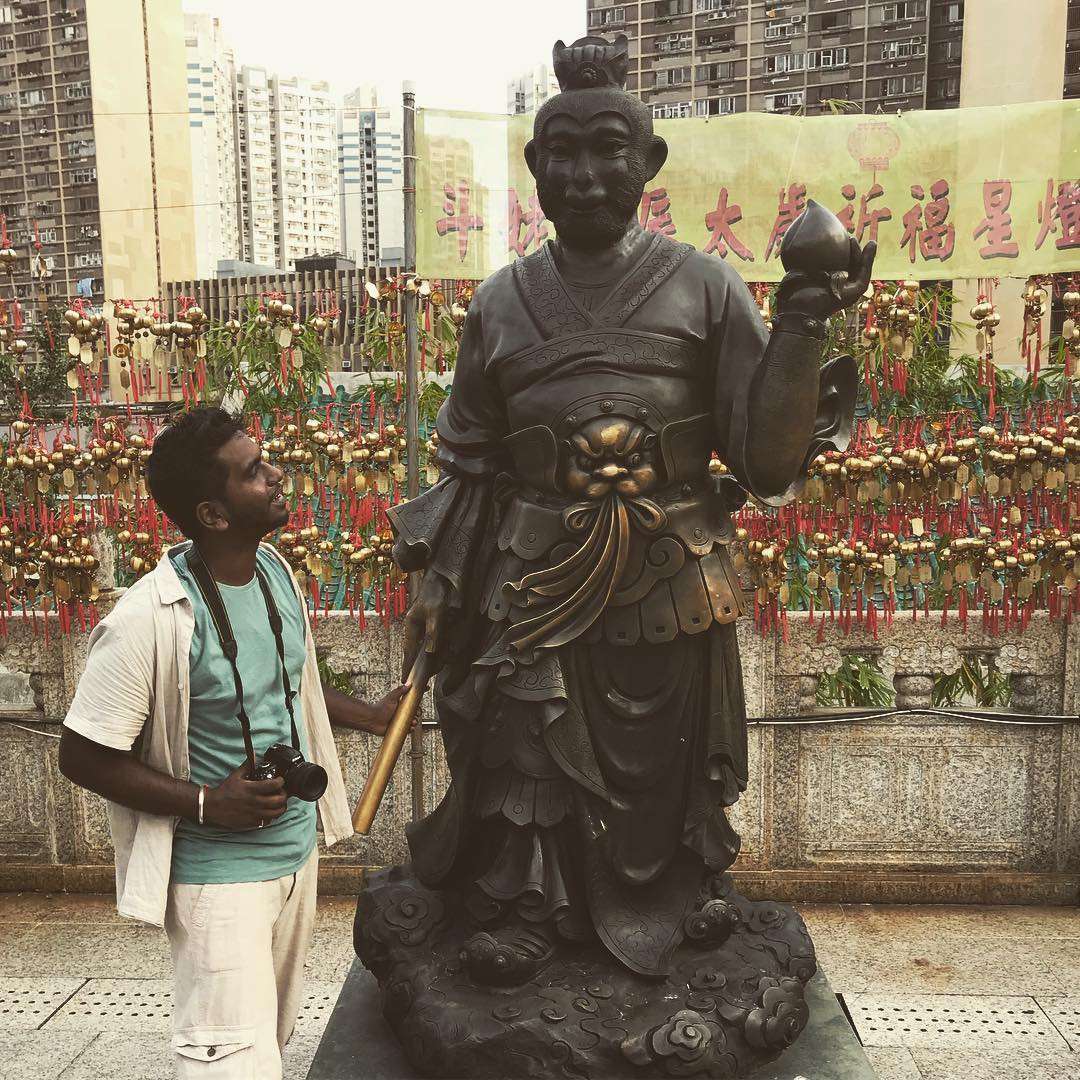
Saie admiring a Monkey King statue at the Wong Tai Sin temple in Kowloon, Hong Kong (larger version).

I. My journey

So how did my journey to the various Great Sage Equalling Heaven temples in Fujian begin? I guess I’ll start from the beginning. Growing up, I would often see images or figurines of the Hindu Monkey God Hanuman in fellow Sri Lankan and Indian homes. For those who don’t know, Hanuman is the Indian counterpart of Sun Wukong and potentially the first known Monkey God. I was curious and intrigued and wanted to know more, but I didn’t get many answers from the people I asked. “He protects us and can revive us from bad health” was the most common reply. I researched the many translations of the Ramayana (one of two great Indian epics within which Hanuman appears) and became enchanted by his many amazing feats and achievements. I was a huge film fan growing up, so I became obsessed with the idea of making films based on him. There have been TV adaptations of Hanuman’s story—I wasn’t a fan of the more human-like portrayals—but, sadly, major Indian studios have yet to make a proper movie about him.

Fast-forward to 2008. Jet Li and Jackie Chan star in the kung fu fantasy The Forbidden Kingdom. Looking back now, it isn’t the greatest film ever, but this is when I first met … Sun Wukong (cue the “Dagger House Prelude”). This was a turning point for me, my obsession multiplied tenfold. Since then I have watched tens, if not hundreds, of film and TV adaptations of Sun Wukong. I’ve also read endless articles and books (one example) in an effort to connect the dots between our (Hindu and Buddho-Daoist) ancestors’ worship of monkey deities. I’ve found there are just too many similarities to ignore.

At first, I had never heard of Sun Wukong’s worship, so when I found the one vague article online describing the Monkey King Festival (the 16th day of the 8th lunar month) in Hong Kong, I decided I would go! I didn’t know what to expect when Jim and I met at the Great Sage Treasure Temple (大聖寶廟) in Kowloon in September of 2018, but it was a big moment for me. Crowds of young and old gathered to worship the Great Sage Equalling Heaven; Daoist priests chanted from prayer books; rows of important businesspeople bowed in unison; martial arts schools performed colorful lion dances, each kwoon paying respect to the altar as they passed; giant paper effigies were burnt. It was a veritable feast for the eyes and ears. Through our interviews with the locals, we not only learned that the festival was considered a time for strengthening community bonds and to help those in need, but also that many adherents believed their faith originated in Fujian, more specifically the city of Fuzhou. This of course agrees with what past scholars have written about Sun’s worship in Fujian.

I have a question: If you ever found yourself in heaven, what would you do? You’d take some good videos to show your friends back on Earth, right? So that was the idea; I started making a documentary (video 1) based on the real people I met and the places I visited, saving my film ambitions for later.

Video 1 – Legends of a Monkey God: Episode 1 – Hong Kong

I was restless some months after returning from the Hong Kong Monkey God Festival. It was like experiencing Heaven for a week and then falling back to Earth like a meteor with many unanswered questions. I was unable to sit around in my miserable London life any longer, so I finally decided to travel where Sun’s worship supposedly began … Fuzhou.

Arriving in Fuzhou was like a pilgrimage in itself. Let me say, this was not an easy journey for me, nor for the translator friend I hired due to my poor Mandarin. The Hokkien accent of Fuzhou gave her a hard time. In addition, the many places I had researched and mapped online seemingly didn’t exist. We visited one after another, with the locals appearing clueless about the temples we inquired about. It was almost as if Sun Wukong’s worship was a secret and only initiated members were allowed access to his houses of worship. Now, there is a saying in India that goes: “You can’t just find Him, He has to invite you”. This saying holds true, for when we finally found one of the locations (see temple one below), a person inside told us about a man who could help me on my journey. I thought, “Hang on a minute … was this guy the savior goddess Guanyin? Was he going to introduce me to my … Sun Wukong?”

I was later introduced to Mr. You, the head of several temples, the Pingshan theatre, and the greatest Sun Wukong follower I have ever met. He set aside two whole days to drive us to several Monkey King temples around Fuzhou, during which time I shot video for another documentary (video 2). I wondered whether or not he wanted anything in return. I mean, no one does anything for free, right? It turns out he was more than happy just to share his Sun Wukong with me and invite me into his secret club! He would not accept any gifts from me. I felt like I was the Tang Monk! And here is the thing: Mr. You and his friends didn’t speak a single word of English—in fact, my Mandarin was unbearable to them—yet we somehow managed to communicate and establish a strong friendship between us, “Brothers bound by the love of Monkey”. I promised myself then that I would return with better Mandarin in a Fujian dialect.

Video 2 – Legends of a Monkey God: Episode 3 – Monkey King Temples of Fujian, China

What I took away from this trip was the fact that Sun Wukong is a deity that sits at the intersection of Buddhism, Daoism, and Confucianism. I saw effigies of him in temples of all the “Three Religions”, sometimes shared, sometimes strictly one faith. But the idea of religion in the East is not the same as that in the West. In the East, you find your own path, follow it to your goal; you don’t need to be on the same path as everyone else and no one judges you for making your own way. It’s just like the Indians say: “The destination is the same, paths are many. God is one, names and forms are many”. This ties in with the works of famed mythologist Joseph Campbell, who would call this the many “masks of God”.

II. Temple list

Note: This list is not exhaustive and will be updated periodically. Most importantly, the following GPS coordinates should ONLY be used as a general guideline. It is highly recommended that those wishing to visit these places should hire the services of a knowledgeable guide. I recommend contacting Mr. You (WeChat id: you410631621)

(Note: Mr. You has died, so his WeChat no longer works.) 

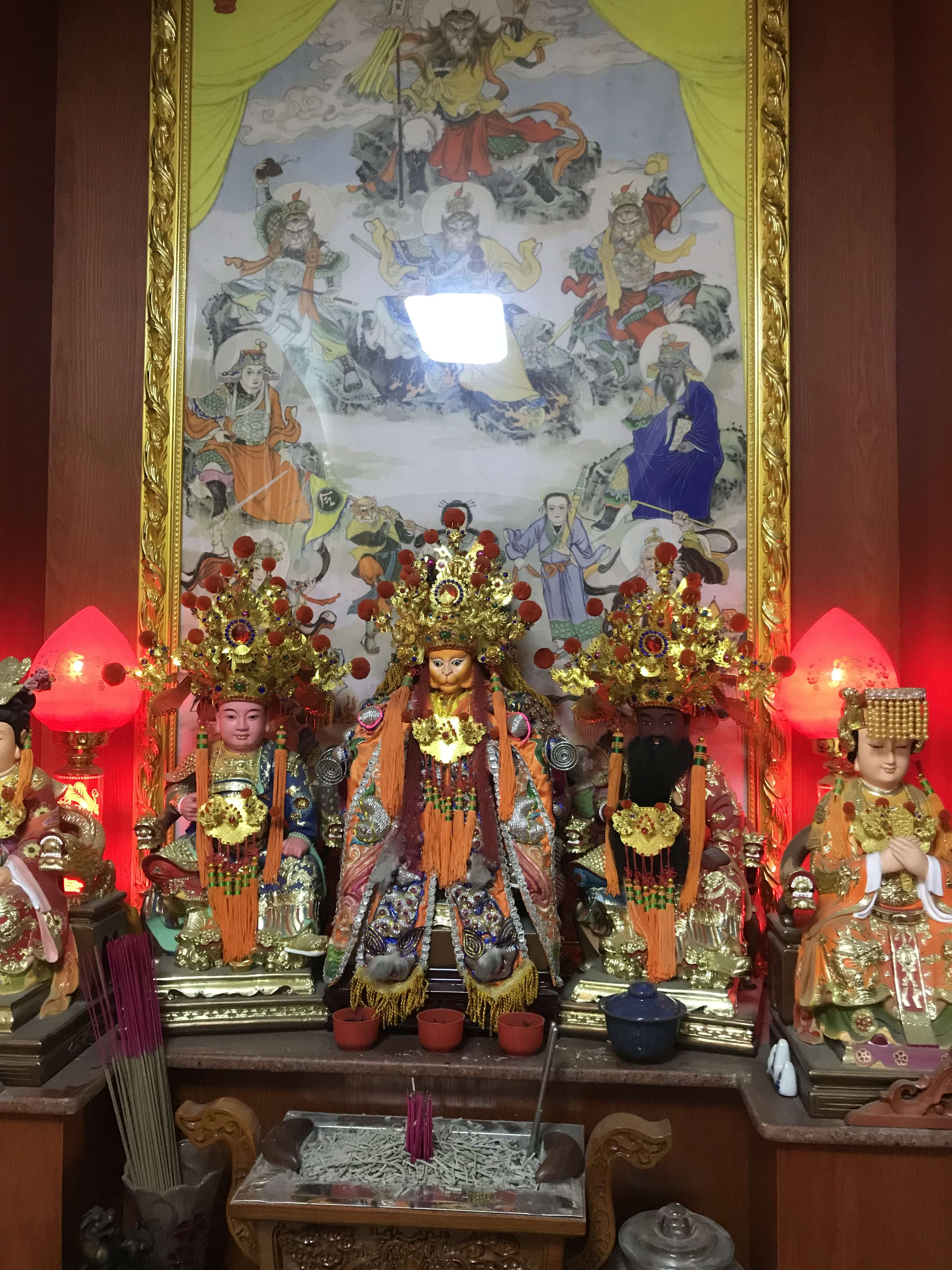
A shrine in Mr. You’s house (larger version).


Temple One: 玉封齐天府屏山祖殿

26°04’45.0″N 119°18’42.6″E
福建省福州市鼓楼区三界寺
Sanjie Temple, Gulou District, Fuzhou City, Fujian Province, China
38H6+MP Gulou District, Fuzhou, Fuzhou, Fujian, China

Pictures

https://drive.google.com/drive/folders/0Bwi3jyIV3-OhfmoyQ0RXN25PalhWbXVncUxwX0pFcDlSbVVDMFRvMm82dWttRlUxaGNVTWc?resourcekey=0-Dq0-f95II5gSZLh9VVu7qg&usp=sharing

IMG_6054


Temple Two

26°04’10.1″N 119°19’56.1″E
福建省福州市晋安区
Eastern District Shangquan, Jin’an, Fuzhou City, Fujian Province, China
389J+QW Jin’an, Fuzhou, Fujian, China

Pictures

https://drive.google.com/drive/folders/0Bwi3jyIV3-Ohfmt2cGV2U1BsVW1iQjVHUEFIZXF6QV9vTndVNkxEdm1SRzA3UURpM25mWDA?resourcekey=0-KybFXH3lW6H0YU4dSIT8Yw&usp=sharing

IMG_6161


Temple Three

26°01’46.8″N 119°15’56.1″E
福建省福州市仓山区百花洲路
Baihua Zhou Road, Cangshan District, Fuzhou City, Fujian Province, China
27H8+V6 Cangshan, Fuzhou, Fujian, China

Pictures

https://drive.google.com/drive/folders/0Bwi3jyIV3-OhfjFhWVdVTTU0bFRMOGo3eGNZSncyal8takVNNTZTLTFBRmNJV3BGOTFyTXc?resourcekey=0-Vp51fSJCx3nejStT3ZjO0g&usp=sharing

IMG_6298


Temple Four: 霞江清泉庵 (齊天大聖殿)

26°02’41.4″N 119°18’34.7″E
福建省福州市仓山区
28V5+WV Cangshan, Fuzhou, Fujian, China

Pictures

https://drive.google.com/drive/folders/0Bwi3jyIV3-OhfmEyMFJHR19OYzM0REhMNzE4bDZZaUd0bjgtdUVZb2h3MndZT0ZQWGVPMm8?resourcekey=0-24cQHhFFVobNPUo6hwLkxg&usp=sharing

For more pictures, see this article.

IMG_6353


Temple Five

26°02’05.1″N 119°21’10.7″E
福建省福州市仓山区后坂路
Houban Road, Cangshan District, Fuzhou City, Fujian Province, China
29M3+W5 Cangshan, Fuzhou, Fujian, China

Pictures

https://drive.google.com/drive/folders/0Bwi3jyIV3-OhflVvT1dOM1RTcDRucXRxT0xfVHoxVFdDZkR4OGpGaGo4VzN1eEZBXzlNVVk?resourcekey=0-X8xhXb0INiwa1FF8kACplg&usp=sharing

IMG_6427


Temple Six

26°06’23.6″N 119°14’30.2″E
福建省福州市闽侯县
Unnamed Road, Minhou County, Fuzhou City, Fujian Province, China
464R+JM Cangshan, Fuzhou, Fujian, China

Pictures

https://drive.google.com/drive/folders/0Bwi3jyIV3-OhflVVSzNCNWVDN25NU05La043NlRyczJSOVc0UkE1aDRfb0ZCeUV4cWJianc?resourcekey=0-cnBTjqM0ZCS0EaizWsGTTQ&usp=sharing

IMG_6662


Temple Seven: 慈恩寺

26°08’54.4″N 119°08’56.9″E
福建省福州市闽侯县军民路
Junmin Rd, Minhou County, Fuzhou City, Fujian Province, China
44XX+9M Ganzhezhen, Minhou, Fuzhou, Fujian, China

Pictures

https://drive.google.com/drive/folders/0Bwi3jyIV3-OhfjUwekJoVTlhclJvVTJDS1NfdDdGXy1PQUg0RHU0WnZUMzI5UWdXRWlzVDQ?resourcekey=0-lDm_EQW1Dj6rEnzeU0BR0Q&usp=sharing

IMG_6681


Temple Eight

26°04’26.2″N 119°11’25.5″E
福建省福州市闽侯县
G316 Minhou County, Fuzhou City, Fujian Province, China
35FR+H5 Shangjiezhen, Minhou, Fuzhou, Fujian, China

Pictures

https://drive.google.com/drive/folders/0Bwi3jyIV3-OhfnFLWGVvWjktaFFfTS1wVHBMdFA2VmtpVW5aUU1qOGNrQ1RQVEo5TG1pTU0?resourcekey=0-_5j182ICuI-0ValCqUQfXg&usp=sharing

IMG_6742


Temple Nine

26°01’49.8″N 119°17’26.7″E
福建省福州市仓山区鹭岭路163号
163 Luling Road, Cangshan District, Fuzhou City, Fujian Province, China
27JR+68 Cangshan, Fuzhou, Fujian, China

Pictures

https://drive.google.com/drive/folders/0Bwi3jyIV3-Ohfmd5WmMza0xuQUtxWThwbmZFRVV5WXlreF9TYkF3ai1WZ01jeDAxQ09pcW8?resourcekey=0-ELD6KPHTI0RCsfAs8LaIUg&usp=sharing

IMG_6765

Update: 02-15-21

Jim here. I have mirrored this article by creating a list of Monkey King temples that I’ve visited in Taiwan.

Qitian Dasheng Monkey King Temples in Taiwan


Update: 10-03-24

I just figured out that the photo links have not worked for several months. This is because my original university gmail account, which hosted the pictures, was shut down. Everything is fixed now.

Archive #15 – Narrative Structure and the Problem of Chapter Nine in the “Hsi-Yu Chi”

Last updated: 04-03-2022

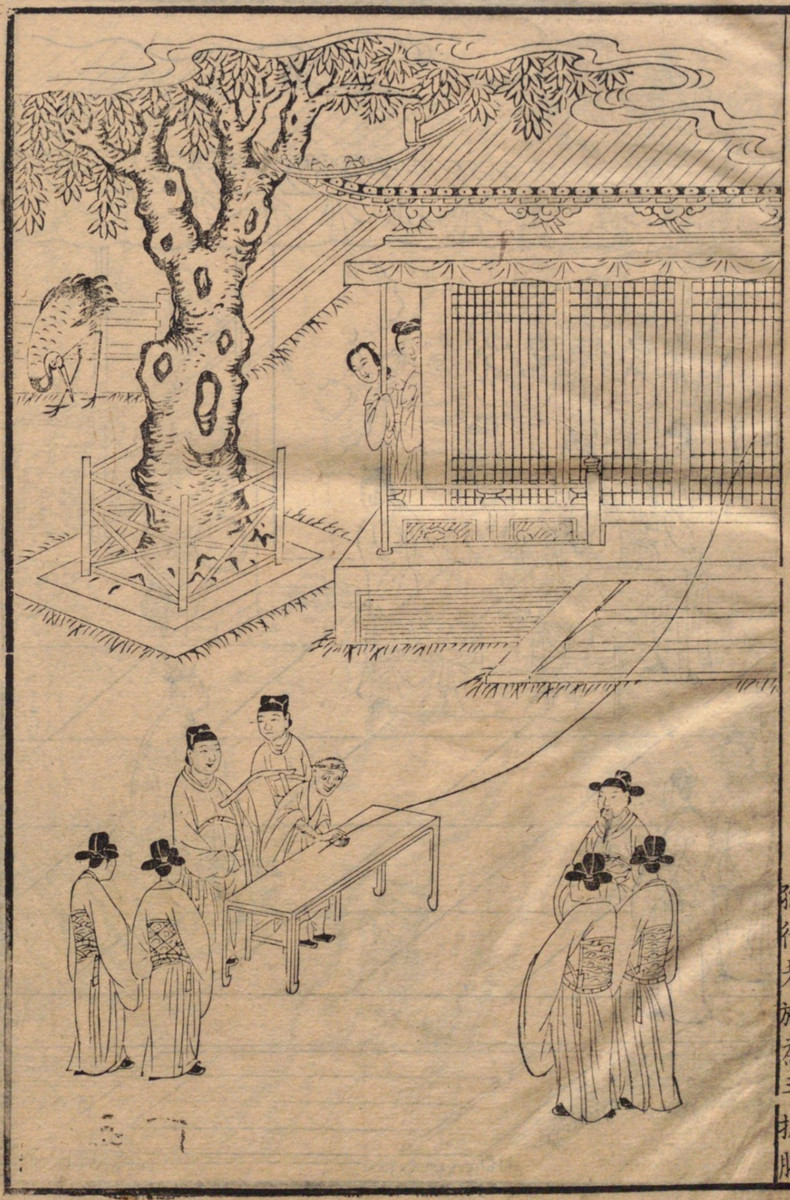
Readers may be surprised to learn that chapter nine of the current one hundred chapter edition of Journey to the West did not appear in the original version anonymously published by the Shidetang (世德堂) publishing house in 1592. Chapter nine of course tells the story of how Tripitaka‘s parents, his scholar-official father Chen Guangrui (陳光蕊) and mother Yin Wenjiao (殷溫嬌), meet (fig. 1); Guangrui’s murder and the pregnant Lady Yin’s kidnapping by a bandit; Tripitaka’s birth and Moses-like trip down a river (hence his nickname “River Float,” Jiang liu, 江流); his rescue, rearing, and initiation into the Buddhist order by the abbot of Gold Mountain; Lady Yin’s rescue and the bandit-turned-official’s arrest; and Tripitaka’s later reunion with his mother and father, the latter’s body having been preserved and brought back to life by heaven.

Some scholars, such as Glen Dudbridge, suggest the current ninth chapter is a forgery, having been written by one Zhu Dingchen (朱鼎臣) of Canton because it appears in his slightly later edited version of the novel titled The Chronicle of Deliverances in Tripitaka Tang’s Journey to the West (Tang Sanzang Xiyou shi ni zhuan, 唐三藏西游释尼傳, circa 1595). (See the 01-02-21 update for new information about Zhu’s version of the novel.) Other scholars posit there is internal textual evidence for a possible lost chapter and that the current ninth chapter was salvaged from these internal clues. 

Tripitaka's Parents

Fig. 1 – Tripitaka’s parents from the 1986 television show. 

Anthony Yu‘s (1975) paper “Narrative Structure and the Problem of Chapter Nine in the ‘Hsi-Yu Chi'” supplements previous analyses of said internal textual evidence. He demonstrates that references to the Chen Guangrui episode litter the book. For example, a poem in chapter twelve (ch. 11 of the original Shidetang version) reads:

Gold Cicada was his former divine name.
As heedless he was of the Buddha’s talk,
He had to suffer in this world of dust,
To fall in the net by being born a man.
He met misfortune as he came to Earth,
And evildoers even before his birth.
His father: Chen, a zhuangyuan [1] from Haizhou.
His mother’s sire: chief of this dynasty’s court.
Fated by his natal star to fall in the stream,
He followed tide and current, chased by mighty waves.
At Gold Mountain, the island, he had great luck,
For the abbot, Qian’an, raised him up.
He met his true mother at age eighteen,
And called on her father at the capital.
A great army was sent by Chief Kaishan
To stamp out at Hongzhou the vicious crew.
The zhuangyuan Guangrui escaped his doom:
Son rejoined sire—how worthy of praise!
They saw the emperor to receive his grace;
Their names resounded in Lingyan Tower.
Declining office, he chose a monk’s life
At Hongfu Temple to seek the true Way,
This old Buddha-child, nicknamed River Float,
With a religious name of Chen Xuanzang. [2]

靈通本諱號金蟬,只為無心聽佛講。
轉托塵凡苦受磨,降生世俗遭羅網。
投胎落地就逢兇,未出之前臨惡黨。
父是海州陳狀元,外公總管當朝長。
出身命犯落江星,順水隨波逐浪泱。
海島金山有大緣,遷安和尚將他養。
年方十八認親娘,特赴京都求外長。
總管開山調大軍,洪州剿寇誅兇黨。
狀元光蕊脫天羅,子父相逢堪賀獎。
復謁當今受主恩,凌煙閣上賢名響。
恩官不受願為僧,洪福沙門將道訪。
小字江流古佛兒,法名喚做陳玄奘。

Yu (1975) notes “this passage…which introduces Tripitaka to the reader, has, with the exception of one major discrepancy (i.e. the name of the monk who took in the river-borne orphan), all the crucial elements constitutive of the Chen Guangrui story” (p. 296).

After providing several more examples, he concedes external textural evidence for a lost chapter has yet to be discovered, but suggests the author-compiler of the Journey to the West was surely familiar with established Yuan-Ming dramas involving Tripitaka’s birth and life:

I think that the foregoing analysis, admittedly brief, is sufficient to show the significance, if not the indispensability, of the Chen Guangrui episode in the narrative, though as I have remarked earlier, these later allusions certainly cannot be construed as incontrovertible proofs for a “lost chapter.” The existence of such a chapter has to be established by further discovery of textual materials hitherto unknown, if such discovery is indeed still possible. It may be safely asserted, however, that the author of the hundred-chapter novel, Wu Cheng’en or whoever he might be, is thoroughly familiar with the tradition of the birth and adventures of the infant Xuanzang popularized in the dramas of Yuan and Ming China, and that he has consciously and skillfully exploited this tradition in his narrative (Yu, 1975, p. 306).

Yu (1975) goes on to counter Dudbridge’s criticism that the Chen Guangrui episode doesn’t progress the overall plot by saying it should, instead, be accepted as an “organizing principle”, one that explains the reason for the monk’s ordeals:

[T]he theme of the river and its attendant perils utilized by the author of the hundred-chapter novel reinforces the theme of Tripitaka’s this-worldly identity as the incarnation of the banished Gold Cicada. Both themes in turn support the threefold aetiology developed in the narrative for explicating the meaning of Tripitaka’s ordeals: as a form of chastisement for his preexistent transgression, as a test of endurance for the earthly pilgrim, and as an exemplum of the high cost of obtaining sacred writings from the West (p. 307).

Furthermore, he counters Dudbridge’s claim that the concept of a lost chapter would be stronger if the novel provided more than just passing references to background info of the central characters. In fact, the novel does provide lengthy info on our heroes. For example, Yu (1975) presents a very long poem from chapter nineteen detailing Zhu Bajie’s life, from his early Daoist training, achievement of immortality, and rise to heavenly rank to his drunken flirting with the moon goddess (fig. 2), banishment from heaven, and mistaken reincarnation on earth as a pig-man.

Zhu Bajie-Chang'e stamp

Fig. 2 – a Taiwanese stamp featuring Zhu Bajie and the moon goddess Chang’e.

In the end, Yu (1975) states Qing-era editors of the novel were justified in their suspicion of a lost chapter given the lack of detailed info about Tripitaka’s life, unlike the other pilgrims:

In the absence of chapter 9, Tripitaka is the only member of the pilgrimage, in fact, whose origins are presented in the manner which Dudbridge ascribes to the disciples: in allusion or indirectly, in moments of retrospect. The early editors of the Xiyouji, therefore, were not wholly unjustified in their protest that a theme of such significance as the Chen Guangrui story had not been more fully accounted for by antecedent narrative (p. 310).

Paper link:


Disclaimer:

This has been posted for educational purposes. No malicious copyright infringement is intended. Please support the official release.


Update: 01-02-21

Zhu Dingchen’s edition of Journey to the West actually predates the 1592 edition. This shows that the aforementioned internal clues in the 1592 edition are based on previous material.


Update: 12-01-21

I’ve archived a book that shows how Tripitaka’s exile from heaven is similar to ancient Greek and Egyptian beliefs.


Update: 04-03-22

I’ve posted an entry discussing the characterization of Tripitaka as a Confucian in the novel.

Notes:

1) A scholar rank. All quotes from Yu (1975) originally use Wade-Giles. I have updated them with Pinyin.

2) Yu, 1975, p. 296. See Wu & Yu, 2012, p. 275 in Yu’s updated translation of the novel.

Sources:

Wu, C., & Yu, A. C. (2012). The journey to the West: Vol. 1. Chicago, Illinois: University of Chicago Press.

Yu, A. (1975). Narrative Structure and the Problem of Chapter Nine in The “Hsi-Yu Chi”. The Journal of Asian Studies, 34(2), 295-311. doi:10.2307/2052750

Archive #14 – Alchemy and Journey to the West: The Cart-Slow Kingdom Episode

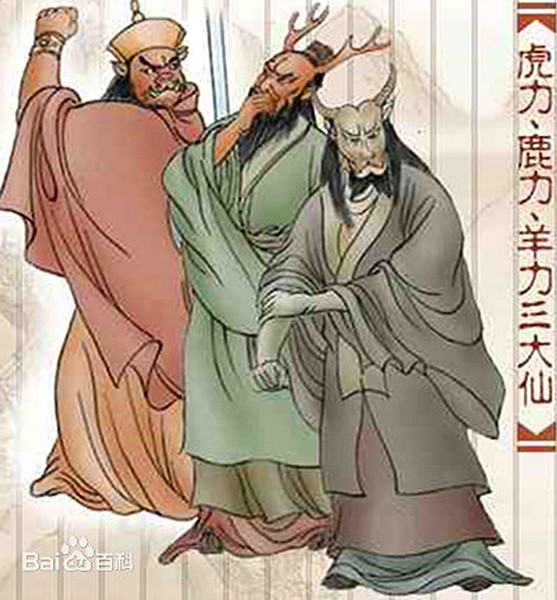
Chapters 44 to 46 of Journey to the West sees the pilgrims enter the Cart-Slow Kingdom (Chechi guo, 車遲國) where they find Buddhist monks have been enslaved by local Daoists to haul a cart full of materials up an impossibly narrow, steep, spine-like ridge in order to construct buildings behind an abbey. After some investigation, Sun Wukong discovers their enslavement is a royal punishment for losing a rain-making competition some years prior to three mysterious Daoist priests, Tiger Strength Great Immortal (Huli daxian, 虎力大仙), Deer Strength Great Immortal (Luli daxian, 鹿力大仙), and Goat Strength Great Immortal (Yangli daxian, 羊力大仙) (fig. 1). (For their victory in saving the country during a time of drought, the three priests are bestowed the royal titles “Precepts of State” (Guoshi, 國師).) Monkey and his brothers break into the abbey and trick the three priests, under the guise of the Three Pure Ones, into thinking their urine is heavenly elixir. The enraged priests then gain permission from the country’s ruler to engage our heroes in a series of magical competitions in order to defend their dignity. After aiding Tripitaka in contests of meditation and clairvoyance, the Great Sage personally faces each of the three priests in contests of surviving corporal punishment, namely beheading (vs Tiger Strength), evisceration (vs Deer Strength), and being boiled in oil (vs Goat Strength). Each priest dies as a result of having lesser magical skills born from heretical practices, and in the end they are revealed to have been animal spirits (a tiger, a deer, and a goat) in disguise. The country’s ruler releases the monks from their bondage and our pilgrims continue their journey to India.

Three Animal Priests (Tiger Strength, Deer Strength, Goat Strength) - small

Fig. 1 – A modern depiction of the three animal priests (larger version). Artist unknown.

Oldstone-Moore’s (1998) paper “Alchemy and Journey to the West: The Cart-Slow Kingdom Episode” explores the history and hidden meaning of the three chapters. She reveals certain aspects of the episode serve as allegories for internal alchemical processes. For background she explains Daoism sometimes presents the body as a microcosmic mountain landscape. In the case of the story, the ridge represents the spine and the building material being hauled by the monks represents unrefined qi, seminal essence, and spiritual energies that, when purified via circulation up the spine and down the front of the body numerous times, bolster the body and aids in the attainment of immortality. The cart itself represents a meditation technique used in the Quanzhen school of Daoism to transport the aforementioned energies up the spine. Interestingly, one Zhong-Lü scripture [1] notes this “River Cart” (heche, 河車) is pulled by a number of animals, including an oxen, a deer, and a goat. Therefore, Deer Strength and Goat Strength likely represent these animals. Oldstone-Moore (1998) suggests Tiger Strength is based on Uncle Eyes Great Immortal (Boyan daxian, 伯眼大仙), a tiger spirit appearing in an earlier version of the Slow-Cart Kingdom episode recorded in a 14th-century Korean primer on colloquial Chinese. Additionally, she highlights the conflict between orthodox and heretical practices in the episode. Sun Wukong is shown to have stronger magic because his early Daoist cultivation was guided by a teacher. This differs from the three priests, whose lesser abilities are the result of self study. So taken together, the episode is a warning that esoteric alchemical cultivation should only be pursued under the guidance of an initiated teacher.   

portrait_of_amoghavajra2c_14_century2c_national_museum2c_tokyo

Fig. 2 – A 14th-century painting of the Buddhist monk Amoghavajra (larger version). Image from Wikipedia. 

Oldstone-Moore (1998) also mentions the rain-making competition between Buddhist and Daoists at the beginning of the episode is based on historical events. This is laid out by Yu (1987), who suggests it is based on Tang-era magic competitions between the Indo-Sogdian Buddhist monk Amoghavajra (Bukong, 不空) (fig. 2) and the Daoist Luo Gongyuan (羅公遠). What’s interesting is that, just like the three priests, Luo was also a Precept of State.

Archive link

Click to access alchemy-and-journey-to-the-west-the-cart-slow-kingdom-episode.pdf

Disclaimer

This has been posted for educational purposes. No malicious copyright infringement is intended. Please support the official release.

Notes:

1) This refers to teachings associated with the immortals Zhongli Quan and his student Lü Dongbin.

Sources:

Oldstone-Moore, J. (1998). Alchemy and Journey to the West: The Cart-Slow Kingdom Episode. Journal of Chinese Religions, 26(1), 51-66, DOI: 10.1179/073776998805306930

Yu, A. C. (1987). Religion and literature in China: The ‘Obscure Way’ in The Journey to the West In C. Tu (Ed.), Tradition and creativity: Essays on East Asian civilization (pp. 122-24). Publisher City, State: Publisher.

Archive # 12 – The Origin of Sun Wukong’s 72 Transformations

Last updated: 06-12-22

Upon Sun Wukong achieving immortality, his Buddho-Daoist master Subodhi warns him of three calamities sent by heaven to kill those who defy their fate and attain eternal life. The Sage then offers to teach Monkey one of two forms of transformation in order to avoid this outcome by living in hiding. [1] The first form, called the “Multitude of the Heavenly Ladle” (Tiangang shu, 天罡數), contains thirty-six changes, while the second, the “Multitude of Earthly Fiends” (Disha shu, 地煞數), contains seventy-two. [2] Our hero chooses the latter and quickly masters a set of secret oral formulas (koujue, 口訣). This becomes one of his signature abilities used throughout the narrative. Monkey’s most famous use of the skill appears in chapter six when he battles Lord Erlang, a divine demon queller and fellow master of transformations (video 1).

Video 1 – Sun’s battle with Lord Erlang. From the great animated Classic Havoc in Heaven (1965).

I. Connection to Chinese astrology and literature

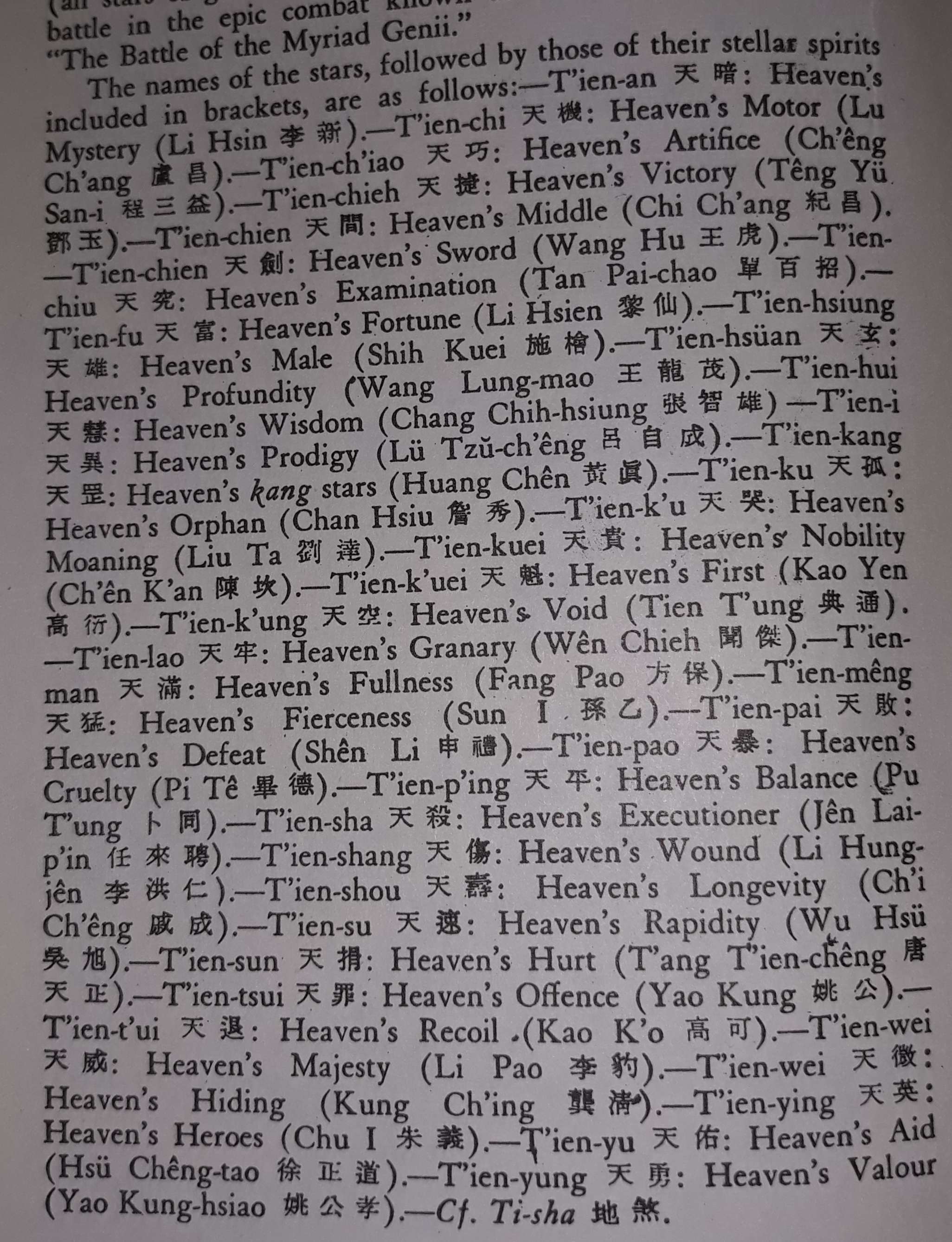
The names of the two forms of transformation that Subodhi offers to teach Monkey can be traced to Chinese astrology. The “Heavenly Ladle” (Tiangang, 天罡; i.e. the Big Dipper) is associated in some traditions with thirty-six stars (fig. 1). Regarding the origin of these stellar bodies, Werner (1932/1969) explains: “The gods of these stars (all stars of good omen) are all heroes who fell on the field of battle in the epic combat known as Wan Xian Zhen 萬仙陣, “The Battle of the Myriad Genii [or Immortals]” (p. 506). [3]

Sun Wukong Transformation - 36 Heavenly Ladle Stars - small

Fig. 1 – A list of the thirty-six Heavenly Ladle stars (larger version). Photograph of Werner, 1932/1969, p. 506. Apologies for not having access to a scanner at this time. 

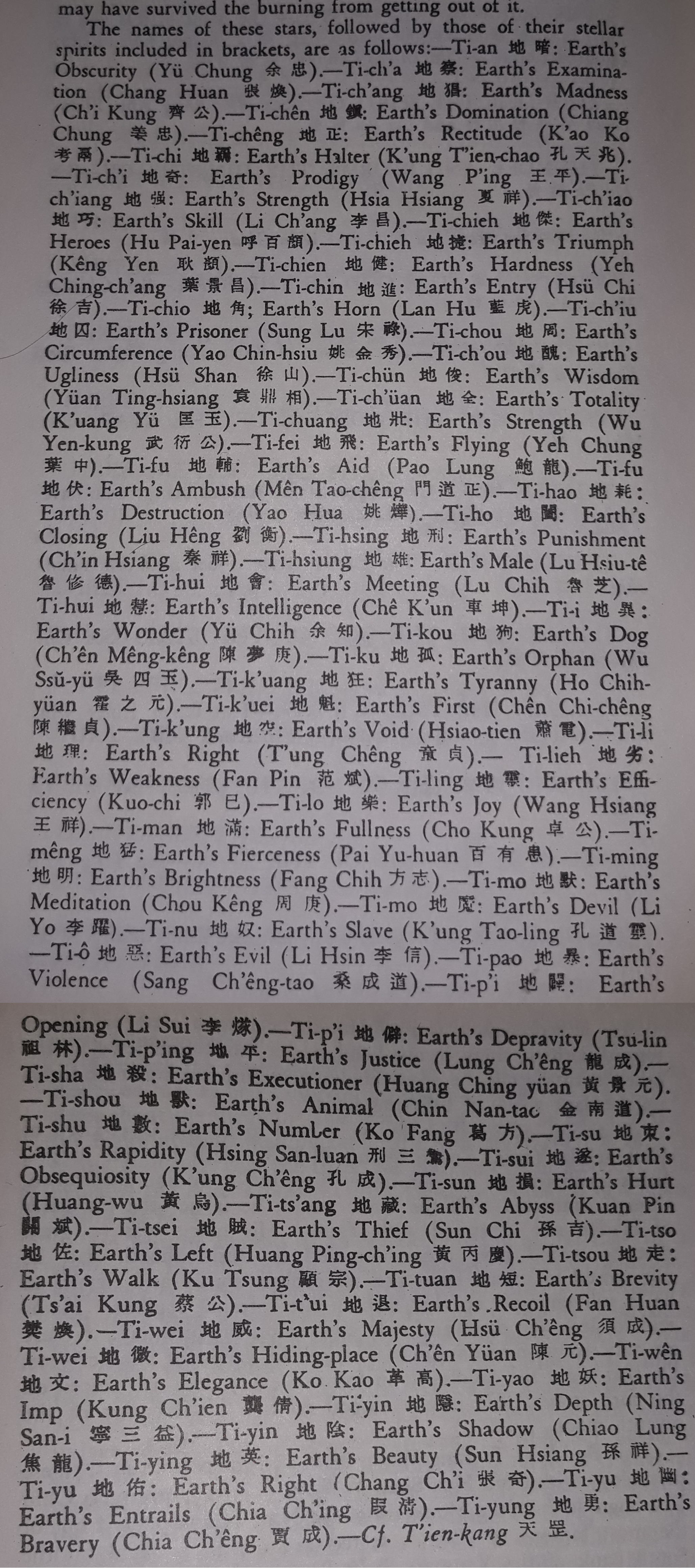
Furthermore, he writes that the “Earthly Fiends” (Disha, 地煞) are:

[S]eventy-two stars [fig. 2] of evil influence, opposed to the Tiangang. The wicked genii of these stars are cast out and slain by tongzi 童子 magicians [i.e. spirit mediums], who impale them on forks and shut them up in earthen jars, then take them to waste lands, throw them into fires, and surround the spot with a circle of lime, which is supposed to prevent any spirit which may have survived the burning from getting out of it (Werner, 1932/1969, p. 496). [4]

Sun Wukong Transformation - 72 Earthly Fiend Stars - small

Fig. 2 – A list of the seventy-two Earthly Fiend stars (larger version). Photographs of Werner, 1932/1969, pp. 496-497.

Additionally, the Earthly Fiends are considered the “enemies of man, and causes of all diseases and ailments” (Doré & Kennelly, 1916, p. xviii). Several Buddho-Daoist folk talismans exist to ward afflictions caused by the Fiends. One such Buddhist talisman said to cure the “one hundred ailments” even invokes the thirty-six Heavenly Ladle stars to aid in the conquering of the seventy-two demons:

An order is hereby made by the “Ministry of the Thunderbolt”, commanding in the name of the “three religions” that the auspicious stellar gods, Tiangang 天罡, reduce to order the maleficent demons, Disha 地煞, who have caused this disease. The charm must also repress these malignant beings and expel them forthwith (fig.3) (Doré & Kennelly, 1916, p. 312).

Di-sha talisman spell #2- small

Fig. 3 – A reproduction of the illness-curing Buddhist Talisman (larger version).

It’s interesting that Sun Wukong chooses the transformation method centered around stars of evil influence and later becomes a demon who challenges heaven. [5] Good fodder for fan fiction, no?

When these dichotomous stellar bodies were first acknowledged isn’t exactly clear. [6] But the Heavenly Ladle stars go back to at least the mid-13th-century as they are mentioned in the Old Incidents in the Xuanhe period of the Great Song Dynasty (Da Song Xuanhe Yishi, 大宋宣和遺事) (Anonymous, n.d.), a storytelling prompt of the late-Song to early-Yuan. It contains the earliest stories associated with the Water Margin (Shuihu zhuan, 水滸傳, c. 1400), a Chinese classic that predates Journey to the West. The one hundred and eight heroes of this novel are famous for being reincarnations of the Heavenly Ladle and Earthly Fiend stars, a fact revealed in chapter seventy-one when a heaven-sent stone slab is found to list their human names along with the corresponding stellar titles. The long association of the stars with the hugely popular Water Margin novel therefore may have inspired the names for the techniques taught by the sage Subodhi in Journey to the West.

II. Ties to Daoist practices

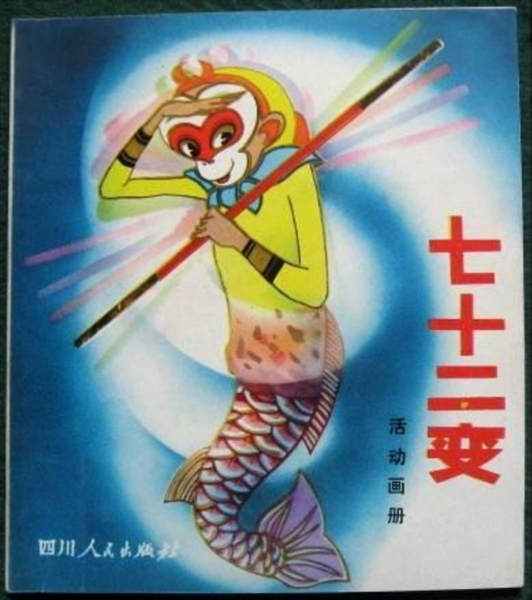
Robinet (1979) expertly explains that transformation (bianhua, 變化), or “metamorphosis” as she calls it, is central to Daoism. Gods and Saints are portrayed in Daoist literature as being in constant flux, changing with the seasons, taking on different guises and titles, disappearing and reappearing, never remaining the same, thereby living eternally. Daoists and magicians achieve metamorphosis through external and internal alchemical processes, the former involving the ingestion of drugs and talismans and the latter via mental exercises. Those who succeed in their practice can divide themselves endlessly; create rivers, mountains, and forests from meager samples of water, earth, and seeds; and, most importantly, change their form into anything (fig. 4), including the five elements, dragons, clouds, rays of light, or even celestial bodies like the sun and moon. 

72 Transformations Childrens Book - small

Fig. 4 – The cover of a vintage children’s flip book about Monkey’s transformations (larger version). Here he is seen changing into a fish.

Interestingly, transformations could be used to live in hiding, much like originally intended by Subodhi in Journey to the West. Adepts still questing for immortality could magically transform a sword, staff, or slipper into their deceased body, thereby faking death and escaping elsewhere to find a method leading to eternal life. (Often times, those who took this route assumed a new identity to avoid heaven’s gaze (Campany, 2005)). Additionally, sages are said to use their powers to hide in the earth or in the light of the sun, moon, and stars. One source mentions adepts hiding by scattering their shadow and transforming it into seventy-two types of light. In a related book chapter, Robinet (1993) notes this number “alludes to [Laozi’s] seventy-two supernatural marks” (clearly borrowing from the Buddhist Mahapurusa laksana) (p. 166). This is fascinating as it shows there is precedent for seventy-two transformations in Daoism.

III. Archive link

I have archived Robinet’s (1979) wonderful paper on metamorphosis. It can be read here:

Click to access robinet-metamorphosis.pdf

Disclaimer

This has been posted for educational purposes. No malicious copyright infringement is intended. Please support the official release.


Update: 06-12-22

I recently posted an in-depth article about the Patriarch Subodhi in which I reveal information about the additional benefits of the 72 Transformations. Anyone involved in any upcoming “What if” battles involving the Monkey King (COUGH, COUGH!) would do well to take note of this information.

Subodhi teaches this skill to Monkey with the expressed purpose of helping him hide from three calamities of cosmic lightning, fire, and wind sent by heaven to destroy immortals for defying fate and achieving eternal life. But beyond the power of metamorphosis, the novel implies that the ability also grants the user multiple lives (similar to a video game), which might serve as a buffer against the calamities. For example, in chapter 41, after Sun passes out from Red Boy‘s fiery attack, Zhu Bajie reassures everyone by saying: “If he is capable of seventy-two transformations, he has seventy-two lives” (Wu & Yu, 2012, vol. 2, p. 232). Also, in chapter 46, Monkey magically regrows his head after being non-fatally beheaded in a contest of magical skillSha Wujing remarks: “If he knows seventy-two ways of transformation, … he may have altogether seventy-two heads!” (Wu & Yu, 2012, vol. 2, p. 308). [7] In addition, while not directly related to the primate hero, the Bull Demon King is said in chapter 61 to also know the 72 changes (Wu & Yu, 2012, vol. 3, p. 148). He uses the extra lives to survive being beheaded by Prince Nezha a number of times:

[Nezha] leaped onto the bull’s back and brought his monster-cleaving sword down on the bull’s neck: the bull was beheaded at once. Putting away his scimitar, the devaraja was about to greet [Sun Wukong] when another head emerged from the torso of the bull, his mouth belching black air and his eyes beaming golden rays. [Nezha] lifted his sword once more and cut off the bull’s head; as soon as it dropped to the ground, another head came out. It went on like this more than ten times. At last, [Nezha] took out his fiery wheel and hung it on the Bull’s horn. The wheel at once started a great blaze of true immortal fire, which burned so fiercely that the bull began to growl and roar madly, shaking his head and wagging his tail (Wu & Yu, vol. 3, p. 160).

Notes:

1) It should be noted that the calamities are sent every five hundred years. Sun never has to live in hiding, though, as he is trapped under Five Elements Mountain upon the five hundredth anniversary of his immortality (he lived to be roughly four hundred prior to taking up spiritual cultivation). And he achieves Buddhahood prior to reaching the one thousandth year of his immortality, so he never has to guard against subsequent calamities.

2) The translation of these names are loosely based on Anthony C. Yu (Wu & Yu, 2012, vol. 1, p. 122). I have provided more accurate names based on related Chinese literature (see section one above).

3) Source changed slightly. I updated the Wade-Giles to Pinyin. This refers to a military trap appearing in the Chinese classic Investiture of the Gods (Fengshen yanyi, 封神演義, 16th-century), which was published around the same time as Journey to the West

4) I’ve previously mentioned a similar ritual in the first section of this article.

5) Conversely, Zhu Bajie is shown capable of thirty-six transformations (for example, Wu & Yu, 2012, vol 2, p. 328), meaning he studied the method associated with the stars of good omens. And of course we know his sordid story…

6) Though, in my opinion, the thirty-six stars are likely based on the thirty-six generals led by the stellar exorcist, Marshal Tianpeng (天蓬, i.e. Zhu Bajie’s former incarnation), who is himself one of the nine stars of the Big Dipper. The Marshal and his generals appear in the liturgy of the Song-era “Correct Method of the Celestial Heart” (Tianxin zhengfa, 天心正法) exorcist tradition (Anderson, 2008).

[7] Thank you to Irwen Wong of the Journey to the West Library blog for bringing these examples to my attention.

Sources:

Anderson, P. (2008) Tianxin zhengfa In F. Pregadio (ed.), The encyclopedia of Taoism: Vol 1-2 (pp. 989-993). Longdon: Routledge.

Anonymous. (n.d.). Da Song Xuanhe Yishi [Old incidents in the Xuanhe period of the Great Song Dynasty]. Retrieved from https://ctext.org/wiki.pl?if=gb&res=290731&searchu=%E5%A4%A9%E7%BD%A1

Campany, R. (2005). Living off the Books: Fifty Ways to Dodge Ming 命 [Preallotted Lifespan] in Early Medieval China In C. Lupke (Ed.), The Magnitude of Ming: Command, Allotment, and Fate in Chinese Culture (pp. 129-150). University of Hawaii Press.

Doré, H., & Kennelly, M. (1916). Researches into Chinese superstitions: Vol. 3 – Superstitious practices. Shanghai: T’usewei Printing Press. Retrieved from https://ia800709.us.archive.org/2/items/researchesintoch03dor/researchesintoch03dor.pdf

Robinet, I. (1979). Metamorphosis and deliverance from the corpse in Taoism. History of Religions, 19(1), 37-70.

Robinet, I. (1993). Taoist meditation: The Mao-shan tradition of Great Purity. Albany: State University of New York Press.

E. T. C. Werner (1969). A dictionary of Chinese mythology. New York: The Julian Press. (Original work published 1932)

Wu, C., & Yu, A. C. (2012). The journey to the West: Vol. 1-4. Chicago, Illinois: University of Chicago Press.

Dragon Ball’s Senzu Bean and Journey to the West

Last updated: 11-20-2021

Fig. 1 – A birdseye view of Senzu beans (larger version). Original image found here.

One reoccurring plot device in the world famous Dragon Ball (Jp: Doragon Bōru,ドラゴンボール; Ch: Qilongzhu, 七龍珠) franchise (1984-present) is the Lima bean-like Senzu (仙豆; Ch: xian dou; lit: “sage or immortal bean”) (fig. 1). As explained by Dragon Ball scholar Derek Padula, the Senzu is a green, crunchy bean used to magically and instantly heal life-threatening flesh wounds and broken bones, to rejuvenate warriors who have overexerted themselves during intense, prolonged training or battle (video 1), and to sate hunger for up to ten days. Its only limitations are the inability to heal viral sicknesses, missing body parts, and preexisting scars. Much like the immortal peaches of the Queen Mother of the West, which only mature every few thousand years, the beans only mature in small numbers, possibly taking hundreds of years for their caretaker, the long-lived sage cat Korin, to harvest a few hundred specimens. The beans become a rarity once a dimwitted character eats them by the handful (Padula, 2015).

Video 1 – The hero Son Goku is healed by a Senzu.

Derek traces the bean to elixirs created by practitioners of Daoist external alchemy. For example, he writes:

The sennin [仙人; Ch: xianren] collect rare ingredients and prized metals such as gold, mercury, mushrooms, and precious stones such as jade. Then they place them into a crucible, stoke the fire, and melt them into a concoction. Each particular ingredient possesses various amounts of yīn and yáng energy, and by mixing the ingredients together in just the right fashion the hermit can concoct a potion or pill that will balance the yīn and yáng in their own bodies. Their hope is that the pill will  increase their life span, eliminate illness and injuries, or confer immortality (Padula, 2015).

He makes a keen connection between the Senzu and immortal peaches. After all, both are heavenly agricultural goods with magico-medical properties.

Over time, legends formed around such practices and made their way into popular culture. For example, the Daoist Patriarch Laozi’s “pills of immortality” and “peaches of immortality” (Chinese: xiāntáo, 仙桃), from Journey to the West that Sun Wukong (the character Son Goku is inspired by) so voraciously devours. Sun Wukong becomes immortal not once, not twice, but thrice, by also practicing Internal Alchemy and transforming his body. Since Xiyouji is the inspiration for Dragon Ball, it’s no surprise that we find a simplified form of them here that Son Goku eats. Senzu do not confer instant immortality in Dragon Ball, but they do provide the other benefits. They’re a simplified representation of ancient and supernormal concepts (Padula, 2015).

While Derek alludes to Laozi’s elixir pills above, I think he might have missed an important element from the novel, one that appears to be the ultimate source for Senzu. After raiding the heavenly peach banquet and getting drunk on immortal wine in chapter five, Sun Wukong stumbles into Laozi’s laboratory and eats all of the god’s elixir pills:

Searching around, our Great Sage went all the way to the alchemical room. He found no one but saw fire burning in an oven beside the hearth, and around the oven were five gourds in which finished elixir was stored. “This thing is the greatest treasure of immortals,” said the Great Sage happily. “Since old Monkey has understood the Way and comprehended the mystery of the Internal’s identity with the External, I have also wanted to produce some golden elixir [jin dan, 金丹] on my own to benefit people. While I have been too busy at other times even to think about going home to enjoy myself, good fortune has met me at the door today and presented me with this! As long as Laozi is not around, I’ll take a few tablets and try the taste of something new.” He poured out the contents of all the gourds and ate them like fried beans [chao dou, 炒豆] (emphasis added) [fig. 2].

In a moment, the effect of the elixir had dispelled that of the wine, and he again thought to himself, “Bad! Bad! I have brought on myself calamity greater than Heaven! If the Jade Emperor has knowledge of this, it’ll be difficult to preserve my life! Go! Go! Go! I’ll go back to the Region Below to be a king.” He ran out of the Tushita Palace and, avoiding the former way, left by the West Heaven Gate, making himself invisible by the magic of body concealment (Wu & Yu, 2012, p. 166).

這大聖直至丹房裡面,尋訪不遇。但見丹灶之傍,爐中有火。爐左右安放著五個葫蘆,葫蘆裡都是煉就的金丹。大聖喜道:「此物乃仙家之至寶。老孫自了道以來,識破了內外相同之理,也要煉些金丹濟人,不期到家無暇。今日有緣,卻又撞著此物。趁老子不在,等我吃他幾丸嘗新。」他就把那葫蘆都傾出來,就都吃了,如吃炒豆相似。

一時間,丹滿酒醒。又自己揣度道:「不好,不好!這場禍比天還大,若驚動玉帝,性命難存。走,走,走,不如下界為王去也。」他就跑出兜率宮,不行舊路,從西天門,使個隱身法逃去。

So we have immortality-bestowing alchemical pills described as beans, which can instantly cure the effects of alcohol, a mild poison. As noted above, Son Goku is based on Sun Wukong. Additionally, many other characters and episodes of the manga/anime were pulled directly from Journey to the West. So it’s not a stretch to think that Akira Toriyama, the creator, embellished the ability of these bean-like pills to create the Senzu.

Fig. 2 – “The Great Sage Steals the Elixir”, from Newly Engraved, Illustrated, Large-Character Official Edition of the Journey to the West (Xinke chuxiang guanban dazi Xiyouji, 新刻出像官板大字西遊記, 1592) (larger version).


Update: 11-20-21

I’ve written an article briefly listing the influences of Journey to the West on Dragon Ball.

Dragon Ball and Journey to the West

Sources:

Padula, D. (2015). Dragon Ball Culture (Vol. 5). (n.p.): Derek Padula.

Wu, C., & Yu, A. C. (2012). The Journey to the West (Vol. 1). Chicago, Illinois: University of Chicago Press.