Sun Wukong and the Three Heavenly Calamities

Last updated: 11-09-2022

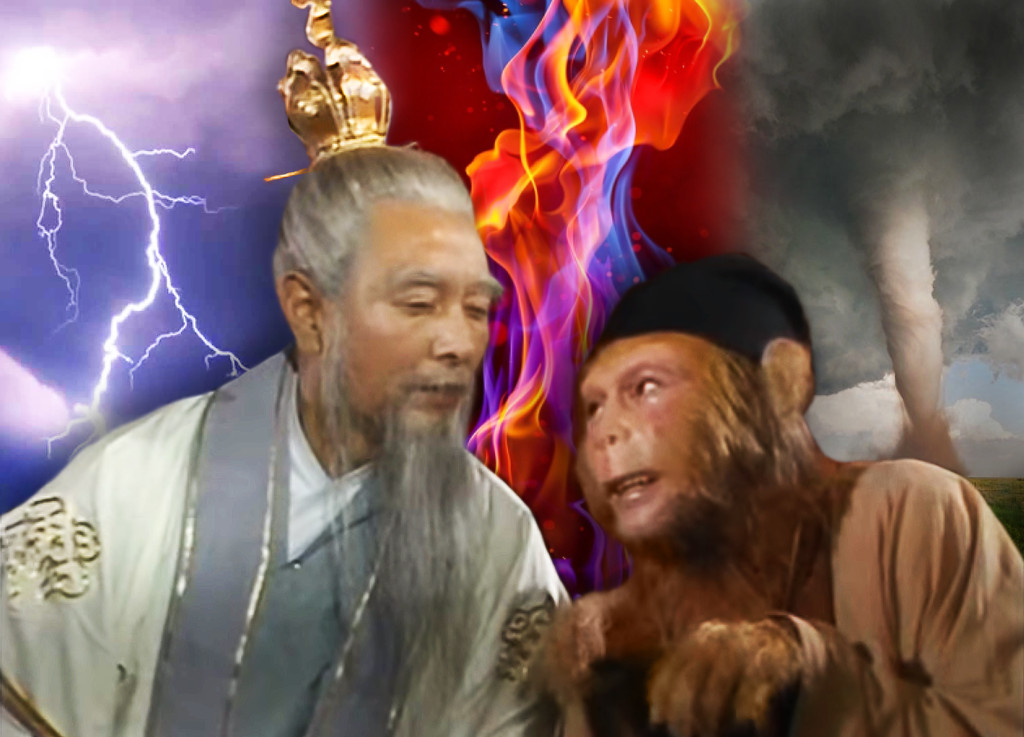
In chapter two of Journey to the West (Xiyouji, 西遊記, 1592), Master Subodhi warns Sun Wukong that he must protect himself from “Three Calamities” (sanzai lihai, 三災利害) sent by heaven to punish him for achieving immortality and defying his fate (fig. 1). These punishments come every half millennia in the form of destructive elements:

Though your appearance will be preserved and your age lengthened, after five hundred years Heaven will send down the calamity of thunder [leizai, 雷災] to strike you. Hence you must be intelligent and wise enough to avoid it ahead of time. If you can escape it, your age will indeed equal that of Heaven; if not, your life will thus be finished. After another five hundred years Heaven will send down the calamity of fire [huozai, 火災] to burn you. The fire is neither natural nor common fire; its name is the Fire of Yin [yinhuo, 陰火], and it arises from within the soles of your feet to reach even the cavity of your heart, reducing your entrails to ashes and your limbs to utter ruin. The arduous labor of a millennium will then have been made completely superfluous. After another five hundred years the calamity of wind [feng zai, 風災] will be sent to blow at you. It is not the wind from the north, south, east, or west; nor is it one of the winds of four seasons; nor is it the wind of flowers, willows, pines, and bamboos. It is called the Mighty Wind [bifeng, 贔風], and it enters from the top of the skull into the body, passes through the midriff, and penetrates the nine apertures. [1] The bones and the flesh will be dissolved and the body itself will disintegrate. You must therefore avoid all three calamities (Wu & Yu, 2012, pp. 121-122).

雖駐顏益壽,但到了五百年後,天降雷災打你,須要見性明心,預先躲避。躲得過,壽與天齊;躲不過,就此絕命。再五百年後,天降火災燒你。這火不是天火,亦不是凡火,喚做『陰火』。自本身湧泉穴下燒起,直透泥垣宮,五臟成灰,四肢皆朽,把千年苦行,俱為虛幻。再五百年,又降風災吹你。這風不是東南西北風,不是和薰金朔風,亦不是花柳松竹風,喚做『贔風』。自顖門中吹入六腑,過丹田,穿九竅,骨肉消疏,其身自解。所以都要躲過。

These calamities are important because Monkey subsequently learns the 72 transformations in order to escape punishment by hiding under any one of a myriad number of disguises. Therefore, exploring the origins of the three calamities has merit.

Fig. 1 – Master Subodhi tells Sun about the Three Calamities (larger version). Photomanipulation by the author.

Table of Contents

1. Origins

The novel likely borrows from a Buddhist cosmological concept called the “Three Calamities” (sanzai, 三災). We first need some background before continuing. Buddhism recognizes a measurement of time called a Kalpa (jie, 劫), which can be many millions or even billions of years long depending on the tradition. Said traditions recognize between four and eighty kalpas (Buswell & Lopez, 2014, p. 409). The total of these respective ranges make up a Mahakalpa (dajie, 大劫), which is divided into four periods of nothingness, creation, subsistence, and finally destruction, each period being between one and twenty kalpas long (Buswell & Lopez, 2014, p. 496). The Three Calamities are responsible for the destruction of each Mahakalpa.

Kloetzli (1983) describes the cyclical destruction of each Mahakalpa by an element:

The destructions are of three kinds: those by fire, those by water and those by wind. […] The destructions succeed one another in the following sequence: seven by fire followed by a destruction by water. This cycle of eight destructions is repeated a total of seven times. This is then followed by seven more destructions by fire, followed by a final by wind. Thus there are 7 x 8 or 56 destructions by fire; 7 by water and a final 64th by wind [fig. 2] (p. 75).

Therefore, the Three Calamities from Journey to the West follow a similar cycle of destructive elements appearing at set time intervals: lightning, fire, and wind every 500 years in place of fire, water, and wind at the end of every Mahakalpa. And instead of destroying the universe, the elements are sent to kill those who have achieved immortality.

Fig. 2 – A chart mapping the cyclical destructions by fire, water, and wind. A larger version is available on the CBETA page.

The earliest mention of Buddhism’s Three Calamities in Chinese writing that I know of appears in scroll one of the Pearl Forest of the Dharma Garden (Fayuan zhulin, 法苑珠林), a Chinese Buddhist encyclopedia published in 688. So there was plenty of time between this work and the publishing of Journey to the West in 1592.

2. Influence on Xianxia Literature

I was interested to learn that Monkey’s calamities made their way into modern Xianxia (仙侠, “Immortal hero”) literature. For example, the author of the Immortal Mountain wordpress writes:

Heavenly Tribulation (天劫 tiānjié) (重劫 zhòngjié) – in some novels, a trial encountered by cultivators at key points in their cultivation, which they must resist and ultimately transcend. Because immortal cultivation (generally) goes against the Will of Heaven, the Heavens will send down tribulations to oppress high-level cultivators who make progress towards Immortality, often right when they enter a new cultivation stage. This typically takes the form of a lightning storm, with extraordinarily powerful bolts of lightning raining down from the Heavens to strike at the cultivator (source).

The trial by lightning is exactly like the calamity of thunder mentioned by Master Subodhi.

3. Conclusion

Subodhi teaches Monkey the 72 transformations with the expressed purpose of hiding from three calamities (sanzai lihai, 三災利害) of celestial lightening, fire, and wind. They are sent by heaven every 500 years to punish cultivators for defying their fate and achieving immortality. Each was likely influenced by the three calamities (sanzai, 三災) of Buddhist cosmology, which states that the universe is alternately destroyed by fire, water, or wind at the end of every Mahakalpa. Both concepts include destructive elemental forces that appear at given times.

The oldest mention of the original Buddhist calamities that I’m aware of appears in a 7th-century religious encyclopedia titled Pearl Forest of the Dharma Garden (Fayuan zhulin, 法苑珠林).

The literary thunder calamity would later come to influence the “Heavenly Tribulation” (tianjie, 天劫; zhongjie, 重劫) of modern Xianxia literature.


4. Updates

Update: 09-10-2018

The Xianxia translator Deathblade (twitter) was kind enough to direct me to an example of a tribulation from a popular Chinese television show . The scene (video 1) involves a 20,000-year-old child immortal experiencing a trial by lightning. The heavenly bolts tear at his clothing and draw blood, but he survives the ordeal.

Video 1 – Start watching from minute 13:08.

Deathblade also directed me to an example from an online Xianxia novel called I shall Seal the Heavens (Wo yu feng tian, 我欲封天). Chapter 385(!) describes how the anti-hero Meng Hao (孟浩) uses a sentient heavenly treasure to protect himself from powerful bolts of lightning, which instead seek out and kill nearby spiritual cultivators on the cusp of immortality:

The Heavenly Tribulation boomed as one lightning bolt after another shot down onto Meng Hao, who held the meat jelly upraised in his hand to defend himself. The lightning would subsequently disperse into the area around him. Any nearby Cultivators would let out bloodcurdling screams. Soon, the air filled with the sounds of cursing and reviling.

Meng Hao didn’t care. This was something he had learned from Patriarch Reliance. When you con someone and then end up getting cursed by them, you must maintain your cool. It was really a realm unto itself.

Throughout the years, Meng Hao had conned many people, and had refined that skill to the very pinnacle. Therefore, he continued to redirect the descending lightning to the various Cultivators in the three thousand kilometer region.

Wherever he went, he was surrounded by a lake of lightning, along with plaintive cursing. What he left behind was scorched corpses.

To the Cultivators here, it was nothing but a massacre, a slaughter in which no one could do anything to fight back. They couldn’t attack him, nor could they flee as… they were horrified to discover that Meng Hao’ speed was incredible, even if he was being struck by lightning!

(read more here)

The character uses trickery to protect himself from the bolts just like Monkey intended to do with his transformations.


Update: 04-02-2021

As I explained above, Wukong learns the 72 transformations in order to escape the heaven-sent punishments of thunder, fire, and wind. Monkey attains eternal life around his 342nd year when his soul is taken to Hell. He is immortal for over 160 years [2] at the time he’s imprisoned under Five Elements Mountain. This means his 500th year of immortality, the year that the calamity of thunder would be scheduled to strike him, takes place during his imprisonment under the celestial mountain. But this is never described in the story. I assume this is just one of many inconsistencies born from oral storytelling. Although, one could argue that, within the fictional universe, the thunder calamity was voided since Wukong was undergoing punishment at the behest of the Buddha.


Update: 08-29-22

It turns out that punishment by lightning appears in other works of religious vernacular fiction. For example, in The Battle of Wits between Sun and Pang (Sun Pang douzhi yanyi, 孫龐鬥智演義, 1636; a.k.a. The Former and Latter Annals of the Seven Kingdoms, Qianhou qiguo zhi, 前後七國志):

Sun Bin [孫臏, d. 316 BCE] was overjoyed when he received the Heavenly Book [from the magic White Ape], and hurriedly went back to light the lamp and read it carefully. But during his reading, he felt an eerie, cold wind and heard the rolling of thunder. The Immortal Master Ghost Valley was meditating on the futon when he heard thunder in the air, so he got up and walked immediately to the door of Sun Bin’s room, only to see him reciting the Heavenly Book. When Ghost Valley heard this, he was taken aback. He pushed the door open and went in and said, “I hid this book in the stone box of the prayer cave. I haven’t passed it onto you because your fate has not yet arrived. Where did you get it?

Sun Bin told the story of the white ape. Ghost Valley said: “It turns out that the evil beast stole it and came to you, but unfortunately it was too early. Besides, when you received the Heavenly Book, you didn’t bathe and burn incense, and you didn’t wash your hands or rinse your mouth, thus blaspheming the gods and provoking a great tribulation [da zainan, 大災難] of 100 days.”

Sun Bin’s continence changed. He asked: “Can master save your disciple?”

Ghost Valley said: “If you want me to save you, you must not disobey my nightmare-suppression method.”

Sun Bin said: “I dare not.”

Ghost Valley said: “Due south behind the mountain is an empty stone tomb. You should sleep in the stone tomb with your head to the south and your feet to the north, with 49 grains of raw rice in your mouth. Cover it with your saliva but don’t swallow the grains. You will feel fully nourished. As long as you hide for forty-nine days, you will escape the great tribulation and protect yourself.”

Sun Bin said, “I sincerely receive your instructions.”

Ghost Valley led Sun Bin to the empty tomb at night. Sun complied with his master’s nightmare-suppression method and followed his instructions. A stele was erected in front of the tomb which read: “The Tomb of Sun Bin of the State of Yan” (Wumen xiaoke & Yanshui sanren, 1636).

Another example comes from the Lady of Linshui Pacifies Demons (Linshui pingyao, 臨水平妖, 17th-century). This time, it involves the immortal Lu Dongbin (呂洞賓; a.k.a. Lu Chunyang, 呂純陽) angering Guanyin, who dispatches thunder deities after him. And just like Sun learns the transformations to hide from the calamities, Lu takes the form of a bug to hide from his punishment:

As we take up our tale anew, Guanyin opened wide her eye of wisdom and saw Pure Yang Lü standing on top of the cloud. She cursed him, saying, “A dumb beast like that has no sense of propriety!” Then she sent the Five Thunders (Wu Lei [五雷]) to strike him. The Immortal Ancestor Lü saw them coming and for an instant was helpless with fright. Unable to escape back to his mountain, he hastily fled to Liang Hao’s study. 

He called to Licentiate Liang, “In a moment of distraction, I offended the Heavenly Court, which has dispatched the Five Thunders to strike me. Save me!” As he spoke, the sound of thunder rolled violently. Liang Hao was so frightened that his hands and feet were like ice, and he was unable to reply. Pure Yang Lü said, “If you are willing to rescue me, then that would give this poor Daoist a place to hide.” Liang Hao agreed with alacrity. Pure Yang Lü then turned himself into a tiny insect, ran under Liang Hao’s fingernails, and hid himself. He waited for an hour and three quarters, until the thunder no longer rolled. There was nothing the Five Thunders could do, so they were obliged to go back to the Purple Bamboo Grove [on Guanyin’s mountain], having failed to carry out the Buddha’s [Guanyin’s] orders. At this time, an hour and three quarters having already elapsed, Pure Yang Lü resumed his original form. He thanked Liang Hao and returned to Zhong Mountain, as he did not dare remain in these harrowing circumstances any longer (Fryklund, Lewis, & Baptandier, 2021, p. 6). 


Update: 11-09-22

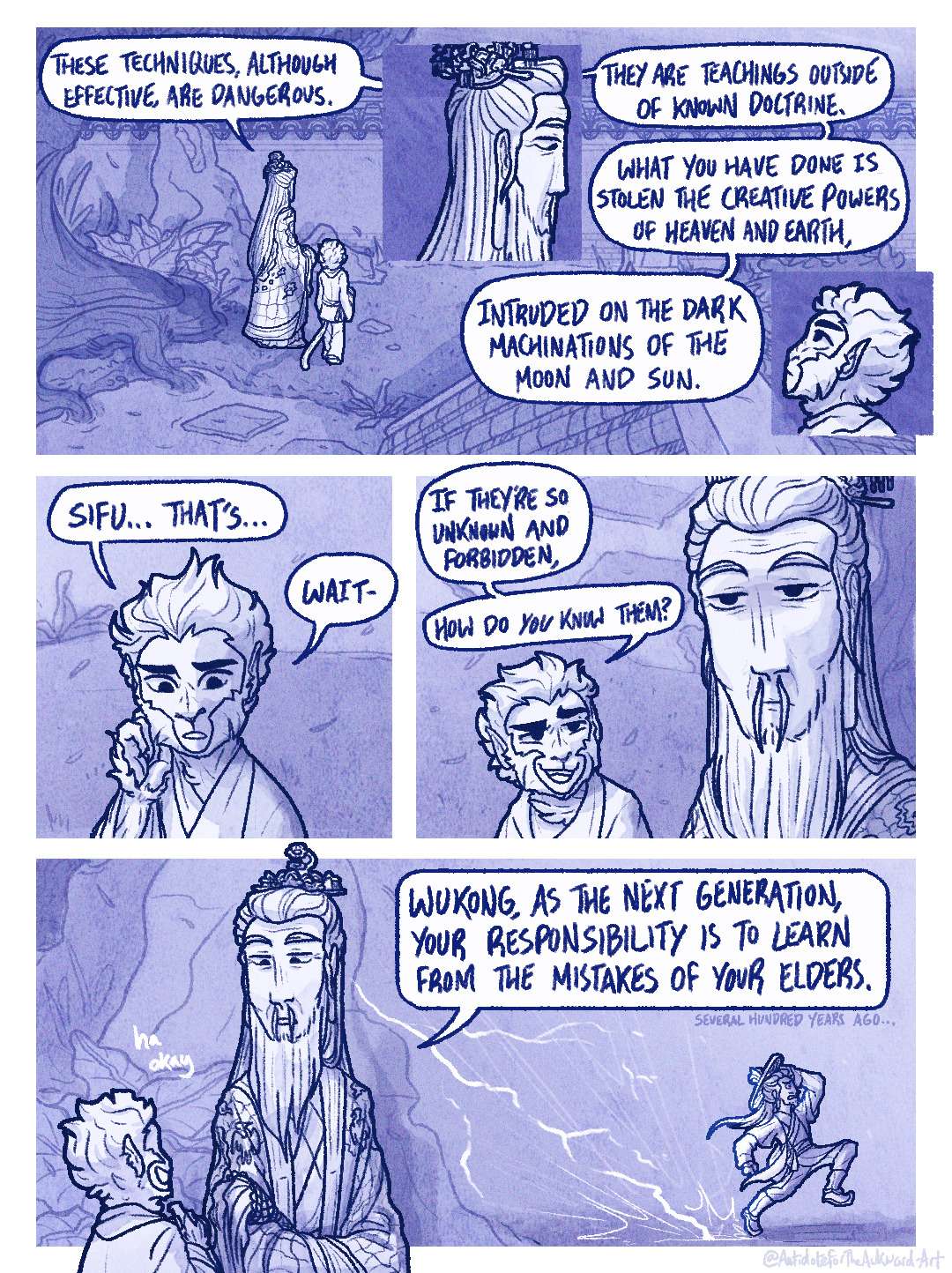
An artist known on Tumblr as “AntidoteForTheAwkward” has posted a wonderful comic (fig. 3) giving a reason for why the Patriarch Subhodi teachers Monkey the 72 transformations in order to avoid the heavenly calamities: personal experience.

Fig. 3 – AntidoteForTheAwkward’s comic (larger version). See the original post here.

Notes:

1) The eyes, ears, nose, mouth, genitals, and anus.

2) Wukong serves in heaven twice: first “for more than ten years” and second “for over a century” (Wu & Yu, 2012, vol. 1, pp. 150 and 166). Then he is punished to 49 days in Laozi’s furnace (Wu & Yu, 2012, vol. 1, p. 189). But the narrative revels “one day in heaven is equal to one year on Earth” (Wu & Yu, 2012, vol. 1, pp. 150 and 167). So this means his turn in the furnace lasts close to fifty years.

Sources:

Buswell, J., & Lopez, D. (2014). The Princeton Dictionary of Buddhism. Princeton, NJ: Princeton University Press.

Fryklund, K. I., Lewis, M. E., & Baptandier, B. (2021). The Lady of Linshui Pacifies Demons: A Seventeenth-Century Novel. Seattle, WA: University of Washington Press.

Kloetzli, R. (1983). Buddhist Cosmology: From Single World System to Pure Land: Science and Theology in the Images of Motion and Light. Oxford: Motilal Books.

Wu, C., & Yu, A. C. (2012). The Journey to the West (Vol. 1) (Rev. ed.). Chicago, Illinois: University of Chicago Press.

Wumen xiaoke, & Yanshui sanren (1636). Qianhou qiguo zhi [Annals of the Seven Kingdoms]. Retrieved from 

Sun Wukong and Martial Arts

Last updated: 08-07-2018

The Monkey King is well known for his prowess with the staff. However, the first two chapters detailing his tutelage under the Buddho-Daoist sage, Patriarch Subodhi, surprisingly do not mention him training in combat skills, what Journey to the West (Xiyouji, 西遊記, 1592; “JTTW” hereafter) calls wuyi (武藝; lit: “martial arts”). [1] In fact, the novel only briefly alludes to it later in a poem from chapter 67, part of which reads: “I bowed to the Patriarch of Spiritual Heart and Elixir Mind and perfected with him the martial arts” (身拜靈臺方寸祖,學成武藝甚全周) (cf. Wu & Yu, 2012, vol 3, p. 243). [2] But beyond the staff, Sun Wukong comes to master boxing, a skill that he only displays twice in the novel.

For example, a poem in chapter 51 describes his unarmed battle with a buffalo demon:

Hitching up his clothes and walking forward, the fiend assumed a boxing posture; his two fists upraised looked truly like two iron sledge hammers. Our Great Sage also loosened his legs at once and moved his body to attack; right before the cave entrance, he began to box with the demon king. This was quite a fight! Aha!

Opening wide the “Four Levels Posture”;
The double-kicking feet fly up.
They pound the ribs and chests;
They stab at galls and hearts.
“The Immortal pointing the Way”;
“Lao Zi Riding the Crane”;
“A Hungry Tiger Pouncing on the Prey” is most hurtful;
“A Dragon Playing with Water” is quite vicious.
The demon king uses a “Serpent Turning Around”;
The Great Sage employs a “Deer Letting Loose its Horns.”
The dragon plunges to Earth with heels upturned;
The wrist twists around to seize Heaven’s bag.
A green lion’s open-mouthed lunge;
A carp’s snapped-back flip.
Sprinkling flowers over the head;
Tying a rope around the waist;
A fan moving with the wind;
The rain driving down the flowers.
The monster-spirit then uses the “Guanyin Palm,”
And pilgrim counters with the “Arhat Feet.”
The “Long-Range Fist,” stretching, is more slack, of course.
How could it compare with the “Close-Range Fist’s” sharp jabs?
The two of them fought for many rounds—
None was the stronger, for they are evenly matched (Wu & Yu, 2012, vol. 3, pp. 12-13)

那妖撩衣進步,丟了個架子,舉起兩個拳來,真似打油的鐵鎚模樣。這大聖展足挪身,擺開解數,在那洞門前,與那魔王遞走拳勢。這一場好打。咦!
拽開大四平,踢起雙飛腳。韜脅劈胸墩,剜心摘膽著。仙人指路,老子騎鶴。餓虎撲食最傷人,蛟龍戲水能兇惡。魔王使個蟒翻身,大聖卻施鹿解角。翹跟淬地龍,扭腕拿天橐。青獅張口來,鯉魚跌脊躍。蓋頂撒花,遶腰貫索。迎風貼扇兒,急雨催花落。妖精便使觀音掌,行者就對羅漢腳。長掌開闊自然鬆,怎比短拳多緊削。兩個相持數十回,一般本事無強弱。

Shahar (2008) notes that this fight “[gave] the author an opportunity to display his familiarity with the contemporary jargon of ‘postures’ (shi and jiazi), ‘Long-Range Fist’ (changquan), and ‘Close-Range Fist’ (duanquan)” (pp. 131-132).

I consulted with martial artist Joshua Viney to learn what each technique involves. (Interestingly, many of these are still known to this day, some better known by slightly different names.) Joshua has lived and studied folk martial arts from village masters around the noted Shaolin Monastery (Shaolin si, 少林寺) for over ten years. He currently maintains the Shaolin Yuzhai Youtube channel, where he posts instructional videos. Please check it out.

Table of Contents

1. The Techniques

1) “Opening wide the ‘Four Levels Posture'” (Zhuai kaida siping, 拽開大四平) – An open fighting posture where the boxer stands in the horse stance (mabu, 馬步) with arms outstretched to his sides. Also known as “Single Whip Horse Stance” (Mabu danbian kai siping, 馬步單鞭開四平) (fig. 1), which is often associated with Taiji boxing (Taiji quan, 太極拳).

Wide open stance
2) “The double-kicking feet fly up” (Ti qi shuangfei jiao, 踢起雙飛腳) – Also known as “Double kicking feet” (Er qi jiao, 二起腳), this technique involves lifting up one knee to build upward momentum and then kicking high with the other (fig. 2). It is reminiscent of the “crane kick” from The Karate Kid (1984).

double jump kick

3) “They pound the ribs and chests” (Tao xie pi xiong dun, 韜脅劈胸墩) – Possibly referring to the “Pushing palm” (Tui zhang, 推掌) or “Splitting palm” (Pi zhang, 劈掌), which is delivered into the solar plexus and up into the rib cage (fig. 3).

Pushing - splitting palm

From Joshua’s APPLICATION of Xiao Hong Quan video.

4) “The Immortal pointing the Way” (Xianren zhilu, 仙人指路) – A double finger attack aimed at the eyes (fig. 4). The stance is often seen used in tandem with a sword.

Immortal points the way

5) “Lao Zi Riding the Crane” (Laozi qihe, 老子騎鶴) – Most likely another name for the Crane stance (fig. 5).

crane stance

6) “A Hungry Tiger Pouncing on the Prey” (E’hu pu shi, 餓虎撲食) – This name has been applied to many techniques. One variation known as “Fetching the moon from the seabed” (Haidi lao yue, 海底撈月) involves a powerful hip and/or palm strike to the groin/lower midline of the body (fig. 6). The force of the hip strike is powerful enough to send someone flying backwards.

Hip bump 1

Left: Setting up the attack. Right: The hit (from Joshua’s 13 Hammers of Shaolin video).

7) “A Dragon Playing with Water” (Jiaolong xishui, 蛟龍戲水) – Also known as “Dragon puking water” (Jiaolong xishui neng xiong’e, 蛟龍戲水能兇惡), this technique involves fluid, sweeping arm movements (most likely blocks or fake strikes) followed by simultaneous double fist blows (fig. 7). The technique is associated with Shaolin and Chang Family Fist (Changjia quan, 萇家拳), a martial art that influenced the development of Taiji boxing. [3]

Dragon puking water

8) “Serpent Turning Around” (Mang fanshen, 蟒翻身) – Also known as “Python turns over” (Guaimang fanshen, 怪蟒翻身), this technique involves a simultaneous chop to the throat and a pulling leg sweep, effectively knocking the opponent backwards (fig. 8).

Pythong turns

9) “Deer Letting Loose its Horns” (Lu jiejiao, 鹿解角) – A series of elbow strikes to the torso (fig. 9). One variant called “Plum blossom deer lies on a pillow” (Meihua lu wozhen, 梅花鹿臥枕) places the fist of the attacking arm against the temple, looking as if the practitioner is propping his head up in a resting posture.

unnamed

10) “The dragon plunges to Earth with heels upturned” (Qiaogen cuidi long, 翹跟淬地龍) – A shooting maneuver using the Falling stance (Pubu, 仆步) to dip below the opponent’s defenses and attack the lower extremities (fig. 10). Also known as Qiaodi long zou xiapan zhao (雀地龍走下盤找).

dragon drops

11) “The wrist twists around to seize Heaven’s bag” (Niuwan na tiantuo, 扭腕拿天橐) – UNKNOWN. Mostly likely a headlock.

12) “A green lion’s open-mouthed lunge” (Qingshi zhangkou lai, 青獅張口來) – More commonly known as “Lion opens mouth” (Shizi dazhang zui, 獅子大張嘴), this technique has two variations. The large frame version involves shooting in low, pulling up the opponent’s knee with one hand, while simultaneously pushing on their head with the other hand, knocking them over (fig. 11). This can be used for throwing an opponent as well. The small frame version involves cupping the hands to intercept strikes.

lion opens mouth

From APPLICATION of Xiao Hong Quan

13) “A carp’s snapped-back flip” (Liyu die ji yue, 鯉魚跌脊躍) – This can refer to both throwing an opponent and a move commonly referred to as a “kip-up.” The latter involves the practitioner flipping up from a supine position to a standing fighting stance (fig. 12).

14) “Sprinkling flowers over the head” (Gaiding sahua, 蓋頂撒花) – Also known as “Double cloud over peak” (Shuangyun ding, 雙雲頂), this technique involves flourishing the hands above the head as a means of blocking, twisting an opponent’s arm, or disengaging from combat (fig. 13).

d8312e2fd284516d5e12d33375177c5e

15) “Tying a rope around the waist” (Raoyao guansuo, 遶腰貫索) – UNKNOWN. Possibly a circling step similar to one later used in Bagua Palm Boxing (Bagua zhang, 八卦掌) (fig. 14).

16) “A fan moving with the wind” (Yingfeng tieshan’er, 迎風貼扇兒) – Crossed hands shooting out to intercept an opponent’s punch (fig. 15).

fan against the wind

17) “The rain driving down the flowers” (Jiyu cuihua luo, 急雨催花落) – Most likely a rapid succession of punches.

18) “Guanyin Palm” (Guanyin zhang, 觀音掌) – A style of palm strikes. It is listed as number 70 of the “72 Training Methods of Shaolin” (Shaolin qishi’er yilian fa, 少林七十二藝練法) (Jin & Timofeevich, 2004, p. 229).

19) “Arhat Feet” (Luohan jiao, 羅漢腳) – A style of kicking.

20) Long-Range Fist (Chang quan, 長拳) – A family of Northern style martial arts known for their long-range punches and kicks and acrobatic movements.

21) Close-Range Fist (Duan quan, 短拳) – A family of Northern style martial arts known for their compact, short-range, yet quick attacks.

2. Battle Reconstruction

What follows is Joshua’s reconstruction of the fight. He makes an interesting observation that the fight may in fact be a theatrical stage combat version of known techniques.

I think what we are seeing here is a Chinese Opera-like performance of a fight that the author saw and perhaps asked about the names or recognised. I expect it would be very contrived. After this we are not told explicitly who does what and it may not be a one for one exchange. Nevertheless looking at the wording we can make a guess.
 
It begins with a large fighting stance, probably the ‘single whip’ posture of holding the arms straight to the sides. Then both performers do a jumping kick towards each other to enter striking range. Given it uses the phrase 劈胸 ‘pi xiong’ (split chest) I expect they begin by using the chest splitting palm at one another and so cross hands in the center of the arena [fig. 16].
cross hands
 
Once they have crossed hands I think the demon grasps Monkey’s hand and attacks with the fingers of the other hand at his eyes, doing the ‘immortal points the way’ technique. Monkey defends against this by shielding his face with his forearms, then spreading his hands and kicking at the monster’s stomach. This pushes the monster away and Monkey is left with one knee suspended and arms spread to the sides in the ‘Lao Tzu rides a crane’ posture.
 
The Demon takes advantage of this unstable posture by rushing at him with the ‘hungry tiger pounces on prey’ technique, striking Monkey with his hips and grasping hold of him. Monkey uses the ‘dragon puking water’ technique, which erupts from below the demons arms and casts them aside, then rushes forwards again to attack with both hands. The Demon defends this by sticking close to the monkey and uses the ‘python turning its body’ technique to trip him up. But Monkey is strong and keeps his footing, counter attacking with a headbutt and multiple elbow strikes which form the ‘Deer-Horn’ technique. 
 
The Demon jumps away but Monkey pursues with the ‘ground dragon’ technique and attacks the demons groin, causing him to buckle over, whereby Monkey grasps his head with the ‘twisting heavens sack’ technique. The Demon defends by using the ‘Lion opens mouth lunge’ to stop Monkey and throw him down. The monkey recovers by flipping his body in the ‘carp jump’ technique. Then he withdraws from the center by a few steps ‘covering his head with the flowers’ overhead technique. The Demon similarly disengages from the center and puts up a guard, prowling slowly around Monkey with the ‘turning waist’ technique.
 
I think the rest is describing more how they are evenly matched and face each other down rather than any other moves. ‘Iron fan stands against the wind’ is a common technique, a guard, and ‘rain falling on flowers’ is perhaps an eye strike but could also mean the intensity of the fight is like an urgent rain of punches. ‘Guanyin palm’ and ‘Luohans feet’ are both style names. Long fist vs short fist, how can they overcome one another? 10 rounds without a victor.

He goes onto describe the physical and psychological aspects of Long-range and Close-range fist:

Long fist and Short fist are the classic methods of Shaolin shenfa [身法, “Body postures”]. In order to strike the opponent one needs momentum, both physical AND psychological. Momentum is achieved by moving the dantian [4] as the centre of mass. In Short fist the dantian is rotated to add to power. In Long fist the whole dantian is thrown in the direction of the strike instead of rotated–much more powerful but also more wild and uncontrollable. In Shaolin philosophy, mind and matter are not severed, so physical momentum and psychological momentum are intertwined; when one has physical forward momentum, one simultaneously feels more confident.

3. Similarities With Other Literary Combat

A poem similar to that from JTTW appears in the 120 chapter version of the Water Margin (Shuihu zhuan, 水滸傳, c. 1594) by Yu Xiangdou (余象斗, c. 1560–c. 1640). The poem describes unarmed combat between a young man and woman.

Opening wide the “Four Levels Posture”;
The double-kicking feet fly up.
“The Immortal pointing the Way”;
“Lao Zi Riding the Crane”;
“Phoenix Elbow” to the heart;
“The Guard Head Cannon Stance” strikes the temples;
The dragon plunges to Earth with heels upturned;
The wrist twists around to seize Heaven’s bag;
This girl, sprinkling flowers over the head;
This boy, tying a rope around the waist;
Two fans moving with the wind;
The rain driving down the flowers.

拽開大四平,踢起雙飛腳。仙人指路,老子騎鶴。拗鸞肘出近前心,當頭炮勢侵額角。翹跟淬地龍,扭腕擎天橐。這邊女子,使個蓋頂撒花;這裡男兒,耍個腰貫索。兩個似迎風貼扇兒,無移時急雨催花落。

We can see many named techniques from Monkey’s battle appear in this poem. There are only two years between the publishing of the standard 1592 edition of our novel and this version of the Water Margin. But it’s very well possible that both authors drew upon common source material.

Joshua discovered two techniques from the Water Margin poem, namely “Phoenix Elbow” (Aoluan zhao, 拗鸞肘) and “The Guard Head Cannon Stance” (Dang toupao shi, 當頭砲勢), appearing together in the same print of an edition of the Collection of Military Works (Wubei zhi, 武備志, c. 1621), a Ming treatise on military armaments and fighting techniques (fig. 17). This suggests that Yu Xiangdou borrowed these moves from similar boxing or military manuals. Likewise, the author-compiler of JTTW may have also borrowed from such literature.

Dangtoupao

Fig. 17 – The print from the Collection of Military Works (Wubei zhi, 武備志, c. 1621) mentioning “Phoenix Elbow” and the “Guard the Head Cannon Stance.”


4. Updates

Update: 05-02-2018

The available evidence suggests that “Short Fist” (Duanquan, 短拳; a.k.a. “Close-Range Fist”) is Sun Wukong’s fighting style. As mentioned above, the poem in chapter 51 reads: “The ‘Long-Range Fist,’ stretching, is more slack, of course. How could it compare with the ‘Close-Range Fist’s’ sharp jabs?” (長掌開闊自然鬆,怎比短拳多緊削。) (Wu & Yu, 2012, vol. 3, p. 13). Also, after facing the buffalo monster, Monkey asks heavenly warriors to critique his boxing skills:

“As you watched from afar,” said Pilgrim, smiling, “how did the abilities of the fiend compare with old Monkey’s?” “His punches were slack,” said Devaraja Li, “and his kicks were slow; he certainly could not match the Great Sage for his speed and tightness'” (Wu & Yu, 2012, vol. 3, p. 14).

行者笑道:「列位在此遠觀,那怪的本事,比老孫如何?」李天王道:「他拳鬆腳慢,不如大聖的緊疾。…」

The “speed and tightness” is of course a reference to his use of Short Fist.

In addition, earlier in chapter two, Sun Wukong faces a demon who had taken over his Water Curtain cave in the immortal’s absence. The two resort to boxing since Monkey is unarmed:

The Monstrous King shifted his position and struck out. Wukong closed in on him, hurtling himself into the engagement. The two of them pummeled and kicked, struggling and colliding with each other. Now it’s easy to miss on a long reach, but a short punch is firm and reliable (emphasis added). Wukong jabbed the Monstrous King in the short ribs, hit him on his chest, and gave him such heavy punishment with a few sharp blows that the monster stepped aside, picked up his huge scimitar, aimed it straight at Wukong’s head, and slashed at him (Wu & Yu, 2012, Vol. 1, p. 128).

那魔王丟開架子便打,這悟空鑽進去相撞相迎。他兩個拳搥腳踢,一衝一撞。原來長拳空大,短簇堅牢。那魔王被悟空掏短脅,撞了襠,幾下觔節,把他打重了。他閃過,拿起那板大的鋼刀,望悟空劈頭就砍。

I initially thought Sun Wukong used Short Fist out of necessity as JTTW describes him being less than four feet tall. But the novel’s bias for close-range fighting over long-range was, according to Shahar (2008), “typical of late Ming and early Qing military literature” (p. 117). He continues:

Sixteenth- and seventeenth-century military experts allude to various short-range styles including ‘Cotton Zhang’s Close-Range Fist’ (Mian Zhang duanda [綿張短打]), ‘Ren Family Close-Range Fist’ (Renjia duanda [任家短打]), and ‘Liu [Family] Close-Range Fist’ (Liu duanda [劉短打])” (Shahar, 2008, p. 117).

Wing Chun (Mandarin: Yong Chun, 詠春) is a close-range fighting style similar to Short fist. Although the style postdates the novel by at least two centuries, it showcases the quick, compact punches associated with Short Fist. Take this video of Jackie Chan, for example. Now imagine Monkey using similar techniques in a fight with a much larger opponent, blocking or ducking to avoid attacks and replying with sharp punches targeted at vulnerable areas.


Update: 08-07-2018

I have found a few more instances of martial arts terms, this time related to weapons. Joshua was again kind to lend his knowledge to the subject.

Chapter 17:

The compliant rod,
The black-tasseled lance.
Two men display their power before the cave;
Stabbing at the heart and face;
Striking at the head and arm.
This one proves handy with a death-dealing rod;
That one tilts the lance for swift, triple jabs.
The “white tiger climbing the mountain” extends his paws;
The “yellow dragon lying on the road” turns his back (emphasis added).
With colored mists flying
And bright flashes of light,
Two monster-god’s strength is yet to be tried.
One’s the truth-seeking, Equal-to-Heaven Sage;
One’s the Great Black King who’s now a spirit.
Why wage this battle in the mountain still?
The cassock, for which each would aim to kill! (Wu & Yu, 2012, vol. 1, p. 354)

如意棒,黑纓槍,二人洞口逞剛強。分心劈臉刺,著臂照頭傷。這個橫丟陰棍手,那個直撚急三槍。白虎爬山來探爪,黃龍臥道轉身忙。噴彩霧,吐毫光,兩個妖仙不可量。一個是修正齊天聖,一個是成精黑大王。這場山裡相爭處,只為袈裟各不良。

22) “‘White tiger climbing the mountain’ extends his paws” (Baihu pashan lai tanzhao, 白虎爬山來探爪) – Mountain climbing stance is synonymous with Gong bu (弓步), or the bow stance. The white tiger denotes an overt attack of sorts. I imagine it would look similar to this spear technique.

Gong Bu thrust

23) “‘Yellow dragon lying on the road’ turns his back” (Huanglong wodao zhuanshen mang, 黃龍臥道轉身忙) – Possibly a retreating maneuver.

Chapter 31:

Dear Monkey King! He raised the rod above his head, with both hands, using the style “Tall-Testing the Horse.” The fiend did not perceive that it was a trick. When he saw there was a chance, he wielded the scimitar and slashed at the lower third of Pilgrim’s [Monkey’s] body. Pilgrim quickly employed the “Great Middle Level” to fend off the scimitar, after which he followed up with the style of “Stealing Peaches Beneath the Leaves” and brought the rod down hard on the monster’s head. This one blow made the monster vanish completely (Wu & Yu, 2012, vol. 2, p. 83).

好猴王,雙手舉棍,使一個「高探馬」的勢子。那怪不識是計,見有空兒,舞著寶刀,徑奔下三路砍;被行者急轉個「大中平」,挑開他那口刀,又使個「葉底偷桃勢」,望妖精頭頂一棍,就打得他無影無蹤。

24) “Tall-Testing the Horse” (Gao tanma, 高探馬) – Tanma (探馬) refers to a military scout, so a better translation would be the “High Scout.” This is a double-handed thrust aimed at the opponent’s face as a high fake. A corresponding fist technique, essentially a jab, is associated with Taiji boxing.

25) “Great Middle Level” (Dazhong ping, 大中平) – Holding the staff level at the navel while in the horse stance. This allows for quick defense below the waist.

26) “Stealing Peaches Beneath the Leaves” (Yedi toutao shi, 葉底偷桃勢) – UNKNOWN. The name of this technique is normally associated with an attack to the groin, not the top of the head as implied in the quoted battle.

Based on the sequence of events described above, it seems like Monkey fakes high, blocks the strike to his body, and then attacks the top of the stooping opponent’s head (since the latter ducked the high fake and attacked low).

Here is Joshua’s interpretation:

The two weapons are stuck together: the monkey is forcing down, the demon up. The monkey releases the pressure, circling his staff below the opponents weapon, so with the release of pressure, the opponent’s weapon flings upwards but with no control. The monkey circles from this lower position, then turns over in a big circle and strikes the opponent downwards on the head.

Chapter 56:

The Great Sage walked forward and picked up the rod with no effort at all. Assuming the style of the Python Rearing its Body (emphasis added), he pointed at the bandits and said, “Your lucks running out, for you have met Old Monkey!” (Wu & Yu, 2012, vol. 3, p. 81).

大聖走上前,輕輕的拿起,丟一個蟒翻身拗步勢,指著強人道:「你都造化低,遇著我老孫了。」

27) “Python Rearing its Body” (Mang fanshen, 蟒翻身). UNKNOWN. This is a differently translated version of a similarly titled technique mentioned above. See number eight (“Serpent Turning Around”). The previous listing referred to a boxing technique, while this, again, is for a weapon.

In closing, I would like to quote a particular passage. While it doesn’t list a given technique, it highlights Monkey’s mastery of the staff. Chapter 33 reads:

“Going through this tall mountain and rugged cliff must have made master [Tripitaka] rather apprehensive, that’s all. Don’t be afraid! Don’t be afraid! Let old Monkey put on a show for you with my rod to calm your fears somewhat.” Dear Pilgrim! Whipping out his rod, he began to go through a sequence of maneuvers with his rod as be walked before the horse: up and down, left and right, the thrusts and parries were made in perfect accord with the manuals of martial arts (emphasis added). What the elder saw from the horse was a sight incomparable anywhere in the world (Wu & Yu, 2012, vol. 2, p. 105).

行者道:「胡說,師父是走著這深山峻嶺,必然小心虛驚。莫怕,莫怕,等老孫把棒打一路與你壓壓驚。」

好行者,理開棒,在馬前丟幾個解數,上三下四,左五右六,盡按那六韜三略,使起神通。那長老在馬上觀之,真個是寰中少有,世上全無。

The portion that Yu (Wu & Yu, 2012) translates as “manuals of martial arts” actually lists the names of two noted military manuals, both of which are listed among the Seven Military Classics of China. The first, the Six Secret Teachings (Liu tao, 六韜), was published during the Warring States period (c. 475–221 BCE) but possibly contains information from as far back as the Qi state (1046–221 BCE). The second, the Three Strategies (San lue, 三略), was most likely published during the Western Han period (206 BCE–9 CE) (Sawyer, 1993).

Associating Monkey’s martial arts skill with ancient military classics only serves to further elevate his status as a great warrior and cultural hero.

Notes

1) Wuyi (武藝) was used to refer to Chinese martial arts as far back as the third century CE. The term predates the more familiar wushu (武術) by some three centuries (Lorge, 2012, p. 10).

2) Readers may think that the “Patriarch of Spiritual Heart and Elixir Mind” (Lingtai fangcun zu, 靈臺方寸祖) is a direct reference to Subodhi. However, the supreme immortal threatened Monkey with eternal torment if he ever revealed the sage had been his teacher. A literal translation of the name is “Patriarch of the Spirit Tower and Square Inch,” which are terms associated with the mind and spiritual cultivation. This is just an interesting way of saying that Monkey had learned martial arts on his own via self-cultivation, thereby not revealing his true master. And at the same time, it is a veiled admission of studying martial arts under the sage.

3) For more information on Chang Family Fist and its progenitor, Chang Naizhou, see Wells (2005).

4) The dantian (丹田, “cinnabar field”) is an area near the navel believed to be the body’s storehouse of spiritual energy.

Bibliography

Jin, J. Z., & Timofeevich, A. (2004). Training Methods of 72 Arts of Shaolin. USA: Shaolin Kung Fu Online Library. Retrieved from http://files.vse-zajimave.webnode.cz…ts-shaolin.pdf
Lorge, P. A. (2012). Chinese Martial Arts: From Antiquity to the Twenty-First Century. New York, NY: Cambridge University Press.

Sawyer, R. D. (1993). The Seven Military Classics of Ancient China. New York: Basic Books.

Shahar, M. (2008). The Shaolin Monastery: History, Religion, and the Chinese Martial Arts. University of Hawaii Press.

Wells, M., & Chang, N. (2005). Scholar Boxer: Chang Naizhou’s Theory of Internal Martial arts and the Evolution of Taijiquan. Berkeley, Calif: North Atlantic Books.

Wu, C., & Yu, A. C. (2012). The Journey to the West (Vols. 1-4) (Rev. ed.). Chicago, Ill: University of Chicago Press.

The Story of Sun Wukong, the Monkey King

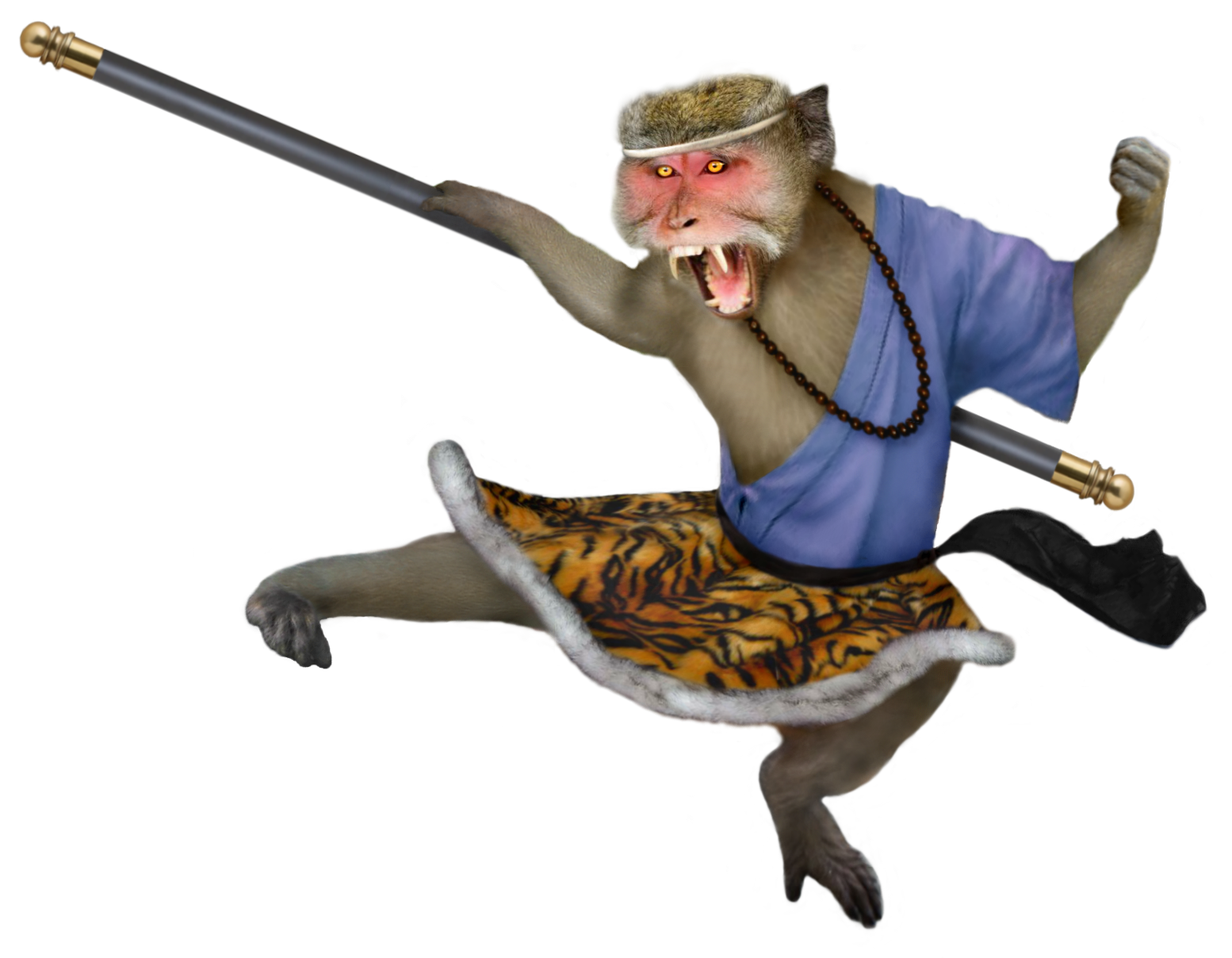
One of the most famous primate characters in world literature appears in the great Chinese classic Journey to the West (Xiyouji, 西遊記, 1592 CE). The story follows the adventures of Sun Wukong (孫悟空, a.k.a. “Monkey”) (fig. 1), an immortal rhesus macaque demon, who gains extraordinary power via spiritual cultivation and rebels against the primacy of heaven. Like Lucifer in Judeo-Christian mythology, this trickster god falls from grace when a supreme deity, in this case the Buddha, banishes him to an earthly prison below. But unlike his western counterpart, the monkey repents, becoming a monk and agreeing to use his abilities to protect a Buddhist priest on his journey to collect sutras from India.

What follows is an overview of Monkey’s story. It will primarily focus on the first seven of the novel’s 100 chapters, but chapters eight through 100 will be briefly touched upon, along with lesser-known literary sequels to Journey to the West. I will also discuss the novel’s impact on pop culture and religion.

Table of Contents

1. His Story

In the beginning, the mystical energies of heaven and earth and the light of the sun and moon come together to impregnate a boulder high atop the Mountain of Flowers and Fruit (Huaguo shan, 花果山), an island that lies to the east of the easternmost continent in the Buddhist disc world system. The stone gestates for countless ages until the Zhou Dynasty (1046-256 BCE), when it hatches a stone egg that is eroded by the elements into a simian shape. The Stone Monkey (Shihou, 石猴) awakens and bows to the four cardinal directions as light bursts forth from his eyes. The light is so bright that it reaches heaven, alarming the Jade Emperor (Yuhuang dadi, 玉皇大帝) and his celestial retinue. The light soon subsides, however, once he ingests food for the first time.

The Stone Monkey happens upon other primates on the island and becomes their king when he proves himself in a test of bravery by blindly leaping through a waterfall, thereby discovering a long-forgotten immortal’s cave. He rules the mountain for over three centuries before the fear of death finally creeps in. One of his primate advisors suggests that the king finds a transcendent to teach him the secrets of eternal life, and so Monkey sets sail on a makeshift raft and explores the world for ten years. His quest eventually takes him to the western continent, where he is finally accepted as a student by the Buddho-Daoist sage, Patriarch Subodhi (Xuputi zushi, 須菩提祖師). He is given the religious name Sun Wukong, meaning “monkey awakened to emptiness” or “monkey who realizes sunyata.” The sage teaches him the 72 methods of earthly transformation, or endless ways of changing his shape and size; cloud somersaulting, or a type of flying that allows him to travel 108,000 li (33,554 mi / 54,000 km) in a single leap; all manner of magical spells to call forth gods and spirits, grow or shrink to any size, part fire and water, create impassable barriers, conjure wind storms, cast illusions, freeze people in place, make endless clones of himself, unlock any lock, bestow superhuman strength, bring the dead back to life, etc.; traditional medicine; armed and unarmed martial arts; and, most importantly, an internal breathing method that results in his immortality. He is later disowned by the sage for selfishly showing off his new found magical skills to his less accomplished classmates.

Sun eventually returns to his cave and faces a demon who had terrorized his people during his prolonged absence. After killing the monster, he realizes that he needs a weapon to match his celestial power, and so his advisor suggests that he go to the undersea palace of Ao Guang (敖廣), the Dragon King of the Eastern Sea. There, he tries out weapons weighing thousands of pounds, but each one is too light. He finally settles on a massive nine-ton iron pillar that was originally used by Yu the Great (Dayu, 大禹) to set the depths of the fabled world flood, as well as to calm the seas. Named the “As-You-Will Gold-Banded Staff” (Ruyi jingu bang, 如意金箍棒), the iron responds to Sun’s touch and follows his command to shrink or grow to his whim, thus signifying that this weapon was fated to be his. In addition to the staff, Monkey bullies the Dragon King’s royal brothers into giving him a magical suit of armor.

Shortly after returning home to the Mountain of Flowers and Fruit, he shows off his new weapon by turning into a frightful cosmic giant and commanding the staff to grow, with the top touching the highest heaven and the bottom the lowest hell. This display of power prompts demon kings of the 72 caves to submit to his rule and host a drunken party in his honor. Soon after falling asleep, Sun is visited by two psychopomps who drag his soul to the Chinese underworld of Diyu (地獄). There, he learns that he was fated to die at the allotted age of 342 years old. But this enrages Monkey since his immortality freed him from the cycle of rebirth, and so he bullies the kings of hell in to bringing him the ledger containing his info. He promptly crosses out his name with ink, as well as the names of all monkeys on earth, thus making them immortal, too. He wakes up in the mortal world when his soul returns to his body.

Fig. 1 – A modern depiction of Sun Wukong (by the author) (larger version).

Both the Eastern Dragon King and the Hell King Qinguang (秦廣王) submit memorials to heaven concerning Sun’s misconduct. But the court advisor, an embodiment of the planet Venus, convinces the Jade Emperor to give Sun the menial task of watching over the Heavenly Horses in order to avoid further conflict. Monkey accepts and steadfastly performs his duties, that is until he learns that he’s just a glorified stable boy. He immediately returns to his earthly home in rebellion to proclaim himself the “Great Sage Equaling Heaven” (Qitian dasheng, 齊天大聖). The celestial realm mobilizes an army of powerful demon hunters, including the Heavenly King Li Jing (Li Jing tianwang, 李靖天王) and his son, the child god Third Prince Nezha (Nezha santaizi, 哪吒三太子), but they all fall to Monkey’s magical and martial might. The embodiment of the planet Venus once again steps in to convince the Jade Emperor to acquiesce to Monkey’s demand for higher rank, thereby granting him the empty title of Great Sage Equaling Heaven and even promoting him to watch over the immortal peach groves.

Sun takes stock of the magical peaches that ripen every few thousand years, but he eventually succumbs to their heavenly aroma. He eats all but the youngest life-prolonging fruits, thus gaining another level of immortality. His theft is soon discovered, however, when fairy attendants of the Queen Mother of the West (Xiwangmu, 西王母) arrive to pick the choicest specimens for her long-awaited immortal peach banquet. Sun is alerted to there presence and, upon questioning them, learns that he has not been invited. Naturally, Sun becomes enraged, freezing the maidens in place with fixing magic and then crashes the party before the hallowed guests arrive. He eats all of the celestial food and drinks all of the immortal wine, and then drunkenly stumbles into the laboratory of Laozi (老子), a high god of Daoism. There, he gobbles up the deity’s alchemically-derived elixir pills, thereby adding several more levels of immortality.

Sun returns home once again to await the coming storm of heavenly forces. Tired of the demon’s antics, the Jade Emperor calls up 72 heavenly generals, comprising the most powerful Buddho-Daoist gods, and 100,000 celestial soldiers. In response, Monkey mobilizes his own army comprising the demon kings of the 72 caves and all manner of animal spirits, including his own monkey soldiers. But soon after the battle commences, the demon kings fall to heavenly troops, forcing Sun to take on three heads and six arms and multiply his iron staff to meet the onslaught. Once again, the heavenly army is no match for him. However, he soon loses his nerve when his monkey children are captured in great heavenly nets. He flees with Erlang (Erlang shen, 二郎神), a master of magic and the nephew of the Jade Emperor, taking chase. The two battle through countless animal transformations, each trying to one-up the other. Monkey is finally captured when Laozi drops a magical bracelet on his head, incapacitating him long enough for Erlang’s celestial hound to bite hold of his leg.

Sun is taken to heaven to be executed for his crimes, but fire, lightning, and edged weapons have no effect on his invincible body. Laozi then suggests that they put him inside of the deity’s alchemical furnace to reduce the demon to ashes. They check the furnace 49 days later expecting to see his rendered remains. However, Monkey jumps out unscathed, having found protection in the wind element (xun, 巽) of the eight trigrams. But intense heat and smoke inside the furnace had greatly irritated his eyes, refining his pupils the color of gold and giving them the power to recognize the dark auras of demons in disguise. He overturns the furnace and begins to cause havoc in heaven with his iron staff. The Jade Emperor finally beseeches the Buddha (Rulai, 如来) in the Western Paradise to intervene.

The Tathagata appears and declares that he will make Sun the new ruler of heaven if the macaque can simply jump out of his palm. Monkey agrees to the wager, and with one tremendous leap, speeds towards the reaches of heaven. He lands before five great pillars, thinking them to be the edge of the cosmos. He tags one with his name and urinates at the base of another in order to prove that he had been there. Upon returning, Sun demands the throne. However, the Buddha reveals that the five pillars were actually his fingers, meaning that the Great Sage had never left. But before Monkey can do anything, the Tathagata overturns his hand, pushing it out the gates of heaven, and transforming it into the Five Elements Mountain (Wuxing shan, 五行山). There, Sun is imprisoned for his crimes against heaven, as well as subjected to a hellish diet.

Chapters thirteen to 100 tell how six hundred years later Sun is released during the Tang Dynasty (618-907) to help escort the Buddhist monk Tripitaka (Sanzang, 三藏) (whose early story is told in chapters eight to twelve), a disciple of the Buddha in a previous life, on a quest to retrieve salvation-bestowing scriptures from India. The Bodhisattva Guanyin (觀音) gives the monk a golden headband (jingu, 金箍; a.k.a. jingu, 緊箍, lit: “tight fillet”) as a means to rein in Monkey’s unruly nature. It tightens around Sun’s head whenever a magic formula is recited, causing him great pain. In addition, Guanyin gives Monkey three magic hairs on the back of his neck that can transform into anything he desires to aid in his protection of the monk. Along the way, the two meet other monsters-turned-disciples—Zhu Bajie (猪八戒), the lecherous pig demon, Sha Wujing (沙悟净), the complacent water demon, and the White Dragon Horse (Bailongma, 白龍馬), a royal serpent transformed into an equine—who agree to aid in the monk’s defense. Monkey battles all sorts of ghosts, monsters, demons, and gods along the way. In the end, he is granted Buddhahood and given the title of the “Victorious Fighting Buddha” (Dou zhanzheng fo, 鬥戰勝佛) for protecting Tripitaka over the long journey.

A summary of all 100 chapters can be read on my friend’s blog (fig. 2).

https://journeytothewestlibrary.weebly.com/novel-summary

Fig. 2 – The summary header (larger version).

2. Sequels

There are a total of four unofficial sequels to the novel.

The first is called A Supplement to the Journey to the West (Xiyoubu, 西游补, 1640), which takes place between chapters 61 and 62 of the original. In the story, the Monkey King wanders from one adventure to the next, using a magic tower of mirrors and a Jade doorway to travel to different points in time. In the Qin Dynasty (221–206 BCE), he disguises himself as Consort Yu in order to locate a magic weapon needed for his quest to India. During the Song Dynasty (960–1279), he serves in place of King Yama as the judge of Hell. After returning to the Tang Dynasty, he finds that his master Tripitaka has taken a wife and become a general charged with wiping out the physical manifestation of desire (desire being a major theme running through the novelette). Monkey goes on to take part in a great war between all the kingdoms of the world, during which time he faces one of his own children in battle. In the end, he discovers an unforeseen danger that threatens Tripitaka’s life.

The second is the Later Journey to the West (Hou Xiyouji, 後西遊記, 17th century). This novel focuses on the adventures of Monkey’s spiritual descendent Sun Luzhen (孫履真, “Monkey who Walks Reality”). I have a three-part article about it (first, second, and third).

And the third and fourth are the Continuation of the Journey to the West (Xu Xiyouji, 續西遊記, 17th century) and the New Journey to the West (Xin Xiyouji, 新西遊記, 19th century), respectively. As of 2023, I have not written any articles on these sequels.

3. Cultural Impact

Stories about Sun Wukong have enthralled people the world over for centuries. His adventures first became popular via oral folktale performances during the Song Dynasty (960-1279). These eventually coalesced into the earliest known version of the novel, The Story of How Tripitaka of the Great Tang Procures the Scriptures (Da Tang Sanzang qujing shihua, 大唐三藏取經詩話; The Story hereafter), published during the late-13th century.

Since the anonymous publishing of the complete novel in the 16th century, Monkey has appeared in numerous paintings, poems, books, operatic stage plays, video games, and films (both live action and animated).

He was sometimes “channeled,” along with other martial spirits, by citizen soldiers of the anti-foreign Boxer Rebellion (1899-1901). There is also a monkey-based martial art named in his honor.

It is interesting to note that there are people in southern China, Taiwan, Malaysia, Singapore, Thailand, and Vietnam who worship him as a patron deity. Thus, Sun became so popular that he jumped from oral and published literature to take his place on the family altar.

Copies of The Story were discovered in Japan among a 17th-century catalog of books in the Kozanji Temple (高山寺, Ch: Gaoshan si). No copies are known to exist in China, which suggests this version came to the island many centuries ago. The complete Ming edition of the novel came to Japan in the late-18th century, where it was translated in bits and pieces over the course of some seventy years. However, Monkey did not become immensely popular until the first complete translation of the novel was published in 1835. The last part was illustrated with woodblocks by Taito II (fl. 1810-1853), a noted student of famous artist Hokusai (1760-1849).

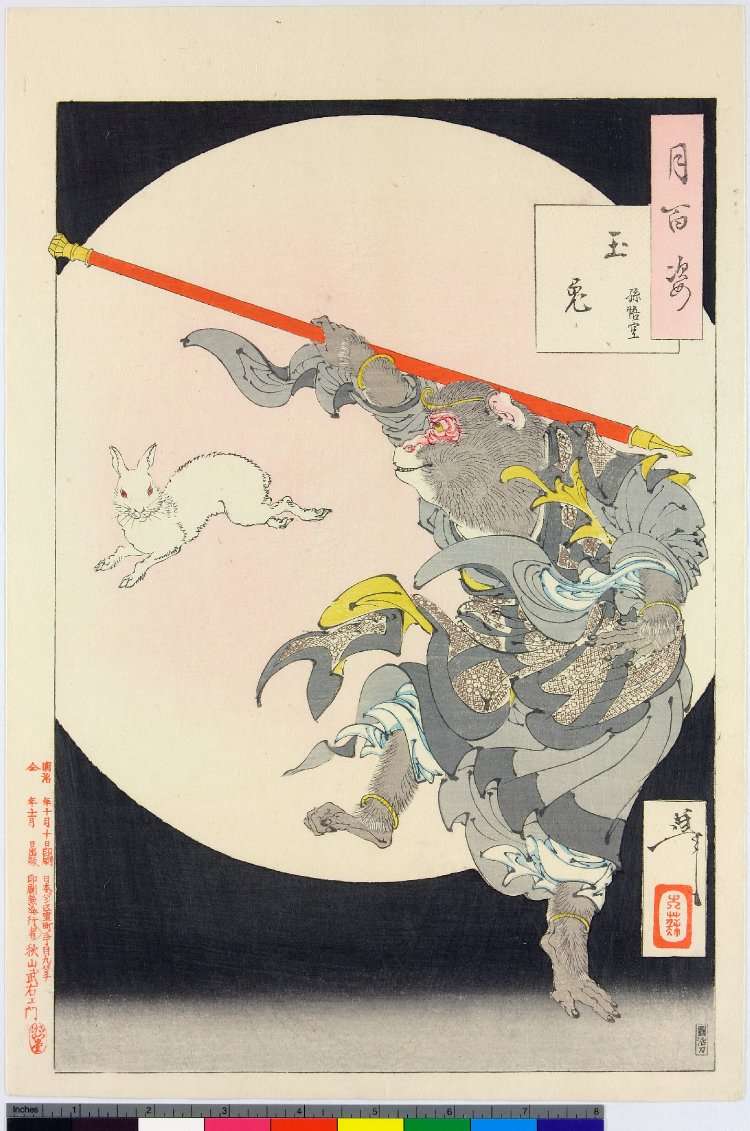
Other Japanese artists, such as Kubo Shunman (1757-1820) and Yoshitoshi (1839-1892) (fig. 3), produced beautiful full color woodblock prints of Sun.

Fig. 3 – (Left) Tsukioka Yoshitoshi, “Jade Rabbit – Sun Wukong”, October 10, 1889 (larger version). Fig 4. – (Right) Son Goku (孫悟空) from the Dragonball Franchise (larger version).

Like in China, Monkey has been adapted in all kinds of Japanese media. By far, his most famous adaptation is the manga and anime character Son Goku (孫悟空) (fig. 4) from the Dragon Ball (Jp:ドラゴンボール; Ch: Qi longzhu, 七龍珠) franchise (1984-present). Like Sun, Goku has a monkey tail, knows martial arts, fights with a magic staff, and rides on a cloud. His early adventures in Dragon Ball (manga: 1984-1995; anime: 1986-1989) see him traveling the world in search of seven wish-granting “dragon balls,” while also perfecting his fighting abilities and participating in a world martial arts tournament. Several of the supporting characters, such as Oolong (ウーロン), a lecherous anthropomorphic pig who can change his shape, a nod to Zhu Bajie, were directly influenced by the novel. Dragon Ball Z (manga: 1988-1995; anime: 1989-1996), a continuation of the comic book and animated TV show, follows Goku as an adult and reveals that he is actually a humanoid alien sent as a child to destroy Earth. He arrived in a spherical spaceship that recalls the stone egg from which Sun Wukong was formed. But instead of destroying the planet, he becomes its stalwart protector and faces extraterrestrial menaces from beyond the stars. Goku’s adventures have continued in the sequels Dragon Ball GT (1996-1997), Dragon Ball Super (2015-2018), and Super Dragon Ball Heroes (2018-present).