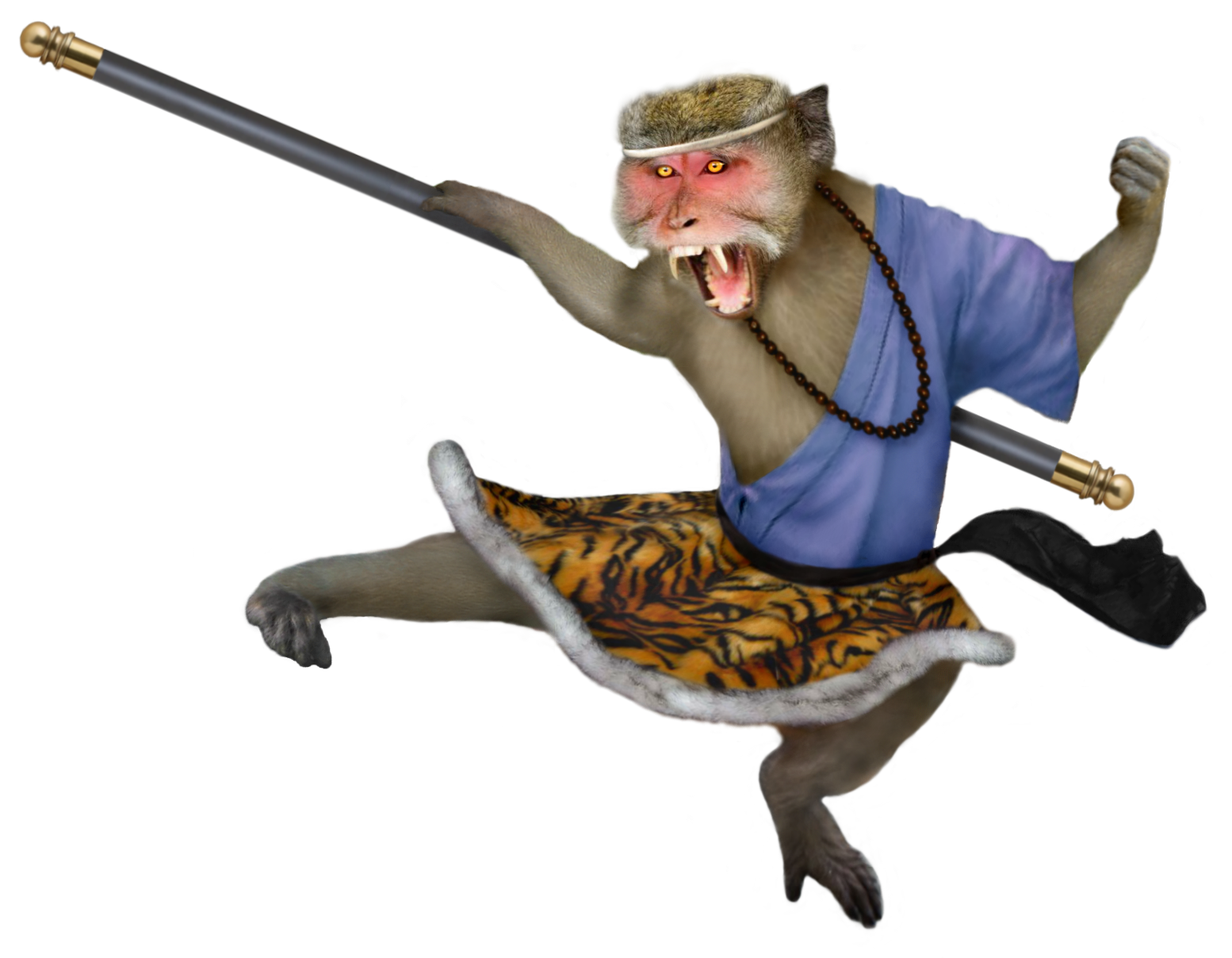
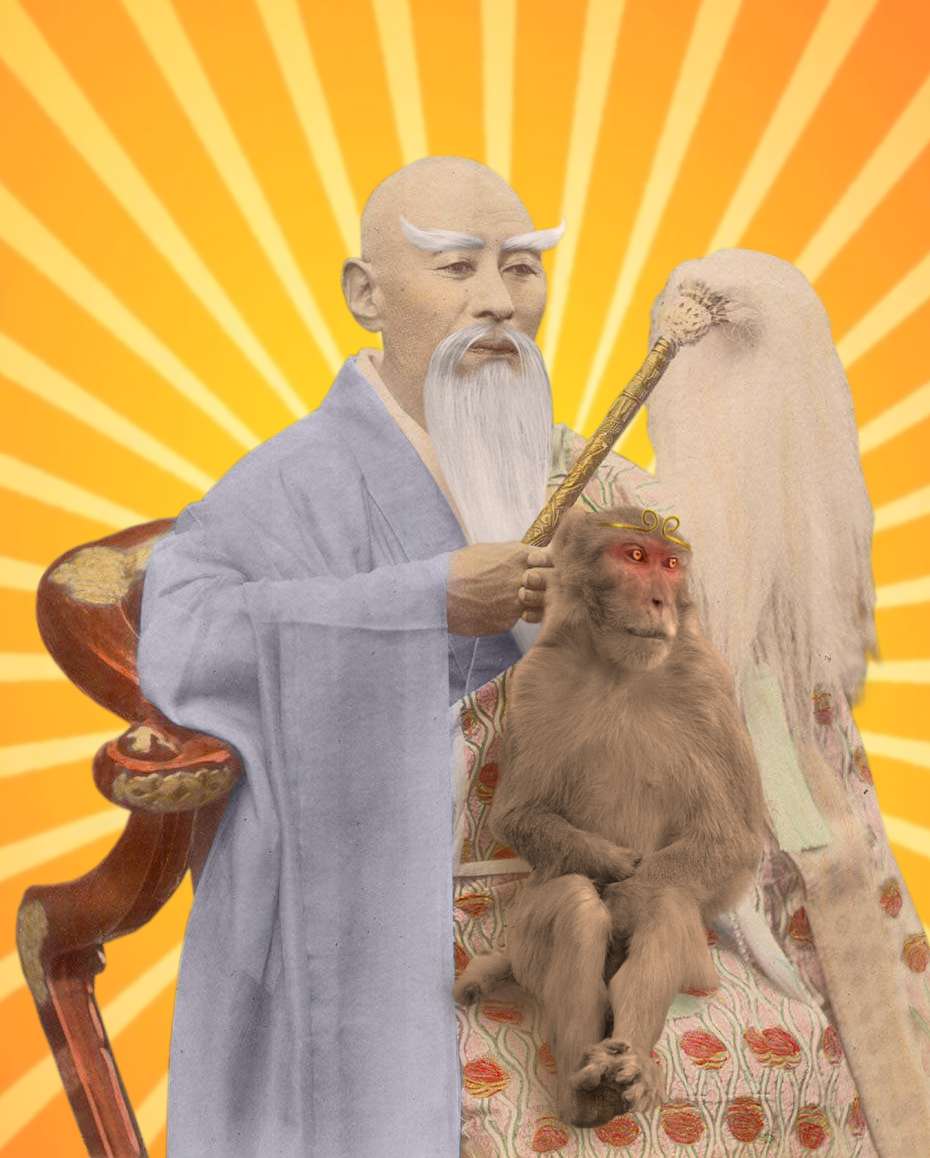
Sun Wukong first appears as the “Monkey Pilgrim” (Hou xingzhe, 猴行者) in The Story of How Tripitaka of the Great Tang Procures the Scriptures (Datang Sanzang qujing shihua, 大唐三藏取經詩話, late-13th-century; “The Story” hereafter), the earliest-known published version of the Journey to the West (Xiyouji, 西遊記, 1592; “JTTW” hereafter) story cycle. He is described as an immortal banished from heaven for stealing divine peaches from the Queen Mother of the West, and he later becomes the ruler of the 84,000 monkeys of Flower-Fruit Mountain. But he first enters the story as a white-clad scholar and willing participant in the journey who actively seeks out the monk Tripitaka and his retinue of fellow clerics on the quest to India. The Monkey Pilgrim then uses his magical abilities and heavenly treasures to protect the monks from all manner of spirits, warlocks, and dragons. In the end, he is bestowed the title “Great Sage Steel Muscles and Iron Bones” (Gangjin tiegu dasheng, 鋼筋鐵骨大聖) (Wivell, 1994). [1]
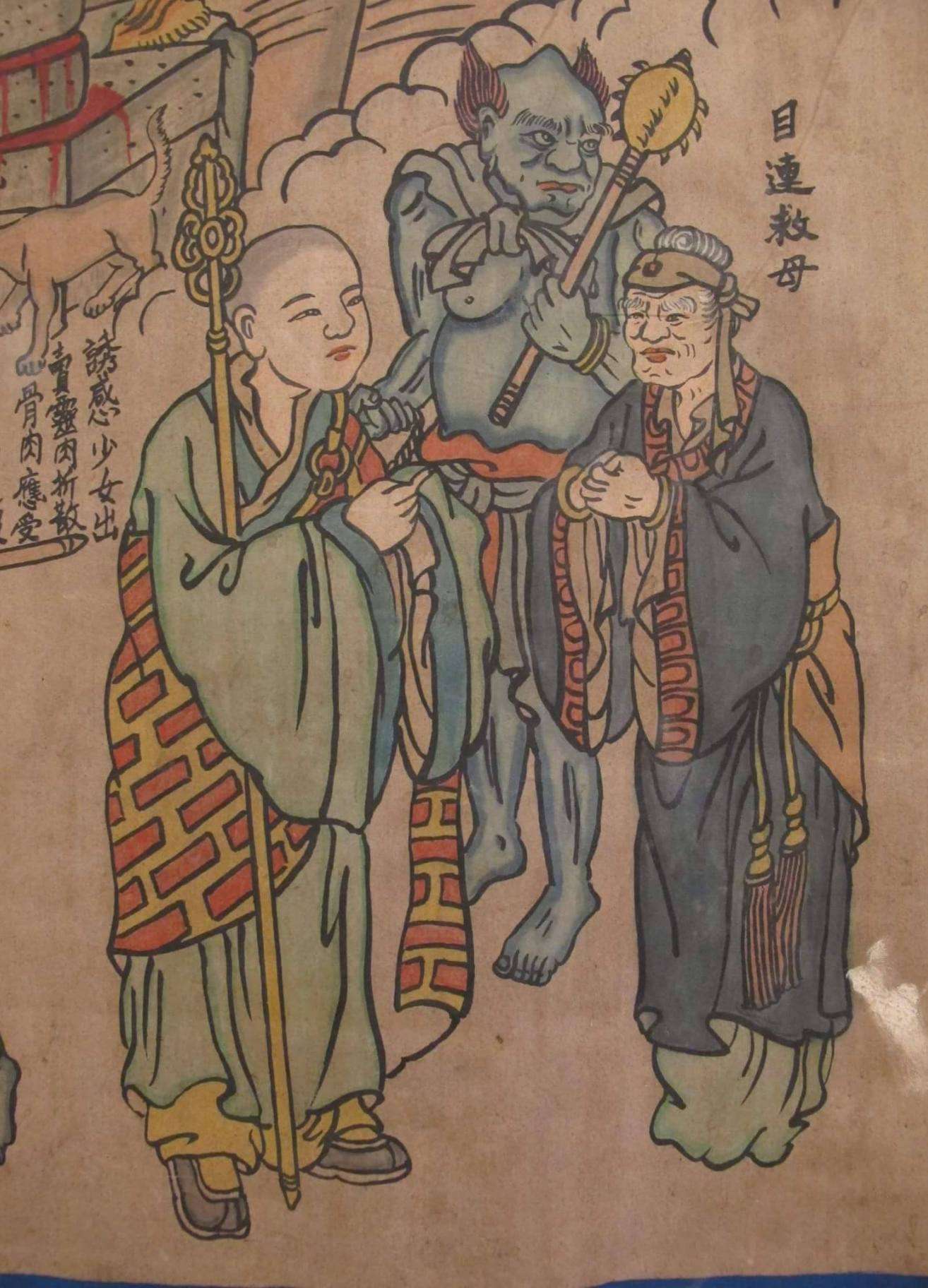
The heavenly treasures wielded by the Monkey Pilgrim are based on those used by the famed Buddhist saint and cultural hero Mulian (目連; Sk: Maudgalyayana), a disciple of the Buddha. He appears in the Transformation Text on Mahamaudgalyayana Rescuing his Mother From the Underworld with Pictures, One Scroll, with Preface (Damuganlian mingjian jiumu bianwen bingtu yijuan bingxu, 大目乾連冥間救母變文并圖一卷並序), a late-9th to early-10th century Bianwen (變文) text in which he travels to the underworld to release his mater from karmic torment (fig. 1). Originally discovered in the oasis of Dunhuang, the text serves as the foundational myth for the Ghost Festival (Gui jie, 鬼節; a.k.a. “Zhongyuan Festival,” Zhongyuan jie, 中元節; a.k.a. “Yulanpen Festival,” Yulanpen jie, 盂蘭盆節), which is held on the 15th day of the seventh month.
In this article, I will discuss three similarities that the Monkey Pilgrim shares with Mulian, including using similar holy treasures, visiting the same heavenly realm, and having a connection to the Ghost Festival. While Tripitaka, as a monk working towards the salvation of others, is a more obvious cognate for Mulian, it’s correct to say that Monkey is an amalgam of the Buddhist saint and Chinese stories of animals that guide the recently deceased through the underworld.
Fig. 1 – A scroll or mural depicting Mulian rescuing his mother from the underworld (larger version). Originally found here.
The Monkey Pilgrim and Tripitaka first receive the golden-ringed monk’s staff, along with two other treasures, from the supreme deity, the Mahabrahma devaraja (Dafan tianwang, 大梵天王; lit: “Great Brahma Heavenly King,” a.k.a. Vaisravana), in chapter two.
The Dharma Master [Tripitaka] and Monkey Pilgrim approached the Devaraja and begged for his help. The Devaraja granted them a cap of invisibility, a golden-ringed staff, and a begging bowl. After accepting these three boons, the Dharma Master said farewell, then turned to the Monkey Pilgrim and asked: “How can we get back to the mortal world?” Pilgrim replied: “Before the Dharma Master speaks of returning to the world below, he had better ask the Devaraja how we can save ourselves from the monsters and disasters which lie ahead of us.” The Dharma Master returned to Mahabrahma and asked as Monkey had suggested. The Devaraja responded: “When you meet calamity, point toward the Heavenly Palace from afar and shout ‘Devaraja’ once, and you will be saved.” The Dharma Master accepted his instructions and bowed farewell (Wivell, 1994, p. 1184).
Now compare that with Mulian’s tale in which he receives the staff from the Buddha:
“How will I [Mulian] be able to see my dear mother again?” The World-Honored called out to him, saying, “Mahamaudgalyayana! Do not be so mournful that you cry yourself heartbroken; The sins of the world are tied to those who commit them like a string, They are not stuck on clay-fashion by anyone else. Quickly I take my metal-ringed staff and give it to you. It can repel the eight difficulties and the three disasters. If only you remember diligently to recite my name, The hells will certainly open up their doors for you” (Mair, 1994, p. 1111).
Both receive a magic monk’s staff with abilities tied to the recitation of a Buddhist deity’s name.
Here is one example of the power of The Story‘s staff:
The pilgrims arrived at the valley of the fire-spitting White Tiger Spirit. Coming closer they encountered a great ditch. The four steep entrances were pitch-black and they heard a roar of thunder. They could not advance. The Dharma Master held up his golden-ringed staff and, flourishing it toward the distant heavenly palace, yelled: “Devaraja! Help us in our afflictions!” Suddenly a shaft of light shot out from the staff five tricents long. It slashed through the long ditch and soon they were able to get across (Wivell, 1994, 1187-1188).
He [Mulian] wiped his tears in mid-air, and shook the metal-ringed staff, Ghosts and spirits were mowed down on the spot like stalks of hemp. Streams of cold sweat crisscrossed their bodies, dampening them like rain, Dazed and unconscious, they groaned in self-pity; They let go of the three-cornered clubs which were in their hands, They threw far away the six-tined pitchforks which were on their shoulders (Mair, 1994, p. 1112).
But The Story‘s treasure builds upon the Mulian tale by adding an exciting new ability: creating giant, monstrous life. For instance, while confronting the white tiger spirit in chapter six:
Monkey Pilgrim transformed his golden-ringed staff into a gigantic yaksa whose head touched the sky and whose feet straddled the earth. In his hands he grasped a demon-subduing cudgel. His body was blue as indigo, his hair red as cinnabar; from his mouth a fiery gleam shot forth a hundred yards long (Wivell, 1994, p. 1189).
How cool is that? And in chapter seven, “he transformed the magic staff into an iron dragon” to battle a group of nine-headed serpents (被猴行者 … 金鐶錫杖化作一條鐵龍) (Wivell, 1994, p. 1190).
Fig. 2 – The head of a 12-ringed monk’s staff (larger version). From the author’s personal collection.
1.2. The Alms Bowl
The treasure bowl is first used in chapter six:
Next they suddenly came to a wild fire [2] which reached to the heavens. It sent off such a huge amount of smoke and sparks that the pilgrims could not proceed. The Dharma Master shone the light of his begging-bowl toward the fire and yelled: “Devaraja!” The fire died out immediately and the seven pilgrims crossed this pit (Wivell, 1994, p. 1189).
It is next used by the Monkey Pilgrim in chapter seven while fighting the nine-headed serpents. He “sucked all the thousand tricents of water into the begging-bowl” (被猴行者 … 缽盂盛卻萬里之水) (Wivell, 1994, p. 1190).
There are no similar feats in Mulian’s story, but his alms bowl is also imbued with magic, allowing him to fly freely between the realms of heaven, earth, and the underworld. For instance,
Maudgalyayana awoke from abstract meditation, Then swiftly exercised his supernatural power; His coming was quick as a thunderclap, His going seemed like a gust of wind. […] With his supernatural power, he gained freedom, So he hurled up his begging bowl and leaped into space; Thereupon, instantaneously, He ascended to the heavenly palace of Brahma (Mair, 1994, pp. 1097-1098).
Both he and the primate hero travel to the Brahma realm. Readers will recall that Monkey magically transports Tripitaka and his group to the crystal palace of the Mahabrahma Devaraja in chapter two (Wivell, 1994, p. 1184).
1.3. Connection to the Ghost Festival
Not only does the Monkey Pilgrim use Mulian-esque treasures, he also ascends to heaven on the Ghost Festival. After the group receives the last of the scriptures in chapter 16, the Dipamkara Buddha tells them:
“On the fifteenth day of the seventh month [i.e. the date of the Ghost Festival], it will be time for you, Dharma Master, and your band of seven to return to the celestial halls. Remember what I have said, and on the fifteenth rise early and bathe yourself. Say farewell to the T’ang emperor, for at noon the ‘Lotus-Plucking Barge’ will arrive. There will also be golden lotus-flower seats and auspicious rainbow-colored clouds. Twelve mellifluously voiced youths will escort you with incense, flowers, and decorated banners. They will adorn you with the seven precious gems, welcoming you seven to return to Heaven. But the invitation from Heaven has a time limit and you must not dally! Listen well to what I have told you and keep it firmly implanted in your mind!” (Wivell, 1994, 1202).
The seven boarded the barge and, looking due west, they ascended into the heavens and became immortals. Nine dragons rose up into the mist and ten phoenixes came out to welcome them. A thousand cranes offered them felicitations and there were flashing lights of transcendence (Wivell, 1994, p. 1206).
Recall that Mulian’s quest to free his mother’s soul from underworld torments is the foundational myth of the Ghost Festival. It actually opens with an explanation of the chthonic celebration:
Now, on the fifteenth day of the seventh month, the heavens open their doors and the gates of hells are flung wide. The three mires dissipate, the ten virtues increase. Because this is the day when the company of monks end their summer retreat, the deity who confers blessings and and the eight classes of supernatural beings all come to convey blessings. Those who undertake to make offerings to them in the present world will have a supply of blessings and those who are dead will be reborn in a superlative place. Therefore, a purgatorian feast is spread before the Three Honored Ones who, through the grace of their welcoming the great assembly, put a priority upon saving those who are distressed by hanging in limbo (Wivell, 1994, pp. 1093-1094).
The Monkey Pilgrim’s use of Mulian-style holy accoutrements, travel to the Brahma realm, and ascension on the Ghost Festival raises the question: is our hero suppose to be a stand-in for the Buddhist saint? The simple answer is “not exactly.” It’s important to remember that he and Tripitaka share the duty of wielding the holy treasures. And while the immortal uses them more, the fact that Tripitaka is a Buddhist monk working towards the salvation of others makes him a more fitting cognate for Mulian.
However, The Story‘s connection to chthonic literature still provides Monkey a link to the Buddhist saint:
The Japanese scholar Chūbachi Masakazu (b. 1938) was the first to point out that the Kōzanji narratives mirror two closely related mythic archetypes. The first, derived from ancient Han Chinese traditions, is the journey of the dead to the netherworld. In many accounts of postmortem travels, spirit animals (including but not limited to monkeys) serve as the guides for the dead on their passage through the spirit realm, whether the final destination is the Yellow Springs beneath the earth or Mount Kunlun in the distant west. The other motif, emerging from early Indian Buddhist literature, is the transmigration of the spirit to the Pure Land, which, like Mount Kunlun, was conventionally located somewhere in the west. In Buddhist accounts, animals (again, often but not always monkeys) also serve as escorts for the dead. Chūbachi proposed that these narrative traditions—culturally distinct but thematically and functionally similar—were fused together with the historical account of Xuanzang’s journey to India. The Kōzanji texts, according to this reading, represent a complex but organic blending of initially independent narratives. The broad contours of Xuanzang’s biography and travelogue were superimposed onto older mythic accounts to provide a new, quasi-historical frame for age-old stories about the transmigrations of the dead.
Viewed from this perspective, Xuanzang was not passing through Central Asia en route to India but, instead, was traversing a hellish purgatory to reach a heavenly pure land. Like a shaman, he departs the human world and enters a dangerous liminal zone. Beset by ghosts and demons, he is guided and protected by powerful spirit animals and Buddhist deities. After enduring extreme hardship, he eventually arrives in an immortal realm populated by spirit monks, immortals, bodhisattvas, and buddhas. From Śākyamuni Buddha, he receives a collection of apotropaic texts with the power to safeguard the living and liberate the dead. Xuanzang then transmits these sacred scriptures back to the human realm before he and his assistants ascend to heaven during the annual ritual for liberating the damned from purgatory. This narrative not only maps the landscape of a postmortem shadow world, it also identifies the scriptures that guard against demonic molestation and ensure a propitious rebirth: the Buddhist canon in general and the Heart Sūtra in particular. Those who read, recited, or heard the Kōzanji texts were thus informed of the perils of purgatory and offered the promise of protection and salvation. Xuanzang, they also learned, was the saintly monk responsible for delivering these divine texts and technologies into the hands of humans (Brose, 2023, pp. 62-63).
Given the above information, it’s more correct to view the Monkey Pilgrim as a sort of amalgam of Mulian and the animal helpers who guide the recently deceased through the under world. This is important to remember, especially when discussing the origins of the Great Sage, for his history is far more nuanced than the “foreign only” (i.e. Hanuman=Sun Wukong) theory would suggest.
2. Updates
2.1 Sun Wukong’s Staff
Update: 09-15-19
Another power of Mulian’s staff likely influenced the Monkey King’s “As You Wish Gold-Banded Staff.” During his quest to free his mother from the underworld, the Buddhist saint uses the treasure to unlock the gates of hell:
With one shake of his staff, the bars and locks fell from the black walls, On the second shake, the double leaves of the main gate [of hell] flew open (Mair, 1994, p. 1113).
Now compare that to an episode from JTTW chapter 25:
“Elder Brother,” said Eight Rules [Zhu Bajie], “stop this hocus-pocus. The doors are all locked. Where are we going to go?” “Watch my power!” said Pilgrim. He seized his golden-hooped rod and exercised the lock-opening magic; he pointed the rod at the door and all the locks fell down with a loud pop as the several doors immediately sprung open. “What talent!” said Eight Rules, laughing. “Even if a little smith were to use a lock pick, he wouldn’t be able to do this so nimbly.” Pilgrim said, “This door is nothing! Even the South Heaven Gate would immediately fly open if I pointed this at it!” (Wu & Yu, 2012, vol. 1, pp. 468-469)
While I believe Mulian’s bowl influenced the somersault cloud, Shao (2006) notes that the 108,000 li (33,554 mi/54,000 km) covered by Monkey in a single leap is based on the symbolic distance said by Huineng to separate the Buddha’s paradise from the world of man. As the Chan patriarch explains in the Platform Sutra, “This number refers to the ten evils and eight wrongs in one’s person” (Huineng & Cleary, 1998, p. 26, for example). Only those who achieve enlightenment can overcome these hindrances and arrive instantly in paradise. This is symbolized in the novel by Monkey zipping their instantly on his cloud, whereas Tripitaka must travel thousands of miles over many years.
Update: 02-06-21
I have written an article that discusses the magic powers of the staff. These include the ability to shrink and grow, control the ocean, astral project and entangle with Monkey’s spirit, multiply endlessly, pick locks, and transform into various objects. It also has sentience to a certain degree.
I’ve rewritten and added new some new information to the article.
Note:
1) Wivell (1994) translates the name as “Great Sage of Bronze Muscles and Iron Bones” (p. 1207). But the gang (鋼) of Gangjin tiegu dasheng (鋼筋鐵骨大聖) means “steel.” Therefore, I’ve changed the original source accordingly.
2) Wivell (1994) translates yehuo (野火) as “prairie fire” (p. 1189), but “wildfire” is a more literal rendering. Therefore, I’ve changed the original source accordingly.
Sources:
Brose, B. (2023). Embodying Xuanzang: The Postmortem Travels of a Buddhist Pilgrim. United States: University of Hawaii Press.
Buswell, R. E., & Lopez, D. S. (2014). The Princeton Dictionary of Buddhism. Princeton University Press.
Mair, V. H. (1994). Transformation Text on Mahamaudgalyayana Rescuing his Mother From the Underworld with Pictures, One Scroll, with Preface. In V. Mair (Ed.), The Columbia Anthology of Traditional Chinese Literature (pp. 1094-1127). New York: Columbia University Press.
Shao, P. (2006). Huineng, Subhūti, and Monkey’s Religion in “Xiyou ji”. The Journal of Asian Studies,65(4), 713-740. Retrieved from www.jstor.org/stable/25076127
It recently occurred to me that Sun Wukong from Journey to the West (Xiyouji, 西遊記, 1592; “JTTW” hereafter) and Wu Song (武松) from the Water Margin (Shuihu zhuan, 水滸傳, c. 1400; “WM” hereafter) share a number of similarities. Each is a reformed supernatural spirit, a tiger slayer, a Buddhist monk nicknamed “Pilgrim,” and a monastic martial artist, and each wears a moralistic headband and wields a weapon made from the same fanciful metal. Since the WM predates the publication of JTTW by nearly two hundred years, one might be tempted to speculate that the latter influenced the former. However, both story cycles first appeared during the Song dynasty, with various iterations from the Yuan to the Ming (see Ge, 2001). In this article I show the parallels are due to the respective narratives drawing on similar religious, folkloric, and historical source material. I feel such a comparison is important as it presents a fuller picture of the cultural landscape in which the Monkey King developed.
Chapters one through seven of JTTW present Sun Wukong as a celestial stone-born monkey who studies under a Buddho-Daoist master and achieves great magic powers, which he uses to rebel against heaven. After being defeated by the Buddha, Monkey is imprisoned under Five Elements Mountain for five hundred years. In chapter fourteen, the repentant immortal is later released to protect the monk Tripitaka on his journey to retrieve scriptures from India.
Fig. 1 – A modern action figure of Sun Wukong’s imprisonment under a section of Five Elements Mountain (larger version).
Chapter one of the WM tells how one hundred and eight spirits were quelled by a Daoist sage during the Tang dynasty and imprisoned in a bottomless pit under a great stone slab. Four or five hundred years later during the Song dynasty, a haughty government official orders the slab dug up and removed to sate his curiosity, allowing the spirits to escape in a plume of miasmic black fumes and later be reborn on earth. Wu Song, whose main story appears in chapters 23 to 32, is one of these extraordinary men and women who come to use their martial, intellectual, or magical skills to rebel against the corrupt Song government. A heaven-sent stone slab in chapter 71 is later discovered to list the names of each bandit with the corresponding name of their previous incarnation, which make up the “Thirty-Six Heavenly Stars” (Tiangang sanshiliu xing, 天罡三十六星) and the “Seventy-Two Earthly Fiend Stars” (Disha qishier xing, 地煞七十二星). Wu Song is listed as the “Heavenly Harm Star” (Tianshang xing, 天傷星), the fourteenth of the Thirty-Six Heavenly Stars.
So we see both are formerly evil spirits who were conquered by a religious figure and imprisoned under stone for centuries. After being released, each rebellious figure becomes a force for good.
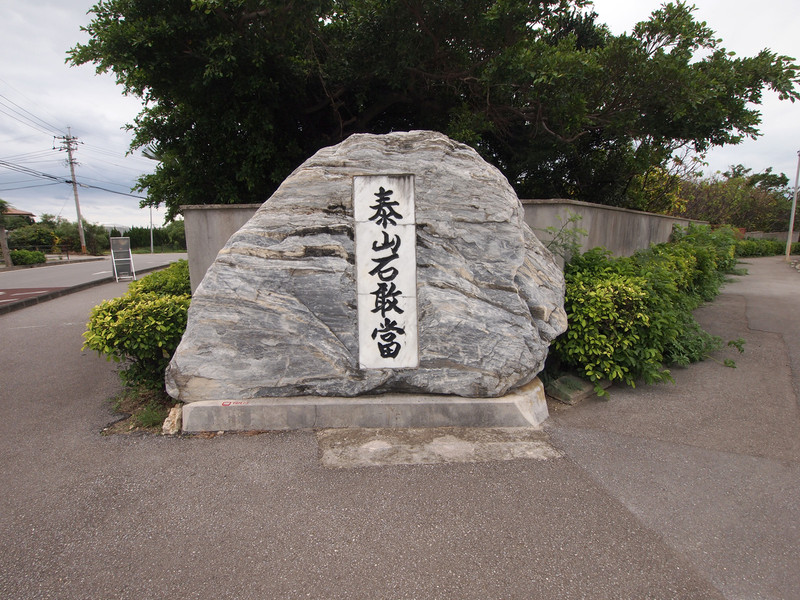
Monkey’s punishment can be traced to Tang and Song dynasty tales about the sage king Yu the Great imprisoning a simian water demon under a mountain. To my knowledge, the first recorded mention of this punishment appears in an early-Ming zaju play in which Guanyin traps Sun Wukong under Flower Fruit Mountain. Wang (1992) suggests that the stone slab from the WM was likely influenced by the Taishan stone (taishan shi, 泰山石) (fig. 2), a class of “evil-warding stones” (shigandang, 石敢當) often placed outside of homes and temples or at the intersection of roads as protection from malevolent forces (pp. 71-72 and 254). The Taishan stone represents Mount Tai and its deity. The landmass is considered the heaviest thing imaginable in Chinese culture. This means that the evil would be completely immobilized by the great weight.
Fig. 2 – A modern Japanese example of a Taishan stone (larger version). They often read “Taishan stone takes upon itself” (Taishan shi gandang, 泰山石敢當), denoting its duty of protection (Wang, 1992, p. 71). Original image from Wikipedia.
Additionally, the pit containing the spirits can be traced to a Song-era Daoist ritual in which an exorcist draws the character for “well” (jing, 井/丼) on the ground, thereby dividing the ritual space into nine sections, representing the Nine Palaces (jiugong, 九宮), [1] and creating an earth prison. The Compilation of Rituals of the Way (Daofa huiyuan, 道法會元) reads:
[U]se the Sword mudrā to draw the character for “well” on the ground. Transform it into a black prison, ten-thousand zhang deep, and ten thousand li wide. [2] Black vapors burst out of it. Inside the prison, visualize how cangues and locks, as well as tools and machinery are laid out. Then recite the Spell for Fast Arrest [cu zhuo zhou, 促捉咒] (Meulenbeld, 2007, p. 142).
The black vapors should remind readers of that released upon the spirits’ escape from their centuries-long imprisonment.
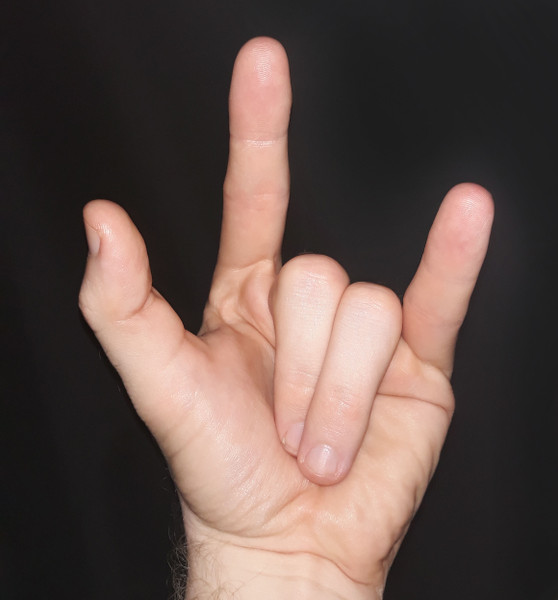
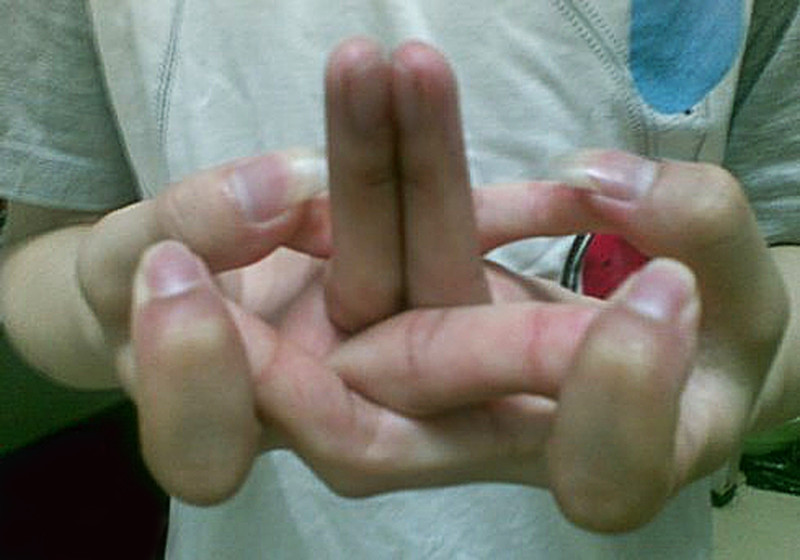
Fig. 3 – The Chinese character for mountain (shan, 山) (larger version). Fig. 4 – The Mountain mudra (shanzi jue, 山字訣) (larger version). Photo by the author. Fig. 5 – The double-handed Mount Tai mudra (Taishan jue, 泰山訣) (larger version). Original picture from here.
Another version of the ritual sees the spirits being coaxed or forced inside of a liquid-filled jar placed in the center of the well diagram. Afterwards, the opening is sealed with paper and the exorcist performs a mudra representing the immense pressing weight of a mountain (just like the aforementioned Taishan stone). [3] Meulenbeld (2007) writes:
The spirits captured within the grid of the Nine Palaces were kept inside their prison by symbolically pressing them down underneath a mountain. The symbolism here lies in the fact that the mountain was represented by a posture of the hand forming the character for mountain (“Mountain Mudrā” 山字訣 with the thumb, index-finger, and little finger all pointing upward [fig. 3 and 4]. Oftentimes the specific “mudrā of Mt. Tai” 泰山訣 [fig. 5], was used, representing the heaviest of all mountains. Moreover, many present-day exorcist talismans contain a character composed of a “demon” 鬼 underneath a “mountain” 山, namely the character wei 嵬 (p. 145, n. 92).
This means that the respective punishments of Sun Wukong and Wu Song (and his brethren) are for all intents and purposes the same: they are imprisoned under mountains. The Taishan stone and the Mountain mudra are no doubt based on the same belief that mountains can immobilize evil spirits. Most importantly, the mudra likely influenced the concept of the Buddha transforming his hand into Five Elements Mountain in chapter 7 of JTTW. The fictional mountain is then a cognate of Mount Tai.
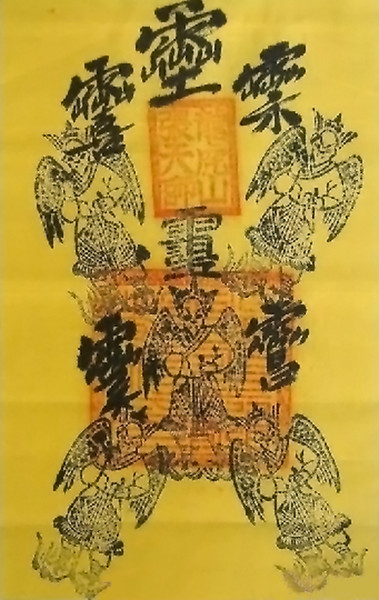
Fig. 6 – A paper fu talisman marked with an image of the Five Thunders (Wu Lei, 五雷) (larger version).
Lastly, the idea that evil spirits can be reformed and their powers put to good use—i.e. Sun Wukong protecting Tripitaka and Wu Song standing against a corrupt government—is tied to the Song-era “Thunder Ritual” (Leifa, 雷法). Meulenbeld (2007) explains that stories from the Tang to the Song present the characteristics of the thunder god, Sire Thunder (Lei Gong, 雷公), becoming increasingly demonic, changing from a muscular deity to a number of animals and finally a Garuda-like bird monster. Likewise, while he was a respected force of nature in the past, Sire Thunder became an impulsive agent of heaven, one capable of being challenged and even captured by a brave individual or ritual master. The subjugation of this demonic god allowed his captors to appropriate his heavenly power for their own purposes. The deity and his four brothers, comprising the “Five Thunders” (Wu Lei, 五雷) (fig. 6), can be summoned on command via talismans and charms and made to bring rain, heal sicknesses, or conquer demons. [4] Such ritual accouterments are just a small part of a much larger subsequent Thunder Ritual liturgy that is, according to one Song dynasty source, capable of “control[ing] the demons and spirits of the Sixfold Heavens, [expelling] evil and avert[ing] disaster” (Meulenbeld, 2007, p. 67).
2. Tiger Slayers
JTTW, ch. 14 – Sun Wukong’s first act of protecting Tripitaka upon his release is effortlessly killing a tiger with a single stroke of his staff. This happens the day after a huntsman had come to the monk’s defense by fighting a tiger for hours before dispatching it with a trident. The difference in power between the immortal and human heroes leads the monk to exclaim, “For the strong, there’s always someone stronger!” (Wu & Yu, 2012, vol. 1, p. 310).
WM, ch. 23 – Wu Song gets drunk on a trip home to see his elder brother, and after ignoring warnings not to take a mountain shortcut, the hero is set upon by a ferocious man-eating tiger. In the process of initially defending himself, Wu snaps his walking staff on a nearby tree, forcing him to resort to brute strength. He manages to wrestle the big cat’s face into the dirt and rains down sixty or seventy fist blows before it stops moving (fig. 7). He then finishes off the beast with the remains of his staff.
Fig. 7 – “Wu Song Beats the Tiger” (Wu Song dahu, 武松打虎) by Wang Kewei (王可偉) (larger version).
I can’t help but imagine that the episode from JTTW is a sly nod to that from the WM. Tripitaka’s statement could be a way of propping up the Monkey King as the most powerful hero, one who can dispatch tigers with no effort at all.
The ability to kill a tiger was considered the sign of a powerful warrior in Chinese folklore. For example, A New Account of the Tales of the World (Shishuo xinyu, 世說新語, 5th century), a collection of historical and fictional anecdotes, tells the story of how the Western Jin general Zhou Chu (周處, 236–297) was originally a wayward youth considered the worst of Yixing‘s “Three Scourges”—a tiger, a dragon, and himself. Wanting to prove his strength, Zhou is said to have easily killed the tiger but disappeared for three days and nights fighting the dragon. The youth later returned to find the people celebrating his apparent death. This caused Zhou to mend his ways and eventually become a great general (Knechtges & Chang, 2010, pp. 2274-2275).
3. Buddhist Monks With Matching Religious Nicknames
JTTW, ch. 14 – Sun Wukong takes the tonsure as a Buddhist monk upon his release. [5] His master Tripitaka then gives him the religious nickname “Pilgrim Sun” (Sun xingzhe, 孫行者), and the character is often simply referred to as “Pilgrim” (xingzhe, 行者; literally: “traveler”) throughout the narrative.
WM, ch. 31 – Wu Song kills a thug and his Song government official friend for framing the hero for theft and attempting to have him murdered en route to a prison camp. As a result, he is forced to dress as a Buddhist monk, taking a slain priest’s religious garb and ordination certificate (jiedie, 戒牒) and calling himself “Pilgrim Wu” (Wu xingzhe, 武行者).
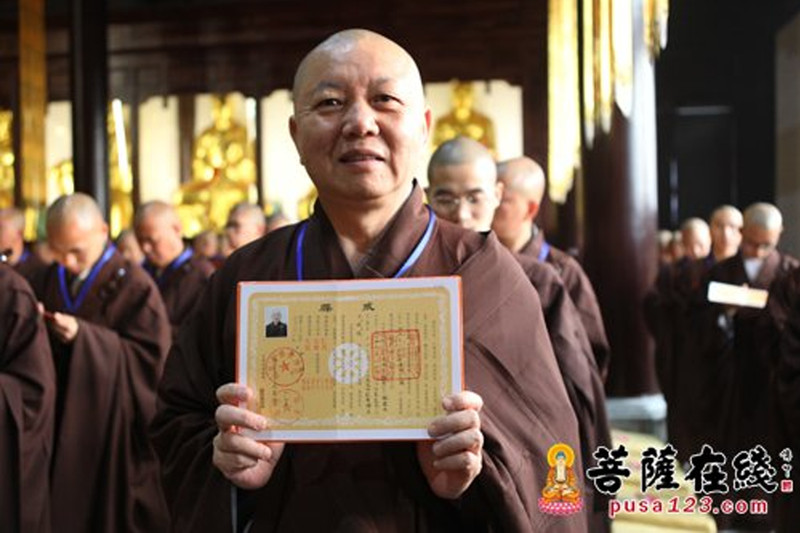
The term Pilgrim refers to a “postulant,” a lay Buddhist acolyte who has yet to be ordained but lives as an untonsured monk, one expected to follow the Five Precepts (Pali: Pañcasīla; Ch: Wujie, 五戒) against killing, lying, stealing, sexual misconduct, and drinking alcohol (Robert & David, 2013, pp. 1011-1012). Ch’en (1956) writes that such trainees were historically required to complete a long period of intense religious study and pass a rigorous examination before being awarded the aforementioned ordination certificate (fig. 8), thereby becoming a full-fledged monk. This certification system was originally initiated during the Tang to weed out those wanting to evade the draft and taxes, as well as bandits like Wu Song who sought refuge from the law. However, during the Song, the government sold these documents like war bonds in order to help pay for their ongoing struggle against the barbarians of northern China. Therefore, ordination certificates were often exuberantly expensive, [6] meaning those who had the training but could not afford the document were doomed to live as a postulant. This contrasts with the thousands upon thousands of people who bought their way into the Buddha’s fold simply for the draft and tax exemption. They forwent the training altogether and were monks only on paper. This continued practice naturally resulted in a major decline in the quality of monks during the Song.
Fig. 8 – A present day monk showing his ordination certificate (jiedie, 戒牒) (larger version). Original image found here.
Having read the above, we can say that Sun Wukong is called Pilgrim because he assists a Buddhist priest but lacks the religious education and ordination certificate. And while Wu Song has the document (taken from a dead priest), he lacks the required education. It should be remembered that Wu is a bandit-turned-monk. At the same time, both characters typify the “itinerant monk,” the second meaning of Pilgrim (xingzhe, 行者), as both are on a journey: Sun is traveling to India and Wu is traveling the road—albeit secretly to meet with fellow outlaws. But I would like to suggest that the titles may have also been meant as a jab at the violent, untrained riffraff passing for monks during the Song (more on this below). After all, the earliest references to our characters with these titles come from this period.
“Pilgrim Wu” appears in scholar-painter Gong Shengyu‘s (龔聖予, 1222–1307) In Praise of the Thirty-Six [Men] of Song Jiang (Song Jiang sanshiliu zan, 宋江三十六贊), a collection of poems eulogizing each of the thirty-six bandits then associated with the early WM story cycle.
Pilgrim Wu Song: You resisted women, obeyed the Five Precepts, among Wine, Women, Wealth and Force, you were inclined to kill people (Børdahl, 2013, p. 29).
Gong claims that the poems were based on “stories of the streets and tales of the lanes” (jietan xiangyu, 街談巷語), popular narratives performed by storytellers at local venues. Given that such early tales no longer exist, its impossible to say whether or not Wu Song was always a monk or a bandit-turned-impostor monk like his counterpart from the published edition of the WM (Børdahl, 2013, pp. 28-29). Either way, this suggests that Wu’s predilection for killing was a prominent aspect of his story cycle by at least the 13th century.
Sun Wukong first appears as the “Monkey Pilgrim” (Hou xingzhe, 猴行者) in The Story of How Tripitaka of the Great Tang Procures the Scriptures (Da Tang Sanzang qujing shihua, 大唐三藏取經詩話; “The Story” hereafter), a seventeen chapter storytelling prompt dated to the late-13th century. Like Wu Song, Monkey is also depicted as comfortable with killing. For example, in chapter five, he turns an evil sorcerer’s wife into grass so that she will be eaten by a young monk who had been transformed by her husband into a donkey. After both parties are changed back to normal, Monkey threatens to “mow down all the grass of [his] house” (i.e. kill his wife and anyone else he loves) if the man ever misuses his magic again. [7] Later in chapter six, Monkey brutally tortures and then kills a white tiger demon who tries to eat his master (Wivell, 1994, pp. 1181-1207)
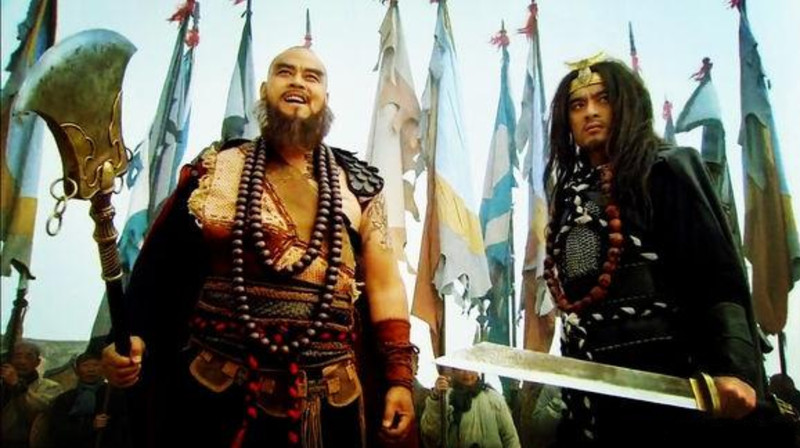
Fig. 9 – The “Pilgrim” Wu Song (right) and the “Flower Monk” Lu Zhishen (left) from a recent WM television series (larger version).
Additionally, two early WM-related tales titled “Pilgrim Wu” (Wu xingzhe, 武行者) and the “Flower [Tattooed] Monk” (Hua heshang, 花和尚) are listed under the “staff” (ganbang, 桿棒) category of popular stories in The Drunken Man’s Talk (Zuiweng tanlu, 醉翁談錄), a circa 13th century collection of short stories, anecdotes, and poetry. [8] So-called staff tales were character-driven narratives about heroes, in this case Wu Song and his fellow outlaw-turned-monk Lu Zhishen (fig. 9), righting injustices using staves. [9] I should note that The Story describes the Monkey Pilgrim wielding two such weapons in his adventures.
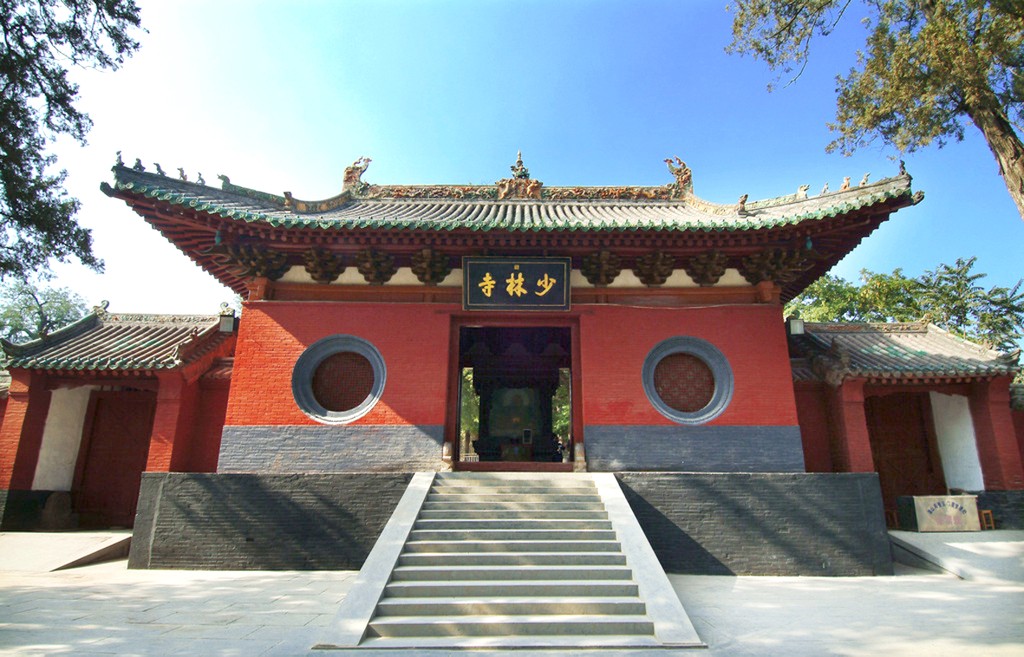
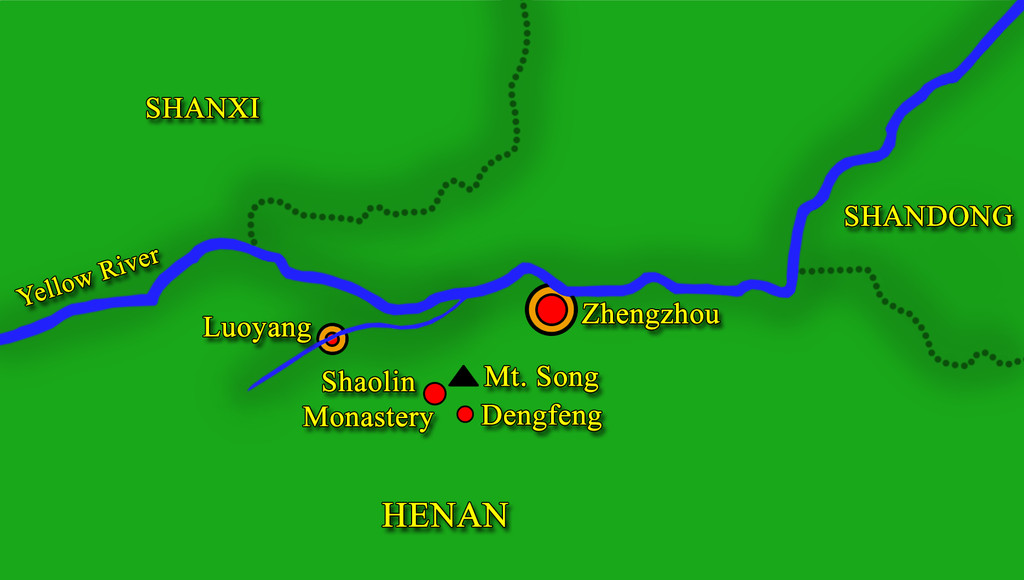
Sun and Wu’s association with killing and staff fighting were likely influenced by historical warrior monks and bandit monks. Shahar (2008) explains that warrior monks were seasoned fighters who lived in subsidiary shrines away from the devout community and protected monasteries in times of trouble. These “monks” regularly drank wine and ate meat, associating the latter with physical strength and fighting ability, and even worshiped wrathful deities like Vajrapani, who is described in scripture as killing in the name of Buddha. Their weapon of choice was a wooden staff, which was originally chosen for being non-lethal. However, a metal staff like the one wielded by Sun Wukong in JTTW was sometimes used by warrior monks for its killing capacity in times of war. The most famous monastic staff method belongs to the Shaolin Monastery (Shaolin si, 少林寺) (video 1). After the Shaolin warrior monks helped the Ming dynasty government repel Japanese pirate incursions from the Chinese coast during the 1550s, their staff method was touted in military encyclopedias and civilian weapons manuals. [10]
Video 1 – A demonstration of Shaolin Wind Devil Staff (Fengmo gun, 風魔棍).
Bandit monks are outlaws like Wu Song who dressed as clerics to avoid problems with the law. [11] Lorge (2012) comments that the characteristics of bandit monks were nearly indistinguishable from that of warrior monks.
[I]t is easy to see how bandit-monks are virtually the same as warrior-monks. These men drank wine, at meat, and had sex with women—practices alien to true Buddhist monks. A number of Buddhist authorities were deeply troubled by the presence of monks who directly violated Buddhist precepts. We do not know whether there was a sharp break between ordained and trained monks who carefully followed monastic rules in their search for enlightenment and men who simply claimed to be monks, wore monastic robes, shaved their heads, but otherwise did not follow monastic rules (p. 174).
He goes on to explain that the Shaolin monastery, for example, became heavily militarized after a nasty defeat in 1356 during the Red Turban Rebellion and so may have replenished its ranks using formerly deactivated soldiers at the turn of the Ming dynasty. Such violence-prone men would naturally turn towards a life of crime. Therefore, these bandits “would have been easy enough to recruit and send out as warrior-monks to fight against [other] bandits” (Lorge, 2012, p. 175).
So we see that there existed a class of staff-bearing pseudo-monks who regularly took life and drank alcohol. Serving as mainly monastic bodyguards, these fighters lacked the devotion to the precepts and, especially, the religious education to be considered real monks. Therefore, Sun and Wu’s characterization as such warriors may further explain why they are called Pilgrim.
4. Monastic Martial Artists
I want to preface this section by stating upfront that it overlaps to some degree with the previous one. But while the former explored Sun and Wu’s connection to staff-wielding warrior monks by way of their characterization in late Song oral literature, this one will discuss the connection between their images as monastic martial artists and the historical practice of boxing by warrior monks.
While the Great Sage is primarily known for his skill with the staff, he displays a mastery of unarmed combat twice in JTTW. Chapter 51, for example, describes Sun and a demonic opponent fighting with a long list of punches, kicks, grapples, and throws.
Hitching up his clothes and walking forward, the fiend assumed a boxing posture; his two fists upraised looked truly like two iron sledge hammers. Our Great Sage also loosened his legs at once and moved his body to attack; right before the cave entrance, he began to box with the demon king. This was quite a fight! Aha!
Opening wide the “Four Levels Posture”; The double-kicking feet fly up. They pound the ribs and chests; They stab at galls and hearts. “The Immortal pointing the Way”; “Lao Zi Riding the Crane”; “A Hungry Tiger Pouncing on the Prey” is most hurtful; “A Dragon Playing with Water” is quite vicious. The demon king uses a “Serpent Turning Around”; The Great Sage employs a “Deer Letting Loose its Horns.” The dragon plunges to Earth with heels upturned; The wrist twists around to seize Heaven’s bag. A green lion’s open-mouthed lunge; A carp’s snapped-back flip. Sprinkling flowers over the head; Tying a rope around the waist; A fan moving with the wind; The rain driving down the flowers. The monster-spirit then uses the “Guanyin Palm,” And pilgrim counters with the “Arhat Feet.” The “Long-Range Fist,” stretching, is more slack, of course. How could it compare with the “Close-Range Fist’s” sharp jabs? The two of them fought for many rounds— None was the stronger, for they are evenly matched (Wu & Yu, 2012, vol. 3, pp. 12-13)
I show in this article that many of the named techniques are real and are still practiced to this day. Furthermore, the poem’s bias for close-range fighting over long-range “is typical of late Ming and early Qing military literature,” as noted by Shahar (2008, p. 117). He continues,
Sixteenth- and seventeenth-century military experts allude to various short-range styles including ‘Cotton Zhang’s Close-Range Fist’ (Mian Zhang duanda [綿張短打]), ‘Ren Family Close-Range Fist’ (Renjia duanda [任家短打]), and ‘Liu [Family] Close-Range Fist’ (Liu duanda [劉短打])” (Shahar, 2008, p. 117).
This shows that the author-compiler of JTTW consulted real martial arts material to make this fight more authentic.
Having donned the monk persona, Pilgrim Wu stops by an inn while on a journey to meet with fellow outlaws in chapter 32. The monk’s great tolerance for wine (fig. 13) and request for meat surprises the inn keeper, whom Wu slaps to the ground upon seeing the man serve better wine and even chicken to a different patron. The patron and his friends attack the monk but are soundly beaten by his superior strength and fighting ability. [12]
Wu’s characterization as a meat-eating, alcohol-drinking monk with a thirst for combat is obviously tied to the warrior and bandit monks discussed earlier.
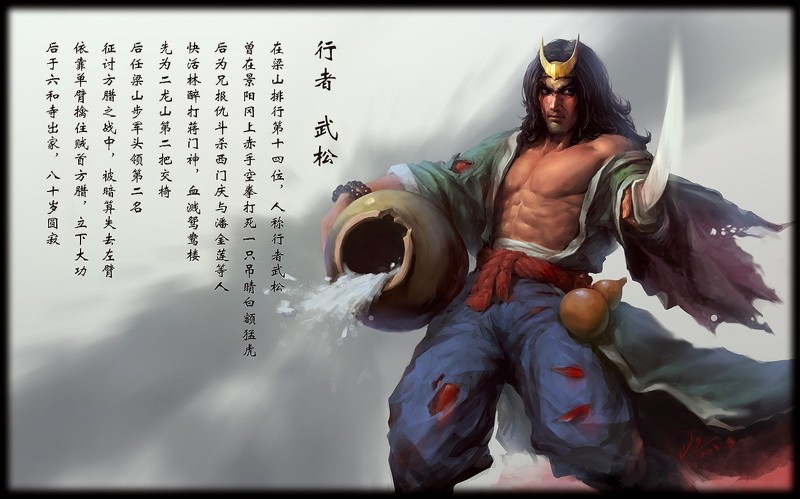
Fig. 15 – A modern depiction of Pilgrim Wu holding a jar of wine and brandishing a saber (larger version). By Leewiart user Du_YH. Original image found here.
While it precedes Wu becoming a monk, the best example of his martial prowess appears in chapter 29:
But Jiang was scornful of his foe [Wu Song], thinking that he was drunk, and he closed in rapidly. Quicker than it takes to tell, Wu Song flourished his two fists at Jiang’s face, then turned and started away. Enraged, Jiang raced after him. Wu Song lashed out backwards with his left foot and kicked him in the groin. As Jiang clasped his injured section and doubled over in pain, Wu Song whirled around and swung his right foot in a flying kick to the forehead that slammed the big man over on his back. Wu Song planted one foot on his chest and, with keg-like fists, began pommeling Jiang’s head.
This maneuver we just described—the flourish of fists and turning away, the backward left kick, the whirling around and the forward right kick—is called “the Jade-Circle Steps with Duck and Drake Feet” [Yuhuan bu, yuanyang jiao, 玉環步, 鴛鴦腳]. It was one of Wu Song’s most skillful moves. A remarkable trick! (Shi & Luo, 1993/2001, vol. 2, pp. 604 and 607.
Wu’s style is possibly another name for “Piercing Foot” (Chuojiao, 戳腳), a northern Chinese martial art known for its dynamic kicking skills. Modern folklore traces the style to the Song dynasty due to its association with WM heroes. [13]
While JTTW never openly describes Sun Wukong training in martial arts, it does imply that he learns armed and unarmed combat as a young monk studying under the Buddho-Daoist Sage Subodhi. Monkey learning boxing in a religious institution is actually a faithful depiction of one aspect of monastic life during the Ming. Shahar (2008) shows that Shaolin warrior monks took up unarmed combat during the late-Ming period, when boxing saw an explosion in popularity in Chinese culture (as demonstrated by the named techniques recorded in JTTW and the WM). Textual evidence suggests that the first styles practiced by Shaolin were Drunken Eight Immortals Boxing (Zui baxian quan, 醉八仙拳), popularized by Jackie Chan in The Drunken Master (1978), and Lost Track Boxing (Mizong quan, 迷蹤拳), the fighting style of the national hero Huo Yuanjia popularized by Bruce Lee in Fist of Fury (1972). The monks may have adopted boxing as a form of calisthenic exercise. To this they later added Daoyin (導引), a regimen of yoga-like Daoist breathing and stretching exercises designed to absorb qi (氣) energy and circulate it throughout the body. Therefore, the monks elevated their boxing practice from mere fighting to a form of spiritual cultivation. This synthesis of martial and spiritual practices simultaneously took place in wider Ming culture, leading to the creation of so-called “internal” (Neijia, 内家) martial arts like Taiji and Xingyi boxing. [14]
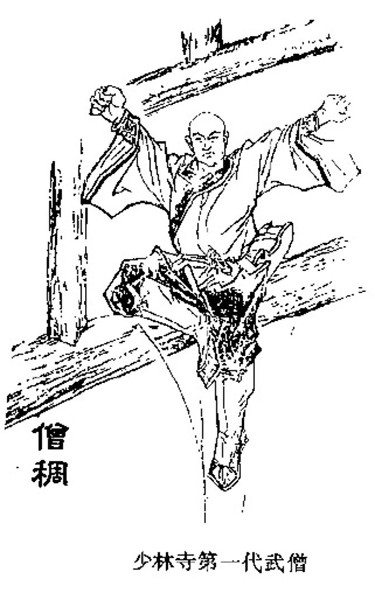
Fig. 10 – A modern drawing of the monk Sengchou showing off his newfound powers by jumping above the rafters of the Shaolin monastery (larger version). Original image found here.
That’s not to say Shaolin monks did not practice unarmed martial arts prior to the 17th century. It’s just boxing was only a form of entertainment practiced by a few and not part of the official training regimen. For example, the Tang-era anthology Complete Records from Court and Commonality (Chaoye qian zai, 朝野僉載, c. 8th century), contains the story of the famed dhyana master and Shaolin monk Sengchou (僧稠, 480–560) beseeching a religious statue of Vajrapani to bless him with martial strength so that the other monks, who enjoy sparring in their free time, will stop bullying him. After six straight days of prayer, the deity appears before him and offers the young novice a bowl of sinews to eat. Sengchou initially refuses due to the prohibition against eating meat, but he ultimately finishes the meal for fear Vajrapani will smite him with his vajra club. Like the radioactive spider bite that changes Peter Parker into Spider-Man, the sinews transform the monk, blessing him with a god-like physique and miraculous powers, such as the ability to walk on walls, leap great heights (fig. 10), and lift thousands of pounds. Most importantly, it drastically improves his fighting skills, so much so, in fact, that his former tormentors come to grovel in his presence (Shahar, 2008, pp. 35-37).
Where did Sengchou’s religious brothers learn their unarmed martial arts centuries prior to it becoming an official part of Shaolin’s training regimen? The simplest answer is someone like Wu Song, who learned boxing as a bandit or soldier and later joined the sangha. Readers may recall such violence-prone men may have been tapped as warrior monks to protect the monastery in times of trouble. They could have easily passed their fighting skills to the next generation of warrior monks.
A good example of a soldier-turned-monk is the brutish former general Huiming (惠明) from the Platform Sutra (Liuzu tanjing, 六祖壇經, written from the 8th to 13th c.). The text tells how the disciples of Hongren (弘忍, 601–674), the fifth Chan patriarch, were enraged when their master passed the mantle onto the illiterate postulant laborer Huineng (惠能, 638–713). Hundreds of monks are said to have pursued the fleeing Pilgrim south intent on forcefully taking the patriarchal symbols of the begging bowl and robe for themselves. Huiming persevered and managed to corner Huineng on a mountain. He attempted to wrestle the treasures away, but by a miracle, he could not lift them. Realizing that Huineng was the rightful heir, the monk became his disciple (Huineng & Cleary, 1998, pp. 11-12). Jealousy and anger are obviously qualities unbecoming of a real monk. In fact, the only thing that separates Huiming’s actions of hounding and attempted strong arm robbery from a bandit is his monkhood.
So, we see that Sun Wukong typifies a next generation warrior monk who learns boxing inside a religious institution. Wu Song, on the other hand, typifies the soldier or bandit who learns boxing outside the monastery and later becomes a monastic fighter, one who passes on their skills to younger monks.
5. Moralistic Headbands
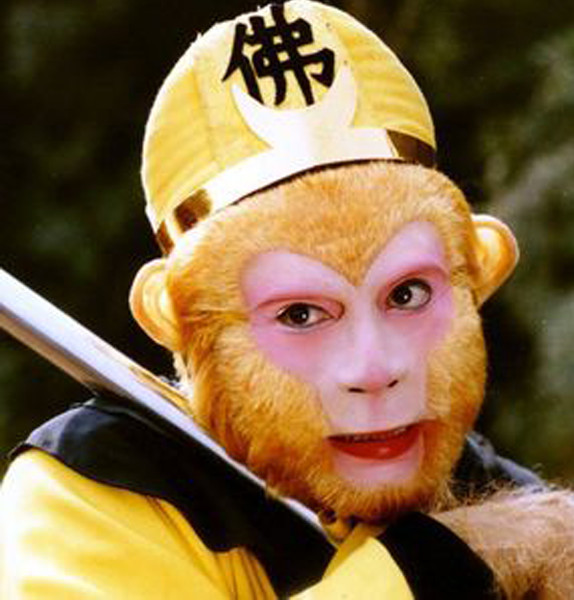
JTTW, ch. 14 – The Monkey King is tricked into wearing a brocade hat under the pretense of gaining the ability to recite scripture without rote memorization. However, the hat houses a golden fillet (jingu, 金箍) that soon takes root and painfully tightens around the immortal’s head when the correct spell is chanted (fig. 11). This allows the feeble monk Tripitaka to control the celestial monkey’s unruly nature.
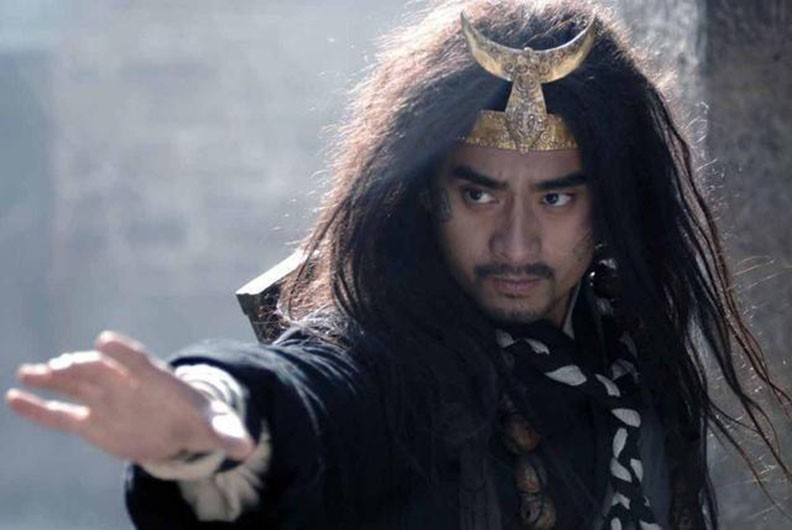
WM, ch. 31 – When Wu Song disguises himself as a monk, he wears the garments of a priest whom had previously been killed by bandits. The habit includes a metal “Precepts fillet” (jiegu, 戒箍) that he wears over his long hair (fig. 12).
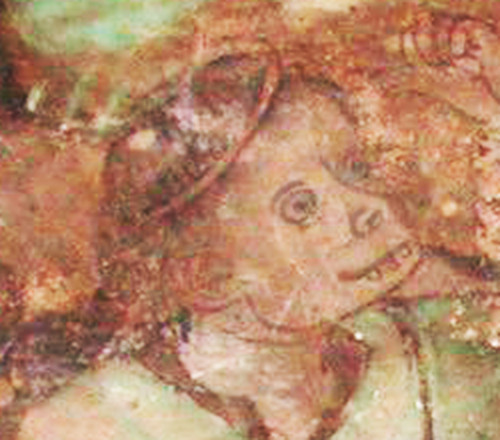
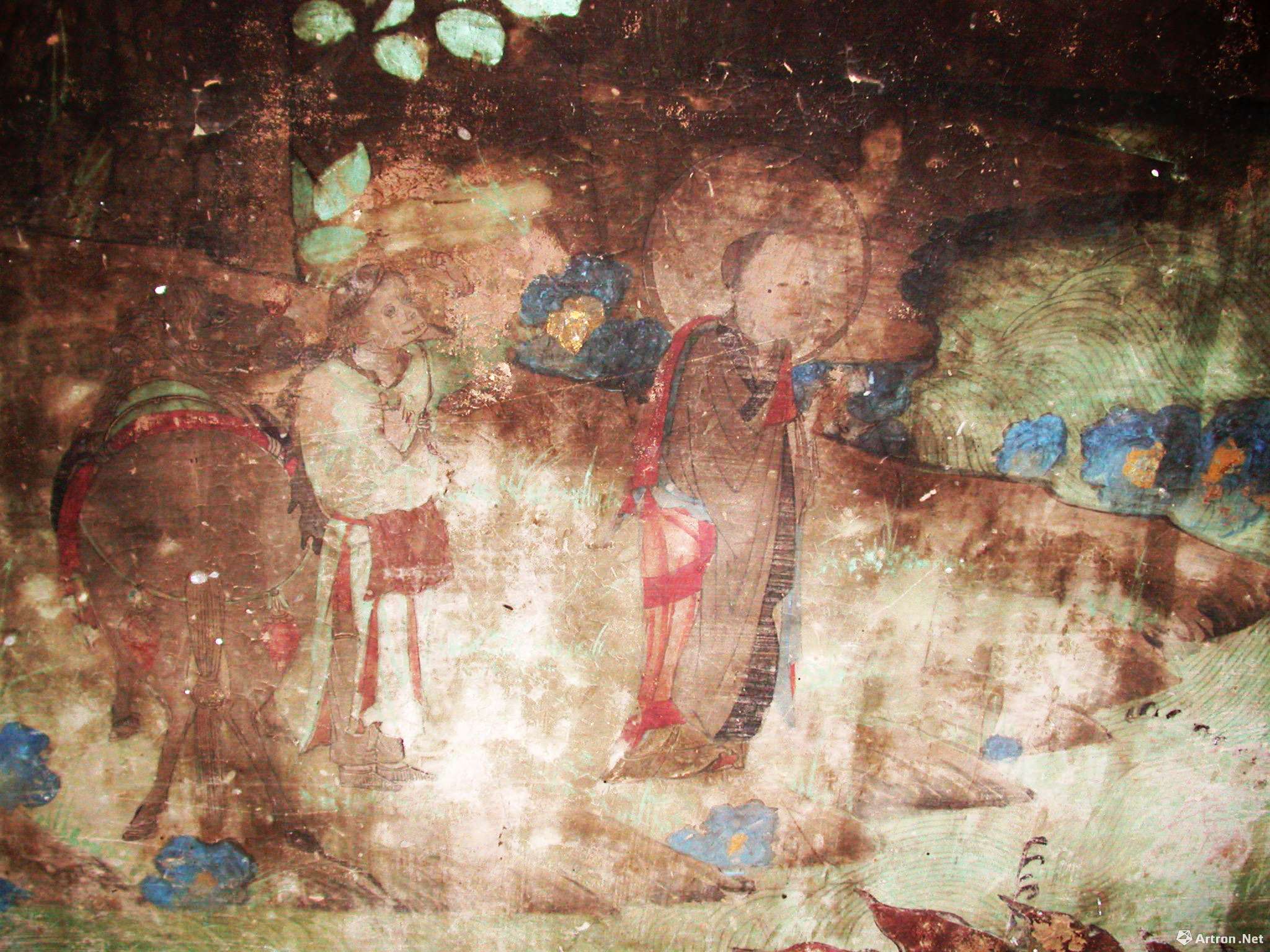
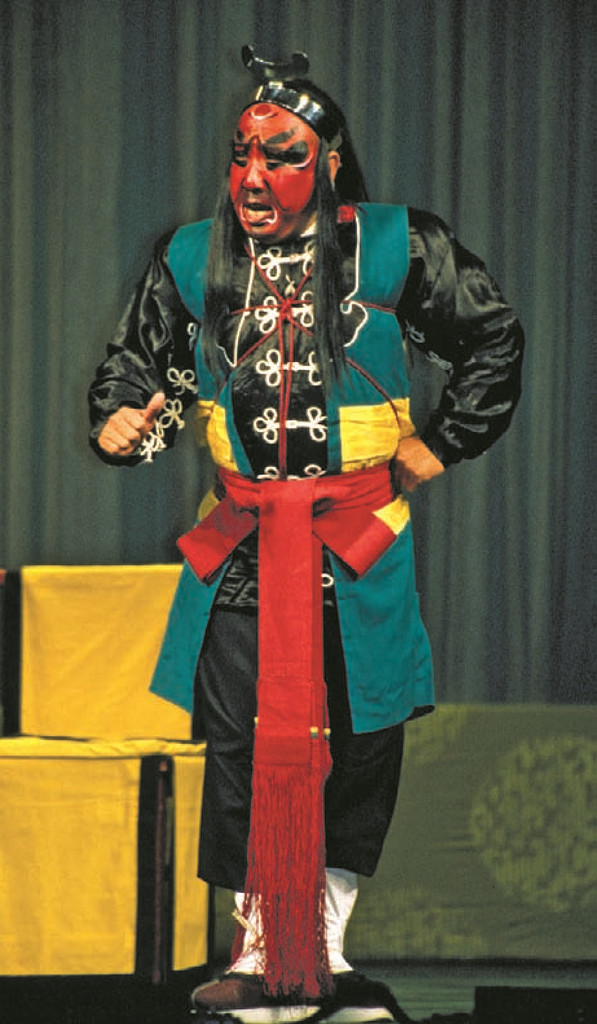
Fig. 11 – (Top left) Sun Wukong’s golden fillet from the 1986 JTTW television series (larger version). Fig. 12 – (Top right) Wu Song’s Precepts fillet from a recent WM television series (larger version). Fig. 13 – (Bottom left) A late 11th to early 12th-century copper alloy statue of the wrathful deity Hevajra (larger version). He is portrayed with the same Esoteric Buddhist ritual attire as his followers, including the headband, arm cuffs, a bone (skull) rosary, bracelets, a girdle, anklets, and a tiger skin sarong. Courtesy of the Los Angeles County Museum of Art. Fig. 14 – (Bottom center) A detail of the Monkey Pilgrim’s fillet featured in a 12th-century mural from Eastern Thousand Buddha Cave number two in Gansu Province, China (larger version). It has been slightly enhanced for clarity. A fuller version of the image can be seen here. Fig. 15 – (Bottom right) A military monk from a modern Beijing Opera production (larger version). From Bonds, 2008, p. 178.
I explain in this article that the heroes’ fillets share a common origin in an ancient Indo-Tibetan Esoteric Buddhist ritual headband, one representing the Buddha Akshobhya and thereby moral self-restraint. It was one of several ritual items worn while worshiping wrathful protector deities like Heruka. Such deities were often depicted wearing the same attire as their followers, leading to the band becoming a symbol of powerful Buddhist spirits (fig. 13). The Hevajra Tantra (Ch: Dabei kongzhi jingang dajiao wang yigui jing, 大悲空智金剛大教王儀軌經), the original 8th-century Indian Buddhist text mentioning the ritual items, was translated into Tibetan and Chinese during the 11th century. Interestingly, the earliest example of Monkey wearing the circlet (likely symbolizing the taming of the monkey of the mind) hails from this time (fig. 14). But Wu’s association with the headband was likely influenced by the Precepts fillet worn by the warrior monks of Chinese Opera (fig. 15). These heroes wear the band to show that they have taken a vow of abstinence (Bonds, 2008, pp. 177-178 and 328).
6. Bin Steel Weapons
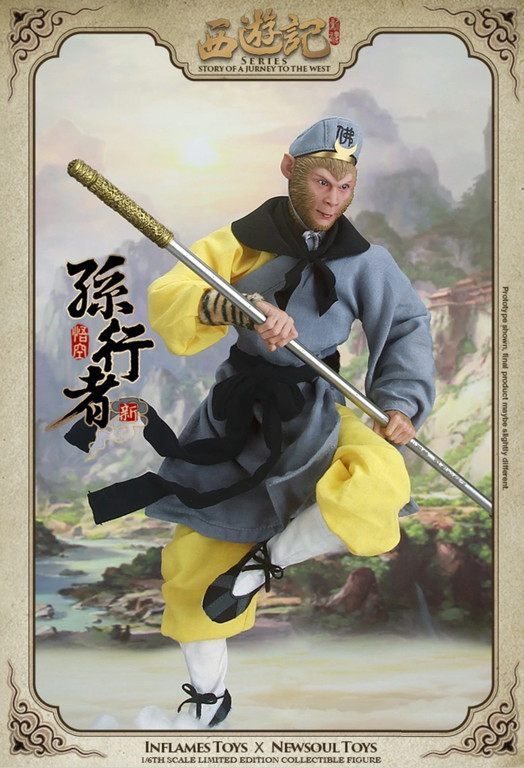
JTTW, ch. 3 – Sun Wukong comes into possession of a magic staff (fig. 16) taken from the Dragon King’s underwater treasury. A poem in chapter 75 describes the weapon being hand-forged from Bin steel (bintie, 鑌鐵) by the high Daoist god Laozi.
WM, ch. 31 – Apart from wearing the fallen monk’s religious clothing, Wu Song also takes possession of his Buddhist sabers made from “snowflake pattern” Bin steel (huaxue bintie jiedao, 雪花鑌鐵戒刀) (fig. 17). [15]
Fig. 16 – A modern action figure of Sun Wukong holding his magic Bin steel staff (larger version). Fig. 17 – A modern painting of Wu Song wielding his Bin steel sabers (larger version). Artist unknown.
Sun’s staff and Wu’s sabers are not the first bin steel weapons to appear in Chinese literature. A bladed pole arm example is the Bin steel great sword (bintie da podao, 鑌鐵大潑刀) wielded by a bandit from the Old incidents in Xuanhe period of the Great Song Dynasty (Da Song Xuanhe Yishi, 大宋宣和遺事, mid-13th century), a storytelling prompt containing WM material predating the published novel. [16] Another pole arm is the Bin steel spear (bintie qiang, 鑌鐵槍) wielded by a general from The Three Sui Quash the Demons’ Revolt (San sui pingyao zhuan, 三遂平妖傳, c. late-16th century), which also takes place in the Song-era.
I explain in this article that Bin steel is a real world metal akin to Damascus that was imported to China from Persia starting from the 6th century, and the secret of its manufacture eventually reached the Middle Kingdom by the 12th century. The metal was considered an exceptionally fine steel and was often used to make strong, durable, and sharp knives and swords, some worth more than silver. One general is described as boasting that rebels would “have to nick (chi, 齒) his sword of bin iron” if they wished to rise up (Wagner, 2008, p. 269). This is a simultaneous declaration of his unbreakable resolve and a statement praising the seemingly indestructible metal. Therefore, JTTW and the WM portray the finest of heroes wielding the finest of steel weapons.
7. Conclusion
As shown, the parallels between Sun Wukong and Wu Song are the result of JTTW and the WM borrowing from the same cultural source material. Monkey’s imprisonment under Five Elements mountain and Wu’s time as an evil spirit trapped in a well beneath stone was influenced by the Daoist belief that mountains—be they sympathetically represented by stone or hand mudras—could immobilize malevolent forces. Likewise, our heroes’ portrayal as reformed demons can be tied to the Daoist “Thunder Ritual,” which aims to conquer evil and repurpose its power for good. Sun and Wu’s image as tiger slayers was influenced by stories of tiger-killing strongmen from Chinese folklore. Their religious nickname “Pilgrim” and characterization as monastic martial artists can be tied to uneducated pseudo-monks and holy warriors skilled in both staff fighting and boxing from Chinese history. Their religious fillets were inspired by an Esoteric Buddhist ritual headband worn as a reminder of moral self-restraint. And the metal comprising Sun and Wu’s weapons can be traced to a real world steel prized in ancient China for its durability.
This was a fun piece to write because it shows that the Great Sage obviously didn’t develop in a vacuum. It’s interesting to me that much of Sun and Wu’s influences hail from the Song dynasty. These include the Daoist rituals for trapping and reforming spirits, the Pilgrim nickname and characterization as staff-wielding warrior monks, and the translation of the tantric text mentioning the moralistic headband and Monkey’s earliest known depiction wearing it.
8. Updates
Update: 10-04-20
I have written a follow up article explaining the parallels between Monkey and the historical Buddha.
I’ve written an article that shows the weight of Sun Wukong’s magic staff (一萬三千五百斤) is an embellishment on the weight of a stone block (三五百斤) lifted by Wu Song in ch. 27 of the WM.
I’m thinking about writing a piece on characters from world myth trapped under mountains. Here’s the list I have so far:
Sun Wukong (various Journey to the West iterations) – Mt. Huaguo by Guanyin or Five Elements Mountain by the Buddha
108 stars (Water Margin) – Imprisoned in an earth prison under a stone slab by a Daoist master. As mentioned above, Jing Wang (1992) suggests that the stone slab was likely influenced by the Taishan stone (泰山石).
The parameters may later be expanded to include “earth prisons” in general, which would open the door to Lucifer!
Update: 03-11-22
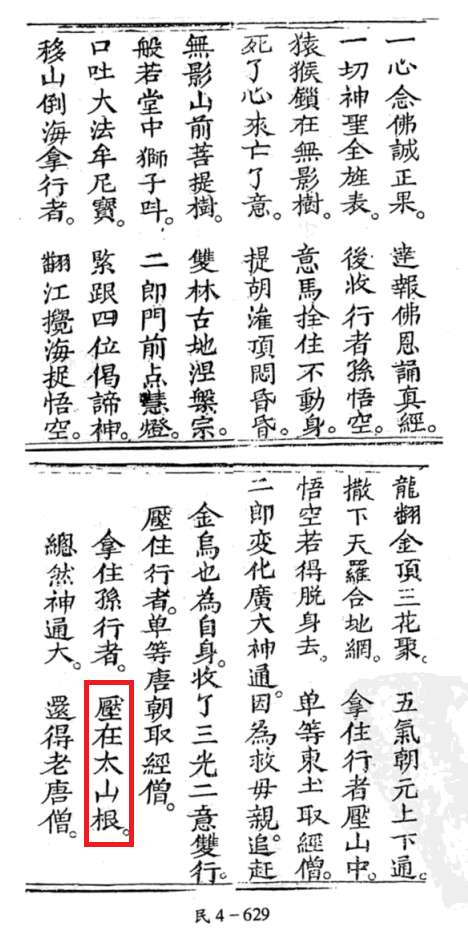
I recently archived the Precious Scroll of Erlang (Erlang baojuan, 二郎寳卷, 1562), a religious text that venerates and records the various deeds of the immortal demi-god. This work states that the Monkey King was “pressed under the base of Mt. Tai” (yazai, taishan gen, 壓在太山根) (PDF page 46) (fig. 18). This supports my suggestion above that Five Elements Mountain is a cognate for Mt. Tai.
Fig. 18 – The Mt. Tai sentence is indicated in red (larger version).
Update: 06-18-22
I’ve written an article that lists a number of surprising parallels shared by Monkey and the Greco-Roman hero Heracles.
1) The nine palaces are a cosmic geographical concept in which stars are mapped according to the five Chinese cardinal directions (N, S, E, W, and center) and the four intermediate directions. Thus, they represent the universe as a whole.
2) A zhang (丈) is ten Chinese feet, so 10,000 zhang would be 100,000 feet. A li (里) is one-third of a Western mile. More importantly, in Chinese culture, the number 10,000 represents an infinitely large concept. Therefore, by squaring the number, the well prison is described as an unfathomably large and inescapable place. I would like to thank the Dragon Ball scholar Derek Padula (his website) for suggesting this note as it helps better visualize the prison. He was kind enough to read an earlier draft of this article.
3) See Meulenbeld, 2007, pp. 143-145 for more information about the jar ritual. It likely influenced media that influenced Akira Toriyama of Dragon Ball fame to create the Mafuba (魔封波; Ch: mofengbo), or “Demon Containment Wave” ritual. Padula (2016) describes the etymology and background of the Mafuba (pp. 122 to 126). He graciously provided me with a digital copy of his book.
4) See Meulenbeld (2007) chapter two.
5) This is not openly stated in chapter 14 but is implied in chapter 27. See this article for more information.
6) Ch’en (1956) gives examples. During the Song, the official selling prices for the certificates ranged from one hundred thirty to eight hundred strings of cash. To put these prices in perspective, he notes that the lowest cost would pay for the equivalent of seventy-five bolts of silk or one hundred twenty-five bushels of rice (pp. 316-317).
7) Wivell, 1994, p. 1187. The full episode appears on pages 1186-1187.
8) Ge, 2001, p. 38. The eight types of stories appearing in The Drunken Man’s Talk are: “lingguai [靈怪] (spirits and demons), yanfen [煙粉] (rouge and powder), chuanqi [傳奇] (marvels), gong’an [公案] (court cases), podao [朴刀] (broadsword), ganbang [桿棒] (staff), shenxian [神仙] (immortals), and yaoshu [妖術] (sorcery)” (Ge, 2001, p. 209, n. 6).
9) Huang, 2018, p. 61 and n. 8. It’s interesting to note that the monk Lu Zhishen is said to wield an impossibly heavy metal staff like Sun Wukong. See this article for more details.
10) See Shahar (2008) chapters three and four.
11) Lorge (2012) cites a Tang-era story about an 8th-century prince who discovers an abandoned wardrobe while hunting in the forest. It is found to contain a young woman who had been kidnapped the previous night by bandits but was subsequently whisked away by two monks among the group. The prince replaces her with a wild bear that later mauls the bandit monks to death when the wardrobe is reopened (Lorge, 2012, pp. 106-107). The monks were likely impostors like Wu Song.
12) Wu Song is famed in Chinese folklore for his martial arts ability. This led to the creation of a wushu form known as “Wu Song Breaks Manacles” (Wu Song tuokao, 武松脫拷), which mimics a person fighting with their hands clasped as if shackled, forcing them to rely on doubled fist and elbow strikes and lots of kicking. The form is based on an episode from chapter 30 of the WM when the hero is attacked by assassins while being led in shackles to a prison camp. Wu Song is forced to defend himself in such a manner before breaking his restraints.
13) See, for example, Chlumsky, 2005, p. 72. The author also repeats folklore further tying the style to the Song dynasty heroes Yue Fei and his teacher Zhou Tong.
14) See Shahar (2008) chapters five and six.
15) I think it’s interesting that each weapon is presented as having some level of sentience. Called the “As-you-wish” Gold-Banded Staff (Ruyi jingu bang, 如意金箍棒), Sun’s staff grows or shrinks according to his whim. Wu’s peerless blades are said to “often groan in the night” (Shi & Luo, 1993/2001, p. 640), suggesting a magic longing for combat. The sentience of each weapon is based on different sources, however. I note in this article that the compliance of Monkey’s weapon is based on the Ruyi (如意) scepter, a symbol of religious and secular authority that was at some point associated with the similarly named wish-fulfilling cintamani jewel (ruyi zhu, 如意珠) from Buddhist mythology. The vocal ability of Wu Song’s blades may be based on the Chinese belief that swords have a soul. Two prime examples are the famed treasure swords Longyuan (龍淵, a.k.a. Longquan, 龍泉) and Tai’e (泰阿/太阿) made by the legendary swordsmith Ou Yezi (歐冶子) during the Spring and Autumn period. Yuan poet Jia Penglai (賈蓬萊, c. mid-14th century) described them as mated lovers who pine for each other when separated and even leap from the scabbard to seek out their beloved (Lee & Wiles, 2015, pp. 161-163).
16) The original source says “po bintie dadao” (潑鑌鐵大刀). This is likely a transcription error. I have corrected it above.
Sources:
Bonds, A. B. (2008). Beijing Opera Costumes: The Visual Communication of Character and Culture. Honolulu: University of Hawai’i Press.
Børdahl, V. (2013). Wu Song Fights the Tiger: The Interaction of Oral and Written Traditions in the Chinese Novel, Drama and Storytelling. Copenhagen, Denmark: NIAS Press.
Buswell, R. E. , & Lopez, D. S. (2014). The Princeton Dictionary of Buddhism. Princeton, NJ: Princeton University Press.
Ch’en, K. (1956). The Sale of Monk Certificates During the Sung Dynasty: A Factor in the Decline of Buddhism in China. The Harvard Theological Review 49(4), pp. 307-327.
Chen, P., & Petersen, V. (2016). The development of Chinese martial arts fiction. Cambridge, U.K.: Cambridge University Press.
Chlumsky, N. (2015). Inside Kungfu: Chinese Martial Arts Encyclopedia. [n.p.]: Lulu.com.
Huang, Y. (2018). Narrative of Chinese and Western Popular Fiction: Comparison and Interpretation. Berlin, Germany: Springer.
Huineng, & Cleary, T. F. (1998). The Sutra of Hui-neng, Grand Master of Zen: With Hui-neng’s Commentary on the Diamond Sutra. Boston: Shambhala.
Ge, L. (2001). Out of the Margins: The Rise of Chinese Vernacular Fiction. Honolulu: University of Hawaii Press.
Knechtges, D. R., & Chang, T. (2010). Ancient and Early Medieval Chinese Literature: A Reference Guide. Leiden: Brill.
Lee, L. X. H., & Wiles, S. (2015). Biographical Dictionary of Chinese Women: Tang through Ming: 618-1644. Abingdon: Routledge.
Lorge, P. A. (2012). Chinese Martial Arts: From Antiquity to the Twenty-First Century. New York, NY: Cambridge University Press.
Meulenbeld, M. R. E. (2007). Civilized Demons: Ming Thunder Gods from Ritual to Literature (Doctoral dissertation). Available from ProQuest Dissertations and Theses database (UMI No: 3247802).
Shahar, M. (2008). The Shaolin Monastery: History, Religion, and the Chinese Martial Arts. Honolulu: University of Hawai’i Press.
Shi, N., & Luo, G. (2001). Outlaws of the Marsh (Vols. 1-4) (S. Shapiro, Trans.). Beijing: Foreign Languages Press. (Original work published 1993)
Wagner, D. (2008). Science and Civilisation in China: Volume 5, Chemistry and Chemical Technology, Part 11, Ferrous Metallurgy. Cambridge: Cambridge Univ. Press.
Wang, J. (1992). The Story of Stone: Intertextuality, Ancient Chinese Stone Lore, and the Stone Symbolism in Dream of the Red Chamber, Water Margin, and the Journey to the West. Durham, N.C: Duke University Press.
The following story sketch was originally posted on my external Historum blog on 01-20-2014. The site recently switched to a new server, but the blogs have yet to be migrated. I’m posting it here for posterity. Regular articles will resume after this entry.
This article describes three story ideas for the origins of Sun Wukong (孫悟空) from Journey to the West (Xiyou ji, 西遊記, 1592 CE, “JTTW” hereafter) that I’ve come up with over the years. Number one was the original focus of this piece, but I’ve since then come up with two other origins. Readers are free to choose which one they like most. Please let me know if you are interested in fleshing these out.
Story Idea #1: Spiritual Son of Primordial Primates
I have included notes to explain why certain narrative choices were made, as well as to highlight what religious texts I drew ideas from.
As a lover of JTTW and a former primatology major, I’ve always wanted to create my own primate-based character similar to Sun Wukong. I originally wanted him to be the son of Monkey or the son of one of his advisers or allies during his days as a demon. Either way, I thought that he could train under Sun and gain similar powers. But then I decided that I wanted him to be a more civilized, yet more powerful version of the character; someone who is held in high regard by all beings of the six realms (demons, hungry ghosts, animals, humans, asuras, and devas) of Buddhist cosmology, as well as the Buddha himself. After reading about the ancient Chinese view of the gibbon, [A] a small, long-armed, arboreal ape native to Asia (fig. 1), I thought that the character could be an ape immortal. It was only recently that I decided to pair him with a female since gibbons generally mate for life.
A) The Chinese viewed the gibbon (Yuan, 猿) as symbolic of Confucian gentlemen and Daoist immortals. Their long arms were thought to be evidence of their expertise in soaking up qi. This resulted in long lives and occult powers (Geissmann, 2008).
Fig. 1 – A gibbon soaring through the treetops. Photo by Sachin Rai. A larger version can be found here.
The Dao (道, the way) gives birth to the One (yiqi, 一氣, the first breath);
The One gives birth to the Two (yin and yang, 陰陽);
The Two gives birth to the Three (San qing, 三清, the Three Pure Ones);
The Three gives birth to the Ten Thousand Things.
The Ten Thousand Things carry the Yin and enfold the Yang;
Kneading gently, they create harmony. [B]
B) This is based on chapter 42 of the Daodejing (道德經), the premiere holy text of Daoism. The original passage has been interpreted differently by different scholars. I’m using the interpretation presented in Laozi and Wilson, 2012, p. 197. The cited text, however, makes no mention of the Three Pure Ones. This is based on later Daoist texts and folk views on the supreme immortals. See Stevens, 1997, pp. 68-70.
In the beginning of the universe, the Three Pure Ones, the manifestations of the Dao, use the vital energies of the cosmos to create heaven, earth, and all living things. Among the first to be created are two gibbons, a male and a female (fig. 2). They become the progenitors of all apes and monkeys, just like the phoenix and his mate, the next to be created, are the progenitors of all birds. Being embodiments of yin and yang sexual forces, the pair propagates quickly. They frolic with their children and the following generations through the mountain tops soaking up qi (氣), prolonging their lives for thousands upon thousands of years. And Like modern apes, the pair shows a propensity for observation, watching the cyclical movement of the stars and planets and becoming aware of the ebb and flow of qi, studying the energy and cultivating its mysteries over endless eons.
Fig. 2 – A pair of mated gibbons. A larger version can be found here.
Once their family grows to titanic proportions, the gibbons wield their arcane knowledge to create an island home, raising up Flower-Fruit Mountain (Huaguo shan, 花果山) from the ocean floor. There, they construct the Water Curtain Cave (Shuilian dong, 水簾洞) from which they continue to plumb the depths of the Dao. [C] Their exploration takes them to the heights of the mountain where heaven meets earth, using the corresponding yin (earth/female) and yang (heaven/male) energy to fuel their reenactment of the creation of the cosmos through sexual union. By chance, these powerful, creative sexual energies are absorbed by a boulder atop the mountain. [D]
C) JTTW never explains where the magical cave came from. This is my attempt to give it an origin story.
D) JTTW states the following about the boulder: “Since the creation of the world, it had been nourished for a long period by the seeds of Heaven and Earth and by the essences of the sun and moon, until, quickened by divine inspiration it became pregnant with a divine embryo” (Wu & Yu, 2012, p. 101). I’ve never been satisfied with the explanation for Monkey’s birth. Why would the rock produce a simian character? This is why I wrote that the Ape Immortals make love atop of the mountain, thereby impregnating the boulder with powerful, creative energies. In Daoist sexual practices, earth and heaven are often euphemisms for the feminine and masculine sexual energies of yin and yang (Wile, 1992, pp. 11-12 and 28-29). Therefore, what I have proposed is simply a difference in semantics.
As mated gibbons often do, the pair sings the most beautiful duets that echo throughout time and space. [E] The power of their song continues to increase as their immortal lives extend through the ages. It becomes so powerful that the duet is capable of crumbling mountains, churning the oceans, and shaking the very firmament of heaven. In fact, their song inadvertently topples one of the mountain pillars supporting the sky, and so the deviNuwa (女媧) is forced to mend the heavens with five magic stones. [F] The primordial devas and spirits fear what might happen if the couple continues, so they plead with the gibbons to separate in order to avoid destroying the cosmos. They promise to allow the pair to see one another at some fixed period of time in the distant future.
E) Gibbon duets have an ethereal quality. Those wishing to listen to some can do so here and here (make sure your volume is not too high). It’s interesting to note that gibbons can naturally perform what takes professional opera singers years of dedicated practice to achieve (Lougheed, 2014).
F) The original mythology has the pillar being fallen by a water demon. I guess an explanation could be included somewhere that the original reason for the disaster, the gibbon song, was forgotten to time and confused with a different incident.
The immortal lovers reluctantly agree and isolate themselves to two separate holy mountains; [G] the male becomes known as the “Eastern Ape Immortal” (東猿仙) and the “Ape Patriarch” (Yuan jiazhang, 猿家長), while the female becomes known as the “Western Ape Immortal” (Xi yuan xian, 西猿仙) and the “Ape Matriarch” (Yuan nu jiazhang, 猿女家長). The two are much sought after by animal, human, devil, and deva to teach them the essence of the Dao. Both become the religious teachers of countless beings, from the lowliest creature to the purest deva in the highest heaven. Former students include the Tathagata Buddha and the immortal Subodhi. [H]
G) I wanted there to be a parallel between Monkey’s imprisonment and the pair’s exile, both of which are connected to mountains.
H) The Buddha’s tutelage under the gibbons happens in the distant past when he is still a Bodhisattva in the Tushita heaven. I listed Subodhi because I wanted there to be a further link between Monkey and the Ape Immortals. Therefore, the skills of Sun Wukong’s spiritual parents are transmitted to him by their former student.
The primordial devas are eventually superseded by deified humans after a great battle between the Shang and Zhou Dynasties. [I] The August Jade Emperor (Yuhuang dadi, 玉皇大帝) and the rest of the heavenly retinue go about setting the cosmos into order. The promise made by the primordial devas is lost to time.
I) This is based on the events in the Chinese classic Fengshen yanyi (封神演義, c. 1620), or Investiture of the Gods. In the story, chaos in heaven causes many gods to be reborn on earth as various heroes of the competing Shang and Zhou Dynasties. The King of Zhou wins the conflict and his strategist, an apprentice of the supreme immortal Yuanshi tianzun (元始天尊), one of the Three Pure Ones, uses a magic list to deify the souls of those who died in battle. Thus, heaven is repopulated once more (Stevens, 1997, p. 60).
It is during the interim when the previously mentioned boulder, having been nourished by the light of the sun and moon for centuries, births a stone embryo that is eroded by the elements into a stone monkey. He becomes the king of the monkeys on Flower-Fruit Mountain by rediscovering the Water Curtain Cave that the previous generations of his kin had forgotten long after the Ape Immortals went into exile. The monkey eventually trains under Subodhi, receiving the religious name Sun Wukong (孫悟空, Monkey Awakened to Vacuity) (fig. 3), and achieving great magical powers with which he later uses to rebel against heaven for not recognizing him as a full-fledged god. After being imprisoned by the Buddha for 600 years, Sun redeems himself by escorting the monk Tripitaka (Sanzang, 三藏) to India, and for this he is rewarded with Buddhahood, becoming the “Victorious Fighting Buddha” (Dou zhansheng fo, 鬥戰勝佛).
Fig. 3 – A modern depiction of Sun Wukong (larger version). A photomanipulation by the author.
After the fixed period of time has elapsed, the primordial gibbons request to leave their individual exile. The Jade Emperor, however, refuses due to the potential for danger. Angered because heaven went back on its word, the immortal lovers leave their exile anyway, and so all of the devas, spirits, and devils struggle to keep them apart. This is an impossible task given that the two are among the highest immortals. A great battle ensues in which the pair uses their knowledge of the Dao to put the celestial army into disarray. For instance, the Ape Patriarch is a master of transformations; he grows to titanic proportions, multiplies his long arms, and captures the most powerful Daoist and Buddhist deities in his vice-like hands. The Ape Matriarch is a mistress of illusions; she clouds the minds of the soldiers, making them think that they are fighting her when they are really fighting each other. [J] In addition, their individual songs have grown in power, now capable of destroying anything by separating the yin and yang forces therein (fig. 4).
J) The strengths of each correspond to the skills passed on to the Buddha and the immortal Subodhi. Again, I wanted there to be a parallel between Monkey and his spiritual parents. The pair rebels like he did, but they do so because of injustice, not pride. However, I must say that lofty immortals would have surely evolved passed such earthly “wants and needs” (e.g. lust and anger). Daoist literature and vernacular Chinese fiction often describes immortals as being celibate. But the immortal love of the couple may transcend what might be expected of human-based immortals. That’s why I present them as living embodiments of yin and yang. Wile (1992) states: “The early [Daoist] texts are marked by the existential loneliness of yin and yang for each other, and their union consummates a cosmic synergy” (p. 29).
Fig. 4 – A gibbon yawning. Imagine powerful sound waves emanating from its mouth. A larger version can be found here.
The Jade Emperor begs the Buddha to intervene like he had done for the rebelling Sun Wukong in the past. But considering that heaven went back on its word and the ape immortals are both friends and former teachers of the Enlightened One, the Tathagata sends their spiritual son, the Victorious Fighting Buddha, to ask them to pacify their rage instead of using trickery to halt the onslaught. [K] After a brief reunion, the pair acquiesces, and all three travel by cloud to the Buddha’s abode on Vulture Peak (Lingjiu shan, 靈鷲山) to discuss the matter. The immortal lovers opine the great injustice done to them by the heavenly hierarchy. The Buddha understands that their duet is part of their primordial animal nature and is the ultimate expression of their love, which reaches back to the very beginning of time. Unfortunately, he realizes that the power of their song could destroy the universe if allowed to take place.
K) An example of trickery would be the way that the Buddha uses illusion to make Monkey think that he has left his palm in the seventh chapter of JTTW.
After some thought, the Tathagata gives them a lesson on the cyclical dissolution of the cosmos: at the end of each Mahakalpa (Da jie, 大劫), the universe is destroyed by a different element. There are fifty-six destructions by fire, seven by water, and one by wind. The latter is the most powerful, destroying all earthly and heavenly realms below the pure realm inhabited by the Buddha and his retinue. The Tathagata then suggests a compromise in which the couple can remain as his permanent guests of the Buddha realm, where they can frolic with the Victorious Fighting Buddha. This way the gibbons will be free to sing their melodious song without fear of negative effects. And when the end of the sixty-fourth Mahakalpa comes to a close, their song will serve the function of the wind element to bring about the dissolution of the universe to make way for the new one. [L]
L) Buddhism recognizes a measurement of time called a Kalpa (jie, 劫), which can be many millions or even billions of years long depending on the tradition. Said traditions recognize between four and eighty kalpas (Buswell & Lopez, 2014, p. 409). The total of these respective ranges make up a Mahakalpa (dajie, 大劫), which is divided into four periods of nothingness, creation, subsistence, and finally destruction, each period being between one and twenty kalpas long (Buswell & Lopez, 2013, p. 496).
Updates
Story Idea #2: Son of Primordial Evil
Update: 01-17-21
Last year, I wrote an article that explored other stone-born figures from world mythology. In the conclusion I cautiously suggested that Wukong’s birth and later rebellion was influenced by a Hurrian myth, the “Song of Ullikummi” (c. 1200 BCE), which appears in an extant Hittite cuneiform text comprising three fragmented clay tablets. For example, one scholar noted similarities between Ullikummi and a later figure from Greek mythology: “(1) The initial situation: the big stone; (2) a god fertilizes the stone; (3) the stone gives birth to a child; (4) the child thus created is a rebel against the gods; (5) the gods gather and plan countermeasures; (6) the enemy of the gods is rendered harmless” (see the linked article). Anyone who has read JTTW will no doubt notice the striking similarities with Monkey’s tale. Therefore, I think Ullikummi’s story would be a solid basis for a more authentic origin story for the Monkey King.
While the ancient tale is named after the eponymous stone monster (fig. 5), the story follows the machinations of Kumarbi, a resentful former ruler of the gods, who wishes to usurp the throne from his son, the storm god Tesub. Kumarbi sets about doing this by bedding a massive stone in an effort to produce a being powerful enough to rout the gods. Upon its birth, the doting father gives the creature a name meaning “Destroy Kummiya,” foreshadowing its intended fate to destroy Tesub’s home.
Fearing that it may be killed by the gods before coming into full power, Kumarbi has the monster hidden in the underworld, where it is placed on the right shoulder of the Atlas-like god Upelluri. The creature quickly multiples in size, growing nine thousand leagues tall, eventually reaching heaven. When the goddess Ishtar fails to seduce the blind and deaf monster, the warrior god Astabi leads seventy deities into battle against the lithic menace only to be defeated and cast into the sea below. Tesub abandons the throne and along with his vizier and brother Tasmisu, seeks the aid of Ea, the god of wisdom and witchcraft, who travels to the underworld in search of the creature’s origins. Upon questioning Upelluri, who effortlessly carries the weight of the heavens, earth, and sea, Ea learns that a great weight, which turns out to be the monster, pains the titan’s right shoulder. In the end (of the third and final extant tablet), Ea calls for a tool originally used by the old gods to cleave heaven and earth and chisels Ullikummi free of Upelluri’s shoulder, thus breaking the monster’s base of power and leaving it vulnerable to attack by the gods. One scholar suggests that there’s a missing fourth tablet that describes the monster’s ultimate defeat (again, see the linked article).
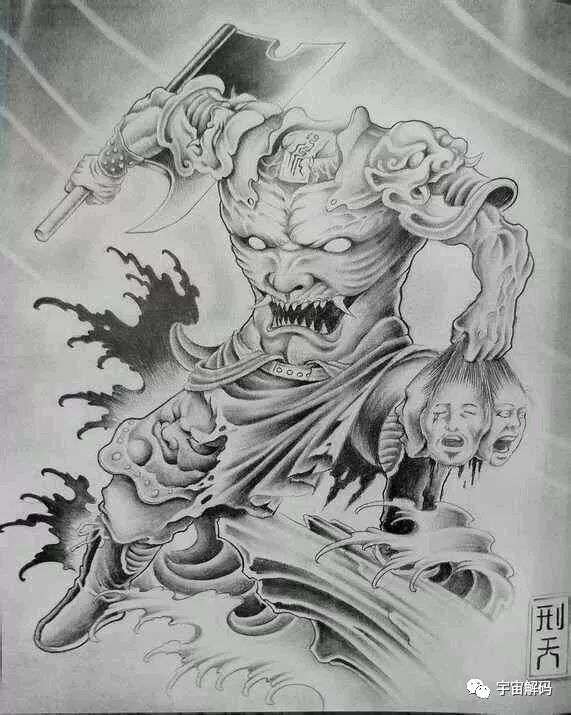
Fig. 6 – A modern depiction of Xingtian (larger version). Artist unknown.
Now, I’ve previously written a story sketch in which Master Subodhi’s school is actually a training ground for an immortal monastic army akin to the Shaolin Temple. I speculated that Wukong’s skill in martial arts and troop movement would come from his time serving as a soldier and eventual officer in this army. Additionally, I suggested that the baddie whom the army faces is the headless monster Xingtian (刑天) (fig. 6), who originally battled the supreme god Shangdi for control of the universe and was beheaded after his defeat. Perhaps he or a figure like him follows in Kumarbi’s footsteps and beds a stone, in this case the rock on the Mountain of Flowers and Fruits, in an effort to create a powerful son to finish what he started. Then, he works in the shadows, influencing the direction of Monkey’s life, leading to his famous rebellion against heaven. Wukong’s defeat of the seventy-two major gods in the heavenly army [1] would mirror Ullikummi routing the seventy gods led by Astabi. Likewise, the Jade Emperor’s call to the Buddha, leading to Monkey’s defeat, mirrors Tesub’s plea to Ea and the eventual downfall of the stone monster.
Thoughts?
Story Idea #3: Arhat Punished to Reincarnation
Update: 06-16-23
Another idea could predate Monkey’s stone birth and instead focus on a past life as a heavenly being. It would draw from three sources: First, the backstory of the Tang Monk, Tripitaka. Those who’ve read JTTW will know that his past life, an Arhat called Master Golden Cicada (Jinchan zi, 金蟬子), is exiled from paradise for ten lifetimes for falling asleep during the Buddha’s lecture.
Just like his master, Sun Wukong is formerly a celestial in paradise. A great name for this figure would be the “Arhat Steel Muscles and Iron Bones” (Gangjin tiegu luohan, 鋼筋鐵骨羅漢). This plays on a similar title given to Sun’s antecedent, the “Monkey Pilgrim” (Hou xingzhe, 猴行者), by Tang Emperor Taizong in the 13th-century oral version of JTTW. [2]
Second, the embellished life story of Song-era General Yue Fei (岳飛, 1103–1142). The Complete Vernacular Biography of Yue Fei (Shuo Yue quanzhuan, 說岳全傳, c. 17th century; “The Biography of Yue Fei” hereafter) actually draws inspiration from the 1592 JTTW by portraying the general as a reincarnation of a bird monster-turned-Dharma protector from chapters 74 to 77. Originally called the “Peng Bird of Ten Thousand Cloudy Miles” (Yuncheng wanli peng, 雲程萬里鵬) in JTTW, the “Great Peng, the Golden-Winged King of Illumination” (Dapeng jinchi mingwang, 大鵬金翅明王) is exiled from paradise in chapter one of The Biography of Yue Fei for killing a stellar bat-spirit who farted during the Tathagata’s sermon on the Lotus Sutra. [3]
Just like the Great Peng bird, the Arhat Steel Muscles and Iron Bones kills a spirit for seemingly offending the Buddha. [4] I imagine that the Enlightened One would admonish him by saying something like, “You are so sure of your strength, so proud of your physical gifts. And yet you don’t know how to defend the Dharma with it!” He then exiles the Arhat to live out ten lifetimes (à la Master Golden Cicada) where he’s a figure of great strength who is continually bested and humiliated and forced by circumstances to protect something weaker than him.
And third, the Buddha’s Jataka tales. The Tathagata has many birth stories where he is both humans and animals who embody an important lesson (Cowell, 1895). In fact, one tale depicts him as a Monkey King!
The Arhat is reborn in the lower three paths of reincarnation, and just like the Buddha, he has several past lives as animals. He works his way up the cosmic hierarchy by performing good deeds, such as a past life where he’s a man-eating tiger who comes to protect a small child. He attains the human-like form of a monkey in his final incarnation, leading to the events of JTTW.
I like this option a lot because this would make both Monkey and Tripitaka former Arhats who undergo prolonged trials that refine their spirits over many lifetimes. This would ultimately explain why both of them attain Buddhahood at the end of their respective character arcs, our hero becoming the “Buddha Victorious in Strife” (Dou zhansheng fo, 鬥戰勝佛) and the Tang Monk “Buddha of Candana Merit” (Zhantan gongde fo, 旃檀功德佛) (Wu & Yu, 2012, vol. 4, p. 381). I also like it because Sun Wukong’s past life references the Tibetan monkey bodhisattva Hilumandju, who is an avatar of the bodhisattva Avalokiteshvara (Guanyin) and a possible Buddhist syncretic version of the Hindu monkey god Hanumanji. What’s interesting about this legendary figure is that he mates with a rock ogress (see the 08-02-19 update here), which reminds one of Sun’s stone birth.
Authenticity
Update: 02-22-25
While I like elements from the first two story ideas, the third one is turning out to be more authentic and interesting.
I had previously referred to Monkey’s past life on this article as a Bodhisattva, but I changed this to an Arhat after finding evidence that Golden Cicada, Tripitaka’s past life, was a Buddhist saint. This includes the following:
Xuanzang was historically worshiped as one during the Song dynasty.
Two Yuan-Ming plays depict him as the reincarnation of Arhats.
Two other principle disciples, the Arhats Ananda and Kasyapa, appear among the Tathagata’s retinue in JTTW (see here).
In addition, my previous article on Sun Wukong’s first master, the Buddho-Daoist Sage Subodhi, suggests that he is the historical Arhat Subhuti, also one of the principle disciples. And if we insert the aforementioned Aniruddha as the original identity of Master Golden Cicada, that will make four of ten disciples appearing in the story. I stress this because maybe—within our fanfiction—Monkey’s previous life could be another principle disciple that has been conveniently inserted among the historical figures. That way, the Great Sage would have known both Golden Cicada (his master Tripitaka) and Subhuti (his master Subodhi) in the past!
This is neat because he (Arhat Steel Muscles and Iron Bones) and Golden Cicada could ideally be living out their respective transmigrational punishments around the same time. And this further stimulates my brain: what if each of Monkey’s incarnations have protected each of Tripitaka’s past lives?!?!
Notes:
1) Koss (1981) writes: “Adding up the number of gods listed here [see Wu & Yu, 2012, p. 169] from the Twenty-Eight Constellations through the Deities of the Five Mountains and the Four Rivers, the number arrived at is seventy-three, if 東西星斗 [dongxi xingdou, the “Stars of East and West”] is counted as two, which Yu does in his translation, or seventy two, if the latter is taken as one, which is another possible interpretation” (p. 84).
2) In chapter 17, Tang Taizong names him the “Great Sage Steel Muscles and Iron Bones” (Gangjin tiegu dasheng, 鋼筋鐵骨大聖) (Wivell, 1994, p. 1207).
3) Chapter one of The Complete Vernacular Biography of Yue Fei reads:
Let’s talk about the Buddha Tathagata at the Great Thunderclap Monastery in the Western Paradise. One day, he sat on a nine-level lotus throne, and the Four Great Bodhisattvas, the Eight Great Vajra Warriors, the five hundred Arhats, the three thousand Heavenly Kings, nuns and monks, male and female attendants, all of the heavenly sages who protect the Dharma, gathered to listen to his lecture on the Lotus Sutra. His words were like flowers and precious jewels raining from the heavens. But, at that time, a star-spirit, the Maiden Earth Bat, who had been listening to the lecture from beneath the lotus throne, couldn’t bear it any longer and unexpectedly let out a stinky fart.
The Buddha was a great, merciful lord, so he didn’t mind even the slightest bit. But don’t sympathize with the Dharma protector above his head, the “Great Peng, the Golden-Winged King of Illumination,” whose eyes shone with golden light and whose back was a scene of auspiciousness. He became angry when he saw the nasty, filthy Maiden Earth Bat, and so he unfurled both his wings and dropped down to kill the spirit by pecking her on the head. The light-point of her soul shot out of the Great Thunderclap Monastery and went to the Lands of the East (China) in the world below to find a mother and reincarnate. She was reborn as a daughter of the Wang clan. She would later marry the Song Prime minister Qin Hui (1091-1155) and come to cruelly kill the righteous (i.e. Yue Fei) as a means to get revenge against today’s enemy. We will talk about this later.
Let’s return to the Buddha, who saw what happened with his all-seeing eyes and exclaimed, “Good! Good! It turns out that this is an episode of karma (cause and effect).” Then he called the Great Peng bird to come closer and shouted, “You evil creature! You already took refuge in my teachings. How can you not follow the five precepts by daring to commit such a horrible crime? I don’t need you here; you will descend to the mortal world to pay off your (karmic) debt and wait until you have fulfilled your work. Once that is completed, only then will I allow you to return to the mountain to achieve the right fruit (Buddhist merit).” The Great Peng complied with the decree, flying out of the Great Thunderclap Monastery directly to the Lands of the East to be reincarnated. We will stop here.
4) A murderous Buddhist deity may seem weird, but Vajrapani (Jingang shou pusa, 金剛手菩薩; lit: “Bodhisattva Holding the Vajra Weapon”), a yaksha-turned-wrathful Dharma protector, is considered a bodhisattva (Buswell & Lopez, 2014, p. 955).
Sources:
Buswell, R. E. , & Lopez, D. S. (2014). The Princeton Dictionary of Buddhism. Princeton, NJ: Princeton University Press.
Wile, D. (1992). Art of the Bedchamber: The Chinese Sexual Yoga Classics Including Women’s Solo Meditation Texts. Albany: State University of New York Press.
From time to time I like to post a fun blog not directly related to (though informed by) my research. A past example can be seen here. Regular articles will resume after this entry.
Last Updated: 05-15-2022
As noted in part one, the immortal sage Subodhi teaches Sun Wukong Chan (Zen) and Daoist philosophy; the secret of immortality; the 72 heavenly transformations; cloud-somersaulting; general Daoist magic; military arts like troop maneuvering, weapons, and boxing; and medicine. But why would a Daoist monk need to know how to wield weapons and fight in battle formations? In this piece, I would like to speculate that the Sage’s school is a training ground for an immortal monastic army! I am by no means suggesting that there is actual textual support for my conjecture. This is purely a fun exercise, fodder for fanfiction, if you will. I plan to supplement what we already know from the novel with historical information about monastic armies in China, particularly focusing on the warrior monks of the famed Shaolin Monastery (Shaolin si, 少林寺) (fig. 1).
1. The Evolution of Shaolin’s Monastic Army: A Brief Survey
Founded in 496 during the Northern Wei Dynasty, the Shaolin monastery was built on Song Mountain, a mountain range located in Henan Province, China (fig. 2). It became the home of Chan Buddhism and a center for Buddhist learning, even attracting the likes of Xuanzang (on whom Tripitaka is based), whose request to move there in 645 was denied by the Tang Emperor Taizong (Shahar, 2008, p. 17). Despite being a school of higher religious learning, the monastery later came to be associated with elite warriors. The term “Warrior Monk” seems like an oxymoron considering that Buddhism is generally considered a religion of peace. However, evidence suggests that the monks may have first taken up arms to protect their property, for monasteries were often lavishly decorated and laden with treasures from rich donors, making them prime targets for bandits (Shahar, 2008, p. 18). For example, one of Shaolin’s worst bandit raids took place in 1356 when Red Turban rebels attacked, “peeling off the gold coating of the Buddha images and breaking the statues in search of hidden treasures,” eventually destroying part of the complex (Shahar, 2008, p. 85).
Fig. 2 – A map showing the location of Shaolin and the nearby town of Dengfeng in northern Henan (larger version). The ancient Sui and Tang capital of Luoyang is visible to the left, while the modern day capital of Zhengzhou is visible to the right. Henan shares a border with the provinces of Shanxi and Shandong to the north. Adapted from Shahar, 2008, p. 10. By the author.
The first documented case of Shaolin monks protecting their monastery took place in 610 when they repelled a bandit attack that saw many of their stupas burnt. Their combat experience would come in handy years later when, in 621, the monks aided Li Shimin, the future Emperor Taizong of the newly formed Tang Dynasty, by assaulting a stronghold and capturing the nephew of Wang Shichong, a former general of the defunct Sui Dynasty and the founder of a competing dynasty. Wang had captured valuable farmland belonging to Shaolin and established the stronghold there because it was located in a valley through which passed the strategically important route to the Sui capital of Luoyang. The monks’ intervention was not a display of loyalty to the fledgling Tang but solely a move to regain control of their property, a political gamble that paid off and benefited the monastery for centuries (Shahar, 2008, pp. 25-27). Three of the monks who took part in the battle were awarded titles by Li. One in particular was given the high military rank of Generalissimo (Da Jiangjun, 大將軍) (Shahar, 2008, p. 31). This wasn’t the last time Shaolin soldier monks came to the aid of the Chinese empire.
By the late-Ming Dynasty, Shaolin was famed far and wide for their mastery of the staff, their method appearing in various military encyclopedias. The interest in their martial prowess was likely spurred by news of their military victories during the 1550s against the Wokou (倭寇, “Dwarf/Japanese pirates”), a conglomeration of Japanese, Chinese, and Korean sea bandits who plagued China’s eastern and southeastern coasts (fig. 3). The Ming’s hereditary army was all but useless at this time, forcing local governments to rely more on prefectural level troops (xiang bing, 廂兵), including contingents of Buddhist warrior monks from different monasteries (Shahar, 2008, p. 68). Monks from Shaolin and sister temples were mobilized in the spring of 1553 and fought the pirates a total of four times through the autumn of 1555. Shahar (2008) explains:
The monks scored their biggest victory in the Wengjiagang battle. On July 21, 1553, 120 fighting monks defeated a group of pirates, chasing the survivors for ten days along the twenty-mile route southward to Wangjiazhuang (on the Jiaxing Prefecture coast). There, on July 31, the very last bandit was disposed of. All in all, more than a hundred pirates perished, whereas the monks suffered four casualties only. Indeed, the monks took pity on no one in this battle, one employing his iron staff to kill an escaping pirate’s wife (p. 69).
It’s interesting to note that the head priest who led the monastic army in their victory over the Wokou was himself from Shaolin and was documented to have single-handedly defeated eight armed monks from a neighboring temple who challenged his position (Shahar, 2008, pp. 69-70).
Fig. 3 – Detail from a Ming painting depicting soldiers fighting the Wokou (larger version). More information about the scroll can be seen here.
In a chapter titled “The Monastic Armies’ First Victory” (Seng bing shou jie ji, 僧兵首捷記, 1568), the geographer Zheng Ruoceng extolled Shaolin’s skill and called for their regular use, along with other holy warriors from sister temples, in combat:
In today’s martial arts, there is no one in the land who does not yield to Shaolin. Funiu [in Henan] should be ranked as second. The main reason [for Funiu’s excellence] is that its monks, seeking to protect themselves against the miners, studied at Shaolin. Third comes Wutai [in Shanxi]. The source of the Wutai tradition is the method of the “Yang Family Spear” (Yangjia qiang), which has been transmitted for generations in the Yang family. Together, these three [Buddhist centers] comprise hundreds of monasteries and countless monks. Our land is beset by bandits inside and barbarians outside. If the government issues an order for [these monks’] recruitment it will win every battle (Shahar, 2008, p. 70).
The warrior monks were just one type of disciple at Shaolin. For example, modern Shaolin has four types: 1) ordained monks; 2) ordained martial arts monks who often leave to open their own schools around the monastery or abroad; 3) non-ordained martial arts performers (a.k.a. “fake monks”); and 4) lay disciples. Only the first type strictly adheres to Buddhist dietary laws. The martial type are historically known for eating meat and drinking alcohol, associating the former with physical strength and fighting ability. During the Ming and Qing Dynasties, such monks lived in subsidiary shrines (fangtou, 房頭) away from the monastery proper or lived an itinerant lifestyle (Shahar, 2008, pp. 46-51). Therefore, the warrior monks who bloodied their hands during wartime and regularly ate meat lived away from the devout, vegetarian body within the main monastery. Their unruly nature was for the most part accepted because of the protection they provided.
2. Story Idea
Now the fun begins! Here I would like to take what we know about the novel (part one) and the above information to speculate on the martial history of Subodhi’s school.
Like Shaolin, Subodhi’s school is located in the mountains and most likely houses great heavenly treasures, the likes of which might be sought after by demon kings. Conflict with these demons would naturally necessitate the immortal monks take up arms in defense of their school. Continued conflict would allow them to hone their skills until their services might be called upon by one of two celestial factions vying for control of heaven during times immemorial, much like Li Shimin’s struggle against Wang Shichong. Chinese mythology is full of numerous baddies threatening the primacy of heaven. One in particular is the headless deity Xingtian (刑天) (fig. 4) from the Classic of Mountains and Seas (c. 4th–1st century BCE):
Xingtian and the Supreme God Di came to this place and struggled against each other for ultimate power. The Supreme God cut off Xingtian’s head and buried him at Eternally Auspicious Mountain. Xiangtian’s nipples then transformed into eyes, and his navel became a mouth. He performs a dance with an ax and shield (Strassberg, 2002, p. 171).
Xingtian was originally a retainer of the Flame emperor, who lost his bid for power against the Yellow Emperor. Xingtian then continued his master’s war, even refusing to die after being beheaded (Strassberg, 2002, p. 171).
Fig. 4 – A modern depiction of Xingtian (larger version). Artist unknown.
The deity’s sustained, obsessive defiance, illustrated by his war dance, could serve as an ever present threat working in the shadows, waiting and plotting. Perhaps untold millennia after his first defeat, Xingtian amasses a huge army that attacks the celestial realm via the Tianhe (天河, “Heavenly River), or the Milky Way, much like the Wokou attacked the Chinese coast by sea. The Yellow Emperor then calls up Master Subodhi’s immortal warriors to help neutralize the threat, emerging victorious and winning the admiration of deities throughout the cosmos like their Shaolin counterparts.
So where does Sun Wukong fit in to this fanciful yarn? As an ordained-martial monk, Monkey would regularly train in weapons and fight in the monastic army, possibly rising through the ranks due to his supernatural talent and becoming a general who leads an assault against Xingtian’s forces. (Perhaps he would even have to defend his position against older, jealous immortals, much like the aforementioned Shaolin monk during the Ming.) Sun’s time in the monastic army would explain why, as noted in part one, the young immortal knows how to train his monkey children to march, go on patrol, follow orders directed by flags and battle drums, and advance and retreat. Only a person who studied military classics and had prior experience with leading troops would have such knowledge.
This in turn would explain why Subodhi expels Monkey and warns him to never reveal the sage had been his teacher. Sun Wukong is a powerful immortal and seasoned fighter with vast magical powers. Combine that with little impulse control and you’ve got the makings of a demon. Heaven discovering that Subodhi had trained the very demon who came to rebel against it would stain the sage’s name and the achievements of his school.
I would love to see someone use this information to write a prequel set during Sun Wukong’s time in Subodhi’s monastery.
3. Updates
Update: 09-18-21
Sun is originally expelled from Subodhi’s school for flaunting his newfound powers of transformation (Wu & Yu, 2012, vol. 1, pp. 123-124). But given Monkey’s ability to acquire amazing powers in just three short years, perhaps Subodhi fears his student’s potential for exponential spiritual growth. Whether this is because he sees a spark of malice in his disciple or he’s just plain jealous (the former seems more likely), Subodhi could just use the transformation as an excuse to halt his progression. But imagine Sun after another three years! I imagine high-level cosmic beings like the Buddha would be interested in keeping an eye on his progress.
Update: 05-15-22
I’ve posted an article that expands on the ideas from above.
This entry will explore the curriculum that Sun Wukong follows while studying under the Buddho-Daoist sage, Patriarch Subodhi, in Journey to the West (Xiyouji, 西遊記, 1592; “JTTW” hereafter). Monkey stays in the immortal’s monastery for a total of ten years, the first seven living as a junior monk and the last three as a close disciple of Subodhi. Apart from menial tasks like fetching firewood and water, tending the garden, and cleaning the monastery grounds, Monkey first receives lessons on human language and etiquette, calligraphy, scripture reading, and minor ritual procedures like incense burning. These are taught to him by his senior religious brothers, thereby freeing up the Sage to teach higher level lessons on philosophy, internal alchemy, magic, and other skills to his more advanced students.
I should point out that Sun’s greatest asset during his training appears to be a supernatural mental acuity. Upon becoming Subodhi’s close disciple, Monkey rapidly masters skills that even his more senior religious brothers cannot grasp. The novel, therefore, refers to our hero as “someone who, knowing one thing, could understand a hundred” (Wu & Yu, 2012, vol. 1, p. 122). Monkey’s intellect allows him to outsmart many opponents and bypass many obstacles during his later adventures.
One poem best describes the philosophical lessons taught by Subodhi:
With words so florid and eloquent That gold lotus sprang from the ground. The doctrine of three vehicles he subtly rehearsed, Including even the laws’ minutest tittle. The yak-tail waved slowly and spouted elegance: His thunderous voice moved e’en the Ninth Heaven. For a while he lectured on Dao; For a while he spoke on Chan– To harmonize the Three Parties is a natural thing. One word’s elucidation filled with truth Points to the birthless showing nature’s mystery
(Wu & Yu, 2012, vol. 1, p. 122).
This poem is a prime example of the Ming syncretic philosophy of the Three Teachings (Sanjiao, 三教): Confucianism, Daoism, and Buddhism. “The doctrine of the three vehicles” could refer to the three main branches of Buddhism, namely Theravada, Mahayana, and Vajrayana, but could also be referring to the Three Teachings (the same as the “Three Parties” mentioned further down the poem). “The yak-tail waved slowly and spouted elegance” refers to the bingfu (秉拂), or “to take hold of the whisk,” a phrase denoting a sermon by a learned Chan (Zen) master conducted from a high chair. The phrase derives from the fly whisk (Sk: vālavyajana; Ch: fuzi, 拂子; Jp: hossu, 払子), a symbol of religious authority held in hand during a lesson (Buswell & Lopez, 2014, p. 120). “His thunderous voice moved e’en the Ninth Heaven” refers to the Nine Heavens (jiutian, 九天) of Daoism (Pregadio, 2008, pp. 593-594). And, of course, the poem goes onto mention Subodhi lecturing on both Chan and the Dao, thereby identifying him as a teacher of unparalleled knowledge.
An immortal lecturing on Buddhism may come as a surprise to some readers. However, it should be remembered that Subodhi is based on one of the Buddha’s historical disciples.
Sun Wukong and Master Subodhi. Take note of the fly whisk in the sage’s hands. Photomanipulation by the author (larger version). The original photo of the monk can be found on this blog about the fly whisk.
The Secret of Immortality
As I’ve explained in this article, Sun achieves immortality via breathing exercises designed to absorb yang energy during prescribed times (after midnight and before noon), the retention of chaste semen and transformation into qi energy, and the purification and circulation of the resulting spiritual energy throughout his body. While these practices are traditionally associated in Daoist internal alchemy with the formation of an immortal spirit that is eventually freed from the mortal shell, Monkey’s practice results in an ageless, adamantine physical body, one capable of lifting even cosmic mountains.
Monkey achieves immortality. Photomanipulation by the author (larger version).
This series of oral formulas allows Wukong to change his physical appearance into anything from other humanoid figures (gods, monsters, and humans), animals, insects, miscellaneous objects, incorporeal beams of light, and even buildings. Subodhi teaches this skill to Monkey with the expressed purpose of escaping three heaven-sent calamities meant to destroy immortals for defying their fate. Despite the intended use, this skill becomes one of his greatest strengths.
Because of Monkey’s mental acuity he is able to instantly remember all of the oral formulas imparted to him, and after some practice, he quickly masters the transformations.
Sun’s heated battle of transformations with the god Erlang. From the 1965 animated classic Havoc in Heaven.
The combination of a hand mudra and an oral formula allows Monkey to rise above the ground and travel at immense speed by somersaulting from cloud to cloud, each leap being 108,000 li, or 33,554 miles (54,000 km) long. (However, it is not wise to attach a real world distance to the ability. See this update for more info.)
This power is mastered in a single night.
Monkey flying on clouds. Drawing by Funzee on deviantart (larger version).
Monkey only makes a passing reference to his martial training in a later poem, part of which reads: “I bowed to the Patriarch of the Heart and Mind Spirit Platform and perfected with him the martial arts” (身拜靈臺方寸祖,學成武藝甚全周) (based on Wu & Yu, 2012, vol 3, p. 243).
The following skills are inferred based on this reference and internal story details.
Boxing
Sun displays a mastery of unarmed boxing in chapters two and 51, the former against a demon who takes over his mountain home in his absence and the latter against a Buffalo demon who steals his staff. Both chapters describe Monkey using techniques akin to short fist, a style known for quick, compact punches. Learning this close range style may be out of necessity, though, considering that Sun is so short—he’s less than 4-Chinese feet (122 cm) tall.
In his wonderful book The Shaolin Monastery (2008), Prof. Meir Shahar of Tel Aviv University reveals that Shaolin kungfu developed during the Ming-Qing transition from a synthesis of Daoist gymnastics (stretching and breathing exercises), religious rituals, and fist techniques. This new form of spiritual cultivation ushered in the era of so-called “internal martial arts,” Taiji boxing being the most famous among them.
Interestingly, some of the real world techniques used by Monkey and his opponent in chapter 51 appear in Taiji boxing.
JTTW was published during the late-Ming when this synthesis was in full swing. Therefore, Sun’s study of martial arts in a religious institution is an accurate snapshot of one facet of 16th-century monastic life.
Sun teaching a young human apprentice martial arts. Drawing by Celsohenrique on deviantart (larger version).
Weapons
After returning home in chapter 3, the young immortal teaches his children how to wield a plethora of weapons, including swords, spears, axes, bows and arrows, etc. He shortly thereafter acquires his magic staff, the weapon most commonly associated with him. Monkey’s skill with the staff is so great, in fact, that his supernatural technique is likened in chapter 33 to two of the Seven Military Classics of China.
Monkey’s broad knowledge of weapons implies that he learns the famous “Eighteen Martial Arts” (Shiba ban wuyi, 十八般武藝). A vague list of these war implements first appeared during the Song Dynasty, but a later definitive list became “a standard shorthand for complete martial arts knowledge” in Yuan-period stage plays (Lorge, 2012, p. 146). One version of the list appearing in the great Chinese classic The Water Margin (Shuihu zhuan, 水滸傳, c. 1400) includes everything from chains, clubs, and whips to axes, halberds, and even early firearms (Lorge, 2012, p. 147). Variations on the eighteen weapons remained a staple of Chinese stage plays, oral literature, and written fiction. Therefore, it’s no wonder a great warrior like Sun Wukong would come to be associated with the mastery of so many weapons.
Monkey assaults heavenly forces with his magic staff. Drawing by JeremyBLZ on deviantart (larger version).
Military Maneuvers
Monkey goes onto train his children in how to march, go on patrol, follow orders directed by flags and battle drums, and advance and retreat, turning the tangled mass of monkeys into an elite army.
Sun’s children engaging in mock battles during their training. From Havoc in Heaven.
3. Implied
Sun Wukong’s tutelage in these subjects are never stated but are understood to have taken place.
General Daoist Magic
This ability allows him to call forth gods and spirits, grow or shrink to any size, part fire and water, create an impassable barrier, conger a wind storm, cast illusions, freeze someone in place, unlock any lock, give human disciples superhuman strength, etc.
What’s interesting is that during his training, Monkey expressly passes on learning the bureaucratic-style magic rites normally used by earthly priests simply because they won’t result in his immortality. Instead, after achieving eternal life, Sun is just so powerful he can command the very gods themselves to do his bidding. His lack of ritual knowledge is highlighted in chapter 45 when he agrees to engage in a rain-making competition with an animal spirit disguised as a Daoist priest. The spirit relies on an established liturgy involving a ritual sword and tablet, as well as the burning of a written note. This elaborate ritual initiates a bureaucratic chain in which the request is sent to heaven, the Jade Emperor agrees to the appeal, and then heavenly officials, namely the gods of wind, clouds, lightning, and rain, are dispatched to fulfill the application. But Monkey rises into the clouds above to bully the respective deities into helping him instead, noting: “I don’t know how to burn charms, issue summons, or strike any tablet. So all of you must play along with me” (Wu & Yu, 2012, vol. 2, p. 293).
Likewise, Monkey is so powerful that he can bring the dead back to life by simply fetching a person’s soul from the underworld (like he does for an elderly benefactor in chapter 97).
Sun casting a magic spell. Drawing by Poppindollars on deviantart (larger version).
Monkey works to diagnose the long-standing malady of a foreign emperor. But due to the immortal’s monstrous appearance, he is forced to analyze the ruler from afar, using three magic hairs-turned-golden strings to measure the vibrations of the pulse from three locations of each forearm. Sun deduces that the illness is caused by fear and anxiety over the loss of the monarch’s queen, who had been kidnapped by a demon. Monkey then concocts three pills from a recipe of herbs, kettle soot, and dragon horse urine and administers the elixir with dragon king saliva. The medicine causes the emperor to pass an obstruction in his bowls, thus restoring the natural qi flow in his body and curing him of his sickness.
Baring the strings, Monkey’s method of reading the pulse aligns with real Chinese medicinal practice. The area of the forearm analyzed by traditional Chinese doctors is known as Cunkou (寸口, the “inch opening”), and this is broken up into the three spots Cun (寸, “inch”), Guan (關, “pass”), and Chi (尺, “foot”). The mirrored spots on each arm are believed to correspond to specific internal organs. For example, the Cun spot (nearest the wrist) on the right hand corresponds to the lungs, while that of the left hand corresponds to the heart (Liao, 2011, pp. 55-56). Therefore, analyzing the pulse at these spots is believed to reveal the health of the corresponding organs.
The abilities and skills learned by Sun are varied, straddling the religious, the literary, and the martial. Therefore, Monkey is a perfect example of what Deng Mingdao (1990) calls the “Scholar Warrior”:
Skill is the essence of the Scholar Warrior. Such a person strives to develop a wide variety of talents to a degree greater than even a specialist in a particular field. Poet and boxer. Doctor and swordsman. Musician and knight. The Scholar Warrior uses each part of his or her overall ability to keep the whole in balance, and to attain the equilibrium for following the Tao. Uncertainty of the future inspires no fear: whatever happens, the Scholar Warrior has the confidence to face it (p. 10).
5. Conclusion
Monkey stays in Subodhi’s monastery for a total of ten years, the first seven living as a junior Daoist monk and the last three as a close disciple of Subodhi. During his time as a junior monk, he learns human language and etiquette, calligraphy, scripture reading, and incense burning. These foundational skills are taught to him by his senior religious brothers. During his time with Subodhi, Sun learns Chan and Daoist philosophy; the secret of immortality; the 72 heavenly transformations; cloud-somersaulting; military arts like troop maneuvering, weapons, and boxing; general Daoist magic; and medicine.
6. Updates
Update: 11-27-2018
I’ve written a continuation of this article where I use the above info to speculate that Sun Wukong is a warrior monk in Master Subodhi’s immortal monastic army. It’s good fodder for fanfiction. I even suggest a mythological baddie for the warrior monks to fight, the headless deity Xingtian.