Parallels Between the Monkey King and the Buddha

Last updated: 06-18-2022

I’ve previously written about the similarities between Sun Wukong and the Water Margin bandit Wu Song. In this article, I would like to explore the similarities shared by the Monkey King and the historical Buddha, Siddhartha Gautama (Ch: Xidaduo Qiaodamo, 悉達多 喬達摩). I know readers are now collectively scratching their heads in confusion and asking, “How in the world are a 6th- to 5th-century BCE Indian philosopher and an immortal monkey spirit from Ming-era Chinese literature similar?” It’s true that the particulars of their stories are different, but I will show that Wukong and the Buddha follow a similar trajectory in their early lives. Both experience a supernatural birth, produce a radiant splendor upon emerging from the womb, spend early years as royalty, feel a sense of shock upon realizing the impermanence of life, set out on a quest to find a means of escaping old age and death, and, finally, achieve this goal through spiritual practices. These similarities suggest that the author-compiler of Journey to the West (Xiyouji, 西遊記, 1592) may have borrowed from the Buddha’s story to make Sun Wukong’s early life more familiar to readers.

For details about the Awakened One’s life, I rely heavily on Acts of the Buddha (Sk: Buddhacarita; Ch: Fo suoxing za, 佛所行讚, 2nd-century), a full-length biographical poem that survives thanks to its translation into Chinese from the original Sanskrit (Buswell & Lopez, 2014, p. 150). Information about Monkey will of course come from the standard 1592 edition of the novel.

See the 06-18-2022 update for another parallel. 

The Parallels

1. Supernatural birth

On the day of his birth, the bodhisattva’s mother, Queen Maya, feels the urge to go to the garden of Lumbini. There, following the tradition of sage-kings, the young prince Siddhartha is born from her right side (fig. 1):

Whilst she (thus) religiously observed the rules of a pure discipline, Bodhisattva was born from her right side, (come) to deliver the world, constrained by great pity, without causing his mother pain or anguish. / As king Yu-liu [Aurva] was born from the thigh, as king Pi-t’au [Pruthu] was born from the hand, as king Man-to [Mandhatri] was born from the top of the head, as king Kia-k’ha [Kakshivat] was born from the arm-pit, / So also was Bodhisattva on the day of his birth produced from the right side… (Beal, 1883, pp. 2-3).

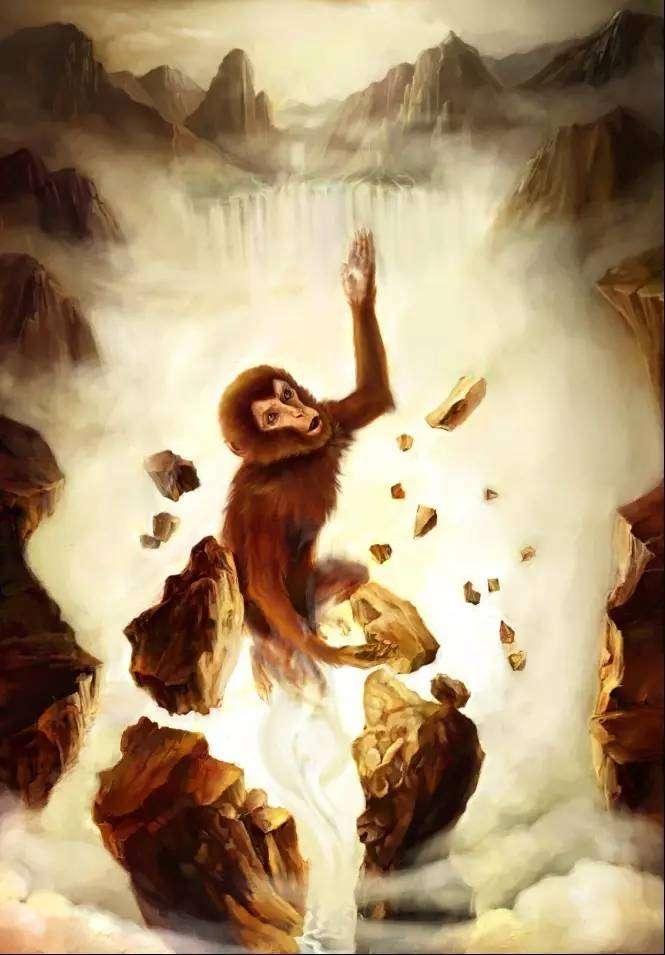
Chapter one of Journey to the West describes how an immortal stone atop the Mountain of Flowers and Fruit (Huaguo shan, 花果山) splits open and gives birth to a stone egg, which is transformed into a stone monkey (shi hou, 石猴) by the elements (fig. 2):

Since the creation of the world, it [the stone] had been nourished for a long period by the seeds of Heaven and Earth and by the essences of the sun and the moon, until, quickened by divine inspiration, it became pregnant with a divine embryo. One day, it split open [benglie, 迸裂], giving birth to a stone egg about the size of a playing ball. Exposed to the wind, it was transformed into a stone monkey endowed with fully developed features and limbs (Wu & Yu, 2012, p. 101) (emphasis mine).

As I’ve previously written, Wukong’s birth is likely based on the sage-king Yu the Great (大禹) and his son Qi (啟, “open”) of Xia, who are stated in various sources to have been born from stone. For example, one 4th-century tale states Yu’s pregnant wife transformed into stone out of shame for having seen her husband’s shamanic metamorphosis into a bear. Yu ordered the stone to release his son, and it split open to give birth to Qi (Birrell, 1999, p. 123). The emphasis on the stone splitting open is related to ancient Chinese stories of sage-kings splitting the chest, back, or sides of their mothers upon birth, [1] much like the Buddha is born from Queen Maya’s side. For instance, the Genealogical Annals of the Emperors and Kings (Diwang shiji, 帝王世紀, 3rd -century) writes:

“While traveling up in the mountains she [Yu’s mother] saw a falling star piercing the Mao region (of the sky). Then in a dream, she received and felt it, so upon swallowing a divine pearl and Job’s Tears, her chest split open and she gave birth to Yu at Stone Knob” (Cook & Luo, 2017, p. 101).

While Yu’s mother is not a stone in this case, his birth is effected by a pearl (a type of stone) and happens in a place named after stone. Such tales establish a link between split births and split stone births, thereby placing the Buddha and Monkey into the same broader birth myth category.

Fig. 1 – A stone carving depicting the birth of Siddhartha from Queen Maya’s side (Gandhara, 2nd- to 3rd-century) (larger version on Wikipedia). Fig. 2 – Monkey’s birth from stone by Zhang Moyi (larger version). Found on this article.

2. Radiant splendor

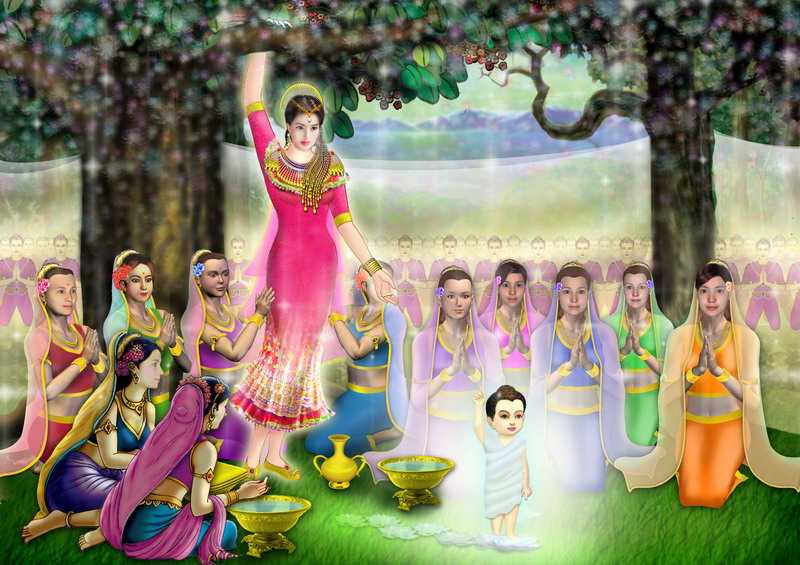
Upon his birth, the Buddha is said to have “shed in every direction the rays of his glory” (fig. 3) (Beal, 1883, p. 3). The source continues to describe this light, as well as the Bodhisattva’s first few moments outside the womb:

His body, nevertheless, was effulgent with light, and like the sun which eclipses the shining of the lamp, so the true gold-like beauty of the Bodhisattva shone forth and was diffused everywhere. / Upright and firm and unconfused in mind, he deliberately took seven steps, the soles of his feet resting evenly upon the ground as he went, his footmarks remained bright as seven stars. / Moving like the lion, king of beasts, and looking earnestly towards the four quarters, penetrating to the centre the principles of truth, he spake thus…” (Beal, 1883, pp. 4-5).

The historical Xuanzang (on whom Tripitaka is based) notes in his travelogue that the Buddha even walks towards the cardinal directions: “After he had been born the Bodhisattva walked seven steps unaided to each of the four quarters … [u]nder each step a large lotus flower sprang up from the earth” (Xuanzang, 1996/2016, p. 158).

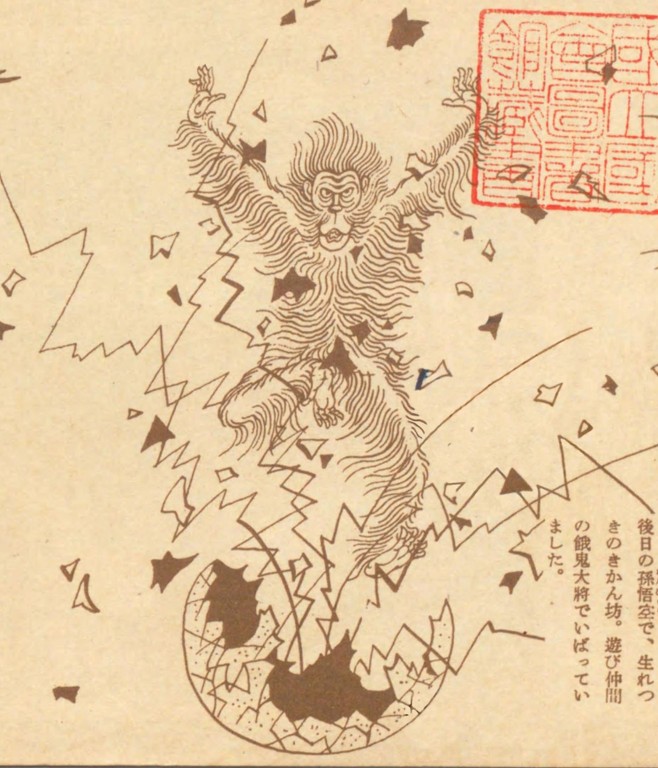
Wukong too produces a great light in every direction: “Having learned at once to climb and run, this monkey also bowed to the four quarters, while two beams of golden light flashed from his eyes to reach even the Palace of the Polestar” (fig. 4) (Wu & Yu, 2012, p. 101).

Therefore, both shine their lights in the four cardinal directions.

Fig. 3 – Baby Buddha producing a radiant splendor upon his birth (larger version). Artist unknown. Found on this article. Fig. 4 – Bright beams of light shine from Wukong’s eyes as he bows to the four directions (larger version). From the Japanese children’s book Son Goku (1939). 

3. Royal years

Prince Siddhartha (fig. 5) is born into the royal Shakya clan ruled by his father, King Suddhodana (Beal, 1883, p. 1). Shortly after his son’s birth, the king is told by two sages that the new heir is fated to be either a universal monarch or a cosmic sage (Beal, 1883, pp. 8-18). Suddhodana attempts to defy the latter fate by surrounding his son with royal luxury and even finding him a wife with which to have his own son:

‘My son, the prince, having a son born to him, / ‘The affairs of the empire will be handed down in succession, and there will be no end to its righteous government; the prince having begotten a son, will love his son as I love him, / ‘And no longer think about leaving his home as an ascetic, but devote himself to the practice of virtue […] Would that this might lead my son (he prayed) to love his child and not forsake his home; the kings of all countries, whose sons have not yet grown up, / Have prevented them exercising authority in the empire, in order to give their minds relaxation, and for this purpose have provided them with worldly indulgences, so that they may perpetuate the royal seed; / So now the king, having begotten a royal son, indulged him in every sort of pleasure; desiring that he might enjoy these worldly delights, and not wish to wander from his home in search of wisdom (Beal, 1883, pp. 28 and 29).

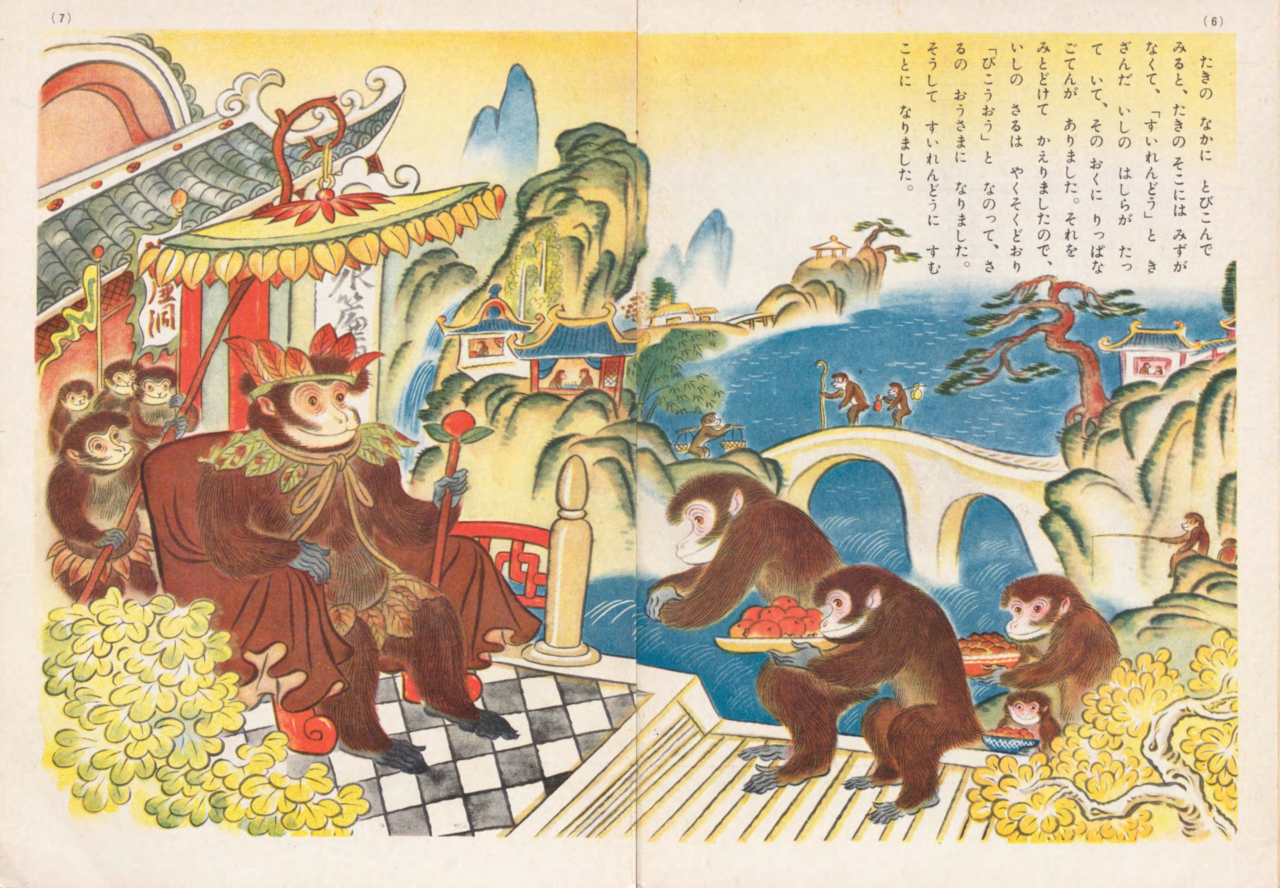
Following his birth, the stone monkey comes to live with a tribe of primates on the Mountain of Flowers and Fruit. One day, the monkeys and apes decide to follow a stream to its source in the mountain and find a beautiful waterfall. They state anyone who can discover what is behind the blanket of water will be proclaimed their king. The stone monkey takes up this challenge by leaping through and discovers the “Cave Heaven of Water-Curtain Cave” (Shuiliandong dongtian, 水簾洞洞天), a grotto paradise with a stone mansion and enough room for all the primates to live. After he emerges victorious,

Each one of them [the primates] then lined up according to rank and age, and, bowing reverently, they intoned, “Long live our great king!” From that moment, the stone monkey ascended the throne of kingship [fig. 6]. He did away with the word “stone” in his name and assumed the title, Handsome Monkey King [Mei hou wang, 美猴王] (Wu & Yu, 2012, p. 105).

The prince is born into a royal clan and yet never rules, while Wukong achieves kinghood through a test of bravery and leads his tribe for over three hundred years (Wu & Yu, 2012, p. 105). Siddhartha’s lack of authority is of course due to his father’s wish that he indulge in worldly pleasures and forget about leaving to become a sage. But birth tales (Sk: jataka) of the Buddha’s past lives do include several incarnations as rulers, even as a monkey king!

Fig. 5 – A stone carving of Prince Siddhartha as a young man (Gandhara, 3rd-century) (larger version via the Norton Simon Museum). Fig. 6 – The Stone Monkey sits on his throne (larger version). From Son Goku (1939).

4. Shock at impermanence

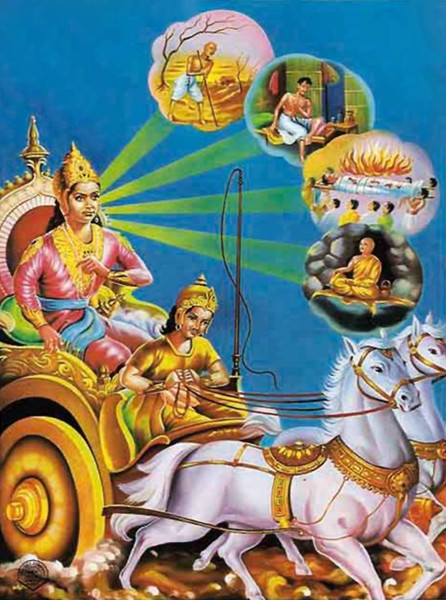
One day, Prince Siddhartha wishes to tour the land outside his personal palace for the first time in his sheltered life. Not wanting his son to see anything unpleasant, King Suddhodana has the path cleared of the old, sick, and poor and decorated with beautiful canopies, banners, and curtains (Beal, 1883, pp. 30-32). But a deva raja intervenes to initiate the first of the “four signs” (Sk: caturnimitta; Ch: sixiang, 四相; i.e. old age, sickness, death, and monasticism) to cause the future Buddha to pursue a spiritual path that will ultimately lead to his enlightenment (fig. 7) (Buswell & Lopez, 2014, pp. 171-172). The deva raja transforms into an extremely elderly man, and upon seeing the sight, Siddhartha is shaken when his chariot driver reveals that he too will suffer this fate:

The prince greatly agitated and moved, asked his charioteer another question and said, ‘Is yonder man the only one afflicted with age, or shall I, and others also, be such as he?’ / The charioteer again replied and said, ‘Your highness also inherits this lot, as time goes on, the form itself is changed, and this must doubtless come, beyond all hindrance: / ‘The youthful form must wear the garb of age, throughout the world, this is the common lot’. Bodhisattva, who had long prepared the foundation of pure and spotless wisdom, / Broadly setting the root of every high quality, with a view to gather large fruit in his present life, hearing these words respecting the sorrow of age, was afflicted in mind, and his hair stood up right. / Just as the roll of the thunder and the storm alarm and put to flight the cattle; so was Bodhisattva affected by the words; shaking with apprehension, he deeply sighed (Beal, 1883, p. 33).

After seeing the sign of sickness (Beal, 1883, pp. 34-35), the prince witnesses the sign of death:

(Once more) he asked, ‘What is this they carry? With streamers and flowers of every choice description, whilst the followers are overwhelmed with grief, tearing their hair and wailing piteously.’ / And now the gods instructing the coachman, he replied and said, ‘This is a “dead man,” all his powers of body destroyed, life departed; his heart without thought, his intellect dispersed; / ‘His spirit gone, his form withered and decayed; stretched out as a dead log; family ties broken—all his friends who once loved him, clad in white cerements, / ‘Now no longer delighting to behold him, remove him to lie in some hollow ditch (tomb).’ The prince hearing the name of death, his heart constrained by painful thoughts, / He asked, ‘Is this the only dead man, or does the world contain like instances?’ Replying thus he said, ‘All, everywhere, the same; he who begins his life must end it likewise; / ‘The strong and lusty and the middle-aged, having a body, cannot but decay (and die).’ The prince now harassed and perplexed in mind; his body bent upon the chariot leaning-board, / With bated breath and struggling accents, stammered thus, ‘Oh worldly men! How fatally deluded! Beholding everywhere the body brought to dust, yet everywhere the more carelessly living; / ‘The heart is neither lifeless wood nor stone, and yet it thinks not “all is vanishing!” (Beal, 1883, pp. 36-37).

After the Monkey King rules the Mountain of Flowers and Fruit for more than three centuries, he tells his children:

Though we are not subject to the laws of man today, nor need we be threatened by the rule of any bird or beast, old age and physical decay in the future will disclose the secret sovereignty of Yama, King of the Underworld. If we die, shall we not have lived in vain, not being able to rank forever among the Heavenly beings? (Wu & Yu, 2012, p. 106).

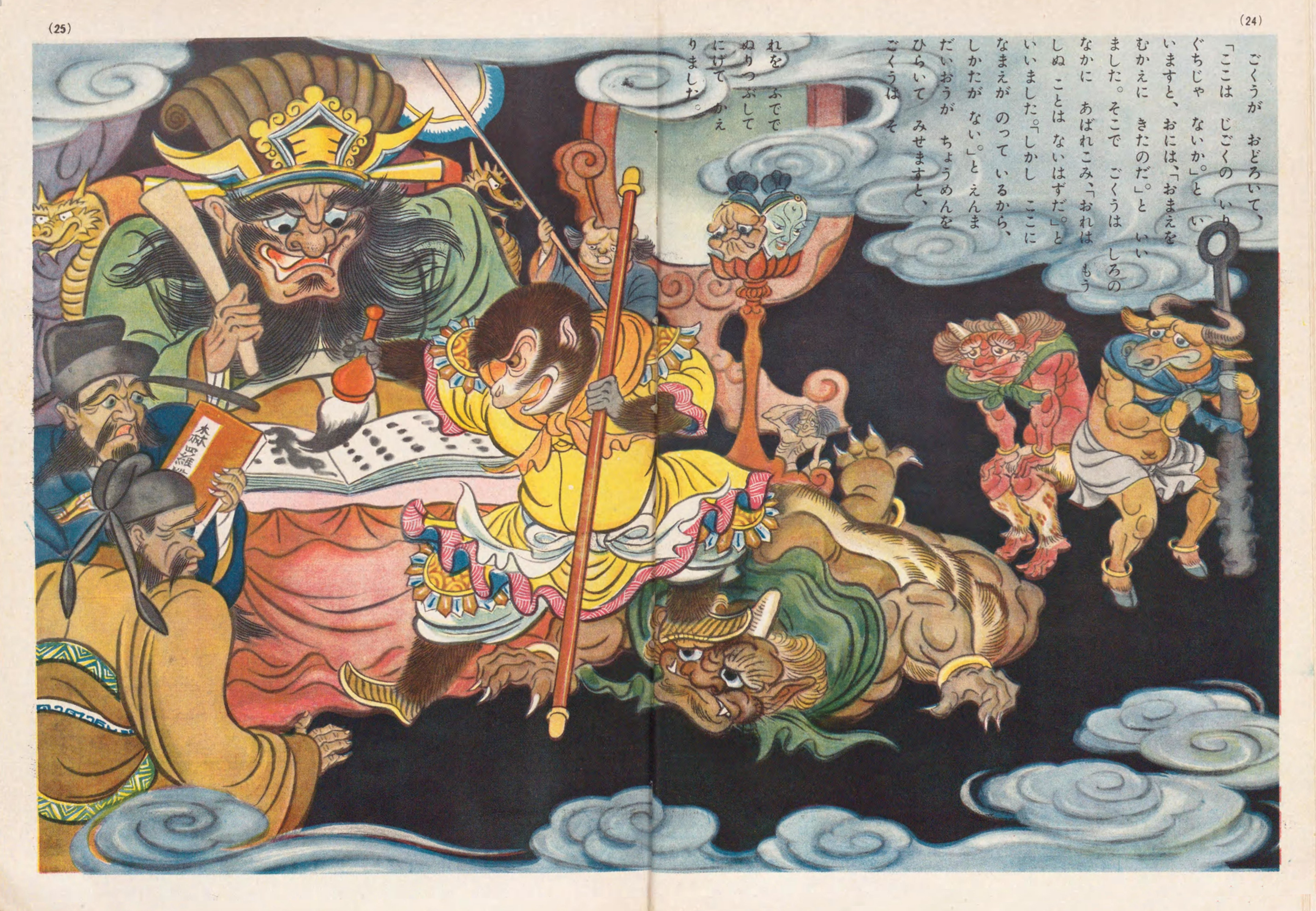
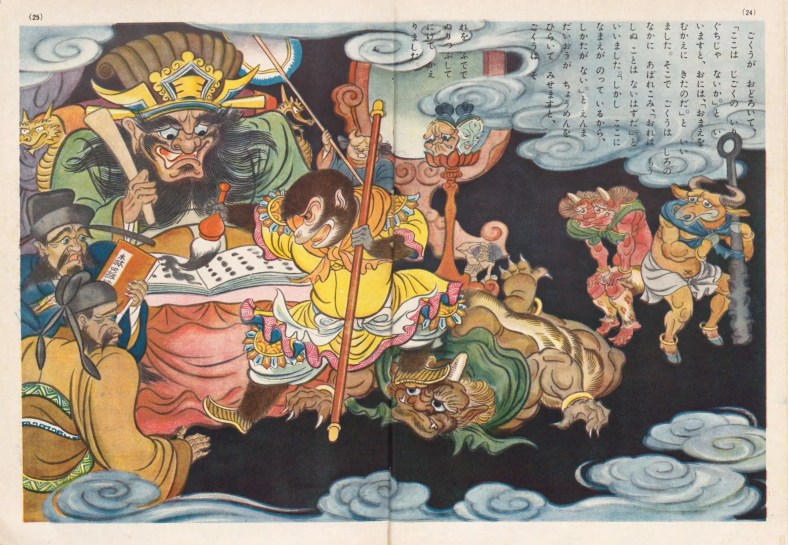
The “shock” felt by Prince Siddhartha and the Monkey King upon realizing the impermanence of life is known in Buddhism as Samvega (Ch: yanli, 厭離) (Thanissaro Bhikkhu, n.d.). It’s interesting that Siddhartha is led to the reality of impermanence, while Monkey comes to the conclusion by himself. This is no doubt due to the differences in their lives. King Suddhodana ensures that his son lives a protected life, one free from the woes of the outside world, by surrounding him with luxury and young, beautiful palace attendants. However, Monkey rules the Mountain of Flowers and Fruit for over three hundred years, no doubt witnessing the decline and death of many of his companions, as well as the waning of his own youth. After all, the thought of impermanence would weigh heavy on anyone nearing the end of their life. This conclusion is supported by the fact that, when his soul is taken to hell in chapter three, Monkey learns from the ledgers of life and death that he was fated to die at 342 years old (fig. 8) (Wu & Yu, 2012, vol. 1, p. 140).

Fig. 7 – Siddhartha experiences the “Four Signs” (larger version). Artist unknown. Fig. 8 – Monkey striking his name from the Book of Life and Death (larger version). From Son Goku (1939).

5. Quest to overcome impermanence

Siddhartha is wracked by constant, obsessive thoughts on the dangers of old age, sickness, and death. After venturing out once more and witnessing poor farmers toiling away in the fields, he proclaims on the spot that he will find some way to oppose life’s suffering. At that exact moment, a deva affects the fourth sign by transforming into a monk (sk: bhikshu), who tells the prince:

Depressed and sad at [the] thought of age, disease, and death, I have left my home to seek some way of rescue, but everywhere I find old age, disease, and death, all (things) hasten to decay and there is no permanency; / ‘Therefore I search for the happiness of some thing that decays not, that never perishes, that never knows beginning, that looks with equal mind on enemy and friend, that heeds not wealth nor beauty, / ‘The happiness of one who finds repose alone in solitude, in some unfrequented dell, free from molestation, all thoughts about the world destroyed, dwelling in some lonely hermitage…’ (Beal, 1883, pp. 49-50).

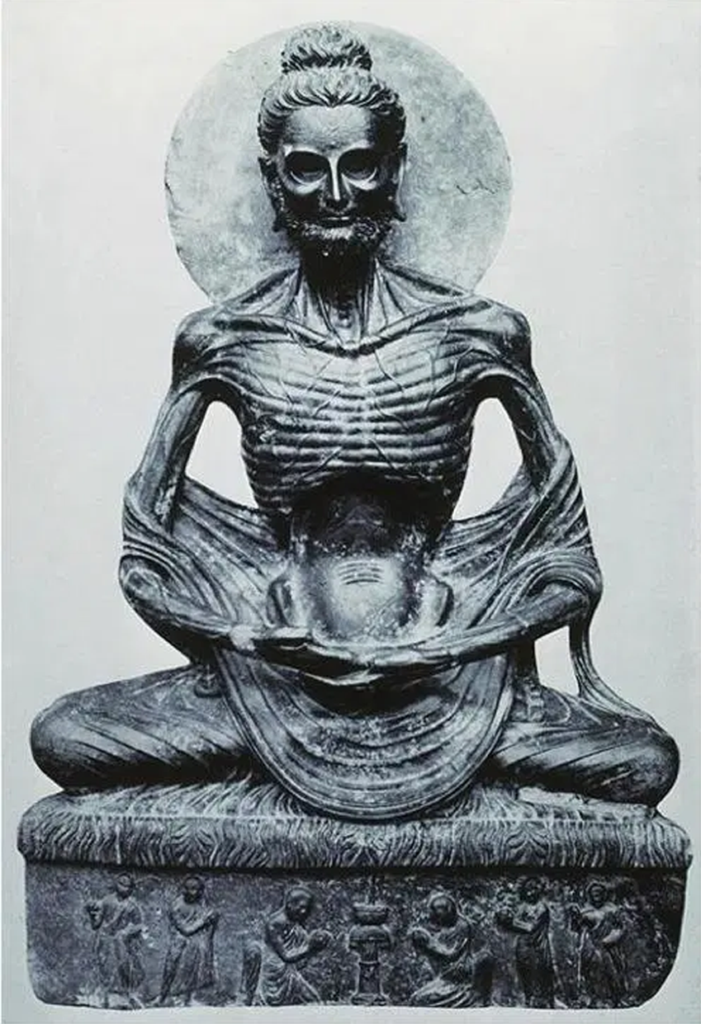
This influences Siddhartha to forsake his royal life to become an ascetic and search for a means of escape from the evils of old age, sickness, and death. Cutting off his topknot, thus severing his royal ties, the future Buddha sets out into the world (Beal, 1883, p. 68). Siddhartha travels the land studying meditation (Sk: dhyana; Ch: chan, 禪) under various sages, pondering concepts of the body, the mind, the soul, and selfhood for years, and even practicing severe austerities that result in the emaciation of his body (fig. 9). But he eventually forsakes these extreme practices, recovering his bodily strength and vowing to achieve perfect enlightenment via meditation beneath a banyan tree (Beal, 1883, pp. 131-147).

When the Monkey King opines the injustice of impermanence, one of his advisors tells him that only three beings live beyond the reach of Yama:

There are, among the five major divisions of all living creatures, only three species that are not subject to Yama, King of the Underworld.” The Monkey King said, “Do you know who they are?” The monkey said, “They are the Buddhas, the immortals, and the holy sages [shensheng, 神聖]; these three alone can avoid the Wheel of Transmigration as well as the process of birth and destruction, and live as long as Heaven and Earth, the mountains and the streams.” “Where do they live?” asked the Monkey King. The monkey said, “They do not live beyond the world of the Jambudvipa, for they dwell within ancient caves on immortal mountains” (Wu & Yu, 2012, p. 107).  

Monkey then pledges to find these great men and women and learn their secret means of escape from Yama’s grasp:

“Tomorrow I shall take leave of you all and go down the mountain. Even if I have to wander with the clouds to the corners of the sea or journey to the distant edges of Heaven, I intend to find these three kinds of people. I will learn from them how to be young forever and escape the calamity inflicted by King Yama” (Wu & Yu, 2012, p. 107).

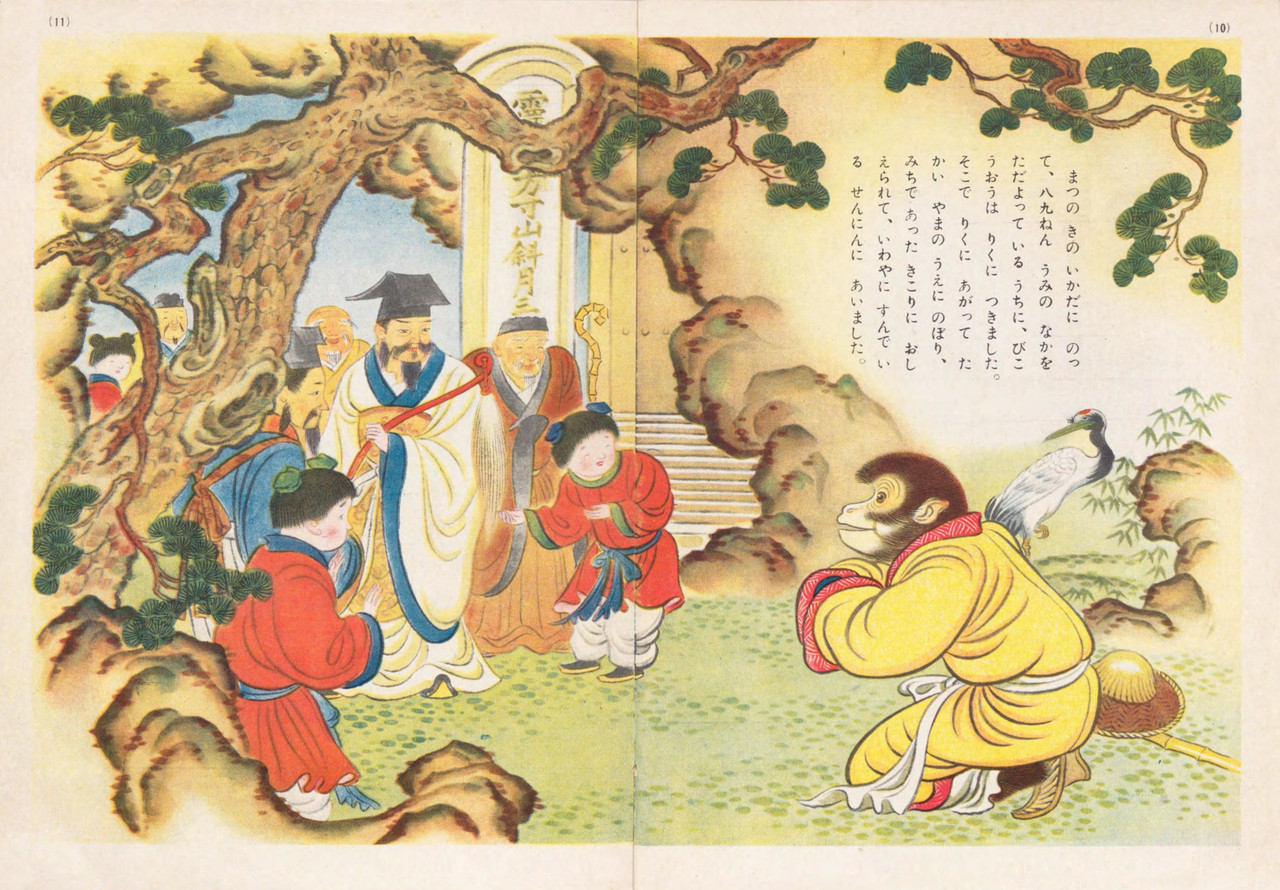
He sets sail in a makeshift raft and wonders the world for more than ten years, searching the towns and cities of the Jambudvipa continent before sailing to the Western Aparagodaniya continent. There, he is directed to the Cave of the Slanted Moon and Three Stars on the Mountain of Numinous Heart and Elixir Mind (Lingtai fangcun shan, xieyue sanxing dong, 靈台方寸山, 斜月三星洞), an immortal hermitage lorded over by the great Buddho-Daoist Sage Subodhi (Xuputi, 須菩提) (fig. 10). The sage accepts him as a student and gives him the religious name Sun Wukong (孫悟空), or “Monkey Awakened to the Void” (Wu & Yu, 2012, pp. 108-115).

Both tales show that Siddhartha and Monkey set out on their respective quests thanks to outside influences. The devas intervene numerous times to guide the future Buddha’s path to enlightenment, [2] proving that the heavenly realm has a vested interest in his fate. Wukong’s journey is instead influenced by the words of his mortal advisor. In this case, the gods have no interest in the fate of such “creatures from the world below” (Wu & Yu, 2012, p. 102). This of course changes once Monkey starts causing havoc throughout the cosmos.

Fig. 9 – A stone carving of the “Fasting Buddha” (Gandhara, 2nd- to 3rd-century BCE) (larger version). Fig. 10 – The Monkey King becomes Subhuti’s disciple (larger version). From Son Goku (1939).

6. Achieving a means of escape

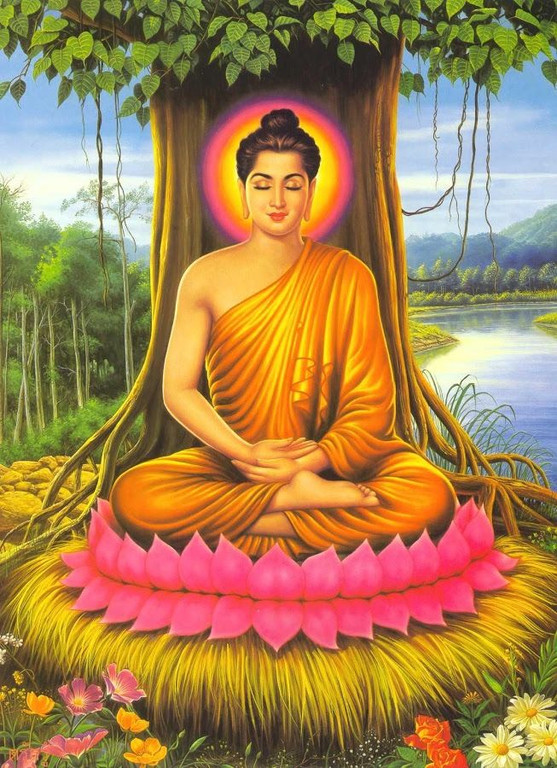
The heavenly demon Mara (Mo, 魔) fears that Siddhartha will achieve enlightenment and help mankind break free from his domain, the illusionary world of Samsara, and so he leads a monstrous army against the great rishi. But the army is rendered powerless by Siddhartha’s supreme focus of mind and burgeoning grasp of reality (Beal, 1883, pp. 147-156). [3] Continuing his meditation further, the rishi perceives his myriad past lives, as well as the karmic punishment of those who covet or perform bad deeds, being tortured in hell or reborn into lower levels of existence, respectively. He then comprehends that suffering arises from clinging, clinging from desire, desire from sensation, sensation from contact, contact from the six senses, and the senses from consciousness. Finally, Siddhartha comes to the realization that breaking each link (e.g. cessation of clinging will end suffering) will stop old age, sickness, and death and ultimately destroy the endless chain of rebirths (Beal, 1883, pp. 156-163). Having achieved perfect enlightenment (fig. 11),

the Buddha then devised for the world’s benefit the eightfold path, right sight, and so on, the only true path for the world to tread. / Thus did he complete the end (destruction) of ‘self,’ as fire goes out for want of grass; thus he had done what he would have men do; he first had found the way of perfect knowledge; / He finished thus the first great lesson (paramartha); entering the great Rishi’s house, the darkness disappeared; light coming on, perfectly silent, all at rest, / He reached at last the exhaustless source of truth (dharma); lustrous with all wisdom the great Rishi sat, perfect in gifts, whilst one convulsive throe shook the wide earth (Beal, 1883, p. 163).

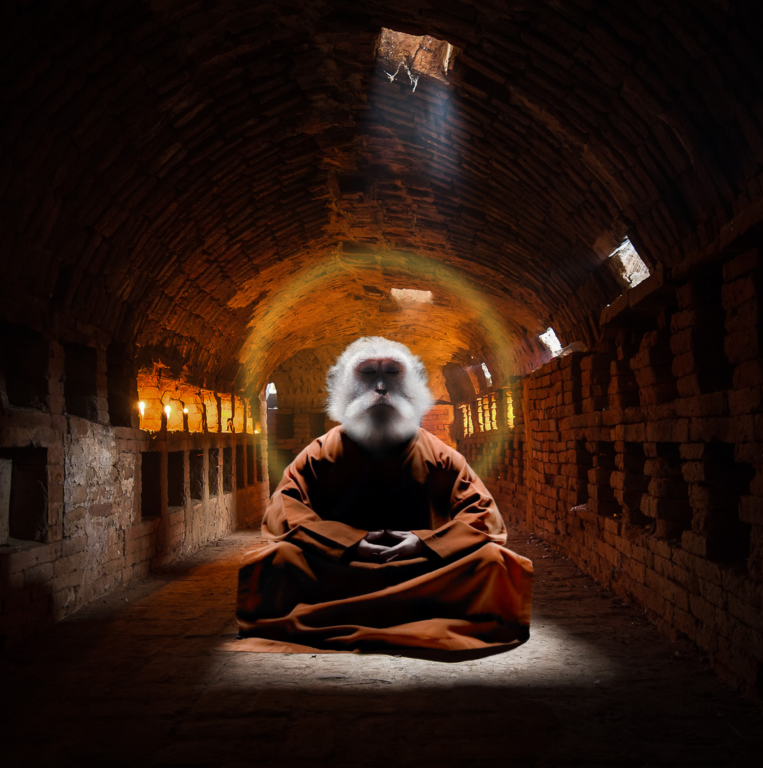
Journey to the West chapter two tells how Wukong serves as a junior monk for seven years before Subodhi takes him as a close disciple. One night, the sage recites him a poem full of flowery esoteric imagery revealing the secret to Daoist immortality and Buddhahood is the cultivation of chaste semen (jing, 精), breath (qi, 氣), and spiritual energy (shen, 神). The poem has a profound effect on Monkey, for the novel states: “At that moment, the very origin was disclosed to Wukong, whose mind became spiritualized as blessedness came to him” (Wu & Yu, 2012, p. 120). Following Subodhi’s instructions, Monkey performs breathing exercises after midnight (zi, 子) and before noon (wu, 午), resulting in immortality after three years of dedicated practice (fig. 12). [4] I should note that the book borrows from real Daoist practices but leaves much of the process up to the reader’s imagination. As I explain here, historical methods combined the aforementioned breathing exercises with the circulation of chaste semen and spiritual energy to create a spirit embryo (shengtai, 聖胎), or an immortal spirit that is eventually freed from the mortal shell. But in the case of the novel, Monkey’s practice results in an ageless, adamantine physical body, one capable of lifting even cosmic mountains.

Interestingly, the title of chapter two also refers to Monkey overcoming Mara. It reads: “Fully awoke to Bodhi’s wondrous truths / He cuts off Mara, returns to the root, and joins Primal Spirit” (Wu che puti zhen miao li / Duan Mo gui ben he yuanshen, 悟徹菩提真妙理 / 斷魔歸本合元神) (Wu & Yu, 2012, p. 116). The title freely associates Buddhist and Daoist concepts, such as Mara and the primal spirit. This synthesis is explained by Darga (2008):

Comparing the development of the embryo to the revelation of Buddhahood is typical of neidan texts of the Ming period. For instance, the Xingming guizhi (Principles of Balanced Cultivation of Inner Nature and Vital Force) uses Body of the Law (fashen 法身, dharmakāya) as a synonym for shengtai. The birth of the embryo represents the appearance of the original spirit (yuanshen 元神) or Buddhahood and is understood as enlightenment (p. 884).

The Buddha’s biography goes on for pages about deep philosophical concepts on the self, suffering, and reality, showing that the means of his liberation was of the utmost importance. By contrast, as noted above, Journey to the West leaves little space for Wukong’s method of immortality. In fact, the hard won moment that he breaks free of Yama’s grasp is not even mentioned in the novel! [5] So the author-compiler no doubt felt Monkey’s subsequent adventures were far more important. This is understandable considering that, in material as far back as the Song dynasty, Monkey is already an ancient immortal at the beginning of the story.

[Note: See the update below for a seventh parallel.]

Fig. 11 – Siddhartha achieves enlightenment and becomes the Buddha (larger version). Artist unknown. Fig. 12 – Wukong achieves immortality (larger version). Photomanipulation by the author.

A borrowed story?

So did the author-compiler (AC) of Journey to the West base Monkey’s early life on the Buddha’s story? The many similarities discussed above are very suggestive, but if only there was documented evidence of borrowing from other Buddhist personages. And that’s exactly what is found in chapter two. Shao (2006) explains that Wukong’s spiritual intelligence is based on the sixth Chan patriarch Huineng (惠能, 638-713):

[Monkey] sets the stage for a striking display of his unusually profound insight when he announces his intentions to become an immortal. This provokes Subhuti to issue him a challenge by refusing to teach him, for he is “some what different from other people.” Monkey may not realize that the master is trying to gauge his spiritual power, but he rises to the occasion with a genuine clarity of vision: “I have a round head pointing to Heaven, and square feet walking on Earth. Similarly, I have nine apertures and four limbs, entrails and cavities. In what way am I different from other people?”

[…]

[W]e may look to Huineng’s story from which Monkey garners meaning. No doubt, Monkey’s inspired cleverness is modeled on Huineng’s reply to Hongren, the fifth patriarch of Chinese Chan Buddhism, in Huineng’s Tanjing (The Platform Sutra). When Huineng announces his intentions to become a Buddha, Hongren pounces upon him with a poignant reminder that he is “from Lingnan,” a “barbarian,” and therefore cannot become a Buddha. Huineng refuses to be intimidated, however. He holds his own with an unparalleled depth of insight about Buddha-nature: There may be “northern and southern men,” but “the Buddha nature fundamentally has no north or south.” Surely Monkey’s phrasing, his unusual insightfulness, and the quickness and aplomb with which he rises to the challenge are reminiscent of Huineng… (pp. 719-720).

Therefore, if the AC borrowed from the life of Huineng, a Buddhist patriarch, then he certainly could have borrowed from the life of the Buddha. I suggest this was done to make Wukong’s early life more familiar to the reader. 

Conclusion

Despite the particulars of their stories being different, the Monkey King and the historical Buddha share six similarities. First, they experience a supernatural birth, both splitting open their mother in the same fashion as ancient Chinese sage-kings. Siddhartha emerges from the side of Queen Maya and Wukong forms from a stone egg birthed by a split rock. Second, they produce a radiant splendor upon their birth. Siddhartha’s body shines as he looks or walks to the four quarters, while beams shoot from Sun’s eyes as he bows to the four quarters. Third, they spend early years as royalty. The prince is born into the royal Shakya clan and Monkey achieves kinghood through a test of bravery. Fourth, they feel a sense of shock upon realizing the impermanence of life. Siddhartha is exposed to the evils of old age, sickness, and death via the “four signs” initiated by heaven. Wukong instead comprehends the fearsome hand of Yama through his observation of time. Fifth, they set out on a quest to find a means of escaping old age and death. The prince travels the land studying meditation and pondering concepts of the body, the mind, the soul, and selfhood. Monkey searches the world for over a decade before he is taken in by the Buddho-Daoist sage Subodhi. Sixth, they achieve their goal through spiritual practices. Siddhartha defeats Mara and achieves perfect enlightenment via intense meditation. Wukong breaks free from Yama/Mara and achieves immortality via Daoist elixir arts. And since the AC borrowed from the life of the Sixth Chan patriarch Huineng, he likely modeled the Monkey King’s early life on the Buddha to make his story more familiar.


Update: 06-12-22

I’ve noticed another parallel while reading two modern biographies of the Buddha. 

7. Student prodigies 

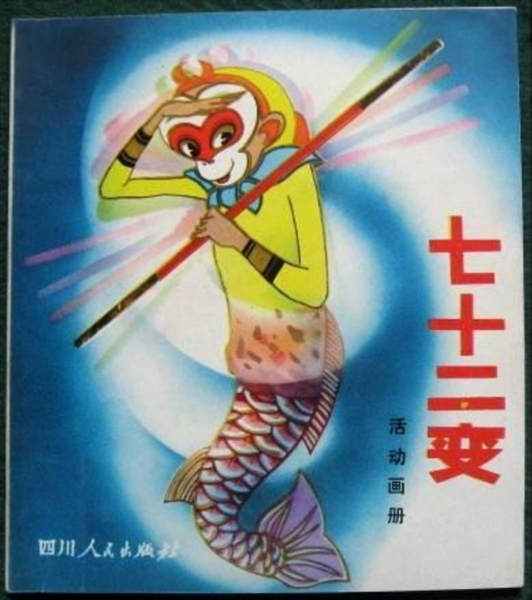
The Prince is said to have had a great aptitude for learning in his youth: “And now he was brought to learn the useful arts, when lo! once instructed (at one hearing) he surpassed his teachers” (Beal, 1883, p. 24). [6] Wukong has the same talent. When Subodhi teaches him the method for the 72 Transformations, he masters them very quickly:

[T]his Monkey King was someone who, knowing one thing, could understand a hundred! He immediately learned the oral formulas and, after working at them and practicing them himself, he mastered all seventy-two transformations (Wu & Yu, vol. 1, p. 122). 


Update: 06-18-22

I’ve written an article that lists a number of surprising parallels shared by Monkey and the Greco-Roman hero Heracles (see section 2).

Parallels Between Sun Wukong and Hercules

Notes:

1) See Cook and Luo (2017) chapter five for more examples of split-births.

2) Other than the “Four Signs”, another example of the devas intervening in Siddhartha’s life takes place shortly after he forsakes the extreme austerities that emaciate his body. He bathes in a holy river but can’t leave the water due to weakness from malnourishment. That’s when a deva pushes down a tree branch, allowing Siddhartha to pull himself to safety (Beal, 1883, p. 144).

3) For example, one passage reads: “Their flying spears, lances, and javelins, stuck fast in space, refusing to descend; the angry thunderdrops and mighty hail, with these, were changed into five-colour’d lotus flowers…” (Beal, 1883, p. 153).

4) The original source says “breathing exercises before the hour of Zi [子, midnight] and after the hour of Wu [午, noon]” (Wu & Yu, 2012, p. 121). However, this is likely a transcription error as Daoist sources cite the opposite, after midnight and before noon (Kohn, 2008, p. 84, for example). Therefore, I have corrected the information.

5) The moment that Monkey achieves immortality is only alluded to in passing:

Suddenly he [Subodhi] asked, “Where’s Wukong?” Wukong drew near and knelt down. “Your pupil’s here,” he said. “What sort of art have you been practicing lately?” the Patriarch asked. “Recently,” Wukong said, “your pupil has begun to apprehend the nature of all things and my foundational knowledge has become firmly established.” “If you have penetrated to the dharma nature to apprehend the origin,” said the Patriarch, “you have, in fact, entered into the divine substance” (Wu & Yu, 2012, p. 121).

6) Nakamura (2000) offers an extremely wordy translation of the above sentence: “When he had passed beyond childhood, he in due time received the initiation ceremony. He mastered in only a few days the various sciences suitable to his standing that [ordinary people] took many years to learn” (p. 90).

Sources:

Beal, S. (Trans.). (1883). The Fo-sho-hing-tsan-king: A Life of Buddha by Asvaghosha Bodhisattva. Oxford: Clarendon Press. Retrieved from https://archive.org/details/foshohingtsankin00asva/mode/2up

Birrell, A. (1999). Chinese Mythology: An introduction. Baltimore: The Johns Hopkins University Press.

Buswell, R. E., & Lopez, D. S. (2014). The Princeton Dictionary of Buddhism. Princeton, NJ: Princeton University Press.

Cook, C. A., & Luo, X. (2017). Birth in Ancient China: A Study of Metaphor and Cultural Identity in Pre-Imperial China. Albany: State University of New York Press.

Cowell, E. B. (Ed.) (1895). The Jātaka, or stories of the Buddhas former births: Vol. 3. Cambridge: Cambridge University Press. Retrieved from https://archive.org/details/cu31924072231073/page/n249/mode/2up

Darga, M. (2008) Shengtai. In F. Pregadio (Ed.), The Encyclopedia of Taoism: Vol 1-2 (pp. 883-884). Longdon: Routledge.

Kohn, L. (2008). Chinese Healing Exercises: The Tradition of Daoyin. Honolulu: University of Hawaiʻi Press.

Nakamura, H. (2000). Gotama Buddha: A Biography Based on the Most Reliable Texts (G. Sekimori, Trans.) (Vols. 1-2). Tokyo: Kosei Publishing Co.

Shao, P. (2006). Huineng, Subhūti, and Monkey’s Religion in “Xiyou ji”The Journal of Asian Studies, 65(4), 713-740. Retrieved from www.jstor.org/stable/25076127.

Thanissaro Bhikkhu (n.d.). Affirming the Truths of the Heart: The Buddhist Teachings on Samvega & Pasada. Retrieved from https://www.dhammatalks.org/books/NobleStrategy/Section0004.html.

Wu, C., & Yu, A. C. (2012). The Journey to the West (Vol. 1). Chicago, Illinois: University of Chicago Press.

Xuanzang (2016). The Great Tang Dynasty Record of the Western Regions (2nd ed., R. Li, trans.). California: BDK AMerica, Inc. (Original work published 1996)

When was the Monkey King Born?

Last updated: 04-02-2021

From time to time I like to post a fun blog not directly related to (though sometimes informed by) my research. Past examples can be seen herehere, and here. Regular articles will resume after this entry.

I was recently contacted by someone writing a Journey to the West fanfiction and asked when the Monkey King was born from stone. I have therefore decided to write an entry for those interested in the subject. I will start at the end of the novel and work my way backwards. The years presented are guesstimates and should not be taken as wholly accurate considering that the novel does not follow a strict historical timeline.

I should point out that this has nothing to do with his religious birthday, which is variously celebrated on the sixteenth day of the eighth lunar month in Hong Kong and Singapore (Elliott, 1955/1990, p. 82), the twenty-third (Fuzhou) or twenty-fifth day (Putian) of the second lunar month in Fujian (Doolittle, 1865, vol. 1, pp. 288; Dean & Zheng, 2010, p. 162, for example), and the twelfth day of the tenth lunar month (Taiwan) (see here).

Monkey’s birth from stone (larger version). From The Illustrated Journey to the West (1950).

I. Chapter 100

Upon the pilgrims’ return to China from India, Tang Emperor Taizong tells Tripitaka: “We have caused you the trouble of taking a long journey. This is now the twenty-seventh year of the Zhenguan period!” (Wu & Yu, vol. 4, p. 374). It should be noted that this era historically lasted from 627 to 650 CE (Zhang, 2015, p. 49). So the novel dates their return to 654 CE, adding four fictional years to the reign period.

The historical Xuanzang returned in 645 CE (Buswell & Lopez, 2014, p. 1015).

II. Chapter 13 &14

In chapter fourteen, Tripitaka releases Sun Wukong from under the Mountain of Two Frontiers (a.k.a. Five Elements Mountain) a short time after leaving the confines of the Chinese empire. But prior to taking Monkey as a disciple, he is briefly guarded by the hunter Liu Boqin on his trek westward. Liu tells Tripitaka the history of the area during their journey across the mountain: “A few years ago, I heard from my elders that during the time when Wang Mang usurped the throne of the Han emperor, this mountain fell from Heaven with a divine monkey clamped beneath it” (Wu & Yu, vol. 1, p. 306). [1] The former Han official Wang Mang historically ruled from 9 BCE–23 CE (Bielenstein, 1986). I will return to this point below.

Chapter thirteen states Tripitaka leaves from Chang’anon the third day before the fifteenth of the ninth month in the thirteenth year of the period Zhenguan” (Wu & Yu, vol. 1, p. 293). This dates his departure to the year 640 CE.

The historical Xuanzang left China in 627 CE (Buswell & Lopez, 2014, p. 1015).

III. Chapter 7 & 8

In the beginning of chapter eight, the Buddha says: “We do not know how much time has passed here since I subdued the wily monkey and pacified Heaven, but I suppose at least half a millennium has gone by in the worldly realm…” (Wu & Yu, 2012, vol. 1, p. 203). But as noted above, Wukong is imprisoned during the reign of Wang Mang (r. 9 BCE–23 CE). Therefore, if he is discovered in 640 CE, this means Monkey’s imprisonment lasts anywhere from 617 to 649 years and not 500 as is commonly thought.

Prior to his wager with the Buddha in chapter seven, Wukong is placed into Laozi’s eight trigrams furnace. The novel reads: “Truly time passed swiftly, and the forty-ninth day arrived imperceptibly” (Wu & Yu, 2012, vol. 1, p. 189). But the narrative previously revealed that “one day in heaven is equal to one year on Earth” (Wu & Yu, 2012, vol. 1, pp. 150 and 167). So this means his turn in the furnace lasts close to fifty years, starting between 40–26 BCE.

IV. Chapter 5

Following Monkey’s initial rebellion and being granted the empty title “Great Sage Equaling Heaven,” he is appointed the guardian of the immortal peach groves. He later flees back to earth after eating the life-prolonging fruits and wreaking havoc on the Queen Mother’s peach banquet. Upon his return, his commanders ask him: “The Great Sage has been living for over a century (emphasis added) in Heaven. May we ask what appointment he actually received?” (Wu & Yu, 2012, vol. 1, p. 166). [2] This dates his ascension to heaven somewhere below the range of 140–126 BCE (150–136 BCE?). I obviously can’t provide a more precise number given the vague language.

V. Chapter 3 & 4

After Wukong bullies the Eastern Dragon King and the Judges of Hell, Heaven appoints him the “Keeper of the Heavenly Horses” in order to keep his unruly adventures in check. But upon learning that his position is the lowest in heaven, he returns home in rebellion. His children ask, “Having gone to the region above for more than ten years (emphasis added), you must be returning in success and glory” (Wu & Yu, 2012, vol. 1, p. 150). [3] This dates his first ascension somewhere below the range 150–136 BCE (160–146 BCE?). Again, I can’t provide a more precise number given the vague language.

Monkey strikes his name from the Book of Life and Death in Hell (larger version). From Son Goku (1939).

During his time in Hell, Monkey calls for the ledger containing his information. Under a heading marked “Soul 1350,” Wukong reads, “Heaven-born Stone Monkey. Age: three hundred and forty-two years. A good end” (Wu & Yu, 2012, vol. 1, p. 140). [4] If we use 160–146 BCE as a conservative estimate for his first ascension, then this dates his birth to somewhere between 502–488 BCE during the Zhou Dynasty (c. 1046–256 BCE). I think 500 BCE is a nice round number.

This means that Sun Wukong is roughly 1,100-years-old when he attains Buddhahood at the end of the novel.


Update: 07-08-20

The novel suggests a two hour window for the time of Wukong’s birth. This takes place in chapter 61 when Monkey is preparing to battle the Bull Demon King over the palm-leaf fan. Our hero recites an emboldening poem, to which Zhu Bajie replies:

Yes! Yes! Yes!
Go! Go! Go!
Who cares if the Bull King says yes or no!
Wood’s born at Boar,
the hog’s its proper mate,
Who’ll lead back the Bull to return to earth.
Monkey is the metal born under shen (emphasis added):
Peaceful and docile, how harmonious!
Use the palm-leaf
As water’s sign.
When flames are extinct, Completion’s attained.
In hard work we persist both night and day
And rush, merit done, to Ullambana Feast (Wu & Yu, 2012, vol. 3, p. 154). 

是是是,去去去,管甚牛王會不會。
木生在亥配為豬,牽轉牛兒歸土類。
申下生金本是猴,無刑無剋多和氣
用芭蕉,為水意,焰火消除成既濟。
晝夜休離苦盡功,功完趕赴盂蘭會。

The monkey is one of twelve animals of the Chinese zodiac, each corresponding to an earthly branch, an elemental phase, and a time period. The monkey is born under the shen (申) branch, which is associated with metal and the hours 3:00 PM to 5:00 PM.


Update: 04-02-21

As I explain in this article, Wukong learns the 72 transformations in order to escape a trio of heaven-sent punishments scheduled to kill him for defying his fate and achieving immortality. The calamities of thunder, fire, and wind respectively come every 500 years (after the initial attainment of eternal life) to kill Daoist cultivators. Monkey becomes an immortal around his 342nd year when his soul is taken to Hell. He is immortal for over 160 years [5] at the time he’s imprisoned under Five Elements Mountain. This means his 500th year of immortality, the year that the calamity of thunder would be scheduled to strike him, takes place during his imprisonment under the celestial mountain. But this is never described in the story. I assume this is just one of many inconsistencies born from oral storytelling. Although, one could argue that, within the fictional universe, the thunder calamity was voided since Wukong was undergoing punishment at the behest of the Buddha.

Notes:

1) I am indebted to Irwen Wong for bringing this passage to my attention.

2) Wukong, however, questions this estimate, saying: “I recall that it’s been but half a year…How can you talk of a century?” (Wu & Yu, 2012, vol. 1, p. 167). But, earlier in the novel, a wise member of Monkey’s tribe points out that one’s view of time is skewed while inhabiting the celestial realm: “You are not aware of time and seasons when you are in Heaven” (Wu & Yu, 2012, vol. 1, p. 150). Add to this the established fact that one heavenly day equals one solar year. Therefore, the Great Sage’s recollection of the passage of time is unreliable.

3) Monkey also questions this estimate: “I have been away for only half a month…How can it be more than ten years” (Wu & Yu, 2012, vol. 1, p. 150). But, again, his recollections are not reliable. See note #2.

4) These include three years as Subodhi’s student (Wu & Yu, 2012, vol. 1, p. 121), seven as a junior monk (Wu & Yu, 2012, vol. 1, p. 117), and “more than ten years” searching the world for a master (Wu & Yu, 2012, vol. 1, p. 114).

5) As previously mentioned, Wukong serves in heaven twice: first “for more than ten years” and second “for over a century” (Wu & Yu, 2012, vol. 1, pp. 150 and 166). Then he is punished to 49 heavenly days/49 solar years in Laozi’s furnace (see above).

Sources:

Bielenstein, H. (1986). Wang Mang, the Restoration of the Han Dynasty, and Later Han. In D. Twitchett and M. Loewe (Ed.). The Cambridge History of China: Volume 1, The Ch’in and Han Empires, 221 BC-AD 220 (pp. 223-290). Kiribati: Cambridge University Press.

Buswell, R. E., & Lopez, D. S. (2014). The Princeton Dictionary of Buddhism. Princeton, NJ : Princeton University Press.

Dean, K., & Zheng, Z. (2010). Ritual Alliances of the Putian plain. Volume Two: A Survey of Village Temples and Ritual Activities. Leiden: Brill.

Doolittle, J. (1865). Social Life of the Chinese: With Some Account of Their Religious, Governmental, Educational, and Business Customs and Opinions. With Special but not Exclusive Reference to Fuhchau (vol. 1 and 2). New York: Harper & Brothers.

Elliott, A. J. (1990). Chinese Spirit-Medium Cults in Singapore. London: The Athlone Press. (Original work published 1955)

Wu, C., & Yu, A. C. (2012). The Journey to the West (vol. 1-4) (Rev. ed.). Chicago, Illinois: University of Chicago Press.

Zhang, Q. (2015). An Introduction to Chinese History and Culture. Belgium: Springer Berlin Heidelberg.

Archive #16 – Sun Wukong and Chinese Medicine

Last updated: 09-22-2024

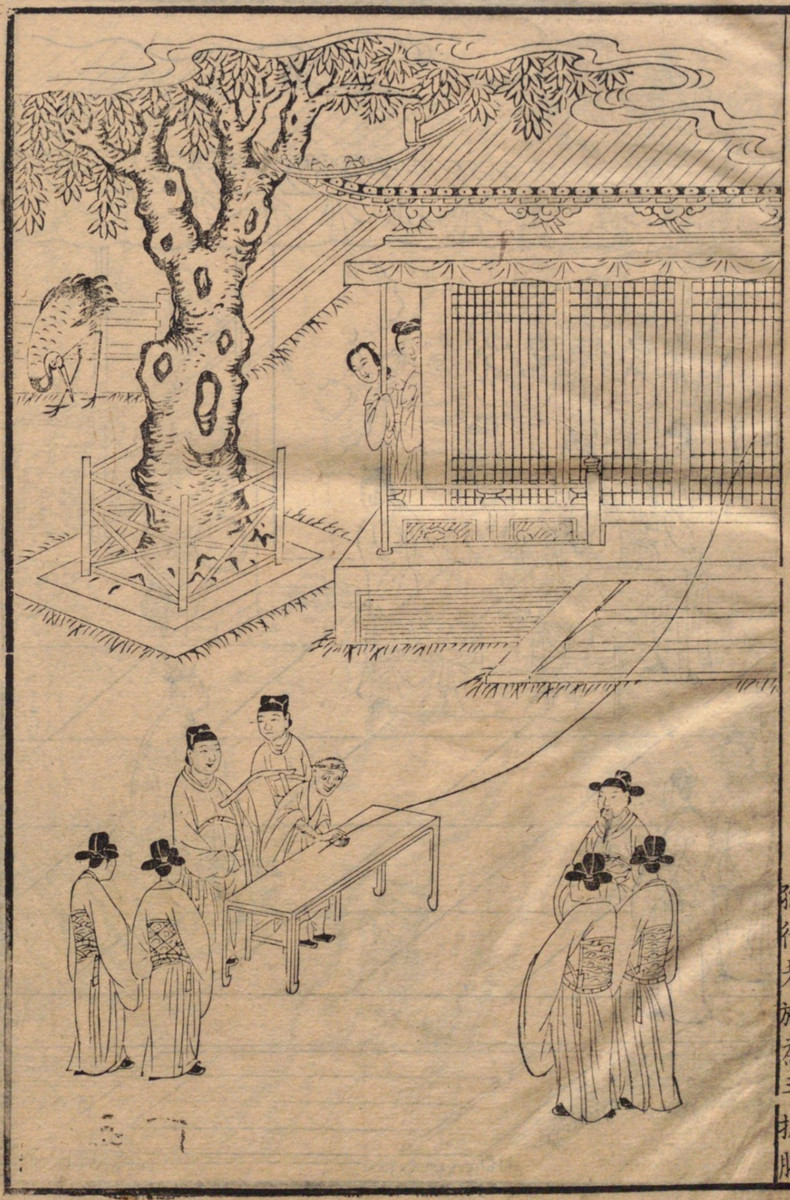
I noted in my previous article that medicine was among the skills acquired by Monkey while training under the Buddho-Daoist sage, Master Subodhi. In Journey to the West (Xiyouji西遊記, 1592) chapters 68 to 69, Monkey works to diagnose the long-standing malady of the Scarlet-Purple Kingdom emperor. But due to the immortal’s monstrous appearance, Sun is forced to analyze the ruler from afar, using three magic hairs-turned-golden strings to measure the vibrations of the pulse from three locations of each forearm. He deduces the illness is caused by fear and anxiety over the loss of the monarch’s queen, who had been kidnapped by a demon. Monkey then concocts three pills from a secret recipe and administers the elixir with dragon king saliva. The medicine causes the emperor to pass an obstruction in his bowels, thus restoring the natural qi flow in his body and curing him of his sickness.

Fig. 1 – Monkey uses golden threads to analyze the emperor’s pulse (larger version). From Mr. Li Zhuowu’s Literary Criticism of Journey to the West (late 16th-century).

1. Examples of Sun’s medical knowledge

1.1. Chapter 68

Monkey first assuages the fears of court officials by reciting a poem explaining the proper procedure for analyzing a patient:

Most mysterious is the physician’s art;
His mind must ever be alert and keen.
To look, listen, ask, and take-these four things If one is missing, his craft’s not complete.
One, we look at the patient’s complexion:
Is it moist, dry, fat, or thin in waking or sleep?
Two, we listen for clear or turbid voice
When he speaks lucid or frenetic words.
Three, we ask for the ailment’s cause and length.
For how he eats, drinks, and eliminates.
Four, we scan the conduits by taking the pulse,
To learn how submerged or floating in and out.
If we do not look, listen, ask, and take, In this life his ailment will ne’er him forsake!” (based on Wu & Yu, 2012, vol. 3, p. 268).

醫門理法至微玄,大要心中有轉旋。
望聞問切四般事,缺一之時不備全:
第一望他神氣色,潤枯肥瘦起和眠;
第二聞聲清與濁,聽他真語及狂言;
三問病原經幾日,如何飲食怎生便;
四才切脈明經絡,浮沉表裡是何般。
我不望聞並問切,今生莫想得安然。(source)

1.2. Chapter 69

Sun then follows through with the analysis:

We were telling you about the Great Sage Sun, who went with the palace attendant to the interior division of the royal palace. He stood still only after he had reached the door of the royal bedchamber. Then he told the attendant to take the three golden threads inside along with the instruction: “Ask one of the palace ladies or eunuchs to tie these three threads to the inch, the pass, and the foot sections of His Majesty’s left hand where the radial pulse are felt. Then pass the other ends of the threads out to me through the window shutters” [fig. 1].

The attendant followed his instruction. The king was asked to sit up on the dragon bed, while the three sections of his pulse were tied by the golden threads, and their other ends were then passed out to Pilgrim. Using the thumb and the index finger of his right hand to pick up one of the threads, Pilgrim first examined the pulse of the cun [寸] section; next, he used his middle finger and his thumb to pick up the second thread and examine the pulse of the guan [關] section; finally, he used the thumb and his fourth finger to pick up the third thread and examine the pulse of the chi [尺] section.

Thereafter Pilgrim made his own breathing regular and proceeded to determine which of the Four Heteropathic Pneumatics, the Five Stases, the Seven External Images of the Pulse, the Eight Internal Images of the Pulse, and the Nine Pulse Indications were present. [1] His pressure on the threads went from light to medium to heavy, and from heavy to medium to light, until he could clearly perceive whether the condition of the patient was repletion or depletion of energy and its cause. Then he made the request that the threads be untied from the king’s left wrist and be attached as before to the positions on his right wrist. Using now the fingers on his left hand, he then examined the pulse on the right wrist section by section. When he had completed his examination, he shook his body once and retrieved his hairs (based on Wu & Yu, 2012, p. 270).

話表孫大聖同近侍宦官到於皇宮內院,直至寢宮門外立定。將三條金線與宦官拿入裡面,吩咐:「教內宮妃后,或近侍太監,先繫在聖躬左手腕下,按寸、關、尺三部上,卻將線頭從窗櫺兒穿出與我。」真個那宦官依此言,請國王坐在龍床,按寸、關、尺,以金線一頭繫了,一頭理出窗外。行者接了線頭,以自己右手大指先托著食指,看了寸脈;次將中指按大指,看了關脈;又將大指托定無名指,看了尺脈。調停自家呼吸,分定四氣、五鬱、七表、八裡、九候、浮中沉、沉中浮,辨明了虛實之端。又教解下左手,依前繫在右手腕下部位。行者即以左手指,一一從頭診視畢,卻將身抖了一抖,把金線收上身來。

Finally he delivers a very detailed diagnosis:

“Your Majesty,” he cried in a loud voice, “on your left wrist the pulse of your cun section feels strong and tense, the pulse of your guan section feels rough and languid, and the pulse of your chi section feels hollow and sunken. On your right wrist the pulse of your cun section feels floating and smooth, the pulse of your guan section feels retarded and hesitant, and the pulse of your chi section feels accelerated and firm. Now, when the pulse of your left cun section feels strong and tense, it indicates an internal energetic depletion with pain in the cardiac system of functions. When the pulse of your left guan section feels rough and languid, it indicates sweating that has led to numbness in the flesh. When the pulse of your left chi section feels hollow and sunken, it indicates a pink tinge to your urine and blood in your stool. When the pulse of the cun section on your right wrist feels floating and smooth, it indicates a congestion blocking the pneumatic energy circulation and leading to cessation of menses. When the pulse of your right guan section feels retarded and hesitant, it indicates a stasis of alimentary matter in the stomach system with retention of fluids. When the pulse of your right chi section feels accelerated and firm, it indicates discomfort caused by sensations of stuffiness and chills caused by energetic depletion. To sum up, your illness has been caused by fear and anxiety, and it may be the manifestation type of an illness called the ‘Paired Birds in Severance’ [shuangniao shiqun, 雙鳥失群]” (based on Wu & Yu, 2012, vol. 3, pp. 270-271).

陛下左手寸脈強而緊,關脈濇而緩,尺脈芤且沉;右手寸脈浮而滑,關脈遲而結,尺脈數而牢。夫左寸強而緊者,中虛心痛也;關濇而緩者,汗出肌麻也;尺芤而沉者,小便赤而大便帶血也。右手寸脈浮而滑者,內結經閉也;關遲而結者,宿食留飲也;尺數而牢者,煩滿虛寒相持也。診此貴恙,是一個驚恐憂思,號為『雙鳥失群』之症。

Baring the strings, Monkey’s method of reading the pulse aligns with real Chinese medicinal practice. The area of the forearm analyzed by traditional Chinese doctors is known as cunkou (寸口, the “inch opening”), and this is broken up into the three spots cun (寸, “inch”), guan (關, “pass”), and chi (尺, “foot”) (fig. 2). The mirrored spots on each arm are believed to correspond to specific internal organs. For example, the cun spot (nearest the wrist) on the right hand corresponds to the lung, while that of the left hand corresponds to the heart (Liao, 2011, pp. 55-56). Therefore, analyzing the pulse at these spots is believed to reveal the health of the corresponding organs.

Fig. 2 – The spots analyzed during pulse diagnosis (larger version). Picture originally found here.

2. The Elixir of Black Gold and its historical origins

Wukong selects his ingredients from among 808 requested substances in order to keep the recipe a secret from the foreign kingdom’s doctors. It is made from an ounce of powderizedahuang (大黃), which is said to “loosen phlegm and facilitate respiration [and] sweep out the chill and heat congealed in one’s stomach” (Wu & Yu, 2012, pp. 273-274); an ounce of shelled, powerderized badou (巴豆), which is said to “break up congestion and drain the intestines [and] take care of swellings at the heart and dropsy in the abdomen” (Wu & Yu, 2012, p. 274); half a flask of “Hundred-Grass Frost” (baicao shuang, 百草霜), or frying pan soot, which is said to “soothe a hundred ailments” (Wu & Yu, 2012, p. 274); and half a flask of dragon (horse) urine, which is said to “cure any kind of disease a human may have when it is ingested” (Wu & Yu, 2012, p. 274). The resulting paste is rolled into three pills and presented to the emperor as the “Elixir of Black Gold” (Wujin dan, 烏金丹) (video 1) (Wu & Yu, 2012, p. 276).

Video 1 – Episode 20 of the 1986 Journey to the West series portrays this story. See minute 19:19 for the preparation of the Elixir of Black Gold.

Andrew Schonebaum’s (2016) fascinating book Novel Medicine: Healing, Literature, and Popular Knowledge in Early Modern China explains the historical significance of the real world ingredients used in this elixir. He introduces the first two ingredients to us by way of their anthropomorphization as Badou Dahuang, the ruler of the fictional Hujiao (胡椒, black pepper) kingdom from the vernacular novel Annals of Herbs and Trees (Caomu chunqiu yanyi, 草木春秋演義, c. 17th/18th-century), a work that gives human form to Chinese medicines, pitting armies of mortal, immortal, and demonic characters/remedies against one another. Badou is depicted as having the mandate of heaven (the right to rule) in his own country but wanting to invade the Han empire. This dual nature can be explained by the properties of the ingredients making up his name. Schonebaum (2016) writes:

[B]adou (croton) and dahuang (rhubarb), are two of the most common drugs in Chinese medicine. Badou is toxic and a strong purgative, and it was used to treat stagnation in the viscera and bowels, as well as to facilitate urination, eliminate malignant flesh, and purge vicious agents such as invading ghosts or worms. Dahuang is nontoxic and is sometimes referred to by the name “military general” because “the drug pushes away the old and brings in the new, like a military general putting down a riot and bringing peace” (pp. 99-100).

Regarding the “Elixir of Black Gold,” Schonebaum (2016) explains “black gold” was the name of a common prescription and that badou and dahuang were part of its core, while other ingredients could be replaced with those of similar properties:

One commentator had never heard of this medicine, saying that it had a strange name, but this only reveals his own highbrow background (or general ignorance), since “black gold” was the name of various prescriptions common among hereditary doctors. In fact, it was mentioned in the Systematic Materia Medica repeatedly, and Xu Dachun recommends it in Medical Cases of Huixi, so it was not exclusively the purview of nonelite healers.

“Black gold pills” (wujin wan) was a name and a concoction similar to “elixir surpassing [the value of] gold” (shengjin dan) and “black spirit pills” (heishen wan). All of them were core formulas that could be modified in their effects by ingesting them with different liquids. These “black gold” medicines, along with the likes of “the prescription offering Guanyin’s all-encompassing help” (Guanyin puji fang) and “pills prepared with old ink” (gumo wan), treated a wide variety of ailments (in one medical manuscript, twenty-nine, forty, and seventy-one ailments, respectively), and were extremely common formula in the Qing. The “black gold” formulas had at their core the drugs dahuang and badou. One medical manuscript from the Republican period states in its introduction, “Black gold powder [wujin san] cures all ailments, just as the wind bends the grasses. Other names [of this prescription] are ‘pine smoke elixir’ [songyan dan] and ‘black spirit pills’ [heishen wan]. It cures thousands of illnesses, just as the sun melts the frost.”

Black gold pills (wan), powder (san), paste (gao), and elixir (dan) were commonly employed to cure gynecological issues. A prescription named “black gold powder” was first recorded in the Song work A Spring of Recipes in the Magic Park (Lingyuan fangquan) and was followed by references in the Southern Song prescription collection “Complete Collection of Effective Prescriptions for Women” (Furen daquan liangfang, 1237), Formulas for Universal Benefit (Puji fang, 1390), and other works. Over the centuries, numerous formulas, each with different ingredients, became known under the names “black gold powder,” “black gold pills,” and “black gold elixir.” The three designations of this formula result from the use of pitch (mo), a vernacular name for which is the “black gold” of these prescriptions.

Monkey’s prescription reflects a historical reality, namely that the advent of the imperial pharmacy (huimin yaoju) in the Song required doctors who had previously relied on simple medicines with one or two ingredients to employ formulas with numerous substances whose composition followed theories of systematic correspondences. From this conflict between empirical and theory-based recipes arose a new type of prescription eventually consisting of a nuclear formula that could be adapted to the requirements of a given patient’s disease by omitting or adding individual constituents in accordance with his pathological condition. Monkey is preparing simple, trusted medicine at the core, namely badou and dahuang, and adding to it many exotic, unobtainable ingredients (pp. 103-104).

As noted above, black gold medicines were sometimes used to treat gynecological issues. This makes Monkey’s prescription all the more comical as he had partly attributed the foreign emperor’s ails to a “cessation of the menses” (Wu & Yu, 2012, p. 271), obviously a woman’s problem. Schonebaum (2016) comments: “To understand this aspect of the carnivalesque comedy, or to realize that it was a mistake in the incorporation of medical materials into the novel, readers would have had to be quite familiar with medicine, at least enough to know that the medicine Monkey is preparing is consistent with his diagnosis” (p. 104). 

3. Archive link

Chapter three of Novel Medicine (2016) is archived here.

Click to access novel-medicine-healing-literature-and-popular-knowledge-in-early-modern-china-chapter-3-contains-jttw-ch.-68-69-material.pdf

Disclaimer

This has been posted for educational purposes. No malicious copyright infringement is intended. Please support the official release.


Update: 09-22-24

As mentioned above, Sun Wukong analyzes the ailing king’s pulse from afar using three magic hairs-turned-golden threads. This is no doubt based on the story of the “Grand Emperor of Protecting Life” (Baosheng dadi, 保生大帝), the Daoist and folk religion god of medicine, curing an empress using the same method:

During the reign of Chengzu (1403-21), the Empress Wen suffered from an inflamed breast. A Taoist priest offered his skills, but the Emperor tested him by having him take her pulse with a string held on the other side of her bedroom wall. First the Emperor attached it to a cat. The Taoist said, “Not a bear, no not bear, it’s a cat.” Then the Emperor tied the string to a doorknob. The Taoist said that it was something of metal and wood, and not a human pulse. Finally, the Emperor tied the string to the woman’s breast and the Taoist said that the liver pulse was inflamed and the blood clotted, and that this indicated a breast infection which had to be treated by moxibustion. He offered to perform the operation by dangling a cord over the wall. He cured the ailment and vanished, refusing a reward of gold and office. In He Qiaoyuan’s version, the Emperor inquired about his name and discovered that he was the long-deceased Divine Doctor Wu Tao. In gratitude, the Emperor enfeoffed the god as Wanshou wuji baosheng dadi (Emperor Who Protects Life of Limitless Longevity) (Dean, 2014, p. 74).

What’s interesting is that this legend carried over into religious practices. A reader who contacted me in 2022 explains:

I observed a practice at [Sidian Xingji Temple (祀典興濟宮)] in Tainan where an individual would let the god Baosheng dadi check their pulse by resting three sticks of incense on their forearm. The temple brochure also mentions this procedure [fig. 3]. I believe this to be relevant to your article …

Fig. 3 – A detail from the aforementioned temple brochure showing the three incense sticks resting on a member’s wrist (larger version). Photo by Richard Malabarista.

Notes:

1) Yu (Wu & Yu, 2012) provides explanations for these terms in the end notes of his wonderful translation (pp. 448-449, n. 3-7).

Sources:

Dean, K. (2014). Taoist Ritual and Popular Cults of Southeast China. United States: Princeton University Press.

Liao, Y. (2011). Traditional Chinese medicine. Cambridge: Cambridge University Press.

Schonebaum, A. (2016). Novel Medicine: Healing, Literature, and Popular Knowledge in Early Modern China. Seattle: University of Washington Press

Wu, C., & Yu, A. C. (2012). The Journey to the West (Vol. 3) (Rev. ed.). Chicago, Illinois: University of Chicago Press.

The Origin of Sun Wukong’s Cloud Somersault

Last updated: 01-04-2024

The Monkey King is famous for utilizing a vast arsenal of magic powers to protect the monk Tripitaka on the journey to India, chief among them being immortality, shape-shifting, hair clones, super strength, and flight via the cloud somersault (jindou yun, 觔/筋斗雲). The latter is a powerful skill because it enables him to travel 108,000 li (33,554 mi / 54,000 km), [1] or one and one-third the circumference of our Earth, in a single leap. [2] Perhaps the most famous episode involving the somersault appears in chapter seven when the Buddha bets Wukong that he’ll give the rebellious monkey the throne of heaven if he can leap clear of the Enlightened One’s palm. Sun gleefully accepts, certain of his success:

What a fool this Tathagata is! A single somersault of mine can carry old Monkey one hundred and eight thousand li, yet his palm is not even one foot across. How could I possibly not jump clear of it? (Wu & Yu, 2012, vol. 1, p. 194).

這如來十分好獃。我老孫一觔斗去十萬八千里,他那手掌方圓不滿一尺,如何跳不出去?

But of course lovers of the novel know how this wager ends, with a desecrated finger and our hero trapped beneath Five Elements Mountain

I. Literary description

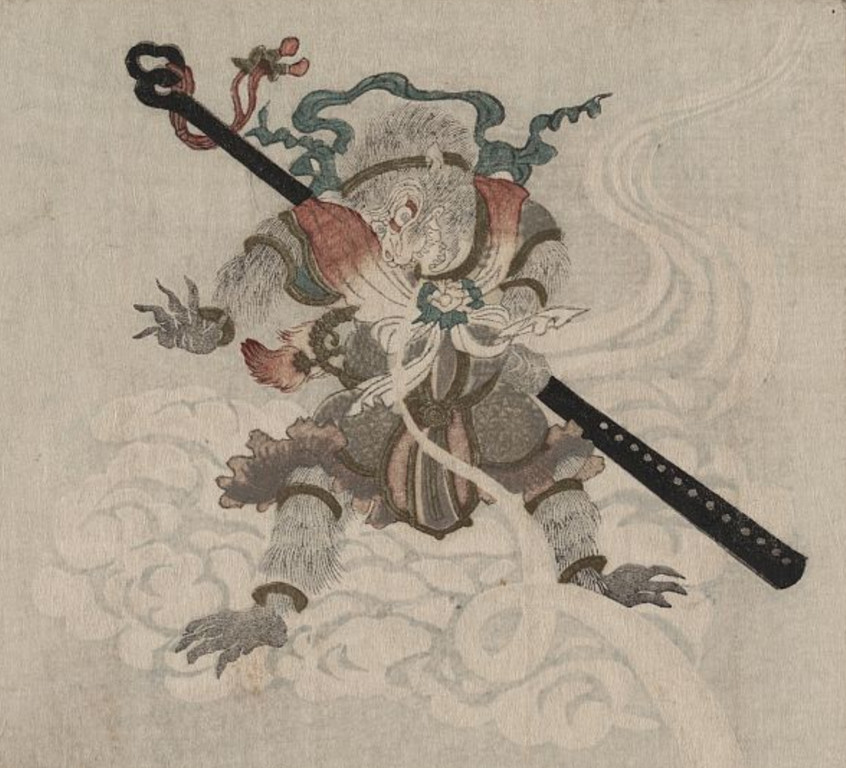
While Sun is traditionally portrayed in visual media riding a single cloud (fig. 1), the very name “somersault” points to Monkey leaping from cloud to cloud. And in fact this is demonstrated in chapter 97 when it requires “a series of cloud somersaults” for him to retrieve the soul of an elderly benefactor from the underworld (Wu & Yu, 2012, vol. 4, p. 338). However, the magic skill’s attributes are not always portrayed consistently throughout the novel. For example, it is sometimes shown capable of transporting passengers, such as the “thirty or fifty” of Monkey’s children rescued from captivity in chapter two, thereby implying a single cloud (Wu & Yu, 2012, vol. 1, p. 129). But other times, like in chapter 22, it can’t lift even a single person because the impure nature of mortals renders them “as heavy as the Tai Mountain” (Wu & Yu, 2012, vol. 1, p. 427). Interestingly, the somersault is portrayed as much faster than the clouds of other immortals (see section three below). 

Kubo Son Goku, 18th-c. - small

Fig. 1 – Detail of an 1812 calendar print by Japanese artist Kubo Shunman depicting Son Goku (Sun Wukong) flying on his cloud somersault (larger version). A full size scan of the calendar can be seen here.  

II. Ties to Daoist immortals 

Sun Wukong first learns to perform his cloud somersault in chapter two while studying Daoist cultivation under his first master, the Sage Subodhi:

[T]he Patriarch gave him an oral formula, saying,

“Make the magic sign, recite the spell, clench your fist tightly, shake your body, and when you jump up, one somersault will carry you one hundred and eight thousand miles.” When the other people heard this, they all giggled and said, “Lucky Wukong! If he learns this little trick, he can become a dispatcher for someone to deliver documents or carry circulars. He’ll be able to make a living anywhere!”

The sky now began to darken, and the master went back to the cave dwelling with his pupils. Throughout the night, however, Wukong practiced ardently and mastered the technique of cloud-somersault. From then on, he had complete freedom (emphasis added), blissfully enjoying his state oflong life (Wu & Yu, 2012, vol. 1, p. 123).

祖師卻又傳個口訣道:「這朵雲,捻著訣,念動真言,攢緊了拳,將身一抖,跳將起來,一觔斗就有十萬八千里路哩。」大眾聽說,一個個嘻嘻笑道:「悟空造化,若會這個法兒,與人家當鋪兵、送文書、遞報單,不管那裡都尋了飯吃。」師徒們天昏各歸洞府。

這一夜,悟空即運神煉法,會了觔斗雲。逐日家無拘無束,自在逍遙,此亦長生之美。

Elements of this passage reference the long tradition of cloud-borne transcendents in Daoist literature. For example, Kirkova (2016) highlights a poem by the first Cao Wei emperor Cao Pi describing the great speed of their travel: “Lightened you’ll soar, mount the floating clouds, / in a blink you’ll travel millions of li” (p. 105). She explains the ability to traverse vast distances in a flash “is a primary sign of the immortals’ mastery over space and time and is an important topos in their hagiographies” (Kirkova, 2016, p. 106). Furthermore, Kirkova (2016) points out the term used to denote their great freedom of movement, xiaoyao (逍遙/消搖), emphasized above, appears in works as old as the Huananzi and Zhuangzi (p. 104).

III. Ties to Chan Buddhist Philosophy

Despite the cloud’s apparent ties to Daoism, it has a strong symbolic connection to Buddhism. For example, the distance that a single somersault covers just so happens to correspond to the expanse separating Tripitaka from the Buddha’s paradise. This fact is revealed in chapter 14 by Guanyin while disguised as an old woman: “The Buddha of the West … lives in the Great Temple of Thunderclap in the territory of India, and the journey there is one hundred and eight thousand li long” (Wu & Yu, 2012, vol. 1, p. 316).

Shao (2006) explains that the distance is taken directly from the Platform Sutra (Liuzu tangjing, 六祖壇經, c. 8th to 13th-century) of Huineng, the sixth patriarch of Chan Buddhism (p. 718). The particular passage reads:

The governor also asked,

I often see clergy and laity invoking Amitabha Buddha in hopes of rebirth in the [Pure Land of the] West. Please explain this to me. Can we attain rebirth there? Please resolve this doubt for me.

The Master said,

Listen clearly, Governor, and I will explain it to you. When the World Honored One was in the city of Sravasti, he spoke of the Western Pure Land as a teaching device. Scripture is clear that “it is not far from here,” but treatises say it is “108,000 li away.” This number refers to the ten evils and eight wrongs in the one’s person. This says it is far away. Saying it is far away is for people of lesser faculties. Saying it is near is for people of better faculties.

刺史又問曰:「弟子常見僧俗念阿彌陀佛,願生西方。請和尚說,得生彼否?願為破疑。」

師言:「使君善聽,惠能與說。世尊在舍衛城中,說西方引化。經文分明,去此不遠。若論相說,里數有十萬八千,即身中十惡八邪,便是說遠。說遠為其下根,說近為其上智。

[…]

Now I urge you, good friends, to first get rid of the ten evils; that is the equivalent of traveling one hundred thousand li. [3] Then get rid of the eight wrongs; that is the equivalent of crossing eight thousand li. See essential nature in every moment, always acting with impartial directness, and you will arrive in a finger-snap and see Amitabha Buddha (Huineng & Cleary, 1998, pp. 26-27).

今勸善知識,先除十惡即行十萬,後除八邪乃過八千。念念見性,常行平直,到如彈指,便覩彌陀 …」

As can be seen, the number 108,000 is symbolic of two sets of spiritual hindrances. The “ten evils” (shi’e, 惡) are killing, stealing, sexual misconduct, greed, hatred, delusion, foul language, lying, harsh speech, and slander. The “eight wrongs” (baxie, 八邪) are opposites of the eight fold path (Huineng, Hsuan, & Buddhist Text Translation Society, 2002, p. 183). Ridding oneself of these piecemeal gets you many li closer to paradise. But only those who achieve enlightenment can arrive instantly. This means the cloud somersault can be read as a Chan metaphor for instant enlightenment. After all, Monkey can travel to the Buddha’s heaven in a flash, whereas Tripitaka is fated to journey thousands of miles over many years “before he finds deliverance from the sea of sorrows” (Wu & Yu, 2012, vol. 1, p. 436). This is because, as suggested by Shao (2006), the demons encountered on the journey embody the “ten evils and eight wrongs” that must be defeated before the monk can enter paradise (p. 719).

37e2fc9cebe000bb1c76c73e7ad2963a-d5oas0h

Fig. 2 – Monkey soaring on his cloud. Drawing by Funzee on deviantart (larger version).

This connection to Buddhism may then explain why the novel differentiates Monkey’s somersault (fig. 2) from the clouds of other immortals. As Sun explains in chapter 22: “My cloud somersault is essentially like cloud soaring [jiayun, 駕雲] … the only difference being that I can cover greater distances more rapidly” (Wu & Yu, 2012, vol. 1, p. 427). In light of the Chan evidence, the difference in speed could be read as a further metaphor for the potency of Buddhism over Daoism. 

IV. Other influences?

Going back to the early days of Sun’s flight training, Subodhi observes our hero using an unorthodox method for propelling himself into the sky: jumping. This differs from other immortals, so the Sage teaches him a different method:

The Patriarch said, “When the various immortals want to soar on the clouds, they all rise by stamping their feet. But you’re not like them. When I saw you leave just now, you had to pull yourself up by jumping. What I’ll do now is to teach you the cloud-somersault in accordance with your form” (Wu & Yu, 2012, vol. 1, p. 123).

凡諸仙騰雲,皆跌足而起,你卻不是這般。我才見你去,連扯方才跳上。我今只就你這個勢,傳你個觔斗雲罷。

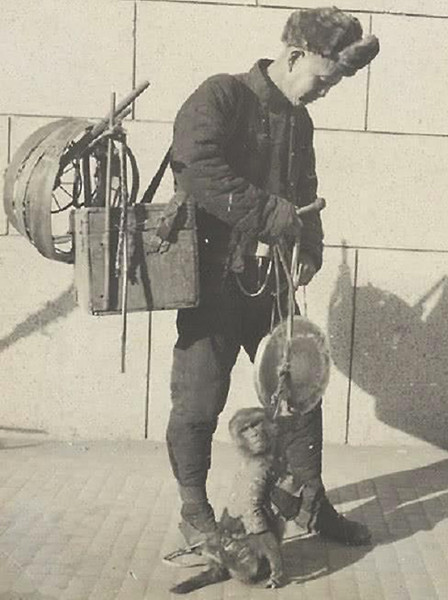
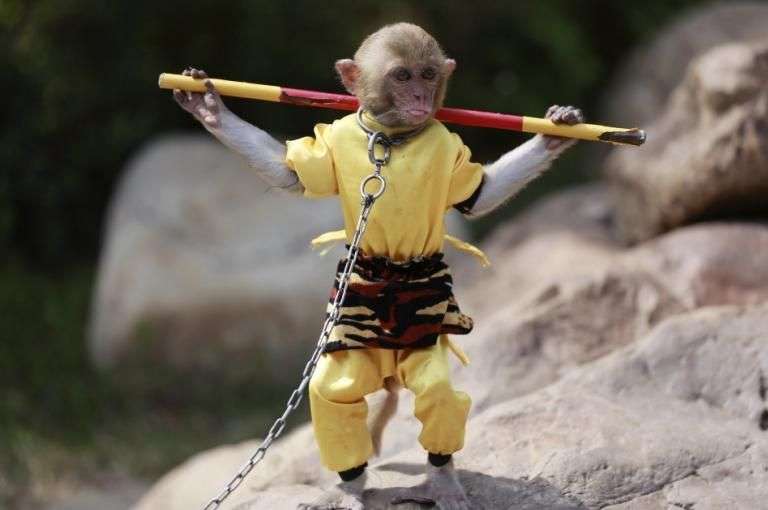
Zhou (1994) suggests this method is likely based on “the novelist’s personal observation” of trained monkey street performances “in the late Ming marketplace” (fig. 3 and 4) (p. 71). He points to an episode in chapter 28 when Wukong returns home to learn his children are regularly captured to perform tricks in the human world:

Those of us who were caught by the net or the trap would be led away live; they would be taught to skip ropes, to act, to somersault, and to do cartwheels. They would have to beat the drum and the gong on the streets and perform every kind of trick to entertain humans (Zhou, 1994, p. 71; cf. Wu & Yu, 2012, vol. 2, p. 31). 

或有那遭網的,遇扣的,夾活兒拿去了,教他跳圈做戲,翻觔斗,豎蜻蜓,當街上篩鑼擂鼓,無所不為的頑耍。

Anyone who has viewed monkeys in a zoo or in the wild knows that they are naturally gifted acrobats. Therefore, Zhou’s proposal is certainly an alluring possibility, one that mixes the naturalistic and historical with Daoist tales of cloud-borne immortals. 

Trained monkeys - pic for blog

Fig. 3 – A Qing-era trainer and his performing monkey (larger version). Original image found here. Fig. 4 – A monkey performer dressed as Sun Wukong (larger version). Original image found here

Scholars favoring a foreign origin for Sun sometimes point to the somersault as evidence for his connection to the Hindu monkey god Hanuman from the epic Ramayana (4th/5th-century BCE). For example, Mi (as cited in Mair, 1989) notes similarities in which Sun and the god propel themselves by leaping:

In typical Chinese legends, the spirits and immortals mount on clouds and ride them; they stand on top of the clouds. Sun Wukong, however is different … Rather, he leaps through the air from a crouching position in the same fashion as Hanuman … This proves Sun Wukong’s supernatural abilities were adopted from Hanuman. (pp. 712-713).

Walker (1998) champions this view by citing a passage from the Ramayana in which Hanuman’s mighty leap across the sea from India to Lanka rips trees away from a mountain:

Hanuman, the foremost of monkeys, without pausing for breath … sprang into the air and, such was the force of his leap, that the trees growing on the mountain, tossing their branches, were sent spinning on every side.

In his rapid flight, Hanuman bore away those trees with their flowering boughs filled with lapwings intoxicated with love … Carried away by the impetus of his tremendous bound, those trees followed in his wake, like an army its leader (p. 10).

However, I’m inclined to believe any similarities in propulsion are simply the product of common behavioral traits among monkeys (refer back to my statement above about their gift for acrobatics). If Wukong’s jumping is indeed based on the somersaulting monkeys of vaudevillian street performances in China, then Hanuman’s jumping prowess no doubt has a real world counterpart in India. A prime example is the Gray Langur, which is capable of spectacular leaps (video 1). 

Video 1 (LOUD NOISE WARNING)- A Langur takes a mighty jump. Watch from minute 0:43.

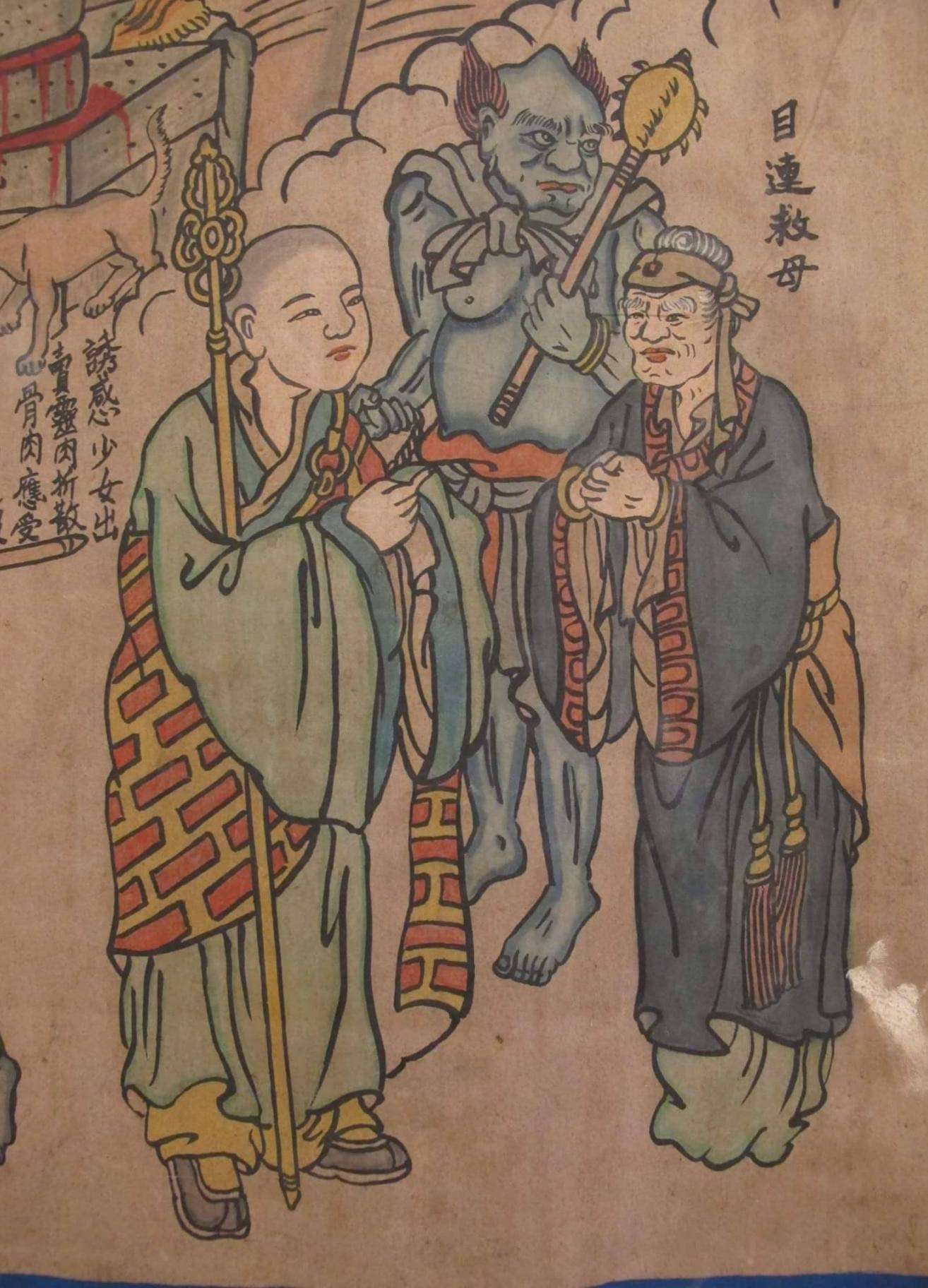
Given the somersault’s symbolic connection to Chan Buddhism, it’s possible Monkey’s jumping has ties to the religion as well. Like immortals, Buddhist saints are also portrayed in Chinese literature as having the power of flight. One example is Maudgalyayana (Ch: Mulian, 目連), a disciple of the Buddha, who is famous for appearing in a late 9th to early 10th-century Bianwen (變文) text in which he travels to the underworld to release his mother from karmic torment (fig. 5). One passage from the tale reads: 

Maudgalyayana awoke from abstract meditation,
Then swiftly exercised his supernatural power;
His coming was quick as a thunderclap,
His going seemed like a gust of wind.
[…]
With his supernatural power, he gained freedom,
So he hurled up his begging bowl and leaped into space (emphasis added);
Thereupon, instantaneously,
He ascended to the heavenly palace of Brahma (Mair, 1994, pp. 1097-1098).

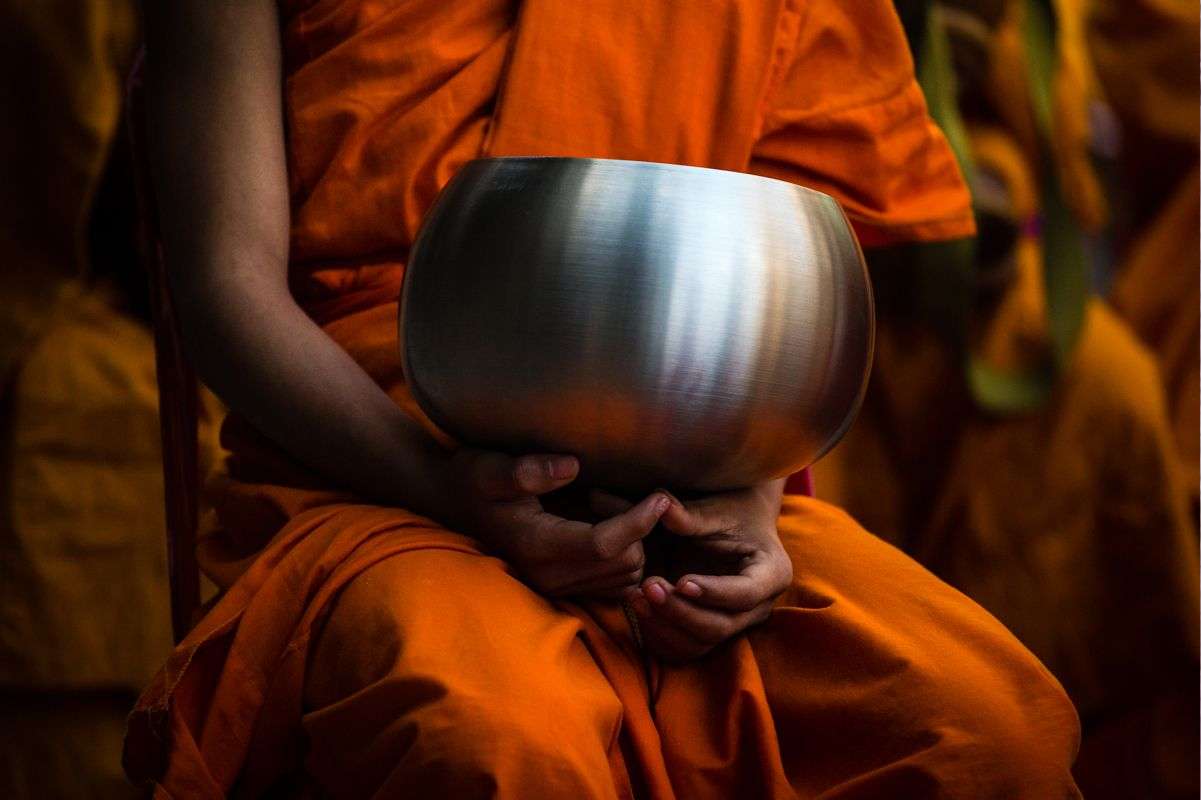
Like Monkey, Maudgalyayana is depicted leaping into the heavens to freely roam the cosmos at blinding speeds, the only difference being that he stands astride a magic alms bowl (fig. 6) and not a cloud. It’s important to note that the saint’s tale influenced the 13th-century precursor of the Ming Journey to the West. As I show in this article, Sun’s antecedent, the Monkey Pilgrim (Hou xingzhe, 猴行者), serves as a proxy for the saint because he wields magic weapons based on those used by Maudgalyayana, namely a golden-ringed monk’s staff and an alms bowl. The ringed staff would come to influence Sun’s signature weapon in Journey to the West, including its ability to change size and pick locks. Therefore, it’s possible the saint may have also influenced Monkey’s jumping.

Buddhist alms bowl - small

Fig. 5 – A scroll or mural depicting Maudgalyayana rescuing his mother from the underworld (larger version). Originally found here. Fig. 6 – A metal alms bowl (larger version). 

V. Popular Culture

It’s interesting to note that the cloud somersault was adapted in the world famous Dragon Ball franchise. In episode three of the Dragonball anime, the lead character Son Goku, himself based on Sun Wukong, is gifted the yellow, fluffy Kinto’un (筋斗雲) by his would-be martial arts teacher, Master Roshi. [4] This is an obvious reference to Subodhi teaching the somersault skill to Monkey. But before Goku officially takes possession, Roshi gives him a warning: “People with impure thoughts can’t ride on it. In other words, you have to be a good person” (video 2). The master thereafter attempts to stand on it but quickly falls through due to his perverted nature. Goku then leaps up and successfully lands on the cloud, proving his worth. This exchange is no doubt a reference to Sun’s inability to carry passengers on his cloud because the impure nature of mortals renders them too heavy (see section one). 

Video 2 – Roshi gives Goku his cloud. Watch from minute 1:50.

VI. Conclusion

The Monkey King first learns the cloud somersault during the early days of his Daoist training under the Sage Subodhi. It enables him to travel 108,000 li in a single leap, making him much faster than the cloud soaring of other transcendents. While this skill shares affinities with the fleet clouds of immortals from Daoist hagiography, Sun’s somersault has a deep connection to Chan Buddhism. The vast distance that it travels is symbolic of the “ten evils and eight wrongs”, two sets of spiritual hindrances from the Platform Sutra said to keep the Buddha’s paradise out of reach. Only those who cleanse themselves of these obstacles can achieve enlightenment and arrive there in a flash, thus making Wukong’s cloud an apt metaphor for instant enlightenment. This suggests the greater speed of the somersault can be read as a further metaphor for the potency of Buddhism over Daoism.

Wukong’s habit of jumping into the heavens differs from the way other immortals rise by stamping their feet. This unorthodox method may have naturalistic or even religious influences. The suggestion that it is based on somersaulting monkeys from Chinese vaudevillian street performances is alluring given their natural gift for acrobatics. Some scholars champion a foreign origin by pointing to the leaping prowess of the Hindu monkey god Hanuman. But this could simply be a passing similarity based on common behavioral traits among monkeys. The jumping may also have ties to the Buddhist saint Maudgalyayana, who is portrayed in a famed 9th/10th-century tale leaping into the air to ride his magic alms bowl between heaven and hell. Elements from his story would come to influence the 13th-century precursor of Journey to the West, as well as the Ming edition of the novel, adding support for his possible influence.


Update: 01-04-24

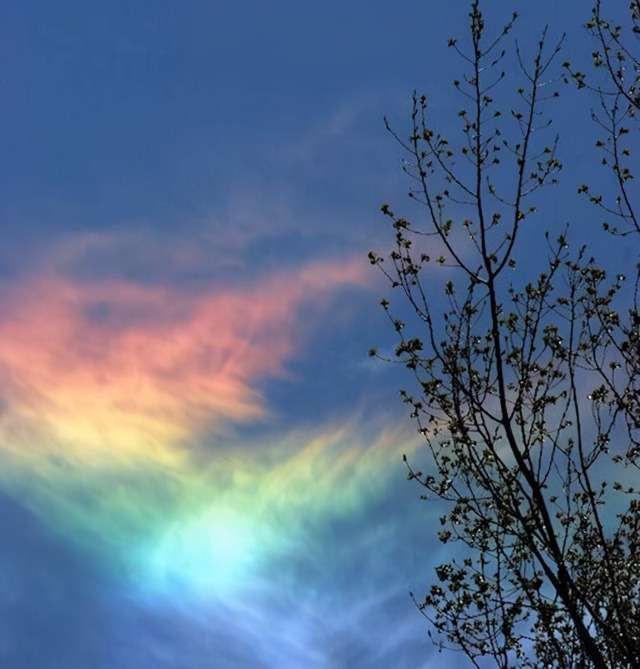
The singular version of Monkey’s cloud is sometimes described as being “auspicious” (xiangyun, 祥雲) or having a “luminosity” (xiangguang, 祥光). Such clouds or lights are commonly associated with the five colors (wuse, 五色) (fig. 7). Chapter 88 makes this explicit:

Marvelous Great Sage! With a loud whistle he somersaulted right up into midair, his two feet treading the auspicious cloud of five colors (emphasis added). At about three hundred paces above ground, he let loose his rod to make [the martial arts moves] Sprinkling Flowers over the Top and the Yellow Dragon Entwining the Body. Up and down he moved, circling left and right. In the beginning his person and the rod so complemented each other that they seemed, as the adage had it, like flowers added to brocade. By and by even the person disappeared, and all one could see was a sky full of twirling rods! (Wu & Yu, 2012, vol. 4, pp. 196-197)

好大聖,唿哨一聲,將觔斗一抖,兩隻腳踏著五色祥雲,起在半空,離地約有三百步高下。把金箍棒丟開個「撒花蓋頂」,「黃龍轉身」,一上一下,左旋右轉,起初時人與棒似錦上添花;次後來不見人,只見一天棒滾。

Fig. 7 – Here is an example of an auspicious cloud (larger version). The scientific term for this phenomenon is “cloud iridescence,” but such nimbuses are commonly called “rainbow clouds” in English. 

Notes:

1) The li (里) is a Chinese measure equaling roughly one-third of a mile. All cited English translations presented here use “mile” instead of the original li. I have therefore changed them accordingly.

2) Of course the magic world in which Monkey lives is not our own. It is much, much larger.

3) The English translation originally says “ten myriad” (Huineng & Cleary, 1998, pp. 26-27). The original Chinese reads shiwan (十萬; 10 x 10,000), or 100,000. I have changed the source to make this more explicit.

4) The cloud is called the “Flying Nimbus” in the English dub.

Sources:

Huineng, & Cleary, T. F. (1998). The Sutra of Hui-neng, Grand Master of Zen: With Hui-neng’s Commentary on the Diamond Sutra. Boston: Shambhala.

Huineng, Hsuan, H., & Buddhist Text Translation Society. (2002). The sixth patriarch’s Dharma Jewel Platform Sutra: With the commentary of Venerable Master Hsuan Hua. Burlingame: Buddhist Text Translation Society.

Kirkova, Z. (2016). Roaming into the Beyond: Representations of Xian Immortality in Early Medieval Chinese Verse. Leiden: Brill.

Mair, V. (1989). Suen Wu-kung = Hanumat? The Progress of a Scholarly Debate. In Proceedings of the Second International Conference on Sinology (pp. 659-752). Taipei: Academia Sinica.

Mair, V. (1994). Transformation Text on Mahamaudgalyayana Rescuing His Mother From the Underworld with Pictures, One Scroll, with Preface. In V. Mair (Ed.), The Columbia anthology of traditional Chinese literature (pp. 1094-1127). New York: Columbia University Press.

Shao, P. (2006). Huineng, Subhūti, and Monkey’s Religion in “Xiyou ji”The Journal of Asian Studies, 65(4), 713-740.

Walker, H.S. (1998). Indigenous or foreign? A look at the origins of monkey hero Sun Wukong. Sino-Platonic Papers, 81, 1-117. Retrieved from https://sino-platonic.org/complete/spp081_monkey_sun_wukong.pdf

Wu, C., & Yu, A. C. (2012). The Journey to the West (Vols. 1-4) (Rev. ed.). Chicago, Illinois: University of Chicago Press.

Zhou, Z. (1994). Carnivalization in The Journey to the West: Cultural Dialogism in Fictional Festivity. Chinese Literature: Essays, Articles, Reviews (CLEAR), 16, 69-92. doi:10.2307/495307

Archive # 12 – The Origin of Sun Wukong’s 72 Transformations

Last updated: 06-12-22

Upon Sun Wukong achieving immortality, his Buddho-Daoist master Subodhi warns him of three calamities sent by heaven to kill those who defy their fate and attain eternal life. The Sage then offers to teach Monkey one of two forms of transformation in order to avoid this outcome by living in hiding. [1] The first form, called the “Multitude of the Heavenly Ladle” (Tiangang shu, 天罡數), contains thirty-six changes, while the second, the “Multitude of Earthly Fiends” (Disha shu, 地煞數), contains seventy-two. [2] Our hero chooses the latter and quickly masters a set of secret oral formulas (koujue, 口訣). This becomes one of his signature abilities used throughout the narrative. Monkey’s most famous use of the skill appears in chapter six when he battles Lord Erlang, a divine demon queller and fellow master of transformations (video 1).

Video 1 – Sun’s battle with Lord Erlang. From the great animated Classic Havoc in Heaven (1965).

I. Connection to Chinese astrology and literature

The names of the two forms of transformation that Subodhi offers to teach Monkey can be traced to Chinese astrology. The “Heavenly Ladle” (Tiangang, 天罡; i.e. the Big Dipper) is associated in some traditions with thirty-six stars (fig. 1). Regarding the origin of these stellar bodies, Werner (1932/1969) explains: “The gods of these stars (all stars of good omen) are all heroes who fell on the field of battle in the epic combat known as Wan Xian Zhen 萬仙陣, “The Battle of the Myriad Genii [or Immortals]” (p. 506). [3]

Sun Wukong Transformation - 36 Heavenly Ladle Stars - small

Fig. 1 – A list of the thirty-six Heavenly Ladle stars (larger version). Photograph of Werner, 1932/1969, p. 506. Apologies for not having access to a scanner at this time. 

Furthermore, he writes that the “Earthly Fiends” (Disha, 地煞) are:

[S]eventy-two stars [fig. 2] of evil influence, opposed to the Tiangang. The wicked genii of these stars are cast out and slain by tongzi 童子 magicians [i.e. spirit mediums], who impale them on forks and shut them up in earthen jars, then take them to waste lands, throw them into fires, and surround the spot with a circle of lime, which is supposed to prevent any spirit which may have survived the burning from getting out of it (Werner, 1932/1969, p. 496). [4]

Sun Wukong Transformation - 72 Earthly Fiend Stars - small

Fig. 2 – A list of the seventy-two Earthly Fiend stars (larger version). Photographs of Werner, 1932/1969, pp. 496-497.

Additionally, the Earthly Fiends are considered the “enemies of man, and causes of all diseases and ailments” (Doré & Kennelly, 1916, p. xviii). Several Buddho-Daoist folk talismans exist to ward afflictions caused by the Fiends. One such Buddhist talisman said to cure the “one hundred ailments” even invokes the thirty-six Heavenly Ladle stars to aid in the conquering of the seventy-two demons:

An order is hereby made by the “Ministry of the Thunderbolt”, commanding in the name of the “three religions” that the auspicious stellar gods, Tiangang 天罡, reduce to order the maleficent demons, Disha 地煞, who have caused this disease. The charm must also repress these malignant beings and expel them forthwith (fig.3) (Doré & Kennelly, 1916, p. 312).

Di-sha talisman spell #2- small

Fig. 3 – A reproduction of the illness-curing Buddhist Talisman (larger version).

It’s interesting that Sun Wukong chooses the transformation method centered around stars of evil influence and later becomes a demon who challenges heaven. [5] Good fodder for fan fiction, no?

When these dichotomous stellar bodies were first acknowledged isn’t exactly clear. [6] But the Heavenly Ladle stars go back to at least the mid-13th-century as they are mentioned in the Old Incidents in the Xuanhe period of the Great Song Dynasty (Da Song Xuanhe Yishi, 大宋宣和遺事) (Anonymous, n.d.), a storytelling prompt of the late-Song to early-Yuan. It contains the earliest stories associated with the Water Margin (Shuihu zhuan, 水滸傳, c. 1400), a Chinese classic that predates Journey to the West. The one hundred and eight heroes of this novel are famous for being reincarnations of the Heavenly Ladle and Earthly Fiend stars, a fact revealed in chapter seventy-one when a heaven-sent stone slab is found to list their human names along with the corresponding stellar titles. The long association of the stars with the hugely popular Water Margin novel therefore may have inspired the names for the techniques taught by the sage Subodhi in Journey to the West.

II. Ties to Daoist practices

Robinet (1979) expertly explains that transformation (bianhua, 變化), or “metamorphosis” as she calls it, is central to Daoism. Gods and Saints are portrayed in Daoist literature as being in constant flux, changing with the seasons, taking on different guises and titles, disappearing and reappearing, never remaining the same, thereby living eternally. Daoists and magicians achieve metamorphosis through external and internal alchemical processes, the former involving the ingestion of drugs and talismans and the latter via mental exercises. Those who succeed in their practice can divide themselves endlessly; create rivers, mountains, and forests from meager samples of water, earth, and seeds; and, most importantly, change their form into anything (fig. 4), including the five elements, dragons, clouds, rays of light, or even celestial bodies like the sun and moon. 

72 Transformations Childrens Book - small

Fig. 4 – The cover of a vintage children’s flip book about Monkey’s transformations (larger version). Here he is seen changing into a fish.

Interestingly, transformations could be used to live in hiding, much like originally intended by Subodhi in Journey to the West. Adepts still questing for immortality could magically transform a sword, staff, or slipper into their deceased body, thereby faking death and escaping elsewhere to find a method leading to eternal life. (Often times, those who took this route assumed a new identity to avoid heaven’s gaze (Campany, 2005)). Additionally, sages are said to use their powers to hide in the earth or in the light of the sun, moon, and stars. One source mentions adepts hiding by scattering their shadow and transforming it into seventy-two types of light. In a related book chapter, Robinet (1993) notes this number “alludes to [Laozi’s] seventy-two supernatural marks” (clearly borrowing from the Buddhist Mahapurusa laksana) (p. 166). This is fascinating as it shows there is precedent for seventy-two transformations in Daoism.

III. Archive link

I have archived Robinet’s (1979) wonderful paper on metamorphosis. It can be read here:

Click to access robinet-metamorphosis.pdf

Disclaimer

This has been posted for educational purposes. No malicious copyright infringement is intended. Please support the official release.


Update: 06-12-22

I recently posted an in-depth article about the Patriarch Subodhi in which I reveal information about the additional benefits of the 72 Transformations. Anyone involved in any upcoming “What if” battles involving the Monkey King (COUGH, COUGH!) would do well to take note of this information.

Subodhi teaches this skill to Monkey with the expressed purpose of helping him hide from three calamities of cosmic lightning, fire, and wind sent by heaven to destroy immortals for defying fate and achieving eternal life. But beyond the power of metamorphosis, the novel implies that the ability also grants the user multiple lives (similar to a video game), which might serve as a buffer against the calamities. For example, in chapter 41, after Sun passes out from Red Boy‘s fiery attack, Zhu Bajie reassures everyone by saying: “If he is capable of seventy-two transformations, he has seventy-two lives” (Wu & Yu, 2012, vol. 2, p. 232). Also, in chapter 46, Monkey magically regrows his head after being non-fatally beheaded in a contest of magical skillSha Wujing remarks: “If he knows seventy-two ways of transformation, … he may have altogether seventy-two heads!” (Wu & Yu, 2012, vol. 2, p. 308). [7] In addition, while not directly related to the primate hero, the Bull Demon King is said in chapter 61 to also know the 72 changes (Wu & Yu, 2012, vol. 3, p. 148). He uses the extra lives to survive being beheaded by Prince Nezha a number of times:

[Nezha] leaped onto the bull’s back and brought his monster-cleaving sword down on the bull’s neck: the bull was beheaded at once. Putting away his scimitar, the devaraja was about to greet [Sun Wukong] when another head emerged from the torso of the bull, his mouth belching black air and his eyes beaming golden rays. [Nezha] lifted his sword once more and cut off the bull’s head; as soon as it dropped to the ground, another head came out. It went on like this more than ten times. At last, [Nezha] took out his fiery wheel and hung it on the Bull’s horn. The wheel at once started a great blaze of true immortal fire, which burned so fiercely that the bull began to growl and roar madly, shaking his head and wagging his tail (Wu & Yu, vol. 3, p. 160).

Notes:

1) It should be noted that the calamities are sent every five hundred years. Sun never has to live in hiding, though, as he is trapped under Five Elements Mountain upon the five hundredth anniversary of his immortality (he lived to be roughly four hundred prior to taking up spiritual cultivation). And he achieves Buddhahood prior to reaching the one thousandth year of his immortality, so he never has to guard against subsequent calamities.

2) The translation of these names are loosely based on Anthony C. Yu (Wu & Yu, 2012, vol. 1, p. 122). I have provided more accurate names based on related Chinese literature (see section one above).

3) Source changed slightly. I updated the Wade-Giles to Pinyin. This refers to a military trap appearing in the Chinese classic Investiture of the Gods (Fengshen yanyi, 封神演義, 16th-century), which was published around the same time as Journey to the West

4) I’ve previously mentioned a similar ritual in the first section of this article.

5) Conversely, Zhu Bajie is shown capable of thirty-six transformations (for example, Wu & Yu, 2012, vol 2, p. 328), meaning he studied the method associated with the stars of good omens. And of course we know his sordid story…

6) Though, in my opinion, the thirty-six stars are likely based on the thirty-six generals led by the stellar exorcist, Marshal Tianpeng (天蓬, i.e. Zhu Bajie’s former incarnation), who is himself one of the nine stars of the Big Dipper. The Marshal and his generals appear in the liturgy of the Song-era “Correct Method of the Celestial Heart” (Tianxin zhengfa, 天心正法) exorcist tradition (Anderson, 2008).

[7] Thank you to Irwen Wong of the Journey to the West Library blog for bringing these examples to my attention.

Sources:

Anderson, P. (2008) Tianxin zhengfa In F. Pregadio (ed.), The encyclopedia of Taoism: Vol 1-2 (pp. 989-993). Longdon: Routledge.

Anonymous. (n.d.). Da Song Xuanhe Yishi [Old incidents in the Xuanhe period of the Great Song Dynasty]. Retrieved from https://ctext.org/wiki.pl?if=gb&res=290731&searchu=%E5%A4%A9%E7%BD%A1

Campany, R. (2005). Living off the Books: Fifty Ways to Dodge Ming 命 [Preallotted Lifespan] in Early Medieval China In C. Lupke (Ed.), The Magnitude of Ming: Command, Allotment, and Fate in Chinese Culture (pp. 129-150). University of Hawaii Press.

Doré, H., & Kennelly, M. (1916). Researches into Chinese superstitions: Vol. 3 – Superstitious practices. Shanghai: T’usewei Printing Press. Retrieved from https://ia800709.us.archive.org/2/items/researchesintoch03dor/researchesintoch03dor.pdf

Robinet, I. (1979). Metamorphosis and deliverance from the corpse in Taoism. History of Religions, 19(1), 37-70.

Robinet, I. (1993). Taoist meditation: The Mao-shan tradition of Great Purity. Albany: State University of New York Press.

E. T. C. Werner (1969). A dictionary of Chinese mythology. New York: The Julian Press. (Original work published 1932)

Wu, C., & Yu, A. C. (2012). The journey to the West: Vol. 1-4. Chicago, Illinois: University of Chicago Press.