Archive #23 – “Pagan Temples in San Francisco” (1892)

I’ve previously written an article on the worship of Sun Wukong in 19th-century America. My source was Frederic J. Masters’ (1892) “Pagan Temples in San Francisco”, which appears in a collected edition of The Californian. He discusses the legends of Guan Gong (“Kwan Kung”), Hau Wong (a.k.a. “How Wong”), Mazu (“Queen of Heaven”, a.k.a. “Tin Hau”), Guanyin (“Kwan Yum”), our monkey god Qitian Dasheng (“Tsai Tin Tai Shing”), and Kum Fah, as well as mentions various other deities, such as Tudi Gong (“Earth God”), Kum Fah’s attendants, Chenghuangshen (“City God”), Heidi (“god of the North Pole”), Zhurong (“God of Fire”), and the “Holy Abbot” (Ksitigarbha?). Much of the information covered in the article isn’t new for anyone familiar with Chinese religion. But it’s easy to forget that Masters is talking about the religious practices and beliefs of immigrant Chinese workers living in 19th-century San Francisco, and this is where the article’s true value lies. Many of the temples (“Joss Houses”) are said to be the property of immigrant businesses.

Masters was a Methodist pastor who wrote extensively about Chinatown. While he comments at length about the beauty of temples and the respectability of keeping the stories of noble heroes alive for centuries, he shows a marked Western Christian condescension for many Chinese beliefs. For example, he calls the worship of the monkey god “the acme of absurdity and sinfulness” (Masters, 1892, p. 737). In the beginning of the article, he makes the mistake of equating the ancient god Shangdi with the Judeo-Christian god, believing that Chinese worship of the Almighty was perverted over the millennia by outside influences. He closes the piece by saying the Chinese will return to this ancient worship with proper guidance: “The nation [China] will one day return to the worship of the Highest and the faith in the True. In the dawn of a clearer light shall vanish all that is extravagant, foolish and false” (Masters, 1892, p. 741).

The attached PDF has been cut from the original collection, which has a whopping 853 pages.

Article link:

Citation

Masters. F. J. (1892). Pagan Temples in San Francisco. In C.F. Holder (Ed.). The Californian Illustrated Magazine: June to November, 1892, vol. 2 (pp. 727-741). San Francisco, Calif.: Californian Pub. Co.

The Great Sage Monkey King Scripture: A Brief Analysis

The Journey to the West Research blog is proud to host an entry by our friend Edward White (his blog). The following is a reformatted and lightly edited version of his brief but insightful analysis of The Great Sage Equaling Heaven’s True Scripture of Awakening People and Enlightening the World (Qitian Dasheng xingren jueshi zhenjing, 齊天大聖醒人覺世眞/真經) posted on Twitter (see here). He was gracious enough to give me permission to post it here. – Jim

Analysis

This book alone is extremely interesting, because it shows the sheer amount of syncretism that is found in Chinese popular religion: It freely combines Buddhist and Daoist elements. The first text in this book is not actually the Great Sage scripture itself, but rather The Thousand-Handed and Thousand-Eyed Bodhisattva Guanshiyin’s Great Compassion Heart Mantra (Qianshou qianyan Guanshiyin pusa dabbixin tuoluoni, 千手千眼觀世音菩薩大悲心陀羅尼), better known as the Great Compassion Mantra (Dabei Zhou, 大悲咒), followed by the celebrated Heart Sutra (Xinjing, 心經), here called by its full name the Prajnaparamita Heart Sutra (Bore boluomi duo xinjing, 般若波羅蜜多心經) (pp. 9-13). Both are quintessentially Buddhist texts. These are, however, followed by a set of mantras for cleansing the body and the surroundings, which are associated with Daoist rites (starting from p. 13).

This is followed again with a “Precious Admonition of the Great Sage Equalling Heaven” (Qitian Dasheng Baogao, 齊天大聖寶誥) (p. 25). This format—effectively a hymn—is a liturgical form that is associated exclusively with Daoist scriptures (Cf. the set phrase 志心皈命禮 on p. 26). [1] Then, you have a list of salutations of four Buddhas and bodhisattvas, and five Heavenly Worthies (Tianzun, 天尊) (Daoist deities), all of which are equally saluted by the Sanskrit “Namo” (南無) (pp. 28-30).

The scripture itself starts on page 30, and has five chapters in total. Chapter one is titled “Cultivating the Body and Rectifying Fate” (Xiushen liming di yi zhang, 修身立命第一章) (p. 30). Chapter two is titled “Entering Sagacity and Transcending Ordinariness” (Ru sheng chaofan di er zhang, 入聖超凡第二章) (p. 33). Chapter three is titled “Returning to the Origin of Brilliance and Kindness” (Mingshan fu chu di san zhang, 明善復初第三章) (p. 40). What is interesting in this text, however, is that between chapters two and three, there is a lengthy section titled “True Words of the Great Sage Equalling Heaven” (Qitian Dasheng zhenyan, 齊天大聖眞言) (p. 36). [2] This is absent in the online edition. Chapter 4 is titled “Cause, Effect, and Retribution” (Yinguo baoying di si zhang, 因果報應第四章) (p. 44). The fifth and final chapter is titled “Cultivating Both Internally and Externally” (Neiwai shuangxiu di wu zhang, 內外雙修第五章) (p. 52). In this particular edition of the Great Sage Scripture, between chapters four and five are found a long list of evils that reciting this scripture can resolve (this is also not found on the online edition) (pp. 48-52). Our Daoist readers may find this similar to a list found in the very, very Daoist “Big Dipper Scripture” (Beidou jing, 北斗經), which I translate here.

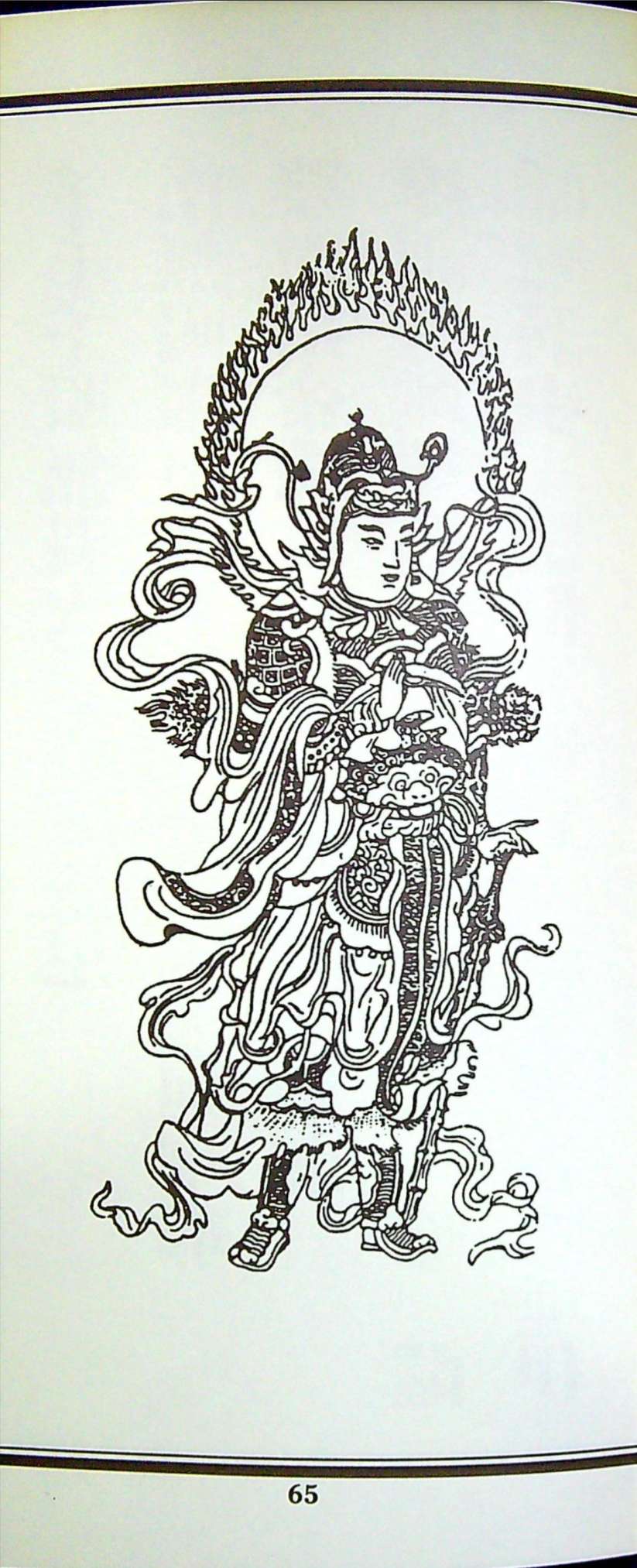
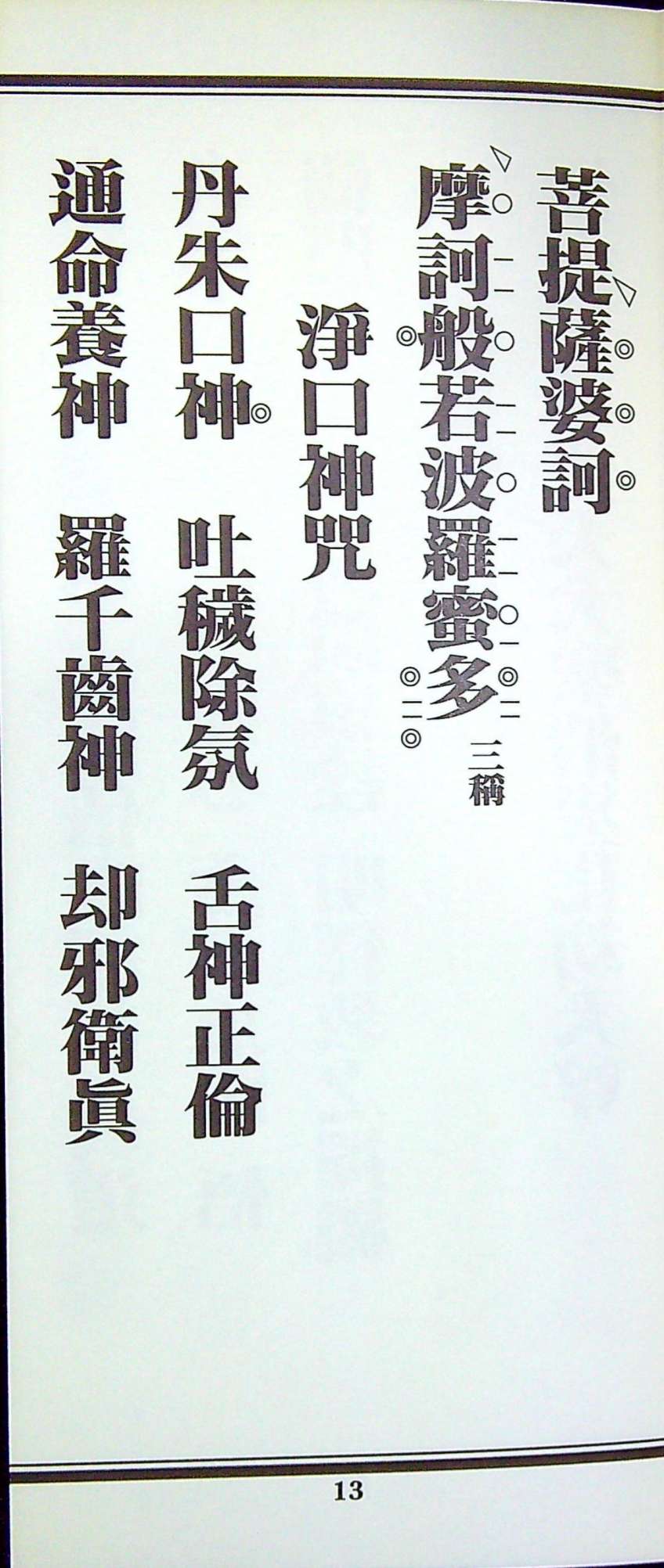
Fig. 1 – Weituo standing guard at the end of the scripture (larger version). Fig. 2 – Examples of percussion marks (larger version).

The text ends with a hymn called “In Praise of the Great Sage Equalling Heaven” (Qitian Dasheng zan, 齊天大聖讚) (p. 56), followed by a text called “The Essentials of Cultivating the Dao” (Xiudao shouyao pian, 修道首要篇) (p. 57). This is immediately followed by the “Mantra of the Seven Buddhas to Extinguish Offences” (Qi fo miezui zhenyan, 七佛滅罪眞言) (p. 59). Syncretism indeed. On the last page we have a picture of the Buddhist god Weituo (韋馱) (fig. 1), who stands guard on the last page of scriptures to protect them (p. 65). Thus we have an extremely Daoist text literally bookended by Buddhism.

We are hence immensely grateful to Jim for uploading scans of this scripture. As even from this preliminary reading shows, it preserves liturgical texts that are not found in online editions of the scripture. The online presence of non-Buddhist Chinese religious works is extremely poor and patchy; we have nothing like the Taisho Tripitaka to work on; every scripture uploaded advances our knowledge greatly. By observing not just the scripture itself, but also its front and back matter that is printed along with it, we can tell how the scripture was used by the religious communities that produced it—something again that gets lost in transmission.

Some words should be said about the format of the book. The book is clearly bound in what is called in the west the “Concertina format”. This format is unique to religious books, thereby increasing its authenticity as a holy work. But also more importantly, makes the book very easy to use in a liturgical context: it lays absolutely flat, and is easy to turn—valuable features if you are chanting off the scripture. In turn, on some pages, you see little dashes and dots besides the characters (fig. 2) (p. 13, for example). These are indications of the percussion—when the various gongs and bells are to be struck. These factors—along with the inclusion of several hymns inserted between chapters of the scripture—would lead me to conclude that this book represents not just a scripture to be contemplated, but a scripture prepared for public performance as a ritual (refer back to “True Words of the Great Sage Equalling Heaven” between ch. 2 and 3). The appended mantras, percussion, and inserted hymns, would only make sense in a context where people would chant the scripture in a grand ceremony: they would be irrelevant if the text was produced with quiet study and contemplation in mind. I could be wrong, though.

Notes:

1) For a Chinese example of another “Precious Admonition”, see here. My translation of another can be seen here.

2) “True Words” 真言 is one of the names by which mantras are known in Chinese. Thus, the term “True Words of the Great Sage” might just as well be read as “Mantra of the Great Sage”.

Archive #22 – The Monkey King’s Scripture

歡迎朋友們,這篇博客文章的底部有一個PDF

Last updated: 03/10/2021

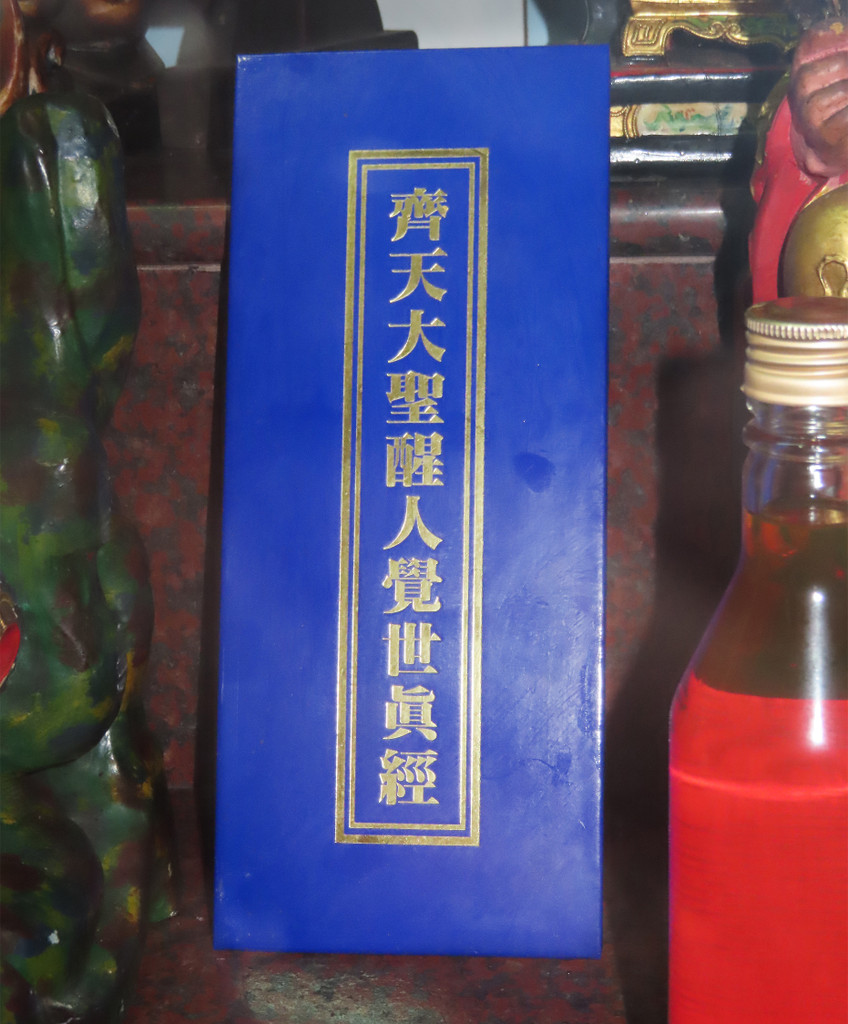
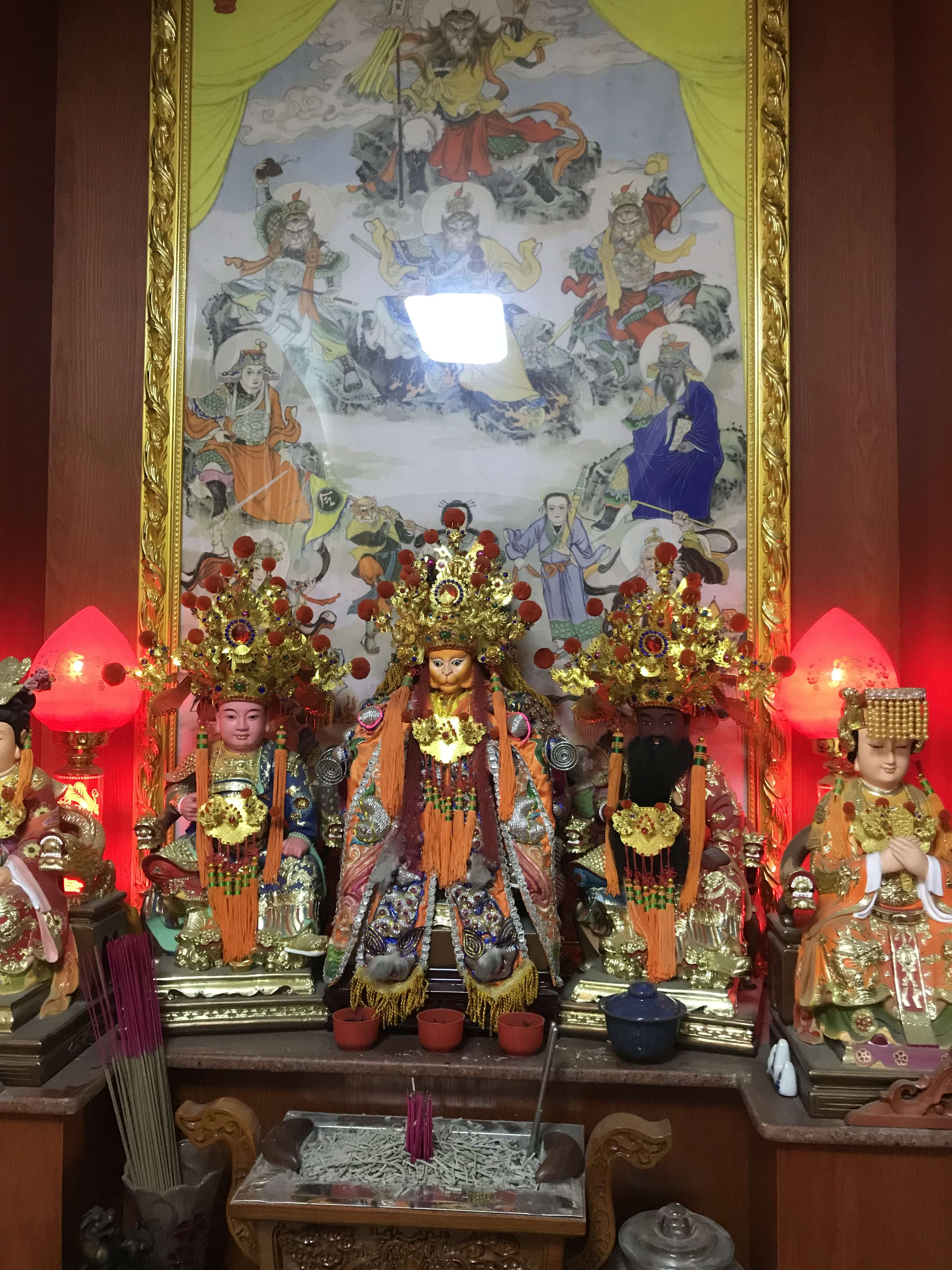
I am absolutely thrilled to share a PDF scan of The Great Sage Equaling Heaven’s True Scripture of Awakening People and Enlightening the World (Qitian Dasheng xingren jueshi zhenjing, 齊天大聖醒人覺世眞/真經). That’s right, the Monkey King has a holy book! I first learned of it when I visited the Great Sage Equaling Heaven Temple (Qitian Dasheng Miao, 齊天大聖廟) in the Zhongshan District of Keelung, Taiwan. I had spent a few minutes taking pictures, when I briefly looked back through the images to make sure they weren’t blurry (a common problem when photographing in dimly lit temples). This is when I saw a blue booklet tucked among the altar statues (fig. 1 and 2). I hadn’t notice it upon first inspecting the figures. But once I looked up and read the characters, I knew I had found something special.

Fig. 1 – The image where I first noticed the blue booklet (larger image). Fig. 2 – The Great Sage Scripture (larger version).

After posting about it online and inquiring with my monkey temple contacts, a gentleman from Taichung wrote me on Facebook and offered to send me a copy free of charge (a BIG thank you to Mr. Chen). A few days later, I received a package in the mail and was delighted to find he had sent me an exact copy as that seen in Keelung.

The resulting scans are the product of an overhead scanner set to document mode. I found the book mode cropped off the page numbers and slightly widened the characters when the program attempted to flatten the curved pages. Still, the final product is not perfect as the accordion-style pages can’t be laid perfectly flat.

The document states that this is the fourth batch printed in September of 2006. I’m not sure when it was first written; though, I’ve been told by a few informants that it is likely the product of the “flying phoenix” (feiluan, 飛鸞), otherwise known as “planchette writing” or “spirit writing” (fuji, 扶乩 / 扶箕). Jordan and Overmyer (1986) note the Chapel of Compassion and Goodness (Cishan Tang, 慈善堂) of the Society of Wisdom and Enlightenment (Huiming She, 慧明社) in Tainan published a book via the planchette in 1965 with 724 “revelations” from assorted Buddhist and Daoist deities, including the Great Sage (pp. 107-108). Perhaps this scripture is part of that tradition. A tangki from Taipei said that last year a sister temple had gifted 20 copies of the Great Sage scripture to various temples. One informant said they saw it at a temple on “Five Fingers Mountain” (Wuzhi shan, 五指山) in Hsinchu, while another said they saw an exact copy in Singapore. The internet has a few videos of the scripture being performed aloud, one in Hokkien and the other in Cantonese (video 1). The latter suggests the scripture is present in Hong Kong as well.

Video 1 – The Cantonese version of the Great Sage scripture.

I am not a translator, so I don’t plan to make my own. My hope is that a more qualified individual will use the PDF to give the scripture the proper translation and analysis that it deserves. I would love to one day host it on my site.

Scripture link:


Update: 03/10/21

I have posted a brief analysis of the Great Sage scripture by Edward White. A big thank you to him.

https://journeytothewestresearch.com/2021/03/10/the-great-sage-scripture-a-brief-analysis/

Source:

Jordan, D. K. & Overmyer, D. L. (1986). The Flying Phoenix: Aspects of Chinese Sectarianism in Taiwan. Princeton: Princeton University Press.

The Monkey King and The Buddha Victorious in Strife (a.k.a. Victorious Fighting Buddha)

NOTE: THIS IS MY 100TH BLOG POST.

Last updated: 06-13-2025

The Monkey King is elevated in spiritual rank at the end of Journey to the West (Xiyouji, 西遊記, 1592; “JTTW” hereafter) for his service in protecting the monk Tripitaka throughout the quest to India. Gautama Buddha enfeoffs him as the “Buddha Victorious in Strife” or “Victorious Fighting Buddha” (Dou zhansheng fo, 鬥戰勝佛). Many readers may be surprised to learn that this is actually an established Buddhist deity and not just the creation of the JTTW author-compiler. In this article, I would like to briefly explore the Buddha’s religious background, iconography, purpose, and relationship to the worship of Sun Wukong.

Table of Contents

1. Literary Enlightenment

The Gautama Buddha explains:

Sun Wukong, when you caused great disturbance at the Celestial Palace, I had to exercise enormous dharma power to have you pressed beneath the Mountain of Five Phases. Fortunately your Heaven-sent calamity came to an end, and you embraced the Buddhist religion. I am pleased even more by the fact that you were devoted to the scourging of evil and the exaltation of good. Throughout your journey you made great merit by smelting the demons and defeating the fiends. For being faithful in the end as you were in the beginning, I hereby give you the grand promotion and appoint you the Buddha Victorious in Strife (Wu & Yu, 2012, p. 381).

孫悟空,汝因大鬧天宮,吾以甚深法力,壓在五行山下,幸天災滿足,歸於釋教;。且喜汝隱惡揚善,在途中煉魔降怪有功,全終全始,加陞大職正果,汝為鬥戰勝佛。

2. Religious Background

JTTW closes by “submitting” or “prostrating” (namo, 南無) to a long list of Buddhas, Bodhisattvas, and Arhats. The Buddha Victorious in Strife is placed at the end of 47 Buddhas and ahead of the Bodhisattva Guanyin. A section of the list reads:

[…]
I submit to the Buddha of the Gift of Light.
I submit to the Buddha of Candana Merit.
I submit to the Buddha Victorious in Strife (emphasis added).
I submit to the Bodhisattva Guanshiyin.
I submit to the Bodhisattva, Great Power-Coming
[…] (Wu & Yu, 2012, p. 385).

南無才光佛。南無旃檀功德佛。南無鬥戰勝佛。南無觀世音菩薩。南無大勢至菩薩

Many of the Buddhas from the novel’s list appear in assorted real world canonical lists, including the 88 Buddhas (Bashiba fo, 八十八佛) from the Great Repentance Text of the Eighty-Eight Buddhas (Ch: Bashiba fo da chanhui wen, 八十八佛大懺悔文). [1] This group is comprised of the 53 Buddhas (Ch: Wushisan fo, 五十三佛) and the 35 Confession Buddhas (Ch: Sanshiwu fo chan, 三十五佛懺) (fig. 1).

The historical “Buddha Victorious in Strife,” Yuddhajaya (Sk: युद्धजय; see the 06-13-2025 update for more name info), is the 31st of the 35 Confession Buddhas, who are individually called upon during a confessional prayer to absolve oneself of sins. They appear in a number of sources, such as The Bodhisattva’s Confession of Ethical Downfalls (Ch: Pusa duochan / Pusa chanhui wen, 菩薩墮懺 / 菩薩懺悔文) from the Three Heaps Sutra (Sk: Trīskhandhadharmasūtra; Ch: Sanyun jing, 三蘊經) and the Names of the Thirty-Five Buddhas Spoken by the Buddha (Ch: Foshuo sanshiwu foming lichan wen, 佛說三十五佛名禮懺文, 8th century). 

Fig. 1 – A religious painting of the 35 Confession Buddhas (larger version). The Buddha Victorious in Strife is third from the right on the bottom row. Image found here.

2.1. Iconography

The Buddha Victorious in Strife is depicted in Buddhist art with the traditional features of a Buddha (i.e. ūrṇā, uṣṇīṣa, long ear lobes, robes, etc.), but he is also shown holding a suit of armor and a sword (fig. 2):

Yuddhajaya Buddha — (Skt.: aka Yuddhajaya) (Chin.: Tou-chan-sheng fo; Mon.: Bayildugan-i masids darugci; Tib.: gYul-las-sin-tu-rnam-par-rgyal-ba, rGyal-ba-gYul-lasr-Gyal-ba) A Sanskrit variant for the Jina Yuddhajaya. One of the Buddha images found in the Pao Hsiang Lou [寶相樓] temple of the Forbidden City, Beijing, and one of the thirty-five “Buddhas of Confession.” Face: one, calm, urna, usnisa, long ear-lobes; arms/hands: holding a cuirass up to his chest; body: monastic robes; legs: two; asana: vajrasana; vahana: lotus throne.

— (2) — (Mon.: Bayildugan-i masids darugci; Tib.: gYul-las-sin-tu-rnam-par-rgyal-ba) One of the Buddhas of Confession pictured in the Mongolian Kanjur (Mon.: Monggol ganjur-un) (1717-1720) Face: one, calm, urna, usnisa, long ear-lobes; arms/hands: two, right hand holds sword (khadga, ral-gri), left hand holds coat of mail (khrab); body: monastic robes, right shoulder uncovered; legs: two; asana: vajrasana; attributes: 32 major and 80 minor signs; vahana: lotus throne (Bunce, 1994, Vol. 1, p. 629). [2]

Fig. 2 – The Buddha Victorious in Strife (Yuddhajaya) holding a sword and suit of armor (larger version). Image found here.

2.2. Purpose

Neither the name Buddha Victorious in Strife nor the sword and armor are a reference to the deity’s fighting prowess. According to Lai (2016), the Buddha “defeat[s] the inner enemies of afflictive emotions and negative actions of sentient beings. He is victorious over cyclic existence and thus able to lead all sentient beings to liberation. He purifies the negative karma of actions committed out of pride.”

His name and accoutrements, therefore, symbolize the means by which he subjugates the negative emotions or actions that would otherwise keep man trapped in the illusory world of Saṃsāra.

3. Relationship to Sun Wukong’s Worship

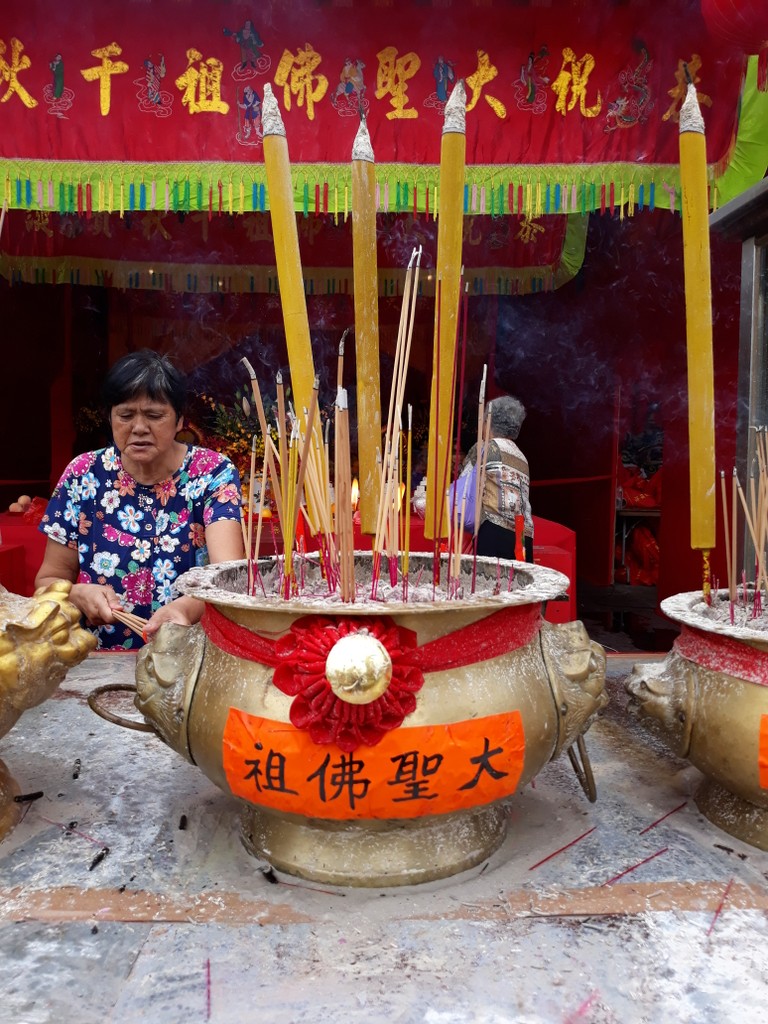
The Monkey King is worshiped in southern China, Taiwan, and Southeast Asian countries like Malaysia, Singapore, Thailand, and Vietnam as a great exorcist and protector of children. But it may come as a surprise to learn that he is rarely worshiped as the Buddha Victorious in Strife. Instead, Wukong is almost exclusively revered as the “Great Sage Equaling Heaven” (Qitian dasheng, 齊天大聖), and even when he is called a Buddha, the name usually includes some reference to the rebellious title. For example, when I attended the Monkey King’s birthday (sixteenth day of the eighth lunar month) in Hong Kong in 2018, I saw an incense pot labeled “Great Sage Buddha Patriarch” (Dasheng fozu, 大聖佛祖) (fig. 3).

So why isn’t Sun widely worshiped as the Buddha Victorious in Strife? I think the simplest answer is that the Buddha already had a long-established following and therefore couldn’t be subsumed under the late-blooming cult of a cultural hero, even one as popular as the Monkey King.

Fig. 3 – An incense pot reading “Great Sage Buddha Patriarch” (Dasheng fozu, 大聖佛祖) (larger version). Taken by the author in Kowloon, Hongkong (Sept. 24, 2018).

4. Precedent for Spiritual Promotion

The author-compiler likely connected Sun Wukong to the Buddha Victorious in Strife because of the Enlightened One’s war-like iconography (recall the sword and armor mentioned above). After all, Monkey is an armor-wearing martial deity wielding his magic staff to protect Tripitaka from untold numbers of demons and spirits.

But the choice to elevate Monkey in rank was likely influenced by previous media. For example, Wukong’s literary antecedent, the Monkey Pilgrim (Hou xingzhe, 猴行者), receives a promotion at the end of The Story of How Tripitaka of the Great Tang Procures the Scriptures (Da Tang Sanzang qujing shihua, 大唐三藏取經詩話), a late-13th century precursor of JTTW. The story ends thus: “Tang Taizong later enfeoffed Monkey Pilgrim as ‘Great Sage Steel Muscles and Iron Bones'” (Gangjin tiegu dasheng, 鋼筋鐵骨大聖) (Wivell, 1994, p. 1207). [3]

5. Conclusion

At the end of JTTW, the Buddha promotes Sun Wukong to the “Buddha Victorious in Strife” or “Victorious Fighting Buddha” (Dou zhansheng fo, 鬥戰勝佛). This is the Chinese name of Yuddhajaya (Sk: युद्धजय), the 31st of the 35 Confession Buddhas called upon during a confessional prayer to absolve oneself of sins. He is generally portrayed as a robe-wearing Buddha holding a sword and suit of armor. This is not a reference to the deity’s fighting prowess, however. Instead, his name and accoutrements symbolize the means by which he subjugates the negative emotions or actions that would otherwise keep man trapped in the illusory world of Saṃsāra.

Instead of being universally revered as the Buddha Victorious in Strife, the Monkey King is far more widely worshiped in East and Southeast Asia as the “Great Sage Equaling Heaven” (Qitian dasheng, 齊天大聖) or a variant like “Great Sage Buddha Patriarch” (Dasheng fozu, 大聖佛祖). This discrepancy is probably due to the original Yuddhajaya already having a long-established following. There’s no way that he could ever be subsumed under Sun Wukong’s late-blooming cult. 

Wu Cheng’en (or whoever the true author-compiler was) likely connected Monkey to the Buddha Victorious in Strife because both have martial iconography. Sun is commonly depicted wearing armor and wielding an iron staff, while Yuddhajaya is shown holding a sword and armor. But the concept of Sun receiving an elevation in spiritual rank goes back centuries. The Monkey Pilgrim, his literary antecedent from The Story of How Tripitaka of the Great Tang Procures the Scriptures (late-13th century), is deified by the Tang emperor as “Great Sage Steel Muscles and Iron Bones” (Gangjin tiegu dasheng, 鋼筋鐵骨大聖).


6. Updates

Update: 09-06-20

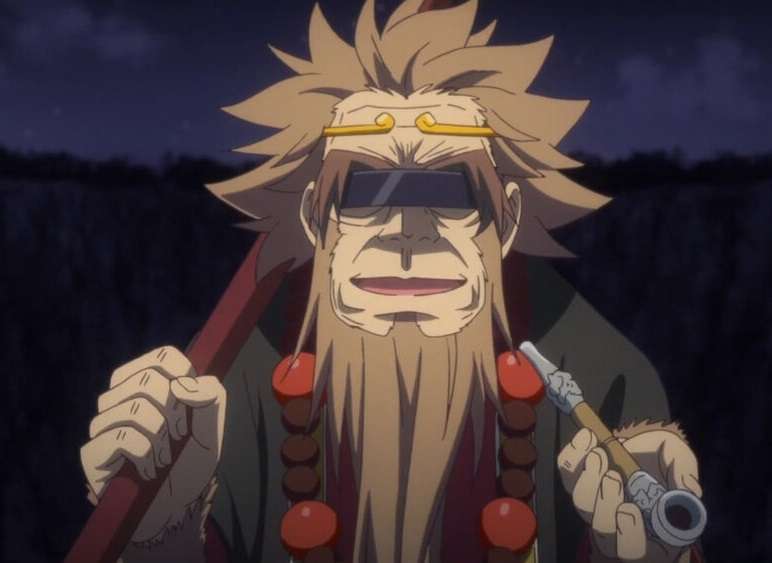
If you type “Buddha Victorious in Strife,” “Victorious Fighting Buddha,” “鬥戰勝佛” or “斗战胜佛” into google images, you’ll notice that these terms are almost exclusively associated with Sun Wukong. Most results are fan-made drawings of Monkey wearing his armor. Very few depict him as a Buddha. The only appearance of the latter in popular media that I’m aware is the Victorious Fighting Buddha from the manga / anime High School DxD.

The character is depicted as a jovial old dwarf with long, shaggy brown hair, bushy eyebrows that fall over a cyberpunk-style black visor, no mustache, a long beard, a floor-length, dark gray coat over a red robe, and monkey feet. He wears his famous golden fillet and a set of chunky brown and red prayer beads. In his left hand he holds a smoking pipe, while the right holds his magic staff, which is depicted as red and gold (fig. 4).

Fig. 4 – The Victorious Fighting Buddha from High School DxD (larger version).

The Victorious Fighting Buddha inhabits a universe where various factions of Western and Eastern gods, devils, and heroes battle one another. According to the story, upon ascending to Buddhahood, he steps down as the Monkey King, handing the title to a young descendant, and serves as the vanguard of the Hindu god Indra, during which time he protects the cosmos from a faction of devils and fallen angels. He later takes on the role of sub-leader and mentor to a new faction of young heroes whom he trains to battle god-tier opponents.

High School DxD portrays the Victorious Fighting Buddha as very powerful. For example, season four, episode six (minute 13:35) of the anime shows him effortlessly blocking the “True Longinus” spear with the tip of his index finger. This is quite a feat as this weapon is the same one used to pierce the side of Christ, thereby giving it the power to kill other gods.


Update: 03-22-21

I visited “Sage Buddha Hall” (Shengfo Tang, 聖佛堂), a Great Sage temple in Beigang, Yunlin, Taiwan and saw a few items labeled the “Fighting Sage Buddha” (Dou zhan sheng fo, 鬥戰聖佛) in place of the Buddha Victorious in Strife/Victorious Fighting Buddha. One such item was a paper fan (fig. 5). As noted above, Buddha Victorious in Strife/Victorious Fighting Buddha is not a reference to the deity’s fighting prowess, but his ability to “defeat the inner enemies of afflictive emotions and negative actions of sentient beings.” So it appears that this temple takes his martial skill at face value.


Update: 08-09-22

As an enlightened Buddha, Monkey is eligible for his own “Buddha-Field” (Sk: Buddhakṣetra; Ch: Focha, 佛刹), essentially his own universe in which he will lead the inhabitants to enlightenment. Buswell and Lopez (2014) explain:

[W]hen a buddha achieves enlightenment, a “container” or “inanimate” world is produced in the form of a field where the buddha leads beings to enlightenment. The inhabitant of that world is the buddha endowed with all the [qualities of an Enlightened One]. Buddha-fields occur in various levels of purification, broadly divided between pure and impure. Impure buddha-fields are synonymous with a world system (cakravāḍa), the infinite number of “world discs” in Buddhist cosmology that constitutes the universe; here, ordinary sentient beings (including animals, ghosts, and hell beings) dwell, subject to the afflictions of greed, hatred, and delusion. Each Cakravāḍa is the domain of a specific buddha, who achieves enlightenment in that world system and works there toward the liberation of all sentient beings… (p. 153).


Update: 01-22-23

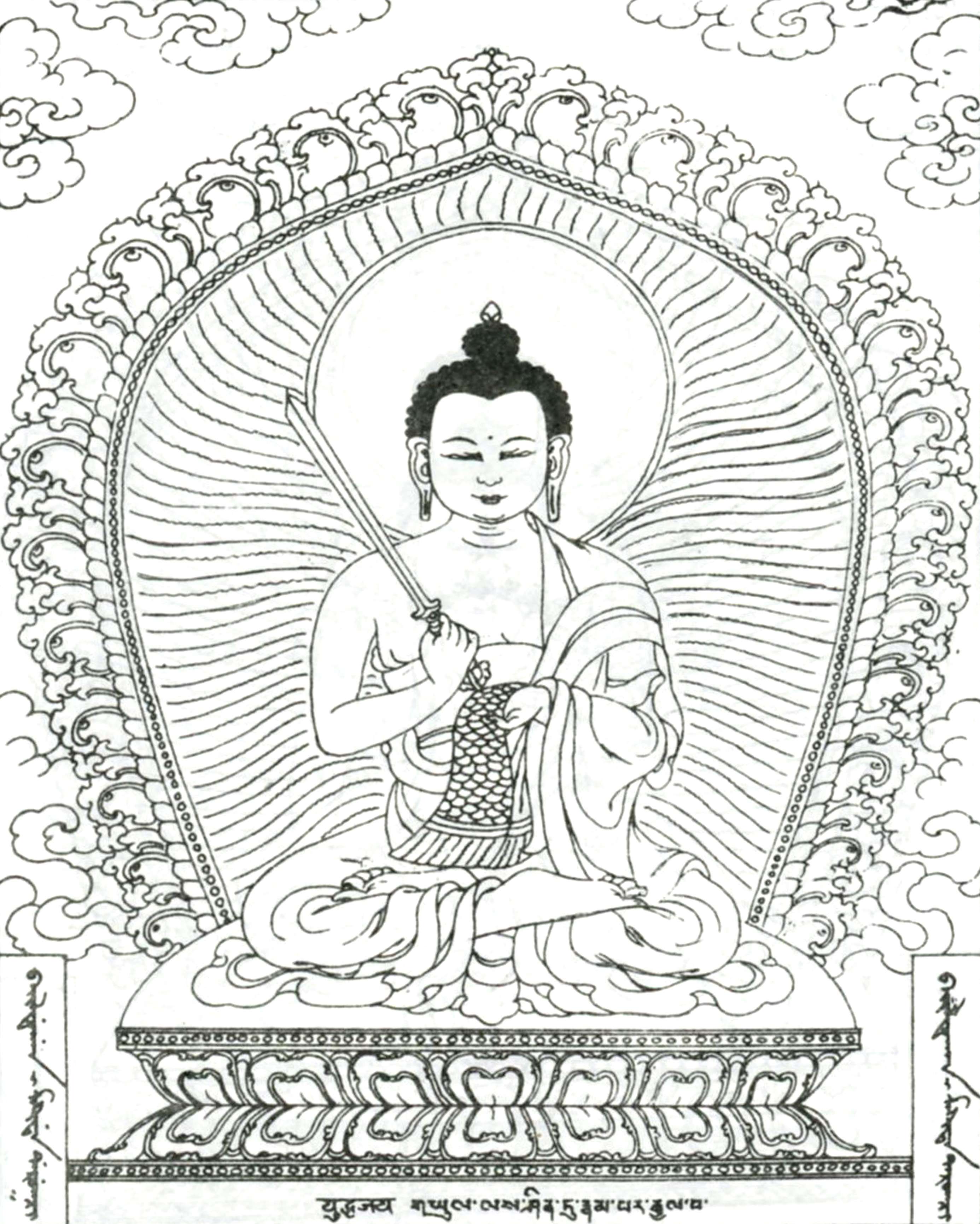
Chandra (1999) includes a lovely black and white line drawing of Yuddhajaya (fig. 6) (p. 94).

Fig. 6 – A traditional Tibetan drawing of Yuddhajaya (larger version). Image from Chandra, 1999, p. 94.


Update: 05-09-23

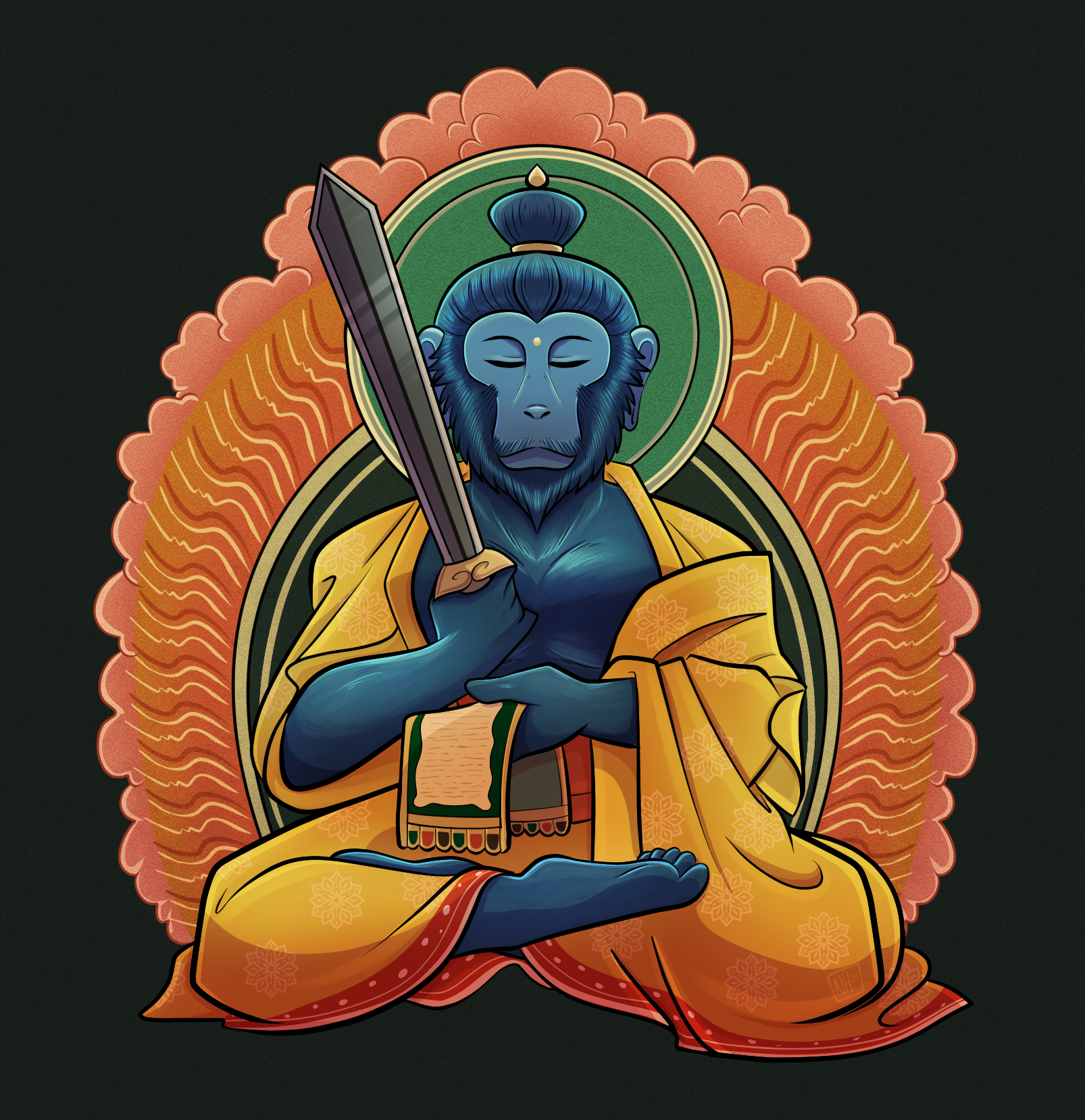
I commissioned NinjaHaku21 (Twitter, Instagram, and Tumblr) to draw Sun Wukong using Yuddhajaya’s traditional iconography (fig. 7), and the results are stunning! It is based on the design from figure two above.

Fig. 7 – A religiously accurate drawing of Monkey as the Yuddhajaya Buddha by NinjaHaku21 (larger version).


Update: 06-12-23

I have written a companion piece to this article about Tripitaka’s Buddha title.

The Tang Monk Tripitaka and the Buddha Candana Merit


Update: 09-11-23

Tumblr user @darkfalcon-z has drawn a lovely picture of the Monkey King as a Buddha (fig. 8). They explain their headcanon for the image:

[B]aby monkeys think Grandpa’s lotus throne is for playing.

[…]

I think Wukong got back to his mountain to take care of his monkeys. He does visit sometimes. He takes his favourite monkeys along for the ride. I don’t think it is much of a problem in Western Heaven in Buddha’s domain, because if you are enlightened the antics of little animals won’t really bother you. He’s told not to bring monkeys along next time as per formality. He does anyway. It’s not like anyone minds. He takes the monkeys along when he visits Jade Emperors domain. There monkeys are treated as nuisance and chased around, but no one actually dares to harm them, as they fear to incur his anger. He probably takes more troublesome monkeys too. On purpose.

I love the baby monkeys, as well as Wukong’s flower-like halo.

Fig. 8 – @darkfalcon-z’s Monkey Buddha (larger version). Used with permission.


Update: 11-07-2024

Above, I wrote: 

Wu Cheng’en (or whoever the true author-compiler was) likely connected Monkey to the Buddha Victorious in Strife because both have martial iconography. Sun is commonly depicted wearing armor and wielding an iron staff, while Yuddhajaya is shown holding a sword and armor.

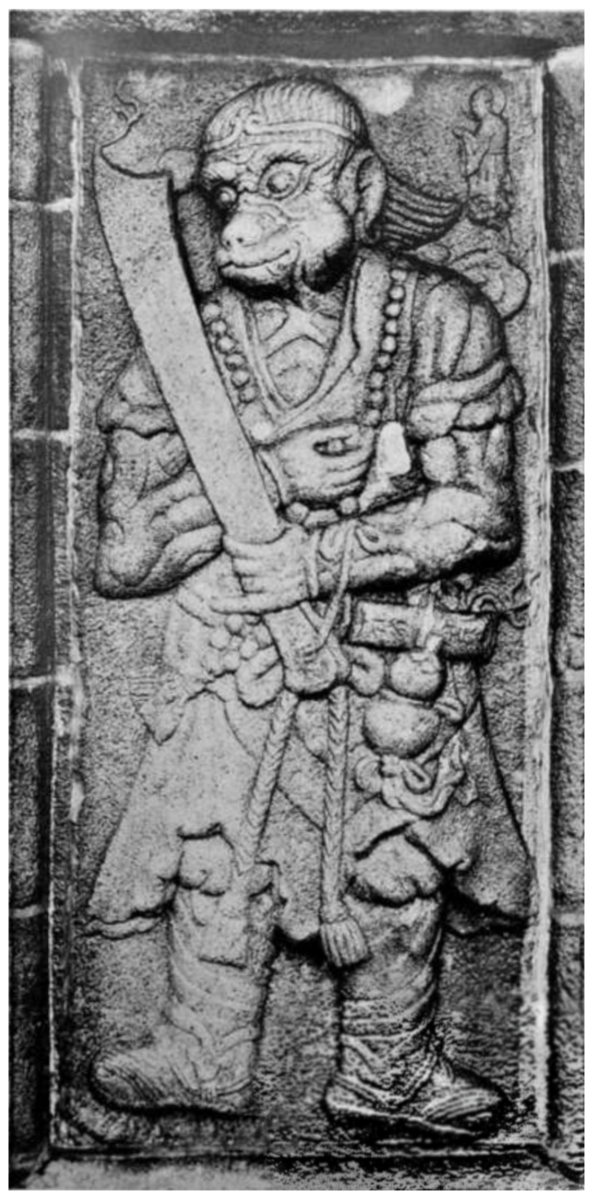
But it just dawned on me that Sun’s antecedent, the Monkey Pilgrim (Hou xingzhe, 猴行者), is also portrayed holding a divine sword in a 13th century stone relief carving (fig. 9). This weapon is referred to as his “Bodhisattva Sabre” (Pusa dao, 菩薩刀) in a 17th or 18th century tale appearing in a famous collection of Chinese folk stories. Therefore, it wouldn’t surprise me if this influenced the association with Yuddhajaya’s sword.

Fig. 9 – The Kaiyuan temple pagoda relief carving depicting Monkey holding a sword (larger version). Located on one of two 13th century stone pagodas of Kaiyuan Temple in Quanzhou City, Fujian Province, China.

I would also like to add some more drawings of Sun Wukong as a Buddha. The first two (fig. 10 & 11) are by a netizen who goes by @VirliebeAnatta (a.k.a. Bhante_Wukong) on Twitter and @his-shining-tears on Tumblr. Their work is very calming and welcoming.

Fig. 10 – The Monkey Buddha gazes upon the viewer with hands clasped (larger version). Image found here and here. Fig. 11 – A three-quarters view of the Monkey Buddha with head bowed and hands clasped (larger version). Image found here and here.

The third (fig. 12) is by Nhung Nguyen (twitter and instagram).

Fig. 12 – Nhung’s intense Monkey Buddha (larger version). The image was first seen on a JTTW discord, but it can also be found here and here.

The fourth (fig. 13) is by Saknarin Bowonkitmanee (a.k.a. Move Saknarin), a member of the the ศรัทธาอากงไต่เสี่ยฮุกโจ้ว (大聖佛祖) Thailand Facebook group.

Fig. 13 – Move’s serene Monkey Buddha (larger version). Image found here.


Update: 11-16-24

Figure 13 above was the bases for this lovely Thai statue of the Monkey Buddha (fig. 14).

Fig. 14 – The Thai Monkey Buddha idol (larger version). Image found here.


Update: 06-13-2025

In late-2024, I commissioned friend of the blog NingadudeXx to draw Monkey as Yuddhajaya using their colorful style. The finished piece (fig. 15) was delivered in mid-January 2025.

Fig. 15 – NingadudeXx’s colorful Monkey Buddha (larger version).

On a related note, I learned that Yuddhajaya has a secondary name, Vijita-saṃgrāma (Ch: Yongjian jixiang fo, 勇健吉祥佛; Viet: Dũng Kiện Cát Tương Phật), or the “Brave and Auspicious Buddha” (source). The Chinese version of his title is listed in the 8th century Names of the Thirty-Five Buddhas Spoken by the Buddha (Ch: Foshuo sanshiwu foming lichan wen, 佛說三十五佛名禮懺文) (originally linked above).

Interestingly, the farthest back that I can trace the term Dou zhansheng fo (鬥戰勝佛, i.e. “Buddha Victorious in Strife”) on CBETA is the 12th or 13th century Ritual for the Tathāgata’s Extensive Filial Piety’s Ten Kinds of Recompensating (Parents’) Kindness (Rulai guangxiao shizhong bao’en daochang yi, 如來廣孝十種報恩道場儀) (see here). Therefore, Vijita-saṃgrāma appears to be a much older name.

Spread the gospel of the Brave and Auspicious Buddha!!!

Notes:

1) Compare the list from the Chinese version to those listed here. The characters may vary slightly.

2) I am grateful to Joris Baeyens of Ghent University Library for providing me with scans of Bunce (1994).

3) Source slightly altered.

Sources:

Bunce, F. W. (1994). An Encyclopaedia of Buddhist Deities, Demigods, Godlings, Saints and Demons: With Special Focus on Iconographic Attributes (Vols.1-2). New Delhi: D.K. Printworld.

Buswell, R. E., & Lopez, D. S. (2014). The Princeton Dictionary of Buddhism. N: Princeton University Press.

Chandra, L. (1999). Buddhist Iconography: Compact Edition. New Delhi: International Academy of Indian Culture & Aditya Prakashan.

Lai, D. (2016, September 3). 35 Confessional Buddhas. Retrieved from www.davidlai.me/2016/09/03/35-confessional-buddhas/.

Wu, C., & Yu, A. C. (2012). The Journey to the West (Vol. 4). Chicago, Illinois: University of Chicago Press.

The Monkey King Temples of Fujian Province, China

Last updated: 10-03-2024

The Journey to the West Research blog is proud to host an entry by our friend Saie Surendra of Hanumovies.com. During the summer of 2019, he was lucky enough to visit several Great Sage Equaling Heaven temples in Fujian Province, China, including those dedicated to him and those hosting small shrines in his honor. This entry will serve as a list of such temples. – Jim

Saie

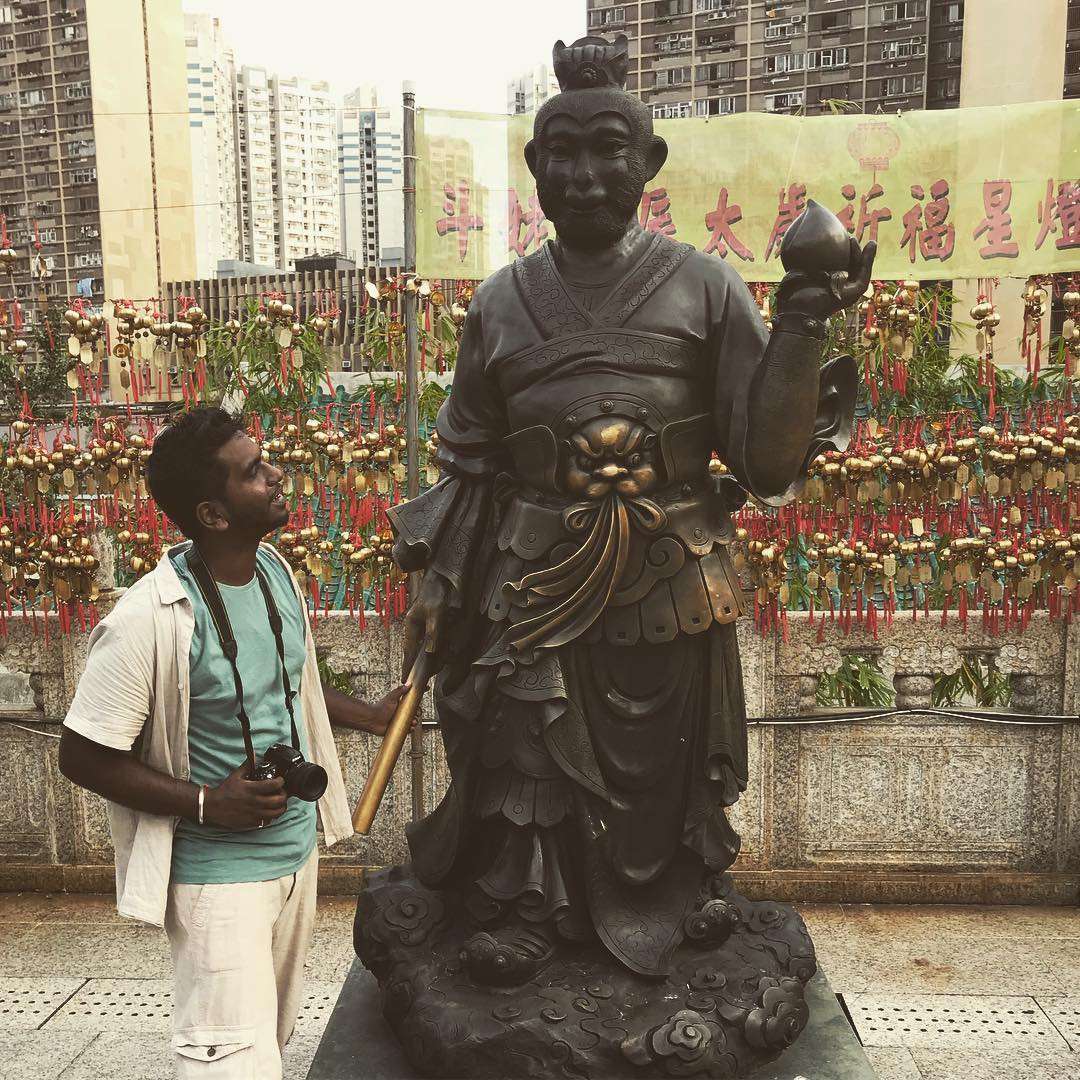
Saie admiring a Monkey King statue at the Wong Tai Sin temple in Kowloon, Hong Kong (larger version).

I. My journey

So how did my journey to the various Great Sage Equalling Heaven temples in Fujian begin? I guess I’ll start from the beginning. Growing up, I would often see images or figurines of the Hindu Monkey God Hanuman in fellow Sri Lankan and Indian homes. For those who don’t know, Hanuman is the Indian counterpart of Sun Wukong and potentially the first known Monkey God. I was curious and intrigued and wanted to know more, but I didn’t get many answers from the people I asked. “He protects us and can revive us from bad health” was the most common reply. I researched the many translations of the Ramayana (one of two great Indian epics within which Hanuman appears) and became enchanted by his many amazing feats and achievements. I was a huge film fan growing up, so I became obsessed with the idea of making films based on him. There have been TV adaptations of Hanuman’s story—I wasn’t a fan of the more human-like portrayals—but, sadly, major Indian studios have yet to make a proper movie about him.

Fast-forward to 2008. Jet Li and Jackie Chan star in the kung fu fantasy The Forbidden Kingdom. Looking back now, it isn’t the greatest film ever, but this is when I first met … Sun Wukong (cue the “Dagger House Prelude”). This was a turning point for me, my obsession multiplied tenfold. Since then I have watched tens, if not hundreds, of film and TV adaptations of Sun Wukong. I’ve also read endless articles and books (one example) in an effort to connect the dots between our (Hindu and Buddho-Daoist) ancestors’ worship of monkey deities. I’ve found there are just too many similarities to ignore.

At first, I had never heard of Sun Wukong’s worship, so when I found the one vague article online describing the Monkey King Festival (the 16th day of the 8th lunar month) in Hong Kong, I decided I would go! I didn’t know what to expect when Jim and I met at the Great Sage Treasure Temple (大聖寶廟) in Kowloon in September of 2018, but it was a big moment for me. Crowds of young and old gathered to worship the Great Sage Equalling Heaven; Daoist priests chanted from prayer books; rows of important businesspeople bowed in unison; martial arts schools performed colorful lion dances, each kwoon paying respect to the altar as they passed; giant paper effigies were burnt. It was a veritable feast for the eyes and ears. Through our interviews with the locals, we not only learned that the festival was considered a time for strengthening community bonds and to help those in need, but also that many adherents believed their faith originated in Fujian, more specifically the city of Fuzhou. This of course agrees with what past scholars have written about Sun’s worship in Fujian.

I have a question: If you ever found yourself in heaven, what would you do? You’d take some good videos to show your friends back on Earth, right? So that was the idea; I started making a documentary (video 1) based on the real people I met and the places I visited, saving my film ambitions for later.

Video 1 – Legends of a Monkey God: Episode 1 – Hong Kong

I was restless some months after returning from the Hong Kong Monkey God Festival. It was like experiencing Heaven for a week and then falling back to Earth like a meteor with many unanswered questions. I was unable to sit around in my miserable London life any longer, so I finally decided to travel where Sun’s worship supposedly began … Fuzhou.

Arriving in Fuzhou was like a pilgrimage in itself. Let me say, this was not an easy journey for me, nor for the translator friend I hired due to my poor Mandarin. The Hokkien accent of Fuzhou gave her a hard time. In addition, the many places I had researched and mapped online seemingly didn’t exist. We visited one after another, with the locals appearing clueless about the temples we inquired about. It was almost as if Sun Wukong’s worship was a secret and only initiated members were allowed access to his houses of worship. Now, there is a saying in India that goes: “You can’t just find Him, He has to invite you”. This saying holds true, for when we finally found one of the locations (see temple one below), a person inside told us about a man who could help me on my journey. I thought, “Hang on a minute … was this guy the savior goddess Guanyin? Was he going to introduce me to my … Sun Wukong?”

I was later introduced to Mr. You, the head of several temples, the Pingshan theatre, and the greatest Sun Wukong follower I have ever met. He set aside two whole days to drive us to several Monkey King temples around Fuzhou, during which time I shot video for another documentary (video 2). I wondered whether or not he wanted anything in return. I mean, no one does anything for free, right? It turns out he was more than happy just to share his Sun Wukong with me and invite me into his secret club! He would not accept any gifts from me. I felt like I was the Tang Monk! And here is the thing: Mr. You and his friends didn’t speak a single word of English—in fact, my Mandarin was unbearable to them—yet we somehow managed to communicate and establish a strong friendship between us, “Brothers bound by the love of Monkey”. I promised myself then that I would return with better Mandarin in a Fujian dialect.

Video 2 – Legends of a Monkey God: Episode 3 – Monkey King Temples of Fujian, China

What I took away from this trip was the fact that Sun Wukong is a deity that sits at the intersection of Buddhism, Daoism, and Confucianism. I saw effigies of him in temples of all the “Three Religions”, sometimes shared, sometimes strictly one faith. But the idea of religion in the East is not the same as that in the West. In the East, you find your own path, follow it to your goal; you don’t need to be on the same path as everyone else and no one judges you for making your own way. It’s just like the Indians say: “The destination is the same, paths are many. God is one, names and forms are many”. This ties in with the works of famed mythologist Joseph Campbell, who would call this the many “masks of God”.

II. Temple list

Note: This list is not exhaustive and will be updated periodically. Most importantly, the following GPS coordinates should ONLY be used as a general guideline. It is highly recommended that those wishing to visit these places should hire the services of a knowledgeable guide. I recommend contacting Mr. You (WeChat id: you410631621)

(Note: Mr. You has died, so his WeChat no longer works.) 

A shrine in Mr. You’s house (larger version).


Temple One: 玉封齐天府屏山祖殿

26°04’45.0″N 119°18’42.6″E
福建省福州市鼓楼区三界寺
Sanjie Temple, Gulou District, Fuzhou City, Fujian Province, China
38H6+MP Gulou District, Fuzhou, Fuzhou, Fujian, China

Pictures

https://drive.google.com/drive/folders/0Bwi3jyIV3-OhfmoyQ0RXN25PalhWbXVncUxwX0pFcDlSbVVDMFRvMm82dWttRlUxaGNVTWc?resourcekey=0-Dq0-f95II5gSZLh9VVu7qg&usp=sharing

IMG_6054


Temple Two

26°04’10.1″N 119°19’56.1″E
福建省福州市晋安区
Eastern District Shangquan, Jin’an, Fuzhou City, Fujian Province, China
389J+QW Jin’an, Fuzhou, Fujian, China

Pictures

https://drive.google.com/drive/folders/0Bwi3jyIV3-Ohfmt2cGV2U1BsVW1iQjVHUEFIZXF6QV9vTndVNkxEdm1SRzA3UURpM25mWDA?resourcekey=0-KybFXH3lW6H0YU4dSIT8Yw&usp=sharing

IMG_6161


Temple Three

26°01’46.8″N 119°15’56.1″E
福建省福州市仓山区百花洲路
Baihua Zhou Road, Cangshan District, Fuzhou City, Fujian Province, China
27H8+V6 Cangshan, Fuzhou, Fujian, China

Pictures

https://drive.google.com/drive/folders/0Bwi3jyIV3-OhfjFhWVdVTTU0bFRMOGo3eGNZSncyal8takVNNTZTLTFBRmNJV3BGOTFyTXc?resourcekey=0-Vp51fSJCx3nejStT3ZjO0g&usp=sharing

IMG_6298


Temple Four: 霞江清泉庵 (齊天大聖殿)

26°02’41.4″N 119°18’34.7″E
福建省福州市仓山区
28V5+WV Cangshan, Fuzhou, Fujian, China

Pictures

https://drive.google.com/drive/folders/0Bwi3jyIV3-OhfmEyMFJHR19OYzM0REhMNzE4bDZZaUd0bjgtdUVZb2h3MndZT0ZQWGVPMm8?resourcekey=0-24cQHhFFVobNPUo6hwLkxg&usp=sharing

For more pictures, see this article.

IMG_6353


Temple Five

26°02’05.1″N 119°21’10.7″E
福建省福州市仓山区后坂路
Houban Road, Cangshan District, Fuzhou City, Fujian Province, China
29M3+W5 Cangshan, Fuzhou, Fujian, China

Pictures

https://drive.google.com/drive/folders/0Bwi3jyIV3-OhflVvT1dOM1RTcDRucXRxT0xfVHoxVFdDZkR4OGpGaGo4VzN1eEZBXzlNVVk?resourcekey=0-X8xhXb0INiwa1FF8kACplg&usp=sharing

IMG_6427


Temple Six

26°06’23.6″N 119°14’30.2″E
福建省福州市闽侯县
Unnamed Road, Minhou County, Fuzhou City, Fujian Province, China
464R+JM Cangshan, Fuzhou, Fujian, China

Pictures

https://drive.google.com/drive/folders/0Bwi3jyIV3-OhflVVSzNCNWVDN25NU05La043NlRyczJSOVc0UkE1aDRfb0ZCeUV4cWJianc?resourcekey=0-cnBTjqM0ZCS0EaizWsGTTQ&usp=sharing

IMG_6662


Temple Seven: 慈恩寺

26°08’54.4″N 119°08’56.9″E
福建省福州市闽侯县军民路
Junmin Rd, Minhou County, Fuzhou City, Fujian Province, China
44XX+9M Ganzhezhen, Minhou, Fuzhou, Fujian, China

Pictures

https://drive.google.com/drive/folders/0Bwi3jyIV3-OhfjUwekJoVTlhclJvVTJDS1NfdDdGXy1PQUg0RHU0WnZUMzI5UWdXRWlzVDQ?resourcekey=0-lDm_EQW1Dj6rEnzeU0BR0Q&usp=sharing

IMG_6681


Temple Eight

26°04’26.2″N 119°11’25.5″E
福建省福州市闽侯县
G316 Minhou County, Fuzhou City, Fujian Province, China
35FR+H5 Shangjiezhen, Minhou, Fuzhou, Fujian, China

Pictures

https://drive.google.com/drive/folders/0Bwi3jyIV3-OhfnFLWGVvWjktaFFfTS1wVHBMdFA2VmtpVW5aUU1qOGNrQ1RQVEo5TG1pTU0?resourcekey=0-_5j182ICuI-0ValCqUQfXg&usp=sharing

IMG_6742


Temple Nine

26°01’49.8″N 119°17’26.7″E
福建省福州市仓山区鹭岭路163号
163 Luling Road, Cangshan District, Fuzhou City, Fujian Province, China
27JR+68 Cangshan, Fuzhou, Fujian, China

Pictures

https://drive.google.com/drive/folders/0Bwi3jyIV3-Ohfmd5WmMza0xuQUtxWThwbmZFRVV5WXlreF9TYkF3ai1WZ01jeDAxQ09pcW8?resourcekey=0-ELD6KPHTI0RCsfAs8LaIUg&usp=sharing

IMG_6765

Update: 02-15-21

Jim here. I have mirrored this article by creating a list of Monkey King temples that I’ve visited in Taiwan.

Qitian Dasheng Monkey King Temples in Taiwan


Update: 10-03-24

I just figured out that the photo links have not worked for several months. This is because my original university gmail account, which hosted the pictures, was shut down. Everything is fixed now.