Sun Wukong and the Three Heavenly Calamities

Last updated: 11-09-2022

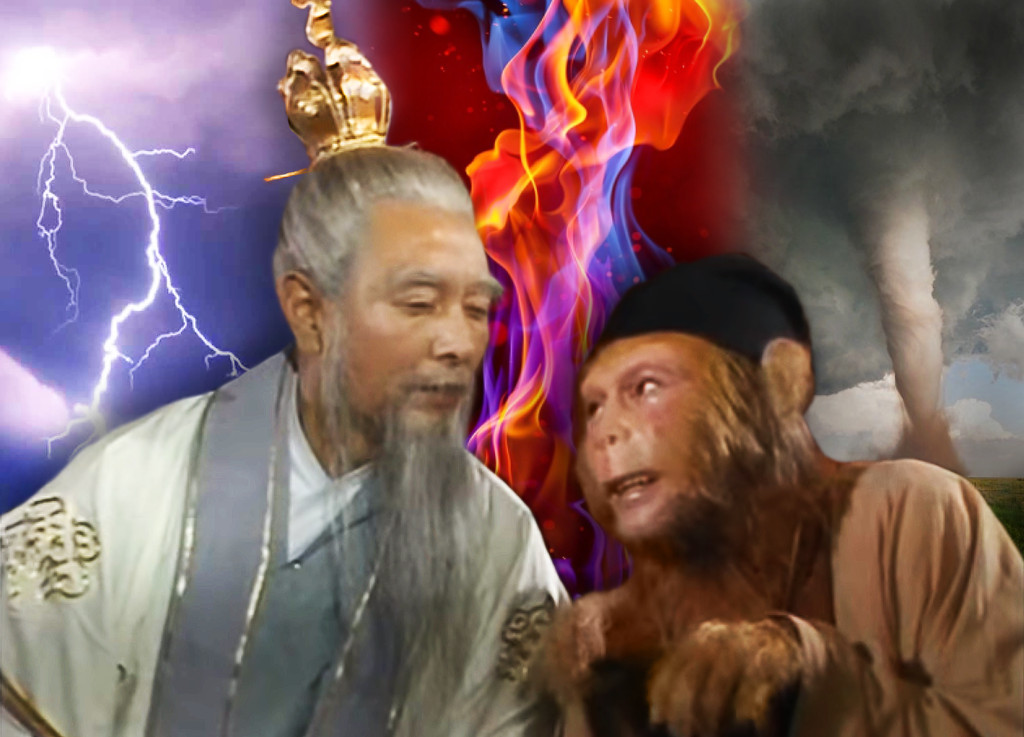
In chapter two of Journey to the West (Xiyouji西遊記, 1592), Master Subodhi warns Sun Wukong that he must protect himself from “Three Calamities” (sanzai lihai, 三災利害) sent by heaven to punish him for achieving immortality and defying his fate (fig. 1). These punishments come every half millennia in the form of destructive elements:

Though your appearance will be preserved and your age lengthened, after five hundred years Heaven will send down the calamity of thunder [leizai, 雷災] to strike you. Hence you must be intelligent and wise enough to avoid it ahead of time. If you can escape it, your age will indeed equal that of Heaven; if not, your life will thus be finished. After another five hundred years Heaven will send down the calamity of fire [huozai, 火災] to burn you. The fire is neither natural nor common fire; its name is the Fire of Yin [yinhuo, 陰火], and it arises from within the soles of your feet to reach even the cavity of your heart, reducing your entrails to ashes and your limbs to utter ruin. The arduous labor of a millennium will then have been made completely superfluous. After another five hundred years the calamity of wind [feng zai, 風災] will be sent to blow at you. It is not the wind from the north, south, east, or west; nor is it one of the winds of four seasons; nor is it the wind of flowers, willows, pines, and bamboos. It is called the Mighty Wind [bifeng, 贔風], and it enters from the top of the skull into the body, passes through the midriff, and penetrates the nine apertures. [1] The bones and the flesh will be dissolved and the body itself will disintegrate. You must therefore avoid all three calamities (Wu & Yu, 2012, pp. 121-122).

雖駐顏益壽,但到了五百年後,天降雷災打你,須要見性明心,預先躲避。躲得過,壽與天齊;躲不過,就此絕命。再五百年後,天降火災燒你。這火不是天火,亦不是凡火,喚做『陰火』。自本身湧泉穴下燒起,直透泥垣宮,五臟成灰,四肢皆朽,把千年苦行,俱為虛幻。再五百年,又降風災吹你。這風不是東南西北風,不是和薰金朔風,亦不是花柳松竹風,喚做『贔風』。自顖門中吹入六腑,過丹田,穿九竅,骨肉消疏,其身自解。所以都要躲過。

These calamities are important because Monkey subsequently learns the 72 transformations in order to escape punishment by hiding under any one of a myriad number of disguises. Therefore, exploring the origins of the three calamities has merit.

Fig. 1 – Master Subodhi tells Sun about the Three Calamities (larger version). Photomanipulation by the author.

Table of Contents

1. Origins

The novel likely borrows from a Buddhist cosmological concept called the “Three Calamities” (sanzai, 三災). We first need some background before continuing. Buddhism recognizes a measurement of time called a Kalpa (jie, 劫), which can be many millions or even billions of years long depending on the tradition. Said traditions recognize between four and eighty kalpas (Buswell & Lopez, 2014, p. 409). The total of these respective ranges make up a Mahakalpa (dajie, 大劫), which is divided into four periods of nothingness, creation, subsistence, and finally destruction, each period being between one and twenty kalpas long (Buswell & Lopez, 2014, p. 496). The Three Calamities are responsible for the destruction of each Mahakalpa.

Kloetzli (1983) describes the cyclical destruction of each Mahakalpa by an element:

The destructions are of three kinds: those by fire, those by water and those by wind. […] The destructions succeed one another in the following sequence: seven by fire followed by a destruction by water. This cycle of eight destructions is repeated a total of seven times. This is then followed by seven more destructions by fire, followed by a final by wind. Thus there are 7 x 8 or 56 destructions by fire; 7 by water and a final 64th by wind [fig. 2] (p. 75).

Therefore, the Three Calamities from Journey to the West follow a similar cycle of destructive elements appearing at set time intervals: lightning, fire, and wind every 500 years in place of fire, water, and wind at the end of every Mahakalpa. And instead of destroying the universe, the elements are sent to kill those who have achieved immortality.

Fig. 2 – A chart mapping the cyclical destructions by fire, water, and wind. A larger version is available on the CBETA page.

The earliest mention of Buddhism’s Three Calamities in Chinese writing that I know of appears in scroll one of the Pearl Forest of the Dharma Garden (Fayuan zhulin, 法苑珠林), a Chinese Buddhist encyclopedia published in 688. So there was plenty of time between this work and the publishing of Journey to the West in 1592.

2. Influence on Xianxia Literature

I was interested to learn that Monkey’s calamities made their way into modern Xianxia (仙侠, “Immortal hero”) literature. For example, the author of the Immortal Mountain wordpress writes:

Heavenly Tribulation (天劫 tiānjié) (重劫 zhòngjié) – in some novels, a trial encountered by cultivators at key points in their cultivation, which they must resist and ultimately transcend. Because immortal cultivation (generally) goes against the Will of Heaven, the Heavens will send down tribulations to oppress high-level cultivators who make progress towards Immortality, often right when they enter a new cultivation stage. This typically takes the form of a lightning storm, with extraordinarily powerful bolts of lightning raining down from the Heavens to strike at the cultivator (source).

The trial by lightning is exactly like the calamity of thunder mentioned by Master Subodhi.

3. Conclusion

Subodhi teaches Monkey the 72 transformations with the expressed purpose of hiding from three calamities (sanzai lihai, 三災利害) of celestial lightening, fire, and wind. They are sent by heaven every 500 years to punish cultivators for defying their fate and achieving immortality. Each was likely influenced by the three calamities (sanzai, 三災) of Buddhist cosmology, which states that the universe is alternately destroyed by fire, water, or wind at the end of every Mahakalpa. Both concepts include destructive elemental forces that appear at given times.

The oldest mention of the original Buddhist calamities that I’m aware of appears in a 7th-century religious encyclopedia titled Pearl Forest of the Dharma Garden (Fayuan zhulin, 法苑珠林).

The literary thunder calamity would later come to influence the “Heavenly Tribulation” (tianjie, 天劫; zhongjie, 重劫) of modern Xianxia literature.


4. Updates

Update: 09-10-2018

The Xianxia translator Deathblade (twitter) was kind enough to direct me to an example of a tribulation from a popular Chinese television show . The scene (video 1) involves a 20,000-year-old child immortal experiencing a trial by lightning. The heavenly bolts tear at his clothing and draw blood, but he survives the ordeal.

Video 1 – Start watching from minute 13:08.

Deathblade also directed me to an example from an online Xianxia novel called I shall Seal the Heavens (Wo yu feng tian, 我欲封天). Chapter 385(!) describes how the anti-hero Meng Hao (孟浩) uses a sentient heavenly treasure to protect himself from powerful bolts of lightning, which instead seek out and kill nearby spiritual cultivators on the cusp of immortality:

The Heavenly Tribulation boomed as one lightning bolt after another shot down onto Meng Hao, who held the meat jelly upraised in his hand to defend himself. The lightning would subsequently disperse into the area around him. Any nearby Cultivators would let out bloodcurdling screams. Soon, the air filled with the sounds of cursing and reviling.

Meng Hao didn’t care. This was something he had learned from Patriarch Reliance. When you con someone and then end up getting cursed by them, you must maintain your cool. It was really a realm unto itself.

Throughout the years, Meng Hao had conned many people, and had refined that skill to the very pinnacle. Therefore, he continued to redirect the descending lightning to the various Cultivators in the three thousand kilometer region.

Wherever he went, he was surrounded by a lake of lightning, along with plaintive cursing. What he left behind was scorched corpses.

To the Cultivators here, it was nothing but a massacre, a slaughter in which no one could do anything to fight back. They couldn’t attack him, nor could they flee as… they were horrified to discover that Meng Hao’ speed was incredible, even if he was being struck by lightning!

(read more here)

The character uses trickery to protect himself from the bolts just like Monkey intended to do with his transformations.


Update: 04-02-2021

As I explained above, Wukong learns the 72 transformations in order to escape the heaven-sent punishments of thunder, fire, and wind. Monkey attains eternal life around his 342nd year when his soul is taken to Hell. He is immortal for over 160 years [2] at the time he’s imprisoned under Five Elements Mountain. This means his 500th year of immortality, the year that the calamity of thunder would be scheduled to strike him, takes place during his imprisonment under the celestial mountain. But this is never described in the story. I assume this is just one of many inconsistencies born from oral storytelling. Although, one could argue that, within the fictional universe, the thunder calamity was voided since Wukong was undergoing punishment at the behest of the Buddha.


Update: 08-29-22

It turns out that punishment by lightning appears in other works of religious vernacular fiction. For example, in The Battle of Wits between Sun and Pang (Sun Pang douzhi yanyi, 孫龐鬥智演義, 1636; a.k.a. The Former and Latter Annals of the Seven KingdomsQianhou qiguo zhi前後七國志):

Sun Bin [孫臏, d. 316 BCE] was overjoyed when he received the Heavenly Book [from the magic White Ape], and hurriedly went back to light the lamp and read it carefully. But during his reading, he felt an eerie, cold wind and heard the rolling of thunder. The Immortal Master Ghost Valley was meditating on the futon when he heard thunder in the air, so he got up and walked immediately to the door of Sun Bin’s room, only to see him reciting the Heavenly Book. When Ghost Valley heard this, he was taken aback. He pushed the door open and went in and said, “I hid this book in the stone box of the prayer cave. I haven’t passed it onto you because your fate has not yet arrived. Where did you get it?

Sun Bin told the story of the white ape. Ghost Valley said: “It turns out that the evil beast stole it and came to you, but unfortunately it was too early. Besides, when you received the Heavenly Book, you didn’t bathe and burn incense, and you didn’t wash your hands or rinse your mouth, thus blaspheming the gods and provoking a great tribulation [da zainan, 大災難] of 100 days.”

Sun Bin’s continence changed. He asked: “Can master save your disciple?”

Ghost Valley said: “If you want me to save you, you must not disobey my nightmare-suppression method.”

Sun Bin said: “I dare not.”

Ghost Valley said: “Due south behind the mountain is an empty stone tomb. You should sleep in the stone tomb with your head to the south and your feet to the north, with 49 grains of raw rice in your mouth. Cover it with your saliva but don’t swallow the grains. You will feel fully nourished. As long as you hide for forty-nine days, you will escape the great tribulation and protect yourself.”

Sun Bin said, “I sincerely receive your instructions.”

Ghost Valley led Sun Bin to the empty tomb at night. Sun complied with his master’s nightmare-suppression method and followed his instructions. A stele was erected in front of the tomb which read: “The Tomb of Sun Bin of the State of Yan” (Wumen xiaoke & Yanshui sanren, 1636).

Another example comes from the Lady of Linshui Pacifies Demons (Linshui pingyao, 臨水平妖, 17th-century). This time, it involves the immortal Lu Dongbin (呂洞賓; a.k.a. Lu Chunyang, 呂純陽) angering Guanyin, who dispatches thunder deities after him. And just like Sun learns the transformations to hide from the calamities, Lu takes the form of a bug to hide from his punishment:

As we take up our tale anew, Guanyin opened wide her eye of wisdom and saw Pure Yang Lü standing on top of the cloud. She cursed him, saying, “A dumb beast like that has no sense of propriety!” Then she sent the Five Thunders (Wu Lei [五雷]) to strike him. The Immortal Ancestor Lü saw them coming and for an instant was helpless with fright. Unable to escape back to his mountain, he hastily fled to Liang Hao’s study. 

He called to Licentiate Liang, “In a moment of distraction, I offended the Heavenly Court, which has dispatched the Five Thunders to strike me. Save me!” As he spoke, the sound of thunder rolled violently. Liang Hao was so frightened that his hands and feet were like ice, and he was unable to reply. Pure Yang Lü said, “If you are willing to rescue me, then that would give this poor Daoist a place to hide.” Liang Hao agreed with alacrity. Pure Yang Lü then turned himself into a tiny insect, ran under Liang Hao’s fingernails, and hid himself. He waited for an hour and three quarters, until the thunder no longer rolled. There was nothing the Five Thunders could do, so they were obliged to go back to the Purple Bamboo Grove [on Guanyin’s mountain], having failed to carry out the Buddha’s [Guanyin’s] orders. At this time, an hour and three quarters having already elapsed, Pure Yang Lü resumed his original form. He thanked Liang Hao and returned to Zhong Mountain, as he did not dare remain in these harrowing circumstances any longer (Fryklund, Lewis, & Baptandier, 2021, p. 6). 


Update: 11-09-22

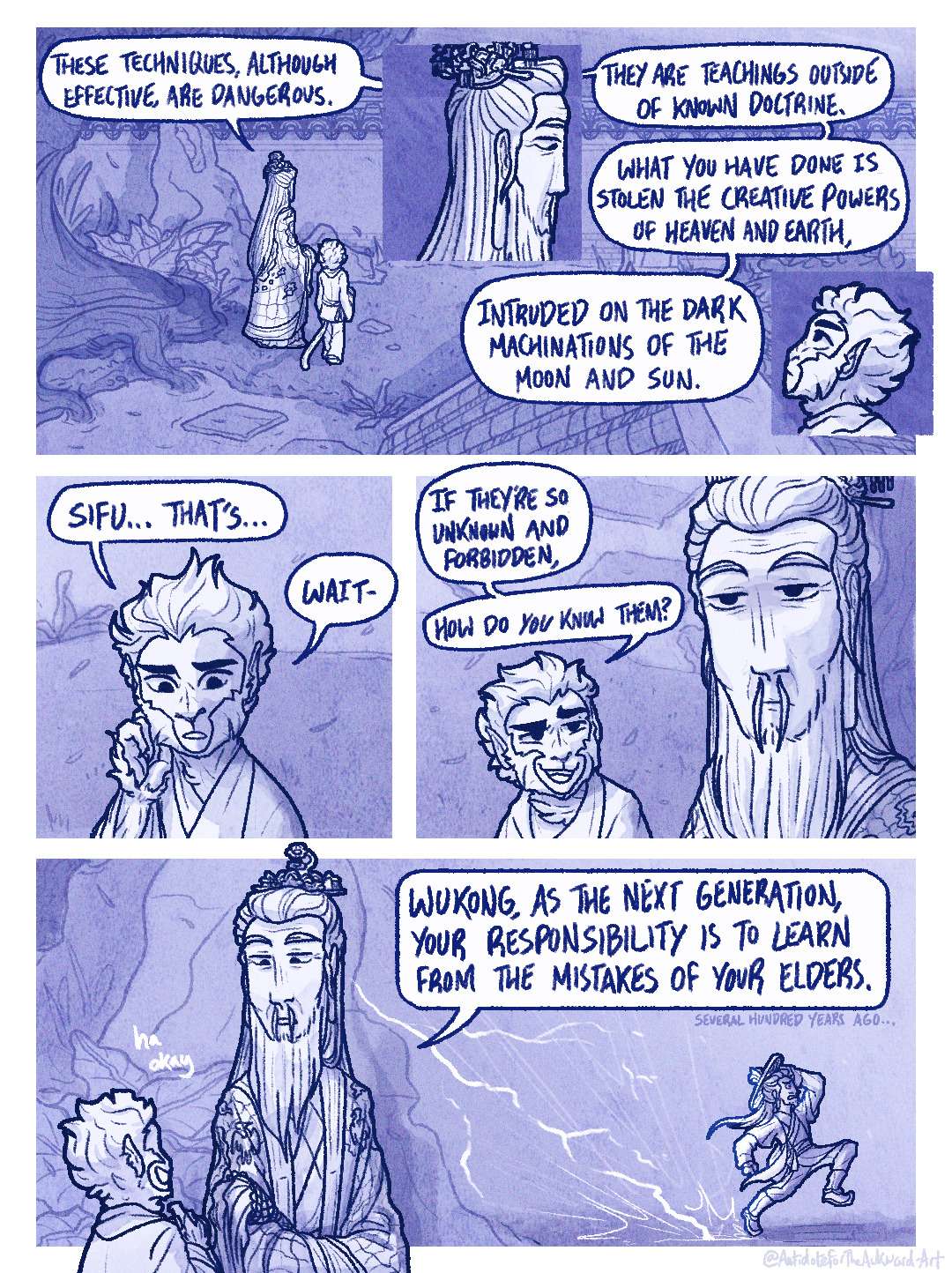
An artist known on Tumblr as “AntidoteForTheAwkward” has posted a wonderful comic (fig. 3) giving a reason for why the Patriarch Subhodi teachers Monkey the 72 transformations in order to avoid the heavenly calamities: personal experience.

Fig. 3 – AntidoteForTheAwkward’s comic (larger version). See the original post here.

Notes:

1) The eyes, ears, nose, mouth, genitals, and anus.

2) Wukong serves in heaven twice: first “for more than ten years” and second “for over a century” (Wu & Yu, 2012, vol. 1, pp. 150 and 166). Then he is punished to 49 days in Laozi’s furnace (Wu & Yu, 2012, vol. 1, p. 189). But the narrative revels “one day in heaven is equal to one year on Earth” (Wu & Yu, 2012, vol. 1, pp. 150 and 167). So this means his turn in the furnace lasts close to fifty years.

Sources:

Buswell, J., & Lopez, D. (2014). The Princeton Dictionary of Buddhism. Princeton, NJ: Princeton University Press.

Fryklund, K. I., Lewis, M. E., & Baptandier, B. (2021). The Lady of Linshui Pacifies Demons: A Seventeenth-Century Novel. Seattle, WA: University of Washington Press.

Kloetzli, R. (1983). Buddhist Cosmology: From Single World System to Pure Land: Science and Theology in the Images of Motion and Light. Oxford: Motilal Books.

Wu, C., & Yu, A. C. (2012). The Journey to the West (Vol. 1) (Rev. ed.). Chicago, Illinois: University of Chicago Press.

Wumen xiaoke, & Yanshui sanren (1636). Qianhou qiguo zhi [Annals of the Seven Kingdoms]. Retrieved from 

The Origin of the Monkey King’s Punishment in Laozi’s Furnace

The beginning of Journey to the West (Xiyouji西遊記, 1592; “JTTW” hereafter) chapter seven sees Sun Wukong transported to the realm above to be executed for his rebellion against the primacy of heaven. However, his immortal body proves impervious to blades, fire, and lightning, leading Laozi to theorize that Monkey’s extreme invulnerability is the result of having consumed large quantities of immortal peaches, wine, and elixir that were later refined in his stomach “to form a single solid mass” (Wu & Yu, 2012, vol. 1, p. 188). The Daoist high god goes on to suggest that the demon be subjected to his Brazier of Eight Trigrams (Bagua lu, 八卦爐) in order to separate out the elixir and make his subsequently weakened body susceptible to death:

Arriving at the Tushita Palace, Laozi loosened the ropes on the Great Sage, pulled out the weapon from his breastbone, and pushed him into the Brazier of Eight Trigrams. He then ordered the Daoist who watched over the brazier and the page boy in charge of the fire to blow up a strong flame for the smelting process. The brazier, you see, was of eight compartments corresponding to the eight trigrams of Qian [☰/乾], Kan [☵/坎], Gen [☶/艮], Zhen [☳/震], Xun [☴/巽], Li [☲/離], Kun [☷/坤], and Dui [☱/兌]. The Great Sage crawled into the space beneath the compartment that corresponded to the Xun trigram. Now Xun symbolizes wind; where there is wind, there is no fire. However, wind could churn up smoke, which at that moment reddened his eyes, giving them a permanently inflamed condition. Hence they were sometimes called Fiery Eyes and Diamond Pupils (Wu & Yu, 2012, vol. 1, p. 189).

那老君到兜率宮,將大聖解去繩索,放了穿琵琶骨之器,推入八卦爐中,命看爐的道人、架火的童子,將火搧起鍛煉。原來那爐是乾、坎、艮、震、巽、離、坤、兌八卦。他即將身鑽在巽宮位下。巽乃風也,有風則無火。只是風攪得煙來,把一雙眼火煼紅了,弄做個老害病眼,故喚作「火眼金睛」。

Laozi checks the furnace forty-nine days later expecting ashes, but he is surprised when Sun emerges and kicks over the mystical oven (fig. 1). This episode has two likely sources.

Fig. 1 – Monkey knocking over Laozi’s furnace (larger version).

Table of Contents

1. Sources

1.1. The Story

The first source is The Story of How Tripitaka of the Great Tang Procures the Scriptures (Da Tang Sanzang qujing shihua大唐三藏取經詩話, c. late-13th century; “The Story” hereafter), the earliest known published edition of JTTW. The 17th chapter describes the trials of Daffy (Chi’na, 癡那), a merchant’s son, at the hands of his evil stepmother, a woman of the Meng clan (孟氏). She resents the boy as he stands to inherit all of his father’s wealth, leaving her son with nothing. Therefore, she and her handmaiden try to kill the heir by respectively boiling him in a pot, ripping out his tongue, starving him, and finally pushing him into a river, but each time he is magically saved by heaven. For instance, after four days boiling in the pot, Daffy emerges unscathed and claims:

[T]he iron cauldron changed into a lily pad on which I sat, surrounded by the cool waters of a pond. I could sleep or just sit there. It was very comfortable (Wivell, 1994, p. 1203).

一釜變化蓮花坐,四伴是冷水池;此中坐臥,甚是安穩。

Mair (1987) notes that the story of a youth being tortured by his stepmother is based on a Dunhuang transformation text with two versions dated 946 and 949, respectively (p. 43). The text focuses on the trials of the future Emperor Shun. [1] However, the boiling episode does not appear in the story.

1.2. Laughing at the Dao

The second source is Laughing at the Dao (Xiaodao lun, 笑道論, 570), an anti-Daoist polemic written as part of a court debate between Buddhist and Daoist representatives vying for state sponsorship. One section recounts Laozi’s rebirth in the mortal world and his later attempt to convert a king in India:

He [Laozi] had (long) hairs on the temples and his head was hoary; his body was sixteen feet tall; he wore a heavenly cap and held a metal staff. He took Yin Xi with him to convert the barbarians. (Once arrived in India) he withdrew to the Shouyang 首陽 mountains, covered by a purple cloud. The barbarian king suspected him of sorcery (妖). He (attempted) to boil him in a cauldron, but (the water) did not grow hot … [2]

頭鬢皓首身長丈六。戴天冠捉金杖。將尹喜化胡。隱首陽山。紫雲覆之。胡王疑妖。鑊煮而不熱。

I find this source particularly amusing because the high god of Daoism is in essence subjected to the same punishment as the one that he later suggests for Sun Wukong!

2. The Furnace in Daoist Alchemy

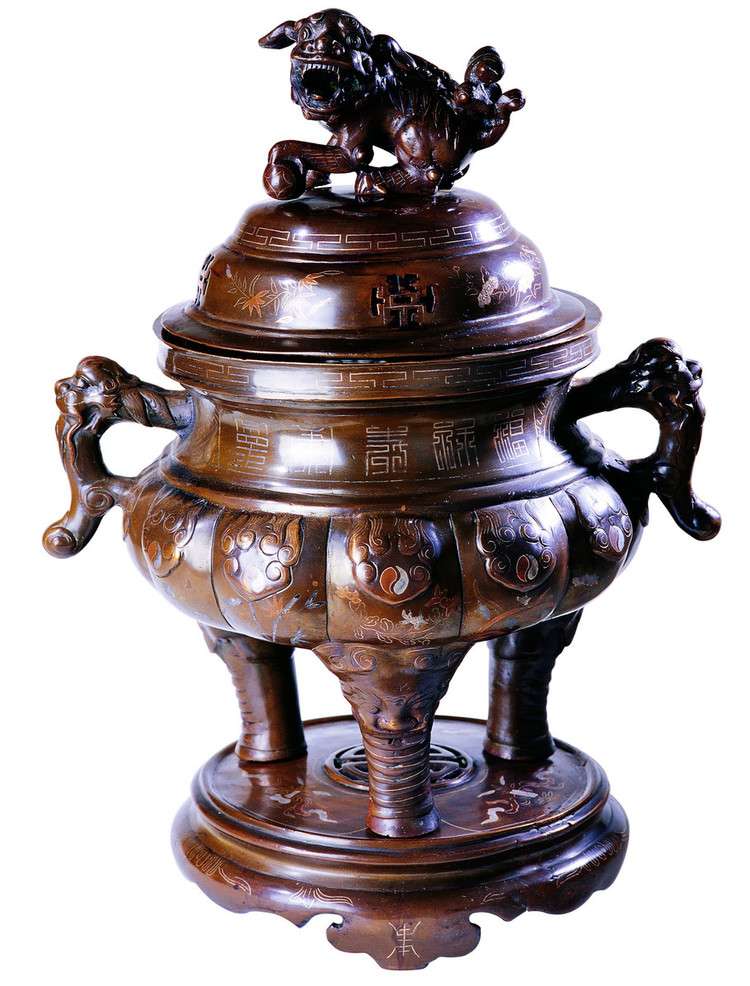
The furnace has two meanings in Daoist alchemy. The first refers to the physical vessel and stove (dinglu, 鼎爐) combo used in external alchemy (waidan, 外丹) to smelt the elixir of immortality (fig. 2). Kim (2008) describes the various parts and models of this contraption:

The reaction vessel has fire around it (when it is placed inside the heating apparatus), under it (when it is placed over the heating apparatus), or above it (when it is entirely covered by ashes inside the heating apparatus). It may contain an inner reaction-case in which the ingredients are placed. In a more complex model, a “water-vessel” containing water and a “fire-vessel” containing the ingredients can be assembled, the former above and the latter below or vice versa. The vessel must be hermetically closed and should not bear any openings or cracks.

The heating apparatus has fire within it and is often placed over a platform or “altar” (tan 壇). The openings on the wall sides allow air to circulate, while those on the top serve to settle the reaction vessel or to emit flame and smoke. One of the main functions of the heating apparatus is to control the intensity and duration of the heat. (pp. 360-361)

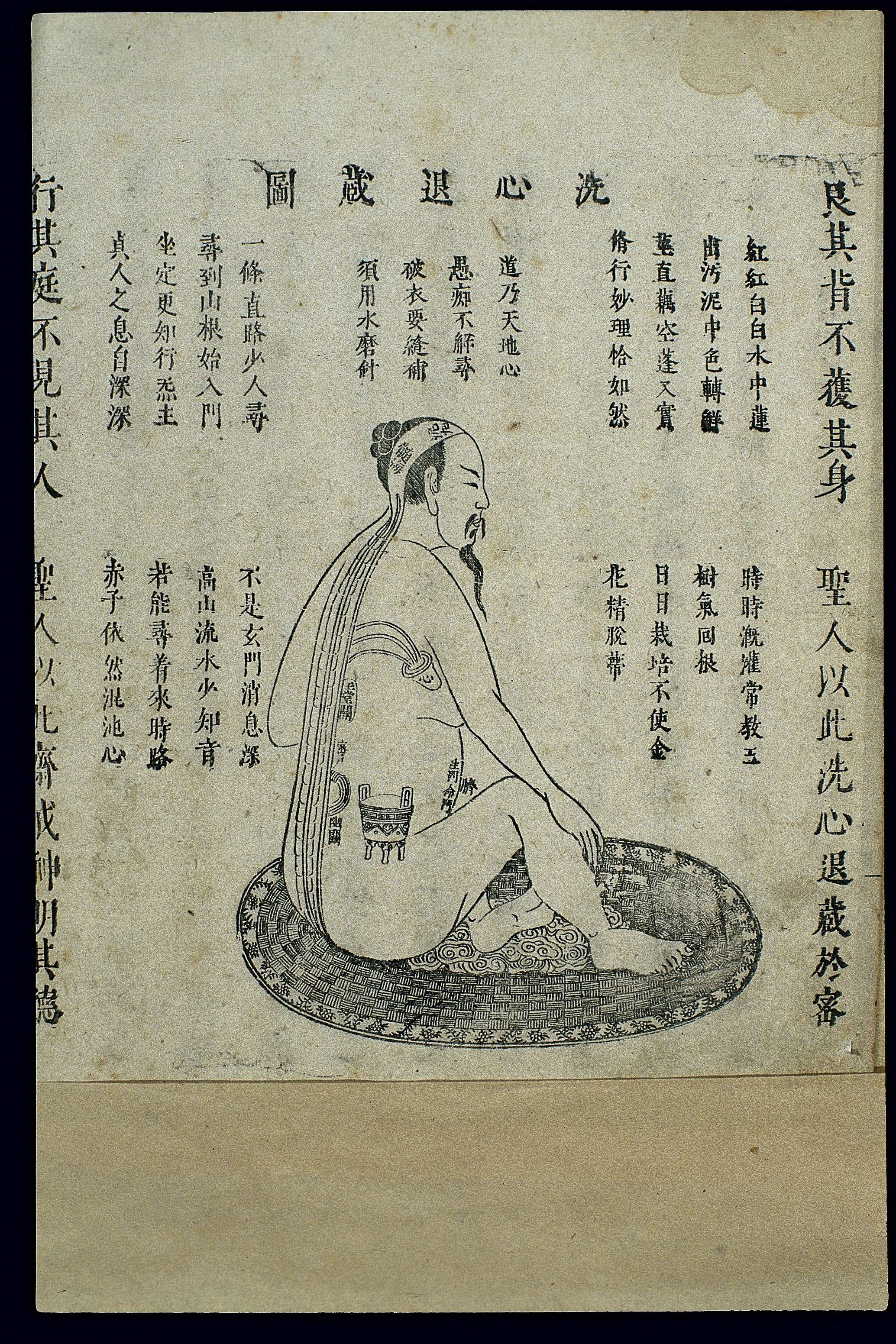
Fig. 2 – An ornate wooden replica dinglu reminiscent of the metal type used in external alchemy (larger version). Fig. 3 – An early 17th-century woodblock print depicting a Daoist practitioner’s dantian as a ding vessel (larger version).

The concept of consuming alchemically derived elixirs is first mentioned in Discourses on Salt and Iron (Yantie tun, 鹽鐵論, c. 60 BCE). Later, the Token for the Agreement of the Three According to the Book of Changes (Zhouyi cantong qi, 周易參同契, c. 2nd century CE; “The Token” hereafter) standardized the use of toxic materials, such as lead and mercury, for making said elixir, and this idea remained entrenched until the Tang Dynasty (618–907 CE) (Pregadio, 2008, pp. 1002-1003). External alchemy was eventually superseded in popularity by internal alchemy (neidan, 内丹) from the Tang onward and was still popular during the Ming Dynasty (1368–1644 CE) when the standard 1592 version of JTTW was published.

The second meaning is the human body as a metaphor for the furnace—i.e. internal alchemy. The Token considers “the 5 organs, 12 vessels, 24 vertebrae, and 360 joints … all part of this body dinglu” (Wang, 2012, p. 192). The corporal furnace, the ingredients (yao, 藥), and the firing time (huohou, 火候) combine to make the “three essentials” (sanyao, 三要) of internal alchemy (Robinet, 2008). The ingredients are yin and yang energy, and the firing time is the measured absorption of said energies and the time at which this activity is partaken (Wang, 2012, pp. 192-193).

3. External vs Internal in JTTW

Laozi’s use of the Eight Trigrams Furnace stands as a perfect example of external alchemy, and Sun’s use of breathing exercises and qi circulation serves as a prime example of internal alchemy. So how are these competing processes depicted in JTTW? Well, recall that the external type had long been supplanted by the internal type by the time the novel was published. Hence, one could say Laozi’s methods were dated compared to those used by Monkey. This might then explain a surprising story element from JTTW chapter seven.

When Sun first escapes from the furnace, “Laozi rushes up to clutch at him, only to be greeted by such a violent shove that he falls head over heels while the Great Sage escapes” (based on Wu & Yu, 2012, vol. 1, p. 189). Think about that for a moment. Monkey, a proponent of internal alchemy, physically assaults the Daoist high god, a proponent of external alchemy. Add to this the fact that Sun seemingly only respects/fears immortals that promote internal alchemy—a good example being his first master, Patriarch Subodhi (Xuputi zushi, 須菩提祖師)—and a picture begins to form: perhaps this is the JTTW author-compiler’s way of touting the superiority of the internal over the external. What do you think?

4. Conclusion

Monkey’s time in Laozi’s furnace likely borrows from (one or both of) two sources, the story of a child magically surviving boiling in The Story, the 13th century CE precursor of JTTW, and the story of Laozi magically surviving boiling from Laughing at the Dao, an anti-Daoist polemic of the 6th-century CE. The latter is humorous as it shows Monkey’s punishment is a recapitulation of the high god’s punishment.

JTTW presents two forms of alchemy: the concept of Laozi’s furnace refers to “external” alchemy and harkens back to Han Dynasty China when alchemists used such furnaces to fire toxic mercury and lead in an attempt to produce an elixir of immortality; Sun Wukong’s use of breathing exercises and qi circulation is a prime example of “internal” alchemy in which the body is used as the furnace to fire the immortal elixir. External alchemy fell out of favor during the Tang and was superseded by Internal alchemy from then on into the Ming, when JTTW was published. Therefore, the novel portrays the high god of Daoism as a proponent of the dated external school, while immortals like Monkey are portrayed as proponents of the then current internal school.

Notes:

1) For a complete translation, see Bodman (1994).

2) See Zürcher & Teiser (2007), pp. 299-300 and 431 n. 53.

Sources:

Bodman, R. W. (1994). The Transformation Text on the Boy Shun’s Extreme Filial Piety. In V. H. Mair (Ed.), The Columbia Anthology of Traditional Chinese Literature (pp. 1128-1134). New York: Columbia University Press.

Kim, D. (2008). Dinglu: I. Waidan In F. Pregadio (Ed.), The Encyclopedia of Taoism (2 Vols.) (pp. 360-361). London [u.a.: Routledge].

Mair, V. H. (1987). Parallels Between Some Tun-Huang Manuscripts and the 17th Chapter of the Kozanji Journey to the West. Cahiers d’Extrême-Asie, 3, 41-53.

Pregadio, F. (2008). Waidan In F. Pregadio (Ed.), The Encyclopedia of Taoism (2 Vols.) (pp. 1002-1005). London [u.a.: Routledge].

Robinet, I. (2008). Dinglu: II. Neidan In F. Pregadio (Ed.), The Encyclopedia of Taoism (2 Vols.) (pp. 361-362). London [u.a.: Routledge].

Wang, R. (2012). Yinyang: The Way of Heaven and Earth in Chinese Thought and Culture. Cambridge: Cambridge University Press.

Wivell, C. S. (1994). The Story of How the Monk Tripitaka of the Great Country of T’ang Brought Back the Sūtras. In Mair, Victor H. The Columbia anthology of traditional Chinese literature (pp. 1181-1207). New York: Columbia University Press.

Wu, C., & Yu, A. C. (2012). The Journey to the West (Vols. 1-4) (Rev. ed.). Chicago, Illinois: University of Chicago Press.

Zürcher, E., & Teiser, S. F. (2007). The Buddhist Conquest of China: The Spread and Adaptation of Buddhism in Early Medieval China. Leiden: Brill.

The Monkey King’s Spiritual Training and Historical Daoist Internal Alchemy

Last updated: 09-22-23

Did you know that the Monkey King’s early spiritual training is connected to historical Daoist internal alchemy? In Journey to the West (Xiyouji西遊記, 1592) chapter two, Sun Wukong receives a private lesson in which his master, Patriarch Subodhi, reveals the secret of immortality in a poem chocked full of esoteric Daoist imagery:

This bold, secret saying that’s wondrous and true:
Spare, nurse nature and life—there’s nothing else.
All power resides in the semen, breath, and spirit;
Store these securely lest there be a leak.
Lest there be a leak!
Keep within the body!
Heed my teaching and the Way itself will thrive.
Hold fast oral formulas so useful and keen
To purge concupiscence, to reach pure cool;
To pure cool
Where the light is bright.
You’ll face the elixir platform, enjoying the moon.
The moon holds the jade rabbit, the sun, the crow;
The tortoise and snake are now tightly entwined.
Tightly entwined,
Nature and life are strong.
You can plant gold lotus e’en in the midst of flames.
Squeeze the Five Phases jointly, use them back and forth—
When that’s done, be a Buddha or immortal at will! (Wu & Yu, 2012, p. 120).

顯密圓通真妙訣,惜修性命無他說。
都來總是精氣神,謹固牢藏休漏泄。
休漏泄,體中藏,汝受吾傳道自昌。
口訣記來多有益,屏除邪慾得清涼。
得清涼,光皎潔,好向丹臺賞明月。
月藏玉兔日藏烏,自有龜蛇相盤結。
相盤結,性命堅,卻能火裡種金蓮。
攢簇五行顛倒用,功完隨作佛和仙。

Table of Contents

1. Explanation

The cryptic methods advocated in the poem find their origins in dogmatic Daoist internal practices that emerged during the Song Dynasty (960–1279) (Kohn, 2008, p. 177). When Subodhi warns Monkey to “Store these [bodily substances] lest there be a leak,” he is referring to the first of three stages in the forging of an immortal spirit body. It involves transforming chaste semen (jing, 精) into pneumatic energy (qi, 氣) and guiding it to the brain, where it is purified and then circulated throughout the body, resulting in the formation of a spiritual pearl in the Cinnabar Field (dantian, 丹田), or the body’s spiritual furnace located in the lower abdomen (Kohn, 2008, p. 178).

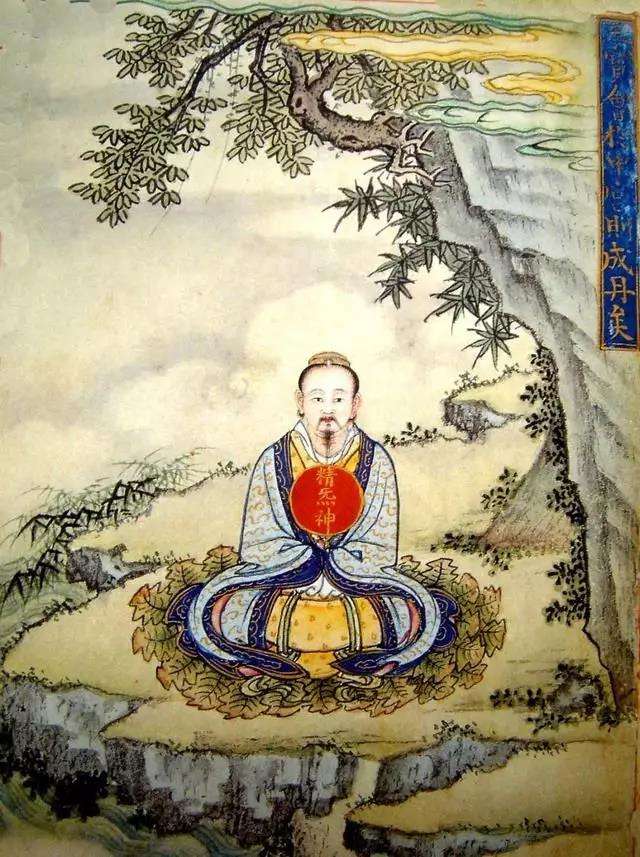
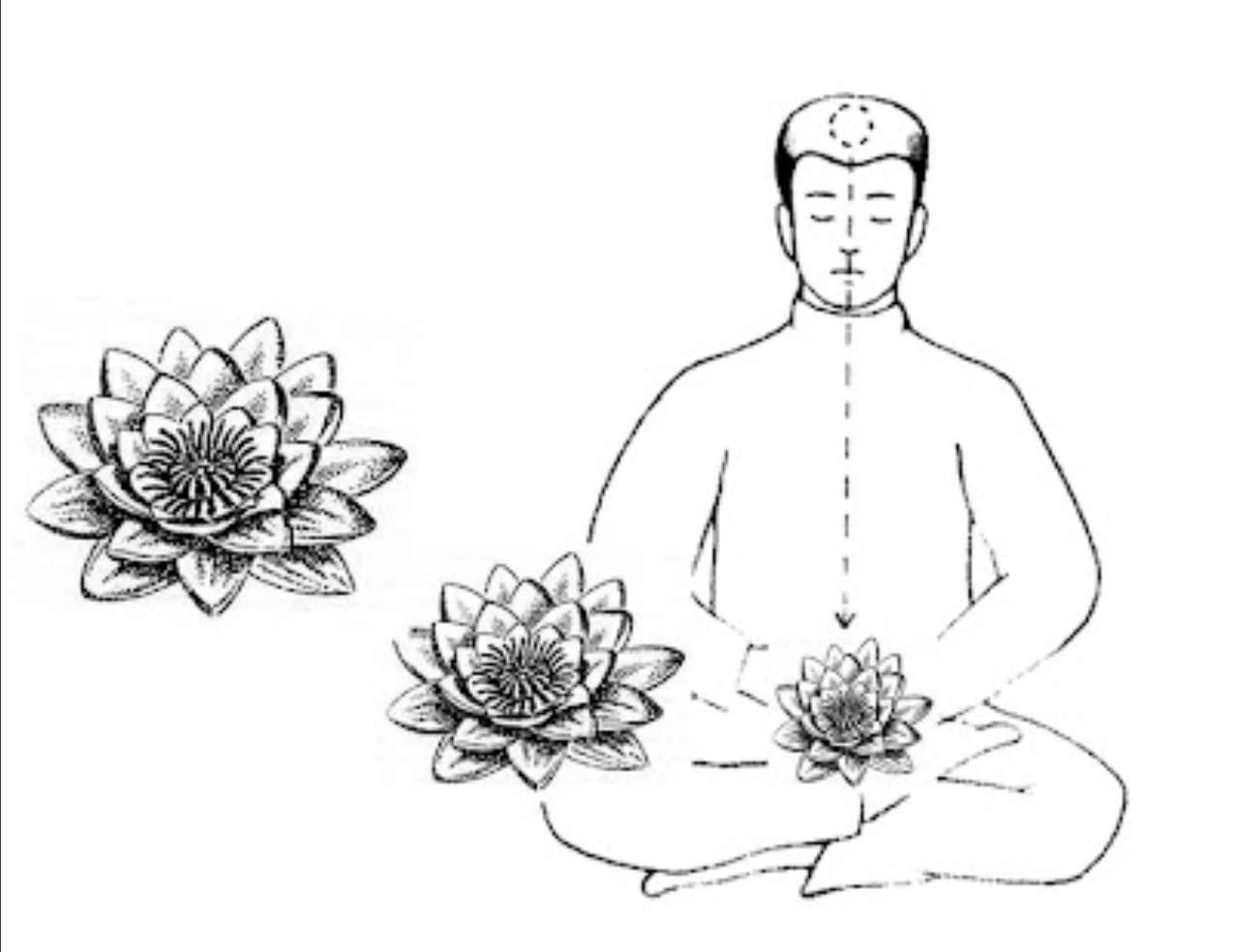
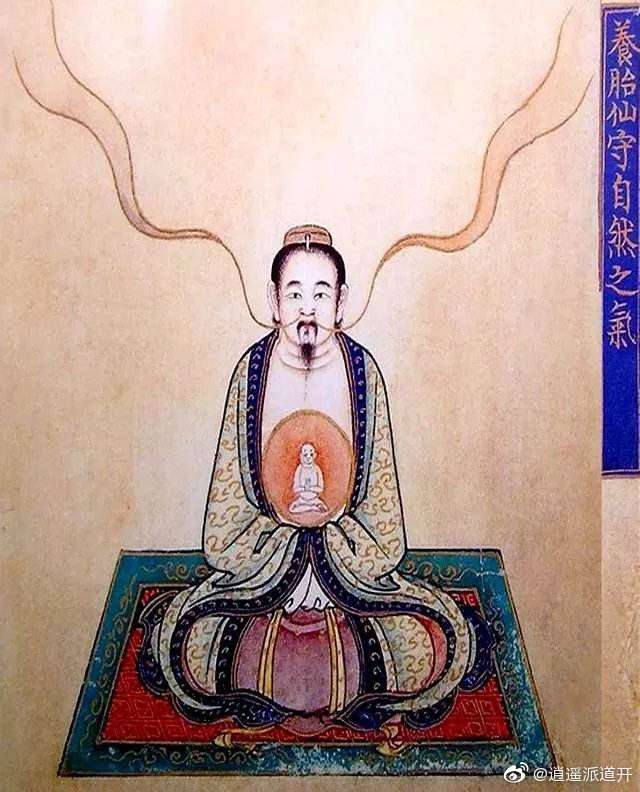
“You can plant gold lotus e’en in the midst of flames. / Squeeze the Five Phases jointly, use them back and forth” refers to the second stage, involving the inhalation and guidance of yang energy through various organs (the “five phases”) in the body to bolster the spirit (shen, 神) (fig. 1). This nurturing of the pearl causes it to sprout like a seed and blossom into a golden lotus (“amidst flames”) in the spiritual furnace (fig. 2). The lotus is considered the early stages of an immortal “spirit embryo” (shengtai, 聖胎) (fig. 3) (Kohn, 2008, pp. 178-179).

The third stage involves the nurturing of said embryo to maturation with spiritual energies and eventually guiding it upwards and out the “Heavenly Gate” (tianguan, 天關), or the top of the crown. This results in a fledgling immortal spirit body that must be trained over an additional three year period in which it learns to travel far and wide apart from the physical vessel (pp. 179-180). “When that’s done, be a Buddha or immortal at will!” refers to the eventual freedom of the immortal spirit.

Fig. 1 (top left) – A sage combining jing, qi, and shen (精炁/氣神, lit: “semen, pneumatic energy, and spirit”; a.k.a. the “Three Treasures,” Sanbao, 三寶) (larger version). Image from the Anthology of Immortals of Complete Perfection (Quanzhen qunxian ji, 全真群仙集). Fig. 2 (top right) – A visualized lotus in the cinnabar field (larger version). Fig. 3 (bottom) – A sage nurturing his spirit embryo with inhaled qi energy (larger version). Image from the Anthology of Immortals.

2. Powers

Kohn (2008) notes that adepts who succeed in their training gain supernatural powers, “including the ability to be in two places at once, to move quickly from one place to another, to know past and future, to divine people’s thoughts, and so on” (p. 180) (fig. 2). I feel this is important information considering all of the powers that Monkey exhibits throughout the story.

3. History

Various facets of the aforementioned Song-era practices, such as the breathing methods from stage two above, have a much older pedigree. While JTTW describes Sun secretly performing “breathing exercises before the hour of Zi and after the hour of Wu” (i.e. after noon and before midnight) (Wu & Yu, 2012, p. 121), the hours are switched in historical practice. The Wondrous Record of the Golden Casket on the Spirit Immortals’ Practice of Eating Qi (Shenxian shiqi jin’gui miaolu, 神仙食氣金櫃妙錄, 4th century; “Wonderous Record” hereafter) explains:

“[A]lways practice after midnight [and before noon] in the period of living qi [yang energy] … In this qi-practice, the time after noon and before midnight is called the period of dead qi [yin energy]. Do not practice then” (Kohn, 2008, p. 84).

So by practicing during the prescribed hours, Monkey absorbs the yang energy that he needs to fuel his immortality.


4. Updates

Update: 08-18-23

Above, I described how the cultivation of an immortal spirit involved refining cosmic energies in the dantian (丹田) into a seed-like pearl, then a lotus, and finally a “spirit embryo” (聖胎). Well, thanks to a tumblr post by user ruibaozha, I now have a better understanding of how Buddhist “lotus births” influenced this imagery. Shahar (2015) explains:

As early as the first centuries CE, redemption in Amitabha‘s Pure Land has been imagined in floral terms. Those who trust in the Buddha’s grace are resurrected from divine lotus blooms. Flower-like beings, they emerge from the sacred lotus blossoms into a realm of purity and happiness:

When beings of this [superior] type are about to die, the Buddha of Measureless Light [Amitabha] appears before them, accompanied by a great crowd of attendants. Then, these beings follow this Buddha and go to be reborn in his land. They are reborn naturally and miraculously in the center of a lotus made of the seven precious substances, and they dwell in the state from which there is no falling back. They come to possess wisdom and courage, supernormal powers and spiritual mastery.

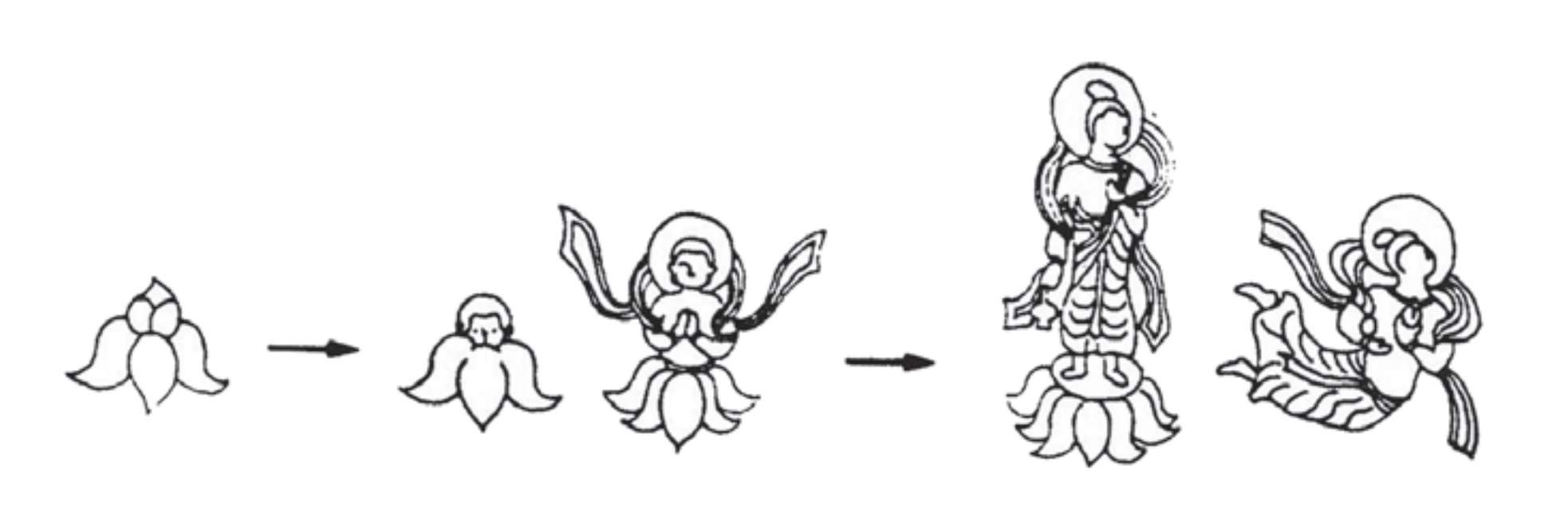
Floral regeneration became a favorite topic of Buddhist art across Asia. Redeemed souls were visually rendered as newborns wrapped in lotus blooms. Some artists faithfully followed a given Pure Land text. The ca. fifth-century Amitabha Visualization Sutra enumerated nine ranks of rebirth in the paradise of the west, from “the upper birth of the upper rank,” through “the middle birth of the upper rank,” downward to the “lower birth of the lower rank.” A seventh-century Dunhuang mural depicted them all in the form of babies emanating from nine lotus blossoms. Other artists focused on the process by which the flower is transformed into a divine being. They created a series of images recording the mysterious metamorphosis of the lotus. Dating from as early as the fifth century CE, the Yun’gang and Longmen caves include numerous examples of these pictorial narratives, showing first a newborn’s head peeping from inside the corolla, then the gradual transformation of the petals into the limbs, and finally the release of a full-blown ethereal being, the divinity of which is indicated by a [halo] [fig. 4] (pp. 143-144). 

Fig. 4 – “Lotus rebirth as rendered at the fifth-century Yun’gang Caves. From Yoshmura Rei, Tianren dansheng tu (Shanghai: Shanghai guji, 2009), p. 23” (larger version) (Shahar, 2015, p. 144).

If viewed through a Daoist lens, this image could represent the fledgling spirit embryo emerging from the lotus, being nurtured to fruition, and then freed to live out an eternity in blissful freedom.


Update: 09-22-23

Above, I quoted Kohn’s (2008) heavily edited translation of the Wonderous Record, which noted the prescribed times for the ingestion of qi energy. This source was apparently cited in the “Inner Chapters” (Neipian, 內篇) of Ge Hong’s Master Who Embraces Simplicity (Baopuzi, 抱朴子, 4th century). A longer quote appearing in Campany (2002) mentions the aforementioned time-based practices, lists the types of resulting spiritual powers, and warns of this path’s difficulty:

Now the circulation of pneumas should be done during the hours of live pneumas (shengqi 生氣[/炁]), not during the hours of dead pneumas (siqi 死氣[/炁]). This is why it is said that “transcendents ingest the six pneumas.” In one day and night there are twelve double-hours. The six double-hours from midnight to noon are those of live pneumas; the six from noon to midnight are those of dead pneumas. During the period of dead pneumas, circulating pneumas is of no benefit.

One who is adept at using pneumas can blow on water and it will flow against its own current for several paces; blow on fire, and it will be extinguished; blow at tigers or wolves, and they will crouch down and not be able to move; blow at serpents, and they will coil up and be unable to flee. If someone is wounded by a weapon, blow on the wound, and the bleeding will stop. If you hear of someone who has suffered a poisonous insect bite, even if you are not in his presence, you can, from a distance, blow and say an incantation over your own hand (males on the left hand, females on the right), and the person will at once be healed even if more than a hundred li away. And if you yourself are struck by a sudden illness, you have merely to swallow pneumas in three series of nine, and you will immediately recover.

However, people by nature are restless, and few are able to maintain the quietude to cultivate this way. Furthermore, to practice the most essential methods of circulating pneumas one must avoid eating very much, or eating flesh vegetables and meats, for these cause the breath to become strong and thus hard to shut off. Also one must avoid rage, for if one has much rage, then the breath becomes disordered, and if it is unable to spill over, then it will cause a fit of coughing.

Few are those, therefore, who can practice breath circulation! (p. 21)

夫行炁當以生炁之時,勿以死炁之時也。故曰仙人服六炁,此之謂也。一日一夜有十二時,其從半夜以至日中六時為生炁,從日中至夜半六時為死炁,死炁之時,行炁無益也。善用炁者,噓水,水為之逆流數步;噓火,火為之滅;噓虎狼,虎狼伏而不得動起;噓蛇虺,蛇虺蟠而不能去。若他人為兵刃所傷,噓之血即止;聞有為毒蟲所中,雖不見其人,遙為噓祝我之手,男噓我左,女噓我右,而彼人雖在百里之外,即時皆愈矣。又中惡急疾,但吞三九之炁,亦登時差也。但人性多躁,少能安靜以修其道耳。又行炁大要,不欲多食,及食生菜肥鮮之物,令人炁強難閉。又禁恚怒,多恚怒則炁亂,既不得溢,或令人發欬,故鮮有能為者也。

Sources:

Campany, R. F. (2002). To Live as Long as Heaven and Earth: A Translation and Study of Ge Hong’s Traditions of Divine Transcendents. United Kingdom: University of California Press.

Kohn, L. (2008). Chinese Healing Exercises: The Tradition of Daoyin. Honolulu: University of Hawaiʻi Press.

Shahar, M. (2015). Oedipal God: The Chinese Nezha and His Indian Origins. Germany: University of Hawaii Press.

Wu, C., & Yu, A. C. (2012). The Journey to the West (Vol. 1) (Rev. ed.). Chicago, Illinois: University of Chicago Press.

The Mountain of Flowers and Fruit and the Cosmic Geography of Journey to the West

Note: This page used to have historical information about the origin of Monkey’s first master, but I have moved it to a new article.

Last updated: 03-07-2023

The Monkey King’s home, the “Mountain of Flowers and Fruit” or “Flower-Fruit Mountain” (Huaguo shan, 花果山), is commonly assumed to be located in China. In fact, a similarly-named mountain in Jiangsu province is even touted as the home of Sun Wukong. However, this is not the case within the novel’s narrative. It’s important to remember that Journey to the West (Xiyouji, 西遊記, 1592) is set in a world that is nothing like our Earth.

In this article, I will explain the location of the Mountain of Flowers and Fruit, showing that Sun Wukong’s home is in fact an island east of what would be considered China. This opens the door to interesting interpretations by those wanting to place the story within a real world context. Second, I will explain the ancient Buddhist disc-world system as presented in the book. My hope is that this will give readers a better understanding of the cosmic geography in which the story happens. 

Table of Contents

1. Religious Background

Note: I will alternate between Wu & Jenner (2020) and Wu & Yu (2012), using one or the other depending on who I think has done a better job of translating certain passages.

Chapter one opens by describing the world in which the story is set:

The world was then divided into four great continents: The Eastern Continent of Superior Body, the Western Continent of Cattle-Gift, the Southern Continent of Jambu and the Northern Continent of Kuru (Wu & Jenner, 1993/2020, vol. 1, p. 3).

… 世界之間,遂分為四大部洲:曰東勝神洲,曰西牛賀洲,曰南贍部洲,曰北俱蘆洲。

Yu’s (Wu & Yu, 2012) translation provides romanization of the Sanskrit names (vol. 1, p. 100). I’ve listed them below, along with the original Sanskrit, an alternative English translation, and the Chinese for the reader’s reference:

  • East Pūrvavideha (Sk: पूर्वविदेह, “Surpassing the Body”; Ch: Dong shengshen zhou, 東勝神洲)
  • West Aparagodānīya (Sk: अपरगोदानीय, “Enjoyer of Cattle”; Ch: Xi niuhe zhou, 西牛賀洲)
  • North Uttarakuru (Sk: उत्तरकुरु, “Unpleasant Sound”; Ch: Bei julu zhou, 北俱盧洲)
  • South Jambudvīpa (Sk: जम्बुद्वीप, “Rose-Apple”; Ch: Nan shanbu zhou, 南贍部洲)

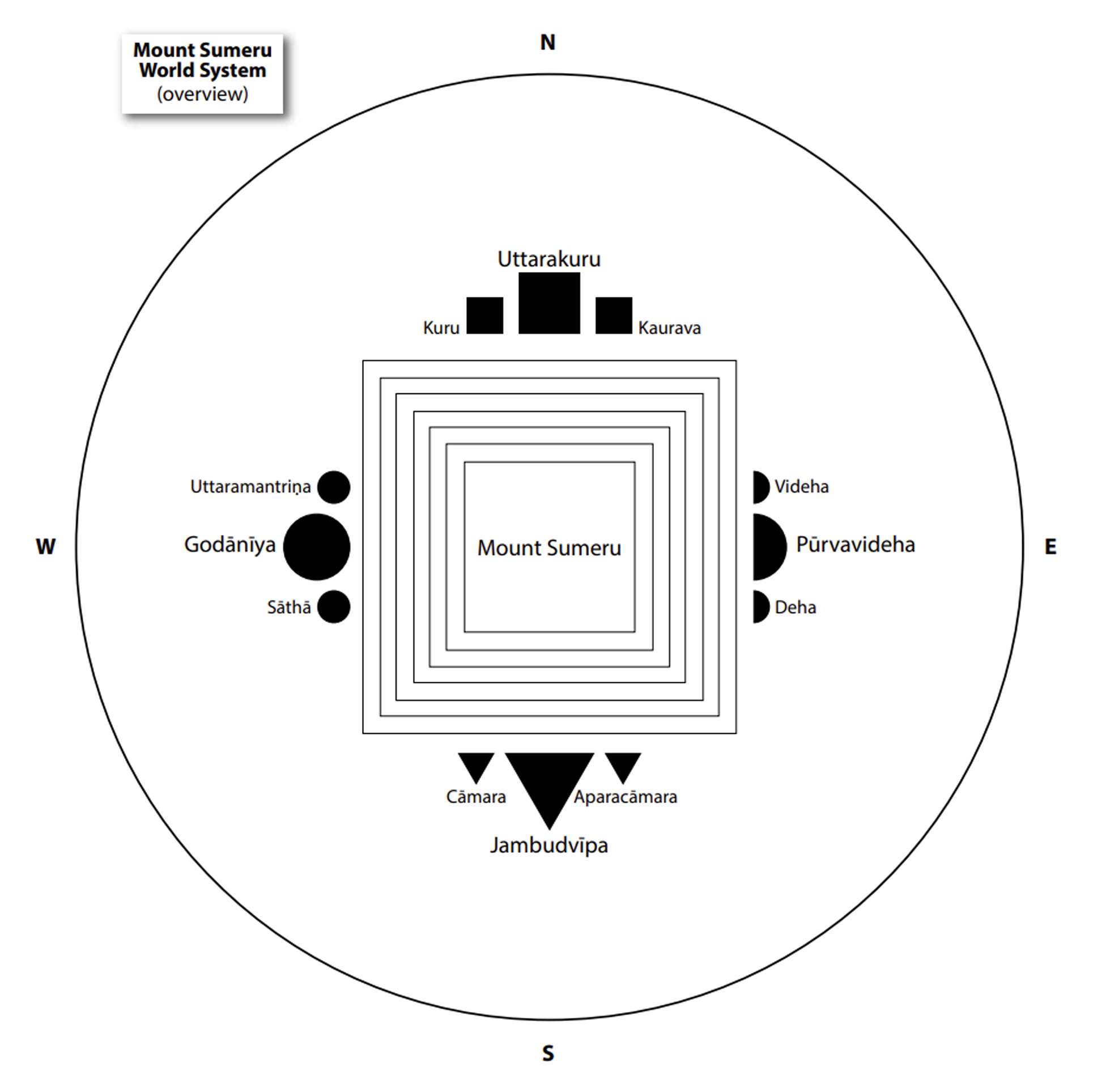
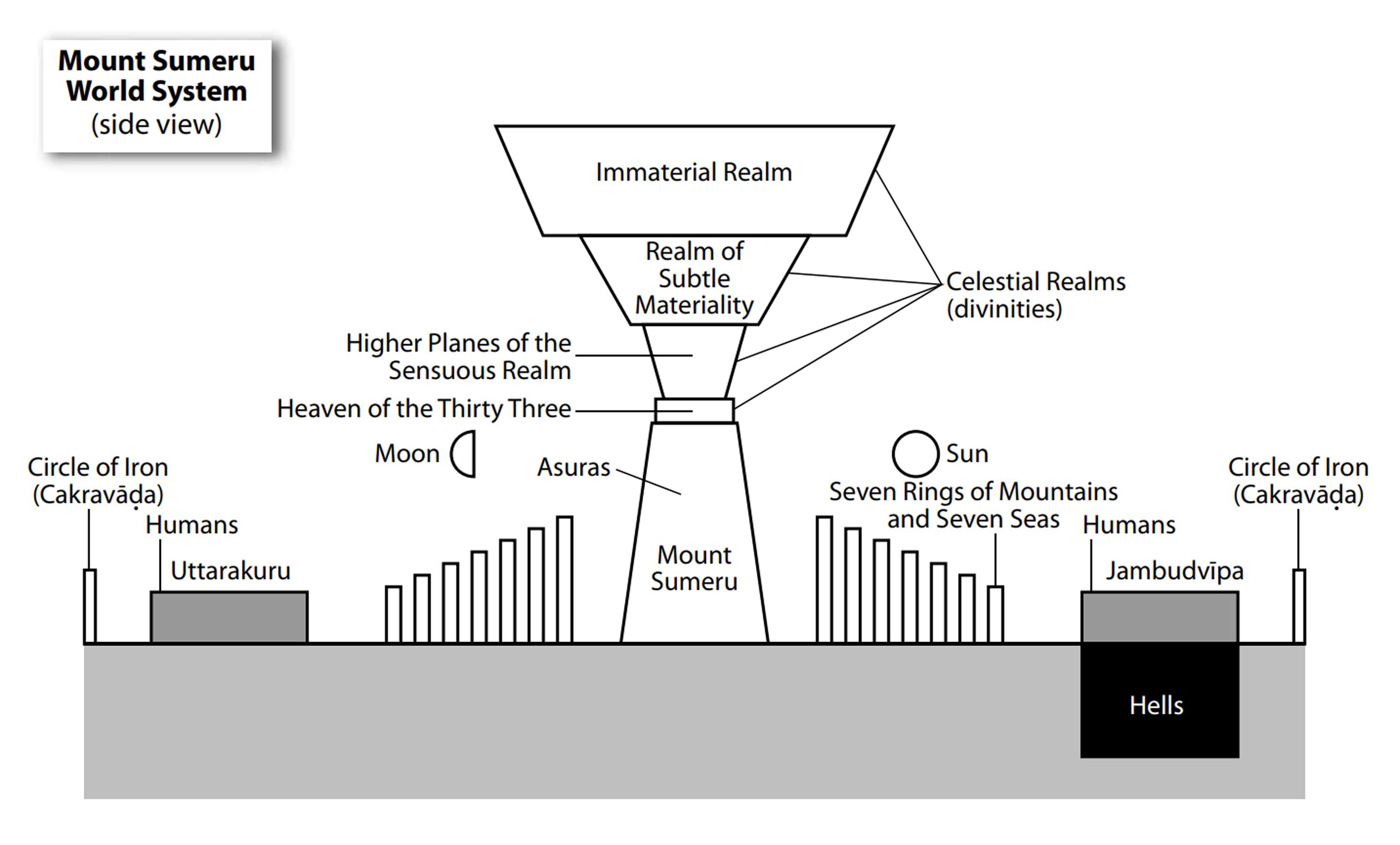
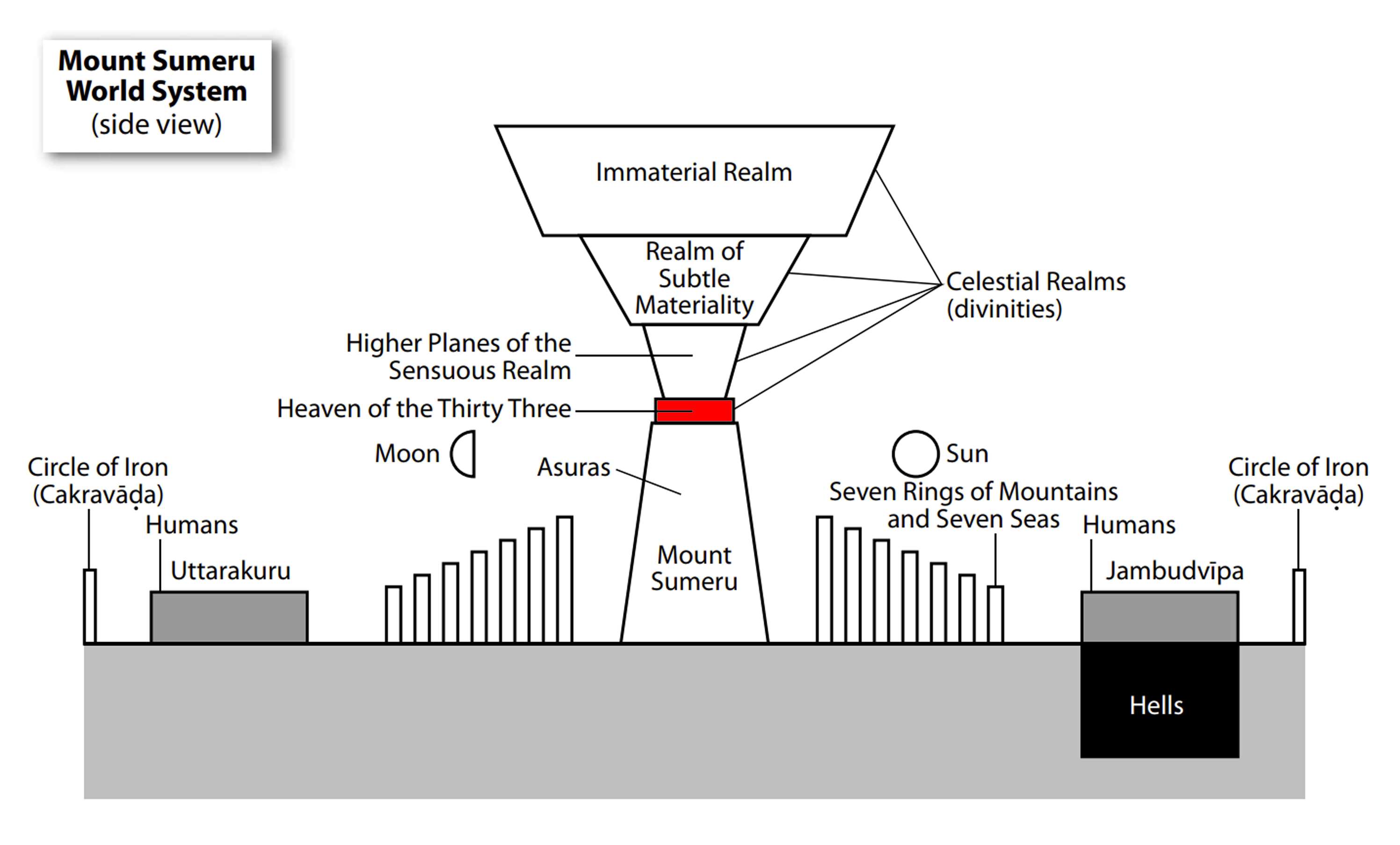
The Abhidharmakośa (Sk: अभिधर्मकोशभास्य; Ch: Api damo jushe lun, 阿毗達磨俱舍論, 4th to 5th century), a text describing the Buddhist universe, states that the four continents each have two intermediate continents, and that all twelve are set afloat in a great ocean surrounding the four respective sides of Mt. Sumeru (Ximi shan, 須彌山; Miaogao shan, 妙高山). This is a giant mountain that serves as the axis mundi of the cosmos, as well as the abode of assorted gods and sages. It is surrounded by seven golden mountains of lesser height, as well as a final iron mountain around the outside rim of the ocean, which keeps the water from draining over the edge (fig. 1 & 2) (Vasubandhu, La Vallée-Poussin, & Pruden, 1991, pp. 452-456).

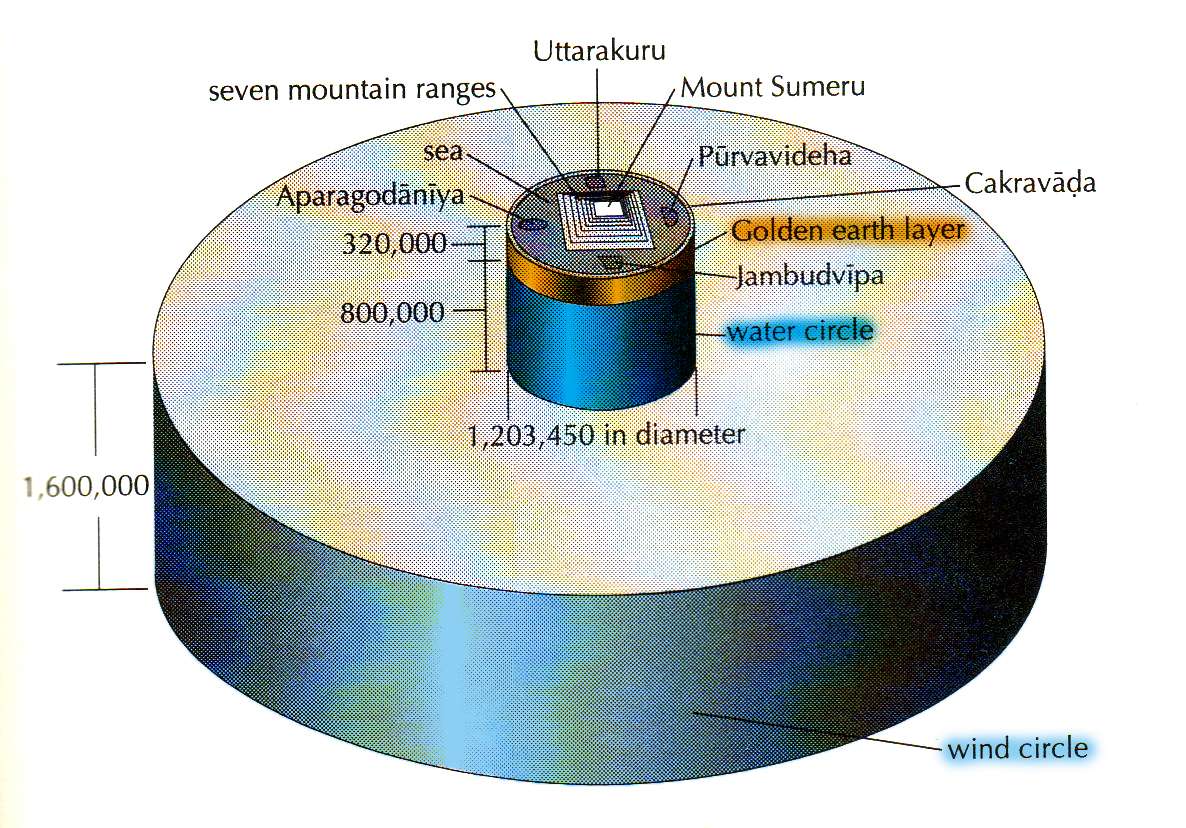
This system is supported by a series of elemental discs, each one becoming larger as one descends. The highest is kāñcanamaṇḍala, a disc of gold. The middle is jalamaṇḍala, a disc of water. And the lowest is vāyumaṇḍala, a disc of wind (fig. 3). This grand creation is thought to float in “space” (Vasubandhu, La Vallée-Poussin, & Pruden, 1991, pp. 451-452). 

Fig. 1 (top) – A top view of the Buddhist disc-world system (larger version). Fig. 2 (center) – A side view of the system (larger version). Images from Buswell & Lopez, 2014, pp. xxxii-xxxi. Fig. 3 (bottom) – A diagram showing the elemental discs supporting the world (larger version). Take note of the “wind circle” (light blue), the “water circle” (dark blue), and the “Golden earth layer” (gold). Adapted from Sadakata, 1997, p. 27.

2. Location of the Mountain

Chapter one continues:

Beyond the seas there is a country called Aolai [Aolai guo, 傲來國]. This country is next to an ocean, and in the middle of the ocean is a famous island called the Mountain of Flowers and Fruit. This mountain is the ancestral artery of the Ten Continents, the origin of the Three Islands; [1] it was formed when the clear and impure were separated and the Enormous Vagueness was divided (Wu & Jenner, 1993/2020, vol. 1, p. 3; cf. Wu & Yu, 2012, vol. 1, p. 100). 

海外有一國土,名曰傲來國。國近大海,海中有一座名山,喚為花果山。此山乃十洲之祖脈,三島之來龍,自開清濁而立,鴻濛判後而成。

Two deities shortly thereafter give a more precise location for the Mountain of Flowers and Fruit:

“We found that at the edge of the country of Aolai, which is east of the ocean belonging to the Eastern Continent of Superior Body, there is an island called the Mountain of Flowers and Fruit …” (Wu & Jenner, 1993/2020, vol. 1, p. 3; cf. Wu & Yu, 2012, vol. 1, p. 102). 

乃東勝神洲海東傲來小國之界,有一座花果山

Later, in chapter three, Sun Wukong’s advisors note the distance between Aolai and their island home:

The four monkeys replied, “East of our mountain, across two hundred [li] of water, is the boundary of the Aolai Country (Wu & Yu, 2012, vol. 1, p. 131; c.f. Wu & Jenner, 1993/2020, vol. 1, p. 50).

四猴道:「我們這山向東去,有二百里水面,那廂乃傲來國界。

All of this information tells us that the mountain is an island located 200 li (62 miles / 100 km) east of Eastern Superior Body (East Pūrvavideha).

3. The Novel’s Version of the Buddhist Disc-World System

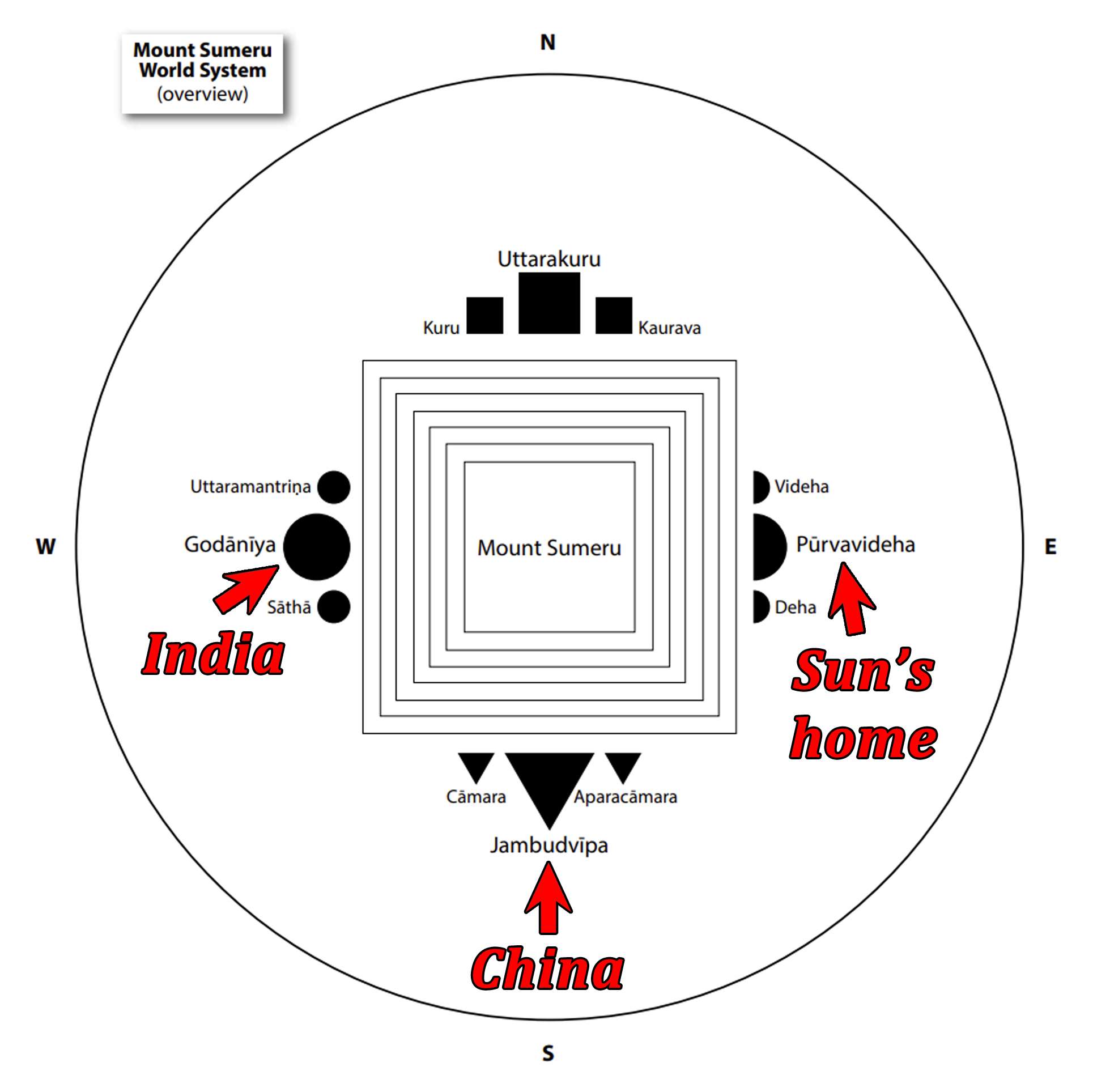
Buddhism traditionally associates Southern Jambu (South Jambudvīpa) with India (Buswell & Lopez, 2014, p. 377), but the novel shifts this structure a quarter turn clockwise (fig. 4). For example, in chapter eight, the Buddha associates his home (India) with the western continent and the southern continent with the “eastern lands” (dongtu, 東土), the Chinese Buddhist term for China (Tan, 1998, p. 137):

“… Our Western Continent of Cattle-Gift has people who neither covet nor kill. They nourish the vital essence and submerge the spirit; and although they produce no saints of the highest order, they all live to a ripe old age. But in the Southern Jambu Continent they are greedy and lecherous and delight in the sufferings of others; they go in for a great deal of killing and quarrelling. That continent can with truth be called a vicious field of tongues and mouths, an evil sea of disputation. [But I have] Three Stores of True Scriptures with which they can be persuaded to be good” (Wu & Jenner, 1993/2020, vol.1, p. 165; cf. Wu & Yu, 2012, vol. 1, pp. 205).

我西牛賀洲者,不貪不殺,養氣潛靈,雖無上真,人人固壽;但那南贍部洲者,貪淫樂禍,多殺多爭,正所謂口舌兇場,是非惡海。我今有三藏真經,可以勸人為善。

[…]

“I want to send them to the eastern lands because it is intolerable that the beings of that quarter should all be such stupid wretches who slander and defame the true word, do not understand the gist of my Law, and have lapsed from the orthodox Yogacara Sect…” (Wu & Jenner, 1993/2020, vol.1, p. 165; cf. Wu & Yu, 2012, vol. 1, pp. 205).

我待要送上東土,叵耐那方眾生愚蠢,毀謗真言,不識我法門之旨要,怠慢了瑜迦之正宗。

Additional evidence comes from chapter 29 when the chosen scripture pilgrim‘s travel rescript is reproduced. The opening line expressly connects China with the southern continent by way of the Chinese Tang dynasty

The travel rescript of the Tang Son of Heaven, who succeeds under the guidance of Heaven to the throne of the Great Tang Empire in the South Jambudvīpa Continent. … (Wu & Yu, 2012, vol. 2, p. 48; cf. Wu & Jenner, 1993/2020, vol. 2, p. 661).

南贍部洲大唐國奉天承運唐天子牒行

This means that when Sun first sails to Southern Jambu (South Jambudvīpa) to find a means of escaping death (Wu & Jenner, 1993/2020, vol.1, p. 16; cf. Wu & Yu, 2012, vol. 1, p. 108), he travels to the novel’s version of China. This further solidifies the fact that the Mountain of Flowers and Fruit is not located in China.

Fig. 4 – A top view of the Buddhist disc-world system according to Journey to the West (larger version). The Mountain of Flowers and Fruit would be to the east of Eastern Superior Body (East Pūrvavideha). Adapted from Buswell & Lopez, 2014, p. xxxii.

4. Reason for the Change

I suggest that the author-compiler of Journey to the West replaced the traditional cosmic geography for two reasons. First, both China and (part of) ancient India were referred to as the “Middle Kingdom” (Ch: Zhongguo, 中國; Sk: Madhyadeśa, मध्यदेश) (Wilkinson, 2000, p. 132; Lamotte, 1988, pp. 8-9). For example, the travelogue of the noted 4th to 5th-century Chinese Buddhist monk Faxian (法顯) reads:

Central India is known as the “Middle Kingdom” [Zhongguo, 中國]. The food and clothing of the common people are the same as the “Middle Kingdom” [i.e. China].

中天竺所謂中國。俗人衣服飲食亦與中國同。

This would naturally make it easier to associate China with Southern Jambu (South Jambudvīpa).

Second, since India is west of China, it would make sense for the country to be associated with Western Cattle-Gift (West Aparagodānīya).


5. Updates

Update: 10-01-17

A poem in chapter one states that the Mountain of Flowers and Fruit is the center of the universe. This obviously conflicts with Mt. Sumeru being the axis mundi.

Flower Fruit Mountain as the Center of the Universe


Update: 02-06-23

I have drastically rewritten the article to include more detailed information about the Buddhist disc-world system. I would also like to add material here from a previous article since it is related to the novel’s changes to the pre-existing structure.

Originally, the top of Mt. Sumeru supported the Buddhist heaven of the “Thirty-Three (Gods)” (Sk: Trāyastriṃśa, त्रायस्त्रिंश; Ch: Sanshisan tian, 三十三天; Daoli tian, 忉利天) (fig. 5), which is ruled by Śakra (Sk: शक्र; Ch: Dishi, 帝釋), king of the gods (Buswell & Lopez, 2014, pp. 921-922). However, the novel replaces this realm with the Daoist heaven, which is ruled by the Jade Emperor (Yuhuang shang/dadi, 玉皇上/大帝) (Clart, 2008, pp. 1197-1198). This is hinted at in chapter four when Monkey is invited to serve as the keeper of the heavenly horses. Part of a poem describing what he sees reads:

[…]
In this heaven are thirty-three heavenly palaces (emphasis added):
The Palace of Clouds Dispersed, the Vaisravana Palace, the [P]alace of Five Lores, the Sun Palace, the Palace of Flowery Bliss
[…] (Wu & Jenner, 1993/2020, p. 73; cf. Wu & Yu, 2012, vol. 1, p. 146).

這天上有三十三座天宮,乃遣雲宮、毘沙宮、五明宮、太陽宮、花樂宮 …

The “thirty-three” palaces are references to the homes of the thirty three gods. This change is, therefore, a prime example of the kind of Buddho-Daoist religious syncretism featured in Journey to the West.

Fig. 5 – The Heaven of the Thirty-Three atop Mt. Sumeru is indicated in red (larger version). Adapted from Buswell & Lopez, 2014, p. xxxii.


Update: 02-08-23

Despite the four Buddhist disc-world continents appearing in the story, Journey to the West hints that its world is a globe. For instance, when the Monkey King first sets out from his home in chapter one, he sails SE to reach the NW side of Southern Jambu (South Jambudvīpa):

He had chosen just the right time for his journey. After he boarded his raft the southeasterly wind blew hard for days on end and bore him to the northwestern shore of the southern continent (Wu & Jenner, 2020, vol.1, p. 16; cf. Wu & Yu, 2012, vol. 1, p. 108).

也是他運至時來,自登木栰之後,連日東南風緊,將他送到西北岸前,乃是南贍部洲地界。

I thought that maybe SE and NW were typos since heading SW would have taken him to the NE shore of the southern continent (refer back to fig. 4). However, in chapter two, Sun tells his children:

“The year I left you all,” Wukong said, “I drifted with the waves across the Great Eastern Ocean and reached the West Aparagodānīya Continent. I then arrived at the South Jambudvīpa Continent, where I learned human ways, wearing this garment and these shoes. I swaggered along with the clouds for eight or nine years, but I had yet to learn the Great Art. I then crossed the Great Western Ocean and reached the West Aparagodānīya Continent (Wu & Yu, 2012, vol. 1, p. 129; cf. Wu & Jenner, 1993/2020, p. 47).

我當年別汝等,隨波逐流,飄過東洋大海,到西牛賀洲地界,徑至南贍部洲,學成人像,著此衣,穿此履,擺擺搖搖,雲遊了八九年餘,更不曾有道。又渡西洋大海,到西牛賀洲地界

So it appears that he sailed from the Mountain of Flowers and Fruit to Western Cattle-Gift (West Aparagodānīya), similar to traveling from Japan in the East to the United States in the West. Then, he sailed from there to Southern Jambu (South Jambudvīpa), similar to traveling from the US to Africa. Lastly, he sailed back to Western Cattle-Gift (West Aparagodānīya). This might mean that the world of Journey to the West is a combination of a spherical planet and the Buddhist disc-world system.

If true, I suggest that the nonsensical, roundabout way that Monkey comes to study with Subodhi in the western continent could be a physical representation of his unsettled “monkey mind” (xinyuan, 心猿).

However, it’s important to point out that even Yu (Wu & Yu, 2012) considers the aforementioned route to be “[a]n inconsistency in the text” (vol. 1, p. 509, n. 17). So, I’ll leave it up to the reader as to which version of the world they ultimately want to accept.


Update: 02-09-23

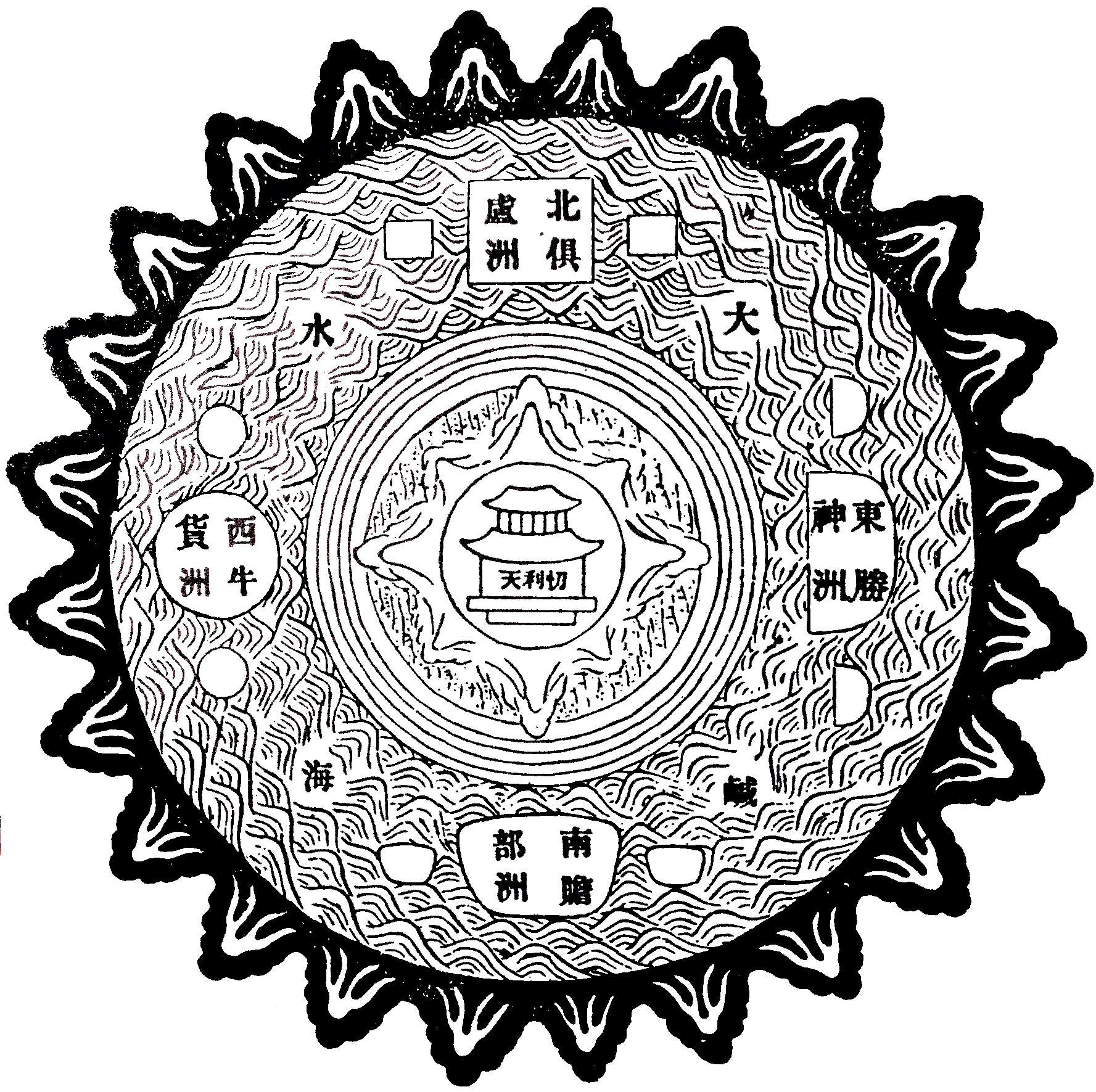
I found a lovely overhead Chinese map of the Buddhist disc-world system (fig. 6). The teeth-like structures around the perimeter are actually the iron mountain that contains the ocean. Also Mt. Sumeru in the center is topped by a building representing the Buddhist heaven of the “Thirty-Three (Gods)” (Ch: Daoli tian, 忉利天) (refer back to fig. 5).

Fig. 6 – An early-20th-century Chinese map of the Buddhist disc-world system (larger version). Image found on Wikimedia Commons.


Update: 02-11-23

I have posted an article that discusses the Buddha’s realm in Western Cattle-Gift (West Aparagodānīya).

The Buddha’s Vulture Peak and Journey to the West


Update: 03-07-23

In my 02-06-23 update, I noted how the “thirty-three mansions” alluded to the Buddhist heaven of the thirty-three gods (sanshisan tian, 三十三天), thereby showing that the Daoist heaven was inserted into the Buddhist cosmological structure. Well, I had completely forgotten that the novel overtly mentions this heaven numerous times. This is important in regards to the location of Laozi‘s (老子) residence. 

Journey to the West states that the deva and his alchemical furnace are located in the “Tushita Palace” (Doushuai gong兜率宮), which is said to be either in the “Separation’s Regret Heaven” (Lihen tian離恨天) or the “Great Canopy Heaven” (Daluo tian, 大羅天). Both are treated as the highest of the thirty-three heavens. For more information, see my article: 

Laozi’s Realm in Journey to the West

Note:

1) Yu (Wu & Yu, 2012) explains, “These islets and islands were famous abodes of gods or immortals” (vol. 1, p. 506, n. 6).

Sources:

Buswell, R. E. , & Lopez, D. S. (2014). The Princeton Dictionary of Buddhism. Princeton University Press.

Clart, P. (2008). Yuhuang. In F. Pregadio (Ed.), The Encyclopedia of Taoism (Vols. 1 & 2) (pp. 1197-1198). Longdon: Routledge.

Lamotte, E. (1988). History of Indian Buddhism: From the Origins to the Saka Era (S. Webb-Boin, Trans.). Louvain-la-Neuve: Université Catholique de Louvain Institut Orientaliste.

Tan, C. (1998). A Sino-Indian Perspective for India-China Understanding. In C. Tan (Ed.), Across the Himalayan Gap: An Indian Quest for Understanding China (pp. 133-147). New Delhi: Indira Gandhi National Centre for the Arts.

Vasubandhu, La Vallée-Poussin, L., & Pruden, L. M. (1991). Abhidharmakośabhāṣyam of Vasubandhu (Vol. 2). Berkeley, Calif.: Asian Humanities Press.

Wilkinson, E. P. (2000). Chinese History: A Manual (Rev. and Enl). Published by the Harvard University Asia Center for the Harvard-Yenching Institute : Distributed by Harvard University Press.

Wu, C. & Jenner, W. J. F. (2020). Journey to the West (Vols. 1-4). Beijing: Foreign Languages Press. (Original work published 1993)

Wu, C., & Yu, A. C. (2012). The Journey to the West (Vols. 1-4) (Rev. ed.). Chicago, Illinois: University of Chicago Press.

“That Piece of Rare Magic Iron”: The Literary and Religious Origins of the Monkey King’s Staff

Last updated: 02-06-2021

Sun Wukong (孫悟空) the Monkey King (fig. 1) is one of the most enduring characters of East Asian literature and folklore. Much ink has been spilled in the analysis of the novel in which he appears, the highly popular Ming Dynasty (1368–1644) classic Journey to the West (Xiyouji, 西遊記, 1592, “JTTW” hereafter). For instance, Anthony C. Yu’s updated translation includes an almost 100 page introduction highlighting the historical background and religious and literary influences of the novel. [1] The origins of Monkey has also been discussed at great length. [2] However, few scholars have attempted to trace the origins of his magical iron staff, one of the most recognizable parts of his iconography. In this paper, I propose that the weapon is an amalgam of ringed staves carried by religious monks and iron staves carried by martial monks. Both are featured in Chinese fiction and religious-inspired martial arts legends. My hope is that this information will be both useful to researchers and interesting to fans of Ol’ Monkey.

Fig. 1 – A 19th-century woodblock print of Sun Wukong and his staff (larger version).

Table of Contents

1. Literary Description

The staff first appears in the third chapter when Monkey goes to the underwater kingdom of Ao Guang (敖廣), the Dragon King of the Eastern Sea, looking for a magic weapon to match his supernatural strength and martial skill. When the offered weapons—a fork and a halberd weighing thousands of pounds each—fail to meet his standards, the dragon queen suggests to her husband that they give Sun “that piece of rare magic iron” (yikuai shentie, 一塊神鐵) taking up space in their treasury. She claims that the ancient shaft had started producing heavenly light days prior and proposes that the monkey is fated to own it. The novel subsequently explains that it was originally used by Yu the Great (大禹), a semi-historical Chinese emperor, to set the depths of the world flood during times immemorial. [3]

The staff is initially described as a pillar of black iron twenty feet in height and the width of a barrel. It is only when Monkey lifts it and suggests that a smaller size would be more manageable that the staff complies with his wishes and shrinks. This is when Sun sees that the weapon is banded with a gold ring on each end, as well as an inscription along the body reading: “The Compliant Golden-Hooped Rod. Weight: thirteen thousand five hundred catties” (如意金箍棒重一萬三千五百斤). [4] The inscription indicates that the staff follows the commands of its owner, shrinking or growing to their whim, and that it is immensely heavy, weighing 17,560 lbs. [5] One particular passage from the novel best summarizes the abilities of Monkey’s staff:

[Sun Wukong] held the treasure [the staff] in his hands and called out, “Smaller, smaller, smaller!” and at once it shrank to the size of a tiny embroidery needle, small enough to be hidden inside the ear. Awestruck, the monkeys cried, “Great King! Take it out and play with it some more.” The Monkey King took it out from his ear and placed it on his palm. “Bigger, bigger, bigger!” he shouted, and again it grew to the thickness of a barrel and more than twenty feet long. He became so delighted playing with it that he jumped onto the bridge and walked out of the cave. Grasping the treasure in his hands, he began to perform the magic of cosmic imitation. He bent over and cried, “Grow!” and at once grew to be ten thousand feet tall, with a head like the Tai Mountain and a chest like a rugged peak, eyes like lightning and a mouth like a blood bowl, and teeth like swords and halberds. The staff in his hands was of such a size that its top reached the thirty-third heaven and its bottom the eighteenth layer of Hell. Tigers, leopards, wolves, and crawling creatures, all of the monsters of the mountain and the demon kings of the seventy-two caves, were so terrified that they kowtowed and paid homage to the Monkey King in fear and trembling. Presently he revoked his magical appearance and changed the treasure back into a tiny embroidery needle stored in his ear. [6]

Sun later uses this powerful weapon in his war against heaven when they don’t recognize him as a full-fledged god. He is so powerful that the Jade Emperor of heaven has to ask the Buddha to intervene. After being imprisoned beneath a mountain range for 500 years, Monkey is eventually released and takes the tonsure as a Buddhist monk. He is charged with the protection of the monk Tripitaka (Sanzang, 三藏) on a quest to retrieve Buddhist scriptures from India. He uses his staff to battle all sorts of monsters, spirits, and rogue gods along the way.

1.1 Literary Antecedent

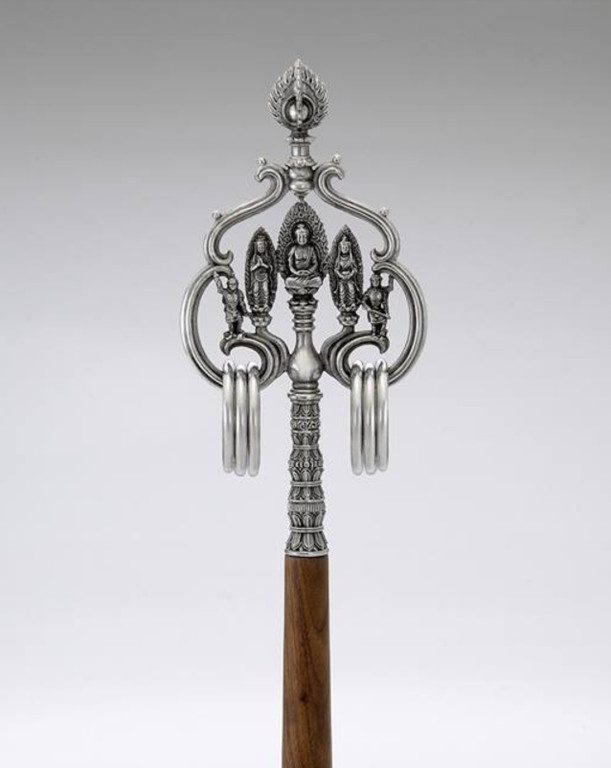
The earliest depiction of the staff appears in the oldest edition of JTTW, The Story of How Tripitaka of the Great Tang, Procures the Scriptures (Da Tang Sanzang qujing shihua, 大唐三藏取經詩話; “The Story” hereafter), published during the late Song Dynasty (960–1279). [7] In the second chapter, Sun’s antecedent, the Monkey Pilgrim (Hou xingzhe, 猴行者), transports his master to heaven to meet Vaisravana, the Mahabrahma Deva. [8] After the monk impresses the heavenly retinue with his lecture on the Lotus Sutra, Monkey is given a cap of invisibility, an alms bowl, and a golden ringed monk’s staff (khakkhara) (fig. 2) as magical weapons against the evils they will face on their journey to India. He later uses the staff in a battle with a white-clad woman who transforms into a tiger demon. Monkey changes the staff into a titanic, red-haired, blue-skinned yaksha with a club, showing that the predecessor of the Compliant Rod has more magical abilities in comparison. [9]

A weapon that predicts the Compliant Rod is mentioned early on in The Story. Monkey describes how the Queen Mother had him flogged with an “iron cudgel” (tiebang, 鐵棒) for stealing ten peaches from her heavenly orchard. He later borrows the cudgel to use in tandem with the monk’s staff to punish nine dragons. [10] The golden rings (jinhuan, 金環) on the monk’s staff most likely influenced the golden hoops (jingu, 金箍) on the weapon from the Ming version. [11] Therefore, both staffs from the Song version were combined to create the Compliant Rod.

Fig. 2 – The head of a ringed monk’s staff (khakkhara) (larger version). Originally found here.

2. Origin

Many scholars believe that Sun Wukong was influenced by the monkey god Hanuman from the Indian epic the Ramayana (3rd century BCE). The two have many textual similarities, [12] but weapons are not among them. Despite his traditional iconography, the Ramayana doesn’t mention Hanuman wielding a mace. His later association with this weapon may have been influenced by two sources. First, the novel portrays him as using his great strength to wield heavy objects, both natural and man-made, as blunt weapons. [13] Second, he was closely associated with yaksha demons in other great Hindu classics like the Mahabharata (4th c. BCE to 4thvc. CE). Early Buddhist sutras mention yakshas wielding maces. [14] One such individual is the Yaksha King Kubera-turned-Buddhist deity Vaisravana, who later makes appearances in the The Story and JTTW. [15] The mace was a fixture of Hanuman’s iconography by at least the 12th century since dynastic coins from this time feature him holding the weapon. [16] However, the association between the two surely took place well before this if the iconography was common enough to stamp on coins. Yet, I am not inclined to speculate that stories of his mace eventually made it to China. Monkey’s weapon may have just been influenced by Buddhist yakshas as well.

As previously mentioned, Sun becomes a Buddhist monk after being released from imprisonment. Meir Shahar explains that the staff was the emblem of the monk. It was a part of the eighteen items that Indian Buddhist monastic law required that they carry with them on the road. [17] In China, there were two different kinds of monks (with some overlap), the lesser known martial type charged with protecting the religious community (sangha) and the more widely known religious type living in cloisters and proselytizing on the road. Both groups carried different kinds of staves. The martial monks wielded the wooden or iron kind. The former was chosen for its diminished capacity to kill unlike edged weapons, [18] while the latter was used for killing during times of war. [19] The religious monks carried the aforementioned ringed kind.

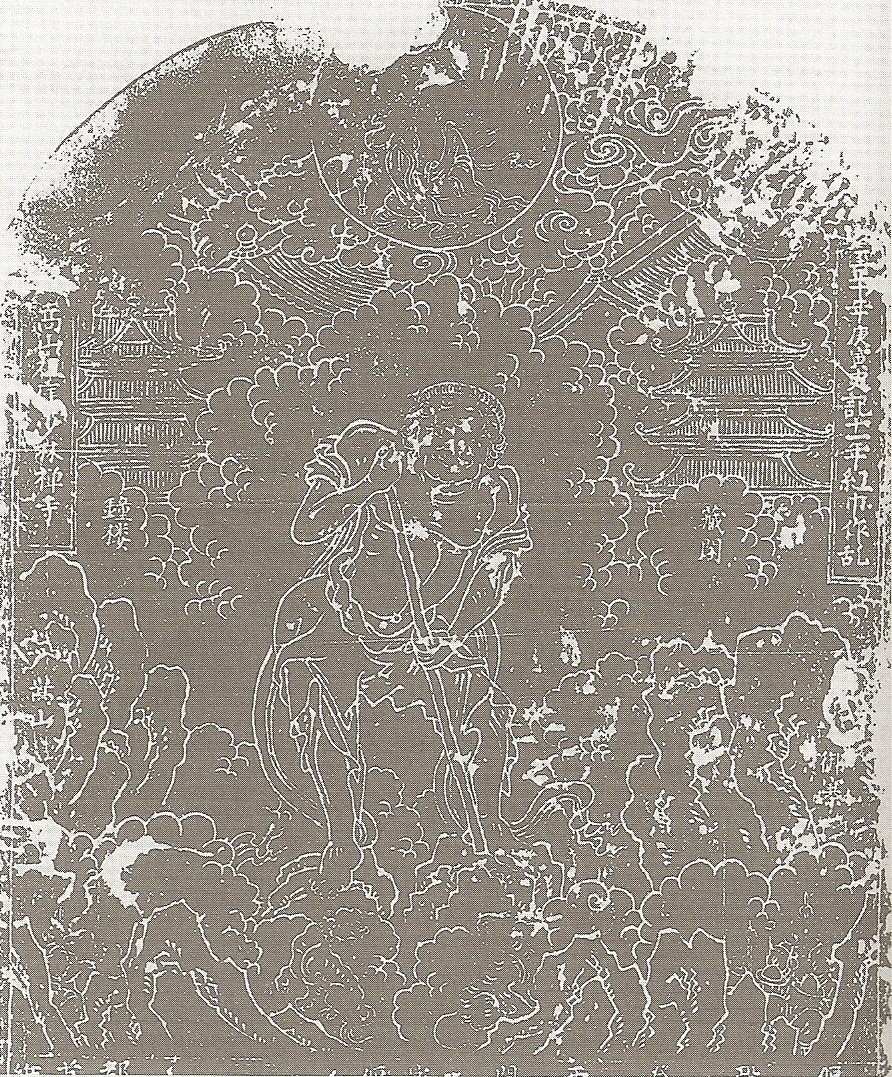
Fig. 3 – The 1517 Shaolin stele featuring Vajrapani (larger version).

The martial monks of the Shaolin Monastery, for example, are famous for their skill with the staff. It’s interesting to note that they venerate the yaksha-turned-Buddhist protector deity Vajrapani as the progenitor of their staff method. A stele erected in 1517 tells the story of how the deity, disguised as a lowly kitchen worker, grew to titanic proportions and wielded a fire poker as a makeshift staff to defend the monastery against rebels during the late Yuan Dynasty (1271–1368) (fig. 3). [20] Buddhist iconography traditionally depicts Vajrapani wielding a mace in defense of the Buddha and his teachings (the dharma). [21] The Shaolin monks may have changed his mace to a staff because this was the blunt weapon with which they wielded in defense of the religious community and, by extension, the Buddha and his Word, [22] as well as in defense of China against rebels and foreign invaders. Shahar suggests that “martial deities such as Vajrapani exonerated the monks from their responsibility for the creation of military techniques.” He continues, “In this respect their legends could be read as Buddhist apologies for the monastic exercise of violence.” [23] Therefore, I suggest that Monkey’s iron staff from the The Story is based on the staves used by martial monks. After all, Sun is a Buddhist warrior just like the monks of Shaolin, and he uses his iron staff to meter out punishment and death just like Vajrapani and his mace. [24]

The ringed staves were known as “xi staves” (xizhang, 錫杖; Sk: khakkhara), which early medieval Chinese documents describe as being decorated with six to twelve metal rings. These rings were designed to make a clanging noise (xi, 錫) to not only scare away any poisonous animals on the road, but also to alert possible donors to the monk’s presence. Noted Buddhist personages and deities were often portrayed as having the same ringed staff and alms bowl given to Monkey in The Story. [25] For instance, a popular story circulating during the Song involves Mulian (目連; Sk: Maudgalyayana), a close disciple of the Buddha, using the magic power of the aforementioned objects to free his deceased mother from the torments of the underworld. [26]

3. Conclusion

The Compliant Rod from JTTW is based on two staves from an earlier Song-era edition of the story. The first is a golden ringed monk’s staff given to Monkey by the deva Vaisravana (among other objects) as a magical weapon to protect the monk Xuanzang. The second is an iron staff procured by Monkey from the Queen Mother of the West in order to punish nine dragons. The former is based on ringed staves historically carried by religious monks while proselytizing on the road. The ringed staff is among the magic items used by Buddhist personages and deities in Song-era stories. The latter is based on wooden and iron staves historically used by martial monks to defend both the Buddhist community and China from rebels and foreign invaders. Martial monks, such as those from Shaolin, attributed their staff skills to mace-wielding yaksha demons-turned-Buddhist protector deities as way of excusing their use of violence. Likewise, Monkey’s use of violence is excused because he wields his staff in protection of his master Tripitaka. In the end, both staves were combined in the Ming version. The golden rings of the ringed staff were transposed onto the iron staff. The Compliant Rod, therefore, inhabits the worlds of heaven and hell, religion and combat, salvation and punishment.


5. Updates

Update: 06-4-14

I have three things to note. The first regards the weapon in popular culture. The staff influenced the polearm used by the humanoid alien Son Goku (himself based on Sun Wukong), [27] the main character of the Dragon Ball franchise. It is named Nyoi Bo, the Japanese transliteration of Ruyi bang (如意棒, “Compliant Rod”), and it is commonly called “Power Pole” in English language media. [28] The staff is given to him as a child by his grandfather Gohan, a human who adopts and teaches him martial arts. [29]

Second, the 75th chapter of JTTW has a long poem describing the history of the staff. The first few lines read:

The rod of steel nine cyclic times refined
Was forged in the stove by Laozi himself.
King Yu took it, named it “Treasure Divine,”
To fix the Eight Rivers and Four Seas’ depth.
In it were spread out tracks of planets and stars,
Its two ends were clamped in pieces of gold.
Its dense patterns would frighten gods and ghosts;
On it dragon and phoenix scripts were drawn.
Its name was one Rod of Numinous Yang,
Stored deep in the sea, hardly seen by men
[…]. [30]

However, instead of reflecting the actual history of the staff (within the novel’s fictional universe), I think this is an example of how character’s boast about their weapons in a bid to “one-up” their opponents. It’s like saying, “My weapon is more prestigious than yours, so you have no chance of beating me.”

And third, I wrote a sister blog to this entry a few days ago that describes additional influences of the staff. It can be read here:

A Historical Source for the Monkey King’s Staff?


Update: 12-30-14

I just posted the third and final installment of my investigation on the history of Monkey’s staff. It can be read here.

Deciphering the Inscription on the Monkey King’s Staff


Update: 09-10-16

I noted in the 06-4-14 update that a poem in the 75th chapter states that the staff was created by Laozi in his oven. A later poem in the 88th chapter notes that it was made by Yu the Great:

An iron rod forged at Creation’s dawn
By Great Yu himself, the god-man of old.
The depths of all oceans, rivers, and lakes,
Were fathomed and fixed by this very rod.
Having board through mountains and conquered floods,
It stayed in East Ocean and ruled the seas,
[…] [31]


Update: 02-06-21

I have written an article that discusses the magic powers of the staff. These include the ability to shrink and grow, control the ocean, astral project and entangle with Monkey’s spirit, multiply endlessly, pick locks, and transform into various objects. It also has sentience to a certain degree.

The Magic Powers of the Monkey King’s Iron Staff

Notes:

[1] Wu Cheng’en, and Anthony C. Yu. The Journey to the West (Vol. 1) (Chicago, Ill: University of Chicago Press, 2012), 1-96.

[2] See, for instance, Ibid, 8-15 and the sources therein.

[3] Yu the Great is believed to have ruled during the 22nd century BCE. The novel, however, does not follow a historical chronology. Yu is just portrayed as inhabiting a mystical time in the distant past.

[4] Wu and Yu, The Journey to the West, 135. Anthony Yu’s original translation uses the word “pounds.” However, Chinese versions of the novel use jin (斤), known in English as “catty.” Catty and pound are two different measures of weight, the former being heavier than the latter. Therefore, the English text has been altered to show this.

[5] The catty during the Ming Dynasty when the novel was compiled equaled 590 grams (Mark Elvin, The Retreat of the Elephants: An Environmental History of China (New Haven (Conn.): Yale university press, 2004), 491 n. 133).

[6] Meir Shahar, The Shaolin Monastery: History, Religion, and the Chinese Martial Arts (Honolulu: University of Hawai’i Press, 2008), 93.

[7] This is also known as the “Kōzanji Version” (高山寺) because a 17th-century document mentioning the work was discovered in a Japanese temple of that name (Victor H. Mair, The Columbia Anthology of Traditional Chinese Literature (New York: Columbia University Press, 1994), 1181).

[8] These are actually two different deities, but the Chinese author of the tale seems to have confused them (Ibid, 1182 n. 4 and 1183 n. 6.)

[9] Dudbridge, The Hsi-Yu Chi, 32 and 35.

[10] Ibid, 37-38.

[11] Ibid, 38. For a comparison between the Chinese names of the Song and Ming weapons, see Shahar, The Shaolin Monastery, 107-108.

[12] These similarities include being monkey protagonists and having births associated with wind, episodes of upsetting cosmic order in their youths, and comparable powers of transformation and flight. Bits and pieces of the Ramayana arrived in China in the form of Buddhist sutras from the north via the Silk Road and word of mouth from Southeast Asian merchants via the southern sea route. It then mixed with indigenous Chinese stories concerning water spirits and ape demons to influence the creation of Sun Wukong. For more details, see Hera S. Walker, “Indigenous or Foreign? A Look at the Origins of the Monkey Hero Sun Wukong”, Sino-Platonic Papers 81 (September 1998): 1-110, accessed February 20, 2014, http://sino-platonic.org/complete/sp…sun_wukong.pdf.

[13] Philip Lutgendorf, Hanuman’s Tale: The Messages of a Divine Monkey (Oxford: Oxford University Press, 2007), 41 n. 9.

[14] Ibid, 41-42.

[15] He appears as the heavenly general Li Jing (李靖) in the Ming version.

[16] Ibid, 61.

[17] Shahar, The Shaolin Monastery, 102.

[18] Ibid, 101.

[19] Shahar mentions a Shaolin monk who used his iron staff to kill the wife of a rebel during the Ming dynasty (Ibid, 69).

[20] Ibid, 83-85.

[21] Ibid, 37. For a story of Vajrapani defending the Buddha, see Vessantara, Meeting the Buddhas: A Guide to Buddhas, Bodhisattvas, and Tantric Deities (Birmingham [England]: Windhorse Publications, 1998), 162.

[22] The Sangha, Buddha, and Dharma are known as the “Three Jewels of Buddhism.”

[23] Ibid, 91.

[24] For instance, one story tells how Vajrapani kills a Hindu deity in order to revive him as a Buddhist deity. This is connected to the concept of skill in means in which an evil being is killed in order to save them from karmic punishment in the next life (Mark Juergensmeyer, Margo Kitts, and Michael K. Jerryson, The Oxford Handbook of Religion and Violence (New York: Oxford University Press, 2013), 55).

[25] Shahar, The Shaolin Monastery, 103.

[26] Dudbridge, The Hsy-Yu Chi, 32 n. 6. For a full version of the story, see Mair, The Columbia Anthology of Traditional Chinese Literature, 1093-1127.

[27] Mark I. West, The Japanification of Children’s Popular Culture: From Godzilla to Miyazaki (Lanham: Scarecrow Press, 2009), 203.

[28] Brian Camp and Julie Davis Anime Classics Zettai!: 100 Must-See Japanese Animation Masterpieces (Berkeley, Calif: Stone Bridge Press, 2007), 112.

[29] Akira Toriyama and Gerard Jones, Dragon Ball (Vol. 2) (San Francisco, Calif: Viz LLC, 2003), 4.

[30] Wu and Yu, Journey to the West (Vol. 3), 375.

[31] Ibid (Vol. 4), 201.

Bibliography

Camp, Brian, and Julie Davis. Anime Classics Zettai!: 100 Must-See Japanese Animation Masterpieces. Berkeley, Calif: Stone Bridge Press, 2007.

Dudbridge, Glen. The Hsi-Yu Chi: A Study of Antecedents to the Sixteenth-Century Chinese Novel. Cambridge: Cambridge Univ. Press, 1970

Elvin, Mark. The Retreat of the Elephants: An Environmental History of China. New Haven (Conn.): Yale university press, 2004

Juergensmeyer, Mark, Margo Kitts, and Michael K. Jerryson. The Oxford Handbook of Religion and Violence. New York: Oxford University Press, 2013.

Lutgendorf, Philip. Hanuman’s Tale: The Messages of a Divine Monkey. Oxford: Oxford University Press, 2007.

Mair, Victor H. The Columbia Anthology of Traditional Chinese Literature. New York: Columbia University Press, 1994

Shahar, Meir. The Shaolin Monastery: History, Religion, and the Chinese Martial Arts. Honolulu: University of Hawai’i Press, 2008.

Toriyama, Akira, and Gerard Jones. Dragon Ball (Vol. 2). San Francisco, Calif: Viz LLC, 2003.

Vessantara. Meeting the Buddhas: A Guide to Buddhas, Bodhisattvas, and Tantric Deities. Birmingham [England]: Windhorse Publications, 1998.

Walker, Hera S. “Indigenous or Foreign? A Look at the Origins of the Monkey Hero Sun Wukong.” Sino-Platonic Papers 81 (September 1998): 1-110. Accessed February 20, 2014. http://sino-platonic.org/complete/sp…sun_wukong.pdf.

West, Mark I. The Japanification of Children’s Popular Culture: From Godzilla to Miyazaki. Lanham: Scarecrow Press, 2009.

Wu, Cheng’en, and Anthony C. Yu. The Journey to the West (Vol. 1-4). Chicago, Ill: University of Chicago Press, 2012.