Note: See the 05-14-22 update for two additional dissertations analyzing Hanuman.
Last updated: 05-14-2022
I previously posted a paper that explores the evidence connecting Sun Wukong with the Hindu monkey god Hanuman. Here, I present a wonderful book that explores Hanuman’s origins, worship, and popular image.
Blurb:
This book offers a comprehensive introduction to one of the most beloved and widely worshiped of Hindu deities: the “monkey-god” Hanuman. It details the historical expansion of Hanuman’s religious status beyond his role as helper to Rama and Sita, the divine hero and heroine of the ancient Ramayana storytelling tradition. Additionally, it surveys contemporary popular literature and folklore through which Hanuman’s mythological biography is celebrated, and describes a range of religious sites and practices that highlight different aspects of his persona. Emphasizing Hanuman’s role as a “liminal” deity who combines animal, human, and divine qualities, and as a “middle-class” god within the Hindu pantheon, the book argues that such mediatory status has made Hanuman especially appealing to upwardly-mobile social groups as well as to Hindus of many sectarian persuasions.
I’d like to update this page with two additional sources, this time written by Arshia Sattar. The first is her Master’s thesis titled A Structural Analysis of Hanuman as a Mythological Figure (Sattar, 1987).
Abstract:
This thesis traces the career of Hanumān in Valmiki’s Rāmāyana, Tulsidās’ Rāmcaritmānas, and the Hanumān Calīsa. In each of these texts, Hanumān is presented in a different light and thus performs a different function. Hanumān is analyzed in terms of the various aspects of his personality, and his antecedents and heritage.
The thesis finds that in making his leap to Lanka in the Rāmāyana, Hanumān changes from a superior monkey into a bhakta. He also sets up the bhakti universe. Hanumān enters the Rāmcaritmānas a bhakta, and is here presented as the model for Tulsi’s creed of Rāma-bhakti. In the Hanumān Cālīsa, he reaches the pinnacle of his career. He has the status of a demi-god, a result of his devotion to Rāma. The thesis includes a translation of the Hanumān Cālīsa and a brief commentary on the text.
The second is her doctorial thesis titled Hanuman in the Ramayana of Valmiki: A Study in Ambiguity (Sattar, 1990).
Info from the Introduction:
This dissertation will look closely at the monkey Hanumān primarily as he appears in Vālmīki’s Rāmāyana (henceforth VR). Hanumān appears in many texts in the Hindu tradition, both Rāmāyana-s, as well as texts outside the Rāmāyana tradition. The other appearances Hanumān makes will not be the focus of this project, though many of them will be referred to en passant.
The present work will discuss the major feats that Hanumān performs in the VR–his birth, his leap to the sun as an infant, his later leap to Lanka as an adult monkey, and his meeting with Sītā. It will employ theoretical frameworks that are based in the narrative structure of the VR, with an intensive focus on those acts for which Hanumān is best known. This method will make possible an understand of Hanumān in the VR that is not based on Rāma’s divinity or lack thereof, but rather is more solidly related to Hanumān’s status as a mythological figure and a monkey. It will also provide construct that will illuminate the way in which Hanumān’s depiction in the later tradition is dependent on and circumscribed by the role that he plays and the abilities that he has in the VR.
The main organizational principle of the present work will be the analysis of Hanumān in terms of his miscegenated birth and its consequences. Hanumān’s parents, the apsaras Anjana and the Wind-god Vayu, do not belong to the same category of being. This mixed parentage bestows a categorical ambiguity on the monkey: he can appear as more than one thing, or as something other than what he appears to be.
[…]
Despite exceptions, it is reasonable to postulate that miscegenated creatures carry the ability to change form as a mark of their mixed parentage and are also categorically ambiguous. In fact, the ability to appear as something else and/or more than one thing at the same time (as shall be demonstrated in the case of Hanumān) is a wonderfully graphic representation of categorical ambiguity.
These have been posted for educational purposes. No malicious copyright infringement is intended. Please support the official release.
Citations:
Lutgendorf, P. (2007). Hanuman’s Tale: The Messages of a Divine Monkey. Oxford: Oxford University Press.
Sattar, A. (1987). A Structural Analysis of Hanuman as a Mythological Figure (Publication No. 1332031) [Master’s dissertation, The American University]. ProQuest Dissertations & Theses Global.
Sattar, A. (1990). Hanuman in the Ramayana of Valmiki: A Study in Ambiguity (Publication No. T31149) [Doctoral dissertation, The University of Chicago]. ProQuest Dissertations & Theses Global.
At the end of chapter 100, Tripitaka and his disciples are elevated in spiritual rank as a reward for their hardwon quest to retrieve scriptures from India. Pigsy becomes an altar cleaner, Sandy becomes a Luohan (Buddhist saint), and the priest and Sun both become Buddhas. This paragraph describes what the Buddha says to Monkey upon his ascension:
“Sun Wukong, when you caused great disturbance at the Celestial Palace, I had to exercise enormous dharma power to have you pressed beneath the Mountain of Five Phases. Fortunately your Heaven-sent calamity came to an end, and you embraced the Buddhist religion. I am pleased even more by the fact that you were devoted to the scourging of evil and the exaltation of good. Throughout your journey you made great merit by smelting the demons and defeating the fiends. For being faithful in the end as you were in the beginning, I hereby give you the grand promotion and appoint you the Buddha Victorious in Strife” [Dou zhangsheng fo, 鬥戰勝佛] (Wu & Yu, 2012, p. 381).
Despite this promotion, Sun still dreads the magic golden headband might be used on him. But he soon learns the heaven-sent punishment has disappeared once he became an enlightened being, denoting the internalization of self-restraint:
As the various Buddhas gave praise to the great dharma of Tathagata, Pilgrim Sun said also to the Tang Monk, “Master, I’ve become a Buddha now, just like you. It can’t be that I still must wear a golden fillet! And you wouldn’t want to clamp my head still by reciting that so-called Tight-Fillet Spell, would you? Recite the Loose-Fillet Spell quickly and get it off my head. I’m going to smash it to pieces, so that that so-called Bodhisattva can’t use it anymore to play tricks on other people.”
“Because you were difficult to control previously,” said the Tang Monk, “this method had to be used to restrain you. Now that you have become a Buddha, naturally it will be gone. How could it be still on your head? Try touching your head and see.” Pilgrim raised his hand and felt along his head, and indeed the fillet had vanished (Wu & Yu, 2012, pp. 382-383).
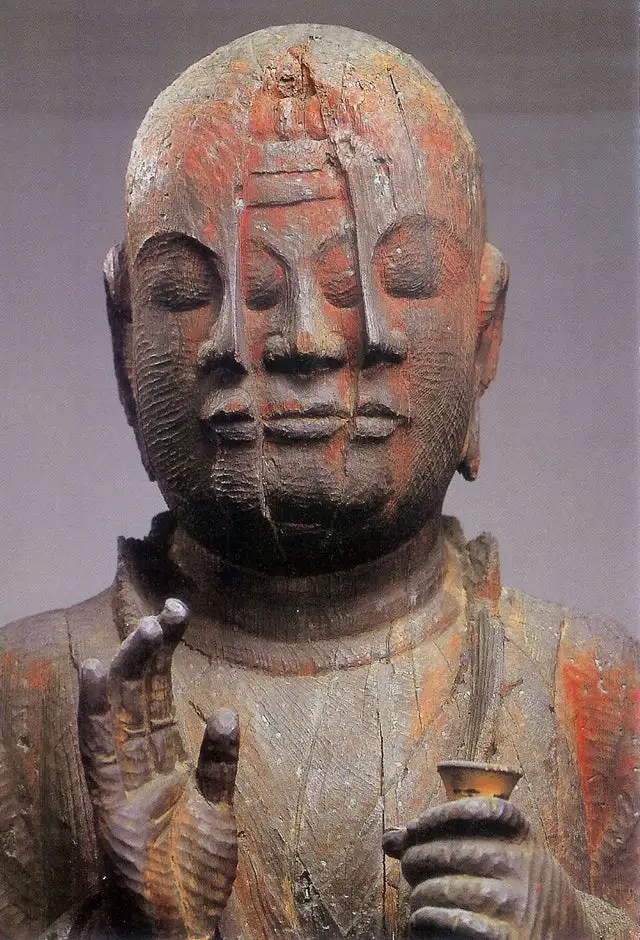
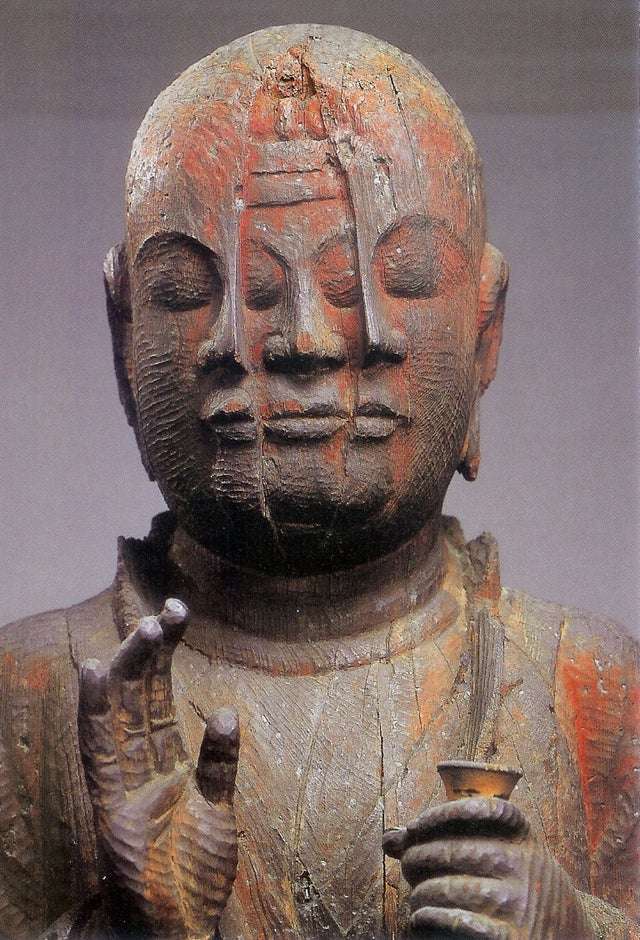
I’ve always wanted to create a piece of digital art portraying Monkey’s ascension and loss of his headband but never knew how to depict both events in the same picture. That is until a few days ago when I came across a beautiful 12th-century Japanese wooden sculpture of the Chan Buddhist monk Baozhi (Jp: Hoshi; K: Poji, 保志/寶志, 418–514) (fig. 1). The piece depicts “the monk’s face in supernatural corporeal transformation, splitting open to reveal the face of the numinous Eleven-Headed Kannon [Guanyin],” symbolizing his enlightenment (Levine, 2005, p. 72). I felt the statue was the best expression of enlightenment that I’ve ever seen. I later discovered the historical Baozhi was known for his ever youthful appearance, carrying a fanciful staff, and working magical miracles (Buswell & Lopez, 2014, p. 98; Ebrey, 1993, pp. 100-102), much like our hero. I therefore knew this piece would be the model from which I’d create my art.
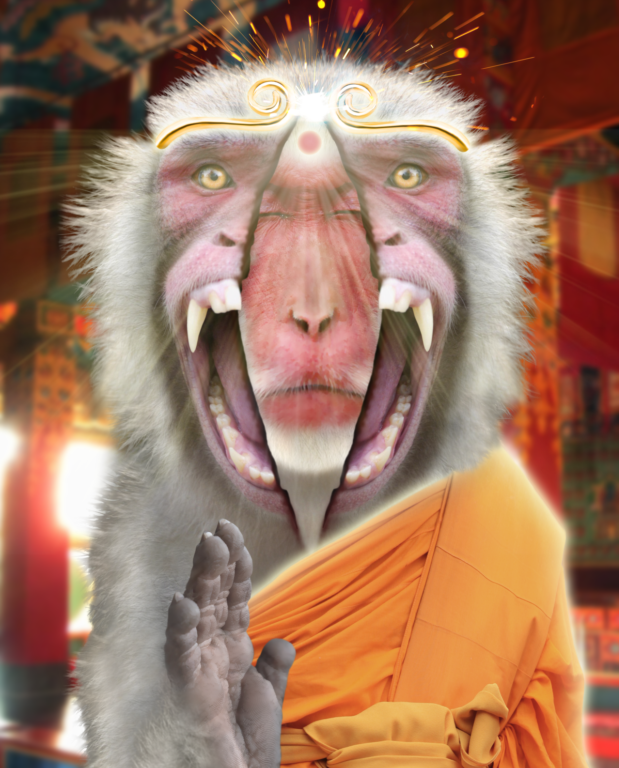
This is the final product created in Photoshop CS6 (fig. 2). The piece is comprised of 15 layers using eight different pictures. It took roughly two days working on and off during free time. The screaming face of the angry immortal splits open, giving way to the serene Buddha beneath. The sparks at the top represent the headband violently snapping open since it is no longer needed. Rays of spiritual light shine from the urna on Monkey’s forehead.
Fig. 2 – The Monkey Buddha has Awakened (larger version). Photomanipulation by the author.
Sources
Buswell, R. E. , & Lopez, D. S. (2014). The Princeton Dictionary of Buddhism. Princeton University Press.
Ebrey, P. B. (1993). Chinese Civilization: A Sourcebook, 2nd Ed. New York: Free Press.
Levine, G. P. A. (2005). Daitokuji: The Visual Cultures of a Zen Monastery. Seattle: University of Washington Press.
Wu, C., & Yu, A. C. (2012). The Journey to the West (Vol. 4) (Rev. ed.) Chicago, Illinois : University of Chicago Press.
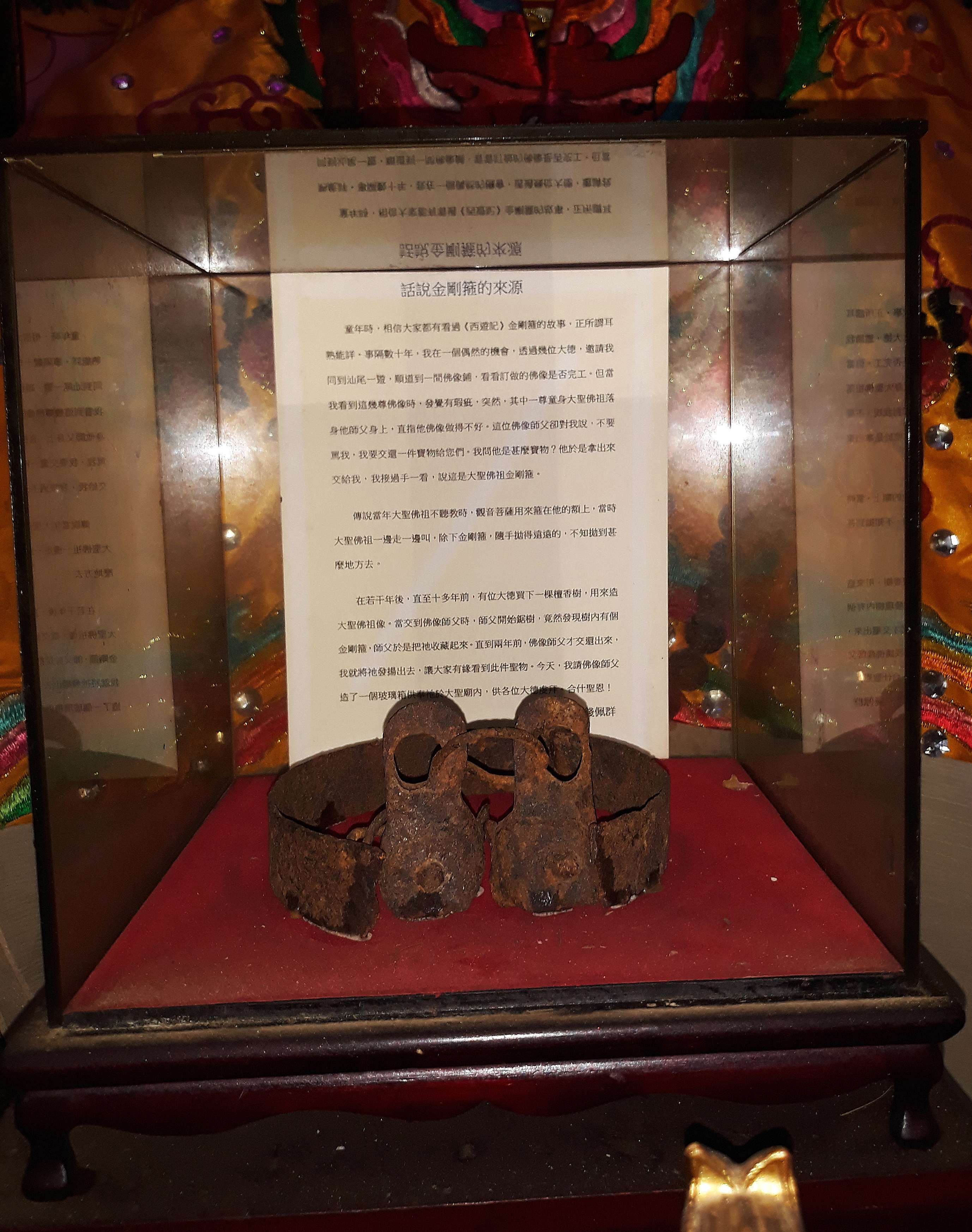
I recently attended the birthday of Sun Wukong on September 25th (the 16th day of the 8th lunar month) in Kowloon, Hong Kong (I’ll write more about this later). While the festivities took place at an alternate location with a secondary altar, I later visited the main altar in the Great Sage Treasure Temple (Dasheng bao miao, 大聖寶廟) on the Po Tat Estate. The altar stage includes a large gilded statue of Wukong, flanked on either side by those of his religious brothers Sha Wujing and Zhu Bajie. Strangely enough, a glass box is conspicuously placed in front of the Monkey King’s visage (fig. 1). Inside is a rusted metal band held together with a single chain link (fig. 2). An accompanying text panel labels it the “Vajra/Diamond Headband” (Jingang gu, 金剛箍) and claims the piece to be the original band worn by the Great Sage during his adventures. This same text is echoed in the Kowloon Great Sage Buddha Hall: Special Inaugural Ceremony Issue of the Sixteenth Year Council Association (Jiulong Dasheng Fo tang: Di shiliu jie lishi hui jiu shi dianli tekan, 九龍大聖佛堂: 第十六屆理事會就識典禮特刊) (2014), a booklet handed out during this year’s festivities. [1]
Fig. 1 – The glass box is visible between the food offerings and the Great Sage’s statue (larger version). Photo by the author.
I. Translation
From Childhood, I believe that everyone has read the story of the golden headband from Journey to the West. Everyone is familiar with the tale. A few decades later [after the events took place], some Buddhists were invited to a Buddhist statue workshop in Shanwei [City, Guangdong Province, China] to see if the Buddha statue they ordered was finished. But when they saw the statue they found it full of flaws. Suddenly, one among them spoke up and said it wasn’t made well enough. The Buddhist statue workshop master asked not to be chastised and said he instead wanted to give them a treasure. They asked him what it was. When he handed it to them they saw it was the Great Sage Buddha’s [original] golden headband.
People say that when Sun Wukong would not accept the Buddhist teachings, Guanyin put the band on his head. Sun Wukong ran side to side while yelling, trying to take it off and throw it far away to some unknown place [but couldn’t].
Many years later, maybe until ten years ago, a virtuous man purchased a sandalwood tree in order to build a Great Sage Buddha statue. He gave it to a Buddhist statue workshop master, who started to saw the tree but soon discovered the golden headband inside and decided to keep it for himself. Two years later, he decided to return it so everyone could behold this sacred treasure. Today, we asked the Buddhist workshop master to make a glass box to display the band in the Great Sage Temple for everyone to worship (p. 45). [2]
Fig. 2 – The glass box with the headband. The accompanying text panel can be seen in the back (larger version). Photo by the author.
Chapter 100 of the original novel describes the headband disappearing once Monkey internalizes self-restraint and becomes a Buddha (Wu & Yu, 2012, p. 383). The ultimate fate of the band is never commented on thereafter. The above story presents a continuation of the tale, thereby linking the Great Sage Treasure Temple with the original events of the novel. The band is lost and discovered twice over the centuries, eventually coming to rest in Hong Kong.
II. Similarities with Shaolin art
The displayed headband appears to be quite old given the level of rust damage. In addition, the style is different than any band I’ve written about before. That being said, the style is somewhat similar to a 17th-century mural from the famed Shaolin Monastery. The mural depicts a muscular luohan wielding a staff and standing next to a ferocious tiger (possibly the Tiger-Taming Luohan). His crown is adorned with a headband held together by a single chain link (fig. 3) similar to our aforementioned band. I am by no means claiming a connection to Shaolin, but it shows there may have been some style of linked headband associated with protector deities in late dynastic China.
Fig. 3 – The 17th-century Shaolin mural (larger version). Take note of the linked headband. From Shahar, 2008, p. 90.
Notes
1) The presented folk story is as told by the Kowloon Great Sage Buddha Hall First Vice-Chairperson Qian Peiqun (錢佩群).
2) Thank you to Kelly Black Lin for helping me with the translation.
Sources
Kowloon Great Sage Buddha hall: Special inaugural ceremony issue of the sixteenth year Council association (2014, Sept. 9). Published by the Hong Kong Shanwei General Commerce Association Limited.
Shahar, M. (2008). The Shaolin monastery: History, religion, and the Chinese martial arts. Honolulu: University of Hawai’i Press.
Wu, C., & Yu, A. C. (2012). The journey to the West: Volume 4. Chicago, Ill: University of Chicago Press.
Now that I’ve written an entry debunking the idea that the Monkey King’s staff anchored the Milky Way, I now want to write a piece about his greatest feat of strength in Journey to the West. This takes place in chapter 33 after Zhu Bajie has been captured by two demon brothers, Kings Goldhorn (Jinjiao Dawang, 金角大王) and Silverhorn (Yinjiao Dawang, 銀角大王). King Silverhorn, the younger of the two, then sets out to capture Tripitaka but is forced to resort to trickery when he learns that the monk is protected by Sun Wukong. He transforms himself into an elderly Daoist laying by the roadside with a broken leg. The monk subsequently forces Monkey to carry him on his back, but our hero sees through the disguise and plans to throw his charge off a cliff. However…
As the Great Sage was about to do this, the monster knew instantly of his plan. Knowing how to summon mountains, he resorted to the magic of Moving Mountains and Pouring Out Oceans. On Pilgrim’s [Monkey’s] back he made the magic sign with his fingers and recited a spell, sending the Sumeru Mountain into midair and causing it to descend directly on Pilgrim’s head. A little startled, the Great Sage bent his head to one side and the mountain landed on his left shoulder. Laughing, he said, “My child, what sort of press-body magic are you using to pin down old Monkey? This is all right, but a lopsided pole is rather difficult to carry.”
The demon said to himself, “One mountain can’t hold him down.” He recited a spell once more and summoned the Emei Mountain into the air. Pilgrim again turned his head and the mountain landed on his right shoulder. Look at him! Carrying two mountains, he began to give chase to his master with the speed of a meteor! The sight of him caused the old demon to perspire all over, muttering to himself, “He truly knows how to pole mountains!” Exerting his spirit even more, he recited another spell and sent up the Tai Mountain to press down on Pilgrim’s head. With this magic of the Tai Mountain Pressing the Head, the Great Sage was overpowered as his strength ebbed and his tendons turned numb; the weight was so great that the spirits of the Three Worms inside his body exploded and blood spurted from his seven apertures (Wu & Yu, 2012, vol. 2, pp. 108-109).
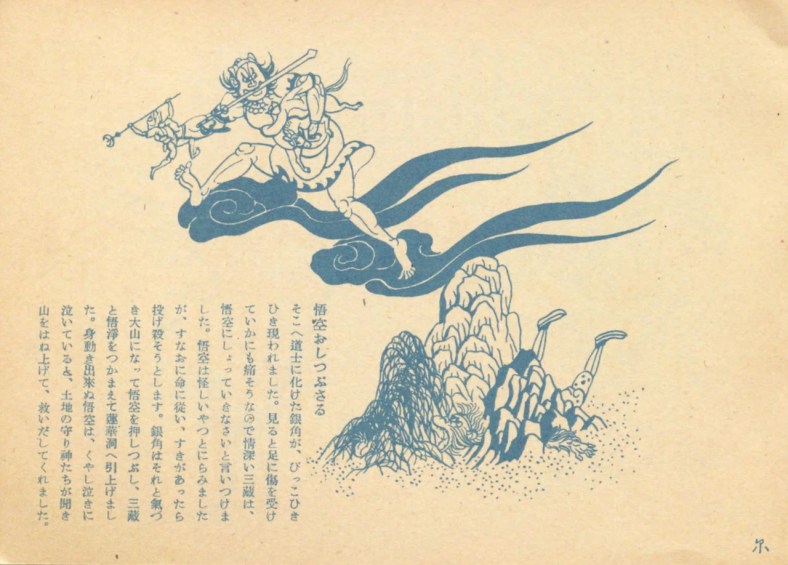
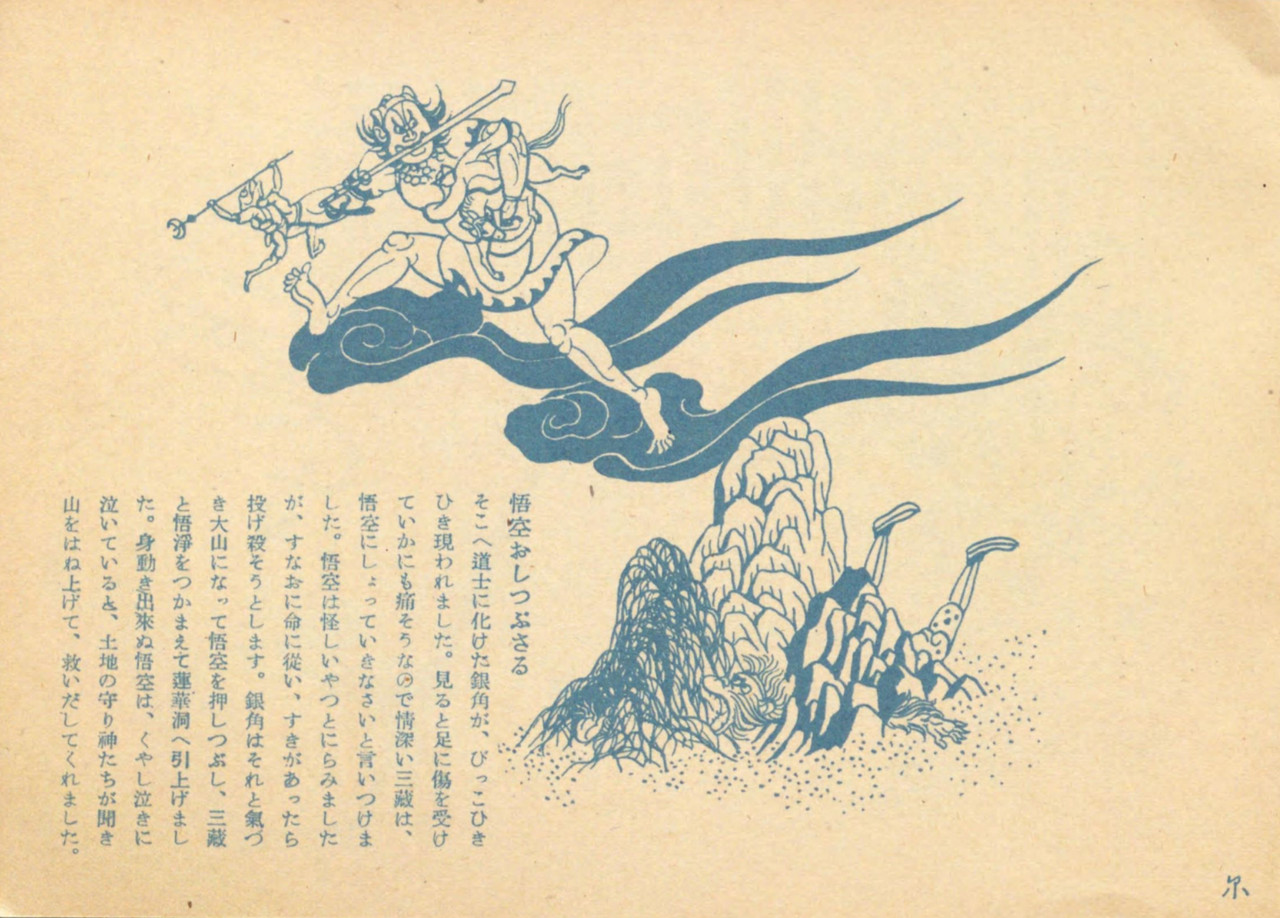
We see here Monkey is able to successfully carry the weight of both the Sumeru and Emei mountains, while running after his master “with the speed of a meteor.” That’s quite impressive, even if he is eventually crushed under the weight of a third mountain (fig. 1). Attention should be given to the particular mountains used in this episode. Let’s start with Sumeru since this is the first one mentioned.
Fig. 1 – Monkey trapped under the three mountains as King Silverhorn abducts Tripitaka, the dragon horse, and Sha Wujing (larger version). From The Illustrated Journey to the West (1950), a Japanese children’s book.
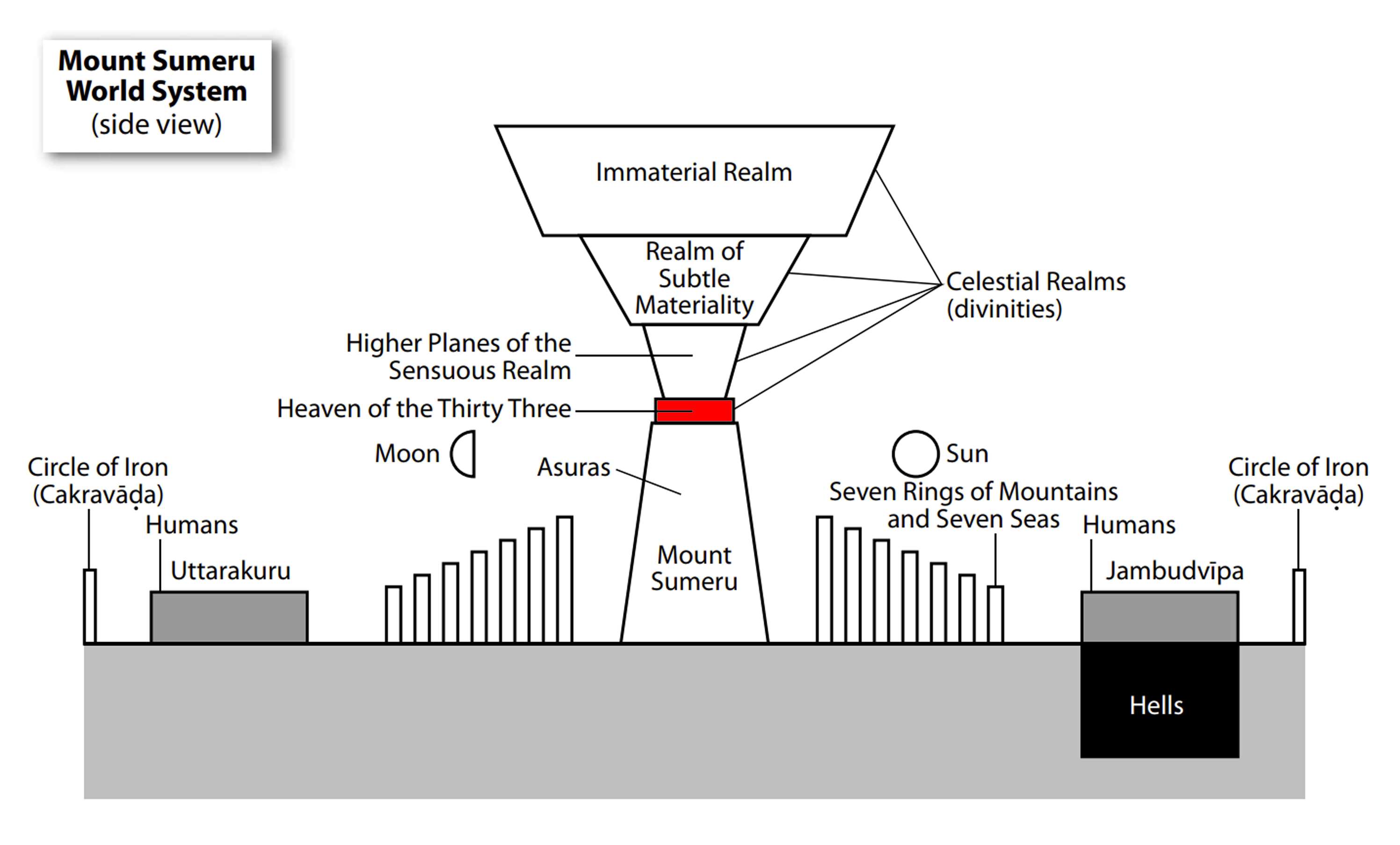
Buswell and Lopez (2014) describe Mount Sumeru (Ximi shan, 須彌山; Miaogao shan, 妙高山) as:
The central axis of the universe in Buddhist cosmology; also known as Mount Meru. Mount Sumeru stands in the middle of the world as its axis and is eight leagues high … The slopes of Sumeru are the abode of demigods, and its upper reaches are the heavens of the four heavenly kings. At the summit of the mountain is the heaven of the thirty-three, ruled by the king of the gods, Sakra. Above Mount Sumeru are located the remaining heavens of the sensuous realm [fig. 2] (p. 896).
[Note: The portion that has been struck through appears to be a typo. Please see the 06-19-22 update below.]
A poem in chapter four of Journey to the West describes what Monkey sees when he first comes to live in heaven as the Keeper of the Heavenly Horses. A portion reads:
Thirty-three mansions were found up here, / With names like the Scattered Cloud, the Vaisravana, the Pancavidya, the Suyama, the Nirmanarati…” (Wu & Yu, 2012, vol. 1, p. 146).
Yu (Wu & Yu, 2012) comments, “The verse here is alluding to the Indra heaven with it’s thirty-three summits (trāyastriṃśa) [fig. 2] and the six heavens of desire (devalokas)” (vol. 1, p. 510, n. 1), which are located atop Mount Sumeru. Therefore, the heaven described in the novel is located on the same cosmic mountain as that from Hindo-Buddhist cosmology, meaning Monkey successfully supports the axis of the universe on one shoulder.
Mount Emei (Emei shan, 峨嵋山; 峨眉山) is one of the four sacred Buddhist mountains of China. It is considered extremely important as Chinese tradition believes, upon entering the Middle Kingdom from India, Buddhism spread from this place during the eastern Han Dynasty and proliferated throughout China. The mountain is 10,167 feet high, making it over 3,000 feet taller than the other sacred Buddhist mountains. The mountain is believed to be the heavenly abode of the Bodhisattva Samantabhadra, making him the patron saint of Emei (Buswell & Lopez, 2014, pp. 282-283).
I want to reiterate the fact that both Sumeru and Emei are important to Buddhism. Not only does Monkey support the very axis of the Buddhist universe on one shoulder, he supports on the other the very mountain from which the religion is believed to have spread into China. I’m not sure if this was the author-compiler’s original intent, but it seems as if this feat of strength could be symbolism for Monkey literally “supporting” Buddhism by protecting his master on their journey to India. After all, the historical Xuanzang (玄奘, 602-664), on whom Tripitaka was based, is considered to be one of, if not the most, prolific translators of Buddhist texts in the history of Chinese Buddhism (Buswell & Lopez, 2014, pp. 1015-1016).
I turn now to Mount Tai (Taishan, 泰山), the mountain that ultimately overwhelms Sun Wukong’s supernatural strength. It is one of the five sacred mountains of China, which differ from the four Buddhist counterparts mentioned above. Mount Tai was the epicenter of a state cult in Ancient China, one in which Sage-Kings and emperors of past millennia traveled there to perform sacrifices to heaven, thereby gaining the right to rule or attaining eternal life. An entry in the Classic of History (Shujing, 書經, 4th-c. BCE) suggests that the practice goes all the way back to the Sage-King Shun (3rd millennia BCE) (Poo, 2011, pp. 20-21). Due to its great cultural and historical significance, the mountain came to be recognized as an adamantine monolith, the very name of which was used as a metaphor for something unfathomably heavy, whether it be a physical measure of weight or philosophical importance. For example, Warring States philosopher Mozi took part in a debate over the plausibility of his school of thought taking center stage in Chinese society. His opponent claimed, “As we see it, one can no more put it into practice than one can pick up Mount Tai and leap over a river with it!” Mozi highlighted the irrelevant nature of the metaphor by replying, “As for picking up Mount Tai and leaping over rivers with it, no one from ancient times to the present, from the beginning of humankind to now, has ever succeeded in doing that!” (Watson, 1999a, p. 71). Another example comes from the Han historian Sima Qian who wrote, “A man has only one death. That death may be as weighty as Mount Tai, or it may be as light as a goose feather. It all depends upon the way he uses it” (Watson, 1999a, pp. 371-372). Therefore, the mountain represented the heaviest thing imaginable in Chinese culture. It’s no wonder then that not even Monkey could withstand its weight.
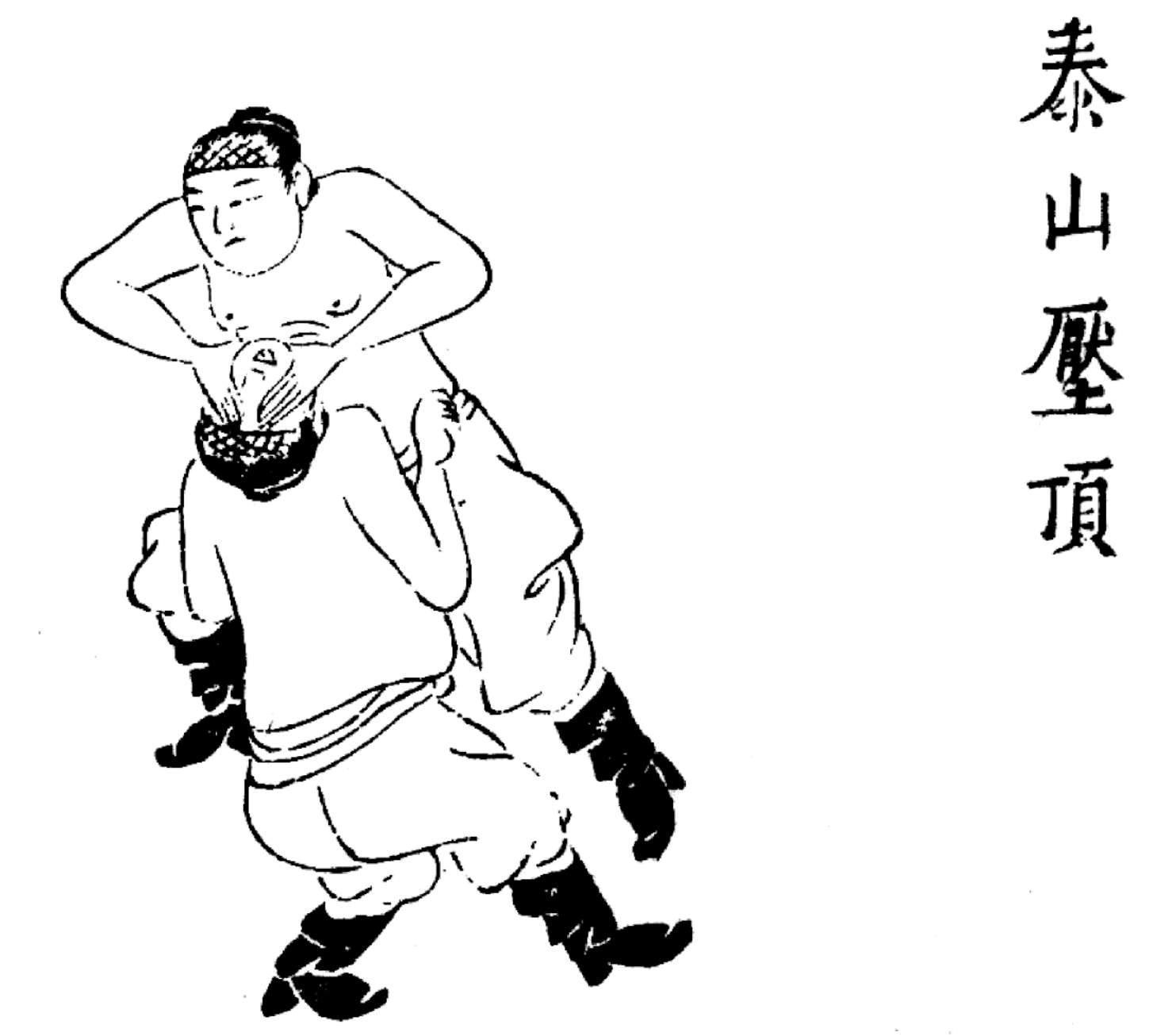
The idea of Mount Tai symbolizing a heavy object influenced the name of a 17th-century technique related to the development of Taiji boxing called “Crush with the Weight of Mount Tai” (Taishan yading, 泰山壓頂) (fig. 3), which involved climbing onto an opponent (Henning, 2009, pp. 78 and 82). Incidentally, the name of this technique is also a common Chinese saying referring to someone being under a lot of stress (Gao, Wang, & Weightman, 2012, p. 191).
Fig. 3 – “Crush with the Weight of Mount Tai”. From Henning, 2009, p. 78 (larger version).
I find it interesting that, after easily bearing the weight of two Buddhist mountains, Mount Tai is the proverbial straw that broke the camel’s back. Mount Tai represents native Chinese history and culture, while Sumeru and Emei represent Buddhism, a non-native religion from India. Therefore, this episode could be read as a struggle between the domestic and foreign aspects of Chinese culture. Considering that the monsters are later revealed to be Daoist attendants of Laozi sent by heaven to test the resolve of the pilgrims (Wu & Yu, 2012, vol. 2, p. 145), it’s possible the conflict is between Daoism, a native Chinese religion, and Buddhism.
This is obviously not a perfect theory, though. For instance, Laozi reveals that it was actually the Bodhisattva Guanyin who requested the lads be sent (Wu & Yu, 2012, vol. 2, p. 145). Does this explain why a Daoist spirit would summon two Buddhist mountains to crush Monkey? I’m interested in what others think.
Fig. 4 – A modern painting of Hanuman lifting the mountain (larger version). All credit goes to the original artist S. Keerthi.
Lastly, I would like to note that Sun Wukong’s feat of lifting mountains recalls an episode in the Ramayana (4th-c. BCE) in which the monkey god Hanuman carries back a mountain laden with magical herbs to heal the wounds of his master‘s brother Lakshmana (fig. 4). Hanuman is the living embodiment of strength (shakti) in India (see for example Alter, 1992). Monkey is believed to be loosely based on Hanuman (Walker, 1998), so there could be a connection between both instances of mountain lifting.
Update: 08-10-18
Monkey’s feat appears to be based on a native Chinese story and not the Ramayana. This is first hinted at in chapter 33 when the demon exclaims that the Great Sage “truly knows how to pole mountains [ta que hui danshan, 他卻會擔山]!” (Wu & Yu, 2012, vol. 2, p. 109). A poem spoken by Sun Wukong in chapter 67 confirms the connection:
Purvavideha was my ancestral home, I did cultivation on Mount Flower-Fruit. I bowed to the Patriarch of Heart and Mind and perfected with him the martial arts. I can tame dragons, stirring up the seas; I can tote mountains to chase down the sun (emphasis added). In binding fiends and demon’s I’m the best; Moving stars and planets, I scare ghosts and gods. Stealing from heav’n and Earth gives me great fame, Of boundless change, Handsome Stone Monkey’s my name (Wu & Yu, 2012, vol. 3, p. 243).
Fig. 5 – Erlang poling the mountains (larger version). Artist unknown.
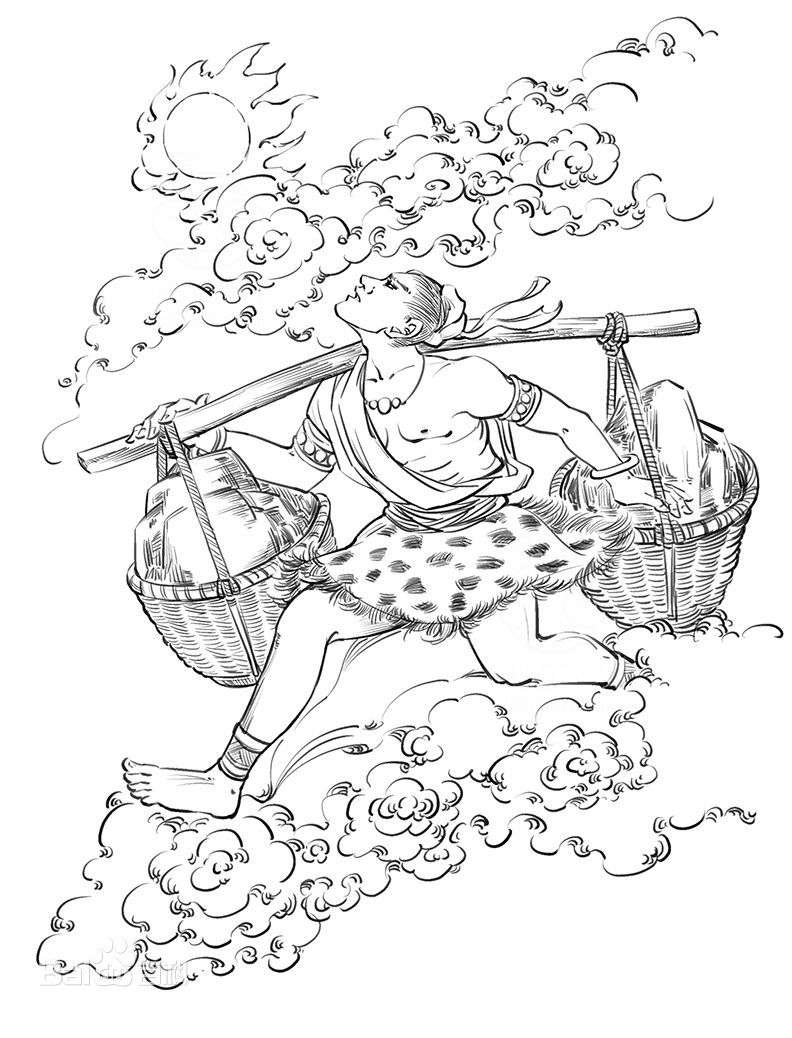
“I can tote mountains to chase down the sun” (shan hui danshan gan ritou, 善會擔山趕日頭) is a clear allusion to the ancient tale “Erlang carries mountains to chase the suns” (Erlang dan shan gan taiyang, 二郎擔山趕太陽). The tale describes how the ancient earth was plagued by many suns that scorched the land, making it impossible for people to grow anything. Vowing to end this plight, the hero Erlang shoulders two mountains hanging from a tree and, with the aid of magical shoes, chases down each sun (fig. 5), using the weight from both landmasses to overwhelm and crush the superfluous celestial bodies (担山赶太阳, n.d). Apart from the feat of lifting two mountains, Erlang’s fleet pursuit of each sun (gan taiyang, 趕太陽) foreshadows Monkey “giv[ing] chase to his master with the speed of a meteor” (fei xing lai gan shifu, 飛星來趕師父).
It’s interesting to note that “Erlang Carrying Mountains” (Erlang dan shan, 二郎擔山) is a common Shaolin stance, and a staff variant even appears in the Collection of Military Works(Wubei zhi, 武備志, c. 1621), a Ming treatise on military armaments and fighting techniques (fig. 6). The staff obviously recalls the pole (or in this case tree) that Erlang uses to bear the weight of the mountains.
One thing I forgot to stress was the speed with which Sun Wukong is able to run while carrying the mountains. The novel reads: “Carrying two mountains, he began to give chase to his master with the speed of a meteor!” (Kan ta tiaozhe liang zuo dashan, feixing lai gan shifu, 看他挑著兩座大山,飛星來趕師父) (Wu & Yu, 2012, vol. 2, p. 109). According to this page, meteors (feixing, 飛星; lit: “flying stars”) enter the atmosphere between 25,000 to 160,000 mph (40,226 to 257,451 km/h). So Monkey would be traveling at mach 32 to 208(!) while carrying the weight of the aforesaid mountains. Pretty impressive, no? I wonder if Superman has ever carried something this heavy while running.
Update: 03-11-22
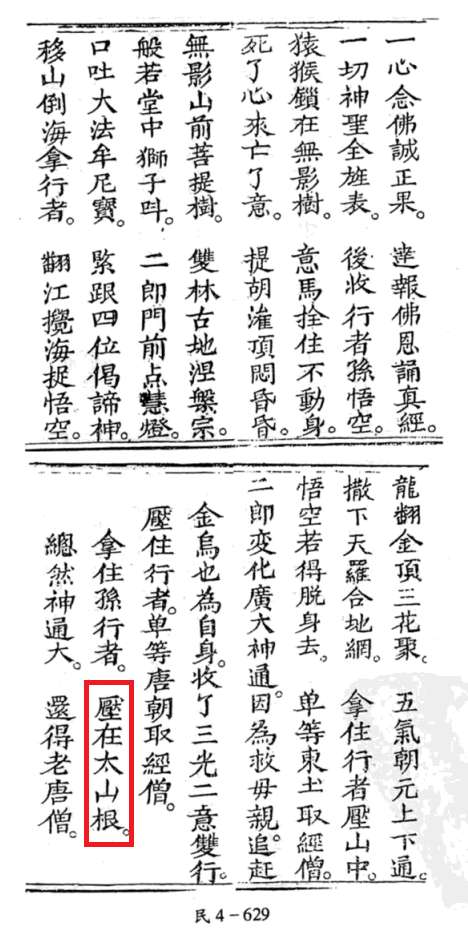
I recently archived the Precious Scroll of Erlang (Erlang baojuan, 二郎寳卷, 1562), a baojuan that venerates and records the various deeds of the immortal demi-god. The work states that the Monkey King was “pressed under the base of Mt. Tai” (yazai, taishan gen, 壓在太山根) (PDF page 46) (fig. 7). This might also explain why Mt. Tai overwhelms Monkey in chapter 33.
Fig. 7– The Mt. Tai sentence is indicated in red (larger version).
Update: 03-25-22
My friend Irwen Wong of the Journey to the West Library blog was kind enough to provide me with time-stamped links to the aforementioned episode in the various JTTW TV shows. I will list them in order of year.
Journey to the West (1986) – live action
Even though this is my favorite show, it did a poor job of representing the mountain. It’s little more than a boulder.
Journey to the West: Legends of the Monkey King (2000) – animated
This cartoon just has monkey trapped by a single mountain.
New Journey to the West (2010) – live action
This version uses all three mountains and really steps up the special effects. This is no surprise given the differences in time and budget between it and the 1986 edition.
Journey to the West (2011) – live action
This is my favorite depiction of the episode. The special effects are top notch. I will say the elongated arms on the Taoist are a bit odd. But Irwen suggests it’s likely a visual representation of “poling” mountains (as discussed above).
Each of these iterations have their own charm. But all of them depart from the novel by showing Monkey struggling to carry the first two mountains. I remind the reader that the literary character runs “with the speed of a meteor!” while carrying the load (Wu & Yu, 2012, vol. 2, p. 108). I guess that would have been hard to depict, even with modern computer graphics.
Update: 06-19-22
Sun Wukong’s feats are on the minds of many people as the Death Battle TV show is set to feature a fight between Hercules and our monkey hero. I’ve seen a few blogs where people try to calculate the size of Mount Sumeru. I cited a source above stating that the landmass is “eight leagues high” (Buswell & Lopez, 2014, p. 896), but this appears to be a typo, for other sources multiply this estimate by thousands of times. For example, Sadakata (1997) explains that, according to the Abhidharmakośa (Ch: Api damo jushe lun, 阿毗達磨俱舍論, 4th to 5th-century): “Sumeru has a height of 160,000 yojanas, of which half is under water. The half above water is therefore 80,000 yojanas high” (pp. 26-27). The yojana (youxun, 由旬) is approximately eight miles (12.87 km), or the distance that one can travel in one day on a cart driven by a team of oxen. But estimates also range between four and ten miles (6.43 and 16.09 km) (Buswell & Lopez, 2014, p. 1036). If eight miles is used, then Mt. Sumeru would an astounding 1,280,000 miles (2,059,960.32 km) tall.
Update: 07-03-22
I should note that Journey to the West does not depict Monkey’s strength consistently throughout the novel. As mentioned, he can carry two mountains (one of them the cosmic axis) on his shoulders while running with meteoric speeds. But apart from Mt. Tai, the novel describes another object that he can’t pick up. Chapter 42 reads:
[T]he Bodhisattva grew terribly angry, crying, “How dare that brazen fiend [Red Boy] change into my image!” As she cried, she flung into the ocean the immaculate porcelain vase set with precious pearls which she held in her hand …
[After her turtle emerges from the sea with the vase on its back, she orders Monkey to retrieve it for her.] Pilgrim went forward at once to pick up the vase. Alas! He could not do so at all! It was as if a dragonfly attempted to rock a stone pillar-how could he even budge it? Pilgrim approached the Bodhisattva and knelt down, saying, “Your disciple cannot pick it up.” “Monkey head,” said the Bodhisattva, “all you know is how to brag! If you can’t even pick up a small vase, how can you subdue fiends and capture monsters?” “To tell you the truth, Bodhisattva,” said Pilgrim, “I might be able to do it ordinarily, but today I just can’t pick it up. I must have been hurt by the monster-spirit, and my strength has weakened.” The Bodhisattva said, “Normally it’s an empty vase, but once it has been thrown into the ocean, it has traveled through the three rivers, the five lakes, the eight seas, and the four big rivers. It has, in fact, gathered together from all the aquatic bodies in the world an oceanful of water, which is now stored inside it. You may be strong, but you don’t possess the strength of upholding the ocean. That’s why you cannot pick up the vase…” (Wu & Yu, 2012, vol. 2, pp. 243 and 244).
But there may be an underlying religious reason for this. For instance, while Sun can’t lift it, the goddess does so easily, as does her holy sea turtle (Wu & Yu, 2012, vol. 2, p. 243). Most importantly, the story suggests that Guanyin will send her holy disciple, the “Dragon Girl Skilled in Wealth” (Shancai longnu, 善財龍女), to carry it for him (Wu & Yu, 2012, vol. 2, p. 244). So, this could mean that Monkey, at this point in the story, lacks the Buddhist spiritual attainments necessary to lift the vase. “Dharma Power” (fali, 法力) is considered the penultimate power in the novel’s universal hierarchy, even outclassing that wielded by high Daoist deities.
Sources:
Alter, J. S., & OUP. (1992). The Wrestler’s Body: Identity and Ideology in North India. Berkeley, Calif: University of California Press.
Buswell, R. E., & Lopez, D. S. (2014). The Princeton Dictionary of Buddhism. N: Princeton University Press.
Gao, W., Wang, A., & Weightman, F. (2012). A Handbook of Chinese Cultural Terms. Bloomington, Indiana: Trafford On Demand Pub.
Henning, S. (2009). Taijiquan: Symbol of Traditional Chinese Martial Arts Culture. Journal of Chinese Martial Arts, 1, pp. 76-83.
Poo, M. (2011). Preparation for the Afterlife in Ancient China. In Olberding, A., & Ivanhoe, P. J. (Ed.), Mortality in Traditional Chinese Thought (pp. 13-36). Albany: State University of New York Press.
Sadakata, A. (1997). Buddhist Cosmology: Philosophy and Origins. Japan: Kosei Publishing Company.
Walker, H.S. (1998). Indigenous or Foreign? A Look at the Origins of Monkey Hero Sun Wukong. Sino-Platonic Papers, 81, 1-117.
Watson, B. (1999a). Mozi: Utility, Uniformity, and Universal Love. In De Bary, W. T. & Bloom, I. (Eds.), Sources of Chinese Tradition: Volume 1: From Earliest Times to 1600 (pp. 64-76). New York: Columbia University Press.
Watson, B. (1999b). The Great Han Historians. In De Bary, W. T. & Bloom, I. (Eds.), Sources of Chinese Tradition: Volume 1: From Earliest Times to 1600 (pp. 367-374). New York: Columbia University Press.
Wu, C., & Yu, A. C. (2012). The Journey to the West (Vols. 1-4) (Rev. ed.). Chicago, Illinois: University of Chicago Press.
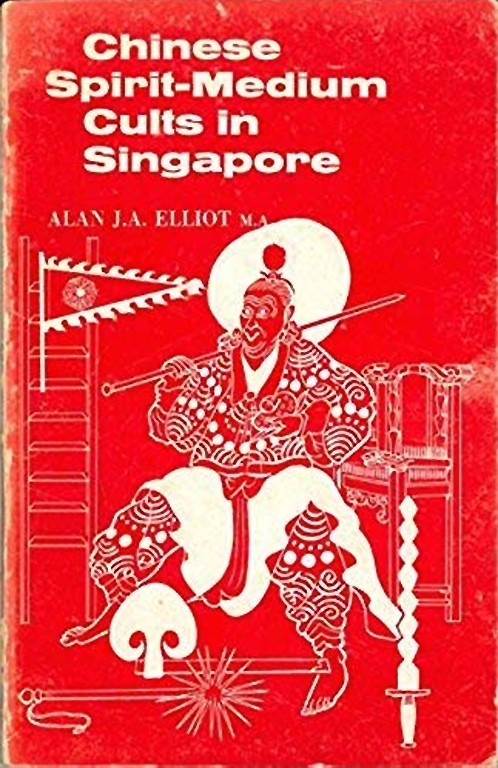
Here I present a PDF of Chinese Spirit-Medium Cults in Singapore (1955/1990) by Alan J. A. Elliott. The book contains a large chapter on the importance of spirit-mediums (Hokkien: Tangki, 童乩; Chinese: Jitong, 乩童; literally: “Divining Child”) in the worship of Sun Wukong. For those unfamiliar with spirit-mediums, I have quoted material from my article linked above:
They are believed to channel [the Great Sage’s] spirit to interact with believers, generally answering their questions, blessing them or their belongings with paper talismans, or prescribing medicine. On special occasions, they also perform a complex self-mortification ceremony […] The ritual serves several purposes. First, hacking, skewering, and poking the body with various weapons is considered a form of self-sacrifice. Second, the weapons that pierce the flesh are believed to imbue the mediums with spiritual power needed in their battle with demonic forces that pervade every corner of daily life. Third, the resulting blood is believed to have demonifugic properties, hence the reason it is smeared on paper talismans and clothing. Overall, the ritual is performed to exorcize evil spirits that cause bad luck and mental and physical illnesses.
Cover from the 1964 (2nd edition) (larger version). Note the prominence of the Monkey King.
I. Forward from the 1990 Edition
This account of Chinese spirit-medium cults describes in great detail an important aspect of the religion of overseas Chinese in Singapore. It is an historical study, since the field research was carried out over nearly two years in 1950 and 1951. It is historical for two reasons. One is that the highly personalized nature of many of these cults has meant that they are short-lived, emphemeral. The other is that in the forty years since the study was made the life of the Singapore Chinese has changed radically, and many of their ritual practices must have altered accordingly. But at the time this research was carried out, anthropological field studies of Chinese social institutions were rare, and this particular investigation was unique. Most studies of Chinese religion anywhere had been of a literary nature, concerning the ideas and practices of Confucianism, Buddhism, Taoism; very little information was available about how ordinary Chinese conducted their daily ritual affairs.
The significance of this study is not just focused on the past. It has contemporary relevance, and for a field far wider than Singapore alone. For anthropologists, enquiry into spirit-mediumship, shamanism, ecstatic religion, possession, has become a recognised part of the discipline, over a broad ethnographic range. But the general problems involved, of alternative personality, of apparent lack of sensitivity to external physical stimuli, of claims in the name of spirit to knowledge and authority not possessed by the human medium, can attract the attention of psychologists, psychiatrists, and all interested in the obscure and complex workings of the human mind. The issues raised involve ordinary people too, since they show how anxiety, uncertainty, fear, disappointment and greed seek assurance and resolution from some source deemed superhuman, even spiritual. The basic beliefs revealed by this study of Chinese spirit-mediumship are not confined to Chinese.