Last updated: 01-30-2024
The great Chinese classic Journey to the West (Xiyouji, 西遊記) was anonymously publish in 1592 and has since then enjoyed the adoration of readers for the last four centuries. But not many people know that an earlier version of the novel exists that predates the popular narrative by some three hundred years. Titled The Story of How Tripitaka of the Great Tang Procures the Scriptures (Da Tang Sanzang qujing shihua, 大唐三藏取經詩話, c. late-13th century), this seventeen chapter novelette likely served as a prompt for oral storytellers, [1] and given it’s age, contains material that differs greatly from the final 16th-century version. For example, the disciple Zhu Bajie doesn’t even appear in the story, and a precursor of Sha Wujing only makes a brief cameo as a monster that Monkey battles.
The novelette is also known as the “Kozanji version” as two editions are mentioned in a 1633 catalog held by the titular Japanese Buddhist temple. The Chinese scholars Wang Guowei (王國維, 1877–1927) and Luo Zhenyu (羅振玉, 1866–1940) first identified the earlier of the two editions as a work of the late-Song Dynasty (960–1279). [2] This article will summarize each short chapter, as well as discuss the similarities and differences between it and the final Ming version of Journey to the West. I rely heavily on the English translation by Charles S. Wivell (1994).
Table of Contents
Ch. 1 – TITLE MISSING
[TEXT MISSING]
Ch. 2 – “En Route They Encounter the Monkey Pilgrim”
Tripitaka and five other monks happen upon a white-clad scholar on their way to India. The figure warns the Sutra Master that his two previous incarnations have died on such a journey, and he will die a thousand times more unless he has protection. The scholar reveals himself to be “the bronze-headed, iron-browed king of the eighty-four thousand monkeys of the Purple Cloud Grotto on the Mountain of Flowers and Fruit” (Huaguoshan ziyundong bawan siqian tongtou tie’e mihou wang, 花果山紫雲洞八萬四千銅頭鐵額獼猴王) (Wivell, 1994, p. 1182). Tripitaka accepts his help and rejoices that Karma is uniting the past, present, and future to benefit the people of China. Tripitaka gives him the name “Monkey Pilgrim” (Hou xingzhe, 猴行者).
JTTW Comparison (A)
Similarities:
1) Tripitaka initially sets out with a retinue of monks, but they are all eventually killed by monsters and tigers in chapters 13 and 14.
2) He starts referring to Monkey by the name Pilgrim Sun (Sun Xingzhe, 孫行者) in chapter 14.
Differences:
1) Triptaka happens upon Monkey at the base of Five Elements Mountain, where he has been imprisoned for the last five hundred years. He removes a magic talisman from the top of the mountain, allowing the immortal to break free. See chapter 14.
2) The name Sun Wukong does not appear in the novelette. He is given the name by the immortal Subodhi in chapter one.
Ch. 3 – “Entering the Palace of Mahābrahmā Devarāja”
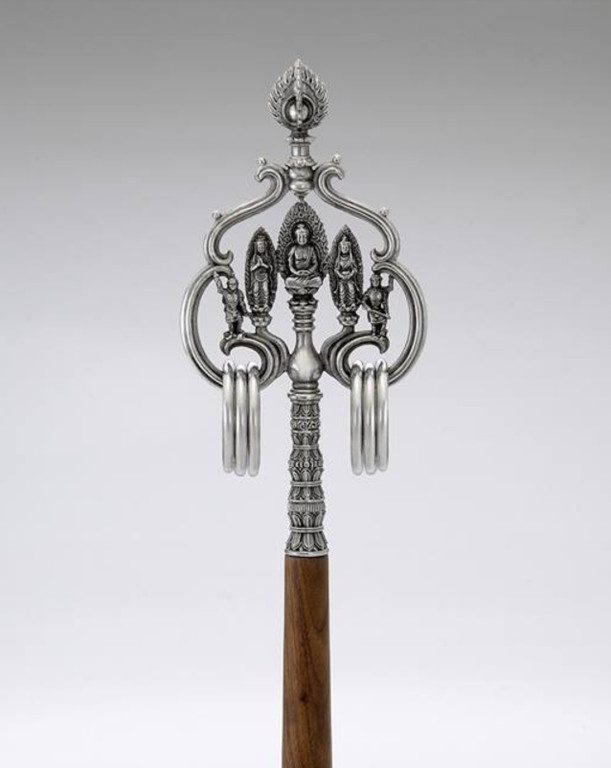
Pilgrim tells the monks he is so old that he has seen the Yellow River dry up nine different times over thousands of generations. Since the immortal has knowledge of the celestial realms, Tripitaka asks Monkey to fly the group to heaven to attend the Buddhist feast being held by Vaiśravana, the Mahābrahmā Devarāja (Dafan tianwang, 大梵天王), in the Crystal Palace. There, the devas ask the monk to give a lecture on the Lotus Sutra. Knowing that a monster, the “Spirit of the Deep Sand” (Shensha shen, 深沙神), had twice devoured Tripitaka in the past, the Devarāja bestows on Monkey three magic weapons to aid in his defense. These include a cap of invisibility, a golden-ringed monk’s staff, and a begging bowl. In addition, Vaiśravana tells them to call his name so that they may be delivered from any danger they face on the journey.
JTTW Comparison (B)
Similarities:
1) Monkey travels to and from heaven as he pleases.
2) He interacts with Vaiśravana on several occasions (see below).
3) The Bodhisattva Guanyin bestows Tripitaka with a golden-ringed monk’s staff and a cassock in chapter 12.
Differences:
1) Monkey is roughly 1,100 hundred years old when he first meets Tripitaka.
2) He never uses his magic to transport the monk by cloud because the impure nature of mortal bodies makes them far too heavy. See chapter 22.
3) The August Jade Emperor is the ruler of heaven in the final version.
4) Vaiśravana makes several appearances as the Pagoda-Bearing Heavenly King Li Jing, father of the child god, Prince Nezha. [3] Monkey battles Li Jing and Prince Nezha during his rebellion in heaven. See chapter 4, for example.
5) Tripitaka is not eaten over and over again. He was originally the Golden Cicada Bodhisattva, who was exiled from heaven for falling asleep during one of the Buddha’s lectures. He goes through nine pious incarnations before he is reborn as the Sutra Master.
6) Monkey fights with an iron cudgel, which he retrieved from the underwater treasury of Ao Guang, the Dragon King of the Eastern Sea. See chapter 3.
7) This episode does not appear in the final version.
Ch. 4 – “Entry in Incense Mountain Temple”
The group travels to the land of the “Thousand-Armed Thousand-Eyed Bodhisattva” (Qian shou qian yan pusa, 千手千眼菩薩), or the Bodhisattva Guanyin (Wivell, 1994, p. 1185). They come upon the Incense Mountain Temple, which is lorded over by statues of fierce guardian deities. Inside, Tripitaka is dismayed to find the holy place has fallen into complete disrepair. Monkey reminds him that the worst is yet to come; the road to the west is full of foreign people with strange languages, wild animals, and unspeakable monsters.
They travel further and enter the Country of Snakes, which is populated by massive serpents that bellow miasmic clouds. However, despite their terrible appearance, the snakes respect the Buddha and let the pilgrims pass through unharmed.
JTTW Comparison (C)
Differences:
1) Guanyin lives on Mount Potalaka, an island in the Eastern Ocean.
2) The giant serpents do not appear in the final version.
Ch. 5 – “Passing the Lion Wood and the Country of Tree People”
The seven monks travel to the Lion Wood country where they are greeted by countless unicorns and lions with flowers in their mouths. Upon entering the Country of the Tree People, the group finds an inn to spend the night, and in the morning, a young monk is sent to fetch breakfast. However, hours pass without the little disciple returning, so Monkey searches the local village and finds that the monk has been transformed into a donkey by a sorcerer. Pilgrim uses his powers to turn the man’s wife into a bale of grass to feed her to the donkey as revenge. Horrified, the sorcerer then recalls his magic by spitting a mouthful of water on the animal. Monkey does the same and threatens to “mow down all the grass of [his] house” (i.e., kill his wife and anyone else he loves) if the man misuses his powers again (Wivell, 1994, p. 1187). The sorcerer promises to let the group pass through the country unharmed.
JTTW Comparison (D)
Differences:
1) This episode does not appear in the final version.
Ch. 6 – “Passing Long Ditch and Great Serpent Peak”
The monks travel to the valley of the fire-spitting white tiger spirit and encounter a large ditch through which they cannot pass. Pointing the ringed staff towards the heavens, Tripitaka calls the name of Vaiśravana and a ray of light issues forth from the rod that destroys the ditch. Next, the group passes through a fiery pit in which Ming Huang, Emperor Xuanzong of the Tang Dynasty, “changed his bones” and deposited them “like snow on a mountain” (Wivell, 1994, p. 1188). [4] Finally, the Sutra Master calls on the Devarāja once more and uses his alms bowl to extinguish a great prairie fire.
Pilgrim warns Tripitaka that they are passing through the territory of a white tiger spirit who can assume the form of any person. She appears out of the mist wearing white clothing and riding a white pony. Monkey confronts her, causing the spirit to forsake her beautiful façade and take on a demonic white tiger form. He then: “…transform[s] his golden-ringed staff into a gigantic Yakşa whose head touche[s] the sky and whose feet straddle the earth. In his hands he grasp[s] a demon-subduing cudgel. His body [is] blue as indigo, his hair red as cinnabar; from his mouth a fiery gleam sh[oots] forth a hundred yards long” (Wivell, 1994, p. 1189). She refuses to submit, so Pilgrim uses his magic to make her vomit up countless monkeys without end. When she still refuses to surrender, he takes the form of an ever-growing stone in her stomach, causing it to explode. The spirit is finally destroyed when Monkey orders the Yakşa to crush her with his cudgel.
JTTW Comparison (E)
Similarities:
1) The prairie fire may be a precursor to the Fiery Mountain that Monkey extinguishes in chapter 59.
2) The mention of bones and a white-clad demon likely resulted in the White Bone Demon (Baigujing, 白骨精) from chapter 27.
3) Monkey’s staff from the final version has the ability to grow, shrink, and take on different forms.
4) Pilgrim defeats several monsters by invading their stomach. See, for example, chapters 59, 75, and 82.
Differences:
1) This episode does not appear in the final version.
Ch. 7 – “Entering Nine Dragon Pond”
The group enters the territory of the Nine Dragon Pond, home to nine-headed dragons that cause devastating floods. Nine of the beasts leap from the water intent on taking Tripitaka’s life, but Pilgrim intervenes by blanketing the sky in darkness with a cloak created from the cap of invisibility, and enveloping thousands of miles of water with the alms bowl. He then transforms the ringed staff into a great iron dragon and engages the creatures in a two day long battle. Fighting them to exhaustion, Monkey rips out their spinal sinews as punishment and weaves them into a magical belt that gives Tripitaka the ability to travel at great speeds. In addition, he subjects each creature to eight hundred blows with an iron cudgel.
JTTW Comparison (F)
Similarities:
1) Monkey battles a dragon who eats and eventually replaces Tripitaka’s horse in chapter 15.
2) The iron staff is a precursor of Monkey’s weapon from the final version.
Differences:
1) Monkey only battles with a single staff.
2) This episode does not appear in the final version.
Ch. 8 – TITLE MISSING
[FIRST PART MISSING]
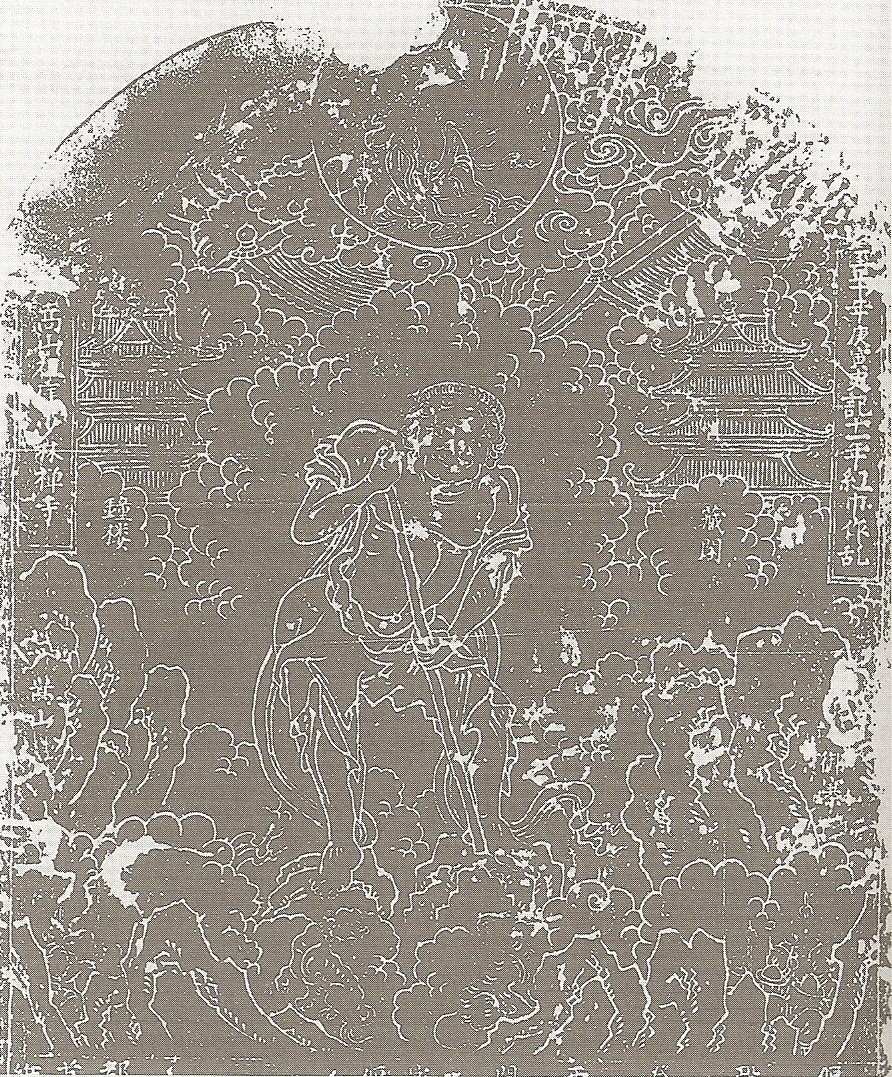
[After blocking the group’s passage through a quicksand-like desert,] The Spirit of the Deep Sand reveals: “I am the one who devoured you twice before, monk. Slung from my neck are all your dry bones!” (Wivell, 1994, p. 1190). The monster only helps the monks cross the “Deep Sands” (Shensha, 深沙) via a magical golden bridge once he is threatened with heavily retribution. Memorial poems note that Tripitaka releases the Spirit from a five hundred-year-long curse, and Pilgrim promises to speak highly of him when they meet the Buddha.
JTTW Comparison (G)
Similarities:
1) The Spirit of the Deep Sand is the literary precursor of Sha Wujing from the final version.
2) The bones of Tripitaka mentioned here are similar to the nine monk skulls hanging from Wujing’s neck.
3) The monster-turned-disciple helps Tripitaka pass through the “Flowing Sands River” (Liusha he, 流沙河) by turning the nine skulls into a makeshift raft. See chapter 22.
Ch. 9 – “Entering the Country of Hārītī”
The seven monks travel to a sparsely populated country peopled mainly by unattended three-year-old children. The few adults who can be found do not bother to interact with the group when spoken to. They eventually meet a king who throws them a lavish vegetarian banquet and reveals that they have entered the Country of Hārītī (Guizi mu, 鬼子母), or the “Mother of Ghostly Children.” Tripitaka is shocked to learn that they have been interacting with disembodied spirits during their stay. The King sends them off with bushels of rice, gold, pearls, and embroidered cloth to help pay for their journey. A memorial poem notes that the monks will repay their debt of gratitude by obtaining the scriptures.
JTTW Comparison (H)
Differences:
1) This episode does not appear in the final version.
Ch. 10 – “Passing Through the Country of Women”
The group travels for some time before Tripitaka calls on the Devarāja once more to help them bypass a raging flood. They pass through several uninhabited territories before they enter the Country of Women, where the Queen offers them a Buddhist feast. They decline to eat, however, as the food is full of sand, but offer to send the country much needed grains upon their return to the East.
The Queen invites Tripitaka and his retinue to remain as permanent residents and even offers to build them their own temple. Furthermore, she offers them any number of beautiful women as prospective brides. But true to their vow, the monks decline in order to continue their journey to India. The Queen sends them off with pearls and a white horse.
JTTW Comparison (I)
Similarities:
1) Tripitaka and his disciples pass through the Country of Women in chapter 54.
2) The Queen attempts to entice them to stay.
Ch. 11 – “Entering the Pool of the Queen Mother”
Tripitaka asks Pilgrim to steal some immortal peaches from the Queen Mother of the West, a primordial goddess, in order to quell his great thirst. Monkey, however, hesitates as he was originally beaten with an iron club and exiled to the Purple Cloud Grotto on the Mountain of Flowers and Fruit for stealing her peaches when he was just eight hundred years old. He remarks that his shanks are still sore even at twenty-seven thousand years of age. They eventually enter the Queen Mother’s realm and look up high above a cliff to see the immortal peach trees laden with fruit. Monkey explains: “These peach trees sprout a thousand years after planting. They blossom in three thousand years and produce a fruit in ten thousand years. The fruit requires ten thousand more years to ripen. He who eats one gains three thousand years of life” (Wivell, 1994, p. 1196).
Several of the ripe fruits fall from the trees into the pond below. Pilgrim raps the golden-ringed monk’s staff on the ground three, five, and seven times, each time summoning a different immortal child to the surface of the water. The first and second children respectively claim to be three thousand and five thousand years old. The third child, who claims to be seven thousand years old, is pulled from the water and quickly devoured in the form of a jujube, or Chinese date. [5] The story mentions in passing that, upon their return to China, Monkey spits out the pit in Sichuan province, thus explaining the origin of ginseng in the area.
JTTW Comparison (J)
Similarities:
1) Pilgrim steals peaches from the Queen Mother’s immortal peach grove in chapter 5. The chapter notes that there are three classes of immortal peaches, each taking thousands upon thousands of years to ripen.
2) He is punished for his transgressions against heaven. See chapters 6 and 7.
3) Tripitaka and his disciples eat baby-shaped ginseng fruit that bestows on them forty-seven thousand years of life. The fruits are harvested from a magical tree with a golden rod. See chapter 24 through 26.
Differences:
1) Monkey is born on the Mountain of Flowers and Fruits in chapter one.
2) He is imprisoned under the Five Elements Mountain for trying to usurp the throne of heaven.
3) Again, he is roughly 1,100 hundred years old.
4) Tripitaka would never ask Pilgrim to steal anything for him.
5) This episode does not appear in the final version.
Ch. 12 – “Entering the Country of Heavy Scent”
They travel to an unpopulated country full of large, ancient trees.
Ch. 13 – “Entering the Country of Vara”
The monks travel through Vara, a paradise on earth, complete with beautiful women, neatly kept homes, playful children, and lions and dragons who chant the Buddha’s name.
Ch. 14 – “Entering the Country of Utpala”
They travel through Utpala, a flower-filled extension of the Buddha’s paradise in which the inhabitants live for countless ages and never want for food. [6]
JTTW Comparison (K)
Differences:
1) These brief episodes do not appear in the final version.
Ch. 15 – “Entering India and Crossing the Sea”
The group finally arrives in India and seeks lodging in the Prosperous Immortals Temple. After a vegetarian meal, the temple monks engage Tripitaka in a sarcastic conversation about the purpose of his quest, noting that they themselves have no need to seek the Buddha’s law any further since they already have copies of the sutras. They warn Tripitaka that endless miles of oceans and mountains separate him from Chicken Foot Mountain, home of the Buddha. Furthermore, they claim that, even if his group could surmount such a vast distance, the scriptures themselves are unattainable as they are kept in the Buddha’s residence high atop a sheer cliff accessible only to holy men with the gift of flight. The Sutra Master is disheartened at first, but Monkey suggests that the group gather the following morning to pray wholeheartedly to the Buddha. Their beautiful chanting causes the sky to go black and resound with thunder and lightning. When the darkness subsides, they are delighted to find that a near complete Buddhist canon has appeared before them. Only the Heart Sutra is missing from among the scriptures.
JTTW Comparison (L)
Differences:
1) Tripitaka and his disciples actually travel to Vulture Peak, where the Buddha gives them the Buddhist canon. See chapter 98.
2) The sutras that they initially receive are destroyed in an accident linked to karmic retribution. But they eventually get new copies. See chapter 99.
3) This episode does not appear in the final version.
Ch. 16 – “Returning They Arrive at the Fragrant Grove Temple and Receive the Heart Sutra”
On their return trip home, the monks seek lodging in the Fragrant Grove Temple in the Country of Pan Lu. Tripitaka dreams a heavenly envoy announces that he will be given the Heart Sutra. The group awakens to a defining noise and rises to see the Buddha emerge from colorful clouds in the form of a young, beautiful monk carrying a golden-ringed staff. He reaches into his sleeve and retrieves a scroll, noting that its power should not be shared with the unworthy because: “As soon as this sutra is opened, bright lights will flash, ghosts will weep and spirits will howl, winds and waves will quiet of themselves, and the sun and moon will cease to shine!” (p. 1201).
Additionally, the Buddha orders Tripitaka to have Tang Emperor Xuanzong build Buddhist temples, initiate monks, and promote the Buddhist Law throughout China.
The Enlightened One only gives the monks three months to complete the task of escorting the sutras back to China, for a “Lotus-Plucking Barge” will be arriving at a particular place and time to transport them to paradise (Wivell, 1994, p. 1202).
JTTW Comparison (M)
Similarities:
1) The Buddha tells Vajra guardians to transport the monk and his disciples to paradise once they have completed their mission. See chapter 98.
Differences:
1) The Buddha is portrayed as a huge, towering figure with a golden body. See chapter 98.
2) Tripitaka, his disciples, and the sutras are magically transported back to China by eight Vajra guardians. See chapter 100.
3) This episode does not appear in the final version.
Ch. 17 – “They Reach Shensi, Where the Wife of the Householder Wang Kills His Son”
The householder Wang (Wang zhangzhe, 王長者) leaves his second wife, whose maiden name is Meng (孟), to care for her step-son Daffy (Chi na, 癡那) while he is away trading goods in foreign lands. Half a year goes by when she receives a letter from Wang dictating that all of their money should go to Daffy if anything were to happen to him. This greatly enrages Meng since Stay-Put (Ju na, 居那), her son from a previous marriage, would miss out on any inheritance. Meng then conspires with her maid Spring Willow (Chunliu, 春柳) to kill Daffy before Wang’s return. They respectively boil him in a pot, rip out his tongue, and starve him, but each time he is magically saved by some unseen supernatural force. For instance, after four days of boiling in the pot, Daffy emerges unscathed and claims: “[T]he iron caldron changed into a lily pad on which I sat, surrounded by the cool waters of a pond. I could sleep or just sit there. It was very comfortable” (Wivell, 1994, p. 1203). Finally, they push Daffy into a tumultuous river and he is swept away. Word of the boy’s death soon spreads to his father, who returns home in tears. Wang holds a Buddhist feast to honor the memory of his son. [7]
Upon their return to China, Tripitaka and the monks stop to attend the feast. The Sutra Master refuses to eat any of the food, however, on the grounds that he is too drunk and needs fish broth to sober up. Following the monk’s instructions, Wang buys the largest specimen that he can find and sets it before Tripitaka. He slices the stomach open with a knife and Daffy emerges unharmed. In the end, father and son are reunited and the treachery of Madame Meng and Spring Willow is exposed.
The monks travel onto the capital where Buddhist feasts are held in their honor. Emperor Xuanzong personally accepts the Heart Sutra and has seven statues of the Buddha commissioned. Soon, the appointed day arrives and “the seven [pilgrims] boarded the barge and, looking due west, they ascended into the heavens and became immortals” (Wivell, 1994, p. 1206). Tang Taizong later honors Monkey with the name “Great Sage Steel Muscles and Iron Bones” (Gangjin tiegu dasheng, 鋼筋鐵骨大聖) (Wivell, 1994, p. 1207).
JTTW Comparison (N)
Similarities:
1) The child emerging from the boiling pot unharmed recalls Monkey’s time in Laozi’s eight trigrams furnace. See chapter 7.
2) Tripitaka and his disciples are granted Buddhahood and Arhatship after returning to the Western Paradise. See chapter 100.
3) Monkey’s new name recalls his title “Great Sage Equally Heaven” (Qitian dasheng, 齊天大聖) from chapter 4.
4) This also recalls Sun receiving the title of the “Victorious Fighting Buddha” (Dou zhansheng fo, 鬥戰勝佛) upon attaining Buddhahood in chapter 100.
Differences:
1) This episode does not appear in the final version.
Updates
Update: 09-14-19
I have written an article discussing the influence of the Buddhist saint Mulian on the Monkey Pilgrim from the story prompt.
Sun Wukong and the Buddhist Saint Mulian
Important Historical and Religious Info
Update: 01-30-24
I was recently interested to learn that The Story was influenced by underworld journey narratives. This explains the often fantastical and seemingly unrelated events that happen throughout the disjointed narrative. Brose (2023) writes:
The Japanese scholar Chūbachi Masakazu (b. 1938) was the first to point out that the Kōzanji narratives mirror two closely related mythic archetypes. The first, derived from ancient Han Chinese traditions, is the journey of the dead to the netherworld. In many accounts of postmortem travels, spirit animals (including but not limited to monkeys) serve as the guides for the dead on their passage through the spirit realm, whether the final destination is the Yellow Springs beneath the earth or Mount Kunlun in the distant west. The other motif, emerging from early Indian Buddhist literature, is the transmigration of the spirit to the Pure Land, which, like Mount Kunlun, was conventionally located somewhere in the west. In Buddhist accounts, animals (again, often but not always monkeys) also serve as escorts for the dead. Chūbachi proposed that these narrative traditions—culturally distinct but thematically and functionally similar—were fused together with the historical account of Xuanzang’s journey to India. The Kōzanji texts, according to this reading, represent a complex but organic blending of initially independent narratives. The broad contours of Xuanzang’s biography and travelogue were superimposed onto older mythic accounts to provide a new, quasi-historical frame for age-old stories about the transmigrations of the dead.
Viewed from this perspective, Xuanzang was not passing through Central Asia en route to India but, instead, was traversing a hellish purgatory to reach a heavenly pure land. Like a shaman, he departs the human world and enters a dangerous liminal zone. Beset by ghosts and demons, he is guided and protected by powerful spirit animals and Buddhist deities. After enduring extreme hardship, he eventually arrives in an immortal realm populated by spirit monks, immortals, bodhisattvas, and buddhas. From Śākyamuni Buddha, he receives a collection of apotropaic texts with the power to safeguard the living and liberate the dead. Xuanzang then transmits these sacred scriptures back to the human realm before he and his assistants ascend to heaven during the annual ritual for liberating the damned from purgatory. This narrative not only maps the landscape of a postmortem shadow world, it also identifies the scriptures that guard against demonic molestation and ensure a propitious rebirth: the Buddhist canon in general and the Heart Sūtra in particular. Those who read, recited, or heard the Kōzanji texts were thus informed of the perils of purgatory and offered the promise of protection and salvation. Xuanzang, they also learned, was the saintly monk responsible for delivering these divine texts and technologies into the hands of humans (pp. 62-63).
This strengthens my suggestion that the Monkey Pilgrim serves as a stand-in for Mulian (目連; Sk: Maudgalyayana), a Buddhist saint famed for traversing the underworld to save his mother. One element that I overlooked was the date when Tripitaka and his companions rise to paradise:
During the fifth quarter hour of the noon watch on the fifteenth [of the seventh month], a barge for collecting lotuses was sent down from the Heavenly Palace and Dipamkara Buddha was manifest in the clouds. Announcing that he had better not tarry any longer, the Dharma Master [Tripitaka] bade a hasty good-bye to the emperor. The seven [pilgrims, including Monkey,] boarded the barge and, looking due west, they ascended into the heavens and became immortals. Nine dragons rose up into the mist and ten phoenixes came out to welcome them. A thousand cranes offered them felicitations and there were flashing lights of transcendence (Wivell, 1994, p. 1206).
十五日午時五刻,天宮降下採蓮舡,定光佛在雲中正果。法師宣公,不得遲遲,匆卒辭於皇帝。七人上舡,望正西乘空上仙去也。九龍興霧,十鳳來迎,千鶴萬祥,光明閃爍。
The 15th day of the seventh lunar month falls on the “Ghost Festival” (Gui jie, 鬼節; a.k.a. “Zhongyuan Festival,” Zhongyuan jie, 中元節; a.k.a. “Yulanpen Festival,” Yulanpen jie, 盂蘭盆節), a time when souls are believed to be released from the underworld. Therefore, the ascension of the pilgrims would coincide with the rise and subsequent salvation (thanks to the procured scriptures) of said spirits from hell.
Regarding the date of The Story, I’ve previously mentioned that it is a product of the late-13th century. But Zhang (1990) assigns an earlier date to its writing, stating this was likely no earlier than the reign of Emperor Renzong (r. 1022–1063) of the Northern Song Dynasty (960–1127) and no later than the reign of Emperor Gaozong (r. 1127–1129) of the Southern Song Dynasty (1127–1279). This places The Story in the late-Northern Song. Zhang ends by saying,
Even though the current version of “Zhongwazi Zhangjiayin” [8] was printed in the late-Southern Song Dynasty, the date of publication should not be confused with the year in which the book was written.
纵然今见“中瓦子张家印”本刊印于南宋晚期,亦不能把刊印时间与成书年代混为一谈。
Chen (2014) supports a Song publication with evidence comparing The Story‘s rhyming system with that of Buddhist “Transformation Texts” (Bianwen, 變文). I have attached a PDF below.
PDF File:
A revisit of the time of Monk Xuanzang of the Tang Dynasty on a Pilgrimage for Buddhist Scriptures – Focus on rhyme style (2014)
Notes:
1) The term shihua (詩話) at the end of the tale’s Chinese name is synonymous with huaben (話本), a genre of vernacular oral literature.
2) Stories dealing with the adventures of the monk Tripitaka and Sun Wukong appeared as early as the 11th century, as evidenced by cave art from that time. Such tales were originally created and told by professional storytellers in busy market places, much like the famed Yangzhou storytellers of today. Standardized repertoires were eventually collected and published during the late Song Dynasty. See Dudbridge (1970) for more information.
3) Li Jing (李靖, 571–649) was a historical Tang dynasty general who won many battles in China and Central Asia. Shahar (2013) notes that Li was deified after his death, and that the cult centered around him existed into the Song Dynasty. Most importantly, “The general [was] celebrated in a large body of oral and written fiction, which gradually associated him with the Indian god [Vaiśravana]” (Shahar, 2013, p. 28). He continues, “Storytellers and playwrights [eventually] merged the Tang general with the martial Heavenly King” (Shahar, 2013, p. 28). This merging may have happened as early as the Yuan Dynasty (1271–1368) (Shahar & Kieschnick, 2013, p. 224 n. 18).
4) This changing of bones most likely refers to some type of realized spiritual cultivation that resulted in a new, pure body for the future emperor.
5) It would seem the immortal fruit takes on the form of children upon entering the pool.
6) The land of Utpala sounds very much like Tao Quan’s famous tale the “Peach Blossom Spring” (421), which tells the story of how a fisherman stumbles upon a garden paradise where the inhabitants never age (Barnhart, 1983, pp. 13-16).
7) This portion of the story is very similar to the late 9th- to early 10th century “Transformation Text on the Boy Shun’s Extreme Filial Piety.” For a comparative analysis, see Mair (1987). For a complete English translation of the tale, see Bodman (1994).
8) The original late-13th century manuscript of The Story is stamped with the “Zhang Family Seal of Central Market District” (Zhongwazi Zhangjiayin, 中瓦子張家印). The Central Market District (Zhongwazi, 中瓦子) was a street known for play promotions and book publishers in Song-era Lin’an prefecture (Zhang, 1990). This appears to be another nickname for The Story apart from the “Kozanji version” (Dudbridge, 1970, p. 25, for example).
Bibliography:
Barnhart, R. M., & Metropolitan Museum of Art (New York, N.Y.) (1983). Peach blossom spring: Gardens and flowers in Chinese paintings. New York: Metropolitan Museum of Art.
Bodman, R.W. (1994). The Transformation Text on the Boy Shun’s Extreme Filial Piety. In V. H. Mair (Ed.), The Columbia anthology of traditional Chinese literature (pp 1128-1134). New York: Columbia University Press.
Brose, B. (2023). Embodying Xuanzang: The Postmortem Travels of a Buddhist Pilgrim. United States: University of Hawaii Press.
Chen, Y. (2014). Datang Sanzang qujing shihua shidaixing zaiyi: Yi yunwen tizhi de kaocha wei zhongxin [Another Discussion on the Age of the Story of How Tripitaka of the Great Tang Procured the Scriptures: An Investigation into the Rhyming System], Pudan Journal (Social Sciences), 5, 69-80.
Dudbridge, G. (1970). The Hsi-yu chi: A study of antecedents to the sixteenth-century Chinese novel. Cambridge, England: University Press.
Mair, V. H. (1987). Parallels between some Tun-Huang manuscripts and the 17th chapter of the Kozanji Journey to the West. Cahiers d’Extrême-Asie, 3, 41-53.
Shahar, M., & Kieschnick, J. (2013). India in the Chinese Imagination: Myth, Religion, and Thought. University of Pennsylvania Press.
Shahar, M. (2013). Indian mythology and the Chinese imagination: Nezha, Nalakubara, and Krshna. In M. Shahar and J. Kieschnick (Eds.), India in the Chinese imagination: Myth, religion, and thought (pp. 21-45). University of Pennsylvania Press.
Wivell, C.S. (1994). The Story of How the Monk Tripitaka of the Great Country of T’ang Brought Back the Sūtras. In V. Mair (Ed.), The Columbia Anthology of Traditional Chinese Literature (pp. 1181-1207). New York: Columbia University Press.
Zhang, J. (1990). Datang Sanzang qujing shihua chengshu niandai kaolun [A Discussion of the Date of the Story of How Tripitaka of the Great Tang Procures the Scriptures]. Xueshu jiaoliu, 4, 108-114. Retrieved from https://www.toutiao.com/article/7065749209709806087/?wid=1706529284309