Archive #21 – Qing-Period Color-Illustrated Complete Edition of Journey to the West

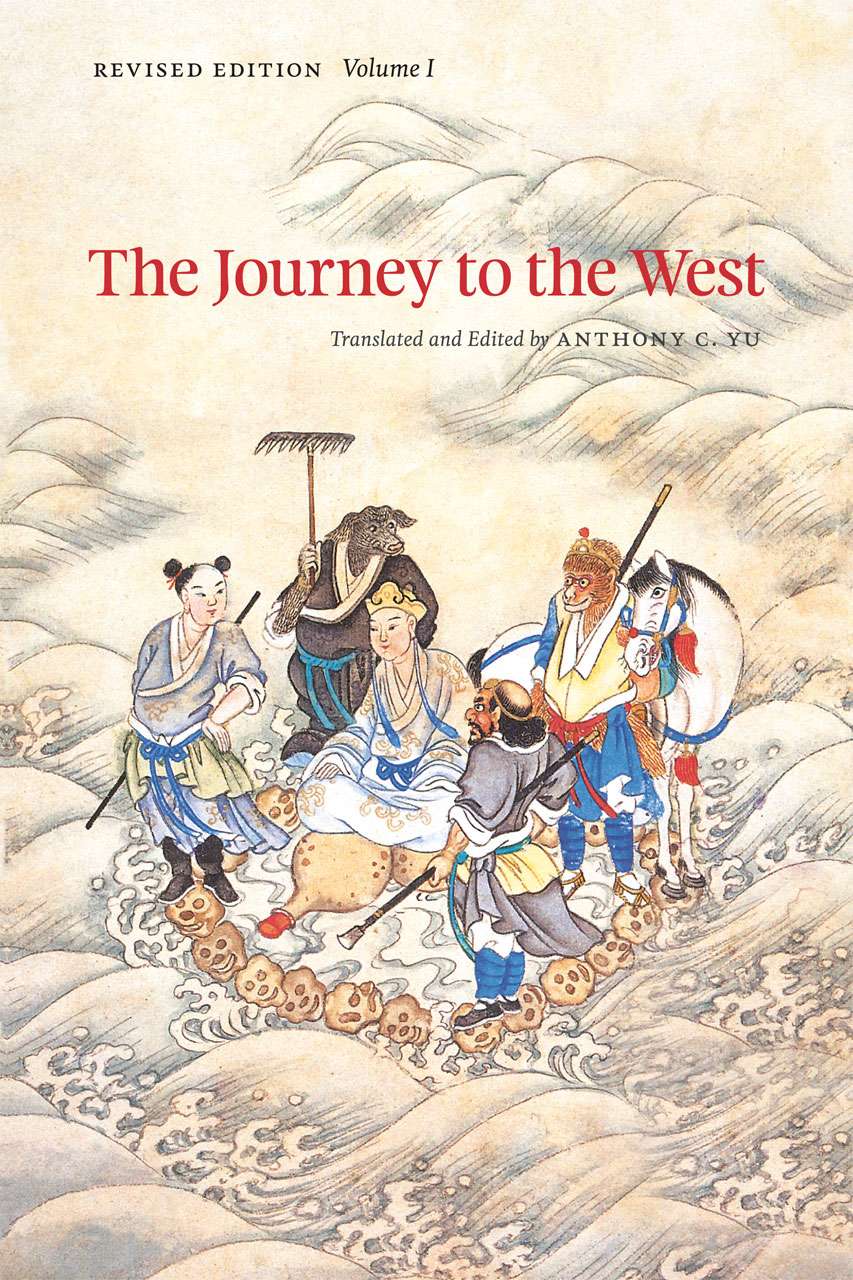
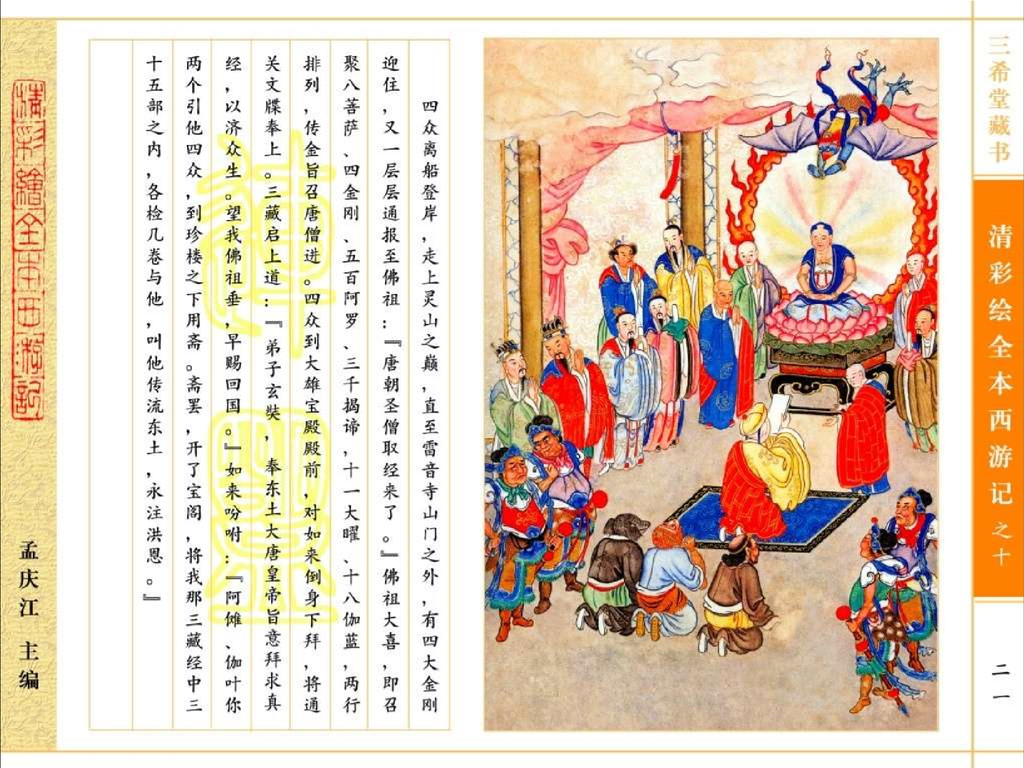
Upon the initial release, I was entranced by the cover art for the 2012 revised edition of Anthony C. Yu’s famed Journey to the West translation. For example, the cover for volume one (fig. 1) featured the pilgrims crossing the Flowing-Sands River via a boat made from Sha Wujing‘s skull necklace and a heaven-sent gourd. I loved the individuality and color scheme of each figure. They look almost like characters from a comic book. Though the art style was old, I assumed the bright, vibrant colors signaled the illustration was a modern reproduction. This was not the case. I later learned that the art was made by an anonymous painter of the Qing Dynasty (1644-1911). The paintings from this series were later gathered into an abridged ten-volume set titled Qing-Period Color-Illustrated Complete Edition of Journey to the West (Qing caihui quanben Xiyouji, 清彩繪全本西遊記, 2008). Here I present lower res PDFs of this work, complete with the gorgeous artwork. Each page is formatted with simplified Chinese dialogue on the left side and art on the right (fig. 2).

Fig. 1 – The cover of volume one (larger version). Fig. 2 – An example of the page format (larger version). It portrays the pilgrims finally coming before the Buddha in India. The formerly subjugated “Peng of 10,000 Cloudy Miles” (i.e. Garuda) can be seen hovering above the Enlightened One’s throne.

Book links

Disclaimer

These have been posted for educational purposes. No malicious copyright infringement is intended. Please support the official release.

Citation

Ming, Q. (Ed.). (2008). Qing caihui quanben Xiyouji [Qing-Period Color-Illustrated Complete Edition of Journey to the West]. Beijing: Zhongguo shudian.

The Worship of Sun Wukong in 19th-century America

Last updated: 01-15-2022

I by chance happened upon an old magazine article that mentions the worship of Sun Wukong in San Francisco’s Chinatown in 1892. The piece is written by one Frederic J. Masters, D.D., a Methodist pastor who wrote extensively about the area’s Chinese community. Not surprisingly, the article is dripping with condescension towards Chinese religion, condemning the Great Sage’s worship as “the acme of absurdity and sinfulness” (Masters, 1892, p. 737). Below is the section discussing the Monkey King.

In the Spofford-alley temple are found the shrines of some twenty other gods and goddesses, the principal being the Grand Duke of Peace, the God of Medicine, and Pan Kung, a celebrated Prime Minister of the Sung Dynasty. The funniest discovery in this temple was that of Tsai Tin Tai Shing [Qitian dasheng, 齊天大聖]. He is a beatified monkey in the image of a man. Hatched from a bowlder [sic], this animal is said to have proclaimed himself king of the monkeys. At last he learned the language of men, and finding himself possessed of supernatural powers, he obtained a place among the gods. Such is the legend. Chinese idolatry thus reaches the acme of absurdity and sinfulness in the canonization of a monkey. Thoughts of Darwin’s descent of man at once flashed across our mind as we looked at this image. It was disappointing at one’s curiosity to find that the old temple keeper who cared more for a pipe of opium than for speculations in theology and anthropology could not tell us what part natural selection played in the evolution of Chinese deities, or whether monkey worship was the newest phase of Chinese ancestral worship. Finding him lamentably ignorant upon the great question of the descent of man, we astonished with him with a complete history of his monkey god.

There was an ape in the days that were earlier;
Centuries passed and his hair became curlier;
Centuries more and his tail disappeared,
Then he was man and a god to be feared (Masters, 1892, pp. 736-737).

So what can we learn from this brief entry? Given the time, place, and use of Cantonese, the worshipers were most likely immigrants from Guangdong province. Refo Mason (1994) explains, “When news of the discovery of gold in California reached South China in 1849, thousands of labourers in Guangdong and Fujian provinces left their villages to seek work in the gum shan ([金山] ‘Gold Mountain’) … Emigration from South China to California…peaked in 1852, when 20,000 Chinese arrived in San Francisco” (p. 200). Monkey‘s adherents may have counted among these men or their descendants (or possibly among those from later periods of immigration). Either way, belief in the Great Sage came with those who traveled from southern China to America.

Monkey King Bust - American Gods - Instagram 1 - small

Fig. 1 – A photomanipulation of Sun Wukong above the title logo from the ongoing American Gods television show (larger version). By the author. The program is based on the 2001 novel of the same name.

Somebody please get Neil Gaimon on the phone and tell him that he can now include Monkey in American Gods (fig. 1). What do you think the character would look like? Maybe a short old man with a cane?

Spofford Alley, home to 19th-century temple with Monkey King shrine - small

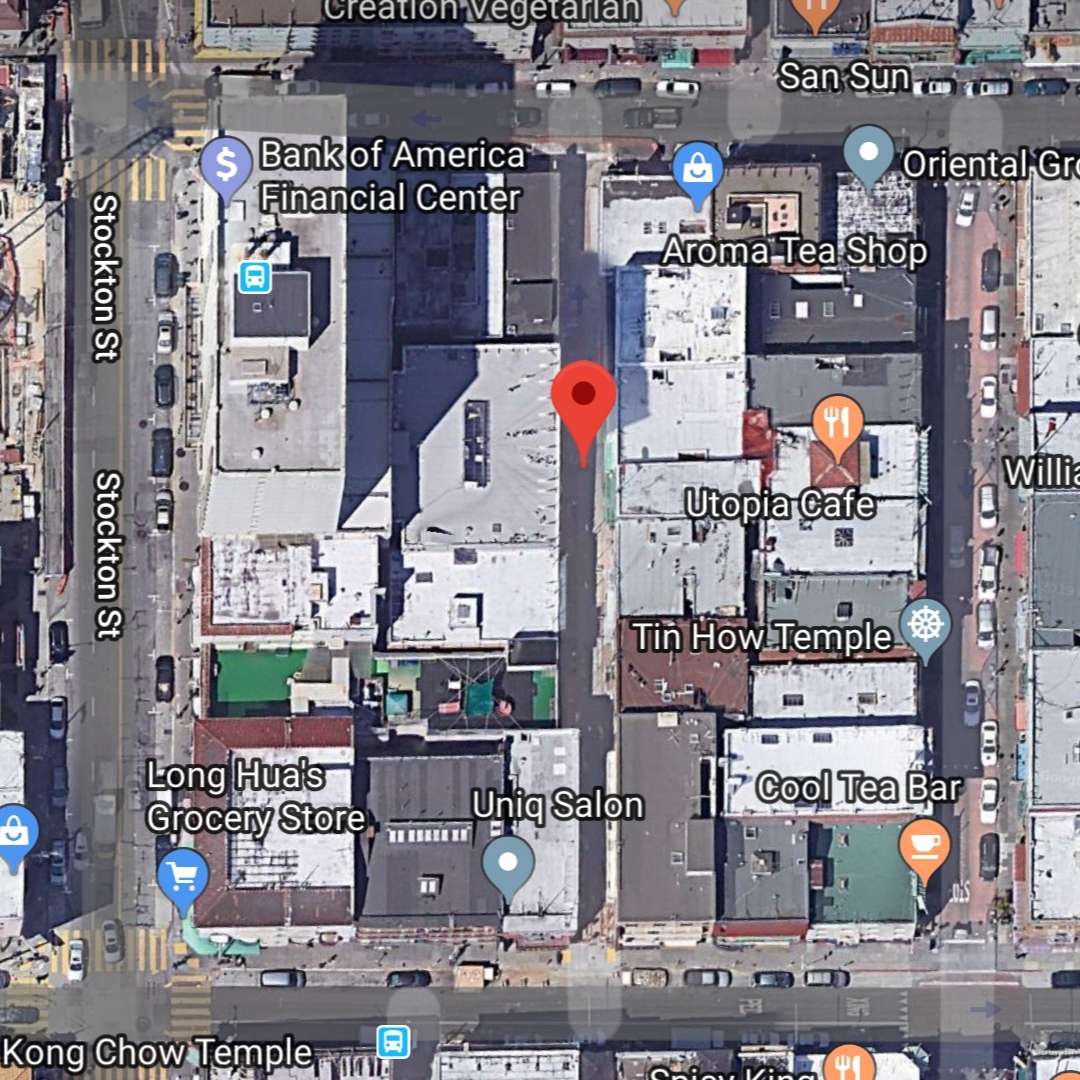
Fig 2 – A modern Google satellite image of Spofford Alley (larger version). It is only a few hundred feet long.

During the 19th-century, Spofford Alley (fig. 2), where the temple housing the Great Sage shrine was located, was home to the Chee Kong Tong (Zhigong tang, 致公堂, “Chamber of High Justice Society,” a.k.a. the “Chinese Freemasons”), the secret Chinese society-turned-criminal organization running Chinatown’s illicit opium, gambling, and prostitution trade (Risse, 2012, p. 37). The Chee Kong Tong were originally an offshoot of anti-Manchu rebels who wanted to overthrow the foreign-ruled Qing dynasty (Cassel, 2002, pp. 218-219). [1] Therefore, Sun Wukong’s worshipers may have included gangsters and rebels. As mentioned in this article, the Great Sage was venerated by fighters of the Boxer Rebellion (1899-1901). This makes sense as the divine primate is famous for his rebellion against heaven in Journey to the West.


Update: 01-15-2022

I was very happy to recently find an article called “Map of Temples in San Francisco’s Chinatown 1850s-1906” (Romaskiewicz, 2021). The author, a PhD student named Peter Romaskiewicz, has done a great service by scouring 19th and 20-century material and cross-referencing this with antique maps of Chinatown. The article has a list of over 20 temples/immigrant associations and their corresponding locations plotted on a map. This is great because it has allowed me to pinpoint the exact place where the Monkey King was worshiped in 1892 Chinatown!

Masters (1892) refers twice to temples on Spofford: 1) “[Guanyin’s] shrine is found up a dingy staircase on the southwest corner of Spofford alley and Washington streets” (p. 734); and 2) “In the Spofford-alley temple are found the shrines of some twenty other gods and goddesses…” (p. 736). Romaskiewicz (2021) shows the Guanyin temple (#10) was located at the end of Spofford, while a different joss house belonging to the Chee Kong Tong (#9) was located in the middle of the street. I therefore assumed Monkey was worshiped at the Chee Kong Tong joss house because Masters’ (1892) second temple reference didn’t mention Guanyin. However, after writing Romaskiewicz, I learned that there were actually three joss houses on Spofford during the 19th-century (one from an 1887 map is not listed). But most importantly, Masters (1982) was likely referring to the Guanyin Temple in both instances. That’s why he highlights “the shrines of some twenty other gods and goddesses…” (emphasis added) (Masters, 1892, p. 736), meaning these icons were also found in the same location.

The Guanyin Temple (Guanyin miao, 觀音廟) was located at No. 60 on the corner of Spofford and Washington (fig. 3) (Romaskiewicz, 2021). I’m unsure if it still exists in some form in that location. But I do know from Google Maps that the old No. 60 is not the same as the current No. 60.

Romaskiewicz was kind enough to direct me to an 1883 brochure asking for funds to restore the temple. This shows it was in use for some time.

Fig. 3 – The yellow star marks the location of the Guanyin Temple (larger version). Based on Romaskiewicz (2021). See this 1885 map

Notes:

1) Sun Yatsen, the “Father of modern China,” made contact with the Chee Kong Tong several times and even used their no. 36 Spofford Alley office as his own while raising money for his revolution in China (United States, 1993, pp. 45-46; Lum & Lum, 1999, p. 57).

Source:

Cassel, S. L. (2002). The Chinese in America: A history from Gold Mountain to the new millennium. Walnut Creek, CA: AltaMira Press.

Lum, Y. M., & Lum, R. M. K. (1999). Sun Yat-sen in Hawaii: Activities and supporters. Honolulu: Hawaii Chinese History Center.

Masters. F. J. (1892). Pagan Temples in San Francisco. In C.F. Holder (Ed.). The Californian illustrated magazine: June to November, 1892, vol. 2 (pp. 727-741). San Francisco, Calif.: Californian Pub. Co.

Refo Mason, S. (1994). Social Christianity, American feminism, and Chinese prostitutes: The history of the Presbyterian mission home, San Francisco, 1874-1935 In M. Jaschok and S. Miers (Ed.) Women and Chinese Patriarchy: Submission, Servitude, and Escape (pp. 198-220). Hong Kong: Hong Kong University Press.

Romaskiewicz, P. (2021, April 15). Map of Temples in San Francisco’s Chinatown 1850s-1906. Personal Site of Peter Romaskiewicz. Retrieved from https://peterromaskiewicz.com/2020/06/02/map-of-temples-in-san-franciscos-chinatown-1850s-1906/

Risse, G. B. (2012). Plague, fear, and politics in San Francisco’s Chinatown. Baltimore: The Johns Hopkins University Press.

United States. (1993). An introduction to organized crime in the United States. Washington, D.C.: Organized Crime/Drug Branch, Criminal Investigative Division.

Sun Wukong and the Three Heavenly Calamities

Last updated: 11-09-2022

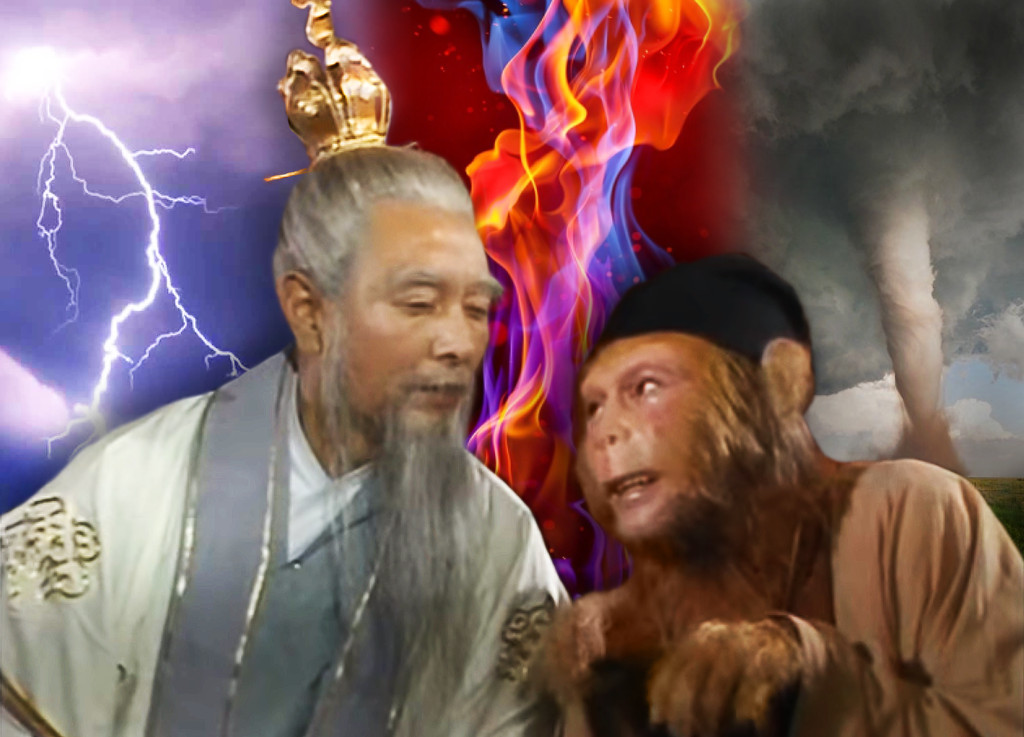
In chapter two of Journey to the West (Xiyouji西遊記, 1592), Master Subodhi warns Sun Wukong that he must protect himself from “Three Calamities” (sanzai lihai, 三災利害) sent by heaven to punish him for achieving immortality and defying his fate (fig. 1). These punishments come every half millennia in the form of destructive elements:

Though your appearance will be preserved and your age lengthened, after five hundred years Heaven will send down the calamity of thunder [leizai, 雷災] to strike you. Hence you must be intelligent and wise enough to avoid it ahead of time. If you can escape it, your age will indeed equal that of Heaven; if not, your life will thus be finished. After another five hundred years Heaven will send down the calamity of fire [huozai, 火災] to burn you. The fire is neither natural nor common fire; its name is the Fire of Yin [yinhuo, 陰火], and it arises from within the soles of your feet to reach even the cavity of your heart, reducing your entrails to ashes and your limbs to utter ruin. The arduous labor of a millennium will then have been made completely superfluous. After another five hundred years the calamity of wind [feng zai, 風災] will be sent to blow at you. It is not the wind from the north, south, east, or west; nor is it one of the winds of four seasons; nor is it the wind of flowers, willows, pines, and bamboos. It is called the Mighty Wind [bifeng, 贔風], and it enters from the top of the skull into the body, passes through the midriff, and penetrates the nine apertures. [1] The bones and the flesh will be dissolved and the body itself will disintegrate. You must therefore avoid all three calamities (Wu & Yu, 2012, pp. 121-122).

雖駐顏益壽,但到了五百年後,天降雷災打你,須要見性明心,預先躲避。躲得過,壽與天齊;躲不過,就此絕命。再五百年後,天降火災燒你。這火不是天火,亦不是凡火,喚做『陰火』。自本身湧泉穴下燒起,直透泥垣宮,五臟成灰,四肢皆朽,把千年苦行,俱為虛幻。再五百年,又降風災吹你。這風不是東南西北風,不是和薰金朔風,亦不是花柳松竹風,喚做『贔風』。自顖門中吹入六腑,過丹田,穿九竅,骨肉消疏,其身自解。所以都要躲過。

These calamities are important because Monkey subsequently learns the 72 transformations in order to escape punishment by hiding under any one of a myriad number of disguises. Therefore, exploring the origins of the three calamities has merit.

Fig. 1 – Master Subodhi tells Sun about the Three Calamities (larger version). Photomanipulation by the author.

Table of Contents

1. Origins

The novel likely borrows from a Buddhist cosmological concept called the “Three Calamities” (sanzai, 三災). We first need some background before continuing. Buddhism recognizes a measurement of time called a Kalpa (jie, 劫), which can be many millions or even billions of years long depending on the tradition. Said traditions recognize between four and eighty kalpas (Buswell & Lopez, 2014, p. 409). The total of these respective ranges make up a Mahakalpa (dajie, 大劫), which is divided into four periods of nothingness, creation, subsistence, and finally destruction, each period being between one and twenty kalpas long (Buswell & Lopez, 2014, p. 496). The Three Calamities are responsible for the destruction of each Mahakalpa.

Kloetzli (1983) describes the cyclical destruction of each Mahakalpa by an element:

The destructions are of three kinds: those by fire, those by water and those by wind. […] The destructions succeed one another in the following sequence: seven by fire followed by a destruction by water. This cycle of eight destructions is repeated a total of seven times. This is then followed by seven more destructions by fire, followed by a final by wind. Thus there are 7 x 8 or 56 destructions by fire; 7 by water and a final 64th by wind [fig. 2] (p. 75).

Therefore, the Three Calamities from Journey to the West follow a similar cycle of destructive elements appearing at set time intervals: lightning, fire, and wind every 500 years in place of fire, water, and wind at the end of every Mahakalpa. And instead of destroying the universe, the elements are sent to kill those who have achieved immortality.

Fig. 2 – A chart mapping the cyclical destructions by fire, water, and wind. A larger version is available on the CBETA page.

The earliest mention of Buddhism’s Three Calamities in Chinese writing that I know of appears in scroll one of the Pearl Forest of the Dharma Garden (Fayuan zhulin, 法苑珠林), a Chinese Buddhist encyclopedia published in 688. So there was plenty of time between this work and the publishing of Journey to the West in 1592.

2. Influence on Xianxia Literature

I was interested to learn that Monkey’s calamities made their way into modern Xianxia (仙侠, “Immortal hero”) literature. For example, the author of the Immortal Mountain wordpress writes:

Heavenly Tribulation (天劫 tiānjié) (重劫 zhòngjié) – in some novels, a trial encountered by cultivators at key points in their cultivation, which they must resist and ultimately transcend. Because immortal cultivation (generally) goes against the Will of Heaven, the Heavens will send down tribulations to oppress high-level cultivators who make progress towards Immortality, often right when they enter a new cultivation stage. This typically takes the form of a lightning storm, with extraordinarily powerful bolts of lightning raining down from the Heavens to strike at the cultivator (source).

The trial by lightning is exactly like the calamity of thunder mentioned by Master Subodhi.

3. Conclusion

Subodhi teaches Monkey the 72 transformations with the expressed purpose of hiding from three calamities (sanzai lihai, 三災利害) of celestial lightening, fire, and wind. They are sent by heaven every 500 years to punish cultivators for defying their fate and achieving immortality. Each was likely influenced by the three calamities (sanzai, 三災) of Buddhist cosmology, which states that the universe is alternately destroyed by fire, water, or wind at the end of every Mahakalpa. Both concepts include destructive elemental forces that appear at given times.

The oldest mention of the original Buddhist calamities that I’m aware of appears in a 7th-century religious encyclopedia titled Pearl Forest of the Dharma Garden (Fayuan zhulin, 法苑珠林).

The literary thunder calamity would later come to influence the “Heavenly Tribulation” (tianjie, 天劫; zhongjie, 重劫) of modern Xianxia literature.


4. Updates

Update: 09-10-2018

The Xianxia translator Deathblade (twitter) was kind enough to direct me to an example of a tribulation from a popular Chinese television show . The scene (video 1) involves a 20,000-year-old child immortal experiencing a trial by lightning. The heavenly bolts tear at his clothing and draw blood, but he survives the ordeal.

Video 1 – Start watching from minute 13:08.

Deathblade also directed me to an example from an online Xianxia novel called I shall Seal the Heavens (Wo yu feng tian, 我欲封天). Chapter 385(!) describes how the anti-hero Meng Hao (孟浩) uses a sentient heavenly treasure to protect himself from powerful bolts of lightning, which instead seek out and kill nearby spiritual cultivators on the cusp of immortality:

The Heavenly Tribulation boomed as one lightning bolt after another shot down onto Meng Hao, who held the meat jelly upraised in his hand to defend himself. The lightning would subsequently disperse into the area around him. Any nearby Cultivators would let out bloodcurdling screams. Soon, the air filled with the sounds of cursing and reviling.

Meng Hao didn’t care. This was something he had learned from Patriarch Reliance. When you con someone and then end up getting cursed by them, you must maintain your cool. It was really a realm unto itself.

Throughout the years, Meng Hao had conned many people, and had refined that skill to the very pinnacle. Therefore, he continued to redirect the descending lightning to the various Cultivators in the three thousand kilometer region.

Wherever he went, he was surrounded by a lake of lightning, along with plaintive cursing. What he left behind was scorched corpses.

To the Cultivators here, it was nothing but a massacre, a slaughter in which no one could do anything to fight back. They couldn’t attack him, nor could they flee as… they were horrified to discover that Meng Hao’ speed was incredible, even if he was being struck by lightning!

(read more here)

The character uses trickery to protect himself from the bolts just like Monkey intended to do with his transformations.


Update: 04-02-2021

As I explained above, Wukong learns the 72 transformations in order to escape the heaven-sent punishments of thunder, fire, and wind. Monkey attains eternal life around his 342nd year when his soul is taken to Hell. He is immortal for over 160 years [2] at the time he’s imprisoned under Five Elements Mountain. This means his 500th year of immortality, the year that the calamity of thunder would be scheduled to strike him, takes place during his imprisonment under the celestial mountain. But this is never described in the story. I assume this is just one of many inconsistencies born from oral storytelling. Although, one could argue that, within the fictional universe, the thunder calamity was voided since Wukong was undergoing punishment at the behest of the Buddha.


Update: 08-29-22

It turns out that punishment by lightning appears in other works of religious vernacular fiction. For example, in The Battle of Wits between Sun and Pang (Sun Pang douzhi yanyi, 孫龐鬥智演義, 1636; a.k.a. The Former and Latter Annals of the Seven KingdomsQianhou qiguo zhi前後七國志):

Sun Bin [孫臏, d. 316 BCE] was overjoyed when he received the Heavenly Book [from the magic White Ape], and hurriedly went back to light the lamp and read it carefully. But during his reading, he felt an eerie, cold wind and heard the rolling of thunder. The Immortal Master Ghost Valley was meditating on the futon when he heard thunder in the air, so he got up and walked immediately to the door of Sun Bin’s room, only to see him reciting the Heavenly Book. When Ghost Valley heard this, he was taken aback. He pushed the door open and went in and said, “I hid this book in the stone box of the prayer cave. I haven’t passed it onto you because your fate has not yet arrived. Where did you get it?

Sun Bin told the story of the white ape. Ghost Valley said: “It turns out that the evil beast stole it and came to you, but unfortunately it was too early. Besides, when you received the Heavenly Book, you didn’t bathe and burn incense, and you didn’t wash your hands or rinse your mouth, thus blaspheming the gods and provoking a great tribulation [da zainan, 大災難] of 100 days.”

Sun Bin’s continence changed. He asked: “Can master save your disciple?”

Ghost Valley said: “If you want me to save you, you must not disobey my nightmare-suppression method.”

Sun Bin said: “I dare not.”

Ghost Valley said: “Due south behind the mountain is an empty stone tomb. You should sleep in the stone tomb with your head to the south and your feet to the north, with 49 grains of raw rice in your mouth. Cover it with your saliva but don’t swallow the grains. You will feel fully nourished. As long as you hide for forty-nine days, you will escape the great tribulation and protect yourself.”

Sun Bin said, “I sincerely receive your instructions.”

Ghost Valley led Sun Bin to the empty tomb at night. Sun complied with his master’s nightmare-suppression method and followed his instructions. A stele was erected in front of the tomb which read: “The Tomb of Sun Bin of the State of Yan” (Wumen xiaoke & Yanshui sanren, 1636).

Another example comes from the Lady of Linshui Pacifies Demons (Linshui pingyao, 臨水平妖, 17th-century). This time, it involves the immortal Lu Dongbin (呂洞賓; a.k.a. Lu Chunyang, 呂純陽) angering Guanyin, who dispatches thunder deities after him. And just like Sun learns the transformations to hide from the calamities, Lu takes the form of a bug to hide from his punishment:

As we take up our tale anew, Guanyin opened wide her eye of wisdom and saw Pure Yang Lü standing on top of the cloud. She cursed him, saying, “A dumb beast like that has no sense of propriety!” Then she sent the Five Thunders (Wu Lei [五雷]) to strike him. The Immortal Ancestor Lü saw them coming and for an instant was helpless with fright. Unable to escape back to his mountain, he hastily fled to Liang Hao’s study. 

He called to Licentiate Liang, “In a moment of distraction, I offended the Heavenly Court, which has dispatched the Five Thunders to strike me. Save me!” As he spoke, the sound of thunder rolled violently. Liang Hao was so frightened that his hands and feet were like ice, and he was unable to reply. Pure Yang Lü said, “If you are willing to rescue me, then that would give this poor Daoist a place to hide.” Liang Hao agreed with alacrity. Pure Yang Lü then turned himself into a tiny insect, ran under Liang Hao’s fingernails, and hid himself. He waited for an hour and three quarters, until the thunder no longer rolled. There was nothing the Five Thunders could do, so they were obliged to go back to the Purple Bamboo Grove [on Guanyin’s mountain], having failed to carry out the Buddha’s [Guanyin’s] orders. At this time, an hour and three quarters having already elapsed, Pure Yang Lü resumed his original form. He thanked Liang Hao and returned to Zhong Mountain, as he did not dare remain in these harrowing circumstances any longer (Fryklund, Lewis, & Baptandier, 2021, p. 6). 


Update: 11-09-22

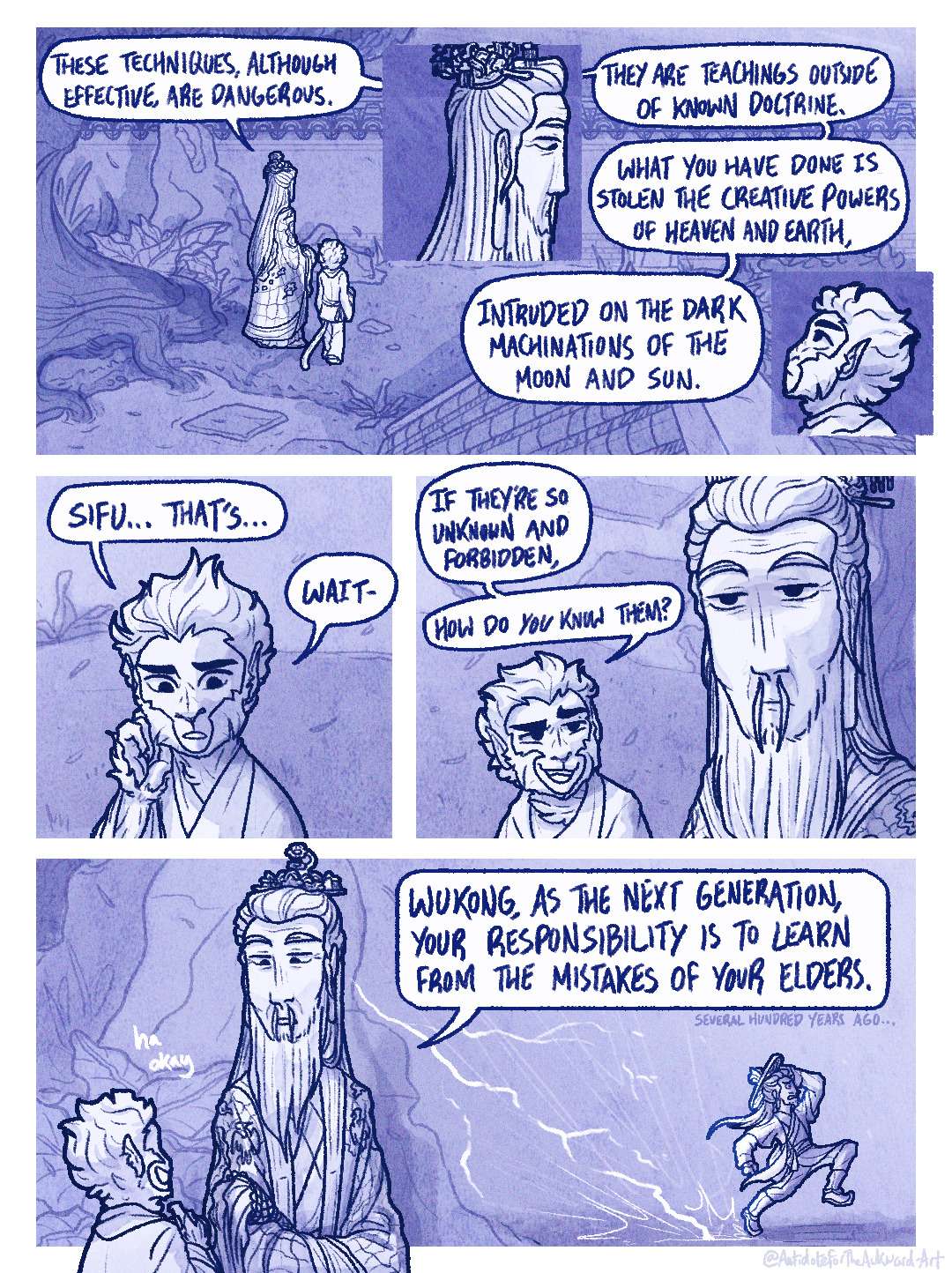
An artist known on Tumblr as “AntidoteForTheAwkward” has posted a wonderful comic (fig. 3) giving a reason for why the Patriarch Subhodi teachers Monkey the 72 transformations in order to avoid the heavenly calamities: personal experience.

Fig. 3 – AntidoteForTheAwkward’s comic (larger version). See the original post here.

Notes:

1) The eyes, ears, nose, mouth, genitals, and anus.

2) Wukong serves in heaven twice: first “for more than ten years” and second “for over a century” (Wu & Yu, 2012, vol. 1, pp. 150 and 166). Then he is punished to 49 days in Laozi’s furnace (Wu & Yu, 2012, vol. 1, p. 189). But the narrative revels “one day in heaven is equal to one year on Earth” (Wu & Yu, 2012, vol. 1, pp. 150 and 167). So this means his turn in the furnace lasts close to fifty years.

Sources:

Buswell, J., & Lopez, D. (2014). The Princeton Dictionary of Buddhism. Princeton, NJ: Princeton University Press.

Fryklund, K. I., Lewis, M. E., & Baptandier, B. (2021). The Lady of Linshui Pacifies Demons: A Seventeenth-Century Novel. Seattle, WA: University of Washington Press.

Kloetzli, R. (1983). Buddhist Cosmology: From Single World System to Pure Land: Science and Theology in the Images of Motion and Light. Oxford: Motilal Books.

Wu, C., & Yu, A. C. (2012). The Journey to the West (Vol. 1) (Rev. ed.). Chicago, Illinois: University of Chicago Press.

Wumen xiaoke, & Yanshui sanren (1636). Qianhou qiguo zhi [Annals of the Seven Kingdoms]. Retrieved from 

The Origin of Sun Wukong’s Golden Headband

Last updated: 12-24-2023

The golden headband or fillet (jingu, 金箍; a.k.a. jingu, 緊箍, lit: “tight fillet”) is one of the Monkey King’s most recognizable iconographic elements appearing in visual media based on the great Chinese classic Journey to the West (Xiyouji西遊記, 1592 CE; “JTTW” hereafter). It is generally portrayed as a ringlet of gold with blunt ends that meet in the middle of the forehead and curl upwards like scowling eyebrows (type one) (fig. 1). A different version is a single band adorned with an upturned crescent shape in the center (type two) (fig. 2). Another still is a simple band devoid of decoration (type three) (fig. 3). Sun first earns the headband as punishment for murdering humans. The circlet is a heaven-sent magic treasure designed to reign in the immortal’s unruly, rebellious nature. Since Sun Wukong is a personification of the Buddhist concept of the “Monkey of the Mind” (xinyuan, 心猿), or the disquieted mind that bars humanity from enlightenment, the fillet serves as a not-so-subtle reminder of Buddhist restraint. Few scholars writing in English have attempted to analyze the treasure’s history.

In this paper, I present textual and visual evidence from India, China, and Japan that suggests it is ultimately based on a ritual headband worn by Esoteric Buddhist Yogin ascetics in 8th century CE India. I also show how such fillets became the emblem of some Chinese protector deities, as well as military monks in Chinese opera.

Table of Contents

1. Literary Origin and Purpose

The headband is first mentioned in chapter eight when three such “tightening fillets” are given to the Bodhisattva Guanyin by the Buddha in order to conquer any demons that she may come across while searching for a scripture pilgrim:

“These treasures are called the tightening fillets, and though they are all alike, their uses are not the same. I have a separate spell for each of them: the Golden, the Constrictive, and the Prohibitive Spell. If you encounter on the way any monster who possesses great magic powers, you must persuade him to learn to be good and to follow the scripture pilgrim as his disciple. If he is disobedient, this fillet may be put on his head, and it will strike root the moment it comes into contact with the flesh. Recite the particular spell which belongs to the fillet and it will cause the head to swell and ache so painfully that he will think his brains are bursting. That will persuade him to come within our fold” (Wu & Yu, 2012, vol. 1, pp. 206-207).

此寶喚做緊箍兒,雖是一樣三個,但只是用各不同。我有金緊禁的咒語三篇。假若路上撞見神通廣大的妖魔,你須是勸他學好,跟那取經人做個徒弟。他若不伏使喚,可將此箍兒與他戴在頭上,自然見肉生根。各依所用的咒語念一念,眼脹頭痛,腦門皆裂,管教他入我門來。

Guanyin later explains in JTTW chapter 42 which demons get which fillet (Wu & Yu, 2012, vol. 2, p. 251).

Sun Wukong earns the “Constrictive” (jin, 緊) band in JTTW chapter 14 after brutally murdering six thieves who accost his master Tripitaka, the chosen scripture pilgrim, on the road to the west. The killings cause the two to part ways, and it is during Monkey’s absence when Guanyin gives the monk a brocade hat containing the fillet and teaches him the “True Words for Controlling the Mind, or the Tight-Fillet Spell” (喚做『定心真言』,又名做『緊箍兒咒』) (Wu & Yu, 2012, vol. 1, p. 317). Sun is eventually persuaded to return and tricked into wearing the hat under the guise of gaining the ability to recite scripture without rote memorization. It soon takes root, and the powerful immortal is brought under control through the application of pain. He then promises to behave and to protect Tripitaka during their long journey to the Western Paradise. [1]

The remaining two fillets are used by Guanyin to conquer monsters in later episodes. She throws the “Prohibitive” (jin, 禁) band onto the head of the Black Bear Demon (Hei xiong jing, 黑熊精) in JTTW chapter 17, and after reciting the spell, he agrees to become the rear entrance guard of her Potalaka Island paradise (Wu & Yu, 2012, vol. 1, p. 365). The “Golden” (jin, 金) band is split into five rings—one each for the head, wrists, and ankles—and used to subdue Red Boy (Hong hai’er, 紅孩兒), the fire-spewing son of the Bull Demon King and Princess Iron Fan, at the end of JTTW chapter 42 and the beginning of 43 (Wu & Yu, 2012, vol. 2, pp. 251-252). The child demon becomes her disciple and eventually takes the religious name “Sudhana.” [2]

Monkey is forced to wear the fillet until he attains Buddhahood in JTTW chapter 100, causing it to vanish (Wu & Yu, 2012, vol. 4, p. 383). The band’s disappearance at the end of the novel denotes Sun’s internalization of self-control, but the treasure doesn’t disappear forever. It appears once more in the Later Journey to the West (Hou Xiyouji, 後西游記, 17th century CE), an unofficial sequel set 200 years after the original. The story follows a similar trajectory, with Monkey’s descendant Sun Luzhen (孫履真, “Monkey who Walks Reality”) attaining immortality and causing havoc in heaven. But this time the macaque Buddha is called in to quell the demon. Monkey quickly disarms the “Small Sage Equaling Heaven” of his iron staff and pacifies him not with trickery but with an enlightening Buddhist koan. He then places the band on Luzhen’s head to teach him restraint (see Liu, 1994).

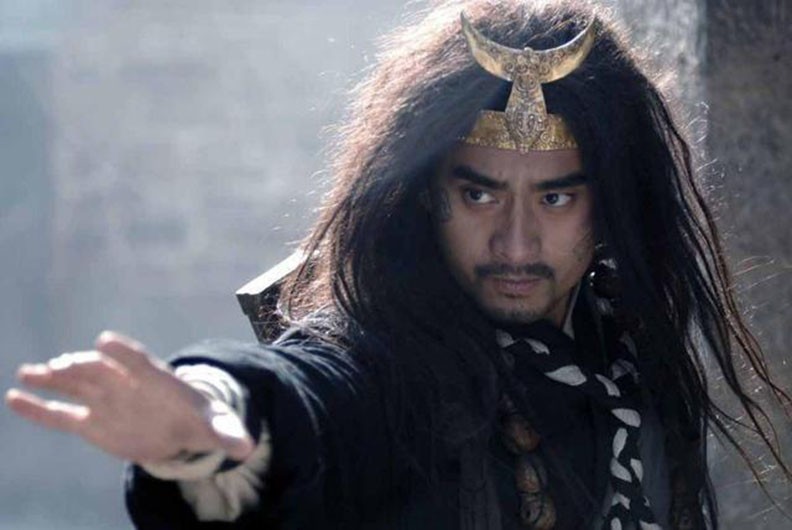
Fig. 1 – (Left) The “Type One” headband. From the comedy A Chinese Odyssey Part Two: Cinderella (1995). (Center) The “Type Two” headband. From the famous 1986 TV show. (Right) The “Type Three” headband. From the 2011 TV show (larger version).

2. Past Research into the Origins of the Headband

It appears very few scholars writing in English have attempted to trace the origins of the golden fillet. Wang Tuancheng theorizes that the idea for the headband came from two sources. First, the historical journal of Xuanzang (602–664 CE), the Tang Dynasty monk on whom Tripitaka is loosely based, details how he was challenged to a religious debate by a man in a foreign kingdom who offered his own head as the price of defeat. Xuanzang won, but instead of collecting his prize, the monk took the man as his servant. Second, Wang notes that slaves during the Han Dynasty (206 BCE–220 CE) wore a metal collar around their neck shaped like the Chinese character for twenty (nian, 廿). He goes on to explain: “…the author transformed the metal hoop that the non-Buddhist might have worn to Sun Wukong’s headband” (Wang, 2006, p. 67).

I’m not particularly persuaded by this argument since Wang doesn’t offer any evidence as to why a Han-era slave implement would still be in use during the Tang (618–907 CE) four to five hundred years later; nor does he suggest a reason for why such a collar would be moved from the neck to the head. Besides, there exists religious art featuring the fillet (see below) that predates the novel by centuries, meaning it wasn’t the sole invention of the JTTW author-compiler.

Before I continue, I would like to point out that the 13th century CE precursor of the novel, The Story of How Tripitaka of the Great Tang Procures the Scriptures, does not mention the fillet at all. (This is just one of many differences between it and the final 16th century CE version.) Monkey is simply portrayed as a concerned celestial who purposely seeks out Tripitaka to ensure his safety, as the monk’s two previous incarnations have perished on the journey to India. In other words, he comes as a willing participant, which negates the need for punishment via the ringlet. [3] But at least two pictorial representations of Monkey coinciding with the Song Dynasty (960–1279 CE) depict him wearing a band, which, again, excludes the treasure being a later invention.

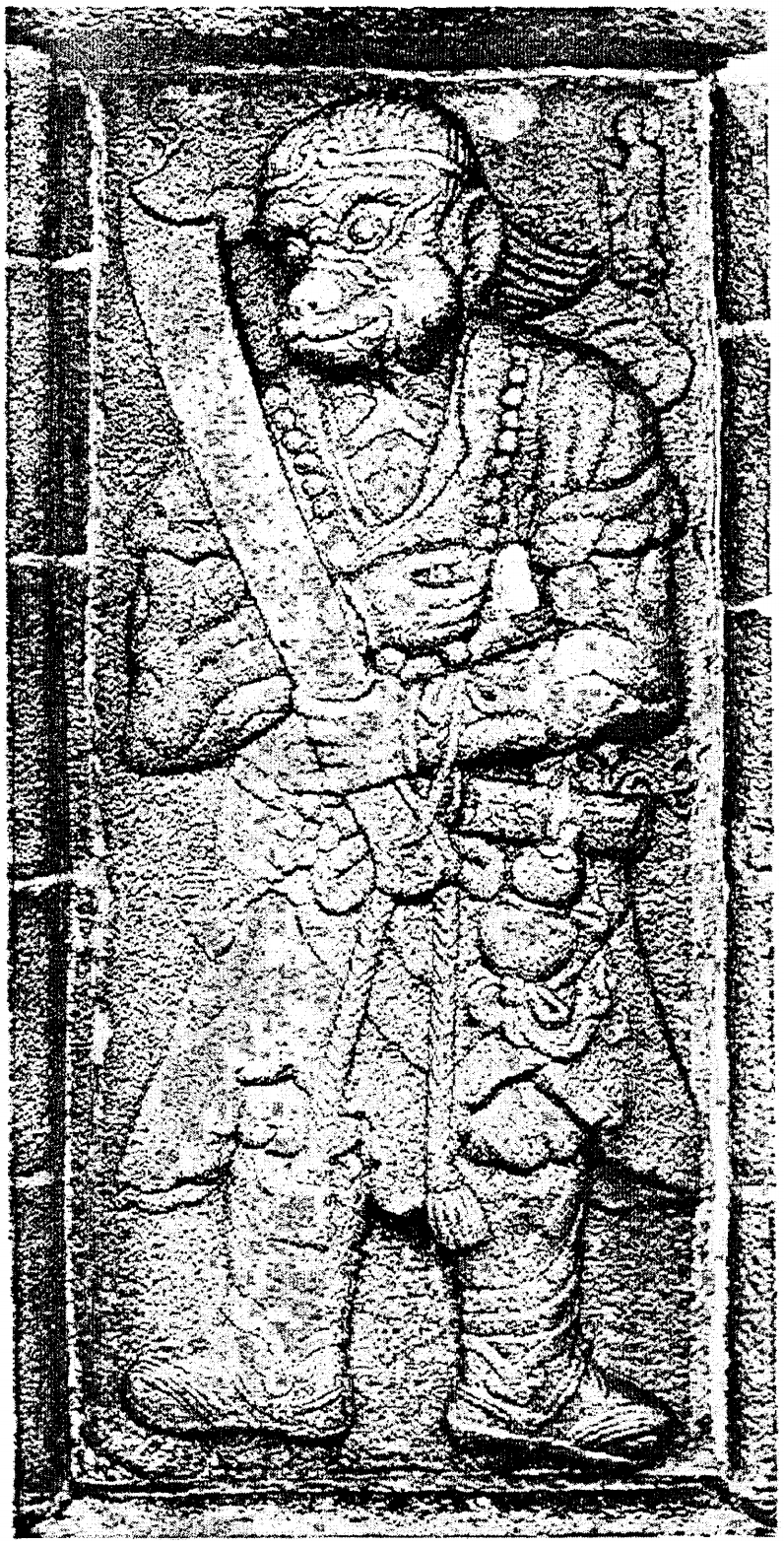
In her excellent paper on the origins of Sun Wukong, Hera S. Walker (1998) discusses a 13th century CE stone relief from the western pagoda of the Kaiyuan Temple (開元寺) in Quanzhou, Fujian province, China that portrays a sword-wielding, monkey-headed warrior (pp. 69-70). Considered by many to be an early depiction of Monkey, the figure wears a robe, a Buddhist rosary, and, most importantly, a type one fillet on the forehead (Fig. 4). [4] Walker quotes Victor Mair, who believes that the fillet “recalls the band around the head of representations of Andira, the simian guardian of Avalokitesvara” (the Indian counterpart to Guanyin) (Walker, 1998, p. 70). He goes on to list similarities between the stone relief and depictions of Andira, while also suggesting said depictions are based on south and southeast Asian representations of the Hindu monkey god Hanuman:

Identical earrings (these are key iconographic features of H[anuman] in many Southeast Asian R[ama saga]s), comparable tilt of the head… which seems to indicate enforced submission, long locks of hair… flaring out behind the head, elongated monkey’s mouth, similar decorations on the forearm and upper arm, etc. It is crucial to note that all these features can be found in South Asian and Southeast Asian representations of H[anuman] (Walker, 1998, p. 70).

So as it stands, the 13th century CE appears to be the furthest that the motif has been reliably traced.

Fig. 4 – The 13th century CE stone relief of Sun Wukong from the Kaiyuan Temple in Quanzhou, Fujian province, China (larger version).

3. My Findings

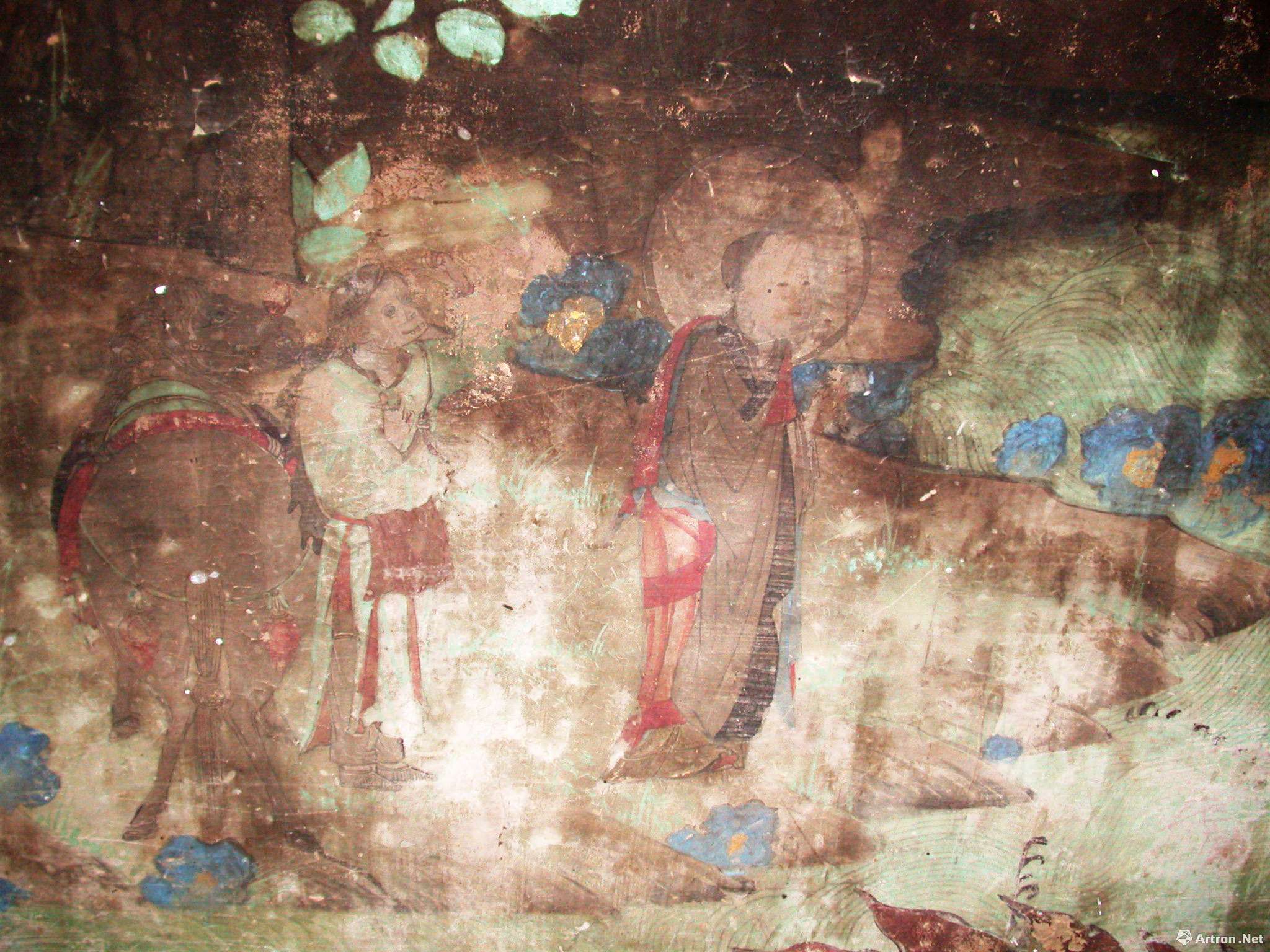
While Mair suggests a Southeast Asian Hindo-Buddhist influence, I know of at least one example from northeastern China that suggests an Indo-Tibetan Buddhist influence. The Eastern Thousand Buddha Cave no. 2 (Dong qianfo dong di 2 ku, 東千佛洞第2窟) in the Hexi Corridor of Gansu Province contains a late-Xixia dynasty (late-12th to early-13th century CE) mural of Xuanzang worshiping Guanyin from a riverbank. Monkey stands behind him tending to a brown horse. He is portrayed with a type three circlet on his head, waist length hair, and light blue-green robes with brown pants (fig. 5). This painting was completed during a time when China was seeing an influx of monks fleeing the inevitable fall of India’s Buddhist-led Pala Dynasty (750–1174 CE) from the 10th to the 12th century CE. They brought with them the highly influential Pala Buddhist art style and Vajrayana Buddhism, a form of esoteric Buddhism. The MET (2010) writes:

A mixture of Chinese-style and Vajrayana traditions and imagery was employed in the Tangut Xixia Kingdom …  which was based in Ningxia, Gansu, and parts of Shanxi … It is difficult to imagine that this “new” type of Buddhism, which not only was flourishing in Tibet in the late tenth century but was also found in the neighboring Xixia Kingdom and may have been practiced by Tibetans based in the Hexi Corridor region of Gansu Province, was completely unknown in central China until the advent of the Mongols (p. 19).

The painting of Monkey and Tripitaka was surely created by an Indian or Tibetan Buddhist monk, or at the very least a fellow Tangut or Chinese practitioner living in the area. This suggests that the imagery within the painting, such as the fillet, could have an Esoteric Buddhist pedigree, and textual evidence shows such headbands were indeed worn in some esoteric rituals.

For example, the Indian Buddhist Hevajra Tantra (Dabei kongzhi jingang dajiao wang yigui jing, 大悲空智金剛大教王儀軌經, 8th century CE) instructs adherents on how to adorn and dress themselves for worshipping Heruka, a Wrathful Destroyer of Obstacles:

The yogin must wear the sacred ear-rings, and the circlet on his head (emphasis added); on his wrists the bracelets, and the girdle round his waist, rings around his ankles, bangles round his arms; he wears the bone-necklace and for his dress a tiger-skin… (Linrothe, 1999, p. 250).

彼修觀者當如是行:謂頂想寶輪、耳帶、寶鐶,手串寶釧,腰垂寶帶,足繫寶鐸及妙臂釧,頸嚴寶鬘衣、虎皮衣 …

Furthermore, it describes how each of the ritual adornments and implements used in the ceremony represents each of the five esoteric Buddhas, as well as other religio-philosophical elements:

Aksobhya is symbolized by the circlet (emphasis added), Amitabha by the ear-rings, Ratnesa by the necklace, and Vairocana (by the rings) upon the wrists. Amogha is symbolized by the girdle. Wisdom by the khatvanga [staff] and Means by the drum, while the yogin represents the Wrathful One himself [i.e. Heruka]. Song symbolizes mantra, dance symbolizes meditation, and so singing and dancing the yogin always acts (Linrothe, 1999, p. 251).

「輪者,表阿閦如來;鐶者,無量壽如來;頸上鬘者,寶生如來;手寶釧者,大毘盧遮那如來;腰寶帶者,不空成就如來。於是色相而生念住:金剛渴椿誐杖者,表勝慧相;奎樓鼓者,即善方便故;瑜伽行者,瞋業清淨;住金剛歌詠者,真言清淨。

「又復,不應為求利養作是金剛歌舞事業。是故,瑜伽者當如是行…

As can be seen, the circlet represents Aksobhya (Sk: “Immovable”; Ch: Achu, 阿閦; Budong, 不動). This deity is known for his adamantine vow to attain buddhahood through the practice of Sila, or “morality,” the aim of which “is to restrain nonvirtuous deeds of body and speech, often in conjunction with the keeping of precepts” (Buswell & Lopez, 2014, pp. 27 and 821). So, the ritual band most likely served as a physical reminder of right speech and action, making it the best candidate for the origin of Monkey’s fillet. Sun is after all the representation of the “Monkey of the Mind” (as noted in the introduction), so his inclusion in the Eastern Thousand Buddha Cave painting was probably meant to convey the taming of this Buddhist concept via the circlet (apart from referencing the popular tale itself).

The Hevajra Tantra, the text in which the circlet appears, was first translated into Tibetan by Drogmi (993–1074 CE) and adopted during the 11th century CE as a central text by the respective founders of the Kagyu and Sakya sects, two of the six major schools of Tibetan Buddhism. Various members of the Sakya sect were invited by Mongol royalty to initiate them into the text’s esoteric teachings during the 13th century CE. These include Sakya Pandita and his nephew Chogyal Phagpa, who tutored Genghis Khan‘s grandson Prince Goden in 1244 and Kublai Khan in 1253, respectively. The meeting between Kublai and Chogyal resulted in Vajrayana Buddhism becoming the state religion of Mongolia. The Hevajra Tantra was translated into Chinese by the Indian monk Dharmapala (963–1058 CE) in 1055 during the Northern Song Dynasty (960–1127 CE). The text, however, did not become popular within the Chinese Buddhist community like it would with the Mongols in the 13th century CE (Bangdel & Huntington, 2003, p. 455). But this evidence shows how the concept of the 8th century CE ritual circlet could have traveled from India to East Asia to influence depictions of Sun Wukong in the 12th/13th century CE. And the relatively unknown status of the text in China might ultimately explain why there are so few ancient depictions of Chinese deities wearing the fillet, or why it does not appear in the 13th century CE version of JTTW.

While the late-Xixia mural (fig. 5) lacks many of the ritual adornments (apart from the fillet) mentioned in the Hevajra Tantra, the Quanzhou stone relief (refer back to fig. 3) includes the band, earrings, necklace, bangles, and possibly even a tiger skin apron, suggesting it too has an esoteric origin (most likely based on Chinese source material). The band’s connection to esoteric Buddhism is further strengthened by a 12th century CE painting from Japan. Titled Aka-Fudo (赤不動), or “Red Fudo [Myoo],” it depicts the wrathful esoteric god seated in a kingly fashion, holding a fiery, serpent-wrapped Vajra sword in one hand and a lasso in the other (fig. 6). He wears a golden, three-linked headband (similar to the curls of type one), which stands out against his deep red body and flaming aureola. Biswas (2010) notes: “… the headband on his forehead … indicate[s], according to some, a relation to the habit of groups of ascetics who were among the strong supporters of Acalanatha” (p. 112). His supporters were no doubt yogin practitioners in the same vein as those who worshipped Heraku and other such wrathful protector deities.

Fig. 5 – A portion of the late-Xixia (late-12th to early-13th century CE mural) in the Eastern Thousand Buddha Cave number two (larger version). Fig. 6 – The 12th century CE Japanese painting “Aka-Fudo” (赤不動) (larger version).

3.1. Symbol of Martial Deities and Warrior Monks

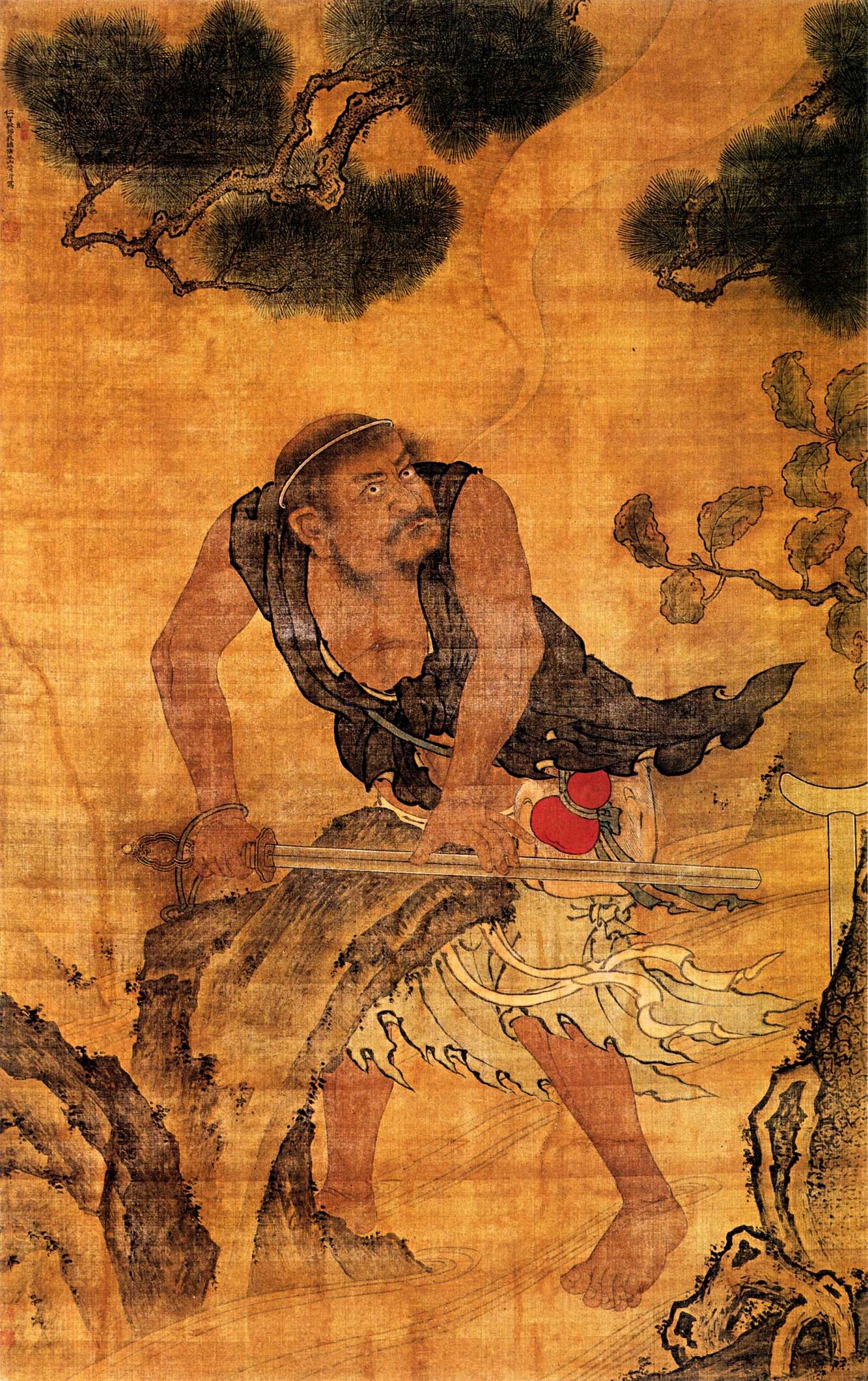
It’s important to note that Monkey was not the only cultural hero of the Ming Dynasty (1368–1644 CE) to wear a golden fillet. Another example is Li Tieguai (李鐵拐), or “Iron Crutch Li,” the oldest of the Eight Immortals. [5] Li is generally portrayed as a crippled beggar leaning on a cane. Legend has it that his original body was cremated prematurely by a disciple while the immortal traveled in spirit to answer a summons from Lord Laozi, the high god of Daoism. Li’s spirit returned a day later to find only ashes, thus forcing him to inhabit the body of a recently deceased cripple. According to Allen and Philips (2012), “Laozi gave him in recompense a golden headband and the crutch that was to become his symbol” (p. 108). Some depictions of Li wearing the fillet predate JTTW. The most striking example is Huang Ji’s Sharpening a Sword (early-15th century CE) (Fig. 7), which portrays the immortal wearing a type three band and sharpening a double-edged blade on a stone while staring menacingly at the viewer. [6] One theory suggests Li’s martial visage identifies him as a “spirit-guardian of the [Ming] state” (Little, 2000, p. 333). Both Monkey and Li are, therefore, portrayed as brutish, weapon-bearing, golden headband-wearing immortals who serve as protectors. This shows that the fillet was associated with certain warrior deities during the Ming.

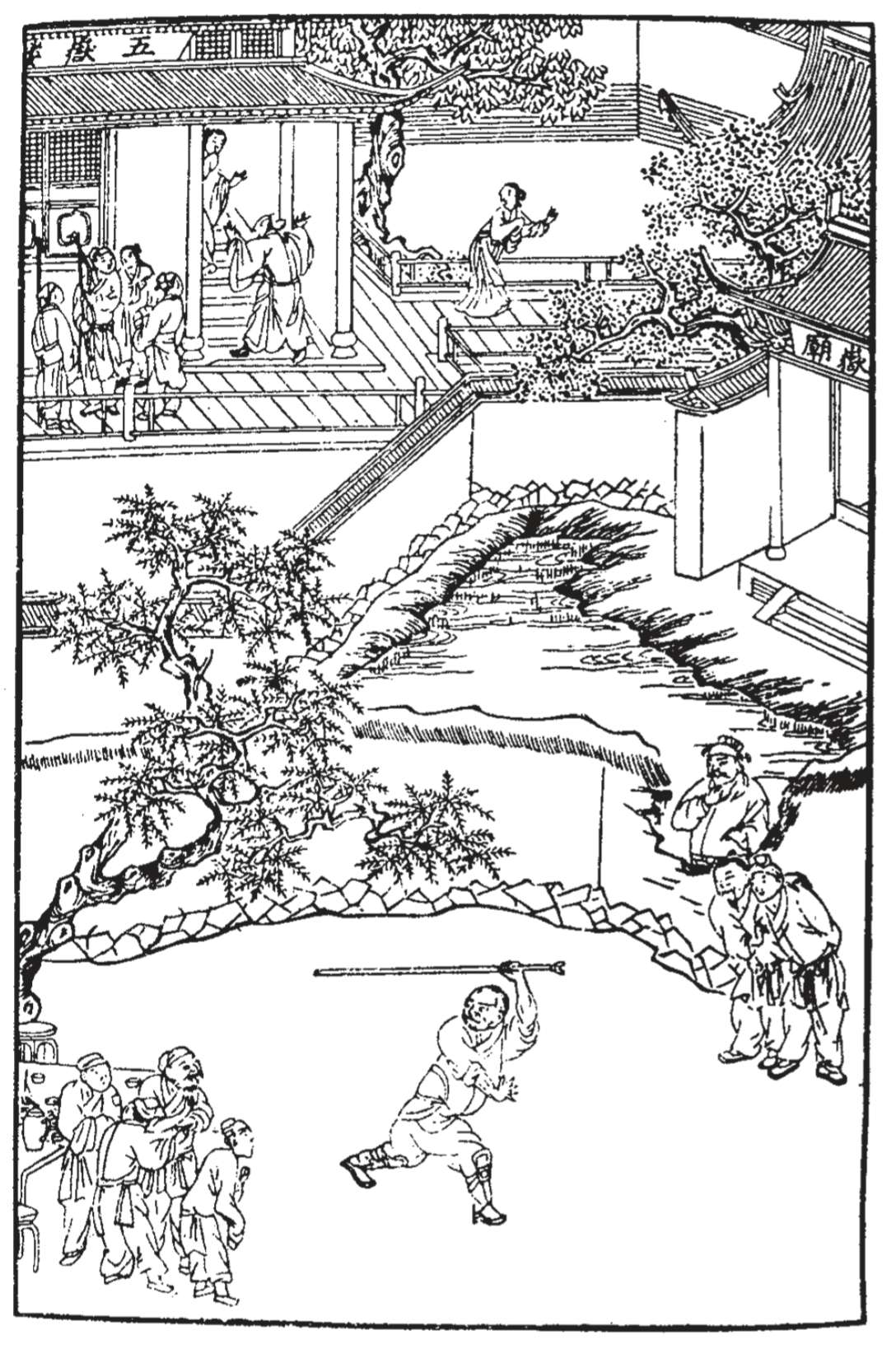
The fillet’s connection to religion and martial attributes culminated in the Jiegu (戒箍, “ring to forget desires”), a type two band worn by Military Monks (Wuseng, 武僧) in Chinese opera to show that they have taken a vow of abstinence (fig. 8). Such monks are depicted as wearing a Jiegu over long hair (Bonds, 2008, pp. 177-178 and 328), which contrasts with the bald heads of religious monks. [7] I would like to suggest that the band’s half-moon shape may have some connection to a Ming-era woodblock print motif in which martial monks are shown wielding staves tipped with a crescent (fig. 9) . The exact reason for the shape is still unknown (Shahar, 2008, pp. 97-98), but the association between the crescent and martial monks seems obvious. (See the 07-25-22 update below for the foreign origins of this motif.) The use of the fillet in Chinese opera led to it being worn by Sun Wukong in the highly popular 1986 live-action TV show adaptation of the novel (fig. 2). [8]

Fig. 7 (Left) – Huang Ji’s “Sharpening a Sword” (early-15th century CE) (larger version). Fig. 8 (Center) – An image of the military monk Wu Song wearing a jiegu (戒箍) fillet from a 2011 Water Margin TV show (larger version). Fig. 9 (Right) – A late-Ming woodblock of the warrior monk Lu Zhishen with a crescent staff (larger version). From Shahar (2008).

4. Conclusion

Examples of past research into the origins of the golden fillet respectively point to a slave collar from the Han dynasty (206 BCE–220 CE) and circa 13th century CE South and Southeast Asian depictions of the Buddhist guardian Andira and the Hindu monkey god Hanuman as possible precursors. However, the first isn’t credible, and the second, while on the right track, doesn’t go back far enough. A late-12th to early-13th century CE mural in the Eastern Thousand Buddha Cave complex depicts Sun Wukong wearing a type three fillet with possible ties to a ritual circlet worn by Esoteric Buddhist Yogin ascetics in 8th century CE India. The Hevajra Tantra, the esoteric text that mentions the band, associates it with the Aksobhya Buddha and thereby his moralistic, self-restraining practices. The text was transmitted from India to Tibet, China, and Mongolia from the 11th to the 13th centuries CE, showing a clear path for such imagery to appear in East Asia. A 12th century CE Japanese Buddhist painting of the guardian deity Fudo Myoo with a fillet suggests that the practice of wearing circlets in esoteric rituals continued for centuries. Other non-Buddhist deities became associated with the fillet during the Ming Dynasty. A 15th century CE painting of the immortal Li Tieguai, for example, depicts him as a type one circlet-wearing, sword-wielding guardian of the Ming dynasty. All of this suggests that the band became a symbol of Chinese protector deities. The association between the fillet and religion and martial attributes led to its use as the symbol of military monks in Chinese opera.


5. Updates

Update: 12-23-17

I’ve been wondering what the 8th century CE version of the circlet (along with the other ritual implements) mentioned in the Hevajra Tantra might have looked like. While I have yet to find a contemporary sculpture or painting, I have found an 11th to 12th century CE interpretation from Tibet. Titled The Buddhist Deity Hevajra (fig. 10), this copper alloy statue somewhat follows the prescribed iconography of the god as laid out in the aforementioned text:

Dark blue and like the sun in colour with reddened and extended eyes, his yellow hair twisted upwards, and adorned with the five symbolic adornments,/ the circlet, the ear-rings and necklace, the bracelets and belt. These five symbols are well known for the purificatory power of the Five Buddhas./ He has the form of a sixteen-year-old youth and is clad in a tiger-skin. His gaze is wrathful. In his left hand he holds a vajra-skull, and a khatvahga [staff] likewise in his left, while in his right is a vajra of [a] dark hue…(Linrothe, 1999, p. 256)

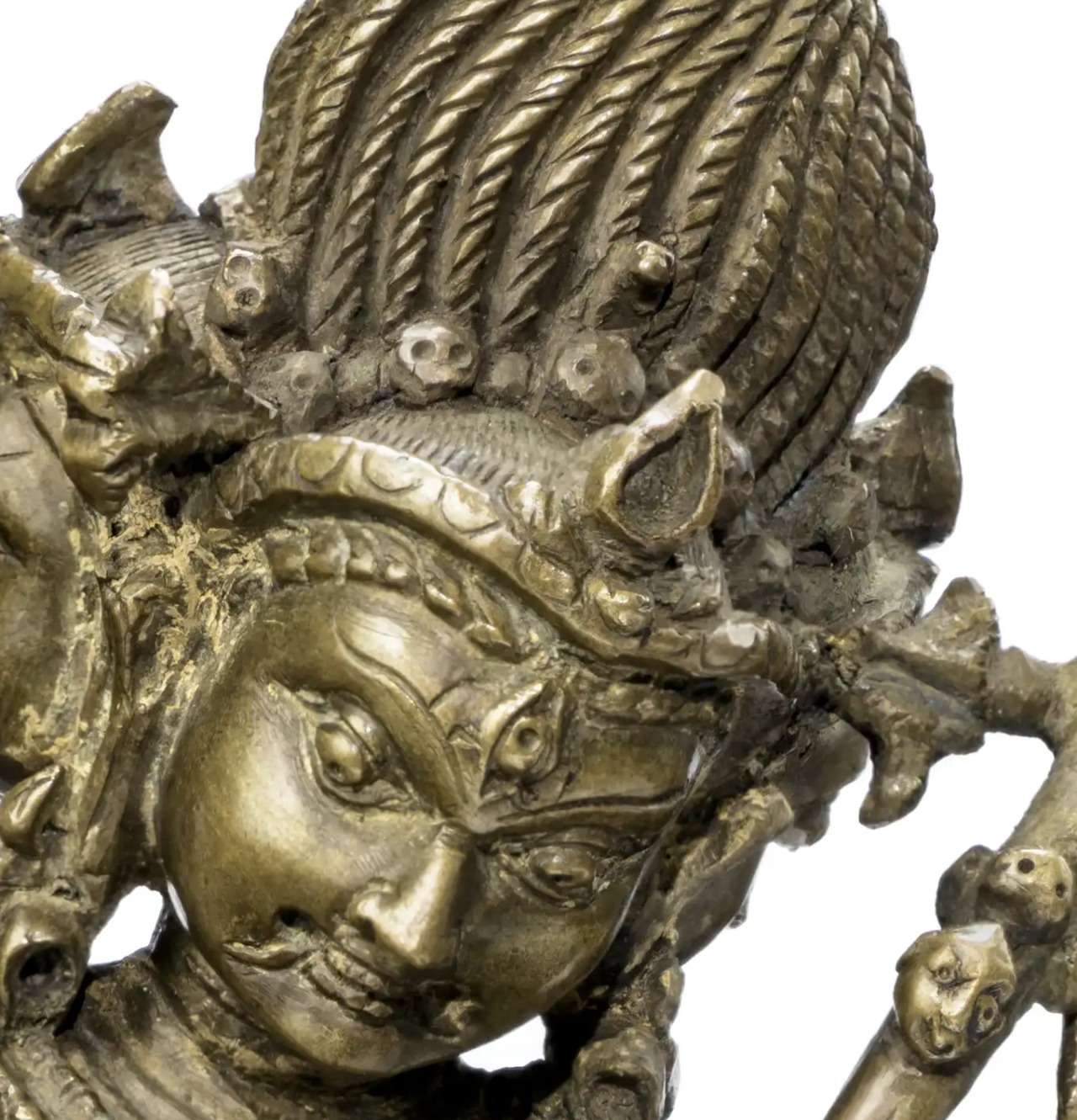
Fig. 10 – The Buddhist Deity Hevajra, late-11th to early-12th century CE, copper alloy (larger version). Courtesy of the Los Angeles County Museum of Art. Fig. 11 – Detail of the circlet (larger version).

The circlet here is depicted as a fitted band with crescent trim and a teardrop-shaped adornment (a conch?) (fig. 11). The statue’s iconography more closely follows that from the Sadhanamala (“Garland of Methods”), a compilation of esoteric texts from the 5th to 11th centuries CE. The following information probably derives from the later part of this period:

He wields the vajra in the right hand and from his left shoulder hangs the Khatvanga [staff] with a flowing banner, like a sacred thread. He carries in his left hand the kapala [skull cap] full of blood. His necklace is beautified by a chain of half-a-hundred severed heads. His face is slightly distorted with bare fangs and blood-shot eyes. His brown hair rises upwards and forms into a crown which bears the effigy of Aksobhya. He wears a kundala [ear decoration] and is decked in ornaments of bones. His head is beautified by five skulls (Donaldson, 2001, p. 221).

Our statue has many of these features but lacks the image of the Buddha in his hair. This suggests the knob visible in the coif (fig. 10) once carried such a figure. So, once again we see the importance of the Aksobhya Buddha. The statue is similar to 10th and 11th century CE stone statues from India. [9]

While this doesn’t get us any closer to what the original circlet looked like, this statue adds to the mutability of the fillet imagery. The Hevajra Tantra is vague in its description, and so it is no surprise that so many variations have appeared over the centuries. The original sanskrit text uses the word cakri (circle) to refer to the band (Farrow & Menon, 2001, pp. 61-62). This might explain the simple type three fillet worn by Monkey in the Eastern Thousand Buddha Cave no. two painting (fig. 2).


Update: 08-16-20

I have written an article suggesting an origin for the type one headband, or as I now call it, the “curlicue headband.”

Sun Wukong’s Curlicue-Style Headband


Update: 12-12-21

One thing I figured out a while ago but never explained here was the reason why the Japanese Buddhist protector deity Aka-Fudo (赤不動) (fig. 6) is depicted with a headband. I believe this is a visual representation of the fillet’s association with the Aksobhya Buddha. This is because the fudo (Ch: budong, 不動) of Aka-Fudo and the Sanskrit meaning of Aksobhya respectively mean “immovable.” So, the image of Aka-Fudo is encapsulating both his position as a protector deity and the Buddha represented by the headband. 


Update: 01-23-22

I’ve written an article suggesting a mantra for the secret spell that causes the golden fillet to tighten.

The Tightening Spell of Sun Wukong’s Golden Headband


Update: 07-25-22

I’ve written an article that explains the origins of the “crescent-style” headband.

The Monkey King’s Crescent-Style Headband


Update: 06-26-23

Above, I mentioned that the novel contains three kinds of headbands:

  1. Sun Wukong/Six Ears – “Constrictive” (jin, 緊) – ch. 14
  2. Black Bear Demon – “Prohibitive” (jin, 禁) – ch. 17
  3. Red Boy – “Golden” (jin, 金) – ch. 42

It’s interesting that all of them are pronounced “jin” (with varying tones).

Now imagine that there is a secret fourth headband not intended to punish but to empower. Called the “Strength” (jin, 勁) headband, it would only be used in the most extreme emergencies.

It would be neat to see someone work this into their fanfiction.


Update: 12-24-23

A character is briefly punished to wear a golden headband in the famed Ming-era novel Investiture of the Gods (Fengshen yanyi封神演義, c. 1620; summary). Chapter 82 reads: 

Ma Sui [馬遂] attacked him with his sword, and after only one round, threw a gold hoop [jingu, 金箍] around the immortal’s head. The Yellow Dragon Immortal [Huanglong zhenren, 黃龍真人] writher in pain but was quickly rescued and brought back to the pavilion.

The Yellow Immortal Dragon Immortal tried to take the hoop off his head but found it was impossible. It was so tight the true samadhi fire went out of his eyes.

The Immortal of the South Pole [Nanji xianweng, 南極仙翁] came in to announce Heavenly Primogenitor’s [Yuanshi tianzun, 元始天尊] arrival. The religious leader entered the pavilion and said, “The Yellow Dragon Immortal was destined to be caught in this gold hoop. Come here and let me help you.”

He pointed at the gold hoop, and it dropped to the ground (Gu, 2000, pp. 1713-1715).

只一合,馬遂祭起金箍,把黃龍真人的頭箍住了。真人頭疼不可忍,眾仙急救真人,大家回蘆篷上來。真人急忙除金箍,除又除不掉,只箍得三昧真火從眼中冒出;大家鬧在一處。不表。且說元始天尊來會萬仙陣,先著南極仙翁持玉符先行。南極仙翁跨鶴而來,雲光縹緲。馬遂抬頭,見是南極仙翁,急駕雲光至半空中來,阻住去路。仙翁笑曰:「馬遂,你休要猖獗,掌教師尊來了。」馬遂正欲爭持,只見後面仙樂一派,遍地異香,馬遂知不可爭持,按落雲頭,回歸本陣。南極仙翁先至蘆篷,率眾仙迎鑾接駕,上篷坐下。眾門人拜畢,侍立兩傍。元始曰:「黃龍真人有金箍之厄。」忙叫:「過來。」黃龍真人走至面前;元始用手一指,金箍隨脫。

(Gu (2000) skips over some elements in the original Chinese.)

I’ve known about this episode for a while but forget to post about it.

Notes

1) For the entire episode, see Wu & Yu, 2012, vol. 1, pp. 314-320.

2) The child first speaks his new name in chapter 49 (Wu & Yu, 2012, vol. 2, p. 354). The original Sudhana originates from the Avatamsaka Sutra (Wu & Yu, 2012, vol. 2, pp. 386-387 n. 3).

3) For a complete English translation, see Wivell (1994).

4) This is just one of many relief carvings that grace the pagoda. It includes other guardian-type figures with esoteric elements but rendered in the Chinese style. See Ecke and Demiéville (1935).

5) The Eight Immortals are Daoist saints who came to be worshipped as a group starting sometime in the Jin Dynasty (1115–1234 CE) (Little, 2000, p. 319).

6) The sword is usually a symbol of the immortal Lu Dongbin, but as noted above, it is used to identify Li Tieguai as a Ming guardian (Little, 2000, p. 333).

7) Shahar (2008) discusses the historical differences between religious and military monks in ancient China.

8) Liu Xiao Ling Tong (六小龄童; born Zhang Jinlai, 章金萊, 1959), the actor who played Monkey in the 1986 TV show, comes from a family who has specialized in playing Sun Wukong in Chinese opera for generations (Ye, 2016).

9) See the Heruka chapter in Linrothe (1999). He includes our statue in his study, but other sources describe it as Tibetan instead of Indian (Bangdel & Huntington, 2003, p. 458).

Bibliography

Allan, T., & Phillips, C. (2012). Ancient China’s Myths and Beliefs. New York: Rosen Pub.

Bangdel, D., & Huntington, J. C. (2003). The Circle of Bliss: Buddhist Meditational Art. Chicago, Ill: Serindia Publications.

Biswas, S. (2010). Indian Influence on the Art of Japan. New Delhi: Northern Book Centre.

Bonds, A. B. (2008). Beijing Opera costumes: The Visual Communication of Character and Culture. Honolulu: University of Hawai’i Press.

Buswell, R. E., & Lopez, D. S. (2014). The Princeton Dictionary of Buddhism. Princeton, NJ: Princeton University Press.

Donaldson, T. E. (2001). Iconography of the Buddhist Sculpture of Orissa. New Delhi: Indira Gandhi National Centre for the Arts.

Ecke, G., & Demiéville, P. (1935). The Twin Pagodas of Zayton: A Study of the Later Buddhist Sculpture in China. Cambridge, Mass: Harvard University Press.

>Farrow, G. W., & Menon, I. (2001). The Concealed Essence of the Hevajra Tantra: With the Commentary Yogaratnamālā. Delhi: Motilal Banarsidass Publ.

Gu, Z. (2000). Creation of the Gods (Vols. 1-4). Beijing: New World Press.

Linrothe, R. N. (1999). Ruthless Compassion: Wrathful Deities in Early Indo-Tibetan Esoteric Buddhist Art. Boston, Mass: Shambhala.

Little, S. (2000). Taoism and the Arts of China. Chicago, IL: Art Institute of Chicago.

Liu, X. (1994). The Odyssey of the Buddhist Mind: The Allegory of the Later Journey to the West. Lanham, Md: University Press of America.

Metropolitan Museum of Art, Leidy, D. P., Strahan, D. K., & Becker, L. (2010). Wisdom Embodied: Chinese Buddhist and Daoist sculpture in the Metropolitan Museum of Art. New York: Metropolitan Museum of Art.

Shahar, M. (2008). The Shaolin Monastery: History, Religion, and the Chinese Martial Arts. University of Hawaii Press.

Walker, H.S. (1998). Indigenous or Foreign? A Look at the Origins of Monkey Hero Sun Wukong. Sino-Platonic Papers, 81, 1-117.

Wang, T. (2006). Dust in the Wind: Retracing Dharma Master Xuanzang’s Western Pilgrimage. Taipei: Rhythms Monthly.

Wivell, C.S. (1994). The Story of How the Monk Tripitaka of the Great Country of T’ang Brought Back the Sūtras. In V. H. Mair (Ed.), The Columbia Anthology of Traditional Chinese Literature (pp. 1181-1207). New York: Columbia University Press.

Wu, C., & Yu, A. C. (2012). The Journey to the West (Vols. 1-4) (Rev. ed.) Chicago, Ill: University of Chicago Press.

Ye, X. (2016). Liu Xiao Ling Tong and Sun Wukong. Retrieved December 15, 2017, from https://www.youlinmagazine.com/story/liu-xiao-ling-tong-and-sun-wukong/Njgw

The Mountain of Flowers and Fruit and the Cosmic Geography of Journey to the West

Note: This page used to have historical information about the origin of Monkey’s first master, but I have moved it to a new article.

Last updated: 03-07-2023

The Monkey King’s home, the “Mountain of Flowers and Fruit” or “Flower-Fruit Mountain” (Huaguo shan, 花果山), is commonly assumed to be located in China. In fact, a similarly-named mountain in Jiangsu province is even touted as the home of Sun Wukong. However, this is not the case within the novel’s narrative. It’s important to remember that Journey to the West (Xiyouji, 西遊記, 1592) is set in a world that is nothing like our Earth.

In this article, I will explain the location of the Mountain of Flowers and Fruit, showing that Sun Wukong’s home is in fact an island east of what would be considered China. This opens the door to interesting interpretations by those wanting to place the story within a real world context. Second, I will explain the ancient Buddhist disc-world system as presented in the book. My hope is that this will give readers a better understanding of the cosmic geography in which the story happens. 

Table of Contents

1. Religious Background

Note: I will alternate between Wu & Jenner (2020) and Wu & Yu (2012), using one or the other depending on who I think has done a better job of translating certain passages.

Chapter one opens by describing the world in which the story is set:

The world was then divided into four great continents: The Eastern Continent of Superior Body, the Western Continent of Cattle-Gift, the Southern Continent of Jambu and the Northern Continent of Kuru (Wu & Jenner, 1993/2020, vol. 1, p. 3).

… 世界之間,遂分為四大部洲:曰東勝神洲,曰西牛賀洲,曰南贍部洲,曰北俱蘆洲。

Yu’s (Wu & Yu, 2012) translation provides romanization of the Sanskrit names (vol. 1, p. 100). I’ve listed them below, along with the original Sanskrit, an alternative English translation, and the Chinese for the reader’s reference:

  • East Pūrvavideha (Sk: पूर्वविदेह, “Surpassing the Body”; Ch: Dong shengshen zhou, 東勝神洲)
  • West Aparagodānīya (Sk: अपरगोदानीय, “Enjoyer of Cattle”; Ch: Xi niuhe zhou, 西牛賀洲)
  • North Uttarakuru (Sk: उत्तरकुरु, “Unpleasant Sound”; Ch: Bei julu zhou, 北俱盧洲)
  • South Jambudvīpa (Sk: जम्बुद्वीप, “Rose-Apple”; Ch: Nan shanbu zhou, 南贍部洲)

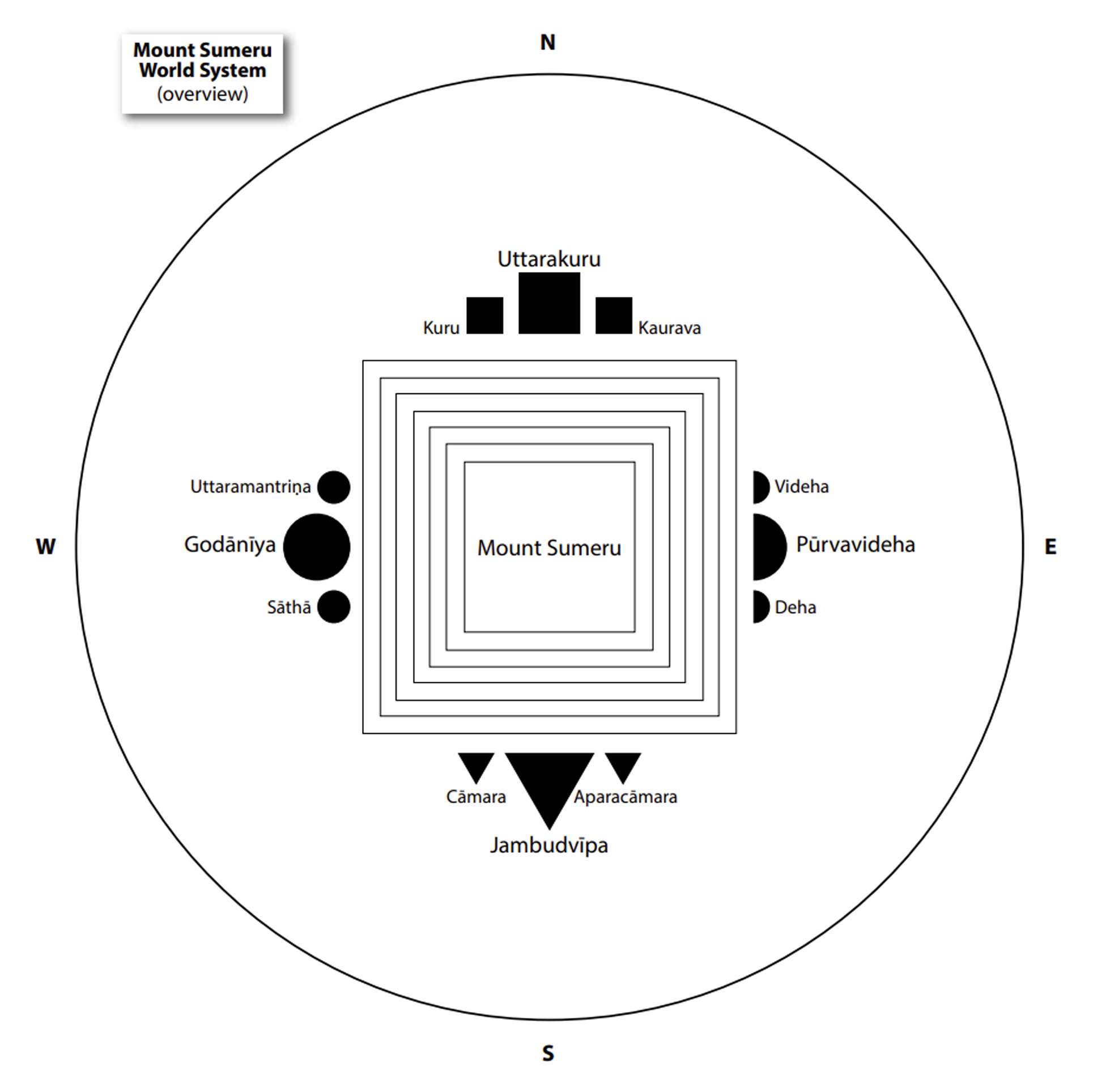
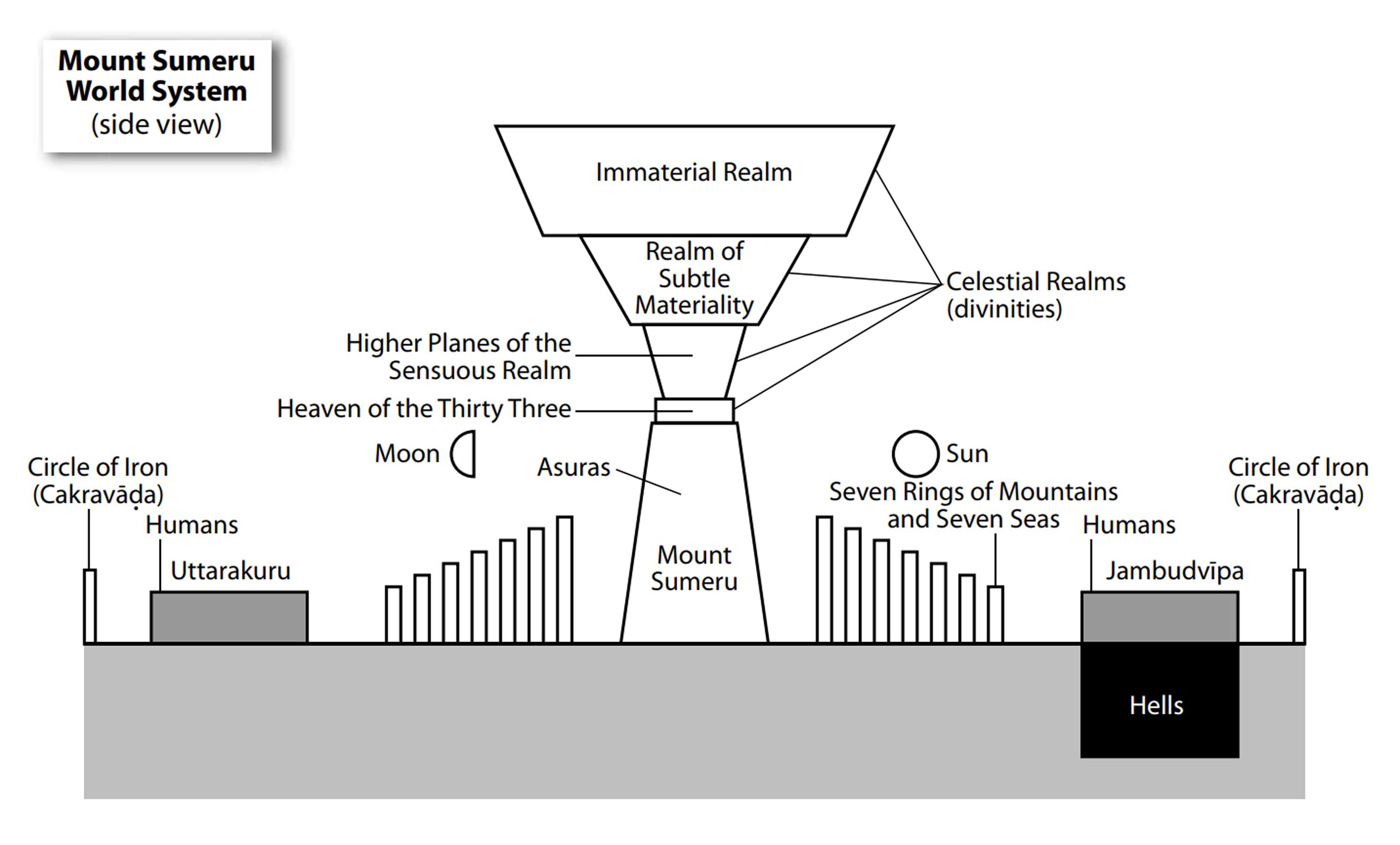
The Abhidharmakośa (Sk: अभिधर्मकोशभास्य; Ch: Api damo jushe lun, 阿毗達磨俱舍論, 4th to 5th century), a text describing the Buddhist universe, states that the four continents each have two intermediate continents, and that all twelve are set afloat in a great ocean surrounding the four respective sides of Mt. Sumeru (Ximi shan, 須彌山; Miaogao shan, 妙高山). This is a giant mountain that serves as the axis mundi of the cosmos, as well as the abode of assorted gods and sages. It is surrounded by seven golden mountains of lesser height, as well as a final iron mountain around the outside rim of the ocean, which keeps the water from draining over the edge (fig. 1 & 2) (Vasubandhu, La Vallée-Poussin, & Pruden, 1991, pp. 452-456).

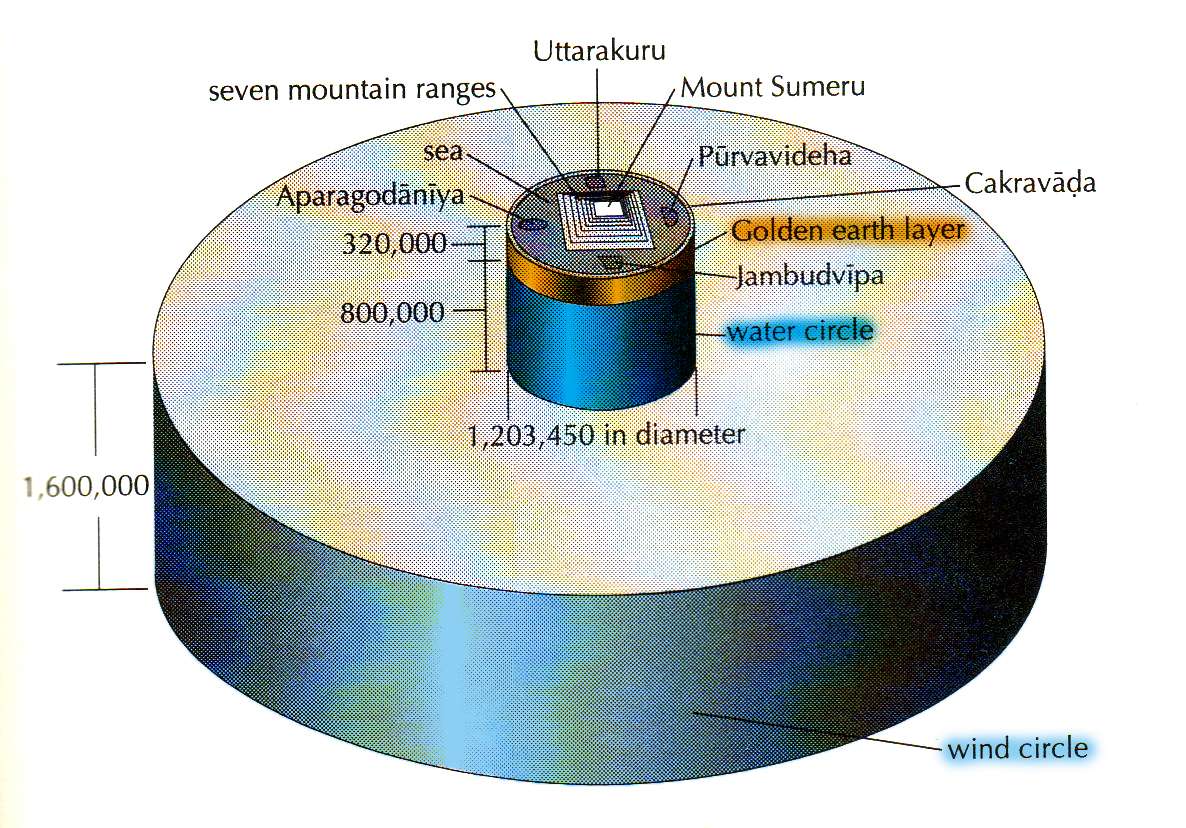
This system is supported by a series of elemental discs, each one becoming larger as one descends. The highest is kāñcanamaṇḍala, a disc of gold. The middle is jalamaṇḍala, a disc of water. And the lowest is vāyumaṇḍala, a disc of wind (fig. 3). This grand creation is thought to float in “space” (Vasubandhu, La Vallée-Poussin, & Pruden, 1991, pp. 451-452). 

Fig. 1 (top) – A top view of the Buddhist disc-world system (larger version). Fig. 2 (center) – A side view of the system (larger version). Images from Buswell & Lopez, 2014, pp. xxxii-xxxi. Fig. 3 (bottom) – A diagram showing the elemental discs supporting the world (larger version). Take note of the “wind circle” (light blue), the “water circle” (dark blue), and the “Golden earth layer” (gold). Adapted from Sadakata, 1997, p. 27.

2. Location of the Mountain

Chapter one continues:

Beyond the seas there is a country called Aolai [Aolai guo, 傲來國]. This country is next to an ocean, and in the middle of the ocean is a famous island called the Mountain of Flowers and Fruit. This mountain is the ancestral artery of the Ten Continents, the origin of the Three Islands; [1] it was formed when the clear and impure were separated and the Enormous Vagueness was divided (Wu & Jenner, 1993/2020, vol. 1, p. 3; cf. Wu & Yu, 2012, vol. 1, p. 100). 

海外有一國土,名曰傲來國。國近大海,海中有一座名山,喚為花果山。此山乃十洲之祖脈,三島之來龍,自開清濁而立,鴻濛判後而成。

Two deities shortly thereafter give a more precise location for the Mountain of Flowers and Fruit:

“We found that at the edge of the country of Aolai, which is east of the ocean belonging to the Eastern Continent of Superior Body, there is an island called the Mountain of Flowers and Fruit …” (Wu & Jenner, 1993/2020, vol. 1, p. 3; cf. Wu & Yu, 2012, vol. 1, p. 102). 

乃東勝神洲海東傲來小國之界,有一座花果山

Later, in chapter three, Sun Wukong’s advisors note the distance between Aolai and their island home:

The four monkeys replied, “East of our mountain, across two hundred [li] of water, is the boundary of the Aolai Country (Wu & Yu, 2012, vol. 1, p. 131; c.f. Wu & Jenner, 1993/2020, vol. 1, p. 50).

四猴道:「我們這山向東去,有二百里水面,那廂乃傲來國界。

All of this information tells us that the mountain is an island located 200 li (62 miles / 100 km) east of Eastern Superior Body (East Pūrvavideha).

3. The Novel’s Version of the Buddhist Disc-World System

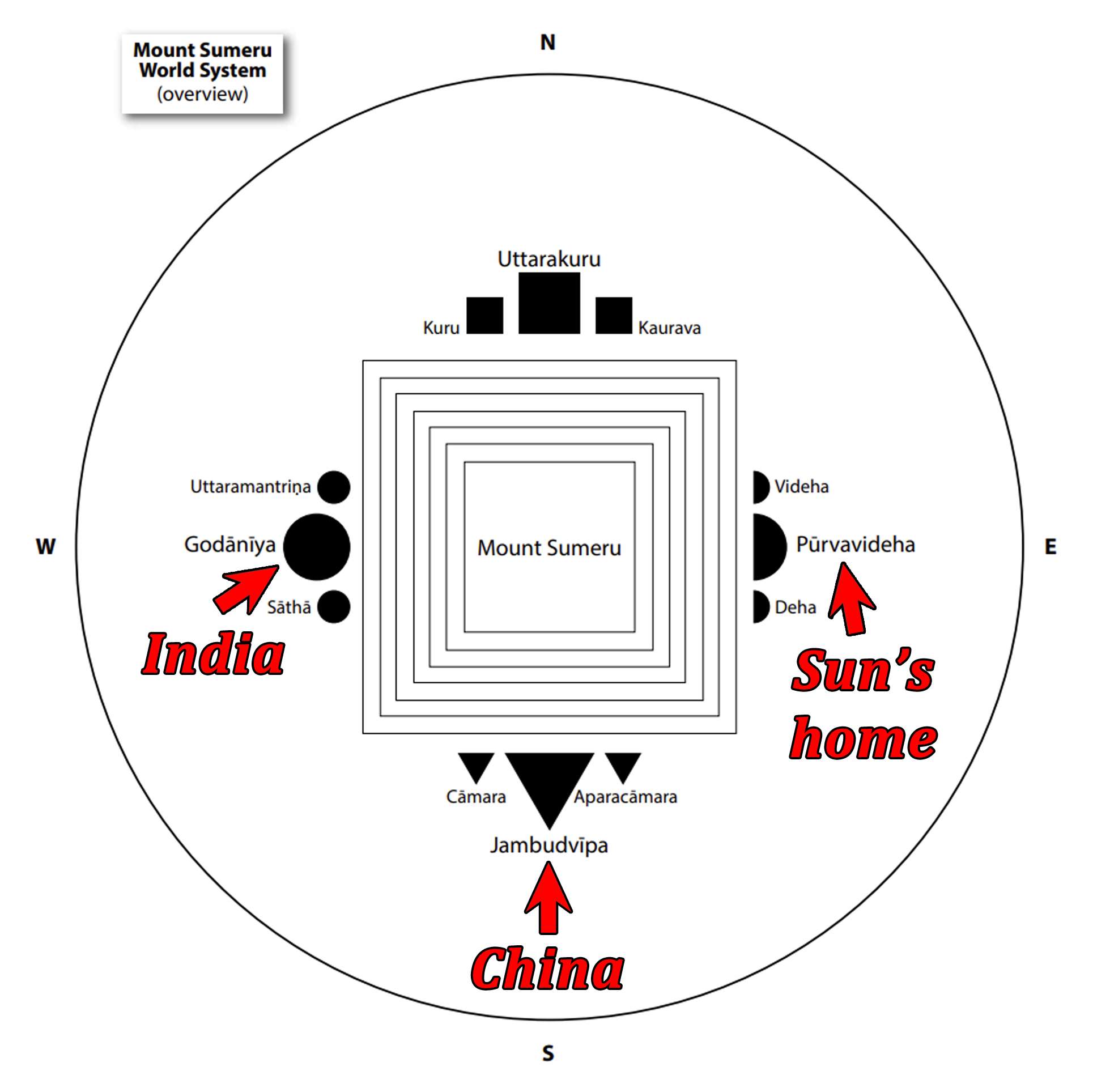
Buddhism traditionally associates Southern Jambu (South Jambudvīpa) with India (Buswell & Lopez, 2014, p. 377), but the novel shifts this structure a quarter turn clockwise (fig. 4). For example, in chapter eight, the Buddha associates his home (India) with the western continent and the southern continent with the “eastern lands” (dongtu, 東土), the Chinese Buddhist term for China (Tan, 1998, p. 137):

“… Our Western Continent of Cattle-Gift has people who neither covet nor kill. They nourish the vital essence and submerge the spirit; and although they produce no saints of the highest order, they all live to a ripe old age. But in the Southern Jambu Continent they are greedy and lecherous and delight in the sufferings of others; they go in for a great deal of killing and quarrelling. That continent can with truth be called a vicious field of tongues and mouths, an evil sea of disputation. [But I have] Three Stores of True Scriptures with which they can be persuaded to be good” (Wu & Jenner, 1993/2020, vol.1, p. 165; cf. Wu & Yu, 2012, vol. 1, pp. 205).

我西牛賀洲者,不貪不殺,養氣潛靈,雖無上真,人人固壽;但那南贍部洲者,貪淫樂禍,多殺多爭,正所謂口舌兇場,是非惡海。我今有三藏真經,可以勸人為善。

[…]

“I want to send them to the eastern lands because it is intolerable that the beings of that quarter should all be such stupid wretches who slander and defame the true word, do not understand the gist of my Law, and have lapsed from the orthodox Yogacara Sect…” (Wu & Jenner, 1993/2020, vol.1, p. 165; cf. Wu & Yu, 2012, vol. 1, pp. 205).

我待要送上東土,叵耐那方眾生愚蠢,毀謗真言,不識我法門之旨要,怠慢了瑜迦之正宗。

Additional evidence comes from chapter 29 when the chosen scripture pilgrim‘s travel rescript is reproduced. The opening line expressly connects China with the southern continent by way of the Chinese Tang dynasty

The travel rescript of the Tang Son of Heaven, who succeeds under the guidance of Heaven to the throne of the Great Tang Empire in the South Jambudvīpa Continent. … (Wu & Yu, 2012, vol. 2, p. 48; cf. Wu & Jenner, 1993/2020, vol. 2, p. 661).

南贍部洲大唐國奉天承運唐天子牒行

This means that when Sun first sails to Southern Jambu (South Jambudvīpa) to find a means of escaping death (Wu & Jenner, 1993/2020, vol.1, p. 16; cf. Wu & Yu, 2012, vol. 1, p. 108), he travels to the novel’s version of China. This further solidifies the fact that the Mountain of Flowers and Fruit is not located in China.

Fig. 4 – A top view of the Buddhist disc-world system according to Journey to the West (larger version). The Mountain of Flowers and Fruit would be to the east of Eastern Superior Body (East Pūrvavideha). Adapted from Buswell & Lopez, 2014, p. xxxii.

4. Reason for the Change

I suggest that the author-compiler of Journey to the West replaced the traditional cosmic geography for two reasons. First, both China and (part of) ancient India were referred to as the “Middle Kingdom” (Ch: Zhongguo, 中國; Sk: Madhyadeśa, मध्यदेश) (Wilkinson, 2000, p. 132; Lamotte, 1988, pp. 8-9). For example, the travelogue of the noted 4th to 5th-century Chinese Buddhist monk Faxian (法顯) reads:

Central India is known as the “Middle Kingdom” [Zhongguo, 中國]. The food and clothing of the common people are the same as the “Middle Kingdom” [i.e. China].

中天竺所謂中國。俗人衣服飲食亦與中國同。

This would naturally make it easier to associate China with Southern Jambu (South Jambudvīpa).

Second, since India is west of China, it would make sense for the country to be associated with Western Cattle-Gift (West Aparagodānīya).


5. Updates

Update: 10-01-17

A poem in chapter one states that the Mountain of Flowers and Fruit is the center of the universe. This obviously conflicts with Mt. Sumeru being the axis mundi.

Flower Fruit Mountain as the Center of the Universe


Update: 02-06-23

I have drastically rewritten the article to include more detailed information about the Buddhist disc-world system. I would also like to add material here from a previous article since it is related to the novel’s changes to the pre-existing structure.

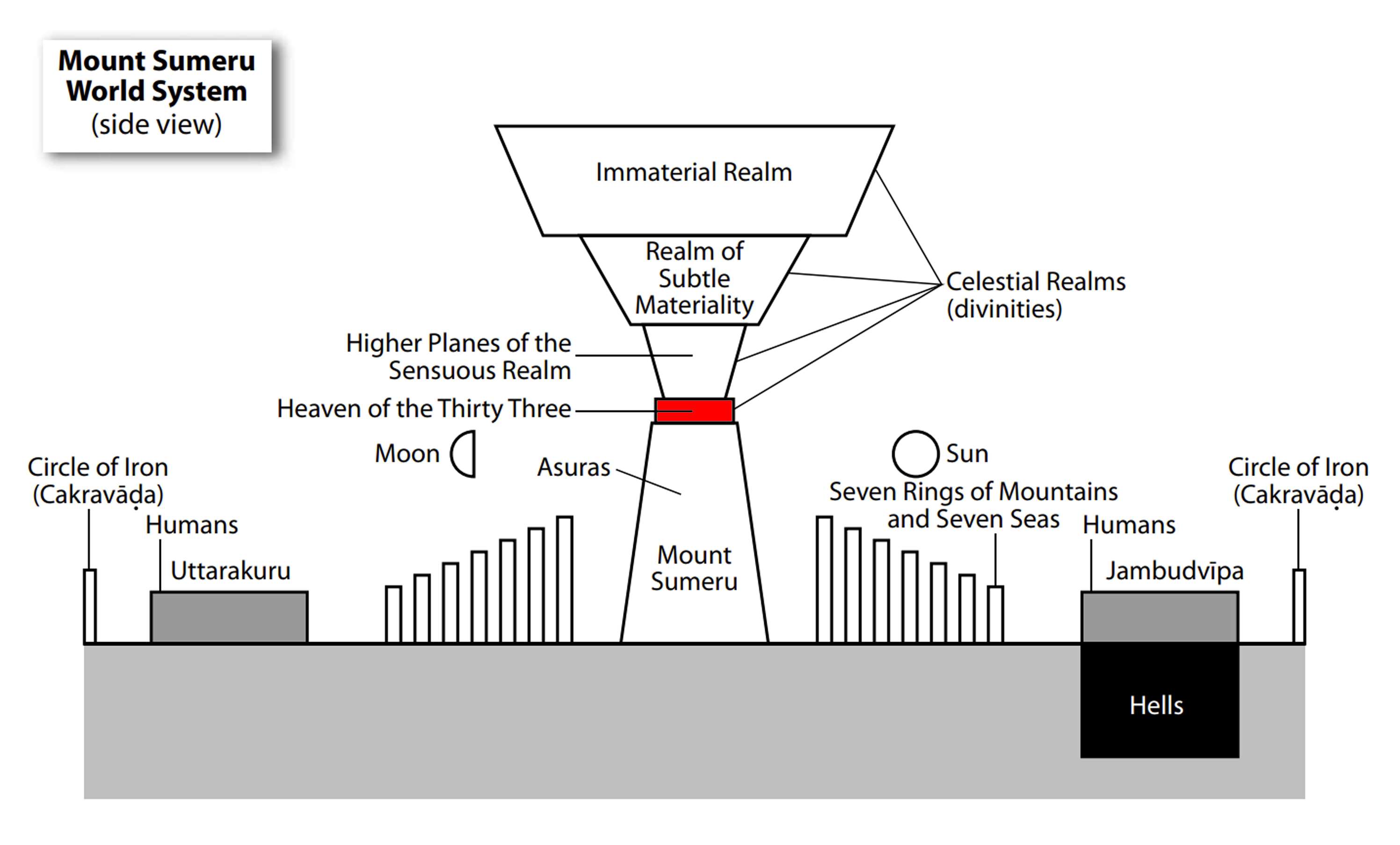
Originally, the top of Mt. Sumeru supported the Buddhist heaven of the “Thirty-Three (Gods)” (Sk: Trāyastriṃśa, त्रायस्त्रिंश; Ch: Sanshisan tian, 三十三天; Daoli tian, 忉利天) (fig. 5), which is ruled by Śakra (Sk: शक्र; Ch: Dishi, 帝釋), king of the gods (Buswell & Lopez, 2014, pp. 921-922). However, the novel replaces this realm with the Daoist heaven, which is ruled by the Jade Emperor (Yuhuang shang/dadi, 玉皇上/大帝) (Clart, 2008, pp. 1197-1198). This is hinted at in chapter four when Monkey is invited to serve as the keeper of the heavenly horses. Part of a poem describing what he sees reads:

[…]
In this heaven are thirty-three heavenly palaces (emphasis added):
The Palace of Clouds Dispersed, the Vaisravana Palace, the [P]alace of Five Lores, the Sun Palace, the Palace of Flowery Bliss
[…] (Wu & Jenner, 1993/2020, p. 73; cf. Wu & Yu, 2012, vol. 1, p. 146).

這天上有三十三座天宮,乃遣雲宮、毘沙宮、五明宮、太陽宮、花樂宮 …

The “thirty-three” palaces are references to the homes of the thirty three gods. This change is, therefore, a prime example of the kind of Buddho-Daoist religious syncretism featured in Journey to the West.

Fig. 5 – The Heaven of the Thirty-Three atop Mt. Sumeru is indicated in red (larger version). Adapted from Buswell & Lopez, 2014, p. xxxii.


Update: 02-08-23

Despite the four Buddhist disc-world continents appearing in the story, Journey to the West hints that its world is a globe. For instance, when the Monkey King first sets out from his home in chapter one, he sails SE to reach the NW side of Southern Jambu (South Jambudvīpa):

He had chosen just the right time for his journey. After he boarded his raft the southeasterly wind blew hard for days on end and bore him to the northwestern shore of the southern continent (Wu & Jenner, 2020, vol.1, p. 16; cf. Wu & Yu, 2012, vol. 1, p. 108).

也是他運至時來,自登木栰之後,連日東南風緊,將他送到西北岸前,乃是南贍部洲地界。

I thought that maybe SE and NW were typos since heading SW would have taken him to the NE shore of the southern continent (refer back to fig. 4). However, in chapter two, Sun tells his children:

“The year I left you all,” Wukong said, “I drifted with the waves across the Great Eastern Ocean and reached the West Aparagodānīya Continent. I then arrived at the South Jambudvīpa Continent, where I learned human ways, wearing this garment and these shoes. I swaggered along with the clouds for eight or nine years, but I had yet to learn the Great Art. I then crossed the Great Western Ocean and reached the West Aparagodānīya Continent (Wu & Yu, 2012, vol. 1, p. 129; cf. Wu & Jenner, 1993/2020, p. 47).

我當年別汝等,隨波逐流,飄過東洋大海,到西牛賀洲地界,徑至南贍部洲,學成人像,著此衣,穿此履,擺擺搖搖,雲遊了八九年餘,更不曾有道。又渡西洋大海,到西牛賀洲地界

So it appears that he sailed from the Mountain of Flowers and Fruit to Western Cattle-Gift (West Aparagodānīya), similar to traveling from Japan in the East to the United States in the West. Then, he sailed from there to Southern Jambu (South Jambudvīpa), similar to traveling from the US to Africa. Lastly, he sailed back to Western Cattle-Gift (West Aparagodānīya). This might mean that the world of Journey to the West is a combination of a spherical planet and the Buddhist disc-world system.

If true, I suggest that the nonsensical, roundabout way that Monkey comes to study with Subodhi in the western continent could be a physical representation of his unsettled “monkey mind” (xinyuan, 心猿).

However, it’s important to point out that even Yu (Wu & Yu, 2012) considers the aforementioned route to be “[a]n inconsistency in the text” (vol. 1, p. 509, n. 17). So, I’ll leave it up to the reader as to which version of the world they ultimately want to accept.


Update: 02-09-23

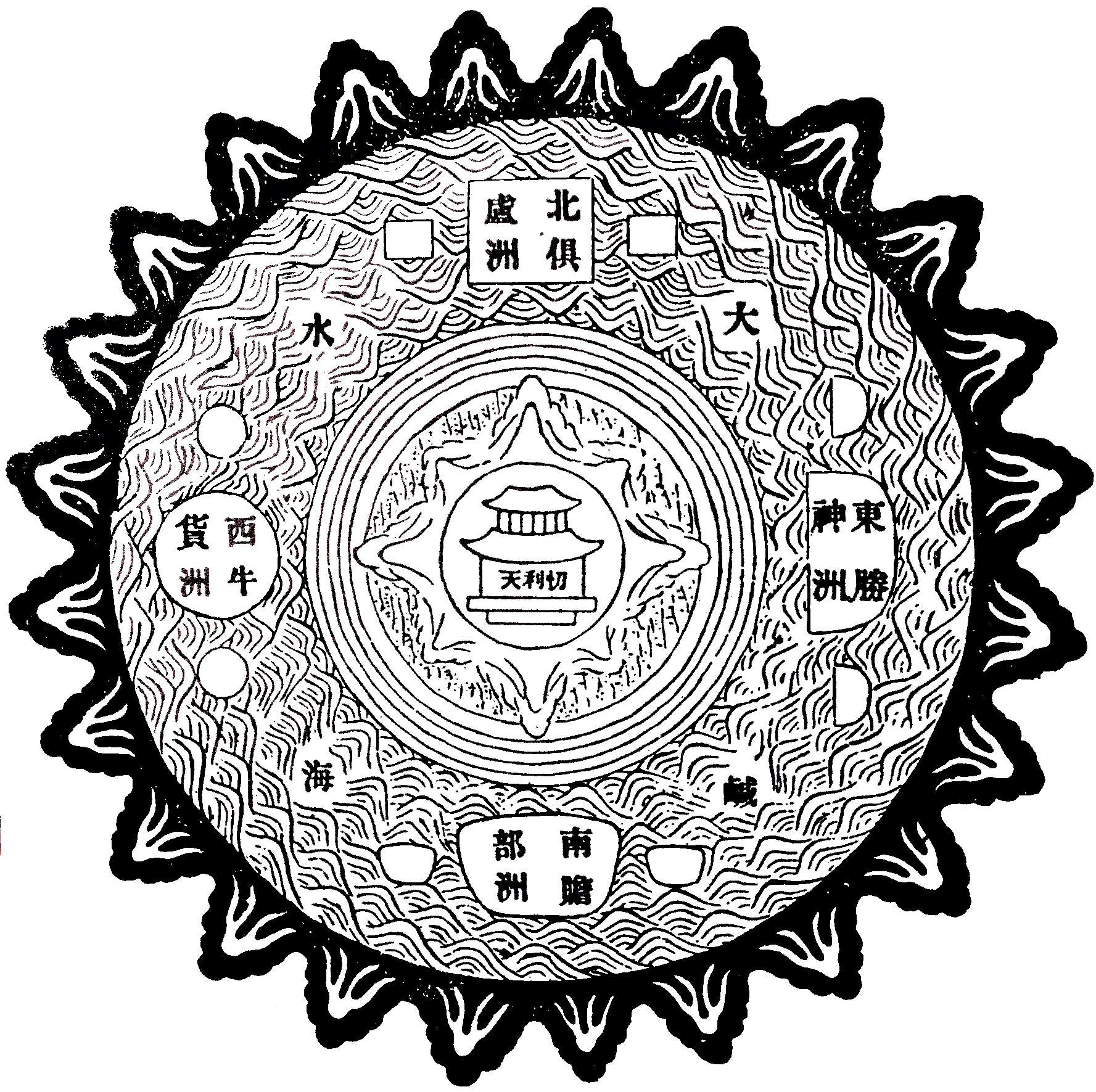
I found a lovely overhead Chinese map of the Buddhist disc-world system (fig. 6). The teeth-like structures around the perimeter are actually the iron mountain that contains the ocean. Also Mt. Sumeru in the center is topped by a building representing the Buddhist heaven of the “Thirty-Three (Gods)” (Ch: Daoli tian, 忉利天) (refer back to fig. 5).

Fig. 6 – An early-20th-century Chinese map of the Buddhist disc-world system (larger version). Image found on Wikimedia Commons.


Update: 02-11-23

I have posted an article that discusses the Buddha’s realm in Western Cattle-Gift (West Aparagodānīya).

The Buddha’s Vulture Peak and Journey to the West


Update: 03-07-23

In my 02-06-23 update, I noted how the “thirty-three mansions” alluded to the Buddhist heaven of the thirty-three gods (sanshisan tian, 三十三天), thereby showing that the Daoist heaven was inserted into the Buddhist cosmological structure. Well, I had completely forgotten that the novel overtly mentions this heaven numerous times. This is important in regards to the location of Laozi‘s (老子) residence. 

Journey to the West states that the deva and his alchemical furnace are located in the “Tushita Palace” (Doushuai gong兜率宮), which is said to be either in the “Separation’s Regret Heaven” (Lihen tian離恨天) or the “Great Canopy Heaven” (Daluo tian, 大羅天). Both are treated as the highest of the thirty-three heavens. For more information, see my article: 

Laozi’s Realm in Journey to the West

Note:

1) Yu (Wu & Yu, 2012) explains, “These islets and islands were famous abodes of gods or immortals” (vol. 1, p. 506, n. 6).

Sources:

Buswell, R. E. , & Lopez, D. S. (2014). The Princeton Dictionary of Buddhism. Princeton University Press.

Clart, P. (2008). Yuhuang. In F. Pregadio (Ed.), The Encyclopedia of Taoism (Vols. 1 & 2) (pp. 1197-1198). Longdon: Routledge.

Lamotte, E. (1988). History of Indian Buddhism: From the Origins to the Saka Era (S. Webb-Boin, Trans.). Louvain-la-Neuve: Université Catholique de Louvain Institut Orientaliste.

Tan, C. (1998). A Sino-Indian Perspective for India-China Understanding. In C. Tan (Ed.), Across the Himalayan Gap: An Indian Quest for Understanding China (pp. 133-147). New Delhi: Indira Gandhi National Centre for the Arts.

Vasubandhu, La Vallée-Poussin, L., & Pruden, L. M. (1991). Abhidharmakośabhāṣyam of Vasubandhu (Vol. 2). Berkeley, Calif.: Asian Humanities Press.

Wilkinson, E. P. (2000). Chinese History: A Manual (Rev. and Enl). Published by the Harvard University Asia Center for the Harvard-Yenching Institute : Distributed by Harvard University Press.

Wu, C. & Jenner, W. J. F. (2020). Journey to the West (Vols. 1-4). Beijing: Foreign Languages Press. (Original work published 1993)

Wu, C., & Yu, A. C. (2012). The Journey to the West (Vols. 1-4) (Rev. ed.). Chicago, Illinois: University of Chicago Press.