I have previously written an article on the worship of Sun Wukong in 19th-century America. My source was Frederic J. Masters’ (1892) essay “Pagan Temples in San Francisco,” which appears in a collected edition of The Californian. He discusses the legends of Guan Gong (“Kwan Kung”), Hau Wong (a.k.a. “How Wong”), Mazu (“Queen of Heaven”, a.k.a. “Tin Hau”), Guanyin (“Kwan Yum”), our monkey god Qitian Dasheng (“Tsai Tin Tai Shing”), and Kum Fah, as well as mentions various other deities, such as Tudi Gong (“Earth God”), Kum Fah’s attendants, Chenghuangshen (“City God”), Heidi (“god of the North Pole”), Zhurong (“God of Fire”), and the “Holy Abbot” (Ksitigarbha?). Much of the information covered in the article isn’t new for anyone familiar with Chinese religion. But it’s easy to forget that Masters is talking about the religious practices and beliefs of immigrant Chinese workers living in 19th-century San Francisco, and this is where the article’s true value lies. Many of the temples (“Joss Houses”) are said to be the property of immigrant businesses.
Masters was a Methodist pastor who wrote extensively about Chinatown. While he comments at length about the beauty of temples and the respectability of keeping the stories of noble heroes alive for centuries, he shows a marked Western Christian condescension for many Chinese beliefs. For example, he calls the worship of the monkey god “the acme of absurdity and sinfulness” (Masters, 1892, p. 737). In the beginning of the report, he makes the mistake of equating the ancient god Shangdi with the Judeo-Christian god, believing that Chinese worship of the Almighty was perverted over the millennia by outside influences. He closes the piece by saying that the Chinese will return to this ancient worship with proper guidance: “The nation [China] will one day return to the worship of the Highest and the faith in the True. In the dawn of a clearer light shall vanish all that is extravagant, foolish and false” (Masters, 1892, p. 741).
Masters. F. J. (1892). Pagan Temples in San Francisco. In C.F. Holder (Ed.). The Californian Illustrated Magazine: June to November, 1892, vol. 2 (pp. 727-741). San Francisco, Calif.: Californian Pub. Co.
Note: This post is not endorsed. I received no compensation for the review.
I have an ongoing international survey gauging the readership of Journey to the West. With almost 1,000 responses, 53.4% of the respondents have never read the novel. Another 28.8% have only read a few chapters, including abridgements. Most have learned about the story via video games, comic books, or the internet. This shouldn’t come as a surprise, though, as the majority of respondents come from North America (52.5%) and Europe (18.8%). Such non-Chinese speaking/reading populations do, however, have access to assorted translations. For example, the most popular English renditions are Arthur Waley’s 30-chapter abridgement Monkey (1942) and full translations like W.J.F. Jenner’s Journey to the West (2001) (see here for PDFs) and Anthony C. Yu’s The Journey to the West (revised 2012 edition). Yu’s version is by far the most accurate, but it runs well over 2,000 pages (including a 100 page introduction, copious explanatory notes throughout the four volumes, and many scholarly sources), making it a daunting task to read. But what about those who wish to read the original Chinese? Well, the edition put out by the People’s Literature Publishing House (人民文學出版社, 1955/2017), for example, has 866,000 Chinese characters, and while the novel is written in the vernacular, a person would need to know 3,000 or more characters before they could comfortably read it. This means beginning students would normally have to wait years until they reached the appropriate reading level. But now they have a new option.
Jeff Pepper (writer and publisher) and Dr. Xiaohui Wang (translator) of Imagin8 Press have produced a series of bilingual retellings of the tale at the 600 and 1,200 HSK word levels, as well as a few with 1,500 based on new words introduced in past books. [1] So far there are 14 books in the series covering chapters one to 42 (Monkey’s stone birth to the defeat of Red Boy). All are available in Simplified Chinese, while (as of March 2021) only the first six books are available in Traditional Chinese. Each is divided into four parts: 1) a preface with a brief explanation of the series and a recap of the story from previous books; 2) the story proper presented in pinyin with the corresponding Chinese on the adjoining page; 3) the English translation; and 4) an alphabetized glossary of terms with four columns listing the Chinese character, pinyin, English meaning, and when new words (not part of HSK3) are “First Used” in a given book (i.e. 1, 2, 3, etc.). [2] If the First Used column is blank for a given character, this is because “the word is part of HSK3 or is in common usage” (Pepper & Wang, 2018a, p. 119). Furthermore, students have the added option of listening to audiobooks available for free on Imagin8’s YouTube channel. This means they can practice both their reading and listening skills. Needless to say, this series truly is an amazing resource.
The cover of book one. Design by Katelyn Pepper (larger version).
Now on to the story. Given the reduced word count, the tale in each book is a simplified version of the original. The first book opens on a parent telling Journey to the West as a bedtime story to their child, each subsequent volume representing a different night’s story. Certain aspects, such as the names of minor gods, immortals, and demons, as well as copious literary poems, are cut out as they don’t really affect the overall story. [3] The narrative flows smoothly and follows the general outline from Anthony C. Yu’s English translation. [4] The rhythm of pages is occasionally broken up by beautiful black and white drawings by Next Mars Media, each of which is accompanied by a bilingual caption.
Beyond a few very minor inaccuracies in the story, I only have two major complaints. One, the tendency to gloss over certain facets of the narrative resulted in the removal of one major aspect of Sun Wukong’s early training, which is the source of his most famous magic power. In the original, the Buddho-Daoist Sage Subodhi teaches Monkey the 72 transformations in order to hide from a trio of heaven-sent punishments scheduled to kill him for attaining immortality. After subsequently learning how to fly via the cloud somersault, he is expelled from the Sage’s school for showing off his newfound powers of metamorphosis to his less accomplished classmates. But in book one of the series, Wukong’s lesson on shapeshifting is mysteriously replaced with flight training. It is implied that he can simply fly away from said punishments (Pepper & Wang, 2018c, pp. 55 and 57 and 82-83). And instead of being kicked out for showing off his transformations, Subhuti simply tells him to leave because he’s “disturbing the other students” (Pepper & Wang, 2018c, pp. 57 and 83). This removal doesn’t make any sense, especially when our hero exhibits transformations in later books (Pepper & Wang, 2018b, pp. 39 and 78, for example).
Two, the Chinese sections of books one to five are very short, running between 25 to 30 pages with only 14 lines per page. The rest of the books are comprised of the aforementioned preface, the pinyin pages, the English translation, the images, and the glossary. However, book six and beyond tend to have more pages, especially those from book seven onwards as this is when the 1,200 word level is introduced. In addition, Imagin8 has produced a number of compilations, each collection containing three books (example).
For my overall rating, I would give the series 4.5 out of 5 stars. I highly recommend it for those in the early stages of learning Chinese. It will surely serve as a gateway to learning more about Chinese history, religion, and mythology.
Notes:
1) Mr. Pepper was kind enough to send me the first six volumes in Simplified Chinese back in 2019. He recently sent me the Traditional Chinese version of volume six.
2) Book one is missing this “First Used” column. It was introduced in book two under the listing “New?”. This was subsequently changed to “Used In” in book five and then “First Used” in book six.
3) The names of certain reoccurring characters, such as Heavenly King Li Jing and his son Prince Nezha, are cut in earlier books. I’d be interested to see if their full names grace later books as the characters do appear several more times in the original narrative.
4) Dr. Yu is thanked in the acknowledgements.
Sources:
Pepper, J., & Wang, X. (2018a). The Emperor in Hell (2nd ed.). Pittsburgh, PA: Imagin8 Press.
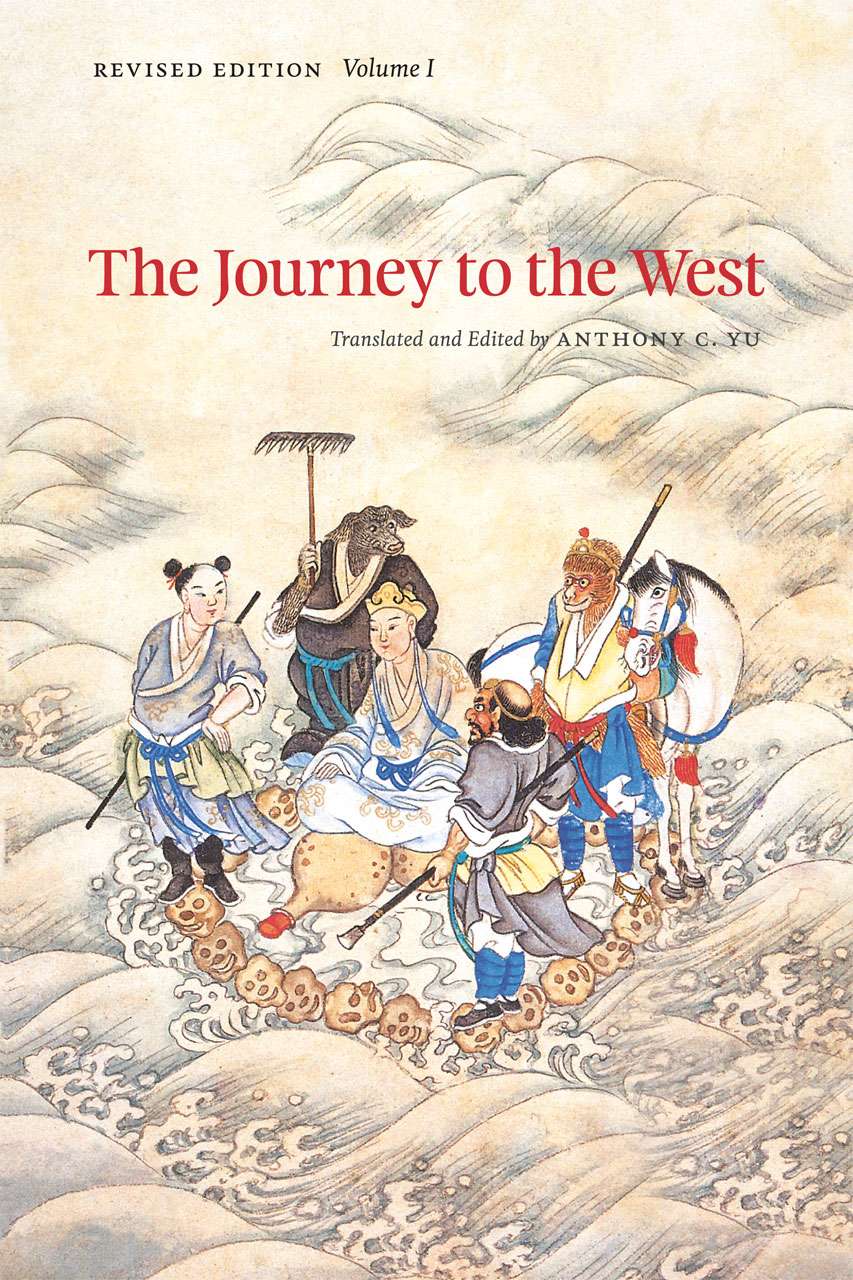
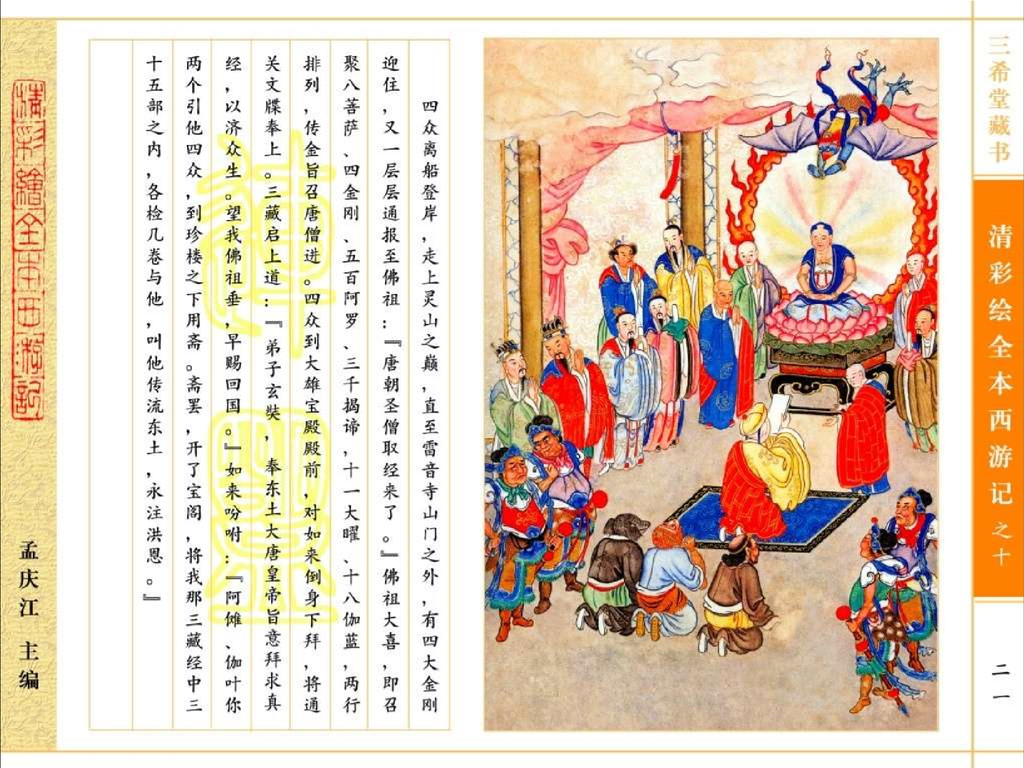
Upon the initial release, I was entranced by the cover art for the 2012 revised edition of Anthony C. Yu’s famed Journey to the West translation. For example, the cover for volume one (fig. 1) featured the pilgrims crossing the Flowing-Sands River via a boat made from Sha Wujing‘s skull necklace and a heaven-sent gourd. I loved the individuality and color scheme of each figure. They look almost like characters from a comic book. Though the art style was old, I assumed the bright, vibrant colors signaled the illustration was a modern reproduction. This was not the case. I later learned that the art was made by an anonymous painter of the Qing Dynasty (1644-1911). The paintings from this series were later gathered into an abridged ten-volume set titled Qing-Period Color-Illustrated Complete Edition of Journey to the West (Qing caihui quanben Xiyouji, 清彩繪全本西遊記, 2008). Here I present lower res PDFs of this work, complete with the gorgeous artwork. Each page is formatted with simplified Chinese dialogue on the left side and art on the right (fig. 2).
Fig. 1 – The cover of volume one (larger version). Fig. 2 – An example of the page format (larger version). It portrays the pilgrims finally coming before the Buddha in India. The formerly subjugated “Peng of 10,000 Cloudy Miles” (i.e. Garuda) can be seen hovering above the Enlightened One’s throne.
The Journey to the West Research blog is proud to host an entry by our friend Saie Surendra of Hanumovies.com. During the summer of 2019, he was lucky enough to visit several Great Sage Equaling Heaven temples in Fujian Province, China, including those dedicated to him and those hosting small shrines in his honor. This entry will serve as a list of such temples. – Jim
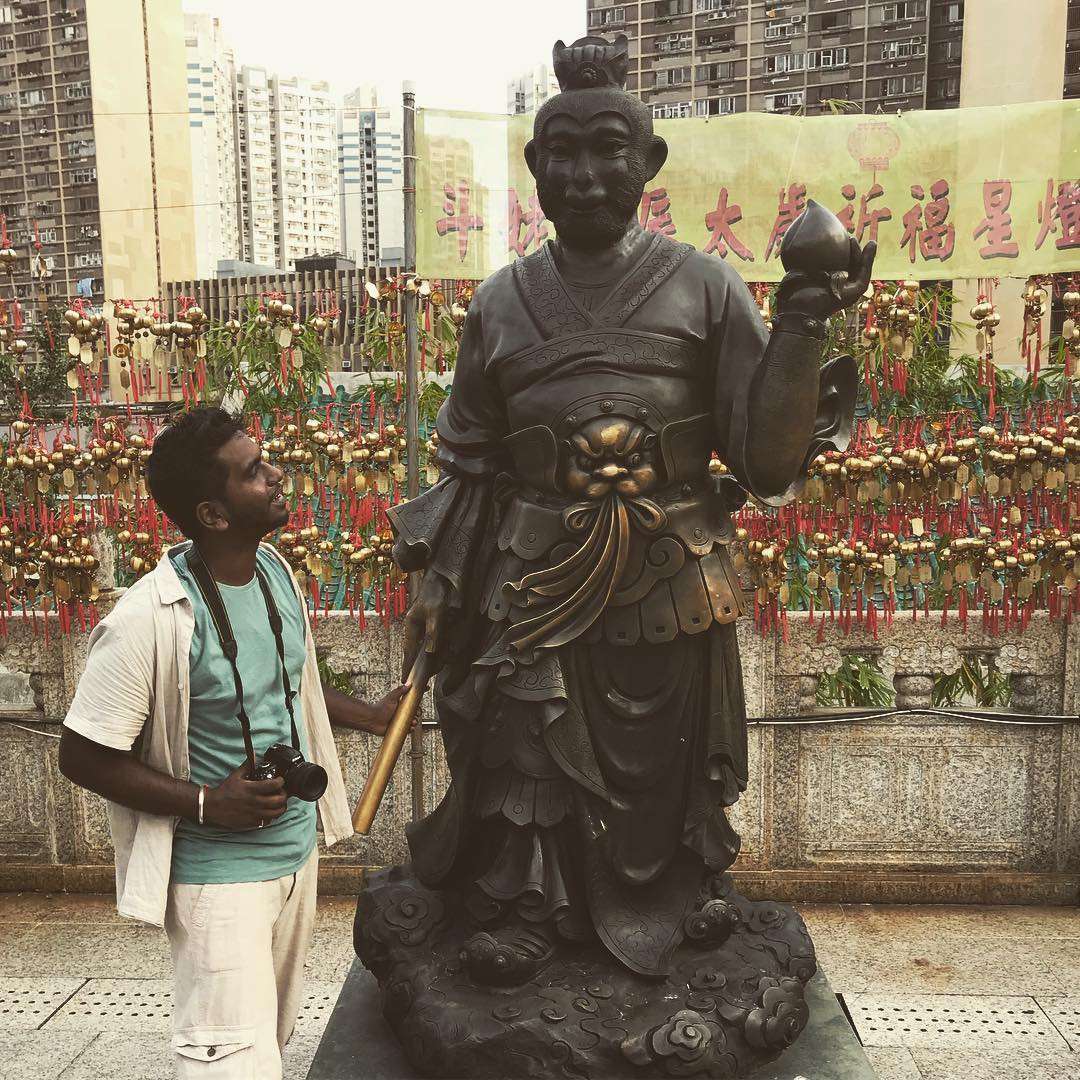
So how did my journey to the various Great Sage Equalling Heaven temples in Fujian begin? I guess I’ll start from the beginning. Growing up, I would often see images or figurines of the Hindu Monkey God Hanuman in fellow Sri Lankan and Indian homes. For those who don’t know, Hanuman is the Indian counterpart of Sun Wukong and potentially the first known Monkey God. I was curious and intrigued and wanted to know more, but I didn’t get many answers from the people I asked. “He protects us and can revive us from bad health” was the most common reply. I researched the many translations of the Ramayana (one of two great Indian epics within which Hanuman appears) and became enchanted by his many amazing feats and achievements. I was a huge film fan growing up, so I became obsessed with the idea of making films based on him. There have been TV adaptations of Hanuman’s story—I wasn’t a fan of the more human-like portrayals—but, sadly, major Indian studios have yet to make a proper movie about him.
Fast-forward to 2008. Jet Li and Jackie Chan star in the kung fu fantasy The Forbidden Kingdom. Looking back now, it isn’t the greatest film ever, but this is when I first met … Sun Wukong (cue the “Dagger House Prelude”). This was a turning point for me, my obsession multiplied tenfold. Since then I have watched tens, if not hundreds, of film and TV adaptations of Sun Wukong. I’ve also read endless articles and books (one example) in an effort to connect the dots between our (Hindu and Buddho-Daoist) ancestors’ worship of monkey deities. I’ve found there are just too many similarities to ignore.
At first, I had never heard of Sun Wukong’s worship, so when I found the one vague article online describing the Monkey King Festival (the 16th day of the 8th lunar month) in Hong Kong, I decided I would go! I didn’t know what to expect when Jim and I met at the Great Sage Treasure Temple (大聖寶廟) in Kowloon in September of 2018, but it was a big moment for me. Crowds of young and old gathered to worship the Great Sage Equalling Heaven; Daoist priests chanted from prayer books; rows of important businesspeople bowed in unison; martial arts schools performed colorful lion dances, each kwoon paying respect to the altar as they passed; giant paper effigies were burnt. It was a veritable feast for the eyes and ears. Through our interviews with the locals, we not only learned that the festival was considered a time for strengthening community bonds and to help those in need, but also that many adherents believed their faith originated in Fujian, more specifically the city of Fuzhou. This of course agrees with what past scholars have written about Sun’s worship in Fujian.
I have a question: If you ever found yourself in heaven, what would you do? You’d take some good videos to show your friends back on Earth, right? So that was the idea; I started making a documentary (video 1) based on the real people I met and the places I visited, saving my film ambitions for later.
Video 1 – Legends of a Monkey God: Episode 1 – Hong Kong
I was restless some months after returning from the Hong Kong Monkey God Festival. It was like experiencing Heaven for a week and then falling back to Earth like a meteor with many unanswered questions. I was unable to sit around in my miserable London life any longer, so I finally decided to travel where Sun’s worship supposedly began … Fuzhou.
Arriving in Fuzhou was like a pilgrimage in itself. Let me say, this was not an easy journey for me, nor for the translator friend I hired due to my poor Mandarin. The Hokkien accent of Fuzhou gave her a hard time. In addition, the many places I had researched and mapped online seemingly didn’t exist. We visited one after another, with the locals appearing clueless about the temples we inquired about. It was almost as if Sun Wukong’s worship was a secret and only initiated members were allowed access to his houses of worship. Now, there is a saying in India that goes: “You can’t just find Him, He has to invite you”. This saying holds true, for when we finally found one of the locations (see temple one below), a person inside told us about a man who could help me on my journey. I thought, “Hang on a minute … was this guy the savior goddess Guanyin? Was he going to introduce me to my … Sun Wukong?”
I was later introduced to Mr. You, the head of several temples, the Pingshan theatre, and the greatest Sun Wukong follower I have ever met. He set aside two whole days to drive us to several Monkey King temples around Fuzhou, during which time I shot video for another documentary (video 2). I wondered whether or not he wanted anything in return. I mean, no one does anything for free, right? It turns out he was more than happy just to share his Sun Wukong with me and invite me into his secret club! He would not accept any gifts from me. I felt like I was the Tang Monk! And here is the thing: Mr. You and his friends didn’t speak a single word of English—in fact, my Mandarin was unbearable to them—yet we somehow managed to communicate and establish a strong friendship between us, “Brothers bound by the love of Monkey”. I promised myself then that I would return with better Mandarin in a Fujian dialect.
Video 2 – Legends of a Monkey God: Episode 3 – Monkey King Temples of Fujian, China
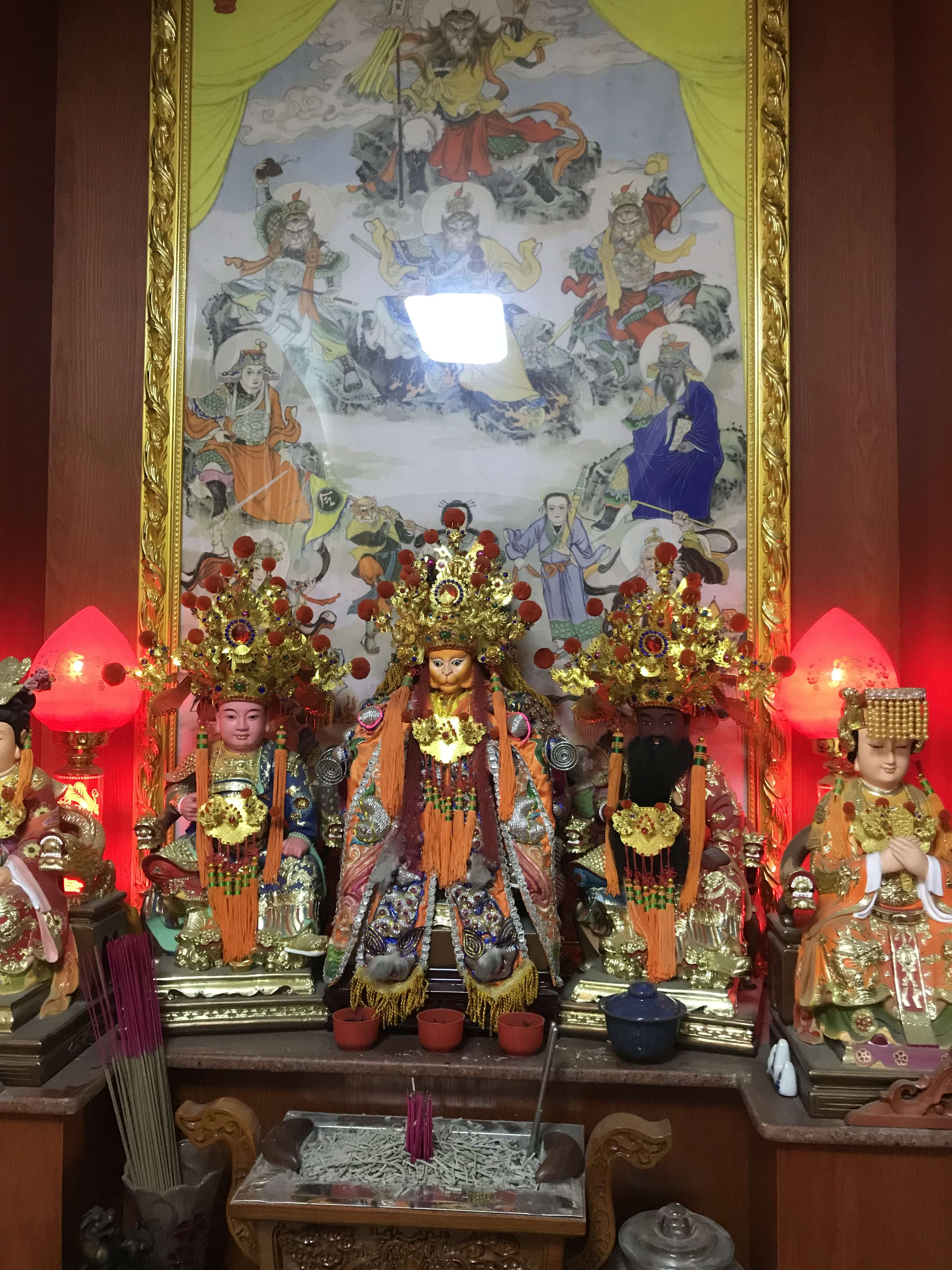
What I took away from this trip was the fact that Sun Wukong is a deity that sits at the intersection of Buddhism, Daoism, and Confucianism. I saw effigies of him in temples of all the “Three Religions”, sometimes shared, sometimes strictly one faith. But the idea of religion in the East is not the same as that in the West. In the East, you find your own path, follow it to your goal; you don’t need to be on the same path as everyone else and no one judges you for making your own way. It’s just like the Indians say: “The destination is the same, paths are many. God is one, names and forms are many”. This ties in with the works of famed mythologist Joseph Campbell, who would call this the many “masks of God”.
II. Temple List
This list is not exhaustive and will be updated periodically. Most importantly, the following GPS coordinates should ONLY be used as a general guideline. It is highly recommended that those wishing to visit these places should hire the services of a knowledgeable guide. I recommend contacting Mr. You (WeChat id: you410631621)
(Note: Mr. You has died, so his WeChat no longer works.)
26°08’54.4″N 119°08’56.9″E 福建省福州市闽侯县军民路 Junmin Rd, Minhou County, Fuzhou City, Fujian Province, China 44XX+9M Ganzhezhen, Minhou, Fuzhou, Fujian, China
I just figured out that the photo links have not worked for several months. This is because my original university gmail account, which hosted the pictures, was shut down. Everything is fixed now.
Note: My blog is not monetized, so I am not making any money from this post. My hope is that the PDF will make this legendary story more accessible to a wider audience. If you enjoyed the digital version, please, please, please support the official release.
Last updated: 12-10-2021
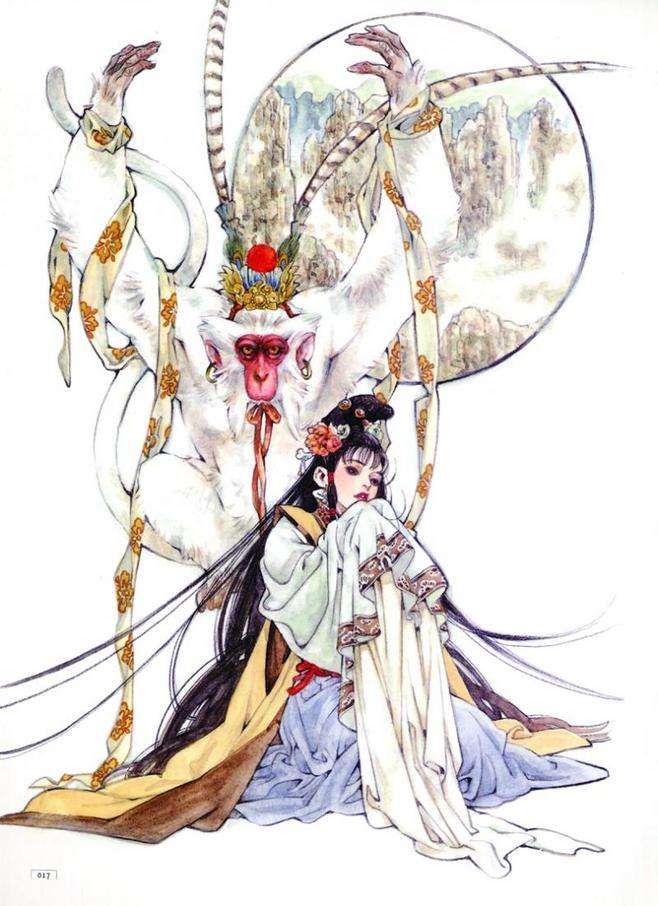
The brief Tang-era tale “A Supplement to Jiang Zong’s Biography of a White Ape” (Bu Jiang Zong Baiyuan Zhuan, 補江總白猿傳, c. late-7th century; “The Supplement” hereafter) tells how the beautiful young wife of General Ouyang He (歐陽紇, 538–570) is kidnapped by a seemingly invisible force while he is engaged in conquering minority groups of the south lands. The general and his men scour the surrounding area for hundreds of li before discovering a mountain where she and other women are being kept by a magic white ape (baiyuan, 白猿) (fig. 1). The captives caution that his soldiers are no match for the powerful primate, and so the ladies devise a plan to get him drunk and incapacitate him long enough for a killing blow to be dealt. With their help, the general manages to fall the beast with a well-placed sword strike below the navel, his only weak spot. Before dying, the ape reveals that the general’s wife is pregnant and begs him not to kill the child. Ouyang subsequently returns to the north with his wife, the other women, and the monster’s priceless treasures. The tale ends with the birth of an unnamed son a year later.
Fig. 1 – A modern drawing of the white ape and General Ouyang He’s wife by Japanese artist Natsuki Sumeragi (皇名月) (larger version). Original image found here. The silken ropes around his wrists refer to those intertwined with hemp and triple-tied to ensure that he can’t break free in the story.
Chen (1998) explains that the original Biography of a White Ape story, purportedly supplemented by the above tale, [1] never existed. The Supplement is actually a standalone piece anonymously published to slander the historical scholar Ouyang Xun (歐陽詢, 557–641), who was known for his legendary monkey-like ugliness and almost supernatural intellect. The tale implies that he was the unnatural offspring of the general’s wife and the magic white ape (p. 76-79).
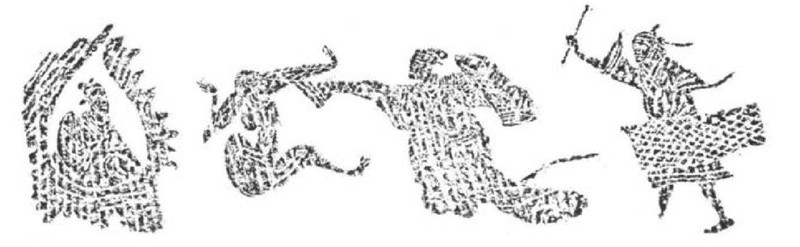
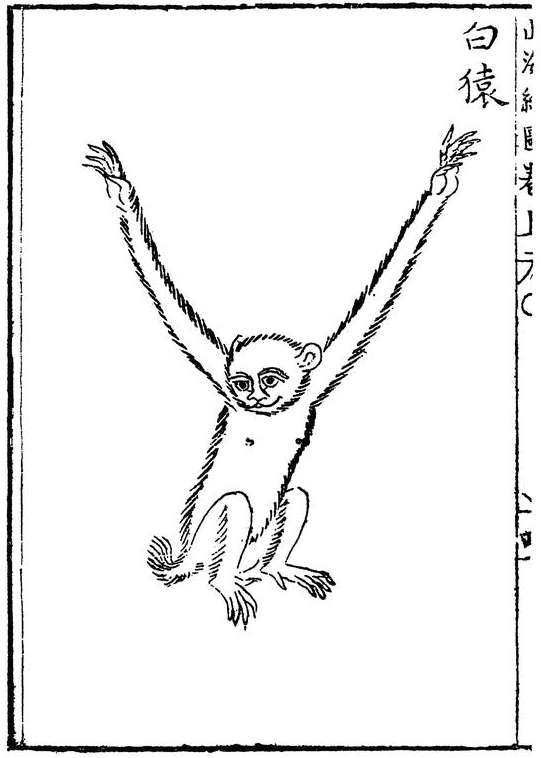
These mischievous simian spirits are known for kidnapping young maidens in tales from the Han to the Song (fig. 2). The mythical creature is based on the gibbon (fig. 3), a small, long-armed, arboreal ape present in East and Southeast Asia (see Gulik, 1967).
Fig. 2 – A Han-era stone tomb rubbing showing a sword-wielding hero striking at a fleeing white ape (center). A woman can be seen held captive in a teardrop-shaped cave (left). The hero is followed by an assistant beating a gong (right) (larger version). From Wu, 1987, p. 88. Fig. 3 – A woodblock print of a “white ape” or gibbon from a Ming version of the Shanhai Jing (larger version).
2. Parallels with Sun Wukong
The Supplement‘s unnamed primate antagonist shares many surprising similarities with Sun Wukong. Both:
Are supernatural primates possessed of human speech.
Are one thousand-year-old practitioners of longevity arts.
Are masters of Daoist magic with the ability to fly and change their appearance.
Are warriors capable of single-handedly defeating an army.
Have an iron-hard, nigh-invulnerable body immune to most efforts to harm them.
Have eyes that flash like lightning.
Live in verdant mountain paradises (like Flower Fruit Mountain).
Reside in caves with stone furniture (like the Water Curtain Cave).
The character and his home, therefore, appear to be an early model for the Monkey King, his abilities, and Flower Fruit Mountain.
3. Translation
Chen (1998) provides a complete translation of the brief tale, along with an informative translator’s introduction. The following PDF was put together from smartphone photos as I don’t currently have access to a scanner.
1) A supplement (bu, 補) is an addendum to an existing body of work, sort of like modern fan fiction. See, for example, A Supplement to the Journey to the West (1640).
Sources
Chen, J. (1998). A supplement to Jiang Zong’s biography of a white ape. Renditions, 49, pp. 76-85.
Chen, J. (2003/2004). Revisiting the yingshe mode of representation in “Supplement to Jiang Zong’s biography of a white ape”. Oriens Extremus, 44, pp. 155-178.
Wu, H. (1987). The earliest pictorial representations of ape tales: An interdisciplinary study of early Chinese narrative art and literature.T’oung Pao LXXIII, pp. 86-112.