The Monkey King and The Buddha Victorious in Strife (a.k.a. Victorious Fighting Buddha)

NOTE: THIS IS MY 100TH BLOG POST.

Last updated: 06-13-2025

The Monkey King is elevated in spiritual rank at the end of Journey to the West (Xiyouji, 西遊記, 1592; “JTTW” hereafter) for his service in protecting the monk Tripitaka throughout the quest to India. Gautama Buddha enfeoffs him as the “Buddha Victorious in Strife” or “Victorious Fighting Buddha” (Dou zhansheng fo, 鬥戰勝佛). Many readers may be surprised to learn that this is actually an established Buddhist deity and not just the creation of the JTTW author-compiler. In this article, I would like to briefly explore the Buddha’s religious background, iconography, purpose, and relationship to the worship of Sun Wukong.

Table of Contents

1. Literary Enlightenment

The Gautama Buddha explains:

Sun Wukong, when you caused great disturbance at the Celestial Palace, I had to exercise enormous dharma power to have you pressed beneath the Mountain of Five Phases. Fortunately your Heaven-sent calamity came to an end, and you embraced the Buddhist religion. I am pleased even more by the fact that you were devoted to the scourging of evil and the exaltation of good. Throughout your journey you made great merit by smelting the demons and defeating the fiends. For being faithful in the end as you were in the beginning, I hereby give you the grand promotion and appoint you the Buddha Victorious in Strife (Wu & Yu, 2012, p. 381).

孫悟空,汝因大鬧天宮,吾以甚深法力,壓在五行山下,幸天災滿足,歸於釋教;。且喜汝隱惡揚善,在途中煉魔降怪有功,全終全始,加陞大職正果,汝為鬥戰勝佛。

2. Religious Background

JTTW closes by “submitting” or “prostrating” (namo, 南無) to a long list of Buddhas, Bodhisattvas, and Arhats. The Buddha Victorious in Strife is placed at the end of 47 Buddhas and ahead of the Bodhisattva Guanyin. A section of the list reads:

[…]
I submit to the Buddha of the Gift of Light.
I submit to the Buddha of Candana Merit.
I submit to the Buddha Victorious in Strife (emphasis added).
I submit to the Bodhisattva Guanshiyin.
I submit to the Bodhisattva, Great Power-Coming
[…] (Wu & Yu, 2012, p. 385).

南無才光佛。南無旃檀功德佛。南無鬥戰勝佛。南無觀世音菩薩。南無大勢至菩薩

Many of the Buddhas from the novel’s list appear in assorted real world canonical lists, including the 88 Buddhas (Bashiba fo, 八十八佛) from the Great Repentance Text of the Eighty-Eight Buddhas (Ch: Bashiba fo da chanhui wen, 八十八佛大懺悔文). [1] This group is comprised of the 53 Buddhas (Ch: Wushisan fo, 五十三佛) and the 35 Confession Buddhas (Ch: Sanshiwu fo chan, 三十五佛懺) (fig. 1).

The historical “Buddha Victorious in Strife,” Yuddhajaya (Sk: युद्धजय; see the 06-13-2025 update for more name info), is the 31st of the 35 Confession Buddhas, who are individually called upon during a confessional prayer to absolve oneself of sins. They appear in a number of sources, such as The Bodhisattva’s Confession of Ethical Downfalls (Ch: Pusa duochan / Pusa chanhui wen, 菩薩墮懺 / 菩薩懺悔文) from the Three Heaps Sutra (Sk: Trīskhandhadharmasūtra; Ch: Sanyun jing, 三蘊經) and the Names of the Thirty-Five Buddhas Spoken by the Buddha (Ch: Foshuo sanshiwu foming lichan wen, 佛說三十五佛名禮懺文, 8th century). 

Fig. 1 – A religious painting of the 35 Confession Buddhas (larger version). The Buddha Victorious in Strife is third from the right on the bottom row. Image found here.

2.1. Iconography

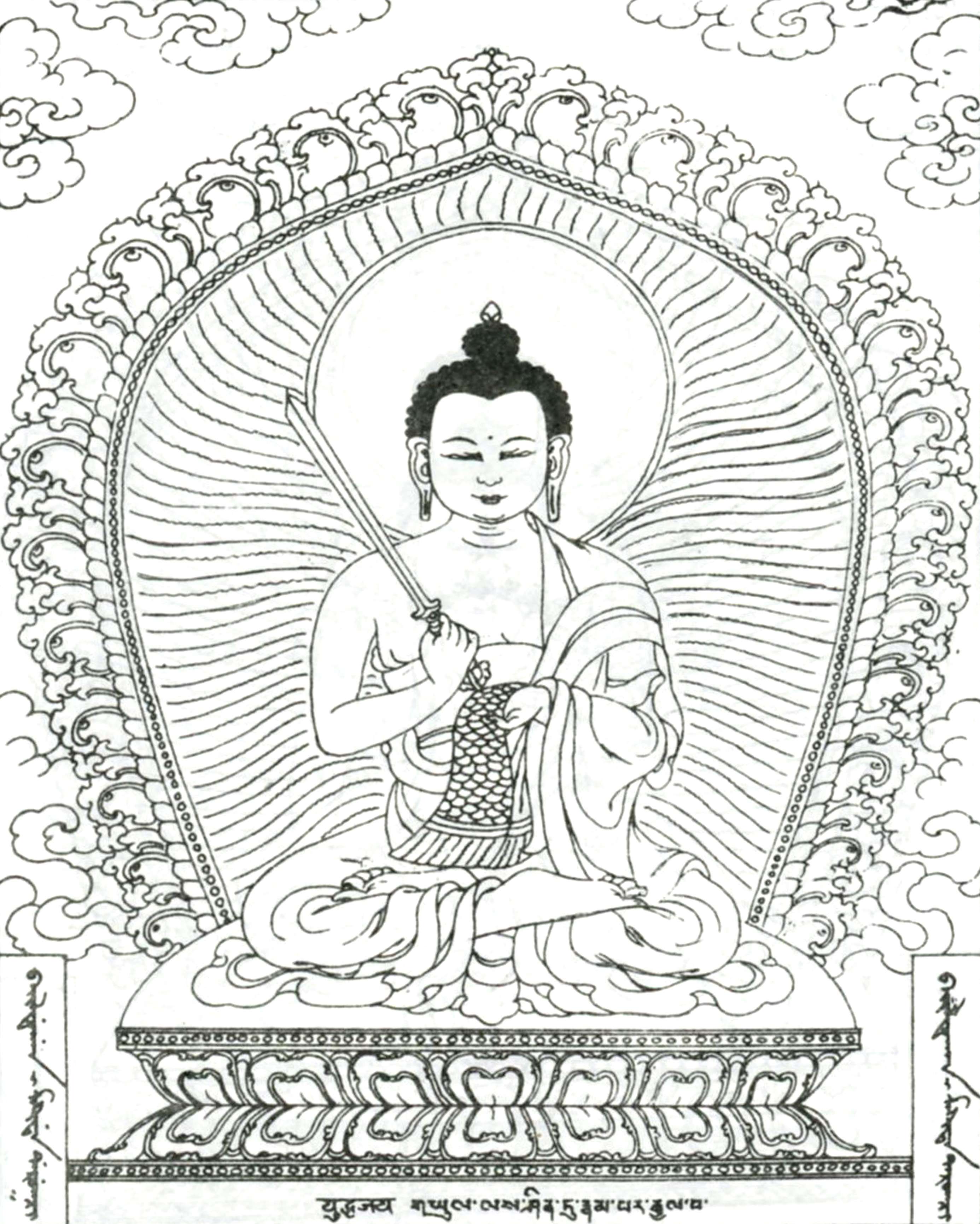
The Buddha Victorious in Strife is depicted in Buddhist art with the traditional features of a Buddha (i.e. ūrṇā, uṣṇīṣa, long ear lobes, robes, etc.), but he is also shown holding a suit of armor and a sword (fig. 2):

Yuddhajaya Buddha — (Skt.: aka Yuddhajaya) (Chin.: Tou-chan-sheng fo; Mon.: Bayildugan-i masids darugci; Tib.: gYul-las-sin-tu-rnam-par-rgyal-ba, rGyal-ba-gYul-lasr-Gyal-ba) A Sanskrit variant for the Jina Yuddhajaya. One of the Buddha images found in the Pao Hsiang Lou [寶相樓] temple of the Forbidden City, Beijing, and one of the thirty-five “Buddhas of Confession.” Face: one, calm, urna, usnisa, long ear-lobes; arms/hands: holding a cuirass up to his chest; body: monastic robes; legs: two; asana: vajrasana; vahana: lotus throne.

— (2) — (Mon.: Bayildugan-i masids darugci; Tib.: gYul-las-sin-tu-rnam-par-rgyal-ba) One of the Buddhas of Confession pictured in the Mongolian Kanjur (Mon.: Monggol ganjur-un) (1717-1720) Face: one, calm, urna, usnisa, long ear-lobes; arms/hands: two, right hand holds sword (khadga, ral-gri), left hand holds coat of mail (khrab); body: monastic robes, right shoulder uncovered; legs: two; asana: vajrasana; attributes: 32 major and 80 minor signs; vahana: lotus throne (Bunce, 1994, Vol. 1, p. 629). [2]

Fig. 2 – The Buddha Victorious in Strife (Yuddhajaya) holding a sword and suit of armor (larger version). Image found here.

2.2. Purpose

Neither the name Buddha Victorious in Strife nor the sword and armor are a reference to the deity’s fighting prowess. According to Lai (2016), the Buddha “defeat[s] the inner enemies of afflictive emotions and negative actions of sentient beings. He is victorious over cyclic existence and thus able to lead all sentient beings to liberation. He purifies the negative karma of actions committed out of pride.”

His name and accoutrements, therefore, symbolize the means by which he subjugates the negative emotions or actions that would otherwise keep man trapped in the illusory world of Saṃsāra.

3. Relationship to Sun Wukong’s Worship

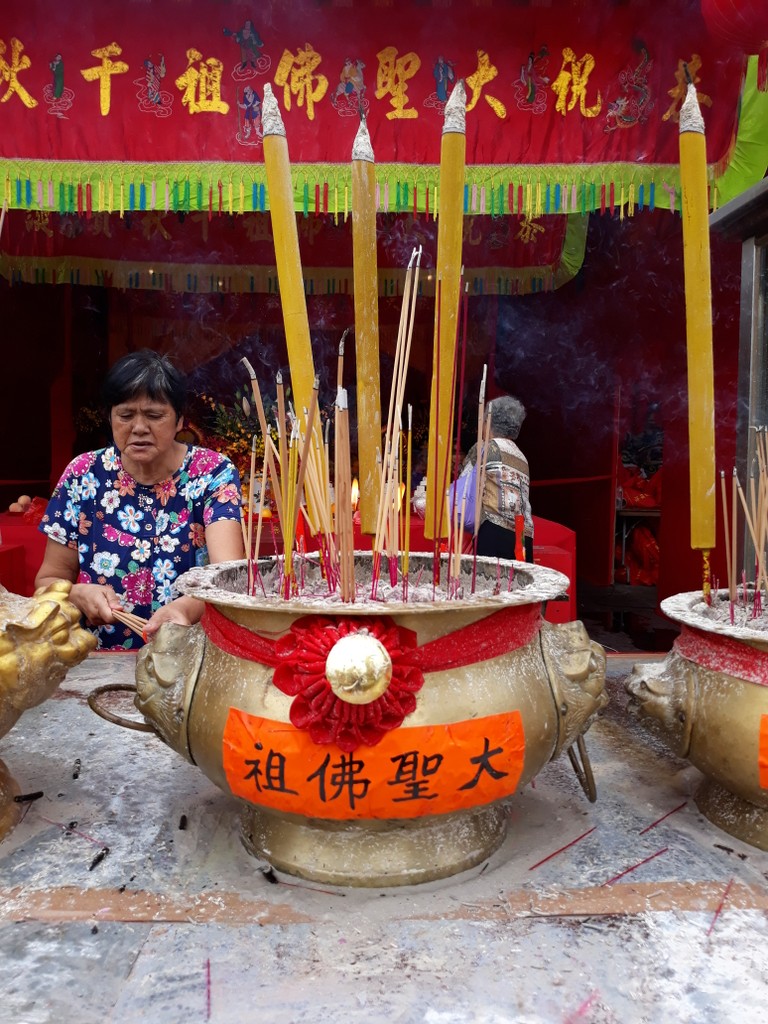
The Monkey King is worshiped in southern China, Taiwan, and Southeast Asian countries like Malaysia, Singapore, Thailand, and Vietnam as a great exorcist and protector of children. But it may come as a surprise to learn that he is rarely worshiped as the Buddha Victorious in Strife. Instead, Wukong is almost exclusively revered as the “Great Sage Equaling Heaven” (Qitian dasheng, 齊天大聖), and even when he is called a Buddha, the name usually includes some reference to the rebellious title. For example, when I attended the Monkey King’s birthday (sixteenth day of the eighth lunar month) in Hong Kong in 2018, I saw an incense pot labeled “Great Sage Buddha Patriarch” (Dasheng fozu, 大聖佛祖) (fig. 3).

So why isn’t Sun widely worshiped as the Buddha Victorious in Strife? I think the simplest answer is that the Buddha already had a long-established following and therefore couldn’t be subsumed under the late-blooming cult of a cultural hero, even one as popular as the Monkey King.

Fig. 3 – An incense pot reading “Great Sage Buddha Patriarch” (Dasheng fozu, 大聖佛祖) (larger version). Taken by the author in Kowloon, Hongkong (Sept. 24, 2018).

4. Precedent for Spiritual Promotion

The author-compiler likely connected Sun Wukong to the Buddha Victorious in Strife because of the Enlightened One’s war-like iconography (recall the sword and armor mentioned above). After all, Monkey is an armor-wearing martial deity wielding his magic staff to protect Tripitaka from untold numbers of demons and spirits.

But the choice to elevate Monkey in rank was likely influenced by previous media. For example, Wukong’s literary antecedent, the Monkey Pilgrim (Hou xingzhe, 猴行者), receives a promotion at the end of The Story of How Tripitaka of the Great Tang Procures the Scriptures (Da Tang Sanzang qujing shihua, 大唐三藏取經詩話), a late-13th century precursor of JTTW. The story ends thus: “Tang Taizong later enfeoffed Monkey Pilgrim as ‘Great Sage Steel Muscles and Iron Bones'” (Gangjin tiegu dasheng, 鋼筋鐵骨大聖) (Wivell, 1994, p. 1207). [3]

5. Conclusion

At the end of JTTW, the Buddha promotes Sun Wukong to the “Buddha Victorious in Strife” or “Victorious Fighting Buddha” (Dou zhansheng fo, 鬥戰勝佛). This is the Chinese name of Yuddhajaya (Sk: युद्धजय), the 31st of the 35 Confession Buddhas called upon during a confessional prayer to absolve oneself of sins. He is generally portrayed as a robe-wearing Buddha holding a sword and suit of armor. This is not a reference to the deity’s fighting prowess, however. Instead, his name and accoutrements symbolize the means by which he subjugates the negative emotions or actions that would otherwise keep man trapped in the illusory world of Saṃsāra.

Instead of being universally revered as the Buddha Victorious in Strife, the Monkey King is far more widely worshiped in East and Southeast Asia as the “Great Sage Equaling Heaven” (Qitian dasheng, 齊天大聖) or a variant like “Great Sage Buddha Patriarch” (Dasheng fozu, 大聖佛祖). This discrepancy is probably due to the original Yuddhajaya already having a long-established following. There’s no way that he could ever be subsumed under Sun Wukong’s late-blooming cult. 

Wu Cheng’en (or whoever the true author-compiler was) likely connected Monkey to the Buddha Victorious in Strife because both have martial iconography. Sun is commonly depicted wearing armor and wielding an iron staff, while Yuddhajaya is shown holding a sword and armor. But the concept of Sun receiving an elevation in spiritual rank goes back centuries. The Monkey Pilgrim, his literary antecedent from The Story of How Tripitaka of the Great Tang Procures the Scriptures (late-13th century), is deified by the Tang emperor as “Great Sage Steel Muscles and Iron Bones” (Gangjin tiegu dasheng, 鋼筋鐵骨大聖).


6. Updates

Update: 09-06-20

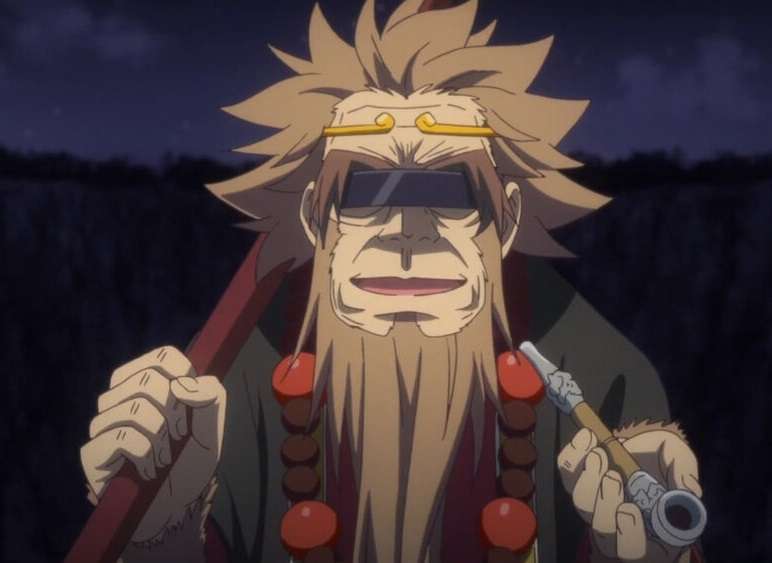
If you type “Buddha Victorious in Strife,” “Victorious Fighting Buddha,” “鬥戰勝佛” or “斗战胜佛” into google images, you’ll notice that these terms are almost exclusively associated with Sun Wukong. Most results are fan-made drawings of Monkey wearing his armor. Very few depict him as a Buddha. The only appearance of the latter in popular media that I’m aware is the Victorious Fighting Buddha from the manga / anime High School DxD.

The character is depicted as a jovial old dwarf with long, shaggy brown hair, bushy eyebrows that fall over a cyberpunk-style black visor, no mustache, a long beard, a floor-length, dark gray coat over a red robe, and monkey feet. He wears his famous golden fillet and a set of chunky brown and red prayer beads. In his left hand he holds a smoking pipe, while the right holds his magic staff, which is depicted as red and gold (fig. 4).

Fig. 4 – The Victorious Fighting Buddha from High School DxD (larger version).

The Victorious Fighting Buddha inhabits a universe where various factions of Western and Eastern gods, devils, and heroes battle one another. According to the story, upon ascending to Buddhahood, he steps down as the Monkey King, handing the title to a young descendant, and serves as the vanguard of the Hindu god Indra, during which time he protects the cosmos from a faction of devils and fallen angels. He later takes on the role of sub-leader and mentor to a new faction of young heroes whom he trains to battle god-tier opponents.

High School DxD portrays the Victorious Fighting Buddha as very powerful. For example, season four, episode six (minute 13:35) of the anime shows him effortlessly blocking the “True Longinus” spear with the tip of his index finger. This is quite a feat as this weapon is the same one used to pierce the side of Christ, thereby giving it the power to kill other gods.


Update: 03-22-21

I visited “Sage Buddha Hall” (Shengfo Tang, 聖佛堂), a Great Sage temple in Beigang, Yunlin, Taiwan and saw a few items labeled the “Fighting Sage Buddha” (Dou zhan sheng fo, 鬥戰聖佛) in place of the Buddha Victorious in Strife/Victorious Fighting Buddha. One such item was a paper fan (fig. 5). As noted above, Buddha Victorious in Strife/Victorious Fighting Buddha is not a reference to the deity’s fighting prowess, but his ability to “defeat the inner enemies of afflictive emotions and negative actions of sentient beings.” So it appears that this temple takes his martial skill at face value.


Update: 08-09-22

As an enlightened Buddha, Monkey is eligible for his own “Buddha-Field” (Sk: Buddhakṣetra; Ch: Focha, 佛刹), essentially his own universe in which he will lead the inhabitants to enlightenment. Buswell and Lopez (2014) explain:

[W]hen a buddha achieves enlightenment, a “container” or “inanimate” world is produced in the form of a field where the buddha leads beings to enlightenment. The inhabitant of that world is the buddha endowed with all the [qualities of an Enlightened One]. Buddha-fields occur in various levels of purification, broadly divided between pure and impure. Impure buddha-fields are synonymous with a world system (cakravāḍa), the infinite number of “world discs” in Buddhist cosmology that constitutes the universe; here, ordinary sentient beings (including animals, ghosts, and hell beings) dwell, subject to the afflictions of greed, hatred, and delusion. Each Cakravāḍa is the domain of a specific buddha, who achieves enlightenment in that world system and works there toward the liberation of all sentient beings… (p. 153).


Update: 01-22-23

Chandra (1999) includes a lovely black and white line drawing of Yuddhajaya (fig. 6) (p. 94).

Fig. 6 – A traditional Tibetan drawing of Yuddhajaya (larger version). Image from Chandra, 1999, p. 94.


Update: 05-09-23

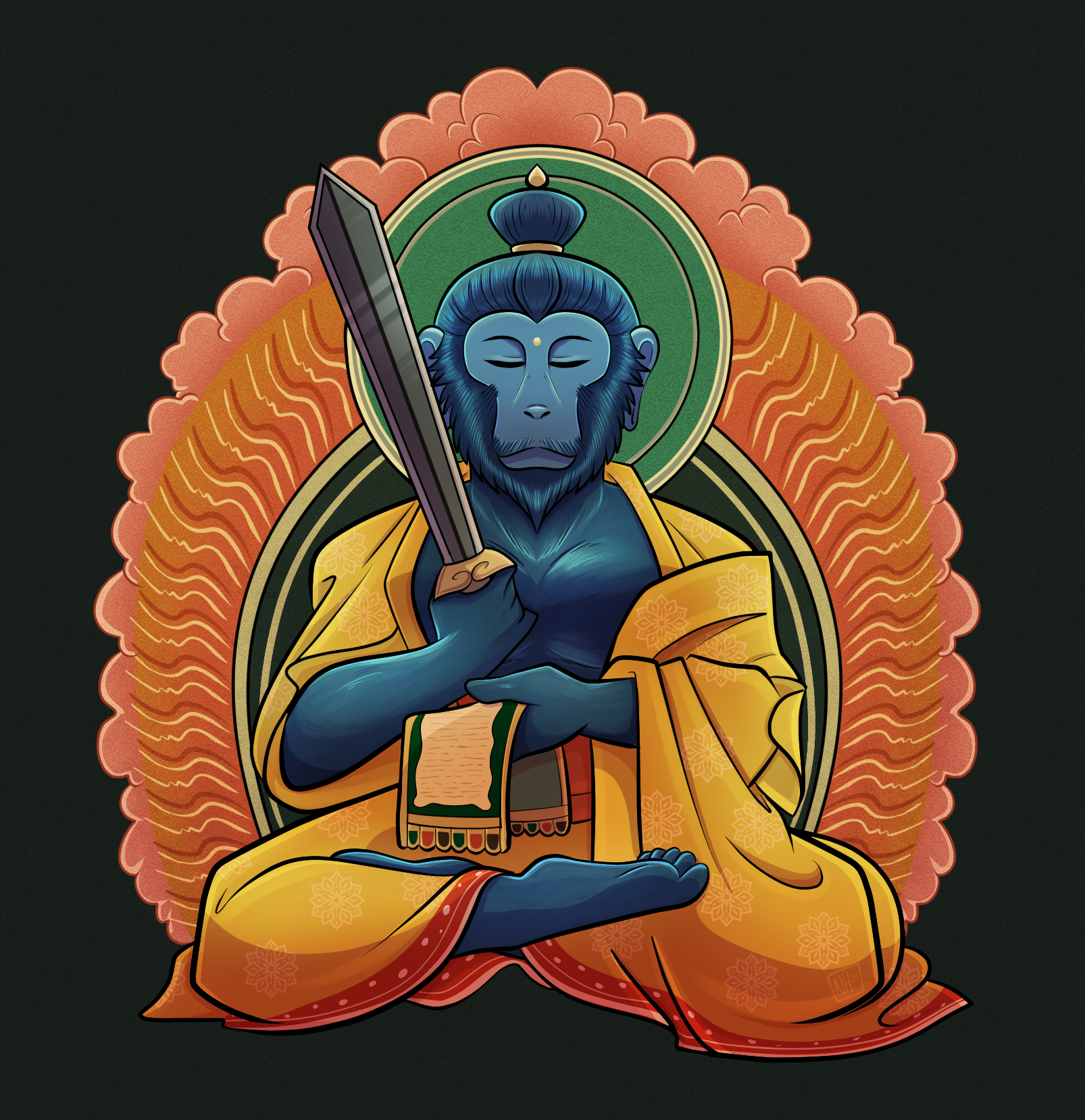
I commissioned NinjaHaku21 (Twitter, Instagram, and Tumblr) to draw Sun Wukong using Yuddhajaya’s traditional iconography (fig. 7), and the results are stunning! It is based on the design from figure two above.

Fig. 7 – A religiously accurate drawing of Monkey as the Yuddhajaya Buddha by NinjaHaku21 (larger version).


Update: 06-12-23

I have written a companion piece to this article about Tripitaka’s Buddha title.

The Tang Monk Tripitaka and the Buddha Candana Merit


Update: 09-11-23

Tumblr user @darkfalcon-z has drawn a lovely picture of the Monkey King as a Buddha (fig. 8). They explain their headcanon for the image:

[B]aby monkeys think Grandpa’s lotus throne is for playing.

[…]

I think Wukong got back to his mountain to take care of his monkeys. He does visit sometimes. He takes his favourite monkeys along for the ride. I don’t think it is much of a problem in Western Heaven in Buddha’s domain, because if you are enlightened the antics of little animals won’t really bother you. He’s told not to bring monkeys along next time as per formality. He does anyway. It’s not like anyone minds. He takes the monkeys along when he visits Jade Emperors domain. There monkeys are treated as nuisance and chased around, but no one actually dares to harm them, as they fear to incur his anger. He probably takes more troublesome monkeys too. On purpose.

I love the baby monkeys, as well as Wukong’s flower-like halo.

Fig. 8 – @darkfalcon-z’s Monkey Buddha (larger version). Used with permission.


Update: 11-07-2024

Above, I wrote: 

Wu Cheng’en (or whoever the true author-compiler was) likely connected Monkey to the Buddha Victorious in Strife because both have martial iconography. Sun is commonly depicted wearing armor and wielding an iron staff, while Yuddhajaya is shown holding a sword and armor.

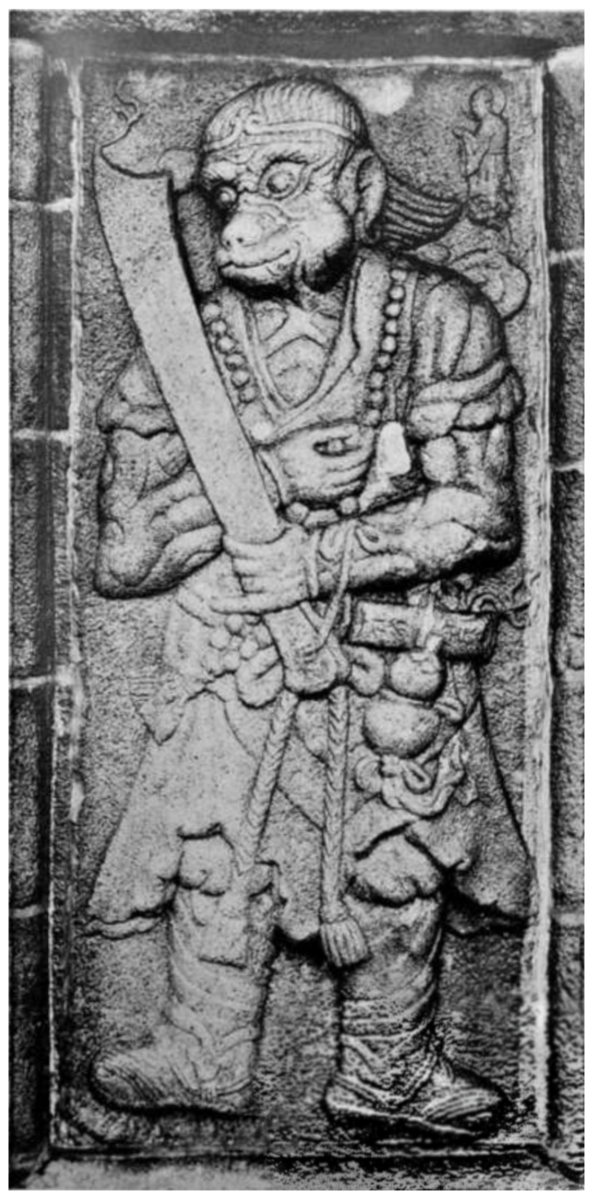
But it just dawned on me that Sun’s antecedent, the Monkey Pilgrim (Hou xingzhe, 猴行者), is also portrayed holding a divine sword in a 13th century stone relief carving (fig. 9). This weapon is referred to as his “Bodhisattva Sabre” (Pusa dao, 菩薩刀) in a 17th or 18th century tale appearing in a famous collection of Chinese folk stories. Therefore, it wouldn’t surprise me if this influenced the association with Yuddhajaya’s sword.

Fig. 9 – The Kaiyuan temple pagoda relief carving depicting Monkey holding a sword (larger version). Located on one of two 13th century stone pagodas of Kaiyuan Temple in Quanzhou City, Fujian Province, China.

I would also like to add some more drawings of Sun Wukong as a Buddha. The first two (fig. 10 & 11) are by a netizen who goes by @VirliebeAnatta (a.k.a. Bhante_Wukong) on Twitter and @his-shining-tears on Tumblr. Their work is very calming and welcoming.

Fig. 10 – The Monkey Buddha gazes upon the viewer with hands clasped (larger version). Image found here and here. Fig. 11 – A three-quarters view of the Monkey Buddha with head bowed and hands clasped (larger version). Image found here and here.

The third (fig. 12) is by Nhung Nguyen (twitter and instagram).

Fig. 12 – Nhung’s intense Monkey Buddha (larger version). The image was first seen on a JTTW discord, but it can also be found here and here.

The fourth (fig. 13) is by Saknarin Bowonkitmanee (a.k.a. Move Saknarin), a member of the the ศรัทธาอากงไต่เสี่ยฮุกโจ้ว (大聖佛祖) Thailand Facebook group.

Fig. 13 – Move’s serene Monkey Buddha (larger version). Image found here.


Update: 11-16-24

Figure 13 above was the bases for this lovely Thai statue of the Monkey Buddha (fig. 14).

Fig. 14 – The Thai Monkey Buddha idol (larger version). Image found here.


Update: 06-13-2025

In late-2024, I commissioned friend of the blog NingadudeXx to draw Monkey as Yuddhajaya using their colorful style. The finished piece (fig. 15) was delivered in mid-January 2025.

Fig. 15 – NingadudeXx’s colorful Monkey Buddha (larger version).

On a related note, I learned that Yuddhajaya has a secondary name, Vijita-saṃgrāma (Ch: Yongjian jixiang fo, 勇健吉祥佛; Viet: Dũng Kiện Cát Tương Phật), or the “Brave and Auspicious Buddha” (source). The Chinese version of his title is listed in the 8th century Names of the Thirty-Five Buddhas Spoken by the Buddha (Ch: Foshuo sanshiwu foming lichan wen, 佛說三十五佛名禮懺文) (originally linked above).

Interestingly, the farthest back that I can trace the term Dou zhansheng fo (鬥戰勝佛, i.e. “Buddha Victorious in Strife”) on CBETA is the 12th or 13th century Ritual for the Tathāgata’s Extensive Filial Piety’s Ten Kinds of Recompensating (Parents’) Kindness (Rulai guangxiao shizhong bao’en daochang yi, 如來廣孝十種報恩道場儀) (see here). Therefore, Vijita-saṃgrāma appears to be a much older name.

Spread the gospel of the Brave and Auspicious Buddha!!!

Notes:

1) Compare the list from the Chinese version to those listed here. The characters may vary slightly.

2) I am grateful to Joris Baeyens of Ghent University Library for providing me with scans of Bunce (1994).

3) Source slightly altered.

Sources:

Bunce, F. W. (1994). An Encyclopaedia of Buddhist Deities, Demigods, Godlings, Saints and Demons: With Special Focus on Iconographic Attributes (Vols.1-2). New Delhi: D.K. Printworld.

Buswell, R. E., & Lopez, D. S. (2014). The Princeton Dictionary of Buddhism. N: Princeton University Press.

Chandra, L. (1999). Buddhist Iconography: Compact Edition. New Delhi: International Academy of Indian Culture & Aditya Prakashan.

Lai, D. (2016, September 3). 35 Confessional Buddhas. Retrieved from www.davidlai.me/2016/09/03/35-confessional-buddhas/.

Wu, C., & Yu, A. C. (2012). The Journey to the West (Vol. 4). Chicago, Illinois: University of Chicago Press.

Story Idea: The Origin of Sun Wukong

Last updated: 02-22-2025

The following story sketch was originally posted on my external Historum blog on 01-20-2014. The site recently switched to a new server, but the blogs have yet to be migrated. I’m posting it here for posterity. Regular articles will resume after this entry.

Story Idea #1

As a lover of Chinese mythology and a former primatology major, I’ve always wanted to create my own primate-based character similar to Sun Wukong. I originally wanted him to be the son of Monkey or the son of one of his advisers or allies during his days as a demon. Either way, I thought he could train under Sun and gain similar powers. But then I decided that I wanted him to be a more civilized, yet more powerful version of the character; someone who is held in high regard by all beings of the six realms (demons, hungry ghosts, animals, humans, asuras, and devas) of Buddhist cosmology, as well as the Buddha himself. After reading about the ancient Chinese view of the gibbon, [A] a small, long-armed, arboreal ape native to Asia (fig. 1), I thought the character could be an ape immortal. It was only recently that I decided to pair him with a female since gibbons generally mate for life.

gibbon-jump-sachin-rai

Fig. 1 – A gibbon soaring through the treetops. Photo by Sachin Rai. A larger version can be found here.

1. Plot

This tale is meant to be a standalone story, but it includes details that explain the origin of Monkey and how his life parallels his spiritual parentage. I’ve drawn upon traditional Chinese religious and vernacular texts for inspiration. The notes below contain important information on the texts I used and why particular plot choices were made.

The Daodejing (道德經) reads:

The Dao (道, the way) gives birth to the One (yiqi, 一氣, the first breath);
The One gives birth to the Two (yin and yang, 陰陽);
The Two gives birth to the Three (San qing, 三清, the Three Pure Ones);
The Three gives birth to the Ten Thousand Things.
The Ten Thousand Things carry the Yin and enfold the Yang;
Kneading gently, they create harmony. [B]

In the beginning of the universe, the Three Pure Ones, the manifestations of the Dao, use the vital energies of the cosmos to create heaven, earth, and all living things. Among the first to be created are two gibbons, a male and a female (fig. 2). They become the progenitors of all apes and monkeys, just like the phoenix and his mate, the next to be created, are the progenitors of all birds. Being embodiments of yin and yang sexual forces, the pair propagates quickly. They frolic with their children and the following generations through the mountain tops soaking up qi (氣), prolonging their lives for thousands upon thousands of years. And Like modern apes, the pair shows a propensity for observation, watching the cyclical movement of the stars and planets and becoming aware of the ebb and flow of qi, studying the energy and cultivating its mysteries over endless eons.

Mated Gibbons

Fig. 2 – A pair of mated gibbons. A larger version can be found here.

Once their family grows to titanic proportions, the gibbons wield their arcane knowledge to create an island home, raising up Flower-Fruit Mountain (Huaguo shan, 花果山) from the ocean. There, they construct the Water Curtain Cave (Shuilian dong, 水簾洞) from which they continue to plumb the depths of the Dao. [C] Their exploration takes them to the heights of the mountain where heaven meets earth, using the corresponding yin (earth/female) and yang (heaven/male) energy to fuel their reenactment of the creation of the cosmos through sexual union. By chance, these powerful, creative sexual energies are absorbed by a boulder atop the mountain. [D]

As mated gibbons often do, the pair sings the most beautiful duets that echo throughout time and space. [E] The power of their song continues to increase as their immortal lives extend through the ages. It becomes so powerful that the duet is capable of crumbling mountains, churning the oceans, and shaking the very firmament of heaven. In fact, their song inadvertently topples one of the mountain pillars supporting the sky, and so the devi Nuwa (女媧) is forced to mend the heavens with five magic stones. [F] The primordial devas and spirits fear what might happen if the couple continues, so they plead with the gibbons to separate in order to avoid destroying the cosmos. They promise to allow the pair to see one another at some fixed period of time in the distant future.

The immortal lovers reluctantly agree and isolate themselves to two separate holy mountains; [G] the male becomes known as the “Eastern Ape Immortal” (東猿仙) and the “Ape Patriarch” (Yuan jiazhang, 猿家長), while the female becomes known as the “Western Ape Immortal” (Xi yuan xian, 西猿仙) and the “Ape Matriarch” (Yuan nu jiazhang, 猿女家長). The two are much sought after by animal, human, devil, and deva to teach them the essence of the Dao. Both become the religious teachers of countless beings, from the lowliest creature to the purest deva in the highest heaven. Former students include the Tathagata Buddha and the immortal Subodhi. [H]

The primordial devas are eventually superseded by deified humans after a great battle between the Shang and Zhou Dynasties. [I] The August Jade Emperor (Yuhuang dadi, 玉皇大帝) and the rest of the heavenly retinue go about setting the cosmos into order. The promise made by the primordial devas is lost to time.

It is during the interim when the previously mentioned boulder, having been nourished by the light of the sun and moon for centuries, births a stone embryo that is eroded by the elements into a stone monkey. He becomes the king of the monkeys on Flower-Fruit Mountain by rediscovering the Water Curtain Cave that the previous generations of his kin had forgotten long after the Ape Immortals went into exile. The monkey eventually trains under Subodhi, receiving the religious name Sun Wukong (孫悟空, Monkey Awakened to Vacuity) (fig. 3), and achieving great magical powers with which he later uses to rebel against heaven for not recognizing him as a full-fledged god. After being imprisoned by the Buddha for 600 years, Sun redeems himself by escorting the monk Tripitaka (Sanzang, 三藏) to India, and for this he is rewarded with Buddhahood, becoming the “Victorious Fighting Buddha” (Dou zhansheng fo, 鬥戰勝佛).

n8mflz

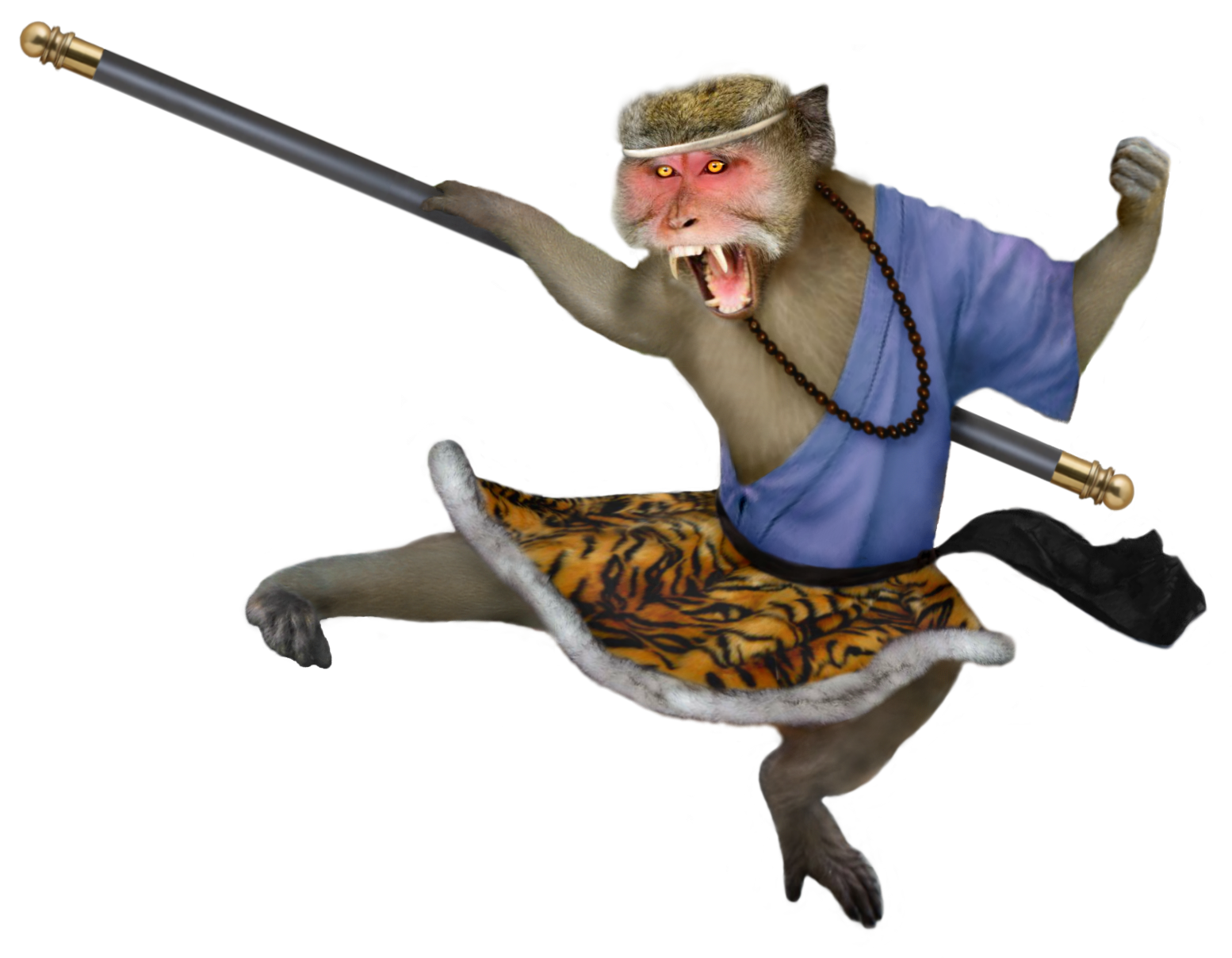
Fig. 3 – A modern depiction of Sun Wukong (larger version). A photomanipulation by the author.

After the fixed period of time has elapsed, the primordial gibbons request to leave their individual exile. The August Jade Emperor, however, refuses due to the potential for danger. Angered because heaven went back on its word, the immortal lovers leave their exile anyway, and so all of the devas, spirits, and devils struggle to keep them apart. This is an impossible task given that the two are among the highest immortals. A great battle ensues in which the pair uses their knowledge of the Dao to put the celestial army into disarray. For instance, the Ape Patriarch is a master of transformations; he grows to titanic proportions, multiplies his long arms, and captures the most powerful Daoist and Buddhist deities in his vice-like hands. The Ape Matriarch is a mistress of illusions; she clouds the minds of the soldiers, making them think they are fighting her when they are really fighting each other. [J] In addition, their individual songs have grown in power, now capable of destroying anything by separating the yin and yang forces therein (fig. 4).

Gibbon yawning

Fig. 4 – A gibbon yawning. Imagine powerful sound waves emanating from its mouth. A larger version can be found here.

The August Jade Emperor begs the Buddha to intervene like he had done for the rebelling Sun Wukong in the past. But considering that heaven went back on its word and the ape immortals are both friends and former teachers of the Enlightened One, the Tathagata sends their spiritual son, the Victorious Fighting Buddha, to ask them to pacify their rage instead of using trickery to halt the onslaught. [K] After a brief reunion, the pair acquiesces, and all three travel by cloud to the Buddha’s abode on Vulture Peak (Lingjiu shan, 靈鷲山) to discuss the matter. The immortal lovers opine the great injustice done to them by the heavenly hierarchy. The Buddha knows their duet is part of their primordial animal nature and is the ultimate expression of their love, which reaches back to the very beginning of time. Unfortunately, he realizes that the power of their song could destroy the universe if allowed to take place.

After some thought, the Tathagata gives them a lesson on the cyclical dissolution of the cosmos: at the end of each Mahakalpa (Da jie, 大劫), the universe is destroyed by a different element. There are fifty-six destructions by fire, seven by water, and one by wind. The latter is the most powerful, destroying all earthly and heavenly realms below the pure realm inhabited by the Buddha and his retinue. The Tathagata then suggests a compromise in which the couple can remain as his permanent guests of the Buddha realm, where they can frolic with the Victorious Fighting Buddha. This way the gibbons will be free to sing their melodious song without fear of negative effects. And when the end of the sixty-fourth Mahakalpa comes to a close, their song will serve the function of the wind element to bring about the dissolution of the universe to make way for the new one. [L]

2. Background information

A) The Chinese viewed the gibbon (Yuan, 猿) as symbolic of Confucian gentlemen and Daoist immortals. Their long arms were thought to be evidence of their expertise in soaking up qi. This resulted in long lives and occult powers (Geissmann, 2008).

B) This is based on chapter 42 of the Daodejing (道德經), the premiere holy text of Daoism. The original passage has been interpreted differently by different scholars. I’m using the interpretation presented in Laozi and Wilson, 2012, p. 197. The cited text, however, makes no mention of the Three Pure Ones. This is based on later Daoist texts and folk views on the supreme immortals. See Stevens, 1997, pp. 68-70.

C) JTTW never explains where the magical cave came from. This is my attempt to give it an origin story.

D) JTTW states the following about the boulder: “Since the creation of the world, it had been nourished for a long period by the seeds of Heaven and Earth and by the essences of the sun and moon, until, quickened by divine inspiration it became pregnant with a divine embryo” (Wu & Yu, 2012, p. 101). I’ve never been satisfied with the explanation for Monkey’s birth. Why would the rock produce a simian character? This is why I wrote that the Ape Immortals make love atop of the mountain, thereby impregnating the boulder with powerful, creative energies. In Daoist sexual practices, earth and heaven are often euphemisms for the feminine and masculine sexual energies of yin and yang (Wile, 1992, pp. 11-12 and 28-29). Therefore, what I have proposed is simply a difference in semantics.

E) Gibbon duets have an ethereal quality. Those wishing to listen to some can do so here and here (make sure your volume is not too high). It’s interesting to note that gibbons can naturally perform what takes professional opera singers years of dedicated practice to achieve (Lougheed, 2014).

F) The original mythology has the pillar being fallen by a water demon. I guess an explanation could be included somewhere that the original reason for the disaster, the gibbon song, was forgotten to time and confused with a different incident.

G) I wanted there to be a parallel between Monkey’s imprisonment and the pair’s exile, both of which are connected to mountains.

H) The Buddha’s tutelage under the gibbons happens in the distant past when he is still a Bodhisattva in the Tushita heaven. I listed Subodhi because I wanted there to be a further link between Monkey and the Ape Immortals. Therefore, the skills of Sun Wukong’s spiritual parents are transmitted to him by their former student.

I) This is based on the events in the 16th-century Chinese classic Fengshen Yanyi (封神演義), or Investiture of the Gods. In the story, chaos in heaven causes many gods to be reborn on earth as various heroes of the competing Shang and Zhou Dynasties. The King of Zhou wins the conflict and his strategist, an apprentice of the supreme immortal Yuanshi Tianzun (元始天尊), one of the Three Pure Ones, uses a magic list to deify the souls of those who died in battle. Thus, heaven is repopulated once more (Stevens, 1997, p. 60).

J) The strengths of each correspond to the skills passed on to the Buddha and the immortal Subodhi. Again, I wanted there to be a parallel between Monkey and his spiritual parents. The pair rebels like he did, but they do so because of injustice, not pride. However, I must say that lofty immortals would have surely evolved passed such earthly “wants and needs” (e.g. lust and anger). Daoist literature and vernacular Chinese fiction often describes immortals as being celibate. But the immortal love of the couple may transcend what might be expected of human-based immortals. That’s why I present them as living embodiments of yin and yang. Wile (1992) states: “The early [Daoist] texts are marked by the existential loneliness of yin and yang for each other, and their union consummates a cosmic synergy” (p. 29).

K) An example of trickery would be the way that the Buddha uses illusion to make Monkey think that he has left his palm in the seventh chapter of JTTW.

L) Buddhism recognizes a measurement of time called a Kalpa (jie, 劫), which can be many millions or even billions of years long depending on the tradition. Said traditions recognize between four and eighty kalpas (Buswell & Lopez, 2014, p. 409). The total of these respective ranges make up a Mahakalpa (dajie, 大劫), which is divided into four periods of nothingness, creation, subsistence, and finally destruction, each period being between one and twenty kalpas long (Buswell & Lopez, 2013, p. 496). For more information on the cyclical destruction of the universe by fire, water, and wind, see my article here.


Update: 01-17-21

Story idea #2

Last year I wrote an article that explored other stone-born figures from world mythology. In the conclusion I cautiously suggested that Wukong’s birth and later rebellion was influenced by the Hurrian myth the “Song of Ullikummi” (c. 1200 BCE), which appears in an extant Hittite cuneiform text comprising three fragmented clay tablets. For example, one scholar noted similarities between Ullikummi and a later figure from Greek mythology: “(1) The initial situation: the big stone; (2) a god fertilizes the stone; (3) the stone gives birth to a child; (4) the child thus created is a rebel against the gods; (5) the gods gather and plan countermeasures; (6) the enemy of the gods is rendered harmless” (see the linked article). Anyone who has read Journey to the West will no doubt notice the striking similarities with Monkey’s tale. Therefore, I think Ullikummi’s story would be a solid basis for a more authentic origin story for the Monkey King.

While the ancient tale is named after the eponymous stone monster (fig. 5), the story follows the machinations of Kumarbi, a resentful former ruler of the gods, who wishes to usurp the throne from his son, the storm god Tesub. Kumarbi sets about doing this by bedding a massive stone in an effort to produce a being powerful enough to rout the gods. Upon its birth, the doting father gives the creature a name meaning “Destroy Kummiya”, foreshadowing its intended fate to destroy Tesub’s home.

Fig. 5 – Ullikummi as a playable character from the online video game Final Fantasy XI (larger version).

Fearing that it may be killed by the gods before coming into full power, Kumarbi has the monster hidden in the underworld, where it is placed on the right shoulder of the Atlas-like god Upelluri. The creature quickly multiples in size, growing nine thousand leagues tall, eventually reaching heaven. When the goddess Ishtar fails to seduce the blind and deaf monster, the warrior god Astabi leads seventy deities into battle against the lithic menace only to be defeated and cast into the sea below. Tesub abandons the throne and, along with his vizier and brother Tasmisu, seeks the aid of Ea, the god of wisdom and witchcraft, who travels to the underworld in search of the creature’s origins. Upon questioning Upelluri, who effortlessly carries the weight of the heavens, earth, and sea, Ea learns a great weight, which turns out to be the monster, pains the titan’s right shoulder. In the end (of the third and final extant tablet), Ea calls for a tool originally used by the old gods to cleave heaven and earth and chisels Ullikummi free of Upelluri’s shoulder, thus breaking the monster’s base of power and leaving it vulnerable to attack by the gods. One scholar suggests there’s a missing fourth tablet that describes the monster’s ultimate defeat (again, see the linked article).

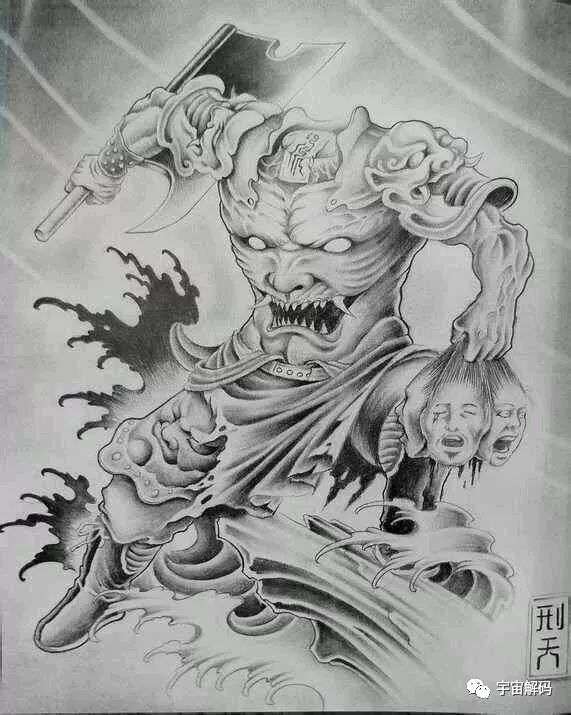
Xingtian

Fig. 6 – A modern depiction of Xingtian (larger version). Artist unknown.

Now, I’ve previously written a story sketch in which Master Subodhi’s school is actually a training ground for an immortal monastic army akin to the Shaolin Temple. I speculated that Wukong’s skill in martial arts and troop movement would come from his time serving as a soldier and eventual officer in this army. Additionally, I suggested that the baddie whom the army faces is the headless monster Xingtian (刑天) (fig. 6), who originally battled the supreme god Shangdi for control of the universe and was beheaded after his defeat. Perhaps he or a figure like him follows in Kumarbi’s footsteps and beds a stone, in this case the rock on the Mountain of Flowers and Fruits, in an effort to create a powerful son to finish what he started. Then, he works in the shadows, influencing the direction of Monkey’s life, leading to his famous rebellion against heaven. Wukong’s defeat of the seventy-two major gods in the heavenly army [1] would mirror Ullikummi routing the seventy gods led by Astabi. Likewise, the Jade Emperor’s call to the Buddha, leading to Monkey’s defeat, mirrors Tesub’s plea to Ea and the eventual downfall of the stone monster. Thoughts?


Update: 12-10-21

I’ve posted a piece about a folk Taoist white ape god. His story overlaps with Sun Wukong just like the spiritual parents I presented above.

The White Ape Perfected Man: Sun Wukong’s Divine Double


Update: 06-16-23

Story Idea #3

Another idea could predate Monkey’s stone birth and instead focus on a past life as a heavenly being. It would draw from three sources: First, the backstory of the Tang Monk, Tripitaka. Those who’ve read JTTW will know that his past life, an Arhat called Master Golden Cicada (Jinchan zi, 金蟬子), is exiled from paradise for ten lifetimes for falling asleep during the Buddha’s lecture.

Just like his master, Sun Wukong is formerly a celestial in paradise. A great name for this figure would be the “Arhat Steel Muscles and Iron Bones” (Gangjin tiegu luohan, 鋼筋鐵骨羅漢). This plays on a similar title given to Sun’s antecedent, the “Monkey Pilgrim” (Hou xingzhe, 猴行者), by Tang Emperor Taizong in the 13th-century oral version of JTTW. [3]

Second, the embellished life story of Song-era General Yue Fei (岳飛, 1103-1142). The Complete Vernacular Biography of Yue Fei (Shuo Yue quanzhuan, 說岳全傳, c. 17th-century; “The Biography of Yue Fei” hereafter) actually draws inspiration from the 1592 JTTW by portraying the general as a reincarnation of a bird monster-turned-Dharma protector from chapters 74 to 77. Originally called the “Peng Bird of Ten Thousand Cloudy Miles” (Yuncheng wanli peng, 雲程萬里鵬) in JTTW, the “Great Peng, the Golden-Winged King of Illumination” (Dapeng jinchi mingwang, 大鵬金翅明王) is exiled from paradise in chapter one of The Biography of Yue Fei for killing a stellar bat-spirit who farted during the Tathagata’s sermon on the Lotus Sutra. [4]

Just like the Great Peng bird, the Arhat Steel Muscles and Iron Bones kills a spirit for seemingly offending the Buddha. [5] I imagine the Enlightened One would admonish him by saying something like, “You are so sure of your strength, so proud of your physical gifts. And yet you don’t know how to defend the Dharma with it!” He then exiles the Arhat to live out ten lifetimes (à la Master Golden Cicada) where he’s a figure of great strength who is continually bested and humiliated and forced by circumstances to protect something weaker than him.

And third, the Buddha’s Jataka tales. The Tathagata has many birth stories where he is both humans and animals who embody an important lesson (Cowell, 1895). In fact, one tale depicts him as a Monkey King!

The Arhat is reborn in the lower three paths of reincarnation, and just like the Buddha, he has several past lives as animals. He works his way up the cosmic hierarchy by performing good deeds, such as a past life where he’s a man-eating tiger who comes to protect a small child. He attains the human-like form of a monkey in his final incarnation, leading to the events of JTTW.

I like this option a lot because this would make both Monkey and Tripitaka former Arhats who undergo prolonged trials that refine their spirits over many lifetimes. This would ultimately explain why both of them attain Buddhahood at the end of their respective character arcs, our hero becoming the “Buddha Victorious in Strife” (Dou zhansheng fo, 鬥戰勝佛) and the Tang Monk “Buddha of Candana Merit” (Zhantan gongde fo, 旃檀功德佛) (Wu & Yu, 2012, vol. 4, p. 381). I also like it because Sun Wukong’s past life references the Tibetan monkey bodhisattva Hilumandju, who is an avatar of the bodhisattva Avalokiteshvara (Guanyin) and a possible Buddhist syncretic version of the Hindu monkey god Hanumanji. What’s interesting about this legendary figure is that he mates with a rock ogress (see the 08-02-19 update here), which reminds one of Sun’s stone birth.


Update: 02-22-25

While I like elements from the first two story ideas, the third one is turning out to be more authentic and interesting.

I had previously referred to Monkey’s past life on this article as a Bodhisattva, but I changed this to an Arhat after finding evidence that Golden Cicada, Tripitaka’s past life, was a Buddhist saint. This includes the following:

  • Xuanzang was historically worshiped as one during the Song dynasty.
  • Two Yuan-Ming plays depict him as the reincarnation of Arhats.
  • The story of Golden Cicada is likely based on the Arhat Aniruddha, one of the ten principle disciples of the Buddha.
  • Two other principle disciples, the Arhats Ananda and Kasyapa, appear among the Tathagata’s retinue in JTTW (see here). 

In addition, my previous article on Sun Wukong’s first master, the Buddho-Daoist Sage Subodhi, suggests that he is the historical Arhat Subhuti, also one of the principle disciples. And if we insert the aforementioned Aniruddha as the original identity of Master Golden Cicada, that will make four of ten disciples appearing in the story. I stress this because maybe—within our fanfiction—Monkey’s previous life could be another principle disciple that has been conveniently inserted among the historical figures. That way, the Great Sage would have known both Golden Cicada (his master Tripitaka) and Subhuti (his master Subodhi) in the past!

This is neat because he (Arhat Steel Muscles and Iron Bones) and Golden Cicada could ideally be living out their respective transmigrational punishments around the same time. And this further stimulates my brain: what if each of Monkey’s incarnations have protected each of Tripitaka’s past lives?!?! 

Notes:

1) Koss (1981) writes: “Adding up the number of gods listed here [see Wu & Yu, 2012, p. 169] from the Twenty-Eight Constellations through the Deities of the Five Mountains and the Four Rivers, the number arrived at is seventy-three, if 東西星斗 [dongxi xingdou, the “Stars of East and West”] is counted as two, which Yu does in his translation, or seventy two, if the latter is taken as one, which is another possible interpretation” (p. 84).

2) This is how old the ledger of life and death lists Monkey as in chapter 3: “Heaven-born Stone Monkey. Age: three hundred and forty-two years. A good end” (Wu & Yu, 2012, vol. 1, p. 140).

3) In chapter 17, Tang Taizong names him the “Great Sage Steel Muscles and Iron Bones” (Gangjin tiegu dasheng, 鋼筋鐵骨大聖) (Wivell, 1994, p. 1207).

4) Chapter one of The Complete Vernacular Biography of Yue Fei reads:

Let’s talk about the Buddha Tathagata at the Great Thunderclap Monastery in the Western Paradise. One day, he sat on a nine-level lotus throne, and the Four Great Bodhisattvas, the Eight Great Vajra Warriors, the five hundred Arhats, the three thousand Heavenly Kings, nuns and monks, male and female attendants, all of the heavenly sages who protect the Dharma, gathered to listen to his lecture on the Lotus Sutra. His words were like flowers and precious jewels raining from the heavens. But, at that time, a star-spirit, the Maiden Earth Bat, who had been listening to the lecture from beneath the lotus throne, couldn’t bear it any longer and unexpectedly let out a stinky fart.

The Buddha was a great, merciful lord, so he didn’t mind even the slightest bit. But don’t sympathize with the Dharma protector above his head, the “Great Peng, the Golden-Winged King of Illumination,” whose eyes shone with golden light and whose back was a scene of auspiciousness. He became angry when he saw the nasty, filthy Maiden Earth Bat, and so he unfurled both his wings and dropped down to kill the spirit by pecking her on the head. The light-point of her soul shot out of the Great Thunderclap Monastery and went to the Lands of the East (China) in the world below to find a mother and reincarnate. She was reborn as a daughter of the Wang clan. She would later marry the Song Prime minister Qin Hui (1091-1155) and come to cruelly kill the righteous (i.e. Yue Fei) as a means to get revenge against today’s enemy. We will talk about this later.

Let’s return to the Buddha, who saw what happened with his all-seeing eyes and exclaimed, “Good! Good! It turns out that this is an episode of karma (cause and effect).” Then he called the Great Peng bird to come closer and shouted, “You evil creature! You already took refuge in my teachings. How can you not follow the five precepts by daring to commit such a horrible crime? I don’t need you here; you will descend to the mortal world to pay off your (karmic) debt and wait until you have fulfilled your work. Once that is completed, only then will I allow you to return to the mountain to achieve the right fruit (Buddhist merit).” The Great Peng complied with the decree, flying out of the Great Thunderclap Monastery directly to the Lands of the East to be reincarnated. We will stop here.

且說西方極樂世界大雷音寺我佛如來,一日端坐九品蓮臺,旁列著四大菩薩、八大金剛、五百羅漢、三千偈諦、比丘尼、比丘僧、優婆夷、優婆塞,共諸天護法聖眾,齊聽講說妙法真經。正說得天花亂墜、寶雨繽紛之際,不期有一位星官,乃是女土蝠,偶在蓮臺之下聽講,一時忍不住,撒出一個臭屁來。我佛原是個大慈大悲之主,毫不在意。不道惱了佛頂上頭一位護法神祗,名為大鵬金翅明王,眼射金光,背呈祥瑞,見那女土蝠污穢不潔,不覺大怒,展開雙翅落下來,望著女土蝠頭上,這一嘴就啄死了。那女土蝠一點靈光射出雷音寺,徑往東土認母投胎,在下界王門為女,後來嫁與秦檜為妻,殘害忠良,以報今日之讎。此是後話,按下不提。

且說佛爺將慧眼一觀,口稱:「善哉,善哉!原來有此一段因果。」即喚大鵬鳥近前,喝道:「你這孽畜!既歸我教,怎不皈依五戒,輒敢如此行兇?我這裡用你不著,今將你降落紅塵,償還冤債,直待功成行滿,方許你歸山,再成正果。」大鵬鳥遵了法旨,飛出雷音寺,徑來東土投胎不表。

5) A murderous Buddhist deity may seem weird, but Vajrapani (Jingang shou pusa, 金剛手菩薩; lit: “Bodhisattva Holding the Vajra Weapon”), a yaksha-turned-wrathful Dharma protector, is considered a bodhisattva (Buswell & Lopez, 2014, p. 955).

Sources:

Buswell, R. E. , & Lopez, D. S. (2014). The Princeton Dictionary of Buddhism. Princeton, NJ: Princeton University Press.

Cowell, E. B. (Ed.) (1895). The Jātaka, or Stories of the Buddha’s Former Births (Vols. 1-5). Cambridge: Cambridge University Press. Retrieved from https://archive.org/search?query=The+Ja%CC%84taka%2C+or%2C+Stories+of+the+Buddha%27s+former+births.

Geissmann, T. (2008). Gibbon paintings in China, Japan, and Korea: Historical distribution, production rate and context. Gibbon Journal, 4, 1-38. Received from http://www.gibbonconservation.org/07_publications/journal/gibbon_journal_4.pdf

Koss, N. (1981). The Xiyou ji in Its Formative Stages: The Late Ming Editions (Vols. 1-2). (Doctoral dissertation). Available from ProQuest Dissertations and Theses database. (UMI No. 8112445)

Laozi, & Wilson, W. S. (2012). Tao Te Ching: An All-New Translation. Boston & London: Shambhala

Lougheed, K. (2012, August 23). Helium reveals gibbon’s soprano skill. Retrieved January 20, 2014, from https://www.nature.com/news/helium-reveals-gibbon-s-soprano-skill-1.11257

Stevens, K. G. (1997). Chinese Gods: The Unseen World of Spirits and Demons. London: Collins & Brown.

Wile, D. (1992). Art of the Bedchamber: The Chinese Sexual Yoga Classics Including Women’s Solo Meditation Texts. Albany: State University of New York Press.

Wivell, C.S. (1994). The Story of How the Monk Tripitaka of the Great Country of T’ang Brought Back the Sūtras. In V. Mair (Ed.), The Columbia Anthology of Traditional Chinese Literature (pp. 1181-1207). New York: Columbia University Press.

Wu, C., & Yu, A. C. (2012). The Journey to the West (Vols. 1-4) (Rev. ed.). Chicago, Illinois: University of Chicago Press.

Yang, L., An, D., & Turner, J. A. (2011). Handbook of Chinese Mythology. Santa Barbara, Calif: ABC-CLIO.

My Sun Wukong Art – “The Buddha has Awakened”

At the end of chapter 100, Tripitaka and his disciples are elevated in spiritual rank as a reward for their hardwon quest to retrieve scriptures from India. Pigsy becomes an altar cleaner, Sandy becomes a Luohan (Buddhist saint), and the priest and Sun both become Buddhas. This paragraph describes what the Buddha says to Monkey upon his ascension:

“Sun Wukong, when you caused great disturbance at the Celestial Palace, I had to exercise enormous dharma power to have you pressed beneath the Mountain of Five Phases. Fortunately your Heaven-sent calamity came to an end, and you embraced the Buddhist religion. I am pleased even more by the fact that you were devoted to the scourging of evil and the exaltation of good. Throughout your journey you made great merit by smelting the demons and defeating the fiends. For being faithful in the end as you were in the beginning, I hereby give you the grand promotion and appoint you the Buddha Victorious in Strife” [Dou zhangsheng fo, 鬥戰勝佛] (Wu & Yu, 2012, p. 381).

孫悟空,汝因大鬧天宮,吾以甚深法力,壓在五行山下,幸天災滿足,歸於釋教;。且喜汝隱惡揚善,在途中煉魔降怪有功,全終全始,加陞大職正果,汝為鬥戰勝佛。

Despite this promotion, Sun still dreads the magic golden headband might be used on him. But he soon learns the heaven-sent punishment has disappeared once he became an enlightened being, denoting the internalization of self-restraint:

As the various Buddhas gave praise to the great dharma of Tathagata, Pilgrim Sun said also to the Tang Monk, “Master, I’ve become a Buddha now, just like you. It can’t be that I still must wear a golden fillet! And you wouldn’t want to clamp my head still by reciting that so-called Tight-Fillet Spell, would you? Recite the Loose-Fillet Spell quickly and get it off my head. I’m going to smash it to pieces, so that that so-called Bodhisattva can’t use it anymore to play tricks on other people.”

“Because you were difficult to control previously,” said the Tang Monk, “this method had to be used to restrain you. Now that you have become a Buddha, naturally it will be gone. How could it be still on your head? Try touching your head and see.” Pilgrim raised his hand and felt along his head, and indeed the fillet had vanished (Wu & Yu, 2012, pp. 382-383).

諸佛讚揚如來的大法。

孫行者卻又對唐僧道:「師父,此時我已成佛,與你一般,莫成還戴金箍兒,你還念甚麼緊箍咒掯勒我?趁早兒念個鬆箍兒咒,脫下來,打得粉碎,切莫叫那甚麼菩薩再去捉弄他人。」唐僧道:「當時只為你難管,故以此法制之。今已成佛,自然去矣,豈有還在你頭上之理?你試摸摸看。」行者舉手去摸一摸,果然無之。

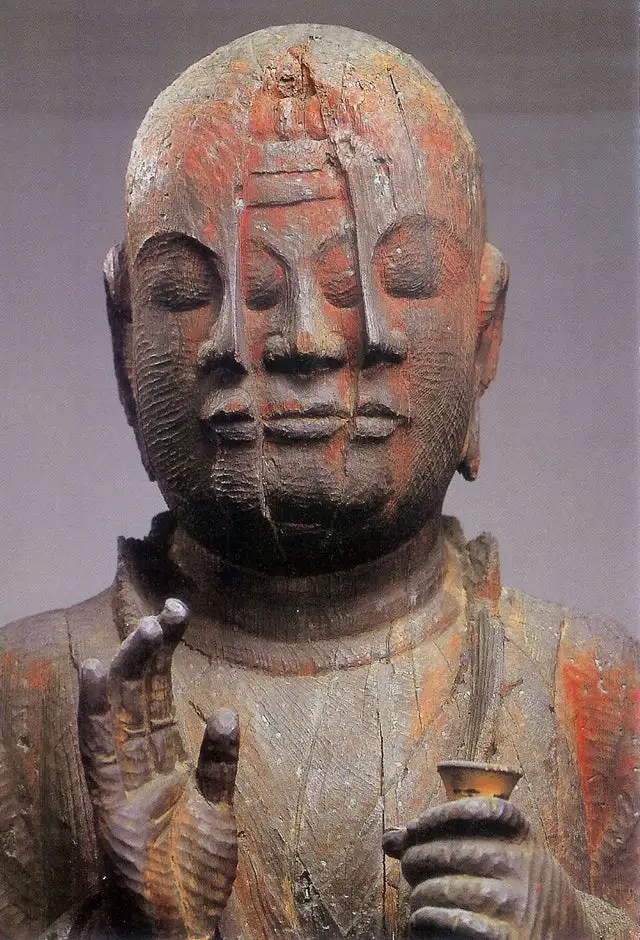
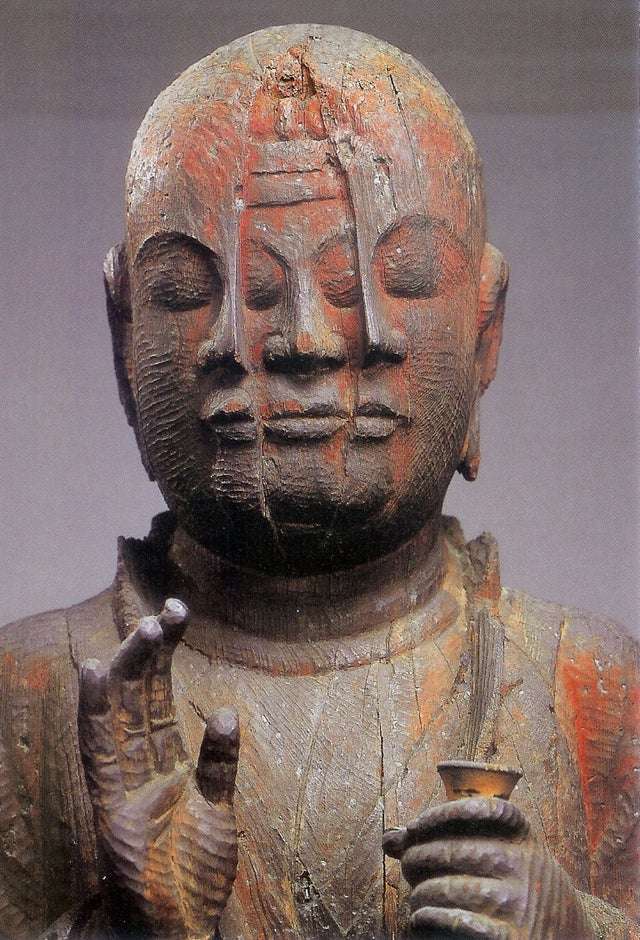
Fig. 1 – Wooden sculpture of the monk Baozhi, 12th-century, Saiho Temple, Kyoto, Japan (larger version). Image found here.

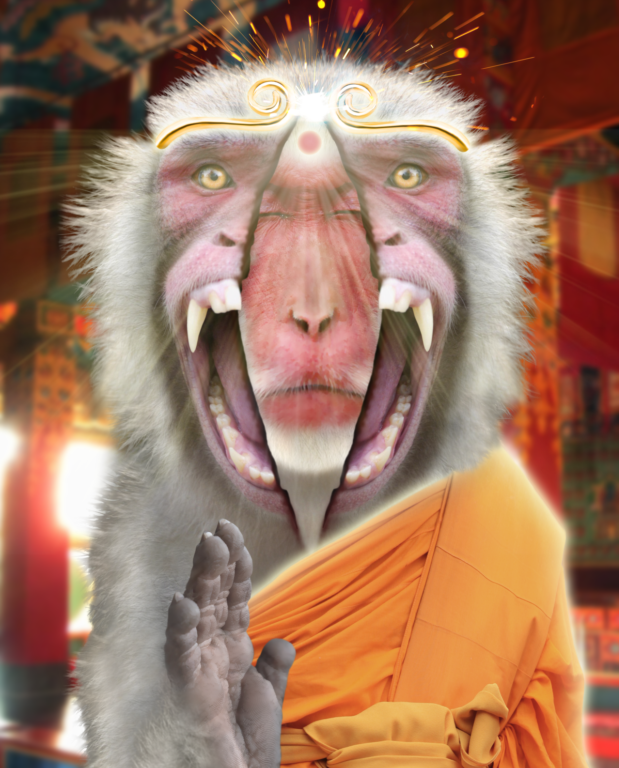
I’ve always wanted to create a piece of digital art portraying Monkey’s ascension and loss of his headband but never knew how to depict both events in the same picture. That is until a few days ago when I came across a beautiful 12th-century Japanese wooden sculpture of the Chan Buddhist monk Baozhi (Jp: Hoshi; K: Poji, 保志/寶志, 418–514) (fig. 1). The piece depicts “the monk’s face in supernatural corporeal transformation, splitting open to reveal the face of the numinous Eleven-Headed Kannon [Guanyin],” symbolizing his enlightenment (Levine, 2005, p. 72). I felt the statue was the best expression of enlightenment that I’ve ever seen. I later discovered the historical Baozhi was known for his ever youthful appearance, carrying a fanciful staff, and working magical miracles (Buswell & Lopez, 2014, p. 98; Ebrey, 1993, pp. 100-102), much like our hero. I therefore knew this piece would be the model from which I’d create my art.

This is the final product created in Photoshop CS6 (fig. 2). The piece is comprised of 15 layers using eight different pictures. It took roughly two days working on and off during free time. The screaming face of the angry immortal splits open, giving way to the serene Buddha beneath. The sparks at the top represent the headband violently snapping open since it is no longer needed. Rays of spiritual light shine from the urna on Monkey’s forehead.

Fig. 2 – The Monkey Buddha has Awakened (larger version). Photomanipulation by the author.

Sources

Buswell, R. E. , & Lopez, D. S. (2014). The Princeton Dictionary of Buddhism. Princeton University Press.

Ebrey, P. B. (1993). Chinese Civilization: A Sourcebook, 2nd Ed. New York: Free Press.

Levine, G. P. A. (2005). Daitokuji: The Visual Cultures of a Zen Monastery. Seattle: University of Washington Press.

Wu, C., & Yu, A. C. (2012). The Journey to the West (Vol. 4) (Rev. ed.) Chicago, Illinois : University of Chicago Press.

The Later Journey to the West: Part 2 – The Journey to India Begins

Note: An AI translation of this novel is now available. Click the linked Chinese characters below that read “後西遊記.”

The main body of Later Journey to the West (Hou Xiyouji, 後西遊記, 17th century) follows a similar trajectory as the parent novel, Journey to the West (Xiyouji西遊記, 1592). The historical monk Dadian (大顛, 732–824) (fig. 1) is tasked with traveling from China to India to retrieve spiritual knowledge from the Buddha, and just like Tripitaka, he is protected by three demonic disciples, namely Sun Luzhen (孫履真), the descendant of Sun Wukong, Zhu Yijie (豬一戒), the son of Zhu Bajie, and Sha Zhihe (沙致和), the disciple of Sha Wujing. Along the way the group travels through many lands, battles numerous evils, and they eventually become enlightened Buddhas like their predecessors two hundred years prior. As noted in part one, Later Journey to the West may appear like a carbon copy of the original, but the similarities are only skin deep since the novel is comprised of extremely dense layers of allegorical meaning.

Below, I present the second of a three-part summary of the novel (part 1 and part 3), which focuses on the journey proper. I rely very heavily on Xiaolian Liu (1994) as the novel has yet to be published in English.

Notes have been added to the sections below to explain the allegorical meaning of various story elements.

Table of Contents

1. The Interpretation Pilgrim is Chosen

After quelling his descendant’s rebellion, Buddha Sun Wukong travels eastward by cloud with Buddha Tripitaka to see how China has benefited from the scriptures delivered by them some two centuries in the past. However, they find that the monks of the Famen temple (Famen si, 法門寺) are not only falsely claiming to have holy relics from Tripitaka’s deceased human body, [1] but also that their leader is his sixth generation disciple and a master of the sutras. This influences Tang Emperor Xianzong (唐憲宗, r. 806-820) to donate heavily to the temple because he believes that the dynasty will prosper once the pagoda containing the supposed relics is opened. The two Buddhas return to the Western Paradise and report their findings to Tathagata, who tells them that the Chinese will continue to misunderstand and misuse the teachings until they receive the “true interpretation” (zhenjie, 真解). The Enlightened One then charges Tripitaka with locating a pilgrim who will make the journey to India to retrieve this interpretation. [2]

In the meantime, the scholar-official Han Yu (韓愈, 768–824) openly criticizes the emperor for his worship of the relics and his spendthrift support of the temple. For this he is exiled from Shaanxi province in the north to Guangdong province in the south, where he meets the Chan Buddhist Master Dadian. [3] Upon hearing of the decadent, misguided state of Buddhism near the capital, Dadian goes north and memorializes the emperor to give up his extravagant patronage of the religion. This show of integrity cements Tripitaka’s decision to choose the monk as his pilgrim. The Buddha then magically seals away the scriptures, forcing the Emperor to send Dadian to India to retrieve the true interpretation.

124782997

Fig. 1 – A woodblock print of the monk Dadian.

2. The Journey to India Begins

The novel has a total of 40 chapters. Liu (1994) only covers certain chapters from this point on since they contain the most allegorical meaning.

Dadian acquires his demonic disciples during the early stage of his journey. First, he recites a magic spell taught to him by Tripitaka which calls Sun Luzhen to his side. Second, he recruits Zhu Yijie on the road after the pig is subdued by Monkey and made to follow the priest west. Third, Dadian accepts Sha Shihe as his last disciple after the water spirit saves him from a monster that had dragged him to the bottom of the Flowing Sands River.

Prior to Sha Shihe joining the group, Monkey, Dadian, and Yijie travel through the sister villages of Ge (葛, “Creepers”) and Teng (籐, “Clinging Vines”), which are both plagued by bottomless pits that appear and swallow untold numbers of people. [A] The elders of these respective villages tell the pilgrims that the source of this calamity is a demon known as King Defect (Quexian wang, 缺陷王), who lives on the Mountain of Imperfection (Buman, 不滿, lit: “Not full”). The monster feeds on the negativity of people whom he curses with poverty, divorce, disease, etc., and those who don’t worship him are swallowed by the ground to be imprisoned forever. Luzhen retrieves a magic golden treasure from heaven that stops the demon from burrowing underground; however, when he flees into a cave, the pilgrims’ path is blocked by seemingly indestructible vines that regrow as soon as they are cut. But Monkey discovers the vines fail to grow if he cuts them while not talking. [B] The group follows suit and they are able to capture and kill the demon, who is revealed to be a badger spirit.

A) These names refer to Geteng (葛籐, Creepers and Clinging Vines), a term used in Buddhist literature to refer to the net of desire that ensnares humans. Liu (1994) notes the Avadanas Scripture (Chuyao jing, 出曜經, late-5th to early-6th cent.) contains two mentions of the term, one of which reads: “Entrapped in the net of desires, common people are bound to undermine the right (orthodoxy) way … like the creepers and vines which twine round a tree and eventually cause its death” (p. 70).

B) The aforementioned creepers and clinging vines also refer to Geteng Chan (葛籐禪, Wordy Chan/Zen), a term often applied “to people who resort to long-winded words or writings, rather than to their intuitive perceptions to grasp the essence of Buddhist principles” (Liu, 1994, p. 71). This love for speaking/writing is believed to hinder the path to enlightenment. This explains why the vines stop growing when Monkey stops talking. The group, in essence, frees themselves from Wordy Chan and relies more on intuition. This puts them one step closer to enlightenment.

After passing the Flowing Sands River and bringing Sha Shihe into their fold, the group travels to the Mountain of Deliverance lorded over by King Deliverance (Jietuo dawang, 解脫大王). He and his demon generals maintain 72 chasms where humans fall prey to their desires (sex, money, alcohol, anger, etc.) and 36 pits where sinners are tortured. [C] During a battle with the demon army, Zhu Yijie resists promises of sex, food, and treasures offered by the generals, but lets his guard down due to flattery and is captured. [D] Dadian is captured by seven demons displaying a range of emotions from joy to hatred. [E] The monk clears his mind and falls into a deep meditative state undisturbed by the outside world. It is only when Monkey comes to his rescue that Tripitaka regains consciousness. [F] In the end, Luzhen manages to kill King Deliverance by crushing him under the weight of a huge boulder that he had transformed into an exact likeness of himself. This causes all of the generals and the chasms and pits to disappear. The author provides an explanatory couplet.

When the heart (mind) is active,
All kinds of demons come into existence;
When the heart (mind) is extinguished,
All kinds of demons disappear (Liu, 1994, p. 77).

心生種種魔生,心滅種種魔滅。

C) The demon king and generals are physical embodiments of desires that keep people from attaining enlightenment.

D) This represents the consequence of temptation, no matter how small.

E) These demons represent the seven emotions of joy, anger, sorrow, fear, love, hate, and desire.

F) Dadian’s capture represents those who erroneously think meditation is simply sitting quietly instead of inner reflection and the examination of truths. His inability to focus his mind is the real reason for his capture. Monkey represents the mind, so his arrival allows the monk to regain consciousness. Therefore, this episode teaches one to focus the mind and thereby not fall prey to desires. This is yet another step closer to enlightenment.

QQ截图20160221185741

Fig. 2 – The immortal Zhenyuanzi as depicted in the famous 1986 television series.

The pilgrims travel to the Temple of Five Villages (Wuzhuang guan, 五莊觀) in the Mountain of Longevity (Wanshou shan, 萬壽山), where they are met by the supreme immortal Zhenyuanzi (鎮元子) (fig. 2), the patriarch of all earthly immortals and a temporary adversary in chapters 24 to 26 of the original. Sensing that Monkey relies too heavily on his physical strength and not his spiritual strength, the immortal only allows Dadian to enter, leaving the others to sit outside for hours. To add further insult to injury, a young immortal page tells Luzhen that his master has decided to forsake the journey in order to study Daoism. This so enrages him that he bursts inside to confront Zhenyuanzi and is challenged to retrieve Dadian from the Mansion of Fiery Clouds (Huoyun lou, 火雲樓) in which the monk is drinking tea. But Monkey’s way is suddenly blocked by a supernatural flame, known as the “fire of the mind” (Xinhuo, 心火), which can’t even be extinguished by Dragon King rain. [G] He finally manages to douse the fire with the sweet dew from Guanyin‘s holy willow sprig and retrieve his master. [H]

G) This fire represents Sun Luzhen and Zhenyuanzi’s anger, which ignites when both enter into an argument. Anger is one of the emotions thought to inhibit enlightenment.

H) This liquid is referred to in Buddhist literature as being able to extinguish everything from desires to negative emotions. For example, Liu (1994) comments: “In a parable in Za baozang jing 雜寶藏經 (Sutra of Miscellaneous Treasures [5th cent.]), the Buddha was said to use the Water of Wisdom to extinguish the Three Fires of Desire, Anger and Delusion” (Liu, 1994, p. 81). Therefore, the dew/water represents wisdom, or the ability to use reason and not become angry. The use of the dew causes Monkey to switch from knee jerk reaction to reason, as exemplified by this statement:

It was my mistake in the first place. I should not have quarreled with him to stir up his fire. Once his fire is stirred up, my fire is stirred up too. I don’t know how long the fire will burn. This surely would cause delay in our master’s proper business (Liu, 1994, p. 80).

初時,原是我差了,不該與他角口,惹他動起火來。他既動了火,我又動起火來,不知燒到幾時?豈不誤了師父正事!

The group comes to an endless, ocean-like river and question how they will ever reach the “other side” (bi’an, 彼岸). [I] They eventually take a derelict boat, but infighting between Dadian and the disciples coincides with a monstrous black storm that erupts overhead, producing powerful winds that blow them thousands of miles off course to the Rakshasa Kingdom (Luocha guo, 羅剎國). This land of monsters is ruled over by the Bull Demon King and Lady Iron Fan (fig. 3), adversaries from chapters 59 to 61 of the original. After learning of the pilgrims’ arrival, Lady Iron Fan sends an army of demon soldiers to capture them so she can exact revenge for perceived misdeeds by their predecessors. [4] Dadian once again enters meditation to avoid evil influences and is quickly rescued by Monkey. Luzhen attempts to save Yijie, who once again falls prey to temptation and is captured, but is stopped by a black whirlwind created by Black Boy (Heihai’er, 黑孩兒), the second son of the demonic couple. [J] Monkey is forced to retrieve a sutra from the Bodhisattva Ksitigarbha in the underworld. Upon reading the sutra, a magic red cloud appears and shines light on the kingdom, destroying all of the demons and leading the monks to freedom. [K]

I) This ocean/river is a common metaphor in Buddhist literature referring to desire, and the “other side” refers to a life free from desire (Paramita), or achieving enlightenment. For example, Huineng (惠能, 638–713), the sixth Chan patriarch, says: “The perverted mind is the great sea and the passions are the waves … if the perverted mind is cast aside the ocean will dry up, and when the passions are gone the waves will subside” (Liu, 1994, p. 81).

J) The black whirlwind represents ignorance, or the Buddhist concept of Wuming (無明, darkness without illumination), and the demon kingdom represents the unenlightened mind that falls prey to its own demons (desire, ignorance, anger, etc.). The metaphors of the black whirlwind and demon kingdom are mentioned in the Collected Essentials of the Five Lamplight Histories (Wudeng huiyuan, 五燈會元, c. 1252), one of several accepted histories of Chan Buddhist orthodoxy in China (Liu, 1994, pp. 84-85).

K) The illuminated red cloud represents sudden enlightenment that sweeps away all ignorance and desire.

01300001248577133770100944901

Fig. 3 – An artist’s depiction of Lady Iron Fan and the Bull Demon King.

Notes:

1) This is false within the novel’s fictional universe because Tripitaka attained living Buddhahood in chapter 100 of the original.

2) Tripitaka serves as Guanyin’s successor in this respect, for it was the Bodhisattva who recruited the “scripture pilgrim” in chapter 12.

3) Liu (1994) notes that this is based on actual history. Han Yu, who was a Confucian scholar and the Vice Minister of the Justice Department, “presented a memorial to the throne, denouncing Buddhism as an alien doctrine and criticizing the emperor for receiving and showing reverence for the ‘decayed and rotten bone’ of the Buddha” (pp. 63-64). So in this case it was a relic belonging to the Buddha and not Tripitaka. Han was actually sentenced to death, but this was later commuted to exile thanks to parties arguing on his behalf.

4) She wishes to exact her revenge because their predecessors, Tripitaka, Sun Wukong, Zhu Bajie, and Sha Wujing, were instrumental in the subjugation and reformation of her first son Red Boy by Guanyin.

Source:

Liu, X. (1994). The Odyssey of the Buddhist Mind: The Allegory of the Later Journey to the West. Lanham, Md: University Press of America.

The Later Journey to the West: Part 1 – Sun Luzhen’s Early Adventures

Note: An AI translation of this novel is now available. Click the linked Chinese characters below that read “後西遊記.”

Last updated: 03-15-2026

The great Chinese classic Journey to the West (Xiyouji, 西遊記; “JTTW” hereafter) spawned numerous unofficial sequels years after its publishing in 1592. One such sequel, Later Journey to the West (Hou Xiyouji, 後西遊記) by an anonymous author of the 17th-century, is set two hundred years after the original and follows the adventures of Sun Wukong’s spiritual descendant Sun Luzhen (孫履真). He too learns the secrets of immortality and causes havoc in heaven, before being tasked to protect the historical monk Dadian (大顛, 732-824) on a similar journey to India. The two are accompanied by the son of Zhu Bajie, Zhu Yijie (豬一戒), and the disciple of Sha Wujing, Sha Zhihe (沙致和). This may at first seem like a cookie cutter retelling of the story, but it is so much more. Unlike the original, which only used allegorical terms for given characters, Later Journey to the West is comprised of extremely dense layers of allegorical meaning, from the names of characters and the words they speak to the places they visit and the villains they face.

Below, I present the first of a three-part overview (part 2 and part 3), which covers Sun Luzhen’s early adventures. I rely very heavily on the engaging work of Xiaolian Liu (1994) as the novel has yet to be published in English.

Notes have been added to the sections below to explain the allegorical meaning of various story elements.

Table of Contents

1. The Riddle

The novel begins with the following riddle:

I have a statue of Buddha, which nobody knows;
He needs no molding or carving;
Nor does he have any clay or color;
No human can draw him; no thief can steal him;
His appearance is originally natural,
And his clarity and purity are not the result of cleaning;
Though only one body,
He is capable of transforming himself into myriad forms (Liu, 1994, p. 22)

我有一軀佛,世人皆不識,
不塑亦不裝,不雕亦不刻,
無一滴灰泥,無一點彩色,
人畫畫不成,賊偷偷不得。
體相本自然,清靜非拂拭,
雖然是一軀,分身千百億。(source)

Liu (1994) notes that the answer is: “The Mind is none other than the Buddha” (jixin jifo, 即心即佛), a common Chan (Zen) Buddhist saying referring to self-enlightenment (p. 22). He continues:

The author uses the verse to announce the theme of his book and to prepare the reader for the mental or spiritual journey he is going to undertake through the experience of reading it […] [T]he novelist wants to make sure that the readers is aware of the allegorical nature of his various episodes and is ready to apply the same technique he would employ in solving a riddle to the reading of the novel, i.e. to go beyond the literal level of the text in order to find the solution or to decipher the intended message (Liu, 1994, p. 24).

2. Sun Luzhen’s Early Adventures

The story opens on the Flower Fruit Mountain (fig. 1), home of the original Monkey King and the axis mundi, or center of the cosmos through which all creative energies flow freely between heaven and earth. Our hero Sun Luzhen is born from a stone and, upon hearing of the adventures of Sun Wukong, takes the title “Small Sage Equaling Heaven” (Qitian xiaosheng, 齊天小聖). [A][1] He follows in his ancestor’s footsteps by sailing to the Aparagodaniya continent in a quest for immortality. There, he finds an immortal’s temple but is barred from meeting the patriarch by a Daoist monk until he has completed a number of tasks, including purifying himself in the Hall of Calming the Mind and the Hall of Nourishing the Breath, [B] taming a dragon and a tiger, [C] and visiting several locations, such as the Cinnabar Field and the Divine Mansion. [D] Monkey completes the purification rituals, but soon leaves the temple when he discovers the immortal cavorting with an old woman and two young maidens. [E]

A) Just like Sun Wukong in JTTW, Sun Luzhen represents the “Monkey of the Mind” (xinyuan, 心猿), a Buddhist metaphor for the restlessness of the human mind/heart (the character of xin () can mean both) (Liu, 1994, pp. 27-28).

B) These represent the early stages of spiritual cultivation, namely meditation and the regulation of breathing. The latter involves absorption of yang energy during prescribed times of the day.

C) These animals represent yin and yang energy, respectively. So taming said animals refers to a mastery of said energies.

D) These represent spiritual centers of the body, namely a region just below the navel and the upper region of the head, respectively. See J below.

E) These people represent Daoist terms associated with sexual cultivation, a type of internal cultivation popular during the Han dynasty but fell out of favor by the Ming when the novel was written (Liu, 1994, pp. 35-37).

Monkey leaves the temple and continues his search the world over for a worthy master, finding only false immortals and hypocritical monks along the way. [F] He returns to Flower Fruit Mountain determined to bring about his own immortality, and there the small stone monkey finds the “No-Leak” Cave (wulou dong, 無漏洞) on the backside of the mountain, making it his hermitage. [G] He meditates for forty-nine days, before Sun Wukong appears in spirit, sharing with him magical formulas and eventually merging with him. This causes Monkey Jr. to realize: “The true master is after all in one’s own mind, but people don’t know where to look for him” (Liu, 1994, p. 38). [H]

F) These people represent the wrong path to enlightenment, including non-Chan Buddhist sects and even Daoism.

G) The name represents the Buddhist concept of Anasrava and the Daoist concept of Wulou (無漏)/Loujin (漏盡), or the cessation of emotional outpouring (or leaking) upon achieving enlightenment (Liu, 1994, p. 38).

H) This represents self-realization.

Having achieved immortality, Sun Luzhen discovers his ancestor’s “as-you-will” gold-banded cudgel in the cave and sets out to find additional ways of increasing his spiritual attainment. [2] First, he forces the Dragon King of the Eastern Sea and the Old Tiger King of the Western Mountains to respectively submit to his power. [I] Next, Monkey travels to the underworld below and uses his wits to prove the other worldly judgements of the ten magistrates of hell are unjust, making their rulings listed in the ledgers of life and death null and void. [J][3] Finally, the small stone monkey travels to the celestial realm above to visit the Jasper Pool, the abode of the Queen Mother of the West (fig. 2). [K] He gets drunk on immortal wine and soon creates such a disturbance that the August Jade Emperor, the ruler of heaven, calls up the celestial army to deal with the menace. The Small Sage is too powerful, and so the emperor enlists the help of the Great Sage, now an enlightened Buddha (fig. 3), [4] to halt his descendant’s onslaught. [L][5]

I) This follows the Daoist monk’s instructions to tame a dragon and a tiger. This again represents his mastery of yin and yang energies.

J) This represents Monkey’s status as an immortal who is beyond the reach of death. I believe the downward journey symbolically follows the Daoist monk’s instructions to visit the Cinnabar Field, an area of the body below the navel normally associated with the storage of spiritual and sexual energy. Although Liu (1994) does not say this explicitly, he does comment: “According to the Taoist microcosmic view, the human body [has] features corresponding to the cosmic universe […] For example, the Celestial Palace … and the Jasper Pool are not only the heavenly residence of the Jade Emperor and the Mother Queen [of the west], but also terms referring to the upper regions of the head” (p. 45). See K below.

K) Going to heaven represents the upward propulsion of energy to the head, the last step in achieving immortality.

L) As the ruler of heaven, the August Jade Emperor represents the Primary Spirit (yuanshen, 元神), or the original pure spirit that everyone is born with. This is also known as the “Heavenly Mind/Heart” (tianxin, 天心). Therefore, Monkey’s rebellion represents the attempt of the “Conscious Spirit or the Heart of Blood and Flesh” at usurping the spiritual mind before all attachments are extinguished upon enlightenment (Liu, 1994, pp. 47-48).

Fig. 1 – A depiction of Flower Fruit Mountain from a modern video game (larger version). Fig. 2 – A Ming Dynasty painting of the Queen Mother of the West riding a stone lion (larger version). Fig. 3 – A live action depiction of Sun Wukong after attaining Buddhahood (larger version).

3. Sun Luzhen’s Enlightenment

Sun Wukong arrives and soon deprives the small stone monkey of the magic iron staff, and when the latter complains that he won’t be able to defend himself, Monkey Sr. tells him: “It is already in your ear [where he used to hide the magically reduced weapon]. How can I give it back to you?” (Liu, 1994, p. 50). [M] This Chan gong’an (Zen koan) instantly brings about Sun Luzhen’s enlightenment.

M) This represents one’s own internal or spiritual strength.

Before returning to the Western Paradise, the Great Sage places the golden fillet on his head and instructs him:

There is a limit to brute force,
But Wisdom and courage are boundless;
If you fail to achieve the right fruition,
You will forever be a wild immortal. (Liu, 1994, p. 49)

頑力有阻,慧勇無邊;
不成正果,終屬野仙。(source)

Liu (1994) explains the significance of the verse:

In the poem Sun Wukong tells his descendant to resort to wisdom and courage, rather than brute force, to achieve this goal. This teaching is borne out by the fact that it is not the celestial army but Sun Wukong who subdues Monkey with his enlightening words. But more important is the message conveyed in the last two lines. Though Monkey has obtained physical immortality, he is still a yexian 野仙 (wild immortal), because he is unable to quench his desires and emotions […] According to Chan Buddhist doctrine of wunian 無念 (no-thought), man’s original nature is pure and free from all thoughts and passions. In the first section of the novel, Monkey tries a Taoist approach in his effort to seek immortality. Though he succeeds through Taoist meditation in calming his mind and in realizing his self-nature, his desire for immortality and his practice of internal alchemy, symbolized by his celestial adventures, violate the Chan Buddhist principle of non-attachment, and are therefore considered “wild” and “unorthodox” by Buddhist ontological non-dualism. The completion of the Taoist physiological alchemy is only the beginning of a self-cultivation process for the hero whose ultimate goal … is to accomplish zhenguo 正果 (right or orthodox fruition), i.e. to achieve the Buddhahood inherent in one’s own nature, through the journey proper to the Holy Mountain in the Western Paradise. (p. 49)


4. Updates

Update: 10-25-21

I have listed Sun Luzhen as an “honorable mention” among the Monkey King’s literary children. See section 3 here:

The Monkey King’s Children


Update: 03-15-26

I have drastically updated the formatting of this article, including adding more of the original Chinese characters/quotations, increasing the number of tags, linking to more wiki articles, and placing the (previously separate) explanatory notes within each section. Needless to say, this post now differs from parts two and three. I will get around to updating those in the future.

Notes:

1) This mirrors the title “Great Sage Equaling Heaven” (Qitian Dasheng, 齊天大聖) taken by Sun Wukong in JTTW chapter 4.

2) Daoism recognizes up to five categories of immortality, each increasing in spiritual attainment from the last: 1. Ghost; 2. Human; 3. Earthly; 4. Divine; and 5. Heavenly (Liu, 1994, p. 55, n. 36).

3) This contrasts with Sun Wukong who used force to erase his name (and those of all other monkeys living at that time) from the ledgers of life and death (see JTTW chapter 3).

4) Monkey Sr. is granted Buddhahood, along with the title “Buddha Victorious in Strife” in JTTW chapter 100.

5) Sun Luzhen’s drunken episode, havoc in heaven, and subjugation by a Buddha recalls the adventures of his ancestor from JTTW chapters 4 to 7.

Source:

Liu, X. (1994). The Odyssey of the Buddhist Mind: The Allegory of the Later Journey to the West. Lanham, Md: University Press of America.