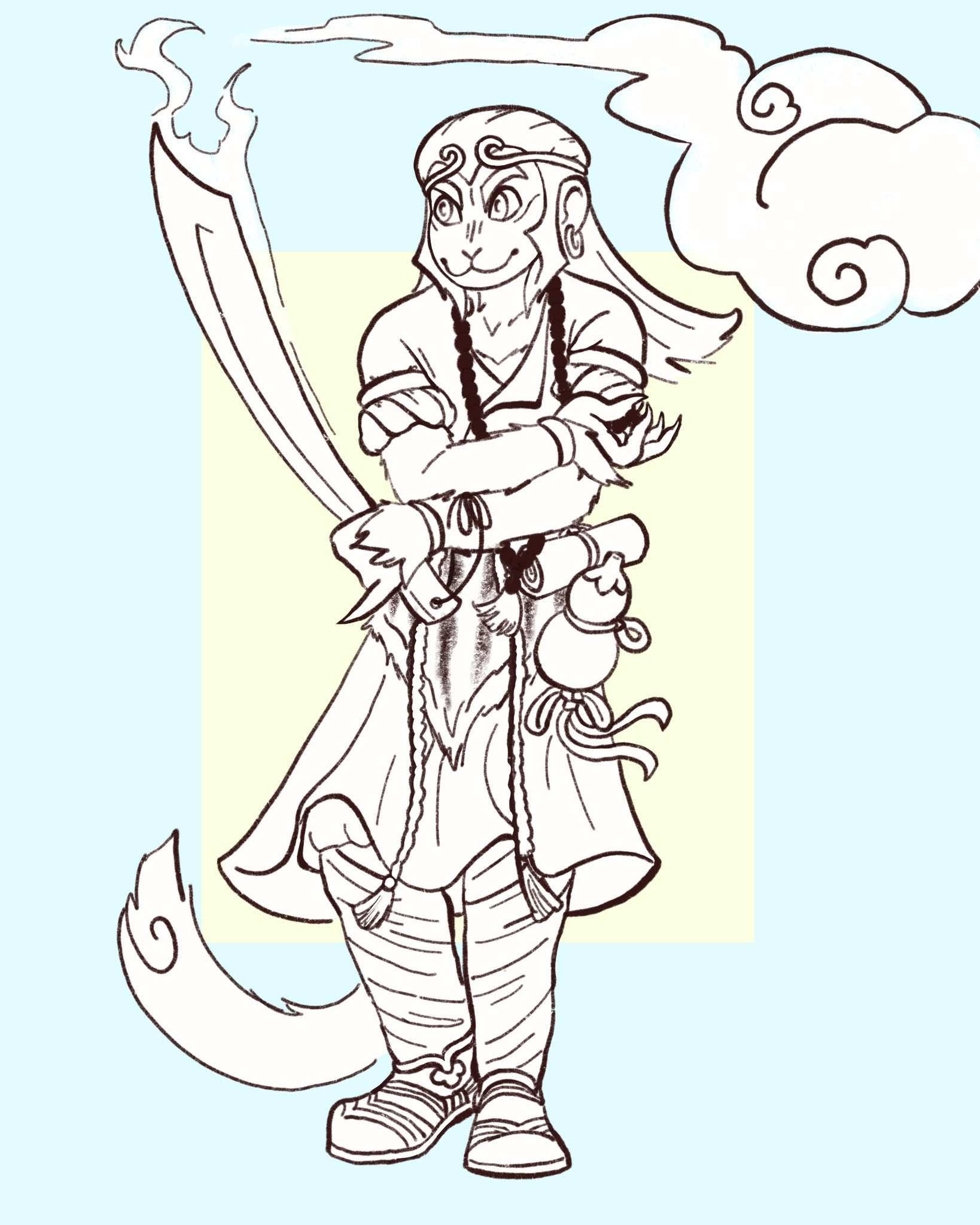
The White Ape Perfected Man: Sun Wukong’s Divine Double

Last updated: 03-20-2022

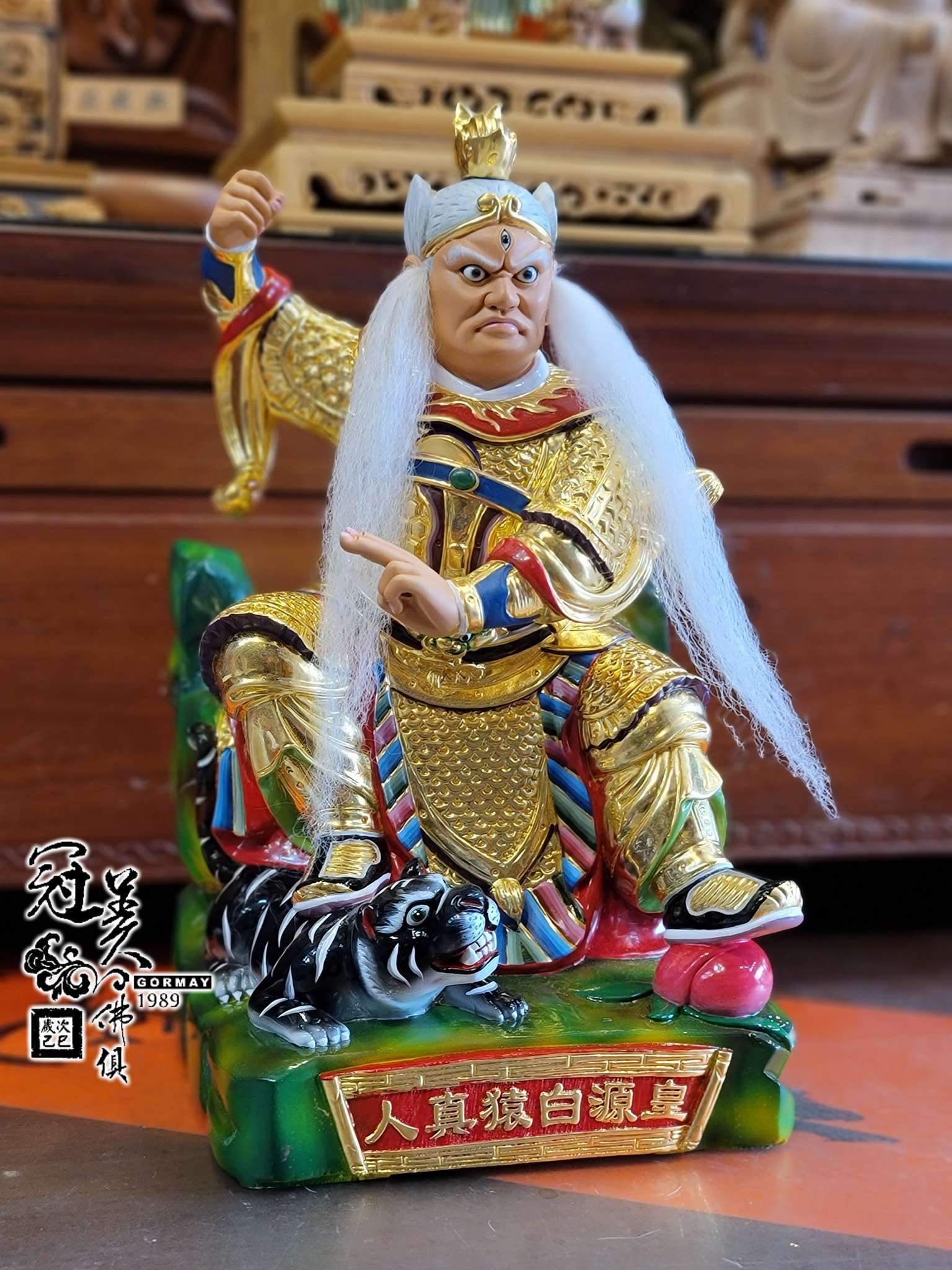
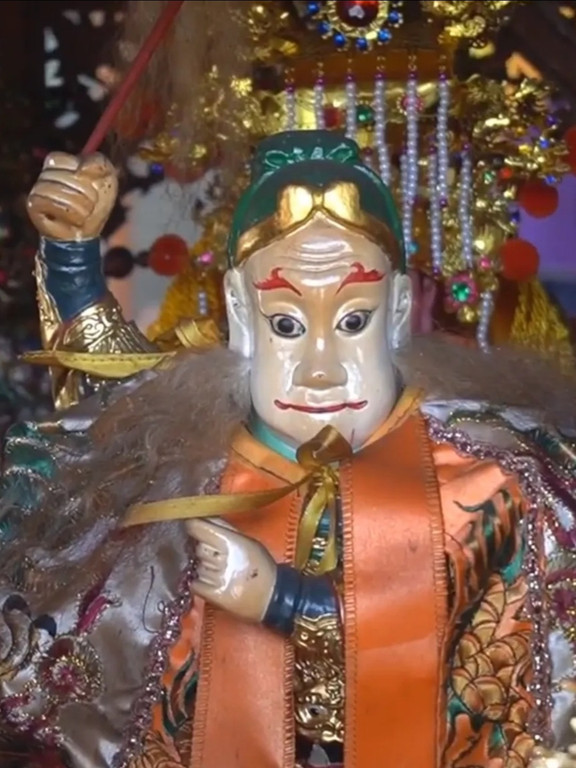
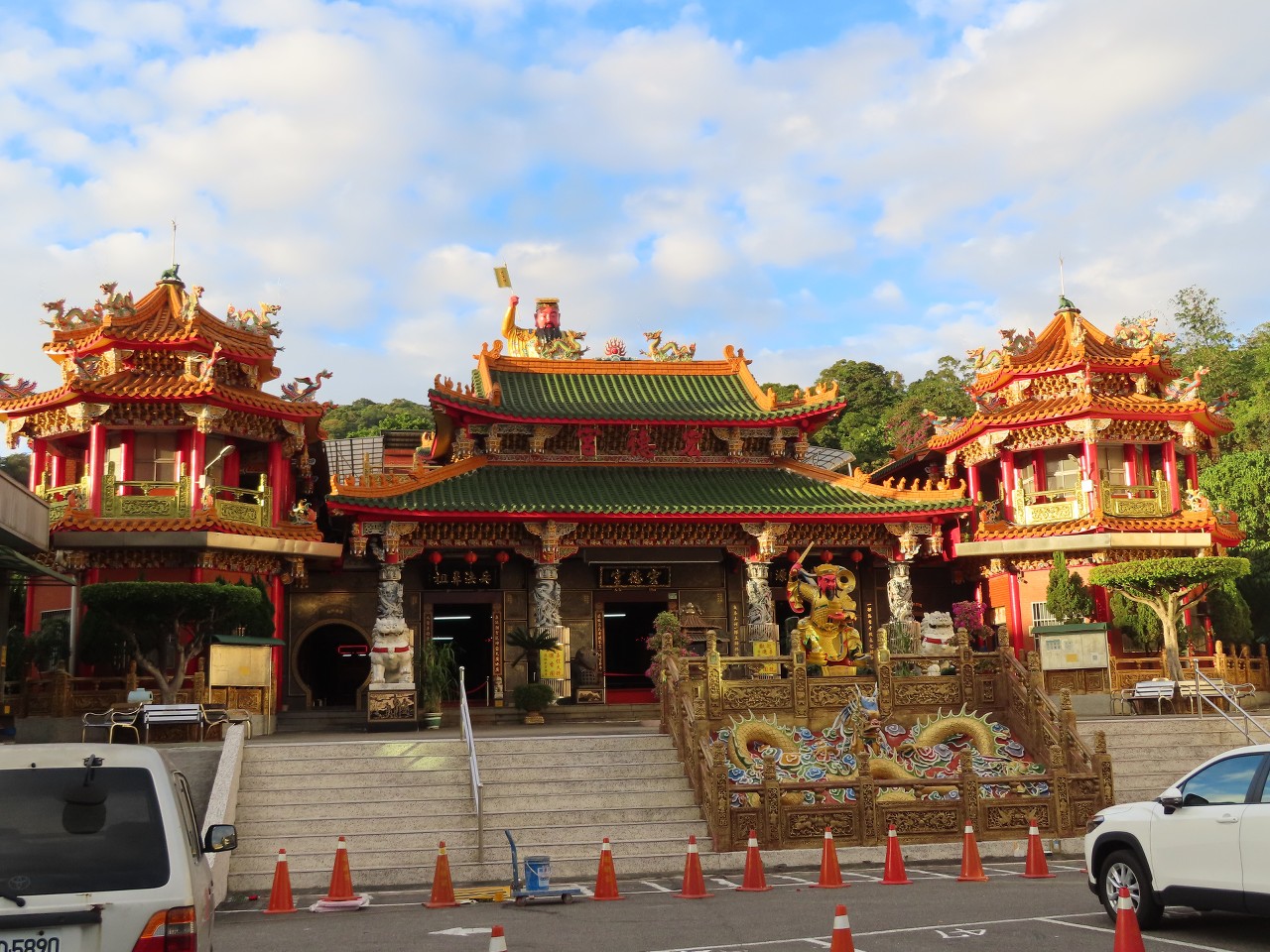
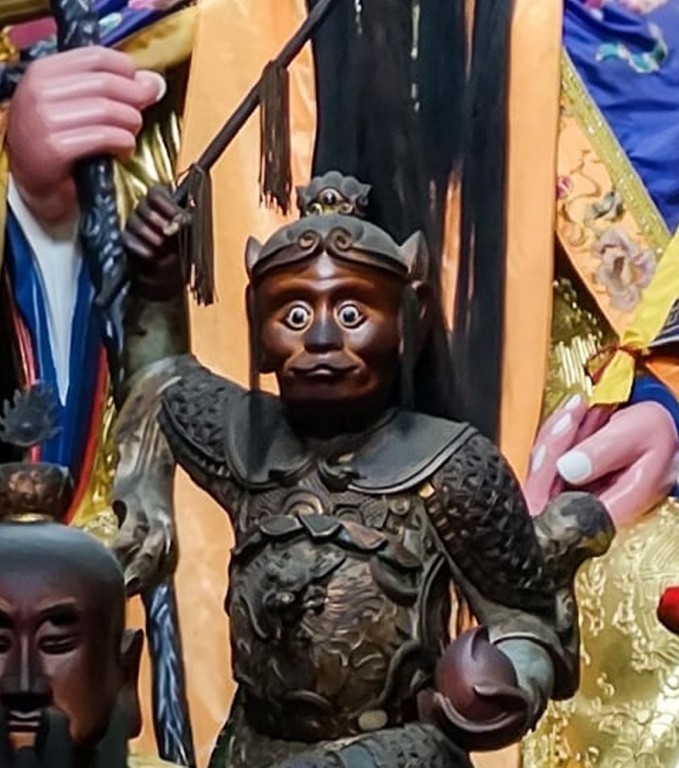
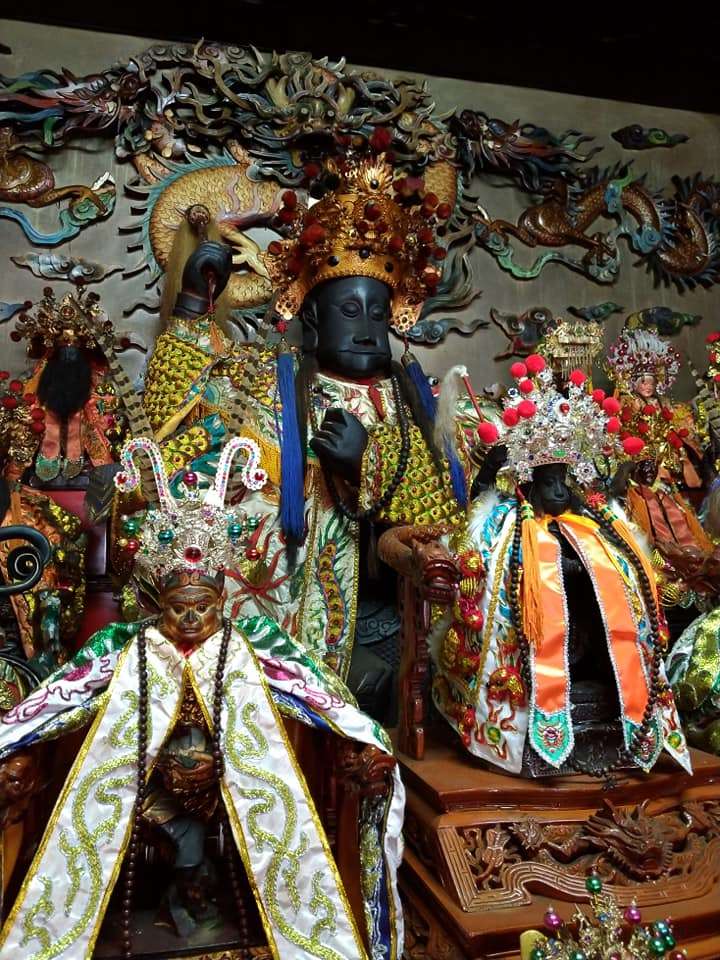
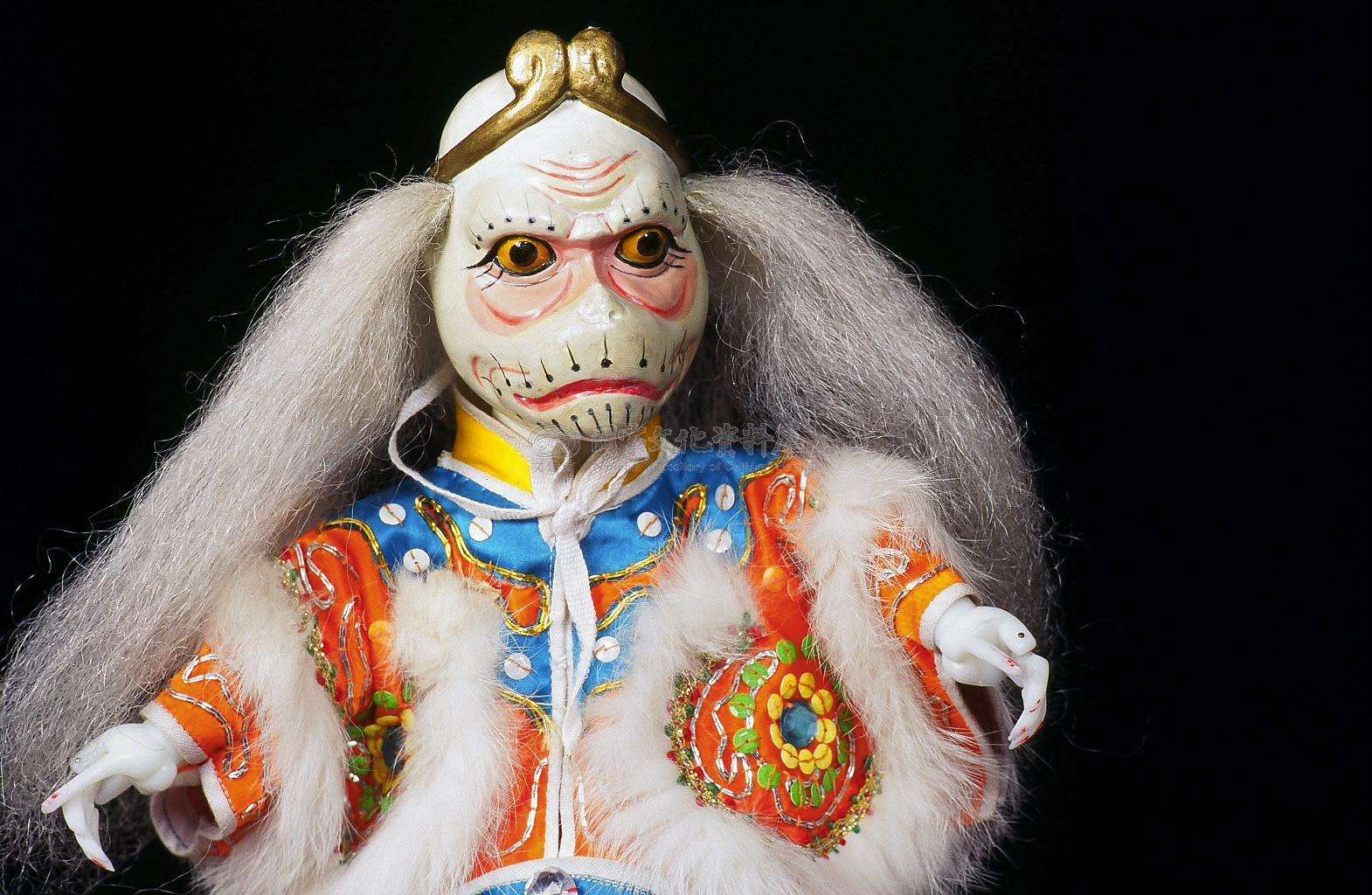
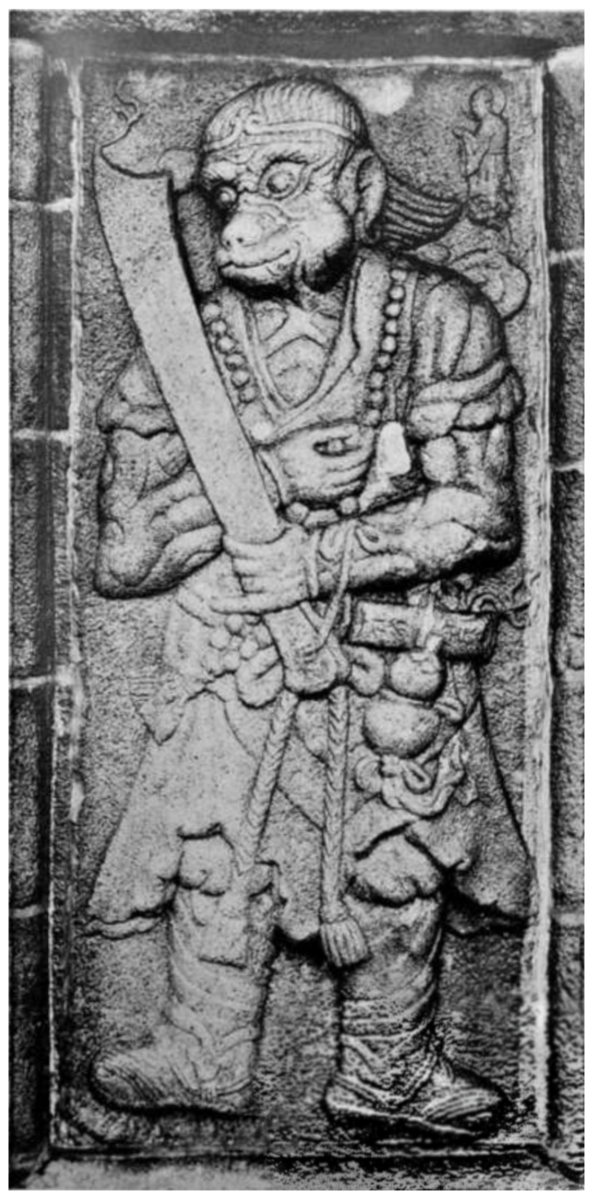
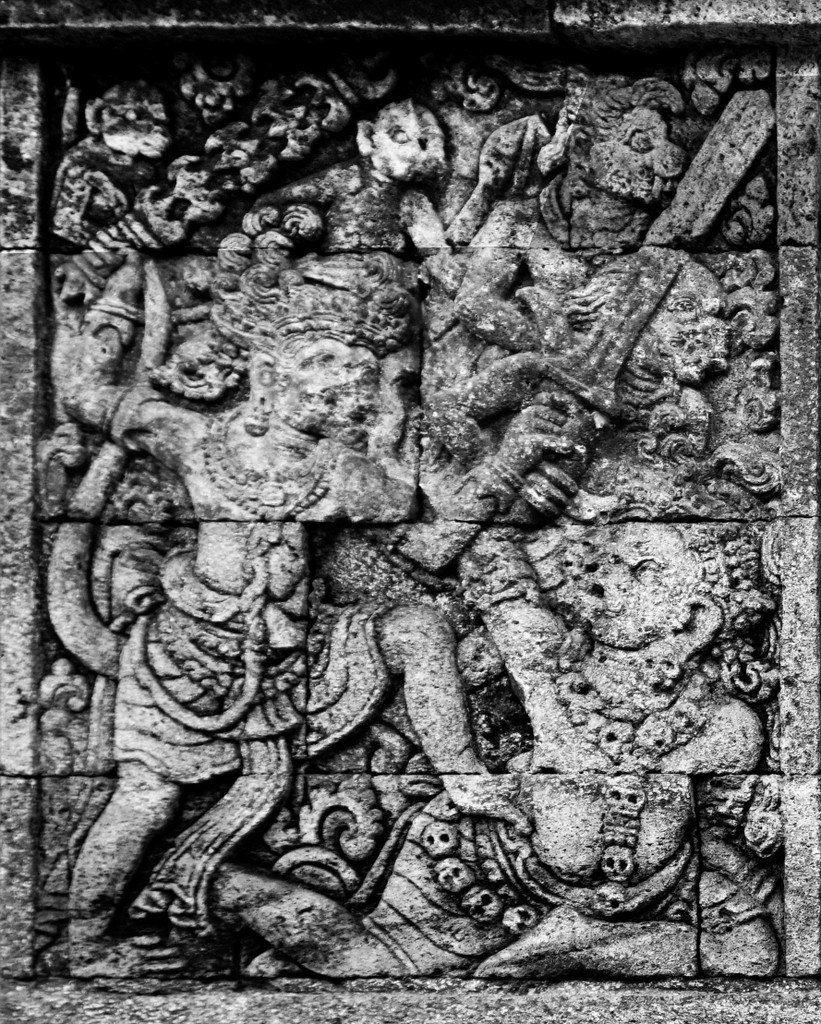
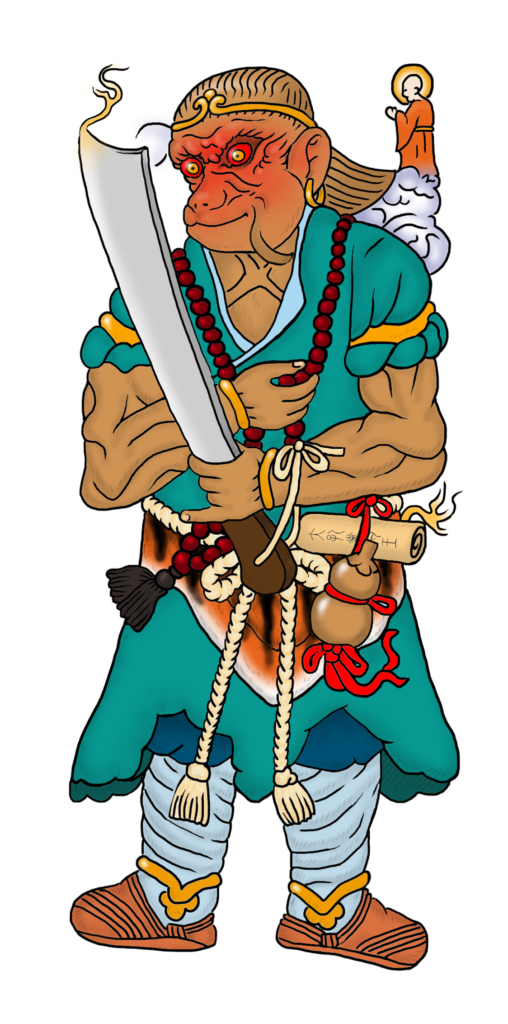
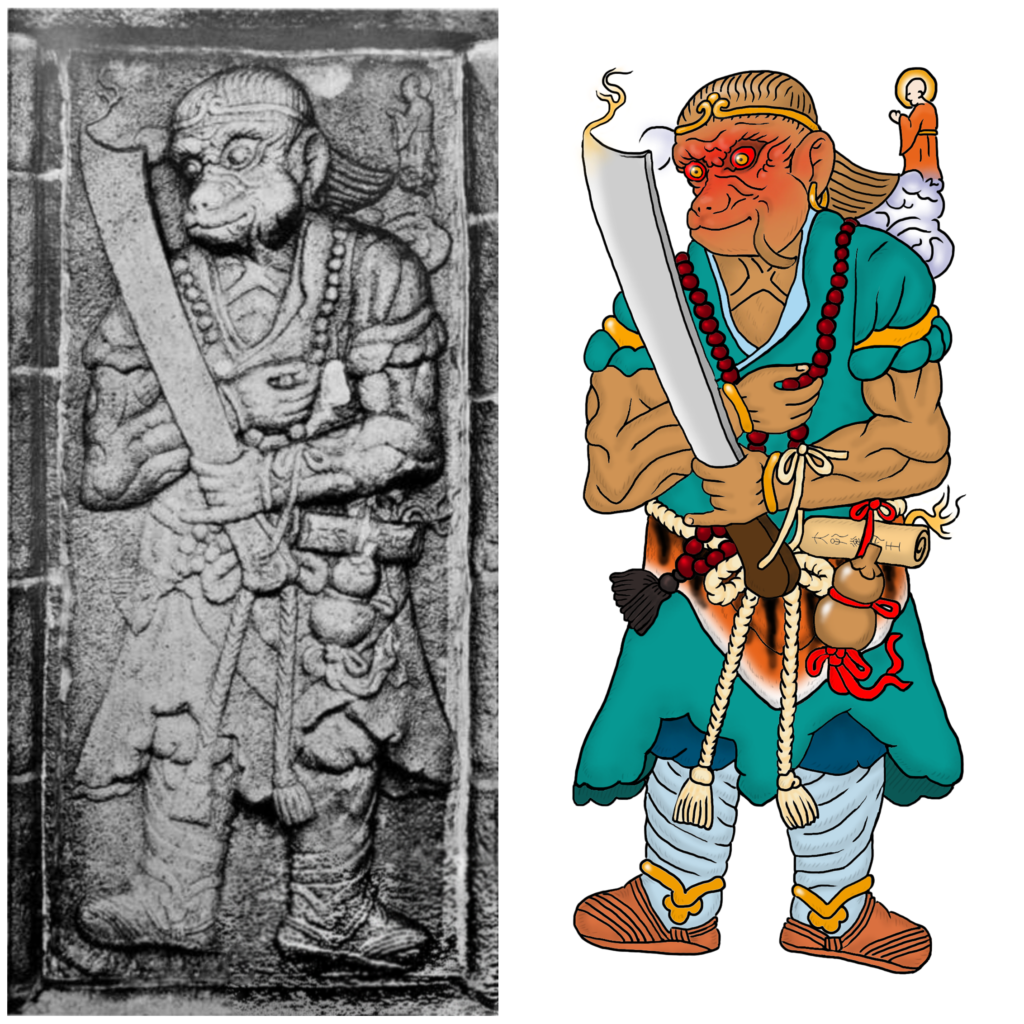
Readers may wonder where I get my inspiration to write articles. Most of the time I seek to answer a question that pops up while reading a book or researching a subject, leading to a subsequent paper on what I learned. Other times, I simply stumble across something online. A prime example of this is the “White Ape Perfected Man” (Baiyuan zhenren, 白猿真人), a rare folk Taoist deity that I recently learned about from Facebook. He is depicted with long hair (sometimes with ear-pressing tufts) and a golden fillet, linking him to Chinese opera depictions of military monks (wuseng, 武僧) (Bonds, 2008, pp. 177-178), thus signaling his position as a martial deity. A headdress with lingzi (翎子) feathers sometimes adorns his crown. His visage ranges from welcoming to fierce and from human to more primate-like. He wears a golden suit of armor and sits in a kingly fashion with the right knee resting on the seat, exposing the bottom of his foot to the viewer. This armor is sometimes draped in a colorful ritual cape. His left arm is usually bent at the elbow and the hand is clenched in a fist (or two-finger shooting mudra) or holds an immortal peach at the chest, while the other is held high and contains a fly whisk or staff. This iconography is shockingly similar to religious depictions of Sun Wukong as the “Great Sage Equaling Heaven” (Qitian dasheng, 齊天大聖). In fact, the two deities are nearly indistinguishable apart from the ape sometimes having white hair and a white face. But this isn’t always a good indicator, though, as one Fujian tradition features a brother of the Monkey King with a white face. And other times, statues of the white ape might be plain wood or even bronze, thereby erasing any signifying color. But the best clue to his identity appears to be the combination of the fist at the chest and a raised foot while in a seated position, what I call the “fist over foot motif” (fig. 1 to 4).

I’ve previously written about magical white apes (gibbons) in relation to Tang-era Chinese literature, primate-based martial arts, and the fictional origin of Sun Wukong. I’ve even archived an entire book on the subject which surveys historical references, poems, folktales, and art spanning over 3,000 years from the Zhou to Qing dynasties. I would like to supplement this material by writing an article about the White Ape Perfected Man and his appearance in vernacular fiction and Taoist scripture. I suggest his iconography was directly influenced by Sun Wukong based on a centuries-long association between the two magic primates in popular literature.

Fig. 1 – One of the first pictures I ever saw of the White Ape Perfected Man (larger version). Photo from Facebook. Fig. 2 – A statue from an unknown temple (larger version). Photo found here. Fig. 3 – One of several statues from the Zhenji Temple of Bade District, Taoyuan, Taiwan (Taoyuan Bade Zhenji gong, 桃園八德鎮濟宮) (larger version). Screenshot from this Facebook video. Fig. 4 – A statue belonging to Jishen Temple of Tainan, Taiwan (Tainan Jishen gong, 台南濟申宮) (larger version). Photo from Facebook.

Table of Contents

1. Religious Story

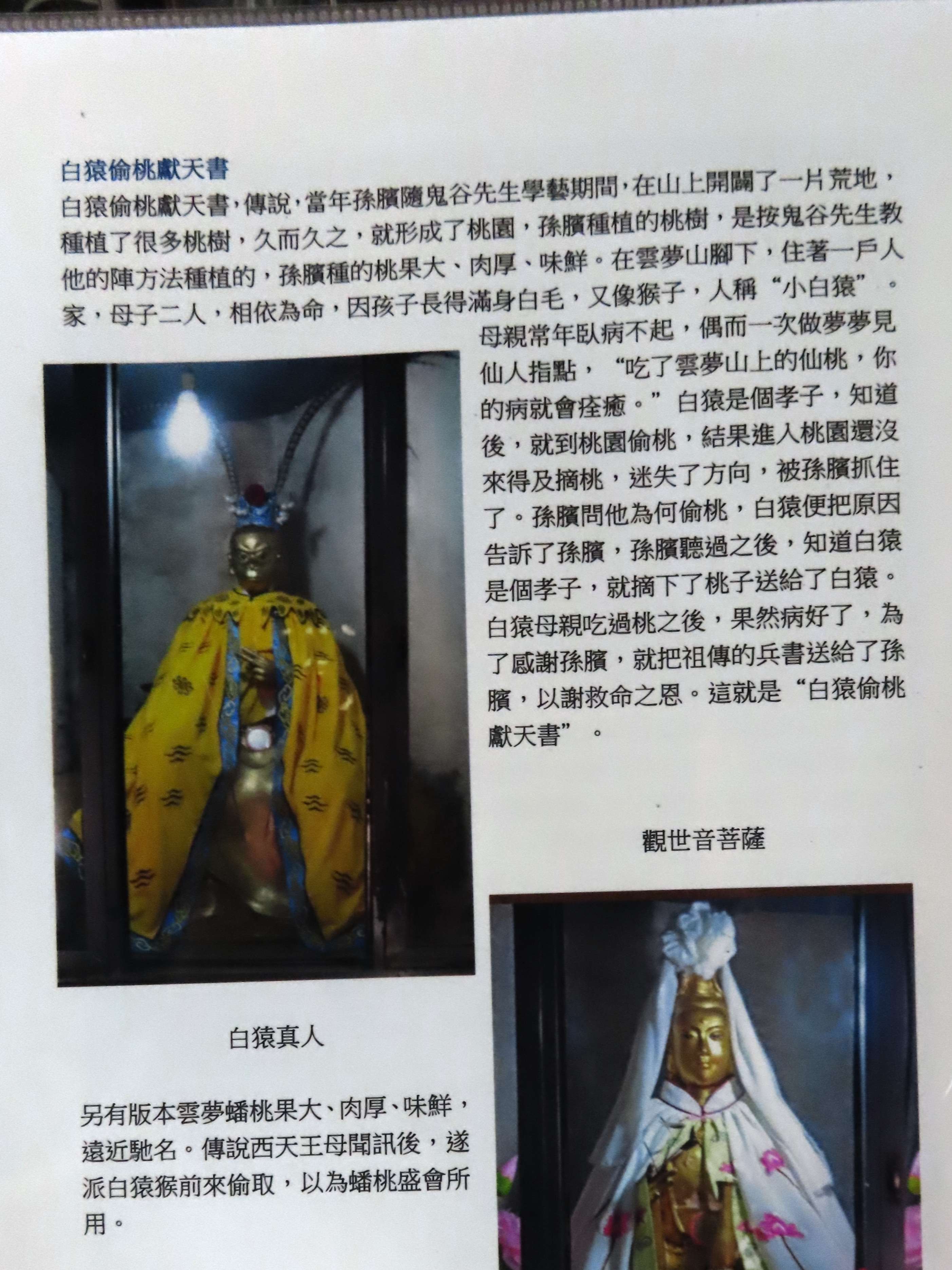
I traveled to the Sun Bin Shrine of Hongde Temple in Yingge District, New Taipei, Taiwan (Yingge Hongde Gong Sun Bin Miao, 鶯歌宏德宮孫臏廟) (fig. 5) to gather material for this article. Unfortunately, the temple’s statue of the White Ape Perfected Man (fig. 6) was out for repairs on the day of my visit. But I collected information about the deity from the temple’s history book (fig. 7). The ape god is associated with Sun Bin (孫臏, d. 316 BCE) (fig. 8), a deified military strategist of the Warring States period, and is revered as a transmitter of divine knowledge. [1] A rough translation of his religious story follows:

“The White Ape Steals a Peach and Offers a Heavenly Book” (Baiyuan toutao xian tianshu, 白猿偷桃獻天書)

According to legend, when Sun Bin was studying military arts under Master Ghost Valley (Guigu xiansheng, 鬼谷先生), he opened a plot of uncultivated land on the side of Yunmeng Mountain (Yunmeng shan, 雲夢山) and grew a peach orchard with big, fleshy, and delicious fruits using his teacher’s method. At the foot of the mountain lived a mother and son who depended on each other. The son looked like a monkey because his body was covered with white hair, and so he was known as the “Little White Ape” (Xiao baiyuan, 小白猿). His mother was constantly sick and occasionally dreamed of a transcendent pointing and saying, “Eat the immortal peaches on Yunmeng Mountain and your illness will be cured”.

The white ape was a filial son, and so he went to steal a peach for his mother but lost his way. Sun caught the boy and asked him why he would steal from the orchard. Once he heard of the ape’s sick mother, he gave him the peach. The mother ate the fruit and recovered. In return, the white ape gave Sun a heavenly book of military strategy (bingshu, 兵書) passed down from his ancestors, saying, “Thank you for your life-saving grace”.

Another version of the story states the Yunmeng peach was so famous for its large size, fleshy fruit, and delicious taste that, upon hearing of it, the Queen Mother of the West sent the white ape to steal it for her Peach Banquet.

This last part is a reversal of Sun Wukong stealing the Queen Mother’s peaches in Journey to the West (Xiyou ji, 西遊記, 1592). [2]

Fig. 5 – The Sun Bin Shrine of Hongde Temple (larger version). Photo by the author. Fig. 6 – A detail of the temple’s White Ape Perfected Man’s statue (larger version). See fig. 8 for a full version. Fig. 7 – A page from the temple’s history book (larger version). Note the bronze statue of the White Ape, including the lingzi headdress. Photo by the author. Fig. 8 – The central statue of Sun Bin (larger version). Note the position of the white ape in front of Sun. Photo from Facebook.

Astute readers will notice that the tale does not touch on the white ape’s religious title, the “Perfected Man” (Zhenren, 真人). Perfected individuals rank among the highest transcendents of the celestial hierarchy and even rule over lower immortals residing in various earthly paradises (Miura, 2008). This contrasts with the meager, filial son presented in the story. It also contrasts with the white ape’s iconography as an armor-clad martial deity. Perfected individuals are usually portrayed as lofty immortals wearing robes decorated with Daoist symbols (Stevens & Welch, 1998, for example).

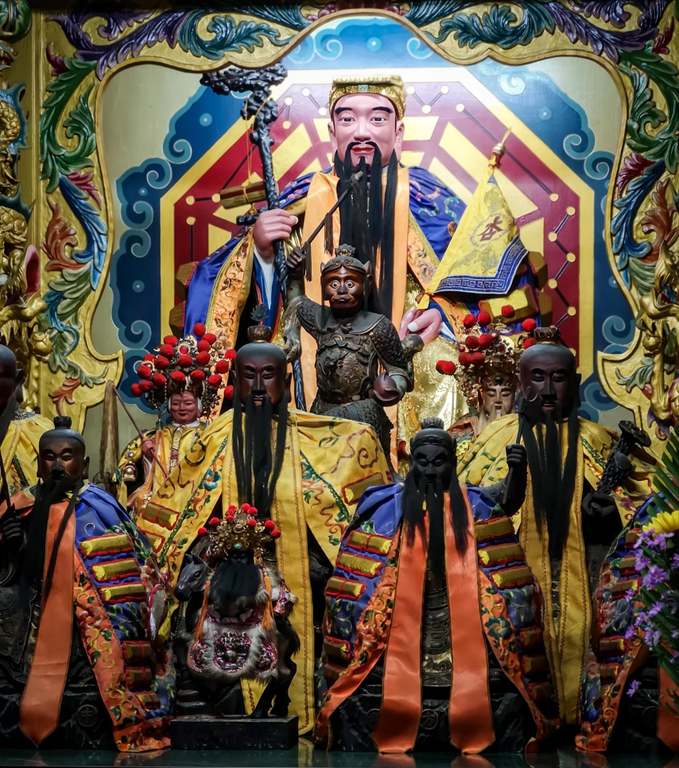
I reached out to the Zhenji Temple of Bade District, Taoyuan, Taiwan (Taoyuan Bade Zhenji gong, 桃園八德鎮齊宮), where the White Ape Perfected Man is worshiped as the main deity (zhu shen, 主神) (fig. 9), to make sense of these disparate strands. However, they did not get back to me by the time this article was ready for publication. I’ll make an update when new information becomes available. But until then, I suggest his martial iconography was directly influenced by depictions of the Great Sage Equaling Heaven, whose cult is far more prevalent in Taiwan. This proposed connection to Sun Wukong becomes even more evident when the information below is taken into account.

Fig. 9 – Zhenji Temple’s main White Ape Perfected Man statue (center background) surrounded by various smaller figures (larger version). The statue in the left foreground looks very similar to the Great Sage apart from the fist over foot motif. Image from Facebook.  

2. Vernacular Fiction

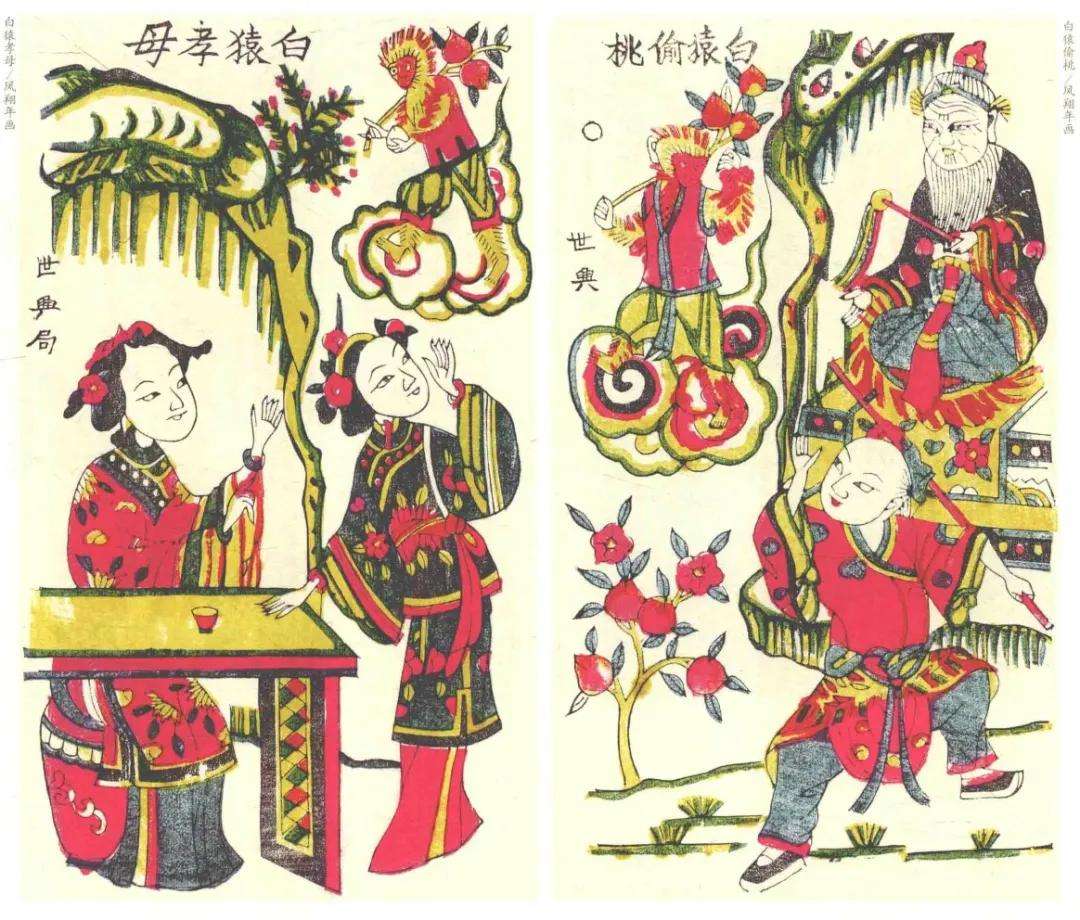
The White Ape Perfected Man’s religious story can be traced directly to The Battle of Wits between Sun and Pang (Sun Pang douzhi yanyi, 孫龐鬥智演義, 1636; a.k.a. The Former and Latter Annals of the Seven Kingdoms, Qianhou qiguo zhi, 前後七國志), which tells of the great struggle between Sun Bin and his former friend and classmate Pang Juan (龐涓). The two study supernatural military arts under the Immortal Master Ghost Valley (Guigu xianshi, 鬼谷仙師) in his “Water Curtain Cave” (Shuilian dong, 水簾洞) before their fates take separate paths and they become bitter enemies. Chapter four sees the teacher appoint Sun as guardian of an immortal peach tree on the backside of Yunmeng Mountain. But the young disciple is surprised to discover a talking white ape stealing peaches night after night. When asked how it can speak, the primate reveals his aristocratic family has been soaking up immortal qi energy for three generations northwest of the Master’s cave. His ancestor is the Marquis of Baxi (Baxi hou, 巴西侯), [3] his father the Duke Macaque (Ju gong, 狙公), [4] and his mother the Princess Mountain Blossom (Shanhua gongzhu, 山花公主). [5] When asked why he’s stealing peaches (fig. 10), the white ape reveals he’s trying to cure his mother of an illness and that she will die unless the treatment is completed. Taking pity on the filial primate, Sun picks the last peach needed and gives it to the white ape, telling him never to return to the orchard. The grateful son repays the favor by stealing three scrolls of heavenly books (tianshu, 天書) from Master Ghost Valley’s secret hiding place to give to his mother’s savior.

But Sun Bin mistakenly incurs the wrath of heaven not only because he acquires the books before he’s fated to but also because he fails to ritually cleanse himself before reading them. Master Ghost Valley is forced to intervene on his student’s behalf by teaching Sun how to hide from heavenly punishment (da zainan, 大災難, lit: “great tribulation”) by meditating in a cave for 49 days (Wumen xiaoke & Yanshui sanren, 1636).

This novel shares many elements with Journey to the West. Both include:

  1. Characters surnamed Sun (孫) (Sun Bin VS Sun Wukong) living in a “Water Curtain Cave”. [6]
  2. Sun characters studying under an immortal master (Master Ghost Valley VS Master Subodhi). [7]
  3. Sun characters being directed to guard trees laden with immortal peaches (one tree on earth VS an entire grove in heaven).
  4. Supernatural primates stealing the magic peaches for consumption (the white ape VS the Monkey King). [8]
  5. Sun characters defying their fate and incurring the wrath of heaven, thereby learning from their masters how to hide from punishment (Sun Bin Vs. Sun Wukong). [9]

Fig. 10 – A lovely New Years print depicting scenes from the story, including the “White Ape steals peaches” (right) and the “White Ape is filial to mother” (left) (larger version). The right print includes Master Ghost Valley and a young Sun Bin. Print found here.

It’s important to note that there is also some overlap between The Battle of Wits and Journey to the South (Nanyouji, 南遊記, 1570s-1580s). I quote from my previous article:

[The rogue immortal Huaguang (華光)] works to end his mother’s demonic lust for flesh by procuring an immortal peach in chapter 17. He does this by transforming into Sun Wukong and stealing the magic fruit from heaven. The real Monkey King is subsequently accused of his double’s misdeeds, much like the Six-Eared Macaque episode of the original novel. The Jade Emperor threatens to remand him to the Buddha for punishment but is convinced to give Sun a month-long reprieve to find the true culprit.

So we have two magical primate characters (the white ape VS Huaguang-as-Sun Wukong) that steal immortal peaches to help cure their mothers. This association with the rogue immortal might then explain why the statue of the White Ape Perfected Man from figure one has a third eye. Huaguang’s various incarnations are described as having three eyes in Journey to the South (for example) (Yu, n.d.).

Therefore, it seems that these later novels borrowed from Journey to the West, as well as each other. But I will show the theme of a primate stealing fruit actually predates the standard Ming edition of Journey to the West by hundreds of years, suggesting it too borrowed from an earlier source.

3. Taoist Literature

The story of Sun Bin and the white ape actually prefaces the first scroll of the Scripture of the Most High Luminous Mirror of the Six Ren Tallying with Yin (Taishang liuren mingjian fuyin jing, 太上六壬明鑑符陰經) (a.k.a., the Ape Book, Yuanshu, 猿書), [10] a Northern Song-era work related to the Taoist doctrine of the Three Sovereigns (Steavu, 2019, p. 195). Instead of peaches, the tale just says “fruit” (guo, 菓). But I imagine the produce is something special like immortal peaches as Sun guards them with a weapon. A rough translation follows (I have skipped over some of the more esoteric parts that escape me):

[Master Ghost Valley] saw the fruit had ripened, so he commanded Sun to watch over it. One night a person jumped the wall into the nine gardens and took some of the fruit. But Sun was hiding with a sword and caught the culprit, a white ape. The primate said: “Don’t hurt my body. I share the same age as heaven and earth and have lived as long as the sun and moon. I have mysterious texts (xuanwen, 玄文). Wait for me the next day and I will give them to you”. The white ape then transformed into white light and left. Sun waited the following day. Suddenly, he saw the white ape fly from the northwest. He was given one scroll of mysterious texts. The primate again transformed into white light and headed towards the southeast. Sun then returned to his room to inspect the text. He didn’t know the name but saw that it was divided into three volumes: initial (shang, 上), middle (zhong, 中) and final (xia, 下). He named it after the white ape (Taishang liuren, n.d.).

The story of a magic monkey stealing peaches was already present in the Journey to the West story cycle by the 13th century, for the “Monkey Pilgrim” (Hou xingzhe, 猴行者), Sun Wukong’s predecessor, admits to raiding the Queen Mother’s orchard when he was still a young immortal (Wivell, 1994, p. 1195). But the preceding Daoist scripture indicates the motif is even older. [11] In addition, the scripture shows the idea of a character surnamed Sun (Sun Bin) guarding special fruit predates the motif in the standard Ming edition of Journey to the West. It’s not a stretch then to suggest the Most High Luminous Mirror (or related media) influenced the 13th and later 16th-century versions of the story. Therefore, it’s possible the tales of Sun Bin, the white ape, and Sun Wukong have been borrowing from each other for hundreds of years.

This centuries-long association between the magical primates in literature then strengthens my suggestion that the White Ape Perfected Man’s iconography was directly influenced by that of Sun Wukong. Drawing upon a well of preexisting cultural beliefs and imagery likely helped the cult of this relatively recent deity establish itself faster, allowing him to take his place in a rapidly evolving religious landscape where ever newer gods are constantly added to the ranks of their older brethren.

4. Conclusion

The White Ape Perfected Man is a rare folk Taoist deity associated with revealing heavenly scriptures to the Warring States military strategist Sun Bin (4th cent.). His statues depict him as a seated, armor-clad primate with a “fist over foot” motif and the long hair and golden fillet of military monks from Chinese opera. This martial iconography conflicts with the deity’s title, “Perfected Man”, a high-ranking immortal usually depicted wearing robes. It also conflicts with his own religious story, which presents him as a meager, filial son who steals immortal peaches to cure his sick mother. I suggested above that his religious imagery was directly influenced by depictions of Sun Wukong as the Great Sage Equaling Heaven. Beyond shockingly similar iconography, both primate deities have a long association in Chinese popular literature. The white ape appears in The Battle of Wits Between Sun and Pang (1636), which shares many similarities with Journey to the West (1592). These include characters surnamed Sun (孫) (Sun Bin VS Sun Wukong) living in a Water Curtain Cave, studying under immortal masters (Ghost Valley VS Subodhi), guarding immortal peaches, and hiding from heavenly punishment. It also includes supernatural primates (the white ape VS the Monkey King) stealing the life-prolonging fruit for consumption. The number of similarities suggests The Battle of Wits borrowed from Journey to the West. The theft of immortal peaches is already present in a 13th-century version of Journey to the West, but this is preceded by a tale appearing in a work from Taoist canon, the Scripture of the Most High Luminous Mirror of the Six Ren Tallying with Yin. It describes the white ape stealing fruit from a garden protected by Sun Bin. It’s possible the Monkey King’s early story cycle was influenced by this scripture (or related media), suggesting the stories of Sun Wukong, Sun Bin, and the white ape have been borrowing from each other for hundreds of years. This centuries-long connection lends support to the martial iconography of Sun Wukong influencing the religious imagery of the White Ape Perfected Man.


5. Updates

Update: 12-11-21

Palmer and Siegler (2017) quote a certain Master Hu, a monk of Mt. Hua in Shaanxi province, China, who claims that the White Ape taught him a system of primate-based martial arts:

I learned [White Ape Through the Back Boxing] spontaneously; it was transmitted to me by the White [Ape] Immortal (Baiyuan zhenren). When I start, he comes down into me, and I do the forms spontaneously. In the future, perhaps I will arrange it into a method in stages that can be taught to others. The White [Ape] Immortal first transmitted the method to humans in the spring and autumn period (770–476 BC), but owing to the poor moral quality of the inheritors of the method, it was lost. Now, it has been transmitted directly to me by the Immortal (pp. 120-121).

Also, Master Ghost Valley’s association with the Water Curtain Cave goes back to at least the Northern Song as his Numinous Writ of the Essence of Heaven (Guigu zi tiansui lingwen, 鬼谷子天隨靈文) lists him as the “Master of the Waterfall Cave” (Shuilian dong zhu, 水濂洞主) (Andersen, 2019). In this case, the source uses a different lian (濂) in place of the lian (簾) associated with the caves of the Master (and Sun Bin) in The Battle of Wits between Sun and Pang (1636) and Sun Wukong in Journey to the West (1592). But they both mean the same thing: a waterfall hiding a cave mouth. This might suggest, apart from the guarding and theft of immortal peaches, other elements from Sun Bin’s story cycle were borrowed by that of the Monkey King.


Update: 12-12-21

I mentioned in the introduction white face and hair are not always the best indicators that a figure is the White Ape Perfected Man. Take, for example, some depictions of Sun Wukong in glove puppetry (fig. 11).

Fig. 11 – A Taiwanese glove puppet of the Monkey King (larger version). Photo found here.


Update: 03-20-22

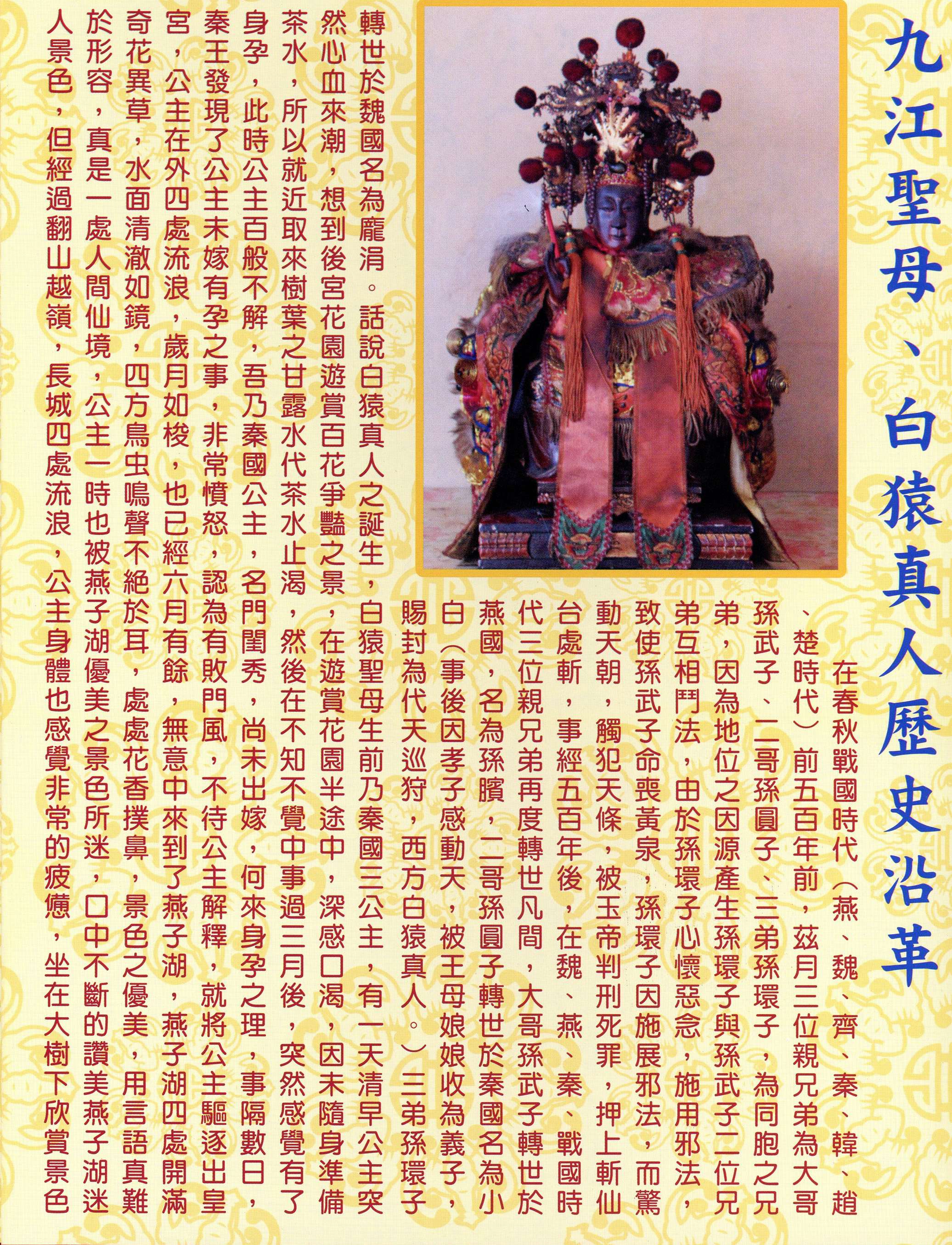
Yesterday I visited the aforementioned Zhenji Temple of Bade District, Taoyuan, Taiwan (Taoyuan Bade Zhenji gong, 桃園八德鎮齊宮), where the White Ape Perfected Man is venerated. I learned a few things. One, his religious birthday is celebrated on the 27th day of the 5th lunar month (June 25th, 2022), often written as 五月廿七日. Two, his mother, the “Holy Mother of Nine Rivers” (Jiujiang shengmu, 九江聖母), is also worshiped at the temple (her birthday is the 15th day of the 1st lunar month). A temple booklet provided to me tells her story (fig. 12 & 13). I paraphrase the tale below:

Five hundred years before the Spring and Autumn and Warring States Periods, there were three godly brothers named Sun Wuzi (孫武子), Sun Yuanzi (孫圓子), and Sun Huanzi (孫環子). The eldest brother Wuzi and the youngest Huanzi fought for status. But because the latter killed the former with evil magic, Sun Huanzi was sentenced by the Jade Emperor to die on the “Immortal-Beheading Platform” (Zhanxian tai, 斬仙台). The brothers were reborn in the mortal realm five hundred years later during the Warring States period. Sun Wuzi was reborn as Sun Bin in the Yan state, Sun Yuanzi was reborn as (the white ape) Xiaobai (小白) in the Qin state, and Sun Huanzi was reborn as Pang Juan in the Wei State.

The mother of the white ape was the third princess of the Qin state. One day, she became thirsty while touring the imperial garden. But in the absence of tea, she sated her thirst with sweet dew from tree leaves. Three months later, the princess discovered to her surprise that she, an unwed woman, was pregnant. When her father the king learned of this news, he expelled her from the palace. Sometime later, she came by accident to Swallow Lake (Yanzi hu, 燕子湖), a pure, mirror-like body of water surrounded by exotic, fragrant flowers and singing birds and insects. After wandering around this indescribable paradise for sometime, the princess became tired and went to sleep. She dreamed of a golden swallow that told her the child she was carrying was a god reincarnated on earth. It also asked the princess to practice spiritual cultivation beside the lake, promising her that she would one day became an immortal. She realized it was just a dream when she woke up, but she followed through with her training.

Ten days later she gave birth to her son, who was not quite human or demon. His entire body was covered with white hair just like a white ape. The local people claimed that he was a monster, but despite her anger, she raised him patiently. When he was three years old, heaven bestowed on him three divine treasures: an As-You-Will Vajra Staff (Ruyi jingang bang, 如意金剛棒), a golden headband spell (jinquan zhou, 金圈咒), and the steed Red Hare (Chitu ma, 赤兔馬). When the white ape was eight years old, a demon came to threaten the villagers around Swallow Lake. The white ape fought the monster and won, leading the people to believe he was a great celestial immortal (Dalou tianxian, 大羅天仙) come to save the world.

When the white ape was sixteen, his mother’s holy spirit left her body, and the evil Sage Sea Tide (Haichao shengren, 海潮聖人) cast his heavenly treasure around it, thus making her body sick. The Patriarch Reaching Heaven (Tongtian jiaozhu, 通天教主) then appeared to tell the white ape that the only way to cure his mother was to feed her one of the Queen Mother‘s (Wangmu niangniang, 王母娘娘) immortal peaches. After many hardships, he succeeded in his quest and cured her. Upon her recovery, she practiced diligently and eventually achieved immortality.

One day, the immortal princess did divination on her fingers and found that, despite their practice, four other woman around Swallow Lake had yet to achieve the elixir. So, she took them as her servants and continued to guide their practice. After this, she subdued seventeen phoenixes that were the same class of evil spirits as the phoenixes and serpents below the Queen Mother’s gate. Following this, she subdued thirty-six demon dragons as her subordinate generals.

At this time, the god of fire (huoshen, 火神) spread flames everywhere, plunging the world into chaos. The fires killed the surrounding vegetation and created a drought. The immortal princess felt sorry for the people, so she used her powers to defeat the fire god in a great battle. She then transformed nine dragons into nine rivers for the people to drink and to revive the plants and trees. The people were finally able to live in peace. From this point on, they worshiped her as the Holy Mother of Nine Rivers. A temple dedicated to her was built around Swallow Lake in Guangling County, Shanxi Province, China, which is now a first-class protected historic site by the CCP.

Fig. 12 – The first page of the Holy Mother of Nine River’s story (larger version). Fig. 13 – The second page (larger version).

It appears that portions of this story were taken from the Qing-era novel Spring and Autumn of Stabbing Swords (Fengjian chunqiu, 鋒劍春秋). The godly Sun brothers, the evil Sage Sea Tide, and even the white ape appear therein.

I’d also like to highlight that the white ape’s staff and headband are modeled on that of Sun Wukong, strengthening my suggestion that the former’s iconography was based on the latter.

Notes:

1) The idea of a white ape sharing heavenly knowledge goes back centuries. For example, one 4th-century source reveals Zhou Qun (周羣/群, 3rd-cent.) learned the art of divination from a book of bamboo slips given to him by a gibbon-turned-old man in the Min Mountains (Gulik, 1967, p. 50).

2) Sun is appointed the guardian of the immortal peach groves in chapter four. He starts eating the life-prolonging fruit early in his tenure, and his theft is eventually discovered by attendants of the Queen Mother of the West (Wu & Yu, 2012, pp. 160 and 162-163).

3) The Marquis of Baxi (Baxi hou, 巴西侯) is an ape spirit appearing in a story from the Song-era Extensive Records of the Taiping Era (Taiping guangji, 太平廣記, 978). A retired official from Sichuan is invited to an eerie, drunken party by the Marquis, only to wake up the next morning to find his host was a gibbon and all of the other guests were also animal spirits (Gulik, 1967, pp. 67 and 68-69).

4) The only Duke Macaque (Ju gong, 狙公) that I’m aware of is a human keeper of monkeys from a parable on freedom appearing in The Collected Works of Bowen (Chengyi Bowen ji, 诚意伯文集, 14th cent.). I’m not sure if the novel is claiming the ape has a human father, or if it’s just a vague reference to a character from Chinese literature with a connection to primates.

5) I can’t find any information on this character. But given the ancestor and father, I’m sure the mother is associated with apes or monkeys in some way.

6) Wukong becomes king of the monkeys in chapter one by discovering a cave, the Water Curtain Cave (Shuilian dong水簾洞), behind a waterfall. His people soon after take residence inside (Wu & Yu, 2012, pp. 104-106).

7) See my article on Master Subodhi’s curriculum.

8) See note #2.

9) Monkey learns the 72 transformations in order to escape heavenly punishments of lightning, fire, and wind sent to kill him for defying his fate by attaining immortality.

10) Steavu (2019) calls it the “Monkey book” (p. 195), but a gibbon is an ape, so I have adjusted the translation accordingly.

11) I suggest in this article that the supernatural ape stealing peaches motif could be a mixture of a Sinicized version of the Great Monkey jataka tale, in which the Buddha’s reincarnation as a monkey king leads his people to raid an imperial fruit garden, and the theft of immortal peaches by the planet Jupiter (Sui, 歲), who is subsequently exiled to reincarnate as the Han-era jester Dongfang Shuo (東方朔).

Sources:

Andersen, P. (2019). Guigu zi tiansui lingwen 鬼谷子天隨靈文. In K. Schipper and F. Verellen (Eds.), The Taoist Canon: A Historical Companion to the Daozang (p. 1239). Chicago: University of Chicago Press.

Bonds, A. B. (2008). Beijing Opera Costumes: The Visual Communication of Character and Culture. Honolulu: University of Hawai’i Press.

Gulik, R. H. (1967). The Gibbon in China: An Essay in Chinese Animal Lore. Leiden: E.J. Brill.

Miura, K. (2008). Zhenren. In F. Pregadio (Ed.), The Encyclopedia of Taoism: Vol. 1 & 2 (pp. 1265-1266). Longdon: Routledge.

Palmer, D. A., & Siegler, E. (2017). Dream Trippers: Global Daoism and the Predicament of Modern Spirituality. Chicago: The University of Chicago Press.

Steavu, D. (2019). The Writ of the Three Sovereigns: From Local Lore to Institutional Daoism. Hong Kong: The Chinese University of Hong Kong.

Stevens, K., & Welch, J. (1998). XU, The Daoist Perfected Lord Xu Zhenjun 許真君 The Protective Deity of Jiangxi Province. Journal of the Hong Kong Branch of the Royal Asiatic Society, 3, 137-146. http://www.jstor.org/stable/23889813

Taishang liuren mingjian fuyin jing juan yi (n.d.). [Book of the Most High Luminous Mirror of the Six Ren Tallying with Yin: First Scroll]. Retrieved from https://ctext.org/wiki.pl?if=gb&chapter=465883#p3

Wivell, C.S. (1994). The Story of How the Monk Tripitaka of the Great Country of T’ang Brought Back the Sūtras. In V. Mair (Ed.), The Columbia Anthology of Traditional Chinese Literature (pp. 1181-1207). New York: Columbia University Press.

Wumen xiaoke, & Yanshui sanren (1636). Qianhou qiguo zhi [Annals of the Seven Kingdoms]. Retrieved from https://ctext.org/wiki.pl?if=gb&chapter=736295#p89

Wu, C., & Yu, A. C. (2012). The Journey to the West (Vol. 1). Chicago, Illinois: University of Chicago Press.

Yu, X. (n.d.). Nanyouji: Huaguang sanxia Fengdu [Journey to the South: Huaguang goes to the Underworld Three Times]. Retrieved from https://ctext.org/wiki.pl?if=gb&chapter=506975&remap=gb#%E5%8D%8E%E5%85%89%E4%B8%89%E4%B8%8B%E9%85%86%E9%83%BD

Sun Wukong and the Buddha’s Past Life as a Monkey King

(Note: I originally wrote this in late 2020 but just now got around to cleaning it up and posting it.)

Last updated: 05-17-2022

Following his birth, the Stone Monkey (Shi hou, 石猴) comes to live with a tribe of primates on the Mountain of Flowers and Fruit. One day, the monkeys and apes decide to follow a stream to its source in the mountain and find a beautiful waterfall. They state anyone who can discover what is behind the blanket of water will be proclaimed their king. The Stone Monkey takes up this challenge by leaping through and discovers a grotto paradise with a stone mansion and enough room for all the primates to live. After he emerges victorious:

Each one of them [the primates] then lined up according to rank and age, and, bowing reverently, they intoned, “Long live our great king!” From that moment, the stone monkey ascended the throne of kingship [fig. 5]. He did away with the word “stone” in his name and assumed the title, Handsome Monkey King [Mei hou wang, 美猴王] [fig. 1] (Wu & Yu, 2012, p. 105).

In this article, I suggest Sun Wukong’s position as a primate monarch is based on “The Story of the Great Monkey” (Sk: Mahakapi jataka; Ch: Houwang bensheng, 猴王本生, “Birth Story of the Monkey King”; “The Great Monkey” hereafter), an ancient story about the Buddha’s past life as a monkey king, which appears in various collections of moralistic birth tales (Sk: jakata; Ch: bensheng jing, 本生經) in Buddhist literature. After summarizing the tale, I will briefly discuss 2,000-year-old Indian Buddhist art depicting the story at important religious sites, thereby showing its intense popularity. Next, I will demonstrate that the tale traveled the Silk Road to China, where it was represented in Buddhist art and literature. Finally, I will highlight similarities between “The Great Monkey” and a 13th-century precursor of Journey to the West, as well as similarities with the standard 1592 edition of the novel.

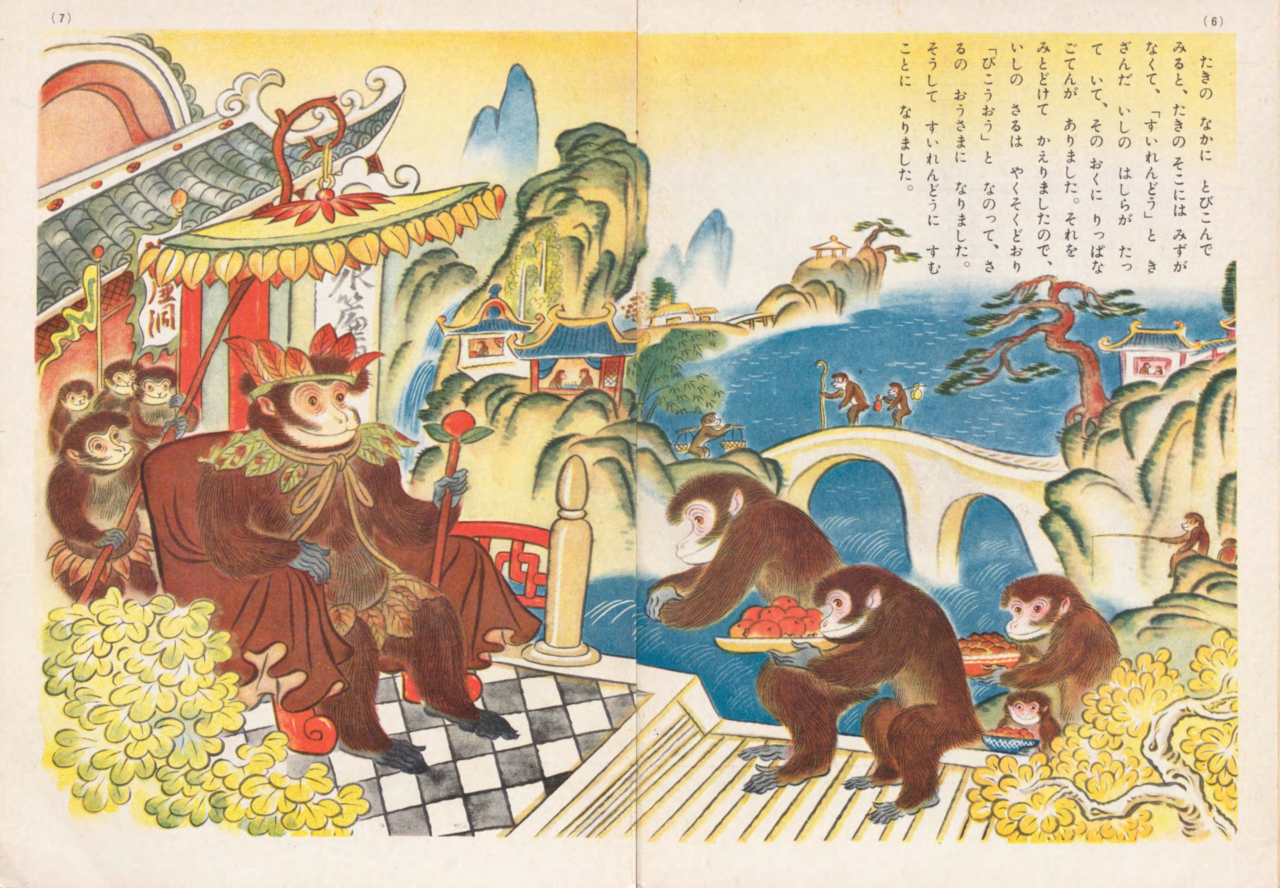
Fig. 5 – The Stone Monkey sits on his throne (larger version). From the Japanese children’s book Son Goku (1939).

Table of Contents

1. Story of the Great Monkey

Buddhist literature contains different versions of the tale. I will describe two of them here. The first is story no. 27 in the Garland of Birth Stories (Sk: Jatakamala, 4th century) by the monk Arya Sura. [1] The tale opens with the following epigraph: “Those who make a practice of good behavior can win over the hearts even of their enemies” (Khoroche, 1989, p. 186). According to the story, the bodhisattva was born a virtuous monkey king in the verdant paradise of the Himalayas, which abounded in fruits and flowers, crystal clear streams, and choirs of singing birds. He and his tribe lived near an unnamed river and ate from a mountainous banyan tree that produced figs larger than palmyra nuts. The monkey king feared that the fruit would cause trouble for his people, so he gave instructions to regularly clear them from a branch overlooking the river. However, one season a fig escaped the monkeys’ attention and it grew to maturation, dropping into the water, drifting downstream, and lodging in the fence of a pool where an unnamed human king played with his consorts. The smell and color of the fruit entranced the women, and after the king tasted it, he became obsessed with its flavor and led an army in search of the tree. The ruler and his entourage cut a path upstream and followed a sweet scent directly to the massive banyan, which rose high above all the surrounding trees like the lord of the forest. When he saw the monkeys eating figs, the enraged ruler ordered his men to shoot them down with arrows, spears, and rocks. Seeing the dire situation of his tribe, the monkey king made a tremendous leap to the summit of a nearby mountain, a feat that would have required any other monkey a series of jumps. On the mountain, he found a strong-rooted cane of the appropriate length needed to span the gap and tied it to his feet. But his return jump to the tree was hampered by the binding, and so he came up short, forcing him to grab a branch and use his body as a bridge so that his tribe could escape. But the monkey king was mortally wounded as throngs of the panicked primates clawed their way across his body to safety. The human king took note of this selfless deed and ordered his men to relieve the suspended monkey by placing a canopy beneath him and simultaneously shooting the branch and cane. After his wounds were tended and he regained consciousness, the monkey king spent the last few moments of his life teaching the human king the virtue of putting his people’s needs before his own (Khoroche, 1989, pp. 186-192).

The second is story no. 407 [2] in Commentary on the Birth Stories (Pali: Jatakatthakatha, a.k.a. Jatakatthavannana, 5th century), which is attributed to the monk Buddhagosa. The narrative opens with the Enlightened One talking to a large assembly of monks in Jetavana. He tells them of a previous life when he helped his relatives. Here, the story is quite similar to the first, with slight differences in certain details, such as the monkey king leading a specified number of 80,000 primates, the river is the Ganges, the fruit is water pot-sized mangoes, the specimen that floats downstream is caught in a fisherman’s net, and the human ruler is named King Brahmadatta of Benares. [3] Instead of leaping to a nearby mountain, the monkey king jumps one hundred bow lengths across the Ganges. The cane is tied to his waste instead of his feet, and the cause of falling short on the return jump is not hindrance but miscalculating the length needed to span the gap. And instead of being seriously injured by his people during their escape, a rival of the king—a previous incarnation of the Buddha’s evil cousin Devadatta—mortally wounds his heart by jumping onto his back from a high branch. Brahmadatta instructs his men to build a tower so that he can retrieve the primate and tend to his wounds in his last few moments of life. And just like before, the monkey king teaches the human monarch the value of his people’s needs prior to dying. But this time the discussion is much shorter, being presented as a poem of seven stanzas. Brahmadatta then honors the monkey with funeral rites befitting a king and worships the skull as a religious relic. In the end, the Buddha reveals that the ruler was the past incarnation of his disciple Ananda, the 80,000 monkeys were incarnations of the assembled monks, and the monkey king was himself (Cowell, 1895, vol. 3, pp. 225-227).

2. The Tale in Indian and Chinese Buddhist Art

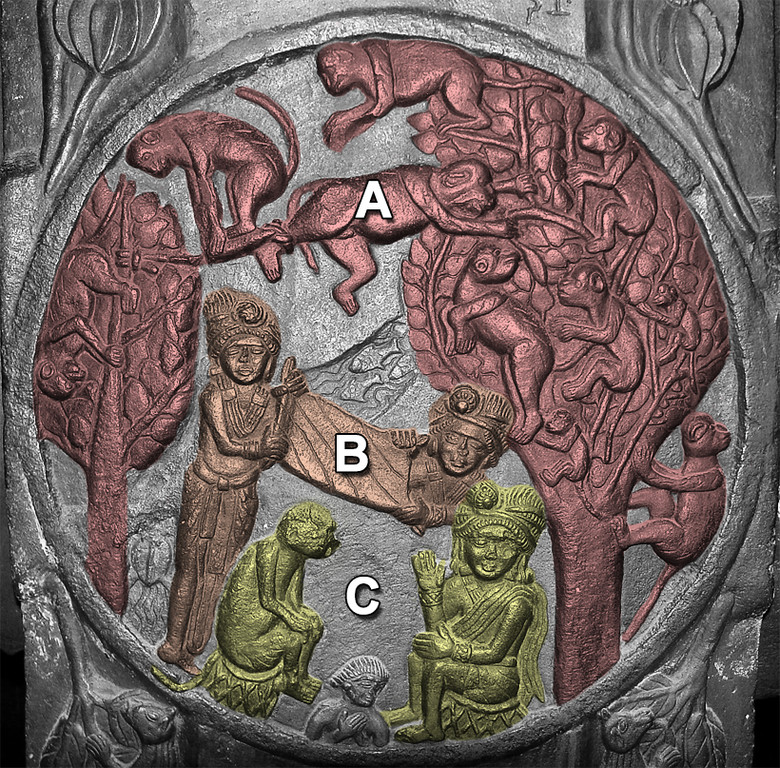
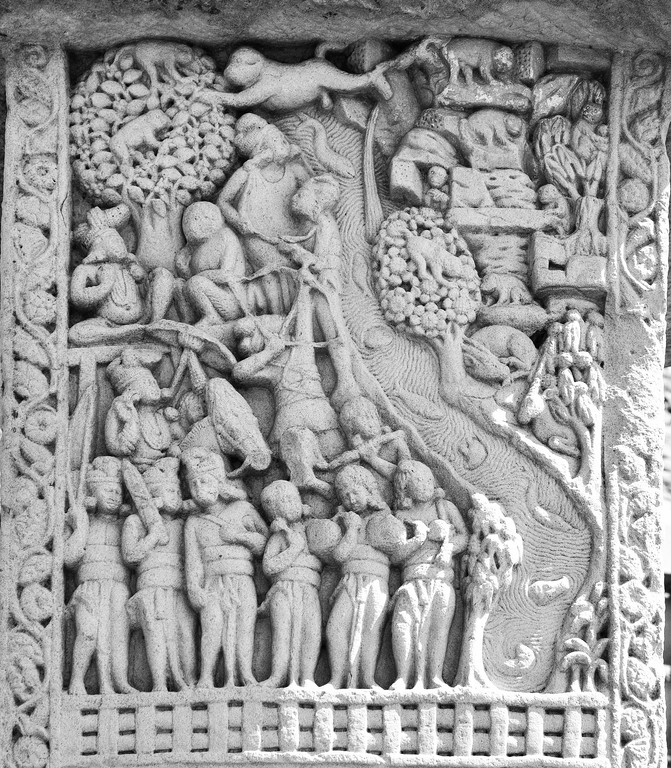
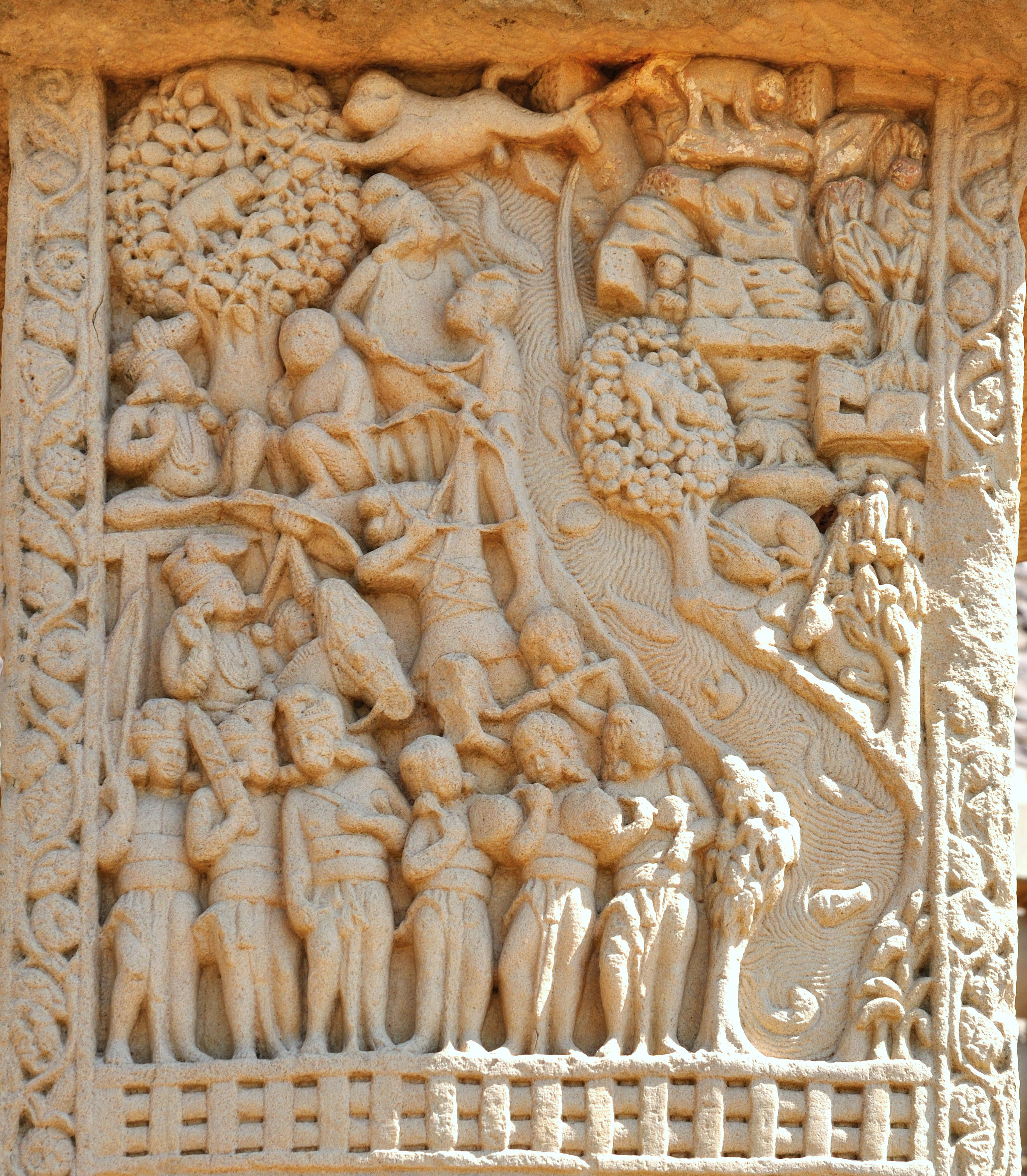
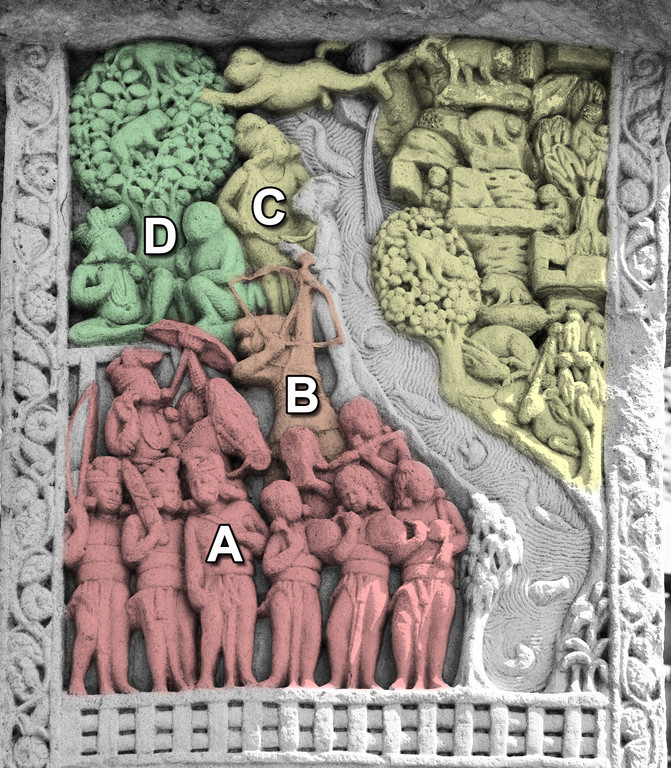
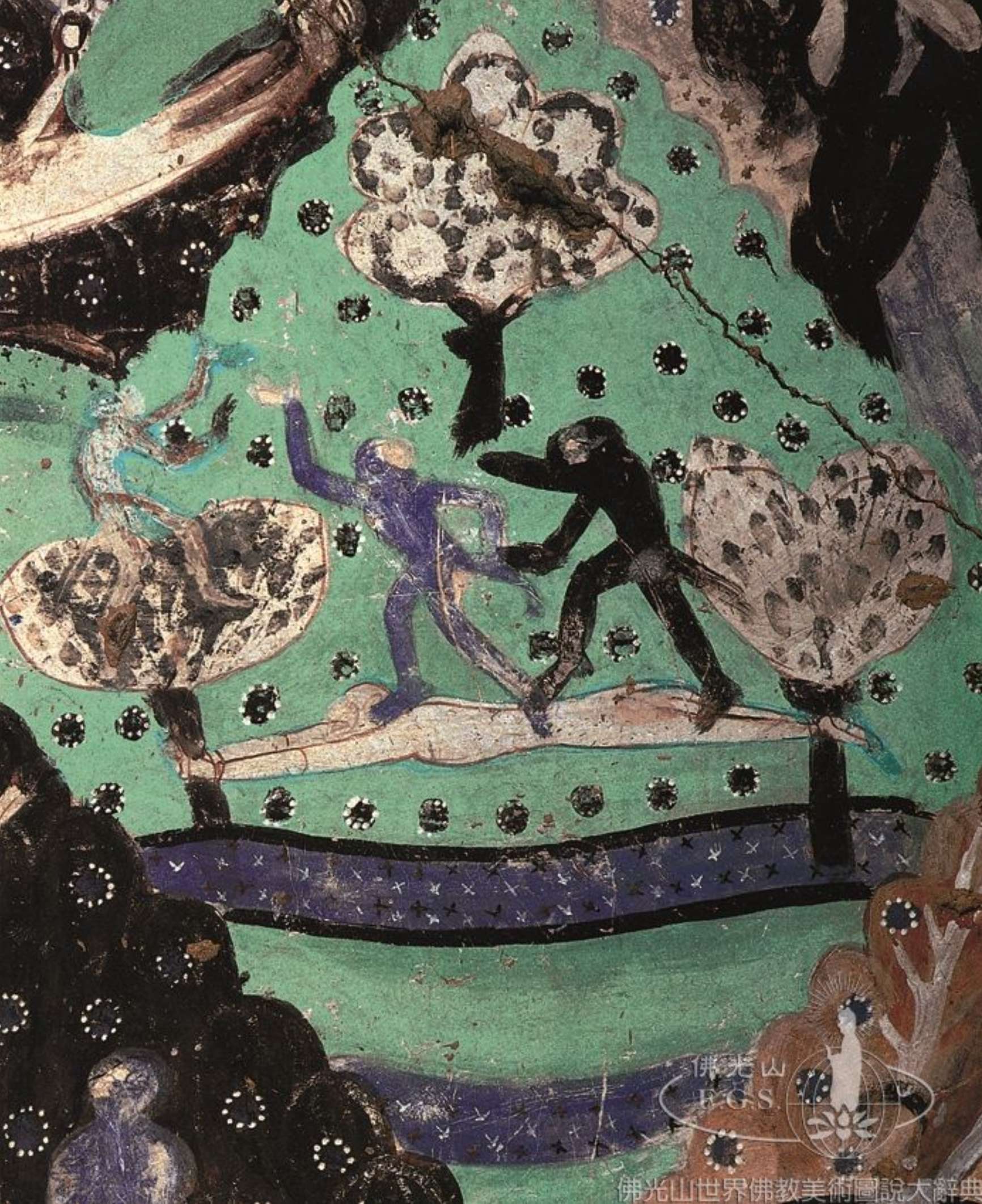
This birth story is over 2,000 years old as it appears among the stone carvings of the Bharhut Stupa (c. 2nd century BCE) (fig. 2 and 3) and the western torana (c. 1st century BCE/CE) of the Great Stupa at Sanchi (fig. 3 and 4) (Marshall, Foucher, Majumdar, 1902, vol. 1, pp. 224-225, vol. 2, plate 64). I should note that the story is one of 547 such tales appearing in the Pali canon (Buswell & Lopez, 2014, p. 381). So the fact that it was one of only a few past life narratives chosen to appear at these religious sites speaks volumes to its popularity. This explains why the story spread beyond India.

Fig. 2 – “The Great Monkey” medallion from Bharhut stupa (c. 2nd century BCE) (larger version). Picture adapted from Wikipedia. Fig. 3 – Key: A) The monkey king leaps and grasps a banyan tree, making a bridge with his body; B) attendants hold a canopy to catch the injured monkey; and C) The human king sits with the monkey discussing the actions of a good ruler prior to the latter’s death (larger version). Fig. 4 – “The Great Monkey” carving from the western torana at Sanchi (c. 1st century BCE/CE) (larger version). Picture adapted from Wikipedia. Fig. 5 – Key: A) Brahmadatta travels with a retinue to the tree; B) he orders his archer(s) to shoot the monkeys; C) He watches as the monkey king leaps across the Ganges and grasps a banyan tree to make a bridge with his body; and D) Brahmadatta’s discussion with the monkey king (larger version).

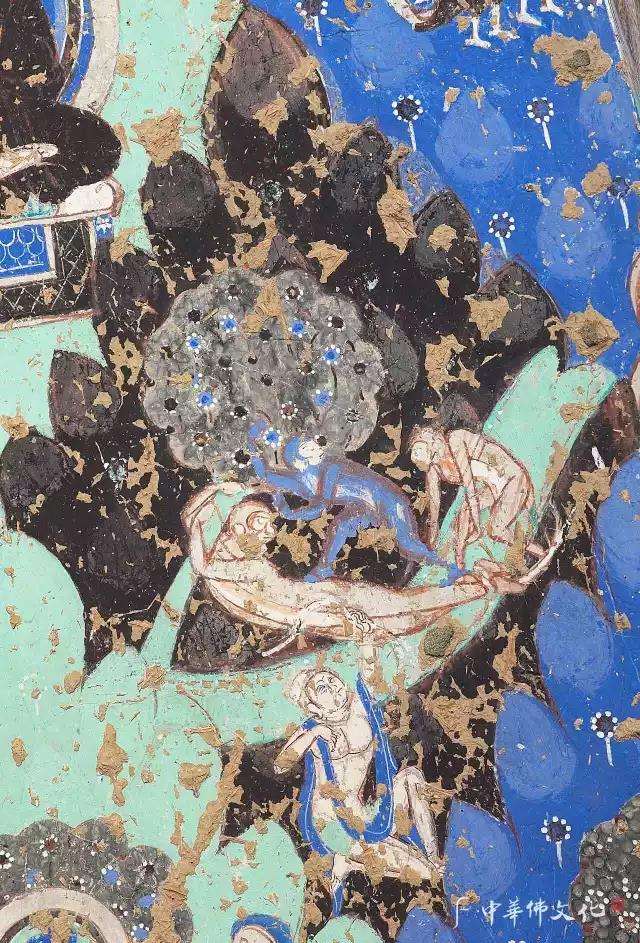
The tale is known to have traveled east to China along the northern silk road. This is demonstrated by murals appearing in the Kizil cave complex (5th to 7th century), one of the earliest and most popular Buddhist centers in Kucha, in what is now Xinjiang, China. Zhu (2012) describes the murals, noting that they lack the detail of their Indian counterparts and are therefore more mnemonic than narrative:

[I]n Kizil Cave 38 [fig. 5], a very large monkey is depicted in the center, stretching his body and holding a tree on the other side of a river. Two other smaller monkeys are stepping on his body to cross the river. In the foreground, a kneeling archer is shooting at them. In Kizil Cave 17 [fig. 6] this story is represented even more simply, with the archer omitted. However the stretching monkey, the river, and the trees are enough for anyone who knows the story to recognize it […] Compared to the Indian representations that are more explicitly narrative, the Kizil paintings are more like a reminder of the story. They communicate with the viewers as if they already know the story well” (pp. 59-60).

Fig. 5 – The Kizil cave no. 38 mural (larger version). Found here. Fig. 6 – Kizil cave no. 17 mural (larger version). Found here. Both are circa 5th to 7th century. Zhu, 2012, p. 61 includes black and white line drawings of the murals.

3. The Tale in Chinese Buddhist Literature

The Kizil murals are predated by a brief story appearing in The Collection of Sutras on the Six Paramitas (Liudu jijing, 六度集經, 3rd century, The Collection hereafter), a compilation of karmic merit tales (Sk: avadana) translated into Chinese by the Sogdian Buddhist monk Kang Senghui (康僧會, d. 280). [4] The 56th story in this collection is an adaptation of the original Indian version with several noticeable differences: The Bodhisattva was formerly a monkey king (mihou wang, 獼猴王) who frolicked with 500 primates. At that time, a drought made the various kinds of fruit scarce. Only a river separated their mountain from a nearby kingdom, so the monkey king led his tribe to eat fruit in the royal garden. The human king ordered that they be secretly captured, but the monkey called for his tribe to gather cane to make a rope. One end was tied to a tree and the other to the king, who leaped from a branch across the river. Unfortunately, the rope wasn’t long enough, and so he came up short, forcing him to grab a branch on the other side and create a bridge with his body. After the 500 monkeys crossed to the other side, the king’s body split in two under the strain. When the human king came upon the scene, the dying primate begged that his tribe not be hurt and offered up his own flesh as payment for his bad judgment. However, the king admired the monkey’s superior, sage-like virtue and questioned his own willingness to sacrifice his body for his people. He then issued a proclamation that all monkeys were to be fed throughout the kingdom, and those who refused would be punished as thieves. Upon his return to the palace, the king recounted the events to his queen, touting the monkey’s kindness and comparing it to the height of Mt. Kunlun. She then suggested that the monkeys be fed and the king confirmed that he had already given the order. In the end, the Buddha revealed that the monkey king was himself, the human king was Ananda, and the 500 monkeys were the monks at the assembly (CBETA, 2016a). [5]

[Note: See the 05-17-22 update below for an explanation on why the number 500 was used.]

Instead of the original 80,000 monkeys, this version reduces the number to only 500. Instead of the king traveling to the banyan/mango tree in the monkey’s mountain territory, the monkeys travel from their home to the royal fruit garden in the king’s territory. Instead of being trampled by his people/a rival, the monkey king’s body breaks in two from the strain. And instead of giving the monkey royal funeral rights and worshiping his skull as a relic, the king enacts a law that all monkeys should be fed.

This version is different enough from the originals to suggest a separate Chinese tradition, one that had circulated for some time. This fits with Chavannes’ (1910) suggestion that The Collection of Sutras on the Six Paramitas is not an original Indian text but one compiled in China by Kang Senghui, who likely selected and edited the stories himself (vol. 1, p. 1 n. 1).

Story no. 56 finds parallels with another tale from Chinese Buddhist literature. [6] It appears in the Scripture on the Storehouse of Sundry Treasures (Za baozang jing, 雜寶藏經, mid-5th century), which was translated into Chinese by the monk Tan Yao (曇曜). According to the 12th story in this collection: The Buddha was in Rajagrha when the monks commented on the woes faced by those who rely on Devadatta, while celebrating the happiness, positive rebirth, and eventual deliverance of those who rely on the Enlightened One. The Buddha confirmed this by telling a brief tale about two monkeys, each with 500 members in their tribe. A prince of Kashi (a.k.a. Benares) was on a hunting excursion when he surrounded the monkeys. The good monkey (shan mihou, 善獼猴) suggested that they cross the river to escape, but the evil monkey (e’mihou, 惡獼猴) wavered. The good monkey instructed his tribe to cross by using the long branches of a nearby tree. But the evil monkey and his tribe were captured due to inaction. In the end, the Buddha revealed that the good monkey was himself and Devadatta was the evil monkey. He used this story to advocate following the virtuous over the evil, for the former would lead others to safety and happiness, while the latter would lead others to suffering over numerous incarnations (CBETA, 2016b). [7]

This version does away with the fruit element altogether. The monkeys are in danger not because a king is protecting produce but because a prince is out hunting. The most noticeable difference here is the addition of a second monkey, one who is labeled as “evil” (e, 惡) (no connection to the Six-Eared Macaque). But like story no. 56, the monkey king is said to lead 500 primates.

It is clear that both Chinese tales were influenced by the later Indian version, story no. 407 from Commentary on the Birth Stories, as they specify a number for the troupe size (500 vs. 80,000), state the monkey king leaps over a river (as opposed to jumping to a nearby mountain top), and characters are revealed in the end to have been the past lives of Buddhist personages (the Buddha, Ananda, Devadatta, monks, etc.). Story no. 12 even opens in a city associated with the Enlightened One’s historical lectures (Rajagrha vs. Jetavana), where he discusses philosophical matters with monks; and an unnamed prince who poses a threat to the monkey king and his people is said to hail from Kashi, another name for Benares, the seat of King Brahmadatta.

4. The Chinese Monkey King

The oldest Chinese source mentioning Sun Wukong as a king of monkeys is The Story of How Tripitaka of the Great Tang Procures the Scriptures (Da Tang Sanzang qujing shihua, 大唐三藏取經詩話, late-13th century, The Story hereafter), a 17 chapter storytelling prompt that predates the Ming Journey to the West by 300 years. In chapter two, our hero’s literary antecedent, a white-clad scholar called the “Monkey Pilgrim” (Hou xingzhe, 猴行者), meets the Tang monk Tripitaka on the road to the west and warns the monk that his two previous incarnations have died trying to procure the Buddhist scriptures. When asked how he knows events of the past, the scholar replies: “I am none other than the bronze-headed, iron-browed [8] king of the eighty-four thousand monkeys of the Purple Cloud Grotto on the Mountain of Flowers and Fruit. I have come to help the reverend monk procure the scriptures” (Wivell, 1994, p. 1182).

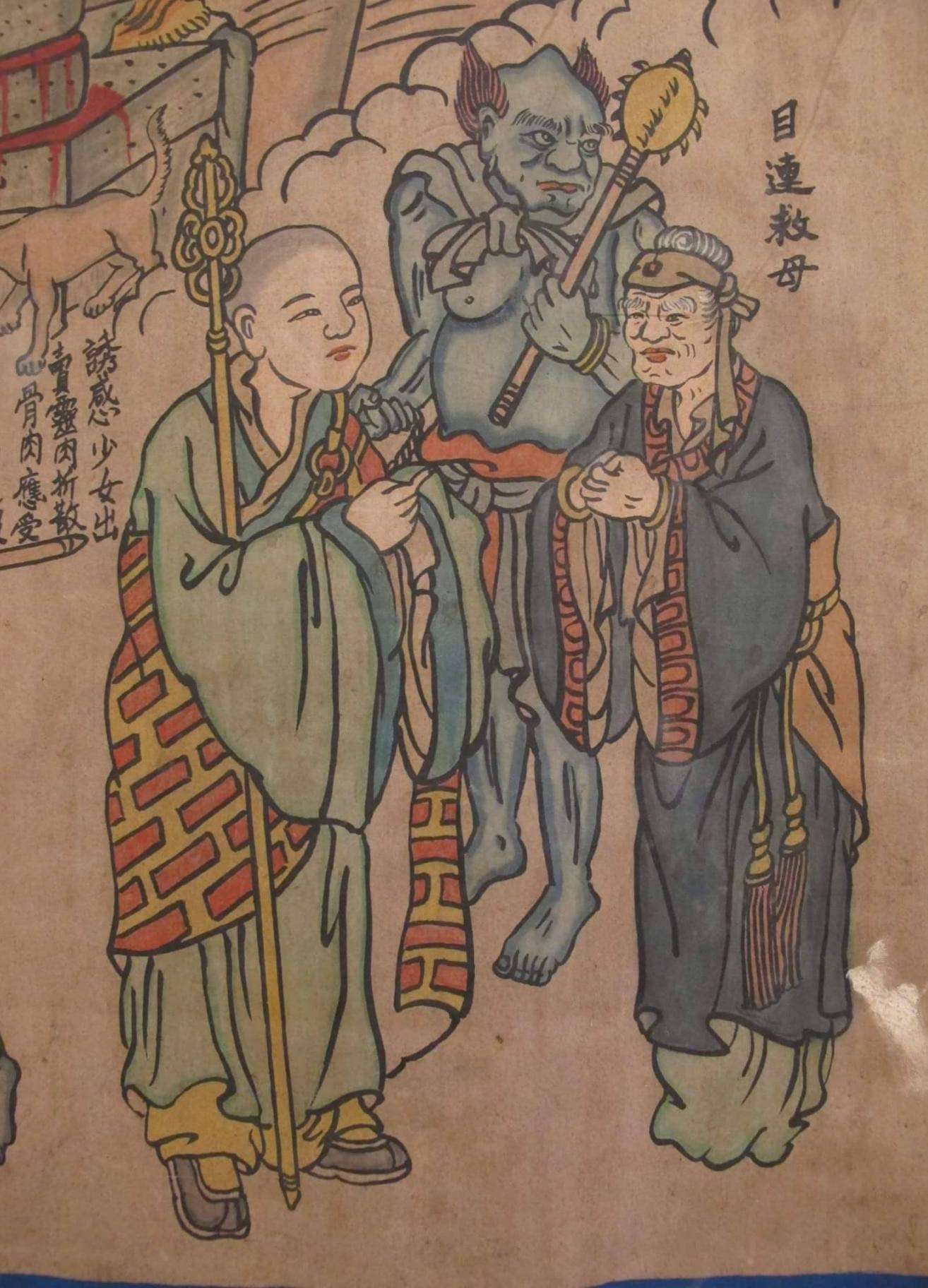
The Story‘s depiction of the Monkey Pilgrim was influenced by Saint Mulian (目連; Sk: Maudgalyayana) (fig. 7), a disciple of the Buddha, who appears in a late-9th to early-10th century Bianwen (變文) text in which he travels to the underworld to release his mother from karmic torment. For example, both are depicted with occult powers enabling them to fly between heaven and earth (Wivell, 1994, pp. 1183; Mair, 1994, pp. 1097-1098); both visit a realm ruled by a deity named Brahma, the Mahabrahma devaraja Vaisravana in the case of Monkey and Brahma in the case of Mulian (Wivell, 1994, pp. 1183; Mair, 1994, p. 1098); both are bestowed magic weapons by heaven, a golden-ringed monk staff and alms bowl for Monkey and a matching staff for Mulian (he enchants his own alms bowl) (Wivell, 1994, p. 1184; Mair, 1994, p. 1111); the power of said weapons are tied to the recitation of a Buddhist deity’s name, Vaisravana and the Buddha, respectively (Wivell, 1994, p. 1184; Mair, 1994, p. 1111); and both use said weapons with the expressed purpose of saving someone important, Tripitaka and Mulian’s mother, respectively (Wivell, 1994, p. 1189, for example; Mair, 1994).

Fig. 7 – A painting depicting Mulian rescuing his mother from the underworld (larger version). Originally found here.

If The Story borrows from Mulian’s tale, it’s not a stretch to suggest that it also appropriated material from other Buddhist tales, including “The Great Monkey.” For example, the Mountain of Flowers and Fruit could be based on the Himalayas and the massive, fruit-bearing banyan/mango tree. Additionally, both The Story and the “The Great Monkey” describe the respective monkey kings leading a similar number of primates, 84,000 in the former and 80,000 in the latter. [9] While the Chinese variants drastically reduce the number to 500, it’s interesting that both tales would display such similar counts. This is because said numbers are significant to Buddhism. For example, 84,000 generally denotes a very large number, hence the belief that the body contains this many atoms. Other examples include the 84,000 stupas of Asoka, the 84,000 bodily relics of the Buddha, the Amitabha‘s 84,000 rays of illumination, the 84,000 bodily signs of a Buddha, the 84,000 teachings of the Buddha, etc. In addition, the Chinese term for 80,000 (bawan, 八萬) can be shorthand for 84,000. It can also refer to separate Buddhist concepts, such as the “bodhisattva’s 80,000 duties” (Soothill & Hodous, 1937/2006, p. 39). It’s certainly possible that both stories independently chose similar numbers due to their demonstrated connection to Buddhism. But maybe the storytellers who developed The Story had access to some non-Chinese version of the tale, perhaps by way of Buddhist monks, for Buddhism has a long history of proselytizing through oral literature. [10]

Furthermore, in chapter 11 of The Story, the pilgrims enter the earthly paradise of the Daoist goddess Queen Mother of the West, home to the famed peaches of immortality. Tripitaka asks Monkey to steal the group a few fruits, but the latter refuses, stating:

Because I stole ten peaches to eat when I was eight hundred years old, I was captured by the Queen Mother and given eight hundred blows on my left side and three thousand blows on the right with an iron cudgel. Then I was exiled to the Purple Cloud Grotto on the Mountain of Flowers and Fruits. Even today my sides hurt and now I definitely don’t dare to steal any more peaches!” (Wivell, 1994, p. 1195).

This event was surely influenced by the fabled meeting of Emperor Wu and the Queen mother, during which she reveals his jester Dongfang Shuo (東方朔), formerly the planet Jupiter (Sui, 歲), was exiled from heaven for stealing her peaches (Campany, 2009, p. 126). However, a monkey king running afoul of an earthbound monarch for raiding their imperial fruit garden mirrors story no. 56 in The Collection. As mentioned above, the tale recalls the Buddhist monkey king leading his tribe out of the mountains to eat fruit in a human sovereign’s garden during a time of drought. The ruler orders the primates captured, leading to the monkey king’s sacrifice. Therefore, this portion of The Story could be a combination of Buddhist and Daoist sources.

“The Great Monkey” could have also influenced the 1592 edition. In chapter one, the monkeys following the stream to find its source in the Mountain of Flowers and Fruit is reminiscent of the human king’s trek up the Ganges to find the source of the fruit in the Himalayas. Also, recall that the Indian and Chinese versions place great emphasis on the monkey king leaping over a river. For example, story no. 407 reads: “[H]e ascended a branch that rose up straight, went along another branch that stretched towards the Ganges, and springing from the end of it, he passed a hundred bow-lengths and lighted on a bush on the [other] bank” (Cowell, 1895, vol. 3, p. 226). This could have influenced the competition to leap through the waterfall. It’s interesting that Wukong alone is successful in the jump, leading to his kinghood:

The monkeys said to each other, “We don’t know where this water comes from. Since we have nothing to do today, let us follow the stream up to its source to have some fun.” With a shriek of joy, they dragged along males and females, calling out to brothers and sisters, and scrambled up the mountain alongside the stream. Reaching its source, they found a great waterfall.

[…]

All the monkeys clapped their hands in acclaim: “Marvelous water! Marvelous water! So this waterfall is distantly connected with the stream at the base of the mountain, and flows directly out, even to the great ocean.” They said also, “If any of us had the ability to penetrate the curtain and find out where the water comes from without hurting himself, we would honor him as king.” They gave the call three times, when suddenly the stone monkey leaped out from the crowd. He answered the challenge with a loud voice, “I’ll go in! I’ll go in!”

[…]

Look at him! He closed his eyes, crouched low, and with one leap he jumped straight through the waterfall (Wu & Yu, 2012, pp. 103-104).

This takes us back to where we started from in the introduction.

5. Conclusion

I suggest Sun Wukong’s position as the Monkey King is based on the “The Great Monkey,” a jataka tale about the Buddha’s past life as a primate monarch, which appears in various Indian Buddhist sources, such as the 4th-century Garland of Birth Stories (no. 27) and the 5th-century Commentary on the Birth Stories (no. 407). The tale describes the monkey king’s efforts to save his tribe from a human monarch who seeks to claim a massive banyan/mango tree in the Himalayas by killing all of the monkeys inhabiting it. After leaping to a mountain top or over the Ganges River to retrieve a length of cane needed to span the gap, his return jump is hindered, forcing him to make a bridge with his body. He is mortally wounded in the process, though, when throngs of clambering monkeys run across his back or a rival primate assaults him from a high branch. In the end, the human monarch takes note of this selfless act and learns from him the value of putting the needs of his people first moments prior to the monkey king’s death.

The popularity of the tale, as evidenced by 2,000-year-old Indian Buddhist art at the Bharhut and Sanchi stupas, explains why it spread beyond Bharata and traveled the Silk Road to the Middle Kingdom, where it was represented in Chinese Buddhist literature and art. Simplistic mnemonic depictions of the tale in Xinjiang’s Kizil Cave complex (no. 17 and 38) (5th to 7th century) are predated by stories in the 3rd century Collection of Sutras on the Six Paramitas (no. 56) and the mid-5th century Scripture on the Storehouse of Sundry Treasures (no. 12). The first tells how the monkey king leads his people down from the mountain to raid an imperial fruit garden and ultimately sacrifices his life so the tribe can escape punishment. The second involves the decisions of two monkey kings, one good and one evil, whether or not to cross a river to escape capture at the hands of a prince on a hunting trip. It serves as a parable warning of the consequences of putting one’s faith in those of evil character.

The oldest Chinese source mentioning Sun Wukong as a king of monkeys is the late-13th century tale The Story of How Tripitaka of the Great Tang Procures the Scriptures. This story borrows from the Mulian story cycle, so it’s possible that it selected from other Buddhist tales, including Indian and Chinese versions of the “The Great Monkey.” For example, the Mountain of Flowers and Fruit could be based on the Himalayas and the banyan/mango tree. The 84,000 primates led by the Chinese Monkey King could be based on the 80,000 from an Indian version. Likewise, Monkey stealing peaches from the Queen Mother of the West in chapter 11 could be based on the Chinese version in which the monkey king and his people raid an imperial fruit garden. In addition, the emphasis on leaping over a river in the various versions of “The Great Monkey” could have influenced the waterfall jumping contest in the standard 1592 edition of Journey to the West.


6. Updates

Update: 05-17-22

I’ve since learned that 500 is used in a similar manner to 84,000. Dhammika (2021) comments, “In Buddhist literature the conventional way of indicating a large number of things is to say that there were five hundred” (p. ix).

Notes:

1) Little is known about Arya Sura’s life. Based on various Indian and Chinese sources, the monk has been estimated to have lived somewhere between the 2nd to the 5th century, with the 4th century being the best guess (Khoroche, 1989, pp. xi-xiii).

2) This should not be confused with the similarly named Mahakapi jataka (no. 516). See Cowell, 1895, vol. 5, pp. 37-42.

3) This page (see #3) explains Brahmadatta is the name of several kings from jataka tales.

4) See Nattier, 2008, pp. 149-155 for more information about Kang Shenghui and his work, including the Liudu jijing.

5) See Chavannes, 1910, vol. 1, pp. 216-218 for a French translation of the story. Click here for an English translation by Edward P. Butler (@EPButler).

6) Thank you to Eric Greene of Yale University for bringing these stories to my attention.

7) See Tanyao, Kikkāya, & Liu, 1994, pp. 40-41 for a full English translation. As of 03-02-21, the book can be downloaded here for free. See Chavannes, 1910, vol. 3, p. 13 for a partial French translation.

8) According to Mair (1989), “‘Bronze-headed, iron-browed’ is a conventional Chinese epithet for boldness and bravery” (p. 701).

9) Interestingly, the number of primates led by Wukong in the final Ming edition of the novel is 47,000 (Wu & Yu, 2012, p. 133). I don’t know if this number holds any significance.

10) Mair (1988) explains Indian Buddhist prosimetric oral literature was very popular in China during the Tang but rapidly became secularized and Sinicized during Song (when The Story was published) due to past anti-Buddhist pogroms, Muslim incursions in Central Asia cutting off fresh Buddhist material, and the reemergence of Confucianism as a state power. But I suggest material that influenced The Story may predate this shift. For example, the Monkey Pilgrim appears with Xuanzang in an 11th-century (Western Xia) mural from Eastern Thousand Buddha Cave number two in the Hexi Corridor of Gansu Province (see this article). Xuanzang is shown worshiping Guanyin from a riverbank, while our hero stands behind him tending to a brown horse. The fact that Monkey appears in religious art at an important stop along the Silk Road shows his association with Xuanzang’s journey was well-known even during this early period. And since story cycles take time to form and become cemented in the public psyche, it’s not a stretch to suggest Monkey’s tale goes back to the previous century or even before the Song. Therefore, it’s possible that these earlier storytellers may have had access to some non-Chinese version of “The Great Monkey.”

Sources:

Campany, R. F. (2009). Making Transcendents: Ascetics and Social Memory in Early Medieval China. University of Hawaii Press.

Chavannes, E. (1910). Cinq Cents Contes et Apologues, Extraits du Tripitaka Chinois et Traduits en Français: Tome 1 [Five Hundred Tales and Apologues: Extracts from the Chinese Tripitaka Translated into French: Vol. 1]. Paris: E. Leroux.

Chinese Buddhist Electronic Text Association (Ed.). (2016a). T03n0152_006 六度集經 第6卷 [The Collection of Sutras on the Six Paramitās, scroll no. 6]. Retrieved from http://tripitaka.cbeta.org/T03n0152_006

Chinese Buddhist Electronic Text Association (Ed.). (2016b). T04n0203_002 雜寶藏經 第2卷 [Scripture on the Storehouse of Sundry Treasures, scroll no. 2]. Retrieved from http://tripitaka.cbeta.org/T04n0203_002

Cowell, E. B. (Ed.) (1895). The Jātaka, or Stories of the Buddha’s Former Births: Vol. 1-5. Cambridge: Cambridge University Press. Retrieved from https://archive.org/details/cu31924072231073/page/n249/mode/2up

Dhammika, S. (2021). Footprints in the Dust: The Life of the Buddha from the Most Ancient Sources. Singapore: Buddha Dhamma Mandala Society.

Khoroche, P. (Trans.). (1989). Once the Buddha Was a Monkey: Ārya śūra’s Jātakamālā. Chicago: University of Chicago Press.

Mair, V. H. (1988). The Buddhist Tradition of Prosimetric Oral Narrative in Chinese Literature. Oral Tradition, 3(1-2), 106-21. Retrieved from https://journal.oraltradition.org/wp-content/uploads/files/articles/3i-ii/6_mair.pdf

Mair, V. H. (1989). Suen Wu-kung = Hanumat? The Progress of a Scholarly Debate, in Proceedings of the Second International Conference on Sinology (pp. 659-752). Taipei: Academia Sinica.

Mair, V. H. (1994). Transformation text on Mahamaudgalyayana rescuing his mother from the underworld with pictures, one scroll, with preface In V. Mair (Ed.), The Columbia anthology of traditional Chinese literature (pp. 1094-1127). New York: Columbia University Press.

Marshall, J., Foucher, A., & Majumdar, N. G. (1902). The Monuments of Sāñchī: Vol. 1-3. Bhopal: Indra Publishing House.

Nattier, J. (2008). A Guide to the Earliest Chinese Buddhist Translations: Texts from the Eastern Han 東漢 and Three Kingdoms 三國 Periods. Tokyo: International Research Institute for Advanced Buddhology, Soka University.

Robert, E. B. J., & David, S. L. J. (2013). The Princeton Dictionary of Buddhism. Princeton University Press.

Soothill, W. E., & Hodous, L. (2006). A Dictionary of Chinese Buddhist Terms: With Sanskrit and English Equivalents and a Sanskrit-Pali Index. London: Routledge.  (Original work published 1937)

Tanyao, Kikkāya, & Liu, X. (1994). The Storehouse of Sundry Valuables (C. Willemen, Trans.). Berkeley, Calif: Numata Center for Buddhist Translation and Research.

Wivell, C.S. (1994). The Story of How the Monk Tripitaka of the Great Country of T’ang Brought Back the Sūtras. In V. Mair (Ed.), The Columbia Anthology of Traditional Chinese Literature (pp. 1181-1207). New York: Columbia University Press.

Wu, C., & Yu, A. C. (2012). The Journey to the West (Vol. 1) (Rev. ed.). Chicago, Illinois: University of Chicago Press.

Zhu, T. (2012). Reshaping the Jātaka Stories: from Jātakas to Avadānas and Praṇidhānas in Paintings at Kucha and Turfan. Buddhist Studies Review, 29(1), 57-83. Retrieved from https://journals.equinoxpub.com/index.php/BSR/article/view/14021/pdf

Story Idea: The Origin of Sun Wukong

Last updated: 02-22-2025

The following story sketch was originally posted on my external Historum blog on 01-20-2014. The site recently switched to a new server, but the blogs have yet to be migrated. I’m posting it here for posterity. Regular articles will resume after this entry.

This article describes three story ideas for the origins of Sun Wukong (孫悟空) from Journey to the West (Xiyou ji西遊記, 1592 CE, “JTTW” hereafter) that I’ve come up with over the years. Number one was the original focus of this piece, but I’ve since then come up with two other origins. Readers are free to choose which one they like most. Please let me know if you are interested in fleshing these out.

Table of Contents

Story Idea #1: Spiritual Son of Primordial Primates

I have included notes to explain why certain narrative choices were made, as well as to highlight what religious texts I drew ideas from.

As a lover of JTTW and a former primatology major, I’ve always wanted to create my own primate-based character similar to Sun Wukong. I originally wanted him to be the son of Monkey or the son of one of his advisers or allies during his days as a demon. Either way, I thought that he could train under Sun and gain similar powers. But then I decided that I wanted him to be a more civilized, yet more powerful version of the character; someone who is held in high regard by all beings of the six realms (demons, hungry ghosts, animals, humans, asuras, and devas) of Buddhist cosmology, as well as the Buddha himself. After reading about the ancient Chinese view of the gibbon, [A] a small, long-armed, arboreal ape native to Asia (fig. 1), I thought that the character could be an ape immortal. It was only recently that I decided to pair him with a female since gibbons generally mate for life.

A) The Chinese viewed the gibbon (Yuan, ) as symbolic of Confucian gentlemen and Daoist immortals. Their long arms were thought to be evidence of their expertise in soaking up qi. This resulted in long lives and occult powers (Geissmann, 2008).

Fig. 1 – A gibbon soaring through the treetops. Photo by Sachin Rai. A larger version can be found here.

Plot

The Daodejing (道德經) reads:

The Dao (道, the way) gives birth to the One (yiqi, 一氣, the first breath);
The One gives birth to the Two (yin and yang, 陰陽);
The Two gives birth to the Three (San qing, 三清, the Three Pure Ones);
The Three gives birth to the Ten Thousand Things.
The Ten Thousand Things carry the Yin and enfold the Yang;
Kneading gently, they create harmony. [B]

B) This is based on chapter 42 of the Daodejing (道德經), the premiere holy text of Daoism. The original passage has been interpreted differently by different scholars. I’m using the interpretation presented in Laozi and Wilson, 2012, p. 197. The cited text, however, makes no mention of the Three Pure Ones. This is based on later Daoist texts and folk views on the supreme immortals. See Stevens, 1997, pp. 68-70.

In the beginning of the universe, the Three Pure Ones, the manifestations of the Dao, use the vital energies of the cosmos to create heaven, earth, and all living things. Among the first to be created are two gibbons, a male and a female (fig. 2). They become the progenitors of all apes and monkeys, just like the phoenix and his mate, the next to be created, are the progenitors of all birds. Being embodiments of yin and yang sexual forces, the pair propagates quickly. They frolic with their children and the following generations through the mountain tops soaking up qi (氣), prolonging their lives for thousands upon thousands of years. And Like modern apes, the pair shows a propensity for observation, watching the cyclical movement of the stars and planets and becoming aware of the ebb and flow of qi, studying the energy and cultivating its mysteries over endless eons.

Fig. 2 – A pair of mated gibbons. A larger version can be found here.

Once their family grows to titanic proportions, the gibbons wield their arcane knowledge to create an island home, raising up Flower-Fruit Mountain (Huaguo shan, 花果山) from the ocean floor. There, they construct the Water Curtain Cave (Shuilian dong, 水簾洞) from which they continue to plumb the depths of the Dao. [C] Their exploration takes them to the heights of the mountain where heaven meets earth, using the corresponding yin (earth/female) and yang (heaven/male) energy to fuel their reenactment of the creation of the cosmos through sexual union. By chance, these powerful, creative sexual energies are absorbed by a boulder atop the mountain. [D]

C) JTTW never explains where the magical cave came from. This is my attempt to give it an origin story.

D) JTTW states the following about the boulder: “Since the creation of the world, it had been nourished for a long period by the seeds of Heaven and Earth and by the essences of the sun and moon, until, quickened by divine inspiration it became pregnant with a divine embryo” (Wu & Yu, 2012, p. 101). I’ve never been satisfied with the explanation for Monkey’s birth. Why would the rock produce a simian character? This is why I wrote that the Ape Immortals make love atop of the mountain, thereby impregnating the boulder with powerful, creative energies. In Daoist sexual practices, earth and heaven are often euphemisms for the feminine and masculine sexual energies of yin and yang (Wile, 1992, pp. 11-12 and 28-29). Therefore, what I have proposed is simply a difference in semantics.

As mated gibbons often do, the pair sings the most beautiful duets that echo throughout time and space. [E] The power of their song continues to increase as their immortal lives extend through the ages. It becomes so powerful that the duet is capable of crumbling mountains, churning the oceans, and shaking the very firmament of heaven. In fact, their song inadvertently topples one of the mountain pillars supporting the sky, and so the devi Nuwa (女媧) is forced to mend the heavens with five magic stones. [F] The primordial devas and spirits fear what might happen if the couple continues, so they plead with the gibbons to separate in order to avoid destroying the cosmos. They promise to allow the pair to see one another at some fixed period of time in the distant future.

E) Gibbon duets have an ethereal quality. Those wishing to listen to some can do so here and here (make sure your volume is not too high). It’s interesting to note that gibbons can naturally perform what takes professional opera singers years of dedicated practice to achieve (Lougheed, 2014).

F) The original mythology has the pillar being fallen by a water demon. I guess an explanation could be included somewhere that the original reason for the disaster, the gibbon song, was forgotten to time and confused with a different incident.

The immortal lovers reluctantly agree and isolate themselves to two separate holy mountains; [G] the male becomes known as the “Eastern Ape Immortal” (東猿仙) and the “Ape Patriarch” (Yuan jiazhang, 猿家長), while the female becomes known as the “Western Ape Immortal” (Xi yuan xian, 西猿仙) and the “Ape Matriarch” (Yuan nu jiazhang, 猿女家長). The two are much sought after by animal, human, devil, and deva to teach them the essence of the Dao. Both become the religious teachers of countless beings, from the lowliest creature to the purest deva in the highest heaven. Former students include the Tathagata Buddha and the immortal Subodhi. [H]

G) I wanted there to be a parallel between Monkey’s imprisonment and the pair’s exile, both of which are connected to mountains.

H) The Buddha’s tutelage under the gibbons happens in the distant past when he is still a Bodhisattva in the Tushita heaven. I listed Subodhi because I wanted there to be a further link between Monkey and the Ape Immortals. Therefore, the skills of Sun Wukong’s spiritual parents are transmitted to him by their former student.

The primordial devas are eventually superseded by deified humans after a great battle between the Shang and Zhou Dynasties. [I] The August Jade Emperor (Yuhuang dadi, 玉皇大帝) and the rest of the heavenly retinue go about setting the cosmos into order. The promise made by the primordial devas is lost to time.

I) This is based on the events in the Chinese classic Fengshen yanyi (封神演義, c. 1620), or Investiture of the Gods. In the story, chaos in heaven causes many gods to be reborn on earth as various heroes of the competing Shang and Zhou Dynasties. The King of Zhou wins the conflict and his strategist, an apprentice of the supreme immortal Yuanshi tianzun (元始天尊), one of the Three Pure Ones, uses a magic list to deify the souls of those who died in battle. Thus, heaven is repopulated once more (Stevens, 1997, p. 60).

It is during the interim when the previously mentioned boulder, having been nourished by the light of the sun and moon for centuries, births a stone embryo that is eroded by the elements into a stone monkey. He becomes the king of the monkeys on Flower-Fruit Mountain by rediscovering the Water Curtain Cave that the previous generations of his kin had forgotten long after the Ape Immortals went into exile. The monkey eventually trains under Subodhi, receiving the religious name Sun Wukong (孫悟空, Monkey Awakened to Vacuity) (fig. 3), and achieving great magical powers with which he later uses to rebel against heaven for not recognizing him as a full-fledged god. After being imprisoned by the Buddha for 600 years, Sun redeems himself by escorting the monk Tripitaka (Sanzang, 三藏) to India, and for this he is rewarded with Buddhahood, becoming the “Victorious Fighting Buddha” (Dou zhansheng fo, 鬥戰勝佛).

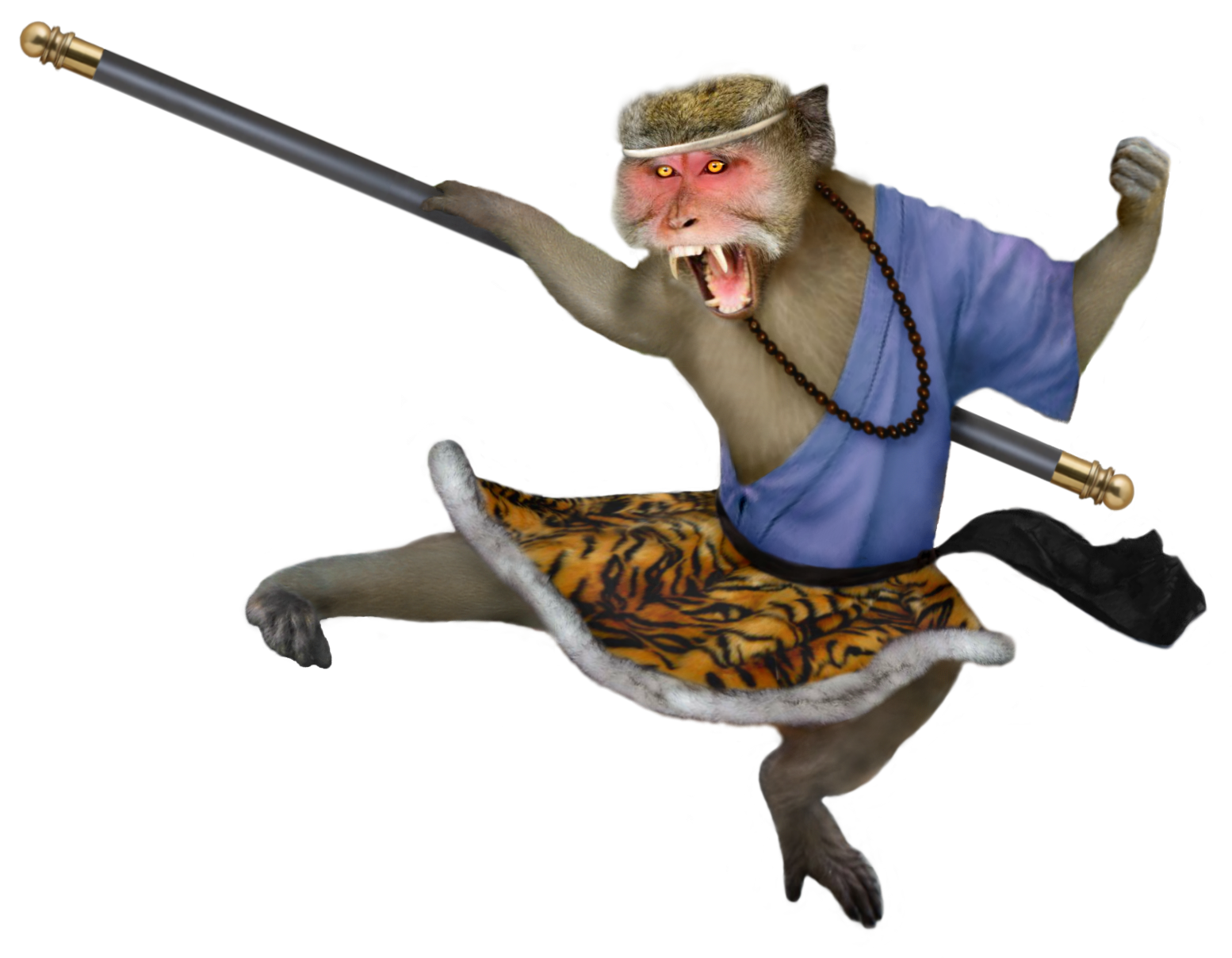
Fig. 3 – A modern depiction of Sun Wukong (larger version). A photomanipulation by the author.

After the fixed period of time has elapsed, the primordial gibbons request to leave their individual exile. The Jade Emperor, however, refuses due to the potential for danger. Angered because heaven went back on its word, the immortal lovers leave their exile anyway, and so all of the devas, spirits, and devils struggle to keep them apart. This is an impossible task given that the two are among the highest immortals. A great battle ensues in which the pair uses their knowledge of the Dao to put the celestial army into disarray. For instance, the Ape Patriarch is a master of transformations; he grows to titanic proportions, multiplies his long arms, and captures the most powerful Daoist and Buddhist deities in his vice-like hands. The Ape Matriarch is a mistress of illusions; she clouds the minds of the soldiers, making them think that they are fighting her when they are really fighting each other. [J] In addition, their individual songs have grown in power, now capable of destroying anything by separating the yin and yang forces therein (fig. 4).

J) The strengths of each correspond to the skills passed on to the Buddha and the immortal Subodhi. Again, I wanted there to be a parallel between Monkey and his spiritual parents. The pair rebels like he did, but they do so because of injustice, not pride. However, I must say that lofty immortals would have surely evolved passed such earthly “wants and needs” (e.g. lust and anger). Daoist literature and vernacular Chinese fiction often describes immortals as being celibate. But the immortal love of the couple may transcend what might be expected of human-based immortals. That’s why I present them as living embodiments of yin and yang. Wile (1992) states: “The early [Daoist] texts are marked by the existential loneliness of yin and yang for each other, and their union consummates a cosmic synergy” (p. 29).

Fig. 4 – A gibbon yawning. Imagine powerful sound waves emanating from its mouth. A larger version can be found here.

The Jade Emperor begs the Buddha to intervene like he had done for the rebelling Sun Wukong in the past. But considering that heaven went back on its word and the ape immortals are both friends and former teachers of the Enlightened One, the Tathagata sends their spiritual son, the Victorious Fighting Buddha, to ask them to pacify their rage instead of using trickery to halt the onslaught. [K] After a brief reunion, the pair acquiesces, and all three travel by cloud to the Buddha’s abode on Vulture Peak (Lingjiu shan, 靈鷲山) to discuss the matter. The immortal lovers opine the great injustice done to them by the heavenly hierarchy. The Buddha understands that their duet is part of their primordial animal nature and is the ultimate expression of their love, which reaches back to the very beginning of time. Unfortunately, he realizes that the power of their song could destroy the universe if allowed to take place.

K) An example of trickery would be the way that the Buddha uses illusion to make Monkey think that he has left his palm in the seventh chapter of JTTW.

After some thought, the Tathagata gives them a lesson on the cyclical dissolution of the cosmos: at the end of each Mahakalpa (Da jie, 大劫), the universe is destroyed by a different element. There are fifty-six destructions by fire, seven by water, and one by wind. The latter is the most powerful, destroying all earthly and heavenly realms below the pure realm inhabited by the Buddha and his retinue. The Tathagata then suggests a compromise in which the couple can remain as his permanent guests of the Buddha realm, where they can frolic with the Victorious Fighting Buddha. This way the gibbons will be free to sing their melodious song without fear of negative effects. And when the end of the sixty-fourth Mahakalpa comes to a close, their song will serve the function of the wind element to bring about the dissolution of the universe to make way for the new one. [L]

L) Buddhism recognizes a measurement of time called a Kalpa (jie, ), which can be many millions or even billions of years long depending on the tradition. Said traditions recognize between four and eighty kalpas (Buswell & Lopez, 2014, p. 409). The total of these respective ranges make up a Mahakalpa (dajie, 大劫), which is divided into four periods of nothingness, creation, subsistence, and finally destruction, each period being between one and twenty kalpas long (Buswell & Lopez, 2013, p. 496). 


Updates

Story Idea #2: Son of Primordial Evil

Update: 01-17-21

Last year, I wrote an article that explored other stone-born figures from world mythology. In the conclusion I cautiously suggested that Wukong’s birth and later rebellion was influenced by a Hurrian myth, the “Song of Ullikummi” (c. 1200 BCE), which appears in an extant Hittite cuneiform text comprising three fragmented clay tablets. For example, one scholar noted similarities between Ullikummi and a later figure from Greek mythology: “(1) The initial situation: the big stone; (2) a god fertilizes the stone; (3) the stone gives birth to a child; (4) the child thus created is a rebel against the gods; (5) the gods gather and plan countermeasures; (6) the enemy of the gods is rendered harmless” (see the linked article). Anyone who has read JTTW will no doubt notice the striking similarities with Monkey’s tale. Therefore, I think Ullikummi’s story would be a solid basis for a more authentic origin story for the Monkey King.

While the ancient tale is named after the eponymous stone monster (fig. 5), the story follows the machinations of Kumarbi, a resentful former ruler of the gods, who wishes to usurp the throne from his son, the storm god Tesub. Kumarbi sets about doing this by bedding a massive stone in an effort to produce a being powerful enough to rout the gods. Upon its birth, the doting father gives the creature a name meaning “Destroy Kummiya,” foreshadowing its intended fate to destroy Tesub’s home.

Fig. 5 – Ullikummi as a playable character from the online video game Final Fantasy XI (larger version).

Fearing that it may be killed by the gods before coming into full power, Kumarbi has the monster hidden in the underworld, where it is placed on the right shoulder of the Atlas-like god Upelluri. The creature quickly multiples in size, growing nine thousand leagues tall, eventually reaching heaven. When the goddess Ishtar fails to seduce the blind and deaf monster, the warrior god Astabi leads seventy deities into battle against the lithic menace only to be defeated and cast into the sea below. Tesub abandons the throne and along with his vizier and brother Tasmisu, seeks the aid of Ea, the god of wisdom and witchcraft, who travels to the underworld in search of the creature’s origins. Upon questioning Upelluri, who effortlessly carries the weight of the heavens, earth, and sea, Ea learns that a great weight, which turns out to be the monster, pains the titan’s right shoulder. In the end (of the third and final extant tablet), Ea calls for a tool originally used by the old gods to cleave heaven and earth and chisels Ullikummi free of Upelluri’s shoulder, thus breaking the monster’s base of power and leaving it vulnerable to attack by the gods. One scholar suggests that there’s a missing fourth tablet that describes the monster’s ultimate defeat (again, see the linked article).

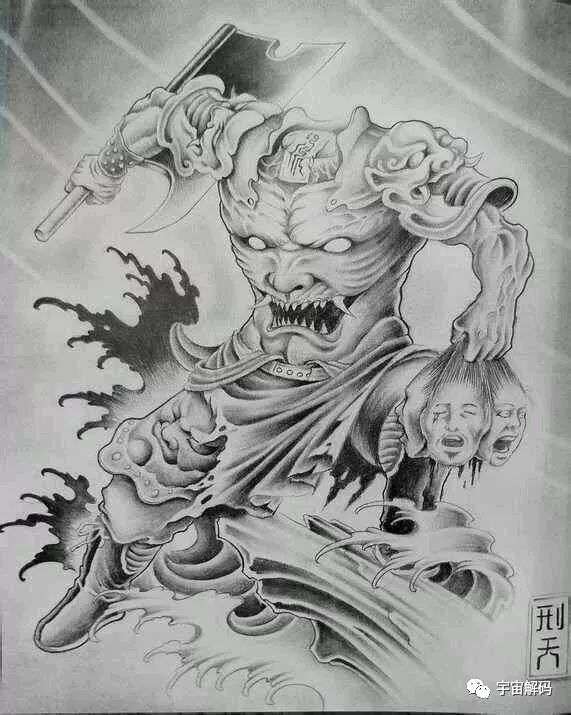
Fig. 6 – A modern depiction of Xingtian (larger version). Artist unknown.

Now, I’ve previously written a story sketch in which Master Subodhi’s school is actually a training ground for an immortal monastic army akin to the Shaolin Temple. I speculated that Wukong’s skill in martial arts and troop movement would come from his time serving as a soldier and eventual officer in this army. Additionally, I suggested that the baddie whom the army faces is the headless monster Xingtian (刑天) (fig. 6), who originally battled the supreme god Shangdi for control of the universe and was beheaded after his defeat. Perhaps he or a figure like him follows in Kumarbi’s footsteps and beds a stone, in this case the rock on the Mountain of Flowers and Fruits, in an effort to create a powerful son to finish what he started. Then, he works in the shadows, influencing the direction of Monkey’s life, leading to his famous rebellion against heaven. Wukong’s defeat of the seventy-two major gods in the heavenly army [1] would mirror Ullikummi routing the seventy gods led by Astabi. Likewise, the Jade Emperor’s call to the Buddha, leading to Monkey’s defeat, mirrors Tesub’s plea to Ea and the eventual downfall of the stone monster.

Thoughts?


Story Idea #3: Arhat Punished to Reincarnation

Update: 06-16-23

Another idea could predate Monkey’s stone birth and instead focus on a past life as a heavenly being. It would draw from three sources: First, the backstory of the Tang Monk, Tripitaka. Those who’ve read JTTW will know that his past life, an Arhat called Master Golden Cicada (Jinchan zi, 金蟬子), is exiled from paradise for ten lifetimes for falling asleep during the Buddha’s lecture.

Just like his master, Sun Wukong is formerly a celestial in paradise. A great name for this figure would be the “Arhat Steel Muscles and Iron Bones” (Gangjin tiegu luohan, 鋼筋鐵骨羅漢). This plays on a similar title given to Sun’s antecedent, the “Monkey Pilgrim” (Hou xingzhe, 猴行者), by Tang Emperor Taizong in the 13th-century oral version of JTTW. [2]

Second, the embellished life story of Song-era General Yue Fei (岳飛, 1103–1142). The Complete Vernacular Biography of Yue Fei (Shuo Yue quanzhuan, 說岳全傳, c. 17th century; “The Biography of Yue Fei” hereafter) actually draws inspiration from the 1592 JTTW by portraying the general as a reincarnation of a bird monster-turned-Dharma protector from chapters 74 to 77. Originally called the “Peng Bird of Ten Thousand Cloudy Miles” (Yuncheng wanli peng, 雲程萬里鵬) in JTTW, the “Great Peng, the Golden-Winged King of Illumination” (Dapeng jinchi mingwang, 大鵬金翅明王) is exiled from paradise in chapter one of The Biography of Yue Fei for killing a stellar bat-spirit who farted during the Tathagata’s sermon on the Lotus Sutra. [3]

Just like the Great Peng bird, the Arhat Steel Muscles and Iron Bones kills a spirit for seemingly offending the Buddha. [4] I imagine that the Enlightened One would admonish him by saying something like, “You are so sure of your strength, so proud of your physical gifts. And yet you don’t know how to defend the Dharma with it!” He then exiles the Arhat to live out ten lifetimes (à la Master Golden Cicada) where he’s a figure of great strength who is continually bested and humiliated and forced by circumstances to protect something weaker than him.

And third, the Buddha’s Jataka tales. The Tathagata has many birth stories where he is both humans and animals who embody an important lesson (Cowell, 1895). In fact, one tale depicts him as a Monkey King!

The Arhat is reborn in the lower three paths of reincarnation, and just like the Buddha, he has several past lives as animals. He works his way up the cosmic hierarchy by performing good deeds, such as a past life where he’s a man-eating tiger who comes to protect a small child. He attains the human-like form of a monkey in his final incarnation, leading to the events of JTTW.

I like this option a lot because this would make both Monkey and Tripitaka former Arhats who undergo prolonged trials that refine their spirits over many lifetimes. This would ultimately explain why both of them attain Buddhahood at the end of their respective character arcs, our hero becoming the “Buddha Victorious in Strife” (Dou zhansheng fo, 鬥戰勝佛) and the Tang Monk “Buddha of Candana Merit” (Zhantan gongde fo, 旃檀功德佛) (Wu & Yu, 2012, vol. 4, p. 381). I also like it because Sun Wukong’s past life references the Tibetan monkey bodhisattva Hilumandju, who is an avatar of the bodhisattva Avalokiteshvara (Guanyin) and a possible Buddhist syncretic version of the Hindu monkey god Hanumanji. What’s interesting about this legendary figure is that he mates with a rock ogress (see the 08-02-19 update here), which reminds one of Sun’s stone birth.


Authenticity

Update: 02-22-25

While I like elements from the first two story ideas, the third one is turning out to be more authentic and interesting.

I had previously referred to Monkey’s past life on this article as a Bodhisattva, but I changed this to an Arhat after finding evidence that Golden Cicada, Tripitaka’s past life, was a Buddhist saint. This includes the following:

  • Xuanzang was historically worshiped as one during the Song dynasty.
  • Two Yuan-Ming plays depict him as the reincarnation of Arhats.
  • The story of Golden Cicada is likely based on the Arhat Aniruddha, one of the ten principle disciples of the Buddha.
  • Two other principle disciples, the Arhats Ananda and Kasyapa, appear among the Tathagata’s retinue in JTTW (see here).

In addition, my previous article on Sun Wukong’s first master, the Buddho-Daoist Sage Subodhi, suggests that he is the historical Arhat Subhuti, also one of the principle disciples. And if we insert the aforementioned Aniruddha as the original identity of Master Golden Cicada, that will make four of ten disciples appearing in the story. I stress this because maybe—within our fanfiction—Monkey’s previous life could be another principle disciple that has been conveniently inserted among the historical figures. That way, the Great Sage would have known both Golden Cicada (his master Tripitaka) and Subhuti (his master Subodhi) in the past!

This is neat because he (Arhat Steel Muscles and Iron Bones) and Golden Cicada could ideally be living out their respective transmigrational punishments around the same time. And this further stimulates my brain: what if each of Monkey’s incarnations have protected each of Tripitaka’s past lives?!?!

Notes:

1) Koss (1981) writes: “Adding up the number of gods listed here [see Wu & Yu, 2012, p. 169] from the Twenty-Eight Constellations through the Deities of the Five Mountains and the Four Rivers, the number arrived at is seventy-three, if 東西星斗 [dongxi xingdou, the “Stars of East and West”] is counted as two, which Yu does in his translation, or seventy two, if the latter is taken as one, which is another possible interpretation” (p. 84).

2) In chapter 17, Tang Taizong names him the “Great Sage Steel Muscles and Iron Bones” (Gangjin tiegu dasheng, 鋼筋鐵骨大聖) (Wivell, 1994, p. 1207).

3) Chapter one of The Complete Vernacular Biography of Yue Fei reads:

Let’s talk about the Buddha Tathagata at the Great Thunderclap Monastery in the Western Paradise. One day, he sat on a nine-level lotus throne, and the Four Great Bodhisattvas, the Eight Great Vajra Warriors, the five hundred Arhats, the three thousand Heavenly Kings, nuns and monks, male and female attendants, all of the heavenly sages who protect the Dharma, gathered to listen to his lecture on the Lotus Sutra. His words were like flowers and precious jewels raining from the heavens. But, at that time, a star-spirit, the Maiden Earth Bat, who had been listening to the lecture from beneath the lotus throne, couldn’t bear it any longer and unexpectedly let out a stinky fart.

The Buddha was a great, merciful lord, so he didn’t mind even the slightest bit. But don’t sympathize with the Dharma protector above his head, the “Great Peng, the Golden-Winged King of Illumination,” whose eyes shone with golden light and whose back was a scene of auspiciousness. He became angry when he saw the nasty, filthy Maiden Earth Bat, and so he unfurled both his wings and dropped down to kill the spirit by pecking her on the head. The light-point of her soul shot out of the Great Thunderclap Monastery and went to the Lands of the East (China) in the world below to find a mother and reincarnate. She was reborn as a daughter of the Wang clan. She would later marry the Song Prime minister Qin Hui (1091-1155) and come to cruelly kill the righteous (i.e. Yue Fei) as a means to get revenge against today’s enemy. We will talk about this later.

Let’s return to the Buddha, who saw what happened with his all-seeing eyes and exclaimed, “Good! Good! It turns out that this is an episode of karma (cause and effect).” Then he called the Great Peng bird to come closer and shouted, “You evil creature! You already took refuge in my teachings. How can you not follow the five precepts by daring to commit such a horrible crime? I don’t need you here; you will descend to the mortal world to pay off your (karmic) debt and wait until you have fulfilled your work. Once that is completed, only then will I allow you to return to the mountain to achieve the right fruit (Buddhist merit).” The Great Peng complied with the decree, flying out of the Great Thunderclap Monastery directly to the Lands of the East to be reincarnated. We will stop here.

且說西方極樂世界大雷音寺我佛如來,一日端坐九品蓮臺,旁列著四大菩薩、八大金剛、五百羅漢、三千偈諦、比丘尼、比丘僧、優婆夷、優婆塞,共諸天護法聖眾,齊聽講說妙法真經。正說得天花亂墜、寶雨繽紛之際,不期有一位星官,乃是女土蝠,偶在蓮臺之下聽講,一時忍不住,撒出一個臭屁來。我佛原是個大慈大悲之主,毫不在意。不道惱了佛頂上頭一位護法神祗,名為大鵬金翅明王,眼射金光,背呈祥瑞,見那女土蝠污穢不潔,不覺大怒,展開雙翅落下來,望著女土蝠頭上,這一嘴就啄死了。那女土蝠一點靈光射出雷音寺,徑往東土認母投胎,在下界王門為女,後來嫁與秦檜為妻,殘害忠良,以報今日之讎。此是後話,按下不提。

且說佛爺將慧眼一觀,口稱:「善哉,善哉!原來有此一段因果。」即喚大鵬鳥近前,喝道:「你這孽畜!既歸我教,怎不皈依五戒,輒敢如此行兇?我這裡用你不著,今將你降落紅塵,償還冤債,直待功成行滿,方許你歸山,再成正果。」大鵬鳥遵了法旨,飛出雷音寺,徑來東土投胎不表。

4) A murderous Buddhist deity may seem weird, but Vajrapani (Jingang shou pusa, 金剛手菩薩; lit: “Bodhisattva Holding the Vajra Weapon”), a yaksha-turned-wrathful Dharma protector, is considered a bodhisattva (Buswell & Lopez, 2014, p. 955).

Sources:

Buswell, R. E. , & Lopez, D. S. (2014). The Princeton Dictionary of Buddhism. Princeton, NJ: Princeton University Press.

Cowell, E. B. (Ed.) (1895). The Jātaka, or Stories of the Buddha’s Former Births (Vols. 1-5). Cambridge: Cambridge University Press. Retrieved from https://archive.org/search?query=The+Ja%CC%84taka%2C+or%2C+Stories+of+the+Buddha%27s+former+births.

Geissmann, T. (2008). Gibbon paintings in China, Japan, and Korea: Historical distribution, production rate and context. Gibbon Journal, 4, 1-38. Received from http://www.gibbonconservation.org/07_publications/journal/gibbon_journal_4.pdf

Koss, N. (1981). The Xiyou ji in Its Formative Stages: The Late Ming Editions (Vols. 1-2). (Doctoral dissertation). Available from ProQuest Dissertations and Theses database. (UMI No. 8112445)

Laozi, & Wilson, W. S. (2012). Tao Te Ching: An All-New Translation. Boston & London: Shambhala

Lougheed, K. (2012, August 23). Helium reveals gibbon’s soprano skill. Retrieved January 20, 2014, from https://www.nature.com/news/helium-reveals-gibbon-s-soprano-skill-1.11257

Stevens, K. G. (1997). Chinese Gods: The Unseen World of Spirits and Demons. London: Collins & Brown.

Wile, D. (1992). Art of the Bedchamber: The Chinese Sexual Yoga Classics Including Women’s Solo Meditation Texts. Albany: State University of New York Press.

Wivell, C.S. (1994). The Story of How the Monk Tripitaka of the Great Country of T’ang Brought Back the Sūtras. In V. Mair (Ed.), The Columbia Anthology of Traditional Chinese Literature (pp. 1181-1207). New York: Columbia University Press.

Wu, C., & Yu, A. C. (2012). The Journey to the West (Vols. 1-4) (Rev. ed.). Chicago, Illinois: University of Chicago Press.

Yang, L., An, D., & Turner, J. A. (2011). Handbook of Chinese Mythology. Santa Barbara, Calif: ABC-CLIO.

The Sun Wukong Stone Relief of Kaiyuan Temple

Last updated: 01-27-2024

The southern Chinese seaport of Quanzhou in Fujian province is home to Kaiyuan Temple (Kaiyuan si, 開元寺), also known as the Purple Cloud Temple (Ziyun si, 紫雲寺), an ancient Buddhist complex originally built in 686. The temple is famous for its two stone pagodas, each of which is covered in 80 life-size relief carvings of bodhisattvas, arhats, patriarchs, protector deities, and various mythological creatures rendered in a rustic style influenced by the Northern Song Dynasty school of art (Ecke & Demiéville, 1935, pp. 11-18). One figure of interest is a muscular, sword-wielding, monkey-headed warrior (fig. 1) located on the northeastern side of the western pagoda’s fourth story. Many scholars consider this to be an early depiction of Sun Wukong from Journey to the West (Xiyouji, 西遊記, 1592). The pagoda was erected in 1237 (Ecke & Demiéville, 1935, p. 91), so this depiction predates the Ming novel by 355 years, making it an important source for analyzing the early influences on the much beloved literary character. In this paper, I present past research on the relief, as well my own in which I suggest that the iconography is based on ritual adornments mentioned in the Hevajra Tantra, an Esoteric Buddhist text of the 8th century.

Fig. 1 – The  Kaiyuan temple pagoda relief (larger version), Quanzhou, Fujian.

Table of Contents

1. Previous Research

The first detailed description of the relief appears in Ecke and Demiéville (1935):

A guardian with a monkey-head, holding with one hand a rosary which is hanging around his neck, and with the other a sword emitting a cloud from its tip. He wears a short tunic, travel-sandals, and a rope-belt from which are hanging a calabash and a scroll with the Chinese title of the Mahamayarividyārajñi [Fomu da kongque mingwang jing佛母大孔雀明王經] (T982-985, a text which was used as a charm against all calamities, dangers, wounds, and diseases). [According to local tradition, it is] Sun Wu-k’ung the name of the monkey assistant (alias the Monkey attendant 猴行者, or the fair Monkey-king 美猴王, or the Great Saint Equal to Heaven 齊天大聖) of Hsüan-tsang [Xuanzang] in the JW-novel. In the upper right corner of the carving there is a small monk-figure with a halo, evidently Hsüan-tsang himself, appearing on a cloud, seemingly the same cloud as that which emanates from the monkey’s sword. In the version of the JW now extant, the monkey assistant’s weapon is not a sword, but an iron rod with two golden rings, which he can reduce, whenever he finds it convenient, into a needle and so keep inside his ear. Also, he wears a tiger-skin over the lower part of his body, a detail which does not agree with our carving (p. 35)

Glen Dudbridge (1970) compares Ecke and Demiéville’s analysis with the description of the Monkey Pilgrim (Hou xinzhe, 猴行者) from the The Story of How Tripitaka of the Great Tang Procures the Scriptures, the late-13th century precursor of Journey to the West. Based on the differences, he suggests that Northern and Southern China may have had separate Monkey story cycles:

[T]here is no sign there of the traveller’s garb in which the Zayton [1] figure is so meticulously clothed; the sword is also not mentioned, although the ‘iron rod with gold rings’ … has not yet assumed its full distinctive role; similarly, the tiger-skin robe, while not described in so many words, seems faintly anticipated in the episode [chapter six] in which Hou Hsing-che slays a tiger-demon, and certainly this standard attribute of demonic figures in Tantric iconography accords well with the description of the yakṣa in that same episode. [2] All this tends to suggest that the Zayton monkey-figure remains strangely distinct from that known to us in the literary sources … Certainly at this stage of their development, there seems to have been no obligation to uniformity in the enactment or representation of popular story cycles: the monkey seen, heard or read about by the northern public could well have differed from his southern counterpart (Dudbridge, 1970, p. 49).

Journey to the West translator and scholar Anthony C. Yu (1977) highlighted a difference in opinion regarding the pious figure on the upper right of the piece:

Ōta Tatsuo 太田辰夫 and Torii Hisayasu 鳥居久靖, in “Kaisetsu 解説,” in Saiyuki, Chūgoku koten bungaku taikei, 31-32 (Tokyo 1971), 432, have challenged Ecke and Demiéville’s interpretation of the carving by pointing out that the figure at the upper righthand corner should be thought of simply as a figure of Buddha (not Hsüan-tsang), which Monkey will become by virtue of bringing back the scriptures. It may be added that Sun Wu-k’ung of the hundred chapter narrative did use a sword or scimitar 刀 (JW, chaps. 2 and 3) before he acquired his famous rod. [3] None of the scholars consulted here sees fit to discuss the significance of what seems to be a headband worn by the carved figure (p. 497 n. 23). 

Victor Mair (1989) focuses on the relief’s iconography and suggests that the various elements might have ties to depictions of both the Buddhist protector deity Aṇḍīra and the Hindu monkey god Hanuman from the Ramayana (c. 4th cent BCE):

The band on the Zayton monkey’s head is indeed very important. Surely it must represent what becomes the Tight-Fillet 緊箍 of the Ming JW, ch. 14. Regardless of the author’s (or his predecessors’) elaborate creative inventions surrounding this fillet in the tradition of the novel, we may ask whether it has any identifiable iconographical origins in art.

The Tight-Fillet recalls the band around the head of representations of Aṇḍīra, the simian guardian of Avalokiteśvara and Bhaișajyaguruvaidūryaprabhāṣa … As a typical specimen, we may take a statue [fig. 2] from the Kōfukuji in Nara. The Kōfukuji Aṇḍīra has curious wing-like projections extending from the sides of the band around his head that remind us of Mercury in Western classical art. On the Zayton SWK [Sun Wukong], these symbols of swiftness have been displaced to the sides of the eyes. In either case, the wings remind us of H’s [Hanuman’s] descent from the god of the wind. Other similarities between the Kōfukuji Aṇḍīra and the Zayton SWK include: identical earrings (these are key iconographical features of H in many Southeast Asian Rs [Ramayanas]), comparable tilt of the head (exaggerated with the Kōfukuji Aṇḍīra) which seems to indicate enforced submission, long locks of hair flaring out behind the head, elongated monkey’s mouth, similar decorations on forearms and upper arm, etc. It is crucial to note that all of these features can be found in South Asian and Southeast Asian representations of H. For its photographic clarity, we may choose a scene from the Rāma reliefs in Panataran, Indonesia [fig. 3]. H’s forearms are bare in this particular representation, but in some Thai reliefs (at Wat Phra Jetubon in Bangkok), they resemble those of the Zayton SWK and the Kōfukuji Aṇḍīra. The discrepancies in the dress and ornamentation of the lower parts of the body may be attributed to culture and climate (pp. 699-700).

Fig. 2 – The Kōfukuji Aṇḍīra wooden relief carving (c. 11th to 12th cent.) (larger version), Nara, Japan. Fig. 3 – Hanuman (left) besting a demonic foe (right), from the Ramayana reliefs of the Panataran temple complex (c. 12th cent.) (larger version), East Java, Indonesia. 

2. My Findings

My opinion on the origins of the Kaiyuan relief’s iconography parts ways with Mair in some respects. For instance, upon close inspection of the Japanese Aṇḍīra carving, the band that he refers to appears to be the brim of a helmet. I do agree that the Kaiyuan relief shares affinities with the cited image of Hanuman (e.g., the earrings and armbands). But again, here I part ways with Mair because I suggest that the relief’s accoutrements were instead influenced by Esoteric Buddhism and not Hinduism. The similar imagery is no doubt due to a common cultural source.

Nearly every aspect of Sun Wukong’s attire can be found in a passage from the 8th-century esoteric text the Hevajra Tantra (Dabei kongzhi jingang dajiao wang yigui jing, 大悲空智金剛大教王儀軌經). It instructs yogins on how to adorn and dress themselves for worshipping Heruka (Xilujia, 呬嚕迦), a wrathful protector deity of Buddhism.

Sanskrit: bhavakena vidhartavyam karnayor divyakupdalam/ sirasi cakri dhartavya hastayo rucakadvayamkatyarp va mekhalam caiva padayor nupuran tatha/ bahumule ca keyuram gnvayam asthimalika/ paridhanam vyaghracarma bhaksanam dasardhamrtam

Translation: The practitioner should wear divine ear-rings, a circlet around the head, upon each wrist a bracelet, a girdle around his waist, anklets around the ankles, arm ornaments around the upper arms and a garland of bones around the neck. His dress must be of tiger skin … (Farrow & Menon, 2001, pp. 61-62).

彼修觀者當如是行:謂頂想寶輪、耳帶、寶鐶,手串寶釧,腰垂寶帶,足繫寶鐸及妙臂釧,頸嚴寶鬘衣、虎皮衣 …

Earrings? Check! Circlet? Check! Bracelets, girdle, anklets, and arm ornaments? Check, check, check, and check! The only two aspects that are questionable are the bone necklace and the tigerskin. Rosaries are sometimes made from bone, which satisfies that requirement. And while Ecke and Demiéville were quick to note the omission of the pelt in their study, I think that the appearance of so many elements from the passage suggests that the tigerskin is present but the features may have just been eroded by time. The chevron shape visible below the girdle could be a skin apron. I’ve created a color version of the relief based on this information (fig. 4).

Fig. 4 – My interpretation of the relief (larger version). A comparison of the original and new versions can be seen here.

(Note: 05-22-23 – Upon reviewing figure four, I don’t like the way the proposed tiger skin cuts off at the belt. It would make more sense for the skin to act as a girdle, making it visible above the belt. I’ll probably update this in the future.)

As I explained in a previous article, the Hevajra Tantra was officially translated into Chinese in 1055 (no doubt arriving earlier than this), so the text was present in the middle kingdom for nearly 200 years prior to the creation of the relief.

What can these ritual elements tell us about Monkey’s depiction? Firstly, it should be noted that the esoteric deity Heruka and other such wrathful guardians, known by the neologism “Wrathful Destroyers of Obstacles” (Sk: krodha-vighnantaka), are commonly portrayed wearing such items, leading to the scholar Van Kooij (as cited in Linrothe, 1999) to comment, “Heruka is more or less a deified hypostasis of the … yogin himself” (p. 251). Second, these deities are often portrayed wielding weapons. For example, one source describes Vajrapani‘s wrathful form Trailokyavijaya “hold[ing] the vajra, ankusa-hook, sharp sword, pâsa-noose and other âyudha [weapons]” (Linrothe, 1999, p. 188). Sun Wukong, too, is depicted with a weapon, a sword with a lick of heavenly flame. Third, the flaming sutra tied to Monkey’s girdle was, as explained above, historically “used as a charm against all calamities, dangers, wounds, and diseases” (Ecke & Demiéville, 1935, p. 35). Wrathful Destroyers of Obstacles are charged “with the destruction of barriers which prevent the experience of enlightenment” (Linrothe, 1999, p. 25). These include external threats like manifested demons and internal threats like demon-caused mental and bodily illness, the “three poisons,” and karmic debt (Linrothe, 1999, pp. 24-25). Therefore, the iconography presents Sun Wukong as a wrathful protector deity.

This then may lend support to Ecke and Demiéville’s original assertion that the pious figure floating in the clouds to the right of Monkey’s head is in fact Xuanzang. The Great Sage clears the path of manifested demons that obstruct the monk’s path to enlightenment, leading to his ascension into paradise (this happens in both the 13th-century version of the story and the standard Ming novel).

3. Ritual Adornments and Other Literary Figures

While Monkey’s association with the fillet and the tiger skin carried over into the novel, other characters came to be associated with ritual adornments from the Hevajra Tantra. A prime example is Red Boy (Hong hai’er, 紅孩兒), son of the Bull Demon King and Princess Iron Fan. The Bodhisattva Guanyin forces the demon child to submit in chapter 42, after which she uses a magic treasure given to her by the Buddha to ensnare his extremities.

Dear Bodhisattva! She took the fillet and waved it at the wind once, crying, “Change!” It changed into five fillets, which she threw at the body of the boy, crying, “Hit!” One fillet enveloped the boy’s head, while the rest caught his two hands and two feet (Wu & Yu, 1977, vol. 2, p. 280).

Red Boy is the literary counterpart of the religious figure Sudhana (Sancai, 善財), whose spiritual journey is told in the Gandavyuha Sutra (Dafang guang fohuayan jing, 大方廣佛華嚴經, c. 3rd cent.). The youth sets out on a quest towards enlightenment and trains under 52 different teachers, including Maitreya, Avalokiteśvara (the South Asian variant of Guanyin), Mañjuśrī, and Samantabhadra (Buswell & Lopez, 2014, p. 864). It’s no wonder then that the ascetic came to be associated with such ritual adornments. South and East Asian depictions of Sudhana/Sancai often portray him wearing bangles and anklets (fig. 5).

Fig. 5 – A modern day altar statue of Sudhana/Sancai (larger version). Notice the bracelets and anklets.

4. Conclusion

The 13th-century Sun Wukong pagoda relief of the Kaiyuan Temple shares many similarities to ritual adornments mentioned in the esoteric Hevajra Tantra (8th cent.), including earrings, the circlet, arm cuffs, a necklace, a girdle, wrist bangles, anklets, and possibly even a tiger skin. Esoteric protector deities are often portrayed with similar attire since they represent the very yogin ascetics who worship them. Monkey’s depiction with said attire suggests the artist who created the piece intended to present him as a powerful Buddhist guardian on par with Wrathful Destroyers of Obstacles like Heruka. The depicted sword and sutra, each shown with a lick of heavenly flame, no doubt represent the means by which the Great Sage protects his master Xuanzang (possibly the pious figure on the upper right corner of the relief).

The onetime enemy Redboy comes to wear the ritual circlet, bracelets, and anklets in Journey to the West after being subjugated by Guanyin. While he is depicted as a defeated foe who submits to Buddhism, these adornments recall his historical and religious origins as Sudhana, a great ascetic from Buddhist literature.


5. Updates

5.1. Fan Art

Update: 05-22-23

Twitter user Lava (@Lavaflowe) has allowed me to post their lovely drawing of the stone pagoda carving.

Fig. 6 – Lavaflowe’s version of the stone pagoda carving (larger version). Image from twitter.


5.2. No Tiger Skin?

Update: 01-26-24

There is also a possibility that the tiger skin isn’t present at all (as suggested by others). Despite the Hevajra Tantra prescribing this dress, the skin isn’t listed among the most basic accoutrements of a yogi elsewhere in the work. These are known as the “Five Symbolic Ornaments” or “Five Seals” (Sk: Pancamudrā, पञ्चमुद्रा; Ch: Wuyin, 五印; a.k.a. “Five Buddha Seals,” Wufo yin, 五佛印). Each is associated with a particular Buddha:

Aksobhya is symbolised by the circlet, Amitabha by the ear-rings, Ratnesa by the necklace, Vairocana by the hand ornaments, [and] Amogha by the girdle (Farrow, 1992, p. 65).

輪者,表阿閦如來;鐶者,無量壽如來;頸上鬘者,寶生如來;手寶釧者,大毘盧遮那如來;腰寶帶者,不空成就如來。


5.3. The Six Ornaments

Update: 01-27-24

The aforementioned five ornaments are sometimes combined with another item to form the “Six Ornaments” or “Six Seals” (Sk: Shanmudrā, षण्मुद्रा), each of which is associated with a Buddhist wisdom:

The yogic ornaments … are commonly classified as being six in number: (1) the skull-tiara, (2) the armlets, (3) the bracelets, (4) the anklets … (5) the bone-bead apron and waist-band combined … and (6) the double line of bone-beads extending over the shoulders to the breast, where they hold in place the breast-plate Mirror of Karma, wherein … are reflected every good and bad action. These six ornaments (usually of human bone) denote the Six Pāramitā (‘Boundless Virtues’), which are: (1) Dāna-Pāramitā (‘Boundless Charity’), (2) Shīla-Pāramitā (‘Boundless Morality’), (3) Kshānti-Pāramitā (‘Boundless Patience’), (4) Vīrya-Pāramitā (‘Boundless Industry’), (5) Dhyāna-Pāramitā (‘Boundless Meditation’), and (6) Prajñā-Pāramitā (‘Boundless Wisdom’). To attain to Buddhahood, and as a Bodhisattva to assist in the salvation of all living creatures, the Six Pramita must be assiduously practised (Evans-Wentz, 2000, p. xxv).

The most detailed source I’ve found reads:

a. The Bone Wheel

Vajradharma wears a bone wheel on his head. It is formed from a small bone circle that sits around the crown of the head, surrounded by a second, larger circle. The two circles are attached to one another by eight bone spokes. On each of the five spokes at the front, above the forehead, stands a dried skull that supports the jewel, which is the crest ornament. From the lower part of their jaws, looped chains and hanging decorative chains extend downward to the space between Vajradharma’s eyebrows and to the tips of his ears. One the back of each skull is a multicolored vajra with a crescent moon placed to the left. The deity’s long hair passes up through the hole in the middle of the inner bone circle and is tired in a topknot. 

b. The Earrings 

There are five parts to the earrings. There is a main circle of bone, which is like a bangle. From the bottom of the circle hang two smaller rings, each one attached to the larger ring above them by a semi-circle of bone.

c. The Necklace 

The necklace is made of two strings of bones bound together with hair taken from both a corpse and a living person. At the front is a square central hub. The hub forms the base for a T-shaped triple vajra. There are to more triple vajras placed at the two points where the strings of the necklace reach the shoulders.

d. The Bracelets

The deity wears a bracelet on each ankle, wrist, and upper arm, making six in total. Each bracelet is made from two strings of bones that have been bound together. There are three vajras on each pair of bracelets, one at the knot in the upper string, one at the knot in the lower string, and one opposite the knot in the upper string.

e. The Brahmin’s Bone Thread

Next is the Brahmin’s bone thread, or investiture thread (yajnopavita). On the front of the body, above the novel, is a bone wheel with either right or four spokes. There are holes in four of the spokes and two parallels strings of bone pass through each of them. Two of these strings go over the shoulders, and two pass under the armpit. On each of these strings are two vajras on the shoulder and another two under the armpit, making eight in total. Sometimes there is a second bone wheel on the back, to which all the strings are tied; if not, all the ends of the strings are knotted together. 

Together, or with the thread of hair from a slain thief, these bone ornaments are called the ornaments of the five mudras.

f. The Bone Belt 

The bone belt, or apron, hangs from the waist. It is made, as before, of two parallel strings of bone. The strings have five vajras attached to them–one at the front in the center, one on each hip, and one on each side of the center, halfway to the whips. Hanging chains and looped chains decorated with small silver bells and small bone spearheads hang from the tips of the vajras. The chains end at the point where the calf muscle begins to taper.

According to oral tradition, the necklace we just mentioned is ornamented with five vajras at the heart. Although I have consulted many descriptions of the bone ornaments, I have never seen this stated anywhere else. There are many traditions concerning the bone ornaments, but here I have presented that of the oral tradition taught by my master (Lingpa, Rinpoche, & Chemchok, 2017, pp. 52-54). 

As can be seen, the tiger skin is not mentioned among these ornaments either.

Also, as is mentioned, the items making up the six ornaments vary from tradition to tradition. For instance, Huntington and Bangdel (2003) list bone ash in place of the bone thread (p. 161). But it’s important to note for our purposes that the circlet, bangles, bracelets, anklets, and belt make up the five basic accoutrements.

Notes:

1) The city of Quanzhou was known to both Marco Polo and Ibn Battuta by the Arabic name Zayton or Zaiton (زيتون , the “City of Olives”).

2) Monkey transforms a ringed monk’s staff into a titanic yakṣa that crushes the aforementioned tiger demon with a club.

3) Yu (Wu & Yu, 1977) is referring to the fight between Sun Wukong and a demon, during which time the monkey disarms him and uses the latter’s own sword against him.

Sources:

Buswell, R. E., & Lopez, D. S. (2014). The Princeton Dictionary of Buddhism. Princeton, NJ: Princeton University Press.

Dudbridge, G. (1970). The Hsi-yu chi: A Study of Antecedents to the Sixteenth-Century Chinese Novel. Cambridge: Cambridge Univ. Press.

Ecke, G., & Demiéville, P. (1935). The Twin Pagodas of Zayton: A Study of the Later Buddhist Sculpture in China. Cambridge, Mass: Harvard University Press.

Evans-Wentz, W. Y. (Ed.). (2000). Tibet’s Great Yogi Milarepa: A Biography from the Tibetan Being the Jetsun-Kabbum Or Biographical History of Jetsun-Milarepa, According to the Late Lama Kazi Dawa-Samdup’s English Rendering. United Kingdom: Oxford University Press, USA.

Farrow, G. W., & Menon, I. (2001). The Concealed Essence of the Hevajra Tantra: With the Commentary Yogaratnamālā. Delhi: Motilal Banarsidass Publ.

Huntington, J. C., & Bangdel, D. (2003). The Circle of Bliss: Buddhist Meditational Art. United Kingdom: Serindia Publications.

Lingpa, J., Rinpoche, P., Chemchok, K. (2017). The Gathering of Vidyadharas: Text and Commentaries on the Rigdzin Düpa. United States: Shambhala.

Linrothe, R. N. (1999). Ruthless Compassion: Wrathful Deities in Early Indo-Tibetan Esoteric Buddhist Art. Boston, Mass: Shambhala.

Mair, V. (1989). Suen Wu-kung = Hanumat? The Progress of a Scholarly Debate, in Proceedings of the Second International Conference on Sinology (pp. 659-752). Taipei: Academia Sinica.

Wu, C., & Yu, A. C. (1977). The Journey to the West (Vol. 1). Chicago, Illinois: University of Chicago Press.

The Story of How Tripitaka of the Great Tang Procures the Scriptures: The Literary Precursor of Journey to the West

Last updated: 01-30-2024

The great Chinese classic Journey to the West (Xiyouji, 西遊記) was anonymously publish in 1592 and has since then enjoyed the adoration of readers for the last four centuries. But not many people know that an earlier version of the novel exists that predates the popular narrative by some three hundred years. Titled The Story of How Tripitaka of the Great Tang Procures the Scriptures (Da Tang Sanzang qujing shihua, 大唐三藏取經詩話, c. late-13th century), this seventeen chapter novelette likely served as a prompt for oral storytellers, [1] and given it’s age, contains material that differs greatly from the final 16th-century version. For example, the disciple Zhu Bajie doesn’t even appear in the story, and a precursor of Sha Wujing only makes a brief cameo as a monster that Monkey battles.

The novelette is also known as the “Kozanji version” as two editions are mentioned in a 1633 catalog held by the titular Japanese Buddhist temple. The Chinese scholars Wang Guowei (王國維, 1877–1927) and Luo Zhenyu (羅振玉, 1866–1940) first identified the earlier of the two editions as a work of the late-Song Dynasty (960–1279). [2] This article will summarize each short chapter, as well as discuss the similarities and differences between it and the final Ming version of Journey to the West. I rely heavily on the English translation by Charles S. Wivell (1994).

Table of Contents

Ch. 1 – TITLE MISSING

[TEXT MISSING]

Ch. 2 – “En Route They Encounter the Monkey Pilgrim”

Tripitaka and five other monks happen upon a white-clad scholar on their way to India. The figure warns the Sutra Master that his two previous incarnations have died on such a journey, and he will die a thousand times more unless he has protection. The scholar reveals himself to be “the bronze-headed, iron-browed king of the eighty-four thousand monkeys of the Purple Cloud Grotto on the Mountain of Flowers and Fruit” (Huaguoshan ziyundong bawan siqian tongtou tie’e mihou wang, 花果山紫雲洞八萬四千銅頭鐵額獼猴王) (Wivell, 1994, p. 1182). Tripitaka accepts his help and rejoices that Karma is uniting the past, present, and future to benefit the people of China. Tripitaka gives him the name “Monkey Pilgrim” (Hou xingzhe, 猴行者).

JTTW Comparison (A)

Similarities:

1) Tripitaka initially sets out with a retinue of monks, but they are all eventually killed by monsters and tigers in chapters 13 and 14.
2) He starts referring to Monkey by the name Pilgrim Sun (Sun Xingzhe, 孫行者) in chapter 14.

Differences:

1) Triptaka happens upon Monkey at the base of Five Elements Mountain, where he has been imprisoned for the last five hundred years. He removes a magic talisman from the top of the mountain, allowing the immortal to break free. See chapter 14.
2) The name Sun Wukong does not appear in the novelette. He is given the name by the immortal Subodhi in chapter one.

Ch. 3 – “Entering the Palace of Mahābrahmā Devarāja”

Pilgrim tells the monks he is so old that he has seen the Yellow River dry up nine different times over thousands of generations. Since the immortal has knowledge of the celestial realms, Tripitaka asks Monkey to fly the group to heaven to attend the Buddhist feast being held by Vaiśravana, the Mahābrahmā Devarāja (Dafan tianwang, 大梵天王), in the Crystal Palace. There, the devas ask the monk to give a lecture on the Lotus Sutra. Knowing that a monster, the “Spirit of the Deep Sand” (Shensha shen, 深沙神), had twice devoured Tripitaka in the past, the Devarāja bestows on Monkey three magic weapons to aid in his defense. These include a cap of invisibility, a golden-ringed monk’s staff, and a begging bowl. In addition, Vaiśravana tells them to call his name so that they may be delivered from any danger they face on the journey.

JTTW Comparison (B)

Similarities:

1) Monkey travels to and from heaven as he pleases.
2) He interacts with Vaiśravana on several occasions (see below).
3) The Bodhisattva Guanyin bestows Tripitaka with a golden-ringed monk’s staff and a cassock in chapter 12.

Differences:

1) Monkey is roughly 1,100 hundred years old when he first meets Tripitaka.
2) He never uses his magic to transport the monk by cloud because the impure nature of mortal bodies makes them far too heavy. See chapter 22.
3) The August Jade Emperor is the ruler of heaven in the final version.
4) Vaiśravana makes several appearances as the Pagoda-Bearing Heavenly King Li Jing, father of the child god, Prince Nezha. [3] Monkey battles Li Jing and Prince Nezha during his rebellion in heaven. See chapter 4, for example.
5) Tripitaka is not eaten over and over again. He was originally the Golden Cicada Bodhisattva, who was exiled from heaven for falling asleep during one of the Buddha’s lectures. He goes through nine pious incarnations before he is reborn as the Sutra Master.
6) Monkey fights with an iron cudgel, which he retrieved from the underwater treasury of Ao Guang, the Dragon King of the Eastern Sea. See chapter 3.
7) This episode does not appear in the final version.

Ch. 4 – “Entry in Incense Mountain Temple”

The group travels to the land of the “Thousand-Armed Thousand-Eyed Bodhisattva” (Qian shou qian yan pusa, 千手千眼菩薩), or the Bodhisattva Guanyin (Wivell, 1994, p. 1185). They come upon the Incense Mountain Temple, which is lorded over by statues of fierce guardian deities. Inside, Tripitaka is dismayed to find the holy place has fallen into complete disrepair. Monkey reminds him that the worst is yet to come; the road to the west is full of foreign people with strange languages, wild animals, and unspeakable monsters.

They travel further and enter the Country of Snakes, which is populated by massive serpents that bellow miasmic clouds. However, despite their terrible appearance, the snakes respect the Buddha and let the pilgrims pass through unharmed.

JTTW Comparison (C)

Differences:

1) Guanyin lives on Mount Potalaka, an island in the Eastern Ocean.
2) The giant serpents do not appear in the final version.

Ch. 5 – “Passing the Lion Wood and the Country of Tree People”

The seven monks travel to the Lion Wood country where they are greeted by countless unicorns and lions with flowers in their mouths. Upon entering the Country of the Tree People, the group finds an inn to spend the night, and in the morning, a young monk is sent to fetch breakfast. However, hours pass without the little disciple returning, so Monkey searches the local village and finds that the monk has been transformed into a donkey by a sorcerer. Pilgrim uses his powers to turn the man’s wife into a bale of grass to feed her to the donkey as revenge. Horrified, the sorcerer then recalls his magic by spitting a mouthful of water on the animal. Monkey does the same and threatens to “mow down all the grass of [his] house” (i.e., kill his wife and anyone else he loves) if the man misuses his powers again (Wivell, 1994, p. 1187). The sorcerer promises to let the group pass through the country unharmed.

JTTW Comparison (D)

Differences:

1) This episode does not appear in the final version.

Ch. 6 – “Passing Long Ditch and Great Serpent Peak”

The monks travel to the valley of the fire-spitting white tiger spirit and encounter a large ditch through which they cannot pass. Pointing the ringed staff towards the heavens, Tripitaka calls the name of Vaiśravana and a ray of light issues forth from the rod that destroys the ditch. Next, the group passes through a fiery pit in which Ming Huang, Emperor Xuanzong of the Tang Dynasty, “changed his bones” and deposited them “like snow on a mountain” (Wivell, 1994, p. 1188). [4] Finally, the Sutra Master calls on the Devarāja once more and uses his alms bowl to extinguish a great prairie fire.

Pilgrim warns Tripitaka that they are passing through the territory of a white tiger spirit who can assume the form of any person. She appears out of the mist wearing white clothing and riding a white pony. Monkey confronts her, causing the spirit to forsake her beautiful façade and take on a demonic white tiger form. He then: “…transform[s] his golden-ringed staff into a gigantic Yakşa whose head touche[s] the sky and whose feet straddle the earth. In his hands he grasp[s] a demon-subduing cudgel. His body [is] blue as indigo, his hair red as cinnabar; from his mouth a fiery gleam sh[oots] forth a hundred yards long” (Wivell, 1994, p. 1189). She refuses to submit, so Pilgrim uses his magic to make her vomit up countless monkeys without end. When she still refuses to surrender, he takes the form of an ever-growing stone in her stomach, causing it to explode. The spirit is finally destroyed when Monkey orders the Yakşa to crush her with his cudgel.

JTTW Comparison (E)

Similarities:

1) The prairie fire may be a precursor to the Fiery Mountain that Monkey extinguishes in chapter 59.
2) The mention of bones and a white-clad demon likely resulted in the White Bone Demon (Baigujing, 白骨精) from chapter 27.
3) Monkey’s staff from the final version has the ability to grow, shrink, and take on different forms.
4) Pilgrim defeats several monsters by invading their stomach. See, for example, chapters 59, 75, and 82.

Differences:

1) This episode does not appear in the final version.

Ch. 7 – “Entering Nine Dragon Pond”

The group enters the territory of the Nine Dragon Pond, home to nine-headed dragons that cause devastating floods. Nine of the beasts leap from the water intent on taking Tripitaka’s life, but Pilgrim intervenes by blanketing the sky in darkness with a cloak created from the cap of invisibility, and enveloping thousands of miles of water with the alms bowl. He then transforms the ringed staff into a great iron dragon and engages the creatures in a two day long battle. Fighting them to exhaustion, Monkey rips out their spinal sinews as punishment and weaves them into a magical belt that gives Tripitaka the ability to travel at great speeds. In addition, he subjects each creature to eight hundred blows with an iron cudgel.

JTTW Comparison (F)

Similarities:

1) Monkey battles a dragon who eats and eventually replaces Tripitaka’s horse in chapter 15.
2) The iron staff is a precursor of Monkey’s weapon from the final version.

Differences:

1) Monkey only battles with a single staff.
2) This episode does not appear in the final version.

Ch. 8 – TITLE MISSING

[FIRST PART MISSING]

[After blocking the group’s passage through a quicksand-like desert,] The Spirit of the Deep Sand reveals: “I am the one who devoured you twice before, monk. Slung from my neck are all your dry bones!” (Wivell, 1994, p. 1190). The monster only helps the monks cross the “Deep Sands” (Shensha, 深沙) via a magical golden bridge once he is threatened with heavily retribution. Memorial poems note that Tripitaka releases the Spirit from a five hundred-year-long curse, and Pilgrim promises to speak highly of him when they meet the Buddha.

JTTW Comparison (G)

Similarities:

1) The Spirit of the Deep Sand is the literary precursor of Sha Wujing from the final version.
2) The bones of Tripitaka mentioned here are similar to the nine monk skulls hanging from Wujing’s neck.
3) The monster-turned-disciple helps Tripitaka pass through the “Flowing Sands River” (Liusha he, 流沙河) by turning the nine skulls into a makeshift raft. See chapter 22.

Ch. 9 – “Entering the Country of Hārītī”

The seven monks travel to a sparsely populated country peopled mainly by unattended three-year-old children. The few adults who can be found do not bother to interact with the group when spoken to. They eventually meet a king who throws them a lavish vegetarian banquet and reveals that they have entered the Country of Hārītī (Guizi mu, 鬼子母), or the “Mother of Ghostly Children.” Tripitaka is shocked to learn that they have been interacting with disembodied spirits during their stay. The King sends them off with bushels of rice, gold, pearls, and embroidered cloth to help pay for their journey. A memorial poem notes that the monks will repay their debt of gratitude by obtaining the scriptures.

JTTW Comparison (H)

Differences:

1) This episode does not appear in the final version.

Ch. 10 – “Passing Through the Country of Women”

The group travels for some time before Tripitaka calls on the Devarāja once more to help them bypass a raging flood. They pass through several uninhabited territories before they enter the Country of Women, where the Queen offers them a Buddhist feast. They decline to eat, however, as the food is full of sand, but offer to send the country much needed grains upon their return to the East.

The Queen invites Tripitaka and his retinue to remain as permanent residents and even offers to build them their own temple. Furthermore, she offers them any number of beautiful women as prospective brides. But true to their vow, the monks decline in order to continue their journey to India. The Queen sends them off with pearls and a white horse.

JTTW Comparison (I)

Similarities:

1) Tripitaka and his disciples pass through the Country of Women in chapter 54.
2) The Queen attempts to entice them to stay.

Ch. 11 – “Entering the Pool of the Queen Mother”

Tripitaka asks Pilgrim to steal some immortal peaches from the Queen Mother of the West, a primordial goddess, in order to quell his great thirst. Monkey, however, hesitates as he was originally beaten with an iron club and exiled to the Purple Cloud Grotto on the Mountain of Flowers and Fruit for stealing her peaches when he was just eight hundred years old. He remarks that his shanks are still sore even at twenty-seven thousand years of age. They eventually enter the Queen Mother’s realm and look up high above a cliff to see the immortal peach trees laden with fruit. Monkey explains: “These peach trees sprout a thousand years after planting. They blossom in three thousand years and produce a fruit in ten thousand years. The fruit requires ten thousand more years to ripen. He who eats one gains three thousand years of life” (Wivell, 1994, p. 1196).

Several of the ripe fruits fall from the trees into the pond below. Pilgrim raps the golden-ringed monk’s staff on the ground three, five, and seven times, each time summoning a different immortal child to the surface of the water. The first and second children respectively claim to be three thousand and five thousand years old. The third child, who claims to be seven thousand years old, is pulled from the water and quickly devoured in the form of a jujube, or Chinese date. [5] The story mentions in passing that, upon their return to China, Monkey spits out the pit in Sichuan province, thus explaining the origin of ginseng in the area.

JTTW Comparison (J)

Similarities:

1) Pilgrim steals peaches from the Queen Mother’s immortal peach grove in chapter 5. The chapter notes that there are three classes of immortal peaches, each taking thousands upon thousands of years to ripen.
2) He is punished for his transgressions against heaven. See chapters 6 and 7.
3) Tripitaka and his disciples eat baby-shaped ginseng fruit that bestows on them forty-seven thousand years of life. The fruits are harvested from a magical tree with a golden rod. See chapter 24 through 26.

Differences:

1) Monkey is born on the Mountain of Flowers and Fruits in chapter one.
2) He is imprisoned under the Five Elements Mountain for trying to usurp the throne of heaven.
3) Again, he is roughly 1,100 hundred years old.
4) Tripitaka would never ask Pilgrim to steal anything for him.
5) This episode does not appear in the final version.

Ch. 12 – “Entering the Country of Heavy Scent”

They travel to an unpopulated country full of large, ancient trees.

Ch. 13 – “Entering the Country of Vara”

The monks travel through Vara, a paradise on earth, complete with beautiful women, neatly kept homes, playful children, and lions and dragons who chant the Buddha’s name.

Ch. 14 – “Entering the Country of Utpala”

They travel through Utpala, a flower-filled extension of the Buddha’s paradise in which the inhabitants live for countless ages and never want for food. [6]

JTTW Comparison (K)

Differences:

1) These brief episodes do not appear in the final version.

Ch. 15 – “Entering India and Crossing the Sea”

The group finally arrives in India and seeks lodging in the Prosperous Immortals Temple. After a vegetarian meal, the temple monks engage Tripitaka in a sarcastic conversation about the purpose of his quest, noting that they themselves have no need to seek the Buddha’s law any further since they already have copies of the sutras. They warn Tripitaka that endless miles of oceans and mountains separate him from Chicken Foot Mountain, home of the Buddha. Furthermore, they claim that, even if his group could surmount such a vast distance, the scriptures themselves are unattainable as they are kept in the Buddha’s residence high atop a sheer cliff accessible only to holy men with the gift of flight. The Sutra Master is disheartened at first, but Monkey suggests that the group gather the following morning to pray wholeheartedly to the Buddha. Their beautiful chanting causes the sky to go black and resound with thunder and lightning. When the darkness subsides, they are delighted to find that a near complete Buddhist canon has appeared before them. Only the Heart Sutra is missing from among the scriptures.

JTTW Comparison (L)

Differences:

1) Tripitaka and his disciples actually travel to Vulture Peak, where the Buddha gives them the Buddhist canon. See chapter 98.
2) The sutras that they initially receive are destroyed in an accident linked to karmic retribution. But they eventually get new copies. See chapter 99.
3) This episode does not appear in the final version.

Ch. 16 – “Returning They Arrive at the Fragrant Grove Temple and Receive the Heart Sutra”

On their return trip home, the monks seek lodging in the Fragrant Grove Temple in the Country of Pan Lu. Tripitaka dreams a heavenly envoy announces that he will be given the Heart Sutra. The group awakens to a defining noise and rises to see the Buddha emerge from colorful clouds in the form of a young, beautiful monk carrying a golden-ringed staff. He reaches into his sleeve and retrieves a scroll, noting that its power should not be shared with the unworthy because: “As soon as this sutra is opened, bright lights will flash, ghosts will weep and spirits will howl, winds and waves will quiet of themselves, and the sun and moon will cease to shine!” (p. 1201).

Additionally, the Buddha orders Tripitaka to have Tang Emperor Xuanzong build Buddhist temples, initiate monks, and promote the Buddhist Law throughout China.

The Enlightened One only gives the monks three months to complete the task of escorting the sutras back to China, for a “Lotus-Plucking Barge” will be arriving at a particular place and time to transport them to paradise (Wivell, 1994, p. 1202).

JTTW Comparison (M)

Similarities:

1) The Buddha tells Vajra guardians to transport the monk and his disciples to paradise once they have completed their mission. See chapter 98.

Differences:

1) The Buddha is portrayed as a huge, towering figure with a golden body. See chapter 98.
2) Tripitaka, his disciples, and the sutras are magically transported back to China by eight Vajra guardians. See chapter 100.
3) This episode does not appear in the final version.

Ch. 17 – “They Reach Shensi, Where the Wife of the Householder Wang Kills His Son”

The householder Wang (Wang zhangzhe, 王長者) leaves his second wife, whose maiden name is Meng (孟), to care for her step-son Daffy (Chi na, 癡那) while he is away trading goods in foreign lands. Half a year goes by when she receives a letter from Wang dictating that all of their money should go to Daffy if anything were to happen to him. This greatly enrages Meng since Stay-Put (Ju na, 居那), her son from a previous marriage, would miss out on any inheritance. Meng then conspires with her maid Spring Willow (Chunliu, 春柳) to kill Daffy before Wang’s return. They respectively boil him in a pot, rip out his tongue, and starve him, but each time he is magically saved by some unseen supernatural force. For instance, after four days of boiling in the pot, Daffy emerges unscathed and claims: “[T]he iron caldron changed into a lily pad on which I sat, surrounded by the cool waters of a pond. I could sleep or just sit there. It was very comfortable” (Wivell, 1994, p. 1203). Finally, they push Daffy into a tumultuous river and he is swept away. Word of the boy’s death soon spreads to his father, who returns home in tears. Wang holds a Buddhist feast to honor the memory of his son. [7]

Upon their return to China, Tripitaka and the monks stop to attend the feast. The Sutra Master refuses to eat any of the food, however, on the grounds that he is too drunk and needs fish broth to sober up. Following the monk’s instructions, Wang buys the largest specimen that he can find and sets it before Tripitaka. He slices the stomach open with a knife and Daffy emerges unharmed. In the end, father and son are reunited and the treachery of Madame Meng and Spring Willow is exposed.

The monks travel onto the capital where Buddhist feasts are held in their honor. Emperor Xuanzong personally accepts the Heart Sutra and has seven statues of the Buddha commissioned. Soon, the appointed day arrives and “the seven [pilgrims] boarded the barge and, looking due west, they ascended into the heavens and became immortals” (Wivell, 1994, p. 1206). Tang Taizong later honors Monkey with the name “Great Sage Steel Muscles and Iron Bones” (Gangjin tiegu dasheng, 鋼筋鐵骨大聖) (Wivell, 1994, p. 1207).

JTTW Comparison (N)

Similarities:

1) The child emerging from the boiling pot unharmed recalls Monkey’s time in Laozi’s eight trigrams furnace. See chapter 7.
2) Tripitaka and his disciples are granted Buddhahood and Arhatship after returning to the Western Paradise. See chapter 100.
3) Monkey’s new name recalls his title “Great Sage Equally Heaven” (Qitian dasheng, 齊天大聖) from chapter 4.
4) This also recalls Sun receiving the title of the “Victorious Fighting Buddha” (Dou zhansheng fo, 鬥戰勝佛) upon attaining Buddhahood in chapter 100.

Differences:

1) This episode does not appear in the final version.


Updates

Update: 09-14-19

I have written an article discussing the influence of the Buddhist saint Mulian on the Monkey Pilgrim from the story prompt.

Sun Wukong and the Buddhist Saint Mulian


Important Historical and Religious Info

Update: 01-30-24

I was recently interested to learn that The Story was influenced by underworld journey narratives. This explains the often fantastical and seemingly unrelated events that happen throughout the disjointed narrative. Brose (2023) writes:

The Japanese scholar Chūbachi Masakazu (b. 1938) was the first to point out that the Kōzanji narratives mirror two closely related mythic archetypes. The first, derived from ancient Han Chinese traditions, is the journey of the dead to the netherworld. In many accounts of postmortem travels, spirit animals (including but not limited to monkeys) serve as the guides for the dead on their passage through the spirit realm, whether the final destination is the Yellow Springs beneath the earth or Mount Kunlun in the distant west. The other motif, emerging from early Indian Buddhist literature, is the transmigration of the spirit to the Pure Land, which, like Mount Kunlun, was conventionally located somewhere in the west. In Buddhist accounts, animals (again, often but not always monkeys) also serve as escorts for the dead. Chūbachi proposed that these narrative traditions—culturally distinct but thematically and functionally similar—were fused together with the historical account of Xuanzang’s journey to India. The Kōzanji texts, according to this reading, represent a complex but organic blending of initially independent narratives. The broad contours of Xuanzang’s biography and travelogue were superimposed onto older mythic accounts to provide a new, quasi-historical frame for age-old stories about the transmigrations of the dead.

Viewed from this perspective, Xuanzang was not passing through Central Asia en route to India but, instead, was traversing a hellish purgatory to reach a heavenly pure land. Like a shaman, he departs the human world and enters a dangerous liminal zone. Beset by ghosts and demons, he is guided and protected by powerful spirit animals and Buddhist deities. After enduring extreme hardship, he eventually arrives in an immortal realm populated by spirit monks, immortals, bodhisattvas, and buddhas. From Śākyamuni Buddha, he receives a collection of apotropaic texts with the power to safeguard the living and liberate the dead. Xuanzang then transmits these sacred scriptures back to the human realm before he and his assistants ascend to heaven during the annual ritual for liberating the damned from purgatory. This narrative not only maps the landscape of a postmortem shadow world, it also identifies the scriptures that guard against demonic molestation and ensure a propitious rebirth: the Buddhist canon in general and the Heart Sūtra in particular. Those who read, recited, or heard the Kōzanji texts were thus informed of the perils of purgatory and offered the promise of protection and salvation. Xuanzang, they also learned, was the saintly monk responsible for delivering these divine texts and technologies into the hands of humans (pp. 62-63).

This strengthens my suggestion that the Monkey Pilgrim serves as a stand-in for Mulian (目連; Sk: Maudgalyayana), a Buddhist saint famed for traversing the underworld to save his mother. One element that I overlooked was the date when Tripitaka and his companions rise to paradise:

During the fifth quarter hour of the noon watch on the fifteenth [of the seventh month], a barge for collecting lotuses was sent down from the Heavenly Palace and Dipamkara Buddha was manifest in the clouds. Announcing that he had better not tarry any longer, the Dharma Master [Tripitaka] bade a hasty good-bye to the emperor. The seven [pilgrims, including Monkey,] boarded the barge and, looking due west, they ascended into the heavens and became immortals. Nine dragons rose up into the mist and ten phoenixes came out to welcome them. A thousand cranes offered them felicitations and there were flashing lights of transcendence (Wivell, 1994, p. 1206).

十五日午時五刻,天宮降下採蓮舡,定光佛在雲中正果。法師宣公,不得遲遲,匆卒辭於皇帝。七人上舡,望正西乘空上仙去也。九龍興霧,十鳳來迎,千鶴萬祥,光明閃爍。

The 15th day of the seventh lunar month falls on the “Ghost Festival” (Gui jie, 鬼節; a.k.a. “Zhongyuan Festival,” Zhongyuan jie, 中元節; a.k.a. “Yulanpen Festival,” Yulanpen jie, 盂蘭盆節), a time when souls are believed to be released from the underworld. Therefore, the ascension of the pilgrims would coincide with the rise and subsequent salvation (thanks to the procured scriptures) of said spirits from hell.

Regarding the date of The Story, I’ve previously mentioned that it is a product of the late-13th century. But Zhang (1990) assigns an earlier date to its writing, stating this was likely no earlier than the reign of Emperor Renzong (r. 1022–1063) of the Northern Song Dynasty (960–1127) and no later than the reign of Emperor Gaozong (r. 1127–1129) of the Southern Song Dynasty (1127–1279). This places The Story in the late-Northern Song. Zhang ends by saying,

Even though the current version of “Zhongwazi Zhangjiayin” [8] was printed in the late-Southern Song Dynasty, the date of publication should not be confused with the year in which the book was written.

纵然今见“中瓦子张家印”本刊印于南宋晚期,亦不能把刊印时间与成书年代混为一谈。

Chen (2014) supports a Song publication with evidence comparing The Story‘s rhyming system with that of Buddhist “Transformation Texts” (Bianwen, 變文). I have attached a PDF below.

PDF File:

A revisit of the time of Monk Xuanzang of the Tang Dynasty on a Pilgrimage for Buddhist Scriptures – Focus on rhyme style (2014)

Notes:

1) The term shihua (詩話) at the end of the tale’s Chinese name is synonymous with huaben (話本), a genre of vernacular oral literature.

2) Stories dealing with the adventures of the monk Tripitaka and Sun Wukong appeared as early as the 11th century, as evidenced by cave art from that time. Such tales were originally created and told by professional storytellers in busy market places, much like the famed Yangzhou storytellers of today. Standardized repertoires were eventually collected and published during the late Song Dynasty. See Dudbridge (1970) for more information.

3) Li Jing (李靖, 571–649) was a historical Tang dynasty general who won many battles in China and Central Asia. Shahar (2013) notes that Li was deified after his death, and that the cult centered around him existed into the Song Dynasty. Most importantly, “The general [was] celebrated in a large body of oral and written fiction, which gradually associated him with the Indian god [Vaiśravana]” (Shahar, 2013, p. 28). He continues, “Storytellers and playwrights [eventually] merged the Tang general with the martial Heavenly King” (Shahar, 2013, p. 28). This merging may have happened as early as the Yuan Dynasty (1271–1368) (Shahar & Kieschnick, 2013, p. 224 n. 18).

4) This changing of bones most likely refers to some type of realized spiritual cultivation that resulted in a new, pure body for the future emperor.

5) It would seem the immortal fruit takes on the form of children upon entering the pool.

6) The land of Utpala sounds very much like Tao Quan’s famous tale the “Peach Blossom Spring” (421), which tells the story of how a fisherman stumbles upon a garden paradise where the inhabitants never age (Barnhart, 1983, pp. 13-16).

7) This portion of the story is very similar to the late 9th- to early 10th century “Transformation Text on the Boy Shun’s Extreme Filial Piety.” For a comparative analysis, see Mair (1987). For a complete English translation of the tale, see Bodman (1994).

8) The original late-13th century manuscript of The Story is stamped with the “Zhang Family Seal of Central Market District” (Zhongwazi Zhangjiayin, 中瓦子張家印). The Central Market District (Zhongwazi, 中瓦子) was a street known for play promotions and book publishers in Song-era Lin’an prefecture (Zhang, 1990). This appears to be another nickname for The Story apart from the “Kozanji version” (Dudbridge, 1970, p. 25, for example).

Bibliography:

Barnhart, R. M., & Metropolitan Museum of Art (New York, N.Y.) (1983). Peach blossom spring: Gardens and flowers in Chinese paintings. New York: Metropolitan Museum of Art.

Bodman, R.W. (1994). The Transformation Text on the Boy Shun’s Extreme Filial Piety. In V. H. Mair (Ed.), The Columbia anthology of traditional Chinese literature (pp 1128-1134). New York: Columbia University Press.

Brose, B. (2023). Embodying Xuanzang: The Postmortem Travels of a Buddhist Pilgrim. United States: University of Hawaii Press.

Chen, Y. (2014). Datang Sanzang qujing shihua shidaixing zaiyi: Yi yunwen tizhi de kaocha wei zhongxin [Another Discussion on the Age of the Story of How Tripitaka of the Great Tang Procured the Scriptures: An Investigation into the Rhyming System], Pudan Journal (Social Sciences), 5, 69-80.

Dudbridge, G. (1970). The Hsi-yu chi: A study of antecedents to the sixteenth-century Chinese novel. Cambridge, England: University Press.

Mair, V. H. (1987). Parallels between some Tun-Huang manuscripts and the 17th chapter of the Kozanji Journey to the West. Cahiers d’Extrême-Asie, 3, 41-53.

Shahar, M., & Kieschnick, J. (2013). India in the Chinese Imagination: Myth, Religion, and Thought. University of Pennsylvania Press.

Shahar, M. (2013). Indian mythology and the Chinese imagination: Nezha, Nalakubara, and Krshna. In M. Shahar and J. Kieschnick (Eds.), India in the Chinese imagination: Myth, religion, and thought (pp. 21-45). University of Pennsylvania Press.

Wivell, C.S. (1994). The Story of How the Monk Tripitaka of the Great Country of T’ang Brought Back the Sūtras. In V. Mair (Ed.), The Columbia Anthology of Traditional Chinese Literature (pp. 1181-1207). New York: Columbia University Press.

Zhang, J. (1990). Datang Sanzang qujing shihua chengshu niandai kaolun [A Discussion of the Date of the Story of How Tripitaka of the Great Tang Procures the Scriptures]. Xueshu jiaoliu, 4, 108-114. Retrieved from https://www.toutiao.com/article/7065749209709806087/?wid=1706529284309