Sun Wukong and the Buddha’s Past Life as a Monkey King

(Note: I originally wrote this in late 2020 but just now got around to cleaning it up and posting it.)

Last updated: 05-17-2022

Following his birth, the Stone Monkey (Shi hou, 石猴) comes to live with a tribe of primates on the Mountain of Flowers and Fruit. One day, the monkeys and apes decide to follow a stream to its source in the mountain and find a beautiful waterfall. They state anyone who can discover what is behind the blanket of water will be proclaimed their king. The Stone Monkey takes up this challenge by leaping through and discovers a grotto paradise with a stone mansion and enough room for all the primates to live. After he emerges victorious:

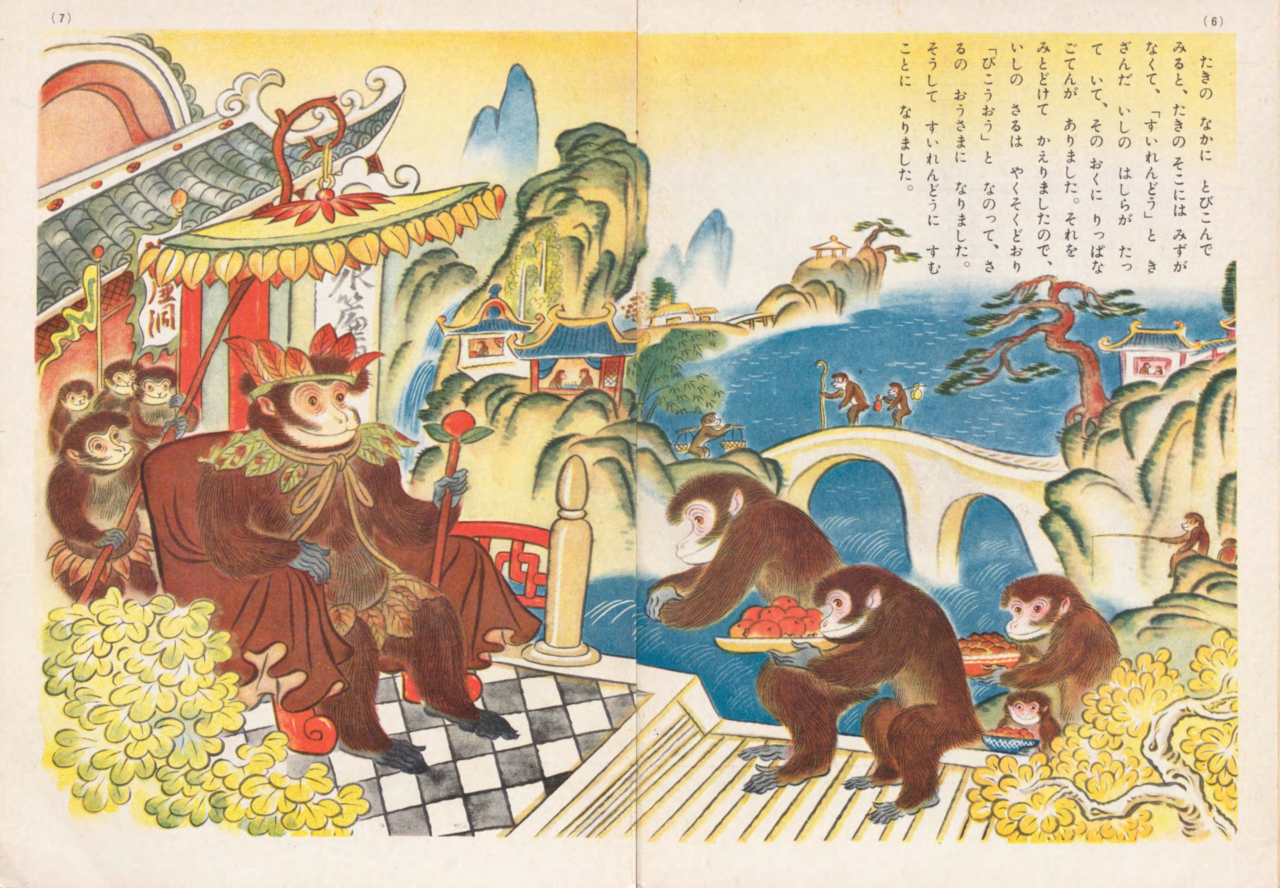
Each one of them [the primates] then lined up according to rank and age, and, bowing reverently, they intoned, “Long live our great king!” From that moment, the stone monkey ascended the throne of kingship [fig. 5]. He did away with the word “stone” in his name and assumed the title, Handsome Monkey King [Mei hou wang, 美猴王] [fig. 1] (Wu & Yu, 2012, p. 105).

In this article, I suggest Sun Wukong’s position as a primate monarch is based on “The Story of the Great Monkey” (Sk: Mahakapi jataka; Ch: Houwang bensheng, 猴王本生, “Birth Story of the Monkey King”; “The Great Monkey” hereafter), an ancient story about the Buddha’s past life as a monkey king, which appears in various collections of moralistic birth tales (Sk: jakata; Ch: bensheng jing, 本生經) in Buddhist literature. After summarizing the tale, I will briefly discuss 2,000-year-old Indian Buddhist art depicting the story at important religious sites, thereby showing its intense popularity. Next, I will demonstrate that the tale traveled the Silk Road to China, where it was represented in Buddhist art and literature. Finally, I will highlight similarities between “The Great Monkey” and a 13th-century precursor of Journey to the West, as well as similarities with the standard 1592 edition of the novel.

Fig. 5 – The Stone Monkey sits on his throne (larger version). From the Japanese children’s book Son Goku (1939).

1. Story of the Great Monkey

Buddhist literature contains different versions of the tale. I will describe two of them here. The first is story no. 27 in the Garland of Birth Stories (Sk: Jatakamala, 4th-century) by the monk Arya Sura. [1] The tale opens with the following epigraph: “Those who make a practice of good behavior can win over the hearts even of their enemies” (Khoroche, 1989, p. 186). According to the story, the bodhisattva was born a virtuous monkey king in the verdant paradise of the Himalayas, which abounded in fruits and flowers, crystal clear streams, and choirs of singing birds. He and his tribe lived near an unnamed river and ate from a mountainous banyan tree that produced figs larger than palmyra nuts. The monkey king feared that the fruit would cause trouble for his people, so he gave instructions to regularly clear them from a branch overlooking the river. However, one season a fig escaped the monkeys’ attention and it grew to maturation, dropping into the water, drifting downstream, and lodging in the fence of a pool where an unnamed human king played with his consorts. The smell and color of the fruit entranced the women, and after the king tasted it, he became obsessed with its flavor and led an army in search of the tree. The ruler and his entourage cut a path upstream and followed a sweet scent directly to the massive banyan, which rose high above all the surrounding trees like the lord of the forest. When he saw the monkeys eating figs, the enraged ruler ordered his men to shoot them down with arrows, spears, and rocks. Seeing the dire situation of his tribe, the monkey king made a tremendous leap to the summit of a nearby mountain, a feat that would have required any other monkey a series of jumps. On the mountain, he found a strong-rooted cane of the appropriate length needed to span the gap and tied it to his feet. But his return jump to the tree was hampered by the binding, and so he came up short, forcing him to grab a branch and use his body as a bridge so that his tribe could escape. But the monkey king was mortally wounded as throngs of the panicked primates clawed their way across his body to safety. The human king took note of this selfless deed and ordered his men to relieve the suspended monkey by placing a canopy beneath him and simultaneously shooting the branch and cane. After his wounds were tended and he regained consciousness, the monkey king spent the last few moments of his life teaching the human king the virtue of putting his people’s needs before his own (Khoroche, 1989, pp. 186-192).

The second is story no. 407 [2] in Commentary on the Birth Stories (Pali: Jatakatthakatha, a.k.a. Jatakatthavannana, 5th-century), which is attributed to the monk Buddhagosa. The narrative opens with the Enlightened One talking to a large assembly of monks in Jetavana. He tells them of a previous life when he helped his relatives. Here, the story is quite similar to the first, with slight differences in certain details, such as the monkey king leading a specified number of 80,000 primates, the river is the Ganges, the fruit is water pot-sized mangoes, the specimen that floats downstream is caught in a fisherman’s net, and the human ruler is named King Brahmadatta of Benares. [3] Instead of leaping to a nearby mountain, the monkey king jumps one hundred bow lengths across the Ganges. The cane is tied to his waste instead of his feet, and the cause of falling short on the return jump is not hindrance but miscalculating the length needed to span the gap. And instead of being seriously injured by his people during their escape, a rival of the king—a previous incarnation of the Buddha’s evil cousin Devadatta—mortally wounds his heart by jumping onto his back from a high branch. Brahmadatta instructs his men to build a tower so that he can retrieve the primate and tend to his wounds in his last few moments of life. And just like before, the monkey king teaches the human monarch the value of his people’s needs prior to dying. But this time the discussion is much shorter, being presented as a poem of seven stanzas. Brahmadatta then honors the monkey with funeral rites befitting a king and worships the skull as a religious relic. In the end, the Buddha reveals that the ruler was the past incarnation of his disciple Ananda, the 80,000 monkeys were incarnations of the assembled monks, and the monkey king was himself (Cowell, 1895, vol. 3, pp. 225-227).

2. The tale in Indian and Chinese Buddhist art

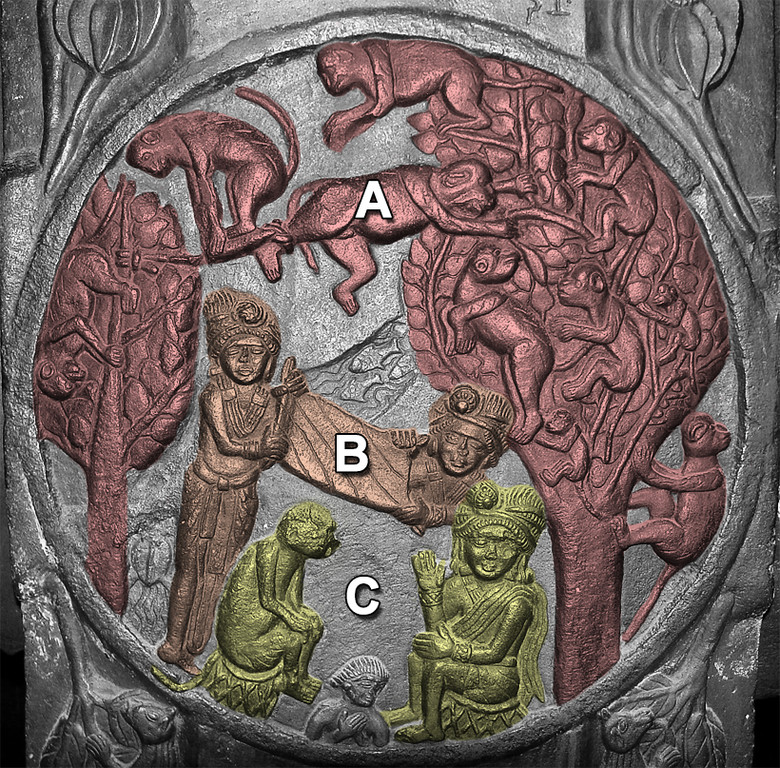
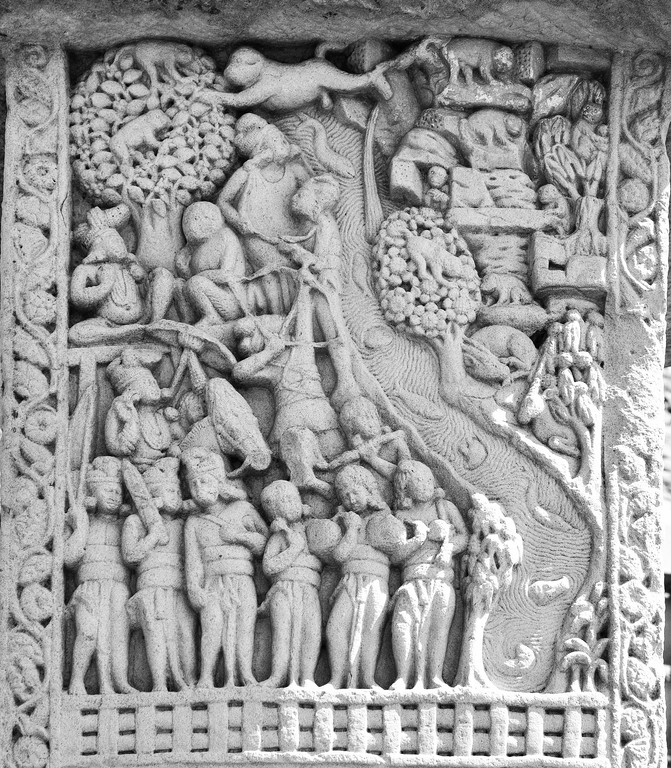
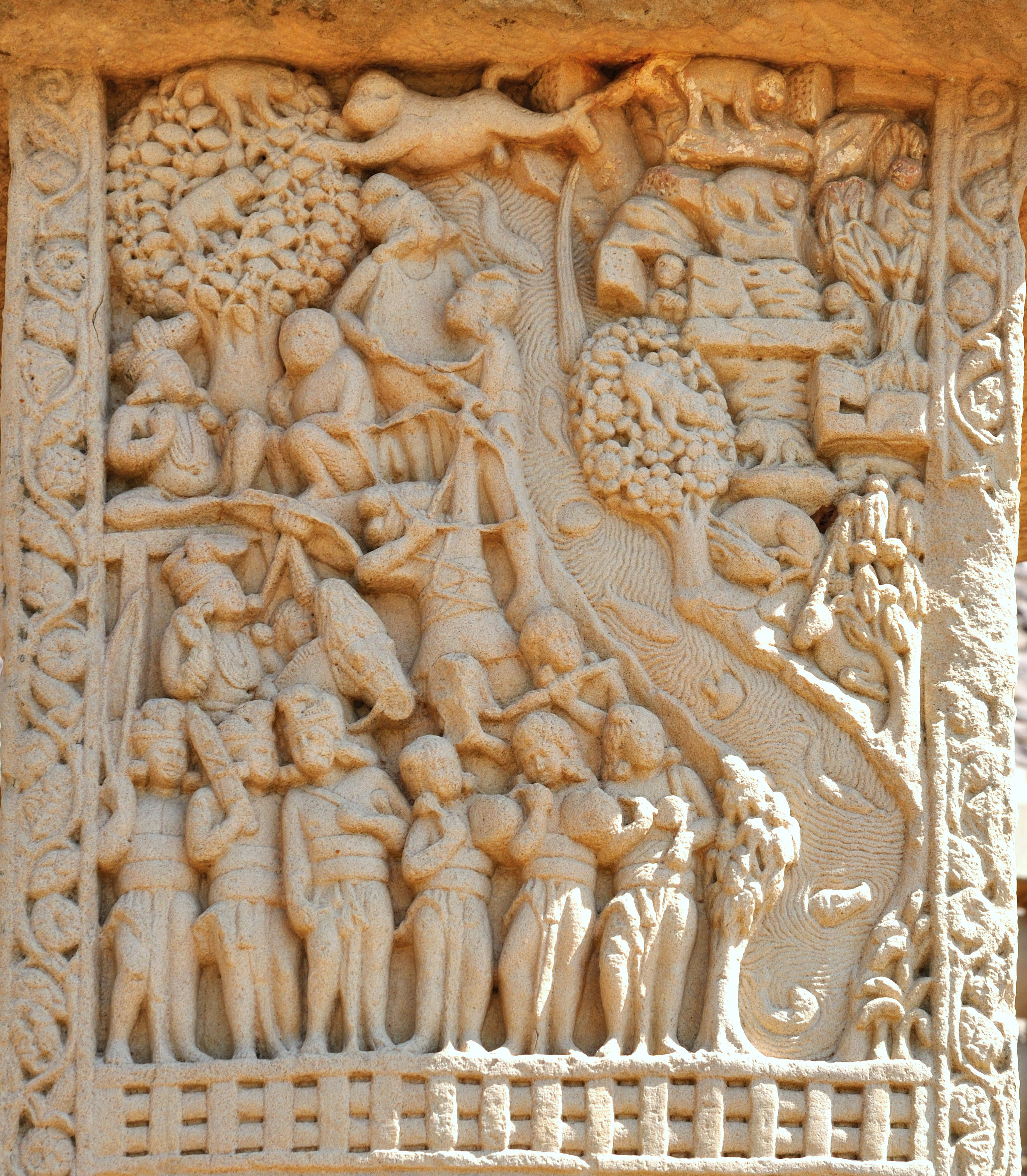
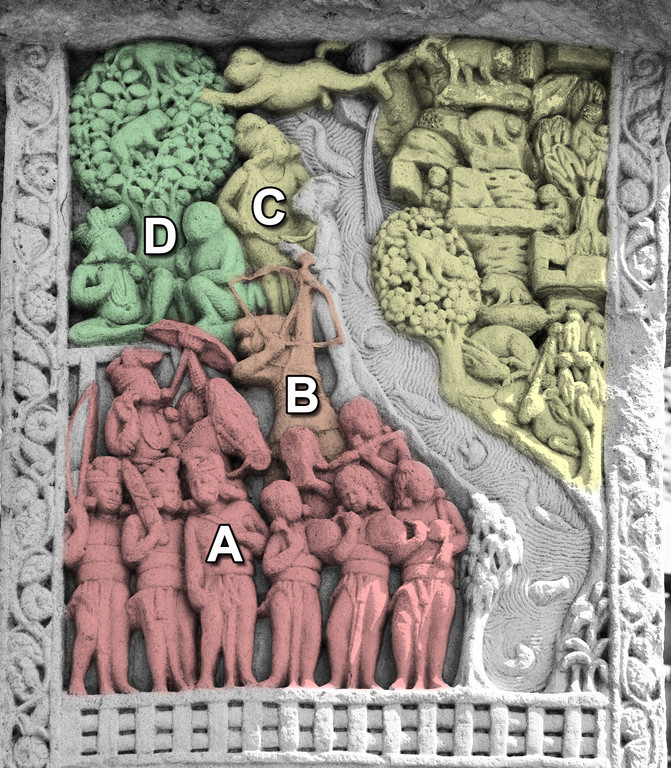
This birth story is over 2,000 years old as it appears among the stone carvings of the Bharhut Stupa (c. 2nd-century BCE) (fig. 2 and 3) and the western torana (c. 1st-century BCE/CE) of the Great Stupa at Sanchi (fig. 3 and 4) (Marshall, Foucher, Majumdar, 1902, vol. 1, pp. 224-225, vol. 2, plate 64). I should note that the story is one of 547 such tales appearing in the Pali canon (Buswell & Lopez, 2014, p. 381). So the fact that it was one of only a few past life narratives chosen to appear at these religious sites speaks volumes to its popularity. This explains why the story spread beyond India.

Fig. 2 – “The Great Monkey” medallion from Bharhut stupa (c. 2nd-century BCE) (larger version). Picture adapted from Wikipedia. Fig. 3 – Key: A) The monkey king leaps and grasps a banyan tree, making a bridge with his body; B) attendants hold a canopy to catch the injured monkey; and C) The human king sits with the monkey discussing the actions of a good ruler prior to the latter’s death (larger version). Fig. 4 – “The Great Monkey” carving from the western torana at Sanchi (c. 1st-century BCE/CE) (larger version). Picture adapted from Wikipedia. Fig. 5 – Key: A) Brahmadatta travels with a retinue to the tree; B) he orders his archer(s) to shoot the monkeys; C) He watches as the monkey king leaps across the Ganges and grasps a banyan tree to make a bridge with his body; and D) Brahmadatta’s discussion with the monkey king (larger version).

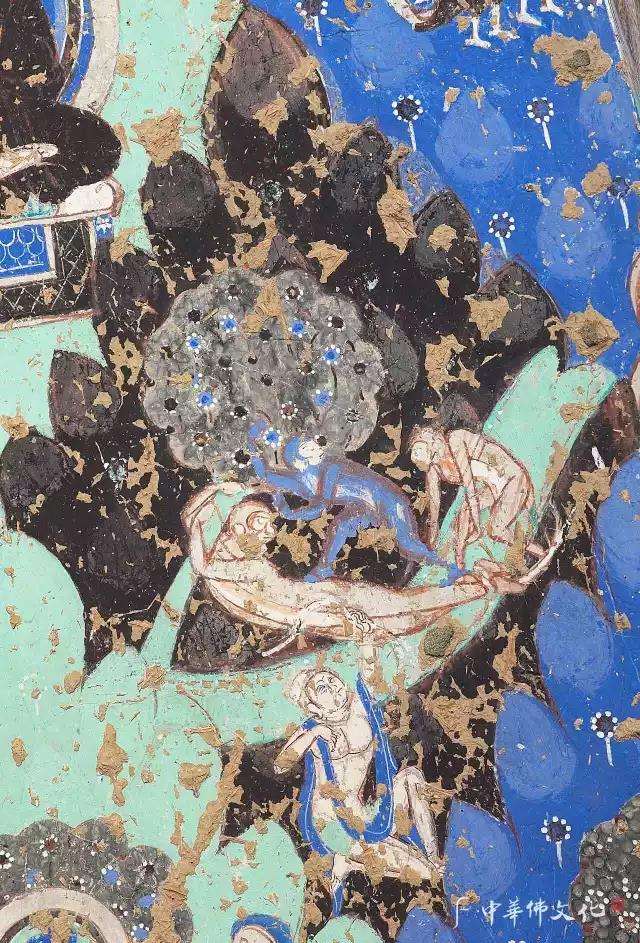
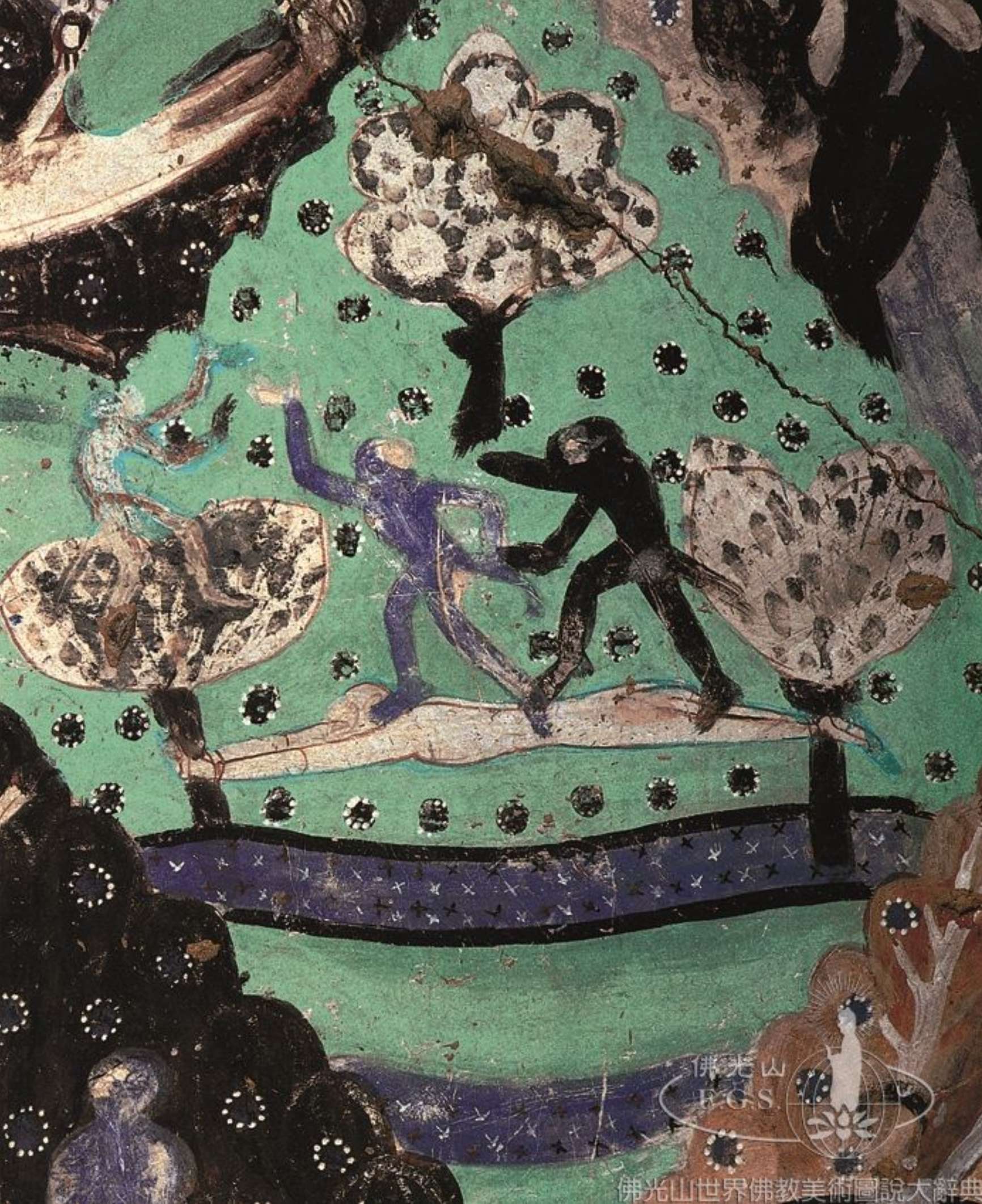
The tale is known to have traveled east to China along the northern silk road. This is demonstrated by murals appearing in the Kizil cave complex (5th to 7th-century), one of the earliest and most popular Buddhist centers in Kucha, in what is now Xinjiang, China. Zhu (2012) describes the murals, noting that they lack the detail of their Indian counterparts and are therefore more mnemonic than narrative:

[I]n Kizil Cave 38 [fig. 5], a very large monkey is depicted in the center, stretching his body and holding a tree on the other side of a river. Two other smaller monkeys are stepping on his body to cross the river. In the foreground, a kneeling archer is shooting at them. In Kizil Cave 17 [fig. 6] this story is represented even more simply, with the archer omitted. However the stretching monkey, the river, and the trees are enough for anyone who knows the story to recognize it […] Compared to the Indian representations that are more explicitly narrative, the Kizil paintings are more like a reminder of the story. They communicate with the viewers as if they already know the story well” (pp. 59-60).

Fig. 5 – The Kizil cave no. 38 mural (larger version). Found here. Fig. 6 – Kizil cave no. 17 mural (larger version). Found here. Both are circa 5th to 7th-century. Zhu, 2012, p. 61 includes black and white line drawings of the murals.

3. The tale in Chinese Buddhist literature

The Kizil murals are predated by a brief story appearing in The Collection of Sutras on the Six Paramitas (Liudu jijing, 六度集經, 3rd-century, The Collection hereafter), a compilation of karmic merit tales (Sk: avadana) translated into Chinese by the Sogdian Buddhist monk Kang Senghui (康僧會, d. 280). [4] The 56th story in this collection is an adaptation of the original Indian version with several noticeable differences: The Bodhisattva was formerly a monkey king (mihou wang, 獼猴王) who frolicked with 500 primates. At that time, a drought made the various kinds of fruit scarce. Only a river separated their mountain from a nearby kingdom, so the monkey king led his tribe to eat fruit in the royal garden. The human king ordered that they be secretly captured, but the monkey called for his tribe to gather cane to make a rope. One end was tied to a tree and the other to the king, who leaped from a branch across the river. Unfortunately, the rope wasn’t long enough, and so he came up short, forcing him to grab a branch on the other side and create a bridge with his body. After the 500 monkeys crossed to the other side, the king’s body split in two under the strain. When the human king came upon the scene, the dying primate begged that his tribe not be hurt and offered up his own flesh as payment for his bad judgment. However, the king admired the monkey’s superior, sage-like virtue and questioned his own willingness to sacrifice his body for his people. He then issued a proclamation that all monkeys were to be fed throughout the kingdom, and those who refused would be punished as thieves. Upon his return to the palace, the king recounted the events to his queen, touting the monkey’s kindness and comparing it to the height of Mt. Kunlun. She then suggested that the monkeys be fed and the king confirmed that he had already given the order. In the end, the Buddha revealed that the monkey king was himself, the human king was Ananda, and the 500 monkeys were the monks at the assembly (CBETA, 2016a). [5]

[Note: See the 05-17-22 update below for an explanation on why the number 500 was used.]

Instead of the original 80,000 monkeys, this version reduces the number to only 500. Instead of the king traveling to the banyan/mango tree in the monkey’s mountain territory, the monkeys travel from their home to the royal fruit garden in the king’s territory. Instead of being trampled by his people/a rival, the monkey king’s body breaks in two from the strain. And instead of giving the monkey royal funeral rights and worshiping his skull as a relic, the king enacts a law that all monkeys should be fed.

This version is different enough from the originals to suggest a separate Chinese tradition, one that had circulated for some time. This fits with Chavannes’ (1910) suggestion that The Collection of Sutras on the Six Paramitas is not an original Indian text but one compiled in China by Kang Senghui, who likely selected and edited the stories himself (vol. 1, p. 1 n. 1).

Story no. 56 finds parallels with another tale from Chinese Buddhist literature. [6] It appears in the Scripture on the Storehouse of Sundry Treasures (Za baozang jing, 雜寶藏經, mid-5th-century), which was translated into Chinese by the monk Tan Yao (曇曜). According to the 12th story in this collection: The Buddha was in Rajagrha when the monks commented on the woes faced by those who rely on Devadatta, while celebrating the happiness, positive rebirth, and eventual deliverance of those who rely on the Enlightened One. The Buddha confirmed this by telling a brief tale about two monkeys, each with 500 members in their tribe. A prince of Kashi (a.k.a. Benares) was on a hunting excursion when he surrounded the monkeys. The good monkey (shan mihou, 善獼猴) suggested that they cross the river to escape, but the evil monkey (e’mihou, 惡獼猴) wavered. The good monkey instructed his tribe to cross by using the long branches of a nearby tree. But the evil monkey and his tribe were captured due to inaction. In the end, the Buddha revealed that the good monkey was himself and Devadatta was the evil monkey. He used this story to advocate following the virtuous over the evil, for the former would lead others to safety and happiness, while the latter would lead others to suffering over numerous incarnations (CBETA, 2016b). [7]

This version does away with the fruit element altogether. The monkeys are in danger not because a king is protecting produce but because a prince is out hunting. The most noticeable difference here is the addition of a second monkey, one who is labeled as “evil” (e, 惡) (no connection to the Six-Eared Macaque). But like story no. 56, the monkey king is said to lead 500 primates.

It is clear that both Chinese tales were influenced by the later Indian version, story no. 407 from Commentary on the Birth Stories, as they specify a number for the troupe size (500 vs. 80,000), state the monkey king leaps over a river (as opposed to jumping to a nearby mountain top), and characters are revealed in the end to have been the past lives of Buddhist personages (the Buddha, Ananda, Devadatta, monks, etc.). Story no. 12 even opens in a city associated with the Enlightened One’s historical lectures (Rajagrha vs. Jetavana), where he discusses philosophical matters with monks; and an unnamed prince who poses a threat to the monkey king and his people is said to hail from Kashi, another name for Benares, the seat of King Brahmadatta.

4. The Chinese Monkey King

The oldest Chinese source mentioning Sun Wukong as a king of monkeys is The Story of How Tripitaka of the Great Tang Procures the Scriptures (Da Tang Sanzang qujing shihua, 大唐三藏取經詩話, late 13th-century, The Story hereafter), a 17 chapter storytelling prompt that predates the Ming Journey to the West by 300 years. In chapter two, our hero’s literary antecedent, a white-clad scholar called the “Monkey Pilgrim” (Hou xingzhe, 猴行者), meets the Tang monk Tripitaka on the road to the west and warns the monk that his two previous incarnations have died trying to procure the Buddhist scriptures. When asked how he knows events of the past, the scholar replies: “I am none other than the bronze-headed, iron-browed [8] king of the eighty-four thousand monkeys of the Purple Cloud Grotto on the Mountain of Flowers and Fruit. I have come to help the reverend monk procure the scriptures” (Wivell, 1994, p. 1182).

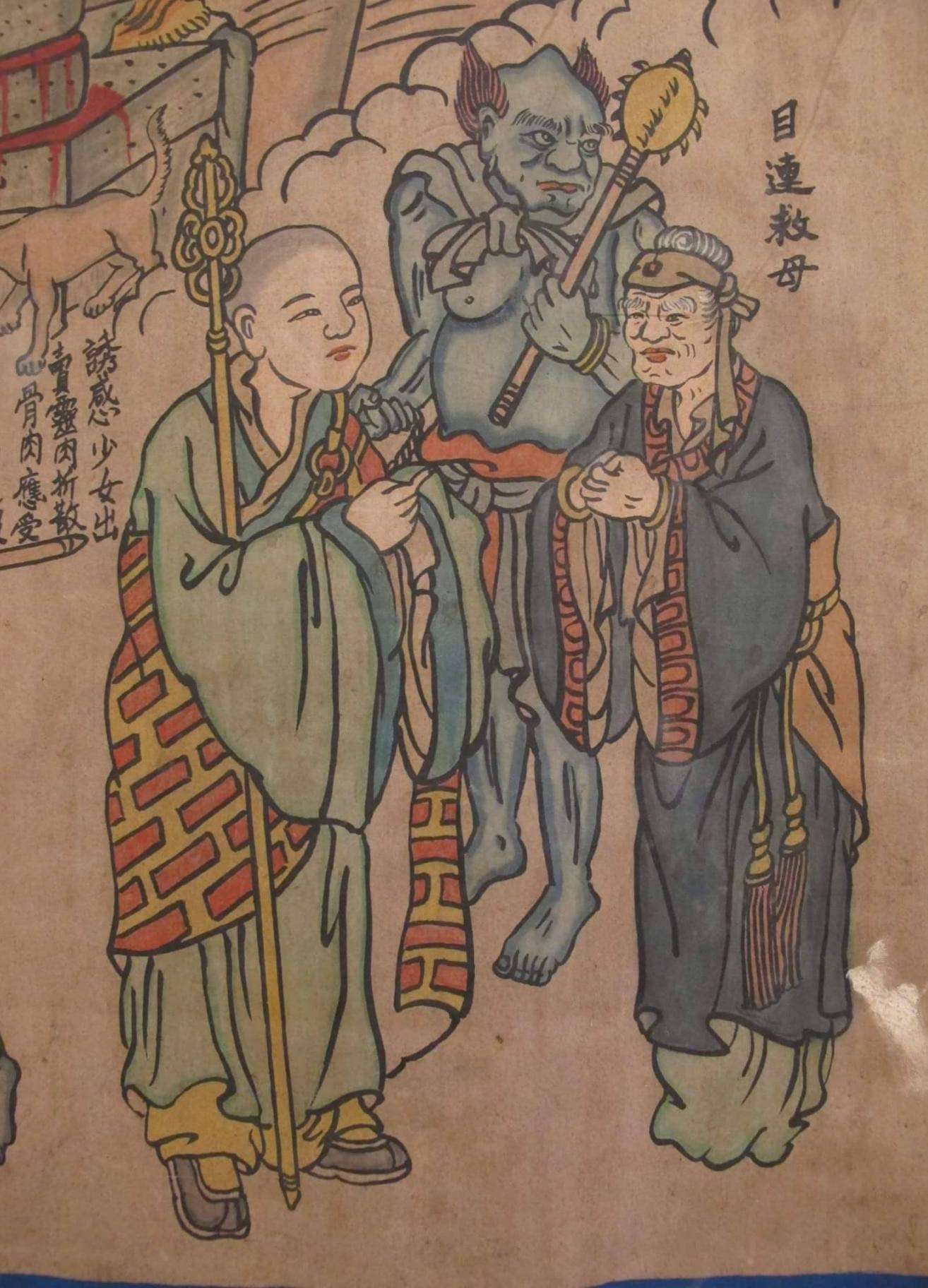
The Story‘s depiction of the Monkey Pilgrim was influenced by Saint Mulian (目連; Sk: Maudgalyayana) (fig. 7), a disciple of the Buddha, who appears in a late-9th to early-10th-century Bianwen (變文) text in which he travels to the underworld to release his mother from karmic torment. For example, both are depicted with occult powers enabling them to fly between heaven and earth (Wivell, 1994, pp. 1183; Mair, 1994, pp. 1097-1098); both visit a realm ruled by a deity named Brahma, the Mahabrahma devaraja Vaisravana in the case of Monkey and Brahma in the case of Mulian (Wivell, 1994, pp. 1183; Mair, 1994, p. 1098); both are bestowed magic weapons by heaven, a golden-ringed monk staff and alms bowl for Monkey and a matching staff for Mulian (he enchants his own alms bowl) (Wivell, 1994, p. 1184; Mair, 1994, p. 1111); the power of said weapons are tied to the recitation of a Buddhist deity’s name, Vaisravana and the Buddha, respectively (Wivell, 1994, p. 1184; Mair, 1994, p. 1111); and both use said weapons with the expressed purpose of saving someone important, Tripitaka and Mulian’s mother, respectively (Wivell, 1994, p. 1189, for example; Mair, 1994).

Mulian saves his mother, scroll - small

Fig. 7 – A painting depicting Mulian rescuing his mother from the underworld (larger version). Originally found here.

If The Story borrows from Mulian’s tale, it’s not a stretch to suggest that it also appropriated material from other Buddhist tales, including “The Great Monkey”. For example, the Mountain of Flowers and Fruit could be based on the Himalayas and the massive, fruit-bearing banyan/mango tree. Additionally, both The Story and the “The Great Monkey” describe the respective monkey kings leading a similar number of primates, 84,000 in the former and 80,000 in the latter. [9] While the Chinese variants drastically reduce the number to 500, it’s interesting that both tales would display such similar counts. This is because said numbers are significant to Buddhism. For example, 84,000 generally denotes a very large number, hence the belief that the body contains this many atoms. Other examples include the 84,000 stupas of Asoka, the 84,000 bodily relics of the Buddha, the Amitabha‘s 84,000 rays of illumination, the 84,000 bodily signs of a Buddha, the 84,000 teachings of the Buddha, etc. In addition, the Chinese term for 80,000 (bawan, 八萬) can be shorthand for 84,000. It can also refer to separate Buddhist concepts, such as the “bodhisattva’s 80,000 duties” (Soothill & Hodous, 1937/2006, p. 39). It’s certainly possible that both stories independently chose similar numbers due to their demonstrated connection to Buddhism. But maybe the storytellers who developed The Story had access to some non-Chinese version of the tale, perhaps by way of Buddhist monks, for Buddhism has a long history of proselytizing through oral literature. [10]

Furthermore, in chapter 11 of The Story, the pilgrims enter the earthly paradise of the Daoist goddess Queen Mother of the West, home to the famed peaches of immortality. Tripitaka asks Monkey to steal the group a few fruits, but the latter refuses, stating:

Because I stole ten peaches to eat when I was eight hundred years old, I was captured by the Queen Mother and given eight hundred blows on my left side and three thousand blows on the right with an iron cudgel. Then I was exiled to the Purple Cloud Grotto on the Mountain of Flowers and Fruits. Even today my sides hurt and now I definitely don’t dare to steal any more peaches!” (Wivell, 1994, p. 1195).

This event was surely influenced by the fabled meeting of Emperor Wu and the Queen mother, during which she reveals his jester Dongfang Shuo (東方朔), formerly the planet Jupiter (Sui, 歲), was exiled from heaven for stealing her peaches (Campany, 2009, p. 126). However, a monkey king running afoul of an earthbound monarch for raiding their imperial fruit garden mirrors story no. 56 in The Collection. As mentioned above, the tale recalls the Buddhist monkey king leading his tribe out of the mountains to eat fruit in a human sovereign’s garden during a time of drought. The ruler orders the primates captured, leading to the monkey king’s sacrifice. Therefore, this portion of The Story could be a combination of Buddhist and Daoist sources.

“The Great Monkey” could have also influenced the 1592 edition. In chapter one, the monkeys following the stream to find its source in the Mountain of Flowers and Fruit is reminiscent of the human king’s trek up the Ganges to find the source of the fruit in the Himalayas. Also, recall that the Indian and Chinese versions place great emphasis on the monkey king leaping over a river. For example, story no. 407 reads: “[H]e ascended a branch that rose up straight, went along another branch that stretched towards the Ganges, and springing from the end of it, he passed a hundred bow-lengths and lighted on a bush on the [other] bank” (Cowell, 1895, vol. 3, p. 226). This could have influenced the competition to leap through the waterfall. It’s interesting that Wukong alone is successful in the jump, leading to his kinghood:

The monkeys said to each other, “We don’t know where this water comes from. Since we have nothing to do today, let us follow the stream up to its source to have some fun.” With a shriek of joy, they dragged along males and females, calling out to brothers and sisters, and scrambled up the mountain alongside the stream. Reaching its source, they found a great waterfall.

[…]  

All the monkeys clapped their hands in acclaim: “Marvelous water! Marvelous water! So this waterfall is distantly connected with the stream at the base of the mountain, and flows directly out, even to the great ocean.” They said also, “If any of us had the ability to penetrate the curtain and find out where the water comes from without hurting himself, we would honor him as king.” They gave the call three times, when suddenly the stone monkey leaped out from the crowd. He answered the challenge with a loud voice, “I’ll go in! I’ll go in!” 

[…]

Look at him! He closed his eyes, crouched low, and with one leap he jumped straight through the waterfall (Wu & Yu, 2012, pp. 103-104).

This takes us back to where we started from in the introduction.

5. Conclusion

I suggest Sun Wukong’s position as the Monkey King is based on the “The Great Monkey”, a jataka tale about the Buddha’s past life as a primate monarch, which appears in various Indian Buddhist sources, such as the 4th-century Garland of Birth Stories (no. 27) and the 5th-century Commentary on the Birth Stories (no. 407). The tale describes the monkey king’s efforts to save his tribe from a human monarch who seeks to claim a massive banyan/mango tree in the Himalayas by killing all of the monkeys inhabiting it. After leaping to a mountain top or over the Ganges River to retrieve a length of cane needed to span the gap, his return jump is hindered, forcing him to make a bridge with his body. He is mortally wounded in the process, though, when throngs of clambering monkeys run across his back or a rival primate assaults him from a high branch. In the end, the human monarch takes note of this selfless act and learns from him the value of putting the needs of his people first moments prior to the monkey king’s death.

The popularity of the tale, as evidenced by 2,000-year-old Indian Buddhist art at the Bharhut and Sanchi stupas, explains why it spread beyond Bharata and traveled the Silk Road to the Middle Kingdom, where it was represented in Chinese Buddhist literature and art. Simplistic mnemonic depictions of the tale in Xinjiang’s Kizil Cave complex (no. 17 and 38) (5th to 7th-century) are predated by stories in the 3rd-century Collection of Sutras on the Six Paramitas (no. 56) and the mid-5th-century Scripture on the Storehouse of Sundry Treasures (no. 12). The first tells how the monkey king leads his people down from the mountain to raid an imperial fruit garden and ultimately sacrifices his life so the tribe can escape punishment. The second involves the decisions of two monkey kings, one good and one evil, whether or not to cross a river to escape capture at the hands of a prince on a hunting trip. It serves as a parable warning of the consequences of putting one’s faith in those of evil character.

The oldest Chinese source mentioning Sun Wukong as a king of monkeys is the late-13th-century tale The Story of How Tripitaka of the Great Tang Procures the Scriptures. This story borrows from the Mulian story cycle, so it’s possible that it selected from other Buddhist tales, including Indian and Chinese versions of the “The Great Monkey”. For example, the Mountain of Flowers and Fruit could be based on the Himalayas and the banyan/mango tree. The 84,000 primates led by the Chinese Monkey King could be based on the 80,000 from an Indian version. Likewise, Monkey stealing peaches from the Queen Mother of the West in chapter 11 could be based on the Chinese version in which the monkey king and his people raid an imperial fruit garden. In addition, the emphasis on leaping over a river in the various versions of “The Great Monkey” could have influenced the waterfall jumping contest in the standard 1592 edition of Journey to the West.


Update: 05-17-22

I’ve since learned that 500 is used in a similar manner to 84,000. Dhammika (2021) comments, “In Buddhist literature the conventional way of indicating a large number of things is to say that there were five hundred” (p. ix).

Notes:

1) Little is known about Arya Sura’s life. Based on various Indian and Chinese sources, the monk has been estimated to have lived somewhere between the 2nd to the 5th-century, with the 4th-century being the best guess (Khoroche, 1989, pp. xi-xiii).

2) This should not be confused with the similarly named Mahakapi jataka (no. 516). See Cowell, 1895, vol. 5, pp. 37-42.

3) This page (see #3) explains Brahmadatta is the name of several kings from jataka tales.

4) See Nattier, 2008, pp. 149-155 for more information about Kang Shenghui and his work, including the Liudu jijing.

5) See Chavannes, 1910, vol. 1, pp. 216-218 for a French translation of the story. Click here for an English translation by Edward P. Butler (@EPButler).

6) Thank you to Eric Greene of Yale University for bringing these stories to my attention.

7) See Tanyao, Kikkāya, & Liu, 1994, pp. 40-41 for a full English translation. As of 03-02-21, the book can be downloaded here for free. See Chavannes, 1910, vol. 3, p. 13 for a partial French translation.

8) According to Mair (1989), “‘Bronze-headed, iron-browed’ is a conventional Chinese epithet for boldness and bravery” (p. 701).

9) Interestingly, the number of primates led by Wukong in the final Ming edition of the novel is 47,000 (Wu & Yu, 2012, p. 133). I don’t know if this number holds any significance.

10) Mair (1988) explains Indian Buddhist prosimetric oral literature was very popular in China during the Tang but rapidly became secularized and Sinicized during Song (when The Story was published) due to past anti-Buddhist pogroms, Muslim incursions in Central Asia cutting off fresh Buddhist material, and the reemergence of Confucianism as a state power. But I suggest material that influenced The Story may predate this shift. For example, the Monkey Pilgrim appears with Xuanzang in an 11th-century (Western Xia) mural from Eastern Thousand Buddha Cave number two in the Hexi Corridor of Gansu Province (see this article). Xuanzang is shown worshiping Guanyin from a riverbank, while our hero stands behind him tending to a brown horse. The fact that Monkey appears in religious art at an important stop along the Silk Road shows his association with Xuanzang’s journey was well-known even during this early period. And since story cycles take time to form and become cemented in the public psyche, it’s not a stretch to suggest Monkey’s tale goes back to the previous century or even before the Song. Therefore, it’s possible that these earlier storytellers may have had access to some non-Chinese version of “The Great Monkey”.

Sources:

Campany, R. F. (2009). Making Transcendents: Ascetics and Social Memory in Early Medieval China. University of Hawaii Press.

Chavannes, E. (1910). Cinq Cents Contes et Apologues, Extraits du Tripitaka Chinois et Traduits en Français: Tome 1 [Five Hundred Tales and Apologues: Extracts from the Chinese Tripitaka Translated into French: Vol. 1]. Paris: E. Leroux.

Chinese Buddhist Electronic Text Association (Ed.). (2016a). T03n0152_006 六度集經 第6卷 [The Collection of Sutras on the Six Paramitās, scroll no. 6]. Retrieved from http://tripitaka.cbeta.org/T03n0152_006

Chinese Buddhist Electronic Text Association (Ed.). (2016b). T04n0203_002 雜寶藏經 第2卷 [Scripture on the Storehouse of Sundry Treasures, scroll no. 2]. Retrieved from http://tripitaka.cbeta.org/T04n0203_002

Cowell, E. B. (Ed.) (1895). The Jātaka, or Stories of the Buddha’s Former Births: Vol. 1-5. Cambridge: Cambridge University Press. Retrieved from https://archive.org/details/cu31924072231073/page/n249/mode/2up

Dhammika, S. (2021). Footprints in the Dust: The Life of the Buddha from the Most Ancient Sources. Singapore: Buddha Dhamma Mandala Society.

Khoroche, P. (Trans.). (1989). Once the Buddha Was a Monkey: Ārya śūra’s Jātakamālā. Chicago: University of Chicago Press.

Mair, V. H. (1988). The Buddhist Tradition of Prosimetric Oral Narrative in Chinese Literature. Oral Tradition, 3(1-2), 106-21. Retrieved from https://journal.oraltradition.org/wp-content/uploads/files/articles/3i-ii/6_mair.pdf

Mair, V. H. (1989). Suen Wu-kung = Hanumat? The Progress of a Scholarly Debate, in Proceedings of the Second International Conference on Sinology (pp. 659-752). Taipei: Academia Sinica.

Mair, V. H. (1994). Transformation text on Mahamaudgalyayana rescuing his mother from the underworld with pictures, one scroll, with preface In V. Mair (Ed.), The Columbia anthology of traditional Chinese literature (pp. 1094-1127). New York: Columbia University Press.

Marshall, J., Foucher, A., & Majumdar, N. G. (1902). The Monuments of Sāñchī: Vol. 1-3. Bhopal: Indra Publishing House.

Nattier, J. (2008). A Guide to the Earliest Chinese Buddhist Translations: Texts from the Eastern Han 東漢 and Three Kingdoms 三國 Periods. Tokyo: International Research Institute for Advanced Buddhology, Soka University.

Robert, E. B. J., & David, S. L. J. (2013). The Princeton Dictionary of Buddhism. Princeton University Press.

Soothill, W. E., & Hodous, L. (2006). A Dictionary of Chinese Buddhist Terms: With Sanskrit and English Equivalents and a Sanskrit-Pali Index. London: Routledge.  (Original work published 1937)

Tanyao, Kikkāya, & Liu, X. (1994). The Storehouse of Sundry Valuables (C. Willemen, Trans.). Berkeley, Calif: Numata Center for Buddhist Translation and Research.

Wivell, C.S. (1994). The Story of How the Monk Tripitaka of the Great Country of T’ang Brought Back the Sūtras. In V. Mair (Ed.), The Columbia Anthology of Traditional Chinese Literature (pp. 1181-1207). New York: Columbia University Press.

Wu, C., & Yu, A. C. (2012). The Journey to the West (Vol. 1) (Rev. ed.). Chicago, Illinois: University of Chicago Press.

Zhu, T. (2012). Reshaping the Jātaka Stories: from Jātakas to Avadānas and Praṇidhānas in Paintings at Kucha and Turfan. Buddhist Studies Review, 29(1), 57-83. Retrieved from https://journals.equinoxpub.com/index.php/BSR/article/view/14021/pdf

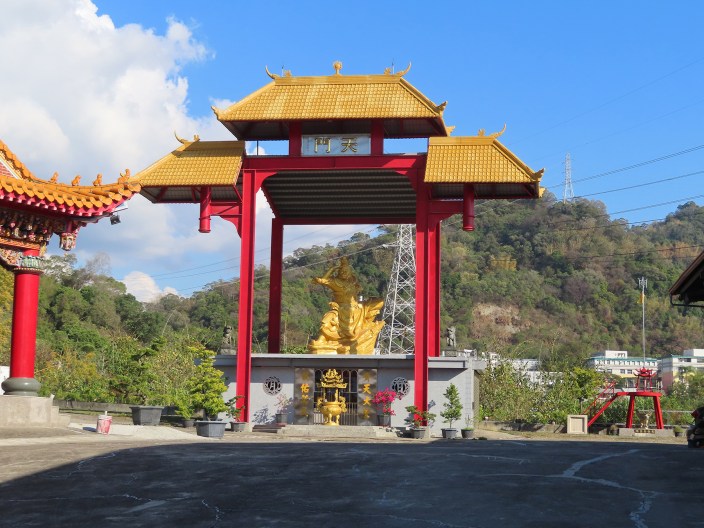
Qitian Dasheng Monkey King Temples in Taiwan

Last updated: 03-14-2021

Temple Count: 14

Did you know that Sun Wukong (孫悟空), the immortal monkey hero from the great Chinese classic Journey to the West (Xiyouji, 西遊記, 1592), has his own religion? He is mainly worshiped as the “Great Sage Equaling Heaven” (Qitian dasheng, 齊天大聖) in southern China, Taiwan, and Southeast Asian countries like Malaysia, Singapore, and even Thailand and Vietnam.

I recently returned from a trip exploring Great Sage temples in northern and central Taiwan. I’ve decided to mirror a former article by creating a list of Monkey King temples that I’ve visited on the island. This should not be considered comprehensive. I intend to update the article as I visit new locations. I will divide the list according to the closest city/municipality and provide the address if possible. If I’ve already written an article about a particular location, I will add a link to the name.

(Note: Make sure to call each temple ahead of time to learn about the best travel route. Google is not always the most accurate in regards to traveling on foot in the countryside.)

I. Jilong (Keelung)

1) Shengji Gong (聖濟宮) – 1949

Address: 202基隆市中正區中船路112巷30弄95號

I didn’t get any information about the temple during my visit as the caretaker appeared to be mute (or just didn’t want to talk to me). Online information states that the temple was built in 1949. Legend has it that the Great Sage saved villagers from rampant fires plaguing Keelung at the time. Like Yilan’s Wujian Ziyu Temple (see below), Shengji’s Great Sage and his army of monkey soldiers are portrayed as martial monks (wuseng, 武僧) with a golden headband and long hair. The alcove housing his statue is called the Shuilian Grotto-Heaven (Shuilian dongtian, 水濓洞天) after Monkey’s home the “Water Curtain Cave” (Shuilian dong, 水簾洞) on the Mountain of Flowers and Fruit. He is flanked on his left and right by Shennong (神農) and Kai Zhang Shengwang (開漳聖王), respectively

Pictures:

https://drive.google.com/drive/folders/0Bwi3jyIV3-OhflAzUy1vSHp2aC0wTExPbjRMV2FzX1pzZWlyd3RHM0hJYWpJc3B2RlM3Ykk?resourcekey=0-twvNaHcJLHXWU4JH05PtUg&usp=drive_link

2) Qitian Dasheng Miao (齊天大聖廟) – Unknown

Address: 203基隆市中山區中山二路89巷31號

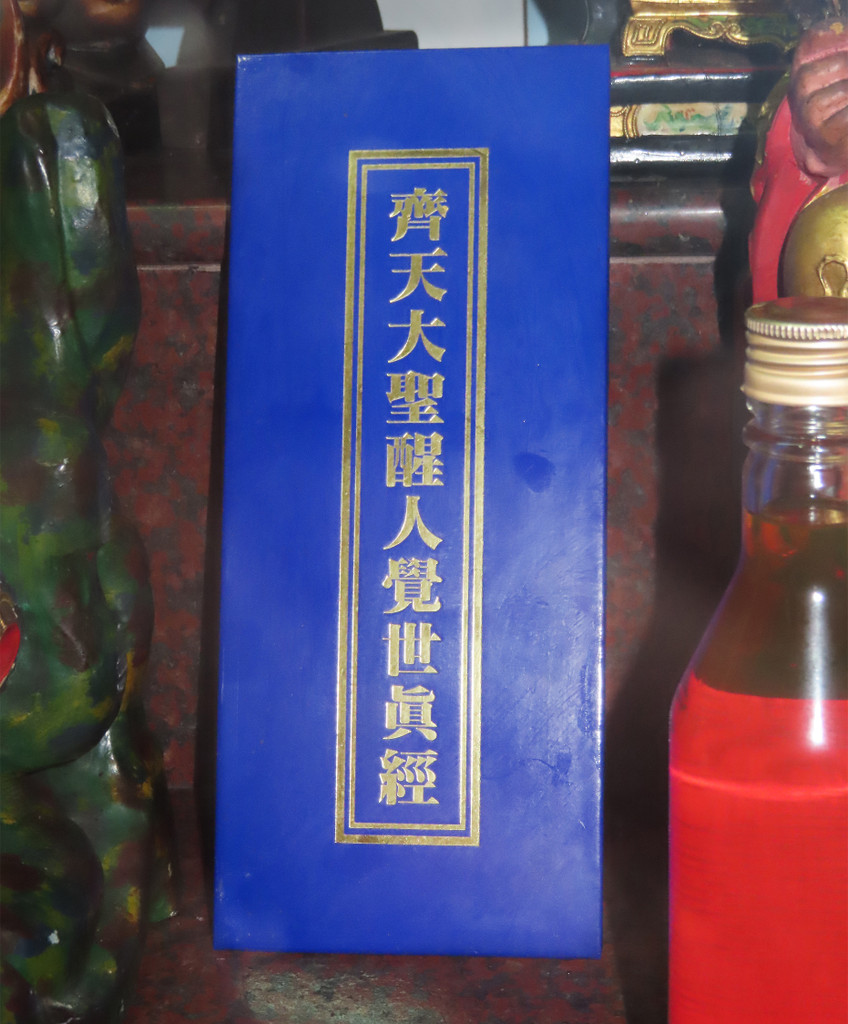
No caretakers were present at the time of my visit, so I was unable to ask questions about history or names. All statues were locked inside of a glass display case, along with a blue booklet that caught my eye. It was titled The Great Sage Equaling Heaven’s True Scripture of Awakening People and Enlightening the World (Qitian Dasheng xingren jueshi zhenjing, 齊天大聖醒人覺世眞經). Like in Shengji and Wujian Ziyu Temples, the Great Sage and his monkey army are depicted as martial monks. Also like Shengji, he is flanked, this time on his left, by Kai Zhang Shengwang. He is flanked on his right by Fude Zhengshen (福德正神).

Pictures:

https://drive.google.com/drive/folders/0Bwi3jyIV3-OhflJtdTZya3lrY01HZVFfTmpIYlRpaF8yNHlTTFdCeUtnRlY3WE9kQzVjODA?resourcekey=0-D67c2xakNujE-s67mqVckA&usp=sharing

II. Taipei

1) Shilin Zheng’an Gong (士林正安宮) – circa 1990

Address: 111台北市士林區士東路2巷5號

The Zheng’an Temple of Shilin [1] is definitely the smallest Great Sage house of worship that I’ve yet visited. It appears to be a small, open-front store/apartment unit that has been converted into a temple. It recognizes at least seven Great Sages, each with his own name and purpose. I’m still gathering information on the temple, so I will post their names at a later date. While most such temples have one or two spirit-mediums, Zheng’an has an astounding seven, each of whom reports to a respective Great Sage. During special occasions, the spirit-mediums perform self-mortification with swords, axes, swordfish noses, spiked clubs, and spiked balls.

I had the pleasure of joining the temple on a pilgrimage to the south of Taiwan back in November of 2020. I was even blessed with the opportunity to help carry the Third Prince’s palanquin, which led the way for a much larger vehicle containing Zheng’an’s numerous Great Sage statues. I’ll write more about this in the future.

Pictures:

https://drive.google.com/drive/folders/0Bwi3jyIV3-OhfkY1VDdRUkNfMFdzTlgzdWZvUW5IZTNfN2NJMmdhRzFocmdaMWJmYWQ5Tjg?resourcekey=0-vTwI3jOGf6nQgFCwiL5Wlg&usp=sharing

2) Shuilian Gong (水濂宮) – Unknown

Address: 108台北市萬華區環河南路一段344號

The temple attendants were unable to give me any history on the temple. But I did learn that they worship a trinity: “Great Sage Sun” (Sun Dasheng, 孫大聖), the large central figure (image 1 (27)); the “Black Great Sage” (Hei Dasheng, 黑大聖), the small figure holding the gourd and whip (image 1 (34)); and the “White Great Sage” (Bai Dasheng, 白大聖), the small figure shielding his eyes and holding a staff (image 1 (42)). These color-coded names remind me of the red, white, and black-faced Great Sages from Fujian, the original home of Monkey’s religion. The temple houses many monkey god statues apart from the trinity, likely soldiers. I’ll return to get more info and better pictures. The soot black figures and bright clothing make it hard to get detailed photos.

Pictures:

https://drive.google.com/drive/folders/0Bwi3jyIV3-OhfkNJNlVLaXhUdW5idGMzaElNbjZDNU0xSFM3TVhUdkpZeFBvbGJMZEpsLUE?resourcekey=0-uTyI6aTdwRlh72AJb1z59A&usp=drive_link

III. Xinbei (New Taipei)

1) Qitian Dasheng Dian (齊天大聖殿) – circa 2000

Address: 249新北市八里區渡船頭路9號

I was told by the temple’s ritual master that she received a religious vision from the Great Sage to move from Gaoxiong in the south and look for land with good fengshui for a temple. After her third move, she founded her temple in the mountainous region of Bali. While the temple has several monkey statues, each is considered a different aspect of the singular “Lord Great Sage” (Dasheng ye, 大聖爺) or “Great Sage Patriarch” (Dasheng zushi, 大聖祖師).

The area behind the temple features a garden with a colorful, life-sized statue of the Great Sage seated on a throne. He holds a peach of immortality in one hand and his staff in the other. His throne rests on an elevated rock outcropping painted with the characters for the “Mountain of Flowers and Fruit” (Huaguo shan, 花菓山). A series of concrete steps laid within the folds of the rocks takes you to a private heaven further into the mountain with flowers and guava, papaya, banana, and tangerine crops. It’s a great experience.

Be forewarned: The route that Google told me to walk from the bus stop was NOT reliable. My GPS took me through a neglected cemetery up the side of a mountain. I had to cut a path through the forest, jump streams, and climb rocks before I finally arrived all sweaty and dirty. The temple personnel were amazed that I made such a trip because the route was completely unnecessary. They told me of a road leading directly to the temple! Apparently my GPS showed me the most direct route instead of the slightly longer, yet far more practical one. I highly suggest walking from the foot of Duchuantou Rd. (渡船頭路) and following the signs to the temple.

On the bright side, the caretakers were so thrilled to learn of my great interest in their god that they treated me to tea, fruit, and snacks. They are very welcoming people.  

Pictures:

https://drive.google.com/drive/folders/0Bwi3jyIV3-OhfnN2amU5WmtzSEg1akt4UXRyaEYxSVB0ei00Nk84VHJDbk1TZ2o5WThleVU?resourcekey=0-E3rHR884MaSFmXdBuizoiQ&usp=sharing

2) Banqiao Yunsheng Gong (板橋雲聖宮) – Unknown

Address: 220新北市板橋區富山街84號

This temple was closed when I visited. I had to shoot pictures through two sliding glass doors. It is very small, possibly as small or even smaller than Zheng’an Temple in Taipei.

Pictures:

https://drive.google.com/drive/folders/0Bwi3jyIV3-Ohfk90MC1wUnRXQzhlWGVUNjdwTzB0T1NQc285MXF4cmFHVUc5VHlrWUFuOFE?resourcekey=0-7E48uhiHgEPXaihd35mbAg&usp=sharing

3) Qitian Dasheng Miao (齊天大聖廟) or Qitian Dasheng Ye Miao (齊天大聖爺廟) – Unknown, possibly new

Address: 238新北市樹林區佳園路一段41巷6號

The caretaker told me that the temple had not yet been consecrated and therefore wouldn’t let me take any pictures inside. However, a Chinese comment on Google says the temple “isn’t open to the outside world”, suggesting that it’s closed to the public. Based on what little I could see, the building unit appears to be someone’s home/business/personal altar. Rows and rows of god statues packaged for sale lined shelves against a back wall.

IV. Yilan

1) Wujian Ziyu Si (五間紫雲寺) – 1960

Address: 263宜蘭縣壯圍鄉大福路三段449號

Legend has it that around 1899 a man found a monkey-shaped stone and enshrined it in a thatched shed. This was eventually converted to a temple a few years later. It was destroyed by a typhoon in 1960 but subsequently rebuilt. The temple appears to recognize a trinity, with countless monkey soldiers beneath them, each portrayed as martial monks with a golden fillet and long hair. The Great Sage has two aspects: the “Martial Great Sage” (Wu Dasheng, 武大聖) (standing statues), who exorcises evil, and the “Civil Great Sage” (Wen Dasheng, 文大聖) (seated statues), who insures the safety of people and animals.

Pictures:

https://drive.google.com/drive/folders/0Bwi3jyIV3-OhfjlJSVc4QkVlSHRGYXR6OC13MDhuczdIVUsxTV9rcUxjMnZBQUFsMGFGbUk?resourcekey=0-X_tibNKz6SnI5YesVR_G1w&usp=sharing

V. Xinzhu (Hsinchu)

1) Shenglong Gong (聖龍宮) – 2016

Address: 310新竹縣竹東鎮中豐路三段187號

This temple is famous for its nine-meter-tall (29.52 ft.) statue of the Great Sage, which is apparently the tallest in Taiwan. I was told that it was shipped from Fuzhou, Fujian Province, China. The members appear to only revere a single monkey god, whom they call the “Buddha Great Sage Equaling Heaven” (Qitian Dasheng Foye, 齊天大聖佛爺). The smaller statue in front of the taller one was the original focus of worship at a devotee’s home prior to the building of the temple.

Pictures:

https://drive.google.com/drive/folders/0Bwi3jyIV3-OhfnNvdkJlTEdjZnFHVDRFZGxGNm1HRG1kNU10cWl6Vm1ubEdBTnVaSjJ1U1E?resourcekey=0-w6nIRnUrmb-cjOOSBuKiWQ&usp=drive_link

VI. Taizhong (Taichung)

1) Yusheng Si (玉聖寺) – 1959

Address: 436台中市清水區頂湳路73號 

Records for the original temple apparently go back to the Xianfeng (1850-1861) period. According to legend, Yusheng was built at the behest of a beggar who revealed himself to be the Great Sage. The current house of worship was built in 1959. The members appear to recognize at least five Great Sages (maybe more). I was told that they don’t have individual names; though, the members may have been apprehensive to share secrets with a random foreigner. They just refer to them as “Lord Great Sage Equaling Heaven” (Qitian Dasheng Ye, 齊天大聖爺). One figure has a painted face similar to pestilence gods (wenshen, 瘟神). Perhaps this version of the Great Sage serves a similar purpose. It’s interesting to note that several statues are shown holding spiked balls like those used by spirit-mediums.

Pictures:

https://drive.google.com/drive/folders/0Bwi3jyIV3-OhfkpzTnI3YkU0LTh3N3ZYVDAzZWJwa1IwRF9LTUxtT3FhUGZaNjN6ejAxWGM?resourcekey=0-GUurvR7ZOmGtYI47Fm6fvA&usp=sharing

2) Wuji Tianyi Jiancha Gong Tiantan (無極天壹監察宮天壇) – Unknown

Address: 406台中市北屯區太原路三段1398號 (see below)

This temple was closed when I visited. I had to shoot pictures of their lovely statue over the gate. I’m guessing it’s four to five-meters-tall based on the ding censor in front. I plan to go back at a later time to get pictures of the temple interior.

I did see a black command flag (Hokkien: or leng ki; Ch: hei leng qi, 黑令旗) out front, which signifies that a spirit-medium is active in the temple.

Update: 04-24-21 – I was informed that this location is only used for particular festival days. The main temple is located at 404台中市北區富強街117巷17號.

Pictures:

https://drive.google.com/drive/folders/0Bwi3jyIV3-OhfjMtSE1oVU1Wd2pWZGpWWE94X09TZ3hjSXBPV0dlSGY5cEctYkI4TkJzbk0?resourcekey=0-uLDycsBAupb0qe1Lup7JgA&usp=sharing

VII. Beigang, Yunlin

1) Shengfo Tang (聖佛堂) – Unknown

Address: 651雲林縣北港鎮文化路198-1號

No attendants were present when I visited, so I couldn’t ask any questions about history or beliefs. The small temple appears to recognize three Great Sages, each represented with golden eyes. The larger central figure is depicted as a martial monk with long hair, while those to his left and right have animalistic, furry faces. Interestingly, the main statue is immediately flanked on both sides by a single wooden pole topped by a black or red Great Sage bag puppet, each depicted as a martial monk. A paper fan and two framed ink on paper paintings indicate the monkey god is referred to as the “Fighting Sage Buddha” (Douzhan sheng fo, 鬥戰聖佛). This is a variant of the deity’s lesser used title, the “Victorious Fighting Buddha” (Dou zhansheng fo, 鬥戰勝佛).

The main altar is flanked on the right by various Buddhist deities and on the left by Daoist gods.

The front of the building is adorned with two Great Sage spirit generals (shenjiang, 神將) [2], something I’ve never before seen but have heard of; as well as a large black command flag, indicating the presence of a tangki spirit-medium. A large, ornate spiked ball, like those used by mediums, was positioned on the offerings table between statues of San Taizi and bottles of rice wine.

The temple is located down the street from a small joss stick factory. It was interesting to see brightly-colored bundles and rolling trays of the sticks being aired out to dry.

Pictures:

https://drive.google.com/drive/folders/0Bwi3jyIV3-OhfjZfb2hpeDNMUnBqX3ZxemRtbDdSMl9tQnpfanlqY3Y1MGJrVi1OOVQ0bzg?resourcekey=0-AK1FYcermkK3wr44y8VntQ&usp=drive_linkhttps://drive.google.com/drive/folders/1qAIvC31izqKt49tTyQYSjxIOPx7T8P7D?usp=sharing

VIII. Chiayi (Jiayi)

1) Jisheng Gong (吉聖宮) – 1979

Address: 嘉義市林森東路691巷139弄65號

While an attendant with a thick Taiwanese accent told me the temple was “very, very old”, online information indicates that it was founded in 1979. Legend has it that Lord Guan sent the Great Sage to heal the head injury of a member of the Li (李) family, leading to their worship of the monkey god. (This suggests Lord Guan is considered a superior of the Great Sage in Jisheng’s celestial hierarchy). The current Great Sage statue is apparently based on an original one that presided over the incense pot at a Lord Guan temple and was later kept in the Li family home. It sits in a man-made cave, along with other monkey figures and Buddho-Daoist gods, behind metal bars. It holds a banana leaf fan like that wielded by Lady Ironfan.

A large metal rod, a replica of the monkey god’s magic staff, is locked to a side wall when not in use by the temple’s spirit-medium. It is plastered with a paper talisman.

A hall to the right of the temple houses several spirit general costumes of various protector deities.

Pictures

https://drive.google.com/drive/folders/0Bwi3jyIV3-Ohfm5xaUF6WFU5TTZiTF90TkJVazBjbVNQaTJ6WXhhZHFkRkVNMElCWXZTblk?resourcekey=0-cUuC4t9sK9S4kBaUBYLDlA&usp=sharing

IX. Tainan

1) Wanfu An (萬福庵) – 1660s

Address: 700台南市中西區民族路二段317巷5號

Wanfu is touted as the oldest Qitian Dasheng temple on the island, originally serving as the home of an anti-Qing general’s wife during the Southern Ming (c. 1660s), which was later converted to a house of worship following her death. It was known for taking in orphans during the early-19th-century. The temple recognizes a trinity of Great Sages, followed by a small handful in administrative positions, and finally a plethora of soldier monkeys. The highest-ranking member of the trinity is a 300-plus-year-old Fujianese stone statue called “Laying the Foundations Elder Great Sage” (Kaiji Da Dasheng, 開基大大聖). The temple has a single spirit-medium. But the last time I checked, he was training a disciple, his nephew.

Great Sage temples from all over Taiwan look upon Wanfu as a fount of pure energy, visiting every year to procure its incense ashes in order to replenish their spiritual armies. Spirit-mediums are thought to direct these soldiers in battle while possessed by the monkey god. I personally witnessed this ash ceremony during the Shilin Zheng’an Temple pilgrimage (as noted earlier). I saw at least three other temples waiting for their turn. I’m sure many more visited that day and the next.

Pictures:

https://drive.google.com/drive/folders/0Bwi3jyIV3-OhfldvbDFFdmlrWHNWNnFNeUhEY1hhTEhYaVdiUnRxS3VBZ2UtRDRwSkVTbms?resourcekey=0-NsUQkYFLqs_gC9-5onWgAw&usp=sharing

Notes:

1) Not to be confused with other Zheng’an Temples in Taiwan.

2) Large, bulky costumes that rest on a performer’s shoulders. They see out through holes in the chest. Such costumes are worn during religious processions, and the walking movement causes hinged arms to swing to and fro.

Archive #21 – Qing-Period Color-Illustrated Complete Edition of Journey to the West

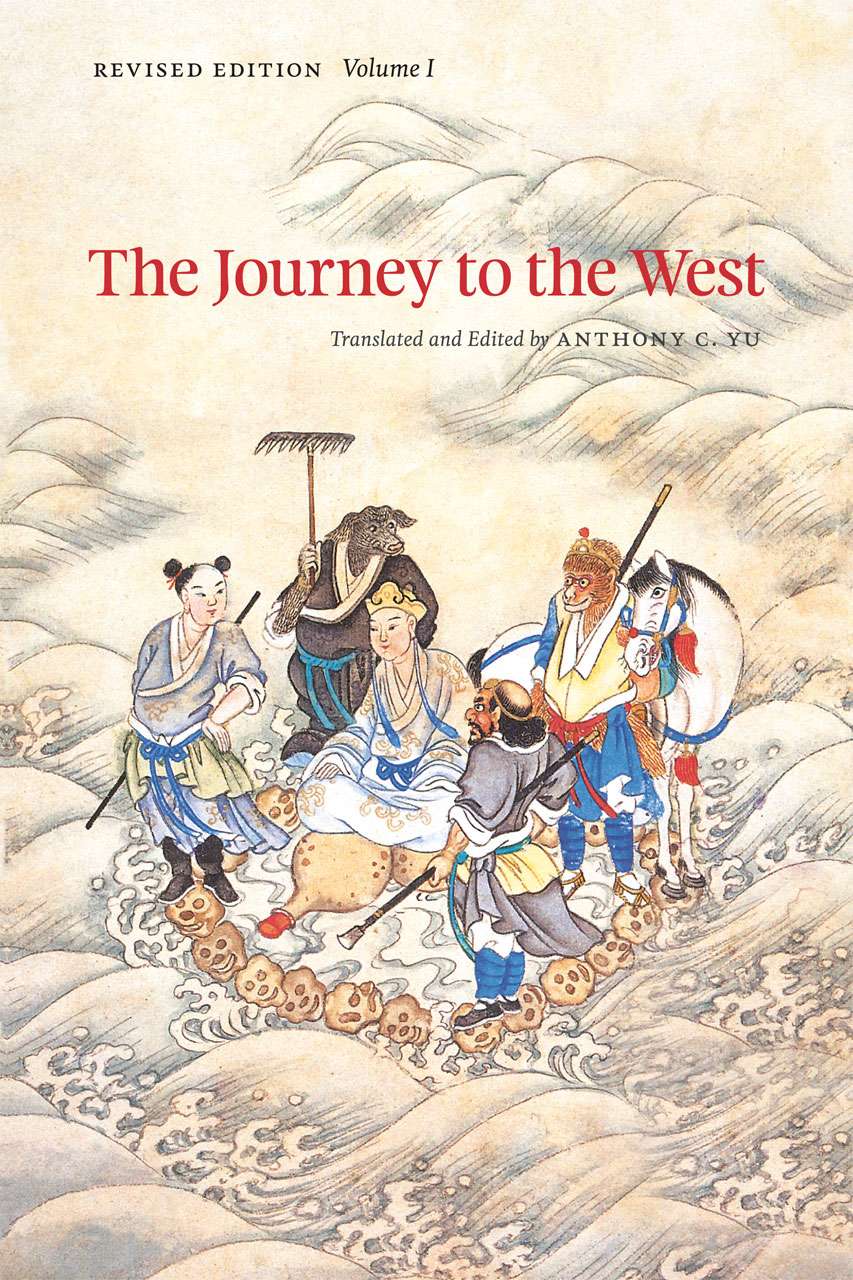
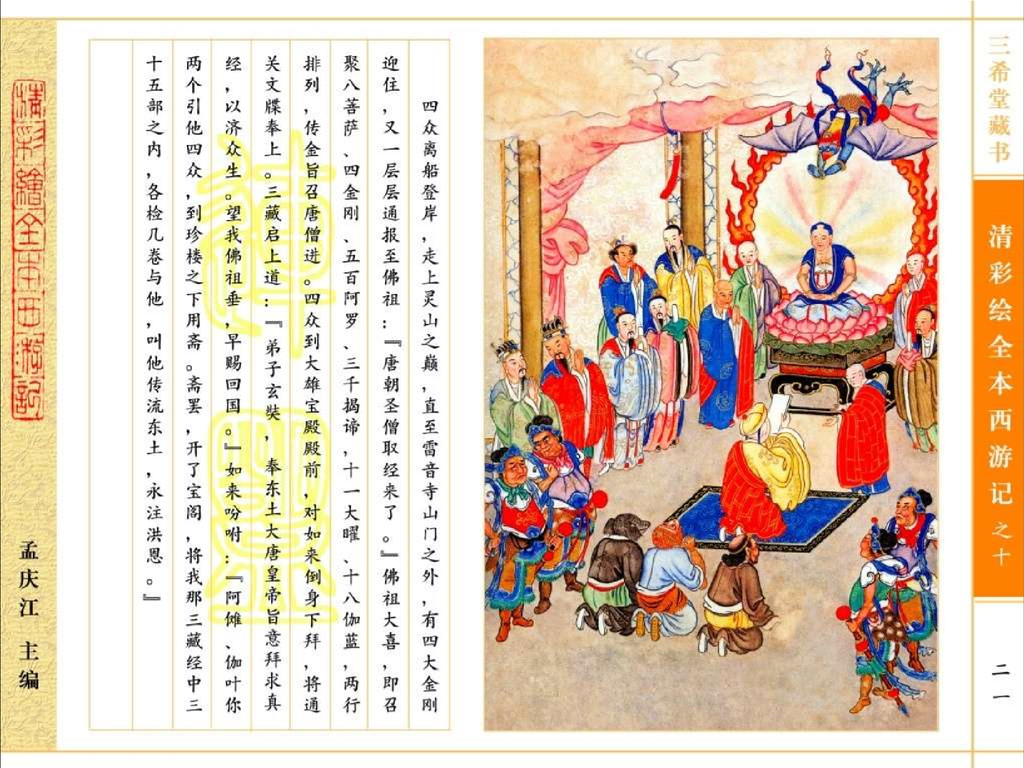
Upon the initial release, I was entranced by the cover art for the 2012 revised edition of Anthony C. Yu’s famed Journey to the West translation. For example, the cover for volume one (fig. 1) featured the pilgrims crossing the Flowing-Sands River via a boat made from Sha Wujing‘s skull necklace and a heaven-sent gourd. I loved the individuality and color scheme of each figure. They look almost like characters from a comic book. Though the art style was old, I assumed the bright, vibrant colors signaled the illustration was a modern reproduction. This was not the case. I later learned that the art was made by an anonymous painter of the Qing Dynasty (1644-1911). The paintings from this series were later gathered into an abridged ten-volume set titled Qing-Period Color-Illustrated Complete Edition of Journey to the West (Qing caihui quanben Xiyouji, 清彩繪全本西遊記, 2008). Here I present lower res PDFs of this work, complete with the gorgeous artwork. Each page is formatted with simplified Chinese dialogue on the left side and art on the right (fig. 2).

Fig. 1 – The cover of volume one (larger version). Fig. 2 – An example of the page format (larger version). It portrays the pilgrims finally coming before the Buddha in India. The formerly subjugated “Peng of 10,000 Cloudy Miles” (i.e. Garuda) can be seen hovering above the Enlightened One’s throne.

Book links

Disclaimer

These have been posted for educational purposes. No malicious copyright infringement is intended. Please support the official release.

Citation

Ming, Q. (Ed.). (2008). Qing caihui quanben Xiyouji [Qing-Period Color-Illustrated Complete Edition of Journey to the West]. Beijing: Zhongguo shudian.

The Magic Powers of the Monkey King’s Iron Staff

Last updated: 07-04-2021

I’ve written several articles on Sun Wukong’s iron staff, including its origin from religious and martial staves used by historical Buddhist monks, the meaning of its inscription (“‘As-You-Will’ Gold-Banded Cudgel. Weight: 17,560 lbs” (7,965 kg)), the real world metal that it is made from, its ties to Yu the Great and flood control, its ties to the Buddhist Saint Mulian, its possible ties to a Hindu monument, and modern day misconceptions about its ability to weigh down the entire Milky Way galaxy. Now, I’d like to briefly survey the magic powers associated with this weapon. This will by no means be exhaustive.

I. Powers

A. Size Manipulation

Sun travels to the Eastern Sea Dragon King’s underwater kingdom in ch. 3 to acquire a celestial weapon. But when the immortal fails to find a suitably heavy armament, the Dragon Queen suggests that they give him a black iron pillar from their treasury. It is described as over 20 feet (6.096 m) in height and the width of a barrel. Only when Monkey lifts the pillar and suggests a smaller size would be more manageable does it comply with his wishes:

Wukong girded up his clothes and went forward to touch it: it was an iron rod more than twenty feet long and as thick as a barrel. Using all his might, he lifted it with both hands, saying, “It’s a little too long and too thick. It would be more serviceable if it were somewhat shorter and thinner.” Hardly had he finished speaking when the treasure shrunk a few feet in length and became a layer thinner. “Smaller still would be even better,” said Wukong, giving it another bounce in his hands. Again the treasure became smaller. Highly pleased, Wukong took it out of the ocean treasury to examine it. He found a golden hoop at each end, with solid black iron in between. Immediately adjacent to one of the hoops was the inscription, “The ‘As-You-Wish’ Gold-Banded Cudgel. Weight: 17,560 lbs. [Ruyi jingu bang zhong yiwan sanqian wubai jin, 如意金箍棒重一萬三千五百斤]” (Wu & Yu, 2012, p. 135). [1]

Later in the chapter, Sun shows off the new weapon to his children by shrinking it to the size of a needle and then expanding it to a literal pillar of heaven.

He held the treasure [the staff] in his hands and called out, “Smaller, smaller, smaller!” and at once it shrank to the size of a tiny embroidery needle, small enough to be hidden inside the ear. Awestruck, the monkeys cried, “Great King! Take it out and play with it some more.” The Monkey King took it out from his ear and placed it on his palm. “Bigger, bigger, bigger!” he shouted, and again it grew to the thickness of a barrel and more than twenty feet long. He became so delighted playing with it that he jumped onto the bridge and walked out of the cave. Grasping the treasure in his hands, he began to perform the magic of cosmic imitation. Bending over, he cried, “Grow!” and at once grew to be one hundred thousand feet tall, [2] with a head like the Tai Mountain and a chest like a rugged peak, eyes like lightning and a mouth like a blood bowl, and teeth like swords and halberds. The rod in his hands was of such a size that its top reached the thirty-third Heaven and its bottom the eighteenth layer of Hell (fig. 1) (Wu & Yu, 2012, vol. 1, p. 138).

cosmic transformation

Fig. 1 – Monkey grows his staff to touch heaven as he performs a cosmic transformation for his children (larger version). Original artist unknown. Found on this article.

B. Controlling the oceans

Prior to giving Monkey the staff, the Dragon King tells his wife, “That…was the measure with which [Yu the Great] fixed the depths of rivers and oceans when he conquered the Flood” (Wu & Yu, 2012, vol. 1, p. 135). Later, in ch. 88 our hero recites a poem in which he gives more detail about the weapon’s origins and history. The first few lines discuss its power over water:

An iron rod forged at Creation’s dawn
By Great Yu himself, the god-man of old.
The depths of all oceans, rivers, and lakes
Were fathomed and fixed by this very rod.
Having bored through mountains and conquered floods,
It stayed in East Ocean and ruled the seas,
[…] (Wu & Yu, 2012, vol. 4, p. 201).

Despite the staff’s influence on bodies of water both great and small, it paradoxically doesn’t grant Sun an advantage when traveling through the aquatic realm or fighting water-based demons. [3] I’ll just chalk this up to inconsistencies born from oral storytelling.

C. Astral entanglement

Ch. 3 shows that Monkey’s soul is able to use the staff in the underworld even when the physical weapon is back with his body in the world of the living.

In his sleep the Handsome Monkey King saw two men approach with a summons with the three characters “Sun Wukong” written on it. They walked up to him and, without a word, tied him up with a rope and dragged him off. The soul of the Handsome Monkey King was reeling from side to side. They reached the edge of a city. The Monkey King was gradually coming to himself, when he lifted up his head and suddenly saw above the city an iron sign bearing in large letters the three words “Region of Darkness.” … Yanking and pulling, they were determined to haul him inside. Growing angry, the Monkey King whipped out his treasure. One wave of it turned it into the thickness of a rice bowl; he raised his hand once, and the two summoners were reduced to hash.

[…]

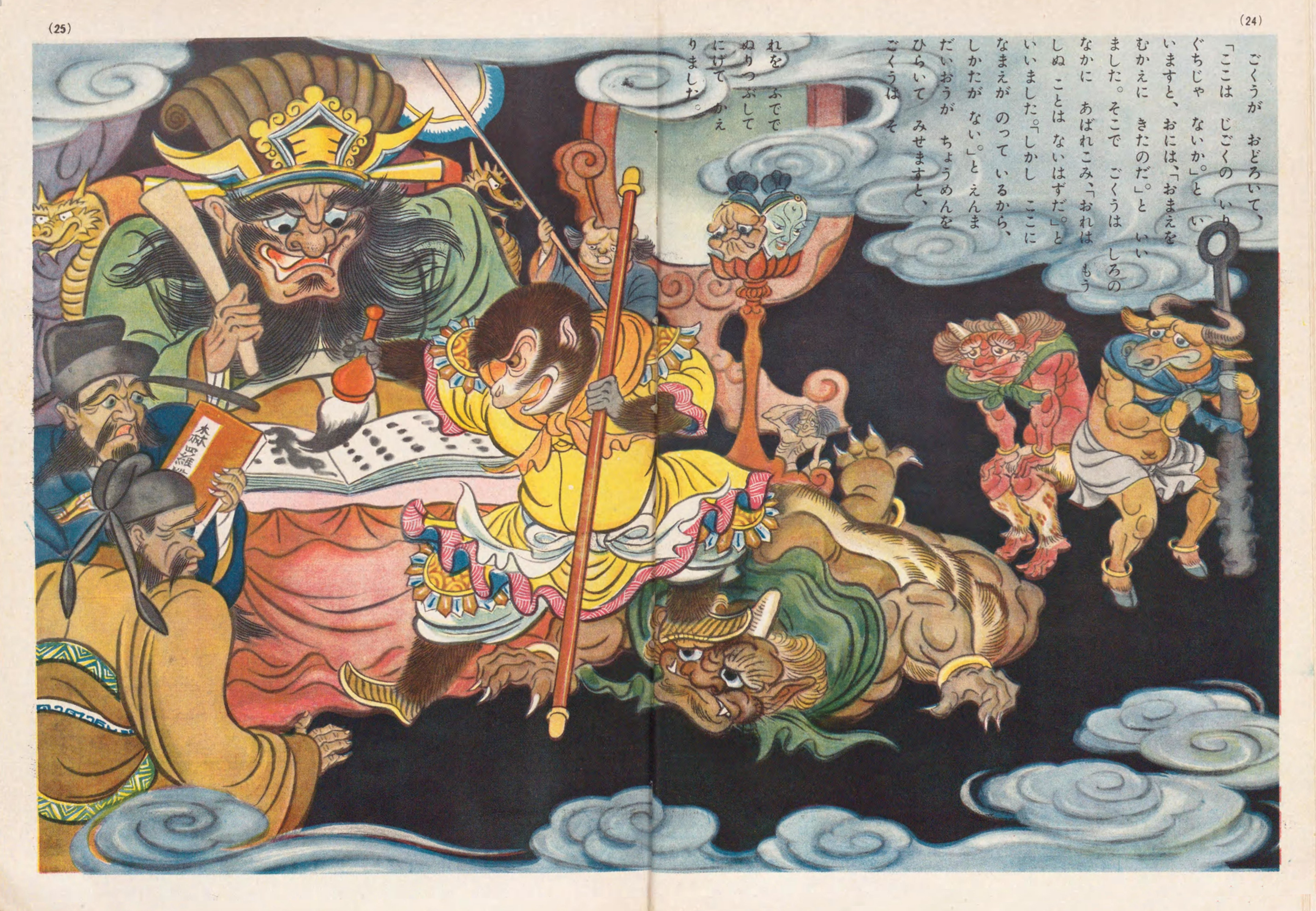
[After reprimanding the 10 judges for bringing his soul to hell, Sun says,] “All I want is to erase my name [from the ledgers of life and death]. Bring me a brush.” The judge hurriedly fetched the brush and soaked it in heavy ink. Wukong took the ledger on monkeys and crossed out all the names he could find in it [fig. 2]. Throwing down the ledger, he said, “That ends the account! That ends the account! Now I’m truly not your subject.” Brandishing his rod, he fought his way out of the Region of Darkness.

[…]

While our Monkey King was fighting his way out of the city, he was suddenly caught in a clump of grass and stumbled. Waking up with a start, he realized that it was all a dream (Wu & Yu, 2012, vol. 1, p. 139).

Sun’s ability to use the weapon as a disembodied spirit implies that it has some power of astral projection and entanglement (i.e. it goes where his soul goes). However, to my knowledge, this only happens once in the story, and the novel clearly demonstrates that he can’t use the weapon if it is physically taken away from him. [4] This is likely another inconsistency from oral storytelling.

Fig. 2 – Monkey holds his staff as he strikes his name from the Book of Life and Death (larger version). From the Japanese children’s book Son Goku (1939). 

D. Multiplication

The weapon is shown capable of creating manifold copies of itself. For example, in ch. 4, Monkey multiplies his staff to accommodate his monstrous, multi-armed form while fighting Prince Nezha: “Dear Great Sage! He shouted, ‘Change!’ and he too transformed himself into a creature with three heads and six arms. One wave of the golden-hooped rod and it became three staffs, which were held with six hands” (Wu & Yu, 2012, vol. 1, p. 155). Later in ch. 50, he rains staves down on a demonic army.

Using the tip of his lance to point at the ground, the demon king shouted for the little imps to attack together. All those brazen fiends, wielding swords, scimitars, staffs, and spears, rushed forward at once and surrounded the Great Sage Sun completely. Entirely undaunted, Pilgrim only cried, “Welcome! Welcome! That’s exactly what I want!” He used his golden-hooped rod to cover his front and back, to parry blows east and west, but that gang of fiends refused to be beaten back. Growing more agitated, Pilgrim tossed his rod up into the air, shouting, “Change!” It changed immediately into iron rods by the hundreds and thousands; like flying snakes and soaring serpents, they descended onto the fiends from the air” (Wu & Yu, 2012, vol. 2, p. 372).

E. Lock-Picking

Sun demonstrates the staff’s magic lock-picking ability in ch. 25.

The doors are all locked. Where are we going to go?” “Watch my power!” said Pilgrim. He seized his golden-hooped rod and exercised the lock-opening magic; he pointed the rod at the door and all the locks fell down with a loud pop as the several doors immediately sprung open. “What talent!” said Eight Rules, laughing. “Even if a little smith were to use a lock pick, he wouldn’t be able to do this so nimbly.” Pilgrim said, “This door is nothing! Even the South Heaven Gate would immediately fly open if I pointed this at it!” (Wu & Yu, 2012, vol. 1, pp. 468-469).

Admittedly, this passage could be read two ways: 1) The staff opens the lock; 2) Monkey uses the staff as a conduit for his own lock-picking magic. But I’m choosing the first interpretation as this ability was likely influenced by Saint Mulian unlocking the gates of hell with his staff. [5]

F. Transformation

In ch. 46, during a competition of Buddhist and Daoist prognostication, Sun magically disguises himself as a Daoist lad’s ritual master and convinces the boy to let him shave his head: “He changed his golden-hooped rod into a sharp razor, and hugging the lad, he said, ‘Darling, try to endure the pain for a moment. Don’t make any noise! I’ll shave your head.’ In a little while, the lad’s hair was completely shorn” (Wu & Yu, 2012, vol. 2, p. 305). In ch. 65, Sun turns the staff into a drill in order to escape from a pair of magic cymbals, using the tool to bore a hole in the horn of a dragon that was just able to pierce the seam: “Marvelous Great Sage! He changed the golden-hooped rod into a steel drill and drilled a hole on the tip of the horn. Transforming his body into the size of a mustard seed, he stuck himself inside the hole and yelled, ‘Pull the horn out! Pull the horn out!'” (Wu & Yu, 2012, vol. 3, p. 218).

G. Sentience

When the Dragon Queen originally suggests giving the pillar to Monkey, she tells her husband: “These past few days the iron has been glowing with a strange and lovely light [fig. 3]. Could this be a sign that it should be taken out to meet this sage?” (Wu & Yu, 2012, vol. 1, p. 135). This might imply the weapon was aware of its new master’s imminent arrival. Later in ch. 75, Sun recites a poem speaking of the staff’s desire for flight.

Its name was one Rod of Numinous Yang,
Stored deep in the sea, hardly seen by men.
Well-formed and transformed it wanted to fly,
Emitting bright strands of five-colored mist.
Enlightened Monkey took it back to the mount
To experience its pow’r for boundless change.
[…] (Wu & Yu, 2012, vol. 3, p. 375).

The phase “wanting to fly” (yao feiteng, 要飛騰) could be read as a metaphor for yearning to be released from the dragon treasury and/or a call for adventure. Add to this the staff’s ability to follow Sun’s wishes to grow, shrink, multiply, change form, and pick locks. Therefore, the novel depicts the staff having a certain amount of awareness. [6]

Fig. 3 – Monkey pointing to the luminous iron pillar (larger version). From the Qing-Era Painted, Complete Edition Journey to the West (Qing caihui quanben Xiyouji, 清彩繪全本西遊記).

II. Conclusion

Journey to the West (1592) describes the Monkey King’s iron staff having the magic power to shrink and grow, control the ocean, astral project and entangle with Monkey’s spirit, multiply endlessly, pick locks, and transform into various objects. It also has sentience to a certain degree.


Update: 07-04-21

Here I present my theory on why Sun Wukong’s staff weighs 13,500 catties (17,560 lbs/7,965 kg). I believe the number is an embellishment on the weight of a stone block lifted by the bandit Wu Song in the Water Margin (c. 1400).

The Weight of the Monkey King’s Staff: A Literary Origin

Notes

1) I have changed Yu’s (Wu & Yu, 2012) dry rendering “Compliant Golden-Hooped Rod” to the more pleasant one based on W.J.F. Jenner. Also, Yu’s original translation says “13,500 pounds”. However, the Chinese version uses jin (斤), known in English as “catty“. The catty and pound are two different measures of weight, the former being heavier than the latter. Therefore, the English text has been altered to show this. The catty during the Ming Dynasty when the novel was compiled equaled 590 grams (Elvin, 2004, p. 491 n. 133), so 13,500 catties would equal 17,550 lb.

2) Here, Yu’s (Wu & Yu, 2012) English translation says Monkey grows to be “ten thousand feet tall”. However, the original Chinese source reads “萬丈” (wanzhang), wan meaning 10,000 and zhang being a measure designating 10 Chinese feet (10,000 x 10 = 100,000). Therefore, I have changed the source to read “One hundred thousand feet”, much like Yu (Wu & Yu, 2012) translates it in chapters six (vol. 1, p. 181) and 61 (vol. 3, p. 157).

3). For example, Monkey relies on Zhu Bajie to fight Sha Wujing when they first come across him at the Flowing-Sands River. This is when Sun admits his weakness to water:

“Worthy Brother,” said Pilgrim with a laugh, “in this case I’ve really nothing to brag about, for I’m just not comfortable doing business in water. If all I do is walk around down there, I still have to make the magic sign and recite the water-repelling spell before I can move anywhere. Or else I have to change into a water creature like a fish, shrimp, crab, or turtle before going in. If it were a matter of matching wits in the high mountains or up in the clouds, I know enough to deal with the strangest and most difficult situation. But doing business in water somewhat cramps my style!” (Wu & Yu, 2012, vol. 1, pp. 423-424).

4) The rhinoceros demon sucks it away with Laozi’s magic steel bracelet in ch. 50 and 51. A lion spirit uses a magic wind to steal the weapons of all three pilgrims in ch. 88. In both cases, Monkey resorts to trickery to retrieve the physical staff from their respective mountain strongholds.

5) One section of Mulian’s tale reads: “With one shake of his staff, the bars and locks fell from the black walls, / On the second shake, the double leaves of the main gate [of hell] flew open” (Mair, 1994, p. 1113).

6) The idea of sentient weapons is certainly not unique to Journey to the West considering that the ancient Chinese ascribed souls to noted swords. For example, Yuan poet Jia Penglai (賈蓬萊, c. mid-14th-c.) described famed Spring and Autumn period blacksmith Ou Yezi‘s (歐冶子) treasure swords Longyuan (龍淵, a.k.a. Longquan, 龍泉) and Tai’e (泰阿/太阿) as mated lovers who pine for each other when separated and even leap from the scabbard to seek out their beloved (Lee & Wiles, 2015, pp. 161-163).

Sources:

Elvin, M. (2004). The Retreat of the Elephants: An Environmental History of China. New Haven (Conn.): Yale university press.

Lee, L. X. H., & Wiles, S. (2015). Biographical Dictionary of Chinese Women: Tang Through Ming: 618-1644. Abingdon: Routledge.

Mair, V. H. (1994). Transformation Text on Mahamaudgalyayana Rescuing his Mother From the Underworld With Pictures, One Scroll, With Preface In V. Mair (Ed.), The Columbia Anthology of Traditional Chinese Literature (pp. 1094-1127). New York: Columbia University Press.

Wu, C., & Yu, A. C. (2012). The Journey to the West: Vol. 1-4. Chicago, Illinois: University of Chicago Press.

The Book of Xian and Shen (BOXS), a Catalog of Chinese Gods

I recently learned about an interesting website called the Book of Xian and Shen (BOXS), which catalogs information and pictures for Chinese gods from all over the world. There are currently 2,000 listings and counting.

https://www.bookofxianshen.com/

It is based on the work of religious scholar Keith Stevens (d. 2016), who wrote the amazing Chinese Gods: The Unseen Worlds of Spirits and Demons (Collins & Brown, 1997) (fig. 1). I recently volunteered to help the project. So far, I’ve written two articles (see reference no. W1001 and W1011) and updated two other existing listings with information and pictures (see the bottom of W8620 and W9305).

Fig. 1 – My well-worn personal copy of Chinese Gods (larger version).

Due to the great number of listings, there are no direct links. Instead, the site has adopted a somewhat confusing (but necessary) cataloging system based around reference numbers, pinyin, Mandarin, and Wade-Giles. However, it’s easy to use once you get used to it. For example, if you were going to search for Sanqing, the “Three Pure Ones,” using, say, Pinyin, I recommend first getting the reference number (RefNo). 

Deities —> Tabular Listing of Xian Shen Deities —> Field: Pinyin —> Type: Contains —> Value: San qing (you may have to play around with the spacing like I did here) —> Filter —> Then look for the correct listing (since other listings mentioning them might appear in the list) —> ☰ —> copy the “RefNo”, in this case W5540 (fig. 2) —> Deities —> Deities Page with Full Listing Side Bar —> Field: RefNo —> Type: Contains —> Value: W5540 —> Filter (fig. 3) —> The listing (fig. 4)

If you know the Mandarin or Wade-Giles for the deity you are looking for, the process would be similar. You would just need to change the field to “Mandarin” or “Wade-Giles”. You could just jump to “Deities Page with Full Listing Side Bar” to search using pinyin, mandarin, and Wade-Giles, but it’s been my experience that a different listing will pop up first based on a higher RefNo or Romanized spelling. First finding the reference number seems to be the easiest method for me.

I can’t recommend this website enough. New gods, as well as new stories or beliefs associated with more established deities, are appearing all the time, so it is very important to catalog everything as soon as new information becomes available. If you would like to volunteer in some way, please contact Ronni Pinsler using the “contact” form on the BOXS website.

Fig. 2 – How to acquire the reference number (RefNo) (larger version). Fig. 3 – How to navigate to the listing (larger version). Fig. 4 – The listing as seen from the top of the page (larger version).