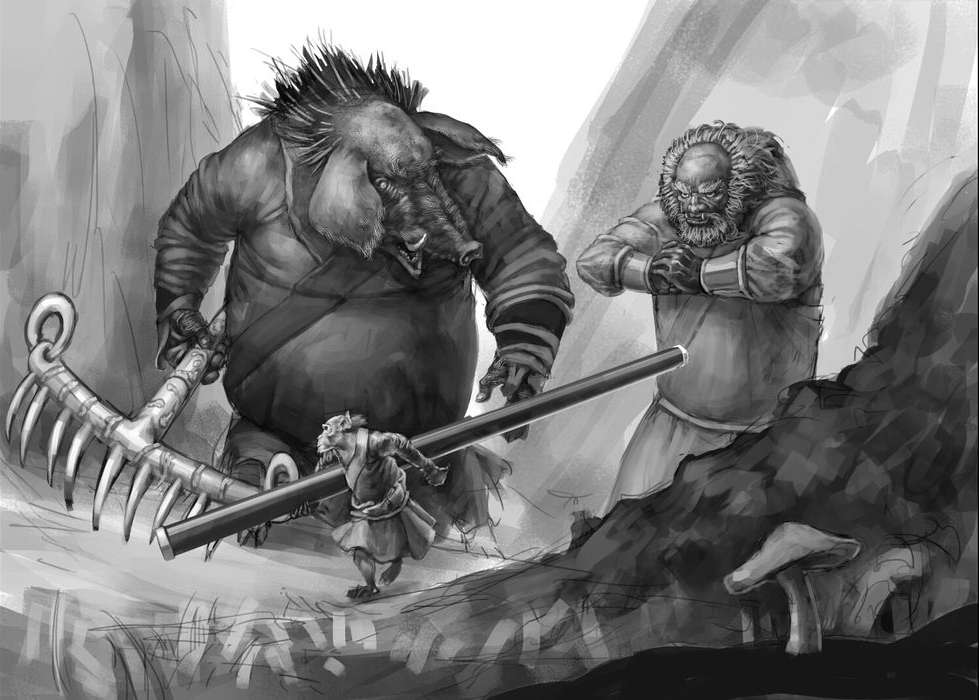
Journey to the West Fanfiction Writer Spotlight #1: DarkscytheDrake

From time to time I like to post a fun blog not directly related to (though sometimes informed by) my research. Regular articles will resume after this entry.

Anyone who follows me on social media will know that I generally do not like modern adaptations of Journey to the West (Xiyouji西遊記, 1592; “JTTW” hereafter) (see here and here, for example). But thanks to enjoying this book, I’ve learned to temper my negativity. I’ve, therefore, decided to mirror the format of a series of past art-based articles [1] and shine a spotlight on the author of a JTTW-related fanfiction that I actually like. My hope is that such posts will expose their work to a wider audience interested in JTTW, while also documenting modern day perceptions and depictions of the novel and its characters.

Our first writer goes by the online handle DarkscytheDrake (AO3, Fanfiction.net, Spacebattles). They were kind enough to answer some interview questions, as well as allow permission to display some of their work.

I. Q & A

1) Can you tell me a little about yourself?

I’m 24 years old and live in the Middle East. I’m a huge fan of mythologies and old stories. I dabble in many aspects of the art world, and writing has been a hobby of mine since high school. Since I was a kid my dad used to bring me books from abroad to read. I’ve travelled the world thanks to my parents’ business trips and was exposed to many cultures and stories, which made me fall in love with them even more.

2) Are you self-taught or have you taken writing classes?

I’m self-taught, using the example of others. By the time I seriously thought about writing, there weren’t any writing workshops in my area, at least ones that didn’t focus on the genres I wanted to write in. English is my second native language and most books I read are in English.

3) What are your main sources of literary inspiration?

My main inspirations are the Inheritance Cycle, Shogun (book and TV show), The Hobbit (book and movies), and Bone. Manga like Fullmetal Alchemist have also taught me a lot about storytelling and character arcs.

4) How did you learn about Journey to the West?

I first became fully aware of Journey to the West proper, meaning not expys like Dragon Ball, when I visited China for the first time. I saw a lot of ads and costumes for the Monkey King, and I asked our guide who this character was. I did some research to get acquainted with the story and main players, and I left it alone until Black Myth: Wukong was announced, which revitalized my interest and prompted me to purchase an abridged version of the book, Monkey King. I read the Anthony C. Yu translation online. From there, I also watched some of his spin-off works like Lego Monkie Kid.

5) Who is your favorite character?

Sun Wukong is my favorite character, and while half of that does come from the sheer insanity of his powers and adventures, the other half comes from how much he learns in the journey, and the family he finds within his companions. His moments of innocence, like when he plays in the snow or his more vulnerable moments like in the White Bone Spirit arc. Princess Iron Fan has got to be my second favorite, though. She takes a lot of shit from her husband, suffered the imprisonment of her son and had to deal with Wukong’s antics, but ultimately remains a decent person and one of the few demons on the journey who isn’t wicked or wants to eat Tripitaka.

6) Do you have a favorite episode from the novel?

My favorite episode would have to be the fight against Demon Bull King, because of how personal it is to Wukong and the sheer scale of the fights that ensue there, like Wukong and DBK transforming into their giant forms and duking it out. Really, all of the Demon Bull family’s episodes (Iron Fan and Red Boy) are the best.

7) Does the novel have a special meaning to you?

I’m honestly surprised by the sheer depth the novel has for its age. There’s a lot of worldbuilding there which is on par with Tolkien‘s work, and those who grew up in Asian culture are aware of its deeper meanings, so it transcends ‘modern’ worldbuilders in that sense. And when I see just how influential the novel is and how it led to one of the greatest anime of all time…I’m humbled.

8) Can you tell me about your ongoing JTTW-related project?

My current JTTW project is a fanfiction story called “Great Sage, Equal to Heaven and Above Brockton” (AO3, Fanfiction.net, Spacebattles), and it’s a crossover with the webnovel Worm by Wildbow. The world of Worm is filled with superpowered humans called ‘capes’ (fig. 1), but unlike DC and Marvel, many capes use their powers for crime. There are heroes who battle these villains of course, but matters aren’t as clear-cut as they appear. On top of that, giant monsters attack cities every few months and cause untold damage. The main premise of my story is that an untold amount of time after the journey, Sun Wukong wakes up in Worm‘s main setting of Brockton Bay, a coastal city [north of Boston, MA, USA] with a lot of capes, nazis, Asian gangsters and heroes. From there he investigates the modern era, having fun and tries to find out what’s going on with these strange superpowered humans. It’s a classic premise of ‘OP character gets dropped into a lower-ranked world’, but it’s also a study of how a character who found a home suddenly gets dropped into a new one, and how power doesn’t always solve problems. And if it does, what are the potential consequences?

[Jim here: As of this writing, chapters one to 11 are available for free online, but chapters 12 to 13 (and a ch. 14 preview) are still only available on patreon.]

Fig. 1 – Cover for a fake Worm comic book featuring the original story’s main character, who makes an appearance in the Great Sage story (larger version). Illustration by @codetrillogy on Twitter. Used with permission.

II. Writing Sample

The following excerpt comes from an event in chapter six. After befriending a young boy, Sun Wukong jumps in to save his sister from gangsters attempting to take her in lieu of a missed “protection money” payment:

* The boy’s name.
** The boy’s sister.
*** The name of a local gang leader. Monkey comically believes he is a literal dragon.

Note:

1) As of this writing, I’ve made three such art posts here, here, and here.

Story Idea: Sun Wukong vs Juggernaut

From time to time I like to post a fun blog not directly related to (though sometimes informed by) my research. Regular articles will resume later.

Note: This is not about power scaling.

I. Background

In chapter 59 of Journey to the West (Xiyouji西遊記, 1592), Princess Iron Fan uses her magic fan to blast Sun Wukong into the heavens (Wu & Yu, 2012, vol. 3, p. 126). The book provides two conflicting figures as to its effective range, stating that the fan can blow a target a total of 84,000 li (bawan siqian li, 八萬四千里; 26,097.59 mi/42,000 km) or 108,000 li (shiwan baqian li, 十萬八千里; 33,554 mi/54,000 km) (based on Wu & Yu, 2012, vol. 3, pp. 127-128 and 148). To combat this weapon, the Bodhisattva Lingji (Lingji pusa, 靈吉菩薩) offers our hero a magical Buddha treasure:

Lingju said, “In years past when I received the instructions from Tathagata, [1] I was given a Flying-Dragon Staff and a Wind-Arresting Elixir [Dingfeng dan, 定風丹; fig. 1]. [2] The staff was used to subdue the wind demon [from ch. 21], but the elixir has never been used. I’ll give it to you now, and you can be certain that that fan will not be able to move you (Wu & Yu, 2012, vol. 3, p. 128).

靈吉道:「我當年受如來教旨,賜我一粒定風丹、一柄飛龍杖。飛龍杖已降了風魔。這定風丹尚未曾見用,如今送了大聖,管教那廝搧你不動 … 」

Lingji then sews it into his robe collar, and the next time that he faces Princess Iron Fan, her weapon has no effect on him (Wu & Yu, 2012, vol. 3, pp. 128-129).

Fig. 1 – The Great Sage receives the Wind-Arresting Elixir (larger version). Image found here. I believe this comes from the circa 1999/2000 Monkey King cartoon.

But Sun accidentally swallows the treasure at some point, and it causes a physical change in his body. Chapter 61 reads:

He [the Bull Demon King] did not know, however, that when the Great Sage changed previously into a tiny mole cricket to enter the stomach of Raksasi [in ch. 59], [3] he still had in his mouth that Wind-Arresting Elixir, which he swallowed unwittingly. All his viscera had become firm; his skin and bones were wholly fortified (emphasis added). No matter how hard the Bull King fanned at him, he could not be moved (Wu & Yu, 2012, vol. 3, p. 149).

不知那大聖先前變蟭蟟蟲入羅剎女腹中之時,將定風丹噙在口裡,不覺的嚥下肚裡,所以五臟皆牢,皮骨皆固,憑他怎麼搧,再也搧他不動。

Let me reiterate: the elixir makes the Great Sage’s organs lao (牢), or “solid” or “firm,” like a prison (dictionary), and it also makes his skin and bones gu (固), or “solid” or “firm” like a four-sided structure (dictionary). Therefore, the pill essentially fortifies his body to the point of becoming an immovable object, even in the face of divine wind capable of blasting someone tens of thousands of miles or kilometers away. This makes him a perfect component of the Irresistible Force Paradox. This power is forgotten in subsequent chapters—a consequence of the novel’s origin as a collection of piecemeal stories—but this would be an interesting element to explore in fanfiction.

The other half of the paradox could be filled by the Juggernaut (Ch: Hong tanke, 紅坦克, or “Red Tank”), a.k.a. Cain Marko (Ch: Kaiyin Make, 凱因·馬可) (fig. 2), a Marvel Comics villain created by Stan Lee and Jack Kirby and first introduced in 1965. He was previously the human step-brother of the powerful mutant telepath Charles Xavier, but after finding a magic gem inside an ancient temple, he became the avatar of the extradimensional deity Cyttorak and was empowered with great physical strength, durability, and immortality. He is often portrayed as unstoppable when in motion. For example, in Uncanny X-Men #183, the Wolverine describes him as “the closest thing on Earth to an irresistible force” (Claremont, 1984, p. 19).

Fig. 2 – The Juggernaut advances on the viewer (larger version). Image found here.

II. Similarities

Both Sun and the Juggernaut are:

  1. Fierce
  2. Super strong
  3. Super durable
  4. Immortal
  5. Empowered by divine beings, Buddha and Cyttorak, respectively (see here for cited examples of all of Monkey’s powers and skills)

The only difference between them—beyond size and origins—is that the powers under discussion are polar opposites, making one an immovable object and the other an unstoppable force. So, what do you think would happen if they ever came to blows?

III. Scenario

The only way I can think of that the Great Sage and Juggernaut could meet would involve borrowing story elements from the “Fear Itself” cross-over event in which both characters make appearances. In Iron Man 2.0 #5-7, Marvel’s Sun Wukong is introduced as a divinely empowered crime boss who’s released from hell when one of the magic hammers of Serpent, the Asgardian god of fear and the deposed brother of Odin, punches through Beijing, China and opens the dimensional barrier separating the underworld from earth. He attempts to lift the enchanted weapon on his way out but fails since he’s not the fated owner (figs. 3a,b,c & 4) (Spencer, 2011a; 2011b; 2011c). In Fear Itself #2, another hammer impacts Juggernaut’s island prison (on New York’s East River), and upon touching it, he becomes Serpent’s new warrior, “Kuurth, Breaker of Stone” (figs. 5a,b,c) (Fraction, 2011). Now, for the purposes of our story, instead of the weapon breaking into hell, imagine it opens a rift to the Buddho-Daoist cosmos of Journey to the West during the quest to India. This would allow a novel accurate Monkey King (fig. 6) to eventually battle Juggernaut, as well as meet modern day superheroes. This change would, of course, require widescale alterations to the rest of the “Fear Itself” storyline. [4] I’m open to suggestions.

How the battle goes would depend on the writer. I’m biased, so I would naturally root for Sun Wukong.

Fig. 3(a) – After beating up some demonic thugs, Sun Wukong sees the hammer falling (here); (b) it makes impact (here); and (c) he first touches it (here) (Spencer, 2011a). Fig. 4 – He fails to lift the enchanted weapon (larger version) (Spencer, 2011b). Fig. 5(a) – A separate hammer impacts the Juggernaut’s prison (here); (b) he first touches it (here); and (c) he is transformed into Serpent’s new warrior (here) (Fraction, 2011). Copyright Marvel comics. Fig. 6 – A nearly novel accurate Monkey King (larger version). A photomanipulation by me.

Notes:

1) This refers to the Buddha’s previous instructions to defeat “Great King Yellow Wind” (Huangfeng dawang, 黃風大王), a demon with a mastery of powerful, divine wind (Wu & Yu, 2012, vol. 1, pp. 413 and 419).

2) Lingji twice reveals (ch. 21 and 59) that the Wind-Arresting Elixir (Dingfeng dan, 定風丹) is a treasure bestowed by the Buddha (Wu & Yu, 2012, vol. 1, p. 419; vol. 3, p. 128). Yu (Wu & Yu, 2012) translates this magic pill as the “wind-stopping pearl” in chapter 21 (vol. 1, p. 419). And It’s interesting to note that a “wind-stopping pearl” (dingfeng zhu, 定風珠) is said to be one of many heavenly jewels decorating Tripitaka’s cassock in chapter 12 (Wu & Yu, 2012, vol. 1, p. 282).

3) This refers to Monkey’s plan to procure the magic fan by beating up Princess Iron Fan from inside her stomach (Wu & Yu, 2012, vol. 3, p. 129).

4) The changes to the comic book storyline wouldn’t affect the original novel. Monkey would eventually return to his universe and continue the journey to India.

Sources:

Claremont, C. (1984, July). Uncanny X-Men (Vol. 1, No. 183 [Comic book]. New York, YK: Marvel. Retrieved from https://readallcomics.com/uncanny-x-men-v1-183/

Fraction, M. (2011). Fear Itself (No. 2) [Comic book]. New York, NY: Marvel. Retrieved from https://readallcomics.com/fear-itself-002-2011/

Spencer, N. (2011a). Iron Man 2.0 (No. 5) [Comic book]. New York, NY: Marvel Comics. Retrieved from https://readallcomics.com/iron-man-2-0-05/

Spencer, N. (2011b). Iron Man 2.0 (No. 6) [Comic book]. New York, NY: Marvel Comics. Retrieved from https://readallcomics.com/iron-man-2-0-06/

Spencer, N. (2011c). Iron Man 2.0 (No. 7) [Comic book]. New York, NY: Marvel Comics. Retrieved from https://readallcomics.com/iron-man-2-0-07/

Wu, C., & Yu, A. C. (2012). The Journey to the West (Vols. 1-4) (Rev. ed.). Chicago, Illinois: University of Chicago Press.

The Past Life Biography of Zhu Bajie

Last updated: 04-09-2025

A twitter user asked me in late 2024 where Zhu Bajie (豬八戒; fig. 1) learned his “36 transformations” (sanshiliu ban bianhua, 三十六般變化). I told them that chapters 19 and 85 of Journey to the West (Xiyouji西遊記; “JTTW” hereafter) contain biographical poems, one of which explains his internal alchemy (neidan, 内丹) training under an immortal and ascension to godhood. I suggested that his past human life learned the magic changes during this time, but after answering the question, it dawned on me that many people may not be aware of these verses. I have, therefore, decided to post and analyze said poems for the benefit of my readers.

This is the second of three articles where I will present info about the disciples’ lives prior to the main events of JTTW. My next article will follow with Sha Wujing‘s (沙悟净) poem. Click here to read the first post about the White Dragon Horse (Bai longma, 白龍馬). These are meant to compliment my previous essay about Sun Wukong (孫悟空).

(On a related note, see here for the oldest known depictions of Zhu Bajie. They come from 14th-century Korea!)

Fig. 1 – A novel accurate depiction of the Tang Monk’s disciples, including our hog hero (top left) (larger version). Artwork by @真·迪绝人 (see here and here).

1. The poems

The novel actually presents two contradictory verses on the origins of our beloved pig-monster. One (ch. 19) portrays him as a human-turned-immortal commander of heavenly forces, while the other (ch. 85) alludes to him being a powerful hog-spirit given celestial rank.

1.1. Chapter 19

This poem is chock-full of internal alchemical jargon, so I’m placing explanatory notes just below the blockquote to save readers from having to scroll to the very bottom of the article every time a new concept is mentioned.

My mind was dim since the time of youth;
Always I loved my indolence and sloth.
Neither nursing nature nor seeking the Real,
I passed my days deluded and confused.
I met a true immortal suddenly
Who sat and spoke to me of cold and heat. [A]
‘Repent,’ he said, ‘and cease your worldly way:
From taking life accrues a boundless curse.
One day when the Great Limit ends your lot,
For eight woes and three ways you’ll grieve too late!’ 
I listened and turned my will to mend my ways:
I heard, repented, and sought the wondrous rune.
By fate my teacher he became at once,
Pointing to the Heavenly and Earthly Passes. [B]
Taught to forge the Great Pill Nine Times Reversed, [C]
I worked without pause through day and night
To reach Mud-Pill Palace topping my skull [D]
And Jetting-Spring Points on soles of my feet. [E]
With kidney brine flooding the Floral Pool, [F]
My Cinnabar Field was thus warmly nursed. [G]
Baby and Fair Girl mated as yin and yang[H]
Lead and mercury mixed as sun and moon. [I]
In concord Li-dragon and Kan-tiger used, [J]
The spirit turtle sucked dry the gold crow’s blood. [K]
‘Three flowers joined on top,’ the root reclaimed [L];
‘Five breaths faced their source’ and all freely flowed. [M]
My merit done, I ascended on high,
Met by pairs of immortals from the sky.
Radiant pink clouds arose beneath my feet;
With light, sound frame I faced the Golden Arch.
The Jade Emperor gave a banquet for gods
Who sat in rows according to their ranks.
Made a marshal of the Celestial Stream,
I took command of both sailors and ships.
Because Queen Mother gave the Peaches Feast
When she met her guests at the Jasper Pool
My mind turned hazy for I got dead drunk,
A shameless rowdy reeling left and right.
Boldly I barged into Vast Cold Palace
Where the charming fairy received me in.
When I saw her face that would snare one’s soul,
My carnal itch of old could not be stopped!
Without regard for manners or for rank,
I grabbed Miss Chang’e asking her to bed.
For three or four times she rejected me:
Hiding east and west, she was sore annoyed.
My passion sky-high I roared like thunder,
Almost toppling the arch of Heaven’s gate.
Inspector General told the Emperor Jade;
I was destined that day to meet my fate.
The Vast Cold completely enclosed airtight
Left me no way to run or to escape.
Then I was caught by the various gods,
Undaunted still, for wine was in my heart.
Bound and taken to see the Emperor Jade,
By law I should have been condemned to death.
It was Venus the Gold Star, Mr. Li,
Who left the ranks and knelt to beg for me.
My punishment changed to two thousand blows,
My flesh was torn; my bones did almost crack.
Alive! I was banished from Heaven’s gate
To make my home beneath the Fuling Mount.
An errant womb’s my sinful destination: Stiff-Bristle Hog’s my worldly appellation!” (Wu & Yu, 2012, vol. 1, pp. 378-379).

自小生來心性拙,貪閑愛懶無休歇。
不曾養性與修真,混沌迷心熬日月。
忽然閑裡遇真仙,就把寒溫坐下說。
勸我回心莫墮凡,傷生造下無邊孽。
有朝大限命終時,八難三途悔不喋。
聽言意轉要修行,聞語心回求妙訣。
有緣立地拜為師,指示天關並地[關]
得傳九轉大還丹,工夫晝夜無時輟。
上至頂門泥丸宮,下至腳板湧泉穴。
周流腎水入華池,丹田補得溫溫熱。
嬰兒姹女配陰陽,鉛汞相投分日月。
離龍坎虎用調和,靈龜吸盡金烏血。
三花聚頂得歸根,五氣朝元通透徹。
功圓行滿卻飛昇,天仙對對來迎接。
朗然足下彩雲生,身輕體健朝金闕。
玉皇設宴會群仙,各分品級排班列。
敕封元帥管天河,總督水兵稱憲節。
只因王母會蟠桃,開宴瑤池邀眾客。
那時酒醉意昏沉,東倒西歪亂撒潑。
逞雄撞入廣寒宮,風流仙子來相接。
見他容貌挾人魂,舊日凡心難得滅。
全無上下失尊卑,扯住嫦娥要陪歇。
再三再四不依從,東躲西藏心不悅。
色膽如天叫似雷,險些震倒天關闕。
糾察靈官奏玉皇,那日吾當命運拙。
廣寒圍困不通風,進退無門難得脫。
卻被諸神拿住我,酒在心頭還不怯。
押赴靈霄見玉皇,依律問成該處決。
多虧太白李金星,出班俯顖親言說。
改刑重責二千鎚,肉綻皮開骨將折。
放生遭貶出天關,福陵山下圖家業。
我因有罪錯投胎,俗名喚做豬剛鬣。(source)

Footnotes:

A) “[C]old and heat,” (riyue, 日月; lit: “sun and moon”) refers to respective yang and yin energies (Pregadio, 2025p; see also Wu & Yu, 2012, vol. 1, p. 527 n. 2).

B) The original Chinese, “天關並地” (tianguan bing dique, or “heavenly passes and earthly watchtowers(?)”), is a likely typo for “天關並地” (tianguan bing diguan, or “heavenly and earthly passes”). These respectively refer to the head and feet (Pregadio, 2025d, 2025s). I’ve therefore altered Yu’s (Wu & Yu, 2012) translation.

C) The “Great Pill [i.e. Elixir] Nine Times Reversed” (jiuzhuan da huandan, 九轉大還丹) was originally an external alchemical process where a concoction of toxic elements was purified over successive firings in a crucible to create a drug of immortality (see section 3.1. of this article). However, the term was coopted by later proponents of internal alchemy, who associated the ingestion and circulation of immortality-bestowing cosmic energies within pathways between bodily organs with a complex five phases-influenced numerology (Pregadio, 2025b, 2025n). Needham (1954, as cited in Wu & Yu, 2012) adds that it refers “to a chhi [qi, pneumatic vitality, breath] or substance generated by techniques purposefully within the human body which would bring about a reversion of the tissues from an ageing state to an infantile state” (vo. 1, p. 527 n. 4).

D) The “Mud-Pill Palace” (niwan gong, 泥丸宮) is a name for the upper cinnabar field in the head (Pregadio, 2025m; Wu & Yu, 2012, vol. 1, p. 528 n. 6).

E) The “Jetting-Spring Points” (yongquan xue, 湧泉穴) are pressure points on the bottom of the feet (Wu & Yu, 2012, vol. 1, p. 528 n. 7).

F) Yu (Wu & Yu, 2012) explains that spiritual energies contained in the kidneys (which are associated with the water element) can be directed to different parts of the practitioner’s body, including a spot under the tongue, the “Floral pool” (huachi, 華池) (vol. 1, p. 528 n. 8; see also Pregadio, 2025r). While this is no doubt the correct answer, it’s important to note that internal alchemy also uses the term Floral pool to refer to true yang energy inside yin (Pregadio, 2025h). The corresponding term is “spirit water” (shenshui, 神水), which denotes true yin energy inside yang—think of the white and black dots inside of the Taiji symbol (Pregadio, 2025h). Therefore, the poem’s original Chinese “腎水入華池” (shenshui ru huachi, or “kidney brine flooding the floral pool”) could also be a reference to the similarly-sounding phrase “神水入華池” (shenshui ru huachi, or “spirit water flooding the floral pool), or the mixture of yang and yin, respectively.

G) The “Cinnabar Field” (dantian, 丹田) is one of three spiritual centers in the body, which is located between 1.3 to 3.6 Chinese inches (cun, 寸; 1 = 1.25 in/3.18 cm) below (or behind) the belly button. The Cinnabar Field is believed to store cosmic/bodily energies, that when circulated and refined, produce an immortal alchemical embryo—i.e. a fledgling immortal spirit avatar (Pregadio, 2025c; see also Wu & Yu, 2012, vol. 1, p. 528 n. 9). And “warmly nursed” (bu de wenwen’re, 補得溫溫熱) may refer to “nourishing warmly” (wenyang, 溫養), or the process of “gestati[ng] the alchemical embryo” (Pregadio, 2025t).

H) The “Baby and Fair Girl” (ying’er chanu, 嬰兒姹女) are anthropomorphic personas of yang and yin energy, respectively (Pregadio, 2025a, 2025w; see also Wu & Yu, 2012, vol. 1, p. 528 n. 10).

I) The elemental and celestial imagery of “lead and mercury” (qian gong/hong, 鉛汞) and “sun and moon” (riyue, 日月) refer to yang and yin energies, respectively (Pregadio, 2025g, 2025o, 2025p).

J) The third eight trigram figure, Li (/☲), is associated with dragons (long, ), and both symbolize yang energy. The sixth figure, Kan (/☵), is associated with tigers (hu, ), and both symbolize yin energy (fig. 2) (Pregadio, 2025j, 2025k, 2025l; see also Wu & Yu, 2012, vol. 1, p. 529 n. 11).

K) Yu (Wu & Yu, 2012) suggests that “turtle” (gui, ) “may be another name for the dark liquid of the kidneys” (vol. 1, p. 529 n. 12). He continues, “[T]he gold crow indicates the sun or the heart. The line refers to the union of yin and yang through the absorption of yang energy by yin” (Wu & Yu, 2012, vol. 1, p. 529 n. 12). While I agree that this refers to the mixing of said energies, it’s important to note, however, that turtles are usually paired with “snakes” (she, 蛇), both being anthropomorphic symbols of jing-essence and qi-breath (精氣), respectively (Pregadio, 2025f). Additionally, the “gold crow” (jinwu, 金烏), an anthropomorphic symbol of true yin inside yang energy, is normally paired with the “jade rabbit” (yutu, 玉兔), an anthropomorphic symbol of true yang inside yin (Pregadio, 2025i, 2025y). Similarly, “blood” (xue, ) represents true yin inside of yang (Pregadio, 2025v).

L) The “Three flowers” (sanhua, 三花) is another name for jing-essence, qi-breath, and shen-spirit (精氣神), three important bio-spiritual substances/energies. These must be “joined on top” (juding, 聚頂), or concentrated in the head (the upper cinnabar field) during the internal alchemical process (Wu & Yu, 2012, vol. 1, p. 529 n. 13; see also Pregadio, 2025q). This leads to the “root [being] reclaimed” (guigen, 歸根), which refers to “[g]oing back to the root and returning to the mandate” (guigen fuming, 歸根復命), or achieving immortality (Pregadio, 2025e).

M) Yu (Wu & Yu, 2012) explains, “Five breaths … wuqi chaoyuan 五氣朝元, refers to the pneumatic vitality, qi, of the five viscera (heart, liver, spleen, lungs, and kidneys) in harmonious balance” (Wu & Yu, 2012, vol. 1, p. 529 n. 14). A related view is that said viscera are synced with bio-spiritual substances or mental concepts—ie. hun/liver, jing-essence/kidneys, spirit/heart, po/lungs, intention/spleen—when a practitioner has learned to quiet their senses and still their body (Pregadio, 2025u).

Fig. 2 – An internal alchemy diagram of a Daoist cultivator circulating yang and yin energies, which are respectively represented by the eight trigrams figures (Li, ) and (Kan, ) and the elements fire and water (larger version). Image found here. I believe it originally comes from the Anthology of Immortals of Complete Perfection (Quanzhen qunxian ji, 全真群仙集, 1483).

1.2. Explanation

Zhu was originally a lazy, aimless man, but he encountered a celestial who told him to mend his ways, or else he would be reborn in the lower three Buddhist realms of hell, hungry ghosts, or animals, making it impossible for him to hear the Buddha’s teachings (an example of the novel’s syncretic unity). Upon repenting, he studied under the immortal, learning the art of internal alchemy, which involved absorbing and circulating vital energies around his body. Once he had attained transcendence, he rose on clouds to be escorted by other celestials into the heavenly realm, where he was appointed marshal of the heavenly navy, which sailed the cosmic river of the Milky Way Galaxy.

But his great achievement was tainted when he got drunk at the Queen Mother’s peach banquet and, being aroused by Chang’e’s dazzling beauty (fig. 3), chased her to the moon palace. He propositioned the goddess for sex several times, but her refusals sent him into a powerful rage. The protector deity Wang Lingguan reported this to the Jade Emperor, who had the moon palace surrounded by heavenly soldiers. The Marshal was soon captured and sentenced to death, but the planet Venus asked for lenience, leading to Zhu’s past life being beaten 2,000 times and banished from the heavenly realm. His divine spirit sought reincarnation in the mortal realm below, but an accident of fate led to his rebirth as a pig-spirit. He later took the name “Stiff-Bristles Hog” (Zhu Ganglie, 豬剛鬣) based on his porcine appearance.

Zhu Bajie-Chang'e stamp

Fig. 3 – A Taiwanese stamp reading, “Drunkenly playing Chang’e” (Zuixi Change, 醉戲嫦娥) (larger version). It’s likely meant to serve as a visual reminder of Zhu’s early story arc involving the events leading to his banishment from heaven and rebirth as a hog-spirit.

1.3. Chapter 85

With huge mouth and fangs I’ve great magic might.
Emperor Jade made me Marshal Heavenly Reeds.
The boss of Heaven’s eighty-thousand marines,
Comforts and joys I had in the halls of light.
Because I mocked a palace maiden when I was drunk
And flaunted my strength at a wrongful hour
One shove of my snout toppled the DipperOx Palace;
Queen Mother’s divine herbs I then devoured
Emperor Jade pounded me two thousand times
And banished me from the Three Heavens realm.
Though told to nourish my primal spirit,
I became again a monster down below.
About to marry at the Village Gao, I met Brother Sun—’twas my wretched fate!
Quite defeated by his golden-hooped rod,
I had to bow and take the Buddhist vow:
A coolie who bears luggage and leads the horse,
Who owes, in former life, the Tang Monk a debt!
This iron-legged Heavenly Reed‘s name is Zhu;
And my religious name is Zhu Eight Rules(based on Wu & Yu, 2012, vol. 4, pp. 149-150).

巨口獠牙神力大,玉皇陞我天蓬帥。
掌管天河八萬兵,天宮快樂多自在。
只因酒醉戲宮娥,那時就把英雄賣。
一嘴拱倒斗牛宮,吃了王母靈芝菜。
玉皇親打二千鎚,把吾貶下三天界。
教吾立志養元神,下方卻又為妖怪。
正在高莊喜結親,命低撞著孫兄在。
金箍棒下受他降,低頭才把沙門拜。
背馬挑包做夯工,前生少了唐僧債。
鐵腳天蓬本姓豬,法名喚作豬八戒。(source)

1.4. Explanation

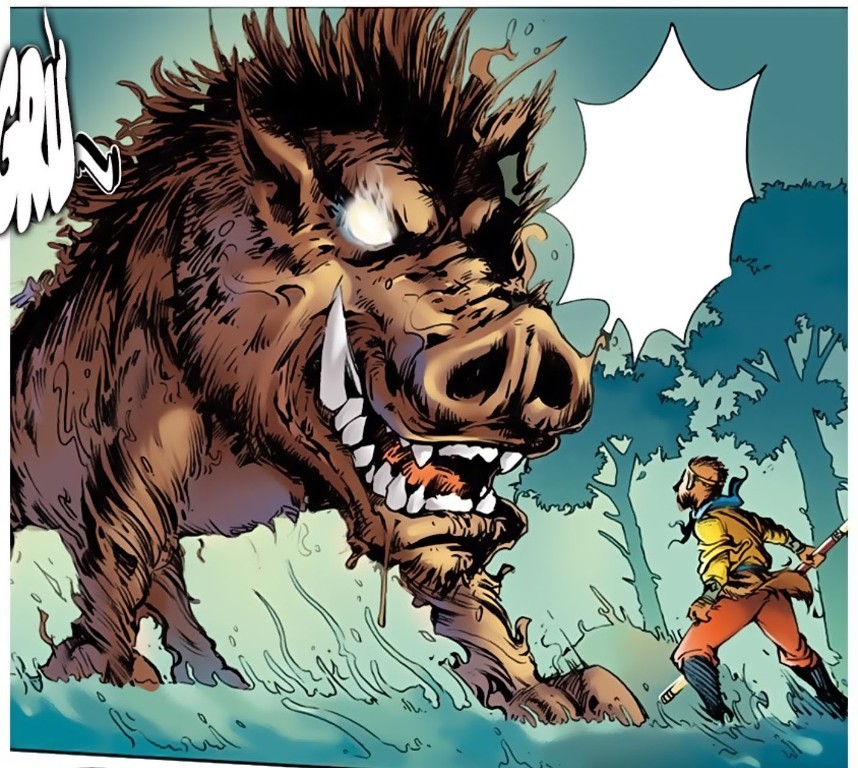
He was originally a pig-spirit with sharp tusks and powerful magic (fig. 4) who was appointed Marshal Tianpeng, commander of the 80,000-strong celestial navy. He enjoyed his new life among the godly ranks but later got drunk (at the Queen Mother’s banquet) and performed a number of forbidden deeds: mistreating a moon goddess, knocking over the Dipper-Ox Palace, and eating the Queen mother’s magic mushrooms. This resulted in a punishment of 2,000 strokes and banishment from heaven, with the added instruction to cultivate his spirit while on earth. But he once again became a monster, and at some point,  he took a wife in Gao Village. He was subsequently defeated by Monkey and forced to take the Buddhist vows, serving as Tripitaka’s disciple and luggage handler. His discipleship may have been the karmic result of a good deed that his master performed for him in a past life.

Fig. 4 – Zhu’s giant boar form from the manhua Journey to the West (Xiyouji, 西遊記) (larger version).

2. Which is true?

Both poems provide certain information that is consistent with internal narrative details, such as:

  • Zhu originally serving as Marshal Heavenly Reed (Tianpeng yuanshuai, 天蓬元帥; lit: “Marshal of Heavenly Mugwort“), commander of the 80,000 soldiers of the celestial navy (and a historical deity) (fig. 5)
  • Getting drunk at the peach festival and harassing a moon goddess
  • Being beaten 2,000 times as punishment and exiled to the mortal world
  • Mistakenly being reborn as Stiff-Bristles Hog, a bloodthirsty pig-monster in Fuling Mountain (Fuling shan, 福陵山)
  • Eventually taking a wife in Gao Village (Gao zhuang, 高莊)
  • Being defeated by Sun Wukong
  • Becoming Zhu Bajie, a Buddhist disciple of Tripitaka
  • Acting as a coolie carrying the luggage

But the real question is: was Zhu originally human or a pig-spirit? I think the first poem is likely true (within the narrative) given the amount of detail that he provides about the alchemical processes that eventually led to his immortality and ascension to godhood. The second poem is cursory in comparison and seems like something that was made up on the spot to embellish his might—perhaps influenced by stories of Sun Wukong’s past havoc in heaven—or monstrous pedigree in the face of a demonic opponent (refer to the events in chapter 85). One detail pointing to this is his claim of knocking over the “Dipper-Ox Palace” (Douniu gong, 斗牛宮), which references the stars of the Southern Dipper and Ox mansions (Stephenson, 2008, p. 517). He’s therefore asserting that he can collapse entire constellations. That’s definitely nonsense as Zhu is often overpowered and defeated in battle, even by groups of little fiends (Wu & Yu, 2012, vol. 2, pp. 102-103, for example).

Fig. 5 – A historical painting of “Great Marshal Tianpeng” (Tianpeng da yuanshui, 天蓬大元帥) from the Ink Treasures of Wu Daozi (Daozi mobao, 道子墨寶, 13th-century), (larger version). Image altered for clarity.

3. Additional info

The poems actually leave out several details about Zhu’s past and current lives.

  1. The Chang’e (嫦娥) mentioned above is not the singular goddess but one of many such named divine maidens in the entourage of the “Star Lord of Supreme Yin” (Taiyin xingjun, 太陰星君), the aged devi of the moon. [1]
  2. He mauled his sow mother and piglet siblings to death sometime after his mistaken rebirth in Fuling Mountain (Wu & Yu, 2012, vol. 1, p. 212).
  3. His first wife, “Second Elder Sister Mao” (Mao erjie, 夘二姐), [2] a likely rabbit spirit, [3] was the original owner of his Cloudy Paths Cave (Yunzhan dong, 雲棧洞) (Wu & Yu, 2012, vol. 1, p. 212). But sadly, she died less than a year after their marriage (Wu & Yu, 2012, vol. 1, p. 212). Their tragic love story would be good fodder for fanfiction.
  4. He was invited by the Crow’s Nest Chan Master (Wuchao chanshi烏巢禪師), a Buddhist sage, to practice austerities, but he passed on the opportunity.
  5. Years prior to being called Zhu Bajie, he submitted to Buddhism at the behest of the bodhisattva Guanyin and was given the religious name “Zhu Wuneng” (豬悟能, “Pig Who Awakens to Power”) (Wu & Yu, 2012, vol. 1, p. 213).
  6. Sometime after adopting a vegetarian diet, [4] he magically transformed into a “stout, swarthy [human] fellow” (hei pang han, 黑胖漢) in order to fraudulently arrange a marriage with his second wife, “Green Orchid” (Cui’lan, 翠蘭), a maiden from Gao Village in Tibet (Wusizang, 烏斯藏) (Wu & Yu, 2012, vol. 1, p. 372). [5]
  7. The Gao family grew rich from his supernatural labors in the field (Wu & Yu, 2012, vol. 1, pp. 375 and 381).
  8. But he was abusive to his wife, locking her inside a back building and not allowing her to see her family for half a year (Wu & Yu, 2012, vol. 1, p. 372).
  9. Monkey tricked Zhu by magically taking his wife’s form and hiding in a dark room (fig. 6), [6] but he later overpowered the hog-spirit in combat (Wu & Yu, 2012, vol. 1, p. 380). Zhu eventually submitted when he learned Sun was escorting the scripture pilgrim to India (Wu & Yu, 2012, vol. 1, p. 384).

Lastly, I would like to suggest that the immortal teacher of Zhu’s past life also taught him divine military arts—like Master Ghost Valley taught Sun Bin in vernacular fiction—because why else would a random person be given command of the entire heavenly navy? I headcanon that he was once a brilliant military strategist and commander, but his mistaken reincarnation as a hog made him very dim and lazy.

Fig. 6 – A woodblock print from the original 1592 edition of JTTW reading, “The fake Green Orchid outsmarts Stiff-Bristles Hog” (Jia Cui’lan zhinong Zhu Ganglie, 假翠蘭智㺯(弄)豬剛鬣) (larger version). See page 228 of the linked PDF. I’m intrigued by the pig-spirit’s failed human transformation.


Update: 03-04-25

Friend of the blog NingadudeXx has drawn a picture of Zhu Bajie as his past life, Marshal Tianpeng (fig. 7), based on the god’s historical iconography (refer back to fig. 5).

Fig. 7 – Zhu Bajie as Marshal Tianpeng (larger version).


Update: 04-09-25

I forgot to mention that Zhu has some medical knowledge. In chapter 41, for example, he performs life-saving massage to resuscitate a dead Sun Wukong:

With a chuckle, Eight Rules [Zhu Bajie] said, “Brother, stop crying. This ape is pretending to be dead, just to scare us. Feel him a little and see if there’s any warmth left in his breast.” “The whole body has turned cold,” said Sha Monk [Sha Wujing]. “Even if there were a little warmth left, how could you revive him?” Eight Rules said, “If he is capable of seventy-two transformations, he has seventy-two lives. Listen, you stretch out his legs while I take care of him.” Sha Monk indeed straightened Pilgrim’s legs while Eight Rules lifted his head and straightened his upper torso. They then pushed his legs up and folded them around the knees before raising him into a sitting position. Rubbing his hands together until they were warm, Eight Rules covered Pilgrim’s seven apertures and began to apply a Chan method [anmo chanfa, 按摩禪法] of massage on him (emphasis added). The cold water, you see, had had such a traumatic effect on Pilgrim that his breath was caught in his cinnabar field and he could not utter a sound. He was lucky, therefore, to have all that rubbing, squeezing, and kneading by Eight Rules, for in a moment his breath went through the three passes, invaded the bright hall, and burst through his apertures. and burst through his apertures. “O Master,” he [Monkey] began to say (Wu & Yu, 2012, vol. 2, p. 232).

八戒笑道:「兄弟莫哭。這猴子佯推死,嚇我們哩。你摸他摸,胸前還有一點熱氣沒有?」沙僧道:「渾身都冷了,就有一點兒熱氣,怎的就得回生?」八戒道:「他有七十二般變化,就有七十二條性命。你扯著腳,等我擺佈他。」真個那沙僧扯著腳,八戒扶著頭,把他拽個直,推上腳來,盤膝坐定。八戒將兩手搓熱,仵住他的七竅,使一個按摩禪法。原來那行者被冷水逼了,氣阻丹田,不能出聲。卻幸得八戒按摸揉擦,須臾間,氣透三關,轉明堂,沖開孔竅,叫了一聲:「師父啊!」

Also, in chapter 69, he argues with Wukong about the attributes and usages of a medicinal ingredient:

“The flavour of badou [巴豆],” said Eight Rules, “is slightly acrid; its nature is hot and poisonous. Able to pare down the hard and the accumulated, it will therefore sweep out the submerged chills of one’s internal cavities. Able to bore through clottings and impediments, it will therefore facilitate the paths of water and grain. This is a warrior who can break down doors and passes, and it should be used lightly” (Wu & Yu, 2012, vol. 3, p. 274).

八戒道:「巴豆味辛,性熱有毒。削堅積,蕩肺腑之沉寒;通閉塞,利水穀之道路。乃斬關奪門之將,不可輕用。」

This might suggest that Bajie also learned these skills from his immortal master.

Endnotes:

1) Chapter 95 explains that the seemingly singular goddess Chang’e is actually a collective, and also that one of them was the maiden that Zhu’s former life had harassed in the past:

As they stared into the sky, they heard the Great Sage Sun crying out in a loud voice: “Your Majesty of India, please ask your queen and concubines to come out and look. Beneath this treasure canopy is the Star Lord of Supreme Yin of the Moon Palace, and the immortal sisters on both sides of her* are the Chang’e goddesses inside the moon (emphasis added). This little jade hare is the false princess of your household; she has now revealed her true form.”

The king hurriedly assembled the queen, his concubines, the palace maidens, and gaily-attired girls to bow to the sky and worship. He himself and the Tang Monk also expressed their thanks toward the sky by bowing low. All the households in the city also set up incense tables and kowtowed, chanting the name of Buddha.

As they looked up into the air, Zhu Eight Rules was moved to lust. Unable to contain himself, he leaped into the air and embraced a rainbow-skirted immortal, crying, “Sister, you and I are old acquaintances! Let’s go play!” (emphasis added) (based on Wu & Yu, 2012, vol. 4, p. 303).

眾擡頭看處,又聞得孫大聖厲聲高叫道:「天竺陛下,請出你那皇后、嬪妃看者:這寶幢下乃月宮太陰星君,兩邊的仙妹是月裡嫦娥。這個玉兔兒卻是你家的假公主,今現真相也。」那國王急召皇后、嬪妃與宮娥、綵女等眾朝天禮拜,他和唐僧及多官亦俱望空拜謝。滿城中各家各戶,也無一人不設香案,叩頭念佛。正此觀看處,豬八戒動了慾心,忍不住,跳在空中,把霓裳仙子抱住道:「姐姐,我與你是舊相識,我和你耍子兒去也。」

* Yu (Wu & Yu, 2012) calls the Star Lord of Supreme Yin “him” in his original translation (vol. 4, p. 303), but the deity has been portrayed as a woman for centuries. See, for instance, her depiction (2nd from the top left) in the Ink Treasures of Wu Daozi (Daozi mobao, 道子墨寶, 13th-century).

2) Yu (Wu & Yu, 2012) translates her name as “Second Elder Sister Egg” (Luan erjie, 卵二姐)” (vol. 1, p. 212). But this is based on a transcription error—i.e. 夘 (Maooriginal edition) vs 卵 (Luan; modern edition).

3) The relationship of Zhu and Second Elder Sister Mao references the synergy between the elemental and animal aspects of the 12 earthly branches—i.e. Mao (夘; yin wood/rabbit) and Hai (亥; yang wood/pig) complete each other.

4) His vegetarian diet is mentioned in chapters 18 and 19 (Wu & Yu, 2012, vol. 1, pp. 372, 384, and 386).

5) Yu (Wu & Yu, 2012) translates “烏斯藏” (Wusizang), the location of Gao village, as the “Kingdom of Qoco” (Wu & Yu, 2012, vol. 1, p. 369). However, this phrase actually refers to Dbus-gtsang, or Tibet (Zhang, 2023, pp. 32-33; Wilkinson, 2000, p. 728).

6) I’ve previously suggested that this episode was influenced by a scene from chapter five of the Water Margin (Shuihu zhuan, 水滸傳, c. 1400). Both feature:

  • Young, beautiful daughters in unwanted relationships (Green Orchid vs the unnamed maiden).
  • Elderly fathers worried for their child (Mr. Gao vs Mr. Liu).
  • Evil spirit-turned-inhumanly strong, hot-tempered, heavy metal staff-wielding martial monks who come to their aid (Sun Wukong vs Lu Zhishen).
  • The monk takes the place of the woman in a darkened room.
  • The villain is beaten (Zhu Bajie vs Zhou Tong) (Wu & Yu, 2012, vol. 1, pp. 374-377; Shi & Luo, 1993/2021, pp. 109-113).

Sources:

Pregadio, F. (2025a). cha nü 姹女 (chanü). In Dictionary of Taoist Internal Alchemy (pp. 19-20). Leiden: Brill.

Pregadio, F. (2025b). da huan dan 大還丹 (da huandan). In Dictionary of Taoist Internal Alchemy (pp. 32-33). Leiden: Brill.

Pregadio, F. (2025c). dan tian 丹田 (dantian). In Dictionary of Taoist Internal Alchemy (pp. 38-39). Leiden: Brill.

Pregadio, F. (2025d). di guan 地關 (diguan). In Dictionary of Taoist Internal Alchemy (p. 45). Leiden: Brill.

Pregadio, F. (2025e). gui gen fu ming 歸根復命 (guigen fuming). In Dictionary of Taoist Internal Alchemy (p. 78). Leiden: Brill.

Pregadio, F. (2025f). gui she 龜蛇 (guishe). In Dictionary of Taoist Internal Alchemy (p. 78). Leiden: Brill.

Pregadio, F. (2025g). hong 汞. In Dictionary of Taoist Internal Alchemy (p. 86). Leiden: Brill.

Pregadio, F. (2025h). hua chi shen shui 華池神水 (huachi shenshui). In Dictionary of Taoist Internal Alchemy (p. 90). Leiden: Brill.

Pregadio, F. (2025i). jin wu 金烏 (jinwu). In Dictionary of Taoist Internal Alchemy (pp. 124-125). Leiden: Brill.

Pregadio, F. (2025j). kan 坎. In Dictionary of Taoist Internal Alchemy (p. 134). Leiden: Brill.

Pregadio, F. (2025k). li 離. In Dictionary of Taoist Internal Alchemy (pp. 142-143). Leiden: Brill.

Pregadio, F. (2025l). long hu 龍虎 (longhu). In Dictionary of Taoist Internal Alchemy (pp. 154-156). Leiden: Brill.

Pregadio, F. (2025m). ni wan gong 泥丸宮 (niwan gong). In Dictionary of Taoist Internal Alchemy (p. 174). Leiden: Brill.

Pregadio, F. (2025n). qi fan jiu huan 七返九還 (qifan jiuhuan). In Dictionary of Taoist Internal Alchemy (pp. 183-184). Leiden: Brill.

Pregadio, F. (2025o). qian 鉛. In Dictionary of Taoist Internal Alchemy (p. 188). Leiden: Brill.

Pregadio, F. (2025p). ri yue 日月 (riyue). In Dictionary of Taoist Internal Alchemy (pp. 202-203). Leiden: Brill.

Pregadio, F. (2025q). san hua ju ding 三花聚頂 (sanhua juding). In Dictionary of Taoist Internal Alchemy (p. 214). Leiden: Brill.

Pregadio, F. (2025r). shen 腎. In Dictionary of Taoist Internal Alchemy (pp. 230-231). Leiden: Brill.

Pregadio, F. (2025s). tian guan 天關 (tianguan). In Dictionary of Taoist Internal Alchemy (p. 262). Leiden: Brill.

Pregadio, F. (2025t). wen yang 溫養 (wenyang). In Dictionary of Taoist Internal Alchemy (p. 276). Leiden: Brill.

Pregadio, F. (2025u). wu qi chao yuan 五氣朝元 (wuqi chaoyuan). In Dictionary of Taoist Internal Alchemy (pp. 282-283). Leiden: Brill.

Pregadio, F. (2025v). xue 血. In Dictionary of Taoist Internal Alchemy (pp. 321-322). Leiden: Brill.

Pregadio, F. (2025w). ying er 嬰兒 (ying’er) (1). In Dictionary of Taoist Internal Alchemy (pp. 341-342). Leiden: Brill.

Pregadio, F. (2025x). ying er 嬰兒 (ying’er) (2). In Dictionary of Taoist Internal Alchemy (p. 342). Leiden: Brill.

Pregadio, F. (2025y). yu tu 玉兔 (yutu). In Dictionary of Taoist Internal Alchemy (p. 346). Leiden: Brill.

Shi, N., & Luo, G. (2021). Outlaws of the Marsh (Vols. 1-4) (S. Shapiro, Trans.). Beijing: Foreign Languages Press. (Original work published 1993)

Stephenson, F. R. (2008). Lunar Mansions in Chinese Astronomy. In H. Selin (Ed.), Encyclopaedia of the History of Science, Technology, and Medicine in Non-Western Cultures (pp. 516-518) (2nd ed.). Netherlands: Kluwer Academic Publishers.

Wilkinson, E. P. (2000). Chinese History: A Manual. United Kingdom: Harvard University Asia Center.

Wu, C., & Yu, A. C. (2012). The Journey to the West (Vols. 1-4) (Rev. ed.). Chicago, Illinois: University of Chicago Press.

Zhang, F. (2023). The Eastern Land and the Western Heaven: Qing Cosmopolitanism and Its Translation in Tibet in the Eighteenth Century. United Kingdom: Taylor & Francis.

Review: The Second Journey (2024) by Joel Bigman

Note: I was not paid for this review.

Format: Ebook ($6.99 USD) and paperback (280 pages; $19.99 to $21.99 USD) [1]
Publisher: Earnshaw Books Ltd.
Release date: December 17th, 2024
Purchase links:

1. Introduction

Over two decades ago I was inspired by Journey to the West (Xiyouji西遊記, 1592 CE; “JTTW” hereafter) to begin writing my own Chinese fantasy about an itinerant disciple of Sun Wukong battling monsters across ancient China. However, this all changed when I learned about the Kaifeng Jews, a historical enclave of sinified Israelite descendants who have lived in the Middle Kingdom for nearly a millennium. This convergence of two different cultures immediately captured my imagination, leading to the main character becoming the son of a founding member of the community. He would go on to brave supernatural events and creatures while serving as a soldier under General Yue Fei (1103–1142 CE), [2] eventually becoming a Jewish sage and powerful exorcist later in life. However, the book ultimately didn’t materialize as I came to realize that I was much better at coming up with research-based story ideas than actually writing narratives. Thus, my dreams of a Chinese-Jewish fantasy novel never came to pass.

But fret not, for Joel Bigman has written The Second Journey (2024), a modern sequel to JTTW, which is being touted as “The World’s First Chinese-Jewish Historical Fantasy.” [3] The story is framed as the contents of a lost 7th-century CE scroll discovered inside a buried jar while city planners investigate a watermain leak in modern Xi’an, Shaanxi province, China. A subsequent translation of the Aramaic text reveals a second, unknown journey undertaken by Xuanzang, Sun Wukong, and Zhu Bajie (but not Sha Wujing or the Dragon Horse) five years after their original return. This new quest is initiated by the Bodhisattva Guanyin, who requests that the Tang Monk seek knowledge outside of China for the benefit of the Kaifeng Jews, who have assimilated so much into Chinese culture that they’ve forgotten how to read their Hebrew scriptures. The trio travels past India and into Central Asia, where they procure the services of “Bear” (a.k.a. the “Second Samson“), a supernaturally strong Jew with knowledge of the various routes and personages of Historic Palestine. Together with a mysterious donkey, they travel from town to town looking for a holy man willing to return to China and become the Kaifeng Jewish community’s new teacher, thereby reigniting their religious life. Bear arranges for the pilgrims to meet and stay with several such holy men—allowing them to learn Hebrew and Jewish culture and religious history along the way—but the search for the right candidate is quite difficult.

Cover art by the wonderful Yuyu (与鱼), a freelance illustrator. You can see other examples of their work here.

2. Analysis

2.1. Compare and contrast

How does The Second Journey compare to JTTW? Recall that the original is a fictionalized retelling of the historical monk Xuanzang‘s (玄奘, 602–664 CE) journey to India from 627 to 645 (640 to 654 in the novel) (Buswell & Lopez, 2014, pp. 1015-1016; Wu & Yu, 2012, vol. 1, p. 293; vol. 4, p. 374). The set up for the sequel is also based on actual history. The Jewish community of Kaifeng, Henan Province, China is believed to have been founded around the Northern Song Dynasty (960–1127 CE), [4] and after centuries of unchecked assimilation, the enclave became religiously extinct sometime after the last Rabbi with knowledge of Hebrew died around 1800, [5] during the Qing Dynasty (1644–1911 CE). Joel has simply taken some artistic license by setting these events during the Tang Dynasty (618–907 CE). Also, the novel is full of historical Jewish sages and people that Xuanzang and his companions come to meet and/or learn from over the course of their journey. These include Eliezer ben Hurcanus, Yehoshua ben Hananiah, Akiva ben Joseph, Elisha ben Abuyah, Simeon ben Azzai, Simeon ben Zoma, Honi HaMe’agel, Shimon bar Yochai and his son Eleazar ben Shimon, Hillel the Elder, Rav Nachman bar Yaakov and his wife Lady Yalta, Rav Sheshet, Yohanan ben Zakkai, Shimon ben Lakish, Rabbi Tarfon, Judah ha-Nasi, Rabbi Meir and his wife Bruriah, and others. One of my favorite historical moments happens in “Wine,” when Monkey helps an enraged Lady Yalta attain catharsis by prompting her to smash hundreds of casks in a wine cellar after being slighted by her husband’s house guest (Bigman, 2024, pp. 138-140). Another happens in “Mother,” when Sun smashes a vase at the behest of Xuanzang in order to snap grieving disciples out of their ceaseless prayers, which are keeping ailing Rabbi Judah from dying (Bigman, 2024, pp. 165-167). Inserting our heroes into these Talmudic stories is an ingenious way of making the pilgrims feel that much more real, like they are being pulled out of myth and thrust into the real world.

JTTW is full of enlightened beings, gods, immortals, and demons and ghosts that can fly and wield spells and mystic objects for benign or malevolent purposes. The Second Journey also features magic. I can’t continue without first acknowledging that the historical Jews listed above actually lived centuries before Xuanzang was even born—something that informed readers may have already figured out. This means that the story follows a dreamlike timeline where the group magically flows like water between their present, the early Talmudic period (70–638 CE), and the distant Exodus Period, freely interacting with sages, prophets, patriarchs, and even God himself along the way. [6] Some of these Jewish holy men have mystical adventures of their own, such as in “Orchard” when Rabbi Akiva and others fly on a flaming chariot to the “Orchard of mystical knowledge” in order to discuss spiritual matters with wise men-cum-divine beings, or in “Slow Cart” when Sage Honi, a biblical rain-maker, is transported in his dreams to the past events of JTTW chapter 46, where he takes part in a rain-making competition against a Daoist animal-spirit (Bigman, 2024, pp. 56-62 and 99-104). And of course no JTTW story would be complete without Monkey showing off his magic powers. One of the more inventive uses of his abilities happens in a particular chapter where the titanic, golem-like angel Gabriel produces a giant clay sword from his thigh, and Monkey uses the intense spiritual flames inside his divine body to carburize it into a fine steel blade (Bigman, 2024, pp. 79). You’ll have to read the book to see how the weapon is used.

The original story is set in a world where Buddhism, Daoism, and Confucianism live in harmony with one another. The sequel also features such religious pluralism. In “Kaifeng,” Guanyin explains that she is sending the Tang Monk to the Western lands in order to save the Kaifeng Jews from being completely absorbed by Chinese culture. And in order to accomplish this, Xuanzang must bring foreign knowledge back to the Eastern lands, referring to it as “[s]eeds that may grow into something new” (Bigman, 2024, p. 11). As mentioned above, “Orchard” sees Jewish sages travel to a mystical orchard, where they converse with wise country folk, who are in actuality the Jade Emperor and Laozi (Bigman, 2024, pp. 59-62). This implies that even Jewish holy men can benefit from the knowledge of the East. A third example takes the form of the novel’s two-fold world system, where the Eastern and Western lands are two distinct realms overseen by the Jade Emperor and God, respectively. The reader first learns about this partitioned cosmos in “Oven” when Monkey seeks Guanyin’s aid in order to facilitate a biblical miracle:

In the past, you have received help in battling demons, either from myself, or from other celestial beings. But in this case, even the Jade Emperor cannot help you. These [Western] lands are too far away from our realm. You must ask for help from the emperor in a different heaven, in the Far Western Heaven […] He is Olam-Tzu, World-Master. The westerners call him Ribbono Shel Olam. You’ll have to find your own way to his heaven (Bigman, 2024, p. 36).

JTTW is full of humor, my favorite episode being when Monkey tricks three animal-spirits into drinking “elixir” which is actually the disciples’ stinky urine (Wu & Yu, 2012, vol. 2, pp. 286-287). BWAHAHAHA!!! The Second Journey also has its funny moments. In “The Other,” we learn our heroes have melodious snores:

Our friends woke up late the following morning; only Xuanzang woke up before noon. There was a whole chorus of snoring, led by the renowned soloist Pigsy, accompanied by Bear, their Foreign Guide, and our dear Monkey (Bigman, 2024, p. 187).

My absolute favorite comical moment happens in “Karma,” when Sage Sheshet warns Zhu that his over indulgence of Sabbath stew will come back to haunt him. And sure enough, after eating eighteen bowls worth, horrible stomach pains wake him from his afternoon nap. This causes him to worry that he has once again become magically pregnant like in chapter 53 of the original. But instead of relying on magic abortion water this time to end his suffering, his problem is solved by ripping nasty, giant farts (Bigman, 2024, pp. 145 and 148-150).

Beyond cultural and religious differences, the only applicable element that contrasts with JTTW is that Historic Palestine is said to be free of monsters (Bigman, 2024, pp. 46 and 109, for example). Monkey does briefly tangle with some biblical baddies in the sequel, but they are separated from the human world and therefore do not pose an immediate threat to the Tang Monk. This lack of action might be a little depressing for fans of the original, but readers should understand that both books serve different purposes. JTTW is chocked full of spirits that act as both merit-building obstacles and cultivation-facilitating illusions of the mind. These act as metaphors for the journey towards Buddhist enlightenment. However, such concepts aren’t needed in The Second Journey since Joel tells me that the point of the book is to introduce readers to Jewish culture and history via the medium of Xuanzang’s quest to find a teacher. Therefore, our heroes spend the majority of the story learning local beliefs and customs, listening to biblical tales, and acting as casual observers of Jewish religious history as it unfolds during their time travels. Entering the book with this knowledge should make it more enjoyable.

2.2. Suggestions

The book’s version of Xuanzang is an amalgam of his historical and literary counterparts. While this generally meshes well within the more realistic context of Historic Palestine, it does cause a problem in one particular instance. In “Bandits,” the pilgrims are accosted on the road by a group of highwaymen, and after their Daoist immortal-looking leader neutralizes Sun, Zhu, and Bear with a magic net, they choose the Tang Monk and a temporary travel companion as sacrifices to the Hindu goddess Durga. But a mysterious, powerful wind sent from heaven causes them to change their minds. The bandit leader is eventually revealed to be a Jew with a shady past who would go on to become a great holy man (Bigman, 2024, pp. 152-156). The problem is that the attempted sacrifice supposedly happened to the historical Xuanzang in India while sailing down the Ganges River (Huili & Shi, 1995, pp. 76-78). Recall that the historical Sage Honi travels back in time to past events from JTTW in “Slow Cart,” but this happens in his dreams. The episode under discussion is different because a historical event from India—which should have already happened to our composit Xuanzang—has been transposed onto Historic Palestine. It’s so out of place that it took me out of the story at that moment. The same can be said about a Daoist Jew leading a group of Hindu bandits in the Levant. I understand that Joel was trying to manufacture tension here, but he could have come up with an original group of bandits, and that way, Xuanzang could liken the experience to the one he had in India years prior. Or better still, the event could be likened to the Tang Monk’s experience in JTTW chapter 56 when Monkey is kicked out of the group for killing brigands, including beheading the wayward son of a local elderly couple (Wu & Yu, 2012, vol. 3, pp. 88-90). Perhaps Sun is put into a similar situation in the sequel where he could easily kill, but he doesn’t, thereby showing his master that he has internalized restraint.

And lastly, beyond fixing some minor issues, [7] the book would benefit from adding a glossary or footnotes to explain the names and significance of the various Jewish personages featured in the narrative. Joel told me that he “didn’t want to make it too ‘educational,’ like lecturing at the reader,” but non-Jews like myself who lack an extensive knowledge of Jewish religious history will no doubt be lost without some kind of guide. Having one would, therefore, make the novel far more accessible and enjoyable to a wider audience. As evidence of this, I actually read the book twice for this review, and I found that I enjoyed it more the second time around after having looked up info about the historical people and events.

3. My rating

I give The Second Journey four and a half out of five stars. The book is well-written, with smooth and oftentimes thought-provoking dialogue. The worldbuilding is very creative and yet still respectful to both Jewish beliefs and Chinese mythos. It’s definitely a great way to introduce someone to Jewish culture and religious history via Journey to the West. I highly recommend it!

Notes:

1) I read the Kindle version for this review. My thanks to Joel for giving me an advanced copy.

2) This was based on Weisz (2006), who shows that the Kaifeng Jews reference Yue Fei’s famous patriotic back tattoo, “Serve the country with utmost loyalty” (Jinzhang baoguo, 盡忠報國), in two of three main stone monuments erected in 1489, 1512, and 1663. The first mention appears in a section of the 1489 stele:

[…]

They received kindness from the Prince,
Lived on the income from the Prince
(They) only exerted in prayers To inform Heaven of their sincerity
Which meant “Boundless loyalty to the country and Prince.” (emphasis added)
May the Great Emperor of the Ming
His virtue surpass that of Yu and Tang
and His Highness that of Yao and Xun (Weisz, 2006, p. 18).

[…]

… 受君之恩食君之祿惟盡禮拜告天之誠報國忠君之意祝頌大明皇上德邁禹湯聖並堯舜 … (White, 1966, p. 38; see also the punctuated version).

The second is in a section of the 1512 stele:

[…]

Look at today.
If those who initiated subjects to study
And “brought glory to one’s parents
And became celebrated”
They had made it.
If those who arranged order among China and foreigners and were loyal to the Prince and benefited the people, they had made it.
Or, those who subdued the enemy and resisted aggression
And where “boundlessly loyal to the country” (emphasis added)
They had made it (Weisz, 2006, p. 26).

[…]

… 今日若進取科目而顯親揚名者有之若布列中外而致君澤民者有之或折衝禦侮而盡忠報國者有 … (White, 1966, p. 53; see also the punctuated version).

3) This is per the book’s blurb:

The World’s first Chinese-Jewish Historical Fantasy.

The Tang Monk Xuanzang along with Monkey and Pigsy famously brought the Buddhist scriptures back to China. Now the trio go on a new adventure to get the Hebrew Scriptures. The strongman Bear joins them as they face new monsters and new challenges, and finally reach a land filled with hundreds of foreign sages, yet only one god. The search for a teacher willing to come back to China is difficult, but a talking donkey helps solve the problem.

A fresh parable linking the Chinese classic story with the worlds of Western Asia and Roman Palestine, The Second Journey brings together the cultures, myths and philosophies of all Asia.

4) See my two-part article (here and here) summarizing theories about when the Kaifeng Jews first came to China.

5) Writing in 1850 CE, a Chinese protestant delegate sent to Kaifeng reported:

The present neglect of the Jewish religion is due to the fact that for these fifty years, there has been no one to instruct the members in the knowledge of the fifty-three sections of the Divine Scriptures, and in the twenty-seven [sic] letters of the Jewish alphabet (White, 1966, p. 116).

“These fifty years” implies that the last rabbi died around 1800 CE.

6) Beyond a mention of a specific “magic time traveling cave” in “Cave” (Bigman, 2024, p. 112), the reason for their time-jumping is never openly explained in the narrative. But Joel notes in his “Afterward” that he did this just so the Tang Monk could meet famous Jewish holy men (Bigman, 2024, p. 260).

7) The first minor issue is plot holes. For example, in “Kaifeng,” after being asked by Xuanzang to be his guide, Bear exclaims: “I have always wanted to go west, to where my people came from. I’ll gladly join you!” (Bigman, 2024, p. 19). But despite having never gone there, he spends the rest of the story expertly guiding the group throughout Historic Palestine like he’s intimately familiar with the routes, towns, and people. Another is that the pilgrims are able to understand spoken Hebrew without the narrative ever mentioning when they first started learning it. For instance, in “Oven,” Sun Wukong understands a debate between Jewish sages: “Old Monkey listened carefully and while it was hard to follow, the question seemed to be whether this specific oven was ritually pure or impure, or maybe whether it could become impure or not” (Bigman, 2024, p. 32). He goes on to use his magic to produce biblical miracles that support one holy man’s exclamations of truth (Bigman, 2024, pp. 34-35). In “Angels,” Bear claims out of nowhere that Xuanzang has been “learn[ing] their language, at least a bit,” and the Tang Monk shortly thereafter speaks to Moses with “accented formal Hebrew” (Bigman, 2024, p. 47). Official Hebrew lessons (in this case reading) are not mentioned until “Mother” (Bigman, 2024, p. 158). A lesser plot hole appears at the end of a particular chapter where Monkey rolls up the recently flayed hide of a biblical baddie on his staff, shrinks it, and stores it to never be seen again (Bigman, 2024, p. 80). I would have liked to have seen the skin play a part in another episode, perhaps serving as a magic blanket or being tailored into a magic robe.

The second minor issue is inconsistency. For instance, in “Kaifeng,” the sequel states that Monkey’s magic staff weighs 17,500 jin (22,762.73 lbs./10,325 kg), but “Oven” changes this to the novel accurate number of 13,500 jin (17,560 lbs./7,965 kg) (Bigman, 2024, pp. 17 and 35). “Leviathan” ups this to an astounding 54,000 jin (70,239.28 lbs./31,860 kg), and then “Skip” sees Sun hand the weapon to Moses, who picks it up with ease (Bigman, 2024, pp. 73 and 183). So, either the prophet is crazy strong, or Joel forgot how much the weapon weighs.

The third minor issue is typos. The book could do with an additional copy edit. I’ve alerted Joel to the misprints I noticed during my readings (please forgive any typos that are overlooked in this article).

Sources:

Bigman, J. (2024). The Second Journey. Hong Kong: Earnshaw Books Ltd. Retrieved from https://www.amazon.com/Second-Journey-Joel-Bigman/dp/9888843702.

Buswell, R. E. , & Lopez, D. S. (2014). The Princeton Dictionary of Buddhism. Princeton, NJ: Princeton University Press.

Huili, & Shi, Y. (1995). A Biography of the Tripitaka Master of the Great Ci’en Monastery of the Great Tang Dynasty (L. Rongxi Trans.). Berkeley, CA: Numata Center for Buddhist Translation and Research. Retrieved from https://www.bdkamerica.org/product/a-biography-of-the-tripitaka-master-of-the-great-cien-monastery/.

Weisz, T. (2006). The Kaifeng Stone Inscriptions: The Legacy of the Jewish Community in Ancient China. Bloomington, IN: iUniverse.

White, W. C. (1966). Chinese Jews: A Compilation of Matters Relating to the Jews of K’ai-fêng Fu (2nd ed.). Canada: University of Toronto Press. Retrieved from https://archive.org/details/lccn_66026456/mode/2up.

Parallels Between Sun Wukong and Hercules

Last updated: 01-12-2026

Here I present a list of parallels shared between Sun Wukong from Journey to the West (Xiyou ji西遊記, 1592 CE) and the Greco-Roman hero Hercules. I noticed many of the similarities myself, but I am also indebted to the list (that I also contributed to) posted on the DEATH BATTLE! Wiki. (Before continuing, I know the demi-god’s original Greek name is Heracles/Herakles, but I will use Hercules throughout the article as this is the name used by DEATH BATTLE!) Numbers one to sixteen below originally appeared in my Hercules vs Sun Wukong Death Battle Analysis, but I decided to split the information off into a new article in order to make the original a more manageable length. 

I should point out that this piece is only listing interesting parallels. It is NOT trying to prove that elements from the Greco-Roman demi-god’s story directly influenced that of our primate immortal. However, at the end, I do very briefly discuss possible antecedents that may have influenced both tales.

Current parallel count: 22

Listed in no particular order.

  1. Heavenly and earthly origins
  2. Bad tempers
  3. Wear big cat skins
  4. Wield blunt weapons
  5. Immensely strong
  6. Subdued by a blow from a deity
  7. Punished with difficult tasks for past crimes
  8. Aided by goddesses
  9. Similar animal enemies
  10. Tamer of horses
  11. Visit women lands
  12.  Steal divine fruit
  13. Save someone from the underworld
  14. Fight in heavenly wars
  15. Achieve godhood in respective narratives
  16. Worshiped in the real world
  17. Have doubles
  18. Attack enemies from within
  19. Blond hair/fur
  20. Disguised as women
  21. Compiled adventures
  22. Kill enemy in bee form with blunt weapon

See below for more details.

I. Details

1) Origins – Both are born of masculine heavenly forces and feminine earthly forces. Hercules is the half-human son of Zeus and the mortal Alkmene. Hesiod‘s Shield of Heracles reads:

But the father of men and gods wove another design in his mind, how he might fashion for gods and wheat-eating men a protector against disaster. He arose from Olympos by night, pondering a deception in his spirit, longing for sex with a fine-waisted woman. Quickly he came to Typhaonion, and from there Zeus the Counselor trod the peak of Mount Phikion. Taking his seat, he planned wondrous deeds in his heart. On that very night he slept with the slender-ankled daughter of Elektryon; he fulfilled his desire […] She bore him [Herakles] by submitting to the son of Kronos, lord of the dark clouds (Hesiod & Powell, 2017, p. 153 and 154; see also Pache, 2021).

The Monkey King is born from a stone seeded by heavenly and earthly energies. Chapter one of JTTW reads:

Since the creation of the world, it [the stone] had been nourished for a long period by the seeds of Heaven and Earth and by the essences of the sun and the moon, until, quickened by divine inspiration, it became pregnant with a divine embryo. One day, it split open, giving birth to a stone egg about the size of a playing ball. Exposed to the wind, it was transformed into a stone monkey endowed with fully developed features and limbs (Wu & Yu, 2012, p. 101).

Hinsch (2011) explains that Chinese works as far back as the Eastern Zhou and Han considered heaven masculine and described it as the father/husband/superior of the feminine earth, the mother/wife/inferior (pp. 157-158).

2) Temper – Both are quick to anger. In his youth, Hercules killed his music teacher for punishing him. The Bibliotheca Historica of Diodorus reads:

Linus [of Thrace] also, who was admired because of his poetry and singing, had many pupils and three of greatest renown, Heracles, Thamyras, and Orpheus. Of these three Heracles, who was learning to play the lyre, was unable to appreciate what was taught him because of his sluggishness of soul, and once when he had been punished with rods by Linus he became violently angry and killed his teacher with a blow of the lyre (3.67.2; Pache, 2021, p. 10).

Sun pushes over a magical, one-of-a-kind Ginseng Tree (Renshen shu, 人參樹) in retaliation for verbal abuse at the hands of some immortal youths. Chapter 25 of JTTW reads:

When the immortal lads found out the truth, they became even more abusive in their language; the Great Sage became so enraged that he ground his steel-like teeth audibly and opened wide his fiery eyes. He gripped his golden-hooped rod again and again, struggling to restrain himself and saying to himself, “These malicious youths! They certainly know how to give people a lashing with their tongues! All right, so I have to take such abuse from them. Let me offer them in return a plan for eliminating posterity: and none of them will have any more fruit to eat!” Dear Pilgrim! He pulled off a strand of hair behind his head and blew on it with his magic breath, crying “Change!” It changed at once into a specious Pilgrim, standing by the Tang Monk, Wujing, and Wuneng to receive the scolding from the Daoist lads. His true spirit rose into the clouds, and with one leap he arrived at the ginseng garden. Whipping out his golden-hooped rod, he gave the tree a terrific blow, after which he used that mountain-moving divine strength of his to give it a mighty shove (Wu & Yu, 2012, vol. 1, pp. 465-466).

3) Skins – Both wear the skins of big cats. Hercules wears the skin of the Nemean Lion. TheocritusIdylls (25) reads:

The fight ended, I fell to pondering how I could strip the shaggy hide from the dead brute’s limbs—a troublesome task indeed, for when I tried, I could not cut it either with iron or with stone or [otherhow]. But then some god put in my mind the thought to sever the lion’s skin with his own claws; and with these I flayed it speedily and wrapped it about my body to guard me from the rents and hurts of war (Theocritus & Gow, 1952, p. 213; see also March, 2021).

Monkey wears the skin of a mountain tiger. Chapter 14 of JTTW reads:

He [Sun] pulled off one strand of hair and blew a mouthful of magic breath onto it, crying, “Change!” It changed into a sharp, curved knife, with which he ripped open the tiger’s chest. Slitting the skin straight down, he then ripped it off in one piece. He chopped away the paws and the head, cutting the skin into one square piece. He picked it up and tried it for size, and then said, “It’s a bit too large; one piece can be made into two.” He took the knife and cut it again into two pieces; he put one of these away and wrapped the other around his waist. Ripping off a strand of rattan from the side of the road, he firmly tied on this covering for the lower part of his body (Wu & Yu, 2012, vol. 1, p. 310).

4) Weapons – Both are knowledgeable in multiple armaments but often wield blunt weapons in their adventures. Hercules uses an olive wood club (I’m unsure if it has an actual name). Theocritus’ Idylls (25) reads:

I set forth, taking my pliant bow, a hallow quiver filled with arrows, and in my other hand a club, made from a spreading wild olive, close-grained, with bark and pith intact, which I had found under holy Helicon and had pulled up entire with all it’s tangle of roots.

[…]

And I, holding in front of me with one hand my arrows … with the other raised my seasoned club over my head and brought it down on [the lion’s] skull; and full on the shaggy head of that invincible brute I broke the tough olive clean in two (Theocritus & Gow, 1952, p. 209 and 211).

Sun uses a black iron staff. Chapter three of JTTW reads:

[After a magic iron pillar followed his wish to shrink] He found a golden hoop at each end, with solid black iron in between. Immediately adjacent to one of the hoops was the inscription, “As-You-Will Gold-Banded Staff. Weight: Thirteen Thousand Five Hundred Catties” [Ruyi jingu bang zhong yiwan sanqian wubai jin如意金箍棒重一萬三千五百斤]” [1] … See how he displayed his power now! He wielded the rod to make lunges and passes, engaging in mock combat all the way back to the Water-Crystal Palace. The old Dragon King was so terrified that he shook with fear, and the dragon princes were all panic-stricken (Wu & Yu, 2012, vol. 1, p. 135).

5) Strength – Both are immensely strong. Hercules (in one version of the myth) holds up the sky. The Bibliotheca of Pseudo-Apollodorus reads:

Now Prometheus had told Hercules not to go himself after the apples but to send Atlas, first relieving him of the burden of the sphere; so when he was come to Atlas in the land of the Hyperboreans, he took the advice and relieved Atlas. But when Atlas had received three apples from the Hesperides, he came to Hercules, and not wishing to support the sphere<he said that he would himself carry the apples to Eurystheus, and bade Hercules hold up the sky in his stead. Hercules promised to do so, but succeeded by craft in putting it on Atlas instead. For at the advice of Prometheus he begged Atlas to hold up the sky till he should> put a pad on his head [fig. 1]. When Atlas heard that, he laid the apples down on the ground and took the sphere from Hercules (2.5.11; see also Salapata, 2021).

Fig. 1 – A lovely Olympian Temple of Zeus metopes portraying Hercules (middle) resting the uplifted sky on his cushioned back. Athena (left) aids him in this task. Atlas (right) is shown with the golden apples (larger version). Image found on Wikipedia.

Monkey runs at great speed while bearing the weight of two mountains on his shoulders, one of which is the axis mundi of the Hindo-Buddhist cosmos and the abode of the gods. Chapter 33 of JTTW reads:

Knowing how to summon mountains, he [a demon being carried by Sun] resorted to the magic of Moving Mountains and Pouring Out Oceans. On Pilgrim’s [Monkey] back he made the magic sign with his fingers and recited a spell, sending the Sumeru Mountain into midair and causing it to descend directly on Pilgrim’s head. A little startled, the Great Sage bent his head to one side and the mountain landed on his left shoulder. Laughing, he said, “My child, what sort of press-body magic are you using to pin down old Monkey? This is all right, but a lopsided pole is rather difficult to carry.”

The demon said to himself, “One mountain can’t hold him down.” He recited a spell once more and summoned the Emei Mountain into the air. Pilgrim again turned his head and the mountain landed on his right shoulder. Look at him! Carrying two mountains, he began to give chase to his master with the speed of a meteor! The sight of him caused the old demon to perspire all over, muttering to himself, “He truly knows how to pole mountains!” (Wu & Yu, 2012, vol. 2, pp. 108-109).

6) Submission – Both are subdued with a blow by deities. Hercules is knocked out with a rock by Athena during his murderous rage. EuripidesHeracles reads:

Then in wild gallop he starts to slay his aged father; but there came a phantom [Athena], as it seemed to us on-lookers, of Pallas, with plumed helm, brandishing a spear; and she hurled a rock against the breast of Heracles, which held him from his frenzied thirst for blood and plunged him into sleep (1000-1006).

Sun is dazed by Laozi’s magic bracelet during his rebellion, allowing the primate to be captured by heaven. Chapter six of JTTW reads:

[Laozi] rolled up his sleeve and took down from his left arm an armlet, saying, “This is a weapon made of red steel, brought into existence during my preparation of elixir and fully charged with theurgical forces. It can be made to transform at will; indestructible by fire or water, it can entrap many things. It’s called the diamond cutter or the diamond snare … After saying this, Laozi hurled the snare down from the Heaven Gate; it went tumbling down into the battlefield at the Flower-Fruit Mountain and landed smack on the Monkey King’s head. The Monkey King was engaged in a bitter struggle with the Seven Sages and was completely unaware of this weapon, which had dropped from the sky and hit him on the crown of his head. No longer able to stand on his feet, he toppled over (Wu & Yu, 2012, vol. 1, p. 186).

7) Punishment – Both are given difficult tasks in order to atone for past transgressions. For killing his family, Hercules is tasked with serving his cousin, King Eurystheus, and completing the 12 Labors. The Bibliotheca of Pseudo-Apollodorus reads:

Now it came to pass that after the battle with the Minyans Hercules was driven mad through the jealousy of Hera and flung his own children, whom he had by Megara, and two children of Iphicles into the fire; wherefore he condemned himself to exile, and was purified by Thespius, and repairing to Delphi he inquired of the god where he should dwell. The Pythian priestess then first called him Hercules, for hitherto he was called Alcides. And she told him to dwell in Tiryns, serving Eurystheus for twelve years and to perform the ten [plus two] labours imposed on him, and so, she said, when the tasks were accomplished, he would be immortal (2.4.12; see also Hsu, 2021).

Monkey is directed to guard the Buddhist monk Tripitaka for rebelling against heaven. Chapter eight of JTTW reads:

Tathagata deceived me,” said the Great Sage, “and imprisoned me beneath this mountain. For over five hundred years already I have not been able to move. I implore the Bodhisattva to show a little mercy and rescue old Monkey!” “Your sinful karma is very deep,” said the Bodhisattva. “If I rescue you, I fear that you will again perpetrate violence, and that will be bad indeed.” “Now I know the meaning of penitence,” said the Great Sage. “So I entreat the Great Compassion to show me the proper path, for I am willing to practice cultivation.”

[…]

“If you have such a purpose, wait until I reach the Great Tang Nation in the Land of the East [China] and find the scripture pilgrim. He will be told to come and rescue you, and you can follow him as a disciple. You shall keep the teachings and hold the rosary to enter our gate of Buddha, so that you may again cultivate the fruits of righteousness. Will you do that?” ”I’m willing, I’m willing,” said the Great Sage repeatedly (Wu & Yu, 2012, vol. 1, p. 215).

8) Heavenly aid – Both are aided by goddesses. Hercules is helped by Athena. For example, Homer‘s Illiad reads”

[B]ut my [Athena] father Zeus is mad with spleen, ever foiling me, ever headstrong and unjust. He forgets how often I saved his son [Hercules] when he was worn out by the labors Eurystheus had laid on him. He would weep till his cry came up to heaven, and then Zeus would send me down to help him; if I had had the sense to foresee all this, when Eurystheus sent him to the house of Hades, to fetch the hell-hound from Erebos, he would never have come back alive out of the deep waters of the river Styx (8.366; See also Deacy, 2021).

Sun is helped by the Bodhisattva Guanyin. For example, the goddess tells him the following in chapter 15 of JTTW:

If on your journey you should come across any danger that threatens your life, I give you permission to call on Heaven, and Heaven will respond; to call on Earth, and Earth will prove efficacious. In the event of extreme difficulty, I myself will come to rescue you. Come closer, and I shall endow you with one more means of power.” Plucking three leaves from her willow branch, the Bodhisattva placed them at the back of Pilgrim’s head, crying, “Change!” They changed at once into three hairs with lifesaving power. She said to him: “When you find yourself in a helpless and hopeless situation, you may use these according to your needs, and they will deliver you from your particular affliction.” After Pilgrim had heard all these kind words, he thanked the Bodhisattva of Great Mercy and Compassion. With scented wind and colored mists swirling around her, the Bodhisattva returned to Potalaka (Wu & Yu, 2012, pp. 328-329).

9) Enemies – Both face similar enemies: A) supernatural lions (Nemean Lion vs Lion demon); B) opponents that regrow their heads once severed but are eventually defeated with fire (Lernaean Hydra vs Bull Demon King); C) supernatural deer (Ceryneian Hind vs Great Immortal Deer Strength); D) supernatural boars (Erymanthian Boar vs Zhu Bajie); E) supernatural birds (Stymphalian birds vs Great Peng of 10,000 Cloudy Miles); and F) supernatural bulls (Cretan Bull vs Bull Demon King).

10) Tamer of horses – Both tame supernatural horses. Hercules tames the man-eating Mares of Diomedes. The Bibliotheca Historica of Diodorus reads:

The next Labour which Heracles undertook was the bringing back of the horses of Diomedes, the Thracian. The feeding-troughs of those horses were of brass because the steeds were so savage, and they were fastened by iron chains because of their strength, and the food they ate was not the natural produce of the soil but they tore apart the limbs of strangers and so got their food from the ill lot of hapless men. Heracles, in order to control them, threw to them their master Diomedes, and when he had satisfied the hunger of the animals by means of the flesh of the man who had taught them to violate human law in this fashion, he had them under his control (4.15.3; see also Ogden, 2021b).

Monkey serves as the Keeper of the Heavenly Horses (fig. 2). Chapter four of JTTW reads:

Never resting, the [Sun] oversaw the care of the horses, fussing with them by day and watching over them diligently by night. Those horses that wanted to sleep were stirred up and fed; those that wanted to gallop were caught and placed in the stalls. When the celestial horses saw him, they all behaved most properly and they were so well cared for that their flanks became swollen with fat (Wu & Yu, 2012, vol. 1, p. 149).

Fig. 2 – A 2014 stamp featuring a scene from the classic 1960s animation Havoc in Heaven in which Sun Wukong serves as the keeper of the heavenly horses (larger version). Image found here.

11) Women lands – Both visit locations peopled entirely by women. Hercules visits the Amazons to get the heavenly war belt (zoster) of their Queen Hippolyte. The Bibliotheca of Pseudo-Apollodorus reads:

The ninth labour he [Eurystheus] enjoined on Hercules was to bring the belt of Hippolyte. She was queen of the Amazons, who dwelt about the river Thermodon, a people great in war; for they cultivated the manly virtues, and if ever they gave birth to children through intercourse with the other sex, they reared the females; and they pinched off the right breasts that they might not be trammelled by them in throwing the javelin, but they kept the left breasts, that they might suckle. Now Hippolyte had the belt of Ares in token of her superiority to all the rest. Hercules was sent to fetch this belt because Admete, daughter of Eurystheus, desired to get it. So taking with him a band of volunteer comrades in a single ship he set sail …

[After taking part in a small war elsewhere, Hercules finally arrived at his destination]

… Having put in at the harbor of Themiscyra, he received a visit from Hippolyte, who inquired why he was come, and promised to give him the belt. But Hera in the likeness of an Amazon went up and down the multitude saying that the strangers who had arrived were carrying off the queen. So the Amazons in arms charged on horseback down on the ship. But when Hercules saw them in arms, he suspected treachery, and killing Hippolyte stripped her of her belt. And after fighting the rest he sailed away and touched at Troy (2.5.9; see also Mayor, 2021).

Monkey and the other pilgrims travel through the “Woman Kingdom of Western Liang” (Xiliang nuguo, 西梁女國) in chapter 53 on their way to India (both Tripitaka and Zhu Bajie become pregnant from drinking magic water while there). In chapter 54, the group enters the capital in order to have their travel rescript signed by the queen, but she has other plans for the head monk:

The queen said, “This man from the Land of the East [China] is a royal brother of the Tang court. In our country, the rulers of various generations since the time when chaos divided had never seen a man come here. Now the royal brother of the Tang emperor has arrived, and he must be a gift from Heaven. We will use the wealth of an entire nation to ask this royal brother to be king; we are willing to be his queen. Such a sexual union will produce children and grandchildren, and the perpetuity of our kingdom will be assured (Wu & Yu, 2012, vol. 3, p. 49).

Sun helps arrange the marriage with the veiled purpose of ensuring that their travel rescript is signed (Wu & Yu, 2012, vol. 3, pp. 52-53).

12) Theft of fruit – Both steal supernatural fruit from the gardens of queenly goddesses. Hercules (in one version of the myth) steals Queen Hera‘s Golden Apples of the Hesperides. The Bibliotheca of Pseudo-Apollodorus reads:

But some say that he did not get them from Atlas, but that he plucked the apples himself after killing the guardian snake. And having brought the apples he gave them to Eurystheus. But he, on receiving them, bestowed them on Hercules, from whom Athena got them and conveyed them back again; for it was not lawful that they should be laid down anywhere (2.5.11; see also Salapata, 2021).

Monkey steals the Queen Mother’s immortal peaches. Chapter five of JTTW reads:

One day he saw that more than half of the peaches on the branches of the older trees had ripened, and he wanted very much to eat one and sample its novel taste. Closely followed, however, by the local spirit of the garden, the stewards, and the divine attendants of the Equal to Heaven Residence, he found it inconvenient to do so. He therefore devised a plan on the spur of the moment and said to them, “Why don’t you all wait for me outside and let me rest a while in this arbor?” The various immortals withdrew accordingly. That Monkey King then took off his cap and robe and climbed up onto a big tree. He selected the large peaches that were thoroughly ripened and, plucking many of them, ate to his heart’s content right on the branches. Only after he had his fill did he jump down from the tree. Pinning back his cap and donning his robe, he called for his train of followers to return to the residence. After two or three days, he used the same device to steal peaches to gratify himself once again (Wu & Yu, 2012, vol. 1, p. 162).

13) Chthonic saviors – Both travel to the land of the dead and bring someone back to life. Hercules goes to Hades to acquire Cerberus and saves Theseus in the process. The Bibliotheca of Pseudo-Apollodorus reads:

A twelfth labour imposed on Hercules was to bring Cerberus from Hades. Now this Cerberus had three heads of dogs, the tail of a dragon, and on his back the heads of all sorts of snakes. When Hercules was about to depart to fetch him, he went to Eumolpus at Eleusis, wishing to be initiated … [He sought ritual purification for his past misdeeds] … And having come to Taenarum in Laconia, where is the mouth of the descent to Hades, he descended through it … [He fended off the empty attacks of shades, rescued Theseus, sated the various ghosts with blood, and won a wrestling match against Menoetes] …When Hercules asked Pluto for Cerberus, Pluto ordered him to take the animal provided he mastered him without the use of the weapons which he carried. Hercules found him at the gates of Acheron, and, cased in his cuirass and covered by the lion’s skin, he flung his arms round the head of the brute, and though the dragon in its tail bit him, he never relaxed his grip and pressure till it yielded. So he carried it off and ascended through Troezen … [A]nd Hercules, after showing Cerberus to Eurystheus, carried him back to Hades (2.5.12; see also Hanesworth, 2021).

Sun travels to the Land of Darkness at least twice (ch. 3 & 97), the latter of which is the most important for our purposes. In chapter 97, he travels there in order to retrieve the spirit of a recently deceased benefactor:

With a series of cloud somersaults, that Great Sage went to the Region Below and crashed right into the Hall of Darkness … Pilgrim said, “Which one of you took away the soul of Kou Hong, the person who fed the monks in the Numinous Earth District of the Bronze Estrade Prefecture? Find out instantly and bring him to me.”

[…]

[After being led out] Kou Hong, who, on seeing Pilgrim, cried out, “Master! Master! Save me!” “You were kicked to death by a robber,” said Pilgrim. “This is the place of the Bodhisattva King Kṣitigarbha in the Region of Darkness. Old Monkey has come especially to take you back to the world of light so that you may give your testimony. The Bodhisattva is kind enough to release you and lengthen your age for another dozen years. Thereafter you’ll return here.” The squire bowed again and again.

Having thanked the Bodhisattva, Pilgrim changed the soul of the squire into ether by blowing on him. The ether was stored in his sleeve so that they could leave the house of darkness and go back to the world of light together. Astride the clouds, he soon arrived at the Kou house (Wu & Yu, 2012, vol. 4, pp. 338-339).

14) Heavenly war – Both take part in battles with heaven but on opposing sides. Hercules fights alongside the Olympian gods during the Gigantomachy. The Bibliotheca of Pseudo-Apollodorus reads:

But Earth, vexed on account of the Titans, brought forth the giants, whom she had by Sky. These were matchless in the bulk of their bodies and invincible in their might; terrible of aspect did they appear, with long locks drooping from their head and chin, and with the scales of dragons for feet. They were born, as some say, in Phlegrae, but according to others in Pallene. And they darted rocks and burning oaks at the sky. Surpassing all the rest were Porphyrion and Alcyoneus, who was even immortal so long as he fought in the land of his birth. He also drove away the cows of the Sun from Erythia. Now the gods had an oracle that none of the giants could perish at the hand of gods, but that with the help of a mortal they would be made an end of. Learning of this, Earth sought for a simple to prevent the giants from being destroyed even by a mortal. But Zeus forbade the Dawn and the Moon and the Sun to shine, and then, before anybody else could get it, he culled the simple himself, and by means of Athena summoned Hercules to his help. Hercules first shot Alcyoneus with an arrow, but when the giant fell on the ground he somewhat revived. However, at Athena’s advice Hercules dragged him outside Pallene, and so the giant died (1.6.1; see also Salowey, 2021).

Monkey fights against the Buddho-Daoist gods a few times. For instance, chapter four of JTTW reads:

Each displaying his divine powers, the Third Prince [Nezha] and Wukong battled for thirty rounds. The six weapons of that prince changed into a thousand and ten thousand pieces; the golden-hooped rod of Sun Wukong into ten thousand and a thousand. They clashed like raindrops and meteors in the air, but victory or defeat was not yet determined. Wukong, however, proved to be the one swifter of eye and hand. Right in the midst of the confusion, he plucked a piece of hair and shouted, “Change!” It changed into a copy of him, also wielding a rod in its hands and deceiving [Nezha]. His real person leaped behind Nata and struck his left shoulder with the rod. [Nezha], still performing his magic, heard the rod whizzing through the air and tried desperately to dodge it. Unable to move quickly enough, he took the blow and fled in pain. Breaking off his magic and gathering up his six weapons, he returned to his camp in defeat (Wu & Yu, 2012, vol. 1, p. 156).

15) Godhood – Both become deities at the end of their respective story cycles. Hercules joins the gods of Olympus after death. Reasons given for this apotheosis include his his 12 Labors, his Gigantomachy deeds, or simply his virtus (Romero-Gonzalez, 2021, p. 275). One account from the Bibliotheca Historica of Diodorus reads:

… Heracles, having abandoned hope for himself [due to exposure to hydra venom], ascended the pyre and asked each one who came up to him too put torch to the pyre. And when no one had courage to obey him Philoctetes alone was prevailed upon; and he, having received in return for his compliance the gift of the bow and arrows of Heracles, lighted the pyre. And immediately lightning also fell from the heavens and the pyre was wholly consumed.

After this, when the companions of Iolaus came to gather up the bones of Heracles and found not a single bone anywhere, they assumed that, in accordance with the words of the oracle, he had passed from among men into the company of the gods.

[Description of the kinds of sacrifices that the various Greek states made to Heracles as a hero and god following his death/ascension]

We should add to what has been said about Heracles, that after his apotheosis Zeus persuaded Hera to adopt him as her son and henceforth for all time to cherish him with a mother’s love, and this adoption, they say, took place in the following manner. Hera lay upon a bed, and drawing Heracles close to her body then let him fall through her garments to the ground, imitating in this way the actual birth; and this ceremony is observed to this day by the barbarians whenever they wish to adopt a son. Hera, the myths relate, after she had adopted Heracles in this fashion, joined him in marriage to Hebe (4.38.4-4.392; see also Romero-Gonzalez, 2021).

Sun is elevated to Buddhahood at the journey’s end. The Buddha says the following to Monkey in chapter 100 of JTTW:

“Sun Wukong, when you caused great disturbance at the Celestial Palace, I had to exercise enormous dharma power to have you pressed beneath the Mountain of Five Phases. Fortunately your Heaven-sent calamity came to an end, and you embraced the Buddhist religion. I am pleased even more by the fact that you were devoted to the scourging of evil and the exaltation of good. Throughout your journey you made great merit by smelting the demons and defeating the fiends. For being faithful in the end as you were in the beginning, I hereby give you the grand promotion and appoint you the Buddha Victorious in Strife [Dou zhansheng fo, 鬥戰勝佛] (Wu & Yu, 2012, p. 381).

16) Worship – Both are (were) worshiped. Hercules was worshiped by the ancient Greeks and Romans, while Sun is worshiped as the “Great Sage Equaling Heaven” in modern Chinese folk religion. It’s interesting to note that both deities are are believed to ward off evil.

II. Possible antecedents 

Scholars have previously noted how Hercules shares parallels with godly heroes of the ancient Near East. For example, here is one of two figures listed by Ogden (2021a):

Ninurta/Ningirsu, in the Akkadian epics Anzu and The Return of Ninurta to Nippur (both originally second millennium BC). He is the son of the storm-god and ruler of the gods, Enlil (cf. Zeus); he wears a lion-skin, carries a club and a bow (cf. Heracles’ equipment); he fights eleven or twelve monsters (cf. the Labors); after defeating them he brings them back to his city as trophies (cf. the demands of Eurystheus); and the beasts in question include a seven-headed serpent (cf. the Hydra), a wild bull (cf. the Cretan Bull), a stag (cf. the Cerynean Hind), the Anzubird (cf. the Stymphalian Birds), and a lion (cf. the Nemean Lion) (pp. xxiv-xxv).

Perhaps the Indic practices that would come to influence the Monkey King’s iconography were also influenced by the same ancient Indo-European sources.


Update: 09-27-25

I just thought of another parallel:

17. Doubles – Both have someone who looks exactly like them. Heracles’ double is his twin (half) brother Iphicles (Ἰφικλῆς). The Bibliotheca of Pseudo-Apollodorus reads:

But before Amphitryon reached Thebes, Zeus came by night and prolonging the one night threefold he assumed the likeness of Amphitryon and bedded with Alcmena and related what had happened concerning the Teleboans. But when Amphitryon arrived and saw that he was not welcomed by his wife, he inquired the cause; and when she told him that he had come the night before and slept with her, he learned from Tiresias how Zeus had enjoyed her. And Alcmena bore two sons, to wit, Hercules, whom she had by Zeus and who was the elder by one night, and Iphicles, whom she had by Amphitryon. When the child was eight months old, Hera desired the destruction of the babe and sent two huge serpents to the bed. Alcmena called Amphitryon to her help, but Hercules arose and killed the serpents by strangling them with both his hands. However, Pherecydes says that it was Amphitryon who put the serpents in the bed, because he would know which of the two children was his, and that when Iphicles fled, and Hercules stood his ground, he knew that Iphicles was begotten of his body (2.4.8; see also Pache, 2021).

Monkey’s double is the Six-Eared Macaque (Liu’er mihou, 六耳獼猴), who appears in JTTW chapters 56 to 58. Chapter 58 describes him as Wukong’s mirror image:

His looks were exactly the same as those of the Great Sage: he, too, had a golden headband clamped to his blond hair, a pair of fiery eyes with golden irises, a monk’s robe on his body, a tiger kilt tied around his waist, a gold-banded iron staff in one of his hands, and a pair of deerskin boots on his feet. He, too, had

A hairy face with the Thunder Lord’s beak, [2]
Empty cheeks unlike those of Saturn; 
[3]
Two forked ears on a big, broad head,
And fangs that have grown outward 
(based on Wu & Yu, 2012, vol. 3, p. 104).

See my previous article about Six Ears for more info.


Update: 10-04-25

And another:

18. Attack from within – Both are known for assaulting bad guys from inside their bodies. I, unfortunately, can’t find an English translation of the original fifth century BCE source for Heracles’ feat (due to its fragmentary nature), but Wickkiser (2021) provides a brief description: “Hellanicus, unlike Homer, provides details about how Heracles attacks the [sea creature] kētos: he climbs inside its mouth and enters its belly, where he ‘destroyed its flanks,’ cutting them from within” (p. 212). Also, Alexandra by Lycophron (3rd century BCE) gives the following account:

Alas! hapless nurse of mine burnt even aforetime by the warlike pineships of the lion that was begotten in three evenings [i.e. Heracles], whom of old Triton’s hound [i.e. kētos] of jagged teeth devoured with his jaws. But he, a living carver of the monster’s liver, seething in steam of cauldron on a flameless hearth, shed to ground the bristles of his head (source).

Attacking baddies from within is one of Monkey’s favorite methods. He successfully performs this in chapters 59, 66, 67, and 75 (Wu & Yu, 2012, vol. 3, pp. 129, 238, 249, and 380). Wukong attempts this twice in chapter 82, but only one is successful (Wu & Yu, 2012, vol. 4, pp. 104 and 110-111). Here’s an example from chapter 59:

“I’m now having a little fun in my esteemed Sister-in-law’s stomach! I am, as the saying goes, seeing right through you! I know how thirsty you must be, so let me send you a ‘sitting bowl’ to relieve your thirst.” Suddenly he shoved his foot down hard and unbearable pain shot through Rākṣasī‘s lower abdomen, sending her tumbling to the floor and moaning. “Please don’t refuse me, Sister-in-law,” said Pilgrim, “I’m presenting you with an added snack for your hunger.” He jerked his head upward, and unbearable pain coursed through Rākṣasī’s heart. She began to roll all over the ground, the pain turning her face yellow and her lips white. All she could do was to cry out, “Brother-in-law Sun, please spare my life!” (Wu & Yu, 2012, vol. 3, p. 129).

On a related note, I have posted an article that proposes a more natural reason for the two heroes to fight each other.

Story Idea: Sun Wukong vs Heracles / Hercules


Update: 10-17-25

And another:

19. Hair/fur color: Both have blond-colored hair/fur. EuripidesMadness of Heracles reads:

In Zeus’ glen first, in the Lion’s lair,
He [Heracles] fought, and the terror was no more there;
But the tawny beast’s grim jaws were veiling
His golden head, and behind swept, trailing
Over his shoulders, its fell of hair (source).

I again quote Chapter 58’s description of Monkey’s doppleganger:

His looks were exactly the same as those of the Great Sage: he, too, had a golden headband clamped to his blond hair, a pair of fiery eyes with golden irises, a monk’s robe on his body, a tiger kilt tied around his waist, a gold-banded iron staff in one of his hands, and a pair of deerskin boots on his feet. He, too, had

A hairy face with the Thunder Lord’s beak, 
Empty cheeks unlike those of Saturn; 

Two forked ears on a big, broad head,
And fangs that have grown outward 
(based on Wu & Yu, 2012, vol. 3, p. 104).

The original Chinese says the hair of Wukong and his double is huang (), or “yellow.” Macaque monkeys, like our hero, tend to have sandy blonde to light brown and even reddish fur (depending on the area of their body).


Update: 10-25-25

And another:

20. Feminine disguises – Both disguise themselves as women in order to hide their true identities. Plutarch’s Greek Questions reads:

Heracles, putting out with his six ships from Troy, encountered a storm ; and when his other ships had been destroyed, with the only one remaining he was driven by the gale to Cos. He was cast ashore upon the Laceter, as the place is called, with nothing salvaged save his arms and his men. Now he happened upon some sheep and asked for one ram from the shepherd. This man, whose name was Antagoras, was in the prime of bodily strength, and bade Heracles wrestle with him ; if Heracles could throw him, he might carry off the ram. And when Heracles grappled with him, the Meropes came to the aid of Antagoras, and the Greeks to help Heracles, and they were soon engaged in a mighty battle. In the struggle it is said that Heracles, being exhausted by the multitude of his adversaries, fled to the house of a Thracian woman ; there, disguising himself in feminine garb, he managed to escape detection (section 58; Matyszak, 2015, p. 123).

This story is only mentioned by Plutarch, however. Older writers don’t reference this defeat.

I think the most famous instance of Wukong taking on a feminine appearance happens in chapter 18, when he transforms into Zhu Bajie’s beleaguered wife:

Pilgrim said. “Old Man! Take your beloved daughter to the building in front, and then you can spend all the time you want with her. Old Monkey will be here waiting for him; if the monster doesn’t show up, don’t blame me. But if he comes at all, I’ll pull out the weeds of your troubles by the roots!” With great joy, old Mr. Gao led his daughter to the front building. Exercising his magic might, Pilgrim shook his body and changed at once into the form of that girl, sitting all by herself to wait for the monster (Wu & Yu, 2012, vol. 1, p. 374).

He goes on to act like a dissatisfied spouse, complaining that her family doesn’t know anything about Zhu’s family (i.e. his background) in order to learn more about him (Wu & Yu, 2012, vol. 1, p. 376).


Update: 01-10-26

Another deals more with their literary origins:

21. Compiled adventures – The stories of both heroes have been gathered from disparate sources. For Hercules, Grollios (1984) explains:

It is very fortunate that we possess today the work of a number of authors who undertook the difficult task of compiling and syncretizing the loose mass of myths that centred around Herakles in antiquity. They were called mythographoi and one of the most important among them was Pherekydes, a 5th century B.C. scholar from Athens, whose work survives only in fragments and references. Fortunately enough, another compiler called Apollodorus, who lived in Athens during the 1st century B.C., appears to have followed the work of Pherekydes quite closely in his own work, the Bibliotheke, which is today one of the most reliable sources (if not the most reliable) for the study of the myths about Herakles. There existed many other compilers, like Diodorus Siculus, Konon, Athenaeus, to mention just a few, who devoted part or the whole of their work to the preservation of myths, among which a large part was covered by myths concerning Herakles. It is mainly through their copious and scholastic collections that we are able today to possess a significant amount of information about the life and deeds of Herakles (p. XXVI).

The piecemeal origins of Sun Wukong’s adventures are discussed in this book:

Archive #33 – The Hsi-yu chi: A Study of Antecedents to the Sixteenth-Century Chinese Novel (1970)


Update: 01-12-26

And another:

22) Kill bee enemy – Both use their signature armaments to kill an opponent transformed into a bee. Hercules ends the shapeshifting warrior Periclymenus/Periklymenos, the son of King Neleus of Pylos, with his club. Frazer notes the following in his translation of [Pseudo] Apollodorus (1921):

As to Periclymenus, see the verses of Hesiod quoted by the Scholiast on Apollonius Rhodius, Argon. i. 156, according to whom Periclymenus received from Poseidon the power of turning himself into an eagle, an ant, a bee, or a snake; but Hercules, so says the scholiast, killed him with a blow of his club when he had assumed the form of a fly. According to another account, it was in the form of a bee that Periclymenus was slain by Hercules (Eustathius, on Homer, Od. xi. 285, pp. 1685 sq.; Scholiast on Homer, Il. ii. 336) (pp. 84-85, n. 1).

Monkey kills his doppelganger-turned-bee with his staff at the end of JTTW chapter 58:

When the macaque heard how Tathagata had announced his original form, he shook with fear; leaping up quickly, he tried to flee. Tathagata, however, at once ordered the Four Bodhisattvas, the Eight Diamond Kings, the five hundred arhats, the three thousand guardians of the faith, the mendicant monks, the mendicant nuns, the upasakas, the upasikas, Guanyin, and Moksa to have him completely encircled. The Great Sage Sun also wanted to rush forward, but Tathagata said, “Wukong, don’t move. Let me capture him for you.” The macaque’s hair stood on end, for he supposed that he would not be able to escape. Shaking his body quickly, he changed at once into a bee, flying straight up. Tathagata threw up into the air a golden almsbowl, which caught the bee and brought it down. Not perceiving that, the congregation thought the macaque had escaped. With a smile, Tathagata said, “Be silent, all of you. The monster-spirit hasn’t escaped. He’s underneath this alms bowl of mine:’ The congregation surged forward and lifted up the almsbowl; a sixth-eared macaque in his original form indeed appeared. Unable to contain himself anymore, the Great Sage Sun raised his iron rod and killed it with one blow on the head. To this day this species of monkey has remained extinct (Wu & Yu, 2012, vol. 3, p. 116).

Note:

1) Yu (Wu & Yu, 2012) uses “pounds” instead of the original jin (斤, a.k.a. catty) (vol. 1, p. 135). During the Ming dynasty when the novel was compiled, one jin equaled approximately 590 grams (Jiang, 2005, p. xxxi). I will therefore alter Yu’s translation to reflect more accurate measures.

2) This is comparing a monkey’s prognathic face with the beak of the Chinese thunder god, who is commonly portrayed as a bird man.

3) Saturn (Tuxing, 土星; lit: “Earth Star”) is mentioned here because the stellar deity is known for having a thickly-bearded face (see figure one on this article). The reference is saying that Sun Wukong’s sunken cheeks are hairless.

Sources:

Apollodorus. (1921). Apollodorus: The Library; With an English translation by Sir James George Frazer, F.B.A., F.R.S. (J. Frazer, Trans.). London: William Heinemann; New York: G. P. Putnam’s Sons.

Deacy, S. (2021). Heracles between Hera and Athena. In D. Ogden (Ed.), The Oxford Handbook of Heracles (pp. 387-394). United Kingdom: Oxford University Press.

Grollios, A. D. (1984). The Myths of Herakles as a Fighter (Publication No. 10867846) [Masters thesis, University of Glasgow]. ProQuest Dissertations & Theses Global.

Hanesworth, P. (2021). Labor XII: Cerberus. In D. Ogden (Ed.), The Oxford Handbook of Heracles (pp. 165-180). United Kingdom: Oxford University Press.

Hesiod, & Powell, B. B. (2017). The Poems of Hesiod: Theogony, Works and Days, and The Shield of Herakles. United States: University of California Press.

Hinsch, B. (2011). Women in Early Imperial China. Lanham, Md: Rowman & Littlefield Publishers.

Hsu, K. L. (2021). The Madness and the Labors. In D. Ogden (Ed.), The Oxford Handbook of Heracles (pp. 13-25). United Kingdom: Oxford University Press.

Jiang, Y. (2005). The Great Ming Code / Da Ming Lu. Vancouver, Wa: University of Washington Press.

March, J. (2021). Labor I: The Nemean Lion. In D. Ogden (Ed.), The Oxford Handbook of Heracles (pp. 29-44). United Kingdom: Oxford University Press.

Matyszak, P. (2015). Hercules: The First Superhero (An Unauthorized Biography). Canada: Monashee Mountain Publishing.

Mayor, A. (2021). The Girdle of the Amazon Hippolyte. In D. Ogden (Ed.), The Oxford Handbook of Heracles (pp. 124-134). United Kingdom: Oxford University Press.

Ogden, D. (2021a). Introduction. In D. Ogden (Ed.), The Oxford Handbook of Heracles (pp. xxi-xxxi). United Kingdom: Oxford University Press.

Ogden, D. (2021b). Labor VIII: The Mares of Diomede (and Alcestis). In D. Ogden (Ed.), The Oxford Handbook of Heracles (pp. 113-123). United Kingdom: Oxford University Press.

Pache, C. (2021). Birth and Childhood. In D. Ogden (Ed.), The Oxford Handbook of Heracles (pp. 3-12). United Kingdom: Oxford University Press.

Romero-Gonzalez, D. (2021). Deianeira, Death, and Apotheosis. In D. Ogden (Ed.), The Oxford Handbook of Heracles (pp. 266-280). United Kingdom: Oxford University Press.

Salapata, G. (2021). Labor XI: The Apples of Hesperides. In D. Ogden (Ed.), The Oxford Handbook of Heracles (pp. 149-164). United Kingdom: Oxford University Press.

Salowey, C. (2021). The Gigantomachy. In D. Ogden (Ed.), The Oxford Handbook of Heracles (pp. 235-250). United Kingdom: Oxford University Press.

Theocritus, & Gow A. S. F. (1952). Theocritus (Vols. 1-2). Kiribati: Cambridge University Press.

Wickkiser, B. (2021). Laomedon, Hesione, and The Sea-Monster. In D. Ogden (Ed.), The Oxford Handbook of Heracles (pp. 209-223). United Kingdom: Oxford University Press.

Wu, C., & Yu, A. C. (2012). The Journey to the West (Vols. 1-4) (Rev. ed.). Chicago, Illinois: University of Chicago Press.