Upon Sun Wukong achieving immortality, his Buddho-Daoist master, Patriarch Subodhi, warns him of three calamities sent by heaven to kill those who defy their fate and attain eternal life. The Sage then offers to teach Monkey one of two forms of transformation in order to avoid this outcome by living in hiding. [1] The first form, called the “Multitude of the Heavenly Ladle” (Tiangang shu, 天罡數), contains thirty-six changes, while the second, the “Multitude of Earthly Fiends” (Disha shu, 地煞數), contains seventy-two. Our hero chooses the latter and quickly masters a set of secret oral formulas (koujue, 口訣). This becomes one of his signature abilities used throughout the narrative. Sun’s most famous use of the skill appears in chapter six when he battles Lord Erlang, a divine demon queller and fellow master of transformations (video 1).
Video 1 – Sun’s battle with Lord Erlang. From the great animated Classic Havoc in Heaven (1965).
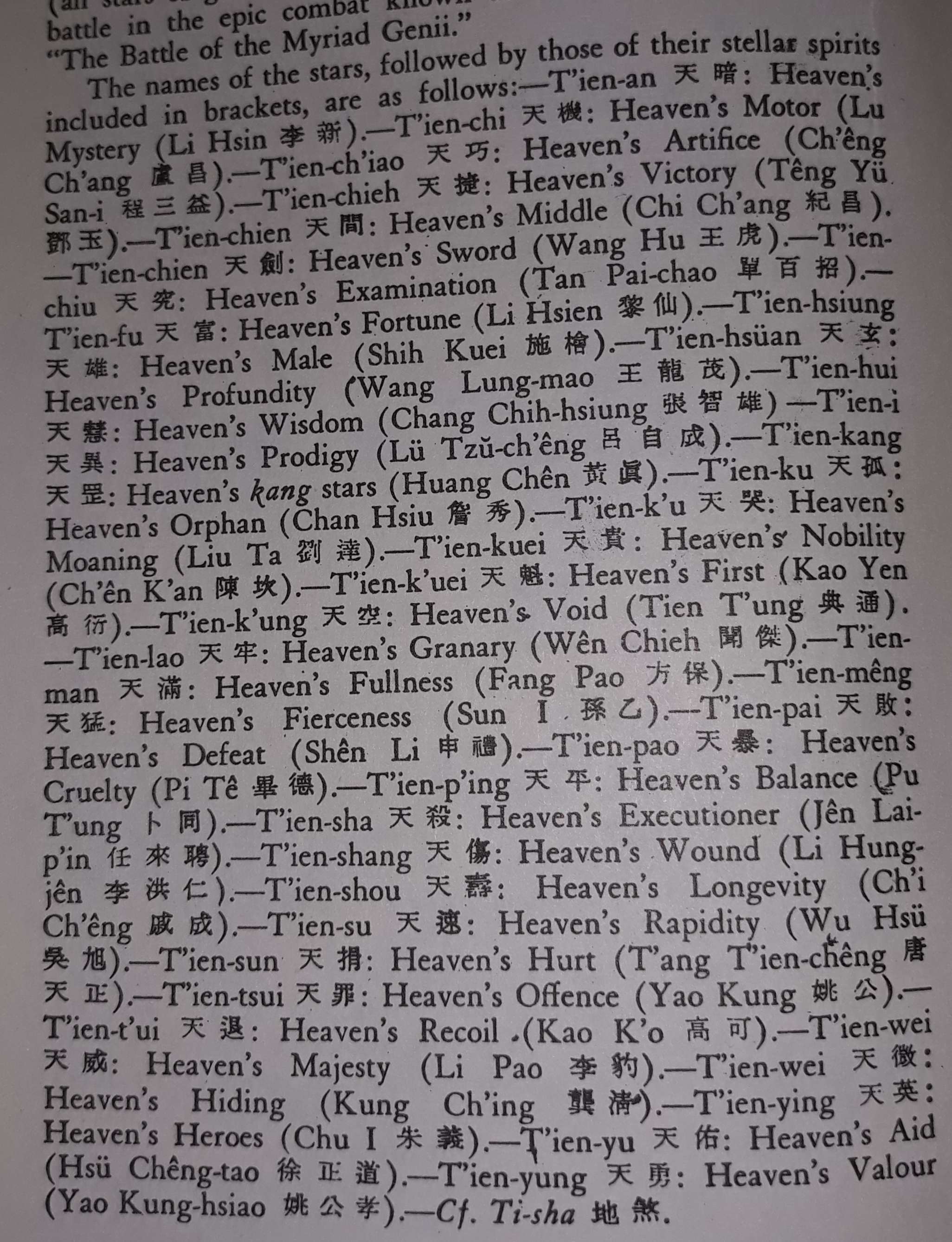
The names of the two forms of transformation that Subodhi offers to teach Monkey can be traced to Chinese astrology. The “Heavenly Ladle” (Tiangang, 天罡; i.e. the Big Dipper) is associated in some traditions with thirty-six stars (fig. 1). Regarding the origin of these stellar bodies, Werner (1932/1969) explains: “The gods of these stars (all stars of good omen) are all heroes who fell on the field of battle in the epic combat known as Wan Xian Zhen 萬仙陣, “The Battle of the Myriad Genii [or Immortals]” (p. 506). This is, of course, a reference to a famous military trap appearing in the Chinese classic Investiture of the Gods (Fengshen yanyi, 封神演義, c. 1620).
Fig. 1 – A list of the thirty-six Heavenly Ladle stars (larger version). Photograph of Werner, 1932/1969, p. 506. Apologies for not having access to a scanner at this time.
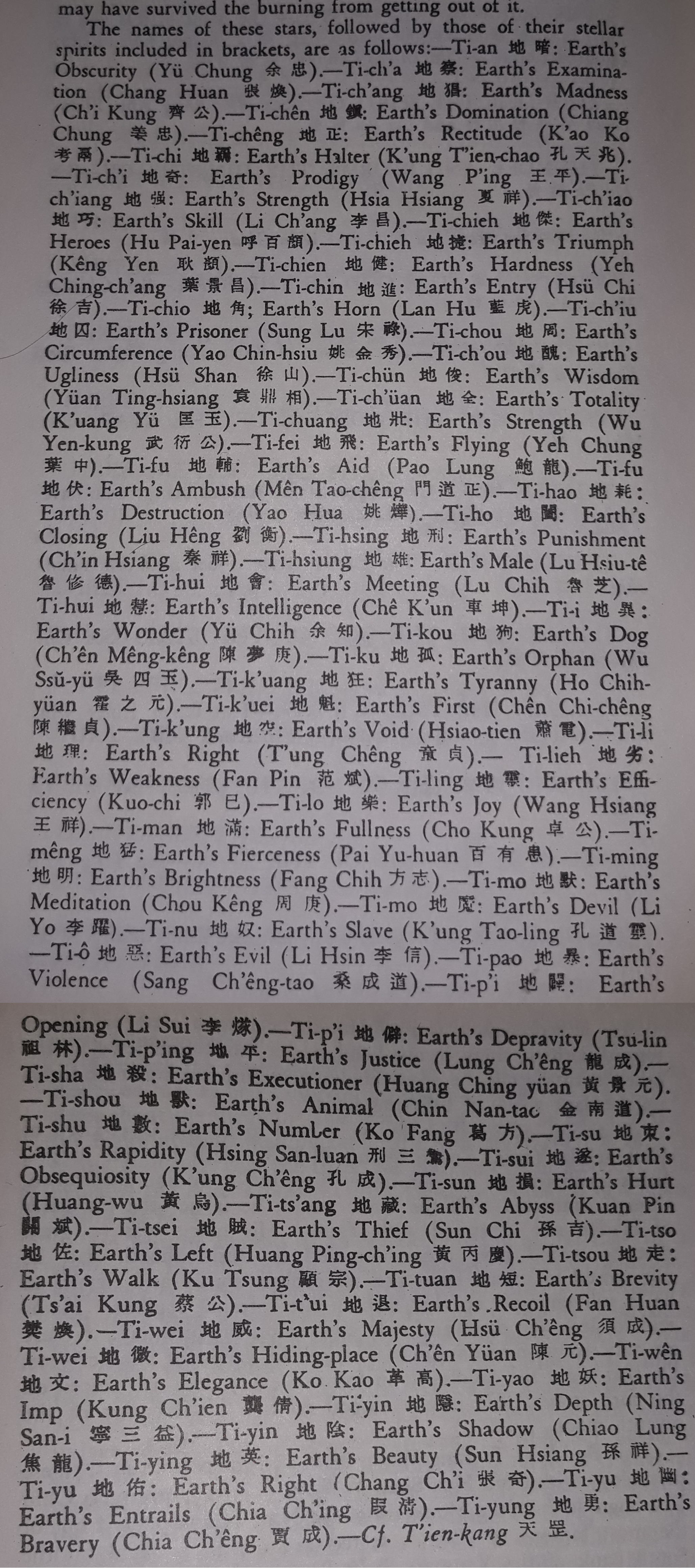
Furthermore, he writes that the “Earthly Fiends” (Disha, 地煞) are:
[S]eventy-two stars [fig. 2] of evil influence, opposed to the Tiangang. The wicked genii of these stars are cast out and slain by tongzi 童子 magicians [i.e. spirit mediums], who impale them on forks and shut them up in earthen jars, then take them to waste lands, throw them into fires, and surround the spot with a circle of lime, which is supposed to prevent any spirit which may have survived the burning from getting out of it (Werner, 1932/1969, p. 496). [2]
Fig. 2 – A list of the seventy-two Earthly Fiend stars (larger version). Photographs of Werner, 1932/1969, pp. 496-497.
Additionally, the Earthly Fiends are considered the “enemies of man, and causes of all diseases and ailments” (Doré & Kennelly, 1916, p. xviii). Several Buddho-Daoist folk talismans exist to ward afflictions caused by the Fiends. One such Buddhist talisman said to cure the “one hundred ailments” even invokes the thirty-six Heavenly Ladle stars to aid in the conquering of the seventy-two demons:
An order is hereby made by the “Ministry of the Thunderbolt”, commanding in the name of the “three religions” that the auspicious stellar gods, Tiangang 天罡, reduce to order the maleficent demons, Disha 地煞, who have caused this disease. The charm must also repress these malignant beings and expel them forthwith (fig.3) (Doré & Kennelly, 1916, p. 312).
Fig. 3 – A reproduction of the illness-curing Buddhist Talisman (larger version).
It’s interesting that Sun Wukong chooses the transformation method centered around stars of evil influence and later becomes a demon who challenges heaven. [3]Good fodder for fan fiction, no?
When these dichotomous stellar bodies were first acknowledged isn’t exactly clear, [4] but the Heavenly Ladle stars go back to at least the mid-13th century as they are mentioned in the Old Incidents in the Xuanhe Period of the Great Song Dynasty (Da Song Xuanhe Yishi, 大宋宣和遺事), a storytelling prompt of the late-Song to early-Yuan. It contains the earliest stories associated with the Water Margin (Shuihu zhuan, 水滸傳, c. 1400), a Chinese classic that predates Journey to the West. The one hundred and eight heroes of this novel are famous for being reincarnations of the Heavenly Ladle and Earthly Fiend stars, a fact revealed in chapter seventy-one when a heaven-sent stone slab is found to list their human names along with the corresponding stellar titles. The long association of the stars with the hugely popular Water Margin novel, therefore, may have inspired the names for the techniques taught by Subodhi in Journey to the West.
2. Ties to Daoist Practices
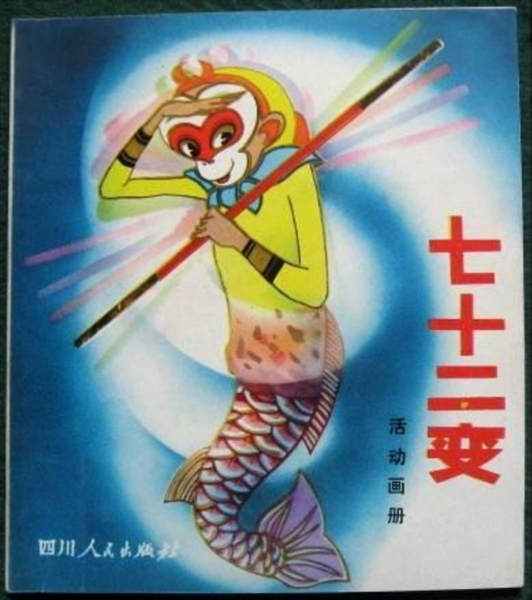
Robinet (1979) expertly explains that transformation (bianhua, 變化), or “metamorphosis” as she calls it, is central to Daoism. Gods and Saints are portrayed in Daoist literature as being in constant flux, changing with the seasons, taking on different guises and titles, disappearing and reappearing, never remaining the same, thereby living eternally. Daoists and magicians achieve metamorphosis through external and internal alchemical processes, the former involving the ingestion of drugs and talismans and the latter via mental exercises. Those who succeed in their practice can divide themselves endlessly; create rivers, mountains, and forests from meager samples of water, earth, and seeds; and most importantly, change their form into anything (fig. 4), including the five elements, dragons, clouds, rays of light, or even celestial bodies like the sun and moon.
Fig. 4 – The cover of a vintage children’s flip book about Monkey’s transformations (larger version). Here he is seen changing into a fish.
Interestingly, transformations could be used to live in hiding, much like originally intended by Subodhi in Journey to the West. Adepts still questing for immortality could magically transform a sword, staff, or slipper into their deceased body, thereby faking death and escaping elsewhere to find a method leading to eternal life. (Often times, those who took this route assumed a new identity to avoid heaven’s gaze (Campany, 2005)). Additionally, sages are said to use their powers to hide in the earth or in the light of the sun, moon, and stars. One source mentions adepts hiding by scattering their shadow and transforming it into seventy-two types of light. In a related book chapter, Robinet (1993) notes that this number “alludes to [Laozi’s] seventy-two supernatural marks” (clearly borrowing from the Buddhist Mahapurusa laksana) (p. 166). This is fascinating as it shows that there is precedent for seventy-two transformations in Daoism.
2.1. Archive Link for Robinet (1979)
I have archived the wonderful paper on metamorphosis cited above. It can be read here:
This has been posted for educational purposes. No malicious copyright infringement is intended. Please support the official release.
3. Update
Update: 06-12-22
I recently posted an in-depth article about the Patriarch Subodhi in which I reveal information about the additional benefits of the 72 Transformations. Anyone involved in any upcoming “What if” battles involving the Monkey King (COUGH, COUGH!) would do well to take note of this information.
Subodhi teaches this skill to Monkey with the expressed purpose of helping him hide from three calamities of cosmic lightning, fire, and wind sent by heaven to destroy immortals for defying fate and achieving eternal life. But beyond the power of metamorphosis, the novel implies that the ability also grants the user multiple lives (similar to a video game), which might serve as a buffer against the calamities. For example, in chapter 41, after Sun passes out from Red Boy‘s fiery attack, Zhu Bajie reassures everyone by saying: “If he is capable of seventy-two transformations, he has seventy-two lives” (Wu & Yu, 2012, vol. 2, p. 232). Also, in chapter 46, Monkey magically regrows his head after being non-fatally beheaded in a contest of magical skill. Sha Wujing remarks: “If he knows seventy-two ways of transformation, … he may have altogether seventy-two heads!” (Wu & Yu, 2012, vol. 2, p. 308). [5] In addition, while not directly related to the primate hero, the Bull Demon King is said in chapter 61 to also know the 72 changes (Wu & Yu, 2012, vol. 3, p. 148). He uses the extra lives to survive being beheaded by Prince Nezha a number of times:
[Nezha] leaped onto the bull’s back and brought his monster-cleaving sword down on the bull’s neck: the bull was beheaded at once. Putting away his scimitar, the devaraja was about to greet [Sun Wukong] when another head emerged from the torso of the bull, his mouth belching black air and his eyes beaming golden rays. [Nezha] lifted his sword once more and cut off the bull’s head; as soon as it dropped to the ground, another head came out. It went on like this more than ten times. At last, [Nezha] took out his fiery wheel and hung it on the Bull’s horn. The wheel at once started a great blaze of true immortal fire, which burned so fiercely that the bull began to growl and roar madly, shaking his head and wagging his tail (Wu & Yu, vol. 3, p. 160).
Notes:
1) It should be noted that the calamities are sent every five hundred years. Sun never has to live in hiding, though, as he is trapped under Five Elements Mountain upon the five hundredth anniversary of his immortality. (He was almost 350 years old prior to taking up spiritual cultivation.) And he achieves Buddhahood prior to reaching the one thousandth year of his immortality, so he never has to guard against subsequent calamities.
3) Conversely, Zhu Bajie is shown capable of thirty-six transformations (Wu & Yu, 2012, vol 2, p. 328, for example), meaning that he studied the method associated with the stars of good omens. And, of course, we know his sordid story …
4) Though, in my opinion, the thirty-six stars are likely based on the thirty-six generals led by the stellar exorcist, Marshal Tianpeng (天蓬, i.e. Zhu Bajie’s former incarnation), who is himself one of the nine stars of the Big Dipper. The Marshal and his generals appear in the liturgy of the Song-era “Correct Method of the Celestial Heart” (Tianxin zhengfa, 天心正法) exorcist tradition (Anderson, 2008).
5) Thank you to Irwen Wong of the Journey to the West Library blog for bringing these examples to my attention.
Sources:
Anderson, P. (2008) Tianxin zhengfa In F. Pregadio (ed.), The encyclopedia of Taoism: Vol 1-2 (pp. 989-993). Longdon: Routledge.
Campany, R. (2005). Living off the Books: Fifty Ways to Dodge Ming 命 [Preallotted Lifespan] in Early Medieval China In C. Lupke (Ed.), The Magnitude of Ming: Command, Allotment, and Fate in Chinese Culture (pp. 129-150). University of Hawaii Press.
It recently occurred to me that Sun Wukong from Journey to the West (Xiyouji, 西遊記, 1592; “JTTW” hereafter) and Wu Song (武松) from the Water Margin (Shuihu zhuan, 水滸傳, c. 1400; “WM” hereafter) share a number of similarities. Each is a reformed supernatural spirit, a tiger slayer, a Buddhist monk nicknamed “Pilgrim,” and a monastic martial artist, and each wears a moralistic headband and wields a weapon made from the same fanciful metal. Since the WM predates the publication of JTTW by nearly two hundred years, one might be tempted to speculate that the latter influenced the former. However, both story cycles first appeared during the Song dynasty, with various iterations from the Yuan to the Ming (see Ge, 2001). In this article I show the parallels are due to the respective narratives drawing on similar religious, folkloric, and historical source material. I feel such a comparison is important as it presents a fuller picture of the cultural landscape in which the Monkey King developed.
Chapters one through seven of JTTW present Sun Wukong as a celestial stone-born monkey who studies under a Buddho-Daoist master and achieves great magic powers, which he uses to rebel against heaven. After being defeated by the Buddha, Monkey is imprisoned under Five Elements Mountain for five hundred years. In chapter fourteen, the repentant immortal is later released to protect the monk Tripitaka on his journey to retrieve scriptures from India.
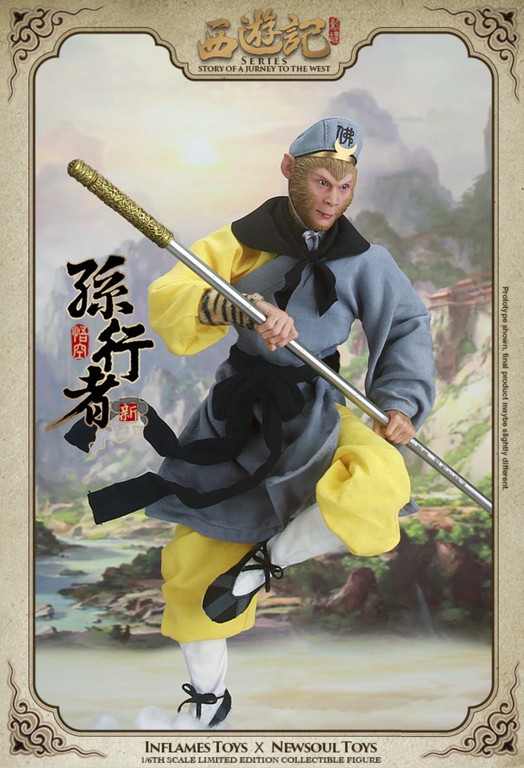
Fig. 1 – A modern action figure of Sun Wukong’s imprisonment under a section of Five Elements Mountain (larger version).
Chapter one of the WM tells how one hundred and eight spirits were quelled by a Daoist sage during the Tang dynasty and imprisoned in a bottomless pit under a great stone slab. Four or five hundred years later during the Song dynasty, a haughty government official orders the slab dug up and removed to sate his curiosity, allowing the spirits to escape in a plume of miasmic black fumes and later be reborn on earth. Wu Song, whose main story appears in chapters 23 to 32, is one of these extraordinary men and women who come to use their martial, intellectual, or magical skills to rebel against the corrupt Song government. A heaven-sent stone slab in chapter 71 is later discovered to list the names of each bandit with the corresponding name of their previous incarnation, which make up the “Thirty-Six Heavenly Stars” (Tiangang sanshiliu xing, 天罡三十六星) and the “Seventy-Two Earthly Fiend Stars” (Disha qishier xing, 地煞七十二星). Wu Song is listed as the “Heavenly Harm Star” (Tianshang xing, 天傷星), the fourteenth of the Thirty-Six Heavenly Stars.
So we see both are formerly evil spirits who were conquered by a religious figure and imprisoned under stone for centuries. After being released, each rebellious figure becomes a force for good.
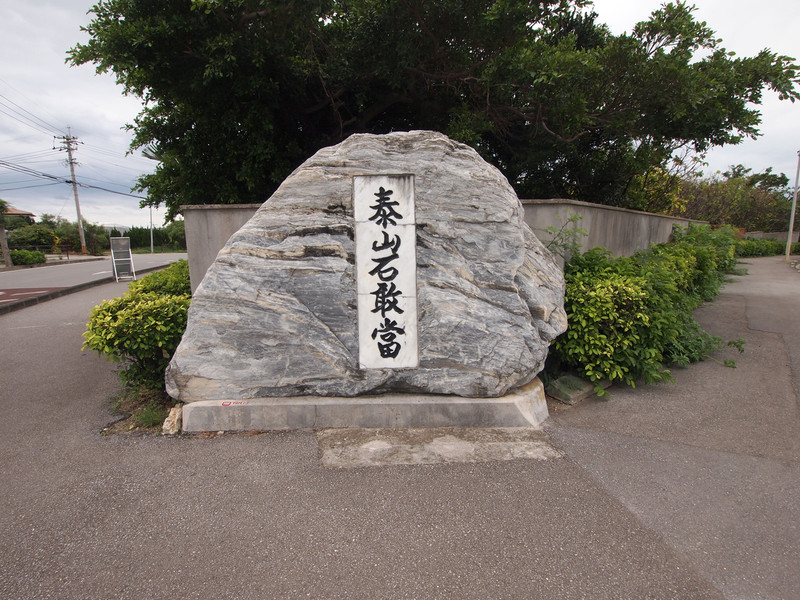
Monkey’s punishment can be traced to Tang and Song dynasty tales about the sage king Yu the Great imprisoning a simian water demon under a mountain. To my knowledge, the first recorded mention of this punishment appears in an early-Ming zaju play in which Guanyin traps Sun Wukong under Flower Fruit Mountain. Wang (1992) suggests that the stone slab from the WM was likely influenced by the Taishan stone (taishan shi, 泰山石) (fig. 2), a class of “evil-warding stones” (shigandang, 石敢當) often placed outside of homes and temples or at the intersection of roads as protection from malevolent forces (pp. 71-72 and 254). The Taishan stone represents Mount Tai and its deity. The landmass is considered the heaviest thing imaginable in Chinese culture. This means that the evil would be completely immobilized by the great weight.
Fig. 2 – A modern Japanese example of a Taishan stone (larger version). They often read “Taishan stone takes upon itself” (Taishan shi gandang, 泰山石敢當), denoting its duty of protection (Wang, 1992, p. 71). Original image from Wikipedia.
Additionally, the pit containing the spirits can be traced to a Song-era Daoist ritual in which an exorcist draws the character for “well” (jing, 井/丼) on the ground, thereby dividing the ritual space into nine sections, representing the Nine Palaces (jiugong, 九宮), [1] and creating an earth prison. The Compilation of Rituals of the Way (Daofa huiyuan, 道法會元) reads:
[U]se the Sword mudrā to draw the character for “well” on the ground. Transform it into a black prison, ten-thousand zhang deep, and ten thousand li wide. [2] Black vapors burst out of it. Inside the prison, visualize how cangues and locks, as well as tools and machinery are laid out. Then recite the Spell for Fast Arrest [cu zhuo zhou, 促捉咒] (Meulenbeld, 2007, p. 142).
The black vapors should remind readers of that released upon the spirits’ escape from their centuries-long imprisonment.
Fig. 3 – The Chinese character for mountain (shan, 山) (larger version). Fig. 4 – The Mountain mudra (shanzi jue, 山字訣) (larger version). Photo by the author. Fig. 5 – The double-handed Mount Tai mudra (Taishan jue, 泰山訣) (larger version). Original picture from here.
Another version of the ritual sees the spirits being coaxed or forced inside of a liquid-filled jar placed in the center of the well diagram. Afterwards, the opening is sealed with paper and the exorcist performs a mudra representing the immense pressing weight of a mountain (just like the aforementioned Taishan stone). [3] Meulenbeld (2007) writes:
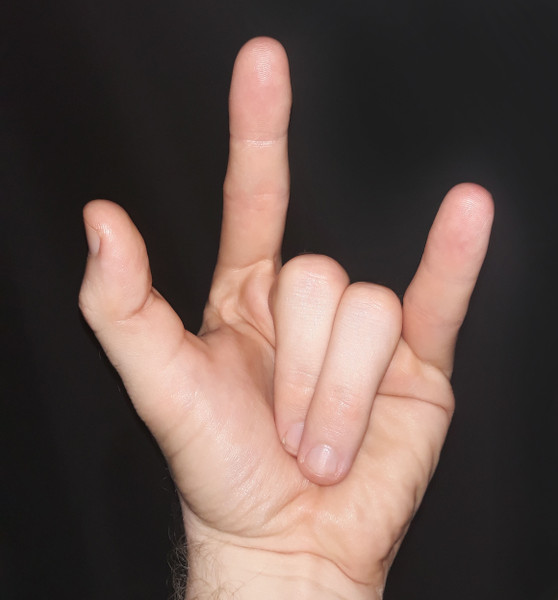
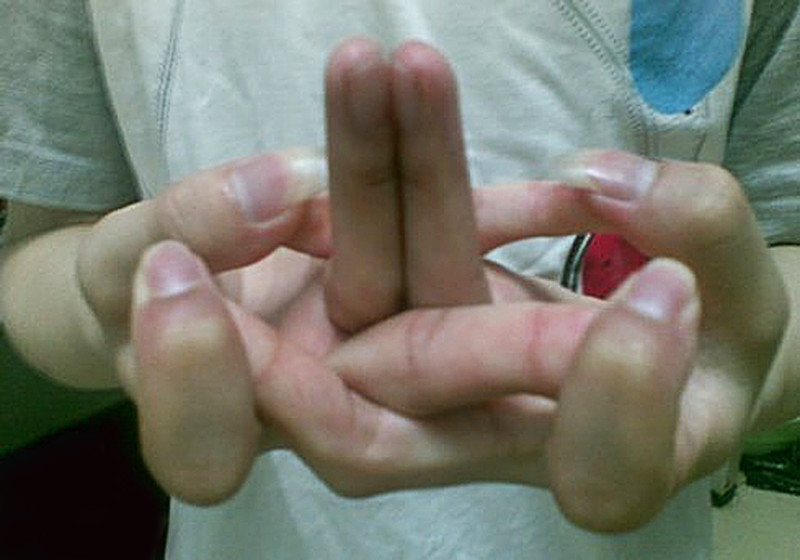
The spirits captured within the grid of the Nine Palaces were kept inside their prison by symbolically pressing them down underneath a mountain. The symbolism here lies in the fact that the mountain was represented by a posture of the hand forming the character for mountain (“Mountain Mudrā” 山字訣 with the thumb, index-finger, and little finger all pointing upward [fig. 3 and 4]. Oftentimes the specific “mudrā of Mt. Tai” 泰山訣 [fig. 5], was used, representing the heaviest of all mountains. Moreover, many present-day exorcist talismans contain a character composed of a “demon” 鬼 underneath a “mountain” 山, namely the character wei 嵬 (p. 145, n. 92).
This means that the respective punishments of Sun Wukong and Wu Song (and his brethren) are for all intents and purposes the same: they are imprisoned under mountains. The Taishan stone and the Mountain mudra are no doubt based on the same belief that mountains can immobilize evil spirits. Most importantly, the mudra likely influenced the concept of the Buddha transforming his hand into Five Elements Mountain in chapter 7 of JTTW. The fictional mountain is then a cognate of Mount Tai.
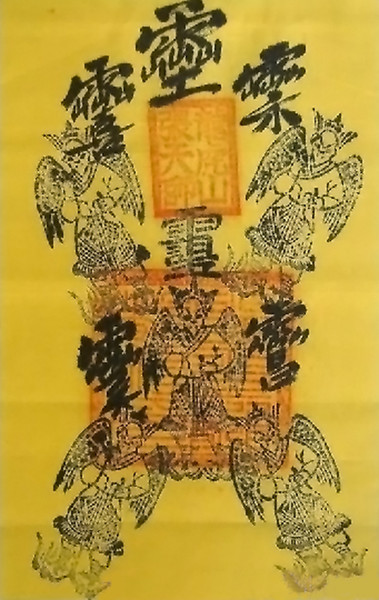
Fig. 6 – A paper fu talisman marked with an image of the Five Thunders (Wu Lei, 五雷) (larger version).
Lastly, the idea that evil spirits can be reformed and their powers put to good use—i.e. Sun Wukong protecting Tripitaka and Wu Song standing against a corrupt government—is tied to the Song-era “Thunder Ritual” (Leifa, 雷法). Meulenbeld (2007) explains that stories from the Tang to the Song present the characteristics of the thunder god, Sire Thunder (Lei Gong, 雷公), becoming increasingly demonic, changing from a muscular deity to a number of animals and finally a Garuda-like bird monster. Likewise, while he was a respected force of nature in the past, Sire Thunder became an impulsive agent of heaven, one capable of being challenged and even captured by a brave individual or ritual master. The subjugation of this demonic god allowed his captors to appropriate his heavenly power for their own purposes. The deity and his four brothers, comprising the “Five Thunders” (Wu Lei, 五雷) (fig. 6), can be summoned on command via talismans and charms and made to bring rain, heal sicknesses, or conquer demons. [4] Such ritual accouterments are just a small part of a much larger subsequent Thunder Ritual liturgy that is, according to one Song dynasty source, capable of “control[ing] the demons and spirits of the Sixfold Heavens, [expelling] evil and avert[ing] disaster” (Meulenbeld, 2007, p. 67).
2. Tiger Slayers
JTTW, ch. 14 – Sun Wukong’s first act of protecting Tripitaka upon his release is effortlessly killing a tiger with a single stroke of his staff. This happens the day after a huntsman had come to the monk’s defense by fighting a tiger for hours before dispatching it with a trident. The difference in power between the immortal and human heroes leads the monk to exclaim, “For the strong, there’s always someone stronger!” (Wu & Yu, 2012, vol. 1, p. 310).
WM, ch. 23 – Wu Song gets drunk on a trip home to see his elder brother, and after ignoring warnings not to take a mountain shortcut, the hero is set upon by a ferocious man-eating tiger. In the process of initially defending himself, Wu snaps his walking staff on a nearby tree, forcing him to resort to brute strength. He manages to wrestle the big cat’s face into the dirt and rains down sixty or seventy fist blows before it stops moving (fig. 7). He then finishes off the beast with the remains of his staff.
Fig. 7 – “Wu Song Beats the Tiger” (Wu Song dahu, 武松打虎) by Wang Kewei (王可偉) (larger version).
I can’t help but imagine that the episode from JTTW is a sly nod to that from the WM. Tripitaka’s statement could be a way of propping up the Monkey King as the most powerful hero, one who can dispatch tigers with no effort at all.
The ability to kill a tiger was considered the sign of a powerful warrior in Chinese folklore. For example, A New Account of the Tales of the World (Shishuo xinyu, 世說新語, 5th century), a collection of historical and fictional anecdotes, tells the story of how the Western Jin general Zhou Chu (周處, 236–297) was originally a wayward youth considered the worst of Yixing‘s “Three Scourges”—a tiger, a dragon, and himself. Wanting to prove his strength, Zhou is said to have easily killed the tiger but disappeared for three days and nights fighting the dragon. The youth later returned to find the people celebrating his apparent death. This caused Zhou to mend his ways and eventually become a great general (Knechtges & Chang, 2010, pp. 2274-2275).
3. Buddhist Monks With Matching Religious Nicknames
JTTW, ch. 14 – Sun Wukong takes the tonsure as a Buddhist monk upon his release. [5] His master Tripitaka then gives him the religious nickname “Pilgrim Sun” (Sun xingzhe, 孫行者), and the character is often simply referred to as “Pilgrim” (xingzhe, 行者; literally: “traveler”) throughout the narrative.
WM, ch. 31 – Wu Song kills a thug and his Song government official friend for framing the hero for theft and attempting to have him murdered en route to a prison camp. As a result, he is forced to dress as a Buddhist monk, taking a slain priest’s religious garb and ordination certificate (jiedie, 戒牒) and calling himself “Pilgrim Wu” (Wu xingzhe, 武行者).
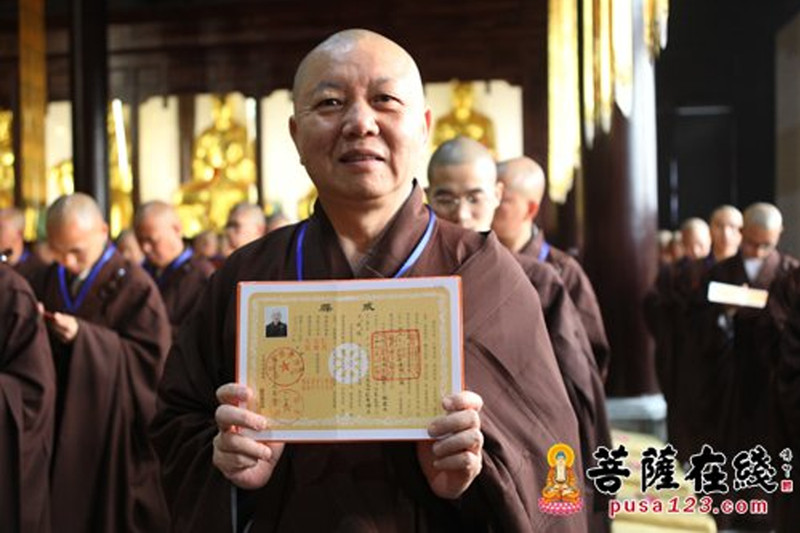
The term Pilgrim refers to a “postulant,” a lay Buddhist acolyte who has yet to be ordained but lives as an untonsured monk, one expected to follow the Five Precepts (Pali: Pañcasīla; Ch: Wujie, 五戒) against killing, lying, stealing, sexual misconduct, and drinking alcohol (Robert & David, 2013, pp. 1011-1012). Ch’en (1956) writes that such trainees were historically required to complete a long period of intense religious study and pass a rigorous examination before being awarded the aforementioned ordination certificate (fig. 8), thereby becoming a full-fledged monk. This certification system was originally initiated during the Tang to weed out those wanting to evade the draft and taxes, as well as bandits like Wu Song who sought refuge from the law. However, during the Song, the government sold these documents like war bonds in order to help pay for their ongoing struggle against the barbarians of northern China. Therefore, ordination certificates were often exuberantly expensive, [6] meaning those who had the training but could not afford the document were doomed to live as a postulant. This contrasts with the thousands upon thousands of people who bought their way into the Buddha’s fold simply for the draft and tax exemption. They forwent the training altogether and were monks only on paper. This continued practice naturally resulted in a major decline in the quality of monks during the Song.
Fig. 8 – A present day monk showing his ordination certificate (jiedie, 戒牒) (larger version). Original image found here.
Having read the above, we can say that Sun Wukong is called Pilgrim because he assists a Buddhist priest but lacks the religious education and ordination certificate. And while Wu Song has the document (taken from a dead priest), he lacks the required education. It should be remembered that Wu is a bandit-turned-monk. At the same time, both characters typify the “itinerant monk,” the second meaning of Pilgrim (xingzhe, 行者), as both are on a journey: Sun is traveling to India and Wu is traveling the road—albeit secretly to meet with fellow outlaws. But I would like to suggest that the titles may have also been meant as a jab at the violent, untrained riffraff passing for monks during the Song (more on this below). After all, the earliest references to our characters with these titles come from this period.
“Pilgrim Wu” appears in scholar-painter Gong Shengyu‘s (龔聖予, 1222–1307) In Praise of the Thirty-Six [Men] of Song Jiang (Song Jiang sanshiliu zan, 宋江三十六贊), a collection of poems eulogizing each of the thirty-six bandits then associated with the early WM story cycle.
Pilgrim Wu Song: You resisted women, obeyed the Five Precepts, among Wine, Women, Wealth and Force, you were inclined to kill people (Børdahl, 2013, p. 29).
Gong claims that the poems were based on “stories of the streets and tales of the lanes” (jietan xiangyu, 街談巷語), popular narratives performed by storytellers at local venues. Given that such early tales no longer exist, its impossible to say whether or not Wu Song was always a monk or a bandit-turned-impostor monk like his counterpart from the published edition of the WM (Børdahl, 2013, pp. 28-29). Either way, this suggests that Wu’s predilection for killing was a prominent aspect of his story cycle by at least the 13th century.
Sun Wukong first appears as the “Monkey Pilgrim” (Hou xingzhe, 猴行者) in The Story of How Tripitaka of the Great Tang Procures the Scriptures (Da Tang Sanzang qujing shihua, 大唐三藏取經詩話; “The Story” hereafter), a seventeen chapter storytelling prompt dated to the late-13th century. Like Wu Song, Monkey is also depicted as comfortable with killing. For example, in chapter five, he turns an evil sorcerer’s wife into grass so that she will be eaten by a young monk who had been transformed by her husband into a donkey. After both parties are changed back to normal, Monkey threatens to “mow down all the grass of [his] house” (i.e. kill his wife and anyone else he loves) if the man ever misuses his magic again. [7] Later in chapter six, Monkey brutally tortures and then kills a white tiger demon who tries to eat his master (Wivell, 1994, pp. 1181-1207)
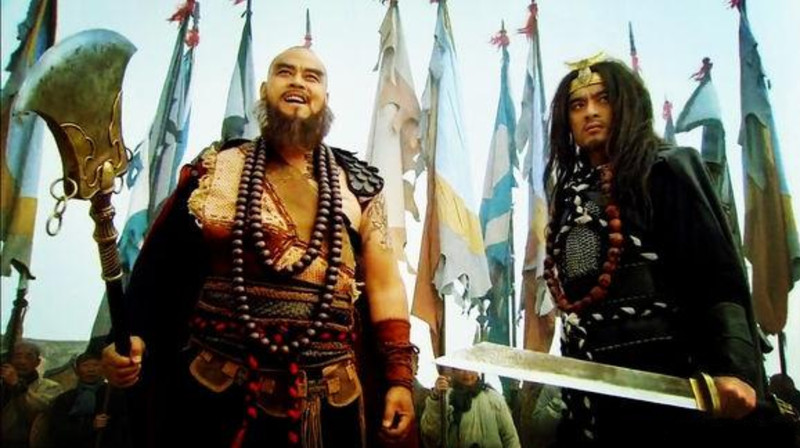
Fig. 9 – The “Pilgrim” Wu Song (right) and the “Flower Monk” Lu Zhishen (left) from a recent WM television series (larger version).
Additionally, two early WM-related tales titled “Pilgrim Wu” (Wu xingzhe, 武行者) and the “Flower [Tattooed] Monk” (Hua heshang, 花和尚) are listed under the “staff” (ganbang, 桿棒) category of popular stories in The Drunken Man’s Talk (Zuiweng tanlu, 醉翁談錄), a circa 13th century collection of short stories, anecdotes, and poetry. [8] So-called staff tales were character-driven narratives about heroes, in this case Wu Song and his fellow outlaw-turned-monk Lu Zhishen (fig. 9), righting injustices using staves. [9] I should note that The Story describes the Monkey Pilgrim wielding two such weapons in his adventures.
Sun and Wu’s association with killing and staff fighting were likely influenced by historical warrior monks and bandit monks. Shahar (2008) explains that warrior monks were seasoned fighters who lived in subsidiary shrines away from the devout community and protected monasteries in times of trouble. These “monks” regularly drank wine and ate meat, associating the latter with physical strength and fighting ability, and even worshiped wrathful deities like Vajrapani, who is described in scripture as killing in the name of Buddha. Their weapon of choice was a wooden staff, which was originally chosen for being non-lethal. However, a metal staff like the one wielded by Sun Wukong in JTTW was sometimes used by warrior monks for its killing capacity in times of war. The most famous monastic staff method belongs to the Shaolin Monastery (Shaolin si, 少林寺) (video 1). After the Shaolin warrior monks helped the Ming dynasty government repel Japanese pirate incursions from the Chinese coast during the 1550s, their staff method was touted in military encyclopedias and civilian weapons manuals. [10]
Video 1 – A demonstration of Shaolin Wind Devil Staff (Fengmo gun, 風魔棍).
Bandit monks are outlaws like Wu Song who dressed as clerics to avoid problems with the law. [11] Lorge (2012) comments that the characteristics of bandit monks were nearly indistinguishable from that of warrior monks.
[I]t is easy to see how bandit-monks are virtually the same as warrior-monks. These men drank wine, at meat, and had sex with women—practices alien to true Buddhist monks. A number of Buddhist authorities were deeply troubled by the presence of monks who directly violated Buddhist precepts. We do not know whether there was a sharp break between ordained and trained monks who carefully followed monastic rules in their search for enlightenment and men who simply claimed to be monks, wore monastic robes, shaved their heads, but otherwise did not follow monastic rules (p. 174).
He goes on to explain that the Shaolin monastery, for example, became heavily militarized after a nasty defeat in 1356 during the Red Turban Rebellion and so may have replenished its ranks using formerly deactivated soldiers at the turn of the Ming dynasty. Such violence-prone men would naturally turn towards a life of crime. Therefore, these bandits “would have been easy enough to recruit and send out as warrior-monks to fight against [other] bandits” (Lorge, 2012, p. 175).
So we see that there existed a class of staff-bearing pseudo-monks who regularly took life and drank alcohol. Serving as mainly monastic bodyguards, these fighters lacked the devotion to the precepts and, especially, the religious education to be considered real monks. Therefore, Sun and Wu’s characterization as such warriors may further explain why they are called Pilgrim.
4. Monastic Martial Artists
I want to preface this section by stating upfront that it overlaps to some degree with the previous one. But while the former explored Sun and Wu’s connection to staff-wielding warrior monks by way of their characterization in late Song oral literature, this one will discuss the connection between their images as monastic martial artists and the historical practice of boxing by warrior monks.
While the Great Sage is primarily known for his skill with the staff, he displays a mastery of unarmed combat twice in JTTW. Chapter 51, for example, describes Sun and a demonic opponent fighting with a long list of punches, kicks, grapples, and throws.
Hitching up his clothes and walking forward, the fiend assumed a boxing posture; his two fists upraised looked truly like two iron sledge hammers. Our Great Sage also loosened his legs at once and moved his body to attack; right before the cave entrance, he began to box with the demon king. This was quite a fight! Aha!
Opening wide the “Four Levels Posture”; The double-kicking feet fly up. They pound the ribs and chests; They stab at galls and hearts. “The Immortal pointing the Way”; “Lao Zi Riding the Crane”; “A Hungry Tiger Pouncing on the Prey” is most hurtful; “A Dragon Playing with Water” is quite vicious. The demon king uses a “Serpent Turning Around”; The Great Sage employs a “Deer Letting Loose its Horns.” The dragon plunges to Earth with heels upturned; The wrist twists around to seize Heaven’s bag. A green lion’s open-mouthed lunge; A carp’s snapped-back flip. Sprinkling flowers over the head; Tying a rope around the waist; A fan moving with the wind; The rain driving down the flowers. The monster-spirit then uses the “Guanyin Palm,” And pilgrim counters with the “Arhat Feet.” The “Long-Range Fist,” stretching, is more slack, of course. How could it compare with the “Close-Range Fist’s” sharp jabs? The two of them fought for many rounds— None was the stronger, for they are evenly matched (Wu & Yu, 2012, vol. 3, pp. 12-13)
I show in this article that many of the named techniques are real and are still practiced to this day. Furthermore, the poem’s bias for close-range fighting over long-range “is typical of late Ming and early Qing military literature,” as noted by Shahar (2008, p. 117). He continues,
Sixteenth- and seventeenth-century military experts allude to various short-range styles including ‘Cotton Zhang’s Close-Range Fist’ (Mian Zhang duanda [綿張短打]), ‘Ren Family Close-Range Fist’ (Renjia duanda [任家短打]), and ‘Liu [Family] Close-Range Fist’ (Liu duanda [劉短打])” (Shahar, 2008, p. 117).
This shows that the author-compiler of JTTW consulted real martial arts material to make this fight more authentic.
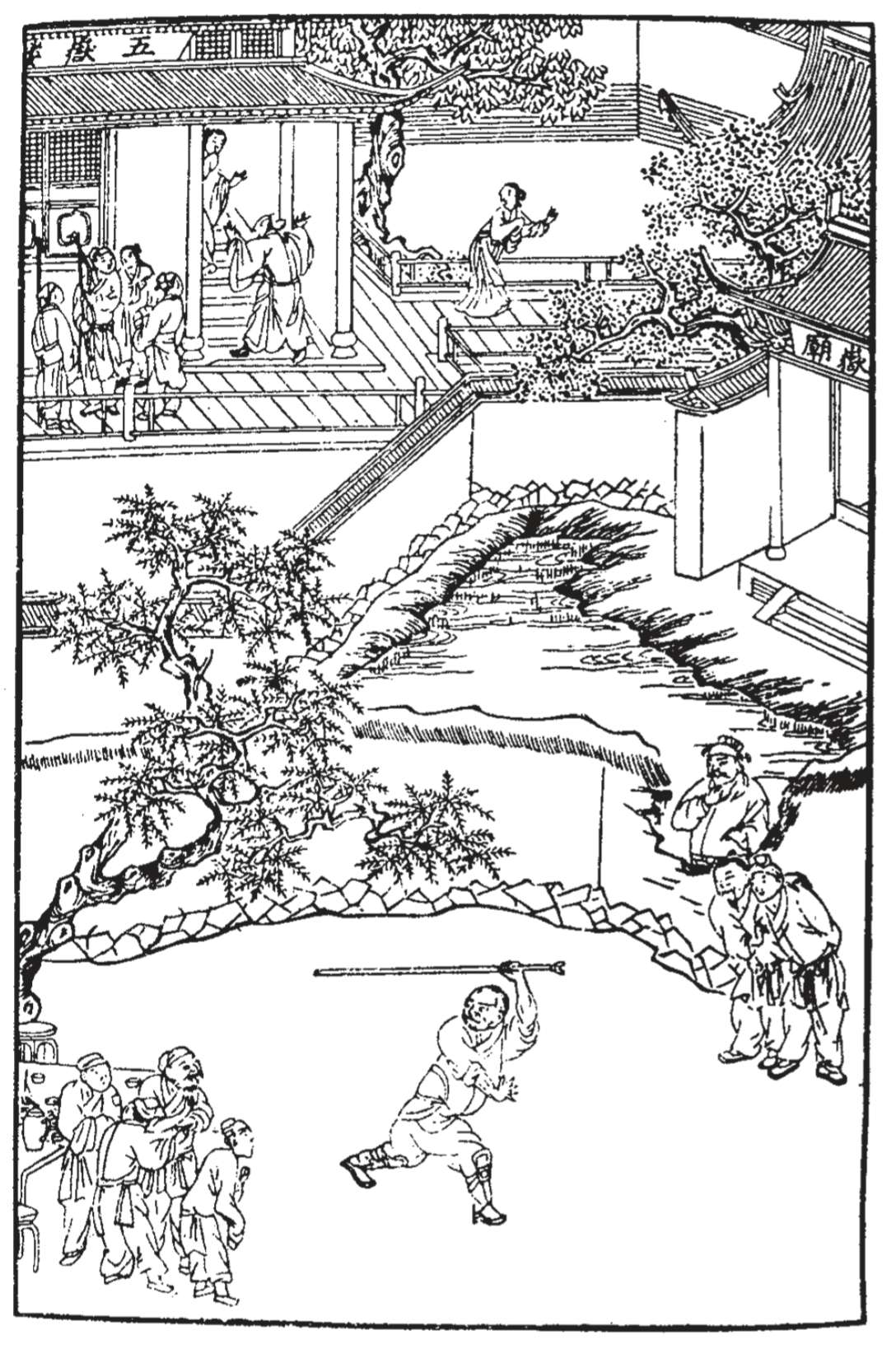
Having donned the monk persona, Pilgrim Wu stops by an inn while on a journey to meet with fellow outlaws in chapter 32. The monk’s great tolerance for wine (fig. 13) and request for meat surprises the inn keeper, whom Wu slaps to the ground upon seeing the man serve better wine and even chicken to a different patron. The patron and his friends attack the monk but are soundly beaten by his superior strength and fighting ability. [12]
Wu’s characterization as a meat-eating, alcohol-drinking monk with a thirst for combat is obviously tied to the warrior and bandit monks discussed earlier.
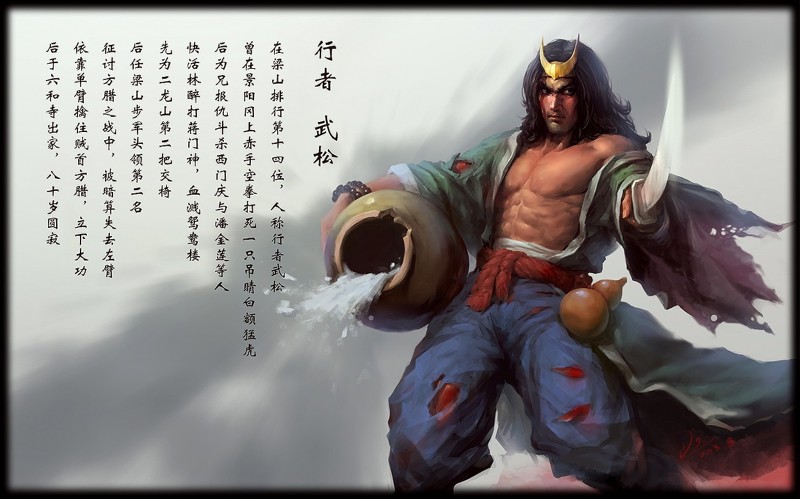
Fig. 15 – A modern depiction of Pilgrim Wu holding a jar of wine and brandishing a saber (larger version). By Leewiart user Du_YH. Original image found here.
While it precedes Wu becoming a monk, the best example of his martial prowess appears in chapter 29:
But Jiang was scornful of his foe [Wu Song], thinking that he was drunk, and he closed in rapidly. Quicker than it takes to tell, Wu Song flourished his two fists at Jiang’s face, then turned and started away. Enraged, Jiang raced after him. Wu Song lashed out backwards with his left foot and kicked him in the groin. As Jiang clasped his injured section and doubled over in pain, Wu Song whirled around and swung his right foot in a flying kick to the forehead that slammed the big man over on his back. Wu Song planted one foot on his chest and, with keg-like fists, began pommeling Jiang’s head.
This maneuver we just described—the flourish of fists and turning away, the backward left kick, the whirling around and the forward right kick—is called “the Jade-Circle Steps with Duck and Drake Feet” [Yuhuan bu, yuanyang jiao, 玉環步, 鴛鴦腳]. It was one of Wu Song’s most skillful moves. A remarkable trick! (Shi & Luo, 1993/2001, vol. 2, pp. 604 and 607.
Wu’s style is possibly another name for “Piercing Foot” (Chuojiao, 戳腳), a northern Chinese martial art known for its dynamic kicking skills. Modern folklore traces the style to the Song dynasty due to its association with WM heroes. [13]
While JTTW never openly describes Sun Wukong training in martial arts, it does imply that he learns armed and unarmed combat as a young monk studying under the Buddho-Daoist Sage Subodhi. Monkey learning boxing in a religious institution is actually a faithful depiction of one aspect of monastic life during the Ming. Shahar (2008) shows that Shaolin warrior monks took up unarmed combat during the late-Ming period, when boxing saw an explosion in popularity in Chinese culture (as demonstrated by the named techniques recorded in JTTW and the WM). Textual evidence suggests that the first styles practiced by Shaolin were Drunken Eight Immortals Boxing (Zui baxian quan, 醉八仙拳), popularized by Jackie Chan in The Drunken Master (1978), and Lost Track Boxing (Mizong quan, 迷蹤拳), the fighting style of the national hero Huo Yuanjia popularized by Bruce Lee in Fist of Fury (1972). The monks may have adopted boxing as a form of calisthenic exercise. To this they later added Daoyin (導引), a regimen of yoga-like Daoist breathing and stretching exercises designed to absorb qi (氣) energy and circulate it throughout the body. Therefore, the monks elevated their boxing practice from mere fighting to a form of spiritual cultivation. This synthesis of martial and spiritual practices simultaneously took place in wider Ming culture, leading to the creation of so-called “internal” (Neijia, 内家) martial arts like Taiji and Xingyi boxing. [14]
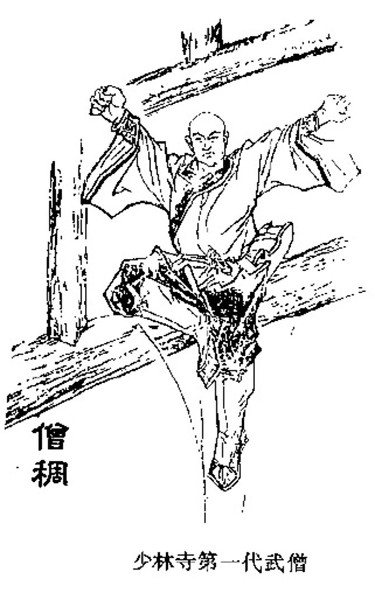
Fig. 10 – A modern drawing of the monk Sengchou showing off his newfound powers by jumping above the rafters of the Shaolin monastery (larger version). Original image found here.
That’s not to say Shaolin monks did not practice unarmed martial arts prior to the 17th century. It’s just boxing was only a form of entertainment practiced by a few and not part of the official training regimen. For example, the Tang-era anthology Complete Records from Court and Commonality (Chaoye qian zai, 朝野僉載, c. 8th century), contains the story of the famed dhyana master and Shaolin monk Sengchou (僧稠, 480–560) beseeching a religious statue of Vajrapani to bless him with martial strength so that the other monks, who enjoy sparring in their free time, will stop bullying him. After six straight days of prayer, the deity appears before him and offers the young novice a bowl of sinews to eat. Sengchou initially refuses due to the prohibition against eating meat, but he ultimately finishes the meal for fear Vajrapani will smite him with his vajra club. Like the radioactive spider bite that changes Peter Parker into Spider-Man, the sinews transform the monk, blessing him with a god-like physique and miraculous powers, such as the ability to walk on walls, leap great heights (fig. 10), and lift thousands of pounds. Most importantly, it drastically improves his fighting skills, so much so, in fact, that his former tormentors come to grovel in his presence (Shahar, 2008, pp. 35-37).
Where did Sengchou’s religious brothers learn their unarmed martial arts centuries prior to it becoming an official part of Shaolin’s training regimen? The simplest answer is someone like Wu Song, who learned boxing as a bandit or soldier and later joined the sangha. Readers may recall such violence-prone men may have been tapped as warrior monks to protect the monastery in times of trouble. They could have easily passed their fighting skills to the next generation of warrior monks.
A good example of a soldier-turned-monk is the brutish former general Huiming (惠明) from the Platform Sutra (Liuzu tanjing, 六祖壇經, written from the 8th to 13th c.). The text tells how the disciples of Hongren (弘忍, 601–674), the fifth Chan patriarch, were enraged when their master passed the mantle onto the illiterate postulant laborer Huineng (惠能, 638–713). Hundreds of monks are said to have pursued the fleeing Pilgrim south intent on forcefully taking the patriarchal symbols of the begging bowl and robe for themselves. Huiming persevered and managed to corner Huineng on a mountain. He attempted to wrestle the treasures away, but by a miracle, he could not lift them. Realizing that Huineng was the rightful heir, the monk became his disciple (Huineng & Cleary, 1998, pp. 11-12). Jealousy and anger are obviously qualities unbecoming of a real monk. In fact, the only thing that separates Huiming’s actions of hounding and attempted strong arm robbery from a bandit is his monkhood.
So, we see that Sun Wukong typifies a next generation warrior monk who learns boxing inside a religious institution. Wu Song, on the other hand, typifies the soldier or bandit who learns boxing outside the monastery and later becomes a monastic fighter, one who passes on their skills to younger monks.
5. Moralistic Headbands
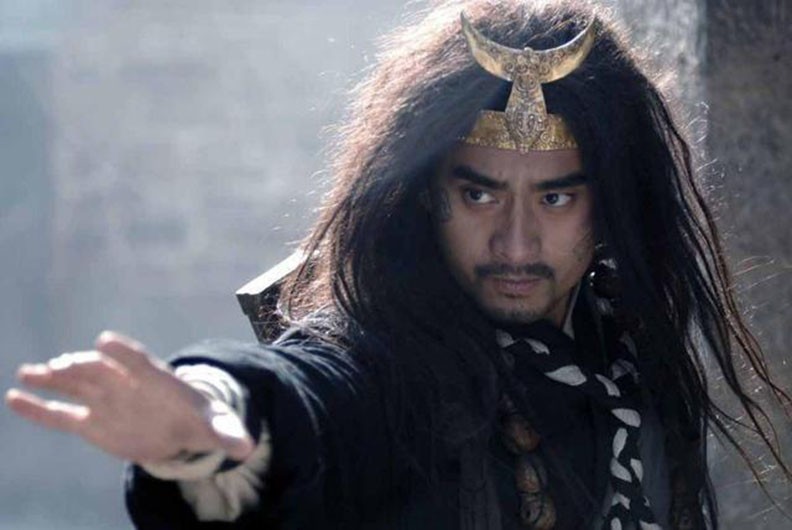
JTTW, ch. 14 – The Monkey King is tricked into wearing a brocade hat under the pretense of gaining the ability to recite scripture without rote memorization. However, the hat houses a golden fillet (jingu, 金箍) that soon takes root and painfully tightens around the immortal’s head when the correct spell is chanted (fig. 11). This allows the feeble monk Tripitaka to control the celestial monkey’s unruly nature.
WM, ch. 31 – When Wu Song disguises himself as a monk, he wears the garments of a priest whom had previously been killed by bandits. The habit includes a metal “Precepts fillet” (jiegu, 戒箍) that he wears over his long hair (fig. 12).
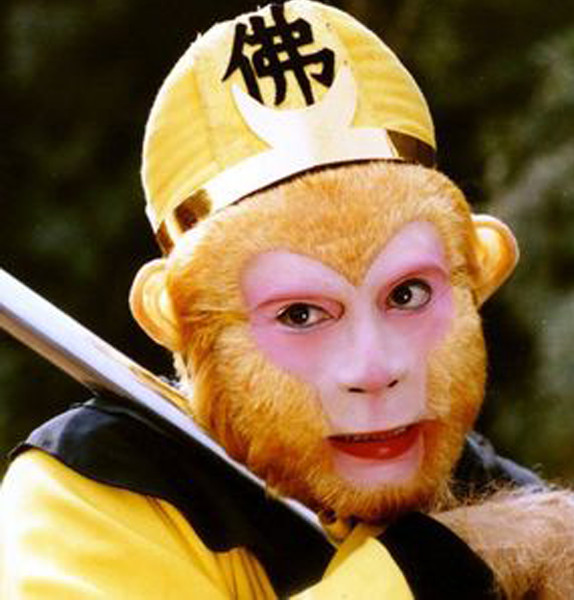
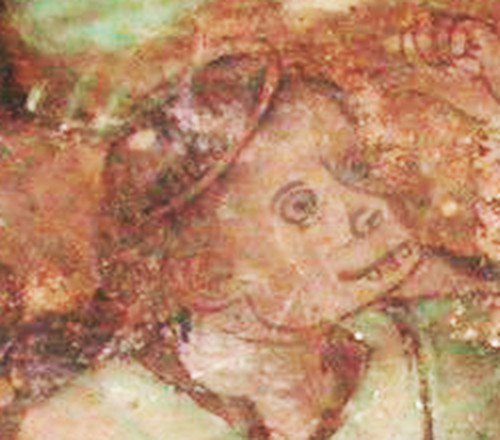
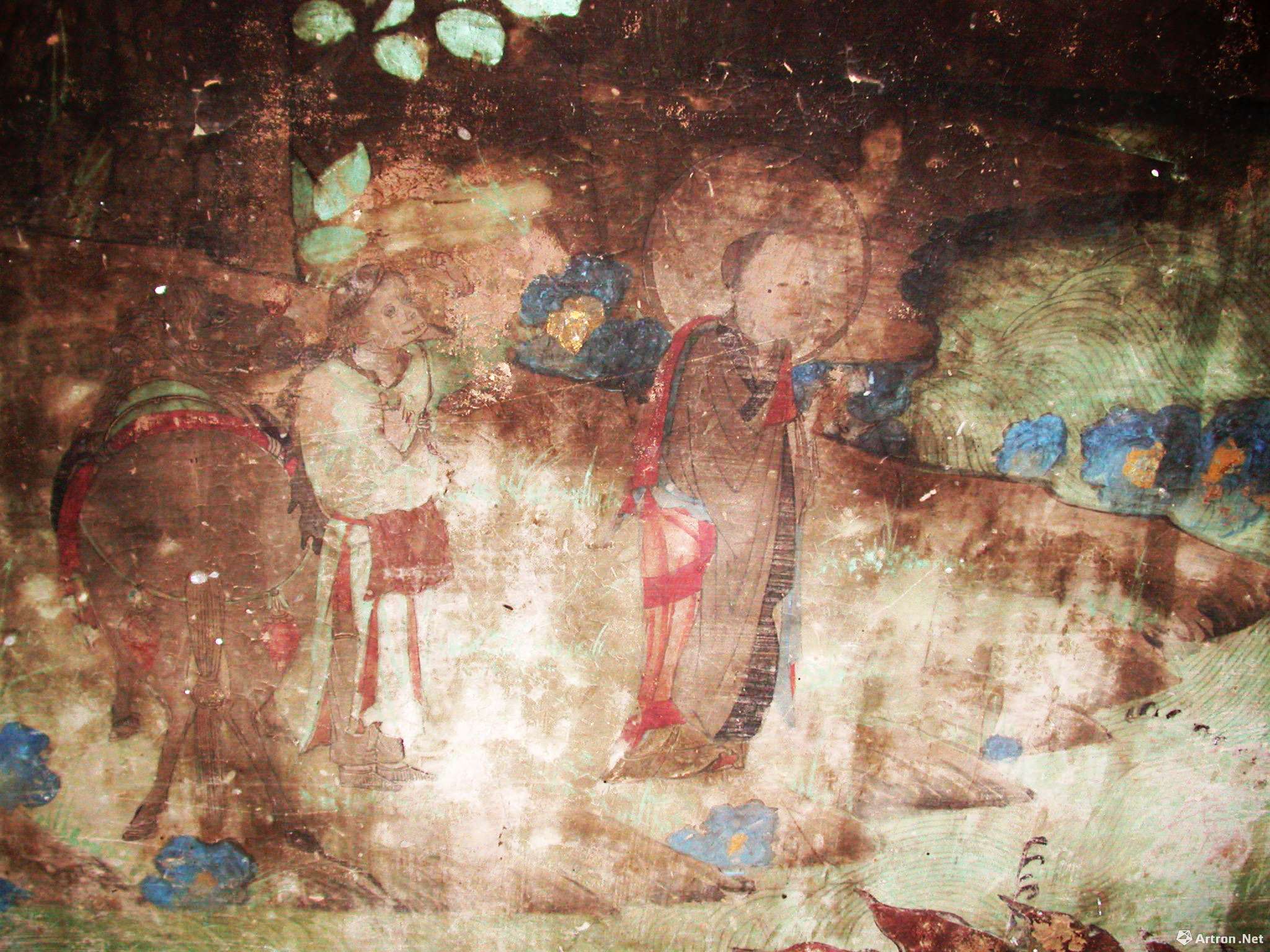
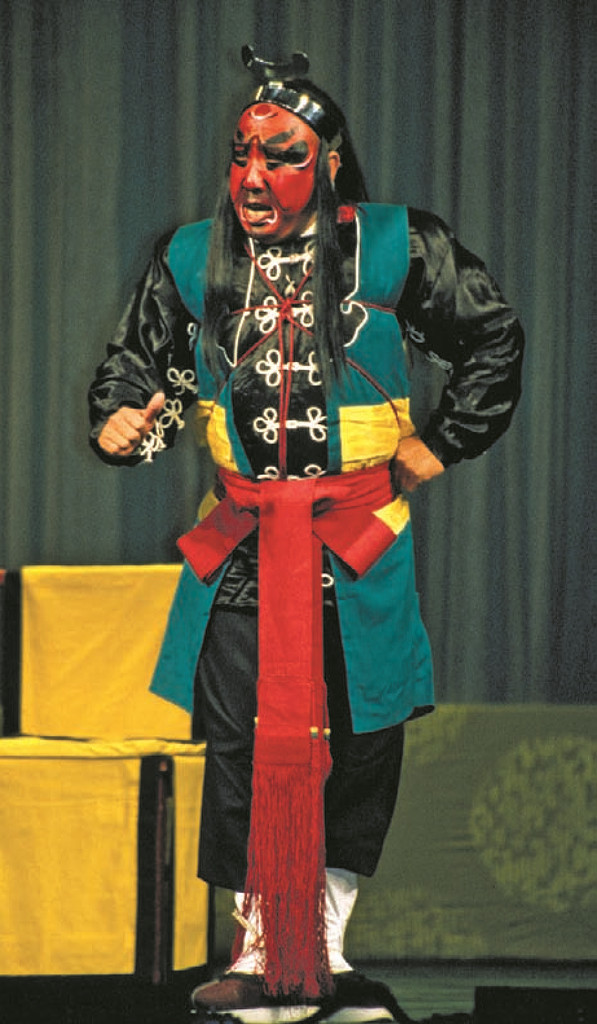
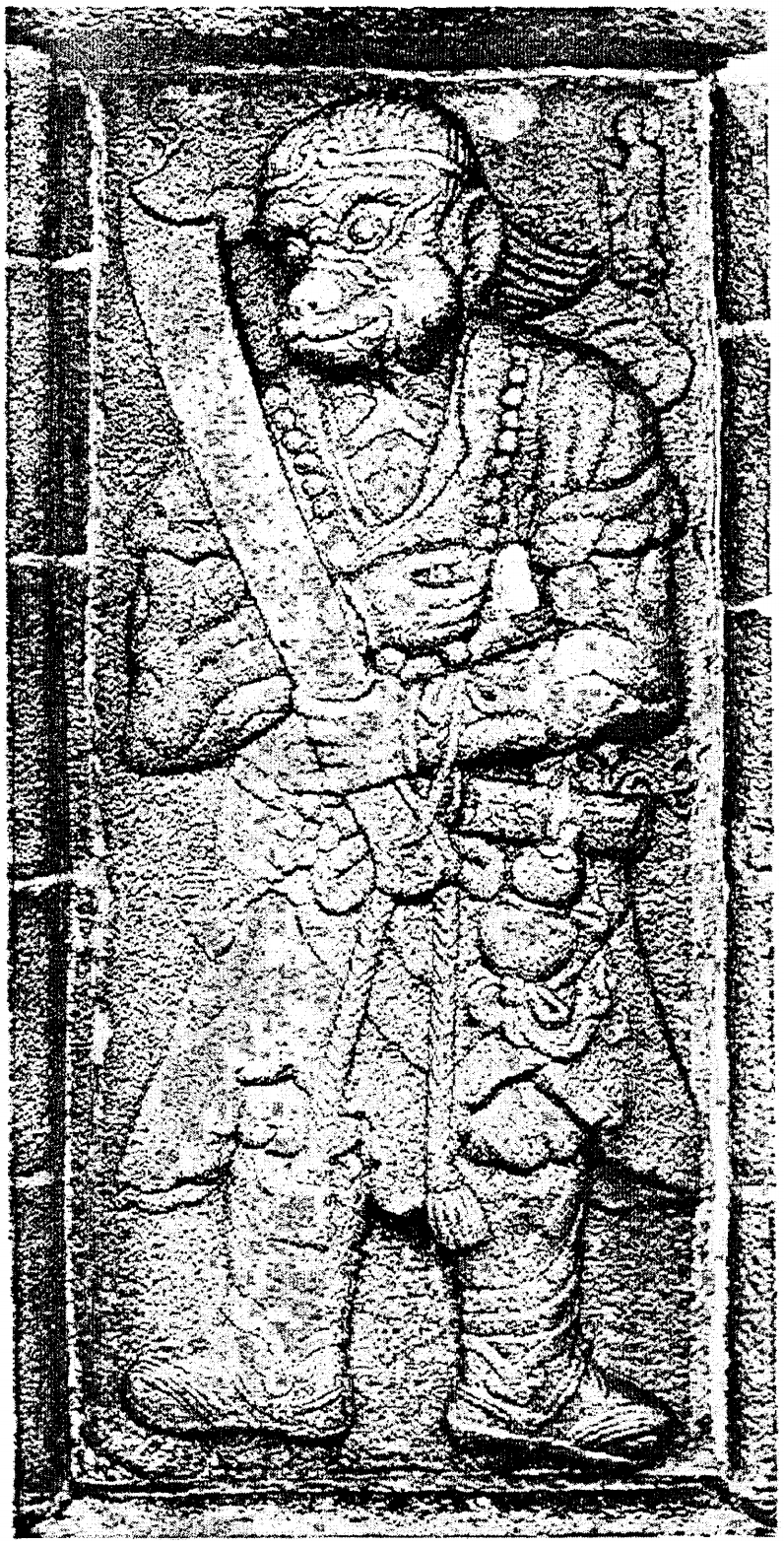
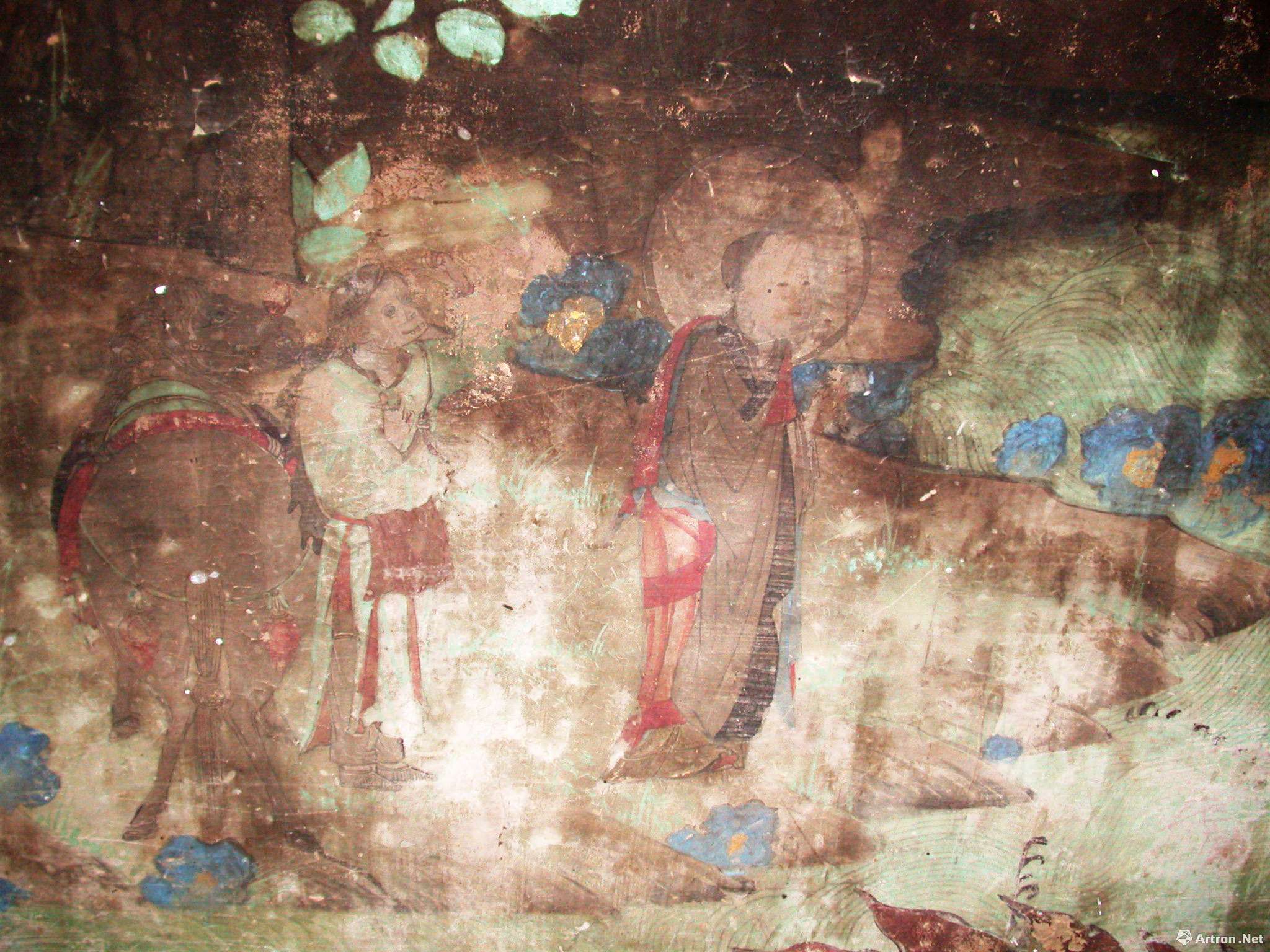
Fig. 11 – (Top left) Sun Wukong’s golden fillet from the 1986 JTTW television series (larger version). Fig. 12 – (Top right) Wu Song’s Precepts fillet from a recent WM television series (larger version). Fig. 13 – (Bottom left) A late 11th to early 12th-century copper alloy statue of the wrathful deity Hevajra (larger version). He is portrayed with the same Esoteric Buddhist ritual attire as his followers, including the headband, arm cuffs, a bone (skull) rosary, bracelets, a girdle, anklets, and a tiger skin sarong. Courtesy of the Los Angeles County Museum of Art. Fig. 14 – (Bottom center) A detail of the Monkey Pilgrim’s fillet featured in a 12th-century mural from Eastern Thousand Buddha Cave number two in Gansu Province, China (larger version). It has been slightly enhanced for clarity. A fuller version of the image can be seen here. Fig. 15 – (Bottom right) A military monk from a modern Beijing Opera production (larger version). From Bonds, 2008, p. 178.
I explain in this article that the heroes’ fillets share a common origin in an ancient Indo-Tibetan Esoteric Buddhist ritual headband, one representing the Buddha Akshobhya and thereby moral self-restraint. It was one of several ritual items worn while worshiping wrathful protector deities like Heruka. Such deities were often depicted wearing the same attire as their followers, leading to the band becoming a symbol of powerful Buddhist spirits (fig. 13). The Hevajra Tantra (Ch: Dabei kongzhi jingang dajiao wang yigui jing, 大悲空智金剛大教王儀軌經), the original 8th-century Indian Buddhist text mentioning the ritual items, was translated into Tibetan and Chinese during the 11th century. Interestingly, the earliest example of Monkey wearing the circlet (likely symbolizing the taming of the monkey of the mind) hails from this time (fig. 14). But Wu’s association with the headband was likely influenced by the Precepts fillet worn by the warrior monks of Chinese Opera (fig. 15). These heroes wear the band to show that they have taken a vow of abstinence (Bonds, 2008, pp. 177-178 and 328).
6. Bin Steel Weapons
JTTW, ch. 3 – Sun Wukong comes into possession of a magic staff (fig. 16) taken from the Dragon King’s underwater treasury. A poem in chapter 75 describes the weapon being hand-forged from Bin steel (bintie, 鑌鐵) by the high Daoist god Laozi.
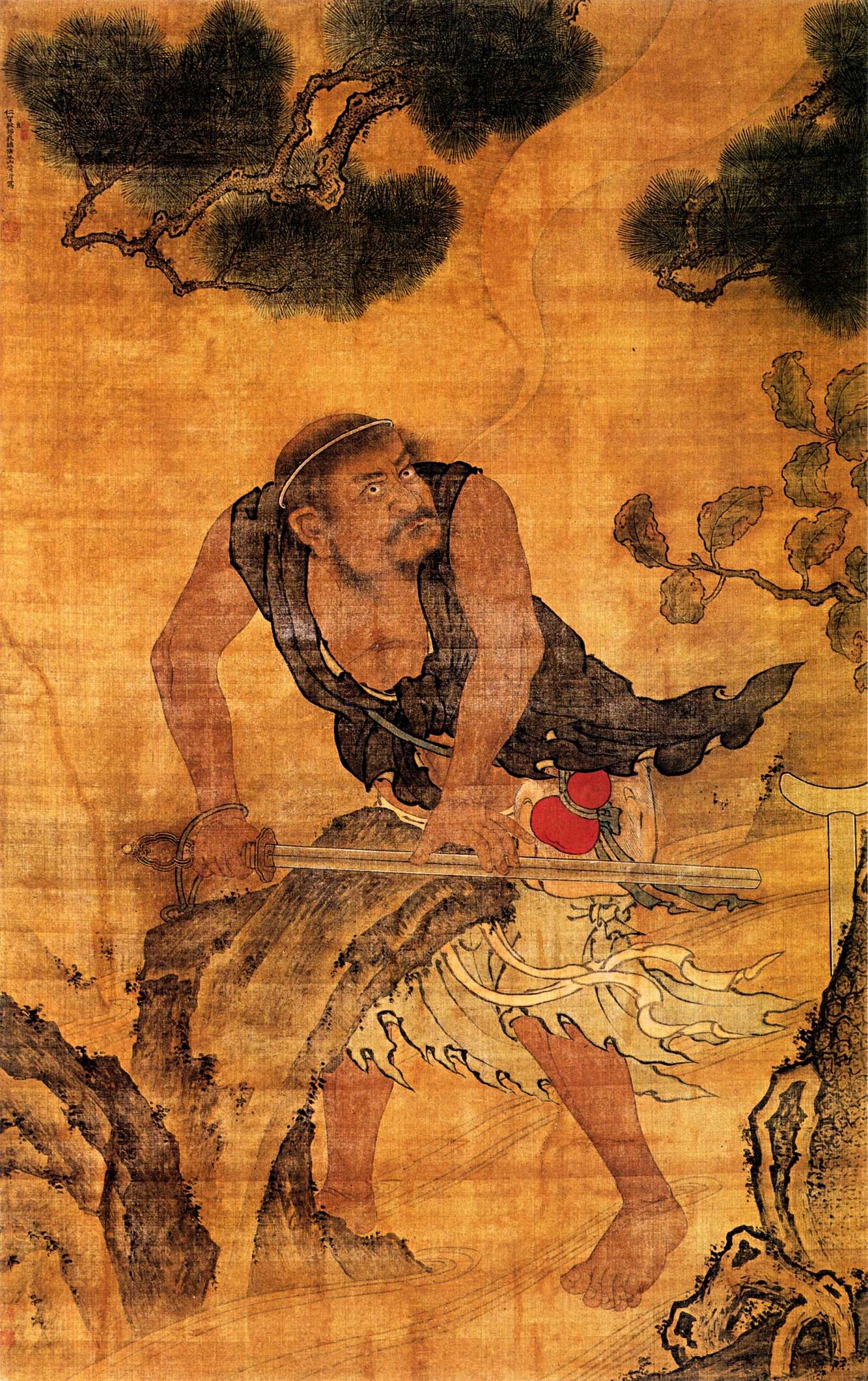
WM, ch. 31 – Apart from wearing the fallen monk’s religious clothing, Wu Song also takes possession of his Buddhist sabers made from “snowflake pattern” Bin steel (huaxue bintie jiedao, 雪花鑌鐵戒刀) (fig. 17). [15]
Fig. 16 – A modern action figure of Sun Wukong holding his magic Bin steel staff (larger version). Fig. 17 – A modern painting of Wu Song wielding his Bin steel sabers (larger version). Artist unknown.
Sun’s staff and Wu’s sabers are not the first bin steel weapons to appear in Chinese literature. A bladed pole arm example is the Bin steel great sword (bintie da podao, 鑌鐵大潑刀) wielded by a bandit from the Old incidents in Xuanhe period of the Great Song Dynasty (Da Song Xuanhe Yishi, 大宋宣和遺事, mid-13th century), a storytelling prompt containing WM material predating the published novel. [16] Another pole arm is the Bin steel spear (bintie qiang, 鑌鐵槍) wielded by a general from The Three Sui Quash the Demons’ Revolt (San sui pingyao zhuan, 三遂平妖傳, c. late-16th century), which also takes place in the Song-era.
I explain in this article that Bin steel is a real world metal akin to Damascus that was imported to China from Persia starting from the 6th century, and the secret of its manufacture eventually reached the Middle Kingdom by the 12th century. The metal was considered an exceptionally fine steel and was often used to make strong, durable, and sharp knives and swords, some worth more than silver. One general is described as boasting that rebels would “have to nick (chi, 齒) his sword of bin iron” if they wished to rise up (Wagner, 2008, p. 269). This is a simultaneous declaration of his unbreakable resolve and a statement praising the seemingly indestructible metal. Therefore, JTTW and the WM portray the finest of heroes wielding the finest of steel weapons.
7. Conclusion
As shown, the parallels between Sun Wukong and Wu Song are the result of JTTW and the WM borrowing from the same cultural source material. Monkey’s imprisonment under Five Elements mountain and Wu’s time as an evil spirit trapped in a well beneath stone was influenced by the Daoist belief that mountains—be they sympathetically represented by stone or hand mudras—could immobilize malevolent forces. Likewise, our heroes’ portrayal as reformed demons can be tied to the Daoist “Thunder Ritual,” which aims to conquer evil and repurpose its power for good. Sun and Wu’s image as tiger slayers was influenced by stories of tiger-killing strongmen from Chinese folklore. Their religious nickname “Pilgrim” and characterization as monastic martial artists can be tied to uneducated pseudo-monks and holy warriors skilled in both staff fighting and boxing from Chinese history. Their religious fillets were inspired by an Esoteric Buddhist ritual headband worn as a reminder of moral self-restraint. And the metal comprising Sun and Wu’s weapons can be traced to a real world steel prized in ancient China for its durability.
This was a fun piece to write because it shows that the Great Sage obviously didn’t develop in a vacuum. It’s interesting to me that much of Sun and Wu’s influences hail from the Song dynasty. These include the Daoist rituals for trapping and reforming spirits, the Pilgrim nickname and characterization as staff-wielding warrior monks, and the translation of the tantric text mentioning the moralistic headband and Monkey’s earliest known depiction wearing it.
8. Updates
Update: 10-04-20
I have written a follow up article explaining the parallels between Monkey and the historical Buddha.
I’ve written an article that shows the weight of Sun Wukong’s magic staff (一萬三千五百斤) is an embellishment on the weight of a stone block (三五百斤) lifted by Wu Song in ch. 27 of the WM.
I’m thinking about writing a piece on characters from world myth trapped under mountains. Here’s the list I have so far:
Sun Wukong (various Journey to the West iterations) – Mt. Huaguo by Guanyin or Five Elements Mountain by the Buddha
108 stars (Water Margin) – Imprisoned in an earth prison under a stone slab by a Daoist master. As mentioned above, Jing Wang (1992) suggests that the stone slab was likely influenced by the Taishan stone (泰山石).
The parameters may later be expanded to include “earth prisons” in general, which would open the door to Lucifer!
Update: 03-11-22
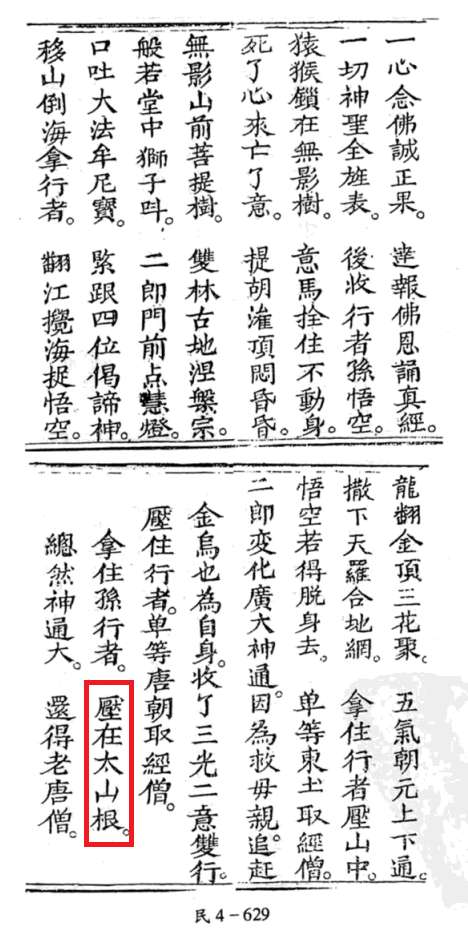
I recently archived the Precious Scroll of Erlang (Erlang baojuan, 二郎寳卷, 1562), a religious text that venerates and records the various deeds of the immortal demi-god. This work states that the Monkey King was “pressed under the base of Mt. Tai” (yazai, taishan gen, 壓在太山根) (PDF page 46) (fig. 18). This supports my suggestion above that Five Elements Mountain is a cognate for Mt. Tai.
Fig. 18 – The Mt. Tai sentence is indicated in red (larger version).
Update: 06-18-22
I’ve written an article that lists a number of surprising parallels shared by Monkey and the Greco-Roman hero Heracles.
1) The nine palaces are a cosmic geographical concept in which stars are mapped according to the five Chinese cardinal directions (N, S, E, W, and center) and the four intermediate directions. Thus, they represent the universe as a whole.
2) A zhang (丈) is ten Chinese feet, so 10,000 zhang would be 100,000 feet. A li (里) is one-third of a Western mile. More importantly, in Chinese culture, the number 10,000 represents an infinitely large concept. Therefore, by squaring the number, the well prison is described as an unfathomably large and inescapable place. I would like to thank the Dragon Ball scholar Derek Padula (his website) for suggesting this note as it helps better visualize the prison. He was kind enough to read an earlier draft of this article.
3) See Meulenbeld, 2007, pp. 143-145 for more information about the jar ritual. It likely influenced media that influenced Akira Toriyama of Dragon Ball fame to create the Mafuba (魔封波; Ch: mofengbo), or “Demon Containment Wave” ritual. Padula (2016) describes the etymology and background of the Mafuba (pp. 122 to 126). He graciously provided me with a digital copy of his book.
4) See Meulenbeld (2007) chapter two.
5) This is not openly stated in chapter 14 but is implied in chapter 27. See this article for more information.
6) Ch’en (1956) gives examples. During the Song, the official selling prices for the certificates ranged from one hundred thirty to eight hundred strings of cash. To put these prices in perspective, he notes that the lowest cost would pay for the equivalent of seventy-five bolts of silk or one hundred twenty-five bushels of rice (pp. 316-317).
7) Wivell, 1994, p. 1187. The full episode appears on pages 1186-1187.
8) Ge, 2001, p. 38. The eight types of stories appearing in The Drunken Man’s Talk are: “lingguai [靈怪] (spirits and demons), yanfen [煙粉] (rouge and powder), chuanqi [傳奇] (marvels), gong’an [公案] (court cases), podao [朴刀] (broadsword), ganbang [桿棒] (staff), shenxian [神仙] (immortals), and yaoshu [妖術] (sorcery)” (Ge, 2001, p. 209, n. 6).
9) Huang, 2018, p. 61 and n. 8. It’s interesting to note that the monk Lu Zhishen is said to wield an impossibly heavy metal staff like Sun Wukong. See this article for more details.
10) See Shahar (2008) chapters three and four.
11) Lorge (2012) cites a Tang-era story about an 8th-century prince who discovers an abandoned wardrobe while hunting in the forest. It is found to contain a young woman who had been kidnapped the previous night by bandits but was subsequently whisked away by two monks among the group. The prince replaces her with a wild bear that later mauls the bandit monks to death when the wardrobe is reopened (Lorge, 2012, pp. 106-107). The monks were likely impostors like Wu Song.
12) Wu Song is famed in Chinese folklore for his martial arts ability. This led to the creation of a wushu form known as “Wu Song Breaks Manacles” (Wu Song tuokao, 武松脫拷), which mimics a person fighting with their hands clasped as if shackled, forcing them to rely on doubled fist and elbow strikes and lots of kicking. The form is based on an episode from chapter 30 of the WM when the hero is attacked by assassins while being led in shackles to a prison camp. Wu Song is forced to defend himself in such a manner before breaking his restraints.
13) See, for example, Chlumsky, 2005, p. 72. The author also repeats folklore further tying the style to the Song dynasty heroes Yue Fei and his teacher Zhou Tong.
14) See Shahar (2008) chapters five and six.
15) I think it’s interesting that each weapon is presented as having some level of sentience. Called the “As-you-wish” Gold-Banded Staff (Ruyi jingu bang, 如意金箍棒), Sun’s staff grows or shrinks according to his whim. Wu’s peerless blades are said to “often groan in the night” (Shi & Luo, 1993/2001, p. 640), suggesting a magic longing for combat. The sentience of each weapon is based on different sources, however. I note in this article that the compliance of Monkey’s weapon is based on the Ruyi (如意) scepter, a symbol of religious and secular authority that was at some point associated with the similarly named wish-fulfilling cintamani jewel (ruyi zhu, 如意珠) from Buddhist mythology. The vocal ability of Wu Song’s blades may be based on the Chinese belief that swords have a soul. Two prime examples are the famed treasure swords Longyuan (龍淵, a.k.a. Longquan, 龍泉) and Tai’e (泰阿/太阿) made by the legendary swordsmith Ou Yezi (歐冶子) during the Spring and Autumn period. Yuan poet Jia Penglai (賈蓬萊, c. mid-14th century) described them as mated lovers who pine for each other when separated and even leap from the scabbard to seek out their beloved (Lee & Wiles, 2015, pp. 161-163).
16) The original source says “po bintie dadao” (潑鑌鐵大刀). This is likely a transcription error. I have corrected it above.
Sources:
Bonds, A. B. (2008). Beijing Opera Costumes: The Visual Communication of Character and Culture. Honolulu: University of Hawai’i Press.
Børdahl, V. (2013). Wu Song Fights the Tiger: The Interaction of Oral and Written Traditions in the Chinese Novel, Drama and Storytelling. Copenhagen, Denmark: NIAS Press.
Buswell, R. E. , & Lopez, D. S. (2014). The Princeton Dictionary of Buddhism. Princeton, NJ: Princeton University Press.
Ch’en, K. (1956). The Sale of Monk Certificates During the Sung Dynasty: A Factor in the Decline of Buddhism in China. The Harvard Theological Review 49(4), pp. 307-327.
Chen, P., & Petersen, V. (2016). The development of Chinese martial arts fiction. Cambridge, U.K.: Cambridge University Press.
Chlumsky, N. (2015). Inside Kungfu: Chinese Martial Arts Encyclopedia. [n.p.]: Lulu.com.
Huang, Y. (2018). Narrative of Chinese and Western Popular Fiction: Comparison and Interpretation. Berlin, Germany: Springer.
Huineng, & Cleary, T. F. (1998). The Sutra of Hui-neng, Grand Master of Zen: With Hui-neng’s Commentary on the Diamond Sutra. Boston: Shambhala.
Ge, L. (2001). Out of the Margins: The Rise of Chinese Vernacular Fiction. Honolulu: University of Hawaii Press.
Knechtges, D. R., & Chang, T. (2010). Ancient and Early Medieval Chinese Literature: A Reference Guide. Leiden: Brill.
Lee, L. X. H., & Wiles, S. (2015). Biographical Dictionary of Chinese Women: Tang through Ming: 618-1644. Abingdon: Routledge.
Lorge, P. A. (2012). Chinese Martial Arts: From Antiquity to the Twenty-First Century. New York, NY: Cambridge University Press.
Meulenbeld, M. R. E. (2007). Civilized Demons: Ming Thunder Gods from Ritual to Literature (Doctoral dissertation). Available from ProQuest Dissertations and Theses database (UMI No: 3247802).
Shahar, M. (2008). The Shaolin Monastery: History, Religion, and the Chinese Martial Arts. Honolulu: University of Hawai’i Press.
Shi, N., & Luo, G. (2001). Outlaws of the Marsh (Vols. 1-4) (S. Shapiro, Trans.). Beijing: Foreign Languages Press. (Original work published 1993)
Wagner, D. (2008). Science and Civilisation in China: Volume 5, Chemistry and Chemical Technology, Part 11, Ferrous Metallurgy. Cambridge: Cambridge Univ. Press.
Wang, J. (1992). The Story of Stone: Intertextuality, Ancient Chinese Stone Lore, and the Stone Symbolism in Dream of the Red Chamber, Water Margin, and the Journey to the West. Durham, N.C: Duke University Press.
Different mythologies and fictional universes have their own magical metals. For example, Marvel’s Asgardians have Uru, and the elves of Middle-earth have Mithril. The great Chinese classic Journey to the West (Xiyouji, 西遊記, 1592 CE) hosts a long list of magical weapons, armor, and objects made from all kinds of metal (steel, iron, brass, gold, silver, etc.). A specific type is called Bin iron or Bin steel (bin tie, 鑌鐵), and it is mentioned several times in the narrative.
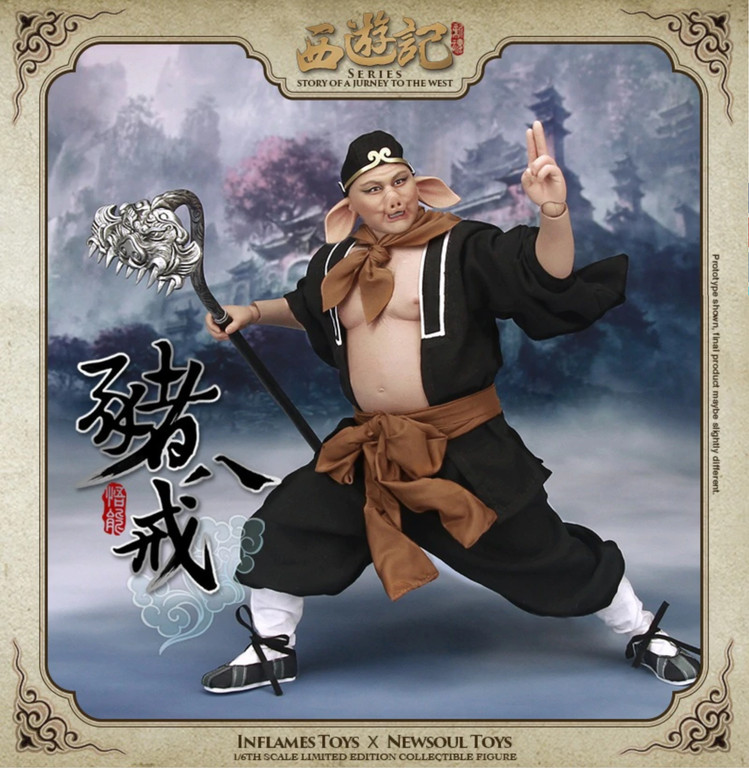
When Zhu Bajie first faces Sun Wukong in combat, he recites a poem praising the celestial origin of his weapon (fig. 1).
This is divine ice steel greatly refined,
Polished so highly that it glows and shines.
Laozi wielded the large hammer and tong;
Mars himself added charcoals piece by piece.
Five Kings of Five Quarters applied their schemes;
Twelve Gods of Time expended all their skills.
They made nine prongs like dangling teeth of jade,
And brass rings were cast with dropping gold leaves.
[…] (Wu & Yu, 2012, vol. 1, p. 382)
The “divine ice steel” (shen bing tie, 神冰鐵) is likely an error for “divine Bin steel” (shen bin tie, 神鑌鐵) as bing (冰) and bin (鑌) sound similar. This may also have something to do with the snowflake-like grain pattern of Bin steel (see sections two and three below). Take note that the metal is associated with Laozi and his furnace. We will see this association again.
Fig. 1 – A modern action figure of Zhu Bajie with his battle rake (larger version.
Chapter 34
On the cusp of his battle with the Monkey King, the demon King Silverhorn (Yinjiao wang, 銀角王) is described as wearing polished armor made from the material.
He wears a phoenix helmet white than snow
And armor made of bright Bin steel. [1]
The belt on his waist is dragon’s tendon.
Plum-flower shaped gaiters top his goat-skin boots.
He seems the living Lord of Libation Stream;
He looks no different from Mighty Spirit.
He holds in his hands the sword of seven stars,
Stern and imposing in a towering rage (Wu & Yu, 2012, vol. 1, p. 127).
The monster is later revealed to be one of two young attendants of Laozi’s furnace sent by heaven to test the resolve of the pilgrims (Wu & Yu, 2012, vol. 2, p. 145).
Chapter 75
The Monkey King recites a poem about his divine staff (fig. 2) prior to battling a lion demon.
The rod of [Bin] steel nine cyclic times refined
Was forged in the stove by Laozi himself.
King Yu took it, named it “Treasure Divine,”
To fix the Eight Rivers and Four Seas’ depth.
In it were spread out tracks of planets and stars,
Its two ends were clamped in pieces of gold.
Its dense patterns would frighten gods and ghosts;
On it dragon and phoenix scripts were drawn.
Its name was one Rod of Numinous Yang,
Stored deep in the sea, hardly seen by men.
Well-formed and transformed it wanted to fly,
Emitting bright strands of five-colored most.
[…] (Wu & Yu, 2012, vol. 3, p. 375)
Here again we see Laozi is associated with the material.
Fig. 2 – A modern action figure of Sun Wukong with his magic staff (larger version).
2. The Metal of Heroes
I want to reiterate the fact that Zhu Bajie and Sun Wukong, two of Tripitaka’s three main disciples and bodyguards, have weapons made from Bin steel (Sha Wujing’s staff is made from a heavenly tree). Each is the product of Laozi refining Bin steel in his magic furnace and smelting the polearms by hand. Just like dwarves imbued Thor’s uru-metal hammer with magical abilities, so too did the high god of Daoism for Zhu and Sun’s weapons. Each has supernatural durability and the power of transformation. In fact, the Monkey King’s staff is one of the strongest weapons in the entire novel, making its association with Bin steel very important. After all, a great hero requires a great weapon.
Another example of a hero wielding a Bin steel weapon is Wu Song (武松) from the classic Chinese novel the Water Margin (Shuihu zhuan, 水滸傳, c. 1400; a.k.a. “Outlaws of the Marsh” or “All Men Are Brothers”). The former constable-turned-outlaw comes into possession of a pair of Buddhist sabers (fig. 3) made from “snowflake [pattern] Bin steel” (xuehua bintie jiedao, 雪花鑌鐵戒刀) and housed in a sharkskin sheath. [2] They are described as being made from the “finest steel, and obviously hadn’t been made in a day” (Shi & Luo, 1993/2001, vol. 2, p. 580). In addition, the blades are said to “often groan in the night” (Shi & Luo, 1993/2001, vol. 2, p. 640), suggesting a magical, sentient longing for combat. Wu later sates this desire by using the sabers in a prolonged skirmish with an evil Daoist priest, eventually beheading the brigand with a single strike (Shi & Luo, 1993/2001, pp. 643-645).
Fig. 3 – A modern drawing of Wu Song with his Buddhist sabers (larger version).
3. Real World History
Wagner (2008) suggests that the name Bin (鑌) is a transliteration of a foreign term, possibly the Sanskrit word Piṇḍa, meaning “steel” or “lump” (p. 270). The material is mentioned in Chinese records of the 6th and 7th centuries as being imported from Persia (Bosi, 波斯) and Jaguda (Cao, 漕, modern day Ghazni) in Afghanistan. Mentions of the metal strangely disappear for centuries, only to reappear in early-10th century records. This is possibly due to the disruption of Persian trade wrought by the Islamic conquest of Persia and the subsequent rise of Muslim trade with the east. Bin steel is believed to have originally been transported in a raw “lump” state prior to smelting in China. But the secret of its manufacture eventually reached the Middle Kingdom, for a 12th-century report shows that the metal was produced in Inner Mongolia. The early Yuan government is known in 1275 to have established the “Office for Bin iron” (Bintie ju, 鑌鐵局), which possibly catered to elite blacksmiths (Wagner, 2008, pp. 268-272).
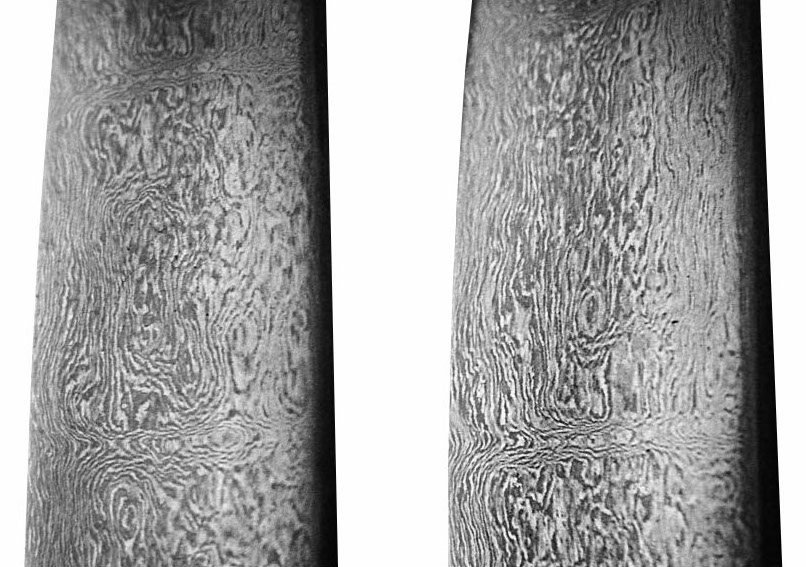
Fig. 4 – Persian-made Damascus steel blades of the 13th century (larger version). Take note of the intricate grain pattern. Bin steel was known to have various patterns (see below).
The best description of the material comes from Cao Zhao’s (曹昭) The Essential Criteria of Antiquities (Gegu yaolun, 格古要論, 1368), an early guide for connoisseurs.
Bin iron: It is produced by the Western Barbarians. Some [types] have a spiral self-patterning, while others have a sesame-seed or snowflake patterning. When a knife or sword is wiped clean and treated with ‘gold thread’ alum, [the pattern] appears. Its value is greater than silver.
An ancient saying holds that “knowing the strength of iron is like knowing gold” [i.e., the ability to judge the properties of steel is as valuable as the ability to assay the purity of gold]. Forgeries have a black patterning. One should examine [a steel object] very carefully.
There are three rules for knives. The first is that in the blade there should be perfect control of fire, metal, and water [i.e., the blade should be correctly quench-hardened and tempered]. The second is that the haft should be of xichi wood from the Western Barbarians, and the third is that the sheath should be of Tatar birchbark.
I once had a pair of scissors of bin iron, of exquisite workmanship. It had a raised gilt pattern on the inside, and on the outside a silver-inlaid inscription in Islamic characters (Wagner, 2008, p. 271).
So we see that Bin steel is comparable to Damascus steel (fig. 4), as both require quench-hardening and produce a number of intricate grain patterns visible after an acid treatment. One such pattern is the snowflake pattern associated with Wu Song’s sabers (and possibly Zhu Bajie’s rake). Most importantly, the metal was considered an exceptionally fine steel. One general is described as boasting that rebels would “have to nick (chi, 齒) his sword of bin iron” if they wished to rise up (Wagner, 2008, p. 269). [3] I take this statement to be symbolic of his unbreakable resolve. At the same time, it shows that Bin steel was considered exceptionally durable.
Highly durable Bin steel weapons could have seemed like magic in comparison to those made from lesser quality metal. Therefore, it’s interesting that Journey to the West presents the metal being smelted by a god in his magic furnace. It seems only natural that a magical forge would produce the finest steel. In fact, after the 10th century, the very name Bin steel came to be used as a term for any type of exquisite steel (Wagner, 2008, p. 271). Therefore, the author-compiler of Journey to the West may have been using it in that sense instead of referring to imported Persian steel.
4. Updates
Update: 02-06-21
I have written an article that discusses the magic powers of the staff. These include the ability to shrink and grow, control the ocean, astral project and entangle with Monkey’s spirit, multiply endlessly, pick locks, and transform into various objects. It also has sentience to a certain degree.
1) Yu’s (Wu & Yu) original translation says “bright Persian steel” (vol. 1, p. 127).
2) While the Water Margin presents them as sabers, Buddhist knives (jiedao, 戒刀, lit: “precept knife”) were historically small, unadorned, curved, finger-length blades used for cutting robes, trimming fingernails, opening wounds, or slicing food (Yifa, 2009, p. 250, n. 37).
3) Wagner (2008) states that the story is listed as coming from the 9th century but the housing source is from the 11th century (p. 269, n. 103). Therefore, it likely originates after the reappearance of Bin steel in Chinese records during the early-10th century.
Sources
Shi, N., & Luo, G. (2001). Outlaws of the Marsh (Vols. 1-4) (S. Shapiro, Trans.). Beijing: Foreign Languages Press. (Original work published 1993)
Wagner, D. (2008). Science and Civilisation in China: Volume 5, Chemistry and Chemical Technology, Part 11, Ferrous Metallurgy. Cambridge: Cambridge Univ. Press.
Wu, C., & Yu, A. C. (2012). The Journey to the West (Vols. 1-4) (Rev. ed.). Chicago, Ill: University of Chicago Press.
Yifa. (2009). The Origins of Buddhist Monastic Codes in China: An Annotated Translation and Study of the Chanyuan Qinggui. Honolulu: University of Hawai’i press.
The Monkey King is well known for his prowess with the staff. However, the first two chapters detailing his tutelage under the Buddho-Daoist sage, Patriarch Subodhi, surprisingly do not mention him training in combat skills, what Journey to the West (Xiyouji, 西遊記, 1592; “JTTW” hereafter) calls wuyi (武藝; lit: “martial arts”). [1] In fact, the novel only briefly alludes to it later in a poem from chapter 67, part of which reads: “I bowed to the Patriarch of the Heart and Mind Spirit Platform and perfected with him the martial arts” (身拜靈臺方寸祖,學成武藝甚全周) (based on Wu & Yu, 2012, vol 3, p. 243). [2] But beyond the staff, Sun Wukong comes to master boxing, a skill that he only displays twice in the novel.
For example, a poem in chapter 51 describes his unarmed battle with a buffalo demon:
Hitching up his clothes and walking forward, the fiend assumed a boxing posture; his two fists upraised looked truly like two iron sledge hammers. Our Great Sage also loosened his legs at once and moved his body to attack; right before the cave entrance, he began to box with the demon king. This was quite a fight! Aha!
Opening wide the “Four Levels Posture”; The double-kicking feet fly up. They pound the ribs and chests; They stab at galls and hearts. “The Immortal pointing the Way”; “Lao Zi Riding the Crane”; “A Hungry Tiger Pouncing on the Prey” is most hurtful; “A Dragon Playing with Water” is quite vicious. The demon king uses a “Serpent Turning Around”; The Great Sage employs a “Deer Letting Loose its Horns.” The dragon plunges to Earth with heels upturned; The wrist twists around to seize Heaven’s bag. A green lion’s open-mouthed lunge; A carp’s snapped-back flip. Sprinkling flowers over the head; Tying a rope around the waist; A fan moving with the wind; The rain driving down the flowers. The monster-spirit then uses the “Guanyin Palm,” And pilgrim counters with the “Arhat Feet.” The “Long-Range Fist,” stretching, is more slack, of course. How could it compare with the “Close-Range Fist’s” sharp jabs? The two of them fought for many rounds— None was the stronger, for they are evenly matched (Wu & Yu, 2012, vol. 3, pp. 12-13)
Shahar (2008) notes that this fight “[gave] the author an opportunity to display his familiarity with the contemporary jargon of ‘postures’ (shi and jiazi), ‘Long-Range Fist’ (changquan), and ‘Close-Range Fist’ (duanquan)” (pp. 131-132).
I consulted with martial artist Joshua Viney to learn what each technique involves. (Interestingly, many of these are still known to this day, some better known by slightly different names.) Joshua has lived and studied folk martial arts from village masters around the noted Shaolin Monastery (Shaolin si, 少林寺) for over ten years. He currently maintains the Shaolin Yuzhai Youtube channel, where he posts instructional videos. Please check it out.
1) “Opening wide the ‘Four Levels Posture'” (Zhuai kaida siping, 拽開大四平) – An open fighting posture where the boxer stands in the horse stance (mabu, 馬步) with arms outstretched to his sides. Also known as “Single Whip Horse Stance” (Mabu danbian kai siping, 馬步單鞭開四平) (fig. 1), which is often associated with Taiji boxing (Taiji quan, 太極拳).
2) “The double-kicking feet fly up” (Ti qi shuangfei jiao, 踢起雙飛腳) – Also known as “Double kicking feet” (Er qi jiao, 二起腳), this technique involves lifting up one knee to build upward momentum and then kicking high with the other (fig. 2). It is reminiscent of the “crane kick” from The Karate Kid (1984).
3) “They pound the ribs and chests” (Tao xie pi xiong dun, 韜脅劈胸墩) – Possibly referring to the “Pushing palm” (Tui zhang, 推掌) or “Splitting palm” (Pi zhang, 劈掌), which is delivered into the solar plexus and up into the rib cage (fig. 3).
4) “The Immortal pointing the Way” (Xianren zhilu, 仙人指路) – A double finger attack aimed at the eyes (fig. 4). The stance is often seen used in tandem with a sword.
5) “Lao Zi Riding the Crane” (Laozi qihe, 老子騎鶴) – Most likely another name for the Crane stance (fig. 5).
6) “A Hungry Tiger Pouncing on the Prey” (E’hu pu shi, 餓虎撲食) – This name has been applied to many techniques. One variation known as “Fetching the moon from the seabed” (Haidi lao yue, 海底撈月) involves a powerful hip and/or palm strike to the groin/lower midline of the body (fig. 6). The force of the hip strike is powerful enough to send someone flying backwards.
Left: Setting up the attack. Right: The hit (from Joshua’s 13 Hammers of Shaolin video).
7) “A Dragon Playing with Water” (Jiaolong xishui, 蛟龍戲水) – Also known as “Dragon puking water” (Jiaolong xishui neng xiong’e, 蛟龍戲水能兇惡), this technique involves fluid, sweeping arm movements (most likely blocks or fake strikes) followed by simultaneous double fist blows (fig. 7). The technique is associated with Shaolin and Chang Family Fist (Changjia quan, 萇家拳), a martial art that influenced the development of Taiji boxing. [3]
8) “Serpent Turning Around” (Mang fanshen, 蟒翻身) – Also known as “Python turns over” (Guaimang fanshen, 怪蟒翻身), this technique involves a simultaneous chop to the throat and a pulling leg sweep, effectively knocking the opponent backwards (fig. 8).
9) “Deer Letting Loose its Horns” (Lu jiejiao, 鹿解角) – A series of elbow strikes to the torso (fig. 9). One variant called “Plum blossom deer lies on a pillow” (Meihua lu wozhen, 梅花鹿臥枕) places the fist of the attacking arm against the temple, looking as if the practitioner is propping his head up in a resting posture.
10) “The dragon plunges to Earth with heels upturned” (Qiaogen cuidi long, 翹跟淬地龍) – A shooting maneuver using the Falling stance (Pubu, 仆步) to dip below the opponent’s defenses and attack the lower extremities (fig. 10). Also known as Qiaodi long zou xiapan zhao (雀地龍走下盤找).
11) “The wrist twists around to seize Heaven’s bag” (Niuwan na tiantuo, 扭腕拿天橐) – UNKNOWN. Mostly likely a headlock.
12) “A green lion’s open-mouthed lunge” (Qingshi zhangkou lai, 青獅張口來) – More commonly known as “Lion opens mouth” (Shizi dazhang zui, 獅子大張嘴), this technique has two variations. The large frame version involves shooting in low, pulling up the opponent’s knee with one hand, while simultaneously pushing on their head with the other hand, knocking them over (fig. 11). This can be used for throwing an opponent as well. The small frame version involves cupping the hands to intercept strikes.
13) “A carp’s snapped-back flip” (Liyu die ji yue, 鯉魚跌脊躍) – This can refer to both throwing an opponent and a move commonly referred to as a “kip-up.” The latter involves the practitioner flipping up from a supine position to a standing fighting stance (fig. 12).
14) “Sprinkling flowers over the head” (Gaiding sahua, 蓋頂撒花) – Also known as “Double cloud over peak” (Shuangyun ding, 雙雲頂), this technique involves flourishing the hands above the head as a means of blocking, twisting an opponent’s arm, or disengaging from combat (fig. 13).
15) “Tying a rope around the waist” (Raoyao guansuo, 遶腰貫索) – UNKNOWN. Possibly a circling step similar to one later used in Bagua Palm Boxing (Bagua zhang, 八卦掌) (fig. 14).
16) “A fan moving with the wind” (Yingfeng tieshan’er, 迎風貼扇兒) – Crossed hands shooting out to intercept an opponent’s punch (fig. 15).
17) “The rain driving down the flowers” (Jiyu cuihua luo, 急雨催花落) – Most likely a rapid succession of punches.
18) “Guanyin Palm” (Guanyin zhang, 觀音掌) – A style of palm strikes. It is listed as number 70 of the “72 Training Methods of Shaolin” (Shaolin qishi’er yilian fa, 少林七十二藝練法) (Jin & Timofeevich, 2004, p. 229).
19) “Arhat Feet” (Luohan jiao, 羅漢腳) – A style of kicking.
What follows is Joshua’s reconstruction of the fight. He makes an interesting observation that the fight may in fact be a theatrical stage combat version of known techniques.
I think what we are seeing here is a Chinese Opera-like performance of a fight that the author saw and perhaps asked about the names or recognised. I expect it would be very contrived. After this we are not told explicitly who does what and it may not be a one for one exchange. Nevertheless looking at the wording we can make a guess.
It begins with a large fighting stance, probably the ‘single whip’ posture of holding the arms straight to the sides. Then both performers do a jumping kick towards each other to enter striking range. Given it uses the phrase 劈胸 ‘pi xiong’ (split chest) I expect they begin by using the chest splitting palm at one another and so cross hands in the center of the arena [fig. 16].
Once they have crossed hands I think the demon grasps Monkey’s hand and attacks with the fingers of the other hand at his eyes, doing the ‘immortal points the way’ technique. Monkey defends against this by shielding his face with his forearms, then spreading his hands and kicking at the monster’s stomach. This pushes the monster away and Monkey is left with one knee suspended and arms spread to the sides in the ‘Lao Tzu rides a crane’ posture.
The Demon takes advantage of this unstable posture by rushing at him with the ‘hungry tiger pounces on prey’ technique, striking Monkey with his hips and grasping hold of him. Monkey uses the ‘dragon puking water’ technique, which erupts from below the demons arms and casts them aside, then rushes forwards again to attack with both hands. The Demon defends this by sticking close to the monkey and uses the ‘python turning its body’ technique to trip him up. But Monkey is strong and keeps his footing, counter attacking with a headbutt and multiple elbow strikes which form the ‘Deer-Horn’ technique.
The Demon jumps away but Monkey pursues with the ‘ground dragon’ technique and attacks the demons groin, causing him to buckle over, whereby Monkey grasps his head with the ‘twisting heavens sack’ technique. The Demon defends by using the ‘Lion opens mouth lunge’ to stop Monkey and throw him down. The monkey recovers by flipping his body in the ‘carp jump’ technique. Then he withdraws from the center by a few steps ‘covering his head with the flowers’ overhead technique. The Demon similarly disengages from the center and puts up a guard, prowling slowly around Monkey with the ‘turning waist’ technique.
I think the rest is describing more how they are evenly matched and face each other down rather than any other moves. ‘Iron fan stands against the wind’ is a common technique, a guard, and ‘rain falling on flowers’ is perhaps an eye strike but could also mean the intensity of the fight is like an urgent rain of punches. ‘Guanyin palm’ and ‘Luohans feet’ are both style names. Long fist vs short fist, how can they overcome one another? 10 rounds without a victor.
He goes onto describe the physical and psychological aspects of Long-range and Close-range fist:
Long fist and Short fist are the classic methods of Shaolin shenfa [身法, “Body postures”]. In order to strike the opponent one needs momentum, both physical AND psychological. Momentum is achieved by moving the dantian [4] as the centre of mass. In Short fist the dantian is rotated to add to power. In Long fist the whole dantian is thrown in the direction of the strike instead of rotated–much more powerful but also more wild and uncontrollable. In Shaolin philosophy, mind and matter are not severed, so physical momentum and psychological momentum are intertwined; when one has physical forward momentum, one simultaneously feels more confident.
3. Similarities With Other Literary Combat
A poem similar to that from JTTW appears in the 120 chapter version of the Water Margin (Shuihu zhuan, 水滸傳, c. 1594) by Yu Xiangdou (余象斗, c. 1560–c. 1640). The poem describes unarmed combat between a young man and woman.
Opening wide the “Four Levels Posture”;
The double-kicking feet fly up.
“The Immortal pointing the Way”;
“Lao Zi Riding the Crane”;
“Phoenix Elbow” to the heart;
“The Guard Head Cannon Stance” strikes the temples;
The dragon plunges to Earth with heels upturned;
The wrist twists around to seize Heaven’s bag;
This girl, sprinkling flowers over the head;
This boy, tying a rope around the waist;
Two fans moving with the wind;
The rain driving down the flowers.
We can see many named techniques from Monkey’s battle appear in this poem. There are only two years between the publishing of the standard 1592 edition of our novel and this version of the Water Margin. But it’s very well possible that both authors drew upon common source material.
Joshua discovered two techniques from the Water Margin poem, namely “Phoenix Elbow” (Aoluan zhao, 拗鸞肘) and “The Guard Head Cannon Stance” (Dang toupao shi, 當頭砲勢), appearing together in the same print of an edition of the Collection of Military Works (Wubei zhi, 武備志, c. 1621), a Ming treatise on military armaments and fighting techniques (fig. 17). This suggests that Yu Xiangdou borrowed these moves from similar boxing or military manuals. Likewise, the author-compiler of JTTW may have also borrowed from such literature.
Fig. 17 – The print from the Collection of Military Works (Wubei zhi, 武備志, c. 1621) mentioning “Phoenix Elbow” and the “Guard the Head Cannon Stance.”
4. Updates
Update: 05-02-2018
The available evidence suggests that “Short Fist” (Duanquan, 短拳; a.k.a. “Close-Range Fist”) is Sun Wukong’s fighting style. As mentioned above, the poem in chapter 51 reads: “The ‘Long-Range Fist,’ stretching, is more slack, of course. How could it compare with the ‘Close-Range Fist’s’ sharp jabs?” (長掌開闊自然鬆,怎比短拳多緊削。) (Wu & Yu, 2012, vol. 3, p. 13). Also, after facing the buffalo monster, Monkey asks heavenly warriors to critique his boxing skills:
“As you watched from afar,” said Pilgrim, smiling, “how did the abilities of the fiend compare with old Monkey’s?” “His punches were slack,” said Devaraja Li, “and his kicks were slow; he certainly could not match the Great Sage for his speed and tightness'” (Wu & Yu, 2012, vol. 3, p. 14).
The “speed and tightness” is of course a reference to his use of Short Fist.
In addition, earlier in chapter two, Sun Wukong faces a demon who had taken over his Water Curtain cave in the immortal’s absence. The two resort to boxing since Monkey is unarmed:
The Monstrous King shifted his position and struck out. Wukong closed in on him, hurtling himself into the engagement. The two of them pummeled and kicked, struggling and colliding with each other. Now it’s easy to miss on a long reach, but a short punch is firm and reliable (emphasis added). Wukong jabbed the Monstrous King in the short ribs, hit him on his chest, and gave him such heavy punishment with a few sharp blows that the monster stepped aside, picked up his huge scimitar, aimed it straight at Wukong’s head, and slashed at him (Wu & Yu, 2012, Vol. 1, p. 128).
I initially thought Sun Wukong used Short Fist out of necessity as JTTW describes him being less than four feet tall. But the novel’s bias for close-range fighting over long-range was, according to Shahar (2008), “typical of late Ming and early Qing military literature” (p. 117). He continues:
Sixteenth- and seventeenth-century military experts allude to various short-range styles including ‘Cotton Zhang’s Close-Range Fist’ (Mian Zhang duanda [綿張短打]), ‘Ren Family Close-Range Fist’ (Renjia duanda [任家短打]), and ‘Liu [Family] Close-Range Fist’ (Liu duanda [劉短打])” (Shahar, 2008, p. 117).
Wing Chun (Mandarin: Yong Chun, 詠春) is a close-range fighting style similar to Short fist. Although the style postdates the novel by at least two centuries, it showcases the quick, compact punches associated with Short Fist. Take this video of Jackie Chan, for example. Now imagine Monkey using similar techniques in a fight with a much larger opponent, blocking or ducking to avoid attacks and replying with sharp punches targeted at vulnerable areas.
Update: 08-07-2018
I have found a few more instances of martial arts terms, this time related to weapons. Joshua was again kind to lend his knowledge to the subject.
Chapter 17:
The compliant rod, The black-tasseled lance. Two men display their power before the cave; Stabbing at the heart and face; Striking at the head and arm. This one proves handy with a death-dealing rod; That one tilts the lance for swift, triple jabs. The “white tiger climbing the mountain” extends his paws; The “yellow dragon lying on the road” turns his back (emphasis added). With colored mists flying And bright flashes of light, Two monster-god’s strength is yet to be tried. One’s the truth-seeking, Equal-to-Heaven Sage; One’s the Great Black King who’s now a spirit. Why wage this battle in the mountain still? The cassock, for which each would aim to kill! (Wu & Yu, 2012, vol. 1, p. 354)
22) “‘White tiger climbing the mountain’ extends his paws” (Baihu pashan lai tanzhao, 白虎爬山來探爪) – Mountain climbing stance is synonymous with Gong bu (弓步), or the bow stance. The white tiger denotes an overt attack of sorts. I imagine it would look similar to this spear technique.
23) “‘Yellow dragon lying on the road’ turns his back” (Huanglong wodao zhuanshen mang, 黃龍臥道轉身忙) – Possibly a retreating maneuver.
Chapter 31:
Dear Monkey King! He raised the rod above his head, with both hands, using the style “Tall-Testing the Horse.” The fiend did not perceive that it was a trick. When he saw there was a chance, he wielded the scimitar and slashed at the lower third of Pilgrim’s [Monkey’s] body. Pilgrim quickly employed the “Great Middle Level” to fend off the scimitar, after which he followed up with the style of “Stealing Peaches Beneath the Leaves” and brought the rod down hard on the monster’s head. This one blow made the monster vanish completely (Wu & Yu, 2012, vol. 2, p. 83).
24) “Tall-Testing the Horse” (Gao tanma, 高探馬) – Tanma (探馬) refers to a military scout, so a better translation would be the “High Scout.” This is a double-handed thrust aimed at the opponent’s face as a high fake. A corresponding fist technique, essentially a jab, is associated with Taiji boxing.
25) “Great Middle Level” (Dazhong ping, 大中平) – Holding the staff level at the navel while in the horse stance. This allows for quick defense below the waist.
26) “Stealing Peaches Beneath the Leaves” (Yedi toutao shi, 葉底偷桃勢) – UNKNOWN. The name of this technique is normally associated with an attack to the groin, not the top of the head as implied in the quoted battle.
Based on the sequence of events described above, it seems like Monkey fakes high, blocks the strike to his body, and then attacks the top of the stooping opponent’s head (since the latter ducked the high fake and attacked low).
Here is Joshua’s interpretation:
The two weapons are stuck together: the monkey is forcing down, the demon up. The monkey releases the pressure, circling his staff below the opponents weapon, so with the release of pressure, the opponent’s weapon flings upwards but with no control. The monkey circles from this lower position, then turns over in a big circle and strikes the opponent downwards on the head.
Chapter 56:
The Great Sage walked forward and picked up the rod with no effort at all. Assuming the style of the Python Rearing its Body (emphasis added), he pointed at the bandits and said, “Your lucks running out, for you have met Old Monkey!” (Wu & Yu, 2012, vol. 3, p. 81).
27) “Python Rearing its Body” (Mang fanshen, 蟒翻身). UNKNOWN. This is a differently translated version of a similarly titled technique mentioned above. See number eight (“Serpent Turning Around”). The previous listing referred to a boxing technique, while this, again, is for a weapon.
In closing, I would like to quote a particular passage. While it doesn’t list a given technique, it highlights Monkey’s mastery of the staff. Chapter 33 reads:
“Going through this tall mountain and rugged cliff must have made master [Tripitaka] rather apprehensive, that’s all. Don’t be afraid! Don’t be afraid! Let old Monkey put on a show for you with my rod to calm your fears somewhat.” Dear Pilgrim! Whipping out his rod, he began to go through a sequence of maneuvers with his rod as be walked before the horse: up and down, left and right, the thrusts and parries were made in perfect accord with the manuals of martial arts (emphasis added). What the elder saw from the horse was a sight incomparable anywhere in the world (Wu & Yu, 2012, vol. 2, p. 105).
The portion that Yu (Wu & Yu, 2012) translates as “manuals of martial arts” actually lists the names of two noted military manuals, both of which are listed among the Seven Military Classics of China. The first, the Six Secret Teachings (Liu tao, 六韜), was published during the Warring States period (c. 475–221 BCE) but possibly contains information from as far back as the Qi state (1046–221 BCE). The second, the Three Strategies (San lue, 三略), was most likely published during the Western Han period (206 BCE–9 CE) (Sawyer, 1993).
Associating Monkey’s martial arts skill with ancient military classics only serves to further elevate his status as a great warrior and cultural hero.
Notes
1)Wuyi (武藝) was used to refer to Chinese martial arts as far back as the third century CE. The term predates the more familiar wushu (武術) by some three centuries (Lorge, 2012, p. 10).
2) Readers may think that the “Ancestor of Heart and Mind” (Fangcun zu, 方寸祖) is a direct reference to Master Subodhi. However, the supreme immortal threatened Monkey with eternal torment if he ever revealed the sage had been his teacher. A more literal translation of the aforementioned figure is “Patriarch Square Inch” (Fangcun zu, 方寸祖). Square Inch (fangcun, 方寸) is a common metaphor for the “heart / mind” (xin, 心), a broad concept written with a small character. This is just an interesting way of saying that Monkey had learned martial arts on his own via self-cultivation, thereby not revealing his true master. At the same time, it is a veiled admission of studying martial arts under the sage.
3) For more information on Chang Family Fist and its progenitor, Chang Naizhou, see Wells (2005).
4) The dantian (丹田, “cinnabar field”) is an area near the navel believed to be the body’s storehouse of spiritual energy.
Lorge, P. A. (2012). Chinese Martial Arts: From Antiquity to the Twenty-First Century. New York, NY: Cambridge University Press.
Sawyer, R. D. (1993). The Seven Military Classics of Ancient China. New York: Basic Books.
Shahar, M. (2008). The Shaolin Monastery: History, Religion, and the Chinese Martial Arts. University of Hawaii Press.
Wells, M., & Chang, N. (2005). Scholar Boxer: Chang Naizhou’s Theory of Internal Martial arts and the Evolution of Taijiquan. Berkeley, Calif: North Atlantic Books.
Wu, C., & Yu, A. C. (2012). The Journey to the West (Vols. 1-4) (Rev. ed.). Chicago, Ill: University of Chicago Press.
The golden headband or fillet (jingu, 金箍; a.k.a. jingu, 緊箍, lit: “tight fillet”) is one of the Monkey King’s most recognizable iconographic elements appearing in visual media based on the great Chinese classic Journey to the West (Xiyouji, 西遊記, 1592 CE; “JTTW” hereafter). It is generally portrayed as a ringlet of gold with blunt ends that meet in the middle of the forehead and curl upwards like scowling eyebrows (type one) (fig. 1). A different version is a single band adorned with an upturned crescent shape in the center (type two) (fig. 2). Another still is a simple band devoid of decoration (type three) (fig. 3). Sun first earns the headband as punishment for murdering humans. The circlet is a heaven-sent magic treasure designed to reign in the immortal’s unruly, rebellious nature. Since Sun Wukong is a personification of the Buddhist concept of the “Monkey of the Mind” (xinyuan, 心猿), or the disquieted mind that bars humanity from enlightenment, the fillet serves as a not-so-subtle reminder of Buddhist restraint. Few scholars writing in English have attempted to analyze the treasure’s history.
In this paper, I present textual and visual evidence from India, China, and Japan that suggests it is ultimately based on a ritual headband worn by Esoteric Buddhist Yogin ascetics in 8th century CE India. I also show how such fillets became the emblem of some Chinese protector deities, as well as military monks in Chinese opera.
The headband is first mentioned in chapter eight when three such “tightening fillets” are given to the Bodhisattva Guanyin by the Buddha in order to conquer any demons that she may come across while searching for a scripture pilgrim:
“These treasures are called the tightening fillets, and though they are all alike, their uses are not the same. I have a separate spell for each of them: the Golden, the Constrictive, and the Prohibitive Spell. If you encounter on the way any monster who possesses great magic powers, you must persuade him to learn to be good and to follow the scripture pilgrim as his disciple. If he is disobedient, this fillet may be put on his head, and it will strike root the moment it comes into contact with the flesh. Recite the particular spell which belongs to the fillet and it will cause the head to swell and ache so painfully that he will think his brains are bursting. That will persuade him to come within our fold” (Wu & Yu, 2012, vol. 1, pp. 206-207).
Guanyin later explains in JTTW chapter 42 which demons get which fillet (Wu & Yu, 2012, vol. 2, p. 251).
Sun Wukong earns the “Constrictive” (jin, 緊) band in JTTW chapter 14 after brutally murdering six thieves who accost his master Tripitaka, the chosen scripture pilgrim, on the road to the west. The killings cause the two to part ways, and it is during Monkey’s absence when Guanyin gives the monk a brocade hat containing the fillet and teaches him the “True Words for Controlling the Mind, or the Tight-Fillet Spell” (喚做『定心真言』,又名做『緊箍兒咒』) (Wu & Yu, 2012, vol. 1, p. 317). Sun is eventually persuaded to return and tricked into wearing the hat under the guise of gaining the ability to recite scripture without rote memorization. It soon takes root, and the powerful immortal is brought under control through the application of pain. He then promises to behave and to protect Tripitaka during their long journey to the Western Paradise. [1]
The remaining two fillets are used by Guanyin to conquer monsters in later episodes. She throws the “Prohibitive” (jin, 禁) band onto the head of the Black Bear Demon (Hei xiong jing, 黑熊精) in JTTW chapter 17, and after reciting the spell, he agrees to become the rear entrance guard of her Potalaka Island paradise (Wu & Yu, 2012, vol. 1, p. 365). The “Golden” (jin, 金) band is split into five rings—one each for the head, wrists, and ankles—and used to subdue Red Boy (Hong hai’er, 紅孩兒), the fire-spewing son of the Bull Demon King and Princess Iron Fan, at the end of JTTW chapter 42 and the beginning of 43 (Wu & Yu, 2012, vol. 2, pp. 251-252). The child demon becomes her disciple and eventually takes the religious name “Sudhana.” [2]
Monkey is forced to wear the fillet until he attains Buddhahood in JTTW chapter 100, causing it to vanish (Wu & Yu, 2012, vol. 4, p. 383). The band’s disappearance at the end of the novel denotes Sun’s internalization of self-control, but the treasure doesn’t disappear forever. It appears once more in the Later Journey to the West (Hou Xiyouji, 後西游記, 17th century CE), an unofficial sequel set 200 years after the original. The story follows a similar trajectory, with Monkey’s descendant Sun Luzhen (孫履真, “Monkey who Walks Reality”) attaining immortality and causing havoc in heaven. But this time the macaque Buddha is called in to quell the demon. Monkey quickly disarms the “Small Sage Equaling Heaven” of his iron staff and pacifies him not with trickery but with an enlightening Buddhist koan. He then places the band on Luzhen’s head to teach him restraint (see Liu, 1994).
It appears very few scholars writing in English have attempted to trace the origins of the golden fillet. Wang Tuancheng theorizes that the idea for the headband came from two sources. First, the historical journal of Xuanzang (602–664 CE), the Tang Dynasty monk on whom Tripitaka is loosely based, details how he was challenged to a religious debate by a man in a foreign kingdom who offered his own head as the price of defeat. Xuanzang won, but instead of collecting his prize, the monk took the man as his servant. Second, Wang notes that slaves during the Han Dynasty (206 BCE–220 CE) wore a metal collar around their neck shaped like the Chinese character for twenty (nian, 廿). He goes on to explain: “…the author transformed the metal hoop that the non-Buddhist might have worn to Sun Wukong’s headband” (Wang, 2006, p. 67).
I’m not particularly persuaded by this argument since Wang doesn’t offer any evidence as to why a Han-era slave implement would still be in use during the Tang (618–907 CE) four to five hundred years later; nor does he suggest a reason for why such a collar would be moved from the neck to the head. Besides, there exists religious art featuring the fillet (see below) that predates the novel by centuries, meaning it wasn’t the sole invention of the JTTW author-compiler.
Before I continue, I would like to point out that the 13th century CE precursor of the novel, The Story of How Tripitaka of the Great Tang Procures the Scriptures, does not mention the fillet at all. (This is just one of many differences between it and the final 16th century CE version.) Monkey is simply portrayed as a concerned celestial who purposely seeks out Tripitaka to ensure his safety, as the monk’s two previous incarnations have perished on the journey to India. In other words, he comes as a willing participant, which negates the need for punishment via the ringlet. [3] But at least two pictorial representations of Monkey coinciding with the Song Dynasty (960–1279 CE) depict him wearing a band, which, again, excludes the treasure being a later invention.
In her excellent paper on the origins of Sun Wukong, Hera S. Walker (1998) discusses a 13th century CE stone relief from the western pagoda of the Kaiyuan Temple (開元寺) in Quanzhou, Fujian province, China that portrays a sword-wielding, monkey-headed warrior (pp. 69-70). Considered by many to be an early depiction of Monkey, the figure wears a robe, a Buddhist rosary, and, most importantly, a type one fillet on the forehead (Fig. 4). [4] Walker quotes Victor Mair, who believes that the fillet “recalls the band around the head of representations of Andira, the simian guardian of Avalokitesvara” (the Indian counterpart to Guanyin) (Walker, 1998, p. 70). He goes on to list similarities between the stone relief and depictions of Andira, while also suggesting said depictions are based on south and southeast Asian representations of the Hindu monkey god Hanuman:
Identical earrings (these are key iconographic features of H[anuman] in many Southeast Asian R[ama saga]s), comparable tilt of the head… which seems to indicate enforced submission, long locks of hair… flaring out behind the head, elongated monkey’s mouth, similar decorations on the forearm and upper arm, etc. It is crucial to note that all these features can be found in South Asian and Southeast Asian representations of H[anuman] (Walker, 1998, p. 70).
So as it stands, the 13th century CE appears to be the furthest that the motif has been reliably traced.
Fig. 4 – The 13th century CE stone relief of Sun Wukong from the Kaiyuan Temple in Quanzhou, Fujian province, China (larger version).
3. My Findings
While Mair suggests a Southeast Asian Hindo-Buddhist influence, I know of at least one example from northeastern China that suggests an Indo-Tibetan Buddhist influence. The Eastern Thousand Buddha Cave no. 2 (Dong qianfo dong di 2 ku, 東千佛洞第2窟) in the Hexi Corridor of Gansu Province contains a late-Xixia dynasty (late-12th to early-13th century CE) mural of Xuanzang worshiping Guanyin from a riverbank. Monkey stands behind him tending to a brown horse. He is portrayed with a type three circlet on his head, waist length hair, and light blue-green robes with brown pants (fig. 5). This painting was completed during a time when China was seeing an influx of monks fleeing the inevitable fall of India’s Buddhist-led Pala Dynasty (750–1174 CE) from the 10th to the 12th century CE. They brought with them the highly influential Pala Buddhist art style and Vajrayana Buddhism, a form of esoteric Buddhism. The MET (2010) writes:
A mixture of Chinese-style and Vajrayana traditions and imagery was employed in the Tangut Xixia Kingdom … which was based in Ningxia, Gansu, and parts of Shanxi … It is difficult to imagine that this “new” type of Buddhism, which not only was flourishing in Tibet in the late tenth century but was also found in the neighboring Xixia Kingdom and may have been practiced by Tibetans based in the Hexi Corridor region of Gansu Province, was completely unknown in central China until the advent of the Mongols (p. 19).
The painting of Monkey and Tripitaka was surely created by an Indian or Tibetan Buddhist monk, or at the very least a fellow Tangut or Chinese practitioner living in the area. This suggests that the imagery within the painting, such as the fillet, could have an Esoteric Buddhist pedigree, and textual evidence shows such headbands were indeed worn in some esoteric rituals.
The yogin must wear the sacred ear-rings, and the circlet on his head (emphasis added); on his wrists the bracelets, and the girdle round his waist, rings around his ankles, bangles round his arms; he wears the bone-necklace and for his dress a tiger-skin… (Linrothe, 1999, p. 250).
Furthermore, it describes how each of the ritual adornments and implements used in the ceremony represents each of the five esoteric Buddhas, as well as other religio-philosophical elements:
Aksobhya is symbolized by the circlet (emphasis added), Amitabha by the ear-rings, Ratnesa by the necklace, and Vairocana (by the rings) upon the wrists. Amogha is symbolized by the girdle. Wisdom by the khatvanga [staff] and Means by the drum, while the yogin represents the Wrathful One himself [i.e. Heruka]. Song symbolizes mantra, dance symbolizes meditation, and so singing and dancing the yogin always acts (Linrothe, 1999, p. 251).
As can be seen, the circlet represents Aksobhya (Sk: “Immovable”; Ch: Achu, 阿閦; Budong, 不動). This deity is known for his adamantine vow to attain buddhahood through the practice of Sila, or “morality,” the aim of which “is to restrain nonvirtuous deeds of body and speech, often in conjunction with the keeping of precepts” (Buswell & Lopez, 2014, pp. 27 and 821). So, the ritual band most likely served as a physical reminder of right speech and action, making it the best candidate for the origin of Monkey’s fillet. Sun is after all the representation of the “Monkey of the Mind” (as noted in the introduction), so his inclusion in the Eastern Thousand Buddha Cave painting was probably meant to convey the taming of this Buddhist concept via the circlet (apart from referencing the popular tale itself).
The Hevajra Tantra, the textin which the circlet appears, was first translated into Tibetan by Drogmi (993–1074 CE) and adopted during the 11th century CE as a central text by the respective founders of the Kagyu and Sakya sects, two of the six major schools of Tibetan Buddhism. Various members of the Sakya sect were invited by Mongol royalty to initiate them into the text’s esoteric teachings during the 13th century CE. These include Sakya Pandita and his nephew Chogyal Phagpa, who tutored Genghis Khan‘s grandson Prince Goden in 1244 and Kublai Khan in 1253, respectively. The meeting between Kublai and Chogyal resulted in Vajrayana Buddhism becoming the state religion of Mongolia. The Hevajra Tantrawas translated into Chinese by the Indian monk Dharmapala (963–1058 CE) in 1055 during the Northern Song Dynasty (960–1127 CE). The text, however, did not become popular within the Chinese Buddhist community like it would with the Mongols in the 13th century CE (Bangdel & Huntington, 2003, p. 455). But this evidence shows how the concept of the 8th century CE ritual circlet could have traveled from India to East Asia to influence depictions of Sun Wukong in the 12th/13th century CE. And the relatively unknown status of the text in China might ultimately explain why there are so few ancient depictions of Chinese deities wearing the fillet, or why it does not appear in the 13th century CE version of JTTW.
While the late-Xixia mural (fig. 5) lacks many of the ritual adornments (apart from the fillet) mentioned in the Hevajra Tantra, the Quanzhou stone relief (refer back to fig. 3) includes the band, earrings, necklace, bangles, and possibly even a tiger skin apron, suggesting it too has an esoteric origin (most likely based on Chinese source material). The band’s connection to esoteric Buddhism is further strengthened by a 12th century CE painting from Japan. Titled Aka-Fudo (赤不動), or “Red Fudo [Myoo],” it depicts the wrathful esoteric god seated in a kingly fashion, holding a fiery, serpent-wrapped Vajra sword in one hand and a lasso in the other (fig. 6). He wears a golden, three-linked headband (similar to the curls of type one), which stands out against his deep red body and flaming aureola. Biswas (2010) notes: “… the headband on his forehead … indicate[s], according to some, a relation to the habit of groups of ascetics who were among the strong supporters of Acalanatha” (p. 112). His supporters were no doubt yogin practitioners in the same vein as those who worshipped Heraku and other such wrathful protector deities.
Fig. 5 – A portion of the late-Xixia (late-12th to early-13th century CE mural) in the Eastern Thousand Buddha Cave number two (larger version). Fig. 6 – The 12th century CE Japanese painting “Aka-Fudo” (赤不動) (larger version).
3.1. Symbol of Martial Deities and Warrior Monks
It’s important to note that Monkey was not the only cultural hero of the Ming Dynasty (1368–1644 CE) to wear a golden fillet. Another example is Li Tieguai (李鐵拐), or “Iron Crutch Li,” the oldest of the Eight Immortals. [5] Li is generally portrayed as a crippled beggar leaning on a cane. Legend has it that his original body was cremated prematurely by a disciple while the immortal traveled in spirit to answer a summons from Lord Laozi, the high god of Daoism. Li’s spirit returned a day later to find only ashes, thus forcing him to inhabit the body of a recently deceased cripple. According to Allen and Philips (2012), “Laozi gave him in recompense a golden headband and the crutch that was to become his symbol” (p. 108). Some depictions of Li wearing the fillet predate JTTW. The most striking example is Huang Ji’s Sharpening a Sword (early-15th century CE) (Fig. 7), which portrays the immortal wearing a type three band and sharpening a double-edged blade on a stone while staring menacingly at the viewer. [6] One theory suggests Li’s martial visage identifies him as a “spirit-guardian of the [Ming] state” (Little, 2000, p. 333). Both Monkey and Li are, therefore, portrayed as brutish, weapon-bearing, golden headband-wearing immortals who serve as protectors. This shows that the fillet was associated with certain warrior deities during the Ming.
The fillet’s connection to religion and martial attributes culminated in the Jiegu (戒箍, “ring to forget desires”), a type two band worn by Military Monks (Wuseng, 武僧) in Chinese opera to show that they have taken a vow of abstinence (fig. 8). Such monks are depicted as wearing a Jiegu over long hair (Bonds, 2008, pp. 177-178 and 328), which contrasts with the bald heads of religious monks. [7]I would like to suggest that the band’s half-moon shape may have some connection to a Ming-era woodblock print motif in which martial monks are shown wielding staves tipped with a crescent (fig. 9) . The exact reason for the shape is still unknown (Shahar, 2008, pp. 97-98), but the association between the crescent and martial monks seems obvious.(See the 07-25-22 update below for the foreign origins of this motif.) The use of the fillet in Chinese opera led to it being worn by Sun Wukong in the highly popular 1986 live-action TV show adaptation of the novel (fig. 2). [8]
Fig. 7 (Left) – Huang Ji’s “Sharpening a Sword” (early-15th century CE) (larger version). Fig. 8 (Center) – An image of the military monk Wu Song wearing a jiegu (戒箍) fillet from a 2011 Water Margin TV show (larger version). Fig. 9 (Right) – A late-Ming woodblock of the warrior monk Lu Zhishen with a crescent staff (larger version). From Shahar (2008).
4. Conclusion
Examples of past research into the origins of the golden fillet respectively point to a slave collar from the Han dynasty (206 BCE–220 CE) and circa 13th century CE South and Southeast Asian depictions of the Buddhist guardian Andira and the Hindu monkey god Hanuman as possible precursors. However, the first isn’t credible, and the second, while on the right track, doesn’t go back far enough. A late-12th to early-13th century CE mural in the Eastern Thousand Buddha Cave complex depicts Sun Wukong wearing a type three fillet with possible ties to a ritual circlet worn by Esoteric Buddhist Yogin ascetics in 8th century CE India. The Hevajra Tantra, the esoteric text that mentions the band, associates it with the Aksobhya Buddha and thereby his moralistic, self-restraining practices. The text was transmitted from India to Tibet, China, and Mongolia from the 11th to the 13th centuries CE, showing a clear path for such imagery to appear in East Asia. A 12th century CE Japanese Buddhist painting of the guardian deity Fudo Myoo with a fillet suggests that the practice of wearing circlets in esoteric rituals continued for centuries. Other non-Buddhist deities became associated with the fillet during the Ming Dynasty. A 15th century CE painting of the immortal Li Tieguai, for example, depicts him as a type one circlet-wearing, sword-wielding guardian of the Ming dynasty. All of this suggests that the band became a symbol of Chinese protector deities. The association between the fillet and religion and martial attributes led to its use as the symbol of military monks in Chinese opera.
5. Updates
Update: 12-23-17
I’ve been wondering what the 8th century CE version of the circlet (along with the other ritual implements) mentioned in the Hevajra Tantra might have looked like. While I have yet to find a contemporary sculpture or painting, I have found an 11th to 12th century CE interpretation from Tibet. Titled The Buddhist Deity Hevajra (fig. 10), this copper alloy statue somewhat follows the prescribed iconography of the god as laid out in the aforementioned text:
Dark blue and like the sun in colour with reddened and extended eyes, his yellow hair twisted upwards, and adorned with the five symbolic adornments,/ the circlet, the ear-rings and necklace, the bracelets and belt. These five symbols are well known for the purificatory power of the Five Buddhas./ He has the form of a sixteen-year-old youth and is clad in a tiger-skin. His gaze is wrathful. In his left hand he holds a vajra-skull, and a khatvahga [staff] likewise in his left, while in his right is a vajra of [a] dark hue…(Linrothe, 1999, p. 256)
The circlet here is depicted as a fitted band with crescent trim and a teardrop-shaped adornment (a conch?) (fig. 11). The statue’s iconography more closely follows that from the Sadhanamala (“Garland of Methods”), a compilation of esoteric texts from the 5th to 11th centuries CE. The following information probably derives from the later part of this period:
He wields the vajra in the right hand and from his left shoulder hangs the Khatvanga [staff] with a flowing banner, like a sacred thread. He carries in his left hand the kapala [skull cap] full of blood. His necklace is beautified by a chain of half-a-hundred severed heads. His face is slightly distorted with bare fangs and blood-shot eyes. His brown hair rises upwards and forms into a crown which bears the effigy of Aksobhya. He wears a kundala [ear decoration] and is decked in ornaments of bones. His head is beautified by five skulls (Donaldson, 2001, p. 221).
Our statue has many of these features but lacks the image of the Buddha in his hair. This suggests the knob visible in the coif (fig. 10) once carried such a figure. So, once again we see the importance of the Aksobhya Buddha. The statue is similar to 10th and 11th century CE stone statues from India. [9]
While this doesn’t get us any closer to what the original circlet looked like, this statue adds to the mutability of the fillet imagery. The Hevajra Tantra is vague in its description, and so it is no surprise that so many variations have appeared over the centuries. The original sanskrit text uses the word cakri (circle) to refer to the band (Farrow & Menon, 2001, pp. 61-62). This might explain the simple type three fillet worn by Monkey in the Eastern Thousand Buddha Cave no. two painting (fig. 2).
Update: 08-16-20
I have written an article suggesting an origin for the type one headband, or as I now call it, the “curlicue headband.”
One thing I figured out a while ago but never explained here was the reason why the Japanese Buddhist protector deity Aka-Fudo (赤不動) (fig. 6) is depicted with a headband. I believe this is a visual representation of the fillet’s association with the Aksobhya Buddha. This is because the fudo (Ch: budong, 不動) of Aka-Fudo and the Sanskrit meaning of Aksobhya respectively mean “immovable.” So, the image of Aka-Fudo is encapsulating both his position as a protector deity and the Buddha represented by the headband.
Update: 01-23-22
I’ve written an article suggesting a mantra for the secret spell that causes the golden fillet to tighten.
Above, I mentioned that the novel contains three kinds of headbands:
Sun Wukong/Six Ears – “Constrictive” (jin, 緊) – ch. 14
Black Bear Demon – “Prohibitive” (jin, 禁) – ch. 17
Red Boy – “Golden” (jin, 金) – ch. 42
It’s interesting that all of them are pronounced “jin” (with varying tones).
Now imagine that there is a secret fourth headband not intended to punish but to empower. Called the “Strength” (jin, 勁) headband, it would only be used in the most extreme emergencies.
It would be neat to see someone work this into their fanfiction.
Update: 12-24-23
A character is briefly punished to wear a golden headband in the famed Ming-era novel Investiture of the Gods (Fengshen yanyi, 封神演義, c. 1620; summary). Chapter 82 reads:
Ma Sui [馬遂] attacked him with his sword, and after only one round, threw a gold hoop [jingu, 金箍] around the immortal’s head. The Yellow Dragon Immortal [Huanglong zhenren, 黃龍真人] writher in pain but was quickly rescued and brought back to the pavilion.
The Yellow Immortal Dragon Immortal tried to take the hoop off his head but found it was impossible. It was so tight the true samadhi fire went out of his eyes.
The Immortal of the South Pole [Nanji xianweng, 南極仙翁] came in to announce Heavenly Primogenitor’s [Yuanshi tianzun, 元始天尊] arrival. The religious leader entered the pavilion and said, “The Yellow Dragon Immortal was destined to be caught in this gold hoop. Come here and let me help you.”
He pointed at the gold hoop, and it dropped to the ground (Gu, 2000, pp. 1713-1715).
(Gu (2000) skips over some elements in the original Chinese.)
I’ve known about this episode for a while but forget to post about it.
Notes
1) For the entire episode, see Wu & Yu, 2012, vol. 1, pp. 314-320.
2) The child first speaks his new name in chapter 49 (Wu & Yu, 2012, vol. 2, p. 354). The original Sudhana originates from the Avatamsaka Sutra (Wu & Yu, 2012, vol. 2, pp. 386-387 n. 3).
3) For a complete English translation, see Wivell (1994).
4) This is just one of many relief carvings that grace the pagoda. It includes other guardian-type figures with esoteric elements but rendered in the Chinese style. See Ecke and Demiéville (1935).
5) The Eight Immortals are Daoist saints who came to be worshipped as a group starting sometime in the Jin Dynasty (1115–1234 CE) (Little, 2000, p. 319).
6) The sword is usually a symbol of the immortal Lu Dongbin, but as noted above, it is used to identify Li Tieguai as a Ming guardian (Little, 2000, p. 333).
7) Shahar (2008) discusses the historical differences between religious and military monks in ancient China.
8)Liu Xiao Ling Tong (六小龄童; born Zhang Jinlai, 章金萊, 1959), the actor who played Monkey in the 1986 TV show, comes from a family who has specialized in playing Sun Wukong in Chinese opera for generations (Ye, 2016).
9) See the Heruka chapter in Linrothe (1999). He includes our statue in his study, but other sources describe it as Tibetan instead of Indian (Bangdel & Huntington, 2003, p. 458).
Bibliography
Allan, T., & Phillips, C. (2012). Ancient China’s Myths and Beliefs. New York: Rosen Pub.
Bangdel, D., & Huntington, J. C. (2003). The Circle of Bliss: Buddhist Meditational Art. Chicago, Ill: Serindia Publications.
Biswas, S. (2010). Indian Influence on the Art of Japan. New Delhi: Northern Book Centre.
Bonds, A. B. (2008). Beijing Opera costumes: The Visual Communication of Character and Culture. Honolulu: University of Hawai’i Press.
Buswell, R. E., & Lopez, D. S. (2014). The Princeton Dictionary of Buddhism. Princeton, NJ: Princeton University Press.
Donaldson, T. E. (2001). Iconography of the Buddhist Sculpture of Orissa. New Delhi: Indira Gandhi National Centre for the Arts.
Ecke, G., & Demiéville, P. (1935). The Twin Pagodas of Zayton: A Study of the Later Buddhist Sculpture in China. Cambridge, Mass: Harvard University Press.
>Farrow, G. W., & Menon, I. (2001). The Concealed Essence of the Hevajra Tantra: With the Commentary Yogaratnamālā. Delhi: Motilal Banarsidass Publ.
Little, S. (2000). Taoism and the Arts of China. Chicago, IL: Art Institute of Chicago.
Liu, X. (1994). The Odyssey of the Buddhist Mind: The Allegory of the Later Journey to the West. Lanham, Md: University Press of America.
Metropolitan Museum of Art, Leidy, D. P., Strahan, D. K., & Becker, L. (2010). Wisdom Embodied: Chinese Buddhist and Daoist sculpture in the Metropolitan Museum of Art. New York: Metropolitan Museum of Art.
Shahar, M. (2008). The Shaolin Monastery: History, Religion, and the Chinese Martial Arts. University of Hawaii Press.
Walker, H.S. (1998). Indigenous or Foreign? A Look at the Origins of Monkey Hero Sun Wukong. Sino-Platonic Papers, 81, 1-117.
Wang, T. (2006). Dust in the Wind: Retracing Dharma Master Xuanzang’s Western Pilgrimage. Taipei: Rhythms Monthly.