Dragon Ball and Journey to the West

Last updated: 12-29-2022

It recently occurred to me that I’ve referenced the Dragon Ball franchise in several blog articles. So I’ve taken the opportunity to gather everything into one spot, including information that I haven’t previously mentioned. This is meant to be a very basic introduction and not an exhaustive analysis. My current interest here is in modern adaptations of Journey to the West (Xiyouji, 西遊記, 1592).

Those interested in a broader discussion on the influences of Dragon Ball should consult the work of Derek Padula.

I. Son Goku

The name of the series protagonist, Son Goku (孫悟空) (fig. 1), is a Japanese transliteration of Sun Wukong, meaning “Monkey Aware of Emptiness,” an allusion to Buddhist enlightenment. While referencing Rhesus macaques and “grandsons,” the surname Sun (孫), is also a veiled symbol for the development of an immortal spirit in Taoist elixir arts. Therefore, the name Son Goku straddles both Buddhism and Taoism.

Goku’s monkey tailflying nimbus cloud, and extending power pole (fig. 2) are all based on the respective trait, skill, and weapon of the Monkey King. The latter’s skill is called the “Cloud Somersault (jindou yun, 筋斗雲), which can travel 108,000 li (33,554 mi / 54,000 km), or one and one-third the circumference of Earth, in a single leap. Sun’s staff, the “‘As-You-Will‘ Gold-Banded staff,” weighs a whopping 17,560 lbs (7,965 kg) and (among other abilities) can magically grow as big or shrink as small as the immortal desires.

Goku’s proficiency in boxing (fig. 3) has a fun connection to Sun Wukong. Series creator Akira Toriyama partly based the Saiyan’s fighting style on the Wing Chun techniques used by Bruce Lee and Jackie Chan in their respective films. This style falls under the umbrella term “Short Fist” (Duan quan, 短拳), a school of martial arts with a low stance and quick, compact punches. Journey to the West states that this very style is the Monkey King’s preferred fighting technique! He uses Short Fist a few times in the novel.

The spherical spaceship that baby Goku crash lands on Earth in from DBZ (fig. 4) is a clever nod to the magic stone that Sun Wukong is born from in the beginning of the novel.

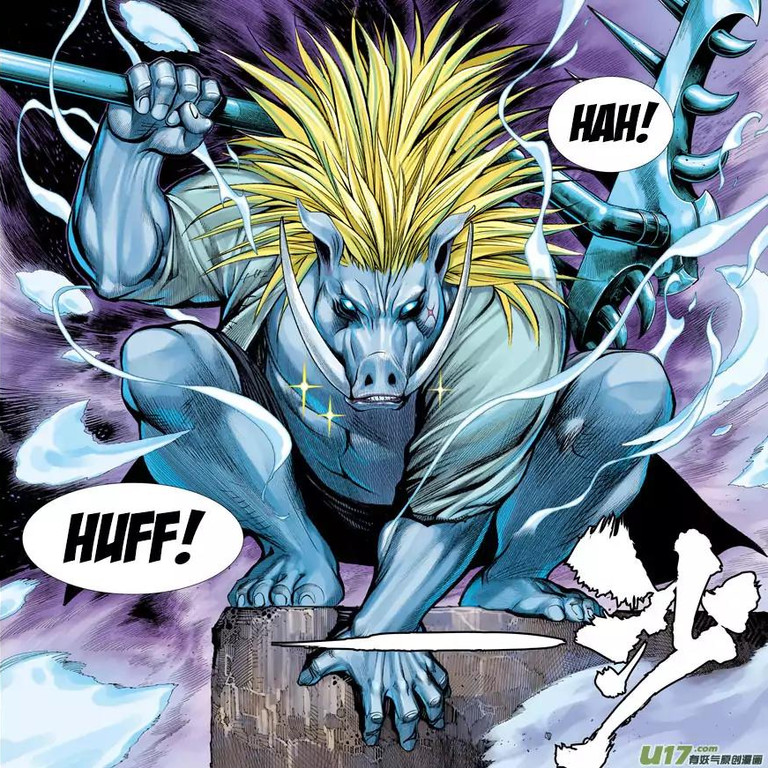
Goku’s Ozaro (大猿) form, or his ability to change into a titanic “great ape” during a full moon (fig. 5), is largely based on the Monkey King’s cosmic transformation. The novel calls this magical skill the “Method of Modeling Heaven on Earth” (Fatian xiangdi, 法天像地), and Sun uses it to grow 100,000 feet (30,480 m) tall during battles with powerful opponents. This is related to ancient Pre-Qin and Han dynasty concepts of astral-geography later used in the construction of imperial Chinese cities.

While I don’t have confirmation from Toriyama, Goku’s “Instant Transmission” skill (fig. 6) might be based on the aforementioned cloud somersault. This is because Chinese Buddhist literature mentions the world of man is separated from the Buddha’s paradise by 108,000 li (the distance covered by the cloud), and the only way to instantly bypass all of the hardships in-between is achieving enlightenment. Hence the cloud somersault is symbolic of instant travel.

II. Other characters

Goku’s early quest to find the dragon balls along with Bulma (Tripitaka), the shape-shifting pig Oolong (Zhu Bajie), and the desert bandit Yamcha (Sha Wujing) is based on the quest for sutras in Journey to the West. Not surprisingly, other DB/DBZ characters come from the Chinese novel. The Ox-King and Chi-Chi are respectively based on the Bull Demon King and his wife, Princess Iron Fan (fig. 7). Tien Shinhan is based on Erlang, the only god to truly defeat Sun Wukong, which is why Tien is such a threat to young Goku.

Goku’s martial arts teacher, Master Roshi, is based on the Buddho-Taoist Sage Subodhi who teaches Sun Wukong magic and the secret of immortality. Subodhi is based on Subhuti, a historical disciple of the Buddha. This is hilarious when you think about how much of a pervert Roshi is (fig. 8).

The antagonist Broly (fig. 9) wears a shock collar and mind-controlling headband in various DB media. These are based on the Monkey King’s “Golden Fillet” (jing gu quan, 金箍圈), which represses his unruly nature by painfully constricting around his head when a magic spell is chanted. It’s interesting to note that this fillet is based on a historical ritual headband worn by ancient Indian Buddhist yogins as a physical reminder of self-restraint.

III. Miscellaneous

The senzu (仙豆, “immortal bean”) (fig. 10) used by Goku and other Z fighters to replenish their strength from prolonged training or battle are based on immortality-bestowing elixir pills that Sun Wukong eats while drunkenly stumbling through the laboratory of the Taoist high god Laozi. Once eaten, the pills immediately counteract the effects of the heavenly wine.


Update: 03-20-22

I recently remembered that I’ve also referenced the origin of the spikey hair in esoteric Buddhist art. On 02-14-2019 I posted on twitter saying: “Goku’s spiked hair is based on esoteric guardian deities. For ex., here is Tianpeng, the former incarnation of Oolong’s precursor Zhu Bajie [fig. 11].”


Update: 12-20-22

I first became interested in Journey to the West thanks to Dragon Ball Z. The series is obviously named after the seven glass-like orbs (fig. 12) created by the Namekian-turned-protector deity Kami for the benefit of mankind. When all seven are collected, they summon the dragon god Shenron, who grants a single wish. One common wish is to resurrect a beloved fighter who had previously been killed in battle.

But what would the Dragon Balls be like if they appeared in the Journey to the West universe? There are two possibilities. The first is the most obvious, the Cintāmaṇi (Sk: “wish-fulfilling jewel”; Ch: ruyi baozhu, 如意寶珠, lit: “as-you-will treasure jewel”). Also known as “dragon jewels” (longzhu, 龍珠), these luminous orbs are commonly held by Bodhisattvas in Buddhist art (fig. 13), thereby signifying their ability to grant any wish that a believer desires. They are also mentioned in Buddhist scripture. For instance, the Treatise of the Great Perfection of Wisdom (Sk: Mahāprajñāpāramitāśāstra; Ch: Da zhidu lun, 大智度論, c. 2nd-century) reveals that the Cintāmaṇi is a bodily relic found in the brains of dragon kings (longzhu chu longnao zhong, 龍珠出龍腦中) (Buswell & Lopez, 2014, p. 193). Therefore, we would be able to maintain the connection to dragons in Journey to the West.

(If we view Dragon Ball Z under the light of this new information, a creepy implication is that Kami killed seven dragon kings in order to create his set of dragon balls.)

In East Asia, the Cintāmaṇi is closely associated with our second possibility, the Śarīra (Sk: “body”; Ch: Sushe/zi, 舍利/子) (fig. 14). These pearl-like beads figure among the bodily relics left over from the historical Buddha’s cremation. [1] Strong (2004) explains: “[They are the result] of a process of metamorphosis brought on not only by the fire of cremation but also by the perfections of the saint (in this case the Buddha) whose body they re-present” (p. 12).

They are said to come in different colors and sizes depending on the country and religious tradition (Strong, 2004, p. 11).
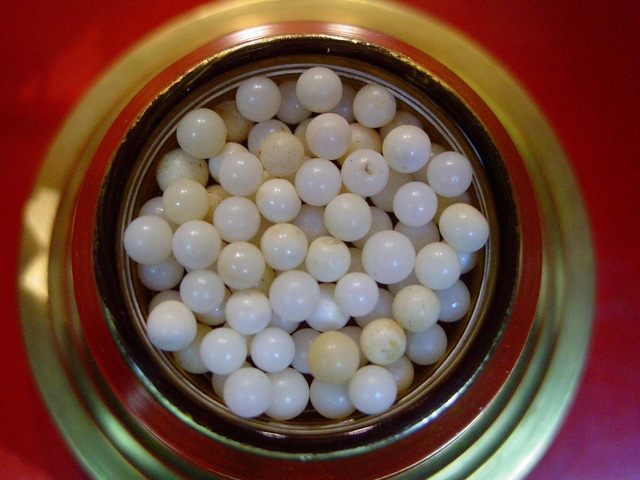
Journey to the West could have one or even both of these bodily relics. For example, the Cintāmaṇi would allow demon kings or lesser spirits to wish for powerful heavenly weapons, thereby helping them fight stronger opponents; or, the Śarīra could grant the devils more spiritual power, thereby allowing them to bypass centuries of spiritual cultivation.

But neither of these items could help evil beings achieve immortality. I’ve previously noted that Journey to the West was heavily influenced by the Buddho-Daoist philosophy of the Southern Quanzhen School Patriarch Zhang Boduan (張伯端, mid to late-980s-1082). He believed that in order to become a true transcendent (xian, 仙), one had to achieve both the Daoist elixir of immortality and Buddha-nature (Shao, 1997; 2006). The first extends your life, while the second frees you from the endless rounds of rebirth. While the aforementioned spiritual objects may grant them divine longevity, it won’t make them unkillable. And if they are killed, they would still be subject to the wheel of reincarnation. It would be up to them to achieve the last step in this two-step process. But that would require these spirits to mend their evil ways and “return to the right path” (gui zheng, 歸正)⁠—i.e. convert to Buddhism.


Update: 12-29-22

It turns out that Journey to the West has śarīra beads. In fact, they are mentioned at least 18 times throughout the novel. One example is a treasure belonging to the Yellow-Robed Demon (Huangpao guai, 黃袍怪). Chapter 31 reads:

Leading Pilgrim [Sun Wukong], the fiend [Yellow Robe] took his companion into the murky depth of the cave before spitting out from his mouth a treasure having the size of a chicken egg. It was a śarīra [shelizi, 舍利子] of exquisite internal elixir. Secretly delighted, Pilgrim said to himself, “Marvelous thing! It’s unknown how many sedentary exercises had been performed, how many years of trials and sufferings had elapsed, how many times the union of male and female forces had taken place before this śarīra of internal elixir was formed. What great affinity it has today that it should encounter old Monkey!” (Wu & Yu, 2012, vol. 2, pp. 80-81). [2]

那怪攜著行者,一直行到洞裡深遠密閉之處。卻從口中吐出一件寶貝,有雞子大小,是一顆舍利子玲瓏內丹。行者心中暗喜道:「好東西耶。這件物不知打了多少坐工,煉了幾年磨難,配了幾轉雌雄,煉成這顆內丹舍利。今日大有緣法,遇著老孫。」

As can be seen, Yellow Robe’s śarīra is portrayed as the hard-won product of spiritual cultivation. This agrees with Strong’s (2004) statement above that Buddhists believed such beads were “brought on not only by the fire of cremation but also by the perfections of the saint (emphasis added) … whose body they re-present” (p. 12).

Note:

1) There are three main types of Buddha relics: 1) those of the body left over from his cremation (hair, teeth, nails, bones, and Śarīra beads); 2) those that he used (walking staff, alms bowl, robes, etc.); and 3) those that he taught (i.e. lessons from scripture) (Strong, 2004, p. 8).

2) Source altered slightly. I’ve made it more accurate.

Sources:

Buswell, R. E., & Lopez, D. S. (2014). The Princeton Dictionary of Buddhism. Princeton, NJ: Princeton University Press.

Shao, P. (1997). Monkey and Chinese Scriptural Tradition: A Rereading of the Novel Xiyouji (UMI No. 9818173) [Doctoral dissertation, Washington University]. Available from ProQuest Dissertations and Theses database.

Shao, P. (2006). Huineng, Subhūti, and Monkey’s Religion in “Xiyou ji”. The Journal of Asian Studies, 65(4), 713-740. Retrieved from http://www.jstor.org/stable/25076127.

Strong, J. S. (2004). Relics of the Buddha. Princeton, NJ: Princeton University Press.

Wu, C., & Yu, A. C. (2012). The Journey to the West (Vols. 1-4) (Rev. ed.). Chicago, Illinois: University of Chicago Press.

Journey to the West Artist Spotlight #1: Dario Virga

From time to time I like to post a fun blog not directly related to (though sometimes informed by) my research. Regular articles will resume after this entry.

Anyone who has read my blog will know that I’m an avid fan of researching the history and influences of Journey to the West. But as an artist, I am also a fan of JTTW-related artwork. There are so many talented people in the world who post their traditional and original designs and comics online, so I’ve decided to feature some of them on my blog. My hope is that such posts will expose this art to a wider audience interested in JTTW, while also documenting modern day perceptions and depictions of the novel and its characters.

Our first artist is Dario Virga, who goes by Onibotokemaru on Instagram. They were kind enough to answer some interview questions, as well as allow permission to display a few of their pieces.

I. Q & A

1) Can you tell me a little about yourself?

Real name Dario Virga, from Italy (Piedmont). Interest in eastern culture and literature, mostly from Japan and China.

2) Are you self-taught or did you go to art school?

Self-taught, though I had some help from someone who went to art school.

3) What are your main sources of artistic inspiration?

Usually animals and characters/elements taken from mythology and literature.

4) How did you learn about Journey to the West?

My very first contact with Journey to the West was back when I was younger, in a book about Chinese myths. Later I found an integral translation done by Serafino Balduzzi (translated from a French one).

5) Who is your favorite character?

Tough question, but I like most of the characters. If forced to choose, I’d say Pigsy for the good guys and the Bull Demon King for the villains.

6) Do you have a favorite episode from the novel?

Probably the whole Gold Horn & Silver Horn arc.

7) Does the novel have a special meaning to you?

Not a special meaning per se, but it was a novel I really enjoyed, both for the setting, the narration, the characters within and watching them grow.

8) Can you tell me about your ongoing JTTW-related projects?

Plan to make a gallery of, if not all, at least a huge amount of the novel’s characters.

II. Art and Thought Process

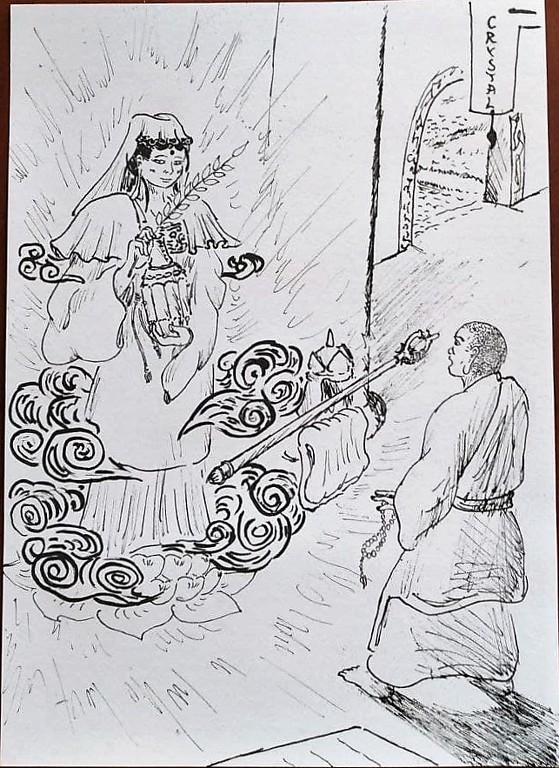
1. As the opening drawing of the Xiyouji-themed Inktober set, I’ve decided to focus not on Sun Wukong himself but rather on Tripitaka, the monk, as Guanyin Pusa appears before him to assign him the quest for the sutras. Guanyin’s reference are commonly-found icons and statues. Between the two of them float the items Tripitaka receives (the cossack, nine-ringed staff and hat).

(Larger version)

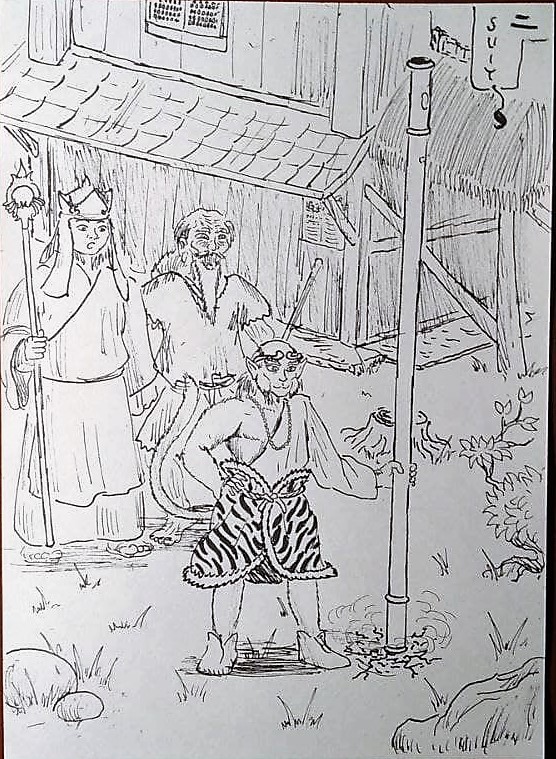
2. This is the first time I depict Sun Wukong in the series, and I did it based his design on an article written on this very blog, trying to stick as much as possible to his literary description, especially regarding the clothing (monk’s shirt and tiger pelt kilt held by a rope), short stature, simian face and bald spot on the top of the head (converted to Buddhism). I gave him long spike-like hair in the back because otherwise his head felt too small. The Ruyijingubang has a rather simple design, as I never liked its depictions with pommels on both ends. I also tried to make the inscriptions on the shaft, but ultimately gave up, admittedly.

(Larger version)

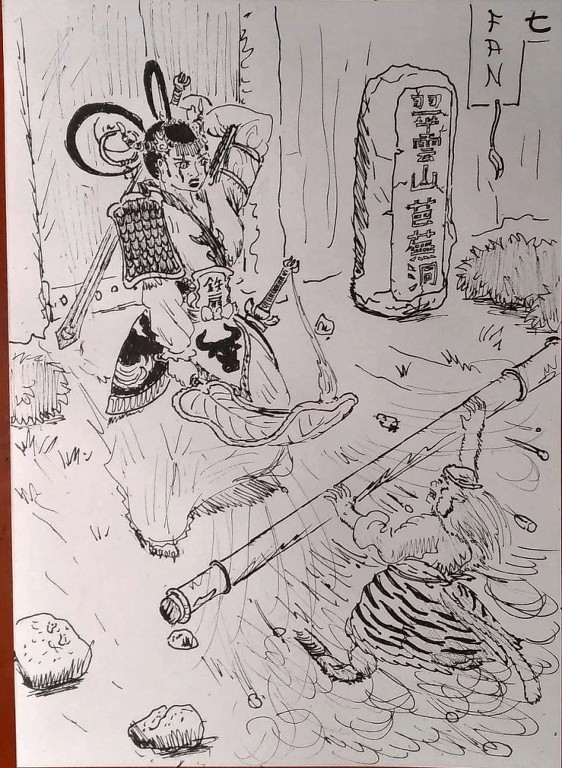
3. This picture has Sun Wukong fighting against the Iron Fan Princess, who sends him flying away with her Banana Leaf Fan. Once again, I wanted to show how small Monkey is (in comparison to nearly everyone else, though I’m not always 100% consistent) and remind that the Ruyijingubang can increase in both length and width, as seen here where he tries to use it as a shield to block the wind, unsuccessfully. Also of note, the massive stone pillar on which the “address” of the Iron Fan Princess is written.

(Larger version)

4. This one isn’t based on any specific event, but it’s here to bring out two topics: the first is the size of the party members, which I always tried to keep consistent (and tried is the keyword). The idea is that Sun Wukong is the smallest of the group (4 feet), then we have Tripitaka, the “normal” one, and the Dragon (horse-sized): Pigsy (here depicted with a hint of boar) is the second tallest but also the fattest, while Sandy is the tallest of the party (and definitively not a Kappa). The second one is Sha Wujing’s weapon: while it’s usually depicted as a Monk Spade, the actual name is the “Demon-Subduing Treasure Cane” (降魔宝杖, Xiangmobaozhang), making it a stick/staff. However, it’s also worth a mention that the Monk Spade is sometimes called “Zen Cane” (禪杖, Chanzhang), a term which also refers to the ringed staff used by monks. Admittedly, I liked the spade version the most, though I plan to depict this weapon as a staff when Sandy is in his celestial marshal/arhat forms, implying that the staff changed into a spade when he fell from Heaven.

(Larger version)

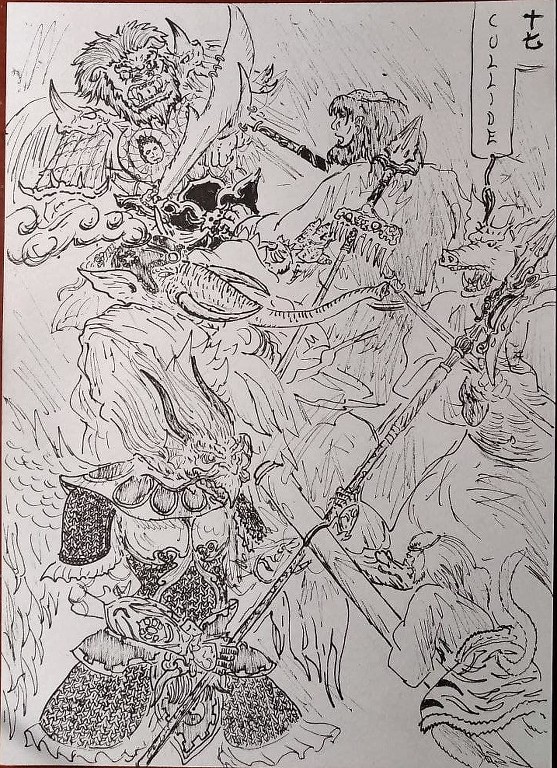
5. The big battle between Sun Wukong and the Lion Demons working for the Great Sage Nine Spirits (seen in the background, in his giant nine-headed form): this was mostly done because it was one of the rare parts of the book where Sandy actually fights the monsters alongside Sun Wukong (as Pigsy was captured), as well as an attempt to make a big battle scene.

(Larger version)

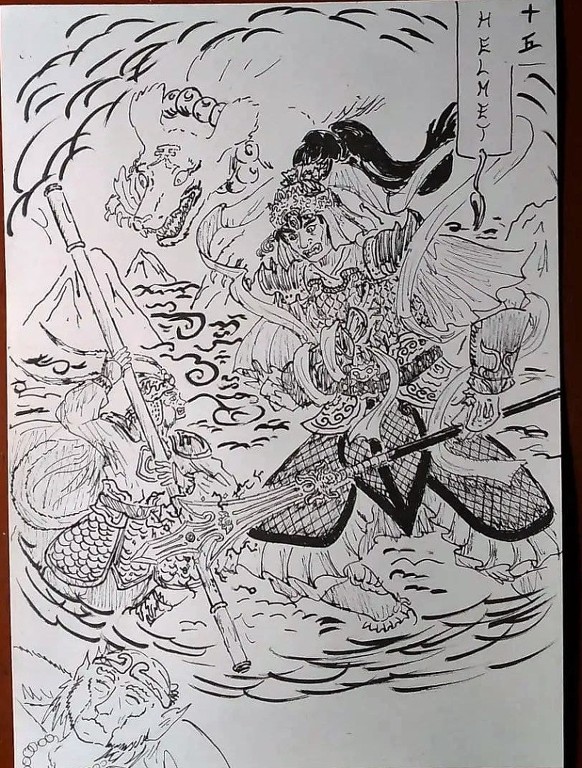
6. The only god who actually beat Monkey, Erlang Shen. Since the Inktober was focused on the journey itself, I’ve decided to depict their battle as a bad dream. This time, Monkey wears his old, stylish outfit he got from the Dragon Kings, while Erlang is in full battle regalia, including his “Sanjiang Lianrendao” (三尖两刃刀 Three-pointed, Double Edged Glaive) and his Heavenly Roar Dog.

(Larger version)

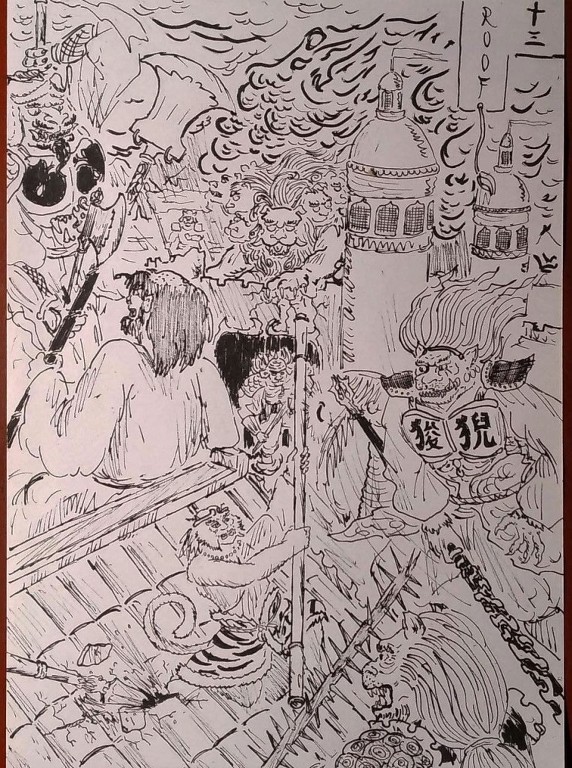
7. The clash between the three pilgrims and the three Demon Kings of Lion Camel Mountain, from top to bottom: the Blue-Haired Lion vs Sha Wujing, the Yellow-Tusked White Elephant vs Zhu Bajie and the Golden-Wings Peng King vs Sun Wukong. The design of the three kings was based on a series of pictures I loved very much. Once again, a reminder that Wukong’s staff can widen as well.

(Larger version)

8. Sun Wukong fights the three Rhino Kings, who’re kidnapping Tripitaka. This time I wanted to depict Monkey twirling his staff as he fights. Like with the Demon Kings above, the design of the three Rhinos was based on the same set of pictures, even though I remember that in the novel they’re described as “bull-like” in appearence. Particularly like the dust cloud to the right.

(Larger version)

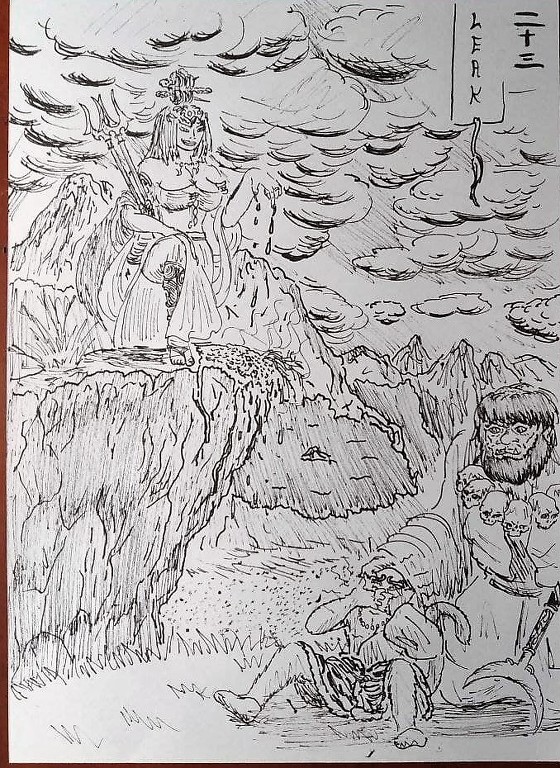
9. Sun Wukong is poisoned by the Scorpion Spirit. Aside from the scenery, I like the scorpioness. I’ve noticed in several arts (even old ones) that she sports a relatively skimpy outfit. As of her weapon, mentioned to be a “fork/trident” in the book, I’ve seen plenty of depictions with both the single trident version and the smaller, dual trident version.

(Larger version)

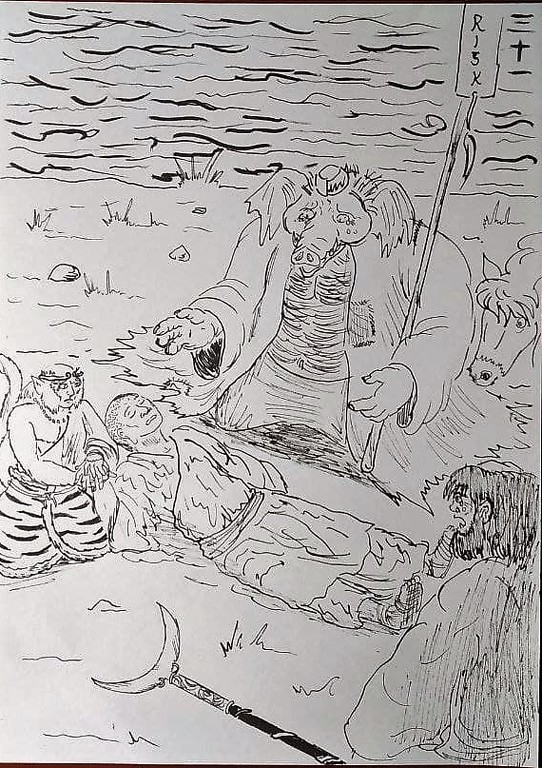
10. As a bookend, I’ve depicted a scene from the end of the book, the moment where Tripitaka drowns and ascends to buddhahood, so that he can obtain the sutras properly. This is also to represent one of the things I liked the most from the novel, the gradual growth of the pilgrims and the attachment to Tripitaka as a father figure. [Note: Tripitaka sheds his mortal form as he and his disciples are ferried across a body of water to the Buddha’s paradise. See the paragraph above image one and the material between images two and three in this article.]

(Larger version)

The Monkey King’s Children

Last updated: 04-04-2022

Modern media occasionally depicts Sun Wukong with children. Examples include the book series The Monkey King’s Daughter (2009-2011) and the DC Comics character the Monkey Prince (first appearing in 2021). The anime High School DxD (2012) even features a descendent some generations removed called Bikou. But the idea of the Great Sage having children goes back centuries. Two late-Ming novels influenced by the original Journey to the West (Xiyouji, 西遊記, 1592) reference multiple offspring. In this article, I will highlight these children and discuss their connection to Buddhism and Asian astrology.

Those interested in this subject may fancy learning about Sun’s brothers and sisters.

1. King PāramitāA Supplement to the Journey to the West (Xiyoubu, 西遊補, 1640)

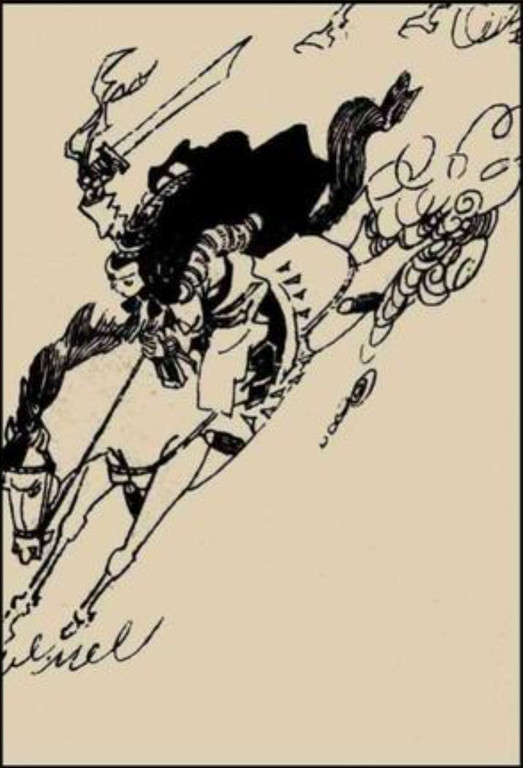
This novel is set between the end of chapter 61 and the beginning of chapter 62 of the original. It follows the Monkey King as he travels time seeking a magic weapon, while also striving to unmask the identity of a mysterious foreign king who has persuaded Tripitaka to give up the quest to India. The first reference to Sun’s children appears in chapter 13 when actors in a royal play describe an alternate timeline where our hero settled down: “His wife is so beautiful, his five sons so dashing. He started out as a monk, but came to such a good end! Such a very good end!” (Dong, Lin, & Schulz, 2000, p. 114). Later, in chapter 15, Monkey meets one of these sons on the battlefield. “King Pāramitā” (Boluomi wang, 波羅蜜王) (fig. 1) is portrayed as a sword-wielding general capable of fighting Sun for several rounds. Pāramitā goes on to recount his family history, revealing that, although he’s never met his father, he’s the son of the Great Sage and Princess Iron Fan (Tie shan gongzhu, 鐵扇公主) (Dong, Lin, & Schulz, 2000, pp. 123-124). In addition, he suggests that he was conceived during an event from chapter 59 of the original:

[Sun Wukong] changed into a tiny insect and entered my mother’s belly. He stayed there a while and caused her no end of agony. When my mother could no longer bear the pain, she had no choice but to give the Banana-leaf Fan to my father, Monkey [1] … In the fifth month of the next year, my mother suddenly gave birth to me, King Pāramitā. Day by day I grew older and more intelligent. If you think about it, since my uncle [the Bull Demon King] and mother had never been together, [2] and I was born after my father, Monkey, had been inside my mother’s belly, the fact that I am his direct descendant is beyond dispute (Dong, Lin, & Schulz, 2000, p. 124).

Fig. 1 – King Pāramitā leaps into battle (larger version). Detail from a modern manhua. Image found here.

1.2. Links to Buddhism

The translators of A Supplement to the Journey to the West explain King Pāramitā’s name serves as a pun:

In the Chinese transliteration for Pāramitā, the character used to render the syllable “mi” [蜜] has the intrinsic meaning of “honey,” while the character t’ang [唐] in T’ang dynasty is homophonous with the character meaning “sugar” [糖]. King Pāramitā is punning on these associations (Dong, Lin, & Schulz, 2000, p. 123 n. 2). [3]

However, the name also has deep connections with Buddhism. The Princeton Dictionary of Buddhism defines the Sanskrit term Pāramitā (“perfection”) as “a virtue or quality developed and practiced by a Bodhisattva on the path to becoming a buddha” (Buswell & Lopez, 2014, p. 624). Various traditions recognize six to ten perfections, with the latter including the former six plus an additional four. The Mahayana perfections, for example, include giving, morality, patience, effort, concentration, wisdom, method, vow, power, and knowledge. Bodhisattvas are believed to master these virtues in the listed order, compounding spiritual wisdom and merit over the course of their journey towards Buddhahood (Buswell & Lopez, 2014, p. 624).

2. Jidu, Luohou, and Yuebei XingJourney to the South (Nanyouji, 南遊記, c. 1570s-1580s)

The novel follows the exile of Miao Jixiang (妙吉祥), a divine flame-turned Buddhist deity, from the Western Paradise through several mischievous reincarnations. [5] As the rogue immortal Huaguang (華光), he works to end his mother’s demonic lust for flesh by procuring an immortal peach in chapter 17. He does this by transforming into Sun Wukong and stealing the magic fruit from heaven. The real Monkey King is subsequently accused of his double’s misdeeds, much like the Six-Eared Macaque episode of the original novel. The Jade Emperor threatens to remand him to the Buddha for punishment but is convinced to give Sun a month-long reprieve to find the true culprit.

Monkey returns to the Mountain of Flowers and Fruit, and it is here, among his people, that the story mentions three children, including sons Jidu (奇都, “Ketu”) and Luohou (羅猴, “Rahu”) and daughter Yuebei Xing (月孛星, “Moon Comet Star”). [4] Sun eventually seeks out Guanyin, who reveals the troublemaker is none other than Huaguang. Returning home once more, Monkey’s news prompts his daughter to volunteer to battle the impostor. But her tribe simply pokes fun at her monstrous appearance. Yuebei Xing is said to have a crooked head with huge eyes and a broad mouth, coarse hands, a wide waist, and long legs with thunderous steps.

Sun travels with his daughter to Huaguang’s home of Mt. Lilou (Lilou shan, 離婁山) to provoke battle by chastising him for stealing the immortal peaches. Monkey strikes at him with his magic staff, causing Huaguang to deploy his heavenly treasure, a golden, triangular brick (sanjiao jinzhuan, 三角金磚). But Sun responds by creating untold numbers of clone monkeys that not only confiscate the weapon but also overwhelm the immortal. Huaguang is seemingly defeated at this point; however, he manages to deploy one last treasure, the Fire Elixir (Huodan, 火丹). This weapon engulfs the Great Sage in heavenly flame (akin to the Red Boy episode), causing him to flee to the Eastern Sea. Yuebei Xing then calls Huaguang’s name while holding her own magic treasure, a skull (kulou tou, 骷髏頭). The immortal is immediately stricken with a headache and stumbles back to his cave in a daze. Her weapon is said to be quite dangerous; anyone whose name is called will die within three days.

Huanguang’s religious teacher, the Flame King Buddha of Light (Huoyan wang guangfo, 火炎王光佛), then intervenes in order to sooth the situation between his disciple and the Great Sage. He promises to bring the rogue immortal to justice on the condition that Yuebei Xing withdraws her deadly magic. In the end, all parties are pardoned by the Jade Emperor, and Huaguang and Monkey become bond brothers (Yu, n.d.).

2.1. Links to Asian Astrology

All three of Sun’s children are named after planetary bodies associated with the moon in Asian astrology. [6] His sons Jidu and Luohou are respectively named after Ketu (Jidu, 奇都) and Rahu (Luohou, 羅睺), two of the “Nine Planets” (Sk: Navagraha; Ch: Jiuyao, 九曜, “Nine Luminaries”) from Hindu astrology. [7] These two shadowy planetary deities represent the respective southern (descending) and northern (ascending) lunar nodes, or points where the moon crosses the earth’s orbit around the sun. As such, the pair are associated with eclipses, and sources sometimes depict them as the head (Rahu) and tail (Ketu) of a great eclipse serpent. Other interpretations include Rahu as a disembodied head and Ketu as the torso, or Ketu as a comet or emerging from a cloud of smoke (Gansten, 2009, p. 652-653; Kotyk, 2017, pp. 59-60).

Before continuing, there are two interesting things to note: 1) Sun Wukong singlehandedly battles and defeats the Nine Planets in chapter five of the original novel (Wu & Yu, 2012, vol. 1, pp. 170-172). But the Ketu and Rahu in this group should be considered distinct from his sons; and 2) one of the original Chinese characters for Rahu (Luohou, 羅睺) was changed in Journey to the South to play on Luohou’s (羅猴) primate origins by using the homophonous word for “monkey” (hou, 猴).

All information about Yuebei xing has been moved to a new article.

Yuebei xing, Daughter of the Monkey King

3. Honorable Mention: Sun Luzhen – Later Journey to the West (Hou Xiyouji, 後西遊記, 17th-century)

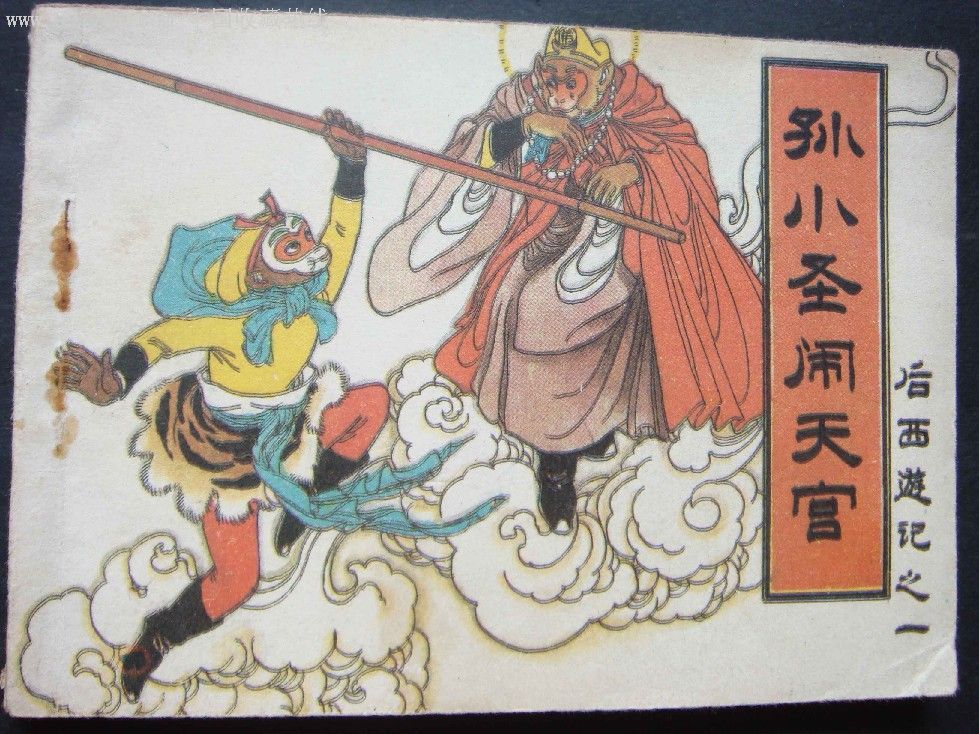
The novel is set two hundred years after the original and follows the adventures of Sun Wukong’s spiritual descendant Sun Luzhen (孫履真, “Monkey who Walks Reality”) (fig. 2). He too learns the secrets of immortality and causes havoc in heaven, before being tasked to protect the historical monk Dadian (大顛, 732-824) on a similar journey to India. The two are accompanied by the son of Zhu Bajie, Zhu Yijie (豬一戒), and the disciple of Sha Wujing, Sha Zhihe (沙致和). I did not include Luzhen in the main list as he is born from a stone in the same fashion as the original Monkey King (see Liu, 1994).

Fig. 2 – “Small Sage Sun’s Havoc in the Heavenly Palace” (larger version). The cover to a modern manhua. Image found here.

4. Conclusion

The Monkey King has a total of eight children shared between two late-Ming novels, but only four are mentioned by name, and only two of these actually have parts in the respective stories. King Pāramitā is one of the Great Sage’s five sons born to Princess Iron Fan in A Supplement to the Journey to the West (1640). He is portrayed as a handsome, sword-wielding general whom Sun faces on the battlefield. His name references the Pāramitās (“perfections”), or the wisdom and merit-building virtues that Bodhisattvas master in their quest for Buddhahood. Monkey has three children in Journey to the South (c. 1570s to 1580s), including sons Jidu and Luohou and daughter Yuebei Xing. The latter is depicted as a grotesque monster with a magic skull weapon cable of harming even celestials. She uses it to defeat the rogue immortal Huaguang. Jidu and Luohou are respectively named after the lunar nodes Ketu and Rahu, two of the Nine Planets from Hindu astrology. Yuebei is named after a shadowy planet representing the lunar apogee, which counts among the Eleven Luminaries of East Asian astrology. Ancient Xixia art sometimes depicts them as a woman or man bearing a sword and a severed head. The feminine iconography appears holding a skull in a novel from the 16th-century.

An honorable mention is Sun Luzhen from Later Journey to the West. He is a stone-bone monkey who follows in his spiritual ancestors footsteps by attaining immortality, causing havoc in heaven, and later protecting a holy monk on the journey to India.


Update: 04-04-22

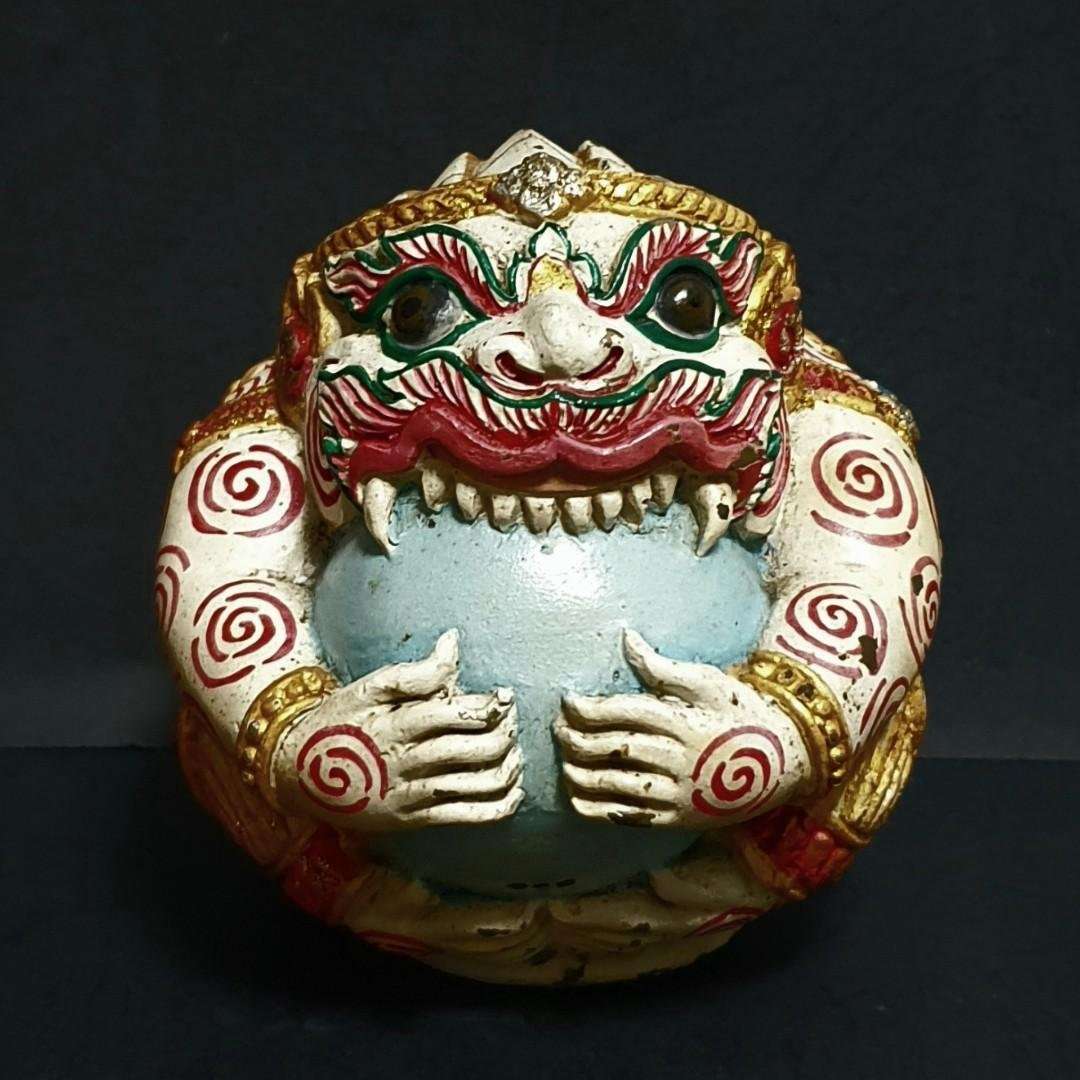
Back in November 2021, I made a post on twitter about a Rahu amulet that a collector friend of my was selling (and later sold). The deity is generally portrayed as a sharp-toothed, giant-mouthed monster devouring the moon. This piece is carved in a similar manner but Rahu is instead patterned after Thai depictions of Hanuman (fig. 3). I imagine his association with the monkey god is based on the latter’s attempt to eat the sun in his youth. 

Fig. 3 – The front of the Hanuman-like Rahu amulet (larger version).

Notes:

1) See Wu & Yu, 2012, vol. 3, p. 129.

2) This statement of course overlooks the conception and birth of the couple’s son Red Boy (Hong haier, 紅孩兒). But King Paramita might be referring to the Bull Demon King’s long absence while living with his mistress.

3) This pun plays out in chapter 14 of Journey to the West when an old patron remarks on Monkey’s monstrous appearance:

“Though you [Tripitaka] may be a Tang man,” the old man said, “that nasty character is certainly no Tang man!” “Old fellow!” cried Wukong in a loud voice, “you really can’t see, can you? The Tang man is my master, and I am his disciple. Of course, I’m no sugar man or honey man! I am the Great Sage, Equal to Heaven!” (Wu & Yu, 2012, vol. 1, p. 312).

Thank you to Irwen Wong for reminding me of this passage.

4) I’m indebted to Jose Loayza for bringing this to my attention.

5) To my knowledge, the only English translation available is this amateur version by Panying Zhao. Thank you to Ronni Pinsler for bringing it to my attention.

6) Thank you to Dr. Jeffrey Kotyk for confirming the astrological connection.

7) Sun, Moon, Mars, Mercury, Jupiter, Venus, Saturn, Rahu, and Ketu (Gansten, 2009).

8) These include the aforementioned Nine Planets (see note #6 above), Yuebei, and another shadowy planet called Ziqi (紫氣/紫炁; “Purple Mist”) (Hart, 2010, p. 145 n. 43; Kotyk, 2017, p. 60). Engravings of the Eleven Luminaries appear on Zhu Bajie’s battle rake (Wu & Yu, 2012, vol. 1, p. 382). See also note #10 on the linked article.

Sources:

Dong, Y., Lin, S. F., & Schulz, L. J. (2000). The Tower of Myriad Mirrors: A Supplement to Journey to the West. Ann Arbor: Center for Chinese Studies, The University of Michigan.

Gansten, M. (2009). Navagrahas. In K. A. Jacobsen (Ed.), Brill’s Encyclopedia of Hinduism (Vol. 1) (pp. 647-653). Leiden: Brill.

Hart, R. (2010). The Chinese Roots of Linear Algebra. United States: Johns Hopkins University Press.

Kotyk, J. (2017). Astrological Iconography of Planetary Deities in Tang China. Journal of Chinese Buddhist Studies, 30, 33-88), Retrieved from https://chinesebuddhiststudies.org/previous_issues/jcbs3002_Kotyk(33-88)_e.pdf

Liu, X. (1994). The Odyssey of the Buddhist Mind: The Allegory of the Later Journey to the West. Lanham, Md: University Press of America.

Buswell, R., & Lopez, D. (2014). The Princeton Dictionary of Buddhism. Princeton University Press.

Wu, C., & Yu, A. C. (2012). The Journey to the West (Vol. 1-4). Chicago, Illinois: University of Chicago Press.

Yu, X. (n.d.). Nanyouji: Huaguang sanxia Fengdu [Journey to the South: Huaguang goes to the Underworld Three Times]. Retrieved from https://ctext.org/wiki.pl?if=gb&chapter=506975&remap=gb#%E5%8D%8E%E5%85%89%E4%B8%89%E4%B8%8B%E9%85%86%E9%83%BD

Watch Your Step: The Influence of Journey to the West on the “Ashiarai Yashiki” Yokai Story of Edo-Period Japan

Last updated: 07-26-2023

The Journey to the West (Xiyouji, 西遊記, 1592) story cycle has been popular in East Asia for nearly a millennium. Written and pictorial evidence points to it emerging in China by at least the 11th-century. Tales of the Tang Monk and his animal companions were well-regarded in Korea by at least the 14th-century (see here and here). I’m not sure when the story first arrived in Japan, but it received piecemeal translations starting in the 18th-century, and the first complete version was finished by 1835. [1] According to Shi (as cited in Chien, 2017), these translations “had a tremendous impact of spreading the story of Xuanzang far and wide in Japan” (p. 22).

Journey to the West came to influence all sorts of Japanese media (one example). In this article, I would like to focus on a lesser known Edo-period folktale from the Seven Wonders of Honjo (Honjo Nanafushigi, 本所七不思議) [2] called the “Foot Washing Manor” (Ashiarai Yashiki, 足洗邸; あしあらいやしき). 

1. The “Foot Washing Manor”

The story tells of a filthy, titanic foot that plagues a samurai night after night. Matthew Meyer kindly gave me permission to reproduce his version of the story, as seen on his website yokai.com:

Long ago lived a hatamoto (a high-ranking samurai) named Aji no Kyūnosuke. One night at his manor in Honjo, a loud, booming voice was heard heard. It echoed like thunder:

“WAAASH MYYY FOOOOOOT!”

Just then there was a splintering crack, and the ceiling tore open. An enormous foot descended into the mansion. The foot was covered in thick, bristly hair, and it was filthy. The terrified servants scrambled to gather buckets, water, and rags. They washed the foot until it was thoroughly clean. Afterwards, the giant foot ascended up through the roof and disappeared.

The following night, and every night thereafter, the same thing occurred. A booming voice would demand its foot be washed. A giant foot would crash through the roof. And the dutiful servants would wash it clean.

A few nights of this was all that Aji no Kyūnosuke could take. He ordered his servants not to wash the foot anymore. That night, the foot crashed through the ceiling and demanded to be washed as usual. When it was ignored, it thrashed around violently, destroying vast swaths of the mansion’s roof in the process.

Kyūnosuke complained to his friends about the nightly visitor and the destruction it was causing. They were very interested. One of them wanted to witness the event so badly that he offered to swap mansions with Kyūnosuke, and Kyūnosuke quickly agreed. However, after his friend moved in, the giant foot never appeared again (Meyer, n.d.).

This story shares many parallels with an event from chapter 97 of Journey to the West.

Fig. 1 – “The Foot Washing Mansion” (足洗邸) by Utagawa Kuniteru (larger version).

2. The Monkey King’s Giant Foot

For context, the four monks are framed for the theft and murder of a rich layman who had originally hosted them for a month in the Bronze Estrade Prefecture (Tongtai fu, 銅臺府) of India. Sun Wukong captures the real perpetrators but is forced to release the bandits for fear that Tripitaka will chant the band-tightening spell for killing them. However, imperial troops later capture the monks with the stolen items, making them look guilty. After allowing Tripitaka to be tortured (fulfilling one of the 81 predestined tribulations), Monkey escapes from the prison at night to affect his master’s release.

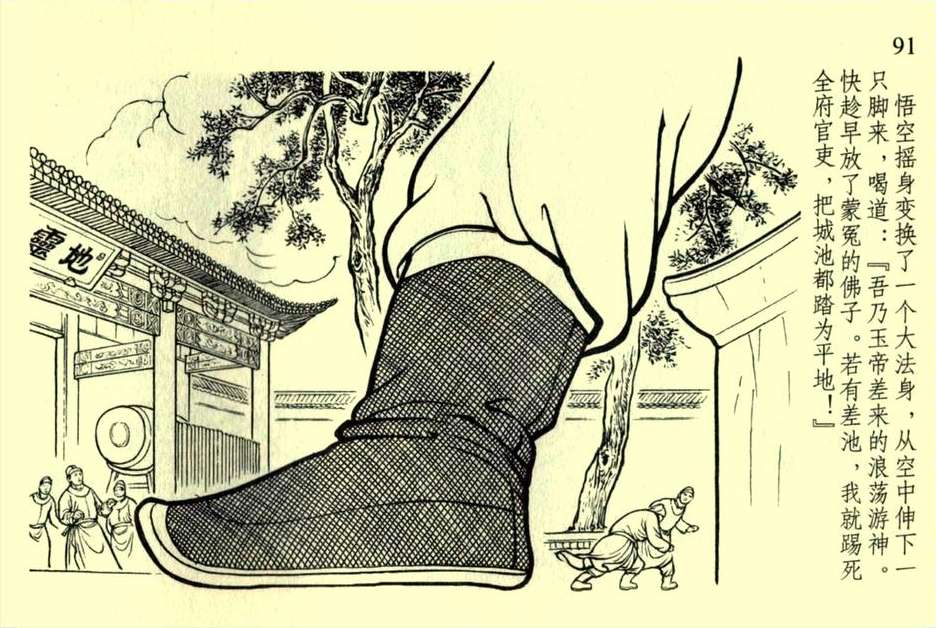
First, he imitates the voice of the slain layman at his wake and threatens heavenly retribution if his widow, the person who framed the monks, doesn’t recant her false claims. Second, he imitates the voice of the deceased uncle of the city magistrate who had imprisoned them and again threatens heavenly retribution if the official doesn’t reexamine the case. And third, at dawn he appears as a giant, disembodied foot (fig. 2) before the district-level magistrates and threatens to stomp the city and surrounding area into oblivion as heavenly retribution if they don’t put pressure on their superior to free his master:

Pilgrim flew out of the hall, and he found that it was beginning to grow light in the east. By the time he reached the Numinous Earth District [Di ling xian, 地靈縣], he saw that the district magistrate had already seated himself in the official hall. “If a midge speaks,” thought Pilgrim to himself, “and someone sees it, my identity may be revealed. That’s no good.” He changed, therefore, into the huge magic body [da fa shen, 大法身]: from midair he lowered a giant foot, [3] which completely filled the district hall. “Hear me, you officials,” he cried, “I’m the Wandering Spirit [Langdang youshen, 浪蕩遊神] sent by the Jade Emperor. I charge you that a son of Buddha has been wrongfully beaten in the jail of your prefecture, thus greatly disturbing the peace of the deities in the Three Regions. I am told to impart this message to you, that you should give him an early release. If there is any delay, my other foot will descend. It will first kick to death all the district officials of this prefecture. Then it will stamp to death the entire population of the region. Your cities finally will be trodden into dust and ashes!”

All the officials of the district were so terrified that they knelt down together to kowtow and worship, saying, “Let the noble sage withdraw his presence. We will go into the prefecture at once and report this to the magistrate. The prisoner will be released immediately. We beg you not to move your foot, for it will frighten these humble officials to death.” Only then did Pilgrim retrieve his magic body. Changing once more into a midge, he flew back inside the jail through the crack between the roof tiles and crawled back to sleep in the rack (Wu & Yu, 2012, p. 335-336).

行者又飛出來看時,東方早已發白。及飛到地靈縣,又見那合縣官卻都在堂上。他思道:「蜢蟲兒說話,被人看見,露出馬腳來不好。」他就半空中改了個大法身,從空裡伸下一隻腳來,把個縣堂屣滿。口中叫道:「眾官聽著:我乃玉帝差來的浪蕩遊神,說你這府監裡屈打了取經的佛子,驚動三界諸神不安,教我傳說,趁早放他;若有差池,教我再來一腳,先踢死合府縣官,後屣死四境居民,把城池都踏為灰燼。」概縣官吏人等慌得一齊跪倒,磕頭禮拜道:「上聖請回。我們如今進府,稟上府尊,即教放出。千萬莫動腳,驚諕死下官。」行者才收了法身,仍變做個蜢蟲兒,從監房瓦縫兒飛入,依舊鑽在轄床中間睡著。

Fig. 2 – A modern manhua depicting Monkey’s giant foot confronting the district-level magistrates (larger version). Comic found here. While the image shows Sun wearing shoes, the original Chinese doesn’t say whether are not his foot is covered.

3. Comparison

Both stories involve a single, giant foot threatening high-ranking members of society within the confines of their living or working quarters. The former is a samurai, while the latter are district-level magistrates. The threat involves death and the destruction of property. Danger looms over the Samurai’s household as the monstrous foot demands cleaning, and when its wants are ignored, it destroys part of the building in a fit of rage. Monkey, on the other hand, threatens to stomp everything (people and buildings) into oblivion if his demands for Tripitaka’s emancipation are not met. Also, the Japanese tale refers to the foot being “covered in thick, bristly hair” (Meyer, n.d.). This may be a reference to a furry monkey’s foot.

Now, someone might question what foot washing and release from prison have to do with each other. The two don’t appear to be related at all, but Meyer (n.d.) explains:

“[W]ashing your feet” is also a Japanese idiom for rehabilitating a criminal. A culprit whose ‘feet have been washed’ can be said to have paid his debt to society.

This is indeed an actual ceremony performed by criminals wishing to cleanse themselves of their negative past and reenter society (Clark, 1994, pp. 122-123). Therefore, both concepts are intimately related. Someone released from prison can be said to be rehabilitated, and this again is symbolized by said foot washing ceremony. Therefore, the monster in the Japanese tale is likely demanding that the Samurai do his part to help release or pardon a prisoner just like the Journey to the West episode.


Update: 04-09-23

The final act of Journey to the West: Conquering the Demons (Xiyou: Jiangmo pian, 西遊·降魔篇, 2013) includes a trio of demon hunters looking to defeat the Monkey King. One is a seemingly crippled old man who hobbles around on a crutch because of an underdeveloped right leg. But when the time comes, he uses qi energy to grow the appendage to giant proportions, calling it his “Heaven-Destroying Foot” (Tiancan jiao, 天殘脚). 

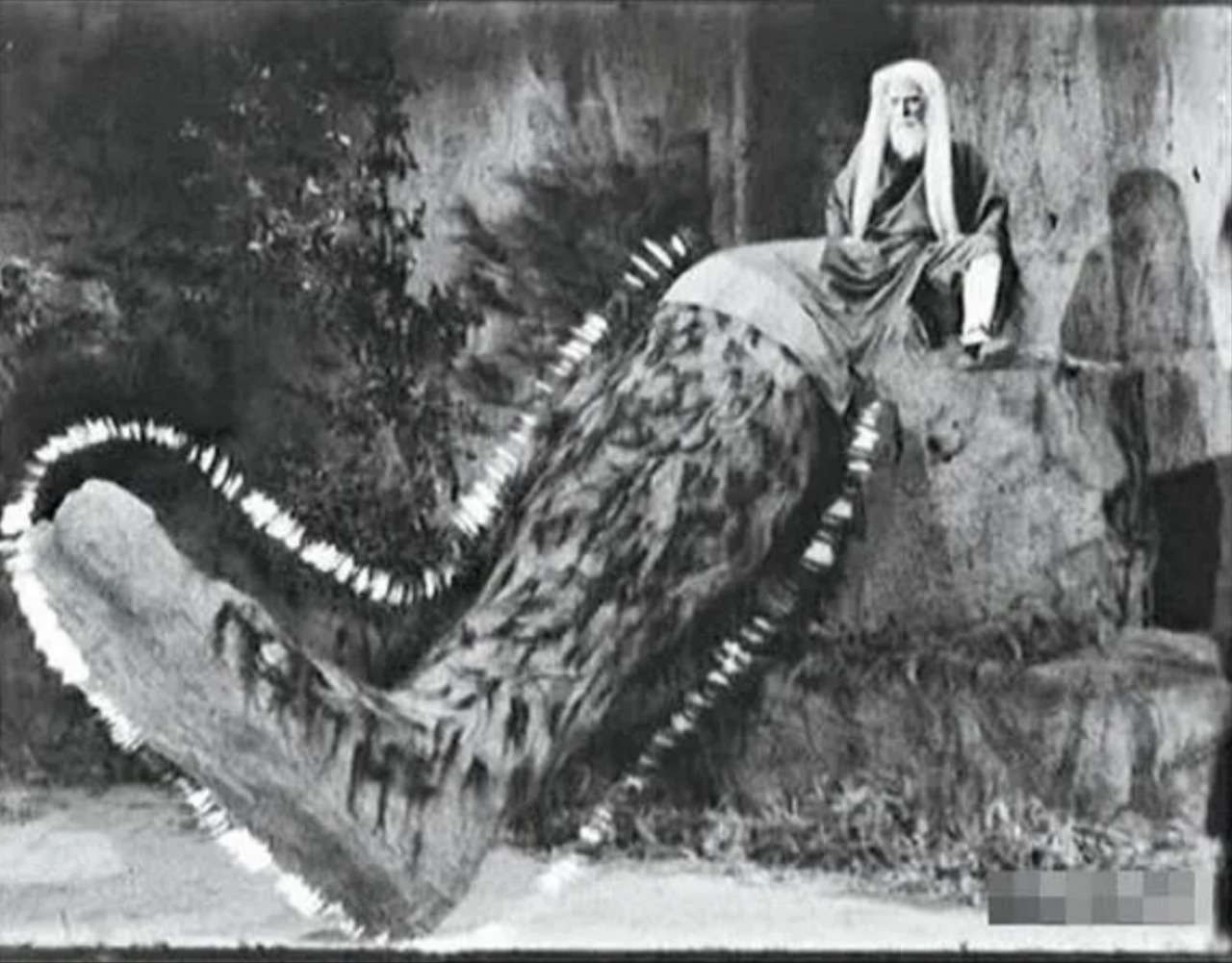
This character’s look and skill were copied directly from an HK martial arts film from 1965 commonly known in English as The Furious Buddha’s Palm (Rulai shenzhang nusui wanjian men, 如來神掌怒碎萬劍門; lit: “The Buddha Spirit Palm Shatters the 10,000 Sword Sect”). During the final battle, the main villain “Iron-Faced Asura” (Tiemian xiuluo, 鐵面修羅, played by Shih Kien) uses the same method to produce a giant foot. But what’s interesting for my purposes is that it appears to be covered in coarse hair like a primate (fig. 3).

A single, giant, destructive foot covered in hair sounds familiar doesn’t it? I wonder if this martial skill was influenced by the JTTW episode. This connection was first suggested to me by Jose Loayza (Twitter). A big thank you to him.

Note: A few hours after adding this update, it dawned on me that the “Buddha Spirit Palm” (Rulai shenzhang, 如來神掌) technique is used at the end of the film to combat the giant, monkey-like foot. This of course brings to mind the episode in JTTW when the Buddha defeats Sun Wukong with his palm by transforming it into Five Elements Mountain.)

Fig. 3 – A movie still of the Iron-Faced Asura summoning his hairy “Heaven-Destroying Foot” (larger version). Image found here.


Update: 07-26-23

A woodblock print showing Monkey’s titanic leg from the first complete Japanese translation of JTTW.

Fig. 4 – Sun’s giant foot (larger version). 

Notes:

1) The 18th-century translator Nishida Korenori (西田維則, d. 1765; penname: Kuchiki sanjin, 口木山人) began publishing Japanese translations of stories from Journey to the West in 1758, ultimately publishing a total of 26 chapters before his death. Others picked up where he left off, including Ishimaro Sanjin (石麻呂山人) (ch. 27-39 and later 40-47), Ogata Teisai (尾方貞斎) (ch. 48-53), and Gakutei Kyuzan 岳亭丘山 (ch. 54-65). This incomplete version, known as The Popular Journey to the West (Tsuzoku saiyuki, 通俗西遊記, 1758-1831) was published in five instalments over 31 volumes. The first complete version of the novel, The Illustrated Journey to the West (Ehon Saiyuki, 繪本西遊記), was published a few years later in 1835 (Tanaka, 1988, as cited in Chien, 2017, p. 21). 

2) This page notes Honjo is “modern day Sumida ward in Tokyo”.

3) Yu (Wu & Yu, 2012) translates this as “leg” (p. 335), but the original Chinese says “foot” (jiao, 腳). I’ve corrected this throughout the quote.

Sources:

Chien, P. (2017). A Journey to the Translation of Verse in the Five English Versions of Xiyouji [Unpublished Master’s dissertation]. National Taiwan Normal University. Retrieved from http://rportal.lib.ntnu.edu.tw/bitstream/20.500.12235/95894/1/060025002l01.pdf

Clark, S. (1994). Japan, a View from the Bath. Germany: University of Hawaii Press.

Meyer, M. (n.d.). Ashiarai yashiki. Yokai.com. Retrieved October 16, 2021, from https://yokai.com/ashiaraiyashiki/.

Wu, C., & Yu, A. C. (2012). The Journey to the West (Vol. 4) (Rev. ed.). Chicago, Illinois: University of Chicago Press.

What Does Zhu Bajie Look Like? A Resource for Artists and Cosplayers

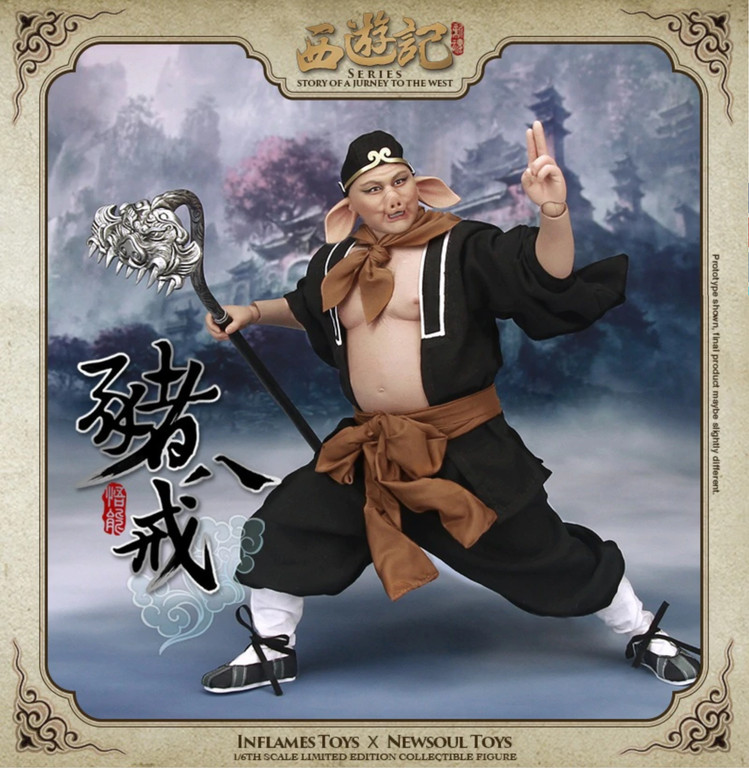
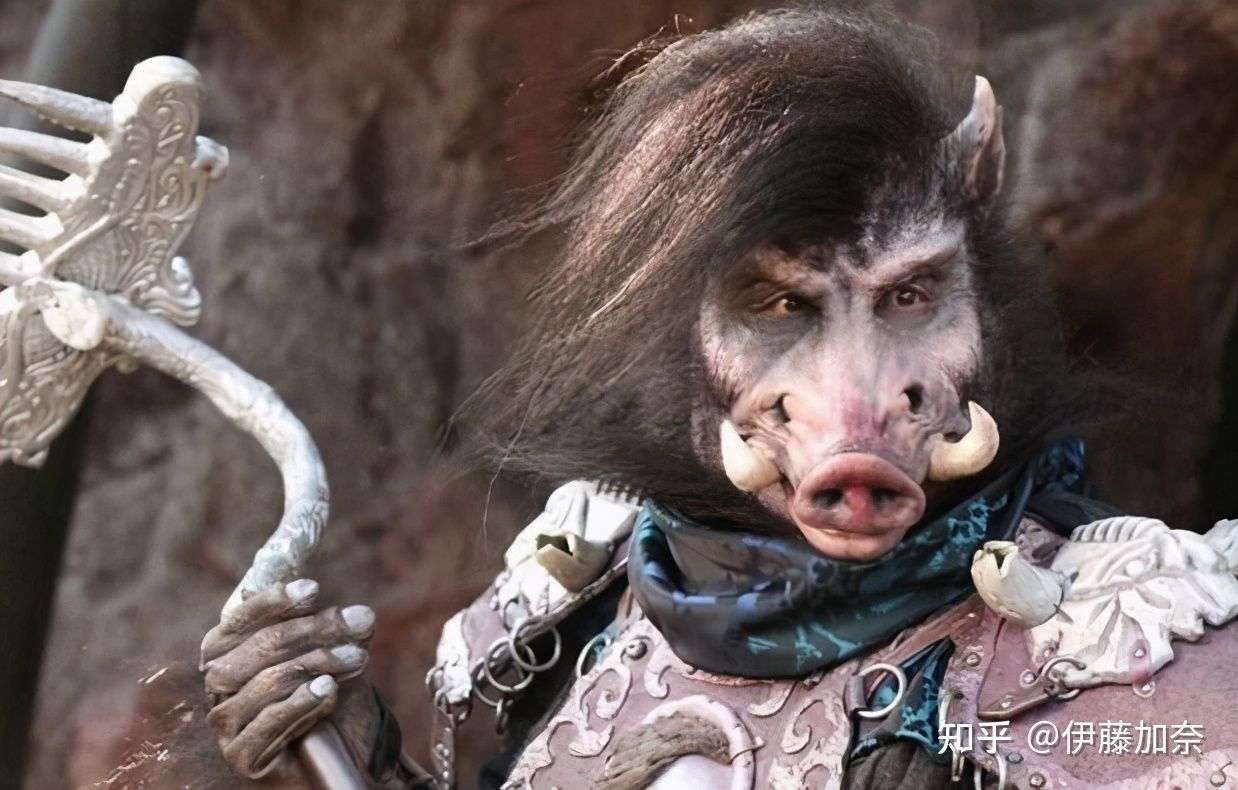
Type “Zhu Bajie” (豬八戒) into Google images and you will generally see a cute or friendly-looking pig-man with pink skin, big ears, a short snout, and a large stomach, and he will inevitably be holding some form of metal rake. Most iterations will likely be based on the character’s iconic look from the classic 1986 TV show, which portrays him wearing a Ji Gong-style Buddhist hat (Ji Gong mao, 濟公帽) with a golden fillet (à la Sun Wukong), a handkerchief tied around his neck and a sash at his waist, and black monk’s robes open at the chest (fig. 1). You might even see a few images depicting Zhu as a hulking warrior, but rarely will you see him portrayed with dark skin. So how do these representations compare to his depiction in the novel, and who has produced the most authentic look? In this article I present Zhu’s literary description, along with ancient depictions that predate the novel. My hope is that the information will be both interesting and useful, especially for artists and cosplayers looking to make a more authentic design.

I should note that this is not meant to be an exhaustive survey, just a general overview.

Zhu Bajie In-Flames Action Figure- small

Fig. 1 – A modern action figure of Zhu Bajie from the 1986 TV show (larger version).

1. Ancient Depictions

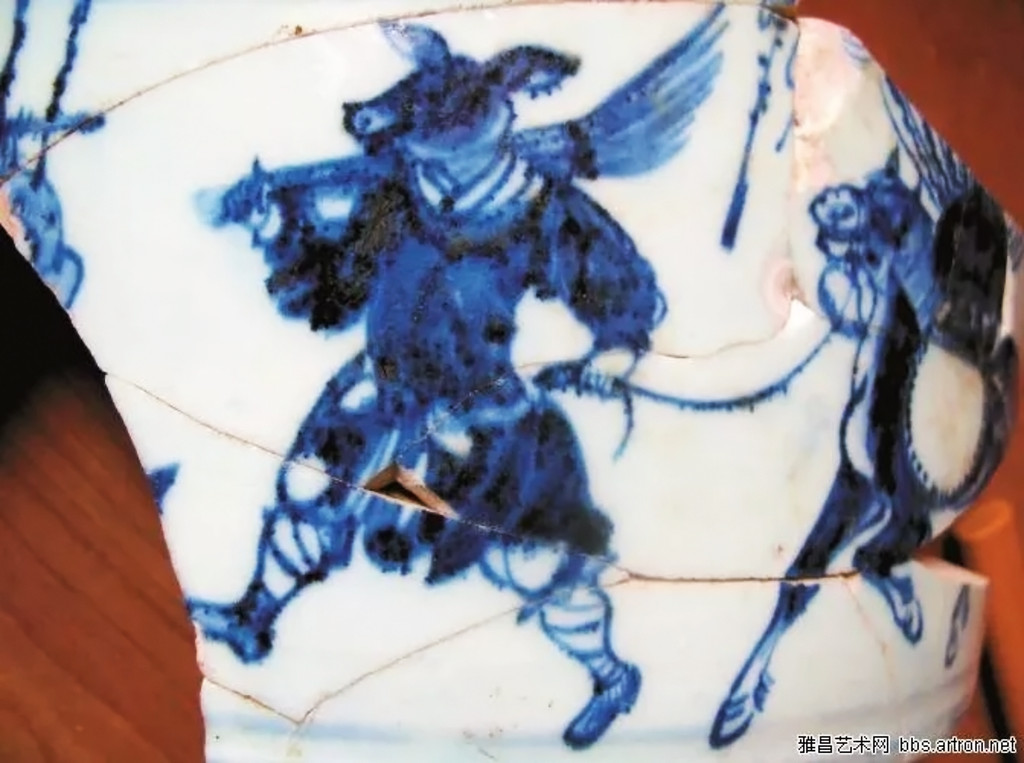
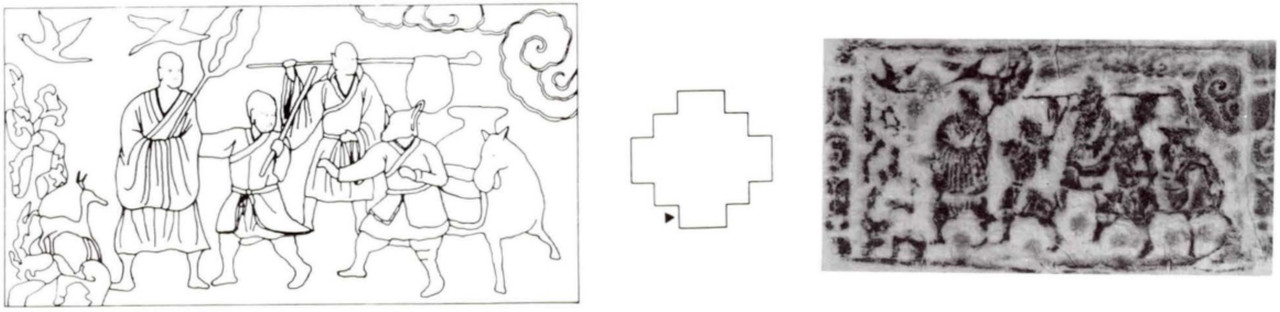
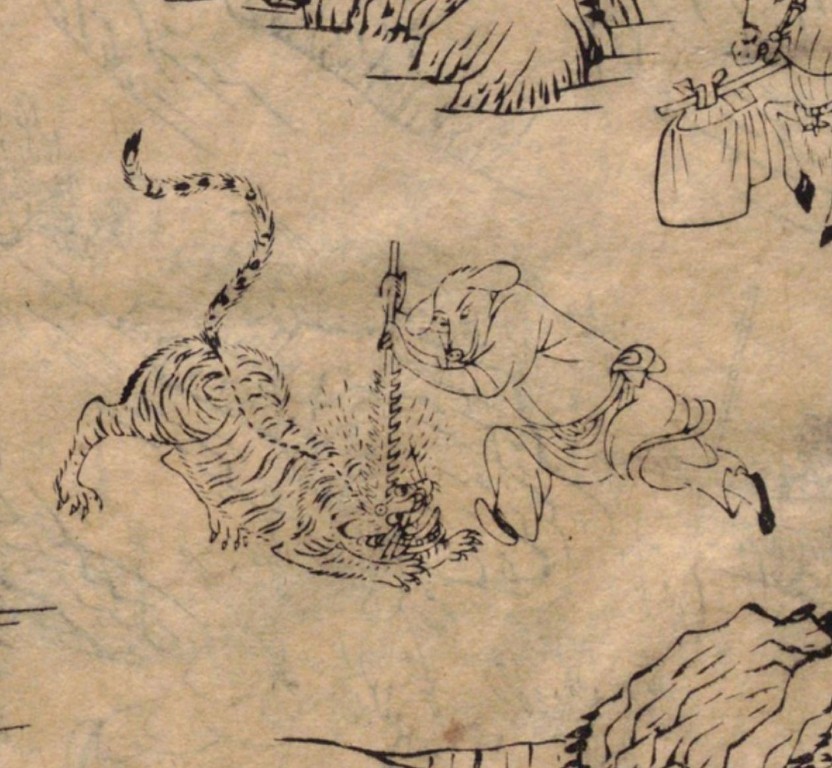
Zhu’s earliest depictions hail from the 14th-century as he is a latecomer to the story cycle, postdating the appearance of Sun Wukong and Sha Wujing by centuries. He is featured on a ceramic pillow and an incense burner from late Yuan China, as well as a series of carvings on a stone pagoda from late Goryeo Korea. Each piece draws on the same motif, depicting Zhu as a pig-headed monk taking large strides as he shoulders his rake and/or leads the horse. Even in instances where the weapon and equine are not present, he’s depicted in the same general posture (fig. 2-4).

Korean Pagoda paper - Pigsy iconography comparison

Fig. 2 – Detail of Zhu from a Cizhou ware ceramic pillow. See here for the full image. Fig. 3 – Detail from the incense burner. See here for the full image. Fig. 4 – Detail from panel two of the Korean pagoda. Note the figure’s matching posture. See here for the full line drawing.

2. What the novel says

2.1. Physical appearance

A poem in chapter 8 contains the earliest reference to Zhu’s appearance:

Lips curled and twisted like dried lotus leaves;
Ears like rush-leaf fans [pushan, 蒲扇] and hard, gleaming eyes;
Gaping teeth as sharp as a fine steel file’s;
A long mouth wide open like a fire pot [huopen, 火盆].
[…] (Wu & Yu, 2012, vol. 1, p. 211).

Chapter 18 provides more detail about his bristly neck and dark skin:

“Well,” said old Mr. Gao, “when he first came, he was a stout, swarthy [hei, 黑; lit: “black”] fellow, but afterwards he turned into an idiot with huge ears and a long snout, with a great tuft of bristles [zongmao, 鬃毛; lit: “mane”] behind his head. His body became horribly coarse and hulking. In short, his whole appearance was that of a hog!” (Wu & Yu, 2012, vol. 1, p. 372).

When the violent gust of wind had gone by, there appeared in midair a monster who was ugly indeed. With his black face [hei lian, 黑臉] covered with short, stubby hair, his long snout and huge ears, he wore a cotton shirt that was neither quite green nor quite blue. A sort of spotted cotton handkerchief was tied round his head (Wu & Yu 2012, vol. 1, p. 375).

The mane on the back of Zhu’s head is such a prominent feature that he took it as his personal name: “[M]y surname is based on my appearance. Hence I am called Zhu ([豬] Hog), and my official name is Ganglie ([剛鬣] Stiff Bristles)” (Wu & Yu 2012, vol. 1, p. 376).

Chapter 19 shows he has hands and feet like a man:

The monster did indeed raise his rake high and bring it down with all his might; with a loud bang, the rake made sparks as it bounced back up. But the blow did not make so much as a scratch on Pilgrim’s head. The monster was so astounded that his hands [shou, 手] turned numb and his feet [jiao, 腳] grew weak (Wu & Yu 2012, vol. 1, pp. 383-384).

Compare this to the mention of hooves (ti, 蹄) when he transforms into a giant boar in chapter 67 (see section 2.2 below).

Chapter 29 gives the fullest description:

My elder disciple has the surname of Zhu, and his given names are Wuneng [悟能] and Eight Rules [Bajie, 八戒]. He has a long snout and fanglike teeth, tough bristles on the back of his head, and huge, fanlike ears. He is coarse and husky, and he causes even the wind to rise when he walks (Wu & Yu 2012, vol. 2, p. 51).

Chapter 85 reveals the shocking size of his snout:

A snout, pestlelike, over three Chinese feet long [san chi, 三尺, 3.15 feet/96 cm] [1]
And teeth protruding like silver prongs.
Bright like lightning a pair of eyeballs round,
Two ears that whip the wind in hu-hu [唿唿] sound.
Arrowlike hairs behind his head are seen;
His whole body’s skin is both coarse and black [qing, 青]. [2]
[…] (Wu & Yu 2012, vol. 4, p. 149).

Chapter 90 notes Zhu has a tail: “Seizing him by the bristles and the tail [wei, 尾], the two spirits hauled Eight Rules away to show him to the nine-headed lion, saying, “Grandmaster, we’ve caught one” (Wu & Yu 2012, vol. 4, p. 219).

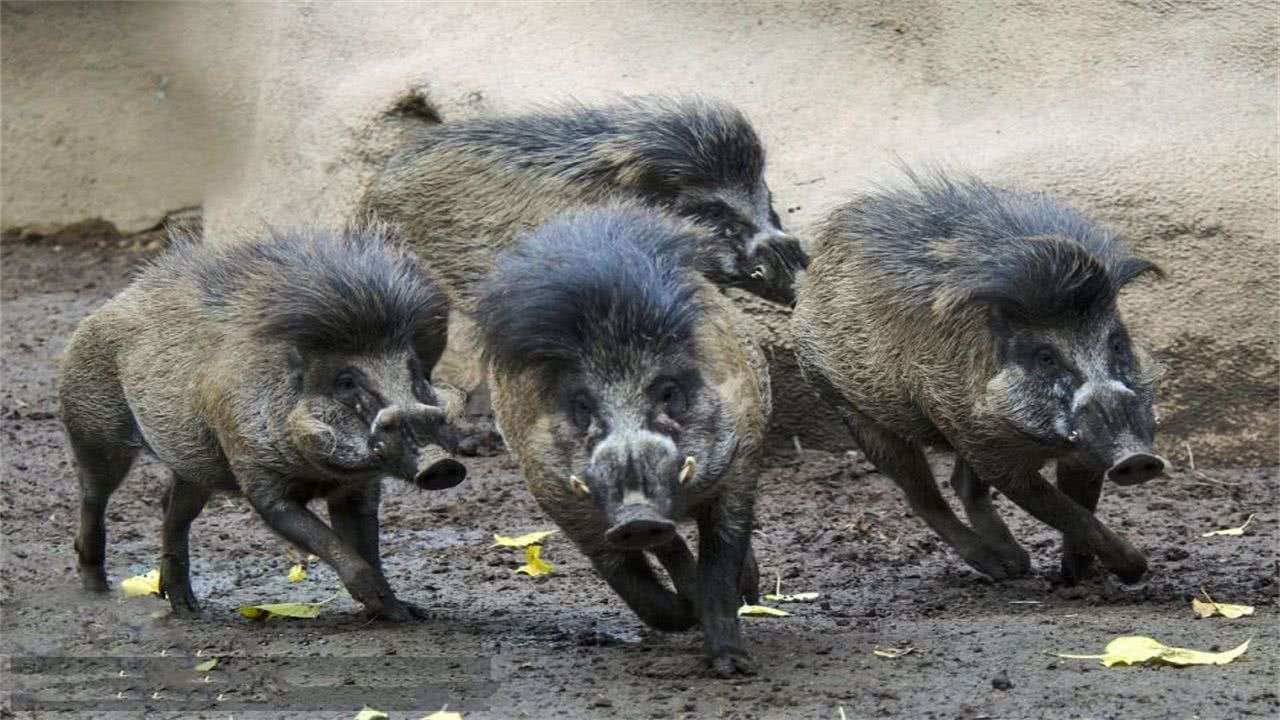
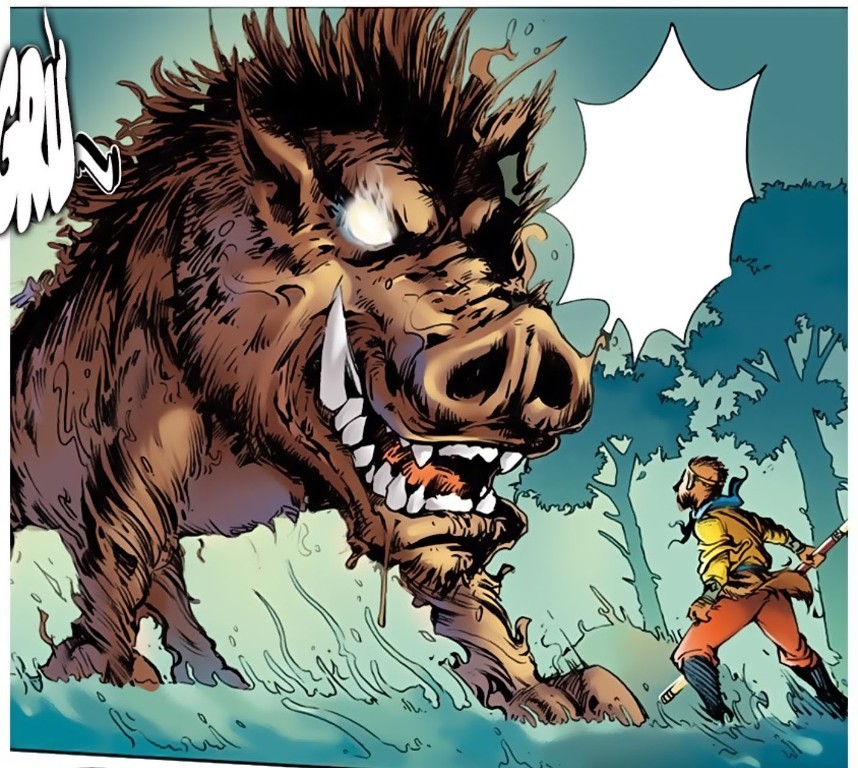
We can see from these quotes several features that appear again and again. These include a bristly mane on the back of his head, fan-like ears, a big mouth with protruding fangs, an overly long snout, and a hulking body with black, furry skin. He is also said to have human hands and feet and a pig tail. This grotesque description greatly differs from his cutesy appearance in modern media. It’s important to note that, just like Sun Wukong, Zhu was modeled on a real life animal. In this case, he shares many of his monstrous qualities with the wild boar (yezhu, 野豬) (fig. 5 & 6).

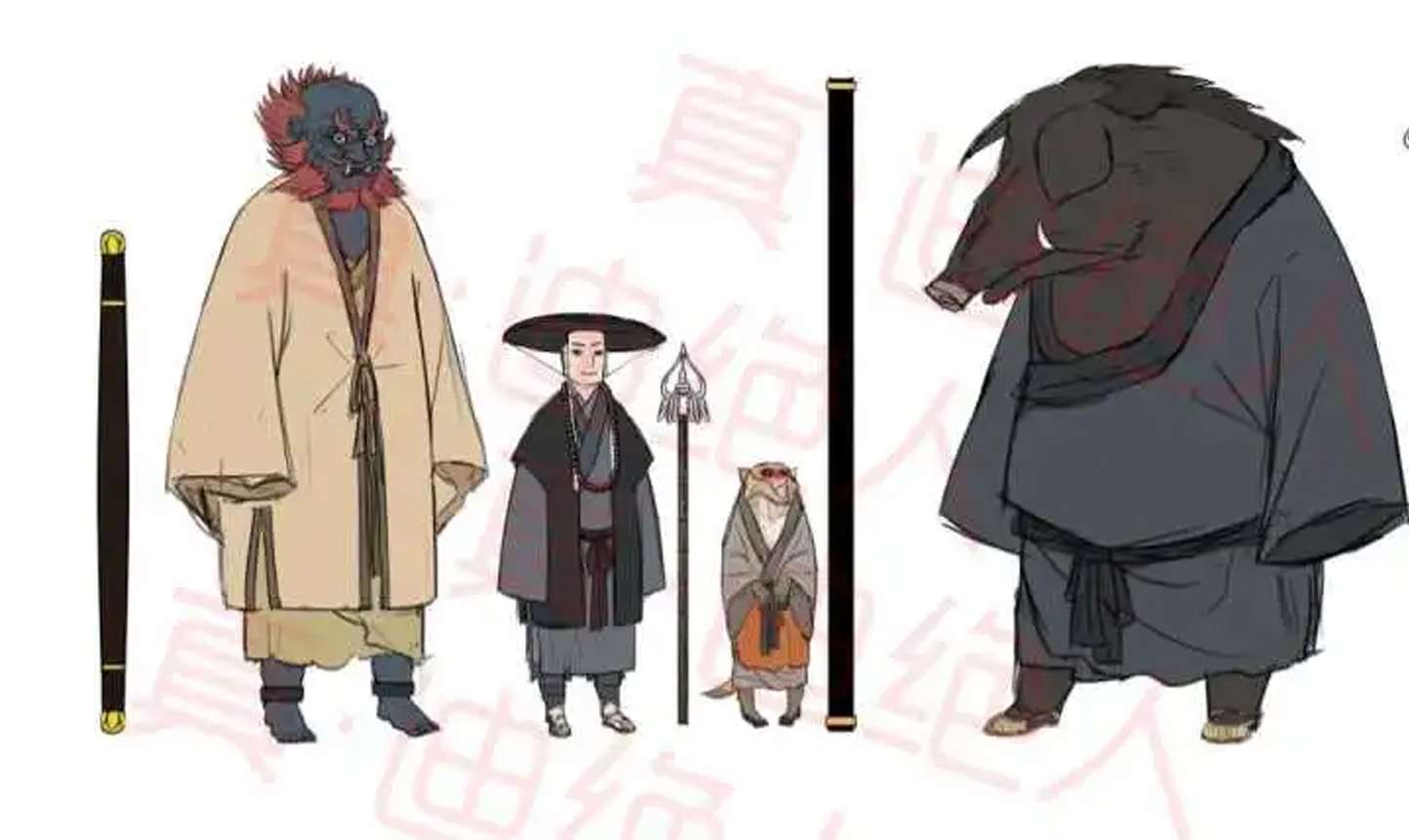
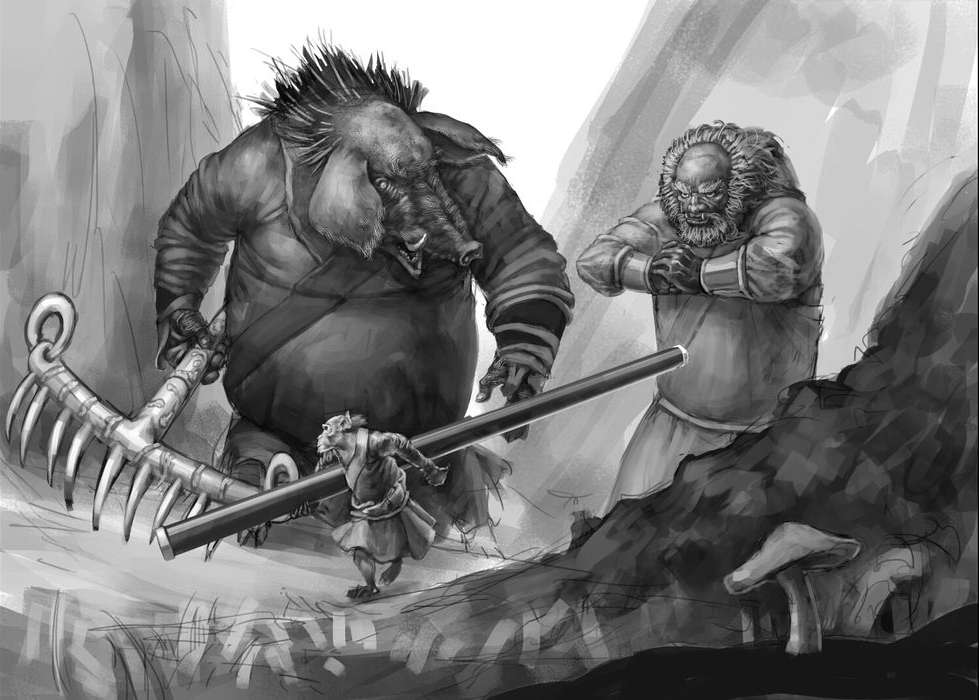
While the novel doesn’t give an exact height for our hero, the cited attributes do provide clues as to his general size. First and foremost is Tripitaka‘s statement: “[H]e causes even the wind to rise when he walks” (Wu & Yu 2012, vol. 2, p. 51). Obviously something capable of stirring the wind just from moving is going to be really big. Then there is Zhu’s 3.15 foot (96 cm) snout, which is over half the height of an average person. This suggests he’s several feet taller than a human. Furthermore, the novel states Sha Wujing is a whopping twelve Chinese feet (zhang er, 丈二; 12.6 feet / 3.84 m) tall (Wu & Yu 2012, vol. 2, p. 51). [3] Zhu is likely shorter than Sha as the latter’s height is specifically mentioned. So I would guess that he is at least 10 feet (roughly 3 m) tall. Zhu’s size is highlighted in some lovely online art (fig. 7 & 8).

Fig. 5 – A pack of running Visayan warty pigs (larger version). Image found here. Fig. 6 – An Indian boar (larger version). Check out that cool hair!!! Fig. 7 – The relative sizes of the pilgrims (larger version). As noted, I believe Zhu is probably shorter than Sha. Fig. 8 – The disciples on patrol (larger version). This is my favorite. Images found here. Artwork by @真·迪绝人 (see here and here).

2.2. Original form?

Zhu provides two contradictory origins for himself, which have implications for what his true form may be and why he looks the way he does in the novel. [5] A biographical poem in chapter 19 explains he was once a wayward, lazy youth who took up Daoist cultivation and later rose on clouds to receive celestial rank in heaven. But his immortal spirit was eventually exiled for drunkenly forcing himself on the moon goddess and mistakenly regained corporeal form in the womb of a sow, becoming the pig spirit that we know today (Wu & Yu 2012, vol. 1, pp. 378-379). [6] However, a poem in chapter 85 implies he was already a powerful pig monster who was given celestial rank but later exiled for drunkenly mocking the moon goddess, destroying Laozi‘s palace, and eating the Queen Mother‘s magic herbs (Wu & Yu 2012, vol. 4, p. 149). The latter origin might be represented in chapter 67 when Zhu transforms into a gigantic boar (fig. 9):

A long snout and short hair—all rather plump.
He fed on herbs of the mountain since his youth.
A black face with round eyes like the sun and moon;
A round head with huge ears like plantain leaves.
His bones were made lasting as Heaven’s age;
Tougher than iron was his thick skin refined.
In deep nasal tones he made his oink-oink cry.
What gutteral grunts when he puffed and huffed!
Four white hoofs [ti, 蹄] standing a thousand feet tall;
Swordlike bristles topped a thousand-foot frame. [7]
Mankind had long seen fatted pigs and swine,
But never till today this old hog elf [lao zhu xiao, 老豬魈].
The Tang Monk and the people all gave praise;
At such high magic pow’r they were amazed (Wu & Yu 2012, vol. 3, p. 253).

Fig. 9 – Zhu’s giant boar form from the manhua Journey to the West (Xiyouji, 西遊記) (larger version).

2.3. Clothing

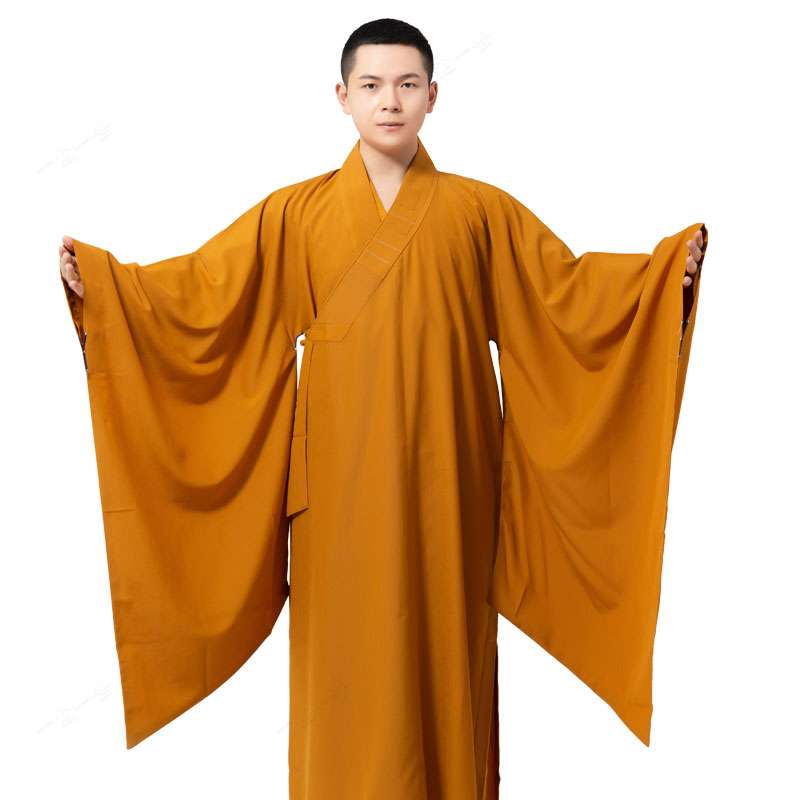
Zhu is not associated in popular culture with any specialized clothing or adornments like Sun Wukong, who’s very name brings to mind the golden fillet, a tiger skin kilt, and golden armor with a feather cap. But several later chapters do mention our pig hero wearing a “black brocade zhiduo robe” (zao jin zhiduo, 皂錦直裰) (ch. 55, 61, 72, & 86) or just a “black zhiduo robe” (zao zhiduo, 皂直裰) (ch. 63, 67, & 84). [4] The zhiduo robe is known colloquially in English as “Buddhist monk” or “Taoist monk” robes. Also called haiqing (海青), such garments reach almost to the ground and have long, broad sleeves. The robe is closed by a tie on the right side of the torso (fig. 10; also refer back to fig. 7).

Fig. 10 – A zhiduo/haiqing robe (larger version). Image found here. Imagine this robe with black cloth.

2.4. The rake

Zhu’s signature weapon is first mentioned in chapter 8. A line from his introductory poem reads: “He holds a rake—a dragon’s outstretched claws” (Wu & Yu, 2012, vol. 1, p. 211). The most detailed description appears in chapter 19:

This is divine bin steel greatly refined, [8]
Polished so highly that it glows and shines.
Laozi wielded the large hammer and tong;
Mars himself added charcoals piece by piece.
Five Kings of Five Quarters applied their schemes;
The Six Ding and Six Jia Spirits expended all their skills. [9]
They made nine prongs like dangling teeth of jade,
And double rings were cast with dropping gold leaves.
Decked with Five Stars and Six Celestial Bodies, [10]
Its frame conformed to eight spans and four climes.
Its whole length set to match the cosmic scheme
Accorded with yin yang, with the sun and moon:
Hexagram Spirit Generals etched as Heaven ruled;
Eight-Trigram Stars stood in ranks and files.
They named this the High Treasure Golden Rake, [Shang bao qin jin pa, 上寶沁金鈀]
[…] (Wu & Yu, 2012, vol. 1, p. 382).

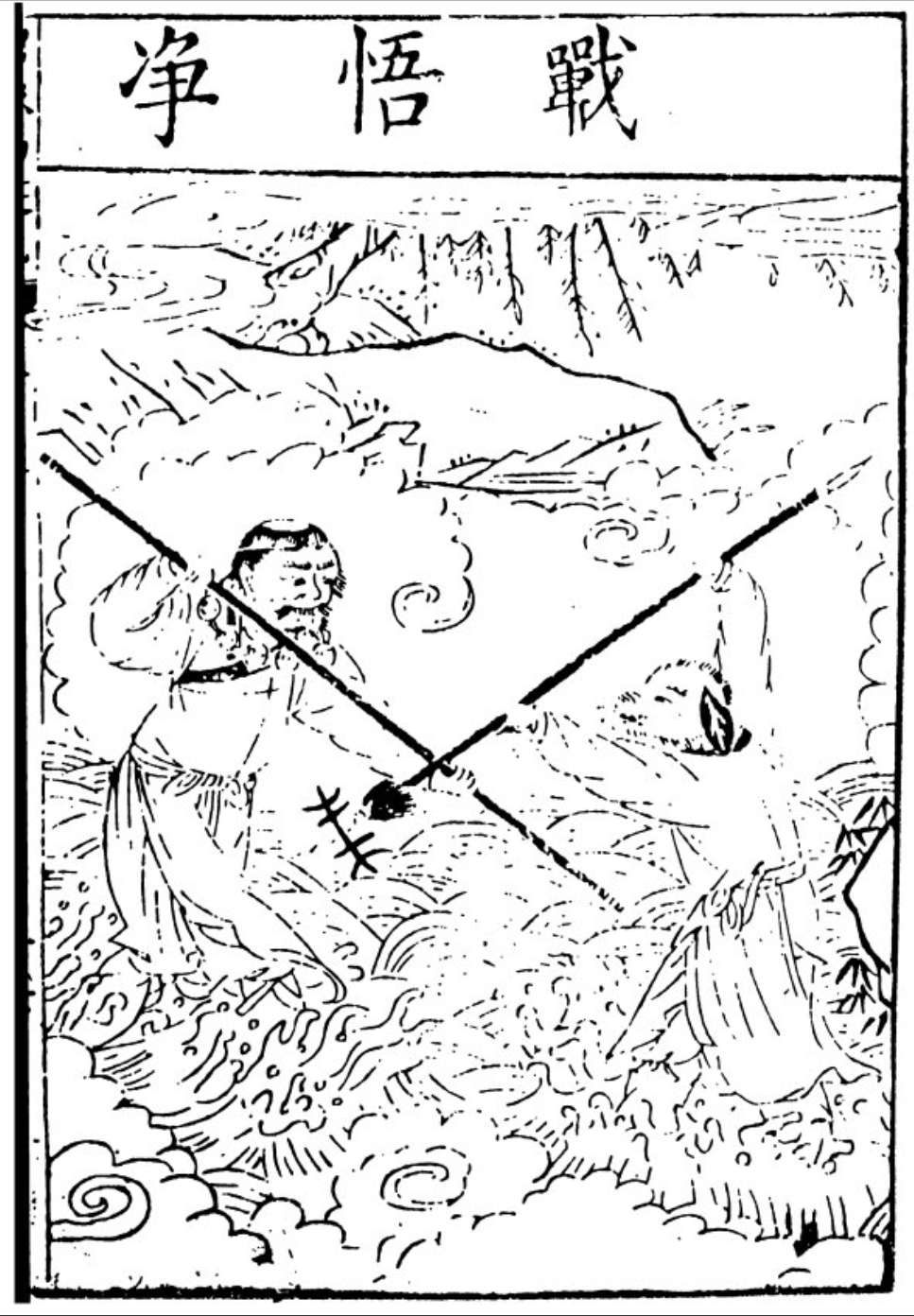
So we see the rake has nine jade-like teeth and a bin steel body decorated with two golden rings and inscriptions of the sun, moon, and planets, as well as hexagram and eight-trigram symbols. The exact position of the rings is not specified, but one online drawing shows them at each end of the rake head (refer back to fig. 8). This might be a reference to the rings capping the ends of Sun’s weapon. While the weight is not listed on the rake like the Monkey King’s staff, chapter 88 states it is 5,048 catties (wuqian ling sishiba jin, 五千零四十八斤; 6,566 lbs. / 2,978.28 kg), [11] or the weight of the Buddhist canon (Wu & Yu, 2012, vol. 4, p. 200). [12]

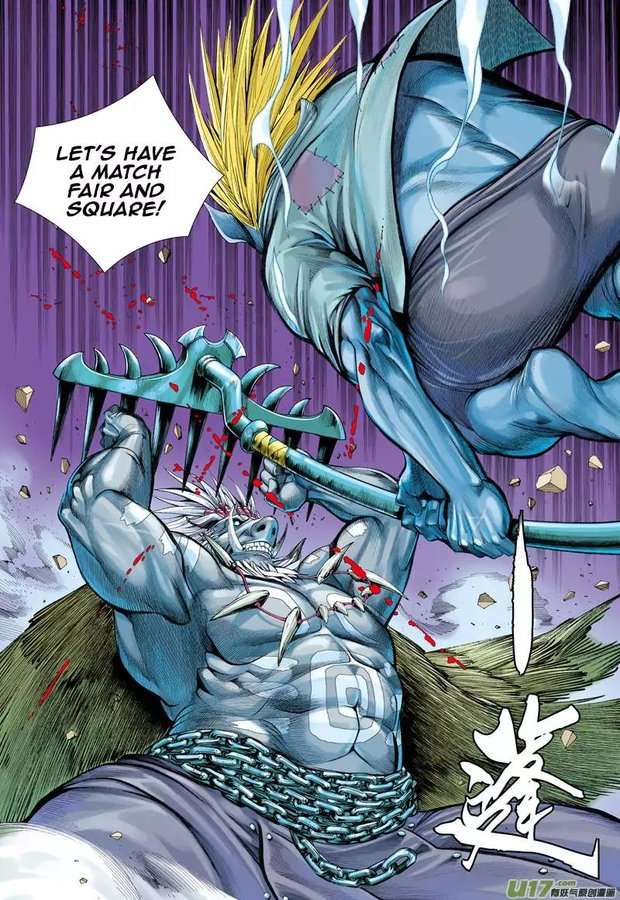
Since the rake’s literary description is more vague than that of Wukong’s staff, my normally strict views on the accuracy of the disciples’ weapons in various media don’t really apply in this case. This is especially true as even historical depictions are all over the place (fig. 11-13). I think the monstrous pig face on the rake from the 1986 TV show-inspired action figure is really neat (refer back to fig. 1). Another favorite of mine is the spiky rake from the ongoing manhua The Westward (Xixingji, 西行記, 2015-present) (fig. 13).

Fig. 11 – A print of Zhu vs Sha Wujing from the Shide tang edition (1592) of the novel (larger version). The weapon is portrayed as a war rake used by the Chinese military. Fig. 12 – His rake is depicted as a wolftooth club in Mr. Li Zhuowu’s Criticism (late-16th/early-17th-century) (larger version). Fig. 13 – Zhu (top) wields the rake against his evil brother (bottom) in The Westward (larger version). This brother is not a character in the original novel.

The following two sections include a small sampling of what I consider to be the least and most accurate portrayals in past and modern media. These are presented in no particular order.

3.1. The least accurate

1) Journey to the West (1996/1998) – It’s like the show’s creators purposely went in the opposite direction. Instead of big, black, and scary, they went with small, pink, and cute (fig. 14).

Fig. 14 – Wayne Lai as the adorable pig spirit (larger version).

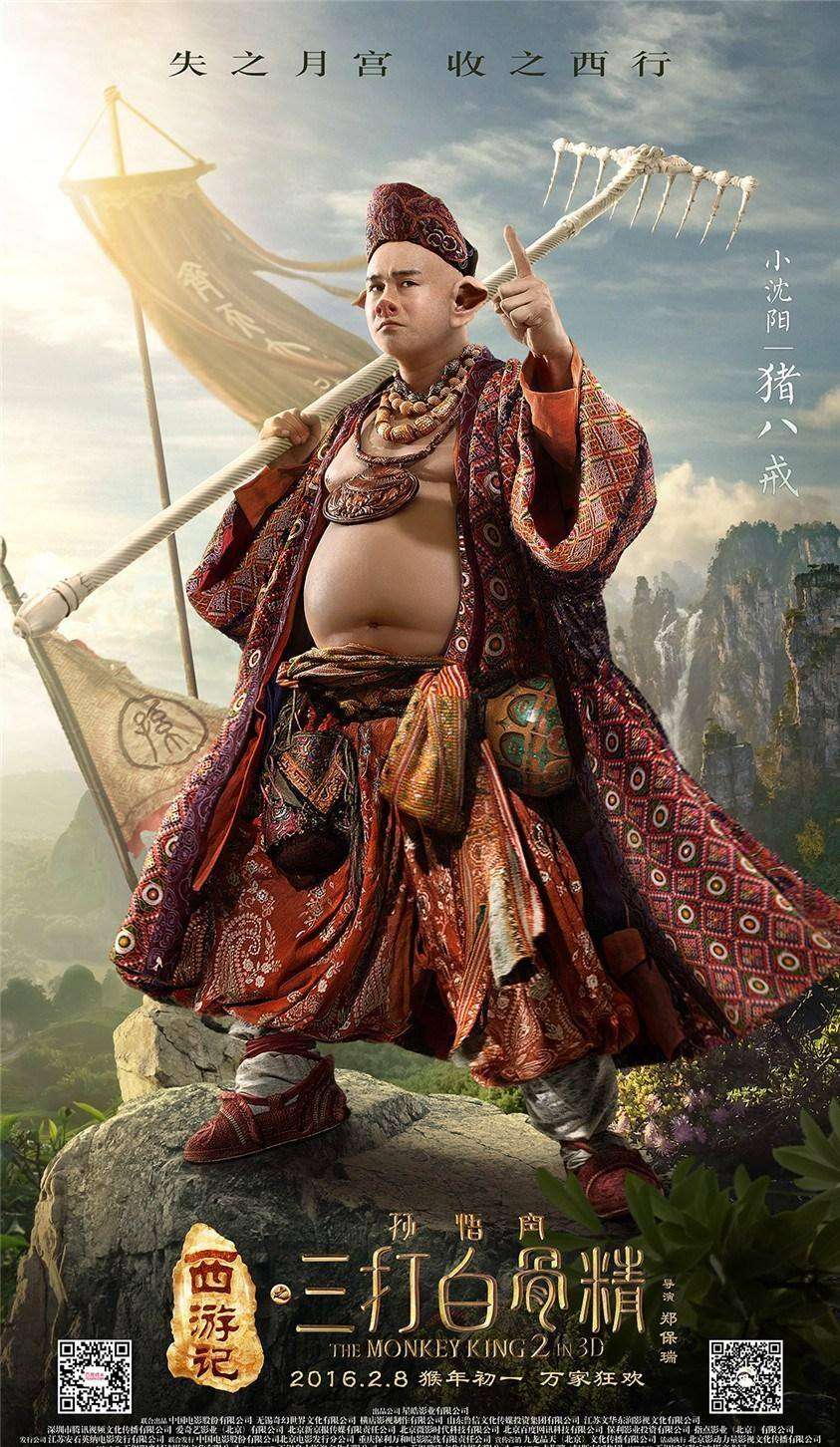
2) The Monkey King 2 & 3 (2016/2018) – It’s the same as before but minus the hair (fig. 15).

Fig. 15 – Xiaoshenyang as the fake hero (larger version).

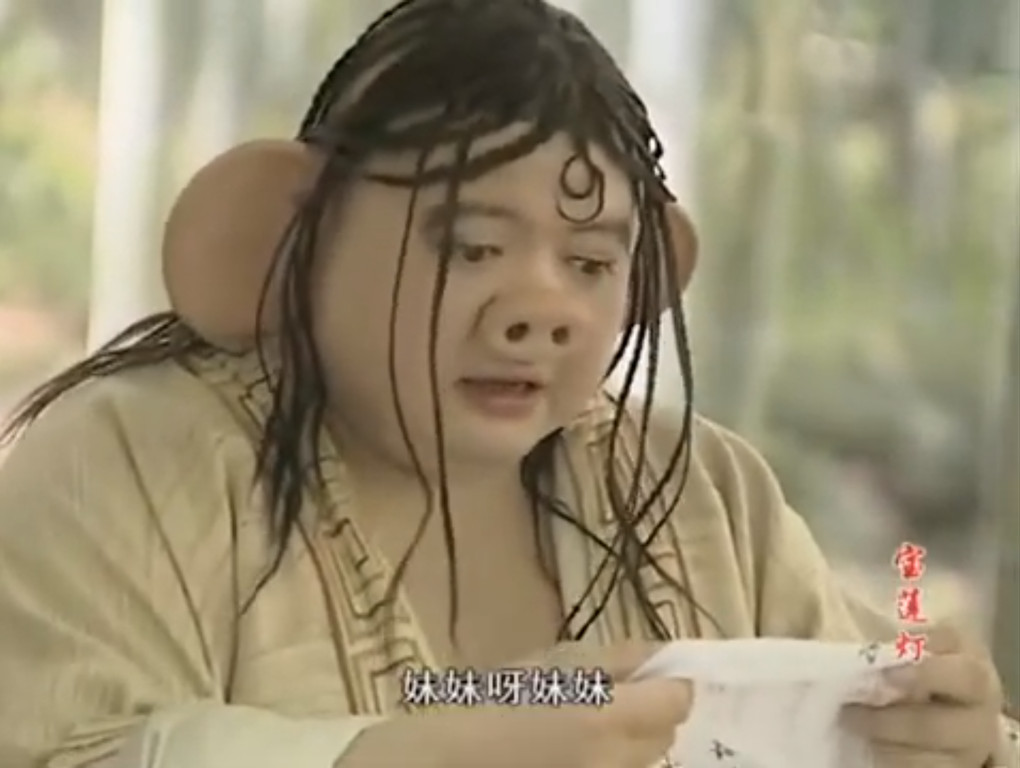
3) The Precious Lotus Lantern (Baolian deng, 寶蓮燈, 2005) – And then there’s this mess… (fig. 16).

Fig. 16 – Xie Ning (谢宁) as “Spaghetti Head” Zhu (larger version).

3.2. The most accurate

1) The Westward (Xixingji, 西行記, 2015-present) – This is perhaps the closest to his literary description (but his body and hair should be darker) (fig. 17). Admittedly, this is not the character’s original form. The manhua portrays Zhu as a small, pink pig-man who needs to absorb energy from the surrounding environment in order to achieve this monstrous transformation.

Fig. 17 – Zhu’s ultimate form (larger version).

2) Journey to the West (2011) – This is how Zhu is portrayed when he’s still a monster (fig. 18). He has the dark skin, fangs, and mane. But he later changes to a friendly, pink pig-man once subjugated.

Fig. 18 – Zang Jinsheng as the armored pig monster (larger version).

3) The Cave of the Silken Web (1927) – While missing his bristly mane, Zhu is portrayed with a long snout, big ears, and, most importantly, black skin (fig. 19). He is also wearing a black zhiduo robe. Thanks to Irwen Wong for suggesting this entry.

Fig. 19 – Zhou Hongquan (周鴻泉) as Zhu in The Cave of the Silken Web (1927) (larger version).

4. Conclusion

While modern media often depicts Zhu as a friendly-looking, pink pig-man, the novel describes him as a giant pig monster with a bristly mane on the back of his head, fan-like ears, a big mouth with protruding fangs, a three-foot-long snout, and a hulking body with black, furry skin, human hands and feet, and a pig tail. He wears a black zhiduo robe. His 3.28 ton bin steel rake has nine jade-like teeth, two golden rings (possibly adorning the ends of the head), and a body inscribed with the sun, moon, and planets and hexagram and eight-trigram symbols. Needless to say, the literary Zhu is far more imposing than his modern, family friendly persona.

Notes:

1) The Chinese foot (chi, 尺) was slightly longer than the modern western foot (12 in/30.48 cm). The Board of Works (Yingzao, 營造) of the Ming and Qing standardized the measurement at 32 cm (12.59 in), though it varied at the local level and at different times (Ruitenbeek, 1996, Chinese Dynasties and Chinese Measurements section). I’m basing the length given in the novel on that from the Board of Works as the novel was published during the Ming dynasty.

2) The original English translation says “green” (Wu & Yu 2012, vol. 4, p. 149). However, there are times when it refers to black. For example, the phrase “The black ox goes west” (qing niu xi qu, 青牛西去) references Laozi and the Daodejing (Ma & van Brakel, 2016, p. 328 n. 71). In addition, the novel previously refers to Zhu having a “black face” (hei lian, 黑臉) (Wu & Yu 2012, vol. 1, p. 375).

3) This recalls the origin of the immortal Iron Crutch Li (Li tieguai, 李鐵拐), whose body was prematurely burnt by a disciple while his celestial spirit traveled to heaven. Upon his return, Li was forced to take corporeal form in the body of a recently deceased cripple.

4) Yu (Wu & Yu, 2012) translates the garment as “black cloth shirt” (Wu & Yu 2012, vol. 3, p. 253, for example).

5) Thank you to Irwen Wong and Anthony “Antz” Chong for bringing this to my attention.

6) See note #1 for how this measurement is calculated.

7) The original English translation says “hundred-yard” (Wu & Yu 2012, vol. 3, p. 253). However, the Chinese states 百丈 (bai zhang), or 100 x 10 Chinese feet, which of course equals 1,000 feet.

8) The original English translation/Chinese text states “divine ice steel” (shen bing tie, 神冰鐵) (Wu & Yu, 2012, vol. 1, p. 382). However, this is likely an error for “divine bin steel” (shen bin tie, 神鑌鐵) as bing (冰) and bin (鑌) sound similar. Bin steel (bin tie, 鑌鐵) was a high quality metal originally imported from Persia before the secret of its manufacture reached China in the 12th-century. It is mentioned a few times in the novel, including being associated with Monkey’s staff in one instance (Wu & Yu, 2012, vol. 3, p. 375).

I’ve made several changes to the translation from this point forward to better accord with the original Chinese.

9) The “Six Ding and Six Jia” (六丁六甲, Liuding liujia) are protector spirits of Daoism (Mugitani, 2008).

10) The “Five Stars” (wuxing, 五星) refer to Mercury (shuixing, 水星), Venus (jinxing, 金星), Jupiter (muxing, 木星), Mars (huoxing, 火星), and Saturn (tuxing, 土星). The Six Celestial Bodies (liuyao, 六曜) refer to the sun (taiyang/ri, 太陽/日) and moon (taiyin/yue, 太陰/月) and the four hidden pseudo-planets Yuebei (月孛), Ziqi (紫氣), Luohou (羅睺), and Jidu (計都). Combined, they are called the “Eleven Luminaries” (shiyi yao, 十一 曜), and these are sometimes broken into the “Seven Governors and Four Hidden Luminaries” (qizheng siyu, 七政四余) (Wang, 2020, pp. 169-170; Hart, 2010, p. 145 n. 43).

11) The original English translation says “five thousand and forty-eight pounds” (Wu & Yu, 2012, vol. 4, p. 200). However, the Chinese version uses jin (斤), known in English as “catty“. The catty and pound are two different measures of weight, the former being heavier than the latter. Therefore, the English text has been altered to show this. The catty during the Ming Dynasty when the novel was compiled equaled 590 grams (Elvin, 2004, p. 491 n. 133), so 5,048 catties would equal 6,566 lbs. or 2,978.28 kg.

12) Yu (Wu & Yu, 2012) notes popular belief held that the Buddhist canon was comprised of 5,048 scrolls (vol. 4, p. 396 n. 7). I’m not sure if the rake’s weight was purely based on the number of scrolls, or if each scroll was believed to weigh one catty.

Sources:

Hart, R. (2010). The Chinese Roots of Linear Algebra. United States: Johns Hopkins University Press.

Ma, L., & van Brakel, J. (2016). Fundamentals of Comparative and Intercultural Philosophy. United States: State University of New York Press.
Mugitani, K. (2008). Liujia and Liuding. In F. Pregadio (Ed.), The Encyclopedia of Taoism (vol. 1-2) (pp. 695-697). Longdon: Routledge.
Ruitenbeek, K. (1996). Carpentry and Building in Late Imperial China: A Study of the Fifteenth-century Carpenter’s Manual, Lu Ban Jing. Germany: E.J. Brill.

Wang, X. (2020). Physiognomy in Ming China: Fortune and the Body. Netherlands: Brill.

Wu, C., & Yu, A. C. (2012). The Journey to the West (vol. 1-4). Chicago, Illinois: University of Chicago Press.