Archive #32 – The Precious Scroll of Erlang (Erlang baojuan) (1562)

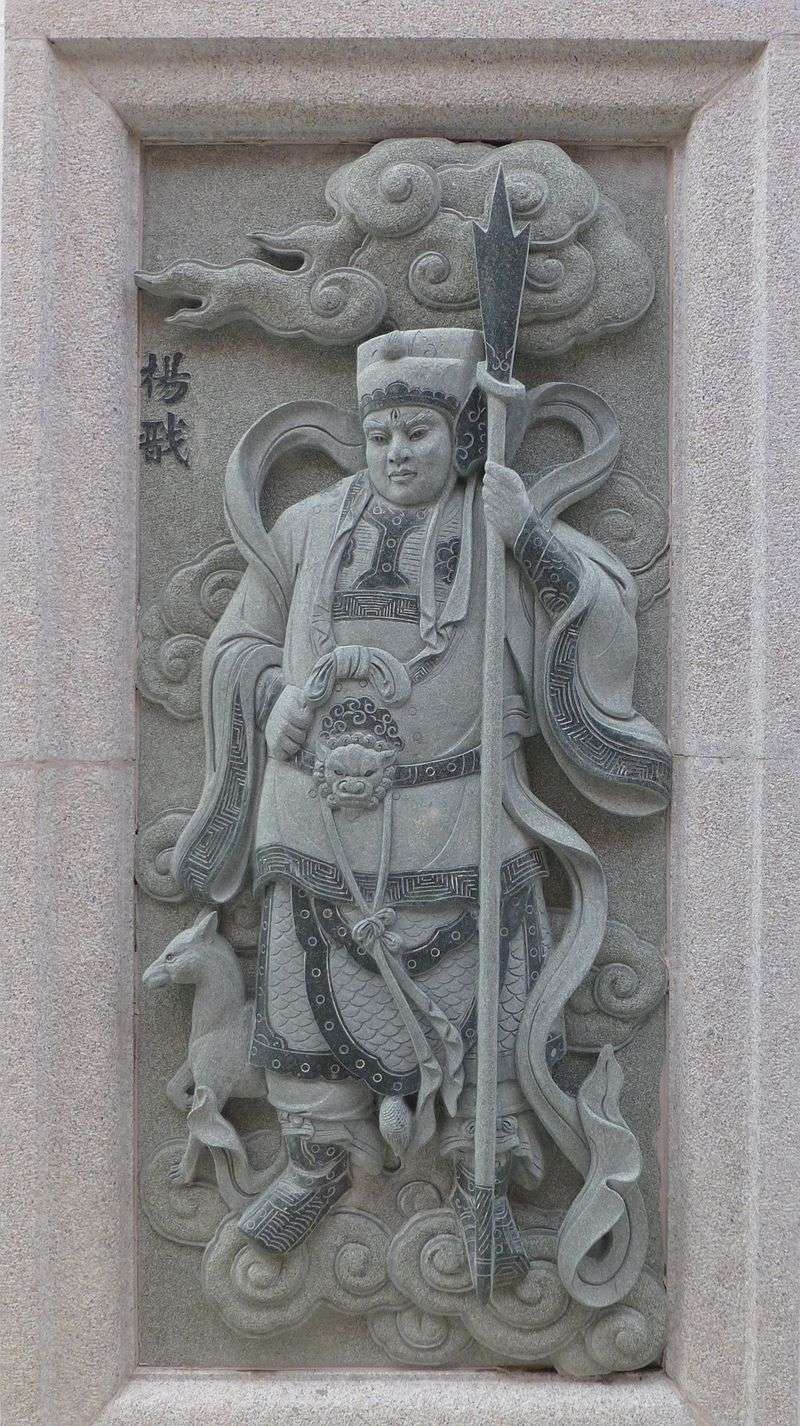
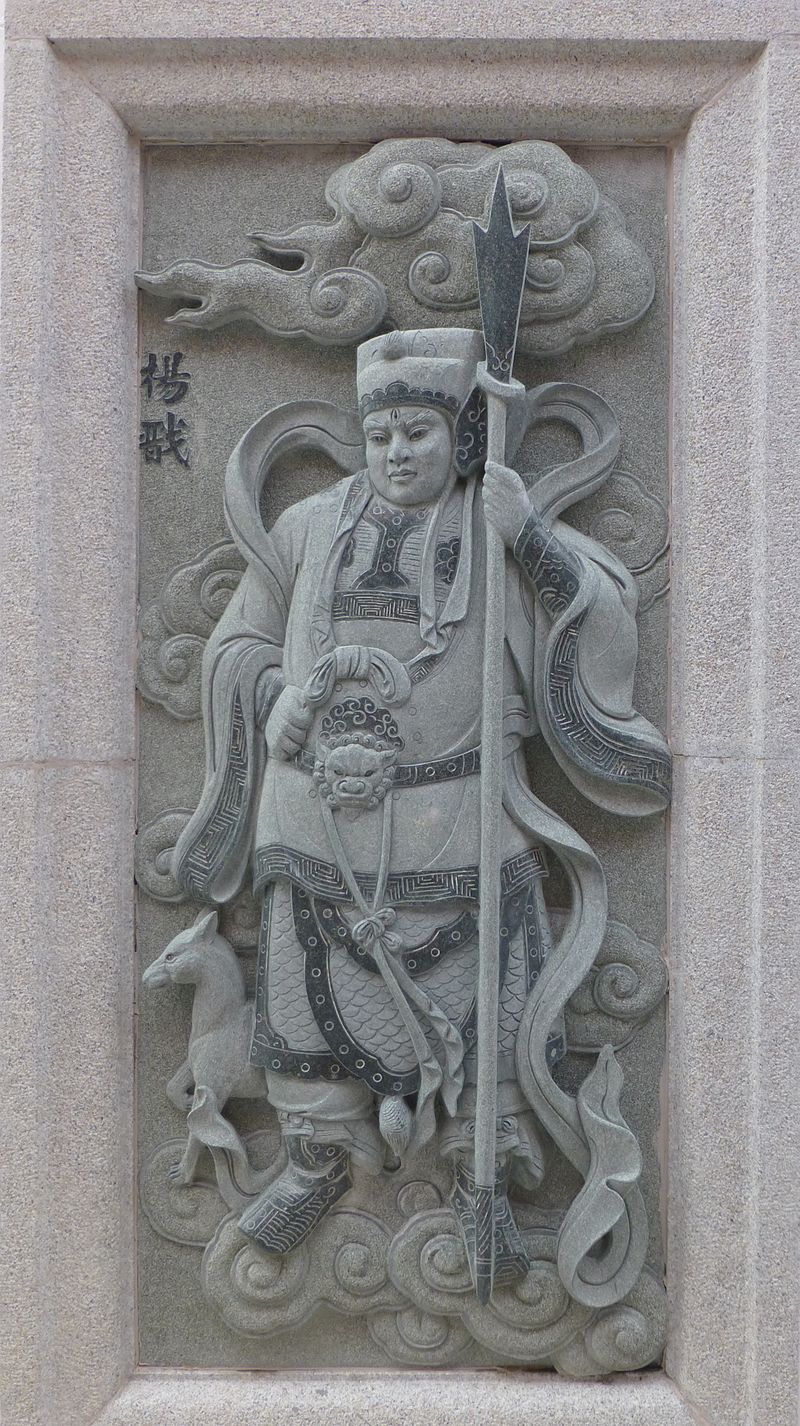
The Precious Scroll of Erlang (Erlang Baojuan, 二郎寳卷; full name Qingyuan Miaodao Xiansheng Zhenjun Yiliao Zhenren huguo youmin zhongxiao Erlang Baojuan, 清源妙道顯聖真君一了真人護國佑民忠孝二郎開山寶卷), is an important baojuan from the 1560s that contains the heroic deeds of the immortal Erlang (二郎) (fig. 1), including his defeat of Sun Wukong (PDF page 46). This shows that the Monkey King was mentioned in a religious context 30 years before the standard Ming edition of Journey to the West (Xiyouji, 西遊記, 1592) was even published. Therefore, apart from recording the religious story of Erlang, it adds to that of Sun Wukong.

I must thank Dr. Benjamin Brose for sending me a PDF of the scroll. I’m excited to archive it on my blog for other scholars to access and read.

Fig. 1 – A relief carving of Erlang as Yang Jian (楊戩) from Investiture of the Gods (c. 1620) (larger version).

Scroll description:

In 1562 a text entitled Erlang baojuan (Precious scroll on Erlang) appeared, providing further information on the emerging Eternal Mother myth. Based on the story of Erlang’s valiant fight with the Monkey King, a famous and entertaining episode from the classic novel Journey to the West (which, incidentally, was given the finishing touches around the same time), the Erlang baojuan describes the final subjugation of the Monkey King by the semidivine Erlang, thanks in large measure to the assistance provided by the Eternal Mother. This text also seems to presage the legend surrounding the building of the Baoming Si, Temple Protecting the Ming dynasty, as described hereafter. In it the story of the bodhisattva Guanyin incarnating as a nun by the name of Lü is first being told. According to this text, the nun had tried unsuccessfully to dissuade Emperor Yingzong from fighting the Oirat Mongols prior to his debacle at Fort Tumu in 1449. When Yingzong was restored to the throne in 1457 after his long captivity, he rewarded the nun for her loyalty and courage and built a temple for her, naming it the Baoming Si. The temple had been reportedly in existence since 1462. By the late years of the Jiajing reign (1522–1567), however, it came under the sway of believers of the Eternal Mother religion (Shek & Tetsuro, 2004, p. 252).

Archive link:

Click to access unnamed-file.pdf

Source:

Shek, R., & Tetsuro, N. (2004). Eternal Mother Religion: It’s History and Ethics. In K Liu. & R. Shek. (Eds.). Heterodoxy in Late Imperial China (pp. 241-280). Hong Kong: University of Hawai’i Press.

Archive #31 – The Original 1592 Edition of Journey to the West, Complete with Pictures

I’m proud to present a PDF of the original edition of Journey to the West anonymously published in 1592 by the Shidetang (世德堂, “Hall of Generational Virtue”) publishing house of Jinling (金陵, “Gold Hill,” a.ka. Nanjing). Titled Newly Printed, Illustrated, Deluxe and Large Character, Journey to the West (Xinke chuxiang guanban dazi Xiyou ji, 新刻出像官板大字西遊記), it features 20 scrolls and 100 chapters (minus the current chapter nine). It contains many charming woodblock prints depicting the events described in the story. For example, this print shows the battle between Monkey and Nezha in their three-headed and six-armed forms.

One doctoral thesis shows that this version is based on an earlier edition of the story titled Newly printed, Completely Illustrated, Chronicle of Deliverances in Sanzang of the Tang’s Journey to the West (Xinqie quanxiang Tang Sanzang Xiyou shi ni (e) zhuan, 新鍥全像唐三藏西遊释尼(厄)傳) in ten scrolls (with three to ten chapters each) by Zhu Dingchen (朱鼎臣) of Yangcheng (羊城, i.e. Guangzhou).

The PDF is quite large at 1.5 gigs, so it will take time to download.

Archive link:

Click to access 二十卷一百回.明.吴承恩撰.明万历二十年金陵世德堂刊本.灰度胶片.pdf

Thanks:

I originally downloaded the PDF from the shuge.org archive.

Archive #30 – The “Great Sage Equaling Heaven” Story from Liaozhai zhiyi (1740)

The world famous Liaozhai zhiyi (聊齋志異, 1740; a.k.a. “Strange Tales from a Chinese Studio”) is a collection of over 400 narratives serving as a snapshot of late-Ming and early-Qing-era popular stories and culture. This is why story no. 4 of scroll 11, “The Great Sage Equaling Heaven” (Qitian dasheng, 齊天大聖), is important to the study of the Monkey King’s religion as it shows his cult was active in 17th and 18th-century Fujian. It also preserves the condescension that the scholarly class held for certain gods. For example, as Meir Shahar (1996) points out, the author Pu Songling was likely speaking through the main character Xu Sheng (許盛), a young merchant from Shandong, when he states: “Sun Wukong is nothing but a parable invented by [the novelist] Old Qiu [老丘]” (pp. 194). [1] Here, Xu chastises the people of Fujian for worshiping what he considers to be a fictional god. In addition, the story associates the Great Sage with a heavenly sword as opposed to his famous magic staff. I believe this is related to a 13th-century stone relief carving from Quanzhou.

Below, I have archived the only complete English translation of the tale that I’m aware of. It comes from volume six of Sidney L. Sondergard’s (Pu & Sondergard, 2014) Strange Tales from Liaozhai (pp. 2078-2085). I don’t currently have access to the physical book, so I have isolated the tale from an ebook and converted it into a PDF.

Archive link:

Click to access Strange-Tales-from-Liaozhai-vol.-6_removed.pdf

Disclaimer:

This has been posted for educational purposes. No malicious copyright infringement is intended. If you liked the digital version, please support the official release.

Note:

1) This refers to Qiu Chuji (丘處機, 1148-1227), the founder of the Dragon Gate sect of Daoism during the Song Dynasty. Qiu is associated with a travel journal also named Journey to the West, which Pu Songling confused with the novel of the same name (Pu & Sondergard, 2014, p. 2080 n. 1).

Sources:

Shahar, M. (1996). Vernacular Fiction and the Transmission of Gods’ Cults in Later Imperial China. In M. Shahar, & R. P. Weller (Eds.), Unruly Gods: Divinity and Society in China (pp. 184-211). Honolulu: University of Hawaiʻi Press.

Pu, S., & Sondergard, S. L. (2014). Strange Tales from Liaozhai: Vol. 6. Fremont, Calif: Jain Pub.

The Monkey King’s Magic Staff: A Complete Guide

I’ve written many articles on the origins of the Monkey King’s staff over the years. Therefore, I’ve decided to combine all of the information in one location for the benefit of people wishing to learn more about the weapon and its history. This will no doubt be interesting to fans of Journey to the West (Xiyouji, 西遊記, 1592; JTTW hereafter), as well as those of modern franchises like Dragon Ball and Lego Monkie Kid (fig. 1). Citations can be found in the articles linked below.

Fig. 1 – The Lego Monkie Kid character “MK” wielding the Monkey King’s magic staff (larger version). Copyright Lego.

1. The Literary Weapon

1.1. Staff Background

The staff first appears in chapter three of the original novel when the Monkey King goes to the underwater kingdom of Ao Guang (敖廣), the Dragon King of the Eastern Sea, looking for a magic weapon to match his supernatural strength and martial skill. When all of the traditional weapons offered to him fail to meet his standards, the dragon queen suggests to her husband that they give Sun Wukong “that piece of rare magic iron” taking up space in their treasury. She claims the ancient shaft had started producing heavenly light days prior and proposes that the monkey is fated to own it. The weapon is said to be a “divine treasure iron” originally used to set the depths of the Heavenly River (Tianhe ding di de shenzhen tie, 天河定底的神珍鐵) by Yu the Great (Dayu, 大禹), a mythic Chinese emperor and demigod.

The staff is initially described as a pillar of black iron or bin steel more than 20 feet in height and as wide as a barrel. It is only when Monkey lifts it and suggests a smaller size would be more manageable that the staff complies with his wishes and shrinks. This is when Sun notices that the weapon is decorated with a golden ring on each end, as well as an inscription along the body reading: “The ‘As-You-Will’ Gold-Banded Cudgel. Weight: Thirteen Thousand Five Hundred Catties” (Ruyi jingu bang zhong yiwan sanqian wubai jin, 如意金箍棒重一萬三千五百斤). The inscription indicates that the staff is immensely heavy, weighing 17,560 lbs. (7,965 kg).

Apart from the above information, a poem in chapter 75 (see section 2.3 here) highlights another name, “Rod of Numinous Yang” (Lingyang bang, 靈陽棒). In addition, the poem describes the staff being covered in “tracks of planets and stars” (i.e. astronomical charts) and esoteric “dragon and phoenix scripts” (longwen yu fengzhuan, 龍紋與鳳篆).

The novel provides two contradictory origins for the staff. The chapter 75 poem notes that it “[w]as forged in the stove by Laozi himself.” Laozi is of course the high god of Daoism. Chapter 88 instead states that it was “forged at Creation’s dawn / By Yu the Great himself, the god-man of old.”

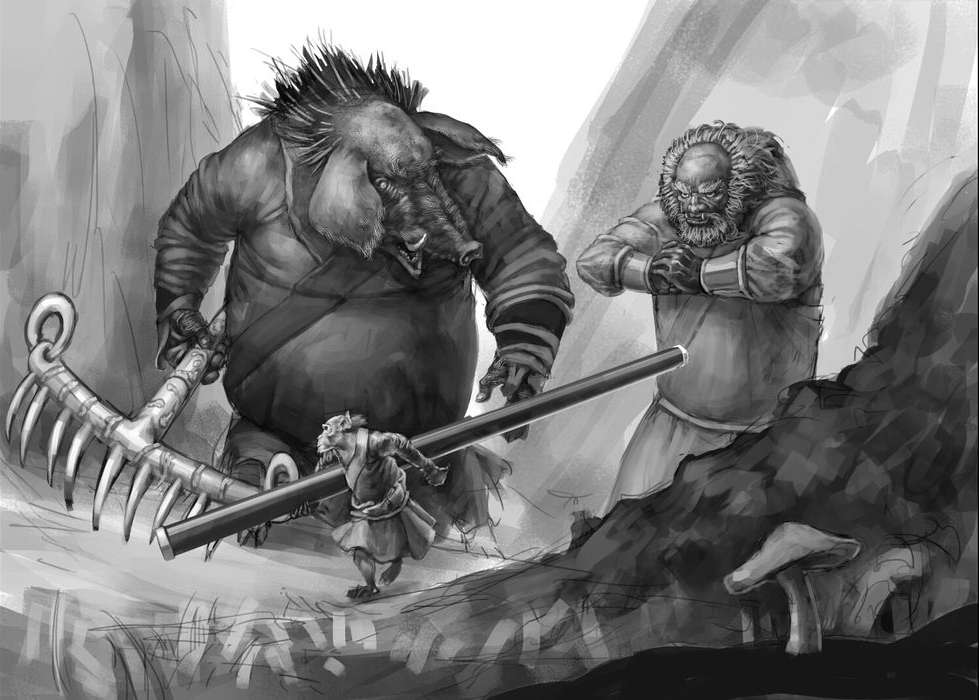
Contrary to popular images of the Monkey King holding a regular-sized staff, his literary counterpart wields a massive weapon in battle. It is said to be 20 feet long (likely an error for 12), [1] with the width of a bowl (erzhang changduan, wankou cuxi, 二丈長短,碗口粗細) (fig. 2). I did a cursory search of bowls during the Ming (when the standard edition of JTTW was published) and found that they have a radius of between 4 to 6 inches (10.16 to 15.25 cm).

Fig. 2 – An accurate depiction of the size of Monkey’s staff (larger version). Images found here. Artwork by @真·迪绝人.

1.2. Staff Powers

The staff is shown to have multiple powers.

  1. Size manipulation – This is the weapon’s most well-known ability, growing as big or as small as Monkey wishes.
  2. Controlling the oceans –  The aforementioned poem from chapter 88 writes: “The depths of all oceans, rivers, and lakes / Were fathomed and fixed by this very rod. / Having bored through mountains and conquered floods, / It stayed in East Ocean and ruled the seas…”
  3. Astral entanglement – Monkey’s soul is able to use the staff in Hell despite the physical weapon being with his body in the world of the living.
  4. Multiplication – He can multiply his staff in the hundreds of thousands.
  5. Lock-Picking – He can open any door just by pointing it at the lock.
  6. Transformation – He can change it into tools like a straight razor or a drill.
  7. Sentience – The weapon glows in anticipation of Monkey’s arrival (fig. 3), responds to his touch, and follows his commands, denoting a certain level of sentience.

Fig. 3 – Monkey pointing to the luminous iron pillar (larger version). From the Qing-Era Painted, Complete Edition Journey to the West (Qing caihui quanben Xiyouji, 清彩繪全本西遊記).

2. Origins

2.1. Literary Precursors

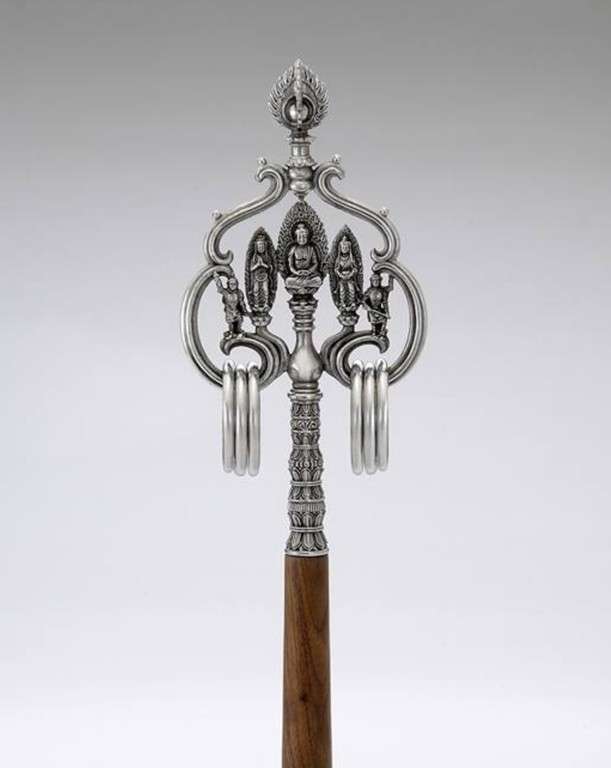
The staff found in the standard Ming edition of JTTW is actually based on two weapons from a 17-chapter storytelling prompt called The Story of How Tripitaka of the Great Tang Procured the Scriptures (Da Tang Sanzang qujing shihua, 大唐三藏取經詩話, c. late 13th-century). Sun Wukong’s precursor, an ageless immortal called the “Monkey Pilgrim” (Hou xingzhe, 猴行者), magically transports Tripitaka and his entourage to heaven. There, the supreme god, the Mahābrahmā Devarāja (Dafan tianwang, 大梵天王; i.e. Vaiśravana), gives the monk a cap of invisibility, a khakkhara (ringed monk’s staff) (fig. 4), and a begging bowl. Tripitaka and the Monkey Pilgrim take turns using these items throughout the journey. The staff is shown capable of shooting destructive beams of light, as well as transforming into magical creatures like an iron dragon or a giant, club-wielding Yaksha. Later, the Monkey Pilgrim also borrows an iron staff from heaven to fight a dragon.

The two staves from this tale were eventually combined by later storytellers. The rings from the first weapon were added to the ends of the second.

Fig. 4 – A beautiful, modern monk’s staff with six rings (larger version).

2.2. Influence from Religion

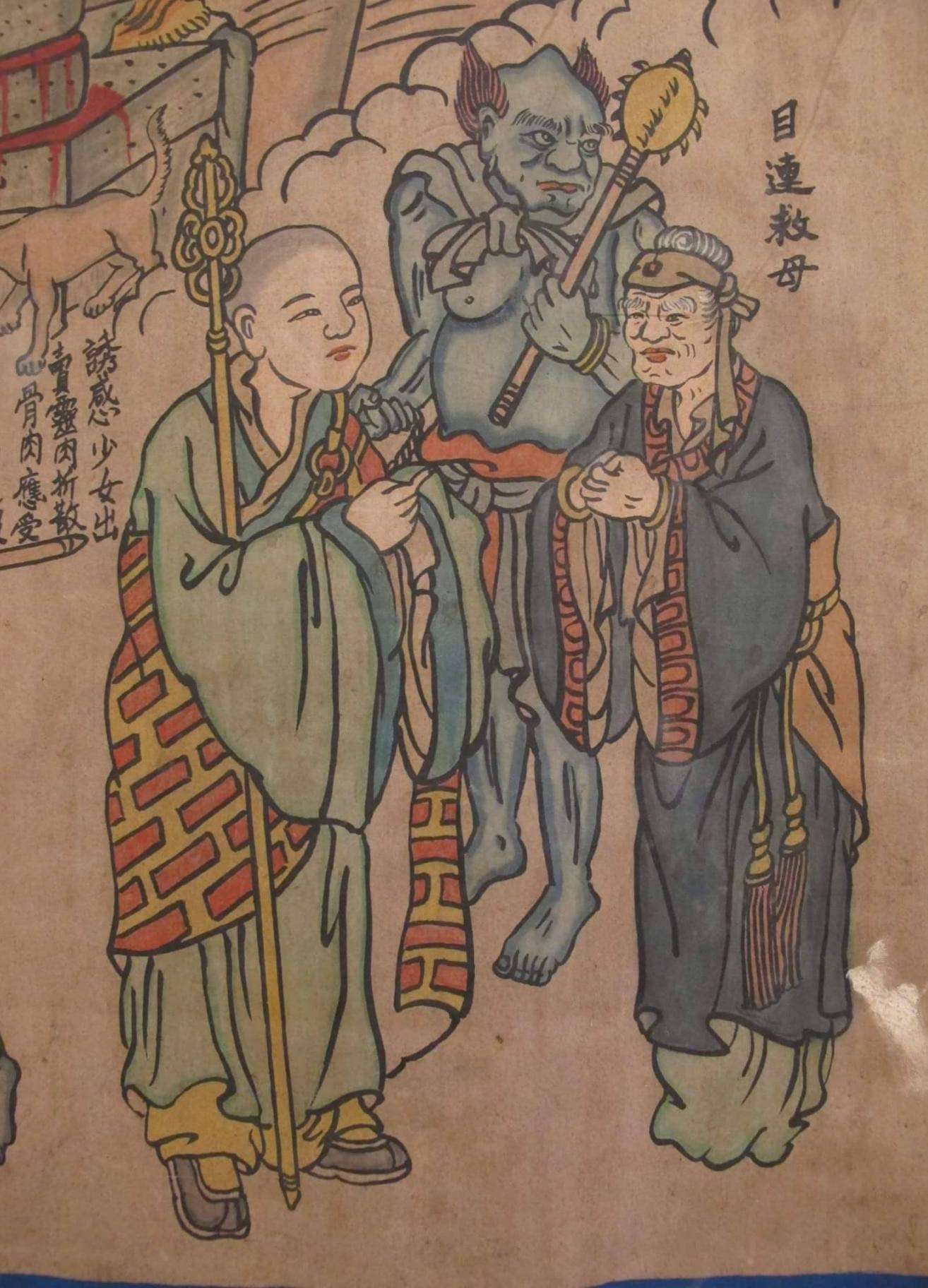
The Monkey Pilgrim’s magic ringed staff and begging bowl were directly influenced by the Buddhist Saint Mulian (目連; Sk: Maudgalyayana), a disciple of the historical Buddha. One particular 9th to 10th-century story notes that the Saint uses the staff to unlock the gates of hell in order to save his mother (fig. 5). This is where Sun Wukong’s weapon from JTTW gets the power to open locks.

Mulian saves his mother, scroll - small

Fig. 5 – A scroll or mural depicting Mulian rescuing his mother from the underworld (larger version). Originally found here.

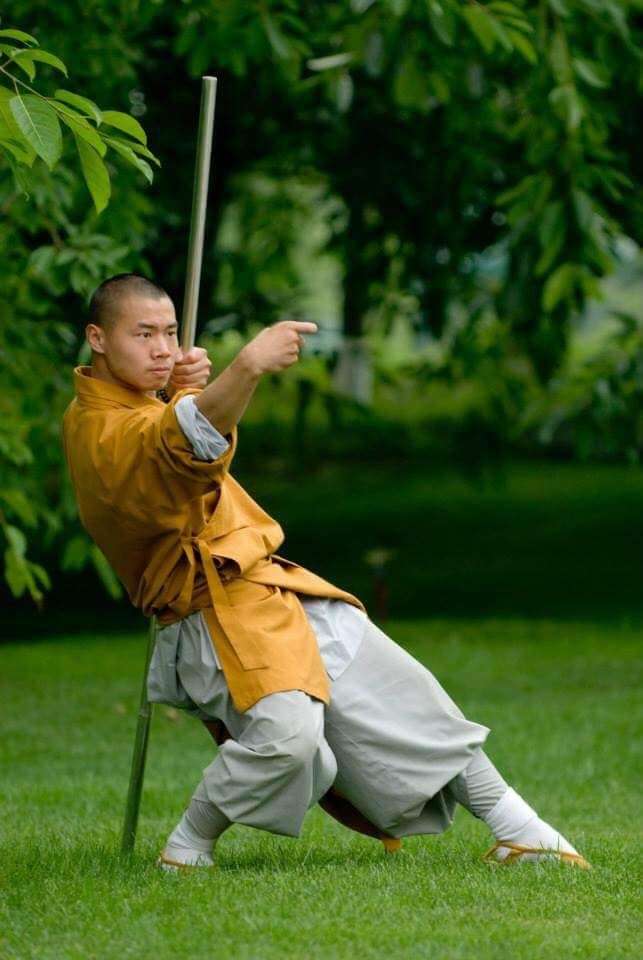
The ringed and metal staves used by the Monkey Pilgrim are based on those historically carried by Buddhist monks in ancient China. The aforementioned ringed variety, called “tin staves” (xizhang, 錫杖) where used by religious monks and decorated with six to twelve metal rings (see fig. 4). These rings were designed to make a clanging noise to not only scare away animals on the road but also to alert possible donors to the monk’s presence.

Martial monks charged with protecting monasteries or deployed by the Chinese government against pirates wielded wooden or iron staves (fig. 6). The former were chosen for their diminished capacity for fatal injuries, while the latter were explicitly used for killing during times of war. Sun Wukong wielding the iron variety makes sense as he’s a martial monk charged with protecting Tripitaka from monsters and spirits.

Fig. 6 – A martial monk practicing a drunken staff-fighting form (larger version).

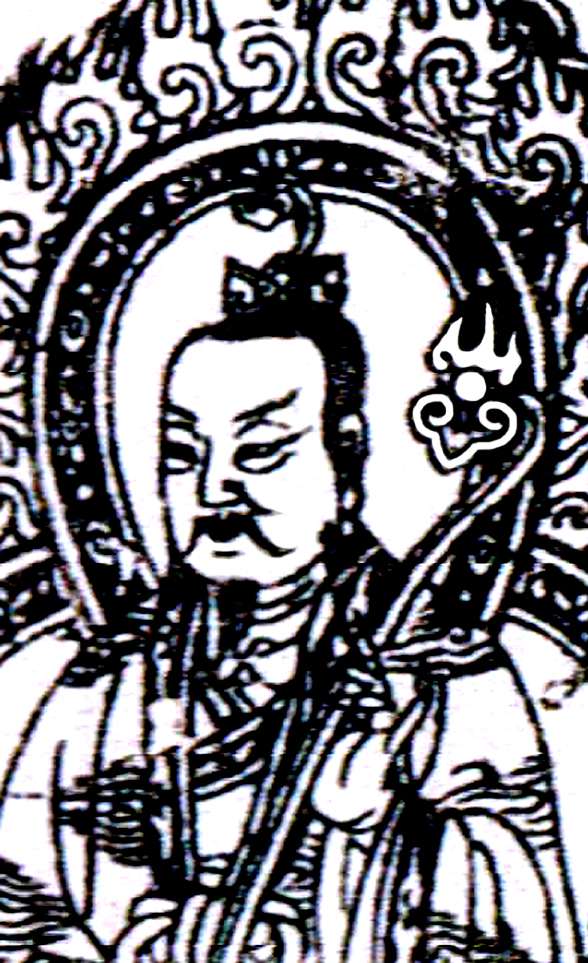
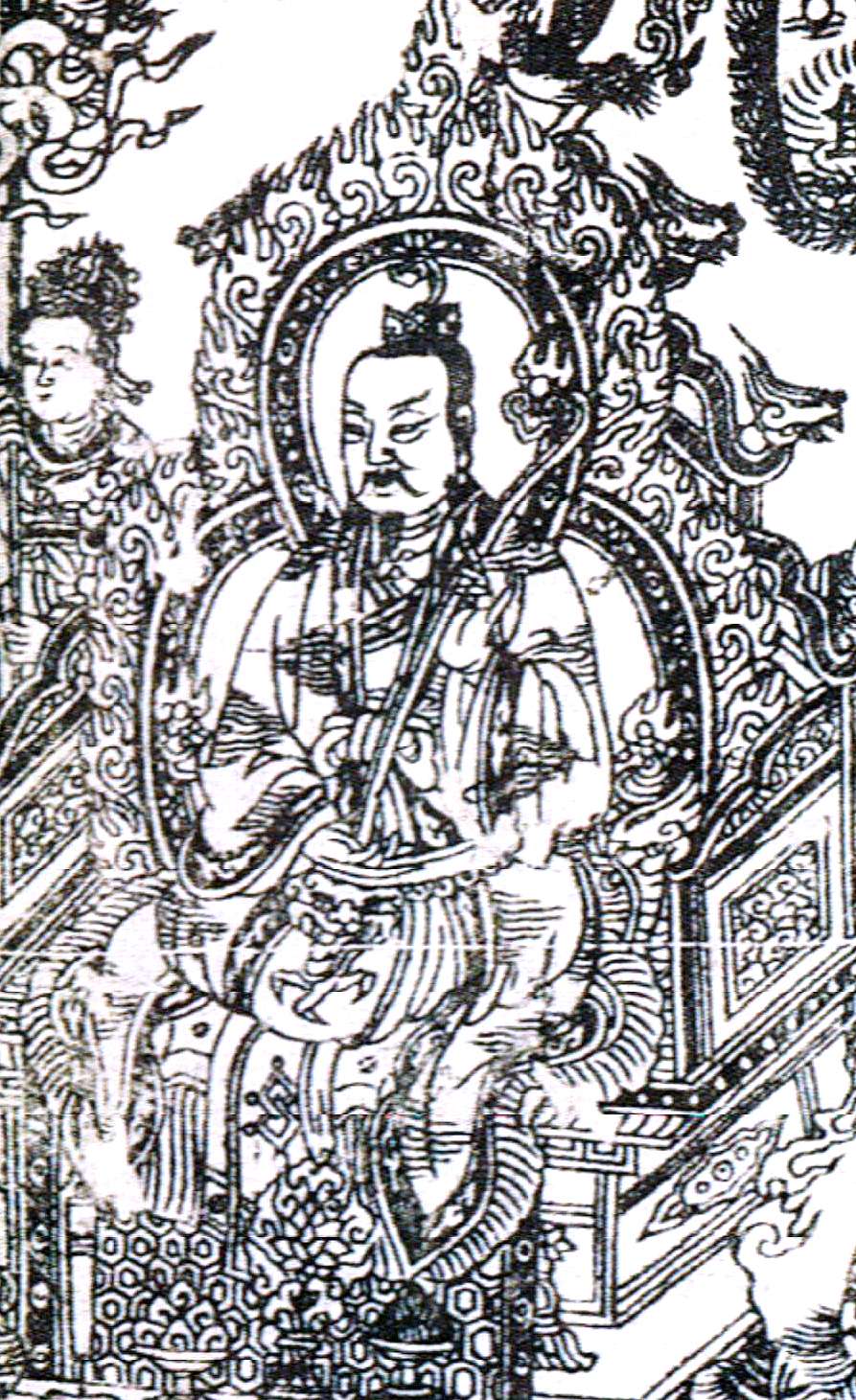
The term “As-you-will” (ruyi, 如意) from Monkey’s staff (mentioned above) is connected with a scepter used in ancient China as a symbol of religious debate and authority and, to a lesser extent, as a weapon. While it can be traced to a Hindo-Buddhist tradition in India, the scepter came to be associated with the highest gods of Daoism thanks to being decorated with a “numinous mushroom” (lingzhi, 靈芝), a real world fungi believed to bestow immortality. This mushroom scepter was at some point associated with the Buddhist Cintamani (Ruyi zhu, 如意珠), or “As-you-will jewel.” This was believed to grant any wish that one might desire. This explains why Monkey’s As-you-will staff grows or shrinks according to his commands. It’s interesting to note that some religious images of the scepter depict it with a syncretic mix of the Daoist mushroom and the Buddhist jewel (fig. 7).

Fig. 7 – An enhanced detail of the Celestial Worthy’s mushroom scepter with a flaming as-you-will jewel (larger version). See here for a fuller version of the deity.

2.3. Influence from Popular literature

The weapon’s portrayal in JTTW as an iron pillar kept in the dragon kingdom comes from old stories about the immortal Xu Xun (許遜), a historical Daoist master and minor government official from Jiangsu province. Popular tales describe him as a Chinese St. Patrick who traveled southern China ridding the land of flood dragons. One 17th-century version titled “An Iron Tree at Jingyang Palace Drives Away Evil” (Jingyang gong tieshu zhenyao旌陽宮鐵樹鎮妖) describes how he chained the flood dragon patriarch to an iron tree (tieshu, 鐵樹) and submerged it in a well, thus preventing the serpent’s children from leaving their subterranean aquatic realm and causing trouble. Pre-JTTW versions of this tale depict the tree as an actual iron pillar (fig. 8). Chinese Five Elements Theory dictates that metal produces water, and as its creator, holds dominion over it. Therefore, an iron pillar would be the perfect item to ward off creatures entrenched in the aquatic environment.

Fig. 8 – A Ming Dynasty woodblock print depicting the immortal Xu overseeing the creation of the iron pillar in a furnace (right) and it’s placement the well (left). Dated 1444-1445 (larger version).

As previously noted, the staff weighs 17,560 lbs. (7,965 kg). This is likely based on an episode from chapter 27 of the Chinese novel Water Margin (Shuihu zhuan, 水滸傳, c. 1400). It involves the bandit Wu Song lifting a heavy stone block said to weigh 300 to 500 catties (san wu bai jin, 三五百斤; 390-650 lbs./177-295 kg) (fig. 9). This scene and the one from JTTW where Monkey lifts the iron pillar are quite similar. Both involve a hero (Wu Song vs. Sun Wukong) asking someone (Shi En vs. Ao Guang) to show them a heavy object that cannot be moved (stone block vs. iron pillar). Both heroes then adjust their clothing before easily lifting the object with both hands. Most importantly, the Chinese characters for the weight of each object (三五百斤 vs. 一萬三千五百斤) are similar. The only difference is the addition of “10,000” (yiwan, 一萬) and “1,000” (qian, 千), respectively. And given the close historical and cultural ties between the two heroes, I believe the author-compiler of JTTW embellished the Water Margin episode to portray Sun as a hero like no other, a divine immortal that can lift weights far beyond even Wu Song himself.

Fig. 9 – Wu Song lifts the stone block (larger version). Image found here.

Note:

1) Irwen Wong of the Journey to the West Library blog has suggested that the length is likely an error for 12 feet (zhanger, 丈二) since the staff was already near 20 feet when Monkey first acquired it, and he later asked it to shrink to a more manageable size.

Archive #28 – Tripitaka’s Reincarnation and its Connection to Ancient Greek and Egyptian Philosophy

Last update: 02-16-2024

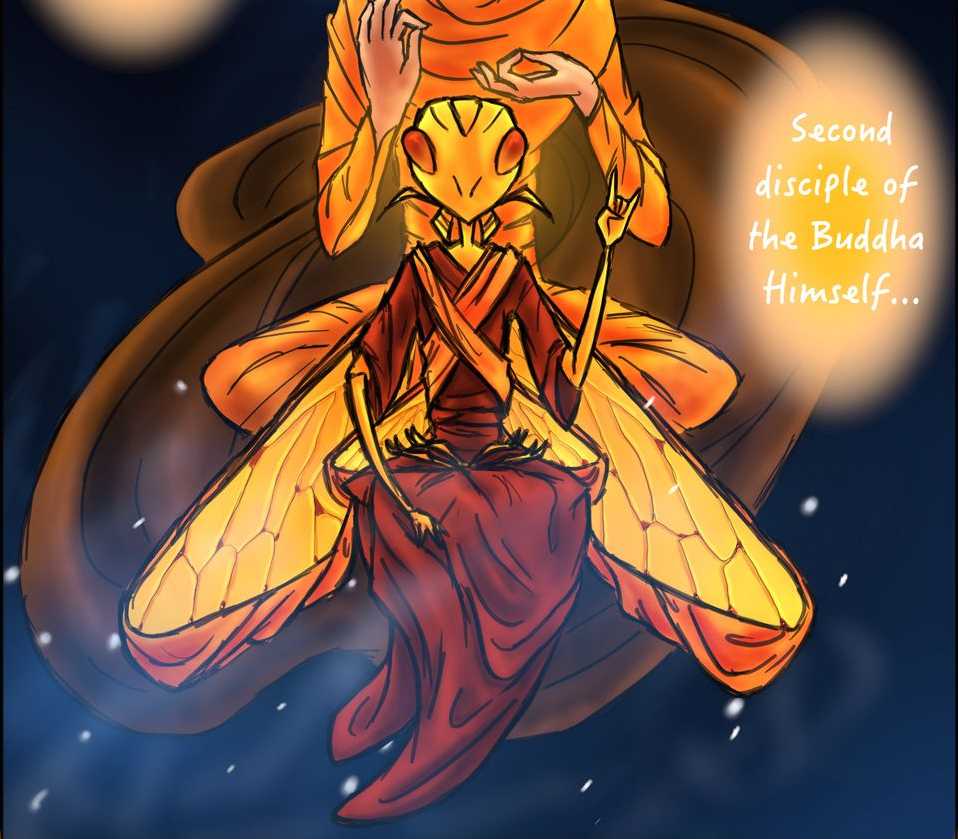
The Tang monk Tripitaka (Tang Sanzang, 唐三藏; a.k.a. Xuanzang) is depicted in Journey to the West (Xiyouji, 西遊記, 1592) as the earthly reincarnation of Master Golden Cicada (Jinchan zi, 金蟬子) (fig. 1), the Buddha’s fictional second disciple. This deity is banished to live out ten pious lives in China until the time comes for him to build merit as the scripture pilgrim, thereby gaining reentry into paradise. His crime of not paying attention to the Buddha’s lectures and subsequent exile to the mortal realm is encapsulated in part of a poem from chapter twelve:

Gold Cicada was his former divine name.
As heedless he was of the Buddha’s talk,
He had to suffer in this world of dust,
To fall in the net by being born a man
[…] (Wu & Yu, 2012, vol. 1, p. 275).

Fig. 1 – A modern interpretation of Master Golden Cicada as a literal insect by Taylor-Denna (larger version). See here for the full version and the artist’s statement. Used with permission.

I. Similarities to Western philosophy

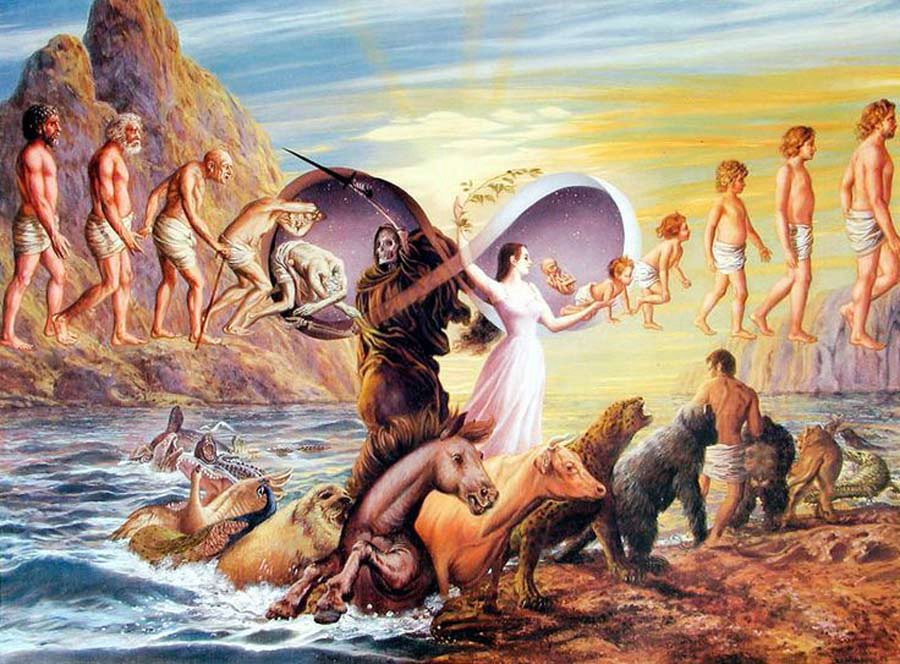
McEvilley‘s (2002) The Shape of Ancient Thought shows that Greek Orphic and Egyptian philosophy also believed in exiling gods from the heavens as a form of punishment. For example, Empedocles (5th-c. BCE) wrote of gods being exiled for ten thousand years for the crime of murder or lying under oath. The fallen deity is believed to reincarnate into every creature of land, air, and sea (fig.3), and when their long punishment is up, they are reborn in their last life as a person of high culture, such as royalty, religious leaders, and scholars. They then return to their former heavenly station upon death (McEvilley, 2002, p. 106). Plato (5th to 4th-c. BCE) specifically mentions the god undergoing ten reincarnations interspersed with thousand-year-long periods of afterlife reward or punishment (McEvilley, 2002, p. 108). The multiples of ten mentioned here fascinate me as they relate to the number of Tripitaka’s incarnations.

image

Fig. 3 – A symbolic painting showing the course of life, death, and reincarnation (larger version). Artist unknown.

McEvilley (2002) continues by tracing these and related Greek and Indian beliefs to the Egyptian Book of the Dead:

The deceased must somehow be regarded as a king or prince before he is eligible to “get thee back to the heights of heaven.” Thus Ani declares, “I am crowned like unto the king of the gods, and I shall not die a second time in the underworld.” Again, the prayer is made, “May Osiris, the scribe Ani, be a prince … and may the meat offerings and the drink offerings of Osiris Ani, triumphant, be apportioned unto him.” “I am crowned,” Ani claims, “I am become a shining one, I am mighty, I am become holy among the gods.” “I am the prince of eternity.” “May it be granted that I pass on among the holy princes,” Ani prays, and he is reassured: “The god Tmu hath decreed that [Ani’s] course shall be among the holy princes.” “Horus,” the Book of the Dead says, “was like unto a prince of the sacred bark, and the throne of his father was given unto him.”

Something very like the doctrine of Empedocles is suggested, and possibly related to it as forerunner. The ba, which was once a god among the other gods, descends to earth, that is, into a body, in order to right some wrong it has done in the past; either it descended as a pharaoh or it has somehow been processed through nature for long ages until it has purified itself sufficiently to be reborn as a pharaoh; after its purification it is ready to return to the company of the gods in heaven, and this is signified by the status as pharaoh. Empedocles said the final incarnation was as a prince, a poet, or a healer. Plato said the last reincarnation was as a philosopher—but he meant philosophers to be kings. They both may be echoing an Egyptian idea either that gods are incarnated only as pharaohs or that the last incarnation is as a pharaoh. A parallel is found in the Hindu caste system, in the idea that only brahmans can attain moksa—that is, “become Osiris”; the soul must reincarnate upward through the castes before it is in position to get off the wheel.

The nature of the primal crime or ancient wrong which the soul “descended on to the earth” to set right is not clearly stated, as it is not in the Greek versions of the myth, where it is either left undefined or ambiguously declared to be either perjury or bloodshed. The Egyptian texts dwell repeatedly on this subject, but with an ambiguity not unlike that of the Greek texts. Various clues in the Greek tradition indicate that the crime which the Orphic was attempting to expiate was either the ancient war of the Titans against the gods, for which they were exiled from heaven and imprisoned in Tartarus, or their rending and devouring of Dionysus Zagreus, or both. (In the Greek tradition, as West says, “The Titans are by definition the banished gods, the gods who have gone out of this world.”) The Egyptian texts may foreshadow the Greek myth of the Titans when they refer to a primal rebellion of one group of gods against another. “O ye gods of the underworld,” Osiris Ani says, “who set yourselves up against me, and who resist the mighty ones …” Again, he says:

Hail, Thoth! What is it that hath happened unto the holy children of Nut? They have done battle, they have upheld strife, they have done evil, they have created the fiends, they have made slaughter, they have caused trouble; in truth, in all their doings the mighty have worked against the weak …I am not one of those who work iniquity in their secret places; let not evil happen unto me.

The children of Nut include Osiris, Horus, Set, Isis, and Nephthys. When Ani claimed “before Isis I was,” he was dissociating himself from this contentious generation of deities in which the primal murder of Osiris by Set occurred, and claiming to have been one among the earlier generation, the “gods of the first time.” But there are also suggestions that the crime might be Set’s dismemberment of Osiris, whom Ani, in his role as Horus, avenger of his father, has to reconstitute to make reparation. Ani, in other words, might be expiating either or both of the Egyptian versions of the crimes of the Titans, and part of his strategy in doing so is to claim that he belongs to the earlier generation of gods (pp.131-133).

So the crime of murderous rebellion or bearing a false oath became inattentiveness to the Buddha’s teachings in Journey to the West. And the gods of ancient Greece and Egypt became a son of Buddha punished to ten reincarnations as a mortal, his last one as a holy monk. This final point mirrors the concept of the last incarnation being a grand one as a king or holy person.

How these beliefs or related proto-beliefs came to China is unknown to me. If pressed, I would venture it involved some Buddhist text containing an ancient Indian arm of this philosophy.

II. Connection to the other pilgrims

I can’t pass up the opportunity to mention how this also relates to the other pilgrims, who are portrayed as former gods exiled from heaven for some offense. In place of several rounds of reincarnation, they are (among other punishments) forced to serve as Tripitaka’s guardians, protecting him from leagues of demons wanting to jump ahead in the cosmic hierarchy by eating the monk’s flesh and gaining immortality. Marshal Tianpeng (Zhu Bajie) is banished for drunkenly forcing himself on the Moon goddess and reborn as a grotesque pig spirit (Wu & Yu, 2012, vol. 1, p. 212) (fig. 2). The Curtain-Raising General (Sha Wujing) is banished for breaking a treasure cup at a heavenly banquet and reborn as a monstrous water spirit plagued by a magic sword that stabs at him weekly (Wu & Yu, 2012, vol. 1, p. 209-210). [1] The dragon prince, son of the Western Sea Dragon King Aorun, is banished for burning a heavenly pearl (Wu & Yu, 2012, vol. 1, p. 213-214), but in place of execution, he agrees to transform into a dragon horse (a kind of rebirth) and serve as Tripitaka’s mount (Wu & Yu, 2012, vol. 1, p. 328). And even Sun Wukong is banished for his rebellion (the divine crime mentioned above) and punished to imprisonment under Five Elements Mountain. It’s interesting to note that one scholar suggests this punishment represents a symbolic death, leading to his eventual reincarnation (see Shao, 1997). (I’d like to add Sun’s additional punishment of eating a hellish diet of molten copper and hot iron balls speaks to a transitional period of afterlife punishment.) And once the pilgrims complete their penance (i.e. the journey), all are welcomed back into heaven, in this case the Buddha’s paradise

Zhu Bajie-Chang'e stamp

Fig. 2 – A Taiwanese stamp featuring Zhu Bajie and the moon goddess.

III. Archive

Here is a PDF for McEvilley (2002).

Click to access Thomas-McEvilley-The-Shape-of-Ancient-Thought_-Comparative-Studies-in-Greek-and-Indian-Philosophies-Motilal-Banarsidass-2008.pdf

Disclaimer:

This has been uploaded for educational purposes. No malicious copyright infringement is intended. Please support the official release.


Update: 04-05-22

I’ve archived a paper suggesting that Sun Wukong and Erlang’s magic battle of transformations was influenced by ancient Greek (and by extension Near Eastern) stories.

Archive #36 – Sun Wukong and Battles of Magical Transformations


Update: 02-16-24

I’ve written an article recording other examples of Buddhist deities from Chinese fiction being exiled from heaven much like those in Greek philosophy.

Buddhist Deities Exiled From the Western Heaven in Chinese Vernacular Literature

Notes:

1) It could be argued that Zhu and Sha do not reincarnate but simply take on monstrous forms upon being banished to earth because they still retain their memories, weapons, and magical skills. But maybe, as immortals, they are able to affect their own rebirth by directing the final destination of their primal spirit, thereby bypassing the normal mode of reincarnation that results in the loss of memory. An example of this is the rogue immortal Huaguang (華光) from Journey to the South (Nanyouji, 南遊記, 17th-c.), who is reborn several times and still has memories of his past and access to his holy weapons.

Sources:

McEvilley, T. (2002). The Shape of Ancient Thought: Comparative Studies in Greek and Indian Philosophies. New York: Allworth.

Shao, P. (1997). Monkey and Chinese Scriptural Tradition: A Rereading of the Novel Xiyouji (UMI No. 9818173) [Doctoral dissertation, Washington University]. Available from ProQuest Dissertations and Theses database.

Wu, C., & Yu, A. C. (2012). The Journey to the West (Vols. 1-4) (Rev. ed.). Chicago: University of Chicago Press.