Note #1: Unless cited here, all information is cited in the respective linked articles below.
Note #2: Please see the 05-19-23 update for an important message.
Last updated: 03-27-2025
Warning: This article contains adult language and content.
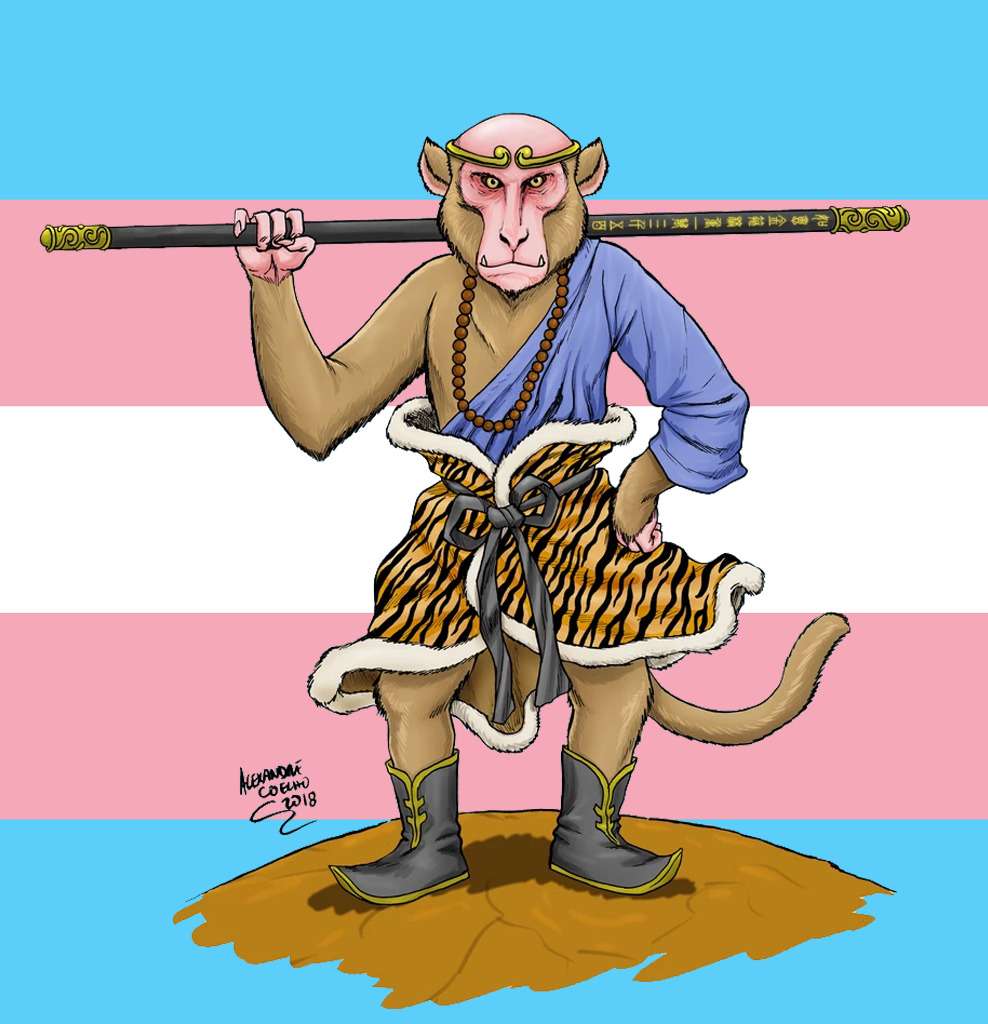
The notion that Sun Wukong (孫悟空) is transgender (fig. 1) became popular on English-speaking social media sometime around 2022. The central idea appears to be that the Monkey King, or I should say “Monkey Queen,” was originally born a woman but magically changes to a trans-man sometime after learning the art of transformation. Whether this is true or not has two possible answers:
1) If you or a loved one are trans, identify with Monkey’s ability to transform his body, and choose to personally interpret the character or portions of his story as an allegory for transness, then yes Sun Wukong is trans.
2) Historically and canonically speaking? No.
In this article, I will present common arguments (A) in favor of a trans Monkey King that I’ve seen on social media. I will also introduce counterarguments (CA) supported by historical oral, published, and pictorial evidence that calls any claims of canonical proof into question. If I don’t have a particular counterargument in mind, I will simply post a comment (C).
Before continuing, I want to expressly state that this piece was written for two kinds of people: 1) Those who might openly claim that Sun Wukong is canonically trans; and 2) Those who don’t know enough about the character’s history or Journey to the West (Xiyouji, 西遊記; “JTTW” hereafter) in general and might be swayed by seemingly knowledgeable online comments. It does not pertain to those who already personally interpret Monkey as trans and/or don’t care about canon because they were first exposed to him via movies, TV shows, video games, comic books, etc.
General readers will certainly find this article interesting as it features a lot of lesser-known historical information about the simian immortal.

Fig. 1 – An accurate Sun Wukong standing in front of the trans flag (larger version). The base drawing is by my friend Alexandre Palheta Coelho (instagram and deviantart). It was originally posted on this article.
1. An Important Statement
If someone claims that the Monkey King appearing in the 1592 edition of JTTW is canonically female-to-male (FTM) trans, or they state the novel hints that he is without openly admitting that this is their own personal interpretation, that person, whether they realize it or not, is not telling you the whole truth. I don’t think they are doing this maliciously, though. It’s perfectly natural for people to want to see some of themselves in their favorite heroes. After all, who wouldn’t want to be an immortal rage wizard who can fly around the cosmos, transform into anything, lift mountains, and beat up gods and devils? I can see how it might be attractive to a trans youth to have the power to push back against authorities that wrongly vilify and strip them of their human rights. Therefore, in that sense, I think I understand why the idea of a trans Sun Wukong is so popular. But having said that, I should highlight that anyone who goes beyond an allegorical reading of the novel by touting the reality of Monkey’s transness is either unaware of the character’s historical development or is willfully ignoring it.
2. Arguments and Counterarguments
2.1. Gender Neutral Terms
A: Ta (他; commonly “him”) and wang (王, commonly “king”) [1] are historically “gender neutral terms” and therefore can be used to refer to Sun Wukong as a woman.
C: These are indeed gender neutral terms in dynastic material. Here are two examples from the 1592 JTTW: 1) Wang (王) appears in the royal title of the “Queen Mother” (Wangmu niangniang, 王母娘娘), the high-ranking Daoist goddess who owns the immortal peach groves; and 2) Ta (他) is used to refer to the female Bodhisattva Guanyin (觀音). Part of a descriptive poem in chapter eight reads: “She is the merciful lord of the Potalaka Mountain” (Ta shi Luojiashan shang Cibei zhu, 他是落伽山上慈悲主) (Wu & Yu, 2012, vol. 1, p. 206).
However, the gender neutral status of these terms do not by themselves constitute evidence that the Monkey King is a woman.
2.2. Matriarchal Primate Society
A: Real world monkey troupes are matriarchal, so it would make more sense for Sun Wukong to be a woman.
CA: Real world biological concepts don’t mesh well with religious mythology. For example, Monkey is born from stone, and he later attains his authority through a test of bravery by jumping through a waterfall. So where does the primate matriarchy fit into this? Also, in chapter 11 of the 13th-century oral version of JTTW (see here and here), Sun’s antecedent, the “Monkey Pilgrim” (Hou xingzhe, 猴行者), explains that, prior to becoming the primate monarch, he had been exiled to the Mountain of Flowers and Fruit in the distant past for stealing immortal peaches from the Queen Mother’s heavenly garden (Wivell, 1994, p. 1195). It’s important to note that the tale presents him as a supremely ancient immortal, one who has seen the Yellow River dry up nine times (Wivell, 1994, pp. 1182-1183). Therefore, it’s not a stretch to suggest that his position as the Monkey King is related to his divinity. So I ask again: Where does the primate matriarchy fit into this?
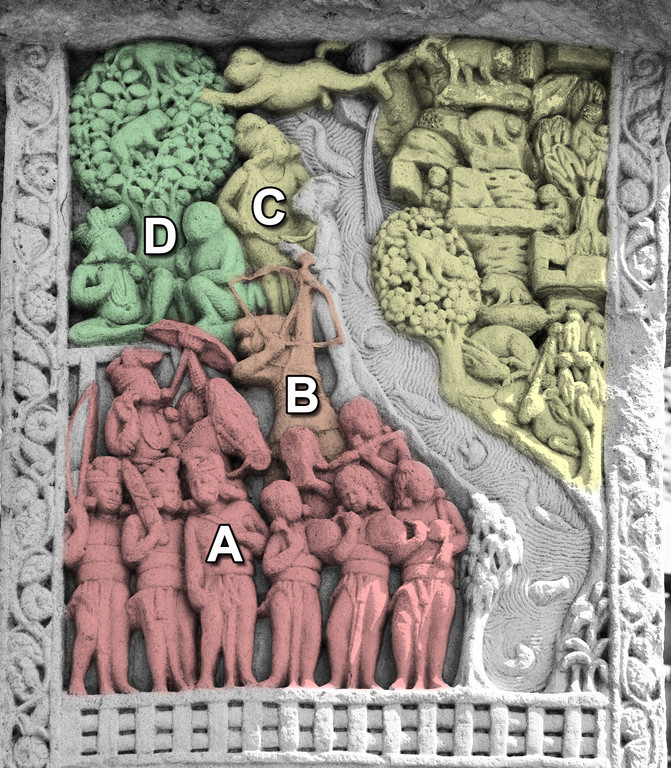
Most importantly, mythic stories about male monkey monarchs do exist. Two such characters are Vali/Bali (Sk: वाली) and Sugrīva (Sk: सुग्रीव) from the Hindu epic Rāmāyaṇa (Sk: रामायणम्, c. 5th-century BCE). Another is the Mahākapi (Sk: महाकपि; lit: “Great Monkey,” c. 2nd-century BCE), an Indian Buddhist jataka tale about the Buddha’s past life as a king of monkeys. One 2,000-year-old carving even depicts him with testicles (fig. 2). These few examples alone challenge the idea that monkey troupes have to be matriarchal in a mythic setting.
In fact, I suggest in this article that the Mahākapi tale influenced the 13th-century oral JTTW in several ways: 1) The Great Monkey is described as the chief of his tribe, and one 3rd-century Chinese version of the story even refers to him as the “Monkey King” (Mihou wang, 獼猴王). This is a likely source for the Monkey Pilgrim’s position as the primate monarch; 2) The Great Monkey leads 80,000 monkeys. The 3rd-century Chinese version changes this number to 500 (wubai, 五百), while the later Monkey Pilgrim leads 84,000 (bawan siqian, 八萬四千). But all three numbers are used in Buddhism to refer to large numbers of things. In the case of the respective Indian and Chinese versions, the 80,000/500 monkeys are said to be the past lives of Buddhist monks. But most importantly, the Chinese term for 80,000 (bawan, 八萬) is considered shorthand for 84,000 (bawan siqian, 八萬四千), showing a possible connection between the numbers of monkeys in the Indian original and the 13th-century oral JTTW; 3) The Great Monkey and his tribe live in or around a mountainous, fruit-bearing tree. This could be one of several sources for the Mountain of Flowers and Fruit (see note #4 below for another); and 4) The 3rd-century Chinese version sees the Great Monkey steal from the imperial fruit garden of a human monarch. This could be one of several sources for the Monkey Pilgrim stealing immortal peaches from the Queen Mother’s heavenly garden.
(On a related note, see this article for the many parallels shared between the 1592 Sun Wukong and the historical Buddha.)

Fig. 2 – The “Great Monkey” carving from the western torana at Sanchi (c. 1st-century BCE/CE) (larger version). He is the uppermost yellow figure reaching for the green tree. Take note of his testicles. The colored and labeled elements are used in my article to describe this “continuous narrative” scene.
2.3. Feminine Title
A: Sun Wukong calls himself the “Handsome Monkey King” (Meihou wang, 美猴王), but the character for handsome, “mei (美),” traditionally means “beautiful.” Therefore, it would make more sense for Monkey to call themself beautiful if they were a woman.
CA: I think that there is a much better explanation. Recall that the 1592 JTTW depicts our hero as an ugly creature. For instance, part of a descriptive poem in chapter 44 reads:
A bumpy brow, and golden eyes flashing;
A round head and a hairy face jowl-less;
Gaping teeth, pointed mouth, a character most sly;
He looks more strange than thunder god
[…] (Wu & Yu, 2012, vol. 2, p. 276).
磕額金睛晃亮,圓頭毛臉無腮。咨牙尖嘴性情乖。貌比雷公古怪。…
In fact, Sun’s association with being ugly goes back centuries. For example, writing in the 1250s, the Song-era poet Liu Kezhuang (劉克莊, 1187-1269) used Monkey as a metaphor to describe his own failing appearance:
A back bent like a water-buffalo in the Zi stream,
Hair as white as the silk thread issued by the “ice silkworms”,
A face even uglier than Hou xingzhe [“Monkey Pilgrim”] (emphasis added),
Verse more scanty than even He Heshi (Dudbridge, 1970, p. 46).
背傴水牛泅磵髪白氷蠶吐絲貌醜似猴行者詩痩於鶴何師
Therefore, the primate monarch definitely is not “handsome” or “beautiful.”
I suggest instead that Sun refers to himself as mei (美) because of his egotistical personality. He is after all an allegory for the Monkey Mind. This same overinflated sense of self eventually leads him to challenge the primacy of the Jade Emperor (Yuhuang dadi, 玉皇大帝). Monkey’s self-conceit is best illustrated by the rebellious poem that he recites to the Buddha in chapter seven. The latter part reads:
[…]
In Divine Mists Hall none should long reside,
For king may follow king in the reign of man.
If might is honor, let them yield to me.
He only is hero who dares to fight and win!”(Wu & Yu, 2012, vol. 1, p. 193).
[…]
靈霄寶殿非他久,歷代人王有分傳。
強者為尊該讓我,英雄只此敢爭先。
See the 08-09-2023 and 09-27-23 updates below for another reason why he might have been called Meihou wang (美猴王).
2.4. Etymology of Surname
A: In chapter one, the Patriarch Subodhi (Puti zushi, 菩提祖師) relies on Monkey’s appearance to derive a surname for them. Some of the etymology mentions feminine concepts, adding support to the idea that Sun Wukong was originally a woman:
The Patriarch laughed and said, “Though your features are not the most attractive, you do resemble a pignolia-eating monkey (husun [猢猻]). This gives me the idea of taking a surname for you from your appearance. I intended to call you by the name Hu [猢]. If I drop the animal radical [犭] from this word, what’s left is a compound made up of the two characters, gu [古] and yue [月]. Gu means aged and yue [“moon”] denotes feminine yin energy [陰], but aged yin cannot reproduce (emphasis added). Therefore, it is better to give you the surname of Sun [猻]. If I drop the animal radical from this word, what we have left is the compound of zi [子] and xi [系]. Zi means a boy and xi means a baby, and that name exactly accords with the fundamental Doctrine of the Baby Boy. So your surname will be ‘Sun’” (Wu & Yu, 2012, vol. 1, p. 115).
祖師笑道:「你身軀雖是鄙陋,卻像個食松果的猢猻。我與你就身上取個姓氏,意思教你姓『猢』。猢字去了個獸傍,乃是個古月。古者,老也;月者,陰也。老陰不能化育,教你姓『猻』倒好。猻字去了獸傍,乃是個子系。子者,兒男也;系者,嬰細也,正合嬰兒之本論。教你姓『孫』罷。」
CA: Our hero’s association with the surname Sun predates the 1592 JTTW by centuries, appearing as early as an early-Ming JTTW zaju play. Therefore, Subodhi’s etymological breakdown is just an excuse to change husun (猢猻), one of the historical terms for the macaque, into Sun. It’s also an excuse to tie the surname to historical Daoist longevity practices.
Also, Sun (孫) has been used since at least the Tang Dynasty (618-907) as a surname for monkeys associated with Buddhist monks. According to the Tang poet Li Shen (李紳, d. 846):
There are many monkeys in the [Lingyin and Tianzhu] monasteries. They are called the Sun group (or the group of Sun, “Sun tuan” [孫團]). They have been reared there for a long time (Shahar, 1992, pp. 202-203).
2.5. Stable Monkeys
A: It was a common historical practice to place female monkeys in horse stables because their menstruation was believed to ward off equine sickness (see my past article for a source). Hence, Sun’s time as the heavenly stable master supports the idea that they were originally a woman.
CA: Just because something influenced a character in a story doesn’t mean that thing and all of its traits become the character. That’s like saying Son Goku is Superman just because Dragon Ball Z-era Akira Toriyama borrowed the “alien sent to earth” element from the Man of Steel’s mythos. But that isn’t the case since each character and their respective stories have definable differences. And it’s the same for the female stable monkeys and Sun Wukong.
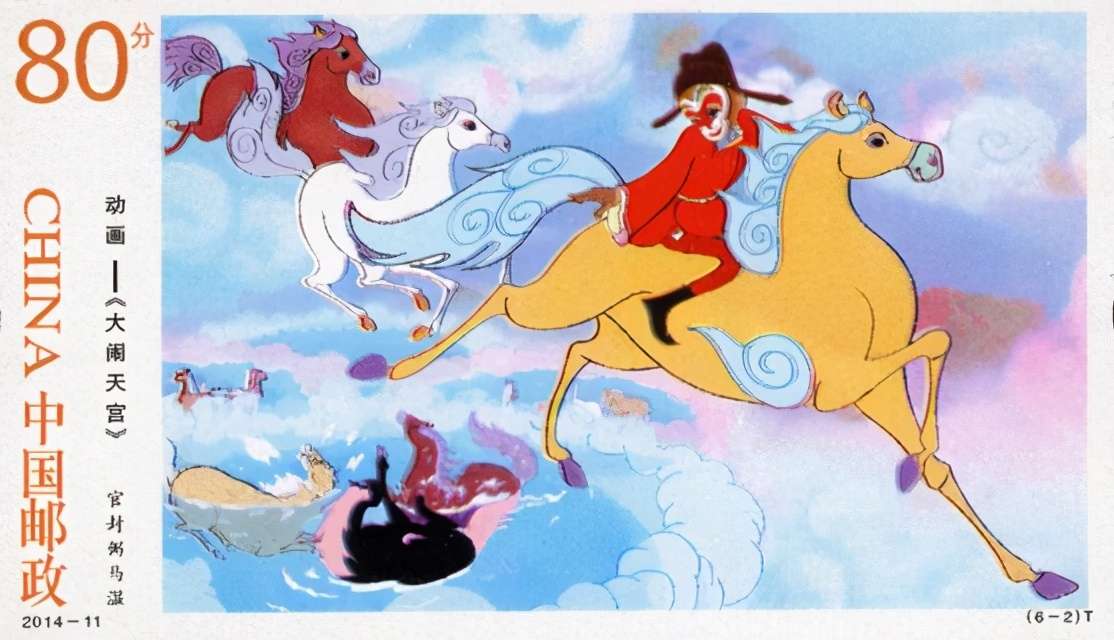
After becoming the Bimawen (弼馬溫) (fig. 3), Sun dotingly cares for nearly 1,000 horses day and night, making sure that they are all well-fed, exercised, and rested. At no point does the 1592 JTTW even hint that their health is in any way tied to menstruation. But having said that, I suggest the reason that Monkey gets so upset when people call him Bimawen, what Yu (Wu & Yu, 2012) translates as “BanHorsePlague” (vol. 1, p. 354), is because it references the homophonous term for the historical practice, Bimawen (避馬瘟, lit: “avoid the horse plague”). Surprisingly, the latter phrase does not appear in the novel.

Fig. 3 – A 2014 stamp featuring a scene from the classic 1960s animation Havoc in Heaven in which Sun Wukong serves as the Bimawen (larger version). Image found here.
3. Final Counterarguments
3.1. Historical Male Depictions
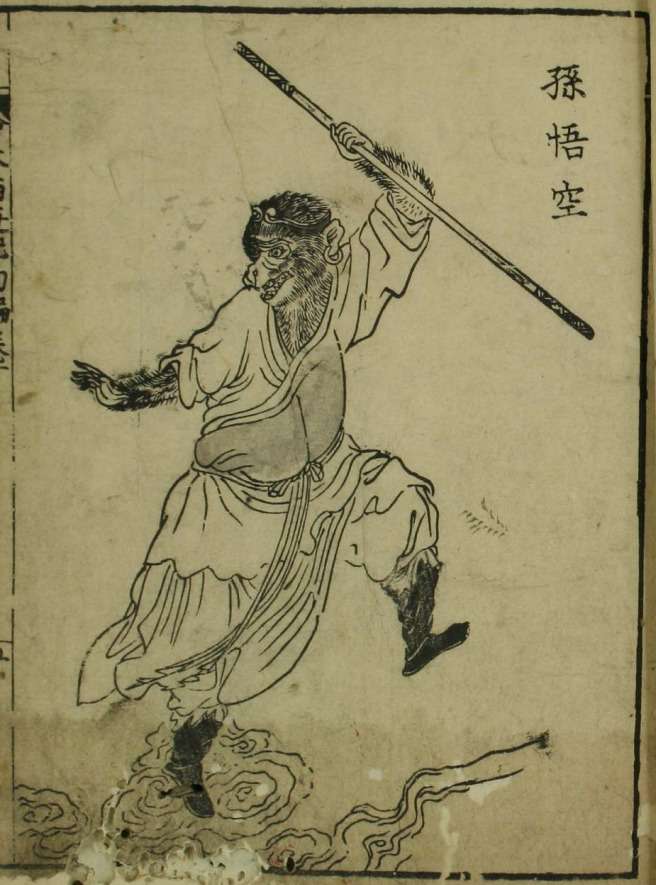
I don’t know of any historical oral, published, or pictorial sources that portray or describe Sun as a woman in their regular form. To my knowledge, he has always been depicted as a man.
I won’t pretend to know the full extent of our hero’s history, but I always strive to learn more about the subject. Just look at the following as a brief survey.
3.1A. Art
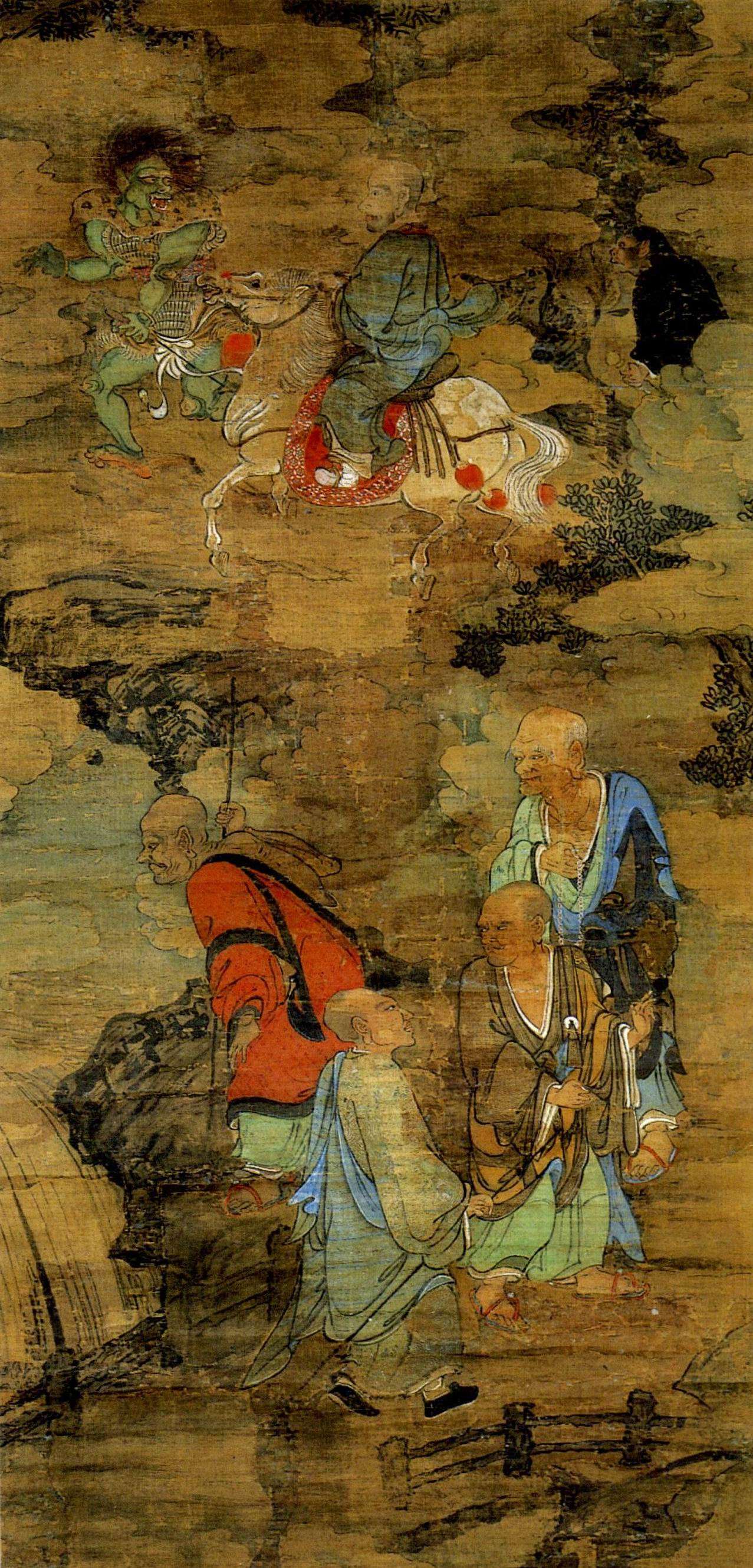
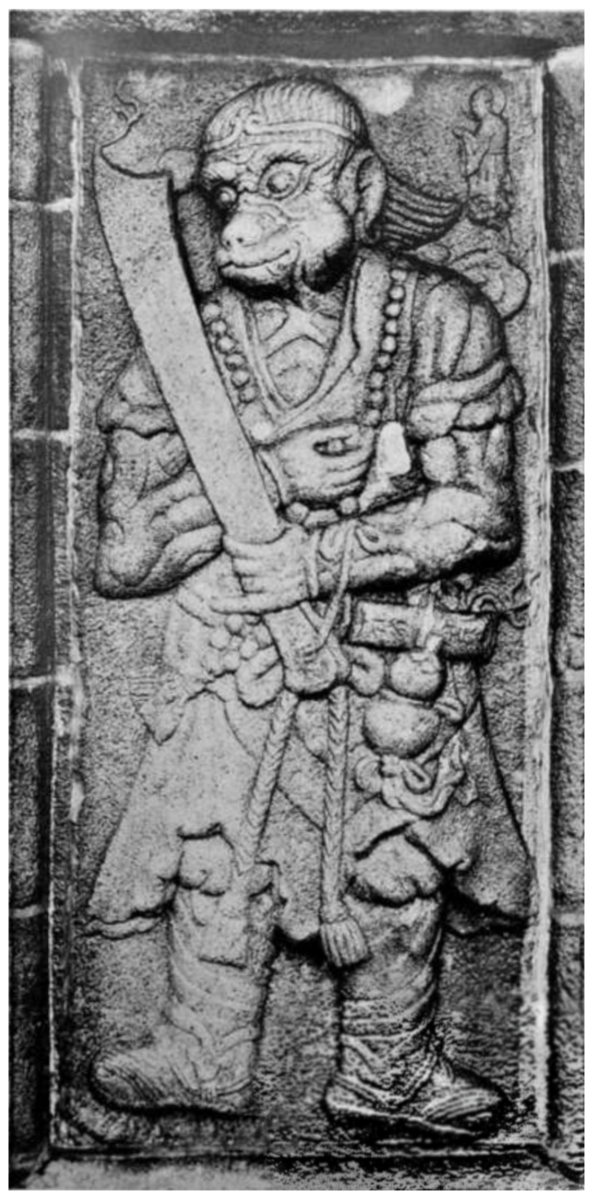
The earliest art depicting the aforementioned Monkey Pilgrim shows him as either a simian cleric or soldier accompanying the monk Tripitaka. But I think the best example to present for this discussion is the 13th-century Kaiyuan Temple stone pagoda carving (fig. 4), which portrays him as a muscular, sword-wielding protector deity.

Fig. 4 – The Kaiyuan Temple stone pagoda carving of the Monkey Pilgrim (1237) (larger version).
3.1B. Oral literature
The Story of How Tripitaka of the Great Tang Procures the Scriptures (Da Tang Sanzang qujing shihua, 大唐三藏取經詩話), the aforementioned 13th-century oral version of JTTW, first introduces the Monkey Pilgrim as a “scholar dressed in a white robe” (Baiyi xiucai, 白衣秀才) (Wivell, 1994, p. 1182). The word translated here as scholar, “xiucai“ (秀才; lit: “cultivated talent”), was “[f]rom antiquity a categorical rubric under which talented men were nominated to be considered for official appointments” (Hucker, 1985, p. 284). During the Song dynasty (960-1279), when this tale was first recorded, the xiucai was an informal term for candidates of the metropolitan-level exams (Hucker, 1985, p. 284). That is to say they were educated commoners who had yet to receive an official office. Dudbridge (1970) suggests that disguising oneself as a traveling, white-robed scholar would have then “conferr[ed] anonymity on the wearer” (p. 32). [2] This means that Monkey is likely using the disguise to walk among mortals without them realizing his divine nature.
Dudbridge (1970) also notes that this disguise was used by male characters in later published media (p. 32 n. 1). These examples instead use “xiushi” (秀士; lit: “cultivated scholar”). For instance, in chapter 81 of the Water Margin (Shuihu zhuan, 水滸傳, c. 1400), a literary version of Song Emperor Huizong (宋徽宗) dresses this way in order to meet in secret with his favorite sex worker:
Accompanied by a young eunuch, the sovereign arrived through the secret tunnel at the rear door of the courtesan’s house. He was dressed in the white garb of a scholar (emphasis added) (Shi & Luo, 1993/2021b, p.1715).
只見道君皇帝引着一個小黃門,扮做白衣秀士,從地道中逕到李師師家後門來。(Shi & Luo, 1975/2021b, p. 1104)
This male disguise even carried over into the 1592 JTTW. For example, in chapter ten, the Dragon King of the Jing River (Jinghe Longwang, 涇河龍王) takes on such a form to investigate a fortune teller with dangerously accurate predictions that threaten the fish of his kingdom:
[H]e abandoned his sword and dismissed the clouds and the rains. Reaching the river bank, he shook his body and changed into a white-robed scholar (emphasis added) (Wu & Yu, 2012, vol. 1, p. 239).
龍王 … 遂棄寶劍,也不興雲雨,出岸上,搖身一變,變作一個白衣秀士)
3.1C. Zaju play
The early-Ming Journey to the West zaju play (Xiyou ji zaju, 西遊記雜劇) contains many familiar episodes that would come to appear in the 1592 JTTW. [3] But despite these parallels, there are many interesting differences. For example, in act nine (of 24), Sun Wukong is said to be the brother of several divine siblings:
We are five brothers and sisters: my older sister is the Venerable Mother of Mount Li, my younger sister is the Holy Mother Wuzhiqi, my older brother is the Great Sage Equaling Heaven, I myself am the Great Sage Reaching Heaven (emphasis added), and my younger brother is the Third Son Shuashua (based on Dudbridge, 1970, p. 110).
小聖弟兄、姊妹五人,大姊驪山老母,二妹巫枝祗聖母,大兄齊天大聖,小聖通天大聖,三弟耍耍三郎。
(That’s right! The play refers to Monkey as the “Great Sage Reaching Heaven” instead of “… Equaling Heaven.”)
He also has a wife, a princess whom he had kidnapped from the “Country of the Golden Cauldron” (Jinding guo, 金鼎國) (Ning, 1986, pp. 63-66). This portion of the play draws directly from a genre of Han to Song-era tales in which magic apes kidnap young maidens in order to rape and impregnate them. [4]
The most apparent differences are the addition of bawdy elements like sex, cursing, and dirty jokes by the author, the 15th-century Mongol playwright Yang Jingxian (杨景賢). For instance, act 18 sees the pilgrims travel through the famous Woman Kingdom, where Sun, Zhu, and Sha all fall prey to temptations of the flesh. But whereas the latter two are successful in their sexual ventures, poor Monkey is struck by a bout of erectile dysfunction caused by the painful constricting of his headband:
Master, listen and I’ll tell you. There I was pinned down by a woman. My lustful nature was about to come forth, when suddenly the iron hoop on my head tightened, and the joints and bones up and down my whole body began to ache. The throbbing conjured up a bunch of vegetable names in my brain.
My head hurt so my hair stood up like radish-tops, my face turned as green as smartweed sprouts, my sweat beaded up like the moisture on an eggplant soaked in sauce, and my cock fell as limp as a salted cucumber (emphasis added). When she saw me looking for all the world like chives sizzling in hot oil, she came around, suppressed her itch and set me free (Ning, 1986, pp. 138-139).
聽行者告訴一遍:小行被一個婆娘按倒,凡心卻待起。不想頭上金箍兒緊將起來,渾身上下骨節疼痛,疼出幾般兒蔬菜名來:頭疼得髮蓬如韭菜,面色青似蓼牙,汗珠一似醬透的茄子,雞巴一似醃軟的黃瓜。他見我恰似燒蔥,恰甫能忍住了胡麻。他放了我 …
(Notice that ta (他) is used in the quote above to refer to the girl. Refer back to section 2.1 for a reminder of the significance.)
Later in act 19, Monkey attempts to seduce Princess Iron Fan (Tieshan gongzhu, 鐵扇公主) in order to gain access to her magic Banana leaf fan. Sun does this by reciting a poem in which he makes a veiled allusion to his penis being the right size for her vagina:
The disciple’s not too shallow,
the woman’s not too deep (emphasis added).
You and I, let’s each put forth an item,
and make a little demon
(Ning, 1986, p. 141).
弟子不淺,娘子不深。我與你大家各出一件,湊成一對妖精。
When this plan fails and the Princess threatens him with her sword, Sun angrily explains that the supernatural durability of his body and penis renders him impervious to physical harm:
Why this lowdown wench has no manners at all! I am the Lord of the Crimson Cloud Cavern, the Great Sage [Reaching Heaven]! I plundered Laozi’s gold Pill of Immortality, and have endured so many alchemical transformations that my muscles are brass, my bones iron, my eyes fire, my pupils gold, my asshole lead and my prick is pewter. Why should I fear a steel [sword] slicing off my pizzle? (emphasis added) (Ning, 1986, p. 142).
這賊賤人好無禮。我是紫雲羅洞主,通天大聖。我盜了老子金丹,煉得銅筋鐵骨,火眼金睛,金俞石屁眼,擺錫雞巴。我怕甚剛刀剁下我鳥來?
I want to highlight that this play did not influence the story cycle; it only reflects characters and episodes that were common to the cycle at that time. The bawdy elements were solely added to spice up the tale, making it more entertaining for zaju audiences. Therefore, this sex-crazed, dirty-mouthed version of the Monkey King should be considered a separate entity from his literary counterpart in the 1592 JTTW. However, I have included him here because the play clearly establishes that the character is a man.
3.1D. Other Published Literature
A Supplement to the Journey to the West (Xiyoubu, 西遊補, 1640) is an unofficial sequel to the 1592 JTTW with a trippy, time-jumping story that mentions Sun Wukong fathering children with a woman. The first reference to his offspring appears in chapter 13 when actors in a royal play describe an alternate timeline where our hero had settled down:
His wife is so beautiful, his five sons so dashing. He started out as a monk, but came to such a good end! Such a very good end! (Dong, Lin, & Schulz, 2000, p. 114).
你看他的夫人這等標致,五個兒子這等風華。當初也是個和尚出身,後來好結局,好結局!
Later, in chapter 15, Monkey meets one of these sons, King Pāramitā (Boluomi wang, 波羅蜜王), on the battlefield. This general recounts his family history to the stranger, revealing that, although he’s never met his father (jiafu, 家父), he’s the son of the Great Sage and the Rakshasi (Luocha nu, 羅剎女), Princess Iron Fan (Dong, Lin, & Schulz, 2000, pp. 123-124). In addition, he suggests that he was conceived during an event from chapter 59 of the original novel:
[Sun Wukong] changed into a tiny insect and entered my mother’s belly. He stayed there a while and caused her no end of agony. When my mother could no longer bear the pain, she had no choice but to give the Banana-leaf Fan to my father, Monkey. [5] When my father, Monkey, got the Banana-leaf Fan, he cooled the inferno at Flaming Mountain and left. In the fifth month of the next year, my mother suddenly gave birth to me, King Pāramitā. Day by day I grew older and more intelligent. If you think about it, since my uncle [the Bull Demon King] and mother had never been together, and I was born after my father, Monkey, had been inside my mother’s belly, the fact that I am his direct descendant is beyond dispute (Dong, Lin, & Schulz, 2000, p. 124).
後來又變作小蟲兒鑽入家母腹中,住了半日,無限攪炒。當時家母認痛不過,只得將芭蕉扇遞與家父行者。家父行者得了芭蕉扇,扇涼了火焰山,竟自去了。到明年五月,家母忽然產下我蜜王。我一日長大一日,智慧越高。想將起來,家伯與家母從來不合,惟家父行者曾走到家母腹中一番,便生了我,其為家父行者之嫡系正派,不言而可知也。」
The novel doesn’t elaborate on how the other four sons are conceived. But in the case of Pāramitā, Sun’s presence in Iron Fan’s stomach acts as sperm fertilizing an egg.
Anyways, it should be evident from the examples presented above that the Monkey King was portrayed or described in his regular form as a man throughout the long course of his character development.
This by itself should put the idea of a canonically trans Sun Wukong to rest, but there is one more counterargument that I think is even stronger.
3.2. Spiritual Gender Transitions in Buddhism
Buddhist literature actually includes instances of girls or women transforming into men upon enlightenment or rebirth. [6] The former is best exemplified by the “Dragon Girl” (Longnu, 龍女) from chapter 12 of the Lotus Sutra (Miaofa lianhua jing, 妙法蓮華經; a.k.a. Fahua jing, 法華經, c. 3rd-century) (fig. 5), a work mentioned in the 1592 JTTW six times. She is first introduced to an assembly of Buddhist deities as the eight-year old daughter of the Dragon King Sāgara (Suojieluo longwang, 娑竭羅龍王) and one of an unfathomable number of dragonfolk enlightened by the Bodhisattva Mañjuśrī’s (Wenshu shili, 文殊師利) lessons on the Lotus Sutra. Her teacher describes her as a great student prodigy with a deep knowledge of Buddhist Law, as well as having many advanced spiritual achievements. But this upsets some among the assembly because the notion of a young girl approaching Buddhahood so quickly flies in the face of convention, which normally calls for untold aeons of severe austerities before one can achieve awakening. Her accomplishments are called into question at first, but everyone is appeased when she offers a priceless jewel to the Buddha, and he quickly accepts it as a symbolic gesture. Then:
The girl said [to the assembly], “Employ your supernatural powers and watch me attain Buddhahood. It will be even quicker than that!”
At that time the members of the assembly all saw the dragon girl in the space of an instant change into a man (emphasis added) and carry out all the practices of a bodhisattva, immediately proceeding to the spotless World of the south, taking a seat on a jeweled lotus, and attaining impartial and correct enlightenment. With the thirty-two features and the eighty characteristics [of a Buddha], he expounded the wonderful Law for all living beings everywhere in the ten directions (Watson, 1993, p. 188). [7]
女言:「以汝神力,觀我成佛,復速於此。」
當時眾會,皆見龍女忽然之間變成男子,具菩薩行,即往南方無垢世界,坐寶蓮華,成等正覺,三十二相、八十種好,普為十方一切眾生演說妙法。
This kind of spiritual gender transition was certainly known to the host of historical oral storytellers and author-compilers who contributed to the formation of the novel due to their vast shared knowledge of Buddhist and Daoist religion and lore. This is especially true given that the Lotus Sutra is even touted in the 13th-century oral version of JTTW. [8]
Therefore, if the Sun Wukong from the 1592 JTTW was originally intended to be trans, they would have been OPENLY portrayed as such, without the need for subtle hints, due to scriptural precedent. And the fact that he wasn’t makes this what I consider to be the most damning argument against a canonically trans Sun Wukong.

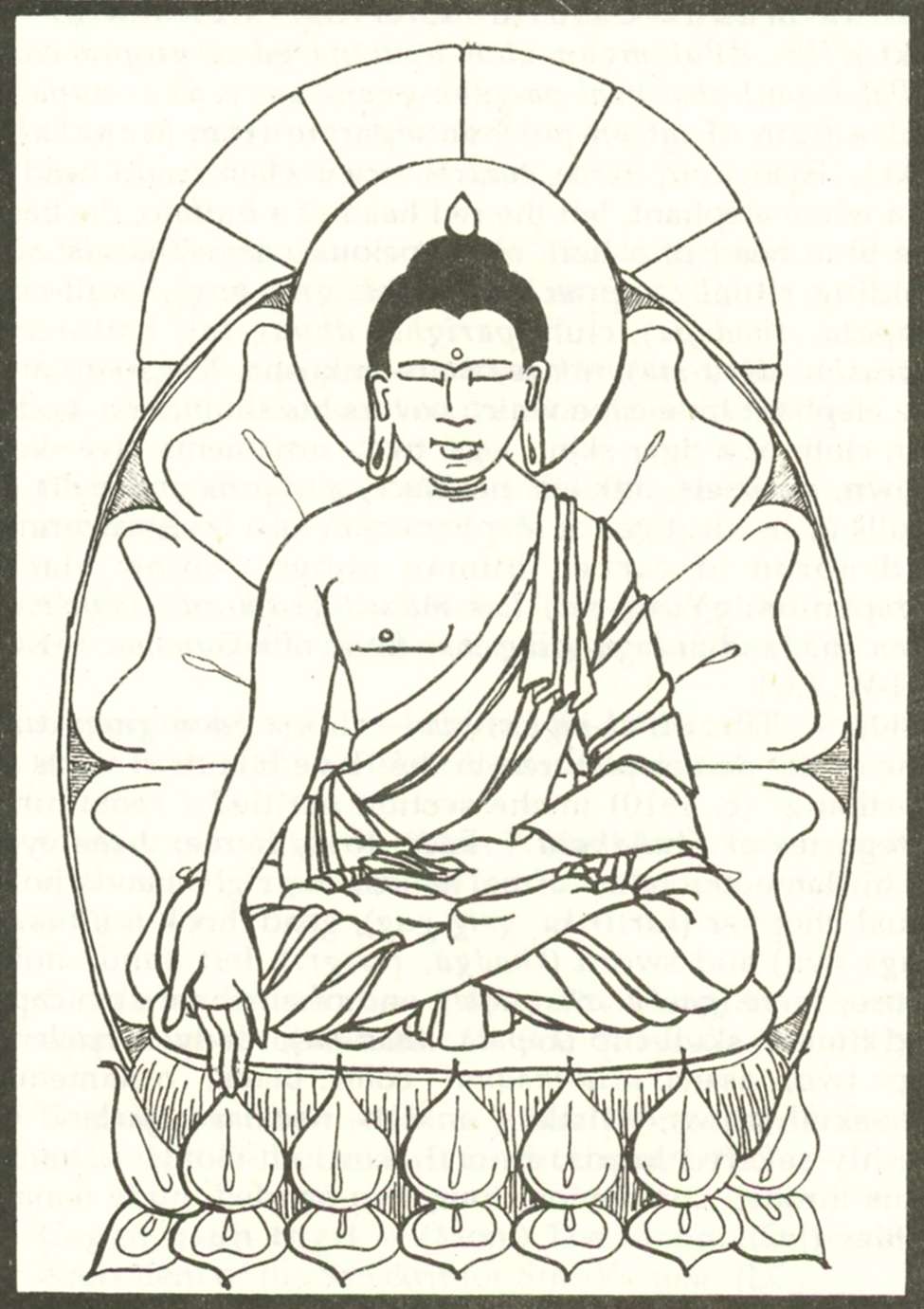
Fig. 5 – A frontispiece to a Song-era edition of the Lotus Sutra (larger version). Image found here.
4. Final Thoughts
I hope that anyone unfamiliar with the Monkey King’s history can now make an informed judgement about online comments making claims about his gender.
And for those who still might want to go beyond an allegorical reading of the novel, you need to answer two questions:
- Why did the 1592 JTTW hint that Sun Wukong is FTM trans despite him being depicted as a man for centuries?
- Why were said hints used in place of scriptural examples of spiritual gender transition?
Answering these questions will require evidence, not an interpretation. I’m honestly not sure what that evidence would be since the evidence against it is so overwhelming.
I would be willing to accept the “possibility” of a trans Sun Wukong, though, if anyone can find an analysis of the character by a pre-20th-century Chinese literary critic expounding the same view. Please do not misinterpret this as me saying that there were no trans people prior to the 20th-century. I’m sure there have been many throughout history, and I’m sure the terms applied to or used by them in the past were wildly different from the ones used today. But without some kind of historical support, the reality of a canonically trans Monkey King, beyond a personal interpretation, is nothing more than a wish.
Update: 05-19-2023
It’s recently come to my attention that this article has upset some people, namely those who are aware of the Monkey King’s worship and those who disagree with the concept of transgender people. The first group needs to understand that, while a religious figure, Sun Wukong is far more widely known around the world as a literary figure. And since people primarily view him as a fictional character—one who is in the public domain, in fact—they are free to interpret the simian immortal however they see fit. This means that both the Monkey God and the literary Monkey King should be viewed as two separate entities.
For the second group, the trans identity is outside my area of research and personal experience. Therefore, I can’t really say anything about the subject that would affect your point of view. My advice would be to ignore political pundits and instead start a dialogue with someone in the trans community to understand their thoughts, feelings, and motivations.
I’ve also learned that my article has apparently been weaponized by some on discord in an attempt to invalidate the views of trans individuals who identify with Sun Wukong. I don’t like that my work is being used to harass people. I want to make it clear that this article was not written to attack the trans community. It was solely made to place Monkey in his correct historical context. My first concern as a student of JTTW is that the history of the novel and its characters are presented accurately. But I am fully aware that perceptions of popular characters can and do evolve over time. That’s why I mentioned in the opening that viewing Sun as trans is perfectly fine as long as it’s clear that this is a personal interpretation. Therefore, if you are a trans person and some troll presents my article as proof that your personal allegory is wrong, please have the confidence to tell them, “off you fuck.”
Update: 05-27-23
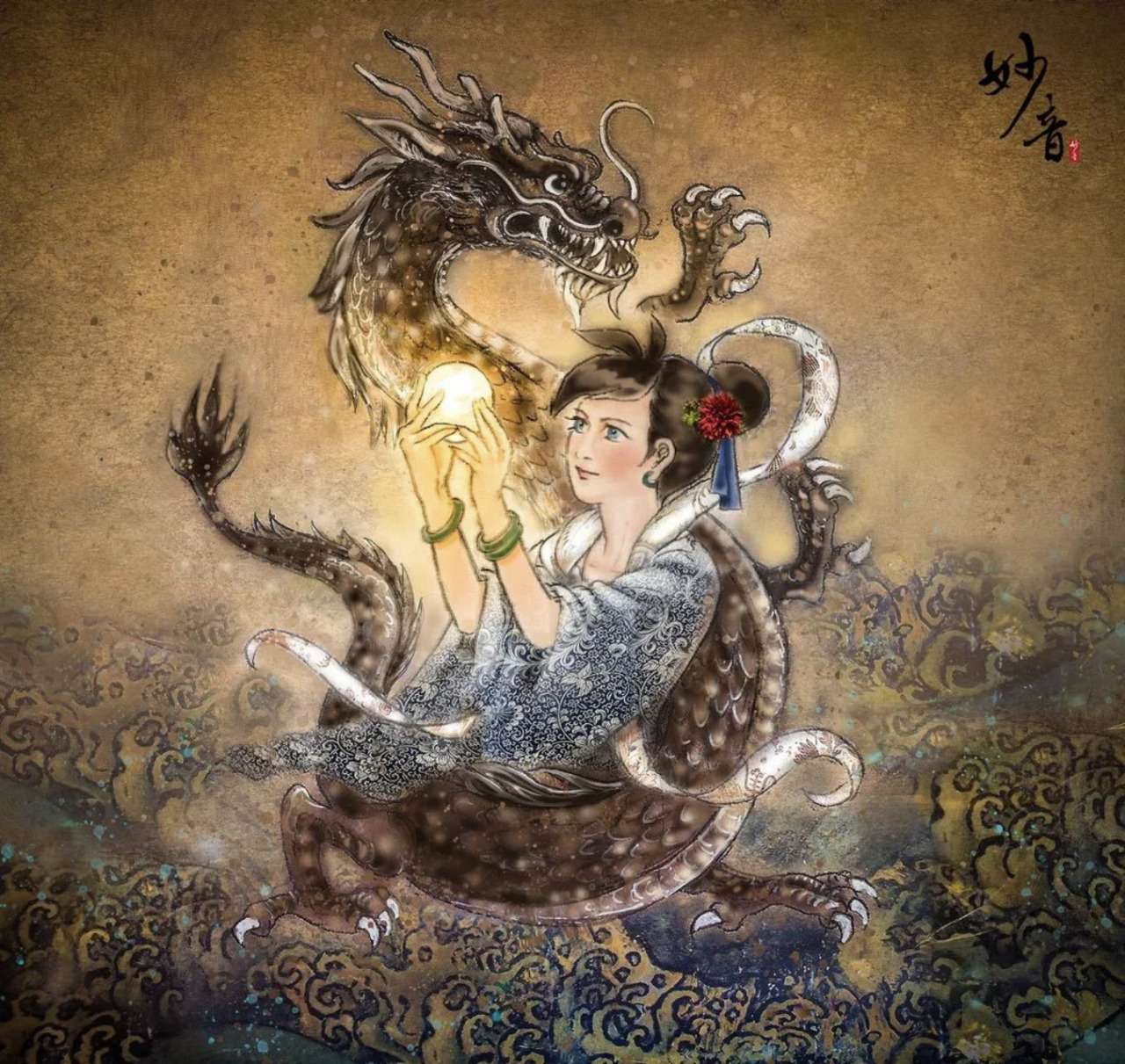
I found this lovely drawing of the Dragon Girl online (fig. 6). The image depicts her at the moment when she hands the Buddha the priceless jewel, just prior to transforming into a man.

Fig. 6 – A drawing of the Dragon Girl and the priceless jewel (larger version). Image found here.
Update: 08-09-23
It just occurred to me that another reason why Sun Wukong might be called Meihou wang (美猴王), or “Handsome or Beautiful Monkey King,” is because it’s a pun on mihou (獼猴), another word for macaque. The 1592 JTTW already includes a separate character named Mihou wang (獼猴王) in chapters three, four, and 41. And most importantly, even the Buddha’s past life as a king of monkeys is called Mihou wang (獼猴王). See the article below for more info.
A Brief Study of the Term Mihou (獼猴) in Journey to the West
Update: 09-27-23
It just dawned on me that Sun Wukong’s precursor, the Monkey Pilgrim” from the 13th-century JTTW, is also called Mihou wang (獼猴王). Chapter two refers to him as Huaguo shan ziyun dong bawan siqian tongtou tie’e Mihou wang (花果山紫雲洞八萬四千銅頭鐵額獼猴王, the “Bronze-Headed, Iron-Browed King of the Eighty-Four Thousand Monkeys of the Purple Cloud Grotto on the Mountain of Flowers and Fruits”) (Wivell, 1994, p. 1182).
This might lend support to the suggestion in my 08-09-23 update above.
Update: 01-03-2024
Apart from the Lotus Sutra, there is another way to make Sun Wukong a woman. The idea is a byproduct of my recent “How to Kill Sun Wukong” article. It details a ritual (from another famous vernacular novel) that secretly steals an immortal’s spirit, tethers it to a straw effigy, and then kills the target by shooting it with arrows. In that article, I introduced a story idea where Zhu Bajie and/or Sha Wujing could race to stop the ritual. But what if they failed and the Monkey King was killed?
The rite only terminates the immortal’s physical body. It doesn’t destroy the spirit. And since Wukong hasn’t yet achieved Buddha-Nature, meaning he is still subject to the wheel of rebirth, his spirit would report to the underworld for processing. He could definitely be transferred to a new reincarnation; however, considering the journey would still be ongoing, and the Tang Monk is always in trouble, heaven might rush to find our hero a new body. This actually happens to a minor character in the 1592 JTTW.
The ledgers of hell show that the deceased wife of a Tang official was fated to live a long life (i.e. she wasn’t supposed to be dead). Therefore, the underworld bureaucracy takes the timely passing of the Tang Emperor’s sister as an opportunity to force the soul of the official’s wife into the princess’ body. The best part is that she still retains her memories from her past life (Wu & Yu, 2012, vol. 1, pp. 268-269)!
Heaven might find the only suitable body that can contain Monkey’s soul is a recently deceased demoness (fox, yaksha, tree, etc.). [9] I imagine this would result in Sun Wukong being weaker, not because she’s now a woman, but because few beings can match Monkey’s original physical and magical might. This would naturally lead to her coming to terms with a loss of power. She could still be a very strong fighter, just not as strong as her past life. This might cause her to use more cunning when dealing with especially powerful evils encountered along the journey.
The choice is yours if you want to keep her a woman or have her become a male Buddha, like the Dragon Girl.
Update: 03-27-25
Another thing to point out is that Monkey’s physical body only changes when he turns into animals. When he mimics a humanoid figure, only his face changes, not his body. This is revealed when Sun is captured in chapter 75:
“Elder Brother,” said the third fiend,” didn’t you see him? He [Wukong disguised as a small demon] was giggling just now with his face half turned, and I saw for a moment a thunder god beak on him. When I grabbed him, he changed back immediately into his present looks.” He then called out: “Little ones, bring me some ropes.” The captains took out ropes immediately. Wrestling Pilgrim to the ground, the third fiend had him hog-tied before they hitched up his clothes to examine him. It became apparent at once that he was the BanHorsePlague all right! Pilgrim, you see, was capable of seventy-two kinds of transformation. If it was a matter of changing into a fowl, a beast, a plant, a utensil, or an insect, his entire body could be transformed. But when he had to change into another person, only his face but not his body could be transformed (emphasis added). When they lifted up his clothes, therefore, they saw a body full of brown fur, two red buttocks, and a tail (Wu & Yu, 2012, vol. 3, p. 367).
三怪道:「哥哥,你不曾看見他?他才子閃著身笑了一聲,我見他就露出個雷公嘴來。見我扯住時,他又變作個這等模樣。」叫:「小的們,拿繩來。」眾頭目即取繩索。
三怪把行者扳翻倒,四馬攢蹄綑住。揭起衣裳看時,足足是個弼馬溫。原來行者有七十二般變化,若是變飛禽、走獸、花木、器皿、昆蟲之類,卻就連身子滾去了;但變人物,卻只是頭臉變了,身子變不過來。果然一身黃毛,兩塊紅股,一條尾巴。
Since his body does not change, this would imply that his sex does not change either.
Again, I’m not trying to anger anyone; I’m just presenting information from the novel to make sure that it is depicted accurately.
On that note, I was told by a friend that some young trans folk were/had been upset with this article. Please write me (see “contact” above) if something about this piece bothers you. I’d like to get your perspective.
Notes:
1) One of the suggested earliest meanings for wang (王) is “big man,” and it was used as a title by the tribal chieftains that would evolve into Chinese emperors (Qi, 1991).
2) Yes, I am aware that Dudbridge (1970) also associates white robes with female demons (p. 32 n. 3). However, the Monkey Pilgrim is expressly associated with the white clothing of the historically male xiucai scholar candidates.
3) These similar episodes include the reincarnation of a heavenly being as Tripitaka, the murder of his father, Sun Wukong stealing immortal peaches from heaven and eventually being imprisoned under a mountain, his punishment with the restricting headband, the subjugation of Zhu Bajie (here and here) and Sha Wujing, the addition of a royal dragon-turned-white horse, the ordeal at Fire Mountain, the Country of Women, etc. This shows that the centuries-old story cycle was starting to become standardized by the 14th or 15th-century.
4) One example is “A Supplement to Jiang Zong’s Biography of a White Ape” (Bu Jiang Zong Baiyuan Zhuan, 補江總白猿傳, c. late-7th-century). In the story, a general’s young wife is kidnapped by a mysterious force, but he and his soldiers later find her living among a large harem of women in a mountain paradise. They tell the commander that their captor is a magic white ape who uses them night after night to fuel his Daoist sexual alchemy. The women also warn him and his men that they are no match for the beast’s great power, so the captives devise a plan that eventually leads to the primate’s death. In the end, the general learns that his wife is pregnant with the spirit’s child.
What’s interesting for the purposes of this blog is that the titular white ape shares many surprising parallels with the Sun Wukong from the 1592 JTTW. Both:
- Are supernatural primates possessed of human speech.
- Are one thousand-year-old practitioners of longevity arts.
- Are masters of Daoist magic with the ability to fly and change their appearance.
- Are warriors capable of single-handedly defeating an army.
- Have a fondness for armed martial arts.
- Have an iron-hard, nigh-invulnerable body immune to most efforts to harm them.
- Have eyes that flash like lightning.
- Live in verdant mountain paradises (like the Mountain of Flowers and Fruit).
- Reside in caves with stone furniture (like the Water Curtain Cave).
5) See Wu & Yu, 2012, vol. 3, p. 129.
6) An example of the latter appears in Chapter 23 of the Lotus Sutra. Women are promised a male rebirth in paradise for having heard and practiced the scripture (Watson, 1993, pp. 287-288).
7) For the Dragon Girl’s story, see Watson, 1993, pp. 187-189.
8) The Lotus Sutra, which contains the story of the Dragon Girl, is given prominence in the 13th-century oral JTTW. It is painted as an important scripture, one even hailed in heaven. Chapter three sees the monk Tripitaka (referred to here by his historical name Xuanzang) give a detailed lecture on the sacred text:
The arhats said: “We thank the Master for coming to the [heavenly] palace today. Does the master excel in explaining sutras?” Xuanzang replied: “If it is a sutra, I can explain it. If it is not, I do not.” “Can you explain the Lotus Sutra?” the arhat asked. Xuanzang replied: “That’s easy.” (emphasis added)
Thereupon the five hundred arhats, the [king of heaven] Mahabrahma Devaraja, and in all a company of over a thousand gathered to listen to the sutra. Xuanzang recited flawlessly without pausing for breath. Like pouring water from a vase, he clarified the obscurities of the text (emphasis added). Everyone praised his marvelous delivery (Wivell, 1994, p. 1184).
羅漢問曰:「今日謝師入宮。師善講經否?」玄奘曰:「是經講得,無經不講。」羅漢曰:「會講《法華經》否?」玄奘:「此是小事。」當時五百尊者、大梵王,一千餘人,咸集聽經。玄奘一氣講說,如瓶注水,大開玄妙。眾皆稱贊不可思議。
9) I even considered Princess Iron Fan as the receptacle. However, she is said to having a positive fate in the novel: “In the end she, too, attained the right fruit [i.e. Buddhist merit] and a lasting reputation in the sutras” (Wu & Yu, 2012, vol. 3, p. 163). I think choosing her would muddy our Lady’s accomplishments.
Sources:
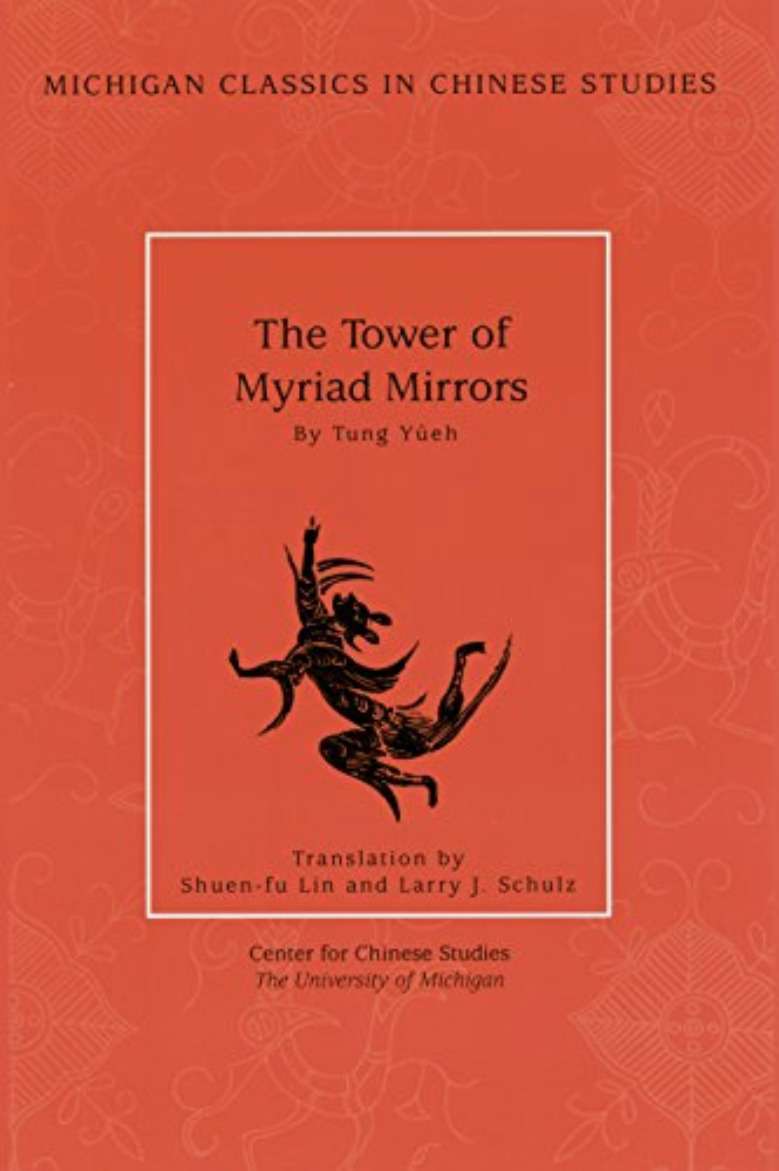
Dong, Y., Lin, S. F., & Schulz, L. J. (2000). The Tower of Myriad Mirrors: A Supplement to Journey to the West. Ann Arbor: Center for Chinese Studies, The University of Michigan.
Dudbridge, G. (1970). The Hsi-yu chi: A Study of Antecedents to the Sixteenth-Century Chinese Novel. Cambridge: Cambridge University Press.
Hucker, C. O. (1985). A Dictionary of Official Titles in Imperial China. Taipei: SMC Publishing Inc.
Ning, C. Y. (1986). Comic Elements in the Xiyouji Zaju (UMI No. 8612591) [Doctoral Dissertation, University of Michigan]. ProQuest Dissertations and Theses Global.
Qi, W. (1991). An Inquiry into the Original Meaning of the Chinese Character for King (wang). Chinese Studies in History, 25(2), 3-16, DOI: 10.2753/CSH0009-463325023
Shahar, M. (1992). The Lingyin Si Monkey Disciples and The Origins of Sun Wukong. Harvard Journal of Asiatic Studies, 52(1), 193-224. https://doi.org/10.2307/2719331
Shi, N., & Luo, G. (2021a). Shuihu zhuan (shang, zhong, xia) [Tale of the Water Margin (Vols. 1-3)]. Beijing: Renmin wenxue chubanshe. (Original work published 1975)
Shi, N., & Luo, G. (2021b). Outlaws of the Marsh (Vols. 1-4) (S. Shapiro, Trans.). Beijing: Foreign Languages Press. (Original work published 1993)
Watson, B. (Trans.) (1993). The Lotus Sutra. New York: Columbia University Press.
Wivell, C.S. (1994). The Story of How the Monk Tripitaka of the Great Country of T’ang Brought Back the Sūtras. In V. Mair (Ed.), The Columbia Anthology of Traditional Chinese Literature (pp. 1181-1207). New York: Columbia University Press.
Wu, C., & Yu, A. C. (2012). The Journey to the West (Vols. 1-4) (Rev. ed.). Chicago, Illinois: University of Chicago Press.