Sun Wukong’s Surname and its Connection to Daoist Doctrine

Did you know the Monkey King’s surname is a pun for immortality? I’ve previously mentioned that his surname Sun (孫, “macaque” or “grandson”) was chosen because he resembles a macaque monkey (猢猻, husun), and his given name Wukong (悟空, “awakened to emptiness”) is most likely based on the religious moniker of an 8th-century Chinese Buddhist monk who lived in India. However, the surname references Daoist internal practices. Talking about the individual components of the surname, the patriarch Subhuti states: “Zi [子] means boy and xi [系] means baby, and that name exactly accords with the fundamental Doctrine of the Baby Boy [正合嬰兒之本論]. So your surname will be Sun” (Wu & Yu, 2012, p. 115). Comparative religious scholar and JTTW translator Anthony C. Yu explains, “The Baby Boy is none other than the ‘holy embryo or shengtai 聖胎,’ the avatar of the realized state of immortality in the adept’s body” (Wu & Yu, 2012, p. 86). Daoist doctrine dictates that the three vital essences of jing (semen), qi (breath), and shen (spirit) combine to create this holy embryo. Daoist and Buddhist texts sometimes illustrate realized immortality or enlightenment as the image of a baby on a practitioner’s stomach.

Click the image to open in full size.

Source:

Wu, C., & Yu, A. C. (2012). The Journey to the West (Vol. 1). Chicago, Illinois: University of Chicago Press.

Sun Wukong and the Rhesus Macaque

Last updated: 05-18-17

Did you know that Sun Wukong is based on a real species of monkey? In chapter one, the patriarch Subhuti tells Sun: “Though your features are not the most attractive, you do resemble a pignolia-eating macaque [husun, 猢猻].” [1] The master dismisses the Hu (猢) character for linguistic reasons, and he drops the animal radical (犭) for religious reasons, leaving Sun (孫, “grandson”) as Monkey’s surname. Possibly quoting an earlier source, the noted Ming physician Li Shizhen (1518-1593) explains the meaning of husun and associates it with a particular genus: “Since a macaque resembles a Hu-barbarian [胡], he is also called hu-sun, ‘grandson of a barbarian’” (Gulik, 1967, p. 35). There are several species of macaque native to China, but anthropologist Frances D. Burton (2005) believes the Rhesus macaque (Macaca mulatta) is the best fit:

Monkey goes bare-headed and wears a red dress, with a yellow sash, and black shoes. This is a fitting description of M. mulatta, whose reddish fur on shoulders and back yields to lighter, more yellowish fur on the abdomen, and whose feet and hands are black. The ‘pouch’ to which the Monkey King himself refers [to in the novel] would likely be the cheek-pouches common in macaques, but not gibbons or leaf-eating monkeys.

[…]

One of Monkey King’s epithets is ‘Fiery Eyes”. His red eyes–a characteristic he shares with the actual red-rimmed eyes of M. mulatta [Fig.1][…]–resulted from his punishment in a crucible. […] He is also a ‘red-bottomed horse ape’, which suggests M. thibetana or, again M. mulatta, both of which are large animals, with pronounced redness on the bottom, especially during reproductive phases (p. 148).

Click the image to open in full size.

Fig. 1- A comparison of Rhesus macaques with red-rimmed eyes during mating season (top left) and other times (bottom left) (larger version). Fig. 2 – An 1865 piece by Yoshitoshi (larger version).

In chapter two, a monster describes Monkey as being “not [even] four feet tall” (Wu & Yu, 2012, p. 128). Rhesus males measure on average 1.74 feet (Lang, 2005). But I imagine these measurements were taken while they were in a quadrupedal posture (on all fours), which would make them taller if they stood.

I think all of this information is important as modern day depictions of Sun portray him as a man (or the size of a man) or a hulking brute with huge muscles. Such depictions are extremely inaccurate. He is a short monkey, plain and simple. His great strength, martial arts skill, and magical abilities make him a formidable warrior, not his size. I think the Japanese produced the most accurate renderings of monkey. The work of Yoshitoshi (1839-1892) is a good example (Fig. 2).


Update: 05-18-17

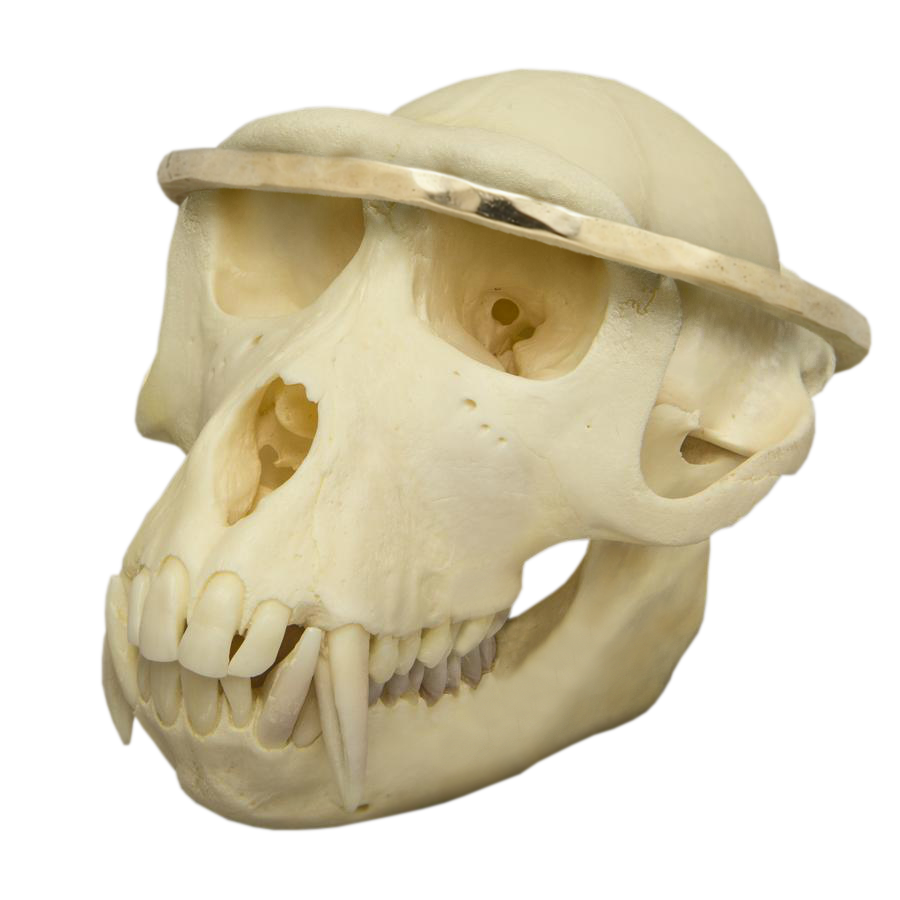
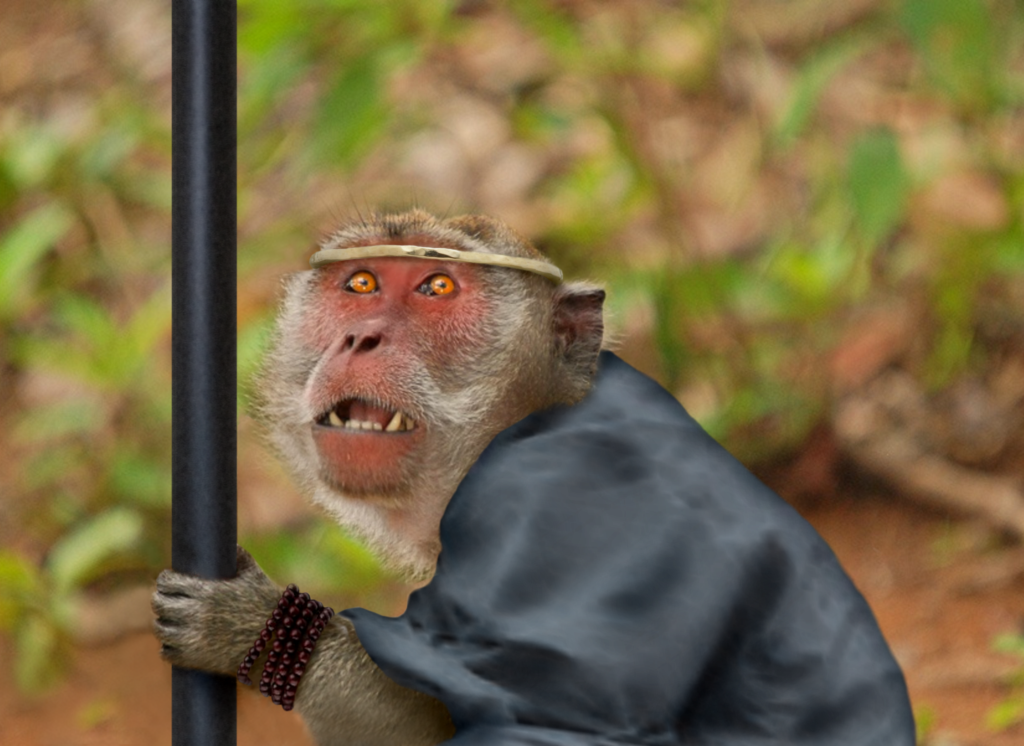
Readers will no doubt recall the golden fillet that Sun Wukong unwillingly wears on his crown. Humanoid depictions of the character show the band sitting on the frontal and parietal areas of the skull. But since Rhesus macaques have a much smaller brain pan, the circlet would have to wrap around the top of the eye orbits and the back of the occipital bone in order to be effective (fig. 1). It would set just above the eyelids (fig. 2).

Fig. 1 – A Rhesus Macaque skull adorned with the golden fillet (larger version). Fig. 2 – A modern depiction of Sun Wukong wearing the circlet (larger version). Photomanipulations by the author.

Notes:

1) Source altered slightly. The original quote states, “…you do resemble a pignolia-eating monkey (husun)” (Wu & Yu, 2012, p. 115).

Sources:

Burton, F. D. (2005). Monkey King in China: Basis for a Conservation Policy? In A. Fuentes & L. D. Wolfe (Eds.), Primates Face to Face: Conservation Implications of Human-Nonhuman Primate Interconnections (pp. 137-162). Cambridge: Cambridge University Press.

Gulik, R. H. (1967). The Gibbon in China: An Essay in Chinese Animal Lore. Leiden: E.J. Brill.

Lang, K. C. (2005). Rhesus macaque Macaca mulatta. Retrieved from http://pin.primate.wisc.edu/factsheets/entry/rhesus_macaque

Wu, C., & Yu, A. C. (2012). The Journey to the West (Vol. 1) (Rev. ed.). Chicago, Illinois: University of Chicago Press.

Journey to the West and Islamic Lore

Last updated: 04-07-2024

I. Battle of Transformations

Did you know that certain portions of Journey to the West were influenced by Indo-Persian and Arab Islamic lore? For instance, in chapter six, Sun Wukong and Lord Erlang engage in a magical battle of skill in which they freely transform into myriad animals, each trying to one-up the other. This battle is unusual as Chinese stories going back to pre-Tang dynasty sources show that characters could not transform into successive beasts at will (Hsia, 1968/2015, pp. 122-123). Conversely, One Thousand and One Arabian Nights (1704), which is based on stories as far back as the 9th-century, contains a tale featuring a magical battle of transformations between a princess and a genie (Hsia, 1968/2015, p. 122). Literary critic C.T. Hsia (1968/2015) notes that the similarities in magical combat “does not mean…the makers of the Monkey legend were specifically indebted to [the Arabian Nights], but it certainly indicates their general awareness of the popular literature of the Middle and Near East” (p. 123).

(Note: I no longer feel Hsia’s (1968/2015) suggestion is accurate. See the 11-21-2019 update below.)

Click the image to open in full size.

Fig. 1 (left) – Modern pears grown in molds to imitate ginseng baby fruit. Fig. 2 (right) – A 14th to 15th-century illuminated manuscript depicting the women fruit of the Waqwaq tree (larger version).

II. Magic Tree

Chapters 24 to 26 of Journey to the West feature a magical Ginseng Tree (Renshen shu, 人參樹; a.k.a. “Immortal/Divine Root of the Five Villages Abbey,” Wuzhuang guan li xiangen, 五莊觀裡仙根) that produces crying, baby-shaped ginseng fruits (renshen guo, 人參果; a.k.a. “grass of reverted cinnabar,” cao huandan, 草還丹; a.k.a. “long-life grass of reverted cinnabar,” wanshou cao huandan, 萬壽草還丹) capable of extending the lives of those who eat them to 47,000 years (fig. 1). The literary antecedent of this fruit first appears in The Story of How Tripitaka of the Great Tang Procures the Scriptures (Da Tang Sanzang qujing shihua, 大唐三藏取經詩話; “The Story” hereafter), a 17-chapter storytelling prompt dated to the late 13th-century. Chapter 11 features an immortal peach tree with fruits that transform into edible children once they drop into water. Each is capable of answering when asked a question:

Monkey Pilgrim continued: ‘There are more than ten peaches on the tree now, but there are gods of the earth who are posted here especially to protect them. There is no way to steal the peaches.’ The Master teased: ‘Your supernatural powers are stupendous. If you were to go, what could prevent you?’ Before his words were finished three peaches of immortality fell down into the pool. The Master was startled by the splash and he asked: ‘What fell down?’ Monkey Pilgrim replied: ‘Don’t be alarmed, Master. It was just a few ripe peaches of immortality which fell into the pool.’ The Master said: ‘Can we find them and eat them?’

Monkey Pilgrim took the golden-ringed staff and shook it three times in the direction of the huge, flat stone. A small child with a greenish face appeared. His fingernails were as sharp as a hawk’s claws and from his gaping mouth the teeth showed as he emerged from the pool. Pilgrim asked: ‘How old are you?’ The child answered: ‘Three thousand years.’ Pilgrim replied: ‘I have no use for you.’ Again he rapped five times and a child appeared whose face was as round as the full moon. He wore embroidered clothes and a headdress with tassels. Pilgrim asked: ‘How old are you?’ The child replied: ‘Five thousand years.’ Pilgrim replied: ‘I will not use you.’ And once more he rapped several times with the staff. Another child appeared all of a sudden. Monkey Pilgrim asked: ‘How old are you?’ ‘Seven thousand years,” the child replied. Monkey put down the golden-ringed staff and made the child get on his hand. Then he asked: ‘Monk! Will you eat this?’ The monks were terrified and fled. Pilgrim whirled his hand with the child in it a number of times and the child became a milky jujube which he popped into his mouth (Wivell, 1994, p. 1196).

猴行者曰:「樹上今有十餘顆,為地神專在彼此守定,無路可去偷取。」師曰:「你神通廣大,去必無妨。」說由未了,攧下三顆蟠桃入池中去。師甚敬惶。問:「此落者是何物?」答曰:「師不要敬,此是蟠桃正熱,攧下水中也。」師曰:「可去尋取來吃。」

猴行者即將金鐶杖向盤石上敲三下,乃見一個孩兒,面帶青色,爪似鷹鷂,開口露牙,從池中出。行者問:『汝年幾多?」孩曰:「三千歲。」行者曰:「我不用你。」又敲五下,見一孩兒,面如滿月,身掛繡纓。行者曰:「汝年多少?」答曰:「五千歲。」行者曰:「不用你。」又敲數下,偶然一孩兒出來。問曰:「你年多少?」答曰:「七千歲。」行者放下金鐶杖,叫取孩兒入手中,問:「和尚,你吃否?」和尚聞語,心敬便走。被行者手中旋數下,孩兒化成一枝乳棗,當時吞入口中。後歸東土唐朝,遂吐出於西川。至今此地中生人參是也。

The concept of speaking, human-shaped fruit can be traced to the “Waqwaq tree” from Islamic lore. For example, The Book of the Wonders of India (Kitaab Ajaaib al-Hind), a set of Indo-Persian sailor stories collected between 900 and 953, contains a brief anecdote which reads:

Muhammad b. Babishad told me that, according to what he had learnt from men who had been to the Waqwaq country, there is a large tree there, with round leaves, or sometimes oblong, which bears fruit like a marrow, only larger, and looking something like a human being. When the wind blows, a voice comes out of it. The inside is full of air, like the fruit of the usher. If one picks it, the air escapes at once, and it is nothing but skin (Buzurg & Freeman-Grenville, 1981, p. 39).

The 15th-century Arab historian Ibn al-Wardi took the concept further by describing the fruit as being shaped like voluptuous women (fig. 2) with the power of speech:

On this island are trees that bear as fruit women: shapely, with bodies, eyes, hands, feet, hair, breasts, and vulvas like the vulvas of women. Their faces are exceptionally beautiful and they hang by their hair. They come out of cases like big swords, and when they feel the wind and sun, they shout “Waq Waq” until their hair tears (Toorawa, 2000, p. 393).

Various sources respectively locate the Waqwaq tree and its home of Waqwaq, a faraway, exotic land or island, somewhere within the Indian Ocean, beyond Iraq, or, further still, beyond China. The Waqwaq term was most likely used to describe the limits of the known world at given times (Toorawa, 2000). The tree itself can possibly be traced to a passage in the Quran (Sura 37, verses 60-64) that describes how the “Tree of Zakkum” produces fruit shaped like the heads of demons. The earliest mention of the Waqwaq tree in Chinese sources appears in the late 8th-century Comprehensive Encyclopedia (Tongdian, 通典) by the travel writer Du Huan (杜環). This is apparently based on an earlier Arabic source (A floral fantasy, n.d.).


Update: 02-28-2018

I was looking through the Ming-era Illustrated Encyclopedia of the Three Realms (Sancai tuhui, 三才圖會, 1609; “Three Realms” hereafter) and happened upon a woodblock print of a Waqwaq tree (fig. 3). The image is labeled Dashi Guo (大食國), a term used since the Tang Dynasty to refer to an ancient country in the Arab World (Zhang & Unschuld, 2015, p. 81). This shows the Chinese were still aware of the tree’s foreign origin around the time that Journey to the West was published.

Ginseng tree - From Sancai tuhui (1609), based on image of Iskander (Alexander the Great) talking to the Talking Tree from the Shamanah

Fig. 3 – Woodblock print from the Three Realms showing the Waqwaq tree (larger version).


Update: 11-21-2019

As noted above, Hsia (1996) suggests the battle of transformations between Monkey and Erlang was influenced in some way by Islamic literature. However, Robinet (1979) describes a tit-for-tat battle from Daoist literature that casts doubt on this view:

The Xianyuan bianzhu [仙苑編珠, “Paired Pearls from the Garden of Immortals,” after c. 921] tells how Wang Tan [王探] received “the art of hiding his light and transforming his body.” Dared by someone to metamorphose himself, he took the form of a tree, but the other fellow seized an axe. Wang immediately transformed himself into a stone, but the other lit a fire (in the theory of the five elements, fire prevails over minerals). After turning himself into bubbling water and so on, Wang Tan finally achieved the upper hand by adopting the appearance of a corpse-the man fled immediately (p. 46). [1]

The way the Daoist and his opponent try to one up the other is very similar to the battle between the Great and Small Sages. Therefore, it’s not a stretch to suggest this story (or related media) was embellished by a storyteller or the author-compiler of the Ming Journey to the West to include two masters of transformation instead of one.


Update: 04-04-2020

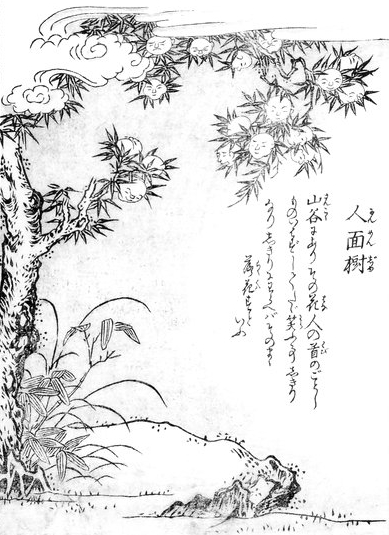
Thanks to a recent Twitter post by Guy Reisman, I was delighted to learn that the Islamic Waqwaq tree made its way to Japan, where it is known as the Jinmenju (人面樹, “human-face tree“). In fact, an illustration of the tree appearing in the Edo-period bestiary Konjaku Hyakki Shūi (今昔百鬼拾遺, “Supplement to The Hundred Demons from the Present and the Past,” c. 1781) appears to be based on that from the Three Realms cited above (refer back to fig. 3).

Even more exciting, however, is the revelation of the identity of the man standing beneath the tree in the Three Realms illustration. Foster (2015) traces the Japanese image to the Three Realms and then further back to a Persian source, thereby associating the man with a famous historical king:

If we continue back in time and along the Silk Road, we find different versions of the great Persian epic poem Shahnama (Book of Kings) by Firdawsi (d. 1020), with illustrations of a man conversing with a tree bearing human heads. The man, it turns out, is Alexander the Great (Sikandar or Iskandar), and the illustrations portray his legendary encounter with a talking tree, sometimes called the Wakwak Tree, that prophesied his death (p. 185).

That’s right, the man in the Three Realms is based on Alexander the Great! See image four for a comparison of the Chinese illustration and one example of Persian “Iskander and the Talking Tree”-genre drawings. Both men stand in a similar position, looking upwards. The Persian Alexander is passively listening, while the Three Realms Alexander is actively talking.

Iskander and the Talking Tree - Three Realms Ginseng Tree

Fig. 4 – A comparison of a 15th-century Persian “Iskander and the Talking Tree” image and the Three Realms image (larger version). The former is held by the Bodleian Library.

This then raises the question: Did material related to the Shahmana influence the Ginseng Tree in Journey to the the West? [2] I’ve already demonstrated that an antecedent of the Ginseng tree appears in The Story. But this doesn’t necessarily negate some sort of influence. After all, both the Shahmana and Journey to the West feature mythic kings (Alexander and Sun Wukong) coming into contact with magic trees with humanoid fruit. I should note, however, that the trees represent two drastically different fates. Alexander’s tree foresees his death, while Monkey’s tree holds the promise of eternal life. Further research might shed light on stronger connections between both stories.


Update: 04-03-22

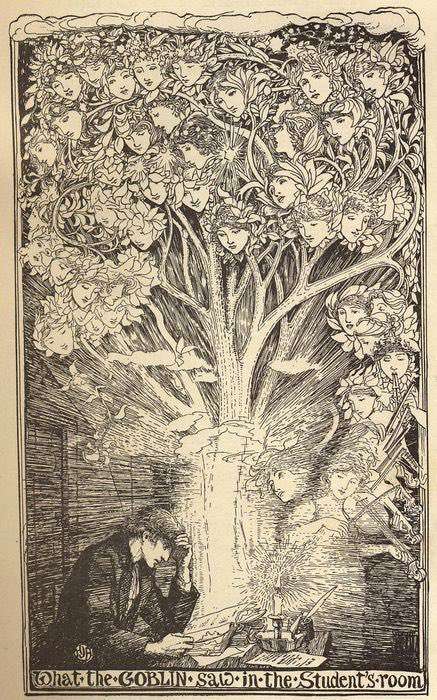
I was scrolling through Twitter, when I came across a post displaying a lovely 19th-century engraving of a magical tree from “The Goblin and the Grocer” (Danish: Nissen hos Spekhøkeren, 1852), a fairy tale by Hans Christian Andersen. The tree is shown to have smiling, female head-shaped fruits similar to the waqwaq tree (fig. 5). The description of the tree reads:

Out of the book shot a streak of light which grew into a large tree and spread its branches far above the student. Every leaf was alive, and every flower was a beautiful girl’s head, some with dark and shining eyes, others with wonderful blue ones. Every fruit was a glittering star” (Anderson, 1904, pp. 13-14)

So it appears that the waqwaq tree came to influence European literature as well.

Fig. 5 – The tree engraving from “The Goblin and the Grocer” (larger version). From Anderson, 1904, p. 15.


Update: 04-05-22

I’ve archived a paper showing that magical battles of transformation can be traced to Ancient Near Eastern, Egyptian, and Greek stories.

Archive #36 – Sun Wukong and Battles of Magical Transformations


Update: 04-07-24

Here is a description of the Ginseng Fruit Tree from ch. 24:

There was a huge tree right in the middle of the garden, with long, healthy branches and luxuriant green leaves that somewhat resembled those of the plantain. Soaring straight up, the tree was over a thousand chi [1,043.30 ft or 318 m] tall, and its base must have measured seven [73.03 ft or 22.26 m] or eight zhang [83.46 ft or 25.44 m] around. Leaning on the tree, Pilgrim looked up and found one ginseng fruit sticking out on one of the branches pointing southward. It certainly had the appearance of an infant with a tail-like peduncle. Look at it dangling from the end of the branch, with limbs moving wildly and head bobbing madly! It seemed to make sounds as it swung in the breeze (based on Wu & Yu, 2012, vol. 1, p. 461).

只見那正中間有根大樹,真個是青枝馥郁,綠葉陰森,那葉兒卻似芭蕉模樣,直上去有千尺餘高,根下有七八丈圍圓。那行者倚在樹下,往上一看,只見向南的枝上露出一個人參果,真個像孩兒一般。原來尾間上是個扢蒂,看他丁在枝頭,手腳亂動,點頭幌腦,風過處似乎有聲。

Notes:

1) I changed the Wade-Giles to Pinyin.

2) Hall (2019) explains Iskander’s meeting with the talking tree takes place in both the Shahmana and the older Greek Alexander Romance (p. 149).

Sources:

A floral fantasy of animals and birds (Waq-waq). (n.d.). Cleveland Museum of Art. Cleveland, Ohio. Retrieved May 12, 2017, from http://library.clevelandart.org/site…0Waq%20waq.pdf

Anderson, H. C. (1904). The Goblin and the Grocer. In A. Lang (Ed.), The Pink Fairy Book (pp. 12-17). New York: Longmans, Green, and Co. Retrieved from https://archive.org/details/pinkfairybook00lang/page/12/mode/2up

Buzurg, S., & Freeman-Grenville, G. S. P. (1981). The book of the wonders of India: Mainland, sea and islands. London: East-West.

Foster, M. D. (2015). The book of yōkai: Mysterious creatures of Japanese folklore. Oakland: University of California Press.

Hall, M. (2019). The imagination of plants: A book of botanical mythology. Albany : State University of New York Press

Hsia, C. (2015). The classic Chinese novel: A critical introduction (Rev. ed.). Hong Kong: The Chinese University of Hong Kong. ( Original work published 1968)

Robinet, I. (1979). Metamorphosis and deliverance from the corpse in Taoism. History of Religions, 19(1), 37-70.

Toorawa, S. M. (2000). WaÃq al-waÃq: Fabulous, fabular, Indian Ocean (?) island(s). Emergences, 10(2), 387-402.

Wivell, C.S. (1994). The story of how the monk Tripitaka of the great country of T’ang brought back the Sūtras In V. Mair (Ed.), The Columbia anthology of traditional Chinese literature (pp. 1181-1207). New York: Columbia University Press.

Zhang, Z., & Unschuld, P. U. (2015). Dictionary of the Ben cao gan mu: Volume 2 – Geographical and administrative designations. Oakland, California: University of California Press

The Monkey King and Cinderella

Did you know that the Monkey King has a connection to Cinderella?! In this brief article, I will summarize some of the findings laid out in Beauchamp (n.d.), which highlights the presence of the Cinderella story cycle in the ethnic folklore of China, a world famous India epic, and even Journey to the West (Xiyouji, 西遊記, 1592).

I. Egypt and Greece

Before I continue, I want to briefly mention one of the oldest Western variants of the Cinderella story cycle, Rhodopis, a tale set in ancient Egypt.

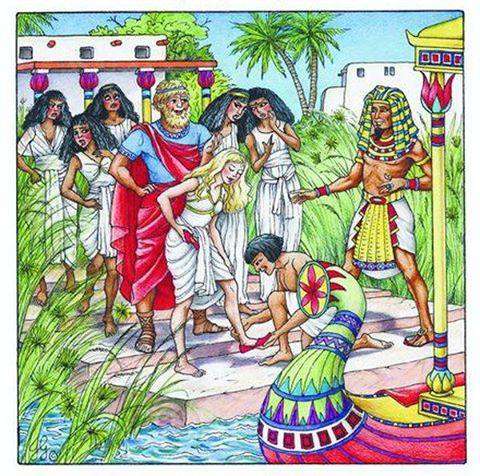
The story describes how the god Horus sends an eagle (or takes the form of one) to steal the slipper of the titular Greek slave and delivers it to an Egyptian Pharaoh, who launches a search for and eventually marries the woman (fig. 1). The tale was first recorded by the Greek geographer Strabo in 7 BCE (Ripley, 2010, pp. 185-188). However, the work is part of a wider story cycle evident throughout Asia and the Middle East.

Fig. 1 – The Pharaoh finds Rhodopis (larger version).

II. China

The earliest version that appears to have many of the familiar elements from the final European version hails from China. Titled “Yexian” (葉限), the story describes the titular heroine working as an imprisoned servant for her evil stepmother, the bestowal of a beautiful dress and slippers by a female ancestor from heaven, her attendance of a local festival, the loss of one of her slippers while fleeing the festivities, the discovery of the shoe by a foreign king, and a search that results in their eventual marriage. The story is based on the oral tales of the Zhuang ethnic people (of the Vietnamese-Chinese border) and was first recorded by Duan Chengshi (段成式) in the 9th-century CE (Ripley, 2010, pp. 191-192; Beauchamp, n.d.).

III. India

Certain elements of the story appear to have been influenced by the great Hindu epic the Ramayana, written by Valmiki around 500 BCE. The story tells how Sita, the wife of Vishnu’s reincarnation Prince Rama, is kidnapped and held prisoner by the demon Ravana (with the intent of making her his wife) on the island of Lanka. It is during her time in captivity that she is visited by Rama’s servant, Hanuman, a monkey demi-god, who brings her the prince’s ring to prove himself a trustworthy ally (fig. 2). The simian character then brings her anklet to Rama to prove that she is still alive. Rama’s army assaults Ranava’s fortress, and he is eventually reunited with his wife.

This at first may not seem like it matches at all, but you have an imprisoned beauty (Sita vs Yexian), supernatural assistance from heaven (Hanuman vs. the female ancestor), the exchange of personal items to prove one’s identity (the ring and anklet vs the slipper), and a campaign that brings together the woman and a man of royal blood (Sita and Rama vs Yexian and the foreign king) (Beauchamp, n.d.).

Hanuman gives Sita Rama’s ring in the Sandara Kanda book of the Ramayana:

Sarga 34

1. Hanuman, the immensely powerful son of Maruta the wind god, humbly addressed further words to Sita in order to inspire her confidence:
2. “I am a monkey, virtuous woman, a messenger of wise Rama. My lady, look at this ring marked with Rama’s name. Take heart, bless you, for your troubles will soon be at an end.”
3. Taking her husband’s ring and examining it, Janaki was as joyous as if she had rejoined her husband.
4. Her lovely face-its long eyes all red and white-lit up with joy, like the moon, the lord of stars, when released from Rahu, demon of the eclipse (Valmiki et. al., 2016, p. 207).

Fig. 2 – Hanuman giving Sita Rama’s ring (larger version).

IV. Journey to the West

Some scholars believe that secularized snippets of the Rama story cycle came to China in several waves, one of which was via Southeast Asian Hindu converts who settled in Southern China from the 7th-century onwards (Walker, 1998).

This then might explain an episode from Journey to the West that appears to draw from the Rama cycle. In chapters 68 to 71, a queen is kidnapped and held prisoner by a demon (with the intent of making her his wife) in a faraway land. Sun Wukong is employed to find her. He brings back a bracelet to her husband as proof of life and identity, and eventually reunites the couple after defeating the demon (Beauchamp, n.d.).

Monkey shows the bracelet to the Queen in chapter 70:

On hearing this, the lady shouted for the two rows of vixen and deer [spirits] to leave. After he closed the palace door, Pilgrim gave his own face a wipe and changed back into his original form. He said to the lady, “Don’t be afraid of me. I am a priest sent by the Great Tang in the Land of the East to go seek scriptures from Buddha in the Thunderclap Monastery of India in the Great Western Heaven. My master is Tripitaka Tang, the bond-brother of the Tang emperor, and I am Sun Wukong, his eldest disciple. When we passed through your kingdom and had to have our travel rescript certified, we saw a royal proclamation issued for the recruitment of physicians. I exercised my great ability in the therapeutic arts, and I cured the king of his illness of ardent longing. During the banquet he [came] to thank me, he told me while we were drinking about how you were abducted by the fiend. Since I have the knowledge of subduing dragons and taming tigers, he asked me specially to come arrest the fiend and rescue you back to the kingdom. It was I who defeated the vanguard, and it was I, too, who slew the little fiend [note: Monkey is disguised as him]. When I saw, however, how powerful the fiend was outside the gate, I changed myself into the form of Going and Coming [note: the little fiend] in order to take the risk of contacting you here.”

On hearing what he said, the lady fell silent. Whereupon Pilgrim took out the treasure bracelets and presented them with both hands, saying, “If you don’t believe me, take a good look at these objects.”

The moment she saw them, the lady began to weep, as she left her seat to bow to Pilgrim, saying, “Elder, if you could indeed rescue me and take me back to the kingdom, I would never forget your great favor!” (Wu & Yu, 2012, vol. 3, p. 297).

娘娘聞言,喝退兩班狐、鹿。行者掩上宮門,把臉一抹,現了本像,對娘娘道:「你休怕我。我是東土大唐差往大西天天竺國雷音寺見佛求經的和尚。我師父是唐王御弟唐三藏。我是他大徒弟孫悟空。因過你國倒換關文,見你君臣出榜招醫,是我大施三折之肱,把他相思之病治好了,排宴謝我。飲酒之間,說出你被妖攝來。我會降龍伏虎,特請我來捉怪,救你回國。那戰敗先鋒是我,打死小妖也是我。我見他門外兇狂,是我變作有來有去模樣,捨身到此,與你通信。」那娘娘聽說,沉吟不語。行者取出寶串,雙手奉上道:「你若不信,看此物何來?」娘娘一見垂淚,下座拜謝道:「長老,你果是救得我回朝,沒齒不忘大恩。」

V. Comparison

Beauchamp (n.d.) provides a diagram showing the similarities between the stories of Yexian, Sita, and the queen from Journey to the West (fig. 3).

Fig. 3 – Comparative Chart of Cinderella Variants (larger version).

Sources:

Beauchamp, F. (n.d.). In the Realm of the Dragon King: Sita and Hanuman meet Cinderella and Sun Wukong. Retrieved from http://www.asdp-bridgingcultures.org/Beauchamp%20-%20Realm%%E2%80%A6. [Original link dead. Click on article title to read.]

Ripley, D. (2010). The Maiden with a Thousand Slippers: Animal Helpers and the Hero(ine)’s Journey. In P. Monaghan (Ed.). Goddesses in World Culture (pp. 185-200). Santa Barbara, California: Praeger.

Valmiki, Goldman, R. P., & Goldman, S. J. (2016). The Rāmāyaṇa of Vālmīki: An Epic of Ancient India, Volume V: Sundarakāṇḍa. United States: Princeton University Press.

Walker, H.S. (1998). Indigenous or Foreign? A Look at the Origins of Monkey Hero Sun Wukong. Sino-Platonic Papers, 81, pp. 1-117. Retrieved from https://sino-platonic.org/complete/spp081_monkey_sun_wukong.pdf.

Wu, C., & Yu, A. C. (2012). The Journey to the West (Vols. 1-4) (Rev. ed.). Chicago, Illinois: University of Chicago Press.

Sun Wukong and Indiana Jones

Did you know that Sun Wukong almost appeared in an Indiana Jones film? George Lucas wrote a brief eight page treatment as early as September 1984 (during the theatrical run of Temple of Doom), and later brought on Chris Columbus to flesh the story out. Columbus’ script sees Jones racing against the Nazis to find a fountain of youth in Africa, located in the lost city of the Monkey King (Jones, 2016, p. 368). Titled Indiana Jones and the Monkey King, a second draft depicts Wukong as an evil immortal who forces Jones to play a game of human chess, killing those living pieces taken from the board (Indiana Jones and the Monkey King, n.d.). A full version of the supposed script, incorrectly titled “Indiana Jones IV”, is available online. The end sees a benevolent Great Sage giving Jones his magic staff, telling him, “The Golden Hooped Rod will be a faithful friend. It is capable of one hundred transformations…and will always remain by your side” (Columbus, n.d.).

The script was eventually scrapped in favor of what would become Indiana Jones and the Last Crusade (1989) (Indiana Jones and the Monkey King, n.d.).

Sources:

Columbus, C. (n.d.). Retrieved January 26, 2017, from http://www.dailyscript.com/scripts/I…JONES_4_2.html

Indiana Jones and the Monkey King. (n.d.). Retrieved January 26, 2017, from http://indianajones.wikia.com/wiki/I…he_Monkey_King

Jones, B. J. (2016). George Lucas: A life. New York: Little, Brown and Company.