The Mountain of Flowers and Fruit and the Cosmic Geography of Journey to the West

Note: This page used to have historical information about the origin of Monkey’s first master, but I have moved it to a new article.

Last updated: 03-07-2023

The Monkey King’s home, the “Mountain of Flowers and Fruit” or “Flower-Fruit Mountain” (Huaguo shan, 花果山), is commonly assumed to be located in China. In fact, a mountain with the same name in Jiangsu province is even touted as the home of Sun Wukong. However, this is not the case within the novel’s narrative. It’s important to remember that Journey to the West (Xiyouji, 西遊記, 1592) is set in a world that is nothing like our Earth.

In this article, I will explain the location of the Mountain of Flowers and Fruit, showing that Sun Wukong’s home is in fact an island east of what would be considered China. This opens the door to interesting interpretations by those wanting to place the story within a real world context. Second, I will explain the ancient Buddhist disc world system as presented in the book. My hope is that this will give readers a better understanding of the cosmic geography in which the story happens. 

1. Religious background

Note: I will alternate between Wu & Jenner (2020) and Wu & Yu (2012), using one or the other depending on who I think has done a better job of translating certain passages.

Chapter one opens by describing the world in which the story is set:

The world was then divided into four great continents: The Eastern Continent of Superior Body, the Western Continent of Cattle-Gift, the Southern Continent of Jambu and the Northern Continent of Kuru (Wu & Jenner, 1993/2020, vol. 1, p. 3).

… 世界之間,遂分為四大部洲:曰東勝神洲,曰西牛賀洲,曰南贍部洲,曰北俱蘆洲。

Yu’s (Wu & Yu, 2012) translation provides romanization of the Sanskrit names (vol. 1, p. 100). I’ve listed them below, along with the original Sanskrit, an alternative English translation, and the Chinese for the reader’s reference:

  • East Pūrvavideha (Sk: पूर्वविदेह, “Surpassing the Body”; Ch: Dong shengshen zhou, 東勝神洲)
  • West Aparagodānīya (Sk: अपरगोदानीय, “Enjoyer of Cattle”; Ch: Xi niuhe zhou, 西牛賀洲)
  • North Uttarakuru (Sk: उत्तरकुरु, “Unpleasant Sound”; Ch: Bei julu zhou, 北俱盧洲)
  • South Jambudvīpa (Sk: जम्बुद्वीप, “Rose-Apple”; Ch: Nan shanbu zhou, 南贍部洲)

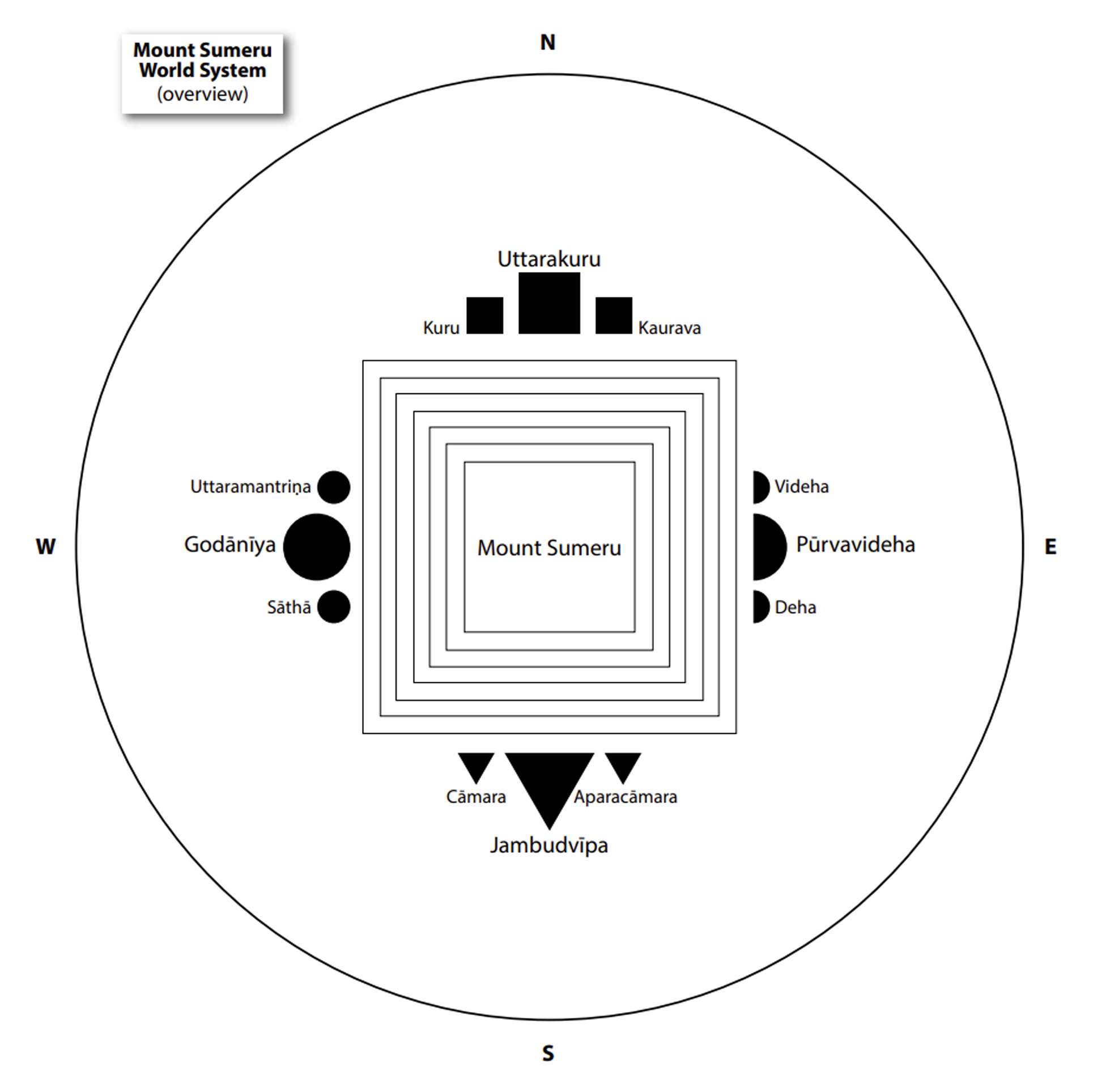
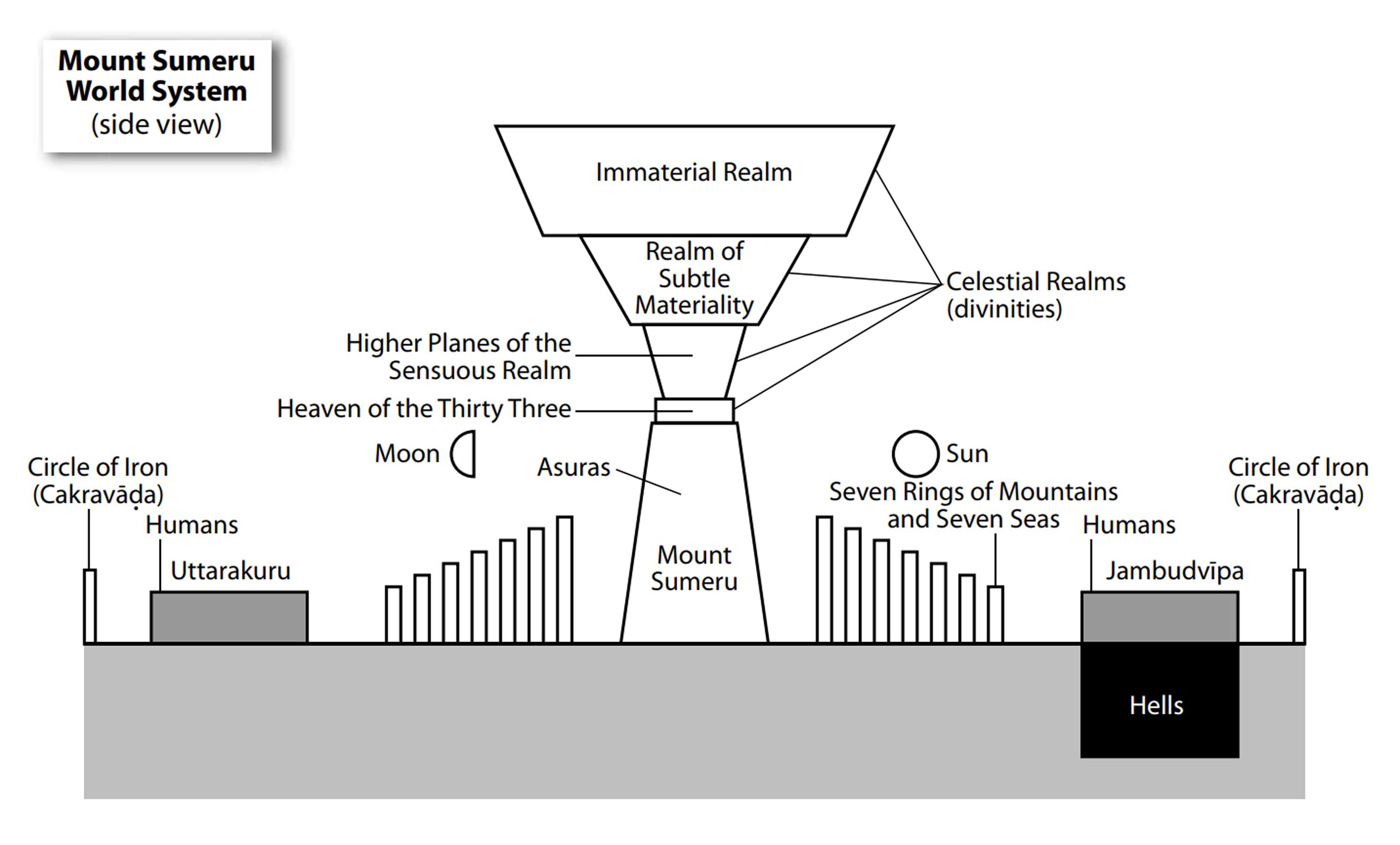
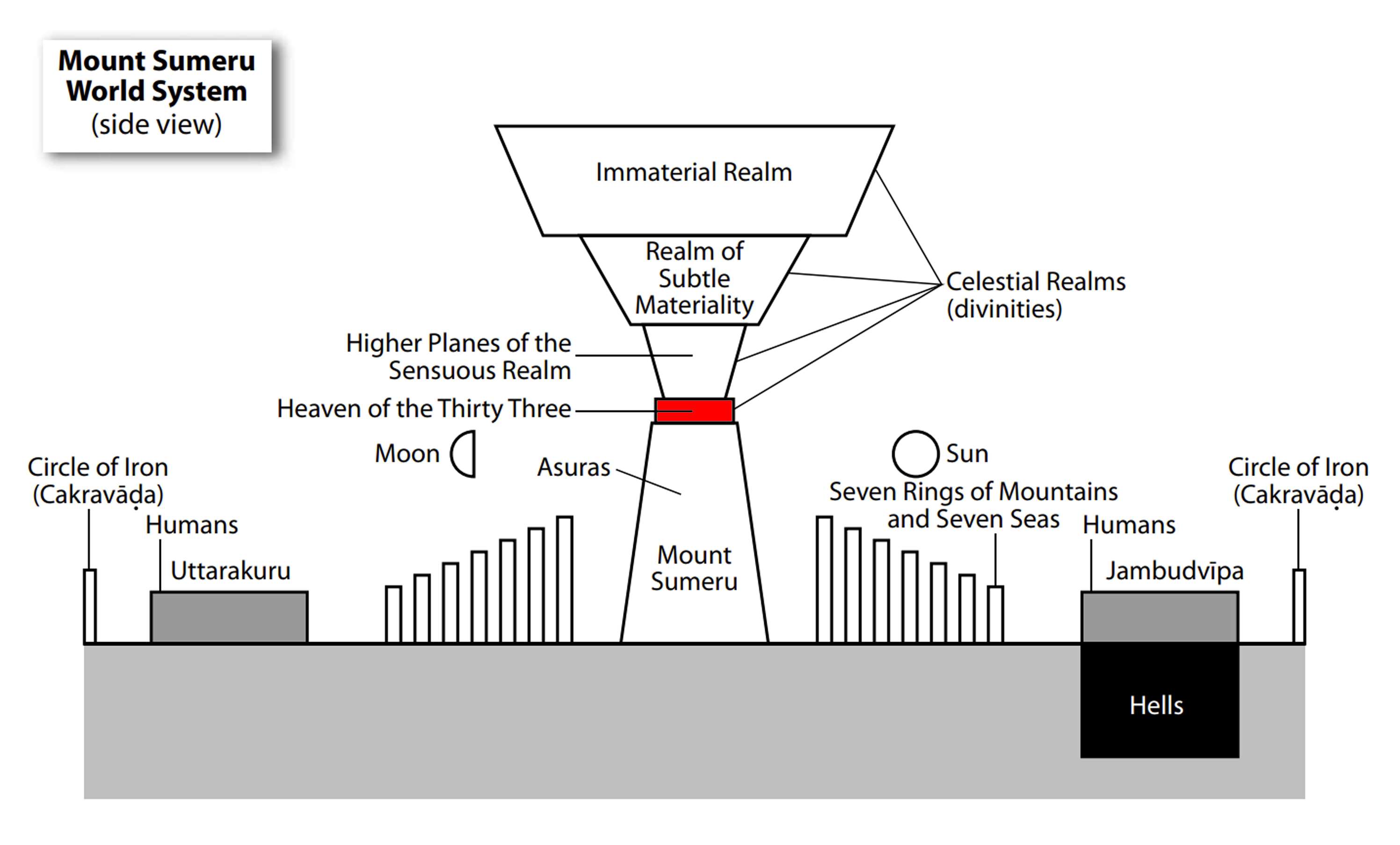
The Abhidharmakośa (Sk: अभिधर्मकोशभास्य; Ch: Api damo jushe lun, 阿毗達磨俱舍論, 4th to 5th-century), a text describing the Buddhist universe, states that the four continents each have two intermediate continents, and that all twelve are set afloat in a great ocean surrounding the four respective sides of Mt. Sumeru (Ximi shan, 須彌山; Miaogao shan, 妙高山). This is a giant mountain that serves as the axis mundi of the cosmos, as well as the abode of assorted gods and sages. It is surrounded by seven golden mountains of lesser height, as well as a final iron mountain around the outside rim of the ocean, which keeps the water from draining over the edge (fig. 1 & 2) (Vasubandhu, La Vallée-Poussin, & Pruden, 1991, pp. 452-456).

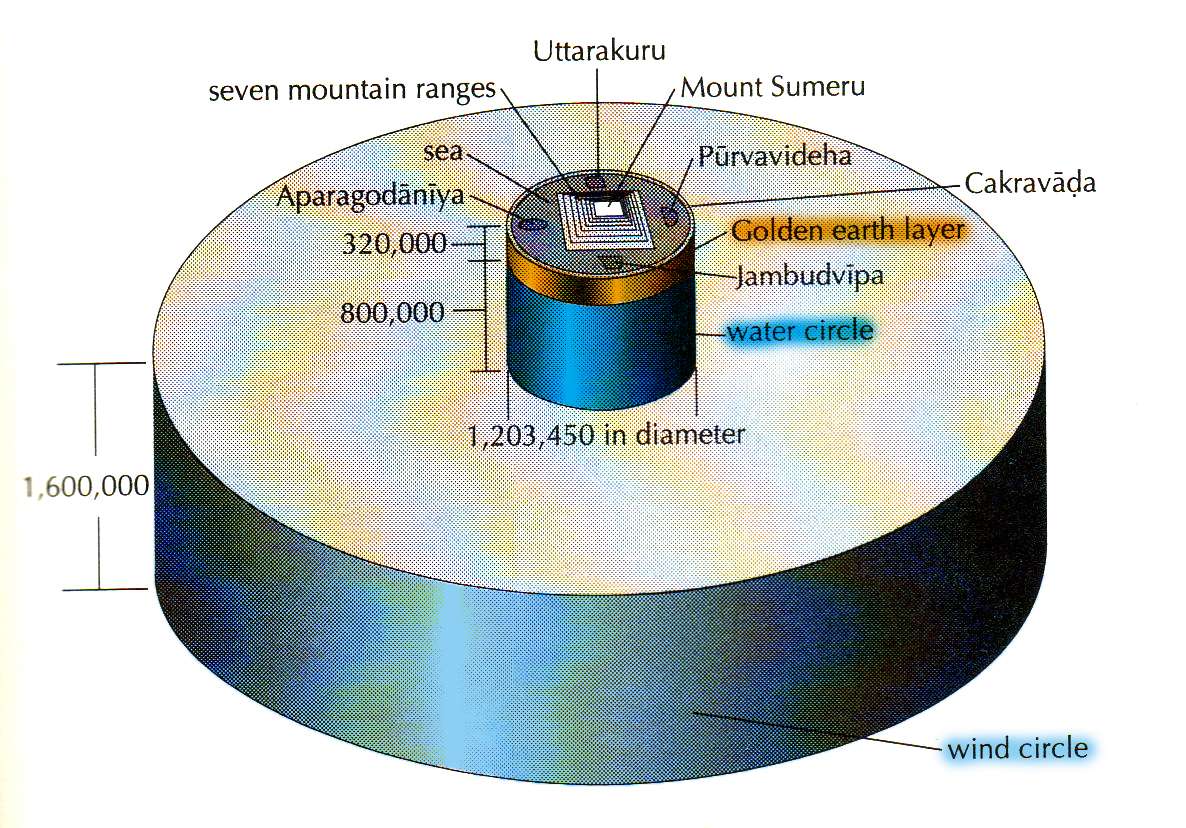
This system is supported by a series of elemental discs, each one becoming larger as one descends. The highest is kāñcanamaṇḍala, a disc of gold. The middle is jalamaṇḍala, a disc of water. And the lowest is vāyumaṇḍala, a disc of wind (fig. 3). This grand creation is thought to float in “space” (Vasubandhu, La Vallée-Poussin, & Pruden, 1991, pp. 451-452). 

Fig. 1 (top) – A top view of the Buddhist disc world system (larger version). Fig. 2 (middle) – A side view of the system (larger version). Images from Buswell & Lopez, 2014, pp. xxxii-xxxi. Fig. 3 (bottom) – A diagram showing the elemental discs supporting the world (larger version). Take note of the “wind circle” (light blue), the “water circle” (dark blue), and the “Golden earth layer” (gold). Adapted from Sadakata, 1997, p. 27.

2. Location of the Mountain

Chapter one continues:

Beyond the seas there is a country called Aolai [Aolai guo, 傲來國]. This country is next to an ocean, and in the middle of the ocean is a famous island called the Mountain of Flowers and Fruit. This mountain is the ancestral artery of the Ten Continents, the origin of the Three Islands; [1] it was formed when the clear and impure were separated and the Enormous Vagueness was divided (Wu & Jenner, 1993/2020, vol. 1, p. 3; cf. Wu & Yu, 2012, vol. 1, p. 100). 

海外有一國土,名曰傲來國。國近大海,海中有一座名山,喚為花果山。此山乃十洲之祖脈,三島之來龍,自開清濁而立,鴻濛判後而成。

Two deities shortly thereafter give a more precise location for the Mountain of Flowers and Fruit:

“We found that at the edge of the country of Aolai, which is east of the ocean belonging to the Eastern Continent of Superior Body, there is an island called the Mountain of Flowers and Fruit …” (Wu & Jenner, 1993/2020, vol. 1, p. 3; cf. Wu & Yu, 2012, vol. 1, p. 102). 

乃東勝神洲海東傲來小國之界,有一座花果山

Later, in chapter three, Sun Wukong’s advisors note the distance between Aolai and their island home:

The four monkeys replied, “East of our mountain, across two hundred [li] of water, is the boundary of the Aolai Country (Wu & Yu, 2012, vol. 1, p. 131; c.f. Wu & Jenner, 1993/2020, vol. 1, p. 50).

四猴道:「我們這山向東去,有二百里水面,那廂乃傲來國界。

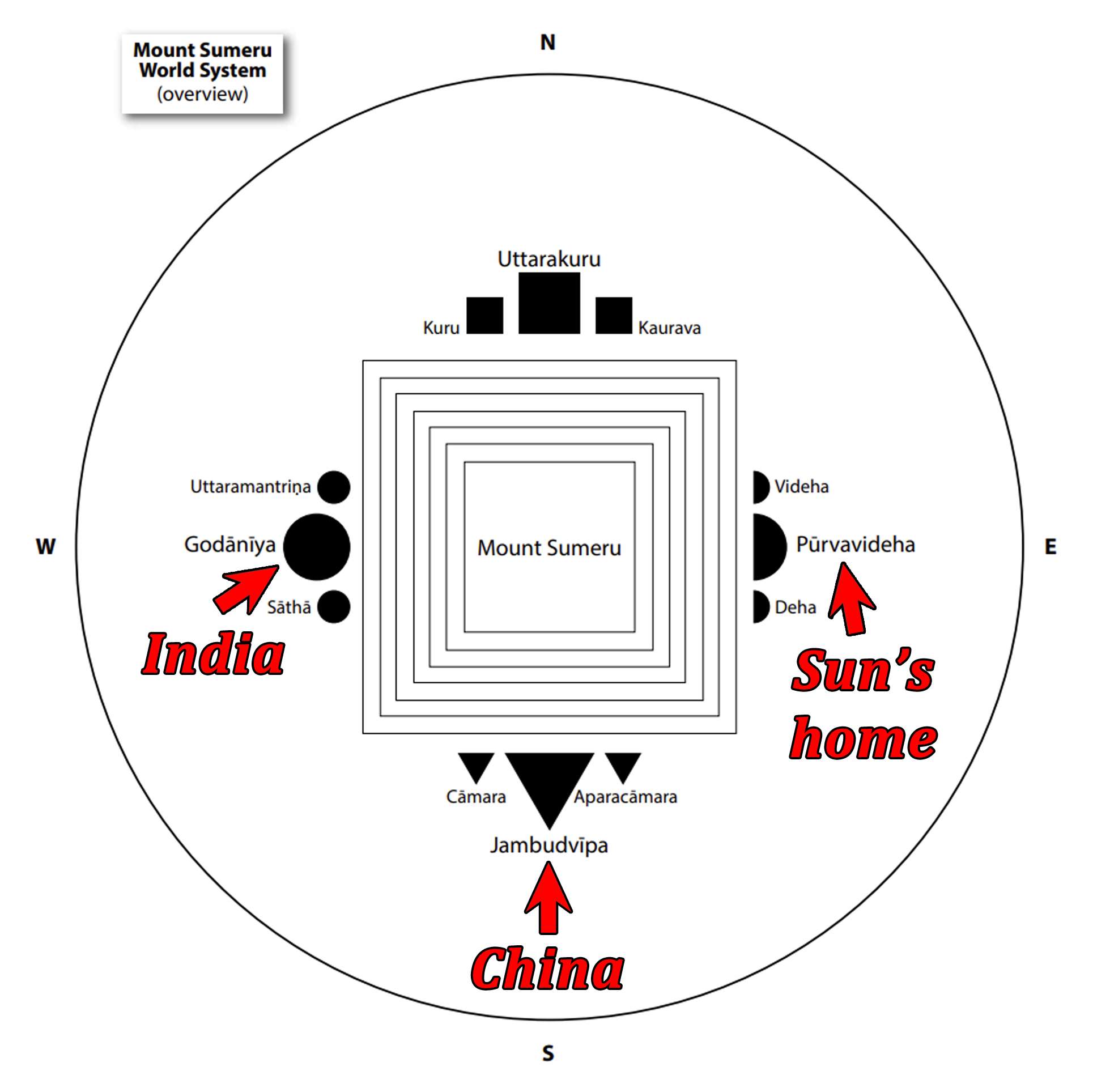
All of this information tells us that the mountain is an island located 200 li (62 miles / 100 km) east of Eastern Superior Body (East Pūrvavideha).

3. The Novel’s Version of the Buddhist Disc World System

Buddhism traditionally associates Southern Jambu (South Jambudvīpa) with India (Buswell & Lopez, 2014, p. 377), but the novel shifts this structure a quarter turn clockwise (fig. 4). For example, in chapter eight, the Buddha associates his home (India) with the western continent and the southern continent with the “eastern lands” (dongtu, 東土), the Chinese Buddhist term for China (Tan, 1998, p. 137):

“… Our Western Continent of Cattle-Gift has people who neither covet nor kill. They nourish the vital essence and submerge the spirit; and although they produce no saints of the highest order, they all live to a ripe old age. But in the Southern Jambu Continent they are greedy and lecherous and delight in the sufferings of others; they go in for a great deal of killing and quarrelling. That continent can with truth be called a vicious field of tongues and mouths, an evil sea of disputation. [But I have] Three Stores of True Scriptures with which they can be persuaded to be good” (Wu & Jenner, 1993/2020, vol.1, p. 165; cf. Wu & Yu, 2012, vol. 1, pp. 205).

我西牛賀洲者,不貪不殺,養氣潛靈,雖無上真,人人固壽;但那南贍部洲者,貪淫樂禍,多殺多爭,正所謂口舌兇場,是非惡海。我今有三藏真經,可以勸人為善。

[…]

“I want to send them to the eastern lands because it is intolerable that the beings of that quarter should all be such stupid wretches who slander and defame the true word, do not understand the gist of my Law, and have lapsed from the orthodox Yogacara Sect…” (Wu & Jenner, 1993/2020, vol.1, p. 165; cf. Wu & Yu, 2012, vol. 1, pp. 205).

我待要送上東土,叵耐那方眾生愚蠢,毀謗真言,不識我法門之旨要,怠慢了瑜迦之正宗。

Additional evidence comes from chapter 29 when the chosen scripture pilgrim‘s travel rescript is reproduced. The opening line expressly connects China with the southern continent by way of the Chinese Tang dynasty

The travel rescript of the Tang Son of Heaven, who succeeds under the guidance of Heaven to the throne of the Great Tang Empire in the South Jambudvīpa Continent. … (Wu & Yu, 2012, vol. 2, p. 48; cf. Wu & Jenner, 1993/2020, vol. 2, p. 661).

南贍部洲大唐國奉天承運唐天子牒行

This means that when Sun first sails to Southern Jambu (South Jambudvīpa) to find a means of escaping death (Wu & Jenner, 1993/2020, vol.1, p. 16; cf. Wu & Yu, 2012, vol. 1, p. 108), he travels to the novel’s version of China. This further solidifies the fact that the Mountain of Flowers and Fruit is not located in China.

Fig. 4 – A top view of the Buddhist disc world system according to Journey to the West (larger version). The Mountain of Flowers and Fruit would be to the east of Eastern Superior Body (East Pūrvavideha). Adapted from Buswell & Lopez, 2014, p. xxxii.

4. Reason for the Change

I suggest that the author-compiler of Journey to the West replaced the traditional cosmic geography for two reasons. First, both China and (part of) ancient India were referred to as the “Middle Kingdom” (Ch: Zhongguo, 中國; Sk: Madhyadeśa, मध्यदेश) (Wilkinson, 2000, p. 132; Lamotte, 1988, pp. 8-9). For example, the travelogue of the noted 4th to 5th-century Chinese Buddhist monk Faxian (法顯) reads:

Central India is known as the “Middle Kingdom” [Zhongguo, 中國]. The food and clothing of the common people are the same as the “Middle Kingdom” [i.e. China].

所謂中國人衣服飲食亦與中國同

This would naturally make it easier to associate China with Southern Jambu (South Jambudvīpa).

Second, since India is west of China, it would make sense for the country to be associated with Western Cattle-Gift (West Aparagodānīya).


Update: 10-01-17

A poem in chapter one states that the Mountain of Flowers and Fruit is the center of the universe. This obviously conflicts with Mt. Sumeru being the axis mundi.

Flower Fruit Mountain as the Center of the Universe


Update: 02-06-23

I have drastically rewritten the article to include more detailed information about the Buddhist disc world system. I would also like to add material here from a previous article since it is related to the novel’s changes to the pre-existing structure.

Originally, the top of Mt. Sumeru supported the Buddhist heaven of the “Thirty-Three (Gods)” (Sk: Trāyastriṃśa, त्रायस्त्रिंश; Ch: Sanshisan tian, 三十三天; Daoli tian, 忉利天) (fig. 5), which is ruled by Śakra (Sk: शक्र; Ch: Dishi, 帝釋), king of the gods (Buswell & Lopez, 2014, pp. 921-922). However, the novel replaces this realm with the Daoist heaven, which is ruled by the Jade Emperor (Yuhuang shang/dadi, 玉皇上/大帝) (Clart, 2008, pp. 1197-1198). This is hinted at in chapter four when Monkey is invited to serve as the keeper of the heavenly horses. Part of a poem describing what he sees reads:

[…]
In this heaven are thirty-three heavenly palaces (emphasis added):
The Palace of Clouds Dispersed, the Vaisravana Palace, the [P]alace of Five Lores, the Sun Palace, the Palace of Flowery Bliss
[…] (Wu & Jenner, 1993/2020, p. 73; cf. Wu & Yu, 2012, vol. 1, p. 146).

這天上有三十三座天宮,乃遣雲宮、毘沙宮、五明宮、太陽宮、花樂宮 …

The “thirty-three” palaces are references to the homes of the thirty three gods. This change is therefore a prime example of the kind of Buddho-Daoist religious syncretism featured in Journey to the West.

Fig. 5 – The Heaven of the Thirty-Three atop Mt. Sumeru is indicated in red (larger version). Adapted from Buswell & Lopez, 2014, p. xxxii.


Update: 02-08-23

Despite the four Buddhist disc world continents appearing in the story, Journey to the West hints that its world is a globe. For instance, when the Monkey King first sets out from his home in chapter one, he sails SE to reach the NW side of Southern Jambu (South Jambudvīpa):

He had chosen just the right time for his journey. After he boarded his raft the southeasterly wind blew hard for days on end and bore him to the northwestern shore of the southern continent (Wu & Jenner, 2020, vol.1, p. 16; cf. Wu & Yu, 2012, vol. 1, p. 108).

也是他運至時來,自登木栰之後,連日東南風緊,將他送到西北岸前,乃是南贍部洲地界。

I thought maybe SE and NW were typos since heading SW would have taken him to the NE shore of the southern continent (refer back to fig. 4). However, in chapter two, Sun tells his children:

“The year I left you all,” Wukong said, “I drifted with the waves across the Great Eastern Ocean and reached the West Aparagodānīya Continent. I then arrived at the South Jambudvīpa Continent, where I learned human ways, wearing this garment and these shoes. I swaggered along with the clouds for eight or nine years, but I had yet to learn the Great Art. I then crossed the Great Western Ocean and reached the West Aparagodānīya Continent (Wu & Yu, 2012, vol. 1, p. 129; cf. Wu & Jenner, 1993/2020, p. 47).

我當年別汝等,隨波逐流,飄過東洋大海,到西牛賀洲地界,徑至南贍部洲,學成人像,著此衣,穿此履,擺擺搖搖,雲遊了八九年餘,更不曾有道。又渡西洋大海,到西牛賀洲地界

So it appears that he sailed from the Mountain of Flowers and Fruit to Western Cattle-Gift (West Aparagodānīya), similar to traveling from Japan in the East to the United States in the West. Then, he sailed from there to Southern Jambu (South Jambudvīpa), similar to traveling from the US to Africa. Lastly, he sailed back to Western Cattle-Gift (West Aparagodānīya). This might mean that the world of Journey to the West is a combination of a spherical planet and the Buddhist disc world system.

If true, I suggest that the nonsensical, roundabout way that Monkey comes to study with Subodhi in the western continent could be a physical representation of his unsettled “monkey mind” (xinyuan, 心猿).

However, it’s important to point out that even Yu (Wu & Yu, 2012) considers the aforementioned route to be “[a]n inconsistency in the text” (vol. 1, p. 509, n. 17). So, I’ll leave it up to the reader as to which version of the world they ultimately want to accept.


Update: 02-09-23

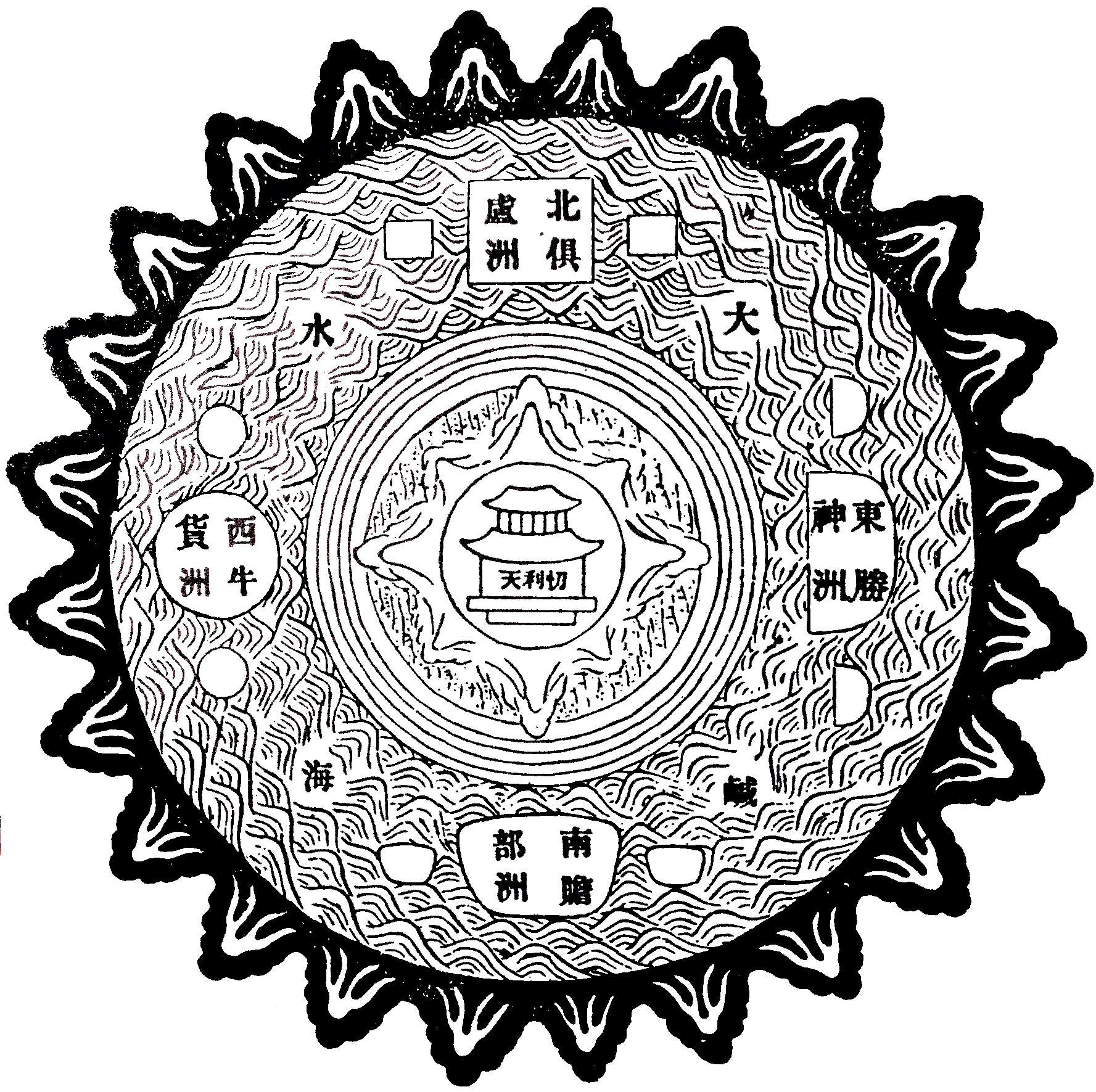
I found a lovely overhead Chinese map of the Buddhist disc world system (fig. 6). The teeth-like structures around the perimeter are actually the iron mountain that contains the ocean. Also Mt. Sumeru in the center is topped by a building representing the Buddhist heaven of the “Thirty-Three (Gods)” (Ch: Daoli tian, 忉利天) (refer back to fig. 5).

Fig. 6 – An early-20th-century Chinese map of the Buddhist disc world system (larger version). Image found on Wikimedia Commons.


Update: 02-11-23

I have posted an article that discusses the Buddha’s realm in Western Cattle-Gift (West Aparagodānīya).

The Buddha’s Vulture Peak and Journey to the West


Update: 03-07-23

In my 02-06-23 update, I noted how the “thirty-three mansions” alluded to the Buddhist heaven of the thirty-three gods (sanshisan tian, 三十三天), thereby showing that the Daoist heaven was inserted into the Buddhist cosmological structure. Well, I had completely forgotten that the novel overtly mentions this heaven numerous times. This is important in regards to the location of Laozi‘s (老子) residence. 

Journey to the West states that the deva and his alchemical furnace are located in the “Tushita Palace” (Doushuai gong兜率宮), which is said to be either in the “Separation’s Regret Heaven” (Lihen tian離恨天) or the “Great Canopy Heaven” (Daluo tian, 大羅天). Both are treated as the highest of the thirty-three heavens. For more information, see my article: 

Laozi’s Realm in Journey to the West

Note:

1) Yu (Wu & Yu, 2012) explains, “These islets and islands were famous abodes of gods or immortals” (vol. 1, p. 506, n. 6).

Sources:

Buswell, R. E. , & Lopez, D. S. (2014). The Princeton Dictionary of Buddhism. Princeton University Press.

Clart, P. (2008). Yuhuang. In F. Pregadio (Ed.), The Encyclopedia of Taoism (Vols. 1 & 2) (pp. 1197-1198). Longdon: Routledge.

Lamotte, E. (1988). History of Indian Buddhism: From the Origins to the Saka Era (S. Webb-Boin, Trans.). Louvain-la-Neuve: Université Catholique de Louvain Institut Orientaliste.

Tan, C. (1998). A Sino-Indian Perspective for India-China Understanding. In C. Tan (Ed.), Across the Himalayan Gap: An Indian Quest for Understanding China (pp. 133-147). New Delhi: Indira Gandhi National Centre for the Arts.

Vasubandhu, La Vallée-Poussin, L., & Pruden, L. M. (1991). Abhidharmakośabhāṣyam of Vasubandhu (Vol. 2). Berkeley, Calif.: Asian Humanities Press.

Wilkinson, E. P. (2000). Chinese History: A Manual (Rev. and Enl). Published by the Harvard University Asia Center for the Harvard-Yenching Institute : Distributed by Harvard University Press.

Wu, C. & Jenner, W. J. F. (2020). Journey to the West (Vols. 1-4). Beijing: Foreign Languages Press. (Original work published 1993)

Wu, C., & Yu, A. C. (2012). The Journey to the West (Vols. 1-4) (Rev. ed.). Chicago, Illinois: University of Chicago Press.

The Monkey King’s Connection to Sex

“Monkey of the Mind” (xinyuan, 心猿) is a title often associated with Sun Wukong. It is one half of the common phrase “Monkey of the Mind, Horse of the Will” (xinyuan yima, 心猿意馬), which refers to the disquieted mind and uncontrollable wants that plague humankind. Allusions to the monkey of the mind appeared in Indian Buddhist sutras as far back as circa 30 BCE. The double metaphor of the monkey and horse appeared in religious and lay Chinese Buddhist writings by the sixth-century CE (Dudbridge, 1970, pp. 168-169).

But did you know that by the 16th-century, when JTTW was written, the phrase had become a popular euphemism for sexual desire? Dudbridge (1970) provides an example from the famous novel Investiture of the Gods (Fengshen Yanyi, 封神演義):

In the lamplight [Zhou Wang] saw Ximei two or three times part her red lips—a little dot of cherry—and breathe a lovely cloud of sweet air; she turned her liquid eyes—two pools of moving water—and gave him all kinds of wanton glances, till Zhou Wang could not suppress the Monkey of the Mind, and the Horse of the Will strained at the leash… (p. 175).

Given Monkey’s connection to the phrase, Liu (1994) suggests the primate and his staff have a sexual dimension:

In the novel both Sun Wukong and his ‘Compliant Golden-Hooped Rod’ represent the human mind and desires, especially sexual desires, which must be under control, as indicated by the tightening fillet on Monkey King’s head and the two hoops on the magic weapon. Specifically, the rod is a symbol of the male sex organ… (pp. 142-143).

I’m not sure if I accept this agument given that Monkey doesn’t show any interest in sex even before attaining immortality. It is Zhu Bajie who suffers from sexual addiction in the novel. Nonetheless, I find Liu’s comparison hilarious, especially if you think about the growing of Monkey’s magic pole! Pardon me while I giggle like a teenage boy.

Sources:

Dudbridge, G. (1970). The Hsi-yu chi: A study of antecedents to the sixteenth-century Chinese novel. Cambridge: Cambridge University Press.

Liu, X. (1994). The odyssey of the Buddhist mind: The allegory of the Later journey to the west. Lanham, Md: University Press of America.

The Later Journey to the West: Part 1 – Sun Luzhen’s Early Adventures

Note: An AI translation of this novel is now available. Click the linked Chinese characters below that read “後西遊記.”

Last updated: 03-15-2026

The great Chinese classic Journey to the West (Xiyouji, 西遊記; “JTTW” hereafter) spawned numerous unofficial sequels years after its publishing in 1592. One such sequel, Later Journey to the West (Hou Xiyouji, 後西遊記) by an anonymous author of the 17th-century, is set two hundred years after the original and follows the adventures of Sun Wukong’s spiritual descendant Sun Luzhen (孫履真). He too learns the secrets of immortality and causes havoc in heaven, before being tasked to protect the historical monk Dadian (大顛, 732-824) on a similar journey to India. The two are accompanied by the son of Zhu Bajie, Zhu Yijie (豬一戒), and the disciple of Sha Wujing, Sha Zhihe (沙致和). This may at first seem like a cookie cutter retelling of the story, but it is so much more. Unlike the original, which only used allegorical terms for given characters, Later Journey to the West is comprised of extremely dense layers of allegorical meaning, from the names of characters and the words they speak to the places they visit and the villains they face.

Below, I present the first of a three-part overview (part 2 and part 3), which covers Sun Luzhen’s early adventures. I rely very heavily on the engaging work of Xiaolian Liu (1994) as the novel has yet to be published in English.

Notes have been added to the sections below to explain the allegorical meaning of various story elements.

I. The Riddle

The novel begins with the following riddle:

I have a statue of Buddha, which nobody knows;
He needs no molding or carving;
Nor does he have any clay or color;
No human can draw him; no thief can steal him;
His appearance is originally natural,
And his clarity and purity are not the result of cleaning;
Though only one body,
He is capable of transforming himself into myriad forms (Liu, 1994, p. 22)

我有一軀佛,世人皆不識,
不塑亦不裝,不雕亦不刻,
無一滴灰泥,無一點彩色,
人畫畫不成,賊偷偷不得。
體相本自然,清靜非拂拭,
雖然是一軀,分身千百億。(source)

Liu (1994) notes that the answer is: “The Mind is none other than the Buddha” (jixin jifo, 即心即佛), a common Chan (Zen) Buddhist saying referring to self-enlightenment (p. 22). He continues:

The author uses the verse to announce the theme of his book and to prepare the reader for the mental or spiritual journey he is going to undertake through the experience of reading it […] [T]he novelist wants to make sure that the readers is aware of the allegorical nature of his various episodes and is ready to apply the same technique he would employ in solving a riddle to the reading of the novel, i.e. to go beyond the literal level of the text in order to find the solution or to decipher the intended message (Liu, 1994, p. 24).

II. Sun Luzhen’s Early Adventures

The story opens on the Flower Fruit Mountain (fig. 1), home of the original Monkey King and the axis mundi, or center of the cosmos through which all creative energies flow freely between heaven and earth. Our hero Sun Luzhen is born from a stone and, upon hearing of the adventures of Sun Wukong, takes the title “Small Sage Equaling Heaven” (Qitian xiaosheng, 齊天小聖). [A][1] He follows in his ancestor’s footsteps by sailing to the Aparagodaniya continent in a quest for immortality. There, he finds an immortal’s temple but is barred from meeting the patriarch by a Daoist monk until he has completed a number of tasks, including purifying himself in the Hall of Calming the Mind and the Hall of Nourishing the Breath, [B] taming a dragon and a tiger, [C] and visiting several locations, such as the Cinnabar Field and the Divine Mansion. [D] Monkey completes the purification rituals, but soon leaves the temple when he discovers the immortal cavorting with an old woman and two young maidens. [E]

A) Just like Sun Wukong in JTTW, Sun Luzhen represents the “Monkey of the Mind” (xinyuan, 心猿), a Buddhist metaphor for the restlessness of the human mind/heart (the character of xin () can mean both) (Liu, 1994, pp. 27-28).

B) These represent the early stages of spiritual cultivation, namely meditation and the regulation of breathing. The latter involves absorption of yang energy during prescribed times of the day.

C) These animals represent yin and yang energy, respectively. So taming said animals refers to a mastery of said energies.

D) These represent spiritual centers of the body, namely a region just below the navel and the upper region of the head, respectively. See J below.

E) These people represent Daoist terms associated with sexual cultivation, a type of internal cultivation popular during the Han dynasty but fell out of favor by the Ming when the novel was written (Liu, 1994, pp. 35-37).

Monkey leaves the temple and continues his search the world over for a worthy master, finding only false immortals and hypocritical monks along the way. [F] He returns to Flower Fruit Mountain determined to bring about his own immortality, and there the small stone monkey finds the “No-Leak” Cave (wulou dong, 無漏洞) on the backside of the mountain, making it his hermitage. [G] He meditates for forty-nine days, before Sun Wukong appears in spirit, sharing with him magical formulas and eventually merging with him. This causes Monkey Jr. to realize: “The true master is after all in one’s own mind, but people don’t know where to look for him” (Liu, 1994, p. 38). [H]

F) These people represent the wrong path to enlightenment, including non-Chan Buddhist sects and even Daoism.

G) The name represents the Buddhist concept of Anasrava and the Daoist concept of Wulou (無漏)/Loujin (漏盡), or the cessation of emotional outpouring (or leaking) upon achieving enlightenment (Liu, 1994, p. 38).

H) This represents self-realization.

Having achieved immortality, Sun Luzhen discovers his ancestor’s “as-you-will” gold-banded cudgel in the cave and sets out to find additional ways of increasing his spiritual attainment. [2] First, he forces the Dragon King of the Eastern Sea and the Old Tiger King of the Western Mountains to respectively submit to his power. [I] Next, Monkey travels to the underworld below and uses his wits to prove the other worldly judgements of the ten magistrates of hell are unjust, making their rulings listed in the ledgers of life and death null and void. [J][3] Finally, the small stone monkey travels to the celestial realm above to visit the Jasper Pool, the abode of the Queen Mother of the West (fig. 2). [K] He gets drunk on immortal wine and soon creates such a disturbance that the August Jade Emperor, the ruler of heaven, calls up the celestial army to deal with the menace. The Small Sage is too powerful, and so the emperor enlists the help of the Great Sage, now an enlightened Buddha (fig. 3), [4] to halt his descendant’s onslaught. [L][5]

I) This follows the Daoist monk’s instructions to tame a dragon and a tiger. This again represents his mastery of yin and yang energies.

J) This represents Monkey’s status as an immortal who is beyond the reach of death. I believe the downward journey symbolically follows the Daoist monk’s instructions to visit the Cinnabar Field, an area of the body below the navel normally associated with the storage of spiritual and sexual energy. Although Liu (1994) does not say this explicitly, he does comment: “According to the Taoist microcosmic view, the human body [has] features corresponding to the cosmic universe […] For example, the Celestial Palace … and the Jasper Pool are not only the heavenly residence of the Jade Emperor and the Mother Queen [of the west], but also terms referring to the upper regions of the head” (p. 45). See K below.

K) Going to heaven represents the upward propulsion of energy to the head, the last step in achieving immortality.

L) As the ruler of heaven, the August Jade Emperor represents the Primary Spirit (yuanshen, 元神), or the original pure spirit that everyone is born with. This is also known as the “Heavenly Mind/Heart” (tianxin, 天心). Therefore, Monkey’s rebellion represents the attempt of the “Conscious Spirit or the Heart of Blood and Flesh” at usurping the spiritual mind before all attachments are extinguished upon enlightenment (Liu, 1994, pp. 47-48).

Fig. 1 – A depiction of Flower Fruit Mountain from a modern video game (larger version). Fig. 2 – A Ming Dynasty painting of the Queen Mother of the West riding a stone lion (larger version). Fig. 3 – A live action depiction of Sun Wukong after attaining Buddhahood (larger version).

III. Sun Luzhen’s enlightenment

Sun Wukong arrives and soon deprives the small stone monkey of the magic iron staff, and when the latter complains that he won’t be able to defend himself, Monkey Sr. tells him: “It is already in your ear [where he used to hide the magically reduced weapon]. How can I give it back to you?” (Liu, 1994, p. 50). [M] This Chan gong’an (Zen koan) instantly brings about Sun Luzhen’s enlightenment.

M) This represents one’s own internal or spiritual strength.

Before returning to the Western Paradise, the Great Sage places the golden fillet on his head and instructs him:

There is a limit to brute force,
But Wisdom and courage are boundless;
If you fail to achieve the right fruition,
You will forever be a wild immortal. (Liu, 1994, p. 49)

頑力有阻,慧勇無邊;
不成正果,終屬野仙。(source)

Liu (1994) explains the significance of the verse:

In the poem Sun Wukong tells his descendant to resort to wisdom and courage, rather than brute force, to achieve this goal. This teaching is borne out by the fact that it is not the celestial army but Sun Wukong who subdues Monkey with his enlightening words. But more important is the message conveyed in the last two lines. Though Monkey has obtained physical immortality, he is still a yexian 野仙 (wild immortal), because he is unable to quench his desires and emotions […] According to Chan Buddhist doctrine of wunian 無念 (no-thought), man’s original nature is pure and free from all thoughts and passions. In the first section of the novel, Monkey tries a Taoist approach in his effort to seek immortality. Though he succeeds through Taoist meditation in calming his mind and in realizing his self-nature, his desire for immortality and his practice of internal alchemy, symbolized by his celestial adventures, violate the Chan Buddhist principle of non-attachment, and are therefore considered “wild” and “unorthodox” by Buddhist ontological non-dualism. The completion of the Taoist physiological alchemy is only the beginning of a self-cultivation process for the hero whose ultimate goal … is to accomplish zhenguo 正果 (right or orthodox fruition), i.e. to achieve the Buddhahood inherent in one’s own nature, through the journey proper to the Holy Mountain in the Western Paradise. (p. 49)


Update: 10-25-21

I have listed Sun Luzhen as an “honorable mention” among the Monkey King’s literary children. See section 3 here:

The Monkey King’s Children


Update: 03-15-26

I have drastically updated the formatting of this article, including adding more of the original Chinese characters/quotations, increasing the number of tags, linking to more wiki articles, and placing the (previously separate) explanatory notes within each section. Needless to say, this post now differs from parts two and three. I will get around to updating those in the future.

Notes:

1) This mirrors the title “Great Sage Equaling Heaven” (Qitian Dasheng, 齊天大聖) taken by Sun Wukong in JTTW chapter 4.

2) Daoism recognizes up to five categories of immortality, each increasing in spiritual attainment from the last: 1. Ghost; 2. Human; 3. Earthly; 4. Divine; and 5. Heavenly (Liu, 1994, p. 55, n. 36).

3) This contrasts with Sun Wukong who used force to erase his name (and those of all other monkeys living at that time) from the ledgers of life and death (see JTTW chapter 3).

4) Monkey Sr. is granted Buddhahood, along with the title “Buddha Victorious in Strife” in JTTW chapter 100.

5) Sun Luzhen’s drunken episode, havoc in heaven, and subjugation by a Buddha recalls the adventures of his ancestor from JTTW chapters 4 to 7.

Source:

Liu, X. (1994). The Odyssey of the Buddhist Mind: The Allegory of the Later Journey to the West. Lanham, Md: University Press of America.

Modern Depictions of Sha Wujing’s Weapon and its Origins

Last updated: 07-02-2023

Sha Wujing (沙悟淨), or “Sandy” for short, is commonly portrayed in modern media wielding a Crescent Moon Spade (Yueya chan, 月牙鏟, a.k.a. “Monk’s Spade“), a wooden polearm capped with a sharpened spade on one end and a crescent-shaped blade on the other (fig. 1). But did you know that Sandy never wields this kind of weapon in the novel? Chapter 22 contains a poem that describes the actual weapon and its pedigree. A section of it reads:

For years my treasure staff has enjoyed great fame,
Originally a tree of the sala variety in the moon, [1]
Wu Gang cut down from it one limb.
Lu Ban then made it, using all his skills.
Within the hub is “as-you-will” gold. [2]
Outside it’s wrapped by countless pearly threads.
It’s called the Treasure Staff Perfect for Subduing Monsters, [3]
[…] (based on Wu & Yu, 2012, vol. 1, p. 428)

寶杖原來名譽大,本是月裡梭羅派。
吳剛伐下一枝來,魯班製造工夫蓋。
裡邊一條金趁心,外邊萬道珠絲玠。
名稱寶杖善降妖 …

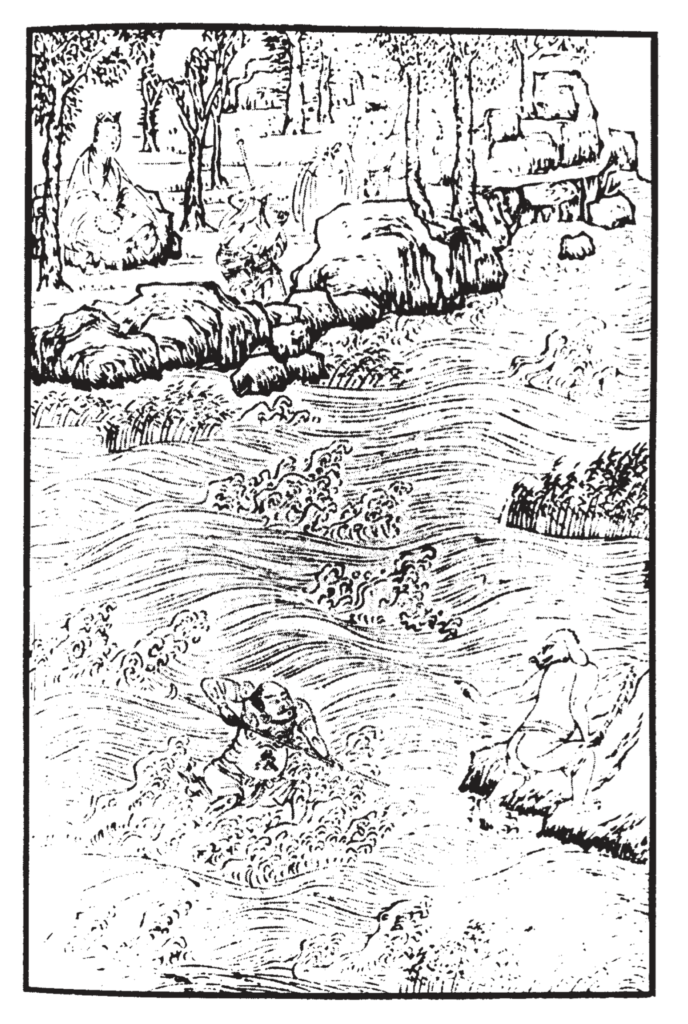
As you can see, it is described as a wooden staff devoid of any metal blades. So how did Sandy become associated with the Monk’s spade? It can be traced to a common motif appearing in late-Ming Dynasty (1368-1644) woodblock prints. Sandy is just one of a number of famous literary staff-wielding monks to be portrayed brandishing a polearm topped with a small crescent shape (fig. 2). Others include Huiming (惠明) from the Story of the Western Wing (Xixiangji, 西廂記, c. 1300) (fig. 3) and Lu Zhishen (魯智深) from the Water Margin (Shuihu zhuan, 水滸傳, c. 1400) (fig. 4) (Shahar, 2008, p. 97).

#12 - Sha Wujing pics for blog entry

Fig. 1 – A modern depiction of Sandy wielding a Monk’s Spade (larger version). Fig. 2 – A late-Ming Dynasty print of Sha Wujing with the crescent staff (larger version). Fig. 3 – A 1614 woodblock print of Monk Huiming with a crescent staff (larger version). Fig. 4 – A late-Ming woodblock of Lu Zhishen with a crescent staff (larger version). Fig. 5 – Sandy from Ehon Saiyuki (circa 1806) (larger version). Fig. 6 – Sandy from Xiyou yuanzhi (1819) (larger version). Fig. 7 – A detail from a Long Corridor painting (circa 1890) (larger version).

The exact origin or purpose of the blade is unknown, however. Martial historian Meir Shahar (2008) comments:

Future research may determine the origins of the crescent shape, which is visible in some Ming period illustrations of the staff. Here I will mention only that an identical design is common in a wide variety of twentieth-century martial arts weapons, whether or not they are wielded by Buddhist clerics. The crescent’s significance in contemporary weaponry can be gauged by its appearance in the names of such instruments as the “Crescent-Shaped (Yueya) [Monk’s] Spade,” “Crescent-Shaped Spear,” “Crescent-Shaped Battle-ax,” and “Crescent-Shaped Rake” (pp. 97-98).

A woodblock print appearing in the first section of The Illustrated Journey to the West (Ehon Saiyuki, 画本西遊記), published in 1806, depicts Sandy holding a staff with a large crescent blade (fig. 5), showing how the once small accent had been enlarged by this time to become a more prominent feature of the polearm. This same weapon is echoed in a print from The Original Intent of The Journey to the West (Xiyou yuanzhi, 西遊原旨, 1819) (fig. 6), as well as in multiple circa 1890 JTTW-related paintings from the Long Corridor of the Summer Palace in Beijing (fig. 7, for example). So Ming depictions of Sandy wielding a crescent-tipped staff were most likely associated with the Monk’s Spade due to their physical similarities, and this probably took place no earlier than the early 20th-century.


Update: 02-25-18

Unlike Sha Wujing, there is a monster in the novel who wields a Crescent Moon spade. Chapter 63 describes the Nine-Headed Beast (Jiutou chong, 九頭蟲), [4] the son-in-law of a dragon king, using this bladed polearm in a battle against Monkey:

Enraged, Pilgrim shouted, “You brazen thievish fiend! What power do you have that you dare mouth such big words? Come up here and have a taste of your father’s rod!” Not in the least intimidated, the son-in-law parried the blow with his crescent-tooth spade; a marvelous battle thus broke out on top of that Scattered-Rock Mountain (Wu & Yu, 2012, vol. 3, p. 183).

行者大怒,罵道:「這潑賊怪,有甚強能,敢開大口?走上來,吃老爺一棒。」那駙馬更不心慌,把月牙鏟架住鐵棒,就在那亂石山頭 …

There existed during the Ming Dynasty a military spade with a crescent blade on the top and a dagger-like blade on the bottom (武備志 (四十三) , n.d.) (fig. 8). This is likely the weapon used by the monster. Notice the similarities with figures five to seven. It’s easy to see how the crescent-tipped staff from the Ming woodblock prints could have later been associated with this military weapon. The difference is one of degree and not kind. This polearm was later modified into the modern Monk’s Spade, leading to depictions of Sandy wielding the weapon.

Fig. 8 – A Crescent Moon Spade from the Collection of Military Works (Wubei zhi, 武備志, c. 1621), a Ming treatise on military armaments and fighting techniques (larger version).


Update: 05-15-18

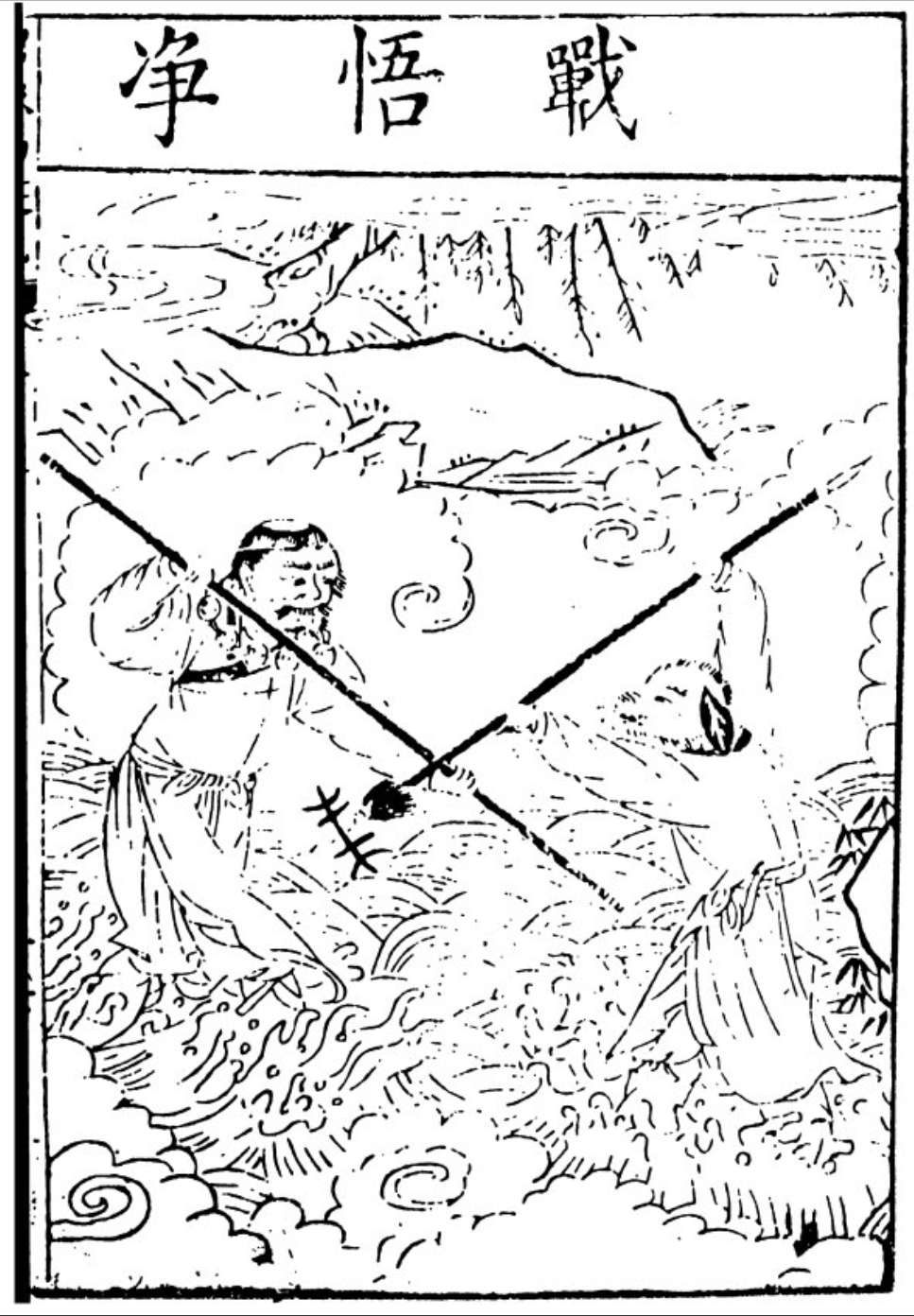
Feng Dajian of Nankai University was kind enough to direct me to this woodblock print (fig. 9) from the original 1592 publishing of Journey to the West. Sandy’s staff is more evident in this piece. It even lacks the aforementioned crescent shape.

Fig. 9 – The 1592 JTTW print of Sandy vs Pigsy (larger version).


Update: 07-02-23

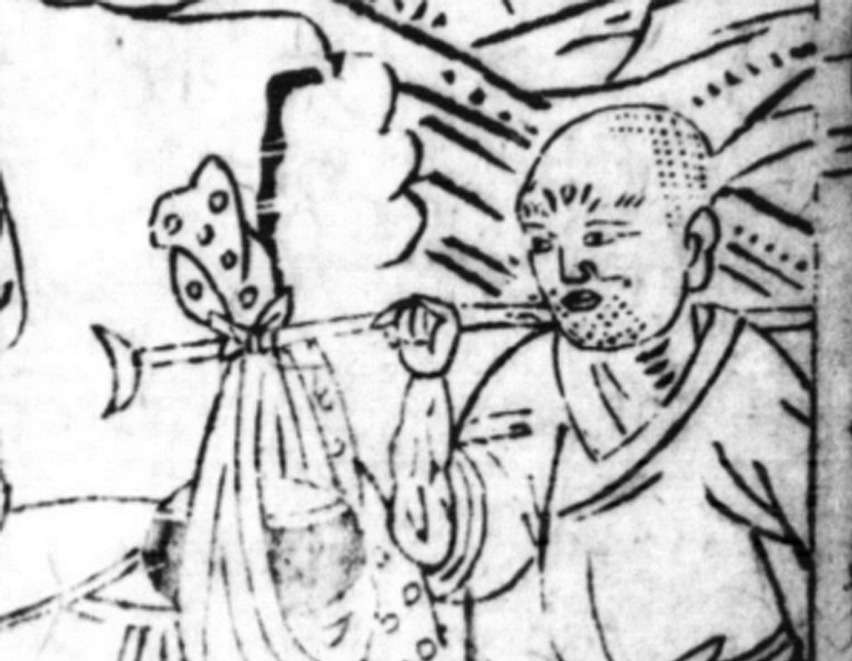
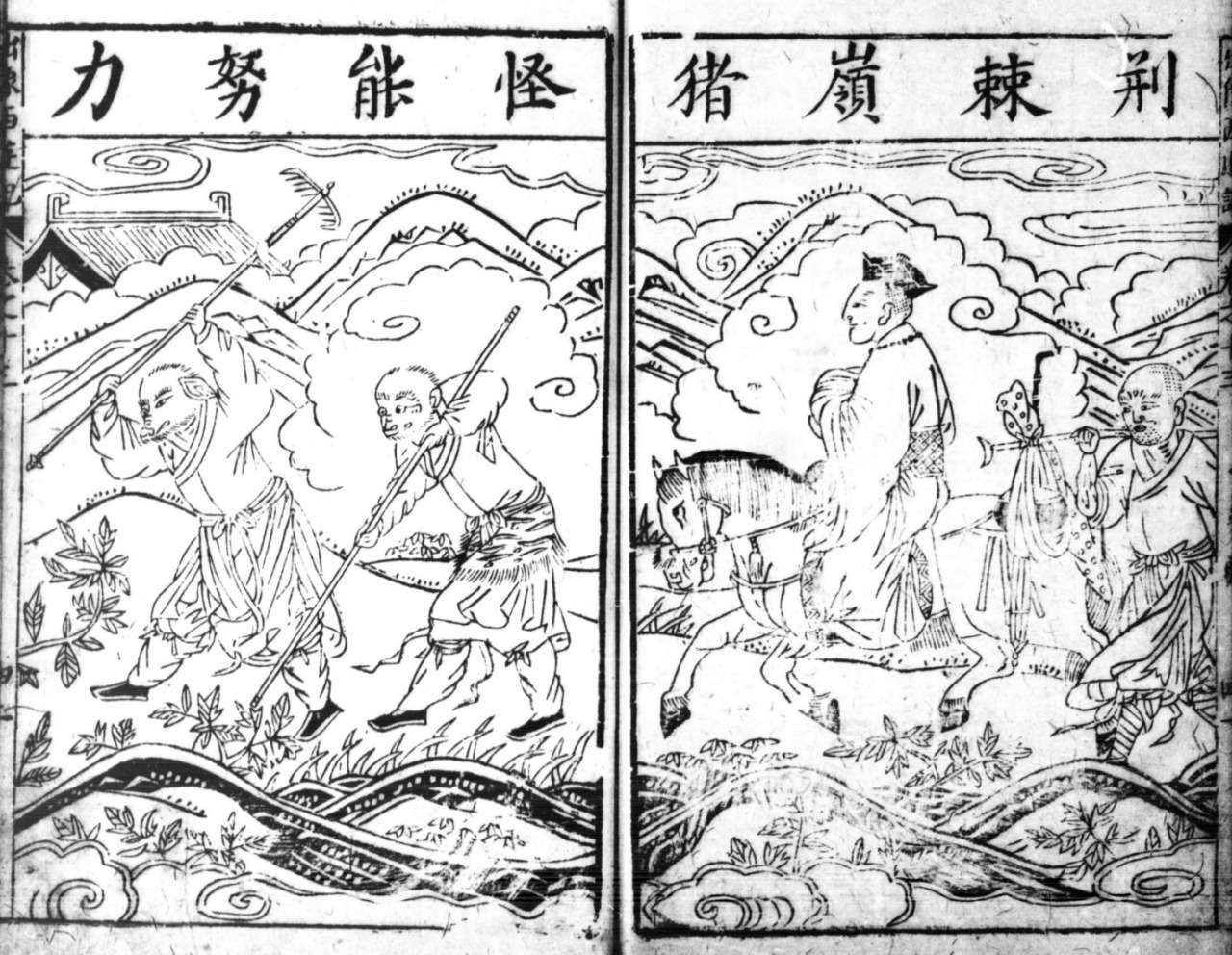
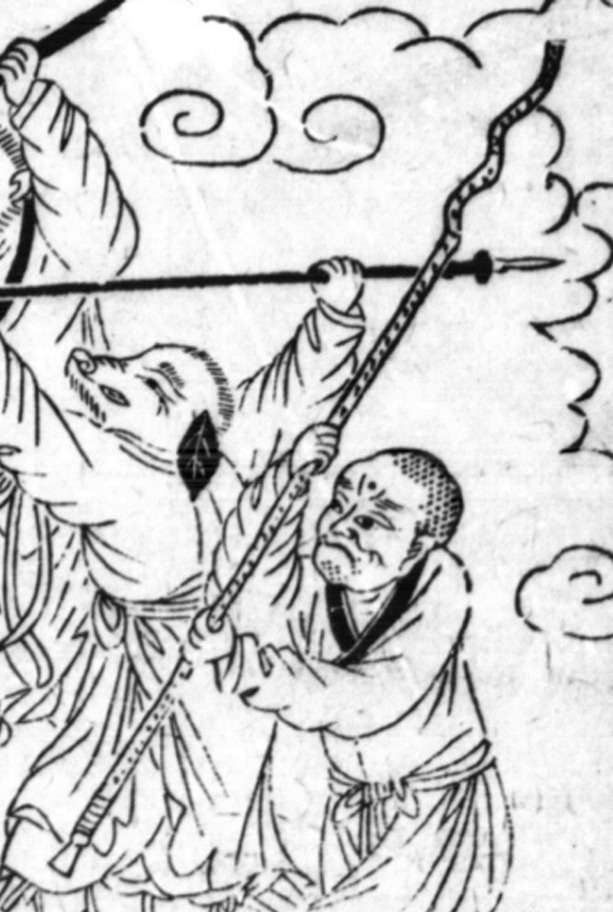
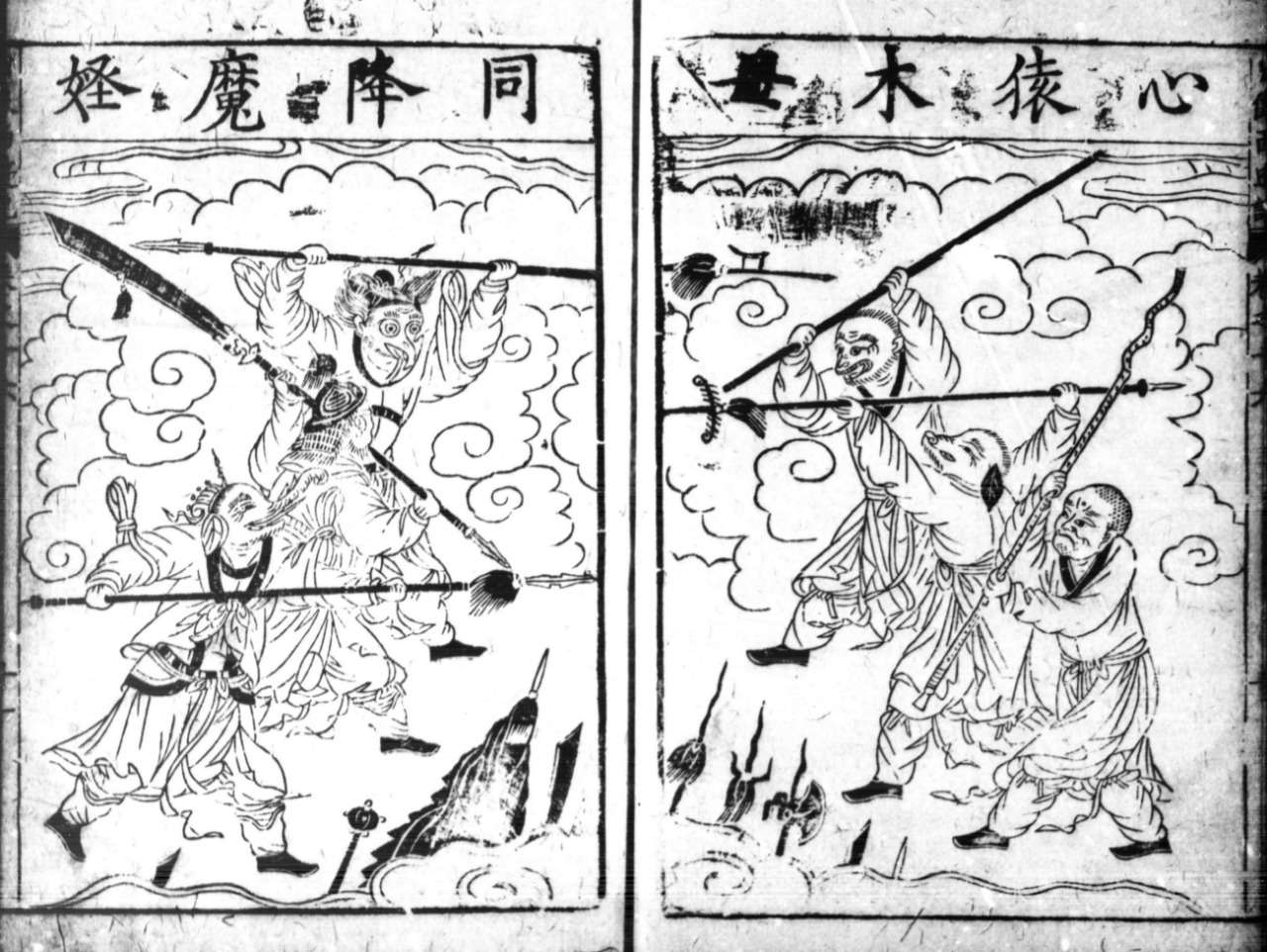
The woodblock prints from the original 1592 JTTW are extremely inconsistent. For example, figure nine shows Sha’s staff as a straight, black line. However, another print (fig. 10 & 11) depicts it with the crescent finial, and yet another (fig. 12 & 13) shows it as a twisting tree branch. The latter is my favorite because it aligns more with the weapon’s origin as presented above in the introduction.

Fig. 10 (top left) – A detail of the crescent staff (larger version). Fig. 11 (top right) – The full print (larger version). Fig. 12 (bottom left) – A detail of the tree branch staff (larger version). Fig. 13 (bottom right) – The full print (larger version).

Notes:

1) The original translation reads: “At first an evergreen tree in the moon” (Wu & Yu, 2012, vol. 1, p. 428). But the Chinese identifies the tree as suoluo pai (梭羅派), which literally means a “(family) branch of the sala tree.” I chose “a variety of” to avoid confusion with “tree branch.” And while the sala is technically a kind of evergreen in wet environments, it has deciduous-looking leaves. I chose to use the actual name of the tree to avoid confusion with pine evergreens. Yu (Wu & Yu, 2012) incorrectly identifies the suoluo tree as “Cunninghamia [l]anceolata,” a type of Chinese pine evergreen (vol. 4, p. 391 n. 7).

2) The original translation reads: “Within the hub one solid piece of gold” (Wu & Yu, 2012, vol. 1, p. 428). But the Chinese states that the inside is jin chenxin (金趁心), or “satisfactory metal/gold.” This is likely referring to the Chinese idiom chenxin ruyi (趁心如意), or “as one desires.” This important as the novel reveals that Sha’s weapon is capable of growing or shrinking on command just like Monkey’s cudgel, the “As-You-Will Gold-Banded Staff” (Wu & Yu, 2012, vol. 1, p. 429). Thank you to Irwen Wong of the Journey to the West Library blog for reminding me of this fact.

3) Yu (Wu & Yu, 2012) skipped over shan (), or “good at, apt, perfect,” in his translation (vol. 1, p. 428).

4) The creature’s name is originally translated as the “Nine-Headed Insect,” but its true form is that of a monstrous reptilian bird (Wu & Yu, vol. 3, p. 184). While chong (蟲) usually means “insect, worm, or pest,” it can also mean “tiger.” For instance, Da chong (大蟲, “great beast”) is the name of the tiger killed by the hero Wu Song in the Water Margin (c. 1400) (Børdahl, 2007). So a better name for our villain would be “Nine-Headed Beast.”

Sources:

Børdahl, V. (2007). The Man-Hunting Tiger: From “Wu Song Fights the Tiger” in Chinese Traditions. Asian Folklore Studies, 66(1/2), 141-163. Retrieved January 7, 2021, from http://www.jstor.org/stable/30030454

Shahar, M. (2008). The Shaolin Monastery: History, Religion, and the Chinese Martial Arts. University of Hawaii Press.

Wu, C., & Yu, A. C. (2012). The Journey to the West (Vols. 1-4) (Rev. ed.). Chicago, Illinois: University of Chicago Press.

武備志 (四十三) . (n.d.). Retrieved February 25, 2018, from https://archive.org/details/02092301.cn

The Mysterious Ninth Chapter and Sun Wukong’s Links to Chinese Opera

Last update: 02-20-20

Did you know that the current ninth chapter of JTTW did not appear in the original version anonymously published in 1592? Those who have read the novel may recall that it details the tragedy surrounding Xuanzang’s birth, namely the murder of his father and the kidnapping of his mother, years prior to him becoming a monk. This narrative first appeared in a slightly later version of the novel titled The Chronicle of Deliverances in Tripitaka Tang’s Journey to the West (Tang Sanzang Xiyou shi ni zhuan, 唐三藏西游释尼傳) compiled by Zhu Dingchen (朱鼎臣) of Canton in 1595 (Wu & Yu, 2012, p. 18).

Click the image to open in full size.

Fig. 1 – (Left) Monkey as portrayed in Beijing Opera (larger version). Fig. 2 – (Right) Sun Wukong angrily biting one of his cap feathers. From a live action adaptation of JTTW (larger version).


The third chapter of JTTW describes how, in addition to his magical staff, Monkey receives a phoenix feather cap, a set of golden chainmail armor, and cloud-treading boots from the undersea dragon kingdom. The armor and phoenix cap are highly recognizable elements of Sun’s iconography. I suggest this attire was directly influenced by that worn in Chinese opera, an artistic medium that presented popular events from the JTTW story cycle long before the novel was published. In Beijing opera, for example, Monkey is often portrayed as a Wusheng (武生), a heroic role focused on martial combat and acrobatics. Regarding the costume, Bonds (2008) explains, “The Wuxiaosheng [武小生, a variant of the Wusheng role] generally wear kao [armor (靠)], high-soled boots, and often have [six-foot] long feathers (Lingzi [翎子]) attached to their silver or gold filigree helmets” (p. 3) (fig. 1). She goes on to say, “[F]eather movements enlarge the gestures and emotions of the wearer. For example, rotating the head in circles…expands a sense of anger. Shaking the head back and forth quickly…adds to extreme frustration. Biting crossed feathers in the mouth heightens the appearance of aggressive feelings” (p. 44). This feather biting can be seen in numerous live-action adaptations of JTTW (fig. 2). So by referencing such attire, the author-compiler of JTTW was highlighting Monkey’s status as a great hero.


Update: 02-20-20

I have archived a paper on the ninth chapter. It can be read here:

Archive #15 – Narrative Structure and the Problem of Chapter Nine in the “Hsi-Yu Chi”

Sources:

Bonds, A. B. (2008). Beijing opera costumes: The visual communication of character and culture. Honolulu: University of Hawai’i Press.

Wu, C., & Yu, A. C. (2012). The journey to the West: Volume I. Chicago, Illinois : University of Chicago Press.