Sun Wukong and the Buddha’s Past Life as a Monkey King

(Note: I originally wrote this in late 2020 but just now got around to cleaning it up and posting it.)

Last updated: 05-17-2022

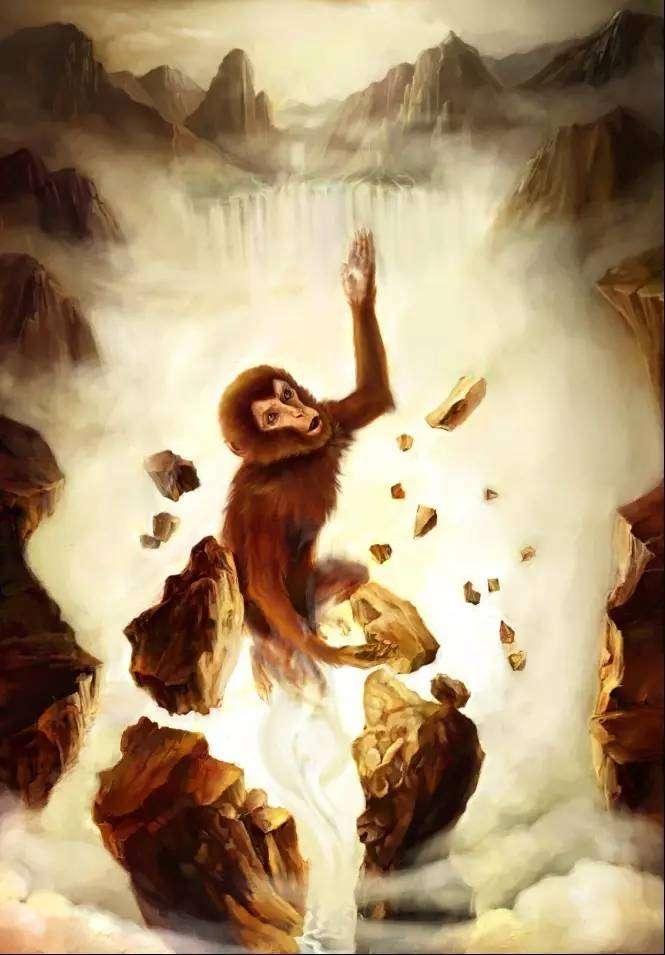
Following his birth, the Stone Monkey (Shi hou, 石猴) comes to live with a tribe of primates on the Mountain of Flowers and Fruit. One day, the monkeys and apes decide to follow a stream to its source in the mountain and find a beautiful waterfall. They state anyone who can discover what is behind the blanket of water will be proclaimed their king. The Stone Monkey takes up this challenge by leaping through and discovers a grotto paradise with a stone mansion and enough room for all the primates to live. After he emerges victorious:

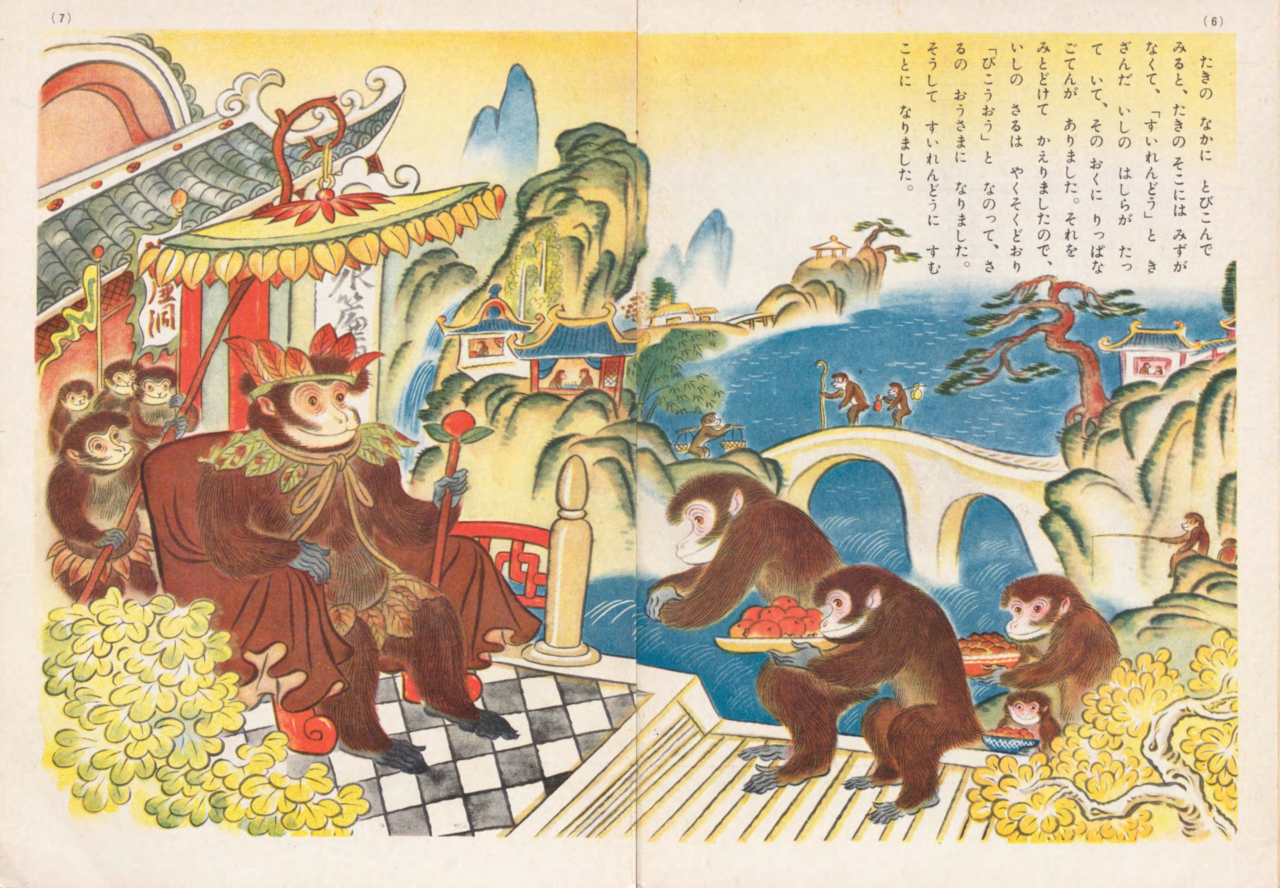
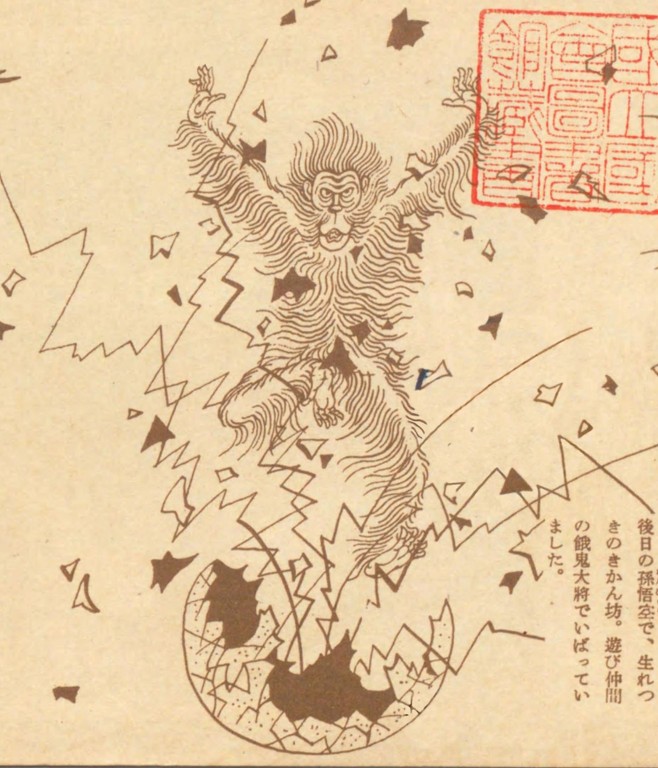
Each one of them [the primates] then lined up according to rank and age, and, bowing reverently, they intoned, “Long live our great king!” From that moment, the stone monkey ascended the throne of kingship [fig. 5]. He did away with the word “stone” in his name and assumed the title, Handsome Monkey King [Mei hou wang, 美猴王] [fig. 1] (Wu & Yu, 2012, p. 105).

In this article, I suggest Sun Wukong’s position as a primate monarch is based on “The Story of the Great Monkey” (Sk: Mahakapi jataka; Ch: Houwang bensheng, 猴王本生, “Birth Story of the Monkey King”; “The Great Monkey” hereafter), an ancient story about the Buddha’s past life as a monkey king, which appears in various collections of moralistic birth tales (Sk: jakata; Ch: bensheng jing, 本生經) in Buddhist literature. After summarizing the tale, I will briefly discuss 2,000-year-old Indian Buddhist art depicting the story at important religious sites, thereby showing its intense popularity. Next, I will demonstrate that the tale traveled the Silk Road to China, where it was represented in Buddhist art and literature. Finally, I will highlight similarities between “The Great Monkey” and a 13th-century precursor of Journey to the West, as well as similarities with the standard 1592 edition of the novel.

Fig. 5 – The Stone Monkey sits on his throne (larger version). From the Japanese children’s book Son Goku (1939).

Table of Contents

1. Story of the Great Monkey

Buddhist literature contains different versions of the tale. I will describe two of them here. The first is story no. 27 in the Garland of Birth Stories (Sk: Jatakamala, 4th century) by the monk Arya Sura. [1] The tale opens with the following epigraph: “Those who make a practice of good behavior can win over the hearts even of their enemies” (Khoroche, 1989, p. 186). According to the story, the bodhisattva was born a virtuous monkey king in the verdant paradise of the Himalayas, which abounded in fruits and flowers, crystal clear streams, and choirs of singing birds. He and his tribe lived near an unnamed river and ate from a mountainous banyan tree that produced figs larger than palmyra nuts. The monkey king feared that the fruit would cause trouble for his people, so he gave instructions to regularly clear them from a branch overlooking the river. However, one season a fig escaped the monkeys’ attention and it grew to maturation, dropping into the water, drifting downstream, and lodging in the fence of a pool where an unnamed human king played with his consorts. The smell and color of the fruit entranced the women, and after the king tasted it, he became obsessed with its flavor and led an army in search of the tree. The ruler and his entourage cut a path upstream and followed a sweet scent directly to the massive banyan, which rose high above all the surrounding trees like the lord of the forest. When he saw the monkeys eating figs, the enraged ruler ordered his men to shoot them down with arrows, spears, and rocks. Seeing the dire situation of his tribe, the monkey king made a tremendous leap to the summit of a nearby mountain, a feat that would have required any other monkey a series of jumps. On the mountain, he found a strong-rooted cane of the appropriate length needed to span the gap and tied it to his feet. But his return jump to the tree was hampered by the binding, and so he came up short, forcing him to grab a branch and use his body as a bridge so that his tribe could escape. But the monkey king was mortally wounded as throngs of the panicked primates clawed their way across his body to safety. The human king took note of this selfless deed and ordered his men to relieve the suspended monkey by placing a canopy beneath him and simultaneously shooting the branch and cane. After his wounds were tended and he regained consciousness, the monkey king spent the last few moments of his life teaching the human king the virtue of putting his people’s needs before his own (Khoroche, 1989, pp. 186-192).

The second is story no. 407 [2] in Commentary on the Birth Stories (Pali: Jatakatthakatha, a.k.a. Jatakatthavannana, 5th century), which is attributed to the monk Buddhagosa. The narrative opens with the Enlightened One talking to a large assembly of monks in Jetavana. He tells them of a previous life when he helped his relatives. Here, the story is quite similar to the first, with slight differences in certain details, such as the monkey king leading a specified number of 80,000 primates, the river is the Ganges, the fruit is water pot-sized mangoes, the specimen that floats downstream is caught in a fisherman’s net, and the human ruler is named King Brahmadatta of Benares. [3] Instead of leaping to a nearby mountain, the monkey king jumps one hundred bow lengths across the Ganges. The cane is tied to his waste instead of his feet, and the cause of falling short on the return jump is not hindrance but miscalculating the length needed to span the gap. And instead of being seriously injured by his people during their escape, a rival of the king—a previous incarnation of the Buddha’s evil cousin Devadatta—mortally wounds his heart by jumping onto his back from a high branch. Brahmadatta instructs his men to build a tower so that he can retrieve the primate and tend to his wounds in his last few moments of life. And just like before, the monkey king teaches the human monarch the value of his people’s needs prior to dying. But this time the discussion is much shorter, being presented as a poem of seven stanzas. Brahmadatta then honors the monkey with funeral rites befitting a king and worships the skull as a religious relic. In the end, the Buddha reveals that the ruler was the past incarnation of his disciple Ananda, the 80,000 monkeys were incarnations of the assembled monks, and the monkey king was himself (Cowell, 1895, vol. 3, pp. 225-227).

2. The Tale in Indian and Chinese Buddhist Art

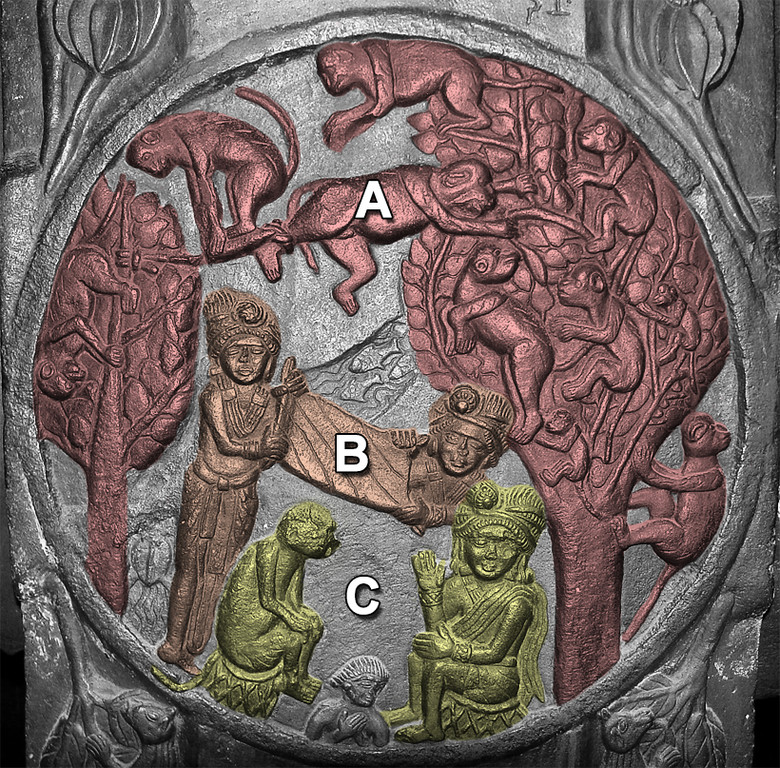
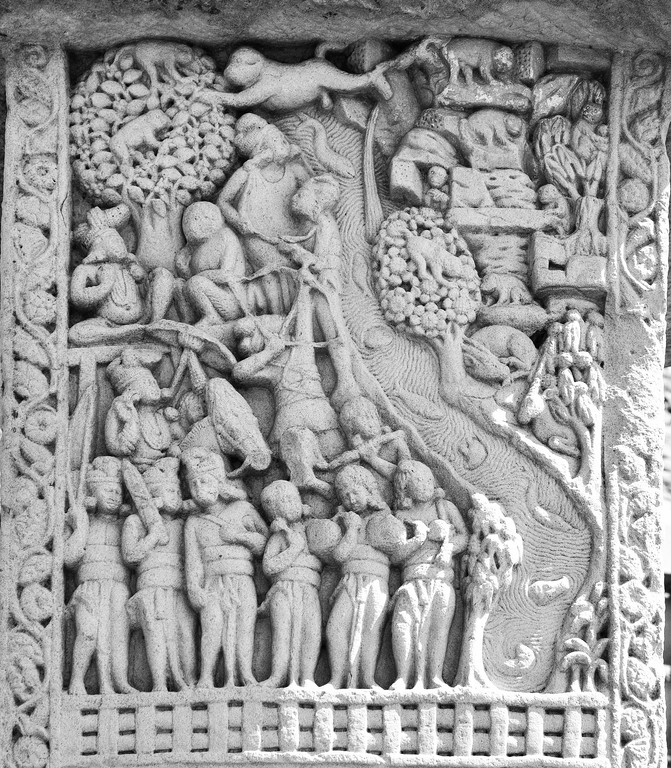
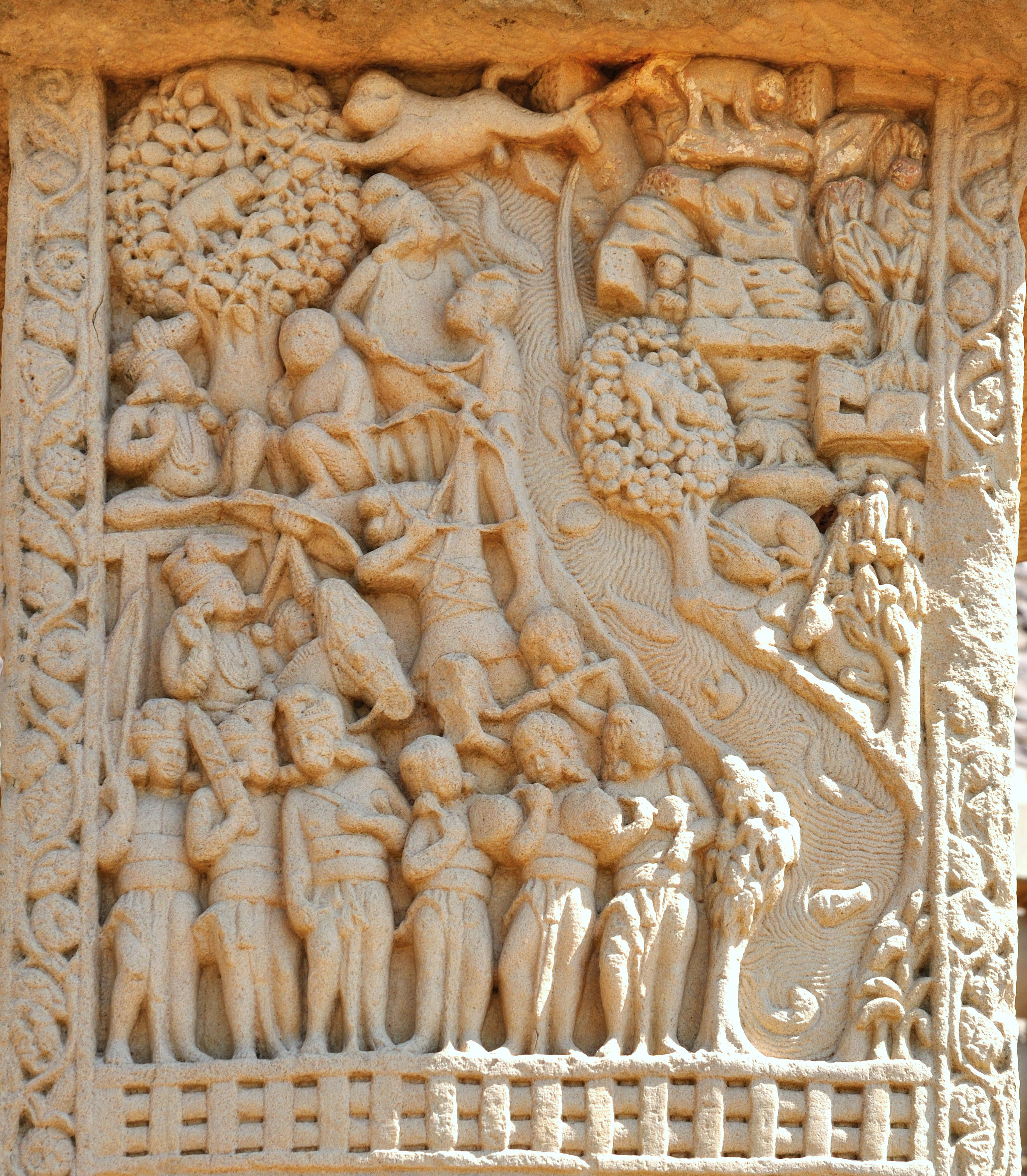
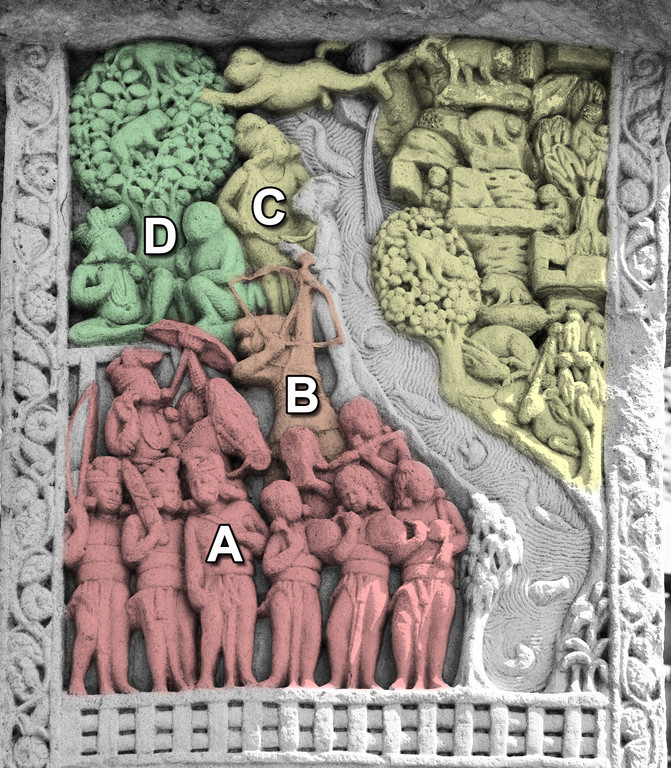
This birth story is over 2,000 years old as it appears among the stone carvings of the Bharhut Stupa (c. 2nd century BCE) (fig. 2 and 3) and the western torana (c. 1st century BCE/CE) of the Great Stupa at Sanchi (fig. 3 and 4) (Marshall, Foucher, Majumdar, 1902, vol. 1, pp. 224-225, vol. 2, plate 64). I should note that the story is one of 547 such tales appearing in the Pali canon (Buswell & Lopez, 2014, p. 381). So the fact that it was one of only a few past life narratives chosen to appear at these religious sites speaks volumes to its popularity. This explains why the story spread beyond India.

Fig. 2 – “The Great Monkey” medallion from Bharhut stupa (c. 2nd century BCE) (larger version). Picture adapted from Wikipedia. Fig. 3 – Key: A) The monkey king leaps and grasps a banyan tree, making a bridge with his body; B) attendants hold a canopy to catch the injured monkey; and C) The human king sits with the monkey discussing the actions of a good ruler prior to the latter’s death (larger version). Fig. 4 – “The Great Monkey” carving from the western torana at Sanchi (c. 1st century BCE/CE) (larger version). Picture adapted from Wikipedia. Fig. 5 – Key: A) Brahmadatta travels with a retinue to the tree; B) he orders his archer(s) to shoot the monkeys; C) He watches as the monkey king leaps across the Ganges and grasps a banyan tree to make a bridge with his body; and D) Brahmadatta’s discussion with the monkey king (larger version).

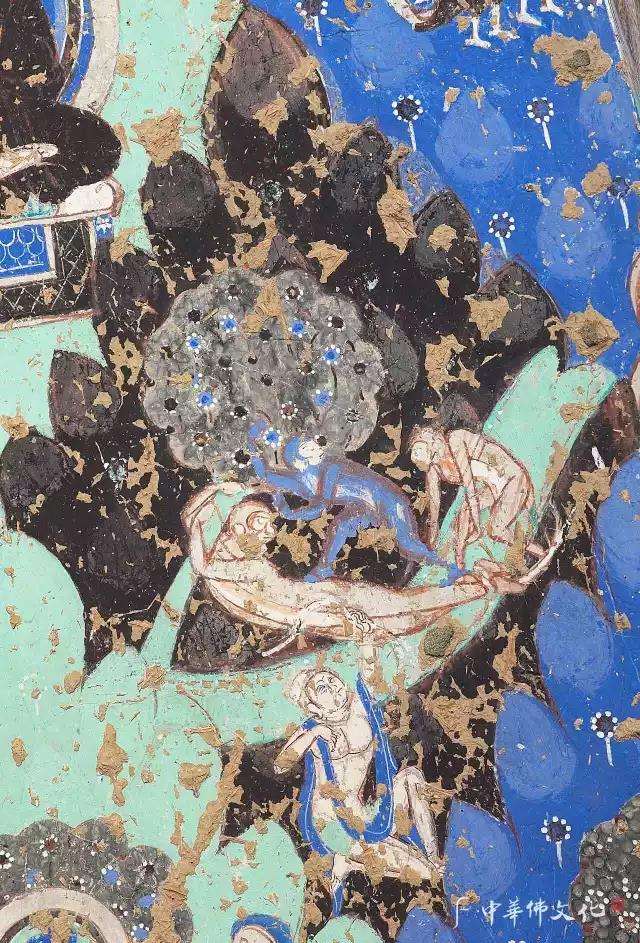
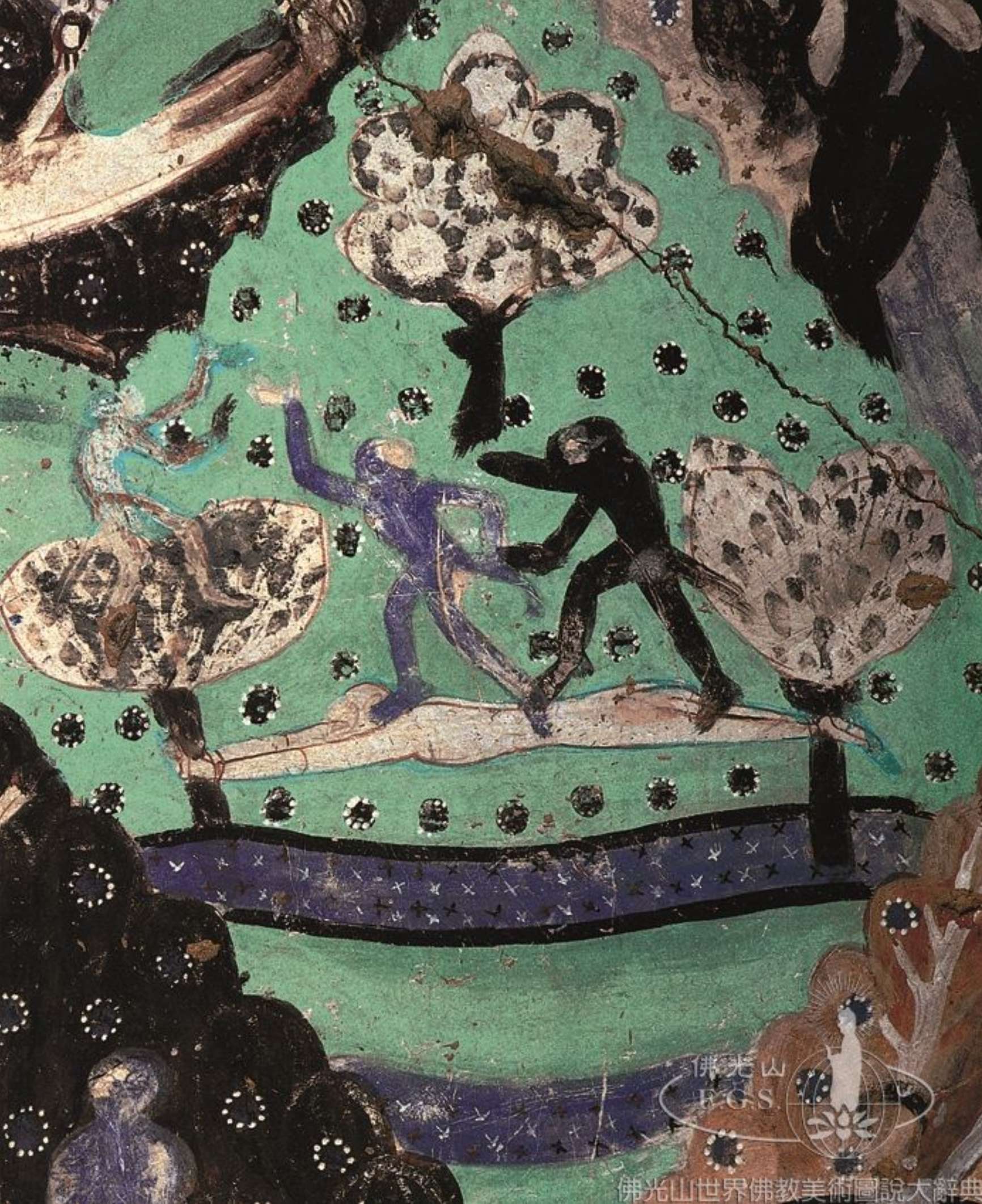
The tale is known to have traveled east to China along the northern silk road. This is demonstrated by murals appearing in the Kizil cave complex (5th to 7th century), one of the earliest and most popular Buddhist centers in Kucha, in what is now Xinjiang, China. Zhu (2012) describes the murals, noting that they lack the detail of their Indian counterparts and are therefore more mnemonic than narrative:

[I]n Kizil Cave 38 [fig. 5], a very large monkey is depicted in the center, stretching his body and holding a tree on the other side of a river. Two other smaller monkeys are stepping on his body to cross the river. In the foreground, a kneeling archer is shooting at them. In Kizil Cave 17 [fig. 6] this story is represented even more simply, with the archer omitted. However the stretching monkey, the river, and the trees are enough for anyone who knows the story to recognize it […] Compared to the Indian representations that are more explicitly narrative, the Kizil paintings are more like a reminder of the story. They communicate with the viewers as if they already know the story well” (pp. 59-60).

Fig. 5 – The Kizil cave no. 38 mural (larger version). Found here. Fig. 6 – Kizil cave no. 17 mural (larger version). Found here. Both are circa 5th to 7th century. Zhu, 2012, p. 61 includes black and white line drawings of the murals.

3. The Tale in Chinese Buddhist Literature

The Kizil murals are predated by a brief story appearing in The Collection of Sutras on the Six Paramitas (Liudu jijing, 六度集經, 3rd century, The Collection hereafter), a compilation of karmic merit tales (Sk: avadana) translated into Chinese by the Sogdian Buddhist monk Kang Senghui (康僧會, d. 280). [4] The 56th story in this collection is an adaptation of the original Indian version with several noticeable differences: The Bodhisattva was formerly a monkey king (mihou wang, 獼猴王) who frolicked with 500 primates. At that time, a drought made the various kinds of fruit scarce. Only a river separated their mountain from a nearby kingdom, so the monkey king led his tribe to eat fruit in the royal garden. The human king ordered that they be secretly captured, but the monkey called for his tribe to gather cane to make a rope. One end was tied to a tree and the other to the king, who leaped from a branch across the river. Unfortunately, the rope wasn’t long enough, and so he came up short, forcing him to grab a branch on the other side and create a bridge with his body. After the 500 monkeys crossed to the other side, the king’s body split in two under the strain. When the human king came upon the scene, the dying primate begged that his tribe not be hurt and offered up his own flesh as payment for his bad judgment. However, the king admired the monkey’s superior, sage-like virtue and questioned his own willingness to sacrifice his body for his people. He then issued a proclamation that all monkeys were to be fed throughout the kingdom, and those who refused would be punished as thieves. Upon his return to the palace, the king recounted the events to his queen, touting the monkey’s kindness and comparing it to the height of Mt. Kunlun. She then suggested that the monkeys be fed and the king confirmed that he had already given the order. In the end, the Buddha revealed that the monkey king was himself, the human king was Ananda, and the 500 monkeys were the monks at the assembly (CBETA, 2016a). [5]

[Note: See the 05-17-22 update below for an explanation on why the number 500 was used.]

Instead of the original 80,000 monkeys, this version reduces the number to only 500. Instead of the king traveling to the banyan/mango tree in the monkey’s mountain territory, the monkeys travel from their home to the royal fruit garden in the king’s territory. Instead of being trampled by his people/a rival, the monkey king’s body breaks in two from the strain. And instead of giving the monkey royal funeral rights and worshiping his skull as a relic, the king enacts a law that all monkeys should be fed.

This version is different enough from the originals to suggest a separate Chinese tradition, one that had circulated for some time. This fits with Chavannes’ (1910) suggestion that The Collection of Sutras on the Six Paramitas is not an original Indian text but one compiled in China by Kang Senghui, who likely selected and edited the stories himself (vol. 1, p. 1 n. 1).

Story no. 56 finds parallels with another tale from Chinese Buddhist literature. [6] It appears in the Scripture on the Storehouse of Sundry Treasures (Za baozang jing, 雜寶藏經, mid-5th century), which was translated into Chinese by the monk Tan Yao (曇曜). According to the 12th story in this collection: The Buddha was in Rajagrha when the monks commented on the woes faced by those who rely on Devadatta, while celebrating the happiness, positive rebirth, and eventual deliverance of those who rely on the Enlightened One. The Buddha confirmed this by telling a brief tale about two monkeys, each with 500 members in their tribe. A prince of Kashi (a.k.a. Benares) was on a hunting excursion when he surrounded the monkeys. The good monkey (shan mihou, 善獼猴) suggested that they cross the river to escape, but the evil monkey (e’mihou, 惡獼猴) wavered. The good monkey instructed his tribe to cross by using the long branches of a nearby tree. But the evil monkey and his tribe were captured due to inaction. In the end, the Buddha revealed that the good monkey was himself and Devadatta was the evil monkey. He used this story to advocate following the virtuous over the evil, for the former would lead others to safety and happiness, while the latter would lead others to suffering over numerous incarnations (CBETA, 2016b). [7]

This version does away with the fruit element altogether. The monkeys are in danger not because a king is protecting produce but because a prince is out hunting. The most noticeable difference here is the addition of a second monkey, one who is labeled as “evil” (e, 惡) (no connection to the Six-Eared Macaque). But like story no. 56, the monkey king is said to lead 500 primates.

It is clear that both Chinese tales were influenced by the later Indian version, story no. 407 from Commentary on the Birth Stories, as they specify a number for the troupe size (500 vs. 80,000), state the monkey king leaps over a river (as opposed to jumping to a nearby mountain top), and characters are revealed in the end to have been the past lives of Buddhist personages (the Buddha, Ananda, Devadatta, monks, etc.). Story no. 12 even opens in a city associated with the Enlightened One’s historical lectures (Rajagrha vs. Jetavana), where he discusses philosophical matters with monks; and an unnamed prince who poses a threat to the monkey king and his people is said to hail from Kashi, another name for Benares, the seat of King Brahmadatta.

4. The Chinese Monkey King

The oldest Chinese source mentioning Sun Wukong as a king of monkeys is The Story of How Tripitaka of the Great Tang Procures the Scriptures (Da Tang Sanzang qujing shihua, 大唐三藏取經詩話, late-13th century, The Story hereafter), a 17 chapter storytelling prompt that predates the Ming Journey to the West by 300 years. In chapter two, our hero’s literary antecedent, a white-clad scholar called the “Monkey Pilgrim” (Hou xingzhe, 猴行者), meets the Tang monk Tripitaka on the road to the west and warns the monk that his two previous incarnations have died trying to procure the Buddhist scriptures. When asked how he knows events of the past, the scholar replies: “I am none other than the bronze-headed, iron-browed [8] king of the eighty-four thousand monkeys of the Purple Cloud Grotto on the Mountain of Flowers and Fruit. I have come to help the reverend monk procure the scriptures” (Wivell, 1994, p. 1182).

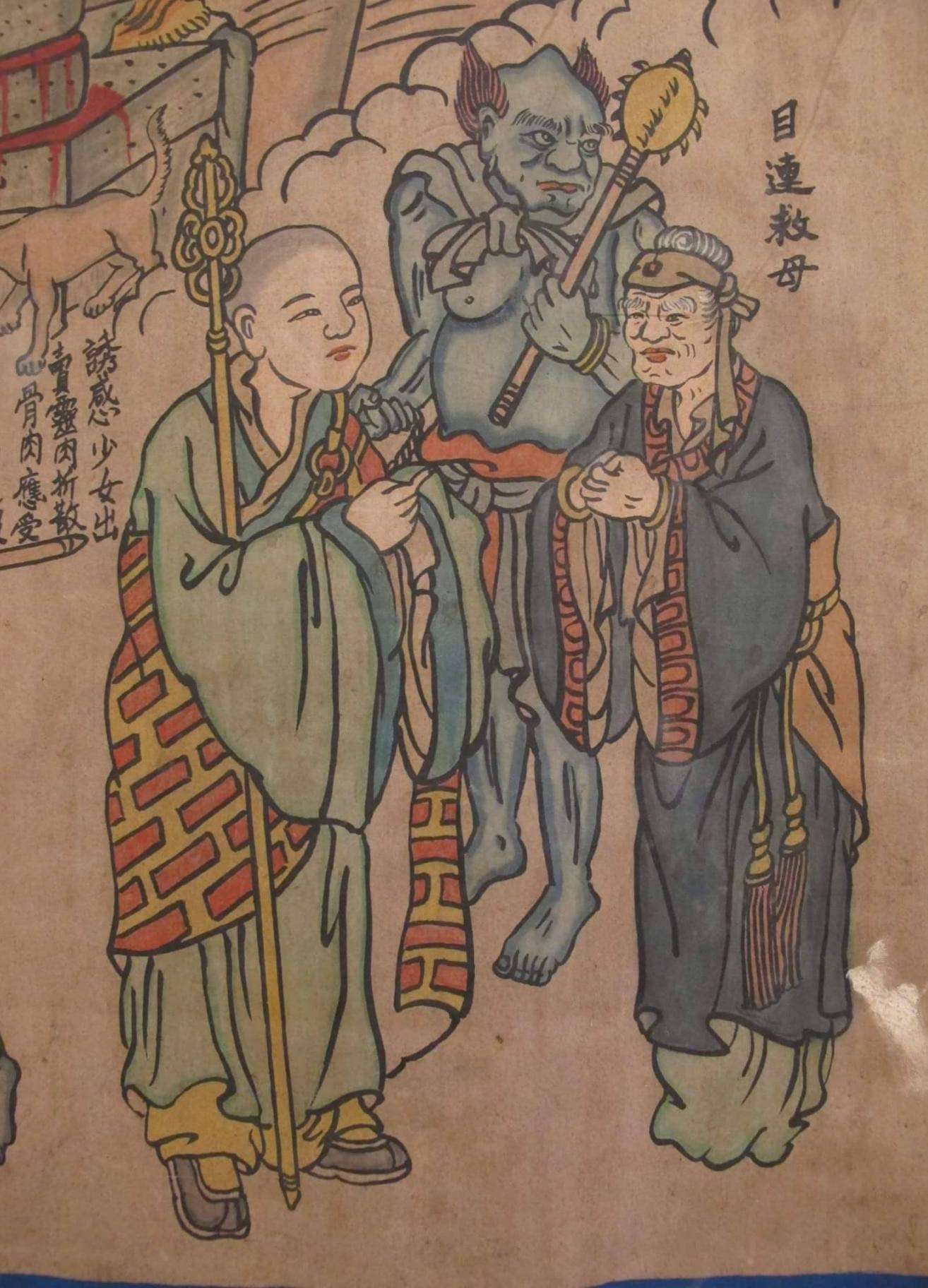
The Story‘s depiction of the Monkey Pilgrim was influenced by Saint Mulian (目連; Sk: Maudgalyayana) (fig. 7), a disciple of the Buddha, who appears in a late-9th to early-10th century Bianwen (變文) text in which he travels to the underworld to release his mother from karmic torment. For example, both are depicted with occult powers enabling them to fly between heaven and earth (Wivell, 1994, pp. 1183; Mair, 1994, pp. 1097-1098); both visit a realm ruled by a deity named Brahma, the Mahabrahma devaraja Vaisravana in the case of Monkey and Brahma in the case of Mulian (Wivell, 1994, pp. 1183; Mair, 1994, p. 1098); both are bestowed magic weapons by heaven, a golden-ringed monk staff and alms bowl for Monkey and a matching staff for Mulian (he enchants his own alms bowl) (Wivell, 1994, p. 1184; Mair, 1994, p. 1111); the power of said weapons are tied to the recitation of a Buddhist deity’s name, Vaisravana and the Buddha, respectively (Wivell, 1994, p. 1184; Mair, 1994, p. 1111); and both use said weapons with the expressed purpose of saving someone important, Tripitaka and Mulian’s mother, respectively (Wivell, 1994, p. 1189, for example; Mair, 1994).

Fig. 7 – A painting depicting Mulian rescuing his mother from the underworld (larger version). Originally found here.

If The Story borrows from Mulian’s tale, it’s not a stretch to suggest that it also appropriated material from other Buddhist tales, including “The Great Monkey.” For example, the Mountain of Flowers and Fruit could be based on the Himalayas and the massive, fruit-bearing banyan/mango tree. Additionally, both The Story and the “The Great Monkey” describe the respective monkey kings leading a similar number of primates, 84,000 in the former and 80,000 in the latter. [9] While the Chinese variants drastically reduce the number to 500, it’s interesting that both tales would display such similar counts. This is because said numbers are significant to Buddhism. For example, 84,000 generally denotes a very large number, hence the belief that the body contains this many atoms. Other examples include the 84,000 stupas of Asoka, the 84,000 bodily relics of the Buddha, the Amitabha‘s 84,000 rays of illumination, the 84,000 bodily signs of a Buddha, the 84,000 teachings of the Buddha, etc. In addition, the Chinese term for 80,000 (bawan, 八萬) can be shorthand for 84,000. It can also refer to separate Buddhist concepts, such as the “bodhisattva’s 80,000 duties” (Soothill & Hodous, 1937/2006, p. 39). It’s certainly possible that both stories independently chose similar numbers due to their demonstrated connection to Buddhism. But maybe the storytellers who developed The Story had access to some non-Chinese version of the tale, perhaps by way of Buddhist monks, for Buddhism has a long history of proselytizing through oral literature. [10]

Furthermore, in chapter 11 of The Story, the pilgrims enter the earthly paradise of the Daoist goddess Queen Mother of the West, home to the famed peaches of immortality. Tripitaka asks Monkey to steal the group a few fruits, but the latter refuses, stating:

Because I stole ten peaches to eat when I was eight hundred years old, I was captured by the Queen Mother and given eight hundred blows on my left side and three thousand blows on the right with an iron cudgel. Then I was exiled to the Purple Cloud Grotto on the Mountain of Flowers and Fruits. Even today my sides hurt and now I definitely don’t dare to steal any more peaches!” (Wivell, 1994, p. 1195).

This event was surely influenced by the fabled meeting of Emperor Wu and the Queen mother, during which she reveals his jester Dongfang Shuo (東方朔), formerly the planet Jupiter (Sui, 歲), was exiled from heaven for stealing her peaches (Campany, 2009, p. 126). However, a monkey king running afoul of an earthbound monarch for raiding their imperial fruit garden mirrors story no. 56 in The Collection. As mentioned above, the tale recalls the Buddhist monkey king leading his tribe out of the mountains to eat fruit in a human sovereign’s garden during a time of drought. The ruler orders the primates captured, leading to the monkey king’s sacrifice. Therefore, this portion of The Story could be a combination of Buddhist and Daoist sources.

“The Great Monkey” could have also influenced the 1592 edition. In chapter one, the monkeys following the stream to find its source in the Mountain of Flowers and Fruit is reminiscent of the human king’s trek up the Ganges to find the source of the fruit in the Himalayas. Also, recall that the Indian and Chinese versions place great emphasis on the monkey king leaping over a river. For example, story no. 407 reads: “[H]e ascended a branch that rose up straight, went along another branch that stretched towards the Ganges, and springing from the end of it, he passed a hundred bow-lengths and lighted on a bush on the [other] bank” (Cowell, 1895, vol. 3, p. 226). This could have influenced the competition to leap through the waterfall. It’s interesting that Wukong alone is successful in the jump, leading to his kinghood:

The monkeys said to each other, “We don’t know where this water comes from. Since we have nothing to do today, let us follow the stream up to its source to have some fun.” With a shriek of joy, they dragged along males and females, calling out to brothers and sisters, and scrambled up the mountain alongside the stream. Reaching its source, they found a great waterfall.

[…]

All the monkeys clapped their hands in acclaim: “Marvelous water! Marvelous water! So this waterfall is distantly connected with the stream at the base of the mountain, and flows directly out, even to the great ocean.” They said also, “If any of us had the ability to penetrate the curtain and find out where the water comes from without hurting himself, we would honor him as king.” They gave the call three times, when suddenly the stone monkey leaped out from the crowd. He answered the challenge with a loud voice, “I’ll go in! I’ll go in!”

[…]

Look at him! He closed his eyes, crouched low, and with one leap he jumped straight through the waterfall (Wu & Yu, 2012, pp. 103-104).

This takes us back to where we started from in the introduction.

5. Conclusion

I suggest Sun Wukong’s position as the Monkey King is based on the “The Great Monkey,” a jataka tale about the Buddha’s past life as a primate monarch, which appears in various Indian Buddhist sources, such as the 4th-century Garland of Birth Stories (no. 27) and the 5th-century Commentary on the Birth Stories (no. 407). The tale describes the monkey king’s efforts to save his tribe from a human monarch who seeks to claim a massive banyan/mango tree in the Himalayas by killing all of the monkeys inhabiting it. After leaping to a mountain top or over the Ganges River to retrieve a length of cane needed to span the gap, his return jump is hindered, forcing him to make a bridge with his body. He is mortally wounded in the process, though, when throngs of clambering monkeys run across his back or a rival primate assaults him from a high branch. In the end, the human monarch takes note of this selfless act and learns from him the value of putting the needs of his people first moments prior to the monkey king’s death.

The popularity of the tale, as evidenced by 2,000-year-old Indian Buddhist art at the Bharhut and Sanchi stupas, explains why it spread beyond Bharata and traveled the Silk Road to the Middle Kingdom, where it was represented in Chinese Buddhist literature and art. Simplistic mnemonic depictions of the tale in Xinjiang’s Kizil Cave complex (no. 17 and 38) (5th to 7th century) are predated by stories in the 3rd century Collection of Sutras on the Six Paramitas (no. 56) and the mid-5th century Scripture on the Storehouse of Sundry Treasures (no. 12). The first tells how the monkey king leads his people down from the mountain to raid an imperial fruit garden and ultimately sacrifices his life so the tribe can escape punishment. The second involves the decisions of two monkey kings, one good and one evil, whether or not to cross a river to escape capture at the hands of a prince on a hunting trip. It serves as a parable warning of the consequences of putting one’s faith in those of evil character.

The oldest Chinese source mentioning Sun Wukong as a king of monkeys is the late-13th century tale The Story of How Tripitaka of the Great Tang Procures the Scriptures. This story borrows from the Mulian story cycle, so it’s possible that it selected from other Buddhist tales, including Indian and Chinese versions of the “The Great Monkey.” For example, the Mountain of Flowers and Fruit could be based on the Himalayas and the banyan/mango tree. The 84,000 primates led by the Chinese Monkey King could be based on the 80,000 from an Indian version. Likewise, Monkey stealing peaches from the Queen Mother of the West in chapter 11 could be based on the Chinese version in which the monkey king and his people raid an imperial fruit garden. In addition, the emphasis on leaping over a river in the various versions of “The Great Monkey” could have influenced the waterfall jumping contest in the standard 1592 edition of Journey to the West.


6. Updates

Update: 05-17-22

I’ve since learned that 500 is used in a similar manner to 84,000. Dhammika (2021) comments, “In Buddhist literature the conventional way of indicating a large number of things is to say that there were five hundred” (p. ix).

Notes:

1) Little is known about Arya Sura’s life. Based on various Indian and Chinese sources, the monk has been estimated to have lived somewhere between the 2nd to the 5th century, with the 4th century being the best guess (Khoroche, 1989, pp. xi-xiii).

2) This should not be confused with the similarly named Mahakapi jataka (no. 516). See Cowell, 1895, vol. 5, pp. 37-42.

3) This page (see #3) explains Brahmadatta is the name of several kings from jataka tales.

4) See Nattier, 2008, pp. 149-155 for more information about Kang Shenghui and his work, including the Liudu jijing.

5) See Chavannes, 1910, vol. 1, pp. 216-218 for a French translation of the story. Click here for an English translation by Edward P. Butler (@EPButler).

6) Thank you to Eric Greene of Yale University for bringing these stories to my attention.

7) See Tanyao, Kikkāya, & Liu, 1994, pp. 40-41 for a full English translation. As of 03-02-21, the book can be downloaded here for free. See Chavannes, 1910, vol. 3, p. 13 for a partial French translation.

8) According to Mair (1989), “‘Bronze-headed, iron-browed’ is a conventional Chinese epithet for boldness and bravery” (p. 701).

9) Interestingly, the number of primates led by Wukong in the final Ming edition of the novel is 47,000 (Wu & Yu, 2012, p. 133). I don’t know if this number holds any significance.

10) Mair (1988) explains Indian Buddhist prosimetric oral literature was very popular in China during the Tang but rapidly became secularized and Sinicized during Song (when The Story was published) due to past anti-Buddhist pogroms, Muslim incursions in Central Asia cutting off fresh Buddhist material, and the reemergence of Confucianism as a state power. But I suggest material that influenced The Story may predate this shift. For example, the Monkey Pilgrim appears with Xuanzang in an 11th-century (Western Xia) mural from Eastern Thousand Buddha Cave number two in the Hexi Corridor of Gansu Province (see this article). Xuanzang is shown worshiping Guanyin from a riverbank, while our hero stands behind him tending to a brown horse. The fact that Monkey appears in religious art at an important stop along the Silk Road shows his association with Xuanzang’s journey was well-known even during this early period. And since story cycles take time to form and become cemented in the public psyche, it’s not a stretch to suggest Monkey’s tale goes back to the previous century or even before the Song. Therefore, it’s possible that these earlier storytellers may have had access to some non-Chinese version of “The Great Monkey.”

Sources:

Campany, R. F. (2009). Making Transcendents: Ascetics and Social Memory in Early Medieval China. University of Hawaii Press.

Chavannes, E. (1910). Cinq Cents Contes et Apologues, Extraits du Tripitaka Chinois et Traduits en Français: Tome 1 [Five Hundred Tales and Apologues: Extracts from the Chinese Tripitaka Translated into French: Vol. 1]. Paris: E. Leroux.

Chinese Buddhist Electronic Text Association (Ed.). (2016a). T03n0152_006 六度集經 第6卷 [The Collection of Sutras on the Six Paramitās, scroll no. 6]. Retrieved from http://tripitaka.cbeta.org/T03n0152_006

Chinese Buddhist Electronic Text Association (Ed.). (2016b). T04n0203_002 雜寶藏經 第2卷 [Scripture on the Storehouse of Sundry Treasures, scroll no. 2]. Retrieved from http://tripitaka.cbeta.org/T04n0203_002

Cowell, E. B. (Ed.) (1895). The Jātaka, or Stories of the Buddha’s Former Births: Vol. 1-5. Cambridge: Cambridge University Press. Retrieved from https://archive.org/details/cu31924072231073/page/n249/mode/2up

Dhammika, S. (2021). Footprints in the Dust: The Life of the Buddha from the Most Ancient Sources. Singapore: Buddha Dhamma Mandala Society.

Khoroche, P. (Trans.). (1989). Once the Buddha Was a Monkey: Ārya śūra’s Jātakamālā. Chicago: University of Chicago Press.

Mair, V. H. (1988). The Buddhist Tradition of Prosimetric Oral Narrative in Chinese Literature. Oral Tradition, 3(1-2), 106-21. Retrieved from https://journal.oraltradition.org/wp-content/uploads/files/articles/3i-ii/6_mair.pdf

Mair, V. H. (1989). Suen Wu-kung = Hanumat? The Progress of a Scholarly Debate, in Proceedings of the Second International Conference on Sinology (pp. 659-752). Taipei: Academia Sinica.

Mair, V. H. (1994). Transformation text on Mahamaudgalyayana rescuing his mother from the underworld with pictures, one scroll, with preface In V. Mair (Ed.), The Columbia anthology of traditional Chinese literature (pp. 1094-1127). New York: Columbia University Press.

Marshall, J., Foucher, A., & Majumdar, N. G. (1902). The Monuments of Sāñchī: Vol. 1-3. Bhopal: Indra Publishing House.

Nattier, J. (2008). A Guide to the Earliest Chinese Buddhist Translations: Texts from the Eastern Han 東漢 and Three Kingdoms 三國 Periods. Tokyo: International Research Institute for Advanced Buddhology, Soka University.

Robert, E. B. J., & David, S. L. J. (2013). The Princeton Dictionary of Buddhism. Princeton University Press.

Soothill, W. E., & Hodous, L. (2006). A Dictionary of Chinese Buddhist Terms: With Sanskrit and English Equivalents and a Sanskrit-Pali Index. London: Routledge.  (Original work published 1937)

Tanyao, Kikkāya, & Liu, X. (1994). The Storehouse of Sundry Valuables (C. Willemen, Trans.). Berkeley, Calif: Numata Center for Buddhist Translation and Research.

Wivell, C.S. (1994). The Story of How the Monk Tripitaka of the Great Country of T’ang Brought Back the Sūtras. In V. Mair (Ed.), The Columbia Anthology of Traditional Chinese Literature (pp. 1181-1207). New York: Columbia University Press.

Wu, C., & Yu, A. C. (2012). The Journey to the West (Vol. 1) (Rev. ed.). Chicago, Illinois: University of Chicago Press.

Zhu, T. (2012). Reshaping the Jātaka Stories: from Jātakas to Avadānas and Praṇidhānas in Paintings at Kucha and Turfan. Buddhist Studies Review, 29(1), 57-83. Retrieved from https://journals.equinoxpub.com/index.php/BSR/article/view/14021/pdf

When was the Monkey King Born?

Last updated: 04-02-2021

From time to time I like to post a fun blog not directly related to (though sometimes informed by) my research. Past examples can be seen herehere, and here. Regular articles will resume after this entry.

I was recently contacted by someone writing a fanfiction about Journey to the West (Xiyou ji西遊記, 1592 CE) and asked when the Monkey King was born from stone. I have, therefore, decided to write an entry for those interested in the subject. I will start at the end of the novel and work my way backwards. However, it is important to note that the years presented here are guesstimates and should not be taken as wholly accurate considering that the novel does not follow a strict historical timeline.

I should also point out that this has nothing to do with Sun Wukong’s religious birthday, which is variously celebrated on the sixteenth day of the eighth lunar month in Hong Kong and Singapore (Elliott, 1955/1990, p. 82), the twenty-third (Fuzhou) or twenty-fifth day (Putian) of the second lunar month in Fujian (Doolittle, 1865, vol. 1, pp. 288; Dean & Zheng, 2010, p. 162, for example), and the twelfth day of the tenth lunar month (Taiwan) (see here).

Monkey’s birth from stone (larger version). From The Illustrated Journey to the West (1950).

Table of Contents

1. Chapter 100

Upon the pilgrims’ return to China from India, Tang Emperor Taizong tells Tripitaka: “We have caused you the trouble of taking a long journey. This is now the twenty-seventh year of the Zhenguan period!” (Wu & Yu, vol. 4, p. 374). It should be noted that this era historically lasted from 627 to 650 CE (Zhang, 2015, p. 49). So, the novel dates their return to 654 CE, adding four fictional years to the reign period.

The historical Xuanzang returned in 645 CE (Buswell & Lopez, 2014, p. 1015).

2. Chapters 13 & 14

In chapter fourteen, Tripitaka releases Wukong from under the Mountain of Two Frontiers (a.k.a. Five Elements Mountain) a short time after leaving the confines of the Chinese empire. But prior to taking Monkey as a disciple, he is briefly guarded by the hunter Liu Boqin on his trek westward. Liu tells Tripitaka the history of the area during their journey across the mountain: “A few years ago, I heard from my elders that during the time when Wang Mang usurped the throne of the Han emperor, this mountain fell from Heaven with a divine monkey clamped beneath it” (Wu & Yu, vol. 1, p. 306). [1] The former Han official Wang Mang historically ruled from 9 BCE–23 CE (Bielenstein, 1986). I will return to this point below.

Chapter thirteen states Tripitaka leaves from Chang’anon the third day before the fifteenth of the ninth month in the thirteenth year of the period Zhenguan” (Wu & Yu, vol. 1, p. 293). This dates his departure to the year 640 CE.

The historical Xuanzang left China in 627 CE (Buswell & Lopez, 2014, p. 1015).

3. Chapters 7 & 8

In the beginning of chapter eight, the Buddha says: “We do not know how much time has passed here since I subdued the wily monkey and pacified Heaven, but I suppose at least half a millennium has gone by in the worldly realm…” (Wu & Yu, 2012, vol. 1, p. 203). But as noted above, Wukong is imprisoned during the reign of Wang Mang (r. 9 BCE–23 CE). Therefore, if he is discovered in 640 CE, this means Monkey’s imprisonment lasts anywhere from 617 to 649 years and not 500 as is commonly thought.

Prior to his wager with the Buddha in chapter seven, Wukong is placed into Laozi’s eight trigrams furnace. The novel reads: “Truly time passed swiftly, and the forty-ninth day arrived imperceptibly” (Wu & Yu, 2012, vol. 1, p. 189). But the narrative previously revealed that “one day in heaven is equal to one year on Earth” (Wu & Yu, 2012, vol. 1, pp. 150 and 167). So, this means his turn in the furnace lasts close to fifty years, starting between 40–26 BCE.

4. Chapter 5

Following Monkey’s initial rebellion and being granted the empty title “Great Sage Equaling Heaven,” he is appointed the guardian of the immortal peach groves. He later flees back to earth after eating the life-prolonging fruits and wreaking havoc on the Queen Mother’s peach banquet. Upon his return, his commanders ask him: “The Great Sage has been living for over a century (emphasis added) in Heaven. May we ask what appointment he actually received?” (Wu & Yu, 2012, vol. 1, p. 166). [2] This dates his ascension to heaven somewhere below the range of 140–126 BCE (150–136 BCE?). I obviously can’t provide a more precise number given the vague language.

5. Chapters 3 & 4 – Answer

After Wukong bullies the Eastern Dragon King and the Judges of Hell, Heaven appoints him the “Keeper of the Heavenly Horses” in order to keep his unruly adventures in check. But upon learning that his position is the lowest in heaven, he returns home in rebellion. His children ask, “Having gone to the region above for more than ten years (emphasis added), you must be returning in success and glory” (Wu & Yu, 2012, vol. 1, p. 150). [3] This dates his first ascension somewhere below the range 150–136 BCE (160–146 BCE?). Again, I can’t provide a more precise number given the vague language.

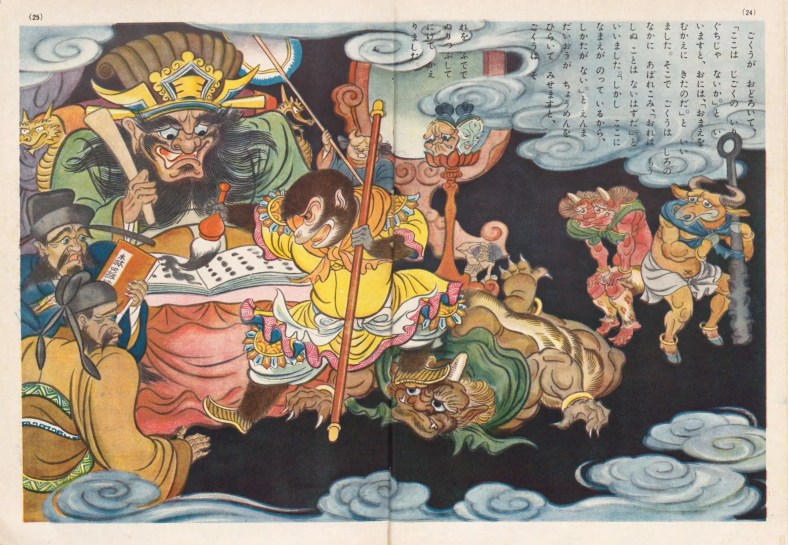
During his time in Hell, Monkey calls for the ledger containing his information. Under a heading marked “Soul 1350,” Wukong reads, “Heaven-born Stone Monkey. Age: three hundred and forty-two years. A good end” (Wu & Yu, 2012, vol. 1, p. 140). [4] If we use 160–146 BCE as a conservative estimate for his first ascension, then this dates his birth to somewhere between 502–488 BCE during the Zhou Dynasty (c. 1046–256 BCE). I think 500 BCE is a nice round number.

This means that Sun Wukong is roughly 1,100-years-old when he attains Buddhahood at the end of the novel.

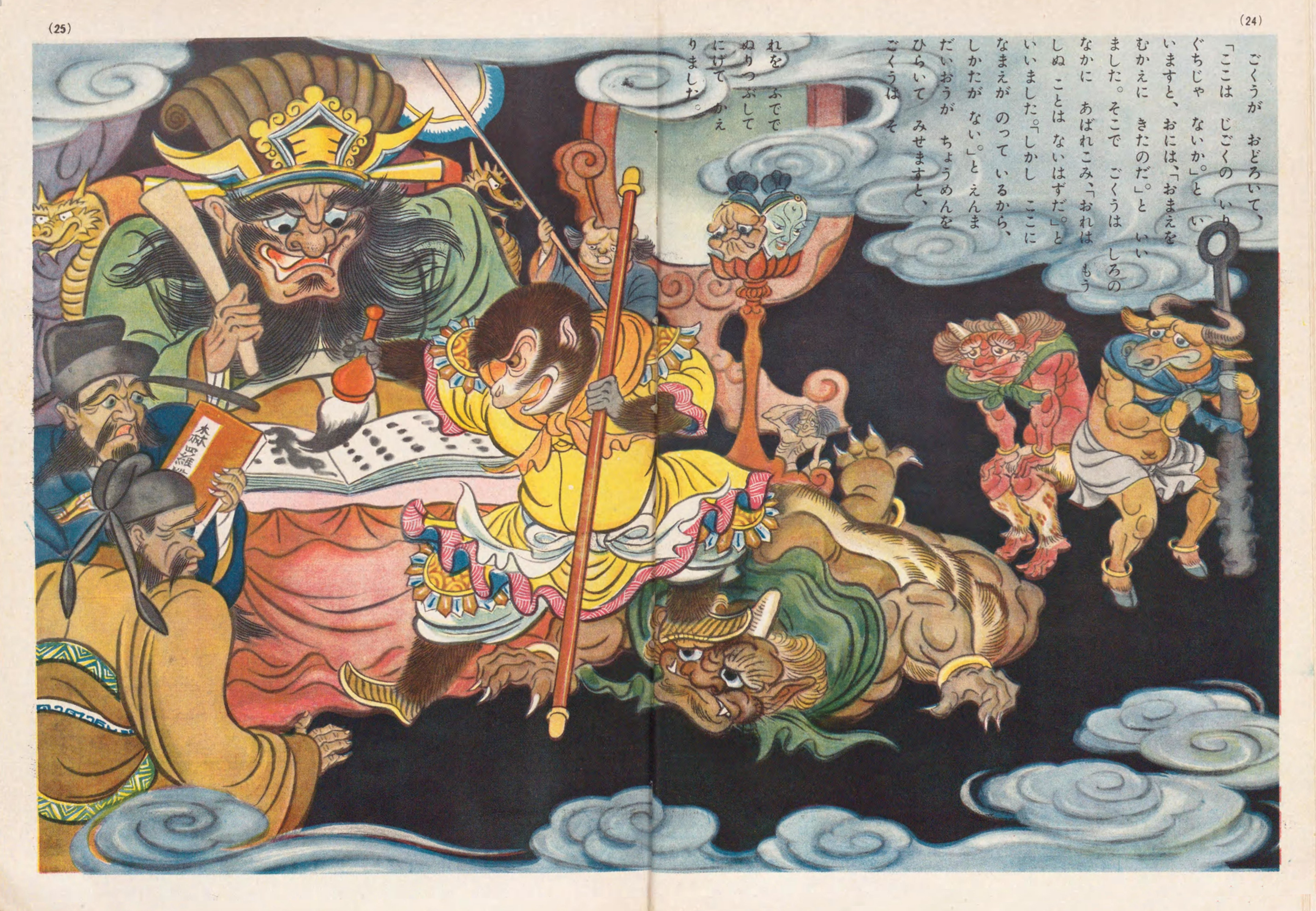
Monkey strikes his name from the Book of Life and Death in Hell (larger version). From Son Goku (1939).


6. Updates

Update: 07-08-20

The novel suggests a two hour window for the time of Wukong’s birth. This takes place in chapter 61 when Monkey is preparing to battle the Bull Demon King over the palm-leaf fan. Our hero recites an emboldening poem, to which Zhu Bajie replies:

Yes! Yes! Yes!
Go! Go! Go!
Who cares if the Bull King says yes or no!
Wood’s born at Boar,
the hog’s its proper mate,
Who’ll lead back the Bull to return to earth.
Monkey is the metal born under shen (emphasis added):
Peaceful and docile, how harmonious!
Use the palm-leaf
As water’s sign.
When flames are extinct, Completion’s attained.
In hard work we persist both night and day
And rush, merit done, to Ullambana Feast (Wu & Yu, 2012, vol. 3, p. 154). 

是是是,去去去,管甚牛王會不會。
木生在亥配為豬,牽轉牛兒歸土類。
申下生金本是猴,無刑無剋多和氣
用芭蕉,為水意,焰火消除成既濟。
晝夜休離苦盡功,功完趕赴盂蘭會。

The monkey is one of twelve animals of the Chinese zodiac, each corresponding to an earthly branch, an elemental phase, and a time period. The monkey is born under the shen (申) branch, which is associated with metal and the hours 3:00 PM to 5:00 PM.


Update: 04-02-21

As I explain in this article, Wukong learns the 72 transformations in order to escape a trio of heaven-sent punishments scheduled to kill him for defying his fate and achieving immortality. The calamities of thunder, fire, and wind respectively come every 500 years (after the initial attainment of eternal life) to kill Daoist cultivators. Monkey becomes an immortal around his 342nd year when his soul is taken to Hell. He is immortal for over 160 years [5] at the time he’s imprisoned under Five Elements Mountain. This means his 500th year of immortality, the year that the calamity of thunder would be scheduled to strike him, takes place during his imprisonment under the celestial mountain. But this is never described in the story. I assume this is just one of many inconsistencies born from oral storytelling. Although, one could argue that, within the fictional universe, the thunder calamity was voided since Wukong was undergoing punishment at the behest of the Buddha.

Notes:

1) I am indebted to Irwen Wong for bringing this passage to my attention.

2) Wukong, however, questions this estimate, saying: “I recall that it’s been but half a year…How can you talk of a century?” (Wu & Yu, 2012, vol. 1, p. 167). But, earlier in the novel, a wise member of Monkey’s tribe points out that one’s view of time is skewed while inhabiting the celestial realm: “You are not aware of time and seasons when you are in Heaven” (Wu & Yu, 2012, vol. 1, p. 150). Add to this the established fact that one heavenly day equals one solar year. Therefore, the Great Sage’s recollection of the passage of time is unreliable.

3) Monkey also questions this estimate: “I have been away for only half a month…How can it be more than ten years” (Wu & Yu, 2012, vol. 1, p. 150). But, again, his recollections are not reliable. See note #2.

4) These include three years as Subodhi’s student (Wu & Yu, 2012, vol. 1, p. 121), seven as a junior monk (Wu & Yu, 2012, vol. 1, p. 117), and “more than ten years” searching the world for a master (Wu & Yu, 2012, vol. 1, p. 114).

5) As previously mentioned, Wukong serves in heaven twice: first “for more than ten years” and second “for over a century” (Wu & Yu, 2012, vol. 1, pp. 150 and 166). Then he is punished to 49 heavenly days/49 solar years in Laozi’s furnace (see above).

Sources:

Bielenstein, H. (1986). Wang Mang, the Restoration of the Han Dynasty, and Later Han. In D. Twitchett and M. Loewe (Ed.). The Cambridge History of China: Volume 1, The Ch’in and Han Empires, 221 BC-AD 220 (pp. 223-290). Kiribati: Cambridge University Press.

Buswell, R. E., & Lopez, D. S. (2014). The Princeton Dictionary of Buddhism. Princeton, NJ: Princeton University Press.

Dean, K., & Zheng, Z. (2010). Ritual Alliances of the Putian plain. Volume Two: A Survey of Village Temples and Ritual Activities. Leiden: Brill.

Doolittle, J. (1865). Social Life of the Chinese: With Some Account of Their Religious, Governmental, Educational, and Business Customs and Opinions. With Special but not Exclusive Reference to Fuhchau (vol. 1 and 2). New York: Harper & Brothers.

Elliott, A. J. (1990). Chinese Spirit-Medium Cults in Singapore. London: The Athlone Press. (Original work published 1955)

Wu, C., & Yu, A. C. (2012). The Journey to the West (vol. 1-4) (Rev. ed.). Chicago, Illinois: University of Chicago Press.

Zhang, Q. (2015). An Introduction to Chinese History and Culture. Belgium: Springer Berlin Heidelberg.

The Later Journey to the West: Part 2 – The Journey to India Begins

Note: An AI translation of this novel is now available. Click the linked Chinese characters below that read “後西遊記.”

The main body of Later Journey to the West (Hou Xiyouji, 後西遊記, 17th century) follows a similar trajectory as the parent novel, Journey to the West (Xiyouji西遊記, 1592). The historical monk Dadian (大顛, 732–824) (fig. 1) is tasked with traveling from China to India to retrieve spiritual knowledge from the Buddha, and just like Tripitaka, he is protected by three demonic disciples, namely Sun Luzhen (孫履真), the descendant of Sun Wukong, Zhu Yijie (豬一戒), the son of Zhu Bajie, and Sha Zhihe (沙致和), the disciple of Sha Wujing. Along the way the group travels through many lands, battles numerous evils, and they eventually become enlightened Buddhas like their predecessors two hundred years prior. As noted in part one, Later Journey to the West may appear like a carbon copy of the original, but the similarities are only skin deep since the novel is comprised of extremely dense layers of allegorical meaning.

Below, I present the second of a three-part summary of the novel (part 1 and part 3), which focuses on the journey proper. I rely very heavily on Xiaolian Liu (1994) as the novel has yet to be published in English.

Notes have been added to the sections below to explain the allegorical meaning of various story elements.

Table of Contents

1. The Interpretation Pilgrim is Chosen

After quelling his descendant’s rebellion, Buddha Sun Wukong travels eastward by cloud with Buddha Tripitaka to see how China has benefited from the scriptures delivered by them some two centuries in the past. However, they find that the monks of the Famen temple (Famen si, 法門寺) are not only falsely claiming to have holy relics from Tripitaka’s deceased human body, [1] but also that their leader is his sixth generation disciple and a master of the sutras. This influences Tang Emperor Xianzong (唐憲宗, r. 806-820) to donate heavily to the temple because he believes that the dynasty will prosper once the pagoda containing the supposed relics is opened. The two Buddhas return to the Western Paradise and report their findings to Tathagata, who tells them that the Chinese will continue to misunderstand and misuse the teachings until they receive the “true interpretation” (zhenjie, 真解). The Enlightened One then charges Tripitaka with locating a pilgrim who will make the journey to India to retrieve this interpretation. [2]

In the meantime, the scholar-official Han Yu (韓愈, 768–824) openly criticizes the emperor for his worship of the relics and his spendthrift support of the temple. For this he is exiled from Shaanxi province in the north to Guangdong province in the south, where he meets the Chan Buddhist Master Dadian. [3] Upon hearing of the decadent, misguided state of Buddhism near the capital, Dadian goes north and memorializes the emperor to give up his extravagant patronage of the religion. This show of integrity cements Tripitaka’s decision to choose the monk as his pilgrim. The Buddha then magically seals away the scriptures, forcing the Emperor to send Dadian to India to retrieve the true interpretation.

124782997

Fig. 1 – A woodblock print of the monk Dadian.

2. The Journey to India Begins

The novel has a total of 40 chapters. Liu (1994) only covers certain chapters from this point on since they contain the most allegorical meaning.

Dadian acquires his demonic disciples during the early stage of his journey. First, he recites a magic spell taught to him by Tripitaka which calls Sun Luzhen to his side. Second, he recruits Zhu Yijie on the road after the pig is subdued by Monkey and made to follow the priest west. Third, Dadian accepts Sha Shihe as his last disciple after the water spirit saves him from a monster that had dragged him to the bottom of the Flowing Sands River.

Prior to Sha Shihe joining the group, Monkey, Dadian, and Yijie travel through the sister villages of Ge (葛, “Creepers”) and Teng (籐, “Clinging Vines”), which are both plagued by bottomless pits that appear and swallow untold numbers of people. [A] The elders of these respective villages tell the pilgrims that the source of this calamity is a demon known as King Defect (Quexian wang, 缺陷王), who lives on the Mountain of Imperfection (Buman, 不滿, lit: “Not full”). The monster feeds on the negativity of people whom he curses with poverty, divorce, disease, etc., and those who don’t worship him are swallowed by the ground to be imprisoned forever. Luzhen retrieves a magic golden treasure from heaven that stops the demon from burrowing underground; however, when he flees into a cave, the pilgrims’ path is blocked by seemingly indestructible vines that regrow as soon as they are cut. But Monkey discovers the vines fail to grow if he cuts them while not talking. [B] The group follows suit and they are able to capture and kill the demon, who is revealed to be a badger spirit.

A) These names refer to Geteng (葛籐, Creepers and Clinging Vines), a term used in Buddhist literature to refer to the net of desire that ensnares humans. Liu (1994) notes the Avadanas Scripture (Chuyao jing, 出曜經, late-5th to early-6th cent.) contains two mentions of the term, one of which reads: “Entrapped in the net of desires, common people are bound to undermine the right (orthodoxy) way … like the creepers and vines which twine round a tree and eventually cause its death” (p. 70).

B) The aforementioned creepers and clinging vines also refer to Geteng Chan (葛籐禪, Wordy Chan/Zen), a term often applied “to people who resort to long-winded words or writings, rather than to their intuitive perceptions to grasp the essence of Buddhist principles” (Liu, 1994, p. 71). This love for speaking/writing is believed to hinder the path to enlightenment. This explains why the vines stop growing when Monkey stops talking. The group, in essence, frees themselves from Wordy Chan and relies more on intuition. This puts them one step closer to enlightenment.

After passing the Flowing Sands River and bringing Sha Shihe into their fold, the group travels to the Mountain of Deliverance lorded over by King Deliverance (Jietuo dawang, 解脫大王). He and his demon generals maintain 72 chasms where humans fall prey to their desires (sex, money, alcohol, anger, etc.) and 36 pits where sinners are tortured. [C] During a battle with the demon army, Zhu Yijie resists promises of sex, food, and treasures offered by the generals, but lets his guard down due to flattery and is captured. [D] Dadian is captured by seven demons displaying a range of emotions from joy to hatred. [E] The monk clears his mind and falls into a deep meditative state undisturbed by the outside world. It is only when Monkey comes to his rescue that Tripitaka regains consciousness. [F] In the end, Luzhen manages to kill King Deliverance by crushing him under the weight of a huge boulder that he had transformed into an exact likeness of himself. This causes all of the generals and the chasms and pits to disappear. The author provides an explanatory couplet.

When the heart (mind) is active,
All kinds of demons come into existence;
When the heart (mind) is extinguished,
All kinds of demons disappear (Liu, 1994, p. 77).

心生種種魔生,心滅種種魔滅。

C) The demon king and generals are physical embodiments of desires that keep people from attaining enlightenment.

D) This represents the consequence of temptation, no matter how small.

E) These demons represent the seven emotions of joy, anger, sorrow, fear, love, hate, and desire.

F) Dadian’s capture represents those who erroneously think meditation is simply sitting quietly instead of inner reflection and the examination of truths. His inability to focus his mind is the real reason for his capture. Monkey represents the mind, so his arrival allows the monk to regain consciousness. Therefore, this episode teaches one to focus the mind and thereby not fall prey to desires. This is yet another step closer to enlightenment.

QQ截图20160221185741

Fig. 2 – The immortal Zhenyuanzi as depicted in the famous 1986 television series.

The pilgrims travel to the Temple of Five Villages (Wuzhuang guan, 五莊觀) in the Mountain of Longevity (Wanshou shan, 萬壽山), where they are met by the supreme immortal Zhenyuanzi (鎮元子) (fig. 2), the patriarch of all earthly immortals and a temporary adversary in chapters 24 to 26 of the original. Sensing that Monkey relies too heavily on his physical strength and not his spiritual strength, the immortal only allows Dadian to enter, leaving the others to sit outside for hours. To add further insult to injury, a young immortal page tells Luzhen that his master has decided to forsake the journey in order to study Daoism. This so enrages him that he bursts inside to confront Zhenyuanzi and is challenged to retrieve Dadian from the Mansion of Fiery Clouds (Huoyun lou, 火雲樓) in which the monk is drinking tea. But Monkey’s way is suddenly blocked by a supernatural flame, known as the “fire of the mind” (Xinhuo, 心火), which can’t even be extinguished by Dragon King rain. [G] He finally manages to douse the fire with the sweet dew from Guanyin‘s holy willow sprig and retrieve his master. [H]

G) This fire represents Sun Luzhen and Zhenyuanzi’s anger, which ignites when both enter into an argument. Anger is one of the emotions thought to inhibit enlightenment.

H) This liquid is referred to in Buddhist literature as being able to extinguish everything from desires to negative emotions. For example, Liu (1994) comments: “In a parable in Za baozang jing 雜寶藏經 (Sutra of Miscellaneous Treasures [5th cent.]), the Buddha was said to use the Water of Wisdom to extinguish the Three Fires of Desire, Anger and Delusion” (Liu, 1994, p. 81). Therefore, the dew/water represents wisdom, or the ability to use reason and not become angry. The use of the dew causes Monkey to switch from knee jerk reaction to reason, as exemplified by this statement:

It was my mistake in the first place. I should not have quarreled with him to stir up his fire. Once his fire is stirred up, my fire is stirred up too. I don’t know how long the fire will burn. This surely would cause delay in our master’s proper business (Liu, 1994, p. 80).

初時,原是我差了,不該與他角口,惹他動起火來。他既動了火,我又動起火來,不知燒到幾時?豈不誤了師父正事!

The group comes to an endless, ocean-like river and question how they will ever reach the “other side” (bi’an, 彼岸). [I] They eventually take a derelict boat, but infighting between Dadian and the disciples coincides with a monstrous black storm that erupts overhead, producing powerful winds that blow them thousands of miles off course to the Rakshasa Kingdom (Luocha guo, 羅剎國). This land of monsters is ruled over by the Bull Demon King and Lady Iron Fan (fig. 3), adversaries from chapters 59 to 61 of the original. After learning of the pilgrims’ arrival, Lady Iron Fan sends an army of demon soldiers to capture them so she can exact revenge for perceived misdeeds by their predecessors. [4] Dadian once again enters meditation to avoid evil influences and is quickly rescued by Monkey. Luzhen attempts to save Yijie, who once again falls prey to temptation and is captured, but is stopped by a black whirlwind created by Black Boy (Heihai’er, 黑孩兒), the second son of the demonic couple. [J] Monkey is forced to retrieve a sutra from the Bodhisattva Ksitigarbha in the underworld. Upon reading the sutra, a magic red cloud appears and shines light on the kingdom, destroying all of the demons and leading the monks to freedom. [K]

I) This ocean/river is a common metaphor in Buddhist literature referring to desire, and the “other side” refers to a life free from desire (Paramita), or achieving enlightenment. For example, Huineng (惠能, 638–713), the sixth Chan patriarch, says: “The perverted mind is the great sea and the passions are the waves … if the perverted mind is cast aside the ocean will dry up, and when the passions are gone the waves will subside” (Liu, 1994, p. 81).

J) The black whirlwind represents ignorance, or the Buddhist concept of Wuming (無明, darkness without illumination), and the demon kingdom represents the unenlightened mind that falls prey to its own demons (desire, ignorance, anger, etc.). The metaphors of the black whirlwind and demon kingdom are mentioned in the Collected Essentials of the Five Lamplight Histories (Wudeng huiyuan, 五燈會元, c. 1252), one of several accepted histories of Chan Buddhist orthodoxy in China (Liu, 1994, pp. 84-85).

K) The illuminated red cloud represents sudden enlightenment that sweeps away all ignorance and desire.

01300001248577133770100944901

Fig. 3 – An artist’s depiction of Lady Iron Fan and the Bull Demon King.

Notes:

1) This is false within the novel’s fictional universe because Tripitaka attained living Buddhahood in chapter 100 of the original.

2) Tripitaka serves as Guanyin’s successor in this respect, for it was the Bodhisattva who recruited the “scripture pilgrim” in chapter 12.

3) Liu (1994) notes that this is based on actual history. Han Yu, who was a Confucian scholar and the Vice Minister of the Justice Department, “presented a memorial to the throne, denouncing Buddhism as an alien doctrine and criticizing the emperor for receiving and showing reverence for the ‘decayed and rotten bone’ of the Buddha” (pp. 63-64). So in this case it was a relic belonging to the Buddha and not Tripitaka. Han was actually sentenced to death, but this was later commuted to exile thanks to parties arguing on his behalf.

4) She wishes to exact her revenge because their predecessors, Tripitaka, Sun Wukong, Zhu Bajie, and Sha Wujing, were instrumental in the subjugation and reformation of her first son Red Boy by Guanyin.

Source:

Liu, X. (1994). The Odyssey of the Buddhist Mind: The Allegory of the Later Journey to the West. Lanham, Md: University Press of America.

The Later Journey to the West: Part 1 – Sun Luzhen’s Early Adventures

Note: An AI translation of this novel is now available. Click the linked Chinese characters below that read “後西遊記.”

Last updated: 03-15-2026

The great Chinese classic Journey to the West (Xiyouji, 西遊記; “JTTW” hereafter) spawned numerous unofficial sequels years after its publishing in 1592. One such sequel, Later Journey to the West (Hou Xiyouji, 後西遊記) by an anonymous author of the 17th-century, is set two hundred years after the original and follows the adventures of Sun Wukong’s spiritual descendant Sun Luzhen (孫履真). He too learns the secrets of immortality and causes havoc in heaven, before being tasked to protect the historical monk Dadian (大顛, 732-824) on a similar journey to India. The two are accompanied by the son of Zhu Bajie, Zhu Yijie (豬一戒), and the disciple of Sha Wujing, Sha Zhihe (沙致和). This may at first seem like a cookie cutter retelling of the story, but it is so much more. Unlike the original, which only used allegorical terms for given characters, Later Journey to the West is comprised of extremely dense layers of allegorical meaning, from the names of characters and the words they speak to the places they visit and the villains they face.

Below, I present the first of a three-part overview (part 2 and part 3), which covers Sun Luzhen’s early adventures. I rely very heavily on the engaging work of Xiaolian Liu (1994) as the novel has yet to be published in English.

Notes have been added to the sections below to explain the allegorical meaning of various story elements.

Table of Contents

1. The Riddle

The novel begins with the following riddle:

I have a statue of Buddha, which nobody knows;
He needs no molding or carving;
Nor does he have any clay or color;
No human can draw him; no thief can steal him;
His appearance is originally natural,
And his clarity and purity are not the result of cleaning;
Though only one body,
He is capable of transforming himself into myriad forms (Liu, 1994, p. 22)

我有一軀佛,世人皆不識,
不塑亦不裝,不雕亦不刻,
無一滴灰泥,無一點彩色,
人畫畫不成,賊偷偷不得。
體相本自然,清靜非拂拭,
雖然是一軀,分身千百億。(source)

Liu (1994) notes that the answer is: “The Mind is none other than the Buddha” (jixin jifo, 即心即佛), a common Chan (Zen) Buddhist saying referring to self-enlightenment (p. 22). He continues:

The author uses the verse to announce the theme of his book and to prepare the reader for the mental or spiritual journey he is going to undertake through the experience of reading it […] [T]he novelist wants to make sure that the readers is aware of the allegorical nature of his various episodes and is ready to apply the same technique he would employ in solving a riddle to the reading of the novel, i.e. to go beyond the literal level of the text in order to find the solution or to decipher the intended message (Liu, 1994, p. 24).

2. Sun Luzhen’s Early Adventures

The story opens on the Flower Fruit Mountain (fig. 1), home of the original Monkey King and the axis mundi, or center of the cosmos through which all creative energies flow freely between heaven and earth. Our hero Sun Luzhen is born from a stone and, upon hearing of the adventures of Sun Wukong, takes the title “Small Sage Equaling Heaven” (Qitian xiaosheng, 齊天小聖). [A][1] He follows in his ancestor’s footsteps by sailing to the Aparagodaniya continent in a quest for immortality. There, he finds an immortal’s temple but is barred from meeting the patriarch by a Daoist monk until he has completed a number of tasks, including purifying himself in the Hall of Calming the Mind and the Hall of Nourishing the Breath, [B] taming a dragon and a tiger, [C] and visiting several locations, such as the Cinnabar Field and the Divine Mansion. [D] Monkey completes the purification rituals, but soon leaves the temple when he discovers the immortal cavorting with an old woman and two young maidens. [E]

A) Just like Sun Wukong in JTTW, Sun Luzhen represents the “Monkey of the Mind” (xinyuan, 心猿), a Buddhist metaphor for the restlessness of the human mind/heart (the character of xin () can mean both) (Liu, 1994, pp. 27-28).

B) These represent the early stages of spiritual cultivation, namely meditation and the regulation of breathing. The latter involves absorption of yang energy during prescribed times of the day.

C) These animals represent yin and yang energy, respectively. So taming said animals refers to a mastery of said energies.

D) These represent spiritual centers of the body, namely a region just below the navel and the upper region of the head, respectively. See J below.

E) These people represent Daoist terms associated with sexual cultivation, a type of internal cultivation popular during the Han dynasty but fell out of favor by the Ming when the novel was written (Liu, 1994, pp. 35-37).

Monkey leaves the temple and continues his search the world over for a worthy master, finding only false immortals and hypocritical monks along the way. [F] He returns to Flower Fruit Mountain determined to bring about his own immortality, and there the small stone monkey finds the “No-Leak” Cave (wulou dong, 無漏洞) on the backside of the mountain, making it his hermitage. [G] He meditates for forty-nine days, before Sun Wukong appears in spirit, sharing with him magical formulas and eventually merging with him. This causes Monkey Jr. to realize: “The true master is after all in one’s own mind, but people don’t know where to look for him” (Liu, 1994, p. 38). [H]

F) These people represent the wrong path to enlightenment, including non-Chan Buddhist sects and even Daoism.

G) The name represents the Buddhist concept of Anasrava and the Daoist concept of Wulou (無漏)/Loujin (漏盡), or the cessation of emotional outpouring (or leaking) upon achieving enlightenment (Liu, 1994, p. 38).

H) This represents self-realization.

Having achieved immortality, Sun Luzhen discovers his ancestor’s “as-you-will” gold-banded cudgel in the cave and sets out to find additional ways of increasing his spiritual attainment. [2] First, he forces the Dragon King of the Eastern Sea and the Old Tiger King of the Western Mountains to respectively submit to his power. [I] Next, Monkey travels to the underworld below and uses his wits to prove the other worldly judgements of the ten magistrates of hell are unjust, making their rulings listed in the ledgers of life and death null and void. [J][3] Finally, the small stone monkey travels to the celestial realm above to visit the Jasper Pool, the abode of the Queen Mother of the West (fig. 2). [K] He gets drunk on immortal wine and soon creates such a disturbance that the August Jade Emperor, the ruler of heaven, calls up the celestial army to deal with the menace. The Small Sage is too powerful, and so the emperor enlists the help of the Great Sage, now an enlightened Buddha (fig. 3), [4] to halt his descendant’s onslaught. [L][5]

I) This follows the Daoist monk’s instructions to tame a dragon and a tiger. This again represents his mastery of yin and yang energies.

J) This represents Monkey’s status as an immortal who is beyond the reach of death. I believe the downward journey symbolically follows the Daoist monk’s instructions to visit the Cinnabar Field, an area of the body below the navel normally associated with the storage of spiritual and sexual energy. Although Liu (1994) does not say this explicitly, he does comment: “According to the Taoist microcosmic view, the human body [has] features corresponding to the cosmic universe […] For example, the Celestial Palace … and the Jasper Pool are not only the heavenly residence of the Jade Emperor and the Mother Queen [of the west], but also terms referring to the upper regions of the head” (p. 45). See K below.

K) Going to heaven represents the upward propulsion of energy to the head, the last step in achieving immortality.

L) As the ruler of heaven, the August Jade Emperor represents the Primary Spirit (yuanshen, 元神), or the original pure spirit that everyone is born with. This is also known as the “Heavenly Mind/Heart” (tianxin, 天心). Therefore, Monkey’s rebellion represents the attempt of the “Conscious Spirit or the Heart of Blood and Flesh” at usurping the spiritual mind before all attachments are extinguished upon enlightenment (Liu, 1994, pp. 47-48).

Fig. 1 – A depiction of Flower Fruit Mountain from a modern video game (larger version). Fig. 2 – A Ming Dynasty painting of the Queen Mother of the West riding a stone lion (larger version). Fig. 3 – A live action depiction of Sun Wukong after attaining Buddhahood (larger version).

3. Sun Luzhen’s Enlightenment

Sun Wukong arrives and soon deprives the small stone monkey of the magic iron staff, and when the latter complains that he won’t be able to defend himself, Monkey Sr. tells him: “It is already in your ear [where he used to hide the magically reduced weapon]. How can I give it back to you?” (Liu, 1994, p. 50). [M] This Chan gong’an (Zen koan) instantly brings about Sun Luzhen’s enlightenment.

M) This represents one’s own internal or spiritual strength.

Before returning to the Western Paradise, the Great Sage places the golden fillet on his head and instructs him:

There is a limit to brute force,
But Wisdom and courage are boundless;
If you fail to achieve the right fruition,
You will forever be a wild immortal. (Liu, 1994, p. 49)

頑力有阻,慧勇無邊;
不成正果,終屬野仙。(source)

Liu (1994) explains the significance of the verse:

In the poem Sun Wukong tells his descendant to resort to wisdom and courage, rather than brute force, to achieve this goal. This teaching is borne out by the fact that it is not the celestial army but Sun Wukong who subdues Monkey with his enlightening words. But more important is the message conveyed in the last two lines. Though Monkey has obtained physical immortality, he is still a yexian 野仙 (wild immortal), because he is unable to quench his desires and emotions […] According to Chan Buddhist doctrine of wunian 無念 (no-thought), man’s original nature is pure and free from all thoughts and passions. In the first section of the novel, Monkey tries a Taoist approach in his effort to seek immortality. Though he succeeds through Taoist meditation in calming his mind and in realizing his self-nature, his desire for immortality and his practice of internal alchemy, symbolized by his celestial adventures, violate the Chan Buddhist principle of non-attachment, and are therefore considered “wild” and “unorthodox” by Buddhist ontological non-dualism. The completion of the Taoist physiological alchemy is only the beginning of a self-cultivation process for the hero whose ultimate goal … is to accomplish zhenguo 正果 (right or orthodox fruition), i.e. to achieve the Buddhahood inherent in one’s own nature, through the journey proper to the Holy Mountain in the Western Paradise. (p. 49)


4. Updates

Update: 10-25-21

I have listed Sun Luzhen as an “honorable mention” among the Monkey King’s literary children. See section 3 here:

The Monkey King’s Children


Update: 03-15-26

I have drastically updated the formatting of this article, including adding more of the original Chinese characters/quotations, increasing the number of tags, linking to more wiki articles, and placing the (previously separate) explanatory notes within each section. Needless to say, this post now differs from parts two and three. I will get around to updating those in the future.

Notes:

1) This mirrors the title “Great Sage Equaling Heaven” (Qitian Dasheng, 齊天大聖) taken by Sun Wukong in JTTW chapter 4.

2) Daoism recognizes up to five categories of immortality, each increasing in spiritual attainment from the last: 1. Ghost; 2. Human; 3. Earthly; 4. Divine; and 5. Heavenly (Liu, 1994, p. 55, n. 36).

3) This contrasts with Sun Wukong who used force to erase his name (and those of all other monkeys living at that time) from the ledgers of life and death (see JTTW chapter 3).

4) Monkey Sr. is granted Buddhahood, along with the title “Buddha Victorious in Strife” in JTTW chapter 100.

5) Sun Luzhen’s drunken episode, havoc in heaven, and subjugation by a Buddha recalls the adventures of his ancestor from JTTW chapters 4 to 7.

Source:

Liu, X. (1994). The Odyssey of the Buddhist Mind: The Allegory of the Later Journey to the West. Lanham, Md: University Press of America.

Sun Wukong’s Birth from Stone and More Connections to Yu the Great

Last updated: 06-05-2020

Chapter one of  Journey to the West (Xiyouji西遊記, 1592) describes Sun Wukong‘s birth from stone (fig. 1).

There was on top of that very mountain [Flower Fruit Mountain] an immortal stone, which measured [36 feet 5 inches (11.09 m) in height and 24 feet (7.31 m) in circumference]. Though it lacked the shade of trees on all sides, it was set off by epidendrums on the left and right. Since the creation of the world, it had been nourished for a long period by the seeds of Heaven and Earth and by the essences of the sun and the moon, until, quickened by divine inspiration, it became pregnant with a divine embryo [xian bao, 仙胞]. One day, it split open, giving birth to a stone egg [shi luan, 石卵] about the size of a playing ball [yuan qiu, 圓毬]. Exposed to the wind, it was transformed into a stone monkey endowed with fully developed features and limbs (Wu & Yu, 2012, p. 101).

Fig. 1 – Monkey’s birth from stone by Zhang Moyi (larger version). Found on this article.

I. Origins

So why was Monkey born from a stone? Ancient Chinese fertility cults placed stones on altars dedicated to creation goddesses because the earth element symbolized the fertile, creative forces of nature. For example, one such goddess, Nuwa (女媧), is said to have fashioned mankind from mud and mended the heavens with five magic stones. A few such fertility cults are also associated with Yu the Great (大禹), a legendary sage emperor of the Xia Dynasty, via his marriage to Nuwa (in some traditions), and it is this connection that culminated in stories from the Han Dynasty claiming that Yu was born from a stone. An ancient tale said to be from the Huainanzi (淮南子, c. 139) states the same happened to his son:

Yu went to appease the floods. He pierced through Huanyuan Mountain, and transformed himself into a bear. [Earlier] Yu had said to Tushan [土山, his wife], ‘At the sound of the drum, you would bring me food.’ Yu jumped on a piece of rock, and thus hit the drum by mistake. Tushan [brought the food and] went. She saw the transformed bear. Feeling embarrassed and distressed, she went away as far as the foot of Songgao Mount where she was transformed into a stone. Yu said to her, ‘Return my son.’ Facing north, the stone split open and gave birth to Qi [啓, fig. 2] (Wang, 2000, p. 54). [1]

Fig. 2 – A woodblock print of Emperor Qi of Xia from a Ming-era version of the Shanhai jing (larger version). Plate XLIV from Strassberg, 2002, p. 168. 

What I find interesting about this is that Yu and his son Qi went on to become great heroes and rulers after their births from stone. This parallels Monkey’s birth, enthronement, and later adventures. In a way, this makes Monkey a sort of literary spiritual successor to Yu. The compiler-author of JTTW may have wanted to literally cast Wukong from the same mold as the flood conqueror by giving him a similar origin. This then would explain why Monkey comes to wield Yu’s cosmic ruler, the gold-banded cudgel, the means by which the future Xia emperor put the world into order, as a weapon.

Also of interest is the fact that a later alternative name for Qi (啓) is Kai (開). Both of these names mean “open”, which no doubt refers to his legendary origins (Strassberg, 2002, pp. 169 and 219).


Updated: 05-10-2020

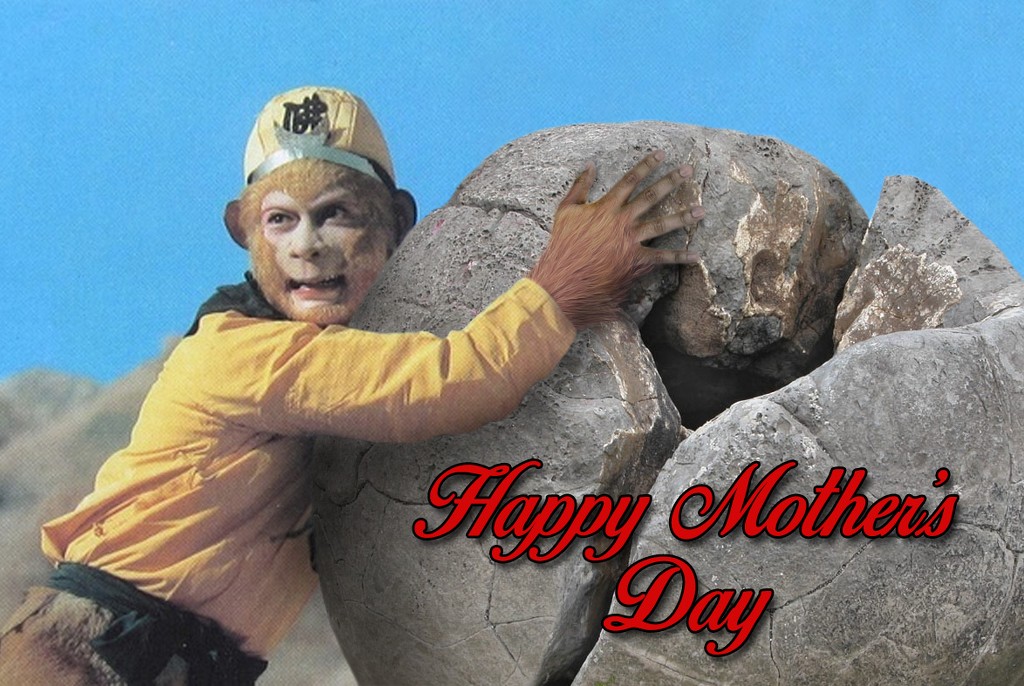
Sun Wukong wishes you a Happy Mother’s Day! Photomanipulation by me.

“Happy Mother’s Day, mom!” (larger version).


Updated: 06-05-2020

I have drastically expanded this piece to write a new article. I discuss other figures from world myth who are born from stone and later rebel against heaven just like Wukong. All future updates will be made there:

Sun Wukong and Births From Stone in World Mythology

Notes:

1) I have changed the Wade-Giles to Pinyin.

Source:

Strassberg, R. E. (2002). Chinese bestiary: Strange creatures from the guideways through mountains and seas. University of California Press.

Wang, J. (2000). The story of stone: Intertextuality, ancient Chinese stone lore, and the stone symbolism in Dream of the red chamber, Water margin and the journey to the West. Durham [u.a.: Duke Univ. Press.

Wu, C., & Yu, A. C. (2013). Journey to the West, Revised Edition, Volume 1. Chicago: University of Chicago Press.