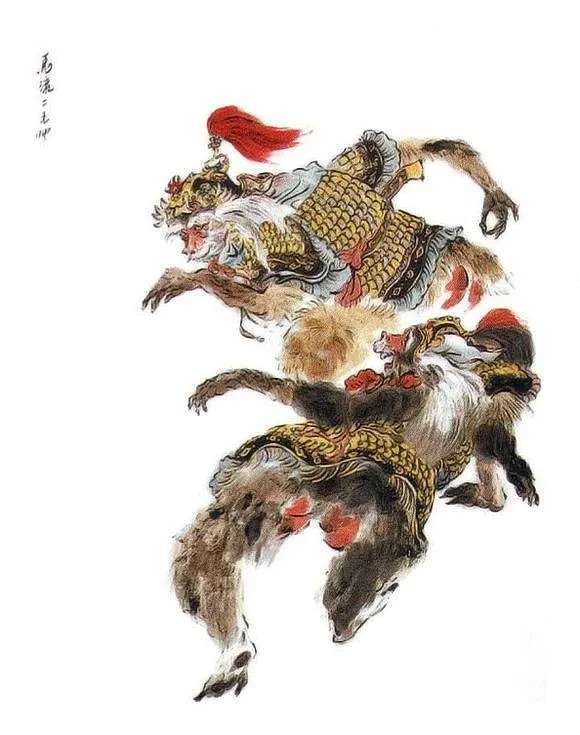
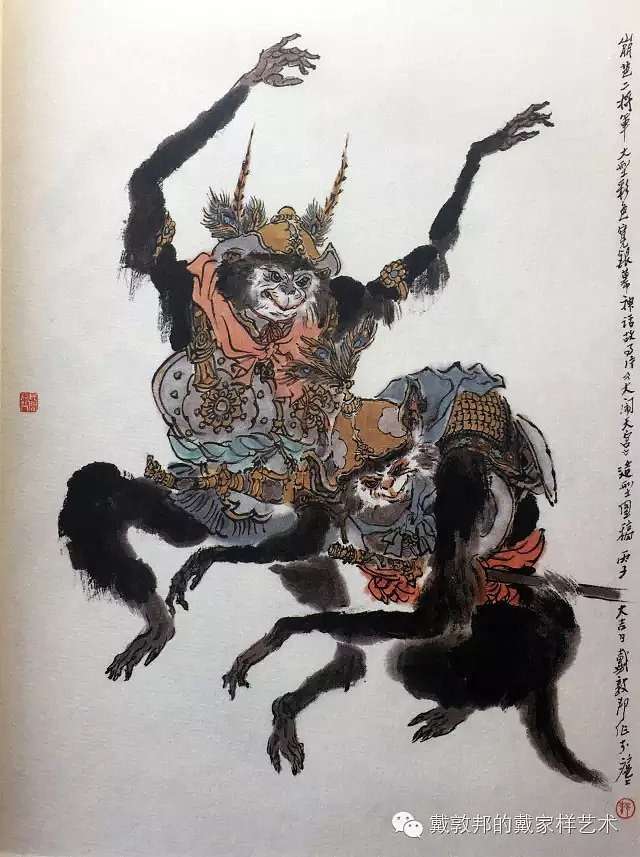
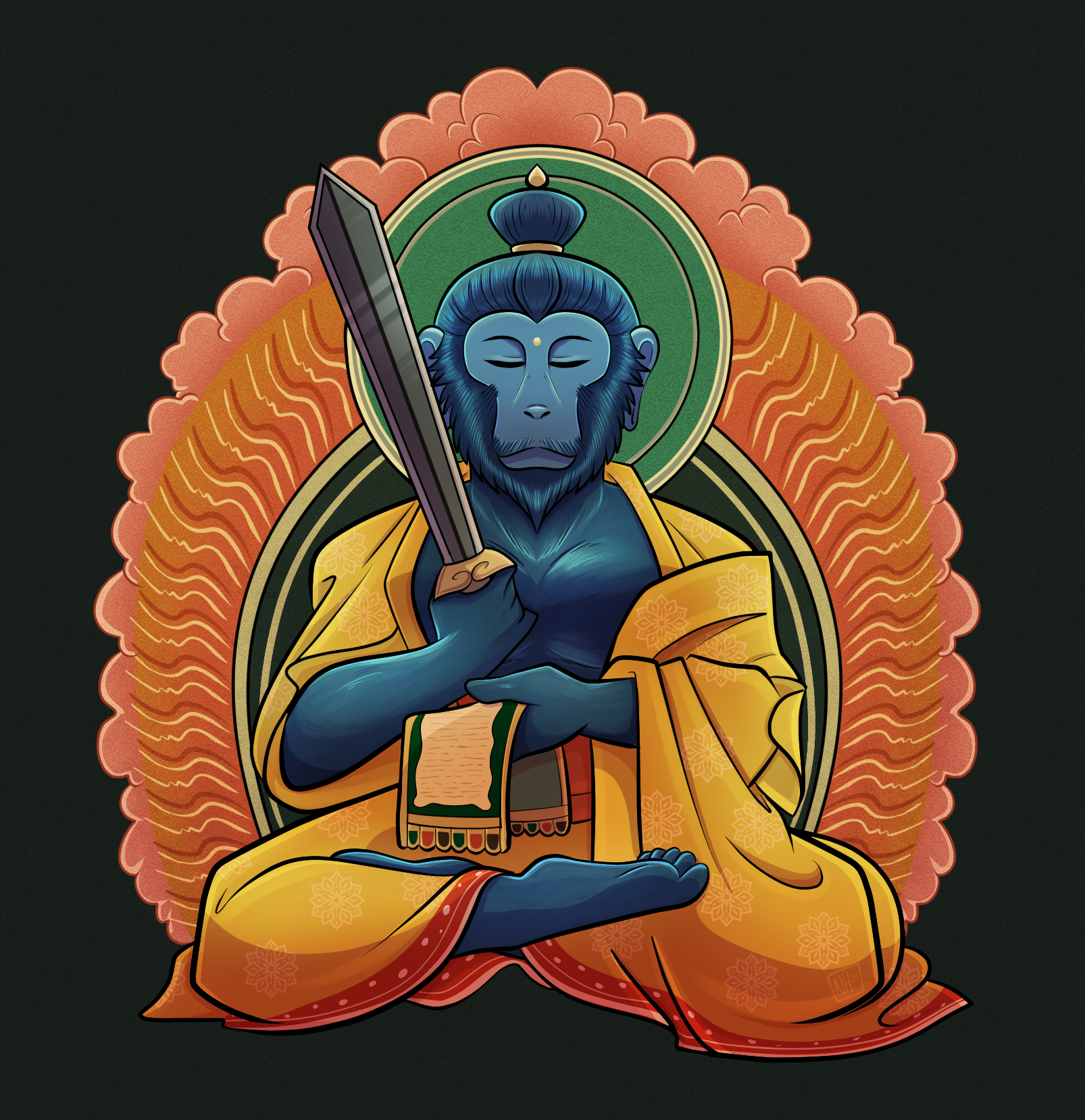
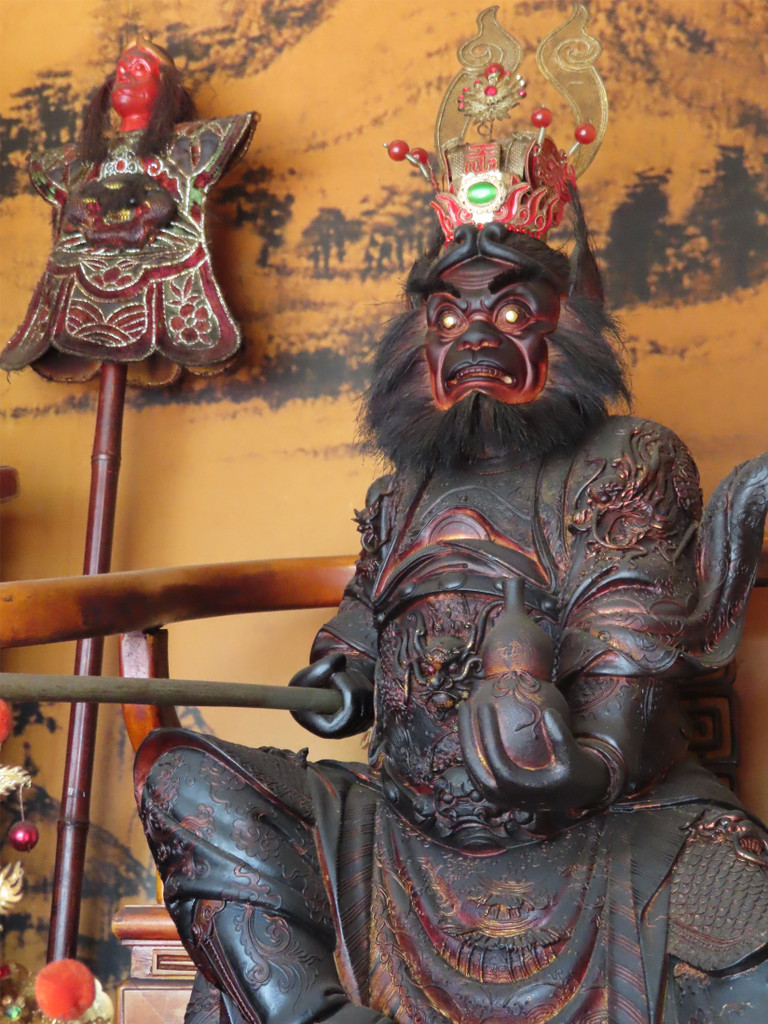
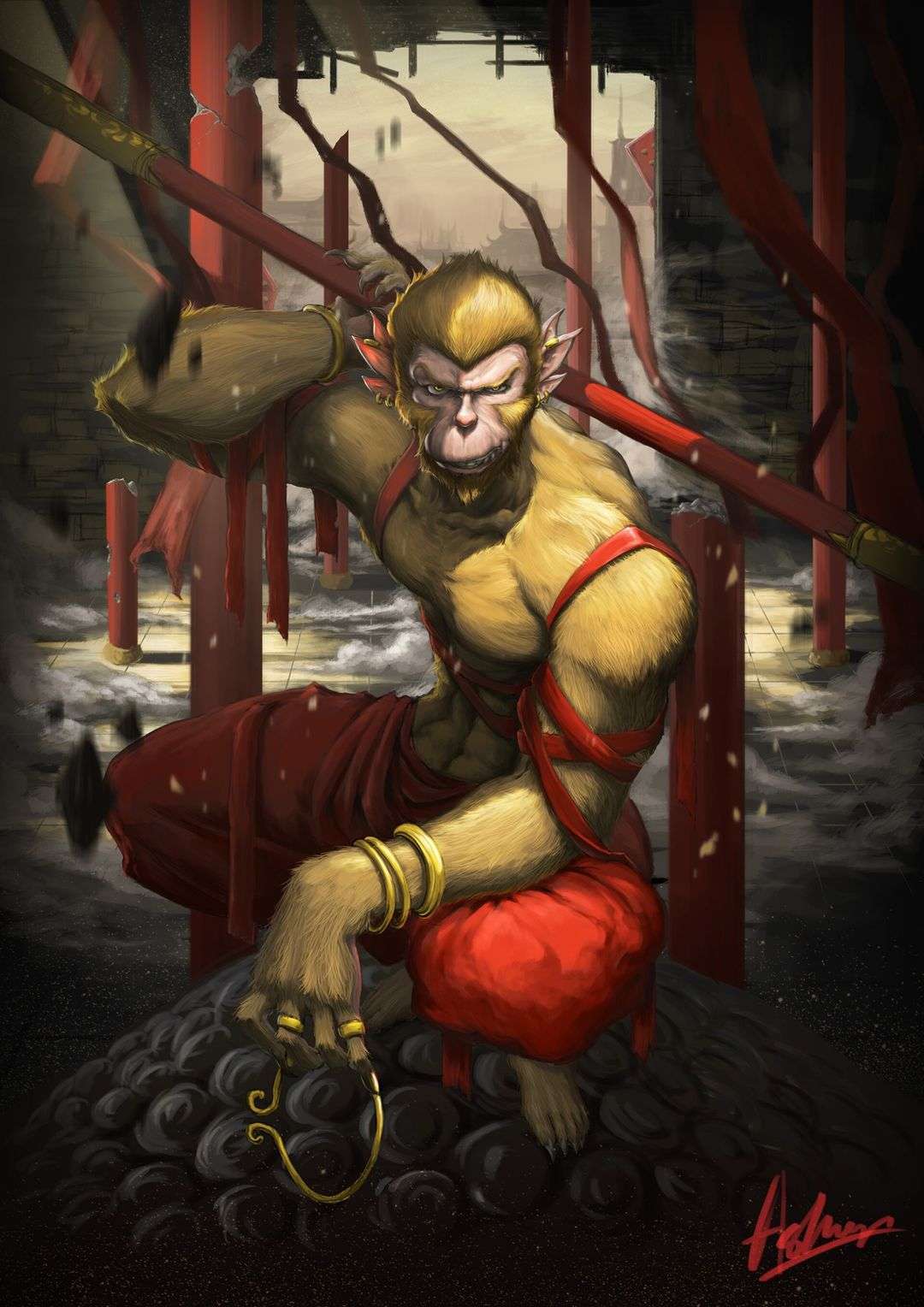
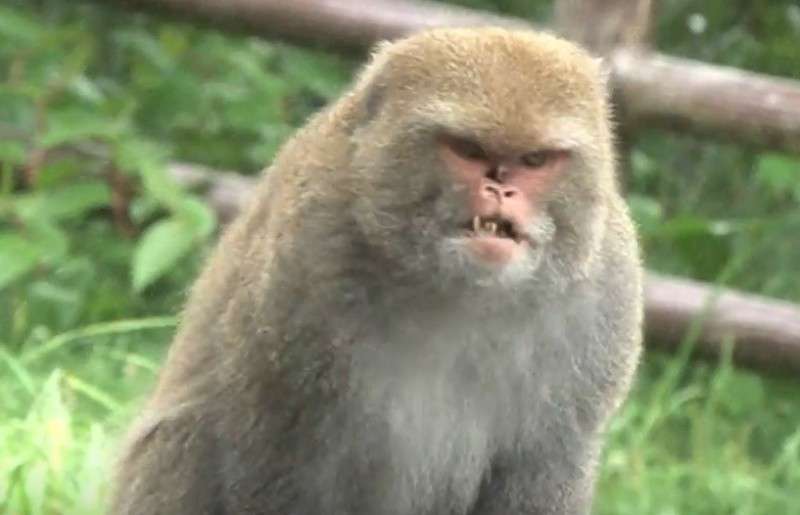
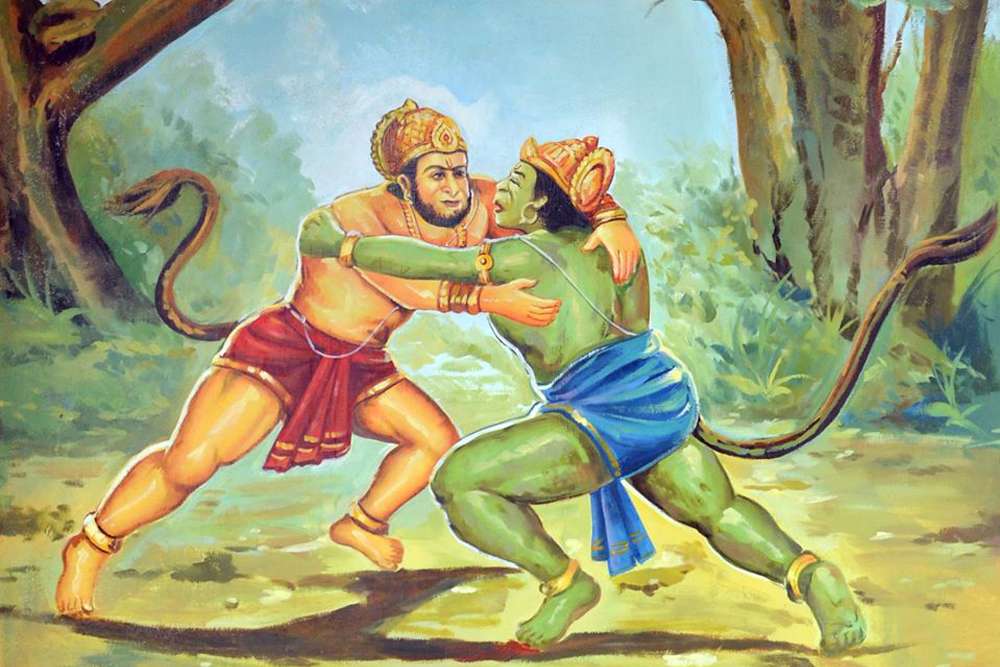
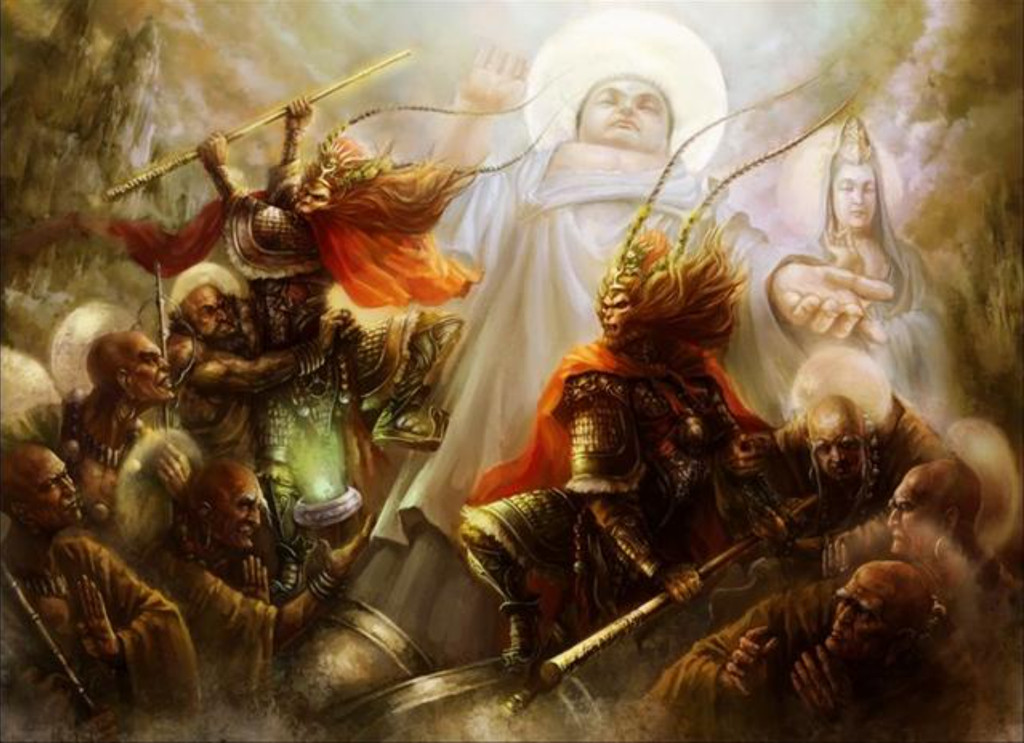
The Monkey King’s “Four Mighty Commanders” (Si Jianjiang, 四健將) (figs. 1 & 2) are minor characters appearing in chapters one, three to six, and 28 of Journey to the West (Xiyouji, 西遊記). They are presented as two elderly gibbons and two elderly horse-monkeys (i.e. macaques) who serve their monarch as advisors and makeshift tutors on spiritual and military matters. In fact, one of them is responsible for setting Wukong on his path towards immortality. They are later given high military rank and charged with training and governing Wukong’s monkey army. An outside observer may question the commanders’ ability to lead troops in battle since they are defeated in nearly every single skirmish. But it should be remembered that, while technically immortal, they can still be killed and only have access to mere earthly weapons. Yet, they choose to face celestial soldiers who wield divine weapons and have millennia of combat experience. This speaks to their great bravery.
Here, I have gathered all references to these characters that I know of. I’ve also included a section on the possible homophonic origins of their names, as well as a section describing their immortality.
This article was prompted by a question put to me on tumblr. Searching the site for “beng ba” and “ma liu” results in a number of posts with fan art and fiction, so this survey has merit. Hopefully it will benefit fans of the novel and/or those who wish to insert these characters into their Lego Monkey Kid-inspired media.
Note: I have changed some of Yu’s (Wu & Yu, 2012) translations of primate names for more accuracy.
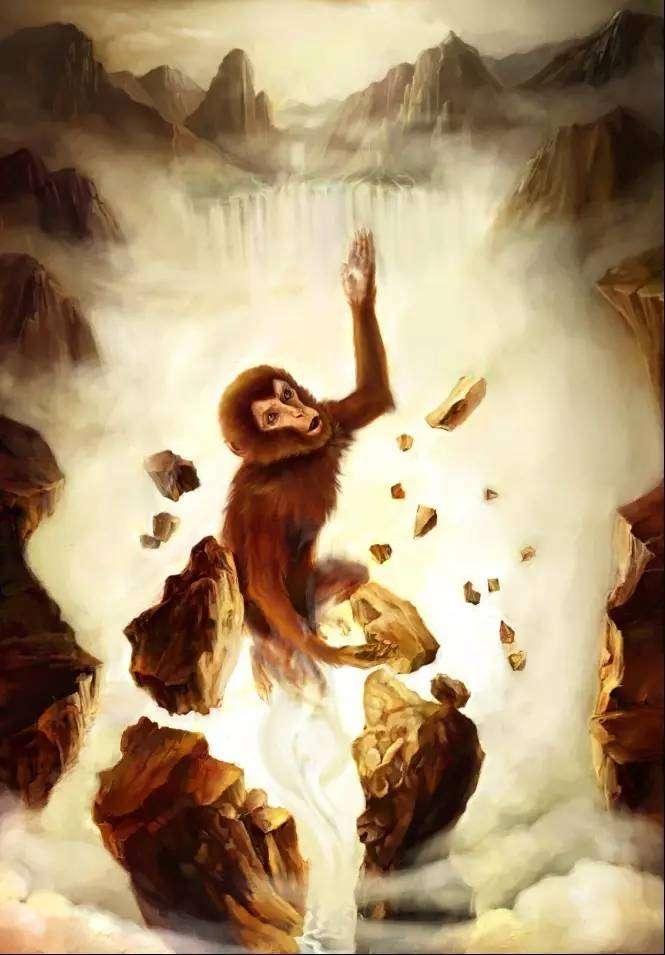
[The Stone Monkey becomes the king of the primates through a test of bravery: leaping through a waterfall and discovering a long-forgotten immortal’s cave.]
The Handsome Monkey King thus led a flock of gibbons [yuanhou, 猿猴], macaques [mihou, 獼猴], and horse-monkeys [mahou, 馬猴], some of whom were appointed by him as his officers and ministers (based on Wu & Yu, 2012, vol. 1, p. 106).
From among the ranks a long-armed gibbon [tongbei yuanhou, 通背猿猴; lit: “(arms)-through-the back-gibbon”] [1] suddenly leaped forth and cried aloud, “If the Great King is so farsighted, it may well indicate the sprouting of his religious inclination. There are, among the five major divisions of all living creatures, only three species that are not subject to Yama, King of the Underworld.” The Monkey King said, “Do you know who they are?” The monkey said, “They are the Buddhas, the immortals, and the holy sages; these three alone can avoid the Wheel of Transmigration as well as the process of birth and destruction, and live as long as Heaven and Earth, the mountains and the streams.” “Where do they live?” asked the Monkey King. The monkey said, “They do not live beyond the world of the Jambudvipa, for they dwell within ancient caves on immortal mountains.” When the Monkey King heard this, he was filled with delight, saying, “Tomorrow I shall take leave of you all and go down the mountain. Even if I have to wander with the clouds to the comers of the sea or journey to the distant edges of Heaven, I intend to find these three kinds of people. I will learn from them how to be young forever and escape the calamity inflicted by King Yama” (based on Wu & Yu, 2012, vol. 1, p. 107).
Chapter 3
[After returning from abroad, the Monkey King wishes to train his children in how to defend themselves with weapons since they had previously been plagued by the Demon King of Havoc.]
As they were speaking, four older monkeys came forward, two horse-monkeys with red buttocks [chikao mahou, 赤尻馬猴] and two long-armed gibbons. Coming to the front, they said, “Great King, to be furnished with sharp-edged weapons is a very simple matter.” “How is it simple?” asked Wukong. The four monkeys replied, “East of our mountain, across two hundred miles of water, is the boundary of the Aolai Country. In that country there is a king who has numberless men and soldiers in his city, and there are bound to be all kinds of gold, silver, copper, and iron works there. If the great king goes there, he can either buy weapons or have them made (based on Wu & Yu, 2012, vol. 1, p. 131).
[Wukong frets over not having a divine weapon that fits his taste.]
The four elder monkeys came forward and memorialized, “The great king is a divine sage, and therefore it is not fit for him to use an earthly weapon. We do not know, however, whether the great king is able to take a journey through water?” “Since I have known the Way,” said Wukong, “I have the ability of seventy-two transformations. The cloud somersault has unlimited power. I am familiar with the magic of body concealment and the magic of displacement. I can find my way to Heaven or I can enter the Earth. I can walk past the sun and the moon without casting a shadow, and I can penetrate stone and metal without hindrance. Water cannot drown me, nor fire burn me. Is there any place I can’t go to?” “It’s a good thing that the great king possesses such powers,” said the four monkeys, “for the water below this sheet iron bridge of ours flows directly into the Dragon Palace of the Eastern Ocean. If you are willing to go down there, Great King, you will find the old Dragon King, from whom you may request some kind of weapon. Won’t that be to your liking?” Hearing this, Wukong said with delight, “Let me make the trip!” (Wu & Yu, 2012, vol. 1, p. 133).
The Monkey King made the four old monkeys mighty commanders of his troops by appointing the two horse-monkeys with red buttocks as marshals Ma and Liu [Ma, Liu er yuanshuai, 馬、流二元帥], and the two long-armed gibbon as generals Beng and Ba [Beng, Ba er jiangjun, 崩、芭二將軍]. The four mighty commanders, moreover, were entrusted with all matters concerning fortification, pitching camps, reward, and punishment (based on Wu & Yu, 2012, vol. 1, p. 138).
[The Monkey King becomes sworn brothers with six other animal demon kings.]
One day, the four mighty commanders had been told to prepare a great banquet in their own cave, and the six kings were invited to the feast. They killed cows and slaughtered horses; they sacrificed to Heaven and Earth. The various imps were ordered to dance and sing, and they all drank until they were thoroughly drunk. After sending the six kings off, Wukong also rewarded the leaders great and small with gifts. Reclining in the shade of pine trees near the sheet iron bridge, he fell asleep in a moment. The four mighty commanders led the crowd to form a protective circle around him, not daring to raise their voices (based on Wu & Yu, 2012, vol. 1, p. 139).
[Wukong’s soul is taken to the underworld because he is fated to die at 342 year old. However, he inks out his name, as well as those of all other monkeys, from the ledgers of hell and then fights his way out of the world of darkness.]
While our Monkey King was fighting his way out of the city, he was suddenly caught in a clump of grass and stumbled. Waking up with a start, he realized that it was all a dream. As he was stretching himself, he heard the four mighty commanders and the various monkeys crying with a loud voice, “Great King! How much wine did you imbibe? You’ve slept all night long. Aren’t you awake yet?” “Sleeping is nothing to get excited about,” said Wukong, “but I dreamed that two men came to arrest me, and I didn’t perceive their intention until they brought me to the outskirts of the Region of Darkness. Showing my power, I protested right up to the Palace of Darkness and argued with the Ten Kings. I went through our ledger of births and deaths and crossed out all our names. Those fellows have no hold over us now.” The various monkeys all kowtowed to express their gratitude. From that time onward there were many mountain monkeys who did not grow old, for their names were not registered in the Underworld. When the Handsome Monkey King finished his account of what had happened, the four mighty commanders reported the story to the demon kings of various caves, who all came to tender their congratulations (Wu & Yu, 2012, vol. 1, p. 141).
[Monkey is invited to heaven to be the keeper of the heavenly horses. This is a plan to keep his unruly adventures in check.]
He then called the four mighty commanders together for this admonition: “Be diligent in teaching and drilling the young ones. Let me go up to Heaven to take a look and to see whether I can have you all brought up there too to live with me.” The four mighty commanders indicated their obedience (Wu & Yu, 2012, vol. 1, p. 144).
Chapter 4
[He leaves heaven in rebellion when he learns that his post is the lowest in the celestial bureaucracy.]
ln a moment, he lowered the direction of his cloud and returned to the Flower-Fruit Mountain. The four mighty commanders were seen drilling troops with the Monster Kings of various caves. “Little ones,” this Monkey King cried in a loud voice, “old Monkey has returned!” (Wu & Yu, 2012, vol. 1, p. 150).
[A demon suggests a rebellious title for Wukong.]
“Make me a banner immediately,” he ordered the four mighty commanders, “and inscribe on it in large letters, ‘The Great Sage, Equal to Heaven.’ Erect a pole to hang it on” (Wu & Yu, 2012, vol. 1, p. 151).
Chapter 5
[He is granted the empty title of “Great Sage Equaling Heaven” and charged with guarding the immortal peach groves. However, he eats most of the ripe fruit, and then he wrecks a long-awaited banquet just because he isn’t invited. He finally flees to earth.]
Lowering the direction of his cloud, he returned to the Flower-Fruit Mountain. There he was greeted by flashing banners and shining spears, for the four mighty commanders and the monster kings of seventy-two caves were engaging in a military exercise. “Little ones,” the Great Sage called out loudly, “I have returned!” The monsters dropped their weapons and knelt down, saying, “Great Sage! What laxity of mind! You left us for so long, and did not even once visit us to see how we were doing.” “It’s not that long!” said the Great Sage. “It’s not that long!” They walked as they talked, and went deep inside the cave dwelling. After sweeping the place clean and preparing a place for him to rest, and after kowtowing and doing homage, the four mighty commanders said, “The Great Sage has been living for over a century in Heaven. May we ask what appointment he actually received?”
“I recall that it’s been but half a year,” said the Great Sage, laughing. “How can you talk of a century?” “One day in Heaven,” said the commanders, “is equal to one year on Earth” (Wu & Yu, 2012, vol. 1, p. 166).
The various monsters were delighted by these words, and they prepared a banquet of fruits and wine to welcome him. A stone bowl was filled with coconut wine and presented to the Great Sage, who took a mouthful and then exclaimed with a grimace, “It tastes awful! Just awful!” “The Great Sage,” said Beng and Ba, the two commanders, “has grown accustomed to tasting divine wine and food in Heaven. Small wonder that coconut wine now seems hardly delectable. But the proverb says, “Tasty or not, it’s water from home!” (Wu & Yu, 2012, vol. 1, p. 167).
[Heaven calls up forces to end his hijinks. The first to challenge him are the Nine Luminaries, anthropomorphic deities of the planets, moon, and sun.]
Hastily the little monsters reported inside, “Great Sage, disaster! Disaster! Outside there are nine savage deities who claim that they are sent from the Region Above to subdue the Great Sage.” Our Great Sage was just sharing the Heavenly wine with the four mighty commanders and the monster kings of seventy-two caves. Hearing this announcement, he said in a most nonchalant manner,
“If you have wine today, get drunk today; Mind not the troubles in front of your door!”
Hardly had he finished speaking when still another flock of imps arrived to report, “Father, those nine savage gods have broken down the door, and are about to fight their way in!”
These reckless, witless gods!” said the Great Sage angrily. “They really have no manners! I was not about to quarrel with them. Why are they abusing me to my face?” He gave the order for the One-Horn Demon King to lead the monster kings of seventy-two caves to battle, adding that old Monkey and the four mighty commanders would follow in the rear. The Demon King swiftly led his troops of ogres to go out to fight, but they were ambushed by the Nine Luminaries and pinned down right at the head of the sheet iron bridge (Wu & Yu, 2012, vol. 1, pp. 170-171).
[…]
[The Monkey King singlehandedly defeats the Nine Luminaries.]
Devaraja Li then ordered the Four Great Devarajas and the Twenty-Eight Constellations to go out together to do battle. Without displaying the slightest panic, the Great Sage also ordered the One-Horn Demon King, the monster kings of seventy-two caves, and the four mighty commanders to range themselves in battle formation in front of the cave (Wu & Yu, 2012, vol. 1, p. 171).
[…]
Beginning with the battle formation at dawn, they fought until the sun sank down behind the western hills. The One-Horn Demon King and the monster kings of seventy-two caves were all taken captive by the forces of Heaven. Those who escaped were the four mighty commanders and the troop of monkeys, who hid themselves deep inside the Water-Curtain Cave. With his single rod, the Great Sage withstood in midair the Four Great Devarajas, Li the Pagoda Bearer, and Prince Nata, and battled with them for a long time. When he saw that evening was approaching, the Great Sage plucked a handful of hairs, threw them into his mouth, and chewed them to pieces. He spat them out, crying, “Change!” They changed at once into many thousands of Great Sages, each employing a golden-hooped rod! They beat back Prince Nata and defeated the Five Devarajas.
In triumph the Great Sage collected back his hairs and hurried back to his cave. Soon, at the head of the sheet iron bridge, he was met by the four mighty commanders leading the rest of the monkeys. As they kowtowed to receive him they cried three times, sobbing aloud, and then they laughed three times, hee-heeing and ho-hoing. The Great Sage said, “Why do you all laugh and cry when you see me?” “When we fought with the Deva Kings this morning,” said the four mighty commanders, “the monster kings of seventy-two caves and the One-Horn Demon King were all taken captive by the gods. We were the only ones who managed to escape alive, and that is why we cried. Now we see that the Great Sage has returned unharmed and triumphant, and so we laugh as well.”
“Victory and defeat,” said the Great Sage, “are the common experiences of a soldier. The ancient proverb says,
You may kill ten thousand of your enemies, But you will lose three thousand of your allies!
Moreover, those chieftains who have been captured are tigers and leopards, wolves and insects, badgers and foxes, and the like. Not a single member of our own kind has been hurt. Why then should we be disconsolate? Although our adversaries have been beaten back by my magic of body division, they are still encamped at the foot of our mountain. Let us be most vigilant, therefore, in our defense. Have a good meal, rest well, and conserve your energy. When morning comes, watch me perform a great magic and capture some of these generals from Heaven, so that our comrades may be avenged.” The four mighty commanders drank a few bowls of coconut wine with the host of monkeys and went to sleep peacefully. We shall speak no more of them (Wu & Yu, 2012, vol. 1, pp. 172-173).
Chapter 6
[Erlang is called in to capture Wukong.]
The Immortal Master fought the Great Sage for more than three hundred rounds, but the result still could not be determined. The Immortal Master, therefore, summoned all his magical powers; with a shake, he made his body a hundred thousand feet tall. Holding with both hands the divine lance of three points and two blades like the peaks that cap the Hua Mountain, this green-faced, saber-toothed figure with scarlet hair aimed a violent blow at the head of the Great Sage. But the Great Sage also exerted his magical power and changed himself into a figure having the features and height of Erlang. He wielded a compliant golden-hooped rod that resembled the Heaven-supporting pillar on top of Mount Kunlun to oppose the god Erlang. This vision so terrified the marshals, Ma and Liu, that they could no longer wave the flags, and so appalled the generals, Beng and Ba, that they could use neither scimitar nor sword. On the side of Erlang, the Brothers Kang, Zhang, Yao, Li, Guo Shen, and Zhi Jian gave the order to the plant-headed deities to let loose the falcons and dogs and to advance upon those monkeys in front of the Water-Curtain Cave with mounted arrows and drawn bows. The charge, alas,
Dispersed the four mighty commanders of monkey imps And captured two or three thousand numinous fiends!
Those monkeys dropped their spears and abandoned their armor, forsook their swords, and threw away their lances. They scattered in all directions running, screaming, scuttling up the mountain, or scrambling back to the cave. It was as if a cat at night had stolen upon resting birds: they darted up as stars to fill the sky. The Brothers thus gained a complete victory, of which we shall speak no further (Wu & Yu, 2012, vol. 1, pp. 181-182).
Chapter 28
[Monkey returns to the Mountain of Flowers and Fruit after being kicked out of the pilgrimage. He discovers that the remainder of his children are plagued by human hunters that eat or force them to perform tricks.]
When the Great Sage heard these words, he became terribly angry. “Who is in charge in the cave now?” he asked. “We still have Ma and Liu, the two marshals,” said the little fiends, “[B]eng and Ba, the two generals, they are in charge.” “Report to them at once,” said the Great Sage, “and say that I’ve returned.” Those little fiends dashed inside the cave and cried, “Father Great Sage has come home!” When Ma, Liu, [B]eng, and Ba heard the report, they rushed out of the door to kowtow and to receive him inside the cave. The Great Sage took a seat in the middle as the various fiends all lined up before him to pay homage. “Father Great Sage,” they said, “we heard recently that you had regained your life so that you could protect the Tang Monk on his journey to the Western Heaven to acquire scriptures. Why are you not heading toward the West? Why do you come back to this mountain?”
“Little ones,” said the Great Sage, “you have no idea that the Tang Monk is wholly ignorant of who is worthy and who is foolish. For his sake, I caught fiends and overcame demons throughout the journey, using all my abilities. Several times I slew a monster, but, accusing me of doing evil and violence, he disowned me as his disciple and banished me back here. He even wrote me a formal letter of banishment as proof that he would never want to use me again.” Clapping their hands and roaring with laughter, the monkeys said, “Lucky! Lucky! What do you want to be a monk for? Come home and you can lead us to have a few years’ fun. Quick! Let’s bring out the coconut wine for the reception of Father.” “Let’s not drink wine just yet,” said the Great Sage. “Let me ask you, how often do those hunters come to our mountain?” “Great Sage,” said Ma and Liu, “there’s no telling of time. They are here every day to make trouble.” The Great Sage asked, “Why aren’t they here today?” Ma and Liu replied, “Just wait and you’ll see them come” (Wu & Yu, 2012, vol. 2, pp. 31-32).
II. Meaning of Names
This Chinese article suggests a naturalistic explanation for these odd-sounding names:
Beng-Ba [崩芭] should be a homophone of “bengba” [蹦巴], that is, bengda [蹦躂], which means that the monkey jumps up and down all day without a moment’s peace. Therefore, it became an alternative name for monkeys. Ma-Liu [馬流] is a homophone for “maliu” [麻溜], which means the monkey moves with speed and agility.
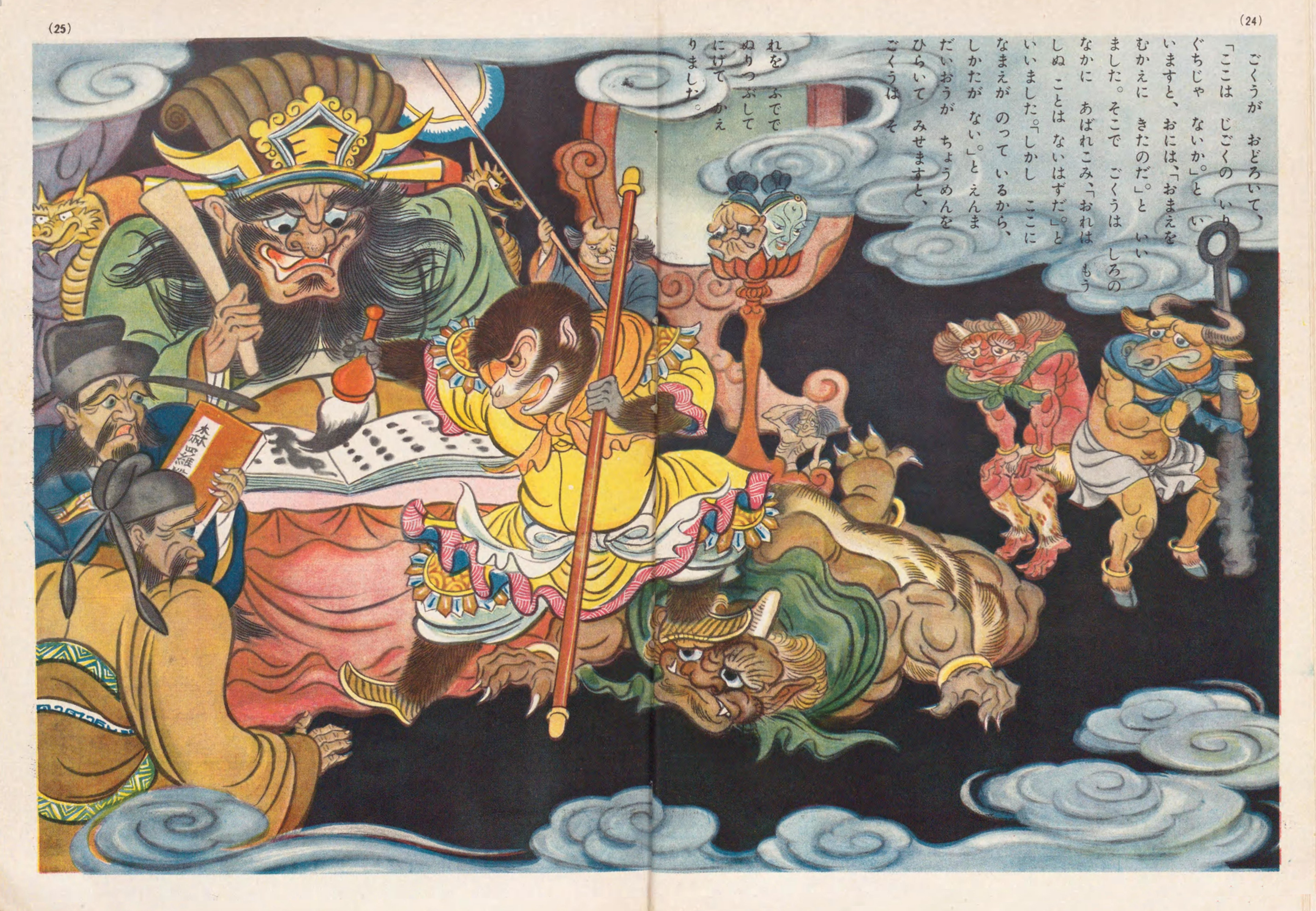
I mentioned in the introduction that the Four Mighty Commanders are technically immortal. This is the result of Wukong inking out the names of all monkeys from the ledgers of hell in chapter three (fig. 2). Wukong explains:
I went through our ledger of births and deaths [shengsi buzi, 生死簿子] and crossed out all our names. Those fellows have no hold over us now.” The various monkeys all kowtowed to express their gratitude. From that time onward there were many mountain monkeys [shanhou, 山猴] who did not grow old, for their names were not registered in the Underworld (Wu & Yu, 2012, vol. 1, p. 141).
Their divine longevity is exhibited when they reappear in chapter 28, sometime after Wukong is released from his 600-plus year imprisonment under Five Elements Mountain.
This same chapter also reveals that they are still capable of dying if fatally wounded. The rank and file monkeys lament their fate at the hands of human hunters:
Those of us who were shot by arrows, pierced by spears, or clubbed to death they took away for food to be served with rice. The dead monkeys would be skinned and boned, cooked with sauce and steamed with vinegar, fried with oil, and sauteed with salt (Wu & Yu, 2012, vol. 2, p. 31).
Fig. 2 – Monkey striking the names from the ledger (larger version). From the Japanese children’s book Son Goku (1939).
Note:
1) This term refers to the belief that the long, agile arms of the gibbon were somehow connected (i.e. tongbi, 通臂), passing through the back (i.e. tongbei, 通背) (Gulik, 1967, p. 92-93).
I was recently contacted by a reader who said they were researching the Monkey King’s various nicknames. I had never thought about this before, so I decided to write an article to help them out. I am indebted to Irwen Wong of the Journey to the West Library blog for helping me with some of the more obscure terms. If you know of others that I missed, please let me know in the comments below or by email (see the “contact” button).
My translation of some names and titles will slightly differ from those appearing in Wu and Yu (2012).
I. Mentioned in the narrative
These are names or titles mentioned by the narrative.
Shihou (石猴, “Stone Monkey”) – Monkey’s first name according to chapter one (Wu & Yu, 2012, vol. 1, p. 104). This is related to his birth from stone (fig. 1).
Tianchan Shihou (天產石猴, “Heaven-Born Stone Monkey”) – His REAL name as listed in the ledgers of hell in chapter three (Wu & Yu, 2012, vol. 1, p. 140).
Xinyuan(心猿, “Mind Monkey/Ape”) – A Buddho-Daoist allegorical term for the disquieted thoughts and emotions that keep man trapped in Saṃsāra. It is used numerous times in chapter titles (e.g. ch. 7) and poems to refer to Monkey (see the material below figure three here).
Jingong (金公, “Lord or Squire of Gold/Metal”) – A term used mainly in poems to refer to Monkey. It is an alternative reading of the component characters making up lead (qian, 鉛), namely jin (金) and gong (公). Lead was an important ingredient in immortal elixirs of external alchemy, and metal/gold (jin, 金) is connected to the earthly branch shen (申), which is associated with monkeys (see no. 9 here) (Wu & Yu, 2012, vol. 1, p. 83 and p. 532 n. 3).
Taiyi Sanxian (太乙散仙, “Leisurely or Minor Immortal of the Great Monad”) – Monkey’s rank within the hierarchy of cosmic immortals (Wu & Yu, 2012, vol. 1, p. 471, for example). It essentially means that he is a divine being without a heavenly post.
Taiyi Jinxian (太乙金仙, “Golden Immortal of the Great Monad”) – A seemingly embellished version of the previous term (Wu & Yu, 2012, vol. 2, p. 264, for example). It speaks of a higher rank. [1]
Lingming Shihou (靈明石猴, “Stone Monkey of Numinous Wisdom”) – The name of his magic species according to the Buddha in chapter 58 (Wu & Yu, 2012, vol. 3, p. 115). [2] He is the first of four spiritual primates.
Nanbian Mihou (難辨獼猴, “Indistinguishable Macaques”) – A term referring to both Sun Wukong and the Six-Eared Macaque. [3]
These are names, titles, or insults that are given to or directed at our hero by other characters.
Hou Xingzhe (猴行者, “Monkey Pilgrim”) – Monkey’s original religious name in the 13th-century JTTW. It is given by Tripitaka at the beginning of the journey (Wivell, 1994, p. 1182). The Xingzhe (行者) portion of this name carried over to the 1592 edition. See nos. 12 and 13 below.
Gangjin Tiegu Dasheng (鋼筋鐵骨大聖, “Great Sage Steel Muscles and Iron Bones”) – His divine title in the 13th-century JTTW. It is bestowed by Tang Emperor Taizong at the end of the journey (Wivell, 1994, p. 1207). [4] The Dasheng (大聖) portion of this name carried over to the 1592 edition. See sec. III, nos. 7 and 8 below.
Sun Wukong (孫悟空, “Monkey Awakened to Emptiness”) – The religious name given to him in chapter one by his first master, the Patriarch Subodhi (Wu & Yu, 2012, vol. 1, p. 115). It predates the 1592 JTTW, first appearing as early as the early-Ming zaju play (see here, for example). It’s important to note that the name “Wukong” (悟空) might have been influenced by a Tang-era monk who traveled throughout India just like Xuanzang (on whom Tripitaka is based).
Liu Xiao Ling Tong (六小龄童) – Monkey’s name in the human world.
Pohou (潑猴, “Reckless or Brazen Monkey”) – An insult used throughout JTTW (Wu & Yu, 2012, vol. 1, p. 118, for example).
Shangxian (上仙, “High or Exalted Immortal”) – A respectful title used by the Dragon King of the Eastern Ocean in chapter three (Wu & Yu, 2012, vol. 1, p. 134).
Huaguo Shan Shuilian Dong Tianchan Yaohou (花果山水簾洞天產妖猴, “Heaven-Born Demon Monkey from the Water-Curtain Cave of the Mountain of Flowers and Fruit”) – An insult used by King Qinguang, a Judge of Hell, in a memorial to the Jade Emperor in chapter three (Wu & Yu, 2012, vol. 1, p. 142).
Xiandi(賢弟, “Worthy Little Brother”) – A nickname used by the Bull Demon King (Wu & Yu, 2012, vol. 1, p. 156, for example). Monkey is the smallest and therefore the last of seven sworn brothers (Wu & Yu, 2012, vol. 2, pp. 223-224).
Yaoxian (妖仙, “Bogus Immortal”) – A category of nigh-immortal beings. He is called this by the Jade Emperor (ch. 4), the Buddha (ch. 7), and the Dragon King of the Eastern Sea in (ch. 14) (Wu & Yu, 2012, vol. 1, pp. 147-148, 193, and 318).
Bimawen (弼馬溫, “To Assist Horse Temperament”) – A minor post overseeing the celestial horse stables. Monkey is given this position in chapter four by the Jade Emperor. Yu (Wu & Yu, 2012) translates this as “BanHorsePlague” (vol. 1, p. 148, for example). [5] This is sometimes used as an insult (Wu & Yu, 2012, vol. 1, p. 354, for example).
Yaohou (妖猴, “Monster or Demon Monkey”) – An insult used numerous times throughout the novel (Wu & Yu, 2012, vol. 1, p. 154, for example).
Sun Xingzhe (孫行者, “Pilgrim Sun”) – Monkey’s second religious name. It is given to him in chapter 14 by Tripitaka (Wu & Yu, 2012, vol. 1, p. 309). Xingzhe Sun (行者孫) is a less common variation. Refer back to no. 1. See also sec. III, no. 9 below.
Xingzhe (行者, “Pilgrim”) – He is more commonly referred to by this name than Sun Xingzhe or Sun Wukong combined. [6] See section III here to learn about the significance of this title. Refer back to no. 1.
Sun Zhanglao (孫長老, “Elder Sun”) – A respectful title used by people he has helped (Wu & Yu, vol. 2, p. 85, for example).
Dashixiong (大師兄, “Elder Religious Brother”) – A term used by Zhu Bajie and Sha Wujing (Wu & Yu, 2012, vol. 2, p. 74, for example).
Houtou (猴頭, “Monkey/Ape Head”) – An insult used by various characters, especially Tripitaka (Wu & Yu, 2012, vol. 2, p. 26, for example).
Maolian Heshang (毛臉和尚, “Hairy-Faced Monk”) – A term that describes his features (Wu & Yu, 2012, vol. 1, p. 407, for example).
Maolian Lei Gong Zui de Heshang (毛臉雷公嘴的和尚, “Hairy-Faced, Thunder God-Beaked Monk) – A term that compares his elongated simian face to the beak of the bird-like thunder god Lei Gong(Wu & Yu, 2012, vol. 1, p. 351, for example). Variations include Lei Gong Zui Heshang (雷公嘴和尚, “Thunder God-Beaked Monk”) and Lei Gong de Nanzi/Hanzi (雷公嘴的男子/漢子, “Thunder God-Beaked Man”).
Dou Zhansheng Fo (鬥戰勝佛, “Buddha Victorious in Strife or Victorious Fighting Buddha”) – His Buddha title bestowed by the Tathagata at the end of the journey in chapter 100 (fig. 2) (Wu & Yu, 2012, vol. 4, p. 381).
Fig. 2 – A religiously accurate drawing of Monkey as Dou zhansheng fo by NinjaHaku21 (larger version).
III. Self-Named
These are names, titles, or pseudonyms taken by Monkey himself. These do not include the names of the innumerable gods, monsters, or humans that he disguises himself as. They only refer to him personally.
Huaguo Shan Ziyun Dong Bawan Siqian Tongtou Tie’e Mihou Wang (花果山紫雲洞八萬四千銅頭鐵額獼猴王, “Bronze-Headed, Iron-Browed King of the Eighty-Four Thousand Monkeys of the Purple Cloud Grotto on the Mountain of Flowers and Fruit”) – How he introduces himself to Tripitaka in the 13th-century JTTW (Wivell, 1994, p. 1182). The “Monkey King” (Mihou Wang, 獼猴王) portion of this name carried over to the 1592 edition but was represented with different Chinese characters. See nos. 2 and 3 below. This article discusses the term mihou (獼猴).
Meihou Wang (美猴王, “Handsome Monkey King“) – The title that he takes upon ascending the throne in chapter one (Wu & Yu, 2012, vol. 1, p. 106).
Hou Wang (猴王, “Monkey King”) – He is more commonly referred to by this name than Meihou wang. [7]
Huaguo Shan Shuilian Dong Dongzhu (花果山水簾洞洞主, “Lord of the Water-Curtain Cave in the Mountain of Flowers and Fruit”) – How he introduces himself in chapter two to a demon king plaguing his people (Wu & Yu, 2012, vol. 1, p. 127).
Huaguo Shan Shuilian Dong Tiansheng Shenren (花果山水簾洞天生聖人, “Heaven-Born Sage From the Water-Curtain Cave in the Mountain of Flowers and Fruit”) – How he introduces himself to the Ten Kings of Hell in chapter three (Wu & Yu, 2012, vol. 1, p. 140).
Lao Sun (老孫, “Old Sun”) – A term that he uses many, many times throughout the novel. Yu (Wu & Yu, 2012) translates this as “Old Monkey” (vol. 1, p. 128, for example).
Qitian Dasheng (齊天大聖, “Great Sage Equaling Heaven”) – The seditious title that he takes during his rebellion against heaven (Wu & Yu, 2012, vol. 1, p. 151). Monkey is worshiped by this name in modern Chinese Folk Religion (fig. 3). Refer back to sec. II, no. 2.
Dasheng (大聖, “Great Sage”) – He is more commonly referred to by this title than Qitian dasheng. [8] Variations include Dasheng Yeye (大聖爺爺, “[Paternal] Grandpa Great Sage”) and Sun Dasheng (孫大聖, “Great Sage Sun”). Refer back to sec. II, no. 2.
Zhexing Sun (者行孫, “Grimpil Sun”) – A pseudonym taken in chapter 34 when Monkey secretly escapes imprisonment and then presents himself as his own brother in an attempt to trick demons (Wu & Yu, 2012, vol. 1, p. 130). The strange English rendering is Yu’s (Wu & Yu, 2012) way of accounting for the change from Xingzhe Sun (行者孫, “Pilgrim Sun”) to Zhexing Sun (者行孫, “Grimpil Sun”). Refer back to sec. II, no. 12.
Sun Waigong (孫外公, “([Maternal] Grandpa Sun”) – A name that he uses to taunt demons (Wu & Yu, 2012, vol. 1, p. 407, for example). It’s a cheeky way of saying, “I’m your elder, so you better submit to me.”
Sun Erguan (孫二官, “Second Master Sun”) – A pseudonym taken in chapter 84 in order to investigate an anti-Buddhist kingdom under the guise of a horse trader. The other pilgrims take similar names (Wu & Yu, 2012, vol. 4, p. 132).
Fig. 3 – A Great Sage idol from Shengfo Tang (聖佛堂, “Sage Buddha Hall”) in Beigang Township, Yunlin County, Taiwan (larger version). It is one of many Monkey King Temples on the island. Photo by the author.
Update: 10-28-24
Someone on reddit questioned why I didn’t add a title for Monkey as the “Protector of the Peaches” or “Guardian of the Heavenly Peach Garden” (as mentioned by Wikipedia). This is how I responded:
This is what the novel says:
“We perceive,” said the Jade Emperor, “that your life is quite indolent, since you have nothing to do, and we have decided therefore to give you an assignment. You will temporarily take care of the Garden of Immortal Peaches. Be careful and diligent, morning and evening” (Wu & Yu, 2012, vol. 1, p. 160).
The phrase “care for the Immortal Peach garden” (管蟠桃園) appears four times. But there is no official title for the position.
Update: 07-26-25
In section one, no. 6, I listed the title Taiyi Jinxian (太乙金仙, “Golden Immortal of the Great Monad”). However, this is only part of the term. The full title is “Golden Immortal of the Great Monad Atop the Primordial Breath of the Chaotic Origin” (Hunyuan yiqi shangfang taiyi jinxian, 混元一氣上方太乙金仙). “Atop the Primordial Breath … ” likely refers to the pristine, original energy of the universe that all Daoists wish to return to. Therefore, I believe this refers to his level of spiritual attainment—think of it in terms of cultivation literature—which is separate from his actual heavenly rank.
Notes:
1) The Jinxian (金仙) of Monkey’s title Taiyi Jinxian (太乙金仙, “Golden Immortal of the Great Monad”) is associated with far more lofty figures. For example, a poem in chapter one refers to the Patriarch Subodhi as the Dajue Jinxian (大覺金仙, “Golden Immortal of Great Awareness”) (see section 2.3 here).
2) I’m placing the name in this category because the Tathagata is stating a fact instead of bestowing it as a proper name.
3) Yu (Wu & Yu, 2012) translates this as the “macaque hard to distinguish” (vol. 4, p. 360). But I think that the original Chinese term is likely referring to both Sun and Six Ears. Their battle across the cosmos is counted in chapter 99 as the 46th of 81 hardships that Tripitaka was fated to endure (Wu &Yu, 2012, vol. 4, p. 360).
4) Wivell (1994) translates the name as “Great Sage of Bronze Muscles and Iron Bones” (p. 1207). But the gang (鋼) of Gangjin tiegu dasheng (鋼筋鐵骨大聖) means “steel.”
5) This references the homophonous term Bimawen (避馬瘟, “avoid the horse plague”), the historical practice of placing monkeys in horse stables to ward off equine sickness (see the 02-26-22 update here).
6) The term Xingzhe (行者, “pilgrim”) appears 4,355 times, while Sun xingzhe and Sun Wukong appear 239 and 127 times, respectively. Xingzhe is used numerous times to refer to other characters, such as Guanyin’s disciple Hui’an (惠岸行者, 6 times; a.k.a. Mucha or Mokṣa, 木叉行者, 9 times), but the vast majority refer to Monkey.
7) The term Hou wang (猴王, “Monkey King”) appears 185 times, while Meihou wang (美猴王) appears 42 times.
8) The term Dasheng (大聖, “Great Sage”) appears 1,273 times, while Qitian dasheng (齊天大聖) appears 103 times. I believe Dasheng is also used to refer to the Buddha a few times, so please keep this in mind.
This article is based on a question put to me on Tumblr. I decided to post my answer here because it contains information from several previous articles discussing monkeys in Chinese culture and Buddhism. This is obviously important when thinking about Journey to the West (Xiyouji, 西遊記).
Question:
Heya, I was researching SWK’s various sworn brothers because I kept hearing abt this one sworn bro of his called “The Female Demon Monkey King” and obviously with a name like that I was curious abt them. But for some reason I can’t find any info abt them anywhere online, and one Tumblr post said that the Female Monkey King and the Macaque King were the same person? I was wondering if you knew anything abt that and had additional info abt the Female Monkey King?
The Female Monkey King seems to be based on a discrepancy in Anthony C. Yu’s (Wu & Yu, 2012) translation. The original Chinese name, Mihou wang (獼猴王, “Macaque King”), appears three times in the novel, but Yu translates it two different ways. I’ve added the Chinese text for comparison.
I. Examples of Mihou wang from JTTW
Chapter 3
At this time, moreover, he entered into fraternal alliance with six other monarchs: the Bull Monster King, the Dragon Monster King, the Garuda Monster King, the Giant Lynx King, the Macaque King, and the Orangutan King, they formed a fraternal order of seven (Wu & Yu, 2012, vol. 1, pp. 138-139).
[Sun Wukong] then said to the six brothers, “If little brother is now called the Great Sage, Equal to Heaven, why don’t all of you assume the title of Great Sage also?” “Our worthy brother’s words are right!” shouted the Bull Monster King from their midst, ”I’m going to be called the Great Sage, Parallel with Heaven.” “I shall be called the Great Sage, Covering the Ocean,” said the Dragon Monster King. “I shall be called the Great Sage, United with Heaven,” said the Garuda Monster King. “I shall be called the Great Sage, Mover of Mountains,” said the Giant Lynx King. “I shall be called the Telltale Great Sage,” said the Macaque King. ”And I shall be called the God-Routing Great Sage,” said the Orangutan King (Wu & Yu, 2012, vol. 1, pp. 156-157).
Your [Red Boy’s] father, the Bull Monster King, called himself the Great Sage, Parallel with Heaven. He and old Monkey formed a fraternal alliance of seven, and we all made him the big brother. There were also a Dragon Monster King, who called himself the Great Sage, Covering the Ocean, and became the second brother; a Garuda Monster King, who called himself Great Sage, United with Heaven, and became the third brother; a Lion Monster King, who called himself the Great Sage, Mover of Mountains, and became the fourth brother; a Female Monkey King, who called herself the Fair Wind Great Sage and became the fifth member; and a Giant Ape Monster King, who called himself the God-Routing Great Sage and became the sixth brother. Old Monkey, the Great Sage, Equal to Heaven, was rather small in size, and so he was number seven (Wu & Yu, 2012, vol. 2, pp. 223-224).
Despite what Yu (Wu & Yu, 2012) translates above, the original Chinese does not include any gendered language referring to the character as a woman. It’s just the exact same name, Mihou wang (獼猴王), used twice before. In addition, the Chinese refers to this character as the “fifth brother” (wuge, 五哥). The W. J. F. Jenner (1993/2020) edition translates the Chinese as such:
The Macaque King, our fifth brother, was the Great Sage Who Travels with the Wind (vol. 2, p. 925).
Some people try to explain away the discrepancy in Yu’s (Wu & Yu, 2012) translation by claiming mihou (獼猴) is associated with female monkeys. But if this was true within the context of Journey to the West, ALL monkeys referred to by this name would be women. This certainly isn’t the case, though, since Liu’er mihou (六耳獼猴, “Six-Eared Macaque“) (fig. 1), Sun Wukong’s doppelganger, is male. In fact, out of 13 mentions of mihou (獼猴) in the novel, over 61% refer directly to Six Ears:
Nanbian mihou (難辨獼猴, “Indistinguishable Macaques,” i.e. Six Ears and Sun Wukong) – 1
Notice, too, that the term is even used once to refer to monkeys as a whole. This takes place in chapter three when King Qinguang (秦廣王) of hell submits a complaint to heaven after Sun Wukong makes all monkeys immortal by striking their names from the book of life and death (Wu & Yu, 2012, vol. 1, pp. 142-143).
In addition, the term mi (獼) is used by itself to refer to all monkeys: Miyuan wei qin (獼猿為親, “[H]e called the monkey and gibbon his relatives”).
Dynastic sources indicate that the association of mihou (獼猴) with female monkeys is based on a misunderstanding of the word’s etymological history. For example, the Compendium of Materia Medica (Bencao gangmu, 本草綱目, 1596 CE) states:
The monkey likes to wipe its face as if bathing (mu), so it is called a “bathing (monkey).” Later generations mistook this mu for “mother,” and then mother for mi. The meaning is lost as errors compound.
“Mother monkey” (muhou) is the name of the beast, not the female. “Bathing monkey” (muhou) and “full monkey” (mihou) are changes in dialect. The characters are wrong.
This confusion is based on the non-Chinese origin of the word for macaque. Van Gulik (1967) explains:
The fact that mu occurs in four variants: 母 and 沐 in Chou literature, and mi 米 or 獼 during the Han dynasty and later, proves that this binom is a phonetic rendering of a non-Chinese term (p. 35).
Therefore, mihou (獼猴) is just one of several ways to refer to the primate, either male or female (fig. 2).
It’s important to note that Buddhist literature also uses the term to refer to male monkeys. For instance, story no. 46 in the Collection of Sutras on the Six Paramitas (Liudu jijing, 六度集經, 3rd-century CE; “Collection of Sutras” hereafter) tells how a past life of the Buddha helps a macaque (mihou, 獼猴) regain his kingship after being usurped by his uncle. What’s important is that this tale, the Dasaratha Jataka, is a famous Buddhist retelling of the Hindu epic Ramayana (5th-century BCE). The hero-king Rama is replaced by the Buddha, and the warring monkey king brothers Sugriva and Vali (fig. 3) are replaced by a nephew and his uncle. [1]
The Buddha himself also has a past life as a king of monkeys. One Chinese variant of the Mahakapi Jataka, story no. 56 in the Collection of Sutras, expressly calls him Mihou wang (獼猴王). A second Chinese variant, story no. 12 in the Scripture on the Storehouse of Sundry Treasures (Za baozang jing, 雜寶藏經, mid-5th-century CE), calls him Shan mihou (善獼猴, “Good Macaque”).
Fig. 3 – The famous battle between the monkey king brothers Sugriva and Vali (larger version). Image found here.
IV. Conclusion
Journey to the West uses the term Mihou wang (獼猴王) three times to refer to the same character. Yu (Wu & Yu, 2012) translates this twice as “Macaque King” (ch. 3 & 4) but later changes it to “Female Monkey King” (ch. 41). Despite the original Chinese referring to the character as the “fifth brother” (wuge, 五哥), Yu (Wu & Yu, 2012) appears to represent them as a woman based solely on the association of mihou (獼猴) with female monkeys. However, not even Journey to the West follows this association, for out of 13 mentions of the term, over 61% refer directly to Liu’er mihou (六耳獼猴), Sun Wukong’s six-eared doppelganger. In addition, mihou (獼猴) and mi (獼) are even used in the novel to refer to monkeys as a whole.
The term mihou (獼猴) is just one of several transcriptions for a non-Chinese word used in China for millennia to mean “macaque” or “monkey.” Dynastic sources show that the association with female monkeys is a misunderstanding based on changes in dialect, along with differences in transcription. Said changes include muhou (沐猴, “bathing monkey”), muhou (母猴, “mother monkey”), and of course mihou (獼猴). Therefore, the word can be applied to either male or female monkeys.
The last point is exemplified in Buddhist literature. A 3rd-century CE Chinese version of the Dasaratha Jataka, which retells the Hindu epic Ramayana (5th-century BCE), references the great battle between the monkey king brothers Sugriva and Vali and calls the former Mihou (獼猴). A 3rd-century Chinese version of the Mahakapi Jataka, which tells of the Buddha’s past life as a monkey king, also refers to him as Mihou wang (獼猴王). And a 5th-century variant of the same story refers to the Enlightened One as the Shan mihou (善獼猴), or “Good Macaque.”
Update: 08-09-23
Sun Wukong calls himself the Meihou wang (美猴王, “Handsome Monkey King”) throughout JTTW. While it serves as an example of his ego-driven personality, I can’t help but think that meihou (美猴) is a play on mihou (獼猴). Recall that even the Buddha’s past life as a monkey king is referred to as Mihou wang (獼猴王) in Chinese sources.
Update: 09-27-23
It just dawned on me that Sun Wukong’s precursor, Hou xingzhe (猴行者, the “Monkey Pilgrim”) from the 13th-century JTTW, is also called Mihou wang (獼猴王). Chapter two refers to him as Huaguo shan ziyun dong bawan siqian tongtou tie’e Mihou wang (花果山紫雲洞八萬四千銅頭鐵額獼猴王, the “Bronze-Headed, Iron-Browed King of the Eighty-Four Thousand Monkeys of the Purple Cloud Grotto on the Mountain of Flowers and Fruits”) (Wivell, 1994, p. 1182). This adds to the evidence that mihou refers to monkeys as a whole and not just female macaques. Also, refer back to the suggestion in my 08-09-23 update.
Note:
1) See Mair, 1989, pp. 676-678 for a full English translation.
I was recently directed to an online Chinese article by Ye Zhiqiu (叶之秋) (n.d.) in which they claim that theBuddha makes “four grand, overarching lies” (sige mitian dahuang, 四個彌天大謊) throughout the course ofJourney to the West (Xiyouji, 西遊記, 1592; “JTTW” hereafter). They believe this is because the literary version of the Enlightened One is a master strategist who uses lies in a calculated attempt to usurp power from theJade Emperor, ruler of the cosmos. This is admittedly a fascinating idea but one that falls apart under careful analysis. Ye (n.d.) displays a fundamental misunderstanding of the novel’s history and religious influences. Worse still, they appear to selectively interpret details to suit a possible agenda against Buddhism. In this article, I will show that there are far more plausible reasons for the Buddha’s statements than lying.
I. First Lie
The Buddha states the following about the novel’s Hindo-Buddhist cosmos (ch. 8), which features four island-like continents floating in a great sea around a cosmic mountain (fig. 1):
I have watched the Four Great Continents, and the morality of their inhabitants varies from place to place. Those living on the East Pūrvavideha revere Heaven and Earth, and they are straightforward and peaceful. Those on the North Uttarakuru, though they love to destroy life, do so out of the necessity of making a livelihood. Moreover, they are rather dull of mind and lethargic in spirit, and they are not likely to do much harm. Those of our West Aparagodānīya are neither covetous nor prone to kill; they control their humor and temper their spirit. There is, to be sure, no illuminate of the first order, but everyone is certain to attain longevity. Those who reside in the South Jambūdvīpa, however, are prone to practice lechery and delight in evildoing, indulging in much slaughter and strife. Indeed, they are all caught in the treacherous field of tongue and mouth, in the wicked sea of slander and malice. However, I have three baskets of true scriptures which can persuade man to do good (Wu & Yu, 2012, vol. 1, pp. 204-205).
Ye (n.d.) claims that the Enlightened One is lying because most of the monsters show up not in the supposedly evil continent of South Jambūdvīpa (the Land of the East, i.e. China) but in the Buddha’s home of West Aparagodānīya (India). They even provide a long list of monsters encountered there. Also, the writer theorizes that the planned scripture pilgrimage is just a ploy to spread the Buddha’s influence to the Land of the East, making him the ruler of two of four continents. The implication here is that he is slowly chipping away at the Jade Emperor’s domain.
However, the Buddha was likely referring to the people in those particular continents and not the monsters. And most importantly, his words appear to mirror the views of foreign Buddhist monks. When the historical monkXuanzang (玄奘; 602-664), on whomTripitaka is based, planned to return home from India, his friends tried dissuading him by describing China in similarly negative terms. Brose (2021) comments:
For many of the monks he had befriended, the decision was hard to fathom. “India is the birthplace of the Buddha,” they reminded him. “Although the Great Sage is gone, his traces remain. To travel around and venerate them is enough to make one’s life content. Why would you want to give this up after having come here? China is a barbarian land where people are neglected, and the Dharma is despised. That is why no buddhas have ever been born there. The people have narrow aspirations and deep impurities, so sages do not go there. The air is cold and the land is dangerous. How can you think of returning there?” Xuanzang reportedly responded by quoting an exchange from theVimalakīrti Sūtra, where the noble layman Vimalakīrti asks Śāriputra, “Why does the sun come to Jambudvīpa?” The answer: “To illuminate it and eliminate the darkness.” If Xuanzang remained in India, the true Dharma might never be known in China (pp. 61-62).
Additionally, Xuanzang is known to have left China illegally when he first began his journey. Brose (2021) explains:
Xuanzang almost didn’t make it to India. Before setting out on his pilgrimage, his initial request for a travel permit was denied by the [Tang] court and, after traveling over five hundred miles from the capital to the westernmost Chinese city of Liangzhou, the local governor ordered him to turn back. Hiding during the day and traveling at night, Xuanzang quietly continued on to the desert outpost of Guazhou. There, he learned that the court had issued a warrant for his arrest. The local prefect, it turned out, was a pious Buddhist and urged Xuanzang to leave quickly… (p. 16).
Conversely, the monk in JTTW is portrayed as aloyal Confucian-type person. Therefore, in order to frame Tripitaka as a faithful, law-abiding citizen of China, the novel had to provide a reason for his pilgrimage, one that the Tang emperor would give his blessing to. [1]
During Sun Wukong’s battle with theSix-Eared Macaque (ch. 58) (fig. 2), the Buddha reveals the doppelganger’s true identity, noting that he and Monkey are two offour celestial primates (sihou hunshi, 四猴混世, lit: “four monkeys of havoc”) with amazing abilities:
“The first,” saidTathāgata [the Buddha], “is the Stone Monkey of Numinous Wisdom, [2] who
Knows transformations, Recognizes the seasons, Discerns the advantages of earth, And is able to alter the course of planets and stars.
The second is the Red-Buttocked Horse Monkey, who
Has knowledge of yin and yang, Understands human affairs, Is adept in its daily life And able to avoid death and lengthen its life.
A sensitive ear, Discernment of fundamental principles, Knowledge of past and future, And comprehension of all things.
These four kinds of monkeys are not classified in the ten categories [of life], nor are they contained in the names between Heaven and Earth. As I see the matter, that specious Wukong must be a six-eared macaque, for even if this monkey stands in one place, he can possess the knowledge of events a thousand miles away and whatever a man may say in that distance” (Wu & Yu, 2012, vol. 3, p. 115).
Ye (n.d.) claims the Buddha concocted the list of supernatural primates in order to hide the fact that Six Ears was an aspect of the Monkey King’s mind. They reason that the falsehood was used to avoid offending the Daoist hierarchy who couldn’t figure out the doppelganger’s true identity.
I think the author’s issue here is that the Daoist gods considered Six Ears a real figure, while the Buddha knew him to be an aspect of Sun’s mind. Something being real and illusory at the same time may seem like a big contradiction, but it’s not in the JTTW cosmos.Campany (1985) explains that, as physical threats, the monsters enable Monkey and his religious brothers to build Buddhist merit (zhenguo, 正果; lit: “right fruit”) by fighting them. At the same time, being illusory aspects of the mind, the monsters help the pilgrims, especially Tripitaka, to understand that reality isempty (kong, 空). This is something that Wukong (悟空, “Aware of Emptiness”) reminds his master of throughout the journey.
Ye (n.d.) also points out that the listed powers of the Horse Monkey and Tongbi Gibbon don’t appear to be true, for they (under the guise of the commanders Ma and Liu and Beng and Ba – seesection 2 here) are supposedly killed by Erlang’s forces in chapter six. They claim this proves that the two supernatural primates don’t actually exist. However, two things need to be said. One, the aforementioned underlings appear alive and well in chapter 28 (Wu & Yu, 2012, vol. 2, p. 32), meaning that they were not killed. And two, an irregularity in the story does not equate to a lie. The author hasn’t even come close to offering conclusive evidence of intent. Instead, I suggest that this is just an inconsistency born from the novel’s origin as individual oral tales that were eventually compiled, expanded, and published in book form. See, for instance, the13th-century version of the story cycle. Therefore, irregularities are bound to pop up throughout the narrative.
But even if this lie was somehow true, how exactly does it further the Buddha’s supposed plan to take power from the Jade Emperor?
Fig. 2 – The Great Sage and Six Ears battle in the Western Paradise (larger version). Artist unknown.
III. Third Lie
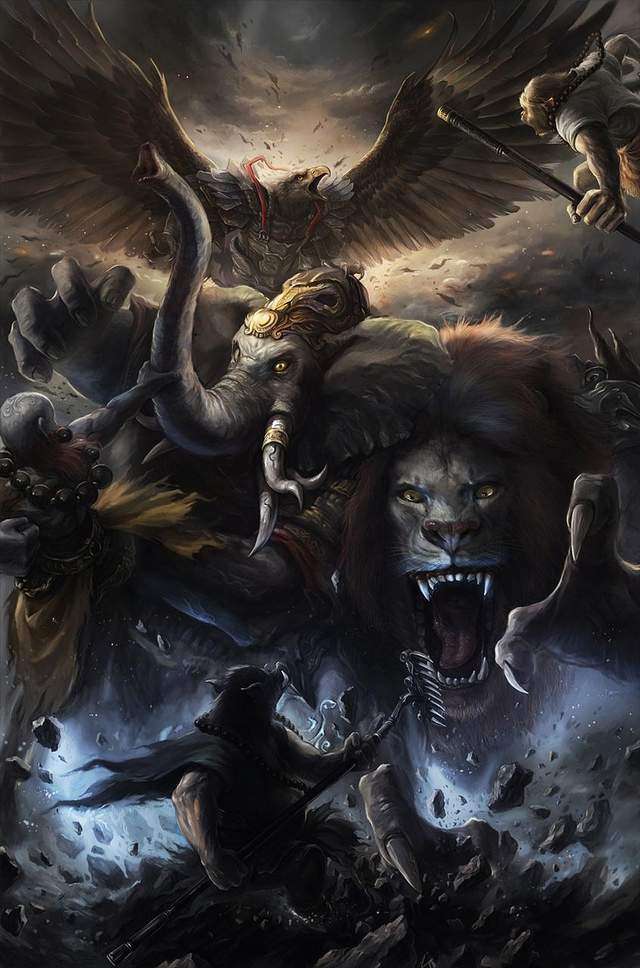
After the Buddha learns that the holy beasts of two bodhisattvas have escaped their respective mountain paradises and become man-eating demons on earth (ch. 77) (fig. 3), he has the following conversation with his disciples:
[…] Tathāgata left the lotus throne and went out of the monastery gate with the rest of the buddhas. There they sawĀnanda andKāśyapa leadingMañjuśrī andSamantabhadra [3] on their way to the monastery also.
As the two bodhisattvas bowed to him, Tathagata asked, “How long have your beasts of burden been gone from your mountains?” “Seven days,” replied Mañjuśrī. “Seven days in the mountain,” said Tathāgata, “are equivalent to several thousand years on earth. I wonder how many lives they have taken down there. You must follow me quickly if we are to retrieve them.” With one bodhisattva standing on each side of him, the Buddha and his followers rose into the air (Wu & Yu, 2012, vol. 4, pp. 29-30).
Ye (n.d.) believes that the Buddha is lying about the corresponding time on earth in order to mask his guilt over not intervening sooner. As evidence, they cite the fact that the novel states “one day in heaven is equal to one year on Earth” (Wu & Yu, 2012, vol. 1, pp. 150 and 167). However, this could just be one of the aforementioned inconsistencies. One oral tradition may have said one day equals one year, while another said it equals one thousand years, and then both of these made it into the novel. But there is a more likely answer (see below).
They also claim that the respective Bodhisattvas’ mountain paradises are on earth, meaning they would be subject to the same time as the mortal world. This carries the implication that the beasts were eating people for at least a few hundred years and none of the Buddhist deities did anything to stop them. But the author clearly doesn’t understand earthly paradises like Mañjuśrī’sMount Wutai (Wutai shan, 五臺山; lit: “Five Terrace/Platform Mountain”), which they mention by name in the article. Chou (2018) notes that a “central paradox of Mount Wutai” is that it is “both an earthly place and a Buddhist paradise (pure land)” (p. 142). Kōtatsu (Kōtatsu & Otowa, 1996) explains thatPure Lands (Jingtu, 净土) are “world[s] of another dimension” that are “temporally different from this one” (p. 45). Therefore, it seems more likely that the Enlightened One was referring to the time difference between Buddhist mountain paradises and the mortal realm. This is distinct from the Daoist heaven, which is expressly associated with the “one heavenly day = one earthly year” time dilation.
Additionally, Ye (n.d.) claims that Mañjuśrī is lying about the length of time his beast was absent because of a similar bout of guilt.It’s strange, though, that the writer’s answer for everything is “such and such Buddhist figure is being dishonest”. I’d be interested to read some of their other work to see if there’s a pattern of deconstructing Buddhism. JTTW clearly treats the religion with reverence, placing the Buddha and his disciples at the top ofthe novel’s cosmic hierarchy. Therefore, selectively interpreting details to support some agenda against Buddhism wouldn’t reflect positively on the author or their writing.
And again, I have to ask: How would this lie further the Buddha’s supposed plans?
Fig. 3 – Sun Wukong and his religious brothers battling the bird, elephant, and lion demons from Lion-Camel Cave (larger version). Artist unknown. Image found here. The elephant and lion are the missing holy beasts who became monsters on earth.
IV. Fourth Lie
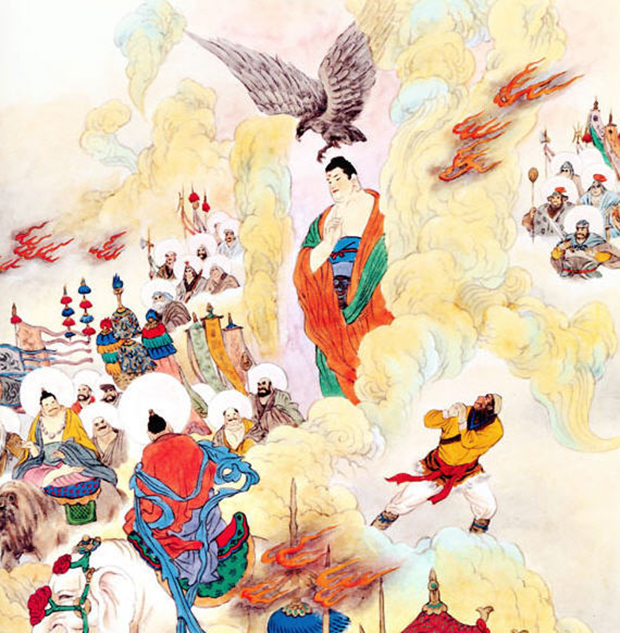
After the Buddha captures theGreat Peng (ch. 77) (fig. 4), the bird demon submits to Buddhism but stubbornly refuses to stop eating meat. The Enlightened One thinks for a moment and then offers him the following solution:
“In the four great continents of my domain,” said Tathāgata, “there are countless worshippers. I shall ask those who wish to do good to sacrifice first to your mouth” (Wu & Yu, 2012, vol. 4, p. 31).
Ye (n.d.) believes that the Buddha is deceptively bragging here in order to placate the uber powerful monster. At the same time, his statement about having dominance over the four continents is thought to be a lie since the Jade Emperor is the stated ruler of the cosmos. They reason that it’s evidence of the Enlightened One wanting to govern all four continents. But it’s important to remember that, as mentioned above, the novel takes place in a world modeled after Hindo-Buddhist cosmic geography, which Ye (n.d.) is fully aware of. The Daoist bureaucracy of JTTW is therefore a syncretic veil that has been draped over a pre-existing Buddhist structure. In the original system, the world is overseen by the Devarāja Śakra (Sk: Śakro devānāṃ indraḥ; Ch: Dishi, 帝釋) from the heaven of the thirty-three gods atop Mount Sumeru (Buswell & Lopez, 2014, pp. 739-740 and 921-922). (Interestingly, the novel hints that the Daoist bureaucracy is located in this very same heaven – see the material above figure two here). But despite the gods’ divine lifespans, as inhabitants of the Realm of Desire, they are still subject to death and therefore susceptible to the Wheel of Reincarnation (Buswell & Lopez, 2014, pp. 230-233). Only the Buddha can help such beings escape from the endless rounds of rebirth by leading them to enlightenment. He does this within the confines of his own domain or “Buddha-Field” (Sk: Buddhakṣetra; Ch: Focha, 佛刹). Buswell and Lopez (2014) explain:
[W]hen a buddha achieves enlightenment, a “container” or “inanimate” world is produced in the form of a field where the buddha leads beings to enlightenment. The inhabitant of that world is the buddha endowed with all the [qualities of an Enlightened One]. Buddha-fields occur in various levels of purification, broadly divided between pure and impure. Impure buddha-fields are synonymous with a world system (cakravāḍa), the infinite number of “world discs” in Buddhist cosmology that constitutes the universe; here, ordinary sentient beings (including animals, ghosts, and hell beings) dwell, subject to the afflictions of greed, hatred, and delusion. Each Cakravāḍa is the domain of a specific buddha, who achieves enlightenment in that world system and works there toward the liberation of all sentient beings… (p. 153).
Therefore, the JTTW cosmos is the Enlightened One’s Buddha-Field. But Ye (n.d.) appears to be aware of this fact (at least on some level), for they write: “The truth of the matter is that the Buddha is the lord of all sentient beings in the Buddhist schools of the four continents” (Zhenshi qingkuang shi, Rulai shi si dabu zhou fopai zhongsheng zhi zhu, 真實情況是,如來是四大部洲佛派眾生之主). So why would the writer still claim that the Buddha’s statement is a lie when they know it isn’t? This is a prime example of the author selectively interpreting facts.
Fig. 4 – A modern depiction of the Great Peng trapped above the Buddha’s head (larger version). Artist unknown.
V. Conclusion
Ye (n.d.) claims that the Buddha is a master strategist who makes “four grand, overarching lies” in a bid to usurp power from the Jade Emperor, ruler of the cosmos. But the writer demonstrates a fundamental misunderstanding of the novel’s history and religious influences. Worse still, they appear to selectively interpret details to suit a possible agenda against Buddhism. I show that the supposed falsehoods are instead likely based on the viewpoints of historical foreign monks, are inconsistencies within the JTTW narrative, reference Buddhist views of time, and reflect the Buddhist world system.
Notes:
1) The ruler’s decision to allow said pilgrimage is associated with a subplot in chapters 11 and 12 where he learns of countless orphaned souls in the underworld and searches for a monk to release them from their torments via a grand Buddhist ceremony. Tripitaka is chosen to lead the ceremony but is later convinced by theBodhisattva Guanyin to halt the ritual until he has retrieved more appropriate scriptures from India.
2) Source altered slightly.
3) Yu (Wu & Yu, 2012) originally translates Puxian (普賢) as “Viśvabhadra” (vol. 4, pp. 29). I’ve changed it to “Samantabhadra” as this appears to be a more well-known version of the Bodhisattva’s name.
Sources:
Brose, B. (2021). Xuanzang: China’s Legendary Pilgrim and Translator. Boulder, Colorado: Shambhala Publications, Inc.
Buswell, R. E., & Lopez, D. S. (2014). The Princeton Dictionary of Buddhism. N: Princeton University Press.
Campany, R. (1985). Demons, Gods, and Pilgrims: The Demonology of the Hsi-yu Chi. Chinese Literature: Essays, Articles, Reviews (CLEAR), 7(1/2), 95-115. doi:10.2307/495195.
Chou, W. (2018). Mount Wutai: Visions of a Sacred Buddhist Mountain. Princeton; Oxford: Princeton University Press.
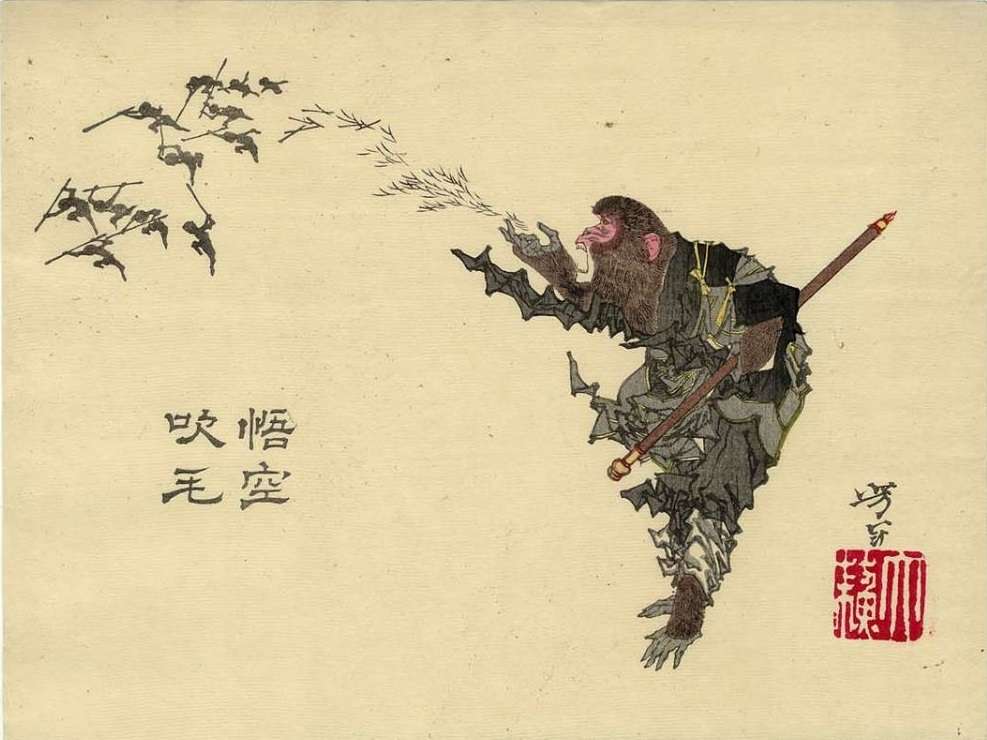
Plucking a handful of hairs from his own body and throwing them into his mouth, he chewed them to tiny pieces and then spat them into the air. “Change!” he cried, and they changed at once into two or three hundred little monkeys encircling the combatants on all sides. For you see, when someone acquires the body of an immortal, he can project his spirit, change his form, and perform all kinds of wonders. Since the Monkey King had become accomplished in the Way, every one of the eighty-four thousand hairs on his body could change into whatever shape or substance he desired (Wu & Yu, 2012, vol. 1, p. 129).
This tactic of transforming chewed up hairs into dozens, hundreds, or even thousands of monkey clones also appears in chapters 3, 5, 21, 35,44, 86, and 90 (A & B) (Wu & Yu, 2012, vol. 1, pp. 132, 165, 172, & 409; vol. 2, pp. 138 & 277; vol. 3, p. 332; vol. 4, pp. 164-165, 168, 219, & 221). But these chewed up hairs can also be transformed into other objects, such as sleep-inducing bugs in chapters 5 and 86, as well as seven kinds of hawks in chapter 72 (Wu & Yu, 2012, vol. 1, p. 165; vol. 3, p. 332; vol. 4, p. 168).
But the novel states that Sun sometimes changes his hair by first blowing on it with his magic “immortal breath” (xianqi, 仙氣). This article will provide a brief survey of this skill and its abilities.
I. Hair
Explicit mentions of the immortal breath show that it can transform hair into:
Yellow-gold rope to replace a magical weapon of the same name (ch. 34) (Wu & Yu, 2012, vol. 2, p. 130).
Gold-plated, red lacquered box to hold a white jade token (ch. 37) (Wu & Yu, 2012, vol. 2, p. 169).
Wrapper to infiltrate a demon’s lair (ch. 41) (Wu & Yu, 2012, vol. 2, pp. 235-236).
Yellow hound to carry away a bogus immortal’s decapitated head (ch. 46) (Wu & Yu, 2012, vol. 2, p. 308).
Hungry hawk to eat a bogus immortal’s entrails (ch. 46) (Wu & Yu, 2012, vol. 2, p. 310).
Group of 30 tigers to scare away monks (ch. 64) (Wu & Yu, 2012, vol. 3, p. 194).
Sleep-inducing insects and lice, fleas, and bedbugs (ch. 71 (A & B) & 84) (Wu & Yu, 2012, vol. 3, pp. 303 & 304; vol. 4, p. 139).
Gold-headed fly to scare a demon king (ch. 75) (Wu & Yu, 2012, vol. 3, p. 366).
Bow drill (comprised of a diamond bit, a bamboo strip, and a cotton string) to drill out of a dangerous magic treasure (ch. 75) (Wu & Yu, 2012, vol. 3, p. 369).
Very thin but long rope to climb out of a monster’s stomach (ch. 76) (Wu & Yu, 2012, vol. 4, p. 3).
Thirty ropes for tying up bandits (ch. 97) (Wu & Yu, 2012, vol. 4, p. 328).
It should be noted, however, that the novel is very inconsistent regarding this ability. The immortal breath is not always used; Sun often just commands the hair to transform or changes it without saying anything, such as in chapters 4, 33, 34 (A, B, & C), 42, 46, 49, 51, 59, 65, 68, 71, and 74 (Wu & Yu, 2012, vol. 1, p. 156; vol. 2, p. 115, 124-125, 237, 301, 305, & 345-346; vol. 3, p. 13, 120, 216, 269, 305, & 358). The “chewing” and “spitting out” of the hair is another example (see above). But one might argue that spitting requires a build of air in the lungs, so by extension, the immortal breath is being used.
This inconsistency is probably due to the standard 1592 edition of Journey to the West coalescing from independent oral stories developed and told over the centuries (see the late-13th-century version of the story, for example). Therefore, some story tellers likely employed the immortal breath, while others did not.
Fig. 1 – “Wukong Blows His Hair” (c. 1882) by Yoshitoshi (larger version).
II. Staff
This immortal breath is also shown capable of transforming the magic iron staff (fig. 2).
Steel file to file through a magic golden ring pinning Monkey’s neck to a column (ch. 34) (Wu & Yu, 2012, vol. 2, p. 129).
Razor to mutilate two lesser demons (ch. 63) (Wu & Yu, 2012, vol. 3, p. 180).
Flag pole to make a pair of magic cymbals stand upright (ch. 65) (Wu & Yu, 2012, vol. 3, p. 216).
Seventy forked weapons to cut the threads of supernatural spider webs (ch. 73) (Wu & Yu, 2012, vol. 3, p. 340).
Nail to prop open a demon’s mouth while Monkey climbs out of their stomach (ch. 83) (Wu & Yu, 2012, vol. 4, p. 113).
Three-pointed drill to make a covert hole in a wardrobe (ch. 84) (Wu & Yu, 2012, vol. 4, p. 139).
As noted above, the novel is inconsistent in this regard. For instance, Monkey changes the staff into a steel drill without blowing on it in chapter 65 (Wu & Yu, 2012, vol. 3, p. 218). Likewise, no breath is used in chapters 46 and 84 when Sun transforms the weapon into razors for shaving heads (Wu & Yu, 2012, vol. 2, p. 305; vol. 4, p. 139).
Monkey can also transform items not in contact with his body. For instance, in chapter 46, he changes a Daoist lad’s clothing from a spring onion white robe into a brown monk’s robe (Wu & Yu, 2012, vol. 2, p. 305). In chapter 78, Sun transforms Tripitaka into his likeness using a mask made from mud:
Pilgrim, too, had little alternative but to flatten the mud and press it on his own face and, after a little while, succeeded in making an apelike mask. Asking the Tang Monk to stand up but without uttering another word, Pilgrim pasted the mask on his master’s face and recited a magic spell. He then blew his immortal breath onto the mask, crying, “Change!” At once the elder took on the appearance of Pilgrim. He was told to take off his own garments and switch clothes with Pilgrim, who made the magic sign and then recited another spell to change into the form of the Tang Monk (Wu & Yu, 2012, vol. 4, p. 47).
Again, the novel is inconsistent regarding external objects. Sometimes Monkey bights his tongue and spits blood out to change said item, such as in chapter 25 (A & B) (Wu & Yu, 2012, vol. 1, pp. 474-475 & 477; vol. 2, p. 303). [1-2] But, again, one could argue that the immortal breath is used as spitting requires a build-up of air in the lungs.
IV. Special abilities
The immortal breath (fig. 3) is also shown to have other special abilities. For instance, in chapter 46, Monkey uses it to heal a gaping wound in his stomach:
With a swagger, Pilgrim walked down to the execution site. Leaning himself on a huge pillar, he untied his robe and revealed his stomach. The executioner used a rope and tied his neck to the pillar; down below, another rope strapped his two legs also to the pillar. Then he wielded a sharp dagger and ripped Pilgrim’s chest downward, all the way to his lower abdomen. Pilgrim used both his hands to push open his belly, and then he took out his intestines, which he examined one by one. After a long pause, he put them back inside, coil for coil exactly as before. Grasping the skins of his belly and bringing them together with his hands, he blew his magic breath on his abdomen, crying, “Grow!” At once his belly closed up completely (Wu & Yu, 2012, vol. 2, p. 309).
The novel implies that Sun’s immortal breath also has the ability to manipulate souls. For example, in chapter 88, Sun uses it in an arcane ritual designed to bestow three human disciples with super human strength. The pertinent section reads:
In a secluded room behind the Gauze-Drying Pavilion, Pilgrim traced out on the ground a diagram of the Big Dipper. Then he asked the three princes to prostrate themselves inside the diagram and, with eyes closed, exercise the utmost concentration. Behind them he himself recited in silence the true sayings of realized immortality and intoned the words of Dharani as he blew divine breaths into their visceral cavities. Their primordial spirits [yuanshen, 元神] were thus restored to their original abodes …
The term “primordial spirits” (yuanshen, 元神) is commonly associated with Buddhahood or enlightenment. In Daoism, it is synonymous with the attainment of immortality via the formation of a “Sacred Embryo” (shengtai, 聖胎), which is forged from spiritual energies over long years of self-cultivation (Darga, 2008). This suggests that Monkey’s immortal breath also grants the disciples some form of immortality. You can read about the entire ritual here.
Fig. 3 – A vapor blowing smoke (larger version). Image found here. Photographer unknown. I imagine this is what the immortal breath would look like.
And in chapter 97, Sun uses the immortal breath to transform an old man’s soul into “ether” for easy transport back to the world of the living:
Pilgrim changed the soul of the squire into ether [qi, 氣] by blowing on him. The ether was stored in his sleeve so that they could leave [Hell] and go back to the world of light together. Astride the clouds, he soon arrived at the Kou house. Eight Rules [Zhu Bajie] was told to pry open the lid of the coffin, and the soul of the squire was pushed into his body. In a moment, he began to breathe once more and revived (Wu & Yu, 2012, vol. 4, p. 339).
The phrase “immortal breath” (xianqi, 仙氣) is missing in the original Chinese, but the ability’s use is understood as the passage mentions Monkey “blowing” (chui, 吹) on the soul.
V. Conclusion
Various chapters of Journey to the West show that Sun Wukong can use his immortal breath to transform his hair, his magic staff, and items not directly in contact with his body into anything he desires. These range from utilitarian items like files, blades, drills, and ropes to living creatures like insects, birds of prey, dogs, tigers, lesser demons, and even independent copies of himself. It can also change the color and appearance of clothing, as well as magically disguise someone when used in tandem with a mask. The skill’s special abilities include healing and soul manipulation. Evidence suggests that it can restore the “primordial spirit,” granting superhuman strength and some form of immortality, as well as transform souls into “ether” for better ease of transport.
The immortal breath, however, is not used consistently throughout the novel. Monkey sometimes chews up and spits out the hair, commands it to change, or simply transforms it without saying anything at all. This inconsistency is likely due to the novel coalescing from independent oral stories developed and told over the centuries.
Notes:
1) Thank you to Irwen Wong for reminding me of this.