The Origin of Sun Wukong’s Golden Headband

Last updated: 12-24-2023

The golden headband or fillet (jingu, 金箍; a.k.a. jingu, 緊箍, lit: “tight fillet”) is one of the Monkey King’s most recognizable iconographic elements appearing in visual media based on the great Chinese classic Journey to the West (Xiyouji西遊記, 1592 CE; “JTTW” hereafter). It is generally portrayed as a ringlet of gold with blunt ends that meet in the middle of the forehead and curl upwards like scowling eyebrows (type one) (fig. 1). A different version is a single band adorned with an upturned crescent shape in the center (type two) (fig. 2). Another still is a simple band devoid of decoration (type three) (fig. 3). Sun first earns the headband as punishment for murdering humans. The circlet is a heaven-sent magic treasure designed to reign in the immortal’s unruly, rebellious nature. Since Sun Wukong is a personification of the Buddhist concept of the “Monkey of the Mind” (xinyuan, 心猿), or the disquieted mind that bars humanity from enlightenment, the fillet serves as a not-so-subtle reminder of Buddhist restraint. Few scholars writing in English have attempted to analyze the treasure’s history.

In this paper, I present textual and visual evidence from India, China, and Japan that suggests it is ultimately based on a ritual headband worn by Esoteric Buddhist Yogin ascetics in 8th century CE India. I also show how such fillets became the emblem of some Chinese protector deities, as well as military monks in Chinese opera.

Table of Contents

1. Literary Origin and Purpose

The headband is first mentioned in chapter eight when three such “tightening fillets” are given to the Bodhisattva Guanyin by the Buddha in order to conquer any demons that she may come across while searching for a scripture pilgrim:

“These treasures are called the tightening fillets, and though they are all alike, their uses are not the same. I have a separate spell for each of them: the Golden, the Constrictive, and the Prohibitive Spell. If you encounter on the way any monster who possesses great magic powers, you must persuade him to learn to be good and to follow the scripture pilgrim as his disciple. If he is disobedient, this fillet may be put on his head, and it will strike root the moment it comes into contact with the flesh. Recite the particular spell which belongs to the fillet and it will cause the head to swell and ache so painfully that he will think his brains are bursting. That will persuade him to come within our fold” (Wu & Yu, 2012, vol. 1, pp. 206-207).

此寶喚做緊箍兒,雖是一樣三個,但只是用各不同。我有金緊禁的咒語三篇。假若路上撞見神通廣大的妖魔,你須是勸他學好,跟那取經人做個徒弟。他若不伏使喚,可將此箍兒與他戴在頭上,自然見肉生根。各依所用的咒語念一念,眼脹頭痛,腦門皆裂,管教他入我門來。

Guanyin later explains in JTTW chapter 42 which demons get which fillet (Wu & Yu, 2012, vol. 2, p. 251).

Sun Wukong earns the “Constrictive” (jin, 緊) band in JTTW chapter 14 after brutally murdering six thieves who accost his master Tripitaka, the chosen scripture pilgrim, on the road to the west. The killings cause the two to part ways, and it is during Monkey’s absence when Guanyin gives the monk a brocade hat containing the fillet and teaches him the “True Words for Controlling the Mind, or the Tight-Fillet Spell” (喚做『定心真言』,又名做『緊箍兒咒』) (Wu & Yu, 2012, vol. 1, p. 317). Sun is eventually persuaded to return and tricked into wearing the hat under the guise of gaining the ability to recite scripture without rote memorization. It soon takes root, and the powerful immortal is brought under control through the application of pain. He then promises to behave and to protect Tripitaka during their long journey to the Western Paradise. [1]

The remaining two fillets are used by Guanyin to conquer monsters in later episodes. She throws the “Prohibitive” (jin, 禁) band onto the head of the Black Bear Demon (Hei xiong jing, 黑熊精) in JTTW chapter 17, and after reciting the spell, he agrees to become the rear entrance guard of her Potalaka Island paradise (Wu & Yu, 2012, vol. 1, p. 365). The “Golden” (jin, 金) band is split into five rings—one each for the head, wrists, and ankles—and used to subdue Red Boy (Hong hai’er, 紅孩兒), the fire-spewing son of the Bull Demon King and Princess Iron Fan, at the end of JTTW chapter 42 and the beginning of 43 (Wu & Yu, 2012, vol. 2, pp. 251-252). The child demon becomes her disciple and eventually takes the religious name “Sudhana.” [2]

Monkey is forced to wear the fillet until he attains Buddhahood in JTTW chapter 100, causing it to vanish (Wu & Yu, 2012, vol. 4, p. 383). The band’s disappearance at the end of the novel denotes Sun’s internalization of self-control, but the treasure doesn’t disappear forever. It appears once more in the Later Journey to the West (Hou Xiyouji, 後西游記, 17th century CE), an unofficial sequel set 200 years after the original. The story follows a similar trajectory, with Monkey’s descendant Sun Luzhen (孫履真, “Monkey who Walks Reality”) attaining immortality and causing havoc in heaven. But this time the macaque Buddha is called in to quell the demon. Monkey quickly disarms the “Small Sage Equaling Heaven” of his iron staff and pacifies him not with trickery but with an enlightening Buddhist koan. He then places the band on Luzhen’s head to teach him restraint (see Liu, 1994).

Fig. 1 – (Left) The “Type One” headband. From the comedy A Chinese Odyssey Part Two: Cinderella (1995). (Center) The “Type Two” headband. From the famous 1986 TV show. (Right) The “Type Three” headband. From the 2011 TV show (larger version).

2. Past Research into the Origins of the Headband

It appears very few scholars writing in English have attempted to trace the origins of the golden fillet. Wang Tuancheng theorizes that the idea for the headband came from two sources. First, the historical journal of Xuanzang (602–664 CE), the Tang Dynasty monk on whom Tripitaka is loosely based, details how he was challenged to a religious debate by a man in a foreign kingdom who offered his own head as the price of defeat. Xuanzang won, but instead of collecting his prize, the monk took the man as his servant. Second, Wang notes that slaves during the Han Dynasty (206 BCE–220 CE) wore a metal collar around their neck shaped like the Chinese character for twenty (nian, 廿). He goes on to explain: “…the author transformed the metal hoop that the non-Buddhist might have worn to Sun Wukong’s headband” (Wang, 2006, p. 67).

I’m not particularly persuaded by this argument since Wang doesn’t offer any evidence as to why a Han-era slave implement would still be in use during the Tang (618–907 CE) four to five hundred years later; nor does he suggest a reason for why such a collar would be moved from the neck to the head. Besides, there exists religious art featuring the fillet (see below) that predates the novel by centuries, meaning it wasn’t the sole invention of the JTTW author-compiler.

Before I continue, I would like to point out that the 13th century CE precursor of the novel, The Story of How Tripitaka of the Great Tang Procures the Scriptures, does not mention the fillet at all. (This is just one of many differences between it and the final 16th century CE version.) Monkey is simply portrayed as a concerned celestial who purposely seeks out Tripitaka to ensure his safety, as the monk’s two previous incarnations have perished on the journey to India. In other words, he comes as a willing participant, which negates the need for punishment via the ringlet. [3] But at least two pictorial representations of Monkey coinciding with the Song Dynasty (960–1279 CE) depict him wearing a band, which, again, excludes the treasure being a later invention.

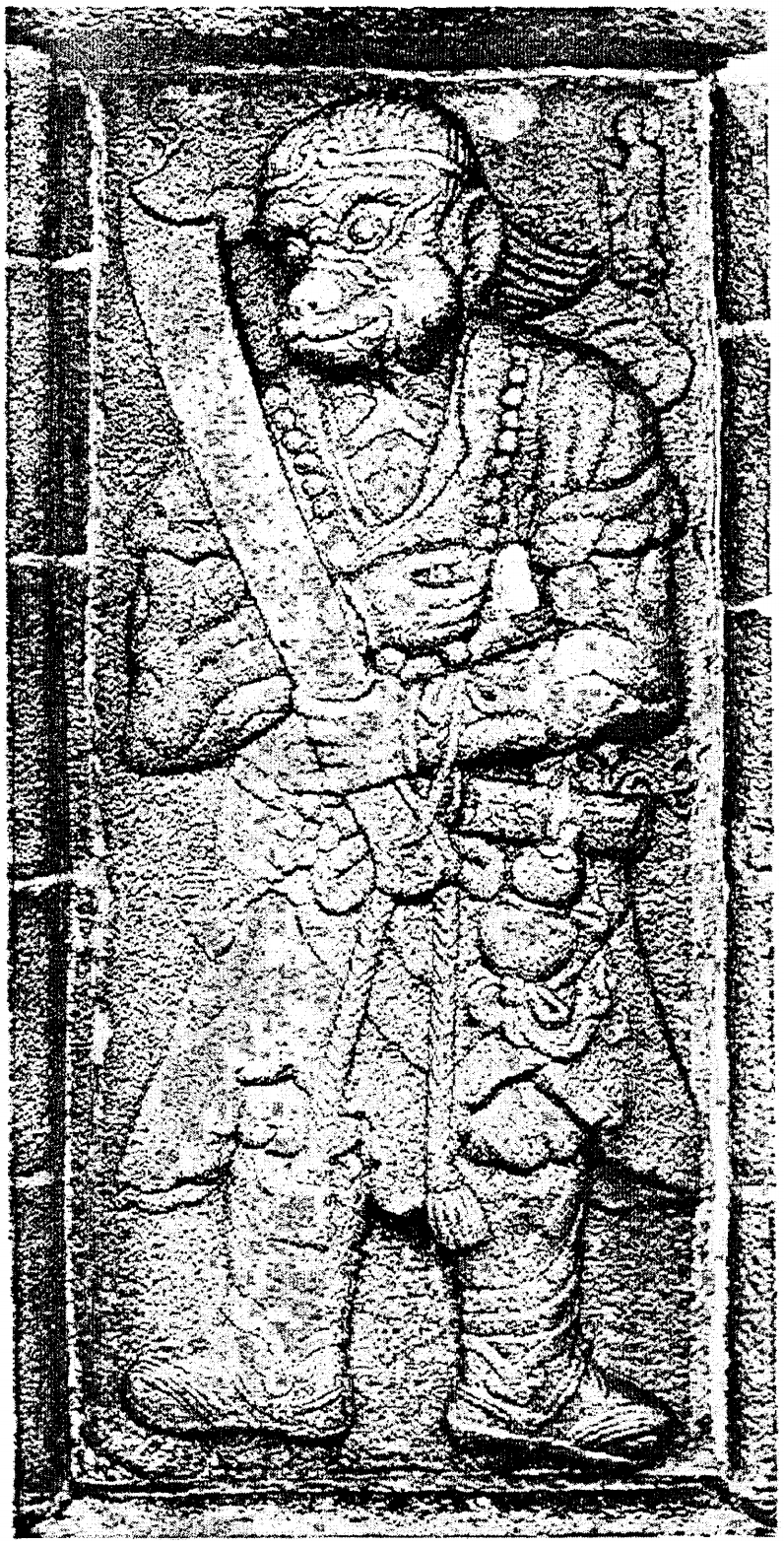
In her excellent paper on the origins of Sun Wukong, Hera S. Walker (1998) discusses a 13th century CE stone relief from the western pagoda of the Kaiyuan Temple (開元寺) in Quanzhou, Fujian province, China that portrays a sword-wielding, monkey-headed warrior (pp. 69-70). Considered by many to be an early depiction of Monkey, the figure wears a robe, a Buddhist rosary, and, most importantly, a type one fillet on the forehead (Fig. 4). [4] Walker quotes Victor Mair, who believes that the fillet “recalls the band around the head of representations of Andira, the simian guardian of Avalokitesvara” (the Indian counterpart to Guanyin) (Walker, 1998, p. 70). He goes on to list similarities between the stone relief and depictions of Andira, while also suggesting said depictions are based on south and southeast Asian representations of the Hindu monkey god Hanuman:

Identical earrings (these are key iconographic features of H[anuman] in many Southeast Asian R[ama saga]s), comparable tilt of the head… which seems to indicate enforced submission, long locks of hair… flaring out behind the head, elongated monkey’s mouth, similar decorations on the forearm and upper arm, etc. It is crucial to note that all these features can be found in South Asian and Southeast Asian representations of H[anuman] (Walker, 1998, p. 70).

So as it stands, the 13th century CE appears to be the furthest that the motif has been reliably traced.

Fig. 4 – The 13th century CE stone relief of Sun Wukong from the Kaiyuan Temple in Quanzhou, Fujian province, China (larger version).

3. My Findings

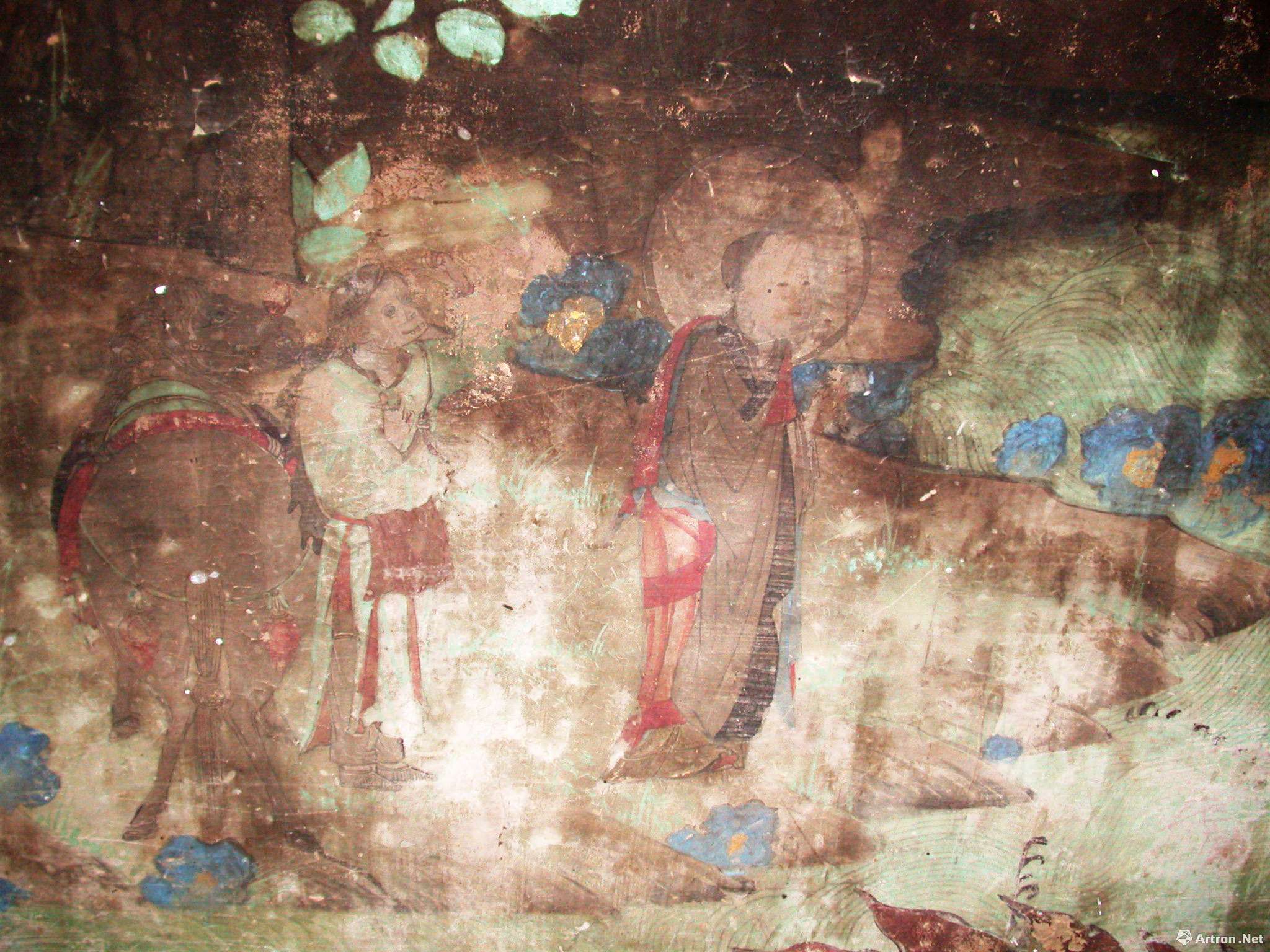
While Mair suggests a Southeast Asian Hindo-Buddhist influence, I know of at least one example from northeastern China that suggests an Indo-Tibetan Buddhist influence. The Eastern Thousand Buddha Cave no. 2 (Dong qianfo dong di 2 ku, 東千佛洞第2窟) in the Hexi Corridor of Gansu Province contains a late-Xixia dynasty (late-12th to early-13th century CE) mural of Xuanzang worshiping Guanyin from a riverbank. Monkey stands behind him tending to a brown horse. He is portrayed with a type three circlet on his head, waist length hair, and light blue-green robes with brown pants (fig. 5). This painting was completed during a time when China was seeing an influx of monks fleeing the inevitable fall of India’s Buddhist-led Pala Dynasty (750–1174 CE) from the 10th to the 12th century CE. They brought with them the highly influential Pala Buddhist art style and Vajrayana Buddhism, a form of esoteric Buddhism. The MET (2010) writes:

A mixture of Chinese-style and Vajrayana traditions and imagery was employed in the Tangut Xixia Kingdom …  which was based in Ningxia, Gansu, and parts of Shanxi … It is difficult to imagine that this “new” type of Buddhism, which not only was flourishing in Tibet in the late tenth century but was also found in the neighboring Xixia Kingdom and may have been practiced by Tibetans based in the Hexi Corridor region of Gansu Province, was completely unknown in central China until the advent of the Mongols (p. 19).

The painting of Monkey and Tripitaka was surely created by an Indian or Tibetan Buddhist monk, or at the very least a fellow Tangut or Chinese practitioner living in the area. This suggests that the imagery within the painting, such as the fillet, could have an Esoteric Buddhist pedigree, and textual evidence shows such headbands were indeed worn in some esoteric rituals.

For example, the Indian Buddhist Hevajra Tantra (Dabei kongzhi jingang dajiao wang yigui jing, 大悲空智金剛大教王儀軌經, 8th century CE) instructs adherents on how to adorn and dress themselves for worshipping Heruka, a Wrathful Destroyer of Obstacles:

The yogin must wear the sacred ear-rings, and the circlet on his head (emphasis added); on his wrists the bracelets, and the girdle round his waist, rings around his ankles, bangles round his arms; he wears the bone-necklace and for his dress a tiger-skin… (Linrothe, 1999, p. 250).

彼修觀者當如是行:謂頂想寶輪、耳帶、寶鐶,手串寶釧,腰垂寶帶,足繫寶鐸及妙臂釧,頸嚴寶鬘衣、虎皮衣 …

Furthermore, it describes how each of the ritual adornments and implements used in the ceremony represents each of the five esoteric Buddhas, as well as other religio-philosophical elements:

Aksobhya is symbolized by the circlet (emphasis added), Amitabha by the ear-rings, Ratnesa by the necklace, and Vairocana (by the rings) upon the wrists. Amogha is symbolized by the girdle. Wisdom by the khatvanga [staff] and Means by the drum, while the yogin represents the Wrathful One himself [i.e. Heruka]. Song symbolizes mantra, dance symbolizes meditation, and so singing and dancing the yogin always acts (Linrothe, 1999, p. 251).

「輪者,表阿閦如來;鐶者,無量壽如來;頸上鬘者,寶生如來;手寶釧者,大毘盧遮那如來;腰寶帶者,不空成就如來。於是色相而生念住:金剛渴椿誐杖者,表勝慧相;奎樓鼓者,即善方便故;瑜伽行者,瞋業清淨;住金剛歌詠者,真言清淨。

「又復,不應為求利養作是金剛歌舞事業。是故,瑜伽者當如是行…

As can be seen, the circlet represents Aksobhya (Sk: “Immovable”; Ch: Achu, 阿閦; Budong, 不動). This deity is known for his adamantine vow to attain buddhahood through the practice of Sila, or “morality,” the aim of which “is to restrain nonvirtuous deeds of body and speech, often in conjunction with the keeping of precepts” (Buswell & Lopez, 2014, pp. 27 and 821). So, the ritual band most likely served as a physical reminder of right speech and action, making it the best candidate for the origin of Monkey’s fillet. Sun is after all the representation of the “Monkey of the Mind” (as noted in the introduction), so his inclusion in the Eastern Thousand Buddha Cave painting was probably meant to convey the taming of this Buddhist concept via the circlet (apart from referencing the popular tale itself).

The Hevajra Tantra, the text in which the circlet appears, was first translated into Tibetan by Drogmi (993–1074 CE) and adopted during the 11th century CE as a central text by the respective founders of the Kagyu and Sakya sects, two of the six major schools of Tibetan Buddhism. Various members of the Sakya sect were invited by Mongol royalty to initiate them into the text’s esoteric teachings during the 13th century CE. These include Sakya Pandita and his nephew Chogyal Phagpa, who tutored Genghis Khan‘s grandson Prince Goden in 1244 and Kublai Khan in 1253, respectively. The meeting between Kublai and Chogyal resulted in Vajrayana Buddhism becoming the state religion of Mongolia. The Hevajra Tantra was translated into Chinese by the Indian monk Dharmapala (963–1058 CE) in 1055 during the Northern Song Dynasty (960–1127 CE). The text, however, did not become popular within the Chinese Buddhist community like it would with the Mongols in the 13th century CE (Bangdel & Huntington, 2003, p. 455). But this evidence shows how the concept of the 8th century CE ritual circlet could have traveled from India to East Asia to influence depictions of Sun Wukong in the 12th/13th century CE. And the relatively unknown status of the text in China might ultimately explain why there are so few ancient depictions of Chinese deities wearing the fillet, or why it does not appear in the 13th century CE version of JTTW.

While the late-Xixia mural (fig. 5) lacks many of the ritual adornments (apart from the fillet) mentioned in the Hevajra Tantra, the Quanzhou stone relief (refer back to fig. 3) includes the band, earrings, necklace, bangles, and possibly even a tiger skin apron, suggesting it too has an esoteric origin (most likely based on Chinese source material). The band’s connection to esoteric Buddhism is further strengthened by a 12th century CE painting from Japan. Titled Aka-Fudo (赤不動), or “Red Fudo [Myoo],” it depicts the wrathful esoteric god seated in a kingly fashion, holding a fiery, serpent-wrapped Vajra sword in one hand and a lasso in the other (fig. 6). He wears a golden, three-linked headband (similar to the curls of type one), which stands out against his deep red body and flaming aureola. Biswas (2010) notes: “… the headband on his forehead … indicate[s], according to some, a relation to the habit of groups of ascetics who were among the strong supporters of Acalanatha” (p. 112). His supporters were no doubt yogin practitioners in the same vein as those who worshipped Heraku and other such wrathful protector deities.

Fig. 5 – A portion of the late-Xixia (late-12th to early-13th century CE mural) in the Eastern Thousand Buddha Cave number two (larger version). Fig. 6 – The 12th century CE Japanese painting “Aka-Fudo” (赤不動) (larger version).

3.1. Symbol of Martial Deities and Warrior Monks

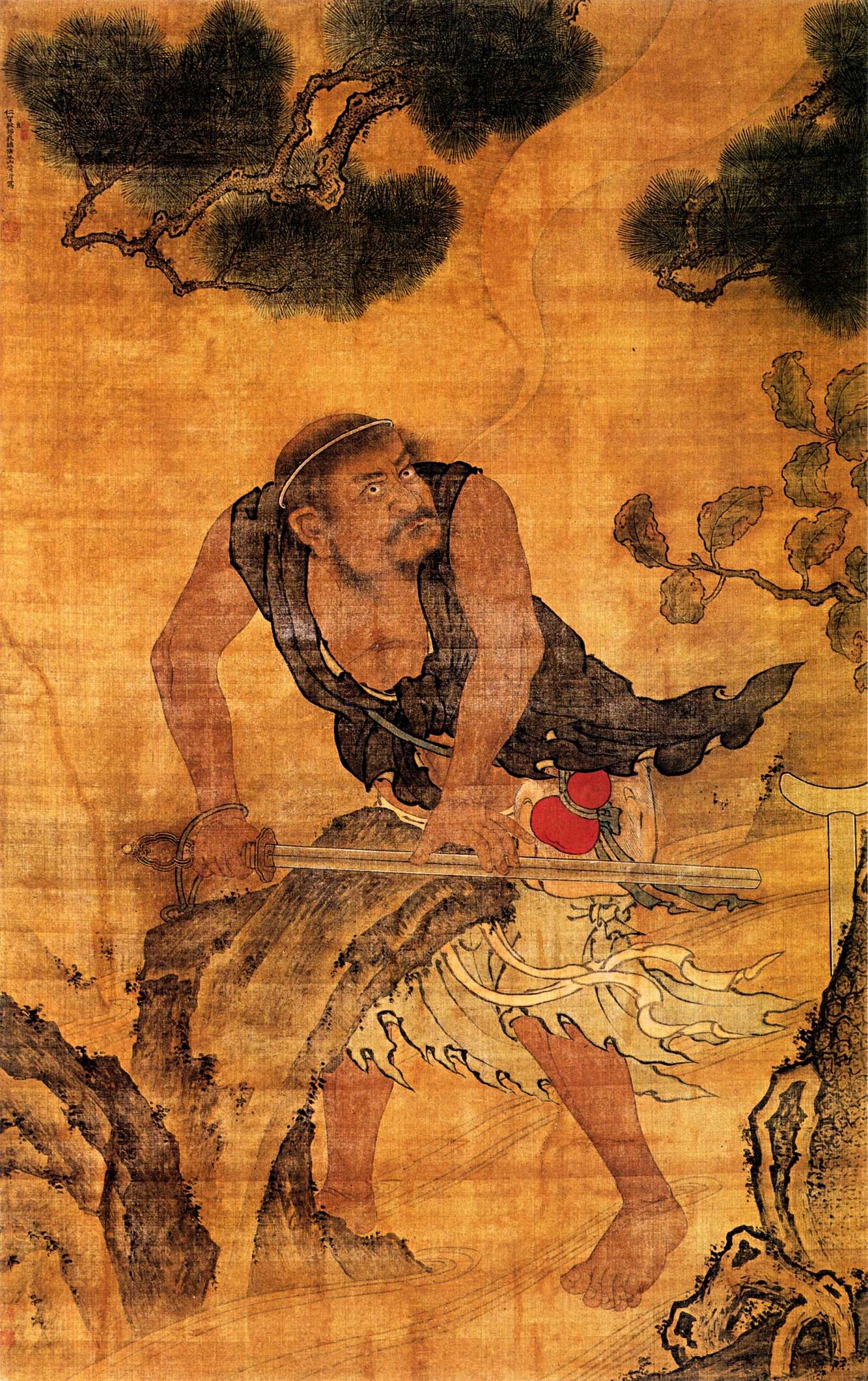
It’s important to note that Monkey was not the only cultural hero of the Ming Dynasty (1368–1644 CE) to wear a golden fillet. Another example is Li Tieguai (李鐵拐), or “Iron Crutch Li,” the oldest of the Eight Immortals. [5] Li is generally portrayed as a crippled beggar leaning on a cane. Legend has it that his original body was cremated prematurely by a disciple while the immortal traveled in spirit to answer a summons from Lord Laozi, the high god of Daoism. Li’s spirit returned a day later to find only ashes, thus forcing him to inhabit the body of a recently deceased cripple. According to Allen and Philips (2012), “Laozi gave him in recompense a golden headband and the crutch that was to become his symbol” (p. 108). Some depictions of Li wearing the fillet predate JTTW. The most striking example is Huang Ji’s Sharpening a Sword (early-15th century CE) (Fig. 7), which portrays the immortal wearing a type three band and sharpening a double-edged blade on a stone while staring menacingly at the viewer. [6] One theory suggests Li’s martial visage identifies him as a “spirit-guardian of the [Ming] state” (Little, 2000, p. 333). Both Monkey and Li are, therefore, portrayed as brutish, weapon-bearing, golden headband-wearing immortals who serve as protectors. This shows that the fillet was associated with certain warrior deities during the Ming.

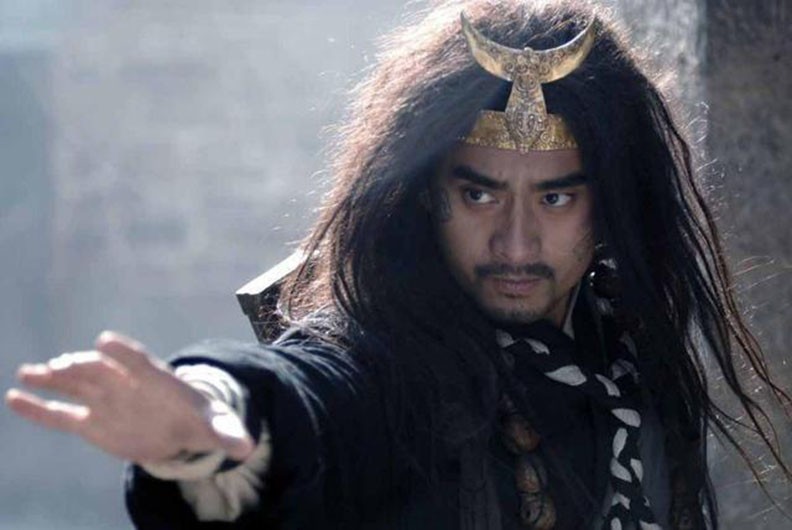
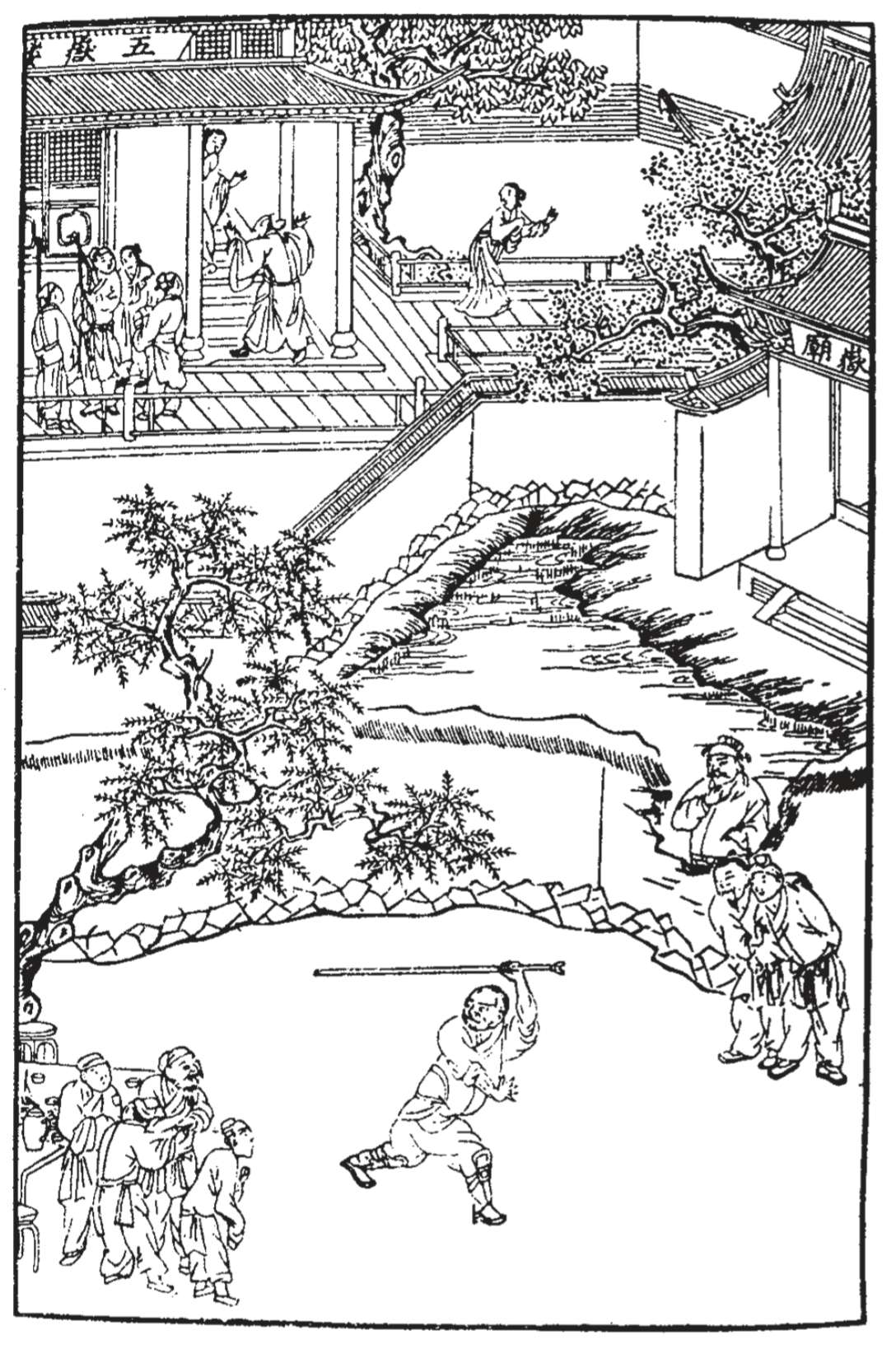
The fillet’s connection to religion and martial attributes culminated in the Jiegu (戒箍, “ring to forget desires”), a type two band worn by Military Monks (Wuseng, 武僧) in Chinese opera to show that they have taken a vow of abstinence (fig. 8). Such monks are depicted as wearing a Jiegu over long hair (Bonds, 2008, pp. 177-178 and 328), which contrasts with the bald heads of religious monks. [7] I would like to suggest that the band’s half-moon shape may have some connection to a Ming-era woodblock print motif in which martial monks are shown wielding staves tipped with a crescent (fig. 9) . The exact reason for the shape is still unknown (Shahar, 2008, pp. 97-98), but the association between the crescent and martial monks seems obvious. (See the 07-25-22 update below for the foreign origins of this motif.) The use of the fillet in Chinese opera led to it being worn by Sun Wukong in the highly popular 1986 live-action TV show adaptation of the novel (fig. 2). [8]

Fig. 7 (Left) – Huang Ji’s “Sharpening a Sword” (early-15th century CE) (larger version). Fig. 8 (Center) – An image of the military monk Wu Song wearing a jiegu (戒箍) fillet from a 2011 Water Margin TV show (larger version). Fig. 9 (Right) – A late-Ming woodblock of the warrior monk Lu Zhishen with a crescent staff (larger version). From Shahar (2008).

4. Conclusion

Examples of past research into the origins of the golden fillet respectively point to a slave collar from the Han dynasty (206 BCE–220 CE) and circa 13th century CE South and Southeast Asian depictions of the Buddhist guardian Andira and the Hindu monkey god Hanuman as possible precursors. However, the first isn’t credible, and the second, while on the right track, doesn’t go back far enough. A late-12th to early-13th century CE mural in the Eastern Thousand Buddha Cave complex depicts Sun Wukong wearing a type three fillet with possible ties to a ritual circlet worn by Esoteric Buddhist Yogin ascetics in 8th century CE India. The Hevajra Tantra, the esoteric text that mentions the band, associates it with the Aksobhya Buddha and thereby his moralistic, self-restraining practices. The text was transmitted from India to Tibet, China, and Mongolia from the 11th to the 13th centuries CE, showing a clear path for such imagery to appear in East Asia. A 12th century CE Japanese Buddhist painting of the guardian deity Fudo Myoo with a fillet suggests that the practice of wearing circlets in esoteric rituals continued for centuries. Other non-Buddhist deities became associated with the fillet during the Ming Dynasty. A 15th century CE painting of the immortal Li Tieguai, for example, depicts him as a type one circlet-wearing, sword-wielding guardian of the Ming dynasty. All of this suggests that the band became a symbol of Chinese protector deities. The association between the fillet and religion and martial attributes led to its use as the symbol of military monks in Chinese opera.


5. Updates

Update: 12-23-17

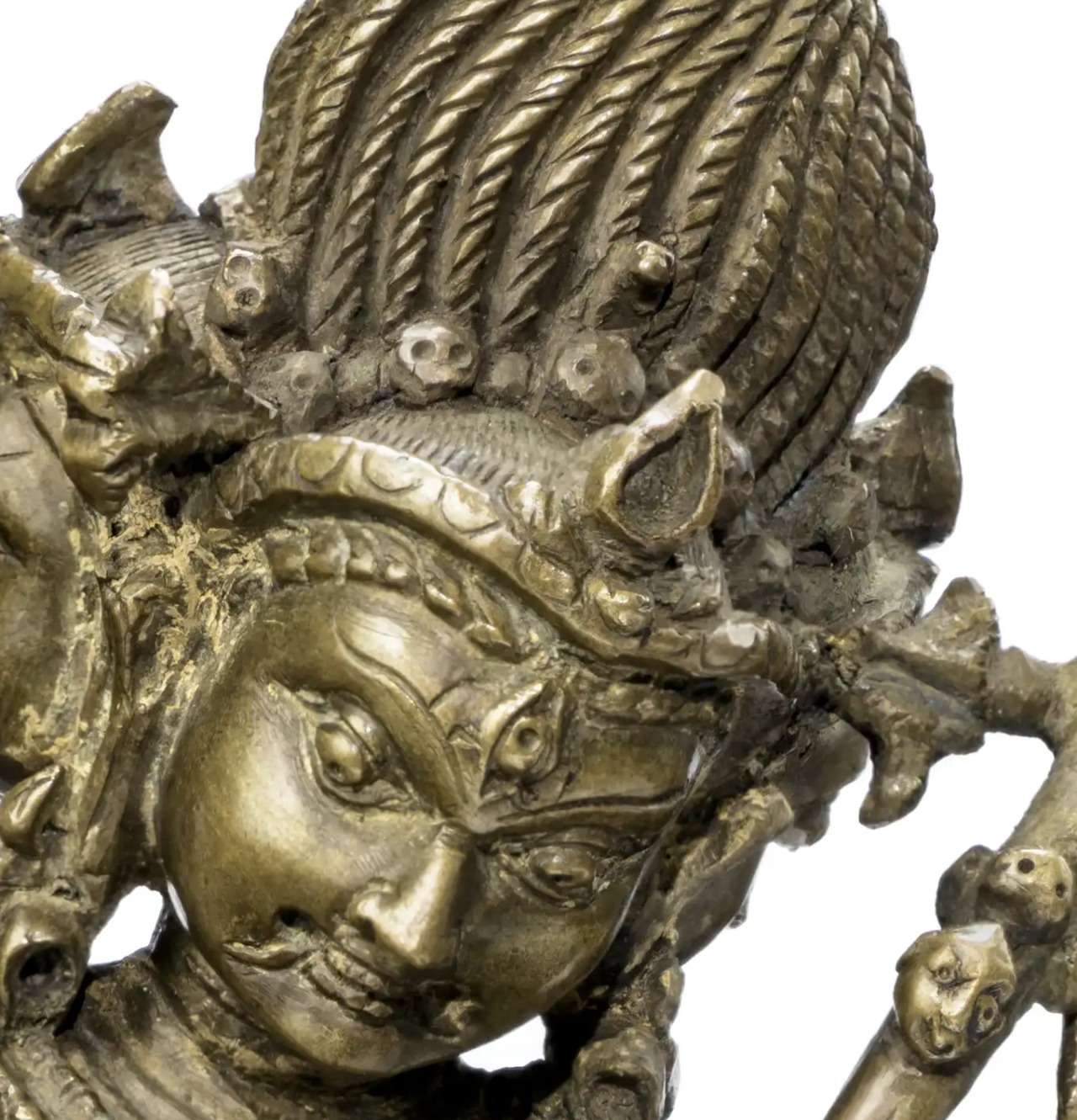
I’ve been wondering what the 8th century CE version of the circlet (along with the other ritual implements) mentioned in the Hevajra Tantra might have looked like. While I have yet to find a contemporary sculpture or painting, I have found an 11th to 12th century CE interpretation from Tibet. Titled The Buddhist Deity Hevajra (fig. 10), this copper alloy statue somewhat follows the prescribed iconography of the god as laid out in the aforementioned text:

Dark blue and like the sun in colour with reddened and extended eyes, his yellow hair twisted upwards, and adorned with the five symbolic adornments,/ the circlet, the ear-rings and necklace, the bracelets and belt. These five symbols are well known for the purificatory power of the Five Buddhas./ He has the form of a sixteen-year-old youth and is clad in a tiger-skin. His gaze is wrathful. In his left hand he holds a vajra-skull, and a khatvahga [staff] likewise in his left, while in his right is a vajra of [a] dark hue…(Linrothe, 1999, p. 256)

Fig. 10 – The Buddhist Deity Hevajra, late-11th to early-12th century CE, copper alloy (larger version). Courtesy of the Los Angeles County Museum of Art. Fig. 11 – Detail of the circlet (larger version).

The circlet here is depicted as a fitted band with crescent trim and a teardrop-shaped adornment (a conch?) (fig. 11). The statue’s iconography more closely follows that from the Sadhanamala (“Garland of Methods”), a compilation of esoteric texts from the 5th to 11th centuries CE. The following information probably derives from the later part of this period:

He wields the vajra in the right hand and from his left shoulder hangs the Khatvanga [staff] with a flowing banner, like a sacred thread. He carries in his left hand the kapala [skull cap] full of blood. His necklace is beautified by a chain of half-a-hundred severed heads. His face is slightly distorted with bare fangs and blood-shot eyes. His brown hair rises upwards and forms into a crown which bears the effigy of Aksobhya. He wears a kundala [ear decoration] and is decked in ornaments of bones. His head is beautified by five skulls (Donaldson, 2001, p. 221).

Our statue has many of these features but lacks the image of the Buddha in his hair. This suggests the knob visible in the coif (fig. 10) once carried such a figure. So, once again we see the importance of the Aksobhya Buddha. The statue is similar to 10th and 11th century CE stone statues from India. [9]

While this doesn’t get us any closer to what the original circlet looked like, this statue adds to the mutability of the fillet imagery. The Hevajra Tantra is vague in its description, and so it is no surprise that so many variations have appeared over the centuries. The original sanskrit text uses the word cakri (circle) to refer to the band (Farrow & Menon, 2001, pp. 61-62). This might explain the simple type three fillet worn by Monkey in the Eastern Thousand Buddha Cave no. two painting (fig. 2).


Update: 08-16-20

I have written an article suggesting an origin for the type one headband, or as I now call it, the “curlicue headband.”

Sun Wukong’s Curlicue-Style Headband


Update: 12-12-21

One thing I figured out a while ago but never explained here was the reason why the Japanese Buddhist protector deity Aka-Fudo (赤不動) (fig. 6) is depicted with a headband. I believe this is a visual representation of the fillet’s association with the Aksobhya Buddha. This is because the fudo (Ch: budong, 不動) of Aka-Fudo and the Sanskrit meaning of Aksobhya respectively mean “immovable.” So, the image of Aka-Fudo is encapsulating both his position as a protector deity and the Buddha represented by the headband. 


Update: 01-23-22

I’ve written an article suggesting a mantra for the secret spell that causes the golden fillet to tighten.

The Tightening Spell of Sun Wukong’s Golden Headband


Update: 07-25-22

I’ve written an article that explains the origins of the “crescent-style” headband.

The Monkey King’s Crescent-Style Headband


Update: 06-26-23

Above, I mentioned that the novel contains three kinds of headbands:

  1. Sun Wukong/Six Ears – “Constrictive” (jin, 緊) – ch. 14
  2. Black Bear Demon – “Prohibitive” (jin, 禁) – ch. 17
  3. Red Boy – “Golden” (jin, 金) – ch. 42

It’s interesting that all of them are pronounced “jin” (with varying tones).

Now imagine that there is a secret fourth headband not intended to punish but to empower. Called the “Strength” (jin, 勁) headband, it would only be used in the most extreme emergencies.

It would be neat to see someone work this into their fanfiction.


Update: 12-24-23

A character is briefly punished to wear a golden headband in the famed Ming-era novel Investiture of the Gods (Fengshen yanyi封神演義, c. 1620; summary). Chapter 82 reads: 

Ma Sui [馬遂] attacked him with his sword, and after only one round, threw a gold hoop [jingu, 金箍] around the immortal’s head. The Yellow Dragon Immortal [Huanglong zhenren, 黃龍真人] writher in pain but was quickly rescued and brought back to the pavilion.

The Yellow Immortal Dragon Immortal tried to take the hoop off his head but found it was impossible. It was so tight the true samadhi fire went out of his eyes.

The Immortal of the South Pole [Nanji xianweng, 南極仙翁] came in to announce Heavenly Primogenitor’s [Yuanshi tianzun, 元始天尊] arrival. The religious leader entered the pavilion and said, “The Yellow Dragon Immortal was destined to be caught in this gold hoop. Come here and let me help you.”

He pointed at the gold hoop, and it dropped to the ground (Gu, 2000, pp. 1713-1715).

只一合,馬遂祭起金箍,把黃龍真人的頭箍住了。真人頭疼不可忍,眾仙急救真人,大家回蘆篷上來。真人急忙除金箍,除又除不掉,只箍得三昧真火從眼中冒出;大家鬧在一處。不表。且說元始天尊來會萬仙陣,先著南極仙翁持玉符先行。南極仙翁跨鶴而來,雲光縹緲。馬遂抬頭,見是南極仙翁,急駕雲光至半空中來,阻住去路。仙翁笑曰:「馬遂,你休要猖獗,掌教師尊來了。」馬遂正欲爭持,只見後面仙樂一派,遍地異香,馬遂知不可爭持,按落雲頭,回歸本陣。南極仙翁先至蘆篷,率眾仙迎鑾接駕,上篷坐下。眾門人拜畢,侍立兩傍。元始曰:「黃龍真人有金箍之厄。」忙叫:「過來。」黃龍真人走至面前;元始用手一指,金箍隨脫。

(Gu (2000) skips over some elements in the original Chinese.)

I’ve known about this episode for a while but forget to post about it.

Notes

1) For the entire episode, see Wu & Yu, 2012, vol. 1, pp. 314-320.

2) The child first speaks his new name in chapter 49 (Wu & Yu, 2012, vol. 2, p. 354). The original Sudhana originates from the Avatamsaka Sutra (Wu & Yu, 2012, vol. 2, pp. 386-387 n. 3).

3) For a complete English translation, see Wivell (1994).

4) This is just one of many relief carvings that grace the pagoda. It includes other guardian-type figures with esoteric elements but rendered in the Chinese style. See Ecke and Demiéville (1935).

5) The Eight Immortals are Daoist saints who came to be worshipped as a group starting sometime in the Jin Dynasty (1115–1234 CE) (Little, 2000, p. 319).

6) The sword is usually a symbol of the immortal Lu Dongbin, but as noted above, it is used to identify Li Tieguai as a Ming guardian (Little, 2000, p. 333).

7) Shahar (2008) discusses the historical differences between religious and military monks in ancient China.

8) Liu Xiao Ling Tong (六小龄童; born Zhang Jinlai, 章金萊, 1959), the actor who played Monkey in the 1986 TV show, comes from a family who has specialized in playing Sun Wukong in Chinese opera for generations (Ye, 2016).

9) See the Heruka chapter in Linrothe (1999). He includes our statue in his study, but other sources describe it as Tibetan instead of Indian (Bangdel & Huntington, 2003, p. 458).

Bibliography

Allan, T., & Phillips, C. (2012). Ancient China’s Myths and Beliefs. New York: Rosen Pub.

Bangdel, D., & Huntington, J. C. (2003). The Circle of Bliss: Buddhist Meditational Art. Chicago, Ill: Serindia Publications.

Biswas, S. (2010). Indian Influence on the Art of Japan. New Delhi: Northern Book Centre.

Bonds, A. B. (2008). Beijing Opera costumes: The Visual Communication of Character and Culture. Honolulu: University of Hawai’i Press.

Buswell, R. E., & Lopez, D. S. (2014). The Princeton Dictionary of Buddhism. Princeton, NJ: Princeton University Press.

Donaldson, T. E. (2001). Iconography of the Buddhist Sculpture of Orissa. New Delhi: Indira Gandhi National Centre for the Arts.

Ecke, G., & Demiéville, P. (1935). The Twin Pagodas of Zayton: A Study of the Later Buddhist Sculpture in China. Cambridge, Mass: Harvard University Press.

>Farrow, G. W., & Menon, I. (2001). The Concealed Essence of the Hevajra Tantra: With the Commentary Yogaratnamālā. Delhi: Motilal Banarsidass Publ.

Gu, Z. (2000). Creation of the Gods (Vols. 1-4). Beijing: New World Press.

Linrothe, R. N. (1999). Ruthless Compassion: Wrathful Deities in Early Indo-Tibetan Esoteric Buddhist Art. Boston, Mass: Shambhala.

Little, S. (2000). Taoism and the Arts of China. Chicago, IL: Art Institute of Chicago.

Liu, X. (1994). The Odyssey of the Buddhist Mind: The Allegory of the Later Journey to the West. Lanham, Md: University Press of America.

Metropolitan Museum of Art, Leidy, D. P., Strahan, D. K., & Becker, L. (2010). Wisdom Embodied: Chinese Buddhist and Daoist sculpture in the Metropolitan Museum of Art. New York: Metropolitan Museum of Art.

Shahar, M. (2008). The Shaolin Monastery: History, Religion, and the Chinese Martial Arts. University of Hawaii Press.

Walker, H.S. (1998). Indigenous or Foreign? A Look at the Origins of Monkey Hero Sun Wukong. Sino-Platonic Papers, 81, 1-117.

Wang, T. (2006). Dust in the Wind: Retracing Dharma Master Xuanzang’s Western Pilgrimage. Taipei: Rhythms Monthly.

Wivell, C.S. (1994). The Story of How the Monk Tripitaka of the Great Country of T’ang Brought Back the Sūtras. In V. H. Mair (Ed.), The Columbia Anthology of Traditional Chinese Literature (pp. 1181-1207). New York: Columbia University Press.

Wu, C., & Yu, A. C. (2012). The Journey to the West (Vols. 1-4) (Rev. ed.) Chicago, Ill: University of Chicago Press.

Ye, X. (2016). Liu Xiao Ling Tong and Sun Wukong. Retrieved December 15, 2017, from https://www.youlinmagazine.com/story/liu-xiao-ling-tong-and-sun-wukong/Njgw

The Later Journey to the West: Part 1 – Sun Luzhen’s Early Adventures

Note: An AI translation of this novel is now available. Click the linked Chinese characters below that read “後西遊記.”

Last updated: 03-15-2026

The great Chinese classic Journey to the West (Xiyouji, 西遊記; “JTTW” hereafter) spawned numerous unofficial sequels years after its publishing in 1592. One such sequel, Later Journey to the West (Hou Xiyouji, 後西遊記) by an anonymous author of the 17th-century, is set two hundred years after the original and follows the adventures of Sun Wukong’s spiritual descendant Sun Luzhen (孫履真). He too learns the secrets of immortality and causes havoc in heaven, before being tasked to protect the historical monk Dadian (大顛, 732-824) on a similar journey to India. The two are accompanied by the son of Zhu Bajie, Zhu Yijie (豬一戒), and the disciple of Sha Wujing, Sha Zhihe (沙致和). This may at first seem like a cookie cutter retelling of the story, but it is so much more. Unlike the original, which only used allegorical terms for given characters, Later Journey to the West is comprised of extremely dense layers of allegorical meaning, from the names of characters and the words they speak to the places they visit and the villains they face.

Below, I present the first of a three-part overview (part 2 and part 3), which covers Sun Luzhen’s early adventures. I rely very heavily on the engaging work of Xiaolian Liu (1994) as the novel has yet to be published in English.

Notes have been added to the sections below to explain the allegorical meaning of various story elements.

Table of Contents

1. The Riddle

The novel begins with the following riddle:

I have a statue of Buddha, which nobody knows;
He needs no molding or carving;
Nor does he have any clay or color;
No human can draw him; no thief can steal him;
His appearance is originally natural,
And his clarity and purity are not the result of cleaning;
Though only one body,
He is capable of transforming himself into myriad forms (Liu, 1994, p. 22)

我有一軀佛,世人皆不識,
不塑亦不裝,不雕亦不刻,
無一滴灰泥,無一點彩色,
人畫畫不成,賊偷偷不得。
體相本自然,清靜非拂拭,
雖然是一軀,分身千百億。(source)

Liu (1994) notes that the answer is: “The Mind is none other than the Buddha” (jixin jifo, 即心即佛), a common Chan (Zen) Buddhist saying referring to self-enlightenment (p. 22). He continues:

The author uses the verse to announce the theme of his book and to prepare the reader for the mental or spiritual journey he is going to undertake through the experience of reading it […] [T]he novelist wants to make sure that the readers is aware of the allegorical nature of his various episodes and is ready to apply the same technique he would employ in solving a riddle to the reading of the novel, i.e. to go beyond the literal level of the text in order to find the solution or to decipher the intended message (Liu, 1994, p. 24).

2. Sun Luzhen’s Early Adventures

The story opens on the Flower Fruit Mountain (fig. 1), home of the original Monkey King and the axis mundi, or center of the cosmos through which all creative energies flow freely between heaven and earth. Our hero Sun Luzhen is born from a stone and, upon hearing of the adventures of Sun Wukong, takes the title “Small Sage Equaling Heaven” (Qitian xiaosheng, 齊天小聖). [A][1] He follows in his ancestor’s footsteps by sailing to the Aparagodaniya continent in a quest for immortality. There, he finds an immortal’s temple but is barred from meeting the patriarch by a Daoist monk until he has completed a number of tasks, including purifying himself in the Hall of Calming the Mind and the Hall of Nourishing the Breath, [B] taming a dragon and a tiger, [C] and visiting several locations, such as the Cinnabar Field and the Divine Mansion. [D] Monkey completes the purification rituals, but soon leaves the temple when he discovers the immortal cavorting with an old woman and two young maidens. [E]

A) Just like Sun Wukong in JTTW, Sun Luzhen represents the “Monkey of the Mind” (xinyuan, 心猿), a Buddhist metaphor for the restlessness of the human mind/heart (the character of xin () can mean both) (Liu, 1994, pp. 27-28).

B) These represent the early stages of spiritual cultivation, namely meditation and the regulation of breathing. The latter involves absorption of yang energy during prescribed times of the day.

C) These animals represent yin and yang energy, respectively. So taming said animals refers to a mastery of said energies.

D) These represent spiritual centers of the body, namely a region just below the navel and the upper region of the head, respectively. See J below.

E) These people represent Daoist terms associated with sexual cultivation, a type of internal cultivation popular during the Han dynasty but fell out of favor by the Ming when the novel was written (Liu, 1994, pp. 35-37).

Monkey leaves the temple and continues his search the world over for a worthy master, finding only false immortals and hypocritical monks along the way. [F] He returns to Flower Fruit Mountain determined to bring about his own immortality, and there the small stone monkey finds the “No-Leak” Cave (wulou dong, 無漏洞) on the backside of the mountain, making it his hermitage. [G] He meditates for forty-nine days, before Sun Wukong appears in spirit, sharing with him magical formulas and eventually merging with him. This causes Monkey Jr. to realize: “The true master is after all in one’s own mind, but people don’t know where to look for him” (Liu, 1994, p. 38). [H]

F) These people represent the wrong path to enlightenment, including non-Chan Buddhist sects and even Daoism.

G) The name represents the Buddhist concept of Anasrava and the Daoist concept of Wulou (無漏)/Loujin (漏盡), or the cessation of emotional outpouring (or leaking) upon achieving enlightenment (Liu, 1994, p. 38).

H) This represents self-realization.

Having achieved immortality, Sun Luzhen discovers his ancestor’s “as-you-will” gold-banded cudgel in the cave and sets out to find additional ways of increasing his spiritual attainment. [2] First, he forces the Dragon King of the Eastern Sea and the Old Tiger King of the Western Mountains to respectively submit to his power. [I] Next, Monkey travels to the underworld below and uses his wits to prove the other worldly judgements of the ten magistrates of hell are unjust, making their rulings listed in the ledgers of life and death null and void. [J][3] Finally, the small stone monkey travels to the celestial realm above to visit the Jasper Pool, the abode of the Queen Mother of the West (fig. 2). [K] He gets drunk on immortal wine and soon creates such a disturbance that the August Jade Emperor, the ruler of heaven, calls up the celestial army to deal with the menace. The Small Sage is too powerful, and so the emperor enlists the help of the Great Sage, now an enlightened Buddha (fig. 3), [4] to halt his descendant’s onslaught. [L][5]

I) This follows the Daoist monk’s instructions to tame a dragon and a tiger. This again represents his mastery of yin and yang energies.

J) This represents Monkey’s status as an immortal who is beyond the reach of death. I believe the downward journey symbolically follows the Daoist monk’s instructions to visit the Cinnabar Field, an area of the body below the navel normally associated with the storage of spiritual and sexual energy. Although Liu (1994) does not say this explicitly, he does comment: “According to the Taoist microcosmic view, the human body [has] features corresponding to the cosmic universe […] For example, the Celestial Palace … and the Jasper Pool are not only the heavenly residence of the Jade Emperor and the Mother Queen [of the west], but also terms referring to the upper regions of the head” (p. 45). See K below.

K) Going to heaven represents the upward propulsion of energy to the head, the last step in achieving immortality.

L) As the ruler of heaven, the August Jade Emperor represents the Primary Spirit (yuanshen, 元神), or the original pure spirit that everyone is born with. This is also known as the “Heavenly Mind/Heart” (tianxin, 天心). Therefore, Monkey’s rebellion represents the attempt of the “Conscious Spirit or the Heart of Blood and Flesh” at usurping the spiritual mind before all attachments are extinguished upon enlightenment (Liu, 1994, pp. 47-48).

Fig. 1 – A depiction of Flower Fruit Mountain from a modern video game (larger version). Fig. 2 – A Ming Dynasty painting of the Queen Mother of the West riding a stone lion (larger version). Fig. 3 – A live action depiction of Sun Wukong after attaining Buddhahood (larger version).

3. Sun Luzhen’s Enlightenment

Sun Wukong arrives and soon deprives the small stone monkey of the magic iron staff, and when the latter complains that he won’t be able to defend himself, Monkey Sr. tells him: “It is already in your ear [where he used to hide the magically reduced weapon]. How can I give it back to you?” (Liu, 1994, p. 50). [M] This Chan gong’an (Zen koan) instantly brings about Sun Luzhen’s enlightenment.

M) This represents one’s own internal or spiritual strength.

Before returning to the Western Paradise, the Great Sage places the golden fillet on his head and instructs him:

There is a limit to brute force,
But Wisdom and courage are boundless;
If you fail to achieve the right fruition,
You will forever be a wild immortal. (Liu, 1994, p. 49)

頑力有阻,慧勇無邊;
不成正果,終屬野仙。(source)

Liu (1994) explains the significance of the verse:

In the poem Sun Wukong tells his descendant to resort to wisdom and courage, rather than brute force, to achieve this goal. This teaching is borne out by the fact that it is not the celestial army but Sun Wukong who subdues Monkey with his enlightening words. But more important is the message conveyed in the last two lines. Though Monkey has obtained physical immortality, he is still a yexian 野仙 (wild immortal), because he is unable to quench his desires and emotions […] According to Chan Buddhist doctrine of wunian 無念 (no-thought), man’s original nature is pure and free from all thoughts and passions. In the first section of the novel, Monkey tries a Taoist approach in his effort to seek immortality. Though he succeeds through Taoist meditation in calming his mind and in realizing his self-nature, his desire for immortality and his practice of internal alchemy, symbolized by his celestial adventures, violate the Chan Buddhist principle of non-attachment, and are therefore considered “wild” and “unorthodox” by Buddhist ontological non-dualism. The completion of the Taoist physiological alchemy is only the beginning of a self-cultivation process for the hero whose ultimate goal … is to accomplish zhenguo 正果 (right or orthodox fruition), i.e. to achieve the Buddhahood inherent in one’s own nature, through the journey proper to the Holy Mountain in the Western Paradise. (p. 49)


4. Updates

Update: 10-25-21

I have listed Sun Luzhen as an “honorable mention” among the Monkey King’s literary children. See section 3 here:

The Monkey King’s Children


Update: 03-15-26

I have drastically updated the formatting of this article, including adding more of the original Chinese characters/quotations, increasing the number of tags, linking to more wiki articles, and placing the (previously separate) explanatory notes within each section. Needless to say, this post now differs from parts two and three. I will get around to updating those in the future.

Notes:

1) This mirrors the title “Great Sage Equaling Heaven” (Qitian Dasheng, 齊天大聖) taken by Sun Wukong in JTTW chapter 4.

2) Daoism recognizes up to five categories of immortality, each increasing in spiritual attainment from the last: 1. Ghost; 2. Human; 3. Earthly; 4. Divine; and 5. Heavenly (Liu, 1994, p. 55, n. 36).

3) This contrasts with Sun Wukong who used force to erase his name (and those of all other monkeys living at that time) from the ledgers of life and death (see JTTW chapter 3).

4) Monkey Sr. is granted Buddhahood, along with the title “Buddha Victorious in Strife” in JTTW chapter 100.

5) Sun Luzhen’s drunken episode, havoc in heaven, and subjugation by a Buddha recalls the adventures of his ancestor from JTTW chapters 4 to 7.

Source:

Liu, X. (1994). The Odyssey of the Buddhist Mind: The Allegory of the Later Journey to the West. Lanham, Md: University Press of America.

The Story of Sun Wukong, the Monkey King

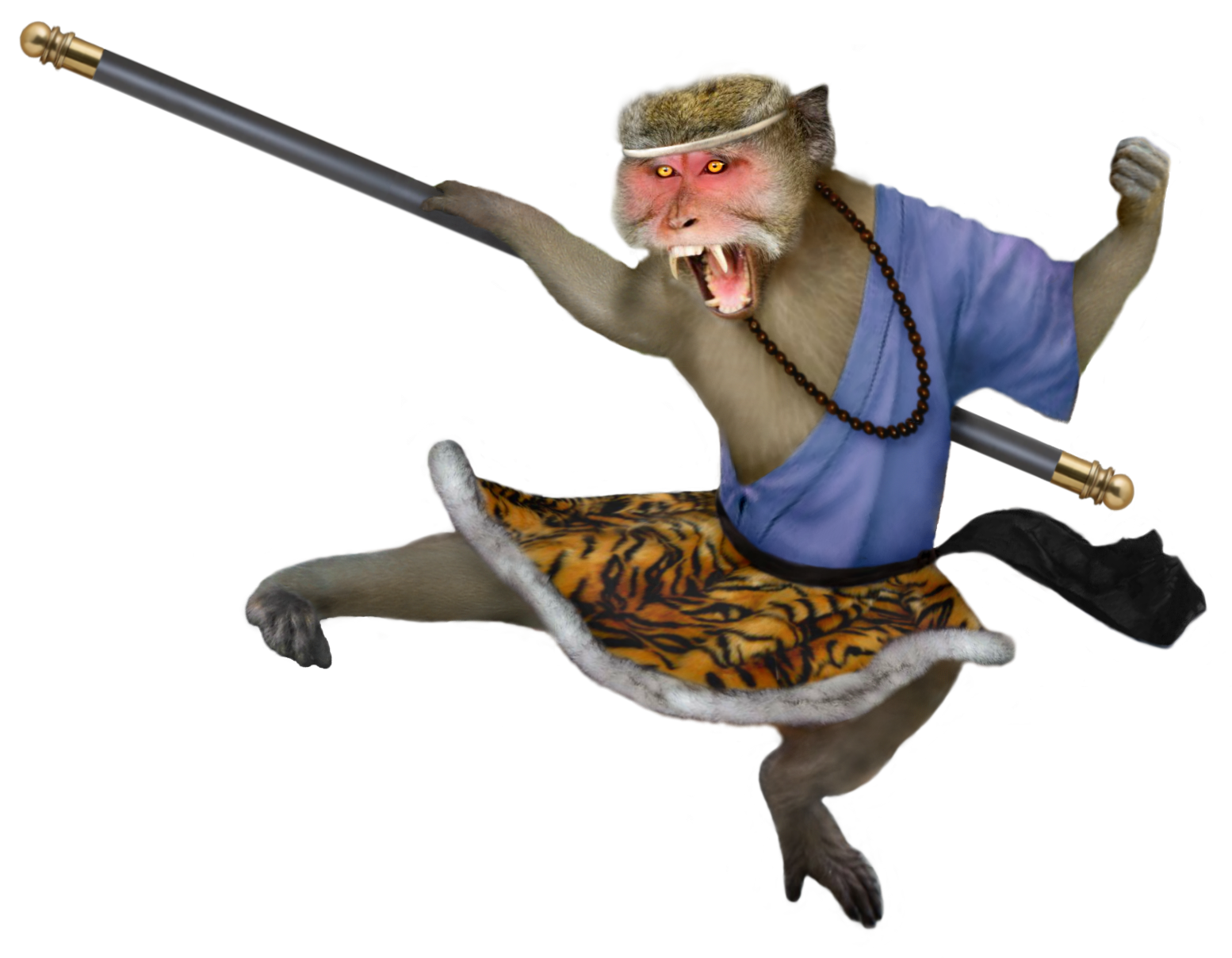
One of the most famous primate characters in world literature appears in the great Chinese classic Journey to the West (Xiyouji, 西遊記, 1592 CE). The story follows the adventures of Sun Wukong (孫悟空, a.k.a. “Monkey”) (fig. 1), an immortal rhesus macaque demon, who gains extraordinary power via spiritual cultivation and rebels against the primacy of heaven. Like Lucifer in Judeo-Christian mythology, this trickster god falls from grace when a supreme deity, in this case the Buddha, banishes him to an earthly prison below. But unlike his western counterpart, the monkey repents, becoming a monk and agreeing to use his abilities to protect a Buddhist priest on his journey to collect sutras from India.

What follows is an overview of Monkey’s story. It will primarily focus on the first seven of the novel’s 100 chapters, but chapters eight through 100 will be briefly touched upon, along with lesser-known literary sequels to Journey to the West. I will also discuss the novel’s impact on pop culture and religion.

Table of Contents

1. His Story

In the beginning, the mystical energies of heaven and earth and the light of the sun and moon come together to impregnate a boulder high atop the Mountain of Flowers and Fruit (Huaguo shan, 花果山), an island that lies to the east of the easternmost continent in the Buddhist disc world system. The stone gestates for countless ages until the Zhou Dynasty (1046-256 BCE), when it hatches a stone egg that is eroded by the elements into a simian shape. The Stone Monkey (Shihou, 石猴) awakens and bows to the four cardinal directions as light bursts forth from his eyes. The light is so bright that it reaches heaven, alarming the Jade Emperor (Yuhuang dadi, 玉皇大帝) and his celestial retinue. The light soon subsides, however, once he ingests food for the first time.

The Stone Monkey happens upon other primates on the island and becomes their king when he proves himself in a test of bravery by blindly leaping through a waterfall, thereby discovering a long-forgotten immortal’s cave. He rules the mountain for over three centuries before the fear of death finally creeps in. One of his primate advisors suggests that the king finds a transcendent to teach him the secrets of eternal life, and so Monkey sets sail on a makeshift raft and explores the world for ten years. His quest eventually takes him to the western continent, where he is finally accepted as a student by the Buddho-Daoist sage, Patriarch Subodhi (Xuputi zushi, 須菩提祖師). He is given the religious name Sun Wukong, meaning “monkey awakened to emptiness” or “monkey who realizes sunyata.” The sage teaches him the 72 methods of earthly transformation, or endless ways of changing his shape and size; cloud somersaulting, or a type of flying that allows him to travel 108,000 li (33,554 mi / 54,000 km) in a single leap; all manner of magical spells to call forth gods and spirits, grow or shrink to any size, part fire and water, create impassable barriers, conjure wind storms, cast illusions, freeze people in place, make endless clones of himself, unlock any lock, bestow superhuman strength, bring the dead back to life, etc.; traditional medicine; armed and unarmed martial arts; and, most importantly, an internal breathing method that results in his immortality. He is later disowned by the sage for selfishly showing off his new found magical skills to his less accomplished classmates.

Sun eventually returns to his cave and faces a demon who had terrorized his people during his prolonged absence. After killing the monster, he realizes that he needs a weapon to match his celestial power, and so his advisor suggests that he go to the undersea palace of Ao Guang (敖廣), the Dragon King of the Eastern Sea. There, he tries out weapons weighing thousands of pounds, but each one is too light. He finally settles on a massive nine-ton iron pillar that was originally used by Yu the Great (Dayu, 大禹) to set the depths of the fabled world flood, as well as to calm the seas. Named the “As-You-Will Gold-Banded Staff” (Ruyi jingu bang, 如意金箍棒), the iron responds to Sun’s touch and follows his command to shrink or grow to his whim, thus signifying that this weapon was fated to be his. In addition to the staff, Monkey bullies the Dragon King’s royal brothers into giving him a magical suit of armor.

Shortly after returning home to the Mountain of Flowers and Fruit, he shows off his new weapon by turning into a frightful cosmic giant and commanding the staff to grow, with the top touching the highest heaven and the bottom the lowest hell. This display of power prompts demon kings of the 72 caves to submit to his rule and host a drunken party in his honor. Soon after falling asleep, Sun is visited by two psychopomps who drag his soul to the Chinese underworld of Diyu (地獄). There, he learns that he was fated to die at the allotted age of 342 years old. But this enrages Monkey since his immortality freed him from the cycle of rebirth, and so he bullies the kings of hell in to bringing him the ledger containing his info. He promptly crosses out his name with ink, as well as the names of all monkeys on earth, thus making them immortal, too. He wakes up in the mortal world when his soul returns to his body.

Fig. 1 – A modern depiction of Sun Wukong (by the author) (larger version).

Both the Eastern Dragon King and the Hell King Qinguang (秦廣王) submit memorials to heaven concerning Sun’s misconduct. But the court advisor, an embodiment of the planet Venus, convinces the Jade Emperor to give Sun the menial task of watching over the Heavenly Horses in order to avoid further conflict. Monkey accepts and steadfastly performs his duties, that is until he learns that he’s just a glorified stable boy. He immediately returns to his earthly home in rebellion to proclaim himself the “Great Sage Equaling Heaven” (Qitian dasheng, 齊天大聖). The celestial realm mobilizes an army of powerful demon hunters, including the Heavenly King Li Jing (Li Jing tianwang, 李靖天王) and his son, the child god Third Prince Nezha (Nezha santaizi, 哪吒三太子), but they all fall to Monkey’s magical and martial might. The embodiment of the planet Venus once again steps in to convince the Jade Emperor to acquiesce to Monkey’s demand for higher rank, thereby granting him the empty title of Great Sage Equaling Heaven and even promoting him to watch over the immortal peach groves.

Sun takes stock of the magical peaches that ripen every few thousand years, but he eventually succumbs to their heavenly aroma. He eats all but the youngest life-prolonging fruits, thus gaining another level of immortality. His theft is soon discovered, however, when fairy attendants of the Queen Mother of the West (Xiwangmu, 西王母) arrive to pick the choicest specimens for her long-awaited immortal peach banquet. Sun is alerted to there presence and, upon questioning them, learns that he has not been invited. Naturally, Sun becomes enraged, freezing the maidens in place with fixing magic and then crashes the party before the hallowed guests arrive. He eats all of the celestial food and drinks all of the immortal wine, and then drunkenly stumbles into the laboratory of Laozi (老子), a high god of Daoism. There, he gobbles up the deity’s alchemically-derived elixir pills, thereby adding several more levels of immortality.

Sun returns home once again to await the coming storm of heavenly forces. Tired of the demon’s antics, the Jade Emperor calls up 72 heavenly generals, comprising the most powerful Buddho-Daoist gods, and 100,000 celestial soldiers. In response, Monkey mobilizes his own army comprising the demon kings of the 72 caves and all manner of animal spirits, including his own monkey soldiers. But soon after the battle commences, the demon kings fall to heavenly troops, forcing Sun to take on three heads and six arms and multiply his iron staff to meet the onslaught. Once again, the heavenly army is no match for him. However, he soon loses his nerve when his monkey children are captured in great heavenly nets. He flees with Erlang (Erlang shen, 二郎神), a master of magic and the nephew of the Jade Emperor, taking chase. The two battle through countless animal transformations, each trying to one-up the other. Monkey is finally captured when Laozi drops a magical bracelet on his head, incapacitating him long enough for Erlang’s celestial hound to bite hold of his leg.

Sun is taken to heaven to be executed for his crimes, but fire, lightning, and edged weapons have no effect on his invincible body. Laozi then suggests that they put him inside of the deity’s alchemical furnace to reduce the demon to ashes. They check the furnace 49 days later expecting to see his rendered remains. However, Monkey jumps out unscathed, having found protection in the wind element (xun, 巽) of the eight trigrams. But intense heat and smoke inside the furnace had greatly irritated his eyes, refining his pupils the color of gold and giving them the power to recognize the dark auras of demons in disguise. He overturns the furnace and begins to cause havoc in heaven with his iron staff. The Jade Emperor finally beseeches the Buddha (Rulai, 如来) in the Western Paradise to intervene.

The Tathagata appears and declares that he will make Sun the new ruler of heaven if the macaque can simply jump out of his palm. Monkey agrees to the wager, and with one tremendous leap, speeds towards the reaches of heaven. He lands before five great pillars, thinking them to be the edge of the cosmos. He tags one with his name and urinates at the base of another in order to prove that he had been there. Upon returning, Sun demands the throne. However, the Buddha reveals that the five pillars were actually his fingers, meaning that the Great Sage had never left. But before Monkey can do anything, the Tathagata overturns his hand, pushing it out the gates of heaven, and transforming it into the Five Elements Mountain (Wuxing shan, 五行山). There, Sun is imprisoned for his crimes against heaven, as well as subjected to a hellish diet.

Chapters thirteen to 100 tell how six hundred years later Sun is released during the Tang Dynasty (618-907) to help escort the Buddhist monk Tripitaka (Sanzang, 三藏) (whose early story is told in chapters eight to twelve), a disciple of the Buddha in a previous life, on a quest to retrieve salvation-bestowing scriptures from India. The Bodhisattva Guanyin (觀音) gives the monk a golden headband (jingu, 金箍; a.k.a. jingu, 緊箍, lit: “tight fillet”) as a means to rein in Monkey’s unruly nature. It tightens around Sun’s head whenever a magic formula is recited, causing him great pain. In addition, Guanyin gives Monkey three magic hairs on the back of his neck that can transform into anything he desires to aid in his protection of the monk. Along the way, the two meet other monsters-turned-disciples—Zhu Bajie (猪八戒), the lecherous pig demon, Sha Wujing (沙悟净), the complacent water demon, and the White Dragon Horse (Bailongma, 白龍馬), a royal serpent transformed into an equine—who agree to aid in the monk’s defense. Monkey battles all sorts of ghosts, monsters, demons, and gods along the way. In the end, he is granted Buddhahood and given the title of the “Victorious Fighting Buddha” (Dou zhanzheng fo, 鬥戰勝佛) for protecting Tripitaka over the long journey.

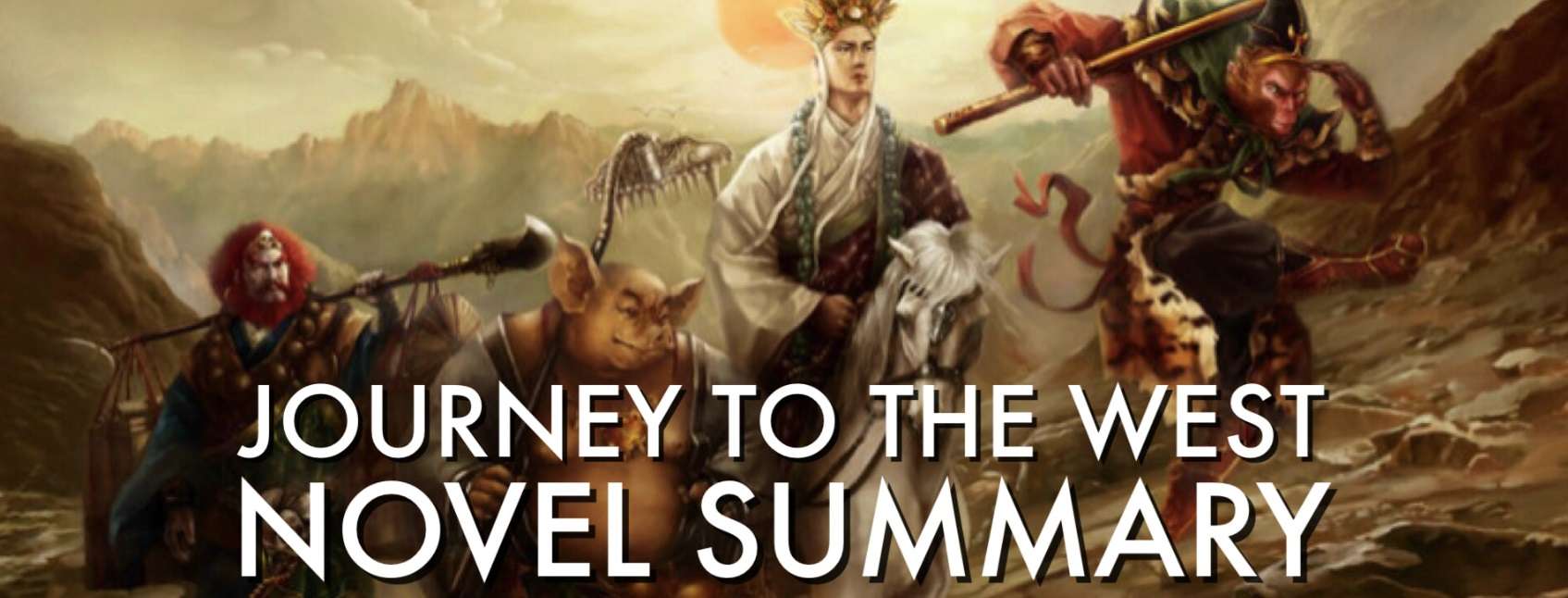
A summary of all 100 chapters can be read on my friend’s blog (fig. 2).

https://journeytothewestlibrary.weebly.com/novel-summary

Fig. 2 – The summary header (larger version).

2. Sequels

There are a total of four unofficial sequels to the novel.

The first is called A Supplement to the Journey to the West (Xiyoubu, 西游补, 1640), which takes place between chapters 61 and 62 of the original. In the story, the Monkey King wanders from one adventure to the next, using a magic tower of mirrors and a Jade doorway to travel to different points in time. In the Qin Dynasty (221–206 BCE), he disguises himself as Consort Yu in order to locate a magic weapon needed for his quest to India. During the Song Dynasty (960–1279), he serves in place of King Yama as the judge of Hell. After returning to the Tang Dynasty, he finds that his master Tripitaka has taken a wife and become a general charged with wiping out the physical manifestation of desire (desire being a major theme running through the novelette). Monkey goes on to take part in a great war between all the kingdoms of the world, during which time he faces one of his own children in battle. In the end, he discovers an unforeseen danger that threatens Tripitaka’s life.

The second is the Later Journey to the West (Hou Xiyouji, 後西遊記, 17th century). This novel focuses on the adventures of Monkey’s spiritual descendent Sun Luzhen (孫履真, “Monkey who Walks Reality”). I have a three-part article about it (first, second, and third).

And the third and fourth are the Continuation of the Journey to the West (Xu Xiyouji, 續西遊記, 17th century) and the New Journey to the West (Xin Xiyouji, 新西遊記, 19th century), respectively. As of 2023, I have not written any articles on these sequels.

3. Cultural Impact

Stories about Sun Wukong have enthralled people the world over for centuries. His adventures first became popular via oral folktale performances during the Song Dynasty (960-1279). These eventually coalesced into the earliest known version of the novel, The Story of How Tripitaka of the Great Tang Procures the Scriptures (Da Tang Sanzang qujing shihua, 大唐三藏取經詩話; The Story hereafter), published during the late-13th century.

Since the anonymous publishing of the complete novel in the 16th century, Monkey has appeared in numerous paintings, poems, books, operatic stage plays, video games, and films (both live action and animated).

He was sometimes “channeled,” along with other martial spirits, by citizen soldiers of the anti-foreign Boxer Rebellion (1899-1901). There is also a monkey-based martial art named in his honor.

It is interesting to note that there are people in southern China, Taiwan, Malaysia, Singapore, Thailand, and Vietnam who worship him as a patron deity. Thus, Sun became so popular that he jumped from oral and published literature to take his place on the family altar.

Copies of The Story were discovered in Japan among a 17th-century catalog of books in the Kozanji Temple (高山寺, Ch: Gaoshan si). No copies are known to exist in China, which suggests this version came to the island many centuries ago. The complete Ming edition of the novel came to Japan in the late-18th century, where it was translated in bits and pieces over the course of some seventy years. However, Monkey did not become immensely popular until the first complete translation of the novel was published in 1835. The last part was illustrated with woodblocks by Taito II (fl. 1810-1853), a noted student of famous artist Hokusai (1760-1849).

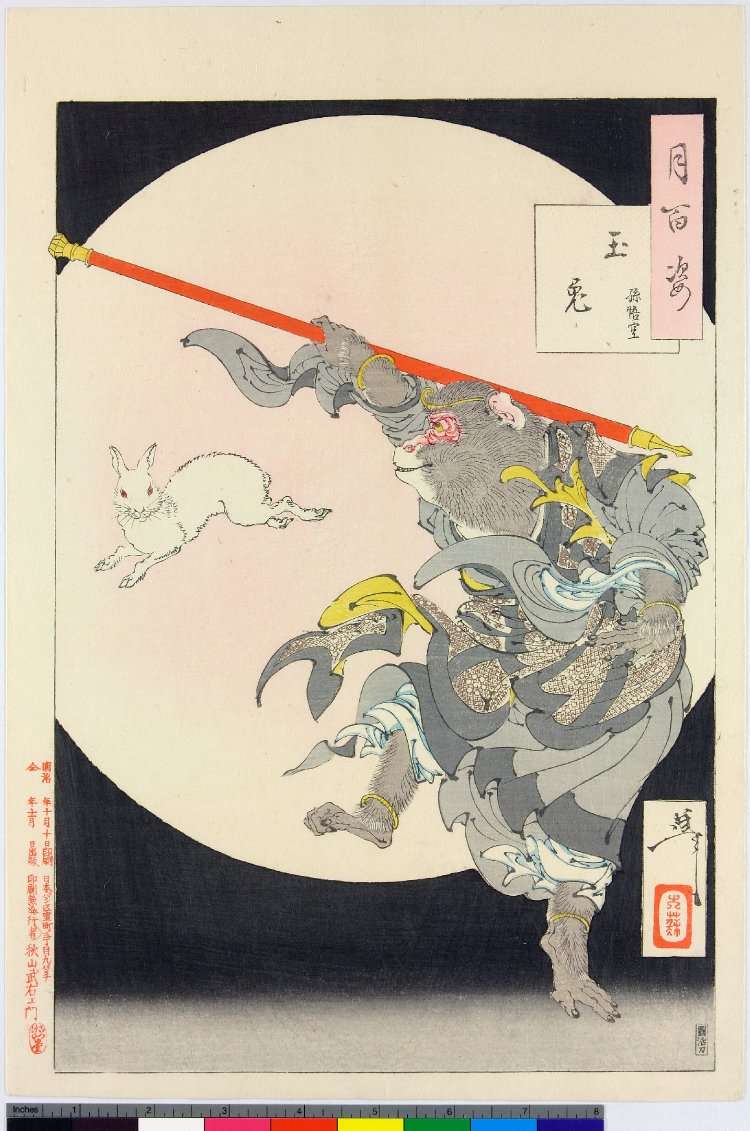
Other Japanese artists, such as Kubo Shunman (1757-1820) and Yoshitoshi (1839-1892) (fig. 3), produced beautiful full color woodblock prints of Sun.

Fig. 3 – (Left) Tsukioka Yoshitoshi, “Jade Rabbit – Sun Wukong”, October 10, 1889 (larger version). Fig 4. – (Right) Son Goku (孫悟空) from the Dragonball Franchise (larger version).

Like in China, Monkey has been adapted in all kinds of Japanese media. By far, his most famous adaptation is the manga and anime character Son Goku (孫悟空) (fig. 4) from the Dragon Ball (Jp:ドラゴンボール; Ch: Qi longzhu, 七龍珠) franchise (1984-present). Like Sun, Goku has a monkey tail, knows martial arts, fights with a magic staff, and rides on a cloud. His early adventures in Dragon Ball (manga: 1984-1995; anime: 1986-1989) see him traveling the world in search of seven wish-granting “dragon balls,” while also perfecting his fighting abilities and participating in a world martial arts tournament. Several of the supporting characters, such as Oolong (ウーロン), a lecherous anthropomorphic pig who can change his shape, a nod to Zhu Bajie, were directly influenced by the novel. Dragon Ball Z (manga: 1988-1995; anime: 1989-1996), a continuation of the comic book and animated TV show, follows Goku as an adult and reveals that he is actually a humanoid alien sent as a child to destroy Earth. He arrived in a spherical spaceship that recalls the stone egg from which Sun Wukong was formed. But instead of destroying the planet, he becomes its stalwart protector and faces extraterrestrial menaces from beyond the stars. Goku’s adventures have continued in the sequels Dragon Ball GT (1996-1997), Dragon Ball Super (2015-2018), and Super Dragon Ball Heroes (2018-present).