Journey to the West Artist Spotlight #1: Dario Virga

From time to time I like to post a fun blog not directly related to (though sometimes informed by) my research. Regular articles will resume after this entry.

Anyone who has read my blog will know that I’m an avid fan of researching the history and influences of Journey to the West. But as an artist, I am also a fan of JTTW-related artwork. There are so many talented people in the world who post their traditional and original designs and comics online, so I’ve decided to feature some of them on my blog. My hope is that such posts will expose this art to a wider audience interested in JTTW, while also documenting modern day perceptions and depictions of the novel and its characters.

Our first artist is Dario Virga, who goes by Onibotokemaru on Instagram. They were kind enough to answer some interview questions, as well as allow permission to display a few of their pieces.

I. Q & A

1) Can you tell me a little about yourself?

Real name Dario Virga, from Italy (Piedmont). Interest in eastern culture and literature, mostly from Japan and China.

2) Are you self-taught or did you go to art school?

Self-taught, though I had some help from someone who went to art school.

3) What are your main sources of artistic inspiration?

Usually animals and characters/elements taken from mythology and literature.

4) How did you learn about Journey to the West?

My very first contact with Journey to the West was back when I was younger, in a book about Chinese myths. Later I found an integral translation done by Serafino Balduzzi (translated from a French one).

5) Who is your favorite character?

Tough question, but I like most of the characters. If forced to choose, I’d say Pigsy for the good guys and the Bull Demon King for the villains.

6) Do you have a favorite episode from the novel?

Probably the whole Gold Horn & Silver Horn arc.

7) Does the novel have a special meaning to you?

Not a special meaning per se, but it was a novel I really enjoyed, both for the setting, the narration, the characters within and watching them grow.

8) Can you tell me about your ongoing JTTW-related projects?

Plan to make a gallery of, if not all, at least a huge amount of the novel’s characters.

II. Art and Thought Process

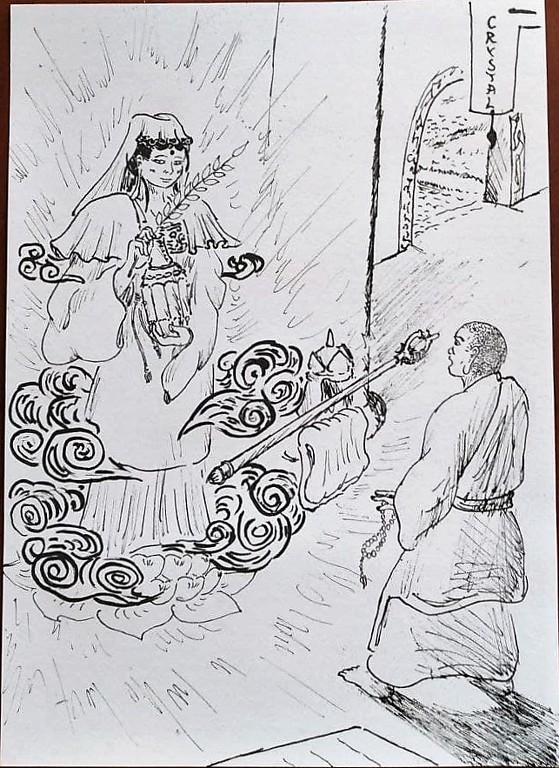
1. As the opening drawing of the Xiyouji-themed Inktober set, I’ve decided to focus not on Sun Wukong himself but rather on Tripitaka, the monk, as Guanyin Pusa appears before him to assign him the quest for the sutras. Guanyin’s reference are commonly-found icons and statues. Between the two of them float the items Tripitaka receives (the cossack, nine-ringed staff and hat).

(Larger version)

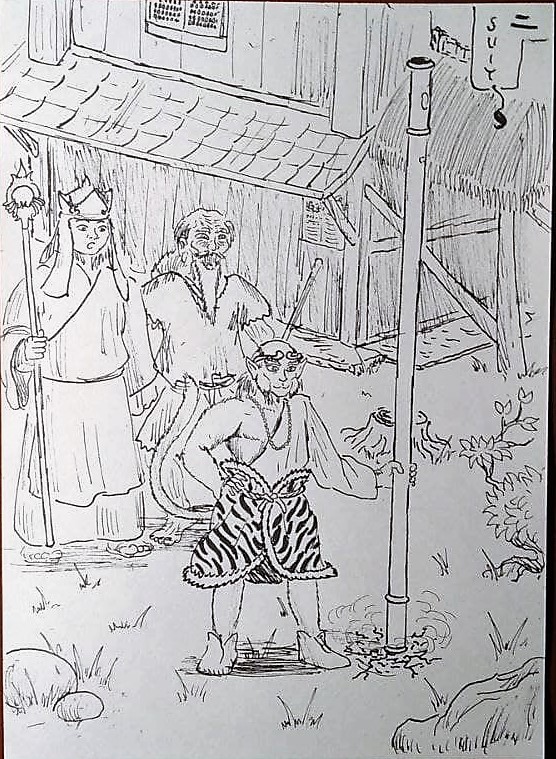
2. This is the first time I depict Sun Wukong in the series, and I did it based his design on an article written on this very blog, trying to stick as much as possible to his literary description, especially regarding the clothing (monk’s shirt and tiger pelt kilt held by a rope), short stature, simian face and bald spot on the top of the head (converted to Buddhism). I gave him long spike-like hair in the back because otherwise his head felt too small. The Ruyijingubang has a rather simple design, as I never liked its depictions with pommels on both ends. I also tried to make the inscriptions on the shaft, but ultimately gave up, admittedly.

(Larger version)

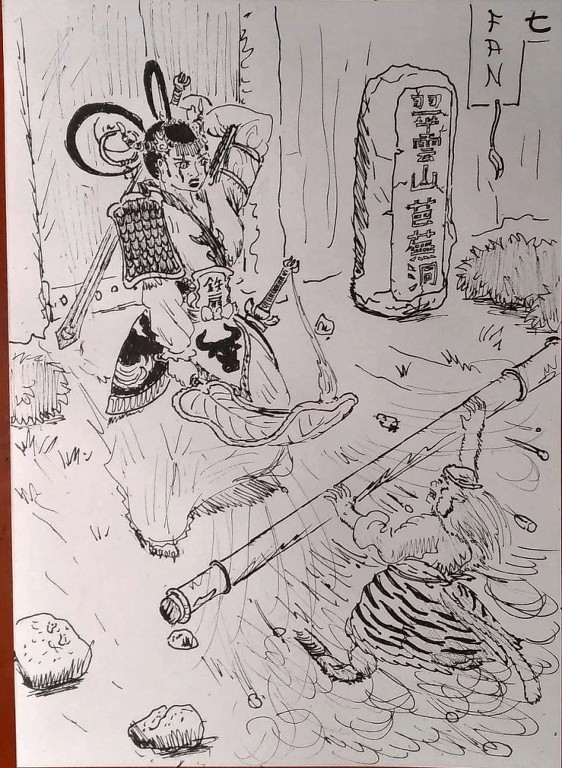
3. This picture has Sun Wukong fighting against the Iron Fan Princess, who sends him flying away with her Banana Leaf Fan. Once again, I wanted to show how small Monkey is (in comparison to nearly everyone else, though I’m not always 100% consistent) and remind that the Ruyijingubang can increase in both length and width, as seen here where he tries to use it as a shield to block the wind, unsuccessfully. Also of note, the massive stone pillar on which the “address” of the Iron Fan Princess is written.

(Larger version)

4. This one isn’t based on any specific event, but it’s here to bring out two topics: the first is the size of the party members, which I always tried to keep consistent (and tried is the keyword). The idea is that Sun Wukong is the smallest of the group (4 feet), then we have Tripitaka, the “normal” one, and the Dragon (horse-sized): Pigsy (here depicted with a hint of boar) is the second tallest but also the fattest, while Sandy is the tallest of the party (and definitively not a Kappa). The second one is Sha Wujing’s weapon: while it’s usually depicted as a Monk Spade, the actual name is the “Demon-Subduing Treasure Cane” (降魔宝杖, Xiangmobaozhang), making it a stick/staff. However, it’s also worth a mention that the Monk Spade is sometimes called “Zen Cane” (禪杖, Chanzhang), a term which also refers to the ringed staff used by monks. Admittedly, I liked the spade version the most, though I plan to depict this weapon as a staff when Sandy is in his celestial marshal/arhat forms, implying that the staff changed into a spade when he fell from Heaven.

(Larger version)

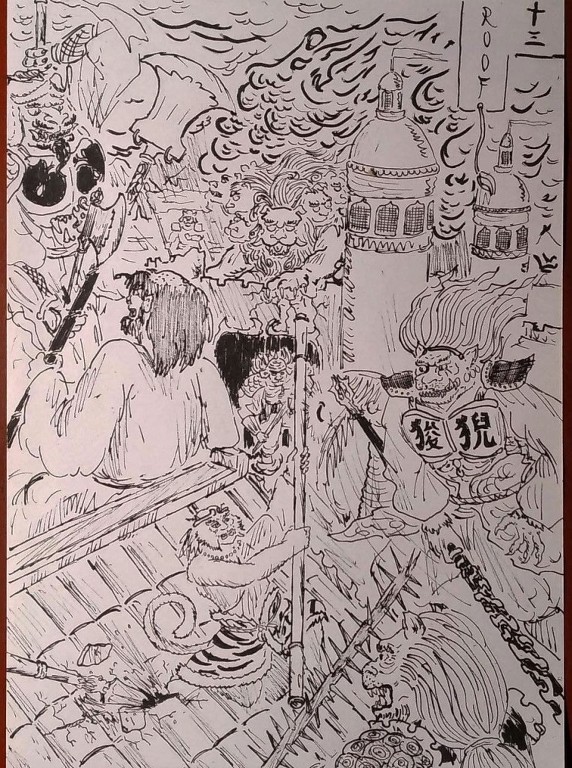
5. The big battle between Sun Wukong and the Lion Demons working for the Great Sage Nine Spirits (seen in the background, in his giant nine-headed form): this was mostly done because it was one of the rare parts of the book where Sandy actually fights the monsters alongside Sun Wukong (as Pigsy was captured), as well as an attempt to make a big battle scene.

(Larger version)

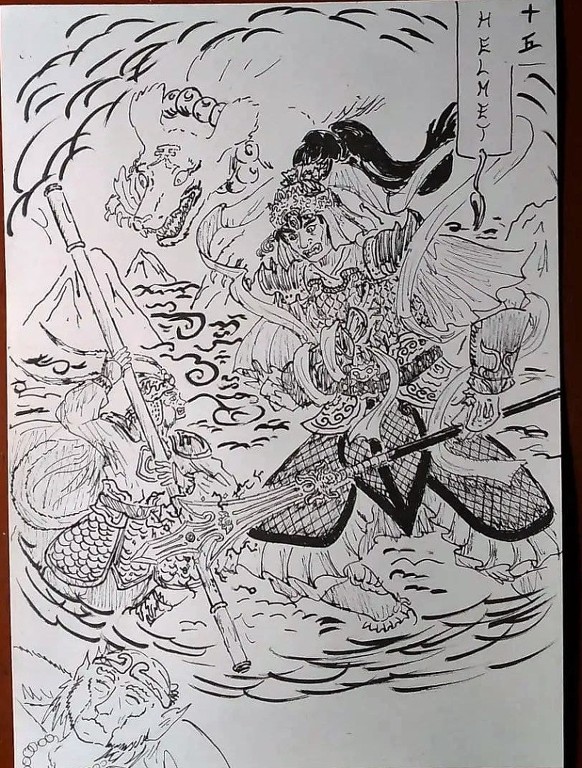
6. The only god who actually beat Monkey, Erlang Shen. Since the Inktober was focused on the journey itself, I’ve decided to depict their battle as a bad dream. This time, Monkey wears his old, stylish outfit he got from the Dragon Kings, while Erlang is in full battle regalia, including his “Sanjiang Lianrendao” (三尖两刃刀 Three-pointed, Double Edged Glaive) and his Heavenly Roar Dog.

(Larger version)

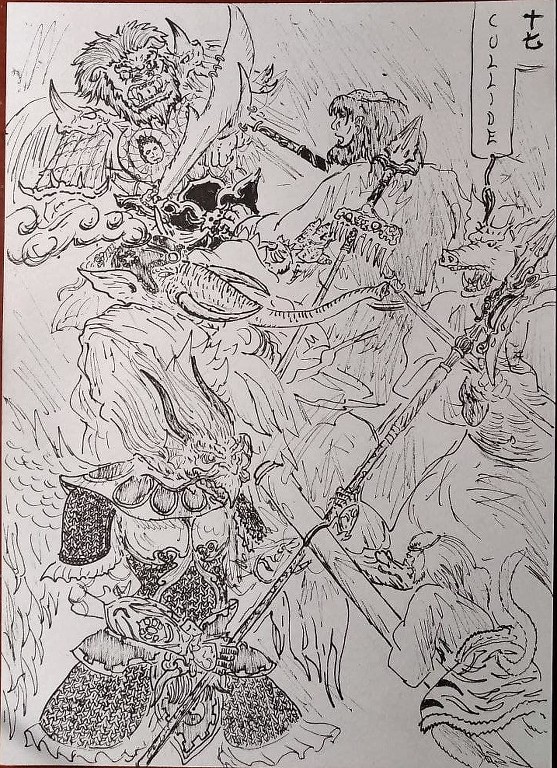
7. The clash between the three pilgrims and the three Demon Kings of Lion Camel Mountain, from top to bottom: the Blue-Haired Lion vs Sha Wujing, the Yellow-Tusked White Elephant vs Zhu Bajie and the Golden-Wings Peng King vs Sun Wukong. The design of the three kings was based on a series of pictures I loved very much. Once again, a reminder that Wukong’s staff can widen as well.
(Larger version)

8. Sun Wukong fights the three Rhino Kings, who’re kidnapping Tripitaka. This time I wanted to depict Monkey twirling his staff as he fights. Like with the Demon Kings above, the design of the three Rhinos was based on the same set of pictures, even though I remember that in the novel they’re described as “bull-like” in appearence. Particularly like the dust cloud to the right.

(Larger version)

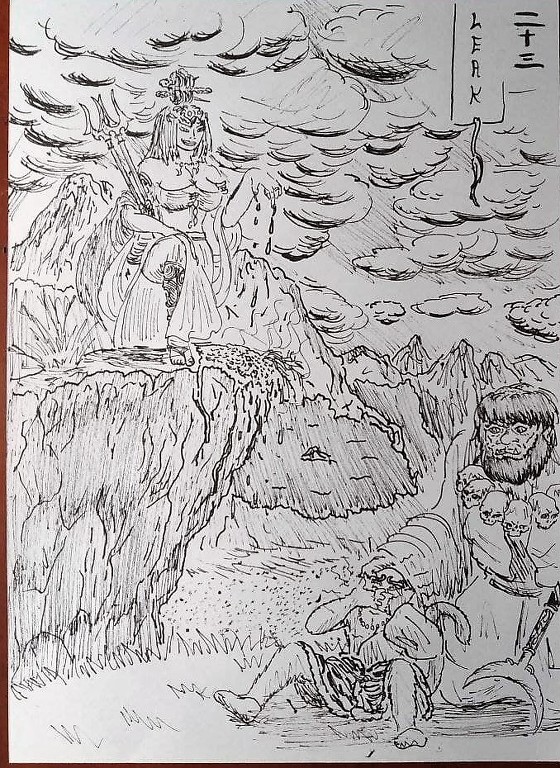
9. Sun Wukong is poisoned by the Scorpion Spirit. Aside from the scenery, I like the scorpioness. I’ve noticed in several arts (even old ones) that she sports a relatively skimpy outfit. As of her weapon, mentioned to be a “fork/trident” in the book, I’ve seen plenty of depictions with both the single trident version and the smaller, dual trident version.

(Larger version)

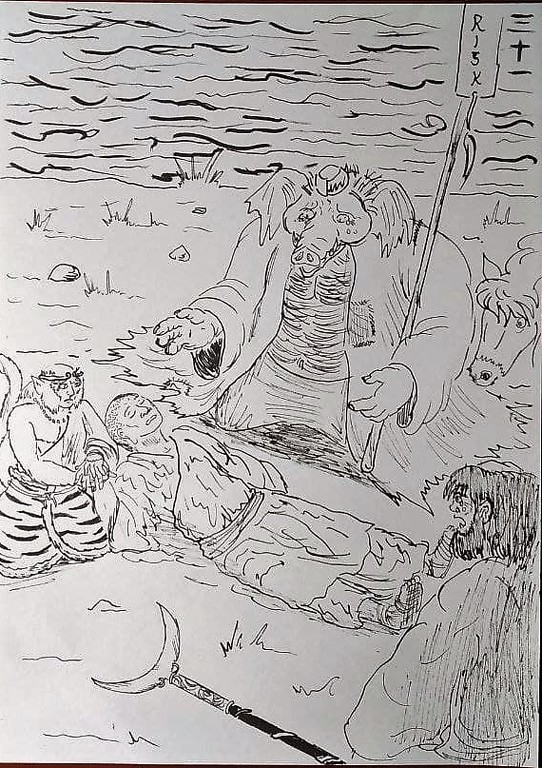
10. As a bookend, I’ve depicted a scene from the end of the book, the moment where Tripitaka drowns and ascends to buddhahood, so that he can obtain the sutras properly. This is also to represent one of the things I liked the most from the novel, the gradual growth of the pilgrims and the attachment to Tripitaka as a father figure. [Note: Tripitaka sheds his mortal form as he and his disciples are ferried across a body of water to the Buddha’s paradise. See the paragraph above image one and the material between images two and three in this article.]

(Larger version)

The Magic Powers of the Monkey King’s Iron Staff

Last updated: 07-04-2021

I’ve written several articles on Sun Wukong’s iron staff, including its origin from religious and martial staves used by historical Buddhist monks, the meaning of its inscription (“‘As-You-Will’ Gold-Banded Cudgel. Weight: 17,560 lbs” (7,965 kg)), the real world metal that it is made from, its ties to Yu the Great and flood control, its ties to the Buddhist Saint Mulian, its possible ties to a Hindu monument, and modern day misconceptions about its ability to weigh down the entire Milky Way galaxy. Now, I’d like to briefly survey the magic powers associated with this weapon. This will by no means be exhaustive.

I. Powers

A. Size Manipulation

Sun travels to the Eastern Sea Dragon King’s underwater kingdom in ch. 3 to acquire a celestial weapon. But when the immortal fails to find a suitably heavy armament, the Dragon Queen suggests that they give him a black iron pillar from their treasury. It is described as over 20 feet (6.096 m) in height and the width of a barrel. Only when Monkey lifts the pillar and suggests a smaller size would be more manageable does it comply with his wishes:

Wukong girded up his clothes and went forward to touch it: it was an iron rod more than twenty feet long and as thick as a barrel. Using all his might, he lifted it with both hands, saying, “It’s a little too long and too thick. It would be more serviceable if it were somewhat shorter and thinner.” Hardly had he finished speaking when the treasure shrunk a few feet in length and became a layer thinner. “Smaller still would be even better,” said Wukong, giving it another bounce in his hands. Again the treasure became smaller. Highly pleased, Wukong took it out of the ocean treasury to examine it. He found a golden hoop at each end, with solid black iron in between. Immediately adjacent to one of the hoops was the inscription, “The ‘As-You-Wish’ Gold-Banded Cudgel. Weight: 17,560 lbs. [Ruyi jingu bang zhong yiwan sanqian wubai jin, 如意金箍棒重一萬三千五百斤]” (Wu & Yu, 2012, p. 135). [1]

Later in the chapter, Sun shows off the new weapon to his children by shrinking it to the size of a needle and then expanding it to a literal pillar of heaven.

He held the treasure [the staff] in his hands and called out, “Smaller, smaller, smaller!” and at once it shrank to the size of a tiny embroidery needle, small enough to be hidden inside the ear. Awestruck, the monkeys cried, “Great King! Take it out and play with it some more.” The Monkey King took it out from his ear and placed it on his palm. “Bigger, bigger, bigger!” he shouted, and again it grew to the thickness of a barrel and more than twenty feet long. He became so delighted playing with it that he jumped onto the bridge and walked out of the cave. Grasping the treasure in his hands, he began to perform the magic of cosmic imitation. Bending over, he cried, “Grow!” and at once grew to be one hundred thousand feet tall, [2] with a head like the Tai Mountain and a chest like a rugged peak, eyes like lightning and a mouth like a blood bowl, and teeth like swords and halberds. The rod in his hands was of such a size that its top reached the thirty-third Heaven and its bottom the eighteenth layer of Hell (fig. 1) (Wu & Yu, 2012, vol. 1, p. 138).

cosmic transformation

Fig. 1 – Monkey grows his staff to touch heaven as he performs a cosmic transformation for his children (larger version). Original artist unknown. Found on this article.

B. Controlling the oceans

Prior to giving Monkey the staff, the Dragon King tells his wife, “That…was the measure with which [Yu the Great] fixed the depths of rivers and oceans when he conquered the Flood” (Wu & Yu, 2012, vol. 1, p. 135). Later, in ch. 88 our hero recites a poem in which he gives more detail about the weapon’s origins and history. The first few lines discuss its power over water:

An iron rod forged at Creation’s dawn
By Great Yu himself, the god-man of old.
The depths of all oceans, rivers, and lakes
Were fathomed and fixed by this very rod.
Having bored through mountains and conquered floods,
It stayed in East Ocean and ruled the seas,
[…] (Wu & Yu, 2012, vol. 4, p. 201).

Despite the staff’s influence on bodies of water both great and small, it paradoxically doesn’t grant Sun an advantage when traveling through the aquatic realm or fighting water-based demons. [3] I’ll just chalk this up to inconsistencies born from oral storytelling.

C. Astral entanglement

Ch. 3 shows that Monkey’s soul is able to use the staff in the underworld even when the physical weapon is back with his body in the world of the living.

In his sleep the Handsome Monkey King saw two men approach with a summons with the three characters “Sun Wukong” written on it. They walked up to him and, without a word, tied him up with a rope and dragged him off. The soul of the Handsome Monkey King was reeling from side to side. They reached the edge of a city. The Monkey King was gradually coming to himself, when he lifted up his head and suddenly saw above the city an iron sign bearing in large letters the three words “Region of Darkness.” … Yanking and pulling, they were determined to haul him inside. Growing angry, the Monkey King whipped out his treasure. One wave of it turned it into the thickness of a rice bowl; he raised his hand once, and the two summoners were reduced to hash.

[…]

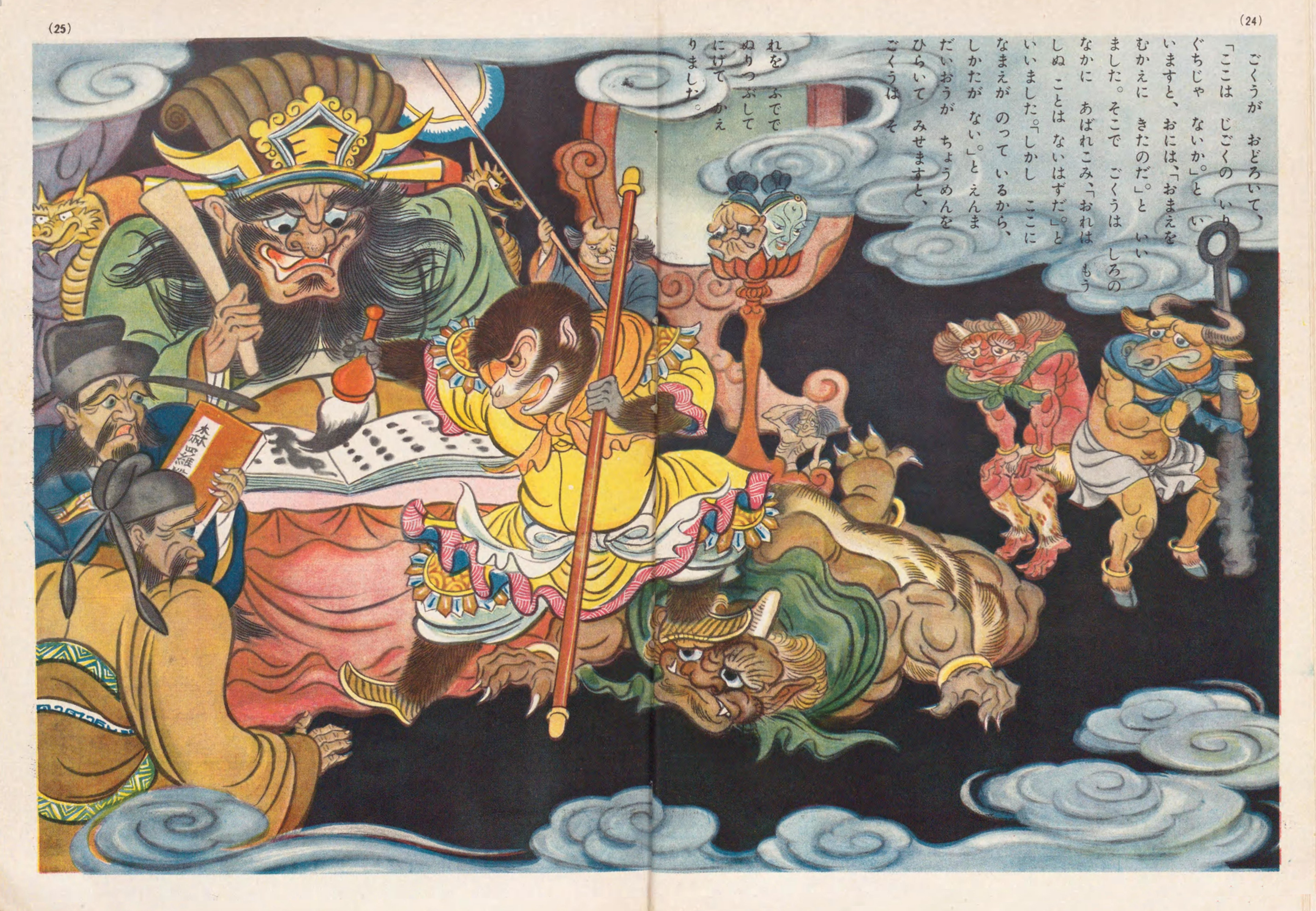
[After reprimanding the 10 judges for bringing his soul to hell, Sun says,] “All I want is to erase my name [from the ledgers of life and death]. Bring me a brush.” The judge hurriedly fetched the brush and soaked it in heavy ink. Wukong took the ledger on monkeys and crossed out all the names he could find in it [fig. 2]. Throwing down the ledger, he said, “That ends the account! That ends the account! Now I’m truly not your subject.” Brandishing his rod, he fought his way out of the Region of Darkness.

[…]

While our Monkey King was fighting his way out of the city, he was suddenly caught in a clump of grass and stumbled. Waking up with a start, he realized that it was all a dream (Wu & Yu, 2012, vol. 1, p. 139).

Sun’s ability to use the weapon as a disembodied spirit implies that it has some power of astral projection and entanglement (i.e. it goes where his soul goes). However, to my knowledge, this only happens once in the story, and the novel clearly demonstrates that he can’t use the weapon if it is physically taken away from him. [4] This is likely another inconsistency from oral storytelling.

Fig. 2 – Monkey holds his staff as he strikes his name from the Book of Life and Death (larger version). From the Japanese children’s book Son Goku (1939). 

D. Multiplication

The weapon is shown capable of creating manifold copies of itself. For example, in ch. 4, Monkey multiplies his staff to accommodate his monstrous, multi-armed form while fighting Prince Nezha: “Dear Great Sage! He shouted, ‘Change!’ and he too transformed himself into a creature with three heads and six arms. One wave of the golden-hooped rod and it became three staffs, which were held with six hands” (Wu & Yu, 2012, vol. 1, p. 155). Later in ch. 50, he rains staves down on a demonic army.

Using the tip of his lance to point at the ground, the demon king shouted for the little imps to attack together. All those brazen fiends, wielding swords, scimitars, staffs, and spears, rushed forward at once and surrounded the Great Sage Sun completely. Entirely undaunted, Pilgrim only cried, “Welcome! Welcome! That’s exactly what I want!” He used his golden-hooped rod to cover his front and back, to parry blows east and west, but that gang of fiends refused to be beaten back. Growing more agitated, Pilgrim tossed his rod up into the air, shouting, “Change!” It changed immediately into iron rods by the hundreds and thousands; like flying snakes and soaring serpents, they descended onto the fiends from the air” (Wu & Yu, 2012, vol. 2, p. 372).

E. Lock-Picking

Sun demonstrates the staff’s magic lock-picking ability in ch. 25.

The doors are all locked. Where are we going to go?” “Watch my power!” said Pilgrim. He seized his golden-hooped rod and exercised the lock-opening magic; he pointed the rod at the door and all the locks fell down with a loud pop as the several doors immediately sprung open. “What talent!” said Eight Rules, laughing. “Even if a little smith were to use a lock pick, he wouldn’t be able to do this so nimbly.” Pilgrim said, “This door is nothing! Even the South Heaven Gate would immediately fly open if I pointed this at it!” (Wu & Yu, 2012, vol. 1, pp. 468-469).

Admittedly, this passage could be read two ways: 1) The staff opens the lock; 2) Monkey uses the staff as a conduit for his own lock-picking magic. But I’m choosing the first interpretation as this ability was likely influenced by Saint Mulian unlocking the gates of hell with his staff. [5]

F. Transformation

In ch. 46, during a competition of Buddhist and Daoist prognostication, Sun magically disguises himself as a Daoist lad’s ritual master and convinces the boy to let him shave his head: “He changed his golden-hooped rod into a sharp razor, and hugging the lad, he said, ‘Darling, try to endure the pain for a moment. Don’t make any noise! I’ll shave your head.’ In a little while, the lad’s hair was completely shorn” (Wu & Yu, 2012, vol. 2, p. 305). In ch. 65, Sun turns the staff into a drill in order to escape from a pair of magic cymbals, using the tool to bore a hole in the horn of a dragon that was just able to pierce the seam: “Marvelous Great Sage! He changed the golden-hooped rod into a steel drill and drilled a hole on the tip of the horn. Transforming his body into the size of a mustard seed, he stuck himself inside the hole and yelled, ‘Pull the horn out! Pull the horn out!'” (Wu & Yu, 2012, vol. 3, p. 218).

G. Sentience

When the Dragon Queen originally suggests giving the pillar to Monkey, she tells her husband: “These past few days the iron has been glowing with a strange and lovely light [fig. 3]. Could this be a sign that it should be taken out to meet this sage?” (Wu & Yu, 2012, vol. 1, p. 135). This might imply the weapon was aware of its new master’s imminent arrival. Later in ch. 75, Sun recites a poem speaking of the staff’s desire for flight.

Its name was one Rod of Numinous Yang,
Stored deep in the sea, hardly seen by men.
Well-formed and transformed it wanted to fly,
Emitting bright strands of five-colored mist.
Enlightened Monkey took it back to the mount
To experience its pow’r for boundless change.
[…] (Wu & Yu, 2012, vol. 3, p. 375).

The phase “wanting to fly” (yao feiteng, 要飛騰) could be read as a metaphor for yearning to be released from the dragon treasury and/or a call for adventure. Add to this the staff’s ability to follow Sun’s wishes to grow, shrink, multiply, change form, and pick locks. Therefore, the novel depicts the staff having a certain amount of awareness. [6]

Fig. 3 – Monkey pointing to the luminous iron pillar (larger version). From the Qing-Era Painted, Complete Edition Journey to the West (Qing caihui quanben Xiyouji, 清彩繪全本西遊記).

II. Conclusion

Journey to the West (1592) describes the Monkey King’s iron staff having the magic power to shrink and grow, control the ocean, astral project and entangle with Monkey’s spirit, multiply endlessly, pick locks, and transform into various objects. It also has sentience to a certain degree.


Update: 07-04-21

Here I present my theory on why Sun Wukong’s staff weighs 13,500 catties (17,560 lbs/7,965 kg). I believe the number is an embellishment on the weight of a stone block lifted by the bandit Wu Song in the Water Margin (c. 1400).

The Weight of the Monkey King’s Staff: A Literary Origin

Notes

1) I have changed Yu’s (Wu & Yu, 2012) dry rendering “Compliant Golden-Hooped Rod” to the more pleasant one based on W.J.F. Jenner. Also, Yu’s original translation says “13,500 pounds”. However, the Chinese version uses jin (斤), known in English as “catty“. The catty and pound are two different measures of weight, the former being heavier than the latter. Therefore, the English text has been altered to show this. The catty during the Ming Dynasty when the novel was compiled equaled 590 grams (Elvin, 2004, p. 491 n. 133), so 13,500 catties would equal 17,550 lb.

2) Here, Yu’s (Wu & Yu, 2012) English translation says Monkey grows to be “ten thousand feet tall”. However, the original Chinese source reads “萬丈” (wanzhang), wan meaning 10,000 and zhang being a measure designating 10 Chinese feet (10,000 x 10 = 100,000). Therefore, I have changed the source to read “One hundred thousand feet”, much like Yu (Wu & Yu, 2012) translates it in chapters six (vol. 1, p. 181) and 61 (vol. 3, p. 157).

3). For example, Monkey relies on Zhu Bajie to fight Sha Wujing when they first come across him at the Flowing-Sands River. This is when Sun admits his weakness to water:

“Worthy Brother,” said Pilgrim with a laugh, “in this case I’ve really nothing to brag about, for I’m just not comfortable doing business in water. If all I do is walk around down there, I still have to make the magic sign and recite the water-repelling spell before I can move anywhere. Or else I have to change into a water creature like a fish, shrimp, crab, or turtle before going in. If it were a matter of matching wits in the high mountains or up in the clouds, I know enough to deal with the strangest and most difficult situation. But doing business in water somewhat cramps my style!” (Wu & Yu, 2012, vol. 1, pp. 423-424).

4) The rhinoceros demon sucks it away with Laozi’s magic steel bracelet in ch. 50 and 51. A lion spirit uses a magic wind to steal the weapons of all three pilgrims in ch. 88. In both cases, Monkey resorts to trickery to retrieve the physical staff from their respective mountain strongholds.

5) One section of Mulian’s tale reads: “With one shake of his staff, the bars and locks fell from the black walls, / On the second shake, the double leaves of the main gate [of hell] flew open” (Mair, 1994, p. 1113).

6) The idea of sentient weapons is certainly not unique to Journey to the West considering that the ancient Chinese ascribed souls to noted swords. For example, Yuan poet Jia Penglai (賈蓬萊, c. mid-14th-c.) described famed Spring and Autumn period blacksmith Ou Yezi‘s (歐冶子) treasure swords Longyuan (龍淵, a.k.a. Longquan, 龍泉) and Tai’e (泰阿/太阿) as mated lovers who pine for each other when separated and even leap from the scabbard to seek out their beloved (Lee & Wiles, 2015, pp. 161-163).

Sources:

Elvin, M. (2004). The Retreat of the Elephants: An Environmental History of China. New Haven (Conn.): Yale university press.

Lee, L. X. H., & Wiles, S. (2015). Biographical Dictionary of Chinese Women: Tang Through Ming: 618-1644. Abingdon: Routledge.

Mair, V. H. (1994). Transformation Text on Mahamaudgalyayana Rescuing his Mother From the Underworld With Pictures, One Scroll, With Preface In V. Mair (Ed.), The Columbia Anthology of Traditional Chinese Literature (pp. 1094-1127). New York: Columbia University Press.

Wu, C., & Yu, A. C. (2012). The Journey to the West: Vol. 1-4. Chicago, Illinois: University of Chicago Press.

Sun Wukong and the Buddhist Saint Mulian

Last updated: 01-31-24

Sun Wukong first appears as the “Monkey Pilgrim” (Hou xingzhe, 猴行者) in The Story of How Tripitaka of the Great Tang Procures the Scriptures (Datang Sanzang qujing shihua, 大唐三藏取經詩話, late-13th-century; “The Story,” hereafter), the earliest known published version of the Journey to the West (Xiyouji西遊記, 1592; “JTTW” hereafter) story cycle. He is described as an immortal banished from heaven for stealing divine peaches from the Queen Mother of the West, and he later became the ruler of the 84,000 monkeys of Flower-Fruit Mountain. But he first enters the story as a white-clad scholar and willing participant in the journey who actively seeks out the monk Tripitaka and his retinue of fellow clerics on the quest to India. The Monkey Pilgrim then uses his magical abilities and heavenly treasures to protect the monks from all manner of spirits, warlocks, and dragons. In the end, he is bestowed the title “Great Sage Steel Muscles and Iron Bones” (Gangjin tiegu dasheng, 鋼筋鐵骨大聖) (Wivell, 1994). [1]

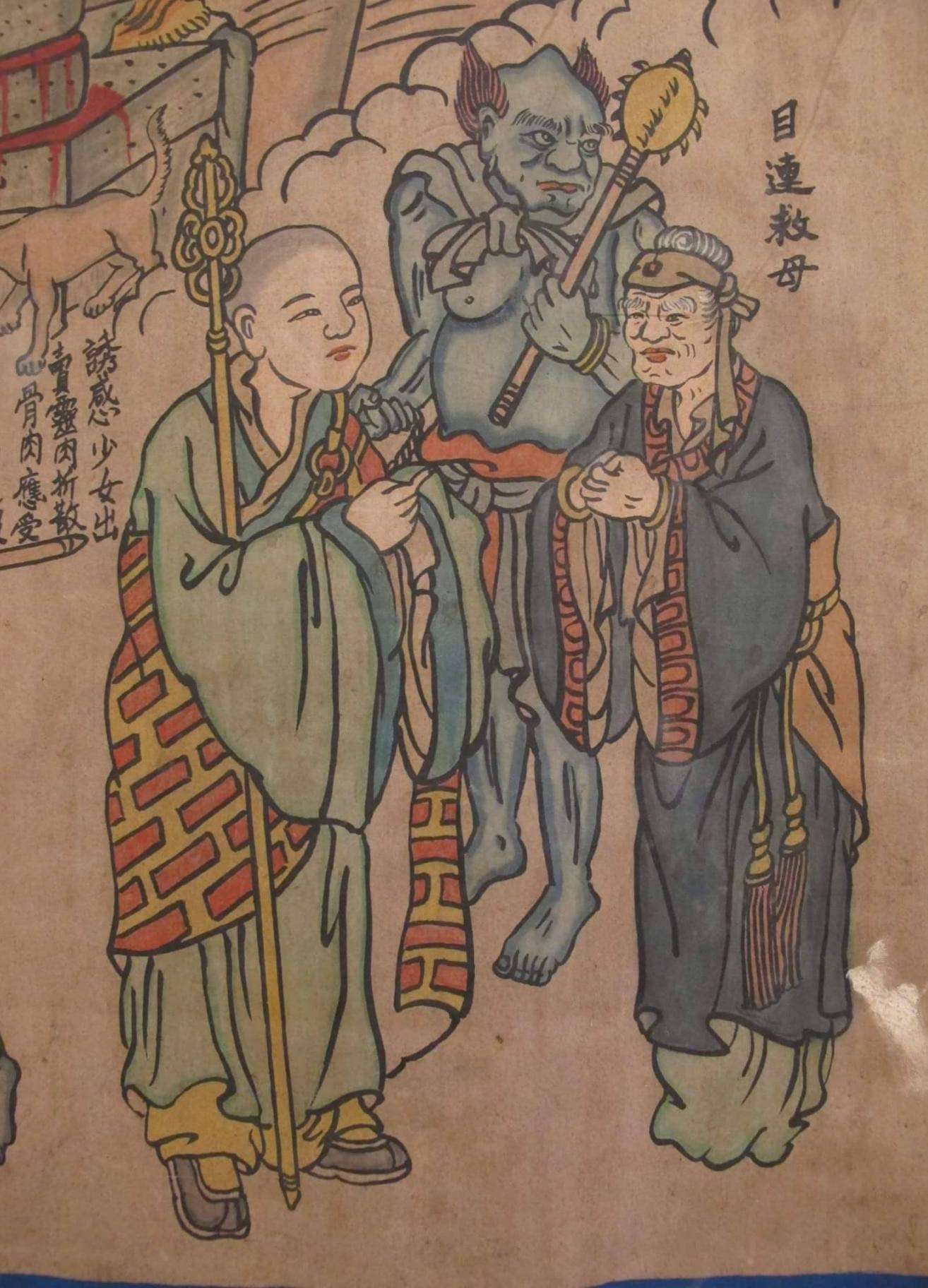
The heavenly treasures wielded by the Monkey Pilgrim are based on those used by the famed Buddhist saint and cultural hero Mulian (目連; Sk: Maudgalyayana), a disciple of the Buddha. He appears in the Transformation Text on Mahamaudgalyayana Rescuing his Mother From the Underworld with Pictures, One Scroll, with Preface (Damuganlian mingjian jiumu bianwen bingtu yijuan bingxu, 大目乾連冥間救母變文并圖一卷並序), a late-9th to early-10th-century Bianwen (變文) text in which he travels to the underworld to release his mater from karmic torment (fig. 1). Originally discovered in the oasis of Dunhuang, the text serves as the foundational myth for the Ghost Festival (Gui jie, 鬼節; a.k.a. “Zhongyuan Festival,” Zhongyuan jie, 中元節; a.k.a. “Yulanpen Festival,” Yulanpen jie, 盂蘭盆節), which is held on the 15th day of the seventh month. 

In this article, I will discuss three similarities that the Monkey Pilgrim shares with Mulian, including using similar holy treasures, visiting the same heavenly realm, and having a connection to the Ghost Festival. While Tripitaka, as a monk working towards the salvation of others, is a more obvious cognate for Mulian, it’s correct to say that Monkey is an amalgam of the Buddhist saint and Chinese stories of animals that guide the recently deceased through the underworld.

Fig. 1 – A scroll or mural depicting Mulian rescuing his mother from the underworld (larger version). Originally found here.

1. The Monkey Pilgrim

1.1. The Staff

The Monkey Pilgrim and Tripitaka first receive the golden-ringed monk’s staff, along with two other treasures, from the supreme deity, the Mahabrahma devaraja (Dafan tianwang, 大梵天王; lit: “Great Brahma Heavenly King,” a.k.a. Vaisravana), in chapter two.

The Dharma Master [Tripitaka] and Monkey Pilgrim approached the Devaraja and begged for his help. The Devaraja granted them a cap of invisibility, a golden-ringed staff, and a begging bowl. After accepting these three boons, the Dharma Master said farewell, then turned to the Monkey Pilgrim and asked: “How can we get back to the mortal world?” Pilgrim replied: “Before the Dharma Master speaks of returning to the world below, he had better ask the Devaraja how we can save ourselves from the monsters and disasters which lie ahead of us.” The Dharma Master returned to Mahabrahma and asked as Monkey had suggested. The Devaraja responded: “When you meet calamity, point toward the Heavenly Palace from afar and shout ‘Devaraja’ once, and you will be saved.” The Dharma Master accepted his instructions and bowed farewell (Wivell, 1994, p. 1184).

法師與猴行者,近前咨告請法。天王賜得隱形帽一事,金鐶錫杖一條,缽盂一只。三件齊全,領訖。法師告謝已了,回頭問猴行者曰:「如何得下人間?」行者曰:「未言下地。法師且更咨問天王,前程有魔難處,如何救用?」法師再近前告問。天王曰:「有難之處,遙指天宮大叫『天王』一聲,當有救用。」法師領指,遂乃拜辭。

Now compare that with Mulian’s tale in which he receives the staff from the Buddha:

“How will I [Mulian] be able to see my dear mother again?”
The World-Honored called out to him, saying, “Mahamaudgalyayana!
Do not be so mournful that you cry yourself heartbroken;
The sins of the world are tied to those who commit them like a string,
They are not stuck on clay-fashion by anyone else.
Quickly I take my metal-ringed staff and give it to you.
It can repel the eight difficulties and the three disasters.
If only you remember diligently to recite my name,
The hells will certainly open up their doors for you” (Mair, 1994, p. 1111).

世尊喚言大目連 且莫悲哀泣
世間之罪由如繩 不是他家尼碾來
火急將吾錫丈與 能除八難及三災
但知懃念吾名字 地獄應為如開

Both receive a magic monk’s staff with abilities tied to the recitation of a Buddhist deity’s name.

Here is one example of the power of The Story‘s staff:

The pilgrims arrived at the valley of the fire-spitting White Tiger Spirit. Coming closer they encountered a great ditch. The four steep entrances were pitch-black and they heard a roar of thunder. They could not advance. The Dharma Master held up his golden-ringed staff and, flourishing it toward the distant heavenly palace, yelled: “Devaraja! Help us in our afflictions!” Suddenly a shaft of light shot out from the staff five tricents long. It slashed through the long ditch and soon they were able to get across (Wivell, 1994, 1187-1188).

行次至火類坳白虎精。前去遇一大坑,四門陡黑,雷聲喊喊,進步不得。法師當把金鐶杖遙指天宮,大叫:「天王救難!」忽然杖上起五里毫光,射破長坑,須臾便過。

Now compare that to Mulian’s staff:

He [Mulian] wiped his tears in mid-air, and shook the metal-ringed staff,
Ghosts and spirits were mowed down on the spot like stalks of hemp.
Streams of cold sweat crisscrossed their bodies, dampening them like rain,
Dazed and unconscious, they groaned in self-pity;
They let go of the three-cornered clubs which were in their hands,
They threw far away the six-tined pitchforks which were on their shoulders (Mair, 1994, p. 1112).

拭淚空中遙錫杖 鬼神當即倒如麻
白汗交流如雨濕 昏迷不覺自噓嗟
手中放却三慢棒 臂上遙拋六舌叉

Both are capable of creating powerful blasts. 

But The Story‘s treasure builds upon the Mulian tale by adding an exciting new ability: creating giant, monstrous life. For instance, while confronting the white tiger spirit in chapter six,

Monkey Pilgrim transformed his golden-ringed staff into a gigantic yaksa whose head touched the sky and whose feet straddled the earth. In his hands he grasped a demon-subduing cudgel. His body was blue as indigo, his hair red as cinnabar; from his mouth a fiery gleam shot forth a hundred yards long (Wivell, 1994, p. 1189).

被猴行者將金鐶杖變作一個夜叉,頭點天,腳踏地,手把降魔杵,身如藍靛青,發似硃沙,口吐百丈火光。

How cool is that? And in chapter seven, “he transformed the magic staff into an iron dragon” to battle a group of nine-headed serpents (被猴行者 … 金鐶錫杖化作一條鐵龍) (Wivell, 1994, p. 1190).

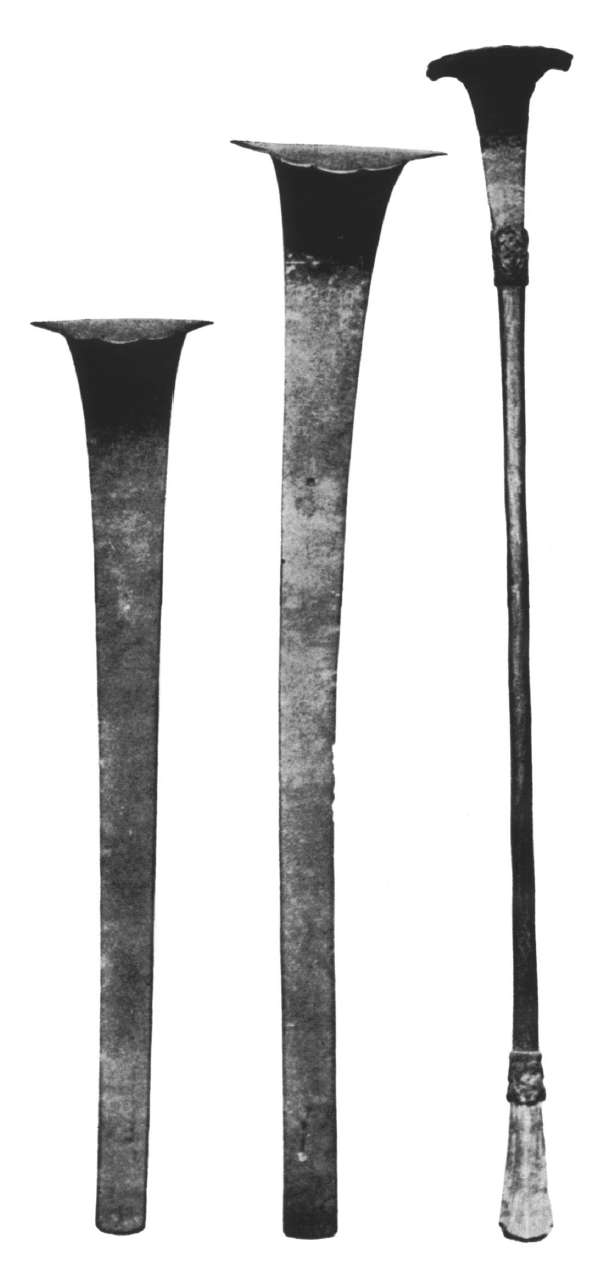
Fig. 2 – The head of a 12-ringed monk’s staff (larger version). From the author’s personal collection.

1.2. The Alms Bowl

The treasure bowl is first used in chapter six:

Next they suddenly came to a wild fire [2] which reached to the heavens. It sent off such a huge amount of smoke and sparks that the pilgrims could not proceed. The Dharma Master shone the light of his begging-bowl toward the fire and yelled: “Devaraja!” The fire died out immediately and the seven pilgrims crossed this pit (Wivell, 1994, p. 1189).

又忽遇一道野火連天,大生煙焰,行去不得。遂將缽盂一照,叫「天王」一聲,當下火滅,七人便過此坳。

It is next used by the Monkey Pilgrim in chapter seven while fighting the nine-headed serpents. He “sucked all the thousand tricents of water into the begging-bowl” (被猴行者  … 缽盂盛卻萬里之水) (Wivell, 1994, p. 1190).

There are no similar feats in Mulian’s story, but his alms bowl is also imbued with magic, allowing him to fly freely between the realms of heaven, earth, and the underworld. For instance,

Maudgalyayana awoke from abstract meditation,
Then swiftly exercised his supernatural power;
His coming was quick as a thunderclap,
His going seemed like a gust of wind.
[…]
With his supernatural power, he gained freedom,
So he hurled up his begging bowl and leaped into space;
Thereupon, instantaneously,
He ascended to the heavenly palace of Brahma (Mair, 1994, pp. 1097-1098).

[…]
神通得自在 擲鉢便騰空
于時一向子 上至天宮

Both he and the primate hero travel to the Brahma realm. Readers will recall that Monkey magically transports Tripitaka and his group to the crystal palace of the Mahabrahma Devaraja in chapter two (Wivell, 1994, p. 1184).

1.3. Connection to the Ghost Festival

Not only does the Monkey Pilgrim use Mulian-esque treasures, he also ascends to heaven on the Ghost Festival. After the group receives the last of the scriptures in chapter 16, the Dipamkara Buddha tells them:

“On the fifteenth day of the seventh month [i.e. the date of the Ghost Festival], it will be time for you, Dharma Master, and your band of seven to return to the celestial halls. Remember what I have said, and on the fifteenth rise early and bathe yourself. Say farewell to the T’ang emperor, for at noon the ‘Lotus-Plucking Barge’ will arrive. There will also be golden lotus-flower seats and auspicious rainbow-colored clouds. Twelve mellifluously voiced youths will escort you with incense, flowers, and decorated banners. They will adorn you with the seven precious gems, welcoming you seven to return to Heaven. But the invitation from Heaven has a time limit and you must not dally! Listen well to what I have told you and keep it firmly implanted in your mind!” (Wivell, 1994, 1202).

佛再告言:「… 七月十五日,法師等七人,時至當返天堂。汝記此言,至十五日,早起浴身,告辭唐帝;午時採蓮舡至,亦有金蓮花坐(德富氏本作「座」),五色祥雲,十二人玉音童子,香花幡幢,七寶瓔珞,來(德富氏本作「未」)時迎汝等七人歸天。天符有限,不得遲遲。汝且諦聽,深記心懷!」

And on the appointed day in chapter 17:

The seven boarded the barge and, looking due west, they ascended into the heavens and became immortals. Nine dragons rose up into the mist and ten phoenixes came out to welcome them. A thousand cranes offered them felicitations and there were flashing lights of transcendence (Wivell, 1994, p. 1206).

七人上舡,望正西乘空上仙去也。九龍興霧,十鳳來迎,千鶴萬祥,光明閃爍。

Recall that Mulian’s quest to free his mother’s soul from underworld torments is the foundational myth of the Ghost Festival. It actually opens with an explanation of the chthonic celebration:

Now, on the fifteenth day of the seventh month, the heavens open their doors and the gates of hells are flung wide. The three mires dissipate, the ten virtues increase. Because this is the day when the company of monks end their summer retreat, the deity who confers blessings and and the eight classes of supernatural beings all come to convey blessings. Those who undertake to make offerings to them in the present world will have a supply of blessings and those who are dead will be reborn in a superlative place. Therefore, a purgatorian feast is spread before the Three Honored Ones who, through the grace of their welcoming the great assembly, put a priority upon saving those who are distressed by hanging in limbo (Wivell, 1994, pp. 1093-1094).

夫為七月十五日者,天堂啟戶,地獄門開,三塗業消,〔十善增長〕。為眾僧咨下此日會福之神,八部龍天,盡來教福。〔承供養者〕,現世福資,為亡者轉生於勝處。於是盂蘭百味,〔飾貢於〕三尊。仰大眾之恩,先救倒懸之窘急。

1.4. Monkey = Mulian?

The Monkey Pilgrim’s use of Mulian-style holy accoutrements, travel to the Brahma realm, and ascension on the Ghost Festival raises the question: is our hero suppose to be a stand-in for the Buddhist saint? The simple answer is “not exactly.” It’s important to remember that he and Tripitaka share the duty of wielding the holy treasures. And while the immortal uses them more, the fact that Tripitaka is a Buddhist monk working towards the salvation of others makes him a more fitting cognate for Mulian.

However, The Story‘s connection to chthonic literature still provides Monkey a link to the Buddhist saint:

The Japanese scholar Chūbachi Masakazu (b. 1938) was the first to point out that the Kōzanji narratives mirror two closely related mythic archetypes. The first, derived from ancient Han Chinese traditions, is the journey of the dead to the netherworld. In many accounts of postmortem travels, spirit animals (including but not limited to monkeys) serve as the guides for the dead on their passage through the spirit realm, whether the final destination is the Yellow Springs beneath the earth or Mount Kunlun in the distant west. The other motif, emerging from early Indian Buddhist literature, is the transmigration of the spirit to the Pure Land, which, like Mount Kunlun, was conventionally located somewhere in the west. In Buddhist accounts, animals (again, often but not always monkeys) also serve as escorts for the dead. Chūbachi proposed that these narrative traditions—culturally distinct but thematically and functionally similar—were fused together with the historical account of Xuanzang’s journey to India. The Kōzanji texts, according to this reading, represent a complex but organic blending of initially independent narratives. The broad contours of Xuanzang’s biography and travelogue were superimposed onto older mythic accounts to provide a new, quasi-historical frame for age-old stories about the transmigrations of the dead.

Viewed from this perspective, Xuanzang was not passing through Central Asia en route to India but, instead, was traversing a hellish purgatory to reach a heavenly pure land. Like a shaman, he departs the human world and enters a dangerous liminal zone. Beset by ghosts and demons, he is guided and protected by powerful spirit animals and Buddhist deities. After enduring extreme hardship, he eventually arrives in an immortal realm populated by spirit monks, immortals, bodhisattvas, and buddhas. From Śākyamuni Buddha, he receives a collection of apotropaic texts with the power to safeguard the living and liberate the dead. Xuanzang then transmits these sacred scriptures back to the human realm before he and his assistants ascend to heaven during the annual ritual for liberating the damned from purgatory. This narrative not only maps the landscape of a postmortem shadow world, it also identifies the scriptures that guard against demonic molestation and ensure a propitious rebirth: the Buddhist canon in general and the Heart Sūtra in particular. Those who read, recited, or heard the Kōzanji texts were thus informed of the perils of purgatory and offered the promise of protection and salvation. Xuanzang, they also learned, was the saintly monk responsible for delivering these divine texts and technologies into the hands of humans (Brose, 2023, pp. 62-63).

Given the above information, it’s more correct to view the Monkey Pilgrim as a sort of amalgam of Mulian and the animal helpers who guide the recently deceased through the under world. This is important to remember, especially when discussing the origins of the Great Sage, for his history is far more nuanced than the “foreign only” (i.e. Hanuman=Sun Wukong) theory would suggest.

2. Sun Wukong

Another power of Mulian’s staff likely influenced the Monkey King’s “As You Wish Gold-Banded Cudgel.” During his quest to free his mother from the underworld, the Buddhist saint uses the treasure to unlock the gates of hell:

With one shake of his staff, the bars and locks fell from the black walls,
On the second shake, the double leaves of the main gate [of hell] flew open (Mair, 1994, p. 1113). [2]

Now compare that to an episode from JTTW chapter 25:

“Elder Brother,” said Eight Rules [Zhu Bajie], “stop this hocus-pocus. The doors are all locked. Where are we going to go?” “Watch my power!” said Pilgrim. He seized his golden-hooped rod and exercised the lock-opening magic; he pointed the rod at the door and all the locks fell down with a loud pop as the several doors immediately sprung open. “What talent!” said Eight Rules, laughing. “Even if a little smith were to use a lock pick, he wouldn’t be able to do this so nimbly.” Pilgrim said, “This door is nothing! Even the South Heaven Gate would immediately fly open if I pointed this at it!” (Wu & Yu, 2012, vol. 1, pp. 468-469)

八戒道:「哥啊,不要搗鬼, 門俱鎖閉,往那裡走?」行者道:「你看手段。」把金箍棒捻在手中,使一個「解鎖法」,往門上一指,只聽得突蹡的一聲響,幾層門雙鐄俱落,唿喇的開了門扇。八戒笑道:「好本事,就是叫小爐兒匠使掭子,便也不像這等爽利。」行者道:「這個門兒有甚稀罕,就是南天門,指一指也開了。」


Update: 12-28-19

While I believe Mulian’s bowl influenced the somersault cloud, Shao (2006) notes the 108,000 li (33,554 mi/54,000 km) covered by Monkey in a single leap is based on the symbolic distance said by Huineng to separate the Buddha’s paradise from the world of man. As the Chan patriarch explains in the Platform Sutra, “This number refers to the ten evils and eight wrongs in one’s person” (Huineng & Cleary, 1998, p. 26, for example). Only those who achieve enlightenment can overcome these hindrances and arrive instantly in paradise. This is symbolized in the novel by Monkey zipping their instantly on his cloud, whereas Tripitaka must travel thousands of miles over many years.


Update: 02-06-21

I have written an article that discusses the magic powers of the staff. These include the ability to shrink and grow, control the ocean, astral project and entangle with Monkey’s spirit, multiply endlessly, pick locks, and transform into various objects. It also has sentience to a certain degree.

The Magic Powers of the Monkey King’s Iron Staff


Update: 01-31-24

I’ve rewritten and added new some new information to the article.

Note:

1) Wivell (1994) translates the name as “Great Sage of Bronze Muscles and Iron Bones” (p. 1207). But the gang (鋼) of Gangjin tiegu dasheng (鋼筋鐵骨大聖) means “steel.” Therefore, I’ve changed the original source accordingly.

2) Wivell (1994) translates yehuo (野火) as “prairie fire” (p. 1189), but “wildfire” is a more literal rendering. Therefore, I’ve changed the original source accordingly.

Sources:

Brose, B. (2023). Embodying Xuanzang: The Postmortem Travels of a Buddhist Pilgrim. United States: University of Hawaii Press.

Buswell, R. E., & Lopez, D. S. (2014). The Princeton Dictionary of Buddhism. Princeton University Press.

Mair, V. H. (1989). Suen Wu-kung = Hanumat? The Progress of a Scholarly Debate In Proceedings of the Second International Conference on Sinology (pp. 659-752). Taipei:

Mair, V. H. (1994). Transformation Text on Mahamaudgalyayana Rescuing his Mother From the Underworld with Pictures, One Scroll, with Preface. In V. Mair (Ed.), The Columbia Anthology of Traditional Chinese Literature (pp. 1094-1127). New York: Columbia University Press.

Shao, P. (2006). Huineng, Subhūti, and Monkey’s Religion in “Xiyou ji”. The Journal of Asian Studies, 65(4), 713-740. Retrieved from www.jstor.org/stable/25076127

Wivell, C.S. (1994). The Story of How the Monk Tripitaka of the Great Country of T’ang Brought Back the Sūtras. In V. Mair (Ed.), The Columbia Anthology of Traditional Chinese Literature (pp. 1181-1207). New York: Columbia University Press.

Wu, C., & Yu, A. C. (2012). The Journey to the West (Vols. 1-4) (Rev. ed). Chicago: University of Chicago Press.

Misconceptions About the Monkey King’s Staff and the Milky Way Galaxy

Last updated: 05-15-2024

A common misconception on the internet is that Sun Wukong’s magic staff was originally used to hold down the Milky Way (fig. 1), suggesting that since the immortal can effortlessly wield the weapon, he is strong enough to lift the weight of a galaxy. (This misconception usually pops up in forums and battle wikis during debates on the lifting strength of particular mythological or fictional characters.) It ultimately stems from a mistranslation in the widely read W. J. F. Jenner edition (see the 02-12-23 update for a PDF). [1] The passage in question reads:

The piece of miraculous iron that anchors the Milky Way in place (emphasis added) has been shining with a lovely rosy glow for the last few days, and creating a most auspicious atmosphere (Wu & Jenner, 1993/2020, p. 55).

However, the original Chinese reads:

我們這海藏中,那一塊天河定底的神珍鐵,這幾日霞光艷艷,瑞氣騰騰

The problem lies in the partial mistranslation of the characters Tianhe dingdi (天河定底). Tianhe is the Chinese name for the Milky Way, while dingdi means to “fix or set the depth or base of.” This refers to setting a fixed measurement for the “Heavenly River” and has nothing to do with anchoring or weighing down anything.

Milky_Way_Arch

Fig. 1 – A panorama of the top arch of the Milky Way galaxy as seen from Chile (larger version).

The far more accurate Anthony C. Yu translations reads:

Inside our ocean treasury is that piece of rare magic iron by which the depth of the Heavenly River is fixed (emphasis added). These past few days the iron has been glowing with a strange and lovely light (Wu and Yu, 2012, vol. 1, p. 135).

Most importantly, the novel is quite clear on how much the staff weighs:

Immediately adjacent to one of the hoops was the inscription, “The Compliant Golden-Hooped Rod. Weight: 13,500 catties” (17,560 lbs./7,965 kg) (based on Wu and Yu, 2012, vol. 1, p. 135). [2]

緊挨箍有鐫成的一行字,喚做:「如意金箍棒,重一萬三千五百斤。」


Update: 08-05-18

I’ve written a follow up discussing Monkey’s greatest feat of strength.

Sun Wukong’s Greatest Feat of Strength: An Allegory for Cultural or Religious Conflict?


Update: 02-06-21

I have written an article that discusses the magic powers of the staff. These include the ability to shrink and grow, control the ocean, astral project and entangle with Monkey’s spirit, multiply endlessly, pick locks, and transform into various objects. It also has sentience to a certain degree.

The Magic Powers of the Monkey King’s Iron Staff


Update: 07-04-21

Here is my theory on why Sun Wukong’s staff weighs 13,500 catties (Yiwan sanqian wubai jin, 一萬三千五百斤; 17,560 lbs./7,965 kg). I believe the number is an embellishment on the 300 to 500 catty (san wubai jin, 三五百斤) stone block lifted by the bandit Wu Song in the Water Margin (Shuihu zhuan, 水滸傳, c. 1400).

The Weight of the Monkey King’s Staff: A Literary Origin


Update: 05-15-24

Sun Wukong claims that his staff can hold up the sky in chapter 67:

Old Monkey isn’t bragging, but this rod I hold in my hands can even hold up the sky—if it collapses!” Wu and Yu, 2012, vol. 3, p. 241)

不是老孫海口,只這條棒子揝在手裡,就是塌下天來,也撐得住。

I should note, however, that this is never demonstrated.

Notes

1) This is the first edition I read as a youngster.

2) Anthony Yu’s (Wu & Yu, 2012) original translation says “thirteen thousand five hundred pounds” (vol. 1, p. 135). However, the Chinese version uses jin (斤), known in English as “catty.” The catty and pound are two different measures of weight, the former being heavier than the latter. Therefore, the English text has been altered to show this. The catty during the Ming Dynasty when the novel was compiled equaled 590 grams (Elvin, 2004, p. 491 n. 133), so 13,500 catties would equal 17,560 lbs.

Sources

Elvin, M. (2004). The Retreat of the Elephants: An Environmental History of China. New Haven (Conn.): Yale university press.

Wu, C. & Jenner, W. J. F. (2020). Journey to the West (Vols. 1-4). Beijing: Foreign Languages Press. (Original work published 1993)

Wu, C., & Yu, A. C. (2012). The Journey to the West (Vols. 1-4) (Rev. ed.). Chicago, Illinois: University of Chicago Press.

The Story of Sun Wukong, the Monkey King

One of the most famous primate characters in world literature appears in the great Chinese classic Journey to the West (Xiyouji, 西遊記, 1592 CE). The story follows the adventures of Sun Wukong (孫悟空, a.k.a. “Monkey”) (fig. 1), an immortal rhesus macaque demon, who gains extraordinary power via spiritual cultivation and rebels against the primacy of heaven. Like Loki in Norse mythology and Lucifer in Judeo-Christian mythology, this trickster god falls from grace when a supreme deity, in this case the Buddha, banishes him to an earthly prison below. But unlike his western counterparts, the monkey repents, becoming a monk and agreeing to use his abilities to protect a Buddhist priest on his journey to collect sutras from India.

What follows is an overview of Monkey’s story. It will primarily focus on the first seven of the novel’s 100 chapters, but chapters eight through 100 will be briefly touched upon, along with lesser-known literary sequels to Journey to the West. I will also discuss the novel’s impact on pop culture and religion.

I. Story

In the beginning, the mystical energies of heaven and earth and the light of the sun and moon come together to impregnate a boulder high atop the Mountain of Flowers and Fruit (Huaguo shan, 花果山), an island that lies to the east of the easternmost continent in the Buddhist disc world system. The stone gestates for countless ages until the Zhou Dynasty (1046-256 BCE), when it hatches a stone egg that is eroded by the elements into a simian shape. The Stone Monkey (Shihou, 石猴) awakens and bows to the four cardinal directions as light bursts forth from his eyes. The light is so bright that it reaches heaven, alarming the Jade Emperor (Yuhuang dadi, 玉皇大帝) and his celestial retinue. The light soon subsides, however, once he ingests food for the first time.

The Stone Monkey happens upon other primates on the island and becomes their king when he proves himself in a test of bravery by blindly leaping through a waterfall, thereby discovering a long-forgotten immortal’s cave. He rules the mountain for over three centuries before the fear of death finally creeps in. One of his primate advisors suggests that the king finds a transcendent to teach him the secrets of eternal life, and so Monkey sets sail on a makeshift raft and explores the world for ten years. His quest eventually takes him to the western continent, where he is finally accepted as a student by the Buddho-Daoist sage Subodhi (Xuputi, 须菩提). He is given the religious name Sun Wukong, meaning “monkey awakened to emptiness” or “monkey who realizes sunyata.” The sage teaches him the 72 methods of earthly transformation, or endless ways of changing his shape and size; cloud somersaulting, or a type of flying that allows him to travel 108,000 li (33,554 mi / 54,000 km) in a single leap; all manner of magical spells to call forth gods and spirits, grow or shrink to any size, part fire and water, create impassable barriers, conjure wind storms, cast illusions, freeze people in place, make endless clones of himself, unlock any lock, bestow superhuman strength, bring the dead back to life, etc.; traditional medicine; armed and unarmed martial arts; and, most importantly, an internal breathing method that results in his immortality. He is later disowned by the sage for selfishly showing off his new found magical skills to his less accomplished classmates.

Sun eventually returns to his cave and faces a demon who had terrorized his people during his prolonged absence. After killing the monster, he realizes that he needs a weapon to match his celestial power, and so his advisor suggests that he go to the undersea palace of Ao Guang (敖廣), the Dragon King of the Eastern Sea. There, he tries out several weapons weighing thousands of pounds, but each one is too light. He finally settles on a massive nine-ton iron pillar that was originally used by Yu the Great (Dayu, 大禹) to set the depths of the fabled world flood, as well as to calm the seas. Named the “As-You-Will Gold-Banded Cudgel” (Ruyi jingu bang, 如意金箍棒), the iron responds to Sun’s touch and follows his command to shrink or grow to his whim, thus signifying that this weapon was fated to be his. In addition to the staff, Monkey bullies the Dragon King’s royal brothers into giving him a magical suit of armor.

Shortly after returning home to the Mountain of Flowers and Fruit, he shows off his new weapon by turning into a frightful cosmic giant and commanding the staff to grow, with the top touching the highest heaven and the bottom the lowest hell. This display of power prompts demon kings of the 72 caves to submit to his rule and host a drunken party in his honor. Soon after falling asleep, Sun is visited by two psychopomps who drag his soul to the Chinese underworld of Diyu (地獄). There, he learns that he was fated to die at the allotted age of 342 years old. But this enrages Monkey since his immortality freed him from the cycle of rebirth, and so he bullies the kings of hell in to bringing him the ledger containing his info. He promptly crosses out his name with ink, as well as the names of all monkeys on earth, thus making them immortal, too. He wakes up in the mortal world when his soul returns to his body.

n8mflz

Fig. 1 – A modern depiction of Sun Wukong (by the author) (larger version).

Both the Eastern Dragon King and the Hell King Qinguang (秦廣王) submit memorials to heaven concerning Sun’s misconduct. But the court advisor, an embodiment of the planet Venus, convinces the Jade Emperor to give Sun the menial task of watching over the Heavenly Horses in order to avoid further conflict. Monkey accepts and steadfastly performs his duties, that is until he learns that he’s just a glorified stable boy. He immediately returns to his earthly home in rebellion to proclaim himself the “Great Sage Equaling Heaven” (Qitian dasheng, 齊天大聖). The celestial realm mobilizes an army of powerful demon hunters, including the Heavenly King Li Jing (Li Jing tianwang, 李靖天王) and his son, the child god Third Prince Nezha (Nezha santaizi, 哪吒三太子), but they all fall to Monkey’s magical and martial might. The embodiment of the planet Venus once again steps in to convince the Jade Emperor to acquiesce to Monkey’s demand for higher rank, thereby granting him the empty title of Great Sage Equaling Heaven and even promoting him to watch over the immortal peach groves.

Sun takes stock of the magical peaches that ripen every few thousand years, but he eventually succumbs to their heavenly aroma. He eats all but the youngest life-prolonging fruits, thus gaining another level of immortality. His theft is soon discovered, however, when fairy attendants of the Queen Mother of the West (Xiwangmu, 西王母) arrive to pick the choicest specimens for her long-awaited immortal peach banquet. Sun is alerted to there presence and, upon questioning, learns that he has not been invited. Naturally, Sun becomes enraged, freezing the maidens in place with fixing magic and then crashes the party before the hallowed guests arrive. He eats all of the celestial food and drinks all of the immortal wine, and then drunkenly stumbles into the laboratory of Laozi (老子), a high god of Daoism. There, he gobbles up the deity’s alchemically-derived elixir pills, thereby adding several more levels of immortality.

Sun returns home once again to await the coming storm of heavenly forces. Tired of the demon’s antics, the Jade Emperor calls up 72 heavenly generals, comprising the most powerful Buddhist and Daoist gods, and 100,000 celestial soldiers. In response, Monkey mobilizes his own army comprising the demon kings of the 72 caves and all manner of animal spirits, including his own monkey soldiers. But soon after the battle commences, the demon kings fall to heavenly troops, forcing Sun to take on three heads and six arms and multiply his iron cudgel to meet the onslaught. Once again, the heavenly army is no match for him. However, he soon loses his nerve when his monkey children are captured in great heavenly nets. He flees with Erlang (Erlang shen, 二郎神), a master of magic and the nephew of the Jade Emperor, taking chase. The two battle through countless animal transformations, each trying to one-up the other. Monkey is finally captured when Laozi drops a magical steel bracelet on his head, incapacitating him long enough for Erlang’s celestial hound to bite hold of his leg.

Sun is taken to heaven to be executed for his crimes, but fire, lightning, and edged weapons have no effect on his invincible body. Laozi then suggests that they put him inside of the deity’s alchemical furnace to reduce the demon to ashes. They check the furnace 49 days later expecting to see his rendered remains; however, Monkey jumps out unscathed, having found protection in the wind element (xun, 巽) of the eight trigrams. But intense smoke inside the furnace had greatly irritated his eyes, refining his pupils the color of gold and giving them the power to recognize the dark auras of demons in disguise. He overturns the furnace and begins to cause havoc in heaven with his iron cudgel. The Jade Emperor beseeches the Buddha (Rulai, 如来) in the Western Paradise to intervene.

The Tathagata appears and declares that he will make Sun the new ruler of heaven if the macaque can simply jump out of his palm. Monkey agrees to the wager, and with one tremendous leap, speeds towards the reaches of heaven. He lands before five great pillars, thinking them to be the edge of the cosmos. He tags one with his name and urinates at the base of another in order to prove that he had been there. Upon returning, Sun demands the throne; however, the Buddha reveals that the five pillars were actually his fingers, meaning that the Great Sage had never left. But before Monkey can do anything, the Tathagata overturns his hand, pushing it out the gates of heaven, and transforming it into the Five Elements Mountain (Wuxing shan, 五行山). There, Sun is imprisoned for his crimes against heaven.

Chapters thirteen to 100 tell how six hundred years later Sun is released during the Tang Dynasty (618-907) to help escort the Buddhist monk Tripitaka (Sanzang, 三藏) (whose early story is told in chapters eight to twelve), a disciple of the Buddha in a previous life, on a quest to retrieve salvation-bestowing scriptures from India. The Bodhisattva Guanyin (觀音) gives the monk a golden headband (jingu, 金箍; a.k.a. jingu, 緊箍, lit: “tight fillet”) as a means to rein in Monkey’s unruly nature. It tightens around Sun’s head whenever a magic formula is recited, causing him great pain. In addition, Guanyin gives Monkey three magic hairs on the back of his neck that can transform into anything he desires to aid in his protection of the monk. Along the way, the two meet other monsters-turned-disciples—Zhu Bajie (猪八戒), the lecherous pig demon, Sha Wujing (沙悟净), the complacent water demon, and the White Dragon Horse (Bailongma, 白龍馬), a royal serpent transformed into an equine—who agree to aid in the monk’s defense. Monkey battles all sorts of ghosts, monsters, demons, and gods along the way. In the end, he is granted Buddhahood and given the title of the “Victorious Fighting Buddha” (Dou zhanzheng fo, 鬥戰勝佛) for protecting Tripitaka over the long journey.

A summary of all 100 chapters can be read on my friend’s blog (fig. 2).

https://journeytothewestlibrary.weebly.com/novel-summary

Fig. 2 – The summary header (larger version).

II. Sequels

There are a total of four unofficial sequels to the novel.

The first is called A Supplement to the Journey to the West (Xiyoubu, 西游补, 1640), which takes place between chapters 61 and 62 of the original. In the story, the Monkey King wanders from one adventure to the next, using a magic tower of mirrors and a Jade doorway to travel to different points in time. In the Qin Dynasty (221–206 BCE), he disguises himself as Consort Yu in order to locate a magic weapon needed for his quest to India. During the Song Dynasty (960–1279), he serves in place of King Yama as the judge of Hell. After returning to the Tang Dynasty, he finds that his master Tripitaka has taken a wife and become a general charged with wiping out the physical manifestation of desire (desire being a major theme running through the novelette). Monkey goes on to take part in a great war between all the kingdoms of the world, during which time he faces one of his own children in battle. In the end, he discovers an unforeseen danger that threatens Tripitaka’s life.

The second is the Later Journey to the West (Hou Xiyouji, 後西遊記, 17th-century). This novel focuses on the adventures of Monkey’s spiritual descendent Sun Luzhen (孫履真, “Monkey who Walks Reality”). I have a three-part article about it (first, second, and third). 


And the third and fourth are the Continuation of the Journey to the West (Xu Xiyouji, 續西遊記, 17th-century) and the New Journey to the West (Xin Xiyouji, 新西遊記, 19th-century), respectively. As of 2023, I have not written any articles on these sequels. 

III. Cultural Impact

Stories about Sun Wukong have enthralled people the world over for centuries. His adventures first became popular via oral folktale performances during the Song Dynasty (960-1279). These eventually coalesced into the earliest known version of the novel, The Story of How Tripitaka of the Great Tang Procures the Scriptures (Da Tang Sanzang qujing shihua, 大唐三藏取經詩話; The Story hereafter), published during the late-13th-century.

Since the anonymous publishing of the complete novel in the 16th-century, Monkey has appeared in numerous paintings, poems, books, operatic stage plays, video games, and films (both live action and animated).

He was sometimes “channeled,” along with other martial spirits, by citizen soldiers of the anti-foreign Boxer Rebellion (1899-1901). There is also a monkey-based martial art named in his honor.

It is interesting to note that there are people in southern China, Taiwan, Malaysia, Singapore, Thailand, and Vietnam who worship him as a patron deity. Thus, Sun became so popular that he jumped from oral and published literature to take his place on the family altar.

Copies of The Story were discovered in Japan among a 17th-century catalog of books in the Kozanji Temple (高山寺, Ch: Gaoshan si). No copies are known to exist in China, which suggests this version came to the island many centuries ago. The complete Ming edition of the novel came to Japan in the late-18th-century, where it was translated in bits and pieces over the course of some seventy years. However, Monkey did not become immensely popular until the first complete translation of the novel was published in 1835. The last part was illustrated with woodblocks by Taito II (fl. 1810-1853), a noted student of famous artist Hokusai (1760-1849).

Other Japanese artists, such as Kubo Shunman (1757-1820) and Yoshitoshi (1839-1892) (fig. 3), produced beautiful full color woodblock prints of Sun.

Fig. 3 – (Left) Tsukioka Yoshitoshi, “Jade Rabbit – Sun Wukong”, October 10, 1889 (larger version). Fig 4. – (Right) Son Goku (孫悟空) from the Dragonball Franchise (larger version).

Like in China, Monkey has been adapted in all kinds of Japanese media. By far, his most famous adaptation is the manga and anime character Son Goku (孫悟空) (fig. 4) from the Dragon Ball (Jp:ドラゴンボール; Ch: Qi longzhu, 七龍珠) franchise (1984-present). Like Sun, Goku has a monkey tail, knows martial arts, fights with a magic staff, and rides on a cloud. His early adventures in Dragon Ball (manga: 1984-1995; anime: 1986-1989) see him traveling the world in search of seven wish-granting “dragon balls,” while also perfecting his fighting abilities and participating in a world martial arts tournament. Several of the supporting characters, such as Oolong (ウーロン), a lecherous anthropomorphic pig who can change his shape, a nod to Zhu Bajie, were directly influenced by the novel. Dragon Ball Z (manga: 1988-1995; anime: 1989-1996), a continuation of the comic book and animated TV show, follows Goku as an adult and reveals that he is actually a humanoid alien sent as a child to destroy Earth. He arrived in a spherical spaceship that recalls the stone egg from which Sun Wukong was formed. But instead of destroying the planet, he becomes its stalwart protector and faces extraterrestrial menaces from beyond the stars. Goku’s adventures have continued in the sequels Dragon Ball GT (1996-1997), Dragon Ball Super (2015-2018), and Super Dragon Ball Heroes (2018-present).