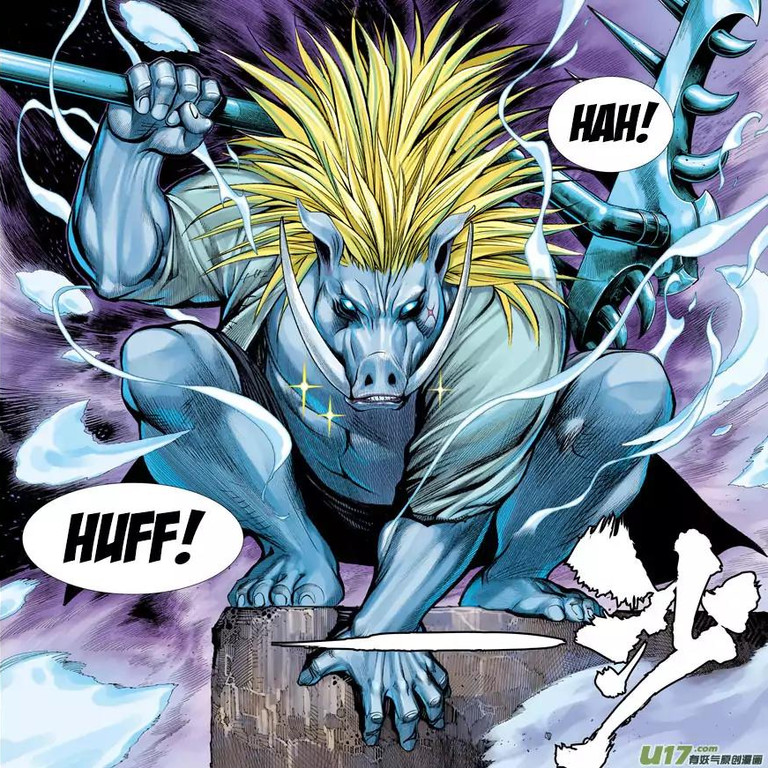
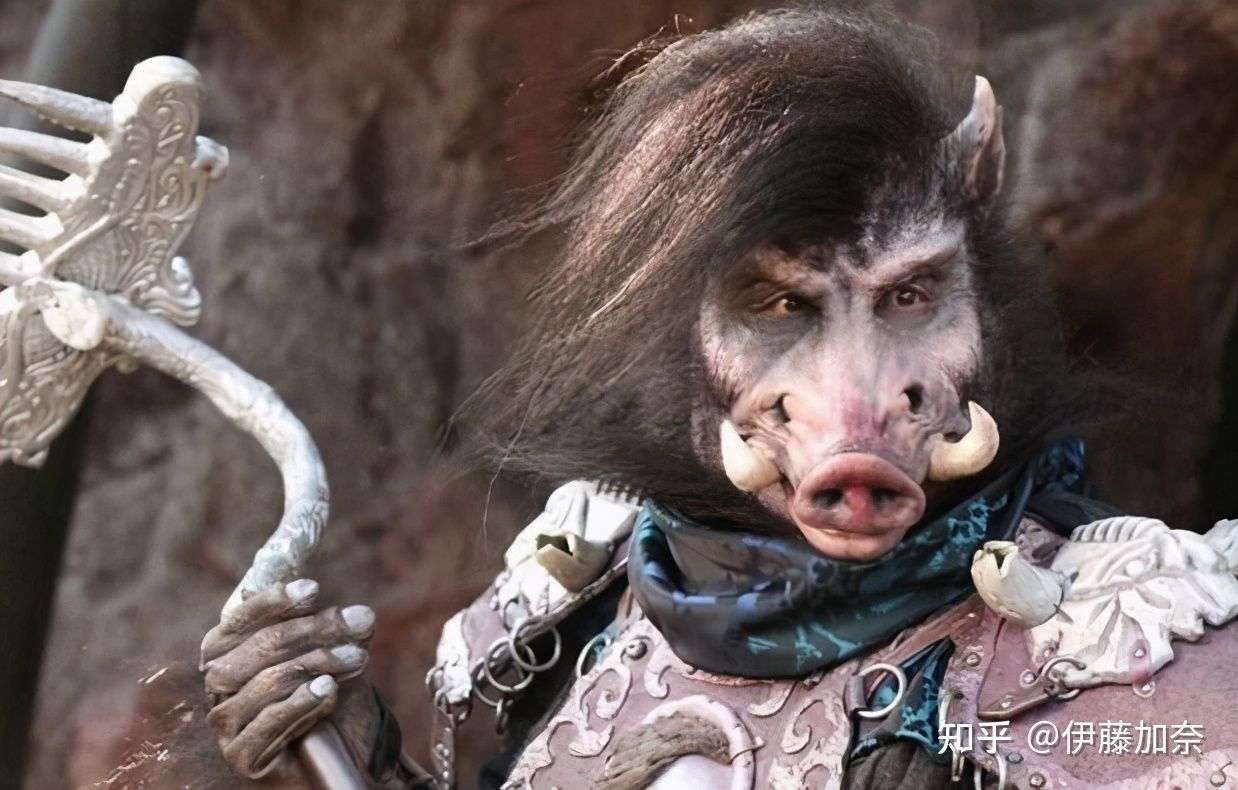
How Tall are the Main Characters from Journey to the West?

Last updated: 09-30-2024

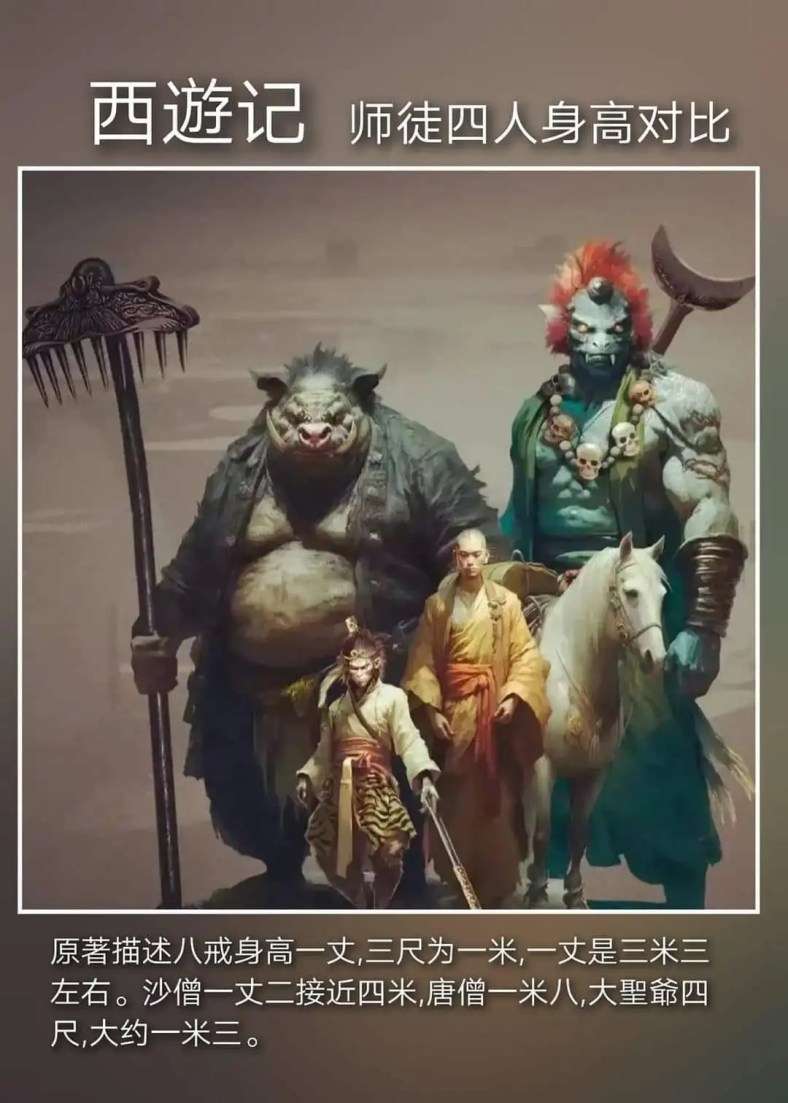
A member of a Monkey King Facebook group I belong to posted a Chinese informational graphic titled “Journey to the West: The Four Body Height Ratios of the Master and His Disciples” (Xiyou ji: Shitu siren shengao duibi, 西游记 师徒四人身高对比) (fig. 1). Each character is depicted with their correct corresponding height, ranging from Sun Wukong as the shortest to Sha Wujing as the tallest. The bottom of the picture provides some measurements:

The original novel describes Bajie’s body as being 1 zhang tall. Three chi is 1 meter. One zhang is around 3.3 meters. Sha Monk is 1.2 zhang, which is close to 4 meters. The Tang monk is 1.8 meters. The Lord Great Sage is 4 chi, or approximately 1.3 meters.

原著描述八戒身高一丈,三尺为一米,一丈是三米三左右。沙僧一丈二接近四米,唐僧一米八,大聖爺四尺,大约一米三。

The information is overgeneralized and at times conjectural, but I figured the picture would be interesting to my followers on Twitter. Little did I know that it would explode in popularity. As of this writing, my tweet has 940 likes (most of these received in a few days). This indicates that not many people were aware of the great height disparity between the pilgrims. I’ve therefore decided to write an article recording what Journey to the West actually says about each character’s height. 

I believe that the creator of the info graphic got their measurements from this essay, for it has the exact same title and very similar material (Zhongshi Damei Shenghuo [ZDS], 2020). I will use the claims therein to compare and contrast with the actual text from the novel.

Fig. 1 – The Chinese informational picture listing the pilgrims’ heights (larger version). I unfortunately don’t know who the original artist is. A reverse image search didn’t turn up anything. This page has the earliest appearance of the informational picture that I can find.

Table of  Contents

1. Measurements

ZDS (2020) uses a mixture of the ancient Chinese chi (尺) and zhang (丈) and the modern meter (mi, 米). The chi (and subsequently the zhang) varied at the local level at different times. During the Ming (1368-1644), when Journey to the West was published, the measurements equaled:

  • One chi (尺) = roughly 31.8 cm (12.3 in)
  • Ten chi = one zhang (丈)
  • one zhang (丈) = roughly 3.18 m (10.43 ft) (Jiang, 2005, p. xxxi).

Yes, the novel is set during the Tang (618-907), but many elements of the story (e.g. language, religion, mythos, martial arts, etc.) are filtered through the lens of the Ming. Therefore, it’s appropriate to use Ming-era measurements.

2. Heights

The characters are listed below from shortest to tallest.

(Note: I will be relying on the Wu & Yu (2012) translation. But since it uses “feet” instead of the original chi or zhang, I’ll alter the source throughout the article for more accuracy.)

2.1. Sun Wukong

See my previous articles discussing Monkey’s height (here and here).

ZDS (2020) states that Sun is “4 chi, that is less than 1.3 m [4.26 ft] or the same height as a child” (4 chi, yejiushi budao 1.3 mi, gen haitong yiban gao, 4尺,也就是不到1.3米,跟孩童一般高). But they miss an important distinction. The novel twice describes him as being “not four chi tall” (buman sichi, 不滿四尺), meaning that Monkey is an unknown height below 1.272 m (4.17 ft).

The phrase is first spoken by the Monstrous King of Havoc (Hunshi mowang, 混世魔王) in chapter 2:

When the Monstrous King saw him, he laughed and said, “You’re not four chi tall (emphasis added), nor are you thirty years old; you don’t even have weapons in your hands. How dare you be so insolent, looking for me to settle accounts?” (based on Wu & Yu, 2012, vol. 1, p. 128).

魔王見了,笑道:「你身不滿四尺,年不過三旬,手內又無兵器,怎麼大膽猖狂,要尋我見甚麼上下?」

The second is said hundreds of years later by the Great King Yellow Wind (Huangfeng dawang, 黃風大王) in chapter 21:

The old monster took a careful look and saw the diminutive figure of Pilgrim—less than four chi (emphasis added), in fact—and his sallow cheeks. He said with a laugh: “Too bad! Too bad! I thought you were some kind of invincible hero. But you are only a sickly ghost, with nothing more than your skeleton left!” (based on Wu & Yu, 2012, vol. 1, p. 408).

那怪仔細觀看,見行者身軀鄙猥,面容羸瘦,不滿四尺。笑道:「可憐,可憐。我只道是怎麼樣扳翻不倒的好漢,原來是這般一個骷髏的病鬼。」

Some readers may wonder why such a powerful character can be so tiny. This is because the novel describes Sun as a literal monkey. Refer back to this article for more information.

(Note: See the 04-27-24 update below for a more precise measurement.)

2.2. The Tang Monk

I have yet to formally write about Tripitaka‘s height.

ZDS (2020) suggests that the “Tang Monk should be about 1.8 m [5.90 ft]” (Tangseng yinggai zai 1.8 mi zuoyou, 唐僧应该在1.8米左右). This estimate is based on the size of a stone box used to imprison him in chapter 49:

Pilgrim … mov[ed] towards the rear of the palace. He looked, and sure enough there was a stone box, somewhat like a trough that people use in a pigpen or a stone coffin. Measuring it, he found it to be approximately six chi in length (emphasis added). He crawled on top of it and soon heard the pitiful sound of Tripitaka’s weeping coming from inside (Wu & Yu, 2012, vol. 2, p. 347).

行者 … 徑直尋到宮後看,果有一個石匣,卻像人家槽房裡的豬槽,又似人間一口石棺材之樣,量量足有六尺長短。卻伏在上面,聽了一會,只聽得三藏在裡面嚶嚶的哭哩。

Six chi is 1.9 m or 6.25 ft. Tripitaka would obviously be shorter given the inside thickness of the stone walls, but the novel doesn’t provide such detailed information. This means that the 1.8 m estimate is conjecture. So, what other proof is there?

ZDS (2020) also cites a poem from chapter 54 as evidence that the Tank Monk is “tall and handsome” (yougao youshuai, 又高又帅):

What handsome features!
What dignified looks!
Teeth white like silver bricks,
Ruddy lips and a square mouth.
His head’s flat-topped, his forehead, wide and full;
Lovely eyes, neat eyebrows, and a chin that’s long.
Two well-rounded ears betoken someone brave.
He is all elegance, a gifted man.
What a youthful, clever, and comely son of love,
Worthy to wed Western Liang’s gorgeous girl! (Wu & Yu, 2012, vol.  3, p. 55). [1]

丰姿英偉,相貌軒昂。齒白如銀砌,唇紅口四方。頂平額闊天倉滿,目秀眉清地閣長。兩耳有輪真傑士,一身不俗是才郎。好個妙齡聰俊風流子,堪配西梁窈窕娘。

Technically, yishen busu (一身不俗) can mean having a body that is “impressive” or “out of the ordinary,” but as Yu (2012) translates, it can also refer to one’s person. This is not the same as listing a particular height.

Hence, there isn’t enough information in the novel to officially say how tall Tripitaka is. But for those demanding some sort of answer, we can always speculate using real world data.

According to one study, out of a sample size of 28,044 Chinese men from 31 provinces/autonomous regions, the average modern height is 169 cm (5.54 ft). Additionally, this Chinese article references a study claiming that men from ancient times up to the Ming were between 165 cm (1.65 m or 5.41 ft) and 167 cm (1.67 m or 5.47 ft). This is obviously shorter than the 1.8 m suggested above.

Therefore, the most we can say is that the Tang Monk would be average historical height.

2.3. Zhu Bajie

I’ve written about Zhu Bajie’s height in the past (see here).

ZDS (2020) writes that Zhu’s “snout is 3 chi long” (zui chang 3 chi, 嘴长3尺). This is based on a descriptive poem from chapter 85:

A snout, pestlelike, over three chi long (emphasis added)
And teeth protruding like silver prongs
Bright like lightning a pair of eyeballs round,
Two ears that whip the wind in hu-hu sound.
Arrowlike hairs behind his head are seen;
His whole body’s skin is both coarse and green.
His hands hold up a thing bizarre and queer:
A muckrake of nine prongs which all men fear.

(Wu & Yu 2012, vol. 4, p. 149).

碓嘴初長三尺零,獠牙觜出賽銀釘。
一雙圓眼光如電,兩耳搧風唿唿聲。
腦後鬃長排鐵箭,渾身皮糙癩還青。
手中使件蹊蹺物,九齒釘鈀個個驚。

But, again, an important distinction is missed. Zhu’s nose is “over three chi long,” or larger than 95.4 cm (3.12 ft), which is over half the height of an average humanZDS (2020) says this measurement indicates that: “According to the laws of biology, (Zhu’s) body is approximately 3.5 m [11.48 ft]” (Anzhao shengwuxue de guilu, shenti yue 3.5 mi zuoyou, 按照生物学的规律,身体约3.5米左右). However, they never explain what laws they are referring to.

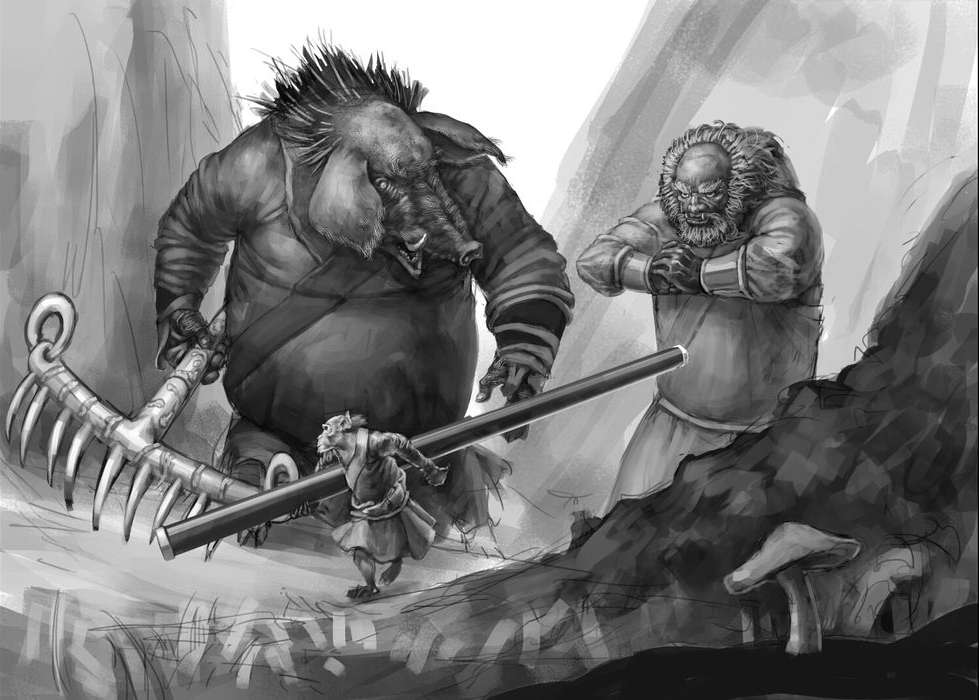
The only other information about Zhu’s size that I’m aware of appears in chapter 29. Upon entering a new kingdom, Tripitaka describes his two remaining disciples. [2] He starts with the pig spirit:

“My elder disciple has the surname of Zhu, and his given names are Wuneng and Eight Rules. He has a long snout and fanglike teeth, tough bristles on the back of his head, and huge, fanlike ears. He is coarse and husky, and he causes even the wind to rise when he walks (emphasis added) …” (Wu & Yu 2012, vol. 2, p. 51).

我那大徒弟姓豬,名悟能八戒,他生得長嘴獠牙,剛鬃扇耳,身粗肚大,行路生風 …

This tells us that Zhu has a large body capable of stirring the wind when he moves. But it’s important to note that Tripitaka’s subsequent dialogue assigns Sha Wujing a specific height (see below). This points to Zhu being shorter in comparison.

Therefore, just like the Tank Monk, there isn’t enough info to officially say how tall Zhu is. But we can again speculate using real world data.

My friend Barbara Campbell (blog) suggested that I use extinct prehistoric pigs as reference. A prime example is Megalochoerus homungous, which has been estimated to be 3.8 m (12.46 ft) long, 1.8 to 2.2 m (5.9 to 7.21 ft) at the shoulder, and up to 1,600 kg (3,527.39 lbs) (Uchytel, n.d.). A reconstruction by the paleo artist Roman Uchytel presents a towering creature with a head half as long as a man’s body (fig. 2). This is quite similar to the size of Zhu’s nose. Even with it’s head facing forward, a bipedal M. homungous would still be around 3.8 m (12.46 ft) tall. But as you’ll read below, this is too tall if Zhu is supposed to be shorter than Sha.

So how tall is Zhu? Your guess is as good as mine. But for those demanding some sort of answer, we can use human arm span to body height ratio, which is roughly 1:1. Using 1.8 m (5.9 ft), or the lower estimate for M. homungous‘ shoulder height, Zhu could be as much as 3.6 m (11.81 ft). But I am in no way comfortable with this estimate. It’s 100% pure conjecture, and I think it is still too tall.

Fig. 2 – A reconstruction of M. homungous by Roman Uchytel (larger version). Mr. Uchytel graciously gave me permission to use a watermarked version of his art for free. Please consult his website here.

2.4. Sha Wujing

I’ve previously mentioned Sha’s height in an article about Zhu Bajie’s appearance (refer back to here).

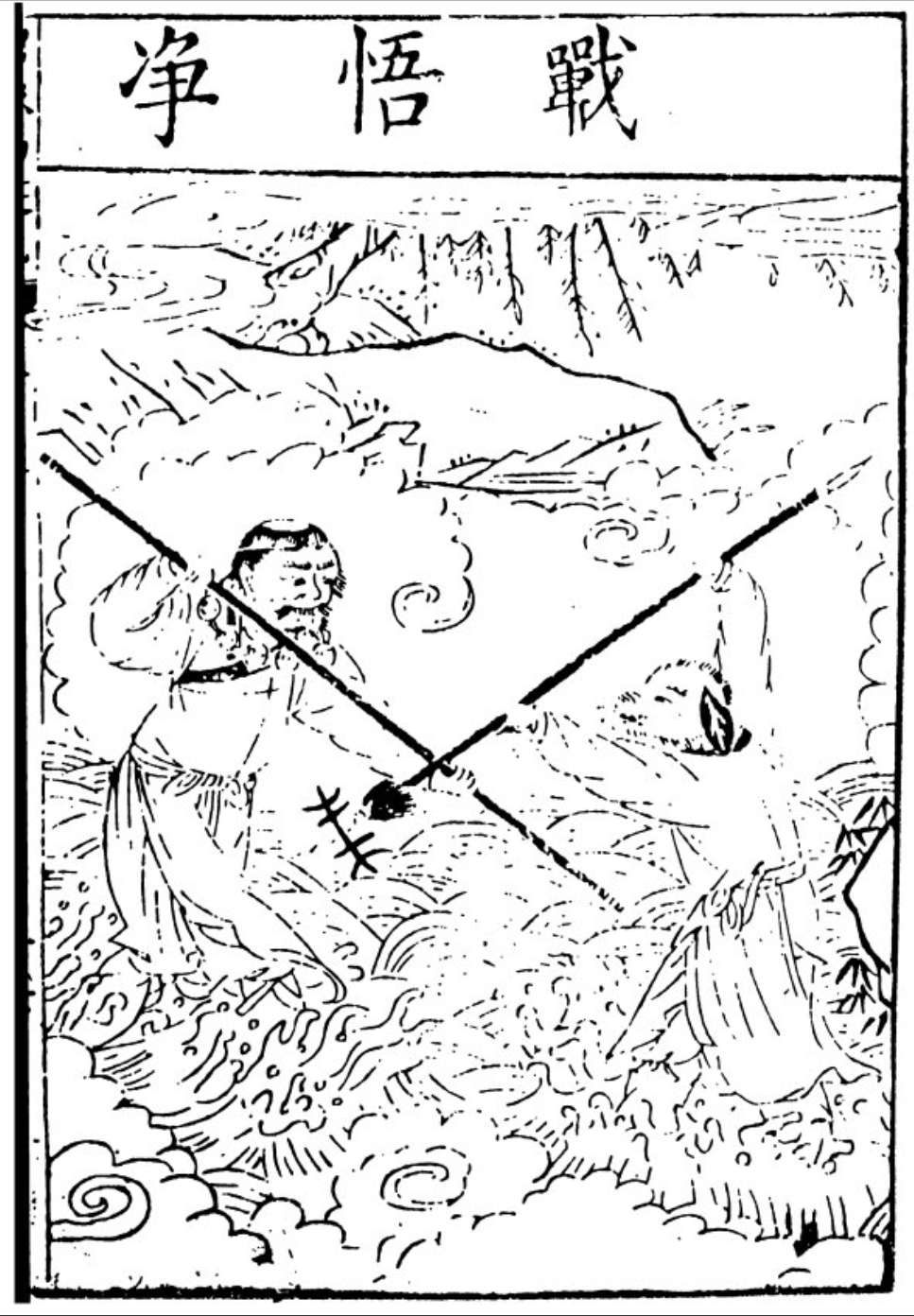
ZDS (2020) writes that Sha is “One zhangchi, nearly 4 m” (yizhang erchi, chabuduo 4 mi le, 一丈二尺,差不多4米了). This is based on Tripitaka’s continued dialogue with the foreign king in chapter 29:

“… My second disciple has the surname of Sha, and his religious names are Wujing and Monk. He is one zhang two chi tall and three span wide across his shoulders (emphasis added). His face is like indigo, his mouth, a butcher’s bowl; his eyes gleam and his teeth seem a row of nails” (Wu & Yu 2012, vol. 2, p. 51).

第二個徒弟姓沙,法名悟淨和尚,他生得身長丈二,臂闊三停,臉如藍靛,口似血盆,眼光閃灼,牙齒排釘。他都是這等個模樣,所以不敢擅領入朝。

This tells us that the monstrous monk is a whopping 3.816 m (12.51 ft) tall, with an exceptionally broad body.

Fun fact: Sha Wujing’s height is based on his giant antecedent, an obscure desert spirit appearing in the 7th-century biography of  the historical monk Xuanzang (on whom Tripitaka is based). The spirit comes to the cleric in a dream to admonish him for sleeping on the journey to India:

[Xuanzang] dreamed that he saw a giant deity several zhang tall (emphasis added), holding a halberd and a flag in his hands. The deity said to him, “Why are you sleeping here instead of forging ahead?” (based on Huili & Li, 1995, p. 28).

即於睡中夢一大神長數丈,執戟麾曰:「何不強行,而更臥也!」

“[S]everal zhang” would be 3 zhang (9.54 m or 31.29 ft) or more tall! That’s one big spirit!

3. Conclusion 

Journey to the West: The Four Body Height Ratios of the Master and His Disciples” is an informational picture that depicts the pilgrims with their correct corresponding heights. The bottom of the picture also provides measurements to supplement the illustration. These numbers were likely borrowed from ZDS (2020), an online article with the exact same name and very similar material. According to the essay, Sun Wukong is less than 1.3 m (4.26 ft), the Tang Monk is about 1.8 m (5.90 ft), Zhu Bajie is 3.5 m (11.48 ft), and Sha Wujing is nearly 4 m (13.12 ft). However, this information is overgeneralized and at times conjectural.

The original Chinese text of Journey to the West naturally gives more accurate information. But, unfortunately, the book only lists specific heights for two characters: Monkey is shorter than 1.272 m (4.17 ft) and Sha is 3.816 m (12.51 ft). As for the other two, not enough information is given for Tripitaka or Zhu to officially say how tall they are. However, speculating with real world historical height data suggests that the literary monk could be somewhere between 1.65 m (5.41 ft) and 1.67 m (5.47 ft), which is obviously shorter than the 1.8 m cited above. But even using prehistoric pigs as a reference, Zhu Bajie is the hardest to calculate since the novel indirectly implies that he is shorter than Sha. I used the lower end shoulder height estimate of the extinct M. homungous to suggest that Zhu could be as much as 3.6 m (11.81 ft) tall. But I think this is still too big.

On an interesting note, Sha’s great height is based on his giant antecedent, a desert spirit appearing in the historical Xuanzang’s 7th-century biography. The spirit is described as being 9.54 m (31.29 ft) or more!


4. Updates

Update: 08-26-23

Tumblr user @digitalagepulao has drawn lovely versions of the JTTW pilgrims (fig. 3). And while some of their heights may differ slightly from those discussed above, the overall ratios are correct. I love the designs.

This is for @digitalagepulao’s own “Expedition to the West au” (alternate universe) JTTW storyline based on a previous article of mine.

Fig. 3 – The height ratios for digitalagepulao’s JTTW character designs (larger version). Used with permission.


Update: 04-27-24

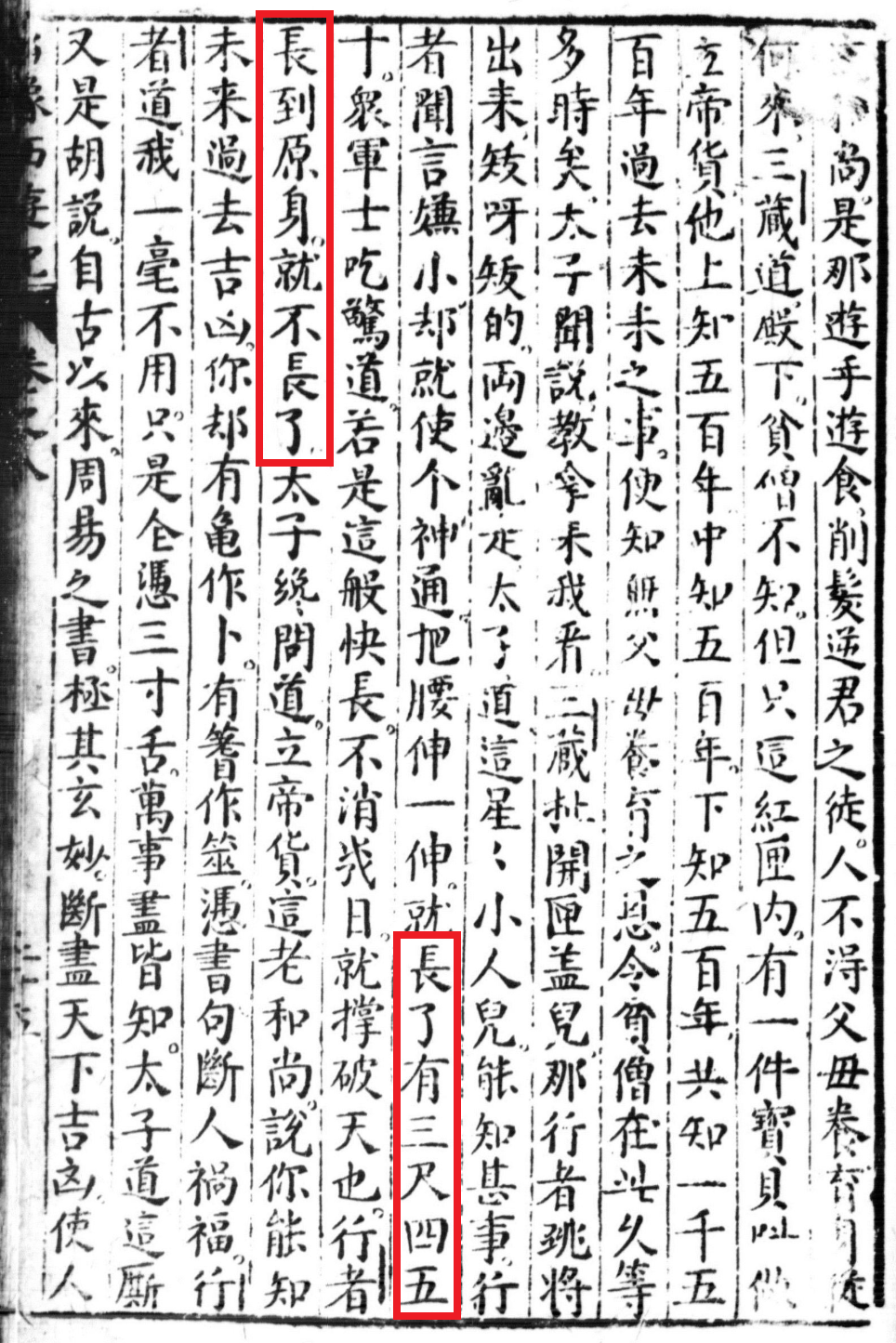
Chapter 37 gives a more precise measurement for Monkey’s height. He first transforms into a “tiny monk about two cun tall” (二寸長的小和尚兒) (based on Wu & Yu, 2012, vol. 2, p. 172). He shortly thereafter grows even bigger when a prince makes fun of him:

Tripitaka pulled open the box’s cover; Pilgrim [Sun Wukong] leaped out and began to hobble all over the place. The prince said, “This little midget! What can he know?” When Pilgrim heard this remark about his size, he at once resorted to magic. Straightening up his torso, he grew about three chi and four or five cun instantly (emphasis added). “If he can grow that rapidly,” said the soldiers, highly startled, “it will only be a few days before he pierces the sky.” When Pilgrim reached his normal height, however, he stopped growing (emphasis added) (based on Wu & Yu, 2012, vol. 2, pp. 174-175).

三藏扯開匣蓋兒,那行者跳將出來,呀的兩邊亂走。太子道:「這星星小人兒,能知甚事?」行者聞言嫌小,卻就使個神通,把腰伸一伸,就長了有三尺四五寸。眾軍士吃驚道:「若是這般快長,不消幾日,就撐破天也。」行者長到原身,就不長了。

As mentioned in section 1, one chi (尺) is roughly 12.3 in or 31.8 cm (Jiang, 2005, p. xxxi). Expanding on this, one chi equals 10 cun (寸; a.k.a. “Chinese inches”) (Jiang, 2005, p. xxxi). One cun would be about 1.25 in or 3.18 cm. Two cun would therefore be 2.5 in or 6.36 cm. Growing the stated additional height would then put our hero at 3 chi and 6 or 7 cun, which is roughly 3.86 ft or 1.176 m. This agrees with the aforementioned estimate of “not (or less than) four chi tall” (buman sichi, 不滿四尺) (Wu & Yu, 2012, vol. 1, pp. 128 and 408).


Update: 09-30-24

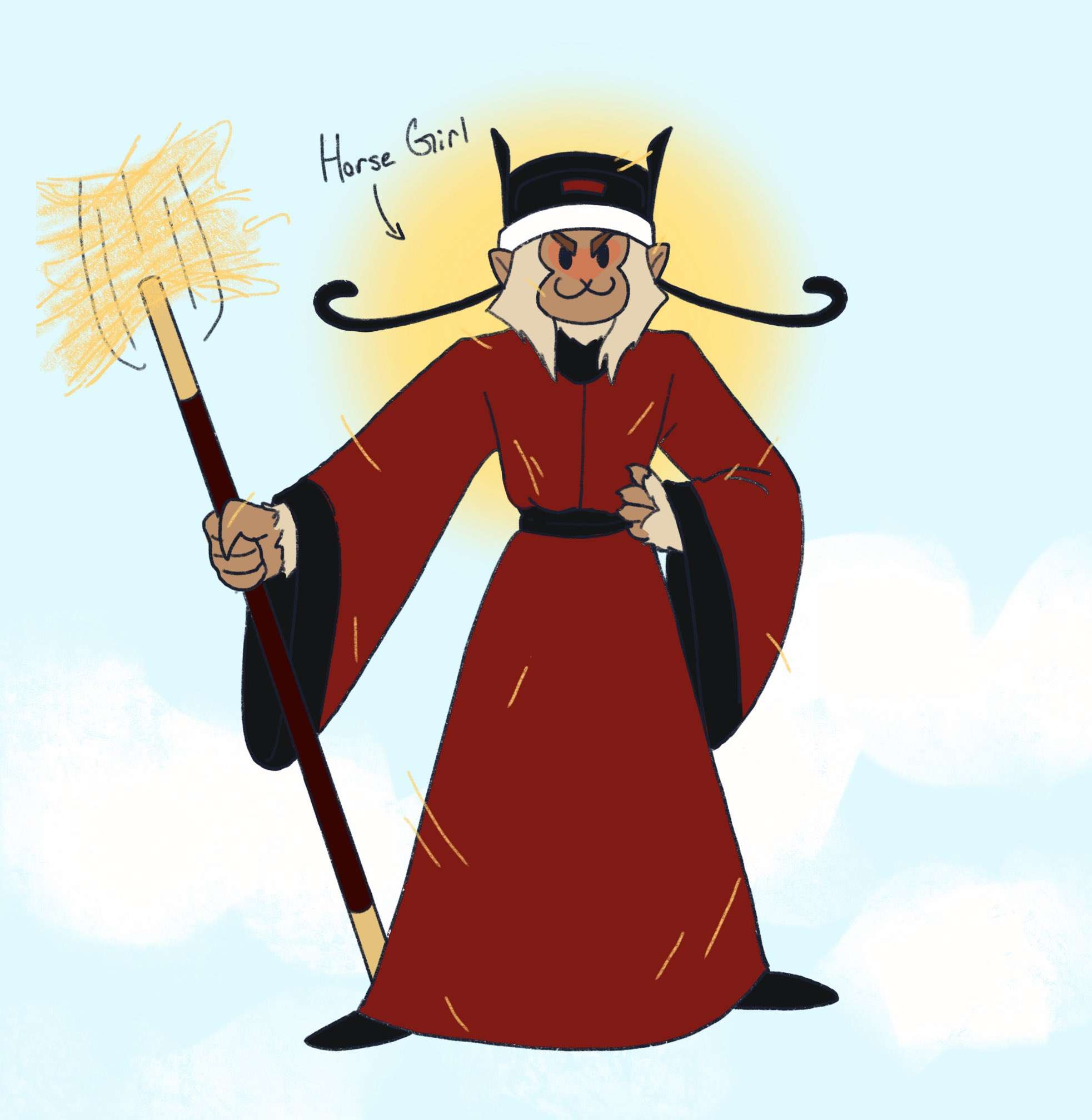
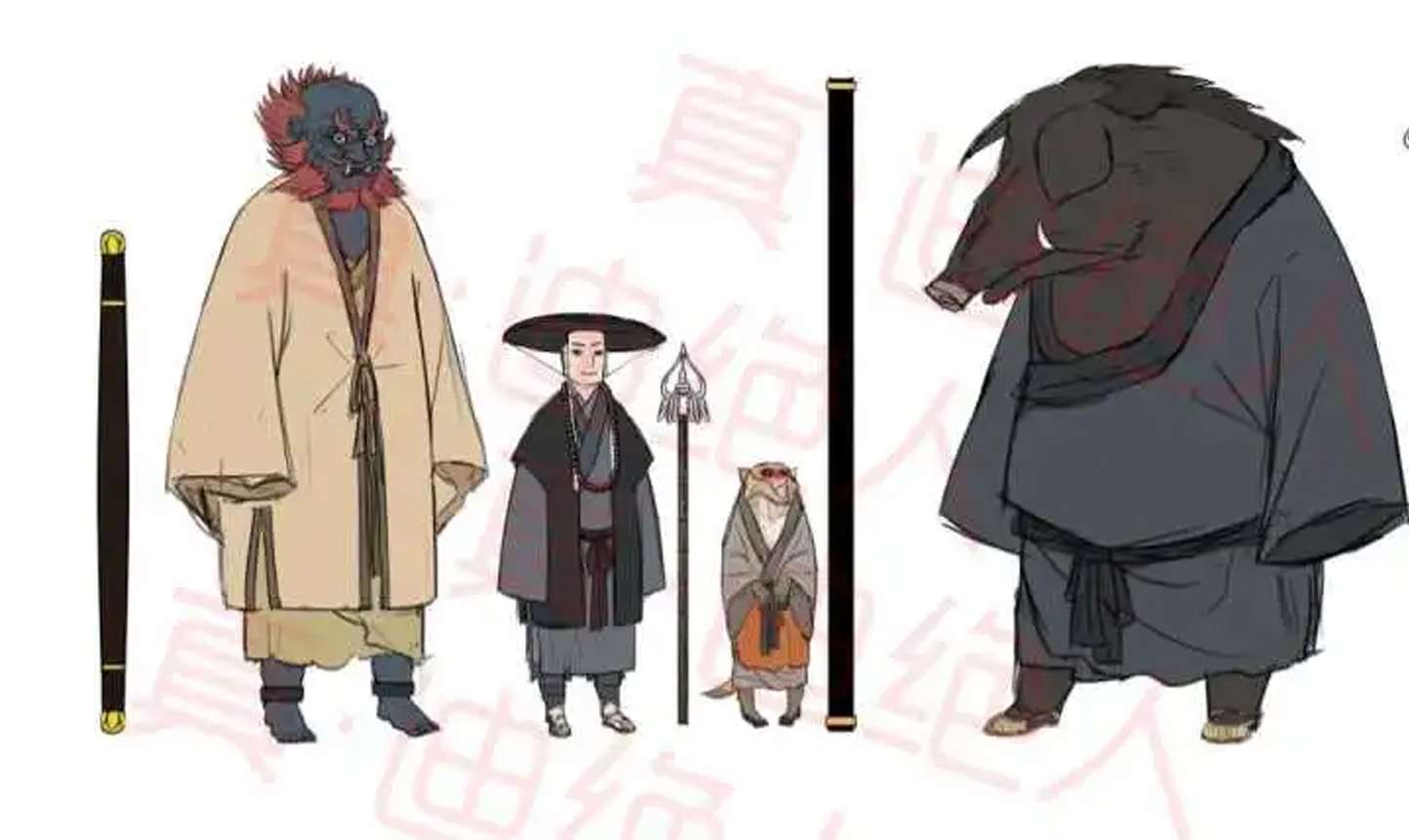
Tumblr user @heshemejoshi has drawn an awesome image of the pilgrims with their various height differences. The coloring almost makes it look like a dream.

Fig. 4 – The pilgrims “going west” (larger version).

Note:

1) “Western Liang’s gorgeous girl” is referring to the Queen of Womanland.

2) The Tang Monk had previously expelled Monkey from the group in chapter 27 (Wu & Yu, vol. 2, pp. 26-28).

Sources:

Huili, & Li, R. (1995). A Biography of the Tripiṭaka Master of the Great Ci’en Monastery of the Great Tang Dynasty. Berkeley: Numata Center for Buddhist translation and research.

Jiang, Y. (2005). The Great Ming Code / Da Ming Lu. Vancouver, Wa: University of Washington Press.

Uchytel, R. (n.d.). Megalochoerus. Prehistoric Fauna. Retrieved from https://prehistoric-fauna.com/Megalochoerus.

Wu, C., & Yu, A. C. (2012). The Journey to the West (Vols. 1-4) (Rev. ed.). Chicago, Illinois: University of Chicago Press.

Zhongshi Damei Shenghuo. (2020, August 18). Xiyou ji: Shitu siren shengao duibi [Journey to the West: The Four Body Height Ratios of the Master and His Disciples]. Sohu. Retrieved from https://www.sohu.com/a/413598842_120113471


How Many Humans Does Sun Wukong Kill in Journey to the West?

Last updated: 08-15-2024

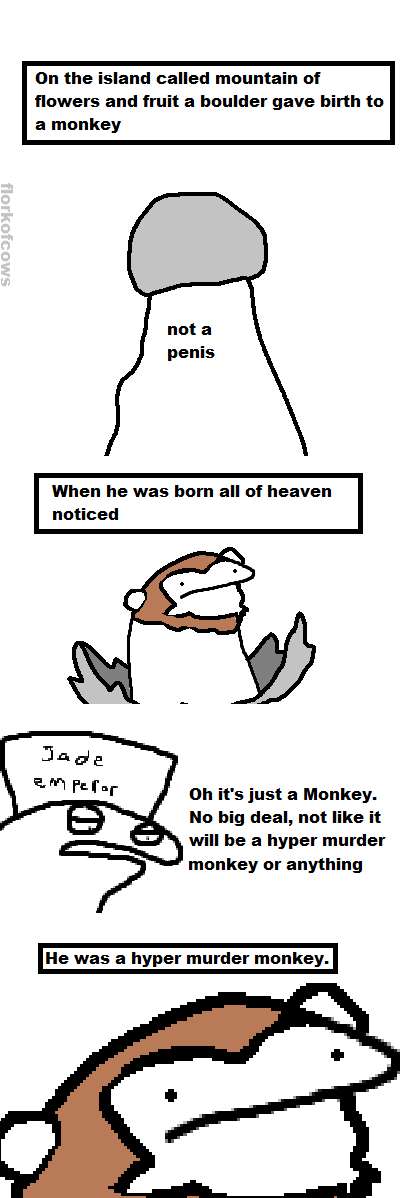
Someone on Tumblr recently asked me if I knew how many monsters, spirits, and humans that Sun Wukong kills throughout Journey to the West (Xiyouji, 西遊記, 1592). But since he’s a “hyper murder monkey” (fig. 1), this is impossible to quantify without an overly extensive survey of the book. However, the task becomes far more manageable if narrowed down to just humans. I know of at least seven instances in chapters 14, 27, 28, 44, 46, and 56. Although I can’t give an exact count, the number slain is over 1,030!

This study is by no means exhaustive. I’ve surely missed a few examples in the latter half of the book. But I’ll update this piece in the future if anything else pops up. (See the 08-15-24 update below.)

Fig. 1 – The story of the hyper murder monkey by @FlorkOfCows (larger version).
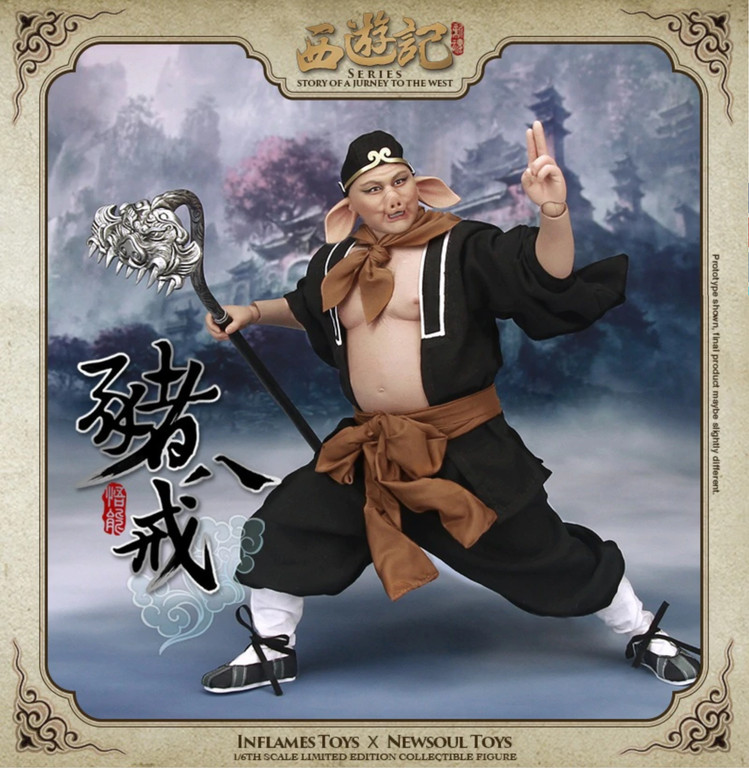
Table of Contents

1. Chapter 14

  • Six robbers

The first instance happens when Sun and his master are accosted by six robbers shortly after the immortal is released from under Five Elements Mountain:

Master and disciple had traveled for some time when suddenly six men jumped out from the side of the road with much clamor, all holding long spears and short swords, sharp blades and strong bows. “Stop, monk!” they cried. “Leave your horse and drop your bag at once, and we’ll let you pass on alive!” Tripitaka was so terrified that his soul left him and his spirit fled; he fell from his horse, unable to utter a word. But Pilgrim lifted him up, saying, “Don’t be alarmed, Master. It’s nothing really, just some people coming to give us clothes and a travel allowance!” “Wukong,” said Tripitaka, “you must be a little hard of hearing! They told us to leave our bag and our horse, and you want to ask them for clothes and a travel allowance?” “You just stay here and watch our belongings,” said Pilgrim, “and let old Monkey confront them. We’ll see what happens.” Tripitaka said, “Even a good punch is no match for a pair of fists, and two fists can’t cope with four hands! There are six big fellows over there, and you are such a tiny person. How can you have the nerve to confront them?”

As he always had been audacious, Pilgrim did not wait for further discussion. He walked forward with arms folded and saluted the six men, saying, “Sirs, for what reason are you blocking the path of this poor monk?” “We are kings of the highway,” said the men, “philanthropic mountain lords. Our fame has long been known, though you seem to be ignorant of it. Leave your belongings at once, and you will be allowed to pass. If you but utter half a no, you’ll be chopped to pieces!” “I have been also a great hereditary king and a mountain lord for centuries,” said Pilgrim, “but I have yet to learn of your illustrious names.” “So you really don’t know!” one of them said. “Let’s tell you then: one of us is named Eye That Sees and Delights; another, Ear That Hears and Rages; another Nose That Smells and Loves; another, Tongue That Tastes and Desires; another, Mind That Perceives and Covets; and another, Body That Bears and Suffers.” “You are nothing but six hairy brigands,” said Wukong laughing, “who have failed to recognize in me a person who has left the family, your proper master. How dare you bar my way? Bring out the treasures you have stolen so that you and I can divide them into seven portions. I’ll spare you then!” Hearing this, the robbers all reacted with rage and amusement, covetousness and fear, desire and anxiety. They rushed forward crying, “You reckless monk! You haven’t a thing to offer us, and yet you want us to share our loot with you!” Wielding spears and swords, they surrounded Pilgrim and hacked away at his head seventy or eighty times. Pilgrim stood in their midst and behaved as if nothing were happening.

What a monk!” said one of the robbers. “He really does have a hard head!” “Passably so!” said Pilgrim, laughing. “But your hands must be getting tired from all that exercise; it’s about time for old Monkey to take out his needle for a little entertainment.” “This monk must be an acupuncture man in disguise,” said the robber. “We’re not sick! What’s all this about using a needle?” Pilgrim reached into his ear and took out a tiny embroidery needle; one wave of it in the wind and it became an iron rod with the thickness of a rice bowl. He held it in his hands, saying, “Don’t run! Let old Monkey try his hand on you with this rod!” The six robbers fled in all directions, but with great strides he caught up with them and rounded all of them up. He beat every one of them to death, stripped them of their clothes, and seized their valuables. Then Pilgrim came back smiling broadly and said, “You may proceed now, Master. Those robbers have been exterminated by old Monkey” (Wu & Yu, vol. 1, pp 314-315).

This ends with Tripitaka becoming angry and exiling Monkey. The cleric later welcomes him back, only to rein in his disciple’s unruly behavior with the heaven-sent golden headband (Wu & Yu, 2012, vol. 1, pp. 315-317 and 318-320). This becomes a reoccurring theme (see below).

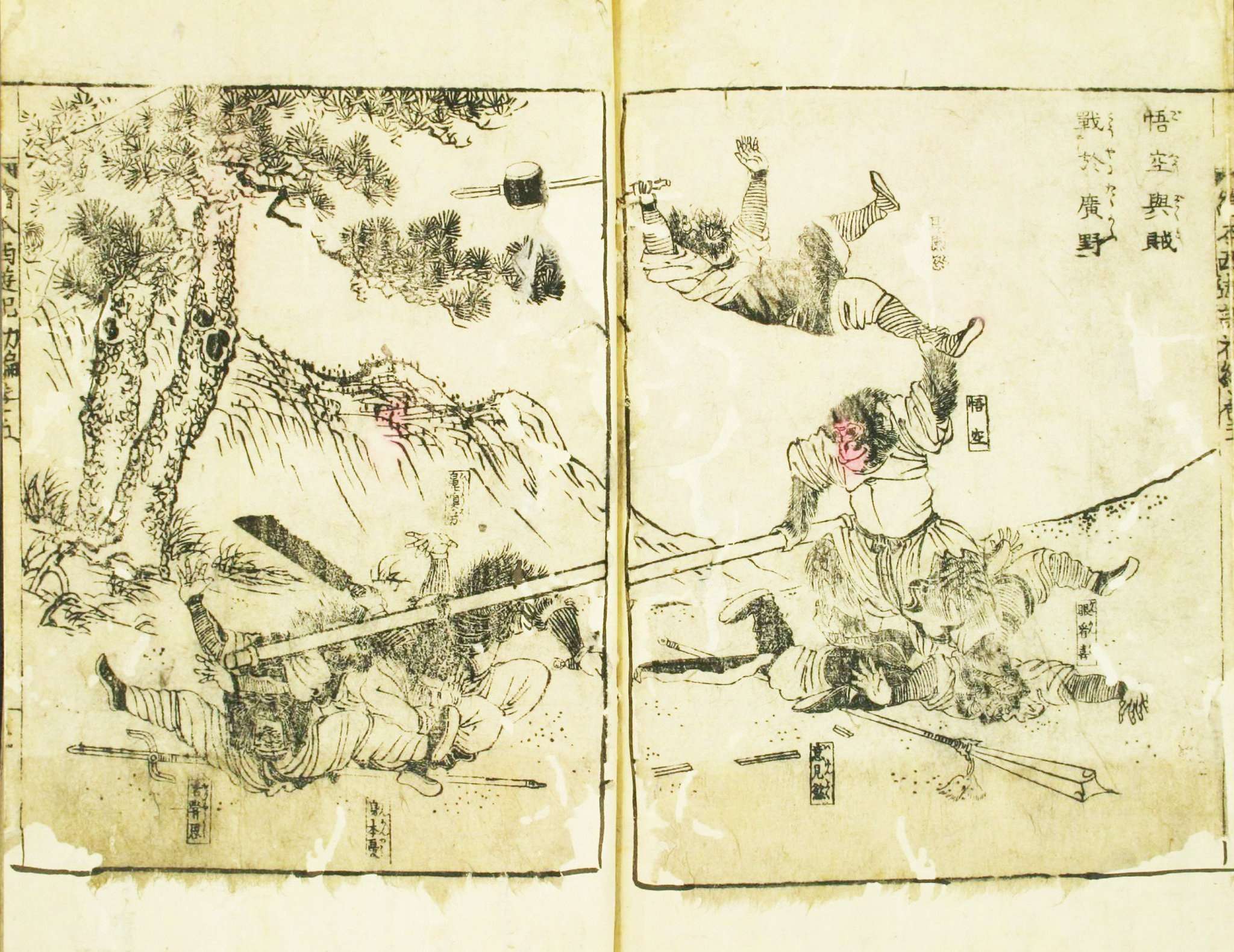
The six murders (fig. 2) are allegories for defeating the desires of the eyes, ears, nose, tongue, mind, and body that hinder one’s spiritual progression. [1] This is explained by Monkey in chapter 43 (Wu & Yu, 2012, vol. 2, p. 254).

Fig. 2 – A woodblock print depicting Sun killing the six bandits (larger version). It comes from The Illustrated Journey to the West (Ehon Saiyuki, 繪本西遊記), a 19th-century Japanese translation.

2. Chapter 27

  • Unknown

The second is alluded to during the White Bone Spirit episode. In her attempts to eat the monk, the wily skeleton demon takes on the guises of a beautiful girl, her elderly mother, and her elderly father in turn. But each time Sun attacks her with his staff, she leaves a fake corpse in her wake, [2] making it seem like the immortal has murdered yet another person. This naturally upsets Tripitaka, but Monkey explains that evil spirits commonly disguise themselves as something welcoming in order to catch and eat humans. He uses himself as an example, claiming to have done the same as a young monster:

“Master,” said Pilgrim with a laugh, “how could you know about this? When I was a monster back at the Water-Curtain Cave, I would act like this if I wanted to eat human flesh. I would change myself into gold or silver, a lonely building, a harmless drunk, or a beautiful woman. Anyone feebleminded enough to be attracted by me I would lure back to the cave. There I would enjoy him as I pleased, by steaming or boiling. If I couldn’t finish him off in one meal, I would dry the leftovers in the sun to keep for rainy days. Master, if I had returned a little later, you would have fallen into her trap and been harmed by her.” That Tang Monk, however, simply refused to believe these words; he kept saying instead that the woman was a good person (Wu & Yu, vol. 2, p. 20).

In the end, the cleric isn’t convinced that Sun didn’t kill an entire family, and so he punishes him with the band-tightening spell before once again banishing him from the group (Wu & Yu, 2012, vol. 2, pp. 26-28).

I know some online commentators believe that Monkey lies here about eating people. I’ll leave it up to the reader to make their own decision. But even if his claims are true, there is no way of quantifying the number eaten.

3. Chapter 28

  • 1,000-plus hunters

The third happens shortly after Sun’s exile. Upon returning to the Mountain of Flowers and Fruit, he learns that more than half of his 47,000 monkey subjects had been killed centuries ago in a great fire set by Erlang, and then half of the survivors later fled elsewhere due to a lack of food. In addition, half of those who remained were killed and eaten or captured for entertainment by a band of over 1,000 human hunters who recently came to inhabit the mountain. Hearing this greatly enrages the Monkey King. He thereafter instructs his subjects to gather piles of small rocks for a magical wind attack (Wu & Yu, vol. 2, pp. 31-32):

Making the magic sign with his fingers and reciting a spell, he drew in a breath facing the southwest and blew it out. At once a violent wind arose. Marvelous wind!

It threw up dust and scattered dirt;
It toppled trees and cut down forests.
The ocean waves rose like mountains;
They crashed fold upon fold on the shore.
The cosmos grew dim and darkened;
The sun and the moon lost their light.
The pine trees, once shaken, roared like tigers;
The bamboos, hit abruptly, sang like dragons.
All Heaven’s pores let loose their angry breaths
As rocks and sand flew, hurting one and all.

The Great Sage called up this mighty wind that blew up and scattered those rock pieces in every direction. Pity those thousand-odd (qianyu, 千餘) hunters and horses! This was what happened to every one of them:

The rocks broke their dark heads to pieces;
Flying sand hurt all the winged horses.
Lords and nobles confounded before the peak,
Blood stained like cinnabar the earth.
Fathers and sons could not go home.
Could fine men to their houses return?
Corpses fell to the dust and lay on the mountain,
While rouged ladies at home waited.

The poem says:

Men killed, horses dead—how could they go home?
Lost, lonely souls floundered like tangled hemp.
Pity those strong and virile fighting men,
Whose blood, both good and bad, did stain the sand!

Lowering the direction of his cloud, the Great Sage clapped his hands and roared with laughter, saying, “Lucky! Lucky! Since I made submission to the Tang Monk and became a priest, he has been giving me this advice:

‘Do good a thousand days,
But the good is still insufficient;
Do evil for one day,
And that evil is already excessive.’

Some truth indeed! When I followed him and killed a few monsters, he would blame me for perpetrating violence. Today I came home and it was the merest trifle to finish off all these hunters.”

He then shouted, “Little ones, come out!” When those monkeys saw that the violent wind had passed and heard the Great Sage calling, they all jumped out. “Go down to the south side of the mountain,” said the Great Sage, “and strip the dead hunters of their clothes. Bring them back home, wash away the bloodstains, and you all can wear them to ward off the cold. The corpses you can push into the deep mountain lake over there. Pull back here also the horses that are killed; their hides can be used to make boots, and their meat can be cured for us to enjoy slowly. Gather up the bows and arrows, the swords and spears, and you can use them for military drills again. And finally, bring me those banners of miscellaneous colors; I have use for them” (Wu & Yu, vol. 2, pp 33-34).

This is by far the largest number of humans killed in one go by the hyper murder monkey.

4. Chapter 44

  • Two Daoists

The fourth happens shortly after the pilgrims arrive in the Cart-Slow Kingdom. Sun is appalled to learn that three self-proclaimed immortals have convinced the region’s monarch to not only destroy all Buddhist institutions but also to enslave the clerics to the Daoists. His initial response is to play a joke on two cocky Daoist overseers by convincing them (under the guise of an aged coreligionist) that he has a relative among the 500 monks who should be set free. But when they ask which one, our hero claims all of them to be his kin (Wu & Yu, 2012, vol. 2, pp. 269-275):

The Daoists said, “You must be a little crazy, for all at once you are babbling! These monks happen to be gifts from the king. If we want to release even one or two of them, we will have to go first before our masters to report that they are ill. Then, we have to submit a death certificate before we can consider the matter closed. How could you ask us to release them all? Nonsense! Nonsense! Why, not to speak of the fact that we would be left without servants in our household, but even the court might be offended. The king might send some officials to look into the work here or he himself might come to investigate. How could we dare let them go?” “You won’t release them?” said Pilgrim. “No, we won’t!” said the Daoists. Pilgrim asked them three times and his anger flared up. Whipping out his iron rod from his ear, he squeezed it once in the wind and it had the thickness of a rice bowl. He tested it with his hand before slamming it down on the Daoists’ heads. How pitiful! This one blow made

Their heads crack, their blood squirts, their bodies sink low;
Their skin split, their necks snap, their brains outflow! (Wu & Yu, vol. 2, p. 275).

5. Chapter 46

  • One civil official

The fifth happens during a magical contest of torture against one of the three supposed immortals. Monkey easily survives a bath in boiling oil but fakes his death in order to play a trick on Zhu Bajie. The officer in charge of the execution reports the development to the monarch, leading Tripitaka to eulogize and present offerings to his disciple’s spirit. But once Zhu hijacks the proceedings by calling Sun a Bimawen, [3] our hero erupts from the caldron to chastise his religious brother. Fearing possible punishment for seemingly lying to the king, the aforementioned official claims the primate is instead a ghost (Wu & Yu, 2012, vol. 3, pp. 310-312):

Maddened by what he heard, Pilgrim leaped out of the cauldron, dried himself from the oil, and threw on his clothes. Dragging that officer over, he whipped out his iron rod and one blow on the head reduced him to a meat patty. “What ghost is this who’s manifesting itself?” he huffed (Wu & Yu, 2012, vol. 2, pp. 312-313).

6. Chapter 56 – Part 1

  • Two bandit chiefs

The last two instances that I know of take place shortly after the scorpion spirit episode. The sixth follows a similar pattern to chapter 14: Tripitaka is confronted by bandits → He gets scared and falls off the horse → The bandits demand money and the horse → Sun intervenes → His banter enrages them and they hit and stab at his adamantine pate to no avail → They comment on his hard head → Monkey pulls out his iron staff, referring to it as a needle → The bandits infer that he works in a certain profession and claim to have no use for the needle → He enlarges the weapon and eventually beats them to death. [4] The only difference here is that Sun first challenges the men to lift his staff:

… Sticking the rod into the ground, Pilgrim said to them, “If any of you can pick it up, it’s yours.” The two bandit chiefs at once went forward to try to grab it, but alas, it was as if dragonflies were attempting to shake a stone pillar. They could not even budge it half a whit! This rod, you see, happened to be the compliant golden-hooped rod, which tipped the scale in Heaven at thirteen thousand, five hundred [catties]. How could those bandits have knowledge of this? The Great Sage walked forward and picked up the rod with no effort at all. Assuming the style of the Python Rearing its Body, he pointed at the bandits and said, “Your luck’s running out, for you have met old Monkey!” One of the bandit chiefs approached him and gave him another fifty or sixty blows. “Your hands must be getting tired!” chuckled Pilgrim. “Let old Monkey give you one stroke of the rod. I won’t do it for real either!” Look at him! One wave of the rod and it grew to about seventy feet, its circumference almost as big as a well. He banged it on the bandit, and he at once fell to the ground: his lips hugging the earth, he could not make another sound.

The other bandit chiefs shouted, “This baldy is so audacious! He has no travel money, but he has killed one of us instead!” “Don’t fret! Don’t fret!” said Pilgrim, laughing. “I’ll hit every one of you, just to make sure that all of you will be wiped out!” With another bang he beat to death the other bandit chief Those small thieves were so terrified that they abandoned their weapons and fled for their lives in all directions (Wu & Yu, vol. 3, pp. 80-81).

7. Chapter 56 – Part 2

  • One unfilial son
  • twenty-ish bandits

The seventh happens sometime after one of the surviving bandits, the son of an elderly couple surnamed Yang (楊), discovers that his parents are feeding and sheltering the pilgrims for the night. He and his brothers-in-arms make plans to attack the monks after eating dinner and sharpening their weapons, but old Mr. Yang alerts them, giving Tripitaka and his disciples ample time to escape:

Every bandit was darting forward like an arrow, and by sunrise, they caught sight of the Tang Monk. When the elder heard shouts behind him, he turned to look and discovered a band of some thirty men rushing toward him, all armed with knives and spears. “Oh, disciples,” he cried, “the brigand troops are catching up with us. What shall we do?” “Relax, relax!” said Pilgrim. “Old Monkey will go finish them off!” “Wukong,” said Tripitaka as he stopped his horse, “you must not hurt these people. Just frighten them away.” Unwilling, of course, to listen to his master, Pilgrim turned quickly to face his pursuers, saying, “Where are you going, sirs?” “You nasty baldie!” cried the thieves. “Give us back the lives of our great kings!”

As they encircled Pilgrim, the bandits lifted their spears and knives to stab and hack away madly. The Great Sage gave one wave of his rod and it had the thickness of a bowl; with it, he fought until those bandits dropped like stars and dispersed like clouds. Those he bumped into died at once, those he caught hold of perished immediately, those he tapped had their bones broken, and those he brushed against had their skins torn. The few smart ones managed to escape, but the rest of the dumb ones all went to see King Yama!

When Tripitaka saw that many men had fallen, he was so aghast that he turned and galloped toward the West, with Zhu Eight Rules and Sha Monk hard on the horse’s heels. Pilgrim pulled over one of the wounded bandits and asked, “Which is the son of old Yang?” “Father,” groaned the thief, “the one in yellow.” Pilgrim went forward to pick up a knife and beheaded the one in yellow. Holding the bloody head in his hand, he retrieved his iron rod and, in great strides, caught up with the Tang Monk. As he arrived before the horse, he raised the head and said, “Master, this is the rebellious son of old Yang, and he’s been beheaded by old Monkey.” [fig. 3] Paling with fright, Tripitaka fell down from the horse, crying, “Wretched ape! You’ve scared me to death! Take it away! Take it away!” Eight Rules went forward and kicked the head to the side of the road, where he used the muckrake to bury it (Wu & Yu, 2012, vol. 3, pp. 88-89).

The quote is clear that not all 30 bandits are killed. Apart from Yang the bandit, I think 20(-ish) is a conservative estimate based on the wording.

And just like chapters 14 and 27, this episode ends with Tripitaka punishing his disciple with the band-tightening spell before exiling him from the group (Wu & Yu, 2012, vol. 2, pp. 89-90).

Fig. 3 – Monkey presenting the head of Yang the bandit to his master. This screenshot comes from episode 10 of OSP’s retelling of Journey to the West (larger version).

8. Conclusion

To my knowledge, the Monkey King kills over 1,030 humans in Journey to the West. This includes six allegorical robbers in chapter 14, an unknown amount alluded to in chapter 27, over 1,000 hunters in chapter 28, two Daoists in chapter 44, one civil official in chapter 46, and two bandits chiefs, one unfilial son, and maybe 20-ish bandits in chapter 56. I may have missed a few instances in the latter half of the novel, so please don’t look at the above total as complete. (Again, see the 08-15-24 update below.)


9. Updates

Update: 01-17-2023

I previously mentioned an instance in chapter 27 where Monkey admits to eating humans in his youth, something that some online commentators believe to be a fib. Well, a Tumblr user, who goes by both @abitfiendish and @localcactushugger, reminded me that dialogue in chapter 39 further calls this into question.

After a pill of immortal elixir fails to revive a long-dead king, Tripitaka suggests mouth-to-mouth necessitation is needed to complete the resurrection process. Sun is ultimately chosen for this job since he had apparently never eaten meat:

Eight Rules walked forward and was about to do this when he was stopped by Tripitaka. “You can’t do it,” he said. “Wukong still should take over.” That elder indeed had presence of mind, for Zhu Eight Rules, you see, had been a cannibal since his youth, and his breath was unclean. Pilgrim, on the other hand, had practiced self-cultivation since his birth, the food sustaining him being various fruits and nuts, and thus his breath was pure. The Great Sage, therefore, went forward and clamped his thundergod beak to the lips of the king: a mighty breath was blown through his throat … (Wu & Yu, 2012, vol. 2, pp. 195-196).

But it should be remembered that Journey to the West is crammed full of inconsistencies (likely born from the novel coalescing from different oral tales). For example, this chapter shows that all it takes to revive a dead person is an elixir pill and mouth-to-mouth. However, in chapter 97, Monkey has to physically retrieve the soul of a recently deceased householder from the underworld in order to resurrect him (see here).

Again, I’ll leave it up to the reader to make their own decision.


Update: 08-15-24

I recently finished rereading JTTW for the umpteenth time, and I am happy to report that I didn’t miss any mentions of killing humans in the latter part of the book. The above article represents the entire work.

Note:

1) Things that arouse the eyes (sights), ears (sounds), nose (smells), tongue (tastes), and mind and body (wants and desires).

2) This is related to an ancient Daoist concept called “Release by means of a corpse” (Shijie, 尸解). Stories as far back as the Han describe immortals leaving behind a fake corpse (sometimes a magically disguised object) while they ascended in secret to heaven (Kirkland, 2008).

3) This plays on the homophonous relationship between Bimawen (避馬瘟, lit: “avoid the horse plague”), an ancient belief that female monkeys placed in horse stables could ward off equine sickness, and Bimawen (弼馬溫, “To assist horse temperament”), Sun’s former station as keeper of the heavenly horses (see here).

See Wu & Yu, 2012, vol. 3, pp. 78-81.

Source:

Kirkland, R. (2008). Shijie In F. Pregadio (Ed.), The Encyclopedia of Taoism (Vol. 2) (pp. 896-897). London [u.a.: Routledge].

Wu, C., & Yu, A. C. (2012). The Journey to the West (Vols. 1-4) (Rev. ed.). Chicago, Illinois: University of Chicago Press.

How Tall is the Monkey King? – A Debate

This was originally posted as a 03-03-2022 update to an existing article, but I decided to make it a standalone piece.

Last updated: 04-27-2024

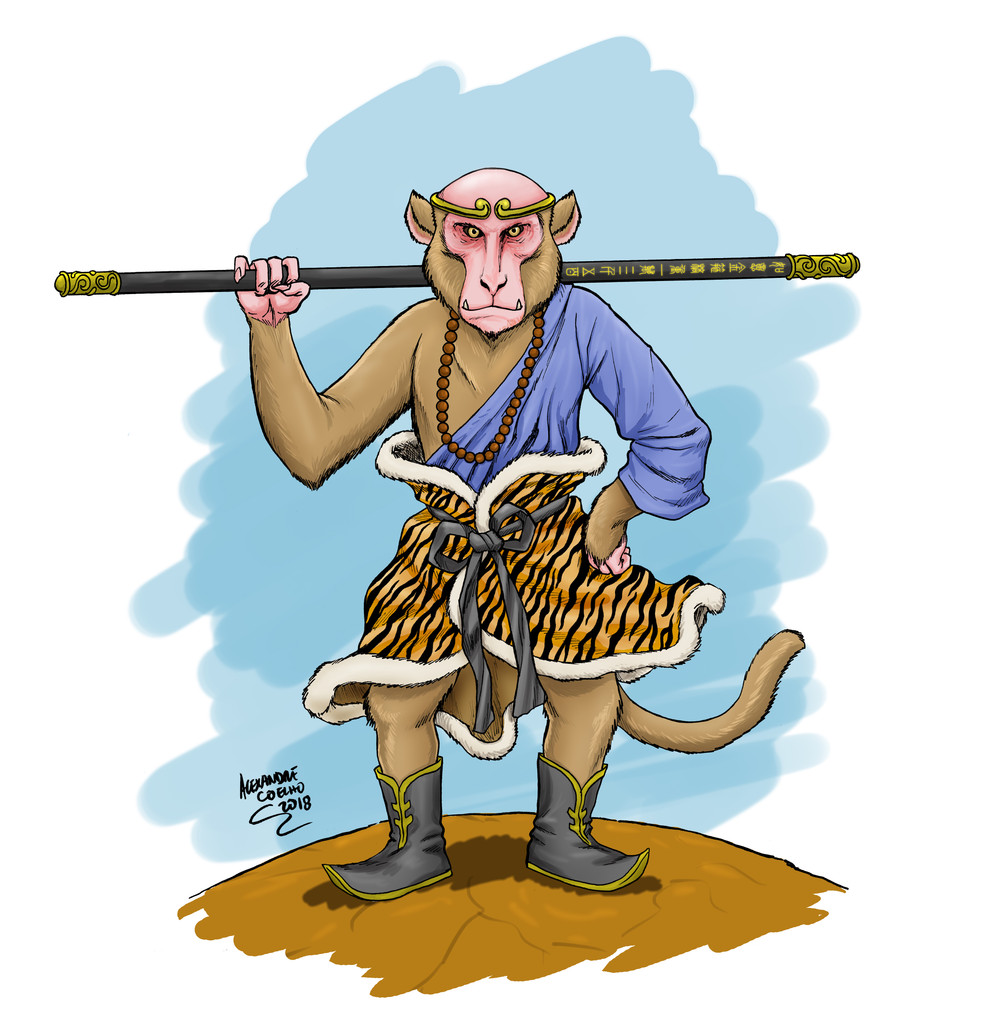
In “What Does Sun Wukong Look Like?” I highlighted several sentences pointing to the Monkey King’s small stature (fig. 1 & 2). For example, one monster comments:

The old monster took a careful look and saw the diminutive figure of Pilgrim [Monkey]—less than four Chinese feet [buman sichi, 不滿四尺, 4.17 ft or 1.27 m] in fact—and his sallow cheeks. He said with a laugh: “Too bad! Too bad! I thought you were some kind of invincible hero. But you are only a sickly ghost, with nothing more than your skeleton left!” (Wu & Yu, 2012, vol. 1, p. 408).

This information was later used in the making of a youtube video called “10 Facts About Sun Wukong the Monkey King.” Fact number seven was that “He’s really short,” and I ended the section by saying: “That’s right! The Great Sage Equaling Heaven, the conqueror of the heavenly army … is the size of a child.” A Chinese viewer later left a thought-provoking comment on the video stating that I was wrong about Monkey’s size.

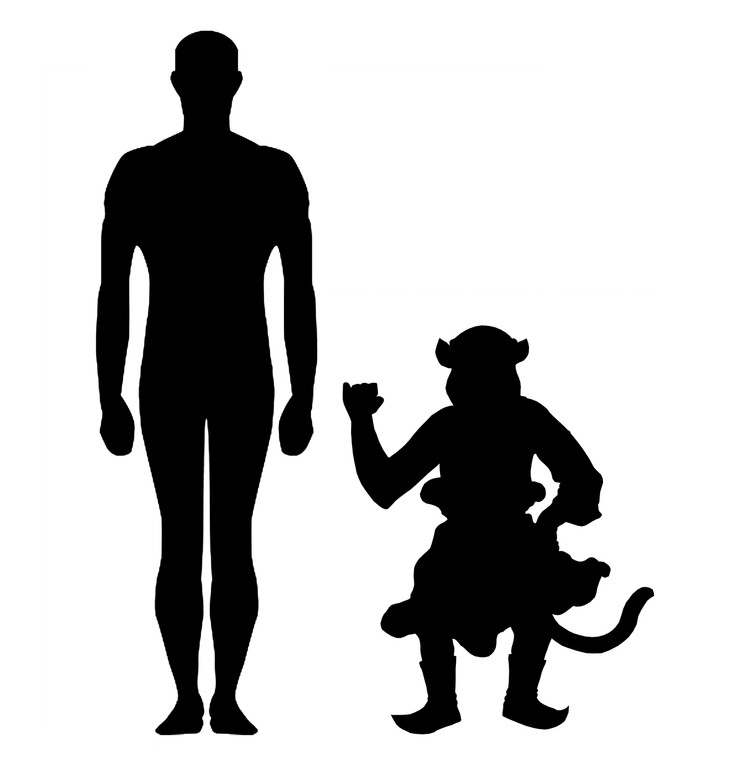
Fig. 1 – An accurate Monkey King (larger version). Drawn by my friend Alexandre Palheta Coelho (instagram and deviantart). Slightly modified by me to match what I’ve written here. For the original version, see here. Fig. 2 – A size chart comparing Sun to a six-foot human (larger version).

The Debate

Here, I will present the comment in full but interspersed with my responses:

Hello! I am a Wukong fan from China. I really enjoyed your video! I would like to say that the height of the Monkey King has been very controversial on the internet in China. The data and appearance depictions in classical Chinese novels can be somewhat exaggerated. Journey to the West is a mythological novel is even more so. For example, seventy-two transformations, a somersault that can travel one hundred thousand eight hundred thousand li respectively refer to infinite changes and fly extremely fast. Seventy-two and one hundred and eighty thousand are not exact numbers, so relying solely on data is not reliable. Besides, in addition to four feet, Wukong has also appeared other height data. For example, the earliest version of the Journey to the West, “世德堂本”, Chapter 21. “大圣公然不惧。那怪果打一下来,他把腰躬一躬,足长了三尺,有一丈长短。” “Our Great Sage was not in the least frightened. When the monster struck him once, he stretched his waist and at once grew three chi, attaining the height of one zhang altogether.”

This PDF scan (page 258) shows the original version of the novel did indeed read “grow three chi” (changle sanchi, 長了三尺) and not six like in the modern version (Wu & Yu, vol. 1, p. 408). I was surprised when this was brought to my attention.

One zhang minus three chi equals seven chi. In other words, the height of the Monkey King here was seven chi (Since the height unit in Chinese classical novels is based on the ancient system, 7 chi is around 5.5 feet). But in later versions and translations, “grew three chi” was changed to six chi. This has always been a point of contention. The figure of four feet (four chi) appears twice, both from the perspective of other monsters, such as the Monstrous King, who is three zhangs tall (around 24 feet). It may be possible that Sun Wukong is short in his eyes in comparison.

For those unfamiliar with ancient Chinese measurements, one zhang () equals ten chi (尺, i.e. “Chinese feet”) (Jiang, 2005, p. xxxi). The passage in question does imply that Monkey is seven chi tall. However, there are two problems. First, during the Ming (1368-1644) when the novel was published, one chi equaled approximately 12.52 inches (31.8 cm) (Jiang, 2005, p. xxxi). This would make Sun a whopping 7.3 feet (2.22 m) tall! I must admit that the chi varied at the local level, but I doubt the variations would lead to a nearly two-foot (60.96 cm) difference. Additionally, if we use the measures for the Tang (618-907 CE), when the story is set, a chi was 11.57 inches (29.4 cm), making Monkey 6.75 feet (2.06 m) tall. There was, however, a “small chi” (xiaochi, 小尺) at this time, which was 9.66 inches (24.6 cm) (Nienhauser, 2016, p. 405 n. 40). This would only make him 5.65 feet (1.72 m) tall. But I would question if the common folk reading the novel during the Ming were aware of and still using this truncated measure. Second, as written above, the figure for “not even four chi” (buman sichi, 不滿四尺, 4.17 ft or 1.27 m) appears twice. But it’s important to note that this estimate is made by two different characters at two different locations and times. The first is spoken in chapter two by the Monstrous King of Havoc (Hunshi mowang, 混世魔王) in the Water Belly Cave (Shuizang dong, 水臟洞) of the Mountain of Flowers and Fruit (east of the Eastern Purvavideha Continent) (PDF page 36; Wu & Yu, 2012, vol. 1, p. 128). This takes place over 100 years before Sun’s initial rebellion during the Han Dynasty (202 BCE-220 CE). And the second is spoken in chapter 21  by Great King Yellow Wind (Huangfeng dawang, 黃風大王) in the Yellow Wind Cave (Huangfeng dong, 黃風洞) of Yellow Wind Ridge (Huangfeng ling, 黃風嶺) somewhere in the Southern Jambudvipa Continent (PDF page 258; Wu & Yu, 2012, vol. 1, p. 408). This takes place sometime after his release from his 600-plus-year punishment under Five Elements Mountain during the Tang Dynasty (618-907 CE). Therefore, this seems like a more reliable measure—given the distance between themthan the ten minus three argument. I suggest the latter was actually a typo that later editions tried to amend by changing three to six. 

Another reason is that the author may be deliberately blurring the height of the Monkey King. Because at least in the story, the author describes Wukong according to the height of normal people. For example: Before Wukong learned Magic skills, when he could not change his height, he had robbed ordinary people’s clothes to wear. If Wukong was the height of a child, the clothes would hardly fit. When Wukong set out on his journey to the west, he once wore the clothes of Tang Monk. Wukong could carry the Taoist priest changed by the Silver Horned King (if he was a child height this would be very difficult).

These are good points, but a 7.3-foot tall Monkey wouldn’t be able to wear the clothing of the aforementioned people either. Conversely, tucking in or rolling up clothing wouldn’t be out of the question. And carrying a priest wouldn’t be a problem for a small-statured hero capable of hoisting the weight of two cosmic mountains while running at meteoric speeds.

In the same chapter, the Tang monk sitting on the horse can pull Wukong’s tiger skin skirt. Wukong can easily grab Eight Rules’ ear. In the Bhikṣu Kingdom, Wukong once exchanged clothes with Tang monk, etc.

Horses are tall animals, so the Tang Monk would’ve probably fallen off before even grabbing the skirt of an adult-sized Sun Wukong. I look at this as something that sounds good on paper until it’s tried in real life.

I think even a 5.5-foot tall Monkey would have problems grabbing the ear of Zhu Bajie, who is likely 10 feet (3.05 m) tall or more given his three chi (3.13 ft / 95.4 cm) snout (PDF page 108; Wu & Yu 2012, vol. 4, p. 149) and giant body that “causes even the wind to rise when he walks” (PDF page 367; Wu & Yu 2012, vol. 2, p. 51). Either way, jumping would be involved, making this irrelevant.

And just because Sun might be smaller doesn’t mean he wears child-sized clothing. I believe the first instance of sharing clothes happens in chapter 14: “Pilgrim … noticed that Tripitaka had taken off a [robe] made of white cloth and had not put it on again after his bath. Pilgrim grabbed it and put it on himself” (PDF page 174; Wu & Yu, vol. 1, p. 313). He seems to wear whatever is available to him.

In China, there is another speculation about Wukong’s height: monkeys are usually hunched over. Wukong is four chi tall when bent over and seven chi tall when standing upright.

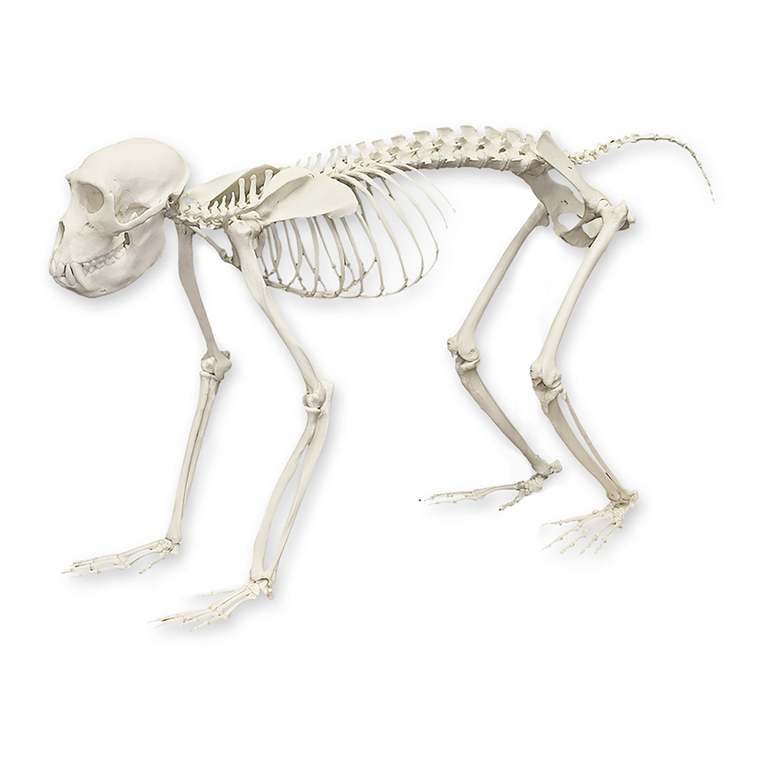
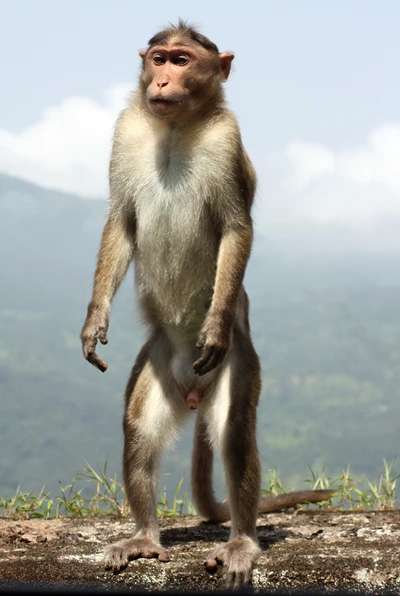
I studied primates in college. Monkeys usually walk on their palms (palmigrade) (fig. 3) and only stand when foraging, fighting, or carrying things. But I don’t recall the novel ever mentioning Sun traveling on all fours (please correct me if I’m wrong). Therefore, he likely walks on two legs. In this case, as stated, monkeys have a hunched posture when standing. They can’t stand straight because of mechanical limitations in their skull, spine, hips, legs, and feet (my previous essay on hominids applies to monkeys as well). One could argue that Monkey can overcome these limitations with his immortal body, but this definitely wouldn’t give him three more chi of height. For example, here’s a macaque standing at full height (fig. 4). As can be seen, straightening the head, spine, and legs would only give a handful of inches or centimeters.

Fig. 3 – A macaque skeleton in its natural posture (larger version). Fig. 4 – A young macaque male standing (larger version).

And as stated in this article, Sun shares all of the hallmarks of a macaque, including a “furry, joweless face with fiery eyes, a broken or flat nose, a beak-like mouth with protruding fangs, and forked ears.” This likely includes a smaller stature.

Of course, there is no doubt that he is very thin, and is definitely the shortest one in the scripture takers, but at least, his height is more like that of a shorter adult than a child. The role of Sun Wukong is a combination of human nature, monkey nature, and divinity. The author may be deliberately obscuring his height. Therefore, when describing daily life, Wukong is the same height as normal people, but in the eyes of other demons, he is more prominent in the shape of the monkey. And he has the divine power to change his height at will. Sorry for my bad English, really enjoyed your video!

I will concede that four chi is a rough estimate, so he might be slightly shorter or even taller than this. Either way, he’d be far below average human height.


Update: 03-06-22

Chapter 20 includes a scene where Monkey refers to his stature: “A person like me, old Monkey, may be small but tough, like the skin around a ball of ligaments!” (PDF page 246; Wu & Yu, 2012, vol. 1, p. 395).


Update: 03-08-22

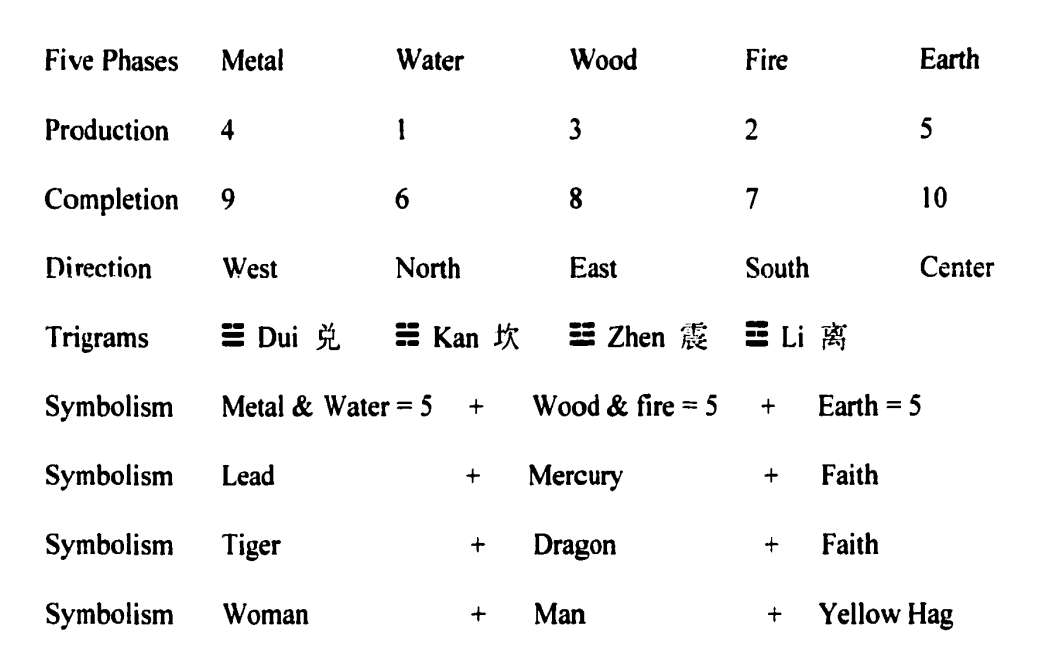
Above, I suggested that the ten minus three argument was a typo. But there might be a numerological explanation. Qing-era scholar Wang Xiangxu (汪象旭, fl.1605-1668) borrowed from the Daoist philosophy of Zhang Boduan (張伯端, 987?-1082) by applying his “three fives equal one” (sanwuyi, 三五一) five elements concept (fig. 5) to numbers appearing in the novel. As Shao (1997) explains:

One set of five consists of wood (3) and fire (2). Wood in the east produces fire in the south. The second set is that of metal (4) and water (1). Metal in the west produces water in the north. The third is earth in the center whose number is five. The whole business of the “gold elixir” is to integrate all three sets of five to produce one—the gold elixir (pp. 16-17).

Shao (1997) goes on to explain the numeric significance of the dharma vessel constructed from Sha Wujing’s 9-skull necklace and the heavenly gourd in chapter 22: 

Wang Xiangxu shows a keen eye for the “one” gourd and “nine” skulls which make a perfect “ten”—the number for the completion of earth. However, it is not the numbers that attract him, but what they indicate—that the gold elixir is creation—a process that involves the integration of all the five elements—not unlike the creation of the universe (p. 18).

Therefore, three (wood) and seven (fire) may be a reference to the completion of ten (the golden elixir) in Daoist numerology. If this is true, even the later switch from three to six still matches this (refer to fig. 5).

Fig. 5 – A chart explaining the three fives (larger version). From Shao, 1997, p. 17.


Update: 04-27-24

Chapter 37 gives a more precise measurement for Monkey’s height. He first transforms into a “tiny monk about two cun tall” (二寸長的小和尚兒) (based on Wu & Yu, 2012, vol. 2, p. 172). He shortly thereafter grows even bigger when a prince makes fun of him:

Tripitaka pulled open the box’s cover; Pilgrim [Sun Wukong] leaped out and began to hobble all over the place. The prince said, “This little midget! What can he know?” When Pilgrim heard this remark about his size, he at once resorted to magic. Straightening up his torso, he grew about three chi and four or five cun instantly (emphasis added). “If he can grow that rapidly,” said the soldiers, highly startled, “it will only be a few days before he pierces the sky.” When Pilgrim reached his normal height, however, he stopped growing (emphasis added) (based on Wu & Yu, 2012, vol. 2, pp. 174-175).

三藏扯開匣蓋兒,那行者跳將出來,呀的兩邊亂走。太子道:「這星星小人兒,能知甚事?」行者聞言嫌小,卻就使個神通,把腰伸一伸,就長了有三尺四五寸。眾軍士吃驚道:「若是這般快長,不消幾日,就撐破天也。」行者長到原身,就不長了。

As mentioned above, one chi (尺) is roughly 12.3 in or 31.8 cm (Jiang, 2005, p. xxxi). Expanding on this, one chi equals 10 cun (寸; a.k.a. “Chinese inches”) (Jiang, 2005, p. xxxi). One cun would be about 1.25 in or 3.18 cm. Two cun would therefore be 2.5 in or 6.36 cm. Growing the stated additional height would then put our hero at chi and 6 or 7 cun, which is roughly 3.86 ft or 1.176 m. This agrees with the aforementioned estimate of “not (or less than) four chi tall” (buman sichi不滿四尺) (Wu & Yu, 2012, vol. 1, pp. 128 and 408).

It’s important to note that the cited quote above does indeed appear in the original 1592 edition (see PDF page 480) (fig. 6). This proves that the aforementioned “grow three chi” (changle sanchi, 長了三尺) from PDF page 258 was a typo!

Fig. 6 – A scan from the original 1592 edition showing that Monkey only grows an additional “3 chi and 4 or 5 cun” (larger version). 

Sources:

Jiang, Y. (2005). The Great Ming Code / Da Ming Lu. Vancouver, Wa: University of Washington Press.

Nienhauser, W. H. (2016). Tang Dynasty Tales: A Guided Reader. Singapore: World Scientific.

Shao, P. (1997). Monkey and Chinese Scriptural Tradition: A Rereading of the Novel Xiyouji (UMI No. 9818173) [Doctoral dissertation, Washington University]. Available from ProQuest Dissertations and Theses database.

Wu, C., & Yu, A. C. (2012). The Journey to the West (Vols. 1-4) (Rev. ed.). Chicago, Illinois: University of Chicago Press.

Archive #26 – Bimawen, Heavenly Horses, and Dragon Horses in Chinese Literature and History

Last updated: 01-04-2025

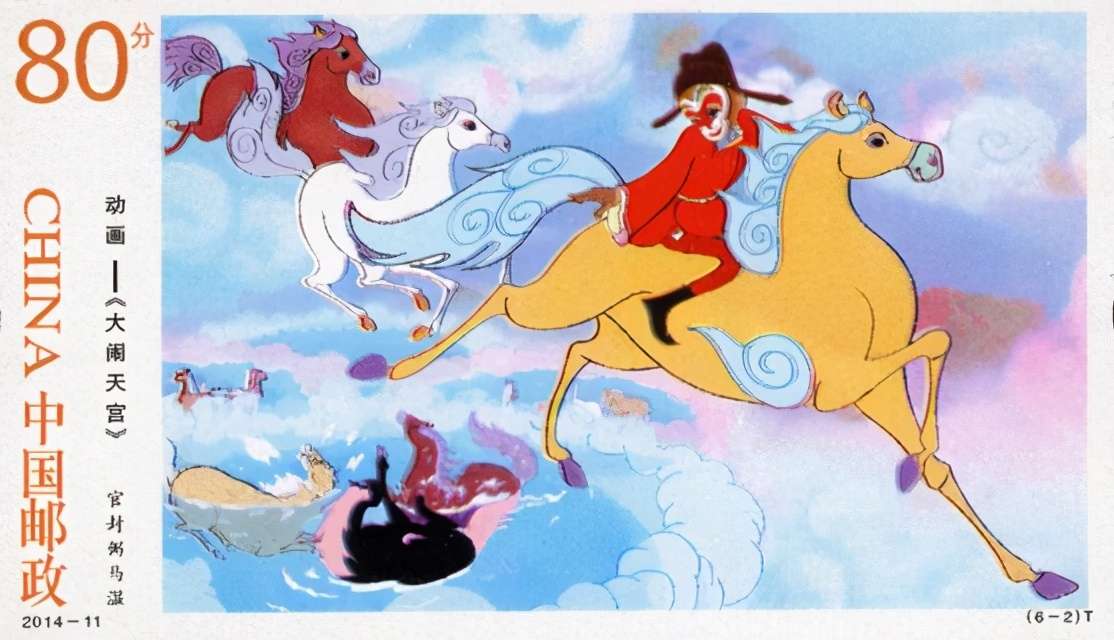
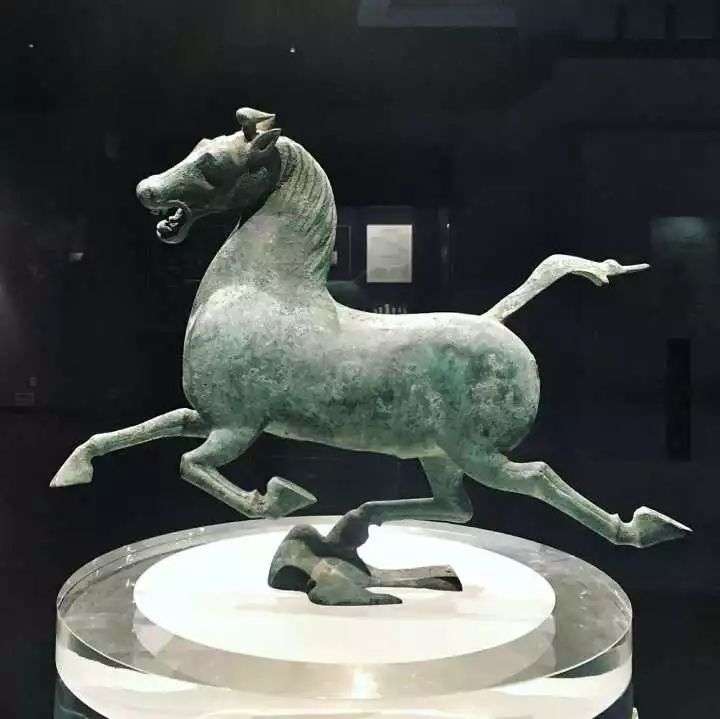
In chapter four of Journey to the West (Xiyouji, 西遊記, 1592), Sun Wukong is invited to heaven to serve as the Bimawen (弼馬溫, “To assist horse temperament”), a minor post overseeing the celestial horse stables (Wu & Yu, 2012, p. 148). He takes the position seriously, caring for nearly 1,000 horses day and night, making sure they are all well-fed, exercised, and rested (Wu & Yu, 2012, p. 149) (fig. 1). But these are no ordinary horses. A poem associates them with the most famous steeds in Chinese history (Wu & Yu, 2012, pp. 148-149), and most importantly, the last line states: “They tread the mist and mount the clouds with unflagging strength” (Wu & Yu, 2012, p. 149). This suggests that they have the supernatural ability to gallop through the skies (fig. 2). Additionally, the novel refers to them as “dragon horses” (long ma, 龍馬) (Wu & Yu, 2012, p. 309), which brings to mind the White Dragon Horse (Bai long ma, 白龍馬) that serves as Tripitaka‘s mount throughout the journey (Wu & Yu, 2012, p. 328).

Monkey’s position gives him power over all horses, especially those of mortal stock:

When the horse saw [Pilgrim], its torso slackened and its legs stiffened. In fear and trembling, it could hardly stand up. For you see, that monkey had been a [Bimawen], who used to look after dragon horses in the celestial stables. His authority was such that horses of this world inevitably would fear him when they saw him (Wu & Yu, 2012, p. 309). [1]

The heavenly post is a homophonous pun on Bimawen (避馬瘟, lit: “avoid the horse plague”), an ancient superstition where people would place monkeys in stables to ward off equine sickness. For example, Essential Techniques for the Common People (Qimin yaoshu, 齊民要術, c. 544) states: 

[Horses] are often associated with macaques [mihou, 猕猴] in the horse stable. This is in order to calm the horses, repel evil, and eliminate all diseases.

常系猕猴于马坊,令马不畏、辟恶、消百病也

The later Compendium of Materia Medica (Bencao gangmu, 本草綱目, 1596) mentions this concept twice. The first reads:

The Shuowen says: The characters (for macaque) look like “mother monkey” (muhou), but it’s “bathing monkey” (muhou, i.e. macaque), not a female. Since a macaque resembles a hu-barbarian, he is also called hu-sun “grandson of a barbarian”. The Zhuangzi calls him ju. People who raise horses keep a macaque in the stables, which will ward off horse-diseases. The Hu barbarians call a macaque maliu, in Sanskrit books he is called Mosizha (makaṭa). [2]

《说文》云︰为字象母猴之形。即沐猴也,非牝也。猴形似胡人,故曰胡孙。《庄子》谓之狙。养马者厩中畜之,能辟马病,胡俗称马留云。《梵书》谓之摩斯[咤]

The second explains how monkeys are believed to help the horses:

The Classic of Horses states: Domesticated macaques used in horse stables help avoid horse diseases [lit: bimawen]. Their monthly menstruation runs onto the grass, and once the horses eat it, they will never be sick.

《马经》言︰马厩畜母猴,辟马瘟疫。逐月有天癸流草上,马食之,永无疾病矣

This is insanely comical as it directly links Sun Wukong, a powerful cosmic warrior, to menstruation! This then might explain why Monkey is so enraged when enemies call him a Bimawen. As noted by my friend Irwen Wong of the Journey to the West Library blog, it challenges the Great Sage’s masculinity.

Essays

The following essay by Arthur Waley (1955), famed translator of the Journey to the West abridgement Monkey (1942), links heavenly horses to a historical breed from Central Asia, the Ferghana horse. He describes China invading the region to procure these horses by force, suggesting Emperor Wu of Han directed this action because the ruler believed the equines were dragon horses capable of transporting him to heaven. This is linked to stories of ancient Chinese rulers attaining immortality by riding horses or dragons to the celestial realm. Waley (1955) notes both the Chinese and Indians believed supernatural steeds hailed from the water, showing a link between horses and dragons.

But Creel (1982) refutes the claim that the heavenly horses were procured for purely religious reasons. He shows they were indeed used in military battles. 

Fig. 1 – A 2014 stamp featuring a scene from the classic 1960s animation Havoc in Heaven in which Sun Wukong serves as the keeper of the heavenly horses (larger version). Image found here. Fig. 2 – A photo of the famous circa 2nd-century BCE Flying Horse of Gansu (larger version). Image found here.

I. The Heavenly Horses of Ferghana

Individuals are not happy in proportion to the amount of space their persons occupy. Yet certain nations, at certain periods of their history, seem to take it for granted that the wider they spread themselves the happier they will be. China is a case in point. Why did this enormous country in the second century BC, in the first century AD and again at various later periods ruin itself by gratuitous westward expansion? Were her aims commercial or strategic? Was she defending her silk trade, or guarding against possible wars on two fronts? What part was played by the individual ambition of Emperors or generals, or by mere restlessness and love of adventure?

To answer these questions we should have to take the campaigns one by one. In doing so we should not be reduced to mere guesses. In Imperial edicts and addresses about military campaigns certain traditional pretences are, of course, kept up: ‘everything under Heaven’ belongs by right to the Chinese Emperor, and any peoples who do not think so must be chastised. Concrete and material motives for war are not always mentioned in these regal utterances, any more than an Address from the Throne (or its equivalent) in modern countries usually mentions petrol or rubber. But statesmen and officials were often quite frank about material motives for conquest: more so, I think, than is the case with us today. Thus, as justifying a proposal to secure from the Huns a strip of territory that projected into the Kansu corridor in north-western China the following reasons are given by a statesman in 8 BC: first, that it was a good source of supply for the sort of wood and feathers used in making arrows; secondly, that it would mean a large increase of Chinese territory, and lastly that it would give the general in command of the campaign a chance to win a big reputation. It is interesting to find that extension of territory is here regarded as an end in itself. Possibly supporters of the proposal might, if pressed, have pointed out as an afterthought that Chinese farmers could be settled in the new territory and that the taxes they paid would be a help to the exchequer.

The tendency of modern historians, and not only in Marxist countries, is to stress material and particularly economic motives for war, and to regard the profession of other motives as mere propaganda. In dealing with early Chinese history I do not think this view would generally lead us far astray, so long as we bear in mind the additional factor of personal ambition and the almost axiomatic belief that extension of territory was an end in itself. But I am going to deal with a case that seems to me to be exceptional. Oddly enough the early Chinese military adventure that modern scholars have most unanimously explained solely on materialist lines, seems, on closer examination, to have been to a large extent a religious quest

In 102. BC the Chinese Emperor Wu sent a huge military expedition (there had been a small and abortive one two years before) to Ta Yüan, corresponding roughly to the modern Ferghana in Russian Turkestan, to capture Heavenly Horses. Modern scholars, both Far Eastern and European, have usually assumed that the real object of the expedition was a purely practical one; namely, to secure a better type of cavalry horse. It is certain that by the middle of the second century AD the Chinese did possess two kinds of horse: a steppe-pony, with a large clumsy head, and a western type of horse, similar to that shown on Greek coins of the fourth to the second century BC, with small graceful head. It may well be that one of the results of the Ferghana expedition was the introduction of a western type of horse into China; and in the eyes of the generals and the horse-experts who accompanied them this may have been the main object as well as the result of the expeditions. But modern historians, intent on the very interesting material aspects of the episode, have tended to overlook its place (amply attested by contemporary texts) in the history of Chinese religion. Incidentally, by examining these texts more closely, I think one gets fresh light on what concretely and zoologically (as opposed to mythologically) the Heavenly Horses really were. I should mention that as a result of the expedition thirty or so ‘superior horses’ and 3,000 horses and mares of ‘middling or lower quality’ were handed over to the Chinese. How many of these survived the journey of 2,500 miles back to the Chinese capital we do not know. A few years later the king of Ferghana agreed to send two Heavenly Horses to China every year. I shall here be concerned only with the thirty ‘superior’ Or ‘Heavenly’ horses. There is no reason to suppose that the 3,000 inferior horses were of a type different from the usual Chinese horse. They may merely have been needed as remounts.

In studying what was said about the horses in contemporary Chinese literature the best point of departure is the hymn made in 101 B.C. when the horses were about to arrive at the Chinese capital :

The Heavenly Horses are coming,
Coming from the Far West.
They crossed the Flowing sands,
For the barbarians are conquered.
The Heavenly Horses are coming
That issued from the waters of a pool.
Two of them have tiger backs.
They can transform themselves like spirits.
The Heavenly Horses are coming
Across the pastureless wilds
A thousand leagues at a stretch,
Following the eastern road.
The Heavenly horses are coming.
Jupiter is in the Dragon.
Should they choose to soar aloft,
Who could keep pace with them?
The Heavenly Horses are coming;
Open the gates while there is time.
They will draw me up and carry me
To the Holy Mountain of K’un-lun.
The Heavenly Horses have come
And the Dragon will follow in their wake
I shall reach the Gates of Heaven,
I shall see the Palace of God.

This song has often been spoken of by western historians as though it were a purely secular literary poem. It is in reality one of a series of hymns written (possibly by the Emperor Wu himself, but the authorship is very uncertain) for use at the sacrifices to Heaven and Earth-sacred rituals performed by the Emperor in person. One or two of the phrases in it obviously need further explanation. Whether the people of Ferghana believed that their sacred horses ‘issued from a pool’ we do not know. But there are, apart from other instances of this belief elsewhere in Central Asia, many Chinese stories of horses coming up out of the water, the implication being that they are dragon-horses, that is to say, water-dragons who have changed themselves into horses, often retaining their dragon wings. As we shall see, the Emperor had been on the look-out for a water-born horse for some time. What is meant by ‘the Dragon will follow in their wake,’ more literally ‘they will be introducers of the Dragon’ ? The idea underlying these words is best illustrated by the following story, dating perhaps from some forty years earlier than the hymn: Recently a man who lived on the frontier lost his horse which ran away into the land of the barbarians. He was very much upset, and everyone condoled with him, except his father who remarked cheerfully, ‘This may be a blessing in disguise.’ And sure enough the lost horse came back bringing with it a ‘fine horse,’ that is to say, a horse of superior value and breed. The Emperor in this hymn hopes that the Ferghana horses would one day bring along a Dragon, a being even more magical than a Heavenly Horse.

The general implication of the hymn therefore is that the Heavenly Horses will carry the Emperor to the abode of the Immortals on the magical mountain K’un-lun. He imagines himself, I think, driving in a chariot drawn by horses rather than riding on horseback. Riding did not become common in China till the fourth century BC and was in the second century still felt ‘to be a utilitarian, unlegendary form of transport. More than this, the Ferghana horses being, as another hymn in the series says, ‘friends of the Dragon ‘ who is master of the clouds, will eventually carry him to Heaven, to the Abode of God-on-High-(Shang Ti).

The preceding hymn (No. 9 in the series), which is about the fleeting and uncertain nature of man’s life, ends with the words, ‘Why does not Tzu-huang come down to me?’ Tzu-huang was the horse with dragonwings that carried up the mythical Yellow Emperor to Heaven. There are many Chinese stories of legendary monarchs being carried up to Heaven by magic steeds; but it would be difficult to prove that any of them is older than the fourth century BC. It is interesting to compare these Chinese myths with Indian ideas about the relation of monarchs to magic steeds. In Indian legends the magic horse Valaha (‘Cloud’), is one of the ‘seven treasures’ of a great monarch. Valaha came up out of the sea, just as the Ferghana horse and others in which the Chinese were interested came up out of the water, and carried Simhala, the legendary founder of the Kingdom of Ceylon, back to India when he was on the verge of being eaten by female cannibals.

The Emperor Wu had, as I have mentioned, for some time past been on the look-out for a magic horse, ‘born from’ a stream. In 121 BC someone thought it worthwhile to report to the Court that a horse had come up out of a river to the north of the Ordos, the great square-shaped northern bend of the Yellow River. We have no details about this horse ; but in 113 BC another strange horse was not only seen but captured and sent to Court. A Chinese who in consequence of some misdemeanour had been sent to do service at the military colony near Tun-huang, on the northwest frontier, frequently saw a horse of strange appearance drinking in the river along with a number of wild horses. He tamed the strange horse by putting at the water-side a dummy figure of a man whose hands were bridle and halter. When the horse was used to this sight he substituted himself for the dummy, captured the horse and sent it to Court. In order to prove that the horse was ‘divine’ he pretended that it had come up from under the water. His story was evidently believed at the time, for this horse, too (like the Ferghana horses twelve years later), was made the subject of a hymn to be used in the Imperial sacrifices :

The Heavenly Horse comes down
A present from the Grand Unity,
Bedewed with red sweat
That foams in an ochre stream
Impatient of all restraint
And of abounding energy.
He treads the fleeting clouds,
Dim in his upward flight;
With smooth and easy gait
Covers a thousand leagues.

Historians of religion, particularly those of the Vienna school, regard as ‘the beginning of religion’ the belief in a supreme celestial deity who later becomes merely a vague memory and ultimately fades away or becomes merged in other, more concrete cults. The ‘Grand Unity‘ (or ‘Great Unique,” as one might also translate it) of this hymn has therefore particular interest as a religious phenomenon, being a supreme celestial deity whose origin (at any rate as a national cult), whose heydey and disappearance all take place before our eyes within a limited historical period. So far from belonging to a remote, ‘archaic’ past he begins, officially at any rate, in 133 B.C. Up till then the Grand Unity was a philosophic conception denoting the primal unity out of which grew the plurality of the universe as we know it. Sometimes the phrase is a synonym of Tao, the underlying principle of the Universe in Taoist philosophy. But in the second century BC a cult sprang up in which the Grand Unity figures not as a philosophic conception but as a personal divinity, the highest of all gods, worshipped with an elaborate ritual. About 133 BC a member of the Grand Unity sect prevailed on the Emperor Wu to make the whole Imperial cult centre round this deity. The Grand Unity maintained this position during several reigns and the cult was only brought to an end (along with many other religious innovations of Wu’s reign) in 32 BC.

I will leave aside for the moment the other points of interest in the Heavenly Horse hymn of 113 BC and note here that the Emperor’s search for immortality did not begin with his interest in divine horses. He had, as is well known, for long past been pursuing this quest on other lines. He had sent numerous and costly expeditions to the East in the hope of discovering islands inhabited by Immortals who might be persuaded to yield their secrets to him. He had dabbled in alchemy, in the belief that if he ate out of vessels made of alchemic gold he would live forever, or at any rate for a prodigiously long time. The expedition to fetch magic horses from the West was, it seems to me, merely a continuation of his earlier quests in the East. ‘The Emperor Wu,’ says Wen Ying in about AD 200, ‘had set his heart on immortality. He was always hoping that a Heavenly Horse would come and carry him to K’un-lun,’ the western Abode of the Immortals. At last when all his guests in the East had failed and when the Horse did not come of its own accord (as it had come to legendary Emperors in the past, both in India and in China) he determined, having known for long that the king of Ferghana had such horses, to wrest some from him by diplomacy or, if need be, by force.

We have seen, then, how the horses were regarded by the Chinese Emperor. Other people, less obsessed by magico-religious ideas, may have viewed them differently; but there is nothing in the Chinese sources to suggest that they were needed or used for military purposes. Naturally, the normal political excuses were made for the expedition. In a public proclamation the Emperor accused Ferghana of having killed two Chinese envoys on their way to the west and an Indian envoy who was on his way to China. The excuse has a familiar ring. One is reminded, for example, of the German seizure of Tsingtao in 1897, alleged to be a reprisal for the murder of the German missionaries Nies and Henle.

Another question clearly arises. How were the Heavenly Horses regarded by the king of Ferghana and what role did they play at his Court? It is generally assumed that they were battle-chargers. But I wonder whether their function was not perhaps something like that of the ten Nesaean horses ‘most gorgeously caparisoned,’ who in the procession of the Persian king Xerxes, as described in the seventh book of Herodotus, walked immediately in front of the sacred chariot of ‘Zeus’ ? ‘And it occurs to one that to this same category of ceremonial horse may very well belong the ten yellow mares of the Pazaryk grave mound, in the eastern Altai, preserved in a solid ice block. They form part of the burial gear of a semi-nomad chieftain who lived perhaps somewhere about the 5th century B.C. ‘They are,’ says the Swedish archaeologist Karl Jettmar, ‘certainly of the noblest breed. They resemble the best strains of Turkmenistan or Ferghana.’ Two of them have masks. One mask represents a deer or reindeer; the other, a composite mythological creature. They may well have been special horses used by a ruler for ritual purposes, and perhaps (as Jettmar suggests) they took part in the funeral procession, which like the Scythian funeral processions described’ by Herodotus may have travelled an immense way. Their mythological function may well have been to carry the dead Khan to Immortality, just as the horse Tzu-huang carried the legendary Chinese Yellow Emperor and as in historic times the Emperor Wu hoped to be carried by the Ferghana horses. One is reminded, again, of the ‘treasure-horses,’ blue-grey in colouring and with black heads (that is to say, descendants of the magic horse Valaha) and gorgeously caparisoned, who took part in the procession that brought the infant Buddha back from Lumbini to his father’s palace. If the function of the Heavenly Horses at the Ferghana Court was a ritual rather than a practical one it would well explain why the king was so anxious not to part with them and at one point even threatened to kill them all rather than let them fall into the hands of the Chinese.

Though the main subject of this essay is the relation between the Ferghana expeditions and the religious pre-occupations of the Chinesr Emperor, the texts we have studied do also tell us something about the physical characteristics of the Ferghana horses, and it may be worth while to close with a few remarks on this subject. The first of the two hymns mentions that two Heavenly Horses had stripy backs. Lydekker in The Horse and Its Relatives says : ‘It has been noticed that dun-coloured domesticated horses frequently show a tendency to develop … one or two transverse dark stripes across the shoulder, and another along the middle line.’ Such presumably were the two Ferghana horses, and the Chinese regarded them as ‘marked’ by heaven and consequently particularly sacred. The other physical characteristic commonly attributed to Ferghana horses is that they ‘sweated blood.’ This, as we have seen, was also said of the horse sent from near Tun-huang in 113 BC. Professor Dubs, in his valuable translation of the Han History, has suggested that the flow of blood was caused by lesions inflicted on the horses by a parasite with the intimidating name Parafilaria multipapillosa. There is in any case no question of this characteristic being merely legendary. In AD 78 the Emperor Chang gave one of his uncles ‘a Ferghana horse which bled from a small hole above its front upper leg.’ In the letter that accompanied this gift he said, ‘I had often heard the line in Emperor Wu’s song about the Heavenly Horse in which it is said that it is ‘ bedewed with red sweat,’ and I have now seen with my own eyes that this is actually the case.’ Presumably the ‘hole’ looked more like a pore in the skin than a wound, and therefore what came out of it was regarded as sweat rather than blood.

Nowhere, I think, is it said that they were larger than Chinese horses, though this has constantly been assumed by Western writers. The only horses that the Chinese at this period call big (ta) were to be found not in Ferghana but in Parthia. ‘They have the big horse and the big bird (ostrich),’ says the Han History. But there is no record of those huge Parthian steeds (no doubt the Parthikoi of Strabo, which he says were of the same build as the huge Nesaean horses) being brought to China.

To sum up: the accepted idea about the Ferghana expeditions is that the Emperor Wu sent them in order to obtain ‘horses larger and fleeter than the small steppe breed.” It is assumed that in this he was successful and that the ‘western’ type of horse seen in some of the second century A.D. grave-reliefs corresponds to the type of horse brought back from Ferghana in 101 BC. I would re-formulate this view as follows: The Emperor sent the expeditions in order to secure Heavenly Horses which would carry him to Heaven. There is no evidence that Heavenly Horses were used in battle either in Ferghana or China: If they had been they would hardly have remained long, as it were, ‘on the secret list.’ I’m inclined, to think that their function was a ritual one, both in Central Asia and in China. About the breed of the horses that the Emperor secured we know nothing. But it is reasonable to suppose that the existence of the ‘Western’ horse in China, in the second century AD was due to Chinese intercourse with the West from the second century BC onwards and that the Ferghana expedition, as an episode in this intercourse, may well have played its part in what was perhaps a gradual process. There is no justification for saying as Tam does that ‘the origin of the Ferghana horses must have been one of the great Parthian war-horses’ or that the Ferghana horses were ‘of the great Nesaean-Parthian breed.’.

Thus though my main object was to show that this episode cannot be properly understood without taking into account more than has hitherto been done its magico-religious aspects, my conclusions about its secular, concrete aspects are also somewhat different from those of my predecessors (Waley, 1955).

II. The Role of the Horse in Chinese History

Creel (1982) successfully refutes the former’s claim that the horses were procured for only religious reasons:

Waley, “Heavenly Horses of Ferghana,” 102, takes the position that the horses of Fergana were sought by the Han Emperor Wu “in order to secure Heavenly Horses which would carry him to Heaven.” He says that “there is no evidence that Heavenly Horses were used in battle either in Ferghana or in China.” (Ibid., 102.) But in fact, as we have seen, the use of Fergana horses in fighting is mentioned in Hou-Han-shu, 110A.4b. By speaking here of “Heavenly Horses” Waley is evading the real question: were horses obtained from Fergana used in battle in Han times? The answer is that they were. Waley also says: “Nowhere, I think, is it said that they [i.e., “Heavenly Horses”] were larger than Chinese horses, though this has constantly been assumed by Western writers.” (Ibid.) The evidence cited above certainly indicates that the Fergana horses were extremely large and that there is every reason to feel assured that they were much larger than most of the horses in China both in Han times and later. Further evidence against Waley’s view is the nature of the titles of the two men sent by the Emperor to Fergana “to select good horses.” (Shih-chi, 123.37.) These would appear to be ordinary official titles and refer to “managing horses” and “driving horses.” If the purpose had been primarily to select horses having special religious virtues, why did the Emperor not send men with religious qualifications? Certainly there was some religious aspect to this curious affair, and Waley has performed a service by emphasizing it. But in doing so he has given undue attention to a part of the evidence and neglected other parts of it entirely (p. 176 n. 66).

Please see the PDF below for the entire chapter.

Archive link

Click to access Herrlee-G.-Creel-What-Is-Taoism_-and-Other-Studies-in-Chinese-Cultural-History-1970-Ch.-8-on-Horses.pdf

Disclaimer:

These have been uploaded for educational purposes. No malicious copyright infringement is intended. If you enjoy the digital content, please support the official releases.


Update: 03-12-23

Twitter user Lava (@Lavaflowe) has allowed me to post their lovely drawing of Sun Wukong as the Bimanwen. The image is comically labeled “horse girl.” I especially love how he has transformed his magic staff into a pitchfork. Also, check out the hay covering his heavenly robes (fig. 4). That’s such a great detail.

Fig. 4 – Monkey as the Bimawen (larger version). The original tweet can be seen here.


Update: 01-04-25

I just posted an article about the White Dragon Horse.

Why Did the White Dragon Horse Burn His Father’s Pearls in Journey to the West?

Notes:

1) This power was given to Monkey by the Jade Emperor, who gives him the Bimawen post. This was pointed out to me by Irwen Wong of the Journey to the West Library blog.

2) The translation is partly based on Gulik, 1967, p. 35. I changed the Wade-Giles to pinyin.

Sources:

Creel, H. G. (1982). What is Taoism?: And other Studies in Chinese Cultural History. Chicago, Ill: University of Chicago Press.

Waley, A. (1955, February). The Heavenly Horses of Ferghana. History Today, 5, 95-103.

Wu, C., & Yu, A. C. (2012). The Journey to the West (Vol. 1) (Rev. ed.). Chicago, Illinois: University of Chicago Press.

What Does Zhu Bajie Look Like? A Resource for Artists and Cosplayers

Type “Zhu Bajie” (豬八戒) into Google images and you will generally see a cute or friendly-looking pig-man with pink skin, big ears, a short snout, and a large stomach, and he will inevitably be holding some form of metal rake. Most iterations will likely be based on the character’s iconic look from the classic 1986 TV show, which portrays him wearing a Ji Gong-style Buddhist hat (Ji Gong mao, 濟公帽) with a golden fillet (à la Sun Wukong), a handkerchief tied around his neck and a sash at his waist, and black monk’s robes open at the chest (fig. 1). You might even see a few images depicting Zhu as a hulking warrior, but rarely will you see him portrayed with dark skin. So how do these representations compare to his depiction in the novel, and who has produced the most authentic look? In this article I present Zhu’s literary description, along with ancient depictions that predate the novel. My hope is that the information will be both interesting and useful, especially for artists and cosplayers looking to make a more authentic design.

I should note that this is not meant to be an exhaustive survey, just a general overview.

Zhu Bajie In-Flames Action Figure- small

Fig. 1 – A modern action figure of Zhu Bajie from the 1986 TV show (larger version).

1. Ancient Depictions

Zhu’s earliest depictions hail from the 14th-century as he is a latecomer to the story cycle, postdating the appearance of Sun Wukong and Sha Wujing by centuries. He is featured on a ceramic pillow and an incense burner from late Yuan China, as well as a series of carvings on a stone pagoda from late Goryeo Korea. Each piece draws on the same motif, depicting Zhu as a pig-headed monk taking large strides as he shoulders his rake and/or leads the horse. Even in instances where the weapon and equine are not present, he’s depicted in the same general posture (fig. 2-4).

Korean Pagoda paper - Pigsy iconography comparison

Fig. 2 – Detail of Zhu from a Cizhou ware ceramic pillow. See here for the full image. Fig. 3 – Detail from the incense burner. See here for the full image. Fig. 4 – Detail from panel two of the Korean pagoda. Note the figure’s matching posture. See here for the full line drawing.

2. What the novel says

2.1. Physical appearance

A poem in chapter 8 contains the earliest reference to Zhu’s appearance:

Lips curled and twisted like dried lotus leaves;
Ears like rush-leaf fans [pushan, 蒲扇] and hard, gleaming eyes;
Gaping teeth as sharp as a fine steel file’s;
A long mouth wide open like a fire pot [huopen, 火盆].
[…] (Wu & Yu, 2012, vol. 1, p. 211).

Chapter 18 provides more detail about his bristly neck and dark skin:

“Well,” said old Mr. Gao, “when he first came, he was a stout, swarthy [hei, 黑; lit: “black”] fellow, but afterwards he turned into an idiot with huge ears and a long snout, with a great tuft of bristles [zongmao, 鬃毛; lit: “mane”] behind his head. His body became horribly coarse and hulking. In short, his whole appearance was that of a hog!” (Wu & Yu, 2012, vol. 1, p. 372).

When the violent gust of wind had gone by, there appeared in midair a monster who was ugly indeed. With his black face [hei lian, 黑臉] covered with short, stubby hair, his long snout and huge ears, he wore a cotton shirt that was neither quite green nor quite blue. A sort of spotted cotton handkerchief was tied round his head (Wu & Yu 2012, vol. 1, p. 375).

The mane on the back of Zhu’s head is such a prominent feature that he took it as his personal name: “[M]y surname is based on my appearance. Hence I am called Zhu ([豬] Hog), and my official name is Ganglie ([剛鬣] Stiff Bristles)” (Wu & Yu 2012, vol. 1, p. 376).

Chapter 19 shows he has hands and feet like a man:

The monster did indeed raise his rake high and bring it down with all his might; with a loud bang, the rake made sparks as it bounced back up. But the blow did not make so much as a scratch on Pilgrim’s head. The monster was so astounded that his hands [shou, 手] turned numb and his feet [jiao, 腳] grew weak (Wu & Yu 2012, vol. 1, pp. 383-384).

Compare this to the mention of hooves (ti, 蹄) when he transforms into a giant boar in chapter 67 (see section 2.2 below).

Chapter 29 gives the fullest description:

My elder disciple has the surname of Zhu, and his given names are Wuneng [悟能] and Eight Rules [Bajie, 八戒]. He has a long snout and fanglike teeth, tough bristles on the back of his head, and huge, fanlike ears. He is coarse and husky, and he causes even the wind to rise when he walks (Wu & Yu 2012, vol. 2, p. 51).

Chapter 85 reveals the shocking size of his snout:

A snout, pestlelike, over three Chinese feet long [san chi, 三尺, 3.15 feet/96 cm] [1]
And teeth protruding like silver prongs.
Bright like lightning a pair of eyeballs round,
Two ears that whip the wind in hu-hu [唿唿] sound.
Arrowlike hairs behind his head are seen;
His whole body’s skin is both coarse and black [qing, 青]. [2]
[…] (Wu & Yu 2012, vol. 4, p. 149).

Chapter 90 notes Zhu has a tail: “Seizing him by the bristles and the tail [wei, 尾], the two spirits hauled Eight Rules away to show him to the nine-headed lion, saying, “Grandmaster, we’ve caught one” (Wu & Yu 2012, vol. 4, p. 219).

We can see from these quotes several features that appear again and again. These include a bristly mane on the back of his head, fan-like ears, a big mouth with protruding fangs, an overly long snout, and a hulking body with black, furry skin. He is also said to have human hands and feet and a pig tail. This grotesque description greatly differs from his cutesy appearance in modern media. It’s important to note that, just like Sun Wukong, Zhu was modeled on a real life animal. In this case, he shares many of his monstrous qualities with the wild boar (yezhu, 野豬) (fig. 5 & 6).

While the novel doesn’t give an exact height for our hero, the cited attributes do provide clues as to his general size. First and foremost is Tripitaka‘s statement: “[H]e causes even the wind to rise when he walks” (Wu & Yu 2012, vol. 2, p. 51). Obviously something capable of stirring the wind just from moving is going to be really big. Then there is Zhu’s 3.15 foot (96 cm) snout, which is over half the height of an average person. This suggests he’s several feet taller than a human. Furthermore, the novel states Sha Wujing is a whopping twelve Chinese feet (zhang er, 丈二; 12.6 feet / 3.84 m) tall (Wu & Yu 2012, vol. 2, p. 51). [3] Zhu is likely shorter than Sha as the latter’s height is specifically mentioned. So I would guess that he is at least 10 feet (roughly 3 m) tall. Zhu’s size is highlighted in some lovely online art (fig. 7 & 8).

Fig. 5 – A pack of running Visayan warty pigs (larger version). Image found here. Fig. 6 – An Indian boar (larger version). Check out that cool hair!!! Fig. 7 – The relative sizes of the pilgrims (larger version). As noted, I believe Zhu is probably shorter than Sha. Fig. 8 – The disciples on patrol (larger version). This is my favorite. Images found here. Artwork by @真·迪绝人 (see here and here).

2.2. Original form?

Zhu provides two contradictory origins for himself, which have implications for what his true form may be and why he looks the way he does in the novel. [5] A biographical poem in chapter 19 explains he was once a wayward, lazy youth who took up Daoist cultivation and later rose on clouds to receive celestial rank in heaven. But his immortal spirit was eventually exiled for drunkenly forcing himself on the moon goddess and mistakenly regained corporeal form in the womb of a sow, becoming the pig spirit that we know today (Wu & Yu 2012, vol. 1, pp. 378-379). [6] However, a poem in chapter 85 implies he was already a powerful pig monster who was given celestial rank but later exiled for drunkenly mocking the moon goddess, destroying Laozi‘s palace, and eating the Queen Mother‘s magic herbs (Wu & Yu 2012, vol. 4, p. 149). The latter origin might be represented in chapter 67 when Zhu transforms into a gigantic boar (fig. 9):

A long snout and short hair—all rather plump.
He fed on herbs of the mountain since his youth.
A black face with round eyes like the sun and moon;
A round head with huge ears like plantain leaves.
His bones were made lasting as Heaven’s age;
Tougher than iron was his thick skin refined.
In deep nasal tones he made his oink-oink cry.
What gutteral grunts when he puffed and huffed!
Four white hoofs [ti, 蹄] standing a thousand feet tall;
Swordlike bristles topped a thousand-foot frame. [7]
Mankind had long seen fatted pigs and swine,
But never till today this old hog elf [lao zhu xiao, 老豬魈].
The Tang Monk and the people all gave praise;
At such high magic pow’r they were amazed (Wu & Yu 2012, vol. 3, p. 253).

Fig. 9 – Zhu’s giant boar form from the manhua Journey to the West (Xiyouji, 西遊記) (larger version).

2.3. Clothing

Zhu is not associated in popular culture with any specialized clothing or adornments like Sun Wukong, who’s very name brings to mind the golden fillet, a tiger skin kilt, and golden armor with a feather cap. But several later chapters do mention our pig hero wearing a “black brocade zhiduo robe” (zao jin zhiduo, 皂錦直裰) (ch. 55, 61, 72, & 86) or just a “black zhiduo robe” (zao zhiduo, 皂直裰) (ch. 63, 67, & 84). [4] The zhiduo robe is known colloquially in English as “Buddhist monk” or “Taoist monk” robes. Also called haiqing (海青), such garments reach almost to the ground and have long, broad sleeves. The robe is closed by a tie on the right side of the torso (fig. 10; also refer back to fig. 7).

Fig. 10 – A zhiduo/haiqing robe (larger version). Image found here. Imagine this robe with black cloth.

2.4. The rake

Zhu’s signature weapon is first mentioned in chapter 8. A line from his introductory poem reads: “He holds a rake—a dragon’s outstretched claws” (Wu & Yu, 2012, vol. 1, p. 211). The most detailed description appears in chapter 19:

This is divine bin steel greatly refined, [8]
Polished so highly that it glows and shines.
Laozi wielded the large hammer and tong;
Mars himself added charcoals piece by piece.
Five Kings of Five Quarters applied their schemes;
The Six Ding and Six Jia Spirits expended all their skills. [9]
They made nine prongs like dangling teeth of jade,
And double rings were cast with dropping gold leaves.
Decked with Five Stars and Six Celestial Bodies, [10]
Its frame conformed to eight spans and four climes.
Its whole length set to match the cosmic scheme
Accorded with yin yang, with the sun and moon:
Hexagram Spirit Generals etched as Heaven ruled;
Eight-Trigram Stars stood in ranks and files.
They named this the High Treasure Golden Rake, [Shang bao qin jin pa, 上寶沁金鈀]
[…] (Wu & Yu, 2012, vol. 1, p. 382).

So we see the rake has nine jade-like teeth and a bin steel body decorated with two golden rings and inscriptions of the sun, moon, and planets, as well as hexagram and eight-trigram symbols. The exact position of the rings is not specified, but one online drawing shows them at each end of the rake head (refer back to fig. 8). This might be a reference to the rings capping the ends of Sun’s weapon. While the weight is not listed on the rake like the Monkey King’s staff, chapter 88 states it is 5,048 catties (wuqian ling sishiba jin, 五千零四十八斤; 6,566 lbs. / 2,978.28 kg), [11] or the weight of the Buddhist canon (Wu & Yu, 2012, vol. 4, p. 200). [12]

Since the rake’s literary description is more vague than that of Wukong’s staff, my normally strict views on the accuracy of the disciples’ weapons in various media don’t really apply in this case. This is especially true as even historical depictions are all over the place (fig. 11-13). I think the monstrous pig face on the rake from the 1986 TV show-inspired action figure is really neat (refer back to fig. 1). Another favorite of mine is the spiky rake from the ongoing manhua The Westward (Xixingji, 西行記, 2015-present) (fig. 13).

Fig. 11 – A print of Zhu vs Sha Wujing from the Shide tang edition (1592) of the novel (larger version). The weapon is portrayed as a war rake used by the Chinese military. Fig. 12 – His rake is depicted as a wolftooth club in Mr. Li Zhuowu’s Criticism (late-16th/early-17th-century) (larger version). Fig. 13 – Zhu (top) wields the rake against his evil brother (bottom) in The Westward (larger version). This brother is not a character in the original novel.

The following two sections include a small sampling of what I consider to be the least and most accurate portrayals in past and modern media. These are presented in no particular order.

3.1. The least accurate

1) Journey to the West (1996/1998) – It’s like the show’s creators purposely went in the opposite direction. Instead of big, black, and scary, they went with small, pink, and cute (fig. 14).

Fig. 14 – Wayne Lai as the adorable pig spirit (larger version).

2) The Monkey King 2 & 3 (2016/2018) – It’s the same as before but minus the hair (fig. 15).

Fig. 15 – Xiaoshenyang as the fake hero (larger version).

3) The Precious Lotus Lantern (Baolian deng, 寶蓮燈, 2005) – And then there’s this mess… (fig. 16).

Fig. 16 – Xie Ning (谢宁) as “Spaghetti Head” Zhu (larger version).

3.2. The most accurate

1) The Westward (Xixingji, 西行記, 2015-present) – This is perhaps the closest to his literary description (but his body and hair should be darker) (fig. 17). Admittedly, this is not the character’s original form. The manhua portrays Zhu as a small, pink pig-man who needs to absorb energy from the surrounding environment in order to achieve this monstrous transformation.

Fig. 17 – Zhu’s ultimate form (larger version).

2) Journey to the West (2011) – This is how Zhu is portrayed when he’s still a monster (fig. 18). He has the dark skin, fangs, and mane. But he later changes to a friendly, pink pig-man once subjugated.

Fig. 18 – Zang Jinsheng as the armored pig monster (larger version).

3) The Cave of the Silken Web (1927) – While missing his bristly mane, Zhu is portrayed with a long snout, big ears, and, most importantly, black skin (fig. 19). He is also wearing a black zhiduo robe. Thanks to Irwen Wong for suggesting this entry.

Fig. 19 – Zhou Hongquan (周鴻泉) as Zhu in The Cave of the Silken Web (1927) (larger version).

4. Conclusion

While modern media often depicts Zhu as a friendly-looking, pink pig-man, the novel describes him as a giant pig monster with a bristly mane on the back of his head, fan-like ears, a big mouth with protruding fangs, a three-foot-long snout, and a hulking body with black, furry skin, human hands and feet, and a pig tail. He wears a black zhiduo robe. His 3.28 ton bin steel rake has nine jade-like teeth, two golden rings (possibly adorning the ends of the head), and a body inscribed with the sun, moon, and planets and hexagram and eight-trigram symbols. Needless to say, the literary Zhu is far more imposing than his modern, family friendly persona.

Notes:

1) The Chinese foot (chi, 尺) was slightly longer than the modern western foot (12 in/30.48 cm). The Board of Works (Yingzao, 營造) of the Ming and Qing standardized the measurement at 32 cm (12.59 in), though it varied at the local level and at different times (Ruitenbeek, 1996, Chinese Dynasties and Chinese Measurements section). I’m basing the length given in the novel on that from the Board of Works as the novel was published during the Ming dynasty.

2) The original English translation says “green” (Wu & Yu 2012, vol. 4, p. 149). However, there are times when it refers to black. For example, the phrase “The black ox goes west” (qing niu xi qu, 青牛西去) references Laozi and the Daodejing (Ma & van Brakel, 2016, p. 328 n. 71). In addition, the novel previously refers to Zhu having a “black face” (hei lian, 黑臉) (Wu & Yu 2012, vol. 1, p. 375).

3) This recalls the origin of the immortal Iron Crutch Li (Li tieguai, 李鐵拐), whose body was prematurely burnt by a disciple while his celestial spirit traveled to heaven. Upon his return, Li was forced to take corporeal form in the body of a recently deceased cripple.

4) Yu (Wu & Yu, 2012) translates the garment as “black cloth shirt” (Wu & Yu 2012, vol. 3, p. 253, for example).

5) Thank you to Irwen Wong and Anthony “Antz” Chong for bringing this to my attention.

6) See note #1 for how this measurement is calculated.

7) The original English translation says “hundred-yard” (Wu & Yu 2012, vol. 3, p. 253). However, the Chinese states 百丈 (bai zhang), or 100 x 10 Chinese feet, which of course equals 1,000 feet.

8) The original English translation/Chinese text states “divine ice steel” (shen bing tie, 神冰鐵) (Wu & Yu, 2012, vol. 1, p. 382). However, this is likely an error for “divine bin steel” (shen bin tie, 神鑌鐵) as bing (冰) and bin (鑌) sound similar. Bin steel (bin tie, 鑌鐵) was a high quality metal originally imported from Persia before the secret of its manufacture reached China in the 12th-century. It is mentioned a few times in the novel, including being associated with Monkey’s staff in one instance (Wu & Yu, 2012, vol. 3, p. 375).

I’ve made several changes to the translation from this point forward to better accord with the original Chinese.

9) The “Six Ding and Six Jia” (六丁六甲, Liuding liujia) are protector spirits of Daoism (Mugitani, 2008).

10) The “Five Stars” (wuxing, 五星) refer to Mercury (shuixing, 水星), Venus (jinxing, 金星), Jupiter (muxing, 木星), Mars (huoxing, 火星), and Saturn (tuxing, 土星). The Six Celestial Bodies (liuyao, 六曜) refer to the sun (taiyang/ri, 太陽/日) and moon (taiyin/yue, 太陰/月) and the four hidden pseudo-planets Yuebei (月孛), Ziqi (紫氣), Luohou (羅睺), and Jidu (計都). Combined, they are called the “Eleven Luminaries” (shiyi yao, 十一 曜), and these are sometimes broken into the “Seven Governors and Four Hidden Luminaries” (qizheng siyu, 七政四余) (Wang, 2020, pp. 169-170; Hart, 2010, p. 145 n. 43).

11) The original English translation says “five thousand and forty-eight pounds” (Wu & Yu, 2012, vol. 4, p. 200). However, the Chinese version uses jin (斤), known in English as “catty“. The catty and pound are two different measures of weight, the former being heavier than the latter. Therefore, the English text has been altered to show this. The catty during the Ming Dynasty when the novel was compiled equaled 590 grams (Elvin, 2004, p. 491 n. 133), so 5,048 catties would equal 6,566 lbs. or 2,978.28 kg.

12) Yu (Wu & Yu, 2012) notes popular belief held that the Buddhist canon was comprised of 5,048 scrolls (vol. 4, p. 396 n. 7). I’m not sure if the rake’s weight was purely based on the number of scrolls, or if each scroll was believed to weigh one catty.

Sources:

Hart, R. (2010). The Chinese Roots of Linear Algebra. United States: Johns Hopkins University Press.

Ma, L., & van Brakel, J. (2016). Fundamentals of Comparative and Intercultural Philosophy. United States: State University of New York Press.

Mugitani, K. (2008). Liujia and Liuding. In F. Pregadio (Ed.), The Encyclopedia of Taoism (vol. 1-2) (pp. 695-697). Longdon: Routledge.

Ruitenbeek, K. (1996). Carpentry and Building in Late Imperial China: A Study of the Fifteenth-century Carpenter’s Manual, Lu Ban Jing. Germany: E.J. Brill.

Wang, X. (2020). Physiognomy in Ming China: Fortune and the Body. Netherlands: Brill.

Wu, C., & Yu, A. C. (2012). The Journey to the West (vol. 1-4). Chicago, Illinois: University of Chicago Press.