When was the Monkey King Born?

Last updated: 04-02-2021

From time to time I like to post a fun blog not directly related to (though sometimes informed by) my research. Past examples can be seen herehere, and here. Regular articles will resume after this entry.

I was recently contacted by someone writing a fanfiction about Journey to the West (Xiyou ji西遊記, 1592 CE) and asked when the Monkey King was born from stone. I have, therefore, decided to write an entry for those interested in the subject. I will start at the end of the novel and work my way backwards. However, it is important to note that the years presented here are guesstimates and should not be taken as wholly accurate considering that the novel does not follow a strict historical timeline.

I should also point out that this has nothing to do with Sun Wukong’s religious birthday, which is variously celebrated on the sixteenth day of the eighth lunar month in Hong Kong and Singapore (Elliott, 1955/1990, p. 82), the twenty-third (Fuzhou) or twenty-fifth day (Putian) of the second lunar month in Fujian (Doolittle, 1865, vol. 1, pp. 288; Dean & Zheng, 2010, p. 162, for example), and the twelfth day of the tenth lunar month (Taiwan) (see here).

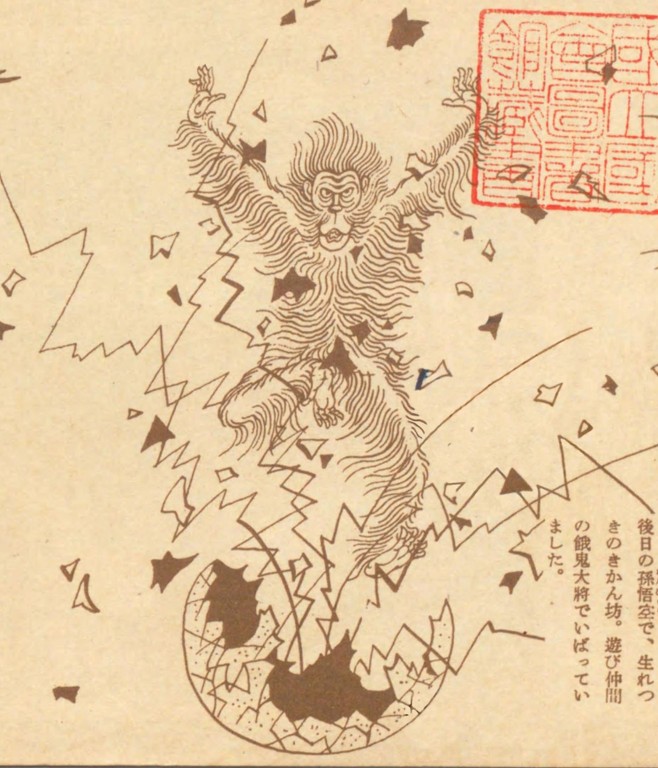
Monkey’s birth from stone (larger version). From The Illustrated Journey to the West (1950).

Table of Contents

1. Chapter 100

Upon the pilgrims’ return to China from India, Tang Emperor Taizong tells Tripitaka: “We have caused you the trouble of taking a long journey. This is now the twenty-seventh year of the Zhenguan period!” (Wu & Yu, vol. 4, p. 374). It should be noted that this era historically lasted from 627 to 650 CE (Zhang, 2015, p. 49). So, the novel dates their return to 654 CE, adding four fictional years to the reign period.

The historical Xuanzang returned in 645 CE (Buswell & Lopez, 2014, p. 1015).

2. Chapters 13 & 14

In chapter fourteen, Tripitaka releases Wukong from under the Mountain of Two Frontiers (a.k.a. Five Elements Mountain) a short time after leaving the confines of the Chinese empire. But prior to taking Monkey as a disciple, he is briefly guarded by the hunter Liu Boqin on his trek westward. Liu tells Tripitaka the history of the area during their journey across the mountain: “A few years ago, I heard from my elders that during the time when Wang Mang usurped the throne of the Han emperor, this mountain fell from Heaven with a divine monkey clamped beneath it” (Wu & Yu, vol. 1, p. 306). [1] The former Han official Wang Mang historically ruled from 9 BCE–23 CE (Bielenstein, 1986). I will return to this point below.

Chapter thirteen states Tripitaka leaves from Chang’anon the third day before the fifteenth of the ninth month in the thirteenth year of the period Zhenguan” (Wu & Yu, vol. 1, p. 293). This dates his departure to the year 640 CE.

The historical Xuanzang left China in 627 CE (Buswell & Lopez, 2014, p. 1015).

3. Chapters 7 & 8

In the beginning of chapter eight, the Buddha says: “We do not know how much time has passed here since I subdued the wily monkey and pacified Heaven, but I suppose at least half a millennium has gone by in the worldly realm…” (Wu & Yu, 2012, vol. 1, p. 203). But as noted above, Wukong is imprisoned during the reign of Wang Mang (r. 9 BCE–23 CE). Therefore, if he is discovered in 640 CE, this means Monkey’s imprisonment lasts anywhere from 617 to 649 years and not 500 as is commonly thought.

Prior to his wager with the Buddha in chapter seven, Wukong is placed into Laozi’s eight trigrams furnace. The novel reads: “Truly time passed swiftly, and the forty-ninth day arrived imperceptibly” (Wu & Yu, 2012, vol. 1, p. 189). But the narrative previously revealed that “one day in heaven is equal to one year on Earth” (Wu & Yu, 2012, vol. 1, pp. 150 and 167). So, this means his turn in the furnace lasts close to fifty years, starting between 40–26 BCE.

4. Chapter 5

Following Monkey’s initial rebellion and being granted the empty title “Great Sage Equaling Heaven,” he is appointed the guardian of the immortal peach groves. He later flees back to earth after eating the life-prolonging fruits and wreaking havoc on the Queen Mother’s peach banquet. Upon his return, his commanders ask him: “The Great Sage has been living for over a century (emphasis added) in Heaven. May we ask what appointment he actually received?” (Wu & Yu, 2012, vol. 1, p. 166). [2] This dates his ascension to heaven somewhere below the range of 140–126 BCE (150–136 BCE?). I obviously can’t provide a more precise number given the vague language.

5. Chapters 3 & 4 – Answer

After Wukong bullies the Eastern Dragon King and the Judges of Hell, Heaven appoints him the “Keeper of the Heavenly Horses” in order to keep his unruly adventures in check. But upon learning that his position is the lowest in heaven, he returns home in rebellion. His children ask, “Having gone to the region above for more than ten years (emphasis added), you must be returning in success and glory” (Wu & Yu, 2012, vol. 1, p. 150). [3] This dates his first ascension somewhere below the range 150–136 BCE (160–146 BCE?). Again, I can’t provide a more precise number given the vague language.

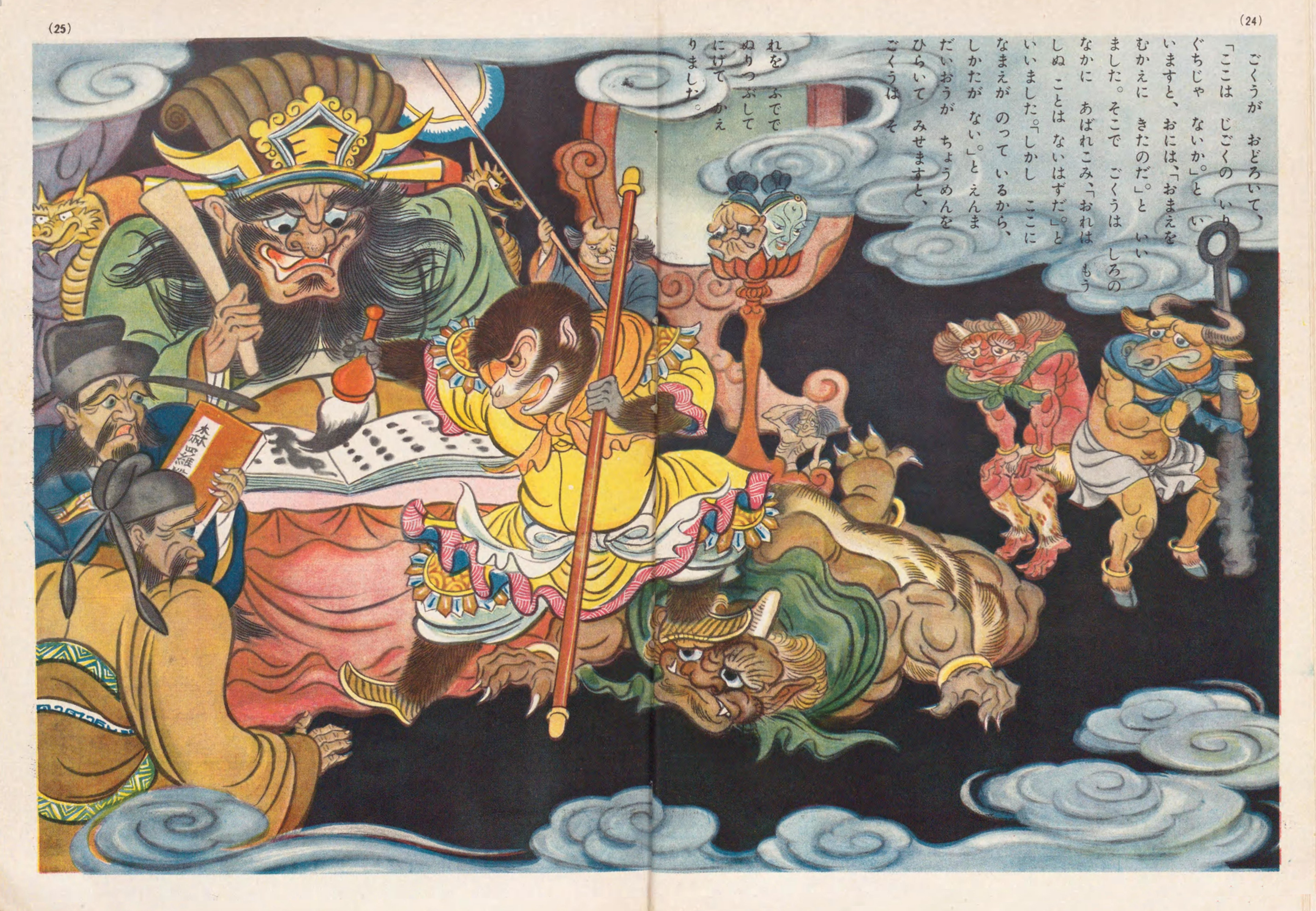
During his time in Hell, Monkey calls for the ledger containing his information. Under a heading marked “Soul 1350,” Wukong reads, “Heaven-born Stone Monkey. Age: three hundred and forty-two years. A good end” (Wu & Yu, 2012, vol. 1, p. 140). [4] If we use 160–146 BCE as a conservative estimate for his first ascension, then this dates his birth to somewhere between 502–488 BCE during the Zhou Dynasty (c. 1046–256 BCE). I think 500 BCE is a nice round number.

This means that Sun Wukong is roughly 1,100-years-old when he attains Buddhahood at the end of the novel.
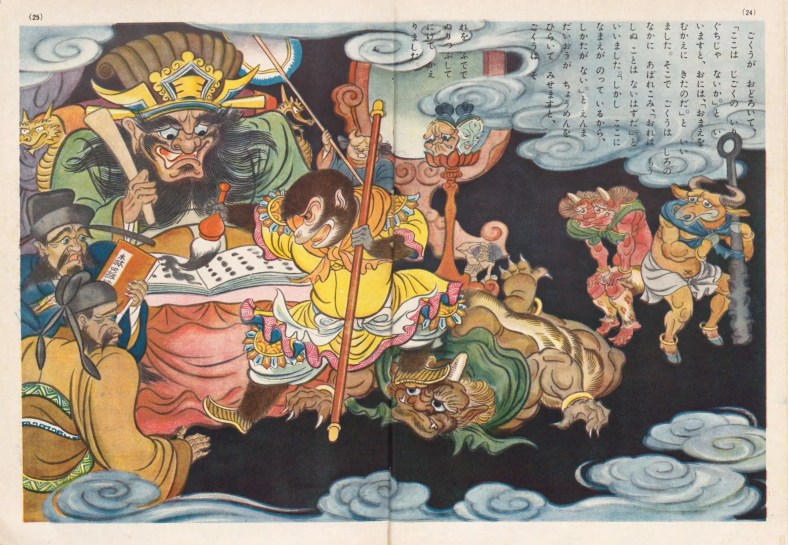
Monkey strikes his name from the Book of Life and Death in Hell (larger version). From Son Goku (1939).


6. Updates

Update: 07-08-20

The novel suggests a two hour window for the time of Wukong’s birth. This takes place in chapter 61 when Monkey is preparing to battle the Bull Demon King over the palm-leaf fan. Our hero recites an emboldening poem, to which Zhu Bajie replies:

Yes! Yes! Yes!
Go! Go! Go!
Who cares if the Bull King says yes or no!
Wood’s born at Boar,
the hog’s its proper mate,
Who’ll lead back the Bull to return to earth.
Monkey is the metal born under shen (emphasis added):
Peaceful and docile, how harmonious!
Use the palm-leaf
As water’s sign.
When flames are extinct, Completion’s attained.
In hard work we persist both night and day
And rush, merit done, to Ullambana Feast (Wu & Yu, 2012, vol. 3, p. 154). 

是是是,去去去,管甚牛王會不會。
木生在亥配為豬,牽轉牛兒歸土類。
申下生金本是猴,無刑無剋多和氣
用芭蕉,為水意,焰火消除成既濟。
晝夜休離苦盡功,功完趕赴盂蘭會。

The monkey is one of twelve animals of the Chinese zodiac, each corresponding to an earthly branch, an elemental phase, and a time period. The monkey is born under the shen (申) branch, which is associated with metal and the hours 3:00 PM to 5:00 PM.


Update: 04-02-21

As I explain in this article, Wukong learns the 72 transformations in order to escape a trio of heaven-sent punishments scheduled to kill him for defying his fate and achieving immortality. The calamities of thunder, fire, and wind respectively come every 500 years (after the initial attainment of eternal life) to kill Daoist cultivators. Monkey becomes an immortal around his 342nd year when his soul is taken to Hell. He is immortal for over 160 years [5] at the time he’s imprisoned under Five Elements Mountain. This means his 500th year of immortality, the year that the calamity of thunder would be scheduled to strike him, takes place during his imprisonment under the celestial mountain. But this is never described in the story. I assume this is just one of many inconsistencies born from oral storytelling. Although, one could argue that, within the fictional universe, the thunder calamity was voided since Wukong was undergoing punishment at the behest of the Buddha.

Notes:

1) I am indebted to Irwen Wong for bringing this passage to my attention.

2) Wukong, however, questions this estimate, saying: “I recall that it’s been but half a year…How can you talk of a century?” (Wu & Yu, 2012, vol. 1, p. 167). But, earlier in the novel, a wise member of Monkey’s tribe points out that one’s view of time is skewed while inhabiting the celestial realm: “You are not aware of time and seasons when you are in Heaven” (Wu & Yu, 2012, vol. 1, p. 150). Add to this the established fact that one heavenly day equals one solar year. Therefore, the Great Sage’s recollection of the passage of time is unreliable.

3) Monkey also questions this estimate: “I have been away for only half a month…How can it be more than ten years” (Wu & Yu, 2012, vol. 1, p. 150). But, again, his recollections are not reliable. See note #2.

4) These include three years as Subodhi’s student (Wu & Yu, 2012, vol. 1, p. 121), seven as a junior monk (Wu & Yu, 2012, vol. 1, p. 117), and “more than ten years” searching the world for a master (Wu & Yu, 2012, vol. 1, p. 114).

5) As previously mentioned, Wukong serves in heaven twice: first “for more than ten years” and second “for over a century” (Wu & Yu, 2012, vol. 1, pp. 150 and 166). Then he is punished to 49 heavenly days/49 solar years in Laozi’s furnace (see above).

Sources:

Bielenstein, H. (1986). Wang Mang, the Restoration of the Han Dynasty, and Later Han. In D. Twitchett and M. Loewe (Ed.). The Cambridge History of China: Volume 1, The Ch’in and Han Empires, 221 BC-AD 220 (pp. 223-290). Kiribati: Cambridge University Press.

Buswell, R. E., & Lopez, D. S. (2014). The Princeton Dictionary of Buddhism. Princeton, NJ: Princeton University Press.

Dean, K., & Zheng, Z. (2010). Ritual Alliances of the Putian plain. Volume Two: A Survey of Village Temples and Ritual Activities. Leiden: Brill.

Doolittle, J. (1865). Social Life of the Chinese: With Some Account of Their Religious, Governmental, Educational, and Business Customs and Opinions. With Special but not Exclusive Reference to Fuhchau (vol. 1 and 2). New York: Harper & Brothers.

Elliott, A. J. (1990). Chinese Spirit-Medium Cults in Singapore. London: The Athlone Press. (Original work published 1955)

Wu, C., & Yu, A. C. (2012). The Journey to the West (vol. 1-4) (Rev. ed.). Chicago, Illinois: University of Chicago Press.

Zhang, Q. (2015). An Introduction to Chinese History and Culture. Belgium: Springer Berlin Heidelberg.

Story Idea: Sun Wukong Animated Music Short

From time to time I like to post a fun blog not directly related to (though sometimes informed by) my research. Past examples can be seen here and here. Regular articles will resume after this entry.

Back in 2010 I dreamed up an animation based around a modern adaptation of “In the Hall of the Mountain King” by the Finnish operatic metal band Apocalyptica. The original version of the song was composed by Edvard Grieg for Henrik Ibsen‘s play Peer Gynt in 1876. The play is based on an old Norwegian tale about a man named Per Gynt who travels the land rescuing maidens from the clutches of trolls. The music is used during the play to enhance the drama and action of a particular scene where Peer attempts to hide and then escape from the hall of the mountain king. This plot obviously shares many similarities with Journey to the West. Sun Wukong spends the majority of the novel rescuing Tripitaka from the mountain strongholds of various demon kings.

The animation would be completely silent to accommodate the music, the various notes acting as dialogue or sound effects. Below, I present the story with time stamps to indicate when the events are to take place. I recommend reading the material once, then listening to the song, and finally reading and listening in unison to better understand. You can possibly use the stopwatch on your phone and start it the same time as the music.

Apocalyptica’s arrangement of “In the Hall of the Mountain King”.

0:00 – 0:29 – The scene opens in a cave where a mountain demon is celebrating news that the Tang monk is headed to his territory. An imp runs in to inform him that Tripitaka has been spotted in the mountain with only two of his three disciples.

0:30 – 1:03 – The demon king leaves the cave and silently spies on them from afar as Tripitaka on his dragon-horse, Zhu Bajie and Sha Wujing walk down a path through the mountains. When it’s obvious that Wukong is off running errands for his master, the demon magically disguises himself as an elderly man or woman and waits for them, drawing them near.

  • The notes in this section sound like someone is sneaking around.

1:04 – 1:42 – He reveals his true form, grabs the monk, and orders his imps to attack Zhu Bajie and Sha Wujing. The two fight but are over powered by sheer numbers.

  • The change up from the sneaky notes is when he reveals his true self.
  • Each of the high-pitched notes here represent imps attacking the disciples in wave after wave, coming faster and faster until they are overwhelmed.

1:43 – 1:52 – The monk calls out Sun Wukong’s name. I imagine the words would come out as Chinese characters that drift through the air to Monkey’s ear. He forcefully turns his head towards the sound, his eyes flash with a fiery light.

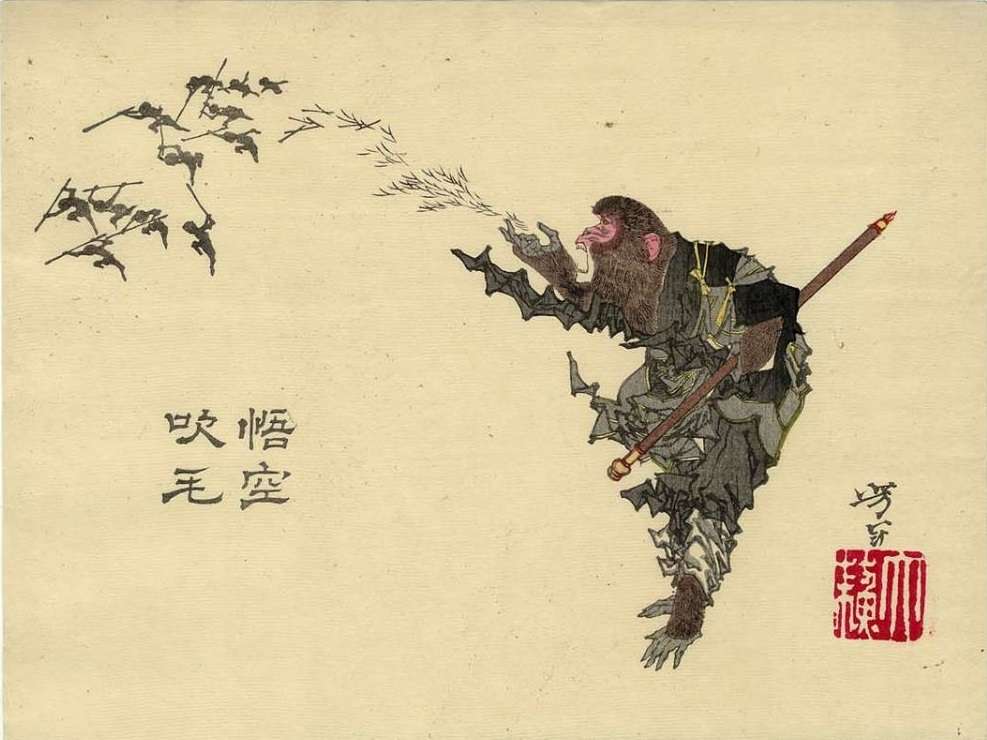
1:53 – 2:20 – Wukong lands in an explosion of multicolored clouds and light. He waves his staff in front of him, thus forcing the imps away from his brothers. He then pulls out magic hairs and blows on them, creating an army of monkeys to do battle with the imps. The monkeys do all manner of things to the imps while Wukong rolls around on the ground in laughter.

  • 1:58 – Wukong creates the army of monkeys. Also, notice how a few seconds in the notes sound almost like monkeys.

sc137582 - small

“Wukong Blows His Hair” (c. 1882) by Yoshitoshi (larger version).

2:21 – 2:26 – The imps run away in defeat. Monkey stands outside the cave screaming and hopping up and down while shaking his fist in order to entice the mountain demon outside.

  • 2:23 – Double hop while shaking fist and screaming obscenities. The words come out as Chinese characters. They could be “coward” or something demeaning like that. The particular sound of “bwah bwah” in the song at this point is when he screams and hops.
  • 2:26 – Second double hop, same.

2:27 – 2:31 – His trick works as the demon king pokes his head out of the doors and shakes his fist back at Wukong.

  • 2:28 – First fist shake and screams obscenity. Same “bwah bwah” sound but with lower register.
  • 2:31 – Second fist shake, same.

2:32 – 2:50 – The demon emerges with his armor and weapon ready to fight and the two begin their bout. The earth shakes, mountains crumble, forests tumble, and the gods shiver in the realm above.

2:51 – 3:08 – Both take to their clouds, the warriors circling each other, rising higher and higher into the heavens, leaving a double helix-like pattern in their wake.

3:09 – 3:12 – The demon makes one last attack with his weapon. Wukong disappears in a puff of smoke, only to reappear instantly in his 100,000-foot-tall cosmic form, breathing fire from a mouth full of tusk-like teeth, his eyes like the sun and moon. The demon realizes he is not Wukong’s match and flees in terror.

cosmic transformation

Monkey performs the cosmic transformation for his children (larger version). Original artist unknown. Found on this article.

3:13 – 3:16 – Wukong reverts to his original form and rockets towards earth with his staff held high.

3:17 – 3:21 – He lands a mortal blow to the demon and stands over his remains.

  • 3:17 – The exact moment the demon is turned into hamburger.

3:22 – 3:24 – Wukong kicks open the double door of the mountain stronghold. The view would be from the inside out (i.e. it’s dark and then the doors are kicked inward, revealing the dark silhouette of Monkey holding his staff against a bright background).

  • The “boom” at the end is when he kicks in the doors.

After the song stops, the animation silently ends with them all continuing their journey to India. The entire animation would probably be around three minutes and forty seconds long. I would really love to work with an animator to make this a reality.

Archive #16 – Sun Wukong and Chinese Medicine

Last updated: 09-22-2024

I noted in my previous article that medicine was among the skills acquired by Monkey while training under the Buddho-Daoist sage, Master Subodhi. In Journey to the West (Xiyouji西遊記, 1592) chapters 68 to 69, Monkey works to diagnose the long-standing malady of the Scarlet-Purple Kingdom emperor. But due to the immortal’s monstrous appearance, Sun is forced to analyze the ruler from afar, using three magic hairs-turned-golden strings to measure the vibrations of the pulse from three locations of each forearm. He deduces the illness is caused by fear and anxiety over the loss of the monarch’s queen, who had been kidnapped by a demon. Monkey then concocts three pills from a secret recipe and administers the elixir with dragon king saliva. The medicine causes the emperor to pass an obstruction in his bowels, thus restoring the natural qi flow in his body and curing him of his sickness.

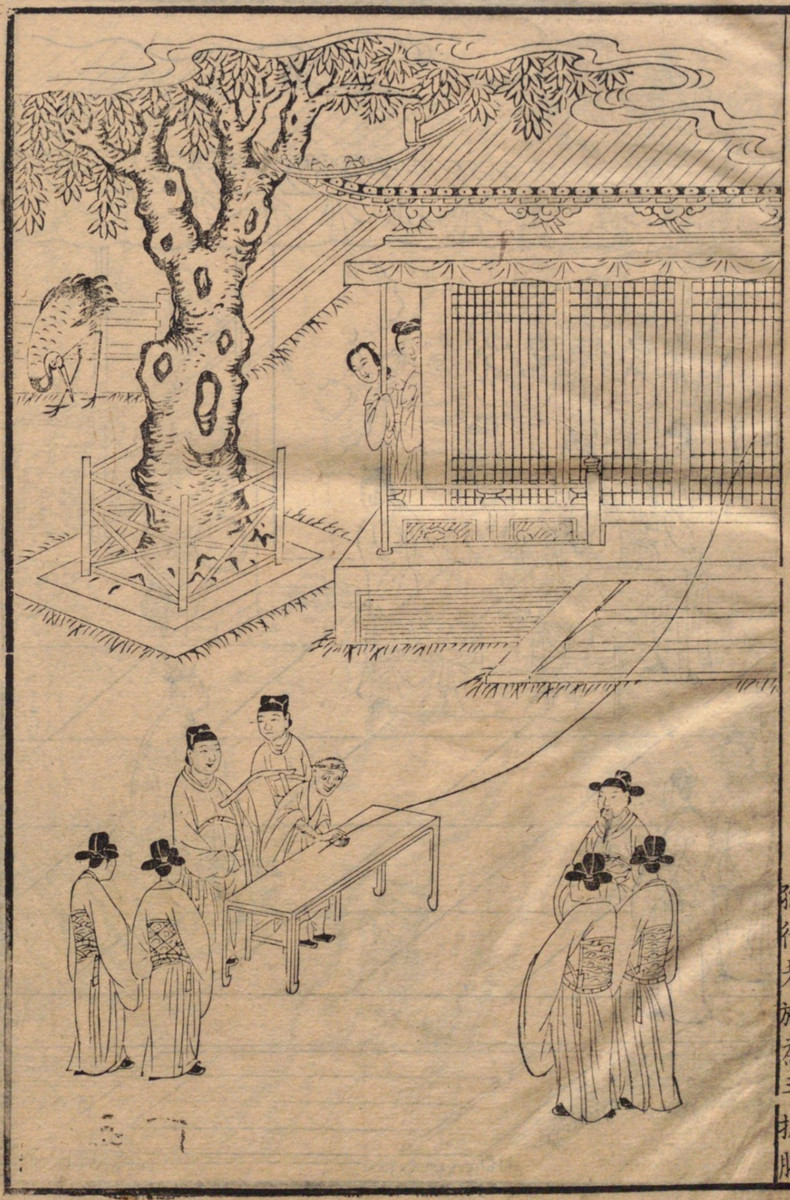
Fig. 1 – Monkey uses golden threads to analyze the emperor’s pulse (larger version). From Mr. Li Zhuowu’s Literary Criticism of Journey to the West (late 16th-century).

1. Examples of Sun’s medical knowledge

1.1. Chapter 68

Monkey first assuages the fears of court officials by reciting a poem explaining the proper procedure for analyzing a patient:

Most mysterious is the physician’s art;
His mind must ever be alert and keen.
To look, listen, ask, and take-these four things If one is missing, his craft’s not complete.
One, we look at the patient’s complexion:
Is it moist, dry, fat, or thin in waking or sleep?
Two, we listen for clear or turbid voice
When he speaks lucid or frenetic words.
Three, we ask for the ailment’s cause and length.
For how he eats, drinks, and eliminates.
Four, we scan the conduits by taking the pulse,
To learn how submerged or floating in and out.
If we do not look, listen, ask, and take, In this life his ailment will ne’er him forsake!” (based on Wu & Yu, 2012, vol. 3, p. 268).

醫門理法至微玄,大要心中有轉旋。
望聞問切四般事,缺一之時不備全:
第一望他神氣色,潤枯肥瘦起和眠;
第二聞聲清與濁,聽他真語及狂言;
三問病原經幾日,如何飲食怎生便;
四才切脈明經絡,浮沉表裡是何般。
我不望聞並問切,今生莫想得安然。(source)

1.2. Chapter 69

Sun then follows through with the analysis:

We were telling you about the Great Sage Sun, who went with the palace attendant to the interior division of the royal palace. He stood still only after he had reached the door of the royal bedchamber. Then he told the attendant to take the three golden threads inside along with the instruction: “Ask one of the palace ladies or eunuchs to tie these three threads to the inch, the pass, and the foot sections of His Majesty’s left hand where the radial pulse are felt. Then pass the other ends of the threads out to me through the window shutters” [fig. 1].

The attendant followed his instruction. The king was asked to sit up on the dragon bed, while the three sections of his pulse were tied by the golden threads, and their other ends were then passed out to Pilgrim. Using the thumb and the index finger of his right hand to pick up one of the threads, Pilgrim first examined the pulse of the cun [寸] section; next, he used his middle finger and his thumb to pick up the second thread and examine the pulse of the guan [關] section; finally, he used the thumb and his fourth finger to pick up the third thread and examine the pulse of the chi [尺] section.

Thereafter Pilgrim made his own breathing regular and proceeded to determine which of the Four Heteropathic Pneumatics, the Five Stases, the Seven External Images of the Pulse, the Eight Internal Images of the Pulse, and the Nine Pulse Indications were present. [1] His pressure on the threads went from light to medium to heavy, and from heavy to medium to light, until he could clearly perceive whether the condition of the patient was repletion or depletion of energy and its cause. Then he made the request that the threads be untied from the king’s left wrist and be attached as before to the positions on his right wrist. Using now the fingers on his left hand, he then examined the pulse on the right wrist section by section. When he had completed his examination, he shook his body once and retrieved his hairs (based on Wu & Yu, 2012, p. 270).

話表孫大聖同近侍宦官到於皇宮內院,直至寢宮門外立定。將三條金線與宦官拿入裡面,吩咐:「教內宮妃后,或近侍太監,先繫在聖躬左手腕下,按寸、關、尺三部上,卻將線頭從窗櫺兒穿出與我。」真個那宦官依此言,請國王坐在龍床,按寸、關、尺,以金線一頭繫了,一頭理出窗外。行者接了線頭,以自己右手大指先托著食指,看了寸脈;次將中指按大指,看了關脈;又將大指托定無名指,看了尺脈。調停自家呼吸,分定四氣、五鬱、七表、八裡、九候、浮中沉、沉中浮,辨明了虛實之端。又教解下左手,依前繫在右手腕下部位。行者即以左手指,一一從頭診視畢,卻將身抖了一抖,把金線收上身來。

Finally he delivers a very detailed diagnosis:

“Your Majesty,” he cried in a loud voice, “on your left wrist the pulse of your cun section feels strong and tense, the pulse of your guan section feels rough and languid, and the pulse of your chi section feels hollow and sunken. On your right wrist the pulse of your cun section feels floating and smooth, the pulse of your guan section feels retarded and hesitant, and the pulse of your chi section feels accelerated and firm. Now, when the pulse of your left cun section feels strong and tense, it indicates an internal energetic depletion with pain in the cardiac system of functions. When the pulse of your left guan section feels rough and languid, it indicates sweating that has led to numbness in the flesh. When the pulse of your left chi section feels hollow and sunken, it indicates a pink tinge to your urine and blood in your stool. When the pulse of the cun section on your right wrist feels floating and smooth, it indicates a congestion blocking the pneumatic energy circulation and leading to cessation of menses. When the pulse of your right guan section feels retarded and hesitant, it indicates a stasis of alimentary matter in the stomach system with retention of fluids. When the pulse of your right chi section feels accelerated and firm, it indicates discomfort caused by sensations of stuffiness and chills caused by energetic depletion. To sum up, your illness has been caused by fear and anxiety, and it may be the manifestation type of an illness called the ‘Paired Birds in Severance’ [shuangniao shiqun, 雙鳥失群]” (based on Wu & Yu, 2012, vol. 3, pp. 270-271).

陛下左手寸脈強而緊,關脈濇而緩,尺脈芤且沉;右手寸脈浮而滑,關脈遲而結,尺脈數而牢。夫左寸強而緊者,中虛心痛也;關濇而緩者,汗出肌麻也;尺芤而沉者,小便赤而大便帶血也。右手寸脈浮而滑者,內結經閉也;關遲而結者,宿食留飲也;尺數而牢者,煩滿虛寒相持也。診此貴恙,是一個驚恐憂思,號為『雙鳥失群』之症。

Baring the strings, Monkey’s method of reading the pulse aligns with real Chinese medicinal practice. The area of the forearm analyzed by traditional Chinese doctors is known as cunkou (寸口, the “inch opening”), and this is broken up into the three spots cun (寸, “inch”), guan (關, “pass”), and chi (尺, “foot”) (fig. 2). The mirrored spots on each arm are believed to correspond to specific internal organs. For example, the cun spot (nearest the wrist) on the right hand corresponds to the lung, while that of the left hand corresponds to the heart (Liao, 2011, pp. 55-56). Therefore, analyzing the pulse at these spots is believed to reveal the health of the corresponding organs.

Fig. 2 – The spots analyzed during pulse diagnosis (larger version). Picture originally found here.

2. The Elixir of Black Gold and its historical origins

Wukong selects his ingredients from among 808 requested substances in order to keep the recipe a secret from the foreign kingdom’s doctors. It is made from an ounce of powderizedahuang (大黃), which is said to “loosen phlegm and facilitate respiration [and] sweep out the chill and heat congealed in one’s stomach” (Wu & Yu, 2012, pp. 273-274); an ounce of shelled, powerderized badou (巴豆), which is said to “break up congestion and drain the intestines [and] take care of swellings at the heart and dropsy in the abdomen” (Wu & Yu, 2012, p. 274); half a flask of “Hundred-Grass Frost” (baicao shuang, 百草霜), or frying pan soot, which is said to “soothe a hundred ailments” (Wu & Yu, 2012, p. 274); and half a flask of dragon (horse) urine, which is said to “cure any kind of disease a human may have when it is ingested” (Wu & Yu, 2012, p. 274). The resulting paste is rolled into three pills and presented to the emperor as the “Elixir of Black Gold” (Wujin dan, 烏金丹) (video 1) (Wu & Yu, 2012, p. 276).

Video 1 – Episode 20 of the 1986 Journey to the West series portrays this story. See minute 19:19 for the preparation of the Elixir of Black Gold.

Andrew Schonebaum’s (2016) fascinating book Novel Medicine: Healing, Literature, and Popular Knowledge in Early Modern China explains the historical significance of the real world ingredients used in this elixir. He introduces the first two ingredients to us by way of their anthropomorphization as Badou Dahuang, the ruler of the fictional Hujiao (胡椒, black pepper) kingdom from the vernacular novel Annals of Herbs and Trees (Caomu chunqiu yanyi, 草木春秋演義, c. 17th/18th-century), a work that gives human form to Chinese medicines, pitting armies of mortal, immortal, and demonic characters/remedies against one another. Badou is depicted as having the mandate of heaven (the right to rule) in his own country but wanting to invade the Han empire. This dual nature can be explained by the properties of the ingredients making up his name. Schonebaum (2016) writes:

[B]adou (croton) and dahuang (rhubarb), are two of the most common drugs in Chinese medicine. Badou is toxic and a strong purgative, and it was used to treat stagnation in the viscera and bowels, as well as to facilitate urination, eliminate malignant flesh, and purge vicious agents such as invading ghosts or worms. Dahuang is nontoxic and is sometimes referred to by the name “military general” because “the drug pushes away the old and brings in the new, like a military general putting down a riot and bringing peace” (pp. 99-100).

Regarding the “Elixir of Black Gold,” Schonebaum (2016) explains “black gold” was the name of a common prescription and that badou and dahuang were part of its core, while other ingredients could be replaced with those of similar properties:

One commentator had never heard of this medicine, saying that it had a strange name, but this only reveals his own highbrow background (or general ignorance), since “black gold” was the name of various prescriptions common among hereditary doctors. In fact, it was mentioned in the Systematic Materia Medica repeatedly, and Xu Dachun recommends it in Medical Cases of Huixi, so it was not exclusively the purview of nonelite healers.

“Black gold pills” (wujin wan) was a name and a concoction similar to “elixir surpassing [the value of] gold” (shengjin dan) and “black spirit pills” (heishen wan). All of them were core formulas that could be modified in their effects by ingesting them with different liquids. These “black gold” medicines, along with the likes of “the prescription offering Guanyin’s all-encompassing help” (Guanyin puji fang) and “pills prepared with old ink” (gumo wan), treated a wide variety of ailments (in one medical manuscript, twenty-nine, forty, and seventy-one ailments, respectively), and were extremely common formula in the Qing. The “black gold” formulas had at their core the drugs dahuang and badou. One medical manuscript from the Republican period states in its introduction, “Black gold powder [wujin san] cures all ailments, just as the wind bends the grasses. Other names [of this prescription] are ‘pine smoke elixir’ [songyan dan] and ‘black spirit pills’ [heishen wan]. It cures thousands of illnesses, just as the sun melts the frost.”

Black gold pills (wan), powder (san), paste (gao), and elixir (dan) were commonly employed to cure gynecological issues. A prescription named “black gold powder” was first recorded in the Song work A Spring of Recipes in the Magic Park (Lingyuan fangquan) and was followed by references in the Southern Song prescription collection “Complete Collection of Effective Prescriptions for Women” (Furen daquan liangfang, 1237), Formulas for Universal Benefit (Puji fang, 1390), and other works. Over the centuries, numerous formulas, each with different ingredients, became known under the names “black gold powder,” “black gold pills,” and “black gold elixir.” The three designations of this formula result from the use of pitch (mo), a vernacular name for which is the “black gold” of these prescriptions.

Monkey’s prescription reflects a historical reality, namely that the advent of the imperial pharmacy (huimin yaoju) in the Song required doctors who had previously relied on simple medicines with one or two ingredients to employ formulas with numerous substances whose composition followed theories of systematic correspondences. From this conflict between empirical and theory-based recipes arose a new type of prescription eventually consisting of a nuclear formula that could be adapted to the requirements of a given patient’s disease by omitting or adding individual constituents in accordance with his pathological condition. Monkey is preparing simple, trusted medicine at the core, namely badou and dahuang, and adding to it many exotic, unobtainable ingredients (pp. 103-104).

As noted above, black gold medicines were sometimes used to treat gynecological issues. This makes Monkey’s prescription all the more comical as he had partly attributed the foreign emperor’s ails to a “cessation of the menses” (Wu & Yu, 2012, p. 271), obviously a woman’s problem. Schonebaum (2016) comments: “To understand this aspect of the carnivalesque comedy, or to realize that it was a mistake in the incorporation of medical materials into the novel, readers would have had to be quite familiar with medicine, at least enough to know that the medicine Monkey is preparing is consistent with his diagnosis” (p. 104). 

3. Archive link

Chapter three of Novel Medicine (2016) is archived here.

Click to access novel-medicine-healing-literature-and-popular-knowledge-in-early-modern-china-chapter-3-contains-jttw-ch.-68-69-material.pdf

Disclaimer

This has been posted for educational purposes. No malicious copyright infringement is intended. Please support the official release.


Update: 09-22-24

As mentioned above, Sun Wukong analyzes the ailing king’s pulse from afar using three magic hairs-turned-golden threads. This is no doubt based on the story of the “Grand Emperor of Protecting Life” (Baosheng dadi, 保生大帝), the Daoist and folk religion god of medicine, curing an empress using the same method:

During the reign of Chengzu (1403-21), the Empress Wen suffered from an inflamed breast. A Taoist priest offered his skills, but the Emperor tested him by having him take her pulse with a string held on the other side of her bedroom wall. First the Emperor attached it to a cat. The Taoist said, “Not a bear, no not bear, it’s a cat.” Then the Emperor tied the string to a doorknob. The Taoist said that it was something of metal and wood, and not a human pulse. Finally, the Emperor tied the string to the woman’s breast and the Taoist said that the liver pulse was inflamed and the blood clotted, and that this indicated a breast infection which had to be treated by moxibustion. He offered to perform the operation by dangling a cord over the wall. He cured the ailment and vanished, refusing a reward of gold and office. In He Qiaoyuan’s version, the Emperor inquired about his name and discovered that he was the long-deceased Divine Doctor Wu Tao. In gratitude, the Emperor enfeoffed the god as Wanshou wuji baosheng dadi (Emperor Who Protects Life of Limitless Longevity) (Dean, 2014, p. 74).

What’s interesting is that this legend carried over into religious practices. A reader who contacted me in 2022 explains:

I observed a practice at [Sidian Xingji Temple (祀典興濟宮)] in Tainan where an individual would let the god Baosheng dadi check their pulse by resting three sticks of incense on their forearm. The temple brochure also mentions this procedure [fig. 3]. I believe this to be relevant to your article …

Fig. 3 – A detail from the aforementioned temple brochure showing the three incense sticks resting on a member’s wrist (larger version). Photo by Richard Malabarista.

Notes:

1) Yu (Wu & Yu, 2012) provides explanations for these terms in the end notes of his wonderful translation (pp. 448-449, n. 3-7).

Sources:

Dean, K. (2014). Taoist Ritual and Popular Cults of Southeast China. United States: Princeton University Press.

Liao, Y. (2011). Traditional Chinese medicine. Cambridge: Cambridge University Press.

Schonebaum, A. (2016). Novel Medicine: Healing, Literature, and Popular Knowledge in Early Modern China. Seattle: University of Washington Press

Wu, C., & Yu, A. C. (2012). The Journey to the West (Vol. 3) (Rev. ed.). Chicago, Illinois: University of Chicago Press.

The Monkey King Temples of Fujian Province, China

Last updated: 10-03-2024

The Journey to the West Research blog is proud to host an entry by our friend Saie Surendra of Hanumovies.com. During the summer of 2019, he was lucky enough to visit several Great Sage Equaling Heaven temples in Fujian Province, China, including those dedicated to him and those hosting small shrines in his honor. This entry will serve as a list of such temples. – Jim

Saie

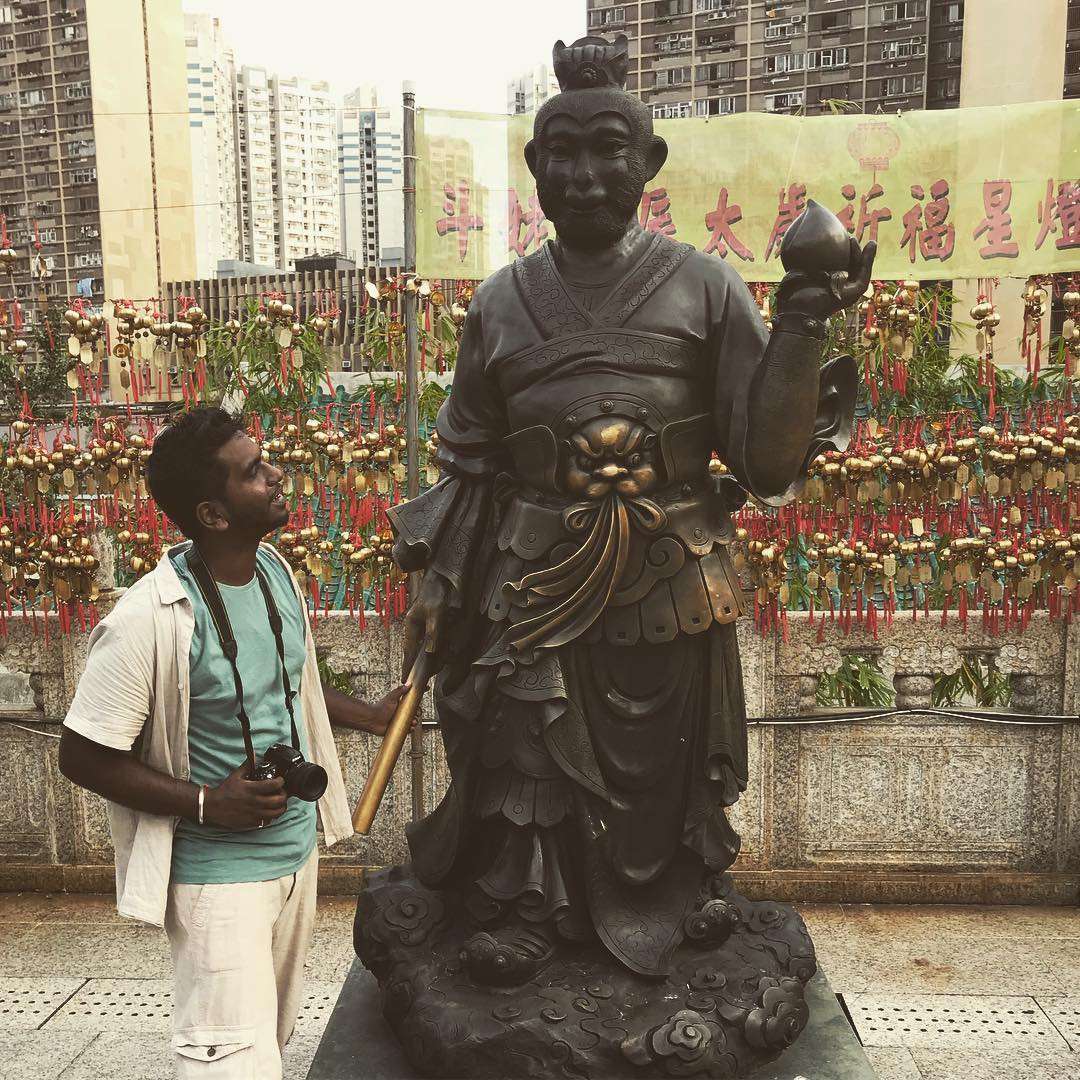
Saie admiring a Monkey King statue at the Wong Tai Sin temple in Kowloon, Hong Kong (larger version).

I. My journey

So how did my journey to the various Great Sage Equalling Heaven temples in Fujian begin? I guess I’ll start from the beginning. Growing up, I would often see images or figurines of the Hindu Monkey God Hanuman in fellow Sri Lankan and Indian homes. For those who don’t know, Hanuman is the Indian counterpart of Sun Wukong and potentially the first known Monkey God. I was curious and intrigued and wanted to know more, but I didn’t get many answers from the people I asked. “He protects us and can revive us from bad health” was the most common reply. I researched the many translations of the Ramayana (one of two great Indian epics within which Hanuman appears) and became enchanted by his many amazing feats and achievements. I was a huge film fan growing up, so I became obsessed with the idea of making films based on him. There have been TV adaptations of Hanuman’s story—I wasn’t a fan of the more human-like portrayals—but, sadly, major Indian studios have yet to make a proper movie about him.

Fast-forward to 2008. Jet Li and Jackie Chan star in the kung fu fantasy The Forbidden Kingdom. Looking back now, it isn’t the greatest film ever, but this is when I first met … Sun Wukong (cue the “Dagger House Prelude”). This was a turning point for me, my obsession multiplied tenfold. Since then I have watched tens, if not hundreds, of film and TV adaptations of Sun Wukong. I’ve also read endless articles and books (one example) in an effort to connect the dots between our (Hindu and Buddho-Daoist) ancestors’ worship of monkey deities. I’ve found there are just too many similarities to ignore.

At first, I had never heard of Sun Wukong’s worship, so when I found the one vague article online describing the Monkey King Festival (the 16th day of the 8th lunar month) in Hong Kong, I decided I would go! I didn’t know what to expect when Jim and I met at the Great Sage Treasure Temple (大聖寶廟) in Kowloon in September of 2018, but it was a big moment for me. Crowds of young and old gathered to worship the Great Sage Equalling Heaven; Daoist priests chanted from prayer books; rows of important businesspeople bowed in unison; martial arts schools performed colorful lion dances, each kwoon paying respect to the altar as they passed; giant paper effigies were burnt. It was a veritable feast for the eyes and ears. Through our interviews with the locals, we not only learned that the festival was considered a time for strengthening community bonds and to help those in need, but also that many adherents believed their faith originated in Fujian, more specifically the city of Fuzhou. This of course agrees with what past scholars have written about Sun’s worship in Fujian.

I have a question: If you ever found yourself in heaven, what would you do? You’d take some good videos to show your friends back on Earth, right? So that was the idea; I started making a documentary (video 1) based on the real people I met and the places I visited, saving my film ambitions for later.

Video 1 – Legends of a Monkey God: Episode 1 – Hong Kong

I was restless some months after returning from the Hong Kong Monkey God Festival. It was like experiencing Heaven for a week and then falling back to Earth like a meteor with many unanswered questions. I was unable to sit around in my miserable London life any longer, so I finally decided to travel where Sun’s worship supposedly began … Fuzhou.

Arriving in Fuzhou was like a pilgrimage in itself. Let me say, this was not an easy journey for me, nor for the translator friend I hired due to my poor Mandarin. The Hokkien accent of Fuzhou gave her a hard time. In addition, the many places I had researched and mapped online seemingly didn’t exist. We visited one after another, with the locals appearing clueless about the temples we inquired about. It was almost as if Sun Wukong’s worship was a secret and only initiated members were allowed access to his houses of worship. Now, there is a saying in India that goes: “You can’t just find Him, He has to invite you”. This saying holds true, for when we finally found one of the locations (see temple one below), a person inside told us about a man who could help me on my journey. I thought, “Hang on a minute … was this guy the savior goddess Guanyin? Was he going to introduce me to my … Sun Wukong?”

I was later introduced to Mr. You, the head of several temples, the Pingshan theatre, and the greatest Sun Wukong follower I have ever met. He set aside two whole days to drive us to several Monkey King temples around Fuzhou, during which time I shot video for another documentary (video 2). I wondered whether or not he wanted anything in return. I mean, no one does anything for free, right? It turns out he was more than happy just to share his Sun Wukong with me and invite me into his secret club! He would not accept any gifts from me. I felt like I was the Tang Monk! And here is the thing: Mr. You and his friends didn’t speak a single word of English—in fact, my Mandarin was unbearable to them—yet we somehow managed to communicate and establish a strong friendship between us, “Brothers bound by the love of Monkey”. I promised myself then that I would return with better Mandarin in a Fujian dialect.

Video 2 – Legends of a Monkey God: Episode 3 – Monkey King Temples of Fujian, China

What I took away from this trip was the fact that Sun Wukong is a deity that sits at the intersection of Buddhism, Daoism, and Confucianism. I saw effigies of him in temples of all the “Three Religions”, sometimes shared, sometimes strictly one faith. But the idea of religion in the East is not the same as that in the West. In the East, you find your own path, follow it to your goal; you don’t need to be on the same path as everyone else and no one judges you for making your own way. It’s just like the Indians say: “The destination is the same, paths are many. God is one, names and forms are many”. This ties in with the works of famed mythologist Joseph Campbell, who would call this the many “masks of God”.

II. Temple list

Note: This list is not exhaustive and will be updated periodically. Most importantly, the following GPS coordinates should ONLY be used as a general guideline. It is highly recommended that those wishing to visit these places should hire the services of a knowledgeable guide. I recommend contacting Mr. You (WeChat id: you410631621)

(Note: Mr. You has died, so his WeChat no longer works.) 

A shrine in Mr. You’s house (larger version).


Temple One: 玉封齐天府屏山祖殿

26°04’45.0″N 119°18’42.6″E
福建省福州市鼓楼区三界寺
Sanjie Temple, Gulou District, Fuzhou City, Fujian Province, China
38H6+MP Gulou District, Fuzhou, Fuzhou, Fujian, China

Pictures

https://drive.google.com/drive/folders/0Bwi3jyIV3-OhfmoyQ0RXN25PalhWbXVncUxwX0pFcDlSbVVDMFRvMm82dWttRlUxaGNVTWc?resourcekey=0-Dq0-f95II5gSZLh9VVu7qg&usp=sharing

IMG_6054


Temple Two

26°04’10.1″N 119°19’56.1″E
福建省福州市晋安区
Eastern District Shangquan, Jin’an, Fuzhou City, Fujian Province, China
389J+QW Jin’an, Fuzhou, Fujian, China

Pictures

https://drive.google.com/drive/folders/0Bwi3jyIV3-Ohfmt2cGV2U1BsVW1iQjVHUEFIZXF6QV9vTndVNkxEdm1SRzA3UURpM25mWDA?resourcekey=0-KybFXH3lW6H0YU4dSIT8Yw&usp=sharing

IMG_6161


Temple Three

26°01’46.8″N 119°15’56.1″E
福建省福州市仓山区百花洲路
Baihua Zhou Road, Cangshan District, Fuzhou City, Fujian Province, China
27H8+V6 Cangshan, Fuzhou, Fujian, China

Pictures

https://drive.google.com/drive/folders/0Bwi3jyIV3-OhfjFhWVdVTTU0bFRMOGo3eGNZSncyal8takVNNTZTLTFBRmNJV3BGOTFyTXc?resourcekey=0-Vp51fSJCx3nejStT3ZjO0g&usp=sharing

IMG_6298


Temple Four: 霞江清泉庵 (齊天大聖殿)

26°02’41.4″N 119°18’34.7″E
福建省福州市仓山区
28V5+WV Cangshan, Fuzhou, Fujian, China

Pictures

https://drive.google.com/drive/folders/0Bwi3jyIV3-OhfmEyMFJHR19OYzM0REhMNzE4bDZZaUd0bjgtdUVZb2h3MndZT0ZQWGVPMm8?resourcekey=0-24cQHhFFVobNPUo6hwLkxg&usp=sharing

For more pictures, see this article.

IMG_6353


Temple Five

26°02’05.1″N 119°21’10.7″E
福建省福州市仓山区后坂路
Houban Road, Cangshan District, Fuzhou City, Fujian Province, China
29M3+W5 Cangshan, Fuzhou, Fujian, China

Pictures

https://drive.google.com/drive/folders/0Bwi3jyIV3-OhflVvT1dOM1RTcDRucXRxT0xfVHoxVFdDZkR4OGpGaGo4VzN1eEZBXzlNVVk?resourcekey=0-X8xhXb0INiwa1FF8kACplg&usp=sharing

IMG_6427


Temple Six

26°06’23.6″N 119°14’30.2″E
福建省福州市闽侯县
Unnamed Road, Minhou County, Fuzhou City, Fujian Province, China
464R+JM Cangshan, Fuzhou, Fujian, China

Pictures

https://drive.google.com/drive/folders/0Bwi3jyIV3-OhflVVSzNCNWVDN25NU05La043NlRyczJSOVc0UkE1aDRfb0ZCeUV4cWJianc?resourcekey=0-cnBTjqM0ZCS0EaizWsGTTQ&usp=sharing

IMG_6662


Temple Seven: 慈恩寺

26°08’54.4″N 119°08’56.9″E
福建省福州市闽侯县军民路
Junmin Rd, Minhou County, Fuzhou City, Fujian Province, China
44XX+9M Ganzhezhen, Minhou, Fuzhou, Fujian, China

Pictures

https://drive.google.com/drive/folders/0Bwi3jyIV3-OhfjUwekJoVTlhclJvVTJDS1NfdDdGXy1PQUg0RHU0WnZUMzI5UWdXRWlzVDQ?resourcekey=0-lDm_EQW1Dj6rEnzeU0BR0Q&usp=sharing

IMG_6681


Temple Eight

26°04’26.2″N 119°11’25.5″E
福建省福州市闽侯县
G316 Minhou County, Fuzhou City, Fujian Province, China
35FR+H5 Shangjiezhen, Minhou, Fuzhou, Fujian, China

Pictures

https://drive.google.com/drive/folders/0Bwi3jyIV3-OhfnFLWGVvWjktaFFfTS1wVHBMdFA2VmtpVW5aUU1qOGNrQ1RQVEo5TG1pTU0?resourcekey=0-_5j182ICuI-0ValCqUQfXg&usp=sharing

IMG_6742


Temple Nine

26°01’49.8″N 119°17’26.7″E
福建省福州市仓山区鹭岭路163号
163 Luling Road, Cangshan District, Fuzhou City, Fujian Province, China
27JR+68 Cangshan, Fuzhou, Fujian, China

Pictures

https://drive.google.com/drive/folders/0Bwi3jyIV3-Ohfmd5WmMza0xuQUtxWThwbmZFRVV5WXlreF9TYkF3ai1WZ01jeDAxQ09pcW8?resourcekey=0-ELD6KPHTI0RCsfAs8LaIUg&usp=sharing

IMG_6765

Update: 02-15-21

Jim here. I have mirrored this article by creating a list of Monkey King temples that I’ve visited in Taiwan.

Qitian Dasheng Monkey King Temples in Taiwan


Update: 10-03-24

I just figured out that the photo links have not worked for several months. This is because my original university gmail account, which hosted the pictures, was shut down. Everything is fixed now.

Archive #15 – Narrative Structure and the Problem of Chapter Nine in the “Hsi-Yu Chi”

Last updated: 04-03-2022

Readers may be surprised to learn that chapter nine of the current one hundred chapter edition of Journey to the West did not appear in the original version anonymously published by the Shidetang (世德堂) publishing house in 1592. Chapter nine of course tells the story of how Tripitaka‘s parents, his scholar-official father Chen Guangrui (陳光蕊) and mother Yin Wenjiao (殷溫嬌), meet (fig. 1); Guangrui’s murder and the pregnant Lady Yin’s kidnapping by a bandit; Tripitaka’s birth and Moses-like trip down a river (hence his nickname “River Float,” Jiang liu, 江流); his rescue, rearing, and initiation into the Buddhist order by the abbot of Gold Mountain; Lady Yin’s rescue and the bandit-turned-official’s arrest; and Tripitaka’s later reunion with his mother and father, the latter’s body having been preserved and brought back to life by heaven.

Some scholars, such as Glen Dudbridge, suggest the current ninth chapter is a forgery, having been written by one Zhu Dingchen (朱鼎臣) of Canton because it appears in his slightly later edited version of the novel titled The Chronicle of Deliverances in Tripitaka Tang’s Journey to the West (Tang Sanzang Xiyou shi ni zhuan, 唐三藏西游释尼傳, circa 1595). (See the 01-02-21 update for new information about Zhu’s version of the novel.) Other scholars posit there is internal textual evidence for a possible lost chapter and that the current ninth chapter was salvaged from these internal clues. 

Tripitaka's Parents

Fig. 1 – Tripitaka’s parents from the 1986 television show. 

Anthony Yu‘s (1975) paper “Narrative Structure and the Problem of Chapter Nine in the ‘Hsi-Yu Chi'” supplements previous analyses of said internal textual evidence. He demonstrates that references to the Chen Guangrui episode litter the book. For example, a poem in chapter twelve (ch. 11 of the original Shidetang version) reads:

Gold Cicada was his former divine name.
As heedless he was of the Buddha’s talk,
He had to suffer in this world of dust,
To fall in the net by being born a man.
He met misfortune as he came to Earth,
And evildoers even before his birth.
His father: Chen, a zhuangyuan [1] from Haizhou.
His mother’s sire: chief of this dynasty’s court.
Fated by his natal star to fall in the stream,
He followed tide and current, chased by mighty waves.
At Gold Mountain, the island, he had great luck,
For the abbot, Qian’an, raised him up.
He met his true mother at age eighteen,
And called on her father at the capital.
A great army was sent by Chief Kaishan
To stamp out at Hongzhou the vicious crew.
The zhuangyuan Guangrui escaped his doom:
Son rejoined sire—how worthy of praise!
They saw the emperor to receive his grace;
Their names resounded in Lingyan Tower.
Declining office, he chose a monk’s life
At Hongfu Temple to seek the true Way,
This old Buddha-child, nicknamed River Float,
With a religious name of Chen Xuanzang. [2]

靈通本諱號金蟬,只為無心聽佛講。
轉托塵凡苦受磨,降生世俗遭羅網。
投胎落地就逢兇,未出之前臨惡黨。
父是海州陳狀元,外公總管當朝長。
出身命犯落江星,順水隨波逐浪泱。
海島金山有大緣,遷安和尚將他養。
年方十八認親娘,特赴京都求外長。
總管開山調大軍,洪州剿寇誅兇黨。
狀元光蕊脫天羅,子父相逢堪賀獎。
復謁當今受主恩,凌煙閣上賢名響。
恩官不受願為僧,洪福沙門將道訪。
小字江流古佛兒,法名喚做陳玄奘。

Yu (1975) notes “this passage…which introduces Tripitaka to the reader, has, with the exception of one major discrepancy (i.e. the name of the monk who took in the river-borne orphan), all the crucial elements constitutive of the Chen Guangrui story” (p. 296).

After providing several more examples, he concedes external textural evidence for a lost chapter has yet to be discovered, but suggests the author-compiler of the Journey to the West was surely familiar with established Yuan-Ming dramas involving Tripitaka’s birth and life:

I think that the foregoing analysis, admittedly brief, is sufficient to show the significance, if not the indispensability, of the Chen Guangrui episode in the narrative, though as I have remarked earlier, these later allusions certainly cannot be construed as incontrovertible proofs for a “lost chapter.” The existence of such a chapter has to be established by further discovery of textual materials hitherto unknown, if such discovery is indeed still possible. It may be safely asserted, however, that the author of the hundred-chapter novel, Wu Cheng’en or whoever he might be, is thoroughly familiar with the tradition of the birth and adventures of the infant Xuanzang popularized in the dramas of Yuan and Ming China, and that he has consciously and skillfully exploited this tradition in his narrative (Yu, 1975, p. 306).

Yu (1975) goes on to counter Dudbridge’s criticism that the Chen Guangrui episode doesn’t progress the overall plot by saying it should, instead, be accepted as an “organizing principle”, one that explains the reason for the monk’s ordeals:

[T]he theme of the river and its attendant perils utilized by the author of the hundred-chapter novel reinforces the theme of Tripitaka’s this-worldly identity as the incarnation of the banished Gold Cicada. Both themes in turn support the threefold aetiology developed in the narrative for explicating the meaning of Tripitaka’s ordeals: as a form of chastisement for his preexistent transgression, as a test of endurance for the earthly pilgrim, and as an exemplum of the high cost of obtaining sacred writings from the West (p. 307).

Furthermore, he counters Dudbridge’s claim that the concept of a lost chapter would be stronger if the novel provided more than just passing references to background info of the central characters. In fact, the novel does provide lengthy info on our heroes. For example, Yu (1975) presents a very long poem from chapter nineteen detailing Zhu Bajie’s life, from his early Daoist training, achievement of immortality, and rise to heavenly rank to his drunken flirting with the moon goddess (fig. 2), banishment from heaven, and mistaken reincarnation on earth as a pig-man.

Zhu Bajie-Chang'e stamp

Fig. 2 – a Taiwanese stamp featuring Zhu Bajie and the moon goddess Chang’e.

In the end, Yu (1975) states Qing-era editors of the novel were justified in their suspicion of a lost chapter given the lack of detailed info about Tripitaka’s life, unlike the other pilgrims:

In the absence of chapter 9, Tripitaka is the only member of the pilgrimage, in fact, whose origins are presented in the manner which Dudbridge ascribes to the disciples: in allusion or indirectly, in moments of retrospect. The early editors of the Xiyouji, therefore, were not wholly unjustified in their protest that a theme of such significance as the Chen Guangrui story had not been more fully accounted for by antecedent narrative (p. 310).

Paper link:


Disclaimer:

This has been posted for educational purposes. No malicious copyright infringement is intended. Please support the official release.


Update: 01-02-21

Zhu Dingchen’s edition of Journey to the West actually predates the 1592 edition. This shows that the aforementioned internal clues in the 1592 edition are based on previous material.


Update: 12-01-21

I’ve archived a book that shows how Tripitaka’s exile from heaven is similar to ancient Greek and Egyptian beliefs.


Update: 04-03-22

I’ve posted an entry discussing the characterization of Tripitaka as a Confucian in the novel.

Notes:

1) A scholar rank. All quotes from Yu (1975) originally use Wade-Giles. I have updated them with Pinyin.

2) Yu, 1975, p. 296. See Wu & Yu, 2012, p. 275 in Yu’s updated translation of the novel.

Sources:

Wu, C., & Yu, A. C. (2012). The journey to the West: Vol. 1. Chicago, Illinois: University of Chicago Press.

Yu, A. (1975). Narrative Structure and the Problem of Chapter Nine in The “Hsi-Yu Chi”. The Journal of Asian Studies, 34(2), 295-311. doi:10.2307/2052750