Archive #2 – Suen Wu-kung = Hanumat? The Progress of a Scholarly Debate

Last updated: 01-18-2019

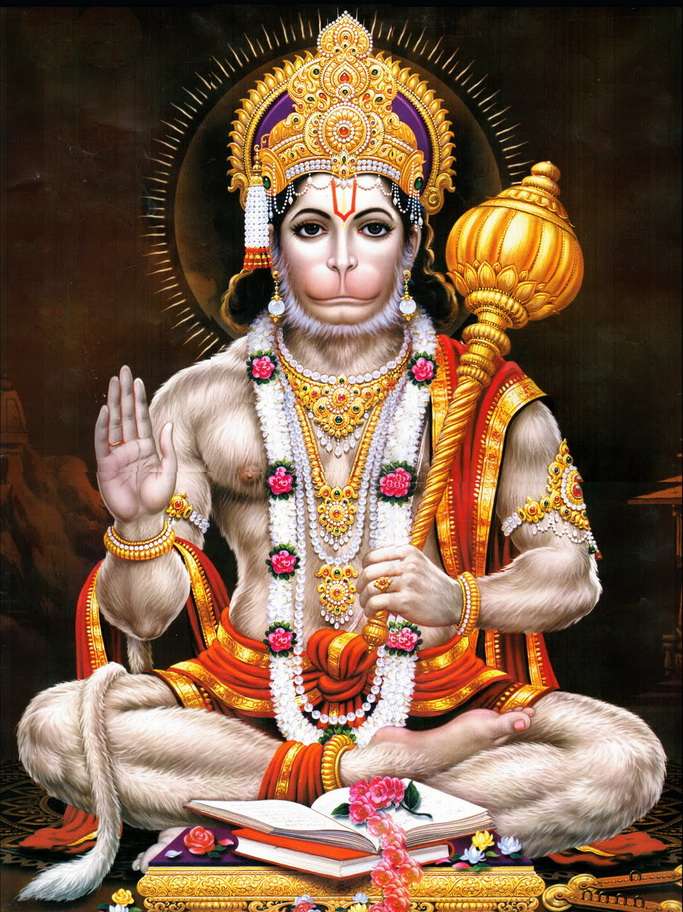
I have finally tracked down a digital version of Victor Mair’s often quoted summary of the scholarly debate on the possible connection between Sun Wukong (fig. 1) and the Hindu monkey god Hanuman (fig. 2). This paper is extremely hard to find, so I am archiving it here to aid both amateur and professional scholars who may not yet have access to it.

Sammy Torres Wukong - small

Fig. 1 – Sun Wukong from birth to the Great Sage. This marvelous sequential drawing is by Sammy Torres on twitter. The full drawing can be seen here.

Info from the Introduction:

The chief aim of this article is to restore the debate to its original scholarly intent, namely to determine whether H [Hanuman], the redoubtable simian devotee of Prince Rama in his quest to recover Sita from Lanka, had anything to do with the formation of the character of SWK [Sun Wukong], Tripitaka’s formidable Monkey-disciple during his pilgrimage to India to retrieve scriptures. This can only be achieved by remaining as impartial and objective as possible while presenting the pertinent evidence. A clinically dispassionate examination of the widely varying opinions of authorities concerning the apparent affinity between SWK and H is also required if the present impasse is to be broken. Hence, this article is necessarily as much an investigation of scholarly methods and attitudes as it is about the origins of SWK. Accordingly, it is divided into two main divisions, “Evidence” and “Authorities and Interpretations.” These are further subdivided into a number of sections, “Evidence” by geographical area and “Authorities and Interpretations” by a chronological listing of major participants in the debate.

Archive link:

Click to access suen-wu-kung-or-hanumat.pdf

Fig. 2 – A religious portrait of Hanuman (larger version). Artist unknown.

Disclaimer:

This has been posted for educational purposes. No malicious copyright infringement is intended. Please support the official release.


Update: 01-18-19

I’ve archived a scholarly book about the origins, worship, and depictions of Hanuman in pop culture.

Archive #9 – PDF of Hanuman’s Tale: The Messages of a Divine Monkey

Citation:

Mair, V. (1989). Suen Wu-kung = Hanumat? The Progress of a Scholarly Debate, in Proceedings of the Second International Conference on Sinology (pp. 659-752). Taipei: Academia Sinica.

Why the Monkey King Wears a Tiger Skin Loincloth and How it Ties Him to Supreme Esoteric Buddhist Guardian Deities

Last updated: 05-20-2026

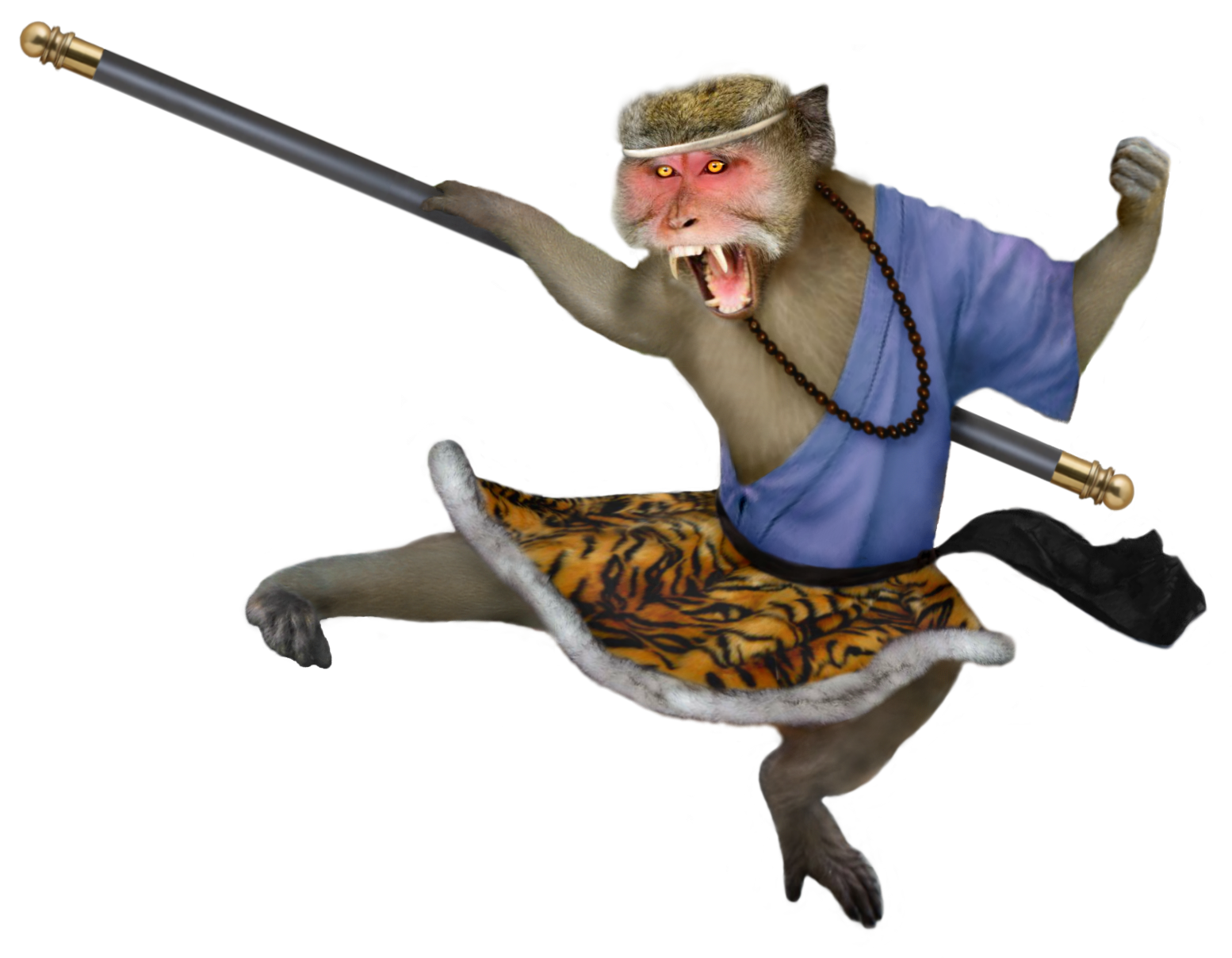
After being released from his mountain prison in  Journey to the West (Xiyou ji, 西遊記, 1592 CE, “JTTW” hereafter) chapter fourteen, Sun Wukong effortlessly kills a tiger with his iron staff and uses a magic hair-turned-knife to skin the beast. He cuts a large square from the fur and uses half to create a loincloth to cover his naked body (Wu & Yu, 2012, vol. 1, pp. 309-310). This tiger skin clothing is a highly recognizable element of Monkey’s iconography (fig. 1). But did you know that it has a connection to the Wrathful Destroyers of Obstacles (Sanskrit: Krodha-vighnantaka; “WDO” hereafter), [1] a class of supreme guardian deities in Indo-Tibetan Esoteric Buddhism?

Table of Contents

1. WDO Background

Esoteric Buddhism first developed in India as an offshoot of Mahayana Buddhism during the 6th century CE. WDOs appear in three recognized iconographic phases stretching from the sixth to the twelfth century. The first and longest phase (6th to 12th cent.) depicts the WDO as a dwarfish attendant to a full-size Bodhisattva. [2] He serves as the personification of his master’s wisdom and abilities. The second phase (8th to 10 cent.) represents the WDO as an independent deity with his own attendants. He serves as the personification of the attributes of the five esoteric Buddhas. The third phase (late-10th to 12th cent.) represents the WDO as the equal of Buddhas (Linrothe, 1999, pp. 11-14).

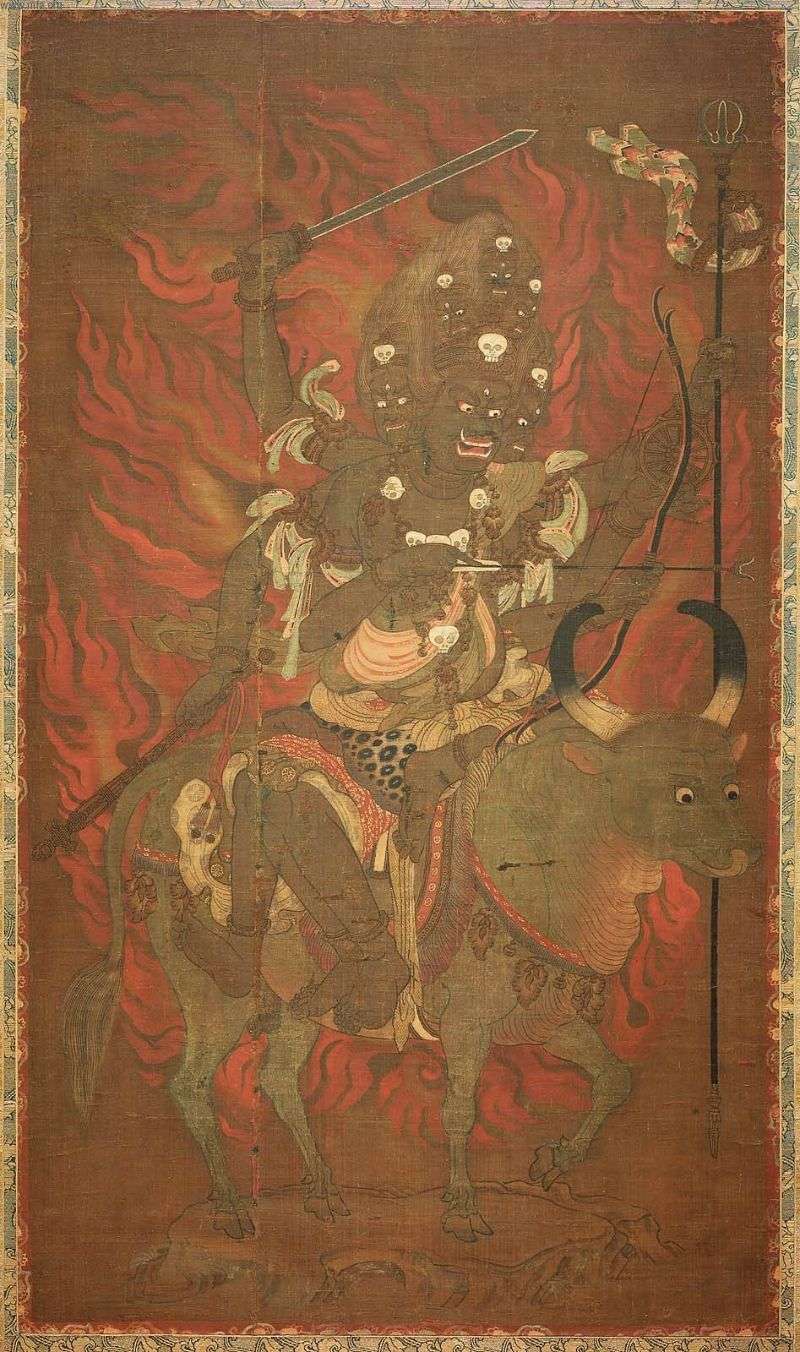
Wrathful Destroyers of Obstacles are often depicted as fierce, multi-armed figures bearing weapons and, most importantly, wearing tiger skin loincloths (Sanskrit: Vyaghracarma-nivasana). For example, the Manjusrimulakalpa, an 8th-century esoteric text, dictates the prescribed iconography of Manjusri’s WDO guardian Yamantaka (“the Destroyer of Yama, god of death”):

Six faces, six arms and feet/Black in color, with a big belly / Bearing a skull, his hair flaring out in anger / A tiger skin wrapped around the hips (emphasis added) / Holding all kinds of implements and weapons” (fig. 2) (Linrothe, 1999, p. 66). (emphasis mine)

The Hevajra Tantra, another 8th-century esoteric work, ties tiger skin clothing to Yogin practices. The text instructs them on how to adorn and dress themselves for worshipping the WDO Heruka:

The yogin must wear the sacred ear-rings, and the circlet on his head; on his wrists the bracelets, and the girdle round his waist, rings around his ankles, bangles round his arms; he wears the bone-necklace and for his dress a tiger-skin (emphasis added)… (Linrothe, 1999, p. 250). (emphasis mine)

Furthermore, it describes how each of the ritual adornments and implements used in the ceremony represent each of the five esoteric Buddhas, as well as other religio-philosophical elements:

Aksobhya is symbolized by the circlet, Amitabha by the ear-rings, Ratnesa by the necklace, and Vairocana (by the rings) upon the wrists. Amogha is symbolized by the girdle. Wisdom by the khatvanga [staff] and Means by the drum, while the yogin represents the Wrathful One himself [Heruka]. Song symbolizes mantra, dance symbolizes meditation, and so singing and dancing the yogin always acts (Linrothe, 1999, p. 251).

Van Kooij (as cited in Linrothe, 1999) comments, “Heruka is more or less a deified hypostasis of the … yogin himself” (p. 251). This suggests that the WDO are dressed according to what is worn by the very Yogin ascetics who worship them. But I would like to take this one step further. It is important to note that many of these elements, such as the earrings, bracelets, arm bangles, bone necklace, tiger skin dress, khatvanga staff, drum, and dancing, are all attributes of the Hindu God Shiva. He is considered the yogin par excellence, as well as a wrathful deity in his own right (Elgood, 1999, pp. 44-54). I, therefore, suggest that the practice of wearing tiger skin was just one of many elements that esoteric Buddhism borrowed from Hindu asceticism.

Fig. 1 – (Left) A modern depiction of Sun Wukong (by the author) (larger version). Fig. 2 – (Center) A 13th-century Japanese depiction of the Wrathful Destroyer of  Obstacles Yamantaka (larger version). Fig. 3 – (Right) A modern depiction of the Hindu god Shiva (larger version).

Shiva is often depicted as wearing a tiger skin and/or using it as a meditation mat (Skt: Asana) (fig. 3). This skin has two interpretations: 1) it represents his power over nature; 2) it represents him killing the personified “tiger of desire” (Elgood, 1999, p. 52; Beer, 2003, p. 65). When viewed from a Buddhist context, it seems only natural that Buddhist ascetics and deities would use the skin to represent the cessation of desire. It should also be noted that tigers and their skin were symbols of strength in ancient India. For instance, the great Hindu epic the Mahabharata (circa 4th cent. BCE), describes the martial feats or attributes of many powerful warriors and kings as being tiger-like (Śarmā, 1988, p. 66). In addition, during the royal consecration ceremony (Skt: Rajasuya), newly appointed Vedic kings would step on a tiger skin to gain the animal’s strength (MacDonell & Keith, 1995, p. 337). I, therefore, suggest that the WDO tiger skin loincloth serves a secondary function as a symbol of the WDOs spiritual or physical strength.

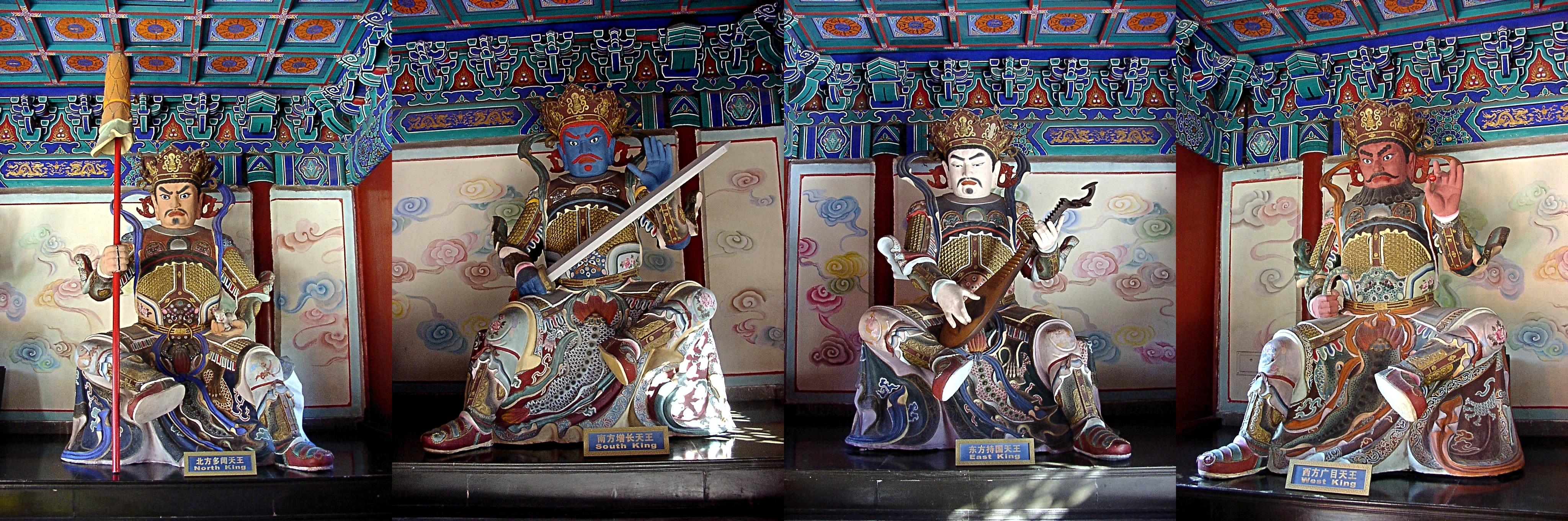
There are numerous classes of Buddhist deities that share similarities with the WDO, such as having a wrathful appearance and serving a protective function, but do not rank as high in the esoteric pantheon. These include the Heavenly Kings (天王, tianwang; Skt: Lokapala) (fig. 4), who protect righteous kingdoms and monasteries; Gate Guardians (門神, Menshen; Skt: Dvarapala), who protect the doorways of monasteries and temples; the Protector of Fields (Skt: Ksetrapala), who protect plots of land; the Guardians of the Directions (Skt: Dikpala), former Hindu gods who protect the eight directions; and the Dharma Protectors (Skt: Dharmapala), who protect the Buddha’s teachings. The WDO are high-level members of the latter group (Linrothe, 1999, pp. 20-22).

WDOs stand high above other guardians because they are charged “with the destruction of barriers which prevent the experience of enlightenment” (Linrothe, 1999, p. 25). These barriers include external threats like manifested demons and internal threats like demon-caused mental and bodily illness, the “three poisons,” and karmic debt (Linrothe, 1999, pp. 24-25). [3] And they have the power to subdue even supreme devas. For example, the Compendium of the Truth of All Buddhas (Skt: Savra-tathagata-tattva-samgraha, late-7th cent.) tells of the Cosmic Buddha Mahavairocana ordering the WDO Trailokyavijaya (the wrathful form of Vajrapani) to conquer Mahesvara (a.k.a., Shiva), king of the gods and master of the three realms. After being subdued, the fallen god asks the Buddha: “[H]ow it can be that Vajrapani, whom in anger [I]…called a mere Yaksa, can be so strong, stronger even than the Tathagata as Lord of the Trikaya[?]” (Linrothe, 1999, p. 26). [4]

Fig. 4 – (Left) Statues of the Four Heavenly Kings located in Beihai Park, Beijing, China (larger version). Fig. 5 – (Right) A modern toy depicting Monkey’s fearsome three-headed, six-armed form (larger version).

2. The Monkey King as a WDO

Many of Sun Wukong’s attributes and abilities align with those mentioned above, I would, therefore, like to argue that he is a WDO. First, he wears the tiger skin loincloth, which ties him to the same spiritual tradition represented by WDOs and Yogin ascetics. Second, he has a wrathful appearance (Skt: krodha). During his war with heaven, he takes on a fearsome form with three heads and six arms and multiplies his iron staff to defeat wave after wave of celestial opponents (fig. 5) (Wu & Yu, 2012, vol. 1, pp. 157 and 191). This is similar to the multiple heads, arms, and weapons of the WDO Yamantaka, as well as other such deities (Linrothe, 1999, pp. 188, 268-269 and 279-280, for example). Third, he serves as a destroyer of obstacles (Skt: vighnantaka). By vanquishing the various monsters, spirits, and fallen stars that threaten the life of Tripitaka, Sun clears the path of manifested demons that obstruct his master’s path to enlightenment. Thanks to his help Tripitaka becomes a Buddha at the end of the novel (Wu & Yu, 2012, vol. 4, p. 381). Fourth, Sun serves as the guardian and strong-arm of a Bodhisattva, per phase one of the recognized WDO iconography. Tripitaka is after all the Golden Cicada Bodhisattva reborn on earth (see the 05-20-26 update below for more info). Fifth, Monkey is so powerful that he poses a threat to the August Jade Emperor of Heaven, just like the WDO Trailokyavijaya did for the supreme deva Mahesvara. This ultimately explains why the celestial army is no match for Sun and why other guardian deities, like the Heavenly Kings, fear and respect him. [5] Identifying the Great Sage as a WDO helps locate his position in the novel’s Buddhist pantheon prior to his elevation to Buddhahood. This means that Monkey is no longer the Buddho-Daoist “wild card” that doesn’t really seem to fit in anywhere.

The author-compiler of JTTW would have had plenty of esoteric material to influence his depiction of Sun. Esoteric Buddhism filtered into China by the early-Tang Dynasty (618–907) and continued into the Song (960–1279) thanks to royal patronage. People of the neighboring foreign Khitan Liao (907–1125), Tangut Western Xia (1038–1227), and Jurchen Jin (1115–1234) dynasties, all of whom conquered northern China at one time or another, adopted the religion. The Mongols, another foreign ruler of the Middle Kingdom, were great adherents of Vajrayana Buddhism during the Yuan Dynasty (1271–1368), which ensured the continued presence of esoteric imagery in China. And during the Ming (1368–1644), when JTTW was first published, the Yongle (r. 1402–1424) and Zhengde (r. 1505-1521) emperors, as well as other elite members of society, patronized and/or practiced the religion (Stoddard, 2008; Orzech, Sorensen, & Payne, 2011).


3. Update

Update: 12-16-2017

My new article expands on the WDO connection by highlighting Monkey’s association with the circlet mentioned above as one of the ritual items worn by yogis. This shows Sun’s trademark headband can be traced to Esoteric Buddhism.

The Origin of Sun Wukong’s Golden Headband


Update: 06-07-2018

A stone carving of Sun Wukong from one of the Kaiyuan temple’s stone pagodas (erected in 1237) portrays him wearing nearly all of the aforementioned ritual items, further solidifying his image as a WDO.

The Sun Wukong Stone Relief of Kaiyuan Temple


Update: 05-20-26

I mistakenly referred to Tripitaka as a bodhisattva. Evidence points to him being an arhat/luohan. See section 4.1. of this article.

The Monk Tripitaka and the Golden Cicada

Notes:

1) The Krodha-vighnantaka term was coined by Rob Linrothe (1999) since the names traditionally given to said wrathful deities over the centuries are not appropriate to cover all three historical phases of their existence (pp. 19-20).

2) The first artists to represent WDOs drew on previous depictions of semi-divine Yaksa spirits, the dwarf-like Gana attendants of Shiva, and the humanoid personification of divine Hindu weapons (Skt: Ayudhapurusa) (Linrothe, 1999, pp. 12-13).

3) The three poisons are stupidity, greed/lust, and anger. These are often depicted in the center of Buddhist Wheel of Life art as a boar, a snake, and a rooster, each biting the others tail, forming a circle.

4) Linrothe (1999) writes that Shiva in this case represents the conquering of ego instead of “a Hinduism which must be humiliated” (p. 26).

5) During the Great Sage’s rebellion, the August Jade Emperor is forced to ask the Buddha to intervene because Sun Wukong is too strong (Wu and Yu, 2012, vol. 1, p. 191-192). Monkey defeats the celestial army, along with the Heavenly Kings, prior to being subdued (Wu and Yu, 2012, vol. 1, p. 172). And later the guardians “ben[d] low to bow to him and dare not bar his way” when he visits heaven some centuries after his rebellion (Wu and Yu, 2012, vol. 4, p. 118).

Sources:

Beer, R. (2003). The Handbook of Tibetan Buddhist Symbols. Chicago, Illinois: Shambhala.

Elgood, H. (1999). Hinduism and the Religious Arts. London, u.a.: Cassell.

Linrothe, R. N. (1999). Ruthless Compassion: Wrathful Deities in Early Indo-Tibetan Esoteric Buddhist Art. Boston, Mass: Shambhala.

Orzech, C. D., Sorensen, H. H., & Payne, R. K. (2011). Esoteric Buddhism and the tantras in East Asia. Leiden: Brill.

MacDonell, A. A., & Keith, A. B. (1995). Vedic index of names and subjects. Delhi: Motilal Banarsidass.

Stoddard, H. (2008). Early Sino-Tibetan art. Bangkok: Orchid Press.

Wu, C., & Yu, A. C. (2012). The Journey to the West (Vols. 1-4) (Rev. ed.). Chicago, Illinois: University of Chicago Press.

The Mountain of Flowers and Fruit and the Cosmic Geography of Journey to the West

Note: This page used to have historical information about the origin of Monkey’s first master, but I have moved it to a new article.

Last updated: 03-07-2023

The Monkey King’s home, the “Mountain of Flowers and Fruit” or “Flower-Fruit Mountain” (Huaguo shan, 花果山), is commonly assumed to be located in China. In fact, a similarly-named mountain in Jiangsu province is even touted as the home of Sun Wukong. However, this is not the case within the novel’s narrative. It’s important to remember that Journey to the West (Xiyouji, 西遊記, 1592) is set in a world that is nothing like our Earth.

In this article, I will explain the location of the Mountain of Flowers and Fruit, showing that Sun Wukong’s home is in fact an island east of what would be considered China. This opens the door to interesting interpretations by those wanting to place the story within a real world context. Second, I will explain the ancient Buddhist disc-world system as presented in the book. My hope is that this will give readers a better understanding of the cosmic geography in which the story happens. 

Table of Contents

1. Religious Background

Note: I will alternate between Wu & Jenner (2020) and Wu & Yu (2012), using one or the other depending on who I think has done a better job of translating certain passages.

Chapter one opens by describing the world in which the story is set:

The world was then divided into four great continents: The Eastern Continent of Superior Body, the Western Continent of Cattle-Gift, the Southern Continent of Jambu and the Northern Continent of Kuru (Wu & Jenner, 1993/2020, vol. 1, p. 3).

… 世界之間,遂分為四大部洲:曰東勝神洲,曰西牛賀洲,曰南贍部洲,曰北俱蘆洲。

Yu’s (Wu & Yu, 2012) translation provides romanization of the Sanskrit names (vol. 1, p. 100). I’ve listed them below, along with the original Sanskrit, an alternative English translation, and the Chinese for the reader’s reference:

  • East Pūrvavideha (Sk: पूर्वविदेह, “Surpassing the Body”; Ch: Dong shengshen zhou, 東勝神洲)
  • West Aparagodānīya (Sk: अपरगोदानीय, “Enjoyer of Cattle”; Ch: Xi niuhe zhou, 西牛賀洲)
  • North Uttarakuru (Sk: उत्तरकुरु, “Unpleasant Sound”; Ch: Bei julu zhou, 北俱盧洲)
  • South Jambudvīpa (Sk: जम्बुद्वीप, “Rose-Apple”; Ch: Nan shanbu zhou, 南贍部洲)

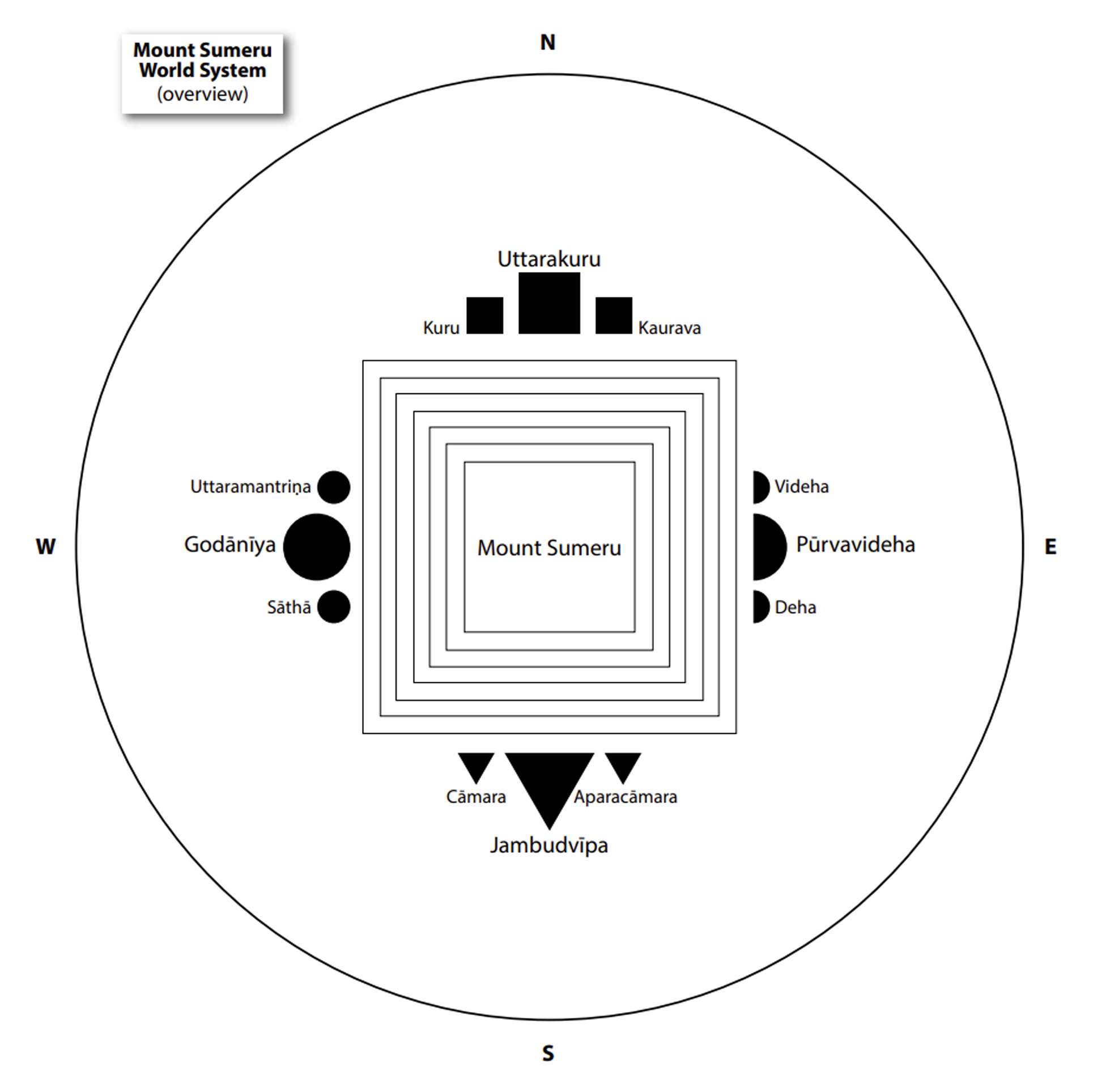
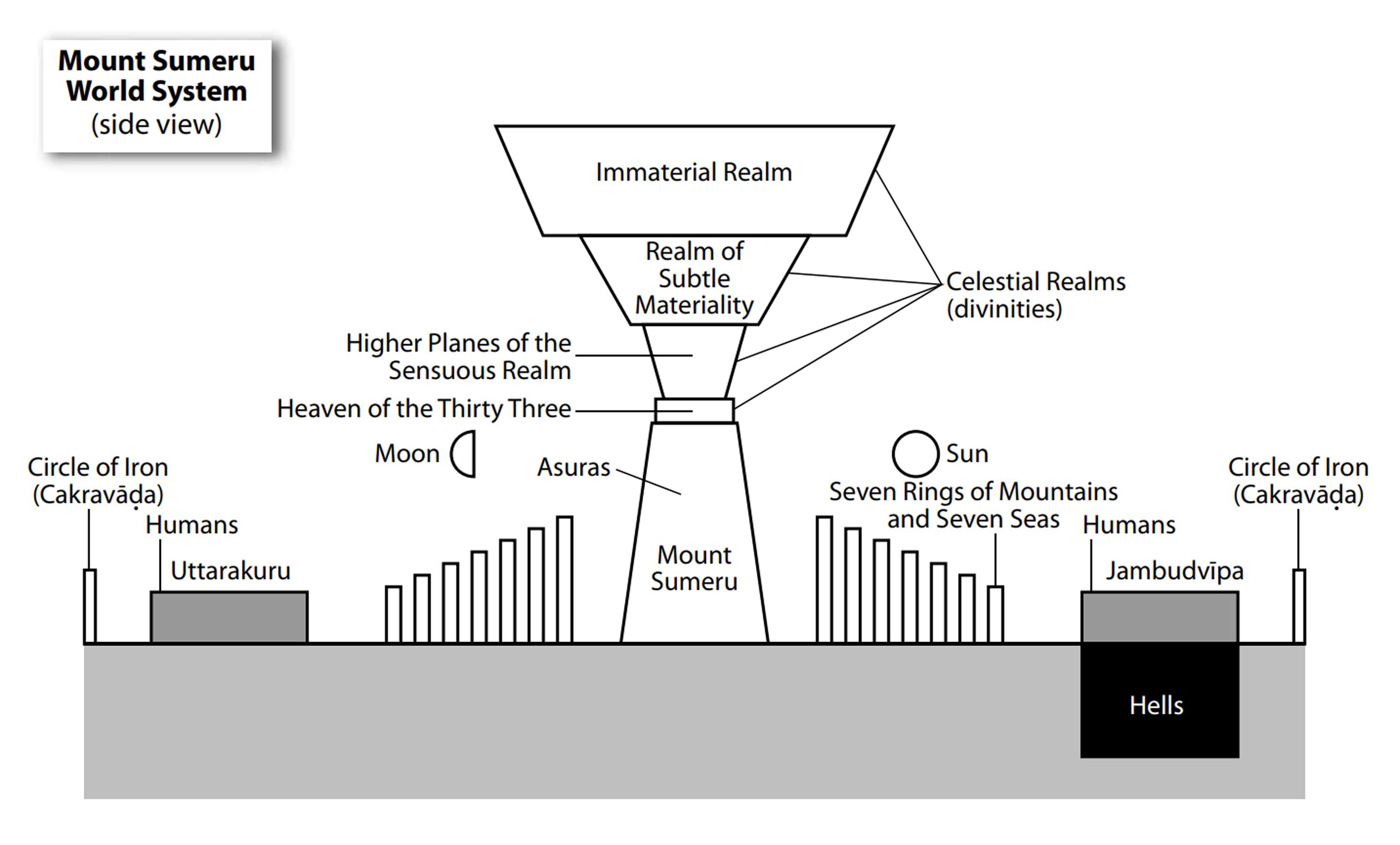
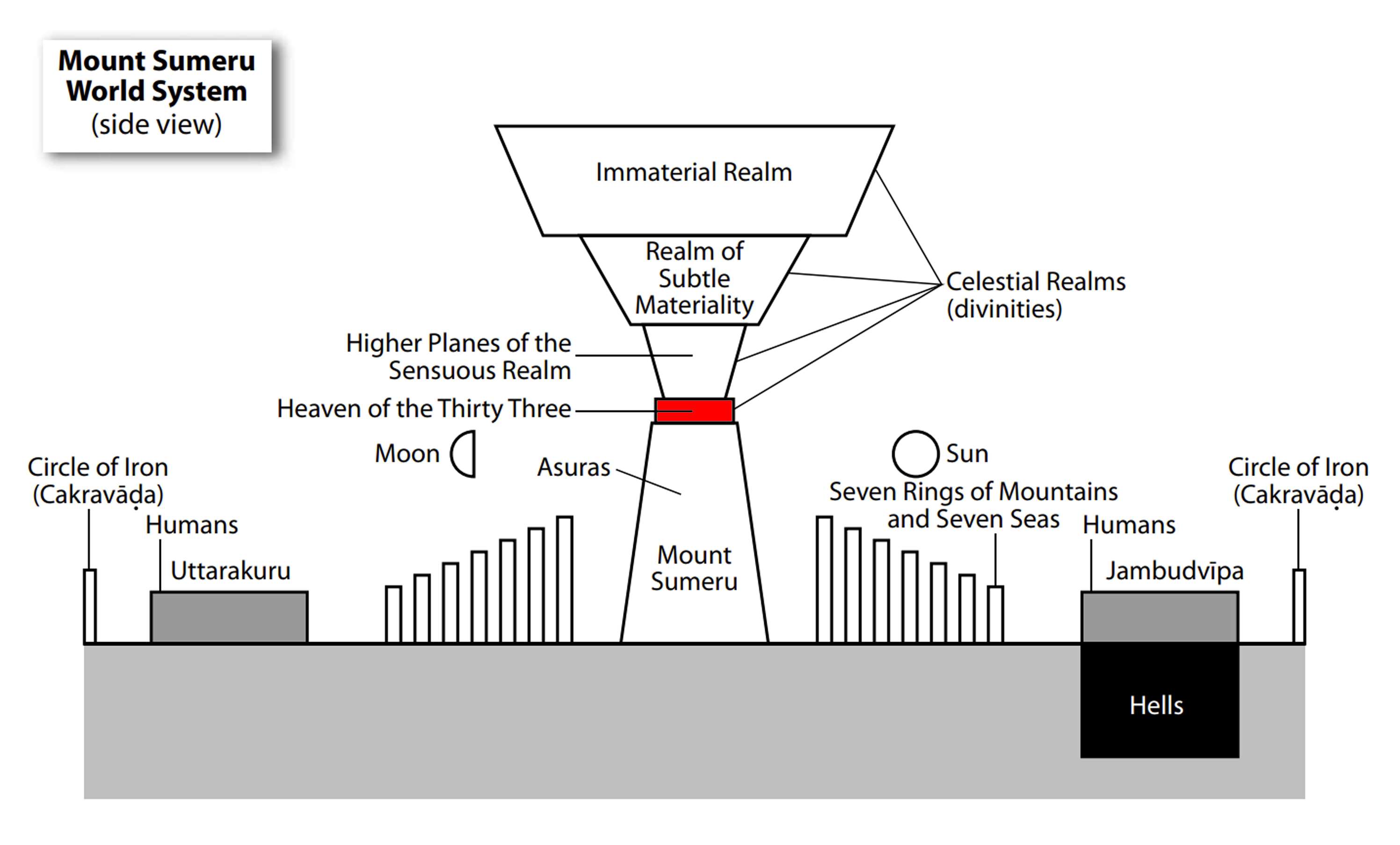
The Abhidharmakośa (Sk: अभिधर्मकोशभास्य; Ch: Api damo jushe lun, 阿毗達磨俱舍論, 4th to 5th century), a text describing the Buddhist universe, states that the four continents each have two intermediate continents, and that all twelve are set afloat in a great ocean surrounding the four respective sides of Mt. Sumeru (Ximi shan, 須彌山; Miaogao shan, 妙高山). This is a giant mountain that serves as the axis mundi of the cosmos, as well as the abode of assorted gods and sages. It is surrounded by seven golden mountains of lesser height, as well as a final iron mountain around the outside rim of the ocean, which keeps the water from draining over the edge (fig. 1 & 2) (Vasubandhu, La Vallée-Poussin, & Pruden, 1991, pp. 452-456).

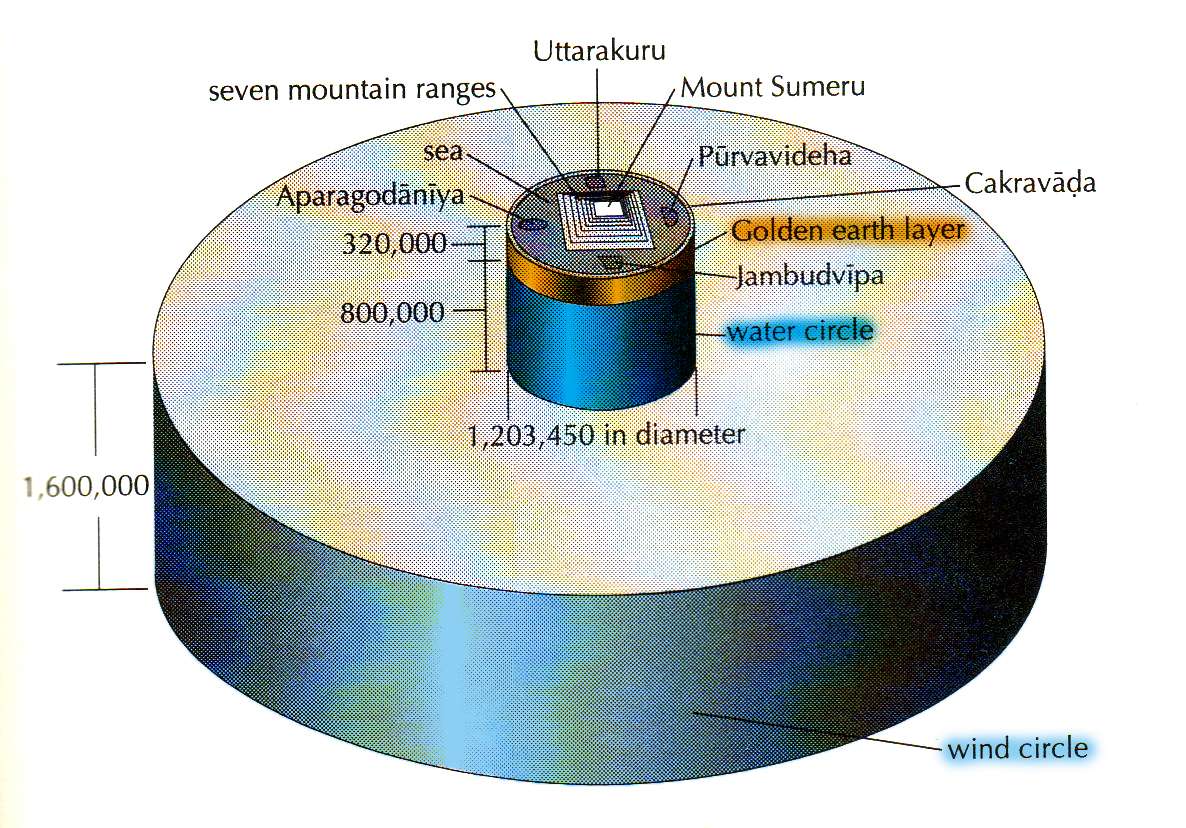
This system is supported by a series of elemental discs, each one becoming larger as one descends. The highest is kāñcanamaṇḍala, a disc of gold. The middle is jalamaṇḍala, a disc of water. And the lowest is vāyumaṇḍala, a disc of wind (fig. 3). This grand creation is thought to float in “space” (Vasubandhu, La Vallée-Poussin, & Pruden, 1991, pp. 451-452). 

Fig. 1 (top) – A top view of the Buddhist disc-world system (larger version). Fig. 2 (center) – A side view of the system (larger version). Images from Buswell & Lopez, 2014, pp. xxxii-xxxi. Fig. 3 (bottom) – A diagram showing the elemental discs supporting the world (larger version). Take note of the “wind circle” (light blue), the “water circle” (dark blue), and the “Golden earth layer” (gold). Adapted from Sadakata, 1997, p. 27.

2. Location of the Mountain

Chapter one continues:

Beyond the seas there is a country called Aolai [Aolai guo, 傲來國]. This country is next to an ocean, and in the middle of the ocean is a famous island called the Mountain of Flowers and Fruit. This mountain is the ancestral artery of the Ten Continents, the origin of the Three Islands; [1] it was formed when the clear and impure were separated and the Enormous Vagueness was divided (Wu & Jenner, 1993/2020, vol. 1, p. 3; cf. Wu & Yu, 2012, vol. 1, p. 100). 

海外有一國土,名曰傲來國。國近大海,海中有一座名山,喚為花果山。此山乃十洲之祖脈,三島之來龍,自開清濁而立,鴻濛判後而成。

Two deities shortly thereafter give a more precise location for the Mountain of Flowers and Fruit:

“We found that at the edge of the country of Aolai, which is east of the ocean belonging to the Eastern Continent of Superior Body, there is an island called the Mountain of Flowers and Fruit …” (Wu & Jenner, 1993/2020, vol. 1, p. 3; cf. Wu & Yu, 2012, vol. 1, p. 102). 

… 乃東勝神洲海東傲來小國之界,有一座花果山 …

Later, in chapter three, Sun Wukong’s advisors note the distance between Aolai and their island home:

The four monkeys replied, “East of our mountain, across two hundred [li] of water, is the boundary of the Aolai Country (Wu & Yu, 2012, vol. 1, p. 131; c.f. Wu & Jenner, 1993/2020, vol. 1, p. 50).

四猴道:「我們這山向東去,有二百里水面,那廂乃傲來國界。

All of this information tells us that the mountain is an island located 200 li (62 miles / 100 km) east of Eastern Superior Body (East Pūrvavideha).

3. The Novel’s Version of the Buddhist Disc-World System

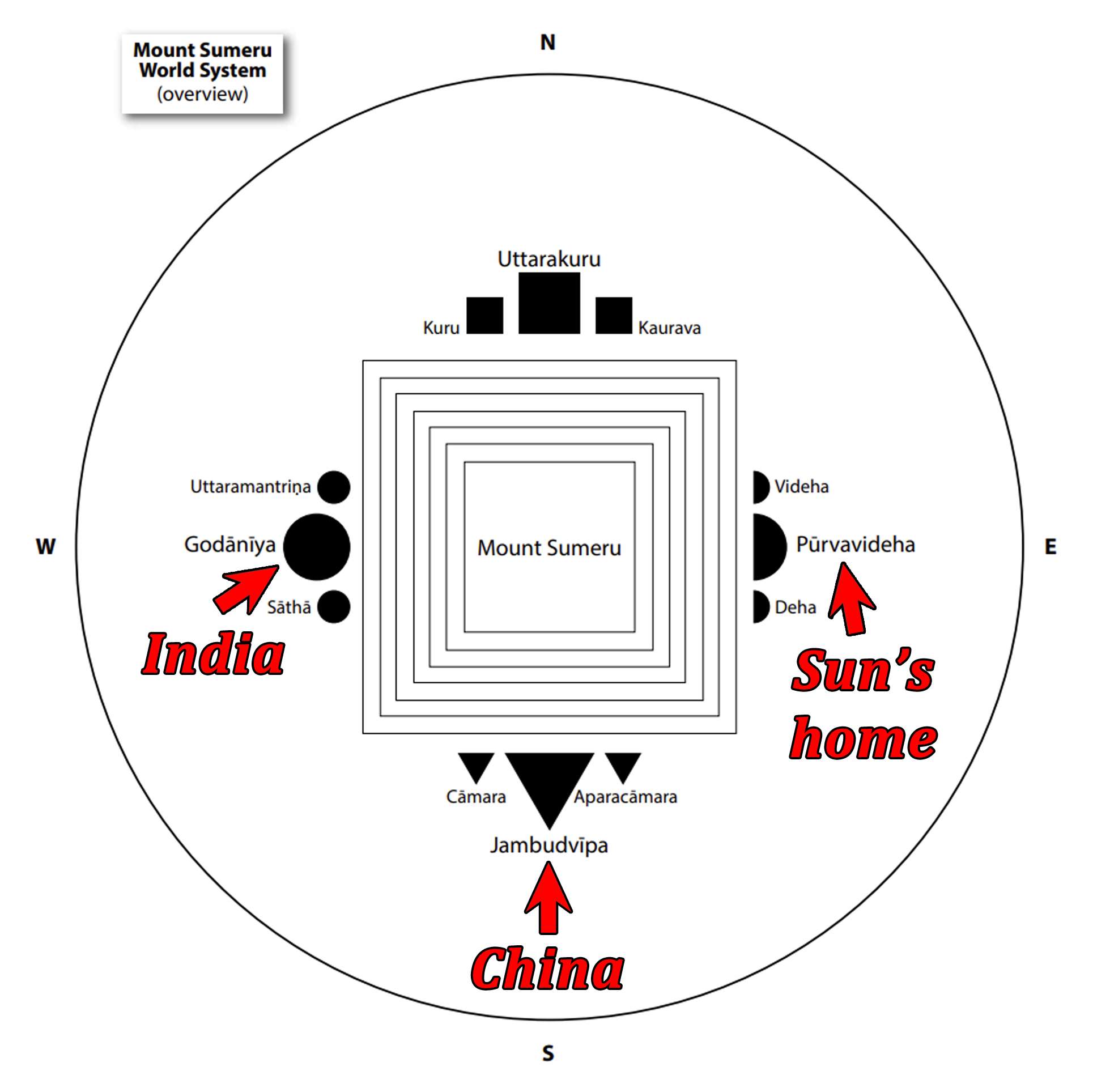
Buddhism traditionally associates Southern Jambu (South Jambudvīpa) with India (Buswell & Lopez, 2014, p. 377), but the novel shifts this structure a quarter turn clockwise (fig. 4). For example, in chapter eight, the Buddha associates his home (India) with the western continent and the southern continent with the “eastern lands” (dongtu, 東土), the Chinese Buddhist term for China (Tan, 1998, p. 137):

“… Our Western Continent of Cattle-Gift has people who neither covet nor kill. They nourish the vital essence and submerge the spirit; and although they produce no saints of the highest order, they all live to a ripe old age. But in the Southern Jambu Continent they are greedy and lecherous and delight in the sufferings of others; they go in for a great deal of killing and quarrelling. That continent can with truth be called a vicious field of tongues and mouths, an evil sea of disputation. [But I have] Three Stores of True Scriptures with which they can be persuaded to be good” (Wu & Jenner, 1993/2020, vol.1, p. 165; cf. Wu & Yu, 2012, vol. 1, pp. 205).

我西牛賀洲者,不貪不殺,養氣潛靈,雖無上真,人人固壽;但那南贍部洲者,貪淫樂禍,多殺多爭,正所謂口舌兇場,是非惡海。我今有三藏真經,可以勸人為善。

[…]

“I want to send them to the eastern lands because it is intolerable that the beings of that quarter should all be such stupid wretches who slander and defame the true word, do not understand the gist of my Law, and have lapsed from the orthodox Yogacara Sect…” (Wu & Jenner, 1993/2020, vol.1, p. 165; cf. Wu & Yu, 2012, vol. 1, pp. 205).

我待要送上東土,叵耐那方眾生愚蠢,毀謗真言,不識我法門之旨要,怠慢了瑜迦之正宗。

Additional evidence comes from chapter 29 when the chosen scripture pilgrim‘s travel rescript is reproduced. The opening line expressly connects China with the southern continent by way of the Chinese Tang dynasty: 

The travel rescript of the Tang Son of Heaven, who succeeds under the guidance of Heaven to the throne of the Great Tang Empire in the South Jambudvīpa Continent. … (Wu & Yu, 2012, vol. 2, p. 48; cf. Wu & Jenner, 1993/2020, vol. 2, p. 661).

南贍部洲大唐國奉天承運唐天子牒行 …

This means that when Sun first sails to Southern Jambu (South Jambudvīpa) to find a means of escaping death (Wu & Jenner, 1993/2020, vol.1, p. 16; cf. Wu & Yu, 2012, vol. 1, p. 108), he travels to the novel’s version of China. This further solidifies the fact that the Mountain of Flowers and Fruit is not located in China.

Fig. 4 – A top view of the Buddhist disc-world system according to Journey to the West (larger version). The Mountain of Flowers and Fruit would be to the east of Eastern Superior Body (East Pūrvavideha). Adapted from Buswell & Lopez, 2014, p. xxxii.

4. Reason for the Change

I suggest that the author-compiler of Journey to the West replaced the traditional cosmic geography for two reasons. First, both China and (part of) ancient India were referred to as the “Middle Kingdom” (Ch: Zhongguo, 中國; Sk: Madhyadeśa, मध्यदेश) (Wilkinson, 2000, p. 132; Lamotte, 1988, pp. 8-9). For example, the travelogue of the noted 4th to 5th-century Chinese Buddhist monk Faxian (法顯) reads:

Central India is known as the “Middle Kingdom” [Zhongguo, 中國]. The food and clothing of the common people are the same as the “Middle Kingdom” [i.e. China].

中天竺所謂中國。俗人衣服飲食亦與中國同。

This would naturally make it easier to associate China with Southern Jambu (South Jambudvīpa).

Second, since India is west of China, it would make sense for the country to be associated with Western Cattle-Gift (West Aparagodānīya).


5. Updates

Update: 10-01-17

A poem in chapter one states that the Mountain of Flowers and Fruit is the center of the universe. This obviously conflicts with Mt. Sumeru being the axis mundi.

Flower Fruit Mountain as the Center of the Universe


Update: 02-06-23

I have drastically rewritten the article to include more detailed information about the Buddhist disc-world system. I would also like to add material here from a previous article since it is related to the novel’s changes to the pre-existing structure.

Originally, the top of Mt. Sumeru supported the Buddhist heaven of the “Thirty-Three (Gods)” (Sk: Trāyastriṃśa, त्रायस्त्रिंश; Ch: Sanshisan tian, 三十三天; Daoli tian, 忉利天) (fig. 5), which is ruled by Śakra (Sk: शक्र; Ch: Dishi, 帝釋), king of the gods (Buswell & Lopez, 2014, pp. 921-922). However, the novel replaces this realm with the Daoist heaven, which is ruled by the Jade Emperor (Yuhuang shang/dadi, 玉皇上/大帝) (Clart, 2008, pp. 1197-1198). This is hinted at in chapter four when Monkey is invited to serve as the keeper of the heavenly horses. Part of a poem describing what he sees reads:

[…]
In this heaven are thirty-three heavenly palaces (emphasis added):
The Palace of Clouds Dispersed, the Vaisravana Palace, the [P]alace of Five Lores, the Sun Palace, the Palace of Flowery Bliss
[…] (Wu & Jenner, 1993/2020, p. 73; cf. Wu & Yu, 2012, vol. 1, p. 146).

這天上有三十三座天宮,乃遣雲宮、毘沙宮、五明宮、太陽宮、花樂宮 …

The “thirty-three” palaces are references to the homes of the thirty three gods. This change is, therefore, a prime example of the kind of Buddho-Daoist religious syncretism featured in Journey to the West.

Fig. 5 – The Heaven of the Thirty-Three atop Mt. Sumeru is indicated in red (larger version). Adapted from Buswell & Lopez, 2014, p. xxxii.


Update: 02-08-23

Despite the four Buddhist disc-world continents appearing in the story, Journey to the West hints that its world is a globe. For instance, when the Monkey King first sets out from his home in chapter one, he sails SE to reach the NW side of Southern Jambu (South Jambudvīpa):

He had chosen just the right time for his journey. After he boarded his raft the southeasterly wind blew hard for days on end and bore him to the northwestern shore of the southern continent (Wu & Jenner, 2020, vol.1, p. 16; cf. Wu & Yu, 2012, vol. 1, p. 108).

也是他運至時來,自登木栰之後,連日東南風緊,將他送到西北岸前,乃是南贍部洲地界。

I thought that maybe SE and NW were typos since heading SW would have taken him to the NE shore of the southern continent (refer back to fig. 4). However, in chapter two, Sun tells his children:

“The year I left you all,” Wukong said, “I drifted with the waves across the Great Eastern Ocean and reached the West Aparagodānīya Continent. I then arrived at the South Jambudvīpa Continent, where I learned human ways, wearing this garment and these shoes. I swaggered along with the clouds for eight or nine years, but I had yet to learn the Great Art. I then crossed the Great Western Ocean and reached the West Aparagodānīya Continent (Wu & Yu, 2012, vol. 1, p. 129; cf. Wu & Jenner, 1993/2020, p. 47).

我當年別汝等,隨波逐流,飄過東洋大海,到西牛賀洲地界,徑至南贍部洲,學成人像,著此衣,穿此履,擺擺搖搖,雲遊了八九年餘,更不曾有道。又渡西洋大海,到西牛賀洲地界 …

So it appears that he sailed from the Mountain of Flowers and Fruit to Western Cattle-Gift (West Aparagodānīya), similar to traveling from Japan in the East to the United States in the West. Then, he sailed from there to Southern Jambu (South Jambudvīpa), similar to traveling from the US to Africa. Lastly, he sailed back to Western Cattle-Gift (West Aparagodānīya). This might mean that the world of Journey to the West is a combination of a spherical planet and the Buddhist disc-world system.

If true, I suggest that the nonsensical, roundabout way that Monkey comes to study with Subodhi in the western continent could be a physical representation of his unsettled “monkey mind” (xinyuan, 心猿).

However, it’s important to point out that even Yu (Wu & Yu, 2012) considers the aforementioned route to be “[a]n inconsistency in the text” (vol. 1, p. 509, n. 17). So, I’ll leave it up to the reader as to which version of the world they ultimately want to accept.


Update: 02-09-23

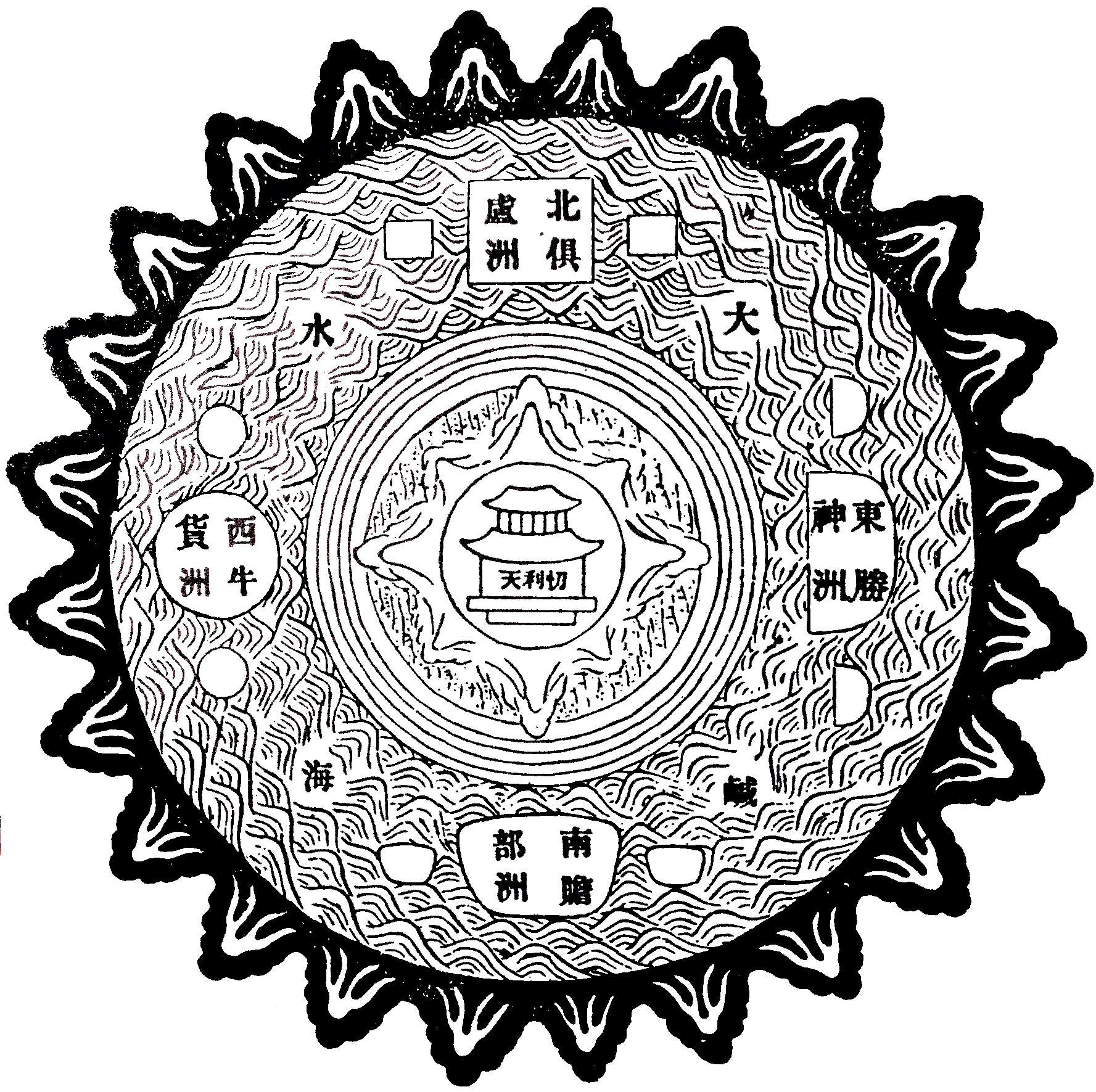
I found a lovely overhead Chinese map of the Buddhist disc-world system (fig. 6). The teeth-like structures around the perimeter are actually the iron mountain that contains the ocean. Also Mt. Sumeru in the center is topped by a building representing the Buddhist heaven of the “Thirty-Three (Gods)” (Ch: Daoli tian, 忉利天) (refer back to fig. 5).

Fig. 6 – An early-20th-century Chinese map of the Buddhist disc-world system (larger version). Image found on Wikimedia Commons.


Update: 02-11-23

I have posted an article that discusses the Buddha’s realm in Western Cattle-Gift (West Aparagodānīya).

The Buddha’s Vulture Peak and Journey to the West


Update: 03-07-23

In my 02-06-23 update, I noted how the “thirty-three mansions” alluded to the Buddhist heaven of the thirty-three gods (sanshisan tian, 三十三天), thereby showing that the Daoist heaven was inserted into the Buddhist cosmological structure. Well, I had completely forgotten that the novel overtly mentions this heaven numerous times. This is important in regards to the location of Laozi‘s (老子) residence. 

Journey to the West states that the deva and his alchemical furnace are located in the “Tushita Palace” (Doushuai gong, 兜率宮), which is said to be either in the “Separation’s Regret Heaven” (Lihen tian, 離恨天) or the “Great Canopy Heaven” (Daluo tian, 大羅天). Both are treated as the highest of the thirty-three heavens. For more information, see my article: 

Laozi’s Realm in Journey to the West

Note:

1) Yu (Wu & Yu, 2012) explains, “These islets and islands were famous abodes of gods or immortals” (vol. 1, p. 506, n. 6).

Sources:

Buswell, R. E. , & Lopez, D. S. (2014). The Princeton Dictionary of Buddhism. Princeton University Press.

Clart, P. (2008). Yuhuang. In F. Pregadio (Ed.), The Encyclopedia of Taoism (Vols. 1 & 2) (pp. 1197-1198). Longdon: Routledge.

Lamotte, E. (1988). History of Indian Buddhism: From the Origins to the Saka Era (S. Webb-Boin, Trans.). Louvain-la-Neuve: Université Catholique de Louvain Institut Orientaliste.

Tan, C. (1998). A Sino-Indian Perspective for India-China Understanding. In C. Tan (Ed.), Across the Himalayan Gap: An Indian Quest for Understanding China (pp. 133-147). New Delhi: Indira Gandhi National Centre for the Arts.

Vasubandhu, La Vallée-Poussin, L., & Pruden, L. M. (1991). Abhidharmakośabhāṣyam of Vasubandhu (Vol. 2). Berkeley, Calif.: Asian Humanities Press.

Wilkinson, E. P. (2000). Chinese History: A Manual (Rev. and Enl). Published by the Harvard University Asia Center for the Harvard-Yenching Institute : Distributed by Harvard University Press.

Wu, C. & Jenner, W. J. F. (2020). Journey to the West (Vols. 1-4). Beijing: Foreign Languages Press. (Original work published 1993)

Wu, C., & Yu, A. C. (2012). The Journey to the West (Vols. 1-4) (Rev. ed.). Chicago, Illinois: University of Chicago Press.

The Monkey King and Cinderella

Did you know that the Monkey King has a connection to Cinderella?! In this brief article, I will summarize some of the findings laid out in Beauchamp (n.d.), which highlights the presence of the Cinderella story cycle in the ethnic folklore of China, a world famous India epic, and even Journey to the West (Xiyouji, 西遊記, 1592). I will also include information, showing that the story cycle predates the Chinese version by centuries.

Table of Contents

1. Egypt and Greece

Before I continue, I want to briefly mention one of the oldest Western variants of the Cinderella story cycle, Rhodopis, a tale set in ancient Egypt.

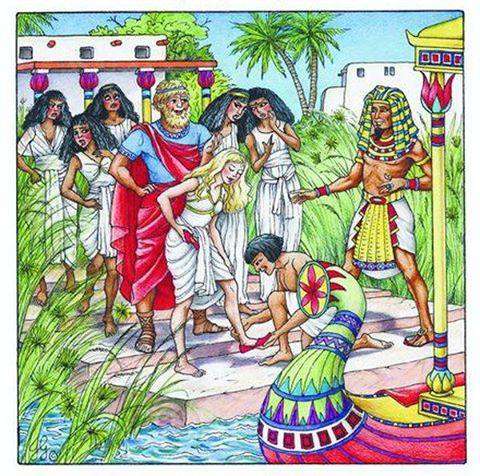
The story describes how the god Horus sends an eagle (or takes the form of one) to steal the slipper of the titular Greek slave and delivers it to an Egyptian Pharaoh, who launches a search for and eventually marries the woman (fig. 1). The tale was first recorded by the Greek geographer Strabo in 7 BCE (Ripley, 2010, pp. 185-188). However, the work is part of a wider story cycle evident throughout Asia and the Middle East.

Fig. 1 – The Pharaoh finds Rhodopis (larger version).

2. China

The earliest version that appears to have many of the familiar elements from the final European version hails from China. Titled “Yexian” (葉限), the story describes the titular heroine working as an imprisoned servant for her evil stepmother, the bestowal of a beautiful dress and slippers by a female ancestor from heaven, her attendance of a local festival, the loss of one of her slippers while fleeing the festivities, the discovery of the shoe by a foreign king, and a search that results in their eventual marriage. The story is based on the oral tales of the Zhuang ethnic people (of the Vietnamese-Chinese border) and was first recorded by Duan Chengshi (段成式) in the 9th-century CE (Ripley, 2010, pp. 191-192; Beauchamp, n.d.).

3. India

Certain elements of the story appear to have been influenced by the great Hindu epic the Ramayana, written by Valmiki around 500 BCE. The story tells how Sita, the wife of Vishnu’s reincarnation Prince Rama, is kidnapped and held prisoner by the demon Ravana (with the intent of making her his wife) on the island of Lanka. It is during her time in captivity that she is visited by Rama’s servant, Hanuman, a monkey demi-god, who brings her the prince’s ring to prove himself a trustworthy ally (fig. 2). The simian character then brings her anklet to Rama to prove that she is still alive. Rama’s army assaults Ranava’s fortress, and he is eventually reunited with his wife.

This at first may not seem like it matches at all, but you have an imprisoned beauty (Sita vs Yexian), supernatural assistance from heaven (Hanuman vs. the female ancestor), the exchange of personal items to prove one’s identity (the ring and anklet vs the slipper), and a campaign that brings together the woman and a man of royal blood (Sita and Rama vs Yexian and the foreign king) (Beauchamp, n.d.).

Hanuman gives Sita Rama’s ring in the Sandara Kanda book of the Ramayana:

Sarga 34

1. Hanuman, the immensely powerful son of Maruta the wind god, humbly addressed further words to Sita in order to inspire her confidence:
2. “I am a monkey, virtuous woman, a messenger of wise Rama. My lady, look at this ring marked with Rama’s name. Take heart, bless you, for your troubles will soon be at an end.”
3. Taking her husband’s ring and examining it, Janaki was as joyous as if she had rejoined her husband.
4. Her lovely face-its long eyes all red and white-lit up with joy, like the moon, the lord of stars, when released from Rahu, demon of the eclipse (Valmiki et. al., 2016, p. 207).

Fig. 2 – Hanuman giving Sita Rama’s ring (larger version).

4. Journey to the West

Some scholars believe that secularized snippets of the Rama story cycle came to China in several waves, one of which was via Southeast Asian Hindu converts who settled in Southern China from the 7th-century onwards (Walker, 1998).

This then might explain an episode from Journey to the West that appears to draw from the Rama cycle. In chapters 68 to 71, a queen is kidnapped and held prisoner by a demon (with the intent of making her his wife) in a faraway land. Sun Wukong is employed to find her. He brings back a bracelet to her husband as proof of life and identity, and eventually reunites the couple after defeating the demon (Beauchamp, n.d.).

Monkey shows the bracelet to the Queen in chapter 70:

On hearing this, the lady shouted for the two rows of vixen and deer [spirits] to leave. After he closed the palace door, Pilgrim gave his own face a wipe and changed back into his original form. He said to the lady, “Don’t be afraid of me. I am a priest sent by the Great Tang in the Land of the East to go seek scriptures from Buddha in the Thunderclap Monastery of India in the Great Western Heaven. My master is Tripitaka Tang, the bond-brother of the Tang emperor, and I am Sun Wukong, his eldest disciple. When we passed through your kingdom and had to have our travel rescript certified, we saw a royal proclamation issued for the recruitment of physicians. I exercised my great ability in the therapeutic arts, and I cured the king of his illness of ardent longing. During the banquet he [came] to thank me, he told me while we were drinking about how you were abducted by the fiend. Since I have the knowledge of subduing dragons and taming tigers, he asked me specially to come arrest the fiend and rescue you back to the kingdom. It was I who defeated the vanguard, and it was I, too, who slew the little fiend [note: Monkey is disguised as him]. When I saw, however, how powerful the fiend was outside the gate, I changed myself into the form of Going and Coming [note: the little fiend] in order to take the risk of contacting you here.”

On hearing what he said, the lady fell silent. Whereupon Pilgrim took out the treasure bracelets and presented them with both hands, saying, “If you don’t believe me, take a good look at these objects.”

The moment she saw them, the lady began to weep, as she left her seat to bow to Pilgrim, saying, “Elder, if you could indeed rescue me and take me back to the kingdom, I would never forget your great favor!” (Wu & Yu, 2012, vol. 3, p. 297).

娘娘聞言,喝退兩班狐、鹿。行者掩上宮門,把臉一抹,現了本像,對娘娘道:「你休怕我。我是東土大唐差往大西天天竺國雷音寺見佛求經的和尚。我師父是唐王御弟唐三藏。我是他大徒弟孫悟空。因過你國倒換關文,見你君臣出榜招醫,是我大施三折之肱,把他相思之病治好了,排宴謝我。飲酒之間,說出你被妖攝來。我會降龍伏虎,特請我來捉怪,救你回國。那戰敗先鋒是我,打死小妖也是我。我見他門外兇狂,是我變作有來有去模樣,捨身到此,與你通信。」那娘娘聽說,沉吟不語。行者取出寶串,雙手奉上道:「你若不信,看此物何來?」娘娘一見垂淚,下座拜謝道:「長老,你果是救得我回朝,沒齒不忘大恩。」

5. Comparison

Beauchamp (n.d.) provides a diagram showing the similarities between the stories of Yexian, Sita, and the queen from Journey to the West (fig. 3).

Fig. 3 – Comparative Chart of Cinderella Variants (larger version).

Sources:

Beauchamp, F. (n.d.). In the Realm of the Dragon King: Sita and Hanuman meet Cinderella and Sun Wukong. Retrieved from http://www.asdp-bridgingcultures.org/Beauchamp%20-%20Realm%%E2%80%A6. [Original link dead. Click on article title to read.]

Ripley, D. (2010). The Maiden with a Thousand Slippers: Animal Helpers and the Hero(ine)’s Journey. In P. Monaghan (Ed.). Goddesses in World Culture (pp. 185-200). Santa Barbara, California: Praeger.

Valmiki, Goldman, R. P., & Goldman, S. J. (2016). The Rāmāyaṇa of Vālmīki: An Epic of Ancient India, Volume V: Sundarakāṇḍa. United States: Princeton University Press.

Walker, H.S. (1998). Indigenous or Foreign? A Look at the Origins of Monkey Hero Sun Wukong. Sino-Platonic Papers, 81, pp. 1-117. Retrieved from https://sino-platonic.org/complete/spp081_monkey_sun_wukong.pdf.

Wu, C., & Yu, A. C. (2012). The Journey to the West (Vols. 1-4) (Rev. ed.). Chicago, Illinois: University of Chicago Press.

A Historical Source for the Monkey King’s Staff?

[Since writing this article, I have come to appreciate a Chinese origin for the depiction of Monkey’s staff as an iron pillar. Please see the entry for 09-26-16 below. I am keeping this article up for posterity so others may see my thought process.]

Last updated: 07-04-2021

Much of my recent work on Journey to the West (Xiyouji, 西遊記; “JTTW” hereafter) has focused on the origins of Sun Wukong‘s magic staff. This is because, as far as I know, scholars haven’t attempted to trace it beyond the 13th-century JTTW. This entry discusses the staff’s influence by the ringed and metal staves respectively carried by religious and martial Buddhist monks. Over time, these were combined into a single weapon: the rings from the former were fused at the ends of the latter. However, this doesn’t explain all aspects of the weapon. Take for example the initial description of the staff as a black iron pillar with an inscription:

[Sun] Wukong girded up his clothes and went forward to touch it: it was an iron rod more than  twenty feet long and as thick as a barrel (emphasis added). Using all his might, he lifted it with both hands, saying, “It’s a little too long and too thick. It would be more serviceable if it were somewhat shorter and thinner.” Hardly had he finished speaking when the treasure shrunk a few feet in length and became a layer thinner. “Smaller still would be even better,” said Wukong, giving it another bounce in his hands. Again the treasure became smaller. Highly pleased, Wukong took it out of the ocean treasury to examine it. He found a golden hoop at each end, with solid black iron in between. Immediately adjacent to one of the hoops (emphasis added) was the inscription, “The Compliant Golden-Hooped Rod. Weight: 17,550 lbs” (based Wu & Yu, 2012, p. 135). [1]

悟空撩衣上前,摸了一把,乃是一根鐵柱子,約有斗來粗,二丈有餘長。他儘力兩手撾過道:「忒粗忒長些,再短細些方可用。」說畢,那寶貝就短了幾尺,細了一圍。悟空又顛一顛道:「再細些更好。」那寶貝真個又細了幾分。悟空十分歡喜,拿出海藏看時,原來兩頭是兩個金箍,中間乃一段烏鐵。緊挨箍有鐫成的一行字,喚做:「如意金箍棒,重一萬三千五百斤。」

If the weapon is based on historical objects, could it be possible that this description is based on something real? I believe I have found the object that may have influenced Monkey’s treasure: the famous Iron Pillar of Delhi (Ch: Deli tiezhu, 德里鐵柱) (fig. 1).

Fig. 1 – The Iron Pillar of Delhi (4th-cent. CE) (larger version). Image found on Wikipedia.

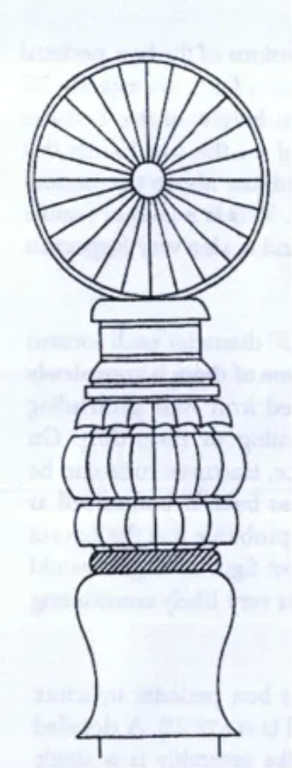
This Hindu monument was erected by King Chandragupta II (r. 380–413) of the Gupta Empire and dedicated to the deva Vishnu (Balasubramaniam, 2005, p. 14). It is nearly 24-feet (7.31 m) long, 21-feet (6.4 m) of which is sticking out of the ground (“an iron rod more than twenty feet long”). The shaft has a very wide diameter, 24-inches (60.96 cm) at the base and 17-inches (43.18 cm) at ground level (“as thick as a barrel”) (Balasubramaniam, 2005, p. 30). It has an ornamental bell capital that was originally topped by a chakra disc (“He found a golden hoop at each end”) (fig. 2) (Balasubramaniam, 2005, pp. 36-42). [2] And it also carries an inscription describing the military feats of the king (“Immediately adjacent to one of the hoops was the inscription…”) (fig. 3) (Balasubramaniam, 2005, pp. 6-8).

Fig. 2 (left) – A reconstruction of the chakra disc (larger version) (Balasubramaniam, 2005, p. 42). Fig. 3 (right) – The inscription (larger version).

What’s most interesting is the fact that the pillar is famous for resisting corrosion over the last 1,600 years. Scientists have analyzed its composition to find that it has a high phosphorous content, which forms a protective barrier against corrosive agents (Balasubramaniam, 2005, pp. 3 and 50-51). This means that the metallurgists of ancient India were far more advanced than originally thought. In addition, a local tradition in Delhi associates the pillar with Bhima, a supernaturally strong warrior from the great Hindu epic the Mahabharata (4th-cent. BCE). A legend circulating from at least the 19th-century (and maybe earlier) claims that he wielded the monument as a club in his ancient war against a rival army (Chunder, 1869, p. 152). Therefore, a black iron rod that defies time and is associated with martial heroes would surely make a fine weapon for an immortal monkey, no?

I unfortunately don’t know of any Chinese sources mentioning the pillar, so connecting it directly to JTTW is difficult. However, the pillar was around for 1,200 years prior to the standard 1592 version of the novel, and Buddhist monks such as Faxian and the historical Xuanzang made pilgrimages to northern India where the monument is located. Not to mention there is the possibility that Indian and Chinese merchants traveling back and forth between the two countries could have spread tales about the marvelous iron rod to China. These oral tales could have then reached the ear of the novel’s author-compiler during the Ming. I’ve contacted experts in Chinese history, religion, and literature to determine whether or not I’m on the right path. I’ll make a sister entry in the future if I happen upon any more information.


Update: 06-04-14

I recently learned that famed Muslim sojourner Ibn Battuta (1304-1377) referenced the pillar in his travel log:

In the center of the [Mosque of Delhi] is the awe-inspiring column of which [it is said] nobody knows of what metal it is constructed. One of their learned men told me that it is called Haft Jūsh, which means ‘seven metals’, and that it is composed of these seven. A part of this column, of a finger’s length, has been polished, and this polished part gives out a brilliant gleam. Iron makes no impression on it. It is thirty cubits high, and we rolled a turban round it, and the portion which encircled it measured eight cubits (Ibn Batuta & Gib, 2002, p. 622). [3]

Ibn Battuta traveled to China after his time in India, so this is just an example of how stories of the pillar could have come to the Middle Kingdom.


Update: 12-30-14

I just posted the third and final installment of my investigation on the history of Monkey’s staff. It can be read here.

Deciphering the Inscription on the Monkey King’s Staff


Update: 09-26-16

Since writing the top entry, I’ve come to appreciate a Chinese origin for the staff’s depiction as an iron pillar. This entry serves as an addendum until I can write a longer blog on the subject.

The Connection Between the Monkey King’s Staff, Yu the Great, and Flood Control


Update: 12-09-16

I recently learned about the origins of Monkey’s birth from stone, which may have influenced the hero’s connection with Yu’s ruler.

Sun Wukong’s Birth from Stone and More Connections to Yu the Great


Update: 02-06-21

I have written an article that discusses the magic powers of the staff. These include the ability to shrink and grow, control the ocean, astral project and entangle with Monkey’s spirit, multiply endlessly, pick locks, and transform into various objects. It also has sentience to a certain degree.

The Magic Powers of the Monkey King’s Iron Staff


Update: 07-04-21

Here I present my theory on why Sun Wukong’s staff weighs 13,500 catties (17,560 lbs/7,965 kg). I believe the number is an embellishment on the weight of a stone block lifted by the bandit Wu Song in the Water Margin (c. 1400).

The Weight of the Monkey King’s Staff: A Literary Origin

Notes:

1) Anthony Yu’s (Wu & Yu, 2012) original translation states “thirteen thousand five hundred pounds” (vol. 1, p. 135). However, Chinese versions of the novel use jin (斤), known in English as “catty.” Catty and pound are two different measures of weight, the former being heavier than the latter. The catty during the Ming Dynasty when the novel was compiled equaled 590 grams (Elvin, 2004, p. 491 n. 133), so 13,500 catties would equal 17,550 lbs. Therefore, the English text has been altered to show the more accurate weight.

2) Balasubramaniam (2005) states that the discus was probably removed during the Muslim era for iconoclastic reasons (p. 43). I’m not sure when (if it all) stories of the pillar made it to China. Whether before or after the Muslim conquest, the ornamental nature of the discus and/or the remaining bell capital could have influenced the fusion of the rings from the religious staff to the ends of the martial iron staff.

3) A big thanks to Historum member Jinit for bringing the reference to my attention.

References

Balasubramaniam, R. (2005). Story of the Delhi Iron Pillar. Delhi: Foundation Books.

Chunder, B. (1869). The Travels of a Hindoo to Various Parts of Bengal and Upper India (Vol. 2). London: N. Trübner.

Elvin, Mark. (2004). The Retreat of the Elephants: An Environmental History of China. New Haven (Conn.): Yale University Press.

Ibn Batuta & Gib, H. A. R. 2000. The Travels of Ibn Baṭṭūṭa, A.D. 1325-1354 (Vol. 3). London: Hakluyt Society.

Wu, C., & Yu, A. C. (2012). The Journey to the West (Vol. 1) (Rev. ed.). Chicago, Illinois: University of Chicago Press.