What Does Zhu Bajie Look Like? A Resource for Artists and Cosplayers

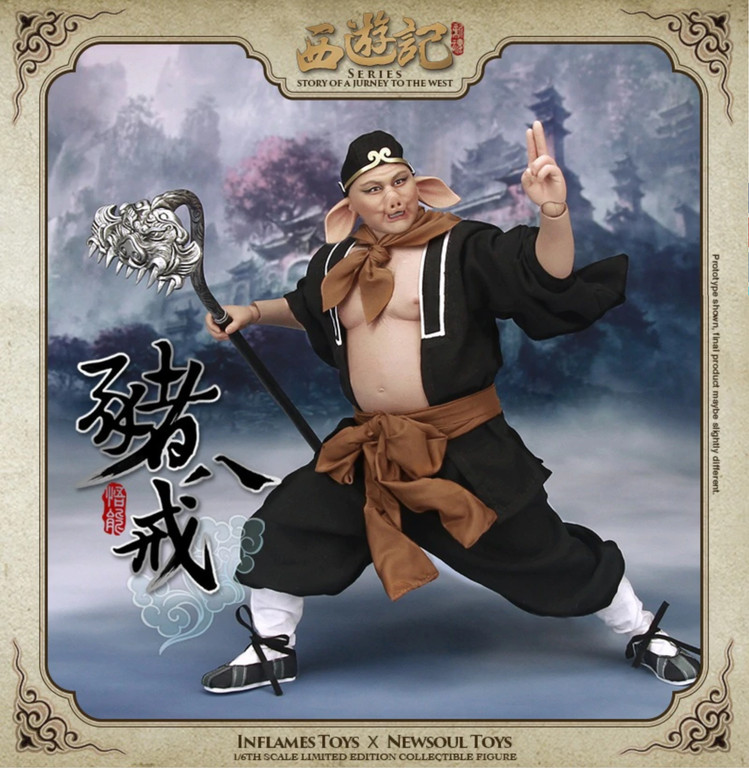
Type “Zhu Bajie” (豬八戒) into Google images and you will generally see a cute or friendly-looking pig-man with pink skin, big ears, a short snout, and a large stomach, and he will inevitably be holding some form of metal rake. Most iterations will likely be based on the character’s iconic look from the classic 1986 TV show, which portrays him wearing a Ji Gong-style Buddhist hat (Ji Gong mao, 濟公帽) with a golden fillet (à la Sun Wukong), a handkerchief tied around his neck and a sash at his waist, and black monk’s robes open at the chest (fig. 1). You might even see a few images depicting Zhu as a hulking warrior, but rarely will you see him portrayed with dark skin. So how do these representations compare to his depiction in the novel, and who has produced the most authentic look? In this article I present Zhu’s literary description, along with ancient depictions that predate the novel. My hope is that the information will be both interesting and useful, especially for artists and cosplayers looking to make a more authentic design.

I should note that this is not meant to be an exhaustive survey, just a general overview.

Fig. 1 – A modern action figure of Zhu Bajie from the 1986 TV show (larger version).

Table of Contents

1. Ancient Depictions

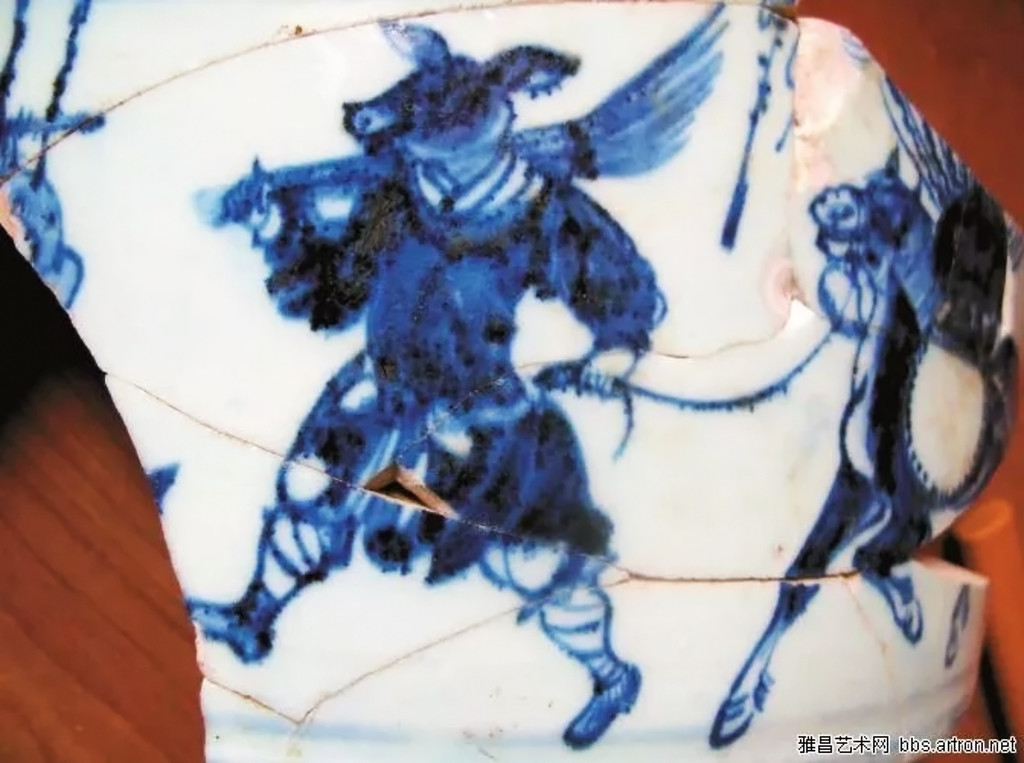
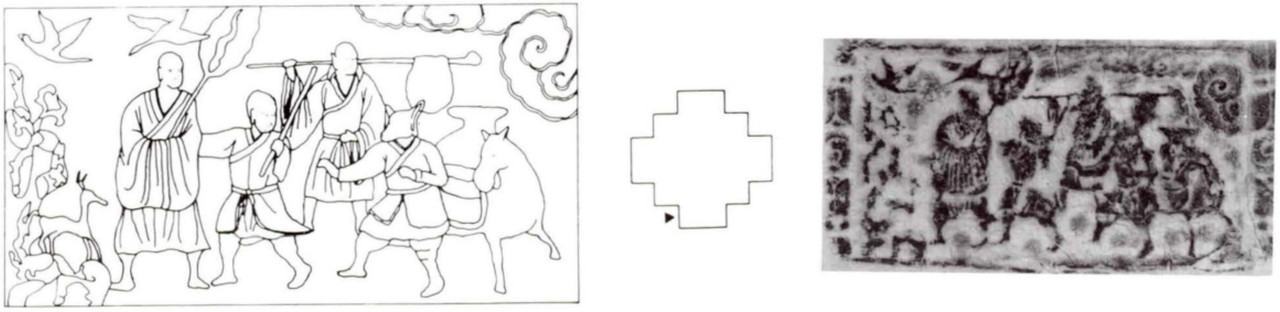
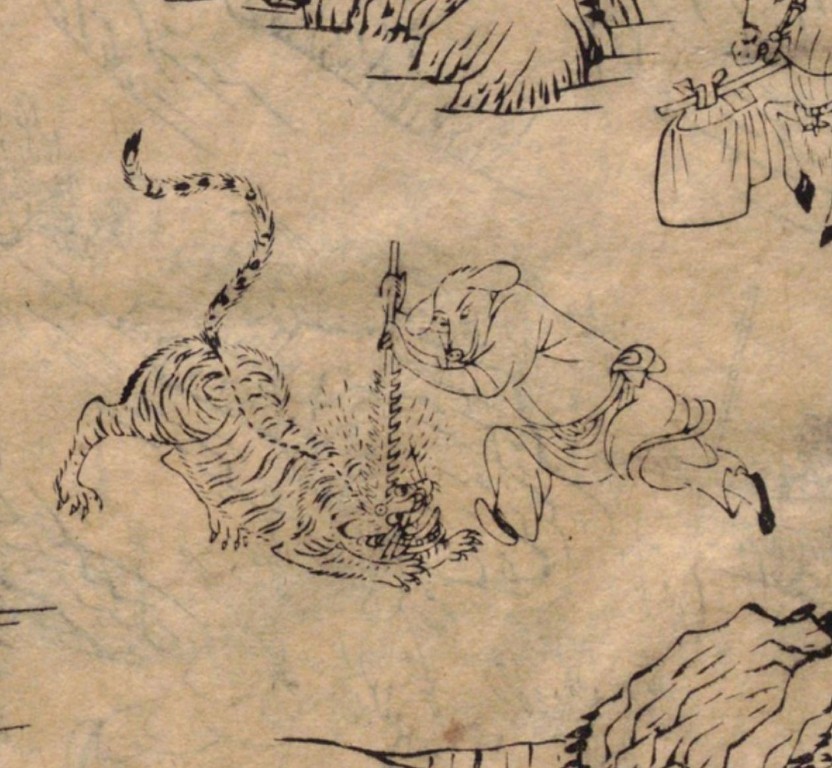
Zhu’s earliest depictions hail from the 14th century as he is a latecomer to the story cycle, postdating the appearance of Sun Wukong and Sha Wujing by centuries. He is featured on a ceramic pillow and an incense burner from late-Yuan China, as well as a series of carvings on a stone pagoda from late Goryeo Korea. Each piece draws on the same motif, depicting Zhu as a pig-headed monk taking large strides as he shoulders his rake and/or leads the horse. Even in instances where the weapon and equine are not present, he’s depicted in the same general posture (fig. 2-4).

Fig. 2 (left) – Detail of Zhu from a Cizhou ware ceramic pillow. See here for the full image. Fig. 3 (center) – Detail from the incense burner. See here for the full image. Fig. 4 (right) – Detail from panel two of the Korean pagoda. Note the figure’s matching posture. See here for the full line drawing.

2. What the Novel Says

2.1. Physical Appearance

A poem in Journey to the West (Xiyou ji, 西遊記, 1592; “JTTW” hereafter) chapter 8 contains the earliest reference to Zhu’s appearance:

Lips curled and twisted like dried lotus leaves;
Ears like rush-leaf fans [pushan, 蒲扇] and hard, gleaming eyes;
Gaping teeth as sharp as a fine steel file’s;
A long mouth wide open like a fire pot [huopen, 火盆].
[…] (Wu & Yu, 2012, vol. 1, p. 211).

JTTW Chapter 18 provides more detail about his bristly neck and dark skin:

“Well,” said old Mr. Gao, “when he first came, he was a stout, swarthy [hei, 黑; lit: “black”] fellow, but afterwards he turned into an idiot with huge ears and a long snout, with a great tuft of bristles [zongmao, 鬃毛; lit: “mane”] behind his head. His body became horribly coarse and hulking. In short, his whole appearance was that of a hog!” (Wu & Yu, 2012, vol. 1, p. 372).

When the violent gust of wind had gone by, there appeared in midair a monster who was ugly indeed. With his black face [hei lian, 黑臉] covered with short, stubby hair, his long snout and huge ears, he wore a cotton shirt that was neither quite green nor quite blue. A sort of spotted cotton handkerchief was tied round his head (Wu & Yu 2012, vol. 1, p. 375).

The mane on the back of Zhu’s head is such a prominent feature that he took it as his personal name: “[M]y surname is based on my appearance. Hence I am called Zhu ([豬] Hog), and my official name is Ganglie ([剛鬣] Stiff Bristles)” (Wu & Yu 2012, vol. 1, p. 376).

JTTW Chapter 19 shows he has hands and feet like a man:

The monster did indeed raise his rake high and bring it down with all his might; with a loud bang, the rake made sparks as it bounced back up. But the blow did not make so much as a scratch on Pilgrim’s head. The monster was so astounded that his hands [shou, 手] turned numb and his feet [jiao, 腳] grew weak (Wu & Yu 2012, vol. 1, pp. 383-384).

Compare this to the mention of hooves (ti, 蹄) when he transforms into a giant boar in JTTW chapter 67 (see section 2.2 below).

JTTW Chapter 29 gives the fullest description:

My elder disciple has the surname of Zhu, and his given names are Wuneng [悟能] and Eight Rules [Bajie, 八戒]. He has a long snout and fanglike teeth, tough bristles on the back of his head, and huge, fanlike ears. He is coarse and husky, and he causes even the wind to rise when he walks (Wu & Yu 2012, vol. 2, p. 51).

JTTW Chapter 85 reveals the shocking size of his snout:

A snout, pestlelike, over three Chinese feet long [san chi, 三尺, 3.15 feet/96 cm] [1]
And teeth protruding like silver prongs.
Bright like lightning a pair of eyeballs round,
Two ears that whip the wind in hu-hu [唿唿] sound.
Arrowlike hairs behind his head are seen;
His whole body’s skin is both coarse and black [qing, 青]. [2]
[…] (based on Wu & Yu 2012, vol. 4, p. 149).

JTTW Chapter 90 notes that Zhu has a tail: “Seizing him by the bristles and the tail [wei, 尾], the two spirits hauled Eight Rules away to show him to the nine-headed lion, saying, “Grandmaster, we’ve caught one” (Wu & Yu 2012, vol. 4, p. 219).

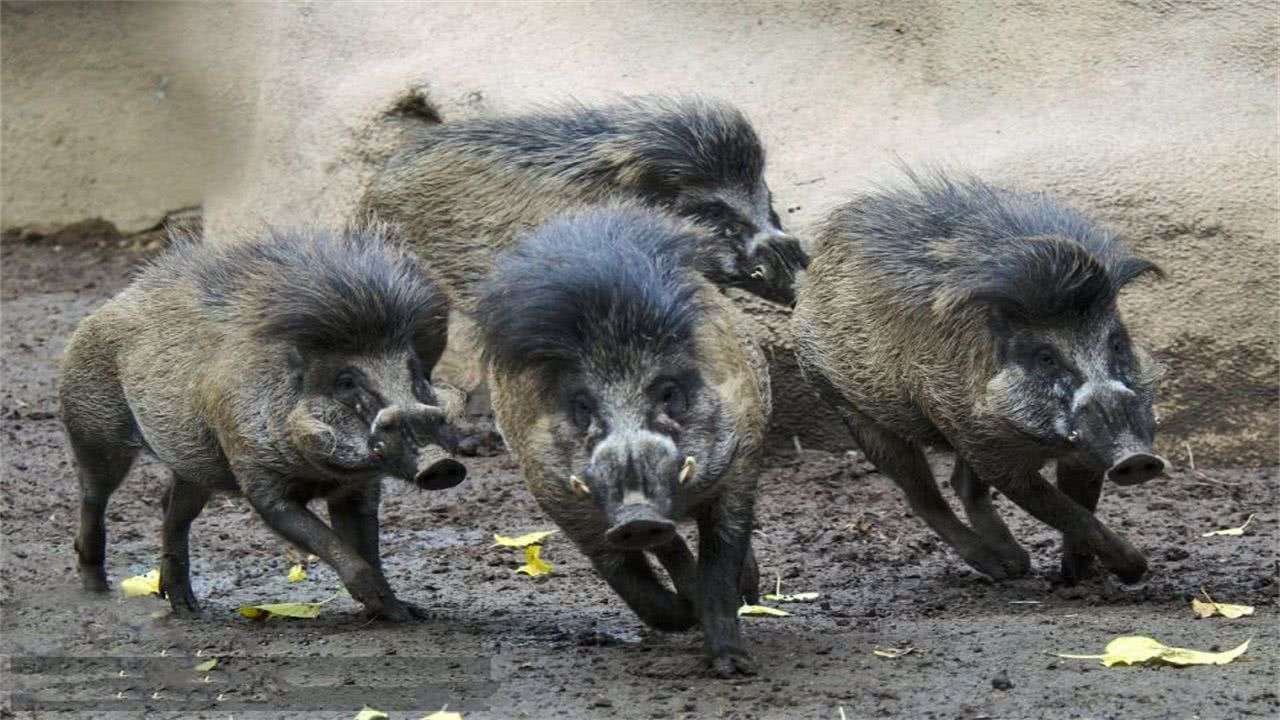
We can see from these quotes several features that appear again and again. These include a bristly mane on the back of his head, fan-like ears, a big mouth with protruding fangs, an overly long snout, and a hulking body with black, furry skin. He is also said to have human hands and feet and a pig tail. This grotesque description greatly differs from his cutesy appearance in modern media. It’s important to note that, just like Sun Wukong, Zhu was modeled on a real life animal. In this case, he shares many of his monstrous qualities with the wild boar (yezhu, 野豬) (fig. 5 & 6).

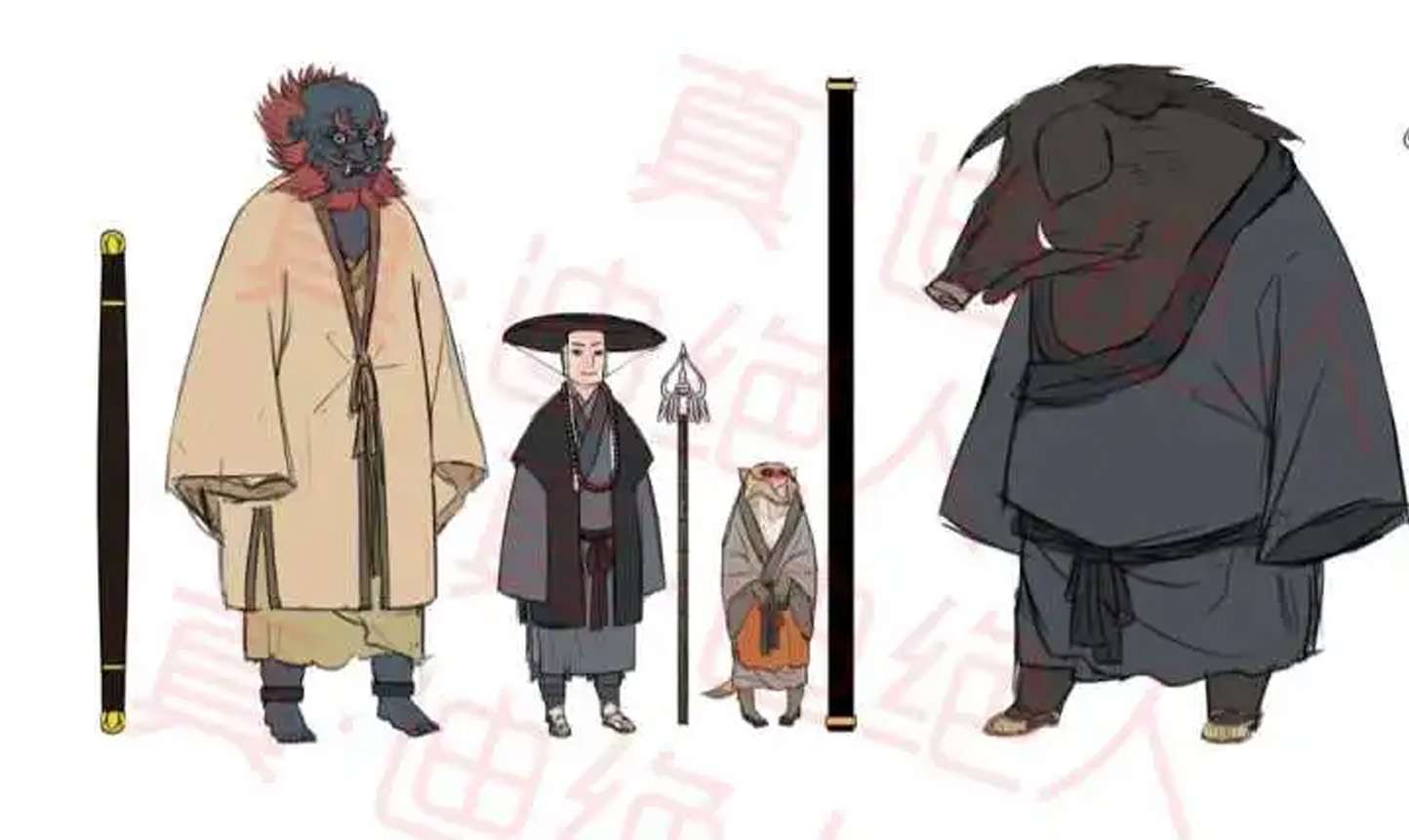
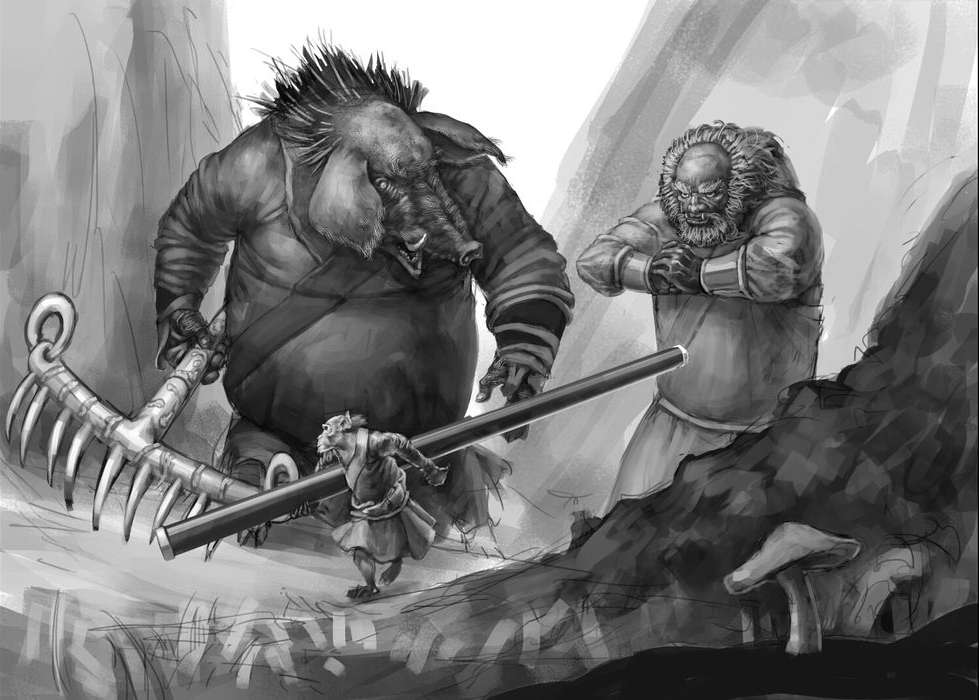
While the novel doesn’t give an exact height for our hero, the cited attributes do provide clues as to his general size. First and foremost is Tripitaka‘s statement: “[H]e causes even the wind to rise when he walks” (Wu & Yu 2012, vol. 2, p. 51). Obviously something capable of stirring the wind just from moving is going to be really big. Then there is Zhu’s 3.15 foot (96 cm) snout, which is over half the height of an average person. This suggests that he’s several feet taller than a human. Furthermore, the novel states that Sha Wujing is a whopping 12-Chinese feet (zhang er, 丈二; 12.6 feet / 3.84 m) tall (Wu & Yu 2012, vol. 2, p. 51). [3] Zhu is likely shorter than Sha as the latter’s height is specifically mentioned, so I would guess that he is at least 10-Chinese feet (roughly 3 m) tall. Zhu’s size is highlighted in some lovely online art (fig. 7 & 8).

Fig. 5 (top left) – A pack of running Visayan warty pigs (larger version). Image found here. Fig. 6 (top right) – An Indian boar (larger version). Check out that cool hair!!! Fig. 7 (bottom left) – The relative sizes of the pilgrims (larger version). As noted, I believe Zhu is probably shorter than Sha. Fig. 8 (bottom right)- The disciples on patrol (larger version). This is my favorite. Images found here. Artwork by @真·迪绝人 (see here and here).

2.2. Original Form?

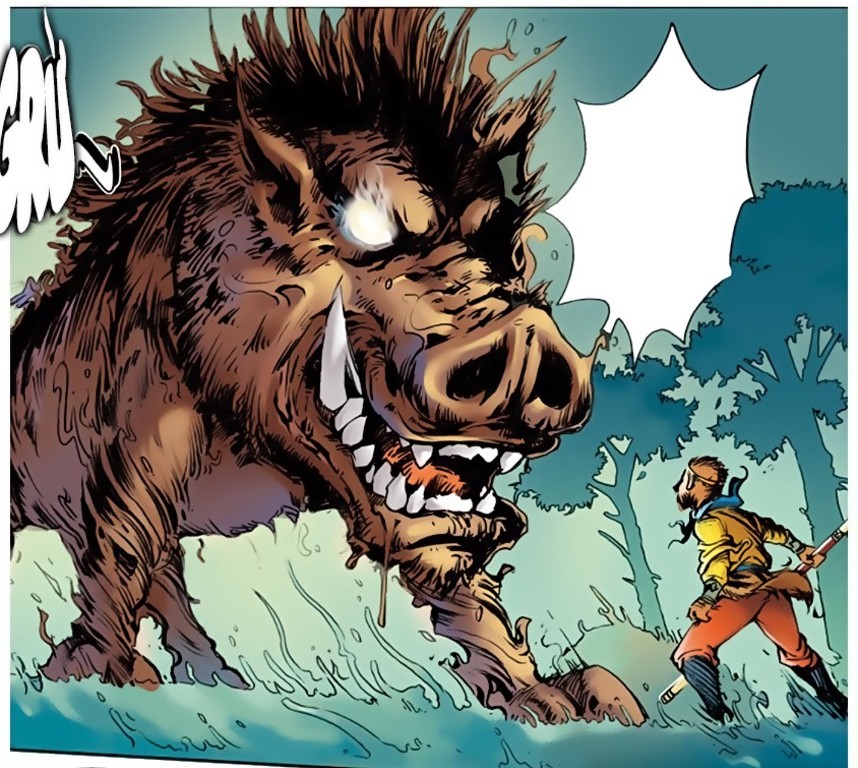
Zhu provides two contradictory origins for himself, which have implications for what his true form may be and why he looks the way he does in the novel. [4] A biographical poem in JTTW chapter 19 explains that he was once a wayward, lazy youth who took up Daoist cultivation and later rose on clouds to receive celestial rank in heaven. But his immortal spirit was eventually exiled for drunkenly forcing himself on the moon goddess and mistakenly regained corporeal form in the womb of a sow, becoming the pig-spirit that we know today (Wu & Yu 2012, vol. 1, pp. 378-379). [5] However, a poem in chapter 85 implies that he was already a powerful pig monster who was given celestial rank but later exiled for drunkenly mocking the moon goddess, destroying Laozi‘s palace, and eating the Queen Mother‘s magic herbs (Wu & Yu 2012, vol. 4, p. 149). The latter origin might be represented in JTTW chapter 67 when Zhu transforms into a gigantic boar (fig. 9):

A long snout and short hair—all rather plump.
He fed on herbs of the mountain since his youth.
A black face with round eyes like the sun and moon;
A round head with huge ears like plantain leaves.
His bones were made lasting as Heaven’s age;
Tougher than iron was his thick skin refined.
In deep nasal tones he made his oink-oink cry.
What gutteral grunts when he puffed and huffed!
Four white hoofs [ti, 蹄] standing a thousand feet tall;
Swordlike bristles topped a thousand-foot frame. [6]
Mankind had long seen fatted pigs and swine,
But never till today this old hog elf [lao zhu xiao, 老豬魈].
The Tang Monk and the people all gave praise;
At such high magic pow’r they were amazed (Wu & Yu 2012, vol. 3, p. 253).

Fig. 9 – Zhu’s giant boar form from the manhua Journey to the West (Xiyouji, 西遊記) (larger version).

2.3. Clothing

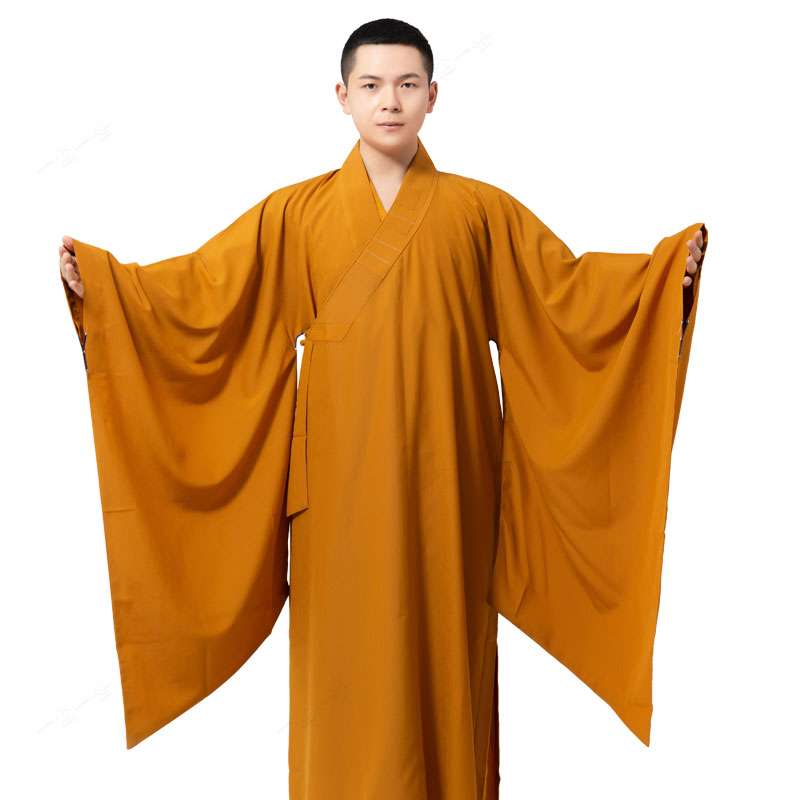
Zhu is not associated in popular culture with any specialized clothing or adornments like Sun Wukong, who’s very name brings to mind the golden fillet, a tiger skin kilt, and golden armor with a feather cap. But several later chapters do mention our pig hero wearing a “black brocade zhiduo robe” (zao jin zhiduo, 皂錦直裰) (ch. 55, 61, 72, & 86) or just a “black zhiduo robe” (zao zhiduo, 皂直裰) (ch. 63, 67, & 84). [7] The zhiduo robe is known colloquially in English as “Buddhist monk” or “Taoist monk” robes. Also called haiqing (海青), such garments reach almost to the ground and have long, broad sleeves. The robe is closed by a tie on the right side of the torso (fig. 10; also refer back to fig. 7).

Fig. 10 – A zhiduo/haiqing robe (larger version). Image found here. Imagine this robe with black cloth.

2.4. The Rake

Zhu’s signature weapon is first mentioned in JTTW chapter 8. A line from his introductory poem reads: “He holds a rake—a dragon’s outstretched claws” (Wu & Yu, 2012, vol. 1, p. 211). The most detailed description appears in JTTW chapter 19:

This is divine bin steel greatly refined, [8]
Polished so highly that it glows and shines.
Laozi wielded the large hammer and tong;
Mars himself added charcoals piece by piece.
Five Kings of Five Quarters applied their schemes;
The Six Ding and Six Jia Spirits expended all their skills. [9]
They made nine prongs like dangling teeth of jade,
And double rings were cast with dropping gold leaves.
Decked with Five Stars and Six Celestial Bodies, [10]
Its frame conformed to eight spans and four climes.
Its whole length set to match the cosmic scheme
Accorded with yin yang, with the sun and moon:
Hexagram Spirit Generals etched as Heaven ruled;
Eight-Trigram Stars stood in ranks and files.
They named this the High Treasure Golden Rake, [Shang bao qin jin pa, 上寶沁金鈀]
[…] (Wu & Yu, 2012, vol. 1, p. 382).

So we see that the rake has nine jade-like teeth and a bin steel body decorated with two golden rings and inscriptions of the sun, moon, and planets, as well as hexagram and eight-trigram symbols. The exact position of the rings is not specified, but one online drawing shows them at each end of the rake head (refer back to fig. 8). This might be a reference to the rings capping the ends of Sun’s weapon. While the weight is not listed on the rake like the Monkey King’s staff, JTTW chapter 88 states that it is 5,048 catties (wuqian ling sishiba jin, 五千零四十八斤; 6,566 lbs. / 2,978.28 kg), [11] or the weight of the Buddhist canon (Wu & Yu, 2012, vol. 4, p. 200). [12]

Since the rake’s literary description is more vague than that of Wukong’s staff, my normally strict views on the accuracy of the disciples’ weapons in various media don’t really apply in this case. This is especially true as even historical depictions are all over the place (fig. 11-13). I think that the monstrous pig face on the rake from the 1986 TV show-inspired action figure is really neat (refer back to fig. 1). Another favorite of mine is the spiky rake from the ongoing manhua The Westward (Xixingji, 西行記, 2015-present) (fig. 13).

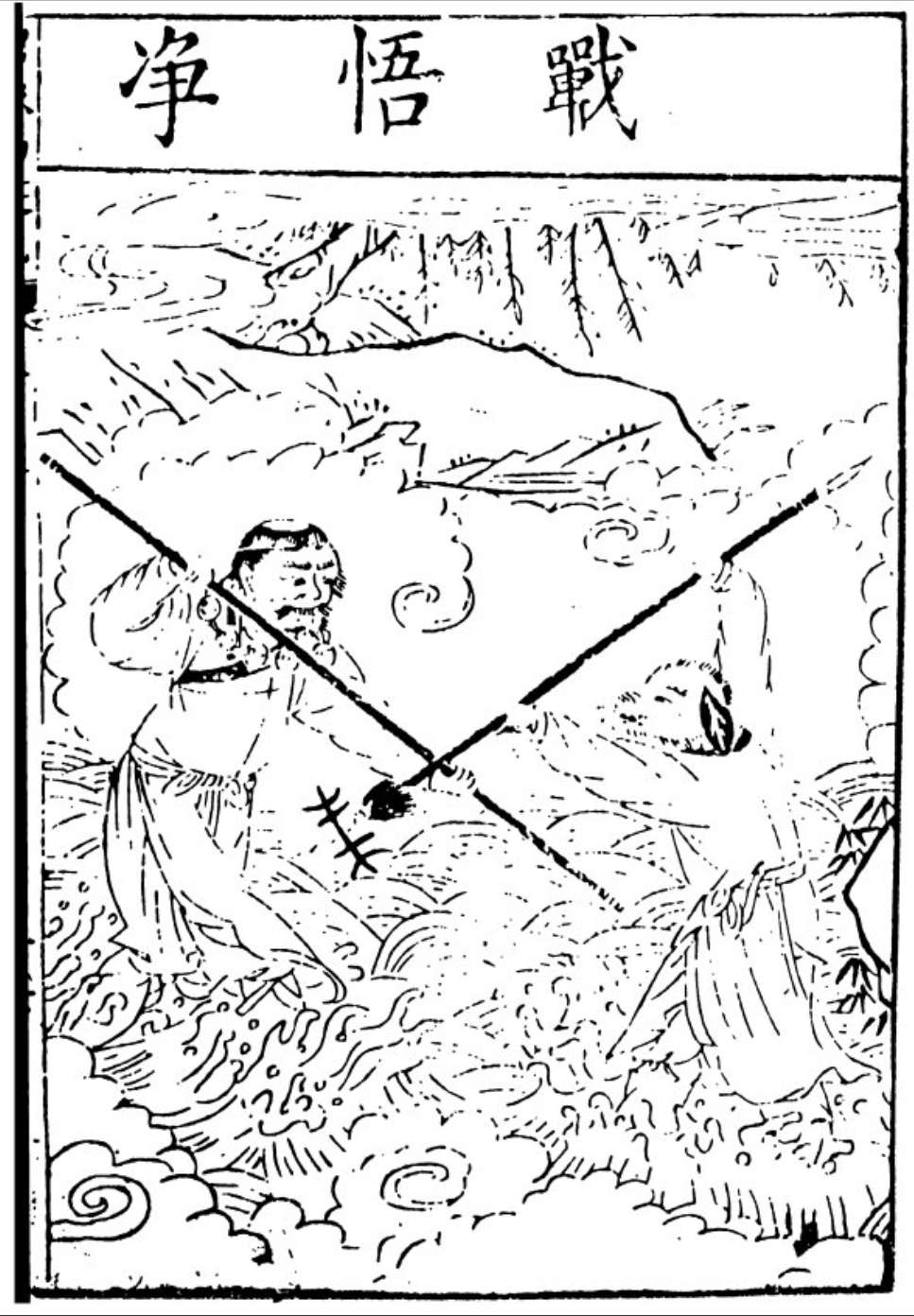
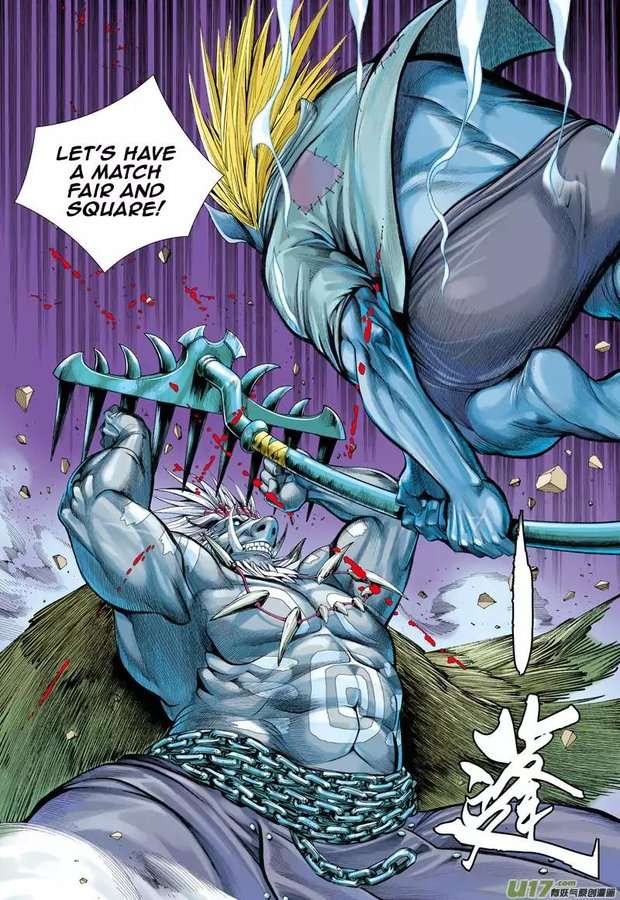
Fig. 11 (left) – A print of Zhu vs Sha Wujing from the Shide tang edition (1592) of the novel (larger version). The weapon is portrayed as a war rake used by the Chinese military. Fig. 12 (center) – His rake is depicted as a wolftooth club in Mr. Li Zhuowu’s Criticism (late-16th to early-17th century) (larger version). Fig. 13 (right) – Zhu (top) wields the rake against his evil brother (bottom) in The Westward (larger version). This brother is not a character in the original novel.

The following two sections include a small sampling of what I consider to be the least and most accurate portrayals in past and modern media. These are presented in no particular order.

3.1. The Least Accurate

1) Journey to the West (1996/1998) – It’s like the show’s creators purposely went in the opposite direction. Instead of big, black, and scary, they went with small, pink, and cute (fig. 14).

Fig. 14 – Wayne Lai as the adorable pig spirit (larger version).

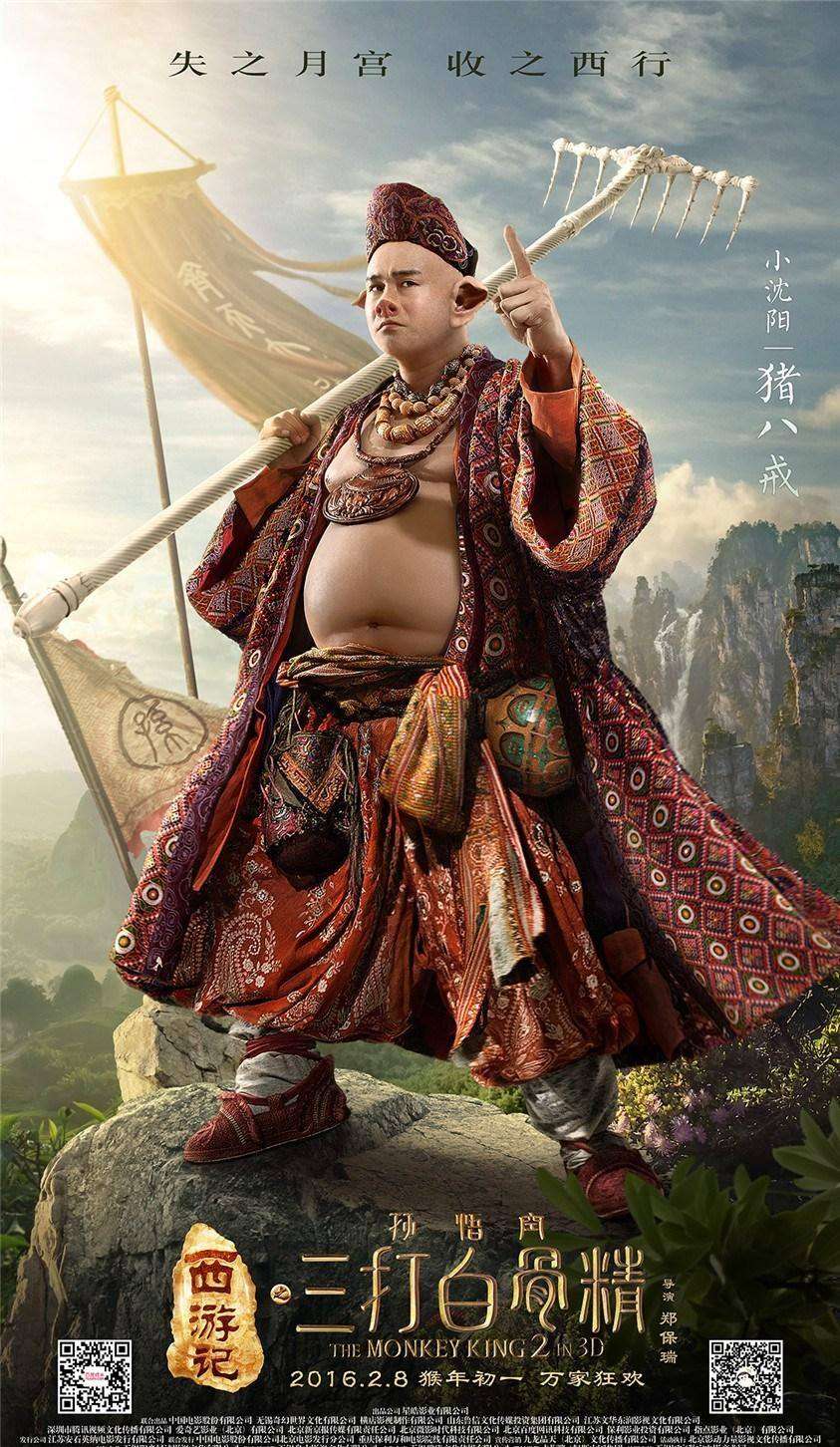
2) The Monkey King 2 & 3 (2016/2018) – It’s the same as before but minus the hair (fig. 15).

Fig. 15 – Xiaoshenyang as the fake hero (larger version).

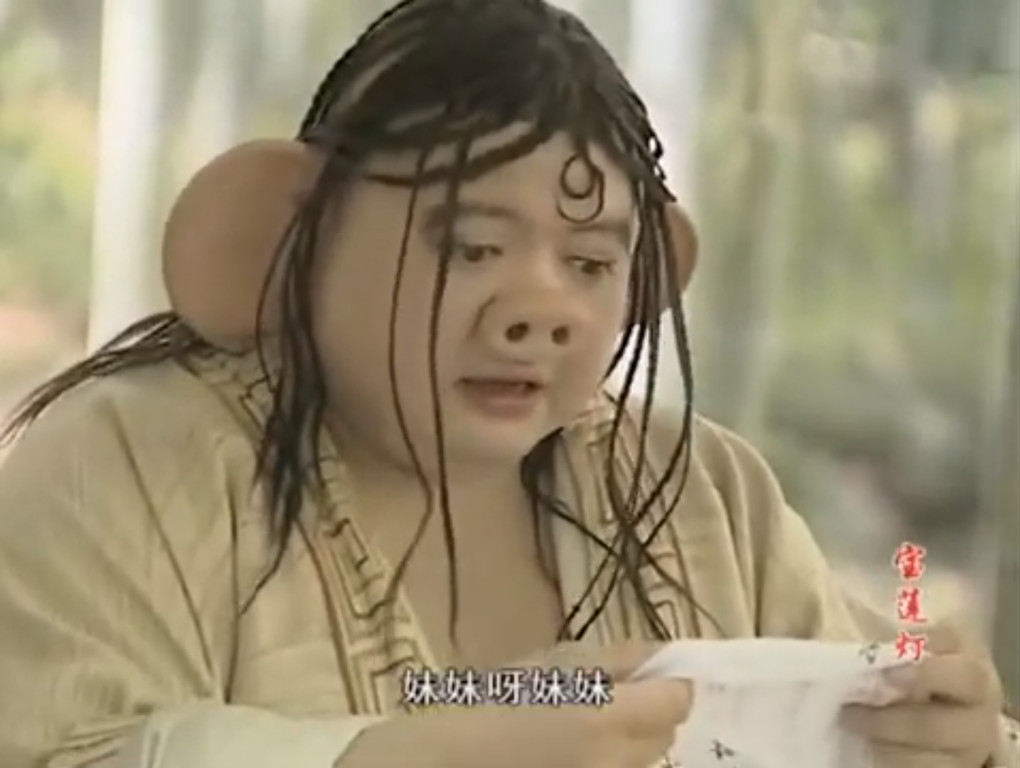
3) The Precious Lotus Lantern (Baolian deng, 寶蓮燈, 2005) – And then there’s this mess… (fig. 16).

Fig. 16 – Xie Ning (谢宁) as “Spaghetti Head” Zhu (larger version).

3.2. The Most Accurate

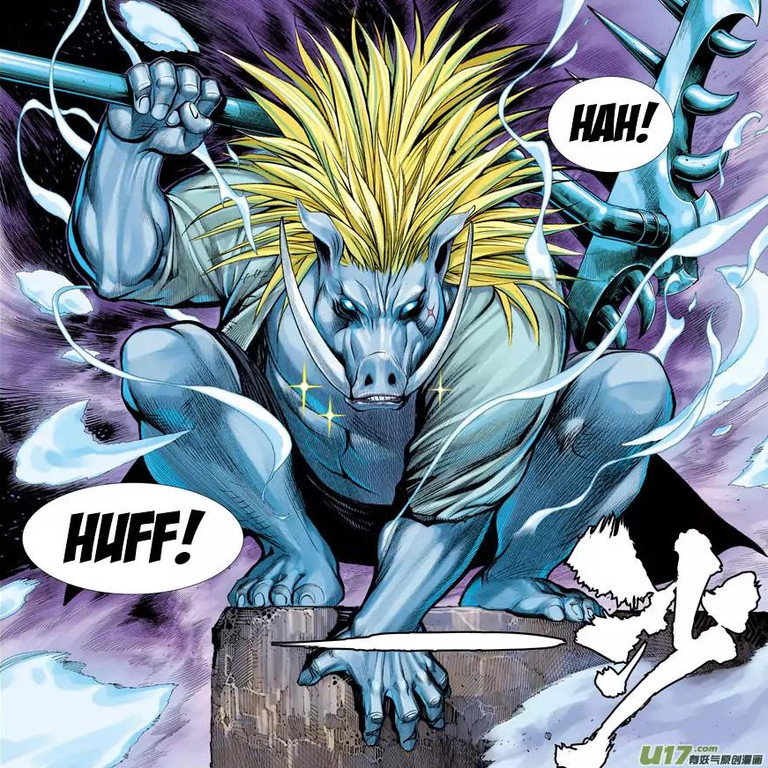
1) The Westward (Xixingji, 西行記, 2015-present) – This is perhaps the closest to his literary description (but his body and hair should be darker) (fig. 17). Admittedly, this is not the character’s original form. The manhua portrays Zhu as a small, pink pig-man who needs to absorb energy from the surrounding environment in order to achieve this monstrous transformation.

Fig. 17 – Zhu’s ultimate form (larger version).

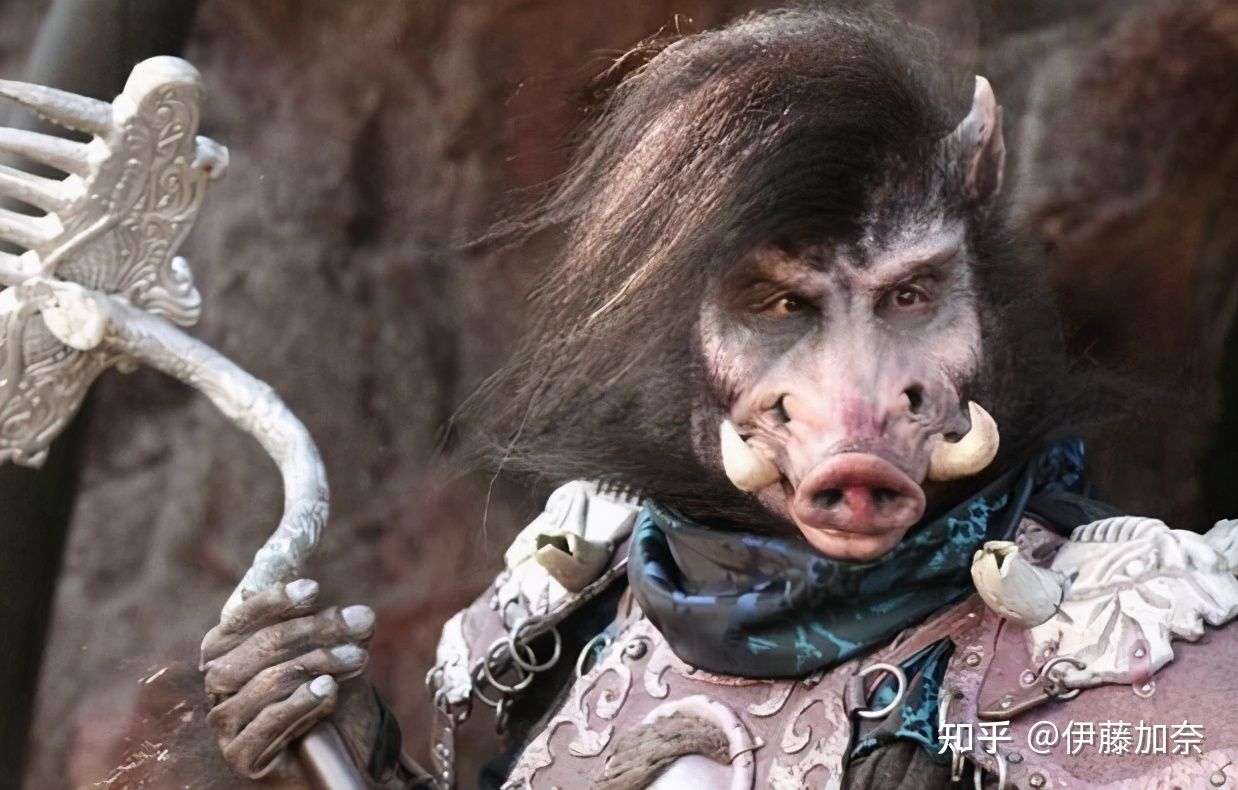
2) Journey to the West (2011) – This is how Zhu is portrayed when he’s still a monster (fig. 18). He has the dark skin, fangs, and mane. But he later changes to a friendly, pink pig-man once subjugated.

Fig. 18 – Zang Jinsheng as the armored pig monster (larger version).

3) The Cave of the Silken Web (1927) – While missing his bristly mane, Zhu is portrayed with a long snout, big ears, and, most importantly, black skin (fig. 19). He is also wearing a black zhiduo robe. Thanks to Irwen Wong for suggesting this entry.

Fig. 19 – Zhou Hongquan (周鴻泉) as Zhu in The Cave of the Silken Web (1927) (larger version).

4. Conclusion

While modern media often depicts Zhu as a friendly-looking, pink pig-man, the novel describes him as a giant pig monster with a bristly mane on the back of his head, fan-like ears, a big mouth with protruding fangs, a three-foot-long snout, and a hulking body with black, furry skin, human hands and feet, and a pig tail. He wears a black zhiduo robe. His 3.28 ton bin steel rake has nine jade-like teeth, two golden rings (possibly adorning the ends of the head), and a body inscribed with the sun, moon, and planets and hexagram and eight-trigram symbols. Needless to say, the literary Zhu is far more imposing than his modern, family friendly persona.

Notes:

1) The Chinese foot (chi, 尺) was slightly longer than the modern western foot (12 in/30.48 cm). The “Board of Works” (Yingzao, 營造) of the Ming and Qing standardized the measurement at 32 cm (12.59 in), though it varied at the local level and at different times (Ruitenbeek, 1996, Chinese Dynasties and Chinese Measurements section). I’m basing the length given in the novel on that from the Board of Works as the novel was published during the Ming dynasty.

2) The original English translation says “green” (Wu & Yu 2012, vol. 4, p. 149). However, there are times when it refers to black. For example, the phrase “The black ox goes west” (qing niu xi qu, 青牛西去) references Laozi and the Daodejing (Ma & van Brakel, 2016, p. 328 n. 71). In addition, the novel previously refers to Zhu having a “black face” (hei lian, 黑臉) (Wu & Yu 2012, vol. 1, p. 375).

3) See note #1 for how this measurement is calculated.

4) Thank you to Irwen Wong and Anthony “Antz” Chong for bringing this to my attention.

5) This recalls the origin of the immortal Iron Crutch Li (Li tieguai, 李鐵拐), whose body was prematurely burnt by a disciple while his celestial spirit traveled to heaven. Upon his return, Li was forced to take corporeal form in the body of a recently deceased cripple.

6) The original English translation says “hundred-yard” (Wu & Yu 2012, vol. 3, p. 253). However, the Chinese states 百丈 (bai zhang), or 100 x 10 Chinese feet, which of course equals 1,000 feet.

7) Yu (Wu & Yu, 2012) translates the garment as “black cloth shirt” (vol. 3, p. 253, for example).

8) The original English translation/Chinese text states “divine ice steel” (shen bing tie, 神冰鐵) (Wu & Yu, 2012, vol. 1, p. 382). However, this is likely an error for “divine bin steel” (shen bin tie, 神鑌鐵) as bing (冰) and bin (鑌) sound similar. Bin steel (bin tie, 鑌鐵) was a high quality metal originally imported from Persia before the secret of its manufacture reached China in the 12th-century. It is mentioned a few times in the novel, including being associated with Monkey’s staff in one instance (Wu & Yu, 2012, vol. 3, p. 375).

I’ve made several changes to the translation from this point forward to better accord with the original Chinese.

9) The “Six Ding and Six Jia” (六丁六甲, Liuding liujia) are protector spirits of Daoism (Mugitani, 2008).

10) The “Five Stars” (wuxing, 五星) refer to Mercury (shuixing, 水星), Venus (jinxing, 金星), Jupiter (muxing, 木星), Mars (huoxing, 火星), and Saturn (tuxing, 土星). The Six Celestial Bodies (liuyao, 六曜) refer to the sun (taiyang/ri, 太陽/日) and moon (taiyin/yue, 太陰/月) and the four hidden pseudo-planets Yuebei (月孛), Ziqi (紫氣), Luohou (羅睺), and Jidu (計都). Combined, they are called the “Eleven Luminaries” (shiyi yao, 十一 曜), and these are sometimes broken into the “Seven Governors and Four Hidden Luminaries” (qizheng siyu, 七政四余) (Wang, 2020, pp. 169-170; Hart, 2010, p. 145 n. 43).

11) The original English translation says “five thousand and forty-eight pounds” (Wu & Yu, 2012, vol. 4, p. 200). However, the Chinese version uses jin (斤), known in English as “catty“. The catty and pound are two different measures of weight, the former being heavier than the latter. Therefore, the English text has been altered to show this. The catty during the Ming Dynasty when the novel was compiled equaled 590 grams (Elvin, 2004, p. 491 n. 133), so 5,048 catties would equal 6,566 lbs. or 2,978.28 kg.

12) Yu (Wu & Yu, 2012) notes popular belief held that the Buddhist canon was comprised of 5,048 scrolls (vol. 4, p. 396 n. 7). I’m not sure if the rake’s weight was purely based on the number of scrolls, or if each scroll was believed to weigh one catty.

Sources:

Hart, R. (2010). The Chinese Roots of Linear Algebra. United States: Johns Hopkins University Press.

Ma, L., & van Brakel, J. (2016). Fundamentals of Comparative and Intercultural Philosophy. United States: State University of New York Press.

Mugitani, K. (2008). Liujia and Liuding. In F. Pregadio (Ed.), The Encyclopedia of Taoism (Vols. 1-2) (pp. 695-697). Longdon: Routledge.

Ruitenbeek, K. (1996). Carpentry and Building in Late Imperial China: A Study of the Fifteenth-century Carpenter’s Manual, Lu Ban Jing. Germany: E.J. Brill.

Wang, X. (2020). Physiognomy in Ming China: Fortune and the Body. Netherlands: Brill.

Wu, C., & Yu, A. C. (2012). The Journey to the West (Vols. 1-4) (Rev. Ed.). Chicago, Illinois: University of Chicago Press.

The Weight of the Monkey King’s Staff: A Literary Origin

Last updated: 03-11-2023

Sun Wukong’s magic staff is famed in popular culture for its ability to grow and shrink but less so for its great weight. The latter quality is best demonstrated in Journey to the West (Xiyouji, 西遊記, 1592; “JTTW” hereafter) chapter 56 when human bandits attempt and fail to pick up the 8.8 ton weapon:

Sticking the rod into the ground, Pilgrim said to them, “If any of you can pick it up, it’s yours.” The two bandit chiefs at once went forward to try to grab it, but alas, it was as if dragonflies were attempting to shake a stone pillar. They could not even budge it half a whit! This rod, you see, happened to be the “As-You-Will” Gold-Banded Staff, which tipped the scale in Heaven at thirteen thousand, five hundred catties [yiwan sanqian wubai jin, 一萬三千五百斤; 17,559.81 lbs. / 7,965 kg]. [1] How could those bandits have knowledge of this? The Great Sage walked forward and picked up the rod with no effort at all. Assuming the style of the Python Rearing its Body, he pointed at the bandits and said, “Your luck’s running out, for you have met old Monkey!” (Wu & Yu, 2012, vol. 3, p. 81).

行者將棍子插在地下道:「列位拿得動,就送你罷。」兩個賊上前搶奪,可憐就如蜻蜓撼石柱,莫想弄動半分毫。這條棍本是如意金箍棒,天秤稱的一萬三千五百斤重,那夥賊怎麼知得?大聖走上前,輕輕的拿起,丟一個蟒翻身拗步勢,指著強人道:「你都造化低,遇著我老孫了。」

I suggested in one of my earliest articles that the weight of Monkey’s staff had a connection to Chinese numerology:

Thirteen thousand five hundred is divisible by nine, which Chinese numerology considers to represent “infinity.” So it’s possible the number (infinity multiplied) was meant to convey that the staff was heavy beyond comprehension, something that only a divine hero such as Monkey would be able to wield.

While I still agree that the great weight cements his position as a superior hero, I no longer believe that the number is directly connected to numerology.

Table of Contents

1. Connection to the Water Margin

I now suggest that the weapon’s weight was directly influenced by a scene in chapter 28 of the Water Margin (Shuihu zhuan, 水滸傳, c. 1400). It involves the bandit Wu Song lifting a heavy stone block:

[Wu Song:] “You mean I haven’t got my strength back? All right. How heavy is the stone block [shi dun, 石墩] I saw in front of the Heavenly King Temple yesterday?” [2]

[Shi En, a young admirer] “Probably four to five hundred catties [si wu bai jin, 四五百斤; 520.29 to 650.36 lbs. / 236 to 295 kg].”

“Let’s take a look. I wonder whether I can move it.”

“Please have some food and wine first.”

“There’ll be time enough for that when we come back.”

The two men walked to the Heavenly King Temple. The prisoners on the grounds bowed and hailed them respectfully. Wu Song shook the stone slightly. He laughed.

“This soft life is spoiling me. I’ll never be able to pick it up!”

“You shouldn’t scoff,” said Shi En. “That stone weighs three to five hundred catties [san wu bai jin, 三五百斤; 390.21 to 650.36 lbs. / 177 to 295 kg]!”

Wu Song grinned. “You really think I can’t lift it? Get back, you men, and watch this.”

He slipped off his tunic and tied the sleeves around his waist. Embracing the stone, he raised it easily [fig. 1], then tossed it away with both hands. It dropped with a thud, sinking a chi [尺; 12.3 in / 31.8 cm] into the earth. The watching prisoners were astonished.

Wu Song grasped the stone with his right hand and lifted. With a sudden twist, he flung it upwards. It sailed one zhang [丈; 10.25 ft / 3.18 m] into the air. He caught it in both hands as it came down and lightly put it back in its original place. He turned and looked at Shi En and the prisoners. His face wasn’t flushed, he wasn’t even breathing hard, his heart beat calmly (based on Shi & Luo, 1993/2001, vol. 2, pp. 590-591).

武松道: “只是道我沒氣力了! 既是如此說時, 我昨日看見天王堂前那個石墩, 約有多少斤重?” 施恩道: “敢怕有四五百斤重。” 武松道: “我且和你去看一看, 武松不知拔得動也不。” 施恩道: “請吃罷酒了同去。” 武松道:“且去了回來吃未遲。” 兩個來到天王堂前, 眾囚徒見武松和小管營同來, 都躬身唱喏。武松把石墩略搖一搖, 大笑道: “小人真箇嬌惰了, 那裡拔得動!” 施恩道:“三五百斤石頭, 如何輕視得他。” 武松笑道: “小管營也信真箇拿不起? 你眾人且躲開, 看武松拿一拿。” 武松便把上半截衣裳脫下來, 拴在腰裡, 把那個石墩只一把, 輕輕地把將起來, 雙手把石墩只一撇, 撲地打下地里一尺來深。眾囚徒見了, 盡皆駭然。武松再把右手去地里一提, 提將起來, 望空只一擲, 擲起去離地一丈來高。武松雙手只一接, 接來輕輕地放在原舊安處, 回過身來, 看着施恩並眾囚徒。武松面上不紅, 心頭不跳, 口裡不喘。(Shi & Luo, 1975/2021a, vol. 1, p. 391)

Fig. 1 – Wu Song lifts the stone block (larger version). Image found here.

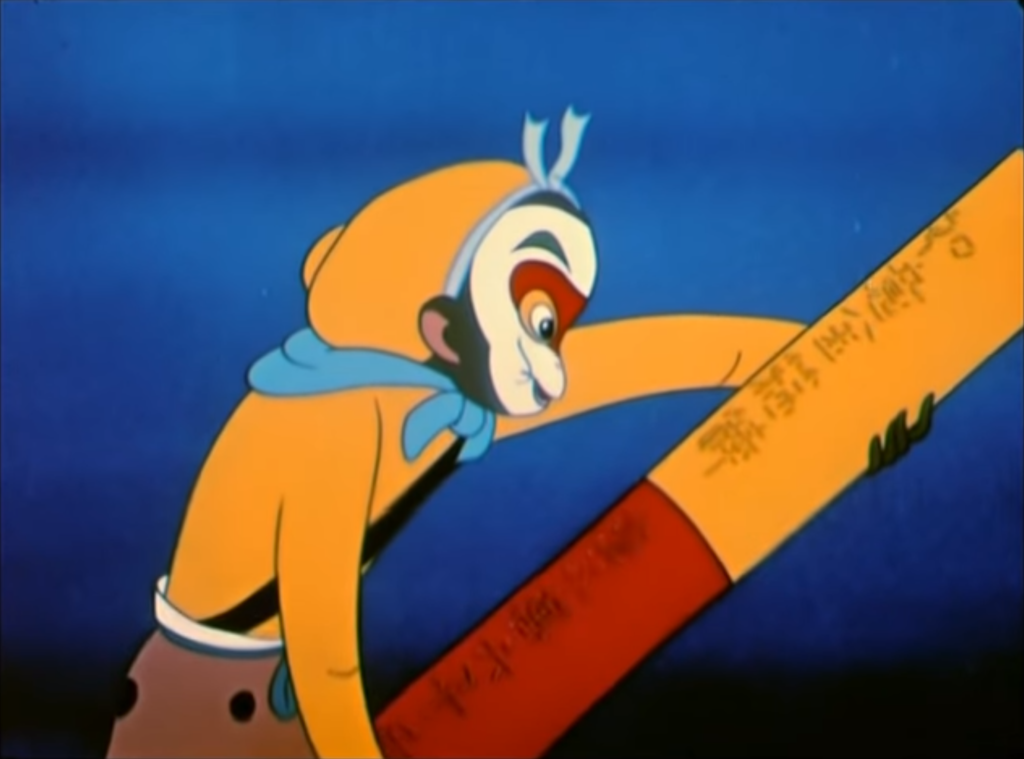
Now compare it to the scene in JTTW chapter three where Monkey first procures his magic staff:

“Take it [the staff] out and let me see it,” said Wukong. Waving his hands, the Dragon King said, “We can’t move it! We can’t even lift it! The high immortal must go there himself to take a look.” “Where is it?” asked Wukong. “Take me there.”

The Dragon King accordingly led him to the center of the ocean treasury, where all at once they saw a thousand shafts of golden light. Pointing to the spot, the Dragon King said, “That’s it—the thing that is glowing.” Wukong girded up his clothes and went forward to touch it: it was an iron rod [tie zhuzi, 鐵柱子] more than two zhang [丈; 20.5 ft / 6.36 m] long and as thick as a barrel. Using all his might, he lifted it with both hands [fig. 2], saying, “It’s a little too long and too thick. It would be more serviceable if it were somewhat shorter and thinner.” Hardly had he finished speaking when the treasure shrunk a few chi [尺; 1 = 12.3 in / 31.8 cm] in length and became a layer thinner. “Smaller still would be even better,” said Wukong, giving it another bounce in his hands. Again the treasure became smaller. Highly pleased, Wukong took it out of the ocean treasury to examine it. He found a golden hoop at each end, with solid black iron in between. Immediately adjacent to one of the hoops was the inscription, “‘As-You-Will’ Gold-Banded Staff. Weight: thirteen thousand five hundred catties [Ruyi jingu bang zhong yiwan sanqian wubai jin, 如意金箍棒,重一萬三千五百斤] [fig. 3].” He thought to himself in secret delight, “This treasure, I suppose, must be most compliant with one’s wishes.” As he walked, he was deliberating in his mind and murmuring to himself, bouncing the rod in his hands, “Shorter and thinner still would be marvelous!” By the time he took it outside, the rod was no more than twelve chi in length and had the thickness of a rice bowl (Wu & Yu, 2012, vol. 1, p. 135). [3]

悟空道:「拿出來我看。」龍王搖手道:「扛不動,擡不動,須上仙親去看看。」悟空道:「在何處?你引我去。」

龍王果引導至海藏中間,忽見金光萬道。龍王指定道:「那放光的便是。」悟空撩衣上前,摸了一把,乃是一根鐵柱子,約有斗來粗,二丈有餘長。他儘力兩手撾過道:「忒粗忒長些,再短細些方可用。」說畢,那寶貝就短了幾尺,細了一圍。悟空又顛一顛道:「再細些更好。」那寶貝真個又細了幾分。悟空十分歡喜,拿出海藏看時,原來兩頭是兩個金箍,中間乃一段烏鐵。緊挨箍有鐫成的一行字,喚做:「如意金箍棒,重一萬三千五百斤。」心中暗喜道:「想必這寶貝如人意。」一邊走,一邊心思口念,手顛著道:「再短細些更妙。」拿出外面,只有二丈長短,碗口粗細。

Fig. 2 – Monkey lifts the iron pillar (larger version). Fig. 3 – Sun looks at the inscription, including the weight (larger version). Screenshots from the 1960s classic Havoc in Heaven.

2. Comparison

Both scenes involve a hero (Wu Song vs. Sun Wukong) asking someone (Shi En vs. Ao Guang) to show them a heavy object that cannot be moved (stone block vs. iron pillar). Both heroes then adjust their clothing before easily lifting the object with both hands. Most importantly, the Chinese characters for the weight of each object (三五百斤 vs. 一萬三千五百斤) are similar. The only difference is the addition of 一萬 and 千, respectively (fig. 4). [4] Now, someone might say the numbers are meaningless as “three to five hundred” is a common estimate for lengths, distances, and people used throughout the Water Margin (some examples). But the proposed connection is strengthened when you take into account the many similarities shared by Monkey and Wu. I show in this article that both are reformed supernatural spirits previously trapped under the weight of magic mountains, slayers of tigers, Buddhist monks nicknamed “Pilgrim,” monastic masters of martial arts, wearers of moralistic golden headbands, and wielders of bin steel weapons. Therefore, given the close historical and cultural ties between the two characters, I believe that the JTTW author-compiler embellished the Water Margin episode to portray Sun as a hero like no other, a divine immortal that can lift weights far beyond even Wu Song himself.

Fig. 4 – The weight of Monkey’s staff where the red characters represent additions to the weight of Wu Song’s stone in black.


3. Updates

Update: 03-11-23

My friend and contributor Saie Surendra (his website) was recently sent a video similar to this one suggesting another possible origin for the weight of Monkey’s staff. [5] The speaker, Lan Yanling (兰彦岭), states, “The Golden-Hooped Staff weighs 13,500 catties, and everyday a person breathes 13,500 times” (金箍棒重13,500斤,人一天呼吸13,500次). The specific number of breaths is drawn from ancient medical treatises, some of which were absorbed into the Daoist canon.

For example, the first scroll of The Yellow Emperor’s Canon of Eighty-One Difficult Issues (Huangdi bashiyi nanjing, 黃帝八十一難經) reads:

A person, in the course of one day and one night, breathes altogether 13,500 times (Unschuld, 1986, p. 65).

人一日一夜,凡一萬三千五百息。

This second possibility is interesting as Sun achieves immortality through a series of breathing and energy circulation exercises. This means that, if the number did influence the weapon’s weight, one could speculate that the staff is a physical manifestation of the methods by which he gained his powers.

I’m not quite sure how I feel about this new possibility. On one hand, it doesn’t require adding characters (i.e. 一萬 and 千) to come up with the figure 13,500 (refer back to section 2). But on the other, it lacks the literary context laid out in the main article. I’ll have to look into this more.

Notes:

1) I have changed Yu’s (Wu & Yu, 2012) dry rendering “Compliant Golden-Hooped Rod” to a more pleasant one based on W.J.F. Jenner (Wu & Jenner, 1993/2001, vol. 1, p. 56). Also, Yu’s (Wu & Yu, 2012) original translation says “thirteen thousand five hundred pounds” (vol. 1, p. 135). However, the Chinese version uses jin (斤), known in English as “catty.” The catty and pound are two different measures of weight, the former being heavier than the latter. Therefore, the English text has been altered to show this. The catty during the Ming Dynasty when the novel was compiled equaled 590 grams (Elvin, 2004, p. 491 n. 133; Jiang, 2005, p. xxxi), so 13,500 catties would be roughly 17,560 lbs.

2) I’ve updated the English translation because it didn’t mention the specific temple name appearing in the original Chinese version.

3) Both the original Chinese and the translation say that the staff shrank to “no more than two zhang in length” (zhiyou er zhang changduan, 只有二丈長短) (based on Wu & Yu, 2012, vol. 1, p. 135), but it was close to two zhang (20.5 ft / 6.36 m) from the start. Irwen Wong of the Journey to the West Library blog has suggested to me that this is a likely error for “one zhang two (chi)” (丈二; 12.3 ft / 3.74 m). I’ve, therefore, modified the translation.

4) These mean “10,000” (yiwan, 一萬) and “1,000” (qian, 千), respectively. When combined with the character for three, the latter becomes “3,000” (sanqian, 三千).

5) The video was sent to him by an acquaintance named Afeng.

Sources:

Elvin, M. (2004). The Retreat of the Elephants: An Environmental History of China. New Haven (Conn.): Yale university press.

Jiang, Y. (2005). The Great Ming Code / Da Ming Lu. Vancouver, Wa: University of Washington Press.

Shi, N., & Luo, G. (2021a). Shuihu zhuan (shang, zhong, xia) [Tale of the Water Margin (Vols. 1-3)]. Beijing: Renmin wenxue chubanshe. (Original work published 1975)

Shi, N., Luo, G., & Shapiro, S. (2001b). Outlaws of the Marsh (Vols. 1-4) (S. Shapiro, Trans.). Beijing, China: Foreign Languages Press. (Original work published 1993)

Unschuld, P. (1986). Nan-Ching: The Classic of Difficult Issues; With Commentaries by Chinese and Japanese Authors from the Third through the Twentieth Century. Berkeley, CA: University of California Press.

Wu, C., & Jenner, W. J. F. (2000). Journey to the West (Vols. 1-4). Beijing, China: Foreign Languages Press. (Original work published 1993)

Wu, C., & Yu, A. C. (2012). The Journey to the West (Vols. 1-4) (Rev. ed.). Chicago, Illinois: University of Chicago Press.

Story Idea: The Reason for Sun Wukong’s Rebellion

From time to time I like to post a fun blog not directly related to (though sometimes informed by) my research. Regular articles will resume after this entry.

I have previously posted a few of my story ideas regarding the Monkey King’s birth and training under Master Subodhi. For instance, this article provides two possible origins for our hero: 1) he is the spiritual offspring of primordial and highly respected ape immortals, who themselves rebel against heaven after a long period of exile; 2) he is the offspring of an ancient, rebellious martial god who wishes to overthrow heaven. This latter origin is tied to another idea where Wukong is a soldier-monk in Subodhi’s immortal monastic army similar to Shaolin. This is where my current idea begins. 

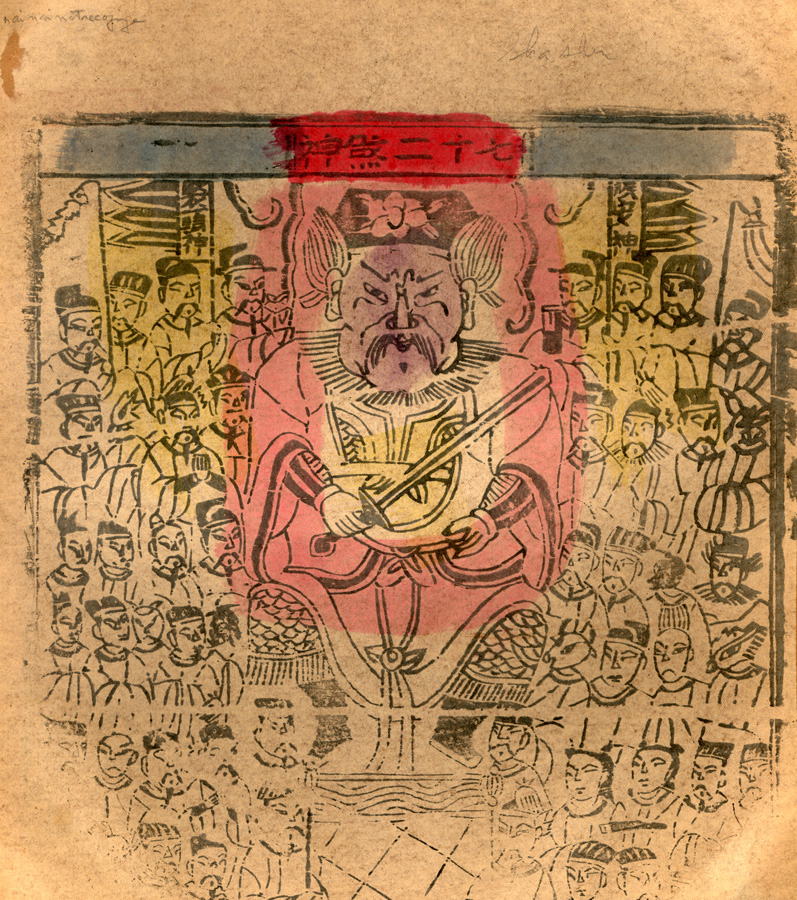
During Monkey’s early Daoist training, his mind is subtly corrupted by one of his magic powers, namely his famous 72 transformations (qi shi er bianhua, 七十二變化). Now, I can already hear my readers saying, “What?!” Well, there is a good reason for this idea. The actual name for this power of metamorphosis is the “Multitude of Terrestrial Killers” (Disha shu, 地煞數). [1] It is named after a host of malevolent stellar deities (fig. 1) who are described in various sources as bringers of bad luck and disease:

The Seventy-two malignant stellar gods, called Ti-shah 地煞, enemies of man, and causes of all diseases and ailments (Doré & Kennelly, 1916, p. xviii).

They are described as star generals inhabiting the stars of the Big Dipper, invoked by the Taoists to control evil spirits. But they are also believed to be evil influences on earth causing misfortune and disease (Pas & Leung, 1998, p. 293)

Similar to the 36 Rectifiers [tiangang, 天罡], the 72 Terrestrial Killers are frightening gods. In keeping with the link between celestial bodies and earthly spaces and with their function as timekeepers, the Killers originate from disruptive—and usually unexpected—collisions between the courses of time and space. In ritual contexts the 72 Killers are a common occurrence, prominently understood as a possible cause for disease or death. Preying on the 72 “passes” (關 guan) that connect the human body to all aspects of the cosmos, they can cause all sorts of maladies—especially for small children. Daoists commonly apply apotropaic rituals to prevent the working of these “killers of the passes” (關煞 guansha) (Meulenbeld, 2019).

Fig. 1 – The “72 Killer Deities” (Qi shi er Shashen, 七十二煞神) folk print from the Anne S. Goodrich Collection (larger version).

In the novel, Wukong originally learns the transformations in order to hide from three calamities of thunder, fire, and wind sent by heaven as punishment for defying his fate and becoming immortal. In my story, I imagine Master Subodhi would warn Monkey to guard his spirit while mastering the magic power as some individuals might be influenced by the “baleful stars” (xiong xing, 凶星). And this is exactly what happens to the young immortal. The stellar gods exploit a chink in his spiritual armor (possibly due to his background) and feed him small suggestions that have compounding effects on his personality, making him increasingly egotistical and combative. This ultimately leads to his attempt to usurp the throne of heaven. I’m open to suggestions.

Notes:

1) Yu (Wu & Yu, 2012) translates the skill as the “Art of the Earthly Multitude”, thus glossing over the 72 Terrestrial Killers (vol. 1, p. 122). Other translations for Disha (地煞) are “Earthly Fiends” and “Earthly Assassins” (Shi, Luo, & Shapiro, 1993, p. 1138, for example; Pas & Leung, 1998, p. 293). I follow the translation from Meulenbeld (2019).

Sources:

Doré, H., & Kennelly, M. (1916). Researches into Chinese superstitions: Vol. 3 – Superstitious practices. Shanghai: T’usewei Printing Press. Retrieved from https://ia800709.us.archive.org/2/items/researchesintoch03dor/researchesintoch03dor.pdf

Meulenbeld, M. (2019). Vernacular “Fiction” and Celestial Script: A Daoist Manual for the Use of Water Margin. Religions, 10(9), 518. MDPI AG. Retrieved from http://dx.doi.org/10.3390/rel10090518

Pas, J. F., & Leung, M. K. (1998). Historical Dictionary of Taoism. Lanham, Md.: Scarecrow Press.

Shi, N., Luo, G., & Shapiro, S. (1993). Outlaws of the Marsh. Beijing: Foreign Languages Press.

Review of DC Comics’ “The Monkey Prince Hates Superheroes”

Last updated: 04-11-2026

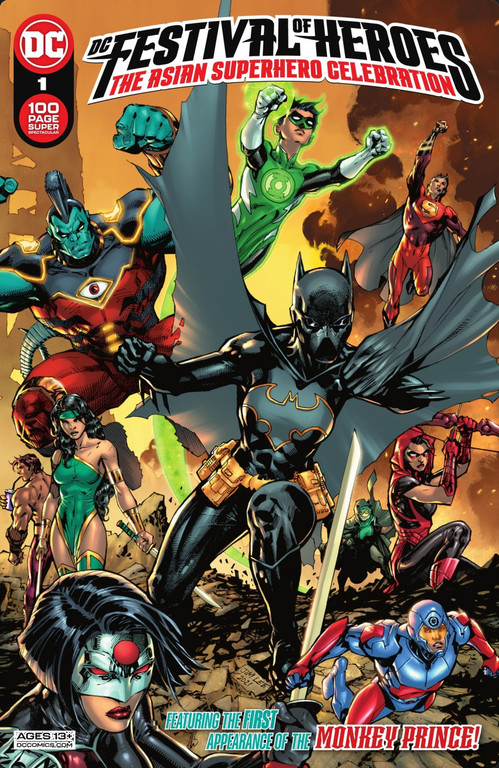
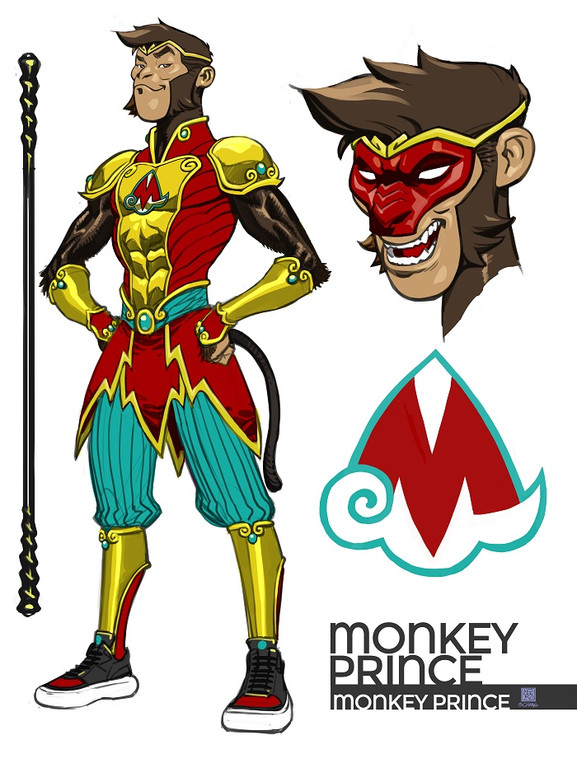
A follower on social media asked me to write an article about DC Comics’ new character, “Monkey Prince” (Ch: Hou wangzi, 猴王子), appearing in the story “The Monkey Prince Hates Superheroes” (Yang, 2021). He is part of a lineup of new and existing Asian characters in their DC Festival of Heroes: The Asian Superhero Celebration (2021). I was aware of the Monkey Prince prior to the request, and while I wasn’t a fan of his costume (more on this later), I was optimistic about the story as I’m a big fan of writer Gene Luen Yang’s masterful graphic novel American Born Chinese (2006). This new comic is 100 pages [1] and features art ranging from dark and gritty to bright and cute. It includes short episodes for many characters, including Batgirl (Cassandra Cain), Green Lantern (Tai Pham), Green Arrow (Connor Hawke), Super-Man (Kong Kenan), Robin (Damian Wayne), Cheshire Cat (Lian Harper), Grace Choi (an Asian Amazon), Red Arrow (Emiko Queen), Katana (Tatsu Toro), Atom (Ryan Choi), and, of course, the Monkey Prince. What’s interesting is that while he doesn’t appear among the heroes on the front cover of the standard edition, our supernatural simian is given top billing: “Featuring the first appearance of the Monkey Prince!” (fig. 1) (Chen, 2021, p. 1). There’s even a variant cover featuring the character (fig. 2).

DC editor Jessica Chen states the character was her idea, but that she worked with Gene Yang and artist Bernard Chang to craft “the origin and the essence of Monkey Prince together” (Aguilar, 2021). She also explains that her close connection to Sun Wukong and her yearning to make a comic book based on him: “Monkey King was kind of my first superhero, and after being at DC Comics, I’ve always wanted to somehow introduce Monkey King as a superhero because his origin story just kind of writes itself” (Aguilar, 2021). She was finally given the go ahead for this “passion project” last year by DC Editor-in-Chief Marie Javins (Aguilar, 2021).

Fig. 1 – The front cover of the standard edition of DC Festival of Heroes: The Asian Superhero Celebration (2021) (larger version). Fig. 2 – The variant cover with the Monkey Prince (larger version). Copyright DC Comics.

Table of Contents

1. Story Description

The story opens in an abandoned warehouse in Philadelphia, Pennsylvania, USA, where the evil Dr. Sivana has captured Shazam (a.k.a. Captain Marvel) and plans to slice him open with a laser a la Goldfinger (1964). However, unlike the Bond villain, Sivana uncharacteristically boasts about the prospect of cooking and eating the demigod’s heart, much to the disgust of his henchman and woman standing nearby. A broken, blue on white, Yuan-era vase in the foreground foreshadows Shazam’s deduction that the doctor has in fact been possessed by an ancient Chinese spirit hell-bent on eating the hero’s heart to gain immortality. While Sivana is visibly disturbed by this inference, Shazam is kind enough to tear open his own chest with an object retrieved from his ear. But instead of a warm, beating heart gushing blood, loads of large, multi-colored Valentine’s Day heart candies stamped “You suck” comically fall from the cavity. And with the added revelation of a wayward tail, the reader learns that the demigod is actually the transformed Monkey Prince and the item is his magic staff. The young hero then flies into action to save the hench people from a large explosion caused from their careless shooting. The blast separates the spirit from Sivana.

“Shifu Pigsy,” a master of magic and martial arts, arrives by cloud to chastise his young disciple’s sloppy work. We learn through subsequent conversations that the Monkey Prince is bitter towards his estranged father, the original Monkey King, leading him to quickly correct anyone who confuses him for his pater. With the help of a magic powder blown into his eyes by Shifu Pigsy, the Prince discovers that the invisible, disembodied spirit is a large, armored deer demon. The latter tries to justify his lust for immortality by stating the need to rule humanity for the damage that they’ve caused to the earthly realm. But when the real Shazam shows up and the spirit tries to attack him, the Monkey Prince is caught off guard and punched to the ground. This causes him to revert back to his human form, showing that his magical transformation is connected to his mental state. Shifu Pigsy calms his mind with sage advice, allowing the Prince to spring back into action.

Having survived the explosion, Dr. Sivana shoots Shazam with a ray gun but to no effect. The demigod attempts to apprehend his foe, but the spirit sneaks up behind him and bites down on his head. Luckily, the adamantine nature of Shazam’s magic body protects him from the attack long enough for the Monkey Prince to land a devastating blow with his staff, thus vanquishing the deer demon. Shazam, however, threatens to arrest the Prince because, unaware of the invisible spirit, he confused the simian character for his attacker. But the Monkey Prince preemptively strikes the demigod so hard that the impact destroys public property. Shifu Pigsy then recites a spell to activate the golden headband on the young hero’s mask, which painfully constricts to tame his rage. Once again, the Monkey Prince reverts to his human form, and we learn that the mask is used to protect his true identity.

Upon returning home to a Philadelphia suburb, we learn that the Prince’s adopted parents are actually the two hench people whom he had saved earlier that night (they are seemingly unaware of his magic heritage). Later at school, we not only learn that his human name is “Marcus” (Ch: Makusi, 馬庫斯), but that also one of his few friends just so happens to be Billy Batson, the kid alter-ego of Shazam. Billy tries to interest Marcus in a video of Shazam’s latest battle, but the latter refuses on the grounds that “superheroes suck” (Yang, 2021, p. 82). The Monkey Prince’s problem with superpowered beings is illustrated earlier during his confrontation with the demigod:

You superheroes think you’re better than everyone else! You think your powers and fancy capes make you the sole arbiters of right and wrong! Well, you know what? I am the mother-flipping Monkey Prince! And I actually am better than everyone else! I can beat you or any of your doofy superhero friends from here to next Sunday! (Yang, 2021, p. 80).

The story ends with a note suggesting that our hero will be getting his own comic: “The adventures of the Monkey Prince continue later this year!” (Yang, 2021, p. 82).

2. References to Journey to the West

There are several things from the story that call back to elements from the classic novel. The need to eat holy flesh to gain immortality refers to the many demons who attempt to cheat the cosmic hierarchy by trying to eat the monk Tripitaka. The Prince keeping his extending staff in his ear refers to the same thing his father does throughout the novel. Him tearing open his chest to reveal multiple hearts refers to one of the Monkey King’s tricks from chapter 79:

“In that case,” said the spurious Tang Monk [a transformed Monkey King], “bring me the knife quickly, so that I may cut open my chest. If I have a black heart, I’ll be pleased to present it to you.” Delighted, the befuddled king thanked him and asked the attendant to the throne to hand the spurious monk a curved dagger. Taking the dagger, the monk untied his robe and stuck out his chest. As he rubbed his belly with his left hand, he plunged the dagger into himself with his right hand and, with a loud ripping noise, tore open his own chest. A mass of hearts rolled out, so terrifying the onlookers that the civil officials paled in fright and the military officers turned numb. When he saw that, the royal father-in-law said in the hall, “This is a monk of many hearts!”

The spurious monk took those bloody hearts and manipulated them one by one for all to see: a red heart, a white heart, a yellow heart, an avaricious heart, a greedy heart, an envious heart, a petty heart, a competitive heart, an ambitious heart, a scornful heart, a murderous heart, a vicious heart, a fearful heart, a cautious heart, a perverse heart, a nameless obscure heart, and all kinds of wicked hearts. There was, however, not one single black heart! (Wu & Yu, 2012, vol. 4, pp. 49-50).

The Monkey Prince’s inability to transform his tail refers to his father’s weakness from the novel. This is best illustrated during his fight with Lord Erlang:

Rolling down the mountain slope, he [Sun Wukong] squatted there to change again—this time into a little temple for the local spirit. His wide-open mouth became the entrance, his teeth the doors, his tongue the Bodhisattva, and his eyes the windows. Only his tail he found to be troublesome, so he stuck it up in the back and changed it into a flagpole (Wu & Yu, 2012, vol. 1, p. 183).

Of course Pigsy, or Zhu Bajie/Wuneng (豬八戒/悟能), is a main character from the original novel. Like his comic book counterpart, he knows martial arts and magic. The name Pigsy is a nickname used in place of the original Chinese name from Arthur Waley’s famed abridgement, Monkey (1942). The golden headband is exactly like the one used by Tripitaka to reign in the Monkey King’s unruly nature. In the case of the Monkey Prince, his band is activated when his master recites the name of the Amitabha Buddha (Yang, 2021, p. 80). And the Prince’s angry, egotistical nature and boastful statements of superiority are just like his father. This is what leads to Sun Wukong’s rebellion against heaven and subsequent imprisonment by the Buddha.

3. The Story and Character Design

One problem any adaptation of Journey to the West is going to face is lack of originality. It’s all been rehashed before endless times. An adaptation has to be super accurate or just different enough for me to find it fresh and interesting. An example of the former is the 2011 TV show, while the latter is the Korean drama Hwayugi (2017-2018). For me, this story falls in the perilous middle ground. The Monkey Prince’s power set/weaknesses are just carbon copies of his father, and yet an effort has been made to differentiate both characters. Marcus is not an immortal monkey protecting a holy monk en route to the Western Paradise of ancient India. Instead, he’s a brooding, teenaged, half-human-half-monkey spirit demigod navigating a normal life in the modern United States, while also attempting to master heavenly arts and fight evil. Mr. Yang explains in an interview why he made the character a teenager:

Pretty early on, we knew we wanted the Monkey Prince to be a teenager. I think there’s something about the American conception of adolescence that ties very well with the character of the Monkey King from the original stories. He’s trying to figure himself out, he’s trying to gather power to himself, he’s really arrogant, but then he also has these moments of self-doubt. Even in the original, 500 years ago (Ching, 2021).

But this portrayal of the Monkey Prince is the first of several problems that I have with the present narrative. While I’m willing to keep an open mind for future installments, the current story structure is not original. It seemingly draws upon formulaic tropes from other young adult literature with teenaged demigods angry at their estranged fathers (e.g. Percy Jackson). And the fact that the Monkey Prince was transplanted onto this formula, and has been so heavily marketed over other Asian heroes, reads less like a bid at expanding diversity in comics and more like a ploy to drum up business in East Asia, where the Monkey King is insanely popular.

Second, the Monkey Prince’s addition to existing canon doesn’t feel natural. Mr. Yang claims making Marcus a teenager with a mystical background made it easier to connect him to Billy Batson, who’s also “a teenager with mythological ties” (Ching, 2021). But this connection is just way, way too forced. To recap, the young hero’s adopted parents just so happen to be the hench people of Dr. Sivana. This isn’t even acknowledged by Marcus, even after saving them. He just notes: “Because of my parents’ jobs, we move around a lot” (Yang, 2021, p. 82). The Prince also just so happens to go to the same school and is friends with Billy Batson. The story even mentions Billy is one of his few friends: “Not many kids here are nice to me. Heck, not many know I even Exist. Billy Batson is one of the few who do” (Yang, 2021, p. 82). So, the Monkey Prince wasn’t just shoe-horned into canon, he was hammered in whether it made sense or not.

Third, the comic doesn’t explain why Sun Wukong would take a Chinese wife after becoming a Buddha in the Western Paradise of India at the end of the novel. I hope this gaping plot hole will be addressed in later issues.

Fourth, making Zhu Bajie a sagely teacher to the Monkey Prince is not a well-thought-out idea. Zhu is the very symbol of gluttony and sloth throughout the original. After reaching the Western Paradise, the Buddha tells him: “Although you protected the sage monk on his way, you were still quite mischievous, for greed and lust were never wholly extinguished in you” (Wu & Yu, 2012, vol. 4, p. 382). When Zhu asks why he’s only promoted to an altar cleaner while the rest of his companions became Buddhas and arhats, the Enlightened One replies: “Because you are still talkative and lazy, … and you retain an enormous appetite” (Wu & Yu, 2012, vol. 4, p. 382). Therefore, he’s definitely not teacher material. [2]

Fifth, the term “Shifu Pigsy” is just grating to my inner reading voice. Why mix two languages when you could just call him “Zhu Shifu” or “Master Pig”? [3]

Sixth, Pigsy’s design, while similar to some Chinese depictions, is too cutesy. His description in the novel is far more grotesque: “He has a long snout and fanglike teeth, tough bristles on the back of his head, and huge fanlike ears. He is coarse and husky, and he causes even the wind to rise when he walks” (Wu & Yu, 2012, vol. 2, p. 51). The first drawing of Pigsy in the comic does portray him with large ears, but this is said to be a magic transformation that allows for better control when flying (Yang, 2021, p. 76).

Seventh, the golden fillet disappears when Marcus is in his everyday human attire. This goes against the point of the band. In the novel, it can’t be removed and thus serves as an ever-present reminder of self-restraint (Wu & Yu, 2012, vol. 1, pp. 319-320). Maybe this will be addressed later.

The eighth and biggest problem is the Monkey Prince’s design (refer back to fig. 2). His golden headband is bent into a subtle “M” (for Monkey), which likely borrows from the double “W” motif on Wonder Woman‘s chest. He even wears a vigilante-type mask and sports a large “M” logo on his chest. And the most egregious of all, he wears basketball sneakers! Mr. Yang explains that this costume and the Monkey Prince’s secret identity tie him to other heroes in the DC Universe. He also states that the logo is “not really an ‘M’ [but] a graphic presentation of Flower Fruit Mountain” where the monkey king was born (Ching, 2021). But this symbology doesn’t agree with the internal story details. Marcus is adamant in his hatred for superheroes, so why dress him like one? It just doesn’t make any sense.

The character designer Mr. Chang explains his reasoning for the final look:

Monkey Prince Is all about attitude and character. My initial reaction to the original Monkey King character is that he’s a rebel, a mischievous figure who defied the gods and wanted to do things his way. So, bringing that element into the design was a key factor. There are already a ton of previous adaptations of this great story, so I wanted to find a balance between the traditional uniform elements (in reflection for previous fans of the mythological hero) and our modern-day superhero elements you would find in heroes in the DC Universe and form that into a new, authentic variation for our times and story.

I was also initially drawn towards the curlicue motif, with it also representing clouds or wind, which the monkey would fly around on, and you can see that throughout his armor. I balanced the traditional deep red, for blood and family, with an old gold, for history and flashiness, and teal, a more modern and hip variation of traditional green or jade (Ching, 2021).

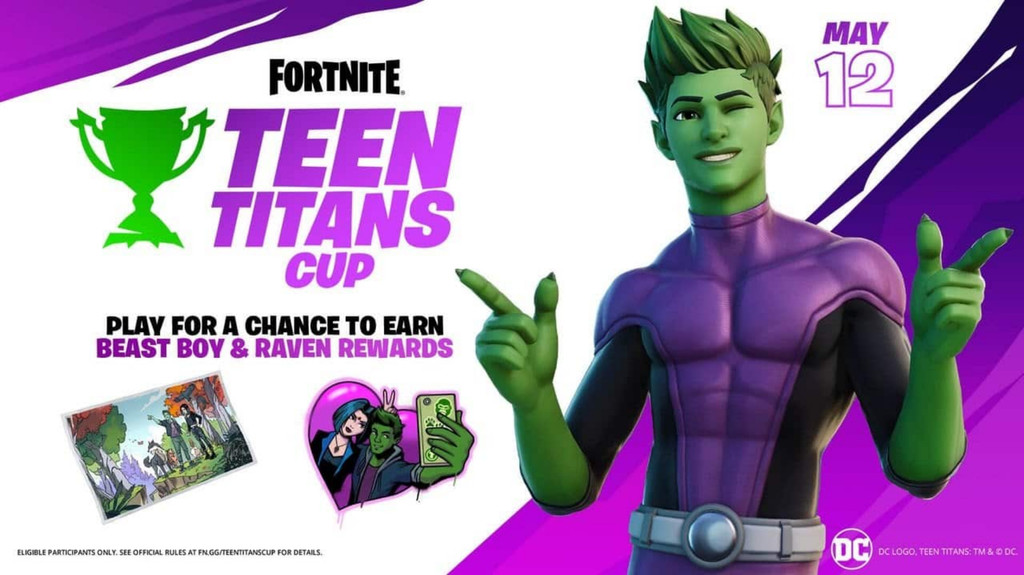
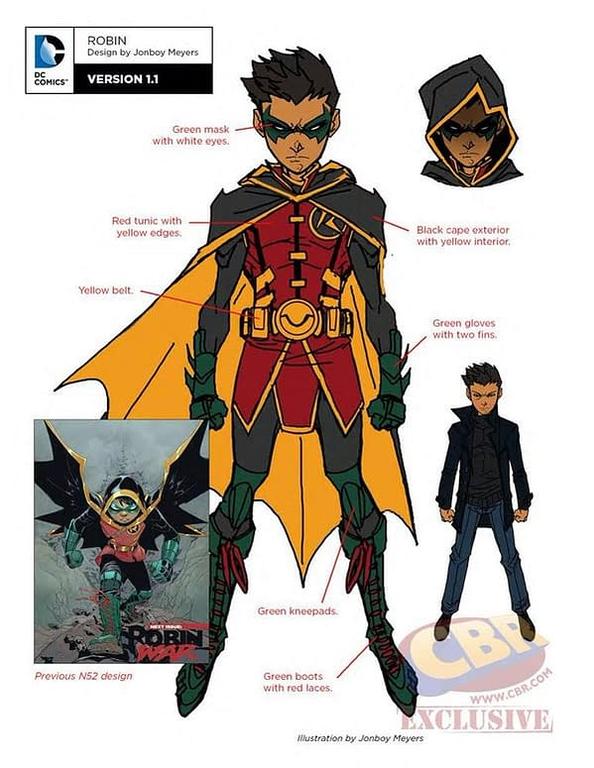
While I like some of the golden armor elements and the use of ruyi (如意) / lingzhi (靈芝) mushrooms (the “curlicue motif“), the striped teal paints and, especially, the sneakers just look tacky. Moreover, the design appears to be recycled from previous characters. Several people have commented online that the Monkey Prince is just a combination of Beast Boy‘s hair and body (fig. 3) and an altered version of Tim Drake‘s red and green Robin costume (fig. 4). Personally, I think his design is just a play on Damian Wayne, especially the hair, the red tri-panels with yellow borders at his waist, and the green pants (fig. 5). He is, after all, playing second fiddle to the Monkey King, like Robin does Batman.

Now, I have to address the sneakers. Why, why, why would a Chinese monkey demigod wear basketball sneakers? Well, according to Mr. Chang, it’s because a high school teenager like Marcus is bound to wear something with “some hotness to it” (Ching, 2021). Additionally, the designer admits that it’s also because he’s trying to (shamelessly) plug his own brand of shoes (Ching, 2021).

Fig. 3 – Detail of an advertisement featuring the design for Beast Boy in Fortnite (larger version). Image found here. Fig. 4 – Tim Drake’s costume (larger version). Take note of the staff. Image found on Wikimedia commons. Fig. 5 – Damian Wayne’s costume (larger version). Take note of the waist panels. Image found here. Copyright DC Comics.

4. My Rating

Overall, I would give “The Monkey Prince Hates Superheroes” 2 out of 5 stars 3 out of 5 stars (see the 06-16-21 update below). [4] I gave extra points for comical story elements and the technical proficiency of the art, but it’s hard to overlook problems with the writing and character design. This is a weak showing for the creative team involved. I think part of the problem is that not all parties had an intimate familiarity with Journey to the West. Mr. Chang admits that he only heard a few stories as a child and doesn’t know how the novel ends (Ching, 2021). Editor Chen states that her parents also told her stories (Aguilar, 2021), but I don’t know if she has ever read the novel. As for Mr. Yang, I’m sure he knows the story cover to cover, so I’d like to think that he was forced to sacrifice authenticity while working within certain constraints set by DC Comics.

Having said that, I’m honestly interested to see where the Monkey Prince story goes in future issues of his comic book. I will update this article as the narrative progresses.

5. What I Would Change

I would do away with the Monkey King taking a Chinese wife centuries after he became a Buddha. Instead, the son could be born during the Tang Dynasty (618–907) to Princess Iron Fan, the rakshasi wife of the Bull Demon King. Though seemingly impossible, there is precedent for this idea. An early 15th-century zaju play predating the novel describes Sun Wukong’s delight upon learning that the Princess is unmarried (Ning, 1986, pp. 139-140). He then resorts to seduction in an attempt to gain the iron fan needed to extinguish Flaming Mountain. For example, he recites a poem to her chocked full of sexual innuendo: “The disciple’s not too shallow. / the woman’s not too deep. / You and I, let’s each put forth an item, / and make a little demon” (Ning, 1986, p. 141). In addition, a 17th-century sequel to Journey to the West even describes the Monkey King having a number of sons with Princess Iron Fan. He faces one of his offspring, King Pāramitā (Boluomi wang, 波羅蜜王), during a final battle between all of the armies of the world (Dong, Lin, & Schulz, 2000, pp. 123-124). In our story, the son could have been conceived during chapter 60 of the original novel when Monkey shares a tender moment with the Princess while disguised as the Bull Demon King (Wu & Yu, 2012, vol. 3, p. 144).

Being a half-monkey spirit-half-rakshasa demigod, I’d like to think that the Prince’s base form would be more monkey-like. This would mean any lapse in concentration would cause him to revert to this state instead of a human form like in the original comic story.

I can already hear someone ask: “How can the Monkey Prince still be a teenager by the start of the story if he was born hundreds of years ago?” Well, this leads me to my next change. Instead of Zhu Bajie, it would make much more sense for his teacher to be the Bodhisattva Guanyin. After all, she tutors the children of several characters from the novel, including Muzha (木吒), 2nd son of Heavenly King Li Jing, and Red Boy (Hong hai’er, 紅孩兒; a.k.a. the “Child Sudhana,” Shancai tongzi, 善財童子), son of the Princess Iron Fan and Bull Demon King. [5] Already having a son under the goddess’ tutelage would make it easier for the Princess to send another child to learn from her. Also, Guanyin helped subdue both Monkey and Red Boy with golden fillets (Wu & Yu, 2012, vol. 1, pp. 316-320; vol. 2, pp. 251-252). Perhaps the Monkey Prince has a temper like his father and half-brother, so the goddess would make him wear Wukong’s fillet as it’s no longer needed once the latter attains Buddhahood (Wu & Yu, 2012, vol. 4, p. 383). Most importantly, the bodhisattva lives on the earthly paradise of Potalaka Mountain. The novel explains that one day in heaven equals one year on earth (Wu & Yu, 2012, vol. 1, pp. 150 and 167). A similar constricting of time would no doubt happen in Guanyin’s holy land. Therefore, the Monkey Prince would still be a teenager even after hundreds of years have passed on earth.

Next, I would completely do away with the tacky superhero costume. As a disciple of Guanyin, he would just wear a monk’s robe, the golden fillet, and possibly even sport a tiger skin skirt (like his father) since he would technically be a heavenly guardian. There would be no unnecessary logos, recycled costumes, or cursed sneakers. And the best part? This attire wouldn’t contradict the Monkey Prince’s hatred for superheroes, provided that was still a necessary plot element. Perhaps this hatred could be born from the fact that heroes like Shazam are given their powers (or happen upon them by accident), while the Prince’s abilities are the hard-won product of long years of spiritual cultivation.

My changes are less confident, however, when it comes to naturally fitting the Monkey Prince into existing canon. The first thing that comes to mind would involve the Shazam villain Sabbac, a hellish demon, causing havoc in Philidephlia’s Chinatown. Perhaps his assault could be related to the deplorable reports of Covid-related violence against Asians. A devotee of the goddess could pray to her in their time of need, and then the Monkey Prince is sent in her stead to exorcize the evil. But Shazam arrives while the Prince is battling the demon, and not knowing one from the other, he attacks them both. This might add fuel to the Monkey Prince’s dislike for Shazam.

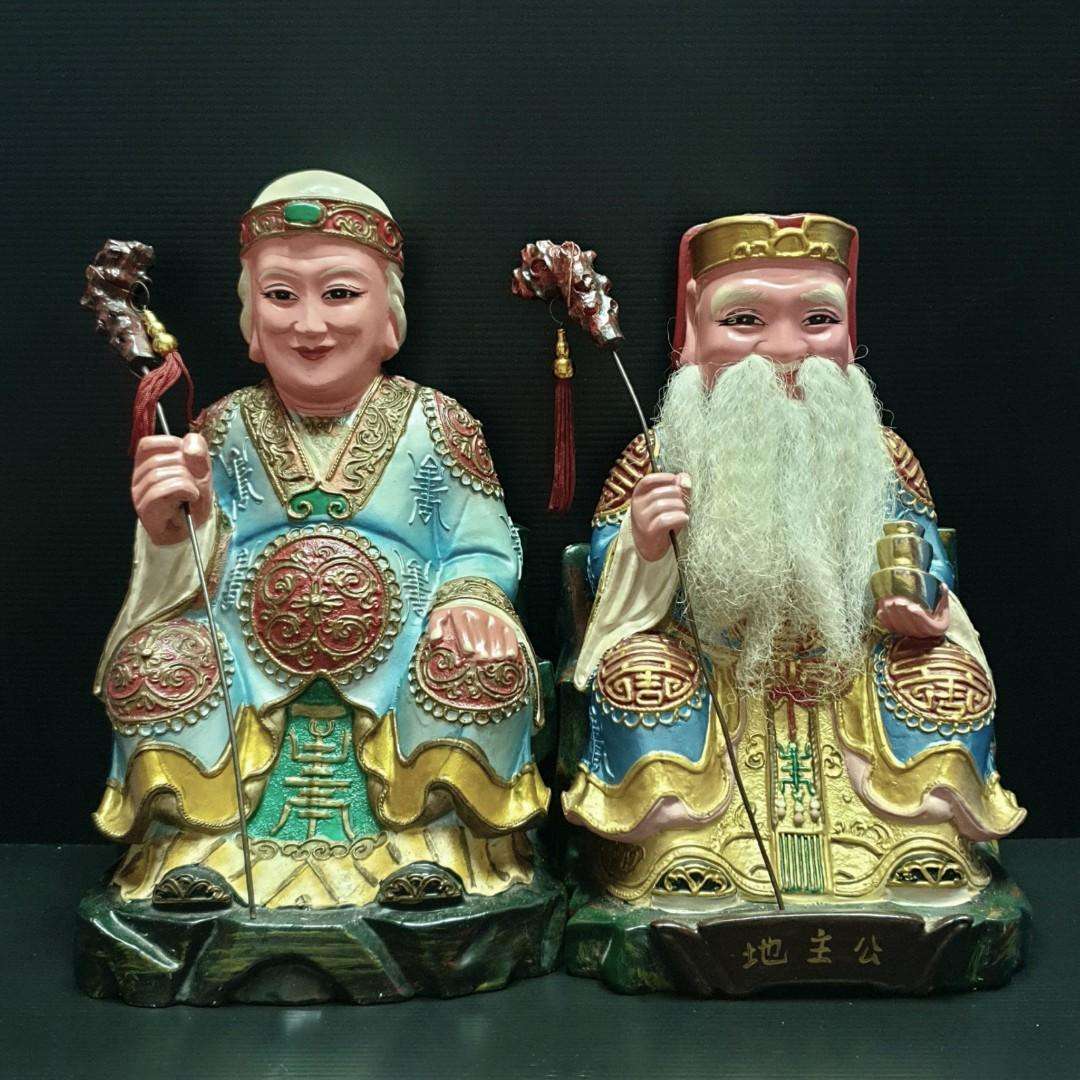
I personally think that the secret teen identity is a bit much, but if it is a necessary plot element, Guanyin could assign the Monkey Prince to watch over her flock in Philadelphia (and the rest of America?), [6] and at the same time allow him to experience a slice of modern teen life. And, again, if necessary, we can borrow from the original story and have the Prince attend high school, where he feels drawn to Billy Batson because of his godly aura. A local earth god (tudi gong, 土地公) and his wife (tudi po, 土地婆) (fig. 6) could be tasked by heaven to act like his grandparents to keep up the appearance of a normal human family.

Fig. 6 – Religious statues of the earth god (right) and his wife (left) in the author’s personal collection (larger version).


6. Updates

Update: 05-21-21

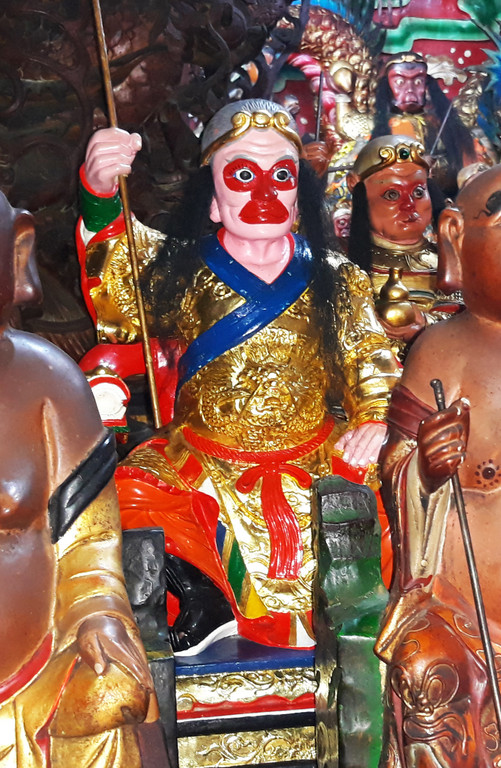
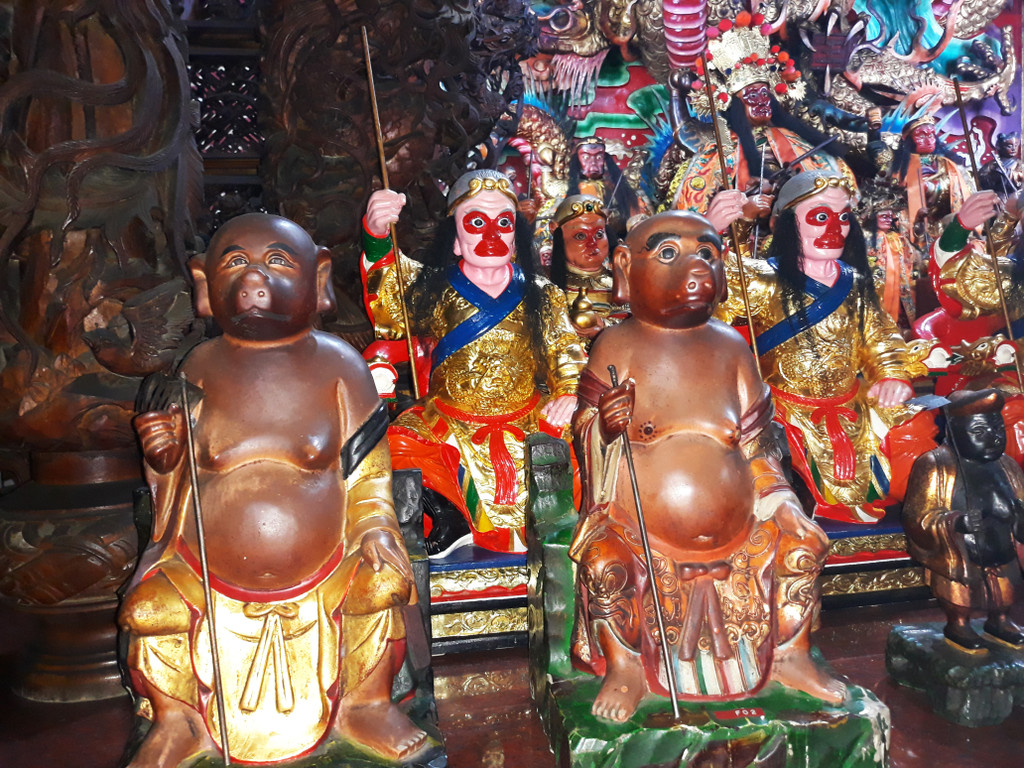
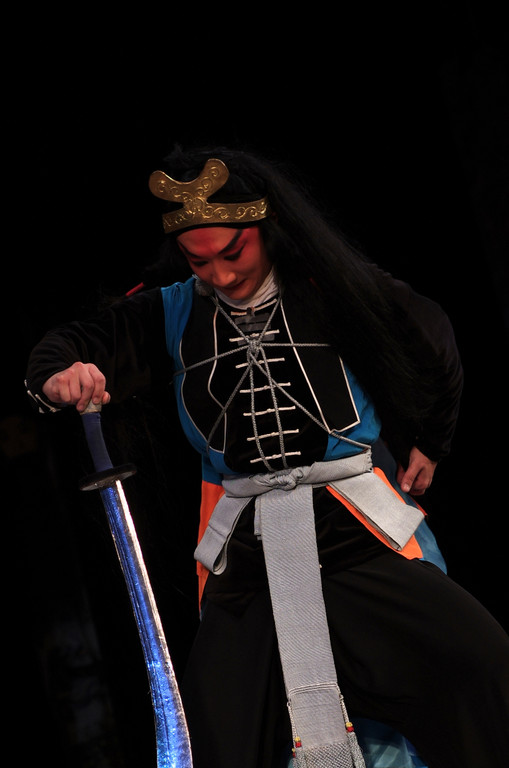
Last time I suggested changes to the Monkey Prince’s costume. One thing I forgot to mention was his hair. In order to be more authentic, there are two choices: 1) he can be bald (like his father in the original novel) since he’d be a Buddhist monk; or 2) he can have long hair since he’d be a martial monk (wuseng, 武僧). It’s interesting to note that religious statues of Sun Wukong sometimes depict him as a martial monk, complete with the golden fillet and long hair (fig. 7). This is heavily influenced by Chinese opera (fig. 8) (Bonds, 2008, pp. 177-178).

Fig. 7 – Detail of a religious statue of Sun Wukong as a martial monk (larger version). See the full version here. Photo taken by the author at one of the many temples in Taiwan dedicated to the Monkey King. Fig. 8. – A detail of the literary hero and martial monk Wu Song from a Chinese opera about his adventures (larger version). Full version available on Wikimedia Commons.


Update: 06-16-21

I’ve just posted my review of Marvel Comics’ Sun Wukong character. Reading the comic book equivalent of a train wreck has allowed me to view the Monkey Prince in a new, more positive light. I have, therefore, decided to increase my previous review score.

Review of Marvel Comics’ Sun Wukong


Update: 10-18-21

It has officially been confirmed that the Monkey Prince will be receiving his own 12-issue run in February 2022.

https://www.dccomics.com/blog/2021/10/16/dc%E2%80%99s-monkey-prince-new-series-to-debut-on-lunar-new-year-2022

DC has created an issue #0, which can be read here. I will review this comic at a later date.


Update: 12-13-21

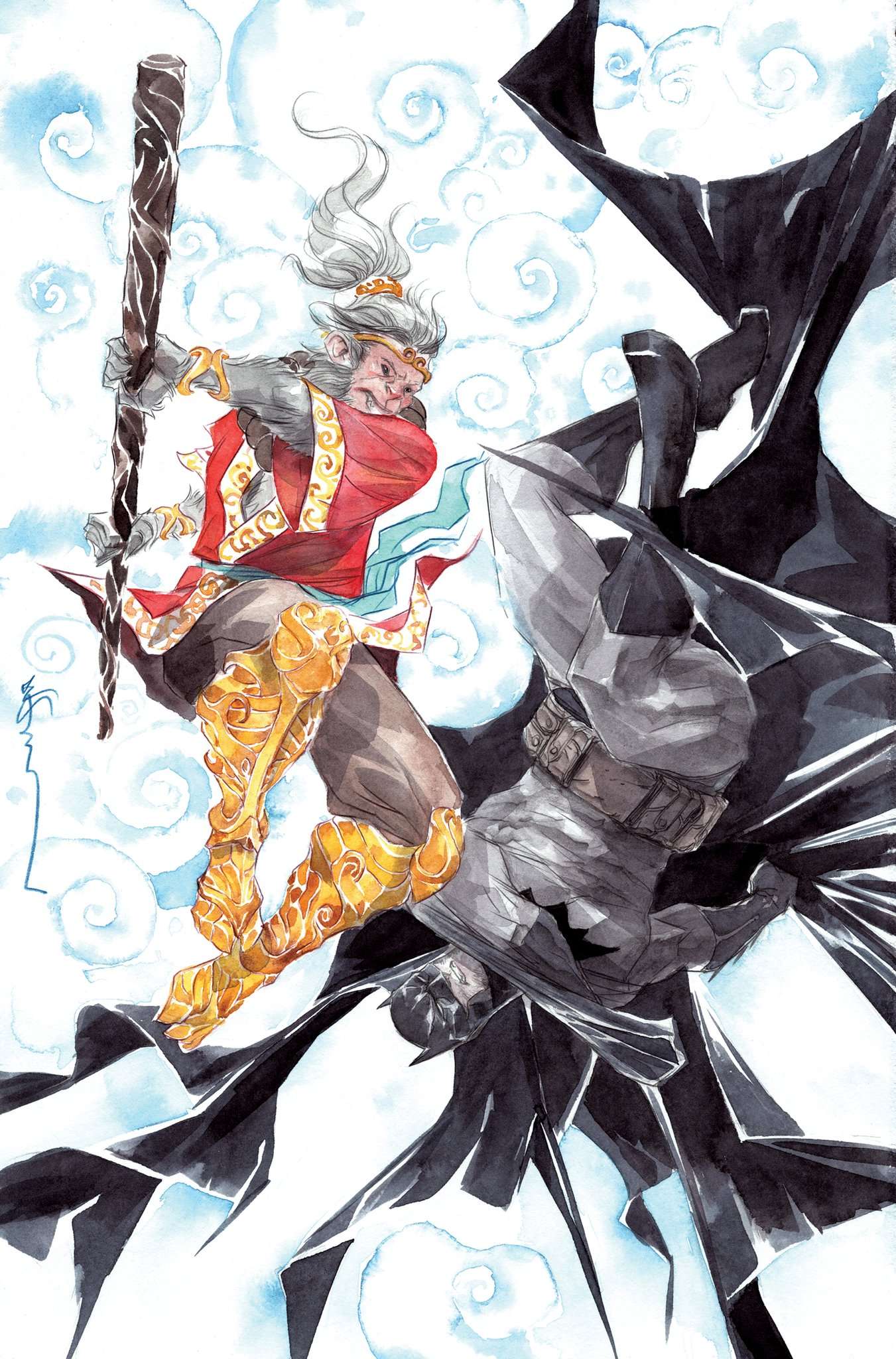
Thanks to a friend, I learned that a new Dustin Nguyen variant cover for issue #1 shows a long, white-haired Monkey Prince/King(?) fighting Batman (fig. 9). The issue description reveals that it is a prequel set in Gotham City:

Introducing the newest hero in the DCU, the great sage, equal to the heavens, better than his predecessor the legendary Monkey King, even better than the Justice League and definitely the Teen Titans (actually, all the heroes combined), everyone put your hands together for the Monkey Prince! Marcus Sun moves around a lot because his adoptive parents are freelance henchpeople, so this month he finds himself as the new kid at Gotham City High School, where a mysterious man with pig features asks Marcus to walk through a water curtain to reveal himself as who Marcus really is someone who has adventured through The Journey to the West, can transform into 72 different formations, can clone himself using his hairs, and is called the Monkey Prince! (see here)

This description indicates that Marcus first meets and begins his training under Pigsy while living in Gotham. It also shows (for some reason) that the hog immortal doesn’t do anything to curb the criminal activity of the boy’s adopted parents. Apparently, even celestials are oblivious to their henching gig. Ugh.

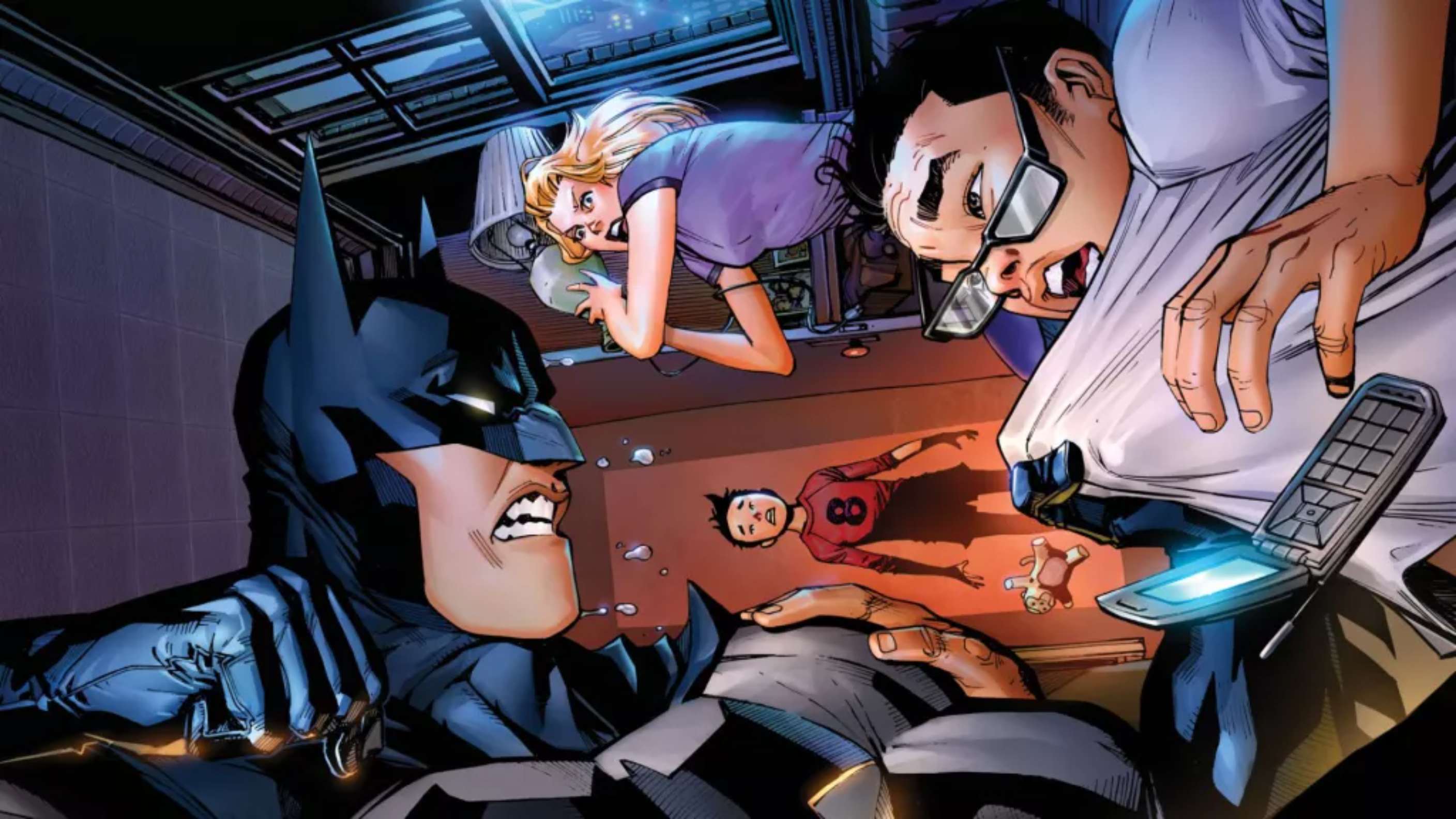
A cursory search shows that I missed a preview panel released in October showing Batman attacking a man and woman (the adopted parents), while a young Marcus helplessly watches from the background (fig. 10).

Fig. 9 – The new issue #1 variant cover by Dustin Nguyen (larger version). Fig. 10 – The Batman panel (larger version). Copyright DC Comics.

I don’t have high hopes for this upcoming issue for several reasons: 1) I’ve already mentioned everyone’s obliviousness to the adopted parents’ criminal activity; 2) The description confuses the Monkey King’s title “Great Sage Equaling Heaven” for a nickname of the Monkey Prince. Anyone who has actually read the novel would NEVER make this mistake; 3) It also says “high school,” while the panel clearly shows a young Marcus holding a stuffed Monkey; and most importantly, 4) Issue #0 was horrible. I won’t bother to give it a proper review. Just know that the story was a flashback involving a shotgun blast of Journey to the West characters (both heroes and villains) fighting against Darkseid‘s invasion of the heavenly realm (fig. 11). Once again, the characters are hammered into canon whether it makes sense or not. 

At this point, I probably won’t do any more reviews, but I will continue to read the series out of morbid curiosity. 

Fig. 11 – Monkey Prince #0 splash page with Journey to the West characters fighting Darkseid’s army (larger version). Copyright DC Comics. 


Update: 12-22-2021

I changed my mind about reviewing issue #0. Here is my analysis. Among my suggested changes, I named the character Sun Taizi (孫太子), or “Prince Sun.” This plays off of San Taizi (三太子), the “Third Prince,” one of the titles of Nezha, a heavenly vanguard in Sun Wukong’s religion, as well as a very important deity in his own right.

Review of DC Comics’ Monkey Prince #0 to #6


Update: 03-13-22

One of my previous complaints reads:

Seventh, the golden fillet disappears when Marcus is in his everyday human attire. This goes against the point of the band. In the novel, it can’t be removed and thus serves as an ever-present reminder of self-restraint (Wu & Yu, 2012, vol. 1, pp. 319-320). Maybe this will be addressed later.

This is indeed addressed in issue #2. Marcus throws away the headband, only for it to return later with the quaint ability to move about his body. It can never be removed, so when he isn’t in his Monkey Prince persona, Marcus wears the fillet where it can’t be seen (Yang, 2022, pp. 16 and 20-21).


Update: 04-11-26

A reddit member has posted a list of the Monkey Prince’s powers.

Respect Marcus Shugel-Shen, the Monkey Prince (DC Comics, Post-Flashpoint)
byu/rangernumberx inrespectthreads

Notes:

1) Though, the online version I bought through Google Play only has 84 pages.

2) Zhu Bajie and his brothers do briefly take students in chapter 88, but they only teach them how to wield weapons (Wu & Yu, 2012, vol. 4, pp. 198-203). This is not the same as the sagely teacher of magic presented in the comic.

3) Admittedly Yu (Wu & Yu, 2012) does use “Master Zhu” (vol. 4, p. 199), but that is far more accurate than mixing “Shifu” with “Pigsy,” a nickname used in place of the proper Chinese from the English abridgement Monkey (1942).

4) I’m willing to revise this in the future as the narrative progresses.

5) Muzha (a.k.a. Hui’an, 惠岸) is already Guanyin’s disciple by the start of Monkey’s rebellion. In chapter 6, the goddess sends him to help in case his skills are needed (Wu & Yu, 2012, vol. 1, p. 175). Red Boy is taken in by her at the end of chapter 42 and beginning of chapter 43 (Wu & Yu, 2012, vol. 2, pp. 251-252).

6) I’ll have to wait and see how far the Monkey Prince’s adventures take him in his ongoing comic.

Sources:

Aguilar, M. (2021). Jessica Chen Talks Returning Favorites and the Monkey Prince’s Debut in Festival of Heroes: The Asian Superhero Celebration. Comic Book. https://comicbook.com/comics/news/dc-festival-of-heroes-the-asian-superhero-celebration-jessica-chen/

Blum, J. (2022). DC’s New Bad Guys Eat Superheroes to Steal Their Powers. CBR. Retrieved from https://www.cbr.com/dc-villains-eat-superheroes-monkey-prince/

Bonds, A. B. (2008). Beijing Opera Costumes: The Visual Communication of Character and Culture. Honolulu: University of Hawai’i Press.

Chen, J. (Ed.). (2021). DC Festival of Heroes: The Asian Superhero Celebration [Google Play]. New York, NY: DC Comics. Retrieved from https://play.google.com/store/books/details/Minh_Le_DC_Festival_of_Heroes_The_Asian_Superhero?id=qXUrEAAAQBAJ

Ching, B. A. (2021). Meet the Monkey Prince: Yang and Chang Introduce DC’s Newest Hero. DC. https://www.dccomics.com/blog/2021/05/12/meet-the-monkey-prince-yang-and-chang-introduce-dcs-newest-hero

Dong, Y., Lin, S., & Schulz, L. J. (2000). The Tower of Myriad Mirrors: A Supplement to Journey to the West. Ann Arbor: Center for Chinese Studies, The University of Michigan.

Ning, C. Y. (1986). Comic Elements in the Xiyouji Zaju. (Doctoral dissertation). Available from ProQuest Dissertations and Theses database. (UMI No. 8612591)

Wu, C., & Yu, A. C. (2012). The Journey to the West (Vol. 1-4). Chicago, Illinois: University of Chicago Press.

Yang, G. L. (2022). Monkey Prince, (2) [Kindle]. New York, NY: DC Comics. Retrieved from https://www.amazon.com/Monkey-Prince-2022-2021-ebook/dp/B09RQ6581L

Yang, G. L. (2021). The Monkey Prince Hates Superheroes. In Jessica Chen (Ed.). DC Festival of Heroes: The Asian Superhero Celebration (pp. 70-82) [Google Play]. New York, NY: DC Comics. Retrieved from https://play.google.com/store/books/details/Minh_Le_DC_Festival_of_Heroes_The_Asian_Superhero?id=qXUrEAAAQBAJ

Review of Imagin8 Press’ Bilingual Edition of Journey to the West for Chinese Language Learners

Note: This post is not endorsed. I received no compensation for the review.

I have an ongoing international survey gauging the readership of Journey to the West. With almost 1,000 responses, 53.4% of the respondents have never read the novel. Another 28.8% have only read a few chapters, including abridgements. Most have learned about the story via video games, comic books, or the internet. This shouldn’t come as a surprise, though, as the majority of respondents come from North America (52.5%) and Europe (18.8%). Such non-Chinese speaking/reading populations do, however, have access to assorted translations. For example, the most popular English renditions are Arthur Waley’s 30-chapter abridgement Monkey (1942) and full translations like W.J.F. Jenner’s Journey to the West (2001) (see here for PDFs) and Anthony C. Yu’s The Journey to the West (revised 2012 edition). Yu’s version is by far the most accurate, but it runs well over 2,000 pages (including a 100 page introduction, copious explanatory notes throughout the four volumes, and many scholarly sources), making it a daunting task to read. But what about those who wish to read the original Chinese? Well, the edition put out by the People’s Literature Publishing House (人民文學出版社, 1955/2017), for example, has 866,000 Chinese characters, and while the novel is written in the vernacular, a person would need to know 3,000 or more characters before they could comfortably read it. This means beginning students would normally have to wait years until they reached the appropriate reading level. But now they have a new option.

Jeff Pepper (writer and publisher) and Dr. Xiaohui Wang (translator) of Imagin8 Press have produced a series of bilingual retellings of the tale at the 600 and 1,200 HSK word levels, as well as a few with 1,500 based on new words introduced in past books. [1] So far there are 14 books in the series covering chapters one to 42 (Monkey’s stone birth to the defeat of Red Boy). All are available in Simplified Chinese, while (as of March 2021) only the first six books are available in Traditional Chinese. Each is divided into four parts: 1) a preface with a brief explanation of the series and a recap of the story from previous books; 2) the story proper presented in pinyin with the corresponding Chinese on the adjoining page; 3) the English translation; and 4) an alphabetized glossary of terms with four columns listing the Chinese character, pinyin, English meaning, and when new words (not part of HSK3) are “First Used” in a given book (i.e. 1, 2, 3, etc.). [2] If the First Used column is blank for a given character, this is because “the word is part of HSK3 or is in common usage” (Pepper & Wang, 2018a, p. 119). Furthermore, students have the added option of listening to audiobooks available for free on Imagin8’s YouTube channel. This means they can practice both their reading and listening skills. Needless to say, this series truly is an amazing resource.

The cover of book one. Design by Katelyn Pepper (larger version).

Now on to the story. Given the reduced word count, the tale in each book is a simplified version of the original. The first book opens on a parent telling Journey to the West as a bedtime story to their child, each subsequent volume representing a different night’s story. Certain aspects, such as the names of minor gods, immortals, and demons, as well as copious literary poems, are cut out as they don’t really affect the overall story. [3] The narrative flows smoothly and follows the general outline from Anthony C. Yu’s English translation. [4] The rhythm of pages is occasionally broken up by beautiful black and white drawings by Next Mars Media, each of which is accompanied by a bilingual caption.

Beyond a few very minor inaccuracies in the story, I only have two major complaints. One, the tendency to gloss over certain facets of the narrative resulted in the removal of one major aspect of Sun Wukong’s early training, which is the source of his most famous magic power. In the original, the Buddho-Daoist Sage Subodhi teaches Monkey the 72 transformations in order to hide from a trio of heaven-sent punishments scheduled to kill him for attaining immortality. After subsequently learning how to fly via the cloud somersault, he is expelled from the Sage’s school for showing off his newfound powers of metamorphosis to his less accomplished classmates. But in book one of the series, Wukong’s lesson on shapeshifting is mysteriously replaced with flight training. It is implied that he can simply fly away from said punishments (Pepper & Wang, 2018c, pp. 55 and 57 and 82-83). And instead of being kicked out for showing off his transformations, Subhuti simply tells him to leave because he’s “disturbing the other students” (Pepper & Wang, 2018c, pp. 57 and 83). This removal doesn’t make any sense, especially when our hero exhibits transformations in later books (Pepper & Wang, 2018b, pp. 39 and 78, for example).

Two, the Chinese sections of books one to five are very short, running between 25 to 30 pages with only 14 lines per page. The rest of the books are comprised of the aforementioned preface, the pinyin pages, the English translation, the images, and the glossary. However, book six and beyond tend to have more pages, especially those from book seven onwards as this is when the 1,200 word level is introduced. In addition, Imagin8 has produced a number of compilations, each collection containing three books (example).

For my overall rating, I would give the series 4.5 out of 5 stars. I highly recommend it for those in the early stages of learning Chinese. It will surely serve as a gateway to learning more about Chinese history, religion, and mythology.

Notes:

1) Mr. Pepper was kind enough to send me the first six volumes in Simplified Chinese back in 2019. He recently sent me the Traditional Chinese version of volume six.

2) Book one is missing this “First Used” column. It was introduced in book two under the listing “New?”. This was subsequently changed to “Used In” in book five and then “First Used” in book six.

3) The names of certain reoccurring characters, such as Heavenly King Li Jing and his son Prince Nezha, are cut in earlier books. I’d be interested to see if their full names grace later books as the characters do appear several more times in the original narrative.

4) Dr. Yu is thanked in the acknowledgements.

Sources:

Pepper, J., & Wang, X. (2018a). The Emperor in Hell (2nd ed.). Pittsburgh, PA: Imagin8 Press.
Pepper, J., & Wang, X. (2018b). The Immortal Peaches (2nd ed.). Pittsburgh, PA: Imagin8 Press.
Pepper, J., & Wang, X. (2018c). The Rise of the Monkey King (2nd ed.). Pittsburgh, PA: Imagin8 Press.