The Monkey King Temples of Fujian Province, China

Last updated: 10-03-2024

The Journey to the West Research blog is proud to host an entry by our friend Saie Surendra of Hanumovies.com. During the summer of 2019, he was lucky enough to visit several Great Sage Equaling Heaven temples in Fujian Province, China, including those dedicated to him and those hosting small shrines in his honor. This entry will serve as a list of such temples. – Jim

Saie

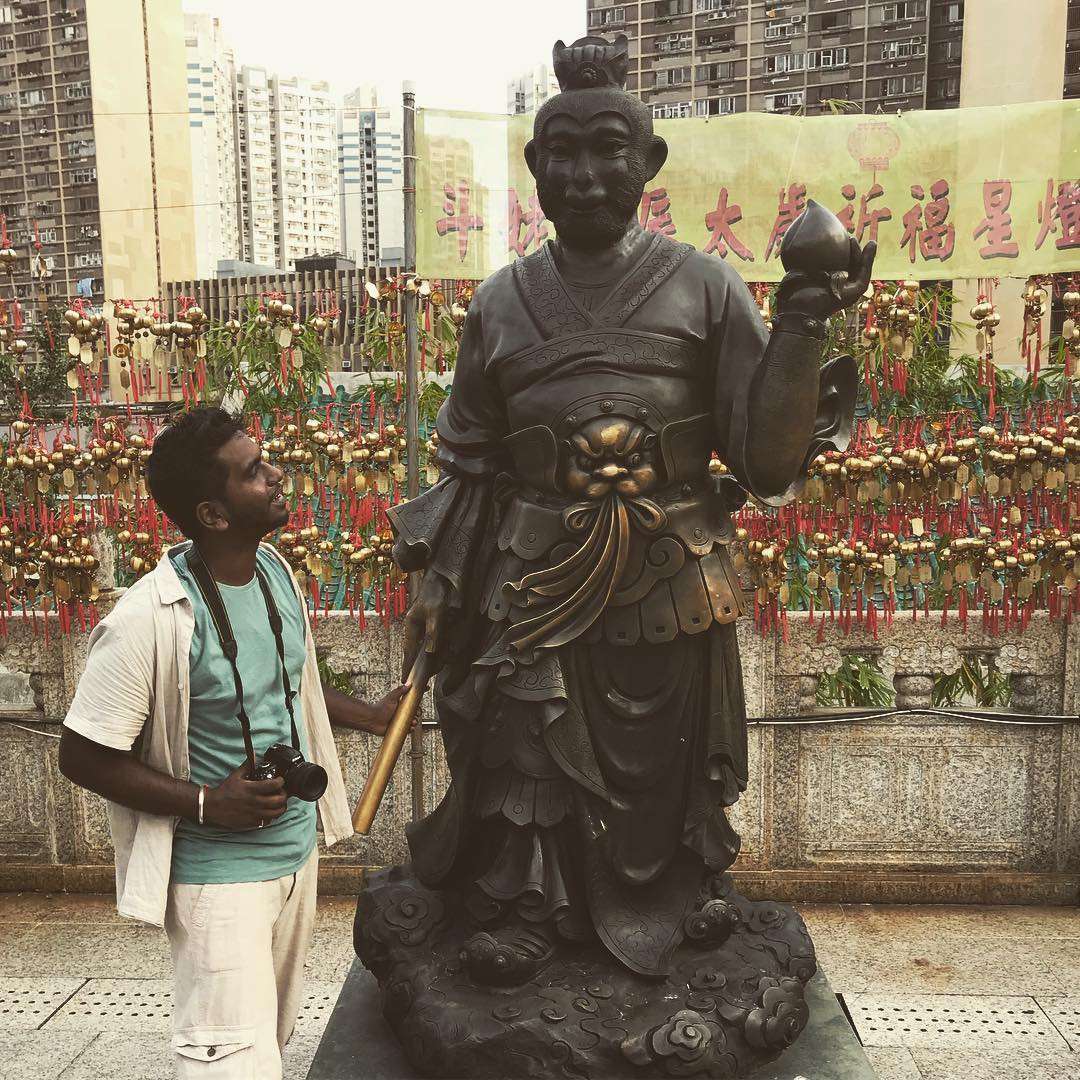
Saie admiring a Monkey King statue at the Wong Tai Sin temple in Kowloon, Hong Kong (larger version).

I. My journey

So how did my journey to the various Great Sage Equalling Heaven temples in Fujian begin? I guess I’ll start from the beginning. Growing up, I would often see images or figurines of the Hindu Monkey God Hanuman in fellow Sri Lankan and Indian homes. For those who don’t know, Hanuman is the Indian counterpart of Sun Wukong and potentially the first known Monkey God. I was curious and intrigued and wanted to know more, but I didn’t get many answers from the people I asked. “He protects us and can revive us from bad health” was the most common reply. I researched the many translations of the Ramayana (one of two great Indian epics within which Hanuman appears) and became enchanted by his many amazing feats and achievements. I was a huge film fan growing up, so I became obsessed with the idea of making films based on him. There have been TV adaptations of Hanuman’s story—I wasn’t a fan of the more human-like portrayals—but, sadly, major Indian studios have yet to make a proper movie about him.

Fast-forward to 2008. Jet Li and Jackie Chan star in the kung fu fantasy The Forbidden Kingdom. Looking back now, it isn’t the greatest film ever, but this is when I first met … Sun Wukong (cue the “Dagger House Prelude”). This was a turning point for me, my obsession multiplied tenfold. Since then I have watched tens, if not hundreds, of film and TV adaptations of Sun Wukong. I’ve also read endless articles and books (one example) in an effort to connect the dots between our (Hindu and Buddho-Daoist) ancestors’ worship of monkey deities. I’ve found there are just too many similarities to ignore.

At first, I had never heard of Sun Wukong’s worship, so when I found the one vague article online describing the Monkey King Festival (the 16th day of the 8th lunar month) in Hong Kong, I decided I would go! I didn’t know what to expect when Jim and I met at the Great Sage Treasure Temple (大聖寶廟) in Kowloon in September of 2018, but it was a big moment for me. Crowds of young and old gathered to worship the Great Sage Equalling Heaven; Daoist priests chanted from prayer books; rows of important businesspeople bowed in unison; martial arts schools performed colorful lion dances, each kwoon paying respect to the altar as they passed; giant paper effigies were burnt. It was a veritable feast for the eyes and ears. Through our interviews with the locals, we not only learned that the festival was considered a time for strengthening community bonds and to help those in need, but also that many adherents believed their faith originated in Fujian, more specifically the city of Fuzhou. This of course agrees with what past scholars have written about Sun’s worship in Fujian.

I have a question: If you ever found yourself in heaven, what would you do? You’d take some good videos to show your friends back on Earth, right? So that was the idea; I started making a documentary (video 1) based on the real people I met and the places I visited, saving my film ambitions for later.

Video 1 – Legends of a Monkey God: Episode 1 – Hong Kong

I was restless some months after returning from the Hong Kong Monkey God Festival. It was like experiencing Heaven for a week and then falling back to Earth like a meteor with many unanswered questions. I was unable to sit around in my miserable London life any longer, so I finally decided to travel where Sun’s worship supposedly began … Fuzhou.

Arriving in Fuzhou was like a pilgrimage in itself. Let me say, this was not an easy journey for me, nor for the translator friend I hired due to my poor Mandarin. The Hokkien accent of Fuzhou gave her a hard time. In addition, the many places I had researched and mapped online seemingly didn’t exist. We visited one after another, with the locals appearing clueless about the temples we inquired about. It was almost as if Sun Wukong’s worship was a secret and only initiated members were allowed access to his houses of worship. Now, there is a saying in India that goes: “You can’t just find Him, He has to invite you”. This saying holds true, for when we finally found one of the locations (see temple one below), a person inside told us about a man who could help me on my journey. I thought, “Hang on a minute … was this guy the savior goddess Guanyin? Was he going to introduce me to my … Sun Wukong?”

I was later introduced to Mr. You, the head of several temples, the Pingshan theatre, and the greatest Sun Wukong follower I have ever met. He set aside two whole days to drive us to several Monkey King temples around Fuzhou, during which time I shot video for another documentary (video 2). I wondered whether or not he wanted anything in return. I mean, no one does anything for free, right? It turns out he was more than happy just to share his Sun Wukong with me and invite me into his secret club! He would not accept any gifts from me. I felt like I was the Tang Monk! And here is the thing: Mr. You and his friends didn’t speak a single word of English—in fact, my Mandarin was unbearable to them—yet we somehow managed to communicate and establish a strong friendship between us, “Brothers bound by the love of Monkey”. I promised myself then that I would return with better Mandarin in a Fujian dialect.

Video 2 – Legends of a Monkey God: Episode 3 – Monkey King Temples of Fujian, China

What I took away from this trip was the fact that Sun Wukong is a deity that sits at the intersection of Buddhism, Daoism, and Confucianism. I saw effigies of him in temples of all the “Three Religions”, sometimes shared, sometimes strictly one faith. But the idea of religion in the East is not the same as that in the West. In the East, you find your own path, follow it to your goal; you don’t need to be on the same path as everyone else and no one judges you for making your own way. It’s just like the Indians say: “The destination is the same, paths are many. God is one, names and forms are many”. This ties in with the works of famed mythologist Joseph Campbell, who would call this the many “masks of God”.

II. Temple list

Note: This list is not exhaustive and will be updated periodically. Most importantly, the following GPS coordinates should ONLY be used as a general guideline. It is highly recommended that those wishing to visit these places should hire the services of a knowledgeable guide. I recommend contacting Mr. You (WeChat id: you410631621)

(Note: Mr. You has died, so his WeChat no longer works.) 

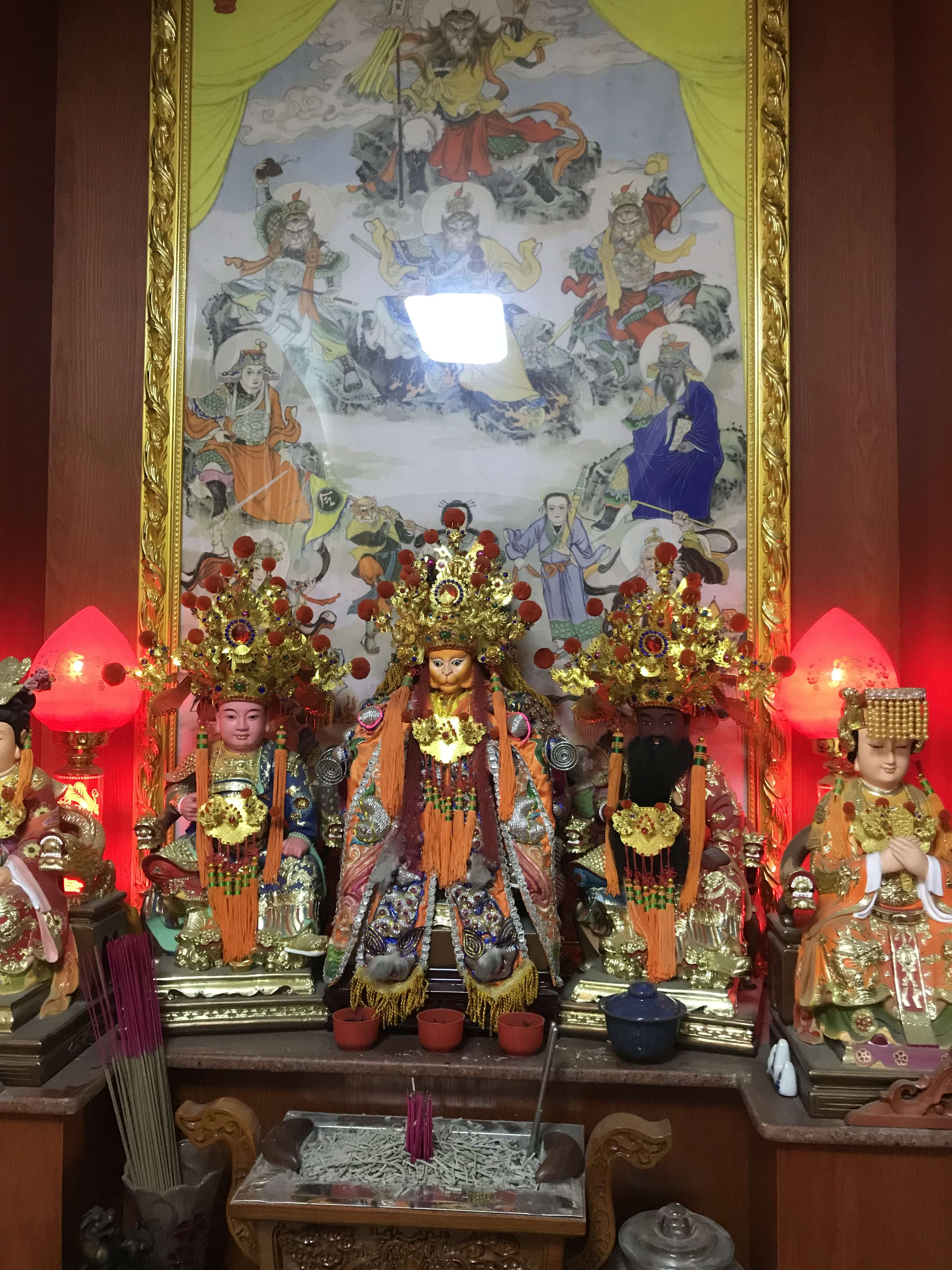
A shrine in Mr. You’s house (larger version).


Temple One: 玉封齐天府屏山祖殿

26°04’45.0″N 119°18’42.6″E
福建省福州市鼓楼区三界寺
Sanjie Temple, Gulou District, Fuzhou City, Fujian Province, China
38H6+MP Gulou District, Fuzhou, Fuzhou, Fujian, China

Pictures

https://drive.google.com/drive/folders/0Bwi3jyIV3-OhfmoyQ0RXN25PalhWbXVncUxwX0pFcDlSbVVDMFRvMm82dWttRlUxaGNVTWc?resourcekey=0-Dq0-f95II5gSZLh9VVu7qg&usp=sharing

IMG_6054


Temple Two

26°04’10.1″N 119°19’56.1″E
福建省福州市晋安区
Eastern District Shangquan, Jin’an, Fuzhou City, Fujian Province, China
389J+QW Jin’an, Fuzhou, Fujian, China

Pictures

https://drive.google.com/drive/folders/0Bwi3jyIV3-Ohfmt2cGV2U1BsVW1iQjVHUEFIZXF6QV9vTndVNkxEdm1SRzA3UURpM25mWDA?resourcekey=0-KybFXH3lW6H0YU4dSIT8Yw&usp=sharing

IMG_6161


Temple Three

26°01’46.8″N 119°15’56.1″E
福建省福州市仓山区百花洲路
Baihua Zhou Road, Cangshan District, Fuzhou City, Fujian Province, China
27H8+V6 Cangshan, Fuzhou, Fujian, China

Pictures

https://drive.google.com/drive/folders/0Bwi3jyIV3-OhfjFhWVdVTTU0bFRMOGo3eGNZSncyal8takVNNTZTLTFBRmNJV3BGOTFyTXc?resourcekey=0-Vp51fSJCx3nejStT3ZjO0g&usp=sharing

IMG_6298


Temple Four: 霞江清泉庵 (齊天大聖殿)

26°02’41.4″N 119°18’34.7″E
福建省福州市仓山区
28V5+WV Cangshan, Fuzhou, Fujian, China

Pictures

https://drive.google.com/drive/folders/0Bwi3jyIV3-OhfmEyMFJHR19OYzM0REhMNzE4bDZZaUd0bjgtdUVZb2h3MndZT0ZQWGVPMm8?resourcekey=0-24cQHhFFVobNPUo6hwLkxg&usp=sharing

For more pictures, see this article.

IMG_6353


Temple Five

26°02’05.1″N 119°21’10.7″E
福建省福州市仓山区后坂路
Houban Road, Cangshan District, Fuzhou City, Fujian Province, China
29M3+W5 Cangshan, Fuzhou, Fujian, China

Pictures

https://drive.google.com/drive/folders/0Bwi3jyIV3-OhflVvT1dOM1RTcDRucXRxT0xfVHoxVFdDZkR4OGpGaGo4VzN1eEZBXzlNVVk?resourcekey=0-X8xhXb0INiwa1FF8kACplg&usp=sharing

IMG_6427


Temple Six

26°06’23.6″N 119°14’30.2″E
福建省福州市闽侯县
Unnamed Road, Minhou County, Fuzhou City, Fujian Province, China
464R+JM Cangshan, Fuzhou, Fujian, China

Pictures

https://drive.google.com/drive/folders/0Bwi3jyIV3-OhflVVSzNCNWVDN25NU05La043NlRyczJSOVc0UkE1aDRfb0ZCeUV4cWJianc?resourcekey=0-cnBTjqM0ZCS0EaizWsGTTQ&usp=sharing

IMG_6662


Temple Seven: 慈恩寺

26°08’54.4″N 119°08’56.9″E
福建省福州市闽侯县军民路
Junmin Rd, Minhou County, Fuzhou City, Fujian Province, China
44XX+9M Ganzhezhen, Minhou, Fuzhou, Fujian, China

Pictures

https://drive.google.com/drive/folders/0Bwi3jyIV3-OhfjUwekJoVTlhclJvVTJDS1NfdDdGXy1PQUg0RHU0WnZUMzI5UWdXRWlzVDQ?resourcekey=0-lDm_EQW1Dj6rEnzeU0BR0Q&usp=sharing

IMG_6681


Temple Eight

26°04’26.2″N 119°11’25.5″E
福建省福州市闽侯县
G316 Minhou County, Fuzhou City, Fujian Province, China
35FR+H5 Shangjiezhen, Minhou, Fuzhou, Fujian, China

Pictures

https://drive.google.com/drive/folders/0Bwi3jyIV3-OhfnFLWGVvWjktaFFfTS1wVHBMdFA2VmtpVW5aUU1qOGNrQ1RQVEo5TG1pTU0?resourcekey=0-_5j182ICuI-0ValCqUQfXg&usp=sharing

IMG_6742


Temple Nine

26°01’49.8″N 119°17’26.7″E
福建省福州市仓山区鹭岭路163号
163 Luling Road, Cangshan District, Fuzhou City, Fujian Province, China
27JR+68 Cangshan, Fuzhou, Fujian, China

Pictures

https://drive.google.com/drive/folders/0Bwi3jyIV3-Ohfmd5WmMza0xuQUtxWThwbmZFRVV5WXlreF9TYkF3ai1WZ01jeDAxQ09pcW8?resourcekey=0-ELD6KPHTI0RCsfAs8LaIUg&usp=sharing

IMG_6765

Update: 02-15-21

Jim here. I have mirrored this article by creating a list of Monkey King temples that I’ve visited in Taiwan.

Qitian Dasheng Monkey King Temples in Taiwan


Update: 10-03-24

I just figured out that the photo links have not worked for several months. This is because my original university gmail account, which hosted the pictures, was shut down. Everything is fixed now.

The Sun Wukong Stone Relief of Kaiyuan Temple

Last updated: 01-27-2024

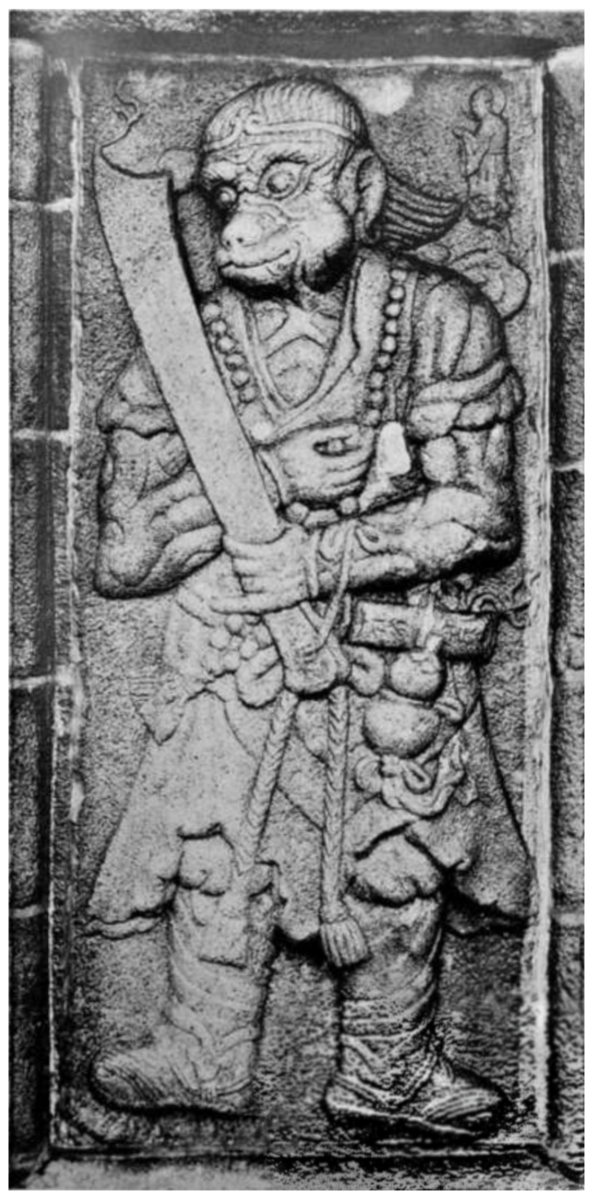
The southern Chinese seaport of Quanzhou in Fujian province is home to Kaiyuan Temple (Kaiyuan si, 開元寺), also known as the Purple Cloud Temple (Ziyun si, 紫雲寺), an ancient Buddhist complex originally built in 686. The temple is famous for its two stone pagodas, each of which is covered in 80 life-size relief carvings of bodhisattvas, arhats, patriarchs, protector deities, and various mythological creatures rendered in a rustic style influenced by the Northern Song Dynasty school of art (Ecke & Demiéville, 1935, pp. 11-18). One figure of interest is a muscular, sword-wielding, monkey-headed warrior (fig. 1) located on the northeastern side of the western pagoda’s fourth story. Many scholars consider this to be an early depiction of Sun Wukong from Journey to the West (Xiyouji, 西遊記, 1592). The pagoda was erected in 1237 (Ecke & Demiéville, 1935, p. 91), so this depiction predates the Ming novel by 355 years, making it an important source for analyzing the early influences on the much beloved literary character. In this paper, I present past research on the relief, as well my own in which I suggest the iconography is based on ritual adornments mentioned in the Hevajra Tantra, an Esoteric Buddhist text of the 8th-century.

Fig. 1 – The  Kaiyuan temple pagoda relief (larger version), Quanzhou, Fujian .

I. Previous research

The first detailed description of the relief appears in Ecke and Demiéville (1935):

A guardian with a monkey-head, holding with one hand a rosary which is hanging around his neck, and with the other a sword emitting a cloud from its tip. He wears a short tunic, travel-sandals, and a rope-belt from which are hanging a calabash and a scroll with the Chinese title of the Mahamayarividyārajñi [Fomu da kongque mingwang jing佛母大孔雀明王經] (T982-985, a text which was used as a charm against all calamities, dangers, wounds, and diseases). [According to local tradition, it is] Sun Wu-k’ung the name of the monkey assistant (alias the Monkey attendant 猴行者, or the fair Monkey-king 美猴王, or the Great Saint Equal to Heaven 齊天大聖) of Hsüan-tsang [Xuanzang] in the JW-novel. In the upper right corner of the carving there is a small monk-figure with a halo, evidently Hsüan-tsang himself, appearing on a cloud, seemingly the same cloud as that which emanates from the monkey’s sword. In the version of the JW now extant, the monkey assistant’s weapon is not a sword, but an iron rod with two golden rings, which he can reduce, whenever he finds it convenient, into a needle and so keep inside his ear. Also, he wears a tiger-skin over the lower part of his body, a detail which does not agree with our carving (p. 35)

Glen Dudbridge (1970) compares Ecke and Demiéville’s analysis with the description of the Monkey Pilgrim (Hou xinzhe, 猴行者) from the The Story of How Tripitaka of the Great Tang Procures the Scriptures, the late 13th-century precursor of Journey to the West. Based on the differences, he suggests Northern and Southern China may have had separate Monkey story cycles:

[T]here is no sign there of the traveller’s garb in which the Zayton [2] figure is so meticulously clothed; the sword is also not mentioned, although the ‘iron rod with gold rings’ … has not yet assumed its full distinctive role; similarly, the tiger-skin robe, while not described in so many words, seems faintly anticipated in the episode [chapter six] in which Hou Hsing-che slays a tiger-demon, and certainly this standard attribute of demonic figures in Tantric iconography accords well with the description of the yakṣa in that same episode. [3] All this tends to suggest that the Zayton monkey-figure remains strangely distinct from that known to us in the literary sources … Certainly at this stage of their development, there seems to have been no obligation to uniformity in the enactment or representation of popular story cycles: the monkey seen, heard or read about by the northern public could well have differed from his southern counterpart (Dudbridge, 1970, p. 49).

Journey to the West translator and scholar Anthony C. Yu (1977) highlighted a difference in opinion regarding the pious figure on the upper right of the piece:

Ōta Tatsuo 太田辰夫 and Torii Hisayasu 鳥居久靖, in “Kaisetsu 解説,” in Saiyuki, Chūgoku koten bungaku taikei, 31-32 (Tokyo 1971), 432, have challenged Ecke and Demiéville’s interpretation of the carving by pointing out that the figure at the upper righthand corner should be thought of simply as a figure of Buddha (not Hsüan-tsang), which Monkey will become by virtue of bringing back the scriptures. It may be added that Sun Wu-k’ung of the hundred chapter narrative did use a sword or scimitar 刀 (JW, chaps. 2 and 3) before he acquired his famous rod. [1] None of the scholars consulted here sees fit to discuss the significance of what seems to be a headband worn by the carved figure (p. 497 n. 23). 

Victor Mair (1989) focuses on the relief’s iconography and suggests that the various elements might have ties to depictions of both the Buddhist protector deity Aṇḍīra and the Hindu monkey god Hanuman from the Ramayana (c. 4th-cent BCE):

The band on the Zayton monkey’s head is indeed very important. Surely it must represent what becomes the Tight-Fillet 緊箍 of the Ming JW, ch. 14. Regardless of the author’s (or his predecessors’) elaborate creative inventions surrounding this fillet in the tradition of the novel, we may ask whether it has any identifiable iconographical origins in art.

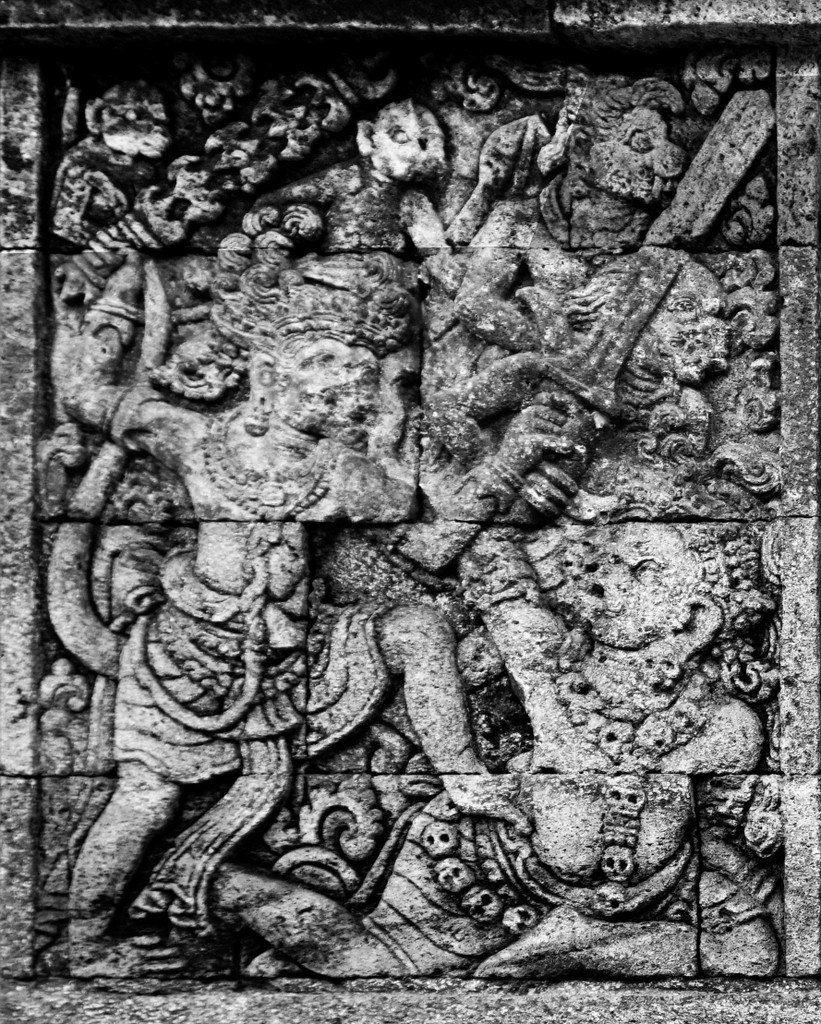
The Tight-Fillet recalls the band around the head of representations of Aṇḍīra, the simian guardian of Avalokiteśvara and Bhaișajyaguruvaidūryaprabhāṣa … As a typical specimen, we may take a statue [fig. 2] from the Kōfukuji in Nara. The Kōfukuji Aṇḍīra has curious wing-like projections extending from the sides of the band around his head that remind us of Mercury in Western classical art. On the Zayton SWK [Sun Wukong], these symbols of swiftness have been displaced to the sides of the eyes. In either case, the wings remind us of H’s [Hanuman’s] descent from the god of the wind. Other similarities between the Kōfukuji Aṇḍīra and the Zayton SWK include: identical earrings (these are key iconographical features of H in many Southeast Asian Rs [Ramayanas]), comparable tilt of the head (exaggerated with the Kōfukuji Aṇḍīra) which seems to indicate enforced submission, long locks of hair flaring out behind the head, elongated monkey’s mouth, similar decorations on forearms and upper arm, etc. It is crucial to note that all of these features can be found in South Asian and Southeast Asian representations of H. For its photographic clarity, we may choose a scene from the Rāma reliefs in Panataran, Indonesia [fig. 3]. H’s forearms are bare in this particular representation, but in some Thai reliefs (at Wat Phra Jetubon in Bangkok), they resemble those of the Zayton SWK and the Kōfukuji Aṇḍīra. The discrepancies in the dress and ornamentation of the lower parts of the body may be attributed to culture and climate (pp. 699-700).

Fig. 2 – The Kōfukuji Aṇḍīra wooden relief carving (c. 11th to 12th-cent.) (larger version), Nara, Japan. Fig. 3 – Hanuman (left) besting a demonic foe (right), from the Ramayana reliefs of the Panataran temple complex (c. 12th-cent.) (larger version), East Java, Indonesia. 

II. My findings

My opinion on the origins of the Kaiyuan relief’s iconography parts ways with Mair in some respects. For instance, upon close inspection of the Japanese Aṇḍīra carving, the band that he refers to appears to be the brim of a helmet. I do agree the Kaiyuan relief shares affinities with the cited image of Hanuman (e.g., the earrings and armbands). But again, here I part ways with Mair because I suggest the relief’s accoutrements were instead influenced by Esoteric Buddhism and not Hinduism. The similar imagery is no doubt due to a common cultural source.

Nearly every aspect of Sun Wukong’s attire can be found in a passage from the 8th-century esoteric text the Hevajra Tantra (Dabei kongzhi jingang dajiao wang yigui jing, 大悲空智金剛大教王儀軌經). It instructs yogins on how to adorn and dress themselves for worshipping Heruka (Xilujia, 呬嚕迦), a wrathful protector deity of Buddhism.

Sanskrit: bhavakena vidhartavyam karnayor divyakupdalam/ sirasi cakri dhartavya hastayo rucakadvayamkatyarp va mekhalam caiva padayor nupuran tatha/ bahumule ca keyuram gnvayam asthimalika/ paridhanam vyaghracarma bhaksanam dasardhamrtam

Translation: The practitioner should wear divine ear-rings, a circlet around the head, upon each wrist a bracelet, a girdle around his waist, anklets around the ankles, arm ornaments around the upper arms and a garland of bones around the neck. His dress must be of tiger skin … (Farrow & Menon, 2001, pp. 61-62).

彼修觀者當如是行:謂頂想寶輪、耳帶、寶鐶,手串寶釧,腰垂寶帶,足繫寶鐸及妙臂釧,頸嚴寶鬘衣、虎皮衣 …

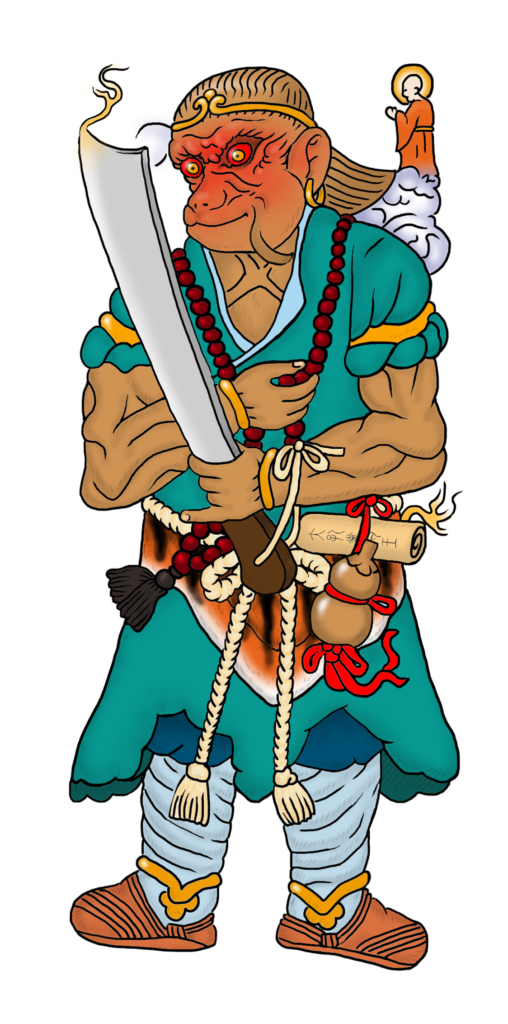
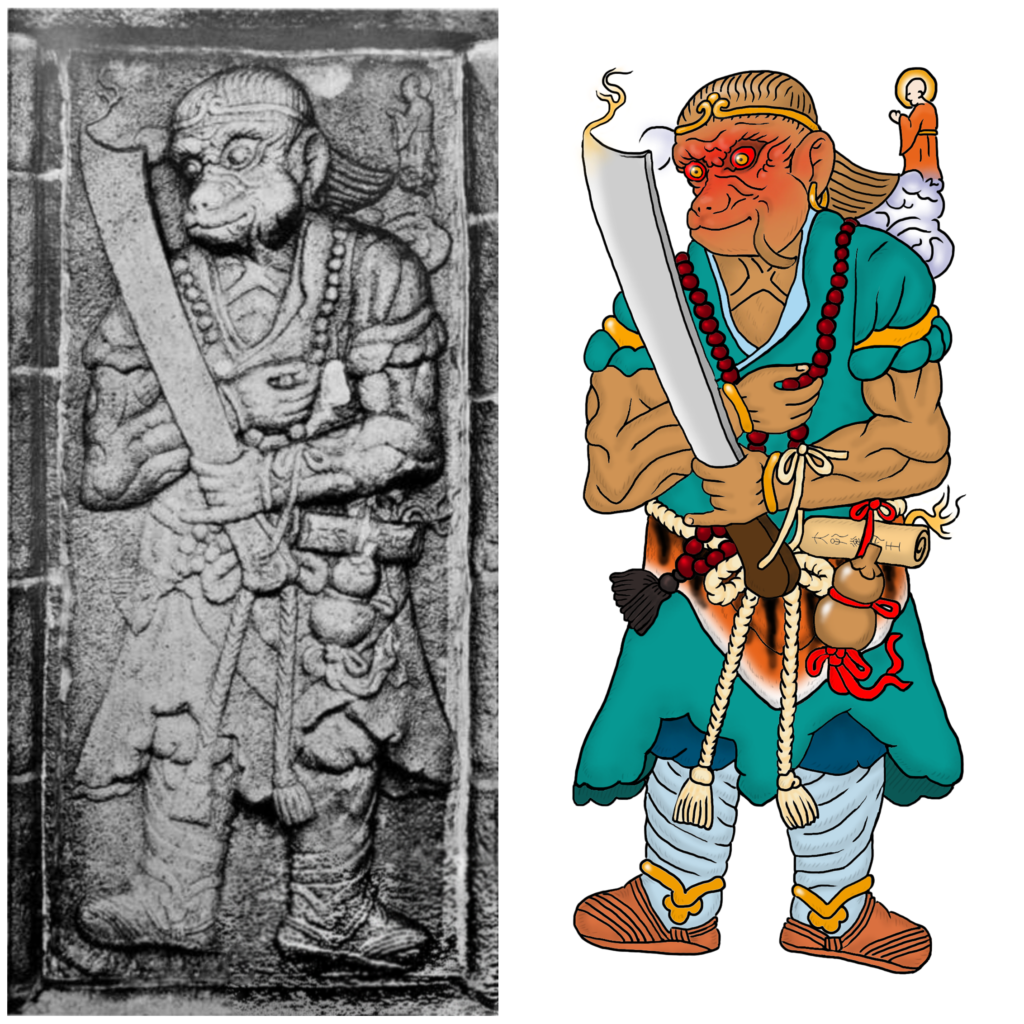
Earrings? Check! Circlet? Check! Bracelets, girdle, anklets, and arm ornaments? Check, check, check, and check! The only two aspects that are questionable are the bone necklace and the tigerskin. Rosaries are sometimes made from bone, which satisfies that requirement. As for the skin, while Ecke and Demiéville were quick to note its omission in their study, I think the appearance of so many elements from the passage suggests the tigerskin is present but the features may have just been eroded by time. The chevron shape visible below the girdle could be a skin apron. I’ve created a color version of the relief based on this information (fig. 4).

Fig. 4 – My interpretation of the relief (larger version). A comparison of the original and new versions can be seen here.

(Note 05-22-23: Upon reviewing figure four, I don’t like the way the proposed tiger skin cuts off at the belt. It would make more sense for the skin to act as a girdle, making it visible above the belt. I’ll probably update this in the future.)

As I explained in a previous article, the Hevajra Tantra was officially translated into Chinese in 1055 (no doubt arriving earlier than this), so the text was present in the middle kingdom for nearly 200 years prior to the creation of the relief.

What can these ritual elements tell us about Monkey’s depiction? Firstly, it should be noted that the esoteric deity Heruka and other such wrathful guardians, known by the neologism “Wrathful Destroyers of Obstacles” (Sk: krodha-vighnantaka), are commonly portrayed wearing such items, leading to the scholar Van Kooij (as cited in Linrothe, 1999) to comment, “Heruka is more or less a deified hypostasis of the … yogin himself” (p. 251). Second, these deities are often portrayed wielding weapons. For example, one source describes Vajrapani‘s wrathful form Trailokyavijaya “hold[ing] the vajra, ankusa-hook, sharp sword, pâsa-noose and other âyudha [weapons]” (Linrothe, 1999, p. 188). Sun Wukong too is depicted with a weapon, a sword with a lick of heavenly flame. Third, the flaming sutra tied to Monkey’s girdle was, as explained above, historically “used as a charm against all calamities, dangers, wounds, and diseases” (Ecke & Demiéville, 1935, p. 35). Wrathful Destroyers of Obstacles are charged “with the destruction of barriers which prevent the experience of enlightenment” (Linrothe, 1999, p. 25). These include external threats like manifested demons and internal threats like demon-caused mental and bodily illness, the “three poisons,” and karmic debt (Linrothe, 1999, pp. 24-25). Therefore, the iconography presents Sun Wukong as a wrathful protector deity.

This then may lend support to Ecke and Demiéville’s original assertion that the pious figure floating in the clouds to the right of Monkey’s head is in fact Xuanzang. The Great Sage clears the path of manifested demons that obstruct the monk’s path to enlightenment, leading to his ascension into paradise (this happens in both the 13th-century version of the story and the final Ming novel).

III. Ritual Adorments and Other Literary Figures

While Monkey’s association with the fillet and the tiger skin carried over into the novel, other characters came to be associated with ritual adornments from the Hevajra Tantra. A prime example is Red Boy (Hong hai’er, 紅孩兒), son of the Bull Demon King and Princess Iron Fan. The Bodhisattva Guanyin forces the demon child to submit in chapter 42, after which she uses a magic treasure given to her by the Buddha to ensnare his extremities.

Dear Bodhisattva! She took the fillet and waved it at the wind once, crying, “Change!” It changed into five fillets, which she threw at the body of the boy, crying, “Hit!” One fillet enveloped the boy’s head, while the rest caught his two hands and two feet (Wu & Yu, 1977, vol. 2, p. 280).

Red Boy is the literary counterpart of the religious figure Sudhana (Sancai, 善財), whose spiritual journey is told in the Gandavyuha Sutra (Dafang guang fohuayan jing, 大方廣佛華嚴經, c. 3rd-cent.). The youth sets out on a quest towards enlightenment and trains under 52 different teachers, including Maitreya, Avalokiteśvara (the South Asian variant of Guanyin), Mañjuśrī, and Samantabhadra (Buswell & Lopez, 2014, p. 864). It’s no wonder then that the ascetic came to be associated with such ritual adornments. South and East Asian depictions of Sudhana/Sancai often portray him wearing bangles and anklets (fig. 5).

Fig. 5 – A modern day altar statue of Sudhana/Sancai (larger version). Notice the bracelets and anklets.

IV. Conclusion

The 13th-century Sun Wukong pagoda relief of the Kaiyuan Temple shares many similarities to ritual adornments mentioned in the esoteric Hevajra Tantra (8th-cent.), including earrings, the circlet, arm cuffs, a necklace, a girdle, wrist bangles, anklets, and possibly even a tiger skin. Esoteric protector deities are often portrayed with similar attire since they represent the very yogin ascetics who worship them. Monkey’s depiction with said attire suggests the artist who created the piece intended to present him as a powerful Buddhist guardian on par with Wrathful Destroyers of Obstacles like Heruka. The depicted sword and sutra, each shown with a lick of heavenly flame, no doubt represent the means by which the Great Sage protects his master Xuanzang (possibly the pious figure on the upper right corner of the relief).

The onetime enemy Redboy comes to wear the ritual circlet, bracelets, and anklets in Journey to the West after being subjugated by Guanyin. While he is depicted as a defeated foe who submits to Buddhism, these adornments recall his historical and religious origins as Sudhana, a great ascetic from Buddhist literature.


Update: 05-22-23

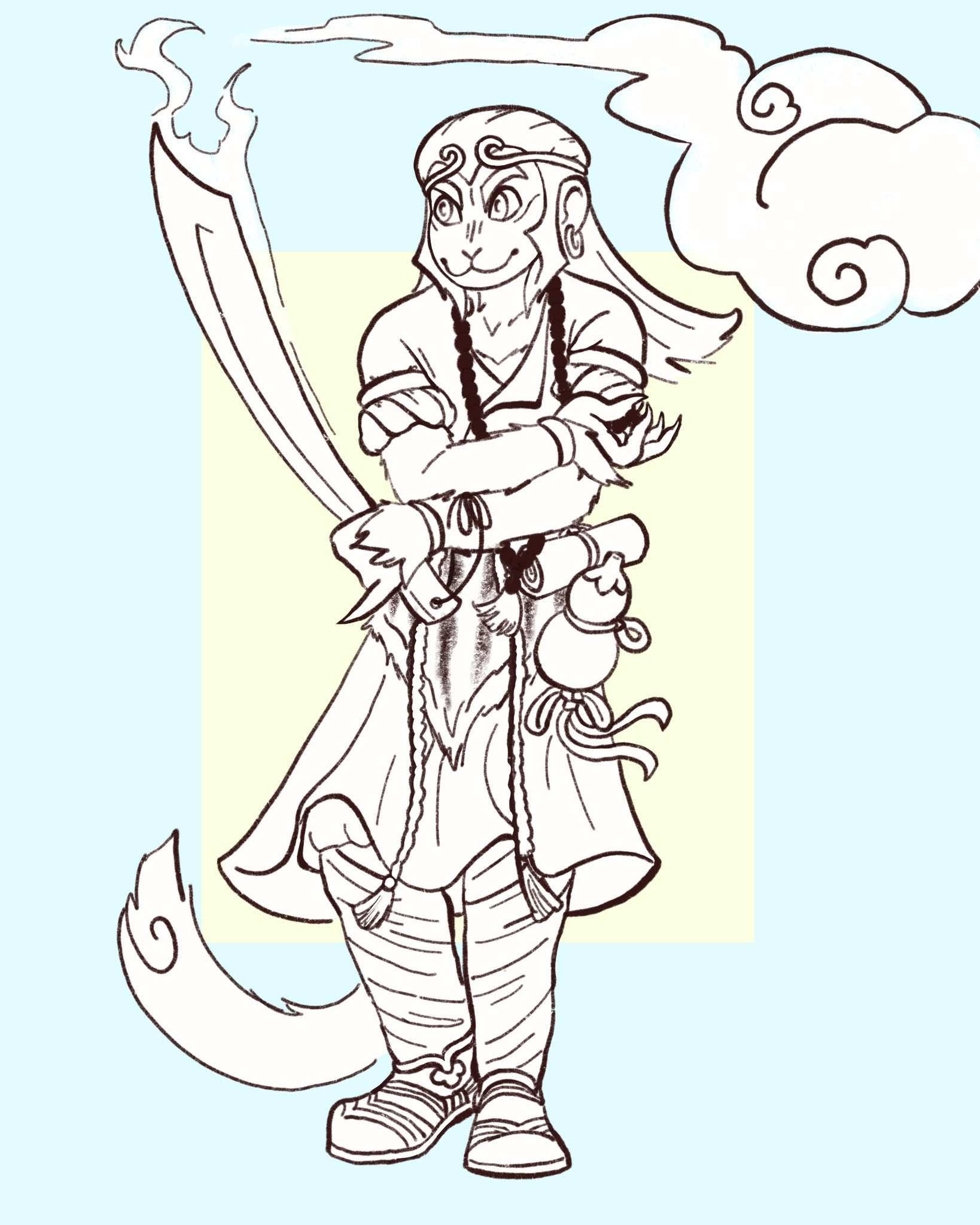
Twitter user Lava (@Lavaflowe) has allowed me to post their lovely drawing of the stone pagoda carving.

Fig. 6 – Lavaflowe’s version of the stone pagoda carving (larger version). Image from twitter.


Update: 01-26-24

There is also a possibility that the tiger skin isn’t present at all (as suggested by others). Despite the Hevajra Tantra prescribing this dress, the skin isn’t listed among the most basic accoutrements of a yogi elsewhere in the work. These are known as the “Five Symbolic Ornaments” or “Five Seals” (Sk: Pancamudrā, पञ्चमुद्रा; Ch: Wuyin, 五印; a.k.a. “Five Buddha Seals,” Wufo yin, 五佛印). Each is associated with a particular Buddha:

Aksobhya is symbolised by the circlet, Amitabha by the ear-rings, Ratnesa by the necklace, Vairocana by the hand ornaments, [and] Amogha by the girdle (Farrow, 1992, p. 65).

輪者,表阿閦如來;鐶者,無量壽如來;頸上鬘者,寶生如來;手寶釧者,大毘盧遮那如來;腰寶帶者,不空成就如來。


Update: 01-27-24

The aforementioned five ornaments are sometimes combined with another item to form the “Six Ornaments” or “Six Seals” (Sk: Shanmudrā, षण्मुद्रा), each of which is associated with a Buddhist wisdom:

The yogic ornaments … are commonly classified as being six in number: (1) the skull-tiara, (2) the armlets, (3) the bracelets, (4) the anklets … (5) the bone-bead apron and waist-band combined … and (6) the double line of bone-beads extending over the shoulders to the breast, where they hold in place the breast-plate Mirror of Karma, wherein … are reflected every good and bad action. These six ornaments (usually of human bone) denote the Six Pāramitā (‘Boundless Virtues’), which are: (1) Dāna-Pāramitā (‘Boundless Charity’), (2) Shīla-Pāramitā (‘Boundless Morality’), (3) Kshānti-Pāramitā (‘Boundless Patience’), (4) Vīrya-Pāramitā (‘Boundless Industry’), (5) Dhyāna-Pāramitā (‘Boundless Meditation’), and (6) Prajñā-Pāramitā (‘Boundless Wisdom’). To attain to Buddhahood, and as a Bodhisattva to assist in the salvation of all living creatures, the Six Pramita must be assiduously practised (Evans-Wentz, 2000, p. xxv).

The most detailed source I’ve found reads:

a. The Bone Wheel

Vajradharma wears a bone wheel on his head. It is formed from a small bone circle that sits around the crown of the head, surrounded by a second, larger circle. The two circles are attached to one another by eight bone spokes. On each of the five spokes at the front, above the forehead, stands a dried skull that supports the jewel, which is the crest ornament. From the lower part of their jaws, looped chains and hanging decorative chains extend downward to the space between Vajradharma’s eyebrows and to the tips of his ears. One the back of each skull is a multicolored vajra with a crescent moon placed to the left. The deity’s long hair passes up through the hole in the middle of the inner bone circle and is tired in a topknot. 

b. The Earrings 

There are five parts to the earrings. There is a main circle of bone, which is like a bangle. From the bottom of the circle hang two smaller rings, each one attached to the larger ring above them by a semi-circle of bone.

c. The Necklace 

The necklace is made of two strings of bones bound together with hair taken from both a corpse and a living person. At the front is a square central hub. The hub forms the base for a T-shaped triple vajra. There are to more triple vajras placed at the two points where the strings of the necklace reach the shoulders.

d. The Bracelets

The deity wears a bracelet on each ankle, wrist, and upper arm, making six in total. Each bracelet is made from two strings of bones that have been bound together. There are three vajras on each pair of bracelets, one at the knot in the upper string, one at the knot in the lower string, and one opposite the knot in the upper string.

e. The Brahmin’s Bone Thread

Next is the Brahmin’s bone thread, or investiture thread (yajnopavita). On the front of the body, above the novel, is a bone wheel with either right or four spokes. There are holes in four of the spokes and two parallels strings of bone pass through each of them. Two of these strings go over the shoulders, and two pass under the armpit. On each of these strings are two vajras on the shoulder and another two under the armpit, making eight in total. Sometimes there is a second bone wheel on the back, to which all the strings are tied; if not, all the ends of the strings are knotted together. 

Together, or with the thread of hair from a slain thief, these bone ornaments are called the ornaments of the five mudras.

f. The Bone Belt 

The bone belt, or apron, hangs from the waist. It is made, as before, of two parallel strings of bone. The strings have five vajras attached to them–one at the front in the center, one on each hip, and one on each side of the center, halfway to the whips. Hanging chains and looped chains decorated with small silver bells and small bone spearheads hang from the tips of the vajras. The chains end at the point where the calf muscle begins to taper.

According to oral tradition, the necklace we just mentioned is ornamented with five vajras at the heart. Although I have consulted many descriptions of the bone ornaments, I have never seen this stated anywhere else. There are many traditions concerning the bone ornaments, but here I have presented that of the oral tradition taught by my master (Lingpa, Rinpoche, & Chemchok, 2017, pp. 52-54). 

As can be seen, the tiger skin is not mentioned among these ornaments either.

Also, as is mentioned, the items making up the six ornaments vary from tradition to tradition. For instance, Huntington and Bangdel (2003) list bone ash in place of the bone thread (p. 161). But it’s important to note for our purposes that the circlet, bangles, bracelets, anklets, and belt make up the five basic accoutrements.

Notes:

1) Yu (Wu & Yu, 1977) is referring to the fight between Sun Wukong and a demon, during which time the monkey disarms him and uses the latter’s own sword against him.

2) The city of Quanzhou was known to both Marco Polo and Ibn Battuta by the Arabic name Zayton or Zaiton (زيتون , the “City of Olives”).

3) Monkey transforms a ringed monk’s staff into a titanic yakṣa that crushes the aforementioned tiger demon with a club.

Sources:

Buswell, R. E., & Lopez, D. S. (2014). The Princeton Dictionary of Buddhism. Princeton, NJ: Princeton University Press.

Dudbridge, G. (1970). The Hsi-yu chi: A Study of Antecedents to the Sixteenth-Century Chinese Novel. Cambridge: Cambridge Univ. Press.

Ecke, G., & Demiéville, P. (1935). The Twin Pagodas of Zayton: A Study of the Later Buddhist Sculpture in China. Cambridge, Mass: Harvard University Press.

Evans-Wentz, W. Y. (Ed.). (2000). Tibet’s Great Yogi Milarepa: A Biography from the Tibetan Being the Jetsun-Kabbum Or Biographical History of Jetsun-Milarepa, According to the Late Lama Kazi Dawa-Samdup’s English Rendering. United Kingdom: Oxford University Press, USA.

Farrow, G. W., & Menon, I. (2001). The Concealed Essence of the Hevajra Tantra: With the Commentary Yogaratnamālā. Delhi: Motilal Banarsidass Publ.

Huntington, J. C., & Bangdel, D. (2003). The Circle of Bliss: Buddhist Meditational Art. United Kingdom: Serindia Publications.

Lingpa, J., Rinpoche, P., Chemchok, K. (2017). The Gathering of Vidyadharas: Text and Commentaries on the Rigdzin Düpa. United States: Shambhala.

Linrothe, R. N. (1999). Ruthless Compassion: Wrathful Deities in Early Indo-Tibetan Esoteric Buddhist Art. Boston, Mass: Shambhala.

Mair, V. (1989). Suen Wu-kung = Hanumat? The Progress of a Scholarly Debate, in Proceedings of the Second International Conference on Sinology (pp. 659-752). Taipei: Academia Sinica.

Wu, C., & Yu, A. C. (1977). The Journey to the West (Vol. 1). Chicago, Illinois: University of Chicago Press.

The Sun Wukong Cult in Fujian

Last update: 08-17-19

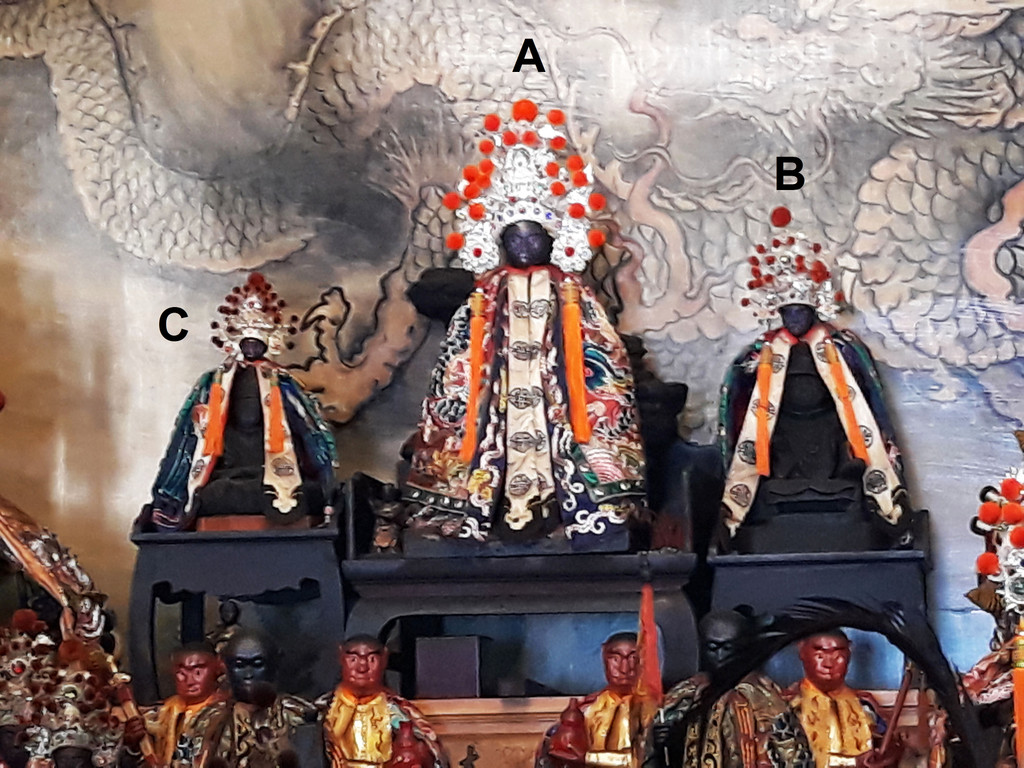
Worshipers of the Wanfu Temple of Tainan, Taiwan believe their high god and oldest altar statue, the “Laying the Foundation Elder Great Sage” (Kaiji Da Dasheng, 開基大大聖) (fig. 1), was transported to the island from the southern Chinese province of Fujian by a certain Lady Ruan (Ruan Furen, 阮夫人) during the Southern Ming/early Qing Dynasty (c. 1660). Fujian is home to a large number of temples dedicated to Sun Wukong. Monkey’s cult on the mainland may have some bearing on the history of his worship on the island. This is especially true since Taiwan was made a prefecture of Fujian in 1684 by the Qing. It was later granted provincehood in 1887 (Gordon, 2007). The cult was no doubt part of the cultural exchange that took place between these two areas during this time. In this paper I use modern demographics and historical records and stories to explore the history of Sun Wukong’s worship in Fujian. I suggest the existence of a historical 12th-century monkey cult explains why the Great Sage’s cult was so readily adopted in the province.

Fig. 1 – The Wanfu Temple’s Laying the Foundation Great Great Sage altar statue, indicated by the letter A (larger version). B and C are lesser Great Sages within the temple’s pantheon.

I. Modern demographics and possible tie to historical trends

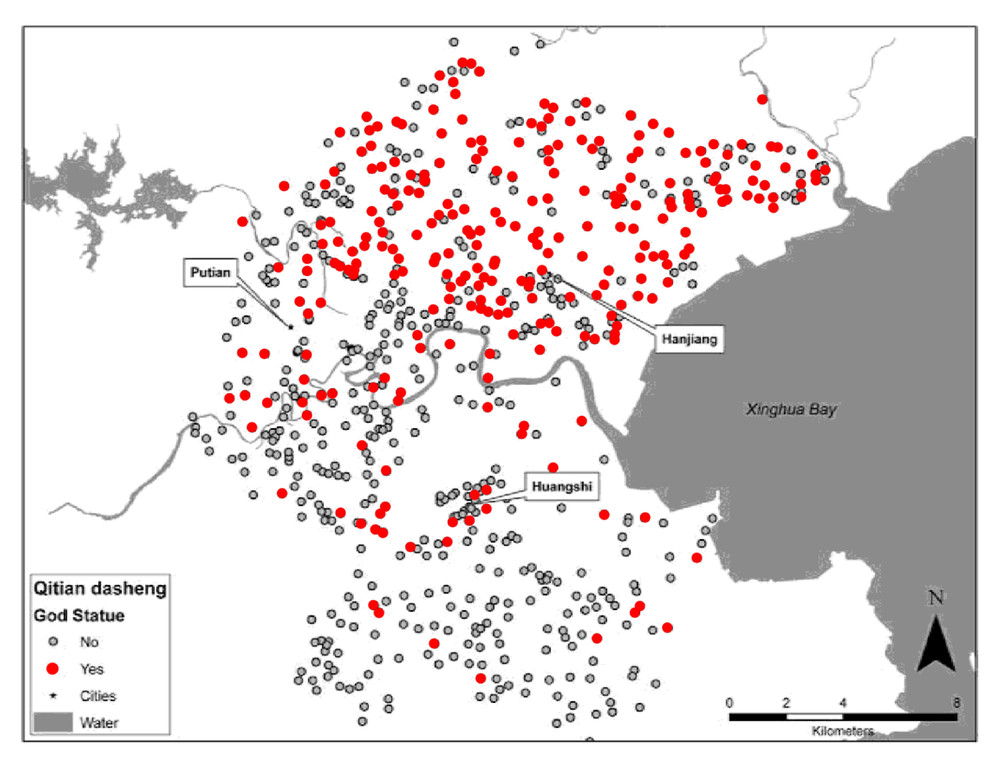
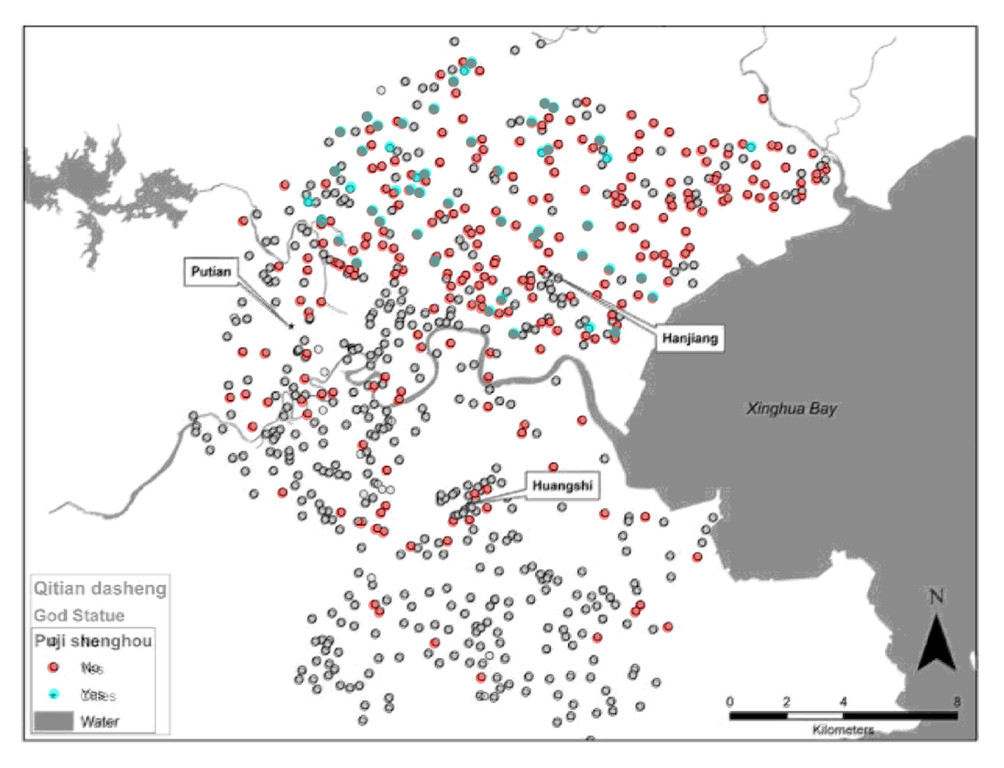
The plains of Putian (莆田) on the central Fujian coast hosts a cluster of Great Sage temples. Dean and Zheng (2009) show the Great Sage is the sixth of the forty most popular deities, his statue appearing in 332 temples, even beating out Guanyin (322 statues) in seventh place (p. 177). Additionally, they describe an interesting geographical correlation in their distribution:

Using GIS mapping, one can unearth many suggestive correlations in distributions of different cultural features across the plain. For example, certain gods such as Qitian dasheng 齊天大聖 (Sun Wukong 孫悟空) and Puji shenghou 普濟聖侯 (Zhu Bajie 豬八戒), the Monkey and the Pig of the classic Xiyouji 西游記 (Journey to the West), appear more often in poorer villages in the northern plain [fig. 2], often in higher elevations than in the low-lying, densely irrigated, wealthier villages of the southern plains. This suggests that the unruly natures of these gods appealed to poorer communities rather than to villages with established scholar-literati lineages (Dean & Zheng, 2009, pp. 38-39)

Fujian Sun Wukong and Zhu Bajie Temple overlay Map - small

Fig. 2 – Left: Distribution of Sun Wukong temples (red) in the Putian plains of Fujian Province, China (larger version); Right: An overlay of Zhu Bajie Temples (light blue) with those of Monkey (red) (larger version). There is quite a bit of overlap. Adapted from Dean & Zheng, 2009, pp. 192-193.

Sun Wukong is one of several gods who never enjoyed state patronage in dynastic China due to their eccentric or rebellious nature (Shahar, 1996, p. 185). Regarding the latter, emperors had to deal with real world challenges to their own primacy, so paying homage to, say, a dissident monkey spirit probably didn’t seem too appealing. It’s interesting to note that Monkey is worshiped in Fujian and Taiwan under his defiant title of the Great Sage Equaling Heaven, a name he chose during his rebellion with the celestial realm, instead of his Buddhist name Wukong (悟空, “Awakened to Emptiness”) (Shahar, 1996, p. 201). Therefore, Monkey may have historically appealed to poorer folks because he had the power to push back against an unfair government, perhaps one that favored rich literati over impoverished farmers. This could explain the demographics mentioned above. If true, such people could be responsible for bringing Sun’s cult to Taiwan.

II. The connection between religion, myth, and popular literature

Emperors who officially recognized gods helped make them more popular or at least better known. [1] But, as Shahar (1996) explains, the state’s involvement rarely went beyond building temples and making offerings. Oral tales and popular novels were largely responsible for spreading the myth of a particular deity (p. 185). He continues:

In some cases the novel’s transformation of its divine protagonist was so profound, and its impact on the shape of its cult so great, that the novelist could be considered the deity’s creator. A notable example is Sun Wukong. The cult of this divine monkey in late imperial times cannot be separated from his image as shaped by the successive Journey to the West novels. In this respect he is indeed their author’s creation, and Pu Songling‘s complaint, voiced through his protagonist Xu Sheng [許盛], is justified: “Sun Wukong is nothing but a parable invented by [the novelist] Old Qiu [老丘]. [2] How can people sincerely believe in him?” (Shahar, 1996, pp. 193-194).

The tale referred to by Shahar, titled the Great Sage Equaling Heaven (Qitian Dasheng, 齊天大聖) appears in Strange Tales from a Chinese Studio (Liaozhai zhiyi, 聊齋誌異), a collection of popular tales recorded as early as 1679 by Pu Songling and later posthumously published in 1740 (Barr, 1984). The story follows the aforementioned Xu Sheng and his older brother, both merchants from Shandong, who travel to Fujian to sell their wares but are told to pray to the Great Sage when they fail to make any money.  They visit the monkey god temple and witness people burning incense and kowtowing to an image of Sun Wukong. The older brother takes part in the rituals, but Sheng simply laughs and leaves, resulting in a subsequent argument between the two during which Sheng ridicules adherents for worshiping a fictional character from a novel. Sheng later falls bedridden with agonizing leg sores that prevent him from walking, yet he refuses to accept the Great sage is punishing him. His brother begs him to repent, but he still refuses. The brother shortly thereafter falls ill and dies, prompting Sheng to go to the temple to beg for his brother’s life. That night, he dreams he is brought before Sun Wukong, who rebukes Sheng for his rude behavior and reveals the leg sores (the result of being stabbed by Monkey’s heavenly sword) [3] and his brother’s subsequent death to be heaven-sent punishments. The deity finally agrees to revive the brother and sends an order to King Yama in hell to release his soul. Sheng shows his thanks by kneeling. He then awakes to find his brother has revived but remains too weak to work. Days later, Sheng meets an old man who claims he can use “a little magic” to transport them to a beautiful place that will sap away the merchant’s depression wrought by the past events. The two travel by cloud to a celestial paradise where Sheng and the old man drink tea with an aged deity. The god rewards Sheng with twelve magic stones for taking the time to visit him. Upon returning to earth, the merchant realizes the old man is the Great Sage, for both use the “Somersault Cloud” (Jindou yun, 筋斗雲) as a means of conveyance. In the end, the magic stones are found to have melted, but this corresponds to a drastic increase in the brothers’ selling profits. The two return home but are sure to pay their respects to the Great Sage anytime they visit Fujian for business (Pu & Sondergard, 2014, pp. 2078-2085).

I’d like to point out the story includes an afterward that critiques the idea of Sun Wukong being a real god:

The collector of these strange tales remarks, “Once upon a time, a scholar who was passing a temple went in and painted a pipa on one wall, then left; when he checked on it later, its spiritual power was considered so outstanding that people had joined together there to burn incense to it. A god certainly doesn’t have to exist in order to be considered powerful in this world; if people believe it to be divine, it will be so for them. What’s the reason for this? When people who share the same beliefs gather together, they’ll choose some creature figure to represent those beliefs. It’s right that an outspoken man like Sheng should be blessed by the god; who else could believe for real that he’s protected by someone who keeps an embroidery needle inside his ear, who he can transform one of his hairs into a writing brush, or who ascends via cloud-somersault into the cerulean sky! In the end, Sheng’s mind must have deluded him, for what he saw simply couldn’t be true” (Pu & Sondergard, 2014, p. 2085)

This shows that, while the common folk believed in Monkey, the literati class scoffed at such an idea. This again may explain why, as mentioned above, more well-educated communities in modern Fujian do not widely worship Monkey.

III. Historical monkey cults in Fujian

Apart from Pu Songling’s story, there are two other 17th-century references to the worship of a monkey god in Fujian. Dudbridge (1970) explains:

According to You Dong [尤侗] (1618-1704) the citizens of Fuzhou worshiped Sun Xingzhe [孫行者, Pilgrim Sun] as a household god and built temples to the monkey-god Qitian Dasheng. Tong Shisi [佟世思] (1651-92) describes the monkey-headed god of Fujian as bearing a metal circlet about his forehead, brandishing an iron cudgel, wearing a tiger-skin and known as Sun Dasheng [孫大聖, Great Sage Sun]. Traditionally he had appeared in the clouds to beat back an attack from Japanese pirates (p. 158). [4]

I find the last reference particularly interesting because it refers to the preceding 16th-century when China’s coast was plagued by Japanese pirates. It depicts the Great Sage as a benevolent god who intervenes to protect his chosen people, the Chinese.

In her excellent paper on the origins of Sun Wukong, Hera S. Walker (1998) discusses a 1237 stone relief from the western pagoda of the Kaiyuan Temple (開元寺) in Quanzhou, a port city in Fujian, that portrays a sword-wielding, monkey-headed warrior (pp. 69-70). [5] Considered by many to be an early depiction of Monkey, the figure wears a fillet, a tunic, a Buddhist rosary, and a pair of bangles (Fig. 3). Walker quotes Victor Mair, who believes the fillet and the figure wearing it recall South and Southeast asian depictions of the Buddhist guardian Andira and the Hindu monkey god Hanuman (Walker, 1998, p. 70). I have suggested in a previous article that the accouterments worn by the warrior are instead based on Esoteric Buddhist ritual attire known in China. So instead of being based on a foreign source, it can be considered a depiction of a local spirit or deity. The relief therefore suggests the proposed Fujian monkey god cult predates the 17th-century.

Better Kaiyung Temple Monkey (Zayton-Quanzhou) - small

Fig. 3 – The 1237 stone relief of Sun Wukong from the Kaiyuan Temple in Quanzhou, Fujian (larger version).

The oldest known evidence for a cult based around a monkey is described in Hong Mai’s (洪邁, 1123-1202) the Record of the Listener (Yijian zhi, 夷堅志, c. 1160), a collection of supernatural tales from the Song Dynasty. The following story is said to take place in the Yongfu County of Fujian. Again, we turn to Dudbridge (2005):

The image [effigy], dubbed Monkey King 猴王, was shaped around a captured living monkey and worshipped as a ‘spirit protecting hills and woods’ (保山林神). [6] It afflicted the surrounding population with fevers and frenzy. Blood sacrifice won no relief. Shamans and monks assaulted the spirit by night with noisy ritual music, but to no effect. Only the Buddhist elder Zongyan 宗演 successfully admonished the resentful monkey spirit and wrought its deliverance by reciting in Sanskrit the dhāraṇī of the All-Compassionate (大悲咒). The grateful monkey appeared to him the same night, explaining that she was now able to rise to heaven. Later the image and its thirty-two attendants (all made from birds) were smashed, and the hauntings came to an end (p. 264; see also Dudbridge, 1970, p. 159).

Dudbridge (1970) is reluctant, however, to accept this as a precursor to Sun Wukong’s cult, especially since both this 12th-century monkey spirit and the “Monkey Pilgrim” (Hou Xingzhe, 猴行者) from the The Story of How Tripitaka of the Great Tang Procures the Scriptures, a 13th-century precursor to Journey to the West, bear little resemblance to the simian god mentioned in 17th-century records. He instead suggests the Great Sage’s cult could have grown up around stories connected to the publishing of the novel (Dudbridge, 1970, p. 159). While Journey to the West certainly played a sizable role in the spread of Monkey’s cult, I think the above tale shows that the Fujian area was already primed for monkey worship by at least the 12th-century. Most importantly, the noted Song dynasty poet Liu Kezhuang (劉克莊, 1187-1269), whose family hailed from the Fujian city of Putian (mentioned in section one) (Ebrey, 2005, p. 95), referenced the Monkey pilgrim twice in his 13th-century work. The second of two such references uses Monkey as a metaphor to describe the ageing 70-year-old poet’s appearance. A portion of the poem reads:

A back bent like a water-buffalo in the Zi stream [泗河],
Hair as white as the silk thread issued by the “ice silkworms”,
A face even uglier than Hou Xingzhe,
Verse more scanty than even He Heshi [鶴何師] (Dudbridge, 1970, p. 46)

This shows the character’s story cycle was so well-known in Fujian at this time that no other specifics from the oral tradition had to be mentioned. Therefore, stories of the early monkey cult and those of Sun Wukong could have existed in Fujian around the same time. It’s not entirely impossible then that the historical monkey worship in the province gave the cult of the Great Sage, whenever it first appeared, a boost. This might explain why a so-called literary character would come to be so readily worshiped in the province.

IV. Conclusion

Taiwan has close ties to the southern Chinese province of Fujian because the former was made a prefecture of the latter during the 17th-century. The province is home to a large number of temples dedicated to the Monkey King, so this is no doubt connected to the spread of his cult to the island nation. Modern GIS mapping in Fujian suggests Sun Wukong’s temples mainly inhabit the northern highlands of the Putian plains where poorer villages reside. Monkey’s cult never received royal patronage in dynastic China due to his rebellious nature. The fact that he is worshiped in Fujian and Taiwan by his rebellious title of the Great Sage Equaling Heaven suggests Monkey may have historically appealed to the poorer class because he had the power to push back against an unfair government, perhaps one that favored the rich over the destitute. If true, these could be the people responsible for bringing Sun’s cult to Taiwan.

The mythos of Monkey’s cult was spread thanks to oral tales and popular literature. His mythos became so inseparable from the novel that the scholar class looked upon him as a literary character that jumped from the pages of fiction to be worshiped as a god. An example of this viewpoint appears in Strange Tales from a Chinese Studio (written c. 17th-cent.) in which a skeptical merchant only becomes an adherent of the Great Sage after he and his brother are punished with painful sores and death, respectively. The author of the tale comments the merchant was probably delusional to fall for such a belief. This scholarly disdain for such literary gods may then explain why the more well-educated villages in Putian don’t widely worship Sun Wukong today.

Other 17th-century sources referring to Monkey’s Fujian cult portray him as a headband-wearing, cudgel-wielding benevolent god who comes to the aid of the Chinese people. A 13th-century stone relief located on the western pagoda of the Kaiyuan Temple in Quanzhou depicts a sword-wielding, monkey-headed warrior wearing a fillet. While past scholarship has posited a South and Southeast Asian origin for the figure’s iconography, my research suggests it to be based on esoteric ritual accouterments known in China. So instead of being based on a foreign source, it can be considered a depiction of a local spirit or deity. The relief therefore suggests the proposed Fujian monkey god cult predates the 17th-century. The oldest evidence for such a cult appears in Hong Mai’s Record of the Listener, a 12th-century collection of supernatural tales. It refers to a malevolent simian god worshiped as the “Spirit protecting hills and woods” that spread fever and was eventually pacified by a Buddhist monk. This shows Fujian was primed for monkey worship by the 12th-century, and the fact that the “Monkey Pilgrim” (Sun Wukong’s original name) is mentioned in the secular works of the Putian poet Liu Kezhuang in the 13th-century shows stories of this god and Monkey existed in Fujian around the same time. The historical existence of a Fujian monkey cult may have given Sun Wukong’s cult a boost, explaining how a literary character came to be so readily worshiped.


Updated: 07-26-19

The American missionary Justus Doolittle (1865) recorded information about the worship of the Great Sage in Fuzhou city, Fujian province, China during the 19th-century:

The Monkey. — It is represented as a man sitting, the face only being like a monkey. The image is usually made of wood or clay. Sometimes a picture of it is made on paper, or simply the title under which the monkey is worshiped is written on a slip of paper, and used instead of an image. There are several large temples at this place, erected for the worship of “His Excellency the Holy King,” one of the titles much used in speaking of the monkey as an object of worship. Oftentimes the niche holding the image or the written name is placed in a hollow tree, or in the wall at the corners of streets, or at the heads of alleys or lanes. Such places, in this city and vicinity, where the monkey is worshiped, reckoned together with the small temples or buildings dedicated to it, amount to several scores. The worship consists principally in the burning of incense and candles, sometimes attended with the presentation of meats, vegetables, and fruits. The monkey was first worshiped in return for some supposed services rendered the individual who went to India, by special command of an emperor of the Tang dynasty, to obtain the Sacred Books of the Buddhist religion — so some affirm. This emperor deified the monkey, or, at least, he conferred the august title of “the great Sage equal to Heaven” upon that quadruped. The birthday of “His Excellency the Holy King” is believed to occur on the twenty-third of the second Chinese month, when his monkey majesty is specially worshiped by men from all classes of society. The monkey is believed to have the general control of hobgoblins, witches, elves, etc. It is also supposed to be able to bestow health, protection, and success on mankind, if not directly, indirectly, by keeping away malicious spirits or goblins. People often imagine that sickness, or want of success in study and trade, is caused by witches and hobgoblins. Hence the sick or the unsuccessful worship the monkey, in order to obtain its kind offices in driving away or preventing the evil influences of various imaginary spirits or powers (vol. 1, pp. 287-288).

He continues, “Sometimes the image carried in procession while praying for rain represents a deified monkey, an object which is much worshiped by some classes of the people at this place” (Doolittle, 1865, vol. 2, p. 119).

It appears that Doolittle wasn’t aware of Journey to the West since he combines folklore with history, claiming a Tang emperor deified and/or bestowed Wukong with his Great Sage title. Sun’s image as an exorcist and healer, as well as his remuneration with incense and delicious foodstuffs, matches what I’ve previously written about in Taiwan. But his association with rainmaking is new, although not entirely a surprise. Also, his birthday is celebrated on a different day, the twenty-third day of the second lunar month, instead of the twelfth day of the tenth lunar month in Taiwan and the sixteenth day of the eighth lunar month in Hong Kong and Singapore. Interestingly, unlike Fuzhou, his birthday is celebrated on the twenty-fifth day of the second lunar month in Putian (Dean & Zheng, 2010, p. 162, for example). Such differences highlight that Monkey’s cult never received state patronage and therefore lacks standardization in beliefs and practices even in Fujian.

This information may have implications for the worship of the Great Sage by southern Chinese immigrants in 19th-century San Francisco.


Updated: 08-17-2019

The Japanese researcher Isobe Akira shows that, despite appearing in Song-era sources, the aforementioned story about the female monkey king can be traced to the late Tang period (Mair, 1989, pp. 694-695). This shows Fujian was primed for monkey worship centuries prior to the development of Sun Wukong’s story cycle.

Additionally, Isobe points to one of the earliest known references to Sun Wukong. A tale appearing in Zhang Shinan’s (張世南, 12th-13th century) Memoirs of a Traveling Official  (Youhuan jiwen遊宦紀聞) tells of Zhang the Sage (Zhang sheng, 張聖), a farmer-turned-Buddhist monk who gains literacy and clairvoyance after eating a magic peach. In the story, Zhang is asked to write a eulogy in honor of a newly built revolving sutra case. The resulting poem references the Monkey Pilgrim:

Fresh are the pattra (palm) leaves on which are written
the unexcelled (anuttara), vigorous texts,
In several lives, Tripitaka went west to India to retrieve them;
Their every line, their every letter is a precious treasure,
Each sentence and each word is a field of blessing (punyaksetra).
In the waves of the sea of misery (duhkha-sagara),
the Monkey-disciple presses on 猴行復,
Through the waters of the river that soak its hair,
the horse rushes forward;
No sooner have they passed the long sand than they must face
the trial of the golden sands,
Only while gazing toward the other shore do they know
the reasons (pratyaya) for being on this shore.
The demons (yaksas) are delighted that they might
get their heart’s desire,
But the Bodhisattva, with hand clasped in respectful greeting,
sends them on;
Now here are the five hundred and sixty-odd cases of scriptures,
Their merit is difficult to measure, their perfection
hard to encompass (Mair, 1989, pp. 693-694).

This eulogy is fascinating because it references additional elements that would appear in The Story of How Tripitaka of the Great Tang Procures the Scriptures, including the Buddhist master’s quest to India over many lifetimes, the tribulations at the river of sand (a nod to Sha Wujing’s precursor), the demons encountered, and heavenly assistance. Isobe dates Zhang the Sage’s tale to the late Northern Song to the early Southern Song (circa 1127) (Mair, 1989, p. 694). But what’s interesting for our purposes is that the original recorder, Zhang Shinan was known to have historically held a government post in Fujian (Zheng, Kirk, Buell, & Unschuld, 2018, pp. 644-645), meaning he could have picked up the tale in the southern province. This adds an additional connection between Fujian and Sun Wukong.

Notes:

1) One example of this connected to Journey to the West is Erlang. He was originally worshiped as a hunting god and queller of mountain ghosts by the Qiang (羌) ethnic group of the western Sichuan region. But his cult became even more popular upon gaining state recognition. Wu (1987) writes: “The Er-lang cult became even more popular in Sichuan under the patronage of the Later Shu emperor, Meng Chang 孟昶 (r. 934-65), and in 965, when the Song dynasty conquered the kingdom, it adopted the cult, erecting temples for the god in the capital and throughout the country” (pp. 107-108).

2) This refers to Qiu Chuji (丘處機, 1148-1227), the founder of the Dragon Gate sect of Daoism during the Song Dynasty. Qiu is known to have written a travel journal named Journey to the West, which Pu Songling confused with the novel of the same name (Pu & Sondergard, 2014, p. 2080 n. 1).

3) Literally “Bodhisattva Saber” (Pusa dao, 菩薩刀).

4) Source altered slightly. The Wade Giles was converted to pinyin and the Chinese characters from the footnotes were moved into the paragraph.

5) In act 10 of the early 15th-century zaju play Journey to the West, Guanyin gives Sun Wukong an iron headband, a cassock, and, most importantly, a sword. His depiction in the play and this relief then may have some connection.

6) The fact that the effigy was formed around a living monkey suggests it was killed in the process. This would explain its rage.

Sources:

Barr, A. (1984). The Textural Transmission of Liaozhai zhiyi. Harvard Journal of Asiatic Studies, 44 (2), pp. 515-562.

Dean, K., & Zheng, Z. (2009). Ritual alliances of the Putian plain. Volume One: Historical introduction to the return of the gods. Leiden: Brill.

Dean, K., & Zheng, Z. (2010). Ritual alliances of the Putian plain. Volume Two: A survey of village temples and ritual activities. Leiden: Brill.

Doolittle, J. (1865). Social life of the Chinese: With some account of their religious, governmental, educational, and business customs and opinions. With special but not exclusive reference to Fuhchau. Volume 1 and 2. New York: Harper & Brothers.

Dudbridge, G. (2005). Books, tales and vernacular culture: Selected papers on China. Leiden: Brill.

Dudbridge, G. (1970). The Hsi-yu chi: A study of antecedents to the sixteenth-century Chinese novel. Cambridge: Cambridge Univ. Press.

Ebrey, P. B. (2005). Women and the family in Chinese history. London: Routledge.

Gordon, L. H. D. (2007). Confrontation over Taiwan: Nineteenth-century China and the powers. Lanham, MD: Lexington Books.

Mair, V. (1989). Suen Wu-kung = Hanumat? The Progress of a Scholarly Debate, in Proceedings of the Second International Conference on Sinology (pp. 659-752). Taipei: Academia Sinica.

Pu, S., & Sondergard, S. L. (2014). Strange tales from Liaozhai. Volume 6. Fremont, Calif: Jain Pub.

Shahar, M. (1996). Vernacular Fiction and the Transmission of Gods’ Cults in Later Imperial China. In M. Shahar & R. P. Weller (Eds.), Unruly gods: Divinity and Society in China (pp. 184-211). Honolulu: University of Hawaiʻi Press.

Walker, H.S. (1998). Indigenous or foreign? A look at the origins of monkey hero Sun Wukong. Sino-Platonic Papers, 81, pp. 1-117.

Zheng, J., Kirk, N., Buell, P. D., & Unschuld, P. U. (2018). Dictionary of the Ben cao gang mu, Vol. 3: Authors and book titles. Berkeley: University of California Press.