The Origin of Sun Wukong’s Battle with Lord Erlang and Its Ties to Han Dynasty Funerary Rites and Folklore

Did you know the battle between Monkey and Lord Erlang is tied to Han Dynasty funerary rights and folklore? Wu (1987) notes that, during the Eastern Han Dynasty (25-220 CE), the people of Sichuan often buried their dead in stone tombs decorated with brave heroes, such as archers and crossbowmen, and fierce animals, such as tigers and hounds. Regarding the latter, the canines are sometimes depicted attacking or intimidating apes, which were considered emblems of disease or bad luck (fig. 1). Therefore, by portraying the subjugation of such evil forces, the carvings are thought to have served the ritual function of protecting deceased loved ones from dark influences on their wayward journey to the afterlife (pp. 100-101).

The idea of dogs overcoming apes should bring to mind Sun Wukong’s capture at the mouth of Lord Erlang’s loyal hound at the end of chapter six.

Fig. 1 – A Han Dynasty tomb rubbing of oversized dogs intimidating apes (larger version).

One recurring motif depicts an archer drawing his bow to fall an ape in a tree (fig. 2). This is based on a third-century BCE tale about the legendary Chu archer Yang Youji (養由基) shooting an elusive white ape held in the palace of the King of Jing. This in turn is based on an even older tale about the archer Yi (羿) bringing order to the primordial earth by killing nine of ten suns that took the form of monstrous crows. Han era tombs are known to portray Yi drawing a bow to shoot said birds flying around a tree, so it most likely influenced the motif of Yang shooting the ape in a tree (Wu, 1987, pp. 102-106). Despite his later connection with the three-pointed polearm, Erlang was also portrayed as an archer in early media.

Fig. 2 – A Han tomb decoration depicting an archer shooting at an ape (larger version).

Lord Erlang was originally worshiped during the Han as a hunting god and queller of mountain ghosts by the Qiang (羌) ethnic group of the western Sichuan region. His cult grew and absorbed other deities and heroes under his mantle. For instance, Wu (1987) writes:

The Er-lang cult became even more popular in Sichuan under the patronage of the Later Shu emperor, Meng Chang 孟昶 (r. 934-65), and in 965, when the Song dynasty conquered the kingdom, it adopted the cult, erecting temples for the god in the capital and throughout the country.

When the Er-lang cult became increasingly popular in Sichuan, the previous divine archers such as Yang Youji and Yi, (like many other legendary demon-quellers), were mologized into this new cult, and their defeat of an ape demon became an important part of the Er-lang legend. Er-lang’s traits in later stories and art works clearly disclose this transformation (pp. 107-108).

It should also be noted that Erlang was at some point associated with the historical engineer Li Bing (李冰, c. 3rd-cent. BCE) and the official Zhao Yu (趙昱, c. 6th/7th-cent CE), both of whom were worshipped for defeating flood demons (Wu, 1987, p. 107). I suggest this may have led to his cult being connected to that of Yu the Great (大禹), the flood-queller par excellence in Chinese folklore. This is important because Tang Dynasty legends state Yu battled a simian water demon and eventually imprisoned it under a mountain (see Andersen, 2001). Sound familiar? This may have been another avenue in which Erlang was associated with quelling ape demons.

One anonymous 13th-century album leaf ink painting portrays Erlang seated in a kingly fashion and watching as his spirit soldiers round up and execute ape demons (fig. 3). An anonymous 15th-century scroll reproduces the scene in color (fig. 4 & 5).

Fig. 3 – (Top L) – The 13th-century painting depicting Erlang and his soldiers rounding up and executing ape demons. A captive ape can be seen on the bottom left between the two soldiers (larger version). Fig. 4 (Top R) – A detail from the 15th-century painting showing the ape, his humanoid wives, and their gibbon-like children being rounded up (larger version). This section is located in the last four-fifths of the scroll. Fig. 5 (Bottom) – A detail showing Erlang near the front of the same scroll (larger version).

The image of the deity as a queller of ape monsters culminated in an anonymous Yuan-Ming Dynasty play called The God Er-lang Locks up the Great Sage-Equal to Heaven (二郎神鎖齊天大聖, Er-lang Shen suo Qitian Dasheng). Much like JTTW, the god is sent to capture a magical primate, in this case an ape, who has stolen immortal food and wine from heaven (Wu, 1987, pp. 108-109). This no doubt influenced Monkeys mischief in heaven and subsequent battle with the deity.

Sources:

Andersen, P. (2001). The Demon Chained Under Turtle Mountain: The History and Mythology of the Chinese River Spirit Wuzhiqi. Berlin: G-und-H-Verl.

Wu, H. (1987). The Earliest Pictorial Representations of Ape Tales: An Interdisciplinary Study of Early Chinese Narrative Art and Literature. T’oung Pao LXXIII, pp. 86-112.

Journey to the West and Islamic Lore

Last updated: 05-20-2026

Did you know that certain portions of Journey to the West (Xiyou ji, 西遊記, 1592 CE, “JTTW” hereafter) were influenced by Indo-Persian and Arab Islamic lore? I will discuss two examples below.

Table of Contents

1. Battle of Transformations

In JTTW chapter six, Sun Wukong and Lord Erlang engage in a magical battle of skill in which they freely transform into myriad animals, each trying to one-up the other. This battle is unusual as Chinese stories going back to pre-Tang Dynasty (618–907) sources show that characters could not transform into successive beasts at will (Hsia, 1968/2015, pp. 122-123). Conversely, One Thousand and One Arabian Nights (1704), which is based on stories as far back as the 9th century, contains a tale featuring a magical battle of transformations between a princess and a genie (Hsia, 1968/2015, p. 122). Literary critic C.T. Hsia (1968/2015) notes that the similarities in magical combat “does not mean…the makers of the Monkey legend were specifically indebted to [the Arabian Nights], but it certainly indicates their general awareness of the popular literature of the Middle and Near East” (p. 123).

(Note: I no longer feel that Hsia’s (1968/2015) suggestion is accurate. See the 11-21-2019 update below.)

2. Magic Tree with Human-Shaped Fruit

JTTW chapters 24 to 26 feature a magical Ginseng Tree (Renshen shu, 人參樹; a.k.a. “Immortal/Divine Root of the Five Villages Abbey,” Wuzhuang guan li xiangen, 五莊觀裡仙根) that produces crying, baby-shaped ginseng fruits (renshen guo, 人參果; a.k.a. “grass of reverted cinnabar,” cao huandan, 草還丹; a.k.a. “long-life grass of reverted cinnabar,” wanshou cao huandan, 萬壽草還丹) capable of extending the lives of those who eat them to 47,000 years (fig. 1). The literary antecedent of this fruit first appears in The Story of How Tripitaka of the Great Tang Procures the Scriptures (Da Tang Sanzang qujing shihua, 大唐三藏取經詩話; “The Story” hereafter), a 17-chapter storytelling prompt dated to the late-13th century. Chapter 11 features an immortal peach tree with fruits that transform into edible children once they drop into water. Each is capable of answering when asked a question:

Monkey Pilgrim continued: ‘There are more than ten peaches on the tree now, but there are gods of the earth who are posted here especially to protect them. There is no way to steal the peaches.’ The Master teased: ‘Your supernatural powers are stupendous. If you were to go, what could prevent you?’ Before his words were finished three peaches of immortality fell down into the pool. The Master was startled by the splash and he asked: ‘What fell down?’ Monkey Pilgrim replied: ‘Don’t be alarmed, Master. It was just a few ripe peaches of immortality which fell into the pool.’ The Master said: ‘Can we find them and eat them?’

Monkey Pilgrim took the golden-ringed staff and shook it three times in the direction of the huge, flat stone. A small child with a greenish face appeared. His fingernails were as sharp as a hawk’s claws and from his gaping mouth the teeth showed as he emerged from the pool. Pilgrim asked: ‘How old are you?’ The child answered: ‘Three thousand years.’ Pilgrim replied: ‘I have no use for you.’ Again he rapped five times and a child appeared whose face was as round as the full moon. He wore embroidered clothes and a headdress with tassels. Pilgrim asked: ‘How old are you?’ The child replied: ‘Five thousand years.’ Pilgrim replied: ‘I will not use you.’ And once more he rapped several times with the staff. Another child appeared all of a sudden. Monkey Pilgrim asked: ‘How old are you?’ ‘Seven thousand years,” the child replied. Monkey put down the golden-ringed staff and made the child get on his hand. Then he asked: ‘Monk! Will you eat this?’ The monks were terrified and fled. Pilgrim whirled his hand with the child in it a number of times and the child became a milky jujube which he popped into his mouth (Wivell, 1994, p. 1196).

猴行者曰:「樹上今有十餘顆,為地神專在彼此守定,無路可去偷取。」師曰:「你神通廣大,去必無妨。」說由未了,攧下三顆蟠桃入池中去。師甚敬惶。問:「此落者是何物?」答曰:「師不要敬,此是蟠桃正熱,攧下水中也。」師曰:「可去尋取來吃。」

猴行者即將金鐶杖向盤石上敲三下,乃見一個孩兒,面帶青色,爪似鷹鷂,開口露牙,從池中出。行者問:『汝年幾多?」孩曰:「三千歲。」行者曰:「我不用你。」又敲五下,見一孩兒,面如滿月,身掛繡纓。行者曰:「汝年多少?」答曰:「五千歲。」行者曰:「不用你。」又敲數下,偶然一孩兒出來。問曰:「你年多少?」答曰:「七千歲。」行者放下金鐶杖,叫取孩兒入手中,問:「和尚,你吃否?」和尚聞語,心敬便走。被行者手中旋數下,孩兒化成一枝乳棗,當時吞入口中。後歸東土唐朝,遂吐出於西川。至今此地中生人參是也。

Click the image to open in full size.

Fig. 1 (left) – Modern pears grown in molds to imitate ginseng baby fruit. Fig. 2 (right) – A 14th to 15th-century illuminated manuscript depicting the women fruit of the Waqwaq tree (larger version).

The concept of speaking, human-shaped fruit can be traced to the “Waqwaq tree” from Islamic lore. For example, The Book of the Wonders of India (Kitaab Ajaaib al-Hind), a set of Indo-Persian sailor stories collected between 900 and 953, contains a brief anecdote which reads:

Muhammad b. Babishad told me that, according to what he had learnt from men who had been to the Waqwaq country, there is a large tree there, with round leaves, or sometimes oblong, which bears fruit like a marrow, only larger, and looking something like a human being. When the wind blows, a voice comes out of it. The inside is full of air, like the fruit of the usher. If one picks it, the air escapes at once, and it is nothing but skin (Buzurg & Freeman-Grenville, 1981, p. 39).

The 15th-century Arab historian Ibn al-Wardi took the concept further by describing the fruit as being shaped like voluptuous women (fig. 2) with the power of speech:

On this island are trees that bear as fruit women: shapely, with bodies, eyes, hands, feet, hair, breasts, and vulvas like the vulvas of women. Their faces are exceptionally beautiful and they hang by their hair. They come out of cases like big swords, and when they feel the wind and sun, they shout “Waq Waq” until their hair tears (Toorawa, 2000, p. 393).

Various sources respectively locate the Waqwaq tree and its home of Waqwaq, a faraway, exotic land or island, somewhere within the Indian Ocean, beyond Iraq, or further still, beyond China. The Waqwaq term was most likely used to describe the limits of the known world at given times (Toorawa, 2000). The tree itself can possibly be traced to a passage in the Quran (Sura 37, verses 60-64) that describes how the “Tree of Zakkum” produces fruit shaped like the heads of demons. The earliest mention of the Waqwaq tree in Chinese sources appears in the late-8th century Comprehensive Encyclopedia (Tongdian, 通典) by the travel writer Du Huan (杜環). This is apparently based on an earlier Arabic source (A floral fantasy, n.d.).


3. Updates

Update: 02-28-2018

I was looking through the Ming-era Illustrated Encyclopedia of the Three Realms (Sancai tuhui, 三才圖會, 1609; “Three Realms” hereafter) and happened upon a woodblock print of a Waqwaq tree (fig. 3). The image is labeled Dashi Guo (大食國), a term used since the Tang Dynasty to refer to an ancient country in the Arab World (Zhang & Unschuld, 2015, p. 81). This shows the Chinese were still aware of the tree’s foreign origin around the time that JTTW was published.

Ginseng tree - From Sancai tuhui (1609), based on image of Iskander (Alexander the Great) talking to the Talking Tree from the Shamanah

Fig. 3 – Woodblock print from the Three Realms showing the Waqwaq tree (larger version).


Update: 11-21-2019

As noted above, Hsia (1996) suggests that the battle of transformations between Monkey and Erlang was influenced in some way by Islamic literature. However, Robinet (1979) describes a tit-for-tat battle from Daoist literature that casts doubt on this view:

The Xianyuan bianzhu [仙苑編珠, “Paired Pearls from the Garden of Immortals,” after c. 921] tells how Wang Tan [王探] received “the art of hiding his light and transforming his body.” Dared by someone to metamorphose himself, he took the form of a tree, but the other fellow seized an axe. Wang immediately transformed himself into a stone, but the other lit a fire (in the theory of the five elements, fire prevails over minerals). After turning himself into bubbling water and so on, Wang Tan finally achieved the upper hand by adopting the appearance of a corpse-the man fled immediately (p. 46). [1]

The way that the Daoist and his opponent try to one up the other is very similar to the battle between the Great and Small Sages. Therefore, it’s not a stretch to suggest that this story or related media were embellished by a storyteller or the author-compiler of the Ming JTTW to include two masters of transformation instead of one.


Update: 04-04-2020

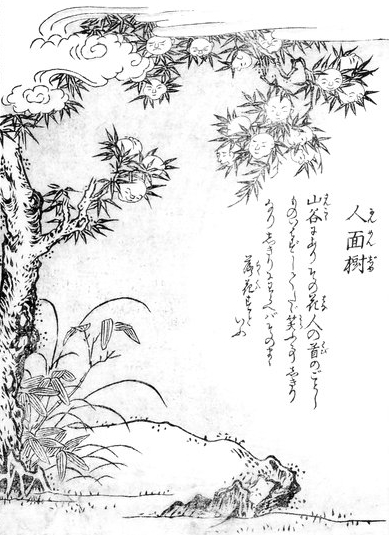
Thanks to a recent Twitter post by Guy Reisman, I was delighted to learn that the Islamic Waqwaq tree made its way to Japan, where it is known as the Jinmenju (人面樹, “human-face tree“). In fact, an illustration of the tree appearing in the Edo-period bestiary Konjaku Hyakki Shūi (今昔百鬼拾遺, “Supplement to the Hundred Demons from the Present and the Past,” c. 1781) appears to be based on that from the Three Realms cited above (refer back to fig. 3).

Even more exciting, however, is the revelation of the identity of the man standing beneath the tree in the Three Realms illustration. Foster (2015) traces the Japanese image to the Three Realms and then further back to a Persian source, thereby associating the man with a famous historical king:

If we continue back in time and along the Silk Road, we find different versions of the great Persian epic poem Shahnama (Book of Kings) by Firdawsi (d. 1020), with illustrations of a man conversing with a tree bearing human heads. The man, it turns out, is Alexander the Great (Sikandar or Iskandar), and the illustrations portray his legendary encounter with a talking tree, sometimes called the Wakwak Tree, that prophesied his death (p. 185).

That’s right! The man in the Three Realms is based on Alexander the Great! See figure four for a comparison of the Chinese illustration and one example of Persian “Iskander and the Talking Tree”-genre drawings. Both men stand in a similar position, looking upwards. The Persian Alexander is passively listening, while the Three Realms Alexander is actively talking.

Iskander and the Talking Tree - Three Realms Ginseng Tree

Fig. 4 – A comparison of a 15th-century Persian “Iskander and the Talking Tree” image and the Three Realms image (larger version). The former is held by the Bodleian Library.

This then raises the question: Did material related to the Shahmana influence the Ginseng Tree in Journey to the the West? [2] I’ve already demonstrated that an antecedent of the Ginseng tree appears in The Story, but this doesn’t necessarily negate some sort of influence. After all, both the Shahmana and JTTW feature mythic kings (Alexander and Sun Wukong) coming into contact with magic trees with humanoid fruit. I should note, however, that the trees represent two drastically different fates. Alexander’s tree foresees his death, while Monkey’s tree holds the promise of eternal life. Further research might shed light on stronger connections between both stories.


Update: 04-03-22

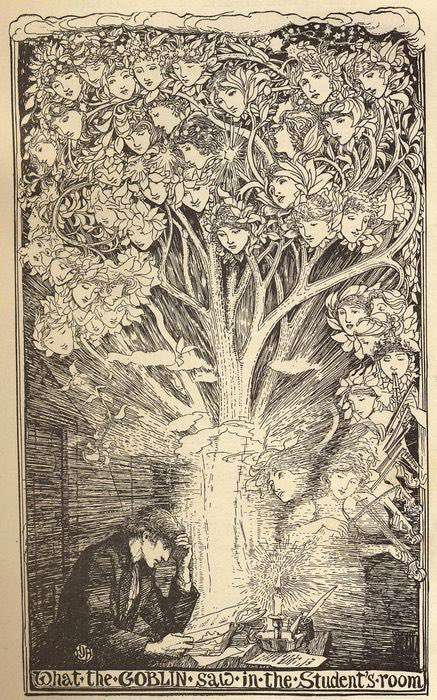
I was scrolling through Twitter, when I came across a post displaying a lovely 19th-century engraving of a magical tree from “The Goblin and the Grocer” (Danish: Nissen hos Spekhøkeren, 1852), a fairy tale by Hans Christian Andersen. The tree is shown to have smiling, female head-shaped fruits similar to the waqwaq tree (fig. 5). The description of the tree reads:

Out of the book shot a streak of light which grew into a large tree and spread its branches far above the student. Every leaf was alive, and every flower was a beautiful girl’s head, some with dark and shining eyes, others with wonderful blue ones. Every fruit was a glittering star” (Anderson, 1904, pp. 13-14)

So it appears that the waqwaq tree came to influence European literature as well.

Fig. 5 – The tree engraving from “The Goblin and the Grocer” (larger version). From Anderson, 1904, p. 15.


Update: 04-05-22

I’ve archived a paper showing that magical battles of transformation can be traced to Ancient Near Eastern, Egyptian, and Greek stories.

Archive #36 – Sun Wukong and Battles of Magical Transformations


Update: 04-07-24

Here is a description of the Ginseng Fruit Tree from JTTW chapter 24:

There was a huge tree right in the middle of the garden, with long, healthy branches and luxuriant green leaves that somewhat resembled those of the plantain. Soaring straight up, the tree was over a thousand chi [1,043.30 ft or 318 m] tall, and its base must have measured seven [73.03 ft or 22.26 m] or eight zhang [83.46 ft or 25.44 m] around. Leaning on the tree, Pilgrim looked up and found one ginseng fruit sticking out on one of the branches pointing southward. It certainly had the appearance of an infant with a tail-like peduncle. Look at it dangling from the end of the branch, with limbs moving wildly and head bobbing madly! It seemed to make sounds as it swung in the breeze (based on Wu & Yu, 2012, vol. 1, p. 461).

只見那正中間有根大樹,真個是青枝馥郁,綠葉陰森,那葉兒卻似芭蕉模樣,直上去有千尺餘高,根下有七八丈圍圓。那行者倚在樹下,往上一看,只見向南的枝上露出一個人參果,真個像孩兒一般。原來尾間上是個扢蒂,看他丁在枝頭,手腳亂動,點頭幌腦,風過處似乎有聲。


Update: 05-20-26

I recently learned that The Domestic Yapoo (Jp: Kachikujin Yapoo, 1970 onward), a strange Japanese time-traveling, body-horror novel series from the post-WWII era features a nod to the JTTW Ginseng Fruit Tree. Translator Nelliefeathers shared the following:

Yes, chapter 32.4 is titled Mandrake Apple (“spelt” with the same kanji used for the Man-fruit from JTTW). The Mandarake Apples are presented to the group to eat. They look like babies with an old person’s face, and Clara remarks that they remind her of the tree from Monkey. She’s specifies she’s referring to Waley’s translation (Personal communication, March 6, 2026).

Notes:

1) I changed the Wade-Giles to Pinyin.

2) Hall (2019) explains that Iskander’s meeting with the talking tree takes place in both the Shahmana and the older Greek Alexander Romance (p. 149).

Sources:

A floral fantasy of animals and birds (Waq-waq). (n.d.). Cleveland Museum of Art. Cleveland, Ohio. Retrieved May 12, 2017, from http://library.clevelandart.org/site…0Waq%20waq.pdf

Anderson, H. C. (1904). The Goblin and the Grocer. In A. Lang (Ed.), The Pink Fairy Book (pp. 12-17). New York: Longmans, Green, and Co. Retrieved from https://archive.org/details/pinkfairybook00lang/page/12/mode/2up

Buzurg, S., & Freeman-Grenville, G. S. P. (1981). The book of the wonders of India: Mainland, sea and islands. London: East-West.

Foster, M. D. (2015). The book of yōkai: Mysterious creatures of Japanese folklore. Oakland: University of California Press.

Hall, M. (2019). The imagination of plants: A book of botanical mythology. Albany : State University of New York Press

Hsia, C. (2015). The classic Chinese novel: A critical introduction (Rev. ed.). Hong Kong: The Chinese University of Hong Kong. ( Original work published 1968)

Robinet, I. (1979). Metamorphosis and deliverance from the corpse in Taoism. History of Religions, 19(1), 37-70.

Toorawa, S. M. (2000). WaÃq al-waÃq: Fabulous, fabular, Indian Ocean (?) island(s). Emergences, 10(2), 387-402.

Wivell, C.S. (1994). The story of how the monk Tripitaka of the great country of T’ang brought back the Sūtras In V. Mair (Ed.), The Columbia anthology of traditional Chinese literature (pp. 1181-1207). New York: Columbia University Press.

Zhang, Z., & Unschuld, P. U. (2015). Dictionary of the Ben cao gan mu: Volume 2 – Geographical and administrative designations. Oakland, California: University of California Press

The Story of Sun Wukong, the Monkey King

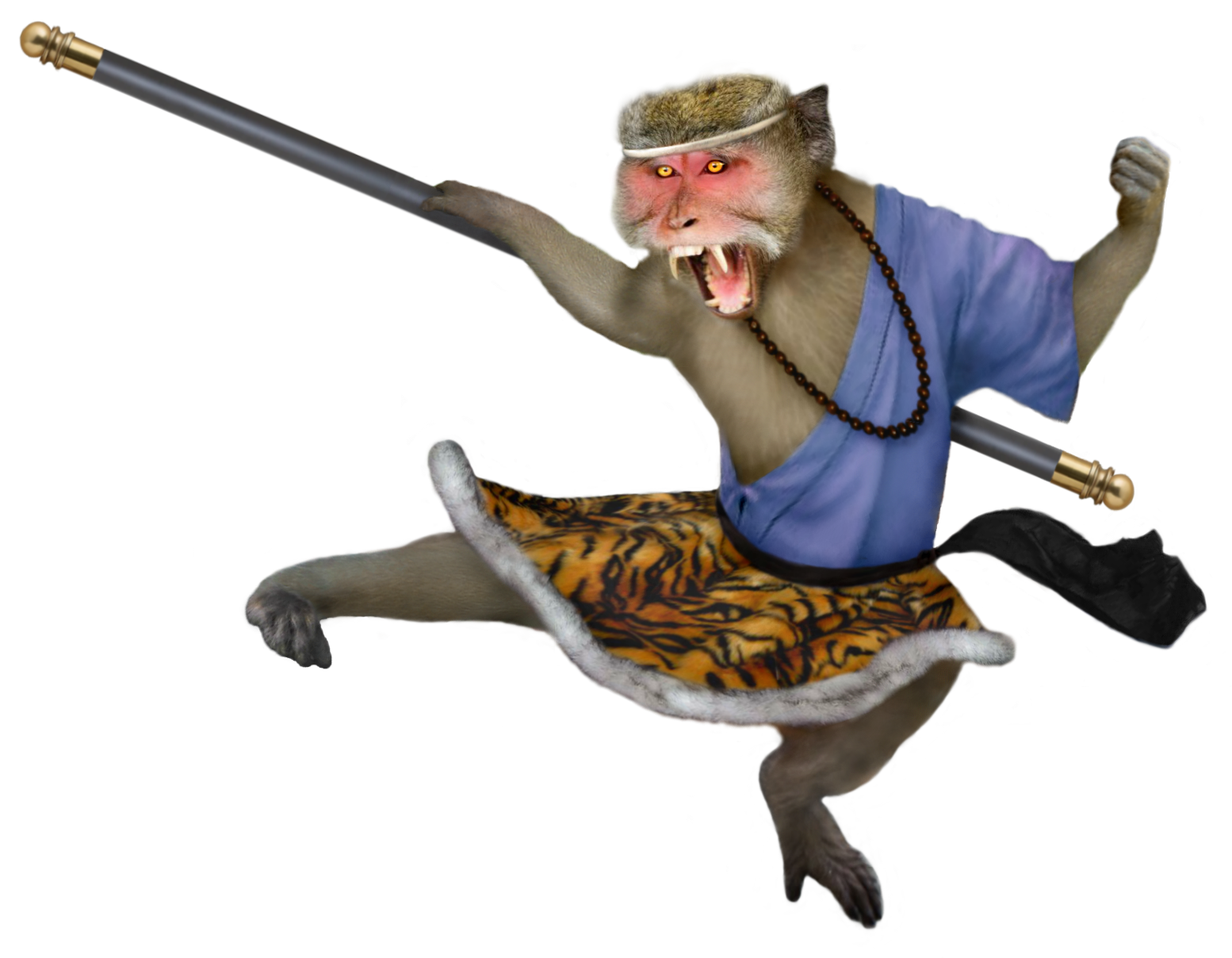
One of the most famous primate characters in world literature appears in the great Chinese classic Journey to the West (Xiyouji, 西遊記, 1592 CE). The story follows the adventures of Sun Wukong (孫悟空, a.k.a. “Monkey”) (fig. 1), an immortal rhesus macaque demon, who gains extraordinary power via spiritual cultivation and rebels against the primacy of heaven. Like Lucifer in Judeo-Christian mythology, this trickster god falls from grace when a supreme deity, in this case the Buddha, banishes him to an earthly prison below. But unlike his western counterpart, the monkey repents, becoming a monk and agreeing to use his abilities to protect a Buddhist priest on his journey to collect sutras from India.

What follows is an overview of Monkey’s story. It will primarily focus on the first seven of the novel’s 100 chapters, but chapters eight through 100 will be briefly touched upon, along with lesser-known literary sequels to Journey to the West. I will also discuss the novel’s impact on pop culture and religion.

Table of Contents

1. His Story

In the beginning, the mystical energies of heaven and earth and the light of the sun and moon come together to impregnate a boulder high atop the Mountain of Flowers and Fruit (Huaguo shan, 花果山), an island that lies to the east of the easternmost continent in the Buddhist disc world system. The stone gestates for countless ages until the Zhou Dynasty (1046-256 BCE), when it hatches a stone egg that is eroded by the elements into a simian shape. The Stone Monkey (Shihou, 石猴) awakens and bows to the four cardinal directions as light bursts forth from his eyes. The light is so bright that it reaches heaven, alarming the Jade Emperor (Yuhuang dadi, 玉皇大帝) and his celestial retinue. The light soon subsides, however, once he ingests food for the first time.

The Stone Monkey happens upon other primates on the island and becomes their king when he proves himself in a test of bravery by blindly leaping through a waterfall, thereby discovering a long-forgotten immortal’s cave. He rules the mountain for over three centuries before the fear of death finally creeps in. One of his primate advisors suggests that the king finds a transcendent to teach him the secrets of eternal life, and so Monkey sets sail on a makeshift raft and explores the world for ten years. His quest eventually takes him to the western continent, where he is finally accepted as a student by the Buddho-Daoist sage, Patriarch Subodhi (Xuputi zushi, 須菩提祖師). He is given the religious name Sun Wukong, meaning “monkey awakened to emptiness” or “monkey who realizes sunyata.” The sage teaches him the 72 methods of earthly transformation, or endless ways of changing his shape and size; cloud somersaulting, or a type of flying that allows him to travel 108,000 li (33,554 mi / 54,000 km) in a single leap; all manner of magical spells to call forth gods and spirits, grow or shrink to any size, part fire and water, create impassable barriers, conjure wind storms, cast illusions, freeze people in place, make endless clones of himself, unlock any lock, bestow superhuman strength, bring the dead back to life, etc.; traditional medicine; armed and unarmed martial arts; and, most importantly, an internal breathing method that results in his immortality. He is later disowned by the sage for selfishly showing off his new found magical skills to his less accomplished classmates.

Sun eventually returns to his cave and faces a demon who had terrorized his people during his prolonged absence. After killing the monster, he realizes that he needs a weapon to match his celestial power, and so his advisor suggests that he go to the undersea palace of Ao Guang (敖廣), the Dragon King of the Eastern Sea. There, he tries out weapons weighing thousands of pounds, but each one is too light. He finally settles on a massive nine-ton iron pillar that was originally used by Yu the Great (Dayu, 大禹) to set the depths of the fabled world flood, as well as to calm the seas. Named the “As-You-Will Gold-Banded Staff” (Ruyi jingu bang, 如意金箍棒), the iron responds to Sun’s touch and follows his command to shrink or grow to his whim, thus signifying that this weapon was fated to be his. In addition to the staff, Monkey bullies the Dragon King’s royal brothers into giving him a magical suit of armor.

Shortly after returning home to the Mountain of Flowers and Fruit, he shows off his new weapon by turning into a frightful cosmic giant and commanding the staff to grow, with the top touching the highest heaven and the bottom the lowest hell. This display of power prompts demon kings of the 72 caves to submit to his rule and host a drunken party in his honor. Soon after falling asleep, Sun is visited by two psychopomps who drag his soul to the Chinese underworld of Diyu (地獄). There, he learns that he was fated to die at the allotted age of 342 years old. But this enrages Monkey since his immortality freed him from the cycle of rebirth, and so he bullies the kings of hell in to bringing him the ledger containing his info. He promptly crosses out his name with ink, as well as the names of all monkeys on earth, thus making them immortal, too. He wakes up in the mortal world when his soul returns to his body.

Fig. 1 – A modern depiction of Sun Wukong (by the author) (larger version).

Both the Eastern Dragon King and the Hell King Qinguang (秦廣王) submit memorials to heaven concerning Sun’s misconduct. But the court advisor, an embodiment of the planet Venus, convinces the Jade Emperor to give Sun the menial task of watching over the Heavenly Horses in order to avoid further conflict. Monkey accepts and steadfastly performs his duties, that is until he learns that he’s just a glorified stable boy. He immediately returns to his earthly home in rebellion to proclaim himself the “Great Sage Equaling Heaven” (Qitian dasheng, 齊天大聖). The celestial realm mobilizes an army of powerful demon hunters, including the Heavenly King Li Jing (Li Jing tianwang, 李靖天王) and his son, the child god Third Prince Nezha (Nezha santaizi, 哪吒三太子), but they all fall to Monkey’s magical and martial might. The embodiment of the planet Venus once again steps in to convince the Jade Emperor to acquiesce to Monkey’s demand for higher rank, thereby granting him the empty title of Great Sage Equaling Heaven and even promoting him to watch over the immortal peach groves.

Sun takes stock of the magical peaches that ripen every few thousand years, but he eventually succumbs to their heavenly aroma. He eats all but the youngest life-prolonging fruits, thus gaining another level of immortality. His theft is soon discovered, however, when fairy attendants of the Queen Mother of the West (Xiwangmu, 西王母) arrive to pick the choicest specimens for her long-awaited immortal peach banquet. Sun is alerted to there presence and, upon questioning them, learns that he has not been invited. Naturally, Sun becomes enraged, freezing the maidens in place with fixing magic and then crashes the party before the hallowed guests arrive. He eats all of the celestial food and drinks all of the immortal wine, and then drunkenly stumbles into the laboratory of Laozi (老子), a high god of Daoism. There, he gobbles up the deity’s alchemically-derived elixir pills, thereby adding several more levels of immortality.

Sun returns home once again to await the coming storm of heavenly forces. Tired of the demon’s antics, the Jade Emperor calls up 72 heavenly generals, comprising the most powerful Buddho-Daoist gods, and 100,000 celestial soldiers. In response, Monkey mobilizes his own army comprising the demon kings of the 72 caves and all manner of animal spirits, including his own monkey soldiers. But soon after the battle commences, the demon kings fall to heavenly troops, forcing Sun to take on three heads and six arms and multiply his iron staff to meet the onslaught. Once again, the heavenly army is no match for him. However, he soon loses his nerve when his monkey children are captured in great heavenly nets. He flees with Erlang (Erlang shen, 二郎神), a master of magic and the nephew of the Jade Emperor, taking chase. The two battle through countless animal transformations, each trying to one-up the other. Monkey is finally captured when Laozi drops a magical bracelet on his head, incapacitating him long enough for Erlang’s celestial hound to bite hold of his leg.

Sun is taken to heaven to be executed for his crimes, but fire, lightning, and edged weapons have no effect on his invincible body. Laozi then suggests that they put him inside of the deity’s alchemical furnace to reduce the demon to ashes. They check the furnace 49 days later expecting to see his rendered remains. However, Monkey jumps out unscathed, having found protection in the wind element (xun, 巽) of the eight trigrams. But intense heat and smoke inside the furnace had greatly irritated his eyes, refining his pupils the color of gold and giving them the power to recognize the dark auras of demons in disguise. He overturns the furnace and begins to cause havoc in heaven with his iron staff. The Jade Emperor finally beseeches the Buddha (Rulai, 如来) in the Western Paradise to intervene.

The Tathagata appears and declares that he will make Sun the new ruler of heaven if the macaque can simply jump out of his palm. Monkey agrees to the wager, and with one tremendous leap, speeds towards the reaches of heaven. He lands before five great pillars, thinking them to be the edge of the cosmos. He tags one with his name and urinates at the base of another in order to prove that he had been there. Upon returning, Sun demands the throne. However, the Buddha reveals that the five pillars were actually his fingers, meaning that the Great Sage had never left. But before Monkey can do anything, the Tathagata overturns his hand, pushing it out the gates of heaven, and transforming it into the Five Elements Mountain (Wuxing shan, 五行山). There, Sun is imprisoned for his crimes against heaven, as well as subjected to a hellish diet.

Chapters thirteen to 100 tell how six hundred years later Sun is released during the Tang Dynasty (618-907) to help escort the Buddhist monk Tripitaka (Sanzang, 三藏) (whose early story is told in chapters eight to twelve), a disciple of the Buddha in a previous life, on a quest to retrieve salvation-bestowing scriptures from India. The Bodhisattva Guanyin (觀音) gives the monk a golden headband (jingu, 金箍; a.k.a. jingu, 緊箍, lit: “tight fillet”) as a means to rein in Monkey’s unruly nature. It tightens around Sun’s head whenever a magic formula is recited, causing him great pain. In addition, Guanyin gives Monkey three magic hairs on the back of his neck that can transform into anything he desires to aid in his protection of the monk. Along the way, the two meet other monsters-turned-disciples—Zhu Bajie (猪八戒), the lecherous pig demon, Sha Wujing (沙悟净), the complacent water demon, and the White Dragon Horse (Bailongma, 白龍馬), a royal serpent transformed into an equine—who agree to aid in the monk’s defense. Monkey battles all sorts of ghosts, monsters, demons, and gods along the way. In the end, he is granted Buddhahood and given the title of the “Victorious Fighting Buddha” (Dou zhanzheng fo, 鬥戰勝佛) for protecting Tripitaka over the long journey.

A summary of all 100 chapters can be read on my friend’s blog (fig. 2).

https://journeytothewestlibrary.weebly.com/novel-summary

Fig. 2 – The summary header (larger version).

2. Sequels

There are a total of four unofficial sequels to the novel.

The first is called A Supplement to the Journey to the West (Xiyoubu, 西游补, 1640), which takes place between chapters 61 and 62 of the original. In the story, the Monkey King wanders from one adventure to the next, using a magic tower of mirrors and a Jade doorway to travel to different points in time. In the Qin Dynasty (221–206 BCE), he disguises himself as Consort Yu in order to locate a magic weapon needed for his quest to India. During the Song Dynasty (960–1279), he serves in place of King Yama as the judge of Hell. After returning to the Tang Dynasty, he finds that his master Tripitaka has taken a wife and become a general charged with wiping out the physical manifestation of desire (desire being a major theme running through the novelette). Monkey goes on to take part in a great war between all the kingdoms of the world, during which time he faces one of his own children in battle. In the end, he discovers an unforeseen danger that threatens Tripitaka’s life.

The second is the Later Journey to the West (Hou Xiyouji, 後西遊記, 17th century). This novel focuses on the adventures of Monkey’s spiritual descendent Sun Luzhen (孫履真, “Monkey who Walks Reality”). I have a three-part article about it (first, second, and third).

And the third and fourth are the Continuation of the Journey to the West (Xu Xiyouji, 續西遊記, 17th century) and the New Journey to the West (Xin Xiyouji, 新西遊記, 19th century), respectively. As of 2023, I have not written any articles on these sequels.

3. Cultural Impact

Stories about Sun Wukong have enthralled people the world over for centuries. His adventures first became popular via oral folktale performances during the Song Dynasty (960-1279). These eventually coalesced into the earliest known version of the novel, The Story of How Tripitaka of the Great Tang Procures the Scriptures (Da Tang Sanzang qujing shihua, 大唐三藏取經詩話; The Story hereafter), published during the late-13th century.

Since the anonymous publishing of the complete novel in the 16th century, Monkey has appeared in numerous paintings, poems, books, operatic stage plays, video games, and films (both live action and animated).

He was sometimes “channeled,” along with other martial spirits, by citizen soldiers of the anti-foreign Boxer Rebellion (1899-1901). There is also a monkey-based martial art named in his honor.

It is interesting to note that there are people in southern China, Taiwan, Malaysia, Singapore, Thailand, and Vietnam who worship him as a patron deity. Thus, Sun became so popular that he jumped from oral and published literature to take his place on the family altar.

Copies of The Story were discovered in Japan among a 17th-century catalog of books in the Kozanji Temple (高山寺, Ch: Gaoshan si). No copies are known to exist in China, which suggests this version came to the island many centuries ago. The complete Ming edition of the novel came to Japan in the late-18th century, where it was translated in bits and pieces over the course of some seventy years. However, Monkey did not become immensely popular until the first complete translation of the novel was published in 1835. The last part was illustrated with woodblocks by Taito II (fl. 1810-1853), a noted student of famous artist Hokusai (1760-1849).

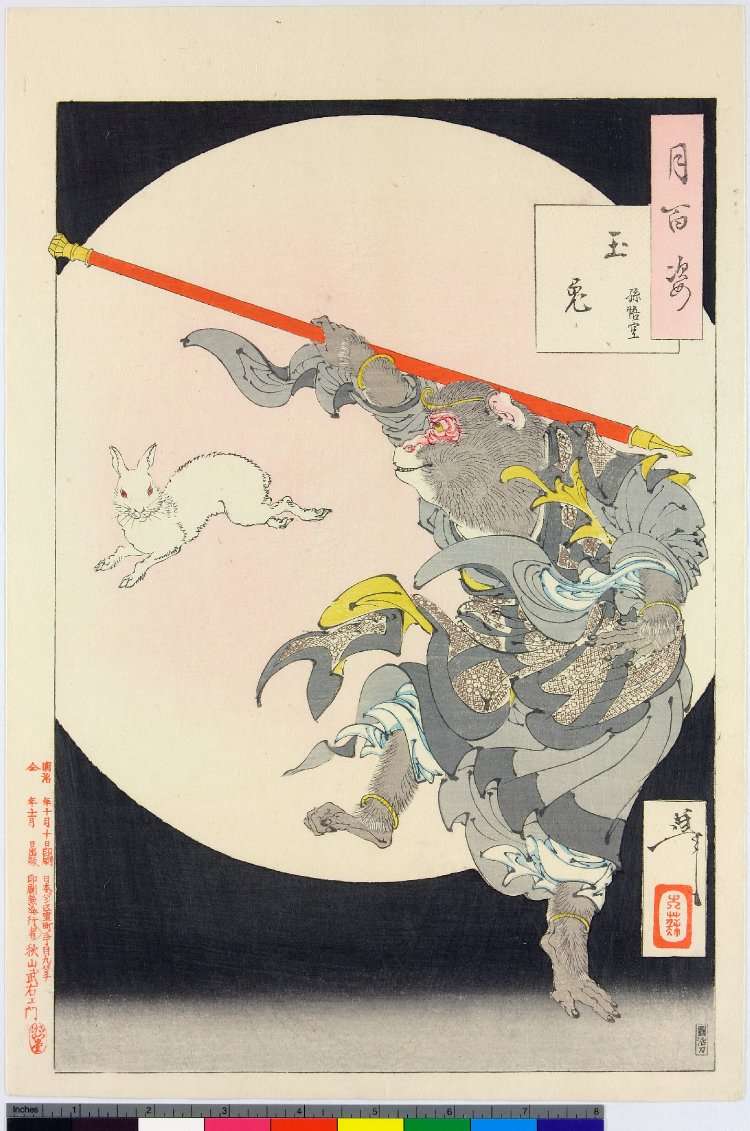
Other Japanese artists, such as Kubo Shunman (1757-1820) and Yoshitoshi (1839-1892) (fig. 3), produced beautiful full color woodblock prints of Sun.

Fig. 3 – (Left) Tsukioka Yoshitoshi, “Jade Rabbit – Sun Wukong”, October 10, 1889 (larger version). Fig 4. – (Right) Son Goku (孫悟空) from the Dragonball Franchise (larger version).

Like in China, Monkey has been adapted in all kinds of Japanese media. By far, his most famous adaptation is the manga and anime character Son Goku (孫悟空) (fig. 4) from the Dragon Ball (Jp:ドラゴンボール; Ch: Qi longzhu, 七龍珠) franchise (1984-present). Like Sun, Goku has a monkey tail, knows martial arts, fights with a magic staff, and rides on a cloud. His early adventures in Dragon Ball (manga: 1984-1995; anime: 1986-1989) see him traveling the world in search of seven wish-granting “dragon balls,” while also perfecting his fighting abilities and participating in a world martial arts tournament. Several of the supporting characters, such as Oolong (ウーロン), a lecherous anthropomorphic pig who can change his shape, a nod to Zhu Bajie, were directly influenced by the novel. Dragon Ball Z (manga: 1988-1995; anime: 1989-1996), a continuation of the comic book and animated TV show, follows Goku as an adult and reveals that he is actually a humanoid alien sent as a child to destroy Earth. He arrived in a spherical spaceship that recalls the stone egg from which Sun Wukong was formed. But instead of destroying the planet, he becomes its stalwart protector and faces extraterrestrial menaces from beyond the stars. Goku’s adventures have continued in the sequels Dragon Ball GT (1996-1997), Dragon Ball Super (2015-2018), and Super Dragon Ball Heroes (2018-present).