Archive #27 – The Journey to the West Japsang Effigies of Korean Royal Palaces

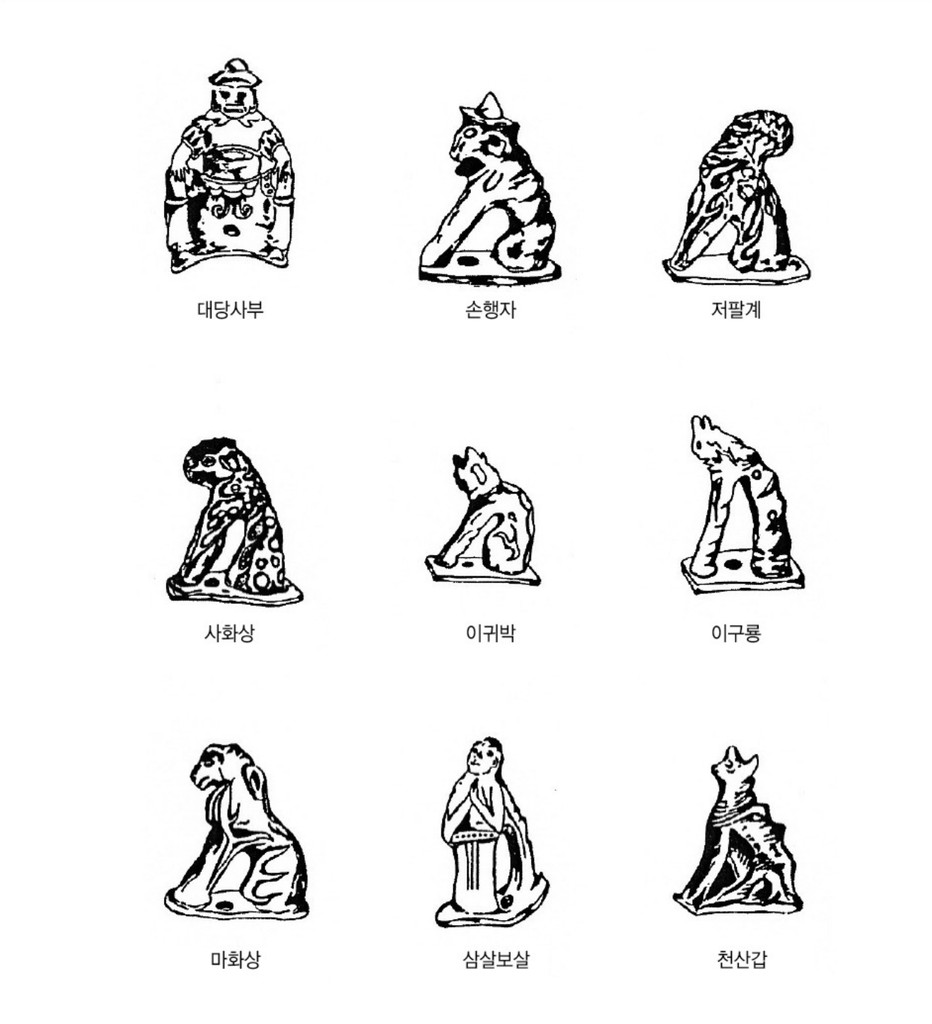
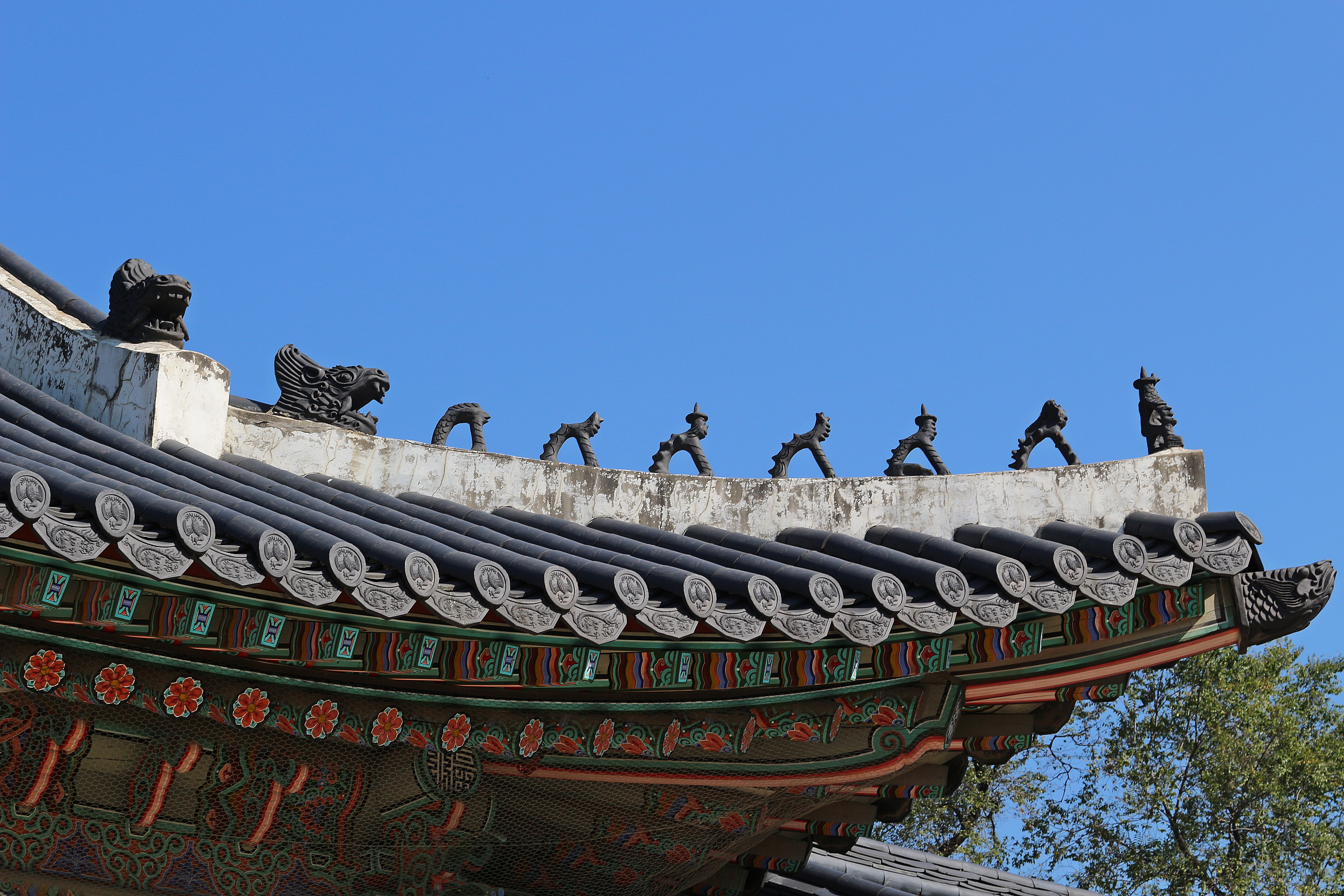
Japsang or Chapsang (Kor: 잡상; Ch: zaxiang, 雜像, “miscellaneous figurines”) are effigies of dark gray fired clay adorning the roof-hips of royal palaces in Korea. The first four (of up to eleven) figures are traditionally associated with the main characters of Journey to the West (Xiyouji, 西遊記, 1592) (fig. 1 & 2). Tripitaka is connected to the first figure, which wears a suit of armor and sits in a kingly fashion with hands on splayed knees (fig. 3). Sun Wukong is connected to the second, an ape-like figure with a pointed hat, long arms, and small legs. Zhu Bajie and Sha Wujing are respectively connected to the third and fourth figures, which are portrayed as scaled beasts with their heads turned in different directions.

Wall (2019) reveals the earliest reference to our our heroes’ association with the japsang appears in Eou yadam (어우야담, “Eou’s Unofficial Histories”), a collection of stories by the scholar-official Yu Mongin (유몽인, 1559-1623). Yu frames knowing the names of the figures as a test for a new official:

When newly appointed officials meet their predecessors for the first time, they have to be able to tell the names of the ten divine figures on top of the palace gates for ten times. . . . The names are Master of Great Tang (Taedang sabu, 大唐師傅 [Tripitaka]), Pilgrim Sun (Son haengja, 孫行者 [Sun Wukong]), Zhu Bajie (猪八戒), [and] Monk Sha (Sa Hwasang, 沙和尙 [Sha Wujing]) (Yu, 2004, as cited by Wall, 2019, p. 2137).

Interestingly, Sun Wukong was eventually associated with the very nails that fastened the figures to the royal rooftops (Chang, 2004, as cited by Wall, 2019, p. 2137). They were called “Pilgrim Sun-Nails” (Sonhaengja taech’ ol; Ch: (孫)行者帶鐵), [1] which implies our hero “was at some point considered representative of all roof ornaments” (Wall, 2019, p. 2137). This connection no doubt references Monkey’s adamantine body and position as the demon-conquering exorcist par excellence. After all, the japsang figurines were believed to “protect the palaces from calamities” (Ro & Park, 2015, p. 78), making them cognates for Chinese roof figurines, which serve as “guardians against fire and evil spirits” (Li, 1990, as cited by Wall, 2019, p. 2138). This is fascinating from a historical perspective as late dynastic Korea was staunchly Neo-Confucian, showing Journey to the West was so wildly popular in the “Land of the Morning Calm” that the pilgrims were able to transcend their original Buddhist associations (Wall, 2019, pp. 2137-2138).

(I also find this subject interesting because, while not officially worshiped by people of non-Chinese descent, it shows Sun served a religious function in Korea. Thus, we can add this thread to the complex tapestry of his worship in East and Southeast Asia.)

I originally intended to write my own in-depth article on japsang figures but later discovered Macouin (2003). This masterful paper explains the evolution of such roof adornments and their later association with the Chinese novel. Macouin (2003) is written in French, so I am presenting both the original and a rough English translation. I did not include the Korean and Chinese characters in the translation.

Fig. 1 (top L) – A chart of nine japsang (larger version). Notice that most feature the same basic arched back design similar to the Hebrew letter mēm (מ). Fig. 2 (top R) – Photo of a roof-hip featuring seven figures (larger version). From Wikipedia. Fig. 3 (bottom) – A picture of the lead figure believed to be Tripitaka (larger version). From Yogin, 2001 as cited in Macouin, 2003, p. 29. But as noted, Sun Wukong came to be associated with all japsang figures. 

I. Abstract (with translation)

French

Dans l’architecture ancienne de la Corée, à l’époque de la dynastie des Yi (1392-1910), les toits de certains bâtiments étaient ornés de statuettes protectrices, disposées en file sur leurs arêtes. À la fin du XIXe siècle, seuls les édifices peu ou prou en relation avec la fonction royale en étaient pourvus. La présence de ces figurines, à l’aspect d’animaux accroupis, est attestée au XVe siècle. Elles peuvent avoir succédé à d’autres ornements et, plus lointainement, à des tuiles spéciales à embout relevé.

Une tradition associe quatre de ces grotesques à des personnages bien connus par le roman chinois du XVIe siècle, le Xiyou ji. Plus précisément, la statuette placée en rive est identifiée au célèbre moine Xuanzang, héros de ce livre. Il est suggéré finalement que la personnification de ces statuettes pourrait être en relation avec des pratiques de bizutage.

English

In the ancient architecture of Korea, during the Yi Dynasty (1392-1910), the roofs of some buildings were adorned with protective statuettes, arranged in a line on their ridges. At the end of the 19th century, only buildings more or less related to the royal function were provided with it. The presence of these figurines, with the appearance of crouching animals, is attested in the 15th century. They may have succeeded other ornaments and, more distantly, special raised-toe tiles.

One tradition associates four of these grotesques with figures well known from the 16th century Chinese novel, Xiyou ji. More precisely, the statuette placed on the bank is identified with the famous monk Xuanzang, hero of this book. It is finally suggested that the personification of these statuettes could be related to hazing practices.

II. Original French Paper

Click to access Chapsang-paper.pdf

III. English Translation

Click to access Chapsang-paper-English-Translation-PDF.pdf

Disclaimer:

This has been uploaded for educational purposes. No malicious copyright infringement is intended. Please support the official release.

Notes:

1) For a discussion of Monkey’s “pilgrim” nickname, see section three of my previous article.

Source:

Macouin, F. (2003). Des Figurines De Toiture Coréennes, Les Chapsang. Journal Asiatique, 291(1-2), 17-34.

Ro, M. & Park, S. (Eds.). (2015). The King at the Palace: Joseon Royal Court Culture at the National Palace Museum of Korea (C. Kwon, Trans.). Seoul: National Palace Museum of Korea.

Wall, B. (2019). Dynamic Texts as Hotbeds for Transmedia Storytelling: A Case Study of the Story Universe of the Journey to the WestInternational Journal of Communication 13, 2116-2142. Retrieved from https://ijoc.org/index.php/ijoc/article/view/10006/2648


Archive #26 – Bimawen, Heavenly Horses, and Dragon Horses in Chinese Literature and History

Last updated: 01-04-2025

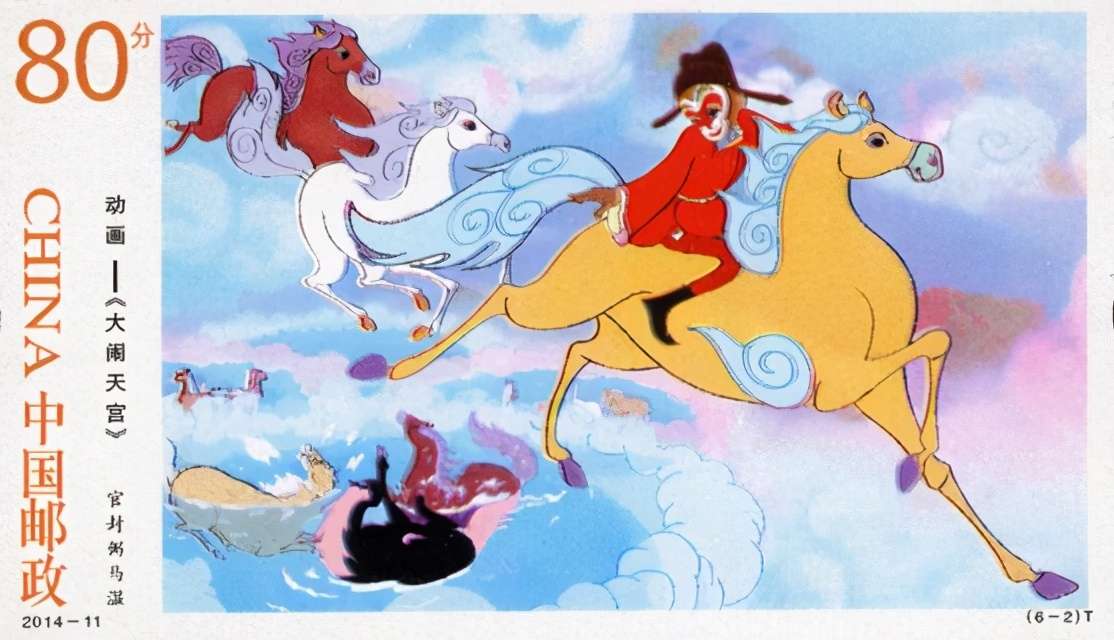
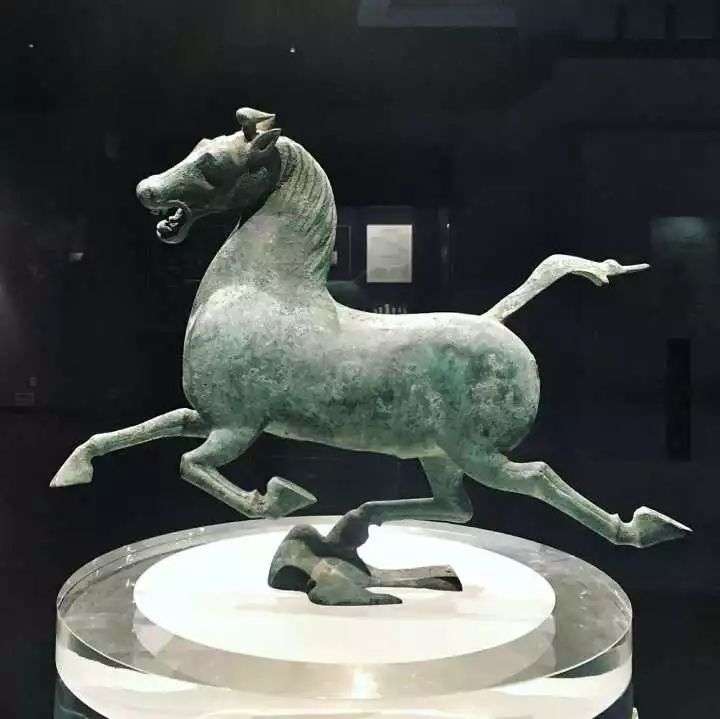
In chapter four of Journey to the West (Xiyouji, 西遊記, 1592), Sun Wukong is invited to heaven to serve as the Bimawen (弼馬溫, “To assist horse temperament”), a minor post overseeing the celestial horse stables (Wu & Yu, 2012, p. 148). He takes the position seriously, caring for nearly 1,000 horses day and night, making sure they are all well-fed, exercised, and rested (Wu & Yu, 2012, p. 149) (fig. 1). But these are no ordinary horses. A poem associates them with the most famous steeds in Chinese history (Wu & Yu, 2012, pp. 148-149), and most importantly, the last line states: “They tread the mist and mount the clouds with unflagging strength” (Wu & Yu, 2012, p. 149). This suggests that they have the supernatural ability to gallop through the skies (fig. 2). Additionally, the novel refers to them as “dragon horses” (long ma, 龍馬) (Wu & Yu, 2012, p. 309), which brings to mind the White Dragon Horse (Bai long ma, 白龍馬) that serves as Tripitaka‘s mount throughout the journey (Wu & Yu, 2012, p. 328).

Monkey’s position gives him power over all horses, especially those of mortal stock:

When the horse saw [Pilgrim], its torso slackened and its legs stiffened. In fear and trembling, it could hardly stand up. For you see, that monkey had been a [Bimawen], who used to look after dragon horses in the celestial stables. His authority was such that horses of this world inevitably would fear him when they saw him (Wu & Yu, 2012, p. 309). [1]

The heavenly post is a homophonous pun on Bimawen (避馬瘟, lit: “avoid the horse plague”), an ancient superstition where people would place monkeys in stables to ward off equine sickness. For example, Essential Techniques for the Common People (Qimin yaoshu, 齊民要術, c. 544) states: 

[Horses] are often associated with macaques [mihou, 猕猴] in the horse stable. This is in order to calm the horses, repel evil, and eliminate all diseases.

常系猕猴于马坊,令马不畏、辟恶、消百病也

The later Compendium of Materia Medica (Bencao gangmu, 本草綱目, 1596) mentions this concept twice. The first reads:

The Shuowen says: The characters (for macaque) look like “mother monkey” (muhou), but it’s “bathing monkey” (muhou, i.e. macaque), not a female. Since a macaque resembles a hu-barbarian, he is also called hu-sun “grandson of a barbarian”. The Zhuangzi calls him ju. People who raise horses keep a macaque in the stables, which will ward off horse-diseases. The Hu barbarians call a macaque maliu, in Sanskrit books he is called Mosizha (makaṭa). [2]

《说文》云︰为字象母猴之形。即沐猴也,非牝也。猴形似胡人,故曰胡孙。《庄子》谓之狙。养马者厩中畜之,能辟马病,胡俗称马留云。《梵书》谓之摩斯[咤]

The second explains how monkeys are believed to help the horses:

The Classic of Horses states: Domesticated macaques used in horse stables help avoid horse diseases [lit: bimawen]. Their monthly menstruation runs onto the grass, and once the horses eat it, they will never be sick.

《马经》言︰马厩畜母猴,辟马瘟疫。逐月有天癸流草上,马食之,永无疾病矣

This is insanely comical as it directly links Sun Wukong, a powerful cosmic warrior, to menstruation! This then might explain why Monkey is so enraged when enemies call him a Bimawen. As noted by my friend Irwen Wong of the Journey to the West Library blog, it challenges the Great Sage’s masculinity.

Essays

The following essay by Arthur Waley (1955), famed translator of the Journey to the West abridgement Monkey (1942), links heavenly horses to a historical breed from Central Asia, the Ferghana horse. He describes China invading the region to procure these horses by force, suggesting Emperor Wu of Han directed this action because the ruler believed the equines were dragon horses capable of transporting him to heaven. This is linked to stories of ancient Chinese rulers attaining immortality by riding horses or dragons to the celestial realm. Waley (1955) notes both the Chinese and Indians believed supernatural steeds hailed from the water, showing a link between horses and dragons.

But Creel (1982) refutes the claim that the heavenly horses were procured for purely religious reasons. He shows they were indeed used in military battles. 

Fig. 1 – A 2014 stamp featuring a scene from the classic 1960s animation Havoc in Heaven in which Sun Wukong serves as the keeper of the heavenly horses (larger version). Image found here. Fig. 2 – A photo of the famous circa 2nd-century BCE Flying Horse of Gansu (larger version). Image found here.

I. The Heavenly Horses of Ferghana

Individuals are not happy in proportion to the amount of space their persons occupy. Yet certain nations, at certain periods of their history, seem to take it for granted that the wider they spread themselves the happier they will be. China is a case in point. Why did this enormous country in the second century BC, in the first century AD and again at various later periods ruin itself by gratuitous westward expansion? Were her aims commercial or strategic? Was she defending her silk trade, or guarding against possible wars on two fronts? What part was played by the individual ambition of Emperors or generals, or by mere restlessness and love of adventure?

To answer these questions we should have to take the campaigns one by one. In doing so we should not be reduced to mere guesses. In Imperial edicts and addresses about military campaigns certain traditional pretences are, of course, kept up: ‘everything under Heaven’ belongs by right to the Chinese Emperor, and any peoples who do not think so must be chastised. Concrete and material motives for war are not always mentioned in these regal utterances, any more than an Address from the Throne (or its equivalent) in modern countries usually mentions petrol or rubber. But statesmen and officials were often quite frank about material motives for conquest: more so, I think, than is the case with us today. Thus, as justifying a proposal to secure from the Huns a strip of territory that projected into the Kansu corridor in north-western China the following reasons are given by a statesman in 8 BC: first, that it was a good source of supply for the sort of wood and feathers used in making arrows; secondly, that it would mean a large increase of Chinese territory, and lastly that it would give the general in command of the campaign a chance to win a big reputation. It is interesting to find that extension of territory is here regarded as an end in itself. Possibly supporters of the proposal might, if pressed, have pointed out as an afterthought that Chinese farmers could be settled in the new territory and that the taxes they paid would be a help to the exchequer.

The tendency of modern historians, and not only in Marxist countries, is to stress material and particularly economic motives for war, and to regard the profession of other motives as mere propaganda. In dealing with early Chinese history I do not think this view would generally lead us far astray, so long as we bear in mind the additional factor of personal ambition and the almost axiomatic belief that extension of territory was an end in itself. But I am going to deal with a case that seems to me to be exceptional. Oddly enough the early Chinese military adventure that modern scholars have most unanimously explained solely on materialist lines, seems, on closer examination, to have been to a large extent a religious quest

In 102. BC the Chinese Emperor Wu sent a huge military expedition (there had been a small and abortive one two years before) to Ta Yüan, corresponding roughly to the modern Ferghana in Russian Turkestan, to capture Heavenly Horses. Modern scholars, both Far Eastern and European, have usually assumed that the real object of the expedition was a purely practical one; namely, to secure a better type of cavalry horse. It is certain that by the middle of the second century AD the Chinese did possess two kinds of horse: a steppe-pony, with a large clumsy head, and a western type of horse, similar to that shown on Greek coins of the fourth to the second century BC, with small graceful head. It may well be that one of the results of the Ferghana expedition was the introduction of a western type of horse into China; and in the eyes of the generals and the horse-experts who accompanied them this may have been the main object as well as the result of the expeditions. But modern historians, intent on the very interesting material aspects of the episode, have tended to overlook its place (amply attested by contemporary texts) in the history of Chinese religion. Incidentally, by examining these texts more closely, I think one gets fresh light on what concretely and zoologically (as opposed to mythologically) the Heavenly Horses really were. I should mention that as a result of the expedition thirty or so ‘superior horses’ and 3,000 horses and mares of ‘middling or lower quality’ were handed over to the Chinese. How many of these survived the journey of 2,500 miles back to the Chinese capital we do not know. A few years later the king of Ferghana agreed to send two Heavenly Horses to China every year. I shall here be concerned only with the thirty ‘superior’ Or ‘Heavenly’ horses. There is no reason to suppose that the 3,000 inferior horses were of a type different from the usual Chinese horse. They may merely have been needed as remounts.

In studying what was said about the horses in contemporary Chinese literature the best point of departure is the hymn made in 101 B.C. when the horses were about to arrive at the Chinese capital :

The Heavenly Horses are coming,
Coming from the Far West.
They crossed the Flowing sands,
For the barbarians are conquered.
The Heavenly Horses are coming
That issued from the waters of a pool.
Two of them have tiger backs.
They can transform themselves like spirits.
The Heavenly Horses are coming
Across the pastureless wilds
A thousand leagues at a stretch,
Following the eastern road.
The Heavenly horses are coming.
Jupiter is in the Dragon.
Should they choose to soar aloft,
Who could keep pace with them?
The Heavenly Horses are coming;
Open the gates while there is time.
They will draw me up and carry me
To the Holy Mountain of K’un-lun.
The Heavenly Horses have come
And the Dragon will follow in their wake
I shall reach the Gates of Heaven,
I shall see the Palace of God.

This song has often been spoken of by western historians as though it were a purely secular literary poem. It is in reality one of a series of hymns written (possibly by the Emperor Wu himself, but the authorship is very uncertain) for use at the sacrifices to Heaven and Earth-sacred rituals performed by the Emperor in person. One or two of the phrases in it obviously need further explanation. Whether the people of Ferghana believed that their sacred horses ‘issued from a pool’ we do not know. But there are, apart from other instances of this belief elsewhere in Central Asia, many Chinese stories of horses coming up out of the water, the implication being that they are dragon-horses, that is to say, water-dragons who have changed themselves into horses, often retaining their dragon wings. As we shall see, the Emperor had been on the look-out for a water-born horse for some time. What is meant by ‘the Dragon will follow in their wake,’ more literally ‘they will be introducers of the Dragon’ ? The idea underlying these words is best illustrated by the following story, dating perhaps from some forty years earlier than the hymn: Recently a man who lived on the frontier lost his horse which ran away into the land of the barbarians. He was very much upset, and everyone condoled with him, except his father who remarked cheerfully, ‘This may be a blessing in disguise.’ And sure enough the lost horse came back bringing with it a ‘fine horse,’ that is to say, a horse of superior value and breed. The Emperor in this hymn hopes that the Ferghana horses would one day bring along a Dragon, a being even more magical than a Heavenly Horse.

The general implication of the hymn therefore is that the Heavenly Horses will carry the Emperor to the abode of the Immortals on the magical mountain K’un-lun. He imagines himself, I think, driving in a chariot drawn by horses rather than riding on horseback. Riding did not become common in China till the fourth century BC and was in the second century still felt ‘to be a utilitarian, unlegendary form of transport. More than this, the Ferghana horses being, as another hymn in the series says, ‘friends of the Dragon ‘ who is master of the clouds, will eventually carry him to Heaven, to the Abode of God-on-High-(Shang Ti).

The preceding hymn (No. 9 in the series), which is about the fleeting and uncertain nature of man’s life, ends with the words, ‘Why does not Tzu-huang come down to me?’ Tzu-huang was the horse with dragonwings that carried up the mythical Yellow Emperor to Heaven. There are many Chinese stories of legendary monarchs being carried up to Heaven by magic steeds; but it would be difficult to prove that any of them is older than the fourth century BC. It is interesting to compare these Chinese myths with Indian ideas about the relation of monarchs to magic steeds. In Indian legends the magic horse Valaha (‘Cloud’), is one of the ‘seven treasures’ of a great monarch. Valaha came up out of the sea, just as the Ferghana horse and others in which the Chinese were interested came up out of the water, and carried Simhala, the legendary founder of the Kingdom of Ceylon, back to India when he was on the verge of being eaten by female cannibals.

The Emperor Wu had, as I have mentioned, for some time past been on the look-out for a magic horse, ‘born from’ a stream. In 121 BC someone thought it worthwhile to report to the Court that a horse had come up out of a river to the north of the Ordos, the great square-shaped northern bend of the Yellow River. We have no details about this horse ; but in 113 BC another strange horse was not only seen but captured and sent to Court. A Chinese who in consequence of some misdemeanour had been sent to do service at the military colony near Tun-huang, on the northwest frontier, frequently saw a horse of strange appearance drinking in the river along with a number of wild horses. He tamed the strange horse by putting at the water-side a dummy figure of a man whose hands were bridle and halter. When the horse was used to this sight he substituted himself for the dummy, captured the horse and sent it to Court. In order to prove that the horse was ‘divine’ he pretended that it had come up from under the water. His story was evidently believed at the time, for this horse, too (like the Ferghana horses twelve years later), was made the subject of a hymn to be used in the Imperial sacrifices :

The Heavenly Horse comes down
A present from the Grand Unity,
Bedewed with red sweat
That foams in an ochre stream
Impatient of all restraint
And of abounding energy.
He treads the fleeting clouds,
Dim in his upward flight;
With smooth and easy gait
Covers a thousand leagues.

Historians of religion, particularly those of the Vienna school, regard as ‘the beginning of religion’ the belief in a supreme celestial deity who later becomes merely a vague memory and ultimately fades away or becomes merged in other, more concrete cults. The ‘Grand Unity‘ (or ‘Great Unique,” as one might also translate it) of this hymn has therefore particular interest as a religious phenomenon, being a supreme celestial deity whose origin (at any rate as a national cult), whose heydey and disappearance all take place before our eyes within a limited historical period. So far from belonging to a remote, ‘archaic’ past he begins, officially at any rate, in 133 B.C. Up till then the Grand Unity was a philosophic conception denoting the primal unity out of which grew the plurality of the universe as we know it. Sometimes the phrase is a synonym of Tao, the underlying principle of the Universe in Taoist philosophy. But in the second century BC a cult sprang up in which the Grand Unity figures not as a philosophic conception but as a personal divinity, the highest of all gods, worshipped with an elaborate ritual. About 133 BC a member of the Grand Unity sect prevailed on the Emperor Wu to make the whole Imperial cult centre round this deity. The Grand Unity maintained this position during several reigns and the cult was only brought to an end (along with many other religious innovations of Wu’s reign) in 32 BC.

I will leave aside for the moment the other points of interest in the Heavenly Horse hymn of 113 BC and note here that the Emperor’s search for immortality did not begin with his interest in divine horses. He had, as is well known, for long past been pursuing this quest on other lines. He had sent numerous and costly expeditions to the East in the hope of discovering islands inhabited by Immortals who might be persuaded to yield their secrets to him. He had dabbled in alchemy, in the belief that if he ate out of vessels made of alchemic gold he would live forever, or at any rate for a prodigiously long time. The expedition to fetch magic horses from the West was, it seems to me, merely a continuation of his earlier quests in the East. ‘The Emperor Wu,’ says Wen Ying in about AD 200, ‘had set his heart on immortality. He was always hoping that a Heavenly Horse would come and carry him to K’un-lun,’ the western Abode of the Immortals. At last when all his guests in the East had failed and when the Horse did not come of its own accord (as it had come to legendary Emperors in the past, both in India and in China) he determined, having known for long that the king of Ferghana had such horses, to wrest some from him by diplomacy or, if need be, by force.

We have seen, then, how the horses were regarded by the Chinese Emperor. Other people, less obsessed by magico-religious ideas, may have viewed them differently; but there is nothing in the Chinese sources to suggest that they were needed or used for military purposes. Naturally, the normal political excuses were made for the expedition. In a public proclamation the Emperor accused Ferghana of having killed two Chinese envoys on their way to the west and an Indian envoy who was on his way to China. The excuse has a familiar ring. One is reminded, for example, of the German seizure of Tsingtao in 1897, alleged to be a reprisal for the murder of the German missionaries Nies and Henle.

Another question clearly arises. How were the Heavenly Horses regarded by the king of Ferghana and what role did they play at his Court? It is generally assumed that they were battle-chargers. But I wonder whether their function was not perhaps something like that of the ten Nesaean horses ‘most gorgeously caparisoned,’ who in the procession of the Persian king Xerxes, as described in the seventh book of Herodotus, walked immediately in front of the sacred chariot of ‘Zeus’ ? ‘And it occurs to one that to this same category of ceremonial horse may very well belong the ten yellow mares of the Pazaryk grave mound, in the eastern Altai, preserved in a solid ice block. They form part of the burial gear of a semi-nomad chieftain who lived perhaps somewhere about the 5th century B.C. ‘They are,’ says the Swedish archaeologist Karl Jettmar, ‘certainly of the noblest breed. They resemble the best strains of Turkmenistan or Ferghana.’ Two of them have masks. One mask represents a deer or reindeer; the other, a composite mythological creature. They may well have been special horses used by a ruler for ritual purposes, and perhaps (as Jettmar suggests) they took part in the funeral procession, which like the Scythian funeral processions described’ by Herodotus may have travelled an immense way. Their mythological function may well have been to carry the dead Khan to Immortality, just as the horse Tzu-huang carried the legendary Chinese Yellow Emperor and as in historic times the Emperor Wu hoped to be carried by the Ferghana horses. One is reminded, again, of the ‘treasure-horses,’ blue-grey in colouring and with black heads (that is to say, descendants of the magic horse Valaha) and gorgeously caparisoned, who took part in the procession that brought the infant Buddha back from Lumbini to his father’s palace. If the function of the Heavenly Horses at the Ferghana Court was a ritual rather than a practical one it would well explain why the king was so anxious not to part with them and at one point even threatened to kill them all rather than let them fall into the hands of the Chinese.

Though the main subject of this essay is the relation between the Ferghana expeditions and the religious pre-occupations of the Chinesr Emperor, the texts we have studied do also tell us something about the physical characteristics of the Ferghana horses, and it may be worth while to close with a few remarks on this subject. The first of the two hymns mentions that two Heavenly Horses had stripy backs. Lydekker in The Horse and Its Relatives says : ‘It has been noticed that dun-coloured domesticated horses frequently show a tendency to develop … one or two transverse dark stripes across the shoulder, and another along the middle line.’ Such presumably were the two Ferghana horses, and the Chinese regarded them as ‘marked’ by heaven and consequently particularly sacred. The other physical characteristic commonly attributed to Ferghana horses is that they ‘sweated blood.’ This, as we have seen, was also said of the horse sent from near Tun-huang in 113 BC. Professor Dubs, in his valuable translation of the Han History, has suggested that the flow of blood was caused by lesions inflicted on the horses by a parasite with the intimidating name Parafilaria multipapillosa. There is in any case no question of this characteristic being merely legendary. In AD 78 the Emperor Chang gave one of his uncles ‘a Ferghana horse which bled from a small hole above its front upper leg.’ In the letter that accompanied this gift he said, ‘I had often heard the line in Emperor Wu’s song about the Heavenly Horse in which it is said that it is ‘ bedewed with red sweat,’ and I have now seen with my own eyes that this is actually the case.’ Presumably the ‘hole’ looked more like a pore in the skin than a wound, and therefore what came out of it was regarded as sweat rather than blood.

Nowhere, I think, is it said that they were larger than Chinese horses, though this has constantly been assumed by Western writers. The only horses that the Chinese at this period call big (ta) were to be found not in Ferghana but in Parthia. ‘They have the big horse and the big bird (ostrich),’ says the Han History. But there is no record of those huge Parthian steeds (no doubt the Parthikoi of Strabo, which he says were of the same build as the huge Nesaean horses) being brought to China.

To sum up: the accepted idea about the Ferghana expeditions is that the Emperor Wu sent them in order to obtain ‘horses larger and fleeter than the small steppe breed.” It is assumed that in this he was successful and that the ‘western’ type of horse seen in some of the second century A.D. grave-reliefs corresponds to the type of horse brought back from Ferghana in 101 BC. I would re-formulate this view as follows: The Emperor sent the expeditions in order to secure Heavenly Horses which would carry him to Heaven. There is no evidence that Heavenly Horses were used in battle either in Ferghana or China: If they had been they would hardly have remained long, as it were, ‘on the secret list.’ I’m inclined, to think that their function was a ritual one, both in Central Asia and in China. About the breed of the horses that the Emperor secured we know nothing. But it is reasonable to suppose that the existence of the ‘Western’ horse in China, in the second century AD was due to Chinese intercourse with the West from the second century BC onwards and that the Ferghana expedition, as an episode in this intercourse, may well have played its part in what was perhaps a gradual process. There is no justification for saying as Tam does that ‘the origin of the Ferghana horses must have been one of the great Parthian war-horses’ or that the Ferghana horses were ‘of the great Nesaean-Parthian breed.’.

Thus though my main object was to show that this episode cannot be properly understood without taking into account more than has hitherto been done its magico-religious aspects, my conclusions about its secular, concrete aspects are also somewhat different from those of my predecessors (Waley, 1955).

II. The Role of the Horse in Chinese History

Creel (1982) successfully refutes the former’s claim that the horses were procured for only religious reasons:

Waley, “Heavenly Horses of Ferghana,” 102, takes the position that the horses of Fergana were sought by the Han Emperor Wu “in order to secure Heavenly Horses which would carry him to Heaven.” He says that “there is no evidence that Heavenly Horses were used in battle either in Ferghana or in China.” (Ibid., 102.) But in fact, as we have seen, the use of Fergana horses in fighting is mentioned in Hou-Han-shu, 110A.4b. By speaking here of “Heavenly Horses” Waley is evading the real question: were horses obtained from Fergana used in battle in Han times? The answer is that they were. Waley also says: “Nowhere, I think, is it said that they [i.e., “Heavenly Horses”] were larger than Chinese horses, though this has constantly been assumed by Western writers.” (Ibid.) The evidence cited above certainly indicates that the Fergana horses were extremely large and that there is every reason to feel assured that they were much larger than most of the horses in China both in Han times and later. Further evidence against Waley’s view is the nature of the titles of the two men sent by the Emperor to Fergana “to select good horses.” (Shih-chi, 123.37.) These would appear to be ordinary official titles and refer to “managing horses” and “driving horses.” If the purpose had been primarily to select horses having special religious virtues, why did the Emperor not send men with religious qualifications? Certainly there was some religious aspect to this curious affair, and Waley has performed a service by emphasizing it. But in doing so he has given undue attention to a part of the evidence and neglected other parts of it entirely (p. 176 n. 66).

Please see the PDF below for the entire chapter.

Archive link

Click to access Herrlee-G.-Creel-What-Is-Taoism_-and-Other-Studies-in-Chinese-Cultural-History-1970-Ch.-8-on-Horses.pdf

Disclaimer:

These have been uploaded for educational purposes. No malicious copyright infringement is intended. If you enjoy the digital content, please support the official releases.


Update: 03-12-23

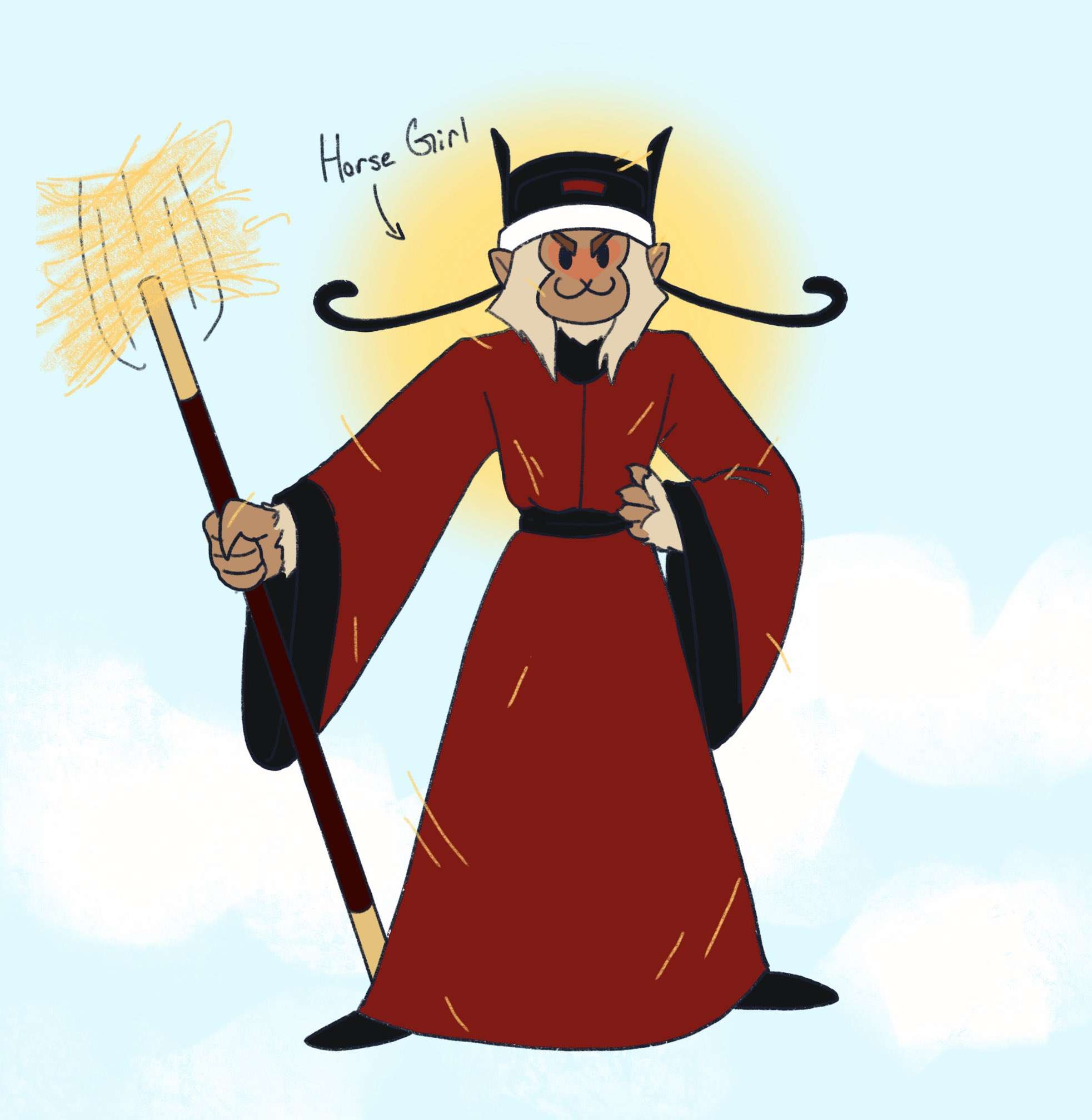
Twitter user Lava (@Lavaflowe) has allowed me to post their lovely drawing of Sun Wukong as the Bimanwen. The image is comically labeled “horse girl.” I especially love how he has transformed his magic staff into a pitchfork. Also, check out the hay covering his heavenly robes (fig. 4). That’s such a great detail.

Fig. 4 – Monkey as the Bimawen (larger version). The original tweet can be seen here.


Update: 01-04-25

I just posted an article about the White Dragon Horse.

Why Did the White Dragon Horse Burn His Father’s Pearls in Journey to the West?

Notes:

1) This power was given to Monkey by the Jade Emperor, who gives him the Bimawen post. This was pointed out to me by Irwen Wong of the Journey to the West Library blog.

2) The translation is partly based on Gulik, 1967, p. 35. I changed the Wade-Giles to pinyin.

Sources:

Creel, H. G. (1982). What is Taoism?: And other Studies in Chinese Cultural History. Chicago, Ill: University of Chicago Press.

Waley, A. (1955, February). The Heavenly Horses of Ferghana. History Today, 5, 95-103.

Wu, C., & Yu, A. C. (2012). The Journey to the West (Vol. 1) (Rev. ed.). Chicago, Illinois: University of Chicago Press.

Dragon Ball and Journey to the West

Last updated: 12-29-2022

It recently occurred to me that I’ve referenced the Dragon Ball franchise in several blog articles. So I’ve taken the opportunity to gather everything into one spot, including information that I haven’t previously mentioned. This is meant to be a very basic introduction and not an exhaustive analysis. My current interest here is in modern adaptations of Journey to the West (Xiyouji, 西遊記, 1592).

Those interested in a broader discussion on the influences of Dragon Ball should consult the work of Derek Padula.

I. Son Goku

The name of the series protagonist, Son Goku (孫悟空) (fig. 1), is a Japanese transliteration of Sun Wukong, meaning “Monkey Aware of Emptiness,” an allusion to Buddhist enlightenment. While referencing Rhesus macaques and “grandsons,” the surname Sun (孫), is also a veiled symbol for the development of an immortal spirit in Taoist elixir arts. Therefore, the name Son Goku straddles both Buddhism and Taoism.

Goku’s monkey tailflying nimbus cloud, and extending power pole (fig. 2) are all based on the respective trait, skill, and weapon of the Monkey King. The latter’s skill is called the “Cloud Somersault (jindou yun, 筋斗雲), which can travel 108,000 li (33,554 mi / 54,000 km), or one and one-third the circumference of Earth, in a single leap. Sun’s staff, the “‘As-You-Will‘ Gold-Banded staff,” weighs a whopping 17,560 lbs (7,965 kg) and (among other abilities) can magically grow as big or shrink as small as the immortal desires.

Goku’s proficiency in boxing (fig. 3) has a fun connection to Sun Wukong. Series creator Akira Toriyama partly based the Saiyan’s fighting style on the Wing Chun techniques used by Bruce Lee and Jackie Chan in their respective films. This style falls under the umbrella term “Short Fist” (Duan quan, 短拳), a school of martial arts with a low stance and quick, compact punches. Journey to the West states that this very style is the Monkey King’s preferred fighting technique! He uses Short Fist a few times in the novel.

The spherical spaceship that baby Goku crash lands on Earth in from DBZ (fig. 4) is a clever nod to the magic stone that Sun Wukong is born from in the beginning of the novel.

Goku’s Ozaro (大猿) form, or his ability to change into a titanic “great ape” during a full moon (fig. 5), is largely based on the Monkey King’s cosmic transformation. The novel calls this magical skill the “Method of Modeling Heaven on Earth” (Fatian xiangdi, 法天像地), and Sun uses it to grow 100,000 feet (30,480 m) tall during battles with powerful opponents. This is related to ancient Pre-Qin and Han dynasty concepts of astral-geography later used in the construction of imperial Chinese cities.

While I don’t have confirmation from Toriyama, Goku’s “Instant Transmission” skill (fig. 6) might be based on the aforementioned cloud somersault. This is because Chinese Buddhist literature mentions the world of man is separated from the Buddha’s paradise by 108,000 li (the distance covered by the cloud), and the only way to instantly bypass all of the hardships in-between is achieving enlightenment. Hence the cloud somersault is symbolic of instant travel.

II. Other characters

Goku’s early quest to find the dragon balls along with Bulma (Tripitaka), the shape-shifting pig Oolong (Zhu Bajie), and the desert bandit Yamcha (Sha Wujing) is based on the quest for sutras in Journey to the West. Not surprisingly, other DB/DBZ characters come from the Chinese novel. The Ox-King and Chi-Chi are respectively based on the Bull Demon King and his wife, Princess Iron Fan (fig. 7). Tien Shinhan is based on Erlang, the only god to truly defeat Sun Wukong, which is why Tien is such a threat to young Goku.

Goku’s martial arts teacher, Master Roshi, is based on the Buddho-Taoist Sage Subodhi who teaches Sun Wukong magic and the secret of immortality. Subodhi is based on Subhuti, a historical disciple of the Buddha. This is hilarious when you think about how much of a pervert Roshi is (fig. 8).

The antagonist Broly (fig. 9) wears a shock collar and mind-controlling headband in various DB media. These are based on the Monkey King’s “Golden Fillet” (jing gu quan, 金箍圈), which represses his unruly nature by painfully constricting around his head when a magic spell is chanted. It’s interesting to note that this fillet is based on a historical ritual headband worn by ancient Indian Buddhist yogins as a physical reminder of self-restraint.

III. Miscellaneous

The senzu (仙豆, “immortal bean”) (fig. 10) used by Goku and other Z fighters to replenish their strength from prolonged training or battle are based on immortality-bestowing elixir pills that Sun Wukong eats while drunkenly stumbling through the laboratory of the Taoist high god Laozi. Once eaten, the pills immediately counteract the effects of the heavenly wine.


Update: 03-20-22

I recently remembered that I’ve also referenced the origin of the spikey hair in esoteric Buddhist art. On 02-14-2019 I posted on twitter saying: “Goku’s spiked hair is based on esoteric guardian deities. For ex., here is Tianpeng, the former incarnation of Oolong’s precursor Zhu Bajie [fig. 11].”


Update: 12-20-22

I first became interested in Journey to the West thanks to Dragon Ball Z. The series is obviously named after the seven glass-like orbs (fig. 12) created by the Namekian-turned-protector deity Kami for the benefit of mankind. When all seven are collected, they summon the dragon god Shenron, who grants a single wish. One common wish is to resurrect a beloved fighter who had previously been killed in battle.

But what would the Dragon Balls be like if they appeared in the Journey to the West universe? There are two possibilities. The first is the most obvious, the Cintāmaṇi (Sk: “wish-fulfilling jewel”; Ch: ruyi baozhu, 如意寶珠, lit: “as-you-will treasure jewel”). Also known as “dragon jewels” (longzhu, 龍珠), these luminous orbs are commonly held by Bodhisattvas in Buddhist art (fig. 13), thereby signifying their ability to grant any wish that a believer desires. They are also mentioned in Buddhist scripture. For instance, the Treatise of the Great Perfection of Wisdom (Sk: Mahāprajñāpāramitāśāstra; Ch: Da zhidu lun, 大智度論, c. 2nd-century) reveals that the Cintāmaṇi is a bodily relic found in the brains of dragon kings (longzhu chu longnao zhong, 龍珠出龍腦中) (Buswell & Lopez, 2014, p. 193). Therefore, we would be able to maintain the connection to dragons in Journey to the West.

(If we view Dragon Ball Z under the light of this new information, a creepy implication is that Kami killed seven dragon kings in order to create his set of dragon balls.)

In East Asia, the Cintāmaṇi is closely associated with our second possibility, the Śarīra (Sk: “body”; Ch: Sushe/zi, 舍利/子) (fig. 14). These pearl-like beads figure among the bodily relics left over from the historical Buddha’s cremation. [1] Strong (2004) explains: “[They are the result] of a process of metamorphosis brought on not only by the fire of cremation but also by the perfections of the saint (in this case the Buddha) whose body they re-present” (p. 12).

They are said to come in different colors and sizes depending on the country and religious tradition (Strong, 2004, p. 11).

Journey to the West could have one or even both of these bodily relics. For example, the Cintāmaṇi would allow demon kings or lesser spirits to wish for powerful heavenly weapons, thereby helping them fight stronger opponents; or, the Śarīra could grant the devils more spiritual power, thereby allowing them to bypass centuries of spiritual cultivation.

But neither of these items could help evil beings achieve immortality. I’ve previously noted that Journey to the West was heavily influenced by the Buddho-Daoist philosophy of the Southern Quanzhen School Patriarch Zhang Boduan (張伯端, mid to late-980s-1082). He believed that in order to become a true transcendent (xian, 仙), one had to achieve both the Daoist elixir of immortality and Buddha-nature (Shao, 1997; 2006). The first extends your life, while the second frees you from the endless rounds of rebirth. While the aforementioned spiritual objects may grant them divine longevity, it won’t make them unkillable. And if they are killed, they would still be subject to the wheel of reincarnation. It would be up to them to achieve the last step in this two-step process. But that would require these spirits to mend their evil ways and “return to the right path” (gui zheng, 歸正)⁠—i.e. convert to Buddhism.


Update: 12-29-22

It turns out that Journey to the West has śarīra beads. In fact, they are mentioned at least 18 times throughout the novel. One example is a treasure belonging to the Yellow-Robed Demon (Huangpao guai, 黃袍怪). Chapter 31 reads:

Leading Pilgrim [Sun Wukong], the fiend [Yellow Robe] took his companion into the murky depth of the cave before spitting out from his mouth a treasure having the size of a chicken egg. It was a śarīra [shelizi, 舍利子] of exquisite internal elixir. Secretly delighted, Pilgrim said to himself, “Marvelous thing! It’s unknown how many sedentary exercises had been performed, how many years of trials and sufferings had elapsed, how many times the union of male and female forces had taken place before this śarīra of internal elixir was formed. What great affinity it has today that it should encounter old Monkey!” (Wu & Yu, 2012, vol. 2, pp. 80-81). [2]

那怪攜著行者,一直行到洞裡深遠密閉之處。卻從口中吐出一件寶貝,有雞子大小,是一顆舍利子玲瓏內丹。行者心中暗喜道:「好東西耶。這件物不知打了多少坐工,煉了幾年磨難,配了幾轉雌雄,煉成這顆內丹舍利。今日大有緣法,遇著老孫。」

As can be seen, Yellow Robe’s śarīra is portrayed as the hard-won product of spiritual cultivation. This agrees with Strong’s (2004) statement above that Buddhists believed such beads were “brought on not only by the fire of cremation but also by the perfections of the saint (emphasis added) … whose body they re-present” (p. 12).

Note:

1) There are three main types of Buddha relics: 1) those of the body left over from his cremation (hair, teeth, nails, bones, and Śarīra beads); 2) those that he used (walking staff, alms bowl, robes, etc.); and 3) those that he taught (i.e. lessons from scripture) (Strong, 2004, p. 8).

2) Source altered slightly. I’ve made it more accurate.

Sources:

Buswell, R. E., & Lopez, D. S. (2014). The Princeton Dictionary of Buddhism. Princeton, NJ: Princeton University Press.

Shao, P. (1997). Monkey and Chinese Scriptural Tradition: A Rereading of the Novel Xiyouji (UMI No. 9818173) [Doctoral dissertation, Washington University]. Available from ProQuest Dissertations and Theses database.

Shao, P. (2006). Huineng, Subhūti, and Monkey’s Religion in “Xiyou ji”. The Journal of Asian Studies, 65(4), 713-740. Retrieved from http://www.jstor.org/stable/25076127.

Strong, J. S. (2004). Relics of the Buddha. Princeton, NJ: Princeton University Press.

Wu, C., & Yu, A. C. (2012). The Journey to the West (Vols. 1-4) (Rev. ed.). Chicago, Illinois: University of Chicago Press.

The Monkey King’s Children

Last updated: 04-04-2022

Modern media occasionally depicts Sun Wukong with children. Examples include the book series The Monkey King’s Daughter (2009-2011) and the DC Comics character the Monkey Prince (first appearing in 2021). The anime High School DxD (2012) even features a descendent some generations removed called Bikou. But the idea of the Great Sage having children goes back centuries. Two late-Ming novels influenced by the original Journey to the West (Xiyouji, 西遊記, 1592) reference multiple offspring. In this article, I will highlight these children and discuss their connection to Buddhism and Asian astrology.

Those interested in this subject may fancy learning about Sun’s brothers and sisters.

1. King PāramitāA Supplement to the Journey to the West (Xiyoubu, 西遊補, 1640)

This novel is set between the end of chapter 61 and the beginning of chapter 62 of the original. It follows the Monkey King as he travels time seeking a magic weapon, while also striving to unmask the identity of a mysterious foreign king who has persuaded Tripitaka to give up the quest to India. The first reference to Sun’s children appears in chapter 13 when actors in a royal play describe an alternate timeline where our hero settled down: “His wife is so beautiful, his five sons so dashing. He started out as a monk, but came to such a good end! Such a very good end!” (Dong, Lin, & Schulz, 2000, p. 114). Later, in chapter 15, Monkey meets one of these sons on the battlefield. “King Pāramitā” (Boluomi wang, 波羅蜜王) (fig. 1) is portrayed as a sword-wielding general capable of fighting Sun for several rounds. Pāramitā goes on to recount his family history, revealing that, although he’s never met his father, he’s the son of the Great Sage and Princess Iron Fan (Tie shan gongzhu, 鐵扇公主) (Dong, Lin, & Schulz, 2000, pp. 123-124). In addition, he suggests that he was conceived during an event from chapter 59 of the original:

[Sun Wukong] changed into a tiny insect and entered my mother’s belly. He stayed there a while and caused her no end of agony. When my mother could no longer bear the pain, she had no choice but to give the Banana-leaf Fan to my father, Monkey [1] … In the fifth month of the next year, my mother suddenly gave birth to me, King Pāramitā. Day by day I grew older and more intelligent. If you think about it, since my uncle [the Bull Demon King] and mother had never been together, [2] and I was born after my father, Monkey, had been inside my mother’s belly, the fact that I am his direct descendant is beyond dispute (Dong, Lin, & Schulz, 2000, p. 124).

Fig. 1 – King Pāramitā leaps into battle (larger version). Detail from a modern manhua. Image found here.

1.2. Links to Buddhism

The translators of A Supplement to the Journey to the West explain King Pāramitā’s name serves as a pun:

In the Chinese transliteration for Pāramitā, the character used to render the syllable “mi” [蜜] has the intrinsic meaning of “honey,” while the character t’ang [唐] in T’ang dynasty is homophonous with the character meaning “sugar” [糖]. King Pāramitā is punning on these associations (Dong, Lin, & Schulz, 2000, p. 123 n. 2). [3]

However, the name also has deep connections with Buddhism. The Princeton Dictionary of Buddhism defines the Sanskrit term Pāramitā (“perfection”) as “a virtue or quality developed and practiced by a Bodhisattva on the path to becoming a buddha” (Buswell & Lopez, 2014, p. 624). Various traditions recognize six to ten perfections, with the latter including the former six plus an additional four. The Mahayana perfections, for example, include giving, morality, patience, effort, concentration, wisdom, method, vow, power, and knowledge. Bodhisattvas are believed to master these virtues in the listed order, compounding spiritual wisdom and merit over the course of their journey towards Buddhahood (Buswell & Lopez, 2014, p. 624).

2. Jidu, Luohou, and Yuebei XingJourney to the South (Nanyouji, 南遊記, c. 1570s-1580s)

The novel follows the exile of Miao Jixiang (妙吉祥), a divine flame-turned Buddhist deity, from the Western Paradise through several mischievous reincarnations. [5] As the rogue immortal Huaguang (華光), he works to end his mother’s demonic lust for flesh by procuring an immortal peach in chapter 17. He does this by transforming into Sun Wukong and stealing the magic fruit from heaven. The real Monkey King is subsequently accused of his double’s misdeeds, much like the Six-Eared Macaque episode of the original novel. The Jade Emperor threatens to remand him to the Buddha for punishment but is convinced to give Sun a month-long reprieve to find the true culprit.

Monkey returns to the Mountain of Flowers and Fruit, and it is here, among his people, that the story mentions three children, including sons Jidu (奇都, “Ketu”) and Luohou (羅猴, “Rahu”) and daughter Yuebei Xing (月孛星, “Moon Comet Star”). [4] Sun eventually seeks out Guanyin, who reveals the troublemaker is none other than Huaguang. Returning home once more, Monkey’s news prompts his daughter to volunteer to battle the impostor. But her tribe simply pokes fun at her monstrous appearance. Yuebei Xing is said to have a crooked head with huge eyes and a broad mouth, coarse hands, a wide waist, and long legs with thunderous steps.

Sun travels with his daughter to Huaguang’s home of Mt. Lilou (Lilou shan, 離婁山) to provoke battle by chastising him for stealing the immortal peaches. Monkey strikes at him with his magic staff, causing Huaguang to deploy his heavenly treasure, a golden, triangular brick (sanjiao jinzhuan, 三角金磚). But Sun responds by creating untold numbers of clone monkeys that not only confiscate the weapon but also overwhelm the immortal. Huaguang is seemingly defeated at this point; however, he manages to deploy one last treasure, the Fire Elixir (Huodan, 火丹). This weapon engulfs the Great Sage in heavenly flame (akin to the Red Boy episode), causing him to flee to the Eastern Sea. Yuebei Xing then calls Huaguang’s name while holding her own magic treasure, a skull (kulou tou, 骷髏頭). The immortal is immediately stricken with a headache and stumbles back to his cave in a daze. Her weapon is said to be quite dangerous; anyone whose name is called will die within three days.

Huanguang’s religious teacher, the Flame King Buddha of Light (Huoyan wang guangfo, 火炎王光佛), then intervenes in order to sooth the situation between his disciple and the Great Sage. He promises to bring the rogue immortal to justice on the condition that Yuebei Xing withdraws her deadly magic. In the end, all parties are pardoned by the Jade Emperor, and Huaguang and Monkey become bond brothers (Yu, n.d.).

2.1. Links to Asian Astrology

All three of Sun’s children are named after planetary bodies associated with the moon in Asian astrology. [6] His sons Jidu and Luohou are respectively named after Ketu (Jidu, 奇都) and Rahu (Luohou, 羅睺), two of the “Nine Planets” (Sk: Navagraha; Ch: Jiuyao, 九曜, “Nine Luminaries”) from Hindu astrology. [7] These two shadowy planetary deities represent the respective southern (descending) and northern (ascending) lunar nodes, or points where the moon crosses the earth’s orbit around the sun. As such, the pair are associated with eclipses, and sources sometimes depict them as the head (Rahu) and tail (Ketu) of a great eclipse serpent. Other interpretations include Rahu as a disembodied head and Ketu as the torso, or Ketu as a comet or emerging from a cloud of smoke (Gansten, 2009, p. 652-653; Kotyk, 2017, pp. 59-60).

Before continuing, there are two interesting things to note: 1) Sun Wukong singlehandedly battles and defeats the Nine Planets in chapter five of the original novel (Wu & Yu, 2012, vol. 1, pp. 170-172). But the Ketu and Rahu in this group should be considered distinct from his sons; and 2) one of the original Chinese characters for Rahu (Luohou, 羅睺) was changed in Journey to the South to play on Luohou’s (羅猴) primate origins by using the homophonous word for “monkey” (hou, 猴).

All information about Yuebei xing has been moved to a new article.

Yuebei xing, Daughter of the Monkey King

3. Honorable Mention: Sun Luzhen – Later Journey to the West (Hou Xiyouji, 後西遊記, 17th-century)

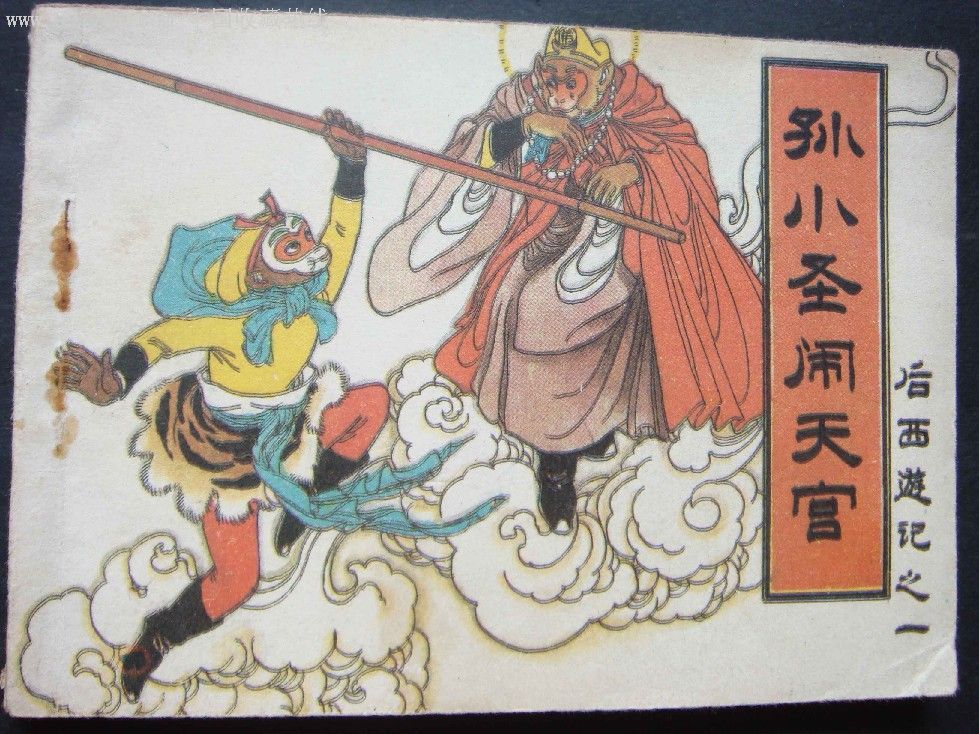
The novel is set two hundred years after the original and follows the adventures of Sun Wukong’s spiritual descendant Sun Luzhen (孫履真, “Monkey who Walks Reality”) (fig. 2). He too learns the secrets of immortality and causes havoc in heaven, before being tasked to protect the historical monk Dadian (大顛, 732-824) on a similar journey to India. The two are accompanied by the son of Zhu Bajie, Zhu Yijie (豬一戒), and the disciple of Sha Wujing, Sha Zhihe (沙致和). I did not include Luzhen in the main list as he is born from a stone in the same fashion as the original Monkey King (see Liu, 1994).

Fig. 2 – “Small Sage Sun’s Havoc in the Heavenly Palace” (larger version). The cover to a modern manhua. Image found here.

4. Conclusion

The Monkey King has a total of eight children shared between two late-Ming novels, but only four are mentioned by name, and only two of these actually have parts in the respective stories. King Pāramitā is one of the Great Sage’s five sons born to Princess Iron Fan in A Supplement to the Journey to the West (1640). He is portrayed as a handsome, sword-wielding general whom Sun faces on the battlefield. His name references the Pāramitās (“perfections”), or the wisdom and merit-building virtues that Bodhisattvas master in their quest for Buddhahood. Monkey has three children in Journey to the South (c. 1570s to 1580s), including sons Jidu and Luohou and daughter Yuebei Xing. The latter is depicted as a grotesque monster with a magic skull weapon cable of harming even celestials. She uses it to defeat the rogue immortal Huaguang. Jidu and Luohou are respectively named after the lunar nodes Ketu and Rahu, two of the Nine Planets from Hindu astrology. Yuebei is named after a shadowy planet representing the lunar apogee, which counts among the Eleven Luminaries of East Asian astrology. Ancient Xixia art sometimes depicts them as a woman or man bearing a sword and a severed head. The feminine iconography appears holding a skull in a novel from the 16th-century.

An honorable mention is Sun Luzhen from Later Journey to the West. He is a stone-bone monkey who follows in his spiritual ancestors footsteps by attaining immortality, causing havoc in heaven, and later protecting a holy monk on the journey to India.


Update: 04-04-22

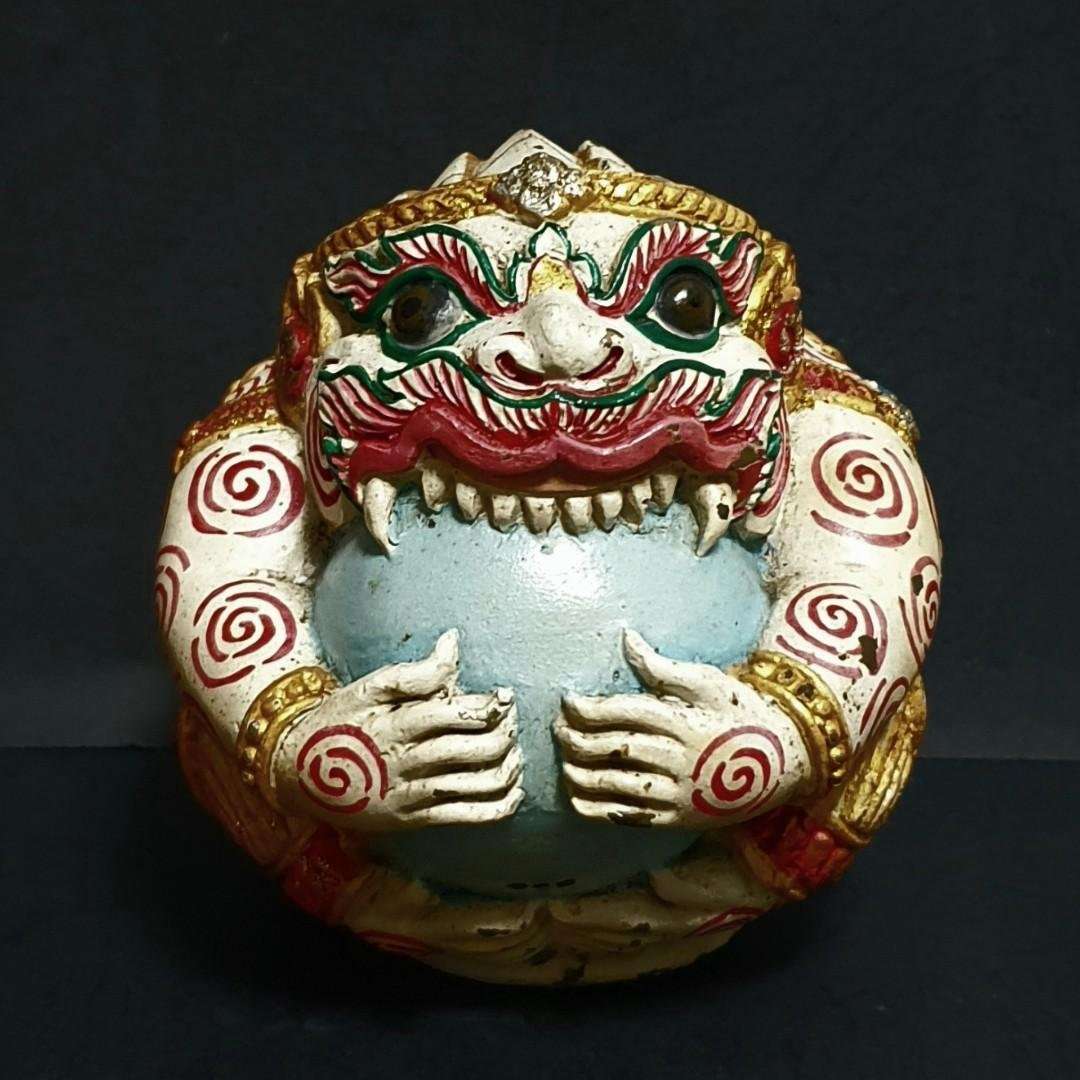
Back in November 2021, I made a post on twitter about a Rahu amulet that a collector friend of my was selling (and later sold). The deity is generally portrayed as a sharp-toothed, giant-mouthed monster devouring the moon. This piece is carved in a similar manner but Rahu is instead patterned after Thai depictions of Hanuman (fig. 3). I imagine his association with the monkey god is based on the latter’s attempt to eat the sun in his youth. 

Fig. 3 – The front of the Hanuman-like Rahu amulet (larger version).

Notes:

1) See Wu & Yu, 2012, vol. 3, p. 129.

2) This statement of course overlooks the conception and birth of the couple’s son Red Boy (Hong haier, 紅孩兒). But King Paramita might be referring to the Bull Demon King’s long absence while living with his mistress.

3) This pun plays out in chapter 14 of Journey to the West when an old patron remarks on Monkey’s monstrous appearance:

“Though you [Tripitaka] may be a Tang man,” the old man said, “that nasty character is certainly no Tang man!” “Old fellow!” cried Wukong in a loud voice, “you really can’t see, can you? The Tang man is my master, and I am his disciple. Of course, I’m no sugar man or honey man! I am the Great Sage, Equal to Heaven!” (Wu & Yu, 2012, vol. 1, p. 312).

Thank you to Irwen Wong for reminding me of this passage.

4) I’m indebted to Jose Loayza for bringing this to my attention.

5) To my knowledge, the only English translation available is this amateur version by Panying Zhao. Thank you to Ronni Pinsler for bringing it to my attention.

6) Thank you to Dr. Jeffrey Kotyk for confirming the astrological connection.

7) Sun, Moon, Mars, Mercury, Jupiter, Venus, Saturn, Rahu, and Ketu (Gansten, 2009).

8) These include the aforementioned Nine Planets (see note #6 above), Yuebei, and another shadowy planet called Ziqi (紫氣/紫炁; “Purple Mist”) (Hart, 2010, p. 145 n. 43; Kotyk, 2017, p. 60). Engravings of the Eleven Luminaries appear on Zhu Bajie’s battle rake (Wu & Yu, 2012, vol. 1, p. 382). See also note #10 on the linked article.

Sources:

Dong, Y., Lin, S. F., & Schulz, L. J. (2000). The Tower of Myriad Mirrors: A Supplement to Journey to the West. Ann Arbor: Center for Chinese Studies, The University of Michigan.

Gansten, M. (2009). Navagrahas. In K. A. Jacobsen (Ed.), Brill’s Encyclopedia of Hinduism (Vol. 1) (pp. 647-653). Leiden: Brill.

Hart, R. (2010). The Chinese Roots of Linear Algebra. United States: Johns Hopkins University Press.

Kotyk, J. (2017). Astrological Iconography of Planetary Deities in Tang China. Journal of Chinese Buddhist Studies, 30, 33-88), Retrieved from https://chinesebuddhiststudies.org/previous_issues/jcbs3002_Kotyk(33-88)_e.pdf

Liu, X. (1994). The Odyssey of the Buddhist Mind: The Allegory of the Later Journey to the West. Lanham, Md: University Press of America.

Buswell, R., & Lopez, D. (2014). The Princeton Dictionary of Buddhism. Princeton University Press.

Wu, C., & Yu, A. C. (2012). The Journey to the West (Vol. 1-4). Chicago, Illinois: University of Chicago Press.

Yu, X. (n.d.). Nanyouji: Huaguang sanxia Fengdu [Journey to the South: Huaguang goes to the Underworld Three Times]. Retrieved from https://ctext.org/wiki.pl?if=gb&chapter=506975&remap=gb#%E5%8D%8E%E5%85%89%E4%B8%89%E4%B8%8B%E9%85%86%E9%83%BD

Watch Your Step: The Influence of Journey to the West on the “Ashiarai Yashiki” Yokai Story of Edo-Period Japan

Last updated: 07-26-2023

The Journey to the West (Xiyouji, 西遊記, 1592) story cycle has been popular in East Asia for nearly a millennium. Written and pictorial evidence points to it emerging in China by at least the 11th-century. Tales of the Tang Monk and his animal companions were well-regarded in Korea by at least the 14th-century (see here and here). I’m not sure when the story first arrived in Japan, but it received piecemeal translations starting in the 18th-century, and the first complete version was finished by 1835. [1] According to Shi (as cited in Chien, 2017), these translations “had a tremendous impact of spreading the story of Xuanzang far and wide in Japan” (p. 22).

Journey to the West came to influence all sorts of Japanese media (one example). In this article, I would like to focus on a lesser known Edo-period folktale from the Seven Wonders of Honjo (Honjo Nanafushigi, 本所七不思議) [2] called the “Foot Washing Manor” (Ashiarai Yashiki, 足洗邸; あしあらいやしき). 

1. The “Foot Washing Manor”

The story tells of a filthy, titanic foot that plagues a samurai night after night. Matthew Meyer kindly gave me permission to reproduce his version of the story, as seen on his website yokai.com:

Long ago lived a hatamoto (a high-ranking samurai) named Aji no Kyūnosuke. One night at his manor in Honjo, a loud, booming voice was heard heard. It echoed like thunder:

“WAAASH MYYY FOOOOOOT!”

Just then there was a splintering crack, and the ceiling tore open. An enormous foot descended into the mansion. The foot was covered in thick, bristly hair, and it was filthy. The terrified servants scrambled to gather buckets, water, and rags. They washed the foot until it was thoroughly clean. Afterwards, the giant foot ascended up through the roof and disappeared.

The following night, and every night thereafter, the same thing occurred. A booming voice would demand its foot be washed. A giant foot would crash through the roof. And the dutiful servants would wash it clean.

A few nights of this was all that Aji no Kyūnosuke could take. He ordered his servants not to wash the foot anymore. That night, the foot crashed through the ceiling and demanded to be washed as usual. When it was ignored, it thrashed around violently, destroying vast swaths of the mansion’s roof in the process.

Kyūnosuke complained to his friends about the nightly visitor and the destruction it was causing. They were very interested. One of them wanted to witness the event so badly that he offered to swap mansions with Kyūnosuke, and Kyūnosuke quickly agreed. However, after his friend moved in, the giant foot never appeared again (Meyer, n.d.).

This story shares many parallels with an event from chapter 97 of Journey to the West.

Fig. 1 – “The Foot Washing Mansion” (足洗邸) by Utagawa Kuniteru (larger version).

2. The Monkey King’s Giant Foot

For context, the four monks are framed for the theft and murder of a rich layman who had originally hosted them for a month in the Bronze Estrade Prefecture (Tongtai fu, 銅臺府) of India. Sun Wukong captures the real perpetrators but is forced to release the bandits for fear that Tripitaka will chant the band-tightening spell for killing them. However, imperial troops later capture the monks with the stolen items, making them look guilty. After allowing Tripitaka to be tortured (fulfilling one of the 81 predestined tribulations), Monkey escapes from the prison at night to affect his master’s release.

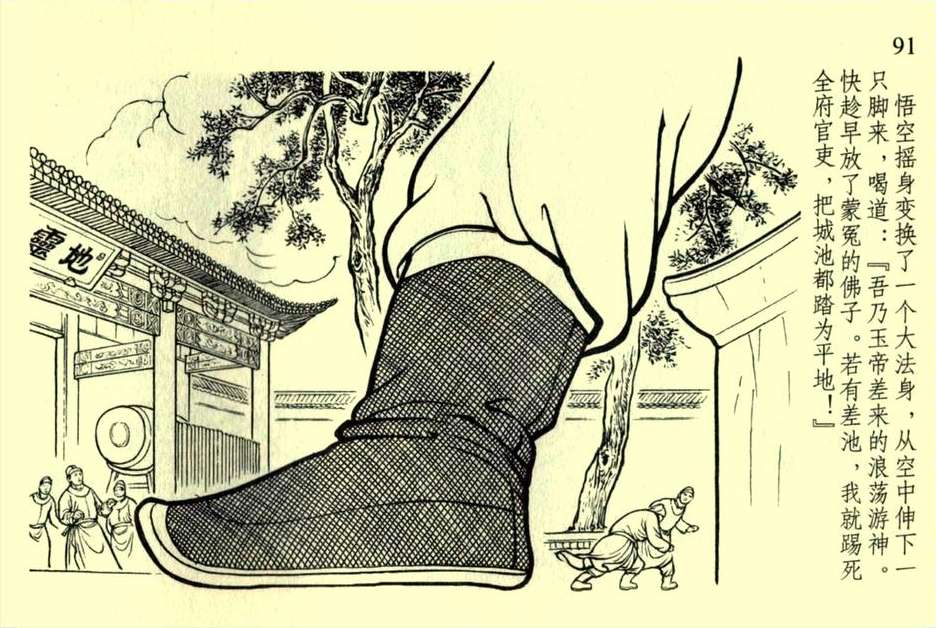
First, he imitates the voice of the slain layman at his wake and threatens heavenly retribution if his widow, the person who framed the monks, doesn’t recant her false claims. Second, he imitates the voice of the deceased uncle of the city magistrate who had imprisoned them and again threatens heavenly retribution if the official doesn’t reexamine the case. And third, at dawn he appears as a giant, disembodied foot (fig. 2) before the district-level magistrates and threatens to stomp the city and surrounding area into oblivion as heavenly retribution if they don’t put pressure on their superior to free his master:

Pilgrim flew out of the hall, and he found that it was beginning to grow light in the east. By the time he reached the Numinous Earth District [Di ling xian, 地靈縣], he saw that the district magistrate had already seated himself in the official hall. “If a midge speaks,” thought Pilgrim to himself, “and someone sees it, my identity may be revealed. That’s no good.” He changed, therefore, into the huge magic body [da fa shen, 大法身]: from midair he lowered a giant foot, [3] which completely filled the district hall. “Hear me, you officials,” he cried, “I’m the Wandering Spirit [Langdang youshen, 浪蕩遊神] sent by the Jade Emperor. I charge you that a son of Buddha has been wrongfully beaten in the jail of your prefecture, thus greatly disturbing the peace of the deities in the Three Regions. I am told to impart this message to you, that you should give him an early release. If there is any delay, my other foot will descend. It will first kick to death all the district officials of this prefecture. Then it will stamp to death the entire population of the region. Your cities finally will be trodden into dust and ashes!”

All the officials of the district were so terrified that they knelt down together to kowtow and worship, saying, “Let the noble sage withdraw his presence. We will go into the prefecture at once and report this to the magistrate. The prisoner will be released immediately. We beg you not to move your foot, for it will frighten these humble officials to death.” Only then did Pilgrim retrieve his magic body. Changing once more into a midge, he flew back inside the jail through the crack between the roof tiles and crawled back to sleep in the rack (Wu & Yu, 2012, p. 335-336).

行者又飛出來看時,東方早已發白。及飛到地靈縣,又見那合縣官卻都在堂上。他思道:「蜢蟲兒說話,被人看見,露出馬腳來不好。」他就半空中改了個大法身,從空裡伸下一隻腳來,把個縣堂屣滿。口中叫道:「眾官聽著:我乃玉帝差來的浪蕩遊神,說你這府監裡屈打了取經的佛子,驚動三界諸神不安,教我傳說,趁早放他;若有差池,教我再來一腳,先踢死合府縣官,後屣死四境居民,把城池都踏為灰燼。」概縣官吏人等慌得一齊跪倒,磕頭禮拜道:「上聖請回。我們如今進府,稟上府尊,即教放出。千萬莫動腳,驚諕死下官。」行者才收了法身,仍變做個蜢蟲兒,從監房瓦縫兒飛入,依舊鑽在轄床中間睡著。

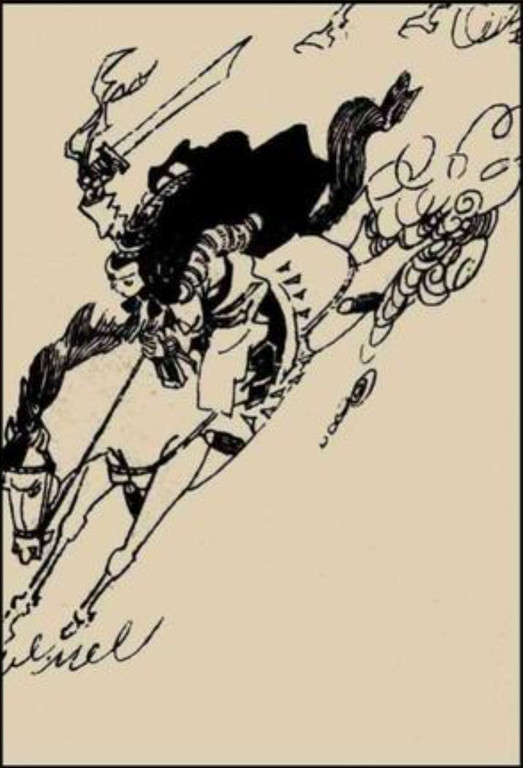
Fig. 2 – A modern manhua depicting Monkey’s giant foot confronting the district-level magistrates (larger version). Comic found here. While the image shows Sun wearing shoes, the original Chinese doesn’t say whether are not his foot is covered.

3. Comparison

Both stories involve a single, giant foot threatening high-ranking members of society within the confines of their living or working quarters. The former is a samurai, while the latter are district-level magistrates. The threat involves death and the destruction of property. Danger looms over the Samurai’s household as the monstrous foot demands cleaning, and when its wants are ignored, it destroys part of the building in a fit of rage. Monkey, on the other hand, threatens to stomp everything (people and buildings) into oblivion if his demands for Tripitaka’s emancipation are not met. Also, the Japanese tale refers to the foot being “covered in thick, bristly hair” (Meyer, n.d.). This may be a reference to a furry monkey’s foot.

Now, someone might question what foot washing and release from prison have to do with each other. The two don’t appear to be related at all, but Meyer (n.d.) explains:

“[W]ashing your feet” is also a Japanese idiom for rehabilitating a criminal. A culprit whose ‘feet have been washed’ can be said to have paid his debt to society.

This is indeed an actual ceremony performed by criminals wishing to cleanse themselves of their negative past and reenter society (Clark, 1994, pp. 122-123). Therefore, both concepts are intimately related. Someone released from prison can be said to be rehabilitated, and this again is symbolized by said foot washing ceremony. Therefore, the monster in the Japanese tale is likely demanding that the Samurai do his part to help release or pardon a prisoner just like the Journey to the West episode.


Update: 04-09-23

The final act of Journey to the West: Conquering the Demons (Xiyou: Jiangmo pian, 西遊·降魔篇, 2013) includes a trio of demon hunters looking to defeat the Monkey King. One is a seemingly crippled old man who hobbles around on a crutch because of an underdeveloped right leg. But when the time comes, he uses qi energy to grow the appendage to giant proportions, calling it his “Heaven-Destroying Foot” (Tiancan jiao, 天殘脚). 

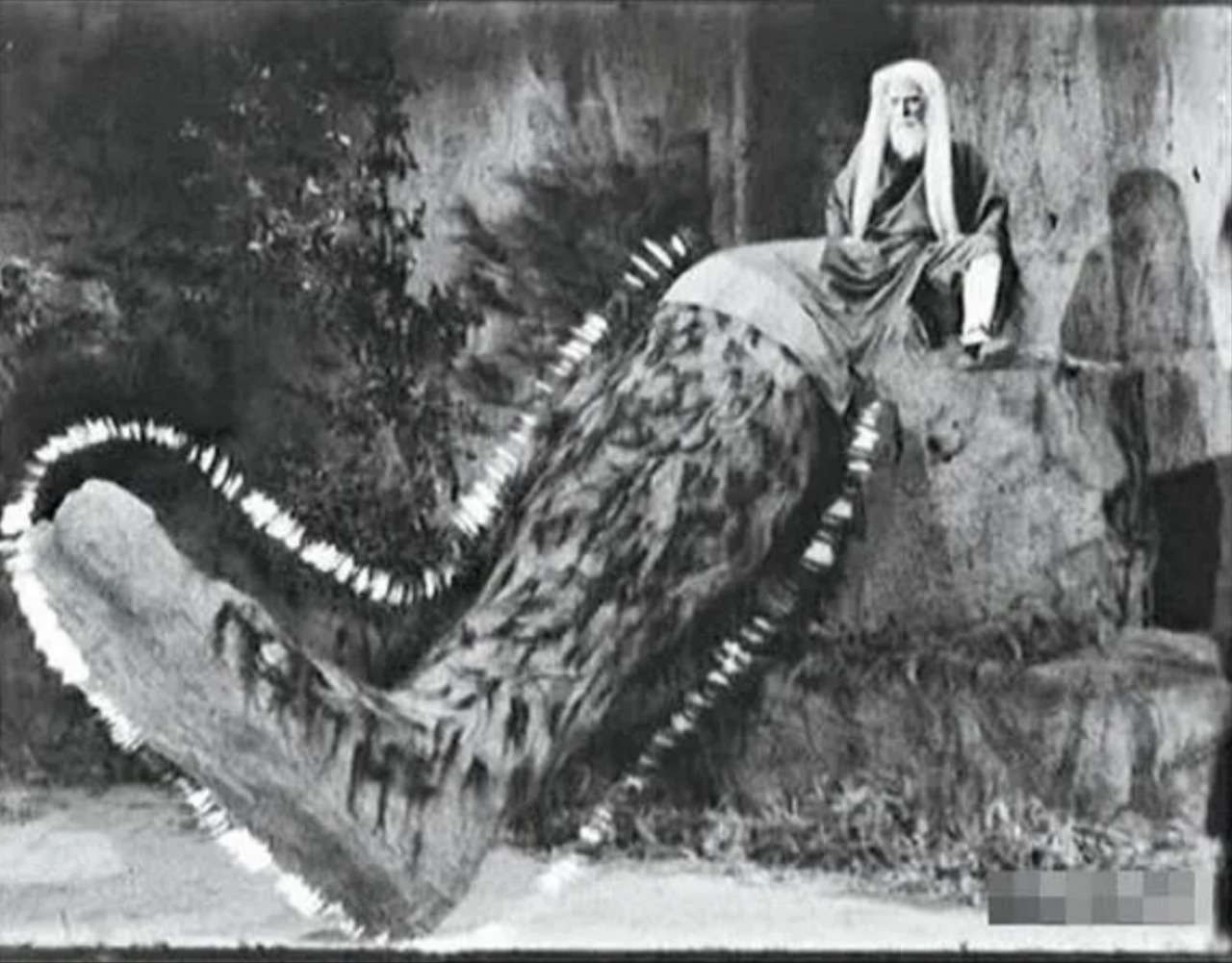
This character’s look and skill were copied directly from an HK martial arts film from 1965 commonly known in English as The Furious Buddha’s Palm (Rulai shenzhang nusui wanjian men, 如來神掌怒碎萬劍門; lit: “The Buddha Spirit Palm Shatters the 10,000 Sword Sect”). During the final battle, the main villain “Iron-Faced Asura” (Tiemian xiuluo, 鐵面修羅, played by Shih Kien) uses the same method to produce a giant foot. But what’s interesting for my purposes is that it appears to be covered in coarse hair like a primate (fig. 3).

A single, giant, destructive foot covered in hair sounds familiar doesn’t it? I wonder if this martial skill was influenced by the JTTW episode. This connection was first suggested to me by Jose Loayza (Twitter). A big thank you to him.

Note: A few hours after adding this update, it dawned on me that the “Buddha Spirit Palm” (Rulai shenzhang, 如來神掌) technique is used at the end of the film to combat the giant, monkey-like foot. This of course brings to mind the episode in JTTW when the Buddha defeats Sun Wukong with his palm by transforming it into Five Elements Mountain.)

Fig. 3 – A movie still of the Iron-Faced Asura summoning his hairy “Heaven-Destroying Foot” (larger version). Image found here.


Update: 07-26-23

A woodblock print showing Monkey’s titanic leg from the first complete Japanese translation of JTTW.

Fig. 4 – Sun’s giant foot (larger version). 

Notes:

1) The 18th-century translator Nishida Korenori (西田維則, d. 1765; penname: Kuchiki sanjin, 口木山人) began publishing Japanese translations of stories from Journey to the West in 1758, ultimately publishing a total of 26 chapters before his death. Others picked up where he left off, including Ishimaro Sanjin (石麻呂山人) (ch. 27-39 and later 40-47), Ogata Teisai (尾方貞斎) (ch. 48-53), and Gakutei Kyuzan 岳亭丘山 (ch. 54-65). This incomplete version, known as The Popular Journey to the West (Tsuzoku saiyuki, 通俗西遊記, 1758-1831) was published in five instalments over 31 volumes. The first complete version of the novel, The Illustrated Journey to the West (Ehon Saiyuki, 繪本西遊記), was published a few years later in 1835 (Tanaka, 1988, as cited in Chien, 2017, p. 21). 

2) This page notes Honjo is “modern day Sumida ward in Tokyo”.

3) Yu (Wu & Yu, 2012) translates this as “leg” (p. 335), but the original Chinese says “foot” (jiao, 腳). I’ve corrected this throughout the quote.

Sources:

Chien, P. (2017). A Journey to the Translation of Verse in the Five English Versions of Xiyouji [Unpublished Master’s dissertation]. National Taiwan Normal University. Retrieved from http://rportal.lib.ntnu.edu.tw/bitstream/20.500.12235/95894/1/060025002l01.pdf

Clark, S. (1994). Japan, a View from the Bath. Germany: University of Hawaii Press.

Meyer, M. (n.d.). Ashiarai yashiki. Yokai.com. Retrieved October 16, 2021, from https://yokai.com/ashiaraiyashiki/.

Wu, C., & Yu, A. C. (2012). The Journey to the West (Vol. 4) (Rev. ed.). Chicago, Illinois: University of Chicago Press.