Qitian Dasheng Monkey King Temples in Taiwan

Last updated: 03-14-2021

Temple Count: 14

Did you know that Sun Wukong (孫悟空), the immortal monkey hero from the great Chinese classic Journey to the West (Xiyouji, 西遊記, 1592), has his own religion? He is mainly worshiped as the “Great Sage Equaling Heaven” (Qitian dasheng, 齊天大聖) in southern China, Taiwan, and Southeast Asian countries like Malaysia, Singapore, and even Thailand and Vietnam.

I recently returned from a trip exploring Great Sage temples in northern and central Taiwan. I’ve decided to mirror a former article by creating a list of Monkey King temples that I’ve visited on the island. This should not be considered comprehensive. I intend to update the article as I visit new locations. I will divide the list according to the closest city/municipality and provide the address if possible. If I’ve already written an article about a particular location, I will add a link to the name.

(Note: Make sure to call each temple ahead of time to learn about the best travel route. Google is not always the most accurate in regards to traveling on foot in the countryside.)

Table of Contents

I. Jilong (Keelung)

1) Shengji Gong (聖濟宮) – 1949

Address: 202基隆市中正區中船路112巷30弄95號

I didn’t get any information about the temple during my visit as the caretaker appeared to be mute (or just didn’t want to talk to me). Online information states that the temple was built in 1949. Legend has it that the Great Sage saved villagers from rampant fires plaguing Keelung at the time. Like Yilan’s Wujian Ziyu Temple (see below), Shengji’s Great Sage and his army of monkey soldiers are portrayed as martial monks (wuseng, 武僧) with a golden headband and long hair. The alcove housing his statue is called the Shuilian Grotto-Heaven (Shuilian dongtian, 水濓洞天) after Monkey’s home the “Water Curtain Cave” (Shuilian dong, 水簾洞) on the Mountain of Flowers and Fruit. He is flanked on his left and right by Shennong (神農) and Kai Zhang Shengwang (開漳聖王), respectively

Pictures:

https://drive.google.com/drive/folders/0Bwi3jyIV3-OhflAzUy1vSHp2aC0wTExPbjRMV2FzX1pzZWlyd3RHM0hJYWpJc3B2RlM3Ykk?resourcekey=0-twvNaHcJLHXWU4JH05PtUg&usp=drive_link

2) Qitian Dasheng Miao (齊天大聖廟) – Unknown

Address: 203基隆市中山區中山二路89巷31號

No caretakers were present at the time of my visit, so I was unable to ask questions about history or names. All statues were locked inside of a glass display case, along with a blue booklet that caught my eye. It was titled The Great Sage Equaling Heaven’s True Scripture of Awakening People and Enlightening the World (Qitian Dasheng xingren jueshi zhenjing, 齊天大聖醒人覺世眞經). Like in Shengji and Wujian Ziyu Temples, the Great Sage and his monkey army are depicted as martial monks. Also like Shengji, he is flanked, this time on his left, by Kai Zhang Shengwang. He is flanked on his right by Fude Zhengshen (福德正神).

Pictures:

https://drive.google.com/drive/folders/0Bwi3jyIV3-OhflJtdTZya3lrY01HZVFfTmpIYlRpaF8yNHlTTFdCeUtnRlY3WE9kQzVjODA?resourcekey=0-D67c2xakNujE-s67mqVckA&usp=sharing

II. Taipei

1) Shilin Zheng’an Gong (士林正安宮) – circa 1990

Address: 111台北市士林區士東路2巷5號

The Zheng’an Temple of Shilin [1] is definitely the smallest Great Sage house of worship that I’ve yet visited. It appears to be a small, open-front store/apartment unit that has been converted into a temple. It recognizes at least seven Great Sages, each with his own name and purpose. I’m still gathering information on the temple, so I will post their names at a later date. While most such temples have one or two spirit-mediums, Zheng’an has an astounding seven, each of whom reports to a respective Great Sage. During special occasions, the spirit-mediums perform self-mortification with swords, axes, swordfish noses, spiked clubs, and spiked balls.

I had the pleasure of joining the temple on a pilgrimage to the south of Taiwan back in November of 2020. I was even blessed with the opportunity to help carry the Third Prince’s palanquin, which led the way for a much larger vehicle containing Zheng’an’s numerous Great Sage statues. I’ll write more about this in the future.

Pictures:

https://drive.google.com/drive/folders/0Bwi3jyIV3-OhfkY1VDdRUkNfMFdzTlgzdWZvUW5IZTNfN2NJMmdhRzFocmdaMWJmYWQ5Tjg?resourcekey=0-vTwI3jOGf6nQgFCwiL5Wlg&usp=sharing

2) Shuilian Gong (水濂宮) – Unknown

Address: 108台北市萬華區環河南路一段344號

The temple attendants were unable to give me any history on the temple. But I did learn that they worship a trinity: “Great Sage Sun” (Sun Dasheng, 孫大聖), the large central figure (image 1 (27)); the “Black Great Sage” (Hei Dasheng, 黑大聖), the small figure holding the gourd and whip (image 1 (34)); and the “White Great Sage” (Bai Dasheng, 白大聖), the small figure shielding his eyes and holding a staff (image 1 (42)). These color-coded names remind me of the red, white, and black-faced Great Sages from Fujian, the original home of Monkey’s religion. The temple houses many monkey god statues apart from the trinity, likely soldiers. I’ll return to get more info and better pictures. The soot black figures and bright clothing make it hard to get detailed photos.

Pictures:

https://drive.google.com/drive/folders/0Bwi3jyIV3-OhfkNJNlVLaXhUdW5idGMzaElNbjZDNU0xSFM3TVhUdkpZeFBvbGJMZEpsLUE?resourcekey=0-uTyI6aTdwRlh72AJb1z59A&usp=drive_link

III. Xinbei (New Taipei)

1) Qitian Dasheng Dian (齊天大聖殿) – circa 2000

Address: 249新北市八里區渡船頭路9號

I was told by the temple’s ritual master that she received a religious vision from the Great Sage to move from Gaoxiong in the south and look for land with good fengshui for a temple. After her third move, she founded her temple in the mountainous region of Bali. While the temple has several monkey statues, each is considered a different aspect of the singular “Lord Great Sage” (Dasheng ye, 大聖爺) or “Great Sage Patriarch” (Dasheng zushi, 大聖祖師).

The area behind the temple features a garden with a colorful, life-sized statue of the Great Sage seated on a throne. He holds a peach of immortality in one hand and his staff in the other. His throne rests on an elevated rock outcropping painted with the characters for the “Mountain of Flowers and Fruit” (Huaguo shan, 花菓山). A series of concrete steps laid within the folds of the rocks takes you to a private heaven further into the mountain with flowers and guava, papaya, banana, and tangerine crops. It’s a great experience.

Be forewarned: The route that Google told me to walk from the bus stop was NOT reliable. My GPS took me through a neglected cemetery up the side of a mountain. I had to cut a path through the forest, jump streams, and climb rocks before I finally arrived all sweaty and dirty. The temple personnel were amazed that I made such a trip because the route was completely unnecessary. They told me of a road leading directly to the temple! Apparently my GPS showed me the most direct route instead of the slightly longer, yet far more practical one. I highly suggest walking from the foot of Duchuantou Rd. (渡船頭路) and following the signs to the temple.

On the bright side, the caretakers were so thrilled to learn of my great interest in their god that they treated me to tea, fruit, and snacks. They are very welcoming people.

Pictures:

https://drive.google.com/drive/folders/0Bwi3jyIV3-OhfnN2amU5WmtzSEg1akt4UXRyaEYxSVB0ei00Nk84VHJDbk1TZ2o5WThleVU?resourcekey=0-E3rHR884MaSFmXdBuizoiQ&usp=sharing

2) Banqiao Yunsheng Gong (板橋雲聖宮) – Unknown

Address: 220新北市板橋區富山街84號

This temple was closed when I visited. I had to shoot pictures through two sliding glass doors. It is very small, possibly as small or even smaller than Zheng’an Temple in Taipei.

Pictures:

https://drive.google.com/drive/folders/0Bwi3jyIV3-Ohfk90MC1wUnRXQzhlWGVUNjdwTzB0T1NQc285MXF4cmFHVUc5VHlrWUFuOFE?resourcekey=0-7E48uhiHgEPXaihd35mbAg&usp=sharing

3) Qitian Dasheng Miao (齊天大聖廟) or Qitian Dasheng Ye Miao (齊天大聖爺廟) – Unknown, possibly new

Address: 238新北市樹林區佳園路一段41巷6號

The caretaker told me that the temple had not yet been consecrated and therefore wouldn’t let me take any pictures inside. However, a Chinese comment on Google says the temple “isn’t open to the outside world,” suggesting that it’s closed to the public. Based on what little I could see, the building unit appears to be someone’s home/business/personal altar. Rows and rows of god statues packaged for sale lined shelves against a back wall.

IV. Yilan

1) Wujian Ziyu Si (五間紫雲寺) – 1960

Address: 263宜蘭縣壯圍鄉大福路三段449號

Legend has it that around 1899 a man found a monkey-shaped stone and enshrined it in a thatched shed. This was eventually converted to a temple a few years later. It was destroyed by a typhoon in 1960 but subsequently rebuilt. The temple appears to recognize a trinity, with countless monkey soldiers beneath them, each portrayed as martial monks with a golden fillet and long hair. The Great Sage has two aspects: the “Martial Great Sage” (Wu Dasheng, 武大聖) (standing statues), who exorcises evil, and the “Civil Great Sage” (Wen Dasheng, 文大聖) (seated statues), who insures the safety of people and animals.

Pictures:

https://drive.google.com/drive/folders/0Bwi3jyIV3-OhfjlJSVc4QkVlSHRGYXR6OC13MDhuczdIVUsxTV9rcUxjMnZBQUFsMGFGbUk?resourcekey=0-X_tibNKz6SnI5YesVR_G1w&usp=sharing

V. Xinzhu (Hsinchu)

1) Shenglong Gong (聖龍宮) – 2016

Address: 310新竹縣竹東鎮中豐路三段187號

This temple is famous for its nine-meter-tall (29.52 ft.) statue of the Great Sage, which is apparently the tallest in Taiwan. I was told that it was shipped from Fuzhou, Fujian Province, China. The members appear to only revere a single monkey god, whom they call the “Buddha Great Sage Equaling Heaven” (Qitian Dasheng Foye, 齊天大聖佛爺). The smaller statue in front of the taller one was the original focus of worship at a devotee’s home prior to the building of the temple.

Pictures:

https://drive.google.com/drive/folders/0Bwi3jyIV3-OhfnNvdkJlTEdjZnFHVDRFZGxGNm1HRG1kNU10cWl6Vm1ubEdBTnVaSjJ1U1E?resourcekey=0-w6nIRnUrmb-cjOOSBuKiWQ&usp=drive_link

VI. Taizhong (Taichung)

1) Yusheng Si (玉聖寺) – 1959

Address: 436台中市清水區頂湳路73號

Records for the original temple apparently go back to the Xianfeng (1850–1861) period. According to legend, Yusheng was built at the behest of a beggar who revealed himself to be the Great Sage. The current house of worship was built in 1959. The members appear to recognize at least five Great Sages (maybe more). I was told that they don’t have individual names; though, the members may have been apprehensive to share secrets with a random foreigner. They just refer to them as “Lord Great Sage Equaling Heaven” (Qitian Dasheng Ye, 齊天大聖爺). One figure has a painted face similar to pestilence gods (wenshen, 瘟神). Perhaps this version of the Great Sage serves a similar purpose. It’s interesting to note that several statues are shown holding spiked balls like those used by spirit-mediums.

Pictures:

https://drive.google.com/drive/folders/0Bwi3jyIV3-OhfkpzTnI3YkU0LTh3N3ZYVDAzZWJwa1IwRF9LTUxtT3FhUGZaNjN6ejAxWGM?resourcekey=0-GUurvR7ZOmGtYI47Fm6fvA&usp=sharing

2) Wuji Tianyi Jiancha Gong Tiantan (無極天壹監察宮天壇) – Unknown

Address: 406台中市北屯區太原路三段1398號 (see below)

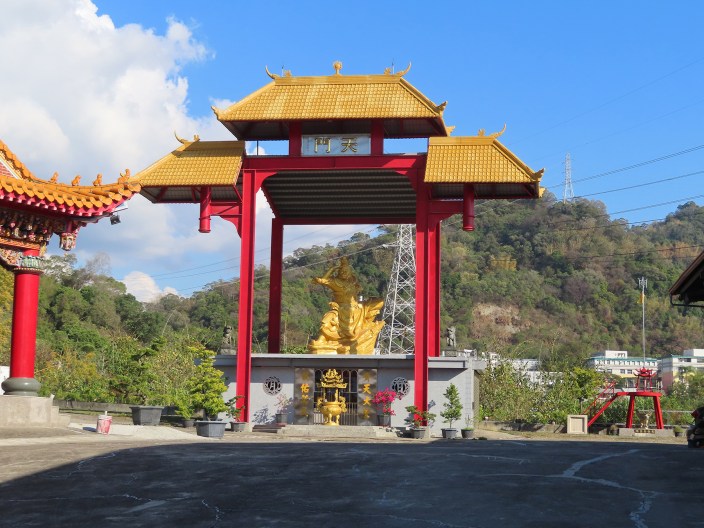
This temple was closed when I visited. I had to shoot pictures of their lovely statue over the gate. I’m guessing it’s four to five-meters-tall based on the ding censor in front. I plan to go back at a later time to get pictures of the temple interior.

I did see a black command flag (Hokkien: or leng ki; Ch: hei leng qi, 黑令旗) out front, which signifies that a spirit-medium is active in the temple.

Update: 04-24-21 – I was informed that this location is only used for particular festival days. The main temple is located at 404台中市北區富強街117巷17號.

Pictures:
https://drive.google.com/drive/folders/0Bwi3jyIV3-OhfjMtSE1oVU1Wd2pWZGpWWE94X09TZ3hjSXBPV0dlSGY5cEctYkI4TkJzbk0?resourcekey=0-uLDycsBAupb0qe1Lup7JgA&usp=sharing

VII. Beigang, Yunlin

1) Shengfo Tang (聖佛堂) – Unknown

Address: 651雲林縣北港鎮文化路198-1號

No attendants were present when I visited, so I couldn’t ask any questions about history or beliefs. The small temple appears to recognize three Great Sages, each represented with golden eyes. The larger central figure is depicted as a martial monk with long hair, while those to his left and right have animalistic, furry faces. Interestingly, the main statue is immediately flanked on both sides by a single wooden pole topped by a black or red Great Sage bag puppet, each depicted as a martial monk. A paper fan and two framed ink on paper paintings indicate the monkey god is referred to as the “Fighting Sage Buddha” (Douzhan sheng fo, 鬥戰聖佛). This is a variant of the deity’s lesser used title, the “Victorious Fighting Buddha” (Dou zhansheng fo, 鬥戰勝佛).

The main altar is flanked on the right by various Buddhist deities and on the left by Daoist gods.

The front of the building is adorned with two Great Sage spirit generals (shenjiang, 神將) [2], something I’ve never before seen but have heard of; as well as a large black command flag, indicating the presence of a tangki spirit-medium. A large, ornate spiked ball, like those used by mediums, was positioned on the offerings table between statues of San Taizi and bottles of rice wine.

The temple is located down the street from a small joss stick factory. It was interesting to see brightly-colored bundles and rolling trays of the sticks being aired out to dry.

Pictures:

https://drive.google.com/drive/folders/0Bwi3jyIV3-OhfjZfb2hpeDNMUnBqX3ZxemRtbDdSMl9tQnpfanlqY3Y1MGJrVi1OOVQ0bzg?resourcekey=0-AK1FYcermkK3wr44y8VntQ&usp=drive_linkhttps://drive.google.com/drive/folders/1qAIvC31izqKt49tTyQYSjxIOPx7T8P7D?usp=sharing

VIII. Chiayi (Jiayi)

1) Jisheng Gong (吉聖宮) – 1979

Address: 嘉義市林森東路691巷139弄65號

While an attendant with a thick Taiwanese accent told me the temple was “very, very old,” online information indicates that it was founded in 1979. Legend has it that Lord Guan sent the Great Sage to heal the head injury of a member of the Li (李) family, leading to their worship of the monkey god. (This suggests that Lord Guan is considered a superior of the Great Sage in Jisheng’s celestial hierarchy). The current Great Sage statue is apparently based on an original one that presided over the incense pot at a Lord Guan temple and was later kept in the Li family home. It sits in a man-made cave, along with other monkey figures and Buddho-Daoist gods, behind metal bars. It holds a banana leaf fan like that wielded by Lady Ironfan.

A large metal rod, a replica of the monkey god’s magic staff, is locked to a side wall when not in use by the temple’s spirit-medium. It is plastered with a paper talisman.

A hall to the right of the temple houses several spirit general costumes of various protector deities.

Pictures

https://drive.google.com/drive/folders/0Bwi3jyIV3-Ohfm5xaUF6WFU5TTZiTF90TkJVazBjbVNQaTJ6WXhhZHFkRkVNMElCWXZTblk?resourcekey=0-cUuC4t9sK9S4kBaUBYLDlA&usp=sharing

IX. Tainan

1) Wanfu An (萬福庵) – 1660s

Address: 700台南市中西區民族路二段317巷5號

Wanfu is touted as the oldest Qitian Dasheng temple on the island, originally serving as the home of an anti-Qing general’s wife during the Southern Ming (c. 1660s), which was later converted to a house of worship following her death. It was known for taking in orphans during the early-19th century. The temple recognizes a trinity of Great Sages, followed by a small handful in administrative positions, and finally a plethora of soldier monkeys. The highest-ranking member of the trinity is a 300-plus-year-old Fujianese stone statue called “Laying the Foundations Elder Great Sage” (Kaiji Da Dasheng, 開基大大聖). The temple has a single spirit-medium. But the last time I checked, he was training a disciple, his nephew.

Great Sage temples from all over Taiwan look upon Wanfu as a fount of pure energy, visiting every year to procure its incense ashes in order to replenish their spiritual armies. Spirit-mediums are thought to direct these soldiers in battle while possessed by the monkey god. I personally witnessed this ash ceremony during the Shilin Zheng’an Temple pilgrimage (as noted earlier). I saw at least three other temples waiting for their turn. I’m sure many more visited that day and the next.

Pictures:

https://drive.google.com/drive/folders/0Bwi3jyIV3-OhfldvbDFFdmlrWHNWNnFNeUhEY1hhTEhYaVdiUnRxS3VBZ2UtRDRwSkVTbms?resourcekey=0-NsUQkYFLqs_gC9-5onWgAw&usp=sharing

Notes:

1) Not to be confused with other Zheng’an Temples in Taiwan.

2) Large, bulky costumes that rest on a performer’s shoulders. They see out through holes in the chest. Such costumes are worn during religious processions, and the walking movement causes hinged arms to swing to and fro.

The Worship of Sun Wukong in 19th-century America

Last updated: 01-15-2022

I by chance happened upon an old magazine article that mentions the worship of Sun Wukong in 1892 San Francisco Chinatown. The piece is written by one Frederic J. Masters, D.D., a Methodist pastor who wrote extensively about the area’s Chinese community. Not surprisingly, the article is dripping with condescension towards Chinese religion, condemning the Great Sage’s worship as “the acme of absurdity and sinfulness” (Masters, 1892, p. 737).

Table of Contents

1. The Section About Monkey Worship

In the Spofford-alley temple are found the shrines of some twenty other gods and goddesses, the principal being the Grand Duke of Peace, the God of Medicine, and Pan Kung, a celebrated Prime Minister of the Sung Dynasty. The funniest discovery in this temple was that of Tsai Tin Tai Shing [Qitian dasheng, 齊天大聖]. He is a beatified monkey in the image of a man. Hatched from a bowlder [sic], this animal is said to have proclaimed himself king of the monkeys. At last he learned the language of men, and finding himself possessed of supernatural powers, he obtained a place among the gods. Such is the legend. Chinese idolatry thus reaches the acme of absurdity and sinfulness in the canonization of a monkey. Thoughts of Darwin’s descent of man at once flashed across our mind as we looked at this image. It was disappointing at one’s curiosity to find that the old temple keeper who cared more for a pipe of opium than for speculations in theology and anthropology could not tell us what part natural selection played in the evolution of Chinese deities, or whether monkey worship was the newest phase of Chinese ancestral worship. Finding him lamentably ignorant upon the great question of the descent of man, we astonished with him with a complete history of his monkey god.

There was an ape in the days that were earlier;
Centuries passed and his hair became curlier;
Centuries more and his tail disappeared,
Then he was man and a god to be feared (Masters, 1892, pp. 736-737).

2. Immigrant Worshipers

So what can we learn from this brief entry? Given the time, place, and use of Cantonese, the worshipers were most likely immigrants from Guangdong province. Refo Mason (1994) explains, “When news of the discovery of gold in California reached South China in 1849, thousands of labourers in Guangdong and Fujian provinces left their villages to seek work in the gum shan ([金山] ‘Gold Mountain’) … Emigration from South China to California…peaked in 1852, when 20,000 Chinese arrived in San Francisco” (p. 200). Monkey‘s adherents may have counted among these men or their descendants. Either way, belief in the Great Sage came with those who traveled from southern China to America.

Somebody please get Neil Gaimon on the phone and tell him that he can now include Monkey in American Gods (fig. 1). What do you think the character would look like? Maybe a short old man with a cane?

Monkey King Bust - American Gods - Instagram 1 - small

Fig. 1 – A photomanipulation of Sun Wukong above the title logo from the ongoing American Gods television show (larger version). By the author. The program is based on the 2001 novel of the same name.

2.1. Gangsters and Rebels?

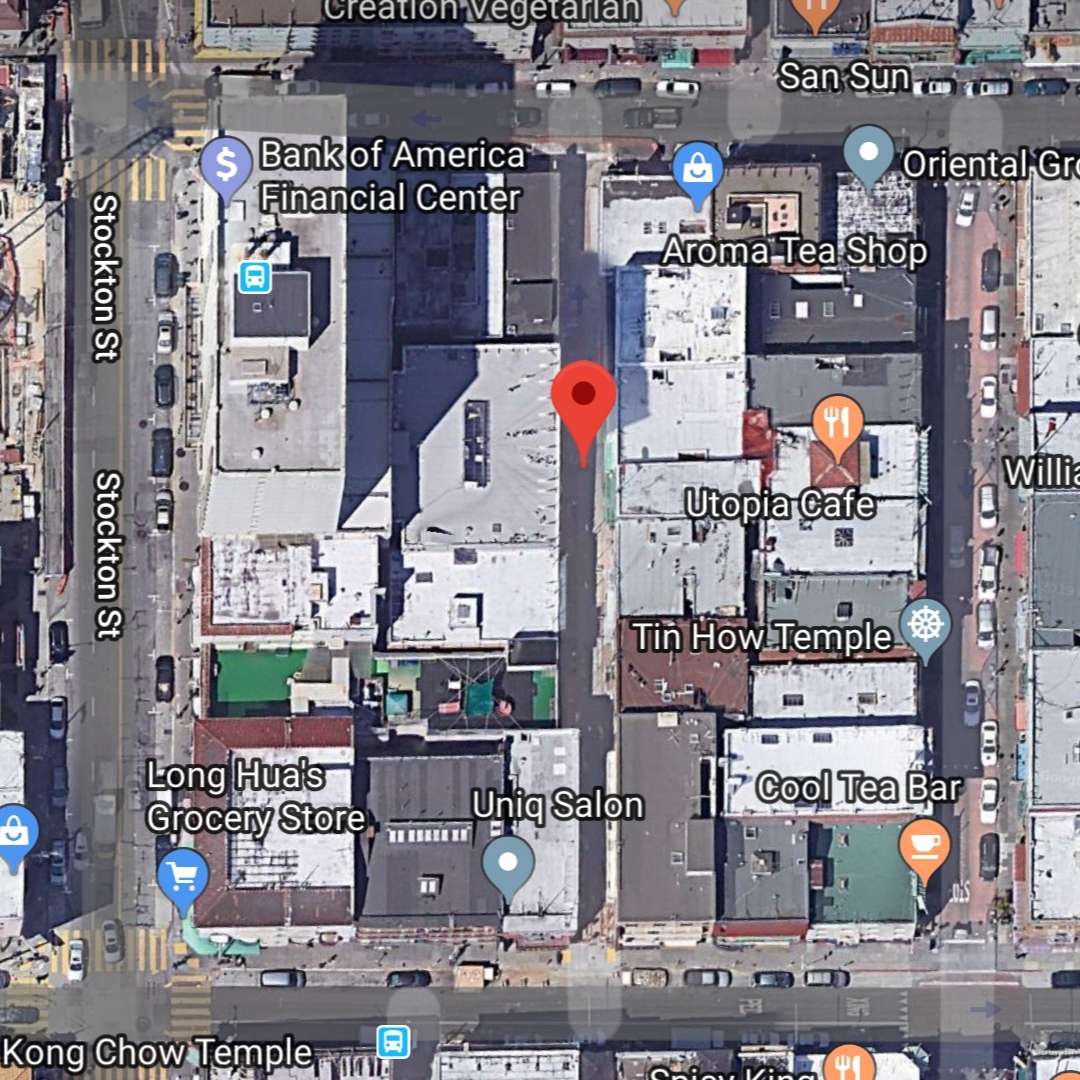
During the 19th century, Spofford Alley (fig. 2), where the temple housing the Great Sage shrine was located, was home to the Chee Kong Tong (Zhigong tang, 致公堂, “Chamber of High Justice Society,” a.k.a. the “Chinese Freemasons”), the secret Chinese society-turned-criminal organization running Chinatown’s illicit opium, gambling, and prostitution trade (Risse, 2012, p. 37). The Chee Kong Tong were originally an offshoot of anti-Manchu rebels who wanted to overthrow the foreign-ruled Qing dynasty (Cassel, 2002, pp. 218-219). [1] Therefore, Sun Wukong’s worshipers may have included gangsters and rebels. As mentioned in this article, the Great Sage was venerated by fighters of the Boxer Rebellion (1899–1901). This makes sense as the divine primate is famous for his rebellion against heaven in Journey to the West (Xiyouji西遊記, 1592).

Spofford Alley, home to 19th-century temple with Monkey King shrine - small

Fig 2 – A modern Google satellite image of Spofford Alley (larger version). It is only a few hundred feet long.


3. Updates

3.1. Location of Temple

Update: 01-15-2022

I was very happy to find an article called “Map of Temples in San Francisco’s Chinatown 1850s-1906” (Romaskiewicz, 2021). The author, a PhD student named Peter Romaskiewicz, has done a great service by scouring 19th and 20-century material and cross-referencing this with antique maps of Chinatown. The article has a list of over 20 temples/immigrant associations and their corresponding locations plotted on a map. This is great because it has allowed me to pinpoint the exact place where the Monkey King was worshiped in 1892 Chinatown!

Masters (1892) refers twice to temples on Spofford: 1) “[Guanyin’s] shrine is found up a dingy staircase on the southwest corner of Spofford alley and Washington streets” (p. 734); and 2) “In the Spofford-alley temple are found the shrines of some twenty other gods and goddesses…” (p. 736). Romaskiewicz (2021) shows that the Guanyin temple (#10) was located at the end of Spofford, while a different joss house belonging to the Chee Kong Tong (#9) was located in the middle of the street. I, therefore, assumed Monkey was worshiped at the Chee Kong Tong joss house because Masters’ (1892) second temple reference didn’t mention Guanyin. However, after writing Romaskiewicz, I learned that there were actually three joss houses on Spofford during the 19th century (one from an 1887 map is not listed). But most importantly, Masters (1982) was likely referring to the Guanyin Temple in both instances. That’s why he highlights “the shrines of some twenty other gods and goddesses…” (emphasis added) (Masters, 1892, p. 736), meaning that these icons were also found in the same location.

The Guanyin Temple (Guanyin miao, 觀音廟) was located at No. 60 on the corner of Spofford and Washington (fig. 3) (Romaskiewicz, 2021). I’m unsure if some form of it still exists in that location, but I do know from Google Maps that the old No. 60 is not the same as the current No. 60.

Romaskiewicz was kind enough to direct me to an 1883 brochure asking for funds to restore the temple. This shows that it was in use for some time.

Fig. 3 – The yellow star marks the location of the Guanyin Temple (larger version). Based on Romaskiewicz (2021). See this 1885 map

Notes:

1) Sun Yatsen, the “Father of modern China,” made contact with the Chee Kong Tong several times and even used their no. 36 Spofford Alley office as his own while raising money for his revolution in China (United States, 1993, pp. 45-46; Lum & Lum, 1999, p. 57).

Source:

Cassel, S. L. (2002). The Chinese in America: A history from Gold Mountain to the new millennium. Walnut Creek, CA: AltaMira Press.

Lum, Y. M., & Lum, R. M. K. (1999). Sun Yat-sen in Hawaii: Activities and supporters. Honolulu: Hawaii Chinese History Center.

Masters. F. J. (1892). Pagan Temples in San Francisco. In C.F. Holder (Ed.). The Californian illustrated magazine: June to November, 1892, vol. 2 (pp. 727-741). San Francisco, Calif.: Californian Pub. Co.

Refo Mason, S. (1994). Social Christianity, American feminism, and Chinese prostitutes: The history of the Presbyterian mission home, San Francisco, 1874-1935 In M. Jaschok and S. Miers (Ed.) Women and Chinese Patriarchy: Submission, Servitude, and Escape (pp. 198-220). Hong Kong: Hong Kong University Press.

Romaskiewicz, P. (2021, April 15). Map of Temples in San Francisco’s Chinatown 1850s-1906. Personal Site of Peter Romaskiewicz. Retrieved from https://peterromaskiewicz.com/2020/06/02/map-of-temples-in-san-franciscos-chinatown-1850s-1906/

Risse, G. B. (2012). Plague, fear, and politics in San Francisco’s Chinatown. Baltimore: The Johns Hopkins University Press.

United States. (1993). An introduction to organized crime in the United States. Washington, D.C.: Organized Crime/Drug Branch, Criminal Investigative Division.

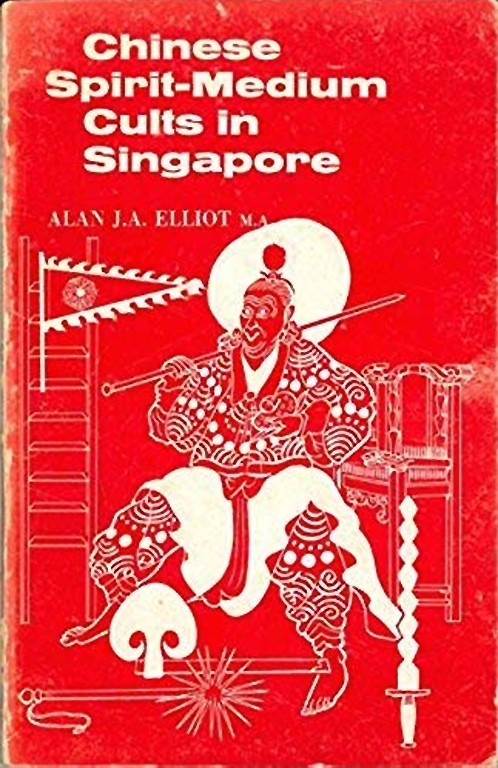
Archive #3 – PDF of Chinese Spirit-Medium Cults in Singapore (1955) by Alan J. A. Elliott

Here I present a PDF of Chinese Spirit-Medium Cults in Singapore (1955/1990) by Alan J. A. Elliott. The book contains a large chapter on the importance of spirit-mediums (Hokkien: Tangki, 童乩; Chinese: Jitong, 乩童; literally: “Divining Child”) in the worship of Sun Wukong. For those unfamiliar with spirit-mediums, I have quoted material from my article linked above:

They are believed to channel [the Great Sage’s] spirit to interact with believers, generally answering their questions, blessing them or their belongings with paper talismans, or prescribing medicine. On special occasions, they also perform a complex self-mortification ceremony […] The ritual serves several purposes. First, hacking, skewering, and poking the body with various weapons is considered a form of self-sacrifice. Second, the weapons that pierce the flesh are believed to imbue the mediums with spiritual power needed in their battle with demonic forces that pervade every corner of daily life. Third, the resulting blood is believed to have demonifugic properties, hence the reason it is smeared on paper talismans and clothing. Overall, the ritual is performed to exorcize evil spirits that cause bad luck and mental and physical illnesses.

Cover from the 1964 (2nd edition) (larger version). Note the prominence of the Monkey King.

I. Forward from the 1990 Edition

This account of Chinese spirit-medium cults describes in great detail an important aspect of the religion of overseas Chinese in Singapore. It is an historical study, since the field research was carried out over nearly two years in 1950 and 1951. It is historical for two reasons. One is that the highly personalized nature of many of these cults has meant that they are short-lived, emphemeral. The other is that in the forty years since the study was made the life of the Singapore Chinese has changed radically, and many of their ritual practices must have altered accordingly. But at the time this research was carried out, anthropological field studies of Chinese social institutions were rare, and this particular investigation was unique. Most studies of Chinese religion anywhere had been of a literary nature, concerning the ideas and practices of Confucianism, Buddhism, Taoism; very little information was available about how ordinary Chinese conducted their daily ritual affairs.

The significance of this study is not just focused on the past. It has contemporary relevance, and for a field far wider than Singapore alone. For anthropologists, enquiry into spirit-mediumship, shamanism, ecstatic religion, possession, has become a recognised part of the discipline, over a broad ethnographic range. But the general problems involved, of alternative personality, of apparent lack of sensitivity to external physical stimuli, of claims in the name of spirit to knowledge and authority not possessed by the human medium, can attract the attention of psychologists, psychiatrists, and all interested in the obscure and complex workings of the human mind. The issues raised involve ordinary people too, since they show how anxiety, uncertainty, fear, disappointment and greed seek assurance and resolution from some source deemed superhuman, even spiritual. The basic beliefs revealed by this study of Chinese spirit-mediumship are not confined to Chinese.

II. PDF Link


Disclaimer
:

This has been posted for educational purposes. No malicious copyright infringement is intended. Please support the official release.

Citation:

Elliott, A. J. (1990). Chinese Spirit-Medium Cults in Singapore. London: The Athlone Press. (Original work published 1955)

The Possible Origin of Wanfu Temple’s Multiple Great Sages

Last updated: 03-22-2026

The Wanfu Temple (Wanfu an, 萬福庵) of Tainan, Taiwan worships Sun Wukong in his guise as the Great Sage Equaling Heaven (Qitian dasheng, 齊天大聖). Most surprisingly, they recognize more than one Great Sage, each with his own function. These include a trinity, three in administrative positions, and an army of dozens of other Monkeys. In this article, I would like to explore the possible origins of this multifaceted pantheon.

Table of Contents

1. Possible Origins

1.1. The JTTW Zaju

The idea of multiple Great Sages goes back centuries to a Yuan-Ming zaju play by Yang Jingxian (杨景賢) titled Journey to the West (Xiyouji, 西遊記, “JTTW zaju” hereafter), which predates the similarly named novel (“JTTW” hereafter) by two hundred years. Scene nine sees Monkey introduce himself, his past misdeeds, and his family. He claims to be one of several siblings:

This small sage has five brothers and sisters: My elder sister is the “Venerable Mother of Mount Li” (Lishan Laomu, 驪山老母), my second sister is the “Holy Mother Wuzhiqi” (Wuzhiqi Shengmu, 巫支祇聖母), my older brother is the “Great Sage Equaling Heaven” (Qitian Dasheng, 齊天大聖), I myself am the “Great Sage Reaching Heaven” (Tongtian Dasheng, 通天大聖), and my younger brother is the “Third Son Shuashua” (Shuashua Sanlang, 耍耍三郎) (based on Dudbridge, 1970, p. 110). [1]

小聖弟兄、姊妹五人,大姊驪山老母,二妹巫枝祗聖母,大兄齊天大聖,小聖通天大聖,三弟耍耍三郎。

Astute readers will notice a discrepancy with the novel. Sun Wukong is referred to here as the Great Sage Reaching Heaven, while an older brother is known as the Great Sage Equaling Heaven. Sun (2018) suggests that the older brother is the result of confusing similar titles given to Monkey during the long history of the story cycle (pp. 44-45). It’s interesting to note, however, that the female siblings have their own history. The Venerable Mother of Mount Li (驪/黎山) was historically worshiped as a deity from at least the Song Dynasty (960–1279), and myths often associate her with the creation/flood-conquering goddess Nuwa (女媧) (Theobald, 2010; Yang & An, 2005, pp. 222-223). Wuzhiqi (also written 無支祁) is a monkey-like flood demon appearing in stories as far back as the Tang Dynasty (618–907) (Andersen, 2001). So, both sisters are associated with flooding.

1.2 JTTW – The “Sun Family”

The novel provides a possible answer to the mystery of the multiple Great Sages. After returning home to the Mountain of Flowers and Fruit in chapter two, Wukong tells his children about his new name:

“My surname is Sun,” replied Wukong, “and my religious name is Wukong.” When the monkeys heard this, they all clapped their hands and shouted happily, “If the great king is Elder Sun, then we are all Junior Suns, Suns the Third, small Suns, tiny Suns—the Sun Family, the Sun Nation, and the Sun Cave!” (Wu & Yu, 2012, vol. 1, p. 130)

悟空道:「我今姓孫,法名悟空。」眾猴聞說,鼓掌忻然道:「大王是老孫,我們都是二孫、三孫、細孫、小孫一家孫、一國孫、一窩孫矣!」

This would explain the army of monkey soldiers who do the bidding of the aforementioned trinity.

1.3 The Linshui Novel

Another Great Sage appears in the pious novel Pacification of the Demons of Linshui (Linshui Pingyao zhuan, 臨水平妖傳, c. 17th or 18th century; “The Linshui novel” hereafter). The narrative recounts the miraculous deeds and deification of Chen Jinggu (陳靖姑) (fig. 1), more commonly known as the Lady of Linshui (臨水夫人), a highly popular Fujian and Taiwanese protector goddess of pregnancy and children. The novel depicts the Cinnabar Cloud Great Sage (Danxia Dasheng, 丹霞大聖) as a red-furred, mulberry staff-wielding monkey who, just like Sun Wukong, stole heavenly peaches and survived a turn in Laozi’s furnace. He teams up with another demon to attack the goddess and her heavenly companion, but both are beaten back. The Great Sage is so badly burnt by a magic flaming pearl used by the companion that it takes an entire year for him to heal his wounds. One year later, he resumes his misdeeds and takes on the appearance of a young man, causing so much havoc that the real human is chased from his village. The young man calls on the goddess, who promptly captures the Great Sage and castrates him “in order, she says, to open to him the way of true asceticism stripped of desire, of true wisdom allowing him to obtain the ‘just fruits’, zhengguo [正果]” (Baptandier, 2008, p. 111). After being deprived of his manhood, the novel reveals the Cinnabar Cloud Great Sage to be the “double” of Sun Wukong. He goes on to become an agent of justice charged with conquering demons. [2]

Fig. 1 – A modern altar statue of the Lady of Linshui (larger version).

The Cinnabar Cloud Sage being Sun Wukong’s double is most likely based on the Six-Eared Macaque (Liu‘er mihou, 六耳獼猴) from JTTW chapters 56 to 58 (fig. 2 and 3). [3] This demon takes on Monkey’s form, much like the Cinnabar Cloud Great Sage does the young man in the aforementioned novel, and causes all sorts of trouble. When the twins seek the Buddha’s wisdom to tell one from the other, the Enlightened One reveals the fraud to be one of four supernatural primates, the other three being the intelligent stone monkey, the red-buttocked horse-monkey, and the long-armed gibbon. The demon attempts to flee but is eventually killed by Sun Wukong (Wu & Yu, 2012, vol. 3, pp. 112-116).

Fig. 2 (left) – An artist’s depiction of the six-eared macaque. Fig. 3 (right) – A production still of Sun Wukong fighting his evil double (video).

1.4. The Religious Trinity

A religious tradition in Fujian appears to borrow from both the Yuan-Ming zaju play and The Linshui novel to derive a trinity of familiar Great Sages. These are the red-faced Cinnabar Cloud Great Sage (丹霞大聖), the black-faced Great Sage Reaching Heaven (通天大聖), and the white-faced Shuashua Sanlang (耍耍三郎/爽爽三郎) (fig. 4) (Chinese Monkey God(s)?, n.d.; Wu, n.d.). Therefore, this plethora of Great Sages could have influenced the many venerated in Wanfu temple.

Fig. 4 – An example of the Three Great Sages from a Lady of Linshui temple (larger version).

2. Updates

Update: 04-21-18

Elliott (1955/1990) describes a Chinese medium in Singapore who channels two of five Great Sages.

According to the current version of the legend, for which no supporting authority can be found elsewhere, there are five Monkey Brothers who may appear when the shen [神, god] is invoked. Each is likely to appear for a number of years before handing over to another brother, unless for any special reason the others have to be consulted. The first Monkey Brother is the wisest and most quiescent of them all. When possessing the dang-ki [童乩, the medium] he can be identified by the manner in which he shades his eyes with his right hand while gazing into the distance. The second Monkey Brother is of fiercer temperament, and can be identified by the manner in which he scratches at his ears as a monkey would. He has a predilection also for eating fire and fruit. The third, fourth and fifth Monkey Brothers are more and more irascible, but there is no detailed knowledge concerning their characteristics since they have never yet appeared. So far it is only the second Monkey Brother who possesses the dang-ki, although the eldest brother is sometimes deferred to in difficult cases and may make a temporary appearance (p. 82).

This shows the concept of multiple Great sages is not restricted to Fujian or Taiwan.


Update: 04-24-18

Another possible avenue opens to us thanks to Monkey’s resemblance to the Chinese god Sire Thunder (Leigong, 雷公). Sun Wukong is compared to the weather deity numerous times throughout the novel (Wu & Yu, 2012, vol 3, p. 352, for example). The connection between the two is an old one, for two tales from the early Song Dynasty (960–1279) portray the thunder god as having the form of an ape with flashing, mirror-like eyes (Meulenbeld, 2007, p. 72). These sound very much like Sun Wukong’s fiery eyes and diamond pupils. Most importantly, tales from the same time period refer to the thunder deity having numerous brothers. Their attributes are similar to the aforementioned five Great Sages:

We are five brothers. If you want to hear the sound of thunder, only call Thunder the old, and Thunder two; then you will have an immediate response. But Thunder five is tough and hot-tempered; if there is no urgent business, you must not call him (Meulenbeld, 2007, p. 69).

The concept of five thunder brothers was solidified by the second half of the Song Dynasty and remains a common belief to this day (Meulenbeld, 2007).


Update: 03-22-26

It dawned on me that a story element from chapters 34 and 35 of the original novel might reference the aforementioned triad of divine brothers from religion and theater. The specific arc sees Monkey escaping capture three times, and in each instance, he presents himself as a brother come to rescue him/them. The following paragraph sums up the event nicely:

The little fiend dashed inside to make the report, saying, “Great King, there is a so-called Sun Pilgrim showing up outside our door.” “Worthy Brother,” said the old demon, deeply shaken, “that’s bad! We have stirred up a whole nest of pestilence! Look! The yellow-gold rope has caught a Pilgrim Sun, while the gourd has stored up a Grimpil Sun. How can it be that there is another Sun Pilgrim? It must be that they have several brothers and they have all arrived” (Wu & Yu, 2012, vol. 2, p. 133).

那小妖急入裡報道:「大王,門外有個甚麼行者孫來了。」老魔大驚道:「賢弟,不好了,惹動他一窩風了。幌金繩現拴著孫行者,葫蘆裡現裝著者行孫,怎麼又有個甚麼行者孫?想是他幾個兄弟都來了。」

These names require some explanation since wordplay is involved. I have used color-coding to make the subject easier to understand. As I note hereGrimpil Sun (Zhexing Sun, ) and Sun Pilgrim (Xingzhe Sun, ) are variants of Monkey’s religious name, Pilgrim Sun (Sun xingzhe, ). 

Notes:

1) The name of the youngest brother could be translated as “Shuashua, the third son” considering the god Erlang (二郎) is literally the “Second Son.” Shuashua is after all the third of three sons.

2) See chapter four in Baptandier (2008) for a complete description of the life and deeds of the Cinnabar Cloud Great Sage.

3) Anthony Yu (Wu & Yu, 2012) suggests that the concept of six ears “may have been derived from the common Buddhist saying, ‘The dharma is not to be transmitted to the sixth ear [i.e., the third pair or person] 法不傳六耳'” (vol. 3, p. 387 n. 7).

Sources:

Andersen, P. (2001). The Demon Chained Under Turtle Mountain: The History and Mythology of Chinese River Spirit Wuzhiqi. Berlin: G-und-H-Verl.

Baptandier, B. (2008). The Lady of Linshui: A Chinese Female Cult. Stanford, Calif: Stanford University Press.

Chinese Monkey God(s)? – What You Don’t Know. (n.d.). Retrieved from http://taoist-sorcery.blogspot.tw/2015/08/chinese-monkey-gods-what-you-dont-know.html

Dudbridge, G. (1970). The Hsi-yu chi: A study of Antecedents to the Sixteenth-Century Chinese Novel. Cambridge: Cambridge Univ. Press.

Elliott, A. J. (1990). Chinese Spirit-Medium Cults in Singapore. London: The Athlone Press. (Original work published 1955)

Meulenbeld, M. R. E. (2007). Civilized Demons: Ming Thunder Gods from Ritual to Literature (Doctoral dissertation). Available from ProQuest Dissertations and Theses database (UMI No: 3247802).

Sun, H. (2018). Transforming Monkey: Adaptation and Representation of a Chinese Epic. Seattle: University of Washington Press.

Theobald, U. (2010). Lishan laomu 驪山老母, the Old Lady from Mt. Lishan. Retrieved from http://www.chinaknowledge.de/Literature/Religion/personslishanlaomu.html.

Wu, C., & Yu, A. C. (2012). The Journey to the West (Vols. 1-4) (Rev. ed.). Chicago, Illinois: University of Chicago Press.

Wu, J. (n.d.). The Three Monkey Sages of Lin Shui Palace. Retrieved from http://javewutaoismplace.blogspot.tw/2014/01/three-monkey-sages-of-lin-shui-palace.html

Yang, L., & An, D. (2005). Handbook of Chinese Mythology. Santa Barbara, Calif.: ABC-CLIO.

Sun Wukong’s Connection to the Boxer Rebellion

Last updated: 07-10-2020

Did you know that Sun Wukong was among the various martial spirits that the fighters (fig. 1) of the anti-foreign Boxer Rebellion (1899–1901) channeled to gain what they believed to be superhuman fighting ability?

Table of Contents

1. The Historical Ritual

This ritual is described by the German catholic missionary Georg Maria Stenz in his 1907 book Contributions to the Folklore of Southern Shandong (Beiträge zur Volkskunde Süd-Schantungs) (fig. 2).

On any day of the first month, [the possessing spirit of] the monkey is invited [to earth] […] In order to invite the monkey, money is collected to buy incense in the village. On that particular day, four young men, who are not allowed to be … born in the year of the dragon or tiger, are led to any temple or cemetery … There the incense candles are lit and the following prayer is spoken:

一匹馬兩匹馬
請孫大老爺來玩耍
一條龍兩條龍
請孫大老爺下天攻

One horse, two horses.
Great Lord Sun, please come and play.
One dragon, two dragons.
Great Lord Sun, please descend from Heaven and fight.

Then the four fall on their faces and remain in this position for a while. Suddenly someone flops to one side: the [spirit of the] monkey has taken hold and the young man can no longer move himself. After being carried home, lighted incense candles are held under his nose until he jumps up by himself. Once a long saber is put in his hand, he makes a scandalous display accompanied by much fanfare and cymbals. The “possessed” is constantly brandishing the saber in the air and jumping over tables and benches. If one believes the display is too scary, then one lets the incense candles extinguish and the possessed falls immediately as if lifeless to the ground. After some time you call him by his name and he wakes up slowly as if from a deep sleep (Stenz, 1907, pp. 47-49). [1]

Esherick (1987) notes that the term “horse” from the poem was often used by boxers to refer to the possessee (pp. 56 and 62), or the human vessel that spirits command like a rider on a horse. I imagine that both the horses and dragons refer to all four men who volunteer for the ritual.

Fig. 1 – Boxer rebels circa 1900. Originally from Wikimedia commons. Fig. 2 – A map of China showing Shandong province in red. Originally from Wikipedia.


2. Updates

2.1. Fujian Monkey Cult

Update: 05-20-18

I’ve written an article about the origins of Sun Wukong’s cult in Fujian province.

The Sun Wukong Cult in Fujian


2.2. Faith by Boat?

Update: 09-25-18

Today I attended Sun Wukong’s birthday celebration (the 16th day of the 8th lunar month) in Kowloon, Hongkong. I might post an article about this in the future. In the meantime, I wanted to note that, since the worship of the Monkey King appears in so many coastal provinces, it’s possible that his cult spread via sailors and merchants.


2.3. A Similar Modern Folk Ritual

Update: 07-10-20

Elliott (1955/1990) describes a spirit-medium (Hokkien: tangki, 童乩; Mandarin: jitong, 乩童) initiation ceremony in Singapore with similarities to the above ritual. These include a small number of young male volunteers; a temple (where the altar is located); chanting, gongs and drums; and one of the volunteers being possessed by a deity, followed by violent movements. This suggests a widespread tradition of spirit-mediumship using similar methods:

The candidates, who may number five or six, seat themselves in a row in front of the altar. Each is given three small incense sticks to hold. they then have to meditate on the shen [神, “god”] which they wish to invoke … After appropriate cleansing ceremonies have been performed the assistants begin to chant and beat their drums and gongs. The experienced dang-ki who has been asked to participate is standing by and possibly assisting in one or another of the minor duties. This initial stage may last for an hour or two while the candidates sit with their heads bowed, waiting to become possessed … Eventually, some slightly strange effects take place in one or more of the the novices. They may shiver a little, or shake their heads. When the experienced dang-ki sees this, he seats himself in a chair beside them and prepares to enter a trance. Within a few minutes his shen has possessed him. Rising from his chair, he strikes a posture in front of the altar and waits until the novices show further signs of possession. At last one of them begins to get more violent in his movements. His head begins to node up and down, and his body sways from side to side so that assistants have to hold his chair lest it fall over. Here the experienced dang-ki intervenes. He grabs the novice by both hands and tries to drag him to his feet … As soon as the dang-ki and assistants can support him in a standing position, they lean over and try to catch the words he is muttering. From this, or from his bodily movements, they identify the shen that is possessing him. An assistant rushes to the altar and produces the stomacher [2] and other items of apparel appropriate to the shen they have identified. The stomacher is tied across the novice’s chest, and he is dragged up to the offering table, still reluctantly, and in a state bordering on collapse. Here he has charm water blown over him and he is given a drink” (p. 60)

Notes:

1) Adapted from the original German.

2) A stomacher (dudou, 肚兜) is an embroidered bib worn on the tangki’s bare torso. It is a symbol that the tangki is “‘naked’ to the sun,” serving as a reenactment of ancient Shang-period sacrificial rain-making ceremonies (Chan, 2015, p. 5).

Sources:

Chan, M. (2015). Contemporary Daoist Tangki Practice. In Oxford Handbooks Online (pp. 1-19). New York: Oxford University Press.
Retrived from https://ink.library.smu.edu.sg/soss_research/1872

Esherick, J. (1987). The Origins of the Boxer Uprising. Berkeley: University of California Press.

Stenz, G. M. (1907). Beiträge zur Volkskunde Süd-Schantungs [Contributions to the Folklore of Southern Shandong]. Leipzig: R. Voigtländer.