Sun Wukong Dough Figurines from Quanzhou, Fujian, China

Last updated: 10-12-2024

My blog currently hosts several articles related to Fujian Province, China, including Sun Wukong’s cult, some of his mainland temples, a 13th-century pagoda relief carving, and a rare Yuan-Ming Journey to the West (Xiyouji西遊記) puppet play entitled Tripitaka Seeks the Scriptures (Sanzang Qujing, 三藏取經). Here, I would like to add to the list by shining a spotlight on the traditional “decorated dough figurines” (zhuanggao ren, 粧糕人) of Maan Uiling (Wan Weilong, 萬偉龍; Insta: @maanuiling) from Quanzhou City.

This article will serve as a very basic introduction to dough figurines. The artform of food-based dolls has many names across Asia, including niemian ren or liat bin/bian jin/lin (捏面/麵人) and niesu or liat sok/so (捏塑) in Chinese and Hokkien-speaking countries, amezaiku (飴細工) in Japan, and to he in Vietnam.

I will update this piece when new information becomes available.

1. Uiling’s Work

I first learned about Uiling’s art from a Facebook post (video 1). It features Sun Wukong in whimsical, brightly-colored scenes of combat and worship.

Video 1 – A video of Great Sage dough figurines.

1.1. Brief Interview

Uiling was kind enough to answer some questions:

1. I would really like to learn more about the history and uses of decorated dough figurines. Are they related to religion?

The figurines are only available during the Yulanpen [i.e. Hungry Ghost] Festival in the seventh month of the lunar calendar. They are used to ward off evil spirits. In my seaside hometown of Quanzhou, Fujian, adults buy them for children to play with in order to drive away evil spirits.

[…]

The most popular figure purchased by everyone during the seventh lunar month is Sun Wukong, and there’s also Nezha, Three-Eyed Yang Jian [i.e. Erlang, 二郎], the Pagoda-Bearing Heavenly King [i.e. Li Jing, 李靖], Mother Guanyin, Lord Guan, Tripitaka riding the white horse, Mu Guiying, He Xiangu, and Iron Crutch Li bearing a hu-gourd.

你好,粧糕人是农历七月盂兰盆节才有的东西。用来镇邪。我的家乡在海边福建泉州,大人买来给小孩子拿在手上玩,驱逐鬼恶。

[…]

七月的时候大家买的比较多的是孙悟空,还有哪吒、三目杨戬、托塔天王、观音妈、关公、三藏骑白马、穆桂英、何仙姑、铁拐李有一粒葫芦。

(The demonifugic properties of the figurines no doubt explain why Sun Wukong is a popular subject of dough figurine makers. He is after all the demon queller par excellence.)

2. Can you tell me how you started making decorated dough figurines? Is this a family tradition? And can you walk me through the process? What materials do you use, and how long does it take to make the figurines?

The materials are wheat flour, glutinous rice flour, salt, honey, etc. It takes five hours to make one. I have enjoyed this since I was a child and have learned from people everywhere. I want to produce items that suit how I feel in my soul. I have written a book titled Quanzhou Clay Toys.

材料是面粉糯米粉盐蜂蜜等。制作目前是五个小时。我从小就喜欢这个,到处跟人学。我想做出适合我灵魂的感觉。我有写一本书《泉州土怂玩具》。

Those wishing to purchase his creations should download the REDnote (小红书) app. Then, search “泉郡粧糕宫.” If this doesn’t work, you can reach out to the artist on Facebook. Again, search “泉郡粧糕宫.”

1.2. Style Influences

Uiling’s version of Sun Wukong features long hair, something that may seem unique to the laymen (fig. 1).

Fig. 1 – Uiling’s version of the Monkey King (larger version). Screenshot from this Instagram video.

But this can be tied to his depiction in Fujian glove puppetry (fig. 1) and folk religion (fig. 2).

Fig. 1 (left) – A (porcelain or wood) Quanzhou glove puppet Monkey King head (larger version). Photo found here. Fig. 2 (right) – A Fujian Great Sage statue in my personal collection (larger version).

And these in turn are modeled on long-haired military monks (wuseng, 武僧) from Chinese opera (fig. 3).

Fig. 2 – A detail of the literary hero and military monk Wu Song from a Chinese opera about his adventures (larger version). Full version available on Wikimedia Commons.

2. Folk History

Several online articles link dough figurines to the origins of mantou pastries. Thankfully, I was able to find a dynastic source mentioning the legend. [1] The Song-era Records on the Origins of Things and Affairs (Shiwu jiyuan, 事物紀原, c. 11th-century) contains an entry reading:

Steamed Buns [Mantou, 饅頭]

The novel says: In the past, when Martial Marquis Zhuge [Zhuge wuhou, 諸葛武侯; i.e. Zhuge Liang, 諸葛亮] was leading an expedition to capture Meng [孟; i.e. Meng Hou, 孟获], people said that the land of the Man-barbarians [蠻] was permeated with sorcery. So, he had to pray to the gods in order to procure spirit-soldiers to help him. But the local custom involved killing sacrificial victims before the gods would send troops. However, the Martial Marquis refused, choosing instead to wrap mutton and pork in rice dough and shape them like human heads [rentou, 人頭]. After this “sacrifice,” the gods sent the soldiers.

From then on, later generations called these “steamed buns” [mantou, 饅頭; i.e. a homonym of “Man-barbarian heads”]. In Lu Di’s (Miscellaneous) Methods of Sacrifice [(Za) Ji fa, (雜)祭法] of the Jin Dynasty, steamed buns were used during the spring sacrifice as items offered to the gods. And Xu Shi’s “Rhapsody on Pasta” [Bing fu, 餅賦] also mentions this, so it’s suspected that steamed buns originated from the Martial Marquis.

饅頭

小說雲:昔諸葛武侯之徵孟獲也,人曰:蠻地多邪術,須禱於神,假陰兵一以助之。然蠻俗必殺人,以其首祭之,神則向之,為出兵也。武侯不從,因雜用羊豕之肉以包之,以面像人頭以祠,神亦向焉,而為出兵。後人由此為饅頭。至晉盧諦《祭法》春祠用饅頭,始列於祭祀之品,而束晢《餅賦》亦有其說,則饅頭疑自武侯始也。

It’s easy to see how this story was associated with our subject. Both the steamed buns and and figurines are humanoid representations that are shaped from rice dough. And both serve a religious function.

I hope to write more about this fascinating artform in the future.


Update: 10-12-24

Dr. Robin Ruizendaal, a noted scholar of traditional Chinese puppetry, recently posted a colorized photo of a dough figurine maker from the mid-20th century (fig. 3). His original description reads:

1940年代四川成都龍泉驛區賣捏麵人演偶戲
Dough puppet maker and vendor brings his merchandise to life on a small stage in Chengdu, Sichuan province (1940s).

The maker appears to be using his figurines as puppets to entertain/entice the young lads to buy some of his wares.

Fig. 3 – The dough maker and crowd (larger version).

Notes:

1) I learned about said source from Ma (2019, p. 981). However, I am not following their translation of the passage because it is different from the version I have.

Source:

Ma, B. (2019). History Of Medicine In Chinese Culture (Vols. 1-2). Singapore: World Scientific Publishing.

Story Idea: Firearms and the Journey to the West Universe

From time to time I like to post a fun blog not directly related to (though sometimes informed by) my research. Regular articles will resume after this entry.

Last updated: 12-03-2024

I am currently reading Gunpowder Technology in the Fifteenth Century: A Study, Edition and Translation of the Firework Book (2024), and this got me thinking: what would the Journey to the West (Xiyouji西遊記, 1592) cosmos be like if there were guns? In this photo essay, I will briefly explore guns in Chinese folk religion, types of historical (mainly handheld) firearms used in ancient China, and, finally, ways that such weapons could be inserted into the narrative.

I. Folk Religion

I first set out to see if firearms play any part in Chinese folk religion. I found a few examples from Taiwan. The first is “Lord Red Flag” (Hongqi gong, 紅旗公; a.k.a. “Marshal of Sacred Righteousness,” Shengyi yuanshuai, 聖義元帥), a relatively recent martial god. He and his marshals are depicted holding rifles.

(Click on the pictures to enlarge them.)

Here’s a version without the cloak.

Even his tangki (spirit-medium) gets a chance to fire off some rounds.

Three more involve Prince Nezha. The first of two (from the same temple) is a traditional statue adorned with an M4 assault rifle and other modern weaponry.

Here’s a closeup of the rifle. Also, take note of the holstered revolver (i.e. the black pouch) on his waist.

The profile view shows clips on his belt (again, in black pouches), as well as a grenade on top of an ammo case at his feet.

The second is a three-headed and eight-armed Nezha with an anti-tank rocket launcher, a rocket round, and a grenade at his feet.

A third statue (my personal favorite) portrays the prince with an MP 40 submachine gun and modern military gear. The carving on the water is amazing. I first learned of it here.

I learned here and here that cannons are sometimes worshiped in East and Southeast Asia as fertility gods. (See the 09-29-24 update below for more info about cannons.)

I also learned that ritual guns sometimes appear in Chinese folk temples of Vietnam.

If present, the guns number among ritual weapons that are commonly found in martial god temples of Chinese folk religion. (But I’ve never personally seen a gun among said armaments in Taiwanese temples.) This Vietnamese article briefly mentions that the weapons are based on the eighteen arms of Chinese martial arts. And it’s interesting to note that a “hand canon” (chong, 銃) does appear among the eighteen arms listed in the Water Margin (Shuihu zhuan, 水滸傳, c. 1400):

Shi Jin daily sought Drill Instructor Wang’s tutelage in the eighteen (weapons of) martial arts. He taught him from the very beginning. Which eighteen martial arts?

Lance, hammer, bow, crossbow, hand cannon, whip, metal tablet, long sword, chain, truncheon, fu-axe, yue-axe, ge-halberd, ji-halberd, shield, staff and spear, and toothless rake. [1]

史進每日求王教頭點撥十八般武藝,一一從頭指教。 那十八般武藝?

矛錘弓弩銃,鞭簡(鐧)劍鏈撾,斧鉞並戈戟,牌棒與槍杈。

Perhaps this list influenced the ritual weapons in Vietnam.

II. Historical Firearms in Ancient China

Here is an example of a Yuan-era hand canon, minus the shaft.

Here is a “Three-Eyed Hand Canon” (Sanyan chong, 三眼銃), a three-barreled stick gun used during the Ming Dynasty.

You can see that they were attached to bladed polearms, which could be used offensively or defensively between reloading.

There were even five-barreled and shielded firearms called “Rapid-Thunder Hand Cannons” (Xunlei chong, 迅雷銃). So cool!

Here’s a Chinese video demonstrating the one and three-barreled versions:

III. Story Idea

This brings me back to Journey to the West. How could firearms be inserted into a religious allegory? Well, for starters, a 950 CE wall mural in Dunhuang shows one of Mara‘s demons attacking the awakening Buddha with a “fire lance” (huoqiang, 火槍; upper right), a precursor of hand cannons. This is a clear example of a centuries-old association between firearms and spiritual warfare.

Here’s the full mural.

Now imagine that these weapons are wielded by celestial gunner-soldiers under the command of the “Star of Fiery Virtue” (Huode xingjun, 火德星君), the god of fire. In JTTW chapter 51, his literary troops utilize fire scimitars, fire bows, fire arrows, fire crows, fire horses, red (fire) rats, fire dragons, fire carts, fire gourds, fire banners, and fire rods in battle (Wu & Yu, 2012, vol. 3, p. 9). These are just a short step from firearms.

Given that the novel projects Ming-era concepts backwards to the Tang Dynasty, having gods wield such weapons hundreds of years before they were even invented wouldn’t be out of place in the JTTW universe. A writer could just say that the weapons were created in the realm above and eventually trickled down to mankind. Admittedly, I like the real history better because it shows the ingenuity of our predecessors, but the story requires a little tinkering.

Writers wanting to expand on the idea of firearms in heaven could take Ming gunners, their uniforms, and their strategies as models to work from. This page features a lovely figurine of such soldiers, including lots of juicy historical info. And the fact that the historical troops were part of the “Divine Machine Battalion” (Shenji ying, 神機營), which specialized in firearms, really solidifies their connection to the heavenly realm.

Who would make such weapons? There’s a fun answer for that: Laozi! The novel twice describes him forging mystical weapons belonging to our main characters. For example, Zhu Bajie mentions in chapter 19 that the high god made his rake: “This is divine ice steel greatly refined, / Polished so highly that it glows and shines. / Laozi wielded the large hammer and tong …” (Wu & Yu, 2012, vol. 1, p. 382). And Monkey claims in chapter 75 that the Daoist Patriarch created his staff: “The rod of steel nine cyclic times refined / Was forged in the stove by Laozi himself” (Wu & Yu, 2012, vol. 3, p. 375). So, on top of making alchemical medicines, Laozi could be heaven’s celestial gunsmith.

How could demons get ahold of celestial guns? Well, referring back to chapter 51, a buffalo-spirit uses the “diamond cutter” (jingang zhuo, 金鋼琢), an uber powerful, bracelet-like treasure-weapon also created by Laozi, to twice suck away all of the aforementioned fire weapons (Wu & Yu, 2012, vol. 3, pp. 9 and 23). Devil craftsmen would then have time to analyze the heavenly technology, which would allow them to eventually make their own (inferior?) copies.

Recall that the Great Peng demon is said in chapter 74 to have taken over a human kingdom by eating all of the inhabitants some 500 years ago, and the former population was replaced by spirits (Wu & Yu, 2012, vol. 3, p. 360). Firearms would definitely make a human-to-monster kingdom transition for less powerful demon kings a lot easier.

Another possibility is that a fiend could simply sneak into heaven to steal some. This may seem like an impossible task, but JTTW chapter 63 mentions something similar happening. The dragon-spirit “Princess All Saints” (Wansheng gongzhu, 萬聖宮(公)主) is said to have “[snuck] into heaven and stole[n] from before the Hall of Divine Mists the nine-leaf divine agaric planted by the Lady Queen Mother of the West” (Wu & Yu, 2012, vol. 3, p. 192). So, if someone can secretly infiltrate the realm above and steal divine vegetation, they could certainly steal heavenly armaments.

Perhaps the simplest way that demons could attain celestial firearms is by ambushing heavenly troops and commandeering their equipment.

I could see Red Boy (Honghai’er, 紅孩兒) using his powerful Samadhi flame to forge his own hand cannons, at least with the help of devil craftsmen. His association with fire only makes it natural that his own troops would carry firearms.

The only thing I can’t think of is how heavenly hand cannons would differ from their real world counterparts. Would they just use gunpowder and metal shot, or would it be more magical in nature, like shooting meteors? I’m open to suggestions from readers.


Update: 09-29-2024

The film Enoken no Songoku: Zenpen (エノケンの孫悟空 前編; a.k.a. “Enoken’s Songoku,” 1940) features the Monkey King mowing down demons with his staff-turned-machine gun.

There are at least two toys depicting the Great Sage with a gun. The first I learned about via a Facebook group post. I love how his sniper rifle is modeled on his magic staff. You can see the original packaging here.

And here is a Black Myth: Wukong-inspired figure with a powerful-looking rifle/shot gun combo. I saw it here.

Regarding cannons, I learned that a giant Western cannon was worshiped by court officials during the Ming. The History of the Ming (Mingshi, 明史, 1739) explains:

At this time, a ship arriving from the Great Western Ocean [i.e. the West] brought an enormous cannon, which got the name of the “Red Barbarian” [Hongyi, 紅夷]. It measured over two-zhang [20.86 ft/6.358 m] long, and weighed as much as 3,000 catties [3,902.18 lbs/1,770 kg]. It could demolish any stone city-walls, and its earthquake-like roar could be heard for several dozen li around. During the Tianqi [天啟] reign, the name of “Great General” [Da jiangjun, 大將軍] was given to it, and officials were sent to offer libations [si, 祀] to it (based on Needham, 1986, p. 392).

其後,大西洋船至,復得巨砲,曰紅夷。長二丈馀,重者至三千斤,能洞裂石城,震數十里。天啟中,錫以大將軍號,遣官祀之。

Needham (1986) suggests the cannon’s worship is connected to folk beliefs: “In Taoist folk-religion any device or machine of almost miraculous potency was something which should receive veneration” (p. 392 n. b).


Update: 10-05-24

I forgot to mention the “Gatling Gun Bodhisattva” (Jia-te-lin pusa, 加特林菩薩) from Chinese social media and Japanese manga. The following clip expounds the Heart Sutra of the Honored Gatling Gun Bodhisattva (Namo Jia-te-lin pusa Xinjing, 南無加特林菩薩心經).


Update: 11-23-24

Reader Danna Zhang left a wonderful comment about how Investiture of the Gods (Fengshen yanyi封神演義, c. 1620 CE), a sort of prequel to Journey to the West, also includes gunpowder weaponry:

Late comment, but FSYY also puts Ming dynasty gunpowder weapons into the 11th BCE Shang dynasty setting. Apart from the numerous mentions of “cannons go boom”, In Chapter 56, they broke Deng Jiugong’s ambush-disguised-as-wedding by hiding a cannon in the gift casket and using it to make a surprise attack, and in Chapter 88, Jiang Ziya suggests to King Wu that they need the “Sky-blasting Cannon” (轰天大炮) to breach the walls of Mianchi City.

At this point, I think the bronze age gunpowder weapon isn’t a bug, it'[s] a feature.


Update: 12-03-24

The Japanese Scroll of Battle Between Generations (異代同戱図巻, 17th-century) includes a depiction of Guanyin aiming a flintlock rifle, with the Dragon Girl waiting in attendance behind her.

Note:

1) The narration is based on my translation, while the weapons list is based on that from Lorge (2012). See page 147.

Source:

Lorge, P. A. (2012). Chinese Martial Arts: From Antiquity to the Twenty-First Century. United Kingdom: Cambridge University Press.

Needham, J. (1986). Science and Civilization in China. Volume 5: Chemistry and Chemical Technology; part 7, Military Technology: The Gunpowder Epic. Assisted by Ho Ping-yü et al. New York: Cambridge University Press.

Wu, C., & Yu, A. C. (2012). The Journey to the West (Vols. 1-4) (Rev. ed.). Chicago, Illinois: University of Chicago Press.


Archive #35 – The Tang Monk Tripitaka as a Confucian in Journey to the West

Last updated: 04-29-2022

I’ve already posted three entries on the Tang monk Tripitaka (Tang Sanzang, 唐三藏; a.k.a. Xuanzang). The first discusses his former incarnation as Master Golden Cicada (Jinchan zi, 金蟬子), the Buddha’s fictional second disciple; the second discusses how chapter nine of the current one hundred chapter edition of Journey to the West did not appear in the original version published in 1592; and the third discusses the connection between his exile from heaven to ancient Greek and Egyptian philosophy.  Here, I’d like present information that describes the monk’s characterization throughout the story. I’m quoting several pages from Yu’s (2008) paper “The Formation of Fiction in the ‘Journey to the West’.” He shows that, instead of a being a model Buddhist, the literary monk is cast as a Confucian.

I. Relevant pages

However that kind of textual contradiction is to be resolved, what no reader of the full-length novel can fail to notice is how deeply in Xuanzang’s consciousness is imprinted the magnitude of the imperial favor and charge bestowed on him. The historical pilgrim’s dedication to visit the Western region was motivated by the quest for doctrinal clarification (Fashizhuan 法師傳 I: “The Master of the Law … thus vowed to tour the region of the West so as to inquire about the perplexities (of his faith) 法師 … 乃誓遊西方以問所惑”), and this commitment would make him risk even death for defying “the laws of the state 國法” (Xingzhuang 行狀). In sharp contrast, the fictive priest, when promoted to be the emperor’s bond-brother for the willingness to serve as the scripture-seeker, said to his ruler: “Your Majesty, what ability and what virtue does your poor monk possess that he should merit such affection from your Heavenly Grace? I shall not spare myself in this journey, but I shall proceed with all diligence until I reach the Western Heaven. If I did not attain my goal, or the true scriptures, I would not dare return to our land even if I were to die. May I fall into eternal perdition in Hell. 陛下, 貧僧有何德何能, 敢蒙天恩眷顧如此? 我這一去, 定要捐軀努力, 直至西天; 如不到西天, 不得真經, 即死也不敢回國, 永墮沉淪地獄.” 

Whereas the historical pilgrim, upon his successful return to China with scriptures, felt compelled to seek imperial pardon for “braving to transgress the authoritative statutes and departing for India on one’s own authority 冒越憲章私往天竺” through both written memorial and direct oral petition (Fashizhuan 6), the fictive priest would be welcomed by a faithful and expectant ruler who had even built a Scripture-Anticipation Tower 望經樓 to wait anxiously for his envoy for eleven more years (chapter 100). This portrait of the pilgrimage’s imperial sponsorship, intervention (most notably in the travel rescript bearing the imperial seal administered by the emperor himself), and reception helps explain why the fictive priest would consider his religious mission to be, in fact, his obligated service to his lord and state, and that the mission’s success must enact not merely the fulfilment of a vow to Buddha but equally one to a human emperor. As the lead-in poem that inaugurates the priest’s formal journey at the beginning of chapter 13 puts it: “The rich Tang ruler issued a decree/Deputing Xuanzang to seek the source of Zen 大有唐王降敕封/欽差玄奘問禪宗.”

The fact that the fictive pilgrim was sent on his way by the highest human authority with tokens of imperial favor thus also changes fundamentally Xuanzang’s identity and its mode of disclosure. In sharp contrast to the historical figure who, deciding to defy the court’s proscription to travel in the western regions, “dared not show himself in public but rested during the day and journeyed only at night 不敢公出, 乃畫伏夜行” (Fashizhuan 1), the novelistic Xuanzang had no difficulty or hesitation in telling the first stranger he met that he was an imperial envoy sent by the Tang emperor to seek scriptures from Buddha in the Western Heaven. The words, uttered by both master and disciples, would become a formulaic announcement throughout the priest’s journey to every conceivable audience – whether divine, demonic or human – much as the imperial travel rescript authorizing his undertaking would be signed and stamped with royal seals of all the states and kingdoms the pilgrims visited, and from where they had gained permitted passage (chapter 100). The “Shengjiao xu 聖教序 (Preface to the Holy Religion”) bestowed by the historical Taizong on the repatriated Xuanzang, transcribed nearly verbatim in chapter 100 of the novel, had declared unambiguously that the journey was the monk’s solitary expedition 承危達邁, 策杖孤征. In this ex post facto encomium bequeathed to a cleric newly pardoned for a seventeen-year-old crime against the state, not even the emperor could claim credit for authorizing or assisting the project in any manner. On the other hand, the invented rescript, in poignant irony, would not allow the readers to forget for one minute that imperial charge and enablement were as needed as the assistance of the gods.

Throughout the novel’s lengthy course, therefore, there are quite a few examples in which Xuanzang frets about his inability to fulfill the decreed wish of his human lord 旨意 as much as the dreaded failure to reach and see Buddha. Fearing contracted illness might prove fatal during the episode of the Sea-Pacifying Monastery in chapter 81, a tearful Tripitaka would write a poem that he wants Monkey to take back to the Tang court, to inform his Sage Lord 聖君 of his precarious health and request another pilgrim be sent instead. Captured by a leopard monster in chapter 85, Tripitaka explains to a fellow prisoner that “If I lose my life here, would that not have dashed the expectation of the emperor and the high hopes of his ministers? 今若喪命, 可不盼殺那君王, 辜負那臣子?” When told by his interlocutor, a stereotypical wood-cutter who is the sole supporter of an old widowed mother (compare with the one who spoke to Monkey in chapter 1), the priest breaks into loud wailing, crying:

How pitiful! How pitiful! 可憐 可憐
If even a rustic has longings for his kin, Has not this poor priest chanted sūtras in vain?
To serve the ruler or to serve one’s parents follows the same
principle. You live by the kindness of your parents, and I live by the kindness of my ruler. 山人尚有思親意, 空教貧僧會念經, 事君事親, 皆同一理, 你為親恩, 我爲君恩.

Tripitaka’s emotional outburst not only places his sentiments squarely within the most familiar discourse of historical Confucian teachings, but also echoes his parting address to his monastic community at the Temple of Great Blessings 洪福寺 on the eve of his journey: “I have already made a great vow and a profound promise, that if I do not acquire the true scriptures, I shall fall into eternal perdition in Hell. Since I have received such grace and favor from the king, I have no alternative but to requite my country to the limit of loyalty. 我已發了弘誓大願, 不取真經, 永墮沉淪地獄, 大底是受王恩寵, 不得不盡忠以報國耳.” That remark, in turn, even more pointedly repeats a similar confession spoken by the Xuanzang of the twenty-four-act zaju: “Honored viewers, attend to the single statement by this lowly monk: a subject must reach the limit of loyalty, much as son must reach the limit of filial piety. There is no other means of requital than the perfection of both loyalty and filial piety. 眾官, 聽小僧一句言語: 為臣盡忠, 為子盡孝, 忠孝兩全, 餘無所報.” Words such as these may seem hackneyed and platitudinous to modern ears, to say the least, but this portrait of the novelistic Xuanzang cannot be ignored. Built consistently on the tradition of antecedent legend, but with important innovative additions apparently supplied by the Shidetang author, his characterization seems to fit precisely the mold of a stereotype – the traditional Confucian scholar-official.

If the full-length novel seems to indicate a presumption of the Three-Religions-in-One ideology 三教歸一 (or, 三教合一) for both its content and context, who among the five fictive pilgrims is more appropriate than the human monk to live to the limits of political loyalism and filial piety, especially when all four of the other disciples have only such tenuous relations to human culture and lineage? The historical Xuanzang was unquestionably a hero of religion, aptly turning his back on family and court in his youth to face appalling dangers with nary a regret, and without doubt a master of literary Sinitic and of scriptural styles shaped by difficult encounters with Indic languages. His biography, compiled by two disciples and touched with hagiography, duly recorded serial visitations to various states of Central Asia and India beset by encounters with gods and demons, physical perils and privations, triumphal religious proselytism, and royal hospitality in many locales. Nonetheless, could a faithful replica of this character who began his famed journey as a treasonous subject be expected to amuse and entertain in the popular imagination? The novelistic figure, by contrast, is timid, ethically fastidious, occasionally dogmatic and heedful of slander, and prone to partiality – mundane traits not uncommon to other male leads typed in Ming drama or vernacular fiction. Most interestingly, although this pilgrim, consistent with his vocational vow of celibacy, may display intractable resistance to sexual temptations in all circumstances (chapters 24, 54-55, 82-83), he is also so fond of poetry that he would discuss poetics with tree monsters (chapter 64) and compose quatrains in a region near India (chapter 94). Perhaps in parody of filial piety blended with the religious notion of reverting to the source and origin 反本還原 extolled in both Daoism and Buddhism, the narrative shows him to be so attached to his mother (when he is not thinking about the emperor) that an ordeal is almost conveniently structured right in his path nearing its goal that would reenact the fated marriage of his parents – the chance selection of the father by the mother’s thrown embroidered ball (chapters 93-95). In this episode on the Kingdom of India, where to the Tang Monk’s chauvinistic eyes the clothing, utensils, manner of speech, and behavior of the people completely resemble those of the Great Tang, the pilgrim’s persistent invocation of maternal experience also justly invites Monkey’s teasing about his master’s “longing for the past 慕古之意.” Is not such a person, dwelling in the religiously syncretic world of the full-length novel, a fit representative of Confucianism, at least as known and imagined by the vast populace? (Yu, 2008, pp. 22-26).

Disclaimer:

This has been posted for educational purposes. No malicious copyright infringement is intended. If you liked the digital version, please support the official release.

II. My thoughts

So having read the above, we know that the change from the heroic historical monk to the cowardly literary figure was likely done for entertainment purposes, as well as to interject a bit of Confucianism in honor of syncretic Ming philosophy. But I can’t help but think that this was also meant to fuel the constant bickering between Tripitaka and Sun Wukong. After all, Confucianism and Buddhism were bitter enemies throughout the centuries. While Confucianism also critiqued Daoism, Buddhism was an easier target due to (among other objections) its foreign origins and association with postulants leaving their families. [1] Ming-era scholar Wang Shouren (王守仁, 1472-1529), for instance, faulted the religion for “ignoring canonical human relations, abandoning affairs and things [of the world] …, and fostering selfishness and self-benefit” (Wang, 1992, as cited in Yu, 2012, p. 72). In addition, the Monkey King is often cast as the voice of reason, while the monk remains blind to reality, a prime example being the white bone spirit episode. This dynamic may have been intended to lampoon Confucianism. If true, this would mean that the author-compiler, be it Wu Cheng’en (吳承恩, c. 1500-1582) or some other scholar-official, was likely poking fun at himself and those in his social circle.


Update: 04-29-22

Chapter 43 has a great example of Monkey being the voice of reason by chastising the monk for being too worldly:

Pilgrim said, “Old Master, you have forgotten the one about ‘no eye, ear, nose, tongue, body, or mind: Those of us who have left the family should see no form with our eyes, should hear no sound with our ears, should smell no smell with our noses, should taste no taste with our tongues; our bodies should have no knowledge of heat or cold, and our minds should gather no vain thoughts. This is called the extermination of the Six Robbers. But look at you now! Though you may be on your way to seek scriptures, your mind is full of vain thoughts: fearing the demons you are unwilling to risk your life; desiring vegetarian food you arouse your tongue; loving fragrance and sweetness you provoke your nose; listening to sounds you disturb your ears; looking at things and events you fix your eyes. You have, in sum, assembled all the Six Robbers together. How could you possibly get to the Western Heaven to see Buddha?” (Wu & Yu, 2012, vol. 2, p. 254).

行者道:「老師父,你忘了『無眼耳鼻舌身意』。我等出家之人,眼不視色,耳不聽聲,鼻不嗅香,舌不嘗味,身不知寒暑,意不存妄想:如此謂之祛褪六賊。你如今為求經,念念在意;怕妖魔,不肯捨身;要齋吃,動舌;喜香甜,觸鼻;聞聲音,驚耳;睹事物,凝眸;招來這六賊紛紛,怎生得西天見佛?」

Note:

1) For a detailed discussion of all the various points raised by Confucians against Buddhism, please see Langlais (1972).

Sources:

Langlais, J. M. (1972). Early Neo-Confucian Criticism of Chinese Buddhism [Unpublished master’s dissertation, McMaster University]. Retrieved from https://macsphere.mcmaster.ca/bitstream/11375/9287/1/fulltext.pdf

Yu, A. C. (2008). The Formation of Fiction in the “Journey to the West.” Asia Major21(1), 15-44.

Yu, A. C. (2012). Introduction. In C. Wu and A. C. Yu. The Journey to the West (Vol. 1) (pp. 1-100). Chicago, Illinois: University of Chicago Press.

Wu, C., & Yu, A. C. (2012). The Journey to the West (Vol. 1). Chicago, Illinois: University of Chicago Press.


The Monkey King and the “Three-Teachings” (三教) Trinity of Southeast Asia

Last updated: 11-07-2024

Ronni Pinsler of the BOXS project recently introduced me to the Huang Lao xianshi (黃老仙師; lit: “Immortal Master Yellow Elder) [1] folk religion sect of Malaysia and Singapore. It features an intriguing trinity with the Monkey King as Dasheng fozu, (大聖佛祖; lit: “Great Sage Buddha Patriarch”) in the center, the aforementioned deity to his right, and Taishang laojun (太上老君; lit: “Most High Elder Lord,” a.k.a. Laozi, 老子) to his left. Combined, they respectively represent Confucianism, Buddhism, and DaoismThis is shocking as Sun Wukong replaces the Buddha himself as a representative of the “Three Teachings” (sanjiao, 三教). Needless to say, his inclusion here elevates the Monkey King from a mid-tier god to a supreme one.

I. History?

There doesn’t appear to be any concrete information about when the trinity first appeared. The oldest photograph (fig. 1) that I can find hails from 1970s Singapore (per an informant). But this page states that Chee Chung Temple (慈忠庙), followers of the sect, was founded in 1960, showing that it was flourishing as early as this time. However, an informant tells me that the sect is more rare in Singapore these days. Conversely, Ronni notes it’s more common in Malaysia and that the trinity from the photograph looks similar to “twenty or thirty examples” he’s seen while visiting temples in the south. 

Fig. 1 – The 1970s photograph (larger version). Image in a private Malaysian collection.

I’d like to add that the three-person grouping follows precedent in Chinese religion, with examples including the “Sanqing” (Sanqing, 三清; lit: “Three Pure Ones”) of Daoism and the “Trikaya” (Ch: Sanshen, 三身; lit: “Three Bodies”) of Buddhism. These likely influenced the trinity (see below).

I’ll update this section as new information becomes available.

II. Iconography

Dasheng fozu is portrayed with a small guan cap (xiao guan, 小冠) crowning a furry, simian head, and the face is sometimes painted similar to his Chinese opera depictions. He wears a (sometimes golden) suit of armor and sits in a kingly fashion with knees splayed and his hands on his legs. One hand is upturned and loosely cups the handle of an “As-you-will” (ruyi, 如意) scepter, with the mushroom head resting near his shoulder. As noted here, this scepter is a symbol of some Buddhist and Daoist gods, most notably Lingbao tianzun (靈寶天尊, lit: “Celestial Worthy of Numinous Treasure”), one of the Sanqing, and Guanyin (觀音). 

Huang Lao xianshi is portrayed with a small guan cap crowning a smiling, elderly man with drawn back white hair and a long, white beard and mustache. He wears bagua robes (of various colors) and sits in a kingly fashion with knees splayed. And he either holds a fly whisk or command flag in one hand, while the other is sometimes held in a mudra.

Taishang laojun is quite similar to the former (including the guan cap, hair and beard, and bagua clothing), but he’s instead seated cross-legged on a lotus throne. One hand holds a traditional palace fan (gongshan, 宮扇), while the other might delicately hold a pearl.

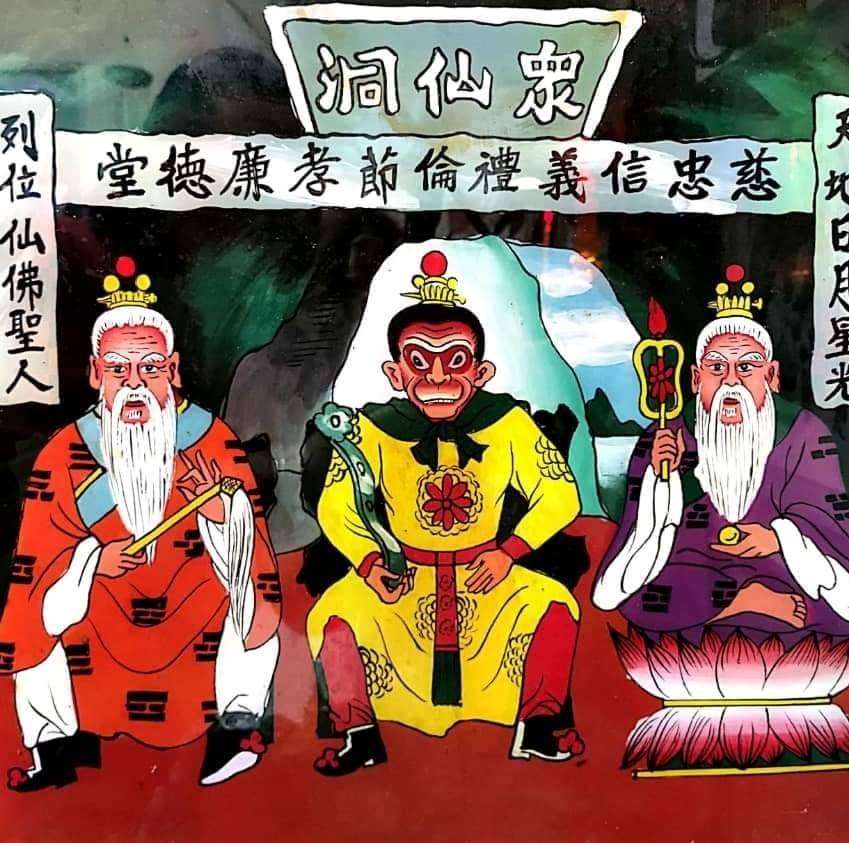
All three are sometimes depicted in a cave-like alcove over which hangs a sign reading “Zhong xian dong” (眾/衆仙洞; lit: “Multitude of Immortals Cave”) or “Xianfo dong” (仙佛洞, “Immortals and Buddhas Cave”) (fig. 2 & 3).

Fig. 2 – The “Multitude of Immortals Cave” (larger version). This is likely a painting of the idols from figure one. Found on Facebook. Fig. 3 – The “Immortals and Buddhas Cave” (larger version). Found on Facebook.

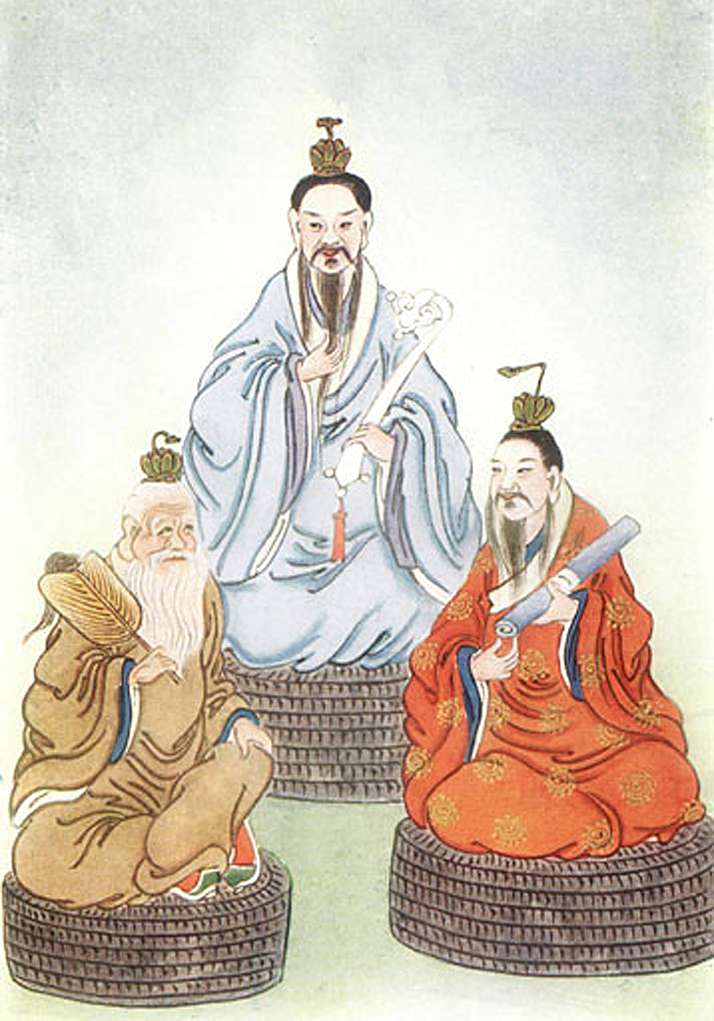
The trinity appears to have borrowed from depictions of the Sanqing. Take for example this painting (fig. 4). Two of the three figures include the As-you-will scepter and the palace fan.

Fig. 4 – A print of the Sanqing from Werner, 1922, p. 124 (larger version).

III. Huang Lao xianshi

This is not a common deity, so I’ve chosen to quote the BOXS article on the subject. I’ve changed the Wade Giles to pinyin. The information was gathered by Keith Stevens:

[…] His images have been seen on altars in Singapore in Balestier Road, also in Malacca and Kuala Lumpur, in Seremban and Muar, and in southern Thailand, where in each temple he is known as one of the Supreme Trinity .

In Kuala Lumpur where he is regarded as a deity who possesses the spirit mediums of his cult, the Huang jiao [黃教], he is known as an avatar of Laozi. He is said to have first appeared and became popular during the Han dynasty as the Governor of the World but without interfering with its day to day running. […] He was identified as Huang Shigong [黃石公], a patron of Zhang Liang [張良] who in about 200 BC was a trusted counsellor of Liu Bang [劉邦] and is said to have written a work on military tactics, the Sanlue [三略, “Three Strategies”].

Zhang Liang was one of the Three Heroes of China, said to have been a governor of a province during the Han, and according to Taoist legend was one day crossing a bridge of a river when a poor old man on a mule passed by. One of the old man’s sandals fell off into the river and in one version Zhang picked up the sandal of his own volition whilst in another, told by devotees, the old man asked him to pick it up. Zhang feeling a great sense of indignity but moved by pity for the old man picked it up. Then, after several tests Zhang Liang was told by the old man that with the book he had just given to Zhang he would become an adviser to the king. In years to come it came about exactly as foretold, and the old man on the mule turned out to be Huang Lao xianshi.

In these temples Huang Lao xianshi’s annual festival is celebrated on the double sixth [i.e. 6th day of the 6th lunar month]. His image has not been noted in Taiwan, Hong Kong or Macau.

In most temples he is revered for his healing powers, with one sip of water blessed by him curing sickness; it also provides stamina and nerve, and wrestlers and boxers visit his altars to drink his tonic before their matches.

Huang is also known as:

Huang Lao zushi [黃老祖師]

Huang Lao jun [黃老君] (RefNo. W3015).

The article goes on to suggest a possible connection to the Huang-Lao (黃老; “Yellow Emperor-Laozi) school of philosophy.

The Huang Lao school combines the teachings of Huang Di, Laozi, Zhuangzi and Buddhist[s], as well as Confucian[s], developed over the centuries into its own particular form (RefNo. W3015).

This philosophical connection is interesting as one scholar suggests that the Sanlue “was written around the end of the Former Han dynasty, probably by a reclusive adherent of the Huang-Lao school who had expert knowledge of military affairs” (Sawyer & Sawyer, 2007, p. 283). This would explain why Huang Lao’s story is associated with Huang Shigong (“Old Man Yellowstone”). Also, his name might imply that he’s considered an embodiment of this philosophy.

One thing not noted in the BOXS article is that some statues alternatively spell his name as 黃老先師 (Huang Lao xianshi), meaning the “First Teacher Yellow Elder” (see the third section on this page). The term 先師 is a reference to one of Confucius‘ titles (Chin, 2007, p. 13).


Update: 04-01-22

Ronni shared with me a source explaining the birth of Master Yellow Elder’s sect. One webpage claims it came about in 1937 at No. 38 Beer Village of Bahau, Negeri Sembilan, Peninsular Malaysia (马来西亚半岛森美兰州马口三十八啤农村). This might explain why the sect is more popular in Malaysia than Singapore:

At that time, Liao Jun [廖俊] was alone in the hall near the Daoist altar when he became curious about learning spirit-mediumship and spirit-writing. All of a sudden, a spirit entered his body, causing him to sit solemnly while stroking his whiskers and mumbling incomprehensively. He didn’t know what spirit had taken hold of his body or what was being said. Afterwards, Liao woke up but didn’t know anything. After that he requested the spirit to descend everyday but wasn’t able to speak. Later, Mr. Dai Zhao [Dai Zhao xiansheng, 戴招先生], the original owner of the Daoist temple, consecrated him as a new spirit-medium with a seal. He was then able to write messages and finally speak. Until that day when Liao Jun called the spirit, he opened his mouth and preached with strict principles and profound meaning. He said that the Immortal Master came to teach disciples in order to help the world. But he did not reveal his origin.

After a period of Liao calling down the spirit, the gathered crowd questioned the deity. He finally revealed that the Immortal Master Yellow Elder was actually Oldman Yellowstone [Huang shigong, 黃石公], known from legends passed down through the generations. According to the Jade Emperor’s decree, he was to open the dharma gate by preaching his teachings for the universal deliverance of the people.

Those who wish to enter the dharma gate first have to fast for 30 days and then complete the dharma hall ceremony to become a formal disciple. This dharma transforms according to one’s heart and can be used as one desires. Only when it is used in the right way will it be effective. One cannot harbor any evil desires.

All of Immortal Master Yellow Elder’s disciples can worship at home by arranging their own shrine. A memorial tablet must be set up in the center, and the following words must be written: mercy, loyalty, faith, righteousness, rituals, relationships, continence, filial piety, honesty, and right virtue. A sign on the left side must say, “Obey the Way of Heaven with Loyalty,” and on the right, “From the Earth Return to Ceremony.”

Apart from the aforementioned ten precepts, the disciples of the Immortal Master can also draw talismans to exorcise evil spirits from residences. At the same time, they can practice a boxing method to protect oneself in case of emergency.

At that time, more than 40 people were attracted to join. They worshiped the Immortal Master Yellow Elder and were diligent in practicing the dharma and martial arts. Later, the number of disciples increased. After the Immortal Master made his holy presence known, some disciples suggested that a temple be built. After the Immortal Master Yellow Elder made his holy presence known, some disciples suggested that a temple be built. And after they went before him and asked for instructions, he ordered that the first temple be built in Malacca. Because Malacca is a holy place of Buddhist temples, the sect spread throughout Malaysia and into Singapore.

黄老仙师缘起一九三七年间在马来西亚半岛森美兰州马口三十八啤农村,当时廖俊在道坛内,因在其好奇心驱使下,趁道堂内无人,就学乩童扶乩,忽然间且有神灵附身,双手交替频频作抚须状,同时肃然端坐,喃喃低语,就是听不明白说些什么,也不知是什么神明降神,之后廖俊就醒来了,但什么也不知道。过后几乎每天都请乩降童,就是不能开口说话,后来原本道堂主人戴招先生,在廖俊扶乩降童时,替他作新乩童开光封印法,廖俊才执笔写明某日可开言,直到该日廖俊降乩时,开口讲道,道理严明,心义深长,并说是黄老仙师下凡授徒济世,但不表明来历。

经过一段时日的请乩降童,又在众人不断的追问下,知悉黄老仙师就是历代相传的黄石公,奉玉皇大帝旨谕到来开黄老仙师法门宣扬教理,普渡善民,有志入黄老仙师法门行道者,必先斋戒三十天,再行过法堂仪式,方为正式弟子,所授之法乃随心变化法,可随心运用,惟必用於正道方有灵验,不可存有邪念,凡是黄老仙师弟子,可在家自设神位奉拜,正中设立牌位上书慈,忠,信,义,礼,伦,节,孝,廉,德堂,左边立牌上书顺天行道忠,右边上书从地復礼仪。

黄老仙师弟子,除了必修慈忠信义礼伦节孝廉德十训道理之外,也可画符驱邪镇宅,同时也修炼法拳,以备紧急时防身,当时就吸引了四十余人加入,亦诚崇信黄老仙师,勤於练法练武,后来弟子越增越多,加上黄老仙师威灵显圣,更有弟子提议黄老仙师庙,经过向黄老仙师请示,奉旨第一间庙应先建在马六甲,因为马六甲是佛庙圣地,之后从马六甲开始推广到星马各州。

This passage is interesting because it mixes Buddhist, Confucian, and Daoist terminology. Examples include “dharma gate” and “right way”; the list of the ten precepts, which are similar to the Four Cardinal Principles and Eight Virtues; and the evil-warding talismans.

It still amazes me, though, that the Great Sage is given such a prominent position in the center when he’s not even the main focus of the sect.


Update: 09-04-23

Irwen Wong of the Journey to the West Library blog reminded me that Huang Lao xianshi, under his guise as Huang Shigong (refer back to sec. III above), is mentioned in Journey to the West. In chapter 14, Tripitaka banishes Sun Wukong for killing six thieves who accost them shortly after the simian immortal is released from under Five Elements Mountain. Monkey retreats to the underwater kingdom of the Eastern Dragon King to vent, and after some tea, he notices a painting on the wall:

When they finished the tea, Pilgrim happened to turn around and saw hanging behind him on the wall a painting on the “Presentation of Shoes at Yi Bridge.” “What’s this all about?” asked Pilgrim. The Dragon King replied, “The incident depicted in the painting took place some time after you were born, and you may not recognize what it was-the threefold presentation of shoes at Yi Bridge.” “What do you mean by the threefold presentation of shoes?” asked Pilgrim.”

The immortal in the painting,” said the Dragon King, “was named Huang Shigong, and the young man kneeling in front of him was called Zhang Liang. Shigong was sitting on the Yi Bridge when suddenly one of his shoes fell off and dropped under the bridge. He asked Zhang Liang to fetch it, and the young man quickly did so, putting it back on for him as he knelt there. This happened three times. Since Zhang Liang did not display the slightest sign of pride or impatience, he won the affection of Shigong, who imparted to him that night a celestial manual and told him to support the house of Han. Afterwards, Zhang Liang ‘made his plans sitting in a military tent to achieve victories a thousand miles away. When the Han dynasty was established, he left his post and went into the mountains, where he followed the Daoist, Master Red Pine, and became enlightened in the way of immortality. Great Sage, if you do not accompany the Tang Monk, if you are unwilling to exercise diligence or to accept instruction, you will remain a bogus immortal after all. Don’t think that you’ll ever acquire the Fruits of Truth.”

Wukong listened to these words and fell silent for some time. The Dragon King said, “Great Sage, you must make the decision yourself It’s unwise to allow momentary comfort to jeopardize your future.” “Not another word!” said Wukong. “Old Monkey will go back to accompany him, that’s all!” Delighted, the Dragon King said, “If that’s your wish, I dare not detain you. Instead, I ask the Great Sage to show his mercy at once and not permit his master to wait any longer.” When Pilgrim heard this exhortation to leave, he bounded right out of the oceanic region; mounting the clouds, he left the Dragon King (Wu & Yu, 2012, vol. 1, p. 318).

茶畢,行者回頭一看,見後壁上掛著一幅「圯橋進履」的畫兒。行者道:「這是甚麼景致?」龍王道:「大聖在先,此事在後,故你不認得。這叫做『圯橋三進履』。」行者道:「怎的是『三進履』?」龍王道:「此仙乃是黃石公,此子乃是漢世張良,石公坐在圯橋上,忽然失履於橋下,遂喚張良取來。此子即忙取來,跪獻於前。如此三度,張良略無一毫倨傲怠慢之心,石公遂愛他勤謹,夜授天書,著他扶漢。後果然運籌帷幄之中,決勝千里之外。太平後,棄職歸山,從赤松子遊,悟成仙道。大聖,你若不保唐僧,不盡勤勞,不受教誨,到底是個妖仙,休想得成正果。」悟空聞言,沉吟半晌不語。龍王道:「大聖自當裁處,不可圖自在,誤了前程。」悟空道:「莫多話,老孫還去保他便了。」龍王忻喜道:「既如此,不敢久留,請大聖早發慈悲,莫要疏久了你師父。」

行者見他催促請行,急縱身,出離海藏,駕著雲,別了龍王。


Update: 11-07-24

I was looking for something unrelated on google images and found this picture from the Huang Lao Xianshi Temple (Huang Lao xianshi miao, 黃老仙師廟) of Terendak Military Camp (Delinda junying, 德林達軍營) in Malacca City, Malaysia (fig. 5).

Fig. 5 – The Terendak Military Camp Huan Lao xianshi sect trinity (larger version). Image found here.

Note:

1) The BOXS catalog explains that there’s actually some confusion between two similarity named deities in different versions of the trinity. One is the aforementioned Huang Lao xianshi (黃老仙師) and the other is Wang Lao xianshi (王老仙師). This is because Huang (黃) and Wang (王) “are almost homophones” (RefNo. W6675 & W3015).

Sources:

Chin, A. (2007). Confucius: A Life of Thought and Politics. United Kingdom: Yale University Press.

Sawyer, R. D., & Sawyer, M. (2007). The Seven Military Classics of Ancient China. New York, NY: Basic Books.

Werner, E. T. C. (1922). Myths & Legends of China. New York: George G. Harrap & Co. Ltd.


Archive #30 – The “Great Sage Equaling Heaven” Story from Liaozhai zhiyi (1740)

The world famous Liaozhai zhiyi (聊齋志異, 1740; a.k.a. “Strange Tales from a Chinese Studio”) is a collection of over 400 narratives serving as a snapshot of late-Ming and early-Qing-era popular stories and culture. This is why story no. 4 of scroll 11, “The Great Sage Equaling Heaven” (Qitian dasheng, 齊天大聖), is important to the study of the Monkey King’s religion as it shows his cult was active in 17th and 18th-century Fujian. It also preserves the condescension that the scholarly class held for certain gods. For example, as Meir Shahar (1996) points out, the author Pu Songling was likely speaking through the main character Xu Sheng (許盛), a young merchant from Shandong, when he states: “Sun Wukong is nothing but a parable invented by [the novelist] Old Qiu [老丘]” (pp. 194). [1] Here, Xu chastises the people of Fujian for worshiping what he considers to be a fictional god. In addition, the story associates the Great Sage with a heavenly sword as opposed to his famous magic staff. I believe this is related to a 13th-century stone relief carving from Quanzhou.
Below, I have archived the only complete English translation of the tale that I’m aware of. It comes from volume six of Sidney L. Sondergard’s (Pu & Sondergard, 2014) Strange Tales from Liaozhai (pp. 2078-2085). I don’t currently have access to the physical book, so I have isolated the tale from an ebook and converted it into a PDF.

Archive link:

Click to access Strange-Tales-from-Liaozhai-vol.-6_removed.pdf

Disclaimer:

This has been posted for educational purposes. No malicious copyright infringement is intended. If you liked the digital version, please support the official release.

Note:

1) This refers to Qiu Chuji (丘處機, 1148-1227), the founder of the Dragon Gate sect of Daoism during the Song Dynasty. Qiu is associated with a travel journal also named Journey to the West, which Pu Songling confused with the novel of the same name (Pu & Sondergard, 2014, p. 2080 n. 1).

Sources:

Shahar, M. (1996). Vernacular Fiction and the Transmission of Gods’ Cults in Later Imperial China. In M. Shahar, & R. P. Weller (Eds.), Unruly Gods: Divinity and Society in China (pp. 184-211). Honolulu: University of Hawaiʻi Press.

Pu, S., & Sondergard, S. L. (2014). Strange Tales from Liaozhai: Vol. 6. Fremont, Calif: Jain Pub.