Archive #2 – Suen Wu-kung = Hanumat? The Progress of a Scholarly Debate

Last updated: 01-18-2019

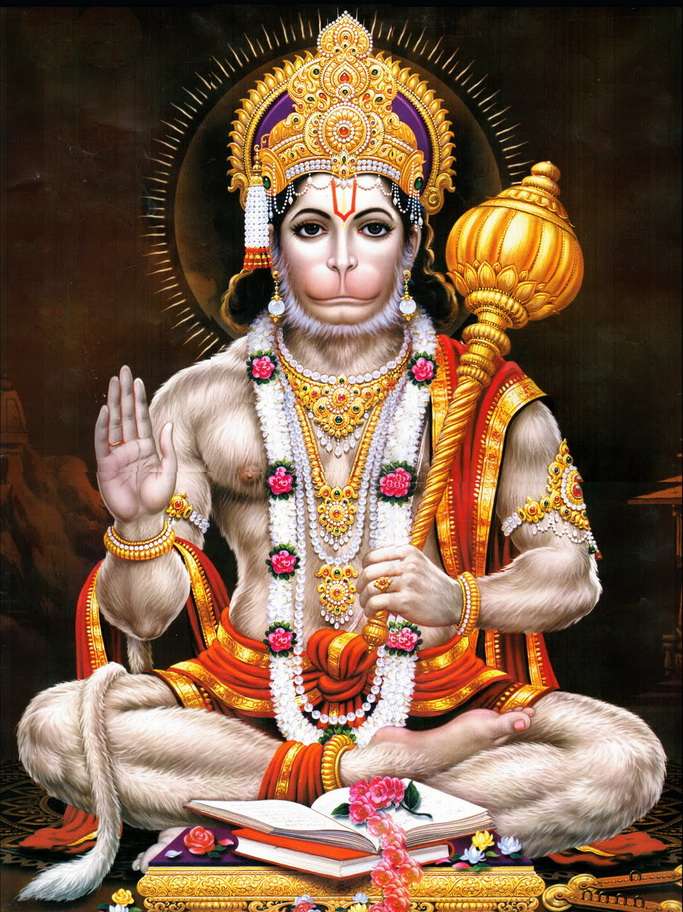
I have finally tracked down a digital version of Victor Mair’s often quoted summary of the scholarly debate on the possible connection between Sun Wukong (fig. 1) and the Hindu monkey god Hanuman (fig. 2). This paper is extremely hard to find, so I am archiving it here to aid both amateur and professional scholars who may not yet have access to it.

Sammy Torres Wukong - small

Fig. 1 – Sun Wukong from birth to the Great Sage. This marvelous sequential drawing is by Sammy Torres on twitter. The full drawing can be seen here.

Info from the Introduction:

The chief aim of this article is to restore the debate to its original scholarly intent, namely to determine whether H [Hanuman], the redoubtable simian devotee of Prince Rama in his quest to recover Sita from Lanka, had anything to do with the formation of the character of SWK [Sun Wukong], Tripitaka’s formidable Monkey-disciple during his pilgrimage to India to retrieve scriptures. This can only be achieved by remaining as impartial and objective as possible while presenting the pertinent evidence. A clinically dispassionate examination of the widely varying opinions of authorities concerning the apparent affinity between SWK and H is also required if the present impasse is to be broken. Hence, this article is necessarily as much an investigation of scholarly methods and attitudes as it is about the origins of SWK. Accordingly, it is divided into two main divisions, “Evidence” and “Authorities and Interpretations.” These are further subdivided into a number of sections, “Evidence” by geographical area and “Authorities and Interpretations” by a chronological listing of major participants in the debate.

Archive link:

Click to access suen-wu-kung-or-hanumat.pdf

Fig. 2 – A religious portrait of Hanuman (larger version). Artist unknown.

Disclaimer:

This has been posted for educational purposes. No malicious copyright infringement is intended. Please support the official release.


Update: 01-18-19

I’ve archived a scholarly book about the origins, worship, and depictions of Hanuman in pop culture.

Archive #9 – PDF of Hanuman’s Tale: The Messages of a Divine Monkey

Citation:

Mair, V. (1989). Suen Wu-kung = Hanumat? The Progress of a Scholarly Debate, in Proceedings of the Second International Conference on Sinology (pp. 659-752). Taipei: Academia Sinica.

The Origin of the Monkey King’s Punishment in Laozi’s Furnace

The beginning of Journey to the West (Xiyouji西遊記, 1592; “JTTW” hereafter) chapter seven sees Sun Wukong transported to the realm above to be executed for his rebellion against the primacy of heaven. However, his immortal body proves impervious to blades, fire, and lightning, leading Laozi to theorize that Monkey’s extreme invulnerability is the result of having consumed large quantities of immortal peaches, wine, and elixir that were later refined in his stomach “to form a single solid mass” (Wu & Yu, 2012, vol. 1, p. 188). The Daoist high god goes on to suggest that the demon be subjected to his Brazier of Eight Trigrams (Bagua lu, 八卦爐) in order to separate out the elixir and make his subsequently weakened body susceptible to death:

Arriving at the Tushita Palace, Laozi loosened the ropes on the Great Sage, pulled out the weapon from his breastbone, and pushed him into the Brazier of Eight Trigrams. He then ordered the Daoist who watched over the brazier and the page boy in charge of the fire to blow up a strong flame for the smelting process. The brazier, you see, was of eight compartments corresponding to the eight trigrams of Qian [☰/乾], Kan [☵/坎], Gen [☶/艮], Zhen [☳/震], Xun [☴/巽], Li [☲/離], Kun [☷/坤], and Dui [☱/兌]. The Great Sage crawled into the space beneath the compartment that corresponded to the Xun trigram. Now Xun symbolizes wind; where there is wind, there is no fire. However, wind could churn up smoke, which at that moment reddened his eyes, giving them a permanently inflamed condition. Hence they were sometimes called Fiery Eyes and Diamond Pupils (Wu & Yu, 2012, vol. 1, p. 189).

那老君到兜率宮,將大聖解去繩索,放了穿琵琶骨之器,推入八卦爐中,命看爐的道人、架火的童子,將火搧起鍛煉。原來那爐是乾、坎、艮、震、巽、離、坤、兌八卦。他即將身鑽在巽宮位下。巽乃風也,有風則無火。只是風攪得煙來,把一雙眼火煼紅了,弄做個老害病眼,故喚作「火眼金睛」。

Laozi checks the furnace forty-nine days later expecting ashes, but he is surprised when Sun emerges and kicks over the mystical oven (fig. 1). This episode has two likely sources.

Fig. 1 – Monkey knocking over Laozi’s furnace (larger version).

Table of Contents

1. Sources

1.1. The Story

The first source is The Story of How Tripitaka of the Great Tang Procures the Scriptures (Da Tang Sanzang qujing shihua大唐三藏取經詩話, c. late-13th century; “The Story” hereafter), the earliest known published edition of JTTW. The 17th chapter describes the trials of Daffy (Chi’na, 癡那), a merchant’s son, at the hands of his evil stepmother, a woman of the Meng clan (孟氏). She resents the boy as he stands to inherit all of his father’s wealth, leaving her son with nothing. Therefore, she and her handmaiden try to kill the heir by respectively boiling him in a pot, ripping out his tongue, starving him, and finally pushing him into a river, but each time he is magically saved by heaven. For instance, after four days boiling in the pot, Daffy emerges unscathed and claims:

[T]he iron cauldron changed into a lily pad on which I sat, surrounded by the cool waters of a pond. I could sleep or just sit there. It was very comfortable (Wivell, 1994, p. 1203).

一釜變化蓮花坐,四伴是冷水池;此中坐臥,甚是安穩。

Mair (1987) notes that the story of a youth being tortured by his stepmother is based on a Dunhuang transformation text with two versions dated 946 and 949, respectively (p. 43). The text focuses on the trials of the future Emperor Shun. [1] However, the boiling episode does not appear in the story.

1.2. Laughing at the Dao

The second source is Laughing at the Dao (Xiaodao lun, 笑道論, 570), an anti-Daoist polemic written as part of a court debate between Buddhist and Daoist representatives vying for state sponsorship. One section recounts Laozi’s rebirth in the mortal world and his later attempt to convert a king in India:

He [Laozi] had (long) hairs on the temples and his head was hoary; his body was sixteen feet tall; he wore a heavenly cap and held a metal staff. He took Yin Xi with him to convert the barbarians. (Once arrived in India) he withdrew to the Shouyang 首陽 mountains, covered by a purple cloud. The barbarian king suspected him of sorcery (妖). He (attempted) to boil him in a cauldron, but (the water) did not grow hot … [2]

頭鬢皓首身長丈六。戴天冠捉金杖。將尹喜化胡。隱首陽山。紫雲覆之。胡王疑妖。鑊煮而不熱。

I find this source particularly amusing because the high god of Daoism is in essence subjected to the same punishment as the one that he later suggests for Sun Wukong!

2. The Furnace in Daoist Alchemy

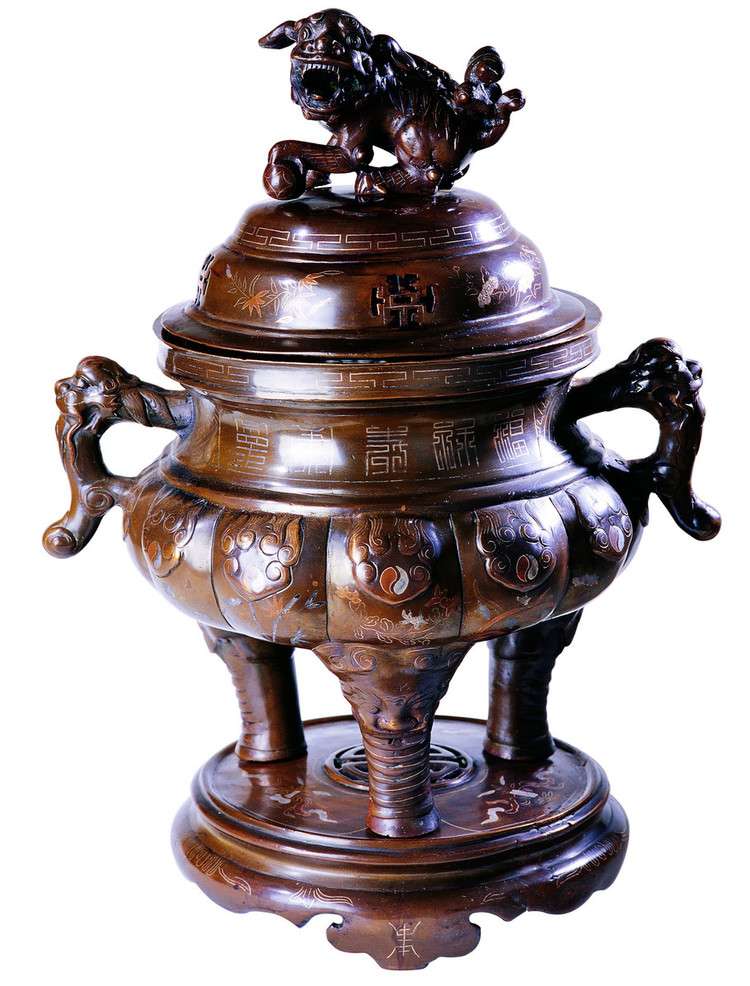
The furnace has two meanings in Daoist alchemy. The first refers to the physical vessel and stove (dinglu, 鼎爐) combo used in external alchemy (waidan, 外丹) to smelt the elixir of immortality (fig. 2). Kim (2008) describes the various parts and models of this contraption:

The reaction vessel has fire around it (when it is placed inside the heating apparatus), under it (when it is placed over the heating apparatus), or above it (when it is entirely covered by ashes inside the heating apparatus). It may contain an inner reaction-case in which the ingredients are placed. In a more complex model, a “water-vessel” containing water and a “fire-vessel” containing the ingredients can be assembled, the former above and the latter below or vice versa. The vessel must be hermetically closed and should not bear any openings or cracks.

The heating apparatus has fire within it and is often placed over a platform or “altar” (tan 壇). The openings on the wall sides allow air to circulate, while those on the top serve to settle the reaction vessel or to emit flame and smoke. One of the main functions of the heating apparatus is to control the intensity and duration of the heat. (pp. 360-361)

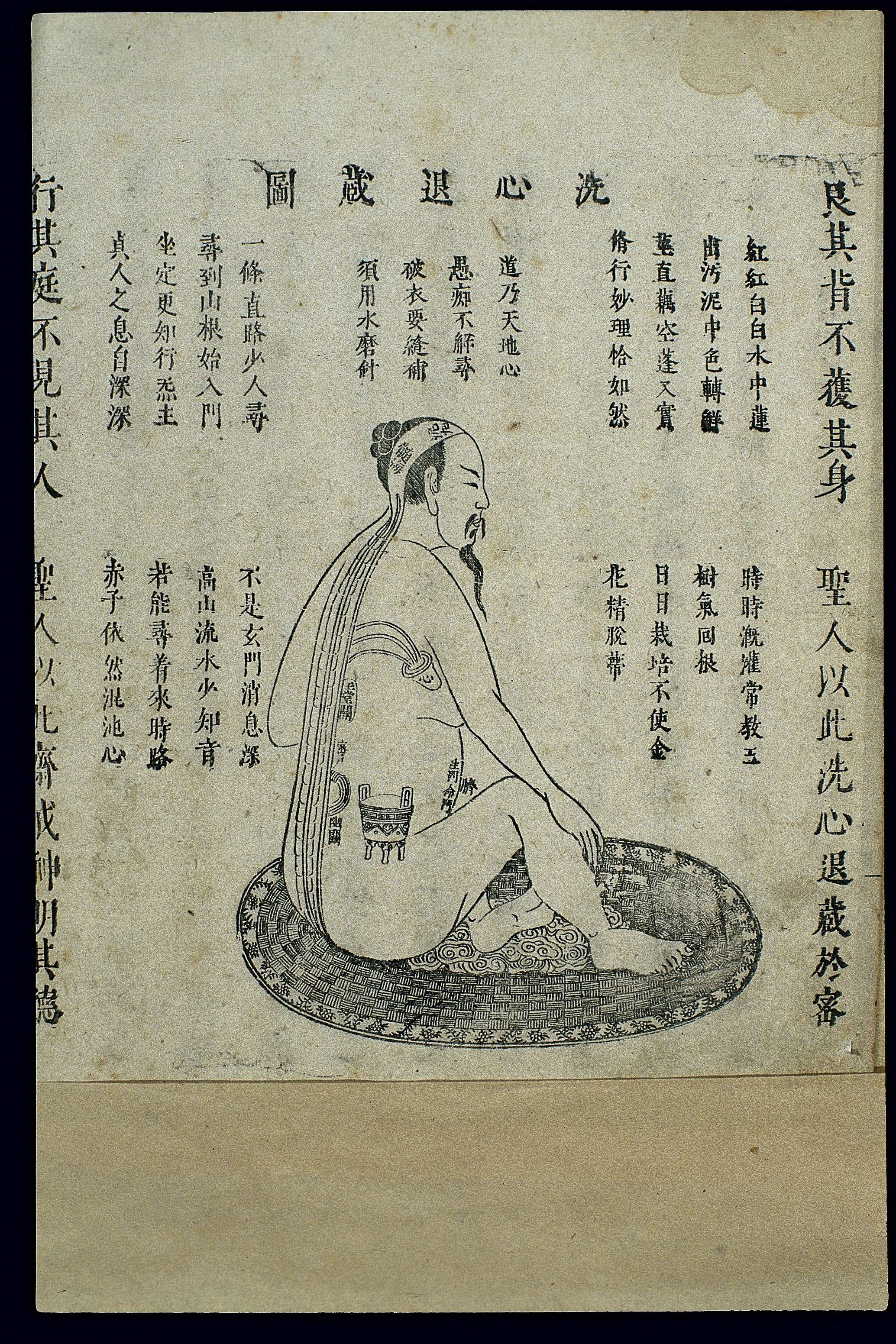
Fig. 2 – An ornate wooden replica dinglu reminiscent of the metal type used in external alchemy (larger version). Fig. 3 – An early 17th-century woodblock print depicting a Daoist practitioner’s dantian as a ding vessel (larger version).

The concept of consuming alchemically derived elixirs is first mentioned in Discourses on Salt and Iron (Yantie tun, 鹽鐵論, c. 60 BCE). Later, the Token for the Agreement of the Three According to the Book of Changes (Zhouyi cantong qi, 周易參同契, c. 2nd century CE; “The Token” hereafter) standardized the use of toxic materials, such as lead and mercury, for making said elixir, and this idea remained entrenched until the Tang Dynasty (618–907 CE) (Pregadio, 2008, pp. 1002-1003). External alchemy was eventually superseded in popularity by internal alchemy (neidan, 内丹) from the Tang onward and was still popular during the Ming Dynasty (1368–1644 CE) when the standard 1592 version of JTTW was published.

The second meaning is the human body as a metaphor for the furnace—i.e. internal alchemy. The Token considers “the 5 organs, 12 vessels, 24 vertebrae, and 360 joints … all part of this body dinglu” (Wang, 2012, p. 192). The corporal furnace, the ingredients (yao, 藥), and the firing time (huohou, 火候) combine to make the “three essentials” (sanyao, 三要) of internal alchemy (Robinet, 2008). The ingredients are yin and yang energy, and the firing time is the measured absorption of said energies and the time at which this activity is partaken (Wang, 2012, pp. 192-193).

3. External vs Internal in JTTW

Laozi’s use of the Eight Trigrams Furnace stands as a perfect example of external alchemy, and Sun’s use of breathing exercises and qi circulation serves as a prime example of internal alchemy. So how are these competing processes depicted in JTTW? Well, recall that the external type had long been supplanted by the internal type by the time the novel was published. Hence, one could say Laozi’s methods were dated compared to those used by Monkey. This might then explain a surprising story element from JTTW chapter seven.

When Sun first escapes from the furnace, “Laozi rushes up to clutch at him, only to be greeted by such a violent shove that he falls head over heels while the Great Sage escapes” (based on Wu & Yu, 2012, vol. 1, p. 189). Think about that for a moment. Monkey, a proponent of internal alchemy, physically assaults the Daoist high god, a proponent of external alchemy. Add to this the fact that Sun seemingly only respects/fears immortals that promote internal alchemy—a good example being his first master, Patriarch Subodhi (Xuputi zushi, 須菩提祖師)—and a picture begins to form: perhaps this is the JTTW author-compiler’s way of touting the superiority of the internal over the external. What do you think?

4. Conclusion

Monkey’s time in Laozi’s furnace likely borrows from (one or both of) two sources, the story of a child magically surviving boiling in The Story, the 13th century CE precursor of JTTW, and the story of Laozi magically surviving boiling from Laughing at the Dao, an anti-Daoist polemic of the 6th-century CE. The latter is humorous as it shows Monkey’s punishment is a recapitulation of the high god’s punishment.

JTTW presents two forms of alchemy: the concept of Laozi’s furnace refers to “external” alchemy and harkens back to Han Dynasty China when alchemists used such furnaces to fire toxic mercury and lead in an attempt to produce an elixir of immortality; Sun Wukong’s use of breathing exercises and qi circulation is a prime example of “internal” alchemy in which the body is used as the furnace to fire the immortal elixir. External alchemy fell out of favor during the Tang and was superseded by Internal alchemy from then on into the Ming, when JTTW was published. Therefore, the novel portrays the high god of Daoism as a proponent of the dated external school, while immortals like Monkey are portrayed as proponents of the then current internal school.

Notes:

1) For a complete translation, see Bodman (1994).

2) See Zürcher & Teiser (2007), pp. 299-300 and 431 n. 53.

Sources:

Bodman, R. W. (1994). The Transformation Text on the Boy Shun’s Extreme Filial Piety. In V. H. Mair (Ed.), The Columbia Anthology of Traditional Chinese Literature (pp. 1128-1134). New York: Columbia University Press.

Kim, D. (2008). Dinglu: I. Waidan In F. Pregadio (Ed.), The Encyclopedia of Taoism (2 Vols.) (pp. 360-361). London [u.a.: Routledge].

Mair, V. H. (1987). Parallels Between Some Tun-Huang Manuscripts and the 17th Chapter of the Kozanji Journey to the West. Cahiers d’Extrême-Asie, 3, 41-53.

Pregadio, F. (2008). Waidan In F. Pregadio (Ed.), The Encyclopedia of Taoism (2 Vols.) (pp. 1002-1005). London [u.a.: Routledge].

Robinet, I. (2008). Dinglu: II. Neidan In F. Pregadio (Ed.), The Encyclopedia of Taoism (2 Vols.) (pp. 361-362). London [u.a.: Routledge].

Wang, R. (2012). Yinyang: The Way of Heaven and Earth in Chinese Thought and Culture. Cambridge: Cambridge University Press.

Wivell, C. S. (1994). The Story of How the Monk Tripitaka of the Great Country of T’ang Brought Back the Sūtras. In Mair, Victor H. The Columbia anthology of traditional Chinese literature (pp. 1181-1207). New York: Columbia University Press.

Wu, C., & Yu, A. C. (2012). The Journey to the West (Vols. 1-4) (Rev. ed.). Chicago, Illinois: University of Chicago Press.

Zürcher, E., & Teiser, S. F. (2007). The Buddhist Conquest of China: The Spread and Adaptation of Buddhism in Early Medieval China. Leiden: Brill.

The Monkey King and Cinderella

Did you know that the Monkey King has a connection to Cinderella?! In this brief article, I will summarize some of the findings laid out in Beauchamp (n.d.), which highlights the presence of the Cinderella story cycle in the ethnic folklore of China, a world famous India epic, and even Journey to the West (Xiyouji, 西遊記, 1592). I will also include information, showing that the story cycle predates the Chinese version by centuries.

Table of Contents

1. Egypt and Greece

Before I continue, I want to briefly mention one of the oldest Western variants of the Cinderella story cycle, Rhodopis, a tale set in ancient Egypt.

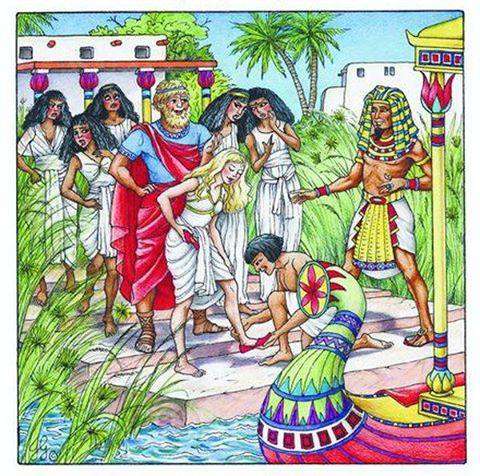
The story describes how the god Horus sends an eagle (or takes the form of one) to steal the slipper of the titular Greek slave and delivers it to an Egyptian Pharaoh, who launches a search for and eventually marries the woman (fig. 1). The tale was first recorded by the Greek geographer Strabo in 7 BCE (Ripley, 2010, pp. 185-188). However, the work is part of a wider story cycle evident throughout Asia and the Middle East.

Fig. 1 – The Pharaoh finds Rhodopis (larger version).

2. China

The earliest version that appears to have many of the familiar elements from the final European version hails from China. Titled “Yexian” (葉限), the story describes the titular heroine working as an imprisoned servant for her evil stepmother, the bestowal of a beautiful dress and slippers by a female ancestor from heaven, her attendance of a local festival, the loss of one of her slippers while fleeing the festivities, the discovery of the shoe by a foreign king, and a search that results in their eventual marriage. The story is based on the oral tales of the Zhuang ethnic people (of the Vietnamese-Chinese border) and was first recorded by Duan Chengshi (段成式) in the 9th-century CE (Ripley, 2010, pp. 191-192; Beauchamp, n.d.).

3. India

Certain elements of the story appear to have been influenced by the great Hindu epic the Ramayana, written by Valmiki around 500 BCE. The story tells how Sita, the wife of Vishnu’s reincarnation Prince Rama, is kidnapped and held prisoner by the demon Ravana (with the intent of making her his wife) on the island of Lanka. It is during her time in captivity that she is visited by Rama’s servant, Hanuman, a monkey demi-god, who brings her the prince’s ring to prove himself a trustworthy ally (fig. 2). The simian character then brings her anklet to Rama to prove that she is still alive. Rama’s army assaults Ranava’s fortress, and he is eventually reunited with his wife.

This at first may not seem like it matches at all, but you have an imprisoned beauty (Sita vs Yexian), supernatural assistance from heaven (Hanuman vs. the female ancestor), the exchange of personal items to prove one’s identity (the ring and anklet vs the slipper), and a campaign that brings together the woman and a man of royal blood (Sita and Rama vs Yexian and the foreign king) (Beauchamp, n.d.).

Hanuman gives Sita Rama’s ring in the Sandara Kanda book of the Ramayana:

Sarga 34

1. Hanuman, the immensely powerful son of Maruta the wind god, humbly addressed further words to Sita in order to inspire her confidence:
2. “I am a monkey, virtuous woman, a messenger of wise Rama. My lady, look at this ring marked with Rama’s name. Take heart, bless you, for your troubles will soon be at an end.”
3. Taking her husband’s ring and examining it, Janaki was as joyous as if she had rejoined her husband.
4. Her lovely face-its long eyes all red and white-lit up with joy, like the moon, the lord of stars, when released from Rahu, demon of the eclipse (Valmiki et. al., 2016, p. 207).

Fig. 2 – Hanuman giving Sita Rama’s ring (larger version).

4. Journey to the West

Some scholars believe that secularized snippets of the Rama story cycle came to China in several waves, one of which was via Southeast Asian Hindu converts who settled in Southern China from the 7th-century onwards (Walker, 1998).

This then might explain an episode from Journey to the West that appears to draw from the Rama cycle. In chapters 68 to 71, a queen is kidnapped and held prisoner by a demon (with the intent of making her his wife) in a faraway land. Sun Wukong is employed to find her. He brings back a bracelet to her husband as proof of life and identity, and eventually reunites the couple after defeating the demon (Beauchamp, n.d.).

Monkey shows the bracelet to the Queen in chapter 70:

On hearing this, the lady shouted for the two rows of vixen and deer [spirits] to leave. After he closed the palace door, Pilgrim gave his own face a wipe and changed back into his original form. He said to the lady, “Don’t be afraid of me. I am a priest sent by the Great Tang in the Land of the East to go seek scriptures from Buddha in the Thunderclap Monastery of India in the Great Western Heaven. My master is Tripitaka Tang, the bond-brother of the Tang emperor, and I am Sun Wukong, his eldest disciple. When we passed through your kingdom and had to have our travel rescript certified, we saw a royal proclamation issued for the recruitment of physicians. I exercised my great ability in the therapeutic arts, and I cured the king of his illness of ardent longing. During the banquet he [came] to thank me, he told me while we were drinking about how you were abducted by the fiend. Since I have the knowledge of subduing dragons and taming tigers, he asked me specially to come arrest the fiend and rescue you back to the kingdom. It was I who defeated the vanguard, and it was I, too, who slew the little fiend [note: Monkey is disguised as him]. When I saw, however, how powerful the fiend was outside the gate, I changed myself into the form of Going and Coming [note: the little fiend] in order to take the risk of contacting you here.”

On hearing what he said, the lady fell silent. Whereupon Pilgrim took out the treasure bracelets and presented them with both hands, saying, “If you don’t believe me, take a good look at these objects.”

The moment she saw them, the lady began to weep, as she left her seat to bow to Pilgrim, saying, “Elder, if you could indeed rescue me and take me back to the kingdom, I would never forget your great favor!” (Wu & Yu, 2012, vol. 3, p. 297).

娘娘聞言,喝退兩班狐、鹿。行者掩上宮門,把臉一抹,現了本像,對娘娘道:「你休怕我。我是東土大唐差往大西天天竺國雷音寺見佛求經的和尚。我師父是唐王御弟唐三藏。我是他大徒弟孫悟空。因過你國倒換關文,見你君臣出榜招醫,是我大施三折之肱,把他相思之病治好了,排宴謝我。飲酒之間,說出你被妖攝來。我會降龍伏虎,特請我來捉怪,救你回國。那戰敗先鋒是我,打死小妖也是我。我見他門外兇狂,是我變作有來有去模樣,捨身到此,與你通信。」那娘娘聽說,沉吟不語。行者取出寶串,雙手奉上道:「你若不信,看此物何來?」娘娘一見垂淚,下座拜謝道:「長老,你果是救得我回朝,沒齒不忘大恩。」

5. Comparison

Beauchamp (n.d.) provides a diagram showing the similarities between the stories of Yexian, Sita, and the queen from Journey to the West (fig. 3).

Fig. 3 – Comparative Chart of Cinderella Variants (larger version).

Sources:

Beauchamp, F. (n.d.). In the Realm of the Dragon King: Sita and Hanuman meet Cinderella and Sun Wukong. Retrieved from http://www.asdp-bridgingcultures.org/Beauchamp%20-%20Realm%%E2%80%A6. [Original link dead. Click on article title to read.]

Ripley, D. (2010). The Maiden with a Thousand Slippers: Animal Helpers and the Hero(ine)’s Journey. In P. Monaghan (Ed.). Goddesses in World Culture (pp. 185-200). Santa Barbara, California: Praeger.

Valmiki, Goldman, R. P., & Goldman, S. J. (2016). The Rāmāyaṇa of Vālmīki: An Epic of Ancient India, Volume V: Sundarakāṇḍa. United States: Princeton University Press.

Walker, H.S. (1998). Indigenous or Foreign? A Look at the Origins of Monkey Hero Sun Wukong. Sino-Platonic Papers, 81, pp. 1-117. Retrieved from https://sino-platonic.org/complete/spp081_monkey_sun_wukong.pdf.

Wu, C., & Yu, A. C. (2012). The Journey to the West (Vols. 1-4) (Rev. ed.). Chicago, Illinois: University of Chicago Press.

A Historical Source for the Monkey King’s Staff?

[Since writing this article, I have come to appreciate a Chinese origin for the depiction of Monkey’s staff as an iron pillar. Please see the entry for 09-26-16 below. I am keeping this article up for posterity so others may see my thought process.]

Last updated: 07-04-2021

Much of my recent work on Journey to the West (Xiyouji西遊記; “JTTW” hereafter) has focused on the origins of Sun Wukong‘s magic staff. This is because, as far as I know, scholars haven’t attempted to trace it beyond the 13th-century JTTW. This entry discusses the staff’s influence by the ringed and metal staves respectively carried by religious and martial Buddhist monks. Over time, these were combined into a single weapon: the rings from the former were fused at the ends of the latter. However, this doesn’t explain all aspects of the weapon. Take for example the initial description of the staff as a black iron pillar with an inscription:

[Sun] Wukong girded up his clothes and went forward to touch it: it was an iron rod more than  twenty feet long and as thick as a barrel (emphasis added). Using all his might, he lifted it with both hands, saying, “It’s a little too long and too thick. It would be more serviceable if it were somewhat shorter and thinner.” Hardly had he finished speaking when the treasure shrunk a few feet in length and became a layer thinner. “Smaller still would be even better,” said Wukong, giving it another bounce in his hands. Again the treasure became smaller. Highly pleased, Wukong took it out of the ocean treasury to examine it. He found a golden hoop at each end, with solid black iron in between. Immediately adjacent to one of the hoops (emphasis added) was the inscription, “The Compliant Golden-Hooped Rod. Weight: 17,550 lbs” (based Wu & Yu, 2012, p. 135). [1]

悟空撩衣上前,摸了一把,乃是一根鐵柱子,約有斗來粗,二丈有餘長。他儘力兩手撾過道:「忒粗忒長些,再短細些方可用。」說畢,那寶貝就短了幾尺,細了一圍。悟空又顛一顛道:「再細些更好。」那寶貝真個又細了幾分。悟空十分歡喜,拿出海藏看時,原來兩頭是兩個金箍,中間乃一段烏鐵。緊挨箍有鐫成的一行字,喚做:「如意金箍棒,重一萬三千五百斤。」

If the weapon is based on historical objects, could it be possible that this description is based on something real? I believe I have found the object that may have influenced Monkey’s treasure: the famous Iron Pillar of Delhi (Ch: Deli tiezhu, 德里鐵柱) (fig. 1).

Fig. 1 – The Iron Pillar of Delhi (4th-cent. CE) (larger version). Image found on Wikipedia.

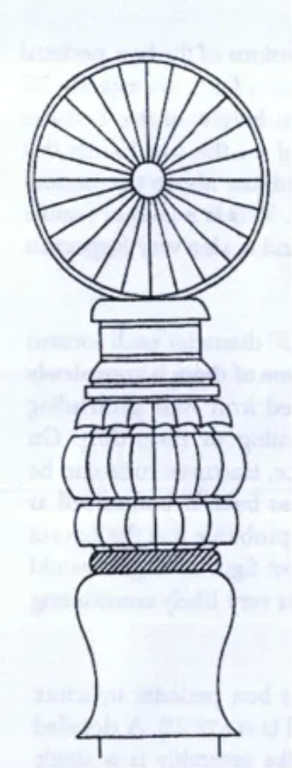
This Hindu monument was erected by King Chandragupta II (r. 380–413) of the Gupta Empire and dedicated to the deva Vishnu (Balasubramaniam, 2005, p. 14). It is nearly 24-feet (7.31 m) long, 21-feet (6.4 m) of which is sticking out of the ground (“an iron rod more than twenty feet long”). The shaft has a very wide diameter, 24-inches (60.96 cm) at the base and 17-inches (43.18 cm) at ground level (“as thick as a barrel”) (Balasubramaniam, 2005, p. 30). It has an ornamental bell capital that was originally topped by a chakra disc (“He found a golden hoop at each end”) (fig. 2) (Balasubramaniam, 2005, pp. 36-42). [2] And it also carries an inscription describing the military feats of the king (“Immediately adjacent to one of the hoops was the inscription…”) (fig. 3) (Balasubramaniam, 2005, pp. 6-8).

Fig. 2 (left) – A reconstruction of the chakra disc (larger version) (Balasubramaniam, 2005, p. 42). Fig. 3 (right) – The inscription (larger version).

What’s most interesting is the fact that the pillar is famous for resisting corrosion over the last 1,600 years. Scientists have analyzed its composition to find that it has a high phosphorous content, which forms a protective barrier against corrosive agents (Balasubramaniam, 2005, pp. 3 and 50-51). This means that the metallurgists of ancient India were far more advanced than originally thought. In addition, a local tradition in Delhi associates the pillar with Bhima, a supernaturally strong warrior from the great Hindu epic the Mahabharata (4th-cent. BCE). A legend circulating from at least the 19th-century (and maybe earlier) claims that he wielded the monument as a club in his ancient war against a rival army (Chunder, 1869, p. 152). Therefore, a black iron rod that defies time and is associated with martial heroes would surely make a fine weapon for an immortal monkey, no?

I unfortunately don’t know of any Chinese sources mentioning the pillar, so connecting it directly to JTTW is difficult. However, the pillar was around for 1,200 years prior to the standard 1592 version of the novel, and Buddhist monks such as Faxian and the historical Xuanzang made pilgrimages to northern India where the monument is located. Not to mention there is the possibility that Indian and Chinese merchants traveling back and forth between the two countries could have spread tales about the marvelous iron rod to China. These oral tales could have then reached the ear of the novel’s author-compiler during the Ming. I’ve contacted experts in Chinese history, religion, and literature to determine whether or not I’m on the right path. I’ll make a sister entry in the future if I happen upon any more information.


Update: 06-04-14

I recently learned that famed Muslim sojourner Ibn Battuta (1304-1377) referenced the pillar in his travel log:

In the center of the [Mosque of Delhi] is the awe-inspiring column of which [it is said] nobody knows of what metal it is constructed. One of their learned men told me that it is called Haft Jūsh, which means ‘seven metals’, and that it is composed of these seven. A part of this column, of a finger’s length, has been polished, and this polished part gives out a brilliant gleam. Iron makes no impression on it. It is thirty cubits high, and we rolled a turban round it, and the portion which encircled it measured eight cubits (Ibn Batuta & Gib, 2002, p. 622). [3]

Ibn Battuta traveled to China after his time in India, so this is just an example of how stories of the pillar could have come to the Middle Kingdom.


Update: 12-30-14

I just posted the third and final installment of my investigation on the history of Monkey’s staff. It can be read here.

Deciphering the Inscription on the Monkey King’s Staff


Update: 09-26-16

Since writing the top entry, I’ve come to appreciate a Chinese origin for the staff’s depiction as an iron pillar. This entry serves as an addendum until I can write a longer blog on the subject.

The Connection Between the Monkey King’s Staff, Yu the Great, and Flood Control


Update: 12-09-16

I recently learned about the origins of Monkey’s birth from stone, which may have influenced the hero’s connection with Yu’s ruler.

Sun Wukong’s Birth from Stone and More Connections to Yu the Great


Update: 02-06-21

I have written an article that discusses the magic powers of the staff. These include the ability to shrink and grow, control the ocean, astral project and entangle with Monkey’s spirit, multiply endlessly, pick locks, and transform into various objects. It also has sentience to a certain degree.

The Magic Powers of the Monkey King’s Iron Staff


Update: 07-04-21

Here I present my theory on why Sun Wukong’s staff weighs 13,500 catties (17,560 lbs/7,965 kg). I believe the number is an embellishment on the weight of a stone block lifted by the bandit Wu Song in the Water Margin (c. 1400).

The Weight of the Monkey King’s Staff: A Literary Origin

Notes:

1) Anthony Yu’s (Wu & Yu, 2012) original translation states “thirteen thousand five hundred pounds” (vol. 1, p. 135). However, Chinese versions of the novel use jin (斤), known in English as “catty.” Catty and pound are two different measures of weight, the former being heavier than the latter. The catty during the Ming Dynasty when the novel was compiled equaled 590 grams (Elvin, 2004, p. 491 n. 133), so 13,500 catties would equal 17,550 lbs. Therefore, the English text has been altered to show the more accurate weight.

2) Balasubramaniam (2005) states that the discus was probably removed during the Muslim era for iconoclastic reasons (p. 43). I’m not sure when (if it all) stories of the pillar made it to China. Whether before or after the Muslim conquest, the ornamental nature of the discus and/or the remaining bell capital could have influenced the fusion of the rings from the religious staff to the ends of the martial iron staff.

3) A big thanks to Historum member Jinit for bringing the reference to my attention.

References

Balasubramaniam, R. (2005). Story of the Delhi Iron Pillar. Delhi: Foundation Books.

Chunder, B. (1869). The Travels of a Hindoo to Various Parts of Bengal and Upper India (Vol. 2). London: N. Trübner.

Elvin, Mark. (2004). The Retreat of the Elephants: An Environmental History of China. New Haven (Conn.): Yale University Press.

Ibn Batuta & Gib, H. A. R. 2000. The Travels of Ibn Baṭṭūṭa, A.D. 1325-1354 (Vol. 3). London: Hakluyt Society.

Wu, C., & Yu, A. C. (2012). The Journey to the West (Vol. 1) (Rev. ed.). Chicago, Illinois: University of Chicago Press.

The Story of Sun Wukong, the Monkey King

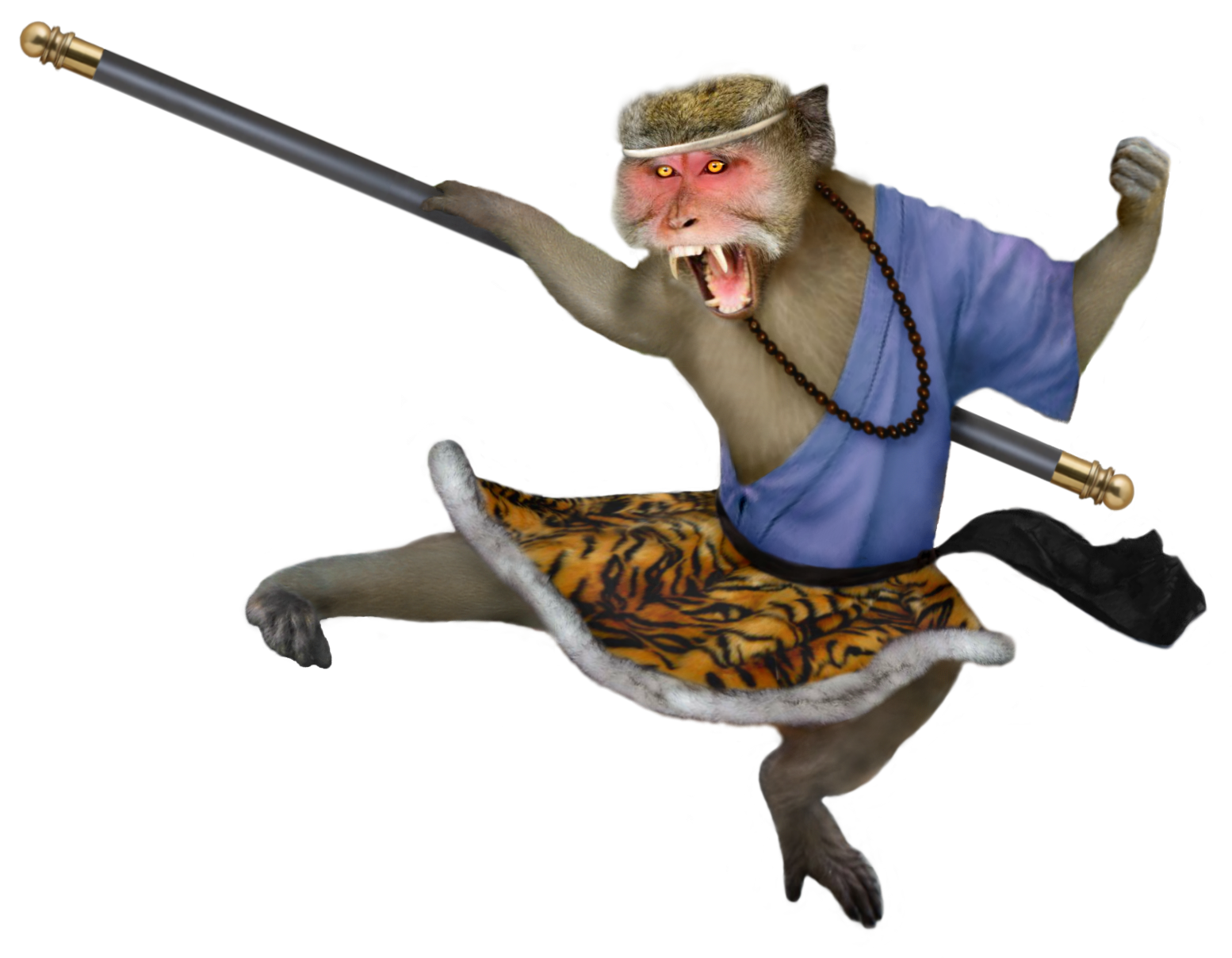
One of the most famous primate characters in world literature appears in the great Chinese classic Journey to the West (Xiyouji, 西遊記, 1592 CE). The story follows the adventures of Sun Wukong (孫悟空, a.k.a. “Monkey”) (fig. 1), an immortal rhesus macaque demon, who gains extraordinary power via spiritual cultivation and rebels against the primacy of heaven. Like Lucifer in Judeo-Christian mythology, this trickster god falls from grace when a supreme deity, in this case the Buddha, banishes him to an earthly prison below. But unlike his western counterpart, the monkey repents, becoming a monk and agreeing to use his abilities to protect a Buddhist priest on his journey to collect sutras from India.

What follows is an overview of Monkey’s story. It will primarily focus on the first seven of the novel’s 100 chapters, but chapters eight through 100 will be briefly touched upon, along with lesser-known literary sequels to Journey to the West. I will also discuss the novel’s impact on pop culture and religion.

Table of Contents

1. His Story

In the beginning, the mystical energies of heaven and earth and the light of the sun and moon come together to impregnate a boulder high atop the Mountain of Flowers and Fruit (Huaguo shan, 花果山), an island that lies to the east of the easternmost continent in the Buddhist disc world system. The stone gestates for countless ages until the Zhou Dynasty (1046-256 BCE), when it hatches a stone egg that is eroded by the elements into a simian shape. The Stone Monkey (Shihou, 石猴) awakens and bows to the four cardinal directions as light bursts forth from his eyes. The light is so bright that it reaches heaven, alarming the Jade Emperor (Yuhuang dadi, 玉皇大帝) and his celestial retinue. The light soon subsides, however, once he ingests food for the first time.

The Stone Monkey happens upon other primates on the island and becomes their king when he proves himself in a test of bravery by blindly leaping through a waterfall, thereby discovering a long-forgotten immortal’s cave. He rules the mountain for over three centuries before the fear of death finally creeps in. One of his primate advisors suggests that the king finds a transcendent to teach him the secrets of eternal life, and so Monkey sets sail on a makeshift raft and explores the world for ten years. His quest eventually takes him to the western continent, where he is finally accepted as a student by the Buddho-Daoist sage, Patriarch Subodhi (Xuputi zushi, 須菩提祖師). He is given the religious name Sun Wukong, meaning “monkey awakened to emptiness” or “monkey who realizes sunyata.” The sage teaches him the 72 methods of earthly transformation, or endless ways of changing his shape and size; cloud somersaulting, or a type of flying that allows him to travel 108,000 li (33,554 mi / 54,000 km) in a single leap; all manner of magical spells to call forth gods and spirits, grow or shrink to any size, part fire and water, create impassable barriers, conjure wind storms, cast illusions, freeze people in place, make endless clones of himself, unlock any lock, bestow superhuman strength, bring the dead back to life, etc.; traditional medicine; armed and unarmed martial arts; and, most importantly, an internal breathing method that results in his immortality. He is later disowned by the sage for selfishly showing off his new found magical skills to his less accomplished classmates.

Sun eventually returns to his cave and faces a demon who had terrorized his people during his prolonged absence. After killing the monster, he realizes that he needs a weapon to match his celestial power, and so his advisor suggests that he go to the undersea palace of Ao Guang (敖廣), the Dragon King of the Eastern Sea. There, he tries out weapons weighing thousands of pounds, but each one is too light. He finally settles on a massive nine-ton iron pillar that was originally used by Yu the Great (Dayu, 大禹) to set the depths of the fabled world flood, as well as to calm the seas. Named the “As-You-Will Gold-Banded Staff” (Ruyi jingu bang, 如意金箍棒), the iron responds to Sun’s touch and follows his command to shrink or grow to his whim, thus signifying that this weapon was fated to be his. In addition to the staff, Monkey bullies the Dragon King’s royal brothers into giving him a magical suit of armor.

Shortly after returning home to the Mountain of Flowers and Fruit, he shows off his new weapon by turning into a frightful cosmic giant and commanding the staff to grow, with the top touching the highest heaven and the bottom the lowest hell. This display of power prompts demon kings of the 72 caves to submit to his rule and host a drunken party in his honor. Soon after falling asleep, Sun is visited by two psychopomps who drag his soul to the Chinese underworld of Diyu (地獄). There, he learns that he was fated to die at the allotted age of 342 years old. But this enrages Monkey since his immortality freed him from the cycle of rebirth, and so he bullies the kings of hell in to bringing him the ledger containing his info. He promptly crosses out his name with ink, as well as the names of all monkeys on earth, thus making them immortal, too. He wakes up in the mortal world when his soul returns to his body.

Fig. 1 – A modern depiction of Sun Wukong (by the author) (larger version).

Both the Eastern Dragon King and the Hell King Qinguang (秦廣王) submit memorials to heaven concerning Sun’s misconduct. But the court advisor, an embodiment of the planet Venus, convinces the Jade Emperor to give Sun the menial task of watching over the Heavenly Horses in order to avoid further conflict. Monkey accepts and steadfastly performs his duties, that is until he learns that he’s just a glorified stable boy. He immediately returns to his earthly home in rebellion to proclaim himself the “Great Sage Equaling Heaven” (Qitian dasheng, 齊天大聖). The celestial realm mobilizes an army of powerful demon hunters, including the Heavenly King Li Jing (Li Jing tianwang, 李靖天王) and his son, the child god Third Prince Nezha (Nezha santaizi, 哪吒三太子), but they all fall to Monkey’s magical and martial might. The embodiment of the planet Venus once again steps in to convince the Jade Emperor to acquiesce to Monkey’s demand for higher rank, thereby granting him the empty title of Great Sage Equaling Heaven and even promoting him to watch over the immortal peach groves.

Sun takes stock of the magical peaches that ripen every few thousand years, but he eventually succumbs to their heavenly aroma. He eats all but the youngest life-prolonging fruits, thus gaining another level of immortality. His theft is soon discovered, however, when fairy attendants of the Queen Mother of the West (Xiwangmu, 西王母) arrive to pick the choicest specimens for her long-awaited immortal peach banquet. Sun is alerted to there presence and, upon questioning them, learns that he has not been invited. Naturally, Sun becomes enraged, freezing the maidens in place with fixing magic and then crashes the party before the hallowed guests arrive. He eats all of the celestial food and drinks all of the immortal wine, and then drunkenly stumbles into the laboratory of Laozi (老子), a high god of Daoism. There, he gobbles up the deity’s alchemically-derived elixir pills, thereby adding several more levels of immortality.

Sun returns home once again to await the coming storm of heavenly forces. Tired of the demon’s antics, the Jade Emperor calls up 72 heavenly generals, comprising the most powerful Buddho-Daoist gods, and 100,000 celestial soldiers. In response, Monkey mobilizes his own army comprising the demon kings of the 72 caves and all manner of animal spirits, including his own monkey soldiers. But soon after the battle commences, the demon kings fall to heavenly troops, forcing Sun to take on three heads and six arms and multiply his iron staff to meet the onslaught. Once again, the heavenly army is no match for him. However, he soon loses his nerve when his monkey children are captured in great heavenly nets. He flees with Erlang (Erlang shen, 二郎神), a master of magic and the nephew of the Jade Emperor, taking chase. The two battle through countless animal transformations, each trying to one-up the other. Monkey is finally captured when Laozi drops a magical bracelet on his head, incapacitating him long enough for Erlang’s celestial hound to bite hold of his leg.

Sun is taken to heaven to be executed for his crimes, but fire, lightning, and edged weapons have no effect on his invincible body. Laozi then suggests that they put him inside of the deity’s alchemical furnace to reduce the demon to ashes. They check the furnace 49 days later expecting to see his rendered remains. However, Monkey jumps out unscathed, having found protection in the wind element (xun, 巽) of the eight trigrams. But intense heat and smoke inside the furnace had greatly irritated his eyes, refining his pupils the color of gold and giving them the power to recognize the dark auras of demons in disguise. He overturns the furnace and begins to cause havoc in heaven with his iron staff. The Jade Emperor finally beseeches the Buddha (Rulai, 如来) in the Western Paradise to intervene.

The Tathagata appears and declares that he will make Sun the new ruler of heaven if the macaque can simply jump out of his palm. Monkey agrees to the wager, and with one tremendous leap, speeds towards the reaches of heaven. He lands before five great pillars, thinking them to be the edge of the cosmos. He tags one with his name and urinates at the base of another in order to prove that he had been there. Upon returning, Sun demands the throne. However, the Buddha reveals that the five pillars were actually his fingers, meaning that the Great Sage had never left. But before Monkey can do anything, the Tathagata overturns his hand, pushing it out the gates of heaven, and transforming it into the Five Elements Mountain (Wuxing shan, 五行山). There, Sun is imprisoned for his crimes against heaven, as well as subjected to a hellish diet.

Chapters thirteen to 100 tell how six hundred years later Sun is released during the Tang Dynasty (618-907) to help escort the Buddhist monk Tripitaka (Sanzang, 三藏) (whose early story is told in chapters eight to twelve), a disciple of the Buddha in a previous life, on a quest to retrieve salvation-bestowing scriptures from India. The Bodhisattva Guanyin (觀音) gives the monk a golden headband (jingu, 金箍; a.k.a. jingu, 緊箍, lit: “tight fillet”) as a means to rein in Monkey’s unruly nature. It tightens around Sun’s head whenever a magic formula is recited, causing him great pain. In addition, Guanyin gives Monkey three magic hairs on the back of his neck that can transform into anything he desires to aid in his protection of the monk. Along the way, the two meet other monsters-turned-disciples—Zhu Bajie (猪八戒), the lecherous pig demon, Sha Wujing (沙悟净), the complacent water demon, and the White Dragon Horse (Bailongma, 白龍馬), a royal serpent transformed into an equine—who agree to aid in the monk’s defense. Monkey battles all sorts of ghosts, monsters, demons, and gods along the way. In the end, he is granted Buddhahood and given the title of the “Victorious Fighting Buddha” (Dou zhanzheng fo, 鬥戰勝佛) for protecting Tripitaka over the long journey.

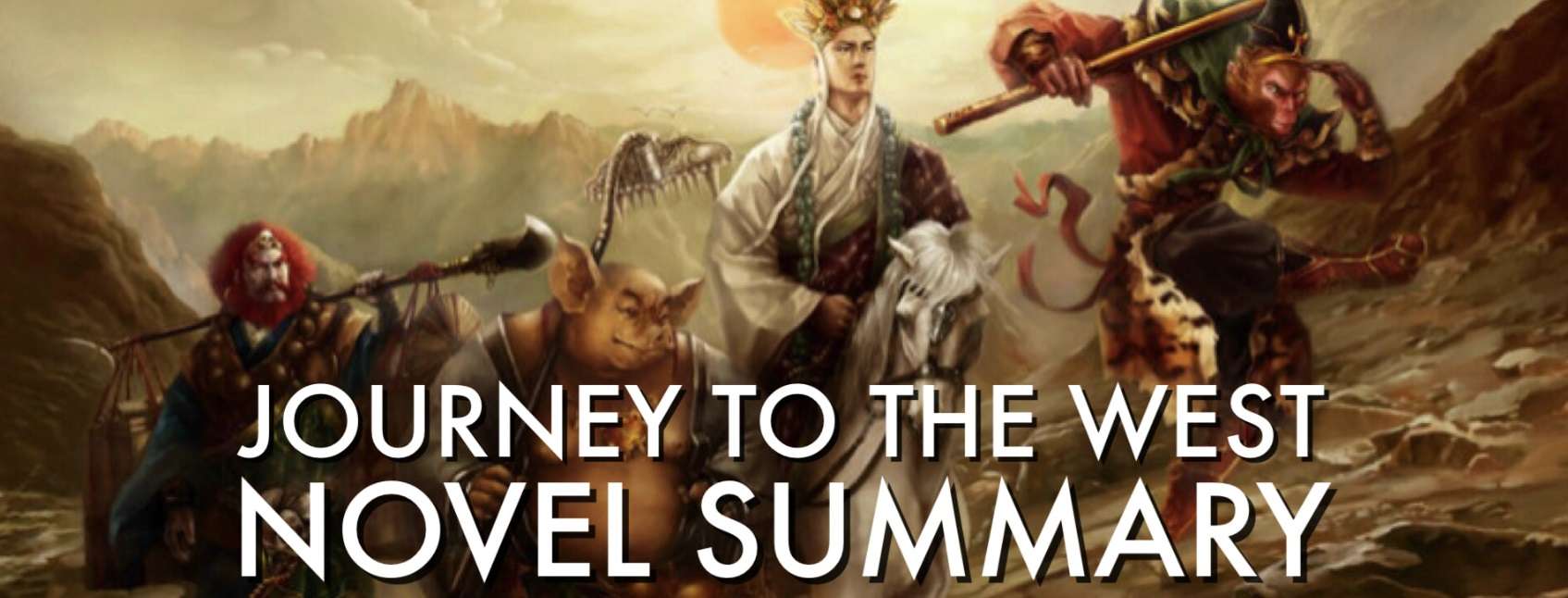
A summary of all 100 chapters can be read on my friend’s blog (fig. 2).

https://journeytothewestlibrary.weebly.com/novel-summary

Fig. 2 – The summary header (larger version).

2. Sequels

There are a total of four unofficial sequels to the novel.

The first is called A Supplement to the Journey to the West (Xiyoubu, 西游补, 1640), which takes place between chapters 61 and 62 of the original. In the story, the Monkey King wanders from one adventure to the next, using a magic tower of mirrors and a Jade doorway to travel to different points in time. In the Qin Dynasty (221–206 BCE), he disguises himself as Consort Yu in order to locate a magic weapon needed for his quest to India. During the Song Dynasty (960–1279), he serves in place of King Yama as the judge of Hell. After returning to the Tang Dynasty, he finds that his master Tripitaka has taken a wife and become a general charged with wiping out the physical manifestation of desire (desire being a major theme running through the novelette). Monkey goes on to take part in a great war between all the kingdoms of the world, during which time he faces one of his own children in battle. In the end, he discovers an unforeseen danger that threatens Tripitaka’s life.

The second is the Later Journey to the West (Hou Xiyouji, 後西遊記, 17th century). This novel focuses on the adventures of Monkey’s spiritual descendent Sun Luzhen (孫履真, “Monkey who Walks Reality”). I have a three-part article about it (first, second, and third).

And the third and fourth are the Continuation of the Journey to the West (Xu Xiyouji, 續西遊記, 17th century) and the New Journey to the West (Xin Xiyouji, 新西遊記, 19th century), respectively. As of 2023, I have not written any articles on these sequels.

3. Cultural Impact

Stories about Sun Wukong have enthralled people the world over for centuries. His adventures first became popular via oral folktale performances during the Song Dynasty (960-1279). These eventually coalesced into the earliest known version of the novel, The Story of How Tripitaka of the Great Tang Procures the Scriptures (Da Tang Sanzang qujing shihua, 大唐三藏取經詩話; The Story hereafter), published during the late-13th century.

Since the anonymous publishing of the complete novel in the 16th century, Monkey has appeared in numerous paintings, poems, books, operatic stage plays, video games, and films (both live action and animated).

He was sometimes “channeled,” along with other martial spirits, by citizen soldiers of the anti-foreign Boxer Rebellion (1899-1901). There is also a monkey-based martial art named in his honor.

It is interesting to note that there are people in southern China, Taiwan, Malaysia, Singapore, Thailand, and Vietnam who worship him as a patron deity. Thus, Sun became so popular that he jumped from oral and published literature to take his place on the family altar.

Copies of The Story were discovered in Japan among a 17th-century catalog of books in the Kozanji Temple (高山寺, Ch: Gaoshan si). No copies are known to exist in China, which suggests this version came to the island many centuries ago. The complete Ming edition of the novel came to Japan in the late-18th century, where it was translated in bits and pieces over the course of some seventy years. However, Monkey did not become immensely popular until the first complete translation of the novel was published in 1835. The last part was illustrated with woodblocks by Taito II (fl. 1810-1853), a noted student of famous artist Hokusai (1760-1849).

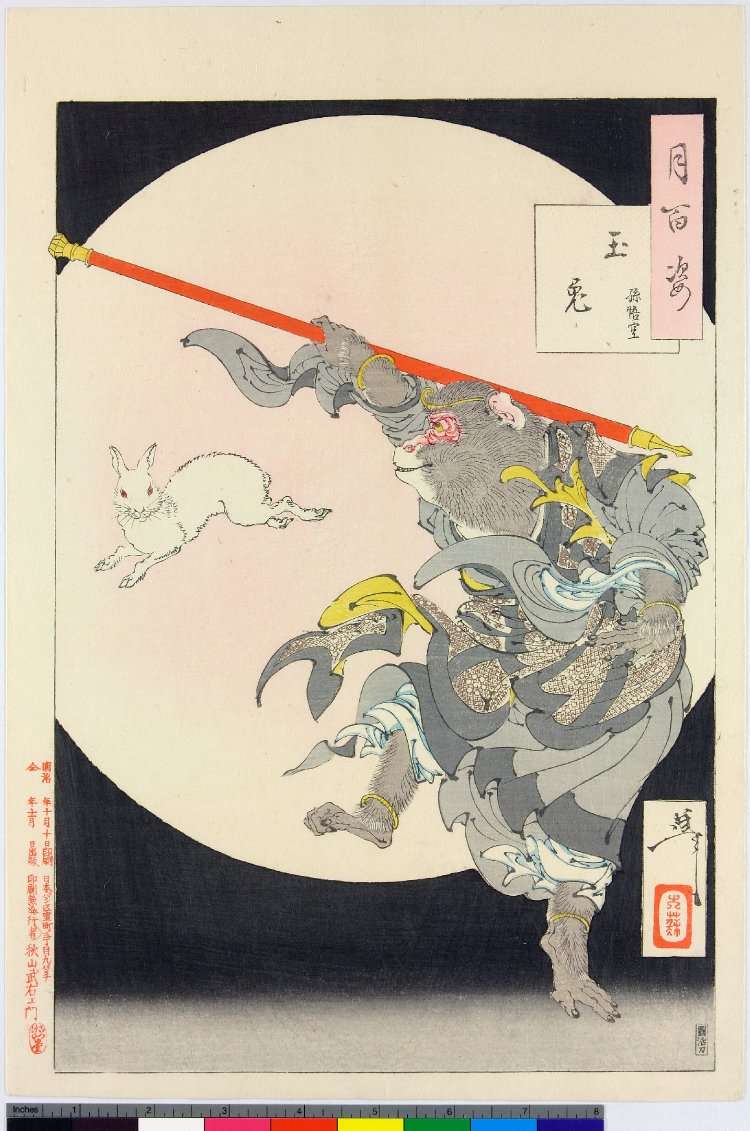
Other Japanese artists, such as Kubo Shunman (1757-1820) and Yoshitoshi (1839-1892) (fig. 3), produced beautiful full color woodblock prints of Sun.

Fig. 3 – (Left) Tsukioka Yoshitoshi, “Jade Rabbit – Sun Wukong”, October 10, 1889 (larger version). Fig 4. – (Right) Son Goku (孫悟空) from the Dragonball Franchise (larger version).

Like in China, Monkey has been adapted in all kinds of Japanese media. By far, his most famous adaptation is the manga and anime character Son Goku (孫悟空) (fig. 4) from the Dragon Ball (Jp:ドラゴンボール; Ch: Qi longzhu, 七龍珠) franchise (1984-present). Like Sun, Goku has a monkey tail, knows martial arts, fights with a magic staff, and rides on a cloud. His early adventures in Dragon Ball (manga: 1984-1995; anime: 1986-1989) see him traveling the world in search of seven wish-granting “dragon balls,” while also perfecting his fighting abilities and participating in a world martial arts tournament. Several of the supporting characters, such as Oolong (ウーロン), a lecherous anthropomorphic pig who can change his shape, a nod to Zhu Bajie, were directly influenced by the novel. Dragon Ball Z (manga: 1988-1995; anime: 1989-1996), a continuation of the comic book and animated TV show, follows Goku as an adult and reveals that he is actually a humanoid alien sent as a child to destroy Earth. He arrived in a spherical spaceship that recalls the stone egg from which Sun Wukong was formed. But instead of destroying the planet, he becomes its stalwart protector and faces extraterrestrial menaces from beyond the stars. Goku’s adventures have continued in the sequels Dragon Ball GT (1996-1997), Dragon Ball Super (2015-2018), and Super Dragon Ball Heroes (2018-present).