What Does Red Boy Look Like? A Resource for Artists and Cosplayers

Last updated: 04-30-2024

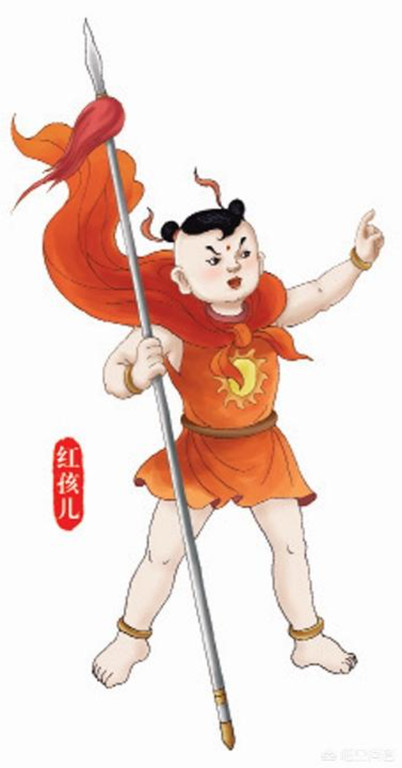
The child demon, Red Boy (Honghai’er, 紅孩兒), appears in chapters 40 to 42 of Journey to the West (Xiyouji西遊記, 1592; “JTTW” hereafter). He is described as the son of the Bull Demon King (Niu mowang, 牛魔王) and Princess Iron Fan (Tieshan gongzhu, 鐵扇公主), a rakshasi spirit (luocha nu, 羅剎女). Due to his bovine father, Red Boy is sometimes portrayed in modern media and fan art with horns, and because of his youthful appearance, he is often shown wearing a red stomacher. So how do these representations compare to his depiction in the novel, and who has produced the most authentic look? In this article, I will present the demon’s literary description, along with ancient depictions from dynastic China and Korea. My hope is that the information will be both interesting and useful, especially for artists and cosplayers looking to make a more authentic design.

This is part of a series of articles describing JTTW characters. See my previous entries on Sun Wukong and Zhu Bajie.

Table of Contents

1. Ancient Depiction

The oldest art featuring Red Boy that I know of appears on the 14th-century Gyeongcheonsa pagoda (Kyŏngch’ŏnsa sipch’ŭng sŏkt’ap, 경천사십층석탑) from Korea. The second level of the pagoda’s multifaceted three-tiered base contains a total of 20 carved scenes from the JTTW story cycle. The 19th carving depicts the character’s defeat in a scene that would come to appear in the 1592 JTTW. [1] Reading it from left to right, Sha Wujing and Zhu Bajie stand by the dragon horse as they watch the cloud-borne Guanyin enact her divine plan of capturing Red Boy, who is shown impaled on a lotus throne full of celestial swords. And to the child-sage’s left, the Bodhisattva’s disciple, Hui’an/Mucha, hammers at the swords with his staff while sitting on Sun Wukong’s shoulders in a symbolic display of teamwork (fig. 1 & 2).

Fig. 3 (top) – The complete 19th JTTW carving on the second tier of Gyeongcheonsa pagoda (larger version). Image from Wall (2019). Fig. 4 (bottom) – A detail of Red Boy trapped on the lotus throne of swords (L) and an accompanying line drawing for clarity (R) (larger version). 

2. What the Novel Says

2.1. Physical appearance

The fullest description of Red Boy appears in chapter 41:

A face as if it had been powdered white,
And lips so ruddy, they seemed brushed with paint.
No dye could create such dark, coiled hair;
His eyebrows curved like new moons carved with knives.
Phoenix and dragon coiled on his battle kilt;
More husky than Nezha‘s frame he had.
With air imposing he lifted up his lance
And walked out the door, swathed in hallowed light.
He roared like thunder in the time of spring;
His striking eyes flashed like lightning bright.
If one would know his true identity,
Remember Red Boy, a name of lasting fame
(based on Wu & Yu, 2012, vol. 2, pp. 222-223).

面如傅粉三分白,唇若塗朱一表才。
鬢挽青雲欺靛染,眉分新月似刀裁。
戰裙巧繡盤龍鳳,形比哪吒更富胎。
雙手綽槍威凜冽,祥光護體出門來。
哏聲響若春雷吼,暴眼明如掣電乖。
要識此魔真姓氏,名揚千古喚紅孩。

This description speaks of porcelain doll-like beauty and a chubby body. The original Chinese states that his hair is “rolled or coiled at the temples” (binwan, 鬢挽). This could mean that his hair is in buns or coils. I’ll leave it up to the reader as to which one you like more.

It’s important to highlight that the poem does not mention horns. An in-canon explanation for this could be because Red Boy’s mother, Princess Iron Fan, had already “attained the way of humanity” (i.e. a human form) via spiritual cultivation (Wu & Yu, 2012, vol. 3, p. 162). Perhaps this resulted in the demon-sage having a more human-like appearance. Or, given his own 300-plus-years of austerities (Wu & Yu, 2012, vol. 2, p. 219), he too has attained human form.

Interestingly, Ming-era woodblock prints don’t portray him with horns either. See figures four and five below.

2.2. Clothing

Red Boy is described as being lightly clothed and barefooted:

With no other armor except a battle kilt of embroidered silk and with naked feet, the monster king took up the lance and walked outside (Wu & Yu, 2012, vol. 2, p. 222).

妖王掄槍拽步,也無甚麼盔甲,只是腰間束一條錦繡戰裙,赤著腳,走出門前。

So his attire consists of a single silken battle kilt, [2] which is, as mentioned in the poem above, embroidered with dragons and phoenixes. This would mean that Red Boy is bare-chested on top of having no footwear.

But what exactly does a “battle kilt” (zhanqun, 戰裙) look like? One example comes from a set of brigandine armor of the Qing dynasty (1636–1912). It covers the entire lower half of the body down to the ground (fig. 4). I imagine that Red Boy’s kilt would be red given his name and association with fire.

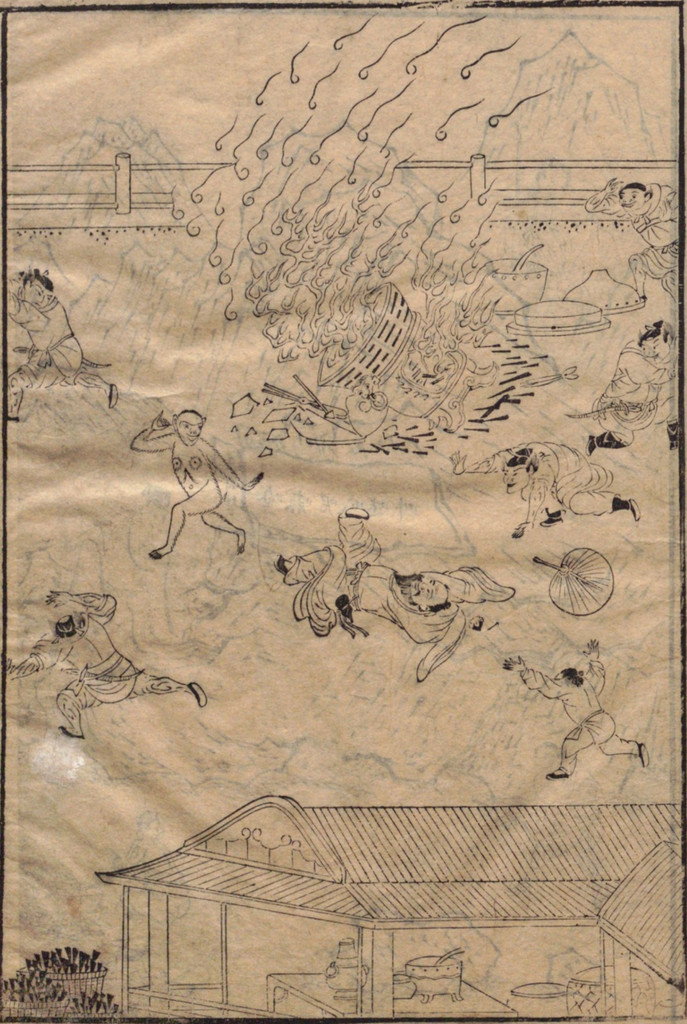
One late-Ming woodblock print portrays this clothing, adding a divine sash and an embroidered stomacher (fig. 3).

Fig. 3 (left) – An example of Qing-era brigandine armor with a battle kilt (larger version). Image found here. Fig. 4 (right) – A detail of Red Boy’s attire from Mr. Li Zhuowu’s Literary Criticism of Journey to the West (Li Zhuowu Xiansheng piping Xiyouji, 李卓吾先生批評西遊記, late-16th or early-17th century) (larger version).

2.3. Weapon

Prior to walking outside to face the Monkey King, the demon calls for his giant, fiery spear:

“Bring me my lance,” he ordered. Those fiends who looked after weapons had two of them carry out a ten zhang eight chi fire-tipped lance [huojian qiang, 火尖槍] to hand over to the monster king (based on Wu & Yu, 2012, vol. 2, p. 222).

教取過槍來。有那一夥管兵器的小妖,著兩個擡出一桿丈八長的火尖槍,遞與妖王。

One zhang (丈) comprises ten chi (尺, a.k.a. “Chinese feet”), and one chi is roughly 12.3 in (31.8 cm). This makes one zhang 10.43 ft (3.18 m) (Jiang, 2005, p. xxxi). Therefore, Red Boy’s weapon is roughly 18.77 ft (5.724 m) long. That’s one long spear!

A woodblock print from the original 1592 JTTW shows an armored Red Boy wielding his weapon (fig. 5).

Fig. 5 – Red Boy wields his spear and holy flame against Monkey and Zhu Bajie (larger version). Image from the Newly Printed, Illustrated, Deluxe and Large Character, Journey to the West (Xinke chuxiang guanban dazi Xiyou ji, 新刻出像官板大字西遊記, 1592).

3. Popular Depictions

As far as I know, there have not been any novel accurate portrayals of Red Boy in popular media, but I figured that I would post images from the most famous TV shows.

3.1. 1986 JTTW

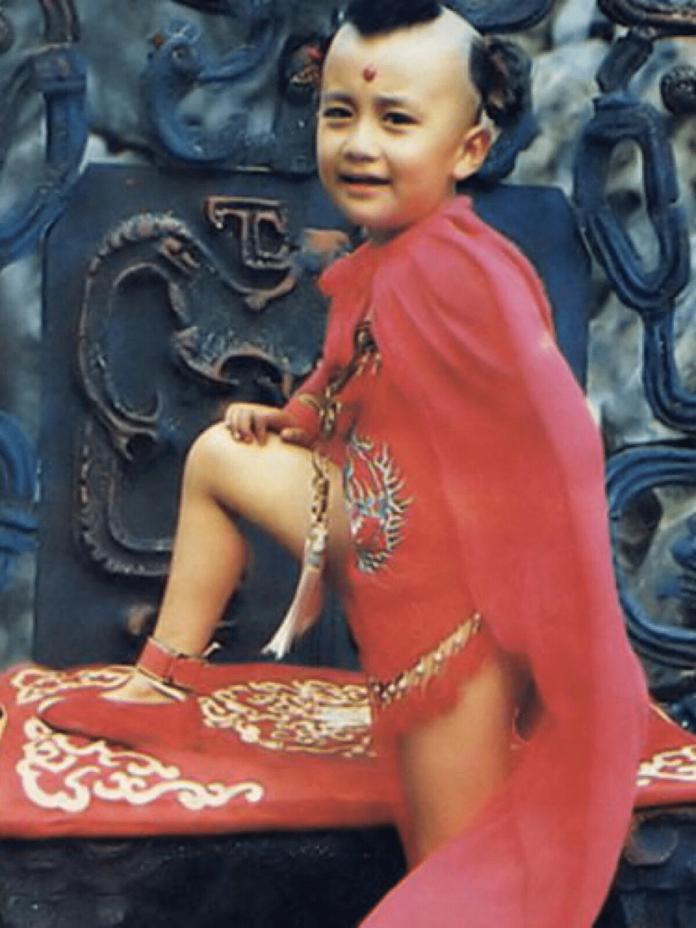
He is portrayed with a hair tuft and coils, a red urna, a red cape, a red stomacher, and red slippers (fig. 6).

Fig. 6 – “Adorable Red Boy” (larger version). Image found here.

3.2. 1996 JTTW

He is portrayed by a young woman with two red ribbon-wrapped, white cloth-covered hair buns and a white undershirt and a red vest, red forearm cuffs, red shorts, and red slippers (fig. 7).

Fig. 7 – “Girl Red Boy” (larger version). Image found here.

3.3. 2011 JTTW

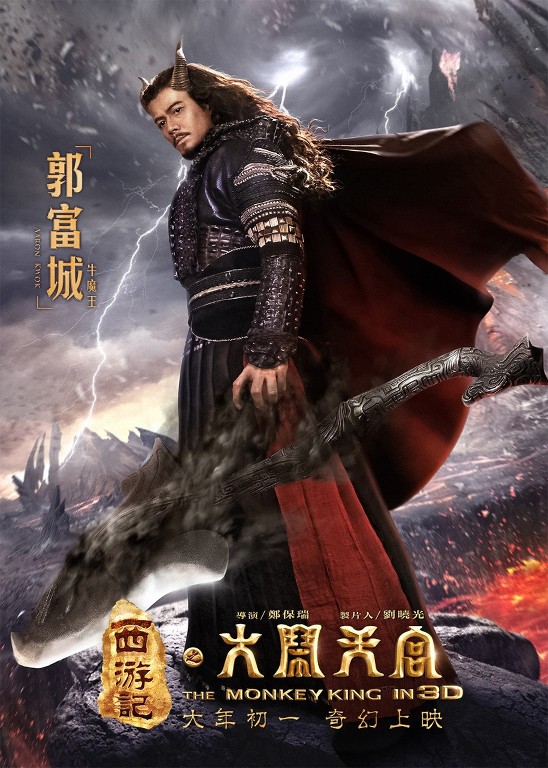
He is portrayed with a hair tuft, red horns, a dark red to brown suit of armor with a flame pattern, and a red cape (fig. 8).

Fig. 8 – “Armored Red Boy” (larger version). The original online source is no longer available.

4. Conclusion

JTTW chapter 41 describes Red Boy as having doll-like beauty with a powder white face, crescent moon-shaped eyebrows, and deep red lips. His dark hair is either wrapped in buns or hung in coils. He is shoeless, and the only clothing covering his husky body is a silken battle kilt embroidered with phoenixes and dragons. And his weapon is an 18.77 ft (5.724 m) long, fired-tipped spear.


5. Updates

Update: 03-25-24

It occurred to me that the following description …

With no other armor except a battle kilt of embroidered silk and with naked feet … (Wu & Yu, 2012, vol. 2, p. 222).

妖王掄槍拽步,也無甚麼盔甲,只是腰間束一條錦繡戰裙,赤著腳

… does not necessarily exclude other clothing. Red Boy could wear some kind of silk robe beneath the battle kilt. However, I think him being shirtless better fits with his ferocious nature.


Update: 04-30-24

Chapter 42 indicates that Red Boy has a full head of hair that is later shaved by Guanyin:

She took out from her sleeve a golden razor and approached the fiend. With a few strokes, she shaved his hair off and turned it into the style of the Tai Mountain Crowning the Head: the top was completely bald, but three tufts of hair were left around the edge so that they could be knotted together into three tiny braids (Wu & Yu, 2012, vol. 2, p. 250).

就袖中取出一把金剃頭刀兒,近前去,把那怪分頂剃了幾刀,剃作一個太山壓頂,與他留下三個頂搭,挽起三個窩角揪兒。

This contrasts with modern representations of Red Boy that already have this shaven hair style prior to being subjugated. Refer back to section 3.

Notes:

1) Chapter 42 reads:

After she received [treasure swords borrowed from heaven], the Bodhisattva [Guanyin] threw them into the air as she recited a spell: the swords were transformed into a thousand-leaf lotus platform. Leaping up, the Bodhisattva sat solemnly in the middle.

菩薩接在手中,拋將去,念個咒語,只見那刀化作一座千葉蓮臺。菩薩縱身上去,端坐在中間。

[…]

[Sun Wukong feigns defeat and tricks Red Boy into chasing him to Guayin’s domain] When the monster spirit suddenly discovered that Pilgrim was gone, he walked up to the Bodhisattva with bulging eyes and said to her, “Are you the reinforcement Pilgrim Sun brought here?” The Bodhisattva did not reply. Rolling the lance in his hands, the monster king bellowed, “Hey! Are you the reinforcement Pilgrim Sun brought here?” Still the Bodhisattva did not reply. The monster-spirit lifted his lance and jabbed at the heart of the Bodhisattva, who at once changed herself into a beam of golden light and rose into the air. Pilgrim followed her on her way up and said to her, “Bodhisattva, you are trying to take advantage of me! The monster-spirit asked you several times. How could you pretend to be deaf and dumb and not make any noise at all? One blow of his lance, in fact, chased you away, and you have even left behind your lotus platform.”

“Don’t talk,” said the Bodhisattva, “let’s see what he will do.” At this time, Pilgrim and [Mucha] both stood in the air shoulder to shoulder and stared down; they found the monster-spirit laughing scornfully and saying to himself, “Brazen ape, you’re mistaken about me! What sort of person do you think that I, Holy Child, happen to be? For several times you could not prevail against me, and then you had to go and fetch some namby-pamby Bodhisattva. One blow of my lance now has made her vanish completely. Moreover, she has even left the treasure lotus platform behind. Well, let me get up there and take a seat.” Dear monster-spirit. He imitated the Bodhisattva by sitting in the middle of the platform with hands and legs folded. When he saw this, Pilgrim said, “Fine! Fine! Fine! This lotus platform has been given to someone else!”

“Wukong,” said the Bodhisattva, “what are you mumbling again?”

“Mumbling what? Mumbling what?” replied Pilgrim. “I’m saying that the lotus platform has been given to someone else. Look! It’s underneath his thighs. You think he’s going to return it to you?”

“I wanted him to sit there,” said the Bodhisattva.

“Well, he’s smaller than you,” said Pilgrim, “and it seems that the seat fits him even better than it fits you.”

“Stop talking,” said the Bodhisattva, “and watch the dharma power.”

She pointed the willow twig downward and cried, “Withdraw!” All at once, flowers and leaves vanished from the lotus platform and the auspicious luminosity dispersed entirely. The monster king, you see, was sitting actually on the points of those swords. The Bodhisattva then gave this command to [Mucha]:

“Use your demon-routing cudgel and strike back and forth at the sword handles.”

Dropping from the clouds, [Mucha] wielded his cudgel as if he were demolishing a wall: he struck at the handles hundreds of times. As for that monster-spirit,

Both his legs were pierced till the points stuck out;
Blood spouted in pools as flesh and skin were torn.

Marvelous monster! Look at him! Gritting his teeth to bear the pain, he abandoned the lance so that he could use both hands to try to pull the swords out from his body … (Wu & Yu, 2012, vol. 2, pp. 246 and 249-250).

這妖精見沒了行者。走近前,睜圓眼,對菩薩道:「你是孫行者請來的救兵麼?」菩薩不答應。妖王撚轉長槍,喝道:「咄!你是孫行者請來的救兵麼?」菩薩也不答應。妖精望菩薩劈心刺一槍來。那菩薩化道金光,徑走上九霄空內。行者跟定道:「菩薩,你好欺伏我罷了,那妖精再三問你,你怎麼推聾裝啞,不敢做聲,被他一槍搠走了,卻把那個蓮臺都丟下耶?」菩薩只教:「莫言語,看他再要怎的。」

此時行者與木叉俱在空中,並肩同看。只見那妖呵呵冷笑道:「潑猴頭,錯認了我也。他不知把我聖嬰當作個甚人,幾番家戰我不過,又去請個甚麼膿包菩薩來卻被我一槍,搠得無形無影去了,又把個寶蓮臺兒丟了。且等我上去坐坐。」好妖精,他也學菩薩,盤手盤腳的坐在當中。行者看見道:「好好好,蓮花臺兒好送人了。」菩薩道:「悟空,你又說甚麼?」行者道:「說甚?說甚?蓮臺送了人了。那妖精坐放臀下,終不得你還要哩?」菩薩道:「正要他坐哩。」行者道:「他的身軀小巧,比你還坐得穩當。」菩薩叫:「莫言語,且看法力。」

他將楊柳枝往下指定,叫一聲:「退!」只見那蓮臺花彩俱無,祥光盡散,原來那妖王坐在刀尖之上。即命木叉:「使降妖杵,把刀柄兒打打去來。」那木叉按下雲頭,將降魔杵如築牆一般,築了有千百餘下。那妖精穿通兩腿刀尖出,血注成汪皮肉開。好怪物,你看他咬著牙,忍著痛,且丟了長槍,用手將刀亂拔 …

2) Padded silk armor was apparently used in ancient China as early as 600 CE (Dean, 1920, pp. 284-285).

Sources:

Dean, B. (1920). Helmets and Body Armor in Modern Warfare. United Kingdom: Yale University Press.

Jiang, Y. (2005). The Great Ming Code / Da Ming Lu. Vancouver, Wa: University of Washington Press.

Wall, B. (2019). Dynamic Texts as Hotbeds for Transmedia Storytelling: A Case Study of the Story Universe of the Journey to the WestInternational Journal of Communication 13, 2116-2142. Retrieved from https://ijoc.org/index.php/ijoc/article/view/10006/2648.

Wu, C., & Yu, A. C. (2012). The Journey to the West (Vols. 1-4) (Rev. ed.). Chicago, Illinois: University of Chicago Press.

Sun Wukong’s Names and Titles

Last updated: 03-21-2026

I was recently contacted by a reader who said they were researching the Monkey King’s various nicknames. I had never thought about this before, so I decided to write an article to help them out. I am indebted to Irwen Wong of the Journey to the West Library blog for helping me with some of the more obscure terms. If you know of others that I missed, please let me know in the comments below or by email (see the “contact” button).

The vast majority of the terms listed here come from the standard 1592 edition of Journey to the West (Xiyouji西遊記; “JTTW” hereafter) (Wu & Yu, 2012). I have also added a few terms from a precursor, The Story of How Tripitaka of the Great Tang Procures the Scriptures (Da Tang Sanzang qujing shihua大唐三藏取經詩話, c. late-13th-century) (Wivell, 1994). I did this to show that certain variations of names or titles have existed for centuries.

My translation of some names and titles will slightly differ from those appearing in Wu and Yu (2012).

Table of Contents

1. Mentioned in the Narrative

These are names or titles mentioned by the narrative.

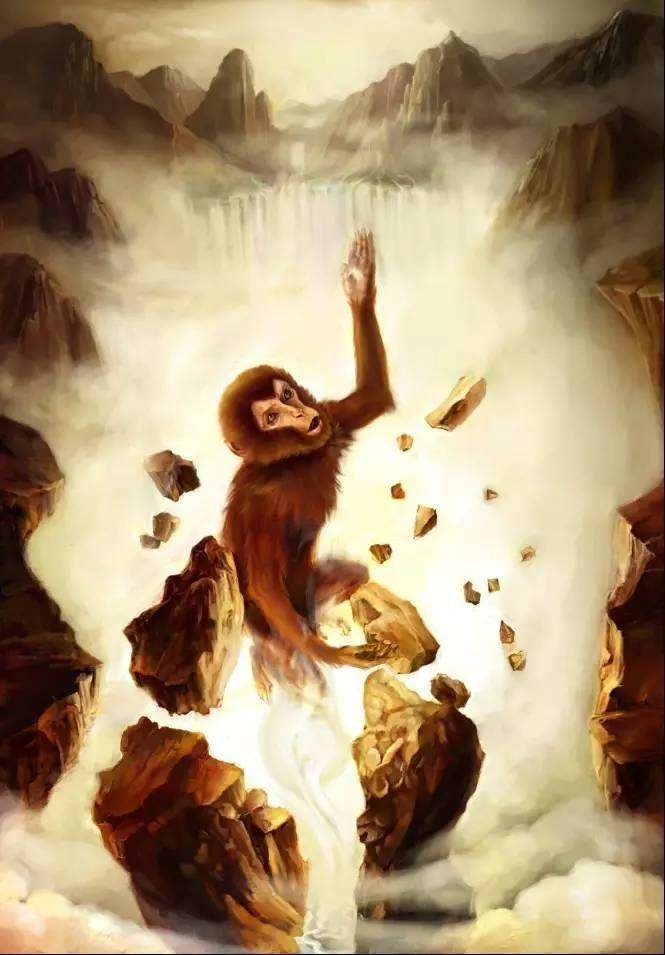
  1. Shihou (石猴, “Stone Monkey”) – Monkey’s first name according to chapter one (Wu & Yu, 2012, vol. 1, p. 104). This is related to his birth from stone (fig. 1).
  2. Tianchan Shihou (天產石猴, “Heaven-Born Stone Monkey”) – His REAL name as listed in the ledgers of hell in chapter three (Wu & Yu, 2012, vol. 1, p. 140).
  3. Xinyuan (心猿, “Mind Monkey/Ape”) – A Buddho-Daoist allegorical term for the disquieted thoughts and emotions that keep man trapped in Saṃsāra. It is used numerous times in chapter titles (e.g. ch. 7) and poems to refer to Monkey (see the material below figure three here).
  4. Jingong (金公, “Lord or Squire of Gold/Metal”) – A term used mainly in poems to refer to Monkey. It is an alternative reading of the component characters making up lead (qian, 鉛), namely jin (金) and gong (公). Lead was an important ingredient in immortal elixirs of external alchemy, and metal/gold (jin, 金) is connected to the earthly branch shen (申), which is associated with monkeys (see no. 9 here) (Wu & Yu, 2012, vol. 1, p. 83 and p. 532 n. 3).
  5. Taiyi Sanxian (太乙散仙, “Leisurely or Minor Immortal of the Great Monad”) – Monkey’s rank within the hierarchy of cosmic immortals (Wu & Yu, 2012, vol. 1, p. 471, for example). It essentially means that he is a divine being without a heavenly post.
  6. Taiyi Jinxian (太乙金仙, “Golden Immortal of the Great Monad”) – A seemingly embellished version of the previous term (Wu & Yu, 2012, vol. 2, p. 264, for example). It speaks of a higher rank. [1] (See the 07-26-25 update below for more info.)
  7. Lingming Shihou (靈明石猴, “Stone Monkey of Numinous Wisdom”) – The name of his magic species according to the Buddha in chapter 58 (Wu & Yu, 2012, vol. 3, p. 115). [2] He is the first of four spiritual primates.
  8. Nanbian Mihou (難辨獼猴, “Indistinguishable Macaques”) – A term referring to both Sun Wukong and the Six-Eared Macaque. [3]

Fig. 1 – Monkey’s birth from stone by Zhang Moyi (larger version). Found on this article.

2. Given by Characters

These are names, titles, or insults that are given to or directed at our hero by other characters.

  1. Hou Xingzhe (猴行者, “Monkey Pilgrim”) – Monkey’s original religious name in the 13th-century JTTW. It is given by Tripitaka at the beginning of the journey (Wivell, 1994, p. 1182). The Xingzhe (行者) portion of this name carried over to the 1592 edition. See nos. 12 & 13 below.
  2. Gangjin Tiegu Dasheng (鋼筋鐵骨大聖, “Great Sage Steel Muscles and Iron Bones”) – His divine title in the 13th-century JTTW. It is bestowed by Tang Emperor Taizong at the end of the journey (Wivell, 1994, p. 1207). [4] The Dasheng (大聖) portion of this name carried over to the 1592 edition. See sec. 3, nos. 7 & 8 below.
  3. Sun Wukong (孫悟空, “Monkey Awakened to Emptiness”) – The religious name given to him in chapter one by his first master, the Patriarch Subodhi (Wu & Yu, 2012, vol. 1, p. 115). It predates the 1592 JTTW, first appearing as early as the early-Ming zaju play (see here, for example). It’s important to note that the name “Wukong” (悟空) might have been influenced by a Tang-era monk who traveled throughout India just like Xuanzang (on whom Tripitaka is based).
  4. Liu Xiao Ling Tong (六小龄童) – Monkey’s name in the human world.
  5. Pohou (潑猴, “Reckless or Brazen Monkey”) – An insult used throughout JTTW (Wu & Yu, 2012, vol. 1, p. 118, for example).
  6. Shangxian (上仙, “High or Exalted Immortal”) – A respectful title used by the Dragon King of the Eastern Ocean in chapter three (Wu & Yu, 2012, vol. 1, p. 134).
  7. Huaguo Shan Shuilian Dong Tianchan Yaohou (花果山水簾洞天產妖猴, “Heaven-Born Demon Monkey from the Water-Curtain Cave of the Mountain of Flowers and Fruit”) – An insult used by King Qinguang, a Judge of Hell, in a memorial to the Jade Emperor in chapter three (Wu & Yu, 2012, vol. 1, p. 142).
  8. Xiandi (賢弟, “Worthy Little Brother”) – A nickname used by the Bull Demon King (Wu & Yu, 2012, vol. 1, p. 156, for example). Monkey is the smallest and therefore the last of seven sworn brothers (Wu & Yu, 2012, vol. 2, pp. 223-224).
  9. Yaoxian (妖仙, “Bogus Immortal”) – A category of nigh-immortal beings. He is called this by the Jade Emperor (ch. 4), the Buddha (ch. 7), and the Dragon King of the Eastern Sea in (ch. 14) (Wu & Yu, 2012, vol. 1, pp. 147-148, 193, and 318).
  10. Bimawen (弼馬溫, “To Assist Horse Temperament”) – A minor post overseeing the celestial horse stables. Monkey is given this position in chapter four by the Jade Emperor. Yu (Wu & Yu, 2012) translates this as “BanHorsePlague” (vol. 1, p. 148, for example). [5] This is sometimes used as an insult (Wu & Yu, 2012, vol. 1, p. 354, for example).
  11. Yaohou (妖猴, “Monster or Demon Monkey”) – An insult used numerous times throughout the novel (Wu & Yu, 2012, vol. 1, p. 154, for example).
  12. Sun Xingzhe (孫行者, “Pilgrim Sun”) – Monkey’s second religious name. It is given to him in chapter 14 by Tripitaka (Wu & Yu, 2012, vol. 1, p. 309). Refer back to no. 1. See also sec. 3, nos. 9 & 10 below.
  13. Xingzhe (行者, “Pilgrim”) – He is more commonly referred to by this name than Sun Xingzhe or Sun Wukong combined. [6] See section III here to learn about the significance of this title. Refer back to no. 1. Again, see sec. 3, no. 9 & 10 below.
  14. Sun Zhanglao (孫長老, “Elder Sun”) – A respectful title used by people he has helped (Wu & Yu, vol. 2, p. 85, for example).
  15. Dashixiong (大師兄, “Elder Religious Brother”) – A term used by Zhu Bajie and Sha Wujing (Wu & Yu, 2012, vol. 2, p. 74, for example).
  16. Houtou (猴頭, “Monkey/Ape Head”) – An insult used by various characters, especially Tripitaka (Wu & Yu, 2012, vol. 2, p. 26, for example).
  17. Maolian Heshang (毛臉和尚, “Hairy-Faced Monk”) – A term that describes his features (Wu & Yu, 2012, vol. 1, p. 407, for example).
  18. Maolian Lei Gong Zui de Heshang (毛臉雷公嘴的和尚, “Hairy-Faced, Thunder God-Beaked Monk) – A term that compares his elongated simian face to the beak of the bird-like thunder god Lei Gong (Wu & Yu, 2012, vol. 1, p. 351, for example). Variations include Lei Gong Zui Heshang (雷公嘴和尚, “Thunder God-Beaked Monk”) and Lei Gong de Nanzi/Hanzi (雷公嘴的男子/漢子, “Thunder God-Beaked Man”).
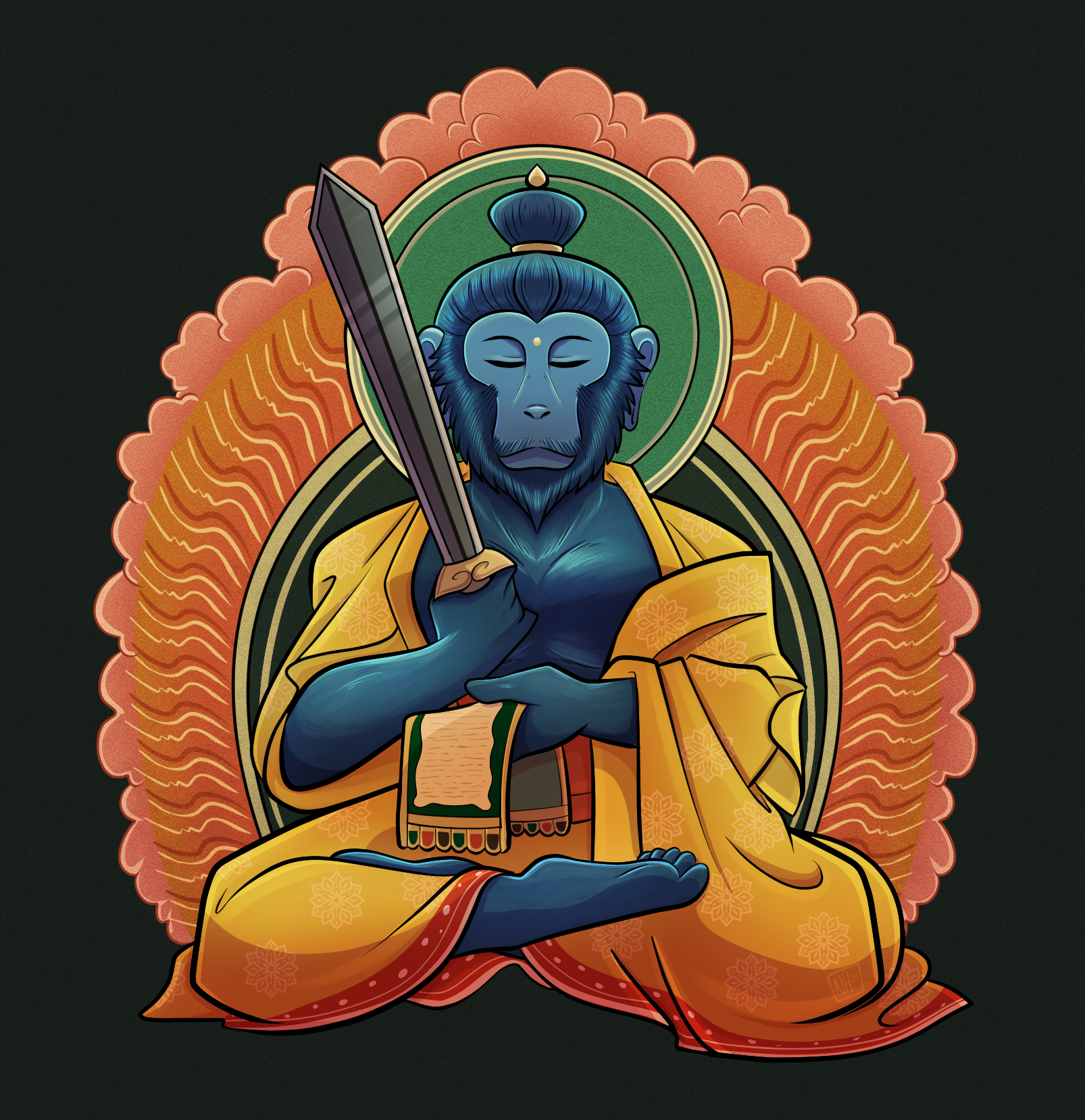
  19. Dou Zhansheng Fo (鬥戰勝佛, “Buddha Victorious in Strife or Victorious Fighting Buddha”) – His Buddha title bestowed by the Tathagata at the end of the journey in chapter 100 (fig. 2) (Wu & Yu, 2012, vol. 4, p. 381).

Fig. 2 – A religiously accurate drawing of Monkey as Dou zhansheng fo by NinjaHaku21 (larger version).

3. Self-Given

These are names, titles, or pseudonyms taken by Monkey himself. These do not include the names of the innumerable gods, monsters, or humans that he disguises himself as. They only refer to him personally.

  1. Huaguo Shan Ziyun Dong Bawan Siqian Tongtou Tie’e Mihou Wang (花果山紫雲洞八萬四千銅頭鐵額獼猴王, “Bronze-Headed, Iron-Browed King of the Eighty-Four Thousand Monkeys of the Purple Cloud Grotto on the Mountain of Flowers and Fruit”) – How he introduces himself to Tripitaka in the 13th-century JTTW (Wivell, 1994, p. 1182). The “Monkey King” (Mihou Wang, 獼猴王) portion of this name carried over to the 1592 edition but was represented with different Chinese characters. See nos. 2 & 3 below. This article discusses the term mihou (獼猴).
  2. Meihou Wang (美猴王, “Handsome Monkey King“) – The title that he takes upon ascending the throne in chapter one (Wu & Yu, 2012, vol. 1, p. 106).
  3. Hou Wang (猴王, “Monkey King”) – He is more commonly referred to by this name than Meihou wang. [7]
  4. Huaguo Shan Shuilian Dong Dongzhu (花果山水簾洞洞主, “Lord of the Water-Curtain Cave in the Mountain of Flowers and Fruit”) – How he introduces himself in chapter two to a demon king plaguing his people (Wu & Yu, 2012, vol. 1, p. 127).
  5. Huaguo Shan Shuilian Dong Tiansheng Shenren (花果山水簾洞天生聖人, “Heaven-Born Sage From the Water-Curtain Cave in the Mountain of Flowers and Fruit”) – How he introduces himself to the Ten Kings of Hell in chapter three (Wu & Yu, 2012, vol. 1, p. 140).
  6. Lao Sun (老孫, “Old Sun”) – A term that he uses many, many times throughout the novel. Yu (Wu & Yu, 2012) translates this as “Old Monkey” (vol. 1, p. 128, for example).
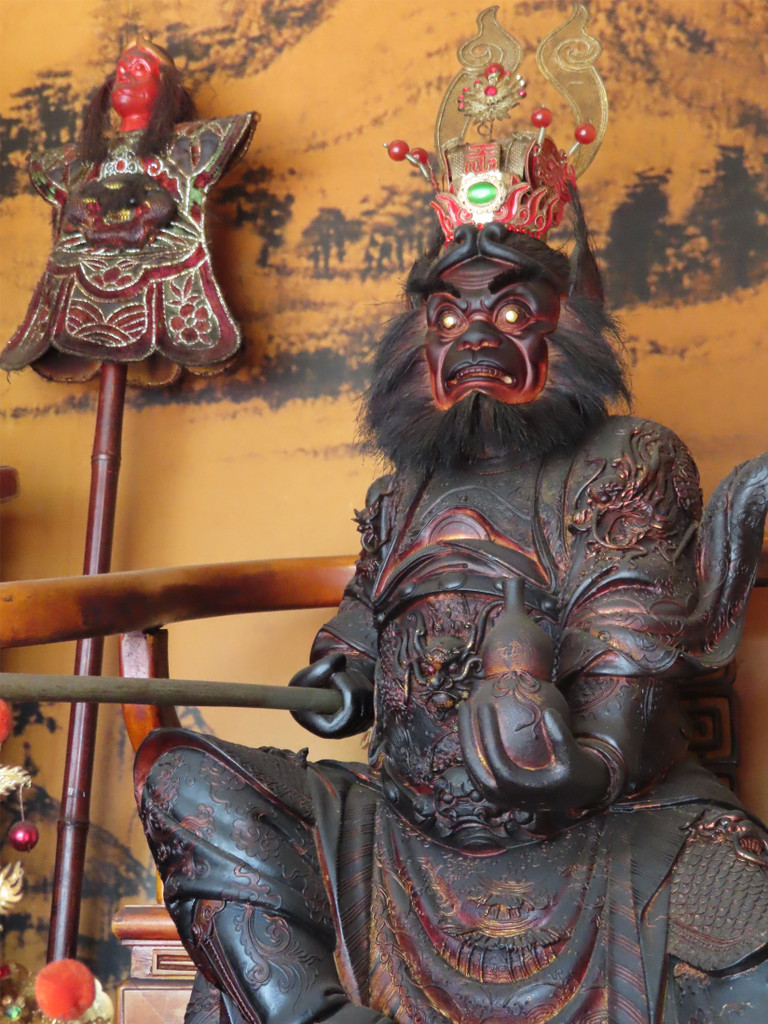
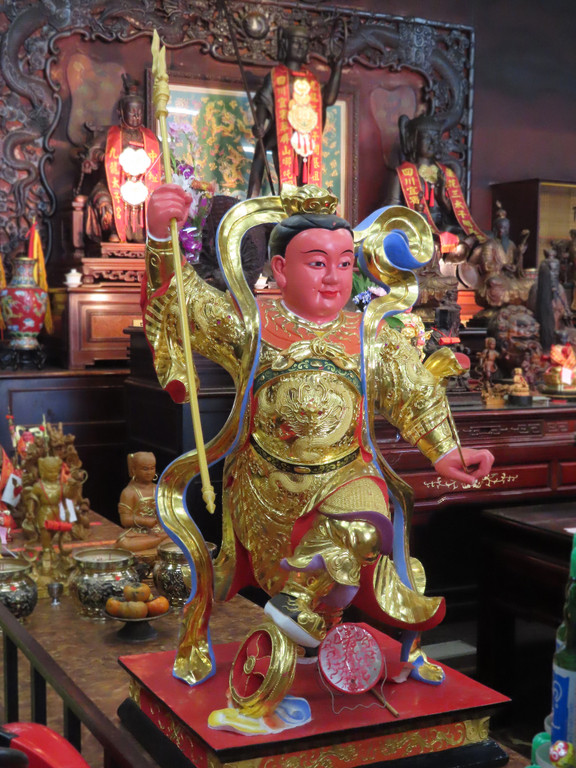
  7. Qitian Dasheng (齊天大聖, “Great Sage Equaling Heaven”) – The seditious title that he takes during his rebellion against heaven (Wu & Yu, 2012, vol. 1, p. 151). Monkey is worshiped by this name in modern Chinese Folk Religion (fig. 3). Refer back to sec. 2, no. 2.
  8. Dasheng (大聖, “Great Sage”) – He is more commonly referred to by this title than Qitian dasheng. [8] Variations include Dasheng Yeye (大聖爺爺, “[Paternal] Grandpa Great Sage”) and Sun Dasheng (孫大聖, “Great Sage Sun”). Refer back to sec. 2, no. 2.
  9. Zhexing Sun (者行孫, “Grimpil Sun”) – A pseudonym taken in chapter 34 when Monkey secretly escapes imprisonment and then presents himself as his own brother in an attempt to trick demons (Wu & Yu, 2012, vol. 1, p. 130). The strange English rendering is Yu’s (Wu & Yu, 2012) way of accounting for the change from Sun Xingzhe (, “Pilgrim Sun“) to Zhexing Sun (, “Grimpil Sun“). Refer back to sec. 2, no. 12. See also no. 10 below.
  10. Xingzhe Sun (行者孫, “Sun Pilgrim”) – A pseudonym taken in chapter 35 when he once again escapes capture and presents himself as a second brother (Wu & Yu, 2012, vol. 1, p. 133). This is a reversal of Sun Xingzhe (孫行者, “Pilgrim Sun”). Refer back to sec. 2, no. 12.
  11. Sun Waigong (孫外公, “([Maternal] Grandpa Sun”) – A name that he uses to taunt demons (Wu & Yu, 2012, vol. 1, p. 407, for example). It’s a cheeky way of saying, “I’m your elder, so you better submit to me.”
  12. Sun Yeye (孫爺爺, “([Paternal] Grandpa Sun”) – Same.
  13. Sun Erguan (孫二官, “Second Master Sun”) – A pseudonym taken in chapter 84 in order to investigate an anti-Buddhist kingdom under the guise of a horse trader. The other pilgrims take similar names (Wu & Yu, 2012, vol. 4, p. 132).

Fig. 3 – A Great Sage idol from Shengfo Tang (聖佛堂, “Sage Buddha Hall”) in Beigang Township, Yunlin County, Taiwan (larger version). It is one of many Monkey King Temples on the island. Photo by the author.


4. Updates

Update: 10-28-24

Someone on reddit questioned why I didn’t add a title for Monkey as the “Protector of the Peaches” or “Guardian of the Heavenly Peach Garden” (as mentioned by Wikipedia). This is how I responded:

This is what the novel says:

“We perceive,” said the Jade Emperor, “that your life is quite indolent, since you have nothing to do, and we have decided therefore to give you an assignment. You will temporarily take care of the Garden of Immortal Peaches. Be careful and diligent, morning and evening” (Wu & Yu, 2012, vol. 1, p. 160).

玉帝道:「朕見你身閑無事,與你件執事:你且權管那蟠桃園,早晚好生在意。」

The phrase “care for the Immortal Peach garden” (管蟠桃園) appears four times. But there is no official title for the position.


Update: 07-26-25

In section one, no. 6, I listed the title Taiyi Jinxian (太乙金仙, “Golden Immortal of the Great Monad”). However, this is only part of the term. The full title is Hunyuan yiqi shangfang taiyi jinxian (混元一氣上方太乙金仙), or “Golden Immortal of the Great Monad Atop the Primordial Breath of the Chaotic Origin.” The phrase “Atop the Primordial Breath … ” likely refers to the pristine, original energy of the universe that all Daoists wish to return to. Therefore, I believe this refers to his level of spiritual attainment—think of it in terms of cultivation literature—which is separate from his actual heavenly rank.


Update: 03-21-2026

It dawned on me that Pilgrim Sun (sec. 2, no. 12) and his “brothers,” Grimpil Sun and Sun Pilgrim (sec. 3, nos. 9 & 10), might be intentional references to the tripart monkey gods of religion and theater. For example, one Fujian tradition names the triad as the black-faced “Great Sage Reaching Heaven” (Tongtian dasheng, 通天大聖), the white-faced “Third Son Shuashua” (Shuashua sanlang, 耍耍三郎/爽爽三郎), and the red-faced “Cinnabar Cloud Great Sage” (Danxia dasheng, 丹霞大聖). The first two figures appear as brothers, along side the Great Sage Equaling Heaven and two sisters, in a pair of Yuan-Ming zaju plays (see the 12-20-23 update here.)

Notes:

1) The Jinxian (金仙) of Monkey’s title Taiyi Jinxian (太乙金仙, “Golden Immortal of the Great Monad”) is associated with far more lofty figures. For example, a poem in chapter one refers to the Patriarch Subodhi as the Dajue Jinxian (大覺金仙, “Golden Immortal of Great Awareness”) (see section 2.3 here).

2) I’m placing the name in this category because the Tathagata is stating a fact instead of bestowing it as a proper name.

3) Yu (Wu & Yu, 2012) translates this as the “macaque hard to distinguish” (vol. 4, p. 360). But I think that the original Chinese term is likely referring to both Sun and Six Ears. Their battle across the cosmos is counted in chapter 99 as the 46th of 81 hardships that Tripitaka was fated to endure (Wu &Yu, 2012, vol. 4, p. 360).

4) Wivell (1994) translates the name as “Great Sage of Bronze Muscles and Iron Bones” (p. 1207). But the gang (鋼) of Gangjin tiegu dasheng (鋼筋鐵骨大聖) means “steel.”

5) This references the homophonous term Bimawen (避馬瘟, “avoid the horse plague”), the historical practice of placing monkeys in horse stables to ward off equine sickness (see the 02-26-22 update here).

6) The term Xingzhe (行者, “pilgrim”) appears 4,355 times, while Sun xingzhe and Sun Wukong appear 239 and 127 times, respectively. Xingzhe is used numerous times to refer to other characters, such as Guanyin’s disciple Hui’an (惠岸行者, 6 times; a.k.a. Mucha or Mokṣa, 木叉行者, 9 times), but the vast majority refer to Monkey.

7) The term Hou wang (猴王, “Monkey King”) appears 185 times, while Meihou wang (美猴王) appears 42 times.

8) The term Dasheng (大聖, “Great Sage”) appears 1,273 times, while Qitian dasheng (齊天大聖) appears 103 times. I believe Dasheng is also used to refer to the Buddha a few times, so please keep this in mind.

Sources:

Wivell, C.S. (1994). The Story of How the Monk Tripitaka of the Great Country of T’ang Brought Back the Sūtras. In V. Mair (Ed.), The Columbia Anthology of Traditional Chinese Literature (pp. 1181-1207). New York: Columbia University Press.

Wu, C., & Yu, A. C. (2012). The Journey to the West (Vols. 1-4) (Rev. ed.). Chicago, Illinois: University of Chicago Press.

Journey to the West Artist Spotlight #2: NinjaHaku21

From time to time I like to post a fun blog not directly related to (though sometimes informed by) my research. Regular articles will resume after this entry.

Last updated: 05-09-2023

Anyone who has read my blog will know that I’m an avid fan of researching the history and influences of Journey to the West (Xiyouji, 西遊記, 1592). But as an artist, I am also a fan of JTTW-related artwork. There are so many talented people in the world who post their traditional and original designs and comics online, so I’ve decided to feature some of them on my blog. My hope is that such posts will expose this art to a wider audience interested in JTTW, while also documenting modern day perceptions and depictions of the novel and its characters.

Our next artist is NinjaHaku21, who goes by @NinjaHaku21_Art on both Twitter and Instagram and @NinjaHaku21Art on Tumblr.  They also have a Patreon and an Etsy storeThey were kind enough to answer some interview questions, as well as allow permission to display a few of their pieces.

I. Q & A

1) Can you tell me a little about yourself?

Hi there! I go by Ninja, and I am a freelance artist! I recently just started my freelancing career this year, and work on a few indie comics along with thumbnails for youtube!

2) Are you self-taught or did you go to art school?

I am self taught! I always wanted to go to art school, but life had other plans in mind!

3) What are your main sources of artistic inspiration?

While growing up, comics for sure! Was a huge fan of sonic comics, and now, it’s a mix of that and other media!

4) How did you learn about Journey to the West?

I learned about the Journey To The West after watching the show LEGO Monkie Kid! My friends and I have seen clips of it on twitter, and so we binged the entire series up to date. I was so interested in the characters and the world, I had to look up more. I then discovered the novel and was hooked. I am still looking into more movies to see their take on the novel!

5) Who is your favorite character?

Sun Wukong! He grows so much throughout the story and faces so many challenges. It’s hard not to love this murderous Monkey King who seeks redemption.

6) Do you have a favorite episode from the novel?

That’s a tough one! I think my favorites have to be the Six- Eared Macaque, the battle with Red Boy, and the Immortals of Tiger, Elk, and Antelope Power!

7) Does the novel have a special meaning to you?

To me, seeing what the characters have acted before in the past and seeing them grow and learn makes me happy. It helps me remember that even though you may have done some awful stuff in the past, you can still make a difference and grow from it.

8) Can you tell me about any ongoing JTTW-related projects?

Currently I am working on my own designs of the characters for fun! Making illustrations about my versions of them, and making some merch of the designs for my shop!

II. Art and Thought Process

Note: Click each image to enlarge it.

1. Ever since I started reading Journey To The West and watching movies with the Monkey King or anything JTTW-related, I wanted to create my own take of the characters. With this piece, I was seeing how my designs would look with all of them together! I had rough sketched out some draft looks that got inspired by different pieces of them from either shows, movies, or ancient drawings of them, then fit in what I liked most and created this piece! I wanted to have them express their own personality through the look, and I am quite proud of the final results! I imagined some unlucky villager getting a visit from these “ugly demons” and their Master asking for a place to visit.

2. With this piece, I wanted to capture a fun moment on their journey to the west. These guys have to deal with so much while trying to protect their master, so I figured giving them a nice snow day would be a fun thing to draw!

3. The Six-Eared Macaque. Definitely one of my favorite characters from the stories. I wanted to show him off along with the opera mask, kind of symbolizing him transforming into Wukong to trick his companions.

4. I wanted to put these three pieces together, showing how Sun Wukong acts around his companions and Master.

I know for sure Wukong and Zhu Bajie argued a lot, and I haven’t seen any issues between Sha Wujing and Wukong (still reading and learning) and figured they’d have some nice conversations. And of course, Wukong protects his master from a group of hungry demons or bandits!

5. Now this one I did decide on having some fun on creating my own version of a “spider queen” (I know there wasn’t a queen in the story, but it was still fun)! I based this loosely around the chapter with the spider sisters, making the eldest one the queen. I had a fun time drawing this out, making the eldest have a thing for Wukong, haha!

(Jim here. This reminds me of the Scorpion Spirit having a thing for Tripitaka.)

6. In this piece here, I wanted to have my design of Nezha interacting with Wukong. I based Nezha’s design on a few different inspirations (some being from the Monkie Kid series and ancient art of the deity), and descriptions from the story. I also wanted to add in a dragon tattoo, sort of as a remembrance of what Nezha had done in the past. But this picture was to show the type of relationship these two have. Nezha would definitely feel a bit salty of losing to Wukong all those years ago!


Update: 05-09-23

I commissioned NinjaHaku21 to draw a religiously accurate illustration of Sun Wukong as the “Victorious Fighting Buddha.” It is based on the traditional iconography of the Yuddhajaya Buddha, the deity from which his religious title is derived. The results are stunning!


Hercules vs Sun Wukong Death Battle Analysis

Last Updated: 10-04-2025

DEATH BATTLE! is a YouTube show that pits famous fictional and (now) mythological characters against one another to see who is the strongest. The outcome of each fight, usually ending in death, is supposedly based on research comparing the combatants’ respective canonical strengths and weaknesses. There are in total nine seasons with 161 episodes. The 162nd episode (episode 7 of season 9) will feature a battle between the hero Hercules from Greco-Roman myth and Sun Wukong from the Chinese Journey to the West (Xiyouji, 西遊記, 1592, JTTW hereafter) story cycle. I only learned about this upcoming fight a little over a week ago when I noticed via my website analytics that a DEATH BATTLE! staff member had linked to my research blog on their external site. Very little concrete information about the battle was released until a few days ago, so I’ve been scrambling to finish this article in preparation for the episode on June 20th, 2022. It can be watched here:

This may not seem very important to some of my followers and lurkers, but DEATH BATTLE! has 5.05 million subscribers, and their last video received 1.7 million views in just a week and the one before got 5 million in just 3 weeks! Therefore, the battle is likely to introduce many, many people to the Monkey King. For example, the primate hero’s fighter preview gained nearly 220,000 views in the first 24 hours, 260,000 as of June 18th, 2022. And as of the same date, Hercules’ fighter preview has 287,000 views.

Win or lose, the purpose of this article is to present accurate information about Sun Wukong. I will correct any mistakes that appear in the video. I will also present a list of surprising parallels shared between Hercules and Sun Wukong, suggesting that they might have been influenced by the same mythic tropes. See also my articles comparing Monkey with the Water Margin hero Wu Song and the historical Buddha.

Before continuing, I want to note that I know the original name is Heracles (or Herakles), but I will use Hercules throughout as this is the name chosen by the staff of DEATH BATTLE!

1. Analysis

1.1. The Death Battle

It’s official, Sun Wukong WON the fight. I will add my comments and corrections (in blue) to the official battle transcript:

An ancient scroll unfurls onscreen as a painted mountain manifests. An unseen narrator begins his story.

1. This was an interesting concept.

Muse: Our tale begins up top a great mountain, where the mighty Heracles sought a gift from the Gods.

As narrated, the legendary demigod finishes his trek up the mountain and calls out to the nearby Monkey King, Sun Wukong, who is sitting atop his Nimbus cloud and holding a divine fruit in his hand.

2. Just a tiny nitpick: The Nimbus cloud is not from JTTW but the Dragon Ball franchise. The novel refers to this skill as the Cloud-Somersault.

Hercules: Ho there! I’m in need of that apple. Relinquish it.

Wukong turns to face the hero and explains his own need for it.

Sun Wukong: Sorry, I’m supposed to find my master some vegetarian food.

3. I really like that the fight starts over fruit. As I note below (sec. 2, #12), both characters steal supernatural fruit (golden apples vs immortal peaches) from the gardens of queenly goddesses (Hera vs the Queen Mother of the West). So this was a nice nod to both myths.

But in hindsight, Monkey stealing the golden apples to feed his master doesn’t make much sense considering: 1) they are located in a land that’s much further west than the scripture monk’s final western destination, India; and 2) I don’t recall reading that the golden apples were anything other than treasures. To my knowledge, none of the associated myths treat them as foodstuff. Someone please correct me if I’m wrong.

However, the explanation is ignored. His short temper kicking in, Hercules draws his sword from its scabbard and threatens Wukong.

Hercules: You’ll find it… elsewhere.

With a shrug and groan of annoyance, Wukong passes the apple to Hercules, who catches it.

Muse: But Heracles was not so easily fooled.

4. Legitimate question: Is Hercules known for having supernatural perception? Are there examples of him seeing through illusions in his original mythos? If anyone knows, please leave a comment.

The hero’s satisfaction turns to indignation as he crushes the illusory fruit in his hand, revealing it to merely be strands of Wukong’s hair. With his scheme discovered, the trickster god pulls out a miniaturized Ruyi Jingu Bang from his ear and enlarges it to its standard size. Laughing with glee, he leaps from his cloud and clashes with Hercules’ sword,

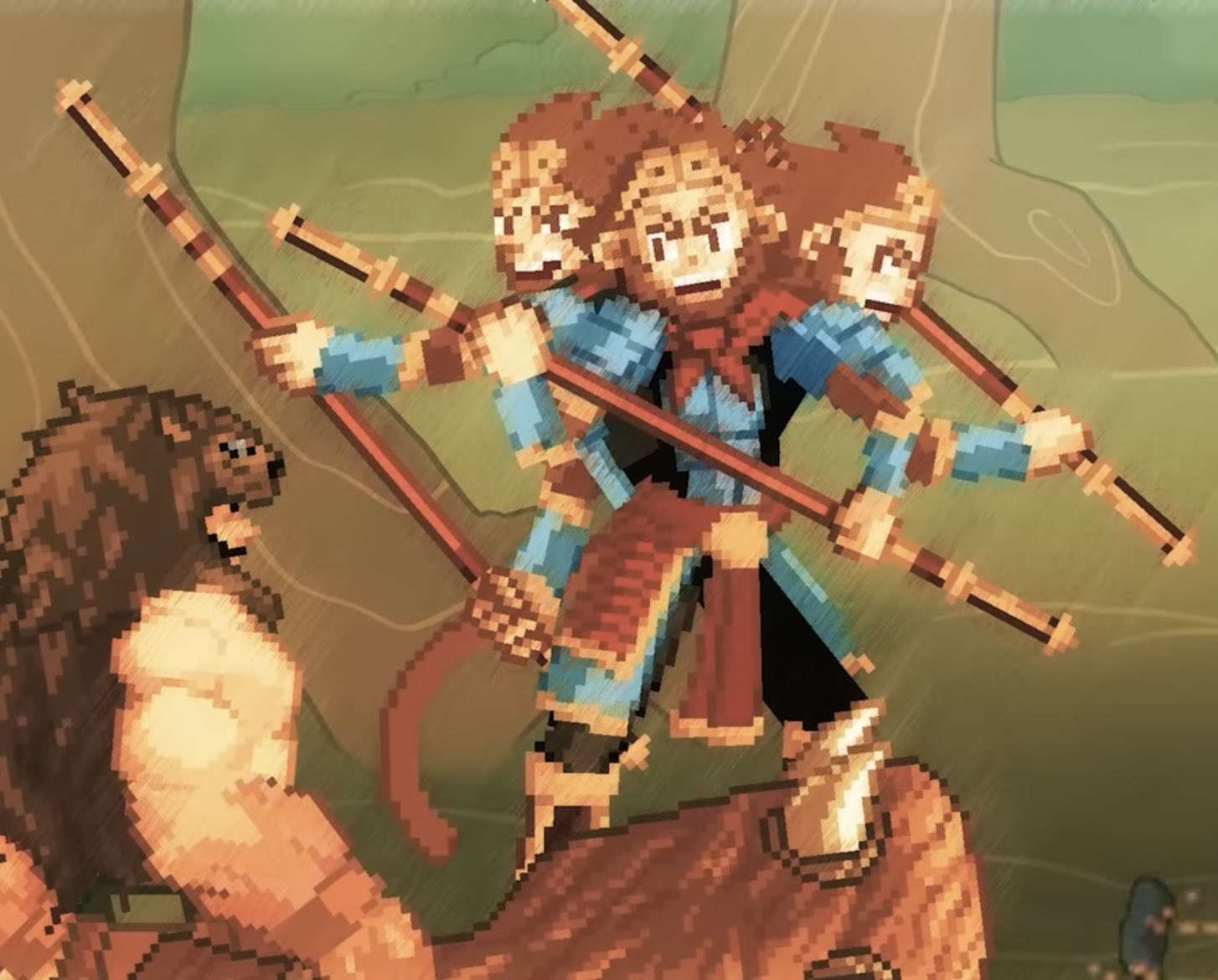
5. Another tiny nitpick: The “standard size” in the animation was not large enough. The novel states that Monkey fights with the staff when it’s around 12 feet (3.65 m) long [1] and the width of a bowl (Wu & Yu, 2012, vol. 1, p. 135, for example). [2] This illustration (fig. 1) shows how big the staff should be in relation to Sun’s body size.

Fig. 1 – Monkey and his religious brothers on patrol (larger version). Artwork by @真·迪绝人 (see here and here). Image found here.

Muse: The Monkey King’s strike rang true, but he’d not so easily overwhelm the God of Strength.

Locked in a clash of weapons, Hercules slashes at Wukong, who dissipates into smoke. The monkey flies behind Hercules on his Nimbus and jabs the hero in the gut with his staff, sending him flying into a cliff below. The mighty demigod is hardly phased though and springs back with a powerful dropkick against the advancing Wukong, sending them down another level.

6. I personally thought Monkey relied far too much on turning into a puff of smoke. I think he instead would have preferred to meet Hercules head-on.

As they both land, Hercules attempts to slash him with his sword once again, but Sun Wukong disappears in a smoke cloud and strikes Hercules with his Ruyi Jingu Bang. As Hercules lies on the ground, the Monkey King extends the staff and brings it down on the hero, who raises his sword to block the strike, only for the blade to shatter. Quickly recovering, Hercules grabs the Ruyi Jingu Bang and pulls on it, bringing Sun Wukong down to him.

Hercules: I am Heracles!

With a single mighty punch to the jaw, Heracles sent the Monkey King soaring through the sky, hitting the edge of the scroll and forcing it to go higher up before landing on a nearby cloud. Before the Monkey King has time to even breathe, Hercules shoots an arrow at him, only narrowly missing.

Sun Wukong: Yikes!

As the hero continues his assault, Wukong begins to jump through the clouds in order to avoid all of his shots, and after beginning to fly with one of them, summons several clones with his hairs to try and reach Hercules. However, the God of Strength manages to shoot down almost all of the clones. One of them climbs onto the cloud Wukong is riding and grabs his tail. Wukong spins him around and launches himself and the clone at Hercules. The Wukongs turn into birds to reach Hercules faster, before turning into snakes to restrict his arms. Tired of the monkey’s shenanigans, Hercules breaks free and grabs his rattles.

7. Legitimate question: Does Hercules have unlimited arrows? Please let me know.

Regarding the transformations, this seemed so out of place during the battle as Monkey never uses animal forms offensively. He instead uses them for stealth or, most famously, to hide from from an opponent

Hercules: Die, demon!

The loud noise echoes through the skies, destroying every single Wukong clone. Reeling in pain from the noise, Wukong’s snake transformation comes undone as he tumbles down the mountain into the forest below.

Sun Wukong: Agony, agony!

8. Why would the rattles have any effect on Monkey? I don’t recall his ears being a weakness

Update: 06-24-22

A redditor explained the following: “It’s not so much that Wukong is weak to sound, more so that the krotalas [rattles] are so loud that the noise causes pain to whatever hears them…”

But the original sources don’t make this claim. For example, the Argonautica of Apollonius Rhodius reads: 

“For not even could Heracles, when he came to Arcadia, drive away with bow and arrow the birds that swam on the Stymphalian lake. I saw it myself. But he shook in his hand a rattle of bronze and made a loud clatter as he stood upon a lofty peak, and the birds fled far off, screeching in bewildered fear” (2.1052).

The Bibliotheca Historica of Diodorus reads:

“Heracles then received a Command to drive the birds out of the Stymphalian Lake, and he easily accomplished the Labour by means of a device of art and by ingenuity. The lake abounded, it would appear, with a multitude of birds without telling, which destroyed the fruits of the country round-about. Now it was not possible to master the animals by force because of the exceptional multitude of them, and so the deed called for ingenuity in cleverly discovering some device. Consequently he fashioned a bronze rattle whereby he made a terrible noise and frightened the animals away, and furthermore, by maintaining a continual din, he easily forced them to abandon their siege of the place and cleansed the lake of them” (4.13.2).

And Pausanias writes:

“There is a story current about the water of the Stymphalus, that at one time man-eating birds bred on it, which Heracles is said to have shot down. Peisander of Camira, however, says that Heracles did not kill the birds, but drove them away with the noise of rattles” (8.22.4).

As can be seen, no mention is made of the implements being painfully loud to anything other than the birds (please provide an example if you know otherwise). While uncertain of the true reason why the rattles appear in the story, Aston (2021) posits that they could reference cultic practices or even just the “noisy rattle[s] or clapper[s] … used by farmers to scare birds from their crops” (p. 102).

I can understand the rattles working if Monkey was still in bird form, but the clone attacking Hercules had already transformed into a snake at the point. And the rattle subsequently affects all of the clones. This doesn’t make any sense.

The scroll unfurls further, revealing the spot where the Monkey King landed, as he begins to laugh.

Muse: The Monkey King fell into a strange forest, in awe of such a wondrous fight. But should he mistake his fear, he might lose his head.

Hercules comes crashing down, instantly crushing Wukong’s head with his club. But to his shock, the beheaded body of the Great Sage gets right back up.

9. Crushing Monkey’s head would not be possible with the olive club, for it would break over his adamantine crown like when Hercules broke the weapon over the Nemean Lion‘s head (sec. 2, #3). Sun’s crown is one of the hardest parts of his body, easily taking direct blows from even sharp weapons wielded by demons with no issue (sec. 1.2, #3).

It think it would have made more sense for both heroes to have, at some point, exchanged blows with their respective blunt weapons (sec. 2, #4). But, again, the club wouldn’t have lasted long. This brings me back to my previous question about the number of Hercules’ arrows. If he ran out, then he would be weaponless after both his sword and club are destroyed.

So, I think at this point Sun would have placed his staff in his ear and offered to have a boxing match with the Greek hero. Something similar happens twice in JTTW. In chapter two, Monkey confronts a demon that had been terrorizing his children during his quest for immortality. But when the monster sees that the primate is not only small but also unarmed, he offers to fight him barehanded in order to avoid criticism from other demon kings. Sun ends up beating him so badly that the monster rushes to defend himself with his sword (Wu & Yu, 2012, vol. 1, p. 128). And in chapter 51, another demon uses a powerful treasure stolen from heaven to take away Monkey’s staff, leading the latter to challenge the monster to unarmed combat to show that he isn’t useless without his weapon. A poem describing the subsequent battle states that the combatants use real-world punching and kicking techniques, many of which are known and still practiced today. And while said poem claims that they are equally matched, all of the heavenly commanders agree that Monkey’s technique is faster and more polished (Wu & Yu, 2012, vol. 3, pp. 12-14)

Seeing Hercules and Sun duke it out, causing the earth to shake and mountains crumble, would be much more entertaining than the latter’s game of hopscotch among the clouds from the video.

Sun Wukong: I haven’t had such fun since I fought all of Heaven! Change!

Wukong transforms into a taller, three-headed and six-armed version of himself, with three separate Ruyi Jingu Bangs included.

Sun Wukong: Behold me, the Immortal Monkey King!

Hercules stares at his opponent’s transformation and laments his misfortune.

Hercules: Huh… Multiple heads. Of course.

10. A nice nod to the Lernean Hydra.

Both warriors begin to trade blows, Hercules managing to avoid a few of Wukong’s strikes before being disarmed of his club and becoming a victim of a staff combo before being kicked away. He shoots out three more arrows at the Monkey King, which seemingly manage to damage him, before his three-headed form dissipates into smoke, and the real Wukong jumps right back up to the clouds, before sending out his staff to hit Hercules once more. The hero merely watches before the staff suddenly grows into an enormous size mere inches away from his face.

11. Monkey does indeed use deceptive magic doubles in battle. One example happens in chapter 4 during his fight with Prince Nezha

“They clashed like raindrops and meteors in the air, but victory or defeat was not yet determined. Wukong, however, proved to be the one swifter of eye and hand. Right in the midst of the confusion, he plucked a piece of hair and shouted, ‘Change!’ It changed into a copy of him, also wielding a rod in its hands and deceiving [Nezha]. His real person leaped behind [Nezha] and struck his left shoulder with the rod. [Nezha] … heard the rod whizzing through the air and tried desperately to dodge it. Unable to move quickly enough, he took the blow and fled in pain” (Wu & Yu, 2012, vol. 1, p. 156).

Hercules: Huh?

He is suddenly crushed underneath the Ruyi Jingu Bang as Wukong sits on top of it and laughs. But the staff suddenly begins to shake, as Hercules begins to lift it from underneath.

Hercules: You’ve had your fun, beast, but I’ve had enough!

Hercules throws the staff away, forcing Wukong to get off it before changing its size once more, and preparing to strike a finishing blow. Hercules sees this and charges towards the Monkey King, clashing with the staff with only his fist. But as the blows make contact, two blue, divine versions of the two warriors can be seen holding the scroll, before preparing their weapons for a clash of their own. The club of Hercules’ celestial body leaves a trail of constellations, while the celestial Ruyi Jingu Bang leaves a trail of names of Four Symbols written in Chinese in its wake.

Muse: The gods watched their earthbound selves, and so joined in battle. The God of Strength mustered the heart of Olympus, while the Great Sage harnessed power equal to Heaven! Thus…

The two celestial bodies swing at each other, with the force of the blows turning the screen a blinding white. Slowly, the light fades away to reveal that Hercules’ celestial body has been impaled by the Ruyi Jingu Bang. The scroll floats back into view, covering the screen once more.

12. I think I understand what the Death Battle staff was going for when they portrayed each character in their celestial form. But this contradicts their promise to not use the heroes’ post-apotheosic versions. Therefore, this also seemed extremely out of place during the fight.

Muse: The Monkey King emerged victorious!

Returning back inside the scroll, Wukong’s attack manages to overpower Hercules, and its might destroys the God of Strength leaving nothing behind.

Sun Wukong: Wow, would you look at that! I struck him so hard he was reduced to nothingness!

13. I think this would have only killed Hercules’ mortal half, releasing the god within and prolonging the fight. While sources vary on what caused his apotheosis (virtus vs the 12 Labors vs Gigantomachy deeds), it’s clear that the son of Zeus become a god upon his fiery death (Romero-Gonzalez, 2021, p. 275).

Wukong laughs once more and grabs the apple, leaving the forest to rejoin his master.

Muse: With a formidable foe slain, stricken against the mountain’s breast, so ends our great tale of East and West.

14. I was honestly underwhelmed by the ending. It seemed like the staff ran out of time, money, or interest and decided to stop the episode prematurely. It should have gone on much longer since Hercules and Sun Wukong are the first two mythological characters to be featured. I also thought Hercules was splattered way too easily. I’m sure there could have been a different way to end the fight. It would have been more respectful to both pantheons if the heroes had simply come to a draw and, having developed a newfound respect for each other’s skills, parted as bond brothers.

But considering that the show is called “Death Battle!”, somebody needs to die (the fans would otherwise be upset). So, baring that in mind, I thought of an idea five days before the episode aired, but I must admit that it’s not very respectful to the Greek hero. In my scenario, Sun seemingly disappears, but he actually turns into an insect and flies into Hercules’ mouth and crawls into his stomach. There, Monkey beats him up from the inside using the iron staff or even his fists. Then he instantly takes on his 100,000 foot (30,480 m) tall cosmic form, causing Hercules’ mortal body to explode. This “attack from within” tactic appears in chapters 59, 75, and 82 of JTTW, [3] as well as chapter 11 of the late-13th-century version of the story cycle

Lasty, I didn’t think the sprite animation was appropriate for such a mythic showdown. I personally would have liked more dynamic, hand-drawn animation like that from the Omni-man vs Homelander episode.

Update: 06-24-22

The same redditor from above also explained that the show apparently has budgetary constraints on episode length and art style. This explains the seemingly abrupt ending and the sprite animation. Hand drawn animation is apparently only reserved for the very tip of the top-most requested matchups.

This still doesn’t change my opinion, though. This was their first battle between extremely famous mythological characters. The fight should have been more grand.

But this information still doesn’t change my opinion of the episode. Rooster Teeth should have allotted a larger budget and made the episode longer.

1.2. The Results

I will do the same for the official fight result transcript:

Boomstick: Talking about a herculean matchup.

Wiz: Heracles was among the greatest heroes in myth, but the Great Sage Equal to Heaven held many more advantages.

Boomstick: You’d think Sun might not measure up to the God of Strength… you know, strength, but he totally could. remember he carried Sumeru on his back, the mountain holding up the infinite celestial sky, like how Heracles held up the infinite celestial sphere.

1. The Death Battle researchers likely learned about this feat from my article. But nowhere do I write that the mountain upheld the sky. The Abhidharmakośa (Ch: Api damo jushe lun, 阿毗達磨俱舍論, 4th to 5th-century) contains an overview of the Hindo-Buddhist cosmos, and it states that the sun, moon, and stars orbit half way down the exposed portion of the mountain [4] in a whirlpool-like ring of wind (Vasubandhu, 2014, pp. 460; Sadakata, 1997, p. 38-40). But the source doesn’t associate this ring with any weight.

Conversely, native Chinese mythology views the sky as a solid object that must be propped up by mountains. And if one of these earthly pillars is damage, it will cause the sky to tilt and even tear, requiring divine repair. See, for example, the legend of Nuwa mending the sky (Birrell, 1999, pp. 69-72 and 96-97). But this has no baring on the discussion at hand as Journey to the West expressly describes the world according to Hindo-Buddhist cosmic geography.

Therefore, Sun’s feat should be scaled accordingly. But I’m not sure how this would be possible as the Buddhist and Greek concepts of the sky appear to be fundamentally different. I’ll have to read more on the latter concept to be sure.

Update: 06-25-22

I was contacted by a reader who said that the episode’s Sun Wukong researcher responded to me on the Death Battle discord, stating:

“To clarify, the basis for what Sumeru supports comes from the Buddhist cosmology lectures sourced in the character sheet. Though the article Jim wrote was what made me initially take note of the feat.

https://www.youtube.com/watch?v=6agAavZTEK0

https://www.youtube.com/watch?v=UMQeFiwacbQ” (per a screenshot emailed to me). 

But I’ve watched the videos and they don’t contradict what I wrote. The problem is that the researcher didn’t make a distinction between the “sky” (as stated in the Death Battle video) and “heaven.” I’ve already described the wind ring in which the celestial bodies orbit the midpoint of Mt. Sumeru. So, now I will give a brief and very simplified overview of the Buddhist cosmos to help readers form a better picture of what I’m arguing. As the axis mundi, Mt. Sumeru is located at the center of our earthly realm, with a ring of seven smaller mountains circling it. This landmass is surrounded by four island-like continents, one for each face of Sumeru, that float in a great sea resting on a disc of golden earth (kāñcanamaṇḍala). This is then supported by a disc of water (jalamaṇḍala) and finally a disc of wind (vāyumaṇḍala), each layer generally becoming larger as one descends. This grand creation is thought to float in “space” (ākāśa) (Sadakata, 1997, pp. 25-30), sometimes translated as “sky” (Buswell & Lopez, 2014, p. 26). There are indeed various layers of heavens on and above Mt. Sumeru, but they appear to be separate from this space/sky (fig. 2). The first two heavens, that of the Four Great Kings and the 33 Gods, are respectively located at the midpoint and summit of Mt. Sumeru. But the following four heavens float above it at varying heights (fig. 3) (Sadakata, 1997, pp. 56-62). Therefore, by running with Mt. Sumeru on one shoulder (and Mt. Emei on the other), Monkey would have supported both the landmass and the two earthly heavens, a monumental task to be sure. But he doesn’t support the four floating heavens above or, most importantly, the space/sky that they are located in. 

Having written the above, I want to note that I’m not claiming Hercules’ feat is stronger by default. I just want to present accurate information. I will at some point post an update with info about ancient Greek concepts of the sky.

Fig. 2 – A diagram of the Buddhist cosmos by MC Owens (larger version). Image from this talk. It’s the most simplistic, eye-catching version I’ve seen. The column of red, blue, and purple rings on the bottom represent the various layers of Hell. Fig. 3 – A diagram of the various heavens on and above Mt. Sumeru (larger version). From Sadakata, 1997, p. 60.

Wiz: As befitting heroes of myth they were on par in that they were both incomprehensibly strong, however, Wukong’s healing abilities meant he could bounce back from Heracles deadliest blows, whereas Heracles did not have a similar option.

Boomstick: But Heracles did have one way of putting the Monkey King down, his arrows dipped in hydra poison.

Wiz: The hydra poison threatened even the gods of Olympus, similar to the scorpion sting. Whether or not it would be fatal is questionable but it could have incapacitated Wukong, similar to how it affected Heracles himself.

2. The novel presents concepts with elemental states beyond heaven and earth. A prime example is Red Boy‘s Samādhi fire, which is considered more powerful than normal or even divine flames. [5] Likewise, the scorpion’s “horse-felling poison” (daoma du, 倒馬毒) likely falls into this separate category, for it was able to hurt even the Buddha! The bodhisattva Guanyin explains:

“Once upon a time she [the scorpion] happened to be listening to a lecture in the Thunderclap Monastery. When Tathagata saw her, he wanted to push her away with his hand, but she turned around and gave the left thumb of the Buddha a stab. Even Tathagata found the pain unbearable!” (Wu & Yu, 2012, vol. 3, p. 72).

The aforementioned monastery is located in the Western Paradise. This suggests that she might have been imbued with “dharma power” [6] over a certain period of time, making her a super powerful foe. Even the bodhisattva Guanyin fears her sting (Wu & Yu, 2012, vol. 3, p. 72). 

I suggest that the scorpion’s sting may be stronger than the hydra’s heavenly poison. [7] Therefore, I question if the latter would have the same effect on the Monkey King.

Boomstick: But that is one very specific win condition and we’re looking at this with every possible option in mind.

Wiz: With his variety of clones, transformations and numerous other spells, Wukong’s arsenal was far more versatile.

Boomstick: Like, there was nothing stopping him from making thousands of clones of himself and just sitting back, while they beat up Herc for him. Unsporting been like? Sure. In character? Absolutely.

Wiz: Even then, those arrows would have to actually strike Wukong, which would be extremely difficult. Yes, in some depictions Heracles could potentially shoot the sun of Helios, his arrows flying 90 times the speed of light. However, in his contest with the Buddha, Wukong leap to the edge of the universe in a single second. To do so he had to be moving over 1.4 quintillion times faster than light.

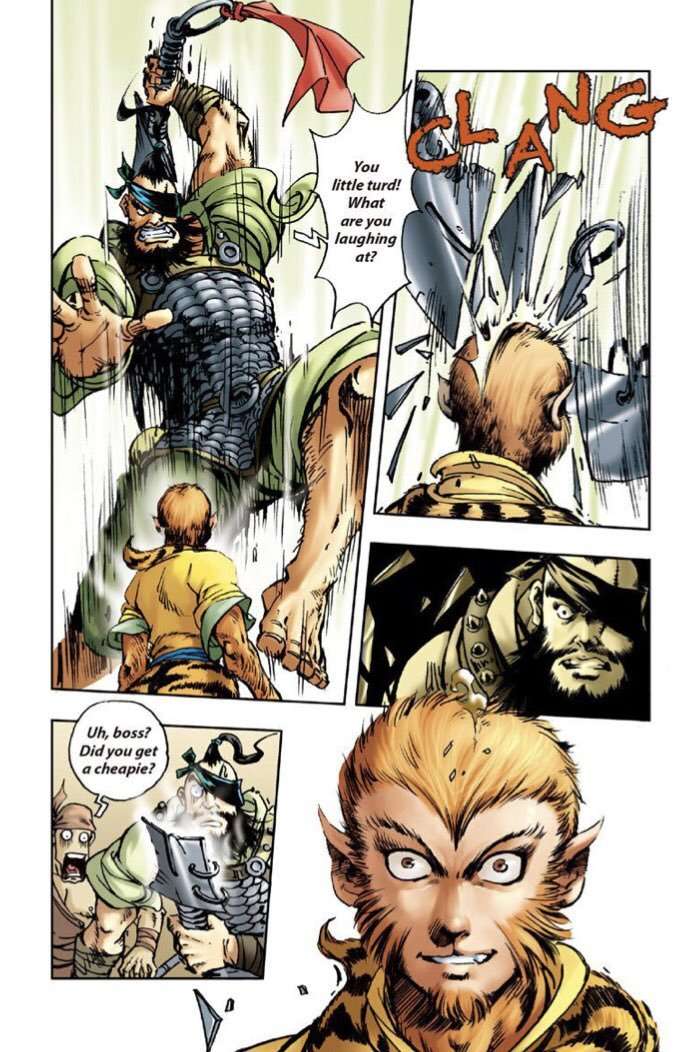
3. But even if the hydra venom was equally potent, there is no guarantee that Hercules’ arrows could pierce Sun’s adamantine hide. The novel is clear that Monkey’s frame is nearly indestructible. For instance, upon his capture, heaven fails to execute him:

“They then slashed him with a scimitar, hewed him with an ax, stabbed him with a spear, and hacked him with a sword, but they could not hurt his body in any way. Next, the Star Spirit of the South Pole ordered the various deities of the Fire Department to burn him with fire, but that, too, had little effect. The gods of the Thunder Department were then ordered to strike him with thunderbolts [lei xie ding, 雷屑釘, lit: “nails of thunder”], but not a single one of his hairs was destroyed.” (Wu & Yu, 2012, vol. 1, p. 188).

This invincibility follows him throughout the novel. For example, in chapter 75, Sun agrees to a demon lord’s offer to set the monk free if he can survive a blow to his head with a scimitar (fig. 4):

“‘When he heard this, Pilgrim smiled and said, ‘Fiend! If you have brush and paper in your cave, take them out and I’ll sign a contract with you. You can start delivering your blows from today until next year, and I won’t regard you seriously!’ Arousing his spirit, the old demon stood firmly with one foot placed in front of the other. He lifted up his scimitar with both hands and brought it down hard on the head of the Great Sage. Our Great Sage, however, jerked his head upward to meet the blow. All they heard was a loud crack, but the skin on the head did not even redden” (Wu & Yu, 2012, vol. 3, p. 373).

Fig. 4 – Page from a Journey to the West comic book showing Monkey’s hard head (larger version). Image found on Twitter.

Someone may argue that the scorpion’s sting pierced his face, but refer back to what I wrote about dharma power in comment #2, and see also note #6 below.

Also, the Death Battle crew lists astronomically large numbers without explaining how the figures were calculated (I make the same critic of the G1 Death Battle Fan Blog in my 06-19-22 update). These figures mean absolutely nothing without some sort of explanation.

But since the numbers are used in reference to Monkey’s feat of leaping out of the Buddha’s palm, I want to explain its significance for those who don’t understand (per this reddit post). Sadakata (1997) writes: “[Sun’s feat] reflects the world of the Flower Garland Sutra, where every phenomenon is located within the buddha-world” (p. 155). He goes on to discuss the Cosmic Buddha Vairochana, noting how Buddhist art from all over the world depicts the myriad Buddhas as his emanations. One Javanese example features images of the Five Dhyani Buddhas encircling a stupa dedicated to Vairochana, thereby “express[ing] the Mahayana idea that the buddhas emanate from Mahavairocana and penetrate the universe, that the ‘one’ is at the same time the ‘many'” (Sadakata, 1997, pp. 156-157). Therefore, in essence, the Buddha’s palm in the novel represents the universe.  

Update: 06-25-22

Another redditor wrote:

“[T]he Hydra venom doesn’t need to ‘pierce’ your body to make effect, it just needs to have skin contact, referring to the time Hercules died because he was tricked into using a robe with some hydra venom on it.”

I responded:

“I’m aware of how Hercules dies, but there’s still the question of whether or not the venom would be absorbed into Sun Wukong’s nearly indestructible skin. I don’t recall any similar episode where a substance is absorbed through his skin in JTTW. So assuming that it could is not the same as citing evidence that it would. I’m not trying to split hairs. I’m just a stickler for details.”

But I will concede that artistic license and the need to raise the stakes of the battle could warrant the venom effecting him even if the arrows can’t penetrate his skin. 

Boomstick: Making him way faster than Herc could ever hope to be.

Wiz: Heracles held might of mythic proportions, but barring a lucky shot. Sun Wukong’s versatile magic, similar strength and absolutely absurd speed overcame this foe fitting for heaven’s equal.

Boomstick: When fighting Sun Wukong, Heracles mythed his chance.

Wiz: The winner is the Monkey King, Sun Wukong.

2. List of Parallels

This has been split off into its own article to make the present post a more manageable length.

Parallels Between Sun Wukong and Hercules


Update: 06-19-22

I’ve been notified by several people that the G1 Death Battle Fan Blog has posted a prediction. This blog is independent from the actual content creators. In a 7 to 6 split, the blog predicts Hercules will win, explaining that he is stronger and faster. While seemingly thorough, portions of their analysis make no sense. For example, the section on speed reads:

As far as speed goes, the demigod also comes out on top. Taking into account Wukong growing his staff from Earth to the Underworld and the Heavens, then scaling that back to his speed, he could potentially move at 800 quadrillion times the speed of light. However, Heracles scaling to Zeus surpasses this by dozens of times, with him being able to send shockwaves across the entire firmament by simply nodding his head. Zeus nodding his head is an act that should have been done with extreme ease – at least more ease than Zeus actually wrestling Heracles – meaning that Heracles should reasonably scale. As the firmament and Olympus are on the outer sphere of the cosmos, which encircle each other, this would have had to cross the entire diameter, putting the feat at 29 quintillion times the speed of light, over 36 times faster than Wukong …

They scale Sun Wukong’s speed not by his Cloud-Somersault (a metaphor for instantaneous travel) or his ability to carry mountains with meteoric speed but by the magic growth of his staff into a pillar of heaven. Why? They also provide astronomically large numbers without explaining how the figures were calculated, a very common problem with such versus discussions.

In addition, they wrongly state that the 72 Transformations grant Monkey immortality. He actually first attains immortality via Daoist elixir arts. Furthermore, they claim that Sun’s immortality can be taken away from him, referencing his turn in Laozi’s Eight Trigrams furnace. While the extreme heat was meant to extract the elixir from his body, it doesn’t work as Monkey was able to hide in a cooler part of the furnace (Wu & Yu, 2012, vol. 1, p. 189). But we don’t know if this plan would have worked even if Sun had been stuck in direct heat. This is confusing an “intended result” with an “actual result.” But even if the heat could complete the job, how exactly is Hercules going to defeat Sun’s immortality. Does he also carry around a heavenly furnace? This is never explained in the analysis.

I don’t have time to analyze the entire article. I will reserve this space for the actual fight results.

Note: In light of new evidence, I’ve changed my opinion regarding the furnace. Please see the 06-28-22 update below.


Update: 06-23-22

I have finished adding my comments to the official fight and result transcripts of the battle (sec. 1.1 and 1.2). If any new evidence comes to light, I will make sure to further update the page.

I’m thrilled to announce that the episode has 1.1 million views after only two days! 925,000 plus of those were in the first 24 hours! I knew this fight would attract a lot of attention. I hope more and more people will finally read the novel and fall in love with Monkey’s adventures like I did oh so long ago.


Update: 06-26-22

When I originally watched the video, I skipped the character analysis straight to the fight. I only just now got around to reading the official transcript for the beginning, and I’m sorry to report that Monkey’s section is riddled with errors. Whomever wrote it has definitely never read the book. It would be like me writing a Death Battle transcript about Harry Potter based on a very lazy read of Wikipedia. I tried correcting the mistakes onsite, but my edits were reverted, and I was told that the transcript is off limits. Therefore, I’ve decided to add my corrections and comments here (in blue) like I did above.

But before continuing, I want to note that I’m upset because it appears that info from my research blog was likely used in the video and Death Battle wiki website without the specific articles being linked to. Sure, my general blog URL was added twice to an external site (here and here), but this is not the same as linking to the actual articles on the video/wiki so people can see where Death Battle got their information from. Make no mistake, this has little to do with publicity; my blog generates zero money for me. It’s just fair that my work be recognized if it’s being used, especially if it contributed to a video currently making money for its creators

3. Sun Wukong’s character analysis

Wiz: There once was a mighty monkey warrior, born of a mystic stone from the energy of the sun and moon. Upon birth, he graciously bowed to the cardinal directions and-

1. The stone was “nourished for a long period by the seeds of Heaven and Earth and by the essences of the sun and the moon” (Wu & Yu, 2012, vol. 1, p. 101). 

Boomstick: Shot lasers from his eyes! Strap in folks, this one’s a doozy.

2. This feat is likely based on the birth of the historical Buddha. See parallel #2 on this article.

Wiz: This monkey soon befriended a band of other primates and, rather narcissistically, named himself their handsome Monkey King.

3. Sun doesn’t just proclaim himself king, though the addition of “handsome” is pure ego on his part (he’s actually really ugly). He proves himself in a test of bravery by jumping through a waterfall to discover a long-forgotten immortal’s grotto-heaven (see the opening of this article).

Boomstick: But after a few centuries of monkeying about, he got a taste of the dreaded… midlife crisis!

Wiz: You see, the Monkey King was fierce and brave, yet he feared death, so he ventured to new lands in search of immortality.

4. Brave? Yes. Fierce? Not yet a warrior.

Boomstick: Turns out, he’d find a lot of it.

Wiz: Training under the Taoist master, Puti, he earned his first method of immortality and a new name. He would be the Monkey Awakened to the Void, spoken as: Sun Wukong.

5. Subodhi is a Buddho-Daoist sage with heavy Buddhist associations despite his normal portrayal as an immortal.

Boomstick: He also learned a bunch of magic. He can ride clouds, make thousands of clones, heal from fatal wounds like decapitation, and transform into basically anything: a bird, some vapor, a pitchfork, even an incredible fighting temple!

Popup: Though this technique is called “72 Earthly Transformations”, the scope of Sun Wukong’s shapeshifting is limited only by his imagination. The number actually references a collection of stars that the power is associated with.

6. Example #1 of info from my blog being used but not linked to. And the actual name for the technique is the “Multitude of the Terrestrial Killers” (Disha shu地煞數). [10]

Wiz: With his famous cloud somersault, he could traverse the world at incredibly high speed. At first, a single somersault could carry him 180,000 li [a typo for 108,000], li being a traditional Chinese unit equal to about 500 meters, making one somersault move 54,000 kilometers per second, fast enough to circle the entire Earth in one leap.

7. Example #2 of info from my blog being used but not linked to. I note this ability to encircle the earth in the opening paragraph here.

Boomstick: And he’d only get faster from there. Monkey would do whatever it took to prove he was the best of the best.

Wiz: When fighting the mighty deity Prince Nezha, his foe transformed into a more powerful visage with three heads and six arms.

8. This doesn’t happen until chapters later when Monkey first rebels. I’m not sure why they would introduce this fight so early.

Boomstick: But Sun was like, “Hey, I can do that too,” and then did just that.

Wiz: Sun Wukong eventually returned to his simian subjects and, with his newfound power, amassed a veritable army. However, he felt no weapon in their arsenal suited him.

Boomstick: So he barged into the Dragon King‘s palace and demanded he hand over a weapon worthy of a king who can match the power of Heaven. Yeah, Sun was pretty full of himself. But, he wound up taking a pillar, originally designed to measure the depths of the ocean.

Popup: Some translations claim this “golden-hooped rod” measured or held up the galaxy, but these are incorrect. It was originally used to gauge the depth of the Great Flood, a story regarding the rise of dynastic China.

9. Example #3 of info from my blog being used but not linked to. Here I discuss the error in translation that led to this common misconception.

Wiz: What seemed like a worthless rod to the Dragon King was actually the perfect weapon for Wukong. Weighing nearly eight tons, the Ruyi Jingu Bang can change size at his whim. It can shrink to the size of a needle or grow long enough to pierce the heavens.

10. The pillar was not “useless.” He considered it an item of great importance:

“‘That,’ said the Dragon King, ‘was the measure with which the Great Yu fixed the depths of rivers and oceans when he conquered the Flood. It’s a piece of magic iron, but of what use could it be to him [Monkey]?'” (Wu & Yu, 2012, p. 135).

And later, he even refers to it as a “divine treasure” (Wu & Yu, 2012, p. 142).

But the Dragon Queen suggests giving it to the rude and very powerful immortal anyway so that he will leave their kingdom (Wu & Yu, 2012, p. 135).

Also, the staff weighs nearly nine tons.

Boomstick: The same heavens that got pretty mad with Sun after he crossed his name out of the Ledger of Death, making himself double immortal! Wait, how does that work?

Wiz: And even more mad when he demanded to be formally acknowledged as “The Great Sage Equal to Heaven”.

11. This doesn’t happen until after serving as the Bimawen and subsequently rebelling. Again, they introduce something too early.

Boomstick: Okay, we got a headstrong goofball who quickly masters new powers and wants a fancy title. This is just Shonen anime!

Wiz: Now, the Monkey King may have lashed out, but it was because when he requested a place in Heaven, a place he truly believed he deserved, the Jade Emperor‘s court reduced him to a stable boy.

12. He didn’t request a place in heaven. The celestial bureaucracy just gave him a position to keep his unruly adventures in check (Wu & Yu, 2012, vol. 1, p. 143). Monkey only later “lashes out” upon learning of his low rank (Wu & Yu, 2012, vol. 1, p. 149).

Boomstick: Beneath all his antics, what Sun wanted most was to prove himself.

Wiz: Even with all the shenanigans, the Jade Emperor remained cautious and willing to placate Wukong.

Boomstick: By making him the watchdog of the Garden of Immortal Peaches. He totally ate that shit, didn’t he, Wiz?

13. It’s only at this point when Monkey battles Nezha, and when he proves too powerful, heaven placates him with the aforementioned sagely title and the above position (Wu & Yu, 2012, vol. 1, pp. 155-159).

Wiz: Oh yeah, Wukong got hammered, ate most of the peaches, ran around the Jade Palace in a fit, and found five gourds of immortality pills… which he promptly swallowed. All of them.

Boomstick: Ok, so that makes… how many layers of immortality now?

Wiz: I’d say a few… hundred? Thousand? If you count each individual peach and pill. When he sobered up, he knew he was in serious trouble, so naturally… he prepared for war.

14. This glosses over the reason for why Sun was drunk in the first place. He crashes the long-awaited immortal peach banquet and drinks all of the heavenly wine. Only then does he drunkenly stumble into Laozi’s laboratory and eat all of the alchemical pills (Wu & Yu, 2012, vol. 1, pp. 165-166).

Boomstick: Wow, that escalated quickly! What are they gonna do? Kill him? So, the Monkey King proved too strong for Heaven. He battled all their best fighters, and even matched Erlang Shen blow-for-blow in an epic battle of transformations! He’s that guy with the third eye.

Wiz: And Heaven’s greatest holy warrior. Yet, no matter Erlang’s form, Wukong always had a counter. Until Laozi threw in a convenient plot MacGuffin that captured the monkey. But even with Wukong in chains, Heaven had a problem.

15. Sun has no problem fighting Erlang, that is until his beloved monkey army is routed. He thereafter loses heart and flees, using a number of animal/structural transformations to escape (Wu & Yu, 2012, vol. 1, pp. 181-184). This is obviously different from the scenario described above. See this article by my friend Irwen Wong over at Journey to the West Library to learn how Erlang wins the majority of their encounters. 

Also, Laozi’s Diamond snare doesn’t capture Monkey. It simply hits Sun on the head, dazing him long enough for heaven to capture him (Wu & Yu, 2012, vol. 1, p. 186).

We cut to Boomstick.

Boomstick: He just wouldn’t die! Lightning, fire, even Laozi’s de-immortalizing furnace just made the monkey stronger!

16. The purpose of the Eight Trigrams furnace is not to remove one’s immortality but to produce the intense heat needed to manufacture alchemical elixirs (see section III of this article). This is an important distinction.

Laozi suggests that the reason why Monkey has a nearly indestructible body is because all of the immortal peaches and alchemical pills were likely refined in his lower elixir field. He then offers a possible solution:

“It would be better, therefore, if [he is placed] in the Brazier of Eight Trigrams, where he will be smelted by high and low heat. When he is finally separated from my elixir, his body will certainly be reduced to ashes” (Wu & Yu, 2012, vol. 1, pp. 188-189).

But as I note in my 06-19-22 critique of the G1 Death Battle Fan Blog,

“…it doesn’t work as Monkey was able to hide in a cooler part of the furnace. But we don’t know if this plan would have worked even if Sun had been stuck in direct heat. This is confusing an ‘intended result’ with an ‘actual result’.”

Note: In light of new evidence, I’ve changed my opinion regarding the furnace. Please see the 06-28-22 update below.

Wiz: Now, Wukong is not invincible. He has been hurt by the Scorpion Demoness’ poison, which could even harm the Buddha, an awaken divine being liberated from the cycle of life and death entirely.

17. Please see what I wrote about the scorpion above (sec. 1.2, #2)

[Random skit removed for brevity]

Boomstick: Ugh… But even after all that, Sun had one more challenger to contend with; the Buddha himself!

Wiz: Buddha approached Wukong with a contest: leap out of his hand, and he could have the Jade Emperor’s throne for himself.

Boomstick: Having no impulse control, the monkey agreed, and in an instant, somersaulted to the very edge of Heaven.

Wiz: But he had already lost. Because Buddha achieved Nirvana, he transcended the world, literally holding all of existence. So even at the edge of the universe, Wukong technically never left his hand.

18. This matches what I wrote above about the Buddha and the universe (sec. 1.2, #3).

Boomstick: For his rebellion, Sun was put in time out, sealed under a mountain for 500 years.

19. This is an understandable mistake as the phrase “500 years” is thrown around a lot in the novel. But as I explain here, chapter 14 states that the mountain trapped Monkey during the rein of a historical usurper (Wu & Yu, 2012, vol. 1, p. 306), revealing that his imprisonment actually lasts somewhere between 617 to 649 years.   

Wiz: But even Sun Wukong would find a chance at redemption. In his case, he was tasked with escorting and protecting a monk, Tang Sanzang, or Tripitaka, on a journey to the west.

Boomstick: With additional companions Pigsy and Sandy. The trip was a tough one, and Monkey abandoned it more than once. But through it all, he always returned to shine as the group’s powerhouse, saving Tripitaka’s life many, many times. Seriously, this guy could not stay out of trouble. It’s like Wiz on a blind date.

Wiz: Ahem. Wukong has cracked apart mountains, slayed hundreds of monsters, and survived the Yellow Wind Demon‘s storm that could destroy the universe. As in Heaven, Earth, the 18 layers of Hell, and more!

Popup: The storm is depicted differently across translations, but the original Chinese text uses “乾坤”, meaning “universe”, or more literally “every manifestation of nature”.

Boomstick: That’s cool and all, Wiz, but let’s answer the real question. Can he beat Goku?

Wiz: Um… maybe! During his journey, Wukong performed possibly his most legendary feat: holding up Mount Sumeru which, in traditional Mahayana Buddhism, is a mountain supporting the infinite cosmic sky.

Boomstick: And Sun just hauled it around on one shoulder. Just one! Because on his other shoulder… was a whole other mountain!

Popup: The other mountain was Mount Emei, one of the Sacred Mountain of China.

20. Example #4 of info from my blog being used but not linked to. This material of course comes from here.

Wiz: After 14 years of travel, the journey was complete, and Wukong had finally accomplished a truly great deed. For this, he was given his long-awaited place among the heavens.

Boomstick: As the Victorious Fighting Buddha! Now that’s got to be an anime.

Wiz: After so much time as a rebel, an outcast, and a truly unstoppable warrior, Sun Wukong had, at last, found his home.


Update: 06-28-22

I previously referenced Sun’s turn in Laozi’s Eight Trigrams furnace but stated that this should not be used as an anti-feat since the flames never actually hurt him (due to taking shelter in a cooler portion of the brazier) (06-19-22 update & sec. 4, #16). I also referenced Red Boy’s spiritually-cultivated Samādhi fire, noting that it is more powerful than earthly or even heavenly fire (sec. 1.2, #2). Regarding the latter, remember that Monkey easily survives an attempted execution by this celestial flame (sec. 1.2, #3). But it’s important to highlight that, in chapter 41, the combination of Samādhi fire and intense smoke is shown to override Monkey’s famous fire-protection spell:

His whole body covered by flame and smoke, the Great Sage found the intense heat unbearable and he dove straight into the mountain stream to try to put out the fire. Little did he anticipate that the shock of the cold water [11] was so great that the heat caused by the fire was forced inward into his body and he fainted immediately (Wu & Yu, vol. 2, p. 231).

And I was recently reminded of an additional episode where Sun has another brush with supernatural flames. In chapter 75, an ancient demon king places Monkey in a small, unassuming vase for execution, but the latter comments on the cool temperature inside. However, it turns out that this is an ultra powerful treasure “governed by the double primal forces of yin and yang” (Wu & Yu, 2012, vol. 3, p. 368), and the second that he speaks, the vessel assaults Sun first with fire, then biting snakes, and finally fire dragons. The first round of fire has no effect on him (nor do the snakes) but the fire dragons produce flames so hot that they also override the fire-protection spell:

He had hardly finished speaking when he felt some pain on his shanks. Rubbing them hurriedly with his hand, he found his shanks were turning flaccid because of the fire. More and more anxious, he thought to himself, “What’s to become of me? Even my shanks are weakened by the fire. I’ll be reduced to a cripple!” (Wu & Yu, 2012, vol. 3, p. 369)

What’s interesting is that the vase’s various torments are said to be “activated by the seven jewels, the eight trigrams, and the twenty-four solar terms” (Wu & Yu, 2012, vol. 3, p. 368) (emphasis mine). These are the same eight trigrams as Laozi’s furnace. So, this suggests that Sun’s time in the brazier would have actually hurt his body. While this might even destroy his form, the novel hints that, besides providing a surplus of extra heads, the 72 Transformations also grant Monkey extra lives just like a video game (see the 06-12-22 update here). But this “respawning” is never officially shown in the novel. So what would happen if Sun had been trapped inside the Eight Trigrams furnace in direct heat? Would he just keep regenerating over and over again until his extra lives were spent (or he escaped), or would the supernatural flames simply destroy his body once and for all? I’m not sure. Make of this what you will.

But my original point still stands: Hercules would not have been able to overcome Monkey’s immortality unless he was carrying around a heavenly furnace and managed to force and keep the primate hero inside for a given time.


Update: 07-01-22

I forgot to mention something regarding the various fire-related episodes in the last update: Sun Wukong’s abilities are presented inconsistently throughout the novel. This is best illustrated by two episodes. As mentioned above, in chapter 75, Monkey cries that he’ll be a cripple if the supernatural fire continues to burn his ankles. But he previously demonstrated the ability to heal using his immortal breath in Chapter 46:

With a swagger, Pilgrim walked down to the execution site. Leaning himself on a huge pillar, he untied his robe and revealed his stomach. The executioner used a rope and tied his neck to the pillar; down below, another rope strapped his two legs also to the pillar. Then he wielded a sharp dagger and ripped Pilgrim’s chest downward, all the way to his lower abdomen. Pilgrim used both his hands to push open his belly, and then he took out his intestines, which he examined one by one. After a long pause, he put them back inside, coil for coil exactly as before. Grasping the skins of his belly and bringing them together with his hands, he blew his magic breath on his abdomen, crying, “Grow!” At once his belly closed up completely (Wu & Yu, 2012, vol. 2, p. 309).

Prior to this, he quoted a fun poem about his abilities:

Cut off my head and I still can speak,
Sever my arms, I still can beat you up!
My legs amputated, I still can walk.
My belly, ripped open, will heal again,
Smooth and snug as a wonton people make:
A tiny pinch and it’s completely formed.
To bathe in boiling oil is easier still;
Like warm liquid cleanse me of dirt it will (Wu & Yu, 2012, vol. 2, p. 307).

This inconsistency is likely due to the standard 1592 edition of Journey to the West coalescing from independent oral stories developed and told over the centuries (see the late-13th-century version of the story, for example). Therefore, it’s important to remember that Monkey is only as fast, strong, or invulnerable as the story calls for him to be. This serves to heighten the drama, making the story more compelling.


Update: 05-20-23

Above, I mentioned that the DEATHBATTLE! video animated the characters as sprites. I didn’t like Monkey’s design at the time because he was so tiny that you couldn’t see any of the details. However, someone on twitter recently posted hi def and up-close images of him from the battle (fig. 8), and I have to say that he looks pretty good.

Fig. 8 – The three-headed, six-armed sprite Sun Wukong from the video (larger version). Image found on this tweet.


Update: 08-03-23

I want a Hercules-Sun Wukong (fig. 9 & 10) buddy cop movie:

One is a divine hero who is super strong, wears a big cat skin, and fights monsters with a blunt weapon. The other is a divine hero who is super strong, wears a big cat skin, and fights monsters with a blunt weapon. Both are extremely pissed and ready to clean up the streets.

Fig. 9 – Hercules kicking some hydra ass (larger version). Image found here. Fig. 10 – Monkey about to kick somebody’s ass (larger version). Image found here.


Update: 12-01-24

I have split the parallels off into their own article.

Parallels Between Sun Wukong and Hercules


Update: 10-04-25

I have split off material from this page to create a new article discussing a more natural reason for Hercules and Sun Wukong to fight each other.

Story Idea: Sun Wukong vs Heracles

Notes:

1) JTTW uses two measurement units when referring to the staff, the chi (尺, i.e. “Chinese foot”; 12.52 in / 31.8 cm) and the zhang (丈; 1 = 10 chi) (Jiang, 2005, p. xxxi). Monkey is said to fight with the staff at two lengths, “two zhang” (erzhang, 二丈, i.e. 20 chi) in chapter three and “12 or 13 chi” (丈二三) in chapter 88 (Wu & Yu, 2012, vol. 1, p. 135; vol. 4, p. 196). But twenty is likely a typo for 12 (zhanger, 丈二, 3.82 m / 12.53 ft.) since the pillar was already close to the former size when Sun first saw it in the dragon treasury. Therefore, this correction agrees with the latter measurement.

2) Translation slightly altered. Yu (Wu & Yu, 2012) writes that it’s the size of a “rice bowl” (vol. 1, p. 135), but this doesn’t appear in the original Chinese.

3) In chatper 59, for example, he invades the stomach of his former bond brother‘s wife in an attempt to procure a magic weapon needed to clear his master’s path to the west:

“I’m now having a little fun in my esteemed Sister-in-law’s stomach! I am, as the saying goes, seeing right through you! I know how thirsty you must be, so let me send you a ‘sitting bowl’ to relieve your thirst” Suddenly he shoved his foot down hard and unbearable pain shot through Rākṣasī’s lower abdomen, sending her tumbling to the floor and moaning. “Please don’t refuse me, Sister-in-law,” said Pilgrim, “I’m presenting you with an added snack for your hunger.” He jerked his head upward, and unbearable pain coursed through Rākṣasī’s heart. She began to roll all over the ground, the pain turning her face yellow and her lips white. All she could do was to cry out, “Brother-in-law Sun, please spare my life!” (Wu & Yu, 2012, vol. 3, p. 129).

4) Mt. Sumeru is said to be 160,000 yojanas (1 yojana = roughly 8 miles/12.87 km) tall, with 80,000 below a great ocean and 80,000 exposed above (Vasubandhu, 2014, pp. 454).

5) Three lines from a poem in chapter 41 read: “It’s not fire from Heaven, / Nor is it a wildfire. / It’s the realized samādhi fire born of the demon’s self-cultivation” (Wu & Yu, 2012, vol. 2, p. 225).

6) “Dharma power” (fali, 法力) is the strongest form of magic in Journey to the West. See this paper for an explanation of the novel’s Buddho-Daoist cosmic hierarchy, which places Buddhist deities at the top.

7) The hydra is the nigh-immortal offspring of the Titanic monsters Typhon and Echidna (Hesiod & Powell, 2017, p. 52).

8) Yu (Wu & Yu, 2012) uses “pounds” instead of the original jin (斤, a.k.a. catty) (vol. 1, p. 135). During the Ming dynasty when the novel was compiled, one jin equaled approximately 590 grams (Jiang, 2005, p. xxxi). I will therefore alter Yu’s translation to reflect more accurate measures.

9) Yes, this information comes from Wikipedia, but I’m the one who originally added it under the screenname “Ghostexorcist.” See this edit history, for example.

10) I follow the translation used in Meulenbeld (2019). Yu (Wu & Yu, 2012) simply translates this as the “Art of the Earthly Multitude” (vol. 1, p. 122).

11) This sounds like a case of thermal shock.

Sources:

Aston, E. (2021). Labor VI: The Stymphalian Birds. In D. Ogden (Ed.), The Oxford Handbook of Heracles (pp. 95-106). United Kingdom: Oxford University Press.

Birrell, A. (1999). Chinese Mythology: An Introduction. Baltimore: The Johns Hopkins University Press.

Deacy, S. (2021). Heracles between Hera and Athena. In D. Ogden (Ed.), The Oxford Handbook of Heracles (pp. 387-394). United Kingdom: Oxford University Press.

Hanesworth, P. (2021). Labor XII: Cerberus. In D. Ogden (Ed.), The Oxford Handbook of Heracles (pp. 165-180). United Kingdom: Oxford University Press.

Hesiod, & Powell, B. B. (2017). The Poems of Hesiod: Theogony, Works and Days, and The Shield of Herakles. United States: University of California Press.

Hinsch, B. (2011). Women in Early Imperial China. Lanham, Md: Rowman & Littlefield Publishers.

Hsing, I.T., & Crowell, W. G. (2005). Heracles in the East: The Diffusion and Transformation of His Image in the Arts of Central Asia, India, and Medieval China. Asia Major, 18(2), 103–154. http://www.jstor.org/stable/41649907

Hsu, K. L. (2021). The Madness and the Labors. In D. Ogden (Ed.), The Oxford Handbook of Heracles (pp. 13-25). United Kingdom: Oxford University Press.

Huntington, J. C., Bangdel, D. (2003). The Circle of Bliss: Buddhist Meditational Art. United Kingdom: Serindia Publications.

Jiang, Y. (2005). The Great Ming Code: Da Ming Lü. United States: University of Washington Press.

March, J. (2021). Labor I: The Nemean Lion. In D. Ogden (Ed.), The Oxford Handbook of Heracles (pp. 29-44). United Kingdom: Oxford University Press.

Mayor, A. (2021). The Girdle of the Amazon Hippolyte. In D. Ogden (Ed.), The Oxford Handbook of Heracles (pp. 124-134). United Kingdom: Oxford University Press.

Meulenbeld. (2019). Vernacular “Fiction” and Celestial Script: A Daoist Manual for the Use of Water Margin. Religions10(9), 518. MDPI AG. Retrieved from http://dx.doi.org/10.3390/rel10090518

Ogden, D. (2021a). Introduction. In D. Ogden (Ed.), The Oxford Handbook of Heracles (pp. xxi-xxxi). United Kingdom: Oxford University Press.

Ogden, D. (2021b). Labor VIII: The Mares of Diomede (and Alcestis). In D. Ogden (Ed.), The Oxford Handbook of Heracles (pp. 113-123). United Kingdom: Oxford University Press.

Pache, C. (2021). Birth and Childhood. In D. Ogden (Ed.), The Oxford Handbook of Heracles (pp. 3-12). United Kingdom: Oxford University Press.

Romero-Gonzalez, D. (2021). Deianeira, Death, and Apotheosis. In D. Ogden (Ed.), The Oxford Handbook of Heracles (pp. 266-280). United Kingdom: Oxford University Press.

Sadakata, A. (1997). Buddhist Cosmology: Philosophy and Origins. Japan: Kosei Publishing Company.

Salowey, C. (2021). The Gigantomachy. In D. Ogden (Ed.), The Oxford Handbook of Heracles (pp. 235-250). United Kingdom: Oxford University Press.

Salapata, G. (2021). Labor XI: The Apples of Hesperides. In D. Ogden (Ed.), The Oxford Handbook of Heracles (pp. 149-164). United Kingdom: Oxford University Press.

Shahar, M. (2008). The Shaolin Monastery: History, Religion, and the Chinese Martial Arts. Honolulu: University of Hawai’i Press.

Theocritus, & Gow A. S. F. (1952). Theocritus (Vol. 1-2). Kiribati: Cambridge University Press.

Vasubandhu (2014). Abhidharmakosabhasyam of Vasubandhu (Vol. 2) (L. de La Vallee Poussin & L. M. Pruden, Trans.). United States: Jain Publishing Company.

Wivell, C.S. (1994). The Story of How the Monk Tripitaka of the Great Country of T’ang Brought Back the Sūtras. In V. Mair (Ed.), The Columbia Anthology of Traditional Chinese Literature (pp. 1181-1207). New York: Columbia University Press.

Wu, C., & Yu, A. C. (2012). The Journey to the West (Vols. 1-4) (Rev. ed.). Chicago, Illinois: University of Chicago Press.

Review of DC Comics’ Monkey Prince #0 to #6

Note: For the time being, I’m changing this from a review of issue #0 to a review of the whole series. Until anything of significance takes place in the story (no luck as of issue #6), I’ll confine my thoughts to this page.

Last updated: 04-11-2026

The DC Comics character the Monkey Prince (Ch: Xiao Houwang, 小猴王; a.k.a. “Marcus”), son of Sun Wukong (孫悟空), first appeared in the story “The Monkey Prince Hates Superheroes” from the DC Festival of Heroes: The Asian Superhero Celebration (2021) (Yang, 2021a). In anticipation of the character receiving his own 12-issue series in February 2022, DC released a free digital issue #0 (readable here) (fig. 1) (DC Publicity, 2021). I stated in my previous review of the Monkey Prince that I wasn’t going to evaluate issue #0 due to so many problems with the original, as well as unpromising errors in promotional material for upcoming issue #1. But I changed my mind because I want readers unfamiliar with Journey to the West (Xiyouji, 西遊記, 1592), the Chinese classic on which the comic is based, to have an informed opinion about the quality of the character design and writing through the lens of the original.

Issue #0 is written by Gene Luen Yang, colored by Sebastian Cheng, lettered by Janice Chiang, and edited by Jessica ChenBernard Chang provides art for the opening and closing pages, while Billy Tan draws the “flashback” scenes, or the majority of the issue (Yang, 2021b, p. 3). Readers of my previous review will remember that Editor Chen thought up the Monkey Prince but also worked with Mr. Yang and Mr. Chang to craft “the origin and the essence of [the character] together” (Aguilar, 2021). 

Those who like this subject might fancy learning about Sun Wukong’s children in 17th-century Chinese literature. See also my review of Marvel’s Sun Wukong.

Fig. 1 – The front cover of Monkey Prince #0 (larger version). From Yang, 2021b. Copyright DC Comics.

1. Story overview

Titled “Apokolips in the Heavenly Realm,” the story opens on the Monkey Prince fighting a nest of insect-like parademon soldiers at night in Philadelphia. When asked how he knew about the nest, Shifu Pigsy (a.k.a. Zhu Bajie, 豬八戒) reveals that he and Sun Wukong had fought their kind once before in the past. This took place centuries ago when Darkseid, a despotic New God, sent his army to conquer the heavenly realm. A flashback shows the Bull Demon King (Niu mowang, 牛魔王), his wife Princess Iron Fan (Tieshan gongzhu, 鐵扇公主; a.k.a. “Rākṣasi,” Luocha, 羅剎), their son Red Boy (Hong hai’er, 紅孩兒), the immortal Erlang (二郎), and the child god Nezha (哪吒) standing against a wave of invading vanguard warriors and a sea of parademons (fig. 2). In the initial clash, Princess Iron Fan uses her famous palm-leaf fan (bajiao shanzi, 芭蕉扇子) to attack Mad Harriet, and the Bull Demon King protects his wife by punching Kalibak. But Big Barda incapacitates Red Boy with a sneak attack from behind. Luckily, the Monkey King swoops in at the last moment to save him from a second, fatal blow. Pigsy thereafter takes Red Boy’s place and strikes at the warrioress with his battle rake.

At the height of battle, Sun and Erlang sense something traveling through time and space. This is revealed to be Darkseid himself when he arrives via boom tube. The evil god then exclaims:

“Hear me denizens of the Heavenly Realm! I am … the sovereign ruler of Apokolips! I’ve come to save you from your own incompetence! You are clearly outnumbered! If you value your lives, you will surrender immediately!” (Yang, 2021b, p. 6, panel #2).

The Bull Demon Family jointly attacks the despot with their magic weapons, but this proves futile against his invulnerable body. Meanwhile, Monkey and Pigsy find and destroy the parademon nest, thereby decimating the invaders’ numerical advantage.

Sun soon after returns to confront Darkseid, comically referring to him as “our most venerable though uninvited guest” (Yang, 2021b, p. 7, panel #3). When the New God claims to have never heard of the famous Monkey King, our hero reveals that he’s destroyed the nest. He goes on to flaunt his power by creating countless hair clones of himself, stating: “It is YOU who are clearly outnumbered” (Yang, 2021b, p. 8, panel #1). Darkseid admits defeat; though, he claims to have a future use for Sun Wukong but not the others. So he unleashes his omega beams and kills the Bull Demon King and Princess Iron Fan. Red Boy is left to mourn over the bodies of his parents.

The issue ends with the Monkey Prince and Shifu Pigsy discussing how the event likely drove Red Boy to a life of villainy (Yang, 2021b).

Fig. 2 – A splash page showing some of the Journey to the West characters fighting Darkseid’s army (larger version). From Yang, 2021b, p. 3. Copyright DC Comics.

2. The art

There’s a noticeable difference in quality throughout the comic. The “flashback” by Mr. Tan has a rough, sketchy style, while the “present day” sections by Mr. Chang, are crisp and dynamic. Mr. Cheng, the colorist, should be congratulated on his amazing work because he helps elevate the mediocre pencils comprising the majority of the comic.

2.1. Character design

The panels of issue #0 are often packed with kinetic figures, making it hard to see detailed, full body images of the characters. I’ve therefore chosen to base my analysis on the character sheets from Blum (2021). I won’t be including Erlang or Nezha in the analysis as their presence is not as out of place as the others.

A major flaw is that the Journey to the West characters are presented as they might have looked during the pilgrimage instead of at the end of the novel. This doesn’t make any sense as the story takes place centuries after the events of the journey. And of course Mr. Chang has taken some artistic license with the designs instead of using descriptions from the book. But, admittedly, some are quite beautiful, such as that for Princess Iron Fan.

The Bull Demon King is depicted as a brown, minotaur-like figure with blue and red armor and matching gauntlets and boots, green pants, and a black battle ax (Blum, 2021) (fig. 3). The problem is that: 1) In the novel, the monster wields his own “cast-iron rod” (huntie gun, 混鐵棍) and a pair of his wife’s treasure swords (Wu & Yu, 2012, vol. 3, pp. 137 and 147). I’m guessing Mr. Chang got the idea for a black ax from the 2014 Chinese film The Monkey King (fig. 4). Films are obviously not a good source to use when adapting a readily available novel; 2) his armor doesn’t match that described in chapter 60:

He had on a wrought-iron helmet, water polished and silver bright; / He wore a yellow gold cuirass lined with silk brocade; / His feet were shod in a pair of pointed-toe and powdered-sole buckskin boots; / His waist was tied with a lion king belt of triple-braided silk (Wu & Yu, 2012, vol. 3, p. 137).

And 3) while the novel doesn’t note the color of his anthropomorphic form, the demon’s true form is said to be a “giant white bull” (da bai niu, 大白牛) (Wu & Yu, 2012, vol. 3, p. 157). This is why the faithful 2011 TV show depicts the Bull Demon King with white fur (fig. 5). 

Fig. 3 – The Bull Demon King’s character design (larger version). Image from Blum (2021). Copyright DC Comics. Fig. 4 – The Monkey King (2014) movie poster showing Aaron Kwok’s bull demon summoning energy from his black ax (larger version). Fig. 5 – A screenshot of the white Bull Demon King from the 2011 TV show (larger version). Image found here. Take note of his iron staff.

Princess Iron Fan is portrayed with jewelry and makeup, a layered coif, and an elegant, multi-colored dress (fig. 6). A mini version of her palm-leaf fan is shown tucked inside a white belt at her waist (Blum, 2021). The problem is that: 1) Her main weapons in the novel are a pair of “blue-bladed treasure swords” (qingfeng baojian, 青鋒寶劍); [1] 2) the fan is reduced to a small leaf and kept inside her mouth, and when full size, it is 12-feet long (Wu & Yu, 2012, vol. 3, p. 145). This obviously differs from the small, handheld weapon shown in the comic (Yang, 2021b, p. 4, panel #1); and 3) most importantly, chapter 61 expressly states that Princess Iron Fan forsakes her lavish clothing to dress as a renunciate upon the defeat of her husband:

When Rākṣasi heard the call [of the Bull Demon King], she took off her jewels and her colored clothing. Tying up her hair like a Daoist priestess [daogu, 道姑] and putting on a plain colored robe like a Buddhist nun [biqiu, 比丘] [fig. 7], she took up with both hands the twelve-foot long palm-leaf fan to walk out of the door (Wu & Yu, 2012, vol. 3, p. 161).

She thereafter follows a reclusive life of self-cultivation (Wu & Yu, 2012, vol. 3, p. 163). So there is a huge contrast between her comic book design and how she looks at the end of her story arc.

Fig. 6 – Princess Iron Fan’s character design (larger version). Image from Blum (2021). Copyright DC Comics. Fig. 7 – A drawing of a Buddhist nun (larger version). Image found here. Just imagine Raksasi with her hair tied into a knot on top and perhaps wearing grey-blue robes.

Red Boy is portrayed as a muscular teenager with a red and black undercut hairstyle, a small, purple cape, a bare chest and shoulders with a red, armored stomacher and matching gauntlets and boots, and purplish-blue, baggy pants. Flaming jewels(?) adorn the armor on his stomach, forearms, and knees (fig. 8). He wields a golden, red-tassled spear with a partitioned blade (Blum, 2021). The problem is that: 1) Red Boy’s weapon is described in chapter 41 as an “eighteen-foot fire-tipped lance” (zhangba chang de huojian qiang, 丈八長的火尖槍) (Wu & Yu, 2012, vol. 2, p. 222); and 2) he’s depicted as a small child in the novel. He’s said to be huskier than Nezha, with a powder white face, deep red lips, and beautiful, black hair (Wu & Yu, 2012, vol. 2, p. 222). In fact, his nickname is the “Great King Holy Infant” (Shengying dawang, 聖嬰大王) (Wu & Yu, 2012, vol. 2, p. 219). [2] And after his defeat at the hands of the Bodhisattva Guanyin (Guanyin pusa, 觀音菩薩), he becomes her disciple, taking the religious name “The Child Sudhana” (Shancai tongzi, 善財童子; lit: “Child of Goodly Wealth”) (Wu & Yu, vol. 2, p. 354). So he definitely shouldn’t look like a teenager; and 3) Guanyin subdues the fiery demon with gold circlets that squeeze his head, wrists, and ankles (fig. 9) (Wu & Yu, vol. 2, p. 251). This story is used to explain the presence of golden bracelets and anklets on modern religious statues of the deity (fig. 10). So a child-like appearance and golden bands are associated with Red Boy in both literature and religion, and yet we see these are totally absent from Mr. Chang’s design.

Fig. 8 – Red Boy’s character design (larger version). Image from Blum (2021). Copyright DC Comics. Fig. 9 – A modern drawing of the literary demon (larger version). Image found here. Take note of the rings on his wrists and ankles. Fig. 10 – A modern day religious statue of Sudhana (larger version). 

Lastly, Sun Wukong is depicted wearing a purple gold cap with lingzi (翎子) feathers, golden armor with a blue cape and gauntlets, a tiger skin kilt, and red pants with black boots (fig. 11) (Blum, 2021). He wields a golden staff with dragon finials spiraling down each tip like a corkscrew. The problem is that: 1) Chapter 3 describes the staff as a bar of black iron banded on each end with a golden ring (Wu & Yu, 2012, vol. 1, p. 135); 2) while the armor design is similar to early depictions of the Monkey King (minus the blue cape and gauntlets and the tiger skin kilt), the novel implies that it was stripped from his body once he was captured by heaven. I quote from my previous article (see section 2.2.):

Contrary to popular belief, Sun does not wear the armor throughout the entire story. Though not openly stated, the novel suggests it is stripped from the monkey when he is captured by heavenly soldiers in chapter six: “They bound him with ropes and punctured his breast bone with a knife, so that he could transform no further” (Wu & Yu, 2012, vol. 1, p. 186). Obviously the knife wouldn’t have punctured the magic armor. And after heaven fails to harm his body during an attempted execution, one celestial reports:

Your Majesty, we don’t know where this Great Sage has acquired such power to protect his body. Your subjects slashed him with a scimitar and hewed him with an ax; we also struck him with thunder and burned him with fire. Not a single one of his hairs was destroyed. What shall we do? (Wu & Yu, 2012, vol. 1, p. 186). (emphasis mine)

Prior to his turn in Laozi’s eight trigrams furnace in chapter seven, the story again references the knife in Monkey’s breastbone, suggesting he is still naked: “Arriving at the Tushita Palace, Laozi loosened the ropes on the Great Sage, pulled out the weapon from his breastbone, and pushed him into the [brazier]” (Wu & Yu, 2012, vol. 1, p. 189). One late-Ming woodblock print actually portrays him naked upon his escape from the furnace (fig. 16). Most importantly, after being released from his 600 plus-year-long imprisonment under Five Elements Mountain, Monkey is expressly described as being “stark naked” (chi tiao tiao, 赤條條) (Wu & Yu, 2012, vol. 1, p. 309).

Monkey escaping from Laozi's 8 trigrams furnace - from Mr. Li Zhuowu's Literary Criticism of Xiyouji, later 16th-early 17th-c. - small


Fig. 16 – Wukong in his birthday suit escaping from Laozi’s eight trigrams furnace (larger version). From Mr. Li’s Criticism (late-16th to early-17th-c.).

This means he wouldn’t have worn the armor during the entirety of the journey (ch. 14 to 100); and 3) most importantly, the Monkey King is elevated in spiritual rank at the journey’s end, becoming the Buddha Victorious in Strife (Dou zhansheng fo, 鬥戰勝佛; a.k.a. the “Victorious Fighting Buddha”) (Wu & Yu, 2012, p. 381). Religious depictions of this historical deity portray him wearing the traditional robes of a Buddhist monk and holding a symbolic sword and suit of armor in his hands (fig. 12). So Sun Wukong should be portrayed as a Buddha and not an armored warrior (fig. 13). 

Fig. 11 – Sun Wukong’s character design (larger version). Image from Blum (2021). Copyright DC Comics. Fig. 12 – The Buddha Victorious in Strife holding a sword and suit of armor (larger version). Image found here. Fig. 13 – A modern drawing of Monkey as a Buddha by Tianwaitang on deviantart (larger version).

Someone might ask: “Who cares what the characters look like?” Well, the creative team had two choices when they elected to adapt Journey to the West. One, they could have done so in broad strokes and laid the foundation for a fresh, new take that departs greatly from the original. An example of this is the South Korean drama Hwayugi (2017-2018), where the characters are gods disguised as humans living in modern Seoul. Or two, they could be faithful to the novel. The team sort of chose the latter as they created a main character that’s a carbon copy of the Monkey King (complete with the same strengths and weaknesses), designed secondary characters how they might have looked in the original, and Mr. Yang even references specific events from the novel in the comic story (see below). So if they’re going to adhere this much to the literary source, they should have at the very least followed the descriptions provided therein. As the old saying goes: “If it ain’t broke, don’t fix it.” It would be like me adapting Harry Potter despite never having read the books (I’m looking at you Mr. Chang). [3] My designs would no doubt be so wildly different from the original that the characters would be nearly unrecognizable.

3. The writing

Let me begin by saying that I actually like the idea of Darkseid taking a boom tube to the heavenly realm. It’s a smart way of bridging the dimensional gap between modern comics and traditional Chinese literature. But that’s where my favorable comments end for the most part.

Mr. Yang makes some strange choices in the story. For example, making Zhu Bajie and the Bull Demon Family part of the heavenly army’s main force is odd because it overlooks the 72 commanders and 100,000 stellar soldiers from the original. [4] With the exception of Nezha, they are nowhere to be found in the comic, making it look like Sun Wukong, Erlang, Zhu, the Bull Demon King, Princess Iron Fan, and Red Boy are the sole defenders of heaven fighting to hold back the tide of Darkseid’s invasion (maybe this will be explained in a future issue).

Zhu Bajie would not have been involved at all because he was made the “Janitor of the Altars” (Jintan shizhe, 淨壇使者) at the end of the journey. This position allows him to constantly eat any leftover offerings on Buddhist altars (tan, 壇) from all over the world (Wu & Yu, 2012, vol. 4, p. 382). So Zhu would have been too busy selfishly stuffing his stomach to his heart’s content.

Apart from being strange that earth-dwelling villains like the Bull Demon King and Princess Iron Fan would defend the heavenly realm, their inclusion in the story does not mesh with the way their respective arcs end in Journey to the West. As noted above, the monster king’s true form is a giant white bull. His story ends when he is trapped in this form and taken under guard by Devraja Li Jing (李靖天王) and Nezha to see the Buddha (Wu & Yu, 2012, vol. 3, pp. 161 and 162). The details of his arc are quite similar to that of Sun Wukong: he’s an iron staff-wielding demon king nicknamed the “Great Sage,” who knows 72 changes, can adopt a titanic form, takes part in a battle of transformations with an enemy, is trapped by a joint effort from heaven and incapacitated by a circular object, and finally faces the Buddha. [5] So it’s not a stretch to suggest the Bull Demon King is also punished in a similar manner. I show in this article (see section 1) that being trapped under the pressing weight of a mountain is a reoccurring sentence for supernatural offenders in Chinese literature. And don’t forget about Monkey’s secondary punishment, a hellish diet of hot iron balls and molten copper. Therefore, the monster king would likely still be imprisoned by the time Darkseid invades heaven.

Before continuing, I should note that Mr. Yang is well aware of the Bull Demon King’s fate, for he references his literary defeat in the comic. During the flashback, the monster asks Sun Wukong: “Would a blood brother have betrayed me to a cosmic net of Buddha’s warrior guardians, Monkey?” (Yang, 2021b, p. 5, panel #3). So this makes the demon’s inclusion in the heavenly army twice as puzzling as he’s still bitter about his defeat.

Princess Iron Fan’s story ends when she “[goes] off somewhere to practice self-cultivation as a recluse” (Wu & Yu, 2012, vol. 3, p. 163). The novel continues: “In the end she, too, attained the right fruit [zhenguo, 正果] and a lasting reputation in the sutras” (Wu & Yu, 2012, vol. 3, p. 163). This might imply that she compounds Buddhist merit by performing good deeds or perhaps even religious miracles, becoming a sort of Buddhist saint in her own right. So I imagine she too would be unavailable to fight against the sudden invasion of Darkseid’s army.

On the contrary, Red Boy’s inclusion makes more sense because, as Guanyin’s disciple, she might send Sudhana to “test the waters” (so to speak) to see whether or not a given threat merits the intervention of a higher power. She does this, for example, in chapter six when she sends Muzha (木吒) to help fight Sun Wukong during his rebellion (Wu & Yu, 2012, vol. 1, p. 175). But just like his senior religious brother, Sudhana surely wouldn’t be able to stand against the threat alone. He would have to work with the aforementioned heavenly commanders and stellar soldiers.

This brings me to Sun Wukong. The story does make a passing reference to his elevation in spiritual rank. When Darkseid fails to recognize Monkey’s name, our hero states: “Enlightenment sure does a number on fame” (Yang, 2021b, p. 7, panel #5). But that’s it. Sun is not presented as a Buddha, just his regular, pre-enlightened self swinging a staff and resorting to the same old tricks. The narrative could’ve been taken to a new level by featuring the Buddha Victorious in Strife.

The thing that bothers me the most about the comic is the anticlimactic confrontation between Sun and Darkseid. Neither takes any overt action against the other. In my opinion, Darkseid, who has never met the Monkey King, gives up way too easily (fig. 14). You’d think there would at least be a brief exchange of fists so they can gauge each other’s strength. And once the invader realizes he’s dealing with a powerhouse, seeing Sun then multiply himself many times over would make him think twice about sticking around. But this only dresses up the story at hand. See below for my suggested changes.

Fig. 14 – Darkseid gives up the invasion upon seeing Monkey duplicate himself (larger version). From Yang, 2021b, p. 8. Copyright DC Comics.

4. My rating

Overall, I would give issue #0 2.5 out of 5 stars. It is marred by mediocre pencils, designs that don’t match the characters’ description from Journey to the West, and a story that doesn’t agree with how the respective characters’ arcs end in the original. I gave extra points for the beautiful coloring of Mr. Cheng, though.

Now, I have to ask the question: Why would the creative team (haphazardly) cram so many recognizable Journey to the West characters into canon? The first answer is clear: DC is likely after that sweet, sweet money from the Asian market. Sure, sales stateside might get a small boost from Asian Americans, but the target demographic is likely the millions of mainland and diasporic Chinese comics readers. The second answer is that the death of the Bull Demon King and Princess Iron Fan under Darkseid’s omega beams likely sets up Red Boy’s spiral into villainy and a later battle between him and the Monkey Prince. [6] That’s right ladies and gentlemen, we have ourselves some throwaway characters! It honestly would have been better (and more respectful to the original) if the husband and wife had never appeared in the comic.

5. What I would change

(My sugestions for issue #0 build off of the changes I made in the original review (section 5). Read it first to better understand my choices here.)

I would do away with the Bull Demon King, Princess Iron Fan, and Zhu Bajie. Instead, the original heavenly army would meet the brunt of Darkseid’s forces upon their arrival. Playing off of the comic story, and acknowledging my own changes, Guanyin would send her disciples Muzha and Sudhana to take part in the battle. And taking more inspiration from the comic story, I would also have Erlang arrive but instead go toe-to-toe with Darkseid. The “Small Sage” (Xiaosheng, 小聖) is after all the only god to truly defeat the Monkey King, so he would be a worthy opponent. But lets say the invader somehow gets the upper hand, and so I would pay homage to the original novel by having the Jade Emperor call on Gautama Buddha to intervene. But he instead sends the Buddha Victorious in Strife, who obviously has experience with causing havoc in heaven. The Monkey Buddha shows off his power by easily nullifying the attacks of Darkseid’s army and even negating the omega beams by turning them into a shower of flowers, reminiscent of ancient biographies of Gautama Buddha:

The host of Mara hastening, as arranged, each one exerting his utmost force, taking each other’s place in turns, threatening every moment to destroy [the Buddha, but] … Their flying spears, lances, and javelins, stuck fast in space, refusing to descend; the angry thunderdrops and mighty hail, with these, were changed into five-colour’d lotus flowers…” (Beal, 1883, pp. 152 and 153).

I could borrow still more from the novel and have the Buddha Victorious in Strife make Darkseid a wager, recalling Gautama Buddha’s bet with Sun Wukong involving his cloud somersault. But instead of betting that he can’t leap from his palm, the Monkey Buddha makes a wager involving the boom tube.

This is where I run into trouble, though. I don’t know enough about the cosmic hierarchy of the DC universe to go past this point. I say this because Darkseid is considered a “conceptual being” that lives outside of time and is capable of creating avatars of himself (Darkseid (New Earth), n.d.). I’m not sure how this stacks up against DC’s concept of an enlightened being. But from a Buddhist cosmological perspective, I believe the Buddha would be more powerful because he has achieved “nirvāṇa” (Ch: niepan, 涅槃) and broken free of the wheel of rebirth (Buswell & Lopez, 2014, pp. 589-590). However, the New God, even as a deva capable of creating avatars, would still be subject to the “Desire realm” (Sk: kāmadhātu; Ch: yujie, 欲界) of Saṃsāra (Ch: lunhui, 輪迴; shengsi lunhui, 生死輪迴) (Buswell & Lopez, 2014, pp. 230-233 and 411). Therefore, I imagine the Buddha Victorious in Strife plays a trick on Darkseid and is able to trap or even destroy his avatar. As mentioned above, this would make the real villain (in his home dimension) think twice before tangling with Monkey again. 

I’m now obligated to insert my concept of the Monkey Prince into the story. Since he’s born during the Tang Dynasty (618-907 CE), he would be alive during the attack on heaven. But as a young, inexperienced disciple, he wouldn’t take part in the battle, just hear news of it from Guanyin during the event and stories of what happened from his half-brother Sudhana after the fact. This way, the Monkey Prince would remember the invasion and yearn to do his part when Darkseid reappears in the present.

Lastly, I feel it’s necessary to give the character a name. The comic calls him the “Monkey Prince” in his hero form and “Marcus” in his human form. I think Sun Taizi (孫太子), or “Prince Sun,” is a great name as it plays off of San Taizi (三太子), the “Third Prince” (fig. 15), one of Nezha’s titles in Chinese folk religion. (Fun fact: This deity serves as a heavenly vanguard in Sun Wukong’s own religion.) Borrowing from existing religious beliefs sparks the titillating idea that Sun Taizi’s heroic deeds would earn him devotees. Beyond his own continuing spiritual cultivation, he would grow in strength as more and more believers pray to and leave him offerings! This wouldn’t be the first time a monkey god is worshiped in America.

Fig. 15 – A religious statue of San Taizi, the “Third Prince,” from the Nine Dragons Prince Temple (Jiulong taizi gong, 九龍太子宮) in Tainan, Taiwan (larger version). Photo taken by the author. 


Update: 12-24-21

I noted in my original review that promotional material for upcoming issue #1 shows Marcus living in Gotham City prior to the events in Philadelphia. The story is said to include Batman, and a sneak peek shows the Caped Crusader accosting Marcus’ criminal foster parents (fig. 16). I predict that future suggested changes to issue #1 and beyond are going to become harder and harder as the comic story is fleshed out. My original changes portray the character as a young demigod who grows up in Guanyin’s earthly paradise and only later becomes acquainted with modern superheroes through happenstance. So I will have to bypass all of these flashbacks and only suggest changes to the broader story.  

Fig. 16 – The Batman panel from issue #1 (larger version). Copyright DC Comics.


Update: 01-26-22

In the above post, I noted that I didn’t know enough about the comic book hierarchy to say whether or not DC’s version of a Buddha would be strong enough to defeat Darkseid. But I subsequently argued in favor of this outcome based on Buddhist cosmology (i.e. the New God is still subject to Samsara and the wheel of rebirth, while a buddha is free). 

I recently read more about said comics hierarchy. The informative answers from this Quora question show that beings like Mr. Mxyzptlk are more powerful than Darkseid because they reside in higher plains of existence. The New God is 4th-dimensional, while the imp is 5th-dimensional. This means beings who reside beyond existence, like a Buddha, would hold infinitely more sway over reality. 

Thanks to a friend’s facebook post, I learned the story for the upcoming Monkey Prince #3 (available 04-05-22). Blum (2022) provides an analysis, as well as a copy of the promotional blurb, which reads: 

The bat’s out of the bag as Monkey Prince and Pigsy both realize what all the demon spirits around the world are after—eating specific superheroes in order to gain their powers! And this penguin demon has his eyes on…Batman! Uh-oh, Monkey Prince, it’s bad enough you have to keep hiding your tail when you’re Marcus, and how your circlet keeps returning latched onto your body as something else every time you try to get rid of it—but now cannibalism is also on the menu? YEOW! (see here)

While I like that there will be an ongoing reference to Tripitaka’s immortality-bestowing flesh (as noted in the original review), a penguin demon just sounds…well…really bad. There’s not one single menacing thing that comes to mind when I think of a penguin. At least the deer demon was big and had antlers. I’m wondering if this creature has any connection to the Batman villain


Update: 02-02-22

Monkey Prince #1 (fig. 17) was released on 03-01-22, and just as I predicted, there’s nothing to build off of regarding suggested changes.

The story takes place in Gotham City, home of the Batman. Marcus is traumatized as a young child when the Dark Knight beats up his adoptive father looking for information about the pair’s criminal activity. This event leads to Marcus developing a phobia around just about everything, including bats, black curtains, water, etc. After briefly living elsewhere, a now teenaged Marcus returns to attend high school in the city. But he’s singled out by bullies for his apparent weakness. Apart from his parents, his only positive role model is a husky, Chinese janitor name Mr. Zhu (i.e. Shifu Pigsy in disguise). Zhu encourages the boy to overcome his fear of water by jumping into a pool. Marcus refuses at first, but after miraculously sprouting a monkey tail in class and subsequently getting beaten up and his shoes stolen by bullies, he takes the plunge. He finds himself magically transported to the “Water Curtain Cave,” [7] home of the Monkey King. He even catches a brief glimpse of his father. Most importantly, he’s transformed into the Monkey Prince, only to reemerge into the present and use his new found powers to beat up his bullies. Damian Wayne, Batman’s son and sidekick, alerts his father to the disturbance. The issue ends when the Dark Knight misjudges his throw and accidentally beheads the Monkey Prince with a batarang. No joke!

Some new information comes to light:

  1. Marcus’ adopted parents are named Laura and Winston Shugel-Shen.
  2. Both are PhD tech scientists who have worked for the Riddler, Intergang, and Captain Cold.

Their new boss, the Penguin, has procured their services to use a large ray to possess an accountant with an ancient Chinese demon. The ray shatters a metal hu-gourd, revealing the Great King Golden Horn (Jinjiao dawang, 金角大王) demon from chapters 33 to 35 of the original. The experiment seemingly fails, causing the Penguin to shoot the victim in a rage. However, the aforementioned promotional material for issue #3 describes a “penguin demon” that wants to eat superheroes to gain their powers. This suggests the demon actually takes hold of the Penguin (Yang, 2022a).

Lastly, the ongoing criminal career of Marcus’ adoptive parents really bothers me. Everyone, even celestials, appears to be oblivious to their illegal activities. Shifu Pigsy either doesn’t know or doesn’t care. Either way, it’s shitty writing. Also, in the beginning, when Batman discovers Marcus watching him accost his father, the Dark Knight simply leaves. He doesn’t attempt to arrest the parents or take the child into protective custody. Again, shitty writing. Ugh.

Fig. 17 – The front cover of issue #1 (larger version). Copyright DC Comics.


Update: 03-13-22

Issue #2 (fig. 18) was released on 03-01-22, and it’s the same bad writing. Batman, Robin, and Shifu Pigsy play a game of hot potato with the Monkey Prince’s head, while the latter nearly dies of asphyxiation before escaping. Marcus subsequently denounces Pigsy and throws away the golden headband, only for it to return with the quaint ability to move about his body. Meanwhile, as predicted, the golden horn demon takes over Penguin’s body, and this monstrous hybrid soon goes about draining the qi energy from countless victims. A shadowy figure with two demon attendants then convinces Penguin to go after the life force of superheroes, thus leading into the aforementioned events of issue #3 (Yang, 2022b).

Above, I suggested Darkseid is still subject to the wheel of reincarnation despite being long-lived. As an inhabitant of the Desire Realm, he too will eventually die. I just came across a fitting line from Buddhist scripture, something that the Monkey Buddha could say to the New God as a warning: “Despite your millions of kalpas of life / It comes to emptiness and annihilation in the end” (Zhang, 1977, as cited in Shao, 1997, p. 110).

Also, this Quora answer features another powerful character, one who lives outside the multiverse, capable of easily defeating even true form Darkseid. 

Fig. 18 – The front cover of issue #2 (larger version). Copyright DC Comics.


Update: 04-06-22

Issue #3 (fig. 19) was released on 04-05-22, and I have to say it was extremely bland. Nothing of substance happened at all. It honestly just feels like stuffing to pad out the series. The length of the comic sort of proves this point. Only 24 of the total 31 pages of the digital version comprise the story. The rest is a teaser for a new Batman storyline (Yang, 2022c).

The issue opens on Shifu Pigsy reciting the band-tightening spell as he and the Monkey Prince soar through the clouds. This teaches the young hero that he needs to concentrate in times of stress, or he’ll lose mental control over his cloud-somersault and fall to his death. At the same time, Marcus attempts to snatch a red envelope from his teacher’s hand. This is subsequently revealed to be a magically disguised gift, a vigilante-type superhero mask to hide his true identity.

The Monkey Prince is later hailed by a young girl (one who unknowingly witnessed his first transformation in issue #1) and tasked with finding her brother: Marcus’ bully. He finds him strung upside down in a stadium and being interrogated by Robin, Batman’s son and sidekick. After a brief fight in which the hero’s forearm is accidentally separated at the elbow, the Monkey Prince successfully returns his former bully to the sister. She kisses him as a reward.

Meanwhile, Shifu Pigsy locates and kills the two demons who were present when the shadowy figure suggested (in issue #2) that the demon-possessed Penguin should drain the life energy of superheroes. This drives the Penguin to kidnap the Shugel-Shens and hold them hostage, noting in a broadcasted message to the Caped Crusader that he’ll eat them if Batman doesn’t meet with him. The issue ends with a shocked Marcus learning of his adoptive parents’ predicament (Yang, 2022c).  

One thing of interest is that Shifu Pigsy hints Marcus has brothers: “Do you know how difficult it was to locate just one of the Monkey King’s sons? Sure, there are others but…” (Yang, 2022c, p. 8, panel #3). I’ll be interested to see if they ever explain why Sun Wukong knocked up random human women and then left them to solely raise or adopt-out the child. It honestly doesn’t reflect positively on the Monkey King.

Also, I’m still not sold on the Penguin being a demon. Mr. Yang could have gone with other rogues. Killer Croc, for example, is known to eat people. Even the Joker seems like a better choice. A demon-possessed psychopath is far more scary than a penguin.

Another thing that bothers me is the description of the demon itself. Shifu Pigsy claims: “Among your [Marcus’] father’s deadliest enemies was the Golden Horn King. He and his brother Silver Horn King wreaked such havoc across China!” (Yang, 2022c, p. 23, panel #2). But this isn’t the case in the original novel. While they were difficult to handle, Laozi explains: “These youths were requested by the Bodhisattva from the sea three times; they were to be sent here and transformed into demons, to test all of you and see whether master and disciples are sincere in going to the West” (Wu & Yu, 2012, vol. 2, p. 145). This means that they were never actual demons, and they certainly weren’t among the deadliest, nor did they wreak havoc across China. This is yet another example showing that the creative team doesn’t actually care about the novel.  

Fig. 19 – The front cover of issue #3 (larger version). Copyright DC Comics.


Update: 05-03-22

Issue #4 (fig. 20) was released on 05-03-22, and it’s more of the same fluff. The story opens on the Monkey Prince transforming his cloud into an R-shaped signal (a play on the Bat-Signal) to get Robin’s attention. And when the Boy Wonder arrives, they agree to a brief partnership to find the Shugel-Shens in exchange for the simian hero later answering pertinent questions. Robin then deduces that the hostages are being held in an old auction house where Batman first fought the Penguin.

After briefly bonding over the strictness of their respective masters, the young heroes travel to the auction house, where they are ambushed by the Penguin demon. He attempts to crush them with a large, metal vault door but misses. Batman subsequently appears and retaliates with bat-shaped knuckledusters. But the sight of the Caped Crusader (who cut off the Monkey Prince’s head in issue #1) causes Marcus to lose focus, making him fall through his cloud and explode into several pieces upon hitting the ground. It’s only with the reassuring words of Pigsy that he’s able to collect everything back together. Meanwhile, Batman and Robin work as a team to take down the Penguin, much to Shifu Pigy’s delight. 

The Monkey Prince attempts to untie his adoptive parents, but Batman stops him, revealing that all past victims were found to have worked for the Penguin, suggesting that the Shugel-Shens are fellow hench people. Marcus has little time to process this unsettling information before low-ranking spirits appear to assist the fallen demon. They overwhelm Batman, allowing the Penguin to start absorbing his powerful, heroic qi energy. The Monkey Prince takes this opportunity to free his parents, but he’s called back into battle by Shifu Pigsy before having a chance to fly them to safety. Torn between helping Batman or his parents, Marcus asks Robin to throw a batarang at his midsection, cutting him in half. His torso then helps the Caped Crusader by tackling the Penguin, while his legs release the Shugel-Shens on the street outside.

Upon rejoining both halves, the Monkey Prince takes a can of magic soda previously given to him by Pigsy and throws it at the demon. This somehow disrupts the monster’s hold on the Penguin, allowing Robin to separate the two with a well-placed staff strike. Batman and his ward thereafter question and attempt to apprehend Marcus and Shifu Pigsy, but the latter tricks them into chasing decoys, while the two hide using a magic disguise. Meanwhile, the spirits help the weakened Golden Horn demon escape. They worry that their master will punish them for failing, but one of them states it was a partial success as the monster was able to absorb enough qi to remain in solid form. They’re last seen taking a boom tube back to the “Flame Planet.” The issue closes with Marcus’ bully apologizing to him at the behest of his sister, the young woman who kissed the Monkey Prince at the end of the last issue (Yang, 2022d).

Beyond the lovely art and coloring by Mr. Chang and Chris Sotomayor, respectively, there’s nothing positive that I can say about this issue. The author, Mr. Yang, continues to make odd choices. His characterization of Batman throughout the series has completely missed the mark. The Cape Crusader is overly dramatic and extremely dense. For example, the Monkey Prince tricks him into looking down at his crotch by saying, “You left the house with your fly down!” (Yang, 2022d, p. 18, panel #2). I remind the reader that Batman’s design includes the classic dark gray trunks over light gray pants. So why would he even look down? Ugh.  

The Monkey King’s whereabouts are finally revealed, but the location makes no sense. When the low-ranking spirits first see the “magic monkey” (Marcus), one exclaims: “Impossible! He was lossst [sic] in the Phantom Zone!” (Yang, 2022d, p. 18, panel #4). The Phantom Zone is a timeless pocket dimension that serves as a penal colony for the worst villains in the universe. But it’s not impossible to escape from, for even Superman has done this. So how can a Buddha, a being beyond reality, be trapped in this cosmic Alcatraz? I’m assuming Sun Wukong’s exile there was the work of Darkseid. I guess we’ll find out in later issues how he accomplished this feat.

And lastly, Marcus is shown capable of easily transporting people, Robin and later his parents, on his cloud (Yang, 2022d, p. 6, panel #3, for example; p. 14, panel #4, for example). But Journey to the West is clear that this is not feasible, for Zhu Bajie states: “The mortal nature and worldly bones of Master [Tripitaka] are as heavy as the Tai Mountain…How could my cloud soaring bear him up? It has to be your cloud somersault” (Wu & Yu, 2012, vol. 1, p. 427). Sun Wukong counters:

If you can’t carry him, what makes you think I can? There’s an old proverb that says:

Move Mount Tai: it’s light as mustard seeds.
Lift a man and you won’t leave the red dust! (Wu & Yu, 2012, vol. 1, p. 427).

I show in this article that Mt. Tai is considered the heaviest thing in Chinese culture. Therefore, Monkey and Zhu Bajie are arguing that it’s impossible to lift mortals on celestial clouds.

Fig. 20 – The front cover of issue #4 (larger version). Copyright DC Comics.


Update: 06-11-22

Issue #5 (fig. 21) was released on 06-07-22, and it’s even more bland than issue #3. After leaving Gotham, Marcus and his family move to the seaside town of Amnesty Bay, the childhood home of Aquaman. There, the Shugel-Shens meet with their new boss, Black Manta, who reveals his revised plan to awaken a demon within a silver hu-gourd (i.e. Great King Silver Horn (Yinjiao dawang, 銀角大王)). The scientist couple are hesitant to agree to the new arrangement given that they almost died at the hands of his brother, Great King Golden Horn, but they acquiesce after deciding to transfer his spirit into a seemingly harmless hermit crab (I predict a giant monster similar to Tamatoa).

Meanwhile, Marcus meets a pink-haired, black leather-clad goth girl at the new high school. She shows an unusual interest in him, evening calling him out on the street after school. But once she rips away his shirt, revealing the golden band on his body, she morphs into a long-toothed monster and tackles Marcus into the ocean. This triggers his aquaphobia (see issue #1). After Shifu Pigsy arrives and pulls him to safety, the Monkey Prince drives her back into the water with a timely delivered staff (bestowed by his master) but refuses to further engage the villainess in the aquatic environment. She is subsequently revealed to be Shellestriah, the half-human daughter of the Atlantean villain Trench King. The issue ends with Trench King alluding to the immortality-bestowing abilities of superhero flesh (Yang, 2022e). That’s it. Nothing new is added to further the Darkseid/Monkey King storyline from issue #0. This entire issue was just boring fluff.

Though, I will say that I enjoyed the opening page, which depicts the historical Monkey King at various stages in his character arc, from his rebellion and punishment beneath Five Elements Mountain to the journey proper and his elevation to Buddhahood at the end of the story (fig. 22) (Yang, 2022e, p. 3). But, again, Mr. Chang has wrongly portrayed Sun Wukong as an armored warrior instead of a robed Buddha.

Fig. 21 – The front cover of issue #5 (larger version). Fig. 22 – The opening page showing the Monkey King’s story arc (larger version). Copyright DC Comics.


Update: 07-09-22

Issue #6 (fig. 23) was released on 07-05-22, and while it continues the Darkseid story (see issue #0), it’s only briefly alluded to and, therefore, does not warrant its own page. Shifu Pigsy gives Marcus a pep talk about his father’s past, thereby teaching him that one needs to move past their fears (i.e. the boy’s fear of water) in order to become stronger. It is here when he briefly reveals the ultimate fate of the original Monkey King: after the battle in heaven, Darkseid banished Sun Wukong to the Phantom Zone with a blast from his omega beams (fig. 24). Back in the present, as predicted, the experiment of Marcus’ adopted parents, the Shugel-Shens, results in a titanic monster hermit crab. The villain Black Manta promises to attack Atlantis with it but instead attacks Harmony Bay (the childhood home of Aquaman) for some reason. The Monkey Prince goes onto battle the creature, driving out the demon with a magic can of soda (ugh) but breaking his extending staff in the process. Marcus then proves that he has overcome his fear by jumping into the ocean, but when Pigsy joins him, both are immediately captured by Atlantean troops readying for an assault from the villain Trench King. Meanwhile, a group of sea dragons in Atlantis are shown bickering while playing elephant chess. One among them, who had previously claimed that his scarred eye held a shard from the Monkey King’s staff, starts to complain of a burning sensation. It produces a light that eventually grows into a golden shaft, predicting the appearance of Sun’s magic staff. The issue ends with Monkey awakening within the Phantom Zone (fig. 25) (Yang, 2022f).

The author, Mr. Yang, again takes liberties with the original story. For instance, Shifu Pigsy tells an altered version of Sun’s past where he seemingly has powers upon his stone birth (Yang, 2022f, pp. 4), thereby skipping over his tutelage in Daoist longevity arts and martial arts under the Patriarch Subodhi (this was no doubt done to save space). And he only acquires his staff after beating up the denizens of heaven (Yang, 2022f, pp. 5). This is completely reversed in the novel, as Monkey is invited to hold position in heaven only after causing trouble in the dragon kingdom and hell (Wu & Yu, 2012, vol. 1, pp. 133-144). Pigsy goes on to state: Once we completed our journey to the west, we all achieved enlightenment” (Yang, 2022f, p. 6). A note then reads: “Well, I was assigned the title ‘Altar Service Attendant,’ but still. It’s an enlightenment of sorts” (Yang, 2022f, p. 6). I’m sure Mr. Yang fully understands the meaning of “enlightenment.“ He’s likely using the term to describe the pilgrims’ elevation in spiritual rank. But this is an oversimplification that needs to be corrected. Only the monk Tripitaka and Sun Wukong achieve Buddhahood—i.e. being freed from the wheel of rebirth; while Sha Wujing becomes a luohan, a sort of Buddhist saint. Zhu Bajie doesn’t really receive an elevation in rank. It’s more of a lateral promotion. He’s essentially a janitor who gets to eat the left over food on Buddhist altars all over the world (Wu & Yu, 2012, vol. 4, pp. 381-382). Does this sound like enlightenment to you?

The addition of Asian sea dragons to Atlantis is a clear cut case of shoehorning, but I kind of like them. They are comically grumpy and bicker like old human men who have known each other for many, many years. The staff shard growing into a golden pillar is an interesting touch, but I’m not quite sure how the narrative will justify this. An unofficial 17th-century sequel to Journey to the West states that Sun’s spiritual descendent finds the staff in the Mountain of Flowers and Fruit. Marcus previously visited this place (Yang, 2022a, pp. 18-19, for example), which would have made this the ideal time to acquire the magic weapon from his father.

I still don’t agree with the Monkey King being trapped in the Phantom zone. As mentioned above, a Buddha is beyond the realm of desire, meaning he would be beyond the control of the gods.

Figure 23 (left) – The front cover of issue #6 (larger version). Fig. 24 (top right) – Darkseid banishes Monkey to the Phantom Zone (larger version). From Yang, 2022f, p. 6, panel #4. Fig. 25 (bottom right) – Sun awakens in the Phantom Zone (larger version). From Yang, 2022f, p. 23. Copyright DC Comics.


Update: 01-03-23

Several issues of the Monkey Prince have been published since my last update, but I’m honestly no longer interested in the series. It’s a chore to read, so I’d rather work on things that I like and am interested in. I might return in the future to finish my review, but it won’t be for a while. Sorry to those who have been following this page. 


Update: 04-11-26

A reddit member has posted a list of the Monkey Prince’s powers.

Respect Marcus Shugel-Shen, the Monkey Prince (DC Comics, Post-Flashpoint)
byu/rangernumberx inrespectthreads

Notes:

1) The novel doesn’t name the swords upon their first appearance (Wu & Yu, vol. 3, p. 124). They are named slightly later when the Bull Demon King wields them (Wu & Yu, vol. 3, p. 147).

2) Yu (Wu & Yu, 2012) translates this as “Great King Holy Child” (vol. 2, p. 219). 

3) Mr. Chang admits that he only heard a few Journey to the West stories as a child and doesn’t know how the novel ends (Ching, 2021)

4) This is based on a passage from chapter five:

[The Jade Emperor] at once commanded the Four Great Devarājas to assist Devarāja Li and Prince [Nezha]. Together, they called up the Twenty-Eight Constellations, the Nine Luminaries, the Twelve Horary Branches, the Fearless Guards of Five Quarters, the Four Temporal Guardians, the Stars of East and West, the Gods of North and South, the Deities of the Five Mountains and the Four Rivers, the Star Spirits of the entire Heaven, and a hundred thousand celestial soldiers (Wu & Yu, 2012, vol. 1, p. 169).

Koss (1981) counts 72 commanders from the names listed in the beginning (pp. 83-84).

5) I’ve already mentioned the iron staff above (compare this to Monkey’s weapon). The Bull Demon King takes the title “Great Sage, Parallel with Heaven” (Pingtian dasheng, 平天大聖) in chapter four (compare this to Sun’s title, the “Great Sage Equaling Heaven“) (Wu & Yu, 2012, vol. 1, pp. 156-157). Most of the similarities that I mentioned happen in chapter 61. His skill with the 72 changes is referenced when he takes on Zhu’s appearance (compare this to Monkey’s ability) (Wu & Yu, 2012, vol. 3, p. 148). The battle of transformations against Sun takes place shortly after he’s overwhelmed by our hero and Zhu in combat (compare this to Monkey’s battle of changes with Erlang in ch. 6) (Wu & Yu, 2012, vol. 3, pp. 156-157; vol. 1, pp. 182-183). He takes on his cosmic form, a giant white bull, in a last ditch effort to defeat Sun (compare this to Monkey’s skill) (Wu & Yu, 2012, vol. 3, p. 157). He is trapped on all sides by Buddho-Daoist deities (compare this to Sun’s troubles with heaven in ch. 6) (Wu & Yu, 2012, vol. 3, pp. 159-160; vol. 1, pp. 185-186). Nezha uses his fire wheel to stop him from regrowing his severed heads (compare this to the diamond bracelet that Laozi (老子) uses to knock the Monkey King off his feet in ch. 6) (Wu & Yu, 2012, vol. 3, p. 160; vol. 1, p. 186); and he is taken to see the Buddha at the end of his story arc (compare this to Sun’s meeting with the Buddha) (Wu & Yu, 2012, vol. 3, p. 162).

6) This spiral is implied during the discussion between the Monkey Prince and Shifu Pigsy at the end of the issue (Yang, 2021b, p. 10). 

7) The Water Curtain Cave (Shuilian dong, 水簾洞) is a grotto-heaven located somewhere within the Mountain of Flowers and Fruit. The stone monkey becomes the Monkey King by jumping through a waterfall and discovering the cave in chapter one. His people soon after take residence inside (Wu & Yu, 2012, vol. 1, pp. 104-106).

Sources:

Aguilar, M. (2021). Jessica Chen Talks Returning Favorites and the Monkey Prince’s Debut in Festival of Heroes: The Asian Superhero Celebration. Comic Book. https://comicbook.com/comics/news/dc-festival-of-heroes-the-asian-superhero-celebration-jessica-chen/.

Beal, S. (Trans.). (1883). The Fo-sho-hing-tsan-king: A Life of Buddha by Asvaghosha Bodhisattva. Oxford: Clarendon Press. Retrieved from https://archive.org/details/foshohingtsankin00asva/mode/2up.

Blum, J. (2021). DC Festival of Heroes’ Monkey Prince Gets Solo Series. CBR. Retrieved from https://www.cbr.com/dc-monkey-prince-solo-series/.

Blum, J. (2022). DC’s New Bad Guys Eat Superheroes to Steal Their Powers. CBR. Retrieved from https://www.cbr.com/dc-villains-eat-superheroes-monkey-prince/.

Buswell, R. E., & Lopez, D. S. (2014). The Princeton Dictionary of Buddhism. Princeton, NJ : Princeton University Press.

Ching, B. A. (2021). Meet the Monkey Prince: Yang and Chang Introduce DC’s Newest Hero. DC. https://www.dccomics.com/blog/2021/05/12/meet-the-monkey-prince-yang-and-chang-introduce-dcs-newest-hero.

Darkseid (New Earth). (n.d.). DC Database. Retrieved from https://dc.fandom.com/wiki/Darkseid_(New_Earth).

DC Publicity. (2021, October 15). DC’s Monkey Prince: New Series to Debut on Lunar New Year 2022. DC Comics. Retrieved from https://www.dccomics.com/blog/2021/10/16/dc’s-monkey-prince-new-series-to-debut-on-lunar-new-year-2022.
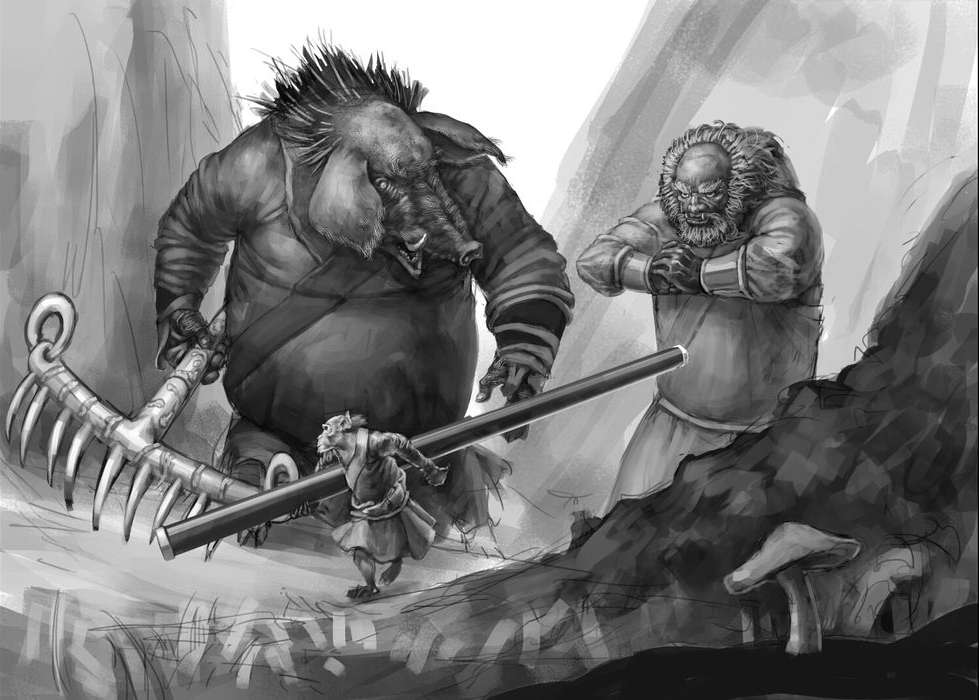

Koss, N. (1981). The Xiyou ji in its Formative Stages: The Late Ming Editions (vol. 1 and 2). (UMI No. 8112445) [Doctoral dissertation]. Available from ProQuest Dissertations and Theses database. 
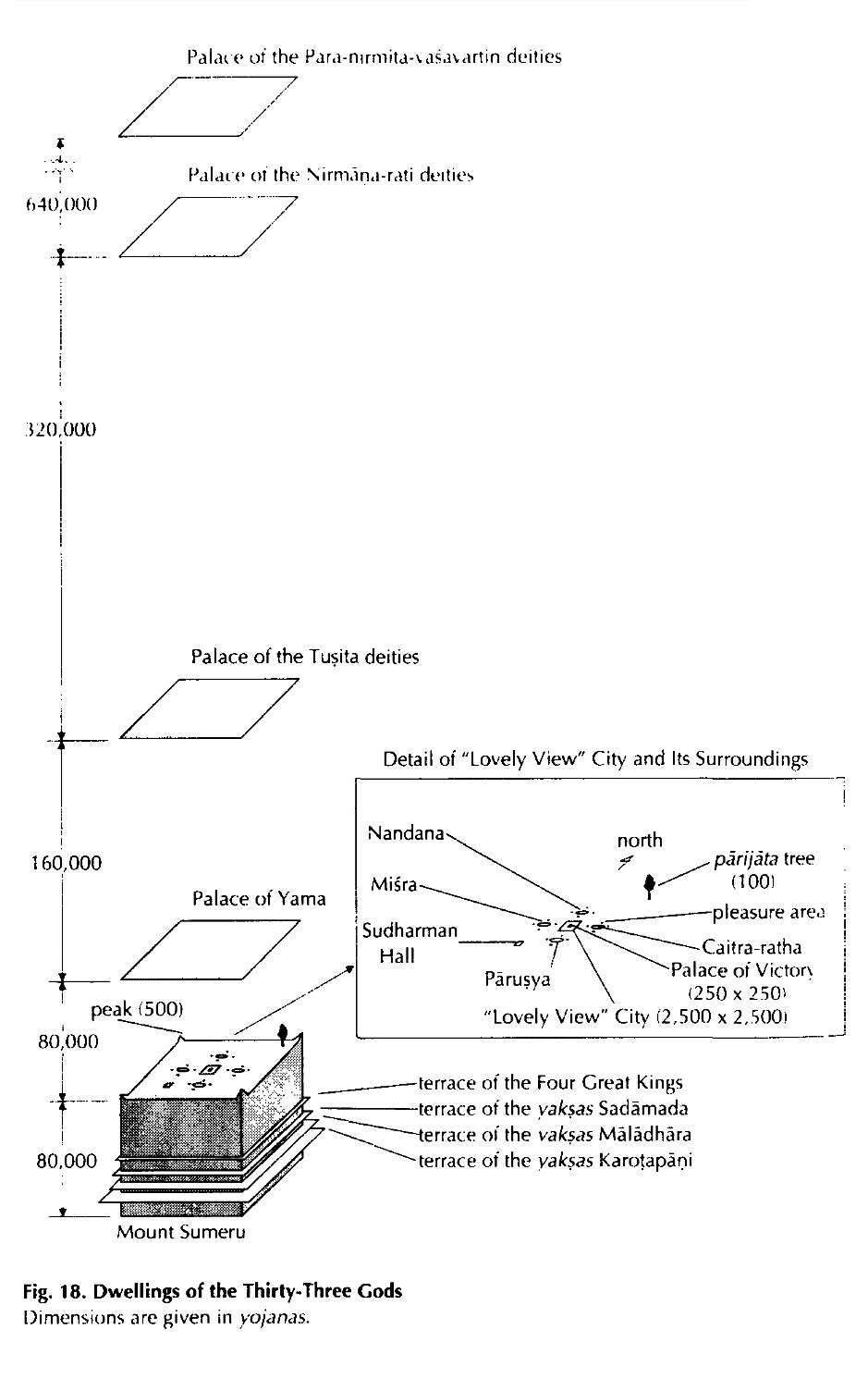
Shao, P. (1997). Monkey and Chinese Scriptural Tradition: A Rereading of the Novel Xiyouji (UMI No. 9818173) [Doctoral dissertation, Washington University]. Available from ProQuest Dissertations and Theses database.

Wu, C., & Yu, A. C. (2012). The Journey to the West (Vols. 1-4) (Rev. ed.). Chicago, Illinois: University of Chicago Press.

Yang, G. L. (2021a). The Monkey Prince Hates Superheroes. In Jessica Chen (Ed.). DC Festival of Heroes: The Asian Superhero Celebration (pp. 70-82) [Google Play]. New York, NY: DC Comics. Retrieved from https://play.google.com/store/books/details/Minh_Le_DC_Festival_of_Heroes_The_Asian_Superhero?id=qXUrEAAAQBAJ.

Yang, G. L. (2021b). Monkey Prince, (0) [Digital]. New York, NY: DC Comics. Retrieved from https://www.dccomics.com/reader/#/comics/483798.

Yang, G. L. (2022a). Monkey Prince, (1) [Kindle]. New York, NY: DC Comics. Retrieved from https://www.amazon.com/Monkey-Prince-2022-2021-ebook/dp/B09P45TWKD/.

Yang, G. L. (2022b). Monkey Prince, (2) [Kindle]. New York, NY: DC Comics. Retrieved from https://www.amazon.com/Monkey-Prince-2022-2021-ebook/dp/B09RQ6581L.

Yang, G. L. (2022c). Monkey Prince, (3) [Kindle]. New York, NY: DC Comics. Retrieved from https://www.amazon.com/Monkey-Prince-2022-2021-ebook/dp/B09TV1BQSW/.

Yang, G. L. (2022d). Monkey Prince, (4) [Kindle]. New York, NY: DC Comics. Retrieved from https://www.amazon.com/Monkey-Prince-2022-2021-ebook/dp/B09X5YZGQ5/.

Yang, G. L. (2022e). Monkey Prince, (5) [Kindle]. New York, NY: DC Comics. Retrieved from https://www.amazon.com/Monkey-Prince-2022-2021-ebook/dp/B09ZVH9C5J/.

Yang, G. L. (2022f). Monkey Prince, (6) [Kindle]. New York, NY: DC Comics. Retrieved from https://www.amazon.com/Monkey-Prince-2022-2021-ebook/dp/B0B3B6D522.