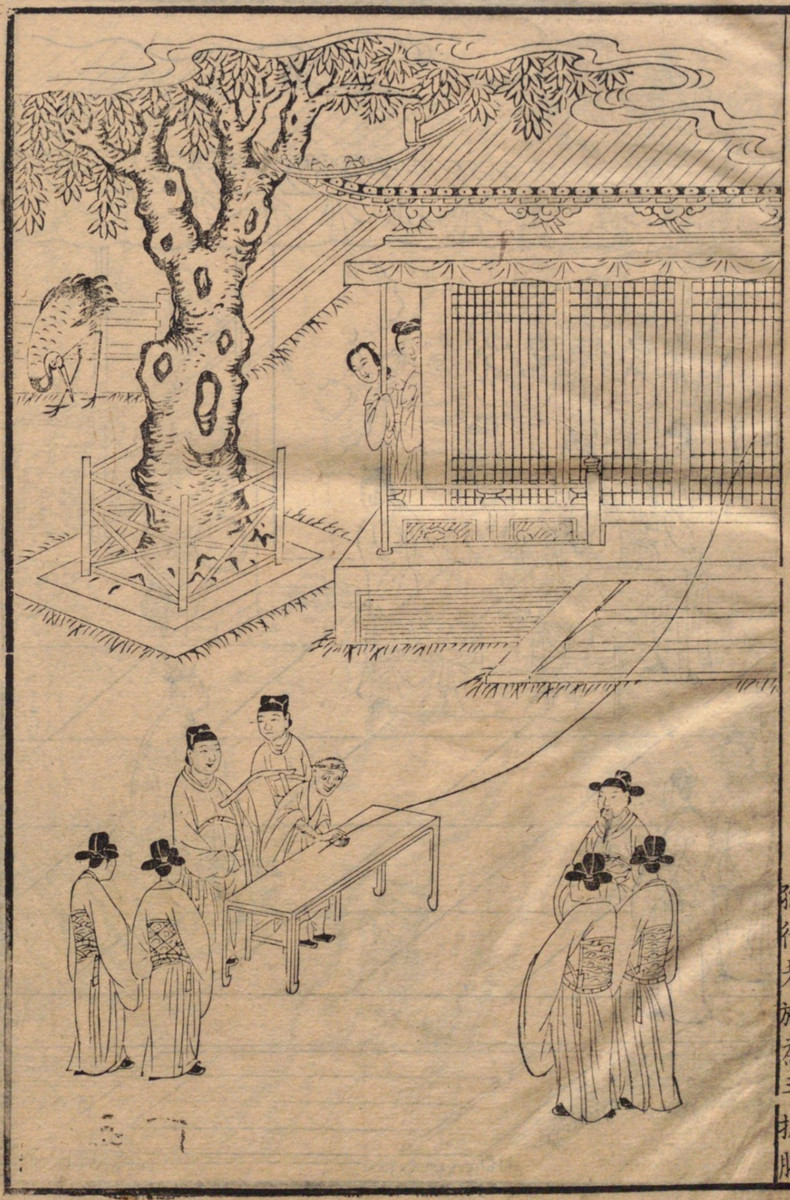
I normally don’t post tone marks for Chinese words, but I will include them here since they are important to the subject of this article.
Měihóu wáng (美猴王), or the “Handsome Monkey King,” is one of Sūn Wùkōng‘s many names and titles. I recently saw an online post where someone proposed their own folk analysis for the character měi (美, “beautiful/handsome”), suggesting that the two prongs on top reference Monkey’s iconic feathered cap. But others quickly pointed out that this was historically not the case. This reminded me of my theory on the origins of the term Měihóu wáng.
(Left) The character měi (美, “beautiful/handsome”) (larger version). Take note of the two prongs on top. Image found here. (Right) Èrláng vs Sūn Wùkōng (larger version). Take note of Monkey’s feathered cap. Image of a production still from the 1986 TV Series.
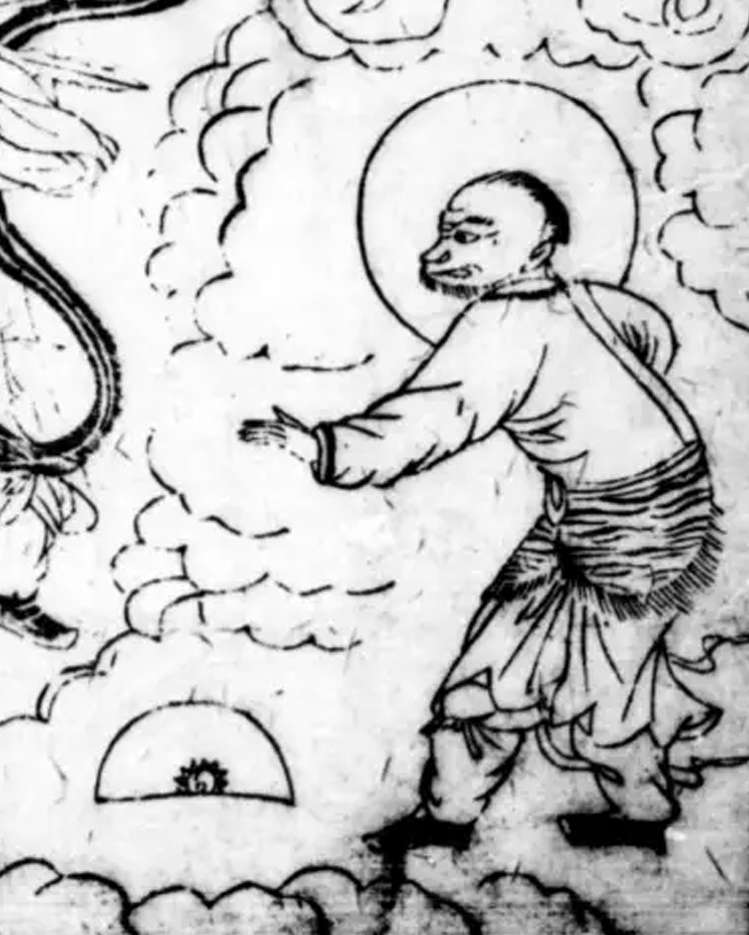
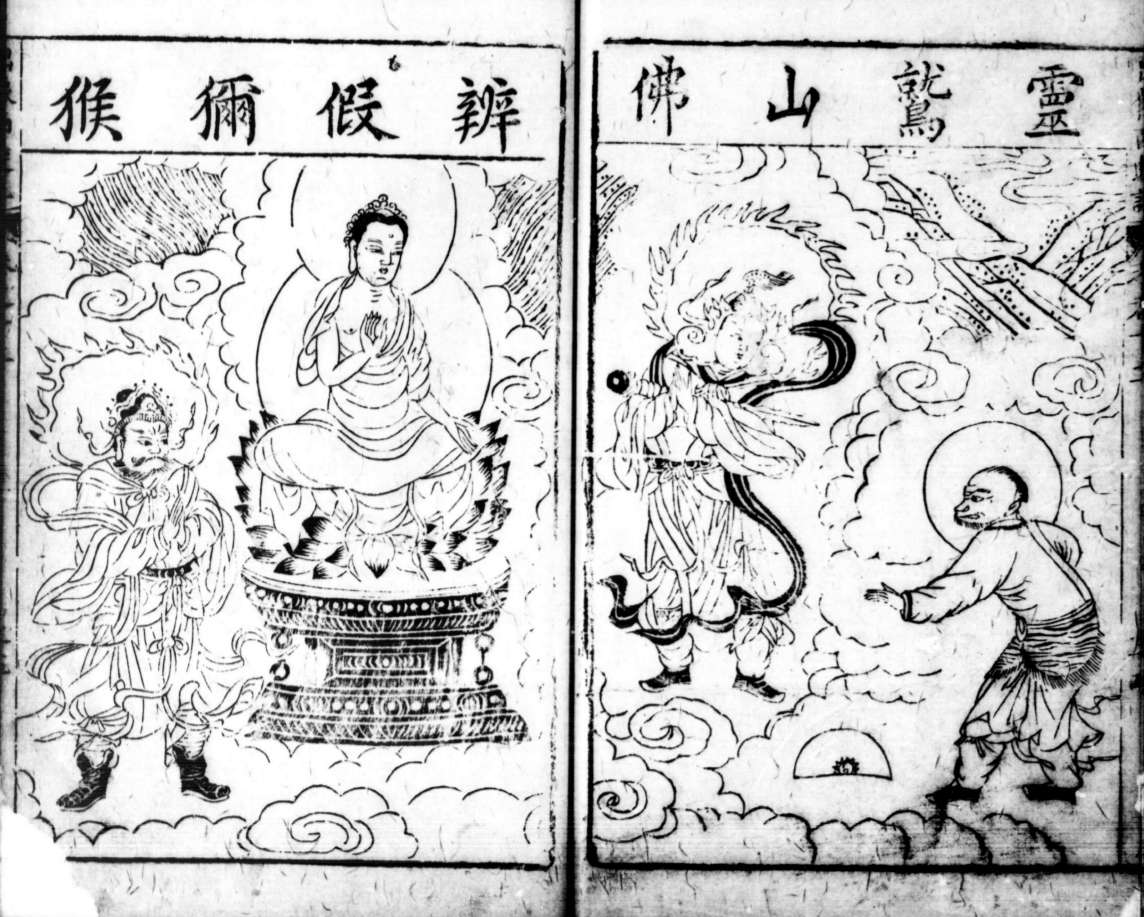
I have suggested in an update to a past article that the title is a play on Míhóu wáng (獼猴王, “Macaque/Monkey King”), míhóu being a common term for monkeys for centuries. [1] This is because the 13th-century version of Journey to the West (Xīyóu jì, 西遊記, 1592) calls Sūn Wùkōng’s antecedent Míhóu wáng. [2] Even a 3rd-century Chinese version of an Indian jataka tale where the Buddha is a monkey king calls him Míhóu wáng. But most importantly, the Middle Chinese pronunciation of měi (美) sounds more like “mǐ” (mijX), as do the pronunciations of many ethnic groups and even neighboring countries. This might suggest that the pre-modern usage was adopted by these people and places in the past. Therefore, Míhóu wáng and Měihóu wáng may have sounded similar at some point in history:
If true, this would mean that the common link between Sūn Wùkōng’s title and his ego is a later interpretation.
I must point out, however, that I am NOT a language expert. This is just something that dawned on me one day. I would like feedback from more knowledgeable readers. Please write me via the “contact” button on the menu, or leave a comment below.
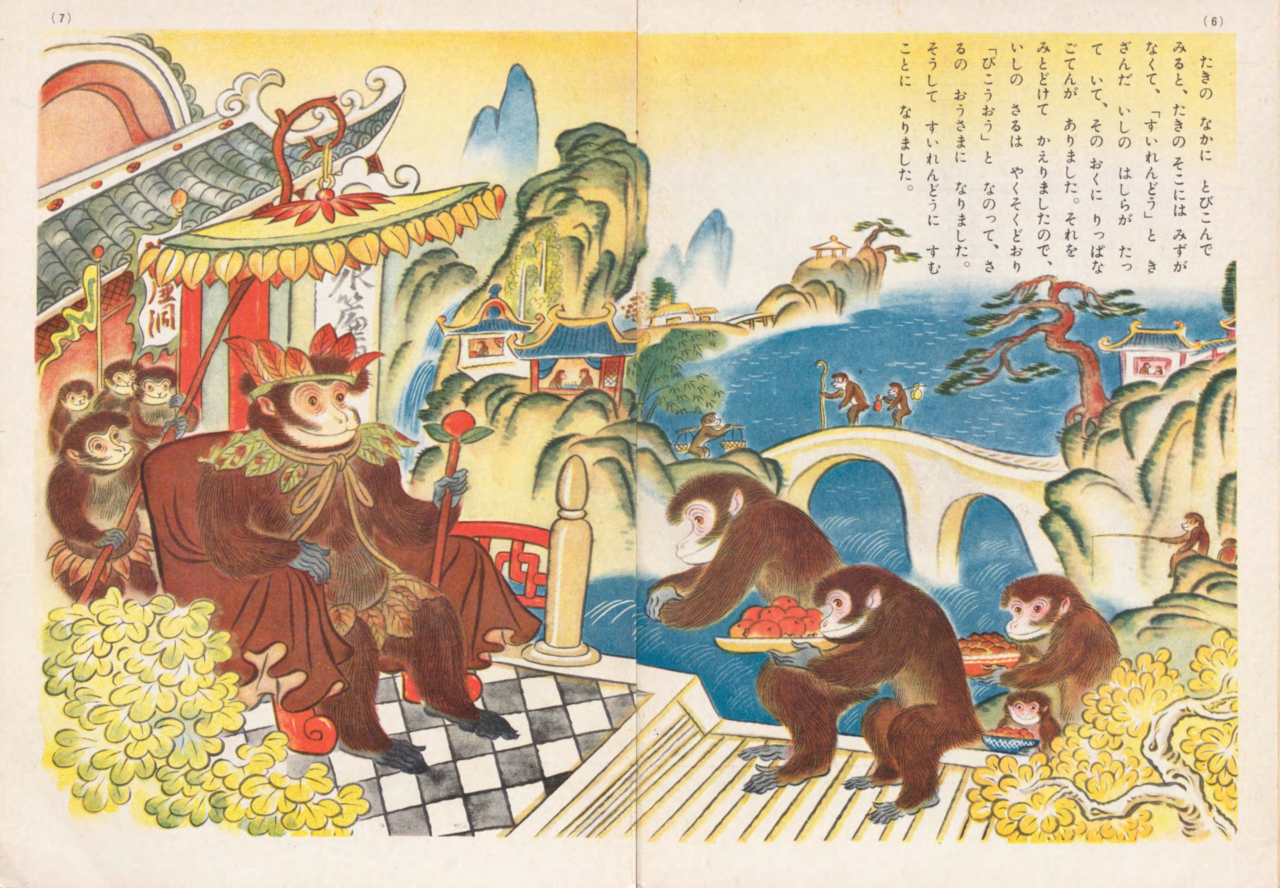
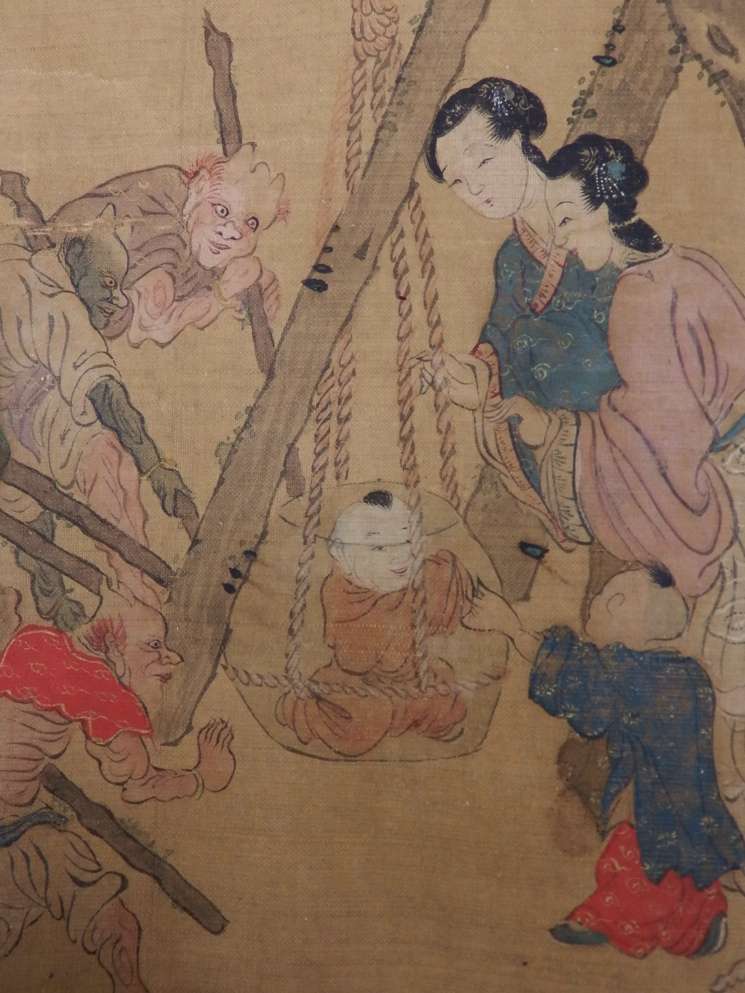
The Handsome Monkey King is waited on by his children (larger version). Image from the Japanese children’s book Son Goku (孫悟空,1939).
Notes:
1) Míhóu is one of various transcriptions for a word of non-Chinese origin used in ancient China to mean “monkey”:
The fact that mu occurs in four variants: 母 and 沐 in Chou literature, and mi 米 or 獼 during the Han dynasty and later, proves that this binom is a phonetic rendering of a non-Chinese term (Van Gulik, 1967, p. 35).
2) The full title is the “Bronze-Headed, Iron-Browed King of the Eighty-Four Thousand Monkeys of the Purple Cloud Grotto on the Mountain of Flowers and Fruit” (Huāguǒ shān Zǐyún dòng bāwàn sìqiān tóngtóu tiě’é Míhóu wáng, 花果山紫雲洞八萬四千銅頭鐵額獼猴王) (Wivell, 1994, p. 1182).
3) See Kroll et al. (2015, pp. 162, 302, and 469).
4) See Kroll et al. (2015, pp. 162, 299, and 469).
Source:
Kroll, P. W., Baxter, W., Boltz, W. G., Knechtges, D. R., Lien, Y. E., Richter, A., Richter, M. L., Warner, D. X. (2015). A Student’s Dictionary of Classical and Medieval Chinese. Belgium: Brill.
In honor of the forthcoming video game Black Myth: Wukong (August 20, 2024), I have completed a catalog of Sun Wukong‘s magic abilities and skills from all 100 chapters of Journey to the West (Xiyouji, 西遊記, 1592). To my knowledge, this is the first of its kind in English. My hope is that it will be useful to fanfiction writers and artists, as well as academics studying magico-religious concepts from Ming-era vernacular literature.
Below, I present a Google Doc and PDF of the full 177-page catalog, as well as a general survey of the magic powers and skills for people who are short on time.
[Note (8-18-24): I have moved the chapter headings to the beginning of each page, as well as added more information. This has increased the page count to 221, but the text is close to the same length, roughly 180 pages if squished together.]
A con is that I have to reupload this anytime I make an update to the original. Also, the formatting is wonky for some reason. But I’ll try my best to keep this updated at all times.
In place of using “layer” or “level,” I’m choosing to designate his various immortalities as “categories.” This is because a new layer of divine longevity or durability would surely be added for each immortal peach, elixir pill, or cup/jug of heavenly wine consumed. Hence, eating multiple peaches would be one category, eating multiple elixir pills would be one category, and so on and so forth.
There are two sets of immortalities. The first are achieved before or during the journey:
(Monkey briefly dies from thermal shock in chapter 41 while battling Red Boy. Zhu Bajie shortly thereafter suggests that he has 72 lives because he knows the 72 transformations (他有七十二般變化,就有七十二條性命。). If true, this would have interesting implications for his various immortalities. Would someone have to kill him 72 times in order to make sure that he is dead for good? However, this is little more than speculation since the narrative never mentions Sun respawning after death like a video game character.)
The second are achieved at the journey’s end once they reach the Buddha’s blessed land. These shouldn’t be lumped together with those acquired before and during the pilgrimage.
Eating Immortal food, tea, and fruit (ch. 98) (See the 01-01-26 update below for more info)
It’s important to note that the novel ends before Monkey is able to perform any feats as a Buddha. Therefore, making claims about his subsequent abilities is outside of canon.
A photomanipulation by me called “The Immortal Has Awakened” (2018) (larger version). The original work was first published on Deviantart.
2.2. Definite Powers
These abilities are utilized in the narrative.
Multitude of terrestrial killers (地煞數; a.k.a. “72 changes,” 七十二般變化) – This allows him to transform his body into anything he wants, including other humanoid figures, animals, insects, miscellaneous objects, incorporeal beams of light, and even buildings.
Cloud-soaring (騰雲) – This allows him to slowly travel through the sky. He only attempts this once (ch. 2).
Cloud somersault (觔/筋斗雲) – This allows him to fly 108,000 li (十萬八千里; 33,554 mi/54,000 km) in a single leap. He displays this throughout the novel.
Navigation – The ability to travel to and find places that he has not previously been to. This is displayed throughout the novel.
I’m placing this here because the ability might be magical.
Body beyond body (身外身法; a.k.a. “magic of body division,” 分身法) – This allows him to transform anyone of his 84,000 hairs into whatever he desires, including humanoid figures, animals, insects, miscellaneous objects, and even food, money, and tools. It is often used to create an army of clones throughout the novel. He claims that a single hair can multiply into the millions and billions.
Magic of displacement (攝法) – This allows him to transport people and items on a swift, powerful wind (ch. 2, 3, 62, 71, & 84).
Mighty wind (陣風) – This allows him to cause chaos all around him with a powerful wind. It is used to hide his activities, fan the flames of fire, scare away onlookers, and even to kill by propelling rocks (ch. 3, 16, 28, 38, 44, 68, 71, & 95).
Water-controlling magic – The “magic of water restriction” (閉水法; a.k.a. “water-repelling magic,” 避水訣) allows him to ward off water and/or to “open a waterway” (開水道) in order to travel to the aquatic realm. And the “magic of overturning seas and rivers” (翻江攪海的神通) does exactly as named. He displays these throughout the novel.
Magic method of modeling heaven on earth (法天像(象)地) – This allows him to take on a monstrous, 104,300 ft/31,800 m tall form. The original specified height, 10,000 zhang (萬丈), may be a metaphorical number for a much, much larger figure, for Monkey claims to have the ability to fill the universe if he so desired it (ch. 14). He displays this power several times (ch. 3, 6, 61, 64, & 97).
Super strength – This allows him to wield his 13,500-catty (一萬三千五百斤; 17,559.81 lbs/7,965 kg) iron staff with ease, overpower opponents, and to scare rude humans. He displays this throughout the novel. His greatest feat of strength involves carrying two mountains on his shoulders while running with great speed (ch. 33).
Travel to heaven – This allows him to find and enter the celestial realm from any of the four cardinal gates. He displays this throughout the novel.
Cloud production – This allows him to breathe clouds and fog during battle. He displays this throughout the novel.
Three-headed and six-armed war form (三頭六臂) – This allows him to battle myriad opponents on all fronts (ch. 4, 7, 31, 40, & 81).
Staff multiplication – This allows him to multiply his magic staff for his war form, to arm his clones, or to bombard opponents with a shower of hundreds of thousands or even millions of weapons. He displays this throughout the novel.
Magic of body concealment (隱身法) – This allows him to become invisible to humans and even gods and spirits (ch. 5, 6, 24, 49, 63, 68, & 71).
Magic of Immobilization (定身法) – This allows him to freeze humans, gods, and spirits in place for up to a full day (ch. 5, 39, 88, & 97).
Invulnerability – His adamantine head and body are capable of withstanding damage from even celestial weapons and elements. He displays this throughout the novel.
Fiery eyes and golden pupils (火眼金睛) – This allows him to peer up to 1,000 li (千里; 310.7 mi/500 km) during the day and 300 to 500 li (夜裡也還看三五百里; 93.20 to 155.34 mi/150 to 250 km) at night. It also enables him to see through the magic disguises and illusions of gods and spirits. It doesn’t work 100% of the time, though. He displays this throughout the novel.
Horse authority – This allows him to command celestial and earthly equines (ch. 14 & 56). This is based on his former position as the keeper of the heavenly steeds, which essentially makes him the god of horses in the JTTW universe.
Taming tigers – Earthly big cats immediately cower in his presence (ch. 14). This seemingly does not include tiger-spirits.
Three life-saving hairs (三根救命的毫毛) – These are three willow branch leaves-turned-hairs gifted to him by Guanyin which allow him to make whatever he wants in the performance of his duties as Tripitaka’s guardian (ch. 15, 63, & 75). The novel differentiates these from the “body beyond body” hairs.
Putting off sleep – He is shown in one instance (ch. 16) to conserve his immortal energy via meditation instead of sleeping, though he is described as resting in numerous chapters. He claims that putting of sleep for nearly three years wouldn’t even bother him (ch. 25).
Voice impersonation – This power allows him to exactly copy the voice of any figure that he transforms into. He displays this throughout the novel.
Magic of seizure (拿/手法; a.k.a. “holding trick”) – This allows him to magically grab large quantities of characters and goods with a single hand (ch. 62 & 89). It is also ambiguously described as a superpowered martial arts technique where he grabs and twists a much larger opponent so hard that they flip (ch. 18).
Seize the wind (抓風) – This allows him to grab the wind like an animate object. This is done once to smell the breeze (ch. 20).
Super smell – This allows him to detect and even track dangerous animals and evil spirits (ch. 20, 41, 67, & 91).
Size manipulation – This allows him to shrink or grow his body as needed. I differentiate this from the “magic method of modeling heaven on earth” because it is not a grand transformation like the latter. His smallest transformation is a hair-like cicada (蟭蟟蟲), which is perhaps a typo for “蟭螟蟲,” an aquatic insect from Daoist literature said to be so small that it can congregate in the eyebrows of a mosquito.
Summoning gods – This allows him to call upon local gods of the soil and mountains, Buddhist gods assigned to protect the Tang Monk, and also the Dragon Kings of the world’s oceans. He displays this throughout the novel.
Immortal breath (仙氣) – This allows him to transform his hairs and staff and other inanimate objects into whatever he wants, as well as to heal grievous wounds, manipulate souls, and to help grant humans divine strength and longevity. He displays this throughout the novel.
Spirit-body (真身出一個神; a.k.a. “magic of the spirit leaving the body,” 出神的手段) – This allows him to transform his body into an astral form in order to leave from a place unnoticed (ch. 25, 45, 77, & 85). This is often used in tandem with a hair-turned-decoy body.
Lock-picking magic (解鎖法) – This allows him to unlock any lock with either his staff or hand (ch. 25, 52, 61, 71, 92, & 99).
Sleep-inducing bugs (瞌睡蟲兒; a.k.a. “sleep demon bugs, 睡魔蟲”) – These insects allow him to incapacitate humans, gods, and spirits. These are said to have been won from a heavenly guardian in a finger-guessing game (ch. 25 & 77). The novel differentiates these from the sleep insects that he makes with “body beyond body.”
Blood transformation magic – This allows him to create talking and moving decoys from inanimate objects. They are created by saying a spell, biting his tongue, and spitting the resulting blood on the selected items (ch. 25, & 46).
Super scream – This allows him to scare away ferocious animals, as well as to intimidate humans (ch. 27, 65, & 93).
Shortening the Ground (縮地法; a.k.a. “magic of shortening the ground and moving the mountain,” 移山縮地之法) – This allows him to transport people vast distances by contracting the land before them (ch. 31 & 40).
Magic nullification – This allows him to cancel a spirit’s illusion by saying a spell and spitting water (ch. 31).
Secret communication – This allows him to contact gods without others noticing (ch. 33 & 37).
Fire-avoidance spell (避火訣) – This allows him to ward fire (ch. 35, 41, & 75).
Super jump – This allows him to jump over a city wall (ch. 38).
Turning off invulnerability – This allows him to switch off the hardness of his body in order to mutilate himself for fun (ch. 46, 75, & 79).
Surviving fatal wounds – This allows him to live through having his head cut off and his intestines and heart pulled out (ch. 46 & 79).
Phantom speech – This allows him to communicate without a head. His voice seemingly projects from inside his body (ch. 46).
Magic body part retrieval – This allows him to command his body parts to return if they are separated from him. However, this doesn’t work if gods hold them down (ch. 46).
Regrowing a head – This allows him to regrow his head if it is separated from his body (ch. 46). Sha Wujing suggests that our hero has 72 heads because he knows the 72 transformations (他有七十二般變化,就有七十二個頭哩。).
Super healing – This allows him to heal from grievous injuries without even a single scar (ch. 46).
Foreknowledge of fate – This allows him to know what the universe has in store for certain characters, especially Tripitaka (ch. 47, 81, 97, & 99).
Magic barrier – This allows him to protect people by drawing a circle around them with his staff (ch. 50).
Halting clouds (留雲) – This allows him to stop hurtling endlessly through the sky after being blown away by Princess Iron Fan‘s magic fan (ch. 59).
Wind-arresting elixir (定風丹) – This allows him to become an immovable object. It is originally sown into the collar of his robe by a bodhisattva, but he later accidentally swallows it, and his body is fortified by it (ch. 59 & 61).
Sympathetic magic – This allows him to summon rain in order to extinguish fire in a different location just by throwing a goblet of wine (ch. 70).
Magic of body division (分身法) – This allows him to split his body in order to create endless copies of himself. The novel treats this as separate (ch. 75) from the “body beyond body,” which is also known by this name.
Mimic magic – This allows him to make someone look like a different person. This involves an oral spell, the immortal breath, and a mud mask. He uses this to change his master’s appearance (face and body) to look like him (ch. 78).
True Fire of Samadhi (三昧真火) – This allows him to blow spiritual fire (ch. 81).
Divine empowerment – This allows him to grant divine strength and longevity to humans (ch. 88).
Travel to the underworld – This allows him to find and enter hell (ch. 97).
Resurrection – This allows him to bring someone back from the dead—provided that he has permission from Ksitigarbha—by retrieving and forcing their soul back into their body (ch. 97).
Weightless body – This allows him to walk with great agility. He achieves this after crossing a spiritual river into the Buddha’s blessed land (ch. 98).
Yang energy projection – This allows him to ward off an army of yin spirits with his staff at the end of the novel (ch. 99).
Readers are free to decide whether or not these are actually powers.
Eye beams – These shoot from his eyes shortly after his birth. They dim upon eating earthly food (ch. 2).
Celestial voice – He is said to have a voice like bells and stone chimes (ch. 4).
Super speed – He is said to run like a meteor in order to catch up to Tripitaka (飛星來趕師父) while carrying two mountains (ch. 33). This might be hyperbole, though, since his master isn’t that far ahead of him.
Light beams shoot from Sun’s eyes shortly after his birth (larger version). The image was originally found on Facebook, but I’ve been informed that it is by the artist Jiang Xiaoshu (姜晓殊).
2.4. Claimed Powers
These are abilities that are never demonstrated:
No shadow – He claims to cast no shadow while walking past the sun and moon (ch. 3).
Phasing – He claims that he can pass through metal and rock unhindered (ch. 3).
Taming dragons – He claims to be able to subdue dragons (ch. 14), but the various serpent-spirits that he meets during the journey do not cower before him like earthly tigers do (see # 19 above).
Super hearing – He claims to be able to hear the goings-on in heaven and hell (ch. 31). But it’s interesting to note that his doppelganger is shown to have super hearing.
Kicking down the sky or overturning wells – These are as named.
Manipulating stellar bodies – He claims to be able to change the path of stars and planets (ch. 46). But I should note that he fights and single handedly defeats the anthropomorphic forms of the nine planets during his rebellion (ch. 5). I’ll leave it up to the reader to decide whether or not this constitutes altering their paths.
Monkey fighting the dragon prince that will become the white dragon horse (larger version). Image found here.
3. Skills
Early education – Language, etiquette, scriptural studies, calligraphy, and gardening.
Navigation – The ability to travel to and find places that he has not previously been to. This is displayed throughout the novel.
I’m also placing this here because it might just be a non-magical skill. You decide.
Martial arts (武藝) – He has a knowledge of different weapons, and he is even shown to be a proficient boxer. He displays this throughout the novel.
Cosmic social connections – His travels as a young immortal enabled him to make friends, or at least to become acquaintances with, all sorts of gods and spirits across the Buddho-Daoist universe. He uses these connections to his advantage throughout the novel.
Sewing – He is shown capable of sewing clothing (ch. 14 & 84).
Face reading – He is shown to have a familiarity with the art of deriving someone’s personality or intelligence from their looks.
Craftsmanship – He claims to be able to build a house for the Tang Monk (ch. 27 & 67), and he later constructs a straw dragon for a queen to ride (ch. 71).
Guessing weight – He can guess the weight of something just by holding it in his hand (ch. 76).
Lastly, I would like to highlight Monkey’s intellect. Despite his common association with using force, he is shown in the novel to be very clever, often relying on a number of mental qualities or tactics to defeat demons:
Adeptness
Basic soldering
Calculation
Commandeering enemy equipment
Deception
Info gathering
Knowledge base:
Celestial and earthly pharmacology and pathology
Heavenly treasures
Classics
Astronomy
Philosophy
Law
Scripture
Demonology
Logic
Spiritual cultivation and spirituality
Cooking
Types of wood
Sound
Cosmic hierarchy
Language acquisition – He only has to listen to a conversation for a moment before he learns a new language.
Memory
Pattern recognition
Persuasion
Planning
Problem solving
Quick thinking
Weapon making
4.1. Example
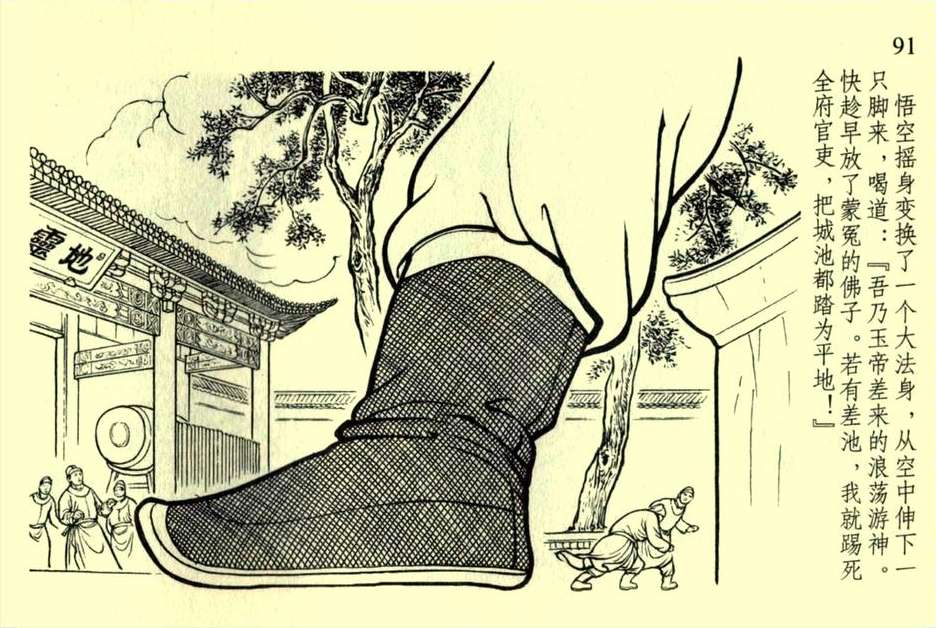
A good example of his cunning appears in chapter 97. The four monks are framed for the theft and murder of a rich layman who had originally hosted them for a month. Sun Wukong captures the real perpetrators and rounds up their stolen bounty, but he is forced to release the bandits for fear that Tripitaka will chant the tight-fillet spell for killing them. However, imperial troops later capture the clerics with the stolen items, making them look guilty. After the group is brought to court and tortured for some time (only affecting the weaker members), Monkey escapes from the prison at night in order to influence their release. First, he imitates the voice of the slain layman at his wake and threatens heavenly retribution if his widow, the person who framed the monks, doesn’t recant her false claims. Second, he imitates the voice of the deceased uncle of the city magistrate who imprisoned them and again threatens heavenly retribution if the official doesn’t reexamine the case. And third, at dawn he transforms himself into a titan-sized apparition before the district level magistrates and threatens to stomp the city and surrounding area into oblivion as heavenly retribution if they don’t put pressure on their superior to free the group. In the morning, Tripitaka, Zhu, Sha, and the officials visit the layman’s home, while Sun goes to the underworld to retrieve the man’s soul, which has been granted a dozen more years of life by the Bodhisattva Ksitigarbha. Monkey returns and brings the man back to life by forcing his soul into his body. The layman then explains how he had been murdered by bandits who robbed his mansion. The city magistrate, therefore, pardons the monks and even the wife.
A modern lianhuanhua depicting Monkey’s giant foot confronting the magistrates (larger version). Comic found here.
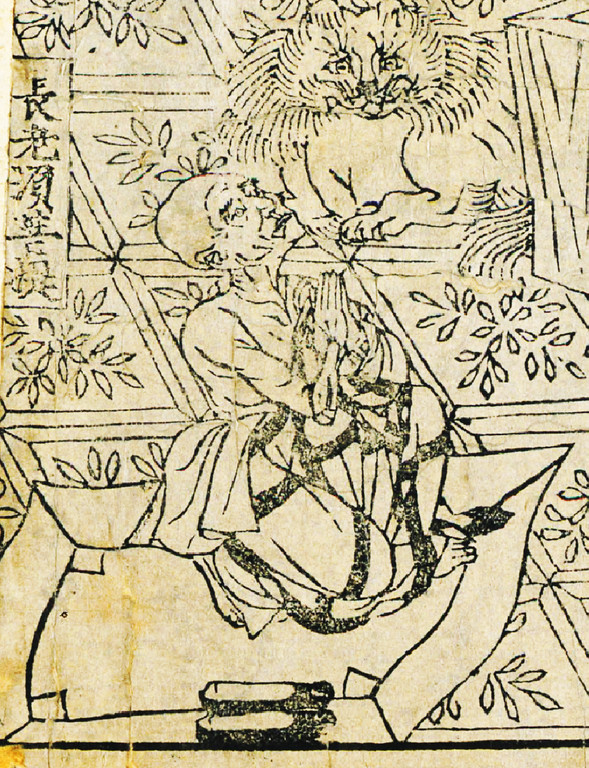
A detail of Nezha striking at an enemy during battle. Image from The Newly Printed, Zhong Bojing Annotated, Investiture of the Gods (Xinke Zhong Bojing xiansheng piping Fengshen yanyi, 新刻鍾伯敬先生批評封神演義, c. 1620) (larger version).
Update: 01-01-26
As noted, Sun Wukong appears to have eight immortalities:
Spiritual breathing exercises (ch. 2)
Erasing his name from the ledgers of hell (ch. 3)
Drinking immortal wine (ch. 4 & 5)
Eating immortal peaches (ch. 5)
Eating elixir pills (ch. 5 & 17)
Eating Ginseng fruit (ch. 24)
Eating Immortal food, tea, and fruit (ch. 98)
Buddhahood (ch. 100)
But I’ve thought of something that brings one of these into question:
In JTTW chapter 98, the pilgrims are all given “immortal food, tea, and fruit” (仙餚、仙茶、仙果) upon entering the Buddha’s paradise, and this is said to “grant them longevity and health and enable them to transform their mortal substance into immortal flesh and bones” (… 壽長生,脫胎換骨之饌,儘著他受用。) (based on Wu & Yu, 2012, vol. 4, pp. 349-350). The latter quote refers directly to Zhu Bajie and Sha Wujing, but Monkey and Tripitaka certainly benefit from the meal as well.
The pilgrims are not too long after elevated in spiritual rank in JTTW chapter 100 (Wu & Yu, 2012, vol. 4, pp. 381-382).
The chronological proximity of the food to the spiritual promotions reminds me of a concept from Buddhism, the immortal “diamond/adamantine body” (Sk: vajrakāya; Ch: jingangshen, 金剛身) of the Buddha. You can read more about that here (see the PDF link therein):
(It’s interesting to note that Laozi suggests in JTTW chapter seven that all of the divine foodstuffs eaten/drunk by Monkey must have resulted in his “diamond body” (jingang zhi qu, 金鋼[剛]之軀) (Wu & Yu, 2012, vol. 1, p. 188).)
This then raises the question: Is the food meant to symbolize the immortality that comes with becoming an enlightened being? If so, numbers seven (immortal food) and eight (Buddhahood) in my list are one and the same, meaning that the former should be removed.
Update: 02-02-26
Monkey strikes me as the sort of person who is overqualified in all areas but still pads their résumé as a way to make them seem even more amazing. This could be used as an in-universe explanation for the undemonstrated powers (see above). Though, I’m sure he could figure out how to, for example, phase through solid objects if he put his mind to it.
Update: 03-27-26
I previously added this info as an update to a past article:
The Saṃyutta Nikāya (Sk: संयुक्त निकाया; Ch: Xiang ying bu, 相應部, c. 250 BCE) notes that Buddhist cultivators develop a host of supernatural powers once they master the four mental qualities (Pali: Iddhipāda). Notice how similar they are to those discussed above:
Multiplying the body
Vanishing and reappearing
Passing through solid objects (walls, ramparts, mountains, etc.)
Diving into the earth like water
Walking on water like earth
Traveling through space
Touching the sun and moon
Hearing all sounds, both human and divine
Knowing the minds of others
Having memories of all of one’s past lives
Knowing the future rebirths (and their causes) of all beings
Liberation from the filth of the world through supreme wisdom (Bodhi, 2000, pp. 1727-1728)
Source:
Bodhi, B. (2000). The Connected Discourses of the Buddha: A Translation of the Saṃyutta Nikāya; Translated from the Pāli by Bhikkhu Bodhi (Vols. 1-2). Boston: Wisdom Publications.
Wu, C., & Yu, A. C. (2012). The Journey to the West (Vols. 1-4) (Rev. ed.). Chicago, Illinois: University of Chicago Press.
If you were to ask someone to name Sun Wukong‘s master, those familiar with Journey to the West (Xiyouji, 西遊記, 1592; “JTTW” hereafter) would probably say Tang Tripitaka (Tang Sanzang, 唐三藏). But many forget that the cleric is actually his second master. His first, the Patriarch Subodhi (Xuputi zushi, 須菩提祖師; a.k.a. “Patriarch Puti / Bodhi,” Puti zushi, 菩提祖師), is rarely brought up in conversation, but this wise old man and elderly martial arts master archetype is the source of the Monkey King’s divine longevity, magical skills, and fighting prowess. He, therefore, deserves his own article. I’ve already written several pieces mentioning him, so I’ve decided to combine everything (including new material) onto a single page.
This article describes his origins, story in the novel, and description; the location, description, and meaning of the name of his mountain home; his school uniform; how he names his students and why the Monkey King is called Sun Wukong; his religious, magical, and martial arts curriculum, including tests of spiritual intelligence; and his spiritual powers. Despite his common portrayal as a Daoist immortal (xian, 仙), the novel stresses a connection to Buddhism. I ultimately suggest that the Patriarch Subodhi is a bodhisattva (pusa, 菩薩), albeit one with Daoist leanings.
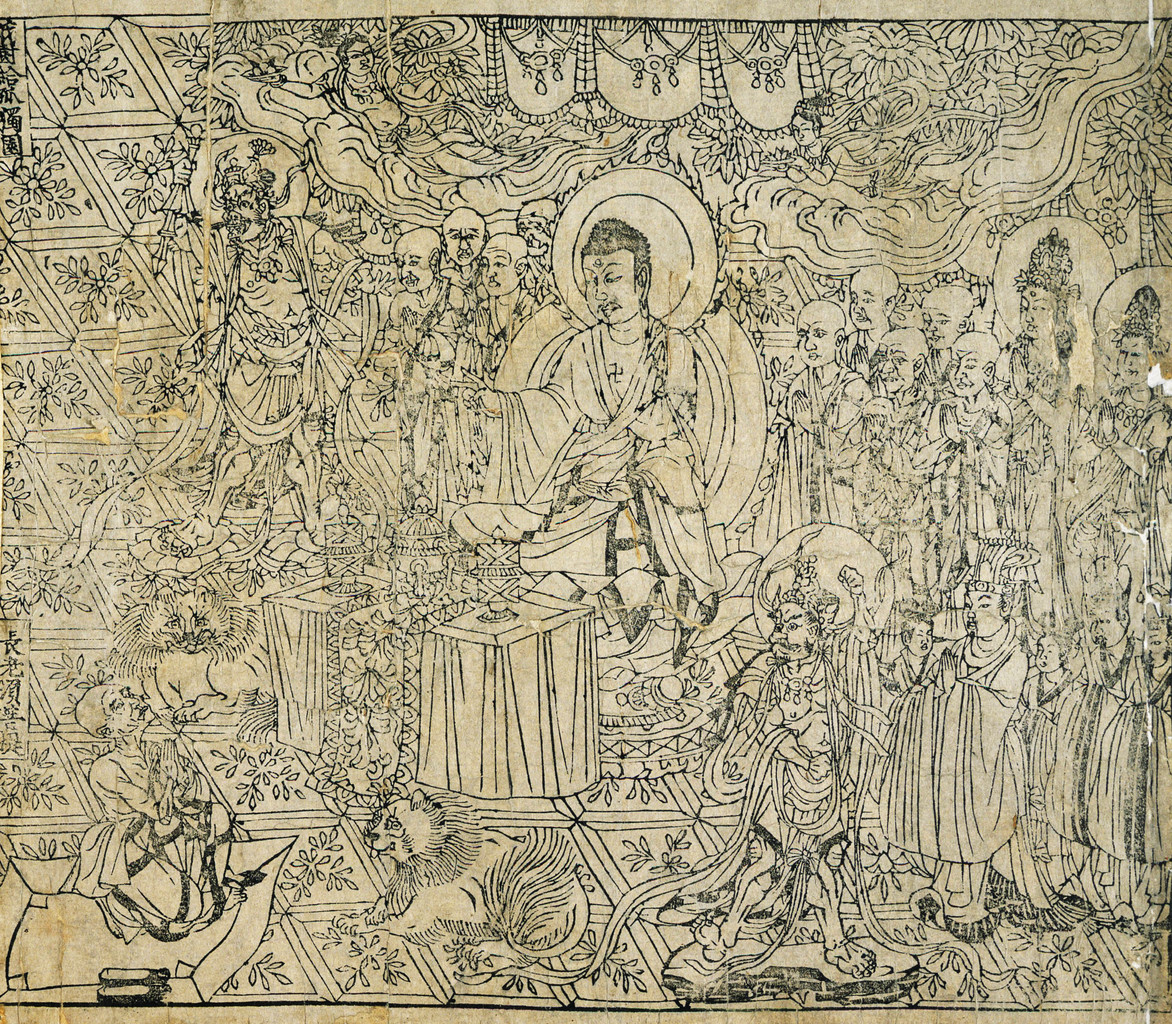
Subodhi is based on Subhūti (Xuputi, 須扶提 / 須浮帝 / 蘇補底 / 蘇部底) (fig. 1), [1] one of the ten principal disciples of the Gautama Buddha. He plays an understated role in the original Pāli canon of Theravāda Buddhism, being recognized by the Buddha as the most accomplished in meditating on the concept of “loving-kindness” (Pāli: Metta; Sanskrit: Maitri), or wishing for the happiness of others (Buswell & Lopez, 2014, pp. 861-862; Osto, 2016, pp. 126-127). On the contrary, Subhūti plays a much larger role in Prajñāpāramitā texts of Mahāyāna Buddhism in which he is famed for contemplating “emptiness” (Pāli: suññatā; Sk: śūnyatā; Ch: kong, 空), a subject with textual interpretations ranging from ridding oneself of sexual desires to realizing the truth of the illusionary nature of Saṃsāra (Buswell & Lopez, 2014, pp. 872; Osto, 2016, p. 126). Because of this, he is also known in Chinese as the “One who expounded vacuity [emptiness]” (Kongsheng, 空生) (Soothill & Hodous, 1937/2014, p. 277). In fact, Osto (2016) suggests that Subhūti was secretly a bodhisattva, reasoning: “How else would he have the necessary insight to understand the profound and paradoxical philosophy of emptiness (śūnyatā) as it is found in these texts?” (p. 128). [2]
Fig. 1 – A detail of Subhūti from a woodblock frontispiece appearing in an 868 CE copy of the Diamond Sutra (larger version). This document is the oldest known dated printed book in the world (full woodblock).
Shao (2006) suggests that Subodhi was modeled on the historical disciple “to evoke a scriptural tradition that identifies Subhūti as the Buddhist at his best, one having the spiritual and intuitive approximation to ’emptiness’ … that the Chan [Zen] Buddhists value tremendously” (p. 723). He continues:
Is it then possible that what the novelist tried to highlight with Subhūti’s name was his reputation as the epitome of emptiness? We can certainly find ample textual evidence to support this line of thinking. Although Monkey’s Taoist realization is worthy of heaven, his Buddhist given name Wukong, or Awaken to Emptiness, obviously represents Subhūti’s Buddhist heritage, for the name is exactly what distinguishes Subhūti in the Buddhist tradition. What gives proof of the power and vitality of this bequest is the fact that “emptiness” constitutes the core of Monkey’s religious being (Shao, 2006, p. 724).
It should be noted that the complete Chinese name Xuputi (須菩提) is only used once in the novel to refer to the Patriarch (see here), while Puti (菩提) is used at least three times (see here). This is interesting as the latter term is a transliteration of bodhi (Pāli & Sk: “awakening” or “enlightenment”), an important concept in Buddhism in which one discovers the Four Noble Truths, thereby achieving enlightenment and freeing themself from the cycle of rebirth (Buswell & Lopez, 2014, p. 129). Therefore, the novel positions the Patriarch as a means to or even embodiment of enlightenment. This is fitting given Osto’s (2016) suggestion above that the historical Subhūti was a bodhisattva, “a ‘being’ (sattva) intent on awakening (bodhi) who has aroused the aspiration to achieve buddhahood” (Buswell & Lopez, 2014, p. 129). More on this below.
2. The Literary Teacher
2.1. His Story
Subodhi is introduced by name in JTTW chapter one when a woodcutter tells the Monkey King about the sage and the location of his mountain home. He learns that the Patriarch “has already sent out innumerable disciples” and that at present “there are thirty or forty persons who are practicing austerities with him” (Wu & Yu, 2012, vol. 1, p. 112). After a quick exchange with an immortal lad at the front door, the Stone Monkey is led to a hall where Subodhi is lecturing to a group of “lesser immortals” (xiaoxian, 小仙). The Patriarch asks for his name and the location of his home but becomes upset as he believes Monkey is lying about his ten year journey from afar. However, after being assured of the truth and hearing of the miraculous stone birth, Subodhi officially accepts the primate as a disciple, giving him the religious name Sun Wukong (孫悟空, “Monkey Awakened to Emptiness”).
In the opening of JTTW chapter two, the Patriarch has his immortal students tutor Monkey in menial tasks like fetching firewood and water, tending the garden, and cleaning the monastery grounds, as well as provide lessons on human language and etiquette, calligraphy, scripture reading, and minor ritual procedures like incense burning. Seven years later, Subodhi notices Sun jumping around in excitement as the primate listens to his lecture. He thereafter offers to teach Monkey a number of skills, but the latter refuses multiple times since they won’t lead to immortality. This rejection makes the Patriarch visually upset, leading him to strike Sun on the head three times with a ruler and then walk away with his hands behind his back. His senior religious brothers chastise him for angering their master, but due to his spiritual intelligence, Sun realizes that the admonishment was really secret code. He later enters Subodhi’s room at the third watch (three hits) using a back door (hands behind back), and it is there where the teacher reveals the secret of immortality in a flowery poem.
After Monkey successfully attains eternal life three years later, the Patriarch teaches him the 72 transformations in order to hide from three heaven-sent elemental attacks slated to destroy him. In addition, he teaches the cloud-somersault, a method of super fast flight. Sun’s religious brothers are amazed at his attainments and request that he display his power of transformation by changing into a pine tree. The resulting applause disturbs Subodhi, who sends the others away before reprimanding and expelling his disciple under the pretense of saving Monkey’s life from those who would harm him to learn his heavenly secrets. But before Sun has a chance to leave, his master threatens him with everlasting torment in the underworld if he ever reveals that the Patriarch had been his tutor. Monkey promises never to speak his name. This is the last time that Subodhi is seen in the story, but he is referenced two more times in later chapters (see section 3.4 below).
2.2. Allusions to Historical Buddhist Masters
Shao (1997) writes that Subodhi hitting Monkey on the head three times—a coded message for receiving secret teachings in the Master’s room at the third watch—is likely based on two episodes from the life of Huineng (惠能, 638-713), the Sixth Chan (Zen) Patriarch:
According to [the Platform Sutra], Huineng was pounding grain when Hongren [the 5th Chan Patriarch] came in, “hit on the mortar three times with his stick and then left” (以杖击碓三下而去). The non-verbal message occurred to the young man as a piece of intuition. By the third watch he arrived dutifully at the master’s chamber where Hongren passed the secret Dharma by way of enlightening him on [the Diamond Sutra], behind a raised cassock used to protect them from the intrusion of prying eyes. The other source is Caoxi dashi biezhuan曹溪大师别传 (An Alternative Biography of the Great Master From Caoxi) in which Huineng hit Shenhui … a few times, seemingly annoyed by the insolence of his disciple’s clever repartee. But it was to none other than Shenhui that he imparted the secret Dharma—in the middle of the night, and with a similar group of dumb disciples who had seen nothing but impudence in Shenhui (pp. 60-61).
The allusion to Hongren and his use of the Diamond Sutra is apt as the historical Subhūti plays a large part in the scripture. His questions fuel the lesson, with the “Buddha’s reply constitut[ing] the body of the sutra” (Watson, 2010, p. 72).
Therefore, the aforementioned episodes associate the Patriarch with two enlightened Chan masters and their secret, unorthodox transmission of the Dharma, supporting his connection to Buddhism.
The novel includes a third allusion to Huineng. This will be discussed in section 4.3 below.
2.3. His Description
The novel never gives an overt description of Subodhi’s features or dress. This ambiguity makes him a blank slate onto which anyone’s personal vision can be written. But there are a few references to his stately, awe-inspiring presence. A poem in chapter one reads:
A Golden Immortal of Great Awareness and of great ken and purest mien,
Master Bodhi, whose wondrous appearance like the West
Had no end or birth by work of the Double Three.
His whole spirit and breath were with mercy filled.
Empty, spontaneous, it could change at will,
His Buddha-nature able to do all things.
The same age as Heaven had his majestic frame.
Fully tried and enlightened was this grand priest (Wu & Yu, 2012, vol. 1, p. 114). [4]
Numerous elements from this poem require explanation. “Golden Immortal of Great Awareness” (Dajue jinxian, 大覺金仙) was a title bestowed on the Buddha by Song Emperor Huizong in 1119 in order to bring Buddhism under the banner of Daoism (Eskildsen, 2008, p. 43 n. 32). (See the 04-14-26 update below for more info.) “Wonderous appearance like the West” (Xifang miaoxiang, 西方妙相) compares the splendor of his person to the Western Pure Land (Sk: Sukhāvatī; Ch: Xifang jingtu, 西方淨土) of the Amitābha Buddha. “No end and no birth” (busheng bumie, 不生不滅) refers to his eternal life free from the wheel of reincarnation, which is thanks to his mastery of the “Double Three” (Sansan xing, 三三行). Yu (Wu & Yu, 2012) explains that this term likely refers to the “three samādhis,” a high-level meditation technique which focuses on the Buddhist philosophical concepts of emptiness, no appearance, and no desires (Wu & Yu, 2012, vol. 1, p. 507 n. 16). “Empty” (kong, 空) in the next line of course refers to Subodhi’s constant meditations on emptiness. “Buddha-nature” (Sk: tathāgatagarbha, lit: “womb of the tathāgata“; Ch: Zhenru benxing, 真如本性; a.k.a. Rulai zang, 如來藏) is “the potential to achieve buddhahood that, according to some Mahāyāna schools, is inherent in all sentient beings” (Buswell & Lopez, 2014, p. 897). This is an open reference to the Buddho-Daoist philosophy of the Southern Quanzhen School Patriarch Zhang Boduan (張伯端, mid to late-980s-1082), which greatly influenced JTTW. He believed that in order to become a true transcendent (xian, 仙), one had to achieve both the Daoist elixir of immortality and Buddha-nature (Shao, 1997; 2006). This dual achievement thus signifies that Subodhi is a celestial of the highest order. His “majestic” (or stately) body (zhuangyan ti, 莊嚴體) is said to have the “same age as heaven” (yutian tongshou, 與天同壽), a phrase used in the novel to denote the endless longevity of such divine beings (see here). The last line notes that he is a fully “enlightened” (mingxin, 明心; lit: “illuminous heart-mind”) master. Taken together, the allusions to Buddhas, the Western paradise, emptiness, and enlightenment speak to Subodhi’s identity as a Buddhist deity. And given his association with bodhi (awakening), I suggest that he is in fact a bodhisattva like his namesake, albeit one with Daoist leanings.
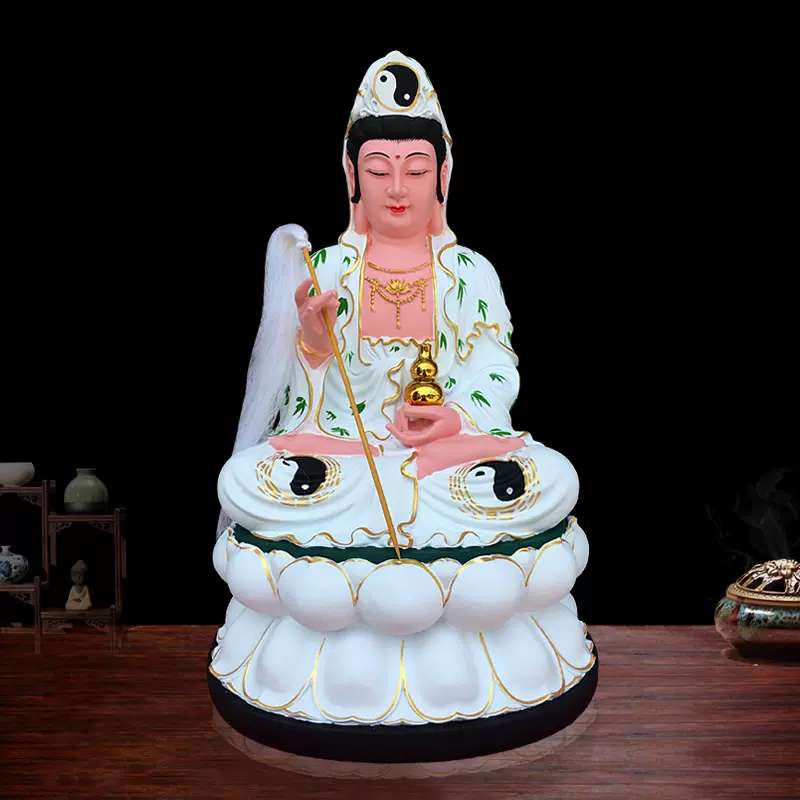
A Daoist bodhisattva may seem paradoxical, but this concept comfortably fits into the syncretic worldview espoused in late-Ming literature. For example, three well-known bodhisattvas are depicted as former high-ranking immortals in Investiture of the Gods (Fengshen yanyi, 封神演義, c. 1620). These include Guanyin (觀音) as “Person of the Way, Compassionate Ferry” (Cihang daoren, 慈航道人) (fig. 2), Mañjuśrī (Wenshu, 文殊) as the “Dharma-Spreading Heavenly Master of Outstanding Culture” (Wenshu guangfa tianzun, 文殊廣法天尊), and Samantabhadra (Puxian, 普賢) as the “Perfected Man of Universal Virtue” (Puxian zhenren, 普賢真人). Together, they later convert to Buddhism and become disciples of the Buddha at the end of chapter 83. [3]
Fig. 2 – A modern idol of Guanyin’s Daoist persona Person of the Way, Compassionate Ferry (larger version).
2.4. An Ancient Depiction
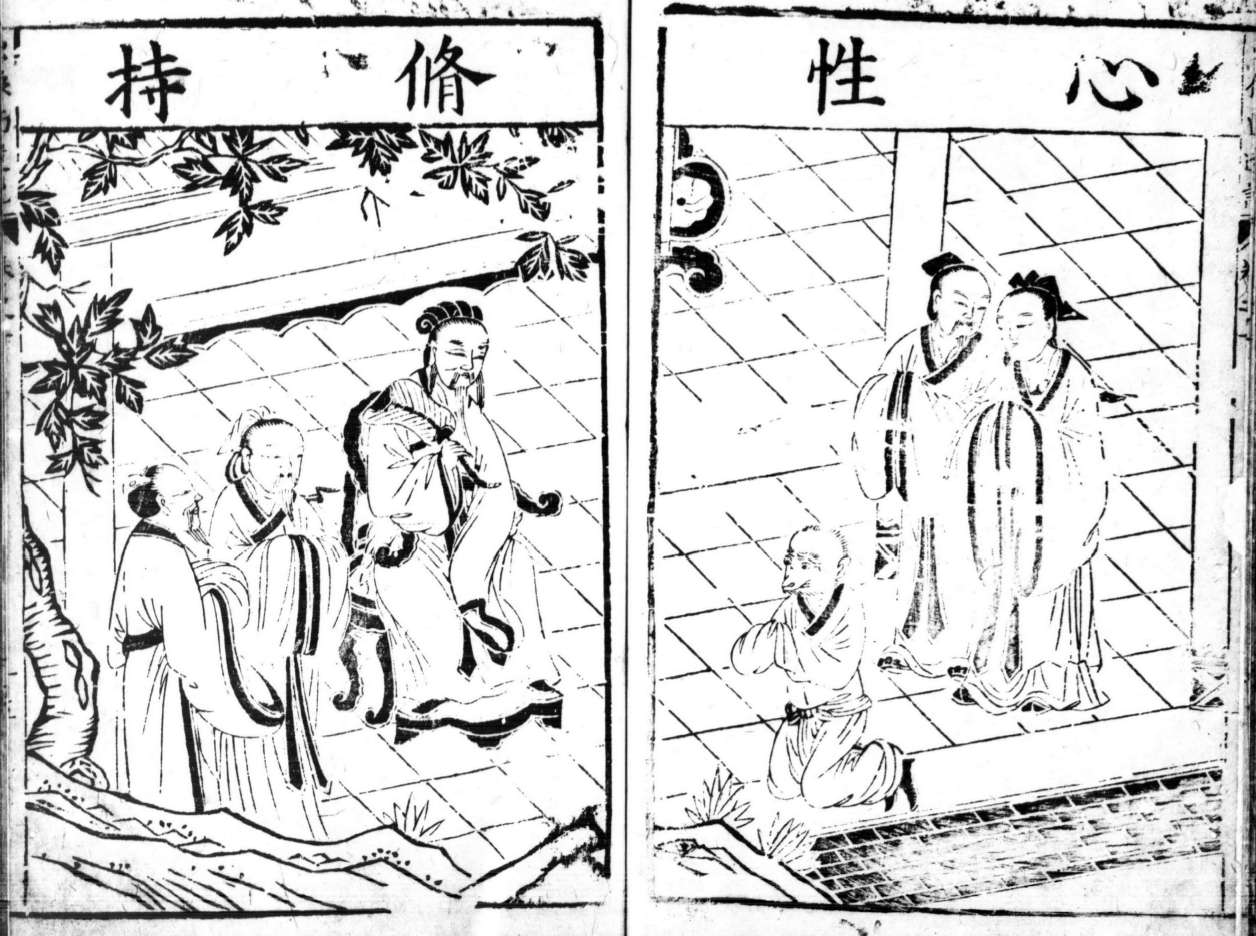
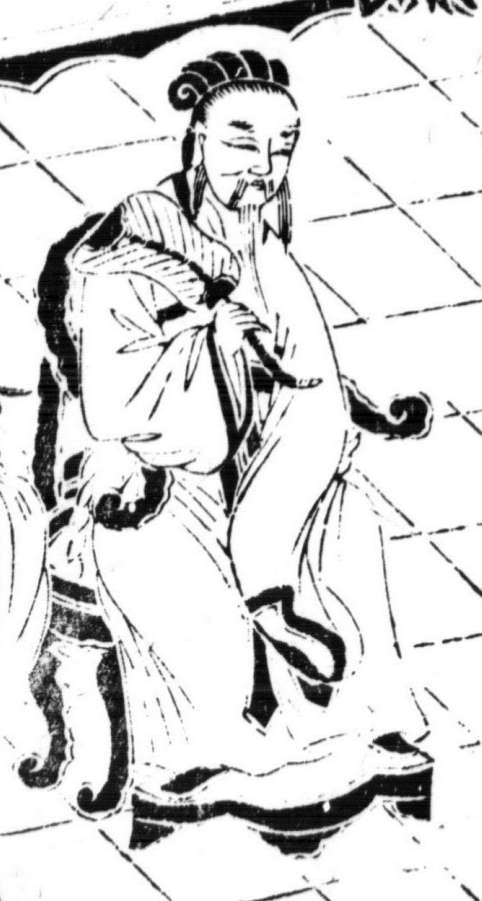
The standard 1592 edition of JTTW was originally published with a series of quaint woodblock prints. One features an image of the Patriarch, depicting him as a robed master holding a palace fan while seated in an ornate chair. He wears a guan-cap and has a kind face with airy whiskers and hints of large-lobed ears (fig. 3 and 4).
(See the 04-15-26 update below for a modern religious idol of the sage. See also the 05-03-2026 update for another Ming-era depiction of the Master as a Daoist immortal.)
Fig. 3 (Left)- A woodblock of Monkey meeting the Patriarch for the first time (larger version). From the standard 1592 edition of the novel. Fig. 4 (Right) – A detail of Subodhi (larger version).
The novel remarks on the beauty of the mountain as Monkey walks through a forest to the school’s front entrance:
Mist and smoke in diffusive brilliance,
Flashing lights from the sun and moon,
A thousand stalks of old cypress,
Ten thousand stems of tall bamboo.
A thousand stalks of old cypress
Draped in rain half fill the air with tender green;
Ten thousand stems of tall bamboo
Held in smoke will paint the glen chartreuse.
Strange flowers spread brocades before the door.
Jadelike grass emits fragrance beside the bridge.
On ridges protruding grow moist green lichens;
On hanging cliffs cling the long blue mosses.
The cries of immortal cranes are often heard.
Once in a while a phoenix soars overhead.
When the cranes cry,
Their sounds reach through the marsh to the distant sky.
When the phoenix soars up,
Its plume with five bright colors embroiders the clouds.
Black apes and white deer may come or hide;
Gold lions and jade elephants may leave or bide.
A Blessed Land [Fudi] to be seen in spirit:
It has the true semblance of Paradise (Wu & Yu, 2012, vol. 1, pp. 112-113).
“Blessed lands” (Fudi, 福地) are thought to be “earthly paradises that do not suffer from floods, wars, epidemics, illnesses, old age or death” (Miura, 2008, p. 368). Daoism recognizes 72 Blessed Lands, each with their own documented name and location (Miura, 2008, p. 371).
The names of the cave and mountain reference the philosophical concept of the “heart-mind” (xin, 心), the center of spiritual intellect, no less than three times. As I explain in this article, the name “slanted moon and three stars” is a literal description of the Chinese character for the heart-mind (fig. 5). “Spirit Tower/platform” (lingtai, 靈臺) is used in Daoist literature to refer to the heart-mind, more specifically the middle elixir field (zhong dantian, 中丹田) around the heart, which is considered the seat of the spirit. During internal alchemical meditation, the spirit is directed from here, along with other energetic substances from elsewhere, into the “square inch” (fangcun, 方寸). This too is a Daoist reference to the heart-mind, more specifically the lower elixir field (xia dantian, 下丹田) around the abdomen, the storehouse of vital energies. The synergy of these energies is thought to bolster the body and bring about immortality. Therefore, a more accurate translation of Patriarch Subodhi’s home, which takes into account the veiled Daoist meanings, would be “Cave of the Slanted Moon and Three Stars on the Mountain of Spiritual Heart and Elixir Mind.”
Fig. 5 – The Chinese character for heart-mind (xin) literally looks like a crescent moon surmounted by three stars. Original image found here.
Therefore, the name of the Patriarch’s mountain home is a double metaphor for Daoist alchemical and Buddhist philosophical concepts.
3.4. References in Later Chapters
Monkey references Subodhi and his mountain home twice in the novel. He recites a biographical poem in chapter 17 in which he states:
[…]
Seedlings of herbs I plucked on Spirit Tower Mountain.
There was in that mountain an old immortal.
His age: one hundred and eight thousand years!
He became my master most solemnly
And showed me the way to longevity
[…] (Wu & Yu, 2012, vol. 1, p. 352). [6]
The location of this mountain is revealed in chapter one during Monkey’s first conversation with Subodhi. After hearing of Sun’s travels, the Patriarch asks:
[H]ow is it that you mention the East Purvavideha Continent? Separating that place and mine are two great oceans and the entire region of the Southern Jambudvipa Continent. How could you possibly get here? (Wu & Yu, 2012, vol. 1, p. 114).
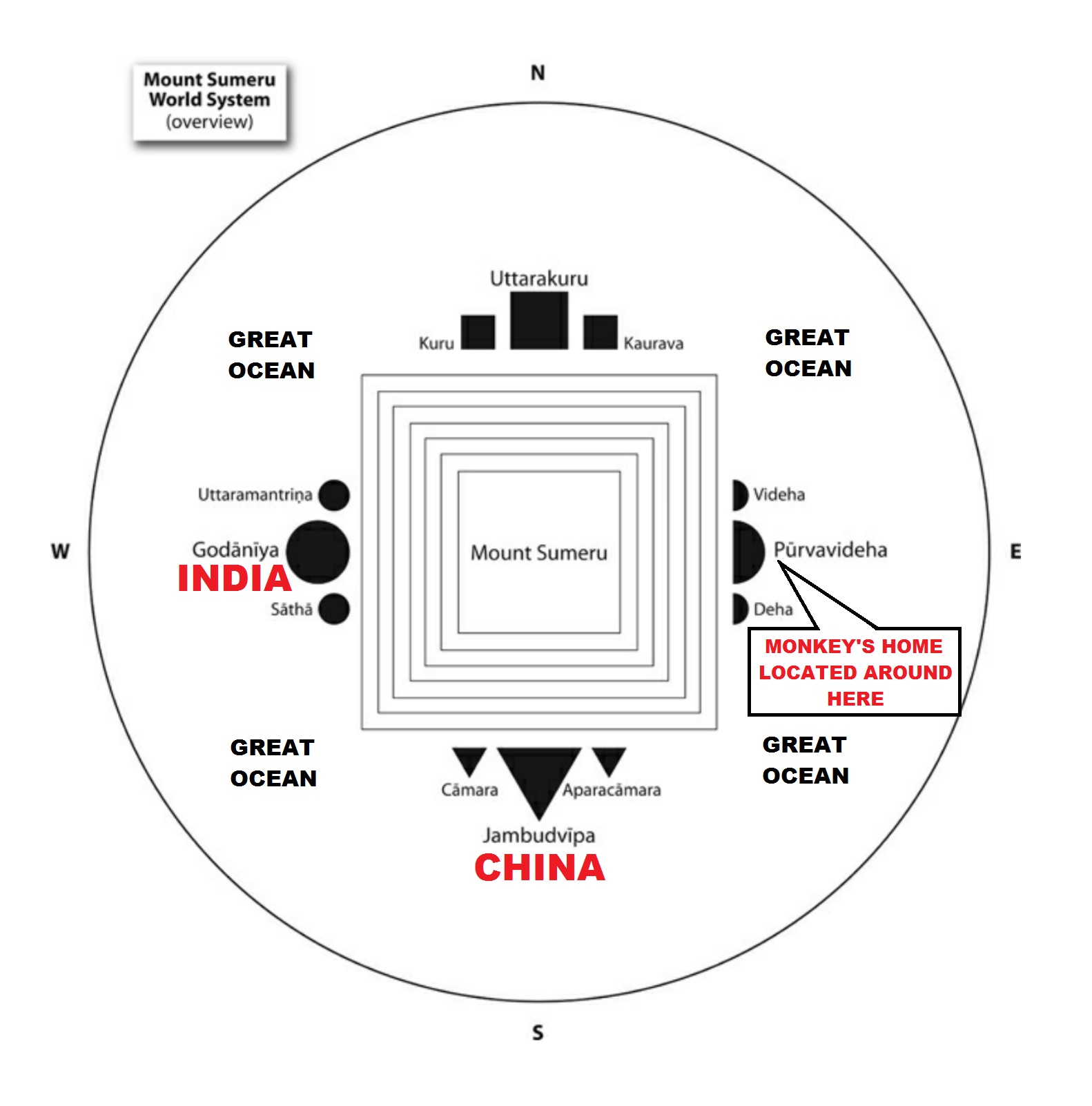
The world of JTTW is modeled on Hindo-Buddhist cosmic geography, which places the Eastern Purvavideha Continent (Sk: “Surpassing the body”; Ch: Dongsheng shenzhou, 東勝神洲), the Southern Jambudvipa Continent (Sk: “Rose-Apple”; Ch: Nanshan buzhou, 南贍部洲), the Western Godaniya Continent (Sk: “Using Cattle”; Ch: Xiniu hezhou, 西牛賀洲), the Northern Uttarakuru Continent (Sk: “Unpleasant Sound”; Ch: Beiju luzhou, 北俱盧洲) around the four respective faces of Mount Sumeru (Ximi shan, 須彌山; Miaogao shan, 妙高山), a giant mountain that serves as the axis mundi of the cosmos, as well as the abode of assorted gods and sages (Buswell & Lopez, 2014, p. 869) (fig. 6). While said geography traditionally associates Southern Jambudvipa with India, or the known world to the ancient people of South Asia (Buswell & Lopez, 2014, p. 377), the novel places the “Land of the East” (Dongtu, 東土) (i.e. China) within the continent and associates India with Western Godaniya (Wu & Yu, 2012, pp. 204-205). Therefore, Subodhi’s mountain is located in India, further strengthening his link with Buddhism.
Fig. 6 – A diagram showing a bird’s-eye view of Hindo-Buddhist cosmic geography as presented in JTTW. Adapted from Buswell & Lopez, 2014, p. xxix (larger version).
4. School
4.1. Possible Uniform
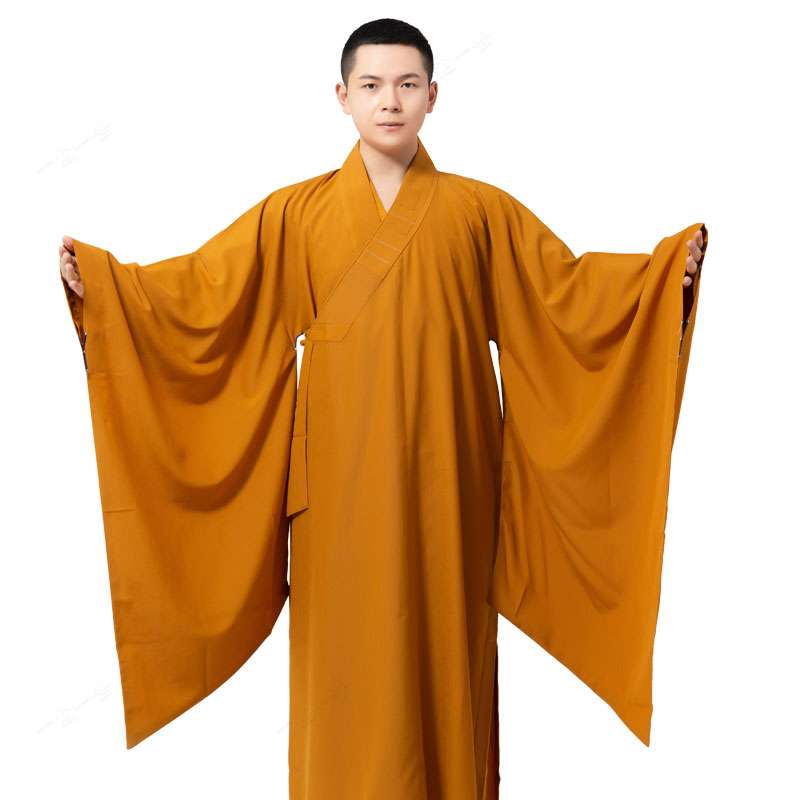
Upon returning to the Mountain of Flowers and Fruit from Subodhi’s school in chapter two, the novel describes Sun Wukong’s clothing through the eyes of a monster imp: “He is bare-headed, wears a red robe with a yellow sash, and has a pair of black boots on” (Wu & Yu, vol. 1, p. 127). The “red robe” is vague, but a poem in chapter one states that the immortal lad who invited Monkey into the cave was wearing a “wide robe with two sleeves of wind” (Wu & Yu, 2012, vol. 1, p. 113). This probably references the large, open arms of the zhiduo robe (直裰; a.k.a. haiqing, 海青), which is known colloquially in English as “Buddhist monk” or “Taoist monk” robes (fig. 7).
The novel doesn’t mention Monkey changing his clothing prior to returning home, so this might describe his school uniform.
Fig. 7 – A zhiduo robe with large sleeves (larger version). Image found here. Imagine this robe red, with a yellow sash at the waist.
4.2. Student Naming Scheme
Subodhi is shown to have 12 generational names (zibei, 字輩) used to name the cohorts of his religious lineage.
Three of the listed names, Zhi (智), Yuan (圓), and Jue (覺), were historically used in Daoism. [7]
Monkey is part of the tenth generation (Wu & Yu, 2012, p. 115), meaning that all of Subodhi’s students taken in around the same time would all have Wu (悟) in their name.
The novel explains in detail why Subodhi names his primate disciple Sun Wukong, tying it to Buddho-Daoist philosophy:
The Patriarch laughed and said, “Though your features are not the most attractive, you do resemble a pignolia-eating monkey (husun [猢猻]). This gives me the idea of taking a surname for you from your appearance. I intended to call you by the name Hu [猢]. If I drop the animal radical [犭] from this word, what’s left is a compound made up of the two characters, gu [古] and yue [月]. Gu means aged and yue [“moon”] denotes feminine yin energy [陰], but aged yin cannot reproduce. Therefore, it is better to give you the surname of Sun [猻]. If I drop the animal radical from this word, what we have left is the compound of zi [子] and xi [系]. Zi means a boy and xi means a baby, and that name exactly accords with the fundamental Doctrine of the Baby Boy [Ying’er zhi benlun, 嬰兒之本論]. So your surname will be ‘Sun.'”
[After explaining the generational names] “You will hence be given the religious name ‘Aware of Emptiness’ (wukong [悟空]). All right?” (Wu & Yu, 2012, vol. 1, p. 115).
Yu (Wu & Yu, 2012) explains: “The Baby Boy is none other than the ‘holy embryo or shengtai 聖胎,’ the avatar of the realized state of immortality in the adept’s body” (vol. 1, p. 86). Daoist doctrine dictates that the “Three Treasures” (Sanbao, 三寶) of semen (jing, 精), breath (qi, 氣), and spirit (shen, 神) be combined to create a holy embryo. The third stage of this internal alchemical process involves the nurturing of said embryo to maturation with spiritual energies and eventually guiding it upwards and out the Heavenly Gate (Tianguan, 天關), or the top of the crown. This results in a fledgling immortal spirit body that must be trained over an additional three year period in which it learns to travel far and wide apart from the physical vessel (Kohn, 2008, pp. 179-180). Therefore, Sun (孫) not only references the primate disciple’s appearance but also his Daoist immortality.
“Wukong” (悟空) combines “Emptiness” (Kong, 空) with “Awakening,” Wu (悟) being “one of the common Chinese translations for the Sanskrit term bodhi (awakening)” (i.e. the bodhi of Subodhi) (Buswell & Lopez, 2014, p. 998). Awakening takes two forms in Chan Buddhism: “instant” (dunwu, 頓悟) and “gradual” (jianwu, 漸悟). The former involves the sudden manifestation of inherent Buddha-nature (see section 2.3), while the latter involves compounding realization, often over a long period of purification (Buswell & Lopez, 2014, p. 998; see also pp. 273 and 384-385). As explained in section 1, bodhi involves realizing the Four Noble Truths, thereby achieving enlightenment and freeing oneself from the cycle of rebirth. Therefore, Wukong references said enlightenment.
Given the above information, another translation for Sun Wukong would be “Immortal Enlightened By Emptiness.” This shows that Monkey’s name incapsulates his story arc: attaining divine longevity in the beginning and ascending to Buddhahood at the end. This, again, is an open reference to the highly influential Buddho-Daoist philosophy of Zhang Boduan (see section 2.3).
4.3. Tests of Spiritual Intelligence
The Patriarch first offers to teach Monkey a selection of skills from the 360 “Side Gates” (bangmen, 傍門; a.k.a. pangmen, 旁門), noting that they will “result in illumination” (zhengguo, 正果; lit: “right fruit”) (Wu & Yu, 2012, vol. 1, p. 117). The skills include:
Method gate (Shuzi menzhong, 術字門中) – “[C]onsists of summoning immortals and working the planchette, of divination by manipulating yarrow stalks, and of learning the secrets of pursuing good and avoiding evil” (Wu & Yu, 2012, vol. 1, p. 117).
Dissemination gate (Liuzi menzhong, 流字門中) – “[I]ncludes the Confucians, the Buddhists, the Daoists, the Dualists, the Mohists, and the Physicians. They read scriptures or recite prayers; they interview priests or conjure up saints and the like” (Wu & Yu, 2012, vol. 1, p. 117).
Silence gate (Jingzi menzhong, 靜字門中) – “To cultivate fasting and abstinence … quiescence and inactivity, meditation and the art of cross-legged sitting, restraint of language, and a vegetarian diet. There are also the practices of yoga, exercises standing or prostrate, entrance into complete stillness, contemplation in solitary confinement, and the like” (Wu & Yu, 2012, vol. 1, pp. 117-118).
Action gate (Dongzi menzhong, 動字門中) – “[G]athering the yin to nourish the yang, bending the bow and treading the arrow, and rubbing the navel to pass breath. There are also experimentation with alchemical formulas, burning rushes and forging cauldrons, taking red lead, making autumn stone, and drinking bride’s milk and the like” (Wu & Yu, 2012, vol. 1, p. 118).
However, the Side Gates, which number 3,600 in Daoist literature, were historically considered “unorthodox training methods of limited benefit” (Eskildsen, 2019, p. 43). This shows that Subodhi is testing his disciple to see if he will fall for studying lesser arts. But Sun passes by refusing to learn them.
Another test takes place when Monkey visits his master’s room at the third watch to receive secret teachings. Shao (2006) explains that, once again, the novel alludes to the Sixth Chan Patriarch Huineng:
[Monkey] sets the stage for a striking display of his unusually profound insight when he announces his intentions to become an immortal. This provokes Subhuti to issue him a challenge by refusing to teach him, for he is “some what different from other people.” Monkey may not realize that the master is trying to gauge his spiritual power, but he rises to the occasion with a genuine clarity of vision: “I have a round head pointing to Heaven, and square feet walking on Earth. Similarly, I have nine apertures and four limbs, entrails and cavities. In what way am I different from other people?”
[…]
[W]e may look to Huineng’s story from which Monkey garners meaning. No doubt, Monkey’s inspired cleverness is modeled on Huineng’s reply to Hongren, the fifth patriarch of Chinese Chan Buddhism, in Huineng’s Tanjing (The Platform Sutra). When Huineng announces his intentions to become a Buddha, Hongren pounces upon him with a poignant reminder that he is “from Lingnan,” a “barbarian,” and therefore cannot become a Buddha. Huineng refuses to be intimidated, however. He holds his own with an unparalleled depth of insight about Buddha-nature: There may be “northern and southern men,” but “the Buddha nature fundamentally has no north or south.” Surely Monkey’s phrasing, his unusual insightfulness, and the quickness and aplomb with which he rises to the challenge are reminiscent of Huineng … (pp. 719-720).
Monkey clearly passes this test, for his insightful reply convinces the Patriarch to teach him the secret of eternal life.
Subodhi no doubt uses such examinations to filter out unsuitable candidates, allowing only the brightest individuals to become his inner disciples.
4.4. Overtly Stated Curriculum and Tools
The novel specifically mentions Subodhi offering or teaching Monkey the following concepts:
The “Three Parties” refer to the Ming syncretic philosophy of the “Three Teachings” (Sanjiao, 三教), which combines elements from Buddhism, Daoism, and Confucianism. This shows that his disciples are given a well-rounded religious education, which explains why Sun is competent even in Buddhist scripture. [8]
Also, during his lectures on philosophy, Subodhi is said to wield a “Precepts ruler” (jiechi, 戒尺), which he uses to admonish his students (Wu & Yu, 2012, vol. 1, p. 118). Such a device figures among the tools of Buddhism (Leong, 2001, p. 49).
2) Secret of Immortality – Breathing exercises designed to absorb yang energy during prescribed times (after midnight and before noon), the retention of chaste semen and transformation into qi energy, and the purification and circulation of the resulting spiritual energy throughout the body.
These internal methods are passed onto Monkey in secret via a flowery poem chocked full of alchemical imagery. It ends with the line, “When that’s done, be a Buddha or immortal at will!” (Wu & Yu, 2012, vol. 1, p. 120). Combined with his syncretic philosophy, this suggests that the Patriarch offers his students more than one spiritual path to divinity.
3) Transformations – A series of oral formulas that allow the user to change their body into any person, animal, or object. Two forms are offered: the 72 changes of the “Multitude of Terrestrial Killers” (Disha shu, 地煞數) and the 36 changes of the “Multitude of the Heavenly Rectifiers” (Tiangang shu, 天罡數) (based on Wu & Yu, 2012, vol. 1, p. 122; Meulenbeld, 2019, p. 7). [9]
Subodhi teaches this skill to Monkey with the expressed purpose of helping him hide from three calamities of cosmic lightning, fire, and wind sent by heaven to destroy immortals for defying fate and achieving eternal life. But beyond the power of metamorphosis, the novel implies that the ability also grants the user multiple lives (similar to a video game), which might serve as a buffer against the calamities. For example, in chapter 41, after Sun passes out from Red Boy‘s fiery attack, Zhu Bajie reassures everyone by saying: “If he is capable of seventy-two transformations, he has seventy-two lives” (Wu & Yu, 2012, vol. 2, p. 232). Also, in chapter 46, Monkey magically regrows his head after being non-fatally beheaded in a contest of magical skill. Sha Wujing remarks: “If he knows seventy-two ways of transformation, … he may have altogether seventy-two heads!” (Wu & Yu, 2012, vol. 2, p. 308). In addition, while not directly related to the primate hero, the Bull Demon King is said in chapter 61 to also know the 72 changes (Wu & Yu, 2012, vol. 3, p. 148). He uses the extra lives to survive being beheaded by Prince Nezha a number of times:
[Nezha] leaped onto the bull’s back and brought his monster-cleaving sword down on the bull’s neck: the bull was beheaded at once. Putting away his scimitar, the devaraja was about to greet [Sun Wukong] when another head emerged from the torso of the bull, his mouth belching black air and his eyes beaming golden rays. [Nezha] lifted his sword once more and cut off the bull’s head; as soon as it dropped to the ground, another head came out. It went on like this more than ten times. At last, [Nezha] took out his fiery wheel and hung it on the Bull’s horn. The wheel at once started a great blaze of true immortal fire, which burned so fiercely that the bull began to growl and roar madly, shaking his head and wagging his tail (Wu & Yu, vol. 3, p. 160). [10]
This agrees with the connection between transformation and immortality in Daoism. Robinet (1979) explains that gods and saints are portrayed in Daoist literature as being in constant flux, changing with the seasons, taking on different guises and titles, disappearing and reappearing, never remaining the same, thereby living eternally.
4) Flight – A method of flying through the sky on divine clouds. Two types are offered: “cloud-soaring” (jiayun, 駕雲), the most common method used by celestials throughout the cosmos. It involves stamping the foot to summon clouds (Wu & Yu, 2012, vol. 1, p. 123); and “cloud-somersaulting” (jindou yun, 觔/筋斗雲), the method chosen by Sun (fig. 8). It involves simultaneously “mak[ing] the magic sign, recit[ing] the spell, clench[ing] the fist tightly, shak[ing] the body” and then jumping into the sky, leaping from cloud to cloud (Wu & Yu, 2012, vol. 1, p. 123). The latter method is by far the fastest, enabling the user to travel 108,000 li (33,554 mi / 54,000 km) in a single instant.
Shao (2006) states that the latter skill is based on a philosophical metaphor from Huineng’s Platform Sutra. The Chan Master explains that the common trope of the Buddha’s paradise being separated from the world of man by 108,000 li is based on a combination of the “Ten Evils” (Shi’e, 十惡) and “Eight Wrongs” (Baxie, 八邪) of Buddhism (see section III here). Those who rid themselves of these spiritual flaws will achieve enlightenment and thus arrive instantly at the Buddha’s paradise (Shao, 2006, p. 718; Huineng & Cleary, 1998, pp. 26-27). Therefore, Subodhi teaches a skill that’s a metaphor for instant enlightenment, further supporting his connection to Buddhism.
As noted in section 3.3, Sun states: “I bowed to the Patriarch of Spirit Tower and Square Inch / and perfected with him the martial arts [wuyi, 武藝]” (Wu & Yu, 2012, vol 3, p. 243). [11]
5) Military arts – Monkey demonstrates knowledge in troop movement, weapons (swords, spears, axes, bows and arrows, staves, etc.), and unarmed boxing. His preferred method is “Short Fist” (Duan quan, 短拳), which is known for compact, short-ranged attacks. This is likely just one of many boxing styles taught by Subodhi.
Shahar (2008) explains that the martials arts of the famed Chan Buddhist Shaolin Monastery developed during the Ming-Qing transition from a synthesis of Daoist gymnastics (stretching and breathing exercises), religious rituals, and fist techniques. This new form of spiritual cultivation ushered in the era of so-called “internal martial arts,” Taiji boxing being the most famous among them. JTTW was published during the late-Ming when this synthesis was in full swing. Therefore, the study of martial arts in a religious institution is an accurate snapshot of one facet of 16th-century monastic life.
4.6. Inferred Curriculum
Although not directly stated, the following skills are likely learned while studying under the Patriarch.
6) General magic – Monkey is shown capable of calling forth gods and spirits, growing or shrinking to any size, parting fire and water, creating impassable barriers, conjuring wind storms, casting illusions, freezing people in place, making endless doubles of himself, unlocking any lock, bestowing superhuman strength, bringing the dead back to life, etc.
7) Traditional Chinese Medicine – Monkey knows how to analyze a patient’s pulse and then concoct individualized medicine from a number of raw ingredients.
This makes sense as a knowledge of harming and healing often goes hand in hand in traditional Chinese martial arts. A prime example is the folk hero Wong Fei-Hung (黃飛鴻, 1847-1925), a Hung Ga boxer and physician from Qing-era Guangdong.
5. His Powers
The breadth of skills taught to Monkey speaks to the Patriarch’s own vast array of magical and martial abilities. But he displays (or the narrative at least hints at him having) three additional powers.
Subodhi demonstrates the ability to see peoples, events, and times beyond his person in JTTW chapter one when Monkey first arrives at his home. An immortal lad opens the door and tells the primate:
“My master … has just left his couch to give a lecture on the platform. Before even announcing his theme, however, he told me to go out and open the door, saying, ‘There is someone outside who wants to practice austerities. You may go and receive him'” (Wu & Yu, 2012, vol. 1, pp. 113-114).
At the end of JTTW chapter two, Subodhi makes a statement suggesting that he is aware of all things:
I forbid you ever to mention that you are my disciple. For if you but utter half the word, I’ll know about it; you can be assured, wretched monkey, that you’ll be skinned alive … (Wu & Yu, 2012, vol. 1, p. 125).
The aforementioned powers raises a question: “If Subodhi has these abilities, why would he take Sun as a disciple knowing full well that he would later expel him for simply displaying his newly cultivated powers?” Someone might say showing off is a sign of ego and the need for validation, qualities unbecoming of a spiritual cultivator. But there is a better answer. Being a bodhisattva with the power of foresight, the Patriarch would no doubt foresee Monkey’s later attainment of Buddhahood, realizing that the trials and tribulations of protecting the Tang Monk on the journey to India would be the price that he needs to pay to gradually awaken (jianwu, 漸悟) his enlightenment. Therefore, expelling Sun would ignite the chain of events leading to his eventual Buddhahood. This would make Subodhi an agent of Dharma, one who uses whatever methods necessary to bring about the enlightenment of his disciples.
6. Conclusion
The Patriarch Subodhi finds his origins in Subhūti, one of the ten principal disciples of the historical Buddha known for his knowledge of “emptiness.” The literary figure’s connection to Buddhism is not in name only, however. The Chinese name used most in the novel to refer to Subodhi is Puti, a transliteration for bodhi (“awakening” or “enlightenment”). His story in JTTW is partly based on events from the lives of the respective Fifth and Sixth Chan (Zen) Patriarchs and their transmission of the Dharma. A poem in JTTW chapter one even compares him to the Buddha and the splendor of the Western paradise, as well as further ties him to emptiness and enlightenment.
The name of Subodhi’s home, Cave of the Slanted Moon and Three Stars on the Mountain of Spiritual Heart and Elixir Mind, serves as a double metaphor for Daoist internal alchemical practices and Buddhist concepts of the mind. It is described as a mountain paradise, and the cave therein is said to be filled with grand architecture, which is centered around the Patriarch’s green jade lecture platform. The mountain is located in the Western Godaniya Continent of Hindo-Buddhist cosmic geography, placing it squarely in India, home of the historical Subhūti.
Subodhi’s students possibly wear a red robe with large, open sleeves, a yellow sash, and black boots, and they are named according to a twelve generation character list. His choice for the Monkey King’s religious name, Sun Wukong, is packed full of philosophical significance related to the formation of a Daoist immortal spirit embryo and the manifestation of enlightenment. As for the Patriarch’s curriculum, he teaches Buddho-Daoist philosophy, the secret of eternal life, transformations, flight via cloud, armed and unarmed military arts, general magic, and Traditional Chinese Medicine. Tests of spiritual intelligence appear to be used to permit only the brightest into his inner circle.
Beyond the magical powers taught by him, Subodhi exhibits (or the narrative at least hints at him having) clairvoyance, omniscience, and control over souls and karmic results. His power of foresight might then explain why he accepted Monkey as a student, only to later expel him. This was likely done to ignite the chain of events that would eventually lead to Sun’s achievement of Buddhahood, thereby completing the last of Zhang Boduan’s two-step process towards Buddho-Daoist transcendence.
JTTW stresses the Patriarch’s status as a Buddhist deity, albeit one with Daoist leanings. Therefore, I suggest that he is a bodhisattva like (as one scholar has proposed) the historical Subhūti. A Daoist bodhisattva, however, is not a paradox as such figures appear in late-Ming syncretic popular literature. Examples include the former high-ranking immortals-turned-bodhisattvas Guanyin, Mañjuśrī, and Samantabhadra from Investiture of the Gods (c. 1620).
7. Updates
Update: 06-04-22
Above, I mentioned that Puti (菩提) is used at least three times to refer to Subodhi, thus stressing the Patriarch’s connection to the Buddhist concept of bodhi (Pāli / Sk: “awakening” or “enlightenment”). There’s actually a fourth usage, appearing in the title of chapter two: “Fully awoke to Bodhi’s wondrous truths / He cuts off Mara, returns to the root, and joins Primal Spirit” (Wu & Yu, 2012, p. 116). The title serves as a double reference to the end of Prince Siddhārtha‘s path to enlightenment. (I explain in this article that the author-compiler of the standard 1592 edition of JTTW likely based Monkey’s early life on the Buddha to make his spiritual journey more familiar to the reader.) As part of the Prince’s meditative journey inward to discover hidden truths, he faces off against the army of the heavenly demon Māra (Mo, 魔), the ruler of the illusionary world of Saṃsāra. But these evil forces are rendered powerless by Siddhartha’s supreme focus of mind and burgeoning grasp of reality. He shortly thereafter achieves enlightenment (a.k.a. bodhi) (Beal, 1883, pp. 156-163). Likewise, thanks to (Su)Bodhi’s guidance, Sun Wukong is able to also stop Mara and achieve immortality.
This free association between Buddhist (bodhi/Mara/returning to the root) and Daoist (primal spirit) concepts was common place in Ming-era religious literature. Darga (2008) explains:
Comparing the development of the embryo to the revelation of Buddhahood is typical of neidan texts of the Ming period. For instance, the Xingming guizhi (Principles of Balanced Cultivation of Inner Nature and Vital Force) uses Body of the Law (fashen 法身, dharmakāya) as a synonym for shengtai. The birth of the embryo represents the appearance of the original spirit (yuanshen 元神) or Buddhahood and is understood as enlightenment (p. 884).
Therefore, the Monkey King’s immortality is synonymous with the Buddha’s enlightenment. And since Subodhi is key to Sun’s spiritual achievement, and given the Patriarch’s demonstrated connection to Buddhism in the novel, I’d like to further suggest that the character is the original disciple Subhūti. After all, he still lives in India like his namesake. (See the 04-22-26 update below for related info.)
Despite all of the overwhelming evidence for the Patriarch’s connection to Buddhism, someone might point out that the novel refers to him as a “Spirit Immortal” (shenxian, 神仙) (for example). The Anthology of the Transmission of the Dao from Zhongli Quan to Lü Dongbin (Zhong Lü Chuan Dao Ji, 鐘呂傳道集, c. late-Tang) explains that this is the fourth of five kinds of transcendents [12] who has cast off the mortal body (per the methods outlined above) to enjoy a life free from the dust of the world (Wong, 2000, p. 29; see also here). But making this distinction in the face of Ming syncretism amounts to little more than arguing semantics. As we’ve seen, this philosophy equates achieving immortality with enlightenment. And Subodhi’s description above as having “no end and no birth” (busheng bumie, 不生不滅) embodies that, for he has both the Daoist elixir and the Buddha-mind and has thus broken free of the wheel of rebirth.
Taking a page from the Daoist Bodhisattvas of Investiture of the Gods (Fengshen yanyi, 封神演義, c. 1620), perhaps Subodhi/Subhūti was an immortal recruited by the Buddha, or the Buddhist disciple trained under the former high-ranking immortals-turned-bodhisattvas Guanyin, Mañjuśrī, and Samantabhadra. Knowing different paths to divinity would make him a more affective teacher and bodhisattva.
Here is a welcoming, modern image of Subhūti (fig. 9). The top line reads “The Honored Monk Subhūti’s Understanding of Emptiness is Number One” (Xuputi zunzhe jiekong diyi, 须菩提尊者解空第一). I love the golden halo.
Subodhi is alluded to in Investiture of the Gods (c. 1620). It reproduces a poem about the sage from JTTW chapter one (section 2.3). The original reads:
A Golden Immortal of Great Awareness and of great ken and purest mien,
Master Bodhi, whose wondrous appearance like the West
Had no end or birth by work of the Double Three.
His whole spirit and breath were with mercy filled.
Empty, spontaneous, it could change at will,
His Buddha-nature able to do all things.
The same age as Heaven had his majestic frame.
Fully tried and enlightened was this grand priest (Wu & Yu, 2012, vol. 1, p. 114).
Chapter 61 of Investiture of the Gods reproduces the poem with only minor changes (indicated in red):
A Golden Immortal of Great Awareness and timelessness, [13] Dharma Master Bodhi of the wondrous West
Had no end or birth by work of the Double Three.
His whole spirit and breath were with mercy filled.
Empty, spontaneous, it could change at will,
His Buddha-nature able to do all things.
The same age as Heaven had his majestic frame.
Fully tried and enlightened was this grand priest (emphasis mine). [14]
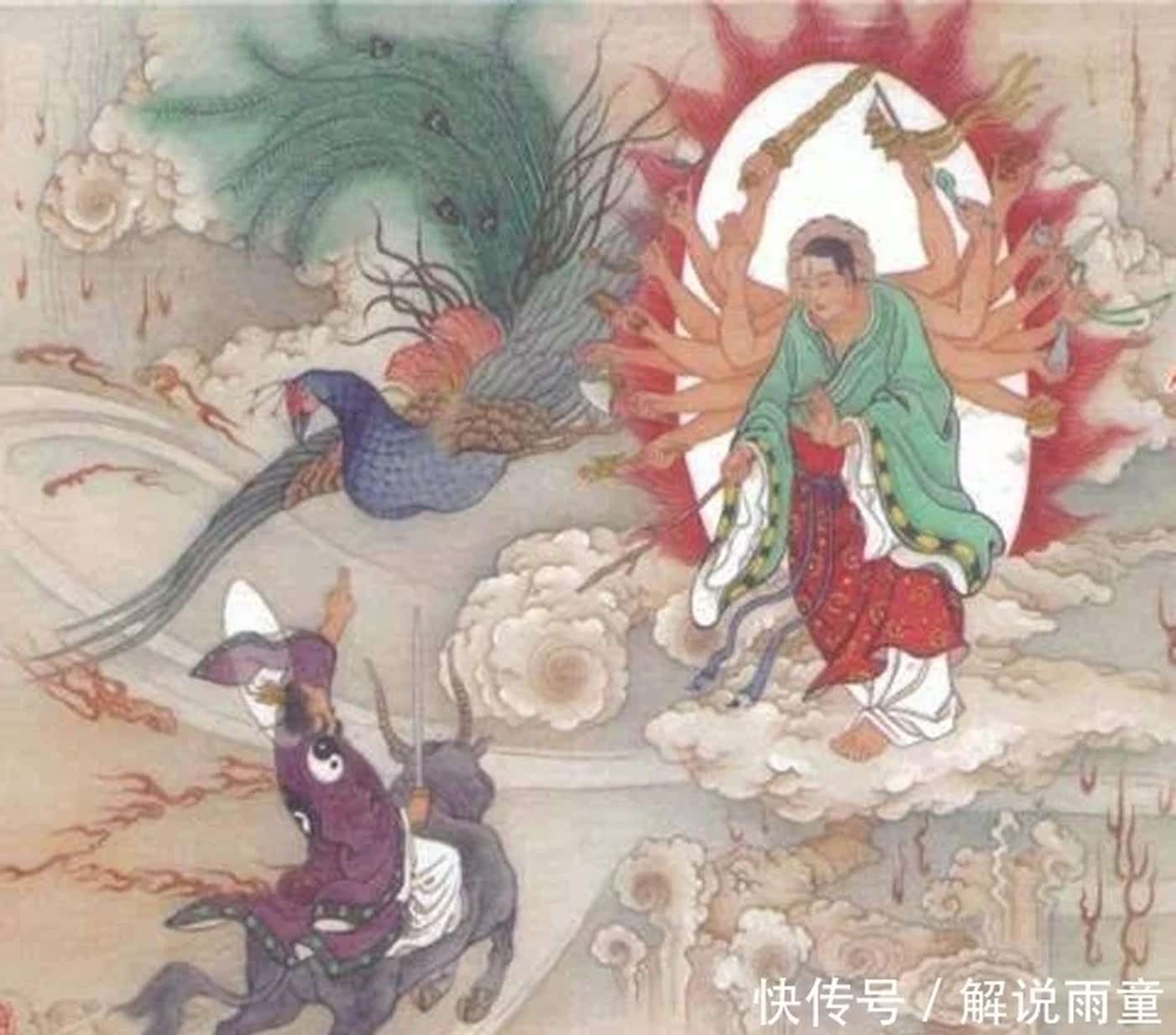
It goes on to associate the poem with a Buddhist deity known as “Person of the Way, Cundī” (Zhunti daoren, 準提道人) (fig. 10). This figure is traditionally considered a multi-armed, female bodhisattva with a strong connection to the Cundā Dhāraṇī, a power-bestowing mantra (Buswell & Lopez, 2014, p. 204). Therefore, it appears that the author was trying to provide an origin for Subodhi (likely based on “提” (ti) appearing in both character’s names). Afterall, the novel is often considered a sequel to JTTW because it reveals the origins of many secondary characters (Li Jing, Nezha, Muzha, Erlang, etc.). However, it’s important to remember that Investiture of the Gods is still a separate novel by a different author. So, any events therein should NOT be considered canon for JTTW. Besides, the latter work clearly establishes a link between Subodhi and the historical Subhūti.
Fig. 10 – Person of the Way, Cundī (top right) fighting against a rogue immortal (lower left) (larger version). From a modern manhua comic book. Image found here.
Update: 06-09-22
It turns out that Subodhi is not the invention of the author-compiler [15] of the standard 1592 edition of JTTW. He appears in the earlier “Zhu edition” of the novel, a.k.a. Chronicle of Deliverances in Tang Sanzang’s Journey to the West (Tang Sanzang Xiyou shi e zhuan, 唐三藏西遊释厄傳) by Zhu Dingchen (朱鼎臣). [16] The following quote indicates the differences between the Zhu edition (red) with the 1592 edition (black):
With solemnity the Monkey King set his clothes in order and followed the boy into the depths of the cave. They passed rows and rows of lofty towers and huge alcoves, of pearly chambers and carved arches. After walking through innumerable quiet chambers and empty studios, they finally reached the base of the green jade platform. Patriarch Subodhi was seen seated solemnly on the platform, with thirty lesser immortals standing below in rows. He [It] was truly a realm of immortals. Let’s listen to the explanation in the next chapter. (emphasis mine)
[Poem describing Master Subodhi. See above for translation. The Zhu version has a typo in the line “Grand priest” (“大怯師” instead of “大法師”).]
The Zhu version is comprised of ten scrolls (juan, 卷) with three to ten subsections each. These subsections differ from the chapter layout of the 1592 edition. For example, subsections one to three and four to five respectively correspond to chapters one and two of the 1592 edition (Koss, 1981, pp. 14-15). It’s interesting to note that the above poem caps the first subsection of scroll one. This is why it ends with: “Let’s listen to the explanation in the next chapter” (qieting xiahua fenjie, 且聽下回分解).
Update: 06-10-22
Monkey’s religious name Wukong (悟空), or “Awakened to Emptiness,” predates the 1592 and Zhu editions, appearing as early as an early-Ming zaju play. Therefore, I’d like to suggest that the historical Subhūti was chosen as the basis for a master worthy of bestowing this name because of his great knowledge of emptiness, as well as the large role that he plays in the Diamond Sutra (Sk: Vajracchedikā Prajñāpāramitā Sūtra; Ch: Jingang bore boluomiduo jing, 金剛般若波羅蜜多經; a.k.a. Jingang jing, 金剛經). After all, the scripture “deals with the concept of emptiness” despite never once “employ[ing] the word for emptiness śūnyatā [Ch: kong, 空]” (Watson, 2010, p. 75). [17] Alluding to the sutra makes sense as it was so overwhelmingly popular when JTTW was written that tales of its miracles were eventually compiled during the late-Ming and Qing dynasties (Ho, 2019). So, the people reading the novel would have no doubt recognized Subodhi as an allusion to Subhūti from the scripture.
The late-13th-century JTTW story cycle already presents Monkey as an ancient Daoist immortal with magic powers from the very beginning. Therefore, this element likely played a role in draping the Buddhist master in a thin veil of Daoism to create the Buddho-Daoist sage Subodhi.
Update: 03-13-23
I just learned that the uber popular cartoon Lego Monkie Kid has introduced Master Subodhi in the recent 4th season. The following clip shows him training the reincarnations of Tripitaka, Zhu Bajie, and the White Dragon Horse and apparently the original Sha Wujing (video 1).
Video 1 – Master Subodhi trains new students in Lego Monkie Kid season 4.
Update: 05-15-23
Above in section 2.3, I mentioned how Subodhi’s seemingly paradoxical depiction as a Daoist bodhisattva wasn’t weird as other vernacular literature of the time included such beings:
A Daoist bodhisattva may seem paradoxical, but this concept comfortably fits into the syncretic worldview espoused in late-Ming literature. For example, three well-known bodhisattvas are depicted as former high-ranking immortals in Investiture of the Gods (Fengshen yanyi, 封神演義, c. 1620). These include Guanyin (觀音) as “Person of the Way, Compassionate Ferry” (Cihang daoren, 慈航道人), Mañjuśrī (Wenshu, 文殊) as the “Dharma-Spreading Heavenly Master of Outstanding Culture” (Wenshu guangfa tianzun, 文殊廣法天尊), and Samantabhadra (Puxian, 普賢) as the “Perfected Man of Universal Virtue” (Puxian zhenren, 普賢真人). Together, they later convert to Buddhism and become disciples of the Buddha at the end of chapter 83.
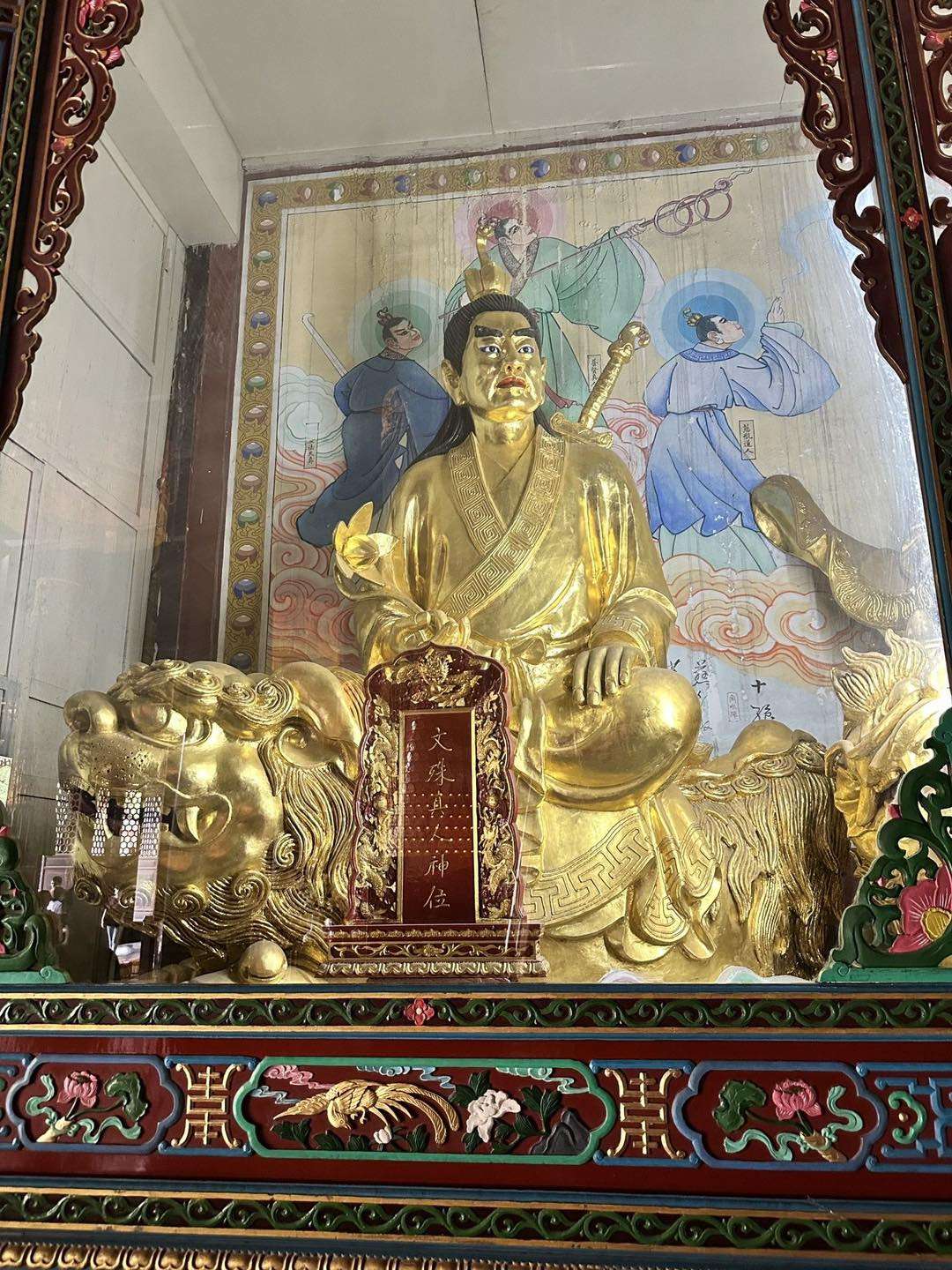
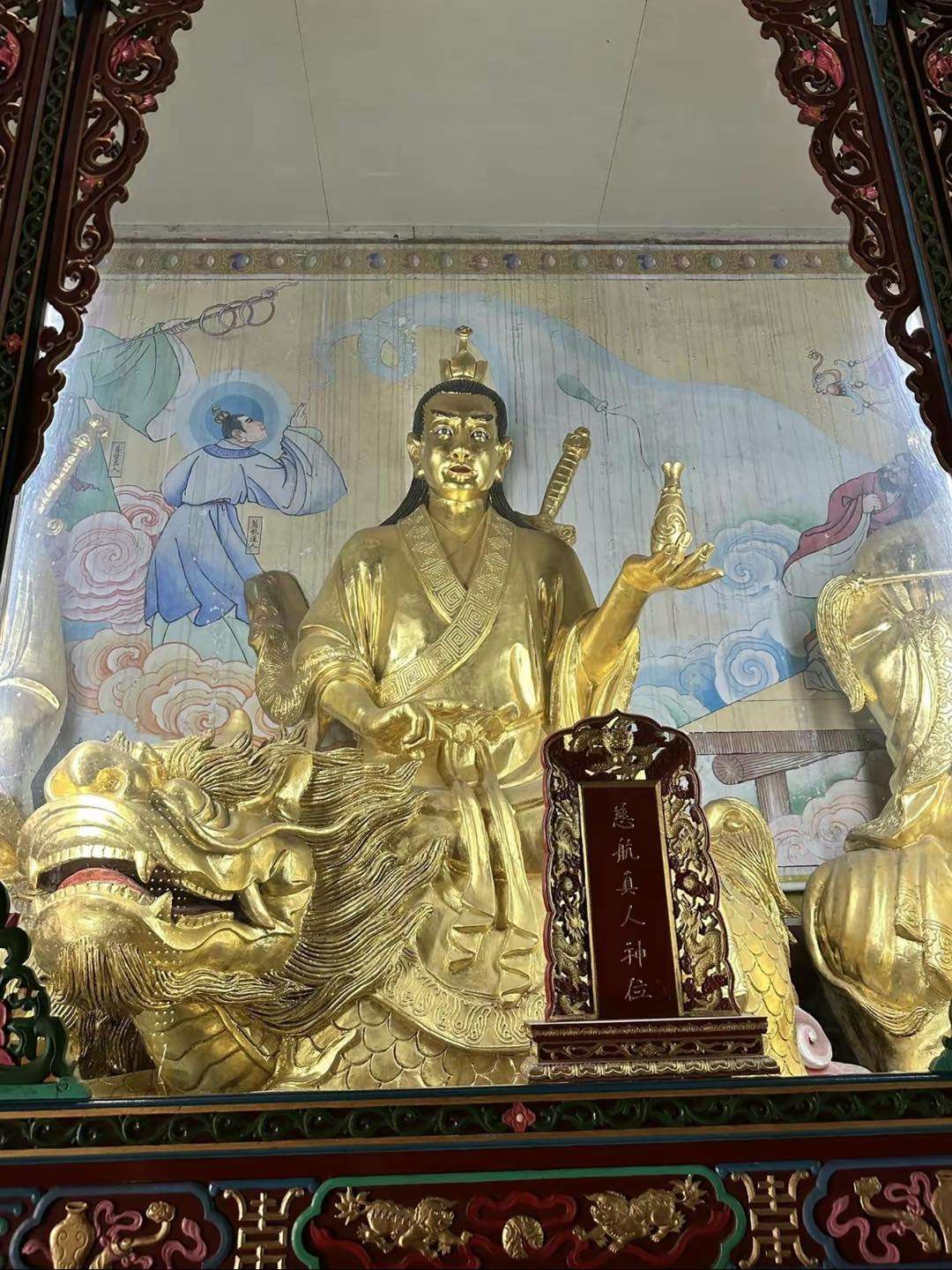
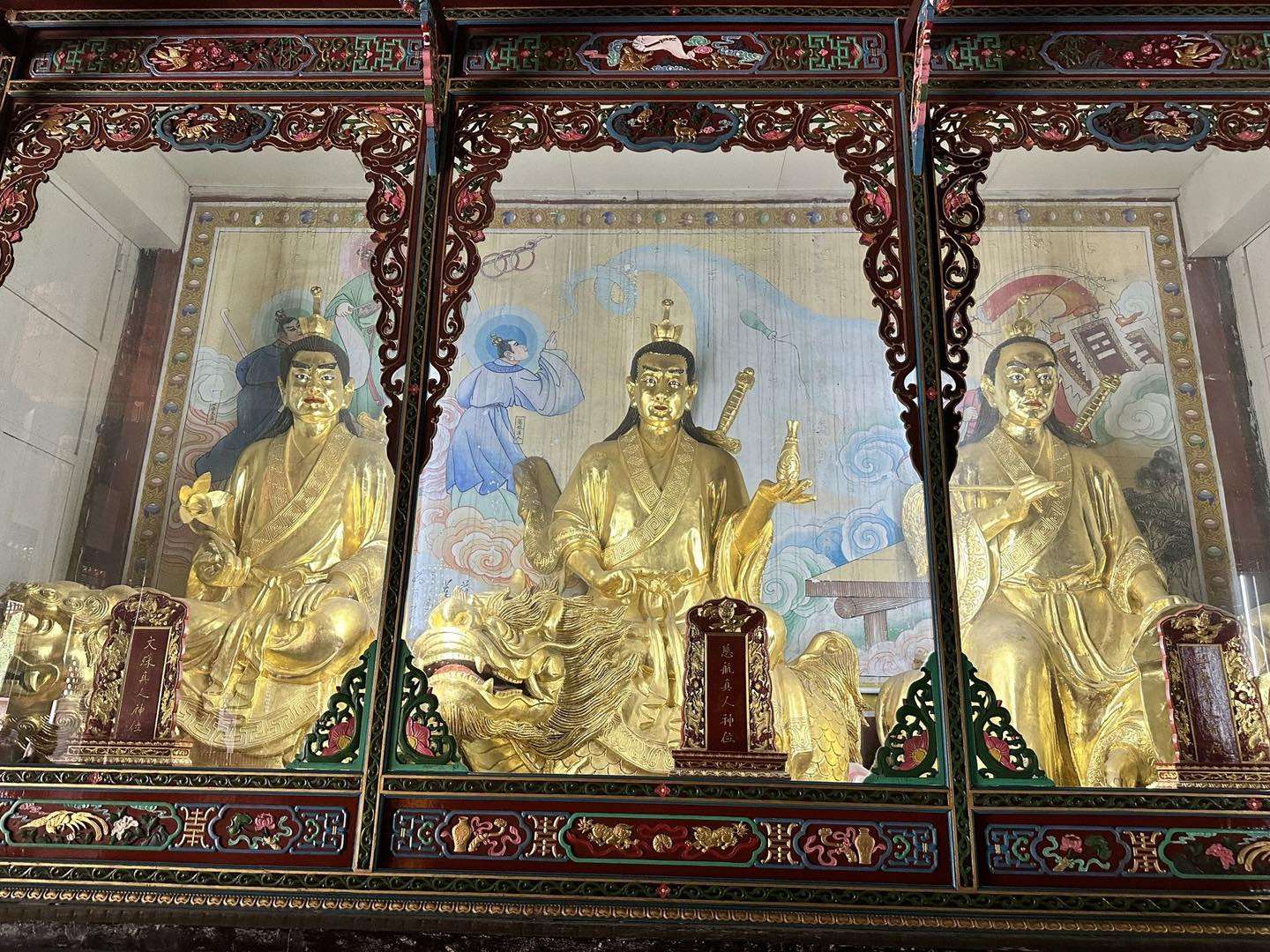
Well, I was happy to learn that Qingyang Temple in Chengdu, Sichuan Province, China (Chengdu Qingyang Gong, 成都青羊宮) houses idols to the three Daoist bodhisattvas from Investiture of the Gods (fig. 11 to 14).
Fig. 11 – (Top Left) The “Perfected Man of Outstanding Culture” (Wenshu zhenren, 文殊真人), a.k.a. Mañjuśrī (larger version). Fig. 12 – (Top Center) The “Perfected Man, Compassionate Ferry” (Cihang zhenren, 慈航真人), a.k.a. Guanyin (larger version). Fig. 13 – (Top Left) The Perfected Man of Universal Virtue (Puxian zhenren, 普賢真人), a.k.a. Samantabhadra (larger version). Fig. 14 – (Bottom) All three idols side by side (larger version). The original Facebook post can be seen here.
Update: 06-09-23
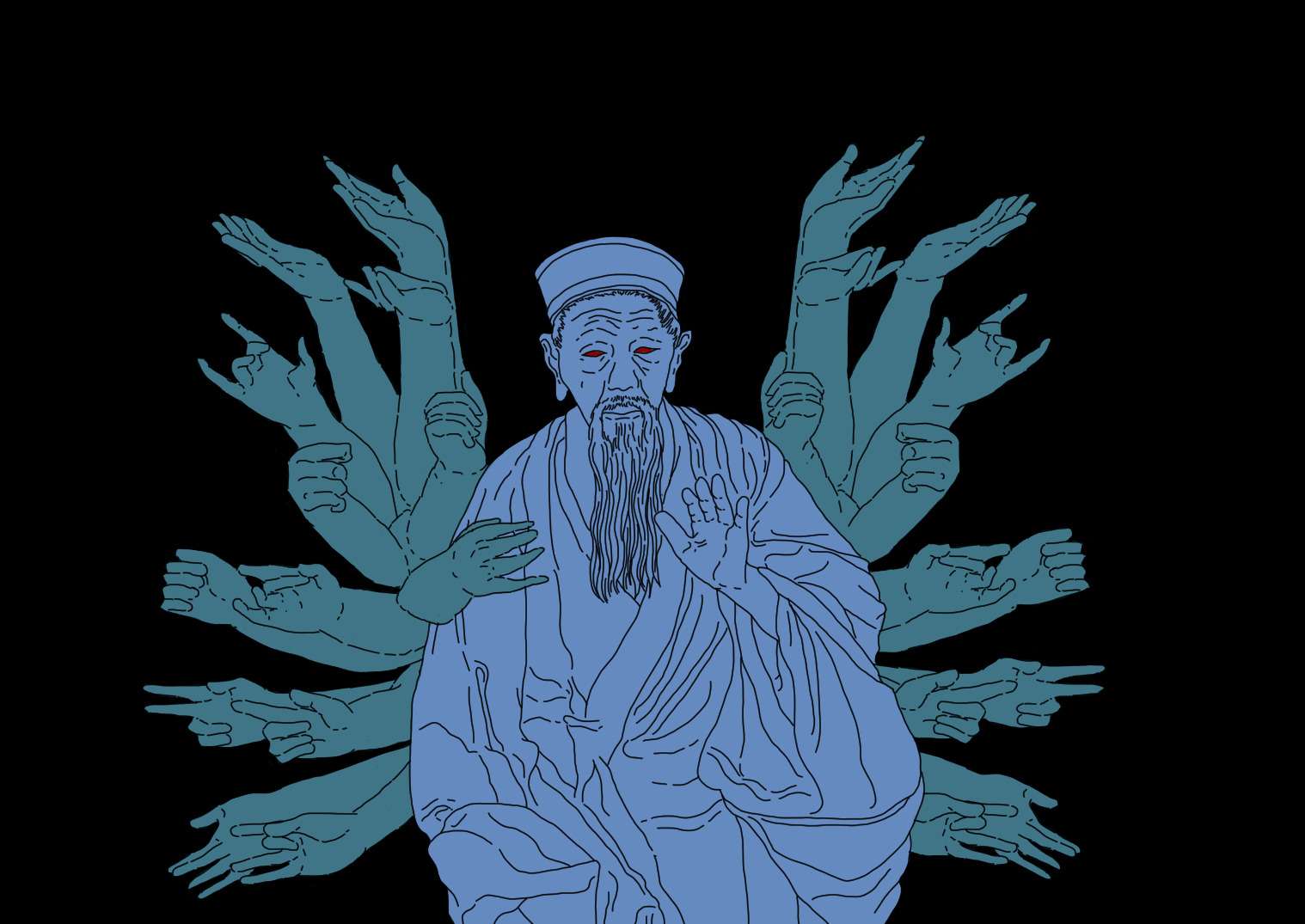
Tumblr user @sketching-shark has drawn a Buddho-Daoist depiction of Master Subodhi based on information in this article (fig. 15).
This is not directly connected to Subodhi, but it’s still interesting. Recall that the Sanskrit name Subhuti is the source for the Chinese name Xuputi/Subodhi. Well, it turns out that the former was a common name in Central Asia. According to this video:
Subhuti/Sophytos/Sophytes was a name that was used by many in this heterogenous region, including those of Iranian, Greek, and Central Asian descent.
Update: 09-25-24
@Ed1171918745 (a.k.a. “Fantasy of Ming”) on Twitter posted a mural by Wang Yixin (王怡新) and Wang Yu (王宇), who I later found out had painted it for the recent video game Black Myth: Wukong. It is a lovely rendition of Subodhi teaching Monkey and his other students painted in the Northern Song Dynasty style (fig. 16).
Fig. 16 – “Riddle in the Pot” (Pan zhong zhi mi, 盤中之謎) by Wang Yixing and Wang Yu (larger version).
Above, I mentioned that Subodhi’s Daoist title is based on that of the Buddha, which was historically given to him by a Chinese Emperor in order to subsume Buddhism under the banner of Daoism. I’ve found the specific historical source mentioning this.
In the first month of spring in the first year of the Xuanhe reign … on the day of Yimao [supposedly February 19th, 1119 CE], an imperial edict was issued:
The Buddha’s title is to be changed to “Golden Immortal of Great Awareness/Enlightenment,” and the rest are to be called “Immortals” and “Great Masters.” Buddhist monks are to be called “Scholars of Virtue,” and they are to change their (religious) clothing and accessories and take family names. (Buddhist) temples are to be called “(Daoist) palaces,” and (Buddhist) monasteries are to be called “(Daoist) monasteries.” Female Daoist priests are to be called “Women of the Way,” and Buddhist nuns are to be called “Women of Virtue.”
I was delighted to learn that the “Palace of Divine Response to the Imperial Decree (of Sanchong District, New Taipei, Taiwan)” (Sanchong Yuzhi tianying gong, 三重玉旨天應宮) hosts a Buddhist monk-like idol of “Patriarch Bodhi” (Puti laozu, 菩提老祖) (fig. 17). The carving dates to at least May 2025. A commenter on the original Facebook post where I found the image asked why he wasn’t depicted with Daoist robes—thus playing on the idea that he is a Daoist immortal. In response, a palace attendant explained the Master’s connection to Buddhism via the descriptive poem from JTTW chapter 1 (as noted above).
Said attendant tells me that Bodhi’s worship was requested by the Great Sage (i.e. Sun Wukong), who is also venerated at the palace. They also tell me that he has performed “miracles” but he hasn’t intervened much since the temple already has a large cadre of deities available to help devotees.
I should point out, though, that this isn’t the first religious statue of the Patriarch I’ve come across. I’ve seen plenty of cheap, plastic, cookie cutter-type examples for sale on websites like Shopee and Taobao (screenshot), but I’ve always just considered them novelties. However, this is certainly the first proper idol I’ve seen and the first real evidence of his worship that I’ve come across.
Fig. 17 – The Patriarch’s idol (larger version). He’s holding a golden bamboo rod in one hand and a golden (alms?) bowl in the other. His body is adorned with golden “rice field” pattern Buddhist robes with a red and white inner lining. He appears to be sitting on an azure lion, and the two are situated inside of a grotto. Image found here.
Update: 04-16-26
I have since learned of two more temples that worship the Buddho-Daoist sage. First, the attendant at the Palace of Divine Response to the Imperial Decree notified me that the “Palace of the Southern Heaven (of Small Liuqiu Island, Pingtung, Taiwan)” (Xiaoliuqiu Nantian gong, 小琉球南天宮) also has an idol (fig. 18). The carving dates to at least 2011 (I need to look into this more). Second, “Nick” Thng Fu Jie, the serving Monkey King tangki (spirit-medium) at Singapore’s Palace of Treasured Virtue (Baode gong, 寶德宮), sent me an image of their statue (fig. 19) on Facebook. He tells me that the Patriarch’s worship was also requested by the Great Sage, specifically during the latter’s 2025 religious festival held on the 16th day of the second lunar month. The figure was designed and carved over the course of a year and finally consecrated around two weeks ago. Here is a clip of the eye-opening ceremony.
I will update this page if I learn of any other temples that pay him homage.
Fig. 18 – The Palace of the Southern Heaven Bodhi idol (larger version). He is depicted as a typical Daoist deity with long hair tied into a bun and a long, stranded bear. He holds a fly-whisk, and his clothing is covered with a colorful, ceremonial cape. Hopefully I can get a clearer picture minus the covering. Fig. 19 – The Palace of Treasured Virtue statue (larger version). The design is also typical of Daoist gods. His visible robes are light gray-blue with dark borders and golden floral patterns. The Patriarch holds his hands in some kind of mudra These idols play on Subodhi’s association with Daoist immortals.
Updates (continued)
Update: 04-22-26
Above, I wrote: “[S]ince Subodhi is key to Sun’s spiritual achievement, and given the Patriarch’s demonstrated connection to Buddhism in the novel, I’d like to further suggest that the character is the original disciple Subhūti.”
Others seem to think so, too.
The Book to Enlightenment of the Journey to the West (Xiyou Zhengdao Shu, 西遊證道書, 1663), a Daoist commentary on the novel, makes the following observation when Subodhi is introduced in JTTW chapter one:
This is Subhuti from the Diamond Sutra. The immortals and the patriarchs are united as one, thus proving that immortals and Buddhas share the same origin.
此即《金剛經》中之須菩提也。神仙、祖師合而為一,方是仙、佛同源。(converted from simplified Chinese – source)
Update: 05-03-26
Here is an old woodblock print showing Monkey practicing his cloud somersault above Patriarch Subodhi and his early religious brothers (fig. 20). The master is again portrayed as a Daoist immortal, complete with crane symbolism. The print is one of a few images from the aforementioned 1663 Daoist commentary of JTTW.
Fig. 20 – The 1663 woodblock print of Monkey’s cloud practice (larger version).
Notes:
1) The list of Xuputi variations comes from Soothill & Hodous, 1937/2014, p. 394.
2) Osto (2016) continues:
This conception that certain disciples of the Buddha were actually crypto-bodhisattvas fits in well with the Prajñāpāramitā idea … that a true bodhisattva does not maintain the idea that ‘I am a bodhisattva‘. Though these bodhisattva-disciples are actually bodhisattvas in guise of disciples, as true bodhisattvas, they would never admit to being bodhisattvas, because the false conception of ‘bodhisattva‘ as a truly existent dharma with ‘own-being’ never occurs in their minds (p. 128).
3) The English translation glosses over this, choosing instead to state how the three “not long thereafter” became the aforementioned bodhisattvas (Gu, 2000, p. 1737).
4) Source slightly altered. I’ve made the translation more accurate. I will do this with the rest of Yu’s (Wu & Yu, 2012) translation where necessary.
5) Yu (Wu & Yu, 2012) suggests that this poem is related to the Buddha’s statement that Sun is “only a monkey who happened to become a spirit, … merely a beast who has just attained human form in this incarnation” (p. 70). This alludes to a Confucian hierarchical scale present in the novel where animals are able to attain human qualities through spiritual cultivation. So Monkey’s training under Subodhi allows him to wed his monkey form to the human heart-mind.
8) An example of the Monkey King’s knowledge of Buddhist scripture happens in chapter 93:
“Disciple,” said the Tang Monk, “it may be true that the land of Buddha is not far away. But remember what the temple priests told us the other day: the distance to the capital of the Kingdom of lndia is still some two thousand miles. I wonder how far have we gone already.”
Tripitaka said, “That Prajñā-pāramitā is like a cassock or an alms bowl that accompanies my very body. Since it was taught me by that Crow’s Nest Chan Master, has there been a day that I didn’t recite it? Indeed, has there been a single hour that I didn’t have it in mind? I could recite the piece backward! How could I have forgotten it?”
“Master, you may be able to recite it,” said Pilgrim, “but you haven’t begged that Chan Master for its proper interpretation.”
“Ape-head!” snapped Tripitaka. “How dare you say that I don’t know its interpretation! Do you?”
“Yes, I know its interpretation!” replied Pilgrim. After that exchange, neither Tripitaka nor Pilgrim uttered another word. At their sides, Eight Rules nearly collapsed with giggles and Sha Monk almost broke up with amusement.
“What brassiness!” said Eight Rules. “Like me, he began his career as a monster-spirit. He wasn’t an acolyte who had heard lectures on the sūtras, nor was he a seminarian who had seen the law expounded. It’s sheer flimflam and pettifoggery to say that he knows how to interpret the sutra! Hey, why is he silent now? Let’s hear the lecture! Please give us the interpretation!”
“Second Elder Brother,” said Sha Monk, “do you believe him? Big Brother is giving us a nice tall tale, just to egg Master on his journey. He may know how to play with a rod. He doesn’t know anything about explaining a sūtra!”
“Wuneng and Wujing,” said Tripitaka, “stop this claptrap! Wukong’s interpretation is made in a speechless language. That’s true interpretation” (Wu & Yu, 2012, vol. 4, pp. 264-265)
9) These methods are named after a set of 108 stellar deities from Chinese astrology and popular literature. Sources describe the 72 stars as malevolent, while the 36 are more helpful. I follow the translation of these names from Meulenbeld (2019).
10) Thanks again to Irwen Wong for bringing these examples to my attention.
11) The term wuyi has been used as far back as the third century CE to refer to Chinese martial arts. It predates the more familiar wushu (武術) by some three centuries (Lorge, 2012, p. 10).
12) The Anthology of the Transmission of the Dao from Zhongli Quan to Lü Dongbin (Zhong Lü Chuan Dao Ji, 鐘呂傳道集, c. late-Tang) states:
The three paths of cultivation are the Lesser Path, the Middle Path, and the Great Path. The five classes of immortals are ghost immortal, human immortal, earth immortal, spirit immortal, and celestial immortal (Wong, 2000, p. 29).
13) The original Chinese characters that I chose to translate as “timelessness” are “不二時” (bu ershi). Soothill and Hodous (1937/2014) define the phrase “二時” (ershi) as: “The two times or periods—morning and evening. Also 迦羅 kāla, a regular or fixed hour for meals, and 三昧那 samaya, irregular or unfixed hours or times” (p. 25). They further define kāla as: “a definite time, a division of time; the time of work, study, etc., as opposed to leisure time” (Soothill and Hodous, 1937/2014,p. 316). Therefore, the Investiture of the Gods poem might be suggesting that the intended character is beyond time.
14) The English version doesn’t even translate the poem (Gu, 2000, pp. 1248 and 1249).
15) The question of Wu Cheng’en‘s authorship is beyond the scope of this article.
16)Koss (1981) performs an in-depth analysis of the standard 1592, Zhu, and Yang editions of the Ming-era JTTW, showing that the 1592 edition is an expansion of Zhu and Yang is a later abridgement of the former. Zhu being the oldest, with portions likely predating 1450, is based on its earlier style phrasing and chapter structure; the use of vernacular language with simplistic two-person dialogue and fewer and less literary poems, suggesting a reliance on oral literature; and Zhu illustrations serving as the basis for many pictures from the 1592 edition.
17) The Diamond Sutra uses an “A is not-A” structure to negate anything and everything that might lead to physical or spiritual clinging. For example, one passage reads:
“Subhūti, [if a bodhisattva] were to say, ‘I am going to save a countless number of living beings,’ then one could not call that person a bodhisattva. Why? Because, Subhūti, there is no such dharma called a bodhisattva. Therefore, the Buddha teaches that, with regard to all dharmas, there is no self, no being, no living creature, no individual.”
“Subhūti, if a bodhisattva were to say, ‘I will adorn the buddha lands,’ he cannot be called a bodhisattva. Why? Because the Buddha teaches that to adorn the buddha lands is not to adorn them. This is called adorning. Subhūti, if the bodhisattvas thoroughly understand that there is no such thing as a self, then the [Tathāgata] declares that they are truly worthy to be called bodhisattvas” (Watson, 2010, p. 90).
“Adorning the Buddha land” refers to the treasure-like splendor of the heavenly paradises created for those saved by bodhisattvas (Watson, 2010, p. 83 n. 20).
Buswell, R. E., & Lopez, D. S. (2014). The Princeton Dictionary of Buddhism. N: Princeton University Press.
Darga, M. (2008) Shengtai. In F. Pregadio (Ed.), The Encyclopedia of Taoism (Vol. 1-2) (pp. 883-884). Longdon: Routledge.
Eskildsen, S. (2008). Do Immortals Kill?: The Controversy Surrounding Lü Dongbin. Journal of Daoist Studies1, 28-66. doi:10.1353/dao.2008.0001.
Eskildsen, S. (2019). Daoist Theories on Sexual Body Alteration. In A. Cuffel, A. Echevarria, & G. T. Halkias (Eds.), Religious Boundaries for Sex, Gender, and Corporeality (pp. 33-47). London: Routledge.
Leong, H. (2001). Ritual Implements, Tools & Objects of Chinese Buddhism. Taiwan: Yuan guang Buddhist Publications.
Lorge, P. A. (2012). Chinese Martial Arts: From Antiquity to the Twenty-First Century. New York, NY: Cambridge University Press.
Meulenbeld, M. (2019). Vernacular “Fiction” and Celestial Script: A Daoist Manual for the Use of Water Margin. Religions, 10(9), 518. MDPI AG. Retrieved from http://dx.doi.org/10.3390/rel10090518.
Miura, K. (2008). Dongtian and Fudi. In F. Pregadio (Ed.), The Encyclopedia of Taoism (Vol. 1-2) (pp. 368-373). Longdon: Routledge.
Osto, D. (2016). Orality, Authority, and Conservatism in the Prajnaparamita Sutras. In B. Black & L. Patton (Eds.), Dialogue in Early South Asian Religions: Hindu, Buddhist, and Jain Traditions (pp. 115-136). United Kingdom: Taylor & Francis.
Robinet, I. (1993). Taoist Meditation: The Mao-Shan Tradition of Great Purity. Albany: State University of New York Press.
Santangelo, P. (2013). Zibuyu, “What The Master Would Not Discuss”, According to Yuan Mei (1716 – 1798): A Collection of Supernatural Stories (2 Vols). Netherlands: Brill.
Shahar, M. (2008). The Shaolin Monastery: History, Religion, and the Chinese Martial Arts. Honolulu: University of Hawai’i Press.
Soothill, W. E., & Hodous, L. (2014). A Dictionary of Chinese Buddhist Terms: With Sanskrit and English Equivalents and a Sanskrit-Pali Index. London: Routledge. (Original work published 1937)
Ter Haar, B. (2021). The White Lotus Teachings in Chinese Religious History. Netherlands: Brill.
Watson, B. (2010). The Diamond Sutra. The Eastern Buddhist, 41(1), 67–100. Retrieved from www.jstor.org/stable/26289589.
Wong, E. (2000). Tao of Health, Longevity, and Immortality: The Teachings of Immortals Chung and Lü. United States: Shambhala.
Wu, C., & Yu, A. C. (2012). The Journey to the West (Vols. 1-4) (Rev. ed.). Chicago, Illinois: University of Chicago Press.
The Six-Eared Macaque (Liu’er mihou, 六耳獼猴) (fig. 1) is one of the most interesting villains that Sun Wukong faces in Journey to the West (Xiyouji, 西遊記, 1592; “JTTW” hereafter). He is an example of the evil twin archetype from world mythology. But unlike modern media which sometimes differentiates evil twins with goatees—think of Evil Spock from the Star Trek episode “Mirror, Mirror“—this malicious spirit is an exact duplicate of Monkey, with the same features, voice, clothing, and fighting abilities. He’s so similar, in fact, that no one in the cosmos, save the Buddha, can differentiate him from Wukong. But who is he really, and where did he come from?
In this article, I suggest that the Six-Eared Macaque is a negative manifestation of Sun Wukong’s mind, a concept which is based on Buddhist theories of mind and nonduality (Sk: advaya; Ch: bu’er, 不二). In addition, I describe his character arc and appearance, discuss his possible origin within the book as a former sworn brother of the Monkey King, explain the significance of the six ears to Buddhism, and detail references to him in an unofficial 17th century sequel to JTTW. Finally, I describe the character’s influence on the upcoming Chinese video game Black Myth: Wukong (August 20th, 2024).
In chapter 56, Monkey magically disguises himself as a 16-year-old monk and comes to the rescue of Tripitaka, who had been captured by mountain bandits demanding money for safe passage. The bandits let the priest go under the pretense that his young disciple has money. However, Wukong murders the two bandit chiefs with his magic staff, causing the remaining thirty or so men to flee in terror. That night, the pilgrims find lodging with an old couple, but they soon discover that the couple’s son is one of the bandits routed by Monkey earlier in the evening. The son returns home with his gang late at night and upon learning of the monks, hatches a plan to attack them in their sleep. But the old man alerts the pilgrims to the danger and allows them to escape out a back gate. The bandits take chase, catching up to them at sunrise, only to meet their death at Wukong’s hands. Monkey finds the old couple’s son and beheads him as punishment for disrespecting his parents. All of this killing horrifies Tripitaka, who recites the tight-fillet spell (jin gu zhou, 緊箍咒) and banishes Wukong from the group.
In chapter 57, Wukong travels to Guanyin’s island paradise to complain about Tripitaka casting him out from the pilgrimage. He asks the goddess if he can be released from monkhood and return to his old life, but she instead uses her eyes of wisdom to foresee a future event in which Monkey will need to rescue his master. Meanwhile, Tripitaka asks his remaining disciples to find him food and drink. However, in their absence, Wukong attacks the priest, knocking him unconscious with the staff and stealing the group’s belongings containing the travel rescript (tongguan wendie, 通關文牒). [1]Sha Wujing is sent to the Mountain of Flowers and Fruit to retrieve their things, but Monkey refuses to return the rescript as he wishes to win all of the merit and fame by finishing the quest on his own. Wujing points out that the Buddha will only give the holy texts to the chosen scripture seeker. Wukong, however, shows that he’s prepared for this outcome by parading doppelgangers of Tripitaka, Zhu Bajie, Sha, and the white dragon horse. Wujing kills his double—which is revealed to be a transformed monkey spirit—and attempts to attack Monkey but is forced to retreat. He flees to Guanyin only to attack Wukong once more when he finds him sitting next to the goddess. Guanyin stays his hand and explains that Monkey has been with her the entire time. She then sends them both back to the Mountain of Flowers and Fruit to investigate the double.
In chapter 58, upon seeing the impostor, Wukong rushes forward to attack the double, who defends himself with his his own magic staff. The two battle their way through the sky to Guanyin’s island paradise in order to determine who is the real Monkey. But when she attempts to weed out the impostor by reciting the tight-fillet spell, both Wukongs drop to the floor in pain. In the face of failure, Guanyin sends them up to the celestial realm in the hopes that the deities who fought Monkey centuries ago will be able to tell one from the other. Both of them fight their way into heaven and gain an audience with the Jade Emperor, but not even the imp-reflecting mirror (zhao yao jing, 照妖鏡) [2] can tell them apart. The two then battle their way back to earth, and when Tripitaka’s use of the tight-fillet spell fails, they fight down to the underworld. There, the judges are unable to find the impostor in their ledgers, but “Investigative Hearing” (Diting, 諦聽), the omniscient celestial mount of the bodhisattva Ksitigarbha, finally solves the riddle. However, the creature is reluctant to reveal the false Wukong for fear that the fiend will use his powers to disrupt the underworld. The bodhisattva, therefore, sends them to the Western Paradise in India to stand before the Buddha, who instantly recognizes the impostor. The Enlightened One gives Guanyin a short lecture on four spiritual primates that fall outside of the ten categories of mortal and immortal life in the cosmos: 1) The Stone Monkey of Numinous Wisdom (Lingming shihou, 靈明石猴, i.e. Sun Wukong); 2) The Red-Buttocked Horse-Monkey (Chikao mahou, 赤尻馬猴); 3) The Connected-Arms Gibbon (Tongbi yuanhou, 通臂猿猴); and 4) The Six-Eared Macaque (Liu’er mihou, 六耳獼猴). When the Buddha identifies the doppelganger as the fourth kind, the fake Monkey attempts to flee in the form of a bee but is trapped under the Enlightened One’s alms bowl. In the end, Wukong kills the macaque with his staff.
2. Physical Appearance
Chapter 58 describes Six Ears as Sun’s exact twin:
His looks were exactly the same as those of the Great Sage: he, too, had a golden headband clamped to his blondish-brown hair, a pair of fiery eyes with golden irises, a monk’s robe on his body, a tiger kilt tied around his waist, a gold-banded iron staff in one of his hands, and a pair of deerskin boots on his feet. He, too, had
A hairy face with the Thunder Lord’s beak, [3] Empty cheeks unlike those of Saturn; [4] Two forked ears on a big, broad head, And fangs that have grown outward (based on Wu & Yu, 2012, vol. 3, p. 104).
His magic staff, the “Acquiescent Iron Pole Arm” (Suixin tie ganbing, 隨心鐵桿兵), [5] also mirrors Monkey’s weapon. “Acquiescent” or “to fulfill one’s desires” (suixin, 隨心) is a play on the “as-you-will” (ruyi, 如意) of Sun’s “As-You-Will Gold-Banded Staff” (Ruyi jingu bang, 如意金箍棒).
3. Origin
3.1. Possible Identity
Lam (2005) suggests that the Six-Eared Macaque is actually Monkey’s sworn brother, the Macaque King (Mihou wang, 獼猴王) (fig. 2), from his younger days as a demon (p. 168). [6] He explains:
The latter’s other agnomen, “the Great Sage Informing Wind” (Tongfeng dasheng, 通風大聖 …) [7] suggests further that its ears are as good as the six-eared macaque’s in information gathering. Despite all these archaic or anachronistic traces, however, Monkey never comes to recognize the six-eared macaque as his old sworn brother as is the case with the Bull Demon King” (Lam, 2005, p. 168).
[Note (08-05-23): For the sake of discourse, I have altered the wording in the above section from “Lam (2005) reveals” to “… suggests” to show that I’m open to opposing views.
It has recently come to my attention that some people disagree with Lam’s (2005) statement from above. One anonymous person on Tumblr even questioned my credibility because they believed that I—not realizing that this is not my idea—was confusing two different characters. But I replied by saying:
It’s okay to disagree with someone. I don’t always agree with scholars who write about Journey to the West and its characters. But that doesn’t make them untrustworthy. The most important thing to do in such situations is to present your own views and support them with evidence.
Admittedly, this person subsequently contacted me in private to ask questions about the subject. So my respect goes out to them.
Another person (who shall remain nameless) has repeatedly said on social media that Lam’s (2005) statement is “just a theory” and that the Macaque King is never explicitly stated in the book to be Six Ears. In addition, they claim the idea that Macaque and Sun Wukong were sworn brothers is not widely accepted in China. Instead, the Chinese supposedly view them as biological brothers. But I have three problems with this critique. One, saying that something is just a theory does not address the point raised by Lam (2005). As noted above, anyone who disagrees needs to provide a counterargument with cited evidence. Two, just because something isn’t openly stated doesn’t mean there isn’t a connection between two or more concepts. See, for instance, the unspoken relationship between the supply cart in chapter 46 and Daoist internal alchemy. And three, the views of modern readers carry no weight when we are talking about an allegory-laden novel that was published over 430 years ago. This is especially true since framing Six Ears and the Monkey King as brothers is incorrect (see section 3.4. below for how these two are connected). Therefore, the only thing that matters in this case is evidence gleaned from the book.
But to the person’s credit, they (along with others on social media) provide a reason for why they don’t accept Lam (2005): Six Ears can’t be the Macaque King because the latter is a woman. This idea is always mentioned in passing but never actually supported with evidence. However, I show in this article that the concept is based on a discrepancy in the Anthony C. Yu (Wu & Yu, 2012) translation. My conclusion reads:
Journey to the West uses the term Mihou wang (獼猴王) three times to refer to the same character. Yu (Wu & Yu, 2012) translates this twice as “Macaque King” (ch. 3 & 4) but later changes it to “Female Monkey King” (ch. 41). Despite the original Chinese referring to the character as the “fifth brother” (wuge, 五哥), Yu (Wu & Yu, 2012) appears to represent them as a woman based solely on the association of mihou (獼猴) with female monkeys. However, not even Journey to the West follows this association, for out of 13 mentions of the term, over 61% refer directly to Liu’er mihou (六耳獼猴), Sun Wukong’s six-eared doppelganger. In addition, mihou (獼猴) and mi (獼) are even used in the novel to refer to monkeys as a whole.
The term mihou (獼猴) is just one of several transcriptions for a non-Chinese word used in China for millennia to mean “macaque” or “monkey.” Dynastic sources show that the association with female monkeys is a misunderstanding based on changes in dialect, along with differences in transcription. Said changes include muhou (沐猴, “bathing monkey”), muhou (母猴, “mother monkey”), and of course mihou (獼猴). Therefore, the word can be applied to either male or female monkeys.
The last point is exemplified in Buddhist literature. A 3rd century CE Chinese version of the Dasaratha Jataka, which very briefly describes the Hindu epic Ramayana (5th-century BCE), references the great battle between the monkey king brothers Sugriva and Vali and calls the former Mihou (獼猴). A 3rd century Chinese version of the Mahakapi Jataka, which tells of the Buddha’s past life as a monkey king, also refers to him as Mihou wang (獼猴王). And a 5th century variant of the same story refers to the Enlightened One as the Shan mihou (善獼猴), or “Good Macaque.”
[Note (09-27-23): Even Sun Wukong’s precursor, Hou xingzhe (猴行者, the “Monkey Pilgrim”) from the 13th century JTTW, is called Mihou wang (獼猴王). Chapter two refers to him as Huaguo shan ziyun dong bawan siqian tongtou tie’e Mihou wang (花果山紫雲洞八萬四千銅頭鐵額獼猴王, the “Bronze-Headed, Iron-Browed King of the Eighty-Four Thousand Monkeys of the Purple Cloud Grotto on the Mountain of Flowers and Fruits”) (Wivell, 1994, p. 1182).]
Therefore, this is not a valid counterargument.
I know of one other objection appearing on social media: Sun Wukong wouldn’t have killed Six Ears if he had recognized him as his sworn brother. But people who claim this forget that Macaque is capable of transformations due to his connection to the Monkey King (again see section 3.4. below). This fact is revealed at the end of his character arc in chapter 58: “The macaque’s hair stood on end, for he supposed that he would not be able to escape. Shaking his body quickly, he changed at once into a bee, flying straight up” (Wu & Yu, vol. 3, p. 116). Thus, he could have taken on a different form in the past. Someone might counter that Sun would have seen through this magic disguise with his “Fiery Eyes and Golden Irises” (Huoyan jinjing, 火眼金睛). [8] But the fraternal brotherhood with the Macaque King and the other Demon Kings is formed in JTTW chapter three, while Monkey isn’t punished to the eight trigrams furnace, which gives him this power, until chapter seven (Wu & Yu, 2012, vol. 1, pp. 138-139 and 189). Remember also that even with his holy vision, Sun can’t see through Six Ears’ disguise during their struggle across the cosmos. Therefore, I don’t consider this to be a valid counterargument either.
It appears that most of this hubbub can be traced to “Shadowpeach,” a nickname for a popular slash romance between the Lego Monkie Kid versions of Six Ears (Shadow) and Sun Wukong (Peach). Somehow this is validated if the Macaque King and Six Ears are two different people. I’m not exactly sure why. But trying to discredit me or a source just to support a popular headcanon seems extremely immature to me.
[Note 10-01-23: I wanted to highlight that I’ve seen a more compelling argument than those listed above. Simply put, it doesn’t make any narrative sense for Six Ears to be the Macaque King. The latter is introduced in chapter three, while the former is introduced in chapter 56. And beyond Lam’s (2005) suggestion, there is nothing else concretely connecting the two. On the other hand, the Bull Demon King (Niumo wang, 牛魔王) is the only sworn brother who openly reappears under the same name to play a part later in the novel (ch. 60-61).
Therefore, I will leave it up to the reader to accept whether or not Six Ears and the Macaque King are the same character.]]
3.3. Significance of the Six Ears
Yu (Wu & Yu, 2012) suggests that the macaque’s six ears come from the Buddhist saying “The dharma is not to be transmitted to the sixth ear [i.e., the third pair or person]” (fa bu zhuan liu er, 法不傳六耳) (p. 387 n. 7). He continues: “This idiom is already used in chapter 2 when Monkey assured Patriarch Subodhi that he could receive the oral transmission of the secret formula for realized immortality because ‘there is no third party [sixth ear] present'” (Wu & Yu, 2012, vol. 3, p. 387 n. 7). This phrase refers to a closely guarded secret that must be kept at all cost, something that can only be passed from a qualified teacher to an initiated disciple.
In this case, the Six-Eared Macaque is the third set of ears, for the Buddha states:
[E]ven if this monkey stands in one place, he can possess the knowledge of events a thousand li [(310.7 mi/500 km] away and whatever a man may say in that distance (based on Wu & Yu, 2012, vol. 3, p. 115).
Who knows how long this creature listens in on Monkey’s life before he makes an appearance. Perhaps he hears Subodhi’s secret teachings. This might explain why the impostor has similar abilities to our hero.
(See the 08-18-23 and 12-20-23 updates below for more information.)
As the embodiment of the “sixth ear,” the Six-Eared Macaque also represents heterodoxy (waidao, 外道; pangmen, 旁們, lit: “side door”), for someone eavesdropping on esoteric secrets without full initiation into a tradition would have an incomplete understanding. And any supernatural gifts derived from subsequent practice, though powerful as they may be, would just be pale imitations of that achieved by true disciples. This concept is featured in JTTW chapter 46 when three animal spirits-turned-Daoist priests challenge Wukong to contests of torture, but each of them dies because their magic is not as strong as Monkey’s. The novel stresses this is because their training was only partially completed under a teacher. [9] Wukong is more powerful because he completed his training under Subodhi.
3.4. The Ramayana vs. Buddhist Philosophy
Hoong (2004) claims that the concept of two identical apes fighting each other “evolved from the well-known episode of the Ramayana where Rama was unable to distinguish between [Vali] and the monkey king Sugriva … when the twin brothers were fighting hand to hand” (p. 36 n. 32). This is an enticing suggestion, and indeed the episode is very briefly described in a collection of Buddhist jataka tales translated into Chinese in the third century, [10] showing that the story existed in China for centuries prior to the publication of the standard 1592 edition of JTTW. However, I should point out that the tale doesn’t mention the pugilistic primates being identical. In fact, they’re not even brothers. It simply reads,
The following day the monkey fought with his uncle. The [human] king bent the bow and took out arrows … Though far off, the uncle shuddered with horror. He was mighty afraid. He wandered about [a while] and ran away (Mair, 1989, p. 677).
That’s not to say the JTTW author-compiler wasn’t influenced by the tale. It’s just that I think there are other avenues open to research.
Fig. 3 – The Great Sage and his impostor battle in the Western Paradise (larger version). Artist unknown.
In Chapter 58, the Buddha gives his congregation a sermon on nonduality (Sk: advaya; Ch: bu’er, 不二), discussing existence and nonexistence, form and formlessness, and emptiness and nonemptiness. Just as the battle between Monkey and his double erupts on Spirit Vulture Mountain (fig. 3), the Enlightened One tells his congregation: “You are all of one mind, but take a look at two Minds in competition and strife arriving here” (Wu & Yu, 2012, vol. 3, p. 113). “One mind” (Sk: ekacitta; Ch: yixin, 一心) is a high-level philosophy and core tenet of many Buddhist schools that refers to a tranquil, immovable mind that encompasses nonduality (Buswell & Lopez, 2014, pp. 1031-1032; Huang, 2005, p. 68). “Two minds” (erxin, 二心) refers to the dichotomy of the “true mind” (zhenxin, 眞/真心), “the original, simple, pure, natural mind of all creatures, [or] the Buddha-mind” and the “illusionary mind” (wangxin, 妄心), “which results in complexity and confusion” (Soothill and Hodous, 1937/2006, pp. 24-25). A poem in chapter 58 specifically associates two minds with confusion. The first two lines read: “If one has two minds, disasters he’ll breed; / He’ll guess and conjecture both far and near” (Wu & Yu, 2012, vol. 3, p. 113).
It’s important to remember that Wukong is an embodiment of the “Mind Monkey” (xinyuan, 心猿), a Buddho-Daoist concept denoting the disquieted thoughts that keep man trapped in Samsara. [11] As his double, the Six-Eared Macaque is also a Mind Monkey. Therefore, I suggest that the battle between these twin primates is an allegory for the struggle between the true and illusionary minds within our hero. After all, Wukong is the true Monkey, while his double, the fake Monkey, lives under the fantasy that he can take the Great Sage’s place and finish the quest on his own. Furthermore, given chapter 58’s emphasis on nonduality, I argue Monkey killing the Six-Eared Macaque in the end represents the blossoming of one mind/true mind by extinguishing the illusionary mind. This fits with Sun’s (2018) suggestion that the killing “is an action of eliminating the monster in him [Wukong], indicating that he is getting closer to achieving Buddhahood at this point in the journey” (p. 25). [12]
4. Other Literature
The Six-Eared Macaque is mentioned by name twice and referenced once in A Supplement to the Journey to the West(Xiyoubu, 西遊補, c. 1640), an unofficial 16-chapter novellette and addendum to the original novel taking place between the end of chapter 61 and the beginning of chapter 62. In the story, Monkey is trapped in a dream world where he wanders from one disjointed adventure to the next searching for a magic weapon needed to clear the pilgrims’ path to India. In chapter ten, he attempts to leave a magic tower of mirrors and becomes hopelessly entangled in a net of sentient red threads that adapt to any transformation he uses to escape. An elderly man claiming to be Sun Wukong, the Great Sage Equaling Heaven, comes to his rescue by snapping the threads for him. But upon hearing the man’s name, Monkey lashes out at him with his weapon, exclaiming: “You rascally six-eared ape! Have you come to trick me again? Take a look at my cudgel!” (Dong, Lin, & Schulz, 2000, p. 87). But after the old man vanishes in a flash, Wukong realizes that he was saved by his very own spirit.
In chapter 12, a blind court singer plays a tune recounting events from the original novel for the enjoyment of Tripitaka and a foreign king. A section of the song goes: “A pair of Sage Monkeys deceived Guanyin” (Dong, Lin, & Schulz, 2000, p. 104). [13]
In chapter 15, after giving up the quest and becoming a commander for the foreign king, Tripitaka starts amassing an army. Sun Wukong is listed among the generals, but because Monkey is investigating his master’s change of heart, he instead presents himself as his brother, the Six-Eared Macaque:
The name “Great General Sun Wukong” was called. The Tang Priest blanched and gazed below his platform. It happened that Monkey had mixed amongst the army for the past three days in the form of a six-eared monkey soldier. When he heard the three words “Sun Wukong” he leaped out of formation and knelt on the ground, saying, “Little General Sun Wukong is transporting supplies and couldn’t be present. I’m his brother Sun Wuhuan [孫悟幻, “Monkey Awakened to Fantasy”], and I wish to take his place in battle. In this I dare disobey the Commander’s order.”
The Tang Priest said, “Sun Wuhuan, what is your origin? Tell me quickly, and I’ll spare your life.”
Hopping and dancing, Monkey said:
In the old days I was a monster, Who took the name of Monkey. After the Great Sage left the Tang Priest, I became his close relation by way of marriage. There’s no need to ask my name, I’m the Six-eared Monkey, Great General Sun Wuhuan.
The Tang Priest said, “The six-eared ape used to be Monkey’s enemy. Now he’s forgotten the old grudge and become generous. He must be a good man.” He ordered [the minor general] White Banner to give Sun Wuhuan a suit of the iron armor of the vanguard and appointed him “Vanguard General to Destroy Entrenchment” (Dong, Lin, & Schulz, 2000, p. 122).
Black Myth: Wukong (Hei shenhua: Wukong, 黑神話:悟空, August 20th, 2024) is an upcoming action RPG by the independent Chinese developer Game Science (Youxi Kexue, 遊戲科學). A trailer with 13 minutes of gameplay was released August 20th of 2020 and (as of 11-4-20) has garnered over 6.7 million views on YouTube alone (video 1). It opens on an aged, furry and squint-faced, long-nailed monk (likely Wukong) sitting in a rundown temple and recalling assorted legends about Monkey. One says the hero became a Buddha and stayed on Spirit Mountain; another that he died on the journey and a different figure was given buddhahood in his place; and another still that Wukong is just a fictional character from a story. The monk then tells the viewer, “But you must not have heard the story I’m going to tell,” thus alluding to the unofficial or “black myth” (hei shenhua, 黑神話).
The trailer features a gorgeous, immersive world in which Wukong travels by foot, wing, and cloud battling underlings and demonic bosses. Monkey is shown capable of freezing enemies in place, making soldiers with his hair, and hardening his body to avoid damage, as well as transforming into a cicada (for covert travel and reconnaissance) and a large golden ape (for boss battles). See here for a great explanation of the cultural and literary references in the game.
Video 1 – The 13 minute game play trailer for Black Myth: Wukong.
Interestingly, some characters in the game hint at a second Wukong. For example, a low-level demon boss says, “Hmm … another monkey?” upon meeting Wukong. Later, an earth god sees him and proclaims, “Similar!”, thus alluding to the other Monkey. This mystery comes to a head at the end of the trailer when Wukong goes to strike another character, and his weapon is blocked by a staff with little effort. The camera pans upwards along the shaft, passed glowing Chinese characters for the “‘As-you-will’ Gold-Banded Staff” (Ruyi jingu bang, 如意金箍棒), revealing the Great Sage Equaling Heaven in his golden armor. This implies the “real” Sun Wukong has arrived and the gamer has been playing as a “fake” Monkey the entire time. But who is this figure?
I suggest that this fake Monkey is the Six-Eared Macaque. As noted above, this impostor wishes to win all the glory by completing the quest on his own. His exact words read:
I struck the Tang Monk [with my staff] and I took the luggage not because I didn’t want to go to the West, nor because I loved to live in this place [Flower-Fruit Mountain]. I’m studying the rescript at the moment precisely because I want to go to the West all by myself to ask Buddha for the scriptures. When I deliver them to the Land of the East, it will be my success and no one else’s. Those people of the South Jambudvipa Continent will honor me then as their patriarch and my fame will last for all posterity (Wu & Yu, 2012, vol. 3, p. 100).
This would explain why the fake Monkey is traveling alone and why the real Wukong stops him at the end of the trailer.
6. Conclusion
The Six-Eared Macaque is a supernatural primate who wishes to take Wukong’s place in order to win all the glory by finishing the quest on his own. He is possibly Monkey’s former sworn brother, the Macaque King, who took the title “Great Sage Informing Wind.” His six ears are likely based on the Buddhist phrase “The dharma is not to be transmitted to the sixth ear,” denoting a great secret that must only be passed to an initiated disciple. His ability to eavesdrop on such secrets from a thousand miles away identifies him as a practitioner of heterodoxy. Being a copy of Monkey, the macaque also symbolizes the “Mind Monkey,” thereby marking their battle as an allegory for the internal struggle between the true and illusionary minds. The spirit’s death at the end represents the blossoming of One Mind.
The Six-Eared Macaque is referenced several times in an unofficial JTTW sequel, A Supplement to the Journey to the West (1640). In chapter ten, Monkey is freed from a magical trap by his very own spirit, who presents himself as Sun Wukong, causing our hero to mistakenly assume his doppelganger has returned. In chapter 12, a court singer alludes to Guanyin’s failure to distinguish the true Great Sage from the fake one. Finally, in chapter 15, Wukong presents himself as the macaque in order to infiltrate Tripitaka’s army.
The spirit is likely the main character of the upcoming action RPG Black Myth: Wukong (2024). The trailer shows this Monkey fighting all manner of underlings and bosses along his solo quest. But the “real” Wukong appears at the end to cross staves, thus showing the gamer is playing as the impostor.
7. Updates
Update: 12-22-22
A friend recently asked me an interesting question: Do you think that the Six-Eared Macaque has Sun Wukong’s fire eyes and golden pupils [huoyan jinjing, 火眼金睛]? My initial thought was “no” since he was never subjected to Laozi’s furnace, but then I remembered that chapter 58 reads:
His looks were exactly the same as those of the Great Sage: he, too, had a golden headband clamped to his blondish-brown hair, a pair of fiery eyes with golden irises (emphasis added), a monk’s robe on his body, a tiger kilt tied around his waist, a gold-banded iron staff in one of his hands, and a pair of deerskin boots on his feet (based on Wu & Yu, 2012, vol. 3, p. 104).
The original article above already establishes that Six Ears is a manifestation of Monkey’s mind. It’s only natural then that he too would have the same appearance and carry the same scars. But this raises the question: When did the two split? As pointed out above, one scholar suggests that Six Ears was once Sun’s sworn brother, the Macaque King (Mihou wang, 獼猴王). If true, this would suggest that they split prior to Monkey’s turn in the furnace. This makes sense as an early split would allow Six Ears to gain the same magic powers at a similar pace.
But an early split carries with it a certain implication: Six Ears would have experienced the tortuous heat and smoke of Laozi’s furnace while physically separated from Sun Wukong. It would be like the two were connected by an invisible thread, similar to entangled particles in Quantum physics (fig. 4).
Can you imagine it? The sheer terror of your super ears hearing that your counterpart is about to be shoved into a celestial furnace, and then the feeling of torturous heat and smoke assaulting your body and eyes (fig. 5). Perhaps Six Ears would try rushing to heaven to stop this but is overcome by the pain affecting him … for 49 days (or 49 years depending on his location). [14]
Fig. 11 (top) – An artist’s interpretation of Quantum entanglement (larger version). Image found here. Fig. 12 (bottom) – A stunt performer running around on fire. I imagine something similar would happen to Six Ears once Monkey is pushed into Laozi’s furnace (larger version). Image found here.
And it just occurred to me while writing that Six Ears would have also been subject to imprisonment under Five Elements Mountain (Wuxing shan, 五行山). I’ll let you decide if he is weighed down by an invisible, metaphysical mountain or a physical object (see the paragraph above figure 2 here for one possibility).
The Quantum physics-like entanglement shared by the twin monkeys also explains why Six Ears has a golden headband (refer back to the quote above). They are after all two sides to the same person. Most importantly, the novel establishes that the tight-fillet spell also causes the doppelganger pain (Wu & Yu, 2012, vol. 3, p. 106, for example).
Update: 01-06-23
Both Six Ears and (at least some of) the monkeys on the Mountain of Flowers and Fruit are depicted as cannibals. This happens in JTTW chapter 57:
When that Pilgrim [a magically disguised Six Ears] saw that the Sha Monk had been forced to flee, he did not give chase. He went back to his cave instead and told his little ones to have the dead monkey skinned. Then his meat was taken to be fried and served as food along with coconut and grape wines (Wu & Yu, 2012, vol. 3, p. 101).
It just occurred to me that since Six Ears is an aspect of Sun Wukong’s mind, the other two celestial primates could be as well. All three being aspects of Sun’s mind would thus explain why they “are not classified in the ten categories [of life], nor are they contained in the names between Heaven and Earth” (Wu & Yu, 2012, vol. 3, p. 115). They aren’t classified because they were never born. They are simply personifications of Sun’s base and noble qualities. How and when they would have splintered from his psyche is the big question.
I doubt I’m the first person to think of this. I’m interested to hear what my readers think.
Update: 06-29-23
Above, I showed how the mentions of “one mind” and “two minds” (and the corresponding “true and illusionary minds”) prove that Six Ears is an aspect of Sun Wukong’s mind, a personification of our hero’s baser qualities if you will. But I want to remind the reader that other features of chapter 58 support this fact:
The Bodhisattva Guanyin and her “eyes of wisdom” (huiyan, 慧眼) can’t tell them apart:
The various deities and the Bodhisattva stared at the two for a long time, but none could tell them apart (Wu & Yu, 2012, vol. 3, p. 106).
Pressing his palms together, our Buddha said, “Guanyin, the Honored One, can you tell which is the true Pilgrim and which is the false one?” “They came to your disciple’s humble region the other day,” replied the Bodhisattva, “but I truly could not distinguish between them …” (Wu & Yu, 2012, vol. 3, p. 114).
Asking Moksa and Goodly Wealth [a.k.a. Red Boy] to approach her, the Bodhisattva whispered to them this instruction: “Each of you take hold of one of them firmly, and let me start reciting in secret the Tight-Fillet Spell. The one whose head hurts is the real monkey; the one who has no pain is specious.” Indeed, the two disciples took hold of the two Pilgrims as the Bodhisattva recited in silence the magic words. At once the two of them gripped their heads and rolled on the ground, both screaming, “Don’t recite! Don’t recite!” The Bodhisattva stopped her recital … (Wu & Yu, 2012, vol. 3, p. 106).
Both the Jade Emperor and the imp-reflecting mirror can’t tell them apart:
Issuing a decree at once to summon Devariija Li, the Pagoda-Bearer, the Jade Emperor commanded: “Let us look at those two fellows through the imp-reflecting mirror, so that the false may perish and the true endure.” The devariija took out the mirror immediately and asked the Jade Emperor to watch with the various celestial deities. What appeared in the mirror were two reflections of Sun Wukong: there was not the slightest difference between their golden fillets, their clothing, and even their hair. Since the Jade Emperor found it impossible to distinguish them, he ordered them chased out of the hall (Wu & Yu, 2012, vol. 3, pp. 107-108).
Only omniscient beings like Investigative Hearing and the Buddha can tell the two apart:
[T]he Bodhisattva Ksitigarbha said, “Wait a moment! Wait a moment! Let me ask Investigative Hearing to listen for you.” That Investigative Hearing, you see, happens to be a beast that usually lies beneath the desk of Ksitigarbha. When he crouches on the ground, he can in an instant perceive the true and the false, the virtuous and the wicked among all short-haired creatures, scaly creatures, hairy creatures, winged creatures, and crawling creatures, and among all the celestial immortals, the earthly immortals, the divine immortals, the human immortals, and the spirit immortals resident in all the cave Heavens and blessed lands in the various shrines, rivers, and mountains of the Four Great Continents. In obedience, therefore, to the command of Ksitigarbha, the beast prostrated himself in the courtyard of the Hall of Darkness, and in a little while, he raised his head to say to his master, “I have the name of the fiend …” (Wu & Yu, 2012, vol. 3, p. 112).
Smiling, Tathagata said, “Though all of you [Guanyin] possess vast dharma power and are able to observe the events of the whole universe, you cannot know all the things therein, nor do you have the knowledge of all the species” (Wu & Yu, 2012, vol. 3, p. 114).
In short, the twin monkeys are so hard to tell apart simply because they are representations of the true and illusionary minds within the same person.
Update: 08-18-23
Six Ears displays one of several powers possessed by Buddhist sages. Volume five, part 51 of the Saṃyutta Nikāya (Sk: संयुक्त निकाया; Ch: Xiang ying bu, 相應部, c. 250 BCE) explains:
When the four bases for spiritual power have been developed and cultivated in this way, a bhikkhu, with the divine ear element, which is purified and surpasses the human, hears both kinds of sounds, the divine and human, those that are far as well as near (Bodhi, 2000, p. 1727).
The end of JTTW chapter 58 sees the Buddha trap Six Ears under his alms bowl:
The [Six-Eared] macaque’s hair stood on end, for he supposed that he would not be able to escape. Shaking his body quickly, he changed at once into a bee, flying straight up. Tathagata threw up into the air a golden almsbowl [jin boyu, 金缽盂], which caught the bee and brought it down [figs. 13 & 14]. Not perceiving that, the congregation thought the macaque had escaped. With a smile, Tathagata said, “Be silent, all of you. The monster-spirit hasn’t escaped. He’s underneath this alms bowl of mine” (Wu & Yu, 2012, vol. 3, p. 116).
This is similar to how the Buddha captures Red Boy (Honghai’er, 紅孩兒; a.k.a. Ainu’er, 愛奴兒) in the early-Ming Journey to the West zaju play (Xiyou ji zaju, 西遊記雜劇), which predates the standard 1592 edition of the novel. It’s important to note that the play casts him as the son of the yakshini Hariti instead of Princess Iron Fan. [15]
This is based on a common story cycle from Buddhist canon in which the Enlightened one hides the demoness’ youngest son in his alms bowl in an attempt to stop her from eating human children. For instance, the Samyuktavastu (Ch: Genbenshuo yiqie youbu binaye zashi, 根本說一切有部毘奈耶雜事; T24, no. 1451) states that he hides the boy under the bowl like Six Ears:
The next day at first light, the Buddha having taken his robe and his bowl, entered into the city in order to seek his food. Having begged following the order of the houses, he came back to the place where he lived and took his meal; after which he went to the residence of the yaksini Hariti [Helidi, 訶利底]. At that moment, the yaksini had gone out and was not at her home but the smallest of her sons, Priyankara [Ai’er, 愛兒] remained at the house. The Bhagavat concealed him under his almsbowl [bo, 鉢] and because of his power (as a) Tathagatha the older brothers could not see their youngest brother and the youngest brother could not see the older ones (Rowan, 2002, p. 142). [16]
(Yes, the name Ai’er likely influenced Red Boy’s name Ainu’er from the early-Ming zaju play)
The Scripture on the Storehouse of Sundry Treasures (Za baozang jing, 雜寶藏經; T4, no. 203, mid-5th-century CE) says that he hides the boy at the bottom. This version is not long, so I will transcribe it in full:
Hariti [Ch: Guizimu, 鬼子母; lit: “Mother of Ghosts”] was the wife of the demon king Pancika. She had ten thousand sons who all had the strength of fine athletes. The youngest one was called Pingala [Binjialuo, 嬪伽羅]. This demon mother was inhuman and cruel. She killed people’s sons to eat them. People suffered because of her. They appealed to the World-honored One. The World-honored One then took her son Pingala and put him at the bottom of his bowl [bo, 鉢]. Hariti looked everywhere in the world for him for seven days, but she did not find him. She was sorrowful and sad. When she heard others say, “It is said that the Buddha, the World-honored One, is omniscient,” she went to the Buddha and asked him where her son was.
The Buddha then answered, “You have ten thousand sons. You have lost only one son. Why do you search for him, suffering and sad? People in the world may have one son, or they may have several sons, but you kill them.’’ Hariti said to the Buddha, “If I can find Pingala now, I shall never kill anyone’s son any more.” So the Buddha let Hariti see Pingala in his bowl. She exerted her supernatural strength, but she could not pull him out. She implored the Buddha, and the Buddha said, “If you can accept the three refuges and the five precepts now, and never in your life kill any more, I shall return your son.” Hariti did as the Buddha told her to, and she accepted the three refuges and the five precepts. After she had accepted them, he returned her son.
The Buddha said, “Keep the precepts well! In the time of Buddha Kasyapa you were the seventh, the youngest daughter of King Jieni. You performed acts of great merit, but because you did not keep the precepts you have received the body of a demon” (based on Tanyao, Kikkaya, & Liu, 1994, pp. 220-221).
Hariti’s inability to free the child was later exaggerated in a detail from a mid-Qing dynasty hell scroll. It depicts a host of demons using a makeshift wooden lever/pulley to no avail (figs. 15 & 16).
The immovable quality of the Buddha’s alms bowl (or anything inside like Six Ears and Red Boy) is likely related to a story told by the pilgrim Faxian (法顯, 337–c. 422 CE):
Buddha’s alms-bowl [bo, 缽] is in this country [of Peshawar]. Formerly, a king of Yuezhi raised a large force and invaded this country, wishing to carry the [Buddha’s] bowl away. Having subdued the kingdom, as he and his captains were sincere believers in the Law of Buddha, and wished to carry off the bowl, they proceeded to present their offerings on a great scale. When they had done so to the Three Treasures, he made a large elephant be grandly caparisoned, and placed the bowl upon it. But the elephant knelt down on the ground, and was unable to go forward. Again he caused a four-wheeled wagon to be prepared in which the bowl was put to be conveyed away. Eight elephants were then yoked to it, and dragged it with their united strength; but neither were they able to go forward. The king knew that the time for an association between himself and the bowl had not yet arrived, and was sad and deeply ashamed of himself. Forthwith he built a tope at the place and a monastery, and left a guard to watch (the bowl), making all sorts of contributions (based on Faxian & Legge, 1886/1965, pp. 34-35).
The Buddha using his alms bowl to trap spirits like Six Ears finds a parallel in Babylonian Demon Bowls (fig. 17). Bohak (1996) explains:
Those bowls which are found in situ often are positioned face-down, and in some cases two bowls are found glued together with pitch, the space enclosed between them containing such items as inscribed egg-shells or human skull fragments. From their positioning, and from the images of bound demons which adorn numerous bowls, it would seem that these were demon traps, meant to lure, trap, and disable any malevolent demons, preventing them from hurting humans or causing damage to property. It seems that such traps often were placed in room corners, since the meeting of walls and floor created cracks through which the demons could sneak in — a fact which is also verified in contemporary literary sources.
Fig. 17 – A circa 400 to 800 CE demon bowl written with Babylonian Aramaic (larger version). Image found here. See this page for several examples.
Update: 12-20-23
This awesome tweet by Xing Wu Chinese Folklore (@x1ngwu) reminded me that the Classic of Mountains and Seas (Shanhai jing, 山海經, c. 4th century to 1st century BCE) has a monkey figure with four ears:
19. CHANGYOU 長右 [fig. 18] Four hundred fifty li to the southeast stands Mount Changyou, which lacks plants and trees, though it contains many rivers. There is a beast here whose form resembles a Yu-Ape with four ears. It is called the Changyou. It makes a sound like a person singing. If seen by people, it is an omen of a great flood in the districts of the commandery (Strassberg, 2002, p. 91).
Beyond the “sixth ear” (liu’er, 六耳) concept from section 3.3, the Changyou (or something similar) could have definitely influenced Six Ear’s image as a supernatural primate with many ears.
Fig. 18 – The Changyou print posted by Xing Wu Chinese Folklore (larger version). From an unknown version of the Classic of Mountains and Seas.
Update: 08-22-2024
Now that Black Myth: Wukong has been released, I see that my prediction about the player being Six Ears was wrong. According to the Wikipedia article, the player is the most recent of several random monkey-warriors from the Mountain of Flower and Fruit that have been sent out to retrieve the six essences (or something like that) of the original Sun Wukong, who forewent Buddhahood at the end of the journey and was later killed in battle against Erlang.
I can’t say that I’m a fan of this storyline.
Notes:
1) The travel rescript is like an imperial passport that needs to be stamped by each kingdom to guarantee legal passage along the quest to India. It contains an introductory letter from the Tang emperor and the stamps of all the kingdoms already visited.
2) The imp-reflecting mirror is used in chapter six to see through Monkey’s various magical disguises during his battle with Erlang (Wu, & Yu, 2012, vol. 1, pp. 179 and 184).
3) This is comparing a monkey’s prognathic face with the beak of the Chinese thunder god, who is commonly portrayed as a bird man.
4) Saturn (Tuxing, 土星; lit: “Earth Star”) is mentioned here because the stellar deity is known for having a thickly-bearded face (see figure one here). The reference is saying that Sun Wukong’s sunken cheeks are hairless.
5) Yu (Wu, & Yu, 2012) translates the name as “acquiescent staff of iron” (vol. 3, p. 105). My thanks to Irwen Wong for suggesting the alternative translation.
6) Wukong takes his six sworn brothers in chapter three shortly after establishing his monkey tribe as a military power. The other brothers include the Bull Monster King, the Dragon Monster King, the Garuda Monster King, the Giant Lynx King, and the Orangutan King (Wu, & Yu, 2012, vol. 1, pp. 138-139).
7) Yu (Wu, & Yu, 2012) translates the name as “Telltale Great Sage” (vol. 1, p. 157).
8) For example, Monkey sees through the White Bone Spirit‘s disguises in chapter 27 (Wu & Yu, 2012, vol. 2, pp. 19-20).
9) For example, after he successfully meets a goat spirit’s challenge to boil in oil, Wukong discovers that the opponent’s liquid is somehow cool to the touch. Monkey then summons a dragon king who tells him:
[T]his cursed beast did go through quite an austere process of self-cultivation, to the point where he was able to cast off his original shell. He has acquired the true magic of the Five Thunders, while the rest of the magic powers he has are all those developed by heterodoxy, none fit to lead him to the true way of the immortals (Wu, & Yu, 2012, vol. 2, p. 313).
10) The Dasaratha Jataka is story no. 46 in The Collection of Sutras on the Six Paramitas (Liudu jijing, 六度集經, third century) (CBETA, 2016), a compilation of karmic merit tales (Sk: avadana) translated into Chinese by the Sogdian Buddhist monk Kang Senghui (康僧會, d. 280). See Mair, 1989, pp. 676-678 for a full English translation.
12) Alternatively, Sun (2018) suggests: “[H]e kills the six-eared macaque because the latter has copied him too closely, the best demon among the ones that Monkey has conquered” (p. 25).
13) I changed the Wade-Giles to Pinyin. All other quotes from this source will be thus changed.
14) The novel establishes that “one day in heaven is equal to one year on Earth” (Wu & Yu, 2012, vol. 1, pp. 150 and 167).
15) I plan to write an article on this at a later date. I don’t want to take up too much space here.
16) The full English version is based on the Chinese to French translation in Peri, 1917, pp. 3-14.
Sources:
Bodhi, B. (2000). The Connected Discourses of the Buddha: A Translation of the Saṃyutta Nikāya; Translated from the Pāli by Bhikkhu Bodhi (Vols. 1-2). Boston: Wisdom Publications.
Chinese Buddhist Electronic Text Association (Ed.). (2016). T03n0152_005 六度集經 第5卷 [The Collection of Sutras on the Six Paramitas, scroll no. 5]. Retrieved from http://tripitaka.cbeta.org/T03n0152_005.
Dong, Y., Lin, S. F., & Schulz, L. J. (2000). The Tower of Myriad Mirrors: A Supplement to Journey to the West. Ann Arbor: Center for Chinese Studies, The University of Michigan.
Faxian, & Legge, J. (1965). A Record of Buddhistic Kingdoms: Being an Account by the Chinese Monk Fâ-Hien of his Travels in India and Ceylon (A.D. 399-414) in Search of the Buddhist Books of Discipline. New York: Dover Publications. (Original work published 1886)
Huang, Y. (2005). Integrating Chinese Buddhism: A Study of Yongming Yanshou’s Guanxin Xuanshu. Taipei: Dharma Drum Publishing.
Lam, H. L. (2005). Cannibalizing the Heart: The Politics of Allegory and The Journey to the West. In E. Ziolkowski (Ed.). Literature, Religion, and East/West Comparison (pp. 162-178). Newark: University of Delaware Press.
Rowan, J. G. (2002). Danger and Devotion: Hariti, Mother of Demons in the Stories and Stones of Gandhara: A History and Catalogue of Images [Master’s thesis, University of Oregon] CORE. https://core.ac.uk/download/pdf/36687517.pdf
Soothill, W. E., & Hodous, L. (2006). A Dictionary of Chinese Buddhist Terms: With Sanskrit and English Equivalents and a Sanskrit-Pali Index. London: Routledge. (Original work published 1937)
Strassberg, R. (2002). A Chinese Bestiary: Strange Creatures from the Guideways Through Mountains and Seas. University of California Press.
Sun Wukong (孫悟空) the Monkey King (fig. 1) is one of the most enduring characters of East Asian literature and folklore. Much ink has been spilled in the analysis of the novel in which he appears, the highly popular Ming Dynasty (1368–1644) classic Journey to the West (Xiyouji, 西遊記, 1592, “JTTW” hereafter). For instance, Anthony C. Yu’s updated translation includes an almost 100 page introduction highlighting the historical background and religious and literary influences of the novel. [1] The origins of Monkey has also been discussed at great length. [2] However, few scholars have attempted to trace the origins of his magical iron staff, one of the most recognizable parts of his iconography. In this paper, I propose that the weapon is an amalgam of ringed staves carried by religious monks and iron staves carried by martial monks. Both are featured in Chinese fiction and religious-inspired martial arts legends. My hope is that this information will be both useful to researchers and interesting to fans of Ol’ Monkey.
Fig. 1 – A 19th-century woodblock print of Sun Wukong and his staff (larger version).
The staff first appears in the third chapter when Monkey goes to the underwater kingdom of Ao Guang (敖廣), the Dragon King of the Eastern Sea, looking for a magic weapon to match his supernatural strength and martial skill. When the offered weapons—a fork and a halberd weighing thousands of pounds each—fail to meet his standards, the dragon queen suggests to her husband that they give Sun “that piece of rare magic iron” (yikuai shentie, 一塊神鐵) taking up space in their treasury. She claims that the ancient shaft had started producing heavenly light days prior and proposes that the monkey is fated to own it. The novel subsequently explains that it was originally used by Yu the Great (大禹), a semi-historical Chinese emperor, to set the depths of the world flood during times immemorial. [3]
The staff is initially described as a pillar of black iron twenty feet in height and the width of a barrel. It is only when Monkey lifts it and suggests that a smaller size would be more manageable that the staff complies with his wishes and shrinks. This is when Sun sees that the weapon is banded with a gold ring on each end, as well as an inscription along the body reading: “The Compliant Golden-Hooped Rod. Weight: thirteen thousand five hundred catties” (如意金箍棒重一萬三千五百斤). [4] The inscription indicates that the staff follows the commands of its owner, shrinking or growing to their whim, and that it is immensely heavy, weighing 17,560 lbs. [5] One particular passage from the novel best summarizes the abilities of Monkey’s staff:
[Sun Wukong] held the treasure [the staff] in his hands and called out, “Smaller, smaller, smaller!” and at once it shrank to the size of a tiny embroidery needle, small enough to be hidden inside the ear. Awestruck, the monkeys cried, “Great King! Take it out and play with it some more.” The Monkey King took it out from his ear and placed it on his palm. “Bigger, bigger, bigger!” he shouted, and again it grew to the thickness of a barrel and more than twenty feet long. He became so delighted playing with it that he jumped onto the bridge and walked out of the cave. Grasping the treasure in his hands, he began to perform the magic of cosmic imitation. He bent over and cried, “Grow!” and at once grew to be ten thousand feet tall, with a head like the Tai Mountain and a chest like a rugged peak, eyes like lightning and a mouth like a blood bowl, and teeth like swords and halberds. The staff in his hands was of such a size that its top reached the thirty-third heaven and its bottom the eighteenth layer of Hell. Tigers, leopards, wolves, and crawling creatures, all of the monsters of the mountain and the demon kings of the seventy-two caves, were so terrified that they kowtowed and paid homage to the Monkey King in fear and trembling. Presently he revoked his magical appearance and changed the treasure back into a tiny embroidery needle stored in his ear. [6]
Sun later uses this powerful weapon in his war against heaven when they don’t recognize him as a full-fledged god. He is so powerful that the Jade Emperor of heaven has to ask the Buddha to intervene. After being imprisoned beneath a mountain range for 500 years, Monkey is eventually released and takes the tonsure as a Buddhist monk. He is charged with the protection of the monk Tripitaka (Sanzang, 三藏) on a quest to retrieve Buddhist scriptures from India. He uses his staff to battle all sorts of monsters, spirits, and rogue gods along the way.
1.1 Literary Antecedent
The earliest depiction of the staff appears in the oldest edition of JTTW, The Story of How Tripitaka of the Great Tang, Procures the Scriptures (Da Tang Sanzang qujing shihua, 大唐三藏取經詩話; “The Story” hereafter), published during the late Song Dynasty (960–1279). [7] In the second chapter, Sun’s antecedent, the Monkey Pilgrim (Hou xingzhe, 猴行者), transports his master to heaven to meet Vaisravana, the Mahabrahma Deva. [8] After the monk impresses the heavenly retinue with his lecture on the Lotus Sutra, Monkey is given a cap of invisibility, an alms bowl, and a golden ringed monk’s staff (khakkhara) (fig. 2) as magical weapons against the evils they will face on their journey to India. He later uses the staff in a battle with a white-clad woman who transforms into a tiger demon. Monkey changes the staff into a titanic, red-haired, blue-skinned yaksha with a club, showing that the predecessor of the Compliant Rod has more magical abilities in comparison. [9]
A weapon that predicts the Compliant Rod is mentioned early on in The Story. Monkey describes how the Queen Mother had him flogged with an “iron cudgel” (tiebang, 鐵棒) for stealing ten peaches from her heavenly orchard. He later borrows the cudgel to use in tandem with the monk’s staff to punish nine dragons. [10] The golden rings (jinhuan, 金環) on the monk’s staff most likely influenced the golden hoops (jingu, 金箍) on the weapon from the Ming version. [11] Therefore, both staffs from the Song version were combined to create the Compliant Rod.
Many scholars believe that Sun Wukong was influenced by the monkey god Hanuman from the Indian epic the Ramayana (3rd century BCE). The two have many textual similarities, [12] but weapons are not among them. Despite his traditional iconography, the Ramayana doesn’t mention Hanuman wielding a mace. His later association with this weapon may have been influenced by two sources. First, the novel portrays him as using his great strength to wield heavy objects, both natural and man-made, as blunt weapons. [13] Second, he was closely associated with yaksha demons in other great Hindu classics like the Mahabharata (4th c. BCE to 4thvc. CE). Early Buddhist sutras mention yakshas wielding maces. [14] One such individual is the Yaksha King Kubera-turned-Buddhist deity Vaisravana, who later makes appearances in the The Story and JTTW. [15] The mace was a fixture of Hanuman’s iconography by at least the 12th century since dynastic coins from this time feature him holding the weapon. [16] However, the association between the two surely took place well before this if the iconography was common enough to stamp on coins. Yet, I am not inclined to speculate that stories of his mace eventually made it to China. Monkey’s weapon may have just been influenced by Buddhist yakshas as well.
As previously mentioned, Sun becomes a Buddhist monk after being released from imprisonment. Meir Shahar explains that the staff was the emblem of the monk. It was a part of the eighteen items that Indian Buddhist monastic law required that they carry with them on the road. [17] In China, there were two different kinds of monks (with some overlap), the lesser known martial type charged with protecting the religious community (sangha) and the more widely known religious type living in cloisters and proselytizing on the road. Both groups carried different kinds of staves. The martial monks wielded the wooden or iron kind. The former was chosen for its diminished capacity to kill unlike edged weapons, [18] while the latter was used for killing during times of war. [19] The religious monks carried the aforementioned ringed kind.
The martial monks of the Shaolin Monastery, for example, are famous for their skill with the staff. It’s interesting to note that they venerate the yaksha-turned-Buddhist protector deity Vajrapani as the progenitor of their staff method. A stele erected in 1517 tells the story of how the deity, disguised as a lowly kitchen worker, grew to titanic proportions and wielded a fire poker as a makeshift staff to defend the monastery against rebels during the late Yuan Dynasty (1271–1368) (fig. 3). [20] Buddhist iconography traditionally depicts Vajrapani wielding a mace in defense of the Buddha and his teachings (the dharma). [21] The Shaolin monks may have changed his mace to a staff because this was the blunt weapon with which they wielded in defense of the religious community and, by extension, the Buddha and his Word, [22] as well as in defense of China against rebels and foreign invaders. Shahar suggests that “martial deities such as Vajrapani exonerated the monks from their responsibility for the creation of military techniques.” He continues, “In this respect their legends could be read as Buddhist apologies for the monastic exercise of violence.” [23] Therefore, I suggest that Monkey’s iron staff from the The Story is based on the staves used by martial monks. After all, Sun is a Buddhist warrior just like the monks of Shaolin, and he uses his iron staff to meter out punishment and death just like Vajrapani and his mace. [24]
The ringed staves were known as “xi staves” (xizhang, 錫杖; Sk: khakkhara), which early medieval Chinese documents describe as being decorated with six to twelve metal rings. These rings were designed to make a clanging noise (xi, 錫) to not only scare away any poisonous animals on the road, but also to alert possible donors to the monk’s presence. Noted Buddhist personages and deities were often portrayed as having the same ringed staff and alms bowl given to Monkey in The Story. [25] For instance, a popular story circulating during the Song involves Mulian (目連; Sk: Maudgalyayana), a close disciple of the Buddha, using the magic power of the aforementioned objects to free his deceased mother from the torments of the underworld. [26]
3. Conclusion
The Compliant Rod from JTTW is based on two staves from an earlier Song-era edition of the story. The first is a golden ringed monk’s staff given to Monkey by the deva Vaisravana (among other objects) as a magical weapon to protect the monk Xuanzang. The second is an iron staff procured by Monkey from the Queen Mother of the West in order to punish nine dragons. The former is based on ringed staves historically carried by religious monks while proselytizing on the road. The ringed staff is among the magic items used by Buddhist personages and deities in Song-era stories. The latter is based on wooden and iron staves historically used by martial monks to defend both the Buddhist community and China from rebels and foreign invaders. Martial monks, such as those from Shaolin, attributed their staff skills to mace-wielding yaksha demons-turned-Buddhist protector deities as way of excusing their use of violence. Likewise, Monkey’s use of violence is excused because he wields his staff in protection of his master Tripitaka. In the end, both staves were combined in the Ming version. The golden rings of the ringed staff were transposed onto the iron staff. The Compliant Rod, therefore, inhabits the worlds of heaven and hell, religion and combat, salvation and punishment.
5. Updates
Update: 06-4-14
I have three things to note. The first regards the weapon in popular culture. The staff influenced the polearm used by the humanoid alien Son Goku (himself based on Sun Wukong), [27] the main character of the Dragon Ball franchise. It is named Nyoi Bo, the Japanese transliteration of Ruyi bang (如意棒, “Compliant Rod”), and it is commonly called “Power Pole” in English language media. [28] The staff is given to him as a child by his grandfather Gohan, a human who adopts and teaches him martial arts. [29]
Second, the 75th chapter of JTTW has a long poem describing the history of the staff. The first few lines read:
The rod of steel nine cyclic times refined Was forged in the stove by Laozi himself. King Yu took it, named it “Treasure Divine,” To fix the Eight Rivers and Four Seas’ depth. In it were spread out tracks of planets and stars, Its two ends were clamped in pieces of gold. Its dense patterns would frighten gods and ghosts; On it dragon and phoenix scripts were drawn. Its name was one Rod of Numinous Yang, Stored deep in the sea, hardly seen by men […]. [30]
However, instead of reflecting the actual history of the staff (within the novel’s fictional universe), I think this is an example of how character’s boast about their weapons in a bid to “one-up” their opponents. It’s like saying, “My weapon is more prestigious than yours, so you have no chance of beating me.”
And third, I wrote a sister blog to this entry a few days ago that describes additional influences of the staff. It can be read here:
I noted in the 06-4-14 update that a poem in the 75th chapter states that the staff was created by Laozi in his oven. A later poem in the 88th chapter notes that it was made by Yu the Great:
An iron rod forged at Creation’s dawn By Great Yu himself, the god-man of old. The depths of all oceans, rivers, and lakes, Were fathomed and fixed by this very rod. Having board through mountains and conquered floods, It stayed in East Ocean and ruled the seas, […] [31]
Update: 02-06-21
I have written an article that discusses the magic powers of the staff. These include the ability to shrink and grow, control the ocean, astral project and entangle with Monkey’s spirit, multiply endlessly, pick locks, and transform into various objects. It also has sentience to a certain degree.
[1] Wu Cheng’en, and Anthony C. Yu. The Journey to the West (Vol. 1) (Chicago, Ill: University of Chicago Press, 2012), 1-96.
[2] See, for instance, Ibid, 8-15 and the sources therein.
[3] Yu the Great is believed to have ruled during the 22nd century BCE. The novel, however, does not follow a historical chronology. Yu is just portrayed as inhabiting a mystical time in the distant past.
[4] Wu and Yu, The Journey to the West, 135. Anthony Yu’s original translation uses the word “pounds.” However, Chinese versions of the novel use jin (斤), known in English as “catty.” Catty and pound are two different measures of weight, the former being heavier than the latter. Therefore, the English text has been altered to show this.
[5] The catty during the Ming Dynasty when the novel was compiled equaled 590 grams (Mark Elvin, The Retreat of the Elephants: An Environmental History of China (New Haven (Conn.): Yale university press, 2004), 491 n. 133).
[6] Meir Shahar, The Shaolin Monastery: History, Religion, and the Chinese Martial Arts (Honolulu: University of Hawai’i Press, 2008), 93.
[7] This is also known as the “Kōzanji Version” (高山寺) because a 17th-century document mentioning the work was discovered in a Japanese temple of that name (Victor H. Mair, The Columbia Anthology of Traditional Chinese Literature (New York: Columbia University Press, 1994), 1181).
[8] These are actually two different deities, but the Chinese author of the tale seems to have confused them (Ibid, 1182 n. 4 and 1183 n. 6.)
[9] Dudbridge, The Hsi-Yu Chi, 32 and 35.
[10] Ibid, 37-38.
[11] Ibid, 38. For a comparison between the Chinese names of the Song and Ming weapons, see Shahar, The Shaolin Monastery, 107-108.
[12] These similarities include being monkey protagonists and having births associated with wind, episodes of upsetting cosmic order in their youths, and comparable powers of transformation and flight. Bits and pieces of the Ramayana arrived in China in the form of Buddhist sutras from the north via the Silk Road and word of mouth from Southeast Asian merchants via the southern sea route. It then mixed with indigenous Chinese stories concerning water spirits and ape demons to influence the creation of Sun Wukong. For more details, see Hera S. Walker, “Indigenous or Foreign? A Look at the Origins of the Monkey Hero Sun Wukong”, Sino-Platonic Papers 81 (September 1998): 1-110, accessed February 20, 2014, http://sino-platonic.org/complete/sp…sun_wukong.pdf.
[13] Philip Lutgendorf, Hanuman’s Tale: The Messages of a Divine Monkey (Oxford: Oxford University Press, 2007), 41 n. 9.
[14] Ibid, 41-42.
[15] He appears as the heavenly general Li Jing (李靖) in the Ming version.
[16] Ibid, 61.
[17] Shahar, The Shaolin Monastery, 102.
[18] Ibid, 101.
[19] Shahar mentions a Shaolin monk who used his iron staff to kill the wife of a rebel during the Ming dynasty (Ibid, 69).
[20] Ibid, 83-85.
[21] Ibid, 37. For a story of Vajrapani defending the Buddha, see Vessantara, Meeting the Buddhas: A Guide to Buddhas, Bodhisattvas, and Tantric Deities (Birmingham [England]: Windhorse Publications, 1998), 162.
[22] The Sangha, Buddha, and Dharma are known as the “Three Jewels of Buddhism.”
[23] Ibid, 91.
[24] For instance, one story tells how Vajrapani kills a Hindu deity in order to revive him as a Buddhist deity. This is connected to the concept of skill in means in which an evil being is killed in order to save them from karmic punishment in the next life (Mark Juergensmeyer, Margo Kitts, and Michael K. Jerryson, The Oxford Handbook of Religion and Violence (New York: Oxford University Press, 2013), 55).
[25] Shahar, The Shaolin Monastery, 103.
[26] Dudbridge, The Hsy-Yu Chi, 32 n. 6. For a full version of the story, see Mair, The Columbia Anthology of Traditional Chinese Literature, 1093-1127.
[27] Mark I. West, The Japanification of Children’s Popular Culture: From Godzilla to Miyazaki (Lanham: Scarecrow Press, 2009), 203.
[28] Brian Camp and Julie Davis Anime Classics Zettai!: 100 Must-See Japanese Animation Masterpieces (Berkeley, Calif: Stone Bridge Press, 2007), 112.
[29] Akira Toriyama and Gerard Jones, Dragon Ball (Vol. 2) (San Francisco, Calif: Viz LLC, 2003), 4.
[30] Wu and Yu, Journey to the West (Vol. 3), 375.
[31] Ibid (Vol. 4), 201.
Bibliography
Camp, Brian, and Julie Davis. Anime Classics Zettai!: 100 Must-See Japanese Animation Masterpieces. Berkeley, Calif: Stone Bridge Press, 2007.
Dudbridge, Glen. The Hsi-Yu Chi: A Study of Antecedents to the Sixteenth-Century Chinese Novel. Cambridge: Cambridge Univ. Press, 1970
Elvin, Mark. The Retreat of the Elephants: An Environmental History of China. New Haven (Conn.): Yale university press, 2004
Juergensmeyer, Mark, Margo Kitts, and Michael K. Jerryson. The Oxford Handbook of Religion and Violence. New York: Oxford University Press, 2013.
Lutgendorf, Philip. Hanuman’s Tale: The Messages of a Divine Monkey. Oxford: Oxford University Press, 2007.
Mair, Victor H. The Columbia Anthology of Traditional Chinese Literature. New York: Columbia University Press, 1994
Shahar, Meir. The Shaolin Monastery: History, Religion, and the Chinese Martial Arts. Honolulu: University of Hawai’i Press, 2008.
Toriyama, Akira, and Gerard Jones. Dragon Ball (Vol. 2). San Francisco, Calif: Viz LLC, 2003.
Vessantara. Meeting the Buddhas: A Guide to Buddhas, Bodhisattvas, and Tantric Deities. Birmingham [England]: Windhorse Publications, 1998.
Walker, Hera S. “Indigenous or Foreign? A Look at the Origins of the Monkey Hero Sun Wukong.” Sino-Platonic Papers 81 (September 1998): 1-110. Accessed February 20, 2014. http://sino-platonic.org/complete/sp…sun_wukong.pdf.
West, Mark I. The Japanification of Children’s Popular Culture: From Godzilla to Miyazaki. Lanham: Scarecrow Press, 2009.
Wu, Cheng’en, and Anthony C. Yu. The Journey to the West (Vol. 1-4). Chicago, Ill: University of Chicago Press, 2012.