Story Idea: Sun Wukong vs Juggernaut

From time to time I like to post a fun blog not directly related to (though sometimes informed by) my research. Regular articles will resume later.

Note: This is not about power scaling.

I. Background

In chapter 59 of Journey to the West (Xiyouji西遊記, 1592), Princess Iron Fan uses her magic fan to blast Sun Wukong into the heavens (Wu & Yu, 2012, vol. 3, p. 126). The book provides two conflicting figures as to its effective range, stating that the fan can blow a target a total of 84,000 li (bawan siqian li, 八萬四千里; 26,097.59 mi/42,000 km) or 108,000 li (shiwan baqian li, 十萬八千里; 33,554 mi/54,000 km) (based on Wu & Yu, 2012, vol. 3, pp. 127-128 and 148). To combat this weapon, the Bodhisattva Lingji (Lingji pusa, 靈吉菩薩) offers our hero a magical Buddha treasure:

Lingju said, “In years past when I received the instructions from Tathagata, [1] I was given a Flying-Dragon Staff and a Wind-Arresting Elixir [Dingfeng dan, 定風丹; fig. 1]. [2] The staff was used to subdue the wind demon [from ch. 21], but the elixir has never been used. I’ll give it to you now, and you can be certain that that fan will not be able to move you (Wu & Yu, 2012, vol. 3, p. 128).

靈吉道:「我當年受如來教旨,賜我一粒定風丹、一柄飛龍杖。飛龍杖已降了風魔。這定風丹尚未曾見用,如今送了大聖,管教那廝搧你不動 … 」

Lingji then sews it into his robe collar, and the next time that he faces Princess Iron Fan, her weapon has no effect on him (Wu & Yu, 2012, vol. 3, pp. 128-129).

Fig. 1 – The Great Sage receives the Wind-Arresting Elixir (larger version). Image found here. I believe this comes from the circa 1999/2000 Monkey King cartoon.

But Sun accidentally swallows the treasure at some point, and it causes a physical change in his body. Chapter 61 reads:

He [the Bull Demon King] did not know, however, that when the Great Sage changed previously into a tiny mole cricket to enter the stomach of Raksasi [in ch. 59], [3] he still had in his mouth that Wind-Arresting Elixir, which he swallowed unwittingly. All his viscera had become firm; his skin and bones were wholly fortified (emphasis added). No matter how hard the Bull King fanned at him, he could not be moved (Wu & Yu, 2012, vol. 3, p. 149).

不知那大聖先前變蟭蟟蟲入羅剎女腹中之時,將定風丹噙在口裡,不覺的嚥下肚裡,所以五臟皆牢,皮骨皆固,憑他怎麼搧,再也搧他不動。

Let me reiterate: the elixir makes the Great Sage’s organs lao (牢), or “solid” or “firm,” like a prison (dictionary), and it also makes his skin and bones gu (固), or “solid” or “firm” like a four-sided structure (dictionary). Therefore, the pill essentially fortifies his body to the point of becoming an immovable object, even in the face of divine wind capable of blasting someone tens of thousands of miles or kilometers away. This makes him a perfect component of the Irresistible Force Paradox. This power is forgotten in subsequent chapters—a consequence of the novel’s origin as a collection of piecemeal stories—but this would be an interesting element to explore in fanfiction.

The other half of the paradox could be filled by the Juggernaut (Ch: Hong tanke, 紅坦克, or “Red Tank”), a.k.a. Cain Marko (Ch: Kaiyin Make, 凱因·馬可) (fig. 2), a Marvel Comics villain created by Stan Lee and Jack Kirby and first introduced in 1965. He was previously the human step-brother of the powerful mutant telepath Charles Xavier, but after finding a magic gem inside an ancient temple, he became the avatar of the extradimensional deity Cyttorak and was empowered with great physical strength, durability, and immortality. He is often portrayed as unstoppable when in motion. For example, in Uncanny X-Men #183, the Wolverine describes him as “the closest thing on Earth to an irresistible force” (Claremont, 1984, p. 19).

Fig. 2 – The Juggernaut advances on the viewer (larger version). Image found here.

II. Similarities

Both Sun and the Juggernaut are:

  1. Fierce
  2. Super strong
  3. Super durable
  4. Immortal
  5. Empowered by divine beings, Buddha and Cyttorak, respectively (see here for cited examples of all of Monkey’s powers and skills)

The only difference between them—beyond size and origins—is that the powers under discussion are polar opposites, making one an immovable object and the other an unstoppable force. So, what do you think would happen if they ever came to blows?

III. Scenario

The only way I can think of that the Great Sage and Juggernaut could meet would involve borrowing story elements from the “Fear Itself” cross-over event in which both characters make appearances. In Iron Man 2.0 #5-7, Marvel’s Sun Wukong is introduced as a divinely empowered crime boss who’s released from hell when one of the magic hammers of Serpent, the Asgardian god of fear and the deposed brother of Odin, punches through Beijing, China and opens the dimensional barrier separating the underworld from earth. He attempts to lift the enchanted weapon on his way out but fails since he’s not the fated owner (figs. 3a,b,c & 4) (Spencer, 2011a; 2011b; 2011c). In Fear Itself #2, another hammer impacts Juggernaut’s island prison (on New York’s East River), and upon touching it, he becomes Serpent’s new warrior, “Kuurth, Breaker of Stone” (figs. 5a,b,c) (Fraction, 2011). Now, for the purposes of our story, instead of the weapon breaking into hell, imagine it opens a rift to the Buddho-Daoist cosmos of Journey to the West during the quest to India. This would allow a novel accurate Monkey King (fig. 6) to eventually battle Juggernaut, as well as meet modern day superheroes. This change would, of course, require widescale alterations to the rest of the “Fear Itself” storyline. [4] I’m open to suggestions.

How the battle goes would depend on the writer. I’m biased, so I would naturally root for Sun Wukong.

Fig. 3(a) – After beating up some demonic thugs, Sun Wukong sees the hammer falling (here); (b) it makes impact (here); and (c) he first touches it (here) (Spencer, 2011a). Fig. 4 – He fails to lift the enchanted weapon (larger version) (Spencer, 2011b). Fig. 5(a) – A separate hammer impacts the Juggernaut’s prison (here); (b) he first touches it (here); and (c) he is transformed into Serpent’s new warrior (here) (Fraction, 2011). Copyright Marvel comics. Fig. 6 – A nearly novel accurate Monkey King (larger version). A photomanipulation by me.

Notes:

1) This refers to the Buddha’s previous instructions to defeat “Great King Yellow Wind” (Huangfeng dawang, 黃風大王), a demon with a mastery of powerful, divine wind (Wu & Yu, 2012, vol. 1, pp. 413 and 419).

2) Lingji twice reveals (ch. 21 and 59) that the Wind-Arresting Elixir (Dingfeng dan, 定風丹) is a treasure bestowed by the Buddha (Wu & Yu, 2012, vol. 1, p. 419; vol. 3, p. 128). Yu (Wu & Yu, 2012) translates this magic pill as the “wind-stopping pearl” in chapter 21 (vol. 1, p. 419). And It’s interesting to note that a “wind-stopping pearl” (dingfeng zhu, 定風珠) is said to be one of many heavenly jewels decorating Tripitaka’s cassock in chapter 12 (Wu & Yu, 2012, vol. 1, p. 282).

3) This refers to Monkey’s plan to procure the magic fan by beating up Princess Iron Fan from inside her stomach (Wu & Yu, 2012, vol. 3, p. 129).

4) The changes to the comic book storyline wouldn’t affect the original novel. Monkey would eventually return to his universe and continue the journey to India.

Sources:

Claremont, C. (1984, July). Uncanny X-Men (Vol. 1, No. 183 [Comic book]. New York, YK: Marvel. Retrieved from https://readallcomics.com/uncanny-x-men-v1-183/

Fraction, M. (2011). Fear Itself (No. 2) [Comic book]. New York, NY: Marvel. Retrieved from https://readallcomics.com/fear-itself-002-2011/

Spencer, N. (2011a). Iron Man 2.0 (No. 5) [Comic book]. New York, NY: Marvel Comics. Retrieved from https://readallcomics.com/iron-man-2-0-05/

Spencer, N. (2011b). Iron Man 2.0 (No. 6) [Comic book]. New York, NY: Marvel Comics. Retrieved from https://readallcomics.com/iron-man-2-0-06/

Spencer, N. (2011c). Iron Man 2.0 (No. 7) [Comic book]. New York, NY: Marvel Comics. Retrieved from https://readallcomics.com/iron-man-2-0-07/

Wu, C., & Yu, A. C. (2012). The Journey to the West (Vols. 1-4) (Rev. ed.). Chicago, Illinois: University of Chicago Press.

What Does Red Boy Look Like? A Resource for Artists and Cosplayers

Last updated: 04-30-2024

The demon Red Boy (Honghai’er, 紅孩兒) appears in chapters 40 to 42 of Journey to the West (Xiyouji西遊記, 1592; “JTTW” hereafter). He is described as the son of the Bull Demon King (Niu mowang, 牛魔王) and Princess Iron Fan (Tieshan gongzhu, 鐵扇公主), a rakshasi spirit (luocha nu, 羅剎女). Due to his bovine father, Red Boy is sometimes portrayed in modern media and fan art with horns, and because of his youthful appearance, he is often shown wearing a red stomacher. So how do these representations compare to his depiction in the novel, and who has produced the most authentic look? In this article, I will present the demon’s literary description, along with ancient depictions from dynastic China and Korea. My hope is that the information will be both interesting and useful, especially for artists and cosplayers looking to make a more authentic design.

This is part of a series of articles describing JTTW characters. See my previous entries on Sun Wukong and Zhu Bajie.

1. Ancient Depiction

The oldest art featuring Red Boy that I know of appears on the 14th-century Gyeongcheonsa pagoda (Kyŏngch’ŏnsa sipch’ŭng sŏkt’ap, 경천사십층석탑) from Korea. The second level of the pagoda’s multifaceted three-tiered base contains a total of 20 carved scenes from the JTTW story cycle. The 19th carving depicts the character’s defeat in a scene that would come to appear in the 1592 JTTW. [1] Reading it from left to right, Sha Wujing and Zhu Bajie stand by the dragon horse as they watch the cloud-borne Guanyin enact her divine plan of capturing Red Boy, who is shown impaled on a lotus throne full of celestial swords. And to the child-sage’s left, the Bodhisattva’s disciple, Hui’an/Mucha, hammers at the swords with his staff while sitting on Sun Wukong’s shoulders in a symbolic display of teamwork (fig. 1 & 2).

Fig. 3 (top) – The complete 19th JTTW carving on the second tier of Gyeongcheonsa pagoda (larger version). Image from Wall (2019). Fig. 4 (bottom) – A detail of Red Boy trapped on the lotus throne of swords (L) and an accompanying line drawing for clarity (R) (larger version). 

2. What the novel says

2.1. Physical appearance

The fullest description of Red Boy appears in chapter 41:

A face as if it had been powdered white,
And lips so ruddy, they seemed brushed with paint.
No dye could create such dark, coiled hair;
His eyebrows curved like new moons carved with knives.
Phoenix and dragon coiled on his battle kilt;
More husky than Nezha‘s frame he had.
With air imposing he lifted up his lance
And walked out the door, swathed in hallowed light.
He roared like thunder in the time of spring;
His striking eyes flashed like lightning bright.
If one would know his true identity,
Remember Red Boy, a name of lasting fame
(based on Wu & Yu, 2012, vol. 2, pp. 222-223).

面如傅粉三分白,唇若塗朱一表才。
鬢挽青雲欺靛染,眉分新月似刀裁。
戰裙巧繡盤龍鳳,形比哪吒更富胎。
雙手綽槍威凜冽,祥光護體出門來。
哏聲響若春雷吼,暴眼明如掣電乖。
要識此魔真姓氏,名揚千古喚紅孩。

This description speaks of porcelain doll-like beauty and a chubby body. The original Chinese states that his hair is “rolled or coiled at the temples” (binwan, 鬢挽). This could mean his hair is in buns or coils. I’ll leave it up to the reader as to which one you like more.

It’s important to highlight that the poem does not mention horns. An in-canon explanation for this could be because Red Boy’s mother, Princess Iron Fan, had already “attained the way of humanity” (i.e. a human form) via spiritual cultivation (Wu & Yu, 2012, vol. 3, p. 162). Perhaps this resulted in the demon-sage having a more human-like appearance. Or, given his own 300-plus years of austerities (Wu & Yu, 2012, vol. 2, p. 219), he too has attained human form.

Interestingly, Ming-era woodblock prints don’t portray him with horns either. See figures four and five below.

2.2. Clothing

Red Boy is described as being lightly clothed and barefooted:

With no other armor except a battle kilt of embroidered silk and with naked feet, the monster king took up the lance and walked outside (Wu & Yu, 2012, vol. 2, p. 222).

妖王掄槍拽步,也無甚麼盔甲,只是腰間束一條錦繡戰裙,赤著腳,走出門前。

So his attire consists of a single silken battle kilt, [2] which is, as mentioned in the poem above, embroidered with dragons and phoenixes. This would mean that Red Boy is bare-chested on top of having no footwear.

But what exactly does a “battle kilt” (zhanqun, 戰裙) look like? One example comes from a set of brigandine armor of the Qing dynasty (1636–1912). It covers the entire lower half of the body down to the ground (fig. 4). I imagine that Red Boy’s kilt would be red given his name and association with fire.

One late-Ming woodblock print portrays this clothing, adding a divine sash and an embroidered stomacher (fig. 3).

Fig. 3 (left) – An example of Qing-era brigandine armor with a battle kilt (larger version). Image found here. Fig. 4 (right) – A detail of Red Boy’s attire from Mr. Li Zhuowu’s Literary Criticism of Journey to the West (Li Zhuowu Xiansheng piping Xiyouji, 李卓吾先生批評西遊記, late-16th or early-17th-century) (larger version).

2.3. Weapon

Prior to walking outside to face the Monkey King, the demon calls for his giant, fiery spear:

“Bring me my lance,” he ordered. Those fiends who looked after weapons had two of them carry out a ten zhang eight chi fire-tipped lance [huojian qiang, 火尖槍] to hand over to the monster king (based on Wu & Yu, 2012, vol. 2, p. 222).

教取過槍來。有那一夥管兵器的小妖,著兩個擡出一桿丈八長的火尖槍,遞與妖王。

One zhang (丈) comprises ten chi (尺, a.k.a. “Chinese feet”), and one chi is roughly 12.3 in (31.8 cm). This makes one zhang 10.43 ft (3.18 m) (Jiang, 2005, p. xxxi). Therefore, Red Boy’s weapon is roughly 18.77 ft (5.724 m) long. That’s one long spear!

A woodblock print from the original 1592 JTTW shows an armored Red Boy wielding his weapon (fig. 5).

Fig. 5 – Red Boy wields his spear and holy flame against Monkey and Zhu Bajie (larger version). Image from the Newly Printed, Illustrated, Deluxe and Large Character, Journey to the West (Xinke chuxiang guanban dazi Xiyou ji, 新刻出像官板大字西遊記, 1592).

3. Popular depictions

As far as I know, there have not been any novel accurate portrayals of Red Boy in popular media. But I figured that I would post images from the most famous TV shows.

3.1. 1986 JTTW

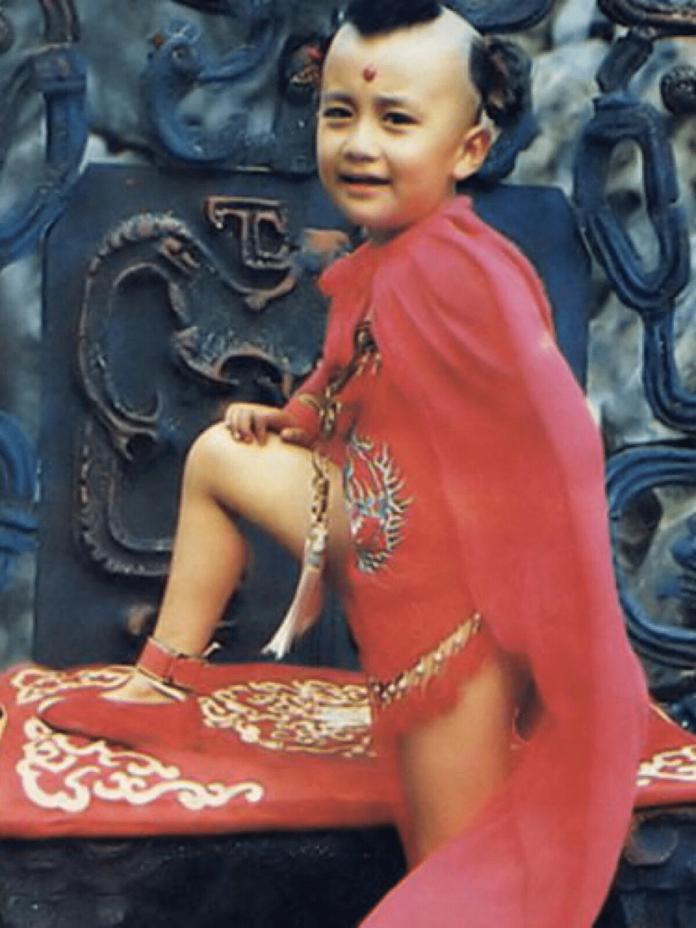
He is portrayed with a hair tuft and coils, a red urna, a red cape, a red stomacher, and red slippers (fig. 6).

Fig. 6 – “Adorable Red Boy” (larger version). Image found here.

3.2. 1996 JTTW

He is portrayed by a young woman with two red ribbon-wrapped, white cloth-covered hair buns and a white undershirt and a red vest, red forearm cuffs, red shorts, and red slippers (fig. 7).

Fig. 7 – “Girl Red Boy” (larger version). Image found here.

3.3. 2011 JTTW

He is portrayed with a hair tuft, red horns, a dark red to brown suit of armor with a flame pattern, and a red cape (fig. 8).

Fig. 8 – “Armored Red Boy” (larger version). The original online source is no longer available.

4. Conclusion

JTTW chapter 41 describes Red Boy as having doll-like beauty with a powder white face, crescent moon-shaped eyebrows, and deep red lips. His dark hair is either wrapped in buns or hung in coils. He is shoeless, and the only clothing covering his husky body is a silken battle kilt embroidered with phoenixes and dragons. And his weapon is an 18.77 ft (5.724 m) long, fired-tipped spear.


Update: 03-25-24

It occurred to me that the following description …

With no other armor except a battle kilt of embroidered silk and with naked feet … (Wu & Yu, 2012, vol. 2, p. 222).

妖王掄槍拽步,也無甚麼盔甲,只是腰間束一條錦繡戰裙,赤著腳

… does not necessarily exclude other clothing. Red Boy could wear some kind of silk robe beneath the battle kilt. However, I think him being shirtless better fits with his ferocious nature.


Update: 04-30-24

Chapter 42 indicates that Red Boy has a full head of hair that is later shaved by Guanyin:

She took out from her sleeve a golden razor and approached the fiend. With a few strokes, she shaved his hair off and turned it into the style of the Tai Mountain Crowning the Head: the top was completely bald, but three tufts of hair were left around the edge so that they could be knotted together into three tiny braids (Wu & Yu, 2012, vol. 2, p. 250).

就袖中取出一把金剃頭刀兒,近前去,把那怪分頂剃了幾刀,剃作一個太山壓頂,與他留下三個頂搭,挽起三個窩角揪兒。

This contrasts with modern representations of Red Boy that already have this shaven hair style prior to being subjugated. Refer back to section 3.

Notes:

1) Chapter 42 reads:

After she received [treasure swords borrowed from heaven], the Bodhisattva [Guanyin] threw them into the air as she recited a spell: the swords were transformed into a thousand-leaf lotus platform. Leaping up, the Bodhisattva sat solemnly in the middle.

菩薩接在手中,拋將去,念個咒語,只見那刀化作一座千葉蓮臺。菩薩縱身上去,端坐在中間。

[…]

[Sun Wukong feigns defeat and tricks Red Boy into chasing him to Guayin’s domain] When the monster spirit suddenly discovered that Pilgrim was gone, he walked up to the Bodhisattva with bulging eyes and said to her, “Are you the reinforcement Pilgrim Sun brought here?” The Bodhisattva did not reply. Rolling the lance in his hands, the monster king bellowed, “Hey! Are you the reinforcement Pilgrim Sun brought here?” Still the Bodhisattva did not reply. The monster-spirit lifted his lance and jabbed at the heart of the Bodhisattva, who at once changed herself into a beam of golden light and rose into the air. Pilgrim followed her on her way up and said to her, “Bodhisattva, you are trying to take advantage of me! The monster-spirit asked you several times. How could you pretend to be deaf and dumb and not make any noise at all? One blow of his lance, in fact, chased you away, and you have even left behind your lotus platform.”

“Don’t talk,” said the Bodhisattva, “let’s see what he will do.” At this time, Pilgrim and [Mucha] both stood in the air shoulder to shoulder and stared down; they found the monster-spirit laughing scornfully and saying to himself, “Brazen ape, you’re mistaken about me! What sort of person do you think that I, Holy Child, happen to be? For several times you could not prevail against me, and then you had to go and fetch some namby-pamby Bodhisattva. One blow of my lance now has made her vanish completely. Moreover, she has even left the treasure lotus platform behind. Well, let me get up there and take a seat.” Dear monster-spirit. He imitated the Bodhisattva by sitting in the middle of the platform with hands and legs folded. When he saw this, Pilgrim said, “Fine! Fine! Fine! This lotus platform has been given to someone else!”

“Wukong,” said the Bodhisattva, “what are you mumbling again?”

“Mumbling what? Mumbling what?” replied Pilgrim. “I’m saying that the lotus platform has been given to someone else. Look! It’s underneath his thighs. You think he’s going to return it to you?”

“I wanted him to sit there,” said the Bodhisattva.

“Well, he’s smaller than you,” said Pilgrim, “and it seems that the seat fits him even better than it fits you.”

“Stop talking,” said the Bodhisattva, “and watch the dharma power.”

She pointed the willow twig downward and cried, “Withdraw!” All at once, flowers and leaves vanished from the lotus platform and the auspicious luminosity dispersed entirely. The monster king, you see, was sitting actually on the points of those swords. The Bodhisattva then gave this command to [Mucha]:

“Use your demon-routing cudgel and strike back and forth at the sword handles.”

Dropping from the clouds, [Mucha] wielded his cudgel as if he were demolishing a wall: he struck at the handles hundreds of times. As for that monster-spirit,

Both his legs were pierced till the points stuck out;
Blood spouted in pools as flesh and skin were torn.

Marvelous monster! Look at him! Gritting his teeth to bear the pain, he abandoned the lance so that he could use both hands to try to pull the swords out from his body … (Wu & Yu, 2012, vol. 2, pp. 246 and 249-250).

這妖精見沒了行者。走近前,睜圓眼,對菩薩道:「你是孫行者請來的救兵麼?」菩薩不答應。妖王撚轉長槍,喝道:「咄!你是孫行者請來的救兵麼?」菩薩也不答應。妖精望菩薩劈心刺一槍來。那菩薩化道金光,徑走上九霄空內。行者跟定道:「菩薩,你好欺伏我罷了,那妖精再三問你,你怎麼推聾裝啞,不敢做聲,被他一槍搠走了,卻把那個蓮臺都丟下耶?」菩薩只教:「莫言語,看他再要怎的。」

此時行者與木叉俱在空中,並肩同看。只見那妖呵呵冷笑道:「潑猴頭,錯認了我也。他不知把我聖嬰當作個甚人,幾番家戰我不過,又去請個甚麼膿包菩薩來卻被我一槍,搠得無形無影去了,又把個寶蓮臺兒丟了。且等我上去坐坐。」好妖精,他也學菩薩,盤手盤腳的坐在當中。行者看見道:「好好好,蓮花臺兒好送人了。」菩薩道:「悟空,你又說甚麼?」行者道:「說甚?說甚?蓮臺送了人了。那妖精坐放臀下,終不得你還要哩?」菩薩道:「正要他坐哩。」行者道:「他的身軀小巧,比你還坐得穩當。」菩薩叫:「莫言語,且看法力。」

他將楊柳枝往下指定,叫一聲:「退!」只見那蓮臺花彩俱無,祥光盡散,原來那妖王坐在刀尖之上。即命木叉:「使降妖杵,把刀柄兒打打去來。」那木叉按下雲頭,將降魔杵如築牆一般,築了有千百餘下。那妖精穿通兩腿刀尖出,血注成汪皮肉開。好怪物,你看他咬著牙,忍著痛,且丟了長槍,用手將刀亂拔 …

2) Padded silk armor was apparently used in ancient China as early as 600 CE (Dean, 1920, pp. 284-285).

Sources:

Dean, B. (1920). Helmets and Body Armor in Modern Warfare. United Kingdom: Yale University Press.

Jiang, Y. (2005). The Great Ming Code / Da Ming Lu. Vancouver, Wa: University of Washington Press.

Wall, B. (2019). Dynamic Texts as Hotbeds for Transmedia Storytelling: A Case Study of the Story Universe of the Journey to the WestInternational Journal of Communication 13, 2116-2142. Retrieved from https://ijoc.org/index.php/ijoc/article/view/10006/2648.

Wu, C., & Yu, A. C. (2012). The Journey to the West (Vols. 1-4) (Rev. ed.). Chicago, Illinois: University of Chicago Press.

Archive #40 – Journey to the South (Nanyouji) English Translation PDF

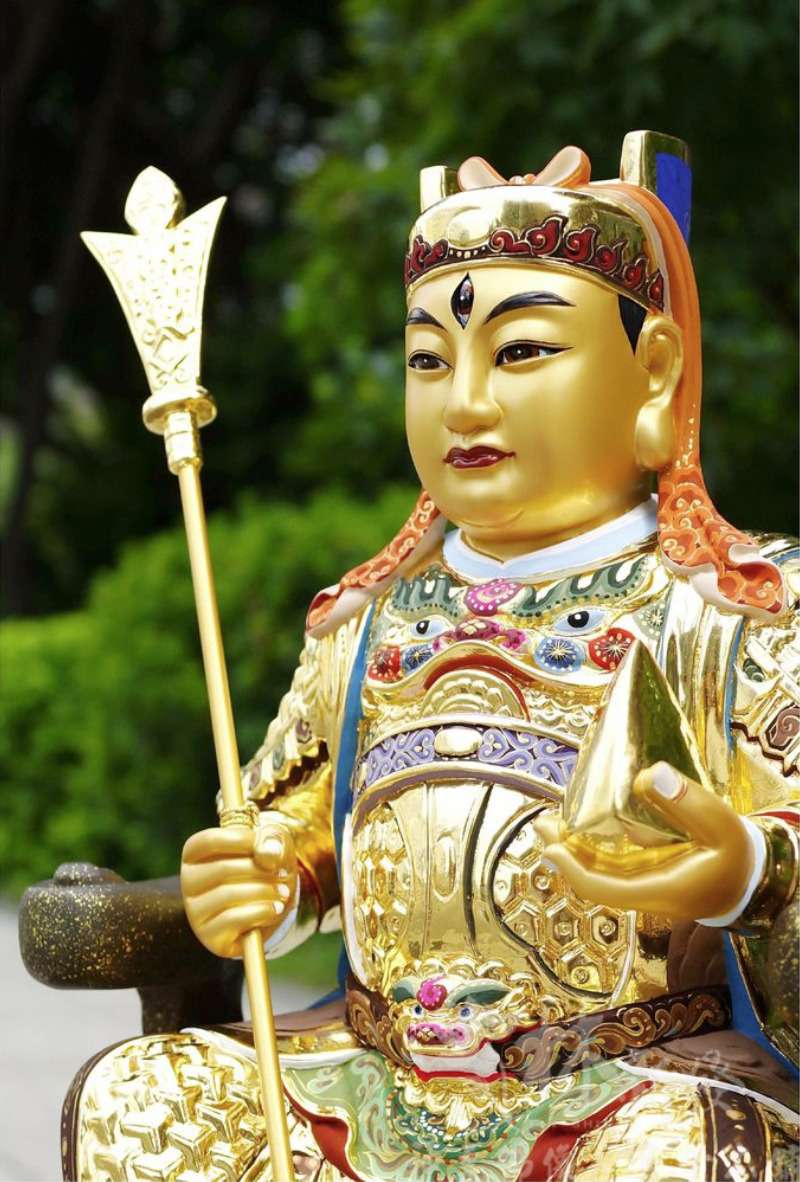
Journey to the South (Nanyouji南遊記, c. 1570s-1580s), [1] is one of four shenmo novels, dubbed the Four Journeys (Siyou ji, 四遊記), (re)published during the Wanli era by Yu Xiangdou (余象斗, c. 1560-c. 1640). This eighteen chapter work follows the adventures of the martial deity Huaguang dadi (華光大帝) (fig. 1), variously translated as “Great Emperor of Flowery/Resplendent/Magnificent/Majestic Light.” He begins the story as a divine disciple of the Buddha who is exiled from paradise for taking a life. But after a series of rebirths in which he causes trouble as a trickster, Huaguang redeems himself by using his powers to subdue evil.

What’s interesting for the purposes of this blog is that the Monkey King appears as a tertiary character in chapters one and seventeen. The latter is notable among fans of Journey to the West as it mentions that our hero has children. One in particular, his monstrous daughter Yuebei xing (月孛星, “Moon Comet Star”), is shown to be a powerful sorceress who can threaten the lives of even immortals with her magic skull weapon.

Here, I would like to archive an English translation of Journey to the South found online. It is by a translator with the penname “Peter Pan.” My thanks to them.

Fig. 1 – A modern Huaguang dadi idol (larger version). Readers will notice that he shares many iconographical similarities with Erlang shen. Image found here.

I. Synopsis

After killing a havoc-wreaking Single-Flame King, Manjusri is banished by Tathagata [Buddha] to reincarnate into Spirit Light as a son of Mount Horse-Ear King, endowed with five accesses to natural elements and a heavenly eye.

[Jim here: One of Manjushri’s old Chinese Buddhist names is Miao Jixiang (妙吉祥). Huaguang’s previous incarnation, a divine flame-turned-Buddhist deity, also shares this name, but the two are not related (Von Glahn, 2004, p. 214). Therefore, translating the name as Manjushri is not accurate.]

During his trip to the Spiritual Void Palace, Spirit Light frees two ghosts by stealing a golden spear, but he is killed by Purple Subtlety Heaven Emperor. He again reincarnates as Three-Eye Spirit Flare in the family of Blazing Darkness Heavenly King. He steals from his master Wonderful Joy Celestial Being a golden broadsword, to make it into a triangular golden brick as his divine weapon.

Later, he wreaks havoc in the Jade Flower Gathering in the heavens and assumes the title of Huaguang, but he is subdued by Black Sky Heaven Emperor. Afraid of being punished by the Jade Emperor, Huaguang reincarnates again into Xiao’s Family Village, where he subdues demons and evil spirits with his divine power. Considering his meritorious deeds, the Jade Emperor grants pardon to him.

Huaguang has no idea that his mother is a man-eating monster named Ganoderma who is later detained by Dragon Auspice King in Fengdu, the demon capital.

Searching around for his mother, Huaguang cheats the Goddess Jade Ring for her pagoda, intending to melt it as his weapon. He meets her daughter Princess Iron Fan and takes her as his wife. He continues to subdue more demons and evil spirits.

Still missing his mother, Huaguang learns she was in the underworld and ventures there without hesitation.

Could Huaguang save his mother? Could he prevent his mother from eating humans again? What stories occur between Huaguang and the legendary Monkey King? What is the fate of Huaguang himself after his undulating reincarnations?

Read on to know more about the making of Heavenly King Resplendent Light, a renowned divine figure in Chinese mythology.

II. Archive Link

Click to access Journey_to_the_South_ENG.pdf

III. Disclaimer

This has been posted for educational purposes. No malicious copyright infringement is intended. If you liked the digital version, please support the official release when it once again becomes available on Amazon.

Note:

1) Evidence suggests that the book was originally published prior to the 1590s (Cedzich, 1995, as cited in Von Glahn, 2004, p. 311 n. 145). Yu Xiangdou later renamed the book when he combined it with the other novels to create the Four Journeys. Von Glahn (2004) explains:

The full title of the earliest known copy of Journey to the South, the 1631 edition in the British Museum, is Quanxiang Huaguang tianwang nanyou zhizhuan [全像華光天王南游志傳] (A Fully Illustrated Chronicle of the Journey to the South by the Heavenly King Huaguang) (p. 311 n. 145).

Sources:

Von Glahn, R. (2004). The Sinister Way: The Divine and the Demonic in Chinese Religious Culture. United Kingdom: University of California Press.