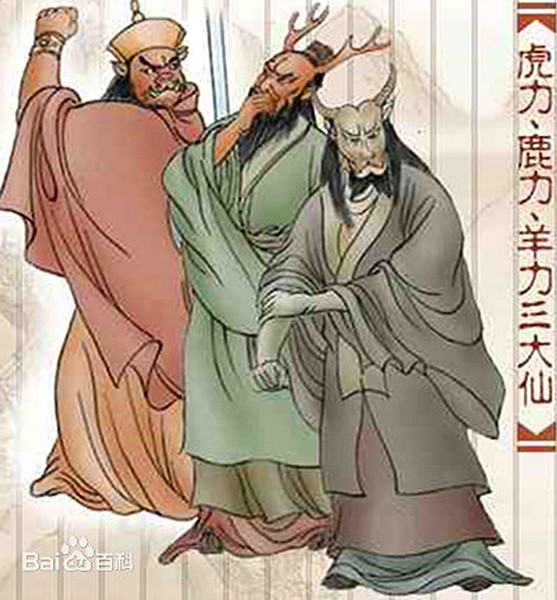
Chapters 44 to 46 of Journey to the West sees the pilgrims enter the Cart-Slow Kingdom (Chechi guo, 車遲國) where they find Buddhist monks have been enslaved by local Daoists to haul a cart full of materials up an impossibly narrow, steep, spine-like ridge in order to construct buildings behind an abbey. After some investigation, Sun Wukong discovers their enslavement is a royal punishment for losing a rain-making competition some years prior to three mysterious Daoist priests, Tiger Strength Great Immortal (Huli daxian, 虎力大仙), Deer Strength Great Immortal (Luli daxian, 鹿力大仙), and Goat Strength Great Immortal (Yangli daxian, 羊力大仙) (fig. 1). (For their victory in saving the country during a time of drought, the three priests are bestowed the royal titles “Precepts of State” (Guoshi, 國師).) Monkey and his brothers break into the abbey and trick the three priests, under the guise of the Three Pure Ones, into thinking their urine is heavenly elixir. The enraged priests then gain permission from the country’s ruler to engage our heroes in a series of magical competitions in order to defend their dignity. After aiding Tripitaka in contests of meditation and clairvoyance, the Great Sage personally faces each of the three priests in contests of surviving corporal punishment, namely beheading (vs Tiger Strength), evisceration (vs Deer Strength), and being boiled in oil (vs Goat Strength). Each priest dies as a result of having lesser magical skills born from heretical practices, and in the end they are revealed to have been animal spirits (a tiger, a deer, and a goat) in disguise. The country’s ruler releases the monks from their bondage and our pilgrims continue their journey to India.
Fig. 1 – A modern depiction of the three animal priests (larger version). Artist unknown.
Oldstone-Moore’s (1998) paper “Alchemy and Journey to the West: The Cart-Slow Kingdom Episode” explores the history and hidden meaning of the three chapters. She reveals certain aspects of the episode serve as allegories for internal alchemical processes. For background she explains Daoism sometimes presents the body as a microcosmic mountain landscape. In the case of the story, the ridge represents the spine and the building material being hauled by the monks represents unrefined qi, seminal essence, and spiritual energies that, when purified via circulation up the spine and down the front of the body numerous times, bolster the body and aids in the attainment of immortality. The cart itself represents a meditation technique used in the Quanzhen school of Daoism to transport the aforementioned energies up the spine. Interestingly, one Zhong-Lü scripture [1] notes this “River Cart” (heche, 河車) is pulled by a number of animals, including an oxen, a deer, and a goat. Therefore, Deer Strength and Goat Strength likely represent these animals. Oldstone-Moore (1998) suggests Tiger Strength is based on Uncle Eyes Great Immortal (Boyan daxian, 伯眼大仙), a tiger spirit appearing in an earlier version of the Slow-Cart Kingdom episode recorded in a 14th-century Korean primer on colloquial Chinese. Additionally, she highlights the conflict between orthodox and heretical practices in the episode. Sun Wukong is shown to have stronger magic because his early Daoist cultivation was guided by a teacher. This differs from the three priests, whose lesser abilities are the result of self study. So taken together, the episode is a warning that esoteric alchemical cultivation should only be pursued under the guidance of an initiated teacher.
Fig. 2 – A 14th-century painting of the Buddhist monk Amoghavajra (larger version). Image from Wikipedia.
Oldstone-Moore (1998) also mentions the rain-making competition between Buddhist and Daoists at the beginning of the episode is based on historical events. This is laid out by Yu (1987), who suggests it is based on Tang-era magic competitions between the Indo-Sogdian Buddhist monk Amoghavajra(Bukong, 不空) (fig. 2) and the Daoist Luo Gongyuan (羅公遠). What’s interesting is that, just like the three priests, Luo was also a Precept of State.
This has been posted for educational purposes. No malicious copyright infringement is intended. Please support the official release.
Notes:
1) This refers to teachings associated with the immortals Zhongli Quan and his student Lü Dongbin.
Sources:
Oldstone-Moore, J. (1998). Alchemy and Journey to the West: The Cart-Slow Kingdom Episode. Journal of Chinese Religions, 26(1), 51-66, DOI: 10.1179/073776998805306930
Yu, A. C. (1987). Religion and literature in China: The ‘Obscure Way’ in The Journey to the West In C. Tu (Ed.), Tradition and creativity: Essays on East Asian civilization (pp. 122-24). Publisher City, State: Publisher.
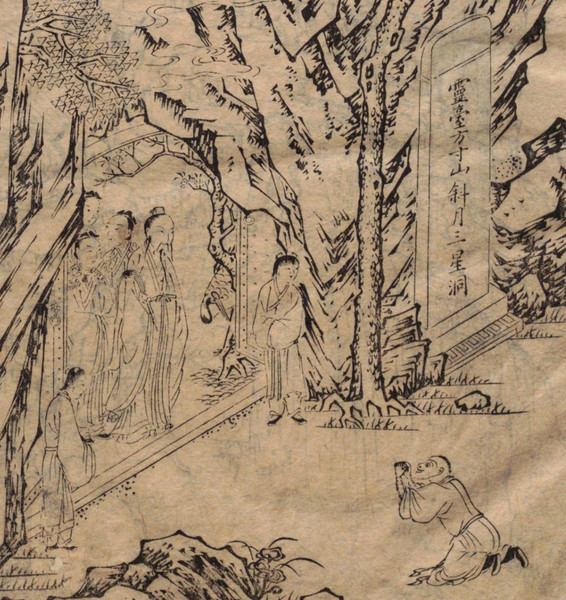
The Monkey King’s quest for immortality spans some ten years, taking him passed two cosmic continents and two great oceans. After sailing to a continent in the west, our hero is directed to the abode of the Sage Subodhi, a place often translated as “The Mountain of Mind and Heart / Cave of the Slanted Moon and Three Stars” (Lingtai fangcun shan, xieyue sanxing dong, 靈臺方寸山,斜月三星洞) (fig. 1) (Wu & Yu, 2012, p. 113, for example). This translation, however, glosses over deeper meanings associated with the original Chinese. The term lingtai (靈臺/台), literally “spirit platform/tower” or “numinous platform/tower”, was sometimes used in Daoist literature to refer to the “heart” or “mind” (xin, 心, “heart-mind” hereafter), the center of spiritual intellect. Going back centuries to the Zhuangzi (c. 3rd-century BCE), it was represented as something that had to be guarded against malevolent influences:
Utilize the bounty of things and let them nourish your body; withdraw into thoughtlessness and in this way give life to your mind; be reverent of what is within and extend this same reverence to others. If you do these things and yet are visited by ten thousand evils, then all are Heaven-sent and not the work of man. They should not be enough to destroy your composure; they must not be allowed to enter the Spirit Tower. The Spirit Tower has its guardian, but unless it understands who its guardian is, it cannot be guarded (Chuang & Watson, 1968, p. 194).
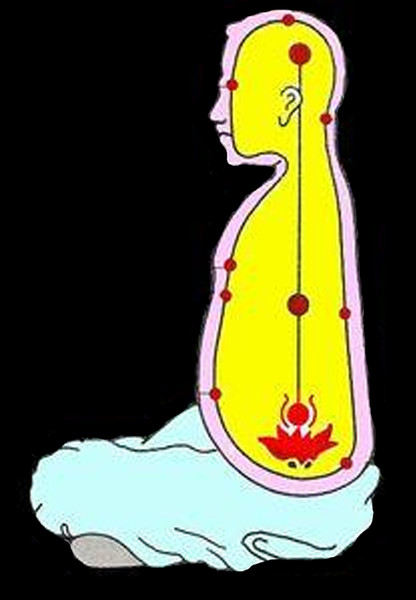
The term fangcun (方寸), literally “square inch”, was also used historically to refer to the heart-mind. [1] But it’s important to note that Daoist alchemical literature sometimes uses the term to refer to the lowest cinnabar or elixir field located approximately “two inches below the navel, three inches within, where the mind is focused” (Saso, 1995, p. 128). For instance, the Scripture of the Yellow Court (Huangting jing, 黃庭經, c. 4th-century), a treatise associated with theHighest Claritytradition, recognizes three fields: brain (upper), heart (center), and belly (lower) (fig. 2), each one represented by a series of place names or an anthropomorphic persona (Saso, 1995, pp. 106-107). The scripture presents the lower field/square inch as the storehouse of vital spiritual energies, the synergy of which is thought to bolster the body and bring about immortality. A portion of the fifth stanza reads: “Inside thesquare inch, carefully cover and storeqi. /Shenspirit andjingintuition returned there, though old, are made new / Through the dark palace make them flow, down to the lower realm. / Nourish your jade tree, now a youth again”. [2]
The scripture treats the central heart-mind field as the seat of the spirit (shen, 神), sometimes anthropomorphizing it as a red-robed man (Saso, 1995, p. 125, for example). But it also calls the field the spirit platform. A section of the sixth stanza reads: “The spirit platform meets heaven in the central field. / From square inch center, down to the [dark] gate, / The soul’s doorway to the Jade Chamber’s core is there”. [3] Saso (1995) explains the first line refers to the interaction between the heart-mind and the Dao, with the second and third referring to spiritual energies being directed into the lower field via a passage near the kidneys (p. 129). Despite the cryptic Daoist jargon, what’s important here is the link between the center field/spirit platform and the lower field/square inch.
Given the information above, a better translation for Subodhi’s mountain might be the “Mountain of Spiritual Heartand Cinnabar Mind” or the “Mountain of Numinous Heart and Elixir Mind” (or any combination of the two).
Fig. 2 – An example of the upper, center, and lower cinnabar fields indicated by red dots (larger version).
I propose the name of Subodhi’s mountain home was specifically chosen by the author-compiler of the Journey to the West as a metaphor for the alchemical practices taught in the Scripture of the Yellow Court. This conclusion is supported by the mention of the scripture in the very first chapter of the novel. This happens when Monkey confuses a lowly woodcutter for an immortal just because the man was singing a Daoist song, one taught to him by Subodhi:
The Monkey King explained, “When I came just now to the forest’s edge, I heard you singing, ‘Those I meet, if not immortals, would be Daoists, seated quietly to expound the Yellow Court.’ The Yellow Court contains the perfected words of the Way and Virtue. What can you be but an immortal?” (Wu & Yu, 2012, p. 111)
I find it interesting that Wukong touts the authority of the Scripture of the Yellow Court even before having begun his Daoist training. From where did he learn this? Could this be projection of the author-compiler?
Fig. 3 – The Chinese character for heart (xin). Original image found here.
Another aspect of Subodhi’s location that requires explanation is the cavern housing his temple, the “Cave of the Slanted Moon and Three Stars” (xieyue sanxing dong, 斜月三星洞). The name is a literal description of the Chinese character for heart-mind (xin, 心). It looks just like a crescent moon surmounted by three stars (fig. 3). This means all three sections of the location name (spirit platform, square inch, cave name) are associated in some form with the heart-mind. The reason for this could be because, in the Ming Journey to the West, Wukong represents the “Mind Monkey” (xinyuan, 心猿), a Buddho-Daoist concept denoting the disquieted thoughts that keep man trapped in Samsara. Examples include the titles for chapters seven (“From the Eight Trigrams Brazier the Great Sage escapes; / Beneath the Five Phases Mountain, Mind Monkey is still”) and fourteen (“Mind Monkey returns to the Right; / The Six Robbers vanish from sight”). Additionally, a poem in chapter seven reads: “An ape’s body of Dao weds the human mind. / Mind is a monkey—this meaning’s profound” (yuanhou dao ti renxin / xin ji yuanhou yisi shen, 猿猴道體配人心 / 心即猿猴意思深) (Wu & Yu, 2012, p. 190). [4]
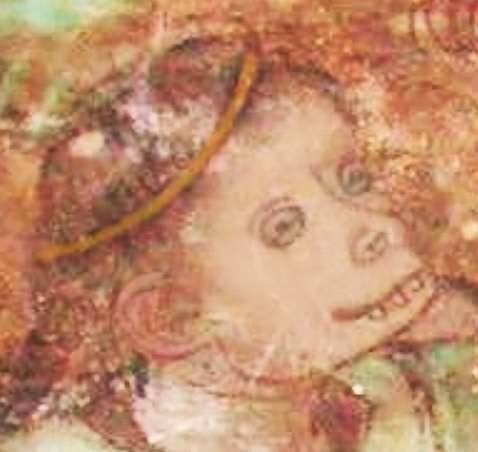
I’m not sure when Sun was first associated with this concept, but Eastern Thousand Buddha Cave (Dong qianfo dong, 東千佛洞) number two in the Hexi Corridor of Gansu Province contains a Western Xia wall painting of the Monkey Pilgrim wearing a golden headband (fig. 4). I show in this article that the band is based on a historical Esoteric Buddhist ritual fillet associated with the Akshobhya Buddha, who is known for his vow to attain Buddhahood through moralistic practices. Therefore, the ritual band most likely served as a physical reminder of right speech and action, making the band from the mural a symbol for the taming of the Monkey Mind. If this is the case, Wukong has represented the Monkey Mind since at least the 11th-century when the mural was painted.
Fig. 4 – Detail of the Monkey Pilgrim’s fillet from Eastern Thousand Buddha Cave no. 2 (c. 11th-cent.) (larger version). Image enhanced slightly for clarity. See here for a larger detail showing both Monkey and Tripitaka.
Allusions to the Mind Monkey appear in the ancient Pali Buddhist canon, but its earliest known occurrences in Chinese sources appear among the translations of the monk Kumarajiva (Jiumoluoshi, 鳩摩羅什, d. 413). For instance, his translation of the Vimalakirti Sutra reads: “Since the mind of one difficult to convert is like an ape [yuanhou, 猨猴], govern his mind by using certain methods and it can then be broken in” (Dudbridge, 1970, pp. 168). This shows the concept was present in China for over a millennia prior to the Ming Journey to the West.
Notes:
1) In Buddhism, for example, the fourth Chan patriarch Daoxin is quoted as saying: “All schools of the Law find their way to the Square Inch; all rivers and sand of wonderful virtues come from the Source of the Mind (xinyuan 心源)” (Liu, 1994, p. 28).
2) See Saso, 1995, p. 127 for the full stanza and explanation. I have changed all quotes used from this source from Wade-Giles to Pinyin. I also slightly modified the translation.
3) See Saso, 1995, p. 129 for the full stanza and explanation. Again, I slightly modified the translation.
4) Anthony Yu (Wu & Yu, 2012) suggests this poem is related to the Buddha’s statement that Wukong is “only a monkey who happened to become a spirit, … merely a beast who has just attained human form in this incarnation” (p. 70), thereby alluding to a Confucian hierarchical scale present in the novel where animals are able to attain human qualities through Daoist cultivation. So Monkey’s Daoist training under Subodhi allows him to wed his monkey form to the human heart-mind.
Sources:
Chuang, T., & Watson, B. (1968). The complete works of Chuang Tzu. Columbia University Press.
Dudbridge, G. (1970). The Hsi-yu chi: A study of antecedents to the sixteenth-century Chinese novel. Cambridge: Cambridge Univ. Press.
Liu, X. (1994). The odyssey of the Buddhist mind: The allegory of the later journey to the West. Lanham, Md: Univ. Press of America.
Saso, M. R. (1995). The Gold pavilion: Taoist ways to peace, healing, and long life. Boston: Charles E. Tuttle Co.
Wu, C., & Yu, A. C. (2012). The journey to the West: Vol. 1. Chicago, Illinois: University of Chicago Press.
The Monkey King is famous for utilizing a vast arsenal of magic powers to protect the monk Tripitaka on the journey to India, chief among them being immortality, shape-shifting, hair clones, super strength, and flight via the cloud somersault (jindou yun, 觔/筋斗雲). The latter is a powerful skill because it enables him to travel 108,000 li (33,554 mi / 54,000 km), [1] or one and one-third the circumference of our Earth, in a single leap. [2] Perhaps the most famous episode involving the somersault appears in chapter seven when the Buddha bets Wukong that he’ll give the rebellious monkey the throne of heaven if he can leap clear of the Enlightened One’s palm. Sun gleefully accepts, certain of his success:
What a fool this Tathagata is! A single somersault of mine can carry old Monkey one hundred and eight thousand li, yet his palm is not even one foot across. How could I possibly not jump clear of it? (Wu & Yu, 2012, vol. 1, p. 194).
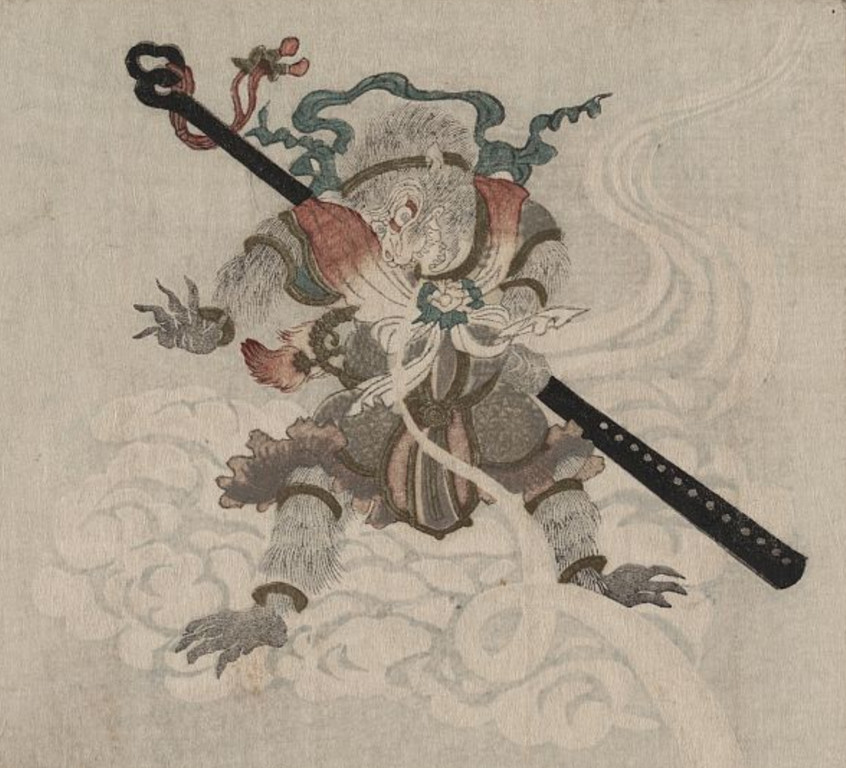
While Sun is traditionally portrayed in visual media riding a single cloud (fig. 1), the very name “somersault” points to Monkey leaping from cloud to cloud. And in fact this is demonstrated in chapter 97 when it requires “a series of cloud somersaults” for him to retrieve the soul of an elderly benefactor from the underworld (Wu & Yu, 2012, vol. 4, p. 338). However, the magic skill’s attributes are not always portrayed consistently throughout the novel. For example, it is sometimes shown capable of transporting passengers, such as the “thirty or fifty” of Monkey’s children rescued from captivity in chapter two, thereby implying a single cloud (Wu & Yu, 2012, vol. 1, p. 129). But other times, like in chapter 22, it can’t lift even a single person because the impure nature of mortals renders them “as heavy as the Tai Mountain” (Wu & Yu, 2012, vol. 1, p. 427). Interestingly, the somersault is portrayed as much faster than the clouds of other immortals (see section three below).
Fig. 1 – Detail of an 1812 calendar print by Japanese artist Kubo Shunman depicting Son Goku (Sun Wukong) flying on his cloud somersault (larger version). A full size scan of the calendar can be seen here.
“Make the magic sign, recite the spell, clench your fist tightly, shake your body, and when you jump up, one somersault will carry you one hundred and eight thousand miles.” When the other people heard this, they all giggled and said, “Lucky Wukong! If he learns this little trick, he can become a dispatcher for someone to deliver documents or carry circulars. He’ll be able to make a living anywhere!”
The sky now began to darken, and the master went back to the cave dwelling with his pupils. Throughout the night, however, Wukong practiced ardently and mastered the technique of cloud-somersault. From then on, he had complete freedom (emphasis added), blissfully enjoying his state oflong life (Wu & Yu, 2012, vol. 1, p. 123).
Elements of this passage reference the long tradition of cloud-borne transcendents in Daoist literature. For example, Kirkova (2016) highlights a poem by the first Cao Wei emperor Cao Pi describing the great speed of their travel: “Lightened you’ll soar, mount the floating clouds, / in a blink you’ll travel millions of li” (p. 105). She explains the ability to traverse vast distances in a flash “is a primary sign of the immortals’ mastery over space and time and is an important topos in their hagiographies” (Kirkova, 2016, p. 106). Furthermore, Kirkova (2016) points out the term used to denote their great freedom of movement, xiaoyao (逍遙/消搖), emphasized above, appears in works as old as the Huananzi and Zhuangzi (p. 104).
Shao (2006) explains that the distance is taken directly from the Platform Sutra (Liuzu tangjing, 六祖壇經, c. 8th to 13th-century) of Huineng, the sixth patriarch of Chan Buddhism (p. 718). The particular passage reads:
The governor also asked,
I often see clergy and laity invoking Amitabha Buddha in hopes of rebirth in the [Pure Land of the] West. Please explain this to me. Can we attain rebirth there? Please resolve this doubt for me.
The Master said,
Listen clearly, Governor, and I will explain it to you. When the World Honored One was in the city of Sravasti, he spoke of the Western Pure Land as a teaching device. Scripture is clear that “it is not far from here,” but treatises say it is “108,000 li away.” This number refers to the ten evils and eight wrongs in the one’s person. This says it is far away. Saying it is far away is for people of lesser faculties. Saying it is near is for people of better faculties.
Now I urge you, good friends, to first get rid of the ten evils; that is the equivalent of traveling one hundred thousand li. [3] Then get rid of the eight wrongs; that is the equivalent of crossing eight thousand li. See essential nature in every moment, always acting with impartial directness, and you will arrive in a finger-snap and see Amitabha Buddha (Huineng & Cleary, 1998, pp. 26-27).
As can be seen, the number 108,000 is symbolic of two sets of spiritual hindrances. The “ten evils” (shi’e, 十惡) are killing, stealing, sexual misconduct, greed, hatred, delusion, foul language, lying, harsh speech, and slander. The “eight wrongs” (baxie, 八邪) are opposites of the eight fold path (Huineng, Hsuan, & Buddhist Text Translation Society, 2002, p. 183). Ridding oneself of these piecemeal gets you many li closer to paradise. But only those who achieve enlightenment can arrive instantly. This means the cloud somersault can be read as a Chan metaphor for instant enlightenment. After all, Monkey can travel to the Buddha’s heaven in a flash, whereas Tripitaka is fated to journey thousands of miles over many years “before he finds deliverance from the sea of sorrows” (Wu & Yu, 2012, vol. 1, p. 436). This is because, as suggested by Shao (2006), the demons encountered on the journey embody the “ten evils and eight wrongs” that must be defeated before the monk can enter paradise (p. 719).
Fig. 2 – Monkey soaring on his cloud. Drawing by Funzee on deviantart (larger version).
Going back to the early days of Sun’s flight training, Subodhi observes our hero using an unorthodox method for propelling himself into the sky: jumping. This differs from other immortals, so the Sage teaches him a different method:
The Patriarch said, “When the various immortals want to soar on the clouds, they all rise by stamping their feet. But you’re not like them. When I saw you leave just now, you had to pull yourself up by jumping. What I’ll do now is to teach you the cloud-somersault in accordance with your form” (Wu & Yu, 2012, vol. 1, p. 123).
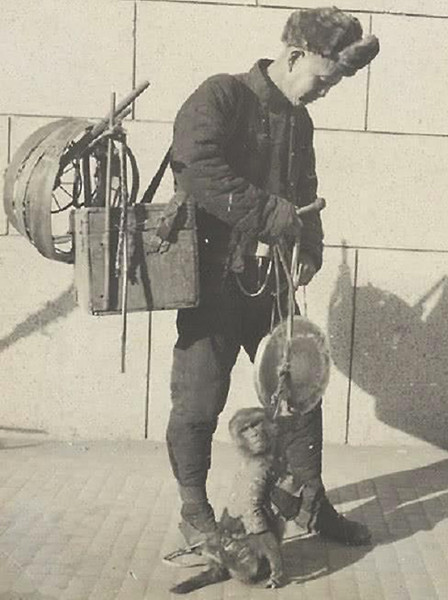
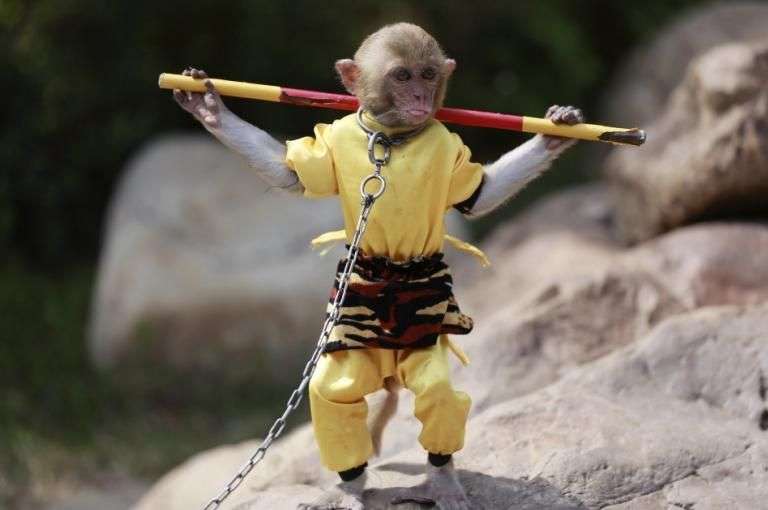
Zhou (1994) suggests this method is likely based on “the novelist’s personal observation” of trained monkey street performances “in the late Ming marketplace” (fig. 3 and 4) (p. 71). He points to an episode in chapter 28 when Wukong returns home to learn his children are regularly captured to perform tricks in the human world:
Those of us who were caught by the net or the trap would be led away live; they would be taught to skip ropes, to act, to somersault, and to do cartwheels. They would have to beat the drum and the gong on the streets and perform every kind of trick to entertain humans (Zhou, 1994, p. 71; cf. Wu & Yu, 2012, vol. 2, p. 31).
Anyone who has viewed monkeys in a zoo or in the wild knows that they are naturally gifted acrobats. Therefore, Zhou’s proposal is certainly an alluring possibility, one that mixes the naturalistic and historical with Daoist tales of cloud-borne immortals.
Fig. 3 – A Qing-era trainer and his performing monkey (larger version). Original image found here. Fig. 4 – A monkey performer dressed as Sun Wukong (larger version). Original image found here.
Scholarsfavoring a foreign originfor Sun sometimes point to the somersault as evidence for his connection to the Hindu monkey godHanuman from the epic Ramayana (4th/5th-century BCE). For example, Mi (as cited in Mair, 1989) notes similarities in which Sun and the god propel themselves by leaping:
In typical Chinese legends, the spirits and immortals mount on clouds and ride them; they stand on top of the clouds. Sun Wukong, however is different … Rather, he leaps through the air from a crouching position in the same fashion as Hanuman … This proves Sun Wukong’s supernatural abilities were adopted from Hanuman. (pp. 712-713).
Walker (1998) champions this view by citing a passage from the Ramayana in which Hanuman’s mighty leap across the sea from India to Lanka rips trees away from a mountain:
Hanuman, the foremost of monkeys, without pausing for breath … sprang into the air and, such was the force of his leap, that the trees growing on the mountain, tossing their branches, were sent spinning on every side.
In his rapid flight, Hanuman bore away those trees with their flowering boughs filled with lapwings intoxicated with love … Carried away by the impetus of his tremendous bound, those trees followed in his wake, like an army its leader (p. 10).
However, I’m inclined to believe any similarities in propulsion are simply the product of common behavioral traits among monkeys (refer back to my statement above about their gift for acrobatics). If Wukong’s jumping is indeed based on the somersaulting monkeys of vaudevillian street performances in China, then Hanuman’s jumping prowess no doubt has a real world counterpart in India. A prime example is the Gray Langur, which is capable of spectacular leaps (video 1).
Video 1 (LOUD NOISE WARNING)- A Langur takes a mighty jump. Watch from minute 0:43.
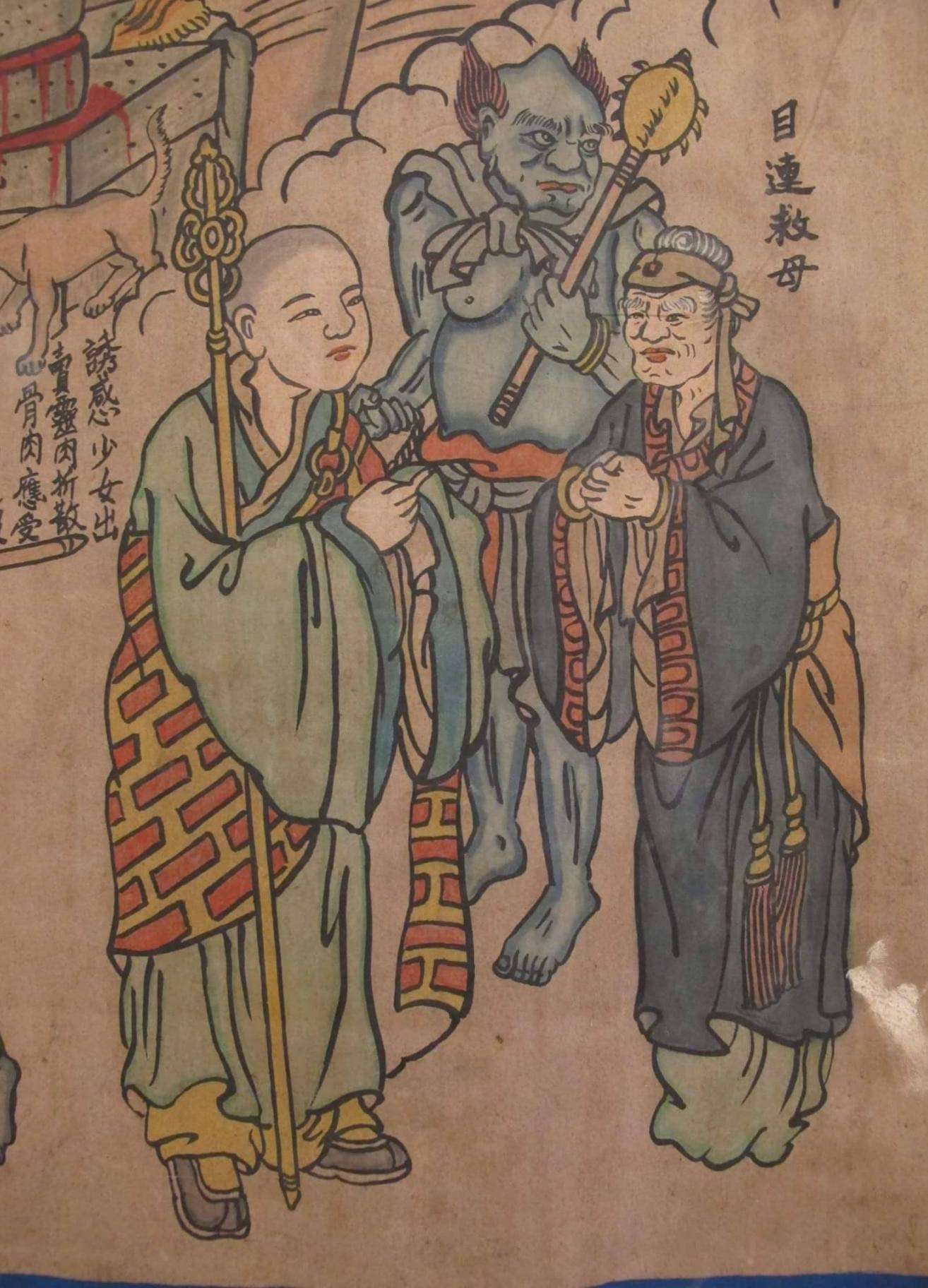
Given the somersault’s symbolic connection to Chan Buddhism, it’s possible Monkey’s jumping has ties to the religion as well. Like immortals, Buddhist saints are also portrayed in Chinese literature as having the power of flight. One example is Maudgalyayana(Ch: Mulian, 目連), a disciple of the Buddha, who is famous for appearing in a late 9th to early 10th-century Bianwen (變文) text in which hetravels to the underworld to release his mother from karmic torment(fig. 5). One passage from the tale reads:
Maudgalyayana awoke from abstract meditation,
Then swiftly exercised his supernatural power;
His coming was quick as a thunderclap,
His going seemed like a gust of wind.
[…]
With his supernatural power, he gained freedom,
So he hurled up his begging bowl and leaped into space (emphasis added);
Thereupon, instantaneously,
He ascended to the heavenly palace of Brahma (Mair, 1994, pp. 1097-1098).
Like Monkey, Maudgalyayana is depicted leaping into the heavens to freely roam the cosmos at blinding speeds, the only difference being that he stands astride a magicalms bowl(fig. 6) and not a cloud. It’s important to note that the saint’s tale influenced the 13th-century precursor of the Ming Journey to the West. As I show in this article, Sun’s antecedent, the Monkey Pilgrim (Hou xingzhe, 猴行者), serves as a proxy for the saint because he wields magic weapons based on those used by Maudgalyayana, namely a golden-ringed monk’s staff and an alms bowl. The ringed staff would come to influence Sun’s signature weapon in Journey to the West, including its ability to change size and pick locks. Therefore, it’s possible the saint may have also influenced Monkey’s jumping.
Fig. 5 – A scroll or mural depicting Maudgalyayana rescuing his mother from the underworld (larger version). Originally found here. Fig. 6 – A metal alms bowl (larger version).
V. Popular Culture
It’s interesting to note that the cloud somersault was adapted in the world famous Dragon Ball franchise. In episode three of the Dragonball anime, the lead character Son Goku, himself based on Sun Wukong, is gifted the yellow, fluffy Kinto’un (筋斗雲) by his would-be martial arts teacher, Master Roshi. [4] This is an obvious reference to Subodhi teaching the somersault skill to Monkey. But before Goku officially takes possession, Roshi gives him a warning: “People with impure thoughts can’t ride on it. In other words, you have to be a good person” (video 2). The master thereafter attempts to stand on it but quickly falls through due to his perverted nature. Goku then leaps up and successfully lands on the cloud, proving his worth. This exchange is no doubt a reference to Sun’s inability to carry passengers on his cloud because the impure nature of mortals renders them too heavy (see section one).
Video 2 – Roshi gives Goku his cloud. Watch from minute 1:50.
VI. Conclusion
The Monkey King first learns the cloud somersault during the early days of his Daoist training under the Sage Subodhi. It enables him to travel 108,000 li in a single leap, making him much faster than the cloud soaring of other transcendents. While this skill shares affinities with the fleet clouds of immortals from Daoist hagiography, Sun’s somersault has a deep connection to Chan Buddhism. The vast distance that it travels is symbolic of the “ten evils and eight wrongs”, two sets of spiritual hindrances from the Platform Sutra said to keep the Buddha’s paradise out of reach. Only those who cleanse themselves of these obstacles can achieve enlightenment and arrive there in a flash, thus making Wukong’s cloud an apt metaphor for instant enlightenment. This suggests the greater speed of the somersault can be read as a further metaphor for the potency of Buddhism over Daoism.
Wukong’s habit of jumping into the heavens differs from the way other immortals rise by stamping their feet. This unorthodox method may have naturalistic or even religious influences. The suggestion that it is based on somersaulting monkeys from Chinese vaudevillian street performances is alluring given their natural gift for acrobatics. Some scholars champion a foreign origin by pointing to the leaping prowess of the Hindu monkey god Hanuman. But this could simply be a passing similarity based on common behavioral traits among monkeys. The jumping may also have ties to the Buddhist saint Maudgalyayana, who is portrayed in a famed 9th/10th-century tale leaping into the air to ride his magic alms bowl between heaven and hell. Elements from his story would come to influence the 13th-century precursor of Journey to the West, as well as the Ming edition of the novel, adding support for his possible influence.
Update: 01-04-24
The singular version of Monkey’s cloud is sometimes described as being “auspicious” (xiangyun, 祥雲) or having a “luminosity” (xiangguang, 祥光). Such clouds or lights are commonly associated with the five colors (wuse, 五色) (fig. 7). Chapter 88 makes this explicit:
Marvelous Great Sage! With a loud whistle he somersaulted right up into midair, his two feet treading the auspicious cloud of five colors (emphasis added). At about three hundred paces above ground, he let loose his rod to make [the martial arts moves] Sprinkling Flowers over the Top and the Yellow Dragon Entwining the Body. Up and down he moved, circling left and right. In the beginning his person and the rod so complemented each other that they seemed, as the adage had it, like flowers added to brocade. By and by even the person disappeared, and all one could see was a sky full of twirling rods! (Wu & Yu, 2012, vol. 4, pp. 196-197)
Fig. 7 – Here is an example of an auspicious cloud (larger version). The scientific term for this phenomenon is “cloud iridescence,” but such nimbuses are commonly called “rainbow clouds” in English.
Notes:
1) The li(里) is a Chinese measure equaling roughly one-third of a mile. All cited English translations presented here use “mile” instead of the original li. I have therefore changed them accordingly.
3) The English translation originally says “ten myriad” (Huineng & Cleary, 1998, pp. 26-27). The original Chinese reads shiwan (十萬; 10 x 10,000), or 100,000. I have changed the source to make this more explicit.
4) The cloud is called the “Flying Nimbus” in the English dub.
Sources:
Huineng, & Cleary, T. F. (1998). The Sutra of Hui-neng, Grand Master of Zen: With Hui-neng’s Commentary on the Diamond Sutra. Boston: Shambhala.
Huineng, Hsuan, H., & Buddhist Text Translation Society. (2002). The sixth patriarch’s Dharma Jewel Platform Sutra: With the commentary of Venerable Master Hsuan Hua. Burlingame: Buddhist Text Translation Society.
Kirkova, Z. (2016). Roaming into the Beyond: Representations of Xian Immortality in Early Medieval Chinese Verse. Leiden: Brill.
Mair, V. (1994). Transformation Text on Mahamaudgalyayana Rescuing His Mother From the Underworld with Pictures, One Scroll, with Preface. In V. Mair (Ed.), The Columbia anthology of traditional Chinese literature (pp. 1094-1127). New York: Columbia University Press.
Wu, C., & Yu, A. C. (2012). The Journey to the West (Vols. 1-4) (Rev. ed.). Chicago, Illinois: University of Chicago Press.
Zhou, Z. (1994). Carnivalization in The Journey to the West: Cultural Dialogism in Fictional Festivity. Chinese Literature: Essays, Articles, Reviews (CLEAR),16, 69-92. doi:10.2307/495307
I present an archived copy of Ping Shao’s (2006) wonderful paper exploring the origin of Sun Wukong’s characterization and how it effects his story cycle. Shao presents a three-fold objective: first, highlight Daoist and Buddhist concepts in chapters one and two that have previously been overlooked or not given enough weight, showing that they serve a function and are not just expendable story elements; second, provide a unified religious vision based on the Buddho-Daoist philosophy of the Daoist southern lineage patriarch Zhang Boduan (張伯端, 987?–1082); and 3) demonstrate that Zhang’s philosophy dictates the course of Sun’s story cycle from unruly immortal to enlightened Buddha.
Shao (2006) suggests Monkey’s portrayal in the first two chapters is influenced by the sixth Chan patriarchHuineng(惠能, 638–713), founder of the “Sudden Enlightenment” school of Buddhism. [1] For example, Sun’s quick-wittedness, demonstrated by his deciphering of his teacher, Subodhi’s, chastisement for refusing to learn certain Daoist skills in chapter two as secret code to receive a private lesson at night, [2] is based on a similar episode involving Huineng and the previous patriarch Hongren. Additionally, Monkey’s 108,000 li (33,554 mi/54,000 km)-spanning somersault cloud (fig. 1) is based on the symbolic distance said by Huineng to separate the Buddha’s paradise from the world of man. [3] Only those who achieve enlightenment can arrive instantly. This is symbolized in the novel by Monkey zipping there instantly on his cloud, whereas Tripitaka must travel thousands of miles over many years. Shao (2006) provides further examples, but I feel these suffice.
Monkey flying on clouds. Drawing by Funzee on deviantart (larger version).
The unified religious vision is demonstrated by Sun Wukong’s name, which contains both Daoist and Buddhist elements. When broken into its individual components, the surname Sun (孫) refers to an immortality spirit embryo brought about via Daoist cultivation exercises. The given name Wukong (悟空) refers to a vacuous state of mind needed for attaining Buddha-nature. Here, Shao (2006) notes the literary Subodhi is based on Subhuti, a historical disciple of the Buddha, who was known for meditating on emptiness and having a superior grasp of the Enlightened One’s teachings. In later chapters, Sun himself shows a grasp of scripture far surpassing even that of Tripitaka. Therefore, an additional influence on Monkey was likely the historical monk. Shao (2006) contextualizes this information by comparing it to Zhang Boduan’s Buddho-Daoist philosophy. Zhang believed Daoists must first attain the elixir (i.e. a method increasing one’s lifespan) and then attain Buddha-nature to truly become an enlightened transcendent. Conversely, he warned Buddhists that achieving Buddha-Nature alone wouldn’t help them escape the wheel of reincarnation.
Fig. 2 – Sun Wukong becoming a Buddha (larger version). Photomanipulation by the author.
Shao (2006) illustrates how Zhang’s views are played out in the novel. Sun achieves immortality and is even invited to heaven like the hagiographies of famous transcendents, but his unruly nature symbolizes his lack of true spiritual attainment, causing him to wage war against the realm above. He remains a “deviant” or “bogus immortal” (yaoxian, 妖仙) until the journey proper, the tribulations serving to temper his mind. Moreover, when the pilgrims arrive in the Buddha’s paradise, they must first pass through a Daoist temple (referring again to Zhang’s philosophy). In the end, Sun is bestowed Buddhahood (fig. 2)—thereby Buddha-nature—completing the second step of Zhang’s two-part path to true transcendence.
Shao (2006) is taken almost verbatim from the author’s doctoral thesis, Monkey and Chinese Scriptural Tradition: A Rereading of the Novel Xiyouji. This dissertation is a gold mine of information, and Shao’s (1997) Daoist reading of the novel explains many facets of the story. He even shows that Monkey has many religious influences. For example, the summation of one section reads: “[The author] allowed him Huineng’s intuition, Subhuti’s objective, and Laozi’s immortal body” (Shao, 1997, p. 108).
1) In this article, I discuss how the “Monkey Pilgrim”, Sun Wukong’s precursor from Song Dynasty material, is based on the monk Mulian (Sk. Maudgalyayana), another of the Buddha’s disciples.
2) The particular passage reads:
When the Patriarch heard this, he uttered a cry and jumped down from the high platform. He pointed the ruler he held in his hands at Wukong and said to him: “What a mischievous monkey you are! You won’t learn this and you won’t learn that! Just what is it that you are waiting for?” Moving forward, he hit Wukong three times on the head. Then he folded his arms behind his back and walked inside, closing the main doors behind him and leaving the congregation stranded outside […] But Wukong was not angered in the least and only replied with a broad grin. For the Monkey King, in fact, had already solved secretly, as it were, the riddle in the pot; he therefore did not quarrel with the other people but patiently held his tongue. He reasoned that the master, by hitting him three times, was telling him to prepare himself for the third watch; and by folding his arms behind his back, walking inside, and closing the main doors, was telling him to enter by the back door so that he might receive instruction in secret (Wu & Yu, 2012, pp. 118-119).
This number refers to the ten evils and eight wrongs in one’s person […] Now I urge you, good friends, to first get rid of the ten evils; that is the equivalent of traveling ten [thousand li]. Then get rid of the eight wrongs; that is the equivalent of crossing eight thousand [li]. See essential nature in every moment, always acting with impartial directness, and you will arrive in a finger-snap and see Amitabha Buddha (Huineng & Cleary, 1998, pp. 26-27).
Sources:
Huineng, & Cleary, T. F. (1998). The Sutra of Hui-neng, grand master of Zen: With Hui-neng’s commentary on the Diamond Sutra. Boston: Shambhala.
Shao, P. (2006). Huineng, Subhūti, and Monkey’s Religion in “Xiyou ji”. The Journal of Asian Studies,65(4), 713-740. Retrieved from www.jstor.org/stable/25076127
Shao, P. (1997). Monkey and Chinese Scriptural Tradition: A Rereading of the Novel Xiyouji (UMI No. 9818173) [Doctoral dissertation, Washington University]. Available from ProQuest Dissertations and Theses database.
Wu, C., & Yu, A. C. (2012). The journey to the West: Vol. 1. Chicago, Illinois: University of Chicago Press.
Upon Sun Wukong achieving immortality, his Buddho-Daoist master Subodhi warns him of three calamities sent by heaven to kill those who defy their fate and attain eternal life. The Sage then offers to teach Monkey one of two forms of transformation in order to avoid this outcome by living in hiding. [1] The first form, called the “Multitude of the Heavenly Ladle” (Tiangang shu, 天罡數), contains thirty-six changes, while the second, the “Multitude of Earthly Fiends” (Disha shu, 地煞數), contains seventy-two. [2]Our hero chooses the latter and quickly masters a set of secret oral formulas (koujue, 口訣). This becomes one of his signature abilities used throughout the narrative. Monkey’s most famous use of the skill appears in chapter six when he battles Lord Erlang, a divine demon queller and fellow master of transformations (video 1).
Video 1 – Sun’s battle with Lord Erlang. From the great animated Classic Havoc in Heaven (1965).
I. Connection to Chinese astrology and literature
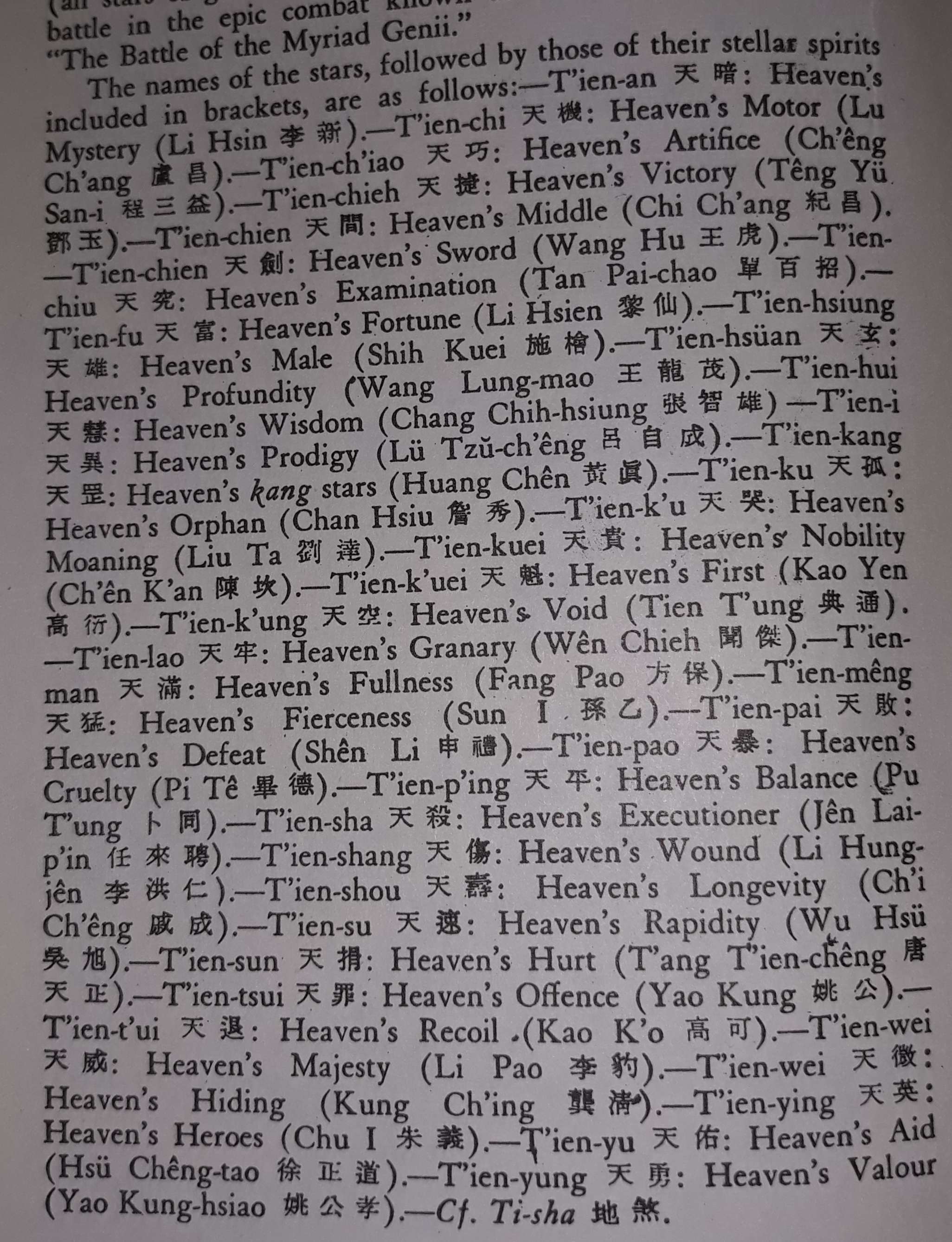
The names of the two forms of transformation that Subodhi offers to teach Monkey can be traced to Chinese astrology. The “Heavenly Ladle” (Tiangang, 天罡; i.e. theBig Dipper) is associated in some traditions with thirty-six stars (fig. 1). Regarding the origin of these stellar bodies, Werner (1932/1969) explains: “The gods of these stars (all stars of good omen) are all heroes who fell on the field of battle in the epic combat known as Wan Xian Zhen 萬仙陣, “The Battle of the Myriad Genii [or Immortals]” (p. 506). [3]
Fig. 1 – A list of the thirty-six Heavenly Ladle stars (larger version). Photograph of Werner, 1932/1969, p. 506. Apologies for not having access to a scanner at this time.
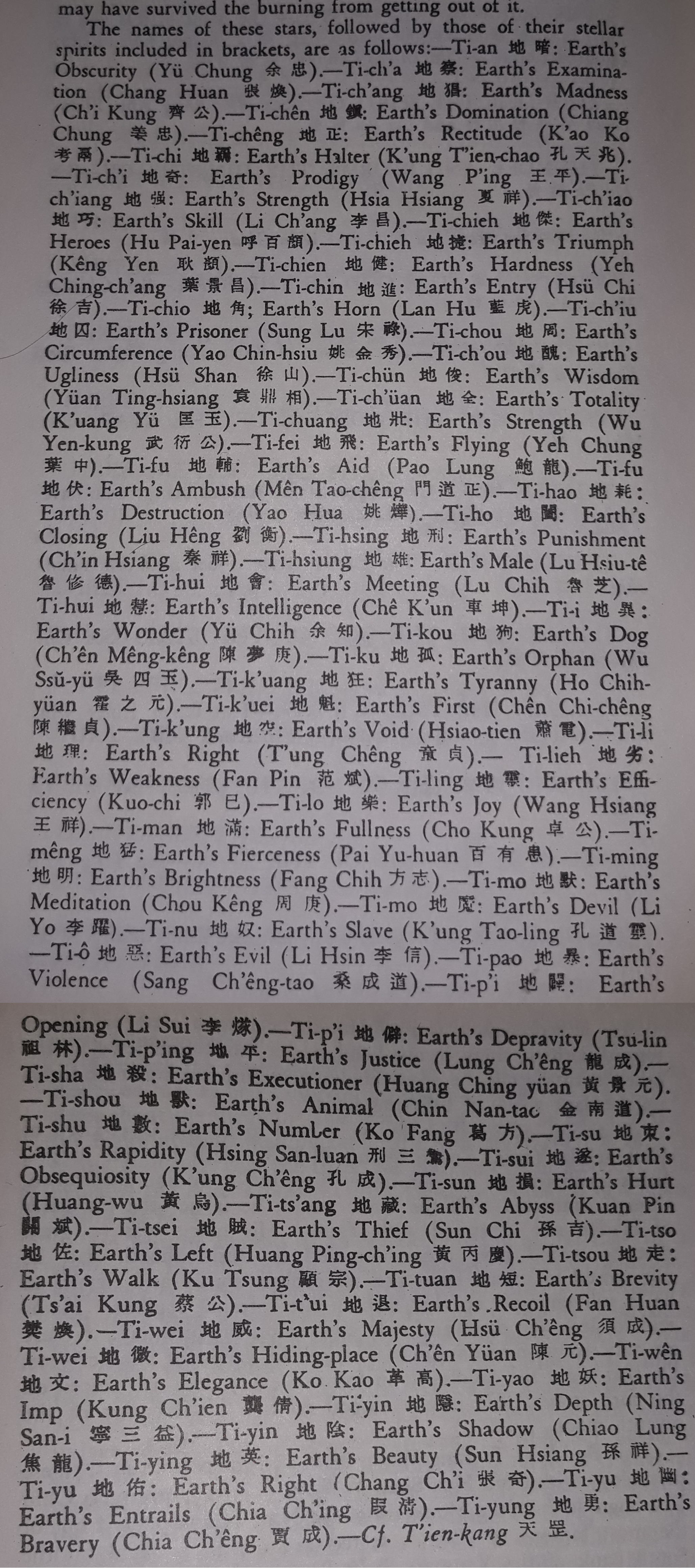
Furthermore, he writes that the “Earthly Fiends” (Disha, 地煞) are:
[S]eventy-two stars [fig. 2] of evil influence, opposed to the Tiangang. The wicked genii of these stars are cast out and slain by tongzi 童子 magicians [i.e. spirit mediums], who impale them on forks and shut them up in earthen jars, then take them to waste lands, throw them into fires, and surround the spot with a circle of lime, which is supposed to prevent any spirit which may have survived the burning from getting out of it (Werner, 1932/1969, p. 496). [4]
Fig. 2 – A list of the seventy-two Earthly Fiend stars (larger version). Photographs of Werner, 1932/1969, pp. 496-497.
Additionally, the Earthly Fiends are considered the “enemies of man, and causes of all diseases and ailments” (Doré & Kennelly, 1916, p. xviii). Several Buddho-Daoist folk talismans exist to ward afflictions caused by the Fiends. One such Buddhist talisman said to cure the “one hundred ailments” even invokes the thirty-six Heavenly Ladle stars to aid in the conquering of the seventy-two demons:
An order is hereby made by the “Ministry of the Thunderbolt”, commanding in the name of the “three religions” that the auspicious stellar gods, Tiangang 天罡, reduce to order the maleficent demons, Disha 地煞, who have caused this disease. The charm must also repress these malignant beings and expel them forthwith (fig.3) (Doré & Kennelly, 1916, p. 312).
Fig. 3 – A reproduction of the illness-curing Buddhist Talisman (larger version).
It’s interesting that Sun Wukong chooses the transformation method centered around stars of evil influence and later becomes a demon who challenges heaven. [5] Good fodder for fan fiction, no?
When these dichotomous stellar bodies were first acknowledged isn’t exactly clear. [6] But the Heavenly Ladle stars go back to at least the mid-13th-century as they are mentioned in the Old Incidents in the Xuanhe period of the Great Song Dynasty (Da Song Xuanhe Yishi, 大宋宣和遺事) (Anonymous, n.d.), a storytelling prompt of the late-Song to early-Yuan. It contains the earliest stories associated with the Water Margin (Shuihu zhuan, 水滸傳, c. 1400), a Chinese classic that predates Journey to the West. The one hundred and eight heroes of this novel are famous for being reincarnations of the Heavenly Ladle and Earthly Fiend stars, a fact revealed in chapter seventy-one when a heaven-sent stone slab is found to list their human names along with the corresponding stellar titles. The long association of the stars with the hugely popular Water Margin novel therefore may have inspired the names for the techniques taught by the sage Subodhi in Journey to the West.
II. Ties to Daoist practices
Robinet (1979) expertly explains that transformation (bianhua, 變化), or “metamorphosis” as she calls it, is central to Daoism. Gods and Saints are portrayed in Daoist literature as being in constant flux, changing with the seasons, taking on different guises and titles, disappearing and reappearing, never remaining the same, thereby living eternally. Daoists and magicians achieve metamorphosis through external and internal alchemical processes, the former involving the ingestion of drugs and talismans and the latter via mental exercises. Those who succeed in their practice can divide themselves endlessly; create rivers, mountains, and forests from meager samples of water, earth, and seeds; and, most importantly, change their form into anything (fig. 4), including the five elements, dragons, clouds, rays of light, or even celestial bodies like the sun and moon.
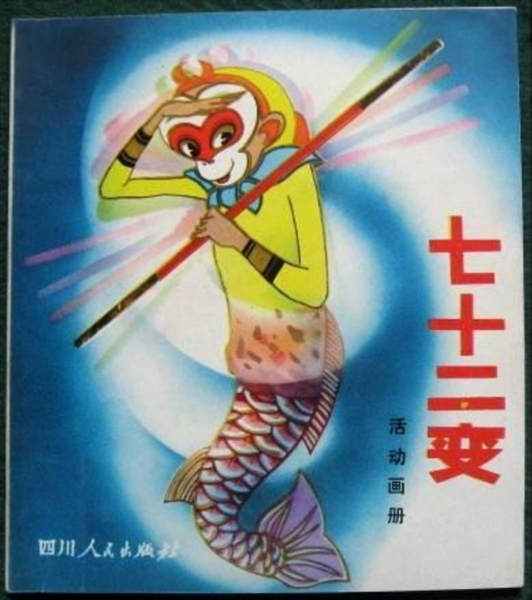
Fig. 4 – The cover of a vintage children’s flip book about Monkey’s transformations (larger version). Here he is seen changing into a fish.
Interestingly, transformations could be used to live in hiding, much like originally intended by Subodhi in Journey to the West. Adepts still questing for immortality could magically transform a sword, staff, or slipper into their deceased body, thereby faking death and escaping elsewhere to find a method leading to eternal life. (Often times, those who took this route assumed a new identity to avoid heaven’s gaze (Campany, 2005)). Additionally, sages are said to use their powers to hide in the earth or in the light of the sun, moon, and stars. One source mentions adepts hiding by scattering their shadow and transforming it into seventy-two types of light. In a related book chapter, Robinet (1993) notes this number “alludes to [Laozi’s] seventy-two supernatural marks” (clearly borrowing from the Buddhist Mahapurusa laksana) (p. 166). This is fascinating as it shows there is precedent for seventy-two transformations in Daoism.
III. Archive link
I have archived Robinet’s (1979) wonderful paper on metamorphosis. It can be read here:
This has been posted for educational purposes. No malicious copyright infringement is intended. Please support the official release.
Update: 06-12-22
I recently posted an in-depth article about the Patriarch Subodhi in which I reveal information about the additional benefits of the 72 Transformations. Anyone involved in any upcoming “What if” battles involving the Monkey King (COUGH, COUGH!) would do well to take note of this information.
Subodhi teaches this skill to Monkey with the expressed purpose of helping him hide from three calamities of cosmic lightning, fire, and wind sent by heaven to destroy immortals for defying fate and achieving eternal life. But beyond the power of metamorphosis, the novel implies that the ability also grants the user multiple lives (similar to a video game), which might serve as a buffer against the calamities. For example, in chapter 41, after Sun passes out from Red Boy‘s fiery attack, Zhu Bajie reassures everyone by saying: “If he is capable of seventy-two transformations, he has seventy-two lives” (Wu & Yu, 2012, vol. 2, p. 232). Also, in chapter 46, Monkey magically regrows his head after being non-fatally beheaded in a contest of magical skill. Sha Wujing remarks: “If he knows seventy-two ways of transformation, … he may have altogether seventy-two heads!” (Wu & Yu, 2012, vol. 2, p. 308). [7] In addition, while not directly related to the primate hero, the Bull Demon King is said in chapter 61 to also know the 72 changes (Wu & Yu, 2012, vol. 3, p. 148). He uses the extra lives to survive being beheaded by Prince Nezha a number of times:
[Nezha] leaped onto the bull’s back and brought his monster-cleaving sword down on the bull’s neck: the bull was beheaded at once. Putting away his scimitar, the devaraja was about to greet [Sun Wukong] when another head emerged from the torso of the bull, his mouth belching black air and his eyes beaming golden rays. [Nezha] lifted his sword once more and cut off the bull’s head; as soon as it dropped to the ground, another head came out. It went on like this more than ten times. At last, [Nezha] took out his fiery wheel and hung it on the Bull’s horn. The wheel at once started a great blaze of true immortal fire, which burned so fiercely that the bull began to growl and roar madly, shaking his head and wagging his tail (Wu & Yu, vol. 3, p. 160).
Notes:
1) It should be noted that the calamities are sent every five hundred years. Sun never has to live in hiding, though, as he is trapped under Five Elements Mountain upon the five hundredth anniversary of his immortality (he lived to be roughly four hundred prior to taking up spiritual cultivation). And he achieves Buddhahood prior to reaching the one thousandth year of his immortality, so he never has to guard against subsequent calamities.
2) The translation of these names are loosely based on Anthony C. Yu (Wu & Yu, 2012, vol. 1, p. 122). I have provided more accurate names based on related Chinese literature (see section one above).
3) Source changed slightly. I updated the Wade-Giles to Pinyin. This refers to a military trap appearing in the Chinese classic Investiture of the Gods (Fengshen yanyi, 封神演義, 16th-century), which was published around the same time as Journey to the West.
5) Conversely, Zhu Bajie is shown capable of thirty-six transformations (for example, Wu & Yu, 2012, vol 2, p. 328), meaning he studied the method associated with the stars of good omens. And of course we know his sordid story…
6) Though, in my opinion, the thirty-six stars are likely based on the thirty-six generals led by the stellar exorcist, Marshal Tianpeng (天蓬, i.e. Zhu Bajie’s former incarnation), who is himself one of the nine stars of the Big Dipper. The Marshal and his generals appear in the liturgy of the Song-era “Correct Method of the Celestial Heart” (Tianxin zhengfa, 天心正法) exorcist tradition (Anderson, 2008).
[7] Thank you to Irwen Wong of the Journey to the West Library blog for bringing these examples to my attention.
Sources:
Anderson, P. (2008) Tianxin zhengfa In F. Pregadio (ed.), The encyclopedia of Taoism: Vol 1-2 (pp. 989-993). Longdon: Routledge.
Campany, R. (2005). Living off the Books: Fifty Ways to Dodge Ming 命 [Preallotted Lifespan] in Early Medieval China In C. Lupke (Ed.), The Magnitude of Ming: Command, Allotment, and Fate in Chinese Culture (pp. 129-150). University of Hawaii Press.