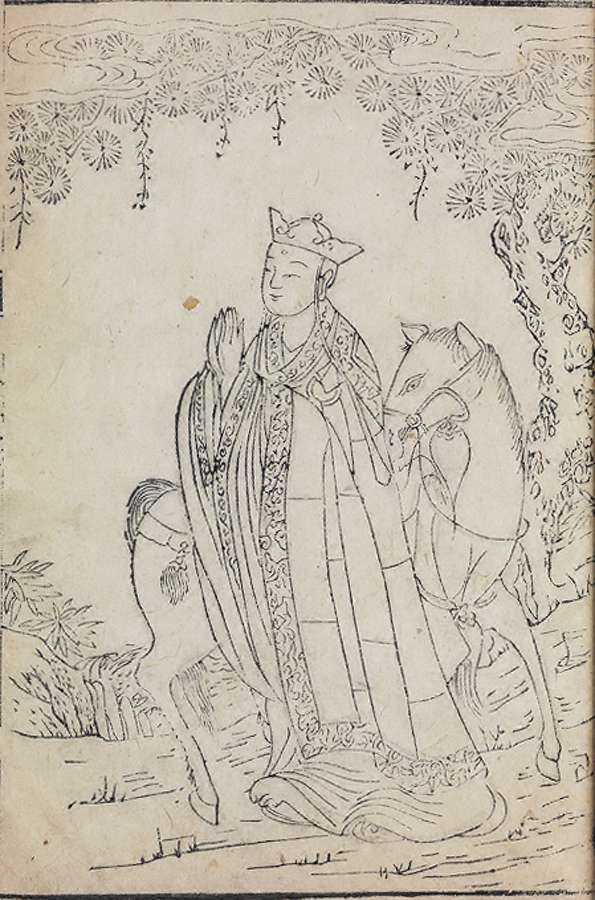
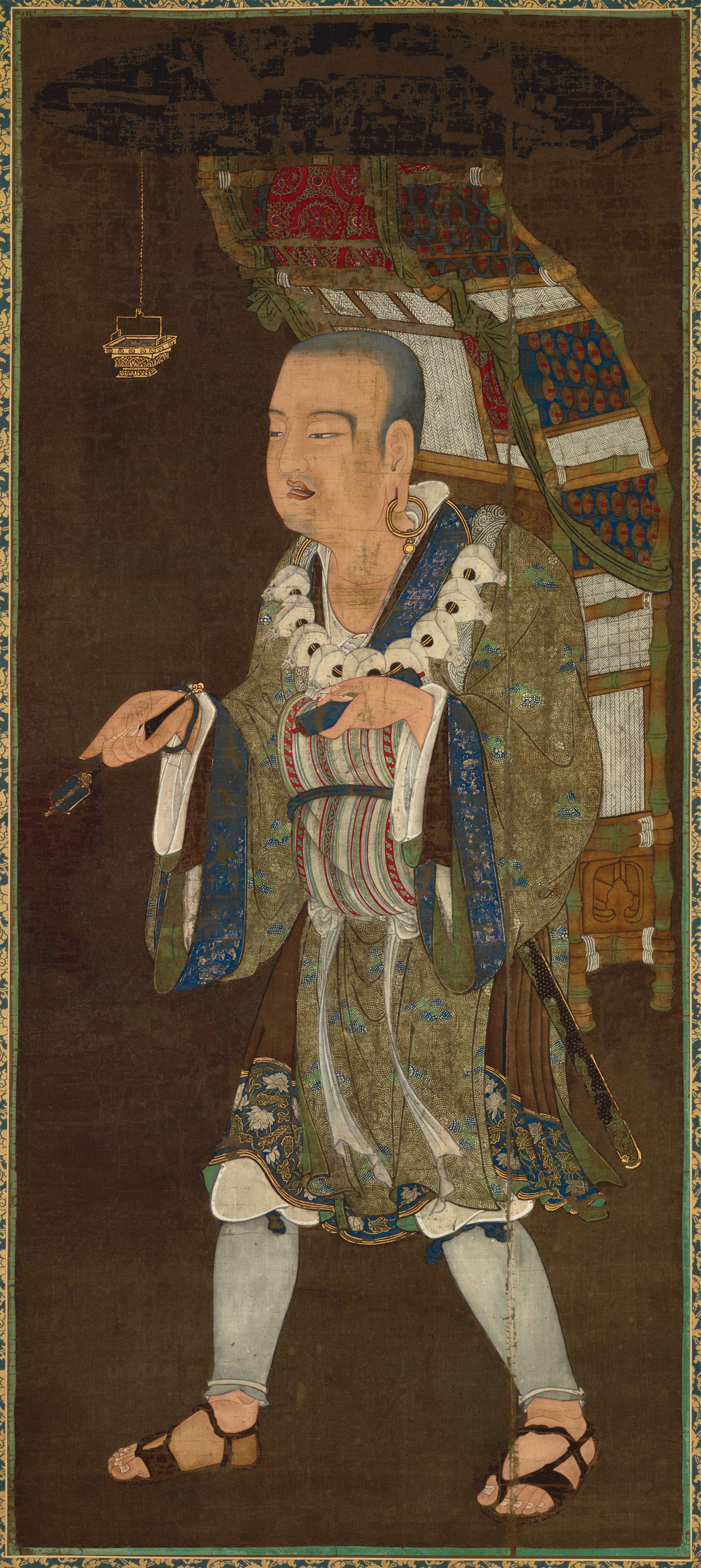
There are some important distinctions that first need to be made between the literary and historical stories before we can speculate about our version.
This is not meant to be exhaustive since trying to adapt every character and event from the novel would make it much too long. The point is to give the reader a basic understanding of what Xuanzang’s historical journey was like.
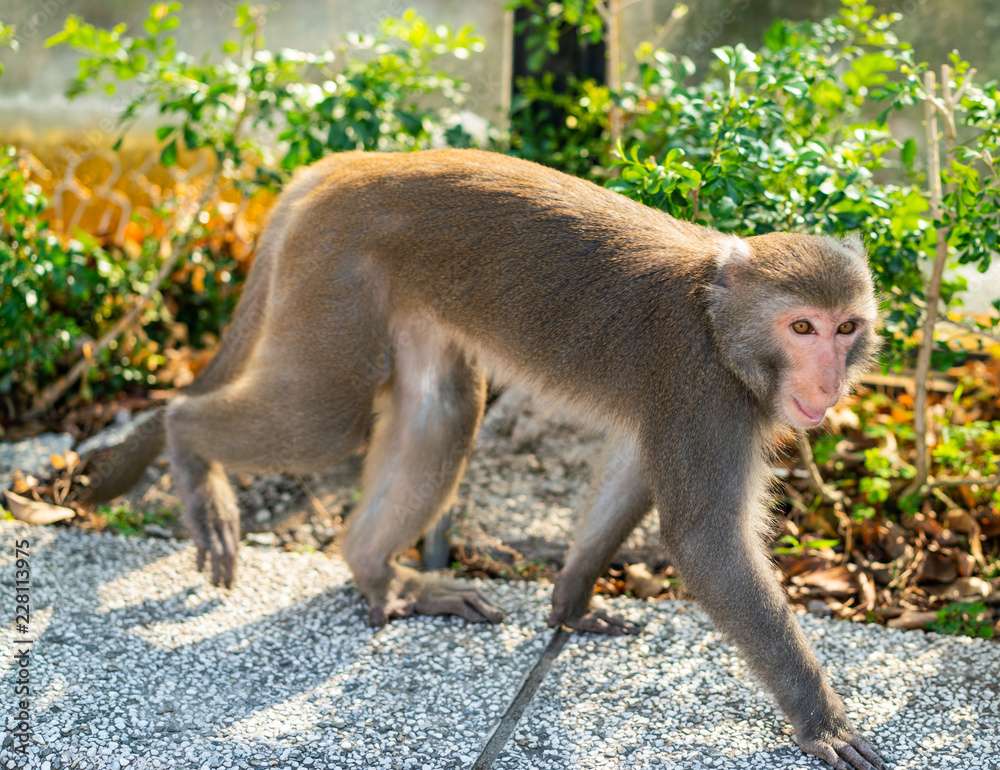
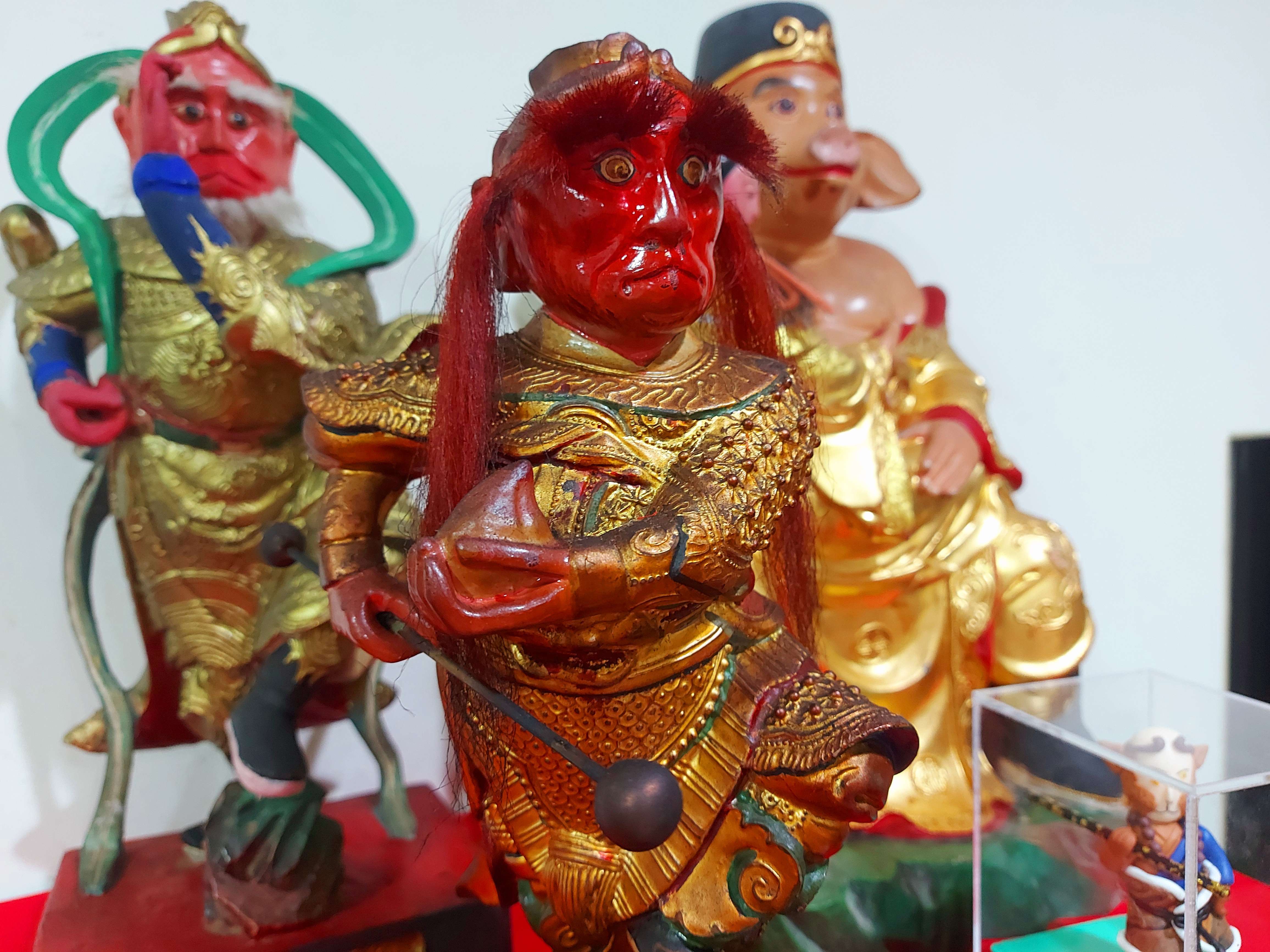
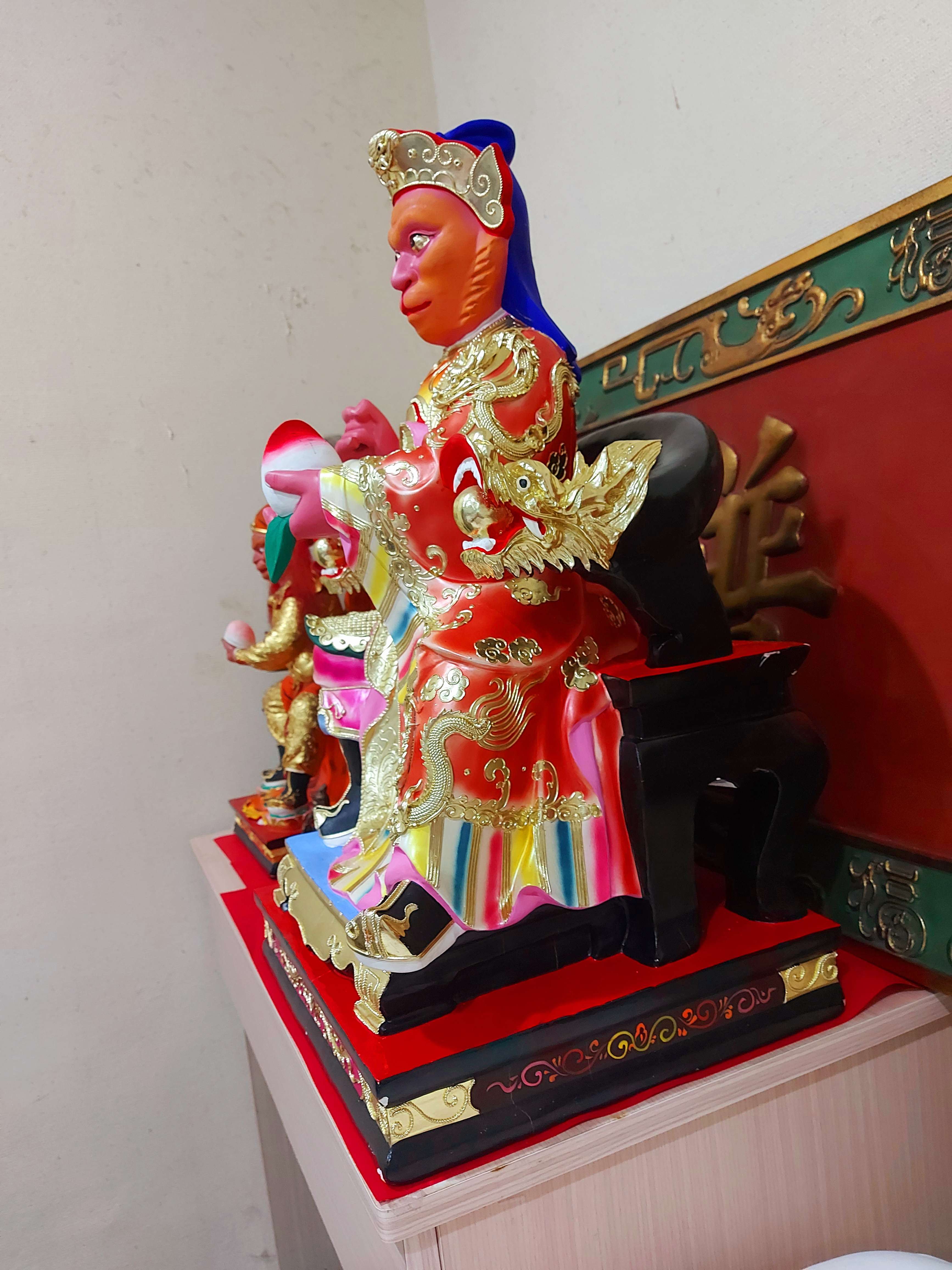
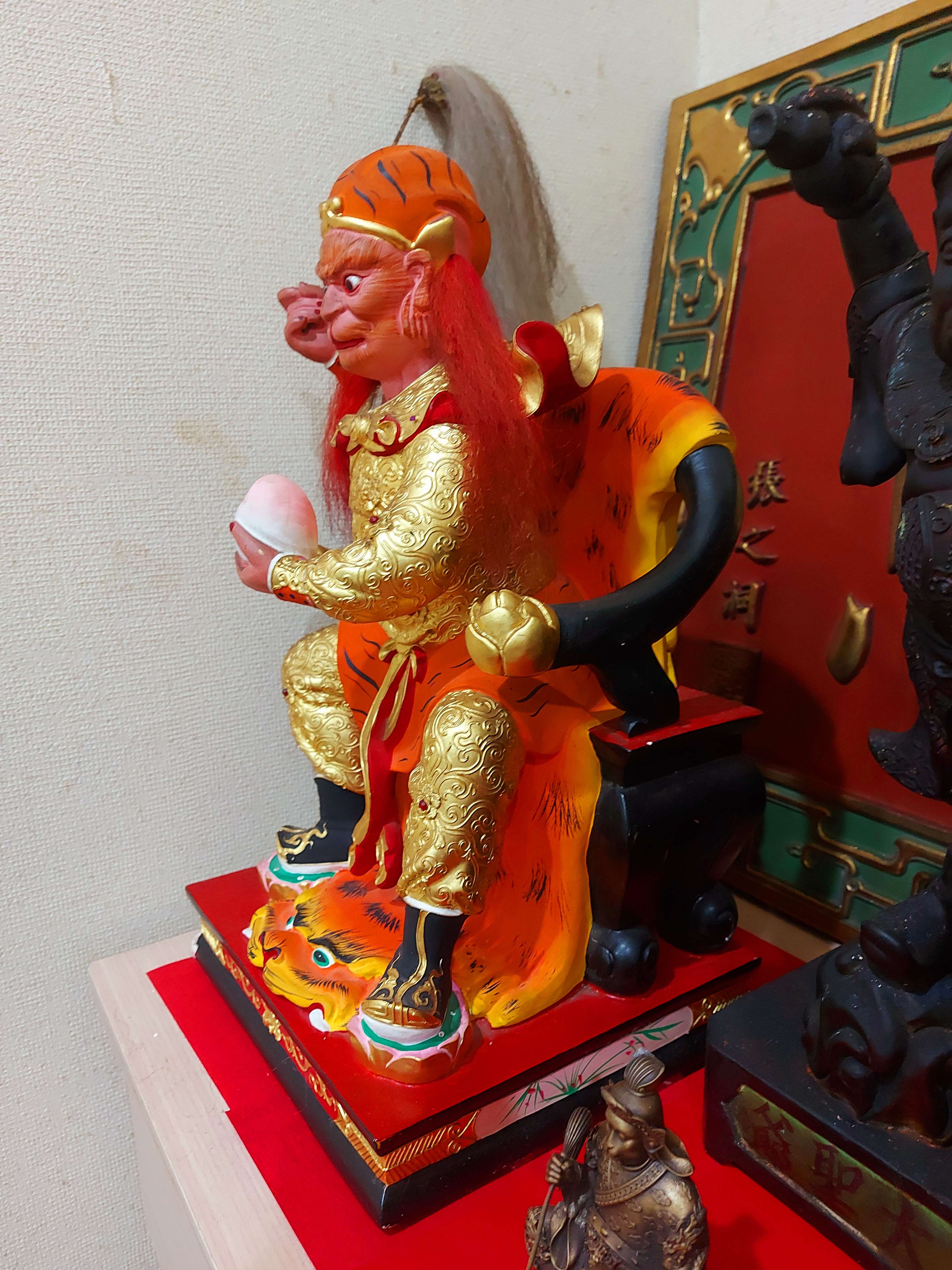
Everything prior to his birth would be nearly the same, including the monk’s previous incarnations and Sun Wukong, Zhu Bajie, and Sha Wujing’s respective early lives and punishments. But since the story will take place on Earth, the location of literary events will have to be placed in a real world context. For example, Monkey would have to be born on an island east of China. Japan is certainly an interesting option, with Mt. Fuji (Fujisan, 富士山) being a good candidate for his birthplace. Taiwan’s Mt. Jade (Yushan, 玉山) is another (see the 02-14-23 update below for more info). Fun fact: Taiwan is known for its “Rock Macaques” (fig. 3). This is a fitting name considering that Sun is born from stone.
Placing Monkey’s past in a real world context opens the door to interesting possibilities in this adaptation. The novel describes him studying Buddho-Daoist arts under the Patriarch Subodhi in the Westernmost continent (i.e. India). But since Daoism didn’t exist in ancient India, he would have likely learned Hindo-Buddhist spiritual cultivation techniques and philosophy, thereby becoming a competent (albeit short-tempered and naughty) rishi. Therefore, he would know how to read and speak the Pali/Sanskrit language of the different Buddhist and Vedic texts that Xuanzang would come to study. One implication is that Sun would be able to help his master if any language or philosophical barriers popped up. This means that his assistance would contribute to Xuanzang’s later translation of Buddhist scriptures in China!
2.1. Travel to and Life in India
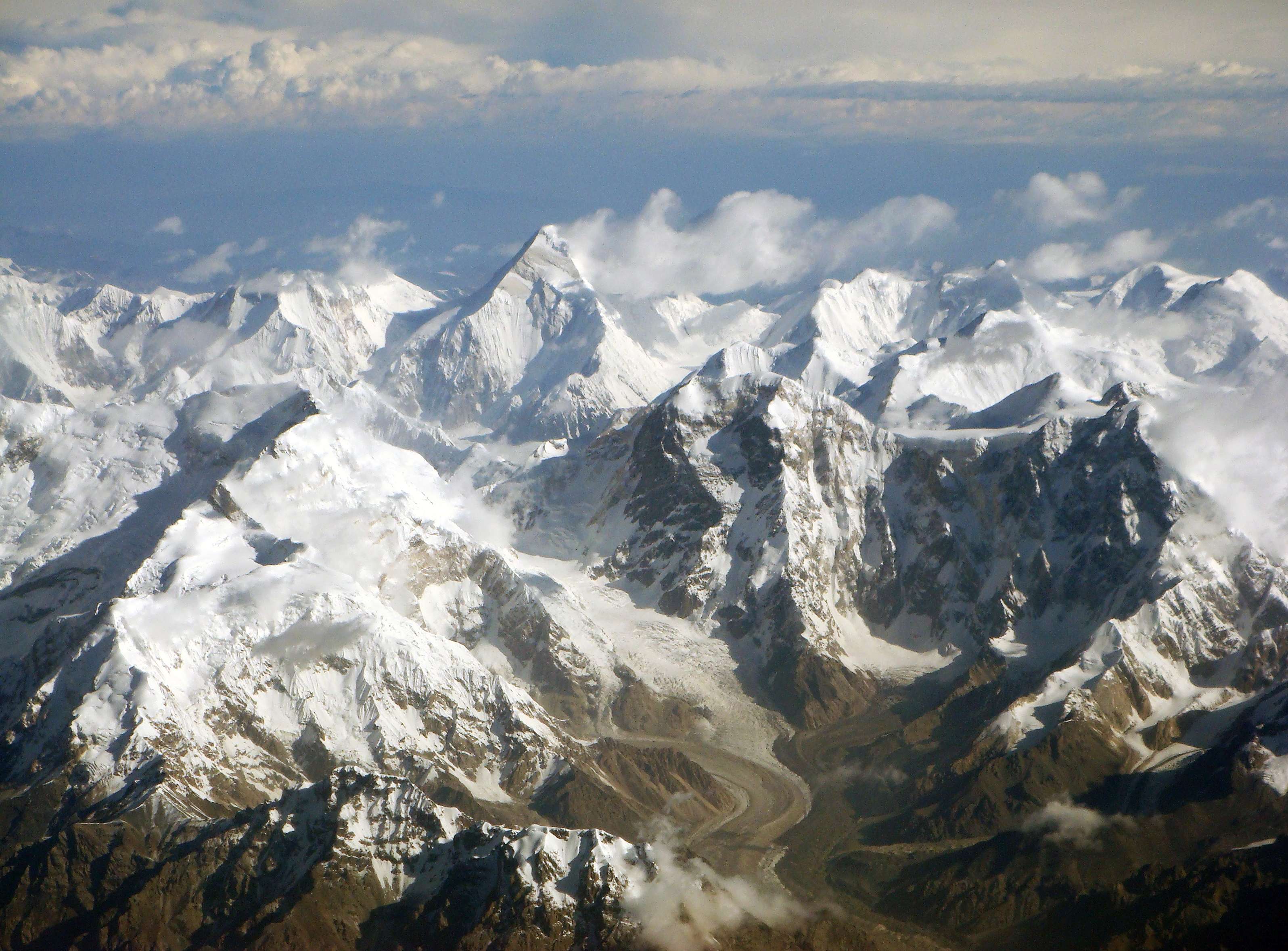
Xuanzang’s initial request to leave China was denied by the Tang court of Emperor Taizong. Undeterred, the monk traveled in secret towards the northwestern reaches of the empire in 629, eventually learning from a sympathetic official that he was to be arrested if caught (Brose, 2021, p. 16). He would likely have come across Monkey just prior to leaving China. Remember that chapter 13 also refers to Five Elements Mountain as the “Mountain of Two Frontiers” (Liangjie shan, 兩界山), the eastern half belonging to the Middle Kingdom and the western half belonging to Turkic peoples (Dada, 韃靼; a.k.a. “Tartars“) (Wu & Yu, 2012, vol. 1, p. 305). The Heavenly Mountain (Tianshan, 天山) (fig. 4) would therefore be a good spot for the trickster god’s earth prison as it stretches from Northwestern China into Central Asia.
Communication between master and disciple wouldn’t be an issue since Monkey would have likely picked up some Chinese during his early life and rebellion. The other disciples would be added at different spots along the route through Central Asia (see the 10-10-22 update below for more info). But since Zhu and Sha have memories of their previous lives, they too would likely know Chinese.
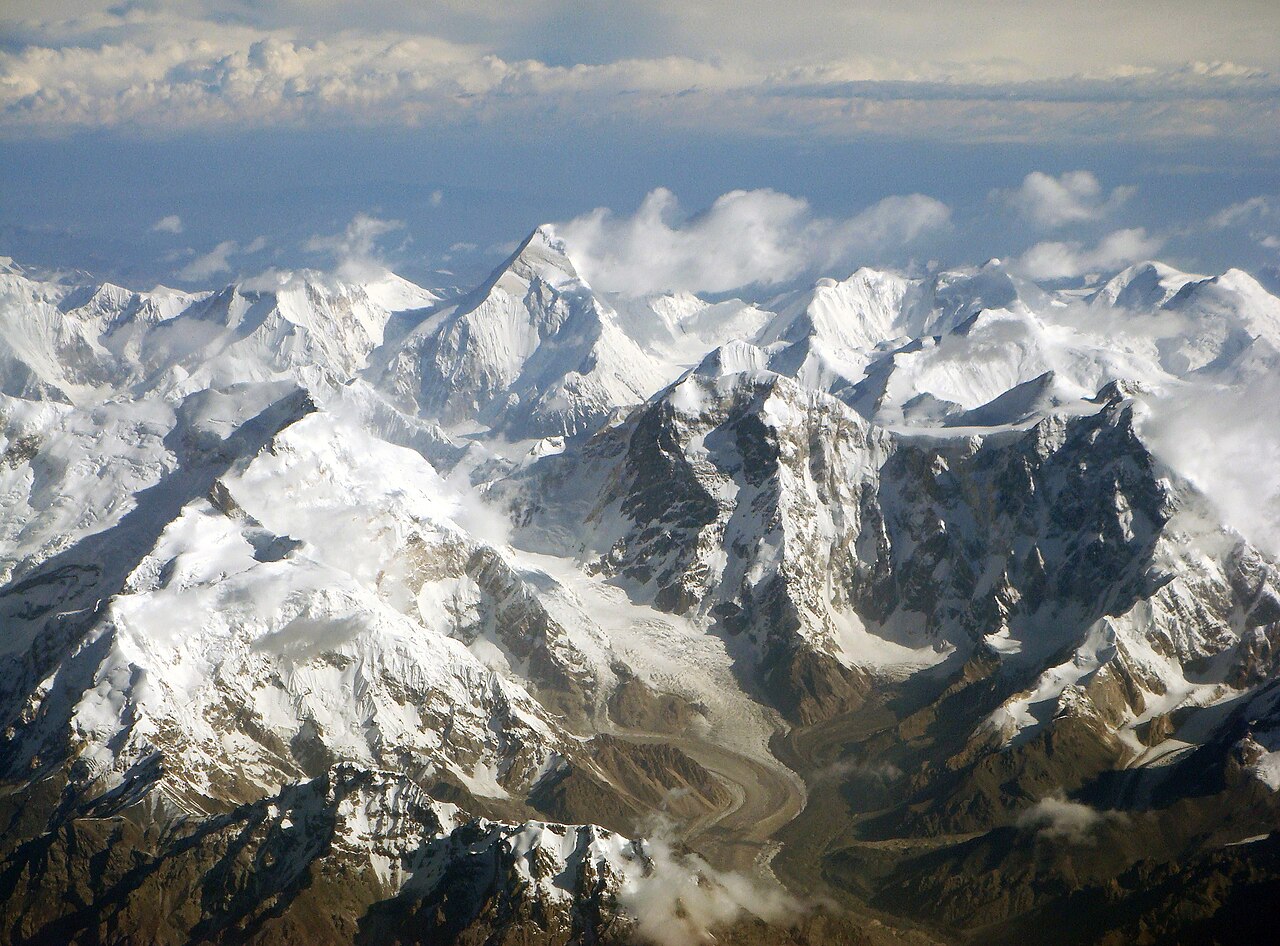
Fig. 4 – The Heavenly Mountains (larger version). Originally found on Wikipedia.
Xuanzang’s Central Asian route took him through Sūyāb (Kyrgyzstan), Samarkand (Uzbekistan), the Kunduz River valley (Afghanistan), and then Balkh (Afghanistan). Here, the monk stopped for a month to study Sanskrit literature under Prajñākara before both of them left to cross the Hindu Kush Mountains. After Bamiyan (Afghanistan), both of them attended the required three-month “Rainy Retreat” at a Buddhist monastery in Kapisā (Afghanistan). This was a time of intense study (Brose, 2021, pp. 23-28). Xuanzang likely attended the three-month retreat every year of his journey, making this aspect of the historical story a major divergence from the novel. This means that, unless the various monsters or spirits tried attacking him in monasteries, his disciples would only see action during the time (days or weeks) that it took the group to travel to a new location.
Since the story is set in the real world, Daoism’s influence would fade as the group traveled westward. This then raises the question: if Sun Wukong requires divine assistance to help identify or defeat a powerful foe in, say, Central Asia, would he zip back to the Daoist heaven in China, or would he simply consult the local foreign gods and spirits? The former possibility would allow us to stick closer to the novel, but the latter would be far more interesting. The Iranic, Judeo-Christian, or Greek gods in that area might be willing to help thanks to the Buddha’s request. I could see this leading to some comical inter-faith drama:
Foreign god: “Monkey Man, you have no power over us in this region!”
Sun Wukong: “Oh, really? Let me introduce you to my two friends [holds up fists], RIGHT and LEFT!”
But this might make the story a little too complex. And since Buddhism was present throughout Central Asia at one point or another, it would make more sense for Monkey to call on Buddhist deities for help. Either way, the story would have to be changed to accommodate gods and spirits outside of Daoism.
Prajñākara stayed in Kapisā, while Xuanzang headed for northern India. His travels took him through Nagarahāra (Afghanistan), Gandhāra (Afghanistan/Pakistan), the Swat Valley (Pakistan), Taxila (Pakistan), and Kashmir (India). He studied in the latter city for two years, while a team of twenty royally-appointed scribes copied extensive scriptures for him. For the next three years after this, he traveled through Cīnabhukti, Jālandhara, Śrughna, Matipura, and Kānyakubja, staying for a month or as long as a year in certain places to study with specialists in Buddhist and Vedic literature. Xuanzang later sailed down the Ganges River, where, according to legend, his priceless collection of Buddhist scriptures and imagery attracted the attention of Hindu pirates. When captured, he sunk into deep meditation while awaiting a sacrificial death by fire, but a strong, supernatural wind began throwing the world into chaos. Thinking that the attempted murder of the monk displeased their goddess Durga, the pirates begged for his forgiveness (Brose, 2021, pp. 30-35). This seems like a perfect demonstration of Sun Wukong’s powers. He would use this trick in place of outright murdering the bandits in order to avoid punishment via the golden headband.
Xuanzang traveled through areas of India where Buddhist institutions once flourished but had fallen into decay, some places being taken over by Hindu and Jain ascetics who practiced extreme forms of austerities. During this time, he also went about visiting all of the famous locations associated with the historical Buddha’s life but was dismayed to see some of those in ruins and/or abandoned. These included the garden where the Enlightened one was born (Lumbini, Nepal) (fig. 5), his father’s palace (Kapilavastu), where he lived as an adult (Jetavana), and the forest where he died (Kuśinagara). Xuanzang took the declining state of Indian Buddhism as proof that his time was the Latter Day of the Dharma (Brose, 2021, pp. 30-32 and 35-38). This surely strengthened his resolve to learn all he could and take back as many scriptures as possible to China in order to ensure that the religion continued to thrive there. His monstrous disciples would be the ones to tote this huge collection in place of human laborers.
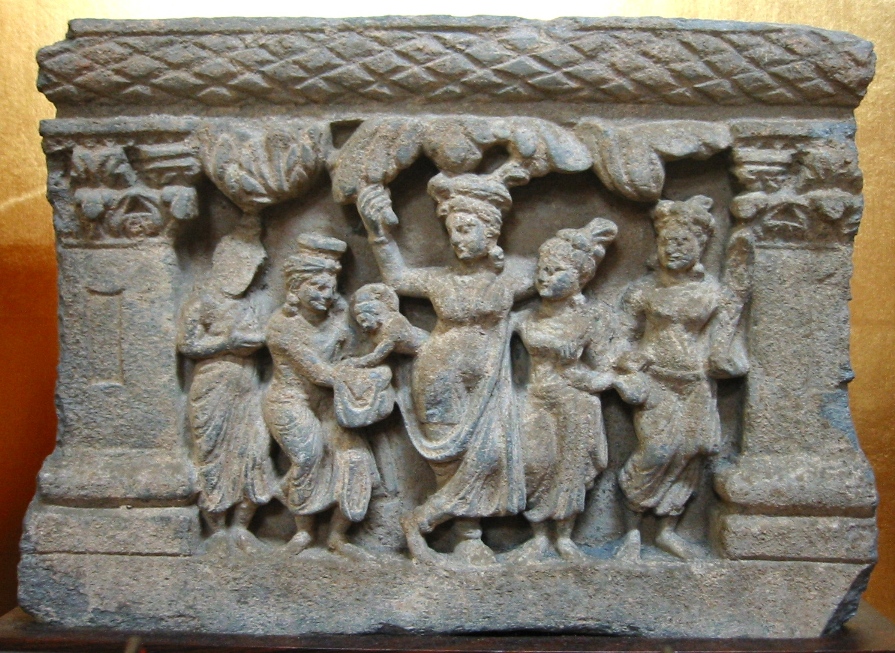
Fig. 5 – A 2nd to 3rd-century Gandharan stone carving depicting the Buddha’s birth from his mother’s side in Lumbini (larger version). Originally found on Wikipedia.
The idea of monsters and spirits attacking the monk while he visits these once flourishing but now dilapidated Buddhist sites is somewhat comical. I think that the evil would live in the various ruins or in the forests and hills around said locations. This would mean that demonic mountain strongholds from the novel would be a rarity in this retelling.
Thankfully, though, Xuanzang was able to visit two places associated with the Buddha’s life that still flourished, namely the park where he gave his first sermon (Sarnath) and the area where he achieved enlightenment (Bodh Gayā). The monk was later invited to a grand Buddhist complex in Nālandā, where he became a disciple of Śīlabhadra, a learned master of the Yogācāra school. He studied in Nālandā for five years, receiving a special status that freed him from community duties so he could focus on his studies (Brose, 2021, pp. 37-45). After a failed trip to Sri Lanka, Xuanzang traveled around southern India and eventually studied for two years in Parvata. After returning to Nālandā and learning from various local masters for a few months, he studied for two years with Jayasena, a very knowledgeable lay disciple of Śīlabhadra (Brose, 2021, pp. 50-53).
The total of Xuanzang’s time spent studying in Nālandā and Parvata alone adds up to an astounding nine years. That is an awfully long time for Sun, Zhu, and Sha to see no action. Perhaps they too would live the life of monks and possibly resume their spiritual cultivation in order to better themselves. They could even help teach the clerics at the various institutions how to protect themselves, much like the famous Shaolin Monks (fig. 6). This might replace the episode in chapter 88 in which Monkey and his religious brothers accept three Indian princes as students. Sun could instead give a chosen cadre of monks super strength and divine longevity in a similar fashion.

Fig. 6 – A group of Shaolin monks practicing martial arts (larger version). Originally found here.
Xuanzang’s final year in India was apparently an eventful one. Apart from saving Nālandā from destruction by accepting a tyrannical king’s invitation to visit, he evidently took part in a number of life or death religious debates against Brahmins and Mainstream Buddhists. However, there is no evidence that the grandest of these ever took place. It might even be a later embellishment by Xuanzang’s disciple (Brose, 2021, pp. 53-60). Therefore, I think it should be left out of the retelling.
2.2. Return to and Life in China
I’m going to skip over the events just prior to Xuanzang leaving India, as well as the various trials and tribulations that he faced along the road to China. His disciples would certainly continue protecting him from any evil that still wished to capture the monk. This means that the various episodes could be spread out to the return journey as well.
Instead, I’d like to briefly discuss Xuanzang’s life after returning to the Middle Kingdom. Despite his illegal departure, the monk was welcomed home in 645 with open arms and became an instant celebrity. Emperor Taizong shortly thereafter asked him to compose an account of his travels, the Great Tang Records on the Western Regions (Datang xiyou ji, 大唐西域記), [2] which was finished in 646. The year before, he and a team of experts from all around the empire began translating the scriptures, but fame, official duties, and later unwanted changes to group members by the proceeding Emperor Gaozong hindered the project over the years. The monk was expected to entertain aristocratic guests and donors, and he often traveled to perform the ordination of hundreds of monks at newly built monasteries. This took a toll on his body, which was apparently plagued by a chronic illness that affected his heart and bones. Wishing to escape his celebrity and return to more steady translation work, he requested and failed many times over the years to be relocated to more remote institutions. Instead, he was forced to stick close to the Tang capital, where, years later, he was lucky to escape political upheaval in the court that saw some of his official friends exiled or even executed. Apart from this, Xuanzang was forced to defend himself against critiques on two fronts. On one side were Daoists who disliked his fame and railed against the foreign nature of Buddhism (Daoism was after all the state religion at that time). And on the other, some Buddhists heavily criticized his translation method, as well as his Yogācāra philosophy, which differed from other Mahāyāna teachings. At the end of his life, the poor monk injured his leg in an accident and was bedridden for two months before dying at the age of 61 in 664. His death was apparently followed by miraculous lights in the sky. [3]
Now, I can already hear some of my readers asking: what happened to his disciples? Does everyone still achieve an elevation in spiritual rank? Monkey and his religious brothers would have left by this time. Whereas the pilgrim’s meet the Buddha face to face in India at the end of the novel, he would instead manifest before them (or at least jointly in their dreams) after they successfully transported the scriptures to China. This is when he would offer them their respective promotions, Sun becoming a Buddha, Sha Wujing an arhat, and Zhu an altar cleaner. They would thereafter leave to enjoy their divine lives in the Western Paradise (see the 11-04-23 update below for more info). However, I think Xuanzang would postpone his enlightenment until he finished translating the scriptures. Monkey might even visit his former master in his dreams and encourage him to continue his work even when he is old and sick. The many hardships that the monk faces towards the end of his life would, therefore, make his final ascension all the more bittersweet.
I’m interested to hear reader’s ideas on where they might insert famous episodes into this more realistic setting. Please let me know in the comments below or in an email (see the “contact” button above).
3. Updates
Update: 10-10-22
It turns out that Sha Wujing would be the first disciple recruited on the road to India in our more realistic retelling. As I show in this article, his antecedent appears in various retellings of Xuanzang’s journey as a stern, encouraging spirit or even a heaven-sent protector.
The monk’s embellished biography notes that, while traveling west of the Jade Gate, he chose to bypass various watchtowers on his illegal journey by trekking though the 800 li Gashun Gobi desert (Mohe yanqi, 莫賀延磧). But after only 100 li, Xuanzang lost his surplus of water when the heavy bag slipped from his hands. He went without drink for four days, all the while chanting the name of Avalokiteśvara (i.e. Guanyin) for deliverance, as well as the Heart Sutra, to keep demons at bay (Huili & Li, 1995, pp. 26-27). On the early morning of the fifth day, a divine mist lulled him to sleep, where:
[He] dreamed that he saw a giant deity several tens of feet tall, holding a [halberd] and a flag in his hands. The deity said to him, “Why are you sleeping here instead of forging ahead?” (Huili & Li, 1995, p. 28).
即於睡中夢一大神長數丈,執戟麾曰:「何不強行,而更臥也!」
After he awoke and mounted his horse, it veered in a different direction than Xuanzang intended and arrived at a much needed oasis, which was apparently provided by Guanyin (Huili & Li, 1995, p. 28).
However, a Tang-era Japanese source appearing in a work of the 11th-century states that the “Spirit of the Deep Sands” (Shensha shen, 深沙神) physically interacted with Xuanzang, calling himself the monk’s “guardian spirit” and even providing him with food and water (Dudbridge, 1970, p. 19). The same source also states that he had previously appeared before the earlier monk Faxian (法顯, 337-422) in a ghastly, demonic form (fig. 7):
I am manifested in an aspect of fury. My head is like a crimson bowl. My two hands are like the nets of heaven and earth. From my neck hang the heads of seven demons. About my limbs are eight serpents, and two demon heads seem to engulf my (nether-) limbs… (Dudbridge, 1970, p. 20).

Fig. 7 – A 13th or 14th-century Japanese carving of the Spirit of the Deep Sands (larger version).
The spirit’s great height influenced Sha’s whopping twelve Chinese-foot (zhang er, 丈二; 12.6 feet / 3.84 m) frame (Wu & Yu 2012, vol. 2, p. 51), his necklace of heads was the model for our hero’s necklace of skulls (Wu & Yu 2012, vol. 1, p. 230), and the “Moving Sands” (Liusha, 流沙) of his harsh desert home served as the basis for Wujing’s “Flowing-Sands River” (Liusha he, 流沙河) (Wu & Yu 2012, vol. 1, p. 421).
I would like to combine details from the Chinese and Japanese sources, making the Spirit of the Deep Sands a physical being, and instead of the pearly thread-wrapped wooden staff wielded by Sha in the novel (Wu & Yu, 2012, vol. 1, p. 428), the deity would use the aforementioned halberd. I’d also borrow from the novel, having him exiled to earth for an offense in heaven, but in place of the Flowing-Sands River, be banished to the desert to await the coming of Xuanzang (Wu & Yu 2012, vol. 1, p. 210).
Another interesting change that just occurred to me would be to completely reverse the order of Xuanzang’s disciples. Even though the literary monk happens upon them in the order of Sun Wukong, Zhu Bajie, and Sha Wujing, Guanyin first recruits them in the order of Sha, Zhu, and Sun (Wu & Yu 2012, vol. 1, pp. 207-216). Making Monkey the lowest-ranking, yet most powerful religious brother would lead to some funny situations. Sha and Zhu might try to order him around at first, but they would soon learn not to test the powerful monkey rishi’s patience. I can see them begging him to intervene when they can’t defeat a given evil.
Perhaps Zhu would be recruited in Central Asia, while Monkey might be discovered under a mountain closer to India. What say you?
Update: 12-17-22
Journey to the West characterizes the Buddha as having a corporeal form. This is revealed in chapter 55 when a Scorpion Spirit (Xiezi jing, 蝎子精) stings and hurts him:
Once upon a time she [the scorpion] happened to be listening to a lecture in the Thunderclap Monastery. When Tathagata saw her, he wanted to push her away with his hand, but she turned around and gave the left thumb of the Buddha a stab. Even Tathagata found the pain unbearable! (Wu & Yu, 2012, vol. 3, p. 72).
他前者在雷音寺聽佛談經,如來見了,不合用手推他一把,他就轉過鉤子,把如來左手中拇指上扎了一下。如來也疼難禁 …
I take this to mean that the Scorpion Spirit was imbued with “dharma power” (fali, 法力) while listening to the Enlightened One’s lectures. This makes sense as Campany (1985) explains that this is the penultimate power in the novel’s Buddho-Daoist universe.
(Baring a discrepancy in chapter six, [4] the Scorpion Spirit is the only figure in all of Journey to the West shown capable of piercing the Monkey King’s adamantine hide (Wu & Yu, 2012, vol. 3, p. 65). She does so with her “horse-felling poison stake” (daoma du zhuang, 倒馬毒樁), which is actually her stinger (Wu & Yu, 2012, vol. 3, p. 72).)
But since this article focuses on a real world journey set over a 1,000 years after the Enlightened One’s death, I would like to suggest that similar exposure to the spiritual power of the Buddha might give other demons or spirits a similar boost. In this case, the items granting this power would be relics associated with Shakyamuni.
Strong (2004) notes that there are three main types of Buddha relics: 1) those of the body left over from his cremation (hair, teeth, nails, bones, and Śarīra beads); 2) those that he used (walking staff, alms bowl, robes, etc.); and 3) those that he taught (i.e. lessons from scripture) (p. 8). I think that the first and second categories would be perfect for our story, especially the Śarīra (Sheli/zi, 舍利/子). These pearl-like beads were associated with the wish-fulfilling Cintāmaṇi (Ruyi baozhu, 如意寶組) jewel in East Asia (Strong, 2004, p. 10), so I could see them granting spirits power. [5]
Evil forces might sneak into monasteries to retrieve such items in a bid to gain extra power in order to fuel their nefarious machinations, assert their will on the surrounding populous, and/or to defeat Monkey and his religious brothers, thereby allowing them to gain immortality by eating the Tang Monk. Protecting the relics would, therefore, be one reason to keep the demon disciples busy during Xuanzang’s long years of study.
Update: 12-29-22
It turns out that Journey to the West has śarīra beads. In fact, they are mentioned at least 18 times throughout the novel. One example is a treasure belonging to the Yellow-Robed Demon (Huangpao guai, 黃袍怪). Chapter 31 reads:
Leading Pilgrim [Sun Wukong], the fiend [Yellow Robe] took his companion into the murky depth of the cave before spitting out from his mouth a treasure having the size of a chicken egg. It was a śarīra [shelizi, 舍利子] of exquisite internal elixir. Secretly delighted, Pilgrim said to himself, “Marvelous thing! It’s unknown how many sedentary exercises had been performed, how many years of trials and sufferings had elapsed, how many times the union of male and female forces had taken place before this śarīra of internal elixir was formed. What great affinity it has today that it should encounter old Monkey!” (Wu & Yu, 2012, vol. 2, pp. 80-81). [6]
那怪攜著行者,一直行到洞裡深遠密閉之處。卻從口中吐出一件寶貝,有雞子大小,是一顆舍利子玲瓏內丹。行者心中暗喜道:「好東西耶。這件物不知打了多少坐工,煉了幾年磨難,配了幾轉雌雄,煉成這顆內丹舍利。今日大有緣法,遇著老孫。」
As can be seen, Yellow Robe’s śarīra is portrayed as the hard-won product of spiritual cultivation. This agrees with Strong’s (2004) statement that Buddhists believed such beads were “brought on not only by the fire of cremation but also by the perfections of the saint (in this case the Buddha) (emphasis added) whose body they re-present” (p. 12).
But in our realistic retelling, Yellow Robes could have stolen the treasure from a monastery or stupa.
Update: 01-04-23
I mentioned in the original post that Sun Wukong would study Hindo-Buddhist arts and become a talented rishi. The Saṃyutta Nikāya (Sk: संयुक्त निकाया; Ch: Xiang ying bu, 相應部, c. 250 BCE) notes that such cultivators develop a host of supernatural powers once they master the four mental qualities (Pali: Iddhipāda):
- Multiplying the body
- Vanishing and reappearing
- Passing through solid objects (walls, ramparts, mountains, etc.)
- Diving into the earth like water
- Walking on water like earth
- Traveling through space
- Touching the sun and moon
- Hearing all sounds, both human and divine
- Knowing the minds of others
- Having memories of all of one’s past lives
- Knowing the future rebirths (and their causes) of all beings
- Liberation from the filth of the world through supreme wisdom (Bodhi, 2000, pp. 1727-1728)
Monkey already exhibits several of these powers in the original narrative.
Update: 01-29-23
Here’s another example of the śarīra beads appearing in Journey to the West. Chapter 62 reads:
This all came about because our All Saints Old Dragon once gave birth to a daughter by the name of Princess All Saints, who was blessed with the loveliest features and the most extraordinary talents. She took in a husband by the name of Nine-Heads, who also had vast magic powers. Year before last, he came here with the Dragon King and, exerting great divine strength, sent down a rainstorm of blood to have the treasure pagoda defiled. Then he stole the sarira Buddhist treasure from the building. Thereafter the princess also went up to the great Heaven where she stole the nine-leaved agaric, which the Lady Queen Mother planted before the Hall of Divine Mists. The plant and the Buddhist treasure are both kept now at the bottom of the lagoon, lighting up the place with their golden beams and colored hues night and day (Wu & Yu, 2012, vol. 3, p. 172).
因我萬聖老龍生了一個女兒,就喚做萬聖公主。那公主花容月貌,有二十分人才。招得一個駙馬,喚做九頭駙馬,神通廣大。前年與龍王來此,顯大法力,下了一陣血雨,污了寶塔,偷了塔中的舍利子佛寶。公主又去大羅天上,靈霄殿前,偷了王母娘娘的九葉靈芝草,養在那潭底下,金光霞彩,晝夜光明。
This supports the idea of evil attacking monasteries, and raining down blood would be one method of deconsecrating said locations.
Update: 02-14-23
Above, I mentioned that Japan or Taiwan would be good candidates for the Mountain of Flowers and Fruit, but I now feel that I didn’t give enough context. As I explain in this article (and briefly in sec. 1.1 above), Buddhist cosmic geography portrays the world as four cardinal continents surrounding a great mountain. Journey to the West changes the original system by associating China with the southern continent and moving India to the western continent. If we continue this trend by associating the other two continents with real countries, the north would be Russia or Mongolia and the east would be Korea (fig. 8). And since the Mountain of Flowers and Fruit is said to be an island east of the eastern most continent, Japan would be the best choice (fig. 9). This means Sun would be a Snow Macaque.

Fig. 9 – A top view of Buddhist cosmic geography overlaid with the names of real world countries (larger version). Adapted from Buswell & Lopez, 2014, pp. xxxi. Fig 10 – Detail from a map of East Asia (larger version). Map found here.
Update: 08-26-23
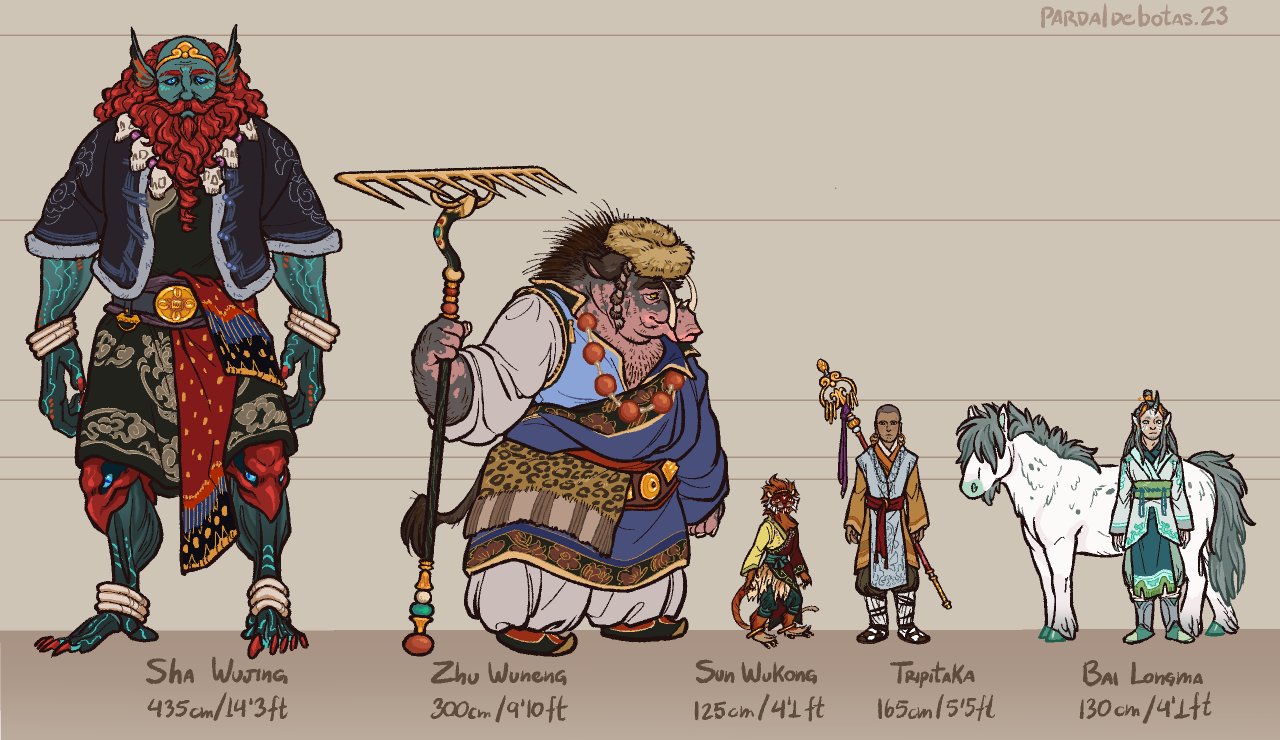
Tumblr user digitalagepulao has drawn lovely versions of the JTTW pilgrims (fig. 11). This is for their own “Expedition to the West au” (JTTW alternate universe) storyline based on the info presented above in the original article. They explain their design choices based on the countries where the disciples are recruited:
Sha Wujing (435cm): His outfit is mostly inspired by Mongolian clothes since he’s found in the Gobi desert stretch of the journey. His bangles are made of fossil bone, and he can use the waist cloth as a headwrap during adverse weather. His markings are inspired by African Lungfish and Mudfish fins, as they are species that exist somewhere between water and dry air. The beasts on his knees are an extension of him, and he can see and speak through them as needed. His beard and long hair can have Ghibli physics depending on his mood and emotions.
Zhu Wuneng (~300cm): Inspired by Northern Tibetan clothes, as that’s the region the group recruits him. Traditional clothes tend to have way more accessories and golden details so I had to simplify a bit. His features are a mix of wild boars and Indonesian babirusa, with the iconic bristles on his head. I leaned on ceremonial Tibetan swords and necklace beads for the decorations on his rake. His vest can be closed, he just prefers not to most of the time.
Sun Wukong (125cm): I’ve already commented on his design over here, but I’ll elaborate that the yellow shirt is the one he gained from Tripitaka soon after he was released, while the pants and red half-robe were the garments he was given by Guan Yin. The hoops on his feet and purple beads were reacquired back in Huaguoshan when he first fled the pilgrimage, heading to his family instead of Ao Guang’s palace. (A-ma and Jinju gave them to him so he’ll always have something to home to remember them by, as well as where he first started, as the beads were gained during his lessons with Subodhi.)
Tripitaka (163cm): This is but one of his many outfits since travel can be rough on clothes, and even more so when you get kidnapped by demons and thrown off your horse all the time. He wears the usual orange monk robes, with some kind of travel clothes over them. He gains some fur boots from Boquin for cold weather but usually prefers sandals most of the time. He seldom uses the cassock and crown he received from Guan Yin, save for when he pays respects to temples and holy sites, but the staff is a constant companion.
Ao Lie (167cm, 130cm at the shoulder as horse): Being effectively in exile until the journey is complete, he wears less fancy clothes than he usually would as a prince, but his status still shows. I tried to balance more casual hanfu of the era with some armor parts, like the waist guard and armored boots. He was given the skill to shapeshift into a horse by Guan Yin when she commanded him to wait for the chosen pilgrim monk, so he can shift at will, but preferably when the tack has been taken off. Speaking of, tack is lost and replaced multiple times during the journey, so I didn’t depict any specific one.

Fig. 11 – Digitalagepulao’s JTTW character designs (larger version). Used with permission.
Update: 11-04-23
Above, I stated: “They [Sun Wukong, Zhu Bajie, and Sha Wujing] would thereafter leave to enjoy their divine lives in the Western Paradise.” But I’ve never really liked the idea that Monkey would forever abandon his people. This is especially true since his rebellion led to heaven decimating the monkeys and burning their cave (Wu & Yu, 2012, vol. 2, p. 31). So, I think a better ending for this historical version would be for the “Victorious Fighting Buddha” (fig. 12) to return to the Mountain of Flower and Fruit, where he transforms it into his own Pure Land (Jingtu, 淨土). The monkeys killed in years passed would be reborn there, and everyone would receive periodic lessons on the dharma between bouts of play. It would be a paradise even grander than when the Great Sage was at the height of his power.

Fig. 12 – Monkey as the Victorious Fighting Buddha (larger version). Imagery based on the iconography of the historical Yuddhajaya Buddha. Art by NingadudeXx.
Update: 10-04-25
Here’s an article where I propose a more natural reason for Wukong and the Greek hero Heracles to fight each other. It’s based on the above story idea.
Story Idea: Sun Wukong vs Heracles / Hercules
Note:
1) The novel adds four more fictional years to a historical reign period (see section 1 here).
2) The Emperor’s true purpose in asking for the travelogue was to gain information pertinent to military campaigns against Turkic forces west of China (Brose, 2021, pp. 75-76).
3) See chapter 3 in Brose (2021).
4) Chapter six reads: “They bound him with ropes and punctured his breastbone with a knife, so that he could transform no further” (Wu & Yu, 2012, vol. 1, p. 186). But this is not stated or implied to be a form of physical punishment. It serves only to keep Monkey in his base form. The blade is mentioned again in chapter seven: “Arriving at the Tushita Palace, Laozi loosened the ropes on the Great Sage, pulled out the weapon from his breastbone, and pushed him into the Brazier of Eight Trigrams” (Wu & Yu, 2012, vol. 1, p. 189).
5) I guess the beads would be swallowed or kept close to the body. Their holy power would surely kill lesser devils but empower cultivator-demon kings.
6) Source altered slightly. I’ve made it more accurate.
Source:
Bodhi, B. (2000). The Connected Discourses of the Buddha: A Translation of the Saṃyutta Nikāya; Translated from the Pāli by Bhikkhu Bodhi (Vols. 1-2). Boston: Wisdom Publications.
Brose, B. (2021). Xuanzang: China’s Legendary Pilgrim and Translator. Boulder, Colorado: Shambhala Publications, Inc.
Buswell, R. E. , & Lopez, D. S. (2014). The Princeton Dictionary of Buddhism. Princeton University Press.
Campany, R. (1985). Demons, Gods, and Pilgrims: The Demonology of the Hsi-yu Chi. Chinese Literature: Essays, Articles, Reviews (CLEAR), 7(1/2), 95-115. doi:10.2307/495195
Dudbridge, G. (1970). The Hsi-Yu Chi: A Study of Antecedents to the Sixteenth-Century Chinese Novel. Cambridge: Cambridge Univ. Press.
Huili, & Li, R. (1995). A Biography of the Tripiṭaka Master of the Great Ci’en Monastery of the Great Tang Dynasty. Berkeley: Numata Center for Buddhist translation and research.
Strong, J. S. (2004). Relics of the Buddha. Princeton, NJ: Princeton University Press.
Wu, C., & Yu, A. C. (2012). The Journey to the West (Vols. 1-4) (Rev. ed.). Chicago, Illinois: University of Chicago Press.