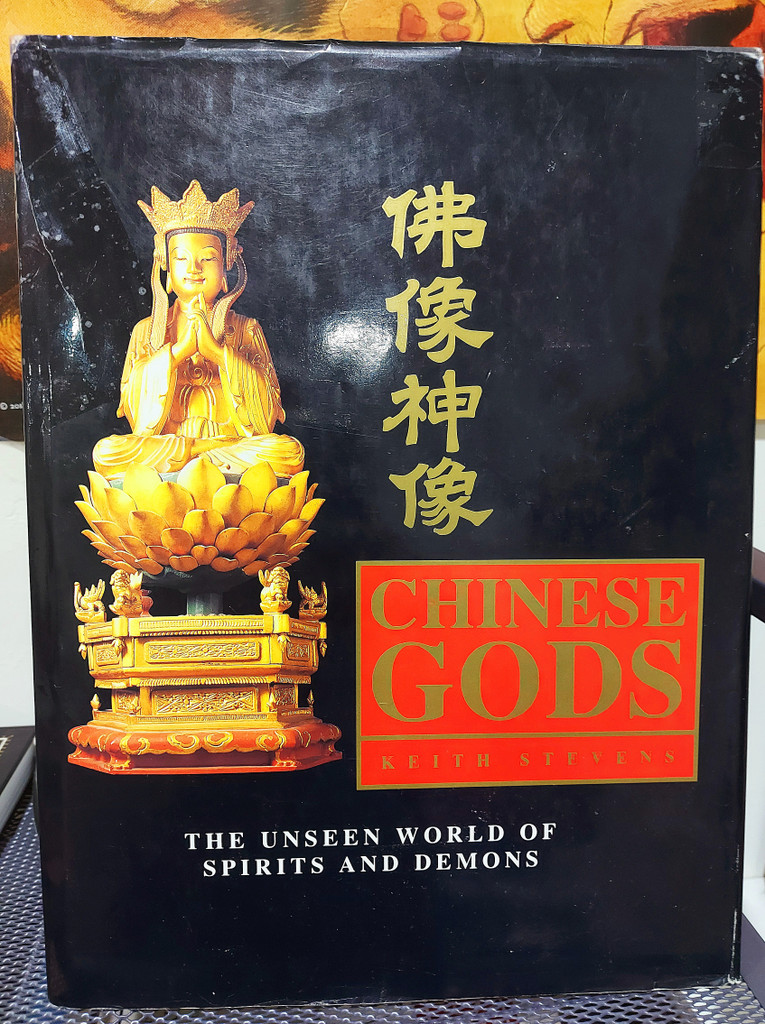
The novels Journey to the West (Xiyouji, 西遊記, 1592) and Investiture of the Gods (Fengshen yanyi, 封神演義, c. 1620) are dramatized examples of the syncretic Buddho-Daoist pantheon of Chinese Folk Religion. The number of Buddhas, sages, gods, immortals, spirits, guardians (etc.) revered by people of Chinese descent is enormous, and new figures are being added to the list even to this day. Needless to say, laymen and researchers who visit temples and wish to correctly identify a particular deity need a resource with images, names, and listed attributes. Luckily there is one such source. Keith Stevens (1926-2015), a veteran of the British Army and Foreign and Commonwealth Office, traveled East and Southeast Asia for 40 years collecting information on the folk pantheon. He produced an invaluable monograph titled Chinese Gods: The Unseen World of Spirits and Demons (1997). The book is unfortunately out of print, and available copies are expensive to buy. So, I am pleased to host a PDF of this wonderful work on my site.
The scan was produced with an overhead document camera. The glossy pages made scanning somewhat difficult. I had to use a soft, indirect light source. Therefore, not all pages are crisp due to the low light levels.
My well-worn personal copy of Chinese Gods (larger version).
1. Dust Jacket Description
China is a land full of gods and goddesses, ranging from the Creators of the World to Worthies local to only one or two villages.
This book introduces the reader to the most important figures of Chinese folk history, and those of Buddhism, Taoism and Confucianism.
Intensely pragmatic in their religion, Chinese people hold all gods in reverence, but it is only the ones who answer prayers with concrete results that are exceptionally praised. Many gods have particular specialities, for instance, there are different Wealth Gods for success in business and for gambling. There are also individual gods for each trade, from those for removal men in Hong Kong to students at Beijing University.
In addition, there are the City Gods and Kitchen Gods, the Earth Gods who protect a specific piece of land, and myriad spirits who protect wells, mountains or bridges, distribute rain or snow, control flooding or protect humanity from disease and epidemics.
Keith Stevens has spent a lifetime researching the subject, travelling extensively in China, Taiwan and throughout South-East Asia. He has gathered information from hundreds of temple keepers, god-carvers and religious specialists and collected details of images and their stories – providing glimpses into the sometimes little-known folk history of China. The author also provides pointers on how to identify images, together with invaluable background information including chronology of Chinese history, a map of the area covered, a glossary and detailed index with the names of deities in Chinese characters.
This has been posted for educational purposes. No malicious copyright infringement is intended. If you like the digital version, please support the official release.
Citation:
Stevens, K. G. (1997). Chinese Gods: The Unseen World of Spirits and Demons. London: Collins & Brown.
Note: This post is not endorsed. I received no compensation for the review.
I have an ongoing international survey gauging the readership of Journey to the West. With almost 1,000 responses, 53.4% of the respondents have never read the novel. Another 28.8% have only read a few chapters, including abridgements. Most have learned about the story via video games, comic books, or the internet. This shouldn’t come as a surprise, though, as the majority of respondents come from North America (52.5%) and Europe (18.8%). Such non-Chinese speaking/reading populations do, however, have access to assorted translations. For example, the most popular English renditions are Arthur Waley’s 30-chapter abridgement Monkey (1942) and full translations like W.J.F. Jenner’s Journey to the West (2001) (see here for PDFs) and Anthony C. Yu’s The Journey to the West (revised 2012 edition). Yu’s version is by far the most accurate, but it runs well over 2,000 pages (including a 100 page introduction, copious explanatory notes throughout the four volumes, and many scholarly sources), making it a daunting task to read. But what about those who wish to read the original Chinese? Well, the edition put out by the People’s Literature Publishing House (人民文學出版社, 1955/2017), for example, has 866,000 Chinese characters, and while the novel is written in the vernacular, a person would need to know 3,000 or more characters before they could comfortably read it. This means beginning students would normally have to wait years until they reached the appropriate reading level. But now they have a new option.
Jeff Pepper (writer and publisher) and Dr. Xiaohui Wang (translator) of Imagin8 Press have produced a series of bilingual retellings of the tale at the 600 and 1,200 HSK word levels, as well as a few with 1,500 based on new words introduced in past books. [1] So far there are 14 books in the series covering chapters one to 42 (Monkey’s stone birth to the defeat of Red Boy). All are available in Simplified Chinese, while (as of March 2021) only the first six books are available in Traditional Chinese. Each is divided into four parts: 1) a preface with a brief explanation of the series and a recap of the story from previous books; 2) the story proper presented in pinyin with the corresponding Chinese on the adjoining page; 3) the English translation; and 4) an alphabetized glossary of terms with four columns listing the Chinese character, pinyin, English meaning, and when new words (not part of HSK3) are “First Used” in a given book (i.e. 1, 2, 3, etc.). [2] If the First Used column is blank for a given character, this is because “the word is part of HSK3 or is in common usage” (Pepper & Wang, 2018a, p. 119). Furthermore, students have the added option of listening to audiobooks available for free on Imagin8’s YouTube channel. This means they can practice both their reading and listening skills. Needless to say, this series truly is an amazing resource.
The cover of book one. Design by Katelyn Pepper (larger version).
Now on to the story. Given the reduced word count, the tale in each book is a simplified version of the original. The first book opens on a parent telling Journey to the West as a bedtime story to their child, each subsequent volume representing a different night’s story. Certain aspects, such as the names of minor gods, immortals, and demons, as well as copious literary poems, are cut out as they don’t really affect the overall story. [3] The narrative flows smoothly and follows the general outline from Anthony C. Yu’s English translation. [4] The rhythm of pages is occasionally broken up by beautiful black and white drawings by Next Mars Media, each of which is accompanied by a bilingual caption.
Beyond a few very minor inaccuracies in the story, I only have two major complaints. One, the tendency to gloss over certain facets of the narrative resulted in the removal of one major aspect of Sun Wukong’s early training, which is the source of his most famous magic power. In the original, the Buddho-Daoist Sage Subodhi teaches Monkey the 72 transformations in order to hide from a trio of heaven-sent punishments scheduled to kill him for attaining immortality. After subsequently learning how to fly via the cloud somersault, he is expelled from the Sage’s school for showing off his newfound powers of metamorphosis to his less accomplished classmates. But in book one of the series, Wukong’s lesson on shapeshifting is mysteriously replaced with flight training. It is implied that he can simply fly away from said punishments (Pepper & Wang, 2018c, pp. 55 and 57 and 82-83). And instead of being kicked out for showing off his transformations, Subhuti simply tells him to leave because he’s “disturbing the other students” (Pepper & Wang, 2018c, pp. 57 and 83). This removal doesn’t make any sense, especially when our hero exhibits transformations in later books (Pepper & Wang, 2018b, pp. 39 and 78, for example).
Two, the Chinese sections of books one to five are very short, running between 25 to 30 pages with only 14 lines per page. The rest of the books are comprised of the aforementioned preface, the pinyin pages, the English translation, the images, and the glossary. However, book six and beyond tend to have more pages, especially those from book seven onwards as this is when the 1,200 word level is introduced. In addition, Imagin8 has produced a number of compilations, each collection containing three books (example).
For my overall rating, I would give the series 4.5 out of 5 stars. I highly recommend it for those in the early stages of learning Chinese. It will surely serve as a gateway to learning more about Chinese history, religion, and mythology.
Notes:
1) Mr. Pepper was kind enough to send me the first six volumes in Simplified Chinese back in 2019. He recently sent me the Traditional Chinese version of volume six.
2) Book one is missing this “First Used” column. It was introduced in book two under the listing “New?”. This was subsequently changed to “Used In” in book five and then “First Used” in book six.
3) The names of certain reoccurring characters, such as Heavenly King Li Jing and his son Prince Nezha, are cut in earlier books. I’d be interested to see if their full names grace later books as the characters do appear several more times in the original narrative.
4) Dr. Yu is thanked in the acknowledgements.
Sources:
Pepper, J., & Wang, X. (2018a). The Emperor in Hell (2nd ed.). Pittsburgh, PA: Imagin8 Press.
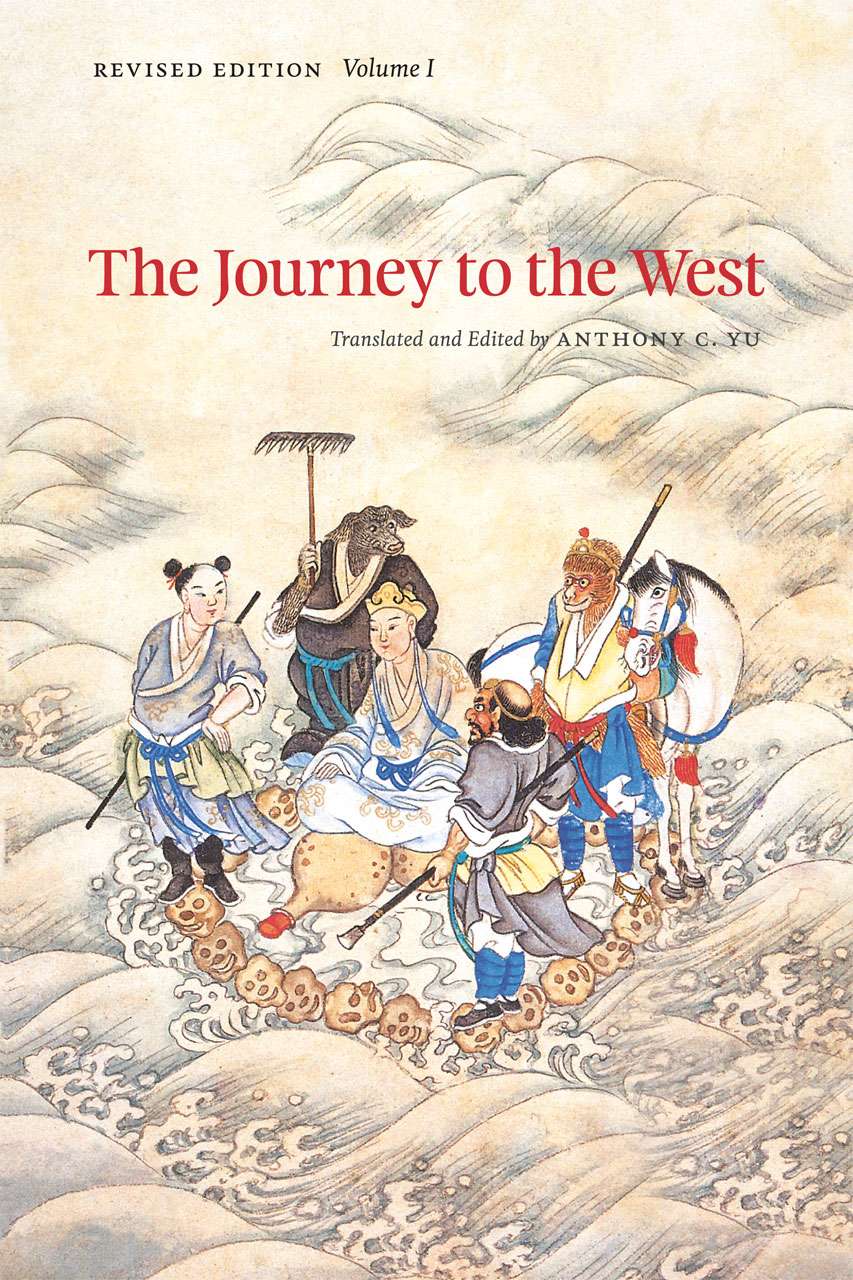
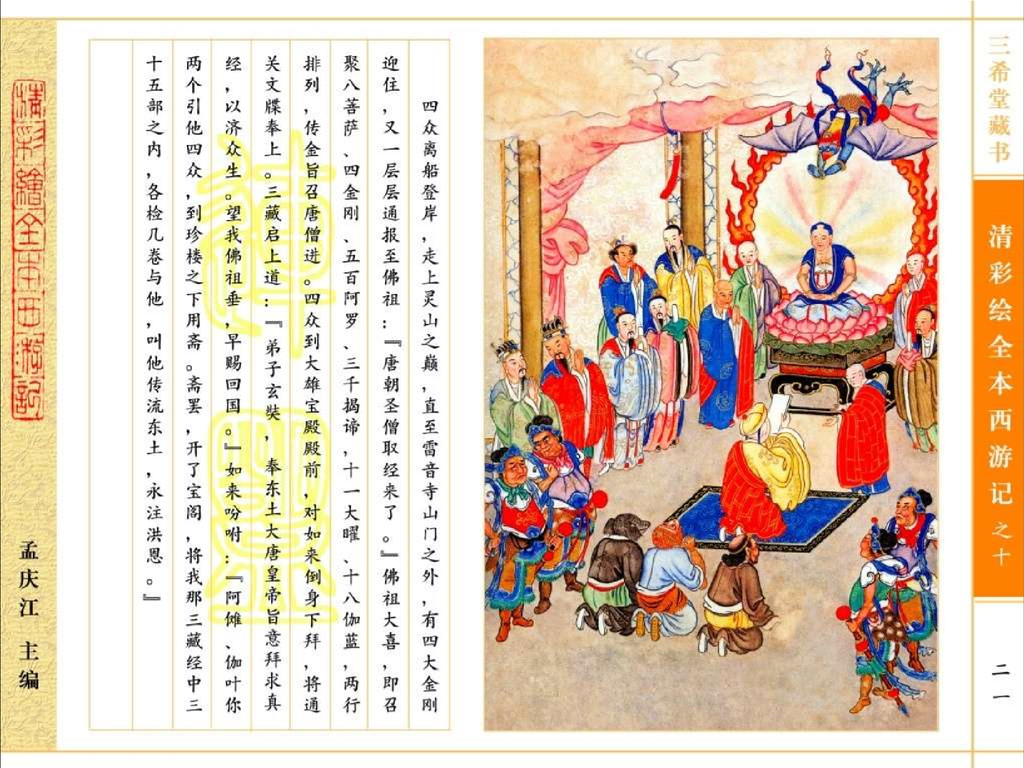
Upon the initial release, I was entranced by the cover art for the 2012 revised edition of Anthony C. Yu’s famed Journey to the West translation. For example, the cover for volume one (fig. 1) featured the pilgrims crossing the Flowing-Sands River via a boat made from Sha Wujing‘s skull necklace and a heaven-sent gourd. I loved the individuality and color scheme of each figure. They look almost like characters from a comic book. Though the art style was old, I assumed the bright, vibrant colors signaled the illustration was a modern reproduction. This was not the case. I later learned that the art was made by an anonymous painter of the Qing Dynasty (1644-1911). The paintings from this series were later gathered into an abridged ten-volume set titled Qing-Period Color-Illustrated Complete Edition of Journey to the West (Qing caihui quanben Xiyouji, 清彩繪全本西遊記, 2008). Here I present lower res PDFs of this work, complete with the gorgeous artwork. Each page is formatted with simplified Chinese dialogue on the left side and art on the right (fig. 2).
Fig. 1 – The cover of volume one (larger version). Fig. 2 – An example of the page format (larger version). It portrays the pilgrims finally coming before the Buddha in India. The formerly subjugated “Peng of 10,000 Cloudy Miles” (i.e. Garuda) can be seen hovering above the Enlightened One’s throne.
Sun travels to the Eastern Sea Dragon King’s underwater kingdom in ch. 3 to acquire a celestial weapon. But when the immortal fails to find a suitably heavy armament, the Dragon Queen suggests that they give him a black iron pillar from their treasury. It is described as over 20 feet (6.096 m) in height and the width of a barrel. Only when Monkey lifts the pillar and suggests a smaller size would be more manageable does it comply with his wishes:
Wukong girded up his clothes and went forward to touch it: it was an iron rod more than twenty feet long and as thick as a barrel. Using all his might, he lifted it with both hands, saying, “It’s a little too long and too thick. It would be more serviceable if it were somewhat shorter and thinner.” Hardly had he finished speaking when the treasure shrunk a few feet in length and became a layer thinner. “Smaller still would be even better,” said Wukong, giving it another bounce in his hands. Again the treasure became smaller. Highly pleased, Wukong took it out of the ocean treasury to examine it. He found a golden hoop at each end, with solid black iron in between. Immediately adjacent to one of the hoops was the inscription, “The ‘As-You-Wish’ Gold-Banded Staff. Weight: 17,560 lbs. [Ruyi jingu bang zhong yiwan sanqian wubai jin, 如意金箍棒重一萬三千五百斤]” (Wu & Yu, 2012, p. 135). [1]
Later in the chapter, Sun shows off the new weapon to his children by shrinking it to the size of a needle and then expanding it to a literal pillar of heaven.
He held the treasure [the staff] in his hands and called out, “Smaller, smaller, smaller!” and at once it shrank to the size of a tiny embroidery needle, small enough to be hidden inside the ear. Awestruck, the monkeys cried, “Great King! Take it out and play with it some more.” The Monkey King took it out from his ear and placed it on his palm. “Bigger, bigger, bigger!” he shouted, and again it grew to the thickness of a barrel and more than twenty feet long. He became so delighted playing with it that he jumped onto the bridge and walked out of the cave. Grasping the treasure in his hands, he began to perform the magic of cosmic imitation. Bending over, he cried, “Grow!” and at once grew to be one hundred thousand feet tall, [2] with a head like the Tai Mountain and a chest like a rugged peak, eyes like lightning and a mouth like a blood bowl, and teeth like swords and halberds. The rod in his hands was of such a size that its top reached the thirty-third Heaven and its bottom the eighteenth layer of Hell (fig. 1) (Wu & Yu, 2012, vol. 1, p. 138).
Fig. 1 – Monkey grows his staff to touch heaven as he performs a cosmic transformation for his children (larger version). Original artist unknown. Found on this article.
1.2. Controlling the Oceans
Prior to giving Monkey the staff, the Dragon King tells his wife, “That…was the measure with which [Yu the Great] fixed the depths of rivers and oceans when he conquered the Flood” (Wu & Yu, 2012, vol. 1, p. 135). Later, in ch. 88 our hero recites a poem in which he gives more detail about the weapon’s origins and history. The first few lines discuss its power over water:
An iron rod forged at Creation’s dawn
By Great Yu himself, the god-man of old.
The depths of all oceans, rivers, and lakes
Were fathomed and fixed by this very rod.
Having bored through mountains and conquered floods,
It stayed in East Ocean and ruled the seas,
[…] (Wu & Yu, 2012, vol. 4, p. 201).
Despite the staff’s influence on bodies of water both great and small, it paradoxically doesn’t grant Sun an advantage when traveling through the aquatic realm or fighting water-based demons. [3] I’ll just chalk this up to inconsistencies born from oral storytelling.
1.3. Astral Entanglement
Ch. 3 shows that Monkey’s soul is able to use the staff in the underworld even when the physical weapon is back with his body in the world of the living.
In his sleep the Handsome Monkey King saw two men approach with a summons with the three characters “Sun Wukong” written on it. They walked up to him and, without a word, tied him up with a rope and dragged him off. The soul of the Handsome Monkey King was reeling from side to side. They reached the edge of a city. The Monkey King was gradually coming to himself, when he lifted up his head and suddenly saw above the city an iron sign bearing in large letters the three words “Region of Darkness.” … Yanking and pulling, they were determined to haul him inside. Growing angry, the Monkey King whipped out his treasure. One wave of it turned it into the thickness of a rice bowl; he raised his hand once, and the two summoners were reduced to hash.
[…]
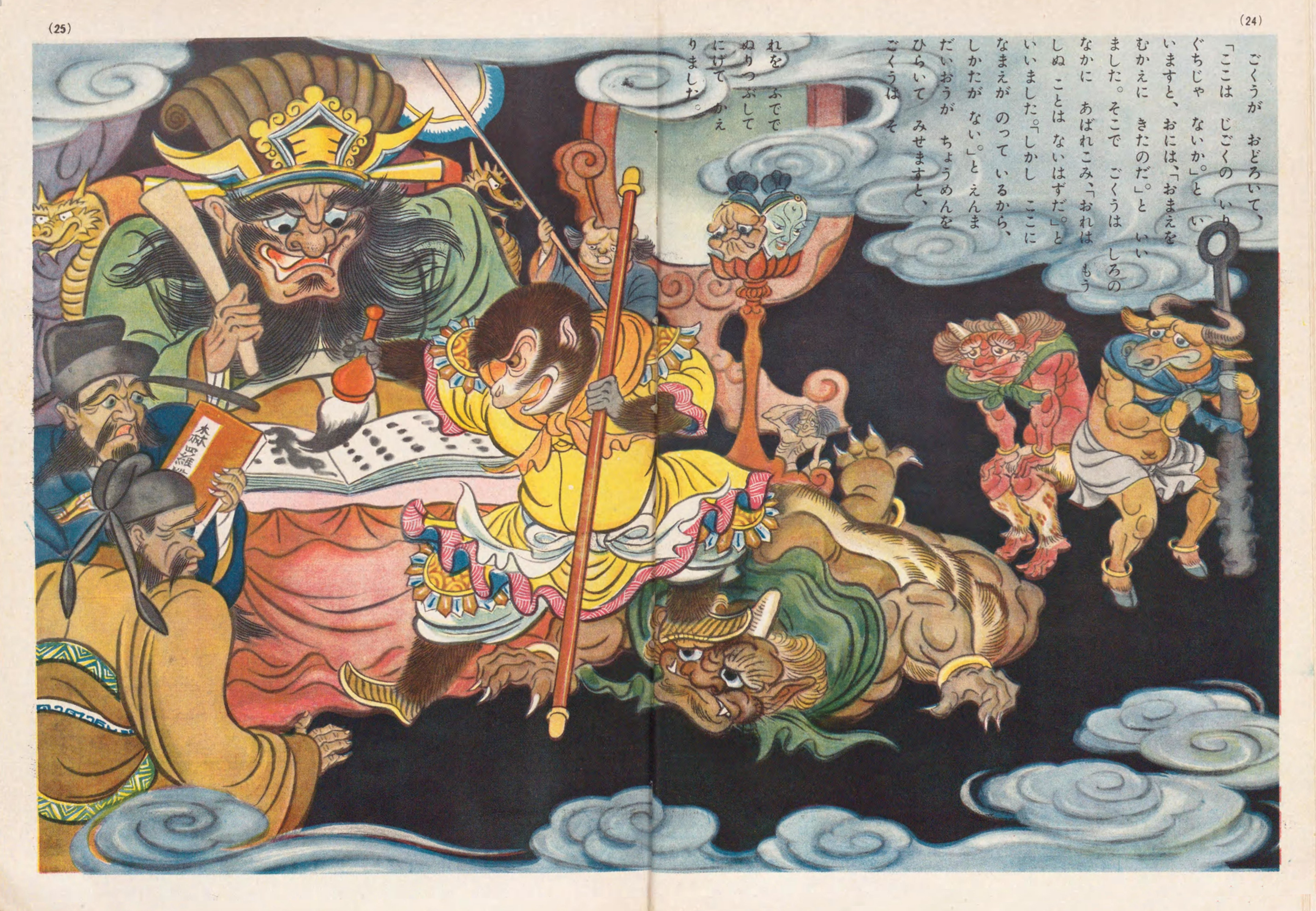
[After reprimanding the 10 judges for bringing his soul to hell, Sun says,] “All I want is to erase my name [from the ledgers of life and death]. Bring me a brush.” The judge hurriedly fetched the brush and soaked it in heavy ink. Wukong took the ledger on monkeys and crossed out all the names he could find in it [fig. 2]. Throwing down the ledger, he said, “That ends the account! That ends the account! Now I’m truly not your subject.” Brandishing his rod, he fought his way out of the Region of Darkness.
[…]
While our Monkey King was fighting his way out of the city, he was suddenly caught in a clump of grass and stumbled. Waking up with a start, he realized that it was all a dream (Wu & Yu, 2012, vol. 1, p. 139).
Sun’s ability to use the weapon as a disembodied spirit implies that it has some power of astral projection and entanglement (i.e. it goes where his soul goes). However, to my knowledge, this only happens once in the story, and the novel clearly demonstrates that he can’t use the weapon if it is physically taken away from him. [4] This is likely another inconsistency from oral storytelling.
Fig. 2 – Monkey holds his staff as he strikes his name from the Book of Life and Death (larger version).From the Japanese children’s book Son Goku (1939).
1.4. Multiplication
The weapon is shown capable of creating manifold copies of itself. For example, in ch. 4, Monkey multiplies his staff to accommodate his monstrous, multi-armed form while fighting Prince Nezha: “Dear Great Sage! He shouted, ‘Change!’ and he too transformed himself into a creature with three heads and six arms. One wave of the golden-hooped rod and it became three staffs, which were held with six hands” (Wu & Yu, 2012, vol. 1, p. 155). Later in ch. 50, he rains staves down on a demonic army.
Using the tip of his lance to point at the ground, the demon king shouted for the little imps to attack together. All those brazen fiends, wielding swords, scimitars, staffs, and spears, rushed forward at once and surrounded the Great Sage Sun completely. Entirely undaunted, Pilgrim only cried, “Welcome! Welcome! That’s exactly what I want!” He used his golden-hooped rod to cover his front and back, to parry blows east and west, but that gang of fiends refused to be beaten back. Growing more agitated, Pilgrim tossed his rod up into the air, shouting, “Change!” It changed immediately into iron rods by the hundreds and thousands; like flying snakes and soaring serpents, they descended onto the fiends from the air” (Wu & Yu, 2012, vol. 2, p. 372).
1.5. Lock-Picking
Sun demonstrates the staff’s magic lock-picking ability in ch. 25.
The doors are all locked. Where are we going to go?” “Watch my power!” said Pilgrim. He seized his golden-hooped rod and exercised the lock-opening magic; he pointed the rod at the door and all the locks fell down with a loud pop as the several doors immediately sprung open. “What talent!” said Eight Rules, laughing. “Even if a little smith were to use a lock pick, he wouldn’t be able to do this so nimbly.” Pilgrim said, “This door is nothing! Even the South Heaven Gate would immediately fly open if I pointed this at it!” (Wu & Yu, 2012, vol. 1, pp. 468-469).
Admittedly, this passage could be read two ways: 1) The staff opens the lock; 2) Monkey uses the staff as a conduit for his own lock-picking magic. But I’m choosing the first interpretation as this ability was likely influenced by Saint Mulian unlocking the gates of hell with his staff. [5]
1.6. Transformation
In ch. 46, during a competition of Buddhist and Daoist prognostication, Sun magically disguises himself as a Daoist lad’s ritual master and convinces the boy to let him shave his head: “He changed his golden-hooped rod into a sharp razor, and hugging the lad, he said, ‘Darling, try to endure the pain for a moment. Don’t make any noise! I’ll shave your head.’ In a little while, the lad’s hair was completely shorn” (Wu & Yu, 2012, vol. 2, p. 305). In ch. 65, Sun turns the staff into a drill in order to escape from a pair of magic cymbals, using the tool to bore a hole in the horn of a dragon that was just able to pierce the seam: “Marvelous Great Sage! He changed the golden-hooped rod into a steel drill and drilled a hole on the tip of the horn. Transforming his body into the size of a mustard seed, he stuck himself inside the hole and yelled, ‘Pull the horn out! Pull the horn out!'” (Wu & Yu, 2012, vol. 3, p. 218).
1.7. Sentience
When the Dragon Queen originally suggests giving the pillar to Monkey, she tells her husband: “These past few days the iron has been glowing with a strange and lovely light [fig. 3]. Could this be a sign that it should be taken out to meet this sage?” (Wu & Yu, 2012, vol. 1, p. 135). This might imply the weapon was aware of its new master’s imminent arrival. Later in ch. 75, Sun recites a poem speaking of the staff’s desire for flight.
Its name was one Rod of Numinous Yang,
Stored deep in the sea, hardly seen by men.
Well-formed and transformed it wanted to fly,
Emitting bright strands of five-colored mist.
Enlightened Monkey took it back to the mount
To experience its pow’r for boundless change.
[…] (Wu & Yu, 2012, vol. 3, p. 375).
The phase “wanting to fly” (yao feiteng, 要飛騰) could be read as an allegory for yearning to be released from the dragon treasury and/or a call to adventure. Add to this the staff’s ability to follow Sun’s wishes to grow, shrink, multiply, change form, and pick locks. Therefore, the novel depicts the staff having a certain amount of awareness. [6]
Fig. 3 – Monkey pointing to the luminous iron pillar (larger version). From the Qing-Era Painted, Complete Edition Journey to the West (Qing caihui quanben Xiyouji, 清彩繪全本西遊記).
2. Conclusion
Journey to the West (1592) describes the Monkey King’s iron staff having the magic power to shrink and grow, control the ocean, astral project and entangle with Monkey’s spirit, multiply endlessly, pick locks, and transform into various objects. It also has sentience to a certain degree.
3. Updates
Update: 07-04-21
Here I present my theory on why Sun Wukong’s staff weighs 13,500 catties (17,560 lbs/7,965 kg). I believe the number is an embellishment on the weight of a stone block lifted by the bandit Wu Song in the Water Margin (c. 1400).
Above, I wrote: “Ch. 3 shows that Monkey’s soul is able to use the staff in the underworld even when the physical weapon is back with his body in the world of the living.”
Sun’s use of said weapon also caught the attention of late-Ming commentators. The authors of The Book to Enlightenment of the Journey to the West (Xiyou Zhengdao Shu, 西遊證道書, 1663), a Daoist commentary on the novel, asked:
“Did he take this treasure with him in his dream?”
此寶貝夢中亦帶去耶? (Converted from simplified Chinese – source).
Notes
1) I have changed Yu’s (Wu & Yu, 2012) dry rendering “Compliant Golden-Hooped Rod” to “As-you-wish Gold-Banded Staff,” similar to W.J.F. Jenner (minus “cudgel”). Also, Yu’s original translation says “13,500 pounds.” However, the Chinese version uses jin (斤), known in English as “catty.” The catty and pound are two different measures of weight, the former being heavier than the latter. Therefore, the English text has been altered to show this. The catty during the Ming Dynasty when the novel was compiled equaled 590 grams (Elvin, 2004, p. 491 n. 133), so 13,500 catties would equal 17,550 lb.
2) Here, Yu’s (Wu & Yu, 2012) English translation says Monkey grows to be “ten thousand feet tall.” However, the original Chinese source reads “萬丈” (wanzhang), wan meaning 10,000 and zhang being a measure designating 10 Chinese feet (10,000 x 10 = 100,000). Therefore, I have changed the source to read “One hundred thousand feet,” much like Yu (Wu & Yu, 2012) translates it in chapters six (vol. 1, p. 181) and 61 (vol. 3, p. 157).
3) For example, Monkey relies on Zhu Bajie to fight Sha Wujing when they first come across him at the Flowing-Sands River. This is when Sun admits his weakness to water:
“Worthy Brother,” said Pilgrim with a laugh, “in this case I’ve really nothing to brag about, for I’m just not comfortable doing business in water. If all I do is walk around down there, I still have to make the magic sign and recite the water-repelling spell before I can move anywhere. Or else I have to change into a water creature like a fish, shrimp, crab, or turtle before going in. If it were a matter of matching wits in the high mountains or up in the clouds, I know enough to deal with the strangest and most difficult situation. But doing business in water somewhat cramps my style!” (Wu & Yu, 2012, vol. 1, pp. 423-424).
4) The rhinoceros demon sucks it away with Laozi’s magic steel bracelet in ch. 50 and 51. A lion spirit uses a magic wind to steal the weapons of all three pilgrims in ch. 88. In both cases, Monkey resorts to trickery to retrieve the physical staff from their respective mountain strongholds.
5) One section of Mulian’s tale reads: “With one shake of his staff, the bars and locks fell from the black walls, / On the second shake, the double leaves of the main gate [of hell] flew open” (Mair, 1994, p. 1113).
6) The idea of sentient weapons is certainly not unique to Journey to the West considering that the ancient Chinese ascribed souls to noted swords. For example, Yuan poet Jia Penglai (賈蓬萊, c. mid-14th-c.) described famed Spring and Autumn period blacksmith Ou Yezi‘s (歐冶子) treasure swords Longyuan (龍淵, a.k.a. Longquan, 龍泉) and Tai’e (泰阿/太阿) as mated lovers who pine for each other when separated and even leap from the scabbard to seek out their beloved (Lee & Wiles, 2015, pp. 161-163).
Sources:
Elvin, M. (2004). The Retreat of the Elephants: An Environmental History of China. New Haven (Conn.): Yale university press.
Lee, L. X. H., & Wiles, S. (2015). Biographical Dictionary of Chinese Women: Tang Through Ming: 618-1644. Abingdon: Routledge.
Mair, V. H. (1994). Transformation Text on Mahamaudgalyayana Rescuing his Mother From the Underworld With Pictures, One Scroll, With Preface In V. Mair (Ed.), The Columbia Anthology of Traditional Chinese Literature (pp. 1094-1127). New York: Columbia University Press.
Wu, C., & Yu, A. C. (2012). The Journey to the West: Vol. 1-4. Chicago, Illinois: University of Chicago Press.
I recently learned about an interesting website called the Book of Xian and Shen (BOXS), which catalogs information and pictures for Chinese gods from all over the world. There are currently 2,000 listings and counting.
It is based on the work of religious scholar Keith Stevens (d. 2016), who wrote the amazing Chinese Gods: The Unseen Worlds of Spirits and Demons(Collins & Brown, 1997) (fig. 1). I recently volunteered to help the project. So far, I’ve written two articles (see reference no. W1001 and W1011) and updated two other existing listings with information and pictures (see the bottom of W8620 and W9305).
Fig. 1 – My well-worn personal copy of Chinese Gods (larger version).
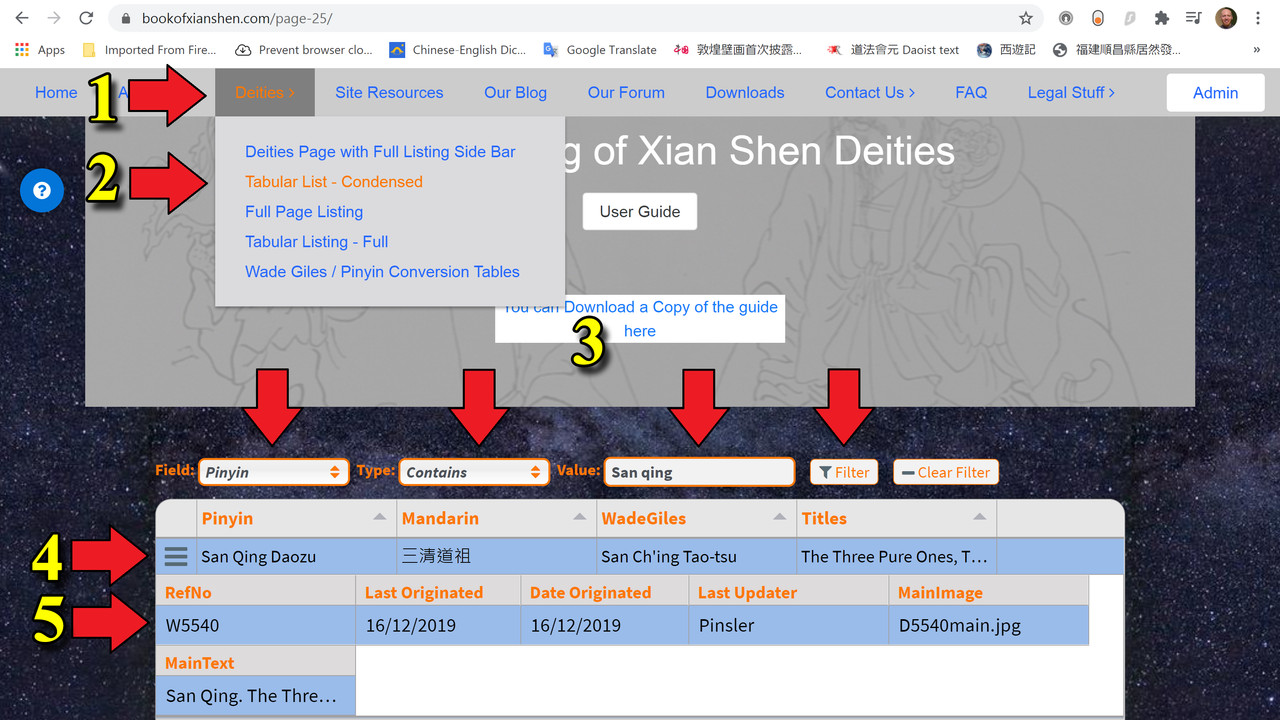
Due to the great number of listings, there are no direct links. Instead, the site has adopted a somewhat confusing (but necessary) cataloging system based around reference numbers, pinyin, Mandarin, and Wade-Giles. However, it’s easy to use once you get used to it. For example, if you were going to search for Sanqing, the “Three Pure Ones,” using, say, Pinyin, I recommend first getting the reference number (RefNo).
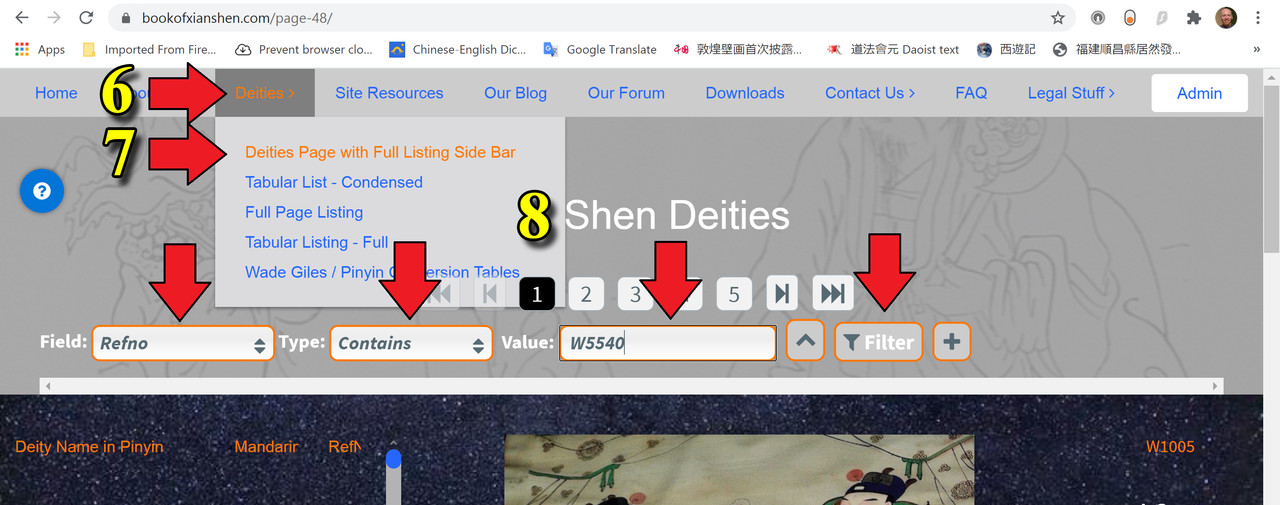
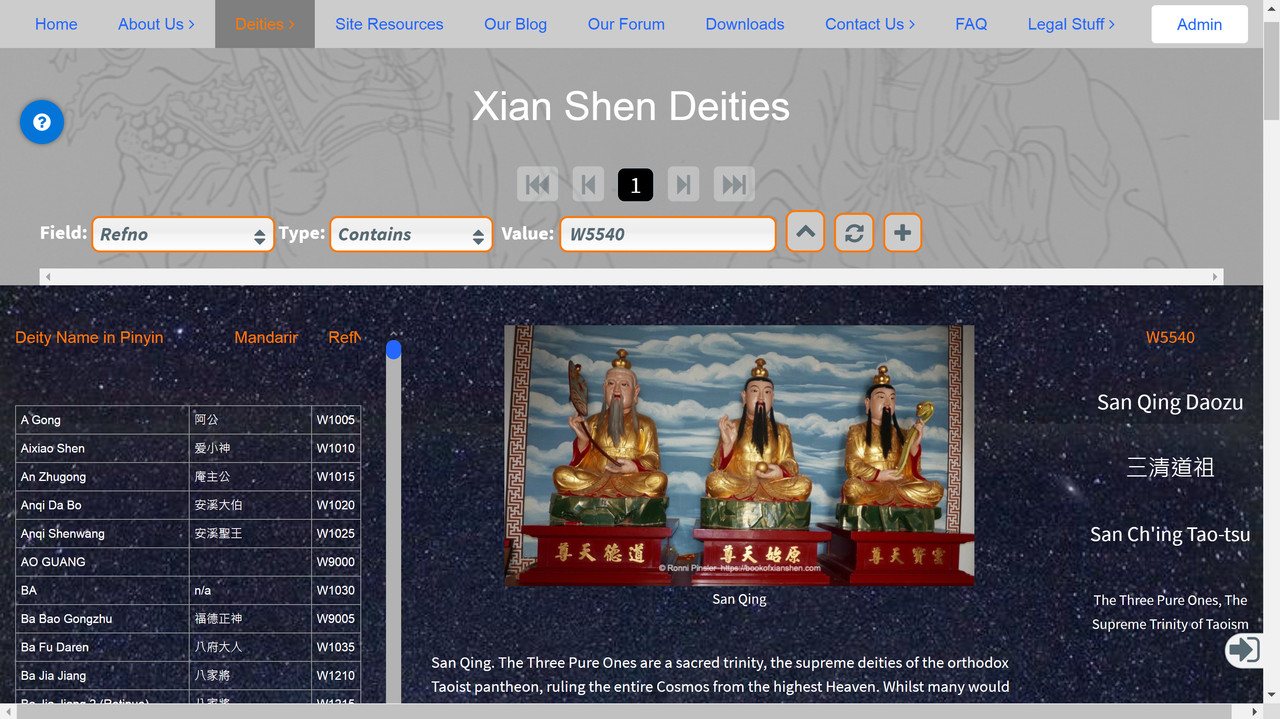
Deities —> Tabular Listing of Xian Shen Deities —> Field: Pinyin —> Type: Contains —> Value: San qing (you may have to play around with the spacing like I did here) —> Filter —> Then look for the correct listing (since other listings mentioning them might appear in the list) —> ☰ —> copy the “RefNo”, in this case W5540 (fig. 2) —> Deities —> Deities Page with Full Listing Side Bar —> Field: RefNo —> Type: Contains —> Value: W5540 —> Filter (fig. 3) —> The listing (fig. 4)
If you know the Mandarin or Wade-Giles for the deity you are looking for, the process would be similar. You would just need to change the field to “Mandarin” or “Wade-Giles”. You could just jump to “Deities Page with Full Listing Side Bar” to search using pinyin, mandarin, and Wade-Giles, but it’s been my experience that a different listing will pop up first based on a higher RefNo or Romanized spelling. First finding the reference number seems to be the easiest method for me.
I can’t recommend this website enough. New gods, as well as new stories or beliefs associated with more established deities, are appearing all the time, so it is very important to catalog everything as soon as new information becomes available. If you would like to volunteer in some way, please contact Ronni Pinsler using the “contact” form on the BOXS website.
Fig. 2 – How to acquire the reference number (RefNo) (larger version). Fig. 3 – How to navigate to the listing (larger version). Fig. 4 – The listing as seen from the top of the page (larger version).