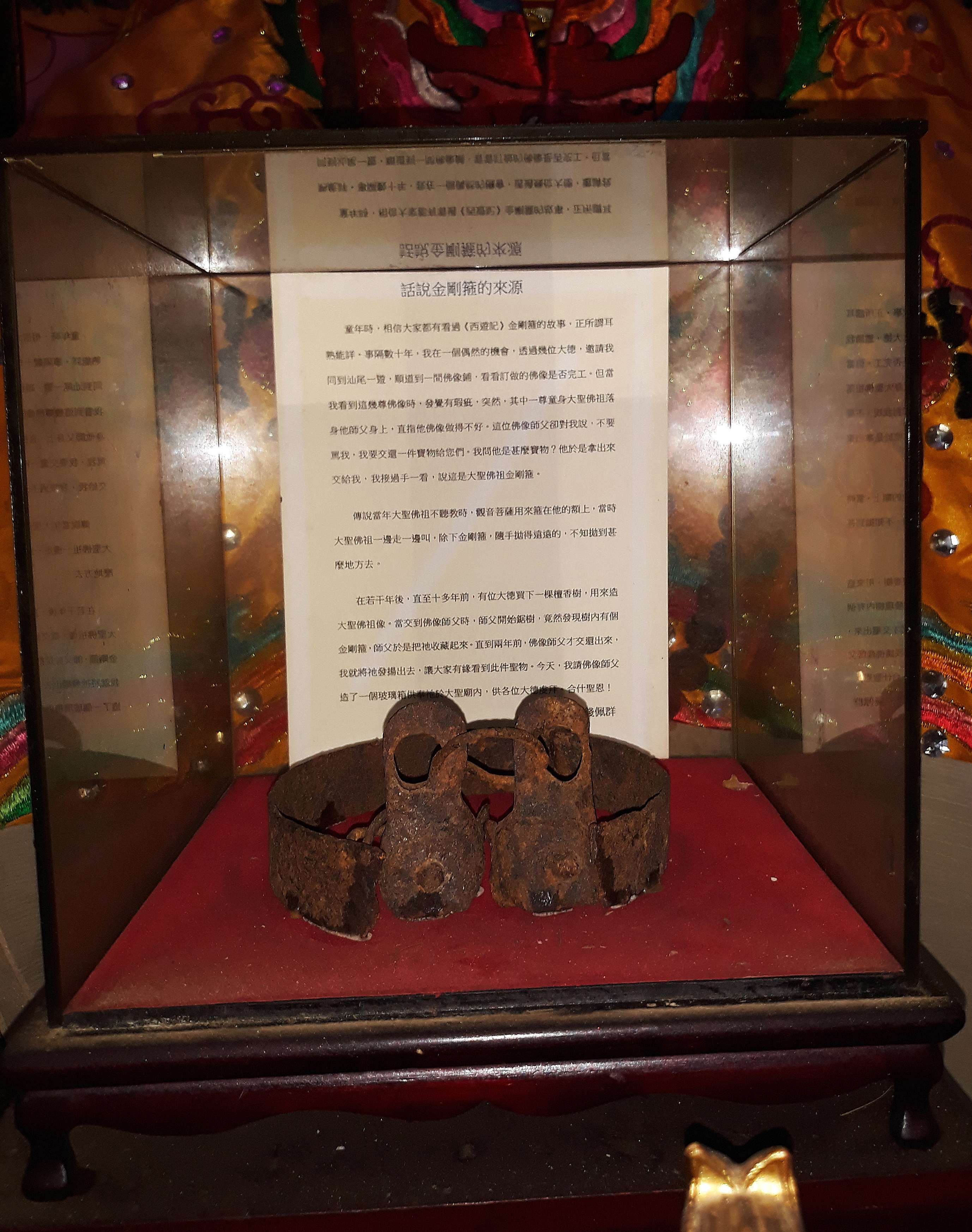
I recently attended the birthday of Sun Wukong on September 25th (the 16th day of the 8th lunar month) in Kowloon, Hong Kong (I’ll write more about this later). While the festivities took place at an alternate location with a secondary altar, I later visited the main altar in the Great Sage Treasure Temple (Dasheng bao miao, 大聖寶廟) on the Po Tat Estate. The altar stage includes a large gilded statue of Wukong, flanked on either side by those of his religious brothers Sha Wujing and Zhu Bajie. Strangely enough, a glass box is conspicuously placed in front of the Monkey King’s visage (fig. 1). Inside is a rusted metal band held together with a single chain link (fig. 2). An accompanying text panel labels it the “Vajra/Diamond Headband” (Jingang gu, 金剛箍) and claims the piece to be the original band worn by the Great Sage during his adventures. This same text is echoed in the Kowloon Great Sage Buddha Hall: Special Inaugural Ceremony Issue of the Sixteenth Year Council Association (Jiulong Dasheng Fo tang: Di shiliu jie lishi hui jiu shi dianli tekan, 九龍大聖佛堂: 第十六屆理事會就識典禮特刊) (2014), a booklet handed out during this year’s festivities. [1]
Fig. 1 – The glass box is visible between the food offerings and the Great Sage’s statue (larger version). Photo by the author.
I. Translation
From Childhood, I believe that everyone has read the story of the golden headband from Journey to the West. Everyone is familiar with the tale. A few decades later [after the events took place], some Buddhists were invited to a Buddhist statue workshop in Shanwei [City, Guangdong Province, China] to see if the Buddha statue they ordered was finished. But when they saw the statue they found it full of flaws. Suddenly, one among them spoke up and said it wasn’t made well enough. The Buddhist statue workshop master asked not to be chastised and said he instead wanted to give them a treasure. They asked him what it was. When he handed it to them they saw it was the Great Sage Buddha’s [original] golden headband.
People say that when Sun Wukong would not accept the Buddhist teachings, Guanyin put the band on his head. Sun Wukong ran side to side while yelling, trying to take it off and throw it far away to some unknown place [but couldn’t].
Many years later, maybe until ten years ago, a virtuous man purchased a sandalwood tree in order to build a Great Sage Buddha statue. He gave it to a Buddhist statue workshop master, who started to saw the tree but soon discovered the golden headband inside and decided to keep it for himself. Two years later, he decided to return it so everyone could behold this sacred treasure. Today, we asked the Buddhist workshop master to make a glass box to display the band in the Great Sage Temple for everyone to worship (p. 45). [2]
Fig. 2 – The glass box with the headband. The accompanying text panel can be seen in the back (larger version). Photo by the author.
Chapter 100 of the original novel describes the headband disappearing once Monkey internalizes self-restraint and becomes a Buddha (Wu & Yu, 2012, p. 383). The ultimate fate of the band is never commented on thereafter. The above story presents a continuation of the tale, thereby linking the Great Sage Treasure Temple with the original events of the novel. The band is lost and discovered twice over the centuries, eventually coming to rest in Hong Kong.
II. Similarities with Shaolin art
The displayed headband appears to be quite old given the level of rust damage. In addition, the style is different than any band I’ve written about before. That being said, the style is somewhat similar to a 17th-century mural from the famed Shaolin Monastery. The mural depicts a muscular luohan wielding a staff and standing next to a ferocious tiger (possibly the Tiger-Taming Luohan). His crown is adorned with a headband held together by a single chain link (fig. 3) similar to our aforementioned band. I am by no means claiming a connection to Shaolin, but it shows there may have been some style of linked headband associated with protector deities in late dynastic China.
Fig. 3 – The 17th-century Shaolin mural (larger version). Take note of the linked headband. From Shahar, 2008, p. 90.
Notes
1) The presented folk story is as told by the Kowloon Great Sage Buddha Hall First Vice-Chairperson Qian Peiqun (錢佩群).
2) Thank you to Kelly Black Lin for helping me with the translation.
Sources
Kowloon Great Sage Buddha hall: Special inaugural ceremony issue of the sixteenth year Council association (2014, Sept. 9). Published by the Hong Kong Shanwei General Commerce Association Limited.
Shahar, M. (2008). The Shaolin monastery: History, religion, and the Chinese martial arts. Honolulu: University of Hawai’i Press.
Wu, C., & Yu, A. C. (2012). The journey to the West: Volume 4. Chicago, Ill: University of Chicago Press.
One of the most famous episodes from Journey to the West happens in chapter three after Sun Wukong returns from the undersea palace with his magic staff and is chosen as lord of the 72 monster kings. Following a lavish banquet in his honor, the Monkey King falls asleep and his soul is dragged to the Chinese underworld by two spirits:
In his sleep the Handsome Monkey King saw two men approach with a summons with the three characters “Sun Wukong” written on it. They walked up to him and, without a word, tied him up with a rope and dragged him off. The soul of the Handsome Monkey King was reeling from side to side. They reached the edge of a city. The Monkey King was gradually coming to himself, when he lifted up his head and suddenly saw above the city an iron sign bearing in large letters the three words “Region of Darkness [You mingjie, 幽冥界].” The Handsome Monkey King at once became fully conscious. “The Region of Darkness is the abode of Yama, King of Death,” he said. “Why am I here?” “Your age in the World of Life has come to an end,” the two men said. “The two of us were given this summons to arrest you.” When the Monkey King heard this, he said, “I, old Monkey himself, have transcended the Three Regions and the Five Phases [1]; hence I am no longer under Yama’s jurisdiction. Why is he so confused that he wants to arrest me?” The two summoners paid scant attention. Yanking and pulling, they were determined to haul him inside. Growing angry, the Monkey King whipped out his treasure. One wave of it turned it into the thickness of a rice bowl; he raised his hand once, and the two summoners were reduced to hash (Wu & Yu, 2012, p. 139).
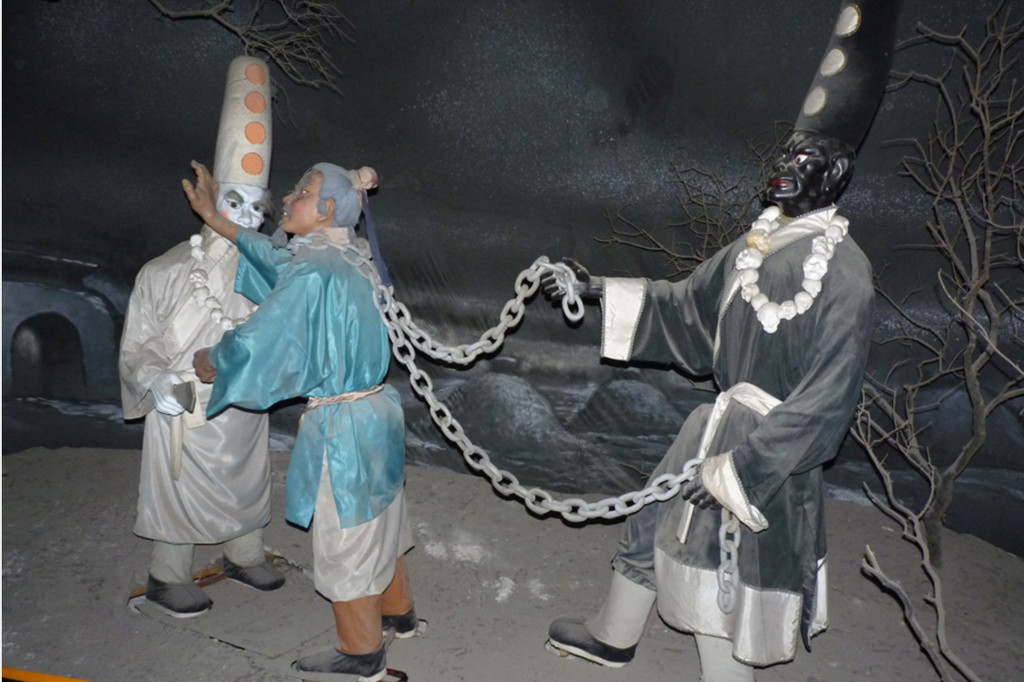
The two unnamed psychopomps are simply referred to in the story as “[those who] arrest the dead” (Gou siren, 勾死人). Modern media sometimes portrays these two wearing contrasting black and white uniforms with tall hats (fig. 1).
The specific color-coded deities are known in China, Taiwan, and Southeast Asian countries like Malaysia and Singapore as the Heibai wuchang (黑白無常), or the “Black and White [spirits of] Impermanence.” Tan (2018) describes their mythic background and religious importance:
[A] good deal of importance attaches to the worship in Malaysia and Singapore of Heibai Wuchang … popularly known as Da Er Ye (大二爺, Eldest and Second Uncles). In charge of policing the netherworld and protecting humans from evil, they are believed to be two soldiers of the Tang dynasty, General Xie [謝] and General Fan [范]. The former was tall and was hanged by the enemy, while the latter was shorter and was drowned while fighting enemies. General Xie’s image is that of a tall person with a protruding long tongue; he’s wearing a white shirt, and his high hat has the characters yijian daji ([一見大吉] “big luck on seeing me”) or yijian shengcai ([一見生財] “getting wealth on seeing me”). General Fan’s image has a dark face, and his square hat bears the characters tianxia taiping [天下太平], or “peace in the world.” Also called Qiye (七爺) and Baye (八爺), the two generals are in charge of rewarding good people and punishing evil ones. General Xie is more popular among worshippers; frightening as he is, the Elder Uncle benefits from his association with blessing wealth (p. 58).
Chen (2014) provides a different background for the two, which is commonly told in the southern Chinese city of Fuzhou in Fujian province:
The Seventh Lord (七爺) and Eighth Lord (八爺) are frequently seen and are well-known in Taiwanese religious parades. These two deities were originally two brother-like friends in Fuzhou (福州). One was called Xie Bian (謝必安), and the other one was named Fan Wujiu (范無救; 范無咎). On a rainy day, they had an appointment to meet under the Nan Tai Bridge (南臺橋). Fan Wujiu was short with a dark complexion, but Xie Bian was tall with a light complexion. Fan Wujiu arrived at the meeting place earlier, waited there in spite of the heavy rain, and was drowned. Xie Bian tried to bring umbrellas for Fan Wujiu and was therefore late. When he arrived at the bridge, Fan Wujiu was already dead, so he decided to commit suicide because of his friendship and guilt. According to legends, the Heavenly Emperor (玉皇大帝) was touched by this pair of brother-like friends, and promoted their ghosts to supernatural officers from the underworld. The Seventh Lord is Bai Wuchang (白無常), and the Eighth Lord is Hei Wuchang (黑無常). Their mission is to bring dead people’s ghosts from the ordinary human world to the underworld at the moment of their deaths (p. 220).
Stevens (1997) goes into more detail about their function and veneration:
The pair are despatched on orders from the City God when the due date of a person’s death arrives, to seek out and identify the correct human through the local spiritual official, the Earth God [fig. 3]. They appear before the human and the Tall Demon [the white spirit] announces that the time has come. The Short Demon [the black spirit] binds the soul and drags it before the City God. The Short Demon carries the tablet of authority and the chains to arrest the soul whose due date of death has arrived [fig. 2].
The Tall Demon … receives considerable attention from devotees, often relatives of the very sick, and in a few temples he is provided with cigarettes which are to be seen continually burning having been forced in between his lips. More popularly, his mouth is smeared with a black substance to win his favour and bribe him to keep away. This used to be opium and is still said to be opium, though the substance appears to be more of a sweet sticky mess. In northern and central China, only the Tall Demon is found (p. 173).
Fig. 3 – A monumental statue of an Earth god in Taiwan (larger version).
Origins
The sources above provide two backgrounds for the spirits, historical generals or brother-like friends, all of whom died unnatural deaths. Both origins involve the tall, white figure being hanged, while the short, black figure was drowned. Both of these backgrounds have respective ties to religious beliefs of the Han (206 BCE – 220 CE) and Song (960-1279 CE) dynasties. It was common practice during the Han for generals, especially those slain by the enemy, to be deified as gods. This concept of deified mortals carried over into the Song Dynasty when tutelary gods were popular. Those deified were often pious or loyal people who died unnatural deaths. But most importantly, these individuals were deified by the very communities in which they lived, meaning they were worshiped as the protector of the specific locale and its people (Von Glahn, 2004, p. 164).
These tutelary cults find their origin in earth gods (tudishen, 土地神) worshiped as early as the Han. Just like people of the Song worshiped the worthy among their fallen community members, people of the Han worshiped the gods believed to inhabit the very earth on which their communities were established. Considering the dead were buried underground, these earth gods also served the function of “escort[ing] the deceased to the world of the afterlife” (Von Glahn, 2004, p. 165). Remember above that Stevens described the tall and short spirits relying on the local earth god to help locate the correct soul being summoned. Therefore, our spirits appear to be a combination of deified mortals (generals/worthy citizens) and earth gods who escorted the deceased to the afterlife. But there may be more to the story.
Wuchang (無常), or “impermanence”, is the Chinese term for the sanskrit Anitya. This is one of the “Three Marks” (Sk: Trilaksana) of existence in Buddhism, the other two being suffering (Duhkha) and non-self (Anatman) (Buswell & Lopez, 2014, pp. 47-48). The fact Wuchang is associated with these spirits suggests there is an added Buddhist influence. As I’ve written before, the Chinese underworld presented in Journey to the West is an amalgam of local Chinese and foreign Buddhist beliefs. In short, the Chinese Underworld consists of ten courts in which a soul is punished and sent on to the next until their karma is cleansed. The concept of purgatory and the Ten Kings or Judges of hell are products of 7th-century Chinese Buddhism. Prior to this, souls of the dead were kept en masse in a sort of Daoist city of the dead. So our two summoners were no doubt absorbed into this new Buddhist worldview. The spirits in effect could be viewed as personifications of Buddhist impermanence.
The contrasting black and white color scheme has at least two origins. One, it may have evolved from the belief that each performed duties at different times. Maspero (1981) writes, “The most famous of [the City God’s] subordinates are Master White (Bai laoye [白老爺]) and Master Black (Hei laoye [黑老爺]), who perceive everything that goes on within the constituency, the former during the day and the latter during the night” (p. 110). Two, it may draw from the dualistic nature of Chinese philosophy. Baptandier (2008) comments their color is a “personification of the yin and yang principles of life” (p. 146).
Fig. 4 – A wall mural depicting the Ba Jiajiang (Eight Generals), including General Xie (white) with the phrase “Big Luck” (daji, 大吉) on his hat (larger version) and to his left General Fan (black) with a square hat. Taken by the author in Taipei, Taiwan.
Influence
Both General Xie (the tall, white spirit) and General Fan (the short, black spirit) figure among the Ba Jiajiang(八家將), or “Eight Generals” (fig. 4). These spirit generals are considered protectors of the City God (as well as other popular folk deities) and destroyers of evil. They consist of our two spirits, two more underworld figures called Generals Gan (甘) and Liu (柳), as well as four other figures known as the Four Seasons (Siji, 四季). These generals are personified during festivals by temple parade dance troupes called Jiajiang (家將). Members paint their faces according to the prescribed wrathful iconography for each general (fig. 5) and perform all sorts of choreographed militaristic dances while wielding weapons (video 1). These performances serve to exorcize evil spirits.
Fig. 5 – The facepaint of General Xie, the tall, white spirit. A larger version can be seen on this blog. Original picture by Rich J. Matheson.
The tradition originated in Fuzhou but later spread to Taiwan by the 1870s, making it a rather recent phenomenon (Sutton, 1996).
Video 1 – A Ba Jiajiang performance.
Update: 10-29-2018
Sutton (1996) explains the ceremonial procession of the Eight Generals is modeled after yamen officials making an arrest in dynastic China. In this case, the otherworldly generals would be sent to arrest evil spirits:
The performers seen on the march—excluding the Four Seasons—represent a process, though it is never ritually played out: arrest by yamen underlings. In principle the punishment bearer warns, the messengers search out, the stave bearers pursue, Erye and Daye [the Black and White Spirits] take into custody, and the justices at the rear interrogate and record (p. 215).
In video 1, the man dressed in civilian attire and carrying the strange, yoke-like device on his shoulders (visible at 00:26) is performing the part of the punishment bearer, which I take to mean a symbol of those previously arrested and used as warnings to the evil spirits being pursued.
Update: 10-14-22
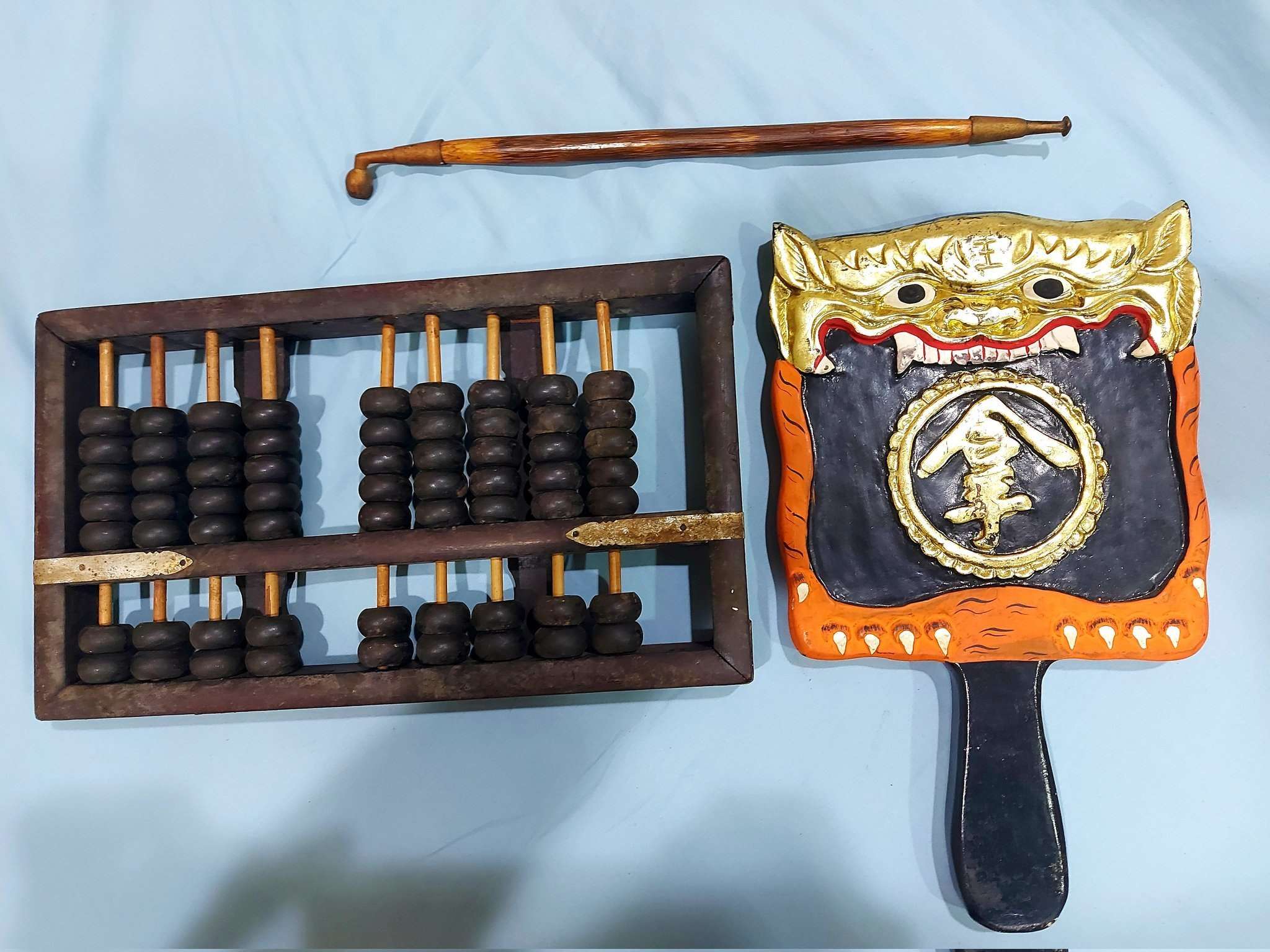
I purchased some ritual items from Singapore previously used by tangki spirit-mediums of the Heibai wuchang. These include an old-school abacus for making arcane calculations, a soul-summoning placard, and a smoking pipe (fig. 6). I feel much cooler now that I have them. My seller-collector friend, from whom I purchased this set, told me that some of the beads are missing from the abacus because they were most likely given to believers as talismans.
Fig. 6 – The ritual items used by Singaporean tangki spirit-mediums of the Heibai wuchang (larger version).
Notes
1) The Three Realms are Heaven, Earth, and Hell, and the Five Phases are the elements of fire, water, earth, metal, and wood. The point being that he is beyond the control of the three realms and the effects of the elements because he has achieved immortality.
Sources
Baptandier, B. (2008). The lady of Linshui: A Chinese female cult. Stanford, Calif: Stanford University Press.
Chen, Y. (2014). Cinematic visualization of spiritual lesbianism in Monkia Treut’s Ghosted: countering essentialist concerns about Li Ang’s literary works In Y. Chen (Ed). New modern Chinese women and gender politics: The centennial of the end of the Qing Dynasty (pp. 210-222).
Maspero, H. (1981). Taoism and Chinese religion. Amherst: University of Massachusetts Press.
Buswell, R., & Lopez, D. (2014). The Princeton Dictionary of Buddhism. Princeton University Press.
Stevens, K. G. (1997). Chinese gods: the unseen world of spirits and demons. London: Collins & Brown.
Sutton, D. S. (1996). Transmission in Popular Religion: The Jiajiang Festival Troupe of Southern Taiwan in Later Imperial China in Shahar, M., & Weller, R. P. (Ed.) Unruly gods: Divinity and society in China (pp. 212-249). Honolulu: University of Hawaiʻi Press.
Tan, C. B. (2018). Chinese religion in Malaysia: Temples and communities. Leiden; Boston: Brill.
Von Glahn, R. (2004). The sinister way: The divine and the demonic in Chinese religious culture. Berkeley: University of California Press.
Wu, C., & Yu, A. C. (2012). The journey to the West: Volumes 1. Chicago, Illinois : University of Chicago Press.
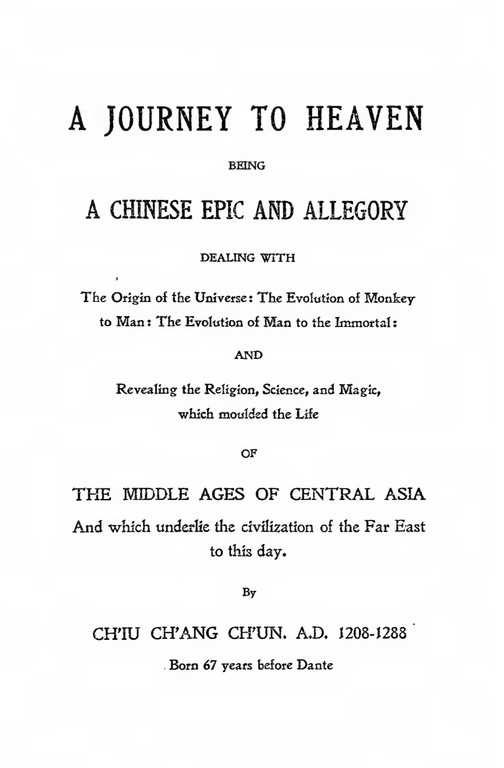
Here I present A Mission to Heaven (1913), the first English version of Journey to the West translated by the Welsh Baptist missionary Timothy Richard (1845-1919). Modern translator Anthony C. Yu describes it and a slightly later translation as “no more than brief paraphrases and adaptations” (Wu & Yu, 2012, vol. 1, p. xiii). This is because Yu’s translation stretches over 2,000 pages, while Richard’s barely breaks 370 pages. Also, there are many mistranslations that will become apparent to those who have already read Yu’s version. For example, in chapter one when light from Sun Wukong’s eyes reach the celestial realm, A Mission to Heaven reads:
They saw the light burning brightly and ordered a telescope to be brought. (The telescope was invented by Galileo only in 1609 A.D., therefore the Chinese must have had some kind of telescope before we in Europe had it. — Tr.) It was taken to the South gate of heaven to be looked through from thence (Chiu & Richard, 1913, p. 3).
However, Yu’s more accurate version reads:
Upon seeing the glimmer of the golden beams, he [the Jade Emperor] ordered Thousand-Mile Eye and Fair-Wind Ear to open the South Heaven Gate and to look out (Wu & Yu, 2012, vol. 1, p. 102).
As can be seen, Richard completely glossed over the two named deities, choosing instead to refer to both as a telescope.
It’s interesting to note the author of A Mission to Heaven/Journey to the West is listed as one Qiu Changchun, otherwise known as Qiu Chuji (1148-1227), founder of the Dragon Gate sect of Daoism. This may be confusing to some since the novel has long been touted as the work of Wu Cheng’en (1500-1582). However, the novel was anonymously published in 1592. Qiu’s disciple is known to have written a travel journal titled Journey to the West (西遊記), which detailed his master’s journey to meet Genghis Khan. Therefore, early commentators confused this historical travel journal with the fictional narrative, thereby claiming Qiu as the author as early as the 17th-century. Wu Cheng’en wasn’t associated with the novel until the 1920s, and the association is again based on a similarly named work published by Wu. Historians remain divided on the true author.
The following video presents 10 facts about Sun Wukong that even superfans of the novel may not know. It is a summation of my and other scholars’ research. I hope you like it and will share with your friends and family.
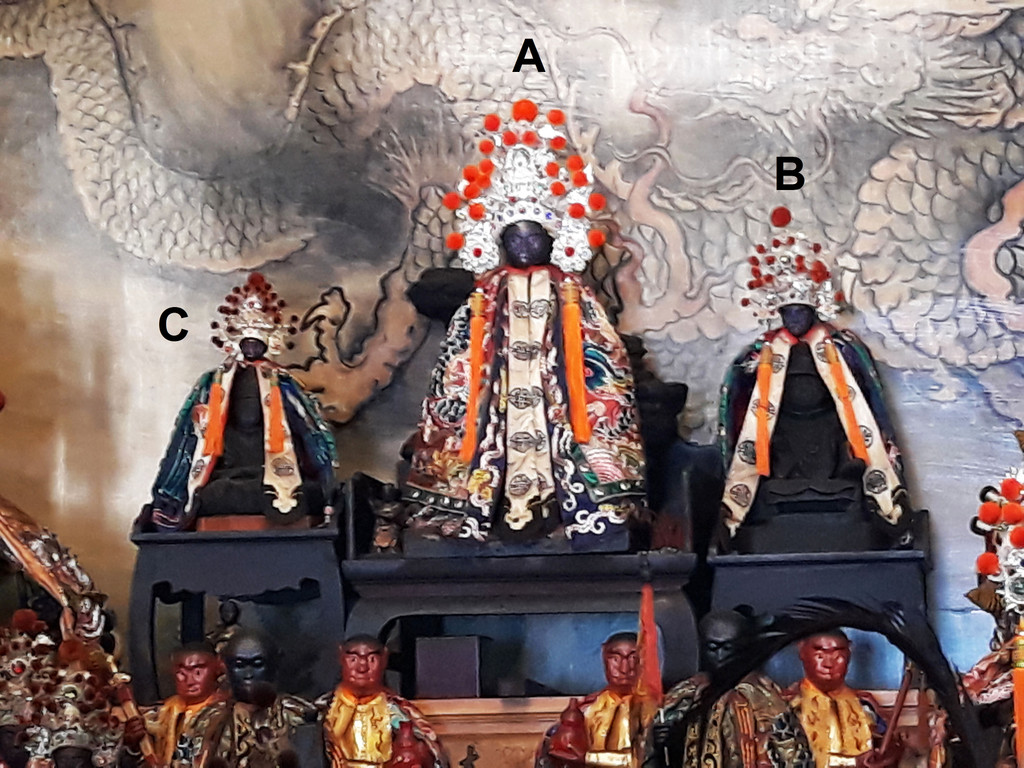
Worshipers of the Wanfu Temple of Tainan, Taiwan believe their high god and oldest altar statue, the “Laying the Foundation Elder Great Sage” (Kaiji Da Dasheng, 開基大大聖) (fig. 1), was transported to the island from the southern Chinese province of Fujian by a certain Lady Ruan (Ruan Furen, 阮夫人) during the Southern Ming/early Qing Dynasty (c. 1660). Fujian is home to a large number of temples dedicated to Sun Wukong. Monkey’s cult on the mainland may have some bearing on the history of his worship on the island. This is especially true since Taiwan was made a prefecture of Fujian in 1684 by the Qing. It was later granted provincehood in 1887 (Gordon, 2007). The cult was no doubt part of the cultural exchange that took place between these two areas during this time. In this paper I use modern demographics and historical records and stories to explore the history of Sun Wukong’s worship in Fujian. I suggest the existence of a historical 12th-century monkey cult explains why the Great Sage’s cult was so readily adopted in the province.
Fig. 1 – The Wanfu Temple’s Laying the Foundation Great Great Sage altar statue, indicated by the letter A (larger version). B and C are lesser Great Sages within the temple’s pantheon.
I. Modern demographics and possible tie to historical trends
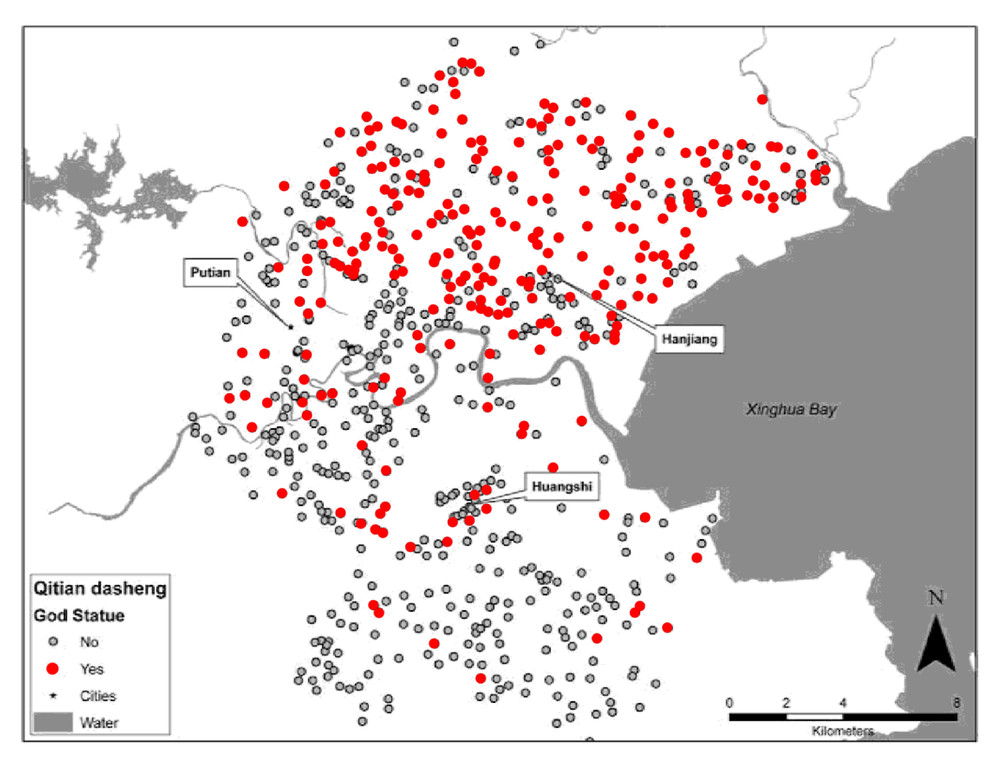
The plains of Putian (莆田) on the central Fujian coast hosts a cluster of Great Sage temples. Dean and Zheng (2009) show the Great Sage is the sixth of the forty most popular deities, his statue appearing in 332 temples, even beating out Guanyin (322 statues) in seventh place (p. 177). Additionally, they describe an interesting geographical correlation in their distribution:
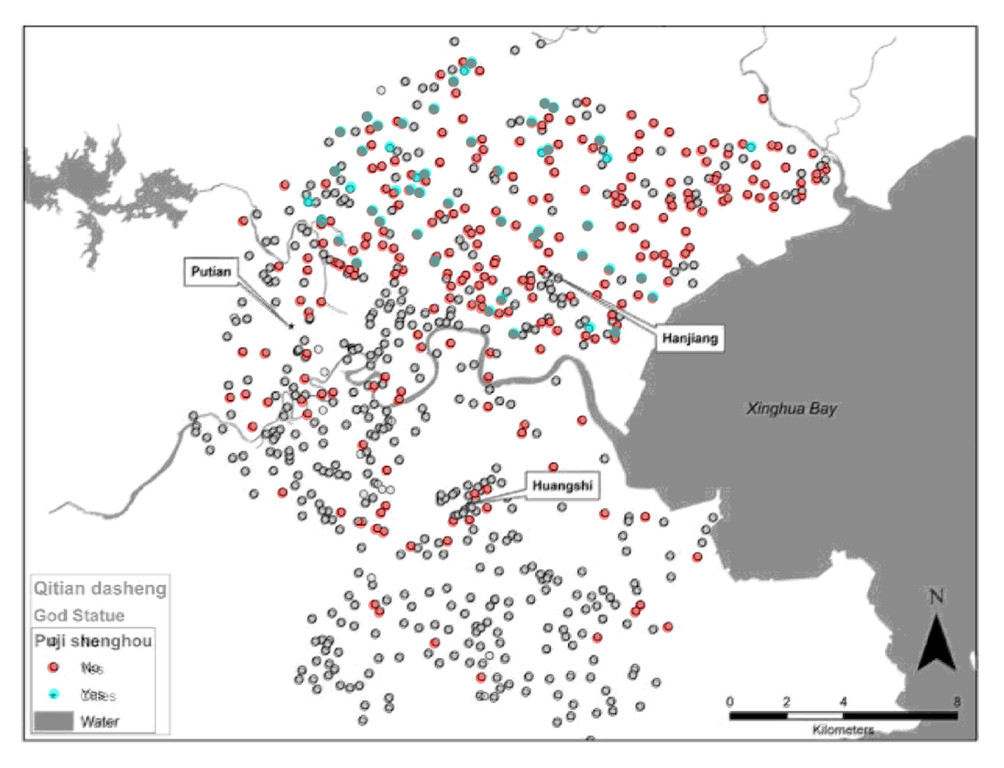
Using GIS mapping, one can unearth many suggestive correlations in distributions of different cultural features across the plain. For example, certain gods such as Qitian dasheng 齊天大聖 (Sun Wukong 孫悟空) and Puji shenghou 普濟聖侯 (Zhu Bajie 豬八戒), the Monkey and the Pig of the classic Xiyouji 西游記 (Journey to the West), appear more often in poorer villages in the northern plain [fig. 2], often in higher elevations than in the low-lying, densely irrigated, wealthier villages of the southern plains. This suggests that the unruly natures of these gods appealed to poorer communities rather than to villages with established scholar-literati lineages (Dean & Zheng, 2009, pp. 38-39)
Fig. 2 – Left: Distribution of Sun Wukong temples (red) in the Putian plains of Fujian Province, China (larger version); Right: An overlay of Zhu Bajie Temples (light blue) with those of Monkey (red) (larger version). There is quite a bit of overlap. Adapted from Dean & Zheng, 2009, pp. 192-193.
Sun Wukong is one of several gods who never enjoyed state patronage in dynastic China due to their eccentric or rebellious nature (Shahar, 1996, p. 185). Regarding the latter, emperors had to deal with real world challenges to their own primacy, so paying homage to, say, a dissident monkey spirit probably didn’t seem too appealing. It’s interesting to note that Monkey is worshiped in Fujian and Taiwan under his defiant title of the Great Sage Equaling Heaven, a name he chose during his rebellion with the celestial realm, instead of his Buddhist name Wukong (悟空, “Awakened to Emptiness”) (Shahar, 1996, p. 201). Therefore, Monkey may have historically appealed to poorer folks because he had the power to push back against an unfair government, perhaps one that favored rich literati over impoverished farmers. This could explain the demographics mentioned above. If true, such people could be responsible for bringing Sun’s cult to Taiwan.
II. The connection between religion, myth, and popular literature
Emperors who officially recognized gods helped make them more popular or at least better known. [1] But, as Shahar (1996) explains, the state’s involvement rarely went beyond building temples and making offerings. Oral tales and popular novels were largely responsible for spreading the myth of a particular deity (p. 185). He continues:
In some cases the novel’s transformation of its divine protagonist was so profound, and its impact on the shape of its cult so great, that the novelist could be considered the deity’s creator. A notable example is Sun Wukong. The cult of this divine monkey in late imperial times cannot be separated from his image as shaped by the successive Journey to the West novels. In this respect he is indeed their author’s creation, and Pu Songling‘s complaint, voiced through his protagonist Xu Sheng [許盛], is justified: “Sun Wukong is nothing but a parable invented by [the novelist] Old Qiu [老丘]. [2] How can people sincerely believe in him?” (Shahar, 1996, pp. 193-194).
The tale referred to by Shahar, titled the Great Sage Equaling Heaven (Qitian Dasheng, 齊天大聖) appears in Strange Tales from a Chinese Studio (Liaozhai zhiyi, 聊齋誌異), a collection of popular tales recorded as early as 1679 by Pu Songling and later posthumously published in 1740 (Barr, 1984). The story follows the aforementioned Xu Sheng and his older brother, both merchants from Shandong, who travel to Fujian to sell their wares but are told to pray to the Great Sage when they fail to make any money. They visit the monkey god temple and witness people burning incense and kowtowing to an image of Sun Wukong. The older brother takes part in the rituals, but Sheng simply laughs and leaves, resulting in a subsequent argument between the two during which Sheng ridicules adherents for worshiping a fictional character from a novel. Sheng later falls bedridden with agonizing leg sores that prevent him from walking, yet he refuses to accept the Great sage is punishing him. His brother begs him to repent, but he still refuses. The brother shortly thereafter falls ill and dies, prompting Sheng to go to the temple to beg for his brother’s life. That night, he dreams he is brought before Sun Wukong, who rebukes Sheng for his rude behavior and reveals the leg sores (the result of being stabbed by Monkey’s heavenly sword) [3] and his brother’s subsequent death to be heaven-sent punishments. The deity finally agrees to revive the brother and sends an order to King Yama in hell to release his soul. Sheng shows his thanks by kneeling. He then awakes to find his brother has revived but remains too weak to work. Days later, Sheng meets an old man who claims he can use “a little magic” to transport them to a beautiful place that will sap away the merchant’s depression wrought by the past events. The two travel by cloud to a celestial paradise where Sheng and the old man drink tea with an aged deity. The god rewards Sheng with twelve magic stones for taking the time to visit him. Upon returning to earth, the merchant realizes the old man is the Great Sage, for both use the “Somersault Cloud” (Jindou yun, 筋斗雲) as a means of conveyance. In the end, the magic stones are found to have melted, but this corresponds to a drastic increase in the brothers’ selling profits. The two return home but are sure to pay their respects to the Great Sage anytime they visit Fujian for business (Pu & Sondergard, 2014, pp. 2078-2085).
I’d like to point out the story includes an afterward that critiques the idea of Sun Wukong being a real god:
The collector of these strange tales remarks, “Once upon a time, a scholar who was passing a temple went in and painted a pipa on one wall, then left; when he checked on it later, its spiritual power was considered so outstanding that people had joined together there to burn incense to it. A god certainly doesn’t have to exist in order to be considered powerful in this world; if people believe it to be divine, it will be so for them. What’s the reason for this? When people who share the same beliefs gather together, they’ll choose some creature figure to represent those beliefs. It’s right that an outspoken man like Sheng should be blessed by the god; who else could believe for real that he’s protected by someone who keeps an embroidery needle inside his ear, who he can transform one of his hairs into a writing brush, or who ascends via cloud-somersault into the cerulean sky! In the end, Sheng’s mind must have deluded him, for what he saw simply couldn’t be true” (Pu & Sondergard, 2014, p. 2085)
This shows that, while the common folk believed in Monkey, the literati class scoffed at such an idea. This again may explain why, as mentioned above, more well-educated communities in modern Fujian do not widely worship Monkey.
III. Historical monkey cults in Fujian
Apart from Pu Songling’s story, there are two other 17th-century references to the worship of a monkey god in Fujian. Dudbridge (1970) explains:
According to You Dong [尤侗] (1618-1704) the citizens of Fuzhou worshiped Sun Xingzhe [孫行者, Pilgrim Sun] as a household god and built temples to the monkey-god Qitian Dasheng. Tong Shisi [佟世思] (1651-92) describes the monkey-headed god of Fujian as bearing a metal circlet about his forehead, brandishing an iron cudgel, wearing a tiger-skin and known as Sun Dasheng [孫大聖, Great Sage Sun]. Traditionally he had appeared in the clouds to beat back an attack from Japanese pirates (p. 158). [4]
I find the last reference particularly interesting because it refers to the preceding 16th-century when China’s coast was plagued by Japanese pirates. It depicts the Great Sage as a benevolent god who intervenes to protect his chosen people, the Chinese.
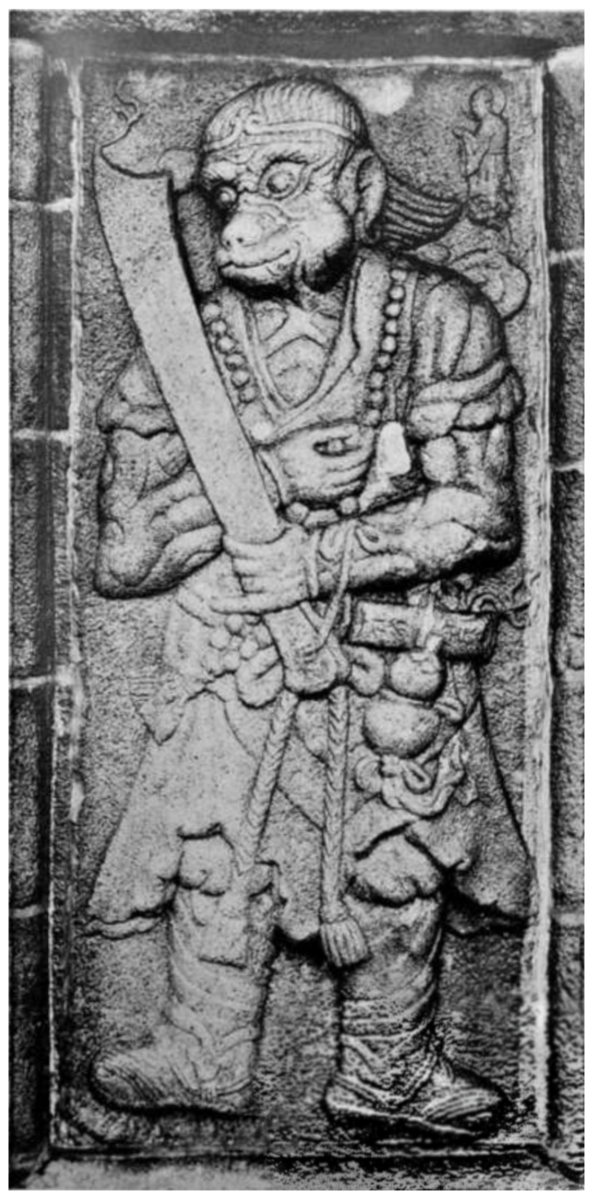
In her excellent paper on the origins of Sun Wukong, Hera S. Walker (1998) discusses a 1237 stone relief from the western pagoda of the Kaiyuan Temple (開元寺) in Quanzhou, a port city in Fujian, that portrays a sword-wielding, monkey-headed warrior (pp. 69-70). [5] Considered by many to be an early depiction of Monkey, the figure wears a fillet, a tunic, a Buddhist rosary, and a pair of bangles (Fig. 3). Walker quotes Victor Mair, who believes the fillet and the figure wearing it recall South and Southeast asian depictions of the Buddhist guardian Andira and the Hindu monkey god Hanuman (Walker, 1998, p. 70). I have suggested in a previous article that the accouterments worn by the warrior are instead based on Esoteric Buddhist ritual attire known in China. So instead of being based on a foreign source, it can be considered a depiction of a local spirit or deity. The relief therefore suggests the proposed Fujian monkey god cult predates the 17th-century.
Fig. 3 – The 1237 stone relief of Sun Wukong from the Kaiyuan Temple in Quanzhou, Fujian (larger version).
The oldest known evidence for a cult based around a monkey is described in Hong Mai’s (洪邁, 1123-1202) the Record of the Listener (Yijian zhi, 夷堅志, c. 1160), a collection of supernatural tales from the Song Dynasty. The following story is said to take place in the Yongfu County of Fujian. Again, we turn to Dudbridge (2005):
The image [effigy], dubbed Monkey King 猴王, was shaped around a captured living monkey and worshipped as a ‘spirit protecting hills and woods’ (保山林神). [6] It afflicted the surrounding population with fevers and frenzy. Blood sacrifice won no relief. Shamans and monks assaulted the spirit by night with noisy ritual music, but to no effect. Only the Buddhist elder Zongyan 宗演 successfully admonished the resentful monkey spirit and wrought its deliverance by reciting in Sanskrit the dhāraṇī of the All-Compassionate (大悲咒). The grateful monkey appeared to him the same night, explaining that she was now able to rise to heaven. Later the image and its thirty-two attendants (all made from birds) were smashed, and the hauntings came to an end (p. 264; see also Dudbridge, 1970, p. 159).
Dudbridge (1970) is reluctant, however, to accept this as a precursor to Sun Wukong’s cult, especially since both this 12th-century monkey spirit and the “Monkey Pilgrim” (Hou Xingzhe, 猴行者) from the The Story of How Tripitaka of the Great Tang Procures the Scriptures, a 13th-century precursor to Journey to the West, bear little resemblance to the simian god mentioned in 17th-century records. He instead suggests the Great Sage’s cult could have grown up around stories connected to the publishing of the novel (Dudbridge, 1970, p. 159). While Journey to the West certainly played a sizable role in the spread of Monkey’s cult, I think the above tale shows that the Fujian area was already primed for monkey worship by at least the 12th-century. Most importantly, the noted Song dynasty poet Liu Kezhuang (劉克莊, 1187-1269), whose family hailed from the Fujian city of Putian (mentioned in section one) (Ebrey, 2005, p. 95), referenced the Monkey pilgrim twice in his 13th-century work. The second of two such references uses Monkey as a metaphor to describe the ageing 70-year-old poet’s appearance. A portion of the poem reads:
A back bent like a water-buffalo in the Zi stream [泗河], Hair as white as the silk thread issued by the “ice silkworms”, A face even uglier than Hou Xingzhe, Verse more scanty than even He Heshi [鶴何師] (Dudbridge, 1970, p. 46)
This shows the character’s story cycle was so well-known in Fujian at this time that no other specifics from the oral tradition had to be mentioned. Therefore, stories of the early monkey cult and those of Sun Wukong could have existed in Fujian around the same time. It’s not entirely impossible then that the historical monkey worship in the province gave the cult of the Great Sage, whenever it first appeared, a boost. This might explain why a so-called literary character would come to be so readily worshiped in the province.
IV. Conclusion
Taiwan has close ties to the southern Chinese province of Fujian because the former was made a prefecture of the latter during the 17th-century. The province is home to a large number of temples dedicated to the Monkey King, so this is no doubt connected to the spread of his cult to the island nation. Modern GIS mapping in Fujian suggests Sun Wukong’s temples mainly inhabit the northern highlands of the Putian plains where poorer villages reside. Monkey’s cult never received royal patronage in dynastic China due to his rebellious nature. The fact that he is worshiped in Fujian and Taiwan by his rebellious title of the Great Sage Equaling Heaven suggests Monkey may have historically appealed to the poorer class because he had the power to push back against an unfair government, perhaps one that favored the rich over the destitute. If true, these could be the people responsible for bringing Sun’s cult to Taiwan.
The mythos of Monkey’s cult was spread thanks to oral tales and popular literature. His mythos became so inseparable from the novel that the scholar class looked upon him as a literary character that jumped from the pages of fiction to be worshiped as a god. An example of this viewpoint appears in Strange Tales from a Chinese Studio (written c. 17th-cent.) in which a skeptical merchant only becomes an adherent of the Great Sage after he and his brother are punished with painful sores and death, respectively. The author of the tale comments the merchant was probably delusional to fall for such a belief. This scholarly disdain for such literary gods may then explain why the more well-educated villages in Putian don’t widely worship Sun Wukong today.
Other 17th-century sources referring to Monkey’s Fujian cult portray him as a headband-wearing, cudgel-wielding benevolent god who comes to the aid of the Chinese people. A 13th-century stone relief located on the western pagoda of the Kaiyuan Temple in Quanzhou depicts a sword-wielding, monkey-headed warrior wearing a fillet. While past scholarship has posited a South and Southeast Asian origin for the figure’s iconography, my research suggests it to be based on esoteric ritual accouterments known in China. So instead of being based on a foreign source, it can be considered a depiction of a local spirit or deity. The relief therefore suggests the proposed Fujian monkey god cult predates the 17th-century. The oldest evidence for such a cult appears in Hong Mai’s Record of the Listener, a 12th-century collection of supernatural tales. It refers to a malevolent simian god worshiped as the “Spirit protecting hills and woods” that spread fever and was eventually pacified by a Buddhist monk. This shows Fujian was primed for monkey worship by the 12th-century, and the fact that the “Monkey Pilgrim” (Sun Wukong’s original name) is mentioned in the secular works of the Putian poet Liu Kezhuang in the 13th-century shows stories of this god and Monkey existed in Fujian around the same time. The historical existence of a Fujian monkey cult may have given Sun Wukong’s cult a boost, explaining how a literary character came to be so readily worshiped.
Updated: 07-26-19
The American missionary Justus Doolittle (1865) recorded information about the worship of the Great Sage in Fuzhou city, Fujian province, China during the 19th-century:
The Monkey. — It is represented as a man sitting, the face only being like a monkey. The image is usually made of wood or clay. Sometimes a picture of it is made on paper, or simply the title under which the monkey is worshiped is written on a slip of paper, and used instead of an image. There are several large temples at this place, erected for the worship of “His Excellency the Holy King,” one of the titles much used in speaking of the monkey as an object of worship. Oftentimes the niche holding the image or the written name is placed in a hollow tree, or in the wall at the corners of streets, or at the heads of alleys or lanes. Such places, in this city and vicinity, where the monkey is worshiped, reckoned together with the small temples or buildings dedicated to it, amount to several scores. The worship consists principally in the burning of incense and candles, sometimes attended with the presentation of meats, vegetables, and fruits. The monkey was first worshiped in return for some supposed services rendered the individual who went to India, by special command of an emperor of the Tang dynasty, to obtain the Sacred Books of the Buddhist religion — so some affirm. This emperor deified the monkey, or, at least, he conferred the august title of “the great Sage equal to Heaven” upon that quadruped. The birthday of “His Excellency the Holy King” is believed to occur on the twenty-third of the second Chinese month, when his monkey majesty is specially worshiped by men from all classes of society. The monkey is believed to have the general control of hobgoblins, witches, elves, etc. It is also supposed to be able to bestow health, protection, and success on mankind, if not directly, indirectly, by keeping away malicious spirits or goblins. People often imagine that sickness, or want of success in study and trade, is caused by witches and hobgoblins. Hence the sick or the unsuccessful worship the monkey, in order to obtain its kind offices in driving away or preventing the evil influences of various imaginary spirits or powers (vol. 1, pp. 287-288).
He continues, “Sometimes the image carried in procession while praying for rain represents a deified monkey, an object which is much worshiped by some classes of the people at this place” (Doolittle, 1865, vol. 2, p. 119).
It appears that Doolittle wasn’t aware of Journey to the West since he combines folklore with history, claiming a Tang emperor deified and/or bestowed Wukong with his Great Sage title. Sun’s image as an exorcist and healer, as well as his remuneration with incense and delicious foodstuffs, matches what I’ve previously written about in Taiwan. But his association with rainmaking is new, although not entirely a surprise. Also, his birthday is celebrated on a different day, the twenty-third day of the second lunar month, instead of the twelfth day of the tenth lunar month in Taiwan and the sixteenth day of the eighth lunar month in Hong Kong and Singapore. Interestingly, unlike Fuzhou, his birthday is celebrated on the twenty-fifth day of the second lunar month in Putian (Dean & Zheng, 2010, p. 162, for example). Such differences highlight that Monkey’s cult never received state patronage and therefore lacks standardization in beliefs and practices even in Fujian.
The Japanese researcher Isobe Akira shows that, despite appearing in Song-era sources, the aforementioned story about the female monkey king can be traced to the late Tang period (Mair, 1989, pp. 694-695). This shows Fujian was primed for monkey worship centuries prior to the development of Sun Wukong’s story cycle.
Additionally, Isobe points to one of the earliest known references to Sun Wukong. A tale appearing in Zhang Shinan’s (張世南, 12th-13th century) Memoirs of a Traveling Official (Youhuan jiwen, 遊宦紀聞) tells of Zhang the Sage (Zhang sheng, 張聖), a farmer-turned-Buddhist monk who gains literacy and clairvoyance after eating a magic peach. In the story, Zhang is asked to write a eulogy in honor of a newly built revolving sutra case. The resulting poem references the Monkey Pilgrim:
Fresh are the pattra (palm) leaves on which are written the unexcelled (anuttara), vigorous texts, In several lives, Tripitaka went west to India to retrieve them; Their every line, their every letter is a precious treasure, Each sentence and each word is a field of blessing (punyaksetra). In the waves of the sea of misery (duhkha-sagara), the Monkey-disciple presses on 猴行復, Through the waters of the river that soak its hair, the horse rushes forward; No sooner have they passed the long sand than they must face the trial of the golden sands, Only while gazing toward the other shore do they know the reasons (pratyaya) for being on this shore. The demons (yaksas) are delighted that they might get their heart’s desire, But the Bodhisattva, with hand clasped in respectful greeting, sends them on; Now here are the five hundred and sixty-odd cases of scriptures, Their merit is difficult to measure, their perfection hard to encompass (Mair, 1989, pp. 693-694).
This eulogy is fascinating because it references additional elements that would appear in The Story of How Tripitaka of the Great Tang Procures the Scriptures, including the Buddhist master’s quest to India over many lifetimes, the tribulations at the river of sand (a nod to Sha Wujing’s precursor), the demons encountered, and heavenly assistance. Isobe dates Zhang the Sage’s tale to the late Northern Song to the early Southern Song (circa 1127) (Mair, 1989, p. 694). But what’s interesting for our purposes is that the original recorder, Zhang Shinan was known to have historically held a government post in Fujian (Zheng, Kirk, Buell, & Unschuld, 2018, pp. 644-645), meaning he could have picked up the tale in the southern province. This adds an additional connection between Fujian and Sun Wukong.
Notes:
1) One example of this connected to Journey to the West is Erlang. He was originally worshiped as a hunting god and queller of mountain ghosts by the Qiang (羌) ethnic group of the western Sichuan region. But his cult became even more popular upon gaining state recognition. Wu (1987) writes: “The Er-lang cult became even more popular in Sichuan under the patronage of the Later Shu emperor, Meng Chang 孟昶 (r. 934-65), and in 965, when the Song dynasty conquered the kingdom, it adopted the cult, erecting temples for the god in the capital and throughout the country” (pp. 107-108).
2) This refers to Qiu Chuji (丘處機, 1148-1227), the founder of the Dragon Gate sect of Daoism during the Song Dynasty. Qiu is known to have written a travel journal named Journey to the West, which Pu Songling confused with the novel of the same name (Pu & Sondergard, 2014, p. 2080 n. 1).
3) Literally “Bodhisattva Saber” (Pusa dao, 菩薩刀).
4) Source altered slightly. The Wade Giles was converted to pinyin and the Chinese characters from the footnotes were moved into the paragraph.
5) In act 10 of the early 15th-century zaju play Journey to the West, Guanyin gives Sun Wukong an iron headband, a cassock, and, most importantly, a sword. His depiction in the play and this relief then may have some connection.
6) The fact that the effigy was formed around a living monkey suggests it was killed in the process. This would explain its rage.
Sources:
Barr, A. (1984). The Textural Transmission of Liaozhai zhiyi. Harvard Journal of Asiatic Studies, 44 (2), pp. 515-562.
Dean, K., & Zheng, Z. (2009). Ritual alliances of the Putian plain. Volume One: Historical introduction to the return of the gods. Leiden: Brill.
Dean, K., & Zheng, Z. (2010). Ritual alliances of the Putian plain. Volume Two: A survey of village temples and ritual activities. Leiden: Brill.
Doolittle, J. (1865). Social life of the Chinese: With some account of their religious, governmental, educational, and business customs and opinions. With special but not exclusive reference to Fuhchau. Volume 1 and 2. New York: Harper & Brothers.
Dudbridge, G. (2005). Books, tales and vernacular culture: Selected papers on China. Leiden: Brill.
Dudbridge, G. (1970). The Hsi-yu chi: A study of antecedents to the sixteenth-century Chinese novel. Cambridge: Cambridge Univ. Press.
Ebrey, P. B. (2005). Women and the family in Chinese history. London: Routledge.
Gordon, L. H. D. (2007). Confrontation over Taiwan: Nineteenth-century China and the powers. Lanham, MD: Lexington Books.
Mair, V. (1989). Suen Wu-kung = Hanumat? The Progress of a Scholarly Debate, in Proceedings of the Second International Conference on Sinology (pp. 659-752). Taipei: Academia Sinica.
Pu, S., & Sondergard, S. L. (2014). Strange tales from Liaozhai. Volume 6. Fremont, Calif: Jain Pub.
Shahar, M. (1996). Vernacular Fiction and the Transmission of Gods’ Cults in Later Imperial China. In M. Shahar & R. P. Weller (Eds.), Unruly gods: Divinity and Society in China (pp. 184-211). Honolulu: University of Hawaiʻi Press.
Walker, H.S. (1998). Indigenous or foreign? A look at the origins of monkey hero Sun Wukong. Sino-Platonic Papers, 81, pp. 1-117.
Zheng, J., Kirk, N., Buell, P. D., & Unschuld, P. U. (2018). Dictionary of the Ben cao gang mu, Vol. 3: Authors and book titles. Berkeley: University of California Press.