The novels Journey to the West (Xiyouji, 西遊記, 1592) and Investiture of the Gods (Fengshen yanyi, 封神演義, c. 1620) are dramatized examples of the syncretic Buddho-Daoist pantheon of Chinese Folk Religion. The number of Buddhas, sages, gods, immortals, spirits, guardians (etc.) revered by people of Chinese descent is enormous, and new figures are being added to the list even to this day. Needless to say, laymen and researchers who visit temples and wish to correctly identify a particular deity need a resource with images, names, and listed attributes. Luckily there is one such source. Keith Stevens (1926-2015), a veteran of the British Army and Foreign and Commonwealth Office, traveled East and Southeast Asia for 40 years collecting information on the folk pantheon. He produced an invaluable monograph titled Chinese Gods: The Unseen World of Spirits and Demons (1997). The book is unfortunately out of print, and available copies are expensive to buy. So, I am pleased to host a PDF of this wonderful work on my site.
The scan was produced with an overhead document camera. The glossy pages made scanning somewhat difficult. I had to use a soft, indirect light source. Therefore, not all pages are crisp due to the low light levels.
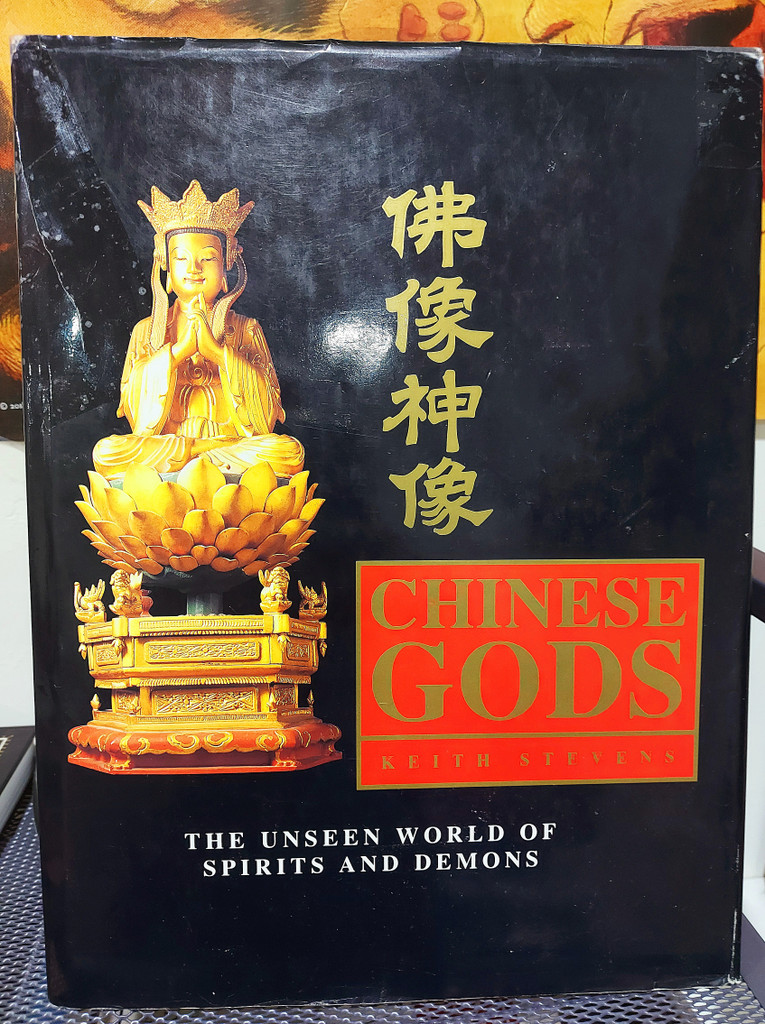
My well-worn personal copy of Chinese Gods (larger version).
1. Dust Jacket Description
China is a land full of gods and goddesses, ranging from the Creators of the World to Worthies local to only one or two villages.
This book introduces the reader to the most important figures of Chinese folk history, and those of Buddhism, Taoism and Confucianism.
Intensely pragmatic in their religion, Chinese people hold all gods in reverence, but it is only the ones who answer prayers with concrete results that are exceptionally praised. Many gods have particular specialities, for instance, there are different Wealth Gods for success in business and for gambling. There are also individual gods for each trade, from those for removal men in Hong Kong to students at Beijing University.
In addition, there are the City Gods and Kitchen Gods, the Earth Gods who protect a specific piece of land, and myriad spirits who protect wells, mountains or bridges, distribute rain or snow, control flooding or protect humanity from disease and epidemics.
Keith Stevens has spent a lifetime researching the subject, travelling extensively in China, Taiwan and throughout South-East Asia. He has gathered information from hundreds of temple keepers, god-carvers and religious specialists and collected details of images and their stories – providing glimpses into the sometimes little-known folk history of China. The author also provides pointers on how to identify images, together with invaluable background information including chronology of Chinese history, a map of the area covered, a glossary and detailed index with the names of deities in Chinese characters.
This has been posted for educational purposes. No malicious copyright infringement is intended. If you like the digital version, please support the official release.
Citation:
Stevens, K. G. (1997). Chinese Gods: The Unseen World of Spirits and Demons. London: Collins & Brown.
I recently learned about an interesting website called the Book of Xian and Shen (BOXS), which catalogs information and pictures for Chinese gods from all over the world. There are currently 2,000 listings and counting.
It is based on the work of religious scholar Keith Stevens (d. 2016), who wrote the amazing Chinese Gods: The Unseen Worlds of Spirits and Demons(Collins & Brown, 1997) (fig. 1). I recently volunteered to help the project. So far, I’ve written two articles (see reference no. W1001 and W1011) and updated two other existing listings with information and pictures (see the bottom of W8620 and W9305).
Fig. 1 – My well-worn personal copy of Chinese Gods (larger version).
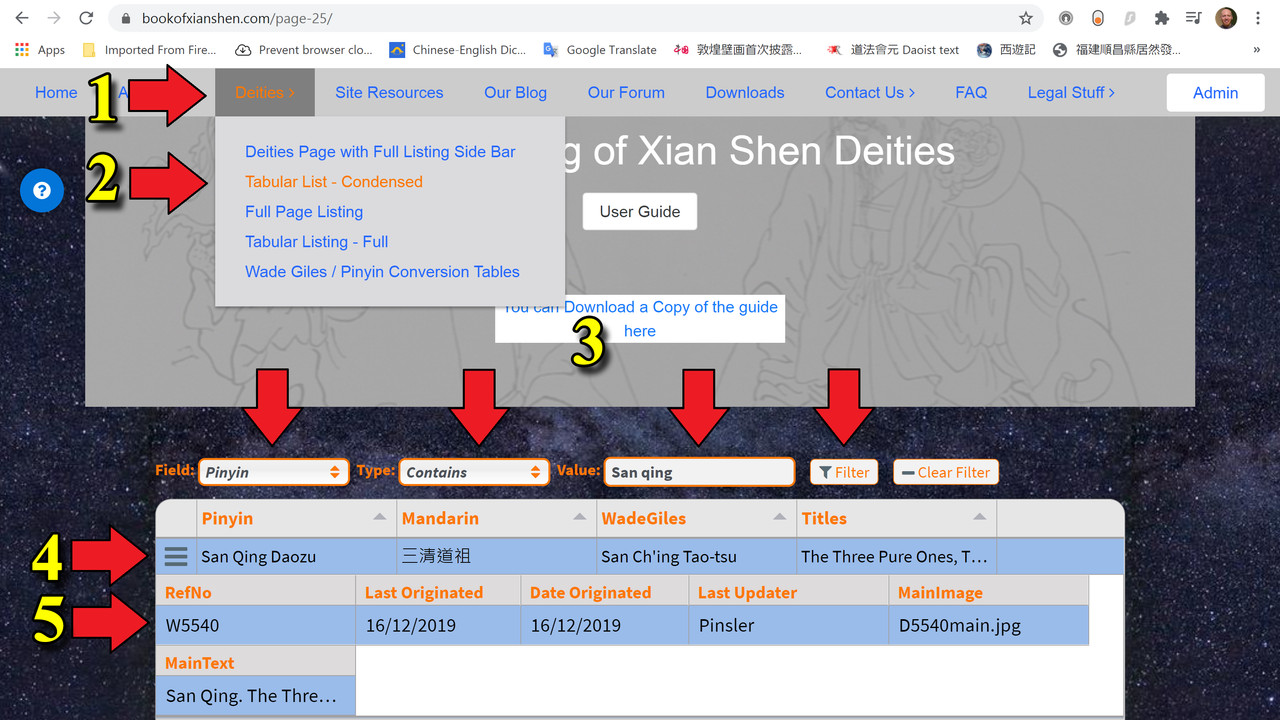
Due to the great number of listings, there are no direct links. Instead, the site has adopted a somewhat confusing (but necessary) cataloging system based around reference numbers, pinyin, Mandarin, and Wade-Giles. However, it’s easy to use once you get used to it. For example, if you were going to search for Sanqing, the “Three Pure Ones,” using, say, Pinyin, I recommend first getting the reference number (RefNo).
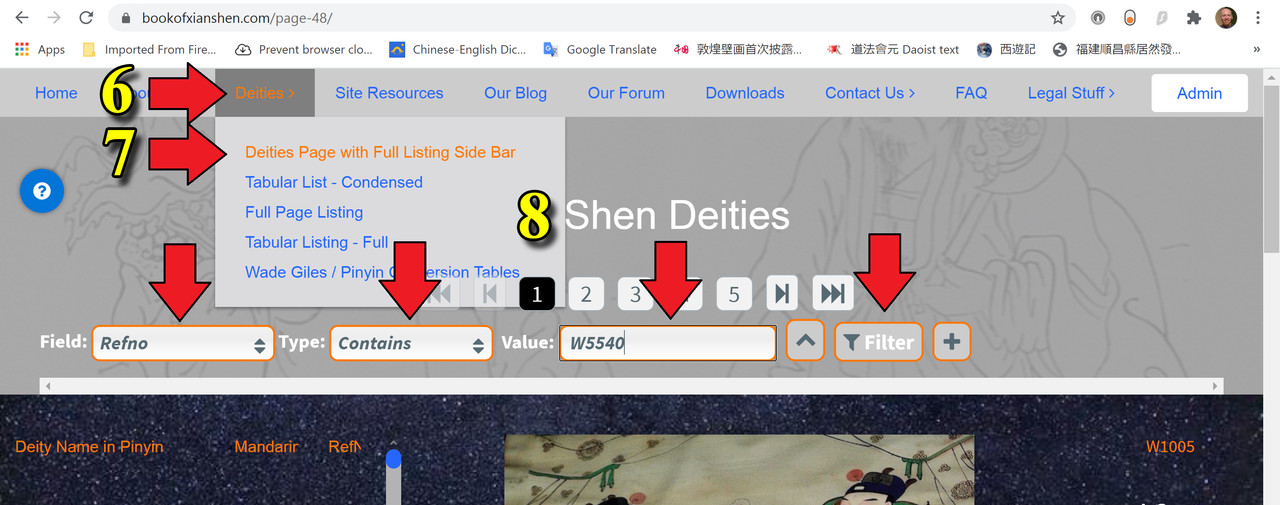
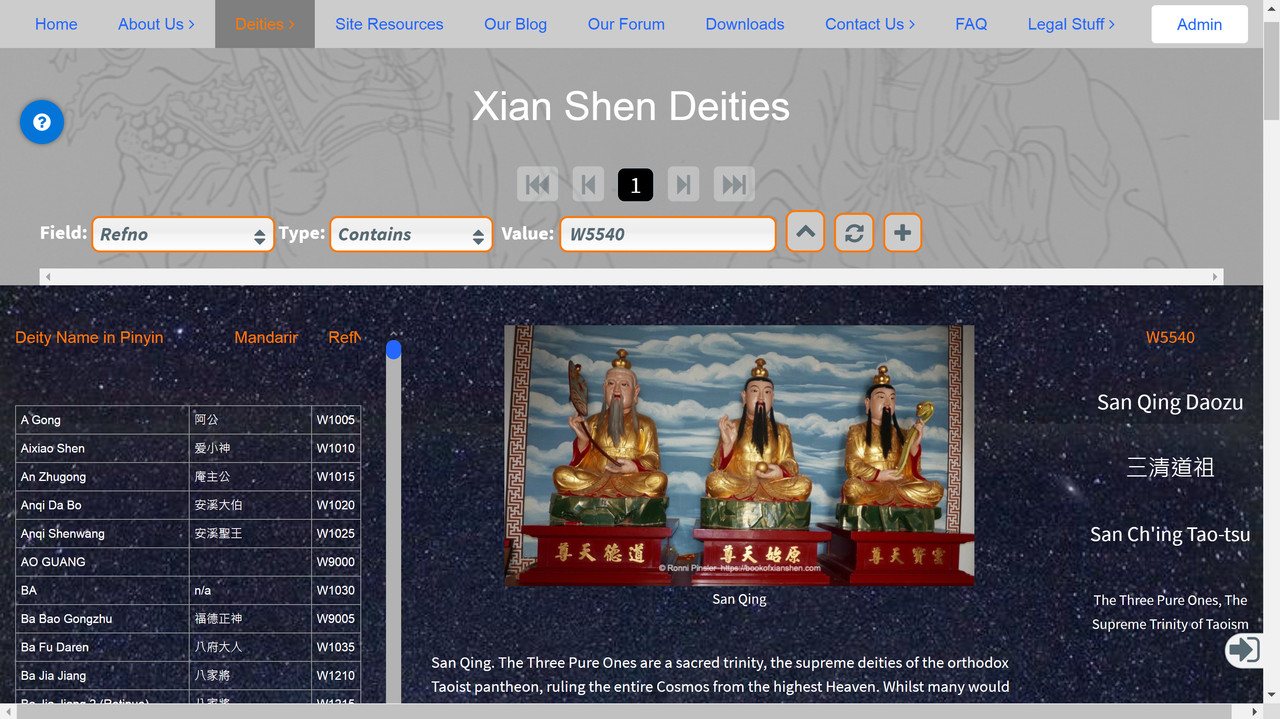
Deities —> Tabular Listing of Xian Shen Deities —> Field: Pinyin —> Type: Contains —> Value: San qing (you may have to play around with the spacing like I did here) —> Filter —> Then look for the correct listing (since other listings mentioning them might appear in the list) —> ☰ —> copy the “RefNo”, in this case W5540 (fig. 2) —> Deities —> Deities Page with Full Listing Side Bar —> Field: RefNo —> Type: Contains —> Value: W5540 —> Filter (fig. 3) —> The listing (fig. 4)
If you know the Mandarin or Wade-Giles for the deity you are looking for, the process would be similar. You would just need to change the field to “Mandarin” or “Wade-Giles”. You could just jump to “Deities Page with Full Listing Side Bar” to search using pinyin, mandarin, and Wade-Giles, but it’s been my experience that a different listing will pop up first based on a higher RefNo or Romanized spelling. First finding the reference number seems to be the easiest method for me.
I can’t recommend this website enough. New gods, as well as new stories or beliefs associated with more established deities, are appearing all the time, so it is very important to catalog everything as soon as new information becomes available. If you would like to volunteer in some way, please contact Ronni Pinsler using the “contact” form on the BOXS website.
Fig. 2 – How to acquire the reference number (RefNo) (larger version). Fig. 3 – How to navigate to the listing (larger version). Fig. 4 – The listing as seen from the top of the page (larger version).
My previous article on the origin of Sun Wukong’s golden fillet describes how various forms of media portray him wearing three different styles: 1) a band with blunt ends that meet in the middle of the forehead and curl upwards like scowling eyebrows; 2) a band adorned with an upturned crescent moon shape in the center; and 3) a simple band devoid of decoration (fig. 1). Here, I want to speculate on the origin of the first style, what I call the “curlicue-style headband”.
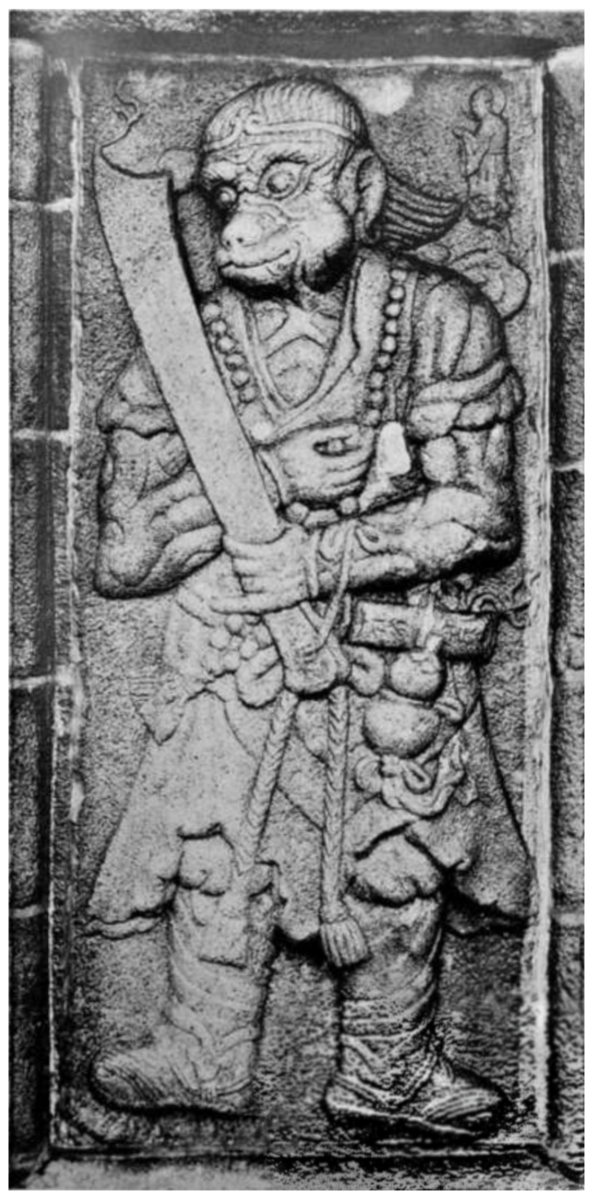
The oldest example of Sun Wukong wearing the curlicue style headband that I am aware of is a nearly life size stone carving from the Western pagoda of Kaiyuan Temple erected in 1237 CE. He is depicted as a muscular, monkey-headed warrior wearing a circlet, earrings, bracelets, a rosary, arm bangles, and anklets (all prescribed ritual items), as well as a monk’s robe and sandals. He wields a broadsword in one hand, while the other thumbs the rosary at his chest. At his waist hangs a calabash gourd and a sutra scroll (fig. 2). Behind his left shoulder can be seen Xuanzang (a.k.a. Tripitaka) ascending to heaven on a cloud, having won a place in paradise thanks to the protection of our hero. In short, Wukong is portrayed as a guardian deity. The significance of this will become clear below.
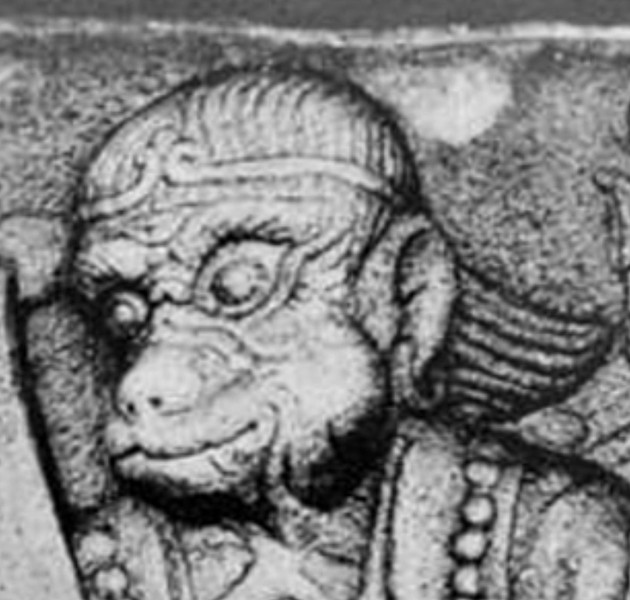
The carving’s headband has a gentle double curlicue topped with a wedge shape (fig. 3). This design appears in Daoist art from the same period.
Fig. 2 – The Kaiyuan Temple pagoda carving (1237) (larger version). Fig. 3 – Detail of the headband (larger version).
II. Ink Treasure of Wu Daozi
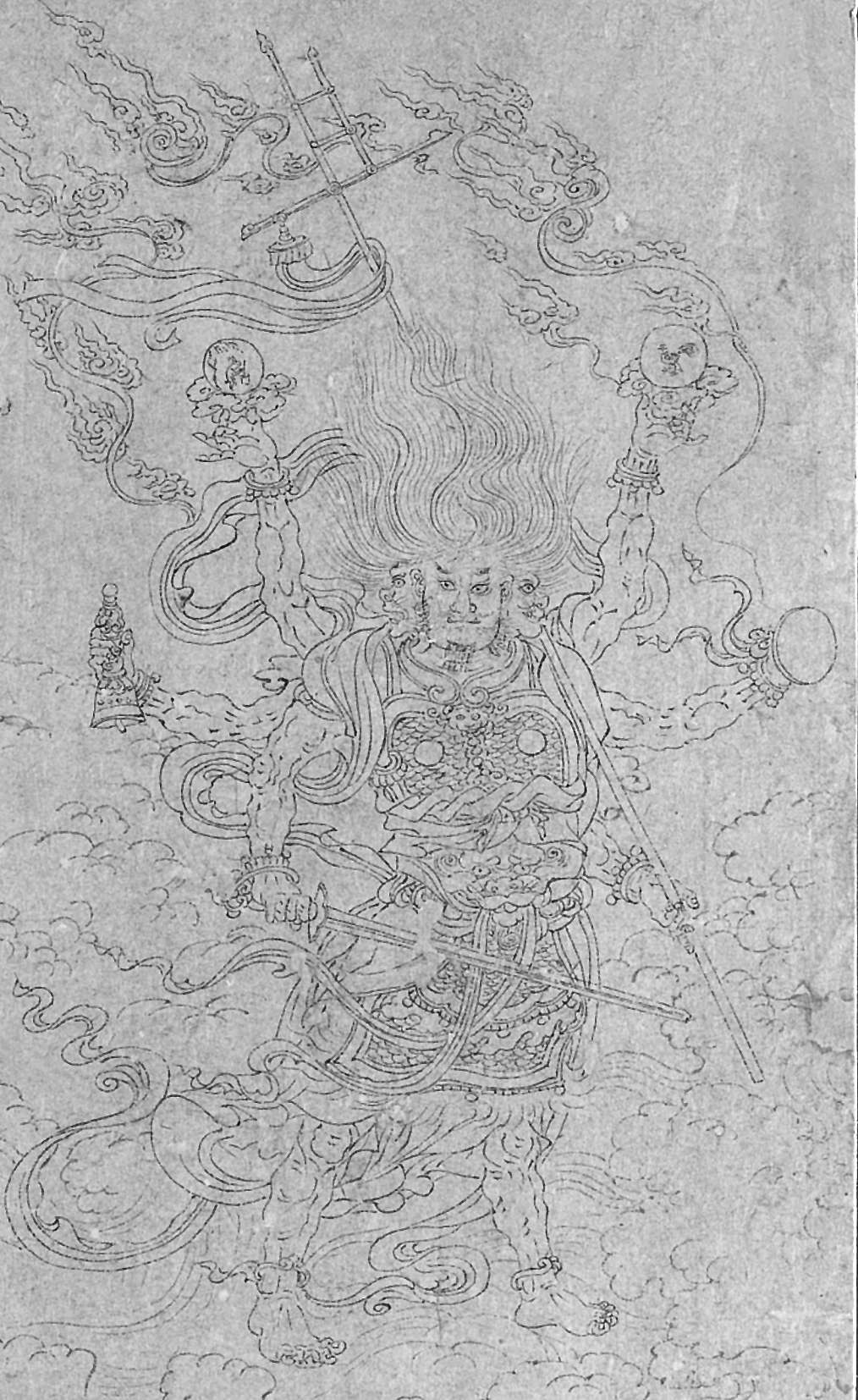
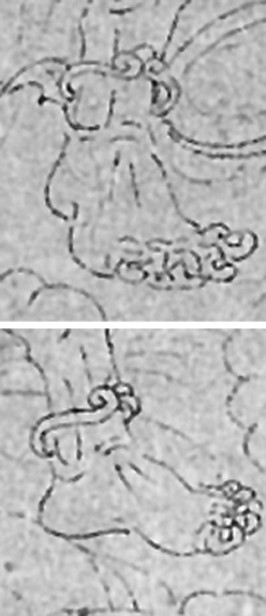
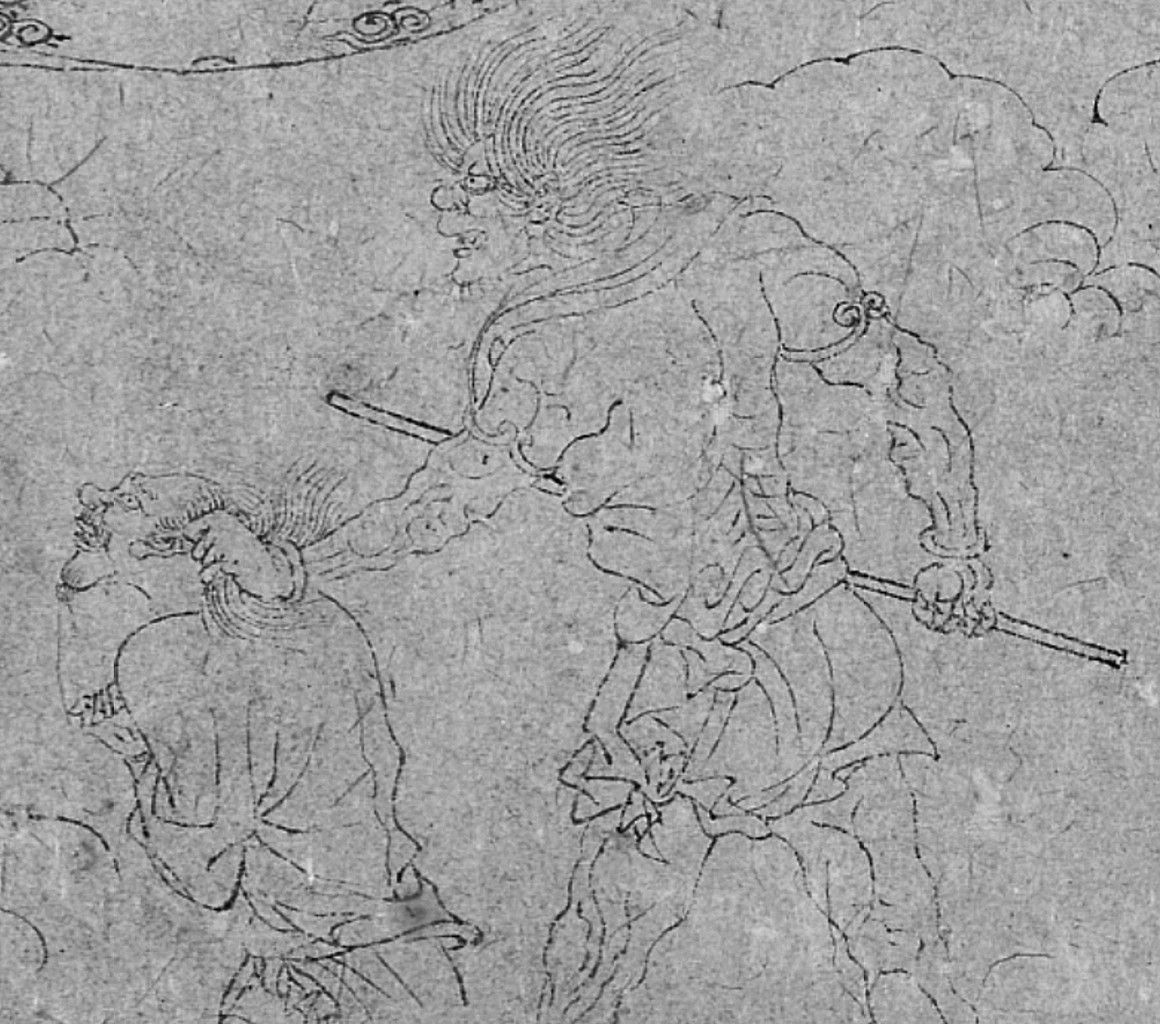
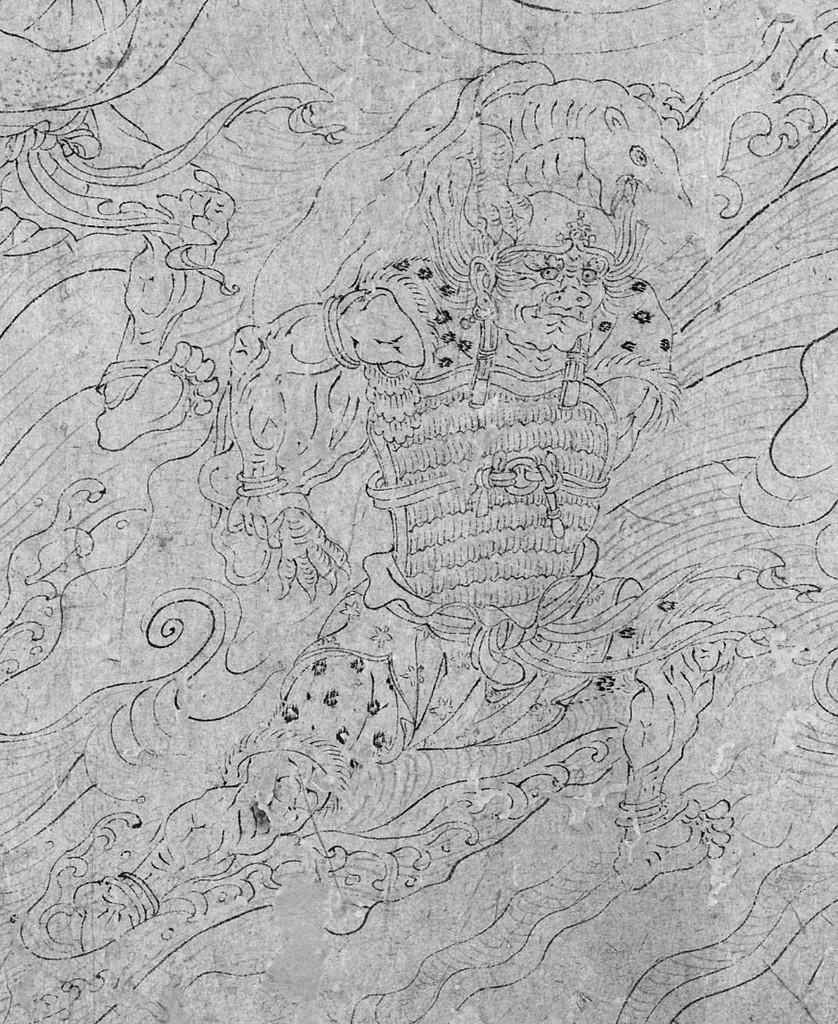
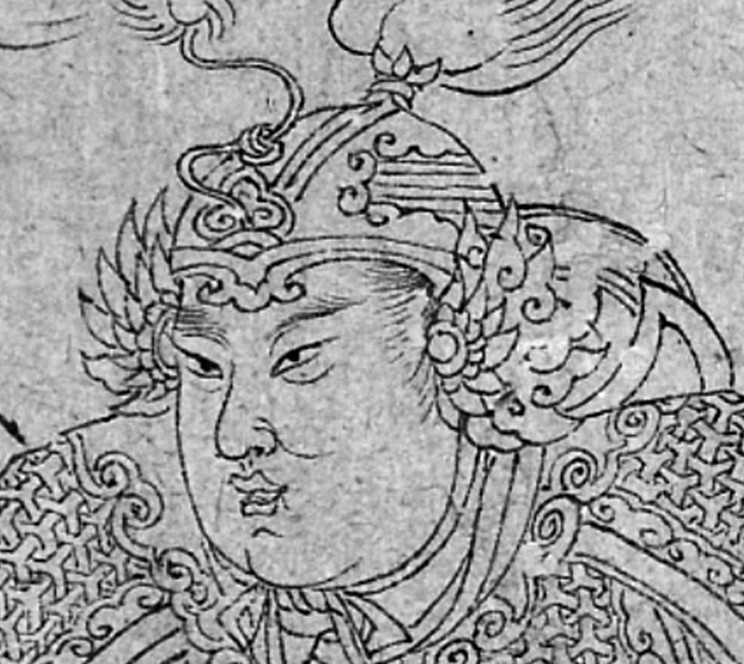
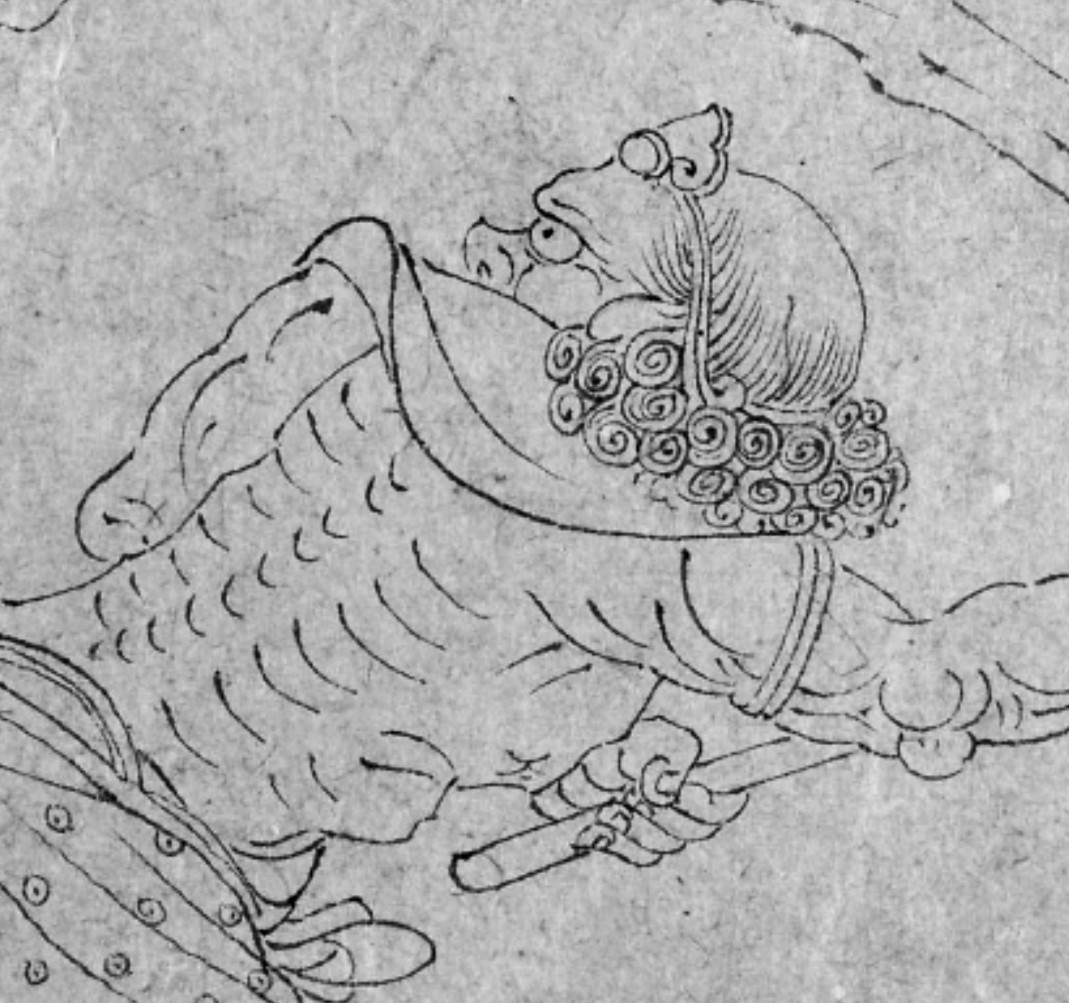
TheInk Treasure of Wu Daozi (Daozi mobao, 道子墨寶) is a collection of 50 ink drawings of the Daoist pantheon attributed to the noted 8th-century artist Wu Daozi but likely produced during the 13th-century. It features many protector/wrathful deities wearing body adornments with this curlicue pattern (with or without the added wedge). There are too many examples to post, so I will choose just three (Fig. 4–9). Please note that, with the exception of the headband and rosary, these figures are wearing the same esoteric ritual items as Monkey (i.e. earrings, bracelets, arm bangles, and anklets).
This shows a clear connection between body adornments with the curlicue pattern and guardian deities.
Fig. 4 – The esoteric protector deity Marshal of Heavenly Reeds, a.k.a. Zhu Bajie’s previous incarnation (larger version). Fig. 5 – Detail of the anklets on his feet (larger version). Note that Heavenly Reed’s necklace also features the curlicue pattern. Fig. 6 – A demonic guardian detaining a soul undergoing judgement in hell (larger version). Fig. 7 – Detail of the bangles on his arms (larger version). Fig. 8 – One of Lord Erlang‘s demonic soldiers helping to clear animal spirits (in this case a turtle) from a mountain river (larger version). Fig. 9 – Detail of his ornate headband with spherical elements, giving it a floral quality (larger version). The images have been enhanced slightly for clarity.
III. Possible origin of the pattern
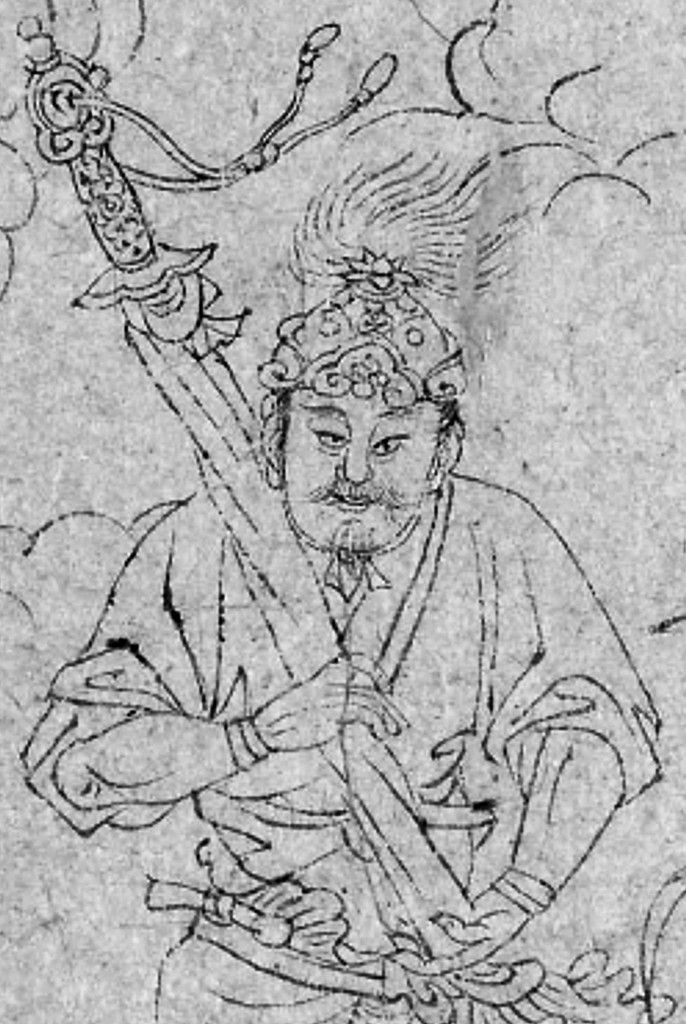
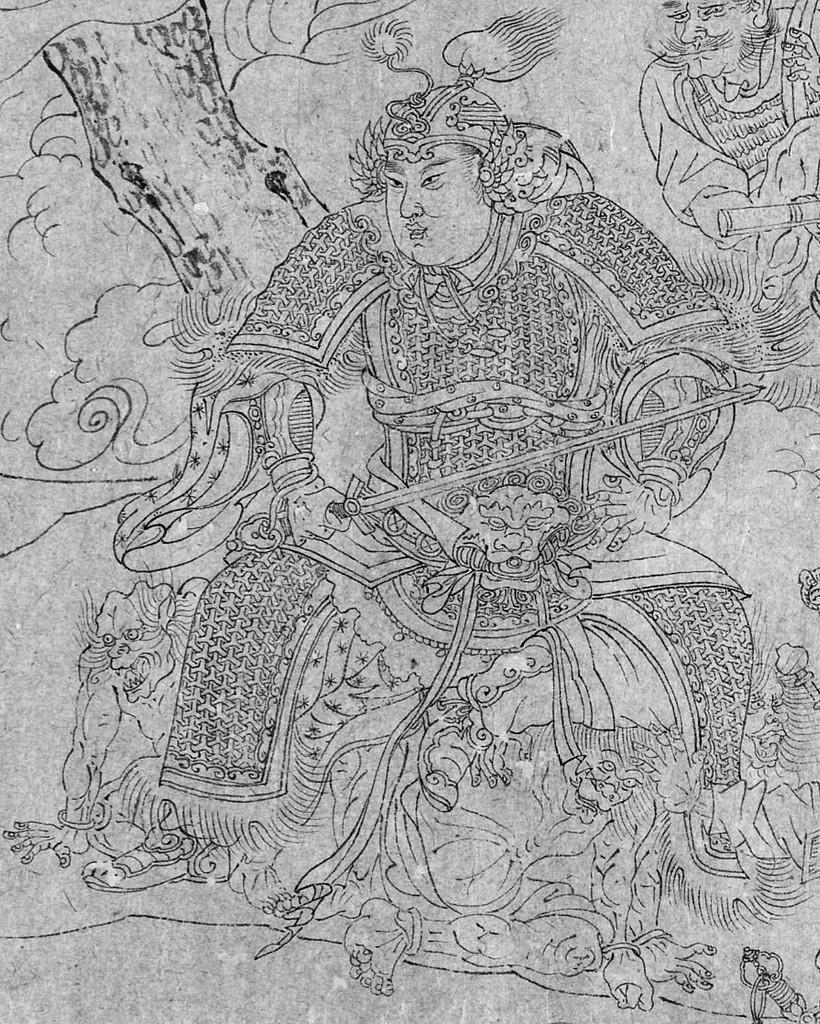
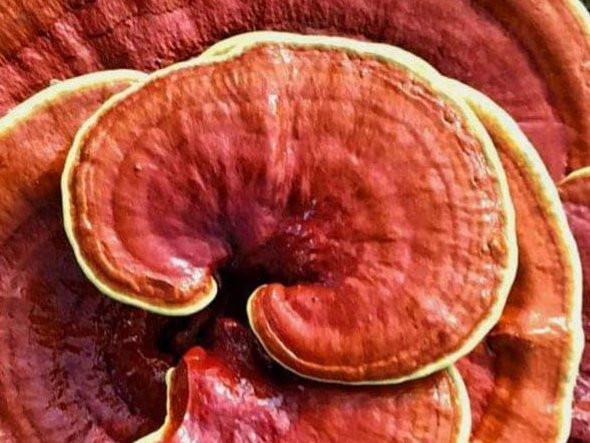
The Ink Treasure of Wu Daozi shows several generals, officials, and guardians wearing headgear with lingzhi mushrooms (靈芝) (fig. 10–13), a real world fungi shaped like a rounded heart with a lacquered reddish-brown appearance (fig. 14). Also known as ruyi (如意, “as-you-wish”),—yes, the same as Wukong’s staff—the mushroom is associated with immortality and magic wish fulfillment in Buddho-Daoist culture. The ruyi pattern (ruyi wen, 如意紋) is a common motif in Chinese art, lining vases, topping S-shaped scepters, appearing as flourishes on traditional style rooftops, repeating endlessly on extravagant silken textiles, etc. (fig. 15–17). It has a familiar double curlicue swirl that reminds one of Monkey’s headband (fig. 18).
Given the fungi’s high standing in religious culture, I could see the lingzhi/ruyi‘s curlicue pattern being associated with the ritual garb of guardian deities since they are the front line of defense against evil influences.
Fig. 10 – A sword bearer (larger version). Fig. 11 – Lord Erlang overseeing his demonic soldiers clearing the mountain and river of animal spirits (larger version). Fig. 12 – Detail of his helmet (larger version). Fig. 13 – One of Erlang’s soldiers driving out animal spirits with fire (larger version). Fig. 14 – A lingzhi mushroom (larger version). Fig. 15 – The Bodhisattva Guanyin holding a ruyi scepter (larger version). Fig. 16 – A marvelous Qianlong-era celadon glaze vase with a ruyi shape (larger version). Note the pattern repeating on the lid and base. Image found here. Fig. 17 – The Ruyi Gate in the Forbidden City. Note the Ruyi elements on the roof (larger version here). Fig. 18 – A comparison of a ruyi pattern and Sun Wukong’s golden headband (larger version).
Update: 01-23-22
I’ve written an article suggesting a mantra for the secret spell that causes the golden fillet to tighten.
Note: My blog is not monetized, so I am not making any money from this post. My hope is that the PDF will make this legendary story more accessible to a wider audience. If you enjoyed the digital version, please, please, please support the official release.
Last updated: 04-06-2026
Here I present a PDF of the Library of Chinese Classics bilingual edition of Creation of the Gods (Fengshen yanyi, 封神演義, c. 1620 CE), sometimes translated as Investiture of the Gods or Enfeoffment of the Gods.
I. Description
This 100 chapter shenmo novel tells of the great struggle between the declining Shang (c. 1600–1046 BCE) and ascending Zhou (c. 1046–256 BCE) dynasties. In the beginning, King Zhou of Shang offends the primordial goddess Nuwa by leaving a lewd poem in her temple, and in response, the devi summons a trio of spirits (a fox, a pheasant, and a lute) to bring about the dynasty’s downfall. The fox spirit takes the place of the king’s concubine Daji and, over the course of nearly 30 years, leads him down a path of imperial neglect, decadence, and sadism. This causes many of the kingdom’s dukes, marquis, and generals to later rebel in favor of King Wu of Zhou, the monarch destined by heaven to rule China.
The majority of the story follows the countless battles between the forces of Shang and Zhou. Along the way, the latter are aided by immortals of the Chan (闡) sect (an analogy for Quanzhen Daoism), which favors spiritual cultivation, while the former are aided by the Jie (截) sect (an analogy for Zhengyi), which favors charms and incantations. [1] Each transcendent wields any number of swords, fans, hooks, staves, axes, halberds, scissors, hammers, rings, sashes, nails, dippers, pennants, pearls, gourds (etc.), each with not only the power to take the lives of thousands of humans but also immobilize other immortals and even kill them. These celestial battles escalate to the point that Laozi and the Buddha must fight side-by-side to defeat a trap designed to kill 10,000 immortals.
A story line present throughout the novel is the fate of Jiang Ziya, a Daoist adept and the military strategist and stalwart commander of the Zhou army. He is destined to deify the souls of the humans and immortals who die in battle using the “List of Creation” (Fengshen bang, 封神榜), an index of preordained names agreed upon at the beginning of time by the heads of the three religions. This list is housed in the “Terrace of Creation” (Fengshen tai, 封神臺), a reed pavilion in which the souls of the dead are gathered to await their apotheosis. In the end, after defeating the Shang forces, Jiang deifies a total of 365 major gods, along with thousands of lesser gods, ranging from holy mountains, weather, and plagues to constellations, the time cycle, and the five elements.
Considering that the story takes place a millennia prior to the arrival of Buddhism in China, the novel portrays the religion having no presence in the east. There are several times in the narrative when a Buddhist deity travels from the western paradise to halt the execution of a powerful immortal or demon as they are fated to submit to Buddhism. Furthermore, when the Buddha intervenes in the great battle towards the end, he does so to find talented disciples who will help him spread the religion in the east. In fact, Bodhisattvas like Guanyin and Manjusri are depicted as former Chan sect immortals who later become disciples of Buddhism.
For the purposes of this blog, several characters from Journey to the West (Xiyouji, 西遊記, 1592) appear in the novel, including Laozi, the Buddha, Nezha (fig. 1), Muzha, and Li Jing, Ao Guang, Erlang (called Yang Jian, 楊戩) and his hound, etc. Journey to the West also had a number of clear influences on the book, one being the ape spirit Yuan Hong (袁洪) from later chapters who wields a staff and 72 transformations in a fight with Yang Jian. Sound familiar?
Fig. 1 – A detail of Nezha striking at an enemy during battle. Image from The Newly Printed, Zhong Bojing Annotated, Investiture of the Gods (Xinke Zhong Bojing xiansheng piping Fengshen yanyi, 新刻鍾伯敬先生批評封神演義, c. 1620) (larger version).
III. The Translation
This edition of the novel was originally translated by Gu Zhizhong (顾执中, 1898–1995) in 1992. Dr. Barbara Witt notes that the translation has its pros and cons:
The positive: It is the only complete translation of Fengshen yanyi into a Western language that I am aware of. The edition I read (from 1992 I think), was also nicely done with interesting woodcut illustrations throughout the novel.
The negative: Firstly, it is not a very faithful translation. Poems are generally left untranslated and sentences often paraphrased. [2] I think, when ever the translator found something difficult, he just skipped it. Secondly, I think Gu Zhizhong was not an English native speaker and not very familiar with Western mythology and some of his translations are really off. For example Taiyi zhenren 太乙真人 (“True Man Primordial”), a powerful Daoist immortal, becomes “Fairy Primordial” in his translation, which conjures up a very different image.
While the translation may not be perfect, I think it is a must read as many of the gods mentioned therein are worshiped in modern temples throughout China, Taiwan, Malaysia, and Singapore. It is a lens into modern folk religion.
IV. PDF File
The following PDF is a combination of all four volumes making up Gu (2000):
I’ve added Wan (1987), a doctoral thesis analyzing the historical sources and micro/macro structure of the story. It also provides a summary of the tale in the end.
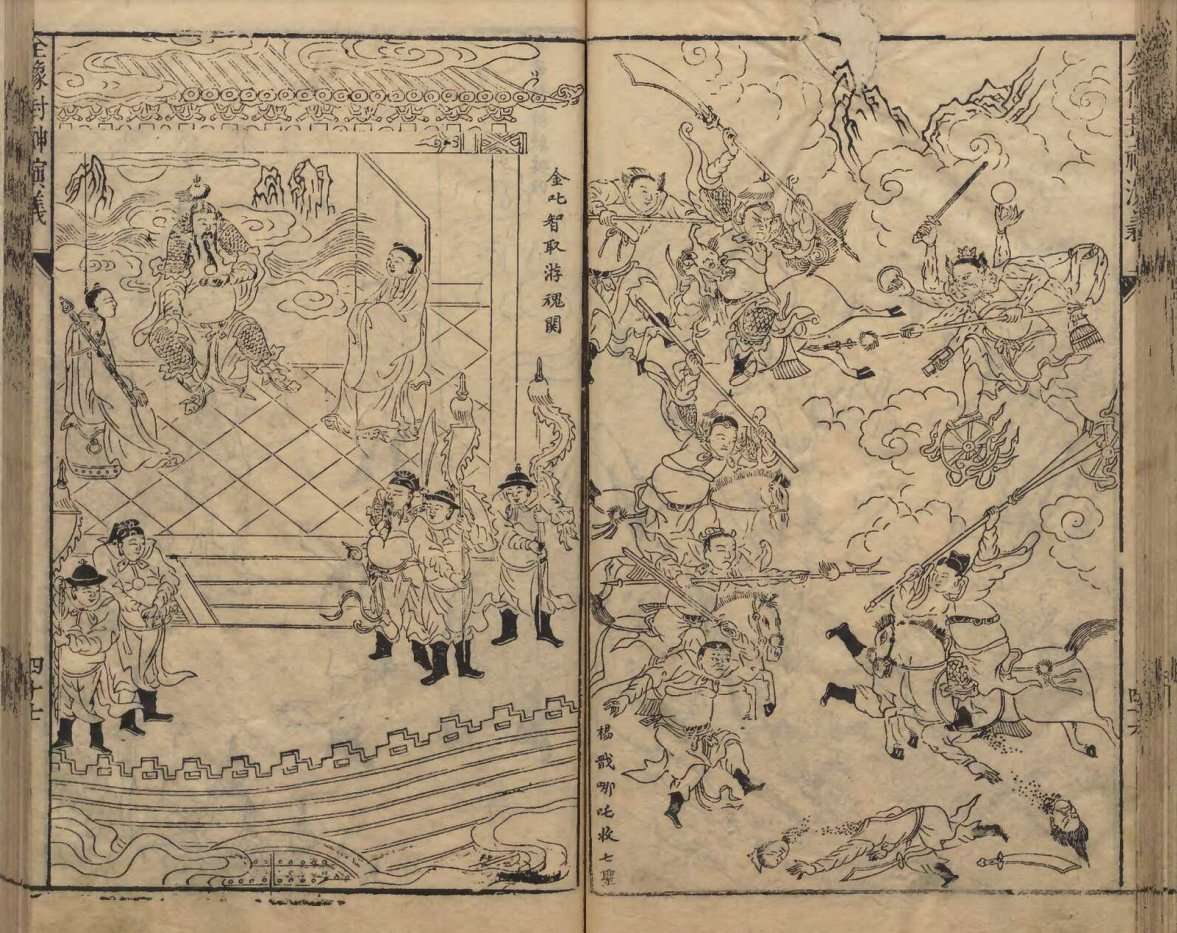
Here is a PDF for volume one of The Newly Printed, Zhong Bojing Annotated, Investiture of the Gods (Xinke Zhong Bojing xiansheng piping Fengshen yanyi, 新刻鍾伯敬先生批評封神演義, c. 1620), the oldest known edition of the novel. It is full of lovely woodblock prints (fig. 2).
Fig. 2 – A random page from vol. 1 of The Newly Printed, Zhong Bojing Annotated, Investiture of the Gods (larger version).
Thank you to the National Archives of Japan for offering the complete 1620 edition of FSYY. It can be downloaded here.
Update: 09-13-23
Tumblr user digitalagepulao has drawn an amazing Nezha (fig. 3). The theme is based on the feud between the prince and his father, which leads to the former’s suicide and divine resurrection. The artist describe a tense scene from the novel:
Li Jing in a fury grabbed his halberd, leapt on his horse and galloped out of the headquarters. He was astonished to see Nezha with his Wind-Fire Wheels and Fire-Tipped Spear. He swore loudly, “You damned beast! You caused us endless suffering before your death, and now that you’ve been reborn, you’re troubling us again!”
“Li Jing! I’ve returned my flesh and bones to you [via suicide], and there’s no longer any relation between us. Why did you smash my golden idol with your whip and burn down my temple? Today I must take my revenge!”
A very big thank you to them. I’ll add more later if or when new lists are available.
Update: 11-03-24
My friend Dario Virga (Onibotokemaru on Instagram) (fig. 4) has completed an Italian translation of the novel titled L’investitura degli Dei: Romanzo cinese di epoca Ming (2024). This 1,120 page, two-volume edition can be purchased here for € 50,00:
1) Prof. Shi Changyu notes in his preface to this translation that the friction between the fictional Chan and Jie sects serves as an analogy for that of Quanzhen and Zhengyi during the Ming, for the former was marginalized, while the latter was held in high esteem and fell prey to decadence, naturally hindering its ability to contribute anything of value to the development of Daoism at this time (Gu, 2000, pp. 50-53).
2) Those interested in reading some of the poetry from the novel should consult Koss (1979), which compares them with those from Journey to the West.
Sources:
Gu, Z. (2000). Creation of the Gods (Vols. 1-4). Beijing: New World Press.
Koss, N. (1979). The Relationship of Hsi-yu chi and Feng-shen yen-i: An Analysis of Poems Found in Both Novels. T’oung Pao,65(4/5), second series, 143-165. Retrieved May 5, 2020, from http://www.jstor.org/stable/4528175
Wan, P. (1987). Investiture of the Gods (“Fengshen yanyi”): Sources, Narrative Structure, and Mythical Significance (UMI No. 8810607) [Doctoral dissertation, University of Washington]. Available from ProQuest Dissertations and Theses database.
Wu, C., & Yu, A. C. (2012). The Journey to the West (Vols. 1-4) (Rev. ed.). Chicago, Illinois: University of Chicago Press.
Upon Sun Wukong achieving immortality, his Buddho-Daoist master Subodhi warns him of three calamities sent by heaven to kill those who defy their fate and attain eternal life. The Sage then offers to teach Monkey one of two forms of transformation in order to avoid this outcome by living in hiding. [1] The first form, called the “Multitude of the Heavenly Ladle” (Tiangang shu, 天罡數), contains thirty-six changes, while the second, the “Multitude of Earthly Fiends” (Disha shu, 地煞數), contains seventy-two. [2]Our hero chooses the latter and quickly masters a set of secret oral formulas (koujue, 口訣). This becomes one of his signature abilities used throughout the narrative. Monkey’s most famous use of the skill appears in chapter six when he battles Lord Erlang, a divine demon queller and fellow master of transformations (video 1).
Video 1 – Sun’s battle with Lord Erlang. From the great animated Classic Havoc in Heaven (1965).
I. Connection to Chinese astrology and literature
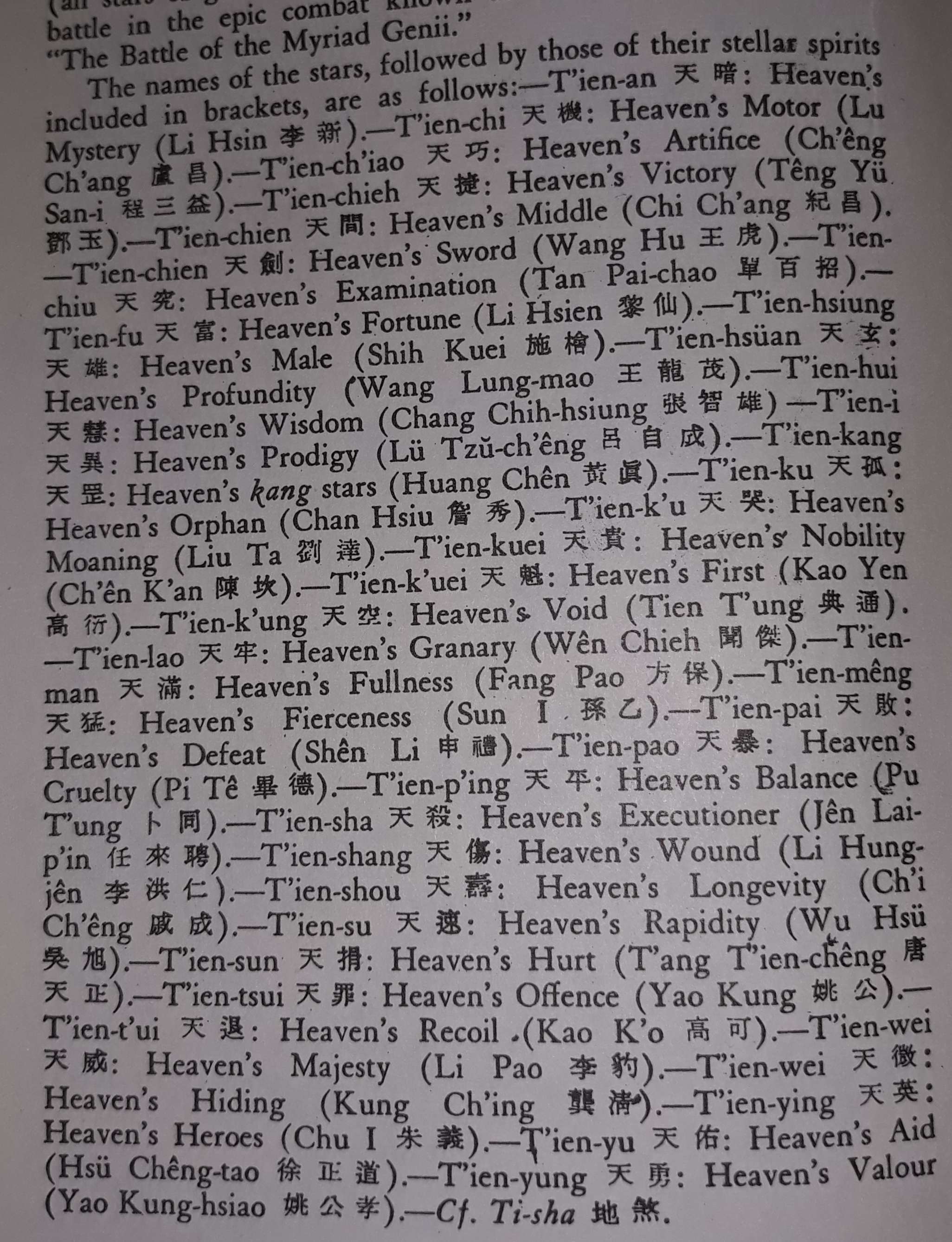
The names of the two forms of transformation that Subodhi offers to teach Monkey can be traced to Chinese astrology. The “Heavenly Ladle” (Tiangang, 天罡; i.e. theBig Dipper) is associated in some traditions with thirty-six stars (fig. 1). Regarding the origin of these stellar bodies, Werner (1932/1969) explains: “The gods of these stars (all stars of good omen) are all heroes who fell on the field of battle in the epic combat known as Wan Xian Zhen 萬仙陣, “The Battle of the Myriad Genii [or Immortals]” (p. 506). [3]
Fig. 1 – A list of the thirty-six Heavenly Ladle stars (larger version). Photograph of Werner, 1932/1969, p. 506. Apologies for not having access to a scanner at this time.
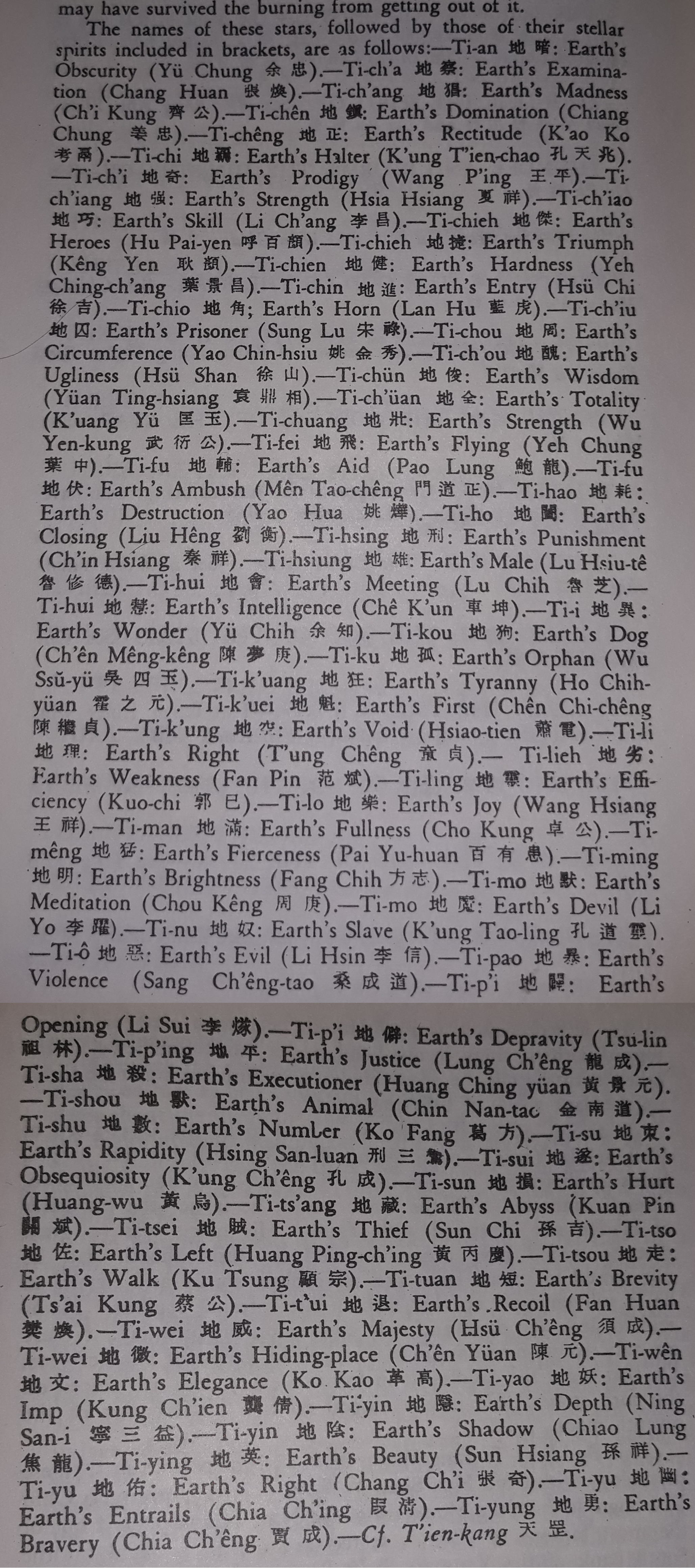
Furthermore, he writes that the “Earthly Fiends” (Disha, 地煞) are:
[S]eventy-two stars [fig. 2] of evil influence, opposed to the Tiangang. The wicked genii of these stars are cast out and slain by tongzi 童子 magicians [i.e. spirit mediums], who impale them on forks and shut them up in earthen jars, then take them to waste lands, throw them into fires, and surround the spot with a circle of lime, which is supposed to prevent any spirit which may have survived the burning from getting out of it (Werner, 1932/1969, p. 496). [4]
Fig. 2 – A list of the seventy-two Earthly Fiend stars (larger version). Photographs of Werner, 1932/1969, pp. 496-497.
Additionally, the Earthly Fiends are considered the “enemies of man, and causes of all diseases and ailments” (Doré & Kennelly, 1916, p. xviii). Several Buddho-Daoist folk talismans exist to ward afflictions caused by the Fiends. One such Buddhist talisman said to cure the “one hundred ailments” even invokes the thirty-six Heavenly Ladle stars to aid in the conquering of the seventy-two demons:
An order is hereby made by the “Ministry of the Thunderbolt”, commanding in the name of the “three religions” that the auspicious stellar gods, Tiangang 天罡, reduce to order the maleficent demons, Disha 地煞, who have caused this disease. The charm must also repress these malignant beings and expel them forthwith (fig.3) (Doré & Kennelly, 1916, p. 312).
Fig. 3 – A reproduction of the illness-curing Buddhist Talisman (larger version).
It’s interesting that Sun Wukong chooses the transformation method centered around stars of evil influence and later becomes a demon who challenges heaven. [5] Good fodder for fan fiction, no?
When these dichotomous stellar bodies were first acknowledged isn’t exactly clear. [6] But the Heavenly Ladle stars go back to at least the mid-13th-century as they are mentioned in the Old Incidents in the Xuanhe period of the Great Song Dynasty (Da Song Xuanhe Yishi, 大宋宣和遺事) (Anonymous, n.d.), a storytelling prompt of the late-Song to early-Yuan. It contains the earliest stories associated with the Water Margin (Shuihu zhuan, 水滸傳, c. 1400), a Chinese classic that predates Journey to the West. The one hundred and eight heroes of this novel are famous for being reincarnations of the Heavenly Ladle and Earthly Fiend stars, a fact revealed in chapter seventy-one when a heaven-sent stone slab is found to list their human names along with the corresponding stellar titles. The long association of the stars with the hugely popular Water Margin novel therefore may have inspired the names for the techniques taught by the sage Subodhi in Journey to the West.
II. Ties to Daoist practices
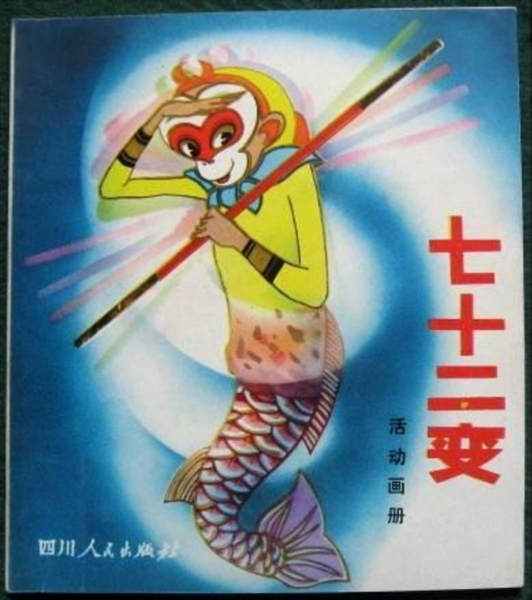
Robinet (1979) expertly explains that transformation (bianhua, 變化), or “metamorphosis” as she calls it, is central to Daoism. Gods and Saints are portrayed in Daoist literature as being in constant flux, changing with the seasons, taking on different guises and titles, disappearing and reappearing, never remaining the same, thereby living eternally. Daoists and magicians achieve metamorphosis through external and internal alchemical processes, the former involving the ingestion of drugs and talismans and the latter via mental exercises. Those who succeed in their practice can divide themselves endlessly; create rivers, mountains, and forests from meager samples of water, earth, and seeds; and, most importantly, change their form into anything (fig. 4), including the five elements, dragons, clouds, rays of light, or even celestial bodies like the sun and moon.
Fig. 4 – The cover of a vintage children’s flip book about Monkey’s transformations (larger version). Here he is seen changing into a fish.
Interestingly, transformations could be used to live in hiding, much like originally intended by Subodhi in Journey to the West. Adepts still questing for immortality could magically transform a sword, staff, or slipper into their deceased body, thereby faking death and escaping elsewhere to find a method leading to eternal life. (Often times, those who took this route assumed a new identity to avoid heaven’s gaze (Campany, 2005)). Additionally, sages are said to use their powers to hide in the earth or in the light of the sun, moon, and stars. One source mentions adepts hiding by scattering their shadow and transforming it into seventy-two types of light. In a related book chapter, Robinet (1993) notes this number “alludes to [Laozi’s] seventy-two supernatural marks” (clearly borrowing from the Buddhist Mahapurusa laksana) (p. 166). This is fascinating as it shows there is precedent for seventy-two transformations in Daoism.
III. Archive link
I have archived Robinet’s (1979) wonderful paper on metamorphosis. It can be read here:
This has been posted for educational purposes. No malicious copyright infringement is intended. Please support the official release.
Update: 06-12-22
I recently posted an in-depth article about the Patriarch Subodhi in which I reveal information about the additional benefits of the 72 Transformations. Anyone involved in any upcoming “What if” battles involving the Monkey King (COUGH, COUGH!) would do well to take note of this information.
Subodhi teaches this skill to Monkey with the expressed purpose of helping him hide from three calamities of cosmic lightning, fire, and wind sent by heaven to destroy immortals for defying fate and achieving eternal life. But beyond the power of metamorphosis, the novel implies that the ability also grants the user multiple lives (similar to a video game), which might serve as a buffer against the calamities. For example, in chapter 41, after Sun passes out from Red Boy‘s fiery attack, Zhu Bajie reassures everyone by saying: “If he is capable of seventy-two transformations, he has seventy-two lives” (Wu & Yu, 2012, vol. 2, p. 232). Also, in chapter 46, Monkey magically regrows his head after being non-fatally beheaded in a contest of magical skill. Sha Wujing remarks: “If he knows seventy-two ways of transformation, … he may have altogether seventy-two heads!” (Wu & Yu, 2012, vol. 2, p. 308). [7] In addition, while not directly related to the primate hero, the Bull Demon King is said in chapter 61 to also know the 72 changes (Wu & Yu, 2012, vol. 3, p. 148). He uses the extra lives to survive being beheaded by Prince Nezha a number of times:
[Nezha] leaped onto the bull’s back and brought his monster-cleaving sword down on the bull’s neck: the bull was beheaded at once. Putting away his scimitar, the devaraja was about to greet [Sun Wukong] when another head emerged from the torso of the bull, his mouth belching black air and his eyes beaming golden rays. [Nezha] lifted his sword once more and cut off the bull’s head; as soon as it dropped to the ground, another head came out. It went on like this more than ten times. At last, [Nezha] took out his fiery wheel and hung it on the Bull’s horn. The wheel at once started a great blaze of true immortal fire, which burned so fiercely that the bull began to growl and roar madly, shaking his head and wagging his tail (Wu & Yu, vol. 3, p. 160).
Notes:
1) It should be noted that the calamities are sent every five hundred years. Sun never has to live in hiding, though, as he is trapped under Five Elements Mountain upon the five hundredth anniversary of his immortality (he lived to be roughly four hundred prior to taking up spiritual cultivation). And he achieves Buddhahood prior to reaching the one thousandth year of his immortality, so he never has to guard against subsequent calamities.
2) The translation of these names are loosely based on Anthony C. Yu (Wu & Yu, 2012, vol. 1, p. 122). I have provided more accurate names based on related Chinese literature (see section one above).
3) Source changed slightly. I updated the Wade-Giles to Pinyin. This refers to a military trap appearing in the Chinese classic Investiture of the Gods (Fengshen yanyi, 封神演義, 16th-century), which was published around the same time as Journey to the West.
5) Conversely, Zhu Bajie is shown capable of thirty-six transformations (for example, Wu & Yu, 2012, vol 2, p. 328), meaning he studied the method associated with the stars of good omens. And of course we know his sordid story…
6) Though, in my opinion, the thirty-six stars are likely based on the thirty-six generals led by the stellar exorcist, Marshal Tianpeng (天蓬, i.e. Zhu Bajie’s former incarnation), who is himself one of the nine stars of the Big Dipper. The Marshal and his generals appear in the liturgy of the Song-era “Correct Method of the Celestial Heart” (Tianxin zhengfa, 天心正法) exorcist tradition (Anderson, 2008).
[7] Thank you to Irwen Wong of the Journey to the West Library blog for bringing these examples to my attention.
Sources:
Anderson, P. (2008) Tianxin zhengfa In F. Pregadio (ed.), The encyclopedia of Taoism: Vol 1-2 (pp. 989-993). Longdon: Routledge.
Campany, R. (2005). Living off the Books: Fifty Ways to Dodge Ming 命 [Preallotted Lifespan] in Early Medieval China In C. Lupke (Ed.), The Magnitude of Ming: Command, Allotment, and Fate in Chinese Culture (pp. 129-150). University of Hawaii Press.