Archive #24 – Chinese Gods: The Unseen World of Spirits and Demons (1997) by Keith Stevens

The novels Journey to the West (Xiyouji西遊記, 1592) and Investiture of the Gods (Fengshen yanyi封神演義, c. 1620) are dramatized examples of the syncretic Buddho-Daoist pantheon of Chinese Folk Religion. The number of Buddhas, sages, gods, immortals, spirits, guardians (etc.) revered by people of Chinese descent is enormous, and new figures are being added to the list even to this day. Needless to say, laymen and researchers who visit temples and wish to correctly identify a particular deity need a resource with images, names, and listed attributes. Luckily there is one such source. Keith Stevens (1926-2015), a veteran of the British Army and Foreign and Commonwealth Office, traveled East and Southeast Asia for 40 years collecting information on the folk pantheon. He produced an invaluable monograph titled Chinese Gods: The Unseen World of Spirits and Demons (1997). The book is unfortunately out of print, and available copies are expensive to buy. So, I am pleased to host a PDF of this wonderful work on my site.

The scan was produced with an overhead document camera. The glossy pages made scanning somewhat difficult. I had to use a soft, indirect light source. Therefore, not all pages are crisp due to the low light levels.

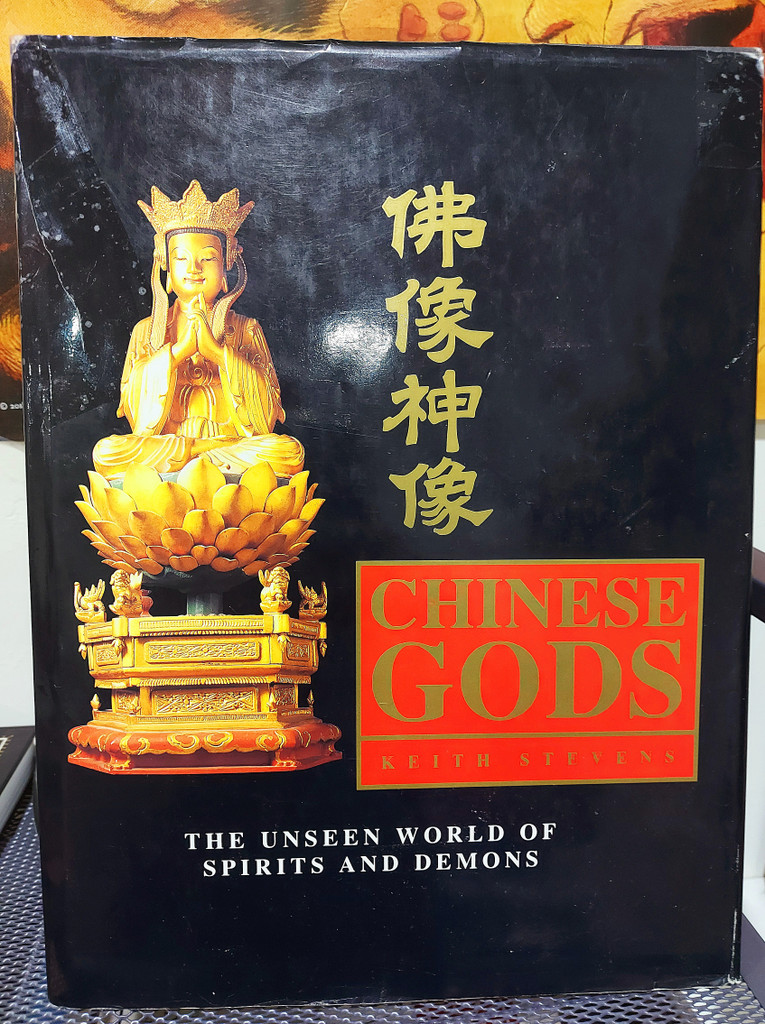
My well-worn personal copy of Chinese Gods (larger version).

1. Dust Jacket Description

China is a land full of gods and goddesses, ranging from the Creators of the World to Worthies local to only one or two villages.

This book introduces the reader to the most important figures of Chinese folk history, and those of Buddhism, Taoism and Confucianism.

Intensely pragmatic in their religion, Chinese people hold all gods in reverence, but it is only the ones who answer prayers with concrete results that are exceptionally praised. Many gods have particular specialities, for instance, there are different Wealth Gods for success in business and for gambling. There are also individual gods for each trade, from those for removal men in Hong Kong to students at Beijing University.

In addition, there are the City Gods and Kitchen Gods, the Earth Gods who protect a specific piece of land, and myriad spirits who protect wells, mountains or bridges, distribute rain or snow, control flooding or protect humanity from disease and epidemics.

Keith Stevens has spent a lifetime researching the subject, travelling extensively in China, Taiwan and throughout South-East Asia. He has gathered information from hundreds of temple keepers, god-carvers and religious specialists and collected details of images and their stories – providing glimpses into the sometimes little-known folk history of China. The author also provides pointers on how to identify images, together with invaluable background information including chronology of Chinese history, a map of the area covered, a glossary and detailed index with the names of deities in Chinese characters.

2. Book Link

Click to access chinese-gods-the-unseen-world-of-spirits-and-demons-compressed.pdf

Disclaimer:

This has been posted for educational purposes. No malicious copyright infringement is intended. If you like the digital version, please support the official release.

Citation:

Stevens, K. G. (1997). Chinese Gods: The Unseen World of Spirits and Demons. London: Collins & Brown.

The Book of Xian and Shen (BOXS), a Catalog of Chinese Gods

I recently learned about an interesting website called the Book of Xian and Shen (BOXS), which catalogs information and pictures for Chinese gods from all over the world. There are currently 2,000 listings and counting.

https://www.bookofxianshen.com/

It is based on the work of religious scholar Keith Stevens (d. 2016), who wrote the amazing Chinese Gods: The Unseen Worlds of Spirits and Demons (Collins & Brown, 1997) (fig. 1). I recently volunteered to help the project. So far, I’ve written two articles (see reference no. W1001 and W1011) and updated two other existing listings with information and pictures (see the bottom of W8620 and W9305).

Fig. 1 – My well-worn personal copy of Chinese Gods (larger version).

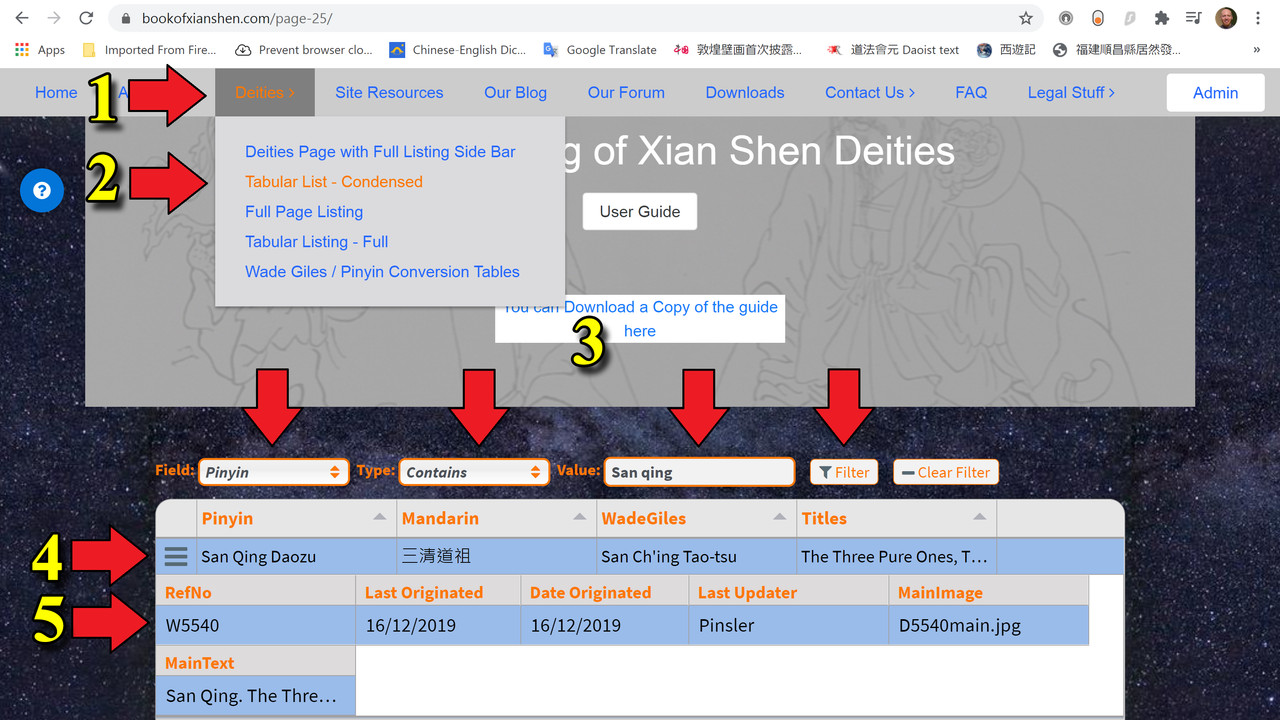
Due to the great number of listings, there are no direct links. Instead, the site has adopted a somewhat confusing (but necessary) cataloging system based around reference numbers, pinyin, Mandarin, and Wade-Giles. However, it’s easy to use once you get used to it. For example, if you were going to search for Sanqing, the “Three Pure Ones,” using, say, Pinyin, I recommend first getting the reference number (RefNo). 

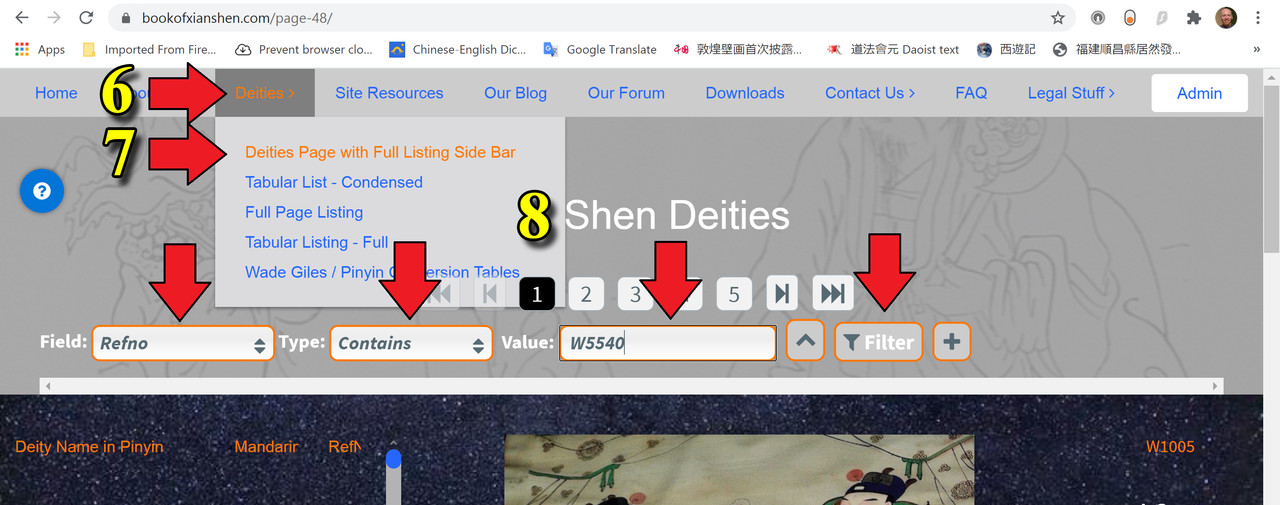
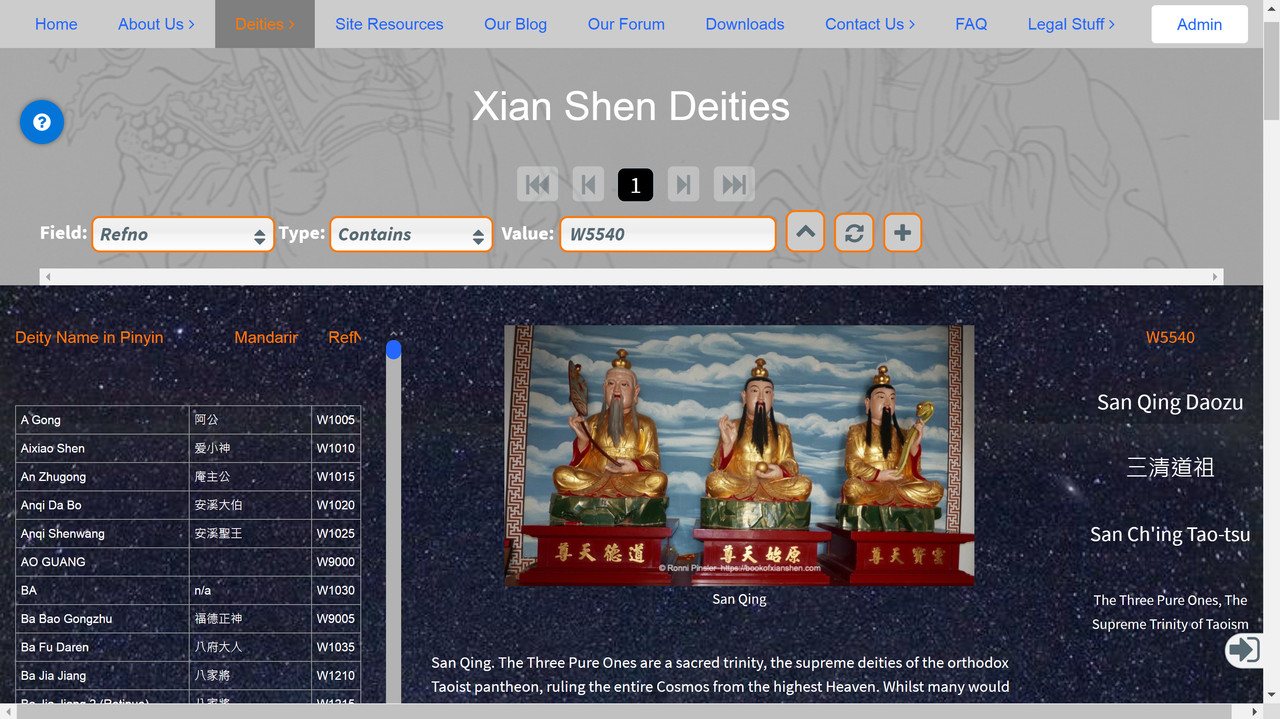
Deities —> Tabular Listing of Xian Shen Deities —> Field: Pinyin —> Type: Contains —> Value: San qing (you may have to play around with the spacing like I did here) —> Filter —> Then look for the correct listing (since other listings mentioning them might appear in the list) —> ☰ —> copy the “RefNo”, in this case W5540 (fig. 2) —> Deities —> Deities Page with Full Listing Side Bar —> Field: RefNo —> Type: Contains —> Value: W5540 —> Filter (fig. 3) —> The listing (fig. 4)

If you know the Mandarin or Wade-Giles for the deity you are looking for, the process would be similar. You would just need to change the field to “Mandarin” or “Wade-Giles”. You could just jump to “Deities Page with Full Listing Side Bar” to search using pinyin, mandarin, and Wade-Giles, but it’s been my experience that a different listing will pop up first based on a higher RefNo or Romanized spelling. First finding the reference number seems to be the easiest method for me.

I can’t recommend this website enough. New gods, as well as new stories or beliefs associated with more established deities, are appearing all the time, so it is very important to catalog everything as soon as new information becomes available. If you would like to volunteer in some way, please contact Ronni Pinsler using the “contact” form on the BOXS website.

Fig. 2 – How to acquire the reference number (RefNo) (larger version). Fig. 3 – How to navigate to the listing (larger version). Fig. 4 – The listing as seen from the top of the page (larger version).

My Qitian Dasheng Monkey King Talisman Block

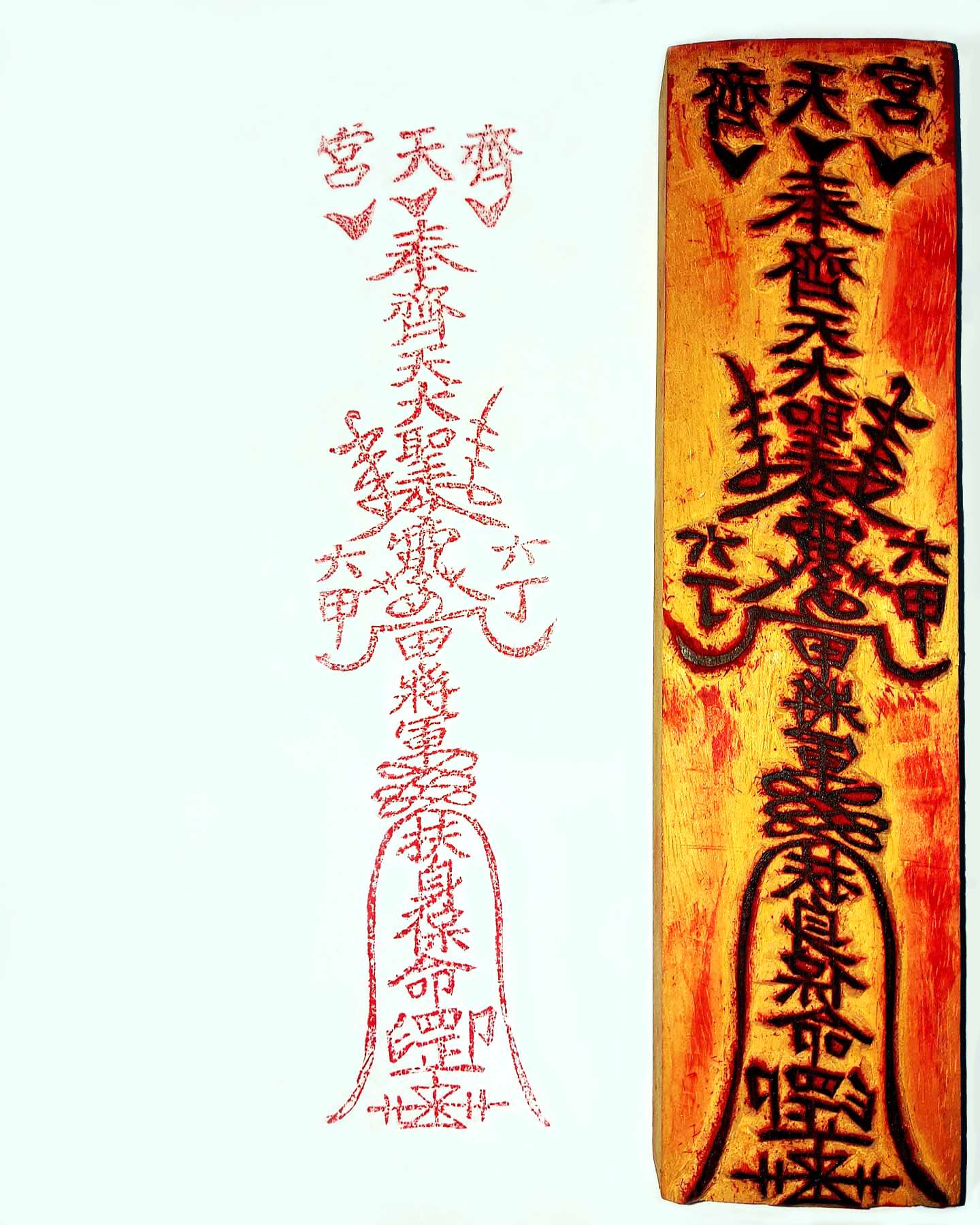
In August of 2020, I happened upon an online listing for a carved wooden talisman block bearing Sun Wukong’s divine, rebellious title Qitian Dasheng (齊天大聖) (fig. 1). The seller was located in Singapore, so I asked my local friend to meet with them to make sure that it was legitimate. Two weeks later, I had the block in hand (thank you Antz). It measures 8.5 x 2.125 x 1 in (21.59 x 5.397 x 2.54 cm) and is made from some kind of light-colored, smooth-grained wood. The face contains a series of intricately carved Chinese characters and magic symbols.

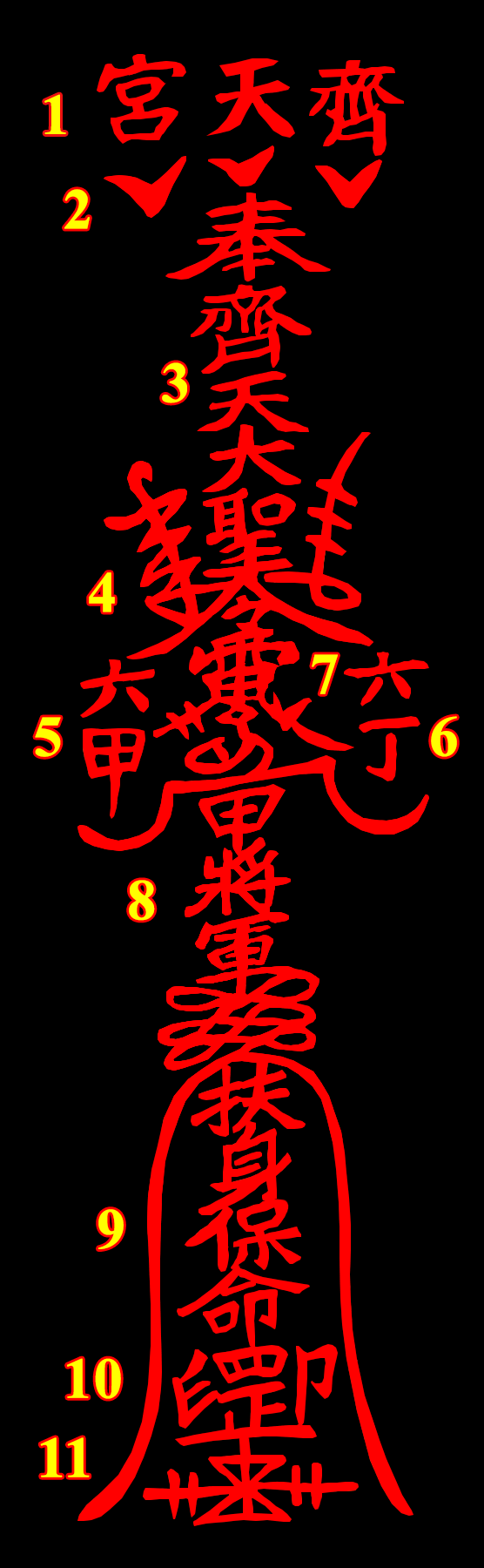
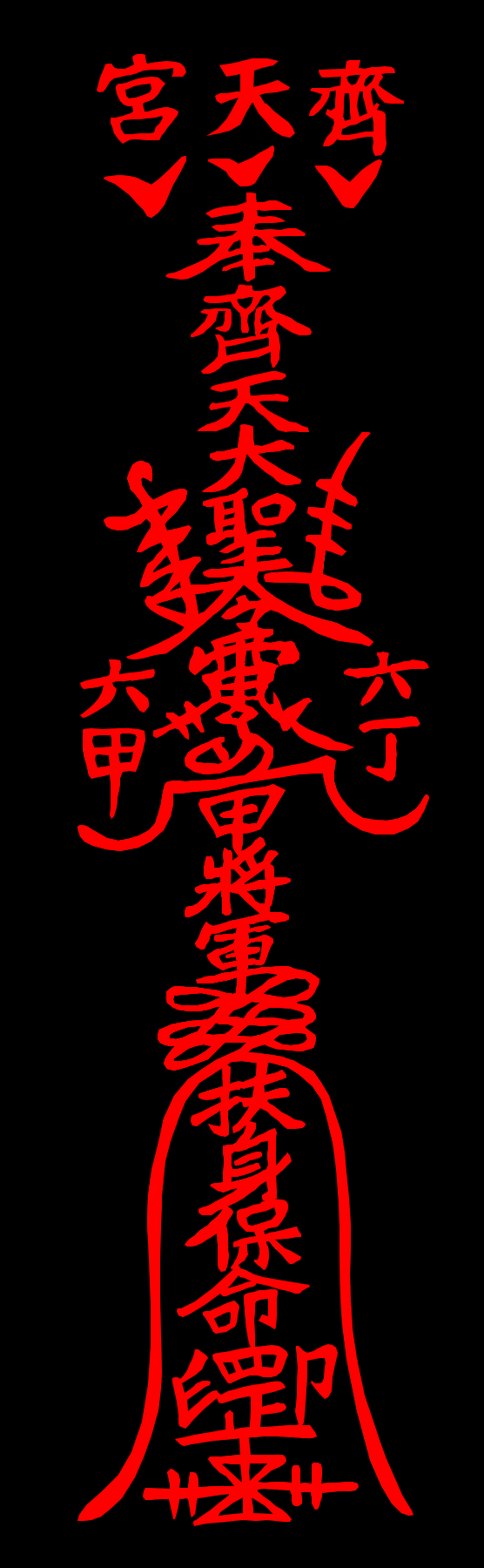
Fig. 1 – The talisman block and a print (larger image). The image has been enhanced slightly for clarity. Fig. 2 – The talisman legend (larger version). See here for a version without the numbers.

Table of Contents

1. Meaning

Here I will explain the various symbols as I understand them (fig. 2). I am by no means an expert, so I am open to comment. I’d like to thank members of the “Talismans of Asia” Heritage Group (亞洲符咒文化資訊網) on Facebook for their suggestions.

1. 齊天宮 (Qitian gong) – The “Equaling Heaven Temple,” a house of worship in Singapore dedicated to Monkey. The characters are written backwards according to traditional fashion.

2. These three checkmark-shaped symbols refer to the 三清 (Sanqing, “Three Pure Ones“), the three highest gods of Daoism. An informant also told me that they can represent heaven, earth, and man.

3. 奉齊天大聖 (Feng Qitian dasheng) – “Revere the Great Sage Equaling Heaven,” the main deity of the Qitian Temple.

4. These barbwire-like designs may represent symbolic weapons of some kind. [1]

5. 六甲 (Liujia) – Refers to the “Six Jia,” protector spirits of Daoism. They are grouped with the Six Ding (Mugitani, 2008).

6. 六丁 (Liuding) – Refers to the “Six Ding” spirits.

7. 令雷 (Ling lei) – “Commanding thunder” refers to the 雷法 (Leifa, “Thunder Ritual”), a corpus of ritual magic that enables the user to command heavenly beings to exorcize malevolent forces (Reiter, 2010). These characters are usually reversed, 雷令 (Lei ling). This essentially commands the Ding and Jia spirits to execute the order (see #9).

8. 甲將軍 (Jia jiangjun) – “Jia generals,” a reference to the Six Jia spirits.

9. 扶身保命 (Fushen baoming) – “Support the body and save life” is the order to be executed by the Ding and Jia spirits.

10. 爪 (zhao/zhua) 罡 (gang) 卩(jie) – Two halves of the character for 印 (yin, “print”), referring to the talisman, sandwich that for “firm.” 罡 (gang) increases the intensity of the command (#9).

11. This angular symbol is the 符胆 (fu dan), the talisman’s locus of power. [2]

2. Use

Unlike Western stamps which are pressed face down onto paper, the paper itself is pressed onto the face of the talisman block like Japanese woodblock prints (Leffman, 2020). This enables a popular temple to mass produce protective talismans without having to handwrite each one. The talisman is then consecrated with a spell and/or blood from a tangki (童乩) spirit-medium.

Note:

1) See #17 in Chan, 2014, p. 35.

2) Again, see #17 in Chan, 2014, p. 35.

Source:

Chan, M., Goh, R., Choo, P., & Tan, B. (2014). Tangki War Magic: The Virtuality of Spirit Warfare and the Actuality of Peace. Social Analysis: The International Journal of Social and Cultural Practice, 58(1), 25-46. Retrieved January 23, 2021, from http://www.jstor.org/stable/24718290

Leffman, D. (2020). Paper Horses: Woodblock Prints of Chinese Gods from 1930s Beijing. [Kindle Android version]. Retrieved from https://www.amazon.com/Paper-Horses-Woodblock-Chinese-Beijing-ebook/dp/B08QZTLF3H

Mugitani, K. (2008). Liujia and Liuding. In F. Pregadio (Ed.), The Encyclopedia of Taoism: Vol. 1 & 2 (pp. 695-697). Longdon: Routledge.

Reiter, F. C. (2010). Taoist Thunder Magic (五雷法), Illustrated with the Example of the Divine Protector Chao Kung-ming 趙公明. Zeitschrift Der Deutschen Morgenländischen Gesellschaft, 160(1), 121-154. Retrieved from http://www.jstor.org/stable/10.13173/zeitdeutmorggese.160.1.0121

Archive #11 – PDFs of the Journey to the West 2012 Revised Edition

Note: My blog is not monetized, so I am not making any money from this post. My hope is that these PDFs will make this legendary story more accessible to a wider audience. If you enjoyed the digital version, please, please, please support the official release.

Last updated: 04-06-2026

Here I present PDFs comprising the complete four volume 2012 revised edition of The Journey to the West (Xiyouji西遊記) translated by Anthony C. Yu (October 6, 1938 – May 12, 2015). This is considered THE most accurate translation of the tale available. I hope those who read and enjoy the digital version will support the official release.

Yu was Carl Darling Buck Distinguished Service Professor Emeritus in the Humanities and Professor Emeritus of Religion and Literature in the Chicago Divinity School. I shared a long email correspondence with Prof. Yu, during which we became friends. He was always quick to answer my many questions. His translation remains a treasure trove of explanatory notes and sources.

Table of Contents

1. Book Blurb

Anthony C. Yu’s translation of The Journey to the West, initially published in 1983, introduced English-speaking audiences to the classic Chinese novel in its entirety for the first time […] With over a hundred chapters written in both prose and poetry, The Journey to the West has always been a complicated and difficult text to render in English while preserving the lyricism of its language and the content of its plot. But Yu has successfully taken on the task, and in this new edition he has made his translations even more accurate and accessible. The explanatory notes are updated and augmented, and Yu has added new material to his introduction, based on his original research as well as on the newest literary criticism and scholarship on Chinese religious traditions. He has also modernized the transliterations included in each volume, using the now-standard Hanyu Pinyin romanization system. Perhaps most important, Yu has made changes to the translation itself in order to make it as precise as possible (source).

2. PDF Files

Vol. 1

Click to access the-journey-to-the-west-wu-chengen_-anthony-c.-yu-the-journey-to-the-west-volume-1-university-of-chicago-press-2013.pdf

Vol. 2

Click to access the-journey-to-the-west-2012-volume-2.pdf

Vol. 3

Click to access the-journey-to-the-west-2012-volume-3.pdf

Vol. 4

Click to access the-journey-to-the-west-2012-volume-4.pdf

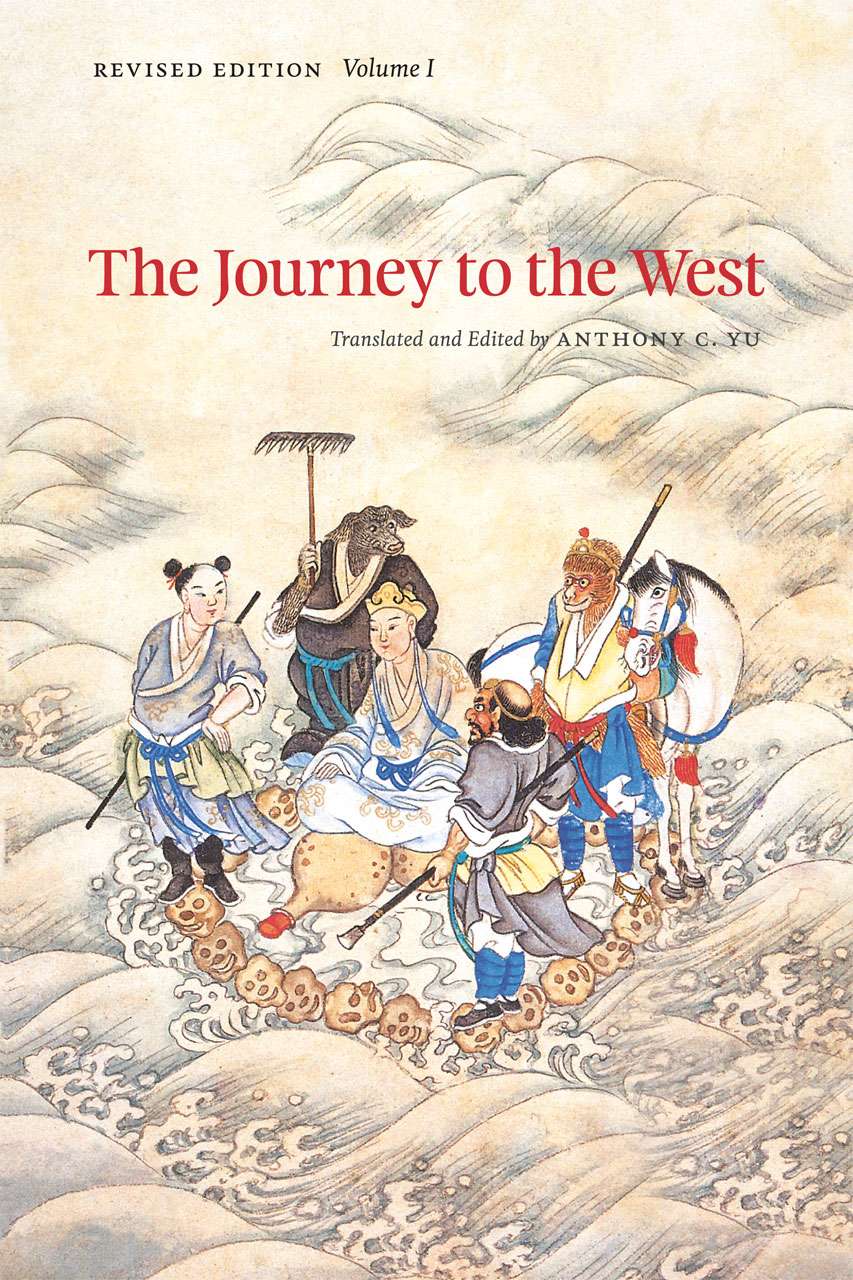
The cover of volume one (larger version).


3. Updates

Update: 03-01-22

I’ve archived a scan of the original Chinese version of the 1592 edition of the novel.

Archive #31 – The Original 1592 Edition of Journey to the West, Complete with Pictures


Update: 07-26-23

I have archived the first complete 1835 Japanese translation of JTTW. It includes amazing woodblock prints.

Archive #41 – PDFs of The Illustrated Journey to the West (Ehon Saiyuki, 繪本西遊記, 1835) – The First Complete Japanese Translation


Update: 08-09-23

I have archived a list of other foreign language translations of Journey to the West, including complete and abridged editions.

  • English (W. J. F. Jenner and Arthur Waley)
  • French
  • German
  • Hungarian
  • Italian
  • Romanian
  • Russian
  • Spanish
  • Thai
  • Turkish
  • Vietnamese

Archive #42 – PDFs of Journey to the West Translations


Update: 04-06-26

See my archives of other translations.

Archive #4 – Mid-Century Illustrated Journey to the West Children’s Books from Japan

For my 50th post, I am excited to host PDF copies of two gorgeously illustrated Journey to the West (Xiyouji西遊記, 1592) children’s books produced in Japan during the middle part of the 20th century.

Table of Contents

1. Son Goku (孫悟空, 1939)

This work was illustrated by Shotaro Honda (本田庄太郎, 1893–1939), a Western-trained artist closely associated with children’s literature for nearly 30 years. As the title suggests, the book focuses on the first 7 chapters of the novel, from the time of Monkey’s stone birth to his final imprisonment under Five Elements mountain. Literally every single panel is worthy of framing. The illustrations are bright and vibrant, seemingly jumping from the page. See below for an example.

Click to access e5ad99e6829fe7a9ba-e7bb98e69cac-e5ae87e9878ee6b5a9e4ba8ce69687-e69cace794b0e5ba84e5a4aae9838ee7bb98-1949e5b9b4e78988.pdf

Shotaro_Honda_1939 - Hell (small)

Monkey in the underworld striking his name from the Book of Life and Death (larger version).

2. The Illustrated Journey to the West (繪本西遊記, 1950)

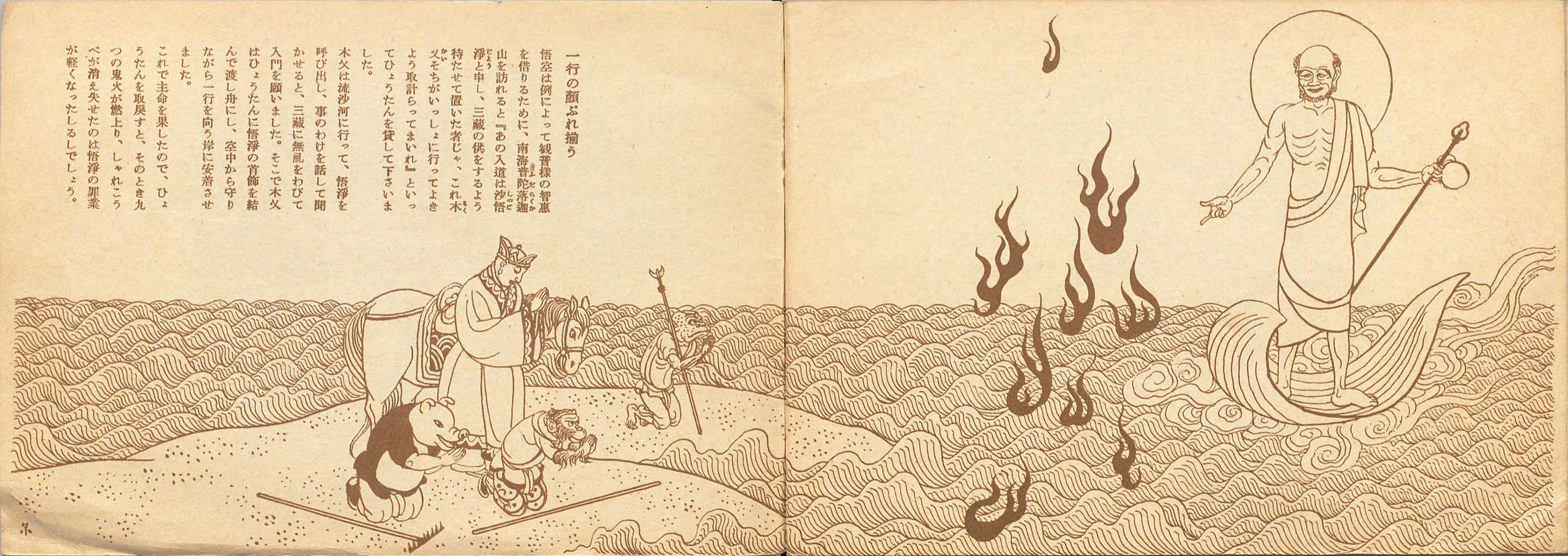
This three volume work was illustrated by Mizushima Nio (水島爾保布, 1884–1958). The first volume covers Monkey’s birth to the submission of Sandy; the second covers the Ginseng fruit tree to the battle with Guanyin’s goldfish; and the third covers the Buffalo demon to the end of the novel. The dark on light line work reminds one of delicate paper cut artwork brought to life. See below for an example.

Click to access e7bb98e69cace8a5bfe6b8b8e8aeb0-e4b88ae4b8ade4b88b-e6b0b4e5b29be5b094e4bf9de5b883-e794bb-1950e5b9b4.pdf

The Illustrated Journey to the West (1950) - End of Volume 1 (small)

The group bowing before a Buddhist figure (larger version).

3. Thanks

The original PDFs are hosted on shuge.org and are free to download. I’m posting them here for posterity. 50Watts appears to be the first English site to host images from both Son Goku and The Illustrated Journey to the West, but they either skip some images or only show a partial spread.