The Monkey King and the “Three-Teachings” (三教) Trinity of Southeast Asia

Last updated: 11-07-2024

Ronni Pinsler of the BOXS project recently introduced me to the Huang Lao xianshi (黃老仙師; lit: “Immortal Master Yellow Elder) [1] folk religion sect of Malaysia and Singapore. It features an intriguing trinity with the Monkey King as Dasheng fozu, (大聖佛祖; lit: “Great Sage Buddha Patriarch”) in the center, the aforementioned deity to his right, and Taishang laojun (太上老君; lit: “Most High Elder Lord,” a.k.a. Laozi, 老子) to his left. Combined, they respectively represent Confucianism, Buddhism, and DaoismThis is shocking as Sun Wukong replaces the Buddha himself as a representative of the “Three Teachings” (sanjiao, 三教). Needless to say, his inclusion here elevates the Monkey King from a mid-tier god to a supreme one.

I. History?

There doesn’t appear to be any concrete information about when the trinity first appeared. The oldest photograph (fig. 1) that I can find hails from 1970s Singapore (per an informant). But this page states that Chee Chung Temple (慈忠庙), followers of the sect, was founded in 1960, showing that it was flourishing as early as this time. However, an informant tells me that the sect is more rare in Singapore these days. Conversely, Ronni notes it’s more common in Malaysia and that the trinity from the photograph looks similar to “twenty or thirty examples” he’s seen while visiting temples in the south. 

Fig. 1 – The 1970s photograph (larger version). Image in a private Malaysian collection.

I’d like to add that the three-person grouping follows precedent in Chinese religion, with examples including the “Sanqing” (Sanqing, 三清; lit: “Three Pure Ones”) of Daoism and the “Trikaya” (Ch: Sanshen, 三身; lit: “Three Bodies”) of Buddhism. These likely influenced the trinity (see below).

I’ll update this section as new information becomes available.

II. Iconography

Dasheng fozu is portrayed with a small guan cap (xiao guan, 小冠) crowning a furry, simian head, and the face is sometimes painted similar to his Chinese opera depictions. He wears a (sometimes golden) suit of armor and sits in a kingly fashion with knees splayed and his hands on his legs. One hand is upturned and loosely cups the handle of an “As-you-will” (ruyi, 如意) scepter, with the mushroom head resting near his shoulder. As noted here, this scepter is a symbol of some Buddhist and Daoist gods, most notably Lingbao tianzun (靈寶天尊, lit: “Celestial Worthy of Numinous Treasure”), one of the Sanqing, and Guanyin (觀音). 

Huang Lao xianshi is portrayed with a small guan cap crowning a smiling, elderly man with drawn back white hair and a long, white beard and mustache. He wears bagua robes (of various colors) and sits in a kingly fashion with knees splayed. And he either holds a fly whisk or command flag in one hand, while the other is sometimes held in a mudra.

Taishang laojun is quite similar to the former (including the guan cap, hair and beard, and bagua clothing), but he’s instead seated cross-legged on a lotus throne. One hand holds a traditional palace fan (gongshan, 宮扇), while the other might delicately hold a pearl.

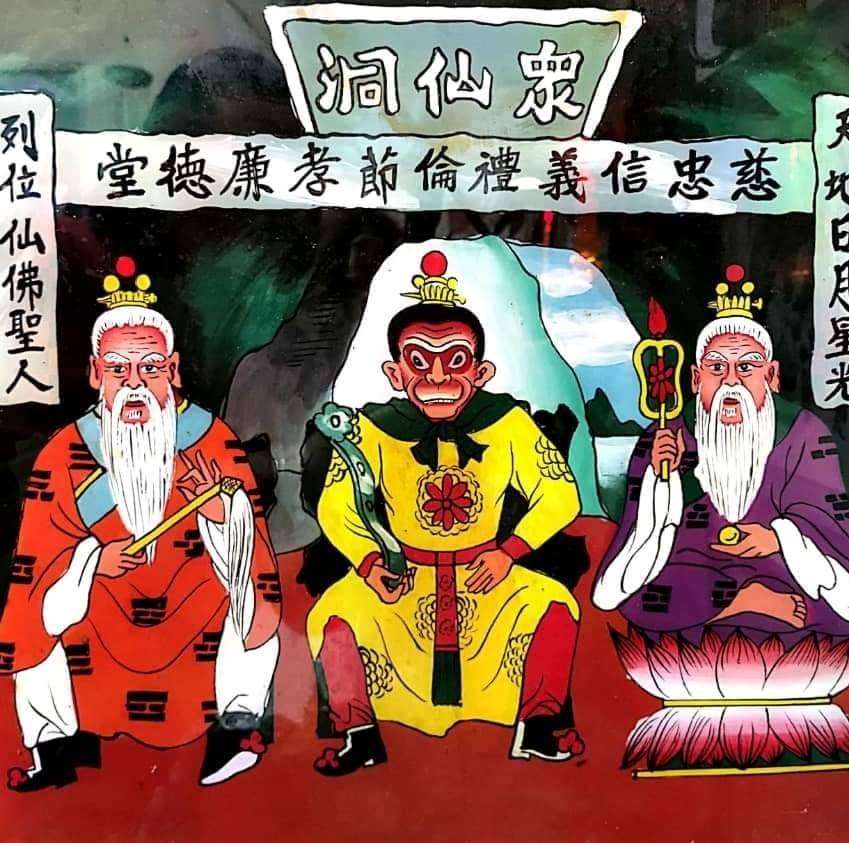
All three are sometimes depicted in a cave-like alcove over which hangs a sign reading “Zhong xian dong” (眾/衆仙洞; lit: “Multitude of Immortals Cave”) or “Xianfo dong” (仙佛洞, “Immortals and Buddhas Cave”) (fig. 2 & 3).

Fig. 2 – The “Multitude of Immortals Cave” (larger version). This is likely a painting of the idols from figure one. Found on Facebook. Fig. 3 – The “Immortals and Buddhas Cave” (larger version). Found on Facebook.

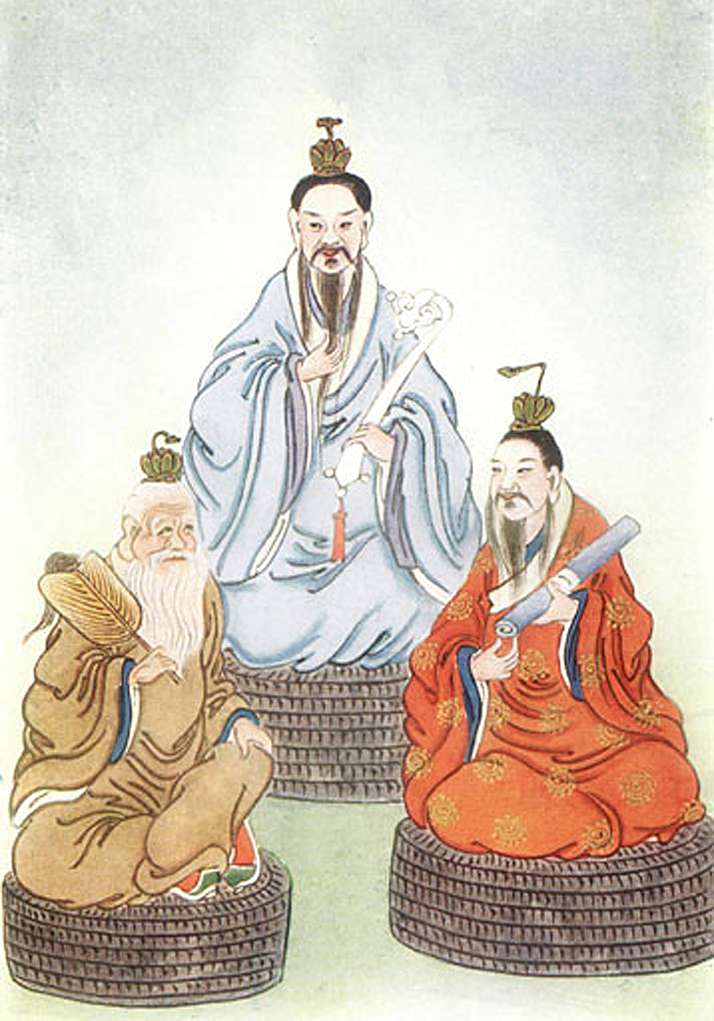
The trinity appears to have borrowed from depictions of the Sanqing. Take for example this painting (fig. 4). Two of the three figures include the As-you-will scepter and the palace fan.

Fig. 4 – A print of the Sanqing from Werner, 1922, p. 124 (larger version).

III. Huang Lao xianshi

This is not a common deity, so I’ve chosen to quote the BOXS article on the subject. I’ve changed the Wade Giles to pinyin. The information was gathered by Keith Stevens:

[…] His images have been seen on altars in Singapore in Balestier Road, also in Malacca and Kuala Lumpur, in Seremban and Muar, and in southern Thailand, where in each temple he is known as one of the Supreme Trinity .

In Kuala Lumpur where he is regarded as a deity who possesses the spirit mediums of his cult, the Huang jiao [黃教], he is known as an avatar of Laozi. He is said to have first appeared and became popular during the Han dynasty as the Governor of the World but without interfering with its day to day running. […] He was identified as Huang Shigong [黃石公], a patron of Zhang Liang [張良] who in about 200 BC was a trusted counsellor of Liu Bang [劉邦] and is said to have written a work on military tactics, the Sanlue [三略, “Three Strategies”].

Zhang Liang was one of the Three Heroes of China, said to have been a governor of a province during the Han, and according to Taoist legend was one day crossing a bridge of a river when a poor old man on a mule passed by. One of the old man’s sandals fell off into the river and in one version Zhang picked up the sandal of his own volition whilst in another, told by devotees, the old man asked him to pick it up. Zhang feeling a great sense of indignity but moved by pity for the old man picked it up. Then, after several tests Zhang Liang was told by the old man that with the book he had just given to Zhang he would become an adviser to the king. In years to come it came about exactly as foretold, and the old man on the mule turned out to be Huang Lao xianshi.

In these temples Huang Lao xianshi’s annual festival is celebrated on the double sixth [i.e. 6th day of the 6th lunar month]. His image has not been noted in Taiwan, Hong Kong or Macau.

In most temples he is revered for his healing powers, with one sip of water blessed by him curing sickness; it also provides stamina and nerve, and wrestlers and boxers visit his altars to drink his tonic before their matches.

Huang is also known as:

Huang Lao zushi [黃老祖師]

Huang Lao jun [黃老君] (RefNo. W3015).

The article goes on to suggest a possible connection to the Huang-Lao (黃老; “Yellow Emperor-Laozi) school of philosophy.

The Huang Lao school combines the teachings of Huang Di, Laozi, Zhuangzi and Buddhist[s], as well as Confucian[s], developed over the centuries into its own particular form (RefNo. W3015).

This philosophical connection is interesting as one scholar suggests that the Sanlue “was written around the end of the Former Han dynasty, probably by a reclusive adherent of the Huang-Lao school who had expert knowledge of military affairs” (Sawyer & Sawyer, 2007, p. 283). This would explain why Huang Lao’s story is associated with Huang Shigong (“Old Man Yellowstone”). Also, his name might imply that he’s considered an embodiment of this philosophy.

One thing not noted in the BOXS article is that some statues alternatively spell his name as 黃老先師 (Huang Lao xianshi), meaning the “First Teacher Yellow Elder” (see the third section on this page). The term 先師 is a reference to one of Confucius‘ titles (Chin, 2007, p. 13).


Update: 04-01-22

Ronni shared with me a source explaining the birth of Master Yellow Elder’s sect. One webpage claims it came about in 1937 at No. 38 Beer Village of Bahau, Negeri Sembilan, Peninsular Malaysia (马来西亚半岛森美兰州马口三十八啤农村). This might explain why the sect is more popular in Malaysia than Singapore:

At that time, Liao Jun [廖俊] was alone in the hall near the Daoist altar when he became curious about learning spirit-mediumship and spirit-writing. All of a sudden, a spirit entered his body, causing him to sit solemnly while stroking his whiskers and mumbling incomprehensively. He didn’t know what spirit had taken hold of his body or what was being said. Afterwards, Liao woke up but didn’t know anything. After that he requested the spirit to descend everyday but wasn’t able to speak. Later, Mr. Dai Zhao [Dai Zhao xiansheng, 戴招先生], the original owner of the Daoist temple, consecrated him as a new spirit-medium with a seal. He was then able to write messages and finally speak. Until that day when Liao Jun called the spirit, he opened his mouth and preached with strict principles and profound meaning. He said that the Immortal Master came to teach disciples in order to help the world. But he did not reveal his origin.

After a period of Liao calling down the spirit, the gathered crowd questioned the deity. He finally revealed that the Immortal Master Yellow Elder was actually Oldman Yellowstone [Huang shigong, 黃石公], known from legends passed down through the generations. According to the Jade Emperor’s decree, he was to open the dharma gate by preaching his teachings for the universal deliverance of the people.

Those who wish to enter the dharma gate first have to fast for 30 days and then complete the dharma hall ceremony to become a formal disciple. This dharma transforms according to one’s heart and can be used as one desires. Only when it is used in the right way will it be effective. One cannot harbor any evil desires.

All of Immortal Master Yellow Elder’s disciples can worship at home by arranging their own shrine. A memorial tablet must be set up in the center, and the following words must be written: mercy, loyalty, faith, righteousness, rituals, relationships, continence, filial piety, honesty, and right virtue. A sign on the left side must say, “Obey the Way of Heaven with Loyalty,” and on the right, “From the Earth Return to Ceremony.”

Apart from the aforementioned ten precepts, the disciples of the Immortal Master can also draw talismans to exorcise evil spirits from residences. At the same time, they can practice a boxing method to protect oneself in case of emergency.

At that time, more than 40 people were attracted to join. They worshiped the Immortal Master Yellow Elder and were diligent in practicing the dharma and martial arts. Later, the number of disciples increased. After the Immortal Master made his holy presence known, some disciples suggested that a temple be built. After the Immortal Master Yellow Elder made his holy presence known, some disciples suggested that a temple be built. And after they went before him and asked for instructions, he ordered that the first temple be built in Malacca. Because Malacca is a holy place of Buddhist temples, the sect spread throughout Malaysia and into Singapore.

黄老仙师缘起一九三七年间在马来西亚半岛森美兰州马口三十八啤农村,当时廖俊在道坛内,因在其好奇心驱使下,趁道堂内无人,就学乩童扶乩,忽然间且有神灵附身,双手交替频频作抚须状,同时肃然端坐,喃喃低语,就是听不明白说些什么,也不知是什么神明降神,之后廖俊就醒来了,但什么也不知道。过后几乎每天都请乩降童,就是不能开口说话,后来原本道堂主人戴招先生,在廖俊扶乩降童时,替他作新乩童开光封印法,廖俊才执笔写明某日可开言,直到该日廖俊降乩时,开口讲道,道理严明,心义深长,并说是黄老仙师下凡授徒济世,但不表明来历。

经过一段时日的请乩降童,又在众人不断的追问下,知悉黄老仙师就是历代相传的黄石公,奉玉皇大帝旨谕到来开黄老仙师法门宣扬教理,普渡善民,有志入黄老仙师法门行道者,必先斋戒三十天,再行过法堂仪式,方为正式弟子,所授之法乃随心变化法,可随心运用,惟必用於正道方有灵验,不可存有邪念,凡是黄老仙师弟子,可在家自设神位奉拜,正中设立牌位上书慈,忠,信,义,礼,伦,节,孝,廉,德堂,左边立牌上书顺天行道忠,右边上书从地復礼仪。

黄老仙师弟子,除了必修慈忠信义礼伦节孝廉德十训道理之外,也可画符驱邪镇宅,同时也修炼法拳,以备紧急时防身,当时就吸引了四十余人加入,亦诚崇信黄老仙师,勤於练法练武,后来弟子越增越多,加上黄老仙师威灵显圣,更有弟子提议黄老仙师庙,经过向黄老仙师请示,奉旨第一间庙应先建在马六甲,因为马六甲是佛庙圣地,之后从马六甲开始推广到星马各州。

This passage is interesting because it mixes Buddhist, Confucian, and Daoist terminology. Examples include “dharma gate” and “right way”; the list of the ten precepts, which are similar to the Four Cardinal Principles and Eight Virtues; and the evil-warding talismans.

It still amazes me, though, that the Great Sage is given such a prominent position in the center when he’s not even the main focus of the sect.


Update: 09-04-23

Irwen Wong of the Journey to the West Library blog reminded me that Huang Lao xianshi, under his guise as Huang Shigong (refer back to sec. III above), is mentioned in Journey to the West. In chapter 14, Tripitaka banishes Sun Wukong for killing six thieves who accost them shortly after the simian immortal is released from under Five Elements Mountain. Monkey retreats to the underwater kingdom of the Eastern Dragon King to vent, and after some tea, he notices a painting on the wall:

When they finished the tea, Pilgrim happened to turn around and saw hanging behind him on the wall a painting on the “Presentation of Shoes at Yi Bridge.” “What’s this all about?” asked Pilgrim. The Dragon King replied, “The incident depicted in the painting took place some time after you were born, and you may not recognize what it was-the threefold presentation of shoes at Yi Bridge.” “What do you mean by the threefold presentation of shoes?” asked Pilgrim.”

The immortal in the painting,” said the Dragon King, “was named Huang Shigong, and the young man kneeling in front of him was called Zhang Liang. Shigong was sitting on the Yi Bridge when suddenly one of his shoes fell off and dropped under the bridge. He asked Zhang Liang to fetch it, and the young man quickly did so, putting it back on for him as he knelt there. This happened three times. Since Zhang Liang did not display the slightest sign of pride or impatience, he won the affection of Shigong, who imparted to him that night a celestial manual and told him to support the house of Han. Afterwards, Zhang Liang ‘made his plans sitting in a military tent to achieve victories a thousand miles away. When the Han dynasty was established, he left his post and went into the mountains, where he followed the Daoist, Master Red Pine, and became enlightened in the way of immortality. Great Sage, if you do not accompany the Tang Monk, if you are unwilling to exercise diligence or to accept instruction, you will remain a bogus immortal after all. Don’t think that you’ll ever acquire the Fruits of Truth.”

Wukong listened to these words and fell silent for some time. The Dragon King said, “Great Sage, you must make the decision yourself It’s unwise to allow momentary comfort to jeopardize your future.” “Not another word!” said Wukong. “Old Monkey will go back to accompany him, that’s all!” Delighted, the Dragon King said, “If that’s your wish, I dare not detain you. Instead, I ask the Great Sage to show his mercy at once and not permit his master to wait any longer.” When Pilgrim heard this exhortation to leave, he bounded right out of the oceanic region; mounting the clouds, he left the Dragon King (Wu & Yu, 2012, vol. 1, p. 318).

茶畢,行者回頭一看,見後壁上掛著一幅「圯橋進履」的畫兒。行者道:「這是甚麼景致?」龍王道:「大聖在先,此事在後,故你不認得。這叫做『圯橋三進履』。」行者道:「怎的是『三進履』?」龍王道:「此仙乃是黃石公,此子乃是漢世張良,石公坐在圯橋上,忽然失履於橋下,遂喚張良取來。此子即忙取來,跪獻於前。如此三度,張良略無一毫倨傲怠慢之心,石公遂愛他勤謹,夜授天書,著他扶漢。後果然運籌帷幄之中,決勝千里之外。太平後,棄職歸山,從赤松子遊,悟成仙道。大聖,你若不保唐僧,不盡勤勞,不受教誨,到底是個妖仙,休想得成正果。」悟空聞言,沉吟半晌不語。龍王道:「大聖自當裁處,不可圖自在,誤了前程。」悟空道:「莫多話,老孫還去保他便了。」龍王忻喜道:「既如此,不敢久留,請大聖早發慈悲,莫要疏久了你師父。」

行者見他催促請行,急縱身,出離海藏,駕著雲,別了龍王。


Update: 11-07-24

I was looking for something unrelated on google images and found this picture from the Huang Lao Xianshi Temple (Huang Lao xianshi miao, 黃老仙師廟) of Terendak Military Camp (Delinda junying, 德林達軍營) in Malacca City, Malaysia (fig. 5).

Fig. 5 – The Terendak Military Camp Huan Lao xianshi sect trinity (larger version). Image found here.

Note:

1) The BOXS catalog explains that there’s actually some confusion between two similarity named deities in different versions of the trinity. One is the aforementioned Huang Lao xianshi (黃老仙師) and the other is Wang Lao xianshi (王老仙師). This is because Huang (黃) and Wang (王) “are almost homophones” (RefNo. W6675 & W3015).

Sources:

Chin, A. (2007). Confucius: A Life of Thought and Politics. United Kingdom: Yale University Press.

Sawyer, R. D., & Sawyer, M. (2007). The Seven Military Classics of Ancient China. New York, NY: Basic Books.

Werner, E. T. C. (1922). Myths & Legends of China. New York: George G. Harrap & Co. Ltd.


Archive #33 – The Hsi-yu chi: A Study of Antecedents to the Sixteenth-Century Chinese Novel (1970)

Dr. Glen Dudbridge (1938-2017), a British sinologist, was a giant in the field of Journey to the West Studies. His book The Hsi-yu chi: A Study of Antecedents to the Sixteenth-Century Chinese Novel (1970) is the best treatise on the history of this world famous story cycle. It stresses the oral storytelling origin of the tale, including a 13th-century storytelling prompt; 13th-century poetic allusions to the story; a 13th-century stone carving of Monkey in Quanzhou; fragments of the story in the Korean Pak t’ongsa ŏnhae (14th-c.) and Chinese Yongle Encyclopedia (early 15th-c.); mentions of the journey in a 16th-century baojuanWuzhiqi and white ape tales and how they may relate to the origin of Sun Wukong; Yuan-Ming Zaju plays about Erlang and Monkey; and it also includes translations and synopses of key texts in the appendixes.

Book Description:

A study of the early versions of the classic Chinese novel known to readers in English as Monkey. Dr Dudbridge examines a long tradition of earlier versions in narrative and dramatic form through which the great episodic cycle slowly took shape. The two main fields of interest are popular culture and folklore and the development of Chinese vernacular literature. Dr Dudbridge provides a very thorough survey of present knowledge about the whole topic and discusses critically a good deal of theorising about it. This is a study for experts. It uses Chinese characters, both in text pages and in the bibliography, which is very extensive. The plates reproduce paintings, carvings and sections of text relevant to the tradition.

Archive link:

Click to access The-Hsi-yu-chi-A-Study-of-Antecedents-to-the-Sixteenth-Century-Chinese-Novel-1970.pdf

Disclaimer:

This has been posted for educational purposes. No malicious copyright infringement is intended. If you liked the digital version, please support the official release.

Citation:

Dudbridge, G. (1970). The Hsi-yu chi: A Study of Antecedents to the Sixteenth-Century Chinese Novel. Cambridge: Cambridge University Press.

How Tall is the Monkey King? – A Debate

This was originally posted as a 03-03-2022 update to an existing article, but I decided to make it a standalone piece.

Last updated: 04-27-2024

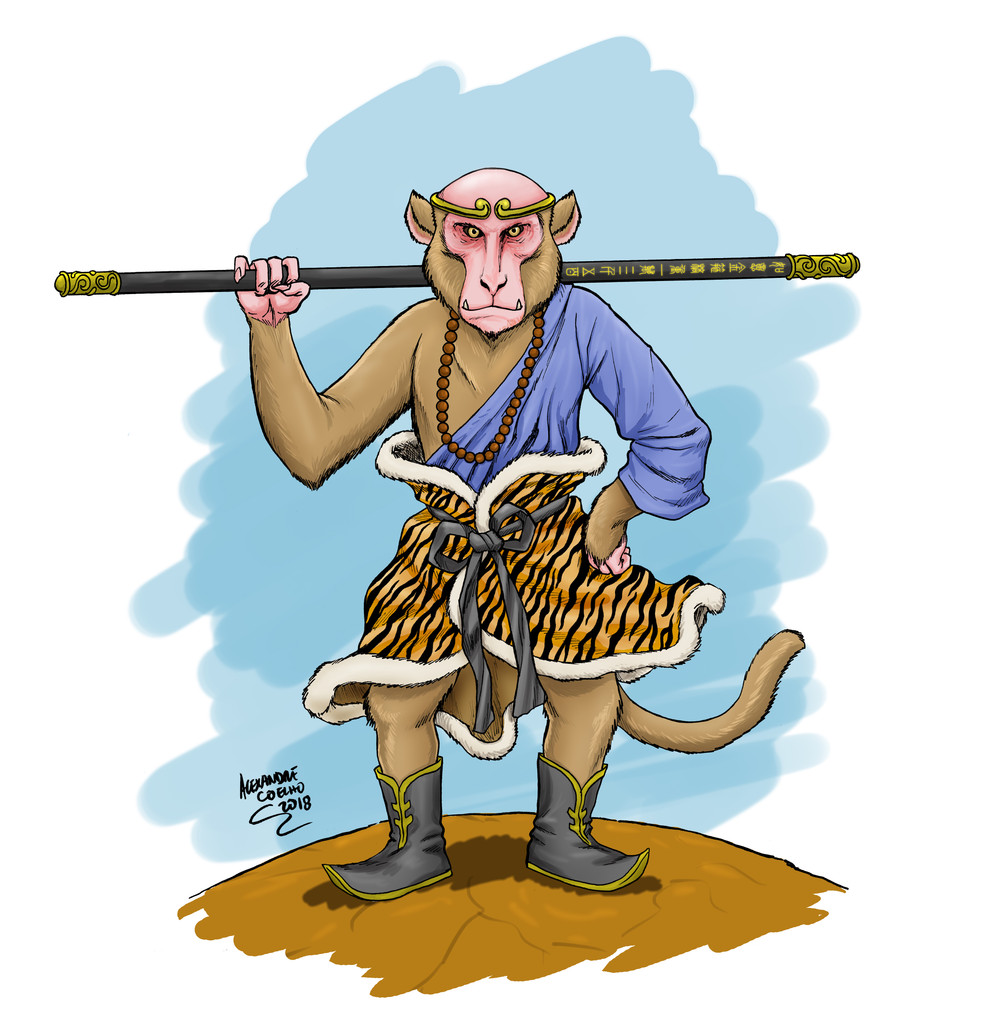
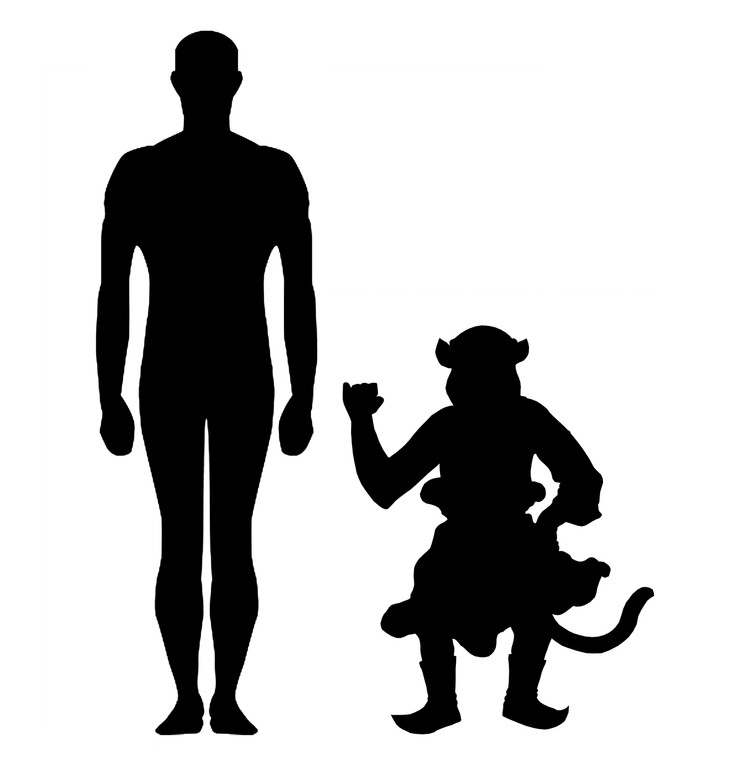
In “What Does Sun Wukong Look Like?” I highlighted several sentences pointing to the Monkey King’s small stature (fig. 1 & 2). For example, one monster comments:

The old monster took a careful look and saw the diminutive figure of Pilgrim [Monkey]—less than four Chinese feet [buman sichi, 不滿四尺, 4.17 ft or 1.27 m] in fact—and his sallow cheeks. He said with a laugh: “Too bad! Too bad! I thought you were some kind of invincible hero. But you are only a sickly ghost, with nothing more than your skeleton left!” (Wu & Yu, 2012, vol. 1, p. 408).

This information was later used in the making of a youtube video called “10 Facts About Sun Wukong the Monkey King.” Fact number seven was that “He’s really short,” and I ended the section by saying: “That’s right! The Great Sage Equaling Heaven, the conqueror of the heavenly army … is the size of a child.” A Chinese viewer later left a thought-provoking comment on the video stating that I was wrong about Monkey’s size.

Fig. 1 – An accurate Monkey King (larger version). Drawn by my friend Alexandre Palheta Coelho (instagram and deviantart). Slightly modified by me to match what I’ve written here. For the original version, see here. Fig. 2 – A size chart comparing Sun to a six-foot human (larger version).

The Debate

Here, I will present the comment in full but interspersed with my responses:

Hello! I am a Wukong fan from China. I really enjoyed your video! I would like to say that the height of the Monkey King has been very controversial on the internet in China. The data and appearance depictions in classical Chinese novels can be somewhat exaggerated. Journey to the West is a mythological novel is even more so. For example, seventy-two transformations, a somersault that can travel one hundred thousand eight hundred thousand li respectively refer to infinite changes and fly extremely fast. Seventy-two and one hundred and eighty thousand are not exact numbers, so relying solely on data is not reliable. Besides, in addition to four feet, Wukong has also appeared other height data. For example, the earliest version of the Journey to the West, “世德堂本”, Chapter 21. “大圣公然不惧。那怪果打一下来,他把腰躬一躬,足长了三尺,有一丈长短。” “Our Great Sage was not in the least frightened. When the monster struck him once, he stretched his waist and at once grew three chi, attaining the height of one zhang altogether.”

This PDF scan (page 258) shows the original version of the novel did indeed read “grow three chi” (changle sanchi, 長了三尺) and not six like in the modern version (Wu & Yu, vol. 1, p. 408). I was surprised when this was brought to my attention.

One zhang minus three chi equals seven chi. In other words, the height of the Monkey King here was seven chi (Since the height unit in Chinese classical novels is based on the ancient system, 7 chi is around 5.5 feet). But in later versions and translations, “grew three chi” was changed to six chi. This has always been a point of contention. The figure of four feet (four chi) appears twice, both from the perspective of other monsters, such as the Monstrous King, who is three zhangs tall (around 24 feet). It may be possible that Sun Wukong is short in his eyes in comparison.

For those unfamiliar with ancient Chinese measurements, one zhang () equals ten chi (尺, i.e. “Chinese feet”) (Jiang, 2005, p. xxxi). The passage in question does imply that Monkey is seven chi tall. However, there are two problems. First, during the Ming (1368-1644) when the novel was published, one chi equaled approximately 12.52 inches (31.8 cm) (Jiang, 2005, p. xxxi). This would make Sun a whopping 7.3 feet (2.22 m) tall! I must admit that the chi varied at the local level, but I doubt the variations would lead to a nearly two-foot (60.96 cm) difference. Additionally, if we use the measures for the Tang (618-907 CE), when the story is set, a chi was 11.57 inches (29.4 cm), making Monkey 6.75 feet (2.06 m) tall. There was, however, a “small chi” (xiaochi, 小尺) at this time, which was 9.66 inches (24.6 cm) (Nienhauser, 2016, p. 405 n. 40). This would only make him 5.65 feet (1.72 m) tall. But I would question if the common folk reading the novel during the Ming were aware of and still using this truncated measure. Second, as written above, the figure for “not even four chi” (buman sichi, 不滿四尺, 4.17 ft or 1.27 m) appears twice. But it’s important to note that this estimate is made by two different characters at two different locations and times. The first is spoken in chapter two by the Monstrous King of Havoc (Hunshi mowang, 混世魔王) in the Water Belly Cave (Shuizang dong, 水臟洞) of the Mountain of Flowers and Fruit (east of the Eastern Purvavideha Continent) (PDF page 36; Wu & Yu, 2012, vol. 1, p. 128). This takes place over 100 years before Sun’s initial rebellion during the Han Dynasty (202 BCE-220 CE). And the second is spoken in chapter 21  by Great King Yellow Wind (Huangfeng dawang, 黃風大王) in the Yellow Wind Cave (Huangfeng dong, 黃風洞) of Yellow Wind Ridge (Huangfeng ling, 黃風嶺) somewhere in the Southern Jambudvipa Continent (PDF page 258; Wu & Yu, 2012, vol. 1, p. 408). This takes place sometime after his release from his 600-plus-year punishment under Five Elements Mountain during the Tang Dynasty (618-907 CE). Therefore, this seems like a more reliable measure—given the distance between themthan the ten minus three argument. I suggest the latter was actually a typo that later editions tried to amend by changing three to six. 

Another reason is that the author may be deliberately blurring the height of the Monkey King. Because at least in the story, the author describes Wukong according to the height of normal people. For example: Before Wukong learned Magic skills, when he could not change his height, he had robbed ordinary people’s clothes to wear. If Wukong was the height of a child, the clothes would hardly fit. When Wukong set out on his journey to the west, he once wore the clothes of Tang Monk. Wukong could carry the Taoist priest changed by the Silver Horned King (if he was a child height this would be very difficult).

These are good points, but a 7.3-foot tall Monkey wouldn’t be able to wear the clothing of the aforementioned people either. Conversely, tucking in or rolling up clothing wouldn’t be out of the question. And carrying a priest wouldn’t be a problem for a small-statured hero capable of hoisting the weight of two cosmic mountains while running at meteoric speeds.

In the same chapter, the Tang monk sitting on the horse can pull Wukong’s tiger skin skirt. Wukong can easily grab Eight Rules’ ear. In the Bhikṣu Kingdom, Wukong once exchanged clothes with Tang monk, etc.

Horses are tall animals, so the Tang Monk would’ve probably fallen off before even grabbing the skirt of an adult-sized Sun Wukong. I look at this as something that sounds good on paper until it’s tried in real life.

I think even a 5.5-foot tall Monkey would have problems grabbing the ear of Zhu Bajie, who is likely 10 feet (3.05 m) tall or more given his three chi (3.13 ft / 95.4 cm) snout (PDF page 108; Wu & Yu 2012, vol. 4, p. 149) and giant body that “causes even the wind to rise when he walks” (PDF page 367; Wu & Yu 2012, vol. 2, p. 51). Either way, jumping would be involved, making this irrelevant.

And just because Sun might be smaller doesn’t mean he wears child-sized clothing. I believe the first instance of sharing clothes happens in chapter 14: “Pilgrim … noticed that Tripitaka had taken off a [robe] made of white cloth and had not put it on again after his bath. Pilgrim grabbed it and put it on himself” (PDF page 174; Wu & Yu, vol. 1, p. 313). He seems to wear whatever is available to him.

In China, there is another speculation about Wukong’s height: monkeys are usually hunched over. Wukong is four chi tall when bent over and seven chi tall when standing upright.

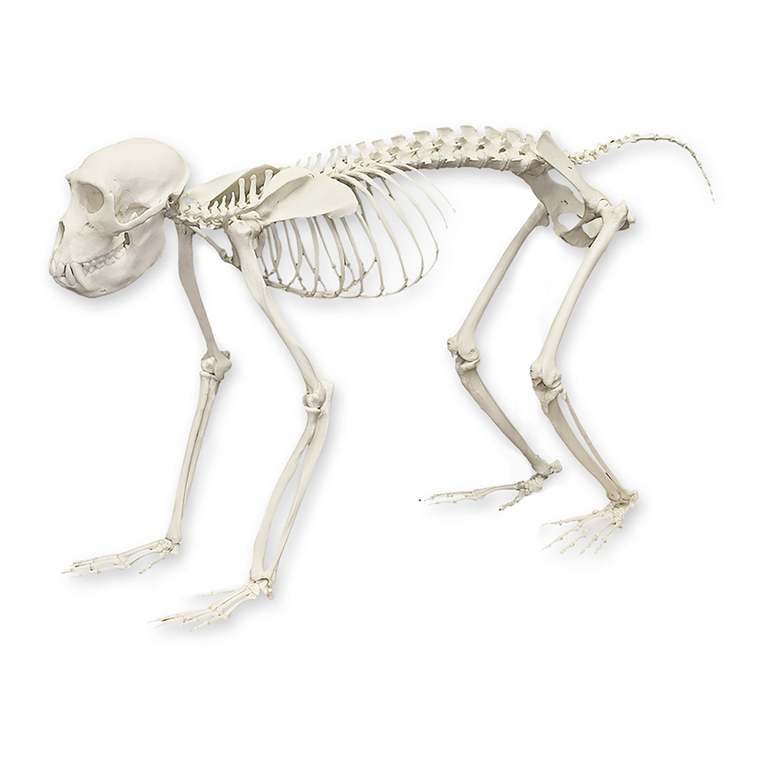
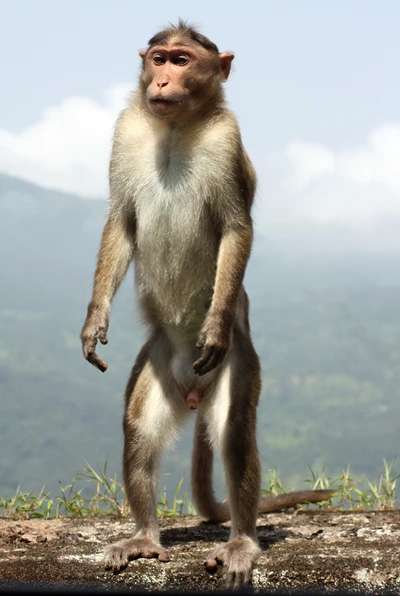
I studied primates in college. Monkeys usually walk on their palms (palmigrade) (fig. 3) and only stand when foraging, fighting, or carrying things. But I don’t recall the novel ever mentioning Sun traveling on all fours (please correct me if I’m wrong). Therefore, he likely walks on two legs. In this case, as stated, monkeys have a hunched posture when standing. They can’t stand straight because of mechanical limitations in their skull, spine, hips, legs, and feet (my previous essay on hominids applies to monkeys as well). One could argue that Monkey can overcome these limitations with his immortal body, but this definitely wouldn’t give him three more chi of height. For example, here’s a macaque standing at full height (fig. 4). As can be seen, straightening the head, spine, and legs would only give a handful of inches or centimeters.

Fig. 3 – A macaque skeleton in its natural posture (larger version). Fig. 4 – A young macaque male standing (larger version).

And as stated in this article, Sun shares all of the hallmarks of a macaque, including a “furry, joweless face with fiery eyes, a broken or flat nose, a beak-like mouth with protruding fangs, and forked ears.” This likely includes a smaller stature.

Of course, there is no doubt that he is very thin, and is definitely the shortest one in the scripture takers, but at least, his height is more like that of a shorter adult than a child. The role of Sun Wukong is a combination of human nature, monkey nature, and divinity. The author may be deliberately obscuring his height. Therefore, when describing daily life, Wukong is the same height as normal people, but in the eyes of other demons, he is more prominent in the shape of the monkey. And he has the divine power to change his height at will. Sorry for my bad English, really enjoyed your video!

I will concede that four chi is a rough estimate, so he might be slightly shorter or even taller than this. Either way, he’d be far below average human height.


Update: 03-06-22

Chapter 20 includes a scene where Monkey refers to his stature: “A person like me, old Monkey, may be small but tough, like the skin around a ball of ligaments!” (PDF page 246; Wu & Yu, 2012, vol. 1, p. 395).


Update: 03-08-22

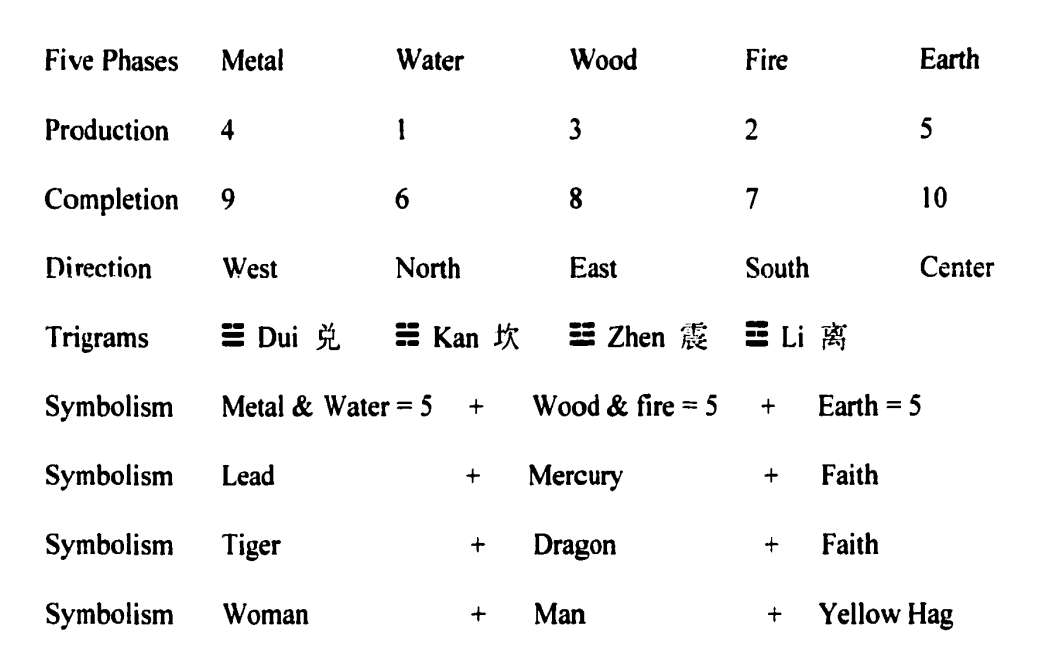
Above, I suggested that the ten minus three argument was a typo. But there might be a numerological explanation. Qing-era scholar Wang Xiangxu (汪象旭, fl.1605-1668) borrowed from the Daoist philosophy of Zhang Boduan (張伯端, 987?-1082) by applying his “three fives equal one” (sanwuyi, 三五一) five elements concept (fig. 5) to numbers appearing in the novel. As Shao (1997) explains:

One set of five consists of wood (3) and fire (2). Wood in the east produces fire in the south. The second set is that of metal (4) and water (1). Metal in the west produces water in the north. The third is earth in the center whose number is five. The whole business of the “gold elixir” is to integrate all three sets of five to produce one—the gold elixir (pp. 16-17).

Shao (1997) goes on to explain the numeric significance of the dharma vessel constructed from Sha Wujing’s 9-skull necklace and the heavenly gourd in chapter 22: 

Wang Xiangxu shows a keen eye for the “one” gourd and “nine” skulls which make a perfect “ten”—the number for the completion of earth. However, it is not the numbers that attract him, but what they indicate—that the gold elixir is creation—a process that involves the integration of all the five elements—not unlike the creation of the universe (p. 18).

Therefore, three (wood) and seven (fire) may be a reference to the completion of ten (the golden elixir) in Daoist numerology. If this is true, even the later switch from three to six still matches this (refer to fig. 5).

Fig. 5 – A chart explaining the three fives (larger version). From Shao, 1997, p. 17.


Update: 04-27-24

Chapter 37 gives a more precise measurement for Monkey’s height. He first transforms into a “tiny monk about two cun tall” (二寸長的小和尚兒) (based on Wu & Yu, 2012, vol. 2, p. 172). He shortly thereafter grows even bigger when a prince makes fun of him:

Tripitaka pulled open the box’s cover; Pilgrim [Sun Wukong] leaped out and began to hobble all over the place. The prince said, “This little midget! What can he know?” When Pilgrim heard this remark about his size, he at once resorted to magic. Straightening up his torso, he grew about three chi and four or five cun instantly (emphasis added). “If he can grow that rapidly,” said the soldiers, highly startled, “it will only be a few days before he pierces the sky.” When Pilgrim reached his normal height, however, he stopped growing (emphasis added) (based on Wu & Yu, 2012, vol. 2, pp. 174-175).

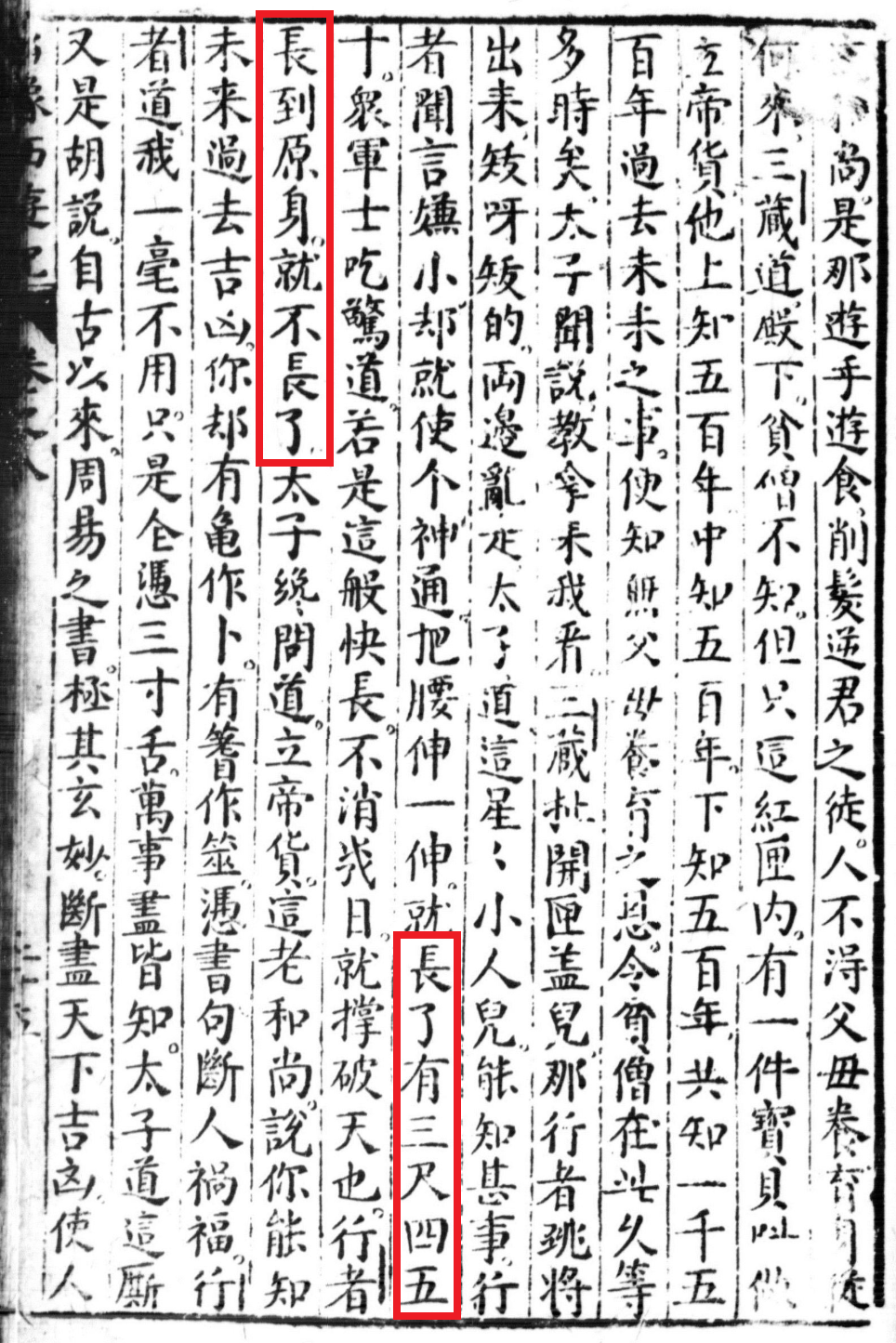
三藏扯開匣蓋兒,那行者跳將出來,呀的兩邊亂走。太子道:「這星星小人兒,能知甚事?」行者聞言嫌小,卻就使個神通,把腰伸一伸,就長了有三尺四五寸。眾軍士吃驚道:「若是這般快長,不消幾日,就撐破天也。」行者長到原身,就不長了。

As mentioned above, one chi (尺) is roughly 12.3 in or 31.8 cm (Jiang, 2005, p. xxxi). Expanding on this, one chi equals 10 cun (寸; a.k.a. “Chinese inches”) (Jiang, 2005, p. xxxi). One cun would be about 1.25 in or 3.18 cm. Two cun would therefore be 2.5 in or 6.36 cm. Growing the stated additional height would then put our hero at chi and 6 or 7 cun, which is roughly 3.86 ft or 1.176 m. This agrees with the aforementioned estimate of “not (or less than) four chi tall” (buman sichi不滿四尺) (Wu & Yu, 2012, vol. 1, pp. 128 and 408).

It’s important to note that the cited quote above does indeed appear in the original 1592 edition (see PDF page 480) (fig. 6). This proves that the aforementioned “grow three chi” (changle sanchi, 長了三尺) from PDF page 258 was a typo!

Fig. 6 – A scan from the original 1592 edition showing that Monkey only grows an additional “3 chi and 4 or 5 cun” (larger version). 

Sources:

Jiang, Y. (2005). The Great Ming Code / Da Ming Lu. Vancouver, Wa: University of Washington Press.

Nienhauser, W. H. (2016). Tang Dynasty Tales: A Guided Reader. Singapore: World Scientific.

Shao, P. (1997). Monkey and Chinese Scriptural Tradition: A Rereading of the Novel Xiyouji (UMI No. 9818173) [Doctoral dissertation, Washington University]. Available from ProQuest Dissertations and Theses database.

Wu, C., & Yu, A. C. (2012). The Journey to the West (Vols. 1-4) (Rev. ed.). Chicago, Illinois: University of Chicago Press.

Archive #26 – Bimawen, Heavenly Horses, and Dragon Horses in Chinese Literature and History

Last updated: 01-04-2025

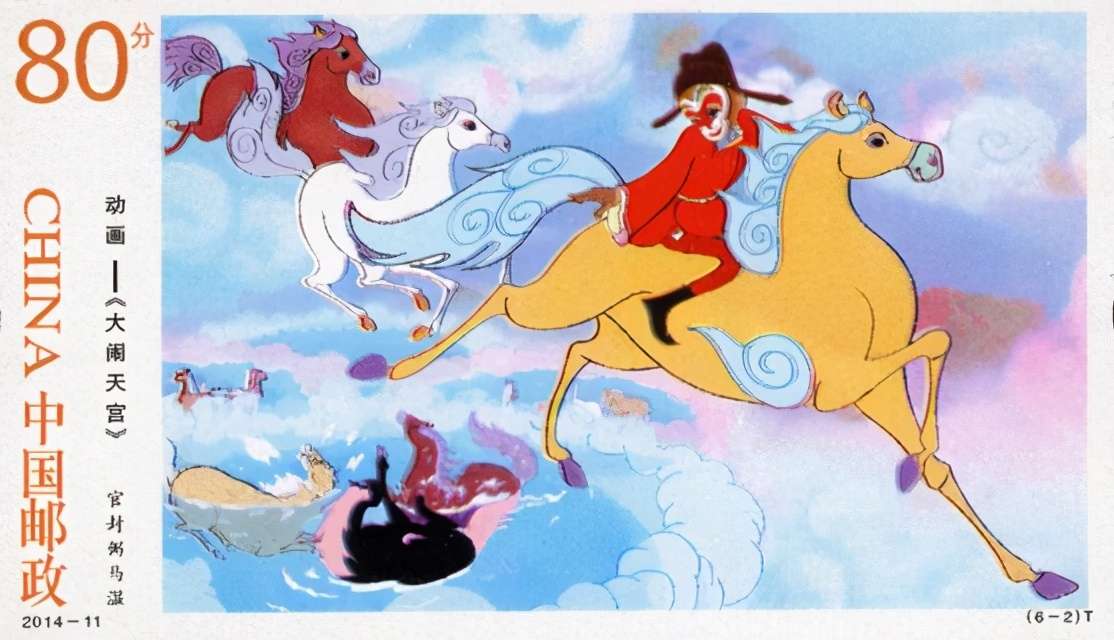
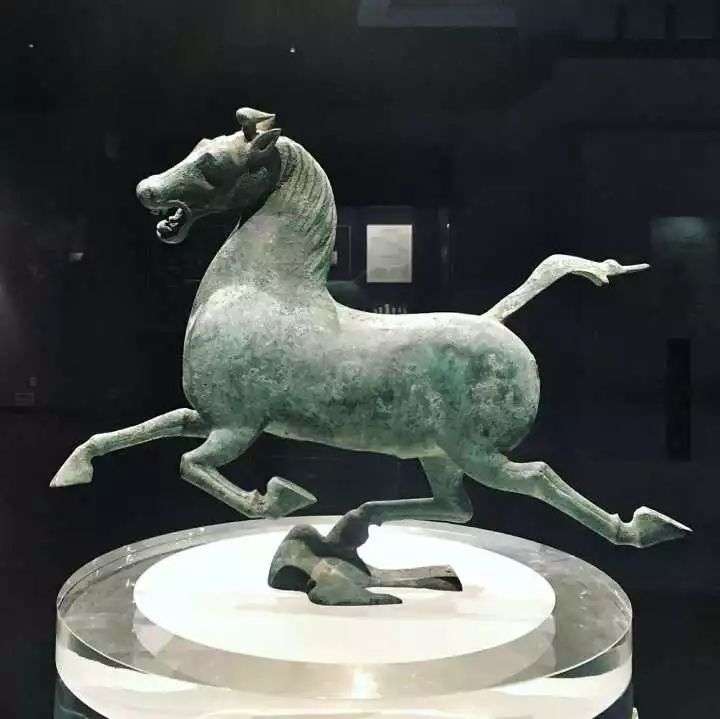
In chapter four of Journey to the West (Xiyouji, 西遊記, 1592), Sun Wukong is invited to heaven to serve as the Bimawen (弼馬溫, “To assist horse temperament”), a minor post overseeing the celestial horse stables (Wu & Yu, 2012, p. 148). He takes the position seriously, caring for nearly 1,000 horses day and night, making sure they are all well-fed, exercised, and rested (Wu & Yu, 2012, p. 149) (fig. 1). But these are no ordinary horses. A poem associates them with the most famous steeds in Chinese history (Wu & Yu, 2012, pp. 148-149), and most importantly, the last line states: “They tread the mist and mount the clouds with unflagging strength” (Wu & Yu, 2012, p. 149). This suggests that they have the supernatural ability to gallop through the skies (fig. 2). Additionally, the novel refers to them as “dragon horses” (long ma, 龍馬) (Wu & Yu, 2012, p. 309), which brings to mind the White Dragon Horse (Bai long ma, 白龍馬) that serves as Tripitaka‘s mount throughout the journey (Wu & Yu, 2012, p. 328).

Monkey’s position gives him power over all horses, especially those of mortal stock:

When the horse saw [Pilgrim], its torso slackened and its legs stiffened. In fear and trembling, it could hardly stand up. For you see, that monkey had been a [Bimawen], who used to look after dragon horses in the celestial stables. His authority was such that horses of this world inevitably would fear him when they saw him (Wu & Yu, 2012, p. 309). [1]

The heavenly post is a homophonous pun on Bimawen (避馬瘟, lit: “avoid the horse plague”), an ancient superstition where people would place monkeys in stables to ward off equine sickness. For example, Essential Techniques for the Common People (Qimin yaoshu, 齊民要術, c. 544) states: 

[Horses] are often associated with macaques [mihou, 猕猴] in the horse stable. This is in order to calm the horses, repel evil, and eliminate all diseases.

常系猕猴于马坊,令马不畏、辟恶、消百病也

The later Compendium of Materia Medica (Bencao gangmu, 本草綱目, 1596) mentions this concept twice. The first reads:

The Shuowen says: The characters (for macaque) look like “mother monkey” (muhou), but it’s “bathing monkey” (muhou, i.e. macaque), not a female. Since a macaque resembles a hu-barbarian, he is also called hu-sun “grandson of a barbarian”. The Zhuangzi calls him ju. People who raise horses keep a macaque in the stables, which will ward off horse-diseases. The Hu barbarians call a macaque maliu, in Sanskrit books he is called Mosizha (makaṭa). [2]

《说文》云︰为字象母猴之形。即沐猴也,非牝也。猴形似胡人,故曰胡孙。《庄子》谓之狙。养马者厩中畜之,能辟马病,胡俗称马留云。《梵书》谓之摩斯[咤]

The second explains how monkeys are believed to help the horses:

The Classic of Horses states: Domesticated macaques used in horse stables help avoid horse diseases [lit: bimawen]. Their monthly menstruation runs onto the grass, and once the horses eat it, they will never be sick.

《马经》言︰马厩畜母猴,辟马瘟疫。逐月有天癸流草上,马食之,永无疾病矣

This is insanely comical as it directly links Sun Wukong, a powerful cosmic warrior, to menstruation! This then might explain why Monkey is so enraged when enemies call him a Bimawen. As noted by my friend Irwen Wong of the Journey to the West Library blog, it challenges the Great Sage’s masculinity.

Essays

The following essay by Arthur Waley (1955), famed translator of the Journey to the West abridgement Monkey (1942), links heavenly horses to a historical breed from Central Asia, the Ferghana horse. He describes China invading the region to procure these horses by force, suggesting Emperor Wu of Han directed this action because the ruler believed the equines were dragon horses capable of transporting him to heaven. This is linked to stories of ancient Chinese rulers attaining immortality by riding horses or dragons to the celestial realm. Waley (1955) notes both the Chinese and Indians believed supernatural steeds hailed from the water, showing a link between horses and dragons.

But Creel (1982) refutes the claim that the heavenly horses were procured for purely religious reasons. He shows they were indeed used in military battles. 

Fig. 1 – A 2014 stamp featuring a scene from the classic 1960s animation Havoc in Heaven in which Sun Wukong serves as the keeper of the heavenly horses (larger version). Image found here. Fig. 2 – A photo of the famous circa 2nd-century BCE Flying Horse of Gansu (larger version). Image found here.

I. The Heavenly Horses of Ferghana

Individuals are not happy in proportion to the amount of space their persons occupy. Yet certain nations, at certain periods of their history, seem to take it for granted that the wider they spread themselves the happier they will be. China is a case in point. Why did this enormous country in the second century BC, in the first century AD and again at various later periods ruin itself by gratuitous westward expansion? Were her aims commercial or strategic? Was she defending her silk trade, or guarding against possible wars on two fronts? What part was played by the individual ambition of Emperors or generals, or by mere restlessness and love of adventure?

To answer these questions we should have to take the campaigns one by one. In doing so we should not be reduced to mere guesses. In Imperial edicts and addresses about military campaigns certain traditional pretences are, of course, kept up: ‘everything under Heaven’ belongs by right to the Chinese Emperor, and any peoples who do not think so must be chastised. Concrete and material motives for war are not always mentioned in these regal utterances, any more than an Address from the Throne (or its equivalent) in modern countries usually mentions petrol or rubber. But statesmen and officials were often quite frank about material motives for conquest: more so, I think, than is the case with us today. Thus, as justifying a proposal to secure from the Huns a strip of territory that projected into the Kansu corridor in north-western China the following reasons are given by a statesman in 8 BC: first, that it was a good source of supply for the sort of wood and feathers used in making arrows; secondly, that it would mean a large increase of Chinese territory, and lastly that it would give the general in command of the campaign a chance to win a big reputation. It is interesting to find that extension of territory is here regarded as an end in itself. Possibly supporters of the proposal might, if pressed, have pointed out as an afterthought that Chinese farmers could be settled in the new territory and that the taxes they paid would be a help to the exchequer.

The tendency of modern historians, and not only in Marxist countries, is to stress material and particularly economic motives for war, and to regard the profession of other motives as mere propaganda. In dealing with early Chinese history I do not think this view would generally lead us far astray, so long as we bear in mind the additional factor of personal ambition and the almost axiomatic belief that extension of territory was an end in itself. But I am going to deal with a case that seems to me to be exceptional. Oddly enough the early Chinese military adventure that modern scholars have most unanimously explained solely on materialist lines, seems, on closer examination, to have been to a large extent a religious quest

In 102. BC the Chinese Emperor Wu sent a huge military expedition (there had been a small and abortive one two years before) to Ta Yüan, corresponding roughly to the modern Ferghana in Russian Turkestan, to capture Heavenly Horses. Modern scholars, both Far Eastern and European, have usually assumed that the real object of the expedition was a purely practical one; namely, to secure a better type of cavalry horse. It is certain that by the middle of the second century AD the Chinese did possess two kinds of horse: a steppe-pony, with a large clumsy head, and a western type of horse, similar to that shown on Greek coins of the fourth to the second century BC, with small graceful head. It may well be that one of the results of the Ferghana expedition was the introduction of a western type of horse into China; and in the eyes of the generals and the horse-experts who accompanied them this may have been the main object as well as the result of the expeditions. But modern historians, intent on the very interesting material aspects of the episode, have tended to overlook its place (amply attested by contemporary texts) in the history of Chinese religion. Incidentally, by examining these texts more closely, I think one gets fresh light on what concretely and zoologically (as opposed to mythologically) the Heavenly Horses really were. I should mention that as a result of the expedition thirty or so ‘superior horses’ and 3,000 horses and mares of ‘middling or lower quality’ were handed over to the Chinese. How many of these survived the journey of 2,500 miles back to the Chinese capital we do not know. A few years later the king of Ferghana agreed to send two Heavenly Horses to China every year. I shall here be concerned only with the thirty ‘superior’ Or ‘Heavenly’ horses. There is no reason to suppose that the 3,000 inferior horses were of a type different from the usual Chinese horse. They may merely have been needed as remounts.

In studying what was said about the horses in contemporary Chinese literature the best point of departure is the hymn made in 101 B.C. when the horses were about to arrive at the Chinese capital :

The Heavenly Horses are coming,
Coming from the Far West.
They crossed the Flowing sands,
For the barbarians are conquered.
The Heavenly Horses are coming
That issued from the waters of a pool.
Two of them have tiger backs.
They can transform themselves like spirits.
The Heavenly Horses are coming
Across the pastureless wilds
A thousand leagues at a stretch,
Following the eastern road.
The Heavenly horses are coming.
Jupiter is in the Dragon.
Should they choose to soar aloft,
Who could keep pace with them?
The Heavenly Horses are coming;
Open the gates while there is time.
They will draw me up and carry me
To the Holy Mountain of K’un-lun.
The Heavenly Horses have come
And the Dragon will follow in their wake
I shall reach the Gates of Heaven,
I shall see the Palace of God.

This song has often been spoken of by western historians as though it were a purely secular literary poem. It is in reality one of a series of hymns written (possibly by the Emperor Wu himself, but the authorship is very uncertain) for use at the sacrifices to Heaven and Earth-sacred rituals performed by the Emperor in person. One or two of the phrases in it obviously need further explanation. Whether the people of Ferghana believed that their sacred horses ‘issued from a pool’ we do not know. But there are, apart from other instances of this belief elsewhere in Central Asia, many Chinese stories of horses coming up out of the water, the implication being that they are dragon-horses, that is to say, water-dragons who have changed themselves into horses, often retaining their dragon wings. As we shall see, the Emperor had been on the look-out for a water-born horse for some time. What is meant by ‘the Dragon will follow in their wake,’ more literally ‘they will be introducers of the Dragon’ ? The idea underlying these words is best illustrated by the following story, dating perhaps from some forty years earlier than the hymn: Recently a man who lived on the frontier lost his horse which ran away into the land of the barbarians. He was very much upset, and everyone condoled with him, except his father who remarked cheerfully, ‘This may be a blessing in disguise.’ And sure enough the lost horse came back bringing with it a ‘fine horse,’ that is to say, a horse of superior value and breed. The Emperor in this hymn hopes that the Ferghana horses would one day bring along a Dragon, a being even more magical than a Heavenly Horse.

The general implication of the hymn therefore is that the Heavenly Horses will carry the Emperor to the abode of the Immortals on the magical mountain K’un-lun. He imagines himself, I think, driving in a chariot drawn by horses rather than riding on horseback. Riding did not become common in China till the fourth century BC and was in the second century still felt ‘to be a utilitarian, unlegendary form of transport. More than this, the Ferghana horses being, as another hymn in the series says, ‘friends of the Dragon ‘ who is master of the clouds, will eventually carry him to Heaven, to the Abode of God-on-High-(Shang Ti).

The preceding hymn (No. 9 in the series), which is about the fleeting and uncertain nature of man’s life, ends with the words, ‘Why does not Tzu-huang come down to me?’ Tzu-huang was the horse with dragonwings that carried up the mythical Yellow Emperor to Heaven. There are many Chinese stories of legendary monarchs being carried up to Heaven by magic steeds; but it would be difficult to prove that any of them is older than the fourth century BC. It is interesting to compare these Chinese myths with Indian ideas about the relation of monarchs to magic steeds. In Indian legends the magic horse Valaha (‘Cloud’), is one of the ‘seven treasures’ of a great monarch. Valaha came up out of the sea, just as the Ferghana horse and others in which the Chinese were interested came up out of the water, and carried Simhala, the legendary founder of the Kingdom of Ceylon, back to India when he was on the verge of being eaten by female cannibals.

The Emperor Wu had, as I have mentioned, for some time past been on the look-out for a magic horse, ‘born from’ a stream. In 121 BC someone thought it worthwhile to report to the Court that a horse had come up out of a river to the north of the Ordos, the great square-shaped northern bend of the Yellow River. We have no details about this horse ; but in 113 BC another strange horse was not only seen but captured and sent to Court. A Chinese who in consequence of some misdemeanour had been sent to do service at the military colony near Tun-huang, on the northwest frontier, frequently saw a horse of strange appearance drinking in the river along with a number of wild horses. He tamed the strange horse by putting at the water-side a dummy figure of a man whose hands were bridle and halter. When the horse was used to this sight he substituted himself for the dummy, captured the horse and sent it to Court. In order to prove that the horse was ‘divine’ he pretended that it had come up from under the water. His story was evidently believed at the time, for this horse, too (like the Ferghana horses twelve years later), was made the subject of a hymn to be used in the Imperial sacrifices :

The Heavenly Horse comes down
A present from the Grand Unity,
Bedewed with red sweat
That foams in an ochre stream
Impatient of all restraint
And of abounding energy.
He treads the fleeting clouds,
Dim in his upward flight;
With smooth and easy gait
Covers a thousand leagues.

Historians of religion, particularly those of the Vienna school, regard as ‘the beginning of religion’ the belief in a supreme celestial deity who later becomes merely a vague memory and ultimately fades away or becomes merged in other, more concrete cults. The ‘Grand Unity‘ (or ‘Great Unique,” as one might also translate it) of this hymn has therefore particular interest as a religious phenomenon, being a supreme celestial deity whose origin (at any rate as a national cult), whose heydey and disappearance all take place before our eyes within a limited historical period. So far from belonging to a remote, ‘archaic’ past he begins, officially at any rate, in 133 B.C. Up till then the Grand Unity was a philosophic conception denoting the primal unity out of which grew the plurality of the universe as we know it. Sometimes the phrase is a synonym of Tao, the underlying principle of the Universe in Taoist philosophy. But in the second century BC a cult sprang up in which the Grand Unity figures not as a philosophic conception but as a personal divinity, the highest of all gods, worshipped with an elaborate ritual. About 133 BC a member of the Grand Unity sect prevailed on the Emperor Wu to make the whole Imperial cult centre round this deity. The Grand Unity maintained this position during several reigns and the cult was only brought to an end (along with many other religious innovations of Wu’s reign) in 32 BC.

I will leave aside for the moment the other points of interest in the Heavenly Horse hymn of 113 BC and note here that the Emperor’s search for immortality did not begin with his interest in divine horses. He had, as is well known, for long past been pursuing this quest on other lines. He had sent numerous and costly expeditions to the East in the hope of discovering islands inhabited by Immortals who might be persuaded to yield their secrets to him. He had dabbled in alchemy, in the belief that if he ate out of vessels made of alchemic gold he would live forever, or at any rate for a prodigiously long time. The expedition to fetch magic horses from the West was, it seems to me, merely a continuation of his earlier quests in the East. ‘The Emperor Wu,’ says Wen Ying in about AD 200, ‘had set his heart on immortality. He was always hoping that a Heavenly Horse would come and carry him to K’un-lun,’ the western Abode of the Immortals. At last when all his guests in the East had failed and when the Horse did not come of its own accord (as it had come to legendary Emperors in the past, both in India and in China) he determined, having known for long that the king of Ferghana had such horses, to wrest some from him by diplomacy or, if need be, by force.

We have seen, then, how the horses were regarded by the Chinese Emperor. Other people, less obsessed by magico-religious ideas, may have viewed them differently; but there is nothing in the Chinese sources to suggest that they were needed or used for military purposes. Naturally, the normal political excuses were made for the expedition. In a public proclamation the Emperor accused Ferghana of having killed two Chinese envoys on their way to the west and an Indian envoy who was on his way to China. The excuse has a familiar ring. One is reminded, for example, of the German seizure of Tsingtao in 1897, alleged to be a reprisal for the murder of the German missionaries Nies and Henle.

Another question clearly arises. How were the Heavenly Horses regarded by the king of Ferghana and what role did they play at his Court? It is generally assumed that they were battle-chargers. But I wonder whether their function was not perhaps something like that of the ten Nesaean horses ‘most gorgeously caparisoned,’ who in the procession of the Persian king Xerxes, as described in the seventh book of Herodotus, walked immediately in front of the sacred chariot of ‘Zeus’ ? ‘And it occurs to one that to this same category of ceremonial horse may very well belong the ten yellow mares of the Pazaryk grave mound, in the eastern Altai, preserved in a solid ice block. They form part of the burial gear of a semi-nomad chieftain who lived perhaps somewhere about the 5th century B.C. ‘They are,’ says the Swedish archaeologist Karl Jettmar, ‘certainly of the noblest breed. They resemble the best strains of Turkmenistan or Ferghana.’ Two of them have masks. One mask represents a deer or reindeer; the other, a composite mythological creature. They may well have been special horses used by a ruler for ritual purposes, and perhaps (as Jettmar suggests) they took part in the funeral procession, which like the Scythian funeral processions described’ by Herodotus may have travelled an immense way. Their mythological function may well have been to carry the dead Khan to Immortality, just as the horse Tzu-huang carried the legendary Chinese Yellow Emperor and as in historic times the Emperor Wu hoped to be carried by the Ferghana horses. One is reminded, again, of the ‘treasure-horses,’ blue-grey in colouring and with black heads (that is to say, descendants of the magic horse Valaha) and gorgeously caparisoned, who took part in the procession that brought the infant Buddha back from Lumbini to his father’s palace. If the function of the Heavenly Horses at the Ferghana Court was a ritual rather than a practical one it would well explain why the king was so anxious not to part with them and at one point even threatened to kill them all rather than let them fall into the hands of the Chinese.

Though the main subject of this essay is the relation between the Ferghana expeditions and the religious pre-occupations of the Chinesr Emperor, the texts we have studied do also tell us something about the physical characteristics of the Ferghana horses, and it may be worth while to close with a few remarks on this subject. The first of the two hymns mentions that two Heavenly Horses had stripy backs. Lydekker in The Horse and Its Relatives says : ‘It has been noticed that dun-coloured domesticated horses frequently show a tendency to develop … one or two transverse dark stripes across the shoulder, and another along the middle line.’ Such presumably were the two Ferghana horses, and the Chinese regarded them as ‘marked’ by heaven and consequently particularly sacred. The other physical characteristic commonly attributed to Ferghana horses is that they ‘sweated blood.’ This, as we have seen, was also said of the horse sent from near Tun-huang in 113 BC. Professor Dubs, in his valuable translation of the Han History, has suggested that the flow of blood was caused by lesions inflicted on the horses by a parasite with the intimidating name Parafilaria multipapillosa. There is in any case no question of this characteristic being merely legendary. In AD 78 the Emperor Chang gave one of his uncles ‘a Ferghana horse which bled from a small hole above its front upper leg.’ In the letter that accompanied this gift he said, ‘I had often heard the line in Emperor Wu’s song about the Heavenly Horse in which it is said that it is ‘ bedewed with red sweat,’ and I have now seen with my own eyes that this is actually the case.’ Presumably the ‘hole’ looked more like a pore in the skin than a wound, and therefore what came out of it was regarded as sweat rather than blood.

Nowhere, I think, is it said that they were larger than Chinese horses, though this has constantly been assumed by Western writers. The only horses that the Chinese at this period call big (ta) were to be found not in Ferghana but in Parthia. ‘They have the big horse and the big bird (ostrich),’ says the Han History. But there is no record of those huge Parthian steeds (no doubt the Parthikoi of Strabo, which he says were of the same build as the huge Nesaean horses) being brought to China.

To sum up: the accepted idea about the Ferghana expeditions is that the Emperor Wu sent them in order to obtain ‘horses larger and fleeter than the small steppe breed.” It is assumed that in this he was successful and that the ‘western’ type of horse seen in some of the second century A.D. grave-reliefs corresponds to the type of horse brought back from Ferghana in 101 BC. I would re-formulate this view as follows: The Emperor sent the expeditions in order to secure Heavenly Horses which would carry him to Heaven. There is no evidence that Heavenly Horses were used in battle either in Ferghana or China: If they had been they would hardly have remained long, as it were, ‘on the secret list.’ I’m inclined, to think that their function was a ritual one, both in Central Asia and in China. About the breed of the horses that the Emperor secured we know nothing. But it is reasonable to suppose that the existence of the ‘Western’ horse in China, in the second century AD was due to Chinese intercourse with the West from the second century BC onwards and that the Ferghana expedition, as an episode in this intercourse, may well have played its part in what was perhaps a gradual process. There is no justification for saying as Tam does that ‘the origin of the Ferghana horses must have been one of the great Parthian war-horses’ or that the Ferghana horses were ‘of the great Nesaean-Parthian breed.’.

Thus though my main object was to show that this episode cannot be properly understood without taking into account more than has hitherto been done its magico-religious aspects, my conclusions about its secular, concrete aspects are also somewhat different from those of my predecessors (Waley, 1955).

II. The Role of the Horse in Chinese History

Creel (1982) successfully refutes the former’s claim that the horses were procured for only religious reasons:

Waley, “Heavenly Horses of Ferghana,” 102, takes the position that the horses of Fergana were sought by the Han Emperor Wu “in order to secure Heavenly Horses which would carry him to Heaven.” He says that “there is no evidence that Heavenly Horses were used in battle either in Ferghana or in China.” (Ibid., 102.) But in fact, as we have seen, the use of Fergana horses in fighting is mentioned in Hou-Han-shu, 110A.4b. By speaking here of “Heavenly Horses” Waley is evading the real question: were horses obtained from Fergana used in battle in Han times? The answer is that they were. Waley also says: “Nowhere, I think, is it said that they [i.e., “Heavenly Horses”] were larger than Chinese horses, though this has constantly been assumed by Western writers.” (Ibid.) The evidence cited above certainly indicates that the Fergana horses were extremely large and that there is every reason to feel assured that they were much larger than most of the horses in China both in Han times and later. Further evidence against Waley’s view is the nature of the titles of the two men sent by the Emperor to Fergana “to select good horses.” (Shih-chi, 123.37.) These would appear to be ordinary official titles and refer to “managing horses” and “driving horses.” If the purpose had been primarily to select horses having special religious virtues, why did the Emperor not send men with religious qualifications? Certainly there was some religious aspect to this curious affair, and Waley has performed a service by emphasizing it. But in doing so he has given undue attention to a part of the evidence and neglected other parts of it entirely (p. 176 n. 66).

Please see the PDF below for the entire chapter.

Archive link

Click to access Herrlee-G.-Creel-What-Is-Taoism_-and-Other-Studies-in-Chinese-Cultural-History-1970-Ch.-8-on-Horses.pdf

Disclaimer:

These have been uploaded for educational purposes. No malicious copyright infringement is intended. If you enjoy the digital content, please support the official releases.


Update: 03-12-23

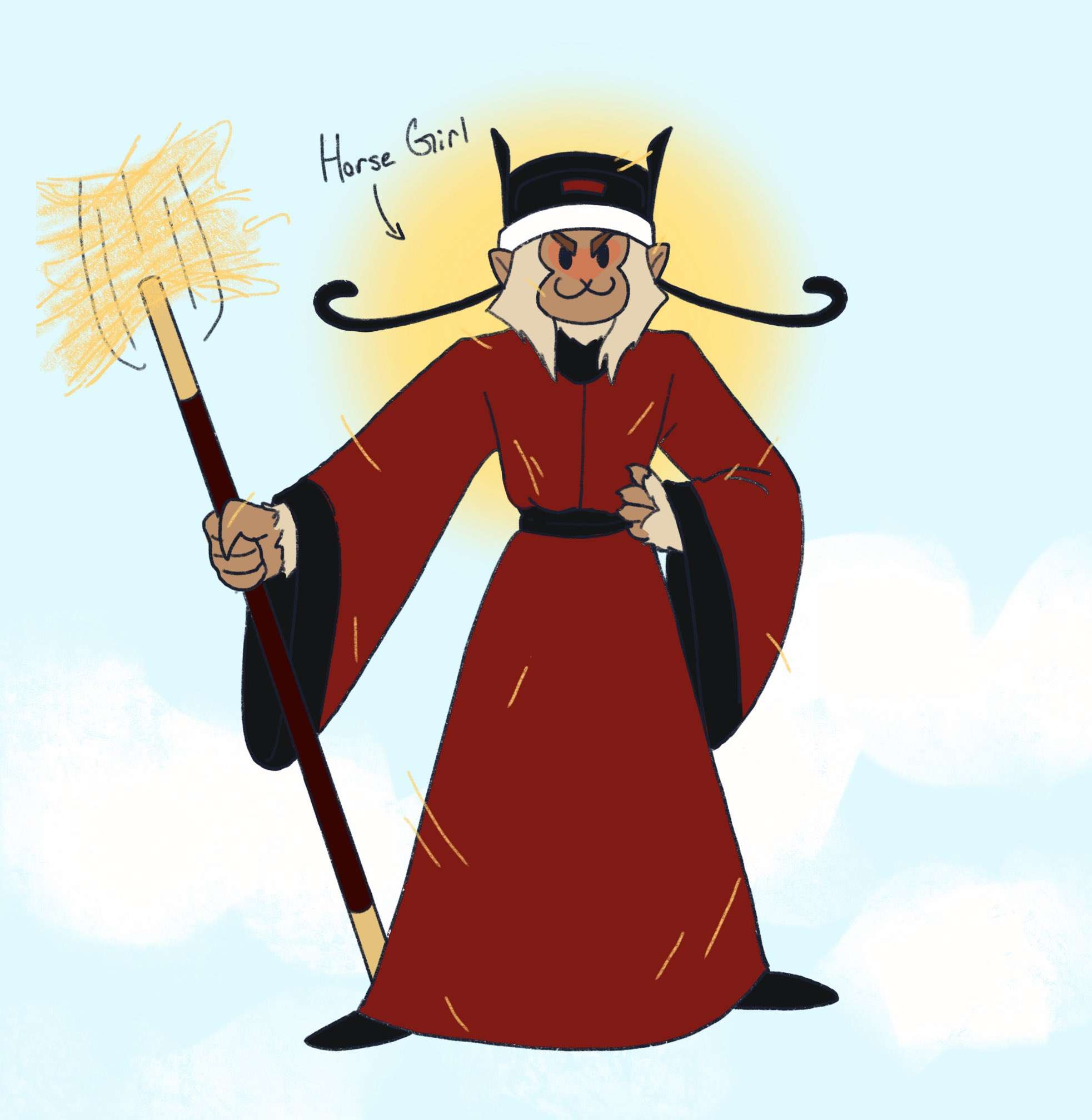
Twitter user Lava (@Lavaflowe) has allowed me to post their lovely drawing of Sun Wukong as the Bimanwen. The image is comically labeled “horse girl.” I especially love how he has transformed his magic staff into a pitchfork. Also, check out the hay covering his heavenly robes (fig. 4). That’s such a great detail.

Fig. 4 – Monkey as the Bimawen (larger version). The original tweet can be seen here.


Update: 01-04-25

I just posted an article about the White Dragon Horse.

Why Did the White Dragon Horse Burn His Father’s Pearls in Journey to the West?

Notes:

1) This power was given to Monkey by the Jade Emperor, who gives him the Bimawen post. This was pointed out to me by Irwen Wong of the Journey to the West Library blog.

2) The translation is partly based on Gulik, 1967, p. 35. I changed the Wade-Giles to pinyin.

Sources:

Creel, H. G. (1982). What is Taoism?: And other Studies in Chinese Cultural History. Chicago, Ill: University of Chicago Press.

Waley, A. (1955, February). The Heavenly Horses of Ferghana. History Today, 5, 95-103.

Wu, C., & Yu, A. C. (2012). The Journey to the West (Vol. 1) (Rev. ed.). Chicago, Illinois: University of Chicago Press.

Dragon Ball and Journey to the West

Last updated: 12-29-2022

It recently occurred to me that I’ve referenced the Dragon Ball franchise in several blog articles. So, I’ve taken the opportunity to gather everything into one spot, including information that I haven’t previously mentioned. This is meant to be a very basic introduction and not an exhaustive analysis. My current interest here is in modern adaptations of Journey to the West (Xiyouji, 西遊記, 1592; “JTTW” hereafter).

Those interested in a broader discussion on the influences of Dragon Ball should consult the work of Derek Padula.

I. Son Goku

The name of the series protagonist, Son Goku (孫悟空) (fig. 1), is a Japanese transliteration of Sun Wukong, meaning “Monkey Aware of Emptiness,” an allusion to Buddhist enlightenment. While referencing Rhesus macaques and “grandsons,” the surname Sun (孫), is also a veiled symbol for the development of an immortal spirit in Taoist elixir arts. Therefore, the name Son Goku straddles both Buddhism and Taoism.

Goku’s monkey tailflying nimbus cloud, and extending power pole (fig. 2) are all based on the respective trait, skill, and weapon of the Monkey King. The latter’s skill is called the “Cloud Somersault (jindou yun, 筋斗雲), which can travel 108,000 li (33,554 mi / 54,000 km), or one and one-third the circumference of Earth, in a single leap. Sun’s staff, the “‘As-You-Will‘ Gold-Banded staff,” weighs a whopping 17,560 lbs (7,965 kg) and (among other abilities) can magically grow as big or shrink as small as the immortal desires.

Goku’s proficiency in boxing (fig. 3) has a fun connection to Sun Wukong. Series creator Akira Toriyama partly based the Saiyan’s fighting style on the Wing Chun techniques used by Bruce Lee and Jackie Chan in their respective films. This style falls under the umbrella term “Short Fist” (Duan quan, 短拳), a school of martial arts with a low stance and quick, compact punches. JTTW states that this very style is the Monkey King’s preferred fighting technique! He uses Short Fist a few times in the novel.

The spherical spaceship that baby Goku crash lands on Earth in from DBZ (fig. 4) is a clever nod to the magic stone that Sun Wukong is born from in the beginning of the novel.

Goku’s Ozaro (大猿) form, or his ability to change into a titanic “great ape” during a full moon (fig. 5), is largely based on the Monkey King’s cosmic transformation. The novel calls this magical skill the “Method of Modeling Heaven on Earth” (Fatian xiangdi, 法天像地), and Sun uses it to grow 100,000 feet (30,480 m) tall during battles with powerful opponents. This is related to ancient Pre-Qin and Han dynasty concepts of astral-geography later used in the construction of imperial Chinese cities.

While I don’t have confirmation from Toriyama, Goku’s “Instant Transmission” skill (fig. 6) might be based on the aforementioned cloud somersault. This is because Chinese Buddhist literature mentions the world of man is separated from the Buddha’s paradise by 108,000 li (the distance covered by the cloud), and the only way to instantly bypass all of the hardships in-between is achieving enlightenment. Hence the cloud somersault is symbolic of instant travel.

II. Other characters

Goku’s early quest to find the dragon balls along with Bulma (Tripitaka), the shape-shifting pig Oolong (Zhu Bajie), and the desert bandit Yamcha (Sha Wujing) is based on the quest for sutras in JTTW. Not surprisingly, other DB/DBZ characters come from the Chinese novel. The Ox-King and Chi-Chi are respectively based on the Bull Demon King and his wife, Princess Iron Fan (fig. 7). Tien Shinhan is based on Erlang, the only god to truly defeat Sun Wukong, which is why Tien is such a threat to young Goku.

Goku’s martial arts teacher, Master Roshi, is based on the Buddho-Taoist Sage Subodhi who teaches Sun Wukong magic and the secret of immortality. Subodhi is based on Subhuti, a historical disciple of the Buddha. This is hilarious when you think about how much of a pervert Roshi is (fig. 8).

The antagonist Broly (fig. 9) wears a shock collar and mind-controlling headband in various DB media. These are based on the Monkey King’s “Golden Fillet” (jing gu quan, 金箍圈), which represses his unruly nature by painfully constricting around his head when a magic spell is chanted. It’s interesting to note that this fillet is based on a historical ritual headband worn by ancient Indian Buddhist yogins as a physical reminder of self-restraint.

III. Miscellaneous

The senzu (仙豆, “immortal bean”) (fig. 10) used by Goku and other Z fighters to replenish their strength from prolonged training or battle are based on immortality-bestowing elixir pills that Sun Wukong eats while drunkenly stumbling through the laboratory of the Taoist high god Laozi. Once eaten, the pills immediately counteract the effects of the heavenly wine.


Update: 03-20-22

I recently remembered that I’ve also referenced the origin of the spikey hair in esoteric Buddhist art. On 02-14-2019 I posted on twitter saying: “Goku’s spiked hair is based on esoteric guardian deities. For ex., here is Tianpeng, the former incarnation of Oolong’s precursor Zhu Bajie [fig. 11].”


Update: 12-20-22

I first became interested in JTTW thanks to Dragon Ball Z. The series is obviously named after the seven glass-like orbs (fig. 12) created by the Namekian-turned-protector deity Kami for the benefit of mankind. When all seven are collected, they summon the dragon god Shenron, who grants a single wish. One common wish is to resurrect a beloved fighter who had previously been killed in battle.

But what would the Dragon Balls be like if they appeared in the JTTW universe? There are two possibilities. The first is the most obvious, the Cintāmaṇi (Sk: “wish-fulfilling jewel”; Ch: ruyi baozhu, 如意寶珠, lit: “as-you-will treasure jewel”). Also known as “dragon jewels” (longzhu, 龍珠), these luminous orbs are commonly held by Bodhisattvas in Buddhist art (fig. 13), thereby signifying their ability to grant any wish that a believer desires. They are also mentioned in Buddhist scripture. For instance, the Treatise of the Great Perfection of Wisdom (Sk: Mahāprajñāpāramitāśāstra; Ch: Da zhidu lun, 大智度論, c. 2nd-century) reveals that the Cintāmaṇi is a bodily relic found in the brains of dragon kings (longzhu chu longnao zhong, 龍珠出龍腦中) (Buswell & Lopez, 2014, p. 193). Therefore, we would be able to maintain the connection to dragons in JTTW.

(If we view Dragon Ball Z under the light of this new information, a creepy implication is that Kami killed seven dragon kings in order to create his set of dragon balls.)

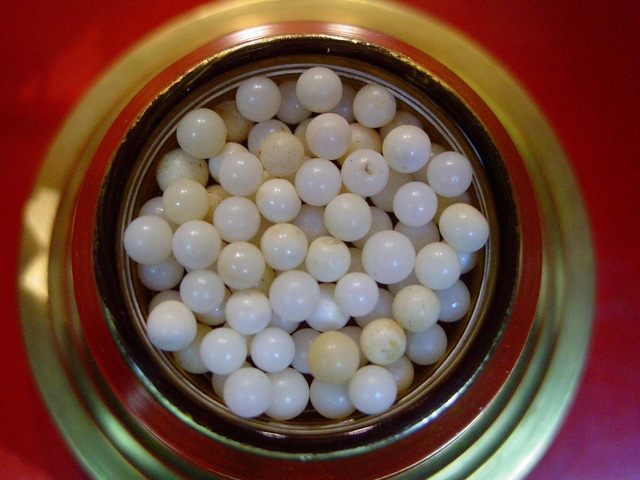
In East Asia, the Cintāmaṇi is closely associated with our second possibility, the Śarīra (Sk: “body”; Ch: Sushe/zi, 舍利/子) (fig. 14). These pearl-like beads figure among the bodily relics left over from the historical Buddha’s cremation. [1] Strong (2004) explains: “[They are the result] of a process of metamorphosis brought on not only by the fire of cremation but also by the perfections of the saint (in this case the Buddha) whose body they re-present” (p. 12).

They are said to come in different colors and sizes depending on the country and religious tradition (Strong, 2004, p. 11).

JTTW could have one or even both of these items. For example, the Cintāmaṇi would allow demon kings or lesser spirits to wish for powerful heavenly weapons, thereby helping them fight stronger opponents; or, the Śarīra could grant the devils more spiritual power, thereby allowing them to bypass centuries of spiritual cultivation.

But neither of these things could help evil beings achieve immortality. I’ve previously noted that JTTW was heavily influenced by the Buddho-Daoist philosophy of the Southern Quanzhen School Patriarch Zhang Boduan (張伯端, mid to late-980s-1082). He believed that in order to become a true transcendent (xian, 仙), one had to achieve both the Daoist elixir of immortality and Buddha-nature (Shao, 1997; 2006). The first extends your life, while the second frees you from the endless rounds of rebirth. While the aforementioned spiritual objects may grant them divine longevity, it won’t make them unkillable. And if they are killed, they would still be subject to the wheel of reincarnation. It would be up to them to achieve the last step in this two-step process. But that would require these spirits to mend their evil ways and “return to the right path” (gui zheng, 歸正)⁠—i.e. convert to Buddhism.


Update: 12-29-22

It turns out that JTTW has śarīra beads. In fact, they are mentioned at least 18 times throughout the novel. One example is a treasure belonging to the Yellow-Robed Demon (Huangpao guai, 黃袍怪). Chapter 31 reads:

Leading Pilgrim [Sun Wukong], the fiend [Yellow Robe] took his companion into the murky depth of the cave before spitting out from his mouth a treasure having the size of a chicken egg. It was a śarīra [shelizi, 舍利子] of exquisite internal elixir. Secretly delighted, Pilgrim said to himself, “Marvelous thing! It’s unknown how many sedentary exercises had been performed, how many years of trials and sufferings had elapsed, how many times the union of male and female forces had taken place before this śarīra of internal elixir was formed. What great affinity it has today that it should encounter old Monkey!” (Wu & Yu, 2012, vol. 2, pp. 80-81). [2]

那怪攜著行者,一直行到洞裡深遠密閉之處。卻從口中吐出一件寶貝,有雞子大小,是一顆舍利子玲瓏內丹。行者心中暗喜道:「好東西耶。這件物不知打了多少坐工,煉了幾年磨難,配了幾轉雌雄,煉成這顆內丹舍利。今日大有緣法,遇著老孫。」

As can be seen, Yellow Robe’s śarīra is portrayed as the hard-won product of spiritual cultivation. This agrees with Strong’s (2004) statement above that Buddhists believed such beads were “brought on not only by the fire of cremation but also by the perfections of the saint (emphasis added) … whose body they re-present” (p. 12).

Note:

1) There are three main types of Buddha relics: 1) those of the body left over from his cremation (hair, teeth, nails, bones, and Śarīra beads); 2) those that he used (walking staff, alms bowl, robes, etc.); and 3) those that he taught (i.e. lessons from scripture) (Strong, 2004, p. 8).

2) Source altered slightly. I’ve made it more accurate.

Sources:

Buswell, R. E., & Lopez, D. S. (2014). The Princeton Dictionary of Buddhism. Princeton, NJ: Princeton University Press.

Shao, P. (1997). Monkey and Chinese Scriptural Tradition: A Rereading of the Novel Xiyouji (UMI No. 9818173) [Doctoral dissertation, Washington University]. Available from ProQuest Dissertations and Theses database.

Shao, P. (2006). Huineng, Subhūti, and Monkey’s Religion in “Xiyou ji”. The Journal of Asian Studies, 65(4), 713-740. Retrieved from http://www.jstor.org/stable/25076127.

Strong, J. S. (2004). Relics of the Buddha. Princeton, NJ: Princeton University Press.

Wu, C., & Yu, A. C. (2012). The Journey to the West (Vols. 1-4) (Rev. ed.). Chicago, Illinois: University of Chicago Press.