
Last updated: 05-18-17
Did you know that Sun Wukong is based on a real species of monkey? In Journey to the West (Xiyou ji, 西遊記, 1592 CE) chapter one, the Patriarch Subodhi tells him: “Though your features are not the most attractive, you do resemble a pignolia-eating monkey (husun [猢猻])” (Wu & Yu, 2012, vol. 1, p. 115). The master goes on to dismiss the Hu (猢) character for linguistic reasons, and he drops the animal radical (犭) from the second character for religious reasons, leaving Sun (孫, “grandson”) as Monkey’s surname (Wu & Yu, 2012, vol. 1, p. 115).
Table of Contents
1. Historical and Scientific Info
Possibly quoting an earlier source, the noted Ming physician Li Shizhen (1518–1593) explains the meaning of husun and associates it with a particular genus: “Since a macaque resembles a Hu-barbarian [胡], he is also called hu-sun, ‘grandson of a barbarian’” (Gulik, 1967, p. 35). There are several species of macaque native to China, but anthropologist Frances D. Burton (2005) believes that the Rhesus macaque (Macaca mulatta) is the best fit:
Monkey goes bare-headed and wears a red dress, with a yellow sash, and black shoes. This is a fitting description of M. mulatta, whose reddish fur on shoulders and back yields to lighter, more yellowish fur on the abdomen, and whose feet and hands are black. The ‘pouch’ to which the Monkey King himself refers [to in the novel] would likely be the cheek-pouches common in macaques, but not gibbons or leaf-eating monkeys. There is little mention of a tail, except in the episode where Monkey King attempts to avoid capture by changing his appearance to a wayside shrine, where his eyes are the windows, his mouth the door, and his long tail is disguised as a flag-pole. Macaques with such long tails do not live in China. They are members of M. fascicularis, from the more southerly reaches of southeast Asiak where, as in Bali, they are the representatives of Monkey King (Wheatley, 1999).
One of Monkey King’s epithets is ‘Fiery Eyes”. His red eyes–a characteristic he shares with the actual red-rimmed eyes of M. mulatta [fig.1] […]–resulted from his punishment in a crucible. The smoke from the fire set to destroy him caused the condition from which he and his kind never recovered. […] He is also a ‘red-bottomed horse ape’, which suggests M. thibetana or, again M. mulatta, both of which are large animals, with pronounced redness on the bottom, especially during reproductive phases (p. 148).
In chapter two, a monster describes Monkey as being “not [even] four feet tall” (Wu & Yu, 2012, vol. 1, p. 128). Rhesus males measure on average 1.74 feet (Lang, 2005). But I imagine that these measurements were taken while they were in a quadrupedal posture (on all fours), which would make them taller if they stood.

Fig. 1 – A comparison of Rhesus macaques with red-rimmed eyes during mating season (top) and other times (bottom) (larger version). Original image from Dubue, Allen, Maestripieri, & Higham (2014, p. 5).
2. Importance
I think all of this information is important as modern day depictions portray him as a man (or the size of a man) or a hulking brute with huge muscles. Such representations are extremely inaccurate. He is a short monkey, plain and simple. His great strength, martial arts skill, and magical abilities make him a formidable warrior, not his size. I think that the Japanese produced the most accurate renderings of Monkey. The work of Yoshitoshi (1839–1892) is a good example (fig. 2).

Fig. 2 – An 1865 piece by Yoshitoshi (larger version).
3. Updates
Update: 05-18-17
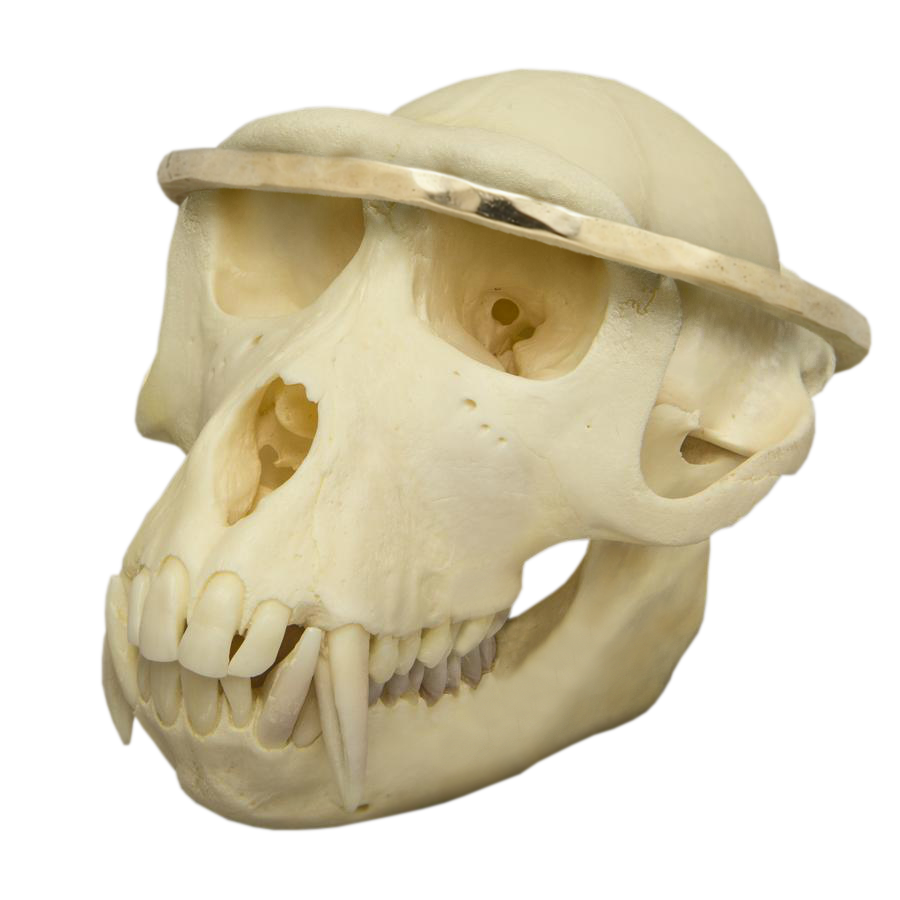
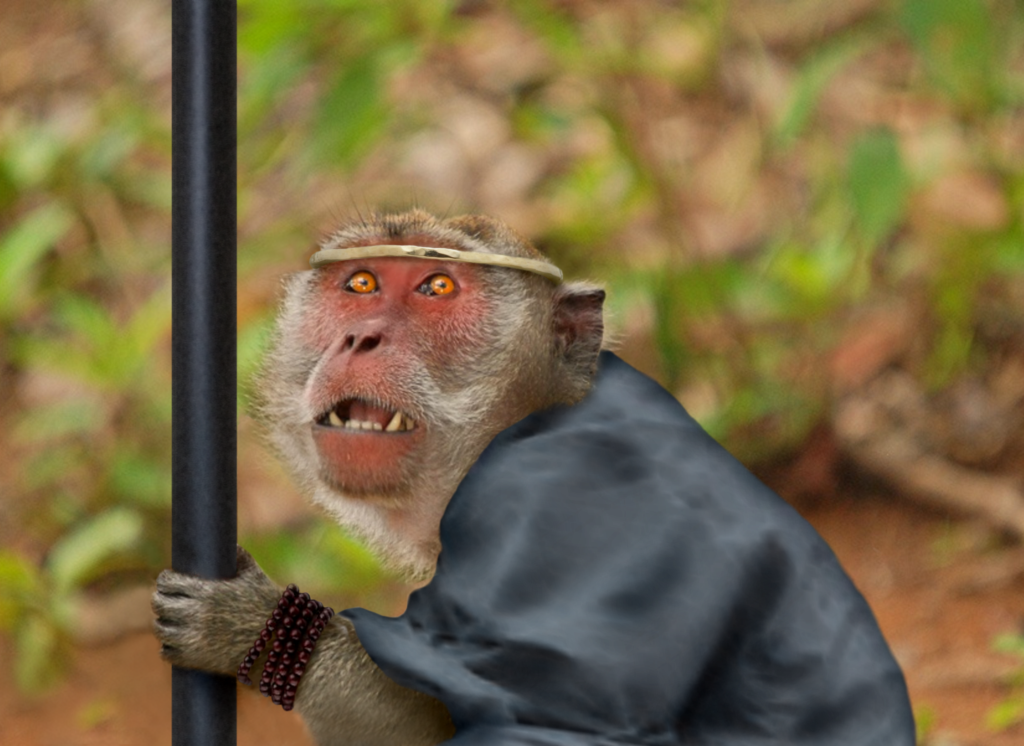
Readers will no doubt recall the golden fillet that Sun Wukong unwillingly wears on his crown. Humanoid depictions of the character show the band sitting on the frontal and parietal areas of the skull. But since Rhesus macaques have a much smaller brain pan, the circlet would have to wrap around the top of the eye orbits and the back of the occipital bone in order to be effective (fig. 3). It would set just above the eyelids (fig. 4).

Fig. 3 (left) – A Rhesus Macaque skull adorned with the golden fillet (larger version). Fig. 4 (right) – A modern depiction of Sun Wukong wearing the circlet (larger version). Photomanipulations by the author.
Sources:
Burton, F. D. (2005). Monkey King in China: Basis for a Conservation Policy? In A. Fuentes & L. D. Wolfe (Eds.), Primates Face to Face: Conservation Implications of Human-Nonhuman Primate Interconnections (pp. 137-162). Cambridge: Cambridge University Press.
Gulik, R. H. (1967). The Gibbon in China: An Essay in Chinese Animal Lore. Leiden: E.J. Brill.
Lang, K. C. (2005). Rhesus macaque Macaca mulatta. Retrieved from http://pin.primate.wisc.edu/factsheets/entry/rhesus_macaque
Wu, C., & Yu, A. C. (2012). The Journey to the West (Vols. 1-4) (Rev. ed.). Chicago, Illinois: University of Chicago Press.