Archive #32 – The Precious Scroll of Erlang (Erlang baojuan) (1562)

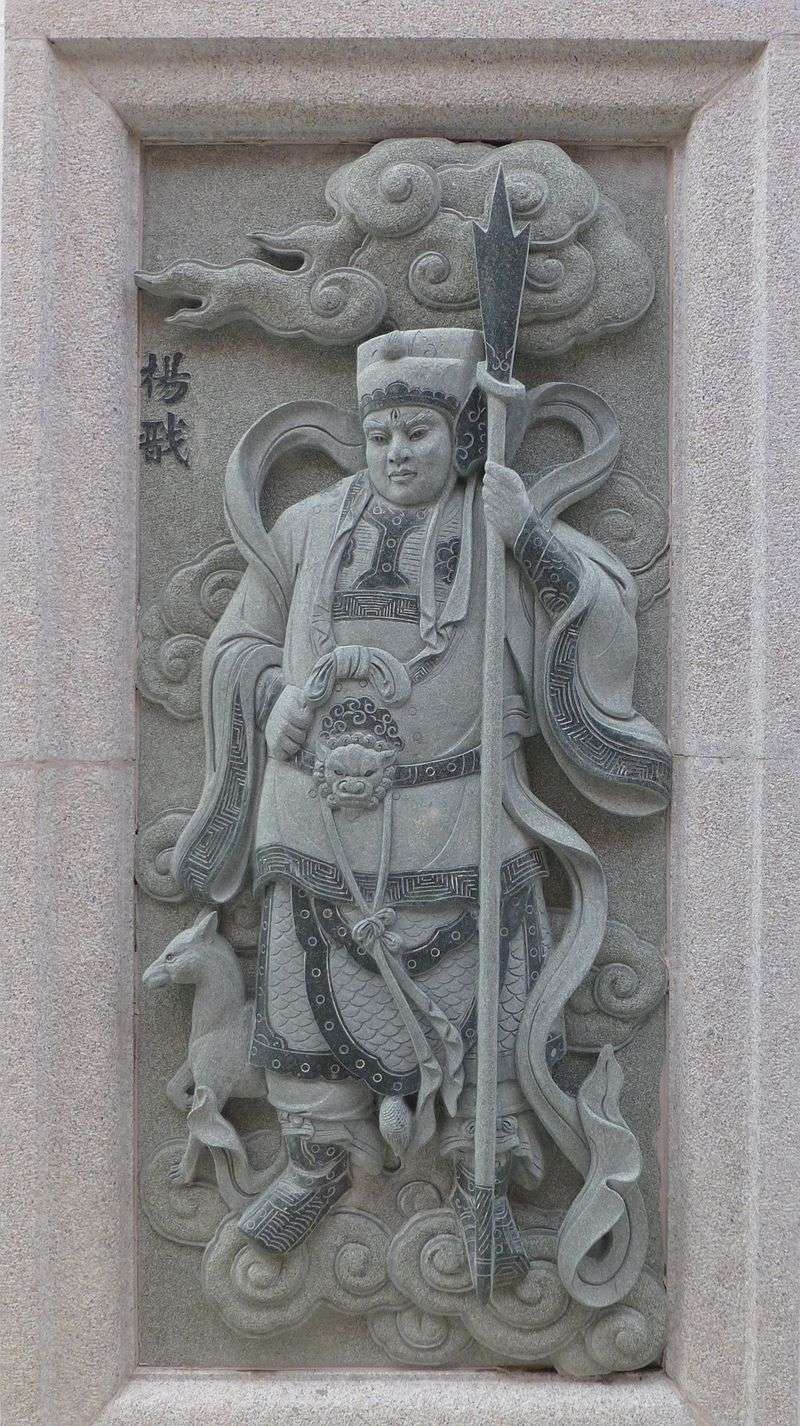
The Precious Scroll of Erlang (Erlang Baojuan, 二郎寳卷; full name Qingyuan Miaodao Xiansheng Zhenjun Yiliao Zhenren huguo youmin zhongxiao Erlang Baojuan, 清源妙道顯聖真君一了真人護國佑民忠孝二郎開山寶卷), is an important baojuan from the 1560s that contains the heroic deeds of the immortal Erlang (二郎) (fig. 1), including his defeat of Sun Wukong (PDF page 46). This shows that the Monkey King was mentioned in a religious context 30 years before the standard Ming edition of Journey to the West (Xiyouji, 西遊記, 1592) was even published. Therefore, apart from recording the religious story of Erlang, it adds to that of Sun Wukong.

I must thank Dr. Benjamin Brose for sending me a PDF of the scroll. I’m excited to archive it on my blog for other scholars to access and read.

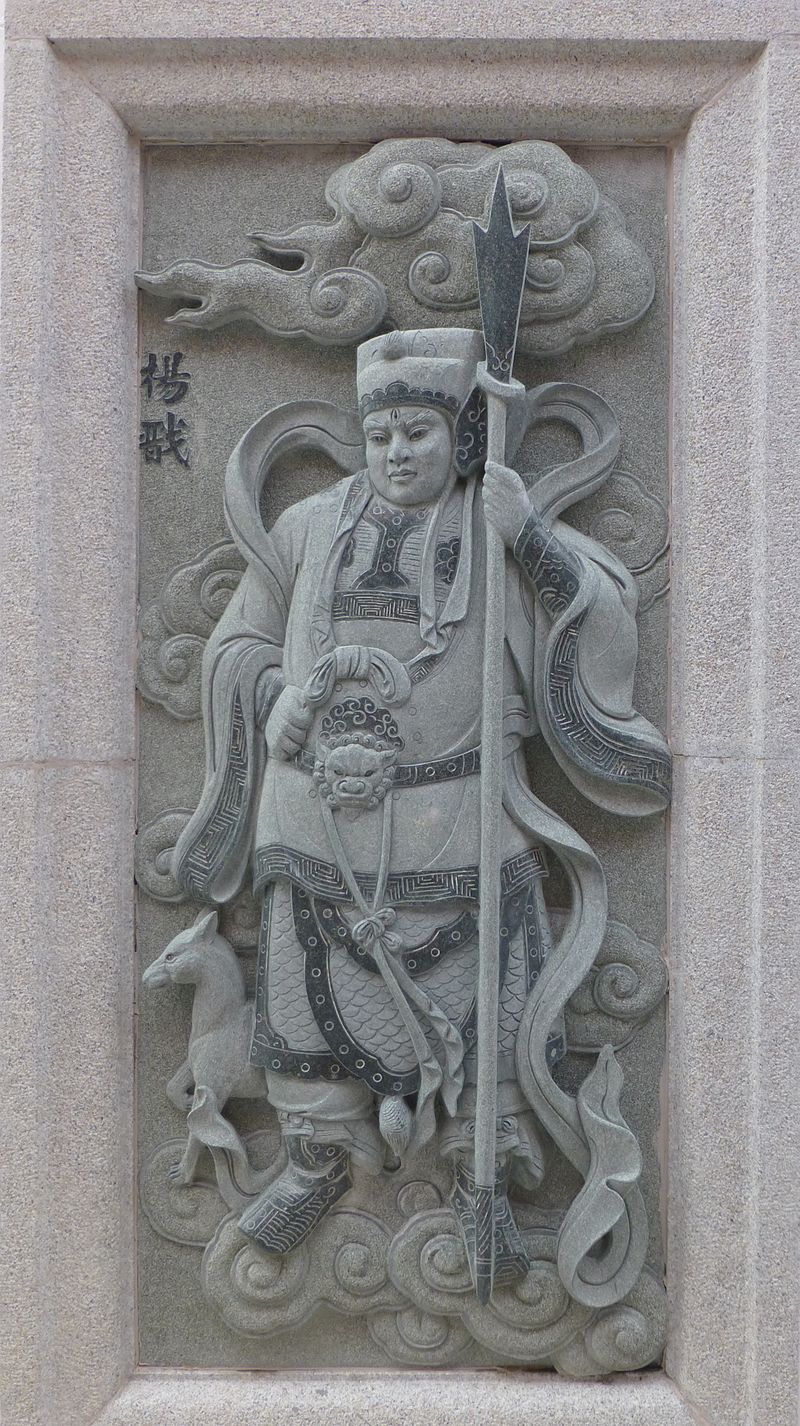
Fig. 1 – A relief carving of Erlang as Yang Jian (楊戩) from Investiture of the Gods (c. 1620) (larger version).

Scroll description:

In 1562 a text entitled Erlang baojuan (Precious scroll on Erlang) appeared, providing further information on the emerging Eternal Mother myth. Based on the story of Erlang’s valiant fight with the Monkey King, a famous and entertaining episode from the classic novel Journey to the West (which, incidentally, was given the finishing touches around the same time), the Erlang baojuan describes the final subjugation of the Monkey King by the semidivine Erlang, thanks in large measure to the assistance provided by the Eternal Mother. This text also seems to presage the legend surrounding the building of the Baoming Si, Temple Protecting the Ming dynasty, as described hereafter. In it the story of the bodhisattva Guanyin incarnating as a nun by the name of Lü is first being told. According to this text, the nun had tried unsuccessfully to dissuade Emperor Yingzong from fighting the Oirat Mongols prior to his debacle at Fort Tumu in 1449. When Yingzong was restored to the throne in 1457 after his long captivity, he rewarded the nun for her loyalty and courage and built a temple for her, naming it the Baoming Si. The temple had been reportedly in existence since 1462. By the late years of the Jiajing reign (1522–1567), however, it came under the sway of believers of the Eternal Mother religion (Shek & Tetsuro, 2004, p. 252).

Archive link:

Click to access unnamed-file.pdf

Source:

Shek, R., & Tetsuro, N. (2004). Eternal Mother Religion: It’s History and Ethics. In K Liu. & R. Shek. (Eds.). Heterodoxy in Late Imperial China (pp. 241-280). Hong Kong: University of Hawai’i Press.

How Tall is the Monkey King? – A Debate

This was originally posted as a 03-03-2022 update to an existing article, but I decided to make it a standalone piece.

Last updated: 04-27-2024

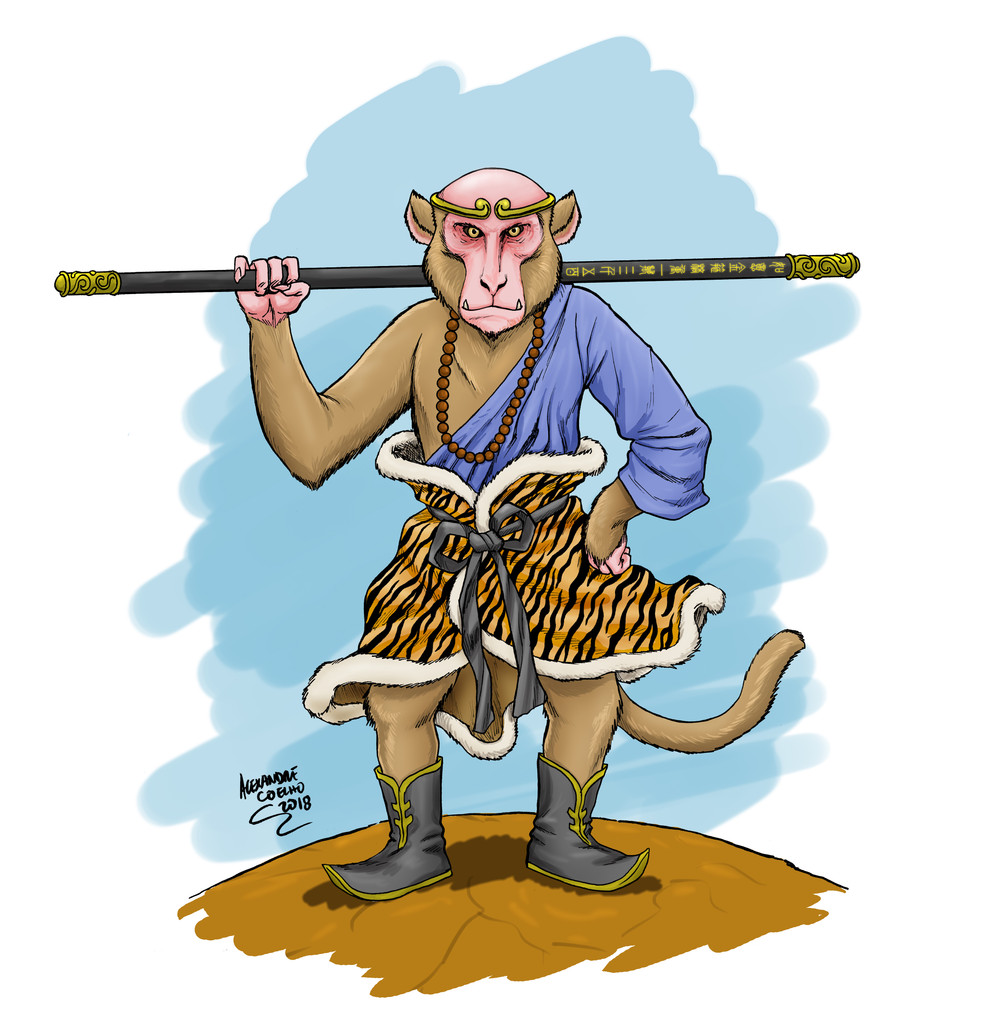
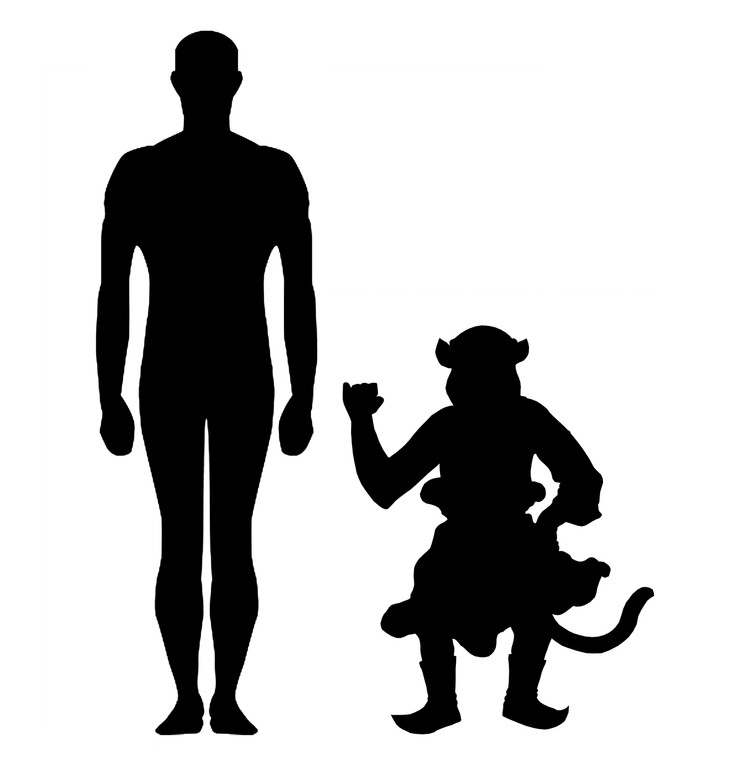
In “What Does Sun Wukong Look Like?” I highlighted several sentences pointing to the Monkey King’s small stature (fig. 1 & 2). For example, one monster comments:

The old monster took a careful look and saw the diminutive figure of Pilgrim [Monkey]—less than four Chinese feet [buman sichi, 不滿四尺, 4.17 ft or 1.27 m] in fact—and his sallow cheeks. He said with a laugh: “Too bad! Too bad! I thought you were some kind of invincible hero. But you are only a sickly ghost, with nothing more than your skeleton left!” (Wu & Yu, 2012, vol. 1, p. 408).

This information was later used in the making of a youtube video called “10 Facts About Sun Wukong the Monkey King.” Fact number seven was that “He’s really short,” and I ended the section by saying: “That’s right! The Great Sage Equaling Heaven, the conqueror of the heavenly army … is the size of a child.” A Chinese viewer later left a thought-provoking comment on the video stating that I was wrong about Monkey’s size.

Fig. 1 – An accurate Monkey King (larger version). Drawn by my friend Alexandre Palheta Coelho (instagram and deviantart). Slightly modified by me to match what I’ve written here. For the original version, see here. Fig. 2 – A size chart comparing Sun to a six-foot human (larger version).

The Debate

Here, I will present the comment in full but interspersed with my responses:

Hello! I am a Wukong fan from China. I really enjoyed your video! I would like to say that the height of the Monkey King has been very controversial on the internet in China. The data and appearance depictions in classical Chinese novels can be somewhat exaggerated. Journey to the West is a mythological novel is even more so. For example, seventy-two transformations, a somersault that can travel one hundred thousand eight hundred thousand li respectively refer to infinite changes and fly extremely fast. Seventy-two and one hundred and eighty thousand are not exact numbers, so relying solely on data is not reliable. Besides, in addition to four feet, Wukong has also appeared other height data. For example, the earliest version of the Journey to the West, “世德堂本”, Chapter 21. “大圣公然不惧。那怪果打一下来,他把腰躬一躬,足长了三尺,有一丈长短。” “Our Great Sage was not in the least frightened. When the monster struck him once, he stretched his waist and at once grew three chi, attaining the height of one zhang altogether.”

This PDF scan (page 258) shows the original version of the novel did indeed read “grow three chi” (changle sanchi, 長了三尺) and not six like in the modern version (Wu & Yu, vol. 1, p. 408). I was surprised when this was brought to my attention.

One zhang minus three chi equals seven chi. In other words, the height of the Monkey King here was seven chi (Since the height unit in Chinese classical novels is based on the ancient system, 7 chi is around 5.5 feet). But in later versions and translations, “grew three chi” was changed to six chi. This has always been a point of contention. The figure of four feet (four chi) appears twice, both from the perspective of other monsters, such as the Monstrous King, who is three zhangs tall (around 24 feet). It may be possible that Sun Wukong is short in his eyes in comparison.

For those unfamiliar with ancient Chinese measurements, one zhang () equals ten chi (尺, i.e. “Chinese feet”) (Jiang, 2005, p. xxxi). The passage in question does imply that Monkey is seven chi tall. However, there are two problems. First, during the Ming (1368-1644) when the novel was published, one chi equaled approximately 12.52 inches (31.8 cm) (Jiang, 2005, p. xxxi). This would make Sun a whopping 7.3 feet (2.22 m) tall! I must admit that the chi varied at the local level, but I doubt the variations would lead to a nearly two-foot (60.96 cm) difference. Additionally, if we use the measures for the Tang (618-907 CE), when the story is set, a chi was 11.57 inches (29.4 cm), making Monkey 6.75 feet (2.06 m) tall. There was, however, a “small chi” (xiaochi, 小尺) at this time, which was 9.66 inches (24.6 cm) (Nienhauser, 2016, p. 405 n. 40). This would only make him 5.65 feet (1.72 m) tall. But I would question if the common folk reading the novel during the Ming were aware of and still using this truncated measure. Second, as written above, the figure for “not even four chi” (buman sichi, 不滿四尺, 4.17 ft or 1.27 m) appears twice. But it’s important to note that this estimate is made by two different characters at two different locations and times. The first is spoken in chapter two by the Monstrous King of Havoc (Hunshi mowang, 混世魔王) in the Water Belly Cave (Shuizang dong, 水臟洞) of the Mountain of Flowers and Fruit (east of the Eastern Purvavideha Continent) (PDF page 36; Wu & Yu, 2012, vol. 1, p. 128). This takes place over 100 years before Sun’s initial rebellion during the Han Dynasty (202 BCE-220 CE). And the second is spoken in chapter 21  by Great King Yellow Wind (Huangfeng dawang, 黃風大王) in the Yellow Wind Cave (Huangfeng dong, 黃風洞) of Yellow Wind Ridge (Huangfeng ling, 黃風嶺) somewhere in the Southern Jambudvipa Continent (PDF page 258; Wu & Yu, 2012, vol. 1, p. 408). This takes place sometime after his release from his 600-plus-year punishment under Five Elements Mountain during the Tang Dynasty (618-907 CE). Therefore, this seems like a more reliable measure—given the distance between themthan the ten minus three argument. I suggest the latter was actually a typo that later editions tried to amend by changing three to six. 

Another reason is that the author may be deliberately blurring the height of the Monkey King. Because at least in the story, the author describes Wukong according to the height of normal people. For example: Before Wukong learned Magic skills, when he could not change his height, he had robbed ordinary people’s clothes to wear. If Wukong was the height of a child, the clothes would hardly fit. When Wukong set out on his journey to the west, he once wore the clothes of Tang Monk. Wukong could carry the Taoist priest changed by the Silver Horned King (if he was a child height this would be very difficult).

These are good points, but a 7.3-foot tall Monkey wouldn’t be able to wear the clothing of the aforementioned people either. Conversely, tucking in or rolling up clothing wouldn’t be out of the question. And carrying a priest wouldn’t be a problem for a small-statured hero capable of hoisting the weight of two cosmic mountains while running at meteoric speeds.

In the same chapter, the Tang monk sitting on the horse can pull Wukong’s tiger skin skirt. Wukong can easily grab Eight Rules’ ear. In the Bhikṣu Kingdom, Wukong once exchanged clothes with Tang monk, etc.

Horses are tall animals, so the Tang Monk would’ve probably fallen off before even grabbing the skirt of an adult-sized Sun Wukong. I look at this as something that sounds good on paper until it’s tried in real life.

I think even a 5.5-foot tall Monkey would have problems grabbing the ear of Zhu Bajie, who is likely 10 feet (3.05 m) tall or more given his three chi (3.13 ft / 95.4 cm) snout (PDF page 108; Wu & Yu 2012, vol. 4, p. 149) and giant body that “causes even the wind to rise when he walks” (PDF page 367; Wu & Yu 2012, vol. 2, p. 51). Either way, jumping would be involved, making this irrelevant.

And just because Sun might be smaller doesn’t mean he wears child-sized clothing. I believe the first instance of sharing clothes happens in chapter 14: “Pilgrim … noticed that Tripitaka had taken off a [robe] made of white cloth and had not put it on again after his bath. Pilgrim grabbed it and put it on himself” (PDF page 174; Wu & Yu, vol. 1, p. 313). He seems to wear whatever is available to him.

In China, there is another speculation about Wukong’s height: monkeys are usually hunched over. Wukong is four chi tall when bent over and seven chi tall when standing upright.

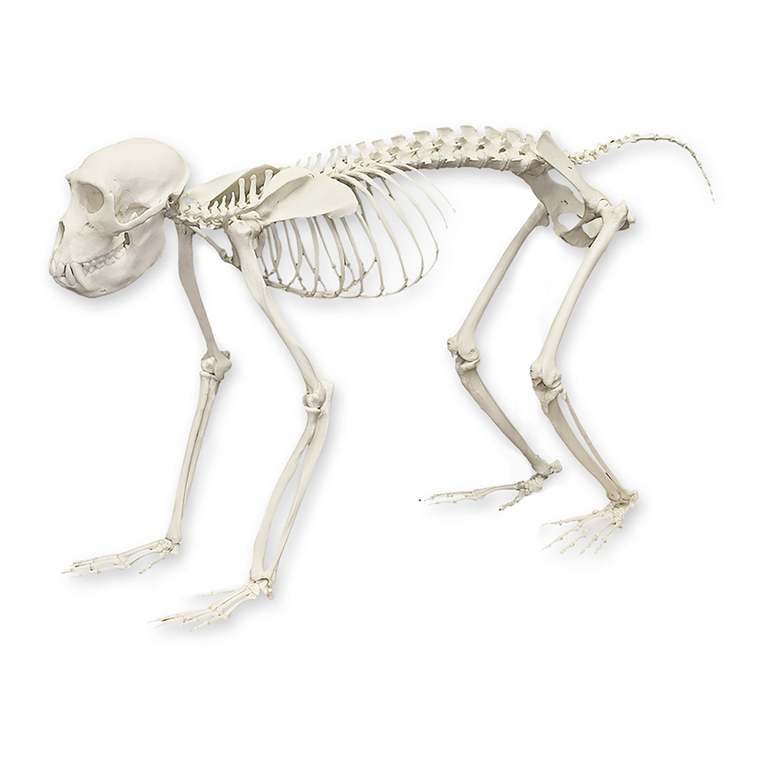
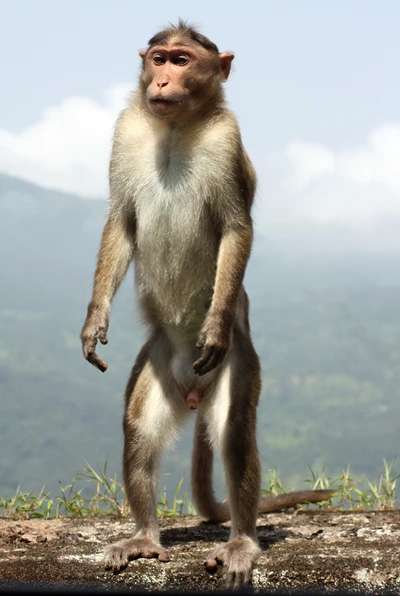
I studied primates in college. Monkeys usually walk on their palms (palmigrade) (fig. 3) and only stand when foraging, fighting, or carrying things. But I don’t recall the novel ever mentioning Sun traveling on all fours (please correct me if I’m wrong). Therefore, he likely walks on two legs. In this case, as stated, monkeys have a hunched posture when standing. They can’t stand straight because of mechanical limitations in their skull, spine, hips, legs, and feet (my previous essay on hominids applies to monkeys as well). One could argue that Monkey can overcome these limitations with his immortal body, but this definitely wouldn’t give him three more chi of height. For example, here’s a macaque standing at full height (fig. 4). As can be seen, straightening the head, spine, and legs would only give a handful of inches or centimeters.

Fig. 3 – A macaque skeleton in its natural posture (larger version). Fig. 4 – A young macaque male standing (larger version).

And as stated in this article, Sun shares all of the hallmarks of a macaque, including a “furry, joweless face with fiery eyes, a broken or flat nose, a beak-like mouth with protruding fangs, and forked ears.” This likely includes a smaller stature.

Of course, there is no doubt that he is very thin, and is definitely the shortest one in the scripture takers, but at least, his height is more like that of a shorter adult than a child. The role of Sun Wukong is a combination of human nature, monkey nature, and divinity. The author may be deliberately obscuring his height. Therefore, when describing daily life, Wukong is the same height as normal people, but in the eyes of other demons, he is more prominent in the shape of the monkey. And he has the divine power to change his height at will. Sorry for my bad English, really enjoyed your video!

I will concede that four chi is a rough estimate, so he might be slightly shorter or even taller than this. Either way, he’d be far below average human height.


Update: 03-06-22

Chapter 20 includes a scene where Monkey refers to his stature: “A person like me, old Monkey, may be small but tough, like the skin around a ball of ligaments!” (PDF page 246; Wu & Yu, 2012, vol. 1, p. 395).


Update: 03-08-22

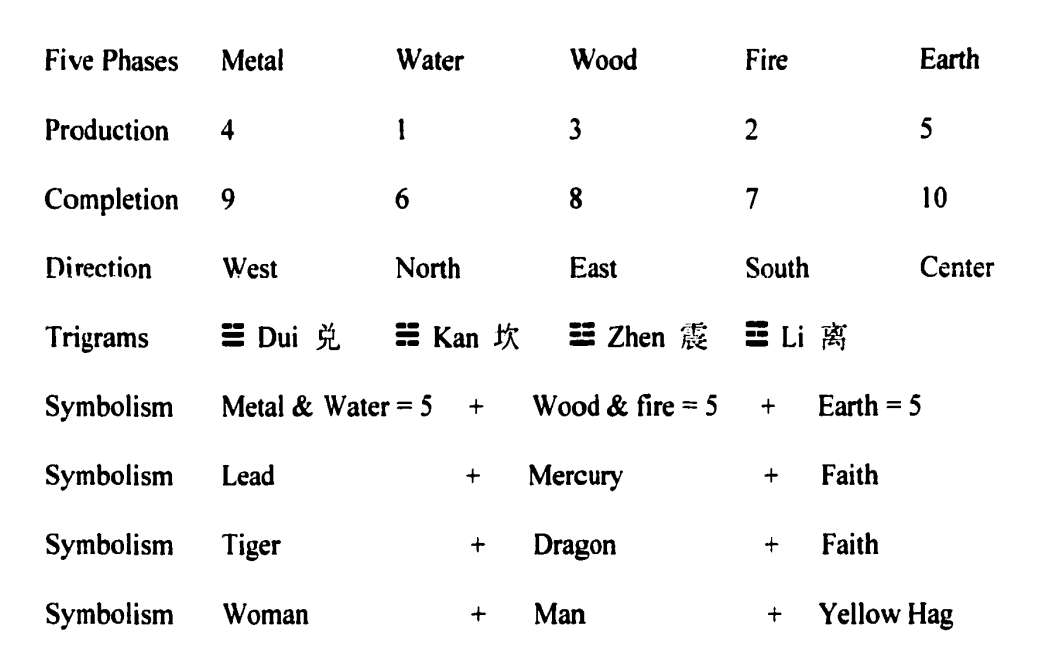
Above, I suggested that the ten minus three argument was a typo. But there might be a numerological explanation. Qing-era scholar Wang Xiangxu (汪象旭, fl.1605-1668) borrowed from the Daoist philosophy of Zhang Boduan (張伯端, 987?-1082) by applying his “three fives equal one” (sanwuyi, 三五一) five elements concept (fig. 5) to numbers appearing in the novel. As Shao (1997) explains:

One set of five consists of wood (3) and fire (2). Wood in the east produces fire in the south. The second set is that of metal (4) and water (1). Metal in the west produces water in the north. The third is earth in the center whose number is five. The whole business of the “gold elixir” is to integrate all three sets of five to produce one—the gold elixir (pp. 16-17).

Shao (1997) goes on to explain the numeric significance of the dharma vessel constructed from Sha Wujing’s 9-skull necklace and the heavenly gourd in chapter 22: 

Wang Xiangxu shows a keen eye for the “one” gourd and “nine” skulls which make a perfect “ten”—the number for the completion of earth. However, it is not the numbers that attract him, but what they indicate—that the gold elixir is creation—a process that involves the integration of all the five elements—not unlike the creation of the universe (p. 18).

Therefore, three (wood) and seven (fire) may be a reference to the completion of ten (the golden elixir) in Daoist numerology. If this is true, even the later switch from three to six still matches this (refer to fig. 5).

Fig. 5 – A chart explaining the three fives (larger version). From Shao, 1997, p. 17.


Update: 04-27-24

Chapter 37 gives a more precise measurement for Monkey’s height. He first transforms into a “tiny monk about two cun tall” (二寸長的小和尚兒) (based on Wu & Yu, 2012, vol. 2, p. 172). He shortly thereafter grows even bigger when a prince makes fun of him:

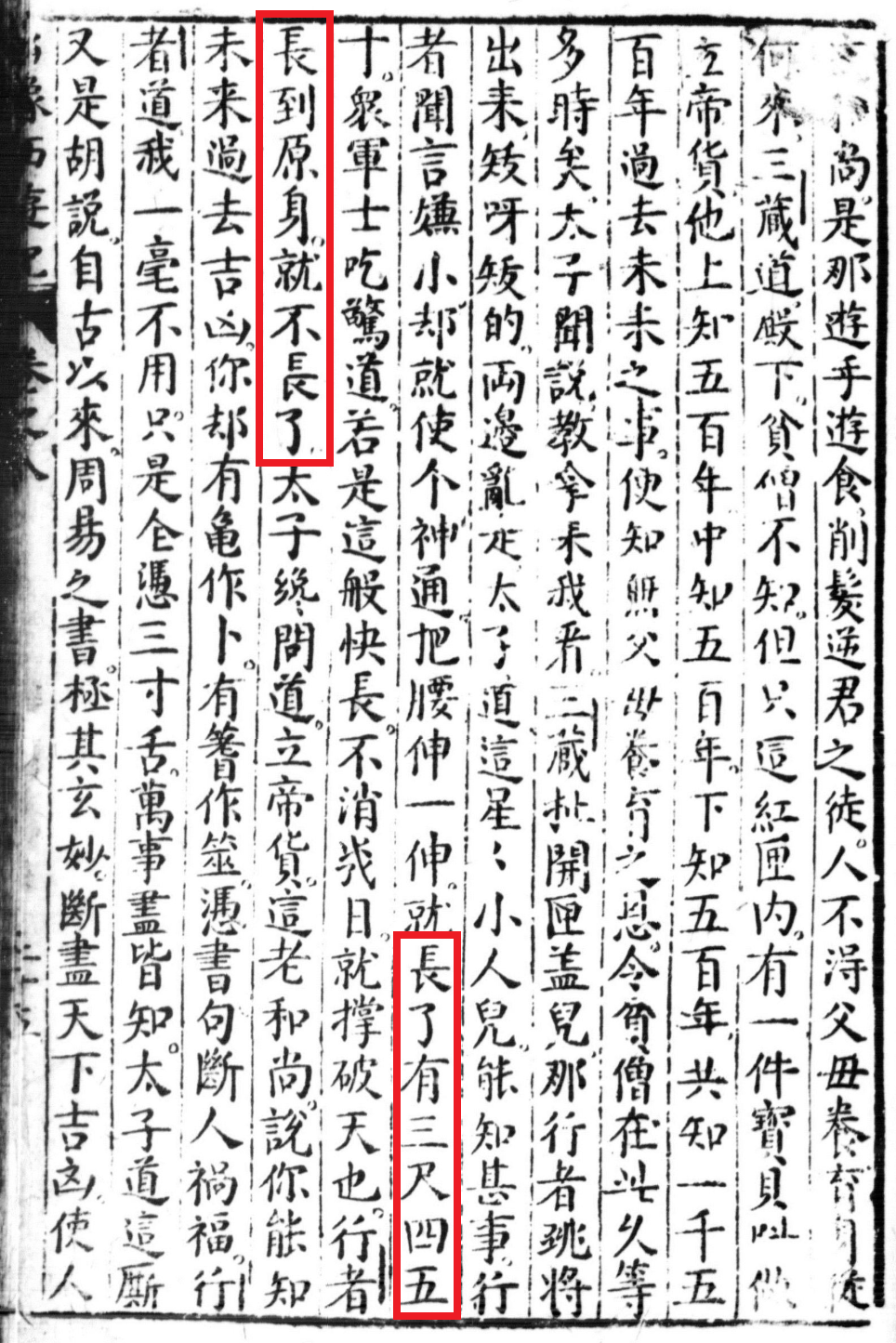
Tripitaka pulled open the box’s cover; Pilgrim [Sun Wukong] leaped out and began to hobble all over the place. The prince said, “This little midget! What can he know?” When Pilgrim heard this remark about his size, he at once resorted to magic. Straightening up his torso, he grew about three chi and four or five cun instantly (emphasis added). “If he can grow that rapidly,” said the soldiers, highly startled, “it will only be a few days before he pierces the sky.” When Pilgrim reached his normal height, however, he stopped growing (emphasis added) (based on Wu & Yu, 2012, vol. 2, pp. 174-175).

三藏扯開匣蓋兒,那行者跳將出來,呀的兩邊亂走。太子道:「這星星小人兒,能知甚事?」行者聞言嫌小,卻就使個神通,把腰伸一伸,就長了有三尺四五寸。眾軍士吃驚道:「若是這般快長,不消幾日,就撐破天也。」行者長到原身,就不長了。

As mentioned above, one chi (尺) is roughly 12.3 in or 31.8 cm (Jiang, 2005, p. xxxi). Expanding on this, one chi equals 10 cun (寸; a.k.a. “Chinese inches”) (Jiang, 2005, p. xxxi). One cun would be about 1.25 in or 3.18 cm. Two cun would therefore be 2.5 in or 6.36 cm. Growing the stated additional height would then put our hero at chi and 6 or 7 cun, which is roughly 3.86 ft or 1.176 m. This agrees with the aforementioned estimate of “not (or less than) four chi tall” (buman sichi不滿四尺) (Wu & Yu, 2012, vol. 1, pp. 128 and 408).

It’s important to note that the cited quote above does indeed appear in the original 1592 edition (see PDF page 480) (fig. 6). This proves that the aforementioned “grow three chi” (changle sanchi, 長了三尺) from PDF page 258 was a typo!

Fig. 6 – A scan from the original 1592 edition showing that Monkey only grows an additional “3 chi and 4 or 5 cun” (larger version). 

Sources:

Jiang, Y. (2005). The Great Ming Code / Da Ming Lu. Vancouver, Wa: University of Washington Press.

Nienhauser, W. H. (2016). Tang Dynasty Tales: A Guided Reader. Singapore: World Scientific.

Shao, P. (1997). Monkey and Chinese Scriptural Tradition: A Rereading of the Novel Xiyouji (UMI No. 9818173) [Doctoral dissertation, Washington University]. Available from ProQuest Dissertations and Theses database.

Wu, C., & Yu, A. C. (2012). The Journey to the West (Vols. 1-4) (Rev. ed.). Chicago, Illinois: University of Chicago Press.

Archive #31 – The Original 1592 Edition of Journey to the West, Complete with Pictures

I’m proud to present a PDF of the original edition of Journey to the West anonymously published in 1592 by the Shidetang (世德堂, “Hall of Generational Virtue”) publishing house of Jinling (金陵, “Gold Hill,” a.ka. Nanjing). Titled Newly Printed, Illustrated, Deluxe and Large Character, Journey to the West (Xinke chuxiang guanban dazi Xiyou ji, 新刻出像官板大字西遊記), it features 20 scrolls and 100 chapters (minus the current chapter nine). It contains many charming woodblock prints depicting the events described in the story. For example, this print shows the battle between Monkey and Nezha in their three-headed and six-armed forms.

One doctoral thesis shows that this version is based on an earlier edition of the story titled Newly printed, Completely Illustrated, Chronicle of Deliverances in Sanzang of the Tang’s Journey to the West (Xinqie quanxiang Tang Sanzang Xiyou shi ni (e) zhuan, 新鍥全像唐三藏西遊释尼(厄)傳) in ten scrolls (with three to ten chapters each) by Zhu Dingchen (朱鼎臣) of Yangcheng (羊城, i.e. Guangzhou).

The PDF is quite large at 1.5 gigs, so it will take time to download.

Archive link:

Click to access 二十卷一百回.明.吴承恩撰.明万历二十年金陵世德堂刊本.灰度胶片.pdf

Thanks:

I originally downloaded the PDF from the shuge.org archive.

A Study of the Four Celestial Primates from Journey to the West

Last updated: 05-17-2025

Sun Wukong faces his evil double, the Six-Eared Macaque, in chapters 56 to 58 of Journey to the West (Xiyouji, 西遊記, 1592, “JTTW” hereafter). After the twin Mind Monkeys battle their way to the Western Paradise, the Buddha reveals the doppelganger’s true identity, noting that he and Monkey are two of four celestial primates (sihou hunshi, 四猴混世, lit: “four monkeys of havoc”) with amazing abilities:

“The first,” said Tathagata, “is the Stone-Monkey of Numinous Wisdom [Lingming shihou, 靈明石猴], [1] who

Knows transformations,
Recognizes the seasons,
Discerns the advantages of earth,
And is able to alter the course of planets and stars.

The second is the Red-Buttocked Horse-Monkey [Chikao mahou, 赤尻馬猴], who

Has knowledge of yin and yang,
Understands human affairs,
Is adept in its daily life
And able to avoid death and lengthen its life.

The third is the Long-Armed Gibbon [Tongbi yuanhou, 通臂猿猴], who can

Seize the sun and the moon,
Shorten a thousand mountains,
Distinguish the auspicious from the inauspicious,
And manipulate planets and stars.

The fourth is the Six-Eared Macaque [Liu’er mihou, 六耳獼猴] who has

A sensitive ear,
Discernment of fundamental principles,
Knowledge of past and future,
And comprehension of all things.

These four kinds of monkeys are not classified in the ten categories [of life], nor are they contained in the names between Heaven and Earth. As I see the matter, that specious Wukong must be a six-eared macaque, for even if this monkey stands in one place, he can possess the knowledge of events a thousand miles away and whatever a man may say in that distance” (based on Wu & Yu, 2012, vol. 3, p. 115).

如來道:「第一是靈明石猴,通變化,識天時,知地利,移星換斗;第二是赤尻馬猴,曉陰陽,會人事,善出入,避死延生;第三是通臂猿猴,拿日月,縮千山,辨休咎,乾坤摩弄;第四是六耳獼猴,善聆音,能察理,知前後,萬物皆明。此四猴者,不入十類之種,不達兩間之名。我觀假悟空乃六耳獼猴也。此猴若立一處,能知千里外之事;凡人說話,亦能知之。

In this article, I would like to explore all mentions of these magical creatures in the novel. I will focus more on the second and third primates as I’ve already written extensively about the first and fourth kind.

1. Stone-Monkey

There isn’t much to write about the “Stone-Monkey of Numinous Wisdom” (Lingming shihou, 靈明石猴) (fig. 1) as it’s clearly Sun Wukong. The term lingming (靈明) can also be translated as “Numinous Luminosity.” Both refer to spiritual wisdom. This explains why Sun Wukong attains so much power after only three years of spiritual cultivation.

Fig. 1 – A poster of the Stone-Monkey of Numinous Wisdom from the film Four Monkeys. The name has since been changed. See update 02-20-22 below.

2. Horse-Monkey and Gibbon

I’m grouping these two together because they share a close association in JTTW. The Chinese term for “Red-Buttocked Horse-Monkey” (Chikao mahou, 赤尻馬猴) (fig. 2) appears three times in the novel, while “Horse-Monkey” (馬猴, Mahou) only appears once (see here). [2] The term “(Arms)-Through-the-Back Gibbon” (Tongbei yuanhou, 通背猿猴) appears three times, while the interchangeable term “Connected Arms Gibbon” (Tongbi yuanhou, 通臂猿猴) appears once (see here and here) (fig. 3). Both essentially mean “Long-Armed Gibbon.” (This refers to the belief that the small ape’s long, agile arms were somehow connected (i.e. tongbi, 通臂), passing through the back (i.e. tongbei, 通背) (Gulik, 1967, p. 92-93).) The term “ape” or “gibbon” (yuanhou, 猿猴) appears 16 times (see here), and it’s even used to refer to Monkey. For example, a poem in chapter seven calls him “The Great Sage, Equal to Heaven, a monstrous ape” (Qitian dasheng yuanhou guai, 齊天大聖猿猴怪) (Wu & Yu, 2012, vol. 1, p. 191). Horse-monkeys and gibbons are surprisingly listed among the Monkey King’s retinue:

The Handsome Monkey King thus led a flock of gibbons [猿猴], macaques [mihou, 獼猴], and horse-monkeys [馬猴], some of whom were appointed by him as his officers and ministers (based Wu & Yu, 2012, vol. 1, p. 106).

美猴王領一群猿猴、獼猴、馬猴等,分派了君臣佐使

It’s actually a long-armed gibbon who reveals the truth of spiritual beings escaping the hand of death, setting Monkey on his quest for immortality:

From among the ranks a long-armed gibbon [tongbei yuanhou, 通背猿猴] suddenly leaped forth and cried aloud, “If the Great King is so farsighted, it may well indicate the sprouting of his religious inclination. There are, among the five major divisions of all living creatures, only three species that are not subject to Yama, King of the Underworld.” The Monkey King said, “Do you know who they are?” The monkey said, “They are the Buddhas, the immortals, and the holy sages; these three alone can avoid the Wheel of Transmigration as well as the process of birth and destruction, and live as long as Heaven and Earth, the mountains and the streams.” “Where do they live?” asked the Monkey King. The monkey said, “They do not live beyond the world of the Jambudvipa, for they dwell within ancient caves on immortal mountains.” When the Monkey King heard this, he was filled with delight, saying, “Tomorrow I shall take leave of you all and go down the mountain. Even if I have to wander with the clouds to the comers of the sea or journey to the distant edges of Heaven, I intend to find these three kinds of people. I will learn from them how to be young forever and escape the calamity inflicted by King Yama” (based on Wu & Yu, 2012, vol. 1, p. 131).

只見那班部中,忽跳出一個通背猿猴,厲聲高叫道:「大王若是這般遠慮,真所謂道心開發也。如今五蟲之內,惟有三等名色不伏閻王老子所管。」猴王道:「你知那三等人?」猿猴道:「乃是佛與仙與神聖三者,躲過輪迴,不生不滅,與天地山川齊壽。」猴王道:「此三者居於何所?」猿猴道:「他只在閻浮世界之中,古洞仙山之內。」猴王聞之,滿心歡喜道:「我明日就辭汝等下山,雲遊海角,遠涉天涯,務必訪此三者,學一個不老長生,常躲過閻君之難。」

Apart from this, chapter two casts both the long-armed gibbons and red-buttocked horse-monkeys as knowledgeable elders:

As they were speaking, four older monkeys came forward, two horse-monkeys with red buttocks [chikao mahou, 赤尻馬猴] and long-armed gibbons [tongbei yuanhou, 通背猿猴]. Coming to the front, they said, “Great King, to be furnished with sharp-edged weapons is a very simple matter:’ “How is it simple?” asked Wukong. The four monkeys replied, “East of our mountain, across two hundred miles of water, is the boundary of the Aolai Country. In that country there is a king who has numberless men and soldiers in his city, and there are bound to be all kinds of gold, silver, copper, and iron works there. If the great king goes there, he can either buy weapons or have them made (based on Wu & Yu, 2012, vol. 1, p. 131).

正說間,轉上四個老猴,兩個是赤尻馬猴,兩個是通背猿猴,走在面前道:「大王,若要治鋒利器械,甚是容易。」悟空道:「怎見容易?」四猴道:「我們這山向東去,有二百里水面,那廂乃傲來國界。那國界中有一王位,滿城中軍民無數,必有金銀銅鐵等匠作。大王若去那裡,或買或造些兵器

Later in the chapter, they are appointed officers:

The Monkey King made the four old monkeys mighty commanders of his troops by appointing the two horse-monkeys with red buttocks [赤尻馬猴] as Marshals Ma [馬] and Liu [流], and the two long-armed gibbons as Generals Beng [崩] and Ba [芭] (based on Wu & Yu, 2012, vol. 1, p. 138).

猴王將那四個老猴封為健將,將兩個赤尻馬猴喚做馬、流二元帥,兩個通背猿猴喚做崩、芭二將軍

These primates are mentioned in a few other chapters (see here and here).

Fig. 2 & 3 – “Four Monkeys” posters of the Red-Buttocked Horse-Monkey and the Long-Armed Gibbon.

2.1. True Identity?

Anthony C. Yu (Wu & Yu, 2012) calls the horse-monkey a “baboon” (vol. 3, p. 115, for example), likely based on the common image of the primate having a red bottom. And while searching “馬猴” does pull up images and articles about the Mandrill, a large, colorful cousin of the baboon (example), I can’t find any reliable historical sources linking the animal with the term. Having said that, this book associates it with the ancient Chinese practice of putting monkeys in horse stables (majiu husun, 馬廄猢猻) to ward off equine sicknesses, making it a “horse’s monkey.” This naturally has connections to Sun Wukong’s time as the Bimawen, or keeper of the heavenly horses. This is the most convincing explanation for the horse-monkey that I’ve seen, but I’ll make sure to update the article if any other plausible reasons arise. As for the red bottom, this is likely the sexual swelling of females. I’ll spare you a picture; just imagine a bright pink pumpkin that’s about to explode.

The gibbon and macaque are real world animals. For more information on Chinese views of the gibbon, please see this archived book.

3. Six-Eared Macaque

The Chinese term for macaque, mihou (獼猴), appears a total of 13 times (see here). Two refer to monkeys in general (here and here), while three refer to the Macaque King (Mihou wang獼猴王) (see here), Wukong’s sworn brother. A total of eight refer to the Six-Eared Macaque (Liu’er mihou, 六耳獼猴) (see here, here, and here).

I’ve already written an article exploring the literary and religious origins of Six Ears. The novel presents him as a negative manifestation of Sun Wukong’s mind. I suggest that their battle is an allegory for the internal struggle between the true and illusionary aspects of Monkey’s psyche. Another scholar has also posited that Six Ears appears earlier in the novel as the Macaque King.

Fig. 4 – A “Four Monkeys” poster of the Six-Eared Macaque. This version wields swords unlike his staff-brandishing literary counterpart.

4. The Same or Similar?

Let’s compare the Four Celestial Primates with the apes and monkeys from the Great Sage’s mountain home:

Four Celestial Primates

  1. Stone-Monkey of Numinous Wisdom (Lingming shihou, 靈明石猴; i.e. Sun Wukong)
  2. Red-Buttocked Horse-Monkey (Chikao mahou, 赤尻馬猴)
  3. Long-Armed Gibbon (Tongbi yuanhou, 通臂猿猴)
  4. Six-Eared Macaque (Liu’er mihou, 六耳獼猴). 

Flower-Fruit Mountain

  1. Stone-Monkey (Shihou, 石猴; i.e. Sun Wukong)
  2. Red-Buttocked Horse-Monkeys (Chikao mahou, 赤尻馬猴)
  3. Long-Armed Gibbons (Tongbei yuanhou, 通背猿猴)
  4. Macaques (Mihou, 獼猴)

Recall how the names Tongbi and Tongbei both refer to the gibbon’s long arms. Therefore, the listed groups above are practically the same.

This then raises the question: Were the Four Celestial Primates all born on Flower-Fruit Mountain, or are the similarities just an example of mirroring? What I mean by this is that JTTW hosts a number of mirrored characters. Here are just a few:

  1. Sun Wukong and Six-Ears (ch. 56 to 58) – This one is obvious.
  2. Sun Wukong and the Bull Demon King (ch. 4 to 7 and 61) – They have the same powers and character arc (see section 3 here).
  3. The Demon Kings of the 72 Caves and the 72 Heavenly Commanders (ch. 4 to 5)
  4. Monkey’s Six Sworn Demon King Brothers (ch. 4) and Lord Erlang’s Six Sworn Brothers of Plum Mountain (ch. 6)
  5. Nezha and Red Boy (chapters 4 to 6 and 40 to 42) – Both are powerful, divine children associated with fire.

I’ll leave it up to the reader which possibility they want to accept.


Update: 02-20-22

Here’s a four minute preview for the upcoming film King of Havoc: Rise of the Great Sage (Hunshi zhi wang: Dasheng jueqi,  混世之王:大圣崛起, 2022). The Six-Eared Macaque appears in figure four wielding swords. This same character takes part in the trailer but is called the Macaque King, thereby referencing the aforementioned theory that he is Six Ears.


Update: 02-22-22

User Phantom86d left an interesting comment suggesting that the four celestial primates are not part of the ten categories of life—as stated by the Buddha in the introduction—”[b]ecause Wukong erased their names from the book of Life and Death.” This refers to chapter three when Sun inks out his name and those of all other primates when his immortal soul is mistakenly summoned to hell. It’s important to remember that he had his own, separate book (Wu & Yu, 2012, vol. 1, p. 140), so the other celestial primates likely had theirs.


Update: 02-25-22

Thanks to this dictionary, I learned that one late-Qing source, New Dialect (Xinfangyan, 新方言, early-20th-c.), associates “horse-monkey” (mahou, 馬猴) with various iterations of Chinese terms for macaque monkeys:

“Bathing-monkey” (muhou): “mother-monkey” (muhou); mother-monkey (muhou): “full-monkey” (mihou) – these are called “horse-monkey” (mahou), the sound of each one changing [in turn].

沐猴:母猴;母猴:彌[獼]猴,令人謂之馬猴,皆一音之轉。(the original doesn’t have punctuation)

This article explains that the second term refers not to a female primate but a macaque. The Annotation of the Shuowen jiezi (Shuowen jiezi zhu, 說文解字注, 1815) reads:

“Mother-monkey” (muhou) is the name of the beast, not the female. “Bathing-monkey” (muhou) and “hunting-monkey” (mihou) are changes in dialect. The characters are wrong.

母猴乃此獸名,非謂牝者。沐猴、獮[獼]猴皆語之轉,字之訛也。

Update: 02-26-22

The Compendium of Materia Medica (Bencao gangmu, 本草綱目, 1596) traces the etymology of “bathing monkey” (muhou, 沐猴):

The monkey likes to wipe its face as if bathing (mu), so it is called a “bathing (monkey).” Later generations mistook this mu for “mother,” and then mother for “full” (mi). The meaning is lost as errors compound.

猴好拭面如沐,故謂之沐,而後人訥沐為母,又謳母為獼,愈訥愈失矣。

It then directly connects muhou (母猴) to stable monkeys:

The Shuowen says: The characters (for macaque) look like “mother monkey” (muhou), but it’s a “bathing monkey” (muhou, i.e. macaque), not a female. Since a macaque resembles a hu-barbarian, he is also called hu-sun “grandson of a barbarian.” The Zhuangzi calls him ju. People who raise horses keep a macaque in the stables, which will ward off horse-diseases. The Hu barbarians call a macaque maliu, in Sanskrit books he is called Mosizha (makaṭa).

《說文》雲︰為字象母猴之形。即沐猴也,非牝也。猴形似胡人,故曰胡孫。 《莊子》謂之狙。養馬者厩中畜之,能闢馬病,胡俗稱馬留雲。 《梵書》謂之摩斯[吒]。

The section later explains how macaques (muhou, 母猴) help the horses:

The Classic of Horses states: Domesticated macaques (muhou) used in horse stables help avoid horse diseases [lit: bimawen]. Their monthly menstruation runs onto the grass, and once the horses eat it, they will never be sick.

《馬經》言︰馬厩畜母猴,闢馬瘟疫。逐月有天癸流草上,馬食之,永無疾病矣。

Update: 06-28-2023

It just occurred to me that since Six Ears is an aspect of Sun Wukong’s mind, the other two celestial primates could be as well. All three being aspects of Sun’s mind would thus explain why they “are not classified in the ten categories [of life], nor are they contained in the names between Heaven and Earth” (Wu & Yu, 2012, vol. 3, p. 115). They aren’t classified because they were never born. They are simply personifications of Sun’s base and noble qualities. How and when they would have splintered from his psyche is the big question. 

I doubt I’m the first person to think of this. I’m interested to hear what my readers think.


Update: 01-04-24

I’ve rewritten sections two to four. This was done to help make the subject more understandable. 


Update: 05-17-25

I was looking for something and happened upon a lovely drawing of the four celestial primates (fig. 5). It’s interesting that most of them are wielding staves. Though, only Monkey and the Six-Eared Macaque are associated with the weapon in JTTW.

Fig. 5 – The drawing (larger version). Image found here.

Notes:

1) I will be altering Yu’s (Wu & Yu, 2012) translation from this point forward to make it more accurate.

2) Ctext shows the term “Great Horse-Monkey” (Da mahou, 大馬猴) pops up in chapter 28 of Dream of the Red Chamber (18th-century). It’s used to symbolize something worse than an immoral husband that would ravage a young maiden:

Next came Xue Pan. “Is it for me to speak now?” Xue Pan asked.

“A maiden is sad…”

But a long time elapsed after these words were uttered and yet nothing further was heard.

“Sad for what?” Feng Ziying laughingly asked.

“Go on and tell us at once!”

Xue Pan was much perplexed. His eyes rolled about like a bell.

“A girl is sad…” he hastily repeated. But here again he coughed twice before he proceeded.

“A girl is sad,” he said:

“When she marries a spouse who is a libertine.”

This sentence so tickled the fancy of the company that they burst out into a loud fit of laughter.

“What amuses you so?” shouted Xue Pan, “is it likely that what I say is not correct? If a girl marries a man, who chooses to forget all virtue, how can she not feel sore at heart?”

But so heartily did they all laugh that their bodies were bent in two.

“What you say is quite right,” they eagerly replied. “So proceed at once with the rest.”

Xue Pan thereupon stared with vacant gaze.

“A girl is grieved…” he added.

But after these few words he once more could find nothing to say.

“What is she grieved about?” they asked.

“When a huge horse monkey [大馬猴] finds its way into the inner room,” Xue Pan retorted (Cao & Joly, 1892, p. 62).

下該薛蟠。薛蟠道:「我可要說了:女兒悲--」說了半日,不見說底下的。馮紫英笑道:「悲什麼?快說!」薛蟠登時急的眼睛鈴鐺一般,便說道:「女兒悲--」又咳嗽了兩聲,方說道:「女兒悲,嫁了個男人是烏龜。」眾人聽了,都大笑起來。薛蟠道:「笑什麼?難道我說的不是?一個女兒嫁了漢子,要做忘八,怎麼不傷心呢?」眾人笑的彎著腰,說道:「你說的是,快說底下的罷。」薛蟠瞪了瞪眼,又說道:「女兒愁--」說了這句,又不言語了。眾人道:「怎麼愁?」薛蟠道:「繡房鑽出個大馬猴。」

Sources:

Cao, X., & Joly, H. B. (1892). Hung Lou Meng: Or, The Dream of the Red Chamber; a Chinese Novel – Book 2. Hongkong: Kelly & Walsh.

Gulik, R. H. (1967). The Gibbon in China: An Essay in Chinese Animal Lore. Leiden: E.J. Brill.

Lam, H. L. (2005). Cannibalizing the Heart: The Politics of Allegory and The Journey to the West. In E. Ziolkowski (Ed.). Literature, Religion, and East/West Comparison (pp. 162-178). Newark: University of Delaware Press.

Wu, C., & Yu, A. C. (2012). The Journey to the West (Vols. 1-4) (Rev. ed.). Chicago, Illinois: University of Chicago Press.

Archive #30 – The “Great Sage Equaling Heaven” Story from Liaozhai zhiyi (1740)

The world famous Liaozhai zhiyi (聊齋志異, 1740; a.k.a. “Strange Tales from a Chinese Studio”) is a collection of over 400 narratives serving as a snapshot of late-Ming and early-Qing-era popular stories and culture. This is why story no. 4 of scroll 11, “The Great Sage Equaling Heaven” (Qitian dasheng, 齊天大聖), is important to the study of the Monkey King’s religion as it shows his cult was active in 17th and 18th-century Fujian. It also preserves the condescension that the scholarly class held for certain gods. For example, as Meir Shahar (1996) points out, the author Pu Songling was likely speaking through the main character Xu Sheng (許盛), a young merchant from Shandong, when he states: “Sun Wukong is nothing but a parable invented by [the novelist] Old Qiu [老丘]” (pp. 194). [1] Here, Xu chastises the people of Fujian for worshiping what he considers to be a fictional god. In addition, the story associates the Great Sage with a heavenly sword as opposed to his famous magic staff. I believe this is related to a 13th-century stone relief carving from Quanzhou.

Below, I have archived the only complete English translation of the tale that I’m aware of. It comes from volume six of Sidney L. Sondergard’s (Pu & Sondergard, 2014) Strange Tales from Liaozhai (pp. 2078-2085). I don’t currently have access to the physical book, so I have isolated the tale from an ebook and converted it into a PDF.

Archive link:

Click to access Strange-Tales-from-Liaozhai-vol.-6_removed.pdf

Disclaimer:

This has been posted for educational purposes. No malicious copyright infringement is intended. If you liked the digital version, please support the official release.

Note:

1) This refers to Qiu Chuji (丘處機, 1148-1227), the founder of the Dragon Gate sect of Daoism during the Song Dynasty. Qiu is associated with a travel journal also named Journey to the West, which Pu Songling confused with the novel of the same name (Pu & Sondergard, 2014, p. 2080 n. 1).

Sources:

Shahar, M. (1996). Vernacular Fiction and the Transmission of Gods’ Cults in Later Imperial China. In M. Shahar, & R. P. Weller (Eds.), Unruly Gods: Divinity and Society in China (pp. 184-211). Honolulu: University of Hawaiʻi Press.

Pu, S., & Sondergard, S. L. (2014). Strange Tales from Liaozhai: Vol. 6. Fremont, Calif: Jain Pub.