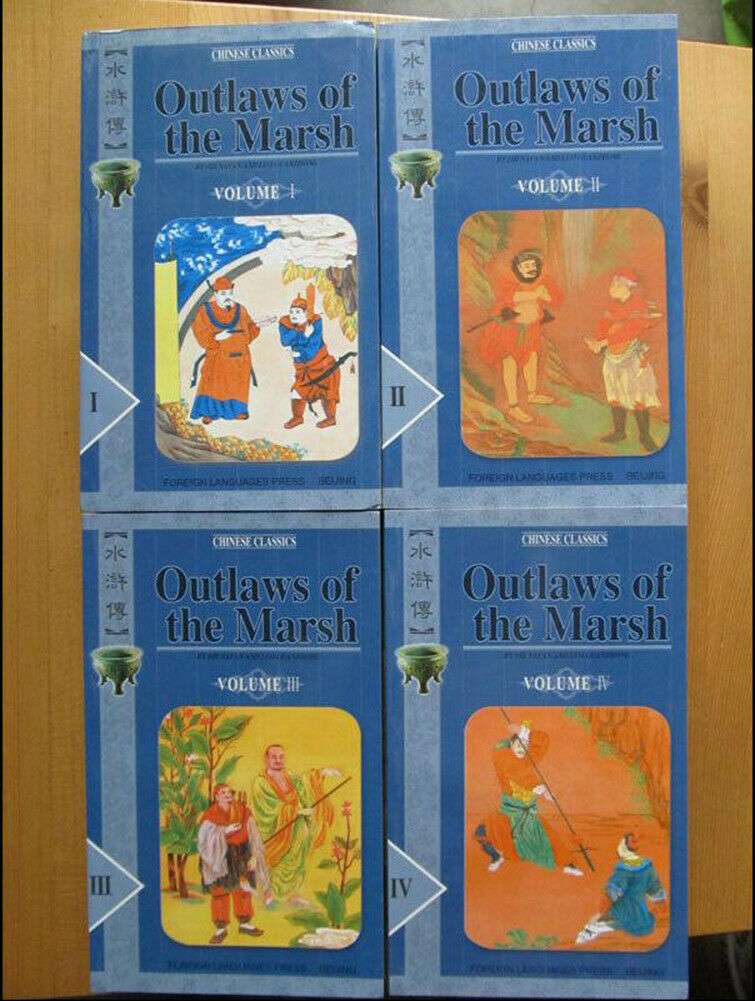
Archive #53 – PDFs of Outlaws of the Marsh (a.k.a. Water Margin) Foreign Language Press English Translation (Vols. 1-4)

Note: My blog is not monetized, so I am not making any money from this post. My hope is that the PDF will make this legendary story more accessible to a wider audience. If you enjoyed the digital version, please, please, please support the official release.

Here I present a PDF of the 100-chapter Foreign Language Press four-volume boxed set of Outlaws of the Marsh (a.k.a. Water Margin, Shuihu zhuan, 水滸傳, c. 1400; “WM” hereafter) translated by Sidney Shapiro. Credited to Shi Nai’an and Luo Guanzhong, this classic Chinese military romance follows 108 heavenly and earthly spirits-reborn-heroes who band together and use their great physical or mental strengths to rebel against the falling Song Dynasty (960–1279). Some of the surviving members later accept clemency from the government and work to fight the barbarian hordes invading China. Few survive to old age.

I’m archiving this book because it has a deep connection with Journey to the West (Xiyouji, 西遊記, 1592; “JTTW” hereafter). Here are a few examples. First, the name and number of Sun Wukong‘s “Multitude of Terrestrial Killers” (Disha shu地煞數; a.k.a. his “72 kinds of transformations,” qishier ban bianhua七十二般變化) and Zhu Bajie’s “Multitude of Celestial Rectifiers” (Tiangang shu天罡數; a.k.a. his “36 kinds of transformations,” sanshiliu ban bianhua三十六般變化) are similar to that of the spirits mentioned above. [1] In WM ch. 2, they are called the “Stars of the 36 Celestial Rectifiers and of the 72 Terrestrial Killers—a total of 108 Demon Lords” (三十六員天罡星,七十二座地煞星,共是一百單八個魔君) (Meulenbeld, 2019, p. 5; Shi & Luo, 1975/2021, vol. 1,  p. 16). [2] Second, see my previous article analyzing the parallels between the Monkey King and the bandit Wu Song (武松). See also the sister article over at the Journey to the West Library blog. And third, I’ve previously suggested that Sun’s ploy to rescue the beleaguered wife of Zhu Bajie in JTTW ch. 18 is based on an event from WM ch. 5. Both feature:

  • Young, beautiful daughters in unwanted relationships (Green Orchid vs the unnamed maiden).
  • Elderly fathers worried for their child (Mr. Gao vs Mr. Liu).
  • Evil spirit-turned-inhumanly strong, hot-tempered, heavy metal staff-wielding martial monks who come to their aid (Sun Wukong vs Lu Zhishen).
  • The monk takes the place of the woman in a darkened room.
  • The villain is beaten (Zhu Bajie vs Zhou Tong) (Wu & Yu, 2012, vol. 1, pp. 374-377; Shi & Luo, 1993/2001, pp. 109-113).

This PDF will complement the translations that I’ve previously archived. These include the JTTW story cycle (here and here), the four-volume 2000 Library of Chinese Classics Chinese-English bilingual edition of Creation of the Gods (Fengshen yanyi封神演義, c. 1620 CE), a fan translation of Journey to the South (Nanyouji南遊記, c. 1570s-1580s), and the four-volume 2001 Foreign Language Press boxed set of Three Kingdoms (Sanguo yanyi三國演義; lit: “Romance of the Three Kingdoms,” 14th century.).

Archive Link:

Click to access Outlaws-of-the-Marsh.pdf

Fig. 1 – The four covers of the boxed set edition (larger version). Image found here.

Notes:

1) Anthony C. Yu (Wu & Yu, 2012) translates these as the “Art of the Heavenly Ladle” and the “Art of the Earthly Multitude” (vol. 1, p. 122). I instead follow the translation used by Meulenbeld (2019). In regards to Tiangang (天罡), he explains: “In its exorcist manifestation, the Northern Dipper is known as gang 罡, which I translate here as ‘rectifier’ due to the ritual function it has in righting wrong” (Meulenbeld, 2019, p. 7). “Terrestrial Killers” is a direct translation of Disha (地煞).

2) Shapiro translates these as the “[t]hirty-six stars of Heavenly spirits and seventy two stars of Earthly Fiends, a total of one hundred and eight demons” (Shi & Luo, 2001, vol. 1, p. 16). Each of the 108 bandits is later associated with a particular star in WM ch. 71 (Shi & Luo, 2001, vol. 4, pp. 1499-1501; Shi & Luo, 1975/2021, vol. 3,  pp. 972-975).

Sources:

Meulenbeld, M. (2019). Vernacular “Fiction” and Celestial Script: A Daoist Manual for the Use of Water Margin. Religions10(9), 518. MDPI AG. Retrieved from http://dx.doi.org/10.3390/rel10090518.

Shi, N., & Luo, G. (2001). Outlaws of the Marsh (Vols. 1-4) (S. Shapiro, Trans.). Beijing: Foreign Languages Press. (Original work published 1993)

Shi, N., & Luo, G. (2021). Shuihu zhuan (shangzhongxia) [Tale of the Water Margin (Vols. 1-3)]. Beijing: Renmin wenxue chubanshe. (Original work published 1975)

Wu, C., & Yu, A. C. (2012). The Journey to the West (Vols. 1-4) (Rev. ed.). Chicago, Illinois: University of Chicago Press.

Story Idea: Firearms and the Journey to the West Universe

From time to time I like to post a fun blog not directly related to (though sometimes informed by) my research. Regular articles will resume after this entry.

Last updated: 12-03-2024

I am currently reading Gunpowder Technology in the Fifteenth Century: A Study, Edition and Translation of the Firework Book (2024), and this got me thinking: what would the Journey to the West (Xiyouji西遊記, 1592) cosmos be like if there were guns? In this photo essay, I will briefly explore guns in Chinese folk religion, types of historical (mainly handheld) firearms used in ancient China, and, finally, ways that such weapons could be inserted into the narrative.

I. Folk Religion

I first set out to see if firearms play any part in Chinese folk religion. I found a few examples from Taiwan. The first is “Lord Red Flag” (Hongqi gong, 紅旗公; a.k.a. “Marshal of Sacred Righteousness,” Shengyi yuanshuai, 聖義元帥), a relatively recent martial god. He and his marshals are depicted holding rifles.

(Click on the pictures to enlarge them.)

Here’s a version without the cloak.

Even his tangki (spirit-medium) gets a chance to fire off some rounds.

Three more involve Prince Nezha. The first of two (from the same temple) is a traditional statue adorned with an M4 assault rifle and other modern weaponry.

Here’s a closeup of the rifle. Also, take note of the holstered revolver (i.e. the black pouch) on his waist.

The profile view shows clips on his belt (again, in black pouches), as well as a grenade on top of an ammo case at his feet.

The second is a three-headed and eight-armed Nezha with an anti-tank rocket launcher, a rocket round, and a grenade at his feet.

A third statue (my personal favorite) portrays the prince with an MP 40 submachine gun and modern military gear. The carving on the water is amazing. I first learned of it here.

I learned here and here that cannons are sometimes worshiped in East and Southeast Asia as fertility gods. (See the 09-29-24 update below for more info about cannons.)

I also learned that ritual guns sometimes appear in Chinese folk temples of Vietnam.

If present, the guns number among ritual weapons that are commonly found in martial god temples of Chinese folk religion. (But I’ve never personally seen a gun among said armaments in Taiwanese temples.) This Vietnamese article briefly mentions that the weapons are based on the eighteen arms of Chinese martial arts. And it’s interesting to note that a “hand canon” (chong, 銃) does appear among the eighteen arms listed in the Water Margin (Shuihu zhuan, 水滸傳, c. 1400):

Shi Jin daily sought Drill Instructor Wang’s tutelage in the eighteen (weapons of) martial arts. He taught him from the very beginning. Which eighteen martial arts?

Lance, hammer, bow, crossbow, hand cannon, whip, metal tablet, long sword, chain, truncheon, fu-axe, yue-axe, ge-halberd, ji-halberd, shield, staff and spear, and toothless rake. [1]

史進每日求王教頭點撥十八般武藝,一一從頭指教。 那十八般武藝?

矛錘弓弩銃,鞭簡(鐧)劍鏈撾,斧鉞並戈戟,牌棒與槍杈。

Perhaps this list influenced the ritual weapons in Vietnam.

II. Historical Firearms in Ancient China

Here is an example of a Yuan-era hand canon, minus the shaft.

Here is a “Three-Eyed Hand Canon” (Sanyan chong, 三眼銃), a three-barreled stick gun used during the Ming Dynasty.

You can see that they were attached to bladed polearms, which could be used offensively or defensively between reloading.

There were even five-barreled and shielded firearms called “Rapid-Thunder Hand Cannons” (Xunlei chong, 迅雷銃). So cool!

Here’s a Chinese video demonstrating the one and three-barreled versions:

III. Story Idea

This brings me back to Journey to the West. How could firearms be inserted into a religious allegory? Well, for starters, a 950 CE wall mural in Dunhuang shows one of Mara‘s demons attacking the awakening Buddha with a “fire lance” (huoqiang, 火槍; upper right), a precursor of hand cannons. This is a clear example of a centuries-old association between firearms and spiritual warfare.

Here’s the full mural.

Now imagine that these weapons are wielded by celestial gunner-soldiers under the command of the “Star of Fiery Virtue” (Huode xingjun, 火德星君), the god of fire. In JTTW chapter 51, his literary troops utilize fire scimitars, fire bows, fire arrows, fire crows, fire horses, red (fire) rats, fire dragons, fire carts, fire gourds, fire banners, and fire rods in battle (Wu & Yu, 2012, vol. 3, p. 9). These are just a short step from firearms.

Given that the novel projects Ming-era concepts backwards to the Tang Dynasty, having gods wield such weapons hundreds of years before they were even invented wouldn’t be out of place in the JTTW universe. A writer could just say that the weapons were created in the realm above and eventually trickled down to mankind. Admittedly, I like the real history better because it shows the ingenuity of our predecessors, but the story requires a little tinkering.

Writers wanting to expand on the idea of firearms in heaven could take Ming gunners, their uniforms, and their strategies as models to work from. This page features a lovely figurine of such soldiers, including lots of juicy historical info. And the fact that the historical troops were part of the “Divine Machine Battalion” (Shenji ying, 神機營), which specialized in firearms, really solidifies their connection to the heavenly realm.

Who would make such weapons? There’s a fun answer for that: Laozi! The novel twice describes him forging mystical weapons belonging to our main characters. For example, Zhu Bajie mentions in chapter 19 that the high god made his rake: “This is divine ice steel greatly refined, / Polished so highly that it glows and shines. / Laozi wielded the large hammer and tong …” (Wu & Yu, 2012, vol. 1, p. 382). And Monkey claims in chapter 75 that the Daoist Patriarch created his staff: “The rod of steel nine cyclic times refined / Was forged in the stove by Laozi himself” (Wu & Yu, 2012, vol. 3, p. 375). So, on top of making alchemical medicines, Laozi could be heaven’s celestial gunsmith.

How could demons get ahold of celestial guns? Well, referring back to chapter 51, a buffalo-spirit uses the “diamond cutter” (jingang zhuo, 金鋼琢), an uber powerful, bracelet-like treasure-weapon also created by Laozi, to twice suck away all of the aforementioned fire weapons (Wu & Yu, 2012, vol. 3, pp. 9 and 23). Devil craftsmen would then have time to analyze the heavenly technology, which would allow them to eventually make their own (inferior?) copies.

Recall that the Great Peng demon is said in chapter 74 to have taken over a human kingdom by eating all of the inhabitants some 500 years ago, and the former population was replaced by spirits (Wu & Yu, 2012, vol. 3, p. 360). Firearms would definitely make a human-to-monster kingdom transition for less powerful demon kings a lot easier.

Another possibility is that a fiend could simply sneak into heaven to steal some. This may seem like an impossible task, but JTTW chapter 63 mentions something similar happening. The dragon-spirit “Princess All Saints” (Wansheng gongzhu, 萬聖宮(公)主) is said to have “[snuck] into heaven and stole[n] from before the Hall of Divine Mists the nine-leaf divine agaric planted by the Lady Queen Mother of the West” (Wu & Yu, 2012, vol. 3, p. 192). So, if someone can secretly infiltrate the realm above and steal divine vegetation, they could certainly steal heavenly armaments.

Perhaps the simplest way that demons could attain celestial firearms is by ambushing heavenly troops and commandeering their equipment.

I could see Red Boy (Honghai’er, 紅孩兒) using his powerful Samadhi flame to forge his own hand cannons, at least with the help of devil craftsmen. His association with fire only makes it natural that his own troops would carry firearms.

The only thing I can’t think of is how heavenly hand cannons would differ from their real world counterparts. Would they just use gunpowder and metal shot, or would it be more magical in nature, like shooting meteors? I’m open to suggestions from readers.


Update: 09-29-2024

The film Enoken no Songoku: Zenpen (エノケンの孫悟空 前編; a.k.a. “Enoken’s Songoku,” 1940) features the Monkey King mowing down demons with his staff-turned-machine gun.

There are at least two toys depicting the Great Sage with a gun. The first I learned about via a Facebook group post. I love how his sniper rifle is modeled on his magic staff. You can see the original packaging here.

And here is a Black Myth: Wukong-inspired figure with a powerful-looking rifle/shot gun combo. I saw it here.

Regarding cannons, I learned that a giant Western cannon was worshiped by court officials during the Ming. The History of the Ming (Mingshi, 明史, 1739) explains:

At this time, a ship arriving from the Great Western Ocean [i.e. the West] brought an enormous cannon, which got the name of the “Red Barbarian” [Hongyi, 紅夷]. It measured over two-zhang [20.86 ft/6.358 m] long, and weighed as much as 3,000 catties [3,902.18 lbs/1,770 kg]. It could demolish any stone city-walls, and its earthquake-like roar could be heard for several dozen li around. During the Tianqi [天啟] reign, the name of “Great General” [Da jiangjun, 大將軍] was given to it, and officials were sent to offer libations [si, 祀] to it (based on Needham, 1986, p. 392).

其後,大西洋船至,復得巨砲,曰紅夷。長二丈馀,重者至三千斤,能洞裂石城,震數十里。天啟中,錫以大將軍號,遣官祀之。

Needham (1986) suggests the cannon’s worship is connected to folk beliefs: “In Taoist folk-religion any device or machine of almost miraculous potency was something which should receive veneration” (p. 392 n. b).


Update: 10-05-24

I forgot to mention the “Gatling Gun Bodhisattva” (Jia-te-lin pusa, 加特林菩薩) from Chinese social media and Japanese manga. The following clip expounds the Heart Sutra of the Honored Gatling Gun Bodhisattva (Namo Jia-te-lin pusa Xinjing, 南無加特林菩薩心經).


Update: 11-23-24

Reader Danna Zhang left a wonderful comment about how Investiture of the Gods (Fengshen yanyi封神演義, c. 1620 CE), a sort of prequel to Journey to the West, also includes gunpowder weaponry:

Late comment, but FSYY also puts Ming dynasty gunpowder weapons into the 11th BCE Shang dynasty setting. Apart from the numerous mentions of “cannons go boom”, In Chapter 56, they broke Deng Jiugong’s ambush-disguised-as-wedding by hiding a cannon in the gift casket and using it to make a surprise attack, and in Chapter 88, Jiang Ziya suggests to King Wu that they need the “Sky-blasting Cannon” (轰天大炮) to breach the walls of Mianchi City.

At this point, I think the bronze age gunpowder weapon isn’t a bug, it'[s] a feature.


Update: 12-03-24

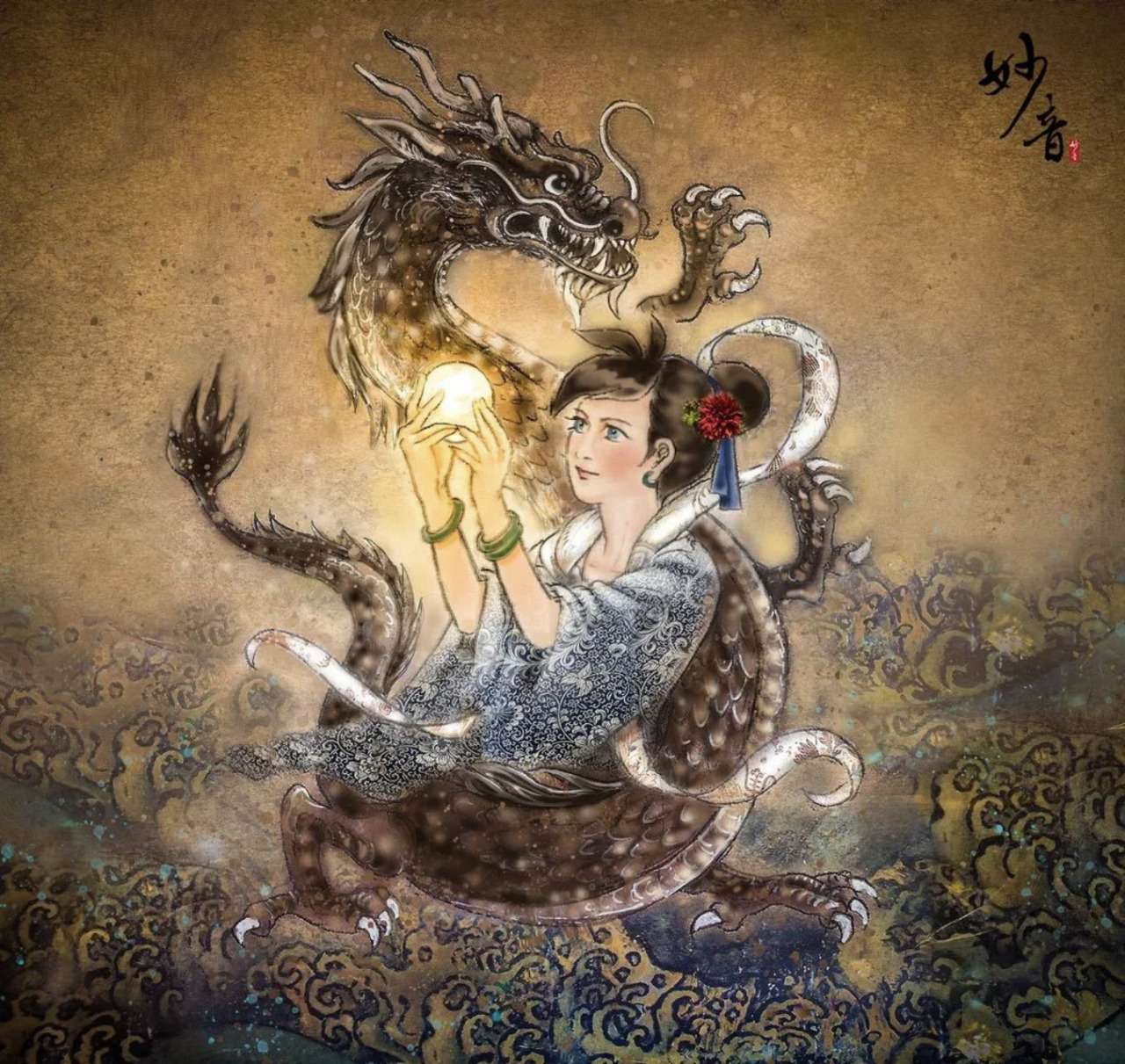
The Japanese Scroll of Battle Between Generations (異代同戱図巻, 17th-century) includes a depiction of Guanyin aiming a flintlock rifle, with the Dragon Girl waiting in attendance behind her.

Note:

1) The narration is based on my translation, while the weapons list is based on that from Lorge (2012). See page 147.

Source:

Lorge, P. A. (2012). Chinese Martial Arts: From Antiquity to the Twenty-First Century. United Kingdom: Cambridge University Press.

Needham, J. (1986). Science and Civilization in China. Volume 5: Chemistry and Chemical Technology; part 7, Military Technology: The Gunpowder Epic. Assisted by Ho Ping-yü et al. New York: Cambridge University Press.

Wu, C., & Yu, A. C. (2012). The Journey to the West (Vols. 1-4) (Rev. ed.). Chicago, Illinois: University of Chicago Press.


Archive #45 – Tripitaka Seeks the Scriptures: A Rare Journey to the West Puppet Play from Quanzhou, Fujian

Last updated: 07-21-2025

The Journey to the West Research blog is proud to host a guest post by the very knowledgeable @ryin-silverfish of Tumblr. They managed to track down a digital copy of the script for Tripitaka Seeks the Scriptures (Sanzang Qujing, 三藏取经), an extremely rare Journey to the West (Xiyouji, 西遊記; “JTTW” hereafter) puppet play from Quanzhou, Fujian province, China (fig. 1). This prompt book was first transcribed during the Qing Dynasty (1644-1911), but internal characteristics date it to sometime after the late-13th-century JTTW and before or concurrent with the early-Ming JTTW zaju play. Needless to say, this is a super important addition to JTTW studies as it likely serves as a “missing link” between the northern and southern traditions of the story cycle (Hu, 2017a; 2017b). The strange thing is that I’ve never read anything about the play in any English sources on JTTW. This fact demonstrates just how rare and precious the play is.

The work contains familiar episodes, like Monkey’s havoc and punishment, Tripitaka‘s tumultuous childhood and vow to retrieve scriptures from India; Sun Wukong and Zhu Bajie becoming his disciples, etc. (This and other parallels presented below perhaps point to the play’s influence on the later 1592 edition of the novel. Or, at the very least, this points to them drawing upon the same source.) But the play also has some very interesting differences: Tripitaka is adopted by Tang Emperor Taizong, thus becoming a prince; Monkey is imprisoned in a crystal well for his past misdeeds; Sha Wujing is the one transformed into a white horse; and Erlang becomes the Tang Monk’s disciple after being punished for flirting with a heavenly maiden. Read on for a full Chinese script and English synopsis below.

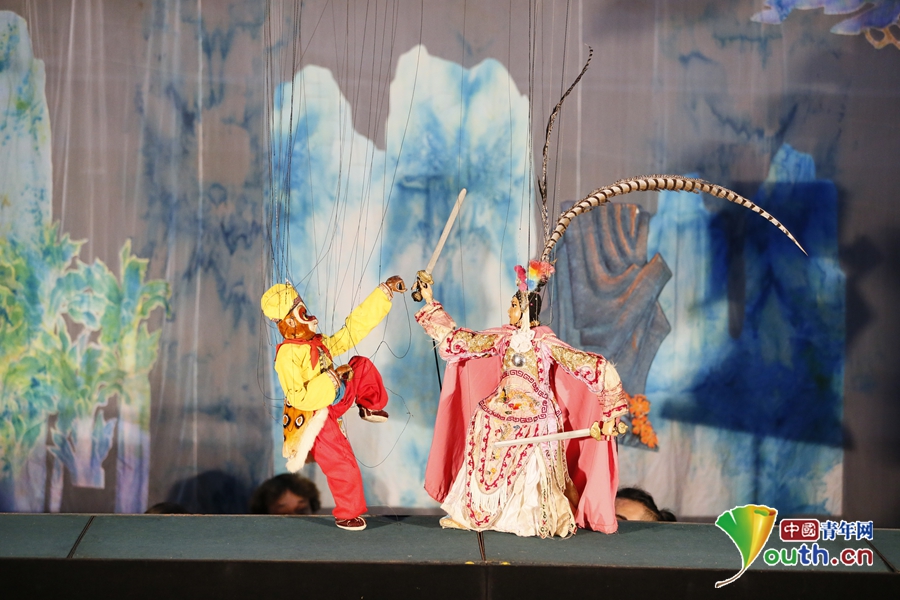
Fig. 1 – An example of modern Quanzhou string puppetry depicting a battle between Sun Wukong and Princess Iron Fan (larger version). Image found here.

I. The Chinese Script

The source of this text is quite obscure, only featured in a 1999 Chinese collection of puppet theater plays published by the Quanzhou Regional Opera Research Society.

Name of the book: 泉州地方戲曲研究社編,《泉州傳統戲曲叢書》第十卷《傀儡戲•目連全簿》(北京:中國戲劇出版社,1999)。

Unsurprisingly, I have no way of getting my hands on an actual copy of the book, so the Chinese text here came from a Tieba user who did, and then someone helpfully uploaded it onto Baidu Cloud Drive.

Just something to keep in mind.

PDF File:

https://docs.google.com/document/d/10XhOpvLFrdcSaqyrhY_4MmiXylSGNhWutcgv6Ngen3M/edit

Jim: Here is a backup just in case.

Click to access Quanzhou-Puppet-Theatre-JTTW.pdf

[Note: See also the 07-21-25 update below for a PDF of the original book!]

II. English Summary

Disclaimer – This is a very rough chapter-by-chapter summary of the play, which was first transcribed in the Qing dynasty and appeared to be written in the local dialect. As I do not speak Hokkien, nuances are likely lost and errors made.

Jim: I have added italicized explanatory notes to @ryin-silverfish’s summary below. I formatted the section as such so that readers will have more context at hand. This way, you won’t have to constantly scroll down to the footnotes. Also, I have added links, as well as more hanzi and pinyin. I don’t (yet) know Hokkien either, so I apologize for not adding the corresponding romanization.

Chapter 1: Meeting the Buddha (Jian Fozu, 见佛祖)

Tripitaka (Sanzang, 三藏; a.k.a. Xuanzang, 玄奘) sings his backstory, which is pretty much the same as the JTTW novel version, minus the revenge part, and with a few more details: he was found by Li Gong (李公) and raised under the name “River Float” (Jiang Liu’er, 江流儿) in the Golden Mountain Temple (Jinshan Si, 金山寺). [A] As an adult, he later traveled to become a monk at the Immortal Peach Temple (Pantao Si, 蟠桃寺). Tang Emperor Taizong came there one day to sponsor a mass and present incense, and being impressed by the monk’s arhat-like aura, made him his adopted son, “Prince Tripitaka” (Sanzang Taizi, 三藏太子). [B]

The royal monk is praying to the “Buddha of the Southern Seas” (Nanhai Fozu, 南海佛祖, a.k.a. Guanyin), when the goddess arrives to ask what is bothering him. He worries that the monks who travel outside the temple might be tempted by worldly things, so he vows that day to retrieve scriptures from India in order to save them from negative karmic fate. [C] In response, Guanyin first tells him that the journey will be perilous, with untold dangers along the way. Then, she tells Tripitaka of the “Great Sage Equaling Heaven” (Qitian Dasheng, 齐天大圣), who had been imprisoned in a well for stealing the Jade Emperor’s wine in the past. Next, she recommends recruiting the Great Sage to protect the monk on the trip, and to that end gives him a “Precious Sash of Infinity” (Wujin Baodi, 无尽宝绦) and a golden headband, two heavenly treasures needed to respectively free and submit the spirit. Finally, Guanyin gives him a ringed staff, an alms bowl, and straw slippers before sending him on his way.

A) Tripitaka is found as a baby by the monk Faming (Faming Heshang, 法明和尚), the holy abbot of the Golden Mountain Temple, in JTTW chapter nine. He gives the baby the same name, “River Float” (Jiang Liu/er, 江流/儿) (Wu & Yu, 2012, vol. 1, p. 222).

B) The monk becomes Tang Emperor Taizong’s bond brother (xiongdi, 兄弟) in JTTW chapter 12 (Wu & Yu, 2012, vol. 1, p. 290). The monarch even refers to him as his “Royal Brother” (yudi, 御弟) (Wu & Yu, 2012, vol. 1, p. 291, for example).

C) The Tang Monk’s reason for the trip is different in the novel: he is chosen to procure scriptures of the “Great Vehicle” (Dacheng, 大乘; i.e. Mahayana texts) in order to perform a “Grand Mass of Land and Water (Shuilu Dahui, 水陆大会), which will free untold numbers of abandoned souls from the underworld (Wu & Y, 2012, vol. 1, pp. 275 and 286-290). This is more in line with Tang Taizong’s mass in the play.

Chapter 2: Monkey in a Well (Zuojing Hou, 坐井猴)

Sun Wukong sings his backstory inside the well: he was as old as heaven and earth and had eleven brothers, a.k.a. the “Eleven Luminaries” (Shiyi Yao Xingjun, 十一曜星君). [D-F] Turning into a mosquito and flying into the celestial realm, he ate twelve peaches of immortality and three, multi-ton alms bowls full of Laozi’s golden elixir pills and drank 3,000 jars of heavenly wine. [G]

In a drunken haze, Monkey drank so much water from the Eastern Sea that the Dragon King’s palace was exposed, causing the monarch, together with every other deity he had pissed off, to complain to the Jade Emperor.

After he was captured by the combined forces of Erlang, Nezha, Devaraja Li Jing, the Curtain-Raising General Deng Hua (Juanlian Denghua, 卷帘邓化), and celestial soldiers, the plot, again, proceeds the same as in the JTTW novel. This includes his failed execution, sentence to the eight trigrams furnace, wager with the Buddha, and his defeat under “Five-Fingers Mountain” (Wuzhi Shan, 五指山; a.k.a. “Five Elements Mountain“). The only thing different is his place of imprisonment: the power-nullifying, 10,000-zhang-deep “Dazzling Crystal Well” under the Wild Horse Bridge of Youzhou (Youzhou Yema Qiao xia wanzhang Huashan Liuli Jing, 幽州野马桥下万丈花闪琉璃井). [H-J]

Monkey is told that only when “flowers bloom on iron trees” (tieshu kaihua, 铁树开花) will he be released. Shortly thereafter, Guanyin shows up in his dreams and mentions Tripitaka, and the chapter ends with him crying out the monk’s name, hoping he might be heard.

D) Monkey formally introduces himself as Sun Wukong (xing Sun ming Wukong, 姓孙名悟空). But this name only appears twice in the entire play. He is primarily called “Equaling Heaven” (Qitian, 齐天). It appears a total of 286 times, including only two uses of “Great Sage Equaling Heaven” (Qitian Dasheng, 齐天大圣) (ch. 2 & 4). He is twice referred to in chapter four as the “Monkey Whose Greatness Equals Heaven” (Yuansun Qitian, 猿孙大齐天) (refer to the PDF). The present summary primarily uses Sun Wukong and Monkey out of tradition. 

E) Monkey’s stated age, “the same as Heaven and Earth” (yu tiandi tonggeng, 与天地同庚) (refer to the PDF), is different from the novel. Calculations based on internal story details suggest that he was born around the year 500 BCE during the late-Zhou Dynasty (c. 1046-256 BCE). 

F) The “Eleven Luminaries” (Shiyi Yao Xingjun, 十一曜星君) are a combination of nine sinicized Hindu astrological deities and two East Asian astrological deities. They include the Sun (Taiyang xing, 太陽星), Moon (Taiyin xing, 太阴星), Mars (Huoxing, 火星), Mercury (Shuixing, 水星), Jupiter (Muxing, 木星), Venus (Jinxing, 金星), Saturn (Tuxing, 土星), Rahu (Luohou, 罗睺), Ketu (Jidu, 奇都), and two shadowy planets called Yuebei xing (月孛星) and Ziqi (紫气). See figure one here for a circa 13th-century image of these gods. I don’t know if these are supposed to be his biological siblings or just bond brothers. But Wukong does take the “Nine Luminaries” (Jiu Yaoxing, 九曜星), the aforementioned sinified stellar gods, as his bond brothers in JTTW chapter five (Wu & Yu, 2012, vol. 1, p. 160). He later fights and singlehandedly defeats them all during his rebellion (Wu & Yu, 2012, vol. 1, p. 171).

Monkey does have biological brothers and sisters in two YuanMing stage plays (see the 12-20-23 update here). One is a sister called the “Iron-Colored Macaque” (Tiese Mihou, 铁色狝猴) (refer to this PDF). In the puppet play, Laozi refers to Monkey as an “iron bone-colored macaque” (Tiegu Se Mihou, 铁骨色猕猴) because his body is immune to harm. I’m not sure where these terms come from. They might be connected to the tiese (铁色), a kind of fruit-bearing tree in Asia. Perhaps macaques were associated with eating its fruit. Also, I should note that Monkey is called the “Great Sage Steel Muscles and Iron Bones” (Gangjin Tiegu Dasheng, 钢筋铁骨大圣) at the end of the late-13th-century JTTW.

G) Monkey is punished in JTTW chapter five for a host of crimes, including eating countless immortal peaches, ruining a celestial banquet, drinking copious amounts of heavenly wine, and eating all of Laozi’s elixir pills (Wu & Yu, 2012, vol. 1, pp. 162 and 165-166).

H) One zhang () comprises ten chi (, a.k.a. “Chinese feet”), and one chi is roughly 31.8 cm (12.3 in). This makes one zhang 3.18 m (10.43 ft) (Jiang, 2005, p. xxxi). Ten-thousand zhang (wanzhang, 万丈) would therefore be 31,800 m (104,300 ft). That’s one deep well!

The Water Margin (Shuihu Zhuan, 水浒传, c. 1400), another famous Chinese vernacular novel, also contains a 10,000 zhang deep pit (wanzhang shenqian dixue, 万丈深浅地穴) used to imprison 108 stellar spirits (Shi & Luo, 1975/2021a, vol. 1, p. 15). Shapiro translates this as “a pit 100,000 feet deep” (Shi & Luo, 1993/2021b, vol. 1, p.15). But the use of 10,000 zhang is likely referring to an infinitely deep, inescapable abyss.

This idea can be traced to a Song-era Daoist ritual in which an exorcist draws the character for “well” (jing, 井/丼) on the ground. This divides the ritual space into nine sections, representing the Nine Palaces (Jiugong, 九宮) (stellar groupings comprising the cosmos), thereby creating an earth prison to incarcerate evil spirits. The Compilation of Rituals of the Way (Daofa huiyuan, 道法会元) reads:

[U]se the Sword mudrā to draw the character for “well” on the ground. Transform it into a black prison, ten-thousand zhang deep, and ten thousand li wide. Black vapors burst out of it. Inside the prison, visualize how cangues and locks, as well as tools and machinery are laid out. Then recite the Spell for Fast Arrest.

右用劍訣,就地劃一井字。化為黑獄,深萬丈,闊萬里。黑炁衝騰。存獄中枷鎖、噐械備列;就念「促捉咒」(Meulenbeld, 2007, p. 142).

Therefore, Monkey’s imprisonment was likely influenced by this Daoist rite.

I) It’s important to note that liuli (琉璃), the material comprising his prison, has a connection to Buddhism. For example, it is mentioned in Indian Buddhist sources under it’s Pali/Sanskrit equivalent, vaiḍūrya (वैडूर्य), as one of the seven precious substances, along with gold, silver, pearls, etc. Modern translators of said sources associate vaiḍūrya with shiny, translucent beryl and cat’s eye gemstones. But the Chinese originally associated vaiḍūrya/liuli with opaque, dark blue, and sometimes golden-speckled lapis lazuli (Winder, 1990). This is why the Chinese name of the Medicine Buddha, Yaoshi Liuli Guangwang Rulai (藥師琉璃光如來), is translated as the “Medicine Master [of] Lapis Lazuli Light Tathāgata” (for example).

This would suggest that Wukong’s prison is not crystal but lapis lazuli, perhaps with golden speckles, which would explain the “dazzle” (huashan, 花闪) part of the well’s name. And since he is held fast there by the Buddha’s seal (see chapter 4 below), the medium of his jail is likely influenced by Buddhism. This would make his prison a joint Buddho-Daoist punishment.

J) Youzhou (幽州) was an ancient prefecture in what is now Heibei province, China.

Chapter 3: Farewell Banquet (Paishu, 派数)

Zhangsun Wuji, historically Taizong’s minister, is preparing a farewell banquet for Prince Tripitaka. It’s mostly a list of dishes; not much to see here.

Chapter 4: Monkey Joins (Shou Hou, 收猴)

Tripitaka attends Zhangsun Wuji’s farewell banquet, and then begins his journey to the west. The Buddha Maitreya sees him about to reach a wide river, uncrossable by boats, and sends Shancai to assist him by covering the river in lotus flowers.

Tripitaka steps over the lotuses and crosses the “Nine-Rank, No Boats River” (Jiupin Wuchuan Jiang, 九品无船江). Keep on keeping on, he hears someone calling out his name, but doesn’t see the caller. The local god of the soil shows up to inform him that it is the Great Sage Equaling Heaven, yelling from inside his well.

The monk removes the Buddha’s seal on the well cover by reciting the “Three-Jewels Mantra” (Sanbao zhenyan, 三宝真言), and then he uses the Precious Sash to lift Sun Wukong out of the well, thereby breaking the iron locks holding him down.

Tripitaka asks Monkey to escort him to the Western Heaven, but the spirit only wants to go back to Flower-Fruit Mountain. Sun Wukong agrees to have his head shaved just so he can bail out after a few li. [K] Unfortunately for him, he also agrees to wear the golden headband, and right after he speeds away, Tripitaka recites the tightening sutra and forces him to return.

Monkey finally relents and agrees to protect Tripitaka on the journey to India. He takes this as an opportunity to bring out the “luggage” from his ear: the 30,000 cattyAs-You-Wish Staff” (Qianjun Ruyi Bang, 千钧如意棒; a.k.a. the “Golden-Hooped As-You-Wish Staff,” Jingu Ruyi Bang, 金箍如意棒), forged by the sage-king Yu the Great. [L & M]

K) Wukong also sports a shaven head in the novel. For instance, in JTTW chapter 27, he states:

But ever since Nirvana delivered me from my sins, when with my hair shorn I took the vow of complete poverty and followed you as your disciple, I had this gold fillet clamped on my head… (Wu & Yu, 2012, vol. 2, p. 24).

自从涅槃罪度,削发秉正沙门,跟你做了徒弟,把这个金箍儿勒在我头上 …

L) The staff’s weight is based on a thousand multiples of 30 catties (jun, ). One catty (jin, ) is 590 grams (Elvin, 2004, p. 491 n. 133). Therefore, 30,000 catties would be roughly 17,700 kg or 39,021.82 lbs. But 30,000 is likely used here to refer to an unimaginably large number (i.e. Wukong’s staff is REALLY heavy). 

The novel staff weighs 13,500 catties (cf. Wu & Yu, 2012, vol. 1, p. 135). This equals 7,965 kg or 17,559.81 lbs.

M) The literary weapon also has a slightly different name: the “As-You-Wish Gold-Banded staff” (Ruyi Jingu Bang, 如意金箍棒). (Notice how ruyi (如意) and jingu (金箍) are switched around from the play’s staff name.) In addition, it is said to have been used by Yu the Great in the past to conquer the world flood (Wu & Yu, 2012, vol. 1, p. 135). But the staff’s creation is attributed to both Laozi (ch. 75) and Yu (ch. 88) (Wu & Yu, 2012, vol. 3, pp. 375; vol. 4, 201).

Chapter 5: The Horse Joins (Shou Ma, 收马)

The “Deep Sand God” of Black Sand Cave (Heisha Dong Shensha Shen, 黑沙洞深沙神, i.e. Sha Wujing) sits in his abode, [N] looking to grab some travelers to eat, and soon, he comes across Tripitaka and Sun Wukong. He seizes the monk first, then tries to grab the monkey but seemingly fails.

Sun Wukong, using his magic “Fiery Eyes and Golden Irises” (Huoyan Jinjing, 火眼金睛), figures out it was the Deep Sand God, and then goes into his cave for a rescue mission. They banter and proceed to fight. Knowing that the old monkey spirit is vulnerable to 1) flames and 2) water, [O] the Deep Sand God sets a fire inside his cave, forcing Sun Wukong to flee to the South Sea for help.

Guanyin decides to come along and asks Sun Wukong to bring her alms bowl, too. When they confront the Deep Sand God again, Guanyin presents a wager to him: if he can lift her alms bowl (boyu, 钵盂), both she and Tripitaka will be his food.

The monster tries but is unable to lift it. [P] Sun Wukong then lifts the bowl, tosses it onto his head, and attempts to slay the Deep Sand God. But Guanyin spares him on the condition that he will turn into a white horse and become Tripitaka’s steed. [Q]

N) The “Deep Sand God” (Shensha Shen, 深沙神) appears as a desert demon in (the incomplete) chapter eight of the late-13th-century JTTW. He claims to have eaten Tripitaka’s two previous incarnations on their journey to India. The monster only helps the pilgrims cross the “Deep Sands” (Shensha, 深沙) via a magical golden bridge once he is threatened with heavily retribution. Memorial poems note that Tripitaka releases the Spirit from a 500-year-long curse, and Monkey promises to speak highly of him when they meet the Buddha (Wivell, 1994, pp. 1190-1191).

O) Monkey is shown to be weak to “True Samadhi Fire” (Sanmei zhenhuo, 三昧真火), an intense flame born from spiritual cultivation, in JTTW chapter 41 (Wu & Yu, 2012, vol. 2, pp. 230-23). And he is shown throughout the novel to be a less proficient fighter in water (ch. 21, for example) (Wu & Yu, 2012, vol. 1, pp. 423-424).

P) This is reminiscent of JTTW chapter 42, when Guanyin challenges Wukong to pick up her porcelain vase, which contains an ocean full of water. He is unsuccessful (see the 07-03-22 update here). The Deep Sand God’s inability to raise the alms bowl is likely related to monk Faxian‘s story about the immovable quality of Buddha’s almsbowl (Faxian & Legge, 1886/1965, pp. 34-35).

Q) In the novel, the white horse is a transformed dragon prince. He is forced to become Tripitaka’s steed after eating the original horse in chapter 15 (Wu & Yu, 2012, vol. 1, p. 328).

Chapter 6: Erlang Joins (Shou Erlang, 收二郎)

Erlang sings his backstory. The previous year, he harassed a Jade Maiden messenger (Chuanyan Yunu, 传言玉女) on a bridge in Tianjin (Tianjin Qiaotou, 天津桥头), provoking the Jade Emperor’s wrath and causing him to cut off sacrifices and worship to Erlang. After the intervention of Guanyin, he was sent to Mt. Guankou (灌口山) (in Sichuan) as a guardian deity, but often preyed on passing mortals and ate their flesh. [R]

The POV switches to Tripitaka and Wukong; the latter sees a black cloud blocking his way, and suspecting it to be a demon, he asks his master to hide while he checks. Erlang reveals his identity and suggests that he will catch the monk and share his flesh with “Elder Brother Qi” (Qige, 齐哥) (i.e. Monkey).

Wukong promptly chews him out and reveals that Tripitaka is the reincarnation of the Golden Chan Arhat (Jinchan Luohan, 金禅罗汉), [S] who attended a lantern fruit festival without notifying his fellow monks and was punished by the Buddha to experience 36 perils (sanshiliu jie, 三十六劫) on his journey to the west. [T]

After getting a monk makeover, Erlang becomes Tripitaka’s disciple.

R) This is reminiscent of Zhu Bajie’s backstory from JTTW chapter 18. After being stripped of his divine post and exiled to earth for forcing himself on a moon maiden, Pigsy becomes a meat-eating spirit (Wu & Yu, 2012, vol. 1, p. 212).

S) Tripitaka’s past divine title, the “Golden Chan Arhat” (Jinchan Luohan,金禅罗汉), is similar to that from JTTW, “Master Golden Cicada” (Jinchan Zi, 金蝉子). Chan (as in Chan Buddhism) and chan (蝉, “cicada”) look and sound similar.

T) Master Golden Cicada is exiled from heaven for sleeping during the Buddha’s lecture. The fullest explanation for this appears in chapter 81 (Wu & Yu, 2012, vol. 4, p. 82). Another part of his punishment is experiencing 81 perils, which happen throughout the novel. Eighty of these are listed, with the final one happening shortly thereafter, in chapter 99 (Wu & Yu, 2012, vol. 4, pp. 358-363).

Chapter 7: Pigsy Joins (Shou Zhu, 收猪)

Zhu Bajie (猪八戒), the pig demon of Mt. Song (嵩山; later called “Pig Excrement Mountain,” Zhushi Shan, 猪屎山), is hungry for human flesh, and so he decides to whip up some smoke and seize some unaware travelers under its cover. Just like the two villains before him, he picks the pilgrims as his target.

Wukong fights him, subdues him, and he joins the party.

Chapter 8: Spiderly Woe (Zhizhu Men, 蜘蛛闷)

Lady Earth-Raised (Diyang Furen, 地养夫人), the spider demoness of Mt. Hua (Hua Shan, 华山), has a problem. She might be the youngest sister of the “Three Saints of Mt. Song” (Song Shan Sansheng Langjun, 嵩山三圣郎君), [U] living on her silk webs, but she is still single and unmarried. As such, she commands her imps to patrol the mountains daily, so as to kidnap a fine man as her future husband.

The imps soon spot a group of people under the mountain: a monkey, a horse, a pig, and a monk (Erlang isn’t mentioned for some reason). She asks one of her imp minions, the “Big-headed Demon” (Datou Gui, 大头鬼), which one seems like a good choice, and after comically dismissing the first three, she settles on the monk.

The Big-headed Demon eagerly grabs a sack and chopper and, when she asks why, he tells her he is going to cut the monk in half and bring the body to her. But since a dead person does not a good husband make, she decides to kidnap the monk herself.

U) Lady Earth-Raised is similar to the seven Spider Spirits (Zhizhu Jing, 蜘蛛精) from JTTW chapters 72 to 73, and her lofty brothers, the Three Saints, are reminiscent of the Demon Lord of a Hundred Eyes (Baiyan Mojun, 百眼魔君), the spider spirits’ senior from chapter 73.

Her name and at least one of her deceptions is also very similar to a demoness in JTTW chapter 80 (see below).

Chapter 9: Subduing the Spider (Shou Zhizhu, 收蜘蛛)

The demoness disguises herself as a young woman with her lower half buried in the earth (the same trick Lady Earth Flow uses in JTTW chapter 80 (Wu & Yu, 2012, vol. 4, p. 67) and calls out for help. Tripitaka orders Wukong to investigate, but he refuses because he doesn’t want trouble. However, the monk forces him into it via the headband tightening spell.

She says she was buried there by her husband for doing something wrong, and then asks the monk for help. When Tripitaka tries to pry her free with a monk’s knife (jiedao, 戒刀), she grabs him and returns to her cave.

Sun Wukong spots some spider silk with his fiery eyes and plans to turn into a jiaoming fly (jiaoming chong, 蟭螟虫) [V] and follow it back to her cave. However, the horse says she probably raises hens inside, and a fly would quickly be eaten, so he should transform into a Scops owl (Lao Chi, 老鸱), a bird of prey. That way Wukong can deal with the chickens when he sneaks inside.

He soon finds the spider demoness and orders her to let his master go or die. She replies that if he dares, her brothers, the “Three Saints of Mt. Wo” (Wo Shan Sanshen Langjun, 窝山三圣郎君) (again, a mountain’s name does not stay consistent) will deal with him. [W] Wukong beats her to death with the staff anyways and rescues Tripitaka.

V) The jiaoming fly (jiaoming chong, 蟭/焦螟虫) is an aquatic insect from Daoist literature said to be so small that it can congregate in the eyebrows of a mosquito (Wang, 2012, p. 28 n. 44).

W) The “Three Saints of Mt. Song/Wo” (Song/Wo Shan Sansheng Langjun, 嵩/窝山三圣郎君) are part of a pattern in JTTW in which the pilgrims face a trio of baddies. Examples include the three bogus animal immortals (ch. 46), the three demon kings of Lion-Camel Cave (ch. 74-77), and the three rhino demons (ch. 91-92). The three incarnations of the White Bone Spirit (ch. 27) could also count. This reoccurring number is perhaps meant to mirror Tripitaka’s three disciples.

Chapter 10: Bad News (Bao Xiongxun, 报凶讯)

Luo Tuo, Luo Du, and Luo Hou (罗托,罗独,罗候)—the Three Saints of Mt. Wo—are having a party in celebration of their eldest brother, Luo Tuo’s birthday. They wonder why their sister has not arrived yet, when suddenly, the Big-Headed Demon enters and delivers the bad news.

Furious, the trio swear revenge and set out to capture Tripitaka and kill Wukong. [X]

X) The Saints’ anger over the murder of their spider sister is also similar to the rage of the Demon Lord of a Hundred Eyes over the killing of his seven spider sisters (ch. 73) (Wu & Yu, 2012, vol. 3, pp. 340-341). All eight are done in by Monkey.

Chapter 11: Subduing the Three Saints (Shou Sansheng, 收三圣)

The pilgrims are passing through a mountain, when Luo Tuo swoops down and grabs Tripitaka but fails to capture Wukong. Monkey informs the rest of the gang about the Three Saints. Erlang suggests that since Wukong is the one who started it, he alone should deal with them.

The whole gang goes after the trio anyways but fails to beat them. Wukong tells Erlang and Sandy to keep watch on the Three Saints so that they do not harm Tripitaka, and he flies to the South Sea to seek Guanyin’s help.

Guanyin agrees, but the chapter ends here because the rest of the pages are missing from the original manuscript.

Chapter 12: Ascending the Immortal Pavilion (Dengxian Ge, 登仙阁)

The chapter begins with the head of the pavilion’s local shrine asking an attendant about sacrifices, for the birthday of a certain “Great Immortal” (Daxian, 大仙) is near. He demands a young boy, as well as food and fruits, as gifts.

The shrine attendant goes to inform the families responsible for supplying each of the sacrifices; this year, it is Old Huang’s (Huang Gong, 黄公) turn to give up his only grandson. [Y] He begs them to delay the sacrifices until his family can … sire another grandkid!

In response, the shrine attendants tie him up and start beating him, stating that if the Great Immortal does not get his sacrifice, the whole village will suffer. Unable to withstand the beating, Old Huang yields and agrees to their demand.

Y) This plot is similar to the Great King of Numinous Power (Linggan Dawang, 灵感大王) episode from JTTW chapters 47 to 48. He demands a yearly sacrifice of children from families that shoulder the horrible burden on a rotating basis. This shares shocking similarities with Hindu literature (see section 2.2 here).

Chapter 13: Meeting the Grandfather and Grandson (Yu Gongsun, 遇公孙)

The pilgrims hear the commotions of the sacrificial ceremony, and upon investigating, come across Old Huang, dragging his grandson along and sobbing. After questioning him, Tripitaka decides to go to Ascending Immortal Pavilion himself and talk the Great Immortal out of this whole “human sacrifice” thing.

Chapter 14: Subduing the Great Serpent (Shou Dashe, 收大蛇)

The sacrificial ceremony begins. But the shrine attendants wonder if the Great Immortal has not yet arrived because the young boy hasn’t been offered up. Tripitaka arrives just in time to call out the Great Immortal for demanding human sacrifices.

Enraged, the Great Immortal orders his imps to snatch Tripitaka, but Wukong smashes his way in and demands the release of his master. The Great Immortal dares Wukong to allow the spirit three free strikes; Wukong agrees.

After three hits and no effect, the Great Immortal tries to bash him over the head with a stone incense burner, which only annoys Wukong. [Z] He whips out his staff and kills the Great Immortal in one strike, revealing his true form—a huge serpent. [AA]

The pilgrims continue their journey. Wukong asks Erlang to get their master some water, while he travels on his cloud to get some food from the Immortal Peach Monastery (蟠桃寺). As the two leave, Tripitaka hears the sound of people chopping firewood and goes to investigate.

Z) Monkey is famous for his invulnerability in JTTW. For instance, in chapter 75, Wukong willingly blocks a sword strike with his adamantine head:

Arousing his spirit, the old demon stood firmly with one foot placed in front of the other. He lifted up his scimitar with both hands and brought it down hard on the head of the Great Sage. Our Great Sage, however, jerked his head upward to meet the blow. All they heard was a loud crack, but the skin on the head did not even redden (Wu & Yu, 2012, vol. 3, p. 373).

那老魔抖擻威風,丁字步站定,雙手舉刀,望大聖劈頂就砍。這大聖把頭往上一迎,只聞扢扠一聲響,頭皮兒紅也不紅。

AA) A massive, red-scaled python spirit (honglin damang, 紅鳞大蟒) appears in JTTW chapter 67.

Chapter 15: Firewood Crossing (隔柴渡)

Two firewood choppers turn out to be Hanshan and Shide (寒山,拾得), two famous historical monks of Mt. Tiantai, who are also worshiped in folk religion. Tripitaka asks them if there is a temple nearby. They say yes but that it’s on the other side of the river.

There aren’t any boats either, so they use their firewood to create a bridge for Tripitaka. Halfway across, the bridge collapses; he falls into the river, only to be rescued by the local Dragon King, who escorts him to the “Correctness and Broadness Temple” (Fangguang Si, 方广寺), [AB] where the Buddha is secretly staying.

After the monk greets Buddha, an immortal lad brings Tripitaka a message: Devaraja Li (Li Tianwang, 李天王) of the Bisha-men Palace (Pisha Gong, 毗沙宫) is inviting him to a party in celebration of his own birthday, as well as Prince Nezha’s (Nezha Taizi, 哪吒太子) “return to the world/rebirth” (zai chushi, 在出世). Tripitaka agrees and heads for the celestial realm on a white crane.

AB) This may be a reference to the Buddhāvataṃsaka Sūtra (Dafangguang fo huayan jing, 大方广佛华严经; a.k.a. “Flower Garland Sutra,” Huayan jing, 华严经). The Chinese believed that this was the Buddha’s first teaching shortly after achieving enlightenment (Buswell & Lopez, 2014, p. 84). This might then explain why the Buddha is residing in a random temple along the journey.

Chapter 16: Party in the Celestial Realm (Tiangong Hui, 天宫会)

Devaraja Li is organizing the party, sending out invitations for the 500 Arhats (Wubai Luohan, 五百罗汉). The immortal lad reports that all five hundred handkerchiefs (shoupa, 手帕) were given out, save for one—which turned out to be Tripitaka’s, missing because of the whole reincarnation thing. [AC]

Luckily, he soon arrives. Devaraja Li gifts him three cups of immortal wine, and Tripitaka, being a lightweight, becomes totally wasted and is taken into the backrooms of the palace to rest.

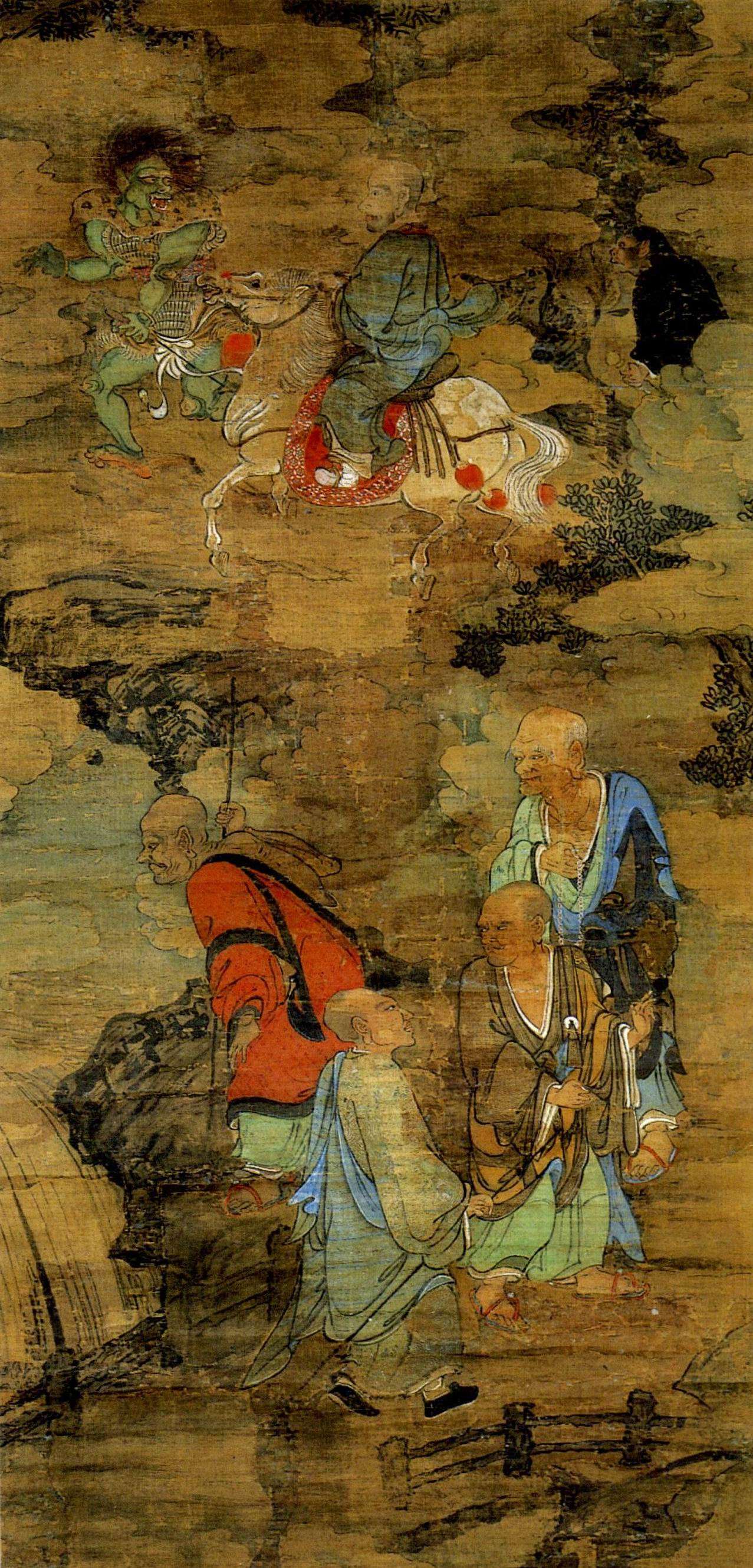
AC) Tripitaka was historically venerated as an arhat as early as the Song dynasty (960-1279) (Liu, 2019). For example, he is included in a series of late-12th-century religious paintings focusing on the 500 Arhats. A black-robed Sun Wukong can be seen walking in the clouds behind him (fig. 2) (see the 06-04-23 update here).

Fig. 2 – Lin Tinggui and Zhou Jichang, The Tang Monk Procures the Scriptures (Tangseng qujing, 唐僧取經), no. 77 of 100 scrolls from Images of the 500 Arhats (Wubai Luohan tu, 五百羅漢圖, 1178-1188 CE) (larger version). Hanging scroll, ink and color on silk. Image from Nara kuniritsu hakubutsukan, Tōkyō bunkazai kenkyūjo, 2014, p. 86. Courtesy of Dr. Liu Shufen, a research fellow at the Institute of History and Philology, Academia Sinica. See the 06-04-23 update here for close ups of Monkey.

Chapter 17: Where did the monk go? (Tao Heshang, 讨和尚)

Meanwhile, Wukong and Erlang return, only to find their master missing. They bash on the gate of the Correctness and Broadness Temple to demand his whereabouts; the Buddha replies that Tripitaka is drunk and sleeping in Devaraja Li’s palace, then slams the door shut in their faces.

Erlang asks Wukong to go to the celestial realm and bring their master back. Wukong declines, citing the whole “Havoc in Heaven” business, then asks Erlang to go. He also declines because of the Jade Maiden incident in the past.

Finally, they summon the local Jiedi (揭帝) with a mantra and send the guardian deity to pick up Tripitaka.

Chapter 18: Subduing the Red-faced Demon (Shou Chimian, 收赤面)

Elder Li De (Laofu Li De, 老夫李德) of Mt. Song has an 18-year-old daughter, Jinyu (金玉, “Golden Jade”), who has been charmed by a demon, and none of the exorcisms by Daoist priests seem to work. The pilgrims happen to pass by and stay at his place for the night, so naturally, Tripitaka signs his monkey disciple up to banish the demon.

Wukong hides in her bedroom, ready to ambush the demon. However, when spooked, it spews out fire and forces Wukong to retreat. Elder Li laments that the demon will surely give them even more trouble after this fiasco; in response, Wukong transforms into the man’s daughter and summons the local god of the soil for questioning. The deity reveals the monster’s identity as the “Red-Faced Demon King” (Chimian Guiwang, 赤面鬼王).

A transformed Wukong marches to the demon’s cave and tells him their relationship might not work out now that her father has seen the demon flee, deeming him a weakling. The Red-Faced Demon then reveals his backstory: he used to be a woodcutter until he saw the “Lamp-Lamp Buddha” (Dengdeng Fo, 灯灯佛) meditating on a rock, [AD] with a precious pearl (zhu, 珠) by his side. He stole the pearl and swallowed it, which allowed him to turn into a fireball and take flight.

Wukong cajoles him into giving up the pearl, immediately swallows it, and uses the True Samadhi Fire to eliminate the demon. [AE]

AD) This is a likely reference to Dīpaṃkara (Sk: दीपंकर), the Buddha preceding Śākyamuni. His Chinese name appears in countless sutras as Dengdeng Fo (燃灯佛), or the “Lamp Buddha.” This is appropriate given the magic pearl’s connection to spiritual fire. Also, this implies that the Red-Faced Demon has lived for countless eons if he was alive during the time of the previous Buddha.

Dīpaṃkara is referenced in JTTW chapter 5, and he briefly appears in chapter 98 (Wu & Yu, 2012, vol. 1, p. 166; vol. 4, p. 352). In addition, his name is listed first (even above Śākyamuni) in a roster of Buddhas and Bodhisattvas saluted at the end of the novel (Wu & Yu, 2012, vol. 4, p. 384). Journey to the West calls him Dendeng Gufo (燃灯古佛; a.k.a. Gufo, 古佛, here and here), or the “Ancient Buddha of the Lamp.”

AE) This chapter shares similarities with a number of JTTW episodes. First, Monkey hiding in the daughter’s room and later transforming into her likeness is reminiscent of Sun and Zhu’s first meeting in chapter 18 (Wu & Yu, 2012, vol. 1, pp. 374-375). Second, Wukong, once again disguised as a woman, tricks a spirit into spitting up a magic pearl and then swallows it himself in chapter 31 (Wu & Yu, 2012, vol. 2, pp. 80-81). And third, the emphasis on a red demon’s command of True Samadhi Fire is similar to Red Boy from chapter 40-42.

Chapter 19: Eight Wheels (Balun Tan, 八轮叹)

The “Holy Mothers of the Eight Wheels” (Balun Shengmu, 八轮圣母) sing their backstory: They were eight sisters—Gold Wheel, Silver Wheel, Copper Wheel, Iron Wheel, Tin Wheel, Wind Wheel, Fire Wheel, and Cart Wheel (Jinlun, Yinlun, Tonglun, Tielun, Xilun, Fenglun, Huolun, Chelun, 金轮, 银轮, 铜轮, 铁轮, 锡轮, 风轮, 火轮, 车轮), who were famous for their might but had remained single for 24,000 years.

As such, they planned to kidnap a husband to share between themselves.

Chapter 20: Subduing the Eight Wheels (Shou Balun, 收八轮)

Tripitaka is very close to his destination, when he is kidnapped by Gold Wheel. A very amusing sequence ensues, where each sister tries to snatch him away for their own wedding but are interrupted by Wukong bashing his way in and threatening to kill all eight of them.

The sisters beg for mercy; Wukong accepts their surrender, and then orders them to turn into eight immortal maidens (Feixian, 飞仙), fly to the Thunderclap Monastery (Leiyin Si, 雷音寺), and notify the Buddha of the pilgrims’ forthcoming arrival.

Chapter 21: Meeting the Great Buddha (Jian Dafo, 见大佛)

The pilgrims greet the Buddha and receive the Three Baskets of scriptures, consisting of sutras, texts and monastic codes. Afterwards, these are taken back to Immortal Peach Temple by the Four Bodhisattvas and Eight Vajrapanis (Ba Jingang, Si Pusa, 八金刚,四菩萨). [AF]

AF) The Eight Vajrapanis are ordered by Buddha to escort the pilgrims and sutras back to China in JTTW chapter 98 (Wu & Yu, 2012, vol. 4, p. 357). However, the guardians are later directed to land after only half way so that Tripitaka can experience the last of the 81 perils: the sutras are nearly lost in chapter 99 when a giant white turtle carrying the group to the other side of a river gets annoyed and dives into the water (this might be based on a historical event) (Wu & Yu, 2012, vol. 4, pp. 363). Thankfully, the Vajrapanis pick them back up and finish the trip to China in chapter 100 (Wu & Yu, 2012, vol. 4, pp. 370).

Chapter 22 to 23: Descending with the Buddha’s Decree (Jiang Fozhi, 降佛旨) and Conferring of Titles (Fengci, 封赐)

After the pilgrims descend to the Tang capital on colorful clouds, their Vajrapani escort suddenly remembers that he forgot to ask for the Buddha’s decree. He then flies back to Thunderclap Monastery after telling them to first start reading the scriptures to the masses.

That minor incident aside, the decree soon arrives without problem: Tripitaka is appointed the “Venerable Pindola Arhat” (Bintou Luohan Zunzhe, 宾头罗汉尊者), Wukong the “Great Sage of the Void” (Xukong Dasheng, 虚空大圣), Erlang the “Great Emperor of Miraculous Knowledge” (Lingtong Dadi, 灵通大帝), [AG] while Zhu Bajie and the Deep Sand God are made Buddhas. [AH]

Taizong then welcomes Prince Tripitaka back and gives him the royal title of “The Great Chan Master of the Great Law and True Scriptures” (Dafa Zhenjing Dachan Shi, 大法真经大禅师).

AG) This section of the manuscript contains an out of place passage not mentioned in the summary. It reads: “The Tree-born Prince and Sinful Dragon, Tathagata, and Erlang were each granted the title of Great Emperor of Marvelous Knowledge” (树生太子业龙,如来,灌口二郎各封灵通大帝) (refer to the PDF). This previously unmentioned princely dragon Buddha character is likely a transcription error (Hu, 2017a; 2017b).

AH) This is radically different than JTTW chapter 100. Only Sun Wukong and Tripitaka become Buddhas. Sha is made an arhat, while Zhu is made an altar custodian (Wu & Yu, 2012, vol. 4, pp. 381-382). Would the play’s ending then suggest that Buddhahood is considered lesser to the heavenly titles given to Monkey and Erlang?

–THE END–

III. Thanks

Jim: I would like to express my utmost thanks to @ryin-silverfish for alerting me to this play, providing the Chinese script, summarizing it, and directing me to an intricate paper about the play’s history. This article would not have been possible without their generous contributions.


Update: 07-21-2025

I’m excited to archive a PDF of the original book (fig. 3) containing the JTTW puppet play.

泉州地方戲曲研究社編,《泉州傳統戲曲叢書》第十卷《傀儡戲•目連全簿》(北京:中國戲劇出版社,1999)。

Quanzhou Local Opera Research Society. (1999). Quanzhou Traditional Opera Series (Vol. 10): Puppet Opera – The Complete Book of Mulian. Beijing: China Drama Publishing House.

All thanks goes to @ryin-silverfish for providing the PDF.

Archive link:

Click to access 泉州传统戏曲丛书-第10卷-傀儡戏·《目连》全簿-Pdg2Pic-郑国权主编;泉州地方戏曲研究社编-Z-Library.pdf

Fig. 3 – Quanzhou Traditional Opera Series (Vol. 10): Puppet Opera – The Complete Book of Mulian (《泉州傳統戲曲叢書》第十卷《傀儡戲•目連全簿》) (larger version).

Sources:

Buswell, R. E., & Lopez, D. S. (2014). The Princeton Dictionary of Buddhism. Princeton University Press.

Elvin, M. (2004). The Retreat of the Elephants: An Environmental History of China. New Haven (Conn.): Yale University Press.

Faxian, & Legge, J. (1965). A Record of Buddhistic Kingdoms: Being an Account by the Chinese Monk Fâ-Hien of his Travels in India and Ceylon (A.D. 399-414) in Search of the Buddhist Books of Discipline. New York: Dover Publications. (Original work published 1886)

Hu, S. (2017a, December 26). Chonggu “Nanxi” Xiyouji: Yi Quanzhou Kuileixi Sanzang Qujing Wei Qieru dian [A Re-evaluation of the Southern Story System of The Journey to the West: Based on Quanzhou Puppet Drama Monk Xuanzang on a Pilgrimage for Buddhist Scriptures]. Weixin Gongzhong Pintai. Retrieved from https://www.yidianzixun.com/article/0HzCWYnd.

Hu, S. (2017b). Chonggu “Nanxi” Xiyouji: Yi Quanzhou Kuileixi Sanzang Qujing Wei Qieru dian [A Re-evaluation of the Southern Story System of The Journey to the West: Based on Quanzhou Puppet Drama Monk Xuanzang on a Pilgrimage for Buddhist Scriptures], Fudan Xuebao (Shehui Kexue Ban), 59(6), 65-74.

Jiang, Y. (2005). The Great Ming Code / Da Ming Lu. Vancouver, Wa: University of Washington Press.

Liu, S. (2019). Songdai Xuanzang de shenghua: Tuxiang, wenwu he yiji [The Sanctification of Xuanzang in the Song Dynasty: Images, Artifacts and Remains]. Zhonghua wenshi luncong, 133, 161-219.

Meulenbeld, M. R. E. (2007). Civilized Demons: Ming Thunder Gods from Ritual to Literature (Publication No. 3247802) [Doctoral dissertation, Princeton University]. ProQuest Dissertations & Theses Global.

Nara kuniritsu hakubutsukan, Tōkyō bunkazai kenkyūjo henshū [Nara University Tōkyō Research Institute for Cultural Properties (Ed.)]. (2014). Daitokuji denrai gohyaku rakan zu [Daitoku Temple’s Tradition of the 500 Arhats Paintings]. Kyōto: Shitau bungaku.

Shi, N., & Luo, G. (2021a). Shuihu Zhuan (Shang, Zhong, Xia) [Tale of the Water Margin (Vols. 1-3)]. Beijing: Renmin Wenxue Chubanshe. (Original work published 1975)

Shi, N, & Luo, G. (2021b). Outlaws of the Marsh (vols. 1-4) (Trans. S. Shapiro). Beijing: Foreign Language Press. (Original work published 1993)

Wang, y. (2004). Sun Wukong De Yuanji Keneng Zai Fujian Baoshan [Sun Wukong’s Origin Could be In Baoshan, Fujian]Yuncheng Xueyan Bao, 22(3), 30-34.

Wang, P. (2012). The Age of Courtly Writing: Wen Xuan Compiler Xiao Tong (501-531) and His Circle. Netherlands: Brill.

Winder, M. (1990). Vaiḍūrya. Bulletin of Tibetology, 26(1-3), 31-37.

Wivell, C.S. (1994). The Story of How the Monk Tripitaka of the Great Country of T’ang Brought Back the Sūtras. In V. Mair (Ed.), The Columbia Anthology of Traditional Chinese Literature (pp. 1181-1207). New York: Columbia University Press.

Wu, C., & Yu, A. C. (2012). The Journey to the West (Vols. 1-4) (Rev. ed.). Chicago, Illinois: University of Chicago Press.

Is Sun Wukong FTM Trans?

Note #1: Unless cited here, all information is cited in the respective linked articles below.

Note #2: Please see the 05-19-23 update for an important message.

Last updated: 03-27-2025

Warning: This article contains adult language and content.

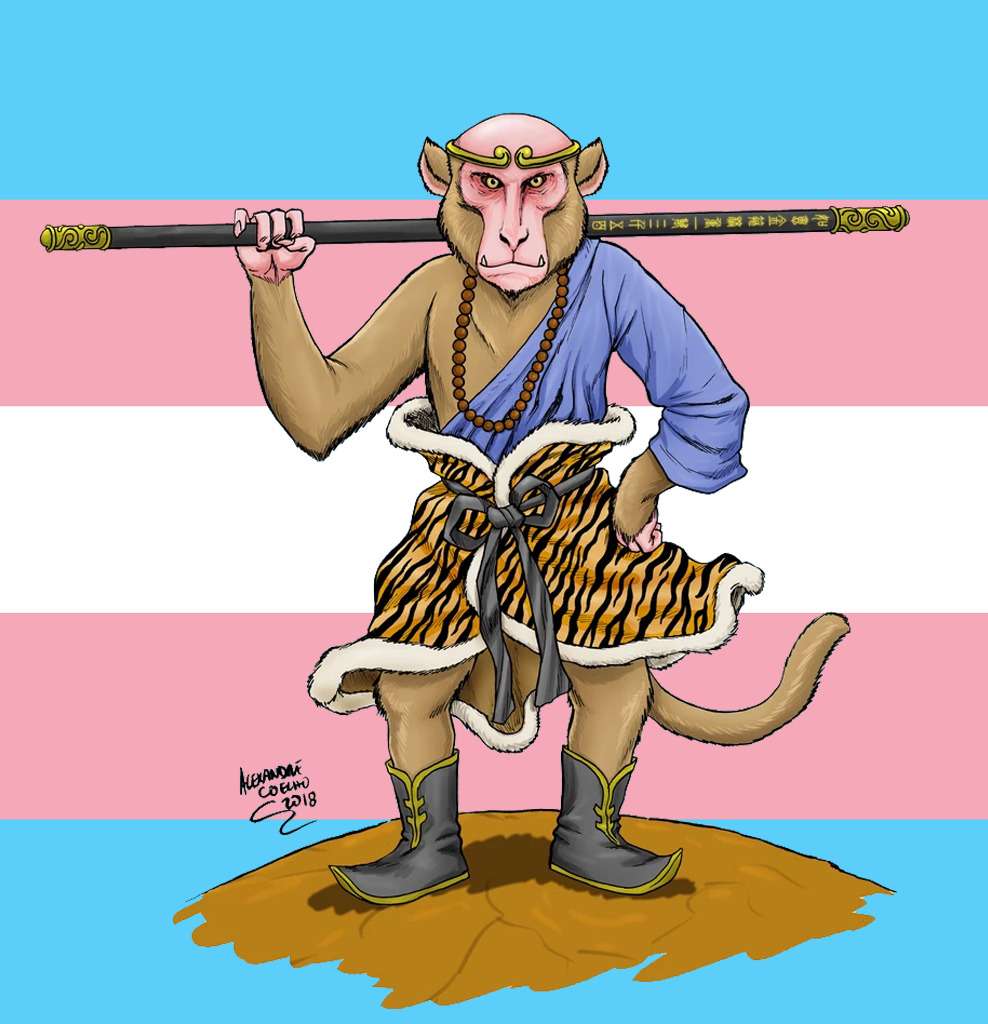
The notion that Sun Wukong (孫悟空) is transgender (fig. 1) became popular on English-speaking social media sometime around 2022. The central idea appears to be that the Monkey King, or I should say “Monkey Queen,” was originally born a woman but magically changes to a trans-man sometime after learning the art of transformation. Whether this is true or not has two possible answers:

1) If you or a loved one are trans, identify with Monkey’s ability to transform his body, and choose to personally interpret the character or portions of his story as an allegory for transness, then yes Sun Wukong is trans. 

2) Historically and canonically speaking? No.

In this article, I will present common arguments (A) in favor of a trans Monkey King that I’ve seen on social media. I will also introduce counterarguments (CA) supported by historical oral, published, and pictorial evidence that calls any claims of canonical proof into question. If I don’t have a particular counterargument in mind, I will simply post a comment (C).

Before continuing, I want to expressly state that this piece was written for two kinds of people: 1) Those who might openly claim that Sun Wukong is canonically trans; and 2) Those who don’t know enough about the character’s history or Journey to the West (Xiyouji西遊記; “JTTW” hereafter) in general and might be swayed by seemingly knowledgeable online comments. It does not pertain to those who already personally interpret Monkey as trans and/or don’t care about canon because they were first exposed to him via movies, TV shows, video games, comic books, etc.

General readers will certainly find this article interesting as it features a lot of lesser-known historical information about the simian immortal.

Fig. 1 – An accurate Sun Wukong standing in front of the trans flag (larger version). The base drawing is by my friend Alexandre Palheta Coelho (instagram and deviantart). It was originally posted on this article.

1. An Important Statement

If someone claims that the Monkey King appearing in the 1592 edition of JTTW is canonically female-to-male (FTM) trans, or they state the novel hints that he is without openly admitting that this is their own personal interpretation, that person, whether they realize it or not, is not telling you the whole truth. I don’t think they are doing this maliciously, though. It’s perfectly natural for people to want to see some of themselves in their favorite heroes. After all, who wouldn’t want to be an immortal rage wizard who can fly around the cosmos, transform into anything, lift mountains, and beat up gods and devils? I can see how it might be attractive to a trans youth to have the power to push back against authorities that wrongly vilify and strip them of their human rights. Therefore, in that sense, I think I understand why the idea of a trans Sun Wukong is so popular. But having said that, I should highlight that anyone who goes beyond an allegorical reading of the novel by touting the reality of Monkey’s transness is either unaware of the character’s historical development or is willfully ignoring it.

2. Arguments and Counterarguments

2.1. Gender Neutral Terms 

A: Ta (他; commonly “him”) and wang (王, commonly “king”) [1] are historically “gender neutral terms” and therefore can be used to refer to Sun Wukong as a woman.

C: These are indeed gender neutral terms in dynastic material. Here are two examples from the 1592 JTTW: 1) Wang (王) appears in the royal title of the “Queen Mother” (Wangmu niangniang, 王母娘娘), the high-ranking Daoist goddess who owns the immortal peach groves; and 2) Ta (他) is used to refer to the female Bodhisattva Guanyin (觀音). Part of a descriptive poem in chapter eight reads: “She is the merciful lord of the Potalaka Mountain” (Ta shi Luojiashan shang Cibei zhu, 是落伽山上慈悲主) (Wu & Yu, 2012, vol. 1, p. 206).

However, the gender neutral status of these terms do not by themselves constitute evidence that the Monkey King is a woman.

2.2. Matriarchal Primate Society

A: Real world monkey troupes are matriarchal, so it would make more sense for Sun Wukong to be a woman.

CA: Real world biological concepts don’t mesh well with religious mythology. For example, Monkey is born from stone, and he later attains his authority through a test of bravery by jumping through a waterfall. So where does the primate matriarchy fit into this? Also, in chapter 11 of the 13th-century oral version of JTTW (see here and here), Sun’s antecedent, the “Monkey Pilgrim” (Hou xingzhe, 猴行者), explains that, prior to becoming the primate monarch, he had been exiled to the Mountain of Flowers and Fruit in the distant past for stealing immortal peaches from the Queen Mother’s heavenly garden (Wivell, 1994, p. 1195). It’s important to note that the tale presents him as a supremely ancient immortal, one who has seen the Yellow River dry up nine times (Wivell, 1994, pp. 1182-1183). Therefore, it’s not a stretch to suggest that his position as the Monkey King is related to his divinity. So I ask again: Where does the primate matriarchy fit into this?

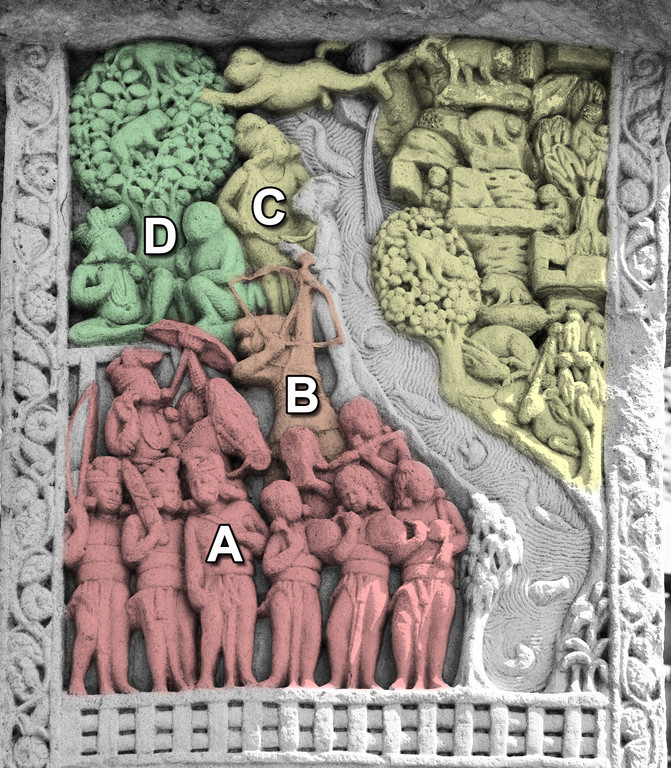
Most importantly, mythic stories about male monkey monarchs do exist. Two such characters are Vali/Bali (Sk: वाली) and Sugrīva (Sk: सुग्रीव) from the Hindu epic Rāmāyaṇa (Sk: रामायणम्, c. 5th-century BCE). Another is the Mahākapi (Sk: महाकपि; lit: “Great Monkey,” c. 2nd-century BCE), an Indian Buddhist jataka tale about the Buddha’s past life as a king of monkeys. One 2,000-year-old carving even depicts him with testicles (fig. 2). These few examples alone challenge the idea that monkey troupes have to be matriarchal in a mythic setting.

In fact, I suggest in this article that the Mahākapi tale influenced the 13th-century oral JTTW in several ways: 1) The Great Monkey is described as the chief of his tribe, and one 3rd-century Chinese version of the story even refers to him as the “Monkey King” (Mihou wang, 獼猴王). This is a likely source for the Monkey Pilgrim’s position as the primate monarch; 2) The Great Monkey leads 80,000 monkeys. The 3rd-century Chinese version changes this number to 500 (wubai, 五百), while the later Monkey Pilgrim leads 84,000 (bawan siqian, 八萬四千). But all three numbers are used in Buddhism to refer to large numbers of things. In the case of the respective Indian and Chinese versions, the 80,000/500 monkeys are said to be the past lives of Buddhist monks. But most importantly, the Chinese term for 80,000 (bawan, 八萬) is considered shorthand for 84,000 (bawan siqian, 八萬四千), showing a possible connection between the numbers of monkeys in the Indian original and the 13th-century oral JTTW; 3) The Great Monkey and his tribe live in or around a mountainous, fruit-bearing tree. This could be one of several sources for the Mountain of Flowers and Fruit (see note #4 below for another); and 4) The 3rd-century Chinese version sees the Great Monkey steal from the imperial fruit garden of a human monarch. This could be one of several sources for the Monkey Pilgrim stealing immortal peaches from the Queen Mother’s heavenly garden.

(On a related note, see this article for the many parallels shared between the 1592 Sun Wukong and the historical Buddha.)

Fig. 2 – The “Great Monkey” carving from the western torana at Sanchi (c. 1st-century BCE/CE) (larger version). He is the uppermost yellow figure reaching for the green tree. Take note of his testicles. The colored and labeled elements are used in my article to describe this “continuous narrative” scene.

2.3. Feminine Title

A: Sun Wukong calls himself the “Handsome Monkey King” (Meihou wang, 美猴王), but the character for handsome, “mei (美),” traditionally means “beautiful.” Therefore, it would make more sense for Monkey to call themself beautiful if they were a woman.

CA: I think that there is a much better explanation. Recall that the 1592 JTTW depicts our hero as an ugly creature. For instance, part of a descriptive poem in chapter 44 reads:

A bumpy brow, and golden eyes flashing;
A round head and a hairy face jowl-less;
Gaping teeth, pointed mouth, a character most sly;
He looks more strange than thunder god
[…] (Wu & Yu, 2012, vol. 2, p. 276).

磕額金睛晃亮,圓頭毛臉無腮。咨牙尖嘴性情乖。貌比雷公古怪。

In fact, Sun’s association with being ugly goes back centuries. For example, writing in the 1250s, the Song-era poet Liu Kezhuang (劉克莊, 1187-1269) used Monkey as a metaphor to describe his own failing appearance:

A back bent like a water-buffalo in the Zi stream,
Hair as white as the silk thread issued by the “ice silkworms”,
A face even uglier than Hou xingzhe [“Monkey Pilgrim”] (emphasis added),
Verse more scanty than even He Heshi (Dudbridge, 1970, p. 46).

背傴水牛泅磵髪白氷蠶吐絲貌醜似猴行者詩痩於鶴何師

Therefore, the primate monarch definitely is not “handsome” or “beautiful.”

I suggest instead that Sun refers to himself as mei (美) because of his egotistical personality. He is after all an allegory for the Monkey Mind. This same overinflated sense of self eventually leads him to challenge the primacy of the Jade Emperor (Yuhuang dadi, 玉皇大帝). Monkey’s self-conceit is best illustrated by the rebellious poem that he recites to the Buddha in chapter seven. The latter part reads:

[…]
In Divine Mists Hall none should long reside,
For king may follow king in the reign of man.
If might is honor, let them yield to me.
He only is hero who dares to fight and win!”(Wu & Yu, 2012, vol. 1, p. 193).

[…]
靈霄寶殿非他久,歷代人王有分傳。
強者為尊該讓我,英雄只此敢爭先。

See the 08-09-2023 and 09-27-23 updates below for another reason why he might have been called Meihou wang (美猴王).

2.4. Etymology of Surname

A: In chapter one, the Patriarch Subodhi (Puti zushi, 菩提祖師) relies on Monkey’s appearance to derive a surname for them. Some of the etymology mentions feminine concepts, adding support to the idea that Sun Wukong was originally a woman:

The Patriarch laughed and said, “Though your features are not the most attractive, you do resemble a pignolia-eating monkey (husun [猢猻]). This gives me the idea of taking a surname for you from your appearance. I intended to call you by the name Hu [猢]. If I drop the animal radical [犭] from this word, what’s left is a compound made up of the two characters, gu [古] and yue [月]. Gu means aged and yue [“moon”] denotes feminine yin energy [陰], but aged yin cannot reproduce (emphasis added). Therefore, it is better to give you the surname of Sun [猻]. If I drop the animal radical from this word, what we have left is the compound of zi [子] and xi [系]. Zi means a boy and xi means a baby, and that name exactly accords with the fundamental Doctrine of the Baby Boy. So your surname will be ‘Sun’” (Wu & Yu, 2012, vol. 1, p. 115).

祖師笑道:「你身軀雖是鄙陋,卻像個食松果的猢猻。我與你就身上取個姓氏,意思教你姓『猢』。猢字去了個獸傍,乃是個古月。古者,老也;月者,陰也。老陰不能化育,教你姓『猻』倒好。猻字去了獸傍,乃是個子系。子者,兒男也;系者,嬰細也,正合嬰兒之本論。教你姓『孫』罷。」

CA: Our hero’s association with the surname Sun predates the 1592 JTTW by centuries, appearing as early as an early-Ming JTTW zaju play. Therefore, Subodhi’s etymological breakdown is just an excuse to change husun (猢猻), one of the historical terms for the macaque, into Sun. It’s also an excuse to tie the surname to historical Daoist longevity practices.

Also, Sun (孫) has been used since at least the Tang Dynasty (618-907) as a surname for monkeys associated with Buddhist monks. According to the Tang poet Li Shen (李紳, d. 846):

There are many monkeys in the [Lingyin and Tianzhu] monasteries. They are called the Sun group (or the group of Sun, “Sun tuan” [孫團]). They have been reared there for a long time (Shahar, 1992, pp. 202-203).

2.5. Stable Monkeys

A: It was a common historical practice to place female monkeys in horse stables because their menstruation was believed to ward off equine sickness (see my past article for a source). Hence, Sun’s time as the heavenly stable master supports the idea that they were originally a woman.

CA: Just because something influenced a character in a story doesn’t mean that thing and all of its traits become the character. That’s like saying Son Goku is Superman just because Dragon Ball Z-era Akira Toriyama borrowed the “alien sent to earth” element from the Man of Steel’s mythos. But that isn’t the case since each character and their respective stories have definable differences. And it’s the same for the female stable monkeys and Sun Wukong.

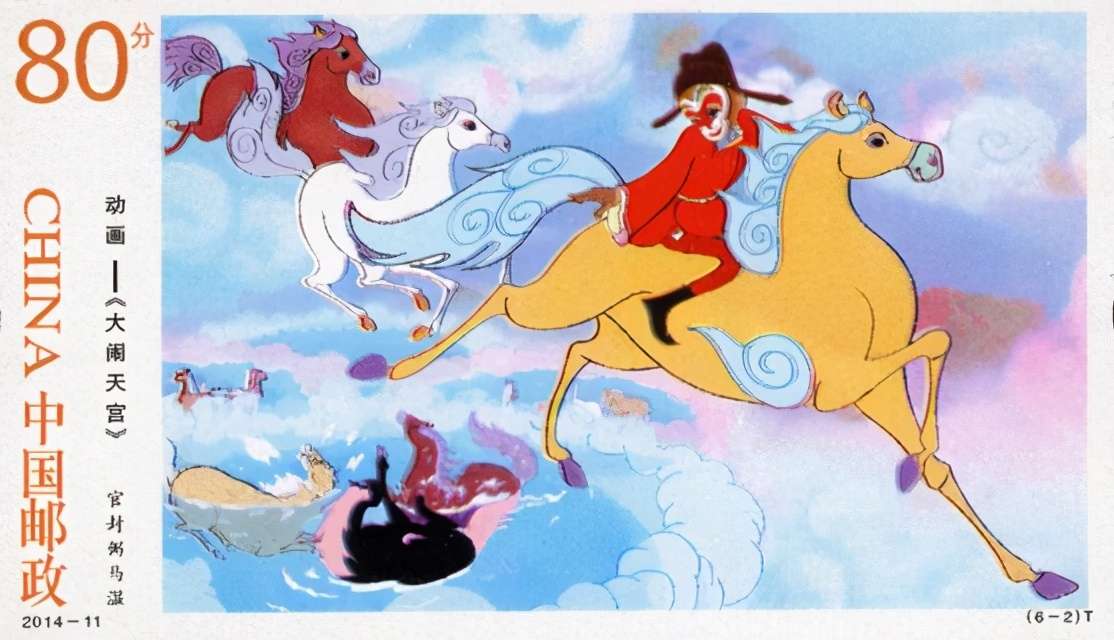
After becoming the Bimawen (弼馬溫) (fig. 3), Sun dotingly cares for nearly 1,000 horses day and night, making sure that they are all well-fed, exercised, and rested. At no point does the 1592 JTTW even hint that their health is in any way tied to menstruation. But having said that, I suggest the reason that Monkey gets so upset when people call him Bimawen, what Yu (Wu & Yu, 2012) translates as “BanHorsePlague” (vol. 1, p. 354), is because it references the homophonous term for the historical practice, Bimawen (避馬瘟, lit: “avoid the horse plague”). Surprisingly, the latter phrase does not appear in the novel.

Fig. 3 – A 2014 stamp featuring a scene from the classic 1960s animation Havoc in Heaven in which Sun Wukong serves as the Bimawen (larger version). Image found here.

3. Final Counterarguments

3.1. Historical Male Depictions

I don’t know of any historical oral, published, or pictorial sources that portray or describe Sun as a woman in their regular form. To my knowledge, he has always been depicted as a man.

I won’t pretend to know the full extent of our hero’s history, but I always strive to learn more about the subject. Just look at the following as a brief survey.

3.1A. Art

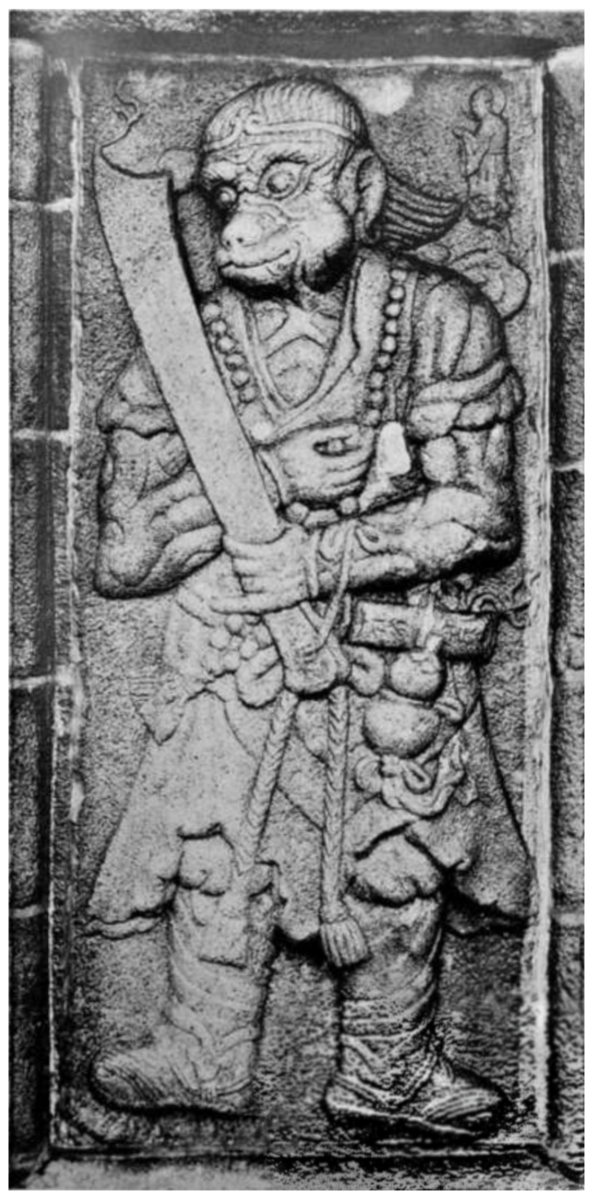
The earliest art depicting the aforementioned Monkey Pilgrim shows him as either a simian cleric or soldier accompanying the monk Tripitaka. But I think the best example to present for this discussion is the 13th-century Kaiyuan Temple stone pagoda carving (fig. 4), which portrays him as a muscular, sword-wielding protector deity.

Fig. 4 – The Kaiyuan Temple stone pagoda carving of the Monkey Pilgrim (1237) (larger version).

3.1B. Oral literature

The Story of How Tripitaka of the Great Tang Procures the Scriptures (Da Tang Sanzang qujing shihua, 大唐三藏取經詩話), the aforementioned 13th-century oral version of JTTW, first introduces the Monkey Pilgrim as a “scholar dressed in a white robe” (Baiyi xiucai, 白衣秀才) (Wivell, 1994, p. 1182). The word translated here as scholar, “xiucai (秀才; lit: “cultivated talent”), was “[f]rom antiquity a categorical rubric under which talented men were nominated to be considered for official appointments” (Hucker, 1985, p. 284). During the Song dynasty (960-1279), when this tale was first recorded, the xiucai was an informal term for candidates of the metropolitan-level exams (Hucker, 1985, p. 284). That is to say they were educated commoners who had yet to receive an official office. Dudbridge (1970) suggests that disguising oneself as a traveling, white-robed scholar would have then “conferr[ed] anonymity on the wearer” (p. 32). [2] This means that Monkey is likely using the disguise to walk among mortals without them realizing his divine nature.

Dudbridge (1970) also notes that this disguise was used by male characters in later published media (p. 32 n. 1). These examples instead use “xiushi” (秀士; lit: “cultivated scholar”). For instance, in chapter 81 of the Water Margin (Shuihu zhuan, 水滸傳, c. 1400), a literary version of Song Emperor Huizong (宋徽宗) dresses this way in order to meet in secret with his favorite sex worker: 

Accompanied by a young eunuch, the sovereign arrived through the secret tunnel at the rear door of the courtesan’s house. He was dressed in the white garb of a scholar (emphasis added) (Shi & Luo, 1993/2021b, p.1715).

只見道君皇帝引着一個小黃門,扮做白衣秀士,從地道中逕到李師師家後門來。(Shi & Luo, 1975/2021b, p. 1104)

This male disguise even carried over into the 1592 JTTW. For example, in chapter ten, the Dragon King of the Jing River (Jinghe Longwang, 涇河龍王) takes on such a form to investigate a fortune teller with dangerously accurate predictions that threaten the fish of his kingdom: 

[H]e abandoned his sword and dismissed the clouds and the rains. Reaching the river bank, he shook his body and changed into a white-robed scholar (emphasis added) (Wu & Yu, 2012, vol. 1, p. 239).

龍王 … 遂棄寶劍,也不興雲雨,出岸上,搖身一變,變作一個白衣秀士)

3.1C. Zaju play

The early-Ming Journey to the West zaju play (Xiyou ji zaju, 西遊記雜劇) contains many familiar episodes that would come to appear in the 1592 JTTW. [3] But despite these parallels, there are many interesting differences. For example, in act nine (of 24), Sun Wukong is said to be the brother of several divine siblings:

We are five brothers and sisters: my older sister is the Venerable Mother of Mount Li, my younger sister is the Holy Mother Wuzhiqi, my older brother is the Great Sage Equaling Heaven, I myself am the Great Sage Reaching Heaven (emphasis added), and my younger brother is the Third Son Shuashua (based on Dudbridge, 1970, p. 110).

小聖弟兄、姊妹五人,大姊驪山老母,二妹巫枝祗聖母,大兄齊天大聖,小聖通天大聖,三弟耍耍三郎。

(That’s right! The play refers to Monkey as the “Great Sage Reaching Heaven” instead of “… Equaling Heaven.”)

He also has a wife, a princess whom he had kidnapped from the “Country of the Golden Cauldron” (Jinding guo, 金鼎國) (Ning, 1986, pp. 63-66). This portion of the play draws directly from a genre of Han to Song-era tales in which magic apes kidnap young maidens in order to rape and impregnate them. [4]

The most apparent differences are the addition of bawdy elements like sex, cursing, and dirty jokes by the author, the 15th-century Mongol playwright Yang Jingxian (杨景賢). For instance, act 18 sees the pilgrims travel through the famous Woman Kingdom, where Sun, Zhu, and Sha all fall prey to temptations of the flesh. But whereas the latter two are successful in their sexual ventures, poor Monkey is struck by a bout of erectile dysfunction caused by the painful constricting of his headband:

Master, listen and I’ll tell you. There I was pinned down by a woman. My lustful nature was about to come forth, when suddenly the iron hoop on my head tightened, and the joints and bones up and down my whole body began to ache. The throbbing conjured up a bunch of vegetable names in my brain.

My head hurt so my hair stood up like radish-tops, my face turned as green as smartweed sprouts, my sweat beaded up like the moisture on an eggplant soaked in sauce, and my cock fell as limp as a salted cucumber (emphasis added). When she saw me looking for all the world like chives sizzling in hot oil, she came around, suppressed her itch and set me free (Ning, 1986, pp. 138-139).

聽行者告訴一遍:小行被一個婆娘按倒,凡心卻待起。不想頭上金箍兒緊將起來,渾身上下骨節疼痛,疼出幾般兒蔬菜名來:頭疼得髮蓬如韭菜,面色青似蓼牙,汗珠一似醬透的茄子,雞巴一似醃軟的黃瓜。他見我恰似燒蔥,恰甫能忍住了胡麻。他放了我

(Notice that ta (他) is used in the quote above to refer to the girl. Refer back to section 2.1 for a reminder of the significance.)

Later in act 19, Monkey attempts to seduce Princess Iron Fan (Tieshan gongzhu, 鐵扇公主) in order to gain access to her magic Banana leaf fan. Sun does this by reciting a poem in which he makes a veiled allusion to his penis being the right size for her vagina:

The disciple’s not too shallow,
the woman’s not too deep (emphasis added).
You and I, let’s each put forth an item,
and make a little demon
(Ning, 1986, p. 141).

弟子不淺,娘子不深。我與你大家各出一件,湊成一對妖精。

When this plan fails and the Princess threatens him with her sword, Sun angrily explains that the supernatural durability of his body and penis renders him impervious to physical harm:

Why this lowdown wench has no manners at all! I am the Lord of the Crimson Cloud Cavern, the Great Sage [Reaching Heaven]! I plundered Laozi’s gold Pill of Immortality, and have endured so many alchemical transformations that my muscles are brass, my bones iron, my eyes fire, my pupils gold, my asshole lead and my prick is pewter. Why should I fear a steel [sword] slicing off my pizzle? (emphasis added) (Ning, 1986, p. 142).

這賊賤人好無禮。我是紫雲羅洞主,通天大聖。我盜了老子金丹,煉得銅筋鐵骨,火眼金睛,金俞石屁眼,擺錫雞巴。我怕甚剛刀剁下我鳥來?

I want to highlight that this play did not influence the story cycle; it only reflects characters and episodes that were common to the cycle at that time. The bawdy elements were solely added to spice up the tale, making it more entertaining for zaju audiences. Therefore, this sex-crazed, dirty-mouthed version of the Monkey King should be considered a separate entity from his literary counterpart in the 1592 JTTW. However, I have included him here because the play clearly establishes that the character is a man.

3.1D. Other Published Literature

A Supplement to the Journey to the West (Xiyoubu, 西遊補, 1640) is an unofficial sequel to the 1592 JTTW with a trippy, time-jumping story that mentions Sun Wukong fathering children with a woman. The first reference to his offspring appears in chapter 13 when actors in a royal play describe an alternate timeline where our hero had settled down:

His wife is so beautiful, his five sons so dashing. He started out as a monk, but came to such a good end! Such a very good end! (Dong, Lin, & Schulz, 2000, p. 114).

你看他的夫人這等標致,五個兒子這等風華。當初也是個和尚出身,後來好結局,好結局!

Later, in chapter 15, Monkey meets one of these sons, King Pāramitā (Boluomi wang, 波羅蜜王), on the battlefield. This general recounts his family history to the stranger, revealing that, although he’s never met his father (jiafu, 家父), he’s the son of the Great Sage and the Rakshasi (Luocha nu, 羅剎女), Princess Iron Fan (Dong, Lin, & Schulz, 2000, pp. 123-124). In addition, he suggests that he was conceived during an event from chapter 59 of the original novel: 

[Sun Wukong] changed into a tiny insect and entered my mother’s belly. He stayed there a while and caused her no end of agony. When my mother could no longer bear the pain, she had no choice but to give the Banana-leaf Fan to my father, Monkey. [5] When my father, Monkey, got the Banana-leaf Fan, he cooled the inferno at Flaming Mountain and left. In the fifth month of the next year, my mother suddenly gave birth to me, King Pāramitā. Day by day I grew older and more intelligent. If you think about it, since my uncle [the Bull Demon King] and mother had never been together, and I was born after my father, Monkey, had been inside my mother’s belly, the fact that I am his direct descendant is beyond dispute (Dong, Lin, & Schulz, 2000, p. 124).

後來又變作小蟲兒鑽入家母腹中,住了半日,無限攪炒。當時家母認痛不過,只得將芭蕉扇遞與家父行者。家父行者得了芭蕉扇,扇涼了火焰山,竟自去了。到明年五月,家母忽然產下我蜜王。我一日長大一日,智慧越高。想將起來,家伯與家母從來不合,惟家父行者曾走到家母腹中一番,便生了我,其為家父行者之嫡系正派,不言而可知也。」

The novel doesn’t elaborate on how the other four sons are conceived. But in the case of Pāramitā, Sun’s presence in Iron Fan’s stomach acts as sperm fertilizing an egg.

Anyways, it should be evident from the examples presented above that the Monkey King was portrayed or described in his regular form as a man throughout the long course of his character development.

This by itself should put the idea of a canonically trans Sun Wukong to rest, but there is one more counterargument that I think is even stronger.

3.2. Spiritual Gender Transitions in Buddhism

Buddhist literature actually includes instances of girls or women transforming into men upon enlightenment or rebirth. [6] The former is best exemplified by the “Dragon Girl” (Longnu, 龍女) from chapter 12 of the Lotus Sutra (Miaofa lianhua jing, 妙法蓮華經; a.k.a. Fahua jing, 法華經, c. 3rd-century) (fig. 5), a work mentioned in the 1592 JTTW six times. She is first introduced to an assembly of Buddhist deities as the eight-year old daughter of the Dragon King Sāgara (Suojieluo longwang, 娑竭羅龍王) and one of an unfathomable number of dragonfolk enlightened by the Bodhisattva Mañjuśrī’s (Wenshu shili, 文殊師利) lessons on the Lotus Sutra. Her teacher describes her as a great student prodigy with a deep knowledge of Buddhist Law, as well as having many advanced spiritual achievements. But this upsets some among the assembly because the notion of a young girl approaching Buddhahood so quickly flies in the face of convention, which normally calls for untold aeons of severe austerities before one can achieve awakening. Her accomplishments are called into question at first, but everyone is appeased when she offers a priceless jewel to the Buddha, and he quickly accepts it as a symbolic gesture. Then:

The girl said [to the assembly], “Employ your supernatural powers and watch me attain Buddhahood. It will be even quicker than that!” 

At that time the members of the assembly all saw the dragon girl in the space of an instant change into a man (emphasis added) and carry out all the practices of a bodhisattva, immediately proceeding to the spotless World of the south, taking a seat on a jeweled lotus, and attaining impartial and correct enlightenment. With the thirty-two features and the eighty characteristics [of a Buddha], he expounded the wonderful Law for all living beings everywhere in the ten directions (Watson, 1993, p. 188). [7]

女言:「以汝神力,觀我成佛,復速於此。」

當時眾會,皆見龍女忽然之間變成男子,具菩薩行,即往南方無垢世界,坐寶蓮華,成等正覺,三十二相、八十種好,普為十方一切眾生演說妙法。

This kind of spiritual gender transition was certainly known to the host of historical oral storytellers and author-compilers who contributed to the formation of the novel due to their vast shared knowledge of Buddhist and Daoist religion and lore. This is especially true given that the Lotus Sutra is even touted in the 13th-century oral version of JTTW. [8]

Therefore, if the Sun Wukong from the 1592 JTTW was originally intended to be trans, they would have been OPENLY portrayed as such, without the need for subtle hints, due to scriptural precedent. And the fact that he wasn’t makes this what I consider to be the most damning argument against a canonically trans Sun Wukong.

Fig. 5 – A frontispiece to a Song-era edition of the Lotus Sutra (larger version). Image found here.

4. Final Thoughts

I hope that anyone unfamiliar with the Monkey King’s history can now make an informed judgement about online comments making claims about his gender.

And for those who still might want to go beyond an allegorical reading of the novel, you need to answer two questions:

  1. Why did the 1592 JTTW hint that Sun Wukong is FTM trans despite him being depicted as a man for centuries?
  2. Why were said hints used in place of scriptural examples of spiritual gender transition?

Answering these questions will require evidence, not an interpretation. I’m honestly not sure what that evidence would be since the evidence against it is so overwhelming. 

I would be willing to accept the “possibility” of a trans Sun Wukong, though, if anyone can find an analysis of the character by a pre-20th-century Chinese literary critic expounding the same view. Please do not misinterpret this as me saying that there were no trans people prior to the 20th-century. I’m sure there have been many throughout history, and I’m sure the terms applied to or used by them in the past were wildly different from the ones used today. But without some kind of historical support, the reality of a canonically trans Monkey King, beyond a personal interpretation, is nothing more than a wish. 


Update: 05-19-2023

It’s recently come to my attention that this article has upset some people, namely those who are aware of the Monkey King’s worship and those who disagree with the concept of transgender people. The first group needs to understand that, while a religious figure, Sun Wukong is far more widely known around the world as a literary figure. And since people primarily view him as a fictional character—one who is in the public domain, in fact—they are free to interpret the simian immortal however they see fit. This means that both the Monkey God and the literary Monkey King should be viewed as two separate entities.

For the second group, the trans identity is outside my area of research and personal experience. Therefore, I can’t really say anything about the subject that would affect your point of view. My advice would be to ignore political pundits and instead start a dialogue with someone in the trans community to understand their thoughts, feelings, and motivations.

I’ve also learned that my article has apparently been weaponized by some on discord in an attempt to invalidate the views of trans individuals who identify with Sun Wukong. I don’t like that my work is being used to harass people. I want to make it clear that this article was not written to attack the trans community. It was solely made to place Monkey in his correct historical context. My first concern as a student of JTTW is that the history of the novel and its characters are presented accurately. But I am fully aware that perceptions of popular characters can and do evolve over time. That’s why I mentioned in the opening that viewing Sun as trans is perfectly fine as long as it’s clear that this is a personal interpretation. Therefore, if you are a trans person and some troll presents my article as proof that your personal allegory is wrong, please have the confidence to tell them, “off you fuck.”


Update: 05-27-23

I found this lovely drawing of the Dragon Girl online (fig. 6). The image depicts her at the moment when she hands the Buddha the priceless jewel, just prior to transforming into a man.

Fig. 6 – A drawing of the Dragon Girl and the priceless jewel (larger version). Image found here.


Update: 08-09-23

It just occurred to me that another reason why Sun Wukong might be called Meihou wang (美猴王), or “Handsome or Beautiful Monkey King,” is because it’s a pun on mihou (獼猴), another word for macaque. The 1592 JTTW already includes a separate character named Mihou wang (獼猴王) in chapters three, four, and 41. And most importantly, even the Buddha’s past life as a king of monkeys is called Mihou wang (獼猴王). See the article below for more info.

A Brief Study of the Term Mihou (獼猴) in Journey to the West


Update: 09-27-23

It just dawned on me that Sun Wukong’s precursor, the Monkey Pilgrim” from the 13th-century JTTW, is also called Mihou wang (獼猴王). Chapter two refers to him as Huaguo shan ziyun dong bawan siqian tongtou tie’e Mihou wang (花果山紫雲洞八萬四千銅頭鐵額獼猴王, the “Bronze-Headed, Iron-Browed King of the Eighty-Four Thousand Monkeys of the Purple Cloud Grotto on the Mountain of Flowers and Fruits”) (Wivell, 1994, p. 1182).

This might lend support to the suggestion in my 08-09-23 update above.


Update: 01-03-2024

Apart from the Lotus Sutra, there is another way to make Sun Wukong a woman. The idea is a byproduct of my recent “How to Kill Sun Wukong” article. It details a ritual (from another famous vernacular novel) that secretly steals an immortal’s spirit, tethers it to a straw effigy, and then kills the target by shooting it with arrows. In that article, I introduced a story idea where Zhu Bajie and/or Sha Wujing could race to stop the ritual. But what if they failed and the Monkey King was killed?

The rite only terminates the immortal’s physical body. It doesn’t destroy the spirit. And since Wukong hasn’t yet achieved Buddha-Nature, meaning he is still subject to the wheel of rebirth, his spirit would report to the underworld for processing. He could definitely be transferred to a new reincarnation; however, considering the journey would still be ongoing, and the Tang Monk is always in trouble, heaven might rush to find our hero a new body. This actually happens to a minor character in the 1592 JTTW.

The ledgers of hell show that the deceased wife of a Tang official was fated to live a long life (i.e. she wasn’t supposed to be dead). Therefore, the underworld bureaucracy takes the timely passing of the Tang Emperor’s sister as an opportunity to force the soul of the official’s wife into the princess’ body. The best part is that she still retains her memories from her past life (Wu & Yu, 2012, vol. 1, pp. 268-269)!

Heaven might find the only suitable body that can contain Monkey’s soul is a recently deceased demoness (fox, yaksha, tree, etc.). [9] I imagine this would result in Sun Wukong being weaker, not because she’s now a woman, but because few beings can match Monkey’s original physical and magical might. This would naturally lead to her coming to terms with a loss of power. She could still be a very strong fighter, just not as strong as her past life. This might cause her to use more cunning when dealing with especially powerful evils encountered along the journey.

The choice is yours if you want to keep her a woman or have her become a male Buddha, like the Dragon Girl.


Update: 03-27-25

Another thing to point out is that Monkey’s physical body only changes when he turns into animals. When he mimics a humanoid figure, only his face changes, not his body. This is revealed when Sun is captured in chapter 75:

“Elder Brother,” said the third fiend,” didn’t you see him? He [Wukong disguised as a small demon] was giggling just now with his face half turned, and I saw for a moment a thunder god beak on him. When I grabbed him, he changed back immediately into his present looks.” He then called out: “Little ones, bring me some ropes.” The captains took out ropes immediately. Wrestling Pilgrim to the ground, the third fiend had him hog-tied before they hitched up his clothes to examine him. It became apparent at once that he was the BanHorsePlague all right! Pilgrim, you see, was capable of seventy-two kinds of transformation. If it was a matter of changing into a fowl, a beast, a plant, a utensil, or an insect, his entire body could be transformed. But when he had to change into another person, only his face but not his body could be transformed (emphasis added). When they lifted up his clothes, therefore, they saw a body full of brown fur, two red buttocks, and a tail (Wu & Yu, 2012, vol. 3, p. 367).

三怪道:「哥哥,你不曾看見他?他才子閃著身笑了一聲,我見他就露出個雷公嘴來。見我扯住時,他又變作個這等模樣。」叫:「小的們,拿繩來。」眾頭目即取繩索。

三怪把行者扳翻倒,四馬攢蹄綑住。揭起衣裳看時,足足是個弼馬溫。原來行者有七十二般變化,若是變飛禽、走獸、花木、器皿、昆蟲之類,卻就連身子滾去了;但變人物,卻只是頭臉變了,身子變不過來。果然一身黃毛,兩塊紅股,一條尾巴。

Since his body does not change, this would imply that his sex does not change either.

Again, I’m not trying to anger anyone; I’m just presenting information from the novel to make sure that it is depicted accurately.

On that note, I was told by a friend that some young trans folk were/had been upset with this article. Please write me (see “contact” above) if something about this piece bothers you. I’d like to get your perspective.

Notes:

1) One of the suggested earliest meanings for wang (王) is “big man,” and it was used as a title by the tribal chieftains that would evolve into Chinese emperors (Qi, 1991). 

2) Yes, I am aware that Dudbridge (1970) also associates white robes with female demons (p. 32 n. 3). However, the Monkey Pilgrim is expressly associated with the white clothing of the historically male xiucai scholar candidates.

3) These similar episodes include the reincarnation of a heavenly being as Tripitaka, the murder of his father, Sun Wukong stealing immortal peaches from heaven and eventually being imprisoned under a mountain, his punishment with the restricting headband, the subjugation of Zhu Bajie (here and here) and Sha Wujing, the addition of a royal dragon-turned-white horse, the ordeal at Fire Mountain, the Country of Women, etc. This shows that the centuries-old story cycle was starting to become standardized by the 14th or 15th-century.

4) One example is “A Supplement to Jiang Zong’s Biography of a White Ape” (Bu Jiang Zong Baiyuan Zhuan, 補江總白猿傳, c. late-7th-century). In the story, a general’s young wife is kidnapped by a mysterious force, but he and his soldiers later find her living among a large harem of women in a mountain paradise. They tell the commander that their captor is a magic white ape who uses them night after night to fuel his Daoist sexual alchemy. The women also warn him and his men that they are no match for the beast’s great power, so the captives devise a plan that eventually leads to the primate’s death. In the end, the general learns that his wife is pregnant with the spirit’s child.

What’s interesting for the purposes of this blog is that the titular white ape shares many surprising parallels with the Sun Wukong from the 1592 JTTW. Both:

  • Are supernatural primates possessed of human speech. 
  • Are one thousand-year-old practitioners of longevity arts. 
  • Are masters of Daoist magic with the ability to fly and change their appearance. 
  • Are warriors capable of single-handedly defeating an army. 
  • Have a fondness for armed martial arts. 
  • Have an iron-hard, nigh-invulnerable body immune to most efforts to harm them. 
  • Have eyes that flash like lightning. 
  • Live in verdant mountain paradises (like the Mountain of Flowers and Fruit). 
  • Reside in caves with stone furniture (like the Water Curtain Cave). 

5) See Wu & Yu, 2012, vol. 3, p. 129.

6) An example of the latter appears in Chapter 23 of the Lotus Sutra. Women are promised a male rebirth in paradise for having heard and practiced the scripture (Watson, 1993, pp. 287-288).

7) For the Dragon Girl’s story, see Watson, 1993, pp. 187-189.

8) The Lotus Sutra, which contains the story of the Dragon Girl, is given prominence in the 13th-century oral JTTW. It is painted as an important scripture, one even hailed in heaven. Chapter three sees the monk Tripitaka (referred to here by his historical name Xuanzang) give a detailed lecture on the sacred text:

The arhats said: “We thank the Master for coming to the [heavenly] palace today. Does the master excel in explaining sutras?” Xuanzang replied: “If it is a sutra, I can explain it. If it is not, I do not.” “Can you explain the Lotus Sutra?” the arhat asked. Xuanzang replied: “That’s easy.” (emphasis added)

Thereupon the five hundred arhats, the [king of heaven] Mahabrahma Devaraja, and in all a company of over a thousand gathered to listen to the sutra. Xuanzang recited flawlessly without pausing for breath. Like pouring water from a vase, he clarified the obscurities of the text (emphasis added). Everyone praised his marvelous delivery (Wivell, 1994, p. 1184).

羅漢問曰:「今日謝師入宮。師善講經否?」玄奘曰:「是經講得,無經不講。」羅漢曰:「會講《法華經》否?」玄奘:「此是小事。」當時五百尊者、大梵王,一千餘人,咸集聽經。玄奘一氣講說,如瓶注水,大開玄妙。眾皆稱贊不可思議。

9) I even considered Princess Iron Fan as the receptacle. However, she is said to having a positive fate in the novel: “In the end she, too, attained the right fruit [i.e. Buddhist merit] and a lasting reputation in the sutras” (Wu & Yu, 2012, vol. 3, p. 163). I think choosing her would muddy our Lady’s accomplishments.

Sources:

Dong, Y., Lin, S. F., & Schulz, L. J. (2000). The Tower of Myriad Mirrors: A Supplement to Journey to the West. Ann Arbor: Center for Chinese Studies, The University of Michigan.

Dudbridge, G. (1970). The Hsi-yu chi: A Study of Antecedents to the Sixteenth-Century Chinese Novel. Cambridge: Cambridge University Press.

Hucker, C. O. (1985). A Dictionary of Official Titles in Imperial China. Taipei: SMC Publishing Inc.

Ning, C. Y. (1986). Comic Elements in the Xiyouji Zaju (UMI No. 8612591) [Doctoral Dissertation, University of Michigan]. ProQuest Dissertations and Theses Global.

Qi, W. (1991). An Inquiry into the Original Meaning of the Chinese Character for King (wang). Chinese Studies in History, 25(2), 3-16, DOI: 10.2753/CSH0009-463325023

Shahar, M. (1992). The Lingyin Si Monkey Disciples and The Origins of Sun Wukong. Harvard Journal of Asiatic Studies, 52(1), 193-224. https://doi.org/10.2307/2719331

Shi, N., & Luo, G. (2021a). Shuihu zhuan (shang, zhong, xia) [Tale of the Water Margin (Vols. 1-3)]. Beijing: Renmin wenxue chubanshe. (Original work published 1975)

Shi, N., & Luo, G. (2021b). Outlaws of the Marsh (Vols. 1-4) (S. Shapiro, Trans.). Beijing: Foreign Languages Press. (Original work published 1993)

Watson, B. (Trans.) (1993). The Lotus Sutra. New York: Columbia University Press.

Wivell, C.S. (1994). The Story of How the Monk Tripitaka of the Great Country of T’ang Brought Back the Sūtras. In V. Mair (Ed.), The Columbia Anthology of Traditional Chinese Literature (pp. 1181-1207). New York: Columbia University Press.

Wu, C., & Yu, A. C. (2012). The Journey to the West (Vols. 1-4) (Rev. ed.). Chicago, Illinois: University of Chicago Press.

Archive #39 – Journey to the West Adaptations

Last updated: 07-21-2025

The Journey to the West Research blog is proud to host an entry by our friend Monkey Ruler (Twitter and Tumblr). They have graciously written an essay on the global nature of Journey to the West adaptations, as well as provided a link to their ongoing project recording JTTW media (fig. 1). As of the publishing of this article, it includes a long list of almost 570 movies, 90 TV shows, and 160 video games! – Jim

Fig. 1 – Depictions of Sun Wukong from adaptations produced over 50 years apart: (left) Havoc in Heaven (Danao tiangong, 大鬧天宮, 1961) and (right) Monkey King: Hero is Back (Xiyouji zhi Dasheng guilai, 西遊記之大聖歸來, lit: “Journey to the West: Return of the Great Sage,” 2015) (larger version). Courtesy of Monkey Ruler.

I. Media adaptations

This started out as a collection of Xiyouji (西遊記; lit: “Journey to the West,” 1592) movies and TV shows for the sake of a Master’s class project; it was simple enough to look for Xiyouji media and start adding them to a collection datasheet. But even when the project was over, I kept finding more and more adaptations, even stumbling across others trying to show the magnitude of how much this novel has encompassed popular culture throughout the centuries. It has been told and re-told again and again in oral and published literature, plays, art, songs, poems, etc., and now on the big and small screens. Audiences are re-introduced to the image of Sun Wukong and his fellow pilgrims with every new media addition.

What really inspired me was the book Transforming Monkey: Adaptations and Representation of a Chinese Epic (2018) by Hongmei Sun, where she explained in depth the cultural impact that Sun Wukong (fig. 2) and Xiyouji has had on Chinese media, as well as how this loose set of franchises have come to represent Chinese culture as these shows and movies have become more globally accessible. Xiyouji is such an iconic cultural universe that it can be both heavily entertaining while still being so personal to audiences of any generation depending on how the artist/writer portrays their interpretation of these characters and their stories. 

There hasn’t been a lot written about how these interpretations influence modern Xiyouji adaptations despite how the story has greatly influenced popular culture.

Fig. 2 – The front cover of Transforming Monkey (2018) (larger version).

Xiyouji is such an influential story, one that will continue to grow more and more globally known throughout time because it is such an all-encompassing piece that can cover politics, identities, and allegories, while still being a very personal and interpersonal work that artists or writers can relate to. 

However, even with these layers of meaning and symbolism to be found, the story never loses the charming and entertaining aspects that can and have captured audiences. Despite being published over 430 years ago (with a history stretching back even further), Xiyouji is still able to relate to modern audiences through its allegories of oppression, rebellion, and self-identity. It has the capability to resonate with any generation depending on what artists or writers at the time wish to highlight or personally connect with themselves or their current world around them, using Xiyouji as a medium for their own struggles.

As Xiyouji starts to become more and more globally known, it is important to understand and resonate that this is still a Chinese story and how to address further adaptations with cross-nation gaps in both translation and cultural differences. There are media forms that are far more exploitative of the mythical journey, creating impractical scenarios of the narrative and thus changing the message of the story and characters completely. However, there needs to be an acknowledgment of what doesn’t work as Xiyouji adaptations due to the ever-changing zeitgeist in not only its home of origin but introducing it to a global sphere as it adds influence. 

In order to see what works for adaptations, there needs to be an acknowledgment of what is the core of the story and just why it remains popular, story-beat or character-wise. For example, Sun Wukong can be used as a great model for positive ambivalence in media, moving away from set limits of a single stereotype and rather being a constant motion of new ideas and new identities. Monkey has been changed from a mischievous monkey to a revolutionary hero to a post-modern rebel against authority throughout the years. But even throughout the constant changes and interpretations, people never lose sight of what the nature of Sun Wukong is: rebelliousness, variability, optimism, and persistence. 

Monkey is a transcending character as he is able to mediate contradictions within his own design, one being his gold-banded staff, a symbol of breaking barriers, and his golden filet (fig. 3), a symbol of limits. These two simple but prominent pieces of iconography immediately tell audiences who the character is supposed to be and what they are about.

Fig. 3 – A modern replica of Monkey’s golden filet or headband (larger version).

While it is entertaining and able to be enjoyed by younger audiences, Xiyouji still has a deeper meaning that can be interpreted and recognized into adulthood. This is one of the few stories that I imagine can be adapted again and again without the issue of overlap as there are so many ways people can personally connect with these characters. 

Having that any generation, anyone really can find enjoyment in this media, and perhaps even be inspired to read the novel itself.

II. Archive link

Please consult the tabs at the bottom of the spreadsheet linked below. They are listed as “Movie Information,” “Movie Links,” “Honorary Shows,” “Game Information,” “Game Pictures,” “Honorary Games,” and “Sources.” – Jim

https://docs.google.com/spreadsheets/d/1GsiCGzE1DZDy2Vpc85wiVXSyLWpxMbxj/edit?usp=sharing&ouid=112097376285754662736&rtpof=true&sd=true


Update: 07-21-25

Monkey Ruler has officially posted a website called “Journey to the West Media.” They continue to update the page with movies, tv shows, video games, and now comic books.

https://www.journeytothewestmedia.com/