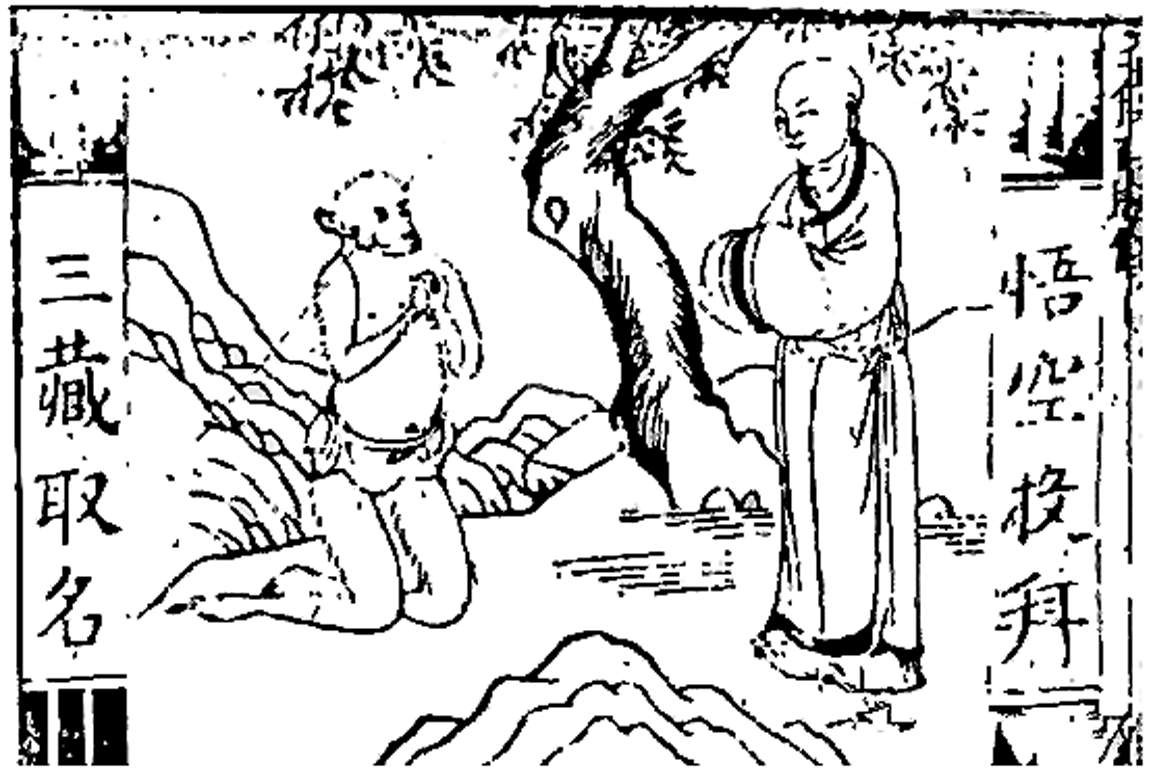
(Note: I originally wrote this in late 2020 but just now got around to cleaning it up and posting it.)
Last updated: 05-17-2022
Following his birth, the Stone Monkey (Shi hou, 石猴) comes to live with a tribe of primates on the Mountain of Flowers and Fruit. One day, the monkeys and apes decide to follow a stream to its source in the mountain and find a beautiful waterfall. They state anyone who can discover what is behind the blanket of water will be proclaimed their king. The Stone Monkey takes up this challenge by leaping through and discovers a grotto paradise with a stone mansion and enough room for all the primates to live. After he emerges victorious:
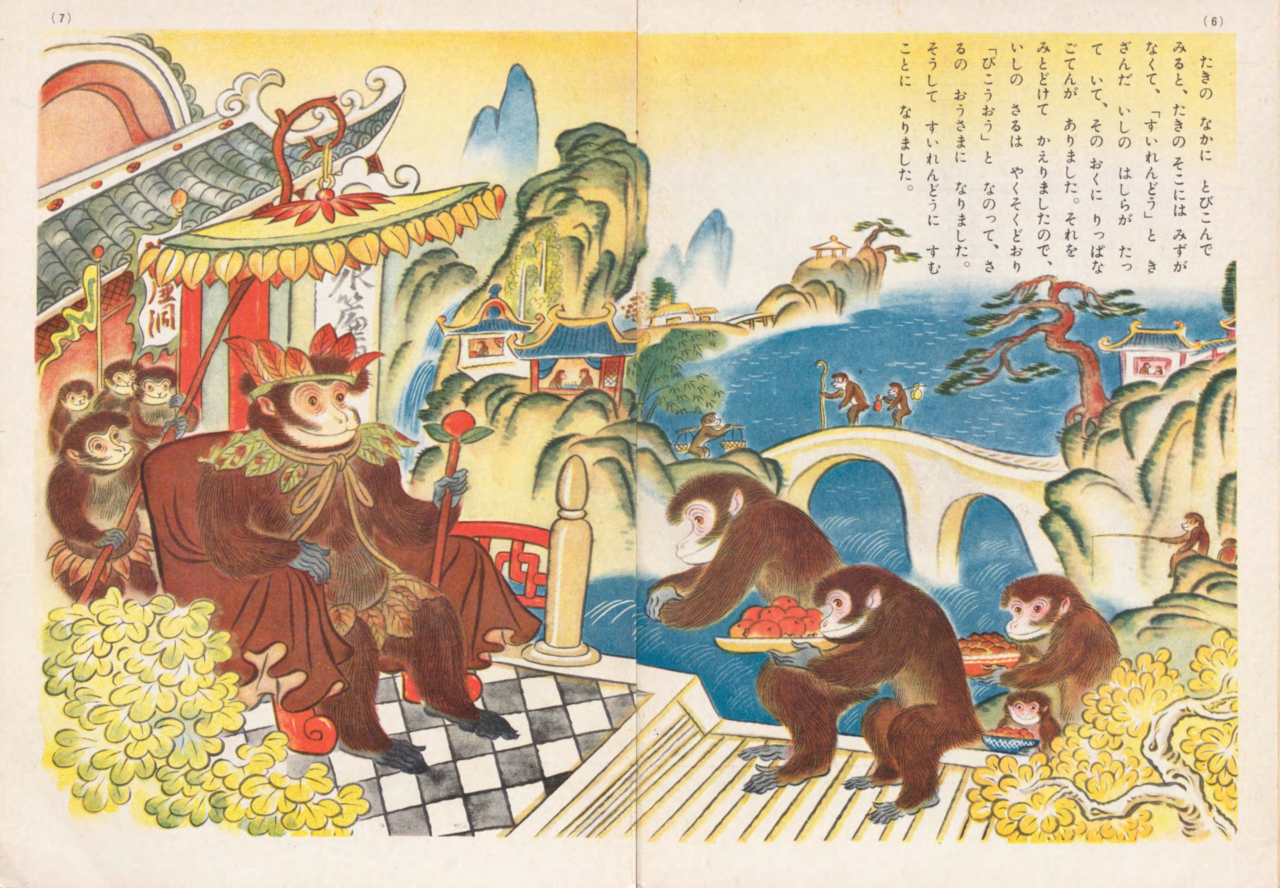
Each one of them [the primates] then lined up according to rank and age, and, bowing reverently, they intoned, “Long live our great king!” From that moment, the stone monkey ascended the throne of kingship [fig. 5]. He did away with the word “stone” in his name and assumed the title, Handsome Monkey King [Mei hou wang, 美猴王] [fig. 1] (Wu & Yu, 2012, p. 105).
In this article, I suggest Sun Wukong’s position as a primate monarch is based on “The Story of the Great Monkey” (Sk: Mahakapi jataka; Ch: Houwang bensheng, 猴王本生, “Birth Story of the Monkey King”; “The Great Monkey” hereafter), an ancient story about the Buddha’s past life as a monkey king, which appears in various collections of moralistic birth tales (Sk: jakata; Ch: bensheng jing, 本生經) in Buddhist literature. After summarizing the tale, I will briefly discuss 2,000-year-old Indian Buddhist art depicting the story at important religious sites, thereby showing its intense popularity. Next, I will demonstrate that the tale traveled the Silk Road to China, where it was represented in Buddhist art and literature. Finally, I will highlight similarities between “The Great Monkey” and a 13th-century precursor of Journey to the West, as well as similarities with the standard 1592 edition of the novel.

Fig. 5 – The Stone Monkey sits on his throne (larger version). From the Japanese children’s book Son Goku (1939).
1. Story of the Great Monkey
Buddhist literature contains different versions of the tale. I will describe two of them here. The first is story no. 27 in the Garland of Birth Stories (Sk: Jatakamala, 4th-century) by the monk Arya Sura. [1] The tale opens with the following epigraph: “Those who make a practice of good behavior can win over the hearts even of their enemies” (Khoroche, 1989, p. 186). According to the story, the bodhisattva was born a virtuous monkey king in the verdant paradise of the Himalayas, which abounded in fruits and flowers, crystal clear streams, and choirs of singing birds. He and his tribe lived near an unnamed river and ate from a mountainous banyan tree that produced figs larger than palmyra nuts. The monkey king feared that the fruit would cause trouble for his people, so he gave instructions to regularly clear them from a branch overlooking the river. However, one season a fig escaped the monkeys’ attention and it grew to maturation, dropping into the water, drifting downstream, and lodging in the fence of a pool where an unnamed human king played with his consorts. The smell and color of the fruit entranced the women, and after the king tasted it, he became obsessed with its flavor and led an army in search of the tree. The ruler and his entourage cut a path upstream and followed a sweet scent directly to the massive banyan, which rose high above all the surrounding trees like the lord of the forest. When he saw the monkeys eating figs, the enraged ruler ordered his men to shoot them down with arrows, spears, and rocks. Seeing the dire situation of his tribe, the monkey king made a tremendous leap to the summit of a nearby mountain, a feat that would have required any other monkey a series of jumps. On the mountain, he found a strong-rooted cane of the appropriate length needed to span the gap and tied it to his feet. But his return jump to the tree was hampered by the binding, and so he came up short, forcing him to grab a branch and use his body as a bridge so that his tribe could escape. But the monkey king was mortally wounded as throngs of the panicked primates clawed their way across his body to safety. The human king took note of this selfless deed and ordered his men to relieve the suspended monkey by placing a canopy beneath him and simultaneously shooting the branch and cane. After his wounds were tended and he regained consciousness, the monkey king spent the last few moments of his life teaching the human king the virtue of putting his people’s needs before his own (Khoroche, 1989, pp. 186-192).
The second is story no. 407 [2] in Commentary on the Birth Stories (Pali: Jatakatthakatha, a.k.a. Jatakatthavannana, 5th-century), which is attributed to the monk Buddhagosa. The narrative opens with the Enlightened One talking to a large assembly of monks in Jetavana. He tells them of a previous life when he helped his relatives. Here, the story is quite similar to the first, with slight differences in certain details, such as the monkey king leading a specified number of 80,000 primates, the river is the Ganges, the fruit is water pot-sized mangoes, the specimen that floats downstream is caught in a fisherman’s net, and the human ruler is named King Brahmadatta of Benares. [3] Instead of leaping to a nearby mountain, the monkey king jumps one hundred bow lengths across the Ganges. The cane is tied to his waste instead of his feet, and the cause of falling short on the return jump is not hindrance but miscalculating the length needed to span the gap. And instead of being seriously injured by his people during their escape, a rival of the king—a previous incarnation of the Buddha’s evil cousin Devadatta—mortally wounds his heart by jumping onto his back from a high branch. Brahmadatta instructs his men to build a tower so that he can retrieve the primate and tend to his wounds in his last few moments of life. And just like before, the monkey king teaches the human monarch the value of his people’s needs prior to dying. But this time the discussion is much shorter, being presented as a poem of seven stanzas. Brahmadatta then honors the monkey with funeral rites befitting a king and worships the skull as a religious relic. In the end, the Buddha reveals that the ruler was the past incarnation of his disciple Ananda, the 80,000 monkeys were incarnations of the assembled monks, and the monkey king was himself (Cowell, 1895, vol. 3, pp. 225-227).
2. The tale in Indian and Chinese Buddhist art
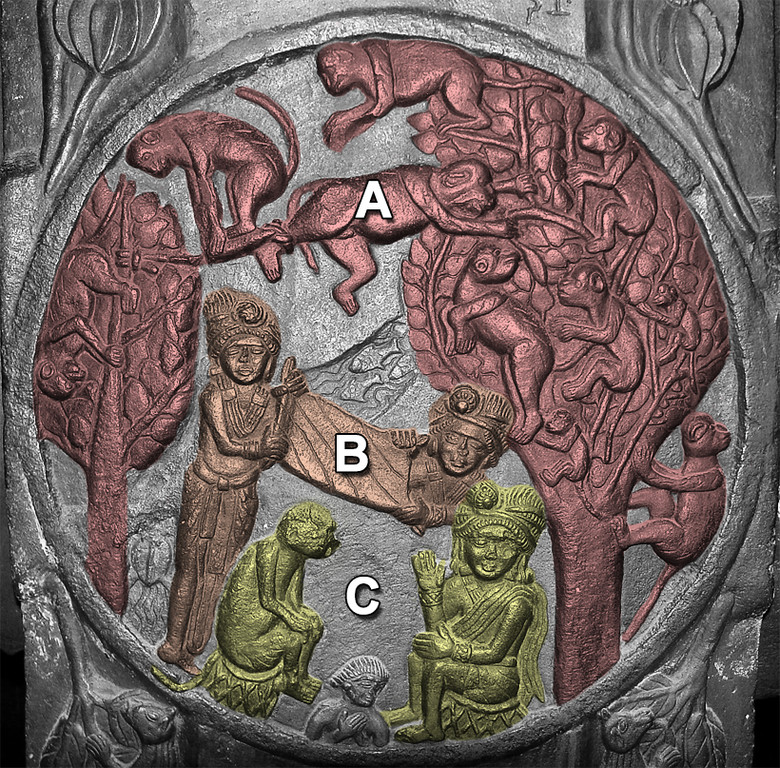
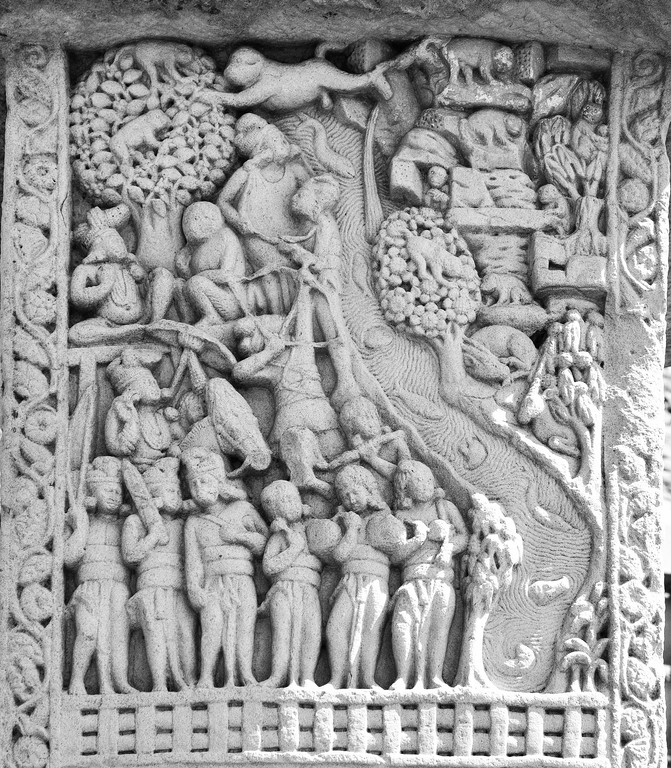
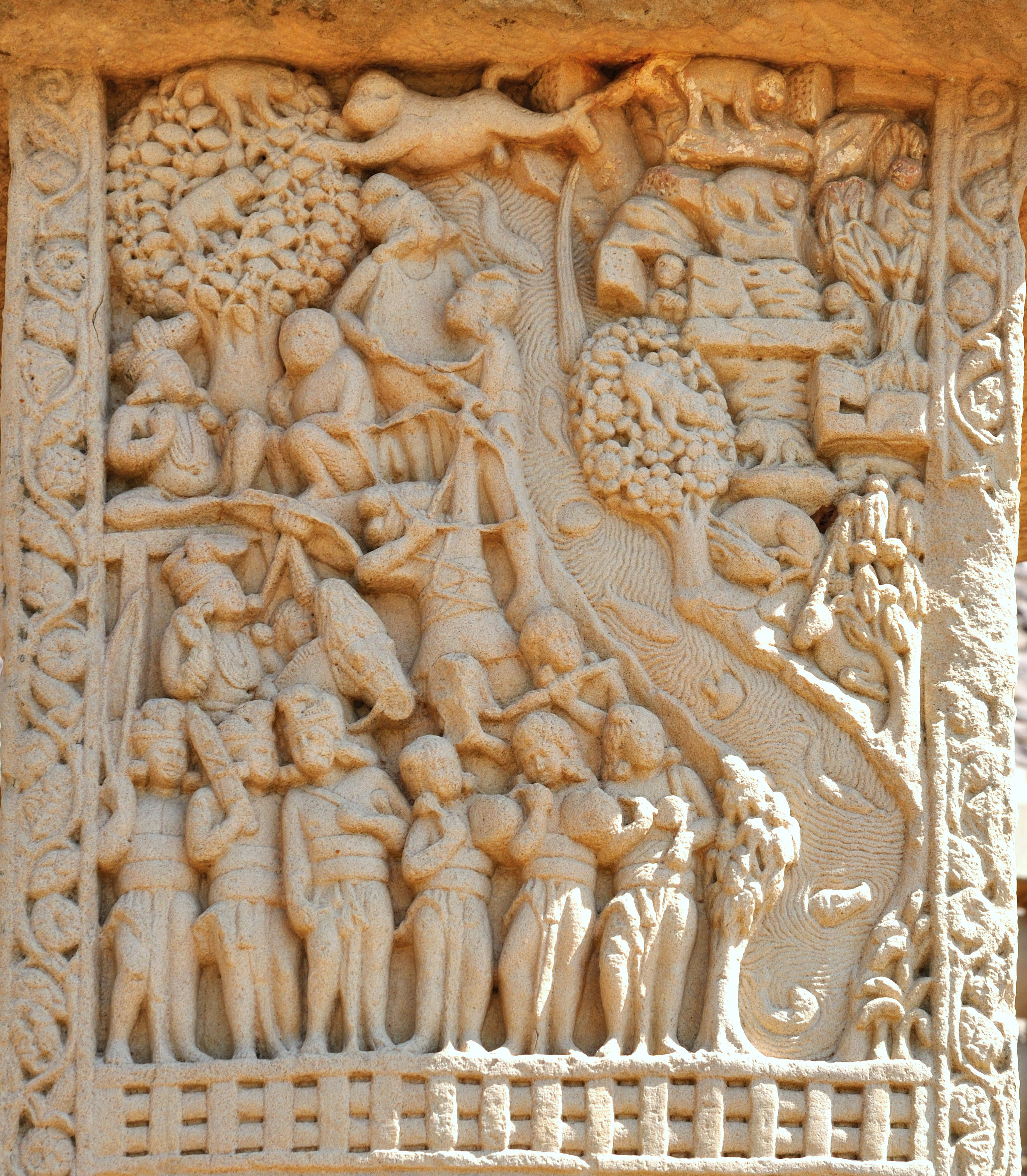
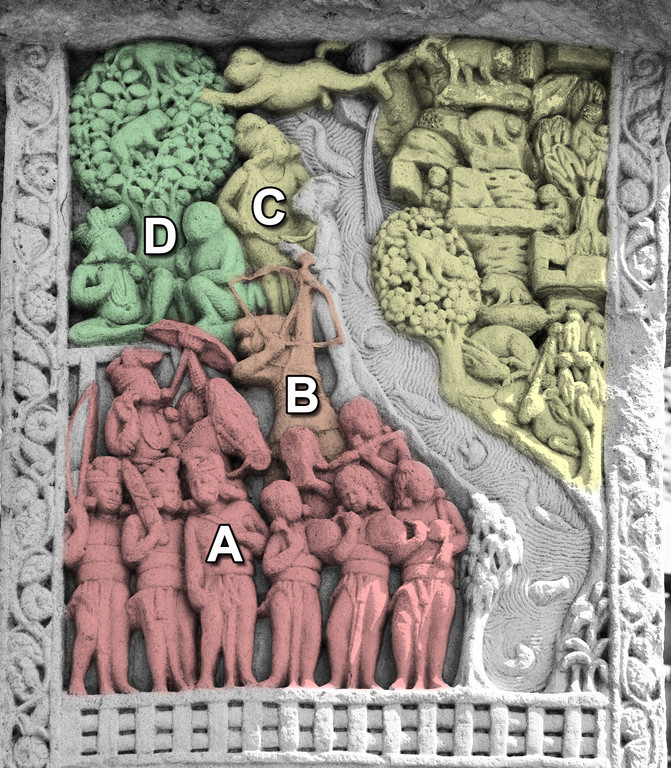
This birth story is over 2,000 years old as it appears among the stone carvings of the Bharhut Stupa (c. 2nd-century BCE) (fig. 2 and 3) and the western torana (c. 1st-century BCE/CE) of the Great Stupa at Sanchi (fig. 3 and 4) (Marshall, Foucher, Majumdar, 1902, vol. 1, pp. 224-225, vol. 2, plate 64). I should note that the story is one of 547 such tales appearing in the Pali canon (Buswell & Lopez, 2014, p. 381). So the fact that it was one of only a few past life narratives chosen to appear at these religious sites speaks volumes to its popularity. This explains why the story spread beyond India.

Fig. 2 – “The Great Monkey” medallion from Bharhut stupa (c. 2nd-century BCE) (larger version). Picture adapted from Wikipedia. Fig. 3 – Key: A) The monkey king leaps and grasps a banyan tree, making a bridge with his body; B) attendants hold a canopy to catch the injured monkey; and C) The human king sits with the monkey discussing the actions of a good ruler prior to the latter’s death (larger version). Fig. 4 – “The Great Monkey” carving from the western torana at Sanchi (c. 1st-century BCE/CE) (larger version). Picture adapted from Wikipedia. Fig. 5 – Key: A) Brahmadatta travels with a retinue to the tree; B) he orders his archer(s) to shoot the monkeys; C) He watches as the monkey king leaps across the Ganges and grasps a banyan tree to make a bridge with his body; and D) Brahmadatta’s discussion with the monkey king (larger version).
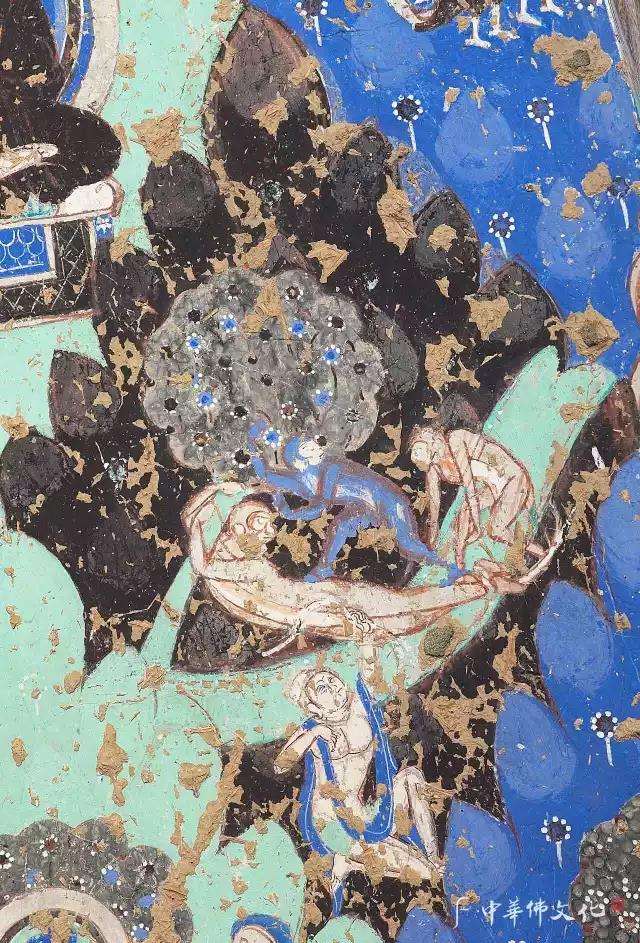
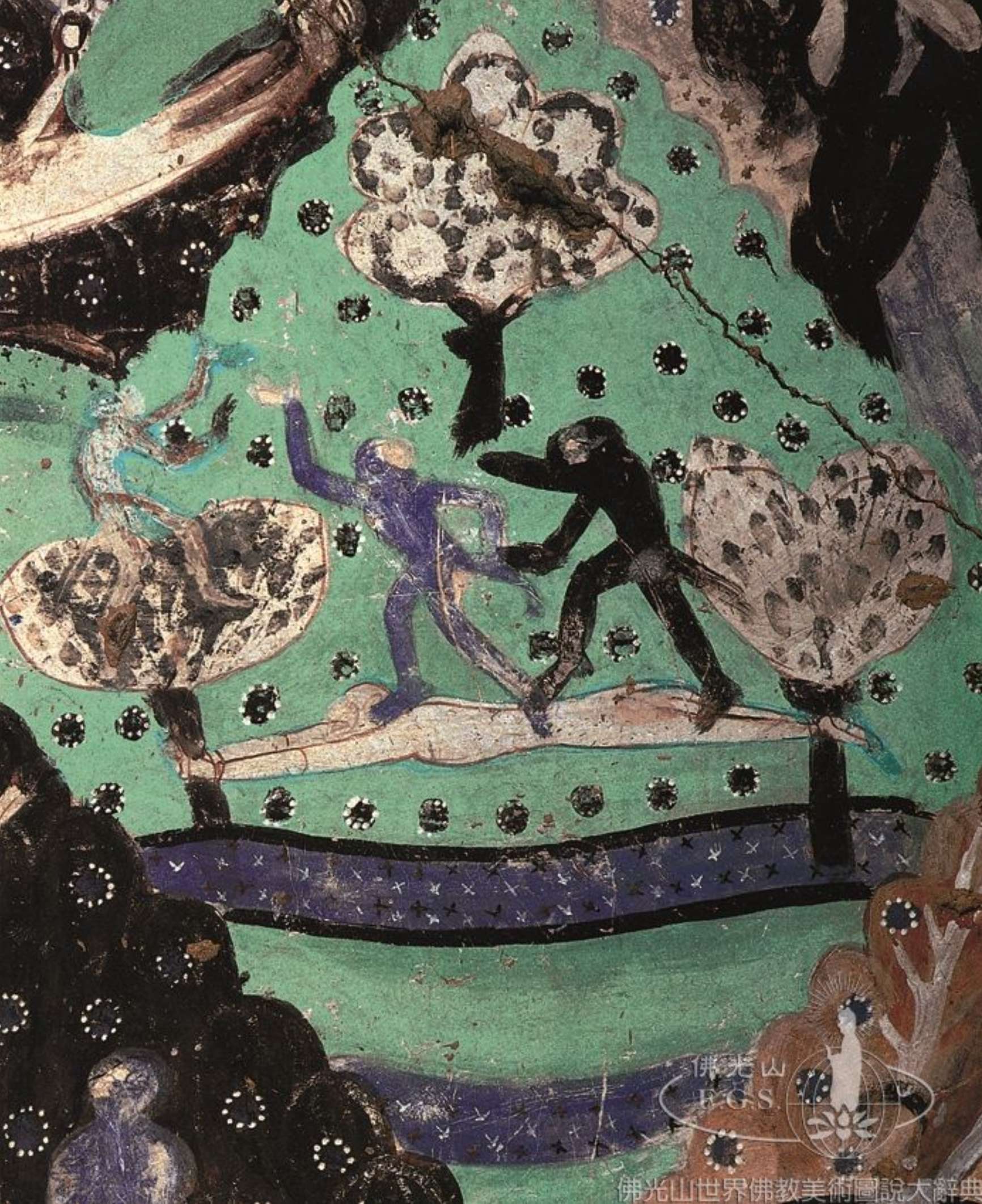
The tale is known to have traveled east to China along the northern silk road. This is demonstrated by murals appearing in the Kizil cave complex (5th to 7th-century), one of the earliest and most popular Buddhist centers in Kucha, in what is now Xinjiang, China. Zhu (2012) describes the murals, noting that they lack the detail of their Indian counterparts and are therefore more mnemonic than narrative:
[I]n Kizil Cave 38 [fig. 5], a very large monkey is depicted in the center, stretching his body and holding a tree on the other side of a river. Two other smaller monkeys are stepping on his body to cross the river. In the foreground, a kneeling archer is shooting at them. In Kizil Cave 17 [fig. 6] this story is represented even more simply, with the archer omitted. However the stretching monkey, the river, and the trees are enough for anyone who knows the story to recognize it […] Compared to the Indian representations that are more explicitly narrative, the Kizil paintings are more like a reminder of the story. They communicate with the viewers as if they already know the story well” (pp. 59-60).

Fig. 5 – The Kizil cave no. 38 mural (larger version). Found here. Fig. 6 – Kizil cave no. 17 mural (larger version). Found here. Both are circa 5th to 7th-century. Zhu, 2012, p. 61 includes black and white line drawings of the murals.
3. The tale in Chinese Buddhist literature
The Kizil murals are predated by a brief story appearing in The Collection of Sutras on the Six Paramitas (Liudu jijing, 六度集經, 3rd-century, The Collection hereafter), a compilation of karmic merit tales (Sk: avadana) translated into Chinese by the Sogdian Buddhist monk Kang Senghui (康僧會, d. 280). [4] The 56th story in this collection is an adaptation of the original Indian version with several noticeable differences: The Bodhisattva was formerly a monkey king (mihou wang, 獼猴王) who frolicked with 500 primates. At that time, a drought made the various kinds of fruit scarce. Only a river separated their mountain from a nearby kingdom, so the monkey king led his tribe to eat fruit in the royal garden. The human king ordered that they be secretly captured, but the monkey called for his tribe to gather cane to make a rope. One end was tied to a tree and the other to the king, who leaped from a branch across the river. Unfortunately, the rope wasn’t long enough, and so he came up short, forcing him to grab a branch on the other side and create a bridge with his body. After the 500 monkeys crossed to the other side, the king’s body split in two under the strain. When the human king came upon the scene, the dying primate begged that his tribe not be hurt and offered up his own flesh as payment for his bad judgment. However, the king admired the monkey’s superior, sage-like virtue and questioned his own willingness to sacrifice his body for his people. He then issued a proclamation that all monkeys were to be fed throughout the kingdom, and those who refused would be punished as thieves. Upon his return to the palace, the king recounted the events to his queen, touting the monkey’s kindness and comparing it to the height of Mt. Kunlun. She then suggested that the monkeys be fed and the king confirmed that he had already given the order. In the end, the Buddha revealed that the monkey king was himself, the human king was Ananda, and the 500 monkeys were the monks at the assembly (CBETA, 2016a). [5]
[Note: See the 05-17-22 update below for an explanation on why the number 500 was used.]
Instead of the original 80,000 monkeys, this version reduces the number to only 500. Instead of the king traveling to the banyan/mango tree in the monkey’s mountain territory, the monkeys travel from their home to the royal fruit garden in the king’s territory. Instead of being trampled by his people/a rival, the monkey king’s body breaks in two from the strain. And instead of giving the monkey royal funeral rights and worshiping his skull as a relic, the king enacts a law that all monkeys should be fed.
This version is different enough from the originals to suggest a separate Chinese tradition, one that had circulated for some time. This fits with Chavannes’ (1910) suggestion that The Collection of Sutras on the Six Paramitas is not an original Indian text but one compiled in China by Kang Senghui, who likely selected and edited the stories himself (vol. 1, p. 1 n. 1).
Story no. 56 finds parallels with another tale from Chinese Buddhist literature. [6] It appears in the Scripture on the Storehouse of Sundry Treasures (Za baozang jing, 雜寶藏經, mid-5th-century), which was translated into Chinese by the monk Tan Yao (曇曜). According to the 12th story in this collection: The Buddha was in Rajagrha when the monks commented on the woes faced by those who rely on Devadatta, while celebrating the happiness, positive rebirth, and eventual deliverance of those who rely on the Enlightened One. The Buddha confirmed this by telling a brief tale about two monkeys, each with 500 members in their tribe. A prince of Kashi (a.k.a. Benares) was on a hunting excursion when he surrounded the monkeys. The good monkey (shan mihou, 善獼猴) suggested that they cross the river to escape, but the evil monkey (e’mihou, 惡獼猴) wavered. The good monkey instructed his tribe to cross by using the long branches of a nearby tree. But the evil monkey and his tribe were captured due to inaction. In the end, the Buddha revealed that the good monkey was himself and Devadatta was the evil monkey. He used this story to advocate following the virtuous over the evil, for the former would lead others to safety and happiness, while the latter would lead others to suffering over numerous incarnations (CBETA, 2016b). [7]
This version does away with the fruit element altogether. The monkeys are in danger not because a king is protecting produce but because a prince is out hunting. The most noticeable difference here is the addition of a second monkey, one who is labeled as “evil” (e, 惡) (no connection to the Six-Eared Macaque). But like story no. 56, the monkey king is said to lead 500 primates.
It is clear that both Chinese tales were influenced by the later Indian version, story no. 407 from Commentary on the Birth Stories, as they specify a number for the troupe size (500 vs. 80,000), state the monkey king leaps over a river (as opposed to jumping to a nearby mountain top), and characters are revealed in the end to have been the past lives of Buddhist personages (the Buddha, Ananda, Devadatta, monks, etc.). Story no. 12 even opens in a city associated with the Enlightened One’s historical lectures (Rajagrha vs. Jetavana), where he discusses philosophical matters with monks; and an unnamed prince who poses a threat to the monkey king and his people is said to hail from Kashi, another name for Benares, the seat of King Brahmadatta.
4. The Chinese Monkey King
The oldest Chinese source mentioning Sun Wukong as a king of monkeys is The Story of How Tripitaka of the Great Tang Procures the Scriptures (Da Tang Sanzang qujing shihua, 大唐三藏取經詩話, late 13th-century, The Story hereafter), a 17 chapter storytelling prompt that predates the Ming Journey to the West by 300 years. In chapter two, our hero’s literary antecedent, a white-clad scholar called the “Monkey Pilgrim” (Hou xingzhe, 猴行者), meets the Tang monk Tripitaka on the road to the west and warns the monk that his two previous incarnations have died trying to procure the Buddhist scriptures. When asked how he knows events of the past, the scholar replies: “I am none other than the bronze-headed, iron-browed [8] king of the eighty-four thousand monkeys of the Purple Cloud Grotto on the Mountain of Flowers and Fruit. I have come to help the reverend monk procure the scriptures” (Wivell, 1994, p. 1182).
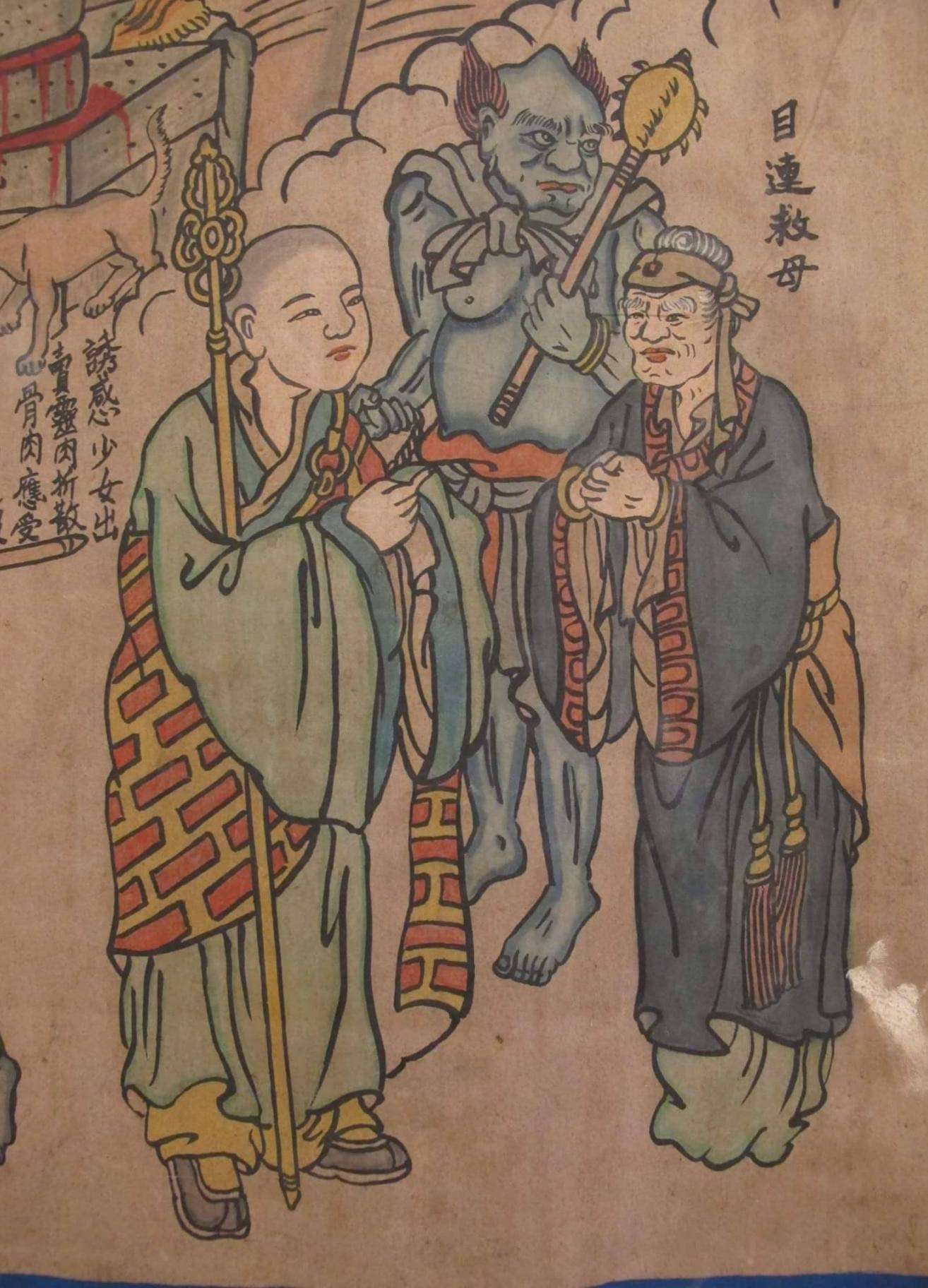
The Story‘s depiction of the Monkey Pilgrim was influenced by Saint Mulian (目連; Sk: Maudgalyayana) (fig. 7), a disciple of the Buddha, who appears in a late-9th to early-10th-century Bianwen (變文) text in which he travels to the underworld to release his mother from karmic torment. For example, both are depicted with occult powers enabling them to fly between heaven and earth (Wivell, 1994, pp. 1183; Mair, 1994, pp. 1097-1098); both visit a realm ruled by a deity named Brahma, the Mahabrahma devaraja Vaisravana in the case of Monkey and Brahma in the case of Mulian (Wivell, 1994, pp. 1183; Mair, 1994, p. 1098); both are bestowed magic weapons by heaven, a golden-ringed monk staff and alms bowl for Monkey and a matching staff for Mulian (he enchants his own alms bowl) (Wivell, 1994, p. 1184; Mair, 1994, p. 1111); the power of said weapons are tied to the recitation of a Buddhist deity’s name, Vaisravana and the Buddha, respectively (Wivell, 1994, p. 1184; Mair, 1994, p. 1111); and both use said weapons with the expressed purpose of saving someone important, Tripitaka and Mulian’s mother, respectively (Wivell, 1994, p. 1189, for example; Mair, 1994).

Fig. 7 – A painting depicting Mulian rescuing his mother from the underworld (larger version). Originally found here.
If The Story borrows from Mulian’s tale, it’s not a stretch to suggest that it also appropriated material from other Buddhist tales, including “The Great Monkey”. For example, the Mountain of Flowers and Fruit could be based on the Himalayas and the massive, fruit-bearing banyan/mango tree. Additionally, both The Story and the “The Great Monkey” describe the respective monkey kings leading a similar number of primates, 84,000 in the former and 80,000 in the latter. [9] While the Chinese variants drastically reduce the number to 500, it’s interesting that both tales would display such similar counts. This is because said numbers are significant to Buddhism. For example, 84,000 generally denotes a very large number, hence the belief that the body contains this many atoms. Other examples include the 84,000 stupas of Asoka, the 84,000 bodily relics of the Buddha, the Amitabha‘s 84,000 rays of illumination, the 84,000 bodily signs of a Buddha, the 84,000 teachings of the Buddha, etc. In addition, the Chinese term for 80,000 (bawan, 八萬) can be shorthand for 84,000. It can also refer to separate Buddhist concepts, such as the “bodhisattva’s 80,000 duties” (Soothill & Hodous, 1937/2006, p. 39). It’s certainly possible that both stories independently chose similar numbers due to their demonstrated connection to Buddhism. But maybe the storytellers who developed The Story had access to some non-Chinese version of the tale, perhaps by way of Buddhist monks, for Buddhism has a long history of proselytizing through oral literature. [10]
Furthermore, in chapter 11 of The Story, the pilgrims enter the earthly paradise of the Daoist goddess Queen Mother of the West, home to the famed peaches of immortality. Tripitaka asks Monkey to steal the group a few fruits, but the latter refuses, stating:
Because I stole ten peaches to eat when I was eight hundred years old, I was captured by the Queen Mother and given eight hundred blows on my left side and three thousand blows on the right with an iron cudgel. Then I was exiled to the Purple Cloud Grotto on the Mountain of Flowers and Fruits. Even today my sides hurt and now I definitely don’t dare to steal any more peaches!” (Wivell, 1994, p. 1195).
This event was surely influenced by the fabled meeting of Emperor Wu and the Queen mother, during which she reveals his jester Dongfang Shuo (東方朔), formerly the planet Jupiter (Sui, 歲), was exiled from heaven for stealing her peaches (Campany, 2009, p. 126). However, a monkey king running afoul of an earthbound monarch for raiding their imperial fruit garden mirrors story no. 56 in The Collection. As mentioned above, the tale recalls the Buddhist monkey king leading his tribe out of the mountains to eat fruit in a human sovereign’s garden during a time of drought. The ruler orders the primates captured, leading to the monkey king’s sacrifice. Therefore, this portion of The Story could be a combination of Buddhist and Daoist sources.
“The Great Monkey” could have also influenced the 1592 edition. In chapter one, the monkeys following the stream to find its source in the Mountain of Flowers and Fruit is reminiscent of the human king’s trek up the Ganges to find the source of the fruit in the Himalayas. Also, recall that the Indian and Chinese versions place great emphasis on the monkey king leaping over a river. For example, story no. 407 reads: “[H]e ascended a branch that rose up straight, went along another branch that stretched towards the Ganges, and springing from the end of it, he passed a hundred bow-lengths and lighted on a bush on the [other] bank” (Cowell, 1895, vol. 3, p. 226). This could have influenced the competition to leap through the waterfall. It’s interesting that Wukong alone is successful in the jump, leading to his kinghood:
The monkeys said to each other, “We don’t know where this water comes from. Since we have nothing to do today, let us follow the stream up to its source to have some fun.” With a shriek of joy, they dragged along males and females, calling out to brothers and sisters, and scrambled up the mountain alongside the stream. Reaching its source, they found a great waterfall.
[…]
All the monkeys clapped their hands in acclaim: “Marvelous water! Marvelous water! So this waterfall is distantly connected with the stream at the base of the mountain, and flows directly out, even to the great ocean.” They said also, “If any of us had the ability to penetrate the curtain and find out where the water comes from without hurting himself, we would honor him as king.” They gave the call three times, when suddenly the stone monkey leaped out from the crowd. He answered the challenge with a loud voice, “I’ll go in! I’ll go in!”
[…]Look at him! He closed his eyes, crouched low, and with one leap he jumped straight through the waterfall (Wu & Yu, 2012, pp. 103-104).
This takes us back to where we started from in the introduction.
5. Conclusion
I suggest Sun Wukong’s position as the Monkey King is based on the “The Great Monkey”, a jataka tale about the Buddha’s past life as a primate monarch, which appears in various Indian Buddhist sources, such as the 4th-century Garland of Birth Stories (no. 27) and the 5th-century Commentary on the Birth Stories (no. 407). The tale describes the monkey king’s efforts to save his tribe from a human monarch who seeks to claim a massive banyan/mango tree in the Himalayas by killing all of the monkeys inhabiting it. After leaping to a mountain top or over the Ganges River to retrieve a length of cane needed to span the gap, his return jump is hindered, forcing him to make a bridge with his body. He is mortally wounded in the process, though, when throngs of clambering monkeys run across his back or a rival primate assaults him from a high branch. In the end, the human monarch takes note of this selfless act and learns from him the value of putting the needs of his people first moments prior to the monkey king’s death.
The popularity of the tale, as evidenced by 2,000-year-old Indian Buddhist art at the Bharhut and Sanchi stupas, explains why it spread beyond Bharata and traveled the Silk Road to the Middle Kingdom, where it was represented in Chinese Buddhist literature and art. Simplistic mnemonic depictions of the tale in Xinjiang’s Kizil Cave complex (no. 17 and 38) (5th to 7th-century) are predated by stories in the 3rd-century Collection of Sutras on the Six Paramitas (no. 56) and the mid-5th-century Scripture on the Storehouse of Sundry Treasures (no. 12). The first tells how the monkey king leads his people down from the mountain to raid an imperial fruit garden and ultimately sacrifices his life so the tribe can escape punishment. The second involves the decisions of two monkey kings, one good and one evil, whether or not to cross a river to escape capture at the hands of a prince on a hunting trip. It serves as a parable warning of the consequences of putting one’s faith in those of evil character.
The oldest Chinese source mentioning Sun Wukong as a king of monkeys is the late-13th-century tale The Story of How Tripitaka of the Great Tang Procures the Scriptures. This story borrows from the Mulian story cycle, so it’s possible that it selected from other Buddhist tales, including Indian and Chinese versions of the “The Great Monkey”. For example, the Mountain of Flowers and Fruit could be based on the Himalayas and the banyan/mango tree. The 84,000 primates led by the Chinese Monkey King could be based on the 80,000 from an Indian version. Likewise, Monkey stealing peaches from the Queen Mother of the West in chapter 11 could be based on the Chinese version in which the monkey king and his people raid an imperial fruit garden. In addition, the emphasis on leaping over a river in the various versions of “The Great Monkey” could have influenced the waterfall jumping contest in the standard 1592 edition of Journey to the West.
Update: 05-17-22
I’ve since learned that 500 is used in a similar manner to 84,000. Dhammika (2021) comments, “In Buddhist literature the conventional way of indicating a large number of things is to say that there were five hundred” (p. ix).
Notes:
1) Little is known about Arya Sura’s life. Based on various Indian and Chinese sources, the monk has been estimated to have lived somewhere between the 2nd to the 5th-century, with the 4th-century being the best guess (Khoroche, 1989, pp. xi-xiii).
2) This should not be confused with the similarly named Mahakapi jataka (no. 516). See Cowell, 1895, vol. 5, pp. 37-42.
3) This page (see #3) explains Brahmadatta is the name of several kings from jataka tales.
4) See Nattier, 2008, pp. 149-155 for more information about Kang Shenghui and his work, including the Liudu jijing.
5) See Chavannes, 1910, vol. 1, pp. 216-218 for a French translation of the story. Click here for an English translation by Edward P. Butler (@EPButler).
6) Thank you to Eric Greene of Yale University for bringing these stories to my attention.
7) See Tanyao, Kikkāya, & Liu, 1994, pp. 40-41 for a full English translation. As of 03-02-21, the book can be downloaded here for free. See Chavannes, 1910, vol. 3, p. 13 for a partial French translation.
8) According to Mair (1989), “‘Bronze-headed, iron-browed’ is a conventional Chinese epithet for boldness and bravery” (p. 701).
9) Interestingly, the number of primates led by Wukong in the final Ming edition of the novel is 47,000 (Wu & Yu, 2012, p. 133). I don’t know if this number holds any significance.
10) Mair (1988) explains Indian Buddhist prosimetric oral literature was very popular in China during the Tang but rapidly became secularized and Sinicized during Song (when The Story was published) due to past anti-Buddhist pogroms, Muslim incursions in Central Asia cutting off fresh Buddhist material, and the reemergence of Confucianism as a state power. But I suggest material that influenced The Story may predate this shift. For example, the Monkey Pilgrim appears with Xuanzang in an 11th-century (Western Xia) mural from Eastern Thousand Buddha Cave number two in the Hexi Corridor of Gansu Province (see this article). Xuanzang is shown worshiping Guanyin from a riverbank, while our hero stands behind him tending to a brown horse. The fact that Monkey appears in religious art at an important stop along the Silk Road shows his association with Xuanzang’s journey was well-known even during this early period. And since story cycles take time to form and become cemented in the public psyche, it’s not a stretch to suggest Monkey’s tale goes back to the previous century or even before the Song. Therefore, it’s possible that these earlier storytellers may have had access to some non-Chinese version of “The Great Monkey”.
Sources:
Campany, R. F. (2009). Making Transcendents: Ascetics and Social Memory in Early Medieval China. University of Hawaii Press.
Chavannes, E. (1910). Cinq Cents Contes et Apologues, Extraits du Tripitaka Chinois et Traduits en Français: Tome 1 [Five Hundred Tales and Apologues: Extracts from the Chinese Tripitaka Translated into French: Vol. 1]. Paris: E. Leroux.
Chinese Buddhist Electronic Text Association (Ed.). (2016a). T03n0152_006 六度集經 第6卷 [The Collection of Sutras on the Six Paramitās, scroll no. 6]. Retrieved from http://tripitaka.cbeta.org/T03n0152_006
Chinese Buddhist Electronic Text Association (Ed.). (2016b). T04n0203_002 雜寶藏經 第2卷 [Scripture on the Storehouse of Sundry Treasures, scroll no. 2]. Retrieved from http://tripitaka.cbeta.org/T04n0203_002
Cowell, E. B. (Ed.) (1895). The Jātaka, or Stories of the Buddha’s Former Births: Vol. 1-5. Cambridge: Cambridge University Press. Retrieved from https://archive.org/details/cu31924072231073/page/n249/mode/2up
Dhammika, S. (2021). Footprints in the Dust: The Life of the Buddha from the Most Ancient Sources. Singapore: Buddha Dhamma Mandala Society.
Khoroche, P. (Trans.). (1989). Once the Buddha Was a Monkey: Ārya śūra’s Jātakamālā. Chicago: University of Chicago Press.
Mair, V. H. (1988). The Buddhist Tradition of Prosimetric Oral Narrative in Chinese Literature. Oral Tradition, 3(1-2), 106-21. Retrieved from https://journal.oraltradition.org/wp-content/uploads/files/articles/3i-ii/6_mair.pdf
Mair, V. H. (1989). Suen Wu-kung = Hanumat? The Progress of a Scholarly Debate, in Proceedings of the Second International Conference on Sinology (pp. 659-752). Taipei: Academia Sinica.
Mair, V. H. (1994). Transformation text on Mahamaudgalyayana rescuing his mother from the underworld with pictures, one scroll, with preface In V. Mair (Ed.), The Columbia anthology of traditional Chinese literature (pp. 1094-1127). New York: Columbia University Press.
Marshall, J., Foucher, A., & Majumdar, N. G. (1902). The Monuments of Sāñchī: Vol. 1-3. Bhopal: Indra Publishing House.
Nattier, J. (2008). A Guide to the Earliest Chinese Buddhist Translations: Texts from the Eastern Han 東漢 and Three Kingdoms 三國 Periods. Tokyo: International Research Institute for Advanced Buddhology, Soka University.
Robert, E. B. J., & David, S. L. J. (2013). The Princeton Dictionary of Buddhism. Princeton University Press.
Soothill, W. E., & Hodous, L. (2006). A Dictionary of Chinese Buddhist Terms: With Sanskrit and English Equivalents and a Sanskrit-Pali Index. London: Routledge. (Original work published 1937)
Tanyao, Kikkāya, & Liu, X. (1994). The Storehouse of Sundry Valuables (C. Willemen, Trans.). Berkeley, Calif: Numata Center for Buddhist Translation and Research.
Wivell, C.S. (1994). The Story of How the Monk Tripitaka of the Great Country of T’ang Brought Back the Sūtras. In V. Mair (Ed.), The Columbia Anthology of Traditional Chinese Literature (pp. 1181-1207). New York: Columbia University Press.
Wu, C., & Yu, A. C. (2012). The Journey to the West (Vol. 1) (Rev. ed.). Chicago, Illinois: University of Chicago Press.
Zhu, T. (2012). Reshaping the Jātaka Stories: from Jātakas to Avadānas and Praṇidhānas in Paintings at Kucha and Turfan. Buddhist Studies Review, 29(1), 57-83. Retrieved from https://journals.equinoxpub.com/index.php/BSR/article/view/14021/pdf