The Tang Monk Tripitaka is elevated in spiritual rank at the end of Journey to the West (Xiyouji, 西遊記, 1592 CE; “1592 JTTW” hereafter) for braving untold dangers and successfully retrieving the scriptures from India. The Tathagata enfeoffs him as the “Buddha of Candana (Sandalwood) Merit” (Zhantan gongde fo, 旃檀功德佛). Many readers may be surprised to learn that this is actually an established Buddhist deity and not just the creation of author-compiler Wu Cheng’en. In this article, I would like to briefly explore this Buddha’s religious background, iconography, purpose, and relationship to the worship of Xuanzang (玄奘, 602–664 CE), the historical Tang monk on whom Tripitaka is based.
Readers familiar with my past work will notice that this piece shares many similarities with my article on Sun Wukong’s Buddha title. I’m using it as a template since the information here is closely related.
1. Literary Enlightenment
In chapter 100, the Buddha states:
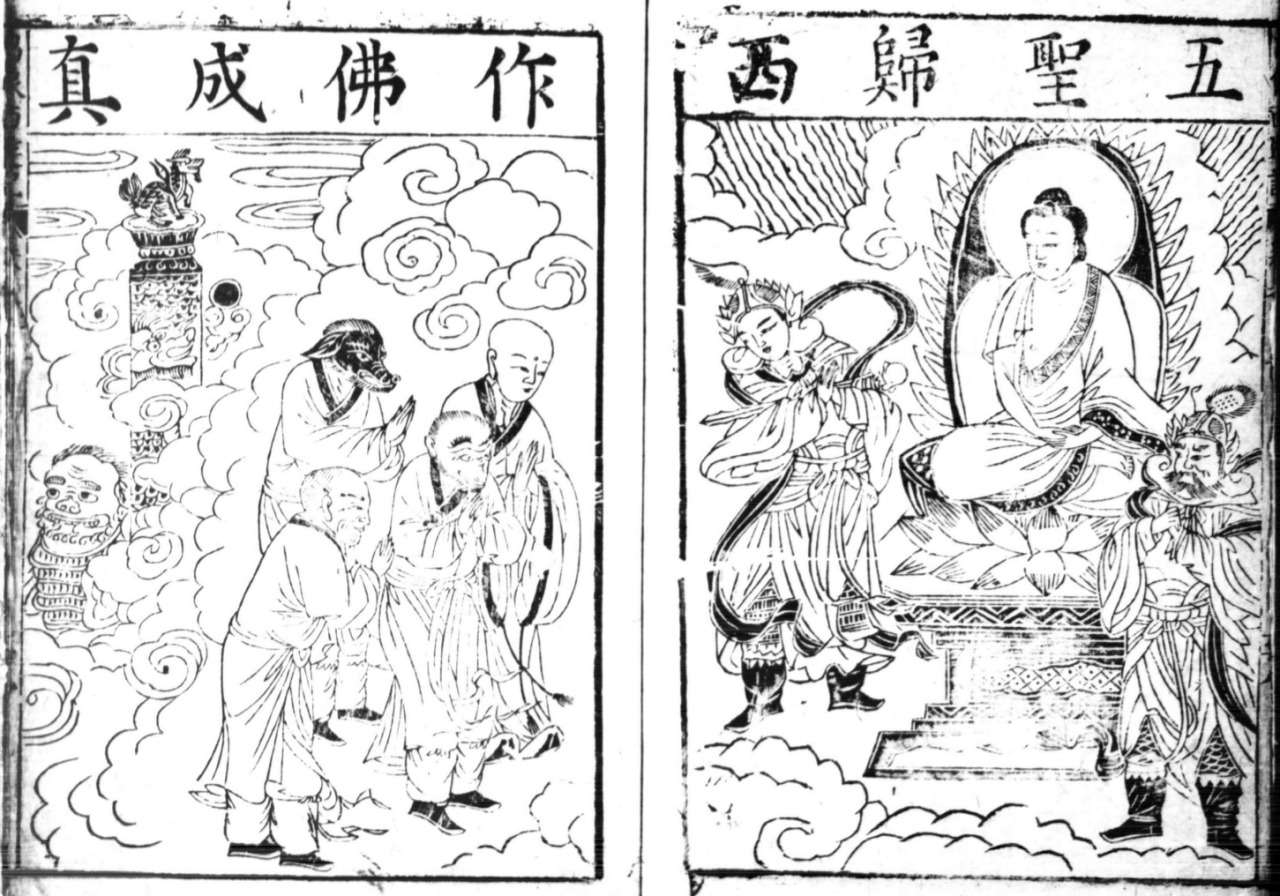
“Sage Monk,” said Tathagata, “in your previous incarnation you were originally my second disciple named Master Gold Cicada. Because you failed to listen to my exposition of the law and slighted my great teaching, your true spirit was banished to find another incarnation in the Land of the East. Happily you submitted and, by remaining faithful to our teaching, succeeded in acquiring the true scriptures. For such magnificent merit, you will receive a great promotion to become the Buddha of Candana Merit (emphasis added) (fig. 1) (Wu & Yu, 2012, vol. 4, p. 381).
聖僧,汝前世原是我之二徒,名喚金蟬子。因為汝不聽說法,輕慢我之大教,故貶汝之真靈,轉生東土。今喜皈依,秉我迦持,又乘吾教,取去真經,甚有功果,加陞大職正果,汝為旃檀功德佛。
Jenner (Wu & Jenner, 1993/2020) translates this title as “Candana-punya Buddha” (vol. 4, p. 2311). However, this appears to be a strange reverse Chinese to Sanskrit translation. Punya (Sk: पुण्य) means “merit.” As you’ll see in sec. 2, this isn’t the actual Sanskrit name of the Buddha.

Fig. 1 – Tripitaka and the other pilgrims receiving their elevation in spiritual rank at the end of the novel (larger version). Image from the original 1592 JTTW. Reading from right to left, the heading says: “The Five Sages Return to the West, Becoming Buddhas Comes True” (Wusheng guixi, Zuofo chengzhen, 五聖歸西,作佛成真)
2. Religious Background
The 1592 JTTW closes by “submitting” or “prostrating” (namo, 南無) to a long list of Buddhas, Bodhisattvas, and Arhats. The Buddha of Candana Merit is placed second to the last of 47 Buddhas and ahead of the Bodhisattva Guanyin. A section of the list reads:
[…]
I submit to the Buddha of Great Perfect Light.
I submit to the Buddha of the Gift of Light.
I submit to the Buddha of Candana Merit (emphasis added).
I submit to the Buddha Victorious in Strife.
I submit to the Bodhisattva Guanshiyin.
[…] (Wu & Yu, 2012, p. 385).
Many of the Buddhas mentioned in the novel appear in assorted real world canonical lists, including the 88 Buddhas (Bashiba fo, 八十八佛) from the Great Repentance Text of the Eighty-Eight Buddhas (Ch: Bashiba fo da chanhui wen, 八十八佛大懺悔文). [1] This group is comprised of the 53 Buddhas (Ch: Wushisan fo, 五十三佛) and the 35 Confession Buddhas (Ch: Sanshiwu fo chan, 三十五佛懺) (fig. 1).
The Buddha of Candana Merit (Sk: Candanaśrī or Candanashri, चन्दनश्री; lit: “Glorious Sandalwood”) is the 18th of the 35 Confession Buddhas, [2] who are individually called upon during a confessional prayer to absolve oneself of sins. They appear in a number of sources, such as The Bodhisattva’s Confession of Ethical Downfalls (Ch: Pusa duochan / Pusa chanhui wen, 菩薩墮懺 / 菩薩懺悔文) from the Three Heaps Sutra (Sk: Trīskhandhadharmasūtra; Ch: Sanyun jing, 三蘊經) and the Names of the Thirty-Five Buddhas Spoken by the Buddha (Ch: Foshuo sanshiwu foming lichan wen, 佛說三十五佛名禮懺文).

Fig. 2 – A religious painting of the 35 Confession Buddhas (larger version). The Buddha of Candana Merit is the last (orange) Buddha on the rightmost side of the fourth row from the top. He is below a white Buddha, above a red Buddha, and to the left of a green Buddha. Image found here.
2.1. Iconography
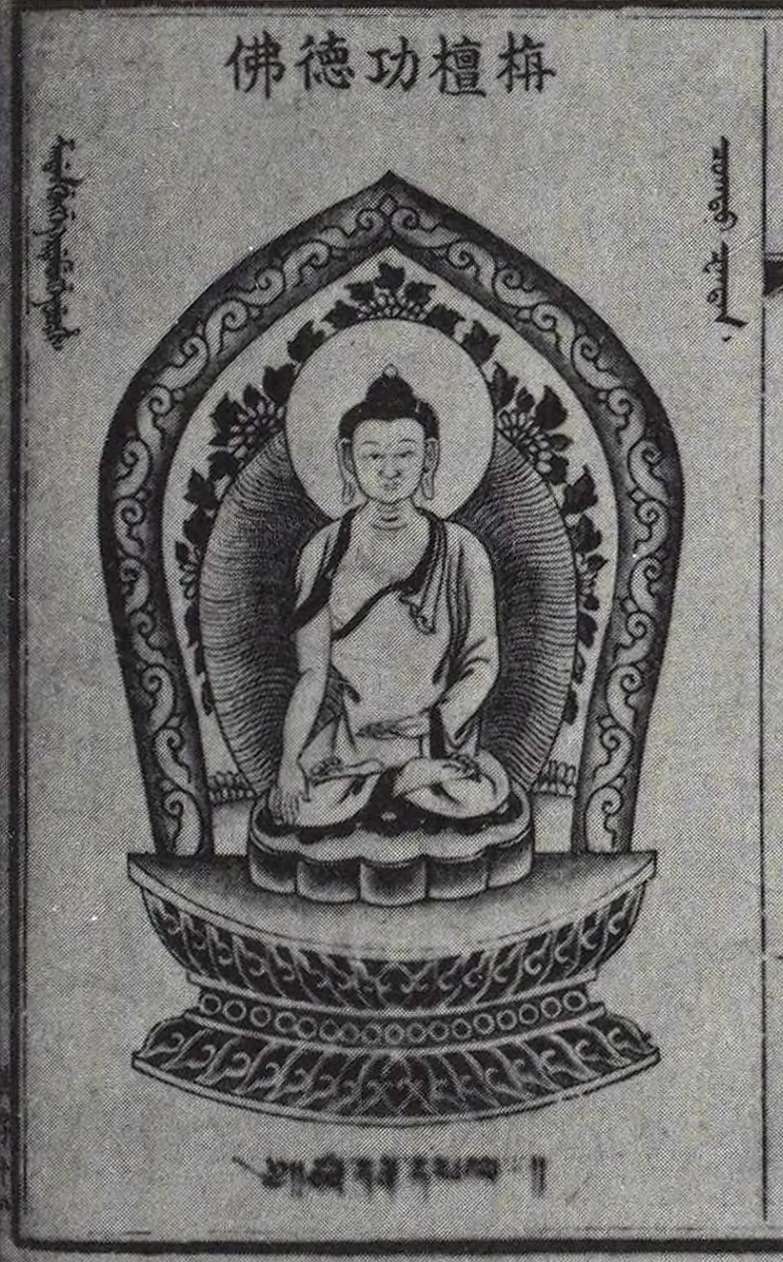
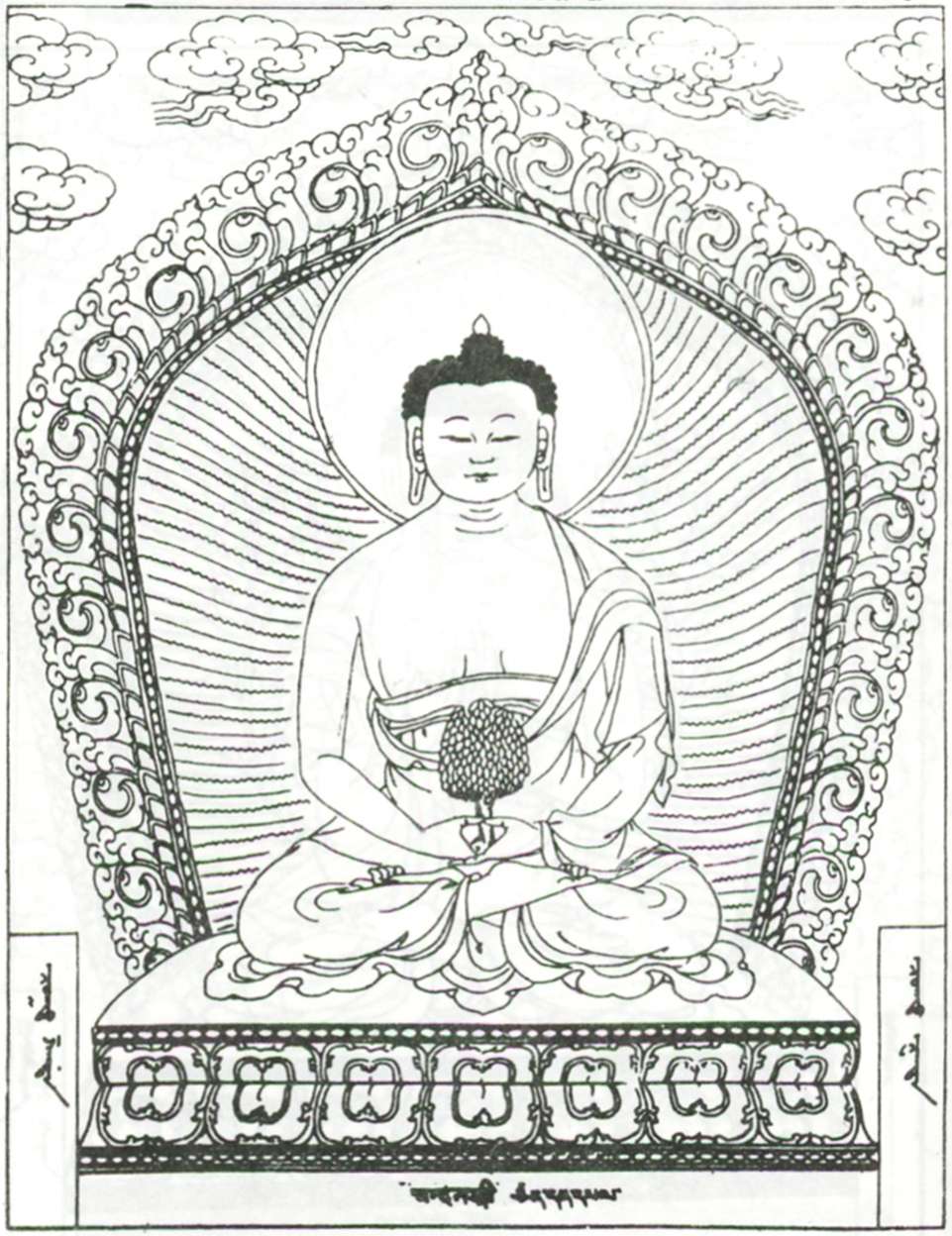
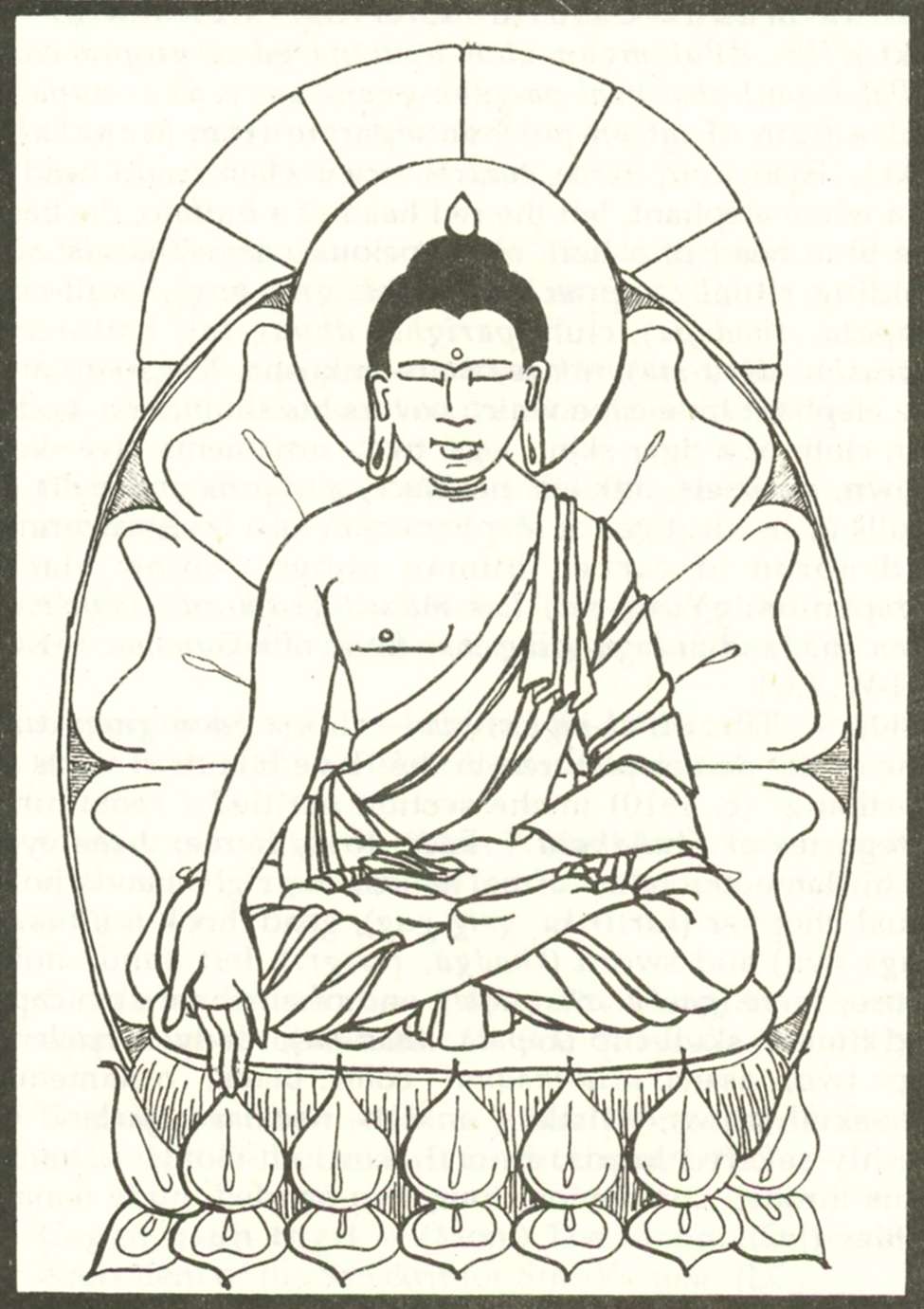
The Buddha of Candana Merit is depicted in Buddhist art with the traditional features of a Buddha (i.e. urṇa, usnisa, long ear lobes, robes, etc.). He has three forms depending on the tradition:
Candanasri Buddha — (Skt.) (Chin.: Chou-t’an-kung-te fo; Mon.” Cogtu candan; Tib.” Tsan-dan-dpal) A Sanskrit variant for the Jina Candanasri. One of the Buddha images found in the Pao Hsiang Lou [寶相樓] temple of the Forbidden City, Beijing, and one of the thirty-five “Buddhas of Confession.” Face: one, calm, urna, usnisa, long ear-lobes; arms/hands: right hand in bhumisparsa mudra, left in dhyana mudra [fig. 3]; mudra: bhumisparsa and dhyana; body: monastic robes; legs; two; asana: vajrasana; vahana: lotus throne.
— (2) — (Mon.: Cogtu candan; Tib.: Tsan-dan-dpal) One of the Buddhas of Confession pictured in the Mongolian Kanjur (Mon.: Mongol ganjur-un) (1717-1720) Face: one, calm, urna, usnisa, long ear-lobes; arms/hands: two, holding a small [sandalwood] tree in dhyana mudra [fig. 4]; mudra: dhyana; body: monastic robes, right shoulder uncovered; legs: two; asana: vajrasana; attributes: 32 major and 80 minor signs; vahana: lotus throne (Bunce, 1994, Vol. 1, pp. 81-82).
A plate in Bunce (1994) portrays him with the varada and dhyana mudras (fig. 5). And a source associated with the scholar-saint Nagarjuna (c. 150–250 CE) connects Candana Merit with the color orange (see sec. 2.2 below) (fig. 6).

Fig. 3 – (Top Left ) The first form of the Buddha of Candana Merit with the bhumisparsa and dhyana mudras (larger version). Image from Clark, 1937/1965, p. 249. Fig. 4 – (Top Right) The Buddha’s second form with a tree and dhyana mudra (larger version). Image from Chandra, 1999, p. 90. Fig. 5 – (Bottom Left) His third form with the varada and dhyana mudras (larger version). Image from Bunce, 1994, vol. 1, p. 82. Fig. 6 – (Bottom Right) Candana Merit portrayed with orange skin (larger version). Image found here.
2.2. Location and Purpose
Nagarjuna’s Discourse on the Ten Stages (Sk: Daśabhūmikavibhāṣā; Ch: Shi zhu piposha lun, 十住毘婆沙論, c. 3rd century CE) names the Buddha-land in which Candana Merit lives and the effect of his name/scent on the hearts of men:
In the south, after passing innumerable and immeasurable Buddha-lands, multiplied by the number of the sand-grains of the River Ganges, there is a land called Nanda. The Buddha of that land is called Candanashri. At present he lives there teaching the Dharma. [His glorious virtue is] like sandalwood (candana) which is fragrant and refreshing. His name reaches everywhere, just as scent pervades far and wide. It eliminates the fire of the three poisons, thereby cooling the passions of all sentient beings (based on Inagaki, 1998).
南方去此無量無邊恒河沙等佛土,有世界名歡喜,佛號栴檀德,今現在說法。譬如栴檀香而清涼,彼佛名稱遠聞,如香流布。滅除眾生三毒火熱,令得清涼。
This work uses an alternative Chinese name for the Buddha, Zhantande (栴檀德), or “Virtuous Sandalwood.” Zhan (栴) is used in place of zhan (旃), and gong (功) is completely removed.
A Running Commentary on the Confession of Transgressions of Bodhi[sattvas] (Sk: Bodhyāpattideśanāvṛtti; Ch: Puti duofan falu huichu shi, 菩提墮犯發露悔除釋), another work connected to Nagarjuna, associates the Buddha with a different location, as well as the color orange:
He is seated in the North-western region in a world called “Pervaded by Miraculous Fragrance.” He is orange in color and his hands hold a branch of a Sandalwood tree and an auspicious fruit, which settles the mind (based on Lai, 2016).
He is also given a slightly different name, Zhantan jixiang (栴檀吉祥), or “Auspicious Sandalwood.” And once again, zhan (栴) is used instead of zhan (旃).
3. Relationship to Xuanzang’s Worship
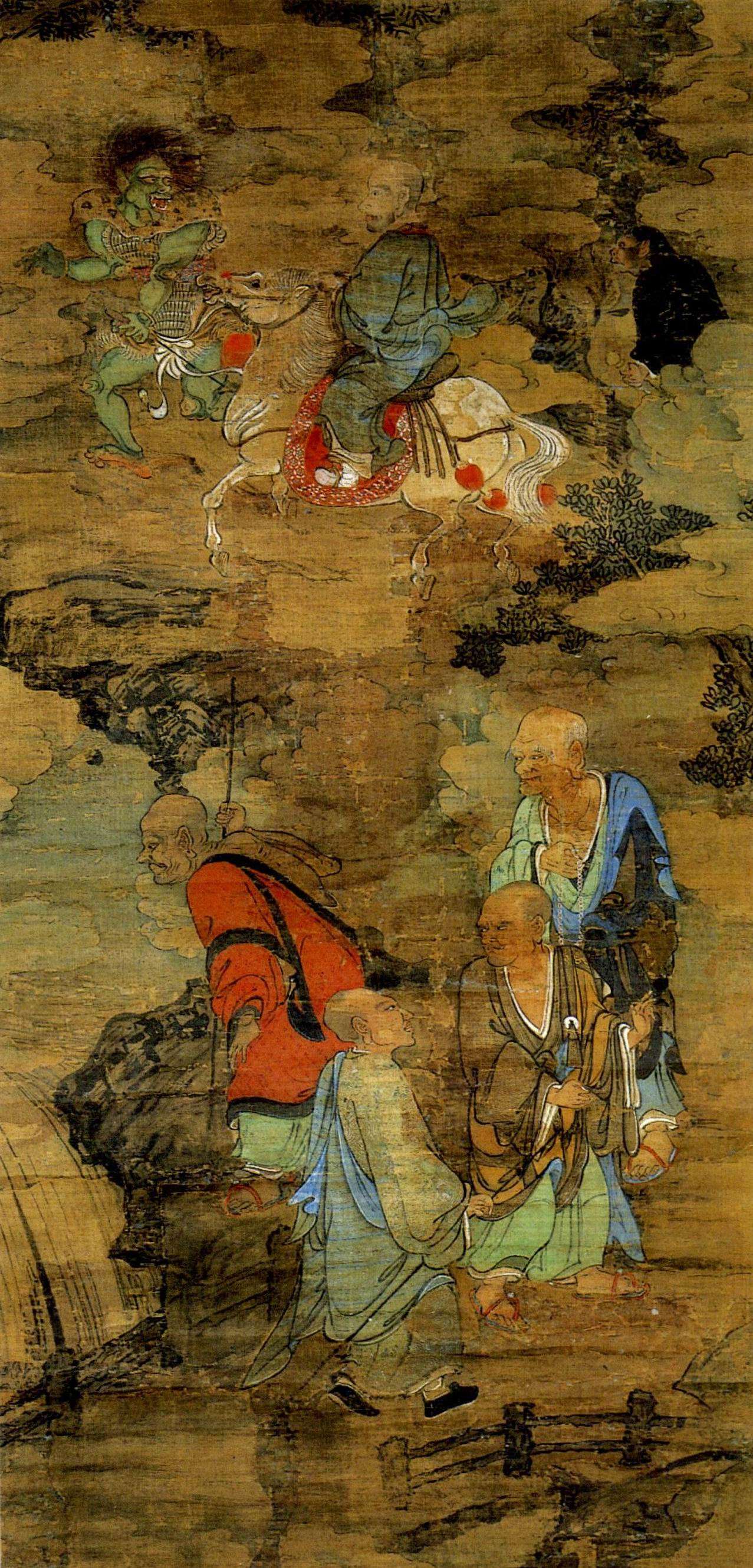
Evidence for the veneration of Xuanzang (玄奘, 602–664 CE), the historical Tang monk on whom Tripitaka is based, first emerged during the Song Dynasty (960–1127 CE) (Liu, 2019). For example, he appears as one of the famed 500 Arhats (Luohan, 羅漢) in a large set of late-12th century ritual scrolls (fig. 7 & 8). [3] This likely explains why an early-Ming JTTW zaju play, which predates the 1592 JTTW, depicts Tripitaka as the reincarnation of one such Buddhist saint. [4]
But most importantly, I was surprised to learn from Dr. Benjamin Brose that Xuanzang was actually associated with the Buddha Candana Merit at some point during the Ming Dynasty (1368-1644):
In a nutshell, during the Ming some salvational associations claimed that Xuanzang was one among several later incarnations of the Sandalwood Buddha sent to the human realm to deliver divine texts. These occurrences predate the publication of the [1592 JTTW] novel” (B. Brose, personal communication, June 3, 2023 *). [5]
* The above information will be expanded upon in Dr. Brose’s forthcoming book, Embodying Xuanzang: The Postmortem Travels of a Buddhist Pilgrim (September, 2023).
This association appears to have been short-lived, however, for I am unfamiliar with any modern temples that worship Xuanzang as Candana Merit. Why is this? I think the simplest answer is that the Buddha already had a long-established following and, therefore, couldn’t be subsumed under the late-blooming cult of the Tang Monk.

Fig. 7 – Lin Tinggui and Zhou Jichang, The Tang Monk Procures the Scriptures (Tangseng qujing, 唐僧取經), no. 77 of 100 scrolls from Images of the 500 Arhats (Wubai Luohan tu, 五百羅漢圖, 1178-1188 CE). Hanging scroll, ink and color on silk (larger version). Image from Nara kuniritsu hakubutsukan, Tōkyō bunkazai kenkyūjo, 2014, p. 86. Courtesy of Dr. Liu Shufen, a research fellow at the Institute of History and Philology, Academia Sinica. Fig. 8 – A detail of Xuanzang on his his horse. He is led by a spirit-soldier(?), and the “Monkey Pilgrim” appears to be visible in the clouds behind him (larger version).
4. Conclusion
At the end of the 1592 JTTW, the Tathagata promotes Tripitaka to the “Buddha of Candana Merit” (Zhantan gongde fo, 旃檀功德佛). This is one of the Chinese names of Candanaśrī or Candanashri (Sk: चन्दनश्री; lit: “Glorious Sandalwood”; a.k.a. “Virtuous or Auspicious Sandalwood,” Zhantande/jixiang, 栴檀德/吉祥), the 18th of the 35 Confession Buddhas called upon during a confessional prayer to absolve oneself of sins. He is portrayed as a sometimes orange-skinned, robe-wearing Buddha making the bhumisparsa, varada, and dhyana mudras and/or holding a fruit-bearing sandalwood tree in his lap. Conflicting sources place his Buddha-land in either “Nanda” (Huanxi, 歡喜) in the South or “Pervaded by Miraculous Fragrance” (Miaoxiang bianman, 妙香遍滿) in the North-West. However, scripture agrees that his name/scent has a calming or “cooling” affect on the passions of mankind.
Xuanzang, the historical Tang monk on whom Tripitaka is based, came to be revered as an arhat during the Song dynasty. This likely explains why he is portrayed as the reincarnation of one such Buddhist saint in an early-Ming JTTW zaju play. But at some point during the Ming, salvational groups connected Xuanzang to Candana Merit, believing the monk to be one of his incarnations. This association took place prior to the 1592 JTTW. However, Xuanzang doesn’t appear to be worshiped as said Buddha in modern practice. This might be because Candana Merit could never be subsumed under the Tang Monk’s late-blooming cult.
Notes:
1) Compare the list from the Chinese version to those listed here. The characters may vary slightly.
2) Thank you to Jose Loayza (Twitter) for telling me that Candana Merit was also one of the 35 Confession Buddhas.
3) To learn more about these Arhat paintings, see Zhou (2021).
4) The early-Ming JTTW zaju play sees the Arhat Vairocana (Pilujia zunzhe, 毗廬伽尊者) willingly reincarnate as Tripitaka in order to obtain the scriptures (Dudbridge, 1970, p. 193). The sage later returns to paradise upon completing his mission (Dudbridge, 1970, p. 200).
5) I don’t know for certain why Xuanzang was associated with Candana Merit during the Ming. However, my educated guess is that it has something to do with the monk’s historical connection to sandalwood statues. Morse (2007) explains:
“Xuanzang played an important role in popularizing sandalwood imagery when he brought ‘four carved sandalwood images of the Buddha’ back to Chang’an from India in 645″ (p. 168)
Sources:
Bunce, F. W. (1994). An Encyclopaedia of Buddhist Deities, Demigods, Godlings, Saints and Demons: With Special Focus on Iconographic Attributes (Vols.1-2). New Delhi: D.K. Printworld.
Chandra, L. (1999). Buddhist Iconography: Compact Edition. New Delhi: International Academy of Indian Culture & Aditya Prakashan.
Clark, W. E. (Ed.). (1965). Two Lamaistic Pantheons. New York: Paragon Book Reprint Corp. (Original work published 1937). Retrieved from https://archive.org/details/twolamaisticpant0012clar/mode/2up?view=theater.
Dudbridge, G. (1970). The Hsi-yu chi: A Study of Antecedents to the Sixteenth-Century Chinese Novel. Cambridge: Cambridge University Press.
Inagaki, H. (1998). Path of Easy Practice: Igyohon – The Ninth Chapter of the Discourse on the Ten Stages by Nagarjuna. MIT. https://web.mit.edu/stclair/www/horai/igyohon.htm.
Lai, D. (2016, September 3). 35 Confessional Buddhas. Retrieved from www.davidlai.me/2016/09/03/35-confessional-buddhas/.
Liu, S. (2019). Songdai Xuanzang de shenghua: Tuxiang, wenwu he yiji [The Sanctification of Xuanzang in the Song Dynasty: Images, Artifacts and Remains]. Zhonghua wenshi luncong, 133, 161-219.
Morse, S. C. (2007). The Buddhist Transformation of Japan in the Ninth Century: The Case of Eleven-Headed Kannon. In M. Adolphson, E. Kamens, & S. Matsumoto (Eds.), Heian Japan: Centers and Peripheries (pp. 153-176). Honolulu: University of Hawai’i Press.
Nara kuniritsu hakubutsukan, Tōkyō bunkazai kenkyūjo henshū [Nara University Tōkyō Research Institute for Cultural Properties (Ed.)]. (2014). Daitokuji denrai gohyaku rakan zu [Daitoku Temple’s Tradition of the 500 Arhats Paintings]. Kyōto: Shitau bungaku.
Wu, C. & Jenner, W. J. F. (2020). Journey to the West (Vol. 4). Beijing: Foreign Languages Press. (Original work published 1993)
Wu, C., & Yu, A. C. (2012). The Journey to the West (Vol. 4) (Rev. ed.). Chicago, Illinois: University of Chicago Press.
Zhou, Y. (2021). The Daitokuji Five Hundred Arhats Paintings and Their Beholders [Master’s dissertation, University of Alberta]. Education and Research Archive. https://era.library.ualberta.ca/items/f0bf436c-f6e5-46a2-920a-91c8b9dd5ba9