From time to time I like to post a fun blog not directly related to (though sometimes informed by) my research. Past examples can be seen here, here, and here. Regular articles will resume after this entry.
I was recently contacted by someone writing a fanfiction about Journey to the West (Xiyou ji, 西遊記, 1592 CE) and asked when the Monkey King was born from stone. I have, therefore, decided to write an entry for those interested in the subject. I will start at the end of the novel and work my way backwards. However, it is important to note that the years presented here are guesstimates and should not be taken as wholly accurate considering that the novel does not follow a strict historical timeline.
I should also point out that this has nothing to do with Sun Wukong’s religious birthday, which is variously celebrated on the sixteenth day of the eighth lunar month in Hong Kong and Singapore (Elliott, 1955/1990, p. 82), the twenty-third (Fuzhou) or twenty-fifth day (Putian) of the second lunar month in Fujian (Doolittle, 1865, vol. 1, pp. 288; Dean & Zheng, 2010, p. 162, for example), and the twelfth day of the tenth lunar month (Taiwan) (see here).
After Wukong bullies the Eastern Dragon King and the Judges of Hell, Heaven appoints him the “Keeper of the Heavenly Horses” in order to keep his unruly adventures in check. But upon learning that his position is the lowest in heaven, he returns home in rebellion. His children ask, “Having gone to the region above for more than ten years (emphasis added), you must be returning in success and glory” (Wu & Yu, 2012, vol. 1, p. 150). [3] This dates his first ascension somewhere below the range 150–136 BCE (160–146 BCE?). Again, I can’t provide a more precise number given the vague language.
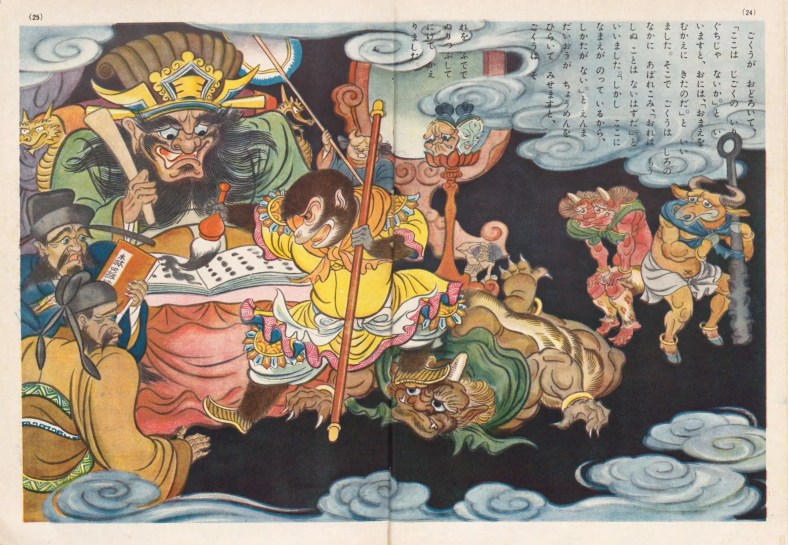
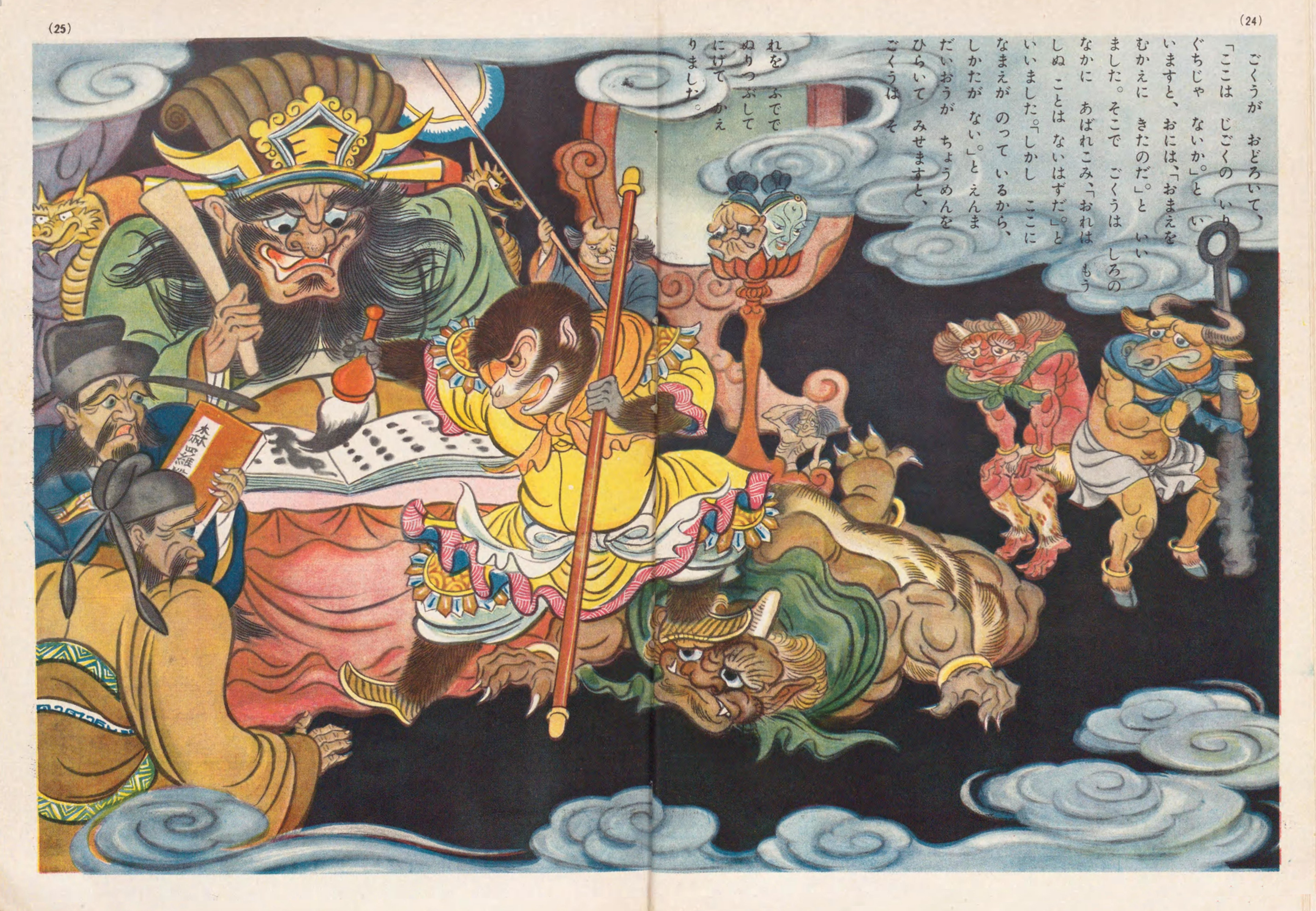
During his time in Hell, Monkey calls for the ledger containing his information. Under a heading marked “Soul 1350,” Wukong reads, “Heaven-born Stone Monkey. Age: three hundred and forty-two years. A good end” (Wu & Yu, 2012, vol. 1, p. 140). [4] If we use 160–146 BCE as a conservative estimate for his first ascension, then this dates his birth to somewhere between 502–488 BCE during the Zhou Dynasty (c. 1046–256 BCE). I think 500 BCE is a nice round number.
Monkey strikes his name from the Book of Life and Death in Hell (larger version). From Son Goku (1939).
6. Updates
Update: 07-08-20
The novel suggests a two hour window for the time of Wukong’s birth. This takes place in chapter 61 when Monkey is preparing to battle the Bull Demon King over the palm-leaf fan. Our hero recites an emboldening poem, to which Zhu Bajie replies:
Yes! Yes! Yes! Go! Go! Go! Who cares if the Bull King says yes or no! Wood’s born at Boar, the hog’s its proper mate, Who’ll lead back the Bull to return to earth. Monkey is the metal born under shen (emphasis added): Peaceful and docile, how harmonious! Use the palm-leaf As water’s sign. When flames are extinct, Completion’s attained. In hard work we persist both night and day And rush, merit done, to Ullambana Feast (Wu & Yu, 2012, vol. 3, p. 154).
The monkey is one of twelve animals of the Chinese zodiac, each corresponding to an earthly branch, an elemental phase, and a time period. The monkey is born under the shen (申) branch, which is associated with metal and the hours 3:00 PM to 5:00 PM.
Update: 04-02-21
As I explain in this article, Wukong learns the 72 transformations in order to escape a trio of heaven-sent punishments scheduled to kill him for defying his fate and achieving immortality. The calamities of thunder, fire, and wind respectively come every 500 years (after the initial attainment of eternal life) to kill Daoist cultivators. Monkey becomes an immortal around his 342nd year when his soul is taken to Hell. He is immortal for over 160 years [5] at the time he’s imprisoned under Five Elements Mountain. This means his 500th year of immortality, the year that the calamity of thunder would be scheduled to strike him, takes place during his imprisonment under the celestial mountain. But this is never described in the story. I assume this is just one of many inconsistencies born from oral storytelling. Although, one could argue that, within the fictional universe, the thunder calamity was voided since Wukong was undergoing punishment at the behest of the Buddha.
Notes:
1) I am indebted to Irwen Wong for bringing this passage to my attention.
2) Wukong, however, questions this estimate, saying: “I recall that it’s been but half a year…How can you talk of a century?” (Wu & Yu, 2012, vol. 1, p. 167). But, earlier in the novel, a wise member of Monkey’s tribe points out that one’s view of time is skewed while inhabiting the celestial realm: “You are not aware of time and seasons when you are in Heaven” (Wu & Yu, 2012, vol. 1, p. 150). Add to this the established fact that one heavenly day equals one solar year. Therefore, the Great Sage’s recollection of the passage of time is unreliable.
4) These include three years as Subodhi’s student (Wu & Yu, 2012, vol. 1, p. 121), seven as a junior monk (Wu & Yu, 2012, vol. 1, p. 117), and “more than ten years” searching the world for a master (Wu & Yu, 2012, vol. 1, p. 114).
5) As previously mentioned, Wukong serves in heaven twice: first “for more than ten years” and second “for over a century” (Wu & Yu, 2012, vol. 1, pp. 150 and 166). Then he is punished to 49 heavenly days/49 solar years in Laozi’s furnace (see above).
Sources:
Bielenstein, H. (1986). Wang Mang, the Restoration of the Han Dynasty, and Later Han. In D. Twitchett and M. Loewe (Ed.). The Cambridge History of China: Volume 1, The Ch’in and Han Empires, 221 BC-AD 220 (pp. 223-290). Kiribati: Cambridge University Press.
Buswell, R. E., & Lopez, D. S. (2014). The Princeton Dictionary of Buddhism. Princeton, NJ: Princeton University Press.
Dean, K., & Zheng, Z. (2010). Ritual Alliances of the Putian plain. Volume Two: A Survey of Village Temples and Ritual Activities. Leiden: Brill.
Doolittle, J. (1865). Social Life of the Chinese: With Some Account of Their Religious, Governmental, Educational, and Business Customs and Opinions. With Special but not Exclusive Reference to Fuhchau (vol. 1 and 2). New York: Harper & Brothers.
The Monkey King is famous for utilizing a vast arsenal of magic powers to protect the monk Tripitaka on the journey to India, chief among them being immortality, shape-shifting, hair clones, super strength, and flight via the cloud somersault (jindou yun, 觔/筋斗雲). The latter is a powerful skill because it enables him to travel 108,000 li (33,554 mi / 54,000 km), [1] or one and one-third the circumference of our Earth, in a single leap. [2] Perhaps the most famous episode involving the somersault appears in Journey to the West (Xiyouji, 西遊記, 1592; “JTTW” hereafter) chapter seven when the Buddha bets Wukong that he’ll give the rebellious monkey the throne of heaven if he can leap clear of the Enlightened One’s palm. Sun gleefully accepts, certain of his success:
What a fool this Tathagata is! A single somersault of mine can carry old Monkey one hundred and eight thousand li, yet his palm is not even one foot across. How could I possibly not jump clear of it? (Wu & Yu, 2012, vol. 1, p. 194).
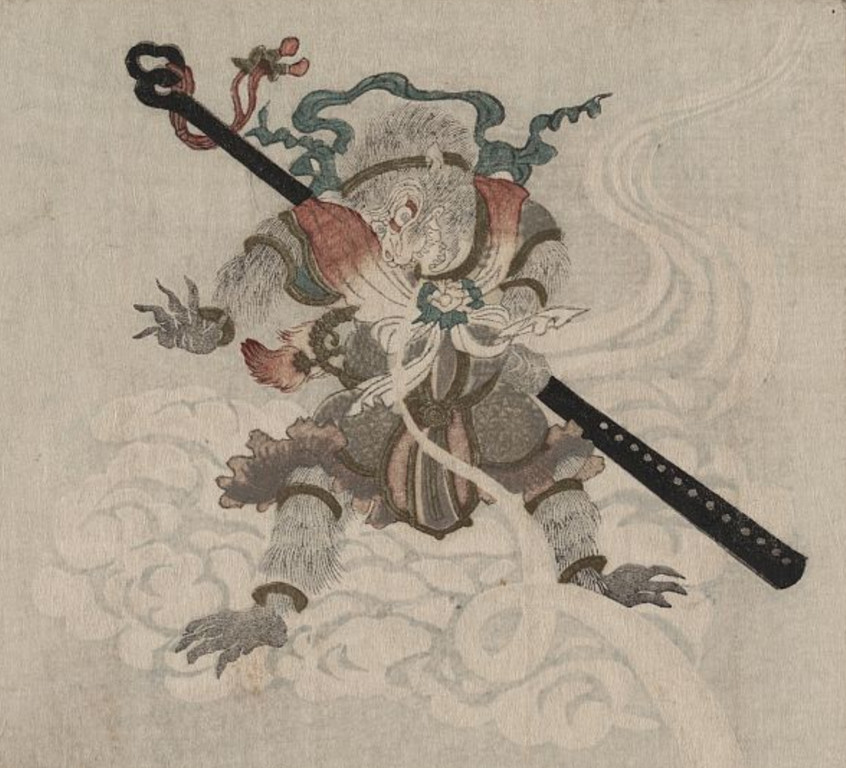
While Sun is traditionally portrayed in visual media riding a single cloud (fig. 1), the very name “somersault” points to Monkey leaping from cloud to cloud. And in fact this is demonstrated in chapter 97 when it requires “a series of cloud somersaults” for him to retrieve the soul of an elderly benefactor from the underworld (Wu & Yu, 2012, vol. 4, p. 338). However, the magic skill’s attributes are not always portrayed consistently throughout the novel. For example, it is sometimes shown capable of transporting passengers, such as the “thirty or fifty” of Monkey’s children rescued from captivity in JTTW chapter two, thereby implying a single cloud (Wu & Yu, 2012, vol. 1, p. 129). (See the 04-28-26 update below for more info.) But other times, like in chapter 22, it can’t lift even a single person because the impure nature of mortals renders them “as heavy as the Tai Mountain” (Wu & Yu, 2012, vol. 1, p. 427). Interestingly, the somersault is portrayed as much faster than the clouds of other immortals (see section three below).
Fig. 1 – Detail of an 1812 calendar print by Japanese artist Kubo Shunman depicting Son Goku (Sun Wukong) flying on his cloud somersault (larger version). A full size scan of the calendar can be seen here.
“Make the magic sign, recite the spell, clench your fist tightly, shake your body, and when you jump up, one somersault will carry you one hundred and eight thousand miles.” When the other people heard this, they all giggled and said, “Lucky Wukong! If he learns this little trick, he can become a dispatcher for someone to deliver documents or carry circulars. He’ll be able to make a living anywhere!”
The sky now began to darken, and the master went back to the cave dwelling with his pupils. Throughout the night, however, Wukong practiced ardently and mastered the technique of cloud-somersault. From then on, he had complete freedom (emphasis added), blissfully enjoying his state of long life (Wu & Yu, 2012, vol. 1, p. 123).
Elements of this passage reference the long tradition of cloud-borne transcendents in Daoist literature. For example, Kirkova (2016) highlights a poem by the first Cao Wei emperor Cao Pi describing the great speed of their travel: “Lightened you’ll soar, mount the floating clouds, / in a blink you’ll travel millions of li” (p. 105). She explains the ability to traverse vast distances in a flash “is a primary sign of the immortals’ mastery over space and time and is an important topos in their hagiographies” (Kirkova, 2016, p. 106). Furthermore, Kirkova (2016) points out the term used to denote their great freedom of movement, xiaoyao (逍遙/消搖), emphasized above, appears in works as old as the Huananzi and Zhuangzi (p. 104).
Shao (2006) explains that the distance is taken directly from the Platform Sutra (Liuzu tangjing, 六祖壇經, c. 8th to 13th century) of Huineng, the sixth patriarch of Chan Buddhism (p. 718). The particular passage reads:
The governor also asked,
I often see clergy and laity invoking Amitabha Buddha in hopes of rebirth in the [Pure Land of the] West. Please explain this to me. Can we attain rebirth there? Please resolve this doubt for me.
The Master said,
Listen clearly, Governor, and I will explain it to you. When the World Honored One was in the city of Sravasti, he spoke of the Western Pure Land as a teaching device. Scripture is clear that “it is not far from here,” but treatises say it is “108,000 li away.” This number refers to the ten evils and eight wrongs in the one’s person. This says it is far away. Saying it is far away is for people of lesser faculties. Saying it is near is for people of better faculties.
Now I urge you, good friends, to first get rid of the ten evils; that is the equivalent of traveling one hundred thousand li. [3] Then get rid of the eight wrongs; that is the equivalent of crossing eight thousand li. See essential nature in every moment, always acting with impartial directness, and you will arrive in a finger-snap and see Amitabha Buddha (Huineng & Cleary, 1998, pp. 26-27).
As can be seen, the number 108,000 is symbolic of two sets of spiritual hindrances. The “ten evils” (shi’e, 十惡) are killing, stealing, sexual misconduct, greed, hatred, delusion, foul language, lying, harsh speech, and slander. The “eight wrongs” (baxie, 八邪) are opposites of the eight fold path (Huineng, Hsuan, & Buddhist Text Translation Society, 2002, p. 183). Ridding oneself of these piecemeal gets you many li closer to paradise. But only those who achieve enlightenment can arrive instantly. This means the cloud somersault can be read as a Chan metaphor for instant enlightenment. After all, Monkey can travel to the Buddha’s heaven in a flash, whereas Tripitaka is fated to journey thousands of miles over many years “before he finds deliverance from the sea of sorrows” (Wu & Yu, 2012, vol. 1, p. 436). This is because, as suggested by Shao (2006), the demons encountered on the journey embody the “ten evils and eight wrongs” that must be defeated before the monk can enter paradise (p. 719).
Fig. 2 – Monkey soaring on his cloud. Drawing by Funzee on deviantart (larger version).
Going back to the early days of Sun’s flight training, Subodhi observes our hero using an unorthodox method for propelling himself into the sky: jumping. This differs from other immortals, so the Sage teaches him a different method:
The Patriarch said, “When the various immortals want to soar on the clouds, they all rise by stamping their feet. But you’re not like them. When I saw you leave just now, you had to pull yourself up by jumping. What I’ll do now is to teach you the cloud-somersault in accordance with your form” (Wu & Yu, 2012, vol. 1, p. 123).
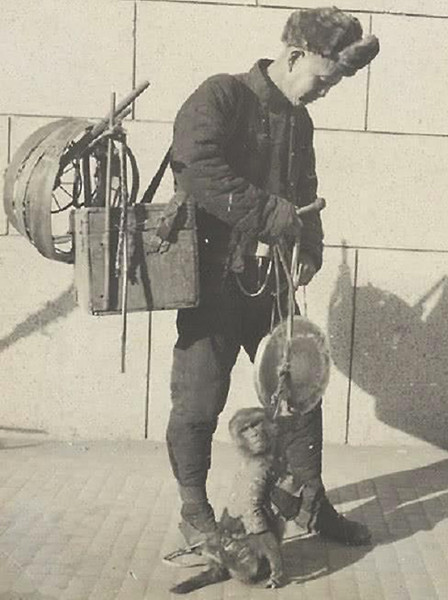
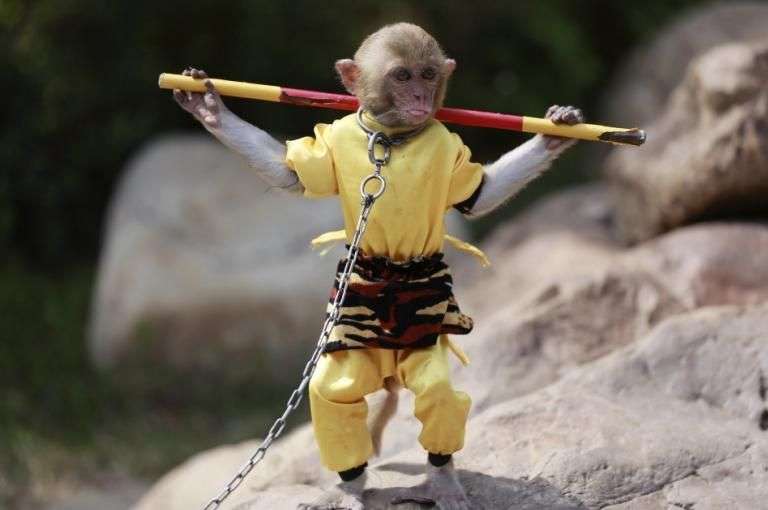
Zhou (1994) suggests this method is likely based on “the novelist’s personal observation” of trained monkey street performances “in the late Ming marketplace” (fig. 3 and 4) (p. 71). He points to an episode in chapter 28 when Wukong returns home to learn his children are regularly captured to perform tricks in the human world:
Those of us who were caught by the net or the trap would be led away live; they would be taught to skip ropes, to act, to somersault, and to do cartwheels. They would have to beat the drum and the gong on the streets and perform every kind of trick to entertain humans (Zhou, 1994, p. 71; cf. Wu & Yu, 2012, vol. 2, p. 31).
Anyone who has viewed monkeys in a zoo or in the wild knows that they are naturally gifted acrobats. Therefore, Zhou’s proposal is certainly an alluring possibility, one that mixes the naturalistic and historical with Daoist tales of cloud-borne immortals.
Fig. 3 – A Qing-era trainer and his performing monkey (larger version). Original image found here. Fig. 4 – A monkey performer dressed as Sun Wukong (larger version). Original image found here.
Scholars favoring a foreign origin for Sun sometimes point to the somersault as evidence for his connection to the Hindu monkey god Hanuman from the epic Ramayana (4th/5th century BCE). For example, Mi (as cited in Mair, 1989) notes similarities in which Sun and the god propel themselves by leaping:
In typical Chinese legends, the spirits and immortals mount on clouds and ride them; they stand on top of the clouds. Sun Wukong, however is different … Rather, he leaps through the air from a crouching position in the same fashion as Hanuman … This proves Sun Wukong’s supernatural abilities were adopted from Hanuman. (pp. 712-713).
Walker (1998) champions this view by citing a passage from the Ramayana in which Hanuman’s mighty leap across the sea from India to Lanka rips trees away from a mountain:
Hanuman, the foremost of monkeys, without pausing for breath … sprang into the air and, such was the force of his leap, that the trees growing on the mountain, tossing their branches, were sent spinning on every side.
In his rapid flight, Hanuman bore away those trees with their flowering boughs filled with lapwings intoxicated with love … Carried away by the impetus of his tremendous bound, those trees followed in his wake, like an army its leader (p. 10).
However, I’m inclined to believe any similarities in propulsion are simply the product of common behavioral traits among monkeys (refer back to my statement above about their gift for acrobatics). If Wukong’s jumping is indeed based on the somersaulting monkeys of vaudevillian street performances in China, then Hanuman’s jumping prowess no doubt has a real world counterpart in India. A prime example is the Gray Langur, which is capable of spectacular leaps (video 1).
Video 1 (LOUD NOISE WARNING) – A Langur takes a mighty jump. The video should start at minute 0:43.
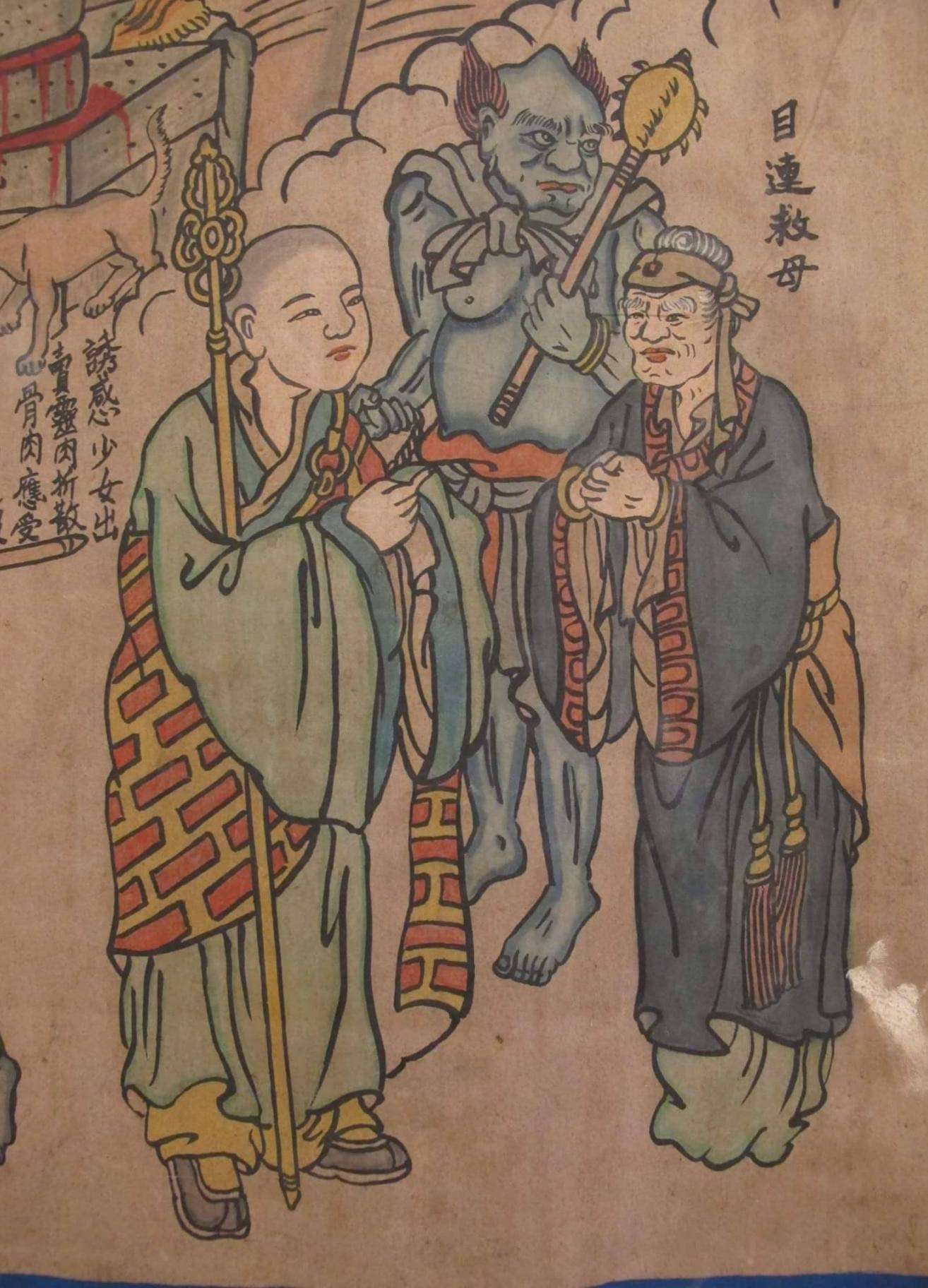
Given the somersault’s symbolic connection to Chan Buddhism, it’s possible Monkey’s jumping has ties to the religion as well. Like immortals, Buddhist saints are also portrayed in Chinese literature as having the power of flight. One example is Maudgalyayana (Ch: Mulian, 目連), a disciple of the Buddha, who is famous for appearing in a late-9th to early-10th century Bianwen (變文) text in which he travels to the underworld to release his mother from karmic torment (fig. 5). One passage from the tale reads:
Maudgalyayana awoke from abstract meditation,
Then swiftly exercised his supernatural power;
His coming was quick as a thunderclap,
His going seemed like a gust of wind.
[…]
With his supernatural power, he gained freedom,
So he hurled up his begging bowl and leaped into space (emphasis added);
Thereupon, instantaneously,
He ascended to the heavenly palace of Brahma (Mair, 1994, pp. 1097-1098).
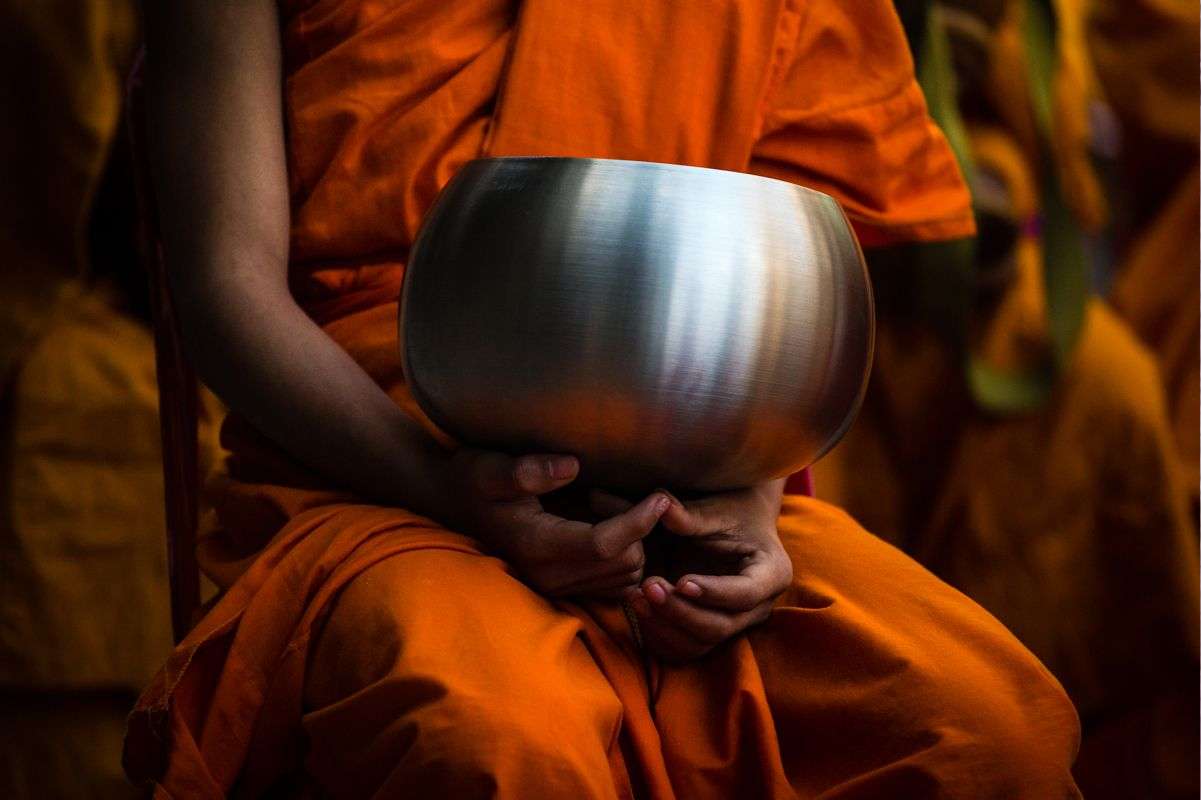
Like Monkey, Maudgalyayana is depicted leaping into the heavens to freely roam the cosmos at blinding speeds, the only difference being that he stands astride a magic alms bowl (fig. 6) and not a cloud. It’s important to note that the saint’s tale influenced the 13th century precursor of the Ming JTTW. As I show in this article, Sun’s antecedent, the Monkey Pilgrim (Hou xingzhe, 猴行者), serves as a proxy for the saint because he wields magic weapons based on those used by Maudgalyayana, namely a golden-ringed monk’s staff and an alms bowl. The ringed staff would come to influence Sun’s signature weapon in JTTW, including its ability to change size and pick locks. Therefore, it’s possible the saint may have also influenced Monkey’s jumping.
Fig. 5 – A scroll or mural depicting Maudgalyayana rescuing his mother from the underworld (larger version). Originally found here. Fig. 6 – A metal alms bowl (larger version).
5. Popular Culture
It’s interesting to note that the cloud somersault was adapted in the world famous Dragon Ball franchise. In episode three of the Dragonball anime, the lead character Son Goku, himself based on Sun Wukong, is gifted the yellow, fluffy Kinto’un (筋斗雲) by his would-be martial arts teacher, Master Roshi. [4] This is an obvious reference to Subodhi teaching the somersault skill to Monkey. But before Goku officially takes possession, Roshi gives him a warning: “People with impure thoughts can’t ride on it. In other words, you have to be a good person” (video 2). The master thereafter attempts to stand on it but quickly falls through due to his perverted nature. Goku then leaps up and successfully lands on the cloud, proving his worth. This exchange is no doubt a reference to Sun’s inability to carry passengers on his cloud because the impure nature of mortals renders them too heavy (see section one).
Video 2 – Roshi gives Goku his cloud. Watch from minute 1:50.
6. Conclusion
The Monkey King first learns the cloud somersault during the early days of his Daoist training under the Sage Subodhi. It enables him to travel 108,000 li in a single leap, making him much faster than the cloud soaring of other transcendents. While this skill shares affinities with the fleet clouds of immortals from Daoist hagiography, Sun’s somersault has a deep connection to Chan Buddhism. The vast distance that it travels is symbolic of the “ten evils and eight wrongs,” two sets of spiritual hindrances from the Platform Sutra said to keep the Buddha’s paradise out of reach. Only those who cleanse themselves of these obstacles can achieve enlightenment and arrive there in a flash, thus making Wukong’s cloud an apt metaphor for instant enlightenment. This suggests the greater speed of the somersault can be read as a further metaphor for the potency of Buddhism over Daoism.
Wukong’s habit of jumping into the heavens differs from the way other immortals rise by stamping their feet. This unorthodox method may have naturalistic or even religious influences. The suggestion that it is based on somersaulting monkeys from Chinese vaudevillian street performances is alluring given their natural gift for acrobatics. Some scholars champion a foreign origin by pointing to the leaping prowess of the Hindu monkey god Hanuman. But this could simply be a passing similarity based on common behavioral traits among monkeys. The jumping may also have ties to the Buddhist saint Maudgalyayana, who is portrayed in a famed 9th/10th century tale leaping into the air to ride his magic alms bowl between heaven and hell. Elements from his story would come to influence the 13th century precursor of JTTW, as well as the Ming edition of the novel, adding support for his possible influence.
7. Updates
Update: 01-04-24
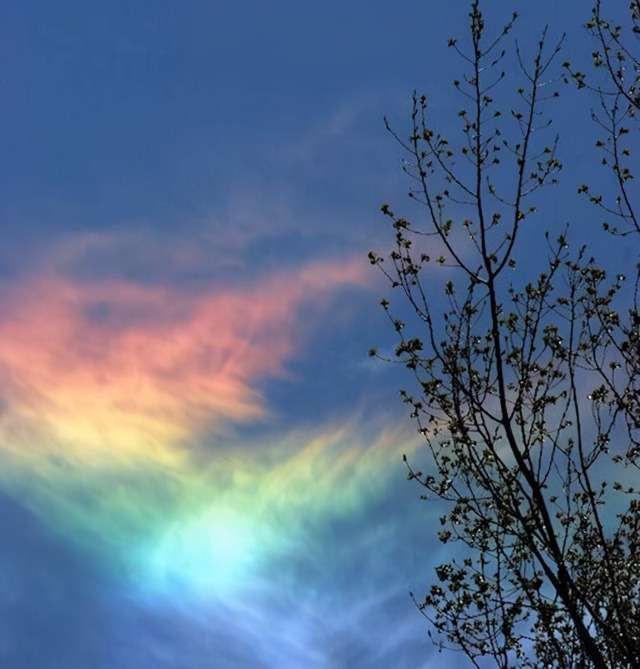
The singular version of Monkey’s cloud is sometimes described as being “auspicious” (xiangyun, 祥雲) or having a “luminosity” (xiangguang, 祥光). Such clouds or lights are commonly associated with the five colors (wuse, 五色) (fig. 7). Chapter 88 makes this explicit:
Marvelous Great Sage! With a loud whistle he somersaulted right up into midair, his two feet treading the auspicious cloud of five colors (emphasis added). At about three hundred paces above ground, he let loose his rod to make [the martial arts moves] Sprinkling Flowers over the Top and the Yellow Dragon Entwining the Body. Up and down he moved, circling left and right. In the beginning his person and the rod so complemented each other that they seemed, as the adage had it, like flowers added to brocade. By and by even the person disappeared, and all one could see was a sky full of twirling rods! (Wu & Yu, 2012, vol. 4, pp. 196-197)
Fig. 7 – An example of an auspicious cloud (larger version). The scientific term for this phenomenon is “cloud iridescence,” but such nimbuses are commonly called “rainbow clouds” in English.
Update: 04-28-26
Above, I wrote: “[The cloud] is sometimes shown capable of transporting passengers, such as the ‘thirty or fifty’ of Monkey’s children rescued from captivity in JTTW chapter two, thereby implying a single cloud” (Wu & Yu, 2012, vol. 1, p. 129).
However, this was a mistake on my part. As I show in my more recent catalog of Sun Wukong’s powers and skills, these children are actually transported via the “magic of displacement” (shefa, 攝法), a swift, powerful wind appearing in JTTW chapters 2, 3, 62, 71, and 84.
On a different note, I feel like a major aspect of the somersault cloud needs extra context. If you recall in section 3, I discussed how the figure of 108,000 li is a religious allegory for the distance separating man from the Buddha’s paradise. Per the Sixth Chan Patriarch, the number comprises the “ten evils” (shi’e, 十惡) and “eight wrongs” (baxie, 八邪), two lists of negative thoughts and actions that hinder spiritual cultivation. Anyone who manages to rid themselves of these will attain enlightenment, allowing them to travel to the holy land instantly. But not everyone is capable of defeating these spiritual hindrances, so the distance separating them from the Buddha might as well be infinity. Therefore, it’s not wise to assign a real world distance and speed to the somersault cloud. This is regarding my recent response to “powerscaling.”
Update: 05-03-26
Here is an old woodblock print showing Monkey practicing his cloud somersault above Patriarch Subodhi and his early religious brothers (fig. 8). It is one of a few images from The Book to Enlightenment of the Journey to the West (Xiyou Zhengdao Shu, 西遊證道書, 1663), a Daoist commentary on the novel.
Fig. 8 – The 1663 woodblock print of Monkey’s cloud practice (larger version).
Notes:
1) The li (里) is a Chinese measure equaling roughly one-third of a mile. All cited English translations presented here use “mile” instead of the original li. I have, therefore, changed them accordingly.
3) The English translation originally says “ten myriad” (Huineng & Cleary, 1998, pp. 26-27). The original Chinese reads shiwan (十萬; 10 x 10,000), or 100,000. I have changed the source to make this more explicit.
4) The cloud is called the “Flying Nimbus” in the English dub.
Sources:
Huineng, & Cleary, T. F. (1998). The Sutra of Hui-neng, Grand Master of Zen: With Hui-neng’s Commentary on the Diamond Sutra. Boston: Shambhala.
Huineng, Hsuan, H., & Buddhist Text Translation Society. (2002). The Sixth Patriarch’s Dharma Jewel Platform Sutra: With the Commentary of Venerable Master Hsuan Hua. Burlingame: Buddhist Text Translation Society.
Kirkova, Z. (2016). Roaming into the Beyond: Representations of Xian Immortality in Early Medieval Chinese Verse. Leiden: Brill.
Mair, V. (1994). Transformation Text on Mahamaudgalyayana Rescuing His Mother From the Underworld with Pictures, One Scroll, with Preface. In V. Mair (Ed.), The Columbia Anthology of Traditional Chinese Literature (pp. 1094-1127). New York: Columbia University Press.
Wu, C., & Yu, A. C. (2012). The Journey to the West (Vols. 1-4) (Rev. ed.). Chicago, Illinois: University of Chicago Press.
Zhou, Z. (1994). Carnivalization in The Journey to the West: Cultural Dialogism in Fictional Festivity. Chinese Literature: Essays, Articles, Reviews (CLEAR),16, 69-92. doi:10.2307/495307
Sun Wukong first appears as the “Monkey Pilgrim” (Hou xingzhe, 猴行者) in The Story of How Tripitaka of the Great Tang Procures the Scriptures (Datang Sanzang qujing shihua, 大唐三藏取經詩話, late-13th-century; “The Story” hereafter), the earliest-known published version of the Journey to the West (Xiyouji, 西遊記, 1592; “JTTW” hereafter) story cycle. He is described as an immortal banished from heaven for stealing divine peaches from the Queen Mother of the West, and he later becomes the ruler of the 84,000 monkeys of Flower-Fruit Mountain. But he first enters the story as a white-clad scholar and willing participant in the journey who actively seeks out the monk Tripitaka and his retinue of fellow clerics on the quest to India. The Monkey Pilgrim then uses his magical abilities and heavenly treasures to protect the monks from all manner of spirits, warlocks, and dragons. In the end, he is bestowed the title “Great Sage Steel Muscles and Iron Bones” (Gangjin tiegu dasheng, 鋼筋鐵骨大聖) (Wivell, 1994). [1]
The heavenly treasures wielded by the Monkey Pilgrim are based on those used by the famed Buddhist saint and cultural hero Mulian (目連; Sk: Maudgalyayana), a disciple of the Buddha. He appears in the Transformation Text on Mahamaudgalyayana Rescuing his Mother From the Underworld with Pictures, One Scroll, with Preface (Damuganlian mingjian jiumu bianwen bingtu yijuan bingxu, 大目乾連冥間救母變文并圖一卷並序), a late-9th to early-10th century Bianwen (變文) text in which he travels to the underworld to release his mater from karmic torment (fig. 1). Originally discovered in the oasis of Dunhuang, the text serves as the foundational myth for the Ghost Festival (Gui jie, 鬼節; a.k.a. “Zhongyuan Festival,” Zhongyuan jie, 中元節; a.k.a. “Yulanpen Festival,” Yulanpen jie, 盂蘭盆節), which is held on the 15th day of the seventh month.
In this article, I will discuss three similarities that the Monkey Pilgrim shares with Mulian, including using similar holy treasures, visiting the same heavenly realm, and having a connection to the Ghost Festival. While Tripitaka, as a monk working towards the salvation of others, is a more obvious cognate for Mulian, it’s correct to say that Monkey is an amalgam of the Buddhist saint and Chinese stories of animals that guide the recently deceased through the underworld.
Fig. 1 – A scroll or mural depicting Mulian rescuing his mother from the underworld (larger version). Originally found here.
The Monkey Pilgrim and Tripitaka first receive the golden-ringed monk’s staff, along with two other treasures, from the supreme deity, the Mahabrahma devaraja (Dafan tianwang, 大梵天王; lit: “Great Brahma Heavenly King,” a.k.a. Vaisravana), in chapter two.
The Dharma Master [Tripitaka] and Monkey Pilgrim approached the Devaraja and begged for his help. The Devaraja granted them a cap of invisibility, a golden-ringed staff, and a begging bowl. After accepting these three boons, the Dharma Master said farewell, then turned to the Monkey Pilgrim and asked: “How can we get back to the mortal world?” Pilgrim replied: “Before the Dharma Master speaks of returning to the world below, he had better ask the Devaraja how we can save ourselves from the monsters and disasters which lie ahead of us.” The Dharma Master returned to Mahabrahma and asked as Monkey had suggested. The Devaraja responded: “When you meet calamity, point toward the Heavenly Palace from afar and shout ‘Devaraja’ once, and you will be saved.” The Dharma Master accepted his instructions and bowed farewell (Wivell, 1994, p. 1184).
Now compare that with Mulian’s tale in which he receives the staff from the Buddha:
“How will I [Mulian] be able to see my dear mother again?” The World-Honored called out to him, saying, “Mahamaudgalyayana! Do not be so mournful that you cry yourself heartbroken; The sins of the world are tied to those who commit them like a string, They are not stuck on clay-fashion by anyone else. Quickly I take my metal-ringed staff and give it to you. It can repel the eight difficulties and the three disasters. If only you remember diligently to recite my name, The hells will certainly open up their doors for you” (Mair, 1994, p. 1111).
Both receive a magic monk’s staff with abilities tied to the recitation of a Buddhist deity’s name.
Here is one example of the power of The Story‘s staff:
The pilgrims arrived at the valley of the fire-spitting White Tiger Spirit. Coming closer they encountered a great ditch. The four steep entrances were pitch-black and they heard a roar of thunder. They could not advance. The Dharma Master held up his golden-ringed staff and, flourishing it toward the distant heavenly palace, yelled: “Devaraja! Help us in our afflictions!” Suddenly a shaft of light shot out from the staff five tricents long. It slashed through the long ditch and soon they were able to get across (Wivell, 1994, 1187-1188).
He [Mulian] wiped his tears in mid-air, and shook the metal-ringed staff, Ghosts and spirits were mowed down on the spot like stalks of hemp. Streams of cold sweat crisscrossed their bodies, dampening them like rain, Dazed and unconscious, they groaned in self-pity; They let go of the three-cornered clubs which were in their hands, They threw far away the six-tined pitchforks which were on their shoulders (Mair, 1994, p. 1112).
But The Story‘s treasure builds upon the Mulian tale by adding an exciting new ability: creating giant, monstrous life. For instance, while confronting the white tiger spirit in chapter six:
Monkey Pilgrim transformed his golden-ringed staff into a gigantic yaksa whose head touched the sky and whose feet straddled the earth. In his hands he grasped a demon-subduing cudgel. His body was blue as indigo, his hair red as cinnabar; from his mouth a fiery gleam shot forth a hundred yards long (Wivell, 1994, p. 1189).
How cool is that? And in chapter seven, “he transformed the magic staff into an iron dragon” to battle a group of nine-headed serpents (被猴行者 … 金鐶錫杖化作一條鐵龍) (Wivell, 1994, p. 1190).
Fig. 2 – The head of a 12-ringed monk’s staff (larger version). From the author’s personal collection.
1.2. The Alms Bowl
The treasure bowl is first used in chapter six:
Next they suddenly came to a wild fire [2] which reached to the heavens. It sent off such a huge amount of smoke and sparks that the pilgrims could not proceed. The Dharma Master shone the light of his begging-bowl toward the fire and yelled: “Devaraja!” The fire died out immediately and the seven pilgrims crossed this pit (Wivell, 1994, p. 1189).
It is next used by the Monkey Pilgrim in chapter seven while fighting the nine-headed serpents. He “sucked all the thousand tricents of water into the begging-bowl” (被猴行者 … 缽盂盛卻萬里之水) (Wivell, 1994, p. 1190).
There are no similar feats in Mulian’s story, but his alms bowl is also imbued with magic, allowing him to fly freely between the realms of heaven, earth, and the underworld. For instance,
Maudgalyayana awoke from abstract meditation, Then swiftly exercised his supernatural power; His coming was quick as a thunderclap, His going seemed like a gust of wind. […] With his supernatural power, he gained freedom, So he hurled up his begging bowl and leaped into space; Thereupon, instantaneously, He ascended to the heavenly palace of Brahma (Mair, 1994, pp. 1097-1098).
Both he and the primate hero travel to the Brahma realm. Readers will recall that Monkey magically transports Tripitaka and his group to the crystal palace of the Mahabrahma Devaraja in chapter two (Wivell, 1994, p. 1184).
1.3. Connection to the Ghost Festival
Not only does the Monkey Pilgrim use Mulian-esque treasures, he also ascends to heaven on the Ghost Festival. After the group receives the last of the scriptures in chapter 16, the Dipamkara Buddha tells them:
“On the fifteenth day of the seventh month [i.e. the date of the Ghost Festival], it will be time for you, Dharma Master, and your band of seven to return to the celestial halls. Remember what I have said, and on the fifteenth rise early and bathe yourself. Say farewell to the T’ang emperor, for at noon the ‘Lotus-Plucking Barge’ will arrive. There will also be golden lotus-flower seats and auspicious rainbow-colored clouds. Twelve mellifluously voiced youths will escort you with incense, flowers, and decorated banners. They will adorn you with the seven precious gems, welcoming you seven to return to Heaven. But the invitation from Heaven has a time limit and you must not dally! Listen well to what I have told you and keep it firmly implanted in your mind!” (Wivell, 1994, 1202).
The seven boarded the barge and, looking due west, they ascended into the heavens and became immortals. Nine dragons rose up into the mist and ten phoenixes came out to welcome them. A thousand cranes offered them felicitations and there were flashing lights of transcendence (Wivell, 1994, p. 1206).
Recall that Mulian’s quest to free his mother’s soul from underworld torments is the foundational myth of the Ghost Festival. It actually opens with an explanation of the chthonic celebration:
Now, on the fifteenth day of the seventh month, the heavens open their doors and the gates of hells are flung wide. The three mires dissipate, the ten virtues increase. Because this is the day when the company of monks end their summer retreat, the deity who confers blessings and and the eight classes of supernatural beings all come to convey blessings. Those who undertake to make offerings to them in the present world will have a supply of blessings and those who are dead will be reborn in a superlative place. Therefore, a purgatorian feast is spread before the Three Honored Ones who, through the grace of their welcoming the great assembly, put a priority upon saving those who are distressed by hanging in limbo (Wivell, 1994, pp. 1093-1094).
The Monkey Pilgrim’s use of Mulian-style holy accoutrements, travel to the Brahma realm, and ascension on the Ghost Festival raises the question: is our hero suppose to be a stand-in for the Buddhist saint? The simple answer is “not exactly.” It’s important to remember that he and Tripitaka share the duty of wielding the holy treasures. And while the immortal uses them more, the fact that Tripitaka is a Buddhist monk working towards the salvation of others makes him a more fitting cognate for Mulian.
However, The Story‘s connection to chthonic literature still provides Monkey a link to the Buddhist saint:
The Japanese scholar Chūbachi Masakazu (b. 1938) was the first to point out that the Kōzanji narratives mirror two closely related mythic archetypes. The first, derived from ancient Han Chinese traditions, is the journey of the dead to the netherworld. In many accounts of postmortem travels, spirit animals (including but not limited to monkeys) serve as the guides for the dead on their passage through the spirit realm, whether the final destination is the Yellow Springs beneath the earth or Mount Kunlun in the distant west. The other motif, emerging from early Indian Buddhist literature, is the transmigration of the spirit to the Pure Land, which, like Mount Kunlun, was conventionally located somewhere in the west. In Buddhist accounts, animals (again, often but not always monkeys) also serve as escorts for the dead. Chūbachi proposed that these narrative traditions—culturally distinct but thematically and functionally similar—were fused together with the historical account of Xuanzang’s journey to India. The Kōzanji texts, according to this reading, represent a complex but organic blending of initially independent narratives. The broad contours of Xuanzang’s biography and travelogue were superimposed onto older mythic accounts to provide a new, quasi-historical frame for age-old stories about the transmigrations of the dead.
Viewed from this perspective, Xuanzang was not passing through Central Asia en route to India but, instead, was traversing a hellish purgatory to reach a heavenly pure land. Like a shaman, he departs the human world and enters a dangerous liminal zone. Beset by ghosts and demons, he is guided and protected by powerful spirit animals and Buddhist deities. After enduring extreme hardship, he eventually arrives in an immortal realm populated by spirit monks, immortals, bodhisattvas, and buddhas. From Śākyamuni Buddha, he receives a collection of apotropaic texts with the power to safeguard the living and liberate the dead. Xuanzang then transmits these sacred scriptures back to the human realm before he and his assistants ascend to heaven during the annual ritual for liberating the damned from purgatory. This narrative not only maps the landscape of a postmortem shadow world, it also identifies the scriptures that guard against demonic molestation and ensure a propitious rebirth: the Buddhist canon in general and the Heart Sūtra in particular. Those who read, recited, or heard the Kōzanji texts were thus informed of the perils of purgatory and offered the promise of protection and salvation. Xuanzang, they also learned, was the saintly monk responsible for delivering these divine texts and technologies into the hands of humans (Brose, 2023, pp. 62-63).
Given the above information, it’s more correct to view the Monkey Pilgrim as a sort of amalgam of Mulian and the animal helpers who guide the recently deceased through the under world. This is important to remember, especially when discussing the origins of the Great Sage, for his history is far more nuanced than the “foreign only” (i.e. Hanuman=Sun Wukong) theory would suggest.
2. Updates
2.1 Sun Wukong’s Staff
Update: 09-15-19
Another power of Mulian’s staff likely influenced the Monkey King’s “As You Wish Gold-Banded Staff.” During his quest to free his mother from the underworld, the Buddhist saint uses the treasure to unlock the gates of hell:
With one shake of his staff, the bars and locks fell from the black walls, On the second shake, the double leaves of the main gate [of hell] flew open (Mair, 1994, p. 1113).
Now compare that to an episode from JTTW chapter 25:
“Elder Brother,” said Eight Rules [Zhu Bajie], “stop this hocus-pocus. The doors are all locked. Where are we going to go?” “Watch my power!” said Pilgrim. He seized his golden-hooped rod and exercised the lock-opening magic; he pointed the rod at the door and all the locks fell down with a loud pop as the several doors immediately sprung open. “What talent!” said Eight Rules, laughing. “Even if a little smith were to use a lock pick, he wouldn’t be able to do this so nimbly.” Pilgrim said, “This door is nothing! Even the South Heaven Gate would immediately fly open if I pointed this at it!” (Wu & Yu, 2012, vol. 1, pp. 468-469)
While I believe Mulian’s bowl influenced the somersault cloud, Shao (2006) notes that the 108,000 li (33,554 mi/54,000 km) covered by Monkey in a single leap is based on the symbolic distance said by Huineng to separate the Buddha’s paradise from the world of man. As the Chan patriarch explains in the Platform Sutra, “This number refers to the ten evils and eight wrongs in one’s person” (Huineng & Cleary, 1998, p. 26, for example). Only those who achieve enlightenment can overcome these hindrances and arrive instantly in paradise. This is symbolized in the novel by Monkey zipping their instantly on his cloud, whereas Tripitaka must travel thousands of miles over many years.
Update: 02-06-21
I have written an article that discusses the magic powers of the staff. These include the ability to shrink and grow, control the ocean, astral project and entangle with Monkey’s spirit, multiply endlessly, pick locks, and transform into various objects. It also has sentience to a certain degree.
I’ve rewritten and added new some new information to the article.
Note:
1) Wivell (1994) translates the name as “Great Sage of Bronze Muscles and Iron Bones” (p. 1207). But the gang (鋼) of Gangjin tiegu dasheng (鋼筋鐵骨大聖) means “steel.” Therefore, I’ve changed the original source accordingly.
2) Wivell (1994) translates yehuo (野火) as “prairie fire” (p. 1189), but “wildfire” is a more literal rendering. Therefore, I’ve changed the original source accordingly.
Sources:
Brose, B. (2023). Embodying Xuanzang: The Postmortem Travels of a Buddhist Pilgrim. United States: University of Hawaii Press.
Buswell, R. E., & Lopez, D. S. (2014). The Princeton Dictionary of Buddhism. Princeton University Press.
Mair, V. H. (1994). Transformation Text on Mahamaudgalyayana Rescuing his Mother From the Underworld with Pictures, One Scroll, with Preface. In V. Mair (Ed.), The Columbia Anthology of Traditional Chinese Literature (pp. 1094-1127). New York: Columbia University Press.
Shao, P. (2006). Huineng, Subhūti, and Monkey’s Religion in “Xiyou ji”. The Journal of Asian Studies,65(4), 713-740. Retrieved from www.jstor.org/stable/25076127
Note: My blog is not monetized, so I am not making any money from this post. My hope is that the PDF will make this legendary story more accessible to a wider audience. If you enjoyed the digital version, please, please, please support the official release.
Last updated: 12-10-2021
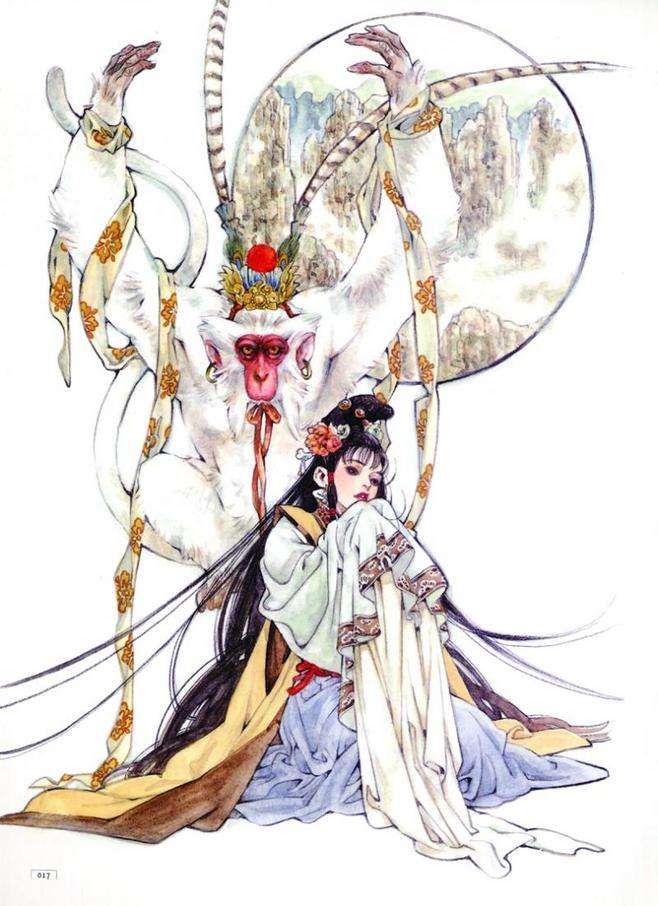
The brief Tang-era tale “A Supplement to Jiang Zong’s Biography of a White Ape” (Bu Jiang Zong Baiyuan Zhuan, 補江總白猿傳, c. late-7th century; “The Supplement” hereafter) tells how the beautiful young wife of General Ouyang He (歐陽紇, 538–570) is kidnapped by a seemingly invisible force while he is engaged in conquering minority groups of the south lands. The general and his men scour the surrounding area for hundreds of li before discovering a mountain where she and other women are being kept by a magic white ape (baiyuan, 白猿) (fig. 1). The captives caution that his soldiers are no match for the powerful primate, and so the ladies devise a plan to get him drunk and incapacitate him long enough for a killing blow to be dealt. With their help, the general manages to fall the beast with a well-placed sword strike below the navel, his only weak spot. Before dying, the ape reveals that the general’s wife is pregnant and begs him not to kill the child. Ouyang subsequently returns to the north with his wife, the other women, and the monster’s priceless treasures. The tale ends with the birth of an unnamed son a year later.
Fig. 1 – A modern drawing of the white ape and General Ouyang He’s wife by Japanese artist Natsuki Sumeragi (皇名月) (larger version). Original image found here. The silken ropes around his wrists refer to those intertwined with hemp and triple-tied to ensure that he can’t break free in the story.
Chen (1998) explains that the original Biography of a White Ape story, purportedly supplemented by the above tale, [1] never existed. The Supplement is actually a standalone piece anonymously published to slander the historical scholar Ouyang Xun (歐陽詢, 557–641), who was known for his legendary monkey-like ugliness and almost supernatural intellect. The tale implies that he was the unnatural offspring of the general’s wife and the magic white ape (p. 76-79).
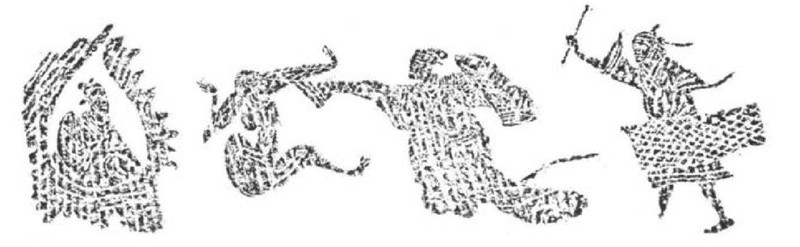
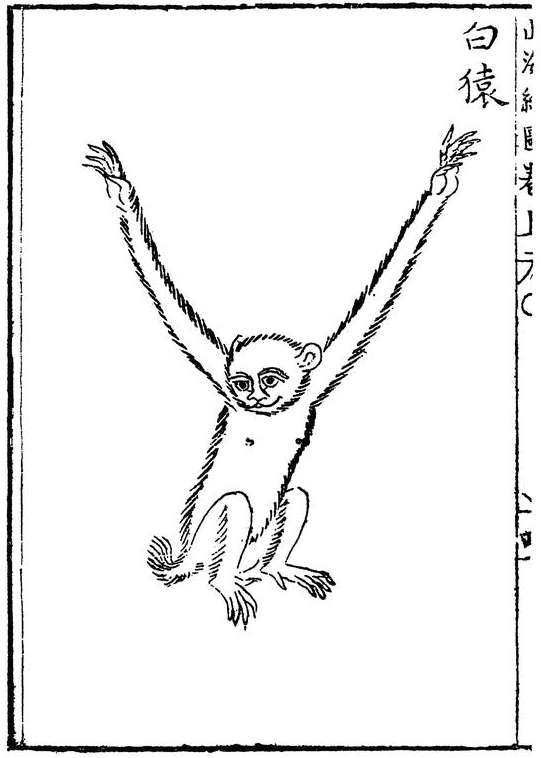
These mischievous simian spirits are known for kidnapping young maidens in tales from the Han to the Song (fig. 2). The mythical creature is based on the gibbon (fig. 3), a small, long-armed, arboreal ape present in East and Southeast Asia (see Gulik, 1967).
Fig. 2 – A Han-era stone tomb rubbing showing a sword-wielding hero striking at a fleeing white ape (center). A woman can be seen held captive in a teardrop-shaped cave (left). The hero is followed by an assistant beating a gong (right) (larger version). From Wu, 1987, p. 88. Fig. 3 – A woodblock print of a “white ape” or gibbon from a Ming version of the Shanhai Jing (larger version).
2. Parallels with Sun Wukong
The Supplement‘s unnamed primate antagonist shares many surprising similarities with Sun Wukong. Both:
Are supernatural primates possessed of human speech.
Are one thousand-year-old practitioners of longevity arts.
Are masters of Daoist magic with the ability to fly and change their appearance.
Are warriors capable of single-handedly defeating an army.
Have an iron-hard, nigh-invulnerable body immune to most efforts to harm them.
Have eyes that flash like lightning.
Live in verdant mountain paradises (like Flower Fruit Mountain).
Reside in caves with stone furniture (like the Water Curtain Cave).
The character and his home, therefore, appear to be an early model for the Monkey King, his abilities, and Flower Fruit Mountain.
3. Translation
Chen (1998) provides a complete translation of the brief tale, along with an informative translator’s introduction. The following PDF was put together from smartphone photos as I don’t currently have access to a scanner.
1) A supplement (bu, 補) is an addendum to an existing body of work, sort of like modern fan fiction. See, for example, A Supplement to the Journey to the West (1640).
Sources
Chen, J. (1998). A supplement to Jiang Zong’s biography of a white ape. Renditions, 49, pp. 76-85.
Chen, J. (2003/2004). Revisiting the yingshe mode of representation in “Supplement to Jiang Zong’s biography of a white ape”. Oriens Extremus, 44, pp. 155-178.
Wu, H. (1987). The earliest pictorial representations of ape tales: An interdisciplinary study of early Chinese narrative art and literature.T’oung Pao LXXIII, pp. 86-112.
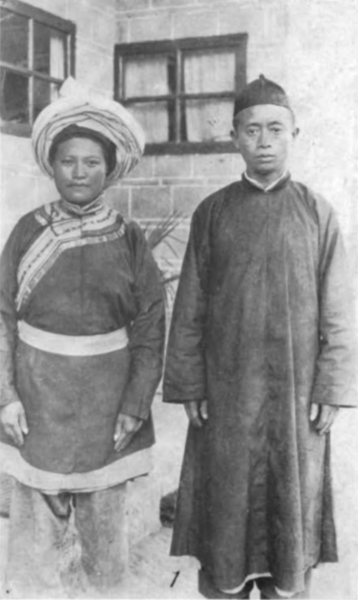
Sun Wukong appears in a body of Buddhist folklore passed on by the Miao ethnic group of Sichuan, also known as the “River Miao” (Chuan Miao, 川苗) or “Old Miao” (Miao: Hmong Bo) (fig. 1). The particular tale is quite different from the popular narrative appearing in Journey to the West (Xiyou ji, 西遊記, 1592). For example, the unnamed monkey tends to a dragon king’s injury and later escorts a Tang dynasty emperor to India.
A Monkey Went Fishing, or Securing Buddhist Sacred Books (97)
The monkey changed into a fisherman and daily went fishing (with a line and hook). He hooked the dragon’s upper lip. When he pulled, the fishhook broke off in the dragon’s upper lip. The dragon’s lip therefore pained him every day. Then every day the dragon king called on his soldiers to go and get a doctor and heal it, but they could not find a doctor.
The monkey daily went to the sand bank to look for his fishhook. One day when he was looking for it two of the dragon king’s soldiers came and asked him, “What are you looking for?” He answered, “I am looking for medicine.” The two soldiers then said, “Old scholar, our old man’s upper lip pains him and he sent us to help him find a doctor. Can you heal him?” The monkey thought, “Probably he has been caught by my fishhook.” He then said, “I can heal it, but I must first look at the injury, then I will give the medicine.” Then the two soldiers invited him to come.
He said, “How can I go since there is so much water?” He had to go down into the water of the stream. The two men then said, “You may get under our fins and close your eyes, and do not open your eyes until we call you.” The monkey wanted to see the dragon, so he closed his two eyes. The two soldiers held him under their fins, and in a short time one of them called him, and he opened his eyes and looked.
When he opened his eyes he had already entered a fine palace. In a little while he heard the soldiers of the dragon king from both sides calling to the dragon king to come and have his wound looked at.
The monkey heard the inside gate resound, “Gu, ga.” He then saw the hands of a big man carrying the dragon king so that he could sit in the chair. Then they requested him to look at the wound. The monkey kowtowed just once to the dragon king and then looked. Then he took a pair of chop sticks and pushed aside the dragon king’s lips, and saw that the fishhook was hooked in the dragon king’s upper lip. Then he took the chopsticks and loosened the fishhook a little. He then asked the dragon king, “Is it any better?” The dragon king answered, “It is a little better.” Then the monkey sat down and rested a little. The dragon king said, “I am afraid that I will die from this illness.”
The monkey said, “You will not die from this sickness. You will certainly recover.” The dragon said, “If you are willing to heal me, I will give you whatever you want.” The monkey then used the chopsticks to push open the lips. Then he seized the fishhook with his chopsticks and with one jerk pulled out the fish book. The lip of the dragon king hurt no longer.
Then the dragon king called to his daughters to entertain the monkey fisherman. The monkey remained there several days. The dragon king was afraid that he [the monkey] was in a hurry and told his soldiers to give him some gold and silver. The monkey said, “I do not want gold and silver. I only want you to permit me to stay here a few days longer.” When the soldiers had reported this to the dragon king, he was glad to have him remain longer. He stayed several months.
One day he was visiting with the women in the palace. The monkey saw a yellow golden club. He then picked it up to play with. He struck with the golden club outside, and the club flew with him to the sea. Then he knew that this club was an ancient golden club. The dragon king did not pursue him.
The monkey lived until the Tang Dynasty, and the Tang Dynasty king wanted to go and get sacred books. But the king could not go himself because the demons and spooks were very numerous along the road. The Tang emperor then sent a messenger to call the monkey to him. The monkey said, “I cannot go. If anybody wants me to go, he must change likenesses with me, and then I will go.”
The Tang emperor himself returned, and for three years sought for a method. One day he came and said to the monkey, “Now I am able to change.” The monkey then requested the Tang emperor to change. The Tang emperor then changed into a big mountain, and the monkey went into the mountain. Then he was unable to come out again. The Tang emperor then said, “Now will you go with me?” The monkey then promised to go with him. Then the Tang emperor lifted aside the written character that had imprisoned him, and then the monkey came out. The monkey then went with the Tang emperor to the western horizon and brought back the sacred books. [79]
[Notes]
79) The Ch’uan Miao said that this is a story about a monkey of some repute, but they did not know his name. It is evidently the monkey god Sen Hou Tzu [Sun houzi, “the monkey Sun”] 孫猴子 or Sen Wu K’ung [Sun Wukong] 孫悟空 (Graham, 1954, p. 211).
2. Story Influences
I suggest that the first three-quarters of the Miao tale draws on the Asian variant of a widely known story cycle in which a fisherman is rewarded for releasing a magic fish (B375.1. Fish returned to the water: grateful, n.d.). This version sees the fisherman release a carp to later discover it was actually the transformed son of a dragon king. He is then rewarded with a magic treasure for his kindness. [1] This cycle is partially played out in another Miao legend in which a fisherman catches a fish, who turns out to be the daughter of the dragon king Ryuang Lan, and later marries her in human form (Graham, 1954, pp. 226-227). In our story, the monkey-turned-fisherman catches the dragon king and then frees him of the hook. He is subsequently rewarded with a prolonged stay in the dragon kingdom and thereafter retrieves the golden club, which is itself a magic treasure.
Fig. 1 (left) – A Miao couple (larger version). She is wearing traditional dress, while he wears that of the Chinese. From Graham, 1954, p. 125. Fig. 2 (right) – Sun Wukong meets the dragon king Ao Guang (larger version). A screenshot from the classic Chinese animation Uproar in Heaven (1961/64).
The Miao story clearly borrows from Journey to the West. The monkey is presented as a shape-shifting immortal, for he changes into a fisherman and lives until the Tang dynasty. His aversion to water in the tale is a common trope throughout the novel, such as when Sun Wukong uses water-propelling magic or relies on others to fight water-based monsters. [2] The golden club is the Monkey King’s “As-you-will” gold-banded staff retrieved from the undersea dragon kingdom. This in turn identifies the dragon king as Ao Guang, the ruler of the Eastern Sea (fig. 2). The unnamed “Tang dynasty emperor,” Tang Taizong in Journey to the West, replaces the monk Tripitaka originally sent to retrieve holy scriptures. The monkey’s imprisonment inside the emperor-turned-mountain is based on Sun’s imprisonment under Five Elements Mountain in the novel, complete with a written amulet weighing the landmass down.
The monarch’s transformation into a mountain is particularly interesting to me, for I don’t recall ever reading any Asian folklore featuring such an event. I know of at least one instance of a hero in ancient European folklore being changed into a mountain as punishment. However, our tale presents the ruler’s transformation as a willing metamorphosis. The Miao consider mountains to be living beings, [3] having “heads, feet, hands, eyes, ears, hearts, breasts, veins, and arteries” (Graham, 1954, p. 9). Therefore, the mountain is a macrocosm of the human body, making the transformation one of degree and not kind. But this portion of the narrative remains a mystery to me as the original intended outcome was “switch[ing] likenesses.” I take this to mean that the monkey would look like the emperor and visa versa. Does this imply that the primate was keen on usurping the throne and the monarch then used his transformation as a deterrent?
3. Monkey Progenitors
The Monkey King’s inclusion in Miao folklore should come as no surprise since monkeys play an important role in their mythology. They believe humans are descended from a pair of monkeys who broke off their tails by accident and eventually evolved human features (Graham, 1954, p. 204). As explained in this article, having a monkey ancestor is a common belief among the various ethnic groups of Tibet and southwestern China. Sun Wukong also appears in the legends of the neighboring (and related) Qiang people of Sichuan.
4. Update
Updated: 04-26-21
Author David Leffman was kind enough to ask his Miao friend of southeast Guizhou about this story. This is their response:
I feel personally that this story is maybe created recently by someone who want to find a reason to give better explanation of her embroidery. In our folk story we have monkey which is smart, used to play prank joke with human being Jiangyang. And Miao don’t have chronology, not even annals, never knew anything about Tang Dynasty which should be aliens for them. And in the history Miao lived away from Han Chinese, almost no contact except those who were called Shu Miao, the cooked ones in west Hunnan and some in east Guizhou, like Sheng Chongwen, the famous writer who grew up in Fenghuang ancient town. Then those Shu Miao may get some influence and confuse those Han Chinese culture as their own.
So it’s possible that the above story is a modern legend influenced by Chinese culture.
Notes:
1) One version appears in the Complete Tale of Guanyin of the Southern Seas (Nanhai Guanyin quanzhuan, 南海觀音全傳), a 16th-century pious novelette detailing Guanyin’s former life as the Princess Miaoshan. After achieving enlightenment, Miaoshan/Guanyin looks to take on disciples. One is a dragon princess (longnu, 龍女) who bestows the Bodhisattva with a magic jewel for saving her brother, a dragon prince who had been caught by a fisherman while transformed into a carp (Idema, 2008, p. 31).
2) The water-propelling magic is first displayed in chapter three when Sun seeks a magic weapon from the underwater dragon kingdom (Wu & Yu, 2012, vol. 1, p. 133). An example of Monkey relying on others to fight a water-based monster happens in chapter 22 when he asks Zhu Bajie to battle Sha Wujing (Wu & Yu, 2012, vol. 1, p. 423).
3) According to Graham (1954), “The Ch’uan Miao regard all things as alive and sentient. The sun, moon, stars, mountains, rivers, rocks, trees, thunder, the echo, the rainbow, homes, fields, plains, recompense or karma, beds, marriage, swords, the harvest, the year…the ceremonial drum, and even the sound of the ceremonial drum are considered to be living things” (p. 9).
Idema, W. L. (2008). Personal Salvation and Filial Piety: Two Precious Scroll Narratives of Guanyin and her Acolytes. Honolulu: University of Hawaii Press.
Wu, C., & Yu, A. (2012). The Journey to the West (Vols. 1-4) (Rev. ed.). Chicago: University of Chicago Press.